IPhO 2018 · Theory problem 1
LIGO-GW150914
In 2015, the gravitational-wave observatory LIGO detected, for the first time, the passing of gravitational waves (GW) through Earth. This event, named GW150914, was triggered by waves produced by two black holes that were orbiting on quasi-circular orbits. This problem will make you estimate some physical parameters of the system, from the properties of the detected signal.
Part A: Newtonian (conservative) orbits (3.0 points)
A.1 1.0pt
Consider a system of two stars with masses \(M_1,M_2\), at locations \(\vec r_1,\vec r_2\), respectively, with respect to the center-of-mass of the system, that is,
\[ M_1\vec r_1+M_2\vec r_2=0\,. \tag{1} \]
The stars are isolated from the rest of the Universe and moving at non-relativistic velocities. Using Newton's laws, the acceleration vector of mass \(M_1\) can be expressed as
\[ \frac{d^2\vec r_1}{dt^2} =-\alpha\frac{\vec r_1}{r_1^n}\,, \tag{2} \]
where \(r_1=|\vec r_1|,r_2=|\vec r_2|\). Find \(n\in\mathbb N\) and \(\alpha=\alpha(G,M_1,M_2)\), where \(G\) is Newton's constant \([G\simeq6.67\times10^{-11}\,\mathrm{N\,m^2\,kg^{-2}}]\).
A.2 1.0pt
The total energy of the 2-mass system, in circular orbits, can be expressed as:
\[ E=A(\mu,\Omega,L)-G\frac{M\mu}{L}\,, \tag{3} \]
where
\[ \mu\equiv\frac{M_1M_2}{M_1+M_2}\,, \qquad M\equiv M_1+M_2\,, \tag{4} \]
are the reduced mass and total mass of the system, \(\Omega\) is the angular velocity of each mass and \(L\) is the total separation \(L=r_1+r_2\). Obtain the explicit form of the term \(A(\mu,\Omega,L)\).
A.3 1.0pt
Equation 3 can be simplified to \(E=\beta G\frac{M\mu}{L}\). Determine the number \(\beta\).
Part B: Introducing relativistic dissipation (7.0 points)
The correct theory of gravity, General Relativity, was formulated by Einstein in 1915, and predicts that gravity travels with the speed of light. The messengers carrying information about the interaction are called GWs. GWs are emitted whenever masses are accelerated, making the system of masses lose energy.
Consider a system of two point-like particles, isolated from the rest of the Universe. Einstein proved that for small enough velocities the emitted GWs: 1) have a frequency which is twice as large as the orbital frequency; 2) can be characterized by a luminosity, i.e. emitted power \(\mathcal P\), which is dominated by Einstein's quadrupole formula,
\[ \mathcal P=\frac{G}{5c^5} \sum_{i=1}^{3}\sum_{j=1}^{3} \left(\frac{d^3Q_{ij}}{dt^3}\right) \left(\frac{d^3Q_{ij}}{dt^3}\right)\,. \tag{5} \]
Here, \(c\) is the velocity of light \(c\simeq3\times10^8\,\mathrm{m/s}\). For a system of 2 pointlike particles orbiting on the \(x-y\) plane, \(Q_{ij}\) is the following table (\(i,j\) label the row/column number)
\[ \begin{aligned} Q_{11}&=\sum_{A=1}^{2}\frac{M_A}{3}(2x_A^2-y_A^2)\,,\\ Q_{22}&=\sum_{A=1}^{2}\frac{M_A}{3}(2y_A^2-x_A^2)\,,\\ Q_{33}&=-\sum_{A=1}^{2}\frac{M_A}{3}(x_A^2+y_A^2)\,, \end{aligned} \tag{6} \]
\[ Q_{12}=Q_{21}=\sum_{A=1}^{2}M_Ax_Ay_A\,, \tag{7} \]
and \(Q_{ij}=0\) for all other possibilities. Here, \((x_A,y_A)\) is the position of mass A in the center-of-mass frame.
B.1 1.0pt
For the circular orbits described in A.2 the components of \(Q_{ij}\) can be expressed as a function of time \(t\) as:
\[ Q_{ii}=\frac{\mu L^2}{2}(a_i+b_i\cos kt)\,, \qquad Q_{ij}\overset{i\ne j}{=}\frac{\mu L^2}{2}c_{ij}\sin kt\,. \tag{8} \]
Determine \(k\) in terms of \(\Omega\) and the numerical values of the constants \(a_i,b_i,c_{ij}\).
B.2 1.0pt
Compute the power \(\mathcal P\) emitted in gravitational waves for that system, and obtain:
\[ \mathcal P=\xi\frac{G}{c^5}\mu^2L^4\Omega^6\,. \tag{9} \]
What is the number \(\xi\)? [If you could not obtain \(\xi\), use \(\xi=6.4\) in the following.]
B.3 1.0pt
In the absence of GW emission the two masses will orbit on a fixed circular orbit indefinitely. However, the emission of GWs causes the system to lose energy and to slowly evolve towards smaller circular orbits. Obtain that the rate of change \(\frac{d\Omega}{dt}\) of the orbital angular velocity takes the form
\[ \left(\frac{d\Omega}{dt}\right)^3 =(3\xi)^3\frac{\Omega^{11}}{c^{15}}(GM_c)^5\,, \tag{10} \]
where \(M_c\) is called the chirp mass. Obtain \(M_c\) as a function of \(M\) and \(\mu\). This mass determines the increase in frequency during the orbital decay. [The name "chirp" is inspired by the high pitch sound (increasing frequency) produced by small birds.]
B.4 2.0pt
Using the information provided above, relate the orbital angular velocity \(\Omega\) with the GW frequency \(f_{\mathrm{GW}}\). Knowing that, for any smooth function \(F(t)\) and \(a\ne1\),
\[ \frac{dF(t)}{dt}=\chi F(t)^a \quad\Rightarrow\quad F(t)^{1-a}=\chi(1-a)(t-t_0)\,, \tag{11} \]
where \(\chi\) is a constant and \(t_0\) is an integration constant, show that (10) implies that the GW frequency is
\[ f_{\mathrm{GW}}^{-8/3} =8\pi^{8/3}\xi \left(\frac{GM_c}{c^3}\right)^{(2/3)+p} (t_0-t)^{2-p} \tag{12} \]
and determine the constant \(p\).
On September 14, 2015 GW150914 was registered by the LIGO detectors, consisting of two L-shaped arms, each 4 km long. These arms changed by a relative length according to Fig. 1. The arms of the detector respond linearly to a passing gravitational wave, and the response pattern mimics the wave. This wave was created by two black holes on quasi-circular orbits; the loss of energy through gravitational radiation caused the orbit to shrink and the black holes to eventually collide. The collision point corresponds, roughly, to the peak of the signal after point D, in Fig. 1.
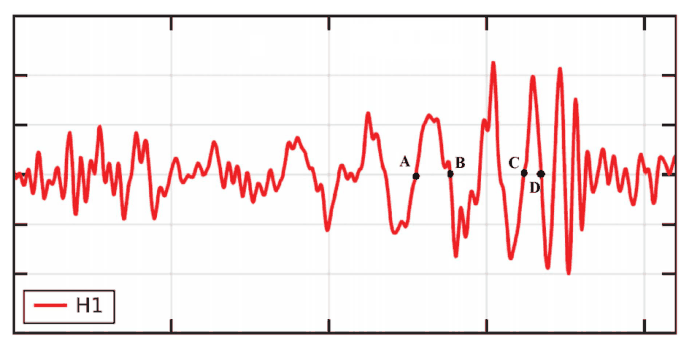
Figure 1. Strain, i.e. relative variation of the size of each arm, at the LIGO detector H1. The horizontal axis is time, and the points A, B, C, D correspond to \(t=0.000,0.009,0.034,0.040\) seconds, respectively.
B.5 1.0pt
From the figure, estimate \(f_{\mathrm{GW}}(t)\) at
\[ t_{\overline{\mathrm{AB}}}=\frac{t_{\mathrm B}+t_{\mathrm A}}{2} \qquad\text{and}\qquad t_{\overline{\mathrm{CD}}}=\frac{t_{\mathrm D}+t_{\mathrm C}}{2}\,. \tag{13} \]
Assuming that (12) is valid all the way until the collision (which strictly speaking is not true) and that the two objects have equal mass, estimate the chirp mass, \(M_c\), and total mass of the system, in terms of solar masses \(M_\odot\simeq2\times10^{30}\,\mathrm{kg}\).
B.6 1.0pt
Estimate the minimal orbital separation between the two objects at \(t_{\overline{\mathrm{CD}}}\). Hence estimate a maximum size for each object, \(R_{\max}\). Obtain \(R_\odot/R_{\max}\) to compare this size with the radius of our Sun, \(R_\odot\simeq7\times10^5\,\mathrm{km}\). Estimate also their orbital linear velocity at the same instant, \(v_{\mathrm{col}}\), comparing it with the speed of light, \(v_{\mathrm{col}}/c\).
Conclude that these are extremely fast moving, extremely compact objects indeed!
Official English text of the problem.
Answers
- A.1: \(\displaystyle n=3,\qquad \alpha=\frac{GM_2^3}{(M_1+M_2)^2}\).
- A.2: \(\displaystyle A(\mu,\Omega,L)=\frac12\mu\Omega^2L^2\).
- A.3: \(\displaystyle \beta=-\frac12\).
- B.1: With the masses on the \(x\)-axis at \(t=0\) and counterclockwise orbital motion, \[ k=2\Omega,\qquad (a_1,a_2,a_3)=\left(\frac13,\frac13,-\frac23\right),\qquad (b_1,b_2,b_3)=(1,-1,0). \] Also, \(c_{12}=c_{21}=1\); all other off-diagonal \(c_{ij}\) vanish.
- B.2: \(\displaystyle \xi=\frac{32}{5}=6.4,\qquad \mathcal P=\frac{32G}{5c^5}\mu^2L^4\Omega^6\).
- B.3: \(\displaystyle M_c=\mu^{3/5}M^{2/5}\), with \[ \frac{d\Omega}{dt} =3\xi\frac{(GM_c)^{5/3}}{c^5}\Omega^{11/3}. \]
- B.4: \(\displaystyle f_{\mathrm{GW}}=\frac{\Omega}{\pi},\qquad p=1\), and \[ f_{\mathrm{GW}}^{-8/3} =8\pi^{8/3}\xi \left(\frac{GM_c}{c^3}\right)^{5/3}(t_0-t). \]
- B.5: \(\displaystyle f_{\mathrm{GW}}(0.0045\,\mathrm s)\simeq56\,\mathrm{Hz}\), \(\displaystyle f_{\mathrm{GW}}(0.037\,\mathrm s)\simeq83\,\mathrm{Hz}\); \(\displaystyle M_c\simeq30M_\odot,\quad M\simeq69M_\odot\).
- B.6: \(\displaystyle L_{\min}\simeq5.1\times10^2\,\mathrm{km}\), \(\displaystyle R_{\max}\simeq2.6\times10^2\,\mathrm{km}\), \(\displaystyle R_\odot/R_{\max}\simeq2.7\times10^3\). Each object's orbital speed is \(\displaystyle v_{\mathrm{col}}\simeq6.7\times10^7\,\mathrm{m/s}\), so \(\displaystyle v_{\mathrm{col}}/c\simeq0.22\).
Solution
A.1
Newton's law of gravitation gives the acceleration of the first star:
\[ \frac{d^2\vec r_1}{dt^2} =-GM_2\frac{\vec r_1-\vec r_2}{|\vec r_1-\vec r_2|^3}. \]
The center-of-mass condition implies
\[ \vec r_2=-\frac{M_1}{M_2}\vec r_1, \qquad \vec r_1-\vec r_2 =\frac{M_1+M_2}{M_2}\vec r_1. \]
Consequently,
\[ \frac{d^2\vec r_1}{dt^2} =-\frac{GM_2^3}{(M_1+M_2)^2}\frac{\vec r_1}{r_1^3}. \]
Comparison with (2) gives
\[ \boxed{n=3,\qquad \alpha=\frac{GM_2^3}{(M_1+M_2)^2}}. \]
A.2
The center-of-mass condition and \(L=r_1+r_2\) give
\[ r_1=\frac{M_2}{M}L, \qquad r_2=\frac{M_1}{M}L. \]
The stars have orbital speeds \(v_1=\Omega r_1\) and \(v_2=\Omega r_2\). Their total kinetic energy is therefore
\[ \begin{aligned} T &=\frac12 M_1\Omega^2r_1^2+\frac12 M_2\Omega^2r_2^2\\ &=\frac12\Omega^2L^2 \left(\frac{M_1M_2^2+M_2M_1^2}{M^2}\right)\\ &=\frac12\mu\Omega^2L^2. \end{aligned} \]
The gravitational potential energy, taking zero at infinite separation, is
\[ U=-\frac{GM_1M_2}{L}=-\frac{GM\mu}{L}. \]
Thus the term \(A\) is the kinetic energy:
\[ \boxed{A(\mu,\Omega,L)=\frac12\mu\Omega^2L^2}. \]
A.3
For the first star, gravity supplies the centripetal force:
\[ M_1\Omega^2r_1=\frac{GM_1M_2}{L^2}. \]
Using \(r_1=M_2L/M\), we obtain the circular-orbit relation
\[ \boxed{\Omega^2=\frac{GM}{L^3}}. \]
Hence
\[ T=\frac12\mu\Omega^2L^2=\frac{GM\mu}{2L}, \]
and
\[ E=T+U =\frac{GM\mu}{2L}-\frac{GM\mu}{L} =-\frac{GM\mu}{2L}. \]
Therefore,
\[ \boxed{\beta=-\frac12}. \]
B.1
Choose the time origin so that the first mass lies on the positive \(x\)-axis at \(t=0\), with counterclockwise motion. Then
\[ \begin{aligned} (x_1,y_1)&=(r_1\cos\Omega t,\ r_1\sin\Omega t),\\ (x_2,y_2)&=(-r_2\cos\Omega t,\ -r_2\sin\Omega t). \end{aligned} \]
From A.2,
\[ M_1r_1^2+M_2r_2^2=\mu L^2. \]
Substitution into the quadrupole components gives
\[ \begin{aligned} Q_{11} &=\frac{\mu L^2}{3}(2\cos^2\Omega t-\sin^2\Omega t) =\frac{\mu L^2}{2}\left(\frac13+\cos2\Omega t\right),\\ Q_{22} &=\frac{\mu L^2}{3}(2\sin^2\Omega t-\cos^2\Omega t) =\frac{\mu L^2}{2}\left(\frac13-\cos2\Omega t\right),\\ Q_{33} &=-\frac{\mu L^2}{3} =\frac{\mu L^2}{2}\left(-\frac23\right),\\ Q_{12}=Q_{21} &=\mu L^2\cos\Omega t\sin\Omega t =\frac{\mu L^2}{2}\sin2\Omega t. \end{aligned} \]
Thus
\[ \boxed{k=2\Omega}. \]
The diagonal coefficients are
| \(i\) | \(a_i\) | \(b_i\) |
|---|---|---|
| \(1\) | \(1/3\) | \(1\) |
| \(2\) | \(1/3\) | \(-1\) |
| \(3\) | \(-2/3\) | \(0\) |
The off-diagonal coefficients are
\[ \boxed{c_{12}=c_{21}=1,\qquad c_{13}=c_{31}=c_{23}=c_{32}=0}. \]
B.2
Write \(q=\mu L^2/2\) and \(k=2\Omega\). For the circular orbit, the nonzero third derivatives are
\[ \begin{aligned} \dddot Q_{11}&=qk^3\sin kt,\\ \dddot Q_{22}&=-qk^3\sin kt,\\ \dddot Q_{12}=\dddot Q_{21}&=-qk^3\cos kt. \end{aligned} \]
Both off-diagonal entries contribute to the double sum. Therefore,
\[ \begin{aligned} \sum_{i,j}(\dddot Q_{ij})^2 &=2q^2k^6\sin^2kt+2q^2k^6\cos^2kt\\ &=2q^2k^6\\ &=2\left(\frac{\mu L^2}{2}\right)^2(2\Omega)^6\\ &=32\mu^2L^4\Omega^6. \end{aligned} \]
The luminosity is consequently
\[ \boxed{\mathcal P =\frac{32G}{5c^5}\mu^2L^4\Omega^6}, \qquad \boxed{\xi=\frac{32}{5}=6.4}. \]
The result is independent of orbital phase.
B.3
We approximate the inspiral as a slowly evolving sequence of circular orbits. The masses remain constant, and the energy carried away by the waves obeys
\[ \frac{dE}{dt}=-\mathcal P. \]
Eliminating \(L\) with the circular-orbit relation,
\[ L=(GM)^{1/3}\Omega^{-2/3}, \]
gives
\[ E=-\frac12\mu(GM)^{2/3}\Omega^{2/3}. \]
Its time derivative is
\[ \frac{dE}{dt} =-\frac13\mu(GM)^{2/3}\Omega^{-1/3}\frac{d\Omega}{dt}. \]
The luminosity, expressed in terms of \(\Omega\), is
\[ \mathcal P =\xi\frac{G}{c^5}\mu^2(GM)^{4/3}\Omega^{10/3}. \]
Equating the energy-loss rate to \(-\mathcal P\) yields
\[ \frac{d\Omega}{dt} =3\xi\frac{G^{5/3}\mu M^{2/3}}{c^5}\Omega^{11/3}. \]
Cubing,
\[ \left(\frac{d\Omega}{dt}\right)^3 =(3\xi)^3\frac{\Omega^{11}}{c^{15}}G^5\mu^3M^2. \]
This has the required form if
\[ M_c^5=\mu^3M^2. \]
Thus
\[ \boxed{M_c=\mu^{3/5}M^{2/5} =\frac{(M_1M_2)^{3/5}}{(M_1+M_2)^{1/5}}}. \]
In particular, \(d\Omega/dt>0\): as the system loses energy, its orbit shrinks and its orbital frequency increases.
B.4
The orbital frequency is \(f_{\mathrm{orb}}=\Omega/(2\pi)\). The given factor of two between GW and orbital frequencies therefore implies
\[ \boxed{f_{\mathrm{GW}}=2f_{\mathrm{orb}}=\frac{\Omega}{\pi}}. \]
Taking the positive cube root of (10),
\[ \frac{d\Omega}{dt} =3\xi\frac{(GM_c)^{5/3}}{c^5}\Omega^{11/3}. \]
With \(\Omega=\pi f_{\mathrm{GW}}\), this becomes
\[ \frac{df_{\mathrm{GW}}}{dt} =3\xi\pi^{8/3} \left(\frac{GM_c}{c^3}\right)^{5/3} f_{\mathrm{GW}}^{11/3}. \]
Using (11) with \(a=11/3\), or directly differentiating \(f_{\mathrm{GW}}^{-8/3}\), gives
\[ \frac{d}{dt}\left(f_{\mathrm{GW}}^{-8/3}\right) =-8\xi\pi^{8/3} \left(\frac{GM_c}{c^3}\right)^{5/3}. \]
Integration yields
\[ \boxed{ f_{\mathrm{GW}}^{-8/3} =8\pi^{8/3}\xi \left(\frac{GM_c}{c^3}\right)^{5/3}(t_0-t) }. \]
Comparing the exponents with (12),
\[ \frac23+p=\frac53,\qquad 2-p=1, \]
so
\[ \boxed{p=1}. \]
Here \(t_0\) is the formal time at which this approximate inspiral model predicts a divergent frequency.
B.5
A and B mark consecutive zero crossings on either side of one positive crest; C and D do likewise for a later crest. Each interval therefore spans approximately half a GW cycle.
Approximating the frequency over each short interval by its midpoint value,
\[ f_{\mathrm{GW}}(t_{\overline{\mathrm{AB}}}) \simeq\frac{1}{2(t_{\mathrm B}-t_{\mathrm A})} =\frac{1}{2(0.009\,\mathrm s)} \simeq55.6\,\mathrm{Hz}, \]
\[ f_{\mathrm{GW}}(t_{\overline{\mathrm{CD}}}) \simeq\frac{1}{2(t_{\mathrm D}-t_{\mathrm C})} =\frac{1}{2(0.006\,\mathrm s)} \simeq83.3\,\mathrm{Hz}. \]
The corresponding times are
\[ t_{\overline{\mathrm{AB}}}=0.0045\,\mathrm s, \qquad t_{\overline{\mathrm{CD}}}=0.037\,\mathrm s, \]
so their difference is \(0.0325\,\mathrm s\).
Let \(f_{\mathrm{AB}}\) and \(f_{\mathrm{CD}}\) denote these frequency estimates. Subtracting the B.4 relation evaluated at the two times eliminates \(t_0\):
\[ f_{\mathrm{AB}}^{-8/3}-f_{\mathrm{CD}}^{-8/3} = 8\pi^{8/3}\xi \left(\frac{GM_c}{c^3}\right)^{5/3} \left(t_{\overline{\mathrm{CD}}}-t_{\overline{\mathrm{AB}}}\right). \]
Solving for the chirp mass,
\[ M_c=\frac{c^3}{G} \left[ \frac{f_{\mathrm{AB}}^{-8/3}-f_{\mathrm{CD}}^{-8/3}} {8\pi^{8/3}\xi \left(t_{\overline{\mathrm{CD}}}-t_{\overline{\mathrm{AB}}}\right)} \right]^{3/5}. \]
Using the supplied constants and \(\xi=6.4\),
\[ M_c\simeq6.02\times10^{31}\,\mathrm{kg}, \]
or, to appropriate precision,
\[ \boxed{M_c\simeq30M_\odot}. \]
For equal component masses, \(M_1=M_2=M/2\), so
\[ \mu=\frac{M}{4}, \qquad M_c=\left(\frac M4\right)^{3/5}M^{2/5} =\frac{M}{4^{3/5}}. \]
Thus
\[ M=4^{3/5}M_c \simeq1.38\times10^{32}\,\mathrm{kg}, \]
and
\[ \boxed{M\simeq69M_\odot}. \]
Each component therefore has a mass of approximately \(35M_\odot\).
B.6
At the later measured time,
\[ \Omega_{\overline{\mathrm{CD}}} =\pi f_{\mathrm{CD}} \simeq2.62\times10^2\,\mathrm{rad/s}. \]
The circular-orbit relation gives
\[ L=\left(\frac{GM}{\Omega_{\overline{\mathrm{CD}}}^2}\right)^{1/3}. \]
The equal-mass choice also gives the minimum total mass, and hence the minimum separation, compatible with the inferred chirp mass and frequency. Indeed,
\[ \frac{\mu}{M}=\frac{M_1M_2}{(M_1+M_2)^2}\le\frac14, \]
so
\[ M_c=M\left(\frac{\mu}{M}\right)^{3/5} \le\frac{M}{4^{3/5}}. \]
Equality holds for equal masses. Using the mass found in B.5,
\[ L_{\min} \simeq \left[ \frac{(6.67\times10^{-11})(1.383\times10^{32})} {(2.618\times10^2)^2} \right]^{1/3}\mathrm m, \]
which gives
\[ \boxed{L_{\min}\simeq5.1\times10^5\,\mathrm m =5.1\times10^2\,\mathrm{km}}. \]
Using a common radius for the equal-mass objects, their remaining distinct requires approximately \(2R\lesssim L\). Hence
\[ \boxed{R_{\max}\simeq\frac{L_{\min}}2 \simeq2.6\times10^2\,\mathrm{km}}. \]
The comparison with the Sun is
\[ \frac{R_\odot}{R_{\max}} \simeq\frac{7\times10^5\,\mathrm{km}} {2.56\times10^2\,\mathrm{km}}, \]
so
\[ \boxed{\frac{R_\odot}{R_{\max}}\simeq2.7\times10^3}. \]
Each object orbits the center of mass at radius \(L/2\). Its orbital speed at this instant is therefore
\[ v_{\mathrm{col}} =\Omega_{\overline{\mathrm{CD}}}\frac{L}{2} \simeq(2.618\times10^2)(2.562\times10^5)\,\mathrm{m/s}, \]
giving
\[ \boxed{v_{\mathrm{col}}\simeq6.7\times10^7\,\mathrm{m/s}}, \qquad \boxed{\frac{v_{\mathrm{col}}}{c}\simeq0.22}. \]
Thus each object contains roughly \(35\) solar masses within a radius no greater than about \(260\,\mathrm{km}\), while moving at about one fifth of the speed of light. These are extremely compact and fast-moving objects. The numerical estimates use the stipulated Newtonian circular-orbit and quadrupole approximations, whose accuracy deteriorates near merger.
The solution was checked against the official solution.
IPhO 2018 · Theorieaufgabe 1
LIGO-GW150914
Im Jahr 2015 registrierte das Gravitationswellenobservatorium LIGO erstmals den Durchgang von Gravitationswellen (GW) durch die Erde. Dieses Ereignis mit der Bezeichnung GW150914 wurde durch Wellen ausgelöst, die von zwei schwarzen Löchern auf nahezu kreisförmigen Umlaufbahnen erzeugt wurden. In dieser Aufgabe werden Sie aus den Eigenschaften des gemessenen Signals einige physikalische Parameter des Systems abschätzen.
Teil A: Newtonsche (konservative) Umlaufbahnen (3.0 Punkte)
A.1 1.0 Punkte
Betrachten Sie ein System aus zwei Sternen mit den Massen \(M_1,M_2\), die sich bezüglich des Schwerpunkts des Systems an den Orten \(\vec r_1,\vec r_2\) befinden, das heißt,
\[ M_1\vec r_1+M_2\vec r_2=0\,. \tag{1} \]
Die Sterne sind vom Rest des Universums isoliert und bewegen sich mit nichtrelativistischen Geschwindigkeiten. Mithilfe der Newtonschen Gesetze lässt sich der Beschleunigungsvektor der Masse \(M_1\) ausdrücken als
\[ \frac{d^2\vec r_1}{dt^2} =-\alpha\frac{\vec r_1}{r_1^n}\,, \tag{2} \]
wobei \(r_1=|\vec r_1|,r_2=|\vec r_2|\). Bestimmen Sie \(n\in\mathbb N\) und \(\alpha=\alpha(G,M_1,M_2)\), wobei \(G\) die Newtonsche Gravitationskonstante ist \([G\simeq6.67\times10^{-11}\,\mathrm{N\,m^2\,kg^{-2}}]\).
A.2 1.0 Punkte
Die Gesamtenergie des Systems aus zwei Massen auf Kreisbahnen lässt sich ausdrücken als:
\[ E=A(\mu,\Omega,L)-G\frac{M\mu}{L}\,, \tag{3} \]
wobei
\[ \mu\equiv\frac{M_1M_2}{M_1+M_2}\,, \qquad M\equiv M_1+M_2\,, \tag{4} \]
die reduzierte Masse und die Gesamtmasse des Systems sind, \(\Omega\) die Winkelgeschwindigkeit jeder Masse ist und \(L\) den gesamten Abstand \(L=r_1+r_2\) bezeichnet. Bestimmen Sie die explizite Form des Terms \(A(\mu,\Omega,L)\).
A.3 1.0 Punkte
Gleichung 3 lässt sich zu \(E=\beta G\frac{M\mu}{L}\) vereinfachen. Bestimmen Sie die Zahl \(\beta\).
Teil B: Einführung relativistischer Dissipation (7.0 Punkte)
Die korrekte Gravitationstheorie, die allgemeine Relativitätstheorie, wurde 1915 von Einstein formuliert und sagt voraus, dass sich die Gravitation mit Lichtgeschwindigkeit ausbreitet. Die Träger der Information über die Wechselwirkung werden GW genannt. GW werden immer dann ausgesendet, wenn Massen beschleunigt werden, wodurch das System aus diesen Massen Energie verliert.
Betrachten Sie ein System aus zwei punktförmigen Teilchen, das vom Rest des Universums isoliert ist. Einstein bewies, dass die ausgesendeten GW bei hinreichend kleinen Geschwindigkeiten: 1) eine Frequenz haben, die doppelt so groß wie die Umlauffrequenz ist; 2) durch eine Leuchtkraft, also eine abgestrahlte Leistung \(\mathcal P\), charakterisiert werden können, deren dominierender Beitrag durch Einsteins Quadrupolformel gegeben ist,
\[ \mathcal P=\frac{G}{5c^5} \sum_{i=1}^{3}\sum_{j=1}^{3} \left(\frac{d^3Q_{ij}}{dt^3}\right) \left(\frac{d^3Q_{ij}}{dt^3}\right)\,. \tag{5} \]
Hier ist \(c\) die Lichtgeschwindigkeit \(c\simeq3\times10^8\,\mathrm{m/s}\). Für ein System aus zwei punktförmigen Teilchen, die in der \(x-y\)-Ebene umlaufen, ist \(Q_{ij}\) durch die folgende Tabelle gegeben (\(i,j\) bezeichnen die Zeilen- bzw. Spaltennummer)
\[ \begin{aligned} Q_{11}&=\sum_{A=1}^{2}\frac{M_A}{3}(2x_A^2-y_A^2)\,,\\ Q_{22}&=\sum_{A=1}^{2}\frac{M_A}{3}(2y_A^2-x_A^2)\,,\\ Q_{33}&=-\sum_{A=1}^{2}\frac{M_A}{3}(x_A^2+y_A^2)\,, \end{aligned} \tag{6} \]
\[ Q_{12}=Q_{21}=\sum_{A=1}^{2}M_Ax_Ay_A\,, \tag{7} \]
und \(Q_{ij}=0\) für alle anderen Kombinationen. Hier ist \((x_A,y_A)\) die Position der Masse A im Schwerpunktsystem.
B.1 1.0 Punkte
Für die in A.2 beschriebenen Kreisbahnen lassen sich die Komponenten von \(Q_{ij}\) als Funktion der Zeit \(t\) ausdrücken als:
\[ Q_{ii}=\frac{\mu L^2}{2}(a_i+b_i\cos kt)\,, \qquad Q_{ij}\overset{i\ne j}{=}\frac{\mu L^2}{2}c_{ij}\sin kt\,. \tag{8} \]
Bestimmen Sie \(k\) in Abhängigkeit von \(\Omega\) sowie die Zahlenwerte der Konstanten \(a_i,b_i,c_{ij}\).
B.2 1.0 Punkte
Berechnen Sie die von diesem System in Form von Gravitationswellen abgestrahlte Leistung \(\mathcal P\), und leiten Sie her:
\[ \mathcal P=\xi\frac{G}{c^5}\mu^2L^4\Omega^6\,. \tag{9} \]
Welchen Wert hat die Zahl \(\xi\)? [Falls Sie \(\xi\) nicht bestimmen konnten, verwenden Sie im Folgenden \(\xi=6.4\).]
B.3 1.0 Punkte
Ohne die Emission von GW würden die beiden Massen unbegrenzt auf einer unveränderlichen Kreisbahn umlaufen. Durch die Emission von GW verliert das System jedoch Energie und geht langsam zu kleineren Kreisbahnen über. Zeigen Sie, dass die Änderungsrate \(\frac{d\Omega}{dt}\) der Bahnwinkelgeschwindigkeit die Form
\[ \left(\frac{d\Omega}{dt}\right)^3 =(3\xi)^3\frac{\Omega^{11}}{c^{15}}(GM_c)^5\,, \tag{10} \]
annimmt, wobei \(M_c\) als Chirp-Masse bezeichnet wird. Bestimmen Sie \(M_c\) als Funktion von \(M\) und \(\mu\). Diese Masse bestimmt die Zunahme der Frequenz während des Schrumpfens der Umlaufbahn. [Die Bezeichnung „Chirp“ ist vom hohen Zwitschern (mit zunehmender Frequenz) kleiner Vögel inspiriert.]
B.4 2.0 Punkte
Stellen Sie mithilfe der oben gegebenen Informationen den Zusammenhang zwischen der Bahnwinkelgeschwindigkeit \(\Omega\) und der GW-Frequenz \(f_{\mathrm{GW}}\) her. Für jede glatte Funktion \(F(t)\) und \(a\ne1\) gilt
\[ \frac{dF(t)}{dt}=\chi F(t)^a \quad\Rightarrow\quad F(t)^{1-a}=\chi(1-a)(t-t_0)\,, \tag{11} \]
wobei \(\chi\) eine Konstante und \(t_0\) eine Integrationskonstante ist. Zeigen Sie damit, dass aus (10) für die GW-Frequenz
\[ f_{\mathrm{GW}}^{-8/3} =8\pi^{8/3}\xi \left(\frac{GM_c}{c^3}\right)^{(2/3)+p} (t_0-t)^{2-p} \tag{12} \]
folgt, und bestimmen Sie die Konstante \(p\).
Am 14. September 2015 wurde GW150914 von den LIGO-Detektoren registriert, die aus zwei L-förmig angeordneten Armen von jeweils 4 km Länge bestehen. Die relative Längenänderung dieser Arme ist in Abb. 1 dargestellt. Die Arme des Detektors reagieren linear auf eine durchlaufende Gravitationswelle, und der Verlauf ihrer Reaktion bildet die Welle nach. Diese Welle wurde von zwei schwarzen Löchern auf nahezu kreisförmigen Umlaufbahnen erzeugt; der Energieverlust durch Gravitationsstrahlung führte dazu, dass die Umlaufbahn schrumpfte und die schwarzen Löcher schließlich kollidierten. Der Zeitpunkt der Kollision entspricht ungefähr dem Maximum des Signals nach Punkt D in Abb. 1.
Abbildung 1. Dehnung, also die relative Längenänderung jedes Arms, am LIGO-Detektor H1. Die horizontale Achse zeigt die Zeit, und die Punkte A, B, C, D entsprechen den Zeiten \(t=0.000,0.009,0.034,0.040\) Sekunden.
B.5 1.0 Punkte
Schätzen Sie anhand der Abbildung \(f_{\mathrm{GW}}(t)\) zu den Zeitpunkten
\[ t_{\overline{\mathrm{AB}}}=\frac{t_{\mathrm B}+t_{\mathrm A}}{2} \qquad\text{und}\qquad t_{\overline{\mathrm{CD}}}=\frac{t_{\mathrm D}+t_{\mathrm C}}{2}\,. \tag{13} \]
Nehmen Sie an, dass (12) bis zur Kollision gültig bleibt (was streng genommen nicht zutrifft) und dass die beiden Objekte die gleiche Masse haben. Schätzen Sie die Chirp-Masse \(M_c\) und die Gesamtmasse des Systems in Einheiten der Sonnenmasse \(M_\odot\simeq2\times10^{30}\,\mathrm{kg}\).
B.6 1.0 Punkte
Schätzen Sie den minimalen Bahnabstand zwischen den beiden Objekten zum Zeitpunkt \(t_{\overline{\mathrm{CD}}}\). Schätzen Sie daraus eine maximale Größe für jedes Objekt, \(R_{\max}\). Bestimmen Sie \(R_\odot/R_{\max}\), um diese Größe mit dem Radius unserer Sonne, \(R_\odot\simeq7\times10^5\,\mathrm{km}\), zu vergleichen. Schätzen Sie auch ihre lineare Bahngeschwindigkeit zu diesem Zeitpunkt, \(v_{\mathrm{col}}\), und vergleichen Sie diese mit der Lichtgeschwindigkeit, \(v_{\mathrm{col}}/c\).
Schließen Sie daraus, dass es sich tatsächlich um extrem schnell bewegte, extrem kompakte Objekte handelt!
Aufgabentext aus dem offiziellen englischen Text übersetzt.
Antworten
- A.1: \(\displaystyle n=3,\qquad \alpha=\frac{GM_2^3}{(M_1+M_2)^2}\).
- A.2: \(\displaystyle A(\mu,\Omega,L)=\frac12\mu\Omega^2L^2\).
- A.3: \(\displaystyle \beta=-\frac12\).
- B.1: Wenn die Massen bei \(t=0\) auf der \(x\)-Achse liegen und gegen den Uhrzeigersinn umlaufen, \[ k=2\Omega,\qquad (a_1,a_2,a_3)=\left(\frac13,\frac13,-\frac23\right),\qquad (b_1,b_2,b_3)=(1,-1,0). \] Außerdem gilt \(c_{12}=c_{21}=1\); alle anderen außerdiagonalen \(c_{ij}\) verschwinden.
- B.2: \(\displaystyle \xi=\frac{32}{5}=6.4,\qquad \mathcal P=\frac{32G}{5c^5}\mu^2L^4\Omega^6\).
- B.3: \(\displaystyle M_c=\mu^{3/5}M^{2/5}\), mit \[ \frac{d\Omega}{dt} =3\xi\frac{(GM_c)^{5/3}}{c^5}\Omega^{11/3}. \]
- B.4: \(\displaystyle f_{\mathrm{GW}}=\frac{\Omega}{\pi},\qquad p=1\), und \[ f_{\mathrm{GW}}^{-8/3} =8\pi^{8/3}\xi \left(\frac{GM_c}{c^3}\right)^{5/3}(t_0-t). \]
- B.5: \(\displaystyle f_{\mathrm{GW}}(0.0045\,\mathrm s)\simeq56\,\mathrm{Hz}\), \(\displaystyle f_{\mathrm{GW}}(0.037\,\mathrm s)\simeq83\,\mathrm{Hz}\); \(\displaystyle M_c\simeq30M_\odot,\quad M\simeq69M_\odot\).
- B.6: \(\displaystyle L_{\min}\simeq5.1\times10^2\,\mathrm{km}\), \(\displaystyle R_{\max}\simeq2.6\times10^2\,\mathrm{km}\), \(\displaystyle R_\odot/R_{\max}\simeq2.7\times10^3\). Die Bahngeschwindigkeit jedes Objekts beträgt \(\displaystyle v_{\mathrm{col}}\simeq6.7\times10^7\,\mathrm{m/s}\), also \(\displaystyle v_{\mathrm{col}}/c\simeq0.22\).
Lösung
A.1
Das Newtonsche Gravitationsgesetz liefert für die Beschleunigung des ersten Sterns:
\[ \frac{d^2\vec r_1}{dt^2} =-GM_2\frac{\vec r_1-\vec r_2}{|\vec r_1-\vec r_2|^3}. \]
Aus der Schwerpunktsbedingung folgt
\[ \vec r_2=-\frac{M_1}{M_2}\vec r_1, \qquad \vec r_1-\vec r_2 =\frac{M_1+M_2}{M_2}\vec r_1. \]
Folglich gilt
\[ \frac{d^2\vec r_1}{dt^2} =-\frac{GM_2^3}{(M_1+M_2)^2}\frac{\vec r_1}{r_1^3}. \]
Der Vergleich mit (2) ergibt
\[ \boxed{n=3,\qquad \alpha=\frac{GM_2^3}{(M_1+M_2)^2}}. \]
A.2
Aus der Schwerpunktsbedingung und \(L=r_1+r_2\) folgt
\[ r_1=\frac{M_2}{M}L, \qquad r_2=\frac{M_1}{M}L. \]
Die Sterne haben die Bahngeschwindigkeiten \(v_1=\Omega r_1\) und \(v_2=\Omega r_2\). Ihre gesamte kinetische Energie beträgt daher
\[ \begin{aligned} T &=\frac12 M_1\Omega^2r_1^2+\frac12 M_2\Omega^2r_2^2\\ &=\frac12\Omega^2L^2 \left(\frac{M_1M_2^2+M_2M_1^2}{M^2}\right)\\ &=\frac12\mu\Omega^2L^2. \end{aligned} \]
Die potenzielle Gravitationsenergie mit dem Nullpunkt bei unendlichem Abstand ist
\[ U=-\frac{GM_1M_2}{L}=-\frac{GM\mu}{L}. \]
Der Term \(A\) ist somit die kinetische Energie:
\[ \boxed{A(\mu,\Omega,L)=\frac12\mu\Omega^2L^2}. \]
A.3
Für den ersten Stern liefert die Gravitation die Zentripetalkraft:
\[ M_1\Omega^2r_1=\frac{GM_1M_2}{L^2}. \]
Mit \(r_1=M_2L/M\) erhalten wir die Beziehung für Kreisbahnen
\[ \boxed{\Omega^2=\frac{GM}{L^3}}. \]
Damit gilt
\[ T=\frac12\mu\Omega^2L^2=\frac{GM\mu}{2L}, \]
und
\[ E=T+U =\frac{GM\mu}{2L}-\frac{GM\mu}{L} =-\frac{GM\mu}{2L}. \]
Also ist
\[ \boxed{\beta=-\frac12}. \]
B.1
Wir wählen den Zeitnullpunkt so, dass die erste Masse bei \(t=0\) auf der positiven \(x\)-Achse liegt und sich gegen den Uhrzeigersinn bewegt. Dann gilt
\[ \begin{aligned} (x_1,y_1)&=(r_1\cos\Omega t,\ r_1\sin\Omega t),\\ (x_2,y_2)&=(-r_2\cos\Omega t,\ -r_2\sin\Omega t). \end{aligned} \]
Aus A.2 folgt
\[ M_1r_1^2+M_2r_2^2=\mu L^2. \]
Einsetzen in die Quadrupolkomponenten ergibt
\[ \begin{aligned} Q_{11} &=\frac{\mu L^2}{3}(2\cos^2\Omega t-\sin^2\Omega t) =\frac{\mu L^2}{2}\left(\frac13+\cos2\Omega t\right),\\ Q_{22} &=\frac{\mu L^2}{3}(2\sin^2\Omega t-\cos^2\Omega t) =\frac{\mu L^2}{2}\left(\frac13-\cos2\Omega t\right),\\ Q_{33} &=-\frac{\mu L^2}{3} =\frac{\mu L^2}{2}\left(-\frac23\right),\\ Q_{12}=Q_{21} &=\mu L^2\cos\Omega t\sin\Omega t =\frac{\mu L^2}{2}\sin2\Omega t. \end{aligned} \]
Somit ist
\[ \boxed{k=2\Omega}. \]
Die Diagonalkoeffizienten sind
| \(i\) | \(a_i\) | \(b_i\) |
|---|---|---|
| \(1\) | \(1/3\) | \(1\) |
| \(2\) | \(1/3\) | \(-1\) |
| \(3\) | \(-2/3\) | \(0\) |
Die außerdiagonalen Koeffizienten sind
\[ \boxed{c_{12}=c_{21}=1,\qquad c_{13}=c_{31}=c_{23}=c_{32}=0}. \]
B.2
Wir setzen \(q=\mu L^2/2\) und \(k=2\Omega\). Für die Kreisbahn sind die von null verschiedenen dritten Ableitungen
\[ \begin{aligned} \dddot Q_{11}&=qk^3\sin kt,\\ \dddot Q_{22}&=-qk^3\sin kt,\\ \dddot Q_{12}=\dddot Q_{21}&=-qk^3\cos kt. \end{aligned} \]
Beide außerdiagonalen Einträge tragen zur Doppelsumme bei. Daher gilt
\[ \begin{aligned} \sum_{i,j}(\dddot Q_{ij})^2 &=2q^2k^6\sin^2kt+2q^2k^6\cos^2kt\\ &=2q^2k^6\\ &=2\left(\frac{\mu L^2}{2}\right)^2(2\Omega)^6\\ &=32\mu^2L^4\Omega^6. \end{aligned} \]
Die Leuchtkraft ist folglich
\[ \boxed{\mathcal P =\frac{32G}{5c^5}\mu^2L^4\Omega^6}, \qquad \boxed{\xi=\frac{32}{5}=6.4}. \]
Das Ergebnis ist unabhängig von der Bahnphase.
B.3
Wir nähern die Einspiralbewegung durch eine sich langsam entwickelnde Folge von Kreisbahnen an. Die Massen bleiben konstant, und für die durch die Wellen abgeführte Energie gilt
\[ \frac{dE}{dt}=-\mathcal P. \]
Die Eliminierung von \(L\) mithilfe der Beziehung für Kreisbahnen,
\[ L=(GM)^{1/3}\Omega^{-2/3}, \]
ergibt
\[ E=-\frac12\mu(GM)^{2/3}\Omega^{2/3}. \]
Die zeitliche Ableitung davon ist
\[ \frac{dE}{dt} =-\frac13\mu(GM)^{2/3}\Omega^{-1/3}\frac{d\Omega}{dt}. \]
Die Leuchtkraft, ausgedrückt durch \(\Omega\), ist
\[ \mathcal P =\xi\frac{G}{c^5}\mu^2(GM)^{4/3}\Omega^{10/3}. \]
Setzt man die Energieänderungsrate gleich \(-\mathcal P\), ergibt sich
\[ \frac{d\Omega}{dt} =3\xi\frac{G^{5/3}\mu M^{2/3}}{c^5}\Omega^{11/3}. \]
Durch Kubieren folgt
\[ \left(\frac{d\Omega}{dt}\right)^3 =(3\xi)^3\frac{\Omega^{11}}{c^{15}}G^5\mu^3M^2. \]
Dies hat die geforderte Form, wenn
\[ M_c^5=\mu^3M^2. \]
Somit ist
\[ \boxed{M_c=\mu^{3/5}M^{2/5} =\frac{(M_1M_2)^{3/5}}{(M_1+M_2)^{1/5}}}. \]
Insbesondere gilt \(d\Omega/dt>0\): Wenn das System Energie verliert, schrumpft seine Umlaufbahn und seine Umlauffrequenz nimmt zu.
B.4
Die Umlauffrequenz ist \(f_{\mathrm{orb}}=\Omega/(2\pi)\). Aus dem gegebenen Faktor zwei zwischen GW-Frequenz und Umlauffrequenz folgt daher
\[ \boxed{f_{\mathrm{GW}}=2f_{\mathrm{orb}}=\frac{\Omega}{\pi}}. \]
Ziehen der positiven Kubikwurzel aus (10) ergibt
\[ \frac{d\Omega}{dt} =3\xi\frac{(GM_c)^{5/3}}{c^5}\Omega^{11/3}. \]
Mit \(\Omega=\pi f_{\mathrm{GW}}\) wird daraus
\[ \frac{df_{\mathrm{GW}}}{dt} =3\xi\pi^{8/3} \left(\frac{GM_c}{c^3}\right)^{5/3} f_{\mathrm{GW}}^{11/3}. \]
Die Anwendung von (11) mit \(a=11/3\) oder die direkte Ableitung von \(f_{\mathrm{GW}}^{-8/3}\) liefert
\[ \frac{d}{dt}\left(f_{\mathrm{GW}}^{-8/3}\right) =-8\xi\pi^{8/3} \left(\frac{GM_c}{c^3}\right)^{5/3}. \]
Integration ergibt
\[ \boxed{ f_{\mathrm{GW}}^{-8/3} =8\pi^{8/3}\xi \left(\frac{GM_c}{c^3}\right)^{5/3}(t_0-t) }. \]
Der Vergleich der Exponenten mit (12) ergibt
\[ \frac23+p=\frac53,\qquad 2-p=1, \]
also
\[ \boxed{p=1}. \]
Hier ist \(t_0\) der formale Zeitpunkt, zu dem dieses Näherungsmodell der Einspiralbewegung eine divergierende Frequenz vorhersagt.
B.5
A und B markieren aufeinanderfolgende Nulldurchgänge beiderseits eines positiven Wellenbergs; C und D tun dies entsprechend für einen späteren Wellenberg. Jedes Intervall umfasst daher ungefähr eine halbe GW-Periode.
Wir nähern die Frequenz während jedes kurzen Intervalls durch ihren Wert in der Intervallmitte an:
\[ f_{\mathrm{GW}}(t_{\overline{\mathrm{AB}}}) \simeq\frac{1}{2(t_{\mathrm B}-t_{\mathrm A})} =\frac{1}{2(0.009\,\mathrm s)} \simeq55.6\,\mathrm{Hz}, \]
\[ f_{\mathrm{GW}}(t_{\overline{\mathrm{CD}}}) \simeq\frac{1}{2(t_{\mathrm D}-t_{\mathrm C})} =\frac{1}{2(0.006\,\mathrm s)} \simeq83.3\,\mathrm{Hz}. \]
Die entsprechenden Zeitpunkte sind
\[ t_{\overline{\mathrm{AB}}}=0.0045\,\mathrm s, \qquad t_{\overline{\mathrm{CD}}}=0.037\,\mathrm s, \]
ihre Differenz beträgt also \(0.0325\,\mathrm s\).
Diese Frequenzschätzungen seien mit \(f_{\mathrm{AB}}\) und \(f_{\mathrm{CD}}\) bezeichnet. Subtrahiert man die für die beiden Zeitpunkte ausgewertete Beziehung aus B.4, wird \(t_0\) eliminiert:
\[ f_{\mathrm{AB}}^{-8/3}-f_{\mathrm{CD}}^{-8/3} = 8\pi^{8/3}\xi \left(\frac{GM_c}{c^3}\right)^{5/3} \left(t_{\overline{\mathrm{CD}}}-t_{\overline{\mathrm{AB}}}\right). \]
Auflösen nach der Chirp-Masse ergibt
\[ M_c=\frac{c^3}{G} \left[ \frac{f_{\mathrm{AB}}^{-8/3}-f_{\mathrm{CD}}^{-8/3}} {8\pi^{8/3}\xi \left(t_{\overline{\mathrm{CD}}}-t_{\overline{\mathrm{AB}}}\right)} \right]^{3/5}. \]
Mit den angegebenen Konstanten und \(\xi=6.4\) folgt
\[ M_c\simeq6.02\times10^{31}\,\mathrm{kg}, \]
oder mit angemessener Genauigkeit
\[ \boxed{M_c\simeq30M_\odot}. \]
Bei gleichen Einzelmassen gilt \(M_1=M_2=M/2\), also
\[ \mu=\frac{M}{4}, \qquad M_c=\left(\frac M4\right)^{3/5}M^{2/5} =\frac{M}{4^{3/5}}. \]
Somit ist
\[ M=4^{3/5}M_c \simeq1.38\times10^{32}\,\mathrm{kg}, \]
und
\[ \boxed{M\simeq69M_\odot}. \]
Jede Komponente hat daher eine Masse von ungefähr \(35M_\odot\).
B.6
Zum späteren Messzeitpunkt gilt
\[ \Omega_{\overline{\mathrm{CD}}} =\pi f_{\mathrm{CD}} \simeq2.62\times10^2\,\mathrm{rad/s}. \]
Die Beziehung für Kreisbahnen liefert
\[ L=\left(\frac{GM}{\Omega_{\overline{\mathrm{CD}}}^2}\right)^{1/3}. \]
Die Wahl gleicher Massen ergibt zugleich die minimale Gesamtmasse und damit den minimalen Abstand, die mit der abgeleiteten Chirp-Masse und Frequenz vereinbar sind. Es gilt nämlich
\[ \frac{\mu}{M}=\frac{M_1M_2}{(M_1+M_2)^2}\le\frac14, \]
also
\[ M_c=M\left(\frac{\mu}{M}\right)^{3/5} \le\frac{M}{4^{3/5}}. \]
Gleichheit gilt bei gleichen Massen. Mit der in B.5 bestimmten Masse folgt
\[ L_{\min} \simeq \left[ \frac{(6.67\times10^{-11})(1.383\times10^{32})} {(2.618\times10^2)^2} \right]^{1/3}\mathrm m, \]
woraus sich ergibt
\[ \boxed{L_{\min}\simeq5.1\times10^5\,\mathrm m =5.1\times10^2\,\mathrm{km}}. \]
Wenn wir für die gleich schweren Objekte denselben Radius ansetzen, erfordert ihr Fortbestehen als getrennte Objekte näherungsweise \(2R\lesssim L\). Daher gilt
\[ \boxed{R_{\max}\simeq\frac{L_{\min}}2 \simeq2.6\times10^2\,\mathrm{km}}. \]
Der Vergleich mit der Sonne ergibt
\[ \frac{R_\odot}{R_{\max}} \simeq\frac{7\times10^5\,\mathrm{km}} {2.56\times10^2\,\mathrm{km}}, \]
also
\[ \boxed{\frac{R_\odot}{R_{\max}}\simeq2.7\times10^3}. \]
Jedes Objekt umläuft den Schwerpunkt auf einer Bahn mit dem Radius \(L/2\). Seine Bahngeschwindigkeit zu diesem Zeitpunkt beträgt daher
\[ v_{\mathrm{col}} =\Omega_{\overline{\mathrm{CD}}}\frac{L}{2} \simeq(2.618\times10^2)(2.562\times10^5)\,\mathrm{m/s}, \]
woraus folgt
\[ \boxed{v_{\mathrm{col}}\simeq6.7\times10^7\,\mathrm{m/s}}, \qquad \boxed{\frac{v_{\mathrm{col}}}{c}\simeq0.22}. \]
Somit enthält jedes Objekt etwa \(35\) Sonnenmassen innerhalb eines Radius von höchstens ungefähr \(260\,\mathrm{km}\) und bewegt sich dabei mit etwa einem Fünftel der Lichtgeschwindigkeit. Es handelt sich um extrem kompakte und schnell bewegte Objekte. Die numerischen Abschätzungen verwenden die vorgegebenen Näherungen Newtonscher Kreisbahnen und der Quadrupolstrahlung, deren Genauigkeit in der Nähe der Verschmelzung abnimmt.
Die Lösung wurde mit der offiziellen Lösung abgeglichen.
IPhO 2018 · Teori sorusu 1
LIGO-GW150914
2015 yılında kütleçekim dalgası gözlemevi LIGO, kütleçekim dalgalarının (GW) Dünya'dan geçişini ilk kez tespit etti. GW150914 adı verilen bu olay, yaklaşık dairesel yörüngelerde dolanan iki kara deliğin ürettiği dalgalardan kaynaklandı. Bu soruda, tespit edilen sinyalin özelliklerinden yararlanarak sistemin bazı fiziksel parametrelerini tahmin edeceksiniz.
Bölüm A: Newton mekaniğinde (korunumlu) yörüngeler (3.0 puan)
A.1 1.0 puan
Kütleleri \(M_1,M_2\) olan ve sistemin kütle merkezine göre sırasıyla \(\vec r_1,\vec r_2\) konumlarında bulunan iki yıldızdan oluşan bir sistem düşünün; yani,
\[ M_1\vec r_1+M_2\vec r_2=0\,. \tag{1} \]
Yıldızlar Evren'in geri kalanından yalıtılmıştır ve göreli olmayan hızlarla hareket etmektedir. Newton yasaları kullanılarak \(M_1\) kütlesinin ivme vektörü
\[ \frac{d^2\vec r_1}{dt^2} =-\alpha\frac{\vec r_1}{r_1^n}\,, \tag{2} \]
şeklinde ifade edilebilir; burada \(r_1=|\vec r_1|,r_2=|\vec r_2|\). \(n\in\mathbb N\) ve \(\alpha=\alpha(G,M_1,M_2)\) ifadelerini bulun; burada \(G\), Newton'un kütleçekim sabitidir \([G\simeq6.67\times10^{-11}\,\mathrm{N\,m^2\,kg^{-2}}]\).
A.2 1.0 puan
Dairesel yörüngelerdeki iki kütleli sistemin toplam enerjisi şöyle ifade edilebilir:
\[ E=A(\mu,\Omega,L)-G\frac{M\mu}{L}\,, \tag{3} \]
burada
\[ \mu\equiv\frac{M_1M_2}{M_1+M_2}\,, \qquad M\equiv M_1+M_2\,, \tag{4} \]
sırasıyla sistemin indirgenmiş kütlesi ve toplam kütlesidir; \(\Omega\), her bir kütlenin açısal hızı, \(L\) ise aralarındaki toplam uzaklıktır: \(L=r_1+r_2\). \(A(\mu,\Omega,L)\) teriminin açık ifadesini elde edin.
A.3 1.0 puan
Denklem 3, \(E=\beta G\frac{M\mu}{L}\) biçiminde sadeleştirilebilir. \(\beta\) sayısını belirleyin.
Bölüm B: Göreli enerji kaybının hesaba katılması (7.0 puan)
Doğru kütleçekim kuramı olan Genel Görelilik, Einstein tarafından 1915 yılında ortaya konmuş olup kütleçekiminin ışık hızıyla yayıldığını öngörür. Etkileşim hakkında bilgi taşıyan habercilere kütleçekim dalgaları (GW) denir. Kütleler ivmelendiğinde GW yayılır ve bu da kütlelerden oluşan sistemin enerji kaybetmesine neden olur.
Evren'in geri kalanından yalıtılmış, iki noktasal parçacıktan oluşan bir sistem düşünün. Einstein, yeterince küçük hızlarda yayılan GW'lerin: 1) yörünge frekansının iki katı frekansa sahip olduğunu; 2) baskın katkısı Einstein'ın dört kutup formülüyle verilen bir ışınım gücü, yani yayılan güç \(\mathcal P\), ile karakterize edilebildiğini kanıtlamıştır:
\[ \mathcal P=\frac{G}{5c^5} \sum_{i=1}^{3}\sum_{j=1}^{3} \left(\frac{d^3Q_{ij}}{dt^3}\right) \left(\frac{d^3Q_{ij}}{dt^3}\right)\,. \tag{5} \]
Burada \(c\), ışık hızıdır: \(c\simeq3\times10^8\,\mathrm{m/s}\). \(x-y\) düzleminde dolanan iki noktasal parçacıktan oluşan bir sistem için \(Q_{ij}\), aşağıdaki tablodur (\(i,j\), satır/sütun numarasını belirtir):
\[ \begin{aligned} Q_{11}&=\sum_{A=1}^{2}\frac{M_A}{3}(2x_A^2-y_A^2)\,,\\ Q_{22}&=\sum_{A=1}^{2}\frac{M_A}{3}(2y_A^2-x_A^2)\,,\\ Q_{33}&=-\sum_{A=1}^{2}\frac{M_A}{3}(x_A^2+y_A^2)\,, \end{aligned} \tag{6} \]
\[ Q_{12}=Q_{21}=\sum_{A=1}^{2}M_Ax_Ay_A\,, \tag{7} \]
ve diğer tüm durumlar için \(Q_{ij}=0\) olur. Burada \((x_A,y_A)\), A kütlesinin kütle merkezi referans sistemindeki konumudur.
B.1 1.0 puan
A.2'de açıklanan dairesel yörüngeler için \(Q_{ij}\) bileşenleri, \(t\) zamanının fonksiyonu olarak şöyle ifade edilebilir:
\[ Q_{ii}=\frac{\mu L^2}{2}(a_i+b_i\cos kt)\,, \qquad Q_{ij}\overset{i\ne j}{=}\frac{\mu L^2}{2}c_{ij}\sin kt\,. \tag{8} \]
\(k\)'yı \(\Omega\) cinsinden ve \(a_i,b_i,c_{ij}\) sabitlerinin sayısal değerlerini belirleyin.
B.2 1.0 puan
Bu sistemin kütleçekim dalgaları biçiminde yaydığı \(\mathcal P\) gücünü hesaplayın ve şu ifadeyi elde edin:
\[ \mathcal P=\xi\frac{G}{c^5}\mu^2L^4\Omega^6\,. \tag{9} \]
\(\xi\) sayısı nedir? [\(\xi\)'yi elde edemediyseniz bundan sonra \(\xi=6.4\) kullanın.]
B.3 1.0 puan
GW yayımı olmadığında iki kütle sabit bir dairesel yörüngede süresiz olarak dolanır. Ancak GW yayımı, sistemin enerji kaybetmesine ve yavaşça daha küçük dairesel yörüngelere doğru evrilmesine neden olur. Yörünge açısal hızının değişim hızı \(\frac{d\Omega}{dt}\)'nin
\[ \left(\frac{d\Omega}{dt}\right)^3 =(3\xi)^3\frac{\Omega^{11}}{c^{15}}(GM_c)^5\,, \tag{10} \]
biçimini aldığını elde edin; burada \(M_c\), cıvıltı kütlesi olarak adlandırılır. \(M_c\)'yi \(M\) ve \(\mu\)'nün fonksiyonu olarak elde edin. Bu kütle, yörüngenin daralması sırasında frekanstaki artışı belirler. ["Cıvıltı" adı, küçük kuşların çıkardığı tiz sesten (artan frekans) esinlenilmiştir.]
B.4 2.0 puan
Yukarıda verilen bilgileri kullanarak yörünge açısal hızı \(\Omega\) ile GW frekansı \(f_{\mathrm{GW}}\) arasındaki ilişkiyi kurun. Herhangi bir düzgün \(F(t)\) fonksiyonu ve \(a\ne1\) için,
\[ \frac{dF(t)}{dt}=\chi F(t)^a \quad\Rightarrow\quad F(t)^{1-a}=\chi(1-a)(t-t_0)\,, \tag{11} \]
olduğunu kullanarak (burada \(\chi\) bir sabit, \(t_0\) ise bir integrasyon sabitidir), (10)'dan GW frekansı için
\[ f_{\mathrm{GW}}^{-8/3} =8\pi^{8/3}\xi \left(\frac{GM_c}{c^3}\right)^{(2/3)+p} (t_0-t)^{2-p} \tag{12} \]
ifadesinin çıktığını gösterin ve \(p\) sabitini belirleyin.
14 Eylül 2015'te GW150914, her biri 4 km uzunluğunda, L biçiminde yerleştirilmiş iki koldan oluşan LIGO dedektörleri tarafından kaydedildi. Bu kolların bağıl uzunlukları Şekil 1'deki gibi değişti. Dedektörün kolları, içlerinden geçen kütleçekim dalgasına doğrusal olarak tepki verir ve bu tepkinin biçimi dalganın biçimini yansıtır. Bu dalga, yaklaşık dairesel yörüngelerde dolanan iki kara delik tarafından oluşturulmuştur; kütleçekim ışıması yoluyla enerji kaybı, yörüngenin daralmasına ve sonunda kara deliklerin çarpışmasına neden olmuştur. Çarpışma anı, yaklaşık olarak Şekil 1'de D noktasından sonraki sinyal tepesine karşılık gelir.
Şekil 1. LIGO H1 dedektöründeki gerinim, yani her bir kolun boyutundaki bağıl değişim. Yatay eksen zamandır ve A, B, C, D noktaları sırasıyla \(t=0.000,0.009,0.034,0.040\) saniyeye karşılık gelir.
B.5 1.0 puan
Şekilden yararlanarak aşağıdaki anlardaki \(f_{\mathrm{GW}}(t)\)'yi tahmin edin:
\[ t_{\overline{\mathrm{AB}}}=\frac{t_{\mathrm B}+t_{\mathrm A}}{2} \qquad\text{ve}\qquad t_{\overline{\mathrm{CD}}}=\frac{t_{\mathrm D}+t_{\mathrm C}}{2}\,. \tag{13} \]
(12)'nin çarpışmaya kadar geçerli olduğunu (bu, tam olarak doğru değildir) ve iki cismin eşit kütleli olduğunu varsayarak cıvıltı kütlesini, \(M_c\), ve sistemin toplam kütlesini Güneş kütlesi \(M_\odot\simeq2\times10^{30}\,\mathrm{kg}\) cinsinden tahmin edin.
B.6 1.0 puan
\(t_{\overline{\mathrm{CD}}}\) anında iki cisim arasındaki en küçük yörünge uzaklığını tahmin edin. Buradan her bir cismin en büyük boyutunu, \(R_{\max}\), tahmin edin. Bu boyutu Güneş'imizin yarıçapı \(R_\odot\simeq7\times10^5\,\mathrm{km}\) ile karşılaştırmak için \(R_\odot/R_{\max}\) oranını elde edin. Aynı andaki yörüngesel çizgisel hızlarını, \(v_{\mathrm{col}}\), da tahmin ederek ışık hızıyla karşılaştırın: \(v_{\mathrm{col}}/c\).
Bunların gerçekten de son derece hızlı hareket eden, son derece kompakt cisimler olduğu sonucuna varın!
Soru metni resmi İngilizce metinden çevrilmiştir.
Cevaplar
- A.1: \(\displaystyle n=3,\qquad \alpha=\frac{GM_2^3}{(M_1+M_2)^2}\).
- A.2: \(\displaystyle A(\mu,\Omega,L)=\frac12\mu\Omega^2L^2\).
- A.3: \(\displaystyle \beta=-\frac12\).
- B.1: Kütleler \(t=0\) anında \(x\) ekseni üzerinde bulunuyor ve yörünge hareketi saat yönünün tersine gerçekleşiyorsa, \[ k=2\Omega,\qquad (a_1,a_2,a_3)=\left(\frac13,\frac13,-\frac23\right),\qquad (b_1,b_2,b_3)=(1,-1,0). \] Ayrıca, \(c_{12}=c_{21}=1\); köşegen dışındaki diğer tüm \(c_{ij}\) katsayıları sıfırdır.
- B.2: \(\displaystyle \xi=\frac{32}{5}=6.4,\qquad \mathcal P=\frac{32G}{5c^5}\mu^2L^4\Omega^6\).
- B.3: \(\displaystyle M_c=\mu^{3/5}M^{2/5}\) olup \[ \frac{d\Omega}{dt} =3\xi\frac{(GM_c)^{5/3}}{c^5}\Omega^{11/3}. \]
- B.4: \(\displaystyle f_{\mathrm{GW}}=\frac{\Omega}{\pi},\qquad p=1\) ve \[ f_{\mathrm{GW}}^{-8/3} =8\pi^{8/3}\xi \left(\frac{GM_c}{c^3}\right)^{5/3}(t_0-t). \]
- B.5: \(\displaystyle f_{\mathrm{GW}}(0.0045\,\mathrm s)\simeq56\,\mathrm{Hz}\), \(\displaystyle f_{\mathrm{GW}}(0.037\,\mathrm s)\simeq83\,\mathrm{Hz}\); \(\displaystyle M_c\simeq30M_\odot,\quad M\simeq69M_\odot\).
- B.6: \(\displaystyle L_{\min}\simeq5.1\times10^2\,\mathrm{km}\), \(\displaystyle R_{\max}\simeq2.6\times10^2\,\mathrm{km}\), \(\displaystyle R_\odot/R_{\max}\simeq2.7\times10^3\). Her bir cismin yörünge sürati \(\displaystyle v_{\mathrm{col}}\simeq6.7\times10^7\,\mathrm{m/s}\) olduğundan \(\displaystyle v_{\mathrm{col}}/c\simeq0.22\) olur.
Çözüm
A.1
Newton'un evrensel kütleçekim yasası, birinci yıldızın ivmesini verir:
\[ \frac{d^2\vec r_1}{dt^2} =-GM_2\frac{\vec r_1-\vec r_2}{|\vec r_1-\vec r_2|^3}. \]
Kütle merkezi koşulundan
\[ \vec r_2=-\frac{M_1}{M_2}\vec r_1, \qquad \vec r_1-\vec r_2 =\frac{M_1+M_2}{M_2}\vec r_1. \]
elde edilir. Dolayısıyla,
\[ \frac{d^2\vec r_1}{dt^2} =-\frac{GM_2^3}{(M_1+M_2)^2}\frac{\vec r_1}{r_1^3}. \]
(2) ile karşılaştırıldığında şu sonuç bulunur:
\[ \boxed{n=3,\qquad \alpha=\frac{GM_2^3}{(M_1+M_2)^2}}. \]
A.2
Kütle merkezi koşulu ve \(L=r_1+r_2\) bağıntısı şu sonucu verir:
\[ r_1=\frac{M_2}{M}L, \qquad r_2=\frac{M_1}{M}L. \]
Yıldızların yörünge süratleri \(v_1=\Omega r_1\) ve \(v_2=\Omega r_2\)'dir. Dolayısıyla toplam kinetik enerjileri
\[ \begin{aligned} T &=\frac12 M_1\Omega^2r_1^2+\frac12 M_2\Omega^2r_2^2\\ &=\frac12\Omega^2L^2 \left(\frac{M_1M_2^2+M_2M_1^2}{M^2}\right)\\ &=\frac12\mu\Omega^2L^2. \end{aligned} \]
olur. Sonsuz uzaklıkta sıfır alınan kütleçekim potansiyel enerjisi ise
\[ U=-\frac{GM_1M_2}{L}=-\frac{GM\mu}{L}. \]
şeklindedir. Dolayısıyla \(A\) terimi kinetik enerjidir:
\[ \boxed{A(\mu,\Omega,L)=\frac12\mu\Omega^2L^2}. \]
A.3
Birinci yıldız için merkezcil kuvveti kütleçekimi sağlar:
\[ M_1\Omega^2r_1=\frac{GM_1M_2}{L^2}. \]
\(r_1=M_2L/M\) kullanılarak dairesel yörünge bağıntısı elde edilir:
\[ \boxed{\Omega^2=\frac{GM}{L^3}}. \]
Böylece
\[ T=\frac12\mu\Omega^2L^2=\frac{GM\mu}{2L}, \]
ve
\[ E=T+U =\frac{GM\mu}{2L}-\frac{GM\mu}{L} =-\frac{GM\mu}{2L}. \]
Dolayısıyla,
\[ \boxed{\beta=-\frac12}. \]
B.1
Zamanın başlangıcını, birinci kütle \(t=0\) anında pozitif \(x\) ekseni üzerinde bulunacak ve saat yönünün tersine hareket edecek şekilde seçelim. O hâlde
\[ \begin{aligned} (x_1,y_1)&=(r_1\cos\Omega t,\ r_1\sin\Omega t),\\ (x_2,y_2)&=(-r_2\cos\Omega t,\ -r_2\sin\Omega t). \end{aligned} \]
A.2'den,
\[ M_1r_1^2+M_2r_2^2=\mu L^2. \]
Dört kutup bileşenlerinde yerine koyulduğunda
\[ \begin{aligned} Q_{11} &=\frac{\mu L^2}{3}(2\cos^2\Omega t-\sin^2\Omega t) =\frac{\mu L^2}{2}\left(\frac13+\cos2\Omega t\right),\\ Q_{22} &=\frac{\mu L^2}{3}(2\sin^2\Omega t-\cos^2\Omega t) =\frac{\mu L^2}{2}\left(\frac13-\cos2\Omega t\right),\\ Q_{33} &=-\frac{\mu L^2}{3} =\frac{\mu L^2}{2}\left(-\frac23\right),\\ Q_{12}=Q_{21} &=\mu L^2\cos\Omega t\sin\Omega t =\frac{\mu L^2}{2}\sin2\Omega t. \end{aligned} \]
elde edilir. Böylece
\[ \boxed{k=2\Omega}. \]
Köşegen katsayıları şöyledir:
| \(i\) | \(a_i\) | \(b_i\) |
|---|---|---|
| \(1\) | \(1/3\) | \(1\) |
| \(2\) | \(1/3\) | \(-1\) |
| \(3\) | \(-2/3\) | \(0\) |
Köşegen dışı katsayılar ise şöyledir:
\[ \boxed{c_{12}=c_{21}=1,\qquad c_{13}=c_{31}=c_{23}=c_{32}=0}. \]
B.2
\(q=\mu L^2/2\) ve \(k=2\Omega\) yazalım. Dairesel yörünge için sıfırdan farklı üçüncü türevler şunlardır:
\[ \begin{aligned} \dddot Q_{11}&=qk^3\sin kt,\\ \dddot Q_{22}&=-qk^3\sin kt,\\ \dddot Q_{12}=\dddot Q_{21}&=-qk^3\cos kt. \end{aligned} \]
Köşegen dışındaki her iki eleman da çift toplama katkıda bulunur. Dolayısıyla,
\[ \begin{aligned} \sum_{i,j}(\dddot Q_{ij})^2 &=2q^2k^6\sin^2kt+2q^2k^6\cos^2kt\\ &=2q^2k^6\\ &=2\left(\frac{\mu L^2}{2}\right)^2(2\Omega)^6\\ &=32\mu^2L^4\Omega^6. \end{aligned} \]
Buna göre ışınım gücü
\[ \boxed{\mathcal P =\frac{32G}{5c^5}\mu^2L^4\Omega^6}, \qquad \boxed{\xi=\frac{32}{5}=6.4}. \]
olur. Sonuç, yörünge fazından bağımsızdır.
B.3
İçe doğru sarmal hareketi, yavaşça değişen dairesel yörüngeler dizisi olarak yaklaştırıyoruz. Kütleler sabit kalır ve dalgaların taşıyarak uzaklaştırdığı enerji
\[ \frac{dE}{dt}=-\mathcal P. \]
bağıntısına uyar. Dairesel yörünge bağıntısıyla \(L\)'yi eleyerek,
\[ L=(GM)^{1/3}\Omega^{-2/3}, \]
şu ifadeyi elde ederiz:
\[ E=-\frac12\mu(GM)^{2/3}\Omega^{2/3}. \]
Bunun zamana göre türevi
\[ \frac{dE}{dt} =-\frac13\mu(GM)^{2/3}\Omega^{-1/3}\frac{d\Omega}{dt}. \]
olur. \(\Omega\) cinsinden ifade edilen ışınım gücü ise
\[ \mathcal P =\xi\frac{G}{c^5}\mu^2(GM)^{4/3}\Omega^{10/3}. \]
şeklindedir. Enerjinin değişim hızını \(-\mathcal P\)'ye eşitleyince
\[ \frac{d\Omega}{dt} =3\xi\frac{G^{5/3}\mu M^{2/3}}{c^5}\Omega^{11/3}. \]
elde edilir. Küpünü alırsak,
\[ \left(\frac{d\Omega}{dt}\right)^3 =(3\xi)^3\frac{\Omega^{11}}{c^{15}}G^5\mu^3M^2. \]
Bu ifade,
\[ M_c^5=\mu^3M^2. \]
olduğunda istenen biçimdedir. Dolayısıyla
\[ \boxed{M_c=\mu^{3/5}M^{2/5} =\frac{(M_1M_2)^{3/5}}{(M_1+M_2)^{1/5}}}. \]
Özellikle, \(d\Omega/dt>0\) olur: sistem enerji kaybettikçe yörüngesi daralır ve yörünge frekansı artar.
B.4
Yörünge frekansı \(f_{\mathrm{orb}}=\Omega/(2\pi)\)'dir. GW frekansı ile yörünge frekansı arasında verilen iki kat ilişkisi dolayısıyla
\[ \boxed{f_{\mathrm{GW}}=2f_{\mathrm{orb}}=\frac{\Omega}{\pi}}. \]
elde edilir. (10)'un pozitif küp kökünü alırsak,
\[ \frac{d\Omega}{dt} =3\xi\frac{(GM_c)^{5/3}}{c^5}\Omega^{11/3}. \]
\(\Omega=\pi f_{\mathrm{GW}}\) ile bu ifade
\[ \frac{df_{\mathrm{GW}}}{dt} =3\xi\pi^{8/3} \left(\frac{GM_c}{c^3}\right)^{5/3} f_{\mathrm{GW}}^{11/3}. \]
biçimini alır. (11)'i \(a=11/3\) ile kullanarak veya doğrudan \(f_{\mathrm{GW}}^{-8/3}\)'ün türevini alarak
\[ \frac{d}{dt}\left(f_{\mathrm{GW}}^{-8/3}\right) =-8\xi\pi^{8/3} \left(\frac{GM_c}{c^3}\right)^{5/3}. \]
elde edilir. İntegrasyon sonucunda
\[ \boxed{ f_{\mathrm{GW}}^{-8/3} =8\pi^{8/3}\xi \left(\frac{GM_c}{c^3}\right)^{5/3}(t_0-t) }. \]
bulunur. Üsler (12) ile karşılaştırıldığında,
\[ \frac23+p=\frac53,\qquad 2-p=1, \]
dolayısıyla
\[ \boxed{p=1}. \]
Burada \(t_0\), bu yaklaşık içe sarmal hareket modelinin frekansın ıraksayacağını öngördüğü biçimsel zamandır.
B.5
A ve B, bir pozitif tepenin iki yanındaki ardışık sıfır geçişlerini işaretler; C ve D de daha sonraki bir tepe için aynı işlevi görür. Dolayısıyla her aralık, yaklaşık olarak bir GW çevriminin yarısını kapsar.
Her kısa aralıktaki frekansı, aralığın orta noktasındaki değeriyle yaklaştırırsak,
\[ f_{\mathrm{GW}}(t_{\overline{\mathrm{AB}}}) \simeq\frac{1}{2(t_{\mathrm B}-t_{\mathrm A})} =\frac{1}{2(0.009\,\mathrm s)} \simeq55.6\,\mathrm{Hz}, \]
\[ f_{\mathrm{GW}}(t_{\overline{\mathrm{CD}}}) \simeq\frac{1}{2(t_{\mathrm D}-t_{\mathrm C})} =\frac{1}{2(0.006\,\mathrm s)} \simeq83.3\,\mathrm{Hz}. \]
Karşılık gelen zamanlar
\[ t_{\overline{\mathrm{AB}}}=0.0045\,\mathrm s, \qquad t_{\overline{\mathrm{CD}}}=0.037\,\mathrm s, \]
olduğundan aralarındaki fark \(0.0325\,\mathrm s\)'dir.
Bu frekans tahminlerini \(f_{\mathrm{AB}}\) ve \(f_{\mathrm{CD}}\) ile gösterelim. B.4 bağıntısının bu iki zamandaki değerlerini birbirinden çıkarmak \(t_0\)'ı eler:
\[ f_{\mathrm{AB}}^{-8/3}-f_{\mathrm{CD}}^{-8/3} = 8\pi^{8/3}\xi \left(\frac{GM_c}{c^3}\right)^{5/3} \left(t_{\overline{\mathrm{CD}}}-t_{\overline{\mathrm{AB}}}\right). \]
Cıvıltı kütlesi için çözersek,
\[ M_c=\frac{c^3}{G} \left[ \frac{f_{\mathrm{AB}}^{-8/3}-f_{\mathrm{CD}}^{-8/3}} {8\pi^{8/3}\xi \left(t_{\overline{\mathrm{CD}}}-t_{\overline{\mathrm{AB}}}\right)} \right]^{3/5}. \]
Verilen sabitleri ve \(\xi=6.4\) değerini kullanarak,
\[ M_c\simeq6.02\times10^{31}\,\mathrm{kg}, \]
veya uygun hassasiyetle,
\[ \boxed{M_c\simeq30M_\odot}. \]
elde edilir. Bileşen kütleleri eşitse \(M_1=M_2=M/2\) olur; dolayısıyla
\[ \mu=\frac{M}{4}, \qquad M_c=\left(\frac M4\right)^{3/5}M^{2/5} =\frac{M}{4^{3/5}}. \]
Böylece
\[ M=4^{3/5}M_c \simeq1.38\times10^{32}\,\mathrm{kg}, \]
ve
\[ \boxed{M\simeq69M_\odot}. \]
Dolayısıyla her bir bileşenin kütlesi yaklaşık \(35M_\odot\)'tir.
B.6
Ölçüm yapılan daha sonraki anda,
\[ \Omega_{\overline{\mathrm{CD}}} =\pi f_{\mathrm{CD}} \simeq2.62\times10^2\,\mathrm{rad/s}. \]
Dairesel yörünge bağıntısı şu sonucu verir:
\[ L=\left(\frac{GM}{\Omega_{\overline{\mathrm{CD}}}^2}\right)^{1/3}. \]
Eşit kütle seçimi, çıkarılan cıvıltı kütlesi ve frekansla uyumlu en küçük toplam kütleyi, dolayısıyla en küçük uzaklığı da verir. Nitekim,
\[ \frac{\mu}{M}=\frac{M_1M_2}{(M_1+M_2)^2}\le\frac14, \]
dolayısıyla
\[ M_c=M\left(\frac{\mu}{M}\right)^{3/5} \le\frac{M}{4^{3/5}}. \]
Eşitlik, kütleler eşit olduğunda sağlanır. B.5'te bulunan kütleyi kullanarak,
\[ L_{\min} \simeq \left[ \frac{(6.67\times10^{-11})(1.383\times10^{32})} {(2.618\times10^2)^2} \right]^{1/3}\mathrm m, \]
buradan
\[ \boxed{L_{\min}\simeq5.1\times10^5\,\mathrm m =5.1\times10^2\,\mathrm{km}}. \]
elde edilir. Eşit kütleli cisimlerin yarıçaplarını aynı alırsak, birbirinden ayrı kalmaları yaklaşık olarak \(2R\lesssim L\) koşulunu gerektirir. Böylece
\[ \boxed{R_{\max}\simeq\frac{L_{\min}}2 \simeq2.6\times10^2\,\mathrm{km}}. \]
Güneş ile karşılaştırma
\[ \frac{R_\odot}{R_{\max}} \simeq\frac{7\times10^5\,\mathrm{km}} {2.56\times10^2\,\mathrm{km}}, \]
şeklindedir; dolayısıyla
\[ \boxed{\frac{R_\odot}{R_{\max}}\simeq2.7\times10^3}. \]
Her bir cisim, kütle merkezinin çevresinde \(L/2\) yarıçaplı bir yörüngede dolanır. Dolayısıyla bu andaki yörünge sürati
\[ v_{\mathrm{col}} =\Omega_{\overline{\mathrm{CD}}}\frac{L}{2} \simeq(2.618\times10^2)(2.562\times10^5)\,\mathrm{m/s}, \]
olup buradan
\[ \boxed{v_{\mathrm{col}}\simeq6.7\times10^7\,\mathrm{m/s}}, \qquad \boxed{\frac{v_{\mathrm{col}}}{c}\simeq0.22}. \]
elde edilir. Böylece her bir cisim, yaklaşık \(260\,\mathrm{km}\)'yi aşmayan bir yarıçap içinde kabaca \(35\) Güneş kütlesi barındırırken ışık hızının yaklaşık beşte biriyle hareket etmektedir. Bunlar son derece kompakt ve hızlı hareket eden cisimlerdir. Sayısal tahminlerde, öngörüldüğü üzere Newton mekaniğindeki dairesel yörünge ve dört kutup yaklaşımları kullanılmıştır; bu yaklaşımların doğruluğu birleşmeye yakın azalır.
Çözüm, resmi çözümle karşılaştırılarak kontrol edildi.
IPhO 2018 · Problema teórico 1
LIGO-GW150914
En 2015, el observatorio de ondas gravitacionales LIGO detectó, por primera vez, el paso de ondas gravitacionales (GW) a través de la Tierra. Este evento, denominado GW150914, se debió a las ondas producidas por dos agujeros negros que describían órbitas cuasicirculares. En este problema estimará algunos parámetros físicos del sistema a partir de las propiedades de la señal detectada.
Parte A: Órbitas newtonianas (conservativas) (3.0 puntos)
A.1 1.0pt
Considere un sistema de dos estrellas de masas \(M_1,M_2\), situadas en las posiciones \(\vec r_1,\vec r_2\), respectivamente, con respecto al centro de masas del sistema, es decir,
\[ M_1\vec r_1+M_2\vec r_2=0\,. \tag{1} \]
Las estrellas están aisladas del resto del Universo y se mueven a velocidades no relativistas. Utilizando las leyes de Newton, el vector aceleración de la masa \(M_1\) puede expresarse como
\[ \frac{d^2\vec r_1}{dt^2} =-\alpha\frac{\vec r_1}{r_1^n}\,, \tag{2} \]
donde \(r_1=|\vec r_1|,r_2=|\vec r_2|\). Halle \(n\in\mathbb N\) y \(\alpha=\alpha(G,M_1,M_2)\), donde \(G\) es la constante de gravitación de Newton \([G\simeq6.67\times10^{-11}\,\mathrm{N\,m^2\,kg^{-2}}]\).
A.2 1.0pt
La energía total del sistema de 2 masas, en órbitas circulares, puede expresarse como:
\[ E=A(\mu,\Omega,L)-G\frac{M\mu}{L}\,, \tag{3} \]
donde
\[ \mu\equiv\frac{M_1M_2}{M_1+M_2}\,, \qquad M\equiv M_1+M_2\,, \tag{4} \]
son la masa reducida y la masa total del sistema, \(\Omega\) es la velocidad angular de cada masa y \(L\) es la separación total \(L=r_1+r_2\). Obtenga la forma explícita del término \(A(\mu,\Omega,L)\).
A.3 1.0pt
La ecuación 3 puede simplificarse a \(E=\beta G\frac{M\mu}{L}\). Determine el número \(\beta\).
Parte B: Introducción de la disipación relativista (7.0 puntos)
La teoría correcta de la gravedad, la relatividad general, fue formulada por Einstein en 1915 y predice que la gravedad se propaga a la velocidad de la luz. Los mensajeros que transportan información sobre la interacción se denominan GW. Las GW se emiten siempre que las masas se aceleran, lo que hace que el sistema de masas pierda energía.
Considere un sistema de dos partículas puntuales, aislado del resto del Universo. Einstein demostró que, para velocidades suficientemente pequeñas, las GW emitidas: 1) tienen una frecuencia igual al doble de la frecuencia orbital; 2) pueden caracterizarse mediante una luminosidad, es decir, una potencia emitida \(\mathcal P\), cuyo término dominante viene dado por la fórmula cuadrupolar de Einstein,
\[ \mathcal P=\frac{G}{5c^5} \sum_{i=1}^{3}\sum_{j=1}^{3} \left(\frac{d^3Q_{ij}}{dt^3}\right) \left(\frac{d^3Q_{ij}}{dt^3}\right)\,. \tag{5} \]
Aquí, \(c\) es la velocidad de la luz \(c\simeq3\times10^8\,\mathrm{m/s}\). Para un sistema de 2 partículas puntuales que orbitan en el plano \(x-y\), \(Q_{ij}\) es la siguiente matriz (\(i,j\) indican el número de fila/columna)
\[ \begin{aligned} Q_{11}&=\sum_{A=1}^{2}\frac{M_A}{3}(2x_A^2-y_A^2)\,,\\ Q_{22}&=\sum_{A=1}^{2}\frac{M_A}{3}(2y_A^2-x_A^2)\,,\\ Q_{33}&=-\sum_{A=1}^{2}\frac{M_A}{3}(x_A^2+y_A^2)\,, \end{aligned} \tag{6} \]
\[ Q_{12}=Q_{21}=\sum_{A=1}^{2}M_Ax_Ay_A\,, \tag{7} \]
y \(Q_{ij}=0\) para todas las demás posibilidades. Aquí, \((x_A,y_A)\) es la posición de la masa A en el sistema de referencia del centro de masas.
B.1 1.0pt
Para las órbitas circulares descritas en A.2, las componentes de \(Q_{ij}\) pueden expresarse en función del tiempo \(t\) como:
\[ Q_{ii}=\frac{\mu L^2}{2}(a_i+b_i\cos kt)\,, \qquad Q_{ij}\overset{i\ne j}{=}\frac{\mu L^2}{2}c_{ij}\sin kt\,. \tag{8} \]
Determine \(k\) en función de \(\Omega\) y los valores numéricos de las constantes \(a_i,b_i,c_{ij}\).
B.2 1.0pt
Calcule la potencia \(\mathcal P\) emitida en ondas gravitacionales por ese sistema y obtenga:
\[ \mathcal P=\xi\frac{G}{c^5}\mu^2L^4\Omega^6\,. \tag{9} \]
¿Cuál es el número \(\xi\)? [Si no ha podido obtener \(\xi\), utilice \(\xi=6.4\) en lo que sigue.]
B.3 1.0pt
En ausencia de emisión de GW, las dos masas describirán una órbita circular fija indefinidamente. Sin embargo, la emisión de GW hace que el sistema pierda energía y evolucione lentamente hacia órbitas circulares más pequeñas. Demuestre que la tasa de variación \(\frac{d\Omega}{dt}\) de la velocidad angular orbital tiene la forma
\[ \left(\frac{d\Omega}{dt}\right)^3 =(3\xi)^3\frac{\Omega^{11}}{c^{15}}(GM_c)^5\,, \tag{10} \]
donde \(M_c\) se denomina masa de chirrido. Obtenga \(M_c\) en función de \(M\) y \(\mu\). Esta masa determina el aumento de la frecuencia durante el decaimiento orbital. [El nombre «chirrido» se inspira en el sonido agudo (de frecuencia creciente) producido por los pájaros pequeños.]
B.4 2.0pt
Utilizando la información anterior, relacione la velocidad angular orbital \(\Omega\) con la frecuencia de las GW \(f_{\mathrm{GW}}\). Sabiendo que, para cualquier función suave \(F(t)\) y \(a\ne1\),
\[ \frac{dF(t)}{dt}=\chi F(t)^a \quad\Rightarrow\quad F(t)^{1-a}=\chi(1-a)(t-t_0)\,, \tag{11} \]
donde \(\chi\) es una constante y \(t_0\) es una constante de integración, demuestre que (10) implica que la frecuencia de las GW es
\[ f_{\mathrm{GW}}^{-8/3} =8\pi^{8/3}\xi \left(\frac{GM_c}{c^3}\right)^{(2/3)+p} (t_0-t)^{2-p} \tag{12} \]
y determine la constante \(p\).
El 14 de septiembre de 2015, GW150914 fue registrado por los detectores LIGO, que constan de dos brazos dispuestos en forma de L, cada uno de 4 km de longitud. La longitud relativa de estos brazos varió según la Fig. 1. Los brazos del detector responden linealmente al paso de una onda gravitacional, y el patrón de respuesta reproduce la onda. Esta onda fue generada por dos agujeros negros en órbitas cuasicirculares; la pérdida de energía por radiación gravitacional hizo que la órbita se contrajera y que los agujeros negros acabaran colisionando. El instante de la colisión corresponde, aproximadamente, al máximo de la señal posterior al punto D de la Fig. 1.
Figura 1. Deformación, es decir, variación relativa del tamaño de cada brazo, en el detector LIGO H1. El eje horizontal representa el tiempo, y los puntos A, B, C, D corresponden a \(t=0.000,0.009,0.034,0.040\) segundos, respectivamente.
B.5 1.0pt
A partir de la figura, estime \(f_{\mathrm{GW}}(t)\) en
\[ t_{\overline{\mathrm{AB}}}=\frac{t_{\mathrm B}+t_{\mathrm A}}{2} \qquad\text{y}\qquad t_{\overline{\mathrm{CD}}}=\frac{t_{\mathrm D}+t_{\mathrm C}}{2}\,. \tag{13} \]
Suponiendo que (12) es válida hasta la colisión (lo cual, estrictamente hablando, no es cierto) y que los dos objetos tienen la misma masa, estime la masa de chirrido, \(M_c\), y la masa total del sistema, en unidades de masas solares \(M_\odot\simeq2\times10^{30}\,\mathrm{kg}\).
B.6 1.0pt
Estime la separación orbital mínima entre los dos objetos en \(t_{\overline{\mathrm{CD}}}\). A partir de ella, estime un tamaño máximo para cada objeto, \(R_{\max}\). Obtenga \(R_\odot/R_{\max}\) para comparar este tamaño con el radio de nuestro Sol, \(R_\odot\simeq7\times10^5\,\mathrm{km}\). Estime también su velocidad lineal orbital en ese mismo instante, \(v_{\mathrm{col}}\), comparándola con la velocidad de la luz, \(v_{\mathrm{col}}/c\).
¡Concluya que se trata, en efecto, de objetos extremadamente compactos que se mueven a velocidades extremadamente altas!
Enunciado traducido del texto oficial en inglés.
Respuestas
- A.1: \(\displaystyle n=3,\qquad \alpha=\frac{GM_2^3}{(M_1+M_2)^2}\).
- A.2: \(\displaystyle A(\mu,\Omega,L)=\frac12\mu\Omega^2L^2\).
- A.3: \(\displaystyle \beta=-\frac12\).
- B.1: Con las masas sobre el eje \(x\) en \(t=0\) y movimiento orbital en sentido antihorario, \[ k=2\Omega,\qquad (a_1,a_2,a_3)=\left(\frac13,\frac13,-\frac23\right),\qquad (b_1,b_2,b_3)=(1,-1,0). \] Además, \(c_{12}=c_{21}=1\); todos los demás \(c_{ij}\) fuera de la diagonal son nulos.
- B.2: \(\displaystyle \xi=\frac{32}{5}=6.4,\qquad \mathcal P=\frac{32G}{5c^5}\mu^2L^4\Omega^6\).
- B.3: \(\displaystyle M_c=\mu^{3/5}M^{2/5}\), con \[ \frac{d\Omega}{dt} =3\xi\frac{(GM_c)^{5/3}}{c^5}\Omega^{11/3}. \]
- B.4: \(\displaystyle f_{\mathrm{GW}}=\frac{\Omega}{\pi},\qquad p=1\), y \[ f_{\mathrm{GW}}^{-8/3} =8\pi^{8/3}\xi \left(\frac{GM_c}{c^3}\right)^{5/3}(t_0-t). \]
- B.5: \(\displaystyle f_{\mathrm{GW}}(0.0045\,\mathrm s)\simeq56\,\mathrm{Hz}\), \(\displaystyle f_{\mathrm{GW}}(0.037\,\mathrm s)\simeq83\,\mathrm{Hz}\); \(\displaystyle M_c\simeq30M_\odot,\quad M\simeq69M_\odot\).
- B.6: \(\displaystyle L_{\min}\simeq5.1\times10^2\,\mathrm{km}\), \(\displaystyle R_{\max}\simeq2.6\times10^2\,\mathrm{km}\), \(\displaystyle R_\odot/R_{\max}\simeq2.7\times10^3\). La rapidez orbital de cada objeto es \(\displaystyle v_{\mathrm{col}}\simeq6.7\times10^7\,\mathrm{m/s}\), por lo que \(\displaystyle v_{\mathrm{col}}/c\simeq0.22\).
Solución
A.1
La ley de gravitación de Newton da la aceleración de la primera estrella:
\[ \frac{d^2\vec r_1}{dt^2} =-GM_2\frac{\vec r_1-\vec r_2}{|\vec r_1-\vec r_2|^3}. \]
La condición del centro de masas implica
\[ \vec r_2=-\frac{M_1}{M_2}\vec r_1, \qquad \vec r_1-\vec r_2 =\frac{M_1+M_2}{M_2}\vec r_1. \]
Por consiguiente,
\[ \frac{d^2\vec r_1}{dt^2} =-\frac{GM_2^3}{(M_1+M_2)^2}\frac{\vec r_1}{r_1^3}. \]
Al comparar con (2), se obtiene
\[ \boxed{n=3,\qquad \alpha=\frac{GM_2^3}{(M_1+M_2)^2}}. \]
A.2
La condición del centro de masas y \(L=r_1+r_2\) dan
\[ r_1=\frac{M_2}{M}L, \qquad r_2=\frac{M_1}{M}L. \]
Las estrellas tienen rapideces orbitales \(v_1=\Omega r_1\) y \(v_2=\Omega r_2\). Por tanto, su energía cinética total es
\[ \begin{aligned} T &=\frac12 M_1\Omega^2r_1^2+\frac12 M_2\Omega^2r_2^2\\ &=\frac12\Omega^2L^2 \left(\frac{M_1M_2^2+M_2M_1^2}{M^2}\right)\\ &=\frac12\mu\Omega^2L^2. \end{aligned} \]
La energía potencial gravitatoria, tomando el cero a una separación infinita, es
\[ U=-\frac{GM_1M_2}{L}=-\frac{GM\mu}{L}. \]
Así pues, el término \(A\) es la energía cinética:
\[ \boxed{A(\mu,\Omega,L)=\frac12\mu\Omega^2L^2}. \]
A.3
Para la primera estrella, la gravedad proporciona la fuerza centrípeta:
\[ M_1\Omega^2r_1=\frac{GM_1M_2}{L^2}. \]
Utilizando \(r_1=M_2L/M\), obtenemos la relación para las órbitas circulares
\[ \boxed{\Omega^2=\frac{GM}{L^3}}. \]
Por tanto,
\[ T=\frac12\mu\Omega^2L^2=\frac{GM\mu}{2L}, \]
y
\[ E=T+U =\frac{GM\mu}{2L}-\frac{GM\mu}{L} =-\frac{GM\mu}{2L}. \]
Por lo tanto,
\[ \boxed{\beta=-\frac12}. \]
B.1
Elegimos el origen de tiempos de modo que la primera masa se encuentre sobre el semieje \(x\) positivo en \(t=0\), con movimiento en sentido antihorario. Entonces
\[ \begin{aligned} (x_1,y_1)&=(r_1\cos\Omega t,\ r_1\sin\Omega t),\\ (x_2,y_2)&=(-r_2\cos\Omega t,\ -r_2\sin\Omega t). \end{aligned} \]
De A.2,
\[ M_1r_1^2+M_2r_2^2=\mu L^2. \]
Al sustituir en las componentes del cuadrupolo, se obtiene
\[ \begin{aligned} Q_{11} &=\frac{\mu L^2}{3}(2\cos^2\Omega t-\sin^2\Omega t) =\frac{\mu L^2}{2}\left(\frac13+\cos2\Omega t\right),\\ Q_{22} &=\frac{\mu L^2}{3}(2\sin^2\Omega t-\cos^2\Omega t) =\frac{\mu L^2}{2}\left(\frac13-\cos2\Omega t\right),\\ Q_{33} &=-\frac{\mu L^2}{3} =\frac{\mu L^2}{2}\left(-\frac23\right),\\ Q_{12}=Q_{21} &=\mu L^2\cos\Omega t\sin\Omega t =\frac{\mu L^2}{2}\sin2\Omega t. \end{aligned} \]
Así pues,
\[ \boxed{k=2\Omega}. \]
Los coeficientes diagonales son
| \(i\) | \(a_i\) | \(b_i\) |
|---|---|---|
| \(1\) | \(1/3\) | \(1\) |
| \(2\) | \(1/3\) | \(-1\) |
| \(3\) | \(-2/3\) | \(0\) |
Los coeficientes fuera de la diagonal son
\[ \boxed{c_{12}=c_{21}=1,\qquad c_{13}=c_{31}=c_{23}=c_{32}=0}. \]
B.2
Escribimos \(q=\mu L^2/2\) y \(k=2\Omega\). Para la órbita circular, las terceras derivadas no nulas son
\[ \begin{aligned} \dddot Q_{11}&=qk^3\sin kt,\\ \dddot Q_{22}&=-qk^3\sin kt,\\ \dddot Q_{12}=\dddot Q_{21}&=-qk^3\cos kt. \end{aligned} \]
Ambos elementos fuera de la diagonal contribuyen a la suma doble. Por lo tanto,
\[ \begin{aligned} \sum_{i,j}(\dddot Q_{ij})^2 &=2q^2k^6\sin^2kt+2q^2k^6\cos^2kt\\ &=2q^2k^6\\ &=2\left(\frac{\mu L^2}{2}\right)^2(2\Omega)^6\\ &=32\mu^2L^4\Omega^6. \end{aligned} \]
La luminosidad es, por consiguiente,
\[ \boxed{\mathcal P =\frac{32G}{5c^5}\mu^2L^4\Omega^6}, \qquad \boxed{\xi=\frac{32}{5}=6.4}. \]
El resultado es independiente de la fase orbital.
B.3
Aproximamos el movimiento de acercamiento en espiral mediante una secuencia de órbitas circulares que evoluciona lentamente. Las masas permanecen constantes y la energía que se llevan las ondas cumple
\[ \frac{dE}{dt}=-\mathcal P. \]
Al eliminar \(L\) mediante la relación para las órbitas circulares,
\[ L=(GM)^{1/3}\Omega^{-2/3}, \]
se obtiene
\[ E=-\frac12\mu(GM)^{2/3}\Omega^{2/3}. \]
Su derivada temporal es
\[ \frac{dE}{dt} =-\frac13\mu(GM)^{2/3}\Omega^{-1/3}\frac{d\Omega}{dt}. \]
La luminosidad, expresada en función de \(\Omega\), es
\[ \mathcal P =\xi\frac{G}{c^5}\mu^2(GM)^{4/3}\Omega^{10/3}. \]
Al igualar la tasa de variación de la energía a \(-\mathcal P\), se obtiene
\[ \frac{d\Omega}{dt} =3\xi\frac{G^{5/3}\mu M^{2/3}}{c^5}\Omega^{11/3}. \]
Elevando al cubo,
\[ \left(\frac{d\Omega}{dt}\right)^3 =(3\xi)^3\frac{\Omega^{11}}{c^{15}}G^5\mu^3M^2. \]
Esta expresión tiene la forma requerida si
\[ M_c^5=\mu^3M^2. \]
Así pues,
\[ \boxed{M_c=\mu^{3/5}M^{2/5} =\frac{(M_1M_2)^{3/5}}{(M_1+M_2)^{1/5}}}. \]
En particular, \(d\Omega/dt>0\): a medida que el sistema pierde energía, su órbita se contrae y su frecuencia orbital aumenta.
B.4
La frecuencia orbital es \(f_{\mathrm{orb}}=\Omega/(2\pi)\). Por tanto, el factor dos dado entre la frecuencia de las GW y la frecuencia orbital implica
\[ \boxed{f_{\mathrm{GW}}=2f_{\mathrm{orb}}=\frac{\Omega}{\pi}}. \]
Tomando la raíz cúbica positiva de (10),
\[ \frac{d\Omega}{dt} =3\xi\frac{(GM_c)^{5/3}}{c^5}\Omega^{11/3}. \]
Con \(\Omega=\pi f_{\mathrm{GW}}\), esto se convierte en
\[ \frac{df_{\mathrm{GW}}}{dt} =3\xi\pi^{8/3} \left(\frac{GM_c}{c^3}\right)^{5/3} f_{\mathrm{GW}}^{11/3}. \]
Utilizando (11) con \(a=11/3\), o derivando directamente \(f_{\mathrm{GW}}^{-8/3}\), se obtiene
\[ \frac{d}{dt}\left(f_{\mathrm{GW}}^{-8/3}\right) =-8\xi\pi^{8/3} \left(\frac{GM_c}{c^3}\right)^{5/3}. \]
La integración da
\[ \boxed{ f_{\mathrm{GW}}^{-8/3} =8\pi^{8/3}\xi \left(\frac{GM_c}{c^3}\right)^{5/3}(t_0-t) }. \]
Comparando los exponentes con (12),
\[ \frac23+p=\frac53,\qquad 2-p=1, \]
por lo que
\[ \boxed{p=1}. \]
Aquí, \(t_0\) es el instante formal en el que este modelo aproximado de acercamiento en espiral predice una frecuencia divergente.
B.5
A y B señalan cruces consecutivos por cero a ambos lados de una cresta positiva; C y D hacen lo mismo para una cresta posterior. Por tanto, cada intervalo abarca aproximadamente medio ciclo de la onda gravitacional.
Aproximando la frecuencia durante cada intervalo corto por su valor en el punto medio,
\[ f_{\mathrm{GW}}(t_{\overline{\mathrm{AB}}}) \simeq\frac{1}{2(t_{\mathrm B}-t_{\mathrm A})} =\frac{1}{2(0.009\,\mathrm s)} \simeq55.6\,\mathrm{Hz}, \]
\[ f_{\mathrm{GW}}(t_{\overline{\mathrm{CD}}}) \simeq\frac{1}{2(t_{\mathrm D}-t_{\mathrm C})} =\frac{1}{2(0.006\,\mathrm s)} \simeq83.3\,\mathrm{Hz}. \]
Los instantes correspondientes son
\[ t_{\overline{\mathrm{AB}}}=0.0045\,\mathrm s, \qquad t_{\overline{\mathrm{CD}}}=0.037\,\mathrm s, \]
por lo que su diferencia es \(0.0325\,\mathrm s\).
Sean \(f_{\mathrm{AB}}\) y \(f_{\mathrm{CD}}\) estas estimaciones de la frecuencia. Al restar la relación de B.4 evaluada en los dos instantes, se elimina \(t_0\):
\[ f_{\mathrm{AB}}^{-8/3}-f_{\mathrm{CD}}^{-8/3} = 8\pi^{8/3}\xi \left(\frac{GM_c}{c^3}\right)^{5/3} \left(t_{\overline{\mathrm{CD}}}-t_{\overline{\mathrm{AB}}}\right). \]
Despejando la masa de chirrido,
\[ M_c=\frac{c^3}{G} \left[ \frac{f_{\mathrm{AB}}^{-8/3}-f_{\mathrm{CD}}^{-8/3}} {8\pi^{8/3}\xi \left(t_{\overline{\mathrm{CD}}}-t_{\overline{\mathrm{AB}}}\right)} \right]^{3/5}. \]
Utilizando las constantes proporcionadas y \(\xi=6.4\),
\[ M_c\simeq6.02\times10^{31}\,\mathrm{kg}, \]
o, con la precisión adecuada,
\[ \boxed{M_c\simeq30M_\odot}. \]
Para componentes de igual masa, \(M_1=M_2=M/2\), por lo que
\[ \mu=\frac{M}{4}, \qquad M_c=\left(\frac M4\right)^{3/5}M^{2/5} =\frac{M}{4^{3/5}}. \]
Así pues,
\[ M=4^{3/5}M_c \simeq1.38\times10^{32}\,\mathrm{kg}, \]
y
\[ \boxed{M\simeq69M_\odot}. \]
Por tanto, cada componente tiene una masa de aproximadamente \(35M_\odot\).
B.6
En el último de los instantes medidos,
\[ \Omega_{\overline{\mathrm{CD}}} =\pi f_{\mathrm{CD}} \simeq2.62\times10^2\,\mathrm{rad/s}. \]
La relación para las órbitas circulares da
\[ L=\left(\frac{GM}{\Omega_{\overline{\mathrm{CD}}}^2}\right)^{1/3}. \]
La elección de masas iguales también da la masa total mínima y, por tanto, la separación mínima compatibles con la masa de chirrido y la frecuencia inferidas. En efecto,
\[ \frac{\mu}{M}=\frac{M_1M_2}{(M_1+M_2)^2}\le\frac14, \]
por lo que
\[ M_c=M\left(\frac{\mu}{M}\right)^{3/5} \le\frac{M}{4^{3/5}}. \]
La igualdad se cumple para masas iguales. Utilizando la masa hallada en B.5,
\[ L_{\min} \simeq \left[ \frac{(6.67\times10^{-11})(1.383\times10^{32})} {(2.618\times10^2)^2} \right]^{1/3}\mathrm m, \]
lo que da
\[ \boxed{L_{\min}\simeq5.1\times10^5\,\mathrm m =5.1\times10^2\,\mathrm{km}}. \]
Utilizando un radio común para los objetos de igual masa, para que sigan siendo objetos separados se requiere aproximadamente \(2R\lesssim L\). Por tanto,
\[ \boxed{R_{\max}\simeq\frac{L_{\min}}2 \simeq2.6\times10^2\,\mathrm{km}}. \]
La comparación con el Sol es
\[ \frac{R_\odot}{R_{\max}} \simeq\frac{7\times10^5\,\mathrm{km}} {2.56\times10^2\,\mathrm{km}}, \]
por lo que
\[ \boxed{\frac{R_\odot}{R_{\max}}\simeq2.7\times10^3}. \]
Cada objeto orbita alrededor del centro de masas a un radio \(L/2\). Por tanto, su rapidez orbital en este instante es
\[ v_{\mathrm{col}} =\Omega_{\overline{\mathrm{CD}}}\frac{L}{2} \simeq(2.618\times10^2)(2.562\times10^5)\,\mathrm{m/s}, \]
lo que da
\[ \boxed{v_{\mathrm{col}}\simeq6.7\times10^7\,\mathrm{m/s}}, \qquad \boxed{\frac{v_{\mathrm{col}}}{c}\simeq0.22}. \]
Así pues, cada objeto contiene unas \(35\) masas solares dentro de un radio no mayor de unos \(260\,\mathrm{km}\), mientras se mueve a aproximadamente una quinta parte de la velocidad de la luz. Son objetos extremadamente compactos y rápidos. Las estimaciones numéricas utilizan las aproximaciones newtoniana de órbitas circulares y cuadrupolar estipuladas, cuya precisión empeora cerca de la fusión.
La solución se comprobó con la solución oficial.
IPhO 2018 · 理论题 1
LIGO-GW150914
2015 年,引力波天文台 LIGO 首次探测到引力波(GW)穿过地球。这一事件被命名为 GW150914,其信号来自两个沿准圆轨道相互绕转的黑洞所产生的引力波。本题将要求你根据探测到的信号的特征,估算该系统的一些物理参数。
部分 A: 牛顿力学中的(保守)轨道(3.0 分)
A.1 1.0分
考虑一个由两颗恒星组成的系统,它们的质量分别为 \(M_1,M_2\),相对于系统质心的位置分别为 \(\vec r_1,\vec r_2\),即
\[ M_1\vec r_1+M_2\vec r_2=0\,. \tag{1} \]
这两颗恒星与宇宙中的其他物体隔离,并以非相对论性速度运动。利用牛顿定律,质量为 \(M_1\) 的恒星的加速度矢量可表示为
\[ \frac{d^2\vec r_1}{dt^2} =-\alpha\frac{\vec r_1}{r_1^n}\,, \tag{2} \]
其中 \(r_1=|\vec r_1|,r_2=|\vec r_2|\)。求 \(n\in\mathbb N\) 和 \(\alpha=\alpha(G,M_1,M_2)\),其中 \(G\) 为牛顿引力常量 \([G\simeq6.67\times10^{-11}\,\mathrm{N\,m^2\,kg^{-2}}]\)。
A.2 1.0分
这两个质量体沿圆轨道运动时,系统的总能量可表示为:
\[ E=A(\mu,\Omega,L)-G\frac{M\mu}{L}\,, \tag{3} \]
其中
\[ \mu\equiv\frac{M_1M_2}{M_1+M_2}\,, \qquad M\equiv M_1+M_2\,, \tag{4} \]
分别为系统的约化质量和总质量,\(\Omega\) 为每个质量体的角速度,\(L\) 为两者之间的总距离 \(L=r_1+r_2\)。求 \(A(\mu,\Omega,L)\) 项的显式表达式。
A.3 1.0分
式 3 可简化为 \(E=\beta G\frac{M\mu}{L}\)。确定数值 \(\beta\)。
部分 B: 引入相对论性耗散(7.0 分)
正确的引力理论——广义相对论——由爱因斯坦于 1915 年提出,它预言引力以光速传播。传递有关相互作用信息的信使称为引力波。只要质量体发生加速运动,就会发射引力波,使质量体组成的系统损失能量。
考虑一个由两个点状粒子组成、与宇宙中的其他物体隔离的系统。爱因斯坦证明,在速度足够小时,发射的引力波:1)频率为轨道频率的两倍;2)可用光度,即辐射功率 \(\mathcal P\) 来表征,其主要贡献由爱因斯坦四极矩公式给出,
\[ \mathcal P=\frac{G}{5c^5} \sum_{i=1}^{3}\sum_{j=1}^{3} \left(\frac{d^3Q_{ij}}{dt^3}\right) \left(\frac{d^3Q_{ij}}{dt^3}\right)\,. \tag{5} \]
这里,\(c\) 为光速,\(c\simeq3\times10^8\,\mathrm{m/s}\)。对于两个在 \(x-y\) 平面内绕转的点状粒子组成的系统,\(Q_{ij}\) 由下列矩阵元素给出(\(i,j\) 分别表示行号和列号)
\[ \begin{aligned} Q_{11}&=\sum_{A=1}^{2}\frac{M_A}{3}(2x_A^2-y_A^2)\,,\\ Q_{22}&=\sum_{A=1}^{2}\frac{M_A}{3}(2y_A^2-x_A^2)\,,\\ Q_{33}&=-\sum_{A=1}^{2}\frac{M_A}{3}(x_A^2+y_A^2)\,, \end{aligned} \tag{6} \]
\[ Q_{12}=Q_{21}=\sum_{A=1}^{2}M_Ax_Ay_A\,, \tag{7} \]
其余所有情况下均有 \(Q_{ij}=0\)。这里,\((x_A,y_A)\) 为质量体 A 在质心参考系中的位置。
B.1 1.0分
对于 A.2 中描述的圆轨道,\(Q_{ij}\) 的各分量可表示为时间 \(t\) 的函数:
\[ Q_{ii}=\frac{\mu L^2}{2}(a_i+b_i\cos kt)\,, \qquad Q_{ij}\overset{i\ne j}{=}\frac{\mu L^2}{2}c_{ij}\sin kt\,. \tag{8} \]
用 \(\Omega\) 表示 \(k\),并确定常数 \(a_i,b_i,c_{ij}\) 的数值。
B.2 1.0分
计算该系统以引力波形式辐射的功率 \(\mathcal P\),并得到:
\[ \mathcal P=\xi\frac{G}{c^5}\mu^2L^4\Omega^6\,. \tag{9} \]
数值 \(\xi\) 是多少?[如果你未能求出 \(\xi\),请在后续计算中使用 \(\xi=6.4\)。]
B.3 1.0分
如果不发射引力波,两个质量体将无限期地沿固定圆轨道绕转。然而,引力波的发射使系统损失能量,并缓慢演化至更小的圆轨道。推导出轨道角速度的变化率 \(\frac{d\Omega}{dt}\) 具有以下形式
\[ \left(\frac{d\Omega}{dt}\right)^3 =(3\xi)^3\frac{\Omega^{11}}{c^{15}}(GM_c)^5\,, \tag{10} \]
其中 \(M_c\) 称为啁啾质量。求 \(M_c\) 关于 \(M\) 和 \(\mu\) 的表达式。这一质量决定了轨道衰减过程中频率的增长。[“啁啾”这一名称源于小鸟发出的音调逐渐升高(频率逐渐增大)的鸣叫声。]
B.4 2.0分
利用上述信息,建立轨道角速度 \(\Omega\) 与引力波频率 \(f_{\mathrm{GW}}\) 之间的关系。已知,对于任意光滑函数 \(F(t)\) 和 \(a\ne1\),
\[ \frac{dF(t)}{dt}=\chi F(t)^a \quad\Rightarrow\quad F(t)^{1-a}=\chi(1-a)(t-t_0)\,, \tag{11} \]
其中 \(\chi\) 为常数,\(t_0\) 为积分常数,证明由式 (10) 可得引力波频率为
\[ f_{\mathrm{GW}}^{-8/3} =8\pi^{8/3}\xi \left(\frac{GM_c}{c^3}\right)^{(2/3)+p} (t_0-t)^{2-p} \tag{12} \]
并确定常数 \(p\)。
2015 年 9 月 14 日,LIGO 探测器记录到了 GW150914。探测器由两条呈 L 形布置的臂组成,每条臂长 4 km。这些臂的相对长度变化如图 1 所示。探测器的臂对通过的引力波作出线性响应,响应的变化形态与引力波一致。这一引力波由两个沿准圆轨道绕转的黑洞产生;引力辐射造成的能量损失使轨道收缩,黑洞最终相撞。碰撞时刻大致对应于图 1 中 D 点之后的信号峰值。
图 1. LIGO 的 H1 探测器处的应变,即每条臂长度的相对变化。横轴为时间,A、B、C、D 点分别对应于 \(t=0.000,0.009,0.034,0.040\) 秒。
B.5 1.0分
根据图像,估算以下时刻的 \(f_{\mathrm{GW}}(t)\):
\[ t_{\overline{\mathrm{AB}}}=\frac{t_{\mathrm B}+t_{\mathrm A}}{2} \qquad\text{和}\qquad t_{\overline{\mathrm{CD}}}=\frac{t_{\mathrm D}+t_{\mathrm C}}{2}\,. \tag{13} \]
假设式 (12) 一直适用到碰撞发生(严格来说并非如此),且两个天体质量相等,估算啁啾质量 \(M_c\) 和系统的总质量,以太阳质量 \(M_\odot\simeq2\times10^{30}\,\mathrm{kg}\) 为单位。
B.6 1.0分
估算在 \(t_{\overline{\mathrm{CD}}}\) 时刻两个天体之间的最小轨道间距。由此估算每个天体的最大尺度 \(R_{\max}\)。求 \(R_\odot/R_{\max}\),以将这一尺度与太阳半径 \(R_\odot\simeq7\times10^5\,\mathrm{km}\) 进行比较。还需估算它们在同一时刻的轨道线速度 \(v_{\mathrm{col}}\),并通过 \(v_{\mathrm{col}}/c\) 将其与光速比较。
由此得出结论:这些天体确实运动极快且极为致密!
题目译自官方英文原文。
答案
- A.1: \(\displaystyle n=3,\qquad \alpha=\frac{GM_2^3}{(M_1+M_2)^2}\)。
- A.2: \(\displaystyle A(\mu,\Omega,L)=\frac12\mu\Omega^2L^2\)。
- A.3: \(\displaystyle \beta=-\frac12\)。
- B.1: 取 \(t=0\) 时两个质量体位于 \(x\) 轴上,且沿逆时针方向绕转, \[ k=2\Omega,\qquad (a_1,a_2,a_3)=\left(\frac13,\frac13,-\frac23\right),\qquad (b_1,b_2,b_3)=(1,-1,0). \] 此外,\(c_{12}=c_{21}=1\);其余所有非对角系数 \(c_{ij}\) 均为零。
- B.2: \(\displaystyle \xi=\frac{32}{5}=6.4,\qquad \mathcal P=\frac{32G}{5c^5}\mu^2L^4\Omega^6\)。
- B.3: \(\displaystyle M_c=\mu^{3/5}M^{2/5}\),且 \[ \frac{d\Omega}{dt} =3\xi\frac{(GM_c)^{5/3}}{c^5}\Omega^{11/3}. \]
- B.4: \(\displaystyle f_{\mathrm{GW}}=\frac{\Omega}{\pi},\qquad p=1\),且 \[ f_{\mathrm{GW}}^{-8/3} =8\pi^{8/3}\xi \left(\frac{GM_c}{c^3}\right)^{5/3}(t_0-t). \]
- B.5: \(\displaystyle f_{\mathrm{GW}}(0.0045\,\mathrm s)\simeq56\,\mathrm{Hz}\),\(\displaystyle f_{\mathrm{GW}}(0.037\,\mathrm s)\simeq83\,\mathrm{Hz}\); \(\displaystyle M_c\simeq30M_\odot,\quad M\simeq69M_\odot\)。
- B.6: \(\displaystyle L_{\min}\simeq5.1\times10^2\,\mathrm{km}\),\(\displaystyle R_{\max}\simeq2.6\times10^2\,\mathrm{km}\),\(\displaystyle R_\odot/R_{\max}\simeq2.7\times10^3\)。 每个天体的轨道速率为 \(\displaystyle v_{\mathrm{col}}\simeq6.7\times10^7\,\mathrm{m/s}\),因此 \(\displaystyle v_{\mathrm{col}}/c\simeq0.22\)。
解答
A.1
由牛顿万有引力定律,第一颗恒星的加速度为:
\[ \frac{d^2\vec r_1}{dt^2} =-GM_2\frac{\vec r_1-\vec r_2}{|\vec r_1-\vec r_2|^3}. \]
由质心条件可得
\[ \vec r_2=-\frac{M_1}{M_2}\vec r_1, \qquad \vec r_1-\vec r_2 =\frac{M_1+M_2}{M_2}\vec r_1. \]
因此,
\[ \frac{d^2\vec r_1}{dt^2} =-\frac{GM_2^3}{(M_1+M_2)^2}\frac{\vec r_1}{r_1^3}. \]
与式 (2) 比较可得
\[ \boxed{n=3,\qquad \alpha=\frac{GM_2^3}{(M_1+M_2)^2}}. \]
A.2
由质心条件和 \(L=r_1+r_2\) 可得
\[ r_1=\frac{M_2}{M}L, \qquad r_2=\frac{M_1}{M}L. \]
两颗恒星的轨道速率分别为 \(v_1=\Omega r_1\) 和 \(v_2=\Omega r_2\)。因此,它们的总动能为
\[ \begin{aligned} T &=\frac12 M_1\Omega^2r_1^2+\frac12 M_2\Omega^2r_2^2\\ &=\frac12\Omega^2L^2 \left(\frac{M_1M_2^2+M_2M_1^2}{M^2}\right)\\ &=\frac12\mu\Omega^2L^2. \end{aligned} \]
取两者相距无穷远时的引力势能为零,则引力势能为
\[ U=-\frac{GM_1M_2}{L}=-\frac{GM\mu}{L}. \]
因此,\(A\) 项就是动能:
\[ \boxed{A(\mu,\Omega,L)=\frac12\mu\Omega^2L^2}. \]
A.3
对于第一颗恒星,引力提供向心力:
\[ M_1\Omega^2r_1=\frac{GM_1M_2}{L^2}. \]
利用 \(r_1=M_2L/M\),得到圆轨道关系式
\[ \boxed{\Omega^2=\frac{GM}{L^3}}. \]
因此
\[ T=\frac12\mu\Omega^2L^2=\frac{GM\mu}{2L}, \]
且
\[ E=T+U =\frac{GM\mu}{2L}-\frac{GM\mu}{L} =-\frac{GM\mu}{2L}. \]
所以,
\[ \boxed{\beta=-\frac12}. \]
B.1
选取时间原点,使得在 \(t=0\) 时第一个质量体位于 \(x\) 轴正半轴上,并沿逆时针方向运动。于是
\[ \begin{aligned} (x_1,y_1)&=(r_1\cos\Omega t,\ r_1\sin\Omega t),\\ (x_2,y_2)&=(-r_2\cos\Omega t,\ -r_2\sin\Omega t). \end{aligned} \]
由 A.2,
\[ M_1r_1^2+M_2r_2^2=\mu L^2. \]
代入四极矩的各分量可得
\[ \begin{aligned} Q_{11} &=\frac{\mu L^2}{3}(2\cos^2\Omega t-\sin^2\Omega t) =\frac{\mu L^2}{2}\left(\frac13+\cos2\Omega t\right),\\ Q_{22} &=\frac{\mu L^2}{3}(2\sin^2\Omega t-\cos^2\Omega t) =\frac{\mu L^2}{2}\left(\frac13-\cos2\Omega t\right),\\ Q_{33} &=-\frac{\mu L^2}{3} =\frac{\mu L^2}{2}\left(-\frac23\right),\\ Q_{12}=Q_{21} &=\mu L^2\cos\Omega t\sin\Omega t =\frac{\mu L^2}{2}\sin2\Omega t. \end{aligned} \]
因此
\[ \boxed{k=2\Omega}. \]
对角系数为
| \(i\) | \(a_i\) | \(b_i\) |
|---|---|---|
| \(1\) | \(1/3\) | \(1\) |
| \(2\) | \(1/3\) | \(-1\) |
| \(3\) | \(-2/3\) | \(0\) |
非对角系数为
\[ \boxed{c_{12}=c_{21}=1,\qquad c_{13}=c_{31}=c_{23}=c_{32}=0}. \]
B.2
记 \(q=\mu L^2/2\),\(k=2\Omega\)。对于圆轨道,非零的三阶导数为
\[ \begin{aligned} \dddot Q_{11}&=qk^3\sin kt,\\ \dddot Q_{22}&=-qk^3\sin kt,\\ \dddot Q_{12}=\dddot Q_{21}&=-qk^3\cos kt. \end{aligned} \]
两个非对角元素都对双重求和有贡献。因此,
\[ \begin{aligned} \sum_{i,j}(\dddot Q_{ij})^2 &=2q^2k^6\sin^2kt+2q^2k^6\cos^2kt\\ &=2q^2k^6\\ &=2\left(\frac{\mu L^2}{2}\right)^2(2\Omega)^6\\ &=32\mu^2L^4\Omega^6. \end{aligned} \]
由此得到光度为
\[ \boxed{\mathcal P =\frac{32G}{5c^5}\mu^2L^4\Omega^6}, \qquad \boxed{\xi=\frac{32}{5}=6.4}. \]
这一结果与轨道相位无关。
B.3
我们将旋近过程近似为一系列缓慢演化的圆轨道。各质量保持不变,引力波带走能量,使系统满足
\[ \frac{dE}{dt}=-\mathcal P. \]
利用圆轨道关系式消去 \(L\),
\[ L=(GM)^{1/3}\Omega^{-2/3}, \]
得到
\[ E=-\frac12\mu(GM)^{2/3}\Omega^{2/3}. \]
它对时间的导数为
\[ \frac{dE}{dt} =-\frac13\mu(GM)^{2/3}\Omega^{-1/3}\frac{d\Omega}{dt}. \]
用 \(\Omega\) 表示的光度为
\[ \mathcal P =\xi\frac{G}{c^5}\mu^2(GM)^{4/3}\Omega^{10/3}. \]
令能量变化率等于 \(-\mathcal P\),可得
\[ \frac{d\Omega}{dt} =3\xi\frac{G^{5/3}\mu M^{2/3}}{c^5}\Omega^{11/3}. \]
两边取三次方,
\[ \left(\frac{d\Omega}{dt}\right)^3 =(3\xi)^3\frac{\Omega^{11}}{c^{15}}G^5\mu^3M^2. \]
当满足下式时,上式便具有所要求的形式:
\[ M_c^5=\mu^3M^2. \]
因此
\[ \boxed{M_c=\mu^{3/5}M^{2/5} =\frac{(M_1M_2)^{3/5}}{(M_1+M_2)^{1/5}}}. \]
特别地,\(d\Omega/dt>0\):随着系统损失能量,其轨道收缩,轨道频率增大。
B.4
轨道频率为 \(f_{\mathrm{orb}}=\Omega/(2\pi)\)。由题目给出的引力波频率与轨道频率之间的两倍关系可得
\[ \boxed{f_{\mathrm{GW}}=2f_{\mathrm{orb}}=\frac{\Omega}{\pi}}. \]
对式 (10) 取正的立方根,
\[ \frac{d\Omega}{dt} =3\xi\frac{(GM_c)^{5/3}}{c^5}\Omega^{11/3}. \]
利用 \(\Omega=\pi f_{\mathrm{GW}}\),上式变为
\[ \frac{df_{\mathrm{GW}}}{dt} =3\xi\pi^{8/3} \left(\frac{GM_c}{c^3}\right)^{5/3} f_{\mathrm{GW}}^{11/3}. \]
在式 (11) 中取 \(a=11/3\),或直接对 \(f_{\mathrm{GW}}^{-8/3}\) 求导,得到
\[ \frac{d}{dt}\left(f_{\mathrm{GW}}^{-8/3}\right) =-8\xi\pi^{8/3} \left(\frac{GM_c}{c^3}\right)^{5/3}. \]
积分得到
\[ \boxed{ f_{\mathrm{GW}}^{-8/3} =8\pi^{8/3}\xi \left(\frac{GM_c}{c^3}\right)^{5/3}(t_0-t) }. \]
与式 (12) 中的指数比较,
\[ \frac23+p=\frac53,\qquad 2-p=1, \]
所以
\[ \boxed{p=1}. \]
这里,\(t_0\) 是这一近似旋近模型预言频率发散的形式上的时刻。
B.5
A 和 B 标记了一个正波峰两侧相邻的过零点;C 和 D 则同样标记了较后一个波峰两侧的过零点。因此,每个时间间隔大约对应半个引力波周期。
将每个短时间间隔内的频率近似取为其中点时刻的值,
\[ f_{\mathrm{GW}}(t_{\overline{\mathrm{AB}}}) \simeq\frac{1}{2(t_{\mathrm B}-t_{\mathrm A})} =\frac{1}{2(0.009\,\mathrm s)} \simeq55.6\,\mathrm{Hz}, \]
\[ f_{\mathrm{GW}}(t_{\overline{\mathrm{CD}}}) \simeq\frac{1}{2(t_{\mathrm D}-t_{\mathrm C})} =\frac{1}{2(0.006\,\mathrm s)} \simeq83.3\,\mathrm{Hz}. \]
对应的时刻为
\[ t_{\overline{\mathrm{AB}}}=0.0045\,\mathrm s, \qquad t_{\overline{\mathrm{CD}}}=0.037\,\mathrm s, \]
因此两者的时间差为 \(0.0325\,\mathrm s\)。
用 \(f_{\mathrm{AB}}\) 和 \(f_{\mathrm{CD}}\) 表示这些频率估计值。将 B.4 中的关系式分别用于这两个时刻,再相减,便可消去 \(t_0\):
\[ f_{\mathrm{AB}}^{-8/3}-f_{\mathrm{CD}}^{-8/3} = 8\pi^{8/3}\xi \left(\frac{GM_c}{c^3}\right)^{5/3} \left(t_{\overline{\mathrm{CD}}}-t_{\overline{\mathrm{AB}}}\right). \]
解出啁啾质量,
\[ M_c=\frac{c^3}{G} \left[ \frac{f_{\mathrm{AB}}^{-8/3}-f_{\mathrm{CD}}^{-8/3}} {8\pi^{8/3}\xi \left(t_{\overline{\mathrm{CD}}}-t_{\overline{\mathrm{AB}}}\right)} \right]^{3/5}. \]
代入题目给出的常量及 \(\xi=6.4\),
\[ M_c\simeq6.02\times10^{31}\,\mathrm{kg}, \]
或保留适当的精度,
\[ \boxed{M_c\simeq30M_\odot}. \]
对于质量相等的两个天体,\(M_1=M_2=M/2\),因此
\[ \mu=\frac{M}{4}, \qquad M_c=\left(\frac M4\right)^{3/5}M^{2/5} =\frac{M}{4^{3/5}}. \]
于是
\[ M=4^{3/5}M_c \simeq1.38\times10^{32}\,\mathrm{kg}, \]
且
\[ \boxed{M\simeq69M_\odot}. \]
因此,每个天体的质量约为 \(35M_\odot\)。
B.6
在较后的测量时刻,
\[ \Omega_{\overline{\mathrm{CD}}} =\pi f_{\mathrm{CD}} \simeq2.62\times10^2\,\mathrm{rad/s}. \]
由圆轨道关系式可得
\[ L=\left(\frac{GM}{\Omega_{\overline{\mathrm{CD}}}^2}\right)^{1/3}. \]
在与推得的啁啾质量和频率相容的所有情况中,等质量的取值也给出了最小的总质量,从而给出了最小的间距。事实上,
\[ \frac{\mu}{M}=\frac{M_1M_2}{(M_1+M_2)^2}\le\frac14, \]
所以
\[ M_c=M\left(\frac{\mu}{M}\right)^{3/5} \le\frac{M}{4^{3/5}}. \]
当两个质量相等时等号成立。利用 B.5 中求得的质量,
\[ L_{\min} \simeq \left[ \frac{(6.67\times10^{-11})(1.383\times10^{32})} {(2.618\times10^2)^2} \right]^{1/3}\mathrm m, \]
得到
\[ \boxed{L_{\min}\simeq5.1\times10^5\,\mathrm m =5.1\times10^2\,\mathrm{km}}. \]
对这两个等质量天体取相同的半径,要使它们仍彼此分离,近似要求 \(2R\lesssim L\)。因此
\[ \boxed{R_{\max}\simeq\frac{L_{\min}}2 \simeq2.6\times10^2\,\mathrm{km}}. \]
与太阳的比较为
\[ \frac{R_\odot}{R_{\max}} \simeq\frac{7\times10^5\,\mathrm{km}} {2.56\times10^2\,\mathrm{km}}, \]
所以
\[ \boxed{\frac{R_\odot}{R_{\max}}\simeq2.7\times10^3}. \]
每个天体都以 \(L/2\) 为半径绕质心运动。因此,它在这一时刻的轨道速率为
\[ v_{\mathrm{col}} =\Omega_{\overline{\mathrm{CD}}}\frac{L}{2} \simeq(2.618\times10^2)(2.562\times10^5)\,\mathrm{m/s}, \]
得到
\[ \boxed{v_{\mathrm{col}}\simeq6.7\times10^7\,\mathrm{m/s}}, \qquad \boxed{\frac{v_{\mathrm{col}}}{c}\simeq0.22}. \]
因此,每个天体都将约 \(35\) 个太阳质量的物质容纳在不超过约 \(260\,\mathrm{km}\) 的半径内,同时以约五分之一光速运动。这些天体极为致密,且运动极快。上述数值估算采用了题目规定的牛顿圆轨道近似和四极矩近似,这些近似在接近并合时精度会下降。
解答已与官方解答核对。
IPhO 2018 · Теоретическая задача 1
LIGO-GW150914
В 2015 году гравитационно-волновая обсерватория LIGO впервые зарегистрировала прохождение гравитационных волн (ГВ) через Землю. Это событие, получившее название GW150914, было вызвано волнами, созданными двумя чёрными дырами, которые двигались по квазикруговым орбитам. В этой задаче вам предстоит оценить некоторые физические параметры системы по свойствам зарегистрированного сигнала.
Часть A: Ньютоновские (консервативные) орбиты (3.0 балла)
A.1 1.0 балла
Рассмотрим систему двух звёзд с массами \(M_1,M_2\), положения которых относительно центра масс системы задаются радиус-векторами \(\vec r_1,\vec r_2\) соответственно, то есть
\[ M_1\vec r_1+M_2\vec r_2=0\,. \tag{1} \]
Звёзды изолированы от остальной Вселенной и движутся с нерелятивистскими скоростями. Используя законы Ньютона, вектор ускорения тела массой \(M_1\) можно выразить как
\[ \frac{d^2\vec r_1}{dt^2} =-\alpha\frac{\vec r_1}{r_1^n}\,, \tag{2} \]
где \(r_1=|\vec r_1|,r_2=|\vec r_2|\). Найдите \(n\in\mathbb N\) и \(\alpha=\alpha(G,M_1,M_2)\), где \(G\) — гравитационная постоянная \([G\simeq6.67\times10^{-11}\,\mathrm{N\,m^2\,kg^{-2}}]\).
A.2 1.0 балла
Полную энергию системы двух тел, движущихся по круговым орбитам, можно выразить как:
\[ E=A(\mu,\Omega,L)-G\frac{M\mu}{L}\,, \tag{3} \]
где
\[ \mu\equiv\frac{M_1M_2}{M_1+M_2}\,, \qquad M\equiv M_1+M_2\,, \tag{4} \]
— приведённая масса и полная масса системы, \(\Omega\) — угловая скорость каждого тела, а \(L\) — расстояние между телами \(L=r_1+r_2\). Получите явный вид слагаемого \(A(\mu,\Omega,L)\).
A.3 1.0 балла
Уравнение 3 можно упростить до \(E=\beta G\frac{M\mu}{L}\). Определите число \(\beta\).
Часть B: Учёт релятивистской диссипации (7.0 балла)
Верная теория гравитации, общая теория относительности, была сформулирована Эйнштейном в 1915 году и предсказывает, что гравитационное взаимодействие распространяется со скоростью света. Носители информации об этом взаимодействии называются ГВ. ГВ излучаются всякий раз, когда тела движутся с ускорением, в результате чего система тел теряет энергию.
Рассмотрим систему двух точечных частиц, изолированную от остальной Вселенной. Эйнштейн доказал, что при достаточно малых скоростях излучаемые ГВ: 1) имеют частоту, вдвое превышающую орбитальную частоту; 2) могут быть охарактеризованы светимостью, то есть мощностью излучения \(\mathcal P\), основной вклад в которую задаётся квадрупольной формулой Эйнштейна,
\[ \mathcal P=\frac{G}{5c^5} \sum_{i=1}^{3}\sum_{j=1}^{3} \left(\frac{d^3Q_{ij}}{dt^3}\right) \left(\frac{d^3Q_{ij}}{dt^3}\right)\,. \tag{5} \]
Здесь \(c\) — скорость света \(c\simeq3\times10^8\,\mathrm{m/s}\). Для системы двух точечных частиц, движущихся по орбитам в плоскости \(x-y\), \(Q_{ij}\) задаётся следующей таблицей (\(i,j\) обозначают номер строки и столбца)
\[ \begin{aligned} Q_{11}&=\sum_{A=1}^{2}\frac{M_A}{3}(2x_A^2-y_A^2)\,,\\ Q_{22}&=\sum_{A=1}^{2}\frac{M_A}{3}(2y_A^2-x_A^2)\,,\\ Q_{33}&=-\sum_{A=1}^{2}\frac{M_A}{3}(x_A^2+y_A^2)\,, \end{aligned} \tag{6} \]
\[ Q_{12}=Q_{21}=\sum_{A=1}^{2}M_Ax_Ay_A\,, \tag{7} \]
а \(Q_{ij}=0\) для всех остальных сочетаний индексов. Здесь \((x_A,y_A)\) — положение тела A в системе отсчёта центра масс.
B.1 1.0 балла
Для круговых орбит, описанных в A.2, компоненты \(Q_{ij}\) можно выразить как функции времени \(t\):
\[ Q_{ii}=\frac{\mu L^2}{2}(a_i+b_i\cos kt)\,, \qquad Q_{ij}\overset{i\ne j}{=}\frac{\mu L^2}{2}c_{ij}\sin kt\,. \tag{8} \]
Выразите \(k\) через \(\Omega\) и определите численные значения постоянных \(a_i,b_i,c_{ij}\).
B.2 1.0 балла
Вычислите мощность \(\mathcal P\), излучаемую этой системой в виде гравитационных волн, и получите:
\[ \mathcal P=\xi\frac{G}{c^5}\mu^2L^4\Omega^6\,. \tag{9} \]
Чему равно число \(\xi\)? [Если вам не удалось получить \(\xi\), далее используйте \(\xi=6.4\).]
B.3 1.0 балла
В отсутствие излучения ГВ два тела будут неограниченно долго двигаться по неизменным круговым орбитам. Однако излучение ГВ приводит к потере энергии системой и медленному переходу на круговые орбиты меньшего радиуса. Покажите, что скорость изменения \(\frac{d\Omega}{dt}\) орбитальной угловой скорости имеет вид
\[ \left(\frac{d\Omega}{dt}\right)^3 =(3\xi)^3\frac{\Omega^{11}}{c^{15}}(GM_c)^5\,, \tag{10} \]
где \(M_c\) называется чирп-массой. Выразите \(M_c\) через \(M\) и \(\mu\). Эта масса определяет рост частоты при уменьшении орбиты. [Название «чирп» происходит от английского слова, обозначающего щебетание — высокий звук с возрастающей частотой, издаваемый маленькими птицами.]
B.4 2.0 балла
Используя приведённые выше сведения, установите связь орбитальной угловой скорости \(\Omega\) с частотой ГВ \(f_{\mathrm{GW}}\). Зная, что для любой гладкой функции \(F(t)\) и \(a\ne1\)
\[ \frac{dF(t)}{dt}=\chi F(t)^a \quad\Rightarrow\quad F(t)^{1-a}=\chi(1-a)(t-t_0)\,, \tag{11} \]
где \(\chi\) — постоянная, а \(t_0\) — постоянная интегрирования, покажите, что из (10) следует выражение для частоты ГВ
\[ f_{\mathrm{GW}}^{-8/3} =8\pi^{8/3}\xi \left(\frac{GM_c}{c^3}\right)^{(2/3)+p} (t_0-t)^{2-p} \tag{12} \]
и определите постоянную \(p\).
14 сентября 2015 года событие GW150914 было зарегистрировано детекторами LIGO, состоящими из двух плеч, расположенных в форме буквы L, длиной 4 км каждое. Относительное изменение длины этих плеч показано на рис. 1. Плечи детектора линейно откликаются на проходящую гравитационную волну, и форма отклика повторяет форму волны. Эта волна была создана двумя чёрными дырами, двигавшимися по квазикруговым орбитам; потеря энергии за счёт гравитационного излучения привела к уменьшению орбиты и в конечном счёте к столкновению чёрных дыр. Момент столкновения приблизительно соответствует максимуму сигнала после точки D на рис. 1.
Рисунок 1. Деформация, то есть относительное изменение длины каждого плеча, в детекторе LIGO H1. По горизонтальной оси отложено время, а точки A, B, C, D соответствуют \(t=0.000,0.009,0.034,0.040\) секунды соответственно.
B.5 1.0 балла
По рисунку оцените \(f_{\mathrm{GW}}(t)\) в моменты времени
\[ t_{\overline{\mathrm{AB}}}=\frac{t_{\mathrm B}+t_{\mathrm A}}{2} \qquad\text{и}\qquad t_{\overline{\mathrm{CD}}}=\frac{t_{\mathrm D}+t_{\mathrm C}}{2}\,. \tag{13} \]
Предполагая, что (12) справедливо вплоть до столкновения (что, строго говоря, неверно) и что оба объекта имеют одинаковую массу, оцените чирп-массу \(M_c\) и полную массу системы в единицах массы Солнца \(M_\odot\simeq2\times10^{30}\,\mathrm{kg}\).
B.6 1.0 балла
Оцените минимальное расстояние между двумя объектами на орбитах в момент \(t_{\overline{\mathrm{CD}}}\). Затем оцените максимальный размер каждого объекта \(R_{\max}\). Найдите \(R_\odot/R_{\max}\), чтобы сравнить этот размер с радиусом нашего Солнца \(R_\odot\simeq7\times10^5\,\mathrm{km}\). Оцените также их линейную орбитальную скорость в тот же момент \(v_{\mathrm{col}}\), сравнив её со скоростью света с помощью отношения \(v_{\mathrm{col}}/c\).
Сделайте вывод о том, что это действительно чрезвычайно компактные объекты, движущиеся с чрезвычайно высокой скоростью!
Условие переведено с официального английского текста.
Ответы
- A.1: \(\displaystyle n=3,\qquad \alpha=\frac{GM_2^3}{(M_1+M_2)^2}\).
- A.2: \(\displaystyle A(\mu,\Omega,L)=\frac12\mu\Omega^2L^2\).
- A.3: \(\displaystyle \beta=-\frac12\).
- B.1: Если в момент \(t=0\) тела находятся на оси \(x\) и движутся по орбитам против часовой стрелки, \[ k=2\Omega,\qquad (a_1,a_2,a_3)=\left(\frac13,\frac13,-\frac23\right),\qquad (b_1,b_2,b_3)=(1,-1,0). \] Кроме того, \(c_{12}=c_{21}=1\); все остальные недиагональные \(c_{ij}\) равны нулю.
- B.2: \(\displaystyle \xi=\frac{32}{5}=6.4,\qquad \mathcal P=\frac{32G}{5c^5}\mu^2L^4\Omega^6\).
- B.3: \(\displaystyle M_c=\mu^{3/5}M^{2/5}\), причём \[ \frac{d\Omega}{dt} =3\xi\frac{(GM_c)^{5/3}}{c^5}\Omega^{11/3}. \]
- B.4: \(\displaystyle f_{\mathrm{GW}}=\frac{\Omega}{\pi},\qquad p=1\), и \[ f_{\mathrm{GW}}^{-8/3} =8\pi^{8/3}\xi \left(\frac{GM_c}{c^3}\right)^{5/3}(t_0-t). \]
- B.5: \(\displaystyle f_{\mathrm{GW}}(0.0045\,\mathrm s)\simeq56\,\mathrm{Hz}\), \(\displaystyle f_{\mathrm{GW}}(0.037\,\mathrm s)\simeq83\,\mathrm{Hz}\); \(\displaystyle M_c\simeq30M_\odot,\quad M\simeq69M_\odot\).
- B.6: \(\displaystyle L_{\min}\simeq5.1\times10^2\,\mathrm{km}\), \(\displaystyle R_{\max}\simeq2.6\times10^2\,\mathrm{km}\), \(\displaystyle R_\odot/R_{\max}\simeq2.7\times10^3\). Орбитальная скорость каждого объекта равна \(\displaystyle v_{\mathrm{col}}\simeq6.7\times10^7\,\mathrm{m/s}\), поэтому \(\displaystyle v_{\mathrm{col}}/c\simeq0.22\).
Решение
A.1
Закон всемирного тяготения Ньютона даёт ускорение первой звезды:
\[ \frac{d^2\vec r_1}{dt^2} =-GM_2\frac{\vec r_1-\vec r_2}{|\vec r_1-\vec r_2|^3}. \]
Из условия для центра масс следует
\[ \vec r_2=-\frac{M_1}{M_2}\vec r_1, \qquad \vec r_1-\vec r_2 =\frac{M_1+M_2}{M_2}\vec r_1. \]
Следовательно,
\[ \frac{d^2\vec r_1}{dt^2} =-\frac{GM_2^3}{(M_1+M_2)^2}\frac{\vec r_1}{r_1^3}. \]
Сравнение с (2) даёт
\[ \boxed{n=3,\qquad \alpha=\frac{GM_2^3}{(M_1+M_2)^2}}. \]
A.2
Условие для центра масс и равенство \(L=r_1+r_2\) дают
\[ r_1=\frac{M_2}{M}L, \qquad r_2=\frac{M_1}{M}L. \]
Орбитальные скорости звёзд равны \(v_1=\Omega r_1\) и \(v_2=\Omega r_2\). Поэтому их полная кинетическая энергия равна
\[ \begin{aligned} T &=\frac12 M_1\Omega^2r_1^2+\frac12 M_2\Omega^2r_2^2\\ &=\frac12\Omega^2L^2 \left(\frac{M_1M_2^2+M_2M_1^2}{M^2}\right)\\ &=\frac12\mu\Omega^2L^2. \end{aligned} \]
Гравитационная потенциальная энергия, если принять её равной нулю при бесконечном расстоянии между телами, равна
\[ U=-\frac{GM_1M_2}{L}=-\frac{GM\mu}{L}. \]
Таким образом, слагаемое \(A\) представляет собой кинетическую энергию:
\[ \boxed{A(\mu,\Omega,L)=\frac12\mu\Omega^2L^2}. \]
A.3
Для первой звезды сила тяготения играет роль центростремительной силы:
\[ M_1\Omega^2r_1=\frac{GM_1M_2}{L^2}. \]
Используя \(r_1=M_2L/M\), получаем соотношение для круговых орбит
\[ \boxed{\Omega^2=\frac{GM}{L^3}}. \]
Отсюда
\[ T=\frac12\mu\Omega^2L^2=\frac{GM\mu}{2L}, \]
и
\[ E=T+U =\frac{GM\mu}{2L}-\frac{GM\mu}{L} =-\frac{GM\mu}{2L}. \]
Следовательно,
\[ \boxed{\beta=-\frac12}. \]
B.1
Выберем начало отсчёта времени так, чтобы в момент \(t=0\) первое тело находилось на положительной полуоси \(x\) и двигалось против часовой стрелки. Тогда
\[ \begin{aligned} (x_1,y_1)&=(r_1\cos\Omega t,\ r_1\sin\Omega t),\\ (x_2,y_2)&=(-r_2\cos\Omega t,\ -r_2\sin\Omega t). \end{aligned} \]
Из A.2,
\[ M_1r_1^2+M_2r_2^2=\mu L^2. \]
Подстановка в выражения для компонент квадрупольного момента даёт
\[ \begin{aligned} Q_{11} &=\frac{\mu L^2}{3}(2\cos^2\Omega t-\sin^2\Omega t) =\frac{\mu L^2}{2}\left(\frac13+\cos2\Omega t\right),\\ Q_{22} &=\frac{\mu L^2}{3}(2\sin^2\Omega t-\cos^2\Omega t) =\frac{\mu L^2}{2}\left(\frac13-\cos2\Omega t\right),\\ Q_{33} &=-\frac{\mu L^2}{3} =\frac{\mu L^2}{2}\left(-\frac23\right),\\ Q_{12}=Q_{21} &=\mu L^2\cos\Omega t\sin\Omega t =\frac{\mu L^2}{2}\sin2\Omega t. \end{aligned} \]
Таким образом,
\[ \boxed{k=2\Omega}. \]
Диагональные коэффициенты равны
| \(i\) | \(a_i\) | \(b_i\) |
|---|---|---|
| \(1\) | \(1/3\) | \(1\) |
| \(2\) | \(1/3\) | \(-1\) |
| \(3\) | \(-2/3\) | \(0\) |
Недиагональные коэффициенты равны
\[ \boxed{c_{12}=c_{21}=1,\qquad c_{13}=c_{31}=c_{23}=c_{32}=0}. \]
B.2
Обозначим \(q=\mu L^2/2\) и \(k=2\Omega\). Для круговой орбиты ненулевые третьи производные равны
\[ \begin{aligned} \dddot Q_{11}&=qk^3\sin kt,\\ \dddot Q_{22}&=-qk^3\sin kt,\\ \dddot Q_{12}=\dddot Q_{21}&=-qk^3\cos kt. \end{aligned} \]
Оба недиагональных элемента вносят вклад в двойную сумму. Следовательно,
\[ \begin{aligned} \sum_{i,j}(\dddot Q_{ij})^2 &=2q^2k^6\sin^2kt+2q^2k^6\cos^2kt\\ &=2q^2k^6\\ &=2\left(\frac{\mu L^2}{2}\right)^2(2\Omega)^6\\ &=32\mu^2L^4\Omega^6. \end{aligned} \]
Таким образом, светимость равна
\[ \boxed{\mathcal P =\frac{32G}{5c^5}\mu^2L^4\Omega^6}, \qquad \boxed{\xi=\frac{32}{5}=6.4}. \]
Результат не зависит от орбитальной фазы.
B.3
Приближённо представим сближение по спирали как медленно изменяющуюся последовательность круговых орбит. Массы остаются постоянными, а энергия, уносимая волнами, удовлетворяет соотношению
\[ \frac{dE}{dt}=-\mathcal P. \]
Исключение \(L\) с помощью соотношения для круговых орбит,
\[ L=(GM)^{1/3}\Omega^{-2/3}, \]
даёт
\[ E=-\frac12\mu(GM)^{2/3}\Omega^{2/3}. \]
Производная этой энергии по времени равна
\[ \frac{dE}{dt} =-\frac13\mu(GM)^{2/3}\Omega^{-1/3}\frac{d\Omega}{dt}. \]
Светимость, выраженная через \(\Omega\), равна
\[ \mathcal P =\xi\frac{G}{c^5}\mu^2(GM)^{4/3}\Omega^{10/3}. \]
Приравнивая скорость изменения энергии к \(-\mathcal P\), получаем
\[ \frac{d\Omega}{dt} =3\xi\frac{G^{5/3}\mu M^{2/3}}{c^5}\Omega^{11/3}. \]
Возводя в куб,
\[ \left(\frac{d\Omega}{dt}\right)^3 =(3\xi)^3\frac{\Omega^{11}}{c^{15}}G^5\mu^3M^2. \]
Это выражение имеет требуемый вид, если
\[ M_c^5=\mu^3M^2. \]
Таким образом,
\[ \boxed{M_c=\mu^{3/5}M^{2/5} =\frac{(M_1M_2)^{3/5}}{(M_1+M_2)^{1/5}}}. \]
В частности, \(d\Omega/dt>0\): по мере потери энергии системой её орбита уменьшается, а орбитальная частота возрастает.
B.4
Орбитальная частота равна \(f_{\mathrm{orb}}=\Omega/(2\pi)\). Поэтому указанное в условии двукратное превышение частоты ГВ над орбитальной частотой означает
\[ \boxed{f_{\mathrm{GW}}=2f_{\mathrm{orb}}=\frac{\Omega}{\pi}}. \]
Извлекая положительный кубический корень из (10),
\[ \frac{d\Omega}{dt} =3\xi\frac{(GM_c)^{5/3}}{c^5}\Omega^{11/3}. \]
При \(\Omega=\pi f_{\mathrm{GW}}\) это выражение принимает вид
\[ \frac{df_{\mathrm{GW}}}{dt} =3\xi\pi^{8/3} \left(\frac{GM_c}{c^3}\right)^{5/3} f_{\mathrm{GW}}^{11/3}. \]
Использование (11) при \(a=11/3\) или непосредственное дифференцирование \(f_{\mathrm{GW}}^{-8/3}\) даёт
\[ \frac{d}{dt}\left(f_{\mathrm{GW}}^{-8/3}\right) =-8\xi\pi^{8/3} \left(\frac{GM_c}{c^3}\right)^{5/3}. \]
Интегрирование приводит к
\[ \boxed{ f_{\mathrm{GW}}^{-8/3} =8\pi^{8/3}\xi \left(\frac{GM_c}{c^3}\right)^{5/3}(t_0-t) }. \]
Сравнивая показатели степеней с (12),
\[ \frac23+p=\frac53,\qquad 2-p=1, \]
получаем
\[ \boxed{p=1}. \]
Здесь \(t_0\) — формальный момент времени, в который эта приближённая модель сближения по спирали предсказывает обращение частоты в бесконечность.
B.5
Точки A и B обозначают последовательные пересечения нулевого уровня по обе стороны одного положительного гребня; точки C и D аналогичным образом ограничивают более поздний гребень. Поэтому каждый интервал охватывает приблизительно половину периода ГВ.
Приближённо заменяя частоту на каждом коротком интервале её значением в середине интервала,
\[ f_{\mathrm{GW}}(t_{\overline{\mathrm{AB}}}) \simeq\frac{1}{2(t_{\mathrm B}-t_{\mathrm A})} =\frac{1}{2(0.009\,\mathrm s)} \simeq55.6\,\mathrm{Hz}, \]
\[ f_{\mathrm{GW}}(t_{\overline{\mathrm{CD}}}) \simeq\frac{1}{2(t_{\mathrm D}-t_{\mathrm C})} =\frac{1}{2(0.006\,\mathrm s)} \simeq83.3\,\mathrm{Hz}. \]
Соответствующие моменты времени равны
\[ t_{\overline{\mathrm{AB}}}=0.0045\,\mathrm s, \qquad t_{\overline{\mathrm{CD}}}=0.037\,\mathrm s, \]
так что их разность составляет \(0.0325\,\mathrm s\).
Обозначим эти оценки частоты через \(f_{\mathrm{AB}}\) и \(f_{\mathrm{CD}}\). Вычитание соотношений из B.4, записанных для двух моментов времени, исключает \(t_0\):
\[ f_{\mathrm{AB}}^{-8/3}-f_{\mathrm{CD}}^{-8/3} = 8\pi^{8/3}\xi \left(\frac{GM_c}{c^3}\right)^{5/3} \left(t_{\overline{\mathrm{CD}}}-t_{\overline{\mathrm{AB}}}\right). \]
Выражая чирп-массу,
\[ M_c=\frac{c^3}{G} \left[ \frac{f_{\mathrm{AB}}^{-8/3}-f_{\mathrm{CD}}^{-8/3}} {8\pi^{8/3}\xi \left(t_{\overline{\mathrm{CD}}}-t_{\overline{\mathrm{AB}}}\right)} \right]^{3/5}. \]
Используя приведённые постоянные и \(\xi=6.4\),
\[ M_c\simeq6.02\times10^{31}\,\mathrm{kg}, \]
или, с подходящей точностью,
\[ \boxed{M_c\simeq30M_\odot}. \]
При равных массах компонентов \(M_1=M_2=M/2\), поэтому
\[ \mu=\frac{M}{4}, \qquad M_c=\left(\frac M4\right)^{3/5}M^{2/5} =\frac{M}{4^{3/5}}. \]
Таким образом,
\[ M=4^{3/5}M_c \simeq1.38\times10^{32}\,\mathrm{kg}, \]
и
\[ \boxed{M\simeq69M_\odot}. \]
Следовательно, масса каждого компонента составляет приблизительно \(35M_\odot\).
B.6
В более поздний из рассмотренных моментов времени
\[ \Omega_{\overline{\mathrm{CD}}} =\pi f_{\mathrm{CD}} \simeq2.62\times10^2\,\mathrm{rad/s}. \]
Соотношение для круговых орбит даёт
\[ L=\left(\frac{GM}{\Omega_{\overline{\mathrm{CD}}}^2}\right)^{1/3}. \]
Выбор равных масс также даёт минимальную полную массу и, следовательно, минимальное расстояние между телами, совместимые с найденной чирп-массой и частотой. Действительно,
\[ \frac{\mu}{M}=\frac{M_1M_2}{(M_1+M_2)^2}\le\frac14, \]
поэтому
\[ M_c=M\left(\frac{\mu}{M}\right)^{3/5} \le\frac{M}{4^{3/5}}. \]
Равенство достигается при равных массах. Используя массу, найденную в B.5,
\[ L_{\min} \simeq \left[ \frac{(6.67\times10^{-11})(1.383\times10^{32})} {(2.618\times10^2)^2} \right]^{1/3}\mathrm m, \]
получаем
\[ \boxed{L_{\min}\simeq5.1\times10^5\,\mathrm m =5.1\times10^2\,\mathrm{km}}. \]
Если принять радиусы объектов равной массы одинаковыми, то для того, чтобы они оставались отдельными объектами, должно приближённо выполняться условие \(2R\lesssim L\). Отсюда
\[ \boxed{R_{\max}\simeq\frac{L_{\min}}2 \simeq2.6\times10^2\,\mathrm{km}}. \]
Сравнение с Солнцем даёт
\[ \frac{R_\odot}{R_{\max}} \simeq\frac{7\times10^5\,\mathrm{km}} {2.56\times10^2\,\mathrm{km}}, \]
так что
\[ \boxed{\frac{R_\odot}{R_{\max}}\simeq2.7\times10^3}. \]
Каждый объект движется вокруг центра масс по орбите радиуса \(L/2\). Поэтому его орбитальная скорость в этот момент равна
\[ v_{\mathrm{col}} =\Omega_{\overline{\mathrm{CD}}}\frac{L}{2} \simeq(2.618\times10^2)(2.562\times10^5)\,\mathrm{m/s}, \]
откуда
\[ \boxed{v_{\mathrm{col}}\simeq6.7\times10^7\,\mathrm{m/s}}, \qquad \boxed{\frac{v_{\mathrm{col}}}{c}\simeq0.22}. \]
Таким образом, каждый объект содержит примерно \(35\) солнечных масс в пределах радиуса не более примерно \(260\,\mathrm{km}\), двигаясь при этом со скоростью около одной пятой скорости света. Это чрезвычайно компактные и быстро движущиеся объекты. В численных оценках использованы заданные ньютоновское приближение круговых орбит и квадрупольное приближение, точность которых ухудшается вблизи слияния.
Решение проверено по официальному решению.
IPhO 2018 · مسألة نظرية 1
LIGO-GW150914
في عام 2015، رصد مرصد الموجات الثقالية LIGO، للمرة الأولى، مرور موجات ثقالية (GW) عبر الأرض. وقد نتج هذا الحدث، الذي سُمّي GW150914، عن موجات ولّدها ثقبان أسودان كانا يدوران في مدارين شبه دائريين. ستقدّر في هذه المسألة بعض المعلمات الفيزيائية للنظام انطلاقًا من خصائص الإشارة المرصودة.
الجزء A: المدارات النيوتونية (المحافظة) (3.0 نقاط)
A.1 1.0 نقطة
اعتبر نظامًا من نجمين كتلتيهما \(M_1,M_2\)، يقعان عند الموضعين \(\vec r_1,\vec r_2\)، على الترتيب، بالنسبة إلى مركز كتلة النظام، أي إن
\[ M_1\vec r_1+M_2\vec r_2=0\,. \tag{1} \]
النجمان معزولان عن بقية الكون ويتحركان بسرعات غير نسبية. باستخدام قوانين نيوتن، يمكن التعبير عن متجه تسارع الكتلة \(M_1\) على النحو الآتي:
\[ \frac{d^2\vec r_1}{dt^2} =-\alpha\frac{\vec r_1}{r_1^n}\,, \tag{2} \]
حيث \(r_1=|\vec r_1|,r_2=|\vec r_2|\). أوجد \(n\in\mathbb N\) و\(\alpha=\alpha(G,M_1,M_2)\)، حيث \(G\) هو ثابت نيوتن \([G\simeq6.67\times10^{-11}\,\mathrm{N\,m^2\,kg^{-2}}]\).
A.2 1.0 نقطة
يمكن التعبير عن الطاقة الكلية لنظام الكتلتين، في مدارين دائريين، كما يأتي:
\[ E=A(\mu,\Omega,L)-G\frac{M\mu}{L}\,, \tag{3} \]
حيث
\[ \mu\equiv\frac{M_1M_2}{M_1+M_2}\,, \qquad M\equiv M_1+M_2\,, \tag{4} \]
هما الكتلة المختزلة والكتلة الكلية للنظام، و\(\Omega\) هي السرعة الزاوية لكل كتلة، و\(L\) هي المسافة الكلية الفاصلة بينهما \(L=r_1+r_2\). أوجد الصيغة الصريحة للحد \(A(\mu,\Omega,L)\).
A.3 1.0 نقطة
يمكن تبسيط المعادلة 3 إلى \(E=\beta G\frac{M\mu}{L}\). حدّد العدد \(\beta\).
الجزء B: إدخال التبدّد النسبي (7.0 نقاط)
صاغ أينشتاين النظرية الصحيحة للجاذبية، النسبية العامة، في عام 1915، وهي تتنبأ بأن الجاذبية تنتشر بسرعة الضوء. وتُسمّى الوسائط التي تحمل المعلومات عن التفاعل بالموجات الثقالية. تنبعث الموجات الثقالية كلما تسارعت الكتل، مما يؤدي إلى فقدان نظام الكتل للطاقة.
اعتبر نظامًا من جسيمين نقطيين معزولًا عن بقية الكون. أثبت أينشتاين أنه عند السرعات الصغيرة بما يكفي، تكون الموجات الثقالية المنبعثة: 1) ذات تردد يساوي ضعف التردد المداري؛ 2) قابلة للوصف بلمعان، أي بقدرة منبعثة \(\mathcal P\)، تهيمن عليها صيغة أينشتاين لرباعي القطب،
\[ \mathcal P=\frac{G}{5c^5} \sum_{i=1}^{3}\sum_{j=1}^{3} \left(\frac{d^3Q_{ij}}{dt^3}\right) \left(\frac{d^3Q_{ij}}{dt^3}\right)\,. \tag{5} \]
هنا، \(c\) هي سرعة الضوء \(c\simeq3\times10^8\,\mathrm{m/s}\). بالنسبة إلى نظام من جسيمين نقطيين يدوران في المستوى \(x-y\)، يُعطى \(Q_{ij}\) بالجدول الآتي (يشير \(i,j\) إلى رقم الصف/العمود):
\[ \begin{aligned} Q_{11}&=\sum_{A=1}^{2}\frac{M_A}{3}(2x_A^2-y_A^2)\,,\\ Q_{22}&=\sum_{A=1}^{2}\frac{M_A}{3}(2y_A^2-x_A^2)\,,\\ Q_{33}&=-\sum_{A=1}^{2}\frac{M_A}{3}(x_A^2+y_A^2)\,, \end{aligned} \tag{6} \]
\[ Q_{12}=Q_{21}=\sum_{A=1}^{2}M_Ax_Ay_A\,, \tag{7} \]
و\(Q_{ij}=0\) في جميع الحالات الأخرى. هنا، \((x_A,y_A)\) هو موضع الكتلة A في إطار مركز الكتلة.
B.1 1.0 نقطة
بالنسبة إلى المدارين الدائريين الموصوفين في A.2، يمكن التعبير عن مركبات \(Q_{ij}\) بدلالة الزمن \(t\) كما يأتي:
\[ Q_{ii}=\frac{\mu L^2}{2}(a_i+b_i\cos kt)\,, \qquad Q_{ij}\overset{i\ne j}{=}\frac{\mu L^2}{2}c_{ij}\sin kt\,. \tag{8} \]
حدّد \(k\) بدلالة \(\Omega\)، والقيم العددية للثوابت \(a_i,b_i,c_{ij}\).
B.2 1.0 نقطة
احسب القدرة \(\mathcal P\) المنبعثة على هيئة موجات ثقالية من هذا النظام، وتوصّل إلى:
\[ \mathcal P=\xi\frac{G}{c^5}\mu^2L^4\Omega^6\,. \tag{9} \]
ما قيمة العدد \(\xi\)؟ [إذا لم تتمكن من إيجاد \(\xi\)، فاستخدم \(\xi=6.4\) فيما يأتي.]
B.3 1.0 نقطة
في غياب انبعاث الموجات الثقالية، ستستمر الكتلتان في الدوران في مدارين دائريين ثابتين إلى أجل غير مسمّى. لكن انبعاث الموجات الثقالية يجعل النظام يفقد الطاقة ويتطور ببطء نحو مدارين دائريين أصغر. بيّن أن معدل تغيّر السرعة الزاوية المدارية \(\frac{d\Omega}{dt}\) يأخذ الصورة
\[ \left(\frac{d\Omega}{dt}\right)^3 =(3\xi)^3\frac{\Omega^{11}}{c^{15}}(GM_c)^5\,, \tag{10} \]
حيث تُسمّى \(M_c\) كتلة الزقزقة. أوجد \(M_c\) بدلالة \(M\) و\(\mu\). تحدّد هذه الكتلة زيادة التردد أثناء اضمحلال المدار. [استُوحي اسم «الزقزقة» من الصوت الحاد (المتزايد التردد) الذي تصدره الطيور الصغيرة.]
B.4 2.0 نقطة
باستخدام المعلومات المعطاة أعلاه، اربط السرعة الزاوية المدارية \(\Omega\) بتردد الموجات الثقالية \(f_{\mathrm{GW}}\). مع العلم أنه لأي دالة ملساء \(F(t)\) و\(a\ne1\)،
\[ \frac{dF(t)}{dt}=\chi F(t)^a \quad\Rightarrow\quad F(t)^{1-a}=\chi(1-a)(t-t_0)\,, \tag{11} \]
حيث \(\chi\) ثابت و\(t_0\) ثابت تكامل، بيّن أن (10) تستلزم أن تردد الموجات الثقالية هو
\[ f_{\mathrm{GW}}^{-8/3} =8\pi^{8/3}\xi \left(\frac{GM_c}{c^3}\right)^{(2/3)+p} (t_0-t)^{2-p} \tag{12} \]
وحدّد الثابت \(p\).
في 14 سبتمبر 2015، سجّلت كواشف LIGO الحدث GW150914، ويتكوّن كل كاشف من ذراعين على شكل حرف L، طول كل منهما 4 km. تغيّر الطول النسبي لهاتين الذراعين وفقًا للشكل 1. تستجيب أذرع الكاشف خطيًا لموجة ثقالية عابرة، ويحاكي نمط الاستجابة الموجة. وقد ولّد هذه الموجة ثقبان أسودان في مدارين شبه دائريين؛ إذ أدّى فقدان الطاقة عبر الإشعاع الثقالي إلى تقلّص المدار وإلى تصادم الثقبين الأسودين في النهاية. تقابل نقطة التصادم، على نحو تقريبي، ذروة الإشارة بعد النقطة D في الشكل 1.
الشكل 1. الانفعال، أي التغيّر النسبي في طول كل ذراع، عند كاشف LIGO المسمّى H1. يمثّل المحور الأفقي الزمن، وتقابل النقاط A وB وC وD الأزمنة \(t=0.000,0.009,0.034,0.040\) ثانية، على الترتيب.
B.5 1.0 نقطة
قدّر من الشكل \(f_{\mathrm{GW}}(t)\) عند
\[ t_{\overline{\mathrm{AB}}}=\frac{t_{\mathrm B}+t_{\mathrm A}}{2} \qquad\text{و}\qquad t_{\overline{\mathrm{CD}}}=\frac{t_{\mathrm D}+t_{\mathrm C}}{2}\,. \tag{13} \]
بافتراض أن (12) تظل صالحة حتى التصادم (وهو أمر غير صحيح بالمعنى الدقيق)، وأن الجسمين متساويا الكتلة، قدّر كتلة الزقزقة \(M_c\) والكتلة الكلية للنظام بوحدات الكتلة الشمسية \(M_\odot\simeq2\times10^{30}\,\mathrm{kg}\).
B.6 1.0 نقطة
قدّر المسافة المدارية الدنيا الفاصلة بين الجسمين عند \(t_{\overline{\mathrm{CD}}}\). ومن ثمّ قدّر الحجم الأقصى لكل جسم، \(R_{\max}\). أوجد \(R_\odot/R_{\max}\) لمقارنة هذا الحجم بنصف قطر شمسنا، \(R_\odot\simeq7\times10^5\,\mathrm{km}\). قدّر أيضًا سرعتهما الخطية المدارية عند اللحظة نفسها، \(v_{\mathrm{col}}\)، مع مقارنتها بسرعة الضوء، \(v_{\mathrm{col}}/c\).
استنتج أن هذين الجسمين شديدا السرعة وشديدا التراص بالفعل!
نص المسألة مترجم عن النص الإنجليزي الرسمي.
الإجابات
- A.1: \(\displaystyle n=3,\qquad \alpha=\frac{GM_2^3}{(M_1+M_2)^2}\).
- A.2: \(\displaystyle A(\mu,\Omega,L)=\frac12\mu\Omega^2L^2\).
- A.3: \(\displaystyle \beta=-\frac12\).
- B.1: عندما تكون الكتلتان على المحور \(x\) عند \(t=0\)، وتكون الحركة المدارية عكس اتجاه عقارب الساعة، \[ k=2\Omega,\qquad (a_1,a_2,a_3)=\left(\frac13,\frac13,-\frac23\right),\qquad (b_1,b_2,b_3)=(1,-1,0). \] كذلك، \(c_{12}=c_{21}=1\)؛ وتنعدم جميع المعاملات الأخرى \(c_{ij}\) خارج القطر.
- B.2: \(\displaystyle \xi=\frac{32}{5}=6.4,\qquad \mathcal P=\frac{32G}{5c^5}\mu^2L^4\Omega^6\).
- B.3: \(\displaystyle M_c=\mu^{3/5}M^{2/5}\)، مع \[ \frac{d\Omega}{dt} =3\xi\frac{(GM_c)^{5/3}}{c^5}\Omega^{11/3}. \]
- B.4: \(\displaystyle f_{\mathrm{GW}}=\frac{\Omega}{\pi},\qquad p=1\)، و \[ f_{\mathrm{GW}}^{-8/3} =8\pi^{8/3}\xi \left(\frac{GM_c}{c^3}\right)^{5/3}(t_0-t). \]
- B.5: \(\displaystyle f_{\mathrm{GW}}(0.0045\,\mathrm s)\simeq56\,\mathrm{Hz}\)، \(\displaystyle f_{\mathrm{GW}}(0.037\,\mathrm s)\simeq83\,\mathrm{Hz}\)؛ \(\displaystyle M_c\simeq30M_\odot,\quad M\simeq69M_\odot\).
- B.6: \(\displaystyle L_{\min}\simeq5.1\times10^2\,\mathrm{km}\)، \(\displaystyle R_{\max}\simeq2.6\times10^2\,\mathrm{km}\)، \(\displaystyle R_\odot/R_{\max}\simeq2.7\times10^3\). السرعة المدارية لكل جسم هي \(\displaystyle v_{\mathrm{col}}\simeq6.7\times10^7\,\mathrm{m/s}\)، ومن ثمّ \(\displaystyle v_{\mathrm{col}}/c\simeq0.22\).
الحل
A.1
يعطي قانون نيوتن للجذب العام تسارع النجم الأول:
\[ \frac{d^2\vec r_1}{dt^2} =-GM_2\frac{\vec r_1-\vec r_2}{|\vec r_1-\vec r_2|^3}. \]
يستلزم شرط مركز الكتلة أن
\[ \vec r_2=-\frac{M_1}{M_2}\vec r_1, \qquad \vec r_1-\vec r_2 =\frac{M_1+M_2}{M_2}\vec r_1. \]
وبالتالي،
\[ \frac{d^2\vec r_1}{dt^2} =-\frac{GM_2^3}{(M_1+M_2)^2}\frac{\vec r_1}{r_1^3}. \]
بالمقارنة مع (2)، نحصل على
\[ \boxed{n=3,\qquad \alpha=\frac{GM_2^3}{(M_1+M_2)^2}}. \]
A.2
من شرط مركز الكتلة و\(L=r_1+r_2\)، نحصل على
\[ r_1=\frac{M_2}{M}L, \qquad r_2=\frac{M_1}{M}L. \]
السرعتان المداريتان للنجمين هما \(v_1=\Omega r_1\) و\(v_2=\Omega r_2\). ولذلك تكون طاقتهما الحركية الكلية
\[ \begin{aligned} T &=\frac12 M_1\Omega^2r_1^2+\frac12 M_2\Omega^2r_2^2\\ &=\frac12\Omega^2L^2 \left(\frac{M_1M_2^2+M_2M_1^2}{M^2}\right)\\ &=\frac12\mu\Omega^2L^2. \end{aligned} \]
طاقة الوضع الثقالية، باختيار الصفر عند تباعد لا نهائي، هي
\[ U=-\frac{GM_1M_2}{L}=-\frac{GM\mu}{L}. \]
إذن، الحد \(A\) هو الطاقة الحركية:
\[ \boxed{A(\mu,\Omega,L)=\frac12\mu\Omega^2L^2}. \]
A.3
بالنسبة إلى النجم الأول، توفّر الجاذبية القوة المركزية:
\[ M_1\Omega^2r_1=\frac{GM_1M_2}{L^2}. \]
باستخدام \(r_1=M_2L/M\)، نحصل على علاقة المدار الدائري
\[ \boxed{\Omega^2=\frac{GM}{L^3}}. \]
ومن ثمّ
\[ T=\frac12\mu\Omega^2L^2=\frac{GM\mu}{2L}, \]
و
\[ E=T+U =\frac{GM\mu}{2L}-\frac{GM\mu}{L} =-\frac{GM\mu}{2L}. \]
وعليه،
\[ \boxed{\beta=-\frac12}. \]
B.1
نختار مبدأ الزمن بحيث تقع الكتلة الأولى على الجزء الموجب من المحور \(x\) عند \(t=0\)، وتتحرك عكس اتجاه عقارب الساعة. عندئذٍ
\[ \begin{aligned} (x_1,y_1)&=(r_1\cos\Omega t,\ r_1\sin\Omega t),\\ (x_2,y_2)&=(-r_2\cos\Omega t,\ -r_2\sin\Omega t). \end{aligned} \]
من A.2،
\[ M_1r_1^2+M_2r_2^2=\mu L^2. \]
بالتعويض في مركبات رباعي القطب، نحصل على
\[ \begin{aligned} Q_{11} &=\frac{\mu L^2}{3}(2\cos^2\Omega t-\sin^2\Omega t) =\frac{\mu L^2}{2}\left(\frac13+\cos2\Omega t\right),\\ Q_{22} &=\frac{\mu L^2}{3}(2\sin^2\Omega t-\cos^2\Omega t) =\frac{\mu L^2}{2}\left(\frac13-\cos2\Omega t\right),\\ Q_{33} &=-\frac{\mu L^2}{3} =\frac{\mu L^2}{2}\left(-\frac23\right),\\ Q_{12}=Q_{21} &=\mu L^2\cos\Omega t\sin\Omega t =\frac{\mu L^2}{2}\sin2\Omega t. \end{aligned} \]
إذن
\[ \boxed{k=2\Omega}. \]
المعاملات القطرية هي
| \(i\) | \(a_i\) | \(b_i\) |
|---|---|---|
| \(1\) | \(1/3\) | \(1\) |
| \(2\) | \(1/3\) | \(-1\) |
| \(3\) | \(-2/3\) | \(0\) |
المعاملات خارج القطر هي
\[ \boxed{c_{12}=c_{21}=1,\qquad c_{13}=c_{31}=c_{23}=c_{32}=0}. \]
B.2
نكتب \(q=\mu L^2/2\) و\(k=2\Omega\). بالنسبة إلى المدار الدائري، المشتقات الثالثة غير المنعدمة هي
\[ \begin{aligned} \dddot Q_{11}&=qk^3\sin kt,\\ \dddot Q_{22}&=-qk^3\sin kt,\\ \dddot Q_{12}=\dddot Q_{21}&=-qk^3\cos kt. \end{aligned} \]
يسهم كلا العنصرين خارج القطر في المجموع المزدوج. ولذلك،
\[ \begin{aligned} \sum_{i,j}(\dddot Q_{ij})^2 &=2q^2k^6\sin^2kt+2q^2k^6\cos^2kt\\ &=2q^2k^6\\ &=2\left(\frac{\mu L^2}{2}\right)^2(2\Omega)^6\\ &=32\mu^2L^4\Omega^6. \end{aligned} \]
وبالتالي يكون اللمعان
\[ \boxed{\mathcal P =\frac{32G}{5c^5}\mu^2L^4\Omega^6}, \qquad \boxed{\xi=\frac{32}{5}=6.4}. \]
هذه النتيجة مستقلة عن الطور المداري.
B.3
نقرّب الحركة الحلزونية نحو الداخل بمتتالية من المدارات الدائرية التي تتطور ببطء. تبقى الكتلتان ثابتتين، وتخضع الطاقة التي تحملها الموجات بعيدًا للعلاقة
\[ \frac{dE}{dt}=-\mathcal P. \]
بحذف \(L\) باستخدام علاقة المدار الدائري،
\[ L=(GM)^{1/3}\Omega^{-2/3}, \]
نحصل على
\[ E=-\frac12\mu(GM)^{2/3}\Omega^{2/3}. \]
مشتقتها بالنسبة إلى الزمن هي
\[ \frac{dE}{dt} =-\frac13\mu(GM)^{2/3}\Omega^{-1/3}\frac{d\Omega}{dt}. \]
اللمعان، معبّرًا عنه بدلالة \(\Omega\)، هو
\[ \mathcal P =\xi\frac{G}{c^5}\mu^2(GM)^{4/3}\Omega^{10/3}. \]
بمساواة معدل تغيّر الطاقة نتيجة فقدانها بـ\(-\mathcal P\)، نحصل على
\[ \frac{d\Omega}{dt} =3\xi\frac{G^{5/3}\mu M^{2/3}}{c^5}\Omega^{11/3}. \]
بالتكعيب،
\[ \left(\frac{d\Omega}{dt}\right)^3 =(3\xi)^3\frac{\Omega^{11}}{c^{15}}G^5\mu^3M^2. \]
تأخذ هذه العلاقة الصورة المطلوبة إذا كان
\[ M_c^5=\mu^3M^2. \]
إذن
\[ \boxed{M_c=\mu^{3/5}M^{2/5} =\frac{(M_1M_2)^{3/5}}{(M_1+M_2)^{1/5}}}. \]
وعلى وجه الخصوص، \(d\Omega/dt>0\): عندما يفقد النظام الطاقة، يتقلّص مداره ويزداد تردده المداري.
B.4
التردد المداري هو \(f_{\mathrm{orb}}=\Omega/(2\pi)\). ولذلك فإن عامل الاثنين المعطى بين تردد الموجات الثقالية والتردد المداري يستلزم
\[ \boxed{f_{\mathrm{GW}}=2f_{\mathrm{orb}}=\frac{\Omega}{\pi}}. \]
بأخذ الجذر التكعيبي الموجب للطرفين في (10)،
\[ \frac{d\Omega}{dt} =3\xi\frac{(GM_c)^{5/3}}{c^5}\Omega^{11/3}. \]
باستخدام \(\Omega=\pi f_{\mathrm{GW}}\)، تصبح هذه العلاقة
\[ \frac{df_{\mathrm{GW}}}{dt} =3\xi\pi^{8/3} \left(\frac{GM_c}{c^3}\right)^{5/3} f_{\mathrm{GW}}^{11/3}. \]
باستخدام (11) مع \(a=11/3\)، أو باشتقاق \(f_{\mathrm{GW}}^{-8/3}\) مباشرةً، نحصل على
\[ \frac{d}{dt}\left(f_{\mathrm{GW}}^{-8/3}\right) =-8\xi\pi^{8/3} \left(\frac{GM_c}{c^3}\right)^{5/3}. \]
يعطي التكامل
\[ \boxed{ f_{\mathrm{GW}}^{-8/3} =8\pi^{8/3}\xi \left(\frac{GM_c}{c^3}\right)^{5/3}(t_0-t) }. \]
بمقارنة الأسس مع (12)،
\[ \frac23+p=\frac53,\qquad 2-p=1, \]
إذن
\[ \boxed{p=1}. \]
هنا، \(t_0\) هو الزمن الشكلي الذي يتنبأ عنده هذا النموذج التقريبي للحركة الحلزونية نحو الداخل بتباعد التردد إلى ما لا نهاية.
B.5
تمثّل A وB نقطتي عبور متتاليتين للصفر على جانبي قمة موجبة واحدة؛ وينطبق الأمر نفسه على C وD بالنسبة إلى قمة لاحقة. ولذلك يغطي كل فاصل زمني نحو نصف دورة من الموجة الثقالية.
بتقريب التردد خلال كل فاصل قصير بقيمته عند منتصف الفاصل،
\[ f_{\mathrm{GW}}(t_{\overline{\mathrm{AB}}}) \simeq\frac{1}{2(t_{\mathrm B}-t_{\mathrm A})} =\frac{1}{2(0.009\,\mathrm s)} \simeq55.6\,\mathrm{Hz}, \]
\[ f_{\mathrm{GW}}(t_{\overline{\mathrm{CD}}}) \simeq\frac{1}{2(t_{\mathrm D}-t_{\mathrm C})} =\frac{1}{2(0.006\,\mathrm s)} \simeq83.3\,\mathrm{Hz}. \]
الزمنان المقابلان هما
\[ t_{\overline{\mathrm{AB}}}=0.0045\,\mathrm s, \qquad t_{\overline{\mathrm{CD}}}=0.037\,\mathrm s, \]
ومن ثمّ فإن الفرق بينهما هو \(0.0325\,\mathrm s\).
لنرمز بـ\(f_{\mathrm{AB}}\) و\(f_{\mathrm{CD}}\) إلى هذين التقديرين للتردد. بطرح علاقة B.4 المحسوبة عند أحد الزمنين من نظيرتها عند الزمن الآخر، نحذف \(t_0\):
\[ f_{\mathrm{AB}}^{-8/3}-f_{\mathrm{CD}}^{-8/3} = 8\pi^{8/3}\xi \left(\frac{GM_c}{c^3}\right)^{5/3} \left(t_{\overline{\mathrm{CD}}}-t_{\overline{\mathrm{AB}}}\right). \]
بحل المعادلة لإيجاد كتلة الزقزقة،
\[ M_c=\frac{c^3}{G} \left[ \frac{f_{\mathrm{AB}}^{-8/3}-f_{\mathrm{CD}}^{-8/3}} {8\pi^{8/3}\xi \left(t_{\overline{\mathrm{CD}}}-t_{\overline{\mathrm{AB}}}\right)} \right]^{3/5}. \]
باستخدام الثوابت المعطاة و\(\xi=6.4\)،
\[ M_c\simeq6.02\times10^{31}\,\mathrm{kg}, \]
أو، بدقة مناسبة،
\[ \boxed{M_c\simeq30M_\odot}. \]
عندما تكون كتلتا الجسمين متساويتين، \(M_1=M_2=M/2\)، ومن ثمّ
\[ \mu=\frac{M}{4}, \qquad M_c=\left(\frac M4\right)^{3/5}M^{2/5} =\frac{M}{4^{3/5}}. \]
إذن
\[ M=4^{3/5}M_c \simeq1.38\times10^{32}\,\mathrm{kg}, \]
و
\[ \boxed{M\simeq69M_\odot}. \]
وعليه، تبلغ كتلة كل جسم نحو \(35M_\odot\).
B.6
عند زمن القياس المتأخر،
\[ \Omega_{\overline{\mathrm{CD}}} =\pi f_{\mathrm{CD}} \simeq2.62\times10^2\,\mathrm{rad/s}. \]
تعطي علاقة المدار الدائري
\[ L=\left(\frac{GM}{\Omega_{\overline{\mathrm{CD}}}^2}\right)^{1/3}. \]
كما أن اختيار كتلتين متساويتين يعطي الكتلة الكلية الدنيا، ومن ثمّ المسافة الفاصلة الدنيا، المتوافقتين مع كتلة الزقزقة والتردد المستنتجين. بالفعل،
\[ \frac{\mu}{M}=\frac{M_1M_2}{(M_1+M_2)^2}\le\frac14, \]
ومن ثمّ
\[ M_c=M\left(\frac{\mu}{M}\right)^{3/5} \le\frac{M}{4^{3/5}}. \]
تتحقق المساواة عند تساوي الكتلتين. باستخدام الكتلة التي وجدناها في B.5،
\[ L_{\min} \simeq \left[ \frac{(6.67\times10^{-11})(1.383\times10^{32})} {(2.618\times10^2)^2} \right]^{1/3}\mathrm m, \]
وهذا يعطي
\[ \boxed{L_{\min}\simeq5.1\times10^5\,\mathrm m =5.1\times10^2\,\mathrm{km}}. \]
بافتراض نصف قطر مشترك للجسمين المتساويين في الكتلة، فإن بقاءهما منفصلين يتطلب تقريبًا \(2R\lesssim L\). ومن ثمّ
\[ \boxed{R_{\max}\simeq\frac{L_{\min}}2 \simeq2.6\times10^2\,\mathrm{km}}. \]
تكون المقارنة مع الشمس كما يأتي:
\[ \frac{R_\odot}{R_{\max}} \simeq\frac{7\times10^5\,\mathrm{km}} {2.56\times10^2\,\mathrm{km}}, \]
ومن ثمّ
\[ \boxed{\frac{R_\odot}{R_{\max}}\simeq2.7\times10^3}. \]
يدور كل جسم حول مركز الكتلة في مدار نصف قطره \(L/2\). ولذلك تكون سرعته المدارية عند هذه اللحظة
\[ v_{\mathrm{col}} =\Omega_{\overline{\mathrm{CD}}}\frac{L}{2} \simeq(2.618\times10^2)(2.562\times10^5)\,\mathrm{m/s}, \]
مما يعطي
\[ \boxed{v_{\mathrm{col}}\simeq6.7\times10^7\,\mathrm{m/s}}, \qquad \boxed{\frac{v_{\mathrm{col}}}{c}\simeq0.22}. \]
إذن، يحتوي كل جسم على نحو \(35\) كتلة شمسية ضمن نصف قطر لا يزيد على نحو \(260\,\mathrm{km}\)، ويتحرك بسرعة تقارب خُمس سرعة الضوء. هذان جسمان شديدا التراص والسرعة. تستخدم التقديرات العددية التقريبين المفروضين، أي تقريب المدار الدائري النيوتوني وتقريب رباعي القطب، اللذين تتدهور دقتهما قرب الاندماج.
تمت مراجعة الحل بمقارنته بالحل الرسمي.