IPhO 2001 · Theory problem 2
Binary Star System
a) It is well known that most stars form binary systems. One type of binary system consists of an ordinary star with mass \(m_0\) and radius \(R\), and a more massive, compact neutron star with mass \(M\), rotating around each other. In all the following ignore the motion of the earth. Observations of such a binary system reveal the following information:
- The maximum angular displacement of the ordinary star is \(\Delta\theta\), whereas that of the neutron star is \(\Delta\phi\) (see Fig. 1).
- The time it takes for these maximum displacements is \(\tau\).
- The radiation characteristics of the ordinary star indicate that its surface temperature is \(T\) and the radiated energy incident on a unit area on earth’s surface per unit time is \(P\).
- The calcium line in this radiation differs from its normal wavelength \(\lambda_0\) by an amount \(\Delta\lambda\), due only to the gravitational field of the ordinary star. (For this calculation the photon can be considered to have an effective mass of \(h/c\lambda\).)
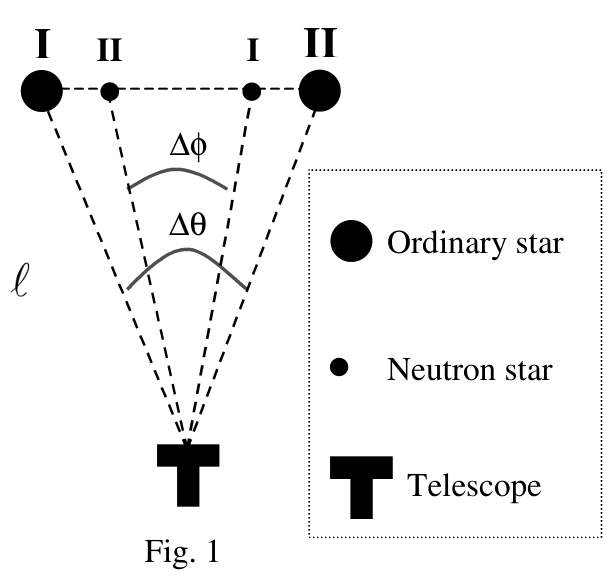
Fig. 1
Find an expression for the distance \(\ell\) from earth to this system, only in terms of the observed quantities and universal constants. Copy your result onto the answer form. [7 pts]
b) Assume that \(M\gg m_0\), so that the ordinary star is basically rotating around the neutron star in a circular orbit of radius \(r_0\). Assume that the ordinary star starts emitting gas toward the neutron star with a speed \(v_0\), relative to the ordinary star (see Fig. 2). Assuming that the neutron star is the dominant gravitational force in this problem and neglecting the orbital changes of the ordinary star find the distance of closest approach \(r_f\) shown in Fig. 2. Copy your result onto the answer form. [3pts]
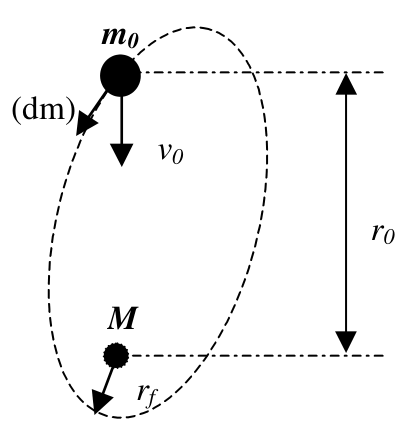
Fig. 2
Official English text of the problem.
Answers
-
a) With the angular displacements in radians, \[ \boxed{ \ell= \frac{2\sqrt{2}\,c\tau}{\pi(\Delta\theta+\Delta\phi)} \left(\frac{\Delta\lambda}{\lambda_0\Delta\phi}\right)^{1/2} \left(\frac{P}{\sigma T^4}\right)^{1/4} } \] where \(\sigma\) is the Stefan–Boltzmann constant. The orbital interpretation is specified below.
-
b) \[ \boxed{ r_f=\frac{r_0}{1+v_0\sqrt{\dfrac{r_0}{GM}}} }. \]
Solution
a)
We use Newtonian orbital dynamics, the small-angle approximation, blackbody radiation from the ordinary star, and weak-field gravitational redshift. The system’s dimensions are negligible compared with its distance from earth.
Interpret Fig. 1 as a circular binary orbit whose observed angular excursions span opposite extrema. Thus \(\tau\) is half the orbital period: \[ \mathcal T=2\tau. \]
Let \(a_0\) and \(a_N\) be the ordinary and neutron stars’ orbital radii about their common centre of mass. Since the angular excursions are full diameters, \[ a_0=\frac{\ell\Delta\theta}{2}, \qquad a_N=\frac{\ell\Delta\phi}{2}. \] The separation is therefore \[ a=a_0+a_N=\frac{\ell(\Delta\theta+\Delta\phi)}{2}. \]
The centre-of-mass relation gives \[ m_0a_0=Ma_N, \qquad m_0=(m_0+M)\frac{a_N}{a}. \] Kepler’s third law for the relative orbit is \[ G(m_0+M)=\frac{4\pi^2a^3}{\mathcal T^2}. \] Combining these equations, \[ Gm_0=\frac{4\pi^2a^2a_N}{\mathcal T^2} =\frac{\pi^2\ell^3}{8\tau^2} \Delta\phi(\Delta\theta+\Delta\phi)^2. \tag{1} \]
Next, the ordinary star’s luminosity is \[ L=4\pi R^2\sigma T^4. \] Assuming isotropic emission and negligible absorption between the star and earth, \[ P=\frac{L}{4\pi\ell^2} =\sigma T^4\frac{R^2}{\ell^2}, \] so \[ R=\ell\left(\frac{P}{\sigma T^4}\right)^{1/2}. \tag{2} \]
Finally, consider the photon’s gravitational energy loss. Its emitted energy and approximate effective mass are \[ E_0=\frac{hc}{\lambda_0}, \qquad m_\gamma\simeq\frac{E_0}{c^2}. \] On travelling from the stellar surface to earth, effectively at infinity relative to \(R\), it loses energy \[ E_0-E_{\mathrm{obs}}\simeq\frac{Gm_0m_\gamma}{R}. \] Consequently, \[ \frac{E_0-E_{\mathrm{obs}}}{E_0} \simeq\frac{Gm_0}{Rc^2}. \] For \(\Delta\lambda\ll\lambda_0\), \[ \frac{E_0-E_{\mathrm{obs}}}{E_0} =1-\frac{\lambda_0}{\lambda_0+\Delta\lambda} \simeq\frac{\Delta\lambda}{\lambda_0}. \] Thus the positive gravitational redshift determines \[ Gm_0=c^2R\frac{\Delta\lambda}{\lambda_0} =c^2\ell\left(\frac{P}{\sigma T^4}\right)^{1/2} \frac{\Delta\lambda}{\lambda_0}. \tag{3} \]
Equating (1) and (3) and cancelling one factor of \(\ell\), \[ \ell^2= \frac{8c^2\tau^2} {\pi^2\Delta\phi(\Delta\theta+\Delta\phi)^2} \frac{\Delta\lambda}{\lambda_0} \left(\frac{P}{\sigma T^4}\right)^{1/2}. \] Taking the positive square root, \[ \boxed{ \ell= \frac{2\sqrt{2}\,c\tau}{\pi(\Delta\theta+\Delta\phi)} \left(\frac{\Delta\lambda}{\lambda_0\Delta\phi}\right)^{1/2} \left(\frac{P}{\sigma T^4}\right)^{1/4} }. \]
The gravitational constant cancels because both the orbital dynamics and the redshift measure \(Gm_0\). All factors except \(c\tau\) are dimensionless.
b)
Since \(M\gg m_0\), treat the neutron star as stationary. The ordinary star’s circular orbital speed follows from \[ \frac{v_c^2}{r_0}=\frac{GM}{r_0^2}, \qquad v_c=\sqrt{\frac{GM}{r_0}}. \]
A gas element inherits this tangential speed and receives an additional inward radial speed \(v_0\). Its initial velocity components are therefore \[ v_r=-v_0,\qquad v_t=v_c. \]
Neglecting the ordinary star’s gravity, the gas moves in the neutron star’s central gravitational field. Its specific angular momentum \(j\) and specific mechanical energy \(\varepsilon\) are conserved: \[ j=r_0v_c=\sqrt{GMr_0}, \] \[ \varepsilon =\frac12(v_c^2+v_0^2)-\frac{GM}{r_0} =\frac12v_0^2-\frac{GM}{2r_0}. \]
At closest approach, the radial velocity vanishes. If the tangential speed there is \(v_f\), angular-momentum conservation gives \[ r_fv_f=r_0v_c, \qquad v_f=\frac{r_0v_c}{r_f}. \] Energy conservation then gives \[ \frac12v_0^2-\frac12v_c^2 = \frac12v_c^2\frac{r_0^2}{r_f^2} -v_c^2\frac{r_0}{r_f}. \] Rearranging, \[ v_0^2=v_c^2\left(\frac{r_0}{r_f}-1\right)^2. \]
The gas initially moves inward, so its closest approach satisfies \(r_f\le r_0\). We therefore choose \[ \frac{r_0}{r_f}-1=\frac{v_0}{v_c}, \] which yields \[ \boxed{ r_f=\frac{r_0}{1+v_0/v_c} =\frac{r_0}{1+v_0\sqrt{\dfrac{r_0}{GM}}} }. \]
For \(v_0=0\), this correctly gives the original circular orbit, \(r_f=r_0\). The gas trajectory is elliptical as drawn when \(v_0<v_c\), parabolic when \(v_0=v_c\), and hyperbolic when \(v_0>v_c\); the closest-approach formula holds in all three cases.
The solution was checked against the official solution.
IPhO 2001 · Theorieaufgabe 2
Doppelsternsystem
a) Es ist allgemein bekannt, dass die meisten Sterne Doppelsternsysteme bilden. Eine Art von Doppelsternsystem besteht aus einem gewöhnlichen Stern mit der Masse \(m_0\) und dem Radius \(R\) und einem massereicheren, kompakten Neutronenstern mit der Masse \(M\), die einander umkreisen. Vernachlässigen Sie im gesamten Folgenden die Bewegung der Erde. Beobachtungen eines solchen Doppelsternsystems liefern die folgenden Informationen:
- Die maximale Winkelverschiebung des gewöhnlichen Sterns beträgt \(\Delta\theta\), die des Neutronensterns hingegen \(\Delta\phi\) (siehe Abb. 1).
- Die Zeit, die für diese maximalen Verschiebungen benötigt wird, beträgt \(\tau\).
- Die Strahlungseigenschaften des gewöhnlichen Sterns zeigen, dass seine Oberflächentemperatur \(T\) beträgt und dass die pro Zeiteinheit auf eine Flächeneinheit der Erdoberfläche auftreffende Strahlungsenergie \(P\) beträgt.
- Die Calciumlinie in dieser Strahlung weicht von ihrer normalen Wellenlänge \(\lambda_0\) um den Betrag \(\Delta\lambda\) ab, und zwar ausschließlich aufgrund des Gravitationsfeldes des gewöhnlichen Sterns. (Für diese Berechnung kann dem Photon eine effektive Masse von \(h/c\lambda\) zugeschrieben werden.)
Abb. 1
Bestimmen Sie einen Ausdruck für die Entfernung \(\ell\) von der Erde zu diesem System, der ausschließlich die beobachteten Größen und universelle Konstanten enthält. Übertragen Sie Ihr Ergebnis auf das Antwortblatt. [7 Punkte]
b) Nehmen Sie an, dass \(M\gg m_0\) gilt, sodass der gewöhnliche Stern im Wesentlichen den Neutronenstern auf einer Kreisbahn mit dem Radius \(r_0\) umkreist. Nehmen Sie an, dass der gewöhnliche Stern beginnt, Gas mit einer Geschwindigkeit \(v_0\) relativ zum gewöhnlichen Stern in Richtung des Neutronensterns auszustoßen (siehe Abb. 2). Bestimmen Sie unter der Annahme, dass die Gravitationskraft des Neutronensterns in dieser Aufgabe dominiert, und unter Vernachlässigung der Bahnänderungen des gewöhnlichen Sterns den in Abb. 2 dargestellten kleinsten Abstand \(r_f\). Übertragen Sie Ihr Ergebnis auf das Antwortblatt. [3 Punkte]
Abb. 2
Aufgabentext aus dem offiziellen englischen Text übersetzt.
Antworten
-
a) Mit den Winkelverschiebungen im Bogenmaß gilt \[ \boxed{ \ell= \frac{2\sqrt{2}\,c\tau}{\pi(\Delta\theta+\Delta\phi)} \left(\frac{\Delta\lambda}{\lambda_0\Delta\phi}\right)^{1/2} \left(\frac{P}{\sigma T^4}\right)^{1/4} } \] wobei \(\sigma\) die Stefan–Boltzmann-Konstante ist. Die zugrunde gelegte Interpretation der Bahn wird weiter unten erläutert.
-
b) \[ \boxed{ r_f=\frac{r_0}{1+v_0\sqrt{\dfrac{r_0}{GM}}} }. \]
Lösung
a)
Wir verwenden die Newtonsche Bahndynamik, die Kleinwinkelnäherung, die Schwarzkörperstrahlung des gewöhnlichen Sterns und die gravitative Rotverschiebung im schwachen Feld. Die Abmessungen des Systems sind gegenüber seiner Entfernung von der Erde vernachlässigbar.
Wir interpretieren Abb. 1 als eine kreisförmige Doppelsternbahn, deren beobachtete Winkelverschiebungen sich zwischen gegenüberliegenden Extrempositionen erstrecken. Somit ist \(\tau\) die Hälfte der Umlaufzeit: \[ \mathcal T=2\tau. \]
Es seien \(a_0\) und \(a_N\) die Bahnradien des gewöhnlichen Sterns beziehungsweise des Neutronensterns um ihren gemeinsamen Schwerpunkt. Da die Winkelverschiebungen den vollen Durchmessern entsprechen, gilt \[ a_0=\frac{\ell\Delta\theta}{2}, \qquad a_N=\frac{\ell\Delta\phi}{2}. \] Der Abstand zwischen den Sternen beträgt daher \[ a=a_0+a_N=\frac{\ell(\Delta\theta+\Delta\phi)}{2}. \]
Aus der Schwerpunktbeziehung folgt \[ m_0a_0=Ma_N, \qquad m_0=(m_0+M)\frac{a_N}{a}. \] Das dritte Keplersche Gesetz für die Relativbahn lautet \[ G(m_0+M)=\frac{4\pi^2a^3}{\mathcal T^2}. \] Durch Kombination dieser Gleichungen erhalten wir \[ Gm_0=\frac{4\pi^2a^2a_N}{\mathcal T^2} =\frac{\pi^2\ell^3}{8\tau^2} \Delta\phi(\Delta\theta+\Delta\phi)^2. \tag{1} \]
Als Nächstes betrachten wir die Leuchtkraft des gewöhnlichen Sterns: \[ L=4\pi R^2\sigma T^4. \] Unter der Annahme isotroper Abstrahlung und vernachlässigbarer Absorption zwischen dem Stern und der Erde gilt \[ P=\frac{L}{4\pi\ell^2} =\sigma T^4\frac{R^2}{\ell^2}, \] also \[ R=\ell\left(\frac{P}{\sigma T^4}\right)^{1/2}. \tag{2} \]
Schließlich betrachten wir den gravitativen Energieverlust des Photons. Seine Energie bei der Emission und seine näherungsweise effektive Masse sind \[ E_0=\frac{hc}{\lambda_0}, \qquad m_\gamma\simeq\frac{E_0}{c^2}. \] Auf dem Weg von der Sternoberfläche zur Erde, die im Vergleich zu \(R\) praktisch im Unendlichen liegt, verliert es die Energie \[ E_0-E_{\mathrm{obs}}\simeq\frac{Gm_0m_\gamma}{R}. \] Folglich gilt \[ \frac{E_0-E_{\mathrm{obs}}}{E_0} \simeq\frac{Gm_0}{Rc^2}. \] Für \(\Delta\lambda\ll\lambda_0\) gilt \[ \frac{E_0-E_{\mathrm{obs}}}{E_0} =1-\frac{\lambda_0}{\lambda_0+\Delta\lambda} \simeq\frac{\Delta\lambda}{\lambda_0}. \] Damit ergibt sich aus der positiven gravitativen Rotverschiebung \[ Gm_0=c^2R\frac{\Delta\lambda}{\lambda_0} =c^2\ell\left(\frac{P}{\sigma T^4}\right)^{1/2} \frac{\Delta\lambda}{\lambda_0}. \tag{3} \]
Durch Gleichsetzen von (1) und (3) und Kürzen eines Faktors \(\ell\) erhalten wir \[ \ell^2= \frac{8c^2\tau^2} {\pi^2\Delta\phi(\Delta\theta+\Delta\phi)^2} \frac{\Delta\lambda}{\lambda_0} \left(\frac{P}{\sigma T^4}\right)^{1/2}. \] Ziehen der positiven Quadratwurzel ergibt \[ \boxed{ \ell= \frac{2\sqrt{2}\,c\tau}{\pi(\Delta\theta+\Delta\phi)} \left(\frac{\Delta\lambda}{\lambda_0\Delta\phi}\right)^{1/2} \left(\frac{P}{\sigma T^4}\right)^{1/4} }. \]
Die Gravitationskonstante kürzt sich heraus, weil sowohl die Bahndynamik als auch die Rotverschiebung \(Gm_0\) bestimmen. Alle Faktoren außer \(c\tau\) sind dimensionslos.
b)
Da \(M\gg m_0\) gilt, betrachten wir den Neutronenstern als ruhend. Die Geschwindigkeit des gewöhnlichen Sterns auf seiner Kreisbahn folgt aus \[ \frac{v_c^2}{r_0}=\frac{GM}{r_0^2}, \qquad v_c=\sqrt{\frac{GM}{r_0}}. \]
Ein Gaselement übernimmt diese Tangentialgeschwindigkeit und erhält zusätzlich eine nach innen gerichtete Radialgeschwindigkeit \(v_0\). Seine anfänglichen Geschwindigkeitskomponenten sind daher \[ v_r=-v_0,\qquad v_t=v_c. \]
Unter Vernachlässigung der Gravitation des gewöhnlichen Sterns bewegt sich das Gas im zentralen Gravitationsfeld des Neutronensterns. Sein spezifischer Drehimpuls \(j\) und seine spezifische mechanische Energie \(\varepsilon\) bleiben erhalten: \[ j=r_0v_c=\sqrt{GMr_0}, \] \[ \varepsilon =\frac12(v_c^2+v_0^2)-\frac{GM}{r_0} =\frac12v_0^2-\frac{GM}{2r_0}. \]
Am Punkt der größten Annäherung verschwindet die Radialgeschwindigkeit. Ist die Tangentialgeschwindigkeit dort \(v_f\), so ergibt die Drehimpulserhaltung \[ r_fv_f=r_0v_c, \qquad v_f=\frac{r_0v_c}{r_f}. \] Aus der Energieerhaltung folgt dann \[ \frac12v_0^2-\frac12v_c^2 = \frac12v_c^2\frac{r_0^2}{r_f^2} -v_c^2\frac{r_0}{r_f}. \] Umformen ergibt \[ v_0^2=v_c^2\left(\frac{r_0}{r_f}-1\right)^2. \]
Das Gas bewegt sich anfangs nach innen, sodass für seinen kleinsten Abstand \(r_f\le r_0\) gilt. Wir wählen daher \[ \frac{r_0}{r_f}-1=\frac{v_0}{v_c}, \] woraus folgt \[ \boxed{ r_f=\frac{r_0}{1+v_0/v_c} =\frac{r_0}{1+v_0\sqrt{\dfrac{r_0}{GM}}} }. \]
Für \(v_0=0\) ergibt sich damit wie erwartet die ursprüngliche Kreisbahn, \(r_f=r_0\). Die Bahn des Gases ist für \(v_0<v_c\) wie dargestellt elliptisch, für \(v_0=v_c\) parabolisch und für \(v_0>v_c\) hyperbolisch; die Formel für den kleinsten Abstand gilt in allen drei Fällen.
Die Lösung wurde mit der offiziellen Lösung abgeglichen.
IPhO 2001 · Teori sorusu 2
Çift Yıldız Sistemi
a) Yıldızların çoğunun çift yıldız sistemleri oluşturduğu iyi bilinmektedir. Bir çift yıldız sistemi türü, birbirlerinin çevresinde dolanan, kütlesi \(m_0\) ve yarıçapı \(R\) olan normal bir yıldız ile kütlesi \(M\) olan, daha büyük kütleli, kompakt bir nötron yıldızından oluşur. Aşağıdaki tüm işlemlerde Dünya'nın hareketini ihmal ediniz. Böyle bir çift yıldız sisteminin gözlemlerinden şu bilgiler elde edilmektedir:
- Normal yıldızın maksimum açısal yer değiştirmesi \(\Delta\theta\), nötron yıldızınınki ise \(\Delta\phi\)'dir (bkz. Şekil 1).
- Bu maksimum yer değiştirmeler için geçen süre \(\tau\)'dur.
- Normal yıldızın ışınım özellikleri, yüzey sıcaklığının \(T\) olduğunu ve Dünya yüzeyindeki birim alana birim zamanda ulaşan ışınım enerjisinin \(P\) olduğunu göstermektedir.
- Bu ışınımdaki kalsiyum çizgisinin dalga boyu, yalnızca normal yıldızın kütleçekim alanı nedeniyle, normal dalga boyu \(\lambda_0\)'dan \(\Delta\lambda\) kadar farklıdır. (Bu hesaplamada fotonun \(h/c\lambda\) etkin kütlesine sahip olduğu düşünülebilir.)
Şekil 1
Dünya'dan bu sisteme olan \(\ell\) uzaklığı için yalnızca gözlenen nicelikler ve evrensel sabitler cinsinden bir ifade bulunuz. Sonucunuzu cevap formuna yazınız. [7 puan]
b) \(M\gg m_0\) olduğunu, dolayısıyla normal yıldızın esas olarak nötron yıldızının çevresinde \(r_0\) yarıçaplı çembersel bir yörüngede dolandığını varsayınız. Normal yıldızın, nötron yıldızına doğru, normal yıldıza göre \(v_0\) süratiyle gaz salmaya başladığını varsayınız (bkz. Şekil 2). Bu problemde baskın kütleçekim kuvvetinin nötron yıldızından kaynaklandığını varsayarak ve normal yıldızın yörüngesindeki değişimleri ihmal ederek Şekil 2'de gösterilen en yakın yaklaşma uzaklığı \(r_f\)'yi bulunuz. Sonucunuzu cevap formuna yazınız. [3 puan]
Şekil 2
Soru metni resmi İngilizce metinden çevrilmiştir.
Cevaplar
-
a) Açısal yer değiştirmeler radyan cinsinden olmak üzere, \[ \boxed{ \ell= \frac{2\sqrt{2}\,c\tau}{\pi(\Delta\theta+\Delta\phi)} \left(\frac{\Delta\lambda}{\lambda_0\Delta\phi}\right)^{1/2} \left(\frac{P}{\sigma T^4}\right)^{1/4} } \] burada \(\sigma\), Stefan–Boltzmann sabitidir. Yörüngeye ilişkin yorum aşağıda belirtilmiştir.
-
b) \[ \boxed{ r_f=\frac{r_0}{1+v_0\sqrt{\dfrac{r_0}{GM}}} }. \]
Çözüm
a)
Newton mekaniğine dayalı yörünge dinamiğini, küçük açı yaklaşımını, normal yıldızın kara cisim ışınımını ve zayıf alan yaklaşımında kütleçekimsel kırmızıya kaymayı kullanıyoruz. Sistemin boyutları, Dünya'ya uzaklığına kıyasla ihmal edilebilir düzeydedir.
Şekil 1'i, gözlenen açısal yer değiştirmelerin karşılıklı uç konumlar arasını kapsadığı çembersel bir çift yıldız yörüngesi olarak yorumlayalım. Böylece \(\tau\), yörünge periyodunun yarısıdır: \[ \mathcal T=2\tau. \]
Normal yıldızın ve nötron yıldızının ortak kütle merkezleri çevresindeki yörünge yarıçapları sırasıyla \(a_0\) ve \(a_N\) olsun. Açısal yer değiştirmeler çapların tamamına karşılık geldiğinden, \[ a_0=\frac{\ell\Delta\theta}{2}, \qquad a_N=\frac{\ell\Delta\phi}{2}. \] Dolayısıyla aralarındaki uzaklık \[ a=a_0+a_N=\frac{\ell(\Delta\theta+\Delta\phi)}{2}. \]
Kütle merkezi bağıntısı şunu verir: \[ m_0a_0=Ma_N, \qquad m_0=(m_0+M)\frac{a_N}{a}. \] Bağıl yörünge için Kepler'in üçüncü yasası \[ G(m_0+M)=\frac{4\pi^2a^3}{\mathcal T^2}. \] Bu denklemleri birleştirirsek, \[ Gm_0=\frac{4\pi^2a^2a_N}{\mathcal T^2} =\frac{\pi^2\ell^3}{8\tau^2} \Delta\phi(\Delta\theta+\Delta\phi)^2. \tag{1} \]
Şimdi, normal yıldızın ışınım gücü \[ L=4\pi R^2\sigma T^4. \] Işınımın izotropik olduğunu ve yıldız ile Dünya arasındaki soğurmanın ihmal edilebilir olduğunu varsayarsak, \[ P=\frac{L}{4\pi\ell^2} =\sigma T^4\frac{R^2}{\ell^2}, \] dolayısıyla \[ R=\ell\left(\frac{P}{\sigma T^4}\right)^{1/2}. \tag{2} \]
Son olarak, fotonun kütleçekim nedeniyle uğradığı enerji kaybını ele alalım. Yayımlandığı andaki enerjisi ve yaklaşık etkin kütlesi \[ E_0=\frac{hc}{\lambda_0}, \qquad m_\gamma\simeq\frac{E_0}{c^2}. \] Yıldızın yüzeyinden, \(R\)'ye kıyasla fiilen sonsuz uzaklıkta olan Dünya'ya giderken kaybettiği enerji \[ E_0-E_{\mathrm{obs}}\simeq\frac{Gm_0m_\gamma}{R}. \] Bunun sonucunda, \[ \frac{E_0-E_{\mathrm{obs}}}{E_0} \simeq\frac{Gm_0}{Rc^2}. \] \(\Delta\lambda\ll\lambda_0\) için, \[ \frac{E_0-E_{\mathrm{obs}}}{E_0} =1-\frac{\lambda_0}{\lambda_0+\Delta\lambda} \simeq\frac{\Delta\lambda}{\lambda_0}. \] Böylece pozitif kütleçekimsel kırmızıya kayma şu bağıntıyı belirler: \[ Gm_0=c^2R\frac{\Delta\lambda}{\lambda_0} =c^2\ell\left(\frac{P}{\sigma T^4}\right)^{1/2} \frac{\Delta\lambda}{\lambda_0}. \tag{3} \]
(1) ile (3)'ü eşitleyip bir \(\ell\) çarpanını sadeleştirirsek, \[ \ell^2= \frac{8c^2\tau^2} {\pi^2\Delta\phi(\Delta\theta+\Delta\phi)^2} \frac{\Delta\lambda}{\lambda_0} \left(\frac{P}{\sigma T^4}\right)^{1/2}. \] Pozitif karekökü alırsak, \[ \boxed{ \ell= \frac{2\sqrt{2}\,c\tau}{\pi(\Delta\theta+\Delta\phi)} \left(\frac{\Delta\lambda}{\lambda_0\Delta\phi}\right)^{1/2} \left(\frac{P}{\sigma T^4}\right)^{1/4} }. \]
Hem yörünge dinamiği hem de kırmızıya kayma \(Gm_0\)'ı ölçtüğünden kütleçekim sabiti sadeleşir. \(c\tau\) dışındaki tüm çarpanlar boyutsuzdur.
b)
\(M\gg m_0\) olduğundan nötron yıldızını durağan kabul edelim. Normal yıldızın çembersel yörüngedeki sürati şu bağıntıdan bulunur: \[ \frac{v_c^2}{r_0}=\frac{GM}{r_0^2}, \qquad v_c=\sqrt{\frac{GM}{r_0}}. \]
Bir gaz elemanı bu teğetsel sürati korur ve buna ek olarak içeri doğru \(v_0\) radyal süratini kazanır. Dolayısıyla başlangıçtaki hız bileşenleri \[ v_r=-v_0,\qquad v_t=v_c. \]
Normal yıldızın kütleçekimi ihmal edildiğinde gaz, nötron yıldızının merkezî kütleçekim alanında hareket eder. Gazın birim kütle başına açısal momentumu \(j\) ve birim kütle başına mekanik enerjisi \(\varepsilon\) korunur: \[ j=r_0v_c=\sqrt{GMr_0}, \] \[ \varepsilon =\frac12(v_c^2+v_0^2)-\frac{GM}{r_0} =\frac12v_0^2-\frac{GM}{2r_0}. \]
En yakın yaklaşma noktasında radyal hız sıfır olur. Buradaki teğetsel sürat \(v_f\) ise açısal momentumun korunumu şunu verir: \[ r_fv_f=r_0v_c, \qquad v_f=\frac{r_0v_c}{r_f}. \] Enerjinin korunumundan ise \[ \frac12v_0^2-\frac12v_c^2 = \frac12v_c^2\frac{r_0^2}{r_f^2} -v_c^2\frac{r_0}{r_f}. \] Yeniden düzenlersek, \[ v_0^2=v_c^2\left(\frac{r_0}{r_f}-1\right)^2. \]
Gaz başlangıçta içeri doğru hareket ettiğinden en yakın yaklaşma uzaklığı \(r_f\le r_0\) koşulunu sağlar. Bu nedenle \[ \frac{r_0}{r_f}-1=\frac{v_0}{v_c}, \] seçimini yaparız; buradan \[ \boxed{ r_f=\frac{r_0}{1+v_0/v_c} =\frac{r_0}{1+v_0\sqrt{\dfrac{r_0}{GM}}} }. \]
\(v_0=0\) için bu sonuç, beklendiği gibi başlangıçtaki çembersel yörüngeyi, \(r_f=r_0\), verir. Gazın yörüngesi \(v_0<v_c\) olduğunda şekilde çizildiği gibi eliptik, \(v_0=v_c\) olduğunda parabolik ve \(v_0>v_c\) olduğunda hiperboliktir; en yakın yaklaşma uzaklığı formülü her üç durumda da geçerlidir.
Çözüm, resmi çözümle karşılaştırılarak kontrol edildi.
IPhO 2001 · Problema teórico 2
Sistema estelar binario
a) Es bien sabido que la mayoría de las estrellas forman sistemas binarios. Un tipo de sistema binario está constituido por una estrella ordinaria de masa \(m_0\) y radio \(R\), y una estrella de neutrones compacta y más masiva, de masa \(M\), que giran una alrededor de la otra. En todo lo que sigue, ignore el movimiento de la Tierra. Las observaciones de un sistema binario de este tipo proporcionan la siguiente información:
- El desplazamiento angular máximo de la estrella ordinaria es \(\Delta\theta\), mientras que el de la estrella de neutrones es \(\Delta\phi\) (véase la Fig. 1).
- El tiempo necesario para efectuar estos desplazamientos máximos es \(\tau\).
- Las características de la radiación de la estrella ordinaria indican que su temperatura superficial es \(T\) y que la energía radiada que incide por unidad de área de la superficie terrestre y por unidad de tiempo es \(P\).
- La línea del calcio en esta radiación difiere de su longitud de onda normal \(\lambda_0\) en una cantidad \(\Delta\lambda\), debida únicamente al campo gravitatorio de la estrella ordinaria. (Para este cálculo, puede considerarse que el fotón tiene una masa efectiva de \(h/c\lambda\).)
Fig. 1
Obtenga una expresión para la distancia \(\ell\) de la Tierra a este sistema, únicamente en función de las magnitudes observadas y de constantes universales. Copie su resultado en la hoja de respuestas. [7 puntos]
b) Suponga que \(M\gg m_0\), de modo que la estrella ordinaria gira esencialmente alrededor de la estrella de neutrones en una órbita circular de radio \(r_0\). Suponga que la estrella ordinaria comienza a emitir gas hacia la estrella de neutrones con una rapidez \(v_0\), respecto de la estrella ordinaria (véase la Fig. 2). Suponiendo que la estrella de neutrones ejerce la fuerza gravitatoria dominante en este problema y despreciando los cambios orbitales de la estrella ordinaria, determine la distancia de máxima aproximación \(r_f\) indicada en la Fig. 2. Copie su resultado en la hoja de respuestas. [3 puntos]
Fig. 2
Enunciado traducido del texto oficial en inglés.
Respuestas
-
a) Con los desplazamientos angulares expresados en radianes, \[ \boxed{ \ell= \frac{2\sqrt{2}\,c\tau}{\pi(\Delta\theta+\Delta\phi)} \left(\frac{\Delta\lambda}{\lambda_0\Delta\phi}\right)^{1/2} \left(\frac{P}{\sigma T^4}\right)^{1/4} } \] donde \(\sigma\) es la constante de Stefan–Boltzmann. La interpretación orbital se especifica a continuación.
-
b) \[ \boxed{ r_f=\frac{r_0}{1+v_0\sqrt{\dfrac{r_0}{GM}}} }. \]
Solución
a)
Utilizamos la dinámica orbital newtoniana, la aproximación de ángulos pequeños, la radiación de cuerpo negro de la estrella ordinaria y el corrimiento gravitatorio al rojo en un campo débil. Las dimensiones del sistema son despreciables en comparación con su distancia a la Tierra.
Interpretamos la Fig. 1 como una órbita binaria circular cuyos desplazamientos angulares observados abarcan extremos opuestos. Por tanto, \(\tau\) es la mitad del período orbital: \[ \mathcal T=2\tau. \]
Sean \(a_0\) y \(a_N\) los radios orbitales de la estrella ordinaria y de la estrella de neutrones alrededor de su centro de masas común. Como los desplazamientos angulares corresponden a diámetros completos, \[ a_0=\frac{\ell\Delta\theta}{2}, \qquad a_N=\frac{\ell\Delta\phi}{2}. \] Por tanto, la separación es \[ a=a_0+a_N=\frac{\ell(\Delta\theta+\Delta\phi)}{2}. \]
La relación del centro de masas da \[ m_0a_0=Ma_N, \qquad m_0=(m_0+M)\frac{a_N}{a}. \] La tercera ley de Kepler para la órbita relativa es \[ G(m_0+M)=\frac{4\pi^2a^3}{\mathcal T^2}. \] Combinando estas ecuaciones, \[ Gm_0=\frac{4\pi^2a^2a_N}{\mathcal T^2} =\frac{\pi^2\ell^3}{8\tau^2} \Delta\phi(\Delta\theta+\Delta\phi)^2. \tag{1} \]
A continuación, la luminosidad de la estrella ordinaria es \[ L=4\pi R^2\sigma T^4. \] Suponiendo una emisión isótropa y una absorción despreciable entre la estrella y la Tierra, \[ P=\frac{L}{4\pi\ell^2} =\sigma T^4\frac{R^2}{\ell^2}, \] de modo que \[ R=\ell\left(\frac{P}{\sigma T^4}\right)^{1/2}. \tag{2} \]
Por último, consideremos la pérdida de energía del fotón debida a la gravedad. Su energía en el momento de la emisión y su masa efectiva aproximada son \[ E_0=\frac{hc}{\lambda_0}, \qquad m_\gamma\simeq\frac{E_0}{c^2}. \] Al viajar desde la superficie estelar hasta la Tierra, situada efectivamente en el infinito en comparación con \(R\), pierde una energía \[ E_0-E_{\mathrm{obs}}\simeq\frac{Gm_0m_\gamma}{R}. \] En consecuencia, \[ \frac{E_0-E_{\mathrm{obs}}}{E_0} \simeq\frac{Gm_0}{Rc^2}. \] Para \(\Delta\lambda\ll\lambda_0\), \[ \frac{E_0-E_{\mathrm{obs}}}{E_0} =1-\frac{\lambda_0}{\lambda_0+\Delta\lambda} \simeq\frac{\Delta\lambda}{\lambda_0}. \] Así, el corrimiento gravitatorio al rojo positivo determina \[ Gm_0=c^2R\frac{\Delta\lambda}{\lambda_0} =c^2\ell\left(\frac{P}{\sigma T^4}\right)^{1/2} \frac{\Delta\lambda}{\lambda_0}. \tag{3} \]
Igualando (1) y (3) y cancelando un factor de \(\ell\), \[ \ell^2= \frac{8c^2\tau^2} {\pi^2\Delta\phi(\Delta\theta+\Delta\phi)^2} \frac{\Delta\lambda}{\lambda_0} \left(\frac{P}{\sigma T^4}\right)^{1/2}. \] Tomando la raíz cuadrada positiva, \[ \boxed{ \ell= \frac{2\sqrt{2}\,c\tau}{\pi(\Delta\theta+\Delta\phi)} \left(\frac{\Delta\lambda}{\lambda_0\Delta\phi}\right)^{1/2} \left(\frac{P}{\sigma T^4}\right)^{1/4} }. \]
La constante gravitatoria se cancela porque tanto la dinámica orbital como el corrimiento al rojo miden \(Gm_0\). Todos los factores, salvo \(c\tau\), son adimensionales.
b)
Como \(M\gg m_0\), tratamos la estrella de neutrones como estacionaria. La rapidez orbital circular de la estrella ordinaria se obtiene de \[ \frac{v_c^2}{r_0}=\frac{GM}{r_0^2}, \qquad v_c=\sqrt{\frac{GM}{r_0}}. \]
Un elemento de gas hereda esta rapidez tangencial y recibe una rapidez radial adicional \(v_0\) dirigida hacia dentro. Por tanto, las componentes iniciales de su velocidad son \[ v_r=-v_0,\qquad v_t=v_c. \]
Despreciando la gravedad de la estrella ordinaria, el gas se mueve en el campo gravitatorio central de la estrella de neutrones. Su momento angular específico \(j\) y su energía mecánica específica \(\varepsilon\) se conservan: \[ j=r_0v_c=\sqrt{GMr_0}, \] \[ \varepsilon =\frac12(v_c^2+v_0^2)-\frac{GM}{r_0} =\frac12v_0^2-\frac{GM}{2r_0}. \]
En el punto de máxima aproximación, la velocidad radial se anula. Si la rapidez tangencial en ese punto es \(v_f\), la conservación del momento angular da \[ r_fv_f=r_0v_c, \qquad v_f=\frac{r_0v_c}{r_f}. \] La conservación de la energía da entonces \[ \frac12v_0^2-\frac12v_c^2 = \frac12v_c^2\frac{r_0^2}{r_f^2} -v_c^2\frac{r_0}{r_f}. \] Reordenando, \[ v_0^2=v_c^2\left(\frac{r_0}{r_f}-1\right)^2. \]
El gas se mueve inicialmente hacia dentro, por lo que su distancia de máxima aproximación satisface \(r_f\le r_0\). Por tanto, elegimos \[ \frac{r_0}{r_f}-1=\frac{v_0}{v_c}, \] lo que conduce a \[ \boxed{ r_f=\frac{r_0}{1+v_0/v_c} =\frac{r_0}{1+v_0\sqrt{\dfrac{r_0}{GM}}} }. \]
Para \(v_0=0\), se obtiene correctamente la órbita circular original, \(r_f=r_0\). La trayectoria del gas es elíptica, como se muestra en la figura, cuando \(v_0<v_c\), parabólica cuando \(v_0=v_c\) e hiperbólica cuando \(v_0>v_c\); la fórmula de la distancia de máxima aproximación es válida en los tres casos.
La solución se comprobó con la solución oficial.
IPhO 2001 · 理论题 2
双星系统
a) 众所周知,大多数恒星组成双星系统。一类双星系统由一颗质量为 \(m_0\)、半径为 \(R\) 的普通恒星和一颗质量为 \(M\)、质量更大且结构致密的中子星组成,两者相互绕转。在以下所有讨论中,均忽略地球的运动。对这样一个双星系统的观测给出了以下信息:
- 普通恒星的最大角位移为 \(\Delta\theta\),中子星的最大角位移为 \(\Delta\phi\)(见图 1)。
- 完成这些最大位移所需的时间为 \(\tau\)。
- 普通恒星的辐射特征表明,其表面温度为 \(T\),单位时间内入射到地球表面单位面积上的辐射能量为 \(P\)。
- 该辐射中的钙谱线波长与其正常波长 \(\lambda_0\) 相差 \(\Delta\lambda\),这一差异仅由普通恒星的引力场引起。(在此计算中,可以认为光子的有效质量为 \(h/c\lambda\)。)
图 1
求地球到该系统的距离 \(\ell\) 的表达式,仅用观测量和普适常数表示。将结果抄写在答题纸上。[7 分]
b) 假设 \(M\gg m_0\),因此普通恒星基本上沿半径为 \(r_0\) 的圆轨道绕中子星运动。假设普通恒星开始朝中子星喷出气体,气体相对于普通恒星的速率为 \(v_0\)(见图 2)。假设在本题中中子星的引力占主导地位,并忽略普通恒星轨道的变化,求图 2 所示的最近距离 \(r_f\)。将结果抄写在答题纸上。[3 分]
图 2
题目译自官方英文原文。
答案
-
a) 角位移以弧度表示时, \[ \boxed{ \ell= \frac{2\sqrt{2}\,c\tau}{\pi(\Delta\theta+\Delta\phi)} \left(\frac{\Delta\lambda}{\lambda_0\Delta\phi}\right)^{1/2} \left(\frac{P}{\sigma T^4}\right)^{1/4} } \] 其中 \(\sigma\) 为斯特藩–玻尔兹曼常数。对轨道的具体解释见下文。
-
b) \[ \boxed{ r_f=\frac{r_0}{1+v_0\sqrt{\dfrac{r_0}{GM}}} }. \]
解答
a)
我们采用牛顿轨道动力学、小角度近似、普通恒星的黑体辐射以及弱场引力红移。与该系统到地球的距离相比,系统本身的尺度可以忽略。
将图 1 理解为圆形双星轨道,观测到的角位移范围跨越两端的极限位置。因此,\(\tau\) 为轨道周期的一半: \[ \mathcal T=2\tau. \]
设 \(a_0\) 和 \(a_N\) 分别为普通恒星和中子星绕共同质心运动的轨道半径。由于角位移范围对应整个轨道直径, \[ a_0=\frac{\ell\Delta\theta}{2}, \qquad a_N=\frac{\ell\Delta\phi}{2}. \] 因此,两星之间的距离为 \[ a=a_0+a_N=\frac{\ell(\Delta\theta+\Delta\phi)}{2}. \]
由质心关系可得 \[ m_0a_0=Ma_N, \qquad m_0=(m_0+M)\frac{a_N}{a}. \] 相对运动轨道的开普勒第三定律为 \[ G(m_0+M)=\frac{4\pi^2a^3}{\mathcal T^2}. \] 联立这些方程,得 \[ Gm_0=\frac{4\pi^2a^2a_N}{\mathcal T^2} =\frac{\pi^2\ell^3}{8\tau^2} \Delta\phi(\Delta\theta+\Delta\phi)^2. \tag{1} \]
接下来,普通恒星的光度为 \[ L=4\pi R^2\sigma T^4. \] 假设辐射是各向同性的,且恒星与地球之间的吸收可以忽略,则 \[ P=\frac{L}{4\pi\ell^2} =\sigma T^4\frac{R^2}{\ell^2}, \] 所以 \[ R=\ell\left(\frac{P}{\sigma T^4}\right)^{1/2}. \tag{2} \]
最后,考虑光子因引力而损失的能量。光子发射时的能量和近似有效质量为 \[ E_0=\frac{hc}{\lambda_0}, \qquad m_\gamma\simeq\frac{E_0}{c^2}. \] 光子从恒星表面传播到地球时,相对于 \(R\) 而言,地球可视为位于无穷远处,光子损失的能量为 \[ E_0-E_{\mathrm{obs}}\simeq\frac{Gm_0m_\gamma}{R}. \] 因此, \[ \frac{E_0-E_{\mathrm{obs}}}{E_0} \simeq\frac{Gm_0}{Rc^2}. \] 当 \(\Delta\lambda\ll\lambda_0\) 时, \[ \frac{E_0-E_{\mathrm{obs}}}{E_0} =1-\frac{\lambda_0}{\lambda_0+\Delta\lambda} \simeq\frac{\Delta\lambda}{\lambda_0}. \] 因此,由正的引力红移可确定 \[ Gm_0=c^2R\frac{\Delta\lambda}{\lambda_0} =c^2\ell\left(\frac{P}{\sigma T^4}\right)^{1/2} \frac{\Delta\lambda}{\lambda_0}. \tag{3} \]
令式 (1) 与式 (3) 相等,并约去一个因子 \(\ell\),得 \[ \ell^2= \frac{8c^2\tau^2} {\pi^2\Delta\phi(\Delta\theta+\Delta\phi)^2} \frac{\Delta\lambda}{\lambda_0} \left(\frac{P}{\sigma T^4}\right)^{1/2}. \] 取正平方根,得 \[ \boxed{ \ell= \frac{2\sqrt{2}\,c\tau}{\pi(\Delta\theta+\Delta\phi)} \left(\frac{\Delta\lambda}{\lambda_0\Delta\phi}\right)^{1/2} \left(\frac{P}{\sigma T^4}\right)^{1/4} }. \]
引力常数被约去,是因为轨道动力学和红移测量的都是 \(Gm_0\)。除 \(c\tau\) 外,所有因子均为无量纲量。
b)
由于 \(M\gg m_0\),可将中子星视为静止。普通恒星的圆轨道速率由下式得到: \[ \frac{v_c^2}{r_0}=\frac{GM}{r_0^2}, \qquad v_c=\sqrt{\frac{GM}{r_0}}. \]
气体微元继承了这一切向速率,并额外获得了大小为 \(v_0\)、沿径向向内的速度。因此,其初始速度分量为 \[ v_r=-v_0,\qquad v_t=v_c. \]
忽略普通恒星的引力,气体在中子星的中心引力场中运动。其单位质量的角动量 \(j\) 和单位质量的机械能 \(\varepsilon\) 守恒: \[ j=r_0v_c=\sqrt{GMr_0}, \] \[ \varepsilon =\frac12(v_c^2+v_0^2)-\frac{GM}{r_0} =\frac12v_0^2-\frac{GM}{2r_0}. \]
在最近点处,径向速度为零。若该处的切向速率为 \(v_f\),则由角动量守恒得 \[ r_fv_f=r_0v_c, \qquad v_f=\frac{r_0v_c}{r_f}. \] 再由能量守恒得 \[ \frac12v_0^2-\frac12v_c^2 = \frac12v_c^2\frac{r_0^2}{r_f^2} -v_c^2\frac{r_0}{r_f}. \] 整理得 \[ v_0^2=v_c^2\left(\frac{r_0}{r_f}-1\right)^2. \]
气体最初向内运动,因此其最近距离满足 \(r_f\le r_0\)。所以取 \[ \frac{r_0}{r_f}-1=\frac{v_0}{v_c}, \] 由此得到 \[ \boxed{ r_f=\frac{r_0}{1+v_0/v_c} =\frac{r_0}{1+v_0\sqrt{\dfrac{r_0}{GM}}} }. \]
当 \(v_0=0\) 时,该结果正确地给出原来的圆轨道,即 \(r_f=r_0\)。当 \(v_0<v_c\) 时,气体轨迹为图中所示的椭圆;当 \(v_0=v_c\) 时为抛物线;当 \(v_0>v_c\) 时为双曲线;最近距离的公式在这三种情况下均成立。
解答已与官方解答核对。
IPhO 2001 · Теоретическая задача 2
Двойная звёздная система
a) Хорошо известно, что большинство звёзд образуют двойные системы. Один из типов двойных систем состоит из обычной звезды массой \(m_0\) и радиусом \(R\) и более массивной компактной нейтронной звезды массой \(M\), обращающихся друг вокруг друга. Во всём дальнейшем пренебрегайте движением Земли. Наблюдения такой двойной системы дают следующую информацию:
- Максимальное угловое перемещение обычной звезды равно \(\Delta\theta\), а нейтронной звезды — \(\Delta\phi\) (см. рис. 1).
- Время, за которое происходят эти максимальные перемещения, равно \(\tau\).
- Характеристики излучения обычной звезды показывают, что температура её поверхности равна \(T\), а энергия излучения, падающего на единицу площади поверхности Земли за единицу времени, равна \(P\).
- Линия кальция в этом излучении смещена относительно своей нормальной длины волны \(\lambda_0\) на величину \(\Delta\lambda\) исключительно под действием гравитационного поля обычной звезды. (В этом расчёте можно считать, что фотон имеет эффективную массу \(h/c\lambda\).)
Рис. 1
Найдите выражение для расстояния \(\ell\) от Земли до этой системы только через наблюдаемые величины и универсальные постоянные. Перенесите результат в бланк ответов. [7 баллов]
b) Предположим, что \(M\gg m_0\), так что обычная звезда фактически обращается вокруг нейтронной звезды по круговой орбите радиусом \(r_0\). Предположим, что обычная звезда начинает испускать газ в направлении нейтронной звезды со скоростью \(v_0\) относительно обычной звезды (см. рис. 2). Считая, что в этой задаче преобладает гравитационное притяжение нейтронной звезды, и пренебрегая изменениями орбиты обычной звезды, найдите расстояние наибольшего сближения \(r_f\), показанное на рис. 2. Перенесите результат в бланк ответов. [3 балла]
Рис. 2
Условие переведено с официального английского текста.
Ответы
-
a) Если угловые перемещения выражены в радианах, \[ \boxed{ \ell= \frac{2\sqrt{2}\,c\tau}{\pi(\Delta\theta+\Delta\phi)} \left(\frac{\Delta\lambda}{\lambda_0\Delta\phi}\right)^{1/2} \left(\frac{P}{\sigma T^4}\right)^{1/4} } \] где \(\sigma\) — постоянная Стефана–Больцмана. Принятая интерпретация орбитального движения уточняется ниже.
-
b) \[ \boxed{ r_f=\frac{r_0}{1+v_0\sqrt{\dfrac{r_0}{GM}}} }. \]
Решение
a)
Используем ньютоновскую динамику орбитального движения, приближение малых углов, модель излучения обычной звезды как абсолютно чёрного тела и гравитационное красное смещение в слабом поле. Размеры системы пренебрежимо малы по сравнению с расстоянием от неё до Земли.
Будем считать, что на рис. 1 изображена круговая орбита двойной системы, а наблюдаемые угловые перемещения соответствуют переходу между противоположными крайними положениями. Таким образом, \(\tau\) равно половине орбитального периода: \[ \mathcal T=2\tau. \]
Пусть \(a_0\) и \(a_N\) — радиусы орбит обычной и нейтронной звёзд относительно их общего центра масс. Поскольку угловые перемещения соответствуют полным диаметрам орбит, \[ a_0=\frac{\ell\Delta\theta}{2}, \qquad a_N=\frac{\ell\Delta\phi}{2}. \] Следовательно, расстояние между звёздами равно \[ a=a_0+a_N=\frac{\ell(\Delta\theta+\Delta\phi)}{2}. \]
Из соотношения для центра масс получаем \[ m_0a_0=Ma_N, \qquad m_0=(m_0+M)\frac{a_N}{a}. \] Третий закон Кеплера для относительной орбиты имеет вид \[ G(m_0+M)=\frac{4\pi^2a^3}{\mathcal T^2}. \] Объединяя эти уравнения, получаем \[ Gm_0=\frac{4\pi^2a^2a_N}{\mathcal T^2} =\frac{\pi^2\ell^3}{8\tau^2} \Delta\phi(\Delta\theta+\Delta\phi)^2. \tag{1} \]
Далее, светимость обычной звезды равна \[ L=4\pi R^2\sigma T^4. \] Предполагая, что излучение изотропно, а поглощением между звездой и Землёй можно пренебречь, получаем \[ P=\frac{L}{4\pi\ell^2} =\sigma T^4\frac{R^2}{\ell^2}, \] откуда \[ R=\ell\left(\frac{P}{\sigma T^4}\right)^{1/2}. \tag{2} \]
Наконец, рассмотрим потерю энергии фотона в гравитационном поле. Его энергия при испускании и приближённое значение эффективной массы равны \[ E_0=\frac{hc}{\lambda_0}, \qquad m_\gamma\simeq\frac{E_0}{c^2}. \] При движении от поверхности звезды до Земли, которую в масштабе \(R\) можно считать находящейся на бесконечности, он теряет энергию \[ E_0-E_{\mathrm{obs}}\simeq\frac{Gm_0m_\gamma}{R}. \] Следовательно, \[ \frac{E_0-E_{\mathrm{obs}}}{E_0} \simeq\frac{Gm_0}{Rc^2}. \] При \(\Delta\lambda\ll\lambda_0\), \[ \frac{E_0-E_{\mathrm{obs}}}{E_0} =1-\frac{\lambda_0}{\lambda_0+\Delta\lambda} \simeq\frac{\Delta\lambda}{\lambda_0}. \] Таким образом, положительное гравитационное красное смещение определяет величину \[ Gm_0=c^2R\frac{\Delta\lambda}{\lambda_0} =c^2\ell\left(\frac{P}{\sigma T^4}\right)^{1/2} \frac{\Delta\lambda}{\lambda_0}. \tag{3} \]
Приравнивая (1) и (3) и сокращая на один множитель \(\ell\), получаем \[ \ell^2= \frac{8c^2\tau^2} {\pi^2\Delta\phi(\Delta\theta+\Delta\phi)^2} \frac{\Delta\lambda}{\lambda_0} \left(\frac{P}{\sigma T^4}\right)^{1/2}. \] Извлекая положительный квадратный корень, получаем \[ \boxed{ \ell= \frac{2\sqrt{2}\,c\tau}{\pi(\Delta\theta+\Delta\phi)} \left(\frac{\Delta\lambda}{\lambda_0\Delta\phi}\right)^{1/2} \left(\frac{P}{\sigma T^4}\right)^{1/4} }. \]
Гравитационная постоянная сокращается, поскольку и орбитальная динамика, и красное смещение позволяют определить \(Gm_0\). Все множители, кроме \(c\tau\), безразмерны.
b)
Поскольку \(M\gg m_0\), будем считать нейтронную звезду неподвижной. Скорость обычной звезды на круговой орбите определяется из соотношения \[ \frac{v_c^2}{r_0}=\frac{GM}{r_0^2}, \qquad v_c=\sqrt{\frac{GM}{r_0}}. \]
Элемент газа сохраняет эту тангенциальную скорость и получает дополнительную радиальную скорость \(v_0\), направленную к центру. Поэтому начальные компоненты его скорости равны \[ v_r=-v_0,\qquad v_t=v_c. \]
Если пренебречь гравитационным притяжением обычной звезды, газ движется в центральном гравитационном поле нейтронной звезды. Его удельный момент импульса \(j\) и удельная механическая энергия \(\varepsilon\) сохраняются: \[ j=r_0v_c=\sqrt{GMr_0}, \] \[ \varepsilon =\frac12(v_c^2+v_0^2)-\frac{GM}{r_0} =\frac12v_0^2-\frac{GM}{2r_0}. \]
В точке наибольшего сближения радиальная скорость обращается в нуль. Если тангенциальная скорость в этой точке равна \(v_f\), то закон сохранения момента импульса даёт \[ r_fv_f=r_0v_c, \qquad v_f=\frac{r_0v_c}{r_f}. \] Тогда из закона сохранения энергии получаем \[ \frac12v_0^2-\frac12v_c^2 = \frac12v_c^2\frac{r_0^2}{r_f^2} -v_c^2\frac{r_0}{r_f}. \] Преобразуя это выражение, получаем \[ v_0^2=v_c^2\left(\frac{r_0}{r_f}-1\right)^2. \]
Вначале газ движется к центру, поэтому расстояние наибольшего сближения удовлетворяет условию \(r_f\le r_0\). Следовательно, выбираем \[ \frac{r_0}{r_f}-1=\frac{v_0}{v_c}, \] откуда \[ \boxed{ r_f=\frac{r_0}{1+v_0/v_c} =\frac{r_0}{1+v_0\sqrt{\dfrac{r_0}{GM}}} }. \]
При \(v_0=0\) это, как и должно быть, даёт исходную круговую орбиту, \(r_f=r_0\). Траектория газа является эллиптической, как показано на рисунке, при \(v_0<v_c\), параболической при \(v_0=v_c\) и гиперболической при \(v_0>v_c\); формула для расстояния наибольшего сближения справедлива во всех трёх случаях.
Решение проверено по официальному решению.
IPhO 2001 · مسألة نظرية 2
نظام نجمي ثنائي
a) من المعروف أن معظم النجوم تشكّل أنظمة ثنائية. ويتكوّن أحد أنواع الأنظمة الثنائية من نجم عادي كتلته \(m_0\) ونصف قطره \(R\)، ونجم نيوتروني متراصّ أكبر كتلةً، كتلته \(M\)، يدور كلٌّ منهما حول الآخر. أهمل حركة الأرض في كل ما يأتي. تكشف أرصاد هذا النظام الثنائي عن المعلومات الآتية:
- الإزاحة الزاوية العظمى للنجم العادي هي \(\Delta\theta\)، بينما تبلغ الإزاحة الزاوية العظمى للنجم النيوتروني \(\Delta\phi\) (انظر الشكل 1).
- الزمن اللازم لحدوث هاتين الإزاحتين العظميين هو \(\tau\).
- تدل خصائص إشعاع النجم العادي على أن درجة حرارة سطحه هي \(T\)، وأن الطاقة الإشعاعية الساقطة على وحدة المساحة من سطح الأرض في وحدة الزمن هي \(P\).
- يختلف الطول الموجي لخط الكالسيوم في هذا الإشعاع عن طوله الموجي المعتاد \(\lambda_0\) بمقدار \(\Delta\lambda\)، بسبب مجال جاذبية النجم العادي وحده. (يمكن، في هذا الحساب، اعتبار أن للفوتون كتلة فعّالة مقدارها \(h/c\lambda\).)
الشكل 1
أوجد تعبيرًا للمسافة \(\ell\) من الأرض إلى هذا النظام، بدلالة الكميات المرصودة والثوابت الكونية فقط. انقل نتيجتك إلى ورقة الإجابة. [7 درجات]
b) افترض أن \(M\gg m_0\)، بحيث يكون النجم العادي في الأساس دائرًا حول النجم النيوتروني في مدار دائري نصف قطره \(r_0\). افترض أن النجم العادي يبدأ بقذف غاز نحو النجم النيوتروني بسرعة \(v_0\) بالنسبة إلى النجم العادي (انظر الشكل 2). بافتراض أن جاذبية النجم النيوتروني هي القوة المهيمنة في هذه المسألة، وبإهمال التغيرات في مدار النجم العادي، أوجد مسافة أقرب اقتراب \(r_f\) المبيّنة في الشكل 2. انقل نتيجتك إلى ورقة الإجابة. [3 درجات]
الشكل 2
نص المسألة مترجم عن النص الإنجليزي الرسمي.
الإجابات
-
a) عندما تكون الإزاحات الزاوية مقيسة بالراديان، \[ \boxed{ \ell= \frac{2\sqrt{2}\,c\tau}{\pi(\Delta\theta+\Delta\phi)} \left(\frac{\Delta\lambda}{\lambda_0\Delta\phi}\right)^{1/2} \left(\frac{P}{\sigma T^4}\right)^{1/4} } \] حيث \(\sigma\) هو ثابت ستيفان–بولتزمان. ويُوضَّح تفسير الحركة المدارية أدناه.
-
b) \[ \boxed{ r_f=\frac{r_0}{1+v_0\sqrt{\dfrac{r_0}{GM}}} }. \]
الحل
a)
نستخدم ديناميكا المدارات النيوتونية، وتقريب الزوايا الصغيرة، وإشعاع الجسم الأسود الصادر عن النجم العادي، والانزياح الثقالي نحو الأحمر في تقريب المجال الضعيف. أبعاد النظام مهملة مقارنةً ببعده عن الأرض.
نفسّر الشكل 1 على أنه يمثّل مدارًا دائريًا لنظام ثنائي، تمتد فيه الإزاحات الزاوية المرصودة بين موضعَي الاستطالة القصوى المتقابلين. ومن ثم فإن \(\tau\) يساوي نصف الزمن الدوري المداري: \[ \mathcal T=2\tau. \]
لتكن \(a_0\) و\(a_N\) نصفَي قطر مدارَي النجم العادي والنجم النيوتروني، على الترتيب، حول مركز كتلتهما المشترك. ولأن الإزاحات الزاوية تقابل أقطارًا كاملة، فإن \[ a_0=\frac{\ell\Delta\theta}{2}, \qquad a_N=\frac{\ell\Delta\phi}{2}. \] وعليه، فإن المسافة الفاصلة بين النجمين هي \[ a=a_0+a_N=\frac{\ell(\Delta\theta+\Delta\phi)}{2}. \]
تعطي علاقة مركز الكتلة \[ m_0a_0=Ma_N, \qquad m_0=(m_0+M)\frac{a_N}{a}. \] وقانون كبلر الثالث للمدار النسبي هو \[ G(m_0+M)=\frac{4\pi^2a^3}{\mathcal T^2}. \] بدمج هذه المعادلات، نحصل على \[ Gm_0=\frac{4\pi^2a^2a_N}{\mathcal T^2} =\frac{\pi^2\ell^3}{8\tau^2} \Delta\phi(\Delta\theta+\Delta\phi)^2. \tag{1} \]
بعد ذلك، يكون اللمعان الكلي للنجم العادي \[ L=4\pi R^2\sigma T^4. \] بافتراض أن الانبعاث متساوٍ في جميع الاتجاهات وأن الامتصاص بين النجم والأرض مهمل، فإن \[ P=\frac{L}{4\pi\ell^2} =\sigma T^4\frac{R^2}{\ell^2}, \] ومن ثم \[ R=\ell\left(\frac{P}{\sigma T^4}\right)^{1/2}. \tag{2} \]
أخيرًا، لننظر في فقدان الفوتون للطاقة بفعل الجاذبية. طاقته عند الانبعاث وكتلته الفعّالة التقريبية هما \[ E_0=\frac{hc}{\lambda_0}, \qquad m_\gamma\simeq\frac{E_0}{c^2}. \] عند انتقاله من سطح النجم إلى الأرض، التي تُعدّ عمليًا عند اللانهاية مقارنةً بـ\(R\)، يفقد طاقة مقدارها \[ E_0-E_{\mathrm{obs}}\simeq\frac{Gm_0m_\gamma}{R}. \] وبالتالي، \[ \frac{E_0-E_{\mathrm{obs}}}{E_0} \simeq\frac{Gm_0}{Rc^2}. \] عندما يكون \(\Delta\lambda\ll\lambda_0\)، فإن \[ \frac{E_0-E_{\mathrm{obs}}}{E_0} =1-\frac{\lambda_0}{\lambda_0+\Delta\lambda} \simeq\frac{\Delta\lambda}{\lambda_0}. \] إذن، يحدّد الانزياح الثقالي الموجب نحو الأحمر العلاقة \[ Gm_0=c^2R\frac{\Delta\lambda}{\lambda_0} =c^2\ell\left(\frac{P}{\sigma T^4}\right)^{1/2} \frac{\Delta\lambda}{\lambda_0}. \tag{3} \]
بمساواة (1) و(3) واختزال عامل واحد من \(\ell\)، نحصل على \[ \ell^2= \frac{8c^2\tau^2} {\pi^2\Delta\phi(\Delta\theta+\Delta\phi)^2} \frac{\Delta\lambda}{\lambda_0} \left(\frac{P}{\sigma T^4}\right)^{1/2}. \] وبأخذ الجذر التربيعي الموجب، \[ \boxed{ \ell= \frac{2\sqrt{2}\,c\tau}{\pi(\Delta\theta+\Delta\phi)} \left(\frac{\Delta\lambda}{\lambda_0\Delta\phi}\right)^{1/2} \left(\frac{P}{\sigma T^4}\right)^{1/4} }. \]
يُختزل ثابت الجاذبية لأن كلًّا من ديناميكا المدارات والانزياح نحو الأحمر يقيس \(Gm_0\). وجميع العوامل عديمة الأبعاد باستثناء \(c\tau\).
b)
بما أن \(M\gg m_0\)، نعامل النجم النيوتروني على أنه ساكن. وتُستنتج السرعة المدارية الدائرية للنجم العادي من \[ \frac{v_c^2}{r_0}=\frac{GM}{r_0^2}, \qquad v_c=\sqrt{\frac{GM}{r_0}}. \]
يحتفظ عنصر من الغاز بهذه السرعة المماسية ويكتسب سرعة شعاعية إضافية نحو الداخل مقدارها \(v_0\). لذا تكون مركّبتا سرعته الابتدائية \[ v_r=-v_0,\qquad v_t=v_c. \]
بإهمال جاذبية النجم العادي، يتحرك الغاز في مجال الجاذبية المركزي للنجم النيوتروني. ويُحفظ زخمه الزاوي لكل وحدة كتلة \(j\) وطاقته الميكانيكية لكل وحدة كتلة \(\varepsilon\): \[ j=r_0v_c=\sqrt{GMr_0}, \] \[ \varepsilon =\frac12(v_c^2+v_0^2)-\frac{GM}{r_0} =\frac12v_0^2-\frac{GM}{2r_0}. \]
عند أقرب اقتراب، تنعدم السرعة الشعاعية. وإذا كانت السرعة المماسية هناك هي \(v_f\)، فإن حفظ الزخم الزاوي يعطي \[ r_fv_f=r_0v_c, \qquad v_f=\frac{r_0v_c}{r_f}. \] ثم يعطي حفظ الطاقة \[ \frac12v_0^2-\frac12v_c^2 = \frac12v_c^2\frac{r_0^2}{r_f^2} -v_c^2\frac{r_0}{r_f}. \] بإعادة الترتيب، \[ v_0^2=v_c^2\left(\frac{r_0}{r_f}-1\right)^2. \]
يتحرك الغاز في البداية نحو الداخل، لذا تحقق مسافة أقرب اقتراب له \(r_f\le r_0\). ولذلك نختار \[ \frac{r_0}{r_f}-1=\frac{v_0}{v_c}, \] وهو ما يعطي \[ \boxed{ r_f=\frac{r_0}{1+v_0/v_c} =\frac{r_0}{1+v_0\sqrt{\dfrac{r_0}{GM}}} }. \]
عندما يكون \(v_0=0\)، تعطي هذه النتيجة، على نحو صحيح، المدار الدائري الأصلي، \(r_f=r_0\). ويكون مسار الغاز إهليلجيًا كما هو مرسوم عندما يكون \(v_0<v_c\)، وقطعًا مكافئًا عندما يكون \(v_0=v_c\)، وقطعًا زائدًا عندما يكون \(v_0>v_c\)؛ وتصحّ صيغة مسافة أقرب اقتراب في الحالات الثلاث جميعها.
تمت مراجعة الحل بمقارنته بالحل الرسمي.