International Physics Olympiad
IPhO 1982
Malente, Federal Republic of Germany · 3 theory problems with complete solutions
Problem 1: Fluorescent lamp
An alternating voltage of 50 Hz frequency is applied to the fluorescent lamp shown in the accompanying circuit diagram.
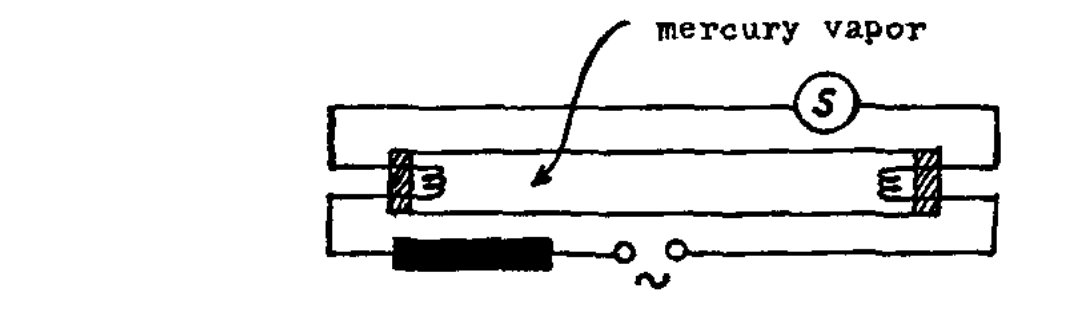
The following quantities are measured:
overall voltage (main voltage) \(U = 228.5\ \mathrm{V}\) electric current \(I = 0.6\ \mathrm{A}\) partial voltage across the fluorescent lamp \(U' = 84\ \mathrm{V}\) ohmic resistance of the series reactor \(R_{\mathrm d} = 26.3\ \Omega\) The fluorescent lamp itself may be considered as an ohmic resistor in the calculations.
a) What is the inductance \(L\) of the series reactor?
b) What is the phase shift \(\varphi\) between voltage and current?
c) What is the active power \(P_{\mathrm w}\) transformed by the apparatus?
d) Apart from limiting the current the series reactor has another important function. Name and explain this function!
Hint: The starter
includes a contact which closes shortly after switching on the lamp, opens up again and stays open.
e) In a diagram with a quantitative time scale sketch the time sequence of the luminous flux emitted by the lamp.
f) Why has the lamp to be ignited only once although the applied alternating voltage goes through zero in regular intervals?
g) According to the statement of the manufacturer, for a fluorescent lamp of the described type a capacitor of about \(4.7\ \mu\mathrm{F}\) can be switched in series with the series reactor. How does this affect the operation of the lamp and to what intent is this possibility provided for?
h) Examine both halves of the displayed demonstrator lamp with the added spectroscope. Explain the differences between the two spectra. You may walk up to the lamp and you may keep the spectroscope as a souvenir.
Official English text of the problem.
Problem 2: Oscillating coat hanger
A (suitably made) wire coat hanger can perform small amplitude oscillations in the plane of the figure around the equilibrium positions shown. In positions a) and b) the long side is horizontal. The other two sides have equal length. The period of oscillation is the same in all cases.
What is the location of the center of mass, and how long is the period?
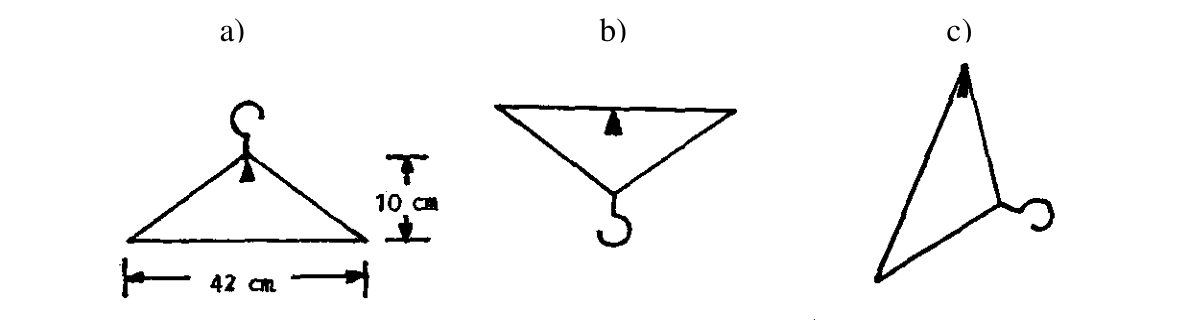
The figure does not contain any information beyond the dimensions given. Nothing is known, e.g., concerning the detailed distribution of mass.
Official English text of the problem.
Problem 3: Hot-air-balloon
Consider a hot-air balloon with fixed volume \(V_{\mathrm B} = 1.1\ \mathrm{m^3}\). The mass of the balloon-envelope, whose volume is to be neglected in comparison to \(V_{\mathrm B}\), is \(m_{\mathrm H} = 0.187\ \mathrm{kg}\).
The balloon shall be started, where the external air temperature is \(\vartheta_1 = 20\ ^\circ\mathrm C\) and the normal external air pressure is \(p_{\mathrm o} = 1.013\cdot 10^5\ \mathrm{Pa}\). Under these conditions the density of air is \(\rho_1 = 1.2\ \mathrm{kg/m^3}\).
a) What temperature \(\vartheta_2\) must the warmed air inside the balloon have to make the balloon just float?
b) First the balloon is held fast to the ground and the internal air is heated to a steady-state temperature of \(\vartheta_3 = 110\ ^\circ\mathrm C\). The balloon is fastened with a rope.
Calculate the force on the rope.
c) Consider the balloon being tied up at the bottom (the density of the internal air stays constant). With a steady-state temperature \(\vartheta_3 = 110\ ^\circ\mathrm C\) of the internal air the balloon rises in an isothermal atmosphere of \(20\ ^\circ\mathrm C\) and a ground pressure of \(p_0 = 1.013\cdot 10^5\ \mathrm{Pa}\). Which height \(h\) can be gained by the balloon under these conditions?
d) At the height \(h\) the balloon (question c)) is pulled out of its equilibrium position by \(10\ \mathrm m\) and then is released again.
Find out by qualitative reasoning what kind of motion it is going to perform!
Official English text of the problem.
Internationale Physik-Olympiade
IPhO 1982
Malente, Bundesrepublik Deutschland · 3 Theorieaufgaben mit vollständigen Lösungen
Aufgabe 1: Leuchtstofflampe
An die im beigefügten Schaltbild dargestellte Leuchtstofflampe wird eine Wechselspannung mit einer Frequenz von 50 Hz angelegt.
Die folgenden Größen werden gemessen:
Gesamtspannung (Netzspannung) \(U = 228.5\ \mathrm{V}\) Stromstärke \(I = 0.6\ \mathrm{A}\) Teilspannung an der Leuchtstofflampe \(U' = 84\ \mathrm{V}\) ohmscher Widerstand der Vorschaltdrossel \(R_{\mathrm d} = 26.3\ \Omega\) Die Leuchtstofflampe selbst darf bei den Berechnungen als ohmscher Widerstand betrachtet werden.
a) Wie groß ist die Induktivität \(L\) der Vorschaltdrossel?
b) Wie groß ist die Phasenverschiebung \(\varphi\) zwischen Spannung und Strom?
c) Wie groß ist die von der Anordnung umgesetzte Wirkleistung \(P_{\mathrm w}\)?
d) Neben der Strombegrenzung hat die Vorschaltdrossel noch eine weitere wichtige Funktion. Nennen und erläutern Sie diese Funktion!
Hinweis: Der Starter
enthält einen Kontakt, der sich kurz nach dem Einschalten der Lampe schließt, sich anschließend wieder öffnet und offen bleibt.
e) Skizzieren Sie in einem Diagramm mit quantitativer Zeitskala den zeitlichen Verlauf des von der Lampe ausgesandten Lichtstroms.
f) Warum muss die Lampe nur einmal gezündet werden, obwohl die angelegte Wechselspannung in regelmäßigen Abständen durch null geht?
g) Nach Angaben des Herstellers kann bei einer Leuchtstofflampe des beschriebenen Typs ein Kondensator von etwa \(4.7\ \mu\mathrm{F}\) in Reihe mit der Vorschaltdrossel geschaltet werden. Wie wirkt sich dies auf den Betrieb der Lampe aus, und zu welchem Zweck ist diese Möglichkeit vorgesehen?
h) Untersuchen Sie beide Hälften der ausgestellten Demonstrationslampe mit dem beigefügten Spektroskop. Erklären Sie die Unterschiede zwischen den beiden Spektren. Sie dürfen zur Lampe gehen und das Spektroskop als Andenken behalten.
Aufgabentext aus dem offiziellen englischen Text übersetzt.
Aufgabe 2: Schwingender Kleiderbügel
Ein (geeignet gefertigter) Drahtkleiderbügel kann in der Zeichenebene Schwingungen kleiner Amplitude um die dargestellten Gleichgewichtslagen ausführen. In den Lagen a) und b) ist die lange Seite waagerecht. Die beiden anderen Seiten sind gleich lang. Die Schwingungsdauer ist in allen Fällen gleich.
Wo liegt der Schwerpunkt, und wie groß ist die Schwingungsdauer?
Die Abbildung enthält außer den angegebenen Abmessungen keine weiteren Informationen. Beispielsweise ist über die genaue Massenverteilung nichts bekannt.
Aufgabentext aus dem offiziellen englischen Text übersetzt.
Aufgabe 3: Heißluftballon
Betrachtet wird ein Heißluftballon mit einem festen Volumen von \(V_{\mathrm B} = 1.1\ \mathrm{m^3}\). Die Masse der Ballonhülle, deren Volumen gegenüber \(V_{\mathrm B}\) zu vernachlässigen ist, beträgt \(m_{\mathrm H} = 0.187\ \mathrm{kg}\).
Der Ballon soll an einem Ort starten, an dem die Außenlufttemperatur \(\vartheta_1 = 20\ ^\circ\mathrm C\) und der normale Außenluftdruck \(p_{\mathrm o} = 1.013\cdot 10^5\ \mathrm{Pa}\) betragen. Unter diesen Bedingungen beträgt die Luftdichte \(\rho_1 = 1.2\ \mathrm{kg/m^3}\).
a) Welche Temperatur \(\vartheta_2\) muss die erwärmte Luft im Inneren des Ballons haben, damit der Ballon gerade schwebt?
b) Zunächst wird der Ballon am Boden festgehalten und die Luft in seinem Inneren auf eine stationäre Temperatur von \(\vartheta_3 = 110\ ^\circ\mathrm C\) erwärmt. Der Ballon ist mit einem Seil befestigt.
Berechnen Sie die Kraft auf das Seil.
c) Nun wird der Ballon unten zugebunden (die Dichte der Luft im Inneren bleibt konstant). Bei einer stationären Temperatur der Innenluft von \(\vartheta_3 = 110\ ^\circ\mathrm C\) steigt der Ballon in einer isothermen Atmosphäre mit einer Temperatur von \(20\ ^\circ\mathrm C\) und einem Luftdruck am Boden von \(p_0 = 1.013\cdot 10^5\ \mathrm{Pa}\) auf. Welche Höhe \(h\) kann der Ballon unter diesen Bedingungen erreichen?
d) In der Höhe \(h\) wird der Ballon (Teilaufgabe c)) um \(10\ \mathrm m\) aus seiner Gleichgewichtslage ausgelenkt und anschließend wieder losgelassen.
Bestimmen Sie durch qualitative Überlegungen, welche Art von Bewegung er ausführen wird!
Aufgabentext aus dem offiziellen englischen Text übersetzt.
Uluslararası Fizik Olimpiyatı
IPhO 1982
Malente, Almanya Federal Cumhuriyeti · 3 teori sorusu, tam çözümleriyle
Soru 1: Floresan lamba
Ekteki devre şemasında gösterilen floresan lambaya 50 Hz frekanslı bir alternatif gerilim uygulanmaktadır.
Aşağıdaki nicelikler ölçülmüştür:
toplam gerilim (şebeke gerilimi) \(U = 228.5\ \mathrm{V}\) elektrik akımı \(I = 0.6\ \mathrm{A}\) floresan lambanın uçları arasındaki gerilim \(U' = 84\ \mathrm{V}\) seri reaktörün omik direnci \(R_{\mathrm d} = 26.3\ \Omega\) Hesaplamalarda floresan lambanın kendisi omik bir direnç olarak kabul edilebilir.
a) Seri reaktörün \(L\) endüktansı nedir?
b) Gerilim ile akım arasındaki \(\varphi\) faz farkı nedir?
c) Düzeneğin dönüştürdüğü \(P_{\mathrm w}\) aktif gücü nedir?
d) Seri reaktörün, akımı sınırlamanın yanı sıra önemli bir işlevi daha vardır. Bu işlevi belirtiniz ve açıklayınız!
İpucu: Starter
lamba açıldıktan kısa bir süre sonra kapanan, ardından tekrar açılan ve açık kalan bir kontak içerir.
e) Nicel bir zaman ölçeği içeren bir grafikte, lambanın yaydığı ışık akısının zamanla değişimini çiziniz.
f) Uygulanan alternatif gerilim düzenli aralıklarla sıfırdan geçtiği hâlde lambanın neden yalnızca bir kez ateşlenmesi gerekir?
g) Üreticinin belirttiğine göre, açıklanan türde bir floresan lamba için seri reaktöre yaklaşık \(4.7\ \mu\mathrm{F}\) kapasiteli bir kondansatör seri olarak bağlanabilir. Bu, lambanın çalışmasını nasıl etkiler ve bu olanak hangi amaçla sağlanmıştır?
h) Sergilenen gösteri lambasının her iki yarısını, verilen spektroskopla inceleyiniz. İki spektrum arasındaki farkları açıklayınız. Lambanın yanına gidebilir ve spektroskobu hatıra olarak saklayabilirsiniz.
Soru metni resmi İngilizce metinden çevrilmiştir.
Soru 2: Salınan elbise askısı
(Uygun biçimde yapılmış) bir tel elbise askısı, gösterilen denge konumları çevresinde şeklin düzleminde küçük genlikli salınımlar yapabilir. a) ve b) konumlarında uzun kenar yataydır. Diğer iki kenar eşit uzunluktadır. Salınım periyodu tüm durumlarda aynıdır.
Kütle merkezi nerededir ve periyot ne kadardır?
Şekil, verilen boyutların ötesinde herhangi bir bilgi içermemektedir. Örneğin, kütlenin ayrıntılı dağılımı hakkında hiçbir şey bilinmemektedir.
Soru metni resmi İngilizce metinden çevrilmiştir.
Soru 3: Sıcak hava balonu
Hacmi sabit ve \(V_{\mathrm B} = 1.1\ \mathrm{m^3}\) olan bir sıcak hava balonunu ele alalım. Hacmi \(V_{\mathrm B}\) ile karşılaştırıldığında ihmal edilecek olan balon zarfının kütlesi \(m_{\mathrm H} = 0.187\ \mathrm{kg}\)'dır.
Balon, dış hava sıcaklığının \(\vartheta_1 = 20\ ^\circ\mathrm C\) ve normal dış hava basıncının \(p_{\mathrm o} = 1.013\cdot 10^5\ \mathrm{Pa}\) olduğu bir yerde havalandırılacaktır. Bu koşullar altında havanın yoğunluğu \(\rho_1 = 1.2\ \mathrm{kg/m^3}\)'tür.
a) Balonun tam olarak havada asılı kalabilmesi için içindeki ısıtılmış havanın sıcaklığı \(\vartheta_2\) ne olmalıdır?
b) Önce balon yere sabitlenir ve içindeki hava, kararlı durum sıcaklığı \(\vartheta_3 = 110\ ^\circ\mathrm C\) olacak şekilde ısıtılır. Balon bir iple bağlı tutulmaktadır.
İpe etki eden kuvveti hesaplayınız.
c) Balonun alt kısmının bağlanarak kapatıldığını düşününüz (içindeki havanın yoğunluğu sabit kalır). İçindeki havanın kararlı durum sıcaklığı \(\vartheta_3 = 110\ ^\circ\mathrm C\) olan balon, sıcaklığı \(20\ ^\circ\mathrm C\) ve yer seviyesindeki basıncı \(p_0 = 1.013\cdot 10^5\ \mathrm{Pa}\) olan izotermal bir atmosferde yükselir. Bu koşullar altında balon hangi \(h\) yüksekliğine ulaşabilir?
d) \(h\) yüksekliğindeki balon (c) sorusu), denge konumundan \(10\ \mathrm m\) uzaklaştırılır ve sonra yeniden serbest bırakılır.
Nitel akıl yürütmeyle balonun ne tür bir hareket yapacağını belirleyiniz!
Soru metni resmi İngilizce metinden çevrilmiştir.
Olimpiada Internacional de Física
IPhO 1982
Malente, República Federal de Alemania · 3 problemas teóricos con soluciones completas
Problema 1: Lámpara fluorescente
Se aplica una tensión alterna de 50 Hz de frecuencia a la lámpara fluorescente representada en el esquema del circuito adjunto.
Se miden las siguientes magnitudes:
tensión total (tensión de red) \(U = 228.5\ \mathrm{V}\) corriente eléctrica \(I = 0.6\ \mathrm{A}\) tensión parcial en los bornes de la lámpara fluorescente \(U' = 84\ \mathrm{V}\) resistencia óhmica de la bobina en serie \(R_{\mathrm d} = 26.3\ \Omega\) En los cálculos, la propia lámpara fluorescente puede considerarse una resistencia óhmica.
a) ¿Cuál es la inductancia \(L\) de la bobina en serie?
b) ¿Cuál es el desfase \(\varphi\) entre la tensión y la corriente?
c) ¿Cuál es la potencia activa \(P_{\mathrm w}\) transformada por el aparato?
d) Además de limitar la corriente, la bobina en serie tiene otra función importante. ¡Indique y explique esta función!
Indicación: El cebador
incluye un contacto que se cierra poco después de conectar la lámpara, vuelve a abrirse y permanece abierto.
e) Represente esquemáticamente en un diagrama con una escala de tiempo cuantitativa la evolución temporal del flujo luminoso emitido por la lámpara.
f) ¿Por qué basta con encender la lámpara una sola vez, aunque la tensión alterna aplicada pase por cero a intervalos regulares?
g) Según indica el fabricante, en una lámpara fluorescente del tipo descrito se puede conectar un condensador de unos \(4.7\ \mu\mathrm{F}\) en serie con la bobina. ¿Cómo afecta esto al funcionamiento de la lámpara y con qué finalidad se ofrece esta posibilidad?
h) Examine las dos mitades de la lámpara de demostración expuesta con el espectroscopio suministrado. Explique las diferencias entre los dos espectros. Puede acercarse a la lámpara y quedarse con el espectroscopio como recuerdo.
Enunciado traducido del texto oficial en inglés.
Problema 2: Percha oscilante
Una percha de alambre (fabricada adecuadamente) puede realizar oscilaciones de pequeña amplitud en el plano de la figura alrededor de las posiciones de equilibrio mostradas. En las posiciones a) y b), el lado largo es horizontal. Los otros dos lados tienen la misma longitud. El período de oscilación es el mismo en todos los casos.
¿Dónde se encuentra el centro de masa y cuánto vale el período?
La figura no contiene ninguna información aparte de las dimensiones indicadas. No se sabe nada, por ejemplo, sobre la distribución detallada de la masa.
Enunciado traducido del texto oficial en inglés.
Problema 3: Globo aerostático de aire caliente
Considérese un globo aerostático de aire caliente de volumen fijo \(V_{\mathrm B} = 1.1\ \mathrm{m^3}\). La masa de la envoltura del globo, cuyo volumen se considera despreciable en comparación con \(V_{\mathrm B}\), es \(m_{\mathrm H} = 0.187\ \mathrm{kg}\).
El globo se lanzará en un lugar donde la temperatura del aire exterior es \(\vartheta_1 = 20\ ^\circ\mathrm C\) y la presión normal del aire exterior es \(p_{\mathrm o} = 1.013\cdot 10^5\ \mathrm{Pa}\). En estas condiciones, la densidad del aire es \(\rho_1 = 1.2\ \mathrm{kg/m^3}\).
a) ¿Qué temperatura \(\vartheta_2\) debe tener el aire calentado en el interior del globo para que este se mantenga justo en suspensión?
b) Primero se sujeta el globo al suelo y se calienta el aire de su interior hasta alcanzar una temperatura estacionaria de \(\vartheta_3 = 110\ ^\circ\mathrm C\). El globo está sujeto mediante una cuerda.
Calcule la fuerza sobre la cuerda.
c) Considérese que se cierra la abertura inferior del globo atándola (la densidad del aire interior permanece constante). Con una temperatura estacionaria \(\vartheta_3 = 110\ ^\circ\mathrm C\) del aire interior, el globo asciende en una atmósfera isoterma a \(20\ ^\circ\mathrm C\) y con una presión a nivel del suelo de \(p_0 = 1.013\cdot 10^5\ \mathrm{Pa}\). ¿Qué altura \(h\) puede alcanzar el globo en estas condiciones?
d) A la altura \(h\), se desplaza el globo (apartado c)) \(10\ \mathrm m\) de su posición de equilibrio y después se suelta de nuevo.
¡Determine mediante un razonamiento cualitativo qué tipo de movimiento realizará!
Enunciado traducido del texto oficial en inglés.
国际物理奥林匹克
IPhO 1982
德意志联邦共和国马伦特 · 3 道理论题及完整解答
题目 1:荧光灯
将频率为 50 Hz 的交流电压加在所附电路图所示的荧光灯电路上。
测得以下各量:
总电压(电源电压) \(U = 228.5\ \mathrm{V}\) 电流 \(I = 0.6\ \mathrm{A}\) 荧光灯两端的分电压 \(U' = 84\ \mathrm{V}\) 串联电抗器的欧姆电阻 \(R_{\mathrm d} = 26.3\ \Omega\) 计算时,可将荧光灯本身视为欧姆电阻。
a) 串联电抗器的电感 \(L\) 是多少?
b) 电压与电流之间的相位差 \(\varphi\) 是多少?
c) 该装置消耗的有功功率 \(P_{\mathrm w}\) 是多少?
d) 除了限制电流之外,串联电抗器还有另一项重要作用。请指出并解释这一作用!
提示:启辉器
中有一个触点,它在接通灯的电源后不久闭合,随后再次断开并保持断开状态。
e) 在具有定量时间刻度的图中,画出灯发出的光通量随时间变化的示意曲线。
f) 尽管所加交流电压周期性地过零,为什么灯只需启动一次?
g) 根据制造商的说明,对于上述类型的荧光灯,可将一个约为 \(4.7\ \mu\mathrm{F}\) 的电容器与串联电抗器串联。这会如何影响灯的运行?提供这种连接方式的目的是什么?
h) 用所附的分光镜观察展示用演示灯的两个半部。解释这两个光谱之间的差异。你可以走近灯观察,也可以将分光镜留作纪念。
题目译自官方英文原文。
题目 2:摆动的衣架
一个(经过适当制作的)金属丝衣架能够在图示平衡位置附近,在图面内做小振幅摆动。在位置 a) 和 b) 中,长边水平。另外两边的长度相等。所有情况下的摆动周期都相同。
质心位于何处?摆动周期是多少?
除给定尺寸外,图中不包含任何其他信息。例如,质量的具体分布情况完全未知。
题目译自官方英文原文。
题目 3:热气球
考虑一个体积固定为 \(V_{\mathrm B} = 1.1\ \mathrm{m^3}\) 的热气球。气球囊皮的质量为 \(m_{\mathrm H} = 0.187\ \mathrm{kg}\),其体积与 \(V_{\mathrm B}\) 相比可忽略不计。
气球将在外界空气温度为 \(\vartheta_1 = 20\ ^\circ\mathrm C\)、外界气压为标准大气压 \(p_{\mathrm o} = 1.013\cdot 10^5\ \mathrm{Pa}\) 的地点升空。在这些条件下,空气密度为 \(\rho_1 = 1.2\ \mathrm{kg/m^3}\)。
a) 要使气球恰好悬浮,气球内被加热的空气必须达到什么温度 \(\vartheta_2\)?
b) 首先将气球固定在地面上,并将内部空气加热至稳态温度 \(\vartheta_3 = 110\ ^\circ\mathrm C\)。气球用一根绳子系住。
计算绳子所受的力。
c) 设气球底部已扎紧封闭(内部空气密度保持不变)。当内部空气的稳态温度为 \(\vartheta_3 = 110\ ^\circ\mathrm C\) 时,气球在温度为 \(20\ ^\circ\mathrm C\)、地面气压为 \(p_0 = 1.013\cdot 10^5\ \mathrm{Pa}\) 的等温大气中上升。在这些条件下,气球能达到多大的高度 \(h\)?
d) 在高度 \(h\) 处,将气球(问题 c) 中的气球)从平衡位置拉开 \(10\ \mathrm m\),然后再次释放。
通过定性推理,判断它将做什么样的运动!
题目译自官方英文原文。
Международная физическая олимпиада
IPhO 1982
Маленте, Федеративная Республика Германия · 3 теоретические задачи с полными решениями
Задача 1: Люминесцентная лампа
К люминесцентной лампе, изображённой на прилагаемой электрической схеме, приложено переменное напряжение частотой 50 Гц.
Измерены следующие величины:
общее напряжение (напряжение сети) \(U = 228.5\ \mathrm{V}\) электрический ток \(I = 0.6\ \mathrm{A}\) напряжение на люминесцентной лампе \(U' = 84\ \mathrm{V}\) активное сопротивление последовательно включённого дросселя \(R_{\mathrm d} = 26.3\ \Omega\) В расчётах саму люминесцентную лампу можно считать омическим резистором.
a) Какова индуктивность \(L\) последовательно включённого дросселя?
b) Каков сдвиг фаз \(\varphi\) между напряжением и током?
c) Какова активная мощность \(P_{\mathrm w}\), потребляемая устройством?
d) Помимо ограничения тока, дроссель выполняет ещё одну важную функцию. Назовите и объясните эту функцию!
Указание: стартер
содержит контакт, который замыкается вскоре после включения лампы, затем вновь размыкается и остаётся разомкнутым.
e) Изобразите схематически зависимость светового потока, излучаемого лампой, от времени, указав численный масштаб на оси времени.
f) Почему лампу необходимо зажигать лишь один раз, хотя приложенное переменное напряжение через равные промежутки времени проходит через нуль?
g) Согласно указанию изготовителя, для люминесцентной лампы описанного типа последовательно с дросселем можно включить конденсатор ёмкостью около \(4.7\ \mu\mathrm{F}\). Как это влияет на работу лампы и с какой целью предусмотрена такая возможность?
h) Рассмотрите обе половины представленной демонстрационной лампы с помощью прилагаемого спектроскопа. Объясните различия между двумя спектрами. Вы можете подойти к лампе и оставить спектроскоп себе на память.
Условие переведено с официального английского текста.
Задача 2: Колеблющаяся вешалка для одежды
Проволочная вешалка для одежды (изготовленная соответствующим образом) может совершать колебания малой амплитуды в плоскости рисунка около показанных положений равновесия. В положениях a) и b) длинная сторона горизонтальна. Две другие стороны имеют одинаковую длину. Период колебаний одинаков во всех случаях.
Где находится центр масс и чему равен период колебаний?
Рисунок не содержит никакой информации, кроме указанных размеров. Например, о конкретном распределении массы ничего не известно.
Условие переведено с официального английского текста.
Задача 3: Воздушный шар с горячим воздухом
Рассмотрим воздушный шар с горячим воздухом, имеющий постоянный объём \(V_{\mathrm B} = 1.1\ \mathrm{m^3}\). Масса оболочки шара, объёмом которой следует пренебречь по сравнению с \(V_{\mathrm B}\), равна \(m_{\mathrm H} = 0.187\ \mathrm{kg}\).
Шар предполагается запускать при температуре наружного воздуха \(\vartheta_1 = 20\ ^\circ\mathrm C\) и нормальном давлении наружного воздуха \(p_{\mathrm o} = 1.013\cdot 10^5\ \mathrm{Pa}\). При этих условиях плотность воздуха равна \(\rho_1 = 1.2\ \mathrm{kg/m^3}\).
a) Какую температуру \(\vartheta_2\) должен иметь нагретый воздух внутри шара, чтобы шар мог удерживаться в воздухе в равновесии?
b) Сначала шар удерживают у земли, а воздух внутри него нагревают до установившейся температуры \(\vartheta_3 = 110\ ^\circ\mathrm C\). Шар привязан верёвкой.
Рассчитайте силу, действующую на верёвку.
c) Рассмотрим шар, отверстие которого снизу завязано (плотность воздуха внутри остаётся постоянной). При установившейся температуре внутреннего воздуха \(\vartheta_3 = 110\ ^\circ\mathrm C\) шар поднимается в изотермической атмосфере с температурой \(20\ ^\circ\mathrm C\) и давлением у земли \(p_0 = 1.013\cdot 10^5\ \mathrm{Pa}\). Какой высоты \(h\) может достичь шар при этих условиях?
d) На высоте \(h\) шар (из пункта c)) смещают из положения равновесия на \(10\ \mathrm m\), а затем отпускают.
Определите с помощью качественных рассуждений, какое движение он будет совершать!
Условие переведено с официального английского текста.
الأولمبياد الدولي للفيزياء
IPhO 1982
مالينته، جمهورية ألمانيا الاتحادية · 3 مسائل نظرية مع حلول كاملة
المسألة 1: المصباح الفلوري
يُطبَّق جهد متناوب بتردد 50 Hz على المصباح الفلوري الموضح في مخطط الدائرة المرفق.
قِيست الكميات الآتية:
الجهد الكلي (جهد الشبكة) \(U = 228.5\ \mathrm{V}\) التيار الكهربائي \(I = 0.6\ \mathrm{A}\) الجهد الجزئي بين طرفي المصباح الفلوري \(U' = 84\ \mathrm{V}\) المقاومة الأومية لملف الخنق الموصول على التوالي \(R_{\mathrm d} = 26.3\ \Omega\) يمكن اعتبار المصباح الفلوري نفسه مقاومة أومية في الحسابات.
a) ما محاثة \(L\) ملف الخنق الموصول على التوالي؟
b) ما فرق الطور \(\varphi\) بين الجهد والتيار؟
c) ما القدرة الفعالة \(P_{\mathrm w}\) التي يحوّلها الجهاز؟
d) إلى جانب الحد من التيار، يؤدي ملف الخنق الموصول على التوالي وظيفة مهمة أخرى. اذكر هذه الوظيفة واشرحها!
تلميح: يحتوي بادئ التشغيل
على ملامس يُغلَق بعد وقت قصير من تشغيل المصباح، ثم يُفتَح من جديد ويبقى مفتوحًا.
e) ارسم رسمًا تخطيطيًا لتغيّر التدفق الضوئي المنبعث من المصباح مع الزمن، مع استخدام مقياس زمني محدد بالقيم العددية.
f) لماذا لا يلزم إشعال المصباح إلا مرة واحدة، مع أن الجهد المتناوب المطبَّق يمر بالصفر على فترات منتظمة؟
g) وفقًا لبيان الشركة المصنِّعة، يمكن، في مصباح فلوري من النوع الموصوف، توصيل مكثف سعته نحو \(4.7\ \mu\mathrm{F}\) على التوالي مع ملف الخنق. كيف يؤثر ذلك في تشغيل المصباح، ولأي غرض أُتيحت هذه الإمكانية؟
h) افحص نصفي المصباح التوضيحي المعروض باستخدام المطياف المرفق. اشرح الفروق بين الطيفين. يمكنك الاقتراب من المصباح، ويمكنك الاحتفاظ بالمطياف تذكارًا.
نص المسألة مترجم عن النص الإنجليزي الرسمي.
المسألة 2: علّاقة ملابس متذبذبة
يمكن لعلّاقة ملابس سلكية (مصنوعة على نحو مناسب) أن تؤدي تذبذبات صغيرة السعة في مستوى الشكل حول مواضع الاتزان المبينة. في الموضعين a) وb) يكون الضلع الطويل أفقيًا. أما الضلعان الآخران فمتساويان في الطول. والزمن الدوري للتذبذب هو نفسه في جميع الحالات.
أين يقع مركز الكتلة، وما مقدار الزمن الدوري؟
لا يتضمن الشكل أي معلومات تتجاوز الأبعاد المعطاة. فلا يُعرف شيء، مثلًا، عن التوزيع التفصيلي للكتلة.
نص المسألة مترجم عن النص الإنجليزي الرسمي.
المسألة 3: منطاد الهواء الساخن
لنعتبر منطاد هواء ساخن ذا حجم ثابت \(V_{\mathrm B} = 1.1\ \mathrm{m^3}\). كتلة غلاف المنطاد، الذي يُهمل حجمه بالمقارنة مع \(V_{\mathrm B}\)، هي \(m_{\mathrm H} = 0.187\ \mathrm{kg}\).
يُراد إطلاق المنطاد من موضع تبلغ فيه درجة حرارة الهواء الخارجي \(\vartheta_1 = 20\ ^\circ\mathrm C\)، ويبلغ فيه ضغط الهواء الخارجي العادي \(p_{\mathrm o} = 1.013\cdot 10^5\ \mathrm{Pa}\). في هذه الظروف، تبلغ كثافة الهواء \(\rho_1 = 1.2\ \mathrm{kg/m^3}\).
a) ما درجة الحرارة \(\vartheta_2\) التي يجب أن يبلغها الهواء المسخَّن داخل المنطاد كي يصبح المنطاد معلقًا في الهواء تمامًا؟
b) يُثبَّت المنطاد أولًا على الأرض، ويُسخَّن الهواء داخله حتى تبلغ درجة حرارته المستقرة \(\vartheta_3 = 110\ ^\circ\mathrm C\). ويُربط المنطاد بحبل.
احسب القوة المؤثرة في الحبل.
c) لنفترض أن فتحة المنطاد السفلية قد رُبطت وأُغلقت (فتبقى كثافة الهواء الداخلي ثابتة). عند درجة حرارة مستقرة للهواء الداخلي مقدارها \(\vartheta_3 = 110\ ^\circ\mathrm C\)، يرتفع المنطاد في غلاف جوي متساوي الحرارة عند \(20\ ^\circ\mathrm C\)، وضغطه عند سطح الأرض \(p_0 = 1.013\cdot 10^5\ \mathrm{Pa}\). ما الارتفاع \(h\) الذي يمكن أن يبلغه المنطاد في هذه الظروف؟
d) عند الارتفاع \(h\)، يُزاح المنطاد (في السؤال c)) عن موضع اتزانه بمقدار \(10\ \mathrm m\)، ثم يُترك حرًّا من جديد.
حدِّد بالاستدلال النوعي نوع الحركة التي سيؤديها!
نص المسألة مترجم عن النص الإنجليزي الرسمي.