IPhO 1982 · Theory problem 2
Oscillating coat hanger
A (suitably made) wire coat hanger can perform small amplitude oscillations in the plane of the figure around the equilibrium positions shown. In positions a) and b) the long side is horizontal. The other two sides have equal length. The period of oscillation is the same in all cases.
What is the location of the center of mass, and how long is the period?
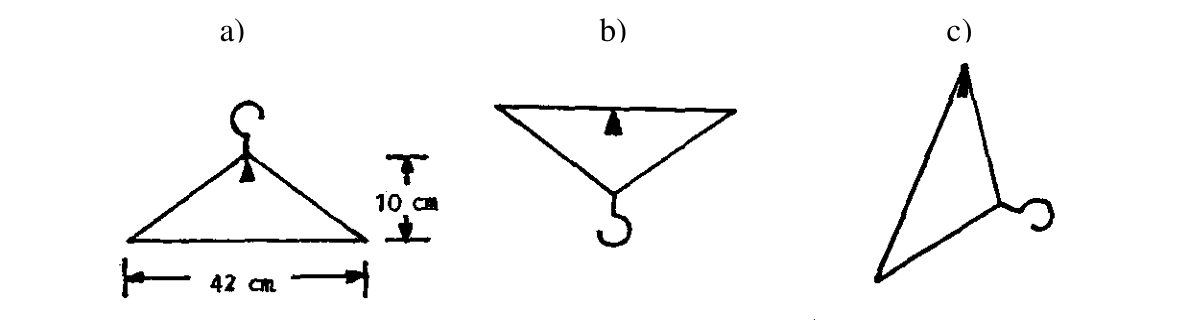
The figure does not contain any information beyond the dimensions given. Nothing is known, e.g., concerning the detailed distribution of mass.
Official English text of the problem.
Answers
- Center of mass: Halfway along the triangle’s altitude, on its symmetry axis: \(5.0\,\mathrm{cm}\) from the long side and \(5.0\,\mathrm{cm}\) from the opposite vertex.
- Common period: \[ \boxed{T=2\pi\sqrt{\frac{0.050+\sqrt{0.210^2+0.050^2}}{g}} \simeq 1.03\,\mathrm{s}}, \] where the lengths are in metres and \(g=9.81\,\mathrm{m\,s^{-2}}\).
Solution
Treat the hanger as a rigid physical pendulum, with a fixed suspension point in each configuration and negligible friction. Let its mass be \(M\), and let \(I_G=Mk^2\) be its moment of inertia about the axis through its center of mass perpendicular to its plane.
If the center of mass lies a distance \(d\) below the suspension point, the parallel-axis theorem and gravitational torque give \[ M(k^2+d^2)\ddot{\theta}=-Mgd\sin\theta. \] For small oscillations, \(\sin\theta\simeq\theta\), so \[ T=2\pi\sqrt{\frac{k^2+d^2}{gd}}. \] Thus a common period means that \[ \ell\equiv\frac{gT^2}{4\pi^2} =d+\frac{k^2}{d} \] has the same value for all three suspension points.
Location of the center of mass.
Denote the vertex opposite the long side by \(A\), the midpoint of the long side by \(B\), and the corner used for suspension in c) by \(C\). The given dimensions are \[ AB=h=0.100\,\mathrm{m}, \qquad BC=a=0.210\,\mathrm{m}. \]
In position a), equilibrium requires the center of mass \(G\) to lie vertically below \(A\). Since the triangle is isosceles and its long side is horizontal, \(G\) lies on the line \(AB\). In position b), the suspension point must likewise lie vertically above \(G\), so it is \(B\).
Both equilibria must be stable. Consequently, \(G\) lies between \(A\) and \(B\). Writing \(BG=x\), we have \[ 0<x<h, \qquad d_a=h-x,\qquad d_b=x,\qquad d_c=\sqrt{a^2+x^2}. \]
Equality of the periods in a) and b) gives \[ h-x+\frac{k^2}{h-x} =x+\frac{k^2}{x}, \] or \[ (h-2x)\bigl[x(h-x)-k^2\bigr]=0. \] Hence either \[ x=\frac h2 \quad\text{or}\quad k^2=x(h-x). \]
The second possibility would imply \[ \ell=x+\frac{x(h-x)}{x}=h. \] But in configuration c), \[ \ell=d_c+\frac{k^2}{d_c}>d_c\ge a =0.210\,\mathrm{m}>h. \] This contradicts the common period. Therefore \[ \boxed{x=\frac h2=0.050\,\mathrm{m}}. \]
The center of mass is thus halfway between the long side’s midpoint and the opposite vertex. This conclusion does not require a uniform mass distribution.
Period of oscillation.
With this center of mass, the suspension distances are \[ d_a=d_b=d=0.050\,\mathrm{m}, \qquad d_c=r=\sqrt{0.210^2+0.050^2} =0.215870\ldots\,\mathrm{m}. \]
Equating the periods for distances \(d\) and \(r\), \[ d+\frac{k^2}{d}=r+\frac{k^2}{r}. \] Since \(d\ne r\), this yields \[ k^2=dr. \] The common equivalent pendulum length is therefore \[ \ell=d+\frac{dr}{d}=d+r =0.265870\ldots\,\mathrm{m}. \] Finally, \[ \boxed{ T=2\pi\sqrt{\frac{d+r}{g}} =2\pi\sqrt{\frac{0.265870\ldots}{9.81}} \simeq1.03\,\mathrm{s}. } \]
The solution was checked against the official solution.
IPhO 1982 · Theorieaufgabe 2
Schwingender Kleiderbügel
Ein (geeignet gefertigter) Drahtkleiderbügel kann in der Zeichenebene Schwingungen kleiner Amplitude um die dargestellten Gleichgewichtslagen ausführen. In den Lagen a) und b) ist die lange Seite waagerecht. Die beiden anderen Seiten sind gleich lang. Die Schwingungsdauer ist in allen Fällen gleich.
Wo liegt der Schwerpunkt, und wie groß ist die Schwingungsdauer?
Die Abbildung enthält außer den angegebenen Abmessungen keine weiteren Informationen. Beispielsweise ist über die genaue Massenverteilung nichts bekannt.
Aufgabentext aus dem offiziellen englischen Text übersetzt.
Antworten
- Schwerpunkt: Auf halber Höhe des Dreiecks, auf seiner Symmetrieachse: \(5.0\,\mathrm{cm}\) von der langen Seite und \(5.0\,\mathrm{cm}\) vom gegenüberliegenden Eckpunkt entfernt.
- Gemeinsame Schwingungsdauer: \[ \boxed{T=2\pi\sqrt{\frac{0.050+\sqrt{0.210^2+0.050^2}}{g}} \simeq 1.03\,\mathrm{s}}, \] wobei die Längen in Metern angegeben sind und \(g=9.81\,\mathrm{m\,s^{-2}}\) ist.
Lösung
Wir betrachten den Kleiderbügel als starres physikalisches Pendel mit einem festen Aufhängepunkt in jeder Anordnung und vernachlässigbarer Reibung. Seine Masse sei \(M\), und \(I_G=Mk^2\) sei sein Trägheitsmoment bezüglich der Achse durch seinen Schwerpunkt senkrecht zu seiner Ebene.
Liegt der Schwerpunkt im Abstand \(d\) unterhalb des Aufhängepunkts, so ergeben der Satz von Steiner und das Drehmoment der Gewichtskraft \[ M(k^2+d^2)\ddot{\theta}=-Mgd\sin\theta. \] Für kleine Schwingungen gilt \(\sin\theta\simeq\theta\), also \[ T=2\pi\sqrt{\frac{k^2+d^2}{gd}}. \] Eine gemeinsame Schwingungsdauer bedeutet somit, dass \[ \ell\equiv\frac{gT^2}{4\pi^2} =d+\frac{k^2}{d} \] für alle drei Aufhängepunkte denselben Wert hat.
Lage des Schwerpunkts.
Wir bezeichnen den der langen Seite gegenüberliegenden Eckpunkt mit \(A\), den Mittelpunkt der langen Seite mit \(B\) und den in c) zur Aufhängung verwendeten Eckpunkt mit \(C\). Die gegebenen Abmessungen sind \[ AB=h=0.100\,\mathrm{m}, \qquad BC=a=0.210\,\mathrm{m}. \]
In der Lage a) erfordert das Gleichgewicht, dass der Schwerpunkt \(G\) senkrecht unterhalb von \(A\) liegt. Da das Dreieck gleichschenklig und seine lange Seite waagerecht ist, liegt \(G\) auf der Geraden \(AB\). In der Lage b) muss der Aufhängepunkt ebenfalls senkrecht oberhalb von \(G\) liegen, also ist er \(B\).
Beide Gleichgewichtslagen müssen stabil sein. Folglich liegt \(G\) zwischen \(A\) und \(B\). Mit \(BG=x\) gilt \[ 0<x<h, \qquad d_a=h-x,\qquad d_b=x,\qquad d_c=\sqrt{a^2+x^2}. \]
Aus der Gleichheit der Schwingungsdauern in a) und b) folgt \[ h-x+\frac{k^2}{h-x} =x+\frac{k^2}{x}, \] oder \[ (h-2x)\bigl[x(h-x)-k^2\bigr]=0. \] Somit gilt entweder \[ x=\frac h2 \quad\text{oder}\quad k^2=x(h-x). \]
Die zweite Möglichkeit würde bedeuten, dass \[ \ell=x+\frac{x(h-x)}{x}=h. \] In der Anordnung c) gilt jedoch \[ \ell=d_c+\frac{k^2}{d_c}>d_c\ge a =0.210\,\mathrm{m}>h. \] Dies widerspricht der gemeinsamen Schwingungsdauer. Daher gilt \[ \boxed{x=\frac h2=0.050\,\mathrm{m}}. \]
Der Schwerpunkt liegt somit auf halbem Weg zwischen dem Mittelpunkt der langen Seite und dem gegenüberliegenden Eckpunkt. Diese Schlussfolgerung setzt keine gleichmäßige Massenverteilung voraus.
Schwingungsdauer.
Für diese Schwerpunktlage betragen die Abstände zu den Aufhängepunkten \[ d_a=d_b=d=0.050\,\mathrm{m}, \qquad d_c=r=\sqrt{0.210^2+0.050^2} =0.215870\ldots\,\mathrm{m}. \]
Durch Gleichsetzen der Schwingungsdauern für die Abstände \(d\) und \(r\) erhalten wir \[ d+\frac{k^2}{d}=r+\frac{k^2}{r}. \] Da \(d\ne r\), ergibt sich daraus \[ k^2=dr. \] Die gemeinsame reduzierte Pendellänge ist daher \[ \ell=d+\frac{dr}{d}=d+r =0.265870\ldots\,\mathrm{m}. \] Schließlich folgt \[ \boxed{ T=2\pi\sqrt{\frac{d+r}{g}} =2\pi\sqrt{\frac{0.265870\ldots}{9.81}} \simeq1.03\,\mathrm{s}. } \]
Die Lösung wurde mit der offiziellen Lösung abgeglichen.
IPhO 1982 · Teori sorusu 2
Salınan elbise askısı
(Uygun biçimde yapılmış) bir tel elbise askısı, gösterilen denge konumları çevresinde şeklin düzleminde küçük genlikli salınımlar yapabilir. a) ve b) konumlarında uzun kenar yataydır. Diğer iki kenar eşit uzunluktadır. Salınım periyodu tüm durumlarda aynıdır.
Kütle merkezi nerededir ve periyot ne kadardır?
Şekil, verilen boyutların ötesinde herhangi bir bilgi içermemektedir. Örneğin, kütlenin ayrıntılı dağılımı hakkında hiçbir şey bilinmemektedir.
Soru metni resmi İngilizce metinden çevrilmiştir.
Cevaplar
- Kütle merkezi: Üçgenin yüksekliğinin orta noktasında, simetri ekseni üzerinde: uzun kenardan \(5.0\,\mathrm{cm}\), karşı köşeden ise \(5.0\,\mathrm{cm}\) uzaklıkta.
- Ortak periyot: \[ \boxed{T=2\pi\sqrt{\frac{0.050+\sqrt{0.210^2+0.050^2}}{g}} \simeq 1.03\,\mathrm{s}}, \] burada uzunluklar metre cinsindendir ve \(g=9.81\,\mathrm{m\,s^{-2}}\) alınmıştır.
Çözüm
Askıyı, her düzenlemede sabit bir asılma noktasına sahip, sürtünmenin ihmal edilebildiği rijit bir fiziksel sarkaç olarak ele alalım. Kütlesi \(M\), kütle merkezinden geçen ve düzlemine dik olan eksene göre eylemsizlik momenti ise \(I_G=Mk^2\) olsun.
Kütle merkezi asılma noktasının \(d\) kadar altında bulunuyorsa, paralel eksen teoremi ve yerçekimi kuvvetinin torku şu bağıntıyı verir: \[ M(k^2+d^2)\ddot{\theta}=-Mgd\sin\theta. \] Küçük salınımlar için \(\sin\theta\simeq\theta\) olduğundan \[ T=2\pi\sqrt{\frac{k^2+d^2}{gd}}. \] Dolayısıyla, periyodun ortak olması, \[ \ell\equiv\frac{gT^2}{4\pi^2} =d+\frac{k^2}{d} \] ifadesinin üç asılma noktası için de aynı değere sahip olması anlamına gelir.
Kütle merkezinin konumu.
Uzun kenarın karşısındaki köşeyi \(A\), uzun kenarın orta noktasını \(B\), c) durumunda asılma için kullanılan köşeyi ise \(C\) ile gösterelim. Verilen boyutlar şunlardır: \[ AB=h=0.100\,\mathrm{m}, \qquad BC=a=0.210\,\mathrm{m}. \]
a) konumunda denge, kütle merkezi \(G\)'nin \(A\)'nın düşey olarak altında bulunmasını gerektirir. Üçgen ikizkenar ve uzun kenarı yatay olduğundan, \(G\), \(AB\) doğrusu üzerinde bulunur. b) konumunda da asılma noktası \(G\)'nin düşey olarak üzerinde bulunmalıdır; dolayısıyla bu nokta \(B\)'dir.
Her iki denge de kararlı olmalıdır. Bu nedenle \(G\), \(A\) ile \(B\) arasında bulunur. \(BG=x\) yazarsak \[ 0<x<h, \qquad d_a=h-x,\qquad d_b=x,\qquad d_c=\sqrt{a^2+x^2}. \]
a) ve b) durumlarındaki periyotların eşitliği \[ h-x+\frac{k^2}{h-x} =x+\frac{k^2}{x}, \] ya da \[ (h-2x)\bigl[x(h-x)-k^2\bigr]=0. \] bağıntısını verir. Dolayısıyla \[ x=\frac h2 \quad\text{veya}\quad k^2=x(h-x). \]
İkinci olasılık \[ \ell=x+\frac{x(h-x)}{x}=h. \] sonucunu doğurur. Ancak c) düzenlemesinde \[ \ell=d_c+\frac{k^2}{d_c}>d_c\ge a =0.210\,\mathrm{m}>h. \] Bu, periyodun ortak olmasıyla çelişir. O hâlde \[ \boxed{x=\frac h2=0.050\,\mathrm{m}}. \]
Böylece kütle merkezi, uzun kenarın orta noktası ile karşı köşe arasındaki uzaklığın tam ortasındadır. Bu sonuç, kütle dağılımının düzgün olmasını gerektirmez.
Salınım periyodu.
Kütle merkezinin bu konumu için asılma noktalarının kütle merkezine uzaklıkları şöyledir: \[ d_a=d_b=d=0.050\,\mathrm{m}, \qquad d_c=r=\sqrt{0.210^2+0.050^2} =0.215870\ldots\,\mathrm{m}. \]
\(d\) ve \(r\) uzaklıkları için periyotları eşitlersek \[ d+\frac{k^2}{d}=r+\frac{k^2}{r}. \] \(d\ne r\) olduğundan, buradan \[ k^2=dr. \] elde edilir. Dolayısıyla ortak eşdeğer sarkaç uzunluğu \[ \ell=d+\frac{dr}{d}=d+r =0.265870\ldots\,\mathrm{m}. \] olur. Son olarak, \[ \boxed{ T=2\pi\sqrt{\frac{d+r}{g}} =2\pi\sqrt{\frac{0.265870\ldots}{9.81}} \simeq1.03\,\mathrm{s}. } \]
Çözüm, resmi çözümle karşılaştırılarak kontrol edildi.
IPhO 1982 · Problema teórico 2
Percha oscilante
Una percha de alambre (fabricada adecuadamente) puede realizar oscilaciones de pequeña amplitud en el plano de la figura alrededor de las posiciones de equilibrio mostradas. En las posiciones a) y b), el lado largo es horizontal. Los otros dos lados tienen la misma longitud. El período de oscilación es el mismo en todos los casos.
¿Dónde se encuentra el centro de masa y cuánto vale el período?
La figura no contiene ninguna información aparte de las dimensiones indicadas. No se sabe nada, por ejemplo, sobre la distribución detallada de la masa.
Enunciado traducido del texto oficial en inglés.
Respuestas
- Centro de masa: A mitad de la altura del triángulo, sobre su eje de simetría: a \(5.0\,\mathrm{cm}\) del lado largo y a \(5.0\,\mathrm{cm}\) del vértice opuesto.
- Período común: \[ \boxed{T=2\pi\sqrt{\frac{0.050+\sqrt{0.210^2+0.050^2}}{g}} \simeq 1.03\,\mathrm{s}}, \] donde las longitudes están expresadas en metros y \(g=9.81\,\mathrm{m\,s^{-2}}\).
Solución
Consideremos la percha como un péndulo físico rígido, con un punto de suspensión fijo en cada configuración y rozamiento despreciable. Sea \(M\) su masa, y sea \(I_G=Mk^2\) su momento de inercia respecto al eje que pasa por su centro de masa y es perpendicular a su plano.
Si el centro de masa se encuentra a una distancia \(d\) por debajo del punto de suspensión, el teorema de los ejes paralelos y el momento de la fuerza de la gravedad dan \[ M(k^2+d^2)\ddot{\theta}=-Mgd\sin\theta. \] Para pequeñas oscilaciones, \(\sin\theta\simeq\theta\), de modo que \[ T=2\pi\sqrt{\frac{k^2+d^2}{gd}}. \] Por tanto, un período común significa que \[ \ell\equiv\frac{gT^2}{4\pi^2} =d+\frac{k^2}{d} \] tiene el mismo valor para los tres puntos de suspensión.
Posición del centro de masa.
Denotemos por \(A\) el vértice opuesto al lado largo, por \(B\) el punto medio del lado largo y por \(C\) el vértice utilizado como punto de suspensión en c). Las dimensiones dadas son \[ AB=h=0.100\,\mathrm{m}, \qquad BC=a=0.210\,\mathrm{m}. \]
En la posición a), el equilibrio exige que el centro de masa \(G\) se encuentre verticalmente por debajo de \(A\). Como el triángulo es isósceles y su lado largo es horizontal, \(G\) se encuentra sobre la recta \(AB\). En la posición b), el punto de suspensión debe encontrarse igualmente en la vertical por encima de \(G\), por lo que es \(B\).
Ambos equilibrios deben ser estables. Por consiguiente, \(G\) se encuentra entre \(A\) y \(B\). Escribiendo \(BG=x\), tenemos \[ 0<x<h, \qquad d_a=h-x,\qquad d_b=x,\qquad d_c=\sqrt{a^2+x^2}. \]
La igualdad de los períodos en a) y b) da \[ h-x+\frac{k^2}{h-x} =x+\frac{k^2}{x}, \] o bien \[ (h-2x)\bigl[x(h-x)-k^2\bigr]=0. \] Por tanto, se cumple una de las dos posibilidades: \[ x=\frac h2 \quad\text{o}\quad k^2=x(h-x). \]
La segunda posibilidad implicaría \[ \ell=x+\frac{x(h-x)}{x}=h. \] Pero en la configuración c), \[ \ell=d_c+\frac{k^2}{d_c}>d_c\ge a =0.210\,\mathrm{m}>h. \] Esto contradice la igualdad de los períodos. Por tanto, \[ \boxed{x=\frac h2=0.050\,\mathrm{m}}. \]
El centro de masa se encuentra, pues, a mitad de camino entre el punto medio del lado largo y el vértice opuesto. Esta conclusión no requiere una distribución uniforme de la masa.
Período de oscilación.
Con este centro de masa, las distancias a los puntos de suspensión son \[ d_a=d_b=d=0.050\,\mathrm{m}, \qquad d_c=r=\sqrt{0.210^2+0.050^2} =0.215870\ldots\,\mathrm{m}. \]
Igualando los períodos para las distancias \(d\) y \(r\), \[ d+\frac{k^2}{d}=r+\frac{k^2}{r}. \] Como \(d\ne r\), se obtiene \[ k^2=dr. \] La longitud común del péndulo equivalente es, por tanto, \[ \ell=d+\frac{dr}{d}=d+r =0.265870\ldots\,\mathrm{m}. \] Finalmente, \[ \boxed{ T=2\pi\sqrt{\frac{d+r}{g}} =2\pi\sqrt{\frac{0.265870\ldots}{9.81}} \simeq1.03\,\mathrm{s}. } \]
La solución se comprobó con la solución oficial.
IPhO 1982 · 理论题 2
摆动的衣架
一个(经过适当制作的)金属丝衣架能够在图示平衡位置附近,在图面内做小振幅摆动。在位置 a) 和 b) 中,长边水平。另外两边的长度相等。所有情况下的摆动周期都相同。
质心位于何处?摆动周期是多少?
除给定尺寸外,图中不包含任何其他信息。例如,质量的具体分布情况完全未知。
题目译自官方英文原文。
答案
- 质心位置: 位于三角形的对称轴上、高的中点处:距长边 \(5.0\,\mathrm{cm}\),距长边所对的顶点 \(5.0\,\mathrm{cm}\)。
- 共同周期: \[ \boxed{T=2\pi\sqrt{\frac{0.050+\sqrt{0.210^2+0.050^2}}{g}} \simeq 1.03\,\mathrm{s}}, \] 其中长度以米为单位,且 \(g=9.81\,\mathrm{m\,s^{-2}}\)。
解答
将衣架视为刚性复摆,在每种悬挂方式下,悬点均固定,摩擦可忽略。设其质量为 \(M\),绕通过质心且垂直于衣架平面的轴的转动惯量为 \(I_G=Mk^2\)。
若质心位于悬点下方、距悬点为 \(d\),由平行轴定理和重力矩可得 \[ M(k^2+d^2)\ddot{\theta}=-Mgd\sin\theta. \] 对于小振幅摆动,\(\sin\theta\simeq\theta\),因此 \[ T=2\pi\sqrt{\frac{k^2+d^2}{gd}}. \] 因此,周期相同意味着 \[ \ell\equiv\frac{gT^2}{4\pi^2} =d+\frac{k^2}{d} \] 对于三个悬点均具有相同的值。
质心的位置。
将长边所对的顶点记为 \(A\),长边的中点记为 \(B\),在 c) 中用作悬点的顶点记为 \(C\)。给定尺寸为 \[ AB=h=0.100\,\mathrm{m}, \qquad BC=a=0.210\,\mathrm{m}. \]
在位置 a) 中,平衡条件要求质心 \(G\) 位于 \(A\) 的正下方。由于三角形是等腰三角形,且长边水平,\(G\) 位于直线 \(AB\) 上。在位置 b) 中,悬点同样必须位于 \(G\) 的正上方,因此悬点为 \(B\)。
这两个平衡位置都必须是稳定的。因此,\(G\) 位于 \(A\) 和 \(B\) 之间。令 \(BG=x\),则有 \[ 0<x<h, \qquad d_a=h-x,\qquad d_b=x,\qquad d_c=\sqrt{a^2+x^2}. \]
a) 和 b) 中的周期相等,给出 \[ h-x+\frac{k^2}{h-x} =x+\frac{k^2}{x}, \] 即 \[ (h-2x)\bigl[x(h-x)-k^2\bigr]=0. \] 因此,要么 \[ x=\frac h2 \quad\text{或}\quad k^2=x(h-x). \]
第二种可能性将意味着 \[ \ell=x+\frac{x(h-x)}{x}=h. \] 但在悬挂方式 c) 中, \[ \ell=d_c+\frac{k^2}{d_c}>d_c\ge a =0.210\,\mathrm{m}>h. \] 这与周期相同相矛盾。因此 \[ \boxed{x=\frac h2=0.050\,\mathrm{m}}. \]
因此,质心位于长边中点与其所对顶点之间的正中间。得出这一结论不需要假设质量均匀分布。
摆动周期。
对于上述质心位置,质心到各悬点的距离为 \[ d_a=d_b=d=0.050\,\mathrm{m}, \qquad d_c=r=\sqrt{0.210^2+0.050^2} =0.215870\ldots\,\mathrm{m}. \]
令距离分别为 \(d\) 和 \(r\) 时的周期相等,得 \[ d+\frac{k^2}{d}=r+\frac{k^2}{r}. \] 由于 \(d\ne r\),可得 \[ k^2=dr. \] 因此,共同的等效摆长为 \[ \ell=d+\frac{dr}{d}=d+r =0.265870\ldots\,\mathrm{m}. \] 最后, \[ \boxed{ T=2\pi\sqrt{\frac{d+r}{g}} =2\pi\sqrt{\frac{0.265870\ldots}{9.81}} \simeq1.03\,\mathrm{s}. } \]
解答已与官方解答核对。
IPhO 1982 · Теоретическая задача 2
Колеблющаяся вешалка для одежды
Проволочная вешалка для одежды (изготовленная соответствующим образом) может совершать колебания малой амплитуды в плоскости рисунка около показанных положений равновесия. В положениях a) и b) длинная сторона горизонтальна. Две другие стороны имеют одинаковую длину. Период колебаний одинаков во всех случаях.
Где находится центр масс и чему равен период колебаний?
Рисунок не содержит никакой информации, кроме указанных размеров. Например, о конкретном распределении массы ничего не известно.
Условие переведено с официального английского текста.
Ответы
- Центр масс: В середине высоты треугольника, на его оси симметрии: на расстоянии \(5.0\,\mathrm{cm}\) от длинной стороны и \(5.0\,\mathrm{cm}\) от противоположной вершины.
- Общий период: \[ \boxed{T=2\pi\sqrt{\frac{0.050+\sqrt{0.210^2+0.050^2}}{g}} \simeq 1.03\,\mathrm{s}}, \] где длины выражены в метрах и \(g=9.81\,\mathrm{m\,s^{-2}}\).
Решение
Будем рассматривать вешалку как твёрдый физический маятник с неподвижной точкой подвеса в каждом положении, пренебрегая трением. Обозначим её массу через \(M\), а момент инерции относительно оси, проходящей через центр масс перпендикулярно её плоскости, — через \(I_G=Mk^2\).
Если центр масс находится на расстоянии \(d\) ниже точки подвеса, то из теоремы Штейнера и выражения для момента силы тяжести получаем \[ M(k^2+d^2)\ddot{\theta}=-Mgd\sin\theta. \] Для малых колебаний \(\sin\theta\simeq\theta\), поэтому \[ T=2\pi\sqrt{\frac{k^2+d^2}{gd}}. \] Таким образом, одинаковый период означает, что величина \[ \ell\equiv\frac{gT^2}{4\pi^2} =d+\frac{k^2}{d} \] имеет одно и то же значение для всех трёх точек подвеса.
Положение центра масс.
Обозначим вершину, противоположную длинной стороне, через \(A\), середину длинной стороны — через \(B\), а вершину, за которую вешалка подвешена в положении c), — через \(C\). Заданы следующие размеры: \[ AB=h=0.100\,\mathrm{m}, \qquad BC=a=0.210\,\mathrm{m}. \]
В положении a) условие равновесия требует, чтобы центр масс \(G\) находился на вертикали под \(A\). Поскольку треугольник равнобедренный, а его длинная сторона горизонтальна, \(G\) лежит на прямой \(AB\). В положении b) точка подвеса также должна находиться на вертикали над \(G\), следовательно, это точка \(B\).
Оба положения равновесия должны быть устойчивыми. Следовательно, \(G\) лежит между \(A\) и \(B\). Полагая \(BG=x\), получаем \[ 0<x<h, \qquad d_a=h-x,\qquad d_b=x,\qquad d_c=\sqrt{a^2+x^2}. \]
Равенство периодов в положениях a) и b) даёт \[ h-x+\frac{k^2}{h-x} =x+\frac{k^2}{x}, \] или \[ (h-2x)\bigl[x(h-x)-k^2\bigr]=0. \] Следовательно, либо \[ x=\frac h2 \quad\text{либо}\quad k^2=x(h-x). \]
Второй вариант означал бы, что \[ \ell=x+\frac{x(h-x)}{x}=h. \] Но в положении c) \[ \ell=d_c+\frac{k^2}{d_c}>d_c\ge a =0.210\,\mathrm{m}>h. \] Это противоречит равенству периодов. Поэтому \[ \boxed{x=\frac h2=0.050\,\mathrm{m}}. \]
Таким образом, центр масс находится посередине между серединой длинной стороны и противоположной вершиной. Этот вывод не требует равномерного распределения массы.
Период колебаний.
При таком положении центра масс расстояния от точек подвеса до него равны \[ d_a=d_b=d=0.050\,\mathrm{m}, \qquad d_c=r=\sqrt{0.210^2+0.050^2} =0.215870\ldots\,\mathrm{m}. \]
Приравнивая периоды для расстояний \(d\) и \(r\), получаем \[ d+\frac{k^2}{d}=r+\frac{k^2}{r}. \] Поскольку \(d\ne r\), отсюда следует \[ k^2=dr. \] Таким образом, общая приведённая длина маятника равна \[ \ell=d+\frac{dr}{d}=d+r =0.265870\ldots\,\mathrm{m}. \] Наконец, \[ \boxed{ T=2\pi\sqrt{\frac{d+r}{g}} =2\pi\sqrt{\frac{0.265870\ldots}{9.81}} \simeq1.03\,\mathrm{s}. } \]
Решение проверено по официальному решению.
IPhO 1982 · مسألة نظرية 2
علّاقة ملابس متذبذبة
يمكن لعلّاقة ملابس سلكية (مصنوعة على نحو مناسب) أن تؤدي تذبذبات صغيرة السعة في مستوى الشكل حول مواضع الاتزان المبينة. في الموضعين a) وb) يكون الضلع الطويل أفقيًا. أما الضلعان الآخران فمتساويان في الطول. والزمن الدوري للتذبذب هو نفسه في جميع الحالات.
أين يقع مركز الكتلة، وما مقدار الزمن الدوري؟
لا يتضمن الشكل أي معلومات تتجاوز الأبعاد المعطاة. فلا يُعرف شيء، مثلًا، عن التوزيع التفصيلي للكتلة.
نص المسألة مترجم عن النص الإنجليزي الرسمي.
الإجابات
- مركز الكتلة: عند منتصف ارتفاع المثلث، على محور تناظره: على بُعد \(5.0\,\mathrm{cm}\) من الضلع الطويل وعلى بُعد \(5.0\,\mathrm{cm}\) من الرأس المقابل.
- الزمن الدوري المشترك: \[ \boxed{T=2\pi\sqrt{\frac{0.050+\sqrt{0.210^2+0.050^2}}{g}} \simeq 1.03\,\mathrm{s}}, \] حيث الأطوال بالأمتار و\(g=9.81\,\mathrm{m\,s^{-2}}\).
الحل
نُعامل العلّاقة على أنها بندول فيزيائي صلب، له نقطة تعليق ثابتة في كل وضعية، مع إهمال الاحتكاك. لتكن كتلتها \(M\)، وليكن \(I_G=Mk^2\) عزم قصورها الذاتي حول المحور المار بمركز كتلتها والعمودي على مستواها.
إذا كان مركز الكتلة يقع على مسافة \(d\) أسفل نقطة التعليق، فإن مبرهنة المحاور المتوازية وعزم قوة الثقل يعطيان \[ M(k^2+d^2)\ddot{\theta}=-Mgd\sin\theta. \] للتذبذبات الصغيرة، \(\sin\theta\simeq\theta\)، ومن ثم \[ T=2\pi\sqrt{\frac{k^2+d^2}{gd}}. \] وعليه، فإن تساوي الأزمنة الدورية يعني أن المقدار \[ \ell\equiv\frac{gT^2}{4\pi^2} =d+\frac{k^2}{d} \] له القيمة نفسها عند نقاط التعليق الثلاث جميعها.
موضع مركز الكتلة.
لنرمز إلى الرأس المقابل للضلع الطويل بـ\(A\)، وإلى منتصف الضلع الطويل بـ\(B\)، وإلى الرأس المستخدم للتعليق في c) بـ\(C\). الأبعاد المعطاة هي \[ AB=h=0.100\,\mathrm{m}, \qquad BC=a=0.210\,\mathrm{m}. \]
في الموضع a)، يقتضي الاتزان أن يقع مركز الكتلة \(G\) أسفل \(A\) على الخط الرأسي المار بها. وبما أن المثلث متساوي الساقين وضلعه الطويل أفقي، فإن \(G\) يقع على المستقيم \(AB\). وفي الموضع b)، يجب كذلك أن تقع نقطة التعليق فوق \(G\) على الخط الرأسي المار به، لذا فهي \(B\).
يجب أن يكون الاتزان مستقرًا في كلا الموضعين. وبناءً عليه، يقع \(G\) بين \(A\) و\(B\). وبوضع \(BG=x\)، نحصل على \[ 0<x<h, \qquad d_a=h-x,\qquad d_b=x,\qquad d_c=\sqrt{a^2+x^2}. \]
يعطي تساوي الزمنين الدوريين في a) وb) \[ h-x+\frac{k^2}{h-x} =x+\frac{k^2}{x}, \] أو \[ (h-2x)\bigl[x(h-x)-k^2\bigr]=0. \] إذن إما \[ x=\frac h2 \quad\text{أو}\quad k^2=x(h-x). \]
الاحتمال الثاني يستلزم أن \[ \ell=x+\frac{x(h-x)}{x}=h. \] لكن في الوضعية c)، \[ \ell=d_c+\frac{k^2}{d_c}>d_c\ge a =0.210\,\mathrm{m}>h. \] وهذا يتناقض مع تساوي الأزمنة الدورية. لذلك \[ \boxed{x=\frac h2=0.050\,\mathrm{m}}. \]
إذن يقع مركز الكتلة في منتصف المسافة بين منتصف الضلع الطويل والرأس المقابل. ولا تتطلب هذه النتيجة توزيعًا منتظمًا للكتلة.
الزمن الدوري للتذبذب.
عندما يكون مركز الكتلة في هذا الموضع، تكون المسافات بينه وبين نقاط التعليق \[ d_a=d_b=d=0.050\,\mathrm{m}, \qquad d_c=r=\sqrt{0.210^2+0.050^2} =0.215870\ldots\,\mathrm{m}. \]
بمساواة الزمنين الدوريين للمسافتين \(d\) و\(r\)، \[ d+\frac{k^2}{d}=r+\frac{k^2}{r}. \] وبما أن \(d\ne r\)، ينتج عن ذلك \[ k^2=dr. \] ومن ثم يكون طول البندول المكافئ المشترك \[ \ell=d+\frac{dr}{d}=d+r =0.265870\ldots\,\mathrm{m}. \] وأخيرًا، \[ \boxed{ T=2\pi\sqrt{\frac{d+r}{g}} =2\pi\sqrt{\frac{0.265870\ldots}{9.81}} \simeq1.03\,\mathrm{s}. } \]
تمت مراجعة الحل بمقارنته بالحل الرسمي.