IPhO 1976 · Theory problem 2
Helium in a cylinder with a piston and a valved dividing wall
The walls of a cylinder of base \(1\,\mathrm{dm}^2\), the piston and the inner dividing wall are perfect heat insulators (Fig. 10). The valve in the dividing wall opens if the pressure on the right side is greater than on the left side. Initially there is \(12\,\mathrm{g}\) helium in the left side and \(2\,\mathrm{g}\) helium in the right side. The lengths of both sides are \(11.2\,\mathrm{dm}\) each and the temperature is \(0^\circ\mathrm{C}\). Outside we have a pressure of \(100\,\mathrm{kPa}\).
The specific heat at constant volume is \(c_v=3.15\,\mathrm{J/gK}\), at constant pressure it is \(c_p=5.25\,\mathrm{J/gK}\). The piston is pushed slowly towards the dividing wall. When the valve opens we stop then continue pushing slowly until the wall is reached. Find the work done on the piston by us.
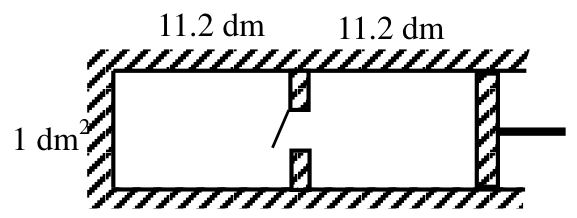
Figure 10
Official English text of the problem.
Answers
- Problem 2: The work done on the piston by us is \[ \boxed{W_{\mathrm{us}}\approx 3.68\times10^3\,\mathrm{J}=3.68\,\mathrm{kJ}.} \]
Solution
Treat helium as an ideal gas with the given constant specific heats. Neglect friction and kinetic energy; the slow piston motion makes the compression quasistatic.
The initial volume of each compartment is \[ V_0=A\ell_0=(1\,\mathrm{dm}^2)(11.2\,\mathrm{dm}) =1.12\times10^{-2}\,\mathrm{m}^3. \] Also, \[ T_0=273.15\,\mathrm{K},\qquad R_s=c_p-c_v=2.10\,\mathrm{J\,g^{-1}K^{-1}},\qquad \gamma=\frac{c_p}{c_v}=\frac53. \]
Before the valve opens. The left-hand gas remains at fixed volume and temperature, so its pressure stays at \[ p_{L0}=\frac{m_LR_sT_0}{V_0}=614.6\,\mathrm{kPa}. \] The initial right-hand pressure is \[ p_{R0}=\frac{m_RR_sT_0}{V_0}=102.4\,\mathrm{kPa}, \qquad \frac{p_{L0}}{p_{R0}}=\frac{12}{2}=6. \]
The right-hand gas undergoes quasistatic adiabatic compression: \[ p_Rv^\gamma=p_{R0}V_0^\gamma, \] where \(v\) is its instantaneous volume. In the quasistatic limit, the valve starts opening when \(p_R=p_{L0}\). Hence the right-hand volume at opening is \[ v_*= V_0\left(\frac{p_{R0}}{p_{L0}}\right)^{1/\gamma} =V_0\,6^{-3/5} =3.822\times10^{-3}\,\mathrm{m}^3. \]
The pause contributes no work because the piston does not move. Any internal equilibration during the pause also leaves the total energy unchanged.
After the valve opens. Continued slow compression transfers helium into the left compartment. The pressure difference needed to open the ideal valve is infinitesimal, so the two compartments have a common pressure \(p\).
Their temperatures need not be equal. For either compartment, the ideal-gas equation gives \[ U_i=m_ic_vT_i=\frac{c_v}{R_s}pV_i =\frac{pV_i}{\gamma-1}. \] Thus, writing the total gas volume as \(\mathcal V=V_0+v\), \[ U=\frac{p\mathcal V}{\gamma-1}. \]
The whole gas system is thermally insulated, and only the piston does boundary work. Therefore, \[ dU=-p\,d\mathcal V. \] Substitution gives \[ \frac{\mathcal V\,dp+p\,d\mathcal V}{\gamma-1} =-p\,d\mathcal V, \] or \[ \mathcal V\,dp+\gamma p\,d\mathcal V=0. \] Consequently, \[ p\mathcal V^\gamma=\text{constant}. \] This relation follows from energy conservation and equal pressures; it does not require equal compartment temperatures.
At the start of this stage, \(\mathcal V=V_0+v_*\) and \(p=p_{L0}\). When the piston reaches the dividing wall, all the helium occupies \(V_0\). Its final pressure is therefore \[ \begin{aligned} p_f &=p_{L0}\left(\frac{V_0+v_*}{V_0}\right)^\gamma\\ &=p_{L0}\left(1+6^{-3/5}\right)^{5/3}\\ &\approx1.00257\times10^6\,\mathrm{Pa}. \end{aligned} \]
Work supplied by us. Since no heat enters the gas, the total work done on it equals its internal-energy increase: \[ \begin{aligned} W_{\mathrm{on\,gas}} &=U_f-U_i\\ &=\frac{p_fV_0-(p_{L0}+p_{R0})V_0}{\gamma-1}\\ &\approx4797.3\,\mathrm{J}. \end{aligned} \]
The atmosphere supplies part of this work. The piston sweeps out the entire initial right-hand volume, so \[ W_{\mathrm{atmosphere}} =p_{\mathrm{ext}}V_0 =(100000)(0.0112) =1120\,\mathrm{J}. \] With negligible piston kinetic energy and friction, \[ W_{\mathrm{us}}+W_{\mathrm{atmosphere}} =W_{\mathrm{on\,gas}}. \] Hence \[ \boxed{ W_{\mathrm{us}}=4797.3-1120 \approx3.68\times10^3\,\mathrm{J}. } \]
The solution was checked against the official solution.
IPhO 1976 · Theorieaufgabe 2
Helium in einem Zylinder mit Kolben und einer Trennwand mit Ventil
Die Wände eines Zylinders mit einer Grundfläche von \(1\,\mathrm{dm}^2\), der Kolben und die innere Trennwand sind vollkommen wärmeisolierend (Abb. 10). Das Ventil in der Trennwand öffnet sich, wenn der Druck auf der rechten Seite größer ist als auf der linken Seite. Anfangs befinden sich auf der linken Seite \(12\,\mathrm{g}\) Helium und auf der rechten Seite \(2\,\mathrm{g}\) Helium. Beide Kammern sind jeweils \(11.2\,\mathrm{dm}\) lang, und die Temperatur beträgt \(0^\circ\mathrm{C}\). Außen herrscht ein Druck von \(100\,\mathrm{kPa}\).
Die spezifische Wärmekapazität bei konstantem Volumen beträgt \(c_v=3.15\,\mathrm{J/gK}\), bei konstantem Druck beträgt sie \(c_p=5.25\,\mathrm{J/gK}\). Der Kolben wird langsam in Richtung der Trennwand geschoben. Wenn sich das Ventil öffnet, halten wir an und schieben anschließend langsam weiter, bis die Trennwand erreicht ist. Bestimmen Sie die von uns am Kolben verrichtete Arbeit.
Abbildung 10
Aufgabentext aus dem offiziellen englischen Text übersetzt.
Antworten
- Aufgabe 2: Die von uns am Kolben verrichtete Arbeit beträgt \[ \boxed{W_{\mathrm{us}}\approx 3.68\times10^3\,\mathrm{J}=3.68\,\mathrm{kJ}.} \]
Lösung
Wir behandeln Helium als ideales Gas mit den angegebenen konstanten spezifischen Wärmekapazitäten. Reibung und kinetische Energie werden vernachlässigt; durch die langsame Kolbenbewegung verläuft die Kompression quasistatisch.
Das Anfangsvolumen jeder Kammer beträgt \[ V_0=A\ell_0=(1\,\mathrm{dm}^2)(11.2\,\mathrm{dm}) =1.12\times10^{-2}\,\mathrm{m}^3. \] Außerdem gilt \[ T_0=273.15\,\mathrm{K},\qquad R_s=c_p-c_v=2.10\,\mathrm{J\,g^{-1}K^{-1}},\qquad \gamma=\frac{c_p}{c_v}=\frac53. \]
Bevor sich das Ventil öffnet. Das Gas in der linken Kammer behält sein Volumen und seine Temperatur bei, sodass sein Druck unverändert bleibt: \[ p_{L0}=\frac{m_LR_sT_0}{V_0}=614.6\,\mathrm{kPa}. \] Der Anfangsdruck in der rechten Kammer beträgt \[ p_{R0}=\frac{m_RR_sT_0}{V_0}=102.4\,\mathrm{kPa}, \qquad \frac{p_{L0}}{p_{R0}}=\frac{12}{2}=6. \]
Das Gas in der rechten Kammer wird quasistatisch und adiabatisch komprimiert: \[ p_Rv^\gamma=p_{R0}V_0^\gamma, \] wobei \(v\) sein momentanes Volumen ist. Im quasistatischen Grenzfall beginnt sich das Ventil zu öffnen, wenn \(p_R=p_{L0}\). Somit beträgt das Volumen der rechten Kammer beim Öffnen \[ v_*= V_0\left(\frac{p_{R0}}{p_{L0}}\right)^{1/\gamma} =V_0\,6^{-3/5} =3.822\times10^{-3}\,\mathrm{m}^3. \]
Während der Pause wird keine Arbeit verrichtet, da sich der Kolben nicht bewegt. Auch ein etwaiger innerer Ausgleich während der Pause lässt die Gesamtenergie unverändert.
Nachdem sich das Ventil geöffnet hat. Durch die weitere langsame Kompression strömt Helium in die linke Kammer. Die zum Öffnen des idealen Ventils erforderliche Druckdifferenz ist infinitesimal klein, sodass in beiden Kammern derselbe Druck \(p\) herrscht.
Ihre Temperaturen müssen nicht gleich sein. Für jede der beiden Kammern ergibt die Zustandsgleichung des idealen Gases \[ U_i=m_ic_vT_i=\frac{c_v}{R_s}pV_i =\frac{pV_i}{\gamma-1}. \] Bezeichnen wir das gesamte Gasvolumen mit \(\mathcal V=V_0+v\), so gilt daher \[ U=\frac{p\mathcal V}{\gamma-1}. \]
Das gesamte Gassystem ist wärmeisoliert, und nur der Kolben verrichtet Volumenarbeit. Daher gilt \[ dU=-p\,d\mathcal V. \] Einsetzen ergibt \[ \frac{\mathcal V\,dp+p\,d\mathcal V}{\gamma-1} =-p\,d\mathcal V, \] oder \[ \mathcal V\,dp+\gamma p\,d\mathcal V=0. \] Folglich gilt \[ p\mathcal V^\gamma=\text{konstant}. \] Diese Beziehung folgt aus der Energieerhaltung und der Gleichheit der Drücke; gleiche Temperaturen in den Kammern sind dafür nicht erforderlich.
Zu Beginn dieser Phase gilt \(\mathcal V=V_0+v_*\) und \(p=p_{L0}\). Wenn der Kolben die Trennwand erreicht, nimmt das gesamte Helium das Volumen \(V_0\) ein. Sein Enddruck beträgt daher \[ \begin{aligned} p_f &=p_{L0}\left(\frac{V_0+v_*}{V_0}\right)^\gamma\\ &=p_{L0}\left(1+6^{-3/5}\right)^{5/3}\\ &\approx1.00257\times10^6\,\mathrm{Pa}. \end{aligned} \]
Von uns verrichtete Arbeit. Da dem Gas keine Wärme zugeführt wird, ist die gesamte an ihm verrichtete Arbeit gleich der Zunahme seiner inneren Energie: \[ \begin{aligned} W_{\mathrm{on\,gas}} &=U_f-U_i\\ &=\frac{p_fV_0-(p_{L0}+p_{R0})V_0}{\gamma-1}\\ &\approx4797.3\,\mathrm{J}. \end{aligned} \]
Die Atmosphäre verrichtet einen Teil dieser Arbeit. Der Kolben überstreicht das gesamte Anfangsvolumen der rechten Kammer, sodass \[ W_{\mathrm{atmosphere}} =p_{\mathrm{ext}}V_0 =(100000)(0.0112) =1120\,\mathrm{J}. \] Bei vernachlässigbarer kinetischer Energie des Kolbens und vernachlässigbarer Reibung gilt \[ W_{\mathrm{us}}+W_{\mathrm{atmosphere}} =W_{\mathrm{on\,gas}}. \] Somit ergibt sich \[ \boxed{ W_{\mathrm{us}}=4797.3-1120 \approx3.68\times10^3\,\mathrm{J}. } \]
Die Lösung wurde mit der offiziellen Lösung abgeglichen.
IPhO 1976 · Teori sorusu 2
Pistonlu ve valfli bir bölme duvarı bulunan silindirde helyum
Taban alanı \(1\,\mathrm{dm}^2\) olan bir silindirin duvarları, pistonu ve iç bölme duvarı kusursuz ısı yalıtkanlarıdır (Şekil 10). Bölme duvarındaki valf, sağ taraftaki basınç sol taraftakinden büyük olduğunda açılır. Başlangıçta sol tarafta \(12\,\mathrm{g}\), sağ tarafta ise \(2\,\mathrm{g}\) helyum vardır. Her iki tarafın uzunluğu da \(11.2\,\mathrm{dm}\), sıcaklık ise \(0^\circ\mathrm{C}\)'dir. Dışarıdaki basınç \(100\,\mathrm{kPa}\)'dır.
Sabit hacimde özgül ısı \(c_v=3.15\,\mathrm{J/gK}\), sabit basınçta özgül ısı ise \(c_p=5.25\,\mathrm{J/gK}\)'dir. Piston, bölme duvarına doğru yavaşça itilir. Valf açıldığında durur, ardından duvara ulaşılıncaya kadar yavaşça itmeye devam ederiz. Piston üzerinde yaptığımız işi bulunuz.
Şekil 10
Soru metni resmi İngilizce metinden çevrilmiştir.
Cevaplar
- Soru 2: Piston üzerinde yaptığımız iş \[ \boxed{W_{\mathrm{us}}\approx 3.68\times10^3\,\mathrm{J}=3.68\,\mathrm{kJ}.} \] kadardır.
Çözüm
Helyumu, verilen sabit özgül ısılara sahip ideal bir gaz olarak ele alalım. Sürtünmeyi ve kinetik enerjiyi ihmal edelim; pistonun yavaş hareketi sıkıştırmanın kuazistatik olmasını sağlar.
Her bölmenin başlangıç hacmi \[ V_0=A\ell_0=(1\,\mathrm{dm}^2)(11.2\,\mathrm{dm}) =1.12\times10^{-2}\,\mathrm{m}^3. \] Ayrıca, \[ T_0=273.15\,\mathrm{K},\qquad R_s=c_p-c_v=2.10\,\mathrm{J\,g^{-1}K^{-1}},\qquad \gamma=\frac{c_p}{c_v}=\frac53. \]
Valf açılmadan önce. Sol taraftaki gazın hacmi ve sıcaklığı sabit kaldığından basıncı da \[ p_{L0}=\frac{m_LR_sT_0}{V_0}=614.6\,\mathrm{kPa}. \] değerinde kalır. Sağ taraftaki başlangıç basıncı \[ p_{R0}=\frac{m_RR_sT_0}{V_0}=102.4\,\mathrm{kPa}, \qquad \frac{p_{L0}}{p_{R0}}=\frac{12}{2}=6. \]
Sağ taraftaki gaz kuazistatik adyabatik sıkıştırmaya uğrar: \[ p_Rv^\gamma=p_{R0}V_0^\gamma, \] burada \(v\), gazın anlık hacmidir. Kuazistatik limitte valf, \(p_R=p_{L0}\) olduğunda açılmaya başlar. Dolayısıyla açılma anında sağ taraftaki hacim \[ v_*= V_0\left(\frac{p_{R0}}{p_{L0}}\right)^{1/\gamma} =V_0\,6^{-3/5} =3.822\times10^{-3}\,\mathrm{m}^3. \]
Duraklama sırasında piston hareket etmediği için iş yapılmaz. Duraklama sırasında sistem içinde gerçekleşebilecek herhangi bir dengeye gelme süreci de toplam enerjiyi değiştirmez.
Valf açıldıktan sonra. Yavaş sıkıştırma sürdürüldükçe helyum sol bölmeye aktarılır. İdeal valfi açmak için gereken basınç farkı sonsuz küçük olduğundan iki bölmenin basıncı ortak bir \(p\) değerindedir.
Bölmelerin sıcaklıklarının eşit olması gerekmez. Her bir bölme için ideal gaz denklemi \[ U_i=m_ic_vT_i=\frac{c_v}{R_s}pV_i =\frac{pV_i}{\gamma-1}. \] bağıntısını verir. Böylece toplam gaz hacmini \(\mathcal V=V_0+v\) olarak yazarak \[ U=\frac{p\mathcal V}{\gamma-1}. \] elde ederiz.
Gaz sisteminin tamamı ısıl olarak yalıtılmıştır ve sistem sınırında yalnızca piston iş yapar. Dolayısıyla, \[ dU=-p\,d\mathcal V. \] Yerine koyarsak \[ \frac{\mathcal V\,dp+p\,d\mathcal V}{\gamma-1} =-p\,d\mathcal V, \] ya da \[ \mathcal V\,dp+\gamma p\,d\mathcal V=0. \] elde edilir. Sonuç olarak, \[ p\mathcal V^\gamma=\text{sabit}. \] Bu bağıntı, enerjinin korunumundan ve basınçların eşitliğinden çıkar; bölmelerin sıcaklıklarının eşit olmasını gerektirmez.
Bu aşamanın başlangıcında \(\mathcal V=V_0+v_*\) ve \(p=p_{L0}\)'dır. Piston bölme duvarına ulaştığında helyumun tamamı \(V_0\) hacmini kaplar. Dolayısıyla son basıncı \[ \begin{aligned} p_f &=p_{L0}\left(\frac{V_0+v_*}{V_0}\right)^\gamma\\ &=p_{L0}\left(1+6^{-3/5}\right)^{5/3}\\ &\approx1.00257\times10^6\,\mathrm{Pa}. \end{aligned} \]
Bizim yaptığımız iş. Gaza ısı girişi olmadığından gaz üzerinde yapılan toplam iş, gazın iç enerjisindeki artışa eşittir: \[ \begin{aligned} W_{\mathrm{on\,gas}} &=U_f-U_i\\ &=\frac{p_fV_0-(p_{L0}+p_{R0})V_0}{\gamma-1}\\ &\approx4797.3\,\mathrm{J}. \end{aligned} \]
Bu işin bir kısmını atmosfer yapar. Piston, sağ tarafın başlangıç hacminin tamamını süpürdüğünden \[ W_{\mathrm{atmosphere}} =p_{\mathrm{ext}}V_0 =(100000)(0.0112) =1120\,\mathrm{J}. \] Pistonun kinetik enerjisi ve sürtünme ihmal edildiğinde, \[ W_{\mathrm{us}}+W_{\mathrm{atmosphere}} =W_{\mathrm{on\,gas}}. \] Böylece \[ \boxed{ W_{\mathrm{us}}=4797.3-1120 \approx3.68\times10^3\,\mathrm{J}. } \]
Çözüm, resmi çözümle karşılaştırılarak kontrol edildi.
IPhO 1976 · Problema teórico 2
Helio en un cilindro con un pistón y un tabique con válvula
Las paredes de un cilindro de base \(1\,\mathrm{dm}^2\), el pistón y el tabique interior son aislantes térmicos perfectos (Fig. 10). La válvula del tabique se abre si la presión del lado derecho es mayor que la del lado izquierdo. Inicialmente hay \(12\,\mathrm{g}\) de helio en el lado izquierdo y \(2\,\mathrm{g}\) de helio en el lado derecho. Las longitudes de ambos lados son de \(11.2\,\mathrm{dm}\) cada una y la temperatura es de \(0^\circ\mathrm{C}\). En el exterior, la presión es de \(100\,\mathrm{kPa}\).
El calor específico a volumen constante es \(c_v=3.15\,\mathrm{J/gK}\), y a presión constante es \(c_p=5.25\,\mathrm{J/gK}\). Se empuja lentamente el pistón hacia el tabique. Cuando se abre la válvula, nos detenemos y luego seguimos empujando lentamente hasta alcanzar el tabique. Determine el trabajo que realizamos sobre el pistón.
Figura 10
Enunciado traducido del texto oficial en inglés.
Respuestas
- Problema 2: El trabajo que realizamos sobre el pistón es \[ \boxed{W_{\mathrm{us}}\approx 3.68\times10^3\,\mathrm{J}=3.68\,\mathrm{kJ}.} \]
Solución
Se considera el helio como un gas ideal con los calores específicos constantes dados. Se desprecian el rozamiento y la energía cinética; el movimiento lento del pistón hace que la compresión sea cuasiestática.
El volumen inicial de cada compartimento es \[ V_0=A\ell_0=(1\,\mathrm{dm}^2)(11.2\,\mathrm{dm}) =1.12\times10^{-2}\,\mathrm{m}^3. \] Además, \[ T_0=273.15\,\mathrm{K},\qquad R_s=c_p-c_v=2.10\,\mathrm{J\,g^{-1}K^{-1}},\qquad \gamma=\frac{c_p}{c_v}=\frac53. \]
Antes de que se abra la válvula. El gas del lado izquierdo permanece a volumen y temperatura constantes, por lo que su presión se mantiene en \[ p_{L0}=\frac{m_LR_sT_0}{V_0}=614.6\,\mathrm{kPa}. \] La presión inicial del lado derecho es \[ p_{R0}=\frac{m_RR_sT_0}{V_0}=102.4\,\mathrm{kPa}, \qquad \frac{p_{L0}}{p_{R0}}=\frac{12}{2}=6. \]
El gas del lado derecho experimenta una compresión adiabática cuasiestática: \[ p_Rv^\gamma=p_{R0}V_0^\gamma, \] donde \(v\) es su volumen instantáneo. En el límite cuasiestático, la válvula empieza a abrirse cuando \(p_R=p_{L0}\). Por tanto, el volumen del lado derecho en el momento de la apertura es \[ v_*= V_0\left(\frac{p_{R0}}{p_{L0}}\right)^{1/\gamma} =V_0\,6^{-3/5} =3.822\times10^{-3}\,\mathrm{m}^3. \]
Durante la pausa no se realiza trabajo porque el pistón no se mueve. Cualquier proceso interno de equilibración durante la pausa también deja inalterada la energía total.
Después de que se abra la válvula. Al continuar la compresión lenta, se transfiere helio al compartimento izquierdo. La diferencia de presión necesaria para abrir la válvula ideal es infinitesimal, por lo que los dos compartimentos tienen una presión común \(p\).
Sus temperaturas no tienen por qué ser iguales. Para cualquiera de los compartimentos, la ecuación del gas ideal da \[ U_i=m_ic_vT_i=\frac{c_v}{R_s}pV_i =\frac{pV_i}{\gamma-1}. \] Así, escribiendo el volumen total del gas como \(\mathcal V=V_0+v\), \[ U=\frac{p\mathcal V}{\gamma-1}. \]
El sistema gaseoso completo está térmicamente aislado, y solo el pistón realiza trabajo en la frontera del sistema. Por tanto, \[ dU=-p\,d\mathcal V. \] Al sustituir, se obtiene \[ \frac{\mathcal V\,dp+p\,d\mathcal V}{\gamma-1} =-p\,d\mathcal V, \] o bien \[ \mathcal V\,dp+\gamma p\,d\mathcal V=0. \] En consecuencia, \[ p\mathcal V^\gamma=\text{constante}. \] Esta relación se deduce de la conservación de la energía y de la igualdad de presiones; no requiere que las temperaturas de los compartimentos sean iguales.
Al inicio de esta etapa, \(\mathcal V=V_0+v_*\) y \(p=p_{L0}\). Cuando el pistón alcanza el tabique, todo el helio ocupa \(V_0\). Por tanto, su presión final es \[ \begin{aligned} p_f &=p_{L0}\left(\frac{V_0+v_*}{V_0}\right)^\gamma\\ &=p_{L0}\left(1+6^{-3/5}\right)^{5/3}\\ &\approx1.00257\times10^6\,\mathrm{Pa}. \end{aligned} \]
Trabajo aportado por nosotros. Como no entra calor en el gas, el trabajo total realizado sobre él es igual al aumento de su energía interna: \[ \begin{aligned} W_{\mathrm{on\,gas}} &=U_f-U_i\\ &=\frac{p_fV_0-(p_{L0}+p_{R0})V_0}{\gamma-1}\\ &\approx4797.3\,\mathrm{J}. \end{aligned} \]
La atmósfera aporta parte de este trabajo. El pistón barre todo el volumen inicial del lado derecho, de modo que \[ W_{\mathrm{atmosphere}} =p_{\mathrm{ext}}V_0 =(100000)(0.0112) =1120\,\mathrm{J}. \] Si la energía cinética del pistón y el rozamiento son despreciables, \[ W_{\mathrm{us}}+W_{\mathrm{atmosphere}} =W_{\mathrm{on\,gas}}. \] Por tanto, \[ \boxed{ W_{\mathrm{us}}=4797.3-1120 \approx3.68\times10^3\,\mathrm{J}. } \]
La solución se comprobó con la solución oficial.
IPhO 1976 · 理论题 2
带有活塞和装有阀门的隔板的气缸中的氦气
一个底面积为 \(1\,\mathrm{dm}^2\) 的气缸,其缸壁、活塞和内部隔板均完全绝热(图 10)。当隔板右侧的压强大于左侧的压强时,隔板上的阀门便会打开。初始时,左侧有 \(12\,\mathrm{g}\) 氦气,右侧有 \(2\,\mathrm{g}\) 氦气。两侧的长度均为 \(11.2\,\mathrm{dm}\),温度为 \(0^\circ\mathrm{C}\)。外界压强为 \(100\,\mathrm{kPa}\)。
定容比热容为 \(c_v=3.15\,\mathrm{J/gK}\),定压比热容为 \(c_p=5.25\,\mathrm{J/gK}\)。将活塞缓慢推向隔板。当阀门打开时,我们停止推动,然后继续缓慢推动,直至活塞到达隔板。求我们对活塞所做的功。
图 10
题目译自官方英文原文。
答案
- 题目 2: 我们对活塞所做的功为 \[ \boxed{W_{\mathrm{us}}\approx 3.68\times10^3\,\mathrm{J}=3.68\,\mathrm{kJ}.} \]
解答
将氦气视为理想气体,其比热容为题给常量。忽略摩擦和动能;活塞缓慢运动,使压缩过程成为准静态过程。
每个气室的初始体积为 \[ V_0=A\ell_0=(1\,\mathrm{dm}^2)(11.2\,\mathrm{dm}) =1.12\times10^{-2}\,\mathrm{m}^3. \] 此外, \[ T_0=273.15\,\mathrm{K},\qquad R_s=c_p-c_v=2.10\,\mathrm{J\,g^{-1}K^{-1}},\qquad \gamma=\frac{c_p}{c_v}=\frac53. \]
阀门打开前。 左侧气体的体积和温度保持不变,因此其压强保持为 \[ p_{L0}=\frac{m_LR_sT_0}{V_0}=614.6\,\mathrm{kPa}. \] 右侧的初始压强为 \[ p_{R0}=\frac{m_RR_sT_0}{V_0}=102.4\,\mathrm{kPa}, \qquad \frac{p_{L0}}{p_{R0}}=\frac{12}{2}=6. \]
右侧气体经历准静态绝热压缩: \[ p_Rv^\gamma=p_{R0}V_0^\gamma, \] 其中,\(v\) 为其瞬时体积。在准静态极限下,当 \(p_R=p_{L0}\) 时,阀门开始打开。因此,阀门打开时右侧气体的体积为 \[ v_*= V_0\left(\frac{p_{R0}}{p_{L0}}\right)^{1/\gamma} =V_0\,6^{-3/5} =3.822\times10^{-3}\,\mathrm{m}^3. \]
暂停期间,活塞不动,因此不做功。暂停期间内部发生的任何平衡过程也不会改变总能量。
阀门打开后。 继续缓慢压缩会使氦气转移到左侧气室。打开理想阀门所需的压强差为无穷小,因此两个气室具有共同的压强 \(p\)。
两者的温度不必相等。对于任一气室,由理想气体状态方程可得 \[ U_i=m_ic_vT_i=\frac{c_v}{R_s}pV_i =\frac{pV_i}{\gamma-1}. \] 因此,将气体总体积记为 \(\mathcal V=V_0+v\),有 \[ U=\frac{p\mathcal V}{\gamma-1}. \]
整个气体系统是绝热的,且只有活塞通过边界位移做功。因此, \[ dU=-p\,d\mathcal V. \] 代入可得 \[ \frac{\mathcal V\,dp+p\,d\mathcal V}{\gamma-1} =-p\,d\mathcal V, \] 即 \[ \mathcal V\,dp+\gamma p\,d\mathcal V=0. \] 于是, \[ p\mathcal V^\gamma=\text{常量}. \] 这一关系由能量守恒和压强相等得出,并不要求两个气室的温度相等。
在这一阶段开始时,\(\mathcal V=V_0+v_*\),且 \(p=p_{L0}\)。当活塞到达隔板时,全部氦气占据的体积为 \(V_0\)。因此,其最终压强为 \[ \begin{aligned} p_f &=p_{L0}\left(\frac{V_0+v_*}{V_0}\right)^\gamma\\ &=p_{L0}\left(1+6^{-3/5}\right)^{5/3}\\ &\approx1.00257\times10^6\,\mathrm{Pa}. \end{aligned} \]
我们所做的功。 由于没有热量传入气体,对气体所做的总功等于其内能的增加量: \[ \begin{aligned} W_{\mathrm{on\,gas}} &=U_f-U_i\\ &=\frac{p_fV_0-(p_{L0}+p_{R0})V_0}{\gamma-1}\\ &\approx4797.3\,\mathrm{J}. \end{aligned} \]
其中一部分功由大气提供。活塞扫过的体积等于右侧气室的全部初始体积,因此 \[ W_{\mathrm{atmosphere}} =p_{\mathrm{ext}}V_0 =(100000)(0.0112) =1120\,\mathrm{J}. \] 在活塞动能和摩擦均可忽略的情况下, \[ W_{\mathrm{us}}+W_{\mathrm{atmosphere}} =W_{\mathrm{on\,gas}}. \] 因此 \[ \boxed{ W_{\mathrm{us}}=4797.3-1120 \approx3.68\times10^3\,\mathrm{J}. } \]
解答已与官方解答核对。
IPhO 1976 · Теоретическая задача 2
Гелий в цилиндре с поршнем и перегородкой с клапаном
Стенки цилиндра с площадью основания \(1\,\mathrm{dm}^2\), поршень и внутренняя перегородка являются идеальными теплоизоляторами (рис. 10). Клапан в перегородке открывается, если давление справа больше давления слева. Первоначально в левой части находится \(12\,\mathrm{g}\) гелия, а в правой — \(2\,\mathrm{g}\) гелия. Длина каждой из двух частей составляет \(11.2\,\mathrm{dm}\), а температура равна \(0^\circ\mathrm{C}\). Внешнее давление составляет \(100\,\mathrm{kPa}\).
Удельная теплоёмкость при постоянном объёме равна \(c_v=3.15\,\mathrm{J/gK}\), а при постоянном давлении — \(c_p=5.25\,\mathrm{J/gK}\). Мы медленно перемещаем поршень к перегородке. Когда клапан открывается, мы останавливаемся, а затем продолжаем медленно перемещать поршень до соприкосновения с перегородкой. Найдите работу, совершённую нами над поршнем.
Рисунок 10
Условие переведено с официального английского текста.
Ответы
- Задача 2: Работа, совершённая нами над поршнем, равна \[ \boxed{W_{\mathrm{us}}\approx 3.68\times10^3\,\mathrm{J}=3.68\,\mathrm{kJ}.} \]
Решение
Будем считать гелий идеальным газом с заданными постоянными удельными теплоёмкостями. Пренебрежём трением и кинетической энергией; благодаря медленному движению поршня сжатие является квазистатическим.
Начальный объём каждого отсека равен \[ V_0=A\ell_0=(1\,\mathrm{dm}^2)(11.2\,\mathrm{dm}) =1.12\times10^{-2}\,\mathrm{m}^3. \] Кроме того, \[ T_0=273.15\,\mathrm{K},\qquad R_s=c_p-c_v=2.10\,\mathrm{J\,g^{-1}K^{-1}},\qquad \gamma=\frac{c_p}{c_v}=\frac53. \]
До открытия клапана. Объём и температура газа в левом отсеке остаются постоянными, поэтому его давление сохраняет значение \[ p_{L0}=\frac{m_LR_sT_0}{V_0}=614.6\,\mathrm{kPa}. \] Начальное давление в правом отсеке равно \[ p_{R0}=\frac{m_RR_sT_0}{V_0}=102.4\,\mathrm{kPa}, \qquad \frac{p_{L0}}{p_{R0}}=\frac{12}{2}=6. \]
Газ в правом отсеке испытывает квазистатическое адиабатическое сжатие: \[ p_Rv^\gamma=p_{R0}V_0^\gamma, \] где \(v\) — его текущий объём. В квазистатическом пределе клапан начинает открываться при \(p_R=p_{L0}\). Следовательно, объём правого отсека в момент открытия равен \[ v_*= V_0\left(\frac{p_{R0}}{p_{L0}}\right)^{1/\gamma} =V_0\,6^{-3/5} =3.822\times10^{-3}\,\mathrm{m}^3. \]
Во время остановки работа не совершается, поскольку поршень не движется. Любое установление внутреннего равновесия во время остановки также оставляет полную энергию неизменной.
После открытия клапана. При дальнейшем медленном сжатии гелий перетекает в левый отсек. Разность давлений, необходимая для открытия идеального клапана, бесконечно мала, поэтому в обоих отсеках устанавливается одинаковое давление \(p\).
Их температуры не обязательно равны. Для каждого отсека из уравнения состояния идеального газа следует \[ U_i=m_ic_vT_i=\frac{c_v}{R_s}pV_i =\frac{pV_i}{\gamma-1}. \] Таким образом, обозначив полный объём газа через \(\mathcal V=V_0+v\), получаем \[ U=\frac{p\mathcal V}{\gamma-1}. \]
Вся газовая система теплоизолирована, и работа на её границе совершается только поршнем. Поэтому \[ dU=-p\,d\mathcal V. \] Подстановка даёт \[ \frac{\mathcal V\,dp+p\,d\mathcal V}{\gamma-1} =-p\,d\mathcal V, \] или \[ \mathcal V\,dp+\gamma p\,d\mathcal V=0. \] Следовательно, \[ p\mathcal V^\gamma=\text{постоянная}. \] Это соотношение следует из закона сохранения энергии и равенства давлений; оно не требует равенства температур в отсеках.
В начале этого этапа \(\mathcal V=V_0+v_*\) и \(p=p_{L0}\). Когда поршень достигает перегородки, весь гелий занимает объём \(V_0\). Поэтому его конечное давление равно \[ \begin{aligned} p_f &=p_{L0}\left(\frac{V_0+v_*}{V_0}\right)^\gamma\\ &=p_{L0}\left(1+6^{-3/5}\right)^{5/3}\\ &\approx1.00257\times10^6\,\mathrm{Pa}. \end{aligned} \]
Работа, совершённая нами. Поскольку газ не получает теплоты, полная работа, совершённая над ним, равна увеличению его внутренней энергии: \[ \begin{aligned} W_{\mathrm{on\,gas}} &=U_f-U_i\\ &=\frac{p_fV_0-(p_{L0}+p_{R0})V_0}{\gamma-1}\\ &\approx4797.3\,\mathrm{J}. \end{aligned} \]
Часть этой работы совершает атмосфера. При перемещении поршня вытесняется весь начальный объём правого отсека, поэтому \[ W_{\mathrm{atmosphere}} =p_{\mathrm{ext}}V_0 =(100000)(0.0112) =1120\,\mathrm{J}. \] Пренебрегая кинетической энергией поршня и трением, получаем \[ W_{\mathrm{us}}+W_{\mathrm{atmosphere}} =W_{\mathrm{on\,gas}}. \] Отсюда \[ \boxed{ W_{\mathrm{us}}=4797.3-1120 \approx3.68\times10^3\,\mathrm{J}. } \]
Решение проверено по официальному решению.
IPhO 1976 · مسألة نظرية 2
الهيليوم في أسطوانة ذات مكبس وحاجز فاصل مزوّد بصمام
جدران أسطوانة مساحة قاعدتها \(1\,\mathrm{dm}^2\)، ومكبسها، وحاجزها الداخلي الفاصل، كلها عوازل حرارية مثالية (الشكل 10). ينفتح الصمام الموجود في الحاجز الفاصل إذا كان الضغط في الجانب الأيمن أكبر منه في الجانب الأيسر. يوجد في البداية \(12\,\mathrm{g}\) من الهيليوم في الجانب الأيسر و\(2\,\mathrm{g}\) من الهيليوم في الجانب الأيمن. يبلغ طول كل من الجانبين \(11.2\,\mathrm{dm}\)، ودرجة الحرارة هي \(0^\circ\mathrm{C}\). أما الضغط الخارجي فيبلغ \(100\,\mathrm{kPa}\).
السعة الحرارية النوعية عند ثبوت الحجم هي \(c_v=3.15\,\mathrm{J/gK}\)، وعند ثبوت الضغط هي \(c_p=5.25\,\mathrm{J/gK}\). يُدفع المكبس ببطء نحو الحاجز الفاصل. عندما ينفتح الصمام نتوقف، ثم نواصل الدفع ببطء حتى يصل المكبس إلى الحاجز. أوجد الشغل الذي نبذله على المكبس.
الشكل 10
نص المسألة مترجم عن النص الإنجليزي الرسمي.
الإجابات
- المسألة 2: الشغل الذي نبذله على المكبس هو \[ \boxed{W_{\mathrm{us}}\approx 3.68\times10^3\,\mathrm{J}=3.68\,\mathrm{kJ}.} \]
الحل
نُعامل الهيليوم بوصفه غازًا مثاليًا له السعتان الحراريتان النوعيتان الثابتتان المعطاتان. نهمل الاحتكاك والطاقة الحركية؛ فحركة المكبس البطيئة تجعل الانضغاط شبه ساكن.
الحجم الابتدائي لكل حجرة هو \[ V_0=A\ell_0=(1\,\mathrm{dm}^2)(11.2\,\mathrm{dm}) =1.12\times10^{-2}\,\mathrm{m}^3. \] وكذلك، \[ T_0=273.15\,\mathrm{K},\qquad R_s=c_p-c_v=2.10\,\mathrm{J\,g^{-1}K^{-1}},\qquad \gamma=\frac{c_p}{c_v}=\frac53. \]
قبل انفتاح الصمام. يظل حجم الغاز في الجانب الأيسر ودرجة حرارته ثابتين، ولذلك يبقى ضغطه عند \[ p_{L0}=\frac{m_LR_sT_0}{V_0}=614.6\,\mathrm{kPa}. \] الضغط الابتدائي في الجانب الأيمن هو \[ p_{R0}=\frac{m_RR_sT_0}{V_0}=102.4\,\mathrm{kPa}, \qquad \frac{p_{L0}}{p_{R0}}=\frac{12}{2}=6. \]
يخضع الغاز في الجانب الأيمن لانضغاط كظومي شبه ساكن: \[ p_Rv^\gamma=p_{R0}V_0^\gamma, \] حيث \(v\) حجمه اللحظي. في حد العملية شبه الساكنة، يبدأ الصمام بالانفتاح عندما \(p_R=p_{L0}\). ومن ثم يكون حجم الغاز في الجانب الأيمن عند الانفتاح \[ v_*= V_0\left(\frac{p_{R0}}{p_{L0}}\right)^{1/\gamma} =V_0\,6^{-3/5} =3.822\times10^{-3}\,\mathrm{m}^3. \]
لا يُبذل أي شغل أثناء التوقف لأن المكبس لا يتحرك. وأي عملية داخلية لبلوغ الاتزان أثناء التوقف تُبقي الطاقة الكلية دون تغيير أيضًا.
بعد انفتاح الصمام. يؤدي استمرار الانضغاط البطيء إلى انتقال الهيليوم إلى الحجرة اليسرى. فرق الضغط اللازم لفتح الصمام المثالي متناهٍ في الصغر، ولذلك يكون للحجرتين ضغط مشترك \(p\).
ولا يلزم أن تكون درجتا حرارتهما متساويتين. لكل من الحجرتين، تعطي معادلة الغاز المثالي \[ U_i=m_ic_vT_i=\frac{c_v}{R_s}pV_i =\frac{pV_i}{\gamma-1}. \] وعليه، بكتابة الحجم الكلي للغاز على الصورة \(\mathcal V=V_0+v\)، نحصل على \[ U=\frac{p\mathcal V}{\gamma-1}. \]
منظومة الغاز بأكملها معزولة حراريًا، ولا يُبذل شغل عبر حدودها إلا بواسطة المكبس. لذلك، \[ dU=-p\,d\mathcal V. \] بالتعويض نحصل على \[ \frac{\mathcal V\,dp+p\,d\mathcal V}{\gamma-1} =-p\,d\mathcal V, \] أو \[ \mathcal V\,dp+\gamma p\,d\mathcal V=0. \] وبالتالي، \[ p\mathcal V^\gamma=\text{ثابت}. \] تنتج هذه العلاقة من حفظ الطاقة وتساوي الضغطين؛ ولا تتطلب تساوي درجتي حرارة الحجرتين.
في بداية هذه المرحلة، \(\mathcal V=V_0+v_*\) و\(p=p_{L0}\). عندما يصل المكبس إلى الحاجز الفاصل، يشغل الهيليوم كله الحجم \(V_0\). ومن ثم يكون ضغطه النهائي \[ \begin{aligned} p_f &=p_{L0}\left(\frac{V_0+v_*}{V_0}\right)^\gamma\\ &=p_{L0}\left(1+6^{-3/5}\right)^{5/3}\\ &\approx1.00257\times10^6\,\mathrm{Pa}. \end{aligned} \]
الشغل الذي نبذله. بما أنه لا تدخل أي حرارة إلى الغاز، فإن الشغل الكلي المبذول عليه يساوي الزيادة في طاقته الداخلية: \[ \begin{aligned} W_{\mathrm{on\,gas}} &=U_f-U_i\\ &=\frac{p_fV_0-(p_{L0}+p_{R0})V_0}{\gamma-1}\\ &\approx4797.3\,\mathrm{J}. \end{aligned} \]
يبذل الغلاف الجوي جزءًا من هذا الشغل. يكتسح المكبس الحجم الابتدائي الكامل للحجرة اليمنى، ولذلك \[ W_{\mathrm{atmosphere}} =p_{\mathrm{ext}}V_0 =(100000)(0.0112) =1120\,\mathrm{J}. \] مع إهمال الطاقة الحركية للمكبس والاحتكاك، \[ W_{\mathrm{us}}+W_{\mathrm{atmosphere}} =W_{\mathrm{on\,gas}}. \] ومن ثم \[ \boxed{ W_{\mathrm{us}}=4797.3-1120 \approx3.68\times10^3\,\mathrm{J}. } \]
تمت مراجعة الحل بمقارنته بالحل الرسمي.