IPhO 1976 · Theory problem 1
Small block inside a rotating hollow sphere
A hollow sphere of radius \(R = 0.5\ \mathrm{m}\) rotates about a vertical axis through its centre with an angular velocity of \(\omega = 5\ \mathrm{s}^{-1}\). Inside the sphere a small block is moving together with the sphere at the height of \(R/2\) (Fig. 6). (\(g = 10\ \mathrm{m/s^2}\).)
a) What should be at least the coefficient of friction to fulfill this condition?
b) Find the minimal coefficient of friction also for the case of \(\omega = 8\ \mathrm{s}^{-1}\).
c) Investigate the problem of stability in both cases,
α) for a small change of the position of the block,
β) for a small change of the angular velocity of the sphere.
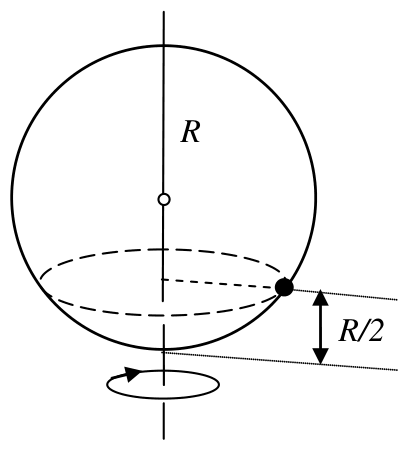
Figure 6
Official English text of the problem.
Answers
- a) \(\displaystyle \boxed{\mu_{\min}=\frac{3\sqrt3}{23}\approx0.226}\), with friction acting upward along the surface.
- b) \(\displaystyle \boxed{\mu_{\min}=\frac{3\sqrt3}{29}\approx0.179}\), with friction acting downward along the surface. Both coefficients are dimensionless.
- c) α) At the respective minimum coefficients, both equilibria are locally stable, with a restoring tendency on one side and sticking on the other:
- At \(5\ \mathrm{s}^{-1}\), an upward displacement produces a downward restoring tendency; a downward displacement permits sticking.
- At \(8\ \mathrm{s}^{-1}\), a downward displacement produces an upward restoring tendency; an upward displacement permits sticking.
Azimuthal displacements are neutral. - c) β) Comparing nearby steady rotations at the original height: - At \(5\ \mathrm{s}^{-1}\), increasing \(\omega\) permits sticking; decreasing it produces a downward sliding tendency. - At \(8\ \mathrm{s}^{-1}\), decreasing \(\omega\) permits sticking; increasing it produces an upward sliding tendency.
Thus the original height is marginal with respect to changes of speed, while nearby stable resting positions remain available.
Solution
a) Treat the small block as a particle and use Coulomb friction. Let \(\theta\) be its angular position measured from the downward vertical through the sphere’s centre. Its height above the bottom and its distance from the rotation axis are
\[ h=R(1-\cos\theta),\qquad \rho=R\sin\theta. \]
The figure specifies \(h=R/2\), so
\[ \cos\theta_0=\frac12,\qquad \theta_0=60^\circ,\qquad \sin\theta_0=\frac{\sqrt3}{2}. \]
Let \(N\) denote the inward normal reaction and let \(f\) be the signed friction force, positive upward along the surface, in the direction of increasing \(\theta\).
In the frame rotating with the sphere, the stationary block experiences gravity, the normal reaction, friction, and the centrifugal force \(m\omega^2R\sin\theta\). Resolving perpendicular and tangential to the surface gives
\[ N=m\left(g\cos\theta+\omega^2R\sin^2\theta\right), \]
\[ f=m\sin\theta\left(g-\omega^2R\cos\theta\right). \]
Static equilibrium requires \(|f|\leq\mu N\). Therefore, at the specified height,
\[ \mu_{\min} =\frac{\sin\theta_0\left|g-\omega^2R\cos\theta_0\right|} {g\cos\theta_0+\omega^2R\sin^2\theta_0} =\frac{\sqrt3\,|2g-\omega^2R|}{2g+3\omega^2R}. \]
For \(\omega=5\ \mathrm{s}^{-1}\),
\[ \omega^2R=12.5\ \mathrm{m/s^2}, \]
and hence
\[ \boxed{\mu_{\min} =\frac{\sqrt3(20-12.5)}{20+37.5} =\frac{3\sqrt3}{23} \approx0.226}. \]
Here \(g-\omega^2R\cos\theta_0>0\), so friction must act upward along the surface.
b) For \(\omega=8\ \mathrm{s}^{-1}\),
\[ \omega^2R=32\ \mathrm{m/s^2}, \]
giving
\[ \boxed{\mu_{\min} =\frac{\sqrt3(32-20)}{20+96} =\frac{3\sqrt3}{29} \approx0.179}. \]
Now \(g-\omega^2R\cos\theta_0<0\): the centrifugal force’s tangential component exceeds gravity’s opposing component. Friction therefore acts downward along the surface.
c) α) Small changes of position
Keep the coefficient equal to the corresponding minimum found above. Consider a small displacement along the surface, followed by release at rest relative to the sphere. We use the idealized single-coefficient Coulomb-friction model.
Introduce
\[ q=\frac{\omega^2R}{g}, \qquad K(\theta,q)=\frac{f_{\mathrm{required}}}{N} =\frac{\sin\theta(1-q\cos\theta)} {\cos\theta+q\sin^2\theta}. \]
The condition for sticking is
\[ -\mu\leq K\leq\mu. \]
If \(K>\mu\), even maximum upward friction is insufficient, and the block starts downward. If \(K<-\mu\), maximum downward friction is insufficient, and it starts upward.
At fixed angular velocity,
\[ \frac{\partial K}{\partial\theta} = \frac{1-q\cos\theta+q^2\sin^2\theta} {\left(\cos\theta+q\sin^2\theta\right)^2}. \]
At \(\theta_0=60^\circ\), the numerator is
\[ 1-\frac q2+\frac{3q^2}{4}>0, \]
so \(K\) increases with height in both cases.
For \(5\ \mathrm{s}^{-1}\), the original equilibrium has \(K=\mu\). Raising the block makes \(K>\mu\), producing downward motion toward the original latitude. Lowering it places \(K\) inside the sticking interval.
For \(8\ \mathrm{s}^{-1}\), the original equilibrium has \(K=-\mu\). Lowering the block makes \(K<-\mu\), producing upward motion toward the original latitude. Raising it places \(K\) inside the sticking interval.
| Angular velocity | Small upward displacement | Small downward displacement |
|---|---|---|
| \(5\ \mathrm{s}^{-1}\) | Downward restoring tendency | Can stick |
| \(8\ \mathrm{s}^{-1}\) | Can stick | Upward restoring tendency |
Thus both equilibria are locally stable under this displacement test. Friction allows neighboring resting positions, so the block need not return to exactly its original latitude. A displacement around the vertical axis changes none of the force components and is neutral.
c) β) Small changes of angular velocity
First compare neighboring steady rotations, keeping the block at its original height. Differentiating the signed friction ratio with respect to \(q\),
\[ \frac{\partial K}{\partial q} =-\frac{\sin\theta} {\left(\cos\theta+q\sin^2\theta\right)^2}<0. \]
Since \(q=\omega^2R/g\), increasing the angular velocity decreases \(K\).
At \(5\ \mathrm{s}^{-1}\), initially \(K=\mu\). Increasing \(\omega\) brings \(K\) inside the permitted interval; decreasing \(\omega\) makes \(K>\mu\), requiring more upward friction than is available.
At \(8\ \mathrm{s}^{-1}\), initially \(K=-\mu\). Decreasing \(\omega\) brings \(K\) inside the permitted interval; increasing \(\omega\) makes \(K<-\mu\), requiring more downward friction than is available.
| Initial angular velocity | Small increase in \(\omega\) | Small decrease in \(\omega\) |
|---|---|---|
| \(5\ \mathrm{s}^{-1}\) | Original height permits sticking | Downward sliding tendency |
| \(8\ \mathrm{s}^{-1}\) | Upward sliding tendency | Original height permits sticking |
The original height therefore cannot be maintained for both signs of a speed change at the minimum coefficient.
Nevertheless, the boundary of the allowed resting positions moves continuously. Keeping \(K=\pm\mu\) and differentiating gives
\[ \delta\theta_{\mathrm b} = \frac{\sin\theta_0} {1-q\cos\theta_0+q^2\sin^2\theta_0}\,\delta q, \qquad \delta q=\frac{2R\omega}{g}\,\delta\omega. \]
Its coefficient is finite and positive in both cases. Thus, in the unfavorable direction of speed change, a small downward adjustment in case a), or a small upward adjustment in case b), reaches the neighboring range of admissible resting positions.
The solution was checked against the official solution.
IPhO 1976 · Theorieaufgabe 1
Kleiner Körper im Inneren einer rotierenden Hohlkugel
Eine Hohlkugel mit dem Radius \(R = 0.5\ \mathrm{m}\) rotiert mit einer Winkelgeschwindigkeit von \(\omega = 5\ \mathrm{s}^{-1}\) um eine vertikale Achse durch ihren Mittelpunkt. Im Inneren der Kugel bewegt sich ein kleiner Körper in der Höhe \(R/2\) zusammen mit der Kugel (Abb. 6). (\(g = 10\ \mathrm{m/s^2}\).)
a) Wie groß muss der Reibungskoeffizient mindestens sein, damit diese Bedingung erfüllt ist?
b) Bestimmen Sie den minimalen Reibungskoeffizienten auch für den Fall \(\omega = 8\ \mathrm{s}^{-1}\).
c) Untersuchen Sie die Stabilität in beiden Fällen,
α) bei einer kleinen Änderung der Position des Körpers,
β) bei einer kleinen Änderung der Winkelgeschwindigkeit der Kugel.
Abbildung 6
Aufgabentext aus dem offiziellen englischen Text übersetzt.
Antworten
- a) \(\displaystyle \boxed{\mu_{\min}=\frac{3\sqrt3}{23}\approx0.226}\), wobei die Reibungskraft entlang der Oberfläche nach oben wirkt.
- b) \(\displaystyle \boxed{\mu_{\min}=\frac{3\sqrt3}{29}\approx0.179}\), wobei die Reibungskraft entlang der Oberfläche nach unten wirkt. Beide Koeffizienten sind dimensionslos.
- c) α) Bei den jeweiligen minimalen Koeffizienten sind beide Gleichgewichtslagen lokal stabil, mit einer rücktreibenden Tendenz auf der einen Seite und Haften auf der anderen:
- Bei \(5\ \mathrm{s}^{-1}\) erzeugt eine Verschiebung nach oben eine rücktreibende Tendenz nach unten; eine Verschiebung nach unten ermöglicht Haften.
- Bei \(8\ \mathrm{s}^{-1}\) erzeugt eine Verschiebung nach unten eine rücktreibende Tendenz nach oben; eine Verschiebung nach oben ermöglicht Haften.
Azimutale Verschiebungen sind neutral. - c) β) Beim Vergleich benachbarter stationärer Rotationen in der ursprünglichen Höhe gilt: - Bei \(5\ \mathrm{s}^{-1}\) ermöglicht eine Erhöhung von \(\omega\) Haften; eine Verringerung erzeugt eine Tendenz zum Abwärtsgleiten. - Bei \(8\ \mathrm{s}^{-1}\) ermöglicht eine Verringerung von \(\omega\) Haften; eine Erhöhung erzeugt eine Tendenz zum Aufwärtsgleiten.
Somit liegt die ursprüngliche Höhe hinsichtlich Änderungen der Drehgeschwindigkeit an der Stabilitätsgrenze, während benachbarte stabile Ruhelagen weiterhin möglich sind.
Lösung
a) Wir behandeln den kleinen Körper als Massenpunkt und verwenden das Coulombsche Reibungsgesetz. Sei \(\theta\) seine Winkelposition, gemessen von der nach unten gerichteten Vertikalen durch den Kugelmittelpunkt. Seine Höhe über dem tiefsten Punkt und sein Abstand von der Rotationsachse sind
\[ h=R(1-\cos\theta),\qquad \rho=R\sin\theta. \]
Die Abbildung gibt \(h=R/2\) vor, also gilt
\[ \cos\theta_0=\frac12,\qquad \theta_0=60^\circ,\qquad \sin\theta_0=\frac{\sqrt3}{2}. \]
Mit \(N\) bezeichnen wir die nach innen gerichtete Normalkraft und mit \(f\) die vorzeichenbehaftete Reibungskraft, die entlang der Oberfläche nach oben, in Richtung zunehmender \(\theta\), positiv ist.
Im mit der Kugel rotierenden Bezugssystem wirken auf den ruhenden Körper die Gewichtskraft, die Normalkraft, die Reibungskraft und die Zentrifugalkraft \(m\omega^2R\sin\theta\). Die Zerlegung senkrecht und tangential zur Oberfläche ergibt
\[ N=m\left(g\cos\theta+\omega^2R\sin^2\theta\right), \]
\[ f=m\sin\theta\left(g-\omega^2R\cos\theta\right). \]
Statisches Gleichgewicht erfordert \(|f|\leq\mu N\). Daher gilt in der angegebenen Höhe
\[ \mu_{\min} =\frac{\sin\theta_0\left|g-\omega^2R\cos\theta_0\right|} {g\cos\theta_0+\omega^2R\sin^2\theta_0} =\frac{\sqrt3\,|2g-\omega^2R|}{2g+3\omega^2R}. \]
Für \(\omega=5\ \mathrm{s}^{-1}\) gilt
\[ \omega^2R=12.5\ \mathrm{m/s^2}, \]
und damit
\[ \boxed{\mu_{\min} =\frac{\sqrt3(20-12.5)}{20+37.5} =\frac{3\sqrt3}{23} \approx0.226}. \]
Hier ist \(g-\omega^2R\cos\theta_0>0\), sodass die Reibungskraft entlang der Oberfläche nach oben wirken muss.
b) Für \(\omega=8\ \mathrm{s}^{-1}\) gilt
\[ \omega^2R=32\ \mathrm{m/s^2}, \]
woraus sich ergibt
\[ \boxed{\mu_{\min} =\frac{\sqrt3(32-20)}{20+96} =\frac{3\sqrt3}{29} \approx0.179}. \]
Nun ist \(g-\omega^2R\cos\theta_0<0\): Die tangentiale Komponente der Zentrifugalkraft übersteigt die entgegengesetzt gerichtete Komponente der Gewichtskraft. Die Reibungskraft wirkt daher entlang der Oberfläche nach unten.
c) α) Kleine Änderungen der Position
Wir halten den Koeffizienten auf dem jeweiligen oben bestimmten Minimalwert. Wir betrachten eine kleine Verschiebung entlang der Oberfläche und lassen den Körper anschließend aus der Ruhe relativ zur Kugel los. Wir verwenden das idealisierte Coulombsche Reibungsmodell mit einem einzigen Koeffizienten.
Wir führen ein:
\[ q=\frac{\omega^2R}{g}, \qquad K(\theta,q)=\frac{f_{\mathrm{required}}}{N} =\frac{\sin\theta(1-q\cos\theta)} {\cos\theta+q\sin^2\theta}. \]
Die Bedingung für Haften lautet
\[ -\mu\leq K\leq\mu. \]
Wenn \(K>\mu\) ist, reicht selbst die maximale nach oben gerichtete Reibungskraft nicht aus, und der Körper setzt sich nach unten in Bewegung. Wenn \(K<-\mu\) ist, reicht die maximale nach unten gerichtete Reibungskraft nicht aus, und er setzt sich nach oben in Bewegung.
Bei konstanter Winkelgeschwindigkeit gilt
\[ \frac{\partial K}{\partial\theta} = \frac{1-q\cos\theta+q^2\sin^2\theta} {\left(\cos\theta+q\sin^2\theta\right)^2}. \]
Bei \(\theta_0=60^\circ\) ist der Zähler
\[ 1-\frac q2+\frac{3q^2}{4}>0, \]
sodass \(K\) in beiden Fällen mit der Höhe zunimmt.
Für \(5\ \mathrm{s}^{-1}\) gilt im ursprünglichen Gleichgewicht \(K=\mu\). Wird der Körper angehoben, so wird \(K>\mu\), was eine Abwärtsbewegung zum ursprünglichen Breitenkreis hervorruft. Wird er abgesenkt, so liegt \(K\) innerhalb des Haftintervalls.
Für \(8\ \mathrm{s}^{-1}\) gilt im ursprünglichen Gleichgewicht \(K=-\mu\). Wird der Körper abgesenkt, so wird \(K<-\mu\), was eine Aufwärtsbewegung zum ursprünglichen Breitenkreis hervorruft. Wird er angehoben, so liegt \(K\) innerhalb des Haftintervalls.
| Winkelgeschwindigkeit | Kleine Verschiebung nach oben | Kleine Verschiebung nach unten |
|---|---|---|
| \(5\ \mathrm{s}^{-1}\) | Rücktreibende Tendenz nach unten | Haften möglich |
| \(8\ \mathrm{s}^{-1}\) | Haften möglich | Rücktreibende Tendenz nach oben |
Somit sind beide Gleichgewichtslagen bei dieser Prüfung durch Verschiebung lokal stabil. Die Reibung ermöglicht benachbarte Ruhelagen, sodass der Körper nicht genau zu seinem ursprünglichen Breitenkreis zurückkehren muss. Eine Verschiebung um die vertikale Achse ändert keine der Kraftkomponenten und ist neutral.
c) β) Kleine Änderungen der Winkelgeschwindigkeit
Zunächst vergleichen wir benachbarte stationäre Rotationen, wobei der Körper in seiner ursprünglichen Höhe bleibt. Die Ableitung des vorzeichenbehafteten Reibungsverhältnisses nach \(q\) ergibt
\[ \frac{\partial K}{\partial q} =-\frac{\sin\theta} {\left(\cos\theta+q\sin^2\theta\right)^2}<0. \]
Da \(q=\omega^2R/g\) ist, nimmt \(K\) bei einer Erhöhung der Winkelgeschwindigkeit ab.
Bei \(5\ \mathrm{s}^{-1}\) ist anfangs \(K=\mu\). Eine Erhöhung von \(\omega\) bringt \(K\) in das zulässige Intervall; eine Verringerung von \(\omega\) führt zu \(K>\mu\), sodass eine größere nach oben gerichtete Reibungskraft erforderlich wäre, als zur Verfügung steht.
Bei \(8\ \mathrm{s}^{-1}\) ist anfangs \(K=-\mu\). Eine Verringerung von \(\omega\) bringt \(K\) in das zulässige Intervall; eine Erhöhung von \(\omega\) führt zu \(K<-\mu\), sodass eine größere nach unten gerichtete Reibungskraft erforderlich wäre, als zur Verfügung steht.
| Anfängliche Winkelgeschwindigkeit | Kleine Erhöhung von \(\omega\) | Kleine Verringerung von \(\omega\) |
|---|---|---|
| \(5\ \mathrm{s}^{-1}\) | Ursprüngliche Höhe ermöglicht Haften | Tendenz zum Abwärtsgleiten |
| \(8\ \mathrm{s}^{-1}\) | Tendenz zum Aufwärtsgleiten | Ursprüngliche Höhe ermöglicht Haften |
Bei minimalem Reibungskoeffizienten kann die ursprüngliche Höhe daher nicht für beide Vorzeichen einer Änderung der Drehgeschwindigkeit beibehalten werden.
Dennoch verschiebt sich die Grenze der zulässigen Ruhelagen kontinuierlich. Hält man \(K=\pm\mu\) konstant und differenziert, so ergibt sich
\[ \delta\theta_{\mathrm b} = \frac{\sin\theta_0} {1-q\cos\theta_0+q^2\sin^2\theta_0}\,\delta q, \qquad \delta q=\frac{2R\omega}{g}\,\delta\omega. \]
Der Koeffizient darin ist in beiden Fällen endlich und positiv. Somit erreicht der Körper bei einer Änderung der Drehgeschwindigkeit in der ungünstigen Richtung durch eine kleine Verschiebung nach unten im Fall a) beziehungsweise nach oben im Fall b) den benachbarten Bereich zulässiger Ruhelagen.
Die Lösung wurde mit der offiziellen Lösung abgeglichen.
IPhO 1976 · Teori sorusu 1
Dönen içi boş bir kürenin içindeki küçük blok
Yarıçapı \(R = 0.5\ \mathrm{m}\) olan içi boş bir küre, merkezinden geçen düşey bir eksen etrafında \(\omega = 5\ \mathrm{s}^{-1}\) açısal hızıyla dönmektedir. Kürenin içindeki küçük bir blok, \(R/2\) yüksekliğinde küreyle birlikte hareket etmektedir (Şekil 6). (\(g = 10\ \mathrm{m/s^2}\).)
a) Bu koşulun sağlanması için sürtünme katsayısı en az ne olmalıdır?
b) \(\omega = 8\ \mathrm{s}^{-1}\) durumu için de en küçük sürtünme katsayısını bulunuz.
c) Her iki durumda da kararlılığı,
α) bloğun konumundaki küçük bir değişim için,
β) kürenin açısal hızındaki küçük bir değişim için inceleyiniz.
Şekil 6
Soru metni resmi İngilizce metinden çevrilmiştir.
Cevaplar
- a) \(\displaystyle \boxed{\mu_{\min}=\frac{3\sqrt3}{23}\approx0.226}\); sürtünme, yüzey boyunca yukarı doğru etki eder.
- b) \(\displaystyle \boxed{\mu_{\min}=\frac{3\sqrt3}{29}\approx0.179}\); sürtünme, yüzey boyunca aşağı doğru etki eder. Her iki katsayı da boyutsuzdur.
- c) α) İlgili en küçük katsayı değerlerinde, her iki denge de bir tarafta geri çağırıcı bir eğilim, diğer tarafta ise kaymadan durma ile yerel olarak kararlıdır:
- \(5\ \mathrm{s}^{-1}\) için, yukarı doğru bir yer değiştirme aşağı doğru geri çağırıcı bir eğilim oluşturur; aşağı doğru bir yer değiştirme ise kaymadan durmaya olanak tanır.
- \(8\ \mathrm{s}^{-1}\) için, aşağı doğru bir yer değiştirme yukarı doğru geri çağırıcı bir eğilim oluşturur; yukarı doğru bir yer değiştirme ise kaymadan durmaya olanak tanır.
Azimut doğrultusundaki yer değiştirmeler nötrdür. - c) β) Başlangıç yüksekliğinde, birbirine yakın sabit hızlı dönme durumları karşılaştırıldığında: - \(5\ \mathrm{s}^{-1}\) için, \(\omega\)'nın artırılması kaymadan durmaya olanak tanır; azaltılması ise aşağı doğru kayma eğilimi oluşturur. - \(8\ \mathrm{s}^{-1}\) için, \(\omega\)'nın azaltılması kaymadan durmaya olanak tanır; artırılması ise yukarı doğru kayma eğilimi oluşturur.
Dolayısıyla başlangıç yüksekliği, hız değişimlerine karşı sınırda kararlıdır; bununla birlikte, yakınlarda kararlı durma konumları bulunmaya devam eder.
Çözüm
a) Küçük bloğu bir parçacık olarak ele alalım ve Coulomb sürtünmesini kullanalım. Kürenin merkezinden geçen aşağı yönlü düşey doğrultudan ölçülen açısal konumu \(\theta\) olsun. Kürenin en alt noktasına göre yüksekliği ve dönme eksenine uzaklığı
\[ h=R(1-\cos\theta),\qquad \rho=R\sin\theta. \]
Şekilde \(h=R/2\) verildiğinden,
\[ \cos\theta_0=\frac12,\qquad \theta_0=60^\circ,\qquad \sin\theta_0=\frac{\sqrt3}{2}. \]
İçe yönelen normal tepki kuvvetini \(N\), işaretli sürtünme kuvvetini ise \(f\) ile gösterelim; \(f\)'nin pozitif yönü, \(\theta\)'nın arttığı yönde, yüzey boyunca yukarı doğru olsun.
Küreyle birlikte dönen referans sisteminde, durmakta olan bloğa yerçekimi kuvveti, normal tepki kuvveti, sürtünme kuvveti ve \(m\omega^2R\sin\theta\) merkezkaç kuvveti etki eder. Yüzeye dik ve teğet doğrultularda bileşenlere ayırırsak
\[ N=m\left(g\cos\theta+\omega^2R\sin^2\theta\right), \]
\[ f=m\sin\theta\left(g-\omega^2R\cos\theta\right). \]
Statik denge için \(|f|\leq\mu N\) olmalıdır. Dolayısıyla belirtilen yükseklikte,
\[ \mu_{\min} =\frac{\sin\theta_0\left|g-\omega^2R\cos\theta_0\right|} {g\cos\theta_0+\omega^2R\sin^2\theta_0} =\frac{\sqrt3\,|2g-\omega^2R|}{2g+3\omega^2R}. \]
\(\omega=5\ \mathrm{s}^{-1}\) için,
\[ \omega^2R=12.5\ \mathrm{m/s^2}, \]
ve buradan
\[ \boxed{\mu_{\min} =\frac{\sqrt3(20-12.5)}{20+37.5} =\frac{3\sqrt3}{23} \approx0.226}. \]
Burada \(g-\omega^2R\cos\theta_0>0\) olduğundan, sürtünme yüzey boyunca yukarı doğru etki etmelidir.
b) \(\omega=8\ \mathrm{s}^{-1}\) için,
\[ \omega^2R=32\ \mathrm{m/s^2}, \]
olduğundan
\[ \boxed{\mu_{\min} =\frac{\sqrt3(32-20)}{20+96} =\frac{3\sqrt3}{29} \approx0.179}. \]
Bu kez \(g-\omega^2R\cos\theta_0<0\) olur: merkezkaç kuvvetinin teğetsel bileşeni, yerçekimi kuvvetinin ona karşı koyan bileşeninden büyüktür. Bu nedenle sürtünme, yüzey boyunca aşağı doğru etki eder.
c) α) Konumdaki küçük değişimler
Katsayıyı, yukarıda bulunan ilgili en küçük değere eşit tutalım. Yüzey boyunca küçük bir yer değiştirmeyi ve ardından bloğun küreye göre durgun olarak serbest bırakılmasını ele alalım. İdealleştirilmiş, tek katsayılı Coulomb sürtünmesi modelini kullanıyoruz.
Şu tanımları yapalım:
\[ q=\frac{\omega^2R}{g}, \qquad K(\theta,q)=\frac{f_{\mathrm{required}}}{N} =\frac{\sin\theta(1-q\cos\theta)} {\cos\theta+q\sin^2\theta}. \]
Kaymadan durma koşulu
\[ -\mu\leq K\leq\mu. \]
\(K>\mu\) ise, yukarı yönlü en büyük sürtünme kuvveti bile yetersiz kalır ve blok aşağı doğru hareket etmeye başlar. \(K<-\mu\) ise, aşağı yönlü en büyük sürtünme kuvveti yetersiz kalır ve blok yukarı doğru hareket etmeye başlar.
Sabit açısal hızda,
\[ \frac{\partial K}{\partial\theta} = \frac{1-q\cos\theta+q^2\sin^2\theta} {\left(\cos\theta+q\sin^2\theta\right)^2}. \]
\(\theta_0=60^\circ\) için pay
\[ 1-\frac q2+\frac{3q^2}{4}>0, \]
olduğundan, her iki durumda da \(K\) yükseklikle artar.
\(5\ \mathrm{s}^{-1}\) için başlangıç dengesinde \(K=\mu\) olur. Bloğu yükseltmek \(K>\mu\) yapar ve başlangıçtaki enlemine doğru aşağı yönlü bir hareket oluşturur. Bloğu alçaltmak ise \(K\)'yı kaymadan durma aralığının içine getirir.
\(8\ \mathrm{s}^{-1}\) için başlangıç dengesinde \(K=-\mu\) olur. Bloğu alçaltmak \(K<-\mu\) yapar ve başlangıçtaki enlemine doğru yukarı yönlü bir hareket oluşturur. Bloğu yükseltmek ise \(K\)'yı kaymadan durma aralığının içine getirir.
| Açısal hız | Yukarı doğru küçük yer değiştirme | Aşağı doğru küçük yer değiştirme |
|---|---|---|
| \(5\ \mathrm{s}^{-1}\) | Aşağı yönlü geri çağırıcı eğilim | Kaymadan durabilir |
| \(8\ \mathrm{s}^{-1}\) | Kaymadan durabilir | Yukarı yönlü geri çağırıcı eğilim |
Dolayısıyla bu yer değiştirme sınamasında her iki denge de yerel olarak kararlıdır. Sürtünme, komşu durma konumlarına olanak tanıdığından, bloğun tam olarak başlangıçtaki enlemine dönmesi gerekmez. Düşey eksen etrafındaki bir yer değiştirme, kuvvet bileşenlerinin hiçbirini değiştirmez ve nötrdür.
c) β) Açısal hızdaki küçük değişimler
Önce, bloğu başlangıç yüksekliğinde tutarak birbirine yakın sabit hızlı dönme durumlarını karşılaştıralım. İşaretli sürtünme oranının \(q\)'ya göre türevini alırsak,
\[ \frac{\partial K}{\partial q} =-\frac{\sin\theta} {\left(\cos\theta+q\sin^2\theta\right)^2}<0. \]
\(q=\omega^2R/g\) olduğundan, açısal hızın artırılması \(K\)'yı azaltır.
\(5\ \mathrm{s}^{-1}\) için başlangıçta \(K=\mu\) olur. \(\omega\)'nın artırılması \(K\)'yı izin verilen aralığın içine getirir; \(\omega\)'nın azaltılması ise \(K>\mu\) yapar ve sağlanabilecek olandan daha büyük bir yukarı yönlü sürtünme kuvveti gerektirir.
\(8\ \mathrm{s}^{-1}\) için başlangıçta \(K=-\mu\) olur. \(\omega\)'nın azaltılması \(K\)'yı izin verilen aralığın içine getirir; \(\omega\)'nın artırılması ise \(K<-\mu\) yapar ve sağlanabilecek olandan daha büyük bir aşağı yönlü sürtünme kuvveti gerektirir.
| Başlangıç açısal hızı | \(\omega\)'da küçük artış | \(\omega\)'da küçük azalış |
|---|---|---|
| \(5\ \mathrm{s}^{-1}\) | Başlangıç yüksekliğinde kaymadan durabilir | Aşağı doğru kayma eğilimi |
| \(8\ \mathrm{s}^{-1}\) | Yukarı doğru kayma eğilimi | Başlangıç yüksekliğinde kaymadan durabilir |
Dolayısıyla en küçük katsayı değerinde, hız değişiminin her iki işareti için de başlangıç yüksekliği korunamaz.
Bununla birlikte, izin verilen durma konumlarının sınırı sürekli olarak yer değiştirir. \(K=\pm\mu\) koşulunu koruyup diferansiyel alırsak
\[ \delta\theta_{\mathrm b} = \frac{\sin\theta_0} {1-q\cos\theta_0+q^2\sin^2\theta_0}\,\delta q, \qquad \delta q=\frac{2R\omega}{g}\,\delta\omega. \]
Buradaki katsayı her iki durumda da sonlu ve pozitiftir. Dolayısıyla hızın elverişsiz yönde değişmesi durumunda, a) durumunda aşağı doğru, b) durumunda ise yukarı doğru küçük bir konum ayarlamasıyla, yakınlardaki izin verilen durma konumları aralığına ulaşılır.
Çözüm, resmi çözümle karşılaştırılarak kontrol edildi.
IPhO 1976 · Problema teórico 1
Bloque pequeño en el interior de una esfera hueca en rotación
Una esfera hueca de radio \(R = 0.5\ \mathrm{m}\) gira alrededor de un eje vertical que pasa por su centro con una velocidad angular de \(\omega = 5\ \mathrm{s}^{-1}\). En el interior de la esfera, un bloque pequeño se mueve junto con ella a una altura de \(R/2\) (Fig. 6). (\(g = 10\ \mathrm{m/s^2}\).)
a) ¿Cuál debe ser el coeficiente de rozamiento mínimo para que se cumpla esta condición?
b) Halle también el coeficiente de rozamiento mínimo para el caso de \(\omega = 8\ \mathrm{s}^{-1}\).
c) Estudie la estabilidad en ambos casos,
α) ante un pequeño cambio de la posición del bloque,
β) ante un pequeño cambio de la velocidad angular de la esfera.
Figura 6
Enunciado traducido del texto oficial en inglés.
Respuestas
- a) \(\displaystyle \boxed{\mu_{\min}=\frac{3\sqrt3}{23}\approx0.226}\), con el rozamiento dirigido hacia arriba a lo largo de la superficie.
- b) \(\displaystyle \boxed{\mu_{\min}=\frac{3\sqrt3}{29}\approx0.179}\), con el rozamiento dirigido hacia abajo a lo largo de la superficie. Ambos coeficientes son adimensionales.
- c) α) Con los respectivos coeficientes mínimos, ambos equilibrios son localmente estables, con una tendencia restitutiva a un lado y adherencia al otro:
- A \(5\ \mathrm{s}^{-1}\), un desplazamiento hacia arriba produce una tendencia restitutiva hacia abajo; un desplazamiento hacia abajo permite la adherencia.
- A \(8\ \mathrm{s}^{-1}\), un desplazamiento hacia abajo produce una tendencia restitutiva hacia arriba; un desplazamiento hacia arriba permite la adherencia.
Los desplazamientos azimutales son neutros. - c) β) Al comparar rotaciones estacionarias próximas a la altura original: - A \(5\ \mathrm{s}^{-1}\), aumentar \(\omega\) permite la adherencia; disminuirla produce una tendencia al deslizamiento hacia abajo. - A \(8\ \mathrm{s}^{-1}\), disminuir \(\omega\) permite la adherencia; aumentarla produce una tendencia al deslizamiento hacia arriba.
Por tanto, la altura original es marginal respecto a los cambios de velocidad, mientras que siguen existiendo posiciones de reposo estables próximas.
Solución
a) Trate el bloque pequeño como una partícula y utilice el rozamiento de Coulomb. Sea \(\theta\) su posición angular medida desde la vertical descendente que pasa por el centro de la esfera. Su altura sobre el punto más bajo y su distancia al eje de rotación son
\[ h=R(1-\cos\theta),\qquad \rho=R\sin\theta. \]
La figura indica \(h=R/2\), por lo que
\[ \cos\theta_0=\frac12,\qquad \theta_0=60^\circ,\qquad \sin\theta_0=\frac{\sqrt3}{2}. \]
Sea \(N\) la reacción normal dirigida hacia el interior y sea \(f\) la fuerza de rozamiento con signo, positiva hacia arriba a lo largo de la superficie, en el sentido de aumento de \(\theta\).
En el sistema de referencia que gira con la esfera, sobre el bloque en reposo actúan la gravedad, la reacción normal, el rozamiento y la fuerza centrífuga \(m\omega^2R\sin\theta\). Al descomponer las fuerzas en las direcciones perpendicular y tangencial a la superficie, se obtiene
\[ N=m\left(g\cos\theta+\omega^2R\sin^2\theta\right), \]
\[ f=m\sin\theta\left(g-\omega^2R\cos\theta\right). \]
El equilibrio estático requiere \(|f|\leq\mu N\). Por tanto, a la altura indicada,
\[ \mu_{\min} =\frac{\sin\theta_0\left|g-\omega^2R\cos\theta_0\right|} {g\cos\theta_0+\omega^2R\sin^2\theta_0} =\frac{\sqrt3\,|2g-\omega^2R|}{2g+3\omega^2R}. \]
Para \(\omega=5\ \mathrm{s}^{-1}\),
\[ \omega^2R=12.5\ \mathrm{m/s^2}, \]
y, por consiguiente,
\[ \boxed{\mu_{\min} =\frac{\sqrt3(20-12.5)}{20+37.5} =\frac{3\sqrt3}{23} \approx0.226}. \]
Aquí \(g-\omega^2R\cos\theta_0>0\), de modo que el rozamiento debe actuar hacia arriba a lo largo de la superficie.
b) Para \(\omega=8\ \mathrm{s}^{-1}\),
\[ \omega^2R=32\ \mathrm{m/s^2}, \]
lo que da
\[ \boxed{\mu_{\min} =\frac{\sqrt3(32-20)}{20+96} =\frac{3\sqrt3}{29} \approx0.179}. \]
Ahora \(g-\omega^2R\cos\theta_0<0\): la componente tangencial de la fuerza centrífuga supera a la componente opuesta de la gravedad. Por tanto, el rozamiento actúa hacia abajo a lo largo de la superficie.
c) α) Pequeños cambios de posición
Mantenga el coeficiente igual al mínimo correspondiente hallado anteriormente. Considere un pequeño desplazamiento a lo largo de la superficie, seguido de una liberación desde el reposo respecto a la esfera. Utilizamos el modelo idealizado de rozamiento de Coulomb con un único coeficiente.
Introduzcamos
\[ q=\frac{\omega^2R}{g}, \qquad K(\theta,q)=\frac{f_{\mathrm{required}}}{N} =\frac{\sin\theta(1-q\cos\theta)} {\cos\theta+q\sin^2\theta}. \]
La condición de adherencia es
\[ -\mu\leq K\leq\mu. \]
Si \(K>\mu\), incluso el rozamiento máximo hacia arriba es insuficiente y el bloque comienza a moverse hacia abajo. Si \(K<-\mu\), el rozamiento máximo hacia abajo es insuficiente y comienza a moverse hacia arriba.
Con velocidad angular fija,
\[ \frac{\partial K}{\partial\theta} = \frac{1-q\cos\theta+q^2\sin^2\theta} {\left(\cos\theta+q\sin^2\theta\right)^2}. \]
En \(\theta_0=60^\circ\), el numerador es
\[ 1-\frac q2+\frac{3q^2}{4}>0, \]
por lo que \(K\) aumenta con la altura en ambos casos.
Para \(5\ \mathrm{s}^{-1}\), el equilibrio original tiene \(K=\mu\). Elevar el bloque hace que \(K>\mu\), lo que produce un movimiento hacia abajo en dirección a la latitud original. Bajarlo sitúa \(K\) dentro del intervalo de adherencia.
Para \(8\ \mathrm{s}^{-1}\), el equilibrio original tiene \(K=-\mu\). Bajar el bloque hace que \(K<-\mu\), lo que produce un movimiento hacia arriba en dirección a la latitud original. Elevarlo sitúa \(K\) dentro del intervalo de adherencia.
| Velocidad angular | Pequeño desplazamiento hacia arriba | Pequeño desplazamiento hacia abajo |
|---|---|---|
| \(5\ \mathrm{s}^{-1}\) | Tendencia restitutiva hacia abajo | Puede permanecer adherido |
| \(8\ \mathrm{s}^{-1}\) | Puede permanecer adherido | Tendencia restitutiva hacia arriba |
Por tanto, ambos equilibrios son localmente estables según esta prueba de desplazamiento. El rozamiento permite posiciones de reposo próximas, de modo que el bloque no tiene por qué volver exactamente a su latitud original. Un desplazamiento alrededor del eje vertical no cambia ninguna de las componentes de las fuerzas y es neutro.
c) β) Pequeños cambios de velocidad angular
Comparemos primero rotaciones estacionarias próximas, manteniendo el bloque a su altura original. Al derivar el cociente de rozamiento con signo respecto a \(q\),
\[ \frac{\partial K}{\partial q} =-\frac{\sin\theta} {\left(\cos\theta+q\sin^2\theta\right)^2}<0. \]
Como \(q=\omega^2R/g\), aumentar la velocidad angular disminuye \(K\).
A \(5\ \mathrm{s}^{-1}\), inicialmente \(K=\mu\). Aumentar \(\omega\) sitúa \(K\) dentro del intervalo permitido; disminuir \(\omega\) hace que \(K>\mu\), lo que exige un rozamiento hacia arriba mayor que el disponible.
A \(8\ \mathrm{s}^{-1}\), inicialmente \(K=-\mu\). Disminuir \(\omega\) sitúa \(K\) dentro del intervalo permitido; aumentar \(\omega\) hace que \(K<-\mu\), lo que exige un rozamiento hacia abajo mayor que el disponible.
| Velocidad angular inicial | Pequeño aumento de \(\omega\) | Pequeña disminución de \(\omega\) |
|---|---|---|
| \(5\ \mathrm{s}^{-1}\) | La altura original permite la adherencia | Tendencia al deslizamiento hacia abajo |
| \(8\ \mathrm{s}^{-1}\) | Tendencia al deslizamiento hacia arriba | La altura original permite la adherencia |
Por tanto, con el coeficiente mínimo, la altura original no puede mantenerse para ambos signos de una variación de velocidad.
Sin embargo, el límite de las posiciones de reposo permitidas se desplaza de forma continua. Al mantener \(K=\pm\mu\) y diferenciar, se obtiene
\[ \delta\theta_{\mathrm b} = \frac{\sin\theta_0} {1-q\cos\theta_0+q^2\sin^2\theta_0}\,\delta q, \qquad \delta q=\frac{2R\omega}{g}\,\delta\omega. \]
Su coeficiente es finito y positivo en ambos casos. Así, para el sentido desfavorable de la variación de velocidad, un pequeño ajuste hacia abajo en el caso a), o un pequeño ajuste hacia arriba en el caso b), permite alcanzar el intervalo próximo de posiciones de reposo admisibles.
La solución se comprobó con la solución oficial.
IPhO 1976 · 理论题 1
旋转空心球内的小物块
一个半径为 \(R = 0.5\ \mathrm{m}\) 的空心球绕通过球心的竖直轴以角速度 \(\omega = 5\ \mathrm{s}^{-1}\) 旋转。球内有一个小物块,在距球底 \(R/2\) 的高度处随球一起运动(图 6)。(\(g = 10\ \mathrm{m/s^2}\)。)
a) 要满足这一条件,摩擦系数至少应为多少?
b) 对于 \(\omega = 8\ \mathrm{s}^{-1}\) 的情况,也求出最小摩擦系数。
c) 研究这两种情况下的稳定性问题,
α) 当物块的位置发生微小变化时,
β) 当球的角速度发生微小变化时。
图 6
题目译自官方英文原文。
答案
- a) \(\displaystyle \boxed{\mu_{\min}=\frac{3\sqrt3}{23}\approx0.226}\),摩擦力沿球面向上。
- b) \(\displaystyle \boxed{\mu_{\min}=\frac{3\sqrt3}{29}\approx0.179}\),摩擦力沿球面向下。这两个系数均为无量纲量。
- c) α) 在各自的最小摩擦系数下,两种平衡都是局部稳定的:向一侧偏移时有恢复趋势,向另一侧偏移时则可保持相对静止:
- 在 \(5\ \mathrm{s}^{-1}\) 时,向上位移会产生向下的恢复趋势;向下位移后可保持相对静止。
- 在 \(8\ \mathrm{s}^{-1}\) 时,向下位移会产生向上的恢复趋势;向上位移后可保持相对静止。
沿方位角方向的位移是中性的。 - c) β) 比较原高度处彼此接近的匀速转动状态: - 在 \(5\ \mathrm{s}^{-1}\) 时,增大 \(\omega\) 后可保持相对静止;减小它则会产生向下滑动的趋势。 - 在 \(8\ \mathrm{s}^{-1}\) 时,减小 \(\omega\) 后可保持相对静止;增大它则会产生向上滑动的趋势。
因此,对于转速的变化,原高度处于临界状态,但附近仍存在稳定的相对静止位置。
解答
a) 将小物块视为质点,并采用库仑摩擦模型。令 \(\theta\) 表示物块的角位置,从通过球心的竖直向下方向量起。它距球底的高度以及到转轴的距离分别为
\[ h=R(1-\cos\theta),\qquad \rho=R\sin\theta. \]
图中给定 \(h=R/2\),因此
\[ \cos\theta_0=\frac12,\qquad \theta_0=60^\circ,\qquad \sin\theta_0=\frac{\sqrt3}{2}. \]
用 \(N\) 表示指向球内的法向支持力,用 \(f\) 表示带符号的摩擦力,取沿球面向上,即 \(\theta\) 增大的方向为正方向。
在随球转动的参考系中,相对静止的物块受到重力、法向支持力、摩擦力以及离心力 \(m\omega^2R\sin\theta\)。沿垂直于球面及与球面相切的方向分解力,得
\[ N=m\left(g\cos\theta+\omega^2R\sin^2\theta\right), \]
\[ f=m\sin\theta\left(g-\omega^2R\cos\theta\right). \]
静力平衡要求 \(|f|\leq\mu N\)。因此,在指定高度处,
\[ \mu_{\min} =\frac{\sin\theta_0\left|g-\omega^2R\cos\theta_0\right|} {g\cos\theta_0+\omega^2R\sin^2\theta_0} =\frac{\sqrt3\,|2g-\omega^2R|}{2g+3\omega^2R}. \]
当 \(\omega=5\ \mathrm{s}^{-1}\) 时,
\[ \omega^2R=12.5\ \mathrm{m/s^2}, \]
因而
\[ \boxed{\mu_{\min} =\frac{\sqrt3(20-12.5)}{20+37.5} =\frac{3\sqrt3}{23} \approx0.226}. \]
此时 \(g-\omega^2R\cos\theta_0>0\),所以摩擦力必须沿球面向上。
b) 当 \(\omega=8\ \mathrm{s}^{-1}\) 时,
\[ \omega^2R=32\ \mathrm{m/s^2}, \]
得到
\[ \boxed{\mu_{\min} =\frac{\sqrt3(32-20)}{20+96} =\frac{3\sqrt3}{29} \approx0.179}. \]
现在 \(g-\omega^2R\cos\theta_0<0\):离心力的切向分量大于与其方向相反的重力切向分量。因此,摩擦力沿球面向下。
c) α) 位置的微小变化
保持摩擦系数等于上面求出的相应最小值。考虑物块沿球面发生微小位移后,从相对于球静止的状态释放。我们采用理想化的单一摩擦系数库仑摩擦模型。
引入
\[ q=\frac{\omega^2R}{g}, \qquad K(\theta,q)=\frac{f_{\mathrm{required}}}{N} =\frac{\sin\theta(1-q\cos\theta)} {\cos\theta+q\sin^2\theta}. \]
保持相对静止的条件为
\[ -\mu\leq K\leq\mu. \]
若 \(K>\mu\),即使向上的摩擦力达到最大值也不足以维持平衡,物块便开始向下运动。若 \(K<-\mu\),向下的最大摩擦力不足以维持平衡,物块便开始向上运动。
在角速度固定时,
\[ \frac{\partial K}{\partial\theta} = \frac{1-q\cos\theta+q^2\sin^2\theta} {\left(\cos\theta+q\sin^2\theta\right)^2}. \]
在 \(\theta_0=60^\circ\) 处,分子为
\[ 1-\frac q2+\frac{3q^2}{4}>0, \]
所以在这两种情况下,\(K\) 均随高度增大而增大。
对于 \(5\ \mathrm{s}^{-1}\),原平衡状态满足 \(K=\mu\)。将物块向上移动会使 \(K>\mu\),从而使其向下运动,趋向原来的纬度位置。将其向下移动,则会使 \(K\) 落入可保持相对静止的区间内。
对于 \(8\ \mathrm{s}^{-1}\),原平衡状态满足 \(K=-\mu\)。将物块向下移动会使 \(K<-\mu\),从而使其向上运动,趋向原来的纬度位置。将其向上移动,则会使 \(K\) 落入可保持相对静止的区间内。
| 角速度 | 微小向上位移 | 微小向下位移 |
|---|---|---|
| \(5\ \mathrm{s}^{-1}\) | 向下的恢复趋势 | 可保持相对静止 |
| \(8\ \mathrm{s}^{-1}\) | 可保持相对静止 | 向上的恢复趋势 |
因此,在这种位移检验下,两种平衡都是局部稳定的。摩擦力使物块能够在邻近位置保持相对静止,所以物块不一定恰好回到原来的纬度位置。绕竖直轴的位移不会改变任何力的分量,因此是中性的。
c) β) 角速度的微小变化
首先,保持物块位于原高度,比较彼此接近的匀速转动状态。将带符号的摩擦力比值对 \(q\) 求导,
\[ \frac{\partial K}{\partial q} =-\frac{\sin\theta} {\left(\cos\theta+q\sin^2\theta\right)^2}<0. \]
由于 \(q=\omega^2R/g\),增大角速度会使 \(K\) 减小。
在 \(5\ \mathrm{s}^{-1}\) 时,初始状态满足 \(K=\mu\)。增大 \(\omega\) 会使 \(K\) 进入允许区间;减小 \(\omega\) 则会使 \(K>\mu\),此时所需的向上摩擦力超过能够提供的最大值。
在 \(8\ \mathrm{s}^{-1}\) 时,初始状态满足 \(K=-\mu\)。减小 \(\omega\) 会使 \(K\) 进入允许区间;增大 \(\omega\) 则会使 \(K<-\mu\),此时所需的向下摩擦力超过能够提供的最大值。
| 初始角速度 | \(\omega\) 微小增大 | \(\omega\) 微小减小 |
|---|---|---|
| \(5\ \mathrm{s}^{-1}\) | 可在原高度保持相对静止 | 向下滑动的趋势 |
| \(8\ \mathrm{s}^{-1}\) | 向上滑动的趋势 | 可在原高度保持相对静止 |
因此,在最小摩擦系数下,原高度无法在转速增大和减小这两种情况下都得以维持。
不过,允许的相对静止位置的边界会连续移动。保持 \(K=\pm\mu\) 并微分,得到
\[ \delta\theta_{\mathrm b} = \frac{\sin\theta_0} {1-q\cos\theta_0+q^2\sin^2\theta_0}\,\delta q, \qquad \delta q=\frac{2R\omega}{g}\,\delta\omega. \]
在两种情况下,该系数均为有限的正值。因此,当转速沿不利方向变化时,在情况 a) 中略微向下调整位置,或在情况 b) 中略微向上调整位置,即可到达邻近的允许相对静止的位置范围。
解答已与官方解答核对。
IPhO 1976 · Теоретическая задача 1
Небольшой брусок внутри вращающейся полой сферы
Полая сфера радиусом \(R = 0.5\ \mathrm{m}\) вращается вокруг вертикальной оси, проходящей через её центр, с угловой скоростью \(\omega = 5\ \mathrm{s}^{-1}\). Внутри сферы небольшой брусок движется вместе со сферой на высоте \(R/2\) (рис. 6). (\(g = 10\ \mathrm{m/s^2}\).)
a) Каков должен быть минимальный коэффициент трения, чтобы это условие выполнялось?
b) Найдите минимальный коэффициент трения также для случая \(\omega = 8\ \mathrm{s}^{-1}\).
c) Исследуйте устойчивость в обоих случаях,
α) при малом изменении положения бруска,
β) при малом изменении угловой скорости сферы.
Рисунок 6
Условие переведено с официального английского текста.
Ответы
- a) \(\displaystyle \boxed{\mu_{\min}=\frac{3\sqrt3}{23}\approx0.226}\), причём сила трения направлена вверх вдоль поверхности.
- b) \(\displaystyle \boxed{\mu_{\min}=\frac{3\sqrt3}{29}\approx0.179}\), причём сила трения направлена вниз вдоль поверхности. Оба коэффициента безразмерны.
- c) α) При соответствующих минимальных коэффициентах оба положения равновесия локально устойчивы: при смещении в одну сторону возникает тенденция к возвращению, а при смещении в другую возможно сохранение покоя относительно сферы:
- При \(5\ \mathrm{s}^{-1}\) смещение вверх вызывает тенденцию к возвращению вниз; при смещении вниз брусок может оставаться в покое относительно сферы.
- При \(8\ \mathrm{s}^{-1}\) смещение вниз вызывает тенденцию к возвращению вверх; при смещении вверх брусок может оставаться в покое относительно сферы.
Азимутальные смещения безразличны. - c) β) При сравнении близких установившихся вращений на исходной высоте: - При \(5\ \mathrm{s}^{-1}\) увеличение \(\omega\) допускает сохранение покоя относительно сферы; уменьшение вызывает тенденцию к скольжению вниз. - При \(8\ \mathrm{s}^{-1}\) уменьшение \(\omega\) допускает сохранение покоя относительно сферы; увеличение вызывает тенденцию к скольжению вверх.
Таким образом, исходная высота является предельной в отношении изменений скорости вращения, однако поблизости по-прежнему существуют устойчивые положения покоя.
Решение
a) Будем рассматривать небольшой брусок как материальную точку и использовать закон трения Кулона. Обозначим через \(\theta\) его угловую координату, отсчитываемую от направленной вниз вертикали, проходящей через центр сферы. Его высота над нижней точкой сферы и расстояние до оси вращения равны
\[ h=R(1-\cos\theta),\qquad \rho=R\sin\theta. \]
На рисунке задано \(h=R/2\), поэтому
\[ \cos\theta_0=\frac12,\qquad \theta_0=60^\circ,\qquad \sin\theta_0=\frac{\sqrt3}{2}. \]
Обозначим через \(N\) направленную внутрь нормальную реакцию, а через \(f\) — алгебраическую величину силы трения, положительную при направлении вверх вдоль поверхности, в сторону увеличения \(\theta\).
В системе отсчёта, вращающейся вместе со сферой, на неподвижный брусок действуют сила тяжести, нормальная реакция, сила трения и центробежная сила \(m\omega^2R\sin\theta\). Проецируя силы на нормаль и касательную к поверхности, получаем
\[ N=m\left(g\cos\theta+\omega^2R\sin^2\theta\right), \]
\[ f=m\sin\theta\left(g-\omega^2R\cos\theta\right). \]
Для равновесия относительно сферы необходимо \(|f|\leq\mu N\). Следовательно, на заданной высоте
\[ \mu_{\min} =\frac{\sin\theta_0\left|g-\omega^2R\cos\theta_0\right|} {g\cos\theta_0+\omega^2R\sin^2\theta_0} =\frac{\sqrt3\,|2g-\omega^2R|}{2g+3\omega^2R}. \]
При \(\omega=5\ \mathrm{s}^{-1}\)
\[ \omega^2R=12.5\ \mathrm{m/s^2}, \]
и, следовательно,
\[ \boxed{\mu_{\min} =\frac{\sqrt3(20-12.5)}{20+37.5} =\frac{3\sqrt3}{23} \approx0.226}. \]
Здесь \(g-\omega^2R\cos\theta_0>0\), поэтому сила трения должна быть направлена вверх вдоль поверхности.
b) При \(\omega=8\ \mathrm{s}^{-1}\)
\[ \omega^2R=32\ \mathrm{m/s^2}, \]
что даёт
\[ \boxed{\mu_{\min} =\frac{\sqrt3(32-20)}{20+96} =\frac{3\sqrt3}{29} \approx0.179}. \]
Теперь \(g-\omega^2R\cos\theta_0<0\): касательная составляющая центробежной силы превышает противоположно направленную составляющую силы тяжести. Поэтому сила трения направлена вниз вдоль поверхности.
c) α) Малые изменения положения
Оставим коэффициент трения равным соответствующему минимальному значению, найденному выше. Рассмотрим малое смещение вдоль поверхности, после которого брусок отпускают без начальной скорости относительно сферы. Используем идеализированную модель трения Кулона с единым коэффициентом трения.
Введём
\[ q=\frac{\omega^2R}{g}, \qquad K(\theta,q)=\frac{f_{\mathrm{required}}}{N} =\frac{\sin\theta(1-q\cos\theta)} {\cos\theta+q\sin^2\theta}. \]
Условие сохранения покоя относительно сферы имеет вид
\[ -\mu\leq K\leq\mu. \]
Если \(K>\mu\), даже максимальной силы трения, направленной вверх, недостаточно, и брусок начинает двигаться вниз. Если \(K<-\mu\), максимальной силы трения, направленной вниз, недостаточно, и он начинает двигаться вверх.
При постоянной угловой скорости
\[ \frac{\partial K}{\partial\theta} = \frac{1-q\cos\theta+q^2\sin^2\theta} {\left(\cos\theta+q\sin^2\theta\right)^2}. \]
При \(\theta_0=60^\circ\) числитель равен
\[ 1-\frac q2+\frac{3q^2}{4}>0, \]
поэтому в обоих случаях \(K\) возрастает с высотой.
При \(5\ \mathrm{s}^{-1}\) в исходном положении равновесия \(K=\mu\). При поднятии бруска получается \(K>\mu\), что вызывает движение вниз, к исходной широте. При опускании бруска значение \(K\) оказывается внутри интервала, допускающего покой относительно сферы.
При \(8\ \mathrm{s}^{-1}\) в исходном положении равновесия \(K=-\mu\). При опускании бруска получается \(K<-\mu\), что вызывает движение вверх, к исходной широте. При поднятии бруска значение \(K\) оказывается внутри интервала, допускающего покой относительно сферы.
| Угловая скорость | Малое смещение вверх | Малое смещение вниз |
|---|---|---|
| \(5\ \mathrm{s}^{-1}\) | Тенденция к возвращению вниз | Может оставаться в покое относительно сферы |
| \(8\ \mathrm{s}^{-1}\) | Может оставаться в покое относительно сферы | Тенденция к возвращению вверх |
Таким образом, при такой проверке смещением оба положения равновесия локально устойчивы. Трение допускает соседние положения покоя, поэтому брусок не обязан возвращаться точно на исходную широту. Смещение вокруг вертикальной оси не меняет ни одной из составляющих сил и является безразличным.
c) β) Малые изменения угловой скорости
Сначала сравним близкие установившиеся вращения, сохраняя брусок на исходной высоте. Дифференцируя отношение алгебраической величины силы трения к нормальной реакции по \(q\), получаем
\[ \frac{\partial K}{\partial q} =-\frac{\sin\theta} {\left(\cos\theta+q\sin^2\theta\right)^2}<0. \]
Поскольку \(q=\omega^2R/g\), увеличение угловой скорости уменьшает \(K\).
При \(5\ \mathrm{s}^{-1}\) первоначально \(K=\mu\). Увеличение \(\omega\) переводит \(K\) внутрь допустимого интервала; уменьшение \(\omega\) приводит к \(K>\mu\), так что требуемая сила трения, направленная вверх, превышает максимально возможную.
При \(8\ \mathrm{s}^{-1}\) первоначально \(K=-\mu\). Уменьшение \(\omega\) переводит \(K\) внутрь допустимого интервала; увеличение \(\omega\) приводит к \(K<-\mu\), так что требуемая сила трения, направленная вниз, превышает максимально возможную.
| Начальная угловая скорость | Малое увеличение \(\omega\) | Малое уменьшение \(\omega\) |
|---|---|---|
| \(5\ \mathrm{s}^{-1}\) | На исходной высоте возможен покой относительно сферы | Тенденция к скольжению вниз |
| \(8\ \mathrm{s}^{-1}\) | Тенденция к скольжению вверх | На исходной высоте возможен покой относительно сферы |
Следовательно, при минимальном коэффициенте трения исходная высота не может сохраняться при обоих знаках изменения скорости вращения.
Тем не менее граница допустимых положений покоя смещается непрерывно. Сохраняя \(K=\pm\mu\) и дифференцируя, получаем
\[ \delta\theta_{\mathrm b} = \frac{\sin\theta_0} {1-q\cos\theta_0+q^2\sin^2\theta_0}\,\delta q, \qquad \delta q=\frac{2R\omega}{g}\,\delta\omega. \]
Коэффициент в этом выражении конечен и положителен в обоих случаях. Таким образом, при изменении скорости вращения в неблагоприятную сторону небольшое смещение вниз в случае a) или небольшое смещение вверх в случае b) приводит брусок в соседнюю область допустимых положений покоя.
Решение проверено по официальному решению.
IPhO 1976 · مسألة نظرية 1
جسم صغير داخل كرة مجوفة دوّارة
تدور كرة مجوفة نصف قطرها \(R = 0.5\ \mathrm{m}\) حول محور رأسي يمر بمركزها بسرعة زاوية مقدارها \(\omega = 5\ \mathrm{s}^{-1}\). ويتحرك داخل الكرة جسم صغير مع الكرة عند ارتفاع \(R/2\) (الشكل 6). (\(g = 10\ \mathrm{m/s^2}\).)
a) ما أقل قيمة يجب أن يكون عليها معامل الاحتكاك لتحقيق هذا الشرط؟
b) أوجد أيضًا أقل قيمة لمعامل الاحتكاك في حالة \(\omega = 8\ \mathrm{s}^{-1}\).
c) ادرس مسألة الاستقرار في كلتا الحالتين،
α) عند حدوث تغير صغير في موضع الجسم،
β) عند حدوث تغير صغير في السرعة الزاوية للكرة.
الشكل 6
نص المسألة مترجم عن النص الإنجليزي الرسمي.
الإجابات
- a) \(\displaystyle \boxed{\mu_{\min}=\frac{3\sqrt3}{23}\approx0.226}\)، ويؤثر الاحتكاك إلى أعلى على امتداد السطح.
- b) \(\displaystyle \boxed{\mu_{\min}=\frac{3\sqrt3}{29}\approx0.179}\)، ويؤثر الاحتكاك إلى أسفل على امتداد السطح. كلا المعاملين بلا أبعاد.
- c) α) عند القيمتين الدنيا المقابلتين لمعامل الاحتكاك، تكون حالتا الاتزان مستقرتين محليًا، مع نزعة إلى العودة من أحد الجانبين وبقاء الجسم ساكنًا بالنسبة إلى الكرة من الجانب الآخر:
- عند \(5\ \mathrm{s}^{-1}\)، تؤدي إزاحة إلى أعلى إلى نزعة إرجاع إلى أسفل؛ وتسمح إزاحة إلى أسفل ببقاء الجسم ساكنًا بالنسبة إلى الكرة.
- عند \(8\ \mathrm{s}^{-1}\)، تؤدي إزاحة إلى أسفل إلى نزعة إرجاع إلى أعلى؛ وتسمح إزاحة إلى أعلى ببقاء الجسم ساكنًا بالنسبة إلى الكرة.
أما الإزاحات السمتية فهي محايدة. - c) β) عند مقارنة حالات دوران منتظم متقاربة عند الارتفاع الأصلي: - عند \(5\ \mathrm{s}^{-1}\)، تسمح زيادة \(\omega\) ببقاء الجسم ساكنًا بالنسبة إلى الكرة؛ ويؤدي إنقاصها إلى نزعة للانزلاق إلى أسفل. - عند \(8\ \mathrm{s}^{-1}\)، يسمح إنقاص \(\omega\) ببقاء الجسم ساكنًا بالنسبة إلى الكرة؛ وتؤدي زيادتها إلى نزعة للانزلاق إلى أعلى.
ومن ثم يكون الارتفاع الأصلي حديًا بالنسبة إلى تغيرات السرعة، مع بقاء مواضع سكون مستقرة قريبة متاحة.
الحل
a) نعامل الجسم الصغير بوصفه جسيمًا ونستخدم احتكاك كولوم. لتكن \(\theta\) موضعه الزاوي مقيسًا من الاتجاه الرأسي المتجه إلى أسفل والمار بمركز الكرة. يكون ارتفاعه فوق القاع وبعده عن محور الدوران كما يأتي:
\[ h=R(1-\cos\theta),\qquad \rho=R\sin\theta. \]
يحدد الشكل \(h=R/2\)، ولذلك
\[ \cos\theta_0=\frac12,\qquad \theta_0=60^\circ,\qquad \sin\theta_0=\frac{\sqrt3}{2}. \]
لنرمز بـ \(N\) إلى قوة رد الفعل العمودية المتجهة إلى الداخل، ولتكن \(f\) قوة الاحتكاك ذات الإشارة، بحيث تكون موجبة إلى أعلى على امتداد السطح، في اتجاه تزايد \(\theta\).
في الإطار المرجعي الذي يدور مع الكرة، تؤثر في الجسم الساكن قوة الثقل وقوة رد الفعل العمودية والاحتكاك وقوة الطرد المركزي \(m\omega^2R\sin\theta\). وبتحليل القوى في الاتجاهين العمودي والمماسي للسطح نحصل على
\[ N=m\left(g\cos\theta+\omega^2R\sin^2\theta\right), \]
\[ f=m\sin\theta\left(g-\omega^2R\cos\theta\right). \]
يتطلب الاتزان السكوني \(|f|\leq\mu N\). ولذلك، عند الارتفاع المحدد،
\[ \mu_{\min} =\frac{\sin\theta_0\left|g-\omega^2R\cos\theta_0\right|} {g\cos\theta_0+\omega^2R\sin^2\theta_0} =\frac{\sqrt3\,|2g-\omega^2R|}{2g+3\omega^2R}. \]
عند \(\omega=5\ \mathrm{s}^{-1}\)،
\[ \omega^2R=12.5\ \mathrm{m/s^2}, \]
ومن ثم
\[ \boxed{\mu_{\min} =\frac{\sqrt3(20-12.5)}{20+37.5} =\frac{3\sqrt3}{23} \approx0.226}. \]
هنا \(g-\omega^2R\cos\theta_0>0\)، لذا يجب أن يؤثر الاحتكاك إلى أعلى على امتداد السطح.
b) عند \(\omega=8\ \mathrm{s}^{-1}\)،
\[ \omega^2R=32\ \mathrm{m/s^2}, \]
فنحصل على
\[ \boxed{\mu_{\min} =\frac{\sqrt3(32-20)}{20+96} =\frac{3\sqrt3}{29} \approx0.179}. \]
الآن \(g-\omega^2R\cos\theta_0<0\): فالمركبة المماسية لقوة الطرد المركزي تفوق المركبة المعاكسة لها لقوة الثقل. لذلك يؤثر الاحتكاك إلى أسفل على امتداد السطح.
c) α) تغيرات صغيرة في الموضع
نُبقي المعامل مساويًا للقيمة الدنيا المقابلة التي وجدناها أعلاه. وننظر في إزاحة صغيرة على امتداد السطح، يعقبها ترك الجسم من السكون بالنسبة إلى الكرة. نستخدم نموذج احتكاك كولوم المثالي ذي المعامل الواحد.
نُعرّف
\[ q=\frac{\omega^2R}{g}, \qquad K(\theta,q)=\frac{f_{\mathrm{required}}}{N} =\frac{\sin\theta(1-q\cos\theta)} {\cos\theta+q\sin^2\theta}. \]
شرط بقاء الجسم ساكنًا بالنسبة إلى الكرة هو
\[ -\mu\leq K\leq\mu. \]
إذا كان \(K>\mu\)، فإن حتى أقصى قوة احتكاك متجهة إلى أعلى لا تكفي، ويبدأ الجسم بالحركة إلى أسفل. وإذا كان \(K<-\mu\)، فإن أقصى قوة احتكاك متجهة إلى أسفل لا تكفي، ويبدأ بالحركة إلى أعلى.
عند ثبات السرعة الزاوية،
\[ \frac{\partial K}{\partial\theta} = \frac{1-q\cos\theta+q^2\sin^2\theta} {\left(\cos\theta+q\sin^2\theta\right)^2}. \]
عند \(\theta_0=60^\circ\)، يكون البسط
\[ 1-\frac q2+\frac{3q^2}{4}>0, \]
ولذلك تزداد \(K\) مع الارتفاع في كلتا الحالتين.
عند \(5\ \mathrm{s}^{-1}\)، يتحقق في الاتزان الأصلي \(K=\mu\). يؤدي رفع الجسم إلى جعل \(K>\mu\)، فتنتج حركة إلى أسفل نحو دائرة العرض الأصلية. أما خفضه فيجعل \(K\) داخل مجال السكون بالنسبة إلى الكرة.
عند \(8\ \mathrm{s}^{-1}\)، يتحقق في الاتزان الأصلي \(K=-\mu\). يؤدي خفض الجسم إلى جعل \(K<-\mu\)، فتنتج حركة إلى أعلى نحو دائرة العرض الأصلية. أما رفعه فيجعل \(K\) داخل مجال السكون بالنسبة إلى الكرة.
| السرعة الزاوية | إزاحة صغيرة إلى أعلى | إزاحة صغيرة إلى أسفل |
|---|---|---|
| \(5\ \mathrm{s}^{-1}\) | نزعة إرجاع إلى أسفل | يمكن أن يبقى ساكنًا بالنسبة إلى الكرة |
| \(8\ \mathrm{s}^{-1}\) | يمكن أن يبقى ساكنًا بالنسبة إلى الكرة | نزعة إرجاع إلى أعلى |
إذن، كلتا حالتي الاتزان مستقرة محليًا وفق اختبار الإزاحة هذا. يتيح الاحتكاك مواضع سكون مجاورة، لذا ليس من الضروري أن يعود الجسم إلى دائرة عرضه الأصلية تمامًا. ولا تغيّر الإزاحة حول المحور الرأسي أيًا من مركبات القوى، وهي محايدة.
c) β) تغيرات صغيرة في السرعة الزاوية
نقارن أولًا حالات دوران منتظم متجاورة، مع إبقاء الجسم عند ارتفاعه الأصلي. باشتقاق نسبة الاحتكاك ذات الإشارة بالنسبة إلى \(q\)،
\[ \frac{\partial K}{\partial q} =-\frac{\sin\theta} {\left(\cos\theta+q\sin^2\theta\right)^2}<0. \]
بما أن \(q=\omega^2R/g\)، فإن زيادة السرعة الزاوية تُنقص \(K\).
عند \(5\ \mathrm{s}^{-1}\)، يكون في البداية \(K=\mu\). تؤدي زيادة \(\omega\) إلى إدخال \(K\) في المجال المسموح؛ أما إنقاص \(\omega\) فيجعل \(K>\mu\)، مما يتطلب قوة احتكاك إلى أعلى أكبر من المتاحة.
عند \(8\ \mathrm{s}^{-1}\)، يكون في البداية \(K=-\mu\). يؤدي إنقاص \(\omega\) إلى إدخال \(K\) في المجال المسموح؛ أما زيادة \(\omega\) فتجعل \(K<-\mu\)، مما يتطلب قوة احتكاك إلى أسفل أكبر من المتاحة.
| السرعة الزاوية الابتدائية | زيادة صغيرة في \(\omega\) | نقصان صغير في \(\omega\) |
|---|---|---|
| \(5\ \mathrm{s}^{-1}\) | يسمح الارتفاع الأصلي بالسكون بالنسبة إلى الكرة | نزعة للانزلاق إلى أسفل |
| \(8\ \mathrm{s}^{-1}\) | نزعة للانزلاق إلى أعلى | يسمح الارتفاع الأصلي بالسكون بالنسبة إلى الكرة |
لذلك لا يمكن الحفاظ على الارتفاع الأصلي لكلتا إشارتي تغير السرعة عند القيمة الدنيا للمعامل.
ومع ذلك، فإن حد مواضع السكون المسموح بها يتحرك بصورة متصلة. وبالإبقاء على \(K=\pm\mu\) وإجراء التفاضل نحصل على
\[ \delta\theta_{\mathrm b} = \frac{\sin\theta_0} {1-q\cos\theta_0+q^2\sin^2\theta_0}\,\delta q, \qquad \delta q=\frac{2R\omega}{g}\,\delta\omega. \]
معاملها محدود وموجب في كلتا الحالتين. ومن ثم، في اتجاه تغير السرعة غير الملائم، يؤدي تعديل صغير إلى أسفل في الحالة a)، أو تعديل صغير إلى أعلى في الحالة b)، إلى بلوغ المجال المجاور لمواضع السكون المسموح بها.
تمت مراجعة الحل بمقارنته بالحل الرسمي.