IPhO 1967 · Theory problem 2
Resistance of an infinite resistor network
Consider an infinite network consisting of resistors (resistance of each of them is \(r\)) shown in Fig. 3. Find the resultant resistance \(R_{AB}\) between points A and B.
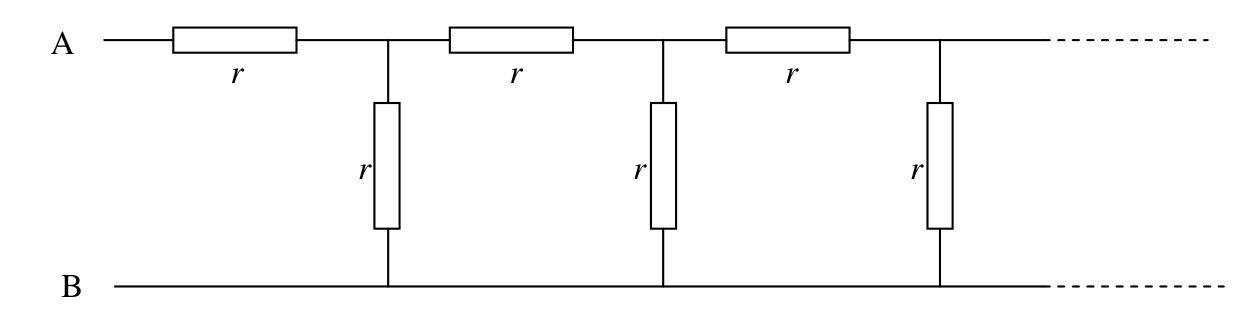
Fig. 3
Official English text of the problem.
Answers
- Problem 2: \(\displaystyle \boxed{R_{AB}=\frac{1+\sqrt5}{2}\,r\approx1.618\,r}\).
Solution
Treat the connecting wires as having negligible resistance and each resistor as an ideal ohmic resistor with \(r>0\).
Let \(R=R_{AB}\). Current entering at A must first pass through the first horizontal resistor, of resistance \(r\). At the following junction, there are two paths to the lower wire connected to B:
- The first vertical resistor, of resistance \(r\).
- The entire remaining ladder, which has exactly the same structure as the original network and therefore has resistance \(R\).
These two paths are in parallel, and their equivalent resistance is in series with the first horizontal resistor. The series and parallel resistance laws therefore give \[ R=r+\left(\frac1r+\frac1R\right)^{-1} =r+\frac{rR}{r+R}. \] Multiplying by \(r+R\) and rearranging, \[ R(r+R)=r(r+R)+rR, \] \[ R^2-rR-r^2=0. \] Thus \[ R=\frac{r\pm\sqrt{r^2+4r^2}}{2} =\frac{1\pm\sqrt5}{2}\,r. \] The negative root is inadmissible for a network of positive resistances, leaving \[ \boxed{R_{AB}=\frac{1+\sqrt5}{2}\,r\approx1.618\,r}. \]
To justify taking an infinite ladder, let \(R_n\) denote the resistance of a finite ladder ending after its \(n\)th vertical resistor. Then \[ R_1=2r,\qquad R_{n+1}=r+\frac{rR_n}{r+R_n}. \] Here \(R_2=5r/3<R_1\). Since the right-hand side is an increasing function of \(R_n\), induction shows that \(R_{n+1}<R_n\) for every \(n\). Also, \(R_n>r\), because the first horizontal resistor is in series with a positive resistance. Hence \(R_n\) converges, and its limit satisfies the equation solved above.
The solution was checked against the official solution.
IPhO 1967 · Theorieaufgabe 2
Widerstand eines unendlichen Widerstandsnetzwerks
Betrachten Sie das in Abb. 3 dargestellte unendliche Netzwerk aus Widerständen (jeder mit dem Widerstand \(r\)). Bestimmen Sie den Ersatzwiderstand \(R_{AB}\) zwischen den Punkten A und B.
Abb. 3
Aufgabentext aus dem offiziellen englischen Text übersetzt.
Antworten
- Aufgabe 2: \(\displaystyle \boxed{R_{AB}=\frac{1+\sqrt5}{2}\,r\approx1.618\,r}\).
Lösung
Nehmen wir an, dass die Verbindungsleitungen einen vernachlässigbaren Widerstand haben und jeder Widerstand ein idealer ohmscher Widerstand mit \(r>0\) ist.
Sei \(R=R_{AB}\). Der bei A eintretende Strom muss zunächst durch den ersten horizontalen Widerstand mit dem Widerstandswert \(r\) fließen. Am darauffolgenden Knoten gibt es zwei Strompfade zur unteren, mit B verbundenen Leitung:
- Den ersten vertikalen Widerstand mit dem Widerstandswert \(r\).
- Die gesamte verbleibende Leiterschaltung, die genau dieselbe Struktur wie das ursprüngliche Netzwerk hat und daher den Widerstand \(R\) besitzt.
Diese beiden Strompfade sind parallel geschaltet, und ihr Ersatzwiderstand liegt in Reihe mit dem ersten horizontalen Widerstand. Die Regeln für die Reihen- und Parallelschaltung von Widerständen ergeben daher \[ R=r+\left(\frac1r+\frac1R\right)^{-1} =r+\frac{rR}{r+R}. \] Durch Multiplikation mit \(r+R\) und Umformen erhält man \[ R(r+R)=r(r+R)+rR, \] \[ R^2-rR-r^2=0. \] Somit gilt \[ R=\frac{r\pm\sqrt{r^2+4r^2}}{2} =\frac{1\pm\sqrt5}{2}\,r. \] Die negative Lösung ist für ein Netzwerk aus positiven Widerständen unzulässig; damit verbleibt \[ \boxed{R_{AB}=\frac{1+\sqrt5}{2}\,r\approx1.618\,r}. \]
Um die Verwendung einer unendlichen Leiterschaltung zu rechtfertigen, bezeichne \(R_n\) den Widerstand einer endlichen Leiterschaltung, die nach ihrem \(n\)-ten vertikalen Widerstand endet. Dann gilt \[ R_1=2r,\qquad R_{n+1}=r+\frac{rR_n}{r+R_n}. \] Hier ist \(R_2=5r/3<R_1\). Da die rechte Seite eine monoton wachsende Funktion von \(R_n\) ist, zeigt vollständige Induktion, dass \(R_{n+1}<R_n\) für jedes \(n\) gilt. Außerdem gilt \(R_n>r\), da der erste horizontale Widerstand mit einem positiven Widerstand in Reihe geschaltet ist. Daher konvergiert \(R_n\), und sein Grenzwert erfüllt die oben gelöste Gleichung.
Die Lösung wurde mit der offiziellen Lösung abgeglichen.
IPhO 1967 · Teori sorusu 2
Sonsuz bir direnç ağının direnci
Şekil 3'te gösterilen, her birinin direnci \(r\) olan dirençlerden oluşan sonsuz bir ağı ele alın. A ve B noktaları arasındaki eşdeğer direnç \(R_{AB}\)'yi bulun.
Şekil 3
Soru metni resmi İngilizce metinden çevrilmiştir.
Cevaplar
- Soru 2: \(\displaystyle \boxed{R_{AB}=\frac{1+\sqrt5}{2}\,r\approx1.618\,r}\).
Çözüm
Bağlantı tellerinin dirençlerini ihmal edilebilir kabul edin ve her bir direnci, \(r>0\) olmak üzere, Ohm yasasına uyan ideal bir direnç olarak ele alın.
\(R=R_{AB}\) olsun. A noktasından giren akım önce direnci \(r\) olan ilk yatay dirençten geçmek zorundadır. Bundan sonraki düğüm noktasında, B'ye bağlı alt tele ulaşan iki yol vardır:
- Direnci \(r\) olan ilk düşey direnç.
- Merdiven ağının geriye kalan tüm kısmı; bu kısım başlangıçtaki ağla tam olarak aynı yapıya sahip olduğundan direnci \(R\)'dir.
Bu iki yol paralel bağlıdır ve eşdeğer dirençleri ilk yatay dirençle seri bağlıdır. Dolayısıyla seri ve paralel bağlı dirençlerin eşdeğer direnç bağıntıları \[ R=r+\left(\frac1r+\frac1R\right)^{-1} =r+\frac{rR}{r+R} \] sonucunu verir. \(r+R\) ile çarpıp yeniden düzenlersek, \[ R(r+R)=r(r+R)+rR, \] \[ R^2-rR-r^2=0. \] Böylece \[ R=\frac{r\pm\sqrt{r^2+4r^2}}{2} =\frac{1\pm\sqrt5}{2}\,r. \] Pozitif dirençlerden oluşan bir ağ için negatif kök kabul edilemez; dolayısıyla \[ \boxed{R_{AB}=\frac{1+\sqrt5}{2}\,r\approx1.618\,r}. \]
Sonsuz bir merdiven ağı ele almanın geçerliliğini gerekçelendirmek için, \(R_n\), \(n\). düşey direncinden sonra sona eren sonlu bir merdiven ağının direncini göstersin. Bu durumda \[ R_1=2r,\qquad R_{n+1}=r+\frac{rR_n}{r+R_n}. \] Burada \(R_2=5r/3<R_1\)'dir. Sağ taraf \(R_n\)'nin artan bir fonksiyonu olduğundan, tümevarım her \(n\) için \(R_{n+1}<R_n\) olduğunu gösterir. Ayrıca ilk yatay direnç pozitif bir dirençle seri bağlı olduğundan \(R_n>r\)'dir. Dolayısıyla \(R_n\) yakınsar ve limiti yukarıda çözülen denklemi sağlar.
Çözüm, resmi çözümle karşılaştırılarak kontrol edildi.
IPhO 1967 · Problema teórico 2
Resistencia de una red infinita de resistencias
Considere una red infinita formada por resistencias (cada una de ellas de resistencia \(r\)), como se muestra en la Fig. 3. Determine la resistencia equivalente \(R_{AB}\) entre los puntos A y B.
Fig. 3
Enunciado traducido del texto oficial en inglés.
Respuestas
- Problema 2: \(\displaystyle \boxed{R_{AB}=\frac{1+\sqrt5}{2}\,r\approx1.618\,r}\).
Solución
Considere que los cables de conexión tienen una resistencia despreciable y que cada resistencia es un elemento óhmico ideal con \(r>0\).
Sea \(R=R_{AB}\). La corriente que entra por A debe pasar primero por la primera resistencia horizontal, de resistencia \(r\). En el siguiente nodo, hay dos caminos hacia el cable inferior conectado a B:
- La primera resistencia vertical, de resistencia \(r\).
- Toda la parte restante de la red en escalera, que tiene exactamente la misma estructura que la red original y, por tanto, tiene resistencia \(R\).
Estos dos caminos están en paralelo, y su resistencia equivalente está en serie con la primera resistencia horizontal. Por tanto, las leyes de asociación de resistencias en serie y en paralelo dan \[ R=r+\left(\frac1r+\frac1R\right)^{-1} =r+\frac{rR}{r+R}. \] Multiplicando por \(r+R\) y reordenando, \[ R(r+R)=r(r+R)+rR, \] \[ R^2-rR-r^2=0. \] Así, \[ R=\frac{r\pm\sqrt{r^2+4r^2}}{2} =\frac{1\pm\sqrt5}{2}\,r. \] La raíz negativa no es admisible para una red de resistencias positivas, por lo que queda \[ \boxed{R_{AB}=\frac{1+\sqrt5}{2}\,r\approx1.618\,r}. \]
Para justificar el uso de una red en escalera infinita, sea \(R_n\) la resistencia de una red en escalera finita que termina tras su \(n\)-ésima resistencia vertical. Entonces \[ R_1=2r,\qquad R_{n+1}=r+\frac{rR_n}{r+R_n}. \] Aquí, \(R_2=5r/3<R_1\). Como el miembro derecho es una función creciente de \(R_n\), por inducción se demuestra que \(R_{n+1}<R_n\) para todo \(n\). Además, \(R_n>r\), porque la primera resistencia horizontal está en serie con una resistencia positiva. Por tanto, \(R_n\) converge, y su límite satisface la ecuación resuelta anteriormente.
La solución se comprobó con la solución oficial.
IPhO 1967 · 理论题 2
无限电阻网络的电阻
考虑图 3 所示的由电阻器组成的无限网络(每个电阻器的电阻均为 \(r\))。求 A、B 两点之间的等效电阻 \(R_{AB}\)。
图 3
题目译自官方英文原文。
答案
- 题目 2: \(\displaystyle \boxed{R_{AB}=\frac{1+\sqrt5}{2}\,r\approx1.618\,r}\)。
解答
将连接导线的电阻视为可忽略不计,并将每个电阻器视为电阻为 \(r>0\) 的理想欧姆电阻器。
令 \(R=R_{AB}\)。从 A 点流入的电流必须先通过第一个水平放置的电阻器,其电阻为 \(r\)。在随后的节点处,有两条通向与 B 点相连的下方导线的路径:
- 第一个竖直放置的电阻器,其电阻为 \(r\)。
- 剩余的整个梯形网络,其结构与原网络完全相同,因此电阻为 \(R\)。
这两条路径并联,其等效电阻与第一个水平放置的电阻器串联。因此,由电阻的串联和并联规律可得 \[ R=r+\left(\frac1r+\frac1R\right)^{-1} =r+\frac{rR}{r+R}. \] 两边乘以 \(r+R\) 并整理,得 \[ R(r+R)=r(r+R)+rR, \] \[ R^2-rR-r^2=0. \] 因此 \[ R=\frac{r\pm\sqrt{r^2+4r^2}}{2} =\frac{1\pm\sqrt5}{2}\,r. \] 对于由正电阻组成的网络,负根不合物理要求,因此得到 \[ \boxed{R_{AB}=\frac{1+\sqrt5}{2}\,r\approx1.618\,r}. \]
为说明采用无限梯形网络的合理性,令 \(R_n\) 表示在第 \(n\) 个竖直电阻器之后终止的有限梯形网络的电阻。则 \[ R_1=2r,\qquad R_{n+1}=r+\frac{rR_n}{r+R_n}. \] 这里 \(R_2=5r/3<R_1\)。由于右端是 \(R_n\) 的单调递增函数,由数学归纳法可知,对每个 \(n\) 都有 \(R_{n+1}<R_n\)。此外,\(R_n>r\),因为第一个水平放置的电阻器与一个正电阻串联。因此,\(R_n\) 收敛,且其极限满足上面求解的方程。
解答已与官方解答核对。
IPhO 1967 · Теоретическая задача 2
Сопротивление бесконечной сети резисторов
Рассмотрим бесконечную сеть, состоящую из резисторов (сопротивление каждого из них равно \(r\)), показанную на рис. 3. Найдите эквивалентное сопротивление \(R_{AB}\) между точками A и B.
Рис. 3
Условие переведено с официального английского текста.
Ответы
- Задача 2: \(\displaystyle \boxed{R_{AB}=\frac{1+\sqrt5}{2}\,r\approx1.618\,r}\).
Решение
Будем считать сопротивление соединительных проводов пренебрежимо малым, а каждый резистор — идеальным резистором, подчиняющимся закону Ома, с сопротивлением \(r>0\).
Пусть \(R=R_{AB}\). Ток, входящий в точке A, сначала должен пройти через первый горизонтальный резистор с сопротивлением \(r\). В следующем узле имеются два пути к нижнему проводу, соединённому с точкой B:
- Первый вертикальный резистор с сопротивлением \(r\).
- Вся оставшаяся лестничная цепь, которая имеет точно такую же структуру, как и исходная сеть, и потому обладает сопротивлением \(R\).
Эти две ветви соединены параллельно, а их эквивалентное сопротивление соединено последовательно с первым горизонтальным резистором. Поэтому правила расчёта сопротивления при последовательном и параллельном соединении дают \[ R=r+\left(\frac1r+\frac1R\right)^{-1} =r+\frac{rR}{r+R}. \] Умножая на \(r+R\) и перегруппировывая слагаемые, получаем \[ R(r+R)=r(r+R)+rR, \] \[ R^2-rR-r^2=0. \] Следовательно, \[ R=\frac{r\pm\sqrt{r^2+4r^2}}{2} =\frac{1\pm\sqrt5}{2}\,r. \] Отрицательный корень недопустим для сети с положительными сопротивлениями, поэтому остаётся \[ \boxed{R_{AB}=\frac{1+\sqrt5}{2}\,r\approx1.618\,r}. \]
Чтобы обосновать переход к бесконечной лестничной цепи, обозначим через \(R_n\) сопротивление конечной лестничной цепи, заканчивающейся после \(n\)-го вертикального резистора. Тогда \[ R_1=2r,\qquad R_{n+1}=r+\frac{rR_n}{r+R_n}. \] Здесь \(R_2=5r/3<R_1\). Поскольку правая часть является возрастающей функцией \(R_n\), по индукции получаем, что \(R_{n+1}<R_n\) для любого \(n\). Кроме того, \(R_n>r\), так как первый горизонтальный резистор соединён последовательно с положительным сопротивлением. Следовательно, последовательность \(R_n\) сходится, и её предел удовлетворяет уравнению, решённому выше.
Решение проверено по официальному решению.
IPhO 1967 · مسألة نظرية 2
مقاومة شبكة لا نهائية من المقاومات
اعتبر شبكة لا نهائية تتكون من مقاومات (مقاومة كل منها \(r\)) كما هو موضح في الشكل 3. أوجد المقاومة المكافئة \(R_{AB}\) بين النقطتين A وB.
الشكل 3
نص المسألة مترجم عن النص الإنجليزي الرسمي.
الإجابات
- المسألة 2: \(\displaystyle \boxed{R_{AB}=\frac{1+\sqrt5}{2}\,r\approx1.618\,r}\).
الحل
اعتبر أن مقاومة أسلاك التوصيل مهملة، وأن كل مقاومة هي مقاومة أومية مثالية ذات \(r>0\).
لتكن \(R=R_{AB}\). لا بد للتيار الداخل عند A من المرور أولًا عبر المقاومة الأفقية الأولى، وقيمتها \(r\). وعند نقطة التفرع التالية، يوجد مساران إلى السلك السفلي المتصل بالنقطة B:
- المقاومة الرأسية الأولى، وقيمتها \(r\).
- الجزء المتبقي بأكمله من الشبكة السلمية، الذي له البنية نفسها تمامًا للشبكة الأصلية، ومن ثم فإن مقاومته تساوي \(R\).
هذان المساران موصولان على التوازي، ومقاومتهما المكافئة موصولة على التوالي مع المقاومة الأفقية الأولى. لذلك تعطي قوانين توصيل المقاومات على التوالي وعلى التوازي \[ R=r+\left(\frac1r+\frac1R\right)^{-1} =r+\frac{rR}{r+R}. \] بالضرب في \(r+R\) وإعادة الترتيب، \[ R(r+R)=r(r+R)+rR, \] \[ R^2-rR-r^2=0. \] إذن \[ R=\frac{r\pm\sqrt{r^2+4r^2}}{2} =\frac{1\pm\sqrt5}{2}\,r. \] الجذر السالب غير مقبول لشبكة من المقاومات الموجبة، فيتبقى \[ \boxed{R_{AB}=\frac{1+\sqrt5}{2}\,r\approx1.618\,r}. \]
لتبرير اعتبار شبكة سلمية لا نهائية، لتكن \(R_n\) مقاومة شبكة سلمية محدودة تنتهي بعد مقاومتها الرأسية ذات الرتبة \(n\). عندئذ \[ R_1=2r,\qquad R_{n+1}=r+\frac{rR_n}{r+R_n}. \] هنا \(R_2=5r/3<R_1\). وبما أن الطرف الأيمن دالة متزايدة في \(R_n\)، فإن الاستقراء يبين أن \(R_{n+1}<R_n\) لكل \(n\). كذلك، \(R_n>r\)، لأن المقاومة الأفقية الأولى موصولة على التوالي مع مقاومة موجبة. ومن ثم فإن \(R_n\) تتقارب، وتحقق نهايتها المعادلة التي حُلّت أعلاه.
تمت مراجعة الحل بمقارنته بالحل الرسمي.