IPhO 1967 · Theory problem 3
Equal heat supplied to a hanging ball and a ball resting on a plane
Consider two identical homogeneous balls, A and B, with the same initial temperatures. One of them is at rest on a horizontal plane, while the second one hangs on a thread (Fig. 6). The same quantities of heat have been supplied to both balls. Are the final temperatures of the balls the same or not? Justify your answer. (All kinds of heat losses are negligible.)
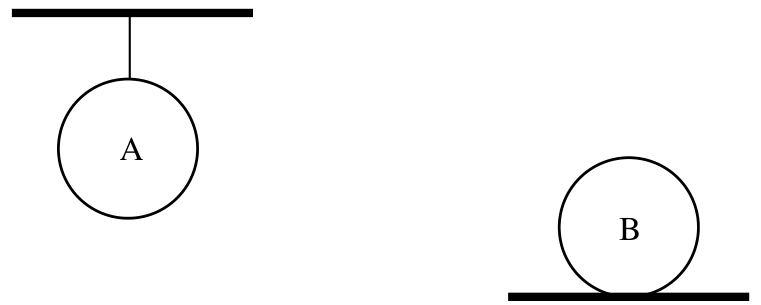
Fig. 6
Official English text of the problem.
Answers
- Problem 3: In the usual elementary model, assuming positive thermal expansion, the hanging ball A becomes hotter than the resting ball B: \[ \boxed{T_A>T_B.} \]
Solution
Assume that the plane is rigid, the thread has a fixed length, and both balls expand uniformly when heated. We use the elementary approximation that their thermal-energy changes have the same dependence on temperature, neglecting the influence of supporting stresses.
Let each ball initially have radius \(R_0\) and temperature \(T_0\). Denote their common mass by \(m\) and the heat supplied to each by \(Q\).
When the radius increases by \(\Delta R\):
- For A, the top attachment point stays fixed, so its centre of mass descends by \(\Delta R\).
- For B, its lowest point remains on the plane, so its centre of mass rises by \(\Delta R\).
Their gravitational potential-energy changes are therefore \[ \Delta E_{g,A}=-mg\Delta R_A, \qquad \Delta E_{g,B}=+mg\Delta R_B. \]
The stationary supports do no work. Conservation of energy gives \[ Q=\Delta U+\Delta E_g, \] where common work against atmospheric pressure may either be neglected or included in the thermal-energy term. Thus \[ \Delta U_A=Q+mg\Delta R_A, \qquad \Delta U_B=Q-mg\Delta R_B. \]
For positive thermal expansion, both radius changes are positive. Consequently, \[ \Delta U_A>Q>\Delta U_B. \] With the assumed common, increasing relationship between thermal energy and temperature, this implies \[ \boxed{T_A>T_B.} \]
Explicitly, let \(c\) be the common specific heat capacity and \(\alpha>0\) the linear expansion coefficient, treated as constant over a small temperature interval. Writing \(\Delta T_i=T_i-T_0\), \[ \Delta U_i=mc\Delta T_i, \qquad \Delta R_i=\alpha R_0\Delta T_i. \] The energy balances become \[ Q=m(c-g\alpha R_0)\Delta T_A, \qquad Q=m(c+g\alpha R_0)\Delta T_B, \] and hence \[ \boxed{ T_A=T_0+\frac{Q}{m(c-g\alpha R_0)}, \qquad T_B=T_0+\frac{Q}{m(c+g\alpha R_0)}. } \] For ordinary conditions, \(g\alpha R_0\ll c\), giving the stated ordering.
Physically, A releases gravitational potential energy as it expands, whereas B uses some supplied energy to raise its centre of mass. No numerical temperature difference can be calculated from the supplied information.
The solution was checked against the official solution.
IPhO 1967 · Theorieaufgabe 3
Gleiche Wärmezufuhr zu einer hängenden Kugel und einer auf einer Ebene ruhenden Kugel
Betrachten Sie zwei identische homogene Kugeln A und B mit derselben Anfangstemperatur. Eine von ihnen ruht auf einer horizontalen Ebene, während die zweite an einem Faden hängt (Abb. 6). Beiden Kugeln wurden gleiche Wärmemengen zugeführt. Sind die Endtemperaturen der Kugeln gleich oder nicht? Begründen Sie Ihre Antwort. (Wärmeverluste jeglicher Art sind vernachlässigbar.)
Abb. 6
Aufgabentext aus dem offiziellen englischen Text übersetzt.
Antworten
- Aufgabe 3: Im üblichen elementaren Modell wird unter der Annahme einer positiven Wärmeausdehnung die hängende Kugel A wärmer als die ruhende Kugel B: \[ \boxed{T_A>T_B.} \]
Lösung
Wir nehmen an, dass die Ebene starr ist, der Faden eine feste Länge hat und sich beide Kugeln bei Erwärmung gleichmäßig ausdehnen. Wir verwenden die elementare Näherung, dass die Änderungen ihrer thermischen Energie in gleicher Weise von der Temperatur abhängen, wobei wir den Einfluss der durch die Abstützung beziehungsweise Aufhängung verursachten mechanischen Spannungen vernachlässigen.
Jede Kugel habe anfangs den Radius \(R_0\) und die Temperatur \(T_0\). Ihre gemeinsame Masse bezeichnen wir mit \(m\) und die jeder Kugel zugeführte Wärme mit \(Q\).
Wenn der Radius um \(\Delta R\) zunimmt:
- Bei A bleibt der obere Befestigungspunkt fest, sodass ihr Schwerpunkt um \(\Delta R\) absinkt.
- Bei B bleibt der tiefste Punkt auf der Ebene, sodass ihr Schwerpunkt um \(\Delta R\) ansteigt.
Die Änderungen ihrer potenziellen Energie im Schwerefeld sind daher \[ \Delta E_{g,A}=-mg\Delta R_A, \qquad \Delta E_{g,B}=+mg\Delta R_B. \]
Die ortsfesten Halterungen verrichten keine Arbeit. Aus der Energieerhaltung folgt \[ Q=\Delta U+\Delta E_g, \] wobei die bei beiden Kugeln auftretende Arbeit gegen den Atmosphärendruck entweder vernachlässigt oder in den Term für die thermische Energie einbezogen werden kann. Somit gilt \[ \Delta U_A=Q+mg\Delta R_A, \qquad \Delta U_B=Q-mg\Delta R_B. \]
Bei positiver Wärmeausdehnung sind beide Radiusänderungen positiv. Folglich gilt \[ \Delta U_A>Q>\Delta U_B. \] Mit dem angenommenen gemeinsamen, monoton steigenden Zusammenhang zwischen thermischer Energie und Temperatur folgt daraus \[ \boxed{T_A>T_B.} \]
Sei nun ausdrücklich \(c\) die gemeinsame spezifische Wärmekapazität und \(\alpha>0\) der lineare Ausdehnungskoeffizient, die über ein kleines Temperaturintervall als konstant betrachtet werden. Mit \(\Delta T_i=T_i-T_0\) gilt \[ \Delta U_i=mc\Delta T_i, \qquad \Delta R_i=\alpha R_0\Delta T_i. \] Die Energiebilanzen lauten dann \[ Q=m(c-g\alpha R_0)\Delta T_A, \qquad Q=m(c+g\alpha R_0)\Delta T_B, \] und damit \[ \boxed{ T_A=T_0+\frac{Q}{m(c-g\alpha R_0)}, \qquad T_B=T_0+\frac{Q}{m(c+g\alpha R_0)}. } \] Unter gewöhnlichen Bedingungen gilt \(g\alpha R_0\ll c\), woraus sich die angegebene Reihenfolge der Temperaturen ergibt.
Physikalisch betrachtet setzt A bei ihrer Ausdehnung potenzielle Energie im Schwerefeld frei, während B einen Teil der zugeführten Energie dazu verwendet, ihren Schwerpunkt anzuheben. Aus den gegebenen Informationen lässt sich kein Zahlenwert für die Temperaturdifferenz berechnen.
Die Lösung wurde mit der offiziellen Lösung abgeglichen.
IPhO 1967 · Teori sorusu 3
Asılı bir küreye ve bir düzlem üzerinde duran bir küreye eşit miktarda ısı verilmesi
Başlangıç sıcaklıkları aynı olan, özdeş ve homojen iki küreyi, A ve B'yi ele alalım. Bunlardan biri yatay bir düzlem üzerinde dururken diğeri bir ipten asılıdır (Şekil 6). Her iki küreye de eşit miktarda ısı verilmiştir. Kürelerin son sıcaklıkları aynı mıdır, yoksa farklı mıdır? Yanıtınızı gerekçelendirin. (Her türlü ısı kaybı ihmal edilebilir.)
Şekil 6
Soru metni resmi İngilizce metinden çevrilmiştir.
Cevaplar
- Soru 3: Alışılmış temel modelde, ısıl genleşmenin pozitif olduğu varsayımıyla, asılı küre A, düzlem üzerinde duran küre B'den daha sıcak olur: \[ \boxed{T_A>T_B.} \]
Çözüm
Düzlemin rijit olduğunu, ipin uzunluğunun sabit olduğunu ve her iki kürenin de ısıtıldığında düzgün biçimde genleştiğini varsayalım. Desteklerin oluşturduğu gerilmelerin etkisini ihmal ederek, kürelerin ısıl enerji değişimlerinin sıcaklığa aynı biçimde bağlı olduğu temel yaklaşımı kullanıyoruz.
Her bir kürenin başlangıç yarıçapı \(R_0\), sıcaklığı ise \(T_0\) olsun. Ortak kütlelerini \(m\), her birine verilen ısıyı ise \(Q\) ile gösterelim.
Yarıçap \(\Delta R\) kadar arttığında:
- A için, üstteki bağlanma noktası sabit kalır; dolayısıyla kütle merkezi \(\Delta R\) kadar alçalır.
- B için, en alt noktası düzlem üzerinde kalır; dolayısıyla kütle merkezi \(\Delta R\) kadar yükselir.
Bu nedenle kütleçekimsel potansiyel enerjilerindeki değişimler \[ \Delta E_{g,A}=-mg\Delta R_A, \qquad \Delta E_{g,B}=+mg\Delta R_B. \] şeklindedir.
Hareketsiz destekler iş yapmaz. Enerjinin korunumu \[ Q=\Delta U+\Delta E_g, \] bağıntısını verir; burada atmosfer basıncına karşı yapılan ve her iki küre için ortak olan iş ya ihmal edilebilir ya da ısıl enerji terimine dahil edilebilir. Böylece \[ \Delta U_A=Q+mg\Delta R_A, \qquad \Delta U_B=Q-mg\Delta R_B. \] elde edilir.
Pozitif ısıl genleşme durumunda her iki yarıçap değişimi de pozitiftir. Dolayısıyla, \[ \Delta U_A>Q>\Delta U_B. \] Isıl enerji ile sıcaklık arasında her iki küre için aynı ve artan bir ilişki olduğu varsayımı altında bu sonuç \[ \boxed{T_A>T_B.} \] eşitsizliğini gerektirir.
Açık bir ifade elde etmek için, \(c\) ortak özgül ısı kapasitesi, \(\alpha>0\) ise doğrusal genleşme katsayısı olsun ve bunlar küçük bir sıcaklık aralığında sabit kabul edilsin. \(\Delta T_i=T_i-T_0\) yazarsak, \[ \Delta U_i=mc\Delta T_i, \qquad \Delta R_i=\alpha R_0\Delta T_i. \] Enerji dengeleri \[ Q=m(c-g\alpha R_0)\Delta T_A, \qquad Q=m(c+g\alpha R_0)\Delta T_B, \] halini alır ve buradan \[ \boxed{ T_A=T_0+\frac{Q}{m(c-g\alpha R_0)}, \qquad T_B=T_0+\frac{Q}{m(c+g\alpha R_0)}. } \] elde edilir. Olağan koşullarda \(g\alpha R_0\ll c\) olduğundan, belirtilen sıralama bulunur.
Fiziksel olarak A genleşirken kütleçekimsel potansiyel enerji açığa çıkarır; B ise verilen enerjinin bir kısmını kütle merkezini yükseltmek için kullanır. Verilen bilgilerden sayısal bir sıcaklık farkı hesaplanamaz.
Çözüm, resmi çözümle karşılaştırılarak kontrol edildi.
IPhO 1967 · Problema teórico 3
Igual cantidad de calor suministrada a una esfera colgante y a una esfera apoyada sobre un plano
Considérense dos esferas homogéneas idénticas, A y B, con la misma temperatura inicial. Una de ellas está en reposo sobre un plano horizontal, mientras que la otra cuelga de un hilo (Fig. 6). Se han suministrado las mismas cantidades de calor a ambas esferas. ¿Son iguales o no las temperaturas finales de las esferas? Justifique su respuesta. (Todas las pérdidas de calor son despreciables.)
Fig. 6
Enunciado traducido del texto oficial en inglés.
Respuestas
- Problema 3: En el modelo elemental habitual, suponiendo una dilatación térmica positiva, la esfera colgante A alcanza una temperatura mayor que la esfera apoyada B: \[ \boxed{T_A>T_B.} \]
Solución
Supongamos que el plano es rígido, que el hilo tiene una longitud fija y que ambas esferas se dilatan uniformemente al calentarse. Utilizamos la aproximación elemental de que sus variaciones de energía térmica tienen la misma dependencia con la temperatura, despreciando la influencia de las tensiones debidas a la sustentación.
Sea \(R_0\) el radio inicial de cada esfera y \(T_0\) su temperatura inicial. Denotemos por \(m\) la masa común de las esferas y por \(Q\) el calor suministrado a cada una.
Cuando el radio aumenta en \(\Delta R\):
- Para A, el punto superior de sujeción permanece fijo, por lo que su centro de masa desciende una distancia \(\Delta R\).
- Para B, su punto más bajo permanece sobre el plano, por lo que su centro de masa asciende una distancia \(\Delta R\).
Por tanto, sus variaciones de energía potencial gravitatoria son \[ \Delta E_{g,A}=-mg\Delta R_A, \qquad \Delta E_{g,B}=+mg\Delta R_B. \]
Los soportes inmóviles no realizan trabajo. La conservación de la energía da \[ Q=\Delta U+\Delta E_g, \] donde el trabajo contra la presión atmosférica, común a ambas esferas, puede despreciarse o incluirse en el término de energía térmica. Así, \[ \Delta U_A=Q+mg\Delta R_A, \qquad \Delta U_B=Q-mg\Delta R_B. \]
Para una dilatación térmica positiva, ambas variaciones del radio son positivas. En consecuencia, \[ \Delta U_A>Q>\Delta U_B. \] Con la relación creciente entre la energía térmica y la temperatura que hemos supuesto común a ambas esferas, esto implica \[ \boxed{T_A>T_B.} \]
Explícitamente, sean \(c\) la capacidad calorífica específica común y \(\alpha>0\) el coeficiente de dilatación lineal, considerados constantes en un pequeño intervalo de temperatura. Escribiendo \(\Delta T_i=T_i-T_0\), \[ \Delta U_i=mc\Delta T_i, \qquad \Delta R_i=\alpha R_0\Delta T_i. \] Los balances de energía quedan \[ Q=m(c-g\alpha R_0)\Delta T_A, \qquad Q=m(c+g\alpha R_0)\Delta T_B, \] y, por tanto, \[ \boxed{ T_A=T_0+\frac{Q}{m(c-g\alpha R_0)}, \qquad T_B=T_0+\frac{Q}{m(c+g\alpha R_0)}. } \] En condiciones ordinarias, \(g\alpha R_0\ll c\), lo que da la relación de orden indicada.
Desde el punto de vista físico, A libera energía potencial gravitatoria al dilatarse, mientras que B utiliza parte de la energía suministrada para elevar su centro de masa. No se puede calcular una diferencia numérica de temperatura a partir de la información proporcionada.
La solución se comprobó con la solución oficial.
IPhO 1967 · 理论题 3
向悬挂的小球和平面上静置的小球供给相同的热量
考虑两个完全相同的均质小球 A 和 B,它们的初始温度相同。其中一个静置在水平面上,另一个用细线悬挂(图 6)。向两个小球供给相同的热量。两个小球的最终温度是否相同?请说明理由。(各种热损失均可忽略不计。)
图 6
题目译自官方英文原文。
答案
- 题目 3: 在通常的初等模型中,假设小球受热膨胀,悬挂的小球 A 的最终温度高于静置的小球 B: \[ \boxed{T_A>T_B.} \]
解答
假设平面是刚性的,细线长度固定,且两个小球受热时均匀膨胀。我们采用初等近似,认为它们的热能变化量与温度具有相同的关系,并忽略支承应力的影响。
设每个小球的初始半径为 \(R_0\),初始温度为 \(T_0\)。用 \(m\) 表示它们共同的质量,用 \(Q\) 表示向每个小球供给的热量。
当半径增加 \(\Delta R\) 时:
- 对于 A,顶部的悬挂点保持固定,因此其质心下降 \(\Delta R\)。
- 对于 B,其最低点始终位于平面上,因此其质心上升 \(\Delta R\)。
因此,它们的重力势能变化量为 \[ \Delta E_{g,A}=-mg\Delta R_A, \qquad \Delta E_{g,B}=+mg\Delta R_B. \]
静止的支承不做功。由能量守恒可得 \[ Q=\Delta U+\Delta E_g, \] 其中,两者共同涉及的克服大气压所做的功,可以忽略,也可以计入热能项。因此 \[ \Delta U_A=Q+mg\Delta R_A, \qquad \Delta U_B=Q-mg\Delta R_B. \]
对于正热膨胀,两个小球的半径变化量均为正。因此, \[ \Delta U_A>Q>\Delta U_B. \] 根据所假设的两个小球热能随温度升高而增加的相同关系,这意味着 \[ \boxed{T_A>T_B.} \]
具体而言,设 \(c\) 为两者共同的比热容,\(\alpha>0\) 为线膨胀系数,在一个较小的温度区间内将它们视为常量。记 \(\Delta T_i=T_i-T_0\),则 \[ \Delta U_i=mc\Delta T_i, \qquad \Delta R_i=\alpha R_0\Delta T_i. \] 能量平衡方程变为 \[ Q=m(c-g\alpha R_0)\Delta T_A, \qquad Q=m(c+g\alpha R_0)\Delta T_B, \] 从而 \[ \boxed{ T_A=T_0+\frac{Q}{m(c-g\alpha R_0)}, \qquad T_B=T_0+\frac{Q}{m(c+g\alpha R_0)}. } \] 在通常条件下,\(g\alpha R_0\ll c\),因此得到上述温度大小关系。
从物理上看,A 在膨胀时释放重力势能,而 B 将所获得能量的一部分用于抬高其质心。根据所给信息,无法计算出温差的数值。
解答已与官方解答核对。
IPhO 1967 · Теоретическая задача 3
Одинаковое количество теплоты, сообщённое подвешенному шару и шару, лежащему на плоскости
Рассмотрим два одинаковых однородных шара A и B с одинаковыми начальными температурами. Один из них покоится на горизонтальной плоскости, а второй подвешен на нити (рис. 6). Обоим шарам сообщили одинаковое количество теплоты. Будут ли конечные температуры шаров одинаковыми? Обоснуйте свой ответ. (Всеми видами тепловых потерь можно пренебречь.)
Рис. 6
Условие переведено с официального английского текста.
Ответы
- Задача 3: В обычной элементарной модели, в предположении положительного теплового расширения, подвешенный шар A нагреется до более высокой температуры, чем покоящийся на плоскости шар B: \[ \boxed{T_A>T_B.} \]
Решение
Предположим, что плоскость жёсткая, длина нити неизменна и оба шара при нагревании расширяются равномерно. Используем элементарное приближение, согласно которому изменения их внутренней энергии одинаковым образом зависят от температуры, пренебрегая влиянием напряжений, обусловленных наличием опоры или подвеса.
Пусть начальные радиус и температура каждого шара равны \(R_0\) и \(T_0\). Обозначим одинаковую для обоих шаров массу через \(m\), а количество теплоты, сообщённое каждому из них, — через \(Q\).
При увеличении радиуса на \(\Delta R\):
- У шара A верхняя точка крепления остаётся неподвижной, поэтому его центр масс опускается на \(\Delta R\).
- У шара B нижняя точка остаётся на плоскости, поэтому его центр масс поднимается на \(\Delta R\).
Следовательно, изменения их потенциальной энергии в поле тяжести равны \[ \Delta E_{g,A}=-mg\Delta R_A, \qquad \Delta E_{g,B}=+mg\Delta R_B. \]
Неподвижные опоры не совершают работы. Закон сохранения энергии даёт \[ Q=\Delta U+\Delta E_g, \] где работой против атмосферного давления, учитываемой одинаковым образом для обоих шаров, можно либо пренебречь, либо включить её в слагаемое, описывающее изменение внутренней энергии. Таким образом, \[ \Delta U_A=Q+mg\Delta R_A, \qquad \Delta U_B=Q-mg\Delta R_B. \]
При положительном тепловом расширении оба изменения радиуса положительны. Следовательно, \[ \Delta U_A>Q>\Delta U_B. \] При принятой одинаковой для обоих шаров возрастающей зависимости внутренней энергии от температуры отсюда следует \[ \boxed{T_A>T_B.} \]
Для получения явных выражений обозначим через \(c\) одинаковую для обоих шаров удельную теплоёмкость, а через \(\alpha>0\) — коэффициент линейного расширения, считая их постоянными в небольшом интервале температур. Полагая \(\Delta T_i=T_i-T_0\), получаем \[ \Delta U_i=mc\Delta T_i, \qquad \Delta R_i=\alpha R_0\Delta T_i. \] Уравнения энергетического баланса принимают вид \[ Q=m(c-g\alpha R_0)\Delta T_A, \qquad Q=m(c+g\alpha R_0)\Delta T_B, \] откуда \[ \boxed{ T_A=T_0+\frac{Q}{m(c-g\alpha R_0)}, \qquad T_B=T_0+\frac{Q}{m(c+g\alpha R_0)}. } \] В обычных условиях \(g\alpha R_0\ll c\), что и даёт указанное соотношение температур.
Физически шар A при расширении высвобождает потенциальную энергию в поле тяжести, тогда как шар B расходует часть сообщённой энергии на подъём своего центра масс. По приведённым данным нельзя вычислить численное значение разности температур.
Решение проверено по официальному решению.
IPhO 1967 · مسألة نظرية 3
تزويد كرة معلّقة وكرة مستندة إلى سطح مستوٍ بكميتين متساويتين من الحرارة
لتكن لدينا كرتان متجانستان متماثلتان، A وB، لهما درجة الحرارة الابتدائية نفسها. تستقر إحداهما على سطح أفقي، بينما تتدلى الثانية من خيط (الشكل 6). زُوّدت الكرتان بكميتين متساويتين من الحرارة. هل تتساوى درجتا حرارتهما النهائيتان أم لا؟ علّل إجابتك. (يمكن إهمال جميع أنواع الفقد الحراري.)
الشكل 6
نص المسألة مترجم عن النص الإنجليزي الرسمي.
الإجابات
- المسألة 3: في النموذج المبسّط المعتاد، وبافتراض تمدد حراري موجب، تصبح الكرة المعلّقة A أسخن من الكرة المستندة إلى السطح B: \[ \boxed{T_A>T_B.} \]
الحل
نفترض أن السطح صلب، وأن طول الخيط ثابت، وأن كلتا الكرتين تتمددان بانتظام عند تسخينهما. نستخدم التقريب المبسّط القائل إن التغير في الطاقة الحرارية لكل منهما يعتمد على درجة الحرارة بالطريقة نفسها، مع إهمال تأثير الإجهادات الناشئة عن الإسناد.
ليكن نصف قطر كل كرة في البداية \(R_0\) ودرجة حرارتها \(T_0\). نرمز إلى كتلتهما المشتركة بـ \(m\)، وإلى كمية الحرارة المزوّدة لكل منهما بـ \(Q\).
عندما يزداد نصف القطر بمقدار \(\Delta R\):
- بالنسبة إلى A، تبقى نقطة التعليق العلوية ثابتة، لذا ينخفض مركز كتلتها بمقدار \(\Delta R\).
- بالنسبة إلى B، تبقى أدنى نقطة فيها على السطح، لذا يرتفع مركز كتلتها بمقدار \(\Delta R\).
ومن ثم فإن التغيرين في طاقة وضعهما الثقالية هما \[ \Delta E_{g,A}=-mg\Delta R_A, \qquad \Delta E_{g,B}=+mg\Delta R_B. \]
لا تبذل الدعامات الساكنة أي شغل. ويعطي قانون حفظ الطاقة \[ Q=\Delta U+\Delta E_g, \] حيث يمكن إما إهمال الشغل المبذول ضد الضغط الجوي، المشترك بين الحالتين، أو إدراجه في حد الطاقة الحرارية. وبالتالي \[ \Delta U_A=Q+mg\Delta R_A, \qquad \Delta U_B=Q-mg\Delta R_B. \]
في حالة التمدد الحراري الموجب، يكون كلا التغيرين في نصف القطر موجبًا. وبناءً عليه، \[ \Delta U_A>Q>\Delta U_B. \] ومع افتراض أن العلاقة بين الطاقة الحرارية ودرجة الحرارة واحدة للكرتين ومتزايدة، فإن ذلك يعني \[ \boxed{T_A>T_B.} \]
وبصورة صريحة، لتكن \(c\) السعة الحرارية النوعية المشتركة للكرتين، و\(\alpha>0\) معامل التمدد الخطي، مع اعتبارهما ثابتين ضمن مجال صغير من درجات الحرارة. بكتابة \(\Delta T_i=T_i-T_0\)، نحصل على \[ \Delta U_i=mc\Delta T_i, \qquad \Delta R_i=\alpha R_0\Delta T_i. \] تصبح معادلات موازنة الطاقة \[ Q=m(c-g\alpha R_0)\Delta T_A, \qquad Q=m(c+g\alpha R_0)\Delta T_B, \] ومن ثم \[ \boxed{ T_A=T_0+\frac{Q}{m(c-g\alpha R_0)}, \qquad T_B=T_0+\frac{Q}{m(c+g\alpha R_0)}. } \] في الظروف المعتادة، \(g\alpha R_0\ll c\)، مما يعطي الترتيب المذكور لدرجتي الحرارة.
من الناحية الفيزيائية، تحرّر A طاقة وضع ثقالية أثناء تمددها، بينما تستخدم B جزءًا من الطاقة المزوّدة لرفع مركز كتلتها. ولا يمكن حساب قيمة عددية لفرق درجتي الحرارة من المعلومات المعطاة.
تمت مراجعة الحل بمقارنته بالحل الرسمي.