IPhO 1967 · Theory problem 1
Bullet passing through a ball resting on a column
A small ball with mass \(M = 0.2\) kg rests on a vertical column with height \(h = 5\)m. A bullet with mass \(m = 0.01\) kg, moving with velocity \(v_0 = 500\) m/s, passes horizontally through the center of the ball (Fig. 1). The ball reaches the ground at a distance \(s = 20\) m. Where does the bullet reach the ground? What part of the kinetic energy of the bullet was converted into heat when the bullet passed trough the ball? Neglect resistance of the air. Assume that \(g = 10\) m/s².
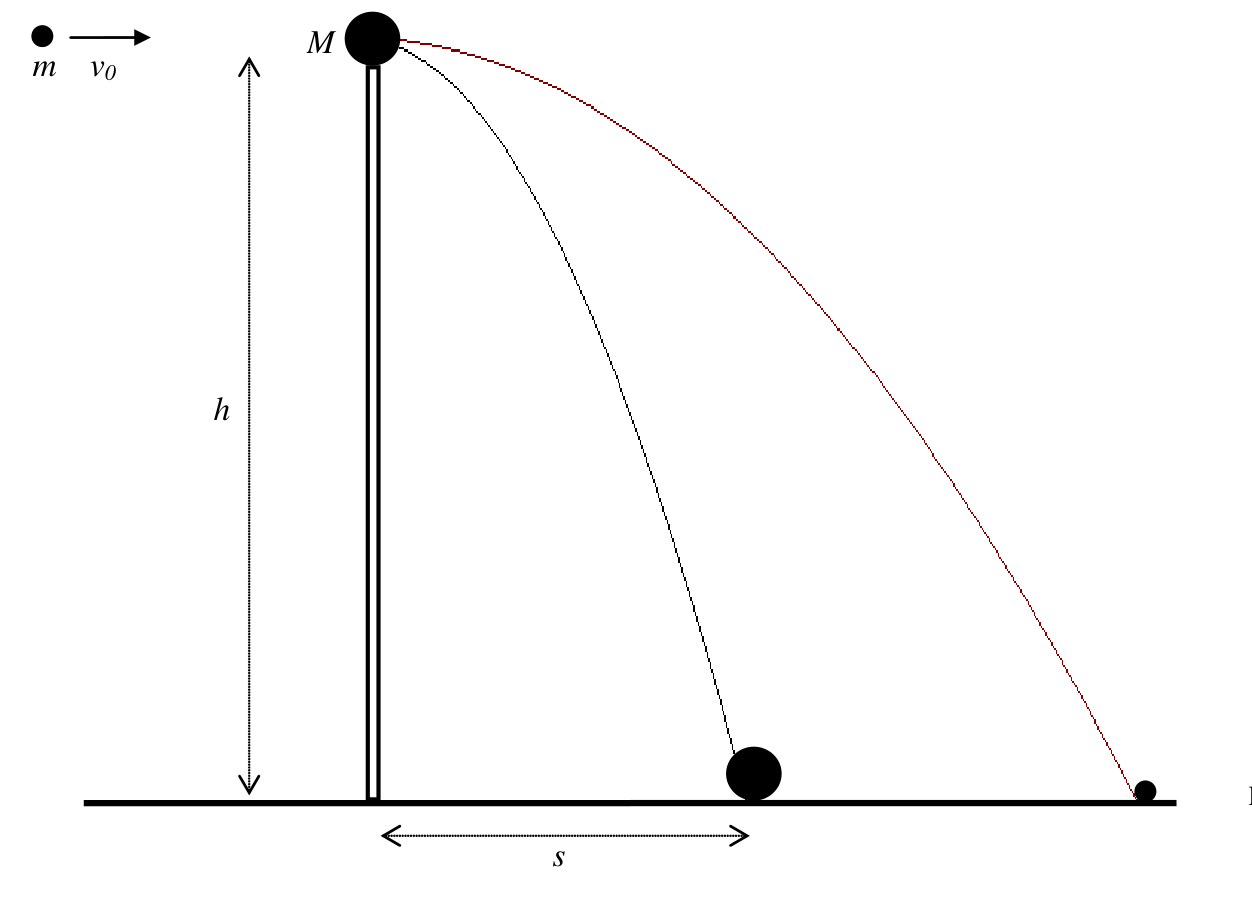
Fig. 1
Official English text of the problem.
Answers
- Bullet’s landing point: \(\boxed{100\ \mathrm{m}}\) horizontally from the foot of the column, in the bullet’s original direction of motion—\(80\ \mathrm{m}\) beyond the ball.
- Energy converted into heat: \(\boxed{Q=1160\ \mathrm{J}}\), corresponding to \(\boxed{92.8\%}\) of the bullet’s initial kinetic energy.
Solution
Bullet’s landing point
Treat the ball and bullet as particles and take the penetration time to be negligible compared with the subsequent fall time. The central, horizontal impact produces horizontal translational motion without rotation. During the brief impact, the external horizontal impulse is negligible, so horizontal momentum is conserved.
After penetration, both objects start falling from height \(h\) with zero vertical velocity. Their common fall time is therefore \[ h=\frac12gt^2, \qquad t=\sqrt{\frac{2h}{g}} =\sqrt{\frac{2(5)}{10}} =1\ \mathrm{s}. \]
With no air resistance, the ball’s horizontal velocity \(V\) remains constant. Its measured range gives \[ V=\frac{s}{t}=\frac{20}{1}=20\ \mathrm{m\,s^{-1}}. \]
Let \(v\) be the bullet’s horizontal velocity after passing through the ball. Conservation of horizontal momentum gives \[ mv_0=mv+MV, \] hence \[ v=v_0-\frac{M}{m}V =500-\frac{0.2}{0.01}(20) =100\ \mathrm{m\,s^{-1}}. \]
The bullet’s horizontal range from the column is thus \[ \boxed{x=vt=(100)(1)=100\ \mathrm{m}}. \]
Energy converted into heat
Kinetic energy is not conserved during penetration. In the problem’s idealized model, the decrease in total kinetic energy is converted into heat. The change in gravitational potential energy during the brief penetration is negligible.
Initially, only the bullet has kinetic energy: \[ K_i=\frac12mv_0^2 =\frac12(0.01)(500)^2 =1250\ \mathrm{J}. \]
Immediately after penetration, the total kinetic energy is \[ K_f=\frac12mv^2+\frac12MV^2 =\frac12(0.01)(100)^2+\frac12(0.2)(20)^2 =50+40=90\ \mathrm{J}. \]
Therefore, \[ \boxed{Q=K_i-K_f=1250-90=1160\ \mathrm{J}}. \]
The required fraction of the bullet’s initial kinetic energy is \[ \boxed{\frac{Q}{K_i}=\frac{1160}{1250}=0.928=92.8\%}. \]
The \(40\ \mathrm{J}\) transferred to the ball’s motion must be excluded from the heat.
The solution was checked against the official solution.
IPhO 1967 · Theorieaufgabe 1
Geschoss durchschlägt eine auf einer Säule ruhende Kugel
Eine kleine Kugel mit der Masse \(M = 0.2\) kg ruht auf einer senkrechten Säule der Höhe \(h = 5\)m. Ein Geschoss mit der Masse \(m = 0.01\) kg, das sich mit der Geschwindigkeit \(v_0 = 500\) m/s bewegt, durchschlägt die Kugel horizontal durch ihren Mittelpunkt (Abb. 1). Die Kugel trifft in einer Entfernung von \(s = 20\) m auf den Boden. Wo trifft das Geschoss auf den Boden? Welcher Anteil der kinetischen Energie des Geschosses wurde beim Durchschlagen der Kugel in Wärme umgewandelt? Vernachlässigen Sie den Luftwiderstand. Nehmen Sie an, dass \(g = 10\) m/s² gilt.
Abb. 1
Aufgabentext aus dem offiziellen englischen Text übersetzt.
Antworten
- Auftreffpunkt des Geschosses: \(\boxed{100\ \mathrm{m}}\) horizontal vom Fuß der Säule entfernt, in der ursprünglichen Bewegungsrichtung des Geschosses — \(80\ \mathrm{m}\) hinter der Kugel.
- In Wärme umgewandelte Energie: \(\boxed{Q=1160\ \mathrm{J}}\), entsprechend \(\boxed{92.8\%}\) der anfänglichen kinetischen Energie des Geschosses.
Lösung
Auftreffpunkt des Geschosses
Wir behandeln Kugel und Geschoss als Massenpunkte und nehmen an, dass die Durchschlagsdauer gegenüber der anschließenden Fallzeit vernachlässigbar ist. Der zentrale, horizontale Stoß bewirkt eine horizontale Translationsbewegung ohne Rotation. Während des kurzen Stoßes ist der äußere horizontale Kraftstoß vernachlässigbar, sodass der horizontale Impuls erhalten bleibt.
Nach dem Durchschlagen beginnen beide Körper aus der Höhe \(h\) mit einer vertikalen Anfangsgeschwindigkeit von null zu fallen. Ihre gemeinsame Fallzeit beträgt daher \[ h=\frac12gt^2, \qquad t=\sqrt{\frac{2h}{g}} =\sqrt{\frac{2(5)}{10}} =1\ \mathrm{s}. \]
Ohne Luftwiderstand bleibt die horizontale Geschwindigkeit \(V\) der Kugel konstant. Aus ihrer gemessenen Wurfweite ergibt sich \[ V=\frac{s}{t}=\frac{20}{1}=20\ \mathrm{m\,s^{-1}}. \]
Sei \(v\) die horizontale Geschwindigkeit des Geschosses nach dem Durchschlagen der Kugel. Aus der Erhaltung des horizontalen Impulses folgt \[ mv_0=mv+MV, \] also \[ v=v_0-\frac{M}{m}V =500-\frac{0.2}{0.01}(20) =100\ \mathrm{m\,s^{-1}}. \]
Die horizontale Wurfweite des Geschosses von der Säule aus beträgt somit \[ \boxed{x=vt=(100)(1)=100\ \mathrm{m}}. \]
In Wärme umgewandelte Energie
Die kinetische Energie bleibt beim Durchschlagen nicht erhalten. Im idealisierten Modell der Aufgabe wird die Abnahme der gesamten kinetischen Energie in Wärme umgewandelt. Die Änderung der potenziellen Energie im Schwerefeld während des kurzen Durchschlagens ist vernachlässigbar.
Anfangs besitzt nur das Geschoss kinetische Energie: \[ K_i=\frac12mv_0^2 =\frac12(0.01)(500)^2 =1250\ \mathrm{J}. \]
Unmittelbar nach dem Durchschlagen beträgt die gesamte kinetische Energie \[ K_f=\frac12mv^2+\frac12MV^2 =\frac12(0.01)(100)^2+\frac12(0.2)(20)^2 =50+40=90\ \mathrm{J}. \]
Daher gilt \[ \boxed{Q=K_i-K_f=1250-90=1160\ \mathrm{J}}. \]
Der gesuchte Anteil an der anfänglichen kinetischen Energie des Geschosses beträgt \[ \boxed{\frac{Q}{K_i}=\frac{1160}{1250}=0.928=92.8\%}. \]
Die \(40\ \mathrm{J}\), die auf die Bewegung der Kugel übertragen werden, dürfen nicht zur Wärme gezählt werden.
Die Lösung wurde mit der offiziellen Lösung abgeglichen.
IPhO 1967 · Teori sorusu 1
Bir sütun üzerinde duran kürenin içinden geçen mermi
Kütlesi \(M = 0.2\) kg olan küçük bir küre, yüksekliği \(h = 5\)m olan düşey bir sütun üzerinde durmaktadır. Kütlesi \(m = 0.01\) kg olan ve \(v_0 = 500\) m/s hızıyla hareket eden bir mermi, kürenin merkezinden yatay doğrultuda geçer (Şek. 1). Küre, \(s = 20\) m uzaklıkta yere düşer. Mermi nerede yere düşer? Mermi kürenin içinden geçerken merminin kinetik enerjisinin ne kadarı ısıya dönüşmüştür? Hava direncini ihmal ediniz. \(g = 10\) m/s² olduğunu kabul ediniz.
Şek. 1
Soru metni resmi İngilizce metinden çevrilmiştir.
Cevaplar
- Merminin yere düştüğü nokta: Sütunun tabanından yatay doğrultuda, merminin ilk hareket yönünde \(\boxed{100\ \mathrm{m}}\) uzaklıkta; kürenin düştüğü noktadan \(80\ \mathrm{m}\) ileride.
- Isıya dönüşen enerji: \(\boxed{Q=1160\ \mathrm{J}}\); merminin başlangıçtaki kinetik enerjisinin \(\boxed{92.8\%}\)'ine karşılık gelir.
Çözüm
Merminin yere düştüğü nokta
Küreyi ve mermiyi noktasal parçacıklar olarak ele alalım ve merminin kürenin içinden geçiş süresini, ardından gelen düşme süresine kıyasla ihmal edilebilir kabul edelim. Merkezden geçen yatay çarpışma, dönme olmaksızın yatay öteleme hareketi oluşturur. Kısa süren çarpışma sırasında dış kuvvetlerin yatay doğrultudaki itmesi ihmal edilebilir olduğundan yatay momentum korunur.
Mermi kürenin içinden geçtikten sonra her iki cisim de \(h\) yüksekliğinden, düşey hızları sıfır olacak şekilde düşmeye başlar. Dolayısıyla ortak düşme süreleri \[ h=\frac12gt^2, \qquad t=\sqrt{\frac{2h}{g}} =\sqrt{\frac{2(5)}{10}} =1\ \mathrm{s}. \]
Hava direnci olmadığından kürenin yatay hızı \(V\) sabit kalır. Ölçülen menzilinden \[ V=\frac{s}{t}=\frac{20}{1}=20\ \mathrm{m\,s^{-1}}. \]
Merminin kürenin içinden geçtikten sonraki yatay hızı \(v\) olsun. Yatay momentumun korunumundan \[ mv_0=mv+MV, \] dolayısıyla \[ v=v_0-\frac{M}{m}V =500-\frac{0.2}{0.01}(20) =100\ \mathrm{m\,s^{-1}}. \]
Böylece merminin sütundan itibaren yatay menzili \[ \boxed{x=vt=(100)(1)=100\ \mathrm{m}}. \]
Isıya dönüşen enerji
Mermi kürenin içinden geçerken kinetik enerji korunmaz. Sorunun idealleştirilmiş modelinde toplam kinetik enerjideki azalma ısıya dönüşür. Kısa süren geçiş sırasında kütleçekim potansiyel enerjisindeki değişim ihmal edilebilir.
Başlangıçta yalnızca merminin kinetik enerjisi vardır: \[ K_i=\frac12mv_0^2 =\frac12(0.01)(500)^2 =1250\ \mathrm{J}. \]
Mermi kürenin içinden geçtikten hemen sonra toplam kinetik enerji \[ K_f=\frac12mv^2+\frac12MV^2 =\frac12(0.01)(100)^2+\frac12(0.2)(20)^2 =50+40=90\ \mathrm{J}. \]
Dolayısıyla, \[ \boxed{Q=K_i-K_f=1250-90=1160\ \mathrm{J}}. \]
Isıya dönüşen enerjinin merminin başlangıçtaki kinetik enerjisine oranı \[ \boxed{\frac{Q}{K_i}=\frac{1160}{1250}=0.928=92.8\%}. \]
Kürenin hareketine aktarılan \(40\ \mathrm{J}\), ısıya dönüşen enerjiye dahil edilmemelidir.
Çözüm, resmi çözümle karşılaştırılarak kontrol edildi.
IPhO 1967 · Problema teórico 1
Una bala atraviesa una bola en reposo sobre una columna
Una pequeña bola de masa \(M = 0.2\) kg reposa sobre una columna vertical de altura \(h = 5\)m. Una bala de masa \(m = 0.01\) kg, que se mueve con una velocidad \(v_0 = 500\) m/s, atraviesa horizontalmente el centro de la bola (Fig. 1). La bola llega al suelo a una distancia \(s = 20\) m. ¿Dónde llega la bala al suelo? ¿Qué fracción de la energía cinética de la bala se convirtió en calor al atravesar la bola? Desprecie la resistencia del aire. Suponga que \(g = 10\) m/s².
Fig. 1
Enunciado traducido del texto oficial en inglés.
Respuestas
- Punto de caída de la bala: \(\boxed{100\ \mathrm{m}}\) horizontalmente desde el pie de la columna, en la dirección original de movimiento de la bala, a \(80\ \mathrm{m}\) más allá de la bola.
- Energía convertida en calor: \(\boxed{Q=1160\ \mathrm{J}}\), correspondiente al \(\boxed{92.8\%}\) de la energía cinética inicial de la bala.
Solución
Punto de caída de la bala
Trate la bola y la bala como partículas y considere que el tiempo que tarda la bala en atravesar la bola es despreciable en comparación con el tiempo de caída posterior. El impacto central y horizontal produce un movimiento de traslación horizontal sin rotación. Durante el breve impacto, el impulso externo horizontal es despreciable, por lo que se conserva la cantidad de movimiento horizontal.
Después de que la bala atraviese la bola, ambos objetos comienzan a caer desde la altura \(h\) con velocidad vertical nula. Por tanto, su tiempo de caída común es \[ h=\frac12gt^2, \qquad t=\sqrt{\frac{2h}{g}} =\sqrt{\frac{2(5)}{10}} =1\ \mathrm{s}. \]
En ausencia de resistencia del aire, la velocidad horizontal \(V\) de la bola permanece constante. A partir de su alcance medido se obtiene \[ V=\frac{s}{t}=\frac{20}{1}=20\ \mathrm{m\,s^{-1}}. \]
Sea \(v\) la velocidad horizontal de la bala después de atravesar la bola. La conservación de la cantidad de movimiento horizontal da \[ mv_0=mv+MV, \] de donde \[ v=v_0-\frac{M}{m}V =500-\frac{0.2}{0.01}(20) =100\ \mathrm{m\,s^{-1}}. \]
Por tanto, el alcance horizontal de la bala desde la columna es \[ \boxed{x=vt=(100)(1)=100\ \mathrm{m}}. \]
Energía convertida en calor
La energía cinética no se conserva mientras la bala atraviesa la bola. En el modelo idealizado del problema, la disminución de la energía cinética total se convierte en calor. La variación de la energía potencial gravitatoria durante el breve tiempo que dura el paso de la bala es despreciable.
Inicialmente, solo la bala tiene energía cinética: \[ K_i=\frac12mv_0^2 =\frac12(0.01)(500)^2 =1250\ \mathrm{J}. \]
Inmediatamente después de que la bala atraviese la bola, la energía cinética total es \[ K_f=\frac12mv^2+\frac12MV^2 =\frac12(0.01)(100)^2+\frac12(0.2)(20)^2 =50+40=90\ \mathrm{J}. \]
Por tanto, \[ \boxed{Q=K_i-K_f=1250-90=1160\ \mathrm{J}}. \]
La fracción solicitada de la energía cinética inicial de la bala es \[ \boxed{\frac{Q}{K_i}=\frac{1160}{1250}=0.928=92.8\%}. \]
Los \(40\ \mathrm{J}\) transferidos al movimiento de la bola deben excluirse del calor.
La solución se comprobó con la solución oficial.
IPhO 1967 · 理论题 1
子弹穿过静置在柱顶的小球
一个质量为 \(M = 0.2\) kg 的小球静置在一根高度为 \(h = 5\)m 的竖直柱子的顶端。一颗质量为 \(m = 0.01\) kg、以速度 \(v_0 = 500\) m/s 运动的子弹水平穿过小球的球心(图 1)。小球落在距柱脚 \(s = 20\) m 处。子弹在何处落地?子弹穿过小球时,其动能的多大比例转化为热量?忽略空气阻力。设 \(g = 10\) m/s²。
图 1
题目译自官方英文原文。
答案
- 子弹的落点: 沿子弹原来的运动方向,距柱脚的水平距离为 \(\boxed{100\ \mathrm{m}}\),比小球的落点远 \(80\ \mathrm{m}\)。
- 转化为热量的能量: \(\boxed{Q=1160\ \mathrm{J}}\),占子弹初始动能的 \(\boxed{92.8\%}\)。
解答
子弹的落点
将小球和子弹视为质点,并认为子弹穿过小球所用的时间与随后下落的时间相比可以忽略。水平的对心碰撞使小球产生水平平动,而不发生转动。在短暂的碰撞过程中,外力的水平冲量可以忽略,因此水平方向的动量守恒。
子弹穿出后,两个物体都从高度 \(h\) 处以零竖直初速度开始下落。因此,它们的下落时间相同,为 \[ h=\frac12gt^2, \qquad t=\sqrt{\frac{2h}{g}} =\sqrt{\frac{2(5)}{10}} =1\ \mathrm{s}. \]
由于没有空气阻力,小球的水平速度 \(V\) 保持不变。由测得的水平射程可得 \[ V=\frac{s}{t}=\frac{20}{1}=20\ \mathrm{m\,s^{-1}}. \]
设子弹穿过小球后的水平速度为 \(v\)。由水平方向的动量守恒可得 \[ mv_0=mv+MV, \] 因此 \[ v=v_0-\frac{M}{m}V =500-\frac{0.2}{0.01}(20) =100\ \mathrm{m\,s^{-1}}. \]
所以,子弹相对于柱脚的水平射程为 \[ \boxed{x=vt=(100)(1)=100\ \mathrm{m}}. \]
转化为热量的能量
子弹穿过小球的过程中,动能不守恒。在本题的理想化模型中,总动能的减少量转化为热量。在短暂的穿透过程中,重力势能的变化可以忽略。
最初,只有子弹具有动能: \[ K_i=\frac12mv_0^2 =\frac12(0.01)(500)^2 =1250\ \mathrm{J}. \]
子弹刚穿出小球时,总动能为 \[ K_f=\frac12mv^2+\frac12MV^2 =\frac12(0.01)(100)^2+\frac12(0.2)(20)^2 =50+40=90\ \mathrm{J}. \]
因此, \[ \boxed{Q=K_i-K_f=1250-90=1160\ \mathrm{J}}. \]
所求的转化为热量的能量占子弹初始动能的比例为 \[ \boxed{\frac{Q}{K_i}=\frac{1160}{1250}=0.928=92.8\%}. \]
传递给小球、使其运动的 \(40\ \mathrm{J}\) 能量必须从热量中排除。
解答已与官方解答核对。
IPhO 1967 · Теоретическая задача 1
Пуля, проходящая сквозь шар, покоящийся на столбе
Небольшой шар массой \(M = 0.2\) кг покоится на вертикальном столбе высотой \(h = 5\) м. Пуля массой \(m = 0.01\) кг, движущаяся со скоростью \(v_0 = 500\) м/с, проходит горизонтально через центр шара (рис. 1). Шар падает на землю на расстоянии \(s = 20\) м. Где упадёт на землю пуля? Какая часть кинетической энергии пули превратилась в теплоту при прохождении пули сквозь шар? Сопротивлением воздуха пренебречь. Принять \(g = 10\) м/с².
Рис. 1
Условие переведено с официального английского текста.
Ответы
- Место падения пули: на расстоянии \(\boxed{100\ \mathrm{m}}\) по горизонтали от основания столба в первоначальном направлении движения пули — на \(80\ \mathrm{m}\) дальше шара.
- Энергия, превратившаяся в теплоту: \(\boxed{Q=1160\ \mathrm{J}}\), что составляет \(\boxed{92.8\%}\) начальной кинетической энергии пули.
Решение
Место падения пули
Будем рассматривать шар и пулю как материальные точки и считать время прохождения пули сквозь шар пренебрежимо малым по сравнению со временем последующего падения. Центральный горизонтальный удар приводит к горизонтальному поступательному движению без вращения. За короткое время удара горизонтальный импульс внешних сил пренебрежимо мал, поэтому горизонтальная составляющая импульса системы сохраняется.
После прохождения пули сквозь шар оба тела начинают падать с высоты \(h\) с нулевой вертикальной скоростью. Поэтому время падения у них одинаково и равно \[ h=\frac12gt^2, \qquad t=\sqrt{\frac{2h}{g}} =\sqrt{\frac{2(5)}{10}} =1\ \mathrm{s}. \]
При отсутствии сопротивления воздуха горизонтальная скорость шара \(V\) остаётся постоянной. По измеренной дальности его полёта получаем \[ V=\frac{s}{t}=\frac{20}{1}=20\ \mathrm{m\,s^{-1}}. \]
Обозначим через \(v\) горизонтальную скорость пули после прохождения сквозь шар. Закон сохранения горизонтальной составляющей импульса даёт \[ mv_0=mv+MV, \] откуда \[ v=v_0-\frac{M}{m}V =500-\frac{0.2}{0.01}(20) =100\ \mathrm{m\,s^{-1}}. \]
Таким образом, дальность полёта пули по горизонтали от столба равна \[ \boxed{x=vt=(100)(1)=100\ \mathrm{m}}. \]
Энергия, превратившаяся в теплоту
При прохождении пули сквозь шар кинетическая энергия не сохраняется. В идеализированной модели задачи уменьшение суммарной кинетической энергии соответствует энергии, превратившейся в теплоту. Изменением гравитационной потенциальной энергии за короткое время прохождения пули сквозь шар можно пренебречь.
Первоначально кинетической энергией обладает только пуля: \[ K_i=\frac12mv_0^2 =\frac12(0.01)(500)^2 =1250\ \mathrm{J}. \]
Сразу после прохождения пули сквозь шар суммарная кинетическая энергия равна \[ K_f=\frac12mv^2+\frac12MV^2 =\frac12(0.01)(100)^2+\frac12(0.2)(20)^2 =50+40=90\ \mathrm{J}. \]
Следовательно, \[ \boxed{Q=K_i-K_f=1250-90=1160\ \mathrm{J}}. \]
Искомая доля начальной кинетической энергии пули равна \[ \boxed{\frac{Q}{K_i}=\frac{1160}{1250}=0.928=92.8\%}. \]
Энергию \(40\ \mathrm{J}\), переданную шару и затраченную на его движение, необходимо исключить из количества теплоты.
Решение проверено по официальному решению.
IPhO 1967 · مسألة نظرية 1
رصاصة تخترق كرة تستقر على عمود
تستقر كرة صغيرة كتلتها \(M = 0.2\ \mathrm{kg}\) على عمود رأسي ارتفاعه \(h = 5\ \mathrm{m}\). تخترق رصاصة كتلتها \(m = 0.01\ \mathrm{kg}\)، وتتحرك بسرعة \(v_0 = 500\ \mathrm{m/s}\)، الكرة أفقيًا عبر مركزها (الشكل 1). تصل الكرة إلى الأرض على مسافة \(s = 20\ \mathrm{m}\). أين تصل الرصاصة إلى الأرض؟ ما الجزء من الطاقة الحركية للرصاصة الذي تحوّل إلى حرارة عند اختراقها الكرة؟ أهمل مقاومة الهواء. افترض أن \(g = 10\ \mathrm{m/s^2}\).
الشكل 1
نص المسألة مترجم عن النص الإنجليزي الرسمي.
الإجابات
- نقطة سقوط الرصاصة: على بُعد أفقي مقداره \(\boxed{100\ \mathrm{m}}\) من قاعدة العمود، في اتجاه حركة الرصاصة الأصلي، أي أبعد من نقطة سقوط الكرة بمقدار \(80\ \mathrm{m}\).
- الطاقة المتحوّلة إلى حرارة: \(\boxed{Q=1160\ \mathrm{J}}\)، وهو ما يعادل \(\boxed{92.8\%}\) من الطاقة الحركية الابتدائية للرصاصة.
الحل
نقطة سقوط الرصاصة
نُعامل الكرة والرصاصة بوصفهما جسيمين، ونعدّ زمن الاختراق مهملًا مقارنةً بزمن السقوط اللاحق. ينتج عن التصادم المركزي الأفقي حركة انتقالية أفقية من دون دوران. وخلال زمن التصادم القصير، يكون الدفع الخارجي الأفقي مهملًا، لذا تُحفظ كمية الحركة الأفقية.
بعد الاختراق، يبدأ كلا الجسمين السقوط من ارتفاع \(h\) بسرعة رأسية معدومة. ولذلك فإن زمن سقوطهما المشترك هو \[ h=\frac12gt^2, \qquad t=\sqrt{\frac{2h}{g}} =\sqrt{\frac{2(5)}{10}} =1\ \mathrm{s}. \]
في غياب مقاومة الهواء، تظل السرعة الأفقية للكرة \(V\) ثابتة. ومن مداها المقاس نحصل على \[ V=\frac{s}{t}=\frac{20}{1}=20\ \mathrm{m\,s^{-1}}. \]
لتكن \(v\) السرعة الأفقية للرصاصة بعد اختراق الكرة. يعطي حفظ كمية الحركة الأفقية \[ mv_0=mv+MV, \] ومن ثم \[ v=v_0-\frac{M}{m}V =500-\frac{0.2}{0.01}(20) =100\ \mathrm{m\,s^{-1}}. \]
إذن، المدى الأفقي للرصاصة مقاسًا من العمود هو \[ \boxed{x=vt=(100)(1)=100\ \mathrm{m}}. \]
الطاقة المتحوّلة إلى حرارة
لا تُحفظ الطاقة الحركية أثناء الاختراق. وفي النموذج المثالي للمسألة، يتحوّل النقص في الطاقة الحركية الكلية إلى حرارة. ويكون التغيّر في طاقة الوضع الثقالية خلال زمن الاختراق القصير مهملًا.
في البداية، تكون للرصاصة وحدها طاقة حركية: \[ K_i=\frac12mv_0^2 =\frac12(0.01)(500)^2 =1250\ \mathrm{J}. \]
بعد الاختراق مباشرةً، تكون الطاقة الحركية الكلية \[ K_f=\frac12mv^2+\frac12MV^2 =\frac12(0.01)(100)^2+\frac12(0.2)(20)^2 =50+40=90\ \mathrm{J}. \]
وعليه، \[ \boxed{Q=K_i-K_f=1250-90=1160\ \mathrm{J}}. \]
النسبة المطلوبة من الطاقة الحركية الابتدائية للرصاصة هي \[ \boxed{\frac{Q}{K_i}=\frac{1160}{1250}=0.928=92.8\%}. \]
يجب استبعاد الطاقة البالغة \(40\ \mathrm{J}\) التي انتقلت إلى حركة الكرة من كمية الحرارة.
تمت مراجعة الحل بمقارنته بالحل الرسمي.