IPhO 2025 · Theory problem 3
Champagne!
Warning: Excessive alcohol consumption is harmful to health and drinking alcohol below legal age is prohibited.
Champagne is a French sparkling wine. Fermentation of sugars produces carbon dioxide (\(\mathrm{CO}_2\)) in the bottle. The molar concentration of \(\mathrm{CO}_2\) in the liquid phase \(c_\ell\) and the partial pressure \(P_{\mathrm{CO}_2}\) in the gas phase are related by \(c_\ell=k_{\mathrm H}P_{\mathrm{CO}_2}\), known as Henry's law and where \(k_{\mathrm H}\) is called Henry's constant.
Data
- Surface tension of champagne \(\sigma=47\times10^{-3}\,\mathrm{J\cdot m^{-2}}\)
- Density of the liquid \(\rho_\ell=1.0\times10^3\,\mathrm{kg\cdot m^{-3}}\)
- Henry's constant at \(T_0=20^\circ\mathrm C\), \(k_{\mathrm H}(20^\circ\mathrm C)=3.3\times10^{-4}\,\mathrm{mol\cdot m^{-3}\cdot Pa^{-1}}\)
- Henry's constant at \(T_0=6^\circ\mathrm C\), \(k_{\mathrm H}(6^\circ\mathrm C)=5.4\times10^{-4}\,\mathrm{mol\cdot m^{-3}\cdot Pa^{-1}}\)
- Atmospheric pressure \(P_0=1\,\mathrm{bar}=1.0\times10^5\,\mathrm{Pa}\)
- Gases are ideal with an adiabatic coefficient \(\gamma=1.3\)
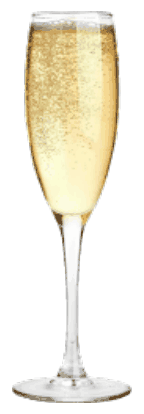
Fig. 1. A glass filled with champagne.
Part A. Nucleation, growth and rise of bubbles
Immediately after opening a bottle of champagne at temperature \(T_0=20^\circ\mathrm C\), we fill a glass. The pressure in the liquid is \(P_0\) and its temperature stays constant at \(T_0\). The concentration \(c_\ell\) of dissolved \(\mathrm{CO}_2\) exceeds the equilibrium concentration and we study the nucleation of a \(\mathrm{CO}_2\) bubble. We note \(a\) its radius and \(P_{\mathrm b}\) its inner pressure.
A.1 — 0.2pt
Express the pressure \(P_{\mathrm b}\) in terms of \(P_0\), \(a\) and \(\sigma\).
In the liquid, the concentration of dissolved \(\mathrm{CO}_2\) depends on the distance to the bubble. At long distance we recover the value \(c_\ell\) and we note \(c_{\mathrm b}\) the concentration close to the bubble surface. According to Henry's law, \(c_{\mathrm b}=k_{\mathrm H}P_{\mathrm b}\). We furthermore assume in all the problem that bubbles contain only \(\mathrm{CO}_2\).
Since \(c_\ell\ne c_{\mathrm b}\), \(\mathrm{CO}_2\) molecules diffuse from areas of high to low concentration. We assume also that any molecule from the liquid phase reaching the bubble surface is transferred to the vapour.
A.2 — 0.5pt
Express the critical radius \(a_{\mathrm c}\) above which a bubble is expected to grow in terms of \(P_0,\sigma,c_\ell\) and \(c_0\) where \(c_0=k_{\mathrm H}P_0\). Calculate numerically \(a_{\mathrm c}\) for \(c_\ell=4c_0\).
In practice, bubbles mainly grow from pre-existing gas cavities. Consider then a bubble with initial radius \(a_0\approx40\,\mu\mathrm m\). The number of moles of \(\mathrm{CO}_2\) transferred at the bubble's surface per unit area and time is noted \(j\). Two models are possible for \(j\).
- model (1) \(j=\dfrac{D}{a}(c_\ell-c_{\mathrm b})\) where \(D\) is the diffusion coefficient of \(\mathrm{CO}_2\) in the liquid.
- model (2) \(j=K(c_\ell-c_{\mathrm b})\) where \(K\) is a constant here.
Experimentally, the bubble radius \(a(t)\) is found to depend on time as shown in Fig. 2. Here \(c_\ell\approx4c_0\), and since bubbles are large enough to be visible, the excess pressure due to surface tension can be neglected and \(P_{\mathrm b}\approx P_0\).
A.3 — 1.2pt
Express the number of \(\mathrm{CO}_2\) moles in the bubble \(n_{\mathrm c}\) in terms of \(a,P_0,T_0\) and ideal gas constant \(R\). Find \(a(t)\) for both models. Indicate which model explains the experimental results in Fig. 2. Depending on your answer, calculate numerically \(K\) or \(D\).
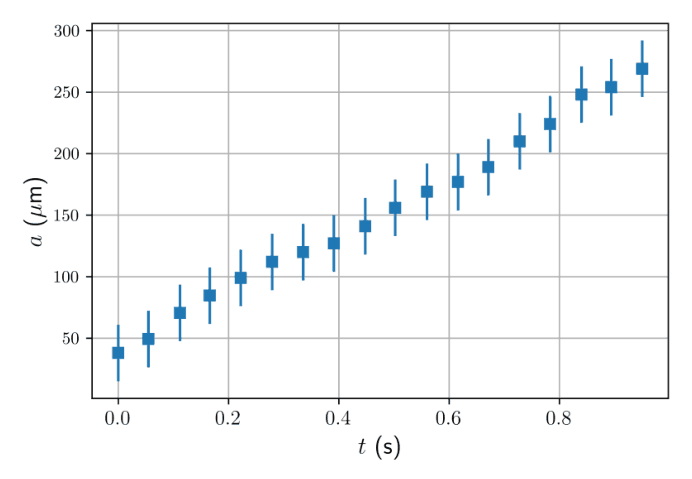
Fig. 2. Time evolution of \(\mathrm{CO}_2\) bubble radius in a glass of champagne (adapted from [1]).
Eventually bubbles detach from the bottom of the glass and continue to grow while rising. Fig. 3. shows a train of bubbles. The bubbles of the train have the same initial radius and are emitted at a constant frequency \(f_{\mathrm b}=20\,\mathrm{Hz}\).

Fig. 3. A train of bubbles. The photo is rotated horizontally for the page layout (adapted from [1]).
For the range of velocities studied here, the drag force \(F\) on a bubble of radius \(a\) moving at velocity \(v\) in a liquid of dynamic viscosity \(\eta\) is given by Stokes' law \(F=6\pi\eta av\). Measurements show that at any moment in time, the bubble can be assumed to be travelling at its terminal velocity.
A.4 — 0.8pt
Give the expression of the main forces exerted on a vertically rising bubble. Obtain the expression of \(v(a)\). Give a numerical estimate of \(\eta\) using \(\rho_\ell\), \(g_0\) and quantities measured on Fig. 3.
The quasi-stationary growth of bubbles with rate \(q_a=\dfrac{\mathrm da}{\mathrm dt}\) still applies during bubble rise.
A.5 — 0.5pt
Express the radius \(a_{H_\ell}\) of a bubble reaching the free surface in terms of height travelled \(H_\ell\), growth rate \(q_a=\dfrac{\mathrm da}{\mathrm dt}\), and any constants you may need. Assume \(a_{H_\ell}\gg a_0\) and \(q_a\) constant, and give the numerical value of \(a_{H_\ell}\) with \(H_\ell=10\,\mathrm{cm}\) and \(q_a\) corresponding to Fig. 2.
There are \(N_{\mathrm b}\) nucleation sites of bubbles. Assume that the bubbles are nucleated at a constant frequency \(f_{\mathrm b}\) at the bottom of a glass of champagne (height \(H_\ell\) for a volume \(V_\ell\)), with \(a_0\) still negligible. Neglect diffusion of \(\mathrm{CO}_2\) at the free surface.
A.6 — 1.1pt
Write the differential equation for \(c_\ell(t)\). Obtain from this equation the characteristic time \(\tau\) for the decay of the concentration of dissolved \(\mathrm{CO}_2\) in the liquid.
Part B. Acoustic emission of a bursting bubble
Small bubbles are nearly spherical as they reach the free surface. Once the liquid film separating the bubble from the air thins out sufficiently, a circular hole of radius \(r\) forms in the film and, driven by surface tension, opens very quickly (Fig. 4. left). The hole opens at constant speed \(v_{\mathrm f}\) (Fig. 4. right). The film outside the rim remains still, with constant thickness \(h\).
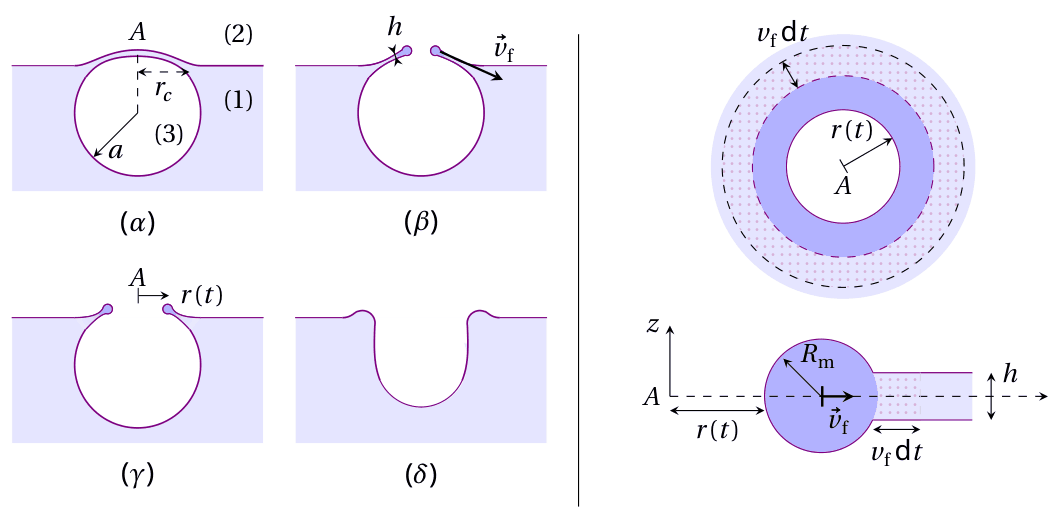
Fig. 4. (Left) \((\alpha)\) Bubble at the surface: (1) liquid, (2) air at pressure \(P_0\) and (3), \(\mathrm{CO}_2\) at pressure \(P_{\mathrm b}\), \((\beta)\) and \((\gamma)\) retraction of the liquid film, where the rim is in dark blue, \((\delta)\) bubble collapse. (Right) Retraction of the liquid film at time \(t\). Top: sketch of the pierced film seen from above. Bottom: cross-section of the rim and the retracting film. During \(\mathrm dt\) the rim accumulates nearby liquid (dotted).
Due to dissipative processes, only half of the difference of the surface energy between \(t\) and \(t+\mathrm dt\) of the rim and the accumulated liquid is transformed into kinetic energy. We further assume that the variation of the surface of the rim is negligible compared to that of the film.
B.1 — 1.1pt
Express \(v_{\mathrm f}\) in terms of \(\rho_\ell,\sigma\) and \(h\).
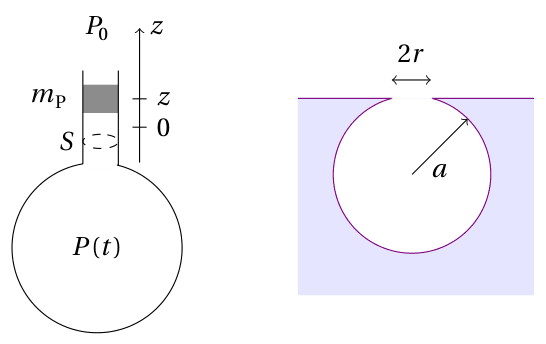
Fig. 5. (Left) a Helmholtz resonator. (Right) a bubble as an oscillator.
When the film bursts, it releases internal pressure and emits a sound. We model this acoustic emission by a Helmholtz resonator: a cavity open to the atmosphere at \(P_0\) through a bottleneck aperture of area \(S\) (Fig. 5. left). In the neck, a mass \(m_{\mathrm p}\) makes small amplitude position oscillations due to the pressure forces it experiences as the gas in the cavity expands or compresses adiabatically. The gravity force on \(m_{\mathrm p}\) is negligible compared to pressure forces. Let \(V_0\) be the volume of gas under the mass \(m_{\mathrm p}\) for \(P=P_0\) as \(z=0\).
B.2 — 1.1pt
Express the frequency of oscillation \(f_0\) of \(m_{\mathrm p}\). Hint: for \(\varepsilon\ll1\), \((1+\varepsilon)^\alpha\approx1+\alpha\varepsilon\).
The Helmholtz model may be used for a bubble of radius \(a\). \(V_0\) is the volume of the closed bubble. From litterature, the mass of the equivalent of the piston is \(m_{\mathrm p}=8\rho_{\mathrm g}r^3/3\) where \(r\) is the radius of the circular aperture and \(\rho_{\mathrm g}=1.8\,\mathrm{kg\cdot m^{-3}}\) is the density of the gas (Fig. 5. right). During the bursting process, \(r\) goes from \(0\) to \(r_{\mathrm c}\), given by \[ r_{\mathrm c}=\frac{2}{\sqrt3}a^2\sqrt{\frac{\rho_\ell g_0}{\sigma}}. \] At the same time, the frequency of emitted sound increases until a maximum value of \(40\,\mathrm{kHz}\) and the bursting time is \(t_{\mathrm b}=3\times10^{-2}\,\mathrm{ms}\).
B.3 — 1.1pt
Find the radius \(a\) and the thickness \(h\) of the champagne film separating the bubble from the atmosphere.
Part C. Popping champagne
In a bottle, the total quantity of \(\mathrm{CO}_2\) is \(n_{\mathrm T}=0.2\,\mathrm{mol}\), either dissolved in the volume \(V_{\mathrm L}=750\,\mathrm{mL}\) of liquid champagne, or as a gas in the volume \(V_{\mathrm G}=25\,\mathrm{mL}\) under the cork (Fig. 6. left). \(V_{\mathrm G}\) contains only \(\mathrm{CO}_2\). The equilibrium between both \(\mathrm{CO}_2\) phases follows Henry's Law. We suppose that the fast gaseous \(\mathrm{CO}_2\) expansion when the bottle is opened, is adiabatic and reversible. Ambient temperature \(T_0\) and pressure \(P_0=1\,\mathrm{bar}\) are constant.
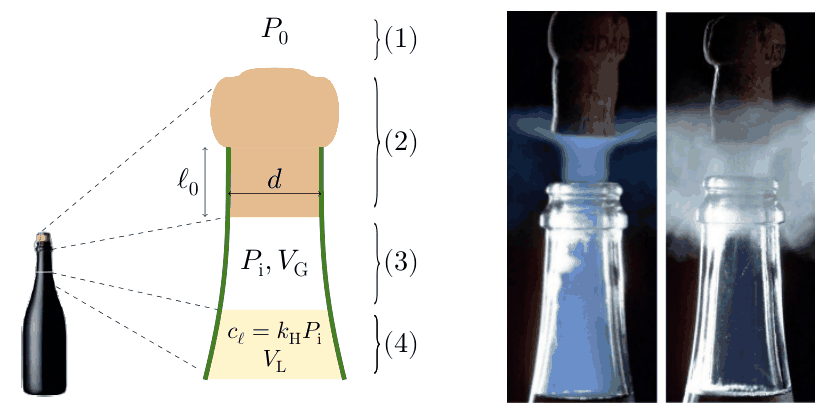
Fig. 6. Left: traditional bottleneck: (1) surrounding air, (2) cork stopper, (3) headspace, (4) liquid champagne. Right: Two phenomena observed while opening the bottle at two different temperatures (adapted from [2]).
C.1 — 0.4pt
Give the numerical value of the pressure \(P_{\mathrm i}\) of gaseous \(\mathrm{CO}_2\) in the bottle for \(T_0=6^\circ\mathrm C\) and \(T_0=20^\circ\mathrm C\).
Another step of champagne production (not described here) leads to the following values of \(P_{\mathrm i}\) that we will use for the next questions: \(P_{\mathrm i}=4.69\,\mathrm{bar}\) at \(T_0=6^\circ\mathrm C\) and \(P_{\mathrm i}=7.45\,\mathrm{bar}\) at \(T_0=20^\circ\mathrm C\).
During bottle opening, two different phenomena can be observed, depending on \(T_0\) (Fig. 6. right).
- either a blue fog appears, due to the formation of solid \(\mathrm{CO}_2\) crystals (but water condensation is inhibited);
- or a grey-white fog appears, due to water vapor condensation in the air surrounding the bottleneck. In this latter case, there is no formation of \(\mathrm{CO}_2\) solid crystals.
The saturated vapor pressure \(P_{\mathrm{sat}}^{\mathrm{CO}_2}\) for the \(\mathrm{CO}_2\) solid/gas transition follows: \[ \log_{10}\left(\frac{P_{\mathrm{sat}}^{\mathrm{CO}_2}}{P_0}\right) =A-\frac{B}{T+C} \] with \(T\) in \(\mathrm K\), \(A=6.81\), \(B=1.30\times10^3\,\mathrm K\) and \(C=-3.49\,\mathrm K\).
C.2 — 0.7pt
Give the numerical value \(T_{\mathrm f}\) of the \(\mathrm{CO}_2\) gas at the end of the expansion, after opening a bottle, if \(T_0=6^\circ\mathrm C\) and if \(T_0=20^\circ\mathrm C\), if no phase transition occured.
Choose which statements are true (several statements possible):
- At \(T_0=6^\circ\mathrm C\) a grey-white fog appears while opening the bottle.
- At \(T_0=6^\circ\mathrm C\) a blue fog appears while opening the bottle.
- At \(T_0=20^\circ\mathrm C\) a grey-white fog appears while opening the bottle.
- At \(T_0=20^\circ\mathrm C\) a blue fog appears while opening the bottle.
During bottle opening, the cork stopper pops out. We now determine the maximum height \(H_{\mathrm c}\) it reaches. Assume that the friction force \(F\) due to the bottleneck on the cork stopper is \(F=\alpha A\) where \(A\) is the area of contact and \(\alpha\) is a constant to determine. Initially, the pressure force slightly overcomes the friction force. The cork's mass is \(m=10\,\mathrm g\), its diameter \(d=1.8\,\mathrm{cm}\) and the length of the cylindrical part initially stuck in the bottleneck is \(\ell_0=2.5\,\mathrm{cm}\). Once the cork has left the bottleneck, you can neglect the net pressure force.
C.3 — 1.3pt
Give the numerical value of \(H_{\mathrm c}\) if the external temperature is \(T_0=6^\circ\mathrm C\).
[1] Liger-Belair et al, Am. J. Enol. Vitic., Vol. 50, No. 3 (1999).
[2] Liger-Belair et al., Sc. Reports 7, 10938 (2017).
General Data Sheet
| Constant | Notation | Value | Unit |
|---|---|---|---|
| Speed of light in vacuum | \(c\) | \(2.997\,924\,58\times10^8\) | \(\mathrm{m\cdot s^{-1}}\) |
| Planck constant | \(h\) | \(6.626\,070\,15\times10^{-34}\) | \(\mathrm{kg\cdot m^2\cdot s^{-1}}\) |
| Reduced Planck constant | \(\hbar=\dfrac{h}{2\pi}\) | \(1.054\,571\,818\times10^{-34}\) | \(\mathrm{kg\cdot m^2\cdot s^{-1}}\) |
| Boltzmann constant | \(k_{\mathrm B}\) | \(1.380\,649\times10^{-23}\) | \(\mathrm{kg\cdot m^2\cdot s^{-2}\cdot K^{-1}}\) |
| Avogadro constant | \(N_{\mathrm A}\) | \(6.022\,140\,76\times10^{23}\) | \(\mathrm{mol^{-1}}\) |
| Molar gas constant | \(R\) | \(8.314\,462\,618\,153\,24\) | \(\mathrm{kg\cdot m^2\cdot s^{-2}\cdot mol^{-1}\cdot K^{-1}}\) |
| Elementary charge | \(e\) | \(1.602\,176\,634\times10^{-19}\) | \(\mathrm{A\cdot s}\) |
| Universal constant of gravitation | \(G\) | \(6.674\,30(15)\times10^{-11}\) | \(\mathrm{m^3\cdot kg^{-1}\cdot s^{-2}}\) |
| Standard acceleration due to gravity | \(g\) | \(9.806\,65\) | \(\mathrm{m\cdot s^{-2}}\) |
| Stefan Boltzmann constant | \(\sigma\) | \(5.670\,374\,419\times10^{-8}\) | \(\mathrm{kg\cdot s^{-3}\cdot K^{-4}}\) |
| Vacuum permeability (magnetic constant) | \(\mu_0\) | \(1.256\,637\,061\,27(20)\times10^{-6}\) | \(\mathrm{kg\cdot m\cdot A^{-2}\cdot s^{-2}}\) |
| Vacuum permittivity (electrical constant) | \(\epsilon_0\) | \(8.854\,187\,818\,8(14)\times10^{-12}\) | \(\mathrm{A^2\cdot s^4\cdot kg^{-1}\cdot m^{-3}}\) |
| Rydberg constant | \(R_\infty\) | \(1.097\,373\,156\,815\,7(12)\times10^7\) | \(\mathrm{m^{-1}}\) |
| Mass of the electron | \(m_{\mathrm e}\) | \(9.109\,383\,713\,9(28)\times10^{-31}\) | \(\mathrm{kg}\) |
| Mass of the proton | \(m_{\mathrm p}\) | \(1.672\,621\,925\,95(52)\times10^{-27}\) | \(\mathrm{kg}\) |
| Mass of the neutron | \(m_{\mathrm n}\) | \(1.674\,927\,500\,56(85)\times10^{-27}\) | \(\mathrm{kg}\) |
| Atomic mass constant | \(m_{\mathrm u}\) | \(1.660\,539\,068\,92(52)\times10^{-27}\) | \(\mathrm{kg}\) |
| Electronvolt | \(\mathrm{eV}\) | \(1.602\,176\,634\times10^{-19}\) | \(\mathrm{kg\cdot m^2\cdot s^{-2}}\) |
Official English text of the problem.
Answers
Here \(\Delta c=c_\ell-c_0\), and \(g_0\) is the gravitational acceleration given in the data sheet.
-
A.1 \[ \boxed{P_{\mathrm b}=P_0+\frac{2\sigma}{a}}. \]
-
A.2 \[ \boxed{a_{\mathrm c}=\frac{2\sigma c_0}{P_0(c_\ell-c_0)}}. \] For \(c_\ell=4c_0\), \[ \boxed{a_{\mathrm c}=3.1\times10^{-7}\,\mathrm m=0.31\,\mu\mathrm m}. \]
-
A.3 \[ \boxed{n_{\mathrm c}=\frac{4\pi P_0a^3}{3RT_0}}, \] \[ \boxed{a_{(1)}(t)=\sqrt{a_0^2+\frac{2DRT_0\Delta c}{P_0}t}}, \qquad \boxed{a_{(2)}(t)=a_0+\frac{KRT_0\Delta c}{P_0}t}. \] Model (2) fits the approximately linear growth: \[ \boxed{q_a\approx2.4\times10^{-4}\,\mathrm{m\,s^{-1}}}, \qquad \boxed{K\approx1.0\times10^{-4}\,\mathrm{m\,s^{-1}}}. \]
-
A.4 Buoyancy \(4\pi\rho_\ell g_0a^3/3\) acts upwards; Stokes drag \(6\pi\eta av\) and the negligible bubble weight act downwards. \[ \boxed{v(a)\simeq\frac{2\rho_\ell g_0a^2}{9\eta}}, \qquad \boxed{\eta\approx2.7\times10^{-3}\,\mathrm{Pa\,s}} \] from approximate measurements of Fig. 3.
-
A.5 \[ \boxed{a_{H_\ell}\simeq \left(\frac{27\eta q_aH_\ell}{2\rho_\ell g_0}\right)^{1/3} \approx4.5\times10^{-4}\,\mathrm m=0.45\,\mathrm{mm}}. \]
-
A.6 \[ \boxed{\frac{\mathrm dc_\ell}{\mathrm dt} =-\frac{18\pi\eta K H_\ell N_{\mathrm b}f_{\mathrm b}} {\rho_\ell g_0V_\ell}(c_\ell-c_0)}, \qquad \boxed{\tau=\frac{\rho_\ell g_0V_\ell} {18\pi\eta K H_\ell N_{\mathrm b}f_{\mathrm b}}}. \]
-
B.1 \[ \boxed{v_{\mathrm f}=\sqrt{\frac{2\sigma}{\rho_\ell h}}}. \]
-
B.2 \[ \boxed{f_0=\frac{1}{2\pi} \sqrt{\frac{\gamma P_0S^2}{m_{\mathrm p}V_0}}}. \]
-
B.3 \[ \boxed{a\approx5.3\times10^{-4}\,\mathrm m=0.53\,\mathrm{mm}}, \qquad \boxed{h\approx3.8\times10^{-6}\,\mathrm m=3.8\,\mu\mathrm m}. \]
-
C.1 \[ \boxed{P_{\mathrm i}(6^\circ\mathrm C)\approx4.81\,\mathrm{bar}}, \qquad \boxed{P_{\mathrm i}(20^\circ\mathrm C)\approx7.76\,\mathrm{bar}}. \]
-
C.2 Using the replacement pressures specified for this part: \[ \boxed{T_{\mathrm f}(6^\circ\mathrm C)\approx195.4\,\mathrm K \;(-77.7^\circ\mathrm C)}, \] \[ \boxed{T_{\mathrm f}(20^\circ\mathrm C)\approx184.4\,\mathrm K \;(-88.7^\circ\mathrm C)}. \] The true statements are 1 and 4: grey-white fog at \(6^\circ\mathrm C\), blue fog at \(20^\circ\mathrm C\).
-
C.3 \[ \boxed{H_{\mathrm c}\approx7.7\,\mathrm m}. \]
Solution
A.1
The Young–Laplace law gives the pressure jump across a curved liquid–gas interface: \[ P_{\mathrm b}-P_0 =\sigma\left(\frac1{R_1}+\frac1{R_2}\right). \] For a spherical bubble, both principal radii are \(a\). Thus \[ \boxed{P_{\mathrm b}=P_0+\frac{2\sigma}{a}}. \] There is one liquid–gas interface around the submerged bubble.
A.2
Henry's law at the bubble surface gives \[ c_{\mathrm b}=k_{\mathrm H}P_{\mathrm b} =k_{\mathrm H}\left(P_0+\frac{2\sigma}{a}\right) =c_0+\frac{2\sigma c_0}{P_0a}. \]
Gas diffuses into the bubble, making it grow, when \(c_\ell>c_{\mathrm b}\). The threshold therefore satisfies \[ c_\ell-c_0=\frac{2\sigma c_0}{P_0a_{\mathrm c}}, \] so \[ \boxed{a_{\mathrm c}=\frac{2\sigma c_0}{P_0(c_\ell-c_0)}}. \] For a supersaturated liquid, bubbles with \(a>a_{\mathrm c}\) grow, whereas smaller bubbles tend to dissolve.
With \(c_\ell=4c_0\), \[ a_{\mathrm c}=\frac{2\sigma}{3P_0} =\frac{2(47\times10^{-3})}{3(1.0\times10^5)} =3.13\times10^{-7}\,\mathrm m. \] Hence \[ \boxed{a_{\mathrm c}\approx0.31\,\mu\mathrm m}. \]
A.3
Under the stated approximation \(P_{\mathrm b}\simeq P_0\), the ideal gas law gives \[ P_0\frac{4\pi a^3}{3}=n_{\mathrm c}RT_0, \] and therefore \[ \boxed{n_{\mathrm c}=\frac{4\pi P_0a^3}{3RT_0}}. \]
The molar influx through the bubble surface is \[ \frac{\mathrm dn_{\mathrm c}}{\mathrm dt}=4\pi a^2j. \] Differentiating the ideal-gas expression at constant \(P_0,T_0\), \[ \frac{4\pi P_0a^2}{RT_0}\frac{\mathrm da}{\mathrm dt} =4\pi a^2j, \] which reduces to \[ \frac{\mathrm da}{\mathrm dt}=\frac{RT_0}{P_0}j. \]
For the short growth experiment, take the bulk concentration as constant and use \(c_{\mathrm b}\simeq c_0\).
For model (1), \[ \frac{\mathrm da}{\mathrm dt} =\frac{DRT_0(c_\ell-c_0)}{P_0a}. \] Integrating with \(a(0)=a_0\), \[ \boxed{a(t)= \sqrt{a_0^2+\frac{2DRT_0(c_\ell-c_0)}{P_0}t}}. \] This predicts a decreasing growth rate and an asymptotic \(t^{1/2}\) dependence.
For model (2), \[ \frac{\mathrm da}{\mathrm dt} =\frac{KRT_0(c_\ell-c_0)}{P_0}=q_a, \] so \[ \boxed{a(t)=a_0+\frac{KRT_0(c_\ell-c_0)}{P_0}t}. \]
Figure 2 shows an approximately constant slope, supporting model (2). Reading roughly \(a=40\,\mu\mathrm m\) at \(t=0\) and \(a=270\,\mu\mathrm m\) at \(t=0.95\,\mathrm s\), \[ q_a\approx\frac{(270-40)\times10^{-6}}{0.95} \approx2.4\times10^{-4}\,\mathrm{m\,s^{-1}}. \]
At \(20^\circ\mathrm C\), \[ T_0=293.15\,\mathrm K,\qquad c_0=k_{\mathrm H}P_0=33\,\mathrm{mol\,m^{-3}}, \] and \(c_\ell-c_0\simeq3c_0=99\,\mathrm{mol\,m^{-3}}\). Hence \[ K=\frac{P_0q_a}{RT_0(c_\ell-c_0)} \approx \frac{10^5(2.4\times10^{-4})} {8.31446(293.15)(99)}. \] Thus \[ \boxed{K\approx1.0\times10^{-4}\,\mathrm{m\,s^{-1}}}. \]
A.4
Let \(\mathbf u_z\) point vertically upwards. The forces are buoyancy, \[ \mathbf F_{\mathrm B} =\rho_\ell\frac{4\pi a^3}{3}g_0\,\mathbf u_z, \] Stokes drag, \[ \mathbf F_{\mathrm D}=-6\pi\eta av\,\mathbf u_z, \] and the bubble's weight, \[ \mathbf W=-\rho_{\mathrm g}\frac{4\pi a^3}{3}g_0\,\mathbf u_z. \]
At terminal velocity their sum vanishes: \[ 6\pi\eta av =(\rho_\ell-\rho_{\mathrm g})\frac{4\pi a^3}{3}g_0. \] Since \(\rho_{\mathrm g}\ll\rho_\ell\), \[ \boxed{v(a)=\frac{2(\rho_\ell-\rho_{\mathrm g})g_0a^2}{9\eta} \simeq\frac{2\rho_\ell g_0a^2}{9\eta}}. \]
Adjacent bubbles follow the same trajectory with an age difference \[ \Delta t=\frac1{f_{\mathrm b}}. \] Their centre-to-centre separation \(\Delta z\) therefore gives \[ v\simeq\frac{\Delta z}{\Delta t}=f_{\mathrm b}\Delta z, \] evaluated approximately at the mean radius of the pair.
Using the scale in Fig. 3, the two bubbles near the right-hand end give approximately \[ a\simeq0.24\,\mathrm{mm},\qquad \Delta z\simeq2.3\,\mathrm{mm}. \] Consequently, \[ v\simeq20(2.3\times10^{-3}) =4.6\times10^{-2}\,\mathrm{m\,s^{-1}}, \] and \[ \eta\simeq\frac{2\rho_\ell g_0a^2}{9f_{\mathrm b}\Delta z} =\frac{2(10^3)(9.80665)(0.24\times10^{-3})^2} {9(20)(2.3\times10^{-3})}. \] This gives the graphical estimate \[ \boxed{\eta\approx2.7\times10^{-3}\,\mathrm{Pa\,s}}. \]
A.5
Combine the terminal rise speed with the constant radial growth rate: \[ \frac{\mathrm dz}{\mathrm dt} =\frac{2\rho_\ell g_0}{9\eta}a^2, \qquad \frac{\mathrm da}{\mathrm dt}=q_a. \] Eliminating time, \[ \frac{\mathrm dz}{\mathrm da} =\frac{2\rho_\ell g_0}{9\eta q_a}a^2. \] Integrating from the bottom to the free surface, \[ H_\ell =\frac{2\rho_\ell g_0}{27\eta q_a} \left(a_{H_\ell}^3-a_0^3\right). \]
Thus the expression retaining the initial radius is \[ a_{H_\ell} =\left(a_0^3+\frac{27\eta q_aH_\ell}{2\rho_\ell g_0}\right)^{1/3}. \] With \(a_{H_\ell}\gg a_0\), \[ \boxed{a_{H_\ell}\simeq \left(\frac{27\eta q_aH_\ell}{2\rho_\ell g_0}\right)^{1/3}}. \]
Using \(H_\ell=0.10\,\mathrm m\), \(q_a\simeq2.4\times10^{-4}\,\mathrm{m\,s^{-1}}\), and the viscosity estimated above, \[ \boxed{a_{H_\ell}\approx4.5\times10^{-4}\,\mathrm m =0.45\,\mathrm{mm}}. \]
A.6
Use the quasi-stationary description of the bubble train on the concentration-depletion timescale. The liquid is represented by a uniform bulk concentration \(c_\ell(t)\), and changes in the gas inventory of bubbles still rising are neglected in the loss balance.
Each bubble reaching the surface carries \[ n_{\mathrm{out}} =\frac{4\pi P_0}{3RT_0}a_{H_\ell}^3. \] The result of A.5, with negligible \(a_0\), gives \[ n_{\mathrm{out}} =\frac{4\pi P_0}{3RT_0} \frac{27\eta q_aH_\ell}{2\rho_\ell g_0} =\frac{18\pi\eta H_\ell P_0}{\rho_\ell g_0RT_0}q_a. \]
As the liquid loses dissolved gas, model (2) gives \[ q_a(t)=\frac{KRT_0}{P_0}\bigl(c_\ell(t)-c_0\bigr). \] Therefore \[ n_{\mathrm{out}} =\frac{18\pi\eta K H_\ell}{\rho_\ell g_0} (c_\ell-c_0). \]
There are \(N_{\mathrm b}f_{\mathrm b}\) bubbles emitted per unit time. Conservation of \(\mathrm{CO}_2\) gives \[ V_\ell\frac{\mathrm dc_\ell}{\mathrm dt} =-N_{\mathrm b}f_{\mathrm b}n_{\mathrm{out}}, \] hence \[ \boxed{ \frac{\mathrm dc_\ell}{\mathrm dt} =-\frac{18\pi\eta K H_\ell N_{\mathrm b}f_{\mathrm b}} {\rho_\ell g_0V_\ell}(c_\ell-c_0) }. \]
The solution is \[ c_\ell(t)=c_0+\bigl[c_\ell(0)-c_0\bigr]e^{-t/\tau}, \] where \[ \boxed{\tau= \frac{\rho_\ell g_0V_\ell} {18\pi\eta K H_\ell N_{\mathrm b}f_{\mathrm b}}}. \] It is the excess concentration above \(c_0\) that decays exponentially.
B.1
During \(\mathrm dt\), the retracting rim sweeps out an annulus of area \[ \mathrm dA=2\pi r v_{\mathrm f}\,\mathrm dt. \] The film has two liquid–gas surfaces, so the decrease in surface energy is \[ -\mathrm dE_{\mathrm s}=2\sigma\,\mathrm dA. \] By the stated dissipation rule, half of this becomes kinetic energy: \[ \mathrm dE_{\mathrm k}=\sigma\,\mathrm dA. \]
The newly accumulated mass is \[ \mathrm dm=\rho_\ell h\,\mathrm dA. \] Since the rim speed remains constant, its kinetic-energy increase is \[ \mathrm dE_{\mathrm k} =\frac12v_{\mathrm f}^2\,\mathrm dm =\frac12\rho_\ell h v_{\mathrm f}^2\,\mathrm dA. \] Equating the two expressions, \[ \frac12\rho_\ell h v_{\mathrm f}^2=\sigma, \] so \[ \boxed{v_{\mathrm f}=\sqrt{\frac{2\sigma}{\rho_\ell h}}}. \]
B.2
An upward displacement \(z\) of the piston changes the enclosed gas volume to \[ V=V_0+Sz. \] For reversible adiabatic compression or expansion, \[ PV^\gamma=P_0V_0^\gamma. \] Thus \[ P=P_0\left(1+\frac{Sz}{V_0}\right)^{-\gamma}. \] For \(|Sz|\ll V_0\), \[ P\simeq P_0\left(1-\gamma\frac{Sz}{V_0}\right). \]
Neglecting the piston weight as specified, its equation of motion is \[ m_{\mathrm p}\ddot z=(P-P_0)S =-\frac{\gamma P_0S^2}{V_0}z. \] This is simple harmonic motion with \[ \omega_0^2=\frac{\gamma P_0S^2}{m_{\mathrm p}V_0}. \] Therefore \[ \boxed{f_0=\frac{1}{2\pi} \sqrt{\frac{\gamma P_0S^2}{m_{\mathrm p}V_0}}}. \]
B.3
For the bubble, \[ S=\pi r^2,\qquad V_0=\frac{4\pi a^3}{3},\qquad m_{\mathrm p}=\frac{8\rho_{\mathrm g}r^3}{3}. \] Substitution into B.2 gives \[ f_0^2 =\frac{1}{4\pi^2} \frac{\gamma P_0\pi^2r^4} {\left(8\rho_{\mathrm g}r^3/3\right) \left(4\pi a^3/3\right)} =\frac{9\gamma P_0r}{128\pi\rho_{\mathrm g}a^3}. \]
Thus \(f_0\propto\sqrt r\), and the maximum frequency occurs at \(r=r_{\mathrm c}\). Using the given expression for \(r_{\mathrm c}\), \[ f_{\max}^2 =\frac{9\gamma P_0}{128\pi\rho_{\mathrm g}a^3} \frac{2a^2}{\sqrt3} \sqrt{\frac{\rho_\ell g_0}{\sigma}} =\frac{3\sqrt3\,\gamma P_0}{64\pi\rho_{\mathrm g}a} \sqrt{\frac{\rho_\ell g_0}{\sigma}}. \] Therefore \[ \boxed{ a=\frac{3\sqrt3\,\gamma P_0} {64\pi\rho_{\mathrm g}f_{\max}^2} \sqrt{\frac{\rho_\ell g_0}{\sigma}} }. \]
With \(f_{\max}=4.0\times10^4\,\mathrm{Hz}\), \[ a= \frac{3\sqrt3(1.3)(10^5)} {64\pi(1.8)(4.0\times10^4)^2} \sqrt{\frac{10^3(9.80665)}{47\times10^{-3}}} =5.33\times10^{-4}\,\mathrm m. \] Hence \[ \boxed{a\approx0.53\,\mathrm{mm}}. \]
The final aperture radius is \[ r_{\mathrm c} =\frac{2}{\sqrt3}a^2 \sqrt{\frac{\rho_\ell g_0}{\sigma}} \approx1.50\times10^{-4}\,\mathrm m. \] Because the aperture opens at constant speed, \[ v_{\mathrm f}=\frac{r_{\mathrm c}}{t_{\mathrm b}}, \qquad t_{\mathrm b}=3\times10^{-2}\,\mathrm{ms} =3\times10^{-5}\,\mathrm s, \] so \[ v_{\mathrm f}\approx5.0\,\mathrm{m\,s^{-1}}. \]
Finally, B.1 gives \[ h=\frac{2\sigma}{\rho_\ell v_{\mathrm f}^2} =\frac{2\sigma t_{\mathrm b}^2}{\rho_\ell r_{\mathrm c}^2} \approx3.77\times10^{-6}\,\mathrm m. \] Thus \[ \boxed{h\approx3.8\,\mu\mathrm m}. \]
C.1
The amounts of dissolved and gaseous \(\mathrm{CO}_2\) are, respectively, \[ n_{\mathrm L}=k_{\mathrm H}P_{\mathrm i}V_{\mathrm L}, \qquad n_{\mathrm G}=\frac{P_{\mathrm i}V_{\mathrm G}}{RT_0}. \] Conservation of the total amount gives \[ n_{\mathrm T} =P_{\mathrm i}\left(k_{\mathrm H}V_{\mathrm L} +\frac{V_{\mathrm G}}{RT_0}\right). \] Consequently, \[ \boxed{ P_{\mathrm i} =\frac{n_{\mathrm T}} {k_{\mathrm H}V_{\mathrm L}+V_{\mathrm G}/(RT_0)} }. \]
Use \[ V_{\mathrm L}=7.50\times10^{-4}\,\mathrm{m^3}, \qquad V_{\mathrm G}=2.50\times10^{-5}\,\mathrm{m^3}. \]
At \(6^\circ\mathrm C\), \(T_0=279.15\,\mathrm K\): \[ P_{\mathrm i} =\frac{0.2} {(5.4\times10^{-4})(7.50\times10^{-4}) +(2.50\times10^{-5})/(8.31446\times279.15)} \approx4.81\times10^5\,\mathrm{Pa}. \]
At \(20^\circ\mathrm C\), \(T_0=293.15\,\mathrm K\): \[ P_{\mathrm i} =\frac{0.2} {(3.3\times10^{-4})(7.50\times10^{-4}) +(2.50\times10^{-5})/(8.31446\times293.15)} \approx7.76\times10^5\,\mathrm{Pa}. \]
These are absolute pressures: \[ \boxed{P_{\mathrm i}(6^\circ\mathrm C)\approx4.81\,\mathrm{bar}}, \qquad \boxed{P_{\mathrm i}(20^\circ\mathrm C)\approx7.76\,\mathrm{bar}}. \]
C.2
For this part, the problem specifies the replacement pressures \[ P_{\mathrm i}(6^\circ\mathrm C)=4.69\,\mathrm{bar}, \qquad P_{\mathrm i}(20^\circ\mathrm C)=7.45\,\mathrm{bar}. \]
For reversible adiabatic expansion of an ideal gas, \[ PV^\gamma=\text{constant}, \qquad TV^{\gamma-1}=\text{constant}. \] Eliminating \(V\), and taking the final pressure to be \(P_0\), \[ \boxed{ T_{\mathrm f}=T_0 \left(\frac{P_0}{P_{\mathrm i}}\right)^{(\gamma-1)/\gamma} }. \]
Thus \[ T_{\mathrm f}(6^\circ\mathrm C) =279.15\left(\frac1{4.69}\right)^{0.3/1.3} \approx195.4\,\mathrm K, \] and \[ T_{\mathrm f}(20^\circ\mathrm C) =293.15\left(\frac1{7.45}\right)^{0.3/1.3} \approx184.4\,\mathrm K. \]
To determine whether solid \(\mathrm{CO}_2\) forms, find the sublimation-equilibrium temperature at \(P_0\). Setting \(P_{\mathrm{sat}}^{\mathrm{CO}_2}=P_0\), \[ 0=A-\frac{B}{T_{\mathrm s}+C}, \] so \[ T_{\mathrm s}=\frac BA-C =\frac{1300}{6.81}+3.49 \approx194.4\,\mathrm K. \]
For the initially cold bottle, \[ 195.4\,\mathrm K>T_{\mathrm s}. \] Indeed, the given vapor-pressure expression yields \[ P_{\mathrm{sat}}^{\mathrm{CO}_2}(195.4\,\mathrm K) \approx1.09\,\mathrm{bar}>P_0. \] The gas does not reach solid–gas saturation during this expansion. According to the stated alternatives, grey-white fog forms.
For the initially warmer bottle, \[ 184.4\,\mathrm K<T_{\mathrm s}, \] and \[ P_{\mathrm{sat}}^{\mathrm{CO}_2}(184.4\,\mathrm K) \approx0.422\,\mathrm{bar}<P_0. \] The phase-change-free expansion would produce supersaturated \(\mathrm{CO}_2\), so solid crystals form, giving blue fog.
Therefore \[ \boxed{\text{Statements 1 and 4 are true.}} \] The calculated \(T_{\mathrm f}\) values are the requested hypothetical temperatures without phase change; solid formation modifies the actual thermal evolution in the warm-bottle case.
C.3
Use the specified pressure at \(6^\circ\mathrm C\): \[ P_{\mathrm i}=4.69\times10^5\,\mathrm{Pa}. \] Let \(x\) be the upward displacement of the cork from its initial position, and let \[ S=\frac{\pi d^2}{4} \] be its cross-sectional area.
While \(0\le x\le\ell_0\), the contact area is \[ A(x)=\pi d(\ell_0-x), \] so the friction force is \[ F_{\mathrm{fr}}(x)=\alpha\pi d(\ell_0-x). \]
Initially, the net pressure force nearly balances friction: \[ (P_{\mathrm i}-P_0)S\simeq\alpha\pi d\ell_0. \] The cork's weight is only \(0.098\,\mathrm N\), compared with an initial net pressure force of about \(94\,\mathrm N\), so it can be neglected when estimating \(\alpha\). Hence \[ \boxed{ \alpha\simeq\frac{(P_{\mathrm i}-P_0)d}{4\ell_0} } \approx6.64\times10^4\,\mathrm{Pa}. \]
The rapid expansion involves the gas initially in the headspace. Its volume and pressure during the cork's motion are \[ V(x)=V_{\mathrm G}+Sx, \qquad P(x)=P_{\mathrm i} \left(\frac{V_{\mathrm G}}{V_{\mathrm G}+Sx}\right)^\gamma. \] When the cork leaves the neck, \[ V_{\mathrm e}=V_{\mathrm G}+S\ell_0. \]
The work done by the internal gas is \[ W_{\mathrm{gas}} =\int_0^{\ell_0}P(x)S\,\mathrm dx =\int_{V_{\mathrm G}}^{V_{\mathrm e}} P_{\mathrm i}\left(\frac{V_{\mathrm G}}V\right)^\gamma\mathrm dV, \] giving \[ W_{\mathrm{gas}} =\frac{P_{\mathrm i}V_{\mathrm G}}{\gamma-1} \left[ 1-\left(\frac{V_{\mathrm G}}{V_{\mathrm e}}\right)^{\gamma-1} \right]. \]
The work against atmospheric pressure is \[ W_{\mathrm{atm}}=P_0S\ell_0, \] and the energy dissipated by friction is \[ W_{\mathrm{fr}} =\int_0^{\ell_0}\alpha\pi d(\ell_0-x)\,\mathrm dx =\frac12\alpha\pi d\ell_0^2 \simeq\frac12(P_{\mathrm i}-P_0)S\ell_0. \]
After the cork exits, the net pressure force is neglected as instructed. Neglecting air resistance, all the remaining mechanical energy becomes gravitational potential energy at the highest point. Taking \(H_{\mathrm c}\) from the initial cork position, \[ mg_0H_{\mathrm c} =W_{\mathrm{gas}}-W_{\mathrm{atm}}-W_{\mathrm{fr}}. \] Therefore \[ \boxed{ H_{\mathrm c}= \frac{1}{mg_0} \left\{ \frac{P_{\mathrm i}V_{\mathrm G}}{\gamma-1} \left[ 1-\left(\frac{V_{\mathrm G}} {V_{\mathrm G}+S\ell_0}\right)^{\gamma-1} \right] -P_0S\ell_0 -\frac12(P_{\mathrm i}-P_0)S\ell_0 \right\}. } \]
Numerically, \[ S=2.5447\times10^{-4}\,\mathrm{m^2}, \qquad V_{\mathrm e}=3.1362\times10^{-5}\,\mathrm{m^3}, \] and \[ W_{\mathrm{gas}}\approx2.570\,\mathrm J,\qquad W_{\mathrm{atm}}\approx0.636\,\mathrm J,\qquad W_{\mathrm{fr}}\approx1.174\,\mathrm J. \] Thus \[ H_{\mathrm c} \approx\frac{2.570-0.636-1.174}{0.010(9.80665)} \approx7.75\,\mathrm m. \] To sensible precision, \[ \boxed{H_{\mathrm c}\approx7.7\,\mathrm m}. \]
If the height is measured from the cork's position when it clears the neck, subtract \(\ell_0=0.025\,\mathrm m\); the rounded answer remains \(7.7\,\mathrm m\).
The solution was checked against the official solution.
IPhO 2025 · Theorieaufgabe 3
Champagner!
Warnung: Übermäßiger Alkoholkonsum ist gesundheitsschädlich, und der Konsum von Alkohol unterhalb des gesetzlichen Mindestalters ist verboten.
Champagner ist ein französischer Schaumwein. Durch die Vergärung von Zucker entsteht Kohlendioxid (\(\mathrm{CO}_2\)) in der Flasche. Die Stoffmengenkonzentration von \(\mathrm{CO}_2\) in der flüssigen Phase \(c_\ell\) und der Partialdruck \(P_{\mathrm{CO}_2}\) in der Gasphase hängen über \(c_\ell=k_{\mathrm H}P_{\mathrm{CO}_2}\) zusammen. Dieser Zusammenhang ist als Henry-Gesetz bekannt; \(k_{\mathrm H}\) wird als Henry-Konstante bezeichnet.
Daten
- Oberflächenspannung von Champagner \(\sigma=47\times10^{-3}\,\mathrm{J\cdot m^{-2}}\)
- Dichte der Flüssigkeit \(\rho_\ell=1.0\times10^3\,\mathrm{kg\cdot m^{-3}}\)
- Henry-Konstante bei \(T_0=20^\circ\mathrm C\), \(k_{\mathrm H}(20^\circ\mathrm C)=3.3\times10^{-4}\,\mathrm{mol\cdot m^{-3}\cdot Pa^{-1}}\)
- Henry-Konstante bei \(T_0=6^\circ\mathrm C\), \(k_{\mathrm H}(6^\circ\mathrm C)=5.4\times10^{-4}\,\mathrm{mol\cdot m^{-3}\cdot Pa^{-1}}\)
- Atmosphärendruck \(P_0=1\,\mathrm{bar}=1.0\times10^5\,\mathrm{Pa}\)
- Die Gase sind ideal und haben einen Adiabatenexponenten \(\gamma=1.3\)
Abb. 1. Ein mit Champagner gefülltes Glas.
Teil A. Keimbildung, Wachstum und Aufstieg von Blasen
Unmittelbar nach dem Öffnen einer Champagnerflasche bei der Temperatur \(T_0=20^\circ\mathrm C\) füllen wir ein Glas. Der Druck in der Flüssigkeit beträgt \(P_0\), und ihre Temperatur bleibt konstant bei \(T_0\). Die Konzentration \(c_\ell\) des gelösten \(\mathrm{CO}_2\) übersteigt die Gleichgewichtskonzentration, und wir untersuchen die Keimbildung einer \(\mathrm{CO}_2\)-Blase. Ihren Radius bezeichnen wir mit \(a\) und ihren Innendruck mit \(P_{\mathrm b}\).
A.1 — 0.2 Punkte
Drücken Sie den Druck \(P_{\mathrm b}\) durch \(P_0\), \(a\) und \(\sigma\) aus.
In der Flüssigkeit hängt die Konzentration des gelösten \(\mathrm{CO}_2\) vom Abstand zur Blase ab. In großer Entfernung nimmt sie wieder den Wert \(c_\ell\) an; die Konzentration nahe der Blasenoberfläche bezeichnen wir mit \(c_{\mathrm b}\). Nach dem Henry-Gesetz gilt \(c_{\mathrm b}=k_{\mathrm H}P_{\mathrm b}\). Außerdem nehmen wir in der gesamten Aufgabe an, dass die Blasen ausschließlich \(\mathrm{CO}_2\) enthalten.
Da \(c_\ell\ne c_{\mathrm b}\), diffundieren \(\mathrm{CO}_2\)-Moleküle aus Bereichen hoher in Bereiche niedriger Konzentration. Wir nehmen zudem an, dass jedes Molekül aus der flüssigen Phase, das die Blasenoberfläche erreicht, in die Dampfphase übergeht.
A.2 — 0.5 Punkte
Drücken Sie den kritischen Radius \(a_{\mathrm c}\), oberhalb dessen eine Blase voraussichtlich wächst, durch \(P_0,\sigma,c_\ell\) und \(c_0\) aus, wobei \(c_0=k_{\mathrm H}P_0\) ist. Berechnen Sie den Zahlenwert von \(a_{\mathrm c}\) für \(c_\ell=4c_0\).
In der Praxis wachsen Blasen hauptsächlich aus bereits vorhandenen gasgefüllten Hohlräumen. Betrachten Sie daher eine Blase mit dem Anfangsradius \(a_0\approx40\,\mu\mathrm m\). Die Stoffmenge an \(\mathrm{CO}_2\), die pro Flächen- und Zeiteinheit an der Blasenoberfläche übertragen wird, wird mit \(j\) bezeichnet. Für \(j\) kommen zwei Modelle infrage.
- Modell (1) \(j=\dfrac{D}{a}(c_\ell-c_{\mathrm b})\), wobei \(D\) der Diffusionskoeffizient von \(\mathrm{CO}_2\) in der Flüssigkeit ist.
- Modell (2) \(j=K(c_\ell-c_{\mathrm b})\), wobei \(K\) hier eine Konstante ist.
Experimentell ergibt sich für den Blasenradius \(a(t)\) die in Abb. 2 dargestellte Zeitabhängigkeit. Hier gilt \(c_\ell\approx4c_0\), und da die Blasen groß genug sind, um sichtbar zu sein, kann der durch die Oberflächenspannung verursachte Überdruck vernachlässigt werden; somit gilt \(P_{\mathrm b}\approx P_0\).
A.3 — 1.2 Punkte
Drücken Sie die Stoffmenge \(n_{\mathrm c}\) des \(\mathrm{CO}_2\) in der Blase durch \(a,P_0,T_0\) und die universelle Gaskonstante \(R\) aus. Bestimmen Sie \(a(t)\) für beide Modelle. Geben Sie an, welches Modell die experimentellen Ergebnisse in Abb. 2 erklärt. Berechnen Sie je nach Ihrer Antwort den Zahlenwert von \(K\) oder \(D\).
Abb. 2. Zeitliche Entwicklung des Radius einer \(\mathrm{CO}_2\)-Blase in einem Glas Champagner (nach [1]).
Schließlich lösen sich die Blasen vom Glasboden und wachsen während ihres Aufstiegs weiter. Abb. 3. zeigt eine Blasenkette. Die Blasen dieser Kette haben denselben Anfangsradius und werden mit einer konstanten Frequenz \(f_{\mathrm b}=20\,\mathrm{Hz}\) freigesetzt.
Abb. 3. Eine Blasenkette. Für das Seitenlayout wurde das Foto in die Horizontale gedreht (nach [1]).
Im hier untersuchten Geschwindigkeitsbereich ist die Widerstandskraft \(F\) auf eine Blase mit dem Radius \(a\), die sich mit der Geschwindigkeit \(v\) in einer Flüssigkeit mit der dynamischen Viskosität \(\eta\) bewegt, durch das Stokes-Gesetz \(F=6\pi\eta av\) gegeben. Messungen zeigen, dass zu jedem Zeitpunkt angenommen werden kann, dass sich die Blase mit ihrer Endgeschwindigkeit bewegt.
A.4 — 0.8 Punkte
Geben Sie die Ausdrücke für die wesentlichen Kräfte an, die auf eine senkrecht aufsteigende Blase wirken. Leiten Sie den Ausdruck für \(v(a)\) her. Schätzen Sie den Zahlenwert von \(\eta\) mithilfe von \(\rho_\ell\), \(g_0\) und Größen ab, die Sie aus Abb. 3 abmessen.
Das quasistationäre Blasenwachstum mit der Rate \(q_a=\dfrac{\mathrm da}{\mathrm dt}\) gilt auch während des Blasenaufstiegs.
A.5 — 0.5 Punkte
Drücken Sie den Radius \(a_{H_\ell}\) einer Blase beim Erreichen der freien Oberfläche durch die zurückgelegte Höhe \(H_\ell\), die Wachstumsrate \(q_a=\dfrac{\mathrm da}{\mathrm dt}\) und gegebenenfalls benötigte Konstanten aus. Nehmen Sie \(a_{H_\ell}\gg a_0\) und ein konstantes \(q_a\) an und geben Sie den Zahlenwert von \(a_{H_\ell}\) für \(H_\ell=10\,\mathrm{cm}\) und das zu Abb. 2 gehörige \(q_a\) an.
Es gibt \(N_{\mathrm b}\) Keimbildungsstellen für Blasen. Nehmen Sie an, dass die Blasen mit einer konstanten Frequenz \(f_{\mathrm b}\) am Boden eines Champagnerglases entstehen (Höhe \(H_\ell\) bei einem Volumen \(V_\ell\)), wobei \(a_0\) weiterhin vernachlässigbar ist. Vernachlässigen Sie die Diffusion von \(\mathrm{CO}_2\) an der freien Oberfläche.
A.6 — 1.1 Punkte
Stellen Sie die Differentialgleichung für \(c_\ell(t)\) auf. Bestimmen Sie aus dieser Gleichung die charakteristische Zeit \(\tau\) für die Abnahme der Konzentration des gelösten \(\mathrm{CO}_2\) in der Flüssigkeit.
Teil B. Schallemission einer platzenden Blase
Kleine Blasen sind beim Erreichen der freien Oberfläche nahezu kugelförmig. Sobald der Flüssigkeitsfilm, der die Blase von der Luft trennt, ausreichend dünn geworden ist, bildet sich im Film ein kreisförmiges Loch mit dem Radius \(r\), das sich, angetrieben durch die Oberflächenspannung, sehr schnell öffnet (Abb. 4. links). Das Loch öffnet sich mit konstanter Geschwindigkeit \(v_{\mathrm f}\) (Abb. 4. rechts). Der Film außerhalb des Randwulstes bleibt in Ruhe und hat eine konstante Dicke \(h\).
Abb. 4. (Links) \((\alpha)\) Blase an der Oberfläche: (1) Flüssigkeit, (2) Luft beim Druck \(P_0\) und (3) \(\mathrm{CO}_2\) beim Druck \(P_{\mathrm b}\), \((\beta)\) und \((\gamma)\) Zurückziehen des Flüssigkeitsfilms, wobei der Randwulst dunkelblau dargestellt ist, \((\delta)\) Kollaps der Blase. (Rechts) Zurückziehen des Flüssigkeitsfilms zum Zeitpunkt \(t\). Oben: Skizze des durchlöcherten Films in der Draufsicht. Unten: Querschnitt durch den Randwulst und den sich zurückziehenden Film. Während \(\mathrm dt\) nimmt der Randwulst benachbarte Flüssigkeit auf (gepunktet).
Aufgrund dissipativer Prozesse wird nur die Hälfte der Differenz der Oberflächenenergie des Randwulstes und der aufgenommenen Flüssigkeit zwischen \(t\) und \(t+\mathrm dt\) in kinetische Energie umgewandelt. Wir nehmen außerdem an, dass die Änderung der Oberfläche des Randwulstes gegenüber derjenigen des Films vernachlässigbar ist.
B.1 — 1.1 Punkte
Drücken Sie \(v_{\mathrm f}\) durch \(\rho_\ell,\sigma\) und \(h\) aus.
Abb. 5. (Links) Ein Helmholtz-Resonator. (Rechts) Eine Blase als Oszillator.
Wenn der Film platzt, baut sich der Innendruck ab und es wird Schall emittiert. Wir modellieren diese Schallemission durch einen Helmholtz-Resonator: einen Hohlraum, der über eine enge Halsöffnung mit der Querschnittsfläche \(S\) mit der Atmosphäre beim Druck \(P_0\) verbunden ist (Abb. 5. links). Im Hals führt eine Masse \(m_{\mathrm p}\) aufgrund der auf sie wirkenden Druckkräfte Schwingungen kleiner Amplitude aus, während sich das Gas im Hohlraum adiabatisch ausdehnt oder zusammengezogen wird. Die Gewichtskraft auf \(m_{\mathrm p}\) ist gegenüber den Druckkräften vernachlässigbar. Sei \(V_0\) das Volumen des Gases unterhalb der Masse \(m_{\mathrm p}\) für \(P=P_0\) bei \(z=0\).
B.2 — 1.1 Punkte
Geben Sie einen Ausdruck für die Schwingungsfrequenz \(f_0\) von \(m_{\mathrm p}\) an. Hinweis: Für \(\varepsilon\ll1\) gilt \((1+\varepsilon)^\alpha\approx1+\alpha\varepsilon\).
Das Helmholtz-Modell lässt sich auf eine Blase mit dem Radius \(a\) anwenden. \(V_0\) ist das Volumen der geschlossenen Blase. Laut Literatur beträgt die Masse des äquivalenten Kolbens \(m_{\mathrm p}=8\rho_{\mathrm g}r^3/3\), wobei \(r\) der Radius der kreisförmigen Öffnung und \(\rho_{\mathrm g}=1.8\,\mathrm{kg\cdot m^{-3}}\) die Dichte des Gases ist (Abb. 5. rechts). Während des Platzens wächst \(r\) von \(0\) auf \(r_{\mathrm c}\), gegeben durch \[ r_{\mathrm c}=\frac{2}{\sqrt3}a^2\sqrt{\frac{\rho_\ell g_0}{\sigma}}. \] Gleichzeitig steigt die Frequenz des emittierten Schalls bis zu einem Maximalwert von \(40\,\mathrm{kHz}\), und die Dauer des Platzens beträgt \(t_{\mathrm b}=3\times10^{-2}\,\mathrm{ms}\).
B.3 — 1.1 Punkte
Bestimmen Sie den Radius \(a\) und die Dicke \(h\) des Champagnerfilms, der die Blase von der Atmosphäre trennt.
Teil C. Die Champagnerkorken knallen lassen
In einer Flasche beträgt die gesamte Stoffmenge an \(\mathrm{CO}_2\) \(n_{\mathrm T}=0.2\,\mathrm{mol}\). Es liegt entweder gelöst im Volumen \(V_{\mathrm L}=750\,\mathrm{mL}\) des flüssigen Champagners oder als Gas im Volumen \(V_{\mathrm G}=25\,\mathrm{mL}\) unter dem Korken vor (Abb. 6. links). \(V_{\mathrm G}\) enthält ausschließlich \(\mathrm{CO}_2\). Das Gleichgewicht zwischen den beiden \(\mathrm{CO}_2\)-Phasen folgt dem Henry-Gesetz. Wir nehmen an, dass die schnelle Expansion des gasförmigen \(\mathrm{CO}_2\) beim Öffnen der Flasche adiabatisch und reversibel verläuft. Die Umgebungstemperatur \(T_0\) und der Umgebungsdruck \(P_0=1\,\mathrm{bar}\) sind konstant.
Abb. 6. Links: herkömmlicher Flaschenhals: (1) Umgebungsluft, (2) Korken, (3) Kopfraum, (4) flüssiger Champagner. Rechts: Zwei Phänomene, die beim Öffnen der Flasche bei zwei verschiedenen Temperaturen beobachtet werden (nach [2]).
C.1 — 0.4 Punkte
Geben Sie den Zahlenwert des Drucks \(P_{\mathrm i}\) des gasförmigen \(\mathrm{CO}_2\) in der Flasche für \(T_0=6^\circ\mathrm C\) und \(T_0=20^\circ\mathrm C\) an.
Ein weiterer Schritt der Champagnerherstellung (hier nicht beschrieben) führt zu den folgenden Werten von \(P_{\mathrm i}\), die wir für die nächsten Fragen verwenden: \(P_{\mathrm i}=4.69\,\mathrm{bar}\) bei \(T_0=6^\circ\mathrm C\) und \(P_{\mathrm i}=7.45\,\mathrm{bar}\) bei \(T_0=20^\circ\mathrm C\).
Beim Öffnen der Flasche können abhängig von \(T_0\) zwei verschiedene Phänomene beobachtet werden (Abb. 6. rechts).
- Entweder erscheint ein blauer Nebel aufgrund der Bildung fester \(\mathrm{CO}_2\)-Kristalle (wobei die Kondensation von Wasser unterdrückt wird);
- oder es erscheint ein grauweißer Nebel aufgrund der Kondensation von Wasserdampf in der Luft um den Flaschenhals. In diesem letzteren Fall bilden sich keine festen \(\mathrm{CO}_2\)-Kristalle.
Für den Sättigungsdampfdruck \(P_{\mathrm{sat}}^{\mathrm{CO}_2}\) des Feststoff-Gas-Übergangs von \(\mathrm{CO}_2\) gilt: \[ \log_{10}\left(\frac{P_{\mathrm{sat}}^{\mathrm{CO}_2}}{P_0}\right) =A-\frac{B}{T+C} \] mit \(T\) in \(\mathrm K\), \(A=6.81\), \(B=1.30\times10^3\,\mathrm K\) und \(C=-3.49\,\mathrm K\).
C.2 — 0.7 Punkte
Geben Sie den Zahlenwert der Temperatur \(T_{\mathrm f}\) des \(\mathrm{CO}_2\)-Gases am Ende der Expansion nach dem Öffnen einer Flasche für \(T_0=6^\circ\mathrm C\) und für \(T_0=20^\circ\mathrm C\) an, falls kein Phasenübergang stattgefunden hätte.
Wählen Sie die zutreffenden Aussagen aus (mehrere Aussagen sind möglich):
- Bei \(T_0=6^\circ\mathrm C\) erscheint beim Öffnen der Flasche ein grauweißer Nebel.
- Bei \(T_0=6^\circ\mathrm C\) erscheint beim Öffnen der Flasche ein blauer Nebel.
- Bei \(T_0=20^\circ\mathrm C\) erscheint beim Öffnen der Flasche ein grauweißer Nebel.
- Bei \(T_0=20^\circ\mathrm C\) erscheint beim Öffnen der Flasche ein blauer Nebel.
Beim Öffnen der Flasche wird der Korken herausgeschleudert. Wir bestimmen nun die maximale Höhe \(H_{\mathrm c}\), die er erreicht. Nehmen Sie an, dass die vom Flaschenhals auf den Korken ausgeübte Reibungskraft \(F\) durch \(F=\alpha A\) gegeben ist, wobei \(A\) die Kontaktfläche und \(\alpha\) eine zu bestimmende Konstante ist. Anfangs übersteigt die Druckkraft die Reibungskraft geringfügig. Die Masse des Korkens beträgt \(m=10\,\mathrm g\), sein Durchmesser \(d=1.8\,\mathrm{cm}\) und die Länge des zylindrischen Teils, der anfangs im Flaschenhals steckt, \(\ell_0=2.5\,\mathrm{cm}\). Sobald der Korken den Flaschenhals verlassen hat, können Sie die resultierende Druckkraft vernachlässigen.
C.3 — 1.3 Punkte
Geben Sie den Zahlenwert von \(H_{\mathrm c}\) an, wenn die Außentemperatur \(T_0=6^\circ\mathrm C\) beträgt.
[1] Liger-Belair et al, Am. J. Enol. Vitic., Vol. 50, No. 3 (1999).
[2] Liger-Belair et al., Sc. Reports 7, 10938 (2017).
Allgemeines Datenblatt
| Konstante | Symbol | Wert | Einheit |
|---|---|---|---|
| Lichtgeschwindigkeit im Vakuum | \(c\) | \(2.997\,924\,58\times10^8\) | \(\mathrm{m\cdot s^{-1}}\) |
| Planck-Konstante | \(h\) | \(6.626\,070\,15\times10^{-34}\) | \(\mathrm{kg\cdot m^2\cdot s^{-1}}\) |
| Reduzierte Planck-Konstante | \(\hbar=\dfrac{h}{2\pi}\) | \(1.054\,571\,818\times10^{-34}\) | \(\mathrm{kg\cdot m^2\cdot s^{-1}}\) |
| Boltzmann-Konstante | \(k_{\mathrm B}\) | \(1.380\,649\times10^{-23}\) | \(\mathrm{kg\cdot m^2\cdot s^{-2}\cdot K^{-1}}\) |
| Avogadro-Konstante | \(N_{\mathrm A}\) | \(6.022\,140\,76\times10^{23}\) | \(\mathrm{mol^{-1}}\) |
| Universelle Gaskonstante | \(R\) | \(8.314\,462\,618\,153\,24\) | \(\mathrm{kg\cdot m^2\cdot s^{-2}\cdot mol^{-1}\cdot K^{-1}}\) |
| Elementarladung | \(e\) | \(1.602\,176\,634\times10^{-19}\) | \(\mathrm{A\cdot s}\) |
| Universelle Gravitationskonstante | \(G\) | \(6.674\,30(15)\times10^{-11}\) | \(\mathrm{m^3\cdot kg^{-1}\cdot s^{-2}}\) |
| Normfallbeschleunigung | \(g\) | \(9.806\,65\) | \(\mathrm{m\cdot s^{-2}}\) |
| Stefan-Boltzmann-Konstante | \(\sigma\) | \(5.670\,374\,419\times10^{-8}\) | \(\mathrm{kg\cdot s^{-3}\cdot K^{-4}}\) |
| Vakuumpermeabilität (magnetische Feldkonstante) | \(\mu_0\) | \(1.256\,637\,061\,27(20)\times10^{-6}\) | \(\mathrm{kg\cdot m\cdot A^{-2}\cdot s^{-2}}\) |
| Vakuumpermittivität (elektrische Feldkonstante) | \(\epsilon_0\) | \(8.854\,187\,818\,8(14)\times10^{-12}\) | \(\mathrm{A^2\cdot s^4\cdot kg^{-1}\cdot m^{-3}}\) |
| Rydberg-Konstante | \(R_\infty\) | \(1.097\,373\,156\,815\,7(12)\times10^7\) | \(\mathrm{m^{-1}}\) |
| Masse des Elektrons | \(m_{\mathrm e}\) | \(9.109\,383\,713\,9(28)\times10^{-31}\) | \(\mathrm{kg}\) |
| Masse des Protons | \(m_{\mathrm p}\) | \(1.672\,621\,925\,95(52)\times10^{-27}\) | \(\mathrm{kg}\) |
| Masse des Neutrons | \(m_{\mathrm n}\) | \(1.674\,927\,500\,56(85)\times10^{-27}\) | \(\mathrm{kg}\) |
| Atomare Massenkonstante | \(m_{\mathrm u}\) | \(1.660\,539\,068\,92(52)\times10^{-27}\) | \(\mathrm{kg}\) |
| Elektronenvolt | \(\mathrm{eV}\) | \(1.602\,176\,634\times10^{-19}\) | \(\mathrm{kg\cdot m^2\cdot s^{-2}}\) |
Aufgabentext aus dem offiziellen englischen Text übersetzt.
Antworten
Hier ist \(\Delta c=c_\ell-c_0\), und \(g_0\) ist die im Datenblatt angegebene Fallbeschleunigung.
-
A.1 \[ \boxed{P_{\mathrm b}=P_0+\frac{2\sigma}{a}}. \]
-
A.2 \[ \boxed{a_{\mathrm c}=\frac{2\sigma c_0}{P_0(c_\ell-c_0)}}. \] Für \(c_\ell=4c_0\) gilt \[ \boxed{a_{\mathrm c}=3.1\times10^{-7}\,\mathrm m=0.31\,\mu\mathrm m}. \]
-
A.3 \[ \boxed{n_{\mathrm c}=\frac{4\pi P_0a^3}{3RT_0}}, \] \[ \boxed{a_{(1)}(t)=\sqrt{a_0^2+\frac{2DRT_0\Delta c}{P_0}t}}, \qquad \boxed{a_{(2)}(t)=a_0+\frac{KRT_0\Delta c}{P_0}t}. \] Modell (2) beschreibt das näherungsweise lineare Wachstum: \[ \boxed{q_a\approx2.4\times10^{-4}\,\mathrm{m\,s^{-1}}}, \qquad \boxed{K\approx1.0\times10^{-4}\,\mathrm{m\,s^{-1}}}. \]
-
A.4 Die Auftriebskraft \(4\pi\rho_\ell g_0a^3/3\) wirkt nach oben; die Stokes-Reibungskraft \(6\pi\eta av\) und die vernachlässigbare Gewichtskraft der Blase wirken nach unten. \[ \boxed{v(a)\simeq\frac{2\rho_\ell g_0a^2}{9\eta}}, \qquad \boxed{\eta\approx2.7\times10^{-3}\,\mathrm{Pa\,s}} \] aus näherungsweisen Messungen anhand von Abb. 3.
-
A.5 \[ \boxed{a_{H_\ell}\simeq \left(\frac{27\eta q_aH_\ell}{2\rho_\ell g_0}\right)^{1/3} \approx4.5\times10^{-4}\,\mathrm m=0.45\,\mathrm{mm}}. \]
-
A.6 \[ \boxed{\frac{\mathrm dc_\ell}{\mathrm dt} =-\frac{18\pi\eta K H_\ell N_{\mathrm b}f_{\mathrm b}} {\rho_\ell g_0V_\ell}(c_\ell-c_0)}, \qquad \boxed{\tau=\frac{\rho_\ell g_0V_\ell} {18\pi\eta K H_\ell N_{\mathrm b}f_{\mathrm b}}}. \]
-
B.1 \[ \boxed{v_{\mathrm f}=\sqrt{\frac{2\sigma}{\rho_\ell h}}}. \]
-
B.2 \[ \boxed{f_0=\frac{1}{2\pi} \sqrt{\frac{\gamma P_0S^2}{m_{\mathrm p}V_0}}}. \]
-
B.3 \[ \boxed{a\approx5.3\times10^{-4}\,\mathrm m=0.53\,\mathrm{mm}}, \qquad \boxed{h\approx3.8\times10^{-6}\,\mathrm m=3.8\,\mu\mathrm m}. \]
-
C.1 \[ \boxed{P_{\mathrm i}(6^\circ\mathrm C)\approx4.81\,\mathrm{bar}}, \qquad \boxed{P_{\mathrm i}(20^\circ\mathrm C)\approx7.76\,\mathrm{bar}}. \]
-
C.2 Mit den für diesen Teil vorgegebenen Ersatzwerten der Drücke: \[ \boxed{T_{\mathrm f}(6^\circ\mathrm C)\approx195.4\,\mathrm K \;(-77.7^\circ\mathrm C)}, \] \[ \boxed{T_{\mathrm f}(20^\circ\mathrm C)\approx184.4\,\mathrm K \;(-88.7^\circ\mathrm C)}. \] Die zutreffenden Aussagen sind 1 und 4: grauweißer Nebel bei \(6^\circ\mathrm C\), blauer Nebel bei \(20^\circ\mathrm C\).
-
C.3 \[ \boxed{H_{\mathrm c}\approx7.7\,\mathrm m}. \]
Lösung
A.1
Das Young-Laplace-Gesetz beschreibt den Drucksprung an einer gekrümmten Flüssigkeits-Gas-Grenzfläche: \[ P_{\mathrm b}-P_0 =\sigma\left(\frac1{R_1}+\frac1{R_2}\right). \] Bei einer kugelförmigen Blase sind beide Hauptkrümmungsradien gleich \(a\). Somit gilt \[ \boxed{P_{\mathrm b}=P_0+\frac{2\sigma}{a}}. \] Die eingetauchte Blase ist von einer einzigen Flüssigkeits-Gas-Grenzfläche umgeben.
A.2
Das Henry-Gesetz an der Blasenoberfläche liefert \[ c_{\mathrm b}=k_{\mathrm H}P_{\mathrm b} =k_{\mathrm H}\left(P_0+\frac{2\sigma}{a}\right) =c_0+\frac{2\sigma c_0}{P_0a}. \]
Gas diffundiert in die Blase und lässt sie wachsen, wenn \(c_\ell>c_{\mathrm b}\) ist. Für den Schwellenwert gilt daher \[ c_\ell-c_0=\frac{2\sigma c_0}{P_0a_{\mathrm c}}, \] also \[ \boxed{a_{\mathrm c}=\frac{2\sigma c_0}{P_0(c_\ell-c_0)}}. \] In einer übersättigten Flüssigkeit wachsen Blasen mit \(a>a_{\mathrm c}\), während kleinere Blasen dazu neigen, sich aufzulösen.
Mit \(c_\ell=4c_0\) gilt \[ a_{\mathrm c}=\frac{2\sigma}{3P_0} =\frac{2(47\times10^{-3})}{3(1.0\times10^5)} =3.13\times10^{-7}\,\mathrm m. \] Daher \[ \boxed{a_{\mathrm c}\approx0.31\,\mu\mathrm m}. \]
A.3
Unter der angegebenen Näherung \(P_{\mathrm b}\simeq P_0\) ergibt die ideale Gasgleichung \[ P_0\frac{4\pi a^3}{3}=n_{\mathrm c}RT_0, \] und damit \[ \boxed{n_{\mathrm c}=\frac{4\pi P_0a^3}{3RT_0}}. \]
Der Stoffmengenstrom durch die Blasenoberfläche beträgt \[ \frac{\mathrm dn_{\mathrm c}}{\mathrm dt}=4\pi a^2j. \] Durch Differenzieren des Ausdrucks aus der idealen Gasgleichung bei konstanten \(P_0,T_0\) folgt \[ \frac{4\pi P_0a^2}{RT_0}\frac{\mathrm da}{\mathrm dt} =4\pi a^2j, \] was sich vereinfacht zu \[ \frac{\mathrm da}{\mathrm dt}=\frac{RT_0}{P_0}j. \]
Für das kurze Wachstumsexperiment nehmen wir die Konzentration im Flüssigkeitsinneren als konstant an und verwenden \(c_{\mathrm b}\simeq c_0\).
Für Modell (1) gilt \[ \frac{\mathrm da}{\mathrm dt} =\frac{DRT_0(c_\ell-c_0)}{P_0a}. \] Integration mit \(a(0)=a_0\) ergibt \[ \boxed{a(t)= \sqrt{a_0^2+\frac{2DRT_0(c_\ell-c_0)}{P_0}t}}. \] Dies sagt eine abnehmende Wachstumsrate und asymptotisch eine \(t^{1/2}\)-Abhängigkeit voraus.
Für Modell (2) gilt \[ \frac{\mathrm da}{\mathrm dt} =\frac{KRT_0(c_\ell-c_0)}{P_0}=q_a, \] also \[ \boxed{a(t)=a_0+\frac{KRT_0(c_\ell-c_0)}{P_0}t}. \]
Abbildung 2 zeigt eine näherungsweise konstante Steigung und stützt damit Modell (2). Liest man ungefähr \(a=40\,\mu\mathrm m\) bei \(t=0\) und \(a=270\,\mu\mathrm m\) bei \(t=0.95\,\mathrm s\) ab, erhält man \[ q_a\approx\frac{(270-40)\times10^{-6}}{0.95} \approx2.4\times10^{-4}\,\mathrm{m\,s^{-1}}. \]
Bei \(20^\circ\mathrm C\) gilt \[ T_0=293.15\,\mathrm K,\qquad c_0=k_{\mathrm H}P_0=33\,\mathrm{mol\,m^{-3}}, \] und \(c_\ell-c_0\simeq3c_0=99\,\mathrm{mol\,m^{-3}}\). Daher \[ K=\frac{P_0q_a}{RT_0(c_\ell-c_0)} \approx \frac{10^5(2.4\times10^{-4})} {8.31446(293.15)(99)}. \] Somit \[ \boxed{K\approx1.0\times10^{-4}\,\mathrm{m\,s^{-1}}}. \]
A.4
Sei \(\mathbf u_z\) senkrecht nach oben gerichtet. Es wirken die Auftriebskraft \[ \mathbf F_{\mathrm B} =\rho_\ell\frac{4\pi a^3}{3}g_0\,\mathbf u_z, \] die Stokes-Reibungskraft \[ \mathbf F_{\mathrm D}=-6\pi\eta av\,\mathbf u_z, \] und die Gewichtskraft der Blase \[ \mathbf W=-\rho_{\mathrm g}\frac{4\pi a^3}{3}g_0\,\mathbf u_z. \]
Bei der Endgeschwindigkeit verschwindet ihre Summe: \[ 6\pi\eta av =(\rho_\ell-\rho_{\mathrm g})\frac{4\pi a^3}{3}g_0. \] Da \(\rho_{\mathrm g}\ll\rho_\ell\), gilt \[ \boxed{v(a)=\frac{2(\rho_\ell-\rho_{\mathrm g})g_0a^2}{9\eta} \simeq\frac{2\rho_\ell g_0a^2}{9\eta}}. \]
Benachbarte Blasen folgen derselben Bahn mit einem Altersunterschied von \[ \Delta t=\frac1{f_{\mathrm b}}. \] Aus dem Abstand \(\Delta z\) ihrer Mittelpunkte folgt daher \[ v\simeq\frac{\Delta z}{\Delta t}=f_{\mathrm b}\Delta z, \] wobei die Geschwindigkeit näherungsweise beim mittleren Radius des Blasenpaars ausgewertet wird.
Mit dem Maßstab in Abb. 3 ergeben sich für die beiden Blasen nahe dem rechten Ende ungefähr \[ a\simeq0.24\,\mathrm{mm},\qquad \Delta z\simeq2.3\,\mathrm{mm}. \] Folglich gilt \[ v\simeq20(2.3\times10^{-3}) =4.6\times10^{-2}\,\mathrm{m\,s^{-1}}, \] und \[ \eta\simeq\frac{2\rho_\ell g_0a^2}{9f_{\mathrm b}\Delta z} =\frac{2(10^3)(9.80665)(0.24\times10^{-3})^2} {9(20)(2.3\times10^{-3})}. \] Dies liefert die grafische Abschätzung \[ \boxed{\eta\approx2.7\times10^{-3}\,\mathrm{Pa\,s}}. \]
A.5
Wir kombinieren die Endgeschwindigkeit des Aufstiegs mit der konstanten radialen Wachstumsrate: \[ \frac{\mathrm dz}{\mathrm dt} =\frac{2\rho_\ell g_0}{9\eta}a^2, \qquad \frac{\mathrm da}{\mathrm dt}=q_a. \] Durch Eliminieren der Zeit folgt \[ \frac{\mathrm dz}{\mathrm da} =\frac{2\rho_\ell g_0}{9\eta q_a}a^2. \] Integration vom Boden bis zur freien Oberfläche ergibt \[ H_\ell =\frac{2\rho_\ell g_0}{27\eta q_a} \left(a_{H_\ell}^3-a_0^3\right). \]
Der Ausdruck unter Beibehaltung des Anfangsradius lautet somit \[ a_{H_\ell} =\left(a_0^3+\frac{27\eta q_aH_\ell}{2\rho_\ell g_0}\right)^{1/3}. \] Mit \(a_{H_\ell}\gg a_0\) gilt \[ \boxed{a_{H_\ell}\simeq \left(\frac{27\eta q_aH_\ell}{2\rho_\ell g_0}\right)^{1/3}}. \]
Mit \(H_\ell=0.10\,\mathrm m\), \(q_a\simeq2.4\times10^{-4}\,\mathrm{m\,s^{-1}}\) und der oben abgeschätzten Viskosität ergibt sich \[ \boxed{a_{H_\ell}\approx4.5\times10^{-4}\,\mathrm m =0.45\,\mathrm{mm}}. \]
A.6
Wir verwenden die quasistationäre Beschreibung der Blasenkette auf der Zeitskala der Konzentrationsabnahme. Die Flüssigkeit wird durch eine räumlich einheitliche Konzentration \(c_\ell(t)\) in ihrem Inneren beschrieben, und Änderungen der Gasmenge in den noch aufsteigenden Blasen werden in der Verlustbilanz vernachlässigt.
Jede Blase, die die Oberfläche erreicht, transportiert die Stoffmenge \[ n_{\mathrm{out}} =\frac{4\pi P_0}{3RT_0}a_{H_\ell}^3. \] Das Ergebnis aus A.5 liefert bei vernachlässigbarem \(a_0\) \[ n_{\mathrm{out}} =\frac{4\pi P_0}{3RT_0} \frac{27\eta q_aH_\ell}{2\rho_\ell g_0} =\frac{18\pi\eta H_\ell P_0}{\rho_\ell g_0RT_0}q_a. \]
Während die Flüssigkeit gelöstes Gas verliert, ergibt Modell (2) \[ q_a(t)=\frac{KRT_0}{P_0}\bigl(c_\ell(t)-c_0\bigr). \] Daher \[ n_{\mathrm{out}} =\frac{18\pi\eta K H_\ell}{\rho_\ell g_0} (c_\ell-c_0). \]
Pro Zeiteinheit werden \(N_{\mathrm b}f_{\mathrm b}\) Blasen freigesetzt. Die Erhaltung der Stoffmenge an \(\mathrm{CO}_2\) ergibt \[ V_\ell\frac{\mathrm dc_\ell}{\mathrm dt} =-N_{\mathrm b}f_{\mathrm b}n_{\mathrm{out}}, \] also \[ \boxed{ \frac{\mathrm dc_\ell}{\mathrm dt} =-\frac{18\pi\eta K H_\ell N_{\mathrm b}f_{\mathrm b}} {\rho_\ell g_0V_\ell}(c_\ell-c_0) }. \]
Die Lösung lautet \[ c_\ell(t)=c_0+\bigl[c_\ell(0)-c_0\bigr]e^{-t/\tau}, \] wobei \[ \boxed{\tau= \frac{\rho_\ell g_0V_\ell} {18\pi\eta K H_\ell N_{\mathrm b}f_{\mathrm b}}}. \] Die Überschusskonzentration gegenüber \(c_0\) nimmt also exponentiell ab.
B.1
Während \(\mathrm dt\) überstreicht der sich zurückziehende Randwulst eine Kreisringfläche von \[ \mathrm dA=2\pi r v_{\mathrm f}\,\mathrm dt. \] Der Film besitzt zwei Flüssigkeits-Gas-Oberflächen, sodass die Abnahme der Oberflächenenergie beträgt: \[ -\mathrm dE_{\mathrm s}=2\sigma\,\mathrm dA. \] Nach der angegebenen Dissipationsregel wird die Hälfte davon in kinetische Energie umgewandelt: \[ \mathrm dE_{\mathrm k}=\sigma\,\mathrm dA. \]
Die neu aufgenommene Masse beträgt \[ \mathrm dm=\rho_\ell h\,\mathrm dA. \] Da die Geschwindigkeit des Randwulstes konstant bleibt, beträgt die Zunahme seiner kinetischen Energie \[ \mathrm dE_{\mathrm k} =\frac12v_{\mathrm f}^2\,\mathrm dm =\frac12\rho_\ell h v_{\mathrm f}^2\,\mathrm dA. \] Gleichsetzen der beiden Ausdrücke ergibt \[ \frac12\rho_\ell h v_{\mathrm f}^2=\sigma, \] also \[ \boxed{v_{\mathrm f}=\sqrt{\frac{2\sigma}{\rho_\ell h}}}. \]
B.2
Eine Auslenkung \(z\) des Kolbens nach oben ändert das eingeschlossene Gasvolumen auf \[ V=V_0+Sz. \] Für eine reversible adiabatische Kompression oder Expansion gilt \[ PV^\gamma=P_0V_0^\gamma. \] Somit \[ P=P_0\left(1+\frac{Sz}{V_0}\right)^{-\gamma}. \] Für \(|Sz|\ll V_0\) gilt \[ P\simeq P_0\left(1-\gamma\frac{Sz}{V_0}\right). \]
Wenn die Gewichtskraft des Kolbens wie vorgegeben vernachlässigt wird, lautet seine Bewegungsgleichung \[ m_{\mathrm p}\ddot z=(P-P_0)S =-\frac{\gamma P_0S^2}{V_0}z. \] Dies ist eine harmonische Schwingung mit \[ \omega_0^2=\frac{\gamma P_0S^2}{m_{\mathrm p}V_0}. \] Daher \[ \boxed{f_0=\frac{1}{2\pi} \sqrt{\frac{\gamma P_0S^2}{m_{\mathrm p}V_0}}}. \]
B.3
Für die Blase gilt \[ S=\pi r^2,\qquad V_0=\frac{4\pi a^3}{3},\qquad m_{\mathrm p}=\frac{8\rho_{\mathrm g}r^3}{3}. \] Einsetzen in B.2 ergibt \[ f_0^2 =\frac{1}{4\pi^2} \frac{\gamma P_0\pi^2r^4} {\left(8\rho_{\mathrm g}r^3/3\right) \left(4\pi a^3/3\right)} =\frac{9\gamma P_0r}{128\pi\rho_{\mathrm g}a^3}. \]
Somit gilt \(f_0\propto\sqrt r\), und die maximale Frequenz tritt bei \(r=r_{\mathrm c}\) auf. Mit dem gegebenen Ausdruck für \(r_{\mathrm c}\) folgt \[ f_{\max}^2 =\frac{9\gamma P_0}{128\pi\rho_{\mathrm g}a^3} \frac{2a^2}{\sqrt3} \sqrt{\frac{\rho_\ell g_0}{\sigma}} =\frac{3\sqrt3\,\gamma P_0}{64\pi\rho_{\mathrm g}a} \sqrt{\frac{\rho_\ell g_0}{\sigma}}. \] Daher \[ \boxed{ a=\frac{3\sqrt3\,\gamma P_0} {64\pi\rho_{\mathrm g}f_{\max}^2} \sqrt{\frac{\rho_\ell g_0}{\sigma}} }. \]
Mit \(f_{\max}=4.0\times10^4\,\mathrm{Hz}\) ergibt sich \[ a= \frac{3\sqrt3(1.3)(10^5)} {64\pi(1.8)(4.0\times10^4)^2} \sqrt{\frac{10^3(9.80665)}{47\times10^{-3}}} =5.33\times10^{-4}\,\mathrm m. \] Also \[ \boxed{a\approx0.53\,\mathrm{mm}}. \]
Der endgültige Öffnungsradius beträgt \[ r_{\mathrm c} =\frac{2}{\sqrt3}a^2 \sqrt{\frac{\rho_\ell g_0}{\sigma}} \approx1.50\times10^{-4}\,\mathrm m. \] Da sich die Öffnung mit konstanter Geschwindigkeit erweitert, gilt \[ v_{\mathrm f}=\frac{r_{\mathrm c}}{t_{\mathrm b}}, \qquad t_{\mathrm b}=3\times10^{-2}\,\mathrm{ms} =3\times10^{-5}\,\mathrm s, \] also \[ v_{\mathrm f}\approx5.0\,\mathrm{m\,s^{-1}}. \]
Schließlich ergibt B.1 \[ h=\frac{2\sigma}{\rho_\ell v_{\mathrm f}^2} =\frac{2\sigma t_{\mathrm b}^2}{\rho_\ell r_{\mathrm c}^2} \approx3.77\times10^{-6}\,\mathrm m. \] Somit \[ \boxed{h\approx3.8\,\mu\mathrm m}. \]
C.1
Die Stoffmengen des gelösten beziehungsweise gasförmigen \(\mathrm{CO}_2\) betragen \[ n_{\mathrm L}=k_{\mathrm H}P_{\mathrm i}V_{\mathrm L}, \qquad n_{\mathrm G}=\frac{P_{\mathrm i}V_{\mathrm G}}{RT_0}. \] Die Erhaltung der gesamten Stoffmenge ergibt \[ n_{\mathrm T} =P_{\mathrm i}\left(k_{\mathrm H}V_{\mathrm L} +\frac{V_{\mathrm G}}{RT_0}\right). \] Folglich \[ \boxed{ P_{\mathrm i} =\frac{n_{\mathrm T}} {k_{\mathrm H}V_{\mathrm L}+V_{\mathrm G}/(RT_0)} }. \]
Wir verwenden \[ V_{\mathrm L}=7.50\times10^{-4}\,\mathrm{m^3}, \qquad V_{\mathrm G}=2.50\times10^{-5}\,\mathrm{m^3}. \]
Bei \(6^\circ\mathrm C\), \(T_0=279.15\,\mathrm K\): \[ P_{\mathrm i} =\frac{0.2} {(5.4\times10^{-4})(7.50\times10^{-4}) +(2.50\times10^{-5})/(8.31446\times279.15)} \approx4.81\times10^5\,\mathrm{Pa}. \]
Bei \(20^\circ\mathrm C\), \(T_0=293.15\,\mathrm K\): \[ P_{\mathrm i} =\frac{0.2} {(3.3\times10^{-4})(7.50\times10^{-4}) +(2.50\times10^{-5})/(8.31446\times293.15)} \approx7.76\times10^5\,\mathrm{Pa}. \]
Dies sind Absolutdrücke: \[ \boxed{P_{\mathrm i}(6^\circ\mathrm C)\approx4.81\,\mathrm{bar}}, \qquad \boxed{P_{\mathrm i}(20^\circ\mathrm C)\approx7.76\,\mathrm{bar}}. \]
C.2
Für diesen Teil gibt die Aufgabe die folgenden Ersatzwerte der Drücke vor: \[ P_{\mathrm i}(6^\circ\mathrm C)=4.69\,\mathrm{bar}, \qquad P_{\mathrm i}(20^\circ\mathrm C)=7.45\,\mathrm{bar}. \]
Für die reversible adiabatische Expansion eines idealen Gases gilt \[ PV^\gamma=\text{konstant}, \qquad TV^{\gamma-1}=\text{konstant}. \] Durch Eliminieren von \(V\) und mit dem Enddruck \(P_0\) folgt \[ \boxed{ T_{\mathrm f}=T_0 \left(\frac{P_0}{P_{\mathrm i}}\right)^{(\gamma-1)/\gamma} }. \]
Somit \[ T_{\mathrm f}(6^\circ\mathrm C) =279.15\left(\frac1{4.69}\right)^{0.3/1.3} \approx195.4\,\mathrm K, \] und \[ T_{\mathrm f}(20^\circ\mathrm C) =293.15\left(\frac1{7.45}\right)^{0.3/1.3} \approx184.4\,\mathrm K. \]
Um festzustellen, ob sich festes \(\mathrm{CO}_2\) bildet, bestimmen wir die Temperatur des Sublimationsgleichgewichts bei \(P_0\). Setzen wir \(P_{\mathrm{sat}}^{\mathrm{CO}_2}=P_0\), so gilt \[ 0=A-\frac{B}{T_{\mathrm s}+C}, \] also \[ T_{\mathrm s}=\frac BA-C =\frac{1300}{6.81}+3.49 \approx194.4\,\mathrm K. \]
Für die anfangs kalte Flasche gilt \[ 195.4\,\mathrm K>T_{\mathrm s}. \] Tatsächlich liefert der angegebene Ausdruck für den Dampfdruck \[ P_{\mathrm{sat}}^{\mathrm{CO}_2}(195.4\,\mathrm K) \approx1.09\,\mathrm{bar}>P_0. \] Das Gas erreicht während dieser Expansion keine Sättigung bezüglich der festen Phase. Gemäß den angegebenen Alternativen bildet sich grauweißer Nebel.
Für die anfangs wärmere Flasche gilt \[ 184.4\,\mathrm K<T_{\mathrm s}, \] und \[ P_{\mathrm{sat}}^{\mathrm{CO}_2}(184.4\,\mathrm K) \approx0.422\,\mathrm{bar}<P_0. \] Die Expansion ohne Phasenübergang würde übersättigtes \(\mathrm{CO}_2\) erzeugen, sodass sich feste Kristalle bilden und blauer Nebel entsteht.
Daher \[ \boxed{\text{Die Aussagen 1 und 4 sind richtig.}} \] Die berechneten Werte von \(T_{\mathrm f}\) sind die gesuchten hypothetischen Temperaturen ohne Phasenübergang; bei der warmen Flasche verändert die Feststoffbildung den tatsächlichen Temperaturverlauf.
C.3
Wir verwenden den vorgegebenen Druck bei \(6^\circ\mathrm C\): \[ P_{\mathrm i}=4.69\times10^5\,\mathrm{Pa}. \] Sei \(x\) die Verschiebung des Korkens aus seiner Anfangslage nach oben, und sei \[ S=\frac{\pi d^2}{4} \] seine Querschnittsfläche.
Für \(0\le x\le\ell_0\) beträgt die Kontaktfläche \[ A(x)=\pi d(\ell_0-x), \] sodass die Reibungskraft gegeben ist durch \[ F_{\mathrm{fr}}(x)=\alpha\pi d(\ell_0-x). \]
Anfangs hält die resultierende Druckkraft der Reibung nahezu das Gleichgewicht: \[ (P_{\mathrm i}-P_0)S\simeq\alpha\pi d\ell_0. \] Die Gewichtskraft des Korkens beträgt nur \(0.098\,\mathrm N\), verglichen mit einer anfänglichen resultierenden Druckkraft von etwa \(94\,\mathrm N\), sodass sie bei der Abschätzung von \(\alpha\) vernachlässigt werden kann. Daher \[ \boxed{ \alpha\simeq\frac{(P_{\mathrm i}-P_0)d}{4\ell_0} } \approx6.64\times10^4\,\mathrm{Pa}. \]
An der schnellen Expansion ist das Gas beteiligt, das sich anfangs im Kopfraum befindet. Sein Volumen und sein Druck während der Bewegung des Korkens sind \[ V(x)=V_{\mathrm G}+Sx, \qquad P(x)=P_{\mathrm i} \left(\frac{V_{\mathrm G}}{V_{\mathrm G}+Sx}\right)^\gamma. \] Wenn der Korken den Flaschenhals verlässt, gilt \[ V_{\mathrm e}=V_{\mathrm G}+S\ell_0. \]
Die vom Gas im Inneren verrichtete Arbeit beträgt \[ W_{\mathrm{gas}} =\int_0^{\ell_0}P(x)S\,\mathrm dx =\int_{V_{\mathrm G}}^{V_{\mathrm e}} P_{\mathrm i}\left(\frac{V_{\mathrm G}}V\right)^\gamma\mathrm dV, \] woraus folgt \[ W_{\mathrm{gas}} =\frac{P_{\mathrm i}V_{\mathrm G}}{\gamma-1} \left[ 1-\left(\frac{V_{\mathrm G}}{V_{\mathrm e}}\right)^{\gamma-1} \right]. \]
Die Arbeit gegen den Atmosphärendruck beträgt \[ W_{\mathrm{atm}}=P_0S\ell_0, \] und die durch Reibung dissipierte Energie beträgt \[ W_{\mathrm{fr}} =\int_0^{\ell_0}\alpha\pi d(\ell_0-x)\,\mathrm dx =\frac12\alpha\pi d\ell_0^2 \simeq\frac12(P_{\mathrm i}-P_0)S\ell_0. \]
Nach dem Austritt des Korkens wird die resultierende Druckkraft wie gefordert vernachlässigt. Wenn der Luftwiderstand vernachlässigt wird, ist am höchsten Punkt die gesamte verbleibende mechanische Energie in potenzielle Energie im Schwerefeld umgewandelt. Wird \(H_{\mathrm c}\) von der Anfangslage des Korkens aus gemessen, gilt \[ mg_0H_{\mathrm c} =W_{\mathrm{gas}}-W_{\mathrm{atm}}-W_{\mathrm{fr}}. \] Daher \[ \boxed{ H_{\mathrm c}= \frac{1}{mg_0} \left\{ \frac{P_{\mathrm i}V_{\mathrm G}}{\gamma-1} \left[ 1-\left(\frac{V_{\mathrm G}} {V_{\mathrm G}+S\ell_0}\right)^{\gamma-1} \right] -P_0S\ell_0 -\frac12(P_{\mathrm i}-P_0)S\ell_0 \right\}. } \]
Numerisch ergibt sich \[ S=2.5447\times10^{-4}\,\mathrm{m^2}, \qquad V_{\mathrm e}=3.1362\times10^{-5}\,\mathrm{m^3}, \] und \[ W_{\mathrm{gas}}\approx2.570\,\mathrm J,\qquad W_{\mathrm{atm}}\approx0.636\,\mathrm J,\qquad W_{\mathrm{fr}}\approx1.174\,\mathrm J. \] Somit \[ H_{\mathrm c} \approx\frac{2.570-0.636-1.174}{0.010(9.80665)} \approx7.75\,\mathrm m. \] Auf eine sinnvolle Genauigkeit gerundet: \[ \boxed{H_{\mathrm c}\approx7.7\,\mathrm m}. \]
Wird die Höhe von der Position des Korkens beim Verlassen des Flaschenhalses aus gemessen, ist \(\ell_0=0.025\,\mathrm m\) abzuziehen; das gerundete Ergebnis bleibt \(7.7\,\mathrm m\).
Die Lösung wurde mit der offiziellen Lösung abgeglichen.
IPhO 2025 · Teori sorusu 3
Şampanya!
Uyarı: Aşırı alkol tüketimi sağlığa zararlıdır ve yasal yaş sınırının altında alkol tüketmek yasaktır.
Şampanya, bir Fransız köpüklü şarabıdır. Şekerlerin fermantasyonu şişede karbondioksit (\(\mathrm{CO}_2\)) üretir. Sıvı fazdaki \(\mathrm{CO}_2\)'nin molar derişimi \(c_\ell\) ile gaz fazındaki kısmi basıncı \(P_{\mathrm{CO}_2}\) arasında, Henry yasası olarak bilinen \(c_\ell=k_{\mathrm H}P_{\mathrm{CO}_2}\) bağıntısı vardır; burada \(k_{\mathrm H}\), Henry sabiti olarak adlandırılır.
Veriler
- Şampanyanın yüzey gerilimi \(\sigma=47\times10^{-3}\,\mathrm{J\cdot m^{-2}}\)
- Sıvının yoğunluğu \(\rho_\ell=1.0\times10^3\,\mathrm{kg\cdot m^{-3}}\)
- \(T_0=20^\circ\mathrm C\) sıcaklığında Henry sabiti, \(k_{\mathrm H}(20^\circ\mathrm C)=3.3\times10^{-4}\,\mathrm{mol\cdot m^{-3}\cdot Pa^{-1}}\)
- \(T_0=6^\circ\mathrm C\) sıcaklığında Henry sabiti, \(k_{\mathrm H}(6^\circ\mathrm C)=5.4\times10^{-4}\,\mathrm{mol\cdot m^{-3}\cdot Pa^{-1}}\)
- Atmosfer basıncı \(P_0=1\,\mathrm{bar}=1.0\times10^5\,\mathrm{Pa}\)
- Gazlar idealdir ve adyabatik katsayıları \(\gamma=1.3\)'tür.
Şekil 1. Şampanya dolu bir kadeh.
Bölüm A. Kabarcıkların çekirdeklenmesi, büyümesi ve yükselmesi
\(T_0=20^\circ\mathrm C\) sıcaklığındaki bir şampanya şişesini açtıktan hemen sonra bir kadehi dolduruyoruz. Sıvının basıncı \(P_0\)'dır ve sıcaklığı \(T_0\)'da sabit kalır. Çözünmüş \(\mathrm{CO}_2\)'nin \(c_\ell\) derişimi denge derişimini aşmaktadır ve bir \(\mathrm{CO}_2\) kabarcığının çekirdeklenmesini inceliyoruz. Kabarcığın yarıçapını \(a\), iç basıncını ise \(P_{\mathrm b}\) ile gösteriyoruz.
A.1 — 0.2 puan
\(P_{\mathrm b}\) basıncını \(P_0\), \(a\) ve \(\sigma\) cinsinden ifade ediniz.
Sıvı içinde çözünmüş \(\mathrm{CO}_2\)'nin derişimi, kabarcığa olan uzaklığa bağlıdır. Uzak mesafelerde yeniden \(c_\ell\) değerine ulaşılır; kabarcık yüzeyinin yakınındaki derişimi \(c_{\mathrm b}\) ile gösteriyoruz. Henry yasasına göre \(c_{\mathrm b}=k_{\mathrm H}P_{\mathrm b}\)'dir. Ayrıca sorunun tamamında kabarcıkların yalnızca \(\mathrm{CO}_2\) içerdiğini varsayıyoruz.
\(c_\ell\ne c_{\mathrm b}\) olduğundan, \(\mathrm{CO}_2\) molekülleri yüksek derişimli bölgelerden düşük derişimli bölgelere difüzyonla geçer. Ayrıca sıvı fazdan kabarcık yüzeyine ulaşan her molekülün buhar fazına geçtiğini varsayıyoruz.
A.2 — 0.5 puan
Üzerinde bir kabarcığın büyümesinin beklendiği kritik yarıçap \(a_{\mathrm c}\)'yi \(P_0,\sigma,c_\ell\) ve \(c_0\) cinsinden ifade ediniz; burada \(c_0=k_{\mathrm H}P_0\)'dır. \(c_\ell=4c_0\) için \(a_{\mathrm c}\)'yi sayısal olarak hesaplayınız.
Pratikte kabarcıklar çoğunlukla önceden var olan gaz boşluklarından büyür. Bu nedenle başlangıç yarıçapı \(a_0\approx40\,\mu\mathrm m\) olan bir kabarcık ele alınız. Kabarcık yüzeyinde birim alan ve birim zamanda aktarılan \(\mathrm{CO}_2\)'nin mol sayısı \(j\) ile gösterilir. \(j\) için iki model mümkündür.
- model (1) \(j=\dfrac{D}{a}(c_\ell-c_{\mathrm b})\); burada \(D\), \(\mathrm{CO}_2\)'nin sıvı içindeki difüzyon katsayısıdır.
- model (2) \(j=K(c_\ell-c_{\mathrm b})\); burada \(K\) bir sabittir.
Deneysel olarak kabarcık yarıçapının \(a(t)\), zamana Şekil 2'de gösterildiği gibi bağlı olduğu bulunmuştur. Burada \(c_\ell\approx4c_0\)'dır ve kabarcıklar görülebilecek kadar büyük olduğundan, yüzey geriliminin yol açtığı ek basınç ihmal edilebilir ve \(P_{\mathrm b}\approx P_0\) alınabilir.
A.3 — 1.2 puan
Kabarcıktaki \(\mathrm{CO}_2\)'nin mol sayısı \(n_{\mathrm c}\)'yi \(a,P_0,T_0\) ve ideal gaz sabiti \(R\) cinsinden ifade ediniz. Her iki model için \(a(t)\)'yi bulunuz. Şekil 2'deki deneysel sonuçları hangi modelin açıkladığını belirtiniz. Cevabınıza bağlı olarak \(K\) veya \(D\)'yi sayısal olarak hesaplayınız.
Şekil 2. Bir kadeh şampanyadaki \(\mathrm{CO}_2\) kabarcığının yarıçapının zamanla değişimi ([1]'den uyarlanmıştır).
Sonunda kabarcıklar kadehin tabanından ayrılır ve yükselirken büyümeye devam eder. Şekil 3, bir kabarcık dizisini göstermektedir. Dizideki kabarcıklar aynı başlangıç yarıçapına sahiptir ve sabit \(f_{\mathrm b}=20\,\mathrm{Hz}\) frekansıyla salınırlar.
Şekil 3. Bir kabarcık dizisi. Fotoğraf, sayfa düzeni için yatay olacak şekilde döndürülmüştür ([1]'den uyarlanmıştır).
Burada incelenen hız aralığında, dinamik viskozitesi \(\eta\) olan bir sıvıda \(v\) hızıyla hareket eden \(a\) yarıçaplı bir kabarcığa etki eden sürükleme kuvveti \(F\), Stokes yasası \(F=6\pi\eta av\) ile verilir. Ölçümler, kabarcığın her an limit hızıyla hareket ettiğinin varsayılabileceğini göstermektedir.
A.4 — 0.8 puan
Düşey olarak yükselen bir kabarcığa etki eden başlıca kuvvetlerin ifadelerini veriniz. \(v(a)\) ifadesini elde ediniz. \(\rho_\ell\), \(g_0\) ve Şekil 3 üzerinden ölçülen büyüklükleri kullanarak \(\eta\) için sayısal bir tahminde bulununuz.
Kabarcıkların \(q_a=\dfrac{\mathrm da}{\mathrm dt}\) hızıyla yarı durağan büyümesi, kabarcıkların yükselmesi sırasında da geçerlidir.
A.5 — 0.5 puan
Serbest yüzeye ulaşan bir kabarcığın yarıçapı \(a_{H_\ell}\)'yi, katettiği yükseklik \(H_\ell\), büyüme hızı \(q_a=\dfrac{\mathrm da}{\mathrm dt}\) ve gerek duyduğunuz sabitler cinsinden ifade ediniz. \(a_{H_\ell}\gg a_0\) olduğunu ve \(q_a\)'nın sabit kaldığını varsayınız; \(H_\ell=10\,\mathrm{cm}\) ve Şekil 2'ye karşılık gelen \(q_a\) için \(a_{H_\ell}\)'nin sayısal değerini veriniz.
Kabarcıkların çekirdeklendiği \(N_{\mathrm b}\) adet yer vardır. Kabarcıkların, bir şampanya kadehinin (\(V_\ell\) hacmi için yüksekliği \(H_\ell\)) tabanında sabit \(f_{\mathrm b}\) frekansıyla çekirdeklendiğini ve \(a_0\)'ın hâlâ ihmal edilebilir olduğunu varsayınız. Serbest yüzeyde \(\mathrm{CO}_2\) difüzyonunu ihmal ediniz.
A.6 — 1.1 puan
\(c_\ell(t)\) için diferansiyel denklemi yazınız. Bu denklemden, sıvıda çözünmüş \(\mathrm{CO}_2\) derişiminin azalmasının karakteristik süresi \(\tau\)'yu elde ediniz.
Bölüm B. Patlayan bir kabarcığın ses yayması
Küçük kabarcıklar serbest yüzeye ulaştıklarında neredeyse küreseldir. Kabarcığı havadan ayıran sıvı film yeterince inceldiğinde, filmde \(r\) yarıçaplı dairesel bir delik oluşur ve yüzey geriliminin etkisiyle çok hızlı bir şekilde açılır (Şekil 4, sol). Delik sabit \(v_{\mathrm f}\) hızıyla açılır (Şekil 4, sağ). Kenar halkasının dışındaki film, sabit \(h\) kalınlığında ve hareketsiz kalır.
Şekil 4. (Sol) \((\alpha)\) Yüzeydeki kabarcık: (1) sıvı, (2) \(P_0\) basıncındaki hava ve (3) \(P_{\mathrm b}\) basıncındaki \(\mathrm{CO}_2\); \((\beta)\) ve \((\gamma)\) sıvı filmin geri çekilmesi, kenar halkası koyu maviyle gösterilmiştir; \((\delta)\) kabarcığın çökmesi. (Sağ) \(t\) anında sıvı filmin geri çekilmesi. Üst: delinmiş filmin üstten görünümünün çizimi. Alt: kenar halkasının ve geri çekilen filmin kesiti. \(\mathrm dt\) süresince kenar halkası yakınındaki sıvıyı toplar (noktalı çizgi).
Enerji kaybına yol açan süreçler nedeniyle, kenar halkası ve toplanan sıvının \(t\) ile \(t+\mathrm dt\) anları arasındaki yüzey enerjisi farkının yalnızca yarısı kinetik enerjiye dönüşür. Ayrıca kenar halkasının yüzey alanındaki değişimin, filminkine göre ihmal edilebilir olduğunu varsayıyoruz.
B.1 — 1.1 puan
\(v_{\mathrm f}\)'yi \(\rho_\ell,\sigma\) ve \(h\) cinsinden ifade ediniz.
Şekil 5. (Sol) Bir Helmholtz rezonatörü. (Sağ) Bir osilatör olarak kabarcık.
Film patladığında iç basıncı serbest bırakır ve bir ses yayar. Bu ses yayımını bir Helmholtz rezonatörüyle modelliyoruz: \(S\) alanlı dar bir boyun açıklığı üzerinden \(P_0\) basıncındaki atmosfere açılan bir boşluk (Şekil 5, sol). Boyunda bulunan \(m_{\mathrm p}\) kütlesi, boşluktaki gaz adyabatik olarak genleşirken veya sıkışırken maruz kaldığı basınç kuvvetleri nedeniyle küçük genlikli konum salınımları yapar. \(m_{\mathrm p}\)'ye etki eden yer çekimi kuvveti, basınç kuvvetlerine göre ihmal edilebilir. \(z=0\) iken \(P=P_0\) için \(m_{\mathrm p}\) kütlesinin altındaki gazın hacmi \(V_0\) olsun.
B.2 — 1.1 puan
\(m_{\mathrm p}\)'nin salınım frekansı \(f_0\)'ı ifade ediniz. İpucu: \(\varepsilon\ll1\) için \((1+\varepsilon)^\alpha\approx1+\alpha\varepsilon\).
Helmholtz modeli, \(a\) yarıçaplı bir kabarcık için kullanılabilir. \(V_0\), kapalı kabarcığın hacmidir. Literatüre göre eşdeğer pistonun kütlesi \(m_{\mathrm p}=8\rho_{\mathrm g}r^3/3\)'tür; burada \(r\), dairesel açıklığın yarıçapı ve \(\rho_{\mathrm g}=1.8\,\mathrm{kg\cdot m^{-3}}\) gazın yoğunluğudur (Şekil 5, sağ). Patlama sürecinde \(r\), \(0\)'dan aşağıda verilen \(r_{\mathrm c}\) değerine kadar değişir: \[ r_{\mathrm c}=\frac{2}{\sqrt3}a^2\sqrt{\frac{\rho_\ell g_0}{\sigma}}. \] Aynı zamanda yayılan sesin frekansı en büyük değeri olan \(40\,\mathrm{kHz}\)'e kadar artar ve patlama süresi \(t_{\mathrm b}=3\times10^{-2}\,\mathrm{ms}\)'dir.
B.3 — 1.1 puan
Kabarcığın yarıçapı \(a\)'yı ve kabarcığı atmosferden ayıran şampanya filminin kalınlığı \(h\)'yi bulunuz.
Bölüm C. Şampanya şişesinin açılması
Bir şişedeki toplam \(\mathrm{CO}_2\) miktarı \(n_{\mathrm T}=0.2\,\mathrm{mol}\)'dür; bu miktar ya \(V_{\mathrm L}=750\,\mathrm{mL}\) hacmindeki sıvı şampanyada çözünmüş hâlde ya da mantarın altındaki \(V_{\mathrm G}=25\,\mathrm{mL}\) hacminde gaz hâlinde bulunur (Şekil 6, sol). \(V_{\mathrm G}\) yalnızca \(\mathrm{CO}_2\) içerir. İki \(\mathrm{CO}_2\) fazı arasındaki denge Henry yasasına uyar. Şişe açıldığında gaz hâlindeki \(\mathrm{CO}_2\)'nin hızlı genleşmesinin adyabatik ve tersinir olduğunu varsayıyoruz. Ortam sıcaklığı \(T_0\) ve basıncı \(P_0=1\,\mathrm{bar}\) sabittir.
Şekil 6. Sol: geleneksel şişe boynu: (1) çevredeki hava, (2) mantar tıpa, (3) üst boşluk, (4) sıvı şampanya. Sağ: Şişe iki farklı sıcaklıkta açılırken gözlenen iki olay ([2]'den uyarlanmıştır).
C.1 — 0.4 puan
\(T_0=6^\circ\mathrm C\) ve \(T_0=20^\circ\mathrm C\) için şişedeki gaz hâlindeki \(\mathrm{CO}_2\)'nin basıncı \(P_{\mathrm i}\)'nin sayısal değerini veriniz.
Şampanya üretiminin başka bir aşaması (burada açıklanmamıştır), sonraki sorularda kullanacağımız şu \(P_{\mathrm i}\) değerlerine yol açar: \(T_0=6^\circ\mathrm C\) için \(P_{\mathrm i}=4.69\,\mathrm{bar}\) ve \(T_0=20^\circ\mathrm C\) için \(P_{\mathrm i}=7.45\,\mathrm{bar}\).
Şişe açılırken \(T_0\)'a bağlı olarak iki farklı olay gözlenebilir (Şekil 6, sağ).
- ya katı \(\mathrm{CO}_2\) kristallerinin oluşması nedeniyle mavi bir sis ortaya çıkar (ancak suyun yoğuşması engellenir);
- ya da şişe boynunu çevreleyen havadaki su buharının yoğuşması nedeniyle gri-beyaz bir sis ortaya çıkar. Bu ikinci durumda katı \(\mathrm{CO}_2\) kristalleri oluşmaz.
\(\mathrm{CO}_2\)'nin katı/gaz geçişi için doymuş buhar basıncı \(P_{\mathrm{sat}}^{\mathrm{CO}_2}\) şu bağıntıya uyar: \[ \log_{10}\left(\frac{P_{\mathrm{sat}}^{\mathrm{CO}_2}}{P_0}\right) =A-\frac{B}{T+C} \] burada \(T\), \(\mathrm K\) cinsindendir; \(A=6.81\), \(B=1.30\times10^3\,\mathrm K\) ve \(C=-3.49\,\mathrm K\)'dir.
C.2 — 0.7 puan
Hiçbir faz geçişi gerçekleşmediği durumda, \(T_0=6^\circ\mathrm C\) ve \(T_0=20^\circ\mathrm C\) için şişe açıldıktan sonra genleşmenin sonunda \(\mathrm{CO}_2\) gazının sıcaklığı \(T_{\mathrm f}\)'nin sayısal değerini veriniz.
Doğru olan ifadeleri seçiniz (birden fazla ifade doğru olabilir):
- \(T_0=6^\circ\mathrm C\) iken şişe açılırken gri-beyaz bir sis ortaya çıkar.
- \(T_0=6^\circ\mathrm C\) iken şişe açılırken mavi bir sis ortaya çıkar.
- \(T_0=20^\circ\mathrm C\) iken şişe açılırken gri-beyaz bir sis ortaya çıkar.
- \(T_0=20^\circ\mathrm C\) iken şişe açılırken mavi bir sis ortaya çıkar.
Şişe açılırken mantar tıpa dışarı fırlar. Şimdi ulaştığı en büyük yükseklik \(H_{\mathrm c}\)'yi belirleyeceğiz. Şişe boynunun mantar tıpaya uyguladığı sürtünme kuvveti \(F\)'nin \(F=\alpha A\) olduğunu varsayınız; burada \(A\) temas alanı, \(\alpha\) ise belirlenecek bir sabittir. Başlangıçta basınç kuvveti sürtünme kuvvetini az miktarda aşar. Mantarın kütlesi \(m=10\,\mathrm g\), çapı \(d=1.8\,\mathrm{cm}\) ve başlangıçta şişe boynuna sıkışmış olan silindirik kısmının uzunluğu \(\ell_0=2.5\,\mathrm{cm}\)'dir. Mantar şişe boynundan çıktıktan sonra net basınç kuvvetini ihmal edebilirsiniz.
C.3 — 1.3 puan
Dış ortam sıcaklığı \(T_0=6^\circ\mathrm C\) ise \(H_{\mathrm c}\)'nin sayısal değerini veriniz.
[1] Liger-Belair ve diğerleri, Am. J. Enol. Vitic., Cilt 50, Sayı 3 (1999).
[2] Liger-Belair ve diğerleri, Sc. Reports 7, 10938 (2017).
Genel Veri Tablosu
| Sabit | Gösterim | Değer | Birim |
|---|---|---|---|
| Işığın boşluktaki hızı | \(c\) | \(2.997\,924\,58\times10^8\) | \(\mathrm{m\cdot s^{-1}}\) |
| Planck sabiti | \(h\) | \(6.626\,070\,15\times10^{-34}\) | \(\mathrm{kg\cdot m^2\cdot s^{-1}}\) |
| İndirgenmiş Planck sabiti | \(\hbar=\dfrac{h}{2\pi}\) | \(1.054\,571\,818\times10^{-34}\) | \(\mathrm{kg\cdot m^2\cdot s^{-1}}\) |
| Boltzmann sabiti | \(k_{\mathrm B}\) | \(1.380\,649\times10^{-23}\) | \(\mathrm{kg\cdot m^2\cdot s^{-2}\cdot K^{-1}}\) |
| Avogadro sabiti | \(N_{\mathrm A}\) | \(6.022\,140\,76\times10^{23}\) | \(\mathrm{mol^{-1}}\) |
| Molar gaz sabiti | \(R\) | \(8.314\,462\,618\,153\,24\) | \(\mathrm{kg\cdot m^2\cdot s^{-2}\cdot mol^{-1}\cdot K^{-1}}\) |
| Temel yük | \(e\) | \(1.602\,176\,634\times10^{-19}\) | \(\mathrm{A\cdot s}\) |
| Evrensel kütle çekim sabiti | \(G\) | \(6.674\,30(15)\times10^{-11}\) | \(\mathrm{m^3\cdot kg^{-1}\cdot s^{-2}}\) |
| Standart yer çekimi ivmesi | \(g\) | \(9.806\,65\) | \(\mathrm{m\cdot s^{-2}}\) |
| Stefan–Boltzmann sabiti | \(\sigma\) | \(5.670\,374\,419\times10^{-8}\) | \(\mathrm{kg\cdot s^{-3}\cdot K^{-4}}\) |
| Boşluğun manyetik geçirgenliği (manyetik sabit) | \(\mu_0\) | \(1.256\,637\,061\,27(20)\times10^{-6}\) | \(\mathrm{kg\cdot m\cdot A^{-2}\cdot s^{-2}}\) |
| Boşluğun elektriksel geçirgenliği (elektrik sabiti) | \(\epsilon_0\) | \(8.854\,187\,818\,8(14)\times10^{-12}\) | \(\mathrm{A^2\cdot s^4\cdot kg^{-1}\cdot m^{-3}}\) |
| Rydberg sabiti | \(R_\infty\) | \(1.097\,373\,156\,815\,7(12)\times10^7\) | \(\mathrm{m^{-1}}\) |
| Elektronun kütlesi | \(m_{\mathrm e}\) | \(9.109\,383\,713\,9(28)\times10^{-31}\) | \(\mathrm{kg}\) |
| Protonun kütlesi | \(m_{\mathrm p}\) | \(1.672\,621\,925\,95(52)\times10^{-27}\) | \(\mathrm{kg}\) |
| Nötronun kütlesi | \(m_{\mathrm n}\) | \(1.674\,927\,500\,56(85)\times10^{-27}\) | \(\mathrm{kg}\) |
| Atomik kütle sabiti | \(m_{\mathrm u}\) | \(1.660\,539\,068\,92(52)\times10^{-27}\) | \(\mathrm{kg}\) |
| Elektronvolt | \(\mathrm{eV}\) | \(1.602\,176\,634\times10^{-19}\) | \(\mathrm{kg\cdot m^2\cdot s^{-2}}\) |
Soru metni resmi İngilizce metinden çevrilmiştir.
Cevaplar
Burada \(\Delta c=c_\ell-c_0\) ve \(g_0\), veri tablosunda verilen yer çekimi ivmesidir.
-
A.1 \[ \boxed{P_{\mathrm b}=P_0+\frac{2\sigma}{a}}. \]
-
A.2 \[ \boxed{a_{\mathrm c}=\frac{2\sigma c_0}{P_0(c_\ell-c_0)}}. \] \(c_\ell=4c_0\) için, \[ \boxed{a_{\mathrm c}=3.1\times10^{-7}\,\mathrm m=0.31\,\mu\mathrm m}. \]
-
A.3 \[ \boxed{n_{\mathrm c}=\frac{4\pi P_0a^3}{3RT_0}}, \] \[ \boxed{a_{(1)}(t)=\sqrt{a_0^2+\frac{2DRT_0\Delta c}{P_0}t}}, \qquad \boxed{a_{(2)}(t)=a_0+\frac{KRT_0\Delta c}{P_0}t}. \] Model (2), yaklaşık doğrusal büyümeyle uyumludur: \[ \boxed{q_a\approx2.4\times10^{-4}\,\mathrm{m\,s^{-1}}}, \qquad \boxed{K\approx1.0\times10^{-4}\,\mathrm{m\,s^{-1}}}. \]
-
A.4 Kaldırma kuvveti \(4\pi\rho_\ell g_0a^3/3\) yukarı yönde; Stokes sürükleme kuvveti \(6\pi\eta av\) ve kabarcığın ihmal edilebilir ağırlığı aşağı yönde etki eder. \[ \boxed{v(a)\simeq\frac{2\rho_\ell g_0a^2}{9\eta}}, \qquad \boxed{\eta\approx2.7\times10^{-3}\,\mathrm{Pa\,s}} \] değerleri Şekil 3'teki yaklaşık ölçümlerden elde edilir.
-
A.5 \[ \boxed{a_{H_\ell}\simeq \left(\frac{27\eta q_aH_\ell}{2\rho_\ell g_0}\right)^{1/3} \approx4.5\times10^{-4}\,\mathrm m=0.45\,\mathrm{mm}}. \]
-
A.6 \[ \boxed{\frac{\mathrm dc_\ell}{\mathrm dt} =-\frac{18\pi\eta K H_\ell N_{\mathrm b}f_{\mathrm b}} {\rho_\ell g_0V_\ell}(c_\ell-c_0)}, \qquad \boxed{\tau=\frac{\rho_\ell g_0V_\ell} {18\pi\eta K H_\ell N_{\mathrm b}f_{\mathrm b}}}. \]
-
B.1 \[ \boxed{v_{\mathrm f}=\sqrt{\frac{2\sigma}{\rho_\ell h}}}. \]
-
B.2 \[ \boxed{f_0=\frac{1}{2\pi} \sqrt{\frac{\gamma P_0S^2}{m_{\mathrm p}V_0}}}. \]
-
B.3 \[ \boxed{a\approx5.3\times10^{-4}\,\mathrm m=0.53\,\mathrm{mm}}, \qquad \boxed{h\approx3.8\times10^{-6}\,\mathrm m=3.8\,\mu\mathrm m}. \]
-
C.1 \[ \boxed{P_{\mathrm i}(6^\circ\mathrm C)\approx4.81\,\mathrm{bar}}, \qquad \boxed{P_{\mathrm i}(20^\circ\mathrm C)\approx7.76\,\mathrm{bar}}. \]
-
C.2 Bu kısım için önceki değerlerin yerine kullanılması belirtilen basınçlarla: \[ \boxed{T_{\mathrm f}(6^\circ\mathrm C)\approx195.4\,\mathrm K \;(-77.7^\circ\mathrm C)}, \] \[ \boxed{T_{\mathrm f}(20^\circ\mathrm C)\approx184.4\,\mathrm K \;(-88.7^\circ\mathrm C)}. \] Doğru ifadeler 1 ve 4'tür: \(6^\circ\mathrm C\)'de gri-beyaz sis, \(20^\circ\mathrm C\)'de mavi sis oluşur.
-
C.3 \[ \boxed{H_{\mathrm c}\approx7.7\,\mathrm m}. \]
Çözüm
A.1
Young–Laplace yasası, eğri bir sıvı–gaz ara yüzünün iki tarafı arasındaki basınç farkını verir: \[ P_{\mathrm b}-P_0 =\sigma\left(\frac1{R_1}+\frac1{R_2}\right). \] Küresel bir kabarcık için her iki asal eğrilik yarıçapı da \(a\)'dır. Dolayısıyla \[ \boxed{P_{\mathrm b}=P_0+\frac{2\sigma}{a}}. \] Sıvı içindeki kabarcığın çevresinde tek bir sıvı–gaz ara yüzü vardır.
A.2
Kabarcık yüzeyindeki Henry yasası şunu verir: \[ c_{\mathrm b}=k_{\mathrm H}P_{\mathrm b} =k_{\mathrm H}\left(P_0+\frac{2\sigma}{a}\right) =c_0+\frac{2\sigma c_0}{P_0a}. \]
\(c_\ell>c_{\mathrm b}\) olduğunda gaz, kabarcığın içine difüzyonla geçerek onu büyütür. Bu nedenle eşik koşulu \[ c_\ell-c_0=\frac{2\sigma c_0}{P_0a_{\mathrm c}}, \] bağıntısını sağlar; dolayısıyla \[ \boxed{a_{\mathrm c}=\frac{2\sigma c_0}{P_0(c_\ell-c_0)}}. \] Aşırı doymuş bir sıvıda \(a>a_{\mathrm c}\) olan kabarcıklar büyürken daha küçük kabarcıklar çözünme eğilimindedir.
\(c_\ell=4c_0\) için, \[ a_{\mathrm c}=\frac{2\sigma}{3P_0} =\frac{2(47\times10^{-3})}{3(1.0\times10^5)} =3.13\times10^{-7}\,\mathrm m. \] Böylece \[ \boxed{a_{\mathrm c}\approx0.31\,\mu\mathrm m}. \]
A.3
Belirtilen \(P_{\mathrm b}\simeq P_0\) yaklaşımı altında ideal gaz yasası \[ P_0\frac{4\pi a^3}{3}=n_{\mathrm c}RT_0, \] bağıntısını ve dolayısıyla \[ \boxed{n_{\mathrm c}=\frac{4\pi P_0a^3}{3RT_0}}. \] sonucunu verir.
Kabarcık yüzeyinden içeri giren mol miktarının zamana göre değişimi \[ \frac{\mathrm dn_{\mathrm c}}{\mathrm dt}=4\pi a^2j. \] şeklindedir. İdeal gaz ifadesinin sabit \(P_0,T_0\) altında türevi alınırsa \[ \frac{4\pi P_0a^2}{RT_0}\frac{\mathrm da}{\mathrm dt} =4\pi a^2j, \] elde edilir; bu da \[ \frac{\mathrm da}{\mathrm dt}=\frac{RT_0}{P_0}j. \] biçimine indirgenir.
Kısa süreli büyüme deneyi için sıvının kabarcıktan uzaktaki derişimini sabit alıp \(c_{\mathrm b}\simeq c_0\) kullanınız.
Model (1) için, \[ \frac{\mathrm da}{\mathrm dt} =\frac{DRT_0(c_\ell-c_0)}{P_0a}. \] \(a(0)=a_0\) koşuluyla integral alındığında, \[ \boxed{a(t)= \sqrt{a_0^2+\frac{2DRT_0(c_\ell-c_0)}{P_0}t}}. \] Bu model, azalan bir büyüme hızı ve asimptotik olarak \(t^{1/2}\) bağımlılığı öngörür.
Model (2) için, \[ \frac{\mathrm da}{\mathrm dt} =\frac{KRT_0(c_\ell-c_0)}{P_0}=q_a, \] dolayısıyla \[ \boxed{a(t)=a_0+\frac{KRT_0(c_\ell-c_0)}{P_0}t}. \]
Şekil 2, yaklaşık sabit bir eğim göstererek model (2)'yi destekler. \(t=0\) anında yaklaşık \(a=40\,\mu\mathrm m\) ve \(t=0.95\,\mathrm s\) anında \(a=270\,\mu\mathrm m\) okunursa, \[ q_a\approx\frac{(270-40)\times10^{-6}}{0.95} \approx2.4\times10^{-4}\,\mathrm{m\,s^{-1}}. \]
\(20^\circ\mathrm C\)'de, \[ T_0=293.15\,\mathrm K,\qquad c_0=k_{\mathrm H}P_0=33\,\mathrm{mol\,m^{-3}}, \] ve \(c_\ell-c_0\simeq3c_0=99\,\mathrm{mol\,m^{-3}}\)'tür. Böylece \[ K=\frac{P_0q_a}{RT_0(c_\ell-c_0)} \approx \frac{10^5(2.4\times10^{-4})} {8.31446(293.15)(99)}. \] Dolayısıyla \[ \boxed{K\approx1.0\times10^{-4}\,\mathrm{m\,s^{-1}}}. \]
A.4
\(\mathbf u_z\) düşey yukarı yönü göstersin. Kuvvetler; kaldırma kuvveti, \[ \mathbf F_{\mathrm B} =\rho_\ell\frac{4\pi a^3}{3}g_0\,\mathbf u_z, \] Stokes sürükleme kuvveti, \[ \mathbf F_{\mathrm D}=-6\pi\eta av\,\mathbf u_z, \] ve kabarcığın ağırlığıdır: \[ \mathbf W=-\rho_{\mathrm g}\frac{4\pi a^3}{3}g_0\,\mathbf u_z. \]
Limit hızda bunların toplamı sıfırdır: \[ 6\pi\eta av =(\rho_\ell-\rho_{\mathrm g})\frac{4\pi a^3}{3}g_0. \] \(\rho_{\mathrm g}\ll\rho_\ell\) olduğundan, \[ \boxed{v(a)=\frac{2(\rho_\ell-\rho_{\mathrm g})g_0a^2}{9\eta} \simeq\frac{2\rho_\ell g_0a^2}{9\eta}}. \]
Komşu kabarcıklar, oluşumlarından itibaren geçen süreler arasındaki \[ \Delta t=\frac1{f_{\mathrm b}}. \] farkıyla aynı yörüngeyi izler. Bu nedenle merkezleri arasındaki \(\Delta z\) uzaklığı \[ v\simeq\frac{\Delta z}{\Delta t}=f_{\mathrm b}\Delta z, \] sonucunu verir; bu hız, yaklaşık olarak kabarcık çiftinin ortalama yarıçapında değerlendirilir.
Şekil 3'teki ölçek kullanıldığında, sağ uca yakın iki kabarcık yaklaşık olarak \[ a\simeq0.24\,\mathrm{mm},\qquad \Delta z\simeq2.3\,\mathrm{mm}. \] değerlerini verir. Bunun sonucunda, \[ v\simeq20(2.3\times10^{-3}) =4.6\times10^{-2}\,\mathrm{m\,s^{-1}}, \] ve \[ \eta\simeq\frac{2\rho_\ell g_0a^2}{9f_{\mathrm b}\Delta z} =\frac{2(10^3)(9.80665)(0.24\times10^{-3})^2} {9(20)(2.3\times10^{-3})}. \] Buradan, şekil üzerinden yapılan ölçümlerle \[ \boxed{\eta\approx2.7\times10^{-3}\,\mathrm{Pa\,s}}. \] tahmini elde edilir.
A.5
Limit yükselme hızını sabit yarıçap büyüme hızıyla birleştirelim: \[ \frac{\mathrm dz}{\mathrm dt} =\frac{2\rho_\ell g_0}{9\eta}a^2, \qquad \frac{\mathrm da}{\mathrm dt}=q_a. \] Zamanı yok edersek, \[ \frac{\mathrm dz}{\mathrm da} =\frac{2\rho_\ell g_0}{9\eta q_a}a^2. \] Tabandan serbest yüzeye kadar integral alındığında, \[ H_\ell =\frac{2\rho_\ell g_0}{27\eta q_a} \left(a_{H_\ell}^3-a_0^3\right). \]
Dolayısıyla başlangıç yarıçapını koruyan ifade \[ a_{H_\ell} =\left(a_0^3+\frac{27\eta q_aH_\ell}{2\rho_\ell g_0}\right)^{1/3}. \] şeklindedir. \(a_{H_\ell}\gg a_0\) için, \[ \boxed{a_{H_\ell}\simeq \left(\frac{27\eta q_aH_\ell}{2\rho_\ell g_0}\right)^{1/3}}. \]
\(H_\ell=0.10\,\mathrm m\), \(q_a\simeq2.4\times10^{-4}\,\mathrm{m\,s^{-1}}\) ve yukarıda tahmin edilen viskozite kullanıldığında, \[ \boxed{a_{H_\ell}\approx4.5\times10^{-4}\,\mathrm m =0.45\,\mathrm{mm}}. \]
A.6
Derişimin azaldığı zaman ölçeğinde kabarcık dizisinin yarı durağan betimlemesini kullanalım. Sıvı, her yerde aynı olan bir \(c_\ell(t)\) derişimiyle temsil edilir ve hâlâ yükselmekte olan kabarcıklardaki gaz miktarının değişimleri, kayıp bilançosunda ihmal edilir.
Yüzeye ulaşan her kabarcık \[ n_{\mathrm{out}} =\frac{4\pi P_0}{3RT_0}a_{H_\ell}^3. \] mol gaz taşır. \(a_0\) ihmal edildiğinde A.5'in sonucu şunu verir: \[ n_{\mathrm{out}} =\frac{4\pi P_0}{3RT_0} \frac{27\eta q_aH_\ell}{2\rho_\ell g_0} =\frac{18\pi\eta H_\ell P_0}{\rho_\ell g_0RT_0}q_a. \]
Sıvı çözünmüş gazını kaybederken model (2), \[ q_a(t)=\frac{KRT_0}{P_0}\bigl(c_\ell(t)-c_0\bigr). \] bağıntısını verir. Dolayısıyla \[ n_{\mathrm{out}} =\frac{18\pi\eta K H_\ell}{\rho_\ell g_0} (c_\ell-c_0). \]
Birim zamanda \(N_{\mathrm b}f_{\mathrm b}\) kabarcık salınır. \(\mathrm{CO}_2\)'nin korunumu \[ V_\ell\frac{\mathrm dc_\ell}{\mathrm dt} =-N_{\mathrm b}f_{\mathrm b}n_{\mathrm{out}}, \] bağıntısını verir; böylece \[ \boxed{ \frac{\mathrm dc_\ell}{\mathrm dt} =-\frac{18\pi\eta K H_\ell N_{\mathrm b}f_{\mathrm b}} {\rho_\ell g_0V_\ell}(c_\ell-c_0) }. \]
Çözüm \[ c_\ell(t)=c_0+\bigl[c_\ell(0)-c_0\bigr]e^{-t/\tau}, \] şeklindedir; burada \[ \boxed{\tau= \frac{\rho_\ell g_0V_\ell} {18\pi\eta K H_\ell N_{\mathrm b}f_{\mathrm b}}}. \] Üstel olarak azalan, derişimin \(c_0\)'ı aşan kısmıdır.
B.1
\(\mathrm dt\) süresince geri çekilen kenar halkası, \[ \mathrm dA=2\pi r v_{\mathrm f}\,\mathrm dt. \] alanlı bir halka bölgesini süpürür. Filmin iki sıvı–gaz yüzeyi olduğundan, yüzey enerjisindeki azalma \[ -\mathrm dE_{\mathrm s}=2\sigma\,\mathrm dA. \] şeklindedir. Belirtilen enerji kaybı kuralına göre bunun yarısı kinetik enerjiye dönüşür: \[ \mathrm dE_{\mathrm k}=\sigma\,\mathrm dA. \]
Yeni toplanan kütle \[ \mathrm dm=\rho_\ell h\,\mathrm dA. \] kadardır. Kenar halkasının hızı sabit kaldığı için kinetik enerjisindeki artış \[ \mathrm dE_{\mathrm k} =\frac12v_{\mathrm f}^2\,\mathrm dm =\frac12\rho_\ell h v_{\mathrm f}^2\,\mathrm dA. \] şeklindedir. İki ifade eşitlenirse, \[ \frac12\rho_\ell h v_{\mathrm f}^2=\sigma, \] dolayısıyla \[ \boxed{v_{\mathrm f}=\sqrt{\frac{2\sigma}{\rho_\ell h}}}. \]
B.2
Pistonun yukarı yönde \(z\) kadar yer değiştirmesi, kapalı gaz hacmini \[ V=V_0+Sz. \] değerine değiştirir. Tersinir adyabatik sıkışma veya genleşme için, \[ PV^\gamma=P_0V_0^\gamma. \] Dolayısıyla \[ P=P_0\left(1+\frac{Sz}{V_0}\right)^{-\gamma}. \] \(|Sz|\ll V_0\) için, \[ P\simeq P_0\left(1-\gamma\frac{Sz}{V_0}\right). \]
Belirtildiği gibi pistonun ağırlığı ihmal edildiğinde hareket denklemi \[ m_{\mathrm p}\ddot z=(P-P_0)S =-\frac{\gamma P_0S^2}{V_0}z. \] olur. Bu, aşağıdaki bağıntıyla tanımlanan basit harmonik harekettir: \[ \omega_0^2=\frac{\gamma P_0S^2}{m_{\mathrm p}V_0}. \] Dolayısıyla \[ \boxed{f_0=\frac{1}{2\pi} \sqrt{\frac{\gamma P_0S^2}{m_{\mathrm p}V_0}}}. \]
B.3
Kabarcık için, \[ S=\pi r^2,\qquad V_0=\frac{4\pi a^3}{3},\qquad m_{\mathrm p}=\frac{8\rho_{\mathrm g}r^3}{3}. \] B.2'de yerine konulduğunda, \[ f_0^2 =\frac{1}{4\pi^2} \frac{\gamma P_0\pi^2r^4} {\left(8\rho_{\mathrm g}r^3/3\right) \left(4\pi a^3/3\right)} =\frac{9\gamma P_0r}{128\pi\rho_{\mathrm g}a^3}. \]
Dolayısıyla \(f_0\propto\sqrt r\)'dir ve en büyük frekansa \(r=r_{\mathrm c}\) olduğunda ulaşılır. \(r_{\mathrm c}\) için verilen ifade kullanılırsa, \[ f_{\max}^2 =\frac{9\gamma P_0}{128\pi\rho_{\mathrm g}a^3} \frac{2a^2}{\sqrt3} \sqrt{\frac{\rho_\ell g_0}{\sigma}} =\frac{3\sqrt3\,\gamma P_0}{64\pi\rho_{\mathrm g}a} \sqrt{\frac{\rho_\ell g_0}{\sigma}}. \] Böylece \[ \boxed{ a=\frac{3\sqrt3\,\gamma P_0} {64\pi\rho_{\mathrm g}f_{\max}^2} \sqrt{\frac{\rho_\ell g_0}{\sigma}} }. \]
\(f_{\max}=4.0\times10^4\,\mathrm{Hz}\) için, \[ a= \frac{3\sqrt3(1.3)(10^5)} {64\pi(1.8)(4.0\times10^4)^2} \sqrt{\frac{10^3(9.80665)}{47\times10^{-3}}} =5.33\times10^{-4}\,\mathrm m. \] Böylece \[ \boxed{a\approx0.53\,\mathrm{mm}}. \]
Açıklığın son yarıçapı \[ r_{\mathrm c} =\frac{2}{\sqrt3}a^2 \sqrt{\frac{\rho_\ell g_0}{\sigma}} \approx1.50\times10^{-4}\,\mathrm m. \] olur. Açıklık sabit hızla açıldığından, \[ v_{\mathrm f}=\frac{r_{\mathrm c}}{t_{\mathrm b}}, \qquad t_{\mathrm b}=3\times10^{-2}\,\mathrm{ms} =3\times10^{-5}\,\mathrm s, \] dolayısıyla \[ v_{\mathrm f}\approx5.0\,\mathrm{m\,s^{-1}}. \]
Son olarak B.1 şunu verir: \[ h=\frac{2\sigma}{\rho_\ell v_{\mathrm f}^2} =\frac{2\sigma t_{\mathrm b}^2}{\rho_\ell r_{\mathrm c}^2} \approx3.77\times10^{-6}\,\mathrm m. \] Dolayısıyla \[ \boxed{h\approx3.8\,\mu\mathrm m}. \]
C.1
Çözünmüş ve gaz hâlindeki \(\mathrm{CO}_2\) miktarları sırasıyla şöyledir: \[ n_{\mathrm L}=k_{\mathrm H}P_{\mathrm i}V_{\mathrm L}, \qquad n_{\mathrm G}=\frac{P_{\mathrm i}V_{\mathrm G}}{RT_0}. \] Toplam miktarın korunumu şunu verir: \[ n_{\mathrm T} =P_{\mathrm i}\left(k_{\mathrm H}V_{\mathrm L} +\frac{V_{\mathrm G}}{RT_0}\right). \] Bunun sonucunda, \[ \boxed{ P_{\mathrm i} =\frac{n_{\mathrm T}} {k_{\mathrm H}V_{\mathrm L}+V_{\mathrm G}/(RT_0)} }. \]
Şu değerleri kullanalım: \[ V_{\mathrm L}=7.50\times10^{-4}\,\mathrm{m^3}, \qquad V_{\mathrm G}=2.50\times10^{-5}\,\mathrm{m^3}. \]
\(6^\circ\mathrm C\)'de, \(T_0=279.15\,\mathrm K\): \[ P_{\mathrm i} =\frac{0.2} {(5.4\times10^{-4})(7.50\times10^{-4}) +(2.50\times10^{-5})/(8.31446\times279.15)} \approx4.81\times10^5\,\mathrm{Pa}. \]
\(20^\circ\mathrm C\)'de, \(T_0=293.15\,\mathrm K\): \[ P_{\mathrm i} =\frac{0.2} {(3.3\times10^{-4})(7.50\times10^{-4}) +(2.50\times10^{-5})/(8.31446\times293.15)} \approx7.76\times10^5\,\mathrm{Pa}. \]
Bunlar mutlak basınçlardır: \[ \boxed{P_{\mathrm i}(6^\circ\mathrm C)\approx4.81\,\mathrm{bar}}, \qquad \boxed{P_{\mathrm i}(20^\circ\mathrm C)\approx7.76\,\mathrm{bar}}. \]
C.2
Bu kısım için soruda önceki değerlerin yerine şu basınçların kullanılması belirtilmiştir: \[ P_{\mathrm i}(6^\circ\mathrm C)=4.69\,\mathrm{bar}, \qquad P_{\mathrm i}(20^\circ\mathrm C)=7.45\,\mathrm{bar}. \]
İdeal bir gazın tersinir adyabatik genleşmesi için, \[ PV^\gamma=\text{sabit}, \qquad TV^{\gamma-1}=\text{sabit}. \] \(V\) yok edilip son basınç \(P_0\) alındığında, \[ \boxed{ T_{\mathrm f}=T_0 \left(\frac{P_0}{P_{\mathrm i}}\right)^{(\gamma-1)/\gamma} }. \]
Dolayısıyla \[ T_{\mathrm f}(6^\circ\mathrm C) =279.15\left(\frac1{4.69}\right)^{0.3/1.3} \approx195.4\,\mathrm K, \] ve \[ T_{\mathrm f}(20^\circ\mathrm C) =293.15\left(\frac1{7.45}\right)^{0.3/1.3} \approx184.4\,\mathrm K. \]
Katı \(\mathrm{CO}_2\) oluşup oluşmadığını belirlemek için \(P_0\) basıncındaki süblimleşme denge sıcaklığını bulalım. \(P_{\mathrm{sat}}^{\mathrm{CO}_2}=P_0\) alınırsa, \[ 0=A-\frac{B}{T_{\mathrm s}+C}, \] dolayısıyla \[ T_{\mathrm s}=\frac BA-C =\frac{1300}{6.81}+3.49 \approx194.4\,\mathrm K. \]
Başlangıçta soğuk olan şişe için, \[ 195.4\,\mathrm K>T_{\mathrm s}. \] Nitekim verilen buhar basıncı ifadesi şunu verir: \[ P_{\mathrm{sat}}^{\mathrm{CO}_2}(195.4\,\mathrm K) \approx1.09\,\mathrm{bar}>P_0. \] Gaz, bu genleşme sırasında katı–gaz doygunluğuna ulaşmaz. Belirtilen seçeneklere göre gri-beyaz sis oluşur.
Başlangıçta daha sıcak olan şişe için, \[ 184.4\,\mathrm K<T_{\mathrm s}, \] ve \[ P_{\mathrm{sat}}^{\mathrm{CO}_2}(184.4\,\mathrm K) \approx0.422\,\mathrm{bar}<P_0. \] Faz değişimi olmadan gerçekleşen genleşme, aşırı doymuş \(\mathrm{CO}_2\) oluşturacağından katı kristaller oluşur ve mavi sis meydana gelir.
Dolayısıyla \[ \boxed{\text{1 ve 4 numaralı ifadeler doğrudur.}} \] Hesaplanan \(T_{\mathrm f}\) değerleri, faz değişimi olmadığı varsayımıyla istenen sıcaklıklardır; sıcak şişe durumunda katı oluşumu gerçek ısıl değişimi etkiler.
C.3
\(6^\circ\mathrm C\)'de belirtilen basıncı kullanalım: \[ P_{\mathrm i}=4.69\times10^5\,\mathrm{Pa}. \] \(x\), mantarın başlangıç konumundan yukarı yöndeki yer değiştirmesi olsun ve kesit alanı \[ S=\frac{\pi d^2}{4} \] ile gösterilsin.
\(0\le x\le\ell_0\) iken temas alanı \[ A(x)=\pi d(\ell_0-x), \] olduğundan sürtünme kuvveti \[ F_{\mathrm{fr}}(x)=\alpha\pi d(\ell_0-x). \] şeklindedir.
Başlangıçta net basınç kuvveti sürtünmeyi neredeyse dengeler: \[ (P_{\mathrm i}-P_0)S\simeq\alpha\pi d\ell_0. \] Mantarın ağırlığı yalnızca \(0.098\,\mathrm N\) iken başlangıçtaki net basınç kuvveti yaklaşık \(94\,\mathrm N\)'dur; bu nedenle \(\alpha\) tahmin edilirken ağırlık ihmal edilebilir. Böylece \[ \boxed{ \alpha\simeq\frac{(P_{\mathrm i}-P_0)d}{4\ell_0} } \approx6.64\times10^4\,\mathrm{Pa}. \]
Hızlı genleşmeye, başlangıçta üst boşlukta bulunan gaz katılır. Mantarın hareketi sırasında bu gazın hacmi ve basıncı \[ V(x)=V_{\mathrm G}+Sx, \qquad P(x)=P_{\mathrm i} \left(\frac{V_{\mathrm G}}{V_{\mathrm G}+Sx}\right)^\gamma. \] şeklindedir. Mantar boyundan çıktığında, \[ V_{\mathrm e}=V_{\mathrm G}+S\ell_0. \]
İçerideki gazın yaptığı iş \[ W_{\mathrm{gas}} =\int_0^{\ell_0}P(x)S\,\mathrm dx =\int_{V_{\mathrm G}}^{V_{\mathrm e}} P_{\mathrm i}\left(\frac{V_{\mathrm G}}V\right)^\gamma\mathrm dV, \] olup buradan \[ W_{\mathrm{gas}} =\frac{P_{\mathrm i}V_{\mathrm G}}{\gamma-1} \left[ 1-\left(\frac{V_{\mathrm G}}{V_{\mathrm e}}\right)^{\gamma-1} \right]. \] elde edilir.
Atmosfer basıncına karşı yapılan iş \[ W_{\mathrm{atm}}=P_0S\ell_0, \] ve sürtünme nedeniyle kaybedilen enerji \[ W_{\mathrm{fr}} =\int_0^{\ell_0}\alpha\pi d(\ell_0-x)\,\mathrm dx =\frac12\alpha\pi d\ell_0^2 \simeq\frac12(P_{\mathrm i}-P_0)S\ell_0. \] şeklindedir.
Mantar çıktıktan sonra, belirtildiği gibi net basınç kuvveti ihmal edilir. Hava direnci ihmal edildiğinde, kalan mekanik enerjinin tamamı en yüksek noktada yer çekimi potansiyel enerjisine dönüşür. \(H_{\mathrm c}\), mantarın başlangıç konumundan ölçülürse, \[ mg_0H_{\mathrm c} =W_{\mathrm{gas}}-W_{\mathrm{atm}}-W_{\mathrm{fr}}. \] Dolayısıyla \[ \boxed{ H_{\mathrm c}= \frac{1}{mg_0} \left\{ \frac{P_{\mathrm i}V_{\mathrm G}}{\gamma-1} \left[ 1-\left(\frac{V_{\mathrm G}} {V_{\mathrm G}+S\ell_0}\right)^{\gamma-1} \right] -P_0S\ell_0 -\frac12(P_{\mathrm i}-P_0)S\ell_0 \right\}. } \]
Sayısal olarak, \[ S=2.5447\times10^{-4}\,\mathrm{m^2}, \qquad V_{\mathrm e}=3.1362\times10^{-5}\,\mathrm{m^3}, \] ve \[ W_{\mathrm{gas}}\approx2.570\,\mathrm J,\qquad W_{\mathrm{atm}}\approx0.636\,\mathrm J,\qquad W_{\mathrm{fr}}\approx1.174\,\mathrm J. \] Böylece \[ H_{\mathrm c} \approx\frac{2.570-0.636-1.174}{0.010(9.80665)} \approx7.75\,\mathrm m. \] Uygun bir hassasiyetle, \[ \boxed{H_{\mathrm c}\approx7.7\,\mathrm m}. \]
Yükseklik, mantarın şişe boynundan tamamen çıktığı andaki konumundan ölçülüyorsa \(\ell_0=0.025\,\mathrm m\) çıkarılır; yuvarlatılmış cevap yine \(7.7\,\mathrm m\) olur.
Çözüm, resmi çözümle karşılaştırılarak kontrol edildi.
IPhO 2025 · Problema teórico 3
¡Champán!
Advertencia: El consumo excesivo de alcohol es perjudicial para la salud y está prohibido consumir alcohol antes de alcanzar la edad legal.
El champán es un vino espumoso francés. La fermentación de los azúcares produce dióxido de carbono (\(\mathrm{CO}_2\)) en la botella. La concentración molar de \(\mathrm{CO}_2\) en la fase líquida \(c_\ell\) y la presión parcial \(P_{\mathrm{CO}_2}\) en la fase gaseosa están relacionadas mediante \(c_\ell=k_{\mathrm H}P_{\mathrm{CO}_2}\), relación conocida como ley de Henry, donde \(k_{\mathrm H}\) se denomina constante de Henry.
Datos
- Tensión superficial del champán \(\sigma=47\times10^{-3}\,\mathrm{J\cdot m^{-2}}\)
- Densidad del líquido \(\rho_\ell=1.0\times10^3\,\mathrm{kg\cdot m^{-3}}\)
- Constante de Henry a \(T_0=20^\circ\mathrm C\), \(k_{\mathrm H}(20^\circ\mathrm C)=3.3\times10^{-4}\,\mathrm{mol\cdot m^{-3}\cdot Pa^{-1}}\)
- Constante de Henry a \(T_0=6^\circ\mathrm C\), \(k_{\mathrm H}(6^\circ\mathrm C)=5.4\times10^{-4}\,\mathrm{mol\cdot m^{-3}\cdot Pa^{-1}}\)
- Presión atmosférica \(P_0=1\,\mathrm{bar}=1.0\times10^5\,\mathrm{Pa}\)
- Los gases son ideales, con un coeficiente adiabático \(\gamma=1.3\)
Fig. 1. Una copa llena de champán.
Parte A. Nucleación, crecimiento y ascenso de las burbujas
Inmediatamente después de abrir una botella de champán a una temperatura \(T_0=20^\circ\mathrm C\), llenamos una copa. La presión en el líquido es \(P_0\) y su temperatura se mantiene constante en \(T_0\). La concentración \(c_\ell\) de \(\mathrm{CO}_2\) disuelto supera la concentración de equilibrio y estudiamos la nucleación de una burbuja de \(\mathrm{CO}_2\). Denotamos por \(a\) su radio y por \(P_{\mathrm b}\) su presión interna.
A.1 — 0.2pt
Exprese la presión \(P_{\mathrm b}\) en función de \(P_0\), \(a\) y \(\sigma\).
En el líquido, la concentración de \(\mathrm{CO}_2\) disuelto depende de la distancia a la burbuja. A gran distancia se recupera el valor \(c_\ell\), y denotamos por \(c_{\mathrm b}\) la concentración cerca de la superficie de la burbuja. Según la ley de Henry, \(c_{\mathrm b}=k_{\mathrm H}P_{\mathrm b}\). Además, suponemos en todo el problema que las burbujas contienen únicamente \(\mathrm{CO}_2\).
Como \(c_\ell\ne c_{\mathrm b}\), las moléculas de \(\mathrm{CO}_2\) se difunden desde las zonas de mayor concentración hacia las de menor concentración. Suponemos también que toda molécula de la fase líquida que alcanza la superficie de la burbuja pasa al vapor.
A.2 — 0.5pt
Exprese el radio crítico \(a_{\mathrm c}\), por encima del cual se espera que una burbuja crezca, en función de \(P_0,\sigma,c_\ell\) y \(c_0\), donde \(c_0=k_{\mathrm H}P_0\). Calcule numéricamente \(a_{\mathrm c}\) para \(c_\ell=4c_0\).
En la práctica, las burbujas crecen principalmente a partir de cavidades gaseosas preexistentes. Consideremos entonces una burbuja de radio inicial \(a_0\approx40\,\mu\mathrm m\). El número de moles de \(\mathrm{CO}_2\) transferidos a través de la superficie de la burbuja por unidad de área y de tiempo se denota por \(j\). Se proponen dos modelos para \(j\).
- modelo (1) \(j=\dfrac{D}{a}(c_\ell-c_{\mathrm b})\), donde \(D\) es el coeficiente de difusión del \(\mathrm{CO}_2\) en el líquido.
- modelo (2) \(j=K(c_\ell-c_{\mathrm b})\), donde \(K\) es una constante en este caso.
Experimentalmente, se observa que el radio de la burbuja \(a(t)\) depende del tiempo como se muestra en la Fig. 2. Aquí \(c_\ell\approx4c_0\) y, puesto que las burbujas son lo suficientemente grandes como para ser visibles, puede despreciarse el exceso de presión debido a la tensión superficial y \(P_{\mathrm b}\approx P_0\).
A.3 — 1.2pt
Exprese el número de moles de \(\mathrm{CO}_2\) en la burbuja \(n_{\mathrm c}\) en función de \(a,P_0,T_0\) y de la constante de los gases ideales \(R\). Halle \(a(t)\) para ambos modelos. Indique qué modelo explica los resultados experimentales de la Fig. 2. Según su respuesta, calcule numéricamente \(K\) o \(D\).
Fig. 2. Evolución temporal del radio de una burbuja de \(\mathrm{CO}_2\) en una copa de champán (adaptado de [1]).
Finalmente, las burbujas se desprenden del fondo de la copa y siguen creciendo mientras ascienden. La Fig. 3. muestra un tren de burbujas. Las burbujas del tren tienen el mismo radio inicial y se emiten con una frecuencia constante \(f_{\mathrm b}=20\,\mathrm{Hz}\).
Fig. 3. Un tren de burbujas. La fotografía se ha girado hasta quedar horizontal para adaptarla a la maquetación de la página (adaptado de [1]).
Para el intervalo de velocidades estudiado aquí, la fuerza de resistencia \(F\) sobre una burbuja de radio \(a\) que se mueve con velocidad \(v\) en un líquido de viscosidad dinámica \(\eta\) viene dada por la ley de Stokes \(F=6\pi\eta av\). Las mediciones muestran que, en cualquier instante, puede suponerse que la burbuja se desplaza a su velocidad límite.
A.4 — 0.8pt
Dé la expresión de las principales fuerzas que actúan sobre una burbuja que asciende verticalmente. Obtenga la expresión de \(v(a)\). Dé una estimación numérica de \(\eta\) utilizando \(\rho_\ell\), \(g_0\) y magnitudes medidas en la Fig. 3.
El crecimiento cuasiestacionario de las burbujas con una tasa \(q_a=\dfrac{\mathrm da}{\mathrm dt}\) sigue siendo válido durante su ascenso.
A.5 — 0.5pt
Exprese el radio \(a_{H_\ell}\) de una burbuja que alcanza la superficie libre en función de la altura recorrida \(H_\ell\), de la tasa de crecimiento \(q_a=\dfrac{\mathrm da}{\mathrm dt}\) y de las constantes que necesite. Suponga que \(a_{H_\ell}\gg a_0\) y que \(q_a\) es constante, y dé el valor numérico de \(a_{H_\ell}\) para \(H_\ell=10\,\mathrm{cm}\) y el valor de \(q_a\) correspondiente a la Fig. 2.
Hay \(N_{\mathrm b}\) sitios de nucleación de burbujas. Suponga que las burbujas se nuclean con una frecuencia constante \(f_{\mathrm b}\) en el fondo de una copa de champán (de altura \(H_\ell\) para un volumen \(V_\ell\)), y que \(a_0\) sigue siendo despreciable. Desprecie la difusión de \(\mathrm{CO}_2\) en la superficie libre.
A.6 — 1.1pt
Escriba la ecuación diferencial para \(c_\ell(t)\). Obtenga a partir de esta ecuación el tiempo característico \(\tau\) de disminución de la concentración de \(\mathrm{CO}_2\) disuelto en el líquido.
Parte B. Emisión acústica de una burbuja al estallar
Las burbujas pequeñas son casi esféricas cuando alcanzan la superficie libre. Una vez que la película líquida que separa la burbuja del aire se adelgaza lo suficiente, se forma en ella un orificio circular de radio \(r\) que, impulsado por la tensión superficial, se abre muy rápidamente (Fig. 4., izquierda). El orificio se abre a una velocidad constante \(v_{\mathrm f}\) (Fig. 4., derecha). La película situada fuera del borde permanece en reposo, con un espesor constante \(h\).
Fig. 4. (Izquierda) \((\alpha)\) Burbuja en la superficie: (1) líquido, (2) aire a presión \(P_0\) y (3), \(\mathrm{CO}_2\) a presión \(P_{\mathrm b}\), \((\beta)\) y \((\gamma)\) retracción de la película líquida, cuyo borde se muestra en azul oscuro, \((\delta)\) colapso de la burbuja. (Derecha) Retracción de la película líquida en el instante \(t\). Arriba: esquema de la película perforada vista desde arriba. Abajo: sección transversal del borde y de la película en retracción. Durante \(\mathrm dt\), el borde acumula el líquido próximo (punteado).
Debido a los procesos disipativos, solo la mitad de la diferencia de energía superficial entre \(t\) y \(t+\mathrm dt\) del borde y del líquido acumulado se transforma en energía cinética. Suponemos además que la variación de la superficie del borde es despreciable frente a la de la película.
B.1 — 1.1pt
Exprese \(v_{\mathrm f}\) en función de \(\rho_\ell,\sigma\) y \(h\).
Fig. 5. (Izquierda) Un resonador de Helmholtz. (Derecha) Una burbuja como oscilador.
Cuando la película se rompe, libera la presión interna y emite un sonido. Modelizamos esta emisión acústica mediante un resonador de Helmholtz: una cavidad abierta a la atmósfera a \(P_0\) a través de una abertura de área \(S\) en un cuello estrecho (Fig. 5., izquierda). En el cuello, una masa \(m_{\mathrm p}\) realiza oscilaciones de posición de pequeña amplitud debido a las fuerzas de presión que experimenta cuando el gas de la cavidad se expande o se comprime adiabáticamente. La fuerza gravitatoria sobre \(m_{\mathrm p}\) es despreciable frente a las fuerzas de presión. Sea \(V_0\) el volumen de gas bajo la masa \(m_{\mathrm p}\) para \(P=P_0\) cuando \(z=0\).
B.2 — 1.1pt
Exprese la frecuencia de oscilación \(f_0\) de \(m_{\mathrm p}\). Indicación: para \(\varepsilon\ll1\), \((1+\varepsilon)^\alpha\approx1+\alpha\varepsilon\).
El modelo de Helmholtz puede utilizarse para una burbuja de radio \(a\). \(V_0\) es el volumen de la burbuja cerrada. Según la bibliografía, la masa del equivalente del pistón es \(m_{\mathrm p}=8\rho_{\mathrm g}r^3/3\), donde \(r\) es el radio de la abertura circular y \(\rho_{\mathrm g}=1.8\,\mathrm{kg\cdot m^{-3}}\) es la densidad del gas (Fig. 5., derecha). Durante el estallido, \(r\) pasa de \(0\) a \(r_{\mathrm c}\), dado por \[ r_{\mathrm c}=\frac{2}{\sqrt3}a^2\sqrt{\frac{\rho_\ell g_0}{\sigma}}. \] Al mismo tiempo, la frecuencia del sonido emitido aumenta hasta un valor máximo de \(40\,\mathrm{kHz}\), y el tiempo de estallido es \(t_{\mathrm b}=3\times10^{-2}\,\mathrm{ms}\).
B.3 — 1.1pt
Halle el radio \(a\) y el espesor \(h\) de la película de champán que separa la burbuja de la atmósfera.
Parte C. El descorche del champán
En una botella, la cantidad total de \(\mathrm{CO}_2\) es \(n_{\mathrm T}=0.2\,\mathrm{mol}\), ya sea disuelto en el volumen \(V_{\mathrm L}=750\,\mathrm{mL}\) de champán líquido o en forma de gas en el volumen \(V_{\mathrm G}=25\,\mathrm{mL}\) bajo el corcho (Fig. 6., izquierda). \(V_{\mathrm G}\) contiene únicamente \(\mathrm{CO}_2\). El equilibrio entre ambas fases del \(\mathrm{CO}_2\) obedece a la ley de Henry. Suponemos que la rápida expansión del \(\mathrm{CO}_2\) gaseoso al abrir la botella es adiabática y reversible. La temperatura ambiente \(T_0\) y la presión \(P_0=1\,\mathrm{bar}\) son constantes.
Fig. 6. Izquierda: cuello de botella tradicional: (1) aire circundante, (2) tapón de corcho, (3) espacio de cabeza, (4) champán líquido. Derecha: dos fenómenos observados al abrir la botella a dos temperaturas distintas (adaptado de [2]).
C.1 — 0.4pt
Dé el valor numérico de la presión \(P_{\mathrm i}\) del \(\mathrm{CO}_2\) gaseoso en la botella para \(T_0=6^\circ\mathrm C\) y \(T_0=20^\circ\mathrm C\).
Otra etapa de la producción de champán (no descrita aquí) conduce a los siguientes valores de \(P_{\mathrm i}\), que utilizaremos en las preguntas siguientes: \(P_{\mathrm i}=4.69\,\mathrm{bar}\) a \(T_0=6^\circ\mathrm C\) y \(P_{\mathrm i}=7.45\,\mathrm{bar}\) a \(T_0=20^\circ\mathrm C\).
Durante la apertura de la botella pueden observarse dos fenómenos distintos, según \(T_0\) (Fig. 6., derecha).
- o bien aparece una niebla azul, debida a la formación de cristales de \(\mathrm{CO}_2\) sólido (pero se inhibe la condensación del agua);
- o bien aparece una niebla blanca grisácea, debida a la condensación del vapor de agua en el aire que rodea el cuello de la botella. En este último caso, no se forman cristales de \(\mathrm{CO}_2\) sólido.
La presión de vapor de saturación \(P_{\mathrm{sat}}^{\mathrm{CO}_2}\) para la transición sólido/gas del \(\mathrm{CO}_2\) obedece a: \[ \log_{10}\left(\frac{P_{\mathrm{sat}}^{\mathrm{CO}_2}}{P_0}\right) =A-\frac{B}{T+C} \] con \(T\) en \(\mathrm K\), \(A=6.81\), \(B=1.30\times10^3\,\mathrm K\) y \(C=-3.49\,\mathrm K\).
C.2 — 0.7pt
Dé el valor numérico de la temperatura \(T_{\mathrm f}\) del gas \(\mathrm{CO}_2\) al final de la expansión, tras abrir una botella, para \(T_0=6^\circ\mathrm C\) y para \(T_0=20^\circ\mathrm C\), si no se produjera ninguna transición de fase.
Seleccione las afirmaciones verdaderas (puede haber varias):
- A \(T_0=6^\circ\mathrm C\) aparece una niebla blanca grisácea al abrir la botella.
- A \(T_0=6^\circ\mathrm C\) aparece una niebla azul al abrir la botella.
- A \(T_0=20^\circ\mathrm C\) aparece una niebla blanca grisácea al abrir la botella.
- A \(T_0=20^\circ\mathrm C\) aparece una niebla azul al abrir la botella.
Durante la apertura de la botella, el tapón de corcho sale disparado. Determinaremos ahora la altura máxima \(H_{\mathrm c}\) que alcanza. Suponga que la fuerza de rozamiento \(F\) que ejerce el cuello de la botella sobre el tapón de corcho es \(F=\alpha A\), donde \(A\) es el área de contacto y \(\alpha\) es una constante que debe determinarse. Inicialmente, la fuerza de presión supera ligeramente la fuerza de rozamiento. La masa del corcho es \(m=10\,\mathrm g\), su diámetro es \(d=1.8\,\mathrm{cm}\) y la longitud de la parte cilíndrica inicialmente encajada en el cuello de la botella es \(\ell_0=2.5\,\mathrm{cm}\). Una vez que el corcho ha salido del cuello de la botella, puede despreciarse la fuerza neta de presión.
C.3 — 1.3pt
Dé el valor numérico de \(H_{\mathrm c}\) si la temperatura exterior es \(T_0=6^\circ\mathrm C\).
[1] Liger-Belair et al, Am. J. Enol. Vitic., Vol. 50, n.º 3 (1999).
[2] Liger-Belair et al., Sc. Reports 7, 10938 (2017).
Hoja de datos generales
| Constante | Notación | Valor | Unidad |
|---|---|---|---|
| Velocidad de la luz en el vacío | \(c\) | \(2.997\,924\,58\times10^8\) | \(\mathrm{m\cdot s^{-1}}\) |
| Constante de Planck | \(h\) | \(6.626\,070\,15\times10^{-34}\) | \(\mathrm{kg\cdot m^2\cdot s^{-1}}\) |
| Constante reducida de Planck | \(\hbar=\dfrac{h}{2\pi}\) | \(1.054\,571\,818\times10^{-34}\) | \(\mathrm{kg\cdot m^2\cdot s^{-1}}\) |
| Constante de Boltzmann | \(k_{\mathrm B}\) | \(1.380\,649\times10^{-23}\) | \(\mathrm{kg\cdot m^2\cdot s^{-2}\cdot K^{-1}}\) |
| Constante de Avogadro | \(N_{\mathrm A}\) | \(6.022\,140\,76\times10^{23}\) | \(\mathrm{mol^{-1}}\) |
| Constante molar de los gases | \(R\) | \(8.314\,462\,618\,153\,24\) | \(\mathrm{kg\cdot m^2\cdot s^{-2}\cdot mol^{-1}\cdot K^{-1}}\) |
| Carga elemental | \(e\) | \(1.602\,176\,634\times10^{-19}\) | \(\mathrm{A\cdot s}\) |
| Constante de gravitación universal | \(G\) | \(6.674\,30(15)\times10^{-11}\) | \(\mathrm{m^3\cdot kg^{-1}\cdot s^{-2}}\) |
| Aceleración normal de la gravedad | \(g\) | \(9.806\,65\) | \(\mathrm{m\cdot s^{-2}}\) |
| Constante de Stefan-Boltzmann | \(\sigma\) | \(5.670\,374\,419\times10^{-8}\) | \(\mathrm{kg\cdot s^{-3}\cdot K^{-4}}\) |
| Permeabilidad del vacío (constante magnética) | \(\mu_0\) | \(1.256\,637\,061\,27(20)\times10^{-6}\) | \(\mathrm{kg\cdot m\cdot A^{-2}\cdot s^{-2}}\) |
| Permitividad del vacío (constante eléctrica) | \(\epsilon_0\) | \(8.854\,187\,818\,8(14)\times10^{-12}\) | \(\mathrm{A^2\cdot s^4\cdot kg^{-1}\cdot m^{-3}}\) |
| Constante de Rydberg | \(R_\infty\) | \(1.097\,373\,156\,815\,7(12)\times10^7\) | \(\mathrm{m^{-1}}\) |
| Masa del electrón | \(m_{\mathrm e}\) | \(9.109\,383\,713\,9(28)\times10^{-31}\) | \(\mathrm{kg}\) |
| Masa del protón | \(m_{\mathrm p}\) | \(1.672\,621\,925\,95(52)\times10^{-27}\) | \(\mathrm{kg}\) |
| Masa del neutrón | \(m_{\mathrm n}\) | \(1.674\,927\,500\,56(85)\times10^{-27}\) | \(\mathrm{kg}\) |
| Constante de masa atómica | \(m_{\mathrm u}\) | \(1.660\,539\,068\,92(52)\times10^{-27}\) | \(\mathrm{kg}\) |
| Electronvoltio | \(\mathrm{eV}\) | \(1.602\,176\,634\times10^{-19}\) | \(\mathrm{kg\cdot m^2\cdot s^{-2}}\) |
Enunciado traducido del texto oficial en inglés.
Respuestas
Aquí \(\Delta c=c_\ell-c_0\), y \(g_0\) es la aceleración de la gravedad indicada en la hoja de datos.
-
A.1 \[ \boxed{P_{\mathrm b}=P_0+\frac{2\sigma}{a}}. \]
-
A.2 \[ \boxed{a_{\mathrm c}=\frac{2\sigma c_0}{P_0(c_\ell-c_0)}}. \] Para \(c_\ell=4c_0\), \[ \boxed{a_{\mathrm c}=3.1\times10^{-7}\,\mathrm m=0.31\,\mu\mathrm m}. \]
-
A.3 \[ \boxed{n_{\mathrm c}=\frac{4\pi P_0a^3}{3RT_0}}, \] \[ \boxed{a_{(1)}(t)=\sqrt{a_0^2+\frac{2DRT_0\Delta c}{P_0}t}}, \qquad \boxed{a_{(2)}(t)=a_0+\frac{KRT_0\Delta c}{P_0}t}. \] El modelo (2) se ajusta al crecimiento aproximadamente lineal: \[ \boxed{q_a\approx2.4\times10^{-4}\,\mathrm{m\,s^{-1}}}, \qquad \boxed{K\approx1.0\times10^{-4}\,\mathrm{m\,s^{-1}}}. \]
-
A.4 El empuje \(4\pi\rho_\ell g_0a^3/3\) actúa hacia arriba; la resistencia de Stokes \(6\pi\eta av\) y el peso despreciable de la burbuja actúan hacia abajo. \[ \boxed{v(a)\simeq\frac{2\rho_\ell g_0a^2}{9\eta}}, \qquad \boxed{\eta\approx2.7\times10^{-3}\,\mathrm{Pa\,s}} \] a partir de mediciones aproximadas de la Fig. 3.
-
A.5 \[ \boxed{a_{H_\ell}\simeq \left(\frac{27\eta q_aH_\ell}{2\rho_\ell g_0}\right)^{1/3} \approx4.5\times10^{-4}\,\mathrm m=0.45\,\mathrm{mm}}. \]
-
A.6 \[ \boxed{\frac{\mathrm dc_\ell}{\mathrm dt} =-\frac{18\pi\eta K H_\ell N_{\mathrm b}f_{\mathrm b}} {\rho_\ell g_0V_\ell}(c_\ell-c_0)}, \qquad \boxed{\tau=\frac{\rho_\ell g_0V_\ell} {18\pi\eta K H_\ell N_{\mathrm b}f_{\mathrm b}}}. \]
-
B.1 \[ \boxed{v_{\mathrm f}=\sqrt{\frac{2\sigma}{\rho_\ell h}}}. \]
-
B.2 \[ \boxed{f_0=\frac{1}{2\pi} \sqrt{\frac{\gamma P_0S^2}{m_{\mathrm p}V_0}}}. \]
-
B.3 \[ \boxed{a\approx5.3\times10^{-4}\,\mathrm m=0.53\,\mathrm{mm}}, \qquad \boxed{h\approx3.8\times10^{-6}\,\mathrm m=3.8\,\mu\mathrm m}. \]
-
C.1 \[ \boxed{P_{\mathrm i}(6^\circ\mathrm C)\approx4.81\,\mathrm{bar}}, \qquad \boxed{P_{\mathrm i}(20^\circ\mathrm C)\approx7.76\,\mathrm{bar}}. \]
-
C.2 Utilizando las presiones de sustitución especificadas para este apartado: \[ \boxed{T_{\mathrm f}(6^\circ\mathrm C)\approx195.4\,\mathrm K \;(-77.7^\circ\mathrm C)}, \] \[ \boxed{T_{\mathrm f}(20^\circ\mathrm C)\approx184.4\,\mathrm K \;(-88.7^\circ\mathrm C)}. \] Las afirmaciones verdaderas son 1 y 4: niebla blanca grisácea a \(6^\circ\mathrm C\), niebla azul a \(20^\circ\mathrm C\).
-
C.3 \[ \boxed{H_{\mathrm c}\approx7.7\,\mathrm m}. \]
Solución
A.1
La ley de Young–Laplace da el salto de presión a través de una interfaz curva entre líquido y gas: \[ P_{\mathrm b}-P_0 =\sigma\left(\frac1{R_1}+\frac1{R_2}\right). \] Para una burbuja esférica, ambos radios principales son \(a\). Por tanto, \[ \boxed{P_{\mathrm b}=P_0+\frac{2\sigma}{a}}. \] Hay una única interfaz entre líquido y gas alrededor de la burbuja sumergida.
A.2
La ley de Henry en la superficie de la burbuja da \[ c_{\mathrm b}=k_{\mathrm H}P_{\mathrm b} =k_{\mathrm H}\left(P_0+\frac{2\sigma}{a}\right) =c_0+\frac{2\sigma c_0}{P_0a}. \]
El gas se difunde hacia el interior de la burbuja y la hace crecer cuando \(c_\ell>c_{\mathrm b}\). Por tanto, el umbral satisface \[ c_\ell-c_0=\frac{2\sigma c_0}{P_0a_{\mathrm c}}, \] de modo que \[ \boxed{a_{\mathrm c}=\frac{2\sigma c_0}{P_0(c_\ell-c_0)}}. \] En un líquido sobresaturado, las burbujas con \(a>a_{\mathrm c}\) crecen, mientras que las burbujas más pequeñas tienden a disolverse.
Con \(c_\ell=4c_0\), \[ a_{\mathrm c}=\frac{2\sigma}{3P_0} =\frac{2(47\times10^{-3})}{3(1.0\times10^5)} =3.13\times10^{-7}\,\mathrm m. \] Por tanto, \[ \boxed{a_{\mathrm c}\approx0.31\,\mu\mathrm m}. \]
A.3
Con la aproximación indicada \(P_{\mathrm b}\simeq P_0\), la ley de los gases ideales da \[ P_0\frac{4\pi a^3}{3}=n_{\mathrm c}RT_0, \] y, por tanto, \[ \boxed{n_{\mathrm c}=\frac{4\pi P_0a^3}{3RT_0}}. \]
El flujo molar entrante a través de la superficie de la burbuja es \[ \frac{\mathrm dn_{\mathrm c}}{\mathrm dt}=4\pi a^2j. \] Derivando la expresión del gas ideal a \(P_0,T_0\) constantes, \[ \frac{4\pi P_0a^2}{RT_0}\frac{\mathrm da}{\mathrm dt} =4\pi a^2j, \] lo que se reduce a \[ \frac{\mathrm da}{\mathrm dt}=\frac{RT_0}{P_0}j. \]
Para el breve experimento de crecimiento, tomamos como constante la concentración en el seno del líquido y utilizamos \(c_{\mathrm b}\simeq c_0\).
Para el modelo (1), \[ \frac{\mathrm da}{\mathrm dt} =\frac{DRT_0(c_\ell-c_0)}{P_0a}. \] Integrando con \(a(0)=a_0\), \[ \boxed{a(t)= \sqrt{a_0^2+\frac{2DRT_0(c_\ell-c_0)}{P_0}t}}. \] Esto predice una tasa de crecimiento decreciente y una dependencia asintótica de la forma \(t^{1/2}\).
Para el modelo (2), \[ \frac{\mathrm da}{\mathrm dt} =\frac{KRT_0(c_\ell-c_0)}{P_0}=q_a, \] de modo que \[ \boxed{a(t)=a_0+\frac{KRT_0(c_\ell-c_0)}{P_0}t}. \]
La Figura 2 muestra una pendiente aproximadamente constante, lo que respalda el modelo (2). Leyendo aproximadamente \(a=40\,\mu\mathrm m\) en \(t=0\) y \(a=270\,\mu\mathrm m\) en \(t=0.95\,\mathrm s\), \[ q_a\approx\frac{(270-40)\times10^{-6}}{0.95} \approx2.4\times10^{-4}\,\mathrm{m\,s^{-1}}. \]
A \(20^\circ\mathrm C\), \[ T_0=293.15\,\mathrm K,\qquad c_0=k_{\mathrm H}P_0=33\,\mathrm{mol\,m^{-3}}, \] y \(c_\ell-c_0\simeq3c_0=99\,\mathrm{mol\,m^{-3}}\). Por tanto, \[ K=\frac{P_0q_a}{RT_0(c_\ell-c_0)} \approx \frac{10^5(2.4\times10^{-4})} {8.31446(293.15)(99)}. \] Así, \[ \boxed{K\approx1.0\times10^{-4}\,\mathrm{m\,s^{-1}}}. \]
A.4
Sea \(\mathbf u_z\) un vector dirigido verticalmente hacia arriba. Las fuerzas son el empuje, \[ \mathbf F_{\mathrm B} =\rho_\ell\frac{4\pi a^3}{3}g_0\,\mathbf u_z, \] la resistencia de Stokes, \[ \mathbf F_{\mathrm D}=-6\pi\eta av\,\mathbf u_z, \] y el peso de la burbuja, \[ \mathbf W=-\rho_{\mathrm g}\frac{4\pi a^3}{3}g_0\,\mathbf u_z. \]
A la velocidad límite, su suma se anula: \[ 6\pi\eta av =(\rho_\ell-\rho_{\mathrm g})\frac{4\pi a^3}{3}g_0. \] Como \(\rho_{\mathrm g}\ll\rho_\ell\), \[ \boxed{v(a)=\frac{2(\rho_\ell-\rho_{\mathrm g})g_0a^2}{9\eta} \simeq\frac{2\rho_\ell g_0a^2}{9\eta}}. \]
Las burbujas adyacentes siguen la misma trayectoria con una diferencia de edad \[ \Delta t=\frac1{f_{\mathrm b}}. \] Por tanto, su separación entre centros \(\Delta z\) permite obtener \[ v\simeq\frac{\Delta z}{\Delta t}=f_{\mathrm b}\Delta z, \] evaluada aproximadamente para el radio medio del par.
Utilizando la escala de la Fig. 3, las dos burbujas próximas al extremo derecho dan aproximadamente \[ a\simeq0.24\,\mathrm{mm},\qquad \Delta z\simeq2.3\,\mathrm{mm}. \] En consecuencia, \[ v\simeq20(2.3\times10^{-3}) =4.6\times10^{-2}\,\mathrm{m\,s^{-1}}, \] y \[ \eta\simeq\frac{2\rho_\ell g_0a^2}{9f_{\mathrm b}\Delta z} =\frac{2(10^3)(9.80665)(0.24\times10^{-3})^2} {9(20)(2.3\times10^{-3})}. \] Esto da la estimación gráfica \[ \boxed{\eta\approx2.7\times10^{-3}\,\mathrm{Pa\,s}}. \]
A.5
Combinamos la velocidad límite de ascenso con la tasa constante de crecimiento radial: \[ \frac{\mathrm dz}{\mathrm dt} =\frac{2\rho_\ell g_0}{9\eta}a^2, \qquad \frac{\mathrm da}{\mathrm dt}=q_a. \] Eliminando el tiempo, \[ \frac{\mathrm dz}{\mathrm da} =\frac{2\rho_\ell g_0}{9\eta q_a}a^2. \] Integrando desde el fondo hasta la superficie libre, \[ H_\ell =\frac{2\rho_\ell g_0}{27\eta q_a} \left(a_{H_\ell}^3-a_0^3\right). \]
Así, la expresión que conserva el radio inicial es \[ a_{H_\ell} =\left(a_0^3+\frac{27\eta q_aH_\ell}{2\rho_\ell g_0}\right)^{1/3}. \] Con \(a_{H_\ell}\gg a_0\), \[ \boxed{a_{H_\ell}\simeq \left(\frac{27\eta q_aH_\ell}{2\rho_\ell g_0}\right)^{1/3}}. \]
Utilizando \(H_\ell=0.10\,\mathrm m\), \(q_a\simeq2.4\times10^{-4}\,\mathrm{m\,s^{-1}}\) y la viscosidad estimada anteriormente, \[ \boxed{a_{H_\ell}\approx4.5\times10^{-4}\,\mathrm m =0.45\,\mathrm{mm}}. \]
A.6
Utilizamos la descripción cuasiestacionaria del tren de burbujas en la escala temporal de disminución de la concentración. El líquido se representa mediante una concentración uniforme en su seno \(c_\ell(t)\), y en el balance de pérdidas se desprecian los cambios en la cantidad de gas contenida en las burbujas que aún están ascendiendo.
Cada burbuja que alcanza la superficie transporta \[ n_{\mathrm{out}} =\frac{4\pi P_0}{3RT_0}a_{H_\ell}^3. \] El resultado de A.5, con \(a_0\) despreciable, da \[ n_{\mathrm{out}} =\frac{4\pi P_0}{3RT_0} \frac{27\eta q_aH_\ell}{2\rho_\ell g_0} =\frac{18\pi\eta H_\ell P_0}{\rho_\ell g_0RT_0}q_a. \]
A medida que el líquido pierde gas disuelto, el modelo (2) da \[ q_a(t)=\frac{KRT_0}{P_0}\bigl(c_\ell(t)-c_0\bigr). \] Por tanto, \[ n_{\mathrm{out}} =\frac{18\pi\eta K H_\ell}{\rho_\ell g_0} (c_\ell-c_0). \]
Se emiten \(N_{\mathrm b}f_{\mathrm b}\) burbujas por unidad de tiempo. La conservación del \(\mathrm{CO}_2\) da \[ V_\ell\frac{\mathrm dc_\ell}{\mathrm dt} =-N_{\mathrm b}f_{\mathrm b}n_{\mathrm{out}}, \] de donde \[ \boxed{ \frac{\mathrm dc_\ell}{\mathrm dt} =-\frac{18\pi\eta K H_\ell N_{\mathrm b}f_{\mathrm b}} {\rho_\ell g_0V_\ell}(c_\ell-c_0) }. \]
La solución es \[ c_\ell(t)=c_0+\bigl[c_\ell(0)-c_0\bigr]e^{-t/\tau}, \] donde \[ \boxed{\tau= \frac{\rho_\ell g_0V_\ell} {18\pi\eta K H_\ell N_{\mathrm b}f_{\mathrm b}}}. \] Es el exceso de concentración respecto a \(c_0\) el que disminuye exponencialmente.
B.1
Durante \(\mathrm dt\), el borde en retracción barre una corona circular de área \[ \mathrm dA=2\pi r v_{\mathrm f}\,\mathrm dt. \] La película tiene dos superficies de separación entre líquido y gas, de modo que la disminución de energía superficial es \[ -\mathrm dE_{\mathrm s}=2\sigma\,\mathrm dA. \] Según la regla de disipación indicada, la mitad se convierte en energía cinética: \[ \mathrm dE_{\mathrm k}=\sigma\,\mathrm dA. \]
La masa recién acumulada es \[ \mathrm dm=\rho_\ell h\,\mathrm dA. \] Como la velocidad del borde permanece constante, el aumento de su energía cinética es \[ \mathrm dE_{\mathrm k} =\frac12v_{\mathrm f}^2\,\mathrm dm =\frac12\rho_\ell h v_{\mathrm f}^2\,\mathrm dA. \] Igualando las dos expresiones, \[ \frac12\rho_\ell h v_{\mathrm f}^2=\sigma, \] de modo que \[ \boxed{v_{\mathrm f}=\sqrt{\frac{2\sigma}{\rho_\ell h}}}. \]
B.2
Un desplazamiento hacia arriba \(z\) del pistón cambia el volumen de gas encerrado a \[ V=V_0+Sz. \] Para una compresión o expansión adiabática reversible, \[ PV^\gamma=P_0V_0^\gamma. \] Así, \[ P=P_0\left(1+\frac{Sz}{V_0}\right)^{-\gamma}. \] Para \(|Sz|\ll V_0\), \[ P\simeq P_0\left(1-\gamma\frac{Sz}{V_0}\right). \]
Despreciando el peso del pistón como se indica, su ecuación de movimiento es \[ m_{\mathrm p}\ddot z=(P-P_0)S =-\frac{\gamma P_0S^2}{V_0}z. \] Se trata de un movimiento armónico simple con \[ \omega_0^2=\frac{\gamma P_0S^2}{m_{\mathrm p}V_0}. \] Por tanto, \[ \boxed{f_0=\frac{1}{2\pi} \sqrt{\frac{\gamma P_0S^2}{m_{\mathrm p}V_0}}}. \]
B.3
Para la burbuja, \[ S=\pi r^2,\qquad V_0=\frac{4\pi a^3}{3},\qquad m_{\mathrm p}=\frac{8\rho_{\mathrm g}r^3}{3}. \] Sustituyendo en B.2 se obtiene \[ f_0^2 =\frac{1}{4\pi^2} \frac{\gamma P_0\pi^2r^4} {\left(8\rho_{\mathrm g}r^3/3\right) \left(4\pi a^3/3\right)} =\frac{9\gamma P_0r}{128\pi\rho_{\mathrm g}a^3}. \]
Así, \(f_0\propto\sqrt r\), y la frecuencia máxima se alcanza para \(r=r_{\mathrm c}\). Utilizando la expresión dada para \(r_{\mathrm c}\), \[ f_{\max}^2 =\frac{9\gamma P_0}{128\pi\rho_{\mathrm g}a^3} \frac{2a^2}{\sqrt3} \sqrt{\frac{\rho_\ell g_0}{\sigma}} =\frac{3\sqrt3\,\gamma P_0}{64\pi\rho_{\mathrm g}a} \sqrt{\frac{\rho_\ell g_0}{\sigma}}. \] Por tanto, \[ \boxed{ a=\frac{3\sqrt3\,\gamma P_0} {64\pi\rho_{\mathrm g}f_{\max}^2} \sqrt{\frac{\rho_\ell g_0}{\sigma}} }. \]
Con \(f_{\max}=4.0\times10^4\,\mathrm{Hz}\), \[ a= \frac{3\sqrt3(1.3)(10^5)} {64\pi(1.8)(4.0\times10^4)^2} \sqrt{\frac{10^3(9.80665)}{47\times10^{-3}}} =5.33\times10^{-4}\,\mathrm m. \] Por tanto, \[ \boxed{a\approx0.53\,\mathrm{mm}}. \]
El radio final de la abertura es \[ r_{\mathrm c} =\frac{2}{\sqrt3}a^2 \sqrt{\frac{\rho_\ell g_0}{\sigma}} \approx1.50\times10^{-4}\,\mathrm m. \] Como la abertura se abre a velocidad constante, \[ v_{\mathrm f}=\frac{r_{\mathrm c}}{t_{\mathrm b}}, \qquad t_{\mathrm b}=3\times10^{-2}\,\mathrm{ms} =3\times10^{-5}\,\mathrm s, \] de modo que \[ v_{\mathrm f}\approx5.0\,\mathrm{m\,s^{-1}}. \]
Finalmente, B.1 da \[ h=\frac{2\sigma}{\rho_\ell v_{\mathrm f}^2} =\frac{2\sigma t_{\mathrm b}^2}{\rho_\ell r_{\mathrm c}^2} \approx3.77\times10^{-6}\,\mathrm m. \] Así, \[ \boxed{h\approx3.8\,\mu\mathrm m}. \]
C.1
Las cantidades de \(\mathrm{CO}_2\) disuelto y gaseoso son, respectivamente, \[ n_{\mathrm L}=k_{\mathrm H}P_{\mathrm i}V_{\mathrm L}, \qquad n_{\mathrm G}=\frac{P_{\mathrm i}V_{\mathrm G}}{RT_0}. \] La conservación de la cantidad total da \[ n_{\mathrm T} =P_{\mathrm i}\left(k_{\mathrm H}V_{\mathrm L} +\frac{V_{\mathrm G}}{RT_0}\right). \] En consecuencia, \[ \boxed{ P_{\mathrm i} =\frac{n_{\mathrm T}} {k_{\mathrm H}V_{\mathrm L}+V_{\mathrm G}/(RT_0)} }. \]
Utilizamos \[ V_{\mathrm L}=7.50\times10^{-4}\,\mathrm{m^3}, \qquad V_{\mathrm G}=2.50\times10^{-5}\,\mathrm{m^3}. \]
A \(6^\circ\mathrm C\), \(T_0=279.15\,\mathrm K\): \[ P_{\mathrm i} =\frac{0.2} {(5.4\times10^{-4})(7.50\times10^{-4}) +(2.50\times10^{-5})/(8.31446\times279.15)} \approx4.81\times10^5\,\mathrm{Pa}. \]
A \(20^\circ\mathrm C\), \(T_0=293.15\,\mathrm K\): \[ P_{\mathrm i} =\frac{0.2} {(3.3\times10^{-4})(7.50\times10^{-4}) +(2.50\times10^{-5})/(8.31446\times293.15)} \approx7.76\times10^5\,\mathrm{Pa}. \]
Estas son presiones absolutas: \[ \boxed{P_{\mathrm i}(6^\circ\mathrm C)\approx4.81\,\mathrm{bar}}, \qquad \boxed{P_{\mathrm i}(20^\circ\mathrm C)\approx7.76\,\mathrm{bar}}. \]
C.2
Para este apartado, el problema especifica las presiones de sustitución \[ P_{\mathrm i}(6^\circ\mathrm C)=4.69\,\mathrm{bar}, \qquad P_{\mathrm i}(20^\circ\mathrm C)=7.45\,\mathrm{bar}. \]
Para la expansión adiabática reversible de un gas ideal, \[ PV^\gamma=\text{constante}, \qquad TV^{\gamma-1}=\text{constante}. \] Eliminando \(V\) y tomando \(P_0\) como presión final, \[ \boxed{ T_{\mathrm f}=T_0 \left(\frac{P_0}{P_{\mathrm i}}\right)^{(\gamma-1)/\gamma} }. \]
Así, \[ T_{\mathrm f}(6^\circ\mathrm C) =279.15\left(\frac1{4.69}\right)^{0.3/1.3} \approx195.4\,\mathrm K, \] y \[ T_{\mathrm f}(20^\circ\mathrm C) =293.15\left(\frac1{7.45}\right)^{0.3/1.3} \approx184.4\,\mathrm K. \]
Para determinar si se forma \(\mathrm{CO}_2\) sólido, hallamos la temperatura de equilibrio de sublimación a \(P_0\). Imponiendo \(P_{\mathrm{sat}}^{\mathrm{CO}_2}=P_0\), \[ 0=A-\frac{B}{T_{\mathrm s}+C}, \] de modo que \[ T_{\mathrm s}=\frac BA-C =\frac{1300}{6.81}+3.49 \approx194.4\,\mathrm K. \]
Para la botella inicialmente fría, \[ 195.4\,\mathrm K>T_{\mathrm s}. \] En efecto, la expresión dada para la presión de vapor da \[ P_{\mathrm{sat}}^{\mathrm{CO}_2}(195.4\,\mathrm K) \approx1.09\,\mathrm{bar}>P_0. \] El gas no alcanza la saturación sólido–gas durante esta expansión. Según las alternativas indicadas, se forma una niebla blanca grisácea.
Para la botella inicialmente más caliente, \[ 184.4\,\mathrm K<T_{\mathrm s}, \] y \[ P_{\mathrm{sat}}^{\mathrm{CO}_2}(184.4\,\mathrm K) \approx0.422\,\mathrm{bar}<P_0. \] La expansión sin cambio de fase produciría \(\mathrm{CO}_2\) sobresaturado, por lo que se forman cristales sólidos que dan lugar a una niebla azul.
Por tanto, \[ \boxed{\text{Las afirmaciones 1 y 4 son verdaderas.}} \] Los valores calculados de \(T_{\mathrm f}\) son las temperaturas hipotéticas solicitadas sin cambio de fase; la formación de sólido modifica la evolución térmica real en el caso de la botella caliente.
C.3
Utilizamos la presión especificada a \(6^\circ\mathrm C\): \[ P_{\mathrm i}=4.69\times10^5\,\mathrm{Pa}. \] Sea \(x\) el desplazamiento hacia arriba del corcho desde su posición inicial, y sea \[ S=\frac{\pi d^2}{4} \] el área de su sección transversal.
Mientras \(0\le x\le\ell_0\), el área de contacto es \[ A(x)=\pi d(\ell_0-x), \] por lo que la fuerza de rozamiento es \[ F_{\mathrm{fr}}(x)=\alpha\pi d(\ell_0-x). \]
Inicialmente, la fuerza neta de presión casi equilibra el rozamiento: \[ (P_{\mathrm i}-P_0)S\simeq\alpha\pi d\ell_0. \] El peso del corcho es de tan solo \(0.098\,\mathrm N\), frente a una fuerza neta de presión inicial de unos \(94\,\mathrm N\), por lo que puede despreciarse al estimar \(\alpha\). Por tanto, \[ \boxed{ \alpha\simeq\frac{(P_{\mathrm i}-P_0)d}{4\ell_0} } \approx6.64\times10^4\,\mathrm{Pa}. \]
La rápida expansión afecta al gas inicialmente contenido en el espacio de cabeza. Su volumen y su presión durante el movimiento del corcho son \[ V(x)=V_{\mathrm G}+Sx, \qquad P(x)=P_{\mathrm i} \left(\frac{V_{\mathrm G}}{V_{\mathrm G}+Sx}\right)^\gamma. \] Cuando el corcho sale del cuello, \[ V_{\mathrm e}=V_{\mathrm G}+S\ell_0. \]
El trabajo realizado por el gas interior es \[ W_{\mathrm{gas}} =\int_0^{\ell_0}P(x)S\,\mathrm dx =\int_{V_{\mathrm G}}^{V_{\mathrm e}} P_{\mathrm i}\left(\frac{V_{\mathrm G}}V\right)^\gamma\mathrm dV, \] lo que da \[ W_{\mathrm{gas}} =\frac{P_{\mathrm i}V_{\mathrm G}}{\gamma-1} \left[ 1-\left(\frac{V_{\mathrm G}}{V_{\mathrm e}}\right)^{\gamma-1} \right]. \]
El trabajo contra la presión atmosférica es \[ W_{\mathrm{atm}}=P_0S\ell_0, \] y la energía disipada por rozamiento es \[ W_{\mathrm{fr}} =\int_0^{\ell_0}\alpha\pi d(\ell_0-x)\,\mathrm dx =\frac12\alpha\pi d\ell_0^2 \simeq\frac12(P_{\mathrm i}-P_0)S\ell_0. \]
Una vez que el corcho sale, se desprecia la fuerza neta de presión, como se indica en el enunciado. Despreciando la resistencia del aire, toda la energía mecánica restante se convierte en energía potencial gravitatoria en el punto más alto. Midiendo \(H_{\mathrm c}\) desde la posición inicial del corcho, \[ mg_0H_{\mathrm c} =W_{\mathrm{gas}}-W_{\mathrm{atm}}-W_{\mathrm{fr}}. \] Por tanto, \[ \boxed{ H_{\mathrm c}= \frac{1}{mg_0} \left\{ \frac{P_{\mathrm i}V_{\mathrm G}}{\gamma-1} \left[ 1-\left(\frac{V_{\mathrm G}} {V_{\mathrm G}+S\ell_0}\right)^{\gamma-1} \right] -P_0S\ell_0 -\frac12(P_{\mathrm i}-P_0)S\ell_0 \right\}. } \]
Numéricamente, \[ S=2.5447\times10^{-4}\,\mathrm{m^2}, \qquad V_{\mathrm e}=3.1362\times10^{-5}\,\mathrm{m^3}, \] y \[ W_{\mathrm{gas}}\approx2.570\,\mathrm J,\qquad W_{\mathrm{atm}}\approx0.636\,\mathrm J,\qquad W_{\mathrm{fr}}\approx1.174\,\mathrm J. \] Así, \[ H_{\mathrm c} \approx\frac{2.570-0.636-1.174}{0.010(9.80665)} \approx7.75\,\mathrm m. \] Con una precisión razonable, \[ \boxed{H_{\mathrm c}\approx7.7\,\mathrm m}. \]
Si la altura se mide desde la posición del corcho cuando acaba de salir del cuello, se resta \(\ell_0=0.025\,\mathrm m\); la respuesta redondeada sigue siendo \(7.7\,\mathrm m\).
La solución se comprobó con la solución oficial.
IPhO 2025 · 理论题 3
香槟!
警告: 过量饮酒有害健康,未达到法定饮酒年龄者禁止饮酒。
香槟是一种法国起泡葡萄酒。糖的发酵在瓶中产生二氧化碳(\(\mathrm{CO}_2\))。液相中 \(\mathrm{CO}_2\) 的摩尔浓度 \(c_\ell\) 与气相中的分压 \(P_{\mathrm{CO}_2}\) 满足关系 \(c_\ell=k_{\mathrm H}P_{\mathrm{CO}_2}\),这称为亨利定律,其中 \(k_{\mathrm H}\) 称为亨利常数。
数据
- 香槟的表面张力 \(\sigma=47\times10^{-3}\,\mathrm{J\cdot m^{-2}}\)
- 液体密度 \(\rho_\ell=1.0\times10^3\,\mathrm{kg\cdot m^{-3}}\)
- \(T_0=20^\circ\mathrm C\) 时的亨利常数,\(k_{\mathrm H}(20^\circ\mathrm C)=3.3\times10^{-4}\,\mathrm{mol\cdot m^{-3}\cdot Pa^{-1}}\)
- \(T_0=6^\circ\mathrm C\) 时的亨利常数,\(k_{\mathrm H}(6^\circ\mathrm C)=5.4\times10^{-4}\,\mathrm{mol\cdot m^{-3}\cdot Pa^{-1}}\)
- 大气压 \(P_0=1\,\mathrm{bar}=1.0\times10^5\,\mathrm{Pa}\)
- 气体均为理想气体,绝热指数为 \(\gamma=1.3\)
图 1. 一杯香槟。
部分 A. 气泡的成核、生长和上升
打开一瓶温度为 \(T_0=20^\circ\mathrm C\) 的香槟后,立即将其倒入杯中。液体中的压强为 \(P_0\),温度保持为 \(T_0\) 不变。溶解的 \(\mathrm{CO}_2\) 的浓度 \(c_\ell\) 超过平衡浓度,我们研究一个 \(\mathrm{CO}_2\) 气泡的成核过程。记其半径为 \(a\),内部压强为 \(P_{\mathrm b}\)。
A.1 — 0.2 分
用 \(P_0\)、\(a\) 和 \(\sigma\) 表示压强 \(P_{\mathrm b}\)。
在液体中,溶解的 \(\mathrm{CO}_2\) 的浓度随到气泡的距离而变化。在远离气泡处,浓度恢复为 \(c_\ell\),记气泡表面附近的浓度为 \(c_{\mathrm b}\)。根据亨利定律,\(c_{\mathrm b}=k_{\mathrm H}P_{\mathrm b}\)。此外,在整道题中均假设气泡只含有 \(\mathrm{CO}_2\)。
由于 \(c_\ell\ne c_{\mathrm b}\),\(\mathrm{CO}_2\) 分子从高浓度区域向低浓度区域扩散。我们还假设,液相中任何到达气泡表面的分子都会转移到气相中。
A.2 — 0.5 分
用 \(P_0,\sigma,c_\ell\) 和 \(c_0\) 表示临界半径 \(a_{\mathrm c}\),半径超过该值的气泡预期会生长,其中 \(c_0=k_{\mathrm H}P_0\)。计算 \(c_\ell=4c_0\) 时 \(a_{\mathrm c}\) 的数值。
实际上,气泡主要从预先存在的气穴生长而来。因此,考虑一个初始半径为 \(a_0\approx40\,\mu\mathrm m\) 的气泡。记单位时间、单位面积内通过气泡表面转移的 \(\mathrm{CO}_2\) 的物质的量为 \(j\)。对于 \(j\),有两种可能的模型。
- 模型 (1) \(j=\dfrac{D}{a}(c_\ell-c_{\mathrm b})\),其中 \(D\) 是 \(\mathrm{CO}_2\) 在液体中的扩散系数。
- 模型 (2) \(j=K(c_\ell-c_{\mathrm b})\),其中 \(K\) 在此为常数。
实验发现,气泡半径 \(a(t)\) 随时间的变化如图 2 所示。这里 \(c_\ell\approx4c_0\),且由于气泡足够大,已经肉眼可见,表面张力引起的附加压强可以忽略,因而 \(P_{\mathrm b}\approx P_0\)。
A.3 — 1.2 分
用 \(a,P_0,T_0\) 和理想气体常数 \(R\) 表示气泡中 \(\mathrm{CO}_2\) 的物质的量 \(n_{\mathrm c}\)。分别求出两种模型下的 \(a(t)\)。指出哪种模型能够解释图 2 中的实验结果。根据你的回答,计算 \(K\) 或 \(D\) 的数值。
图 2. 一杯香槟中 \(\mathrm{CO}_2\) 气泡半径随时间的变化(改编自 [1])。
最终,气泡脱离杯底,并在上升过程中继续生长。图 3 展示了一列气泡。这列气泡具有相同的初始半径,并以恒定频率 \(f_{\mathrm b}=20\,\mathrm{Hz}\) 产生。
图 3. 一列气泡。为适应页面布局,照片已旋转至水平方向(改编自 [1])。
在此处研究的速度范围内,半径为 \(a\) 的气泡以速度 \(v\) 在动力黏度为 \(\eta\) 的液体中运动时,所受的阻力 \(F\) 由斯托克斯定律 \(F=6\pi\eta av\) 给出。测量表明,在任意时刻,都可以认为气泡以其终端速度运动。
A.4 — 0.8 分
写出竖直上升的气泡所受主要力的表达式。求出 \(v(a)\) 的表达式。利用 \(\rho_\ell\)、\(g_0\) 以及从图 3 中测得的量,估算 \(\eta\) 的数值。
气泡以速率 \(q_a=\dfrac{\mathrm da}{\mathrm dt}\) 准稳态生长的规律在上升过程中仍然适用。
A.5 — 0.5 分
用上升高度 \(H_\ell\)、生长速率 \(q_a=\dfrac{\mathrm da}{\mathrm dt}\) 以及所需的任何常数,表示气泡到达自由液面时的半径 \(a_{H_\ell}\)。假设 \(a_{H_\ell}\gg a_0\) 且 \(q_a\) 为常数,给出 \(H_\ell=10\,\mathrm{cm}\)、\(q_a\) 取图 2 所对应值时 \(a_{H_\ell}\) 的数值。
气泡的成核位点共有 \(N_{\mathrm b}\) 个。假设气泡以恒定频率 \(f_{\mathrm b}\) 在一杯香槟的杯底成核(液体高度为 \(H_\ell\),体积为 \(V_\ell\)),且 \(a_0\) 仍可忽略。忽略 \(\mathrm{CO}_2\) 在自由液面处的扩散。
A.6 — 1.1 分
写出 \(c_\ell(t)\) 的微分方程。由此方程求出液体中溶解的 \(\mathrm{CO}_2\) 浓度衰减的特征时间 \(\tau\)。
部分 B. 气泡破裂时的声发射
小气泡到达自由液面时近似为球形。当隔开气泡与空气的液膜变得足够薄时,液膜上形成一个半径为 \(r\) 的圆孔,并在表面张力驱动下迅速扩大(图 4 左)。圆孔以恒定速率 \(v_{\mathrm f}\) 扩大(图 4 右)。孔缘外侧的液膜保持静止,厚度 \(h\) 恒定。
图 4. (左)\((\alpha)\) 液面处的气泡:(1) 液体,(2) 压强为 \(P_0\) 的空气,(3) 压强为 \(P_{\mathrm b}\) 的 \(\mathrm{CO}_2\);\((\beta)\) 和 \((\gamma)\) 液膜回缩,其中孔缘用深蓝色表示;\((\delta)\) 气泡塌陷。(右)\(t\) 时刻液膜的回缩。上:从上方观察已穿孔液膜的示意图。下:孔缘及回缩液膜的截面。在 \(\mathrm dt\) 内,孔缘收集附近的液体(虚线所示)。
由于耗散过程,孔缘及被收集液体在 \(t\) 与 \(t+\mathrm dt\) 之间的表面能之差仅有一半转化为动能。我们进一步假设,与液膜表面积的变化相比,孔缘表面积的变化可以忽略。
B.1 — 1.1 分
用 \(\rho_\ell,\sigma\) 和 \(h\) 表示 \(v_{\mathrm f}\)。
图 5. (左)亥姆霍兹共振器。(右)作为振子的气泡。
液膜破裂时,气泡释放内部压力并发出声音。我们用亥姆霍兹共振器来模拟这一声发射过程:一个空腔通过截面积为 \(S\) 的颈部开口与压强为 \(P_0\) 的大气相通(图 5 左)。颈部中有一个质量为 \(m_{\mathrm p}\) 的物体,空腔内的气体绝热膨胀或压缩时产生的压力使其做小振幅的位移振荡。与压力相比,作用在 \(m_{\mathrm p}\) 上的重力可以忽略。设 \(z=0\)、\(P=P_0\) 时,质量为 \(m_{\mathrm p}\) 的物体下方气体的体积为 \(V_0\)。
B.2 — 1.1 分
写出 \(m_{\mathrm p}\) 的振动频率 \(f_0\) 的表达式。提示:当 \(\varepsilon\ll1\) 时,\((1+\varepsilon)^\alpha\approx1+\alpha\varepsilon\)。
亥姆霍兹模型可用于半径为 \(a\) 的气泡。\(V_0\) 为封闭气泡的体积。根据文献,等效活塞的质量为 \(m_{\mathrm p}=8\rho_{\mathrm g}r^3/3\),其中 \(r\) 为圆形开口的半径,\(\rho_{\mathrm g}=1.8\,\mathrm{kg\cdot m^{-3}}\) 为气体密度(图 5 右)。在破裂过程中,\(r\) 从 \(0\) 增大到 \(r_{\mathrm c}\),其中 \[ r_{\mathrm c}=\frac{2}{\sqrt3}a^2\sqrt{\frac{\rho_\ell g_0}{\sigma}}. \] 与此同时,发出的声音的频率不断增大,直至最大值 \(40\,\mathrm{kHz}\),破裂时间为 \(t_{\mathrm b}=3\times10^{-2}\,\mathrm{ms}\)。
B.3 — 1.1 分
求气泡半径 \(a\) 以及将气泡与大气隔开的香槟液膜厚度 \(h\)。
部分 C. 开启香槟
一瓶香槟中,\(\mathrm{CO}_2\) 的总物质的量为 \(n_{\mathrm T}=0.2\,\mathrm{mol}\),其中一部分溶解在体积为 \(V_{\mathrm L}=750\,\mathrm{mL}\) 的香槟液体中,另一部分以气体形式存在于瓶塞下方体积为 \(V_{\mathrm G}=25\,\mathrm{mL}\) 的空间内(图 6 左)。\(V_{\mathrm G}\) 中只含有 \(\mathrm{CO}_2\)。\(\mathrm{CO}_2\) 两相之间的平衡遵循亨利定律。假设开瓶时气态 \(\mathrm{CO}_2\) 的快速膨胀是绝热可逆的。环境温度 \(T_0\) 和压强 \(P_0=1\,\mathrm{bar}\) 保持不变。
图 6. 左:传统瓶颈:(1) 周围空气,(2) 软木塞,(3) 顶部气相空间,(4) 香槟液体。右:在两种不同温度下开瓶时观察到的两种现象(改编自 [2])。
C.1 — 0.4 分
给出 \(T_0=6^\circ\mathrm C\) 和 \(T_0=20^\circ\mathrm C\) 时瓶内气态 \(\mathrm{CO}_2\) 压强 \(P_{\mathrm i}\) 的数值。
香槟生产中的另一个步骤(此处未作描述)使 \(P_{\mathrm i}\) 取下列数值,后续问题中将使用这些数值:在 \(T_0=6^\circ\mathrm C\) 时,\(P_{\mathrm i}=4.69\,\mathrm{bar}\);在 \(T_0=20^\circ\mathrm C\) 时,\(P_{\mathrm i}=7.45\,\mathrm{bar}\)。
开瓶时,根据 \(T_0\) 的不同,可以观察到两种不同的现象(图 6 右)。
- 或者出现蓝色雾,这是由于形成了固态 \(\mathrm{CO}_2\) 晶体(但水的凝结受到抑制);
- 或者出现灰白色雾,这是由于瓶颈周围空气中的水蒸气凝结。在后一种情况下,不形成 \(\mathrm{CO}_2\) 固体晶体。
\(\mathrm{CO}_2\) 固气相变的饱和蒸气压 \(P_{\mathrm{sat}}^{\mathrm{CO}_2}\) 满足: \[ \log_{10}\left(\frac{P_{\mathrm{sat}}^{\mathrm{CO}_2}}{P_0}\right) =A-\frac{B}{T+C} \] 其中 \(T\) 的单位为 \(\mathrm K\),\(A=6.81\)、\(B=1.30\times10^3\,\mathrm K\)、\(C=-3.49\,\mathrm K\)。
C.2 — 0.7 分
假设没有发生相变,分别给出 \(T_0=6^\circ\mathrm C\) 和 \(T_0=20^\circ\mathrm C\) 时,开瓶后膨胀结束时 \(\mathrm{CO}_2\) 气体温度 \(T_{\mathrm f}\) 的数值。
选出正确的陈述(可多选):
- 在 \(T_0=6^\circ\mathrm C\) 时,开瓶会出现灰白色雾。
- 在 \(T_0=6^\circ\mathrm C\) 时,开瓶会出现蓝色雾。
- 在 \(T_0=20^\circ\mathrm C\) 时,开瓶会出现灰白色雾。
- 在 \(T_0=20^\circ\mathrm C\) 时,开瓶会出现蓝色雾。
开瓶时,软木塞弹出。现在确定它所能达到的最大高度 \(H_{\mathrm c}\)。假设瓶颈对软木塞的摩擦力 \(F\) 为 \(F=\alpha A\),其中 \(A\) 为接触面积,\(\alpha\) 为待定常数。初始时,压力略大于摩擦力。软木塞的质量为 \(m=10\,\mathrm g\),直径为 \(d=1.8\,\mathrm{cm}\),最初嵌在瓶颈中的圆柱部分长度为 \(\ell_0=2.5\,\mathrm{cm}\)。软木塞离开瓶颈后,可以忽略压力的合力。
C.3 — 1.3 分
给出外界温度为 \(T_0=6^\circ\mathrm C\) 时 \(H_{\mathrm c}\) 的数值。
[1] Liger-Belair 等,Am. J. Enol. Vitic.,第 50 卷,第 3 期(1999)。
[2] Liger-Belair 等,Sc. Reports 7,10938(2017)。
通用数据表
| 常数 | 符号 | 数值 | 单位 |
|---|---|---|---|
| 真空中的光速 | \(c\) | \(2.997\,924\,58\times10^8\) | \(\mathrm{m\cdot s^{-1}}\) |
| 普朗克常数 | \(h\) | \(6.626\,070\,15\times10^{-34}\) | \(\mathrm{kg\cdot m^2\cdot s^{-1}}\) |
| 约化普朗克常数 | \(\hbar=\dfrac{h}{2\pi}\) | \(1.054\,571\,818\times10^{-34}\) | \(\mathrm{kg\cdot m^2\cdot s^{-1}}\) |
| 玻尔兹曼常数 | \(k_{\mathrm B}\) | \(1.380\,649\times10^{-23}\) | \(\mathrm{kg\cdot m^2\cdot s^{-2}\cdot K^{-1}}\) |
| 阿伏伽德罗常数 | \(N_{\mathrm A}\) | \(6.022\,140\,76\times10^{23}\) | \(\mathrm{mol^{-1}}\) |
| 摩尔气体常数 | \(R\) | \(8.314\,462\,618\,153\,24\) | \(\mathrm{kg\cdot m^2\cdot s^{-2}\cdot mol^{-1}\cdot K^{-1}}\) |
| 元电荷 | \(e\) | \(1.602\,176\,634\times10^{-19}\) | \(\mathrm{A\cdot s}\) |
| 万有引力常数 | \(G\) | \(6.674\,30(15)\times10^{-11}\) | \(\mathrm{m^3\cdot kg^{-1}\cdot s^{-2}}\) |
| 标准重力加速度 | \(g\) | \(9.806\,65\) | \(\mathrm{m\cdot s^{-2}}\) |
| 斯特藩–玻尔兹曼常数 | \(\sigma\) | \(5.670\,374\,419\times10^{-8}\) | \(\mathrm{kg\cdot s^{-3}\cdot K^{-4}}\) |
| 真空磁导率(磁常数) | \(\mu_0\) | \(1.256\,637\,061\,27(20)\times10^{-6}\) | \(\mathrm{kg\cdot m\cdot A^{-2}\cdot s^{-2}}\) |
| 真空介电常数(电常数) | \(\epsilon_0\) | \(8.854\,187\,818\,8(14)\times10^{-12}\) | \(\mathrm{A^2\cdot s^4\cdot kg^{-1}\cdot m^{-3}}\) |
| 里德伯常数 | \(R_\infty\) | \(1.097\,373\,156\,815\,7(12)\times10^7\) | \(\mathrm{m^{-1}}\) |
| 电子质量 | \(m_{\mathrm e}\) | \(9.109\,383\,713\,9(28)\times10^{-31}\) | \(\mathrm{kg}\) |
| 质子质量 | \(m_{\mathrm p}\) | \(1.672\,621\,925\,95(52)\times10^{-27}\) | \(\mathrm{kg}\) |
| 中子质量 | \(m_{\mathrm n}\) | \(1.674\,927\,500\,56(85)\times10^{-27}\) | \(\mathrm{kg}\) |
| 原子质量常数 | \(m_{\mathrm u}\) | \(1.660\,539\,068\,92(52)\times10^{-27}\) | \(\mathrm{kg}\) |
| 电子伏特 | \(\mathrm{eV}\) | \(1.602\,176\,634\times10^{-19}\) | \(\mathrm{kg\cdot m^2\cdot s^{-2}}\) |
题目译自官方英文原文。
答案
这里 \(\Delta c=c_\ell-c_0\),\(g_0\) 为数据表中给出的重力加速度。
-
A.1 \[ \boxed{P_{\mathrm b}=P_0+\frac{2\sigma}{a}}. \]
-
A.2 \[ \boxed{a_{\mathrm c}=\frac{2\sigma c_0}{P_0(c_\ell-c_0)}}. \] 当 \(c_\ell=4c_0\) 时, \[ \boxed{a_{\mathrm c}=3.1\times10^{-7}\,\mathrm m=0.31\,\mu\mathrm m}. \]
-
A.3 \[ \boxed{n_{\mathrm c}=\frac{4\pi P_0a^3}{3RT_0}}, \] \[ \boxed{a_{(1)}(t)=\sqrt{a_0^2+\frac{2DRT_0\Delta c}{P_0}t}}, \qquad \boxed{a_{(2)}(t)=a_0+\frac{KRT_0\Delta c}{P_0}t}. \] 模型 (2) 符合近似线性的生长规律: \[ \boxed{q_a\approx2.4\times10^{-4}\,\mathrm{m\,s^{-1}}}, \qquad \boxed{K\approx1.0\times10^{-4}\,\mathrm{m\,s^{-1}}}. \]
-
A.4 浮力 \(4\pi\rho_\ell g_0a^3/3\) 方向向上;斯托克斯阻力 \(6\pi\eta av\) 和可忽略的气泡重力方向向下。 \[ \boxed{v(a)\simeq\frac{2\rho_\ell g_0a^2}{9\eta}}, \qquad \boxed{\eta\approx2.7\times10^{-3}\,\mathrm{Pa\,s}} \] 由图 3 中的近似测量值求得。
-
A.5 \[ \boxed{a_{H_\ell}\simeq \left(\frac{27\eta q_aH_\ell}{2\rho_\ell g_0}\right)^{1/3} \approx4.5\times10^{-4}\,\mathrm m=0.45\,\mathrm{mm}}. \]
-
A.6 \[ \boxed{\frac{\mathrm dc_\ell}{\mathrm dt} =-\frac{18\pi\eta K H_\ell N_{\mathrm b}f_{\mathrm b}} {\rho_\ell g_0V_\ell}(c_\ell-c_0)}, \qquad \boxed{\tau=\frac{\rho_\ell g_0V_\ell} {18\pi\eta K H_\ell N_{\mathrm b}f_{\mathrm b}}}. \]
-
B.1 \[ \boxed{v_{\mathrm f}=\sqrt{\frac{2\sigma}{\rho_\ell h}}}. \]
-
B.2 \[ \boxed{f_0=\frac{1}{2\pi} \sqrt{\frac{\gamma P_0S^2}{m_{\mathrm p}V_0}}}. \]
-
B.3 \[ \boxed{a\approx5.3\times10^{-4}\,\mathrm m=0.53\,\mathrm{mm}}, \qquad \boxed{h\approx3.8\times10^{-6}\,\mathrm m=3.8\,\mu\mathrm m}. \]
-
C.1 \[ \boxed{P_{\mathrm i}(6^\circ\mathrm C)\approx4.81\,\mathrm{bar}}, \qquad \boxed{P_{\mathrm i}(20^\circ\mathrm C)\approx7.76\,\mathrm{bar}}. \]
-
C.2 使用本部分指定的替代压强: \[ \boxed{T_{\mathrm f}(6^\circ\mathrm C)\approx195.4\,\mathrm K \;(-77.7^\circ\mathrm C)}, \] \[ \boxed{T_{\mathrm f}(20^\circ\mathrm C)\approx184.4\,\mathrm K \;(-88.7^\circ\mathrm C)}. \] 正确的陈述为 1 和 4:\(6^\circ\mathrm C\) 时出现灰白色雾,\(20^\circ\mathrm C\) 时出现蓝色雾。
-
C.3 \[ \boxed{H_{\mathrm c}\approx7.7\,\mathrm m}. \]
解答
A.1
杨–拉普拉斯定律给出弯曲液气界面两侧的压强差: \[ P_{\mathrm b}-P_0 =\sigma\left(\frac1{R_1}+\frac1{R_2}\right). \] 对于球形气泡,两个主曲率半径均为 \(a\)。因此 \[ \boxed{P_{\mathrm b}=P_0+\frac{2\sigma}{a}}. \] 浸没在液体中的气泡周围只有一个液气界面。
A.2
在气泡表面应用亨利定律,得到 \[ c_{\mathrm b}=k_{\mathrm H}P_{\mathrm b} =k_{\mathrm H}\left(P_0+\frac{2\sigma}{a}\right) =c_0+\frac{2\sigma c_0}{P_0a}. \]
当 \(c_\ell>c_{\mathrm b}\) 时,气体扩散进入气泡,使其生长。因此临界条件满足 \[ c_\ell-c_0=\frac{2\sigma c_0}{P_0a_{\mathrm c}}, \] 所以 \[ \boxed{a_{\mathrm c}=\frac{2\sigma c_0}{P_0(c_\ell-c_0)}}. \] 对于过饱和液体,满足 \(a>a_{\mathrm c}\) 的气泡会生长,而较小的气泡则趋于溶解。
当 \(c_\ell=4c_0\) 时, \[ a_{\mathrm c}=\frac{2\sigma}{3P_0} =\frac{2(47\times10^{-3})}{3(1.0\times10^5)} =3.13\times10^{-7}\,\mathrm m. \] 因此 \[ \boxed{a_{\mathrm c}\approx0.31\,\mu\mathrm m}. \]
A.3
在题设近似 \(P_{\mathrm b}\simeq P_0\) 下,由理想气体状态方程得 \[ P_0\frac{4\pi a^3}{3}=n_{\mathrm c}RT_0, \] 因而 \[ \boxed{n_{\mathrm c}=\frac{4\pi P_0a^3}{3RT_0}}. \]
通过气泡表面流入的物质的量速率为 \[ \frac{\mathrm dn_{\mathrm c}}{\mathrm dt}=4\pi a^2j. \] 在 \(P_0,T_0\) 不变时,对理想气体表达式求导,得 \[ \frac{4\pi P_0a^2}{RT_0}\frac{\mathrm da}{\mathrm dt} =4\pi a^2j, \] 化简为 \[ \frac{\mathrm da}{\mathrm dt}=\frac{RT_0}{P_0}j. \]
对于短时间的生长实验,将主体液体的浓度视为常数,并取 \(c_{\mathrm b}\simeq c_0\)。
对于模型 (1), \[ \frac{\mathrm da}{\mathrm dt} =\frac{DRT_0(c_\ell-c_0)}{P_0a}. \] 在初始条件 \(a(0)=a_0\) 下积分,得到 \[ \boxed{a(t)= \sqrt{a_0^2+\frac{2DRT_0(c_\ell-c_0)}{P_0}t}}. \] 该模型预言生长速率逐渐减小,且半径渐近地按 \(t^{1/2}\) 变化。
对于模型 (2), \[ \frac{\mathrm da}{\mathrm dt} =\frac{KRT_0(c_\ell-c_0)}{P_0}=q_a, \] 所以 \[ \boxed{a(t)=a_0+\frac{KRT_0(c_\ell-c_0)}{P_0}t}. \]
图 2 中的斜率近似恒定,支持模型 (2)。由图大致读出,\(t=0\) 时 \(a=40\,\mu\mathrm m\),\(t=0.95\,\mathrm s\) 时 \(a=270\,\mu\mathrm m\),于是 \[ q_a\approx\frac{(270-40)\times10^{-6}}{0.95} \approx2.4\times10^{-4}\,\mathrm{m\,s^{-1}}. \]
在 \(20^\circ\mathrm C\) 时, \[ T_0=293.15\,\mathrm K,\qquad c_0=k_{\mathrm H}P_0=33\,\mathrm{mol\,m^{-3}}, \] 且 \(c_\ell-c_0\simeq3c_0=99\,\mathrm{mol\,m^{-3}}\)。因此 \[ K=\frac{P_0q_a}{RT_0(c_\ell-c_0)} \approx \frac{10^5(2.4\times10^{-4})} {8.31446(293.15)(99)}. \] 于是 \[ \boxed{K\approx1.0\times10^{-4}\,\mathrm{m\,s^{-1}}}. \]
A.4
令 \(\mathbf u_z\) 竖直向上。气泡所受的力为浮力 \[ \mathbf F_{\mathrm B} =\rho_\ell\frac{4\pi a^3}{3}g_0\,\mathbf u_z, \] 斯托克斯阻力 \[ \mathbf F_{\mathrm D}=-6\pi\eta av\,\mathbf u_z, \] 以及气泡的重力 \[ \mathbf W=-\rho_{\mathrm g}\frac{4\pi a^3}{3}g_0\,\mathbf u_z. \]
以终端速度运动时,合力为零: \[ 6\pi\eta av =(\rho_\ell-\rho_{\mathrm g})\frac{4\pi a^3}{3}g_0. \] 由于 \(\rho_{\mathrm g}\ll\rho_\ell\), \[ \boxed{v(a)=\frac{2(\rho_\ell-\rho_{\mathrm g})g_0a^2}{9\eta} \simeq\frac{2\rho_\ell g_0a^2}{9\eta}}. \]
相邻气泡沿同一轨迹运动,其形成时间相差 \[ \Delta t=\frac1{f_{\mathrm b}}. \] 因此,由它们的中心间距 \(\Delta z\) 可得 \[ v\simeq\frac{\Delta z}{\Delta t}=f_{\mathrm b}\Delta z, \] 该速度近似对应于这两个气泡的平均半径。
利用图 3 中的标尺,由靠近右端的两个气泡大致得到 \[ a\simeq0.24\,\mathrm{mm},\qquad \Delta z\simeq2.3\,\mathrm{mm}. \] 因此, \[ v\simeq20(2.3\times10^{-3}) =4.6\times10^{-2}\,\mathrm{m\,s^{-1}}, \] 且 \[ \eta\simeq\frac{2\rho_\ell g_0a^2}{9f_{\mathrm b}\Delta z} =\frac{2(10^3)(9.80665)(0.24\times10^{-3})^2} {9(20)(2.3\times10^{-3})}. \] 由图估算得 \[ \boxed{\eta\approx2.7\times10^{-3}\,\mathrm{Pa\,s}}. \]
A.5
将上升的终端速度与恒定的径向生长速率联立: \[ \frac{\mathrm dz}{\mathrm dt} =\frac{2\rho_\ell g_0}{9\eta}a^2, \qquad \frac{\mathrm da}{\mathrm dt}=q_a. \] 消去时间,得到 \[ \frac{\mathrm dz}{\mathrm da} =\frac{2\rho_\ell g_0}{9\eta q_a}a^2. \] 从杯底到自由液面积分,得到 \[ H_\ell =\frac{2\rho_\ell g_0}{27\eta q_a} \left(a_{H_\ell}^3-a_0^3\right). \]
因此,保留初始半径的表达式为 \[ a_{H_\ell} =\left(a_0^3+\frac{27\eta q_aH_\ell}{2\rho_\ell g_0}\right)^{1/3}. \] 当 \(a_{H_\ell}\gg a_0\) 时, \[ \boxed{a_{H_\ell}\simeq \left(\frac{27\eta q_aH_\ell}{2\rho_\ell g_0}\right)^{1/3}}. \]
取 \(H_\ell=0.10\,\mathrm m\)、\(q_a\simeq2.4\times10^{-4}\,\mathrm{m\,s^{-1}}\),并使用上面估算的黏度,得到 \[ \boxed{a_{H_\ell}\approx4.5\times10^{-4}\,\mathrm m =0.45\,\mathrm{mm}}. \]
A.6
在浓度衰减的时间尺度上,对气泡列采用准稳态描述。以均匀的主体浓度 \(c_\ell(t)\) 描述液体,并在损失量平衡中忽略仍在上升的气泡内气体总量的变化。
每个到达液面的气泡携带的物质的量为 \[ n_{\mathrm{out}} =\frac{4\pi P_0}{3RT_0}a_{H_\ell}^3. \] 在 \(a_0\) 可忽略的情况下,利用 A.5 的结果得到 \[ n_{\mathrm{out}} =\frac{4\pi P_0}{3RT_0} \frac{27\eta q_aH_\ell}{2\rho_\ell g_0} =\frac{18\pi\eta H_\ell P_0}{\rho_\ell g_0RT_0}q_a. \]
随着液体中溶解气体的流失,模型 (2) 给出 \[ q_a(t)=\frac{KRT_0}{P_0}\bigl(c_\ell(t)-c_0\bigr). \] 因此 \[ n_{\mathrm{out}} =\frac{18\pi\eta K H_\ell}{\rho_\ell g_0} (c_\ell-c_0). \]
单位时间内产生 \(N_{\mathrm b}f_{\mathrm b}\) 个气泡。由 \(\mathrm{CO}_2\) 守恒可得 \[ V_\ell\frac{\mathrm dc_\ell}{\mathrm dt} =-N_{\mathrm b}f_{\mathrm b}n_{\mathrm{out}}, \] 因此 \[ \boxed{ \frac{\mathrm dc_\ell}{\mathrm dt} =-\frac{18\pi\eta K H_\ell N_{\mathrm b}f_{\mathrm b}} {\rho_\ell g_0V_\ell}(c_\ell-c_0) }. \]
其解为 \[ c_\ell(t)=c_0+\bigl[c_\ell(0)-c_0\bigr]e^{-t/\tau}, \] 其中 \[ \boxed{\tau= \frac{\rho_\ell g_0V_\ell} {18\pi\eta K H_\ell N_{\mathrm b}f_{\mathrm b}}}. \] 按指数规律衰减的是超过 \(c_0\) 的那部分浓度。
B.1
在 \(\mathrm dt\) 内,回缩的孔缘扫过一个面积为下式的圆环: \[ \mathrm dA=2\pi r v_{\mathrm f}\,\mathrm dt. \] 液膜有两个液气表面,因此表面能的减少量为 \[ -\mathrm dE_{\mathrm s}=2\sigma\,\mathrm dA. \] 根据题设的耗散规律,其中一半转化为动能: \[ \mathrm dE_{\mathrm k}=\sigma\,\mathrm dA. \]
新收集的液体质量为 \[ \mathrm dm=\rho_\ell h\,\mathrm dA. \] 由于孔缘速率保持不变,其动能增加量为 \[ \mathrm dE_{\mathrm k} =\frac12v_{\mathrm f}^2\,\mathrm dm =\frac12\rho_\ell h v_{\mathrm f}^2\,\mathrm dA. \] 令两个表达式相等,得 \[ \frac12\rho_\ell h v_{\mathrm f}^2=\sigma, \] 所以 \[ \boxed{v_{\mathrm f}=\sqrt{\frac{2\sigma}{\rho_\ell h}}}. \]
B.2
活塞向上位移 \(z\) 后,封闭气体的体积变为 \[ V=V_0+Sz. \] 对于可逆绝热压缩或膨胀, \[ PV^\gamma=P_0V_0^\gamma. \] 因此 \[ P=P_0\left(1+\frac{Sz}{V_0}\right)^{-\gamma}. \] 当 \(|Sz|\ll V_0\) 时, \[ P\simeq P_0\left(1-\gamma\frac{Sz}{V_0}\right). \]
按题意忽略活塞的重力,其运动方程为 \[ m_{\mathrm p}\ddot z=(P-P_0)S =-\frac{\gamma P_0S^2}{V_0}z. \] 这是简谐运动,且 \[ \omega_0^2=\frac{\gamma P_0S^2}{m_{\mathrm p}V_0}. \] 因此 \[ \boxed{f_0=\frac{1}{2\pi} \sqrt{\frac{\gamma P_0S^2}{m_{\mathrm p}V_0}}}. \]
B.3
对于气泡, \[ S=\pi r^2,\qquad V_0=\frac{4\pi a^3}{3},\qquad m_{\mathrm p}=\frac{8\rho_{\mathrm g}r^3}{3}. \] 代入 B.2,得到 \[ f_0^2 =\frac{1}{4\pi^2} \frac{\gamma P_0\pi^2r^4} {\left(8\rho_{\mathrm g}r^3/3\right) \left(4\pi a^3/3\right)} =\frac{9\gamma P_0r}{128\pi\rho_{\mathrm g}a^3}. \]
因此 \(f_0\propto\sqrt r\),且在 \(r=r_{\mathrm c}\) 时频率达到最大。利用题给的 \(r_{\mathrm c}\) 表达式,得 \[ f_{\max}^2 =\frac{9\gamma P_0}{128\pi\rho_{\mathrm g}a^3} \frac{2a^2}{\sqrt3} \sqrt{\frac{\rho_\ell g_0}{\sigma}} =\frac{3\sqrt3\,\gamma P_0}{64\pi\rho_{\mathrm g}a} \sqrt{\frac{\rho_\ell g_0}{\sigma}}. \] 因此 \[ \boxed{ a=\frac{3\sqrt3\,\gamma P_0} {64\pi\rho_{\mathrm g}f_{\max}^2} \sqrt{\frac{\rho_\ell g_0}{\sigma}} }. \]
取 \(f_{\max}=4.0\times10^4\,\mathrm{Hz}\), \[ a= \frac{3\sqrt3(1.3)(10^5)} {64\pi(1.8)(4.0\times10^4)^2} \sqrt{\frac{10^3(9.80665)}{47\times10^{-3}}} =5.33\times10^{-4}\,\mathrm m. \] 因此 \[ \boxed{a\approx0.53\,\mathrm{mm}}. \]
最终的开口半径为 \[ r_{\mathrm c} =\frac{2}{\sqrt3}a^2 \sqrt{\frac{\rho_\ell g_0}{\sigma}} \approx1.50\times10^{-4}\,\mathrm m. \] 由于开口以恒定速率扩大, \[ v_{\mathrm f}=\frac{r_{\mathrm c}}{t_{\mathrm b}}, \qquad t_{\mathrm b}=3\times10^{-2}\,\mathrm{ms} =3\times10^{-5}\,\mathrm s, \] 所以 \[ v_{\mathrm f}\approx5.0\,\mathrm{m\,s^{-1}}. \]
最后,由 B.1 得 \[ h=\frac{2\sigma}{\rho_\ell v_{\mathrm f}^2} =\frac{2\sigma t_{\mathrm b}^2}{\rho_\ell r_{\mathrm c}^2} \approx3.77\times10^{-6}\,\mathrm m. \] 于是 \[ \boxed{h\approx3.8\,\mu\mathrm m}. \]
C.1
溶解态和气态 \(\mathrm{CO}_2\) 的物质的量分别为 \[ n_{\mathrm L}=k_{\mathrm H}P_{\mathrm i}V_{\mathrm L}, \qquad n_{\mathrm G}=\frac{P_{\mathrm i}V_{\mathrm G}}{RT_0}. \] 由总物质的量守恒可得 \[ n_{\mathrm T} =P_{\mathrm i}\left(k_{\mathrm H}V_{\mathrm L} +\frac{V_{\mathrm G}}{RT_0}\right). \] 因此, \[ \boxed{ P_{\mathrm i} =\frac{n_{\mathrm T}} {k_{\mathrm H}V_{\mathrm L}+V_{\mathrm G}/(RT_0)} }. \]
取 \[ V_{\mathrm L}=7.50\times10^{-4}\,\mathrm{m^3}, \qquad V_{\mathrm G}=2.50\times10^{-5}\,\mathrm{m^3}. \]
在 \(6^\circ\mathrm C\) 时,\(T_0=279.15\,\mathrm K\): \[ P_{\mathrm i} =\frac{0.2} {(5.4\times10^{-4})(7.50\times10^{-4}) +(2.50\times10^{-5})/(8.31446\times279.15)} \approx4.81\times10^5\,\mathrm{Pa}. \]
在 \(20^\circ\mathrm C\) 时,\(T_0=293.15\,\mathrm K\): \[ P_{\mathrm i} =\frac{0.2} {(3.3\times10^{-4})(7.50\times10^{-4}) +(2.50\times10^{-5})/(8.31446\times293.15)} \approx7.76\times10^5\,\mathrm{Pa}. \]
这些均为绝对压强: \[ \boxed{P_{\mathrm i}(6^\circ\mathrm C)\approx4.81\,\mathrm{bar}}, \qquad \boxed{P_{\mathrm i}(20^\circ\mathrm C)\approx7.76\,\mathrm{bar}}. \]
C.2
本部分中,题目指定使用以下替代压强: \[ P_{\mathrm i}(6^\circ\mathrm C)=4.69\,\mathrm{bar}, \qquad P_{\mathrm i}(20^\circ\mathrm C)=7.45\,\mathrm{bar}. \]
对于理想气体的可逆绝热膨胀, \[ PV^\gamma=\text{常数}, \qquad TV^{\gamma-1}=\text{常数}. \] 消去 \(V\),并取最终压强为 \(P_0\),得到 \[ \boxed{ T_{\mathrm f}=T_0 \left(\frac{P_0}{P_{\mathrm i}}\right)^{(\gamma-1)/\gamma} }. \]
因此 \[ T_{\mathrm f}(6^\circ\mathrm C) =279.15\left(\frac1{4.69}\right)^{0.3/1.3} \approx195.4\,\mathrm K, \] 且 \[ T_{\mathrm f}(20^\circ\mathrm C) =293.15\left(\frac1{7.45}\right)^{0.3/1.3} \approx184.4\,\mathrm K. \]
为判断是否形成固态 \(\mathrm{CO}_2\),先求出压强 \(P_0\) 下的升华平衡温度。令 \(P_{\mathrm{sat}}^{\mathrm{CO}_2}=P_0\),得 \[ 0=A-\frac{B}{T_{\mathrm s}+C}, \] 所以 \[ T_{\mathrm s}=\frac BA-C =\frac{1300}{6.81}+3.49 \approx194.4\,\mathrm K. \]
对于初始温度较低的酒瓶, \[ 195.4\,\mathrm K>T_{\mathrm s}. \] 事实上,由给定的蒸气压表达式得到 \[ P_{\mathrm{sat}}^{\mathrm{CO}_2}(195.4\,\mathrm K) \approx1.09\,\mathrm{bar}>P_0. \] 在这一膨胀过程中,气体未达到固气饱和状态。根据题目给出的两种情形,会形成灰白色雾。
对于初始温度较高的酒瓶, \[ 184.4\,\mathrm K<T_{\mathrm s}, \] 且 \[ P_{\mathrm{sat}}^{\mathrm{CO}_2}(184.4\,\mathrm K) \approx0.422\,\mathrm{bar}<P_0. \] 若膨胀过程不发生相变,\(\mathrm{CO}_2\) 将处于过饱和状态,因此会形成固体晶体,产生蓝色雾。
因此 \[ \boxed{\text{陈述 1 和 4 正确。}} \] 计算得到的 \(T_{\mathrm f}\) 是题目要求的不发生相变时的假想温度;对于初始温度较高的酒瓶,固体的形成会改变实际的热学演化过程。
C.3
使用题目指定的 \(6^\circ\mathrm C\) 时的压强: \[ P_{\mathrm i}=4.69\times10^5\,\mathrm{Pa}. \] 设 \(x\) 为软木塞相对于初始位置的向上位移,并令 \[ S=\frac{\pi d^2}{4} \] 为其横截面积。
当 \(0\le x\le\ell_0\) 时,接触面积为 \[ A(x)=\pi d(\ell_0-x), \] 所以摩擦力为 \[ F_{\mathrm{fr}}(x)=\alpha\pi d(\ell_0-x). \]
初始时,压力的合力与摩擦力近似平衡: \[ (P_{\mathrm i}-P_0)S\simeq\alpha\pi d\ell_0. \] 软木塞的重力仅为 \(0.098\,\mathrm N\),而初始压力的合力约为 \(94\,\mathrm N\),因此在估算 \(\alpha\) 时可以忽略重力。于是 \[ \boxed{ \alpha\simeq\frac{(P_{\mathrm i}-P_0)d}{4\ell_0} } \approx6.64\times10^4\,\mathrm{Pa}. \]
参与快速膨胀的是最初位于顶部气相空间中的气体。在软木塞运动过程中,其体积和压强为 \[ V(x)=V_{\mathrm G}+Sx, \qquad P(x)=P_{\mathrm i} \left(\frac{V_{\mathrm G}}{V_{\mathrm G}+Sx}\right)^\gamma. \] 当软木塞离开瓶颈时, \[ V_{\mathrm e}=V_{\mathrm G}+S\ell_0. \]
内部气体所做的功为 \[ W_{\mathrm{gas}} =\int_0^{\ell_0}P(x)S\,\mathrm dx =\int_{V_{\mathrm G}}^{V_{\mathrm e}} P_{\mathrm i}\left(\frac{V_{\mathrm G}}V\right)^\gamma\mathrm dV, \] 得到 \[ W_{\mathrm{gas}} =\frac{P_{\mathrm i}V_{\mathrm G}}{\gamma-1} \left[ 1-\left(\frac{V_{\mathrm G}}{V_{\mathrm e}}\right)^{\gamma-1} \right]. \]
克服大气压力所做的功为 \[ W_{\mathrm{atm}}=P_0S\ell_0, \] 而摩擦耗散的能量为 \[ W_{\mathrm{fr}} =\int_0^{\ell_0}\alpha\pi d(\ell_0-x)\,\mathrm dx =\frac12\alpha\pi d\ell_0^2 \simeq\frac12(P_{\mathrm i}-P_0)S\ell_0. \]
软木塞离开瓶颈后,按题意忽略压力的合力。忽略空气阻力,剩余的机械能在最高点全部转化为重力势能。从软木塞初始位置起计量 \(H_{\mathrm c}\),得 \[ mg_0H_{\mathrm c} =W_{\mathrm{gas}}-W_{\mathrm{atm}}-W_{\mathrm{fr}}. \] 因此 \[ \boxed{ H_{\mathrm c}= \frac{1}{mg_0} \left\{ \frac{P_{\mathrm i}V_{\mathrm G}}{\gamma-1} \left[ 1-\left(\frac{V_{\mathrm G}} {V_{\mathrm G}+S\ell_0}\right)^{\gamma-1} \right] -P_0S\ell_0 -\frac12(P_{\mathrm i}-P_0)S\ell_0 \right\}. } \]
代入数值得 \[ S=2.5447\times10^{-4}\,\mathrm{m^2}, \qquad V_{\mathrm e}=3.1362\times10^{-5}\,\mathrm{m^3}, \] 且 \[ W_{\mathrm{gas}}\approx2.570\,\mathrm J,\qquad W_{\mathrm{atm}}\approx0.636\,\mathrm J,\qquad W_{\mathrm{fr}}\approx1.174\,\mathrm J. \] 因此 \[ H_{\mathrm c} \approx\frac{2.570-0.636-1.174}{0.010(9.80665)} \approx7.75\,\mathrm m. \] 取合理精度, \[ \boxed{H_{\mathrm c}\approx7.7\,\mathrm m}. \]
若从软木塞刚离开瓶颈时的位置起测量高度,则应减去 \(\ell_0=0.025\,\mathrm m\);舍入后的答案仍为 \(7.7\,\mathrm m\)。
解答已与官方解答核对。
IPhO 2025 · Теоретическая задача 3
Шампанское!
Предупреждение: Чрезмерное употребление алкоголя вредит здоровью, а употребление алкоголя лицами, не достигшими установленного законом возраста, запрещено.
Шампанское — французское игристое вино. При брожении сахаров в бутылке образуется углекислый газ (\(\mathrm{CO}_2\)). Молярная концентрация \(\mathrm{CO}_2\) в жидкой фазе \(c_\ell\) и парциальное давление \(P_{\mathrm{CO}_2}\) в газовой фазе связаны соотношением \(c_\ell=k_{\mathrm H}P_{\mathrm{CO}_2}\), известным как закон Генри, где \(k_{\mathrm H}\) называется постоянной Генри.
Данные
- Поверхностное натяжение шампанского \(\sigma=47\times10^{-3}\,\mathrm{J\cdot m^{-2}}\)
- Плотность жидкости \(\rho_\ell=1.0\times10^3\,\mathrm{kg\cdot m^{-3}}\)
- Постоянная Генри при \(T_0=20^\circ\mathrm C\), \(k_{\mathrm H}(20^\circ\mathrm C)=3.3\times10^{-4}\,\mathrm{mol\cdot m^{-3}\cdot Pa^{-1}}\)
- Постоянная Генри при \(T_0=6^\circ\mathrm C\), \(k_{\mathrm H}(6^\circ\mathrm C)=5.4\times10^{-4}\,\mathrm{mol\cdot m^{-3}\cdot Pa^{-1}}\)
- Атмосферное давление \(P_0=1\,\mathrm{bar}=1.0\times10^5\,\mathrm{Pa}\)
- Газы идеальны, показатель адиабаты \(\gamma=1.3\)
Рис. 1. Бокал, наполненный шампанским.
Часть A. Зарождение, рост и всплытие пузырьков
Сразу после открывания бутылки шампанского при температуре \(T_0=20^\circ\mathrm C\) наполним бокал. Давление в жидкости равно \(P_0\), а её температура остаётся постоянной и равной \(T_0\). Концентрация \(c_\ell\) растворённого \(\mathrm{CO}_2\) превышает равновесную концентрацию; исследуем зарождение пузырька \(\mathrm{CO}_2\). Обозначим его радиус через \(a\), а давление внутри него — через \(P_{\mathrm b}\).
A.1 — 0.2 балла
Выразите давление \(P_{\mathrm b}\) через \(P_0\), \(a\) и \(\sigma\).
Концентрация растворённого \(\mathrm{CO}_2\) в жидкости зависит от расстояния до пузырька. На большом расстоянии она принимает значение \(c_\ell\); концентрацию вблизи поверхности пузырька обозначим через \(c_{\mathrm b}\). Согласно закону Генри, \(c_{\mathrm b}=k_{\mathrm H}P_{\mathrm b}\). Кроме того, во всей задаче будем считать, что пузырьки содержат только \(\mathrm{CO}_2\).
Поскольку \(c_\ell\ne c_{\mathrm b}\), молекулы \(\mathrm{CO}_2\) диффундируют из областей с высокой концентрацией в области с низкой концентрацией. Также будем считать, что любая молекула из жидкой фазы, достигшая поверхности пузырька, переходит в пар.
A.2 — 0.5 балла
Выразите критический радиус \(a_{\mathrm c}\), при превышении которого пузырёк должен расти, через \(P_0,\sigma,c_\ell\) и \(c_0\), где \(c_0=k_{\mathrm H}P_0\). Вычислите численное значение \(a_{\mathrm c}\) при \(c_\ell=4c_0\).
На практике пузырьки растут преимущественно из уже существующих газовых полостей. Рассмотрим поэтому пузырёк с начальным радиусом \(a_0\approx40\,\mu\mathrm m\). Число молей \(\mathrm{CO}_2\), переносимых через единицу площади поверхности пузырька за единицу времени, обозначим через \(j\). Для \(j\) возможны две модели.
- модель (1) \(j=\dfrac{D}{a}(c_\ell-c_{\mathrm b})\), где \(D\) — коэффициент диффузии \(\mathrm{CO}_2\) в жидкости.
- модель (2) \(j=K(c_\ell-c_{\mathrm b})\), где \(K\) здесь является постоянной.
Экспериментально установлено, что радиус пузырька \(a(t)\) зависит от времени так, как показано на рис. 2. Здесь \(c_\ell\approx4c_0\), и, поскольку пузырьки достаточно велики, чтобы быть видимыми, избыточным давлением, обусловленным поверхностным натяжением, можно пренебречь: \(P_{\mathrm b}\approx P_0\).
A.3 — 1.2 балла
Выразите число молей \(\mathrm{CO}_2\) в пузырьке \(n_{\mathrm c}\) через \(a,P_0,T_0\) и универсальную газовую постоянную \(R\). Найдите \(a(t)\) для обеих моделей. Укажите, какая модель объясняет экспериментальные результаты на рис. 2. В зависимости от ответа вычислите численное значение \(K\) или \(D\).
Рис. 2. Зависимость радиуса пузырька \(\mathrm{CO}_2\) в бокале шампанского от времени (адаптировано из [1]).
В конце концов пузырьки отрываются от дна бокала и продолжают расти при всплытии. На рис. 3 показана цепочка пузырьков. Пузырьки в цепочке имеют одинаковый начальный радиус и образуются с постоянной частотой \(f_{\mathrm b}=20\,\mathrm{Hz}\).
Рис. 3. Цепочка пузырьков. Для размещения на странице фотография повёрнута в горизонтальное положение (адаптировано из [1]).
В рассматриваемом диапазоне скоростей сила сопротивления \(F\), действующая на пузырёк радиуса \(a\), движущийся со скоростью \(v\) в жидкости с динамической вязкостью \(\eta\), определяется законом Стокса \(F=6\pi\eta av\). Измерения показывают, что в любой момент времени можно считать, что пузырёк движется с установившейся скоростью.
A.4 — 0.8 балла
Запишите выражения для основных сил, действующих на вертикально всплывающий пузырёк. Получите выражение для \(v(a)\). Дайте численную оценку \(\eta\), используя \(\rho_\ell\), \(g_0\) и величины, измеренные по рис. 3.
При всплытии пузырьков по-прежнему применимо квазистационарное описание их роста со скоростью \(q_a=\dfrac{\mathrm da}{\mathrm dt}\).
A.5 — 0.5 балла
Выразите радиус \(a_{H_\ell}\) пузырька, достигающего свободной поверхности, через высоту подъёма \(H_\ell\), скорость роста \(q_a=\dfrac{\mathrm da}{\mathrm dt}\) и любые необходимые постоянные. Считая, что \(a_{H_\ell}\gg a_0\) и \(q_a\) постоянна, найдите численное значение \(a_{H_\ell}\) при \(H_\ell=10\,\mathrm{cm}\) и \(q_a\), соответствующей рис. 2.
Имеется \(N_{\mathrm b}\) центров зарождения пузырьков. Предположим, что пузырьки зарождаются с постоянной частотой \(f_{\mathrm b}\) на дне бокала шампанского (высота жидкости \(H_\ell\), её объём \(V_\ell\)), причём \(a_0\) по-прежнему пренебрежимо мал. Пренебрегите диффузией \(\mathrm{CO}_2\) через свободную поверхность.
A.6 — 1.1 балла
Запишите дифференциальное уравнение для \(c_\ell(t)\). Получите из этого уравнения характерное время \(\tau\) убывания концентрации растворённого \(\mathrm{CO}_2\) в жидкости.
Часть B. Акустическое излучение лопающегося пузырька
Малые пузырьки при достижении свободной поверхности имеют почти сферическую форму. Когда жидкая плёнка, отделяющая пузырёк от воздуха, становится достаточно тонкой, в ней образуется круглое отверстие радиуса \(r\), которое под действием поверхностного натяжения очень быстро расширяется (рис. 4, слева). Отверстие расширяется с постоянной скоростью \(v_{\mathrm f}\) (рис. 4, справа). Плёнка за пределами ободка остаётся неподвижной и имеет постоянную толщину \(h\).
Рис. 4. (Слева) \((\alpha)\) Пузырёк на поверхности: (1) жидкость, (2) воздух при давлении \(P_0\) и (3) \(\mathrm{CO}_2\) при давлении \(P_{\mathrm b}\); \((\beta)\) и \((\gamma)\) стягивание жидкой плёнки, ободок показан тёмно-синим цветом; \((\delta)\) схлопывание пузырька. (Справа) Стягивание жидкой плёнки в момент времени \(t\). Вверху: схема плёнки с отверстием, вид сверху. Внизу: поперечное сечение ободка и стягивающейся плёнки. За время \(\mathrm dt\) ободок захватывает прилегающую жидкость (показана пунктиром).
Из-за диссипативных процессов лишь половина разности поверхностных энергий ободка и захватываемой жидкости в моменты \(t\) и \(t+\mathrm dt\) превращается в кинетическую энергию. Кроме того, будем считать, что изменением площади поверхности ободка можно пренебречь по сравнению с изменением площади поверхности плёнки.
B.1 — 1.1 балла
Выразите \(v_{\mathrm f}\) через \(\rho_\ell,\sigma\) и \(h\).
Рис. 5. (Слева) Резонатор Гельмгольца. (Справа) Пузырёк как осциллятор.
При разрыве плёнки избыточное внутреннее давление сбрасывается и излучается звук. Будем моделировать это акустическое излучение резонатором Гельмгольца: полостью, сообщающейся с атмосферой при давлении \(P_0\) через отверстие горлышка площадью \(S\) (рис. 5, слева). В горлышке тело массой \(m_{\mathrm p}\) совершает колебания положения с малой амплитудой под действием сил давления, возникающих при адиабатическом расширении или сжатии газа в полости. Сила тяжести, действующая на \(m_{\mathrm p}\), пренебрежимо мала по сравнению с силами давления. Пусть \(V_0\) — объём газа под телом массой \(m_{\mathrm p}\) при \(P=P_0\) и \(z=0\).
B.2 — 1.1 балла
Выразите частоту колебаний \(f_0\) тела массой \(m_{\mathrm p}\). Подсказка: при \(\varepsilon\ll1\) справедливо \((1+\varepsilon)^\alpha\approx1+\alpha\varepsilon\).
Модель Гельмгольца можно применить к пузырьку радиуса \(a\). \(V_0\) — объём замкнутого пузырька. Согласно литературным данным, масса эквивалентного поршня равна \(m_{\mathrm p}=8\rho_{\mathrm g}r^3/3\), где \(r\) — радиус круглого отверстия, а \(\rho_{\mathrm g}=1.8\,\mathrm{kg\cdot m^{-3}}\) — плотность газа (рис. 5, справа). В процессе разрыва \(r\) изменяется от \(0\) до \(r_{\mathrm c}\), определяемого выражением \[ r_{\mathrm c}=\frac{2}{\sqrt3}a^2\sqrt{\frac{\rho_\ell g_0}{\sigma}}. \] При этом частота излучаемого звука возрастает до максимального значения \(40\,\mathrm{kHz}\), а время разрыва составляет \(t_{\mathrm b}=3\times10^{-2}\,\mathrm{ms}\).
B.3 — 1.1 балла
Найдите радиус \(a\) и толщину \(h\) плёнки шампанского, отделяющей пузырёк от атмосферы.
Часть C. Откупоривание шампанского
В бутылке общее количество \(\mathrm{CO}_2\) равно \(n_{\mathrm T}=0.2\,\mathrm{mol}\); он находится либо в растворённом виде в объёме \(V_{\mathrm L}=750\,\mathrm{mL}\) жидкого шампанского, либо в газообразном виде в объёме \(V_{\mathrm G}=25\,\mathrm{mL}\) под пробкой (рис. 6, слева). Объём \(V_{\mathrm G}\) содержит только \(\mathrm{CO}_2\). Равновесие между обеими фазами \(\mathrm{CO}_2\) подчиняется закону Генри. Будем считать, что быстрое расширение газообразного \(\mathrm{CO}_2\) при открывании бутылки адиабатическое и обратимое. Температура окружающей среды \(T_0\) и давление \(P_0=1\,\mathrm{bar}\) постоянны.
Рис. 6. Слева: обычное горлышко бутылки: (1) окружающий воздух, (2) пробка, (3) газовое пространство под пробкой, (4) жидкое шампанское. Справа: два явления, наблюдаемые при открывании бутылки при двух различных температурах (адаптировано из [2]).
C.1 — 0.4 балла
Найдите численное значение давления \(P_{\mathrm i}\) газообразного \(\mathrm{CO}_2\) в бутылке при \(T_0=6^\circ\mathrm C\) и \(T_0=20^\circ\mathrm C\).
Другой этап производства шампанского (здесь не описанный) приводит к следующим значениям \(P_{\mathrm i}\), которые мы будем использовать в последующих вопросах: \(P_{\mathrm i}=4.69\,\mathrm{bar}\) при \(T_0=6^\circ\mathrm C\) и \(P_{\mathrm i}=7.45\,\mathrm{bar}\) при \(T_0=20^\circ\mathrm C\).
При открывании бутылки в зависимости от \(T_0\) можно наблюдать два различных явления (рис. 6, справа).
- либо появляется голубой туман, обусловленный образованием кристаллов твёрдого \(\mathrm{CO}_2\) (при этом конденсация воды подавлена);
- либо появляется серо-белый туман, обусловленный конденсацией водяного пара в воздухе, окружающем горлышко бутылки. В этом случае кристаллы твёрдого \(\mathrm{CO}_2\) не образуются.
Давление насыщенного пара \(P_{\mathrm{sat}}^{\mathrm{CO}_2}\) для перехода \(\mathrm{CO}_2\) между твёрдой и газообразной фазами подчиняется соотношению: \[ \log_{10}\left(\frac{P_{\mathrm{sat}}^{\mathrm{CO}_2}}{P_0}\right) =A-\frac{B}{T+C} \] где \(T\) выражена в \(\mathrm K\), \(A=6.81\), \(B=1.30\times10^3\,\mathrm K\) и \(C=-3.49\,\mathrm K\).
C.2 — 0.7 балла
Найдите численное значение температуры \(T_{\mathrm f}\) газообразного \(\mathrm{CO}_2\) в конце расширения после открывания бутылки при \(T_0=6^\circ\mathrm C\) и при \(T_0=20^\circ\mathrm C\), если фазового перехода не произошло.
Выберите верные утверждения (верных утверждений может быть несколько):
- При \(T_0=6^\circ\mathrm C\) во время открывания бутылки появляется серо-белый туман.
- При \(T_0=6^\circ\mathrm C\) во время открывания бутылки появляется голубой туман.
- При \(T_0=20^\circ\mathrm C\) во время открывания бутылки появляется серо-белый туман.
- При \(T_0=20^\circ\mathrm C\) во время открывания бутылки появляется голубой туман.
При открывании бутылки пробка вылетает. Теперь определим максимальную высоту \(H_{\mathrm c}\), которой она достигает. Будем считать, что сила трения \(F\), действующая на пробку со стороны горлышка бутылки, равна \(F=\alpha A\), где \(A\) — площадь контакта, а \(\alpha\) — постоянная, которую требуется определить. Вначале сила давления немного превышает силу трения. Масса пробки \(m=10\,\mathrm g\), её диаметр \(d=1.8\,\mathrm{cm}\), а длина цилиндрической части, первоначально находящейся в горлышке, равна \(\ell_0=2.5\,\mathrm{cm}\). После того как пробка покинет горлышко, равнодействующей сил давления можно пренебречь.
C.3 — 1.3 балла
Найдите численное значение \(H_{\mathrm c}\), если температура окружающей среды \(T_0=6^\circ\mathrm C\).
[1] Liger-Belair и др., Am. J. Enol. Vitic., том 50, № 3 (1999).
[2] Liger-Belair и др., Sc. Reports 7, 10938 (2017).
Таблица физических постоянных
| Постоянная | Обозначение | Значение | Единица |
|---|---|---|---|
| Скорость света в вакууме | \(c\) | \(2.997\,924\,58\times10^8\) | \(\mathrm{m\cdot s^{-1}}\) |
| Постоянная Планка | \(h\) | \(6.626\,070\,15\times10^{-34}\) | \(\mathrm{kg\cdot m^2\cdot s^{-1}}\) |
| Приведённая постоянная Планка | \(\hbar=\dfrac{h}{2\pi}\) | \(1.054\,571\,818\times10^{-34}\) | \(\mathrm{kg\cdot m^2\cdot s^{-1}}\) |
| Постоянная Больцмана | \(k_{\mathrm B}\) | \(1.380\,649\times10^{-23}\) | \(\mathrm{kg\cdot m^2\cdot s^{-2}\cdot K^{-1}}\) |
| Постоянная Авогадро | \(N_{\mathrm A}\) | \(6.022\,140\,76\times10^{23}\) | \(\mathrm{mol^{-1}}\) |
| Универсальная газовая постоянная | \(R\) | \(8.314\,462\,618\,153\,24\) | \(\mathrm{kg\cdot m^2\cdot s^{-2}\cdot mol^{-1}\cdot K^{-1}}\) |
| Элементарный заряд | \(e\) | \(1.602\,176\,634\times10^{-19}\) | \(\mathrm{A\cdot s}\) |
| Гравитационная постоянная | \(G\) | \(6.674\,30(15)\times10^{-11}\) | \(\mathrm{m^3\cdot kg^{-1}\cdot s^{-2}}\) |
| Стандартное ускорение свободного падения | \(g\) | \(9.806\,65\) | \(\mathrm{m\cdot s^{-2}}\) |
| Постоянная Стефана — Больцмана | \(\sigma\) | \(5.670\,374\,419\times10^{-8}\) | \(\mathrm{kg\cdot s^{-3}\cdot K^{-4}}\) |
| Магнитная постоянная | \(\mu_0\) | \(1.256\,637\,061\,27(20)\times10^{-6}\) | \(\mathrm{kg\cdot m\cdot A^{-2}\cdot s^{-2}}\) |
| Электрическая постоянная | \(\epsilon_0\) | \(8.854\,187\,818\,8(14)\times10^{-12}\) | \(\mathrm{A^2\cdot s^4\cdot kg^{-1}\cdot m^{-3}}\) |
| Постоянная Ридберга | \(R_\infty\) | \(1.097\,373\,156\,815\,7(12)\times10^7\) | \(\mathrm{m^{-1}}\) |
| Масса электрона | \(m_{\mathrm e}\) | \(9.109\,383\,713\,9(28)\times10^{-31}\) | \(\mathrm{kg}\) |
| Масса протона | \(m_{\mathrm p}\) | \(1.672\,621\,925\,95(52)\times10^{-27}\) | \(\mathrm{kg}\) |
| Масса нейтрона | \(m_{\mathrm n}\) | \(1.674\,927\,500\,56(85)\times10^{-27}\) | \(\mathrm{kg}\) |
| Атомная единица массы | \(m_{\mathrm u}\) | \(1.660\,539\,068\,92(52)\times10^{-27}\) | \(\mathrm{kg}\) |
| Электронвольт | \(\mathrm{eV}\) | \(1.602\,176\,634\times10^{-19}\) | \(\mathrm{kg\cdot m^2\cdot s^{-2}}\) |
Условие переведено с официального английского текста.
Ответы
Здесь \(\Delta c=c_\ell-c_0\), а \(g_0\) — ускорение свободного падения, приведённое в таблице постоянных.
-
A.1 \[ \boxed{P_{\mathrm b}=P_0+\frac{2\sigma}{a}}. \]
-
A.2 \[ \boxed{a_{\mathrm c}=\frac{2\sigma c_0}{P_0(c_\ell-c_0)}}. \] При \(c_\ell=4c_0\) \[ \boxed{a_{\mathrm c}=3.1\times10^{-7}\,\mathrm m=0.31\,\mu\mathrm m}. \]
-
A.3 \[ \boxed{n_{\mathrm c}=\frac{4\pi P_0a^3}{3RT_0}}, \] \[ \boxed{a_{(1)}(t)=\sqrt{a_0^2+\frac{2DRT_0\Delta c}{P_0}t}}, \qquad \boxed{a_{(2)}(t)=a_0+\frac{KRT_0\Delta c}{P_0}t}. \] Модель (2) соответствует приблизительно линейному росту: \[ \boxed{q_a\approx2.4\times10^{-4}\,\mathrm{m\,s^{-1}}}, \qquad \boxed{K\approx1.0\times10^{-4}\,\mathrm{m\,s^{-1}}}. \]
-
A.4 Сила Архимеда \(4\pi\rho_\ell g_0a^3/3\) направлена вверх; сила сопротивления Стокса \(6\pi\eta av\) и пренебрежимо малая сила тяжести пузырька направлены вниз. \[ \boxed{v(a)\simeq\frac{2\rho_\ell g_0a^2}{9\eta}}, \qquad \boxed{\eta\approx2.7\times10^{-3}\,\mathrm{Pa\,s}} \] по приближённым измерениям на рис. 3.
-
A.5 \[ \boxed{a_{H_\ell}\simeq \left(\frac{27\eta q_aH_\ell}{2\rho_\ell g_0}\right)^{1/3} \approx4.5\times10^{-4}\,\mathrm m=0.45\,\mathrm{mm}}. \]
-
A.6 \[ \boxed{\frac{\mathrm dc_\ell}{\mathrm dt} =-\frac{18\pi\eta K H_\ell N_{\mathrm b}f_{\mathrm b}} {\rho_\ell g_0V_\ell}(c_\ell-c_0)}, \qquad \boxed{\tau=\frac{\rho_\ell g_0V_\ell} {18\pi\eta K H_\ell N_{\mathrm b}f_{\mathrm b}}}. \]
-
B.1 \[ \boxed{v_{\mathrm f}=\sqrt{\frac{2\sigma}{\rho_\ell h}}}. \]
-
B.2 \[ \boxed{f_0=\frac{1}{2\pi} \sqrt{\frac{\gamma P_0S^2}{m_{\mathrm p}V_0}}}. \]
-
B.3 \[ \boxed{a\approx5.3\times10^{-4}\,\mathrm m=0.53\,\mathrm{mm}}, \qquad \boxed{h\approx3.8\times10^{-6}\,\mathrm m=3.8\,\mu\mathrm m}. \]
-
C.1 \[ \boxed{P_{\mathrm i}(6^\circ\mathrm C)\approx4.81\,\mathrm{bar}}, \qquad \boxed{P_{\mathrm i}(20^\circ\mathrm C)\approx7.76\,\mathrm{bar}}. \]
-
C.2 При использовании уточнённых значений давления, заданных для этого пункта: \[ \boxed{T_{\mathrm f}(6^\circ\mathrm C)\approx195.4\,\mathrm K \;(-77.7^\circ\mathrm C)}, \] \[ \boxed{T_{\mathrm f}(20^\circ\mathrm C)\approx184.4\,\mathrm K \;(-88.7^\circ\mathrm C)}. \] Верны утверждения 1 и 4: серо-белый туман при \(6^\circ\mathrm C\), голубой туман при \(20^\circ\mathrm C\).
-
C.3 \[ \boxed{H_{\mathrm c}\approx7.7\,\mathrm m}. \]
Решение
A.1
Закон Юнга — Лапласа определяет скачок давления на искривлённой границе раздела жидкости и газа: \[ P_{\mathrm b}-P_0 =\sigma\left(\frac1{R_1}+\frac1{R_2}\right). \] Для сферического пузырька оба главных радиуса кривизны равны \(a\). Следовательно, \[ \boxed{P_{\mathrm b}=P_0+\frac{2\sigma}{a}}. \] Вокруг погружённого в жидкость пузырька имеется одна граница раздела жидкости и газа.
A.2
Закон Генри на поверхности пузырька даёт \[ c_{\mathrm b}=k_{\mathrm H}P_{\mathrm b} =k_{\mathrm H}\left(P_0+\frac{2\sigma}{a}\right) =c_0+\frac{2\sigma c_0}{P_0a}. \]
Газ диффундирует в пузырёк, вызывая его рост, при \(c_\ell>c_{\mathrm b}\). Поэтому пороговое значение удовлетворяет условию \[ c_\ell-c_0=\frac{2\sigma c_0}{P_0a_{\mathrm c}}, \] откуда \[ \boxed{a_{\mathrm c}=\frac{2\sigma c_0}{P_0(c_\ell-c_0)}}. \] В пересыщенной жидкости пузырьки с \(a>a_{\mathrm c}\) растут, тогда как меньшие пузырьки имеют тенденцию растворяться.
При \(c_\ell=4c_0\) \[ a_{\mathrm c}=\frac{2\sigma}{3P_0} =\frac{2(47\times10^{-3})}{3(1.0\times10^5)} =3.13\times10^{-7}\,\mathrm m. \] Следовательно, \[ \boxed{a_{\mathrm c}\approx0.31\,\mu\mathrm m}. \]
A.3
В указанном приближении \(P_{\mathrm b}\simeq P_0\) уравнение состояния идеального газа даёт \[ P_0\frac{4\pi a^3}{3}=n_{\mathrm c}RT_0, \] и, следовательно, \[ \boxed{n_{\mathrm c}=\frac{4\pi P_0a^3}{3RT_0}}. \]
Молярный поток внутрь пузырька через его поверхность равен \[ \frac{\mathrm dn_{\mathrm c}}{\mathrm dt}=4\pi a^2j. \] Дифференцируя выражение, полученное из уравнения состояния идеального газа, при постоянных \(P_0,T_0\), получаем \[ \frac{4\pi P_0a^2}{RT_0}\frac{\mathrm da}{\mathrm dt} =4\pi a^2j, \] что сводится к \[ \frac{\mathrm da}{\mathrm dt}=\frac{RT_0}{P_0}j. \]
На протяжении короткого опыта по исследованию роста примем концентрацию в объёме жидкости постоянной и воспользуемся приближением \(c_{\mathrm b}\simeq c_0\).
Для модели (1) \[ \frac{\mathrm da}{\mathrm dt} =\frac{DRT_0(c_\ell-c_0)}{P_0a}. \] Интегрируя с начальным условием \(a(0)=a_0\), получаем \[ \boxed{a(t)= \sqrt{a_0^2+\frac{2DRT_0(c_\ell-c_0)}{P_0}t}}. \] Эта модель предсказывает убывающую скорость роста и асимптотическую зависимость \(t^{1/2}\).
Для модели (2) \[ \frac{\mathrm da}{\mathrm dt} =\frac{KRT_0(c_\ell-c_0)}{P_0}=q_a, \] откуда \[ \boxed{a(t)=a_0+\frac{KRT_0(c_\ell-c_0)}{P_0}t}. \]
На рис. 2 наклон графика приблизительно постоянен, что подтверждает модель (2). Считывая приближённо \(a=40\,\mu\mathrm m\) при \(t=0\) и \(a=270\,\mu\mathrm m\) при \(t=0.95\,\mathrm s\), получаем \[ q_a\approx\frac{(270-40)\times10^{-6}}{0.95} \approx2.4\times10^{-4}\,\mathrm{m\,s^{-1}}. \]
При \(20^\circ\mathrm C\) \[ T_0=293.15\,\mathrm K,\qquad c_0=k_{\mathrm H}P_0=33\,\mathrm{mol\,m^{-3}}, \] и \(c_\ell-c_0\simeq3c_0=99\,\mathrm{mol\,m^{-3}}\). Следовательно, \[ K=\frac{P_0q_a}{RT_0(c_\ell-c_0)} \approx \frac{10^5(2.4\times10^{-4})} {8.31446(293.15)(99)}. \] Таким образом, \[ \boxed{K\approx1.0\times10^{-4}\,\mathrm{m\,s^{-1}}}. \]
A.4
Пусть \(\mathbf u_z\) направлен вертикально вверх. На пузырёк действуют сила Архимеда \[ \mathbf F_{\mathrm B} =\rho_\ell\frac{4\pi a^3}{3}g_0\,\mathbf u_z, \] сила сопротивления Стокса \[ \mathbf F_{\mathrm D}=-6\pi\eta av\,\mathbf u_z, \] и сила тяжести пузырька \[ \mathbf W=-\rho_{\mathrm g}\frac{4\pi a^3}{3}g_0\,\mathbf u_z. \]
При установившейся скорости их сумма равна нулю: \[ 6\pi\eta av =(\rho_\ell-\rho_{\mathrm g})\frac{4\pi a^3}{3}g_0. \] Поскольку \(\rho_{\mathrm g}\ll\rho_\ell\), \[ \boxed{v(a)=\frac{2(\rho_\ell-\rho_{\mathrm g})g_0a^2}{9\eta} \simeq\frac{2\rho_\ell g_0a^2}{9\eta}}. \]
Соседние пузырьки движутся по одной и той же траектории с разностью возрастов \[ \Delta t=\frac1{f_{\mathrm b}}. \] Поэтому расстояние \(\Delta z\) между их центрами даёт \[ v\simeq\frac{\Delta z}{\Delta t}=f_{\mathrm b}\Delta z, \] причём эта оценка приближённо относится к среднему радиусу двух пузырьков.
Используя масштаб на рис. 3, для двух пузырьков вблизи правого края получаем приближённо \[ a\simeq0.24\,\mathrm{mm},\qquad \Delta z\simeq2.3\,\mathrm{mm}. \] Следовательно, \[ v\simeq20(2.3\times10^{-3}) =4.6\times10^{-2}\,\mathrm{m\,s^{-1}}, \] и \[ \eta\simeq\frac{2\rho_\ell g_0a^2}{9f_{\mathrm b}\Delta z} =\frac{2(10^3)(9.80665)(0.24\times10^{-3})^2} {9(20)(2.3\times10^{-3})}. \] Это даёт оценку по рисунку \[ \boxed{\eta\approx2.7\times10^{-3}\,\mathrm{Pa\,s}}. \]
A.5
Объединим выражение для установившейся скорости всплытия с постоянной скоростью роста радиуса: \[ \frac{\mathrm dz}{\mathrm dt} =\frac{2\rho_\ell g_0}{9\eta}a^2, \qquad \frac{\mathrm da}{\mathrm dt}=q_a. \] Исключая время, получаем \[ \frac{\mathrm dz}{\mathrm da} =\frac{2\rho_\ell g_0}{9\eta q_a}a^2. \] Интегрируя от дна до свободной поверхности, получаем \[ H_\ell =\frac{2\rho_\ell g_0}{27\eta q_a} \left(a_{H_\ell}^3-a_0^3\right). \]
Таким образом, выражение с учётом начального радиуса имеет вид \[ a_{H_\ell} =\left(a_0^3+\frac{27\eta q_aH_\ell}{2\rho_\ell g_0}\right)^{1/3}. \] При \(a_{H_\ell}\gg a_0\) \[ \boxed{a_{H_\ell}\simeq \left(\frac{27\eta q_aH_\ell}{2\rho_\ell g_0}\right)^{1/3}}. \]
Используя \(H_\ell=0.10\,\mathrm m\), \(q_a\simeq2.4\times10^{-4}\,\mathrm{m\,s^{-1}}\) и оценённую выше вязкость, получаем \[ \boxed{a_{H_\ell}\approx4.5\times10^{-4}\,\mathrm m =0.45\,\mathrm{mm}}. \]
A.6
Воспользуемся квазистационарным описанием цепочки пузырьков на временном масштабе убывания концентрации. Жидкость характеризуется однородной по объёму концентрацией \(c_\ell(t)\), а изменениями количества газа в ещё всплывающих пузырьках при составлении баланса потерь пренебрегаем.
Каждый пузырёк, достигающий поверхности, выносит \[ n_{\mathrm{out}} =\frac{4\pi P_0}{3RT_0}a_{H_\ell}^3. \] Результат A.5 при пренебрежимо малом \(a_0\) даёт \[ n_{\mathrm{out}} =\frac{4\pi P_0}{3RT_0} \frac{27\eta q_aH_\ell}{2\rho_\ell g_0} =\frac{18\pi\eta H_\ell P_0}{\rho_\ell g_0RT_0}q_a. \]
По мере потери жидкостью растворённого газа модель (2) даёт \[ q_a(t)=\frac{KRT_0}{P_0}\bigl(c_\ell(t)-c_0\bigr). \] Поэтому \[ n_{\mathrm{out}} =\frac{18\pi\eta K H_\ell}{\rho_\ell g_0} (c_\ell-c_0). \]
За единицу времени образуется \(N_{\mathrm b}f_{\mathrm b}\) пузырьков. Закон сохранения количества \(\mathrm{CO}_2\) даёт \[ V_\ell\frac{\mathrm dc_\ell}{\mathrm dt} =-N_{\mathrm b}f_{\mathrm b}n_{\mathrm{out}}, \] откуда \[ \boxed{ \frac{\mathrm dc_\ell}{\mathrm dt} =-\frac{18\pi\eta K H_\ell N_{\mathrm b}f_{\mathrm b}} {\rho_\ell g_0V_\ell}(c_\ell-c_0) }. \]
Решение имеет вид \[ c_\ell(t)=c_0+\bigl[c_\ell(0)-c_0\bigr]e^{-t/\tau}, \] где \[ \boxed{\tau= \frac{\rho_\ell g_0V_\ell} {18\pi\eta K H_\ell N_{\mathrm b}f_{\mathrm b}}}. \] Экспоненциально убывает именно превышение концентрации над \(c_0\).
B.1
За время \(\mathrm dt\) стягивающийся ободок захватывает кольцо площадью \[ \mathrm dA=2\pi r v_{\mathrm f}\,\mathrm dt. \] У плёнки две поверхности раздела жидкости и газа, поэтому уменьшение поверхностной энергии равно \[ -\mathrm dE_{\mathrm s}=2\sigma\,\mathrm dA. \] Согласно заданному правилу диссипации, половина этой энергии превращается в кинетическую: \[ \mathrm dE_{\mathrm k}=\sigma\,\mathrm dA. \]
Масса вновь захваченной жидкости равна \[ \mathrm dm=\rho_\ell h\,\mathrm dA. \] Поскольку скорость ободка остаётся постоянной, приращение его кинетической энергии равно \[ \mathrm dE_{\mathrm k} =\frac12v_{\mathrm f}^2\,\mathrm dm =\frac12\rho_\ell h v_{\mathrm f}^2\,\mathrm dA. \] Приравнивая два выражения, получаем \[ \frac12\rho_\ell h v_{\mathrm f}^2=\sigma, \] откуда \[ \boxed{v_{\mathrm f}=\sqrt{\frac{2\sigma}{\rho_\ell h}}}. \]
B.2
При смещении поршня вверх на \(z\) объём заключённого под ним газа становится равным \[ V=V_0+Sz. \] Для обратимого адиабатического сжатия или расширения \[ PV^\gamma=P_0V_0^\gamma. \] Следовательно, \[ P=P_0\left(1+\frac{Sz}{V_0}\right)^{-\gamma}. \] При \(|Sz|\ll V_0\) \[ P\simeq P_0\left(1-\gamma\frac{Sz}{V_0}\right). \]
Пренебрегая, как указано в условии, силой тяжести поршня, запишем его уравнение движения: \[ m_{\mathrm p}\ddot z=(P-P_0)S =-\frac{\gamma P_0S^2}{V_0}z. \] Это уравнение гармонических колебаний с \[ \omega_0^2=\frac{\gamma P_0S^2}{m_{\mathrm p}V_0}. \] Поэтому \[ \boxed{f_0=\frac{1}{2\pi} \sqrt{\frac{\gamma P_0S^2}{m_{\mathrm p}V_0}}}. \]
B.3
Для пузырька \[ S=\pi r^2,\qquad V_0=\frac{4\pi a^3}{3},\qquad m_{\mathrm p}=\frac{8\rho_{\mathrm g}r^3}{3}. \] Подстановка в результат B.2 даёт \[ f_0^2 =\frac{1}{4\pi^2} \frac{\gamma P_0\pi^2r^4} {\left(8\rho_{\mathrm g}r^3/3\right) \left(4\pi a^3/3\right)} =\frac{9\gamma P_0r}{128\pi\rho_{\mathrm g}a^3}. \]
Таким образом, \(f_0\propto\sqrt r\), и максимальная частота достигается при \(r=r_{\mathrm c}\). Используя данное выражение для \(r_{\mathrm c}\), получаем \[ f_{\max}^2 =\frac{9\gamma P_0}{128\pi\rho_{\mathrm g}a^3} \frac{2a^2}{\sqrt3} \sqrt{\frac{\rho_\ell g_0}{\sigma}} =\frac{3\sqrt3\,\gamma P_0}{64\pi\rho_{\mathrm g}a} \sqrt{\frac{\rho_\ell g_0}{\sigma}}. \] Поэтому \[ \boxed{ a=\frac{3\sqrt3\,\gamma P_0} {64\pi\rho_{\mathrm g}f_{\max}^2} \sqrt{\frac{\rho_\ell g_0}{\sigma}} }. \]
При \(f_{\max}=4.0\times10^4\,\mathrm{Hz}\) \[ a= \frac{3\sqrt3(1.3)(10^5)} {64\pi(1.8)(4.0\times10^4)^2} \sqrt{\frac{10^3(9.80665)}{47\times10^{-3}}} =5.33\times10^{-4}\,\mathrm m. \] Следовательно, \[ \boxed{a\approx0.53\,\mathrm{mm}}. \]
Конечный радиус отверстия равен \[ r_{\mathrm c} =\frac{2}{\sqrt3}a^2 \sqrt{\frac{\rho_\ell g_0}{\sigma}} \approx1.50\times10^{-4}\,\mathrm m. \] Поскольку отверстие расширяется с постоянной скоростью, \[ v_{\mathrm f}=\frac{r_{\mathrm c}}{t_{\mathrm b}}, \qquad t_{\mathrm b}=3\times10^{-2}\,\mathrm{ms} =3\times10^{-5}\,\mathrm s, \] откуда \[ v_{\mathrm f}\approx5.0\,\mathrm{m\,s^{-1}}. \]
Наконец, результат B.1 даёт \[ h=\frac{2\sigma}{\rho_\ell v_{\mathrm f}^2} =\frac{2\sigma t_{\mathrm b}^2}{\rho_\ell r_{\mathrm c}^2} \approx3.77\times10^{-6}\,\mathrm m. \] Таким образом, \[ \boxed{h\approx3.8\,\mu\mathrm m}. \]
C.1
Количества растворённого и газообразного \(\mathrm{CO}_2\) соответственно равны \[ n_{\mathrm L}=k_{\mathrm H}P_{\mathrm i}V_{\mathrm L}, \qquad n_{\mathrm G}=\frac{P_{\mathrm i}V_{\mathrm G}}{RT_0}. \] Сохранение общего количества даёт \[ n_{\mathrm T} =P_{\mathrm i}\left(k_{\mathrm H}V_{\mathrm L} +\frac{V_{\mathrm G}}{RT_0}\right). \] Следовательно, \[ \boxed{ P_{\mathrm i} =\frac{n_{\mathrm T}} {k_{\mathrm H}V_{\mathrm L}+V_{\mathrm G}/(RT_0)} }. \]
Используем \[ V_{\mathrm L}=7.50\times10^{-4}\,\mathrm{m^3}, \qquad V_{\mathrm G}=2.50\times10^{-5}\,\mathrm{m^3}. \]
При \(6^\circ\mathrm C\), \(T_0=279.15\,\mathrm K\): \[ P_{\mathrm i} =\frac{0.2} {(5.4\times10^{-4})(7.50\times10^{-4}) +(2.50\times10^{-5})/(8.31446\times279.15)} \approx4.81\times10^5\,\mathrm{Pa}. \]
При \(20^\circ\mathrm C\), \(T_0=293.15\,\mathrm K\): \[ P_{\mathrm i} =\frac{0.2} {(3.3\times10^{-4})(7.50\times10^{-4}) +(2.50\times10^{-5})/(8.31446\times293.15)} \approx7.76\times10^5\,\mathrm{Pa}. \]
Это абсолютные давления: \[ \boxed{P_{\mathrm i}(6^\circ\mathrm C)\approx4.81\,\mathrm{bar}}, \qquad \boxed{P_{\mathrm i}(20^\circ\mathrm C)\approx7.76\,\mathrm{bar}}. \]
C.2
Для этого пункта в условии заданы уточнённые значения давления \[ P_{\mathrm i}(6^\circ\mathrm C)=4.69\,\mathrm{bar}, \qquad P_{\mathrm i}(20^\circ\mathrm C)=7.45\,\mathrm{bar}. \]
Для обратимого адиабатического расширения идеального газа \[ PV^\gamma=\text{постоянная}, \qquad TV^{\gamma-1}=\text{постоянная}. \] Исключая \(V\) и принимая конечное давление равным \(P_0\), получаем \[ \boxed{ T_{\mathrm f}=T_0 \left(\frac{P_0}{P_{\mathrm i}}\right)^{(\gamma-1)/\gamma} }. \]
Таким образом, \[ T_{\mathrm f}(6^\circ\mathrm C) =279.15\left(\frac1{4.69}\right)^{0.3/1.3} \approx195.4\,\mathrm K, \] и \[ T_{\mathrm f}(20^\circ\mathrm C) =293.15\left(\frac1{7.45}\right)^{0.3/1.3} \approx184.4\,\mathrm K. \]
Чтобы определить, образуется ли твёрдый \(\mathrm{CO}_2\), найдём температуру сублимационного равновесия при \(P_0\). Полагая \(P_{\mathrm{sat}}^{\mathrm{CO}_2}=P_0\), получаем \[ 0=A-\frac{B}{T_{\mathrm s}+C}, \] откуда \[ T_{\mathrm s}=\frac BA-C =\frac{1300}{6.81}+3.49 \approx194.4\,\mathrm K. \]
Для изначально холодной бутылки \[ 195.4\,\mathrm K>T_{\mathrm s}. \] Действительно, данное выражение для давления пара даёт \[ P_{\mathrm{sat}}^{\mathrm{CO}_2}(195.4\,\mathrm K) \approx1.09\,\mathrm{bar}>P_0. \] При таком расширении газ не достигает насыщения относительно твёрдой фазы. Согласно указанным в условии вариантам, образуется серо-белый туман.
Для изначально более тёплой бутылки \[ 184.4\,\mathrm K<T_{\mathrm s}, \] и \[ P_{\mathrm{sat}}^{\mathrm{CO}_2}(184.4\,\mathrm K) \approx0.422\,\mathrm{bar}<P_0. \] Расширение без фазового перехода привело бы к пересыщению \(\mathrm{CO}_2\), поэтому образуются твёрдые кристаллы, создающие голубой туман.
Следовательно, \[ \boxed{\text{Верны утверждения 1 и 4.}} \] Вычисленные значения \(T_{\mathrm f}\) — это требуемые гипотетические температуры в отсутствие фазового перехода; образование твёрдой фазы изменяет реальный ход изменения температуры в случае тёплой бутылки.
C.3
Используем заданное давление при \(6^\circ\mathrm C\): \[ P_{\mathrm i}=4.69\times10^5\,\mathrm{Pa}. \] Пусть \(x\) — смещение пробки вверх от её начального положения, а \[ S=\frac{\pi d^2}{4} \] — площадь её поперечного сечения.
При \(0\le x\le\ell_0\) площадь контакта равна \[ A(x)=\pi d(\ell_0-x), \] поэтому сила трения равна \[ F_{\mathrm{fr}}(x)=\alpha\pi d(\ell_0-x). \]
Вначале равнодействующая сил давления почти уравновешивает трение: \[ (P_{\mathrm i}-P_0)S\simeq\alpha\pi d\ell_0. \] Сила тяжести пробки составляет всего \(0.098\,\mathrm N\), тогда как начальная равнодействующая сил давления равна примерно \(94\,\mathrm N\), поэтому при оценке \(\alpha\) силой тяжести можно пренебречь. Следовательно, \[ \boxed{ \alpha\simeq\frac{(P_{\mathrm i}-P_0)d}{4\ell_0} } \approx6.64\times10^4\,\mathrm{Pa}. \]
В быстром расширении участвует газ, первоначально находящийся в пространстве под пробкой. Его объём и давление во время движения пробки равны \[ V(x)=V_{\mathrm G}+Sx, \qquad P(x)=P_{\mathrm i} \left(\frac{V_{\mathrm G}}{V_{\mathrm G}+Sx}\right)^\gamma. \] Когда пробка покидает горлышко, \[ V_{\mathrm e}=V_{\mathrm G}+S\ell_0. \]
Работа газа внутри бутылки равна \[ W_{\mathrm{gas}} =\int_0^{\ell_0}P(x)S\,\mathrm dx =\int_{V_{\mathrm G}}^{V_{\mathrm e}} P_{\mathrm i}\left(\frac{V_{\mathrm G}}V\right)^\gamma\mathrm dV, \] откуда \[ W_{\mathrm{gas}} =\frac{P_{\mathrm i}V_{\mathrm G}}{\gamma-1} \left[ 1-\left(\frac{V_{\mathrm G}}{V_{\mathrm e}}\right)^{\gamma-1} \right]. \]
Работа против атмосферного давления равна \[ W_{\mathrm{atm}}=P_0S\ell_0, \] а энергия, рассеиваемая при трении, равна \[ W_{\mathrm{fr}} =\int_0^{\ell_0}\alpha\pi d(\ell_0-x)\,\mathrm dx =\frac12\alpha\pi d\ell_0^2 \simeq\frac12(P_{\mathrm i}-P_0)S\ell_0. \]
После выхода пробки равнодействующей сил давления пренебрегаем, как указано в условии. Если пренебречь сопротивлением воздуха, в наивысшей точке вся оставшаяся механическая энергия превращается в потенциальную энергию в поле тяжести. Отсчитывая \(H_{\mathrm c}\) от начального положения пробки, получаем \[ mg_0H_{\mathrm c} =W_{\mathrm{gas}}-W_{\mathrm{atm}}-W_{\mathrm{fr}}. \] Поэтому \[ \boxed{ H_{\mathrm c}= \frac{1}{mg_0} \left\{ \frac{P_{\mathrm i}V_{\mathrm G}}{\gamma-1} \left[ 1-\left(\frac{V_{\mathrm G}} {V_{\mathrm G}+S\ell_0}\right)^{\gamma-1} \right] -P_0S\ell_0 -\frac12(P_{\mathrm i}-P_0)S\ell_0 \right\}. } \]
Численно \[ S=2.5447\times10^{-4}\,\mathrm{m^2}, \qquad V_{\mathrm e}=3.1362\times10^{-5}\,\mathrm{m^3}, \] и \[ W_{\mathrm{gas}}\approx2.570\,\mathrm J,\qquad W_{\mathrm{atm}}\approx0.636\,\mathrm J,\qquad W_{\mathrm{fr}}\approx1.174\,\mathrm J. \] Таким образом, \[ H_{\mathrm c} \approx\frac{2.570-0.636-1.174}{0.010(9.80665)} \approx7.75\,\mathrm m. \] С разумной точностью \[ \boxed{H_{\mathrm c}\approx7.7\,\mathrm m}. \]
Если высота отсчитывается от положения пробки в момент выхода из горлышка, следует вычесть \(\ell_0=0.025\,\mathrm m\); округлённый ответ остаётся равным \(7.7\,\mathrm m\).
Решение проверено по официальному решению.
IPhO 2025 · مسألة نظرية 3
الشمبانيا!
تحذير: الإفراط في استهلاك الكحول مضر بالصحة، ويُحظر شرب الكحول دون السن القانونية.
الشمبانيا نبيذ فرنسي فوّار. ينتج عن تخمّر السكريات ثاني أكسيد الكربون (\(\mathrm{CO}_2\)) داخل الزجاجة. يرتبط التركيز المولي لغاز \(\mathrm{CO}_2\) في الطور السائل \(c_\ell\) بضغطه الجزئي \(P_{\mathrm{CO}_2}\) في الطور الغازي بالعلاقة \(c_\ell=k_{\mathrm H}P_{\mathrm{CO}_2}\)، المعروفة بقانون هنري، حيث يُسمّى \(k_{\mathrm H}\) ثابت هنري.
المعطيات
- التوتر السطحي للشمبانيا \(\sigma=47\times10^{-3}\,\mathrm{J\cdot m^{-2}}\)
- كثافة السائل \(\rho_\ell=1.0\times10^3\,\mathrm{kg\cdot m^{-3}}\)
- ثابت هنري عند \(T_0=20^\circ\mathrm C\)، \(k_{\mathrm H}(20^\circ\mathrm C)=3.3\times10^{-4}\,\mathrm{mol\cdot m^{-3}\cdot Pa^{-1}}\)
- ثابت هنري عند \(T_0=6^\circ\mathrm C\)، \(k_{\mathrm H}(6^\circ\mathrm C)=5.4\times10^{-4}\,\mathrm{mol\cdot m^{-3}\cdot Pa^{-1}}\)
- الضغط الجوي \(P_0=1\,\mathrm{bar}=1.0\times10^5\,\mathrm{Pa}\)
- الغازات مثالية، ومعاملها الأديباتي \(\gamma=1.3\)
الشكل 1. كأس مملوءة بالشمبانيا.
الجزء A. تنوّي الفقاعات ونموّها وصعودها
نملأ كأسًا مباشرة بعد فتح زجاجة شمبانيا عند درجة الحرارة \(T_0=20^\circ\mathrm C\). يبلغ الضغط في السائل \(P_0\)، وتبقى درجة حرارته ثابتة عند \(T_0\). يتجاوز تركيز \(\mathrm{CO}_2\) المذاب، \(c_\ell\)، تركيز الاتزان، وندرس تنوّي فقاعة من \(\mathrm{CO}_2\). نرمز إلى نصف قطرها بالرمز \(a\)، وإلى ضغطها الداخلي بالرمز \(P_{\mathrm b}\).
A.1 — 0.2 نقطة
عبّر عن الضغط \(P_{\mathrm b}\) بدلالة \(P_0\) و\(a\) و\(\sigma\).
يعتمد تركيز \(\mathrm{CO}_2\) المذاب في السائل على المسافة من الفقاعة. وعلى مسافة بعيدة، يستعيد التركيز القيمة \(c_\ell\)، ونرمز بالرمز \(c_{\mathrm b}\) إلى التركيز بالقرب من سطح الفقاعة. وفقًا لقانون هنري، \(c_{\mathrm b}=k_{\mathrm H}P_{\mathrm b}\). ونفترض كذلك، في جميع أجزاء المسألة، أن الفقاعات لا تحتوي إلا على \(\mathrm{CO}_2\).
بما أن \(c_\ell\ne c_{\mathrm b}\)، تنتشر جزيئات \(\mathrm{CO}_2\) من المناطق ذات التركيز المرتفع إلى المناطق ذات التركيز المنخفض. ونفترض أيضًا أن أي جزيء من الطور السائل يصل إلى سطح الفقاعة ينتقل إلى البخار.
A.2 — 0.5 نقطة
عبّر عن نصف القطر الحرج \(a_{\mathrm c}\)، الذي يُتوقع أن تنمو الفقاعة إذا تجاوز نصف قطرها قيمته، بدلالة \(P_0,\sigma,c_\ell\) و\(c_0\)، حيث \(c_0=k_{\mathrm H}P_0\). احسب عدديًا \(a_{\mathrm c}\) عندما \(c_\ell=4c_0\).
عمليًا، تنمو الفقاعات أساسًا انطلاقًا من تجاويف غازية موجودة مسبقًا. لذا، لنعتبر فقاعة نصف قطرها الابتدائي \(a_0\approx40\,\mu\mathrm m\). نرمز بالرمز \(j\) إلى عدد مولات \(\mathrm{CO}_2\) المنتقلة عبر سطح الفقاعة لكل وحدة مساحة ووحدة زمن. يمكن اعتماد نموذجين لوصف \(j\).
- النموذج (1) \(j=\dfrac{D}{a}(c_\ell-c_{\mathrm b})\)، حيث \(D\) هو معامل انتشار \(\mathrm{CO}_2\) في السائل.
- النموذج (2) \(j=K(c_\ell-c_{\mathrm b})\)، حيث \(K\) ثابت هنا.
تُظهر التجربة أن نصف قطر الفقاعة \(a(t)\) يعتمد على الزمن كما هو موضح في الشكل 2. هنا \(c_\ell\approx4c_0\)، وبما أن الفقاعات كبيرة بما يكفي لتكون مرئية، يمكن إهمال الضغط الزائد الناجم عن التوتر السطحي، ويكون \(P_{\mathrm b}\approx P_0\).
A.3 — 1.2 نقطة
عبّر عن عدد مولات \(\mathrm{CO}_2\) داخل الفقاعة، \(n_{\mathrm c}\)، بدلالة \(a,P_0,T_0\) وثابت الغاز المثالي \(R\). أوجد \(a(t)\) لكلا النموذجين. حدّد النموذج الذي يفسّر النتائج التجريبية في الشكل 2. وبناءً على إجابتك، احسب عدديًا \(K\) أو \(D\).
الشكل 2. التطور الزمني لنصف قطر فقاعة \(\mathrm{CO}_2\) في كأس شمبانيا (مقتبس بتصرّف من [1]).
تنفصل الفقاعات في نهاية المطاف عن قاع الكأس، وتواصل النمو أثناء صعودها. يُظهر الشكل 3. قطارًا من الفقاعات. لفقاعات القطار نصف القطر الابتدائي نفسه، وتنبعث بتردد ثابت \(f_{\mathrm b}=20\,\mathrm{Hz}\).
الشكل 3. قطار من الفقاعات. أُديرت الصورة إلى الوضع الأفقي لتناسب تنسيق الصفحة (مقتبس بتصرّف من [1]).
في مجال السرعات المدروس هنا، تُعطى قوة مقاومة المائع \(F\) المؤثرة في فقاعة نصف قطرها \(a\)، تتحرك بسرعة \(v\) في سائل لزوجته الديناميكية \(\eta\)، بقانون ستوكس \(F=6\pi\eta av\). تُظهر القياسات أنه يمكن افتراض أن الفقاعة تتحرك بسرعتها الحدّية في كل لحظة.
A.4 — 0.8 نقطة
أعطِ تعبيرات القوى الرئيسية المؤثرة في فقاعة تصعد رأسيًا. استنتج تعبير \(v(a)\). أعطِ تقديرًا عدديًا للزوجة \(\eta\) باستخدام \(\rho_\ell\) و\(g_0\) وكميات مقيسة من الشكل 3.
يظل وصف النمو شبه المستقر للفقاعات بمعدل \(q_a=\dfrac{\mathrm da}{\mathrm dt}\) ساريًا أثناء صعودها.
A.5 — 0.5 نقطة
عبّر عن نصف قطر فقاعة تصل إلى السطح الحر، \(a_{H_\ell}\)، بدلالة الارتفاع المقطوع \(H_\ell\)، ومعدل النمو \(q_a=\dfrac{\mathrm da}{\mathrm dt}\)، وأي ثوابت قد تحتاج إليها. افترض أن \(a_{H_\ell}\gg a_0\) وأن \(q_a\) ثابت، وأعطِ القيمة العددية لـ\(a_{H_\ell}\) عند \(H_\ell=10\,\mathrm{cm}\)، وباستخدام \(q_a\) الموافق لـالشكل 2.
يوجد \(N_{\mathrm b}\) من مواقع تنوّي الفقاعات. افترض أن الفقاعات تتنوّى بتردد ثابت \(f_{\mathrm b}\) عند قاع كأس شمبانيا (ارتفاع السائل فيها \(H_\ell\) وحجمه \(V_\ell\))، مع استمرار إهمال \(a_0\). أهمل انتشار \(\mathrm{CO}_2\) عبر السطح الحر.
A.6 — 1.1 نقطة
اكتب المعادلة التفاضلية التي تحققها \(c_\ell(t)\). استنتج من هذه المعادلة الزمن المميّز \(\tau\) لتناقص تركيز \(\mathrm{CO}_2\) المذاب في السائل.
الجزء B. الانبعاث الصوتي لفقاعة تنفجر
تكون الفقاعات الصغيرة شبه كروية عند وصولها إلى السطح الحر. وما إن يرقّ الغشاء السائل الفاصل بين الفقاعة والهواء بما يكفي، حتى تتشكل فيه فتحة دائرية نصف قطرها \(r\)، وتتسع بسرعة كبيرة بفعل التوتر السطحي (الشكل 4. يسارًا). تتسع الفتحة بسرعة ثابتة \(v_{\mathrm f}\) (الشكل 4. يمينًا). ويظل الغشاء خارج الحافة ساكنًا، بسماكة ثابتة \(h\).
الشكل 4. (يسارًا) \((\alpha)\) فقاعة عند السطح: (1) السائل، و(2) الهواء عند الضغط \(P_0\)، و(3) \(\mathrm{CO}_2\) عند الضغط \(P_{\mathrm b}\)؛ \((\beta)\) و\((\gamma)\) تراجع الغشاء السائل، حيث تظهر الحافة باللون الأزرق الداكن؛ \((\delta)\) انهيار الفقاعة. (يمينًا) تراجع الغشاء السائل عند الزمن \(t\). في الأعلى: رسم تخطيطي للغشاء المثقوب كما يُرى من أعلى. في الأسفل: مقطع عرضي للحافة والغشاء المتراجع. خلال \(\mathrm dt\)، تضم الحافة إليها السائل المجاور (المنقّط).
بسبب العمليات التبدّدية، لا يتحول إلى طاقة حركية إلا نصف الفرق بين طاقتي السطح عند \(t\) و\(t+\mathrm dt\) للحافة والسائل المتراكم. ونفترض كذلك أن تغيّر مساحة سطح الحافة مهمل مقارنة بتغيّر مساحة سطح الغشاء.
B.1 — 1.1 نقطة
عبّر عن \(v_{\mathrm f}\) بدلالة \(\rho_\ell,\sigma\) و\(h\).
الشكل 5. (يسارًا) مرنان هلمهولتز. (يمينًا) فقاعة بوصفها مهتزًا.
عندما ينفجر الغشاء، يتحرر الضغط الداخلي وينبعث صوت. نمثّل هذا الانبعاث الصوتي بمرنان هلمهولتز: تجويف مفتوح على الجو عند الضغط \(P_0\) عبر فتحة عنق مساحتها \(S\) (الشكل 5. يسارًا). في العنق، تتذبذب كتلة \(m_{\mathrm p}\) حول موضعها بسعة صغيرة بفعل قوى الضغط المؤثرة فيها، عندما يتمدد الغاز داخل التجويف أو ينضغط أديباتيًا. قوة الثقل المؤثرة في \(m_{\mathrm p}\) مهملة مقارنة بقوى الضغط. ليكن \(V_0\) حجم الغاز أسفل الكتلة \(m_{\mathrm p}\) عند \(P=P_0\)، حين يكون \(z=0\).
B.2 — 1.1 نقطة
عبّر عن تردد تذبذب \(m_{\mathrm p}\)، وهو \(f_0\). تلميح: عندما \(\varepsilon\ll1\)، فإن \((1+\varepsilon)^\alpha\approx1+\alpha\varepsilon\).
يمكن استخدام نموذج هلمهولتز لفقاعة نصف قطرها \(a\). ويكون \(V_0\) حجم الفقاعة المغلقة. وفقًا للمراجع العلمية، تبلغ كتلة المكبس المكافئ \(m_{\mathrm p}=8\rho_{\mathrm g}r^3/3\)، حيث \(r\) نصف قطر الفتحة الدائرية، و\(\rho_{\mathrm g}=1.8\,\mathrm{kg\cdot m^{-3}}\) كثافة الغاز (الشكل 5. يمينًا). أثناء عملية الانفجار، يتغير \(r\) من \(0\) إلى \(r_{\mathrm c}\)، المعطى بالعلاقة \[ r_{\mathrm c}=\frac{2}{\sqrt3}a^2\sqrt{\frac{\rho_\ell g_0}{\sigma}}. \] وفي الوقت نفسه، يزداد تردد الصوت المنبعث حتى قيمة عظمى تبلغ \(40\,\mathrm{kHz}\)، وتبلغ مدة الانفجار \(t_{\mathrm b}=3\times10^{-2}\,\mathrm{ms}\).
B.3 — 1.1 نقطة
أوجد نصف القطر \(a\) وسماكة غشاء الشمبانيا \(h\) الفاصل بين الفقاعة والجو.
الجزء C. فرقعة الشمبانيا
تبلغ الكمية الكلية من \(\mathrm{CO}_2\) في زجاجة \(n_{\mathrm T}=0.2\,\mathrm{mol}\)، وهي إما مذابة في حجم \(V_{\mathrm L}=750\,\mathrm{mL}\) من الشمبانيا السائلة، أو غازية في الحجم \(V_{\mathrm G}=25\,\mathrm{mL}\) أسفل السدادة الفلينية (الشكل 6. يسارًا). لا يحتوي \(V_{\mathrm G}\) إلا على \(\mathrm{CO}_2\). يخضع الاتزان بين طوري \(\mathrm{CO}_2\) لقانون هنري. نفترض أن التمدد السريع لغاز \(\mathrm{CO}_2\) عند فتح الزجاجة أديباتي وعكوس. وتبقى درجة حرارة الوسط المحيط \(T_0\) وضغطه \(P_0=1\,\mathrm{bar}\) ثابتين.
الشكل 6. يسارًا: عنق زجاجة تقليدي: (1) الهواء المحيط، (2) السدادة الفلينية، (3) الحيّز الغازي العلوي، (4) الشمبانيا السائلة. يمينًا: ظاهرتان تُلاحظان عند فتح الزجاجة عند درجتي حرارة مختلفتين (مقتبس بتصرّف من [2]).
C.1 — 0.4 نقطة
أعطِ القيمة العددية لضغط \(\mathrm{CO}_2\) الغازي في الزجاجة، \(P_{\mathrm i}\)، عند \(T_0=6^\circ\mathrm C\) وعند \(T_0=20^\circ\mathrm C\).
تؤدي خطوة أخرى من إنتاج الشمبانيا (غير موصوفة هنا) إلى القيم الآتية لـ\(P_{\mathrm i}\)، التي سنستخدمها في الأسئلة التالية: \(P_{\mathrm i}=4.69\,\mathrm{bar}\) عند \(T_0=6^\circ\mathrm C\)، و\(P_{\mathrm i}=7.45\,\mathrm{bar}\) عند \(T_0=20^\circ\mathrm C\).
عند فتح الزجاجة، يمكن ملاحظة ظاهرتين مختلفتين تبعًا لـ\(T_0\) (الشكل 6. يمينًا).
- إما أن يظهر ضباب أزرق، بسبب تشكّل بلورات \(\mathrm{CO}_2\) الصلبة (مع تثبيط تكاثف الماء)؛
- أو أن يظهر ضباب أبيض مائل إلى الرمادي، بسبب تكاثف بخار الماء في الهواء المحيط بعنق الزجاجة. وفي هذه الحالة الأخيرة، لا تتشكل بلورات \(\mathrm{CO}_2\) الصلبة.
يتبع ضغط البخار المشبع \(P_{\mathrm{sat}}^{\mathrm{CO}_2}\) لانتقال \(\mathrm{CO}_2\) بين الطورين الصلب والغازي العلاقة: \[ \log_{10}\left(\frac{P_{\mathrm{sat}}^{\mathrm{CO}_2}}{P_0}\right) =A-\frac{B}{T+C} \] حيث \(T\) بوحدة \(\mathrm K\)، و\(A=6.81\)، و\(B=1.30\times10^3\,\mathrm K\)، و\(C=-3.49\,\mathrm K\).
C.2 — 0.7 نقطة
أعطِ القيمة العددية لدرجة حرارة غاز \(\mathrm{CO}_2\)، \(T_{\mathrm f}\)، في نهاية التمدد بعد فتح الزجاجة، عند \(T_0=6^\circ\mathrm C\) وعند \(T_0=20^\circ\mathrm C\)، إذا لم يحدث أي انتقال طوري.
اختر العبارات الصحيحة (قد تكون عدة عبارات صحيحة):
- عند \(T_0=6^\circ\mathrm C\)، يظهر ضباب أبيض مائل إلى الرمادي أثناء فتح الزجاجة.
- عند \(T_0=6^\circ\mathrm C\)، يظهر ضباب أزرق أثناء فتح الزجاجة.
- عند \(T_0=20^\circ\mathrm C\)، يظهر ضباب أبيض مائل إلى الرمادي أثناء فتح الزجاجة.
- عند \(T_0=20^\circ\mathrm C\)، يظهر ضباب أزرق أثناء فتح الزجاجة.
أثناء فتح الزجاجة، تندفع السدادة الفلينية إلى الخارج. نحدّد الآن أقصى ارتفاع \(H_{\mathrm c}\) تصل إليه. افترض أن قوة الاحتكاك \(F\) التي يؤثر بها عنق الزجاجة في السدادة الفلينية هي \(F=\alpha A\)، حيث \(A\) مساحة التلامس، و\(\alpha\) ثابت يجب تحديده. في البداية، تتجاوز قوة الضغط قوة الاحتكاك بقليل. تبلغ كتلة السدادة \(m=10\,\mathrm g\)، وقطرها \(d=1.8\,\mathrm{cm}\)، وطول الجزء الأسطواني المنحشر ابتداءً في عنق الزجاجة \(\ell_0=2.5\,\mathrm{cm}\). ما إن تغادر السدادة عنق الزجاجة، يمكن إهمال محصلة قوى الضغط.
C.3 — 1.3 نقطة
أعطِ القيمة العددية لـ\(H_{\mathrm c}\) إذا كانت درجة الحرارة الخارجية \(T_0=6^\circ\mathrm C\).
[1] Liger-Belair وآخرون، Am. J. Enol. Vitic.، المجلد 50، العدد 3 (1999).
[2] Liger-Belair وآخرون، Sc. Reports 7، 10938 (2017).
جدول المعطيات العامة
| الثابت | الرمز | القيمة | الوحدة |
|---|---|---|---|
| سرعة الضوء في الفراغ | \(c\) | \(2.997\,924\,58\times10^8\) | \(\mathrm{m\cdot s^{-1}}\) |
| ثابت بلانك | \(h\) | \(6.626\,070\,15\times10^{-34}\) | \(\mathrm{kg\cdot m^2\cdot s^{-1}}\) |
| ثابت بلانك المختزل | \(\hbar=\dfrac{h}{2\pi}\) | \(1.054\,571\,818\times10^{-34}\) | \(\mathrm{kg\cdot m^2\cdot s^{-1}}\) |
| ثابت بولتزمان | \(k_{\mathrm B}\) | \(1.380\,649\times10^{-23}\) | \(\mathrm{kg\cdot m^2\cdot s^{-2}\cdot K^{-1}}\) |
| ثابت أفوغادرو | \(N_{\mathrm A}\) | \(6.022\,140\,76\times10^{23}\) | \(\mathrm{mol^{-1}}\) |
| ثابت الغاز المولي | \(R\) | \(8.314\,462\,618\,153\,24\) | \(\mathrm{kg\cdot m^2\cdot s^{-2}\cdot mol^{-1}\cdot K^{-1}}\) |
| الشحنة الأولية | \(e\) | \(1.602\,176\,634\times10^{-19}\) | \(\mathrm{A\cdot s}\) |
| ثابت الجذب العام | \(G\) | \(6.674\,30(15)\times10^{-11}\) | \(\mathrm{m^3\cdot kg^{-1}\cdot s^{-2}}\) |
| تسارع الجاذبية القياسي | \(g\) | \(9.806\,65\) | \(\mathrm{m\cdot s^{-2}}\) |
| ثابت ستيفان–بولتزمان | \(\sigma\) | \(5.670\,374\,419\times10^{-8}\) | \(\mathrm{kg\cdot s^{-3}\cdot K^{-4}}\) |
| نفاذية الفراغ (الثابت المغناطيسي) | \(\mu_0\) | \(1.256\,637\,061\,27(20)\times10^{-6}\) | \(\mathrm{kg\cdot m\cdot A^{-2}\cdot s^{-2}}\) |
| سماحية الفراغ (الثابت الكهربائي) | \(\epsilon_0\) | \(8.854\,187\,818\,8(14)\times10^{-12}\) | \(\mathrm{A^2\cdot s^4\cdot kg^{-1}\cdot m^{-3}}\) |
| ثابت ريدبرغ | \(R_\infty\) | \(1.097\,373\,156\,815\,7(12)\times10^7\) | \(\mathrm{m^{-1}}\) |
| كتلة الإلكترون | \(m_{\mathrm e}\) | \(9.109\,383\,713\,9(28)\times10^{-31}\) | \(\mathrm{kg}\) |
| كتلة البروتون | \(m_{\mathrm p}\) | \(1.672\,621\,925\,95(52)\times10^{-27}\) | \(\mathrm{kg}\) |
| كتلة النيوترون | \(m_{\mathrm n}\) | \(1.674\,927\,500\,56(85)\times10^{-27}\) | \(\mathrm{kg}\) |
| ثابت الكتلة الذرية | \(m_{\mathrm u}\) | \(1.660\,539\,068\,92(52)\times10^{-27}\) | \(\mathrm{kg}\) |
| الإلكترون فولت | \(\mathrm{eV}\) | \(1.602\,176\,634\times10^{-19}\) | \(\mathrm{kg\cdot m^2\cdot s^{-2}}\) |
نص المسألة مترجم عن النص الإنجليزي الرسمي.
الإجابات
هنا \(\Delta c=c_\ell-c_0\)، و\(g_0\) هو تسارع الجاذبية المعطى في جدول المعطيات.
-
A.1 \[ \boxed{P_{\mathrm b}=P_0+\frac{2\sigma}{a}}. \]
-
A.2 \[ \boxed{a_{\mathrm c}=\frac{2\sigma c_0}{P_0(c_\ell-c_0)}}. \] عندما \(c_\ell=4c_0\)، \[ \boxed{a_{\mathrm c}=3.1\times10^{-7}\,\mathrm m=0.31\,\mu\mathrm m}. \]
-
A.3 \[ \boxed{n_{\mathrm c}=\frac{4\pi P_0a^3}{3RT_0}}, \] \[ \boxed{a_{(1)}(t)=\sqrt{a_0^2+\frac{2DRT_0\Delta c}{P_0}t}}, \qquad \boxed{a_{(2)}(t)=a_0+\frac{KRT_0\Delta c}{P_0}t}. \] يتوافق النموذج (2) مع النمو الخطي تقريبًا: \[ \boxed{q_a\approx2.4\times10^{-4}\,\mathrm{m\,s^{-1}}}, \qquad \boxed{K\approx1.0\times10^{-4}\,\mathrm{m\,s^{-1}}}. \]
-
A.4 تؤثر قوة الطفو \(4\pi\rho_\ell g_0a^3/3\) إلى أعلى؛ وتؤثر مقاومة ستوكس \(6\pi\eta av\) ووزن الفقاعة المهمل إلى أسفل. \[ \boxed{v(a)\simeq\frac{2\rho_\ell g_0a^2}{9\eta}}, \qquad \boxed{\eta\approx2.7\times10^{-3}\,\mathrm{Pa\,s}} \] من قياسات تقريبية للشكل 3.
-
A.5 \[ \boxed{a_{H_\ell}\simeq \left(\frac{27\eta q_aH_\ell}{2\rho_\ell g_0}\right)^{1/3} \approx4.5\times10^{-4}\,\mathrm m=0.45\,\mathrm{mm}}. \]
-
A.6 \[ \boxed{\frac{\mathrm dc_\ell}{\mathrm dt} =-\frac{18\pi\eta K H_\ell N_{\mathrm b}f_{\mathrm b}} {\rho_\ell g_0V_\ell}(c_\ell-c_0)}, \qquad \boxed{\tau=\frac{\rho_\ell g_0V_\ell} {18\pi\eta K H_\ell N_{\mathrm b}f_{\mathrm b}}}. \]
-
B.1 \[ \boxed{v_{\mathrm f}=\sqrt{\frac{2\sigma}{\rho_\ell h}}}. \]
-
B.2 \[ \boxed{f_0=\frac{1}{2\pi} \sqrt{\frac{\gamma P_0S^2}{m_{\mathrm p}V_0}}}. \]
-
B.3 \[ \boxed{a\approx5.3\times10^{-4}\,\mathrm m=0.53\,\mathrm{mm}}, \qquad \boxed{h\approx3.8\times10^{-6}\,\mathrm m=3.8\,\mu\mathrm m}. \]
-
C.1 \[ \boxed{P_{\mathrm i}(6^\circ\mathrm C)\approx4.81\,\mathrm{bar}}, \qquad \boxed{P_{\mathrm i}(20^\circ\mathrm C)\approx7.76\,\mathrm{bar}}. \]
-
C.2 باستخدام الضغوط البديلة المحددة لهذا الجزء: \[ \boxed{T_{\mathrm f}(6^\circ\mathrm C)\approx195.4\,\mathrm K \;(-77.7^\circ\mathrm C)}, \] \[ \boxed{T_{\mathrm f}(20^\circ\mathrm C)\approx184.4\,\mathrm K \;(-88.7^\circ\mathrm C)}. \] العبارتان الصحيحتان هما 1 و4: ضباب أبيض مائل إلى الرمادي عند \(6^\circ\mathrm C\)، وضباب أزرق عند \(20^\circ\mathrm C\).
-
C.3 \[ \boxed{H_{\mathrm c}\approx7.7\,\mathrm m}. \]
الحل
A.1
يعطي قانون يونغ–لابلاس قفزة الضغط عبر سطح فاصل منحنٍ بين سائل وغاز: \[ P_{\mathrm b}-P_0 =\sigma\left(\frac1{R_1}+\frac1{R_2}\right). \] في حالة فقاعة كروية، يساوي كلٌّ من نصفي قطرَي الانحناء الرئيسيين \(a\). ومن ثم \[ \boxed{P_{\mathrm b}=P_0+\frac{2\sigma}{a}}. \] يوجد سطح فاصل واحد بين السائل والغاز حول الفقاعة المغمورة.
A.2
يعطي قانون هنري عند سطح الفقاعة \[ c_{\mathrm b}=k_{\mathrm H}P_{\mathrm b} =k_{\mathrm H}\left(P_0+\frac{2\sigma}{a}\right) =c_0+\frac{2\sigma c_0}{P_0a}. \]
ينتشر الغاز إلى داخل الفقاعة، فيجعلها تنمو، عندما \(c_\ell>c_{\mathrm b}\). لذلك تحقق العتبة \[ c_\ell-c_0=\frac{2\sigma c_0}{P_0a_{\mathrm c}}, \] ومن ثم \[ \boxed{a_{\mathrm c}=\frac{2\sigma c_0}{P_0(c_\ell-c_0)}}. \] في سائل فوق مشبع، تنمو الفقاعات التي تحقق \(a>a_{\mathrm c}\)، بينما تميل الفقاعات الأصغر إلى الذوبان.
عند \(c_\ell=4c_0\)، \[ a_{\mathrm c}=\frac{2\sigma}{3P_0} =\frac{2(47\times10^{-3})}{3(1.0\times10^5)} =3.13\times10^{-7}\,\mathrm m. \] وعليه \[ \boxed{a_{\mathrm c}\approx0.31\,\mu\mathrm m}. \]
A.3
في إطار التقريب المذكور \(P_{\mathrm b}\simeq P_0\)، يعطي قانون الغاز المثالي \[ P_0\frac{4\pi a^3}{3}=n_{\mathrm c}RT_0, \] وبالتالي \[ \boxed{n_{\mathrm c}=\frac{4\pi P_0a^3}{3RT_0}}. \]
معدل التدفق المولي إلى الداخل عبر سطح الفقاعة هو \[ \frac{\mathrm dn_{\mathrm c}}{\mathrm dt}=4\pi a^2j. \] باشتقاق تعبير الغاز المثالي عند ثبات \(P_0,T_0\)، \[ \frac{4\pi P_0a^2}{RT_0}\frac{\mathrm da}{\mathrm dt} =4\pi a^2j, \] وهو ما يُختزل إلى \[ \frac{\mathrm da}{\mathrm dt}=\frac{RT_0}{P_0}j. \]
في تجربة النمو القصيرة، نعتبر التركيز في عموم السائل ثابتًا ونستخدم \(c_{\mathrm b}\simeq c_0\).
في النموذج (1)، \[ \frac{\mathrm da}{\mathrm dt} =\frac{DRT_0(c_\ell-c_0)}{P_0a}. \] بالتكامل مع \(a(0)=a_0\)، \[ \boxed{a(t)= \sqrt{a_0^2+\frac{2DRT_0(c_\ell-c_0)}{P_0}t}}. \] يتنبأ هذا بمعدل نمو متناقص واعتماد تقاربي على \(t^{1/2}\).
في النموذج (2)، \[ \frac{\mathrm da}{\mathrm dt} =\frac{KRT_0(c_\ell-c_0)}{P_0}=q_a, \] ومن ثم \[ \boxed{a(t)=a_0+\frac{KRT_0(c_\ell-c_0)}{P_0}t}. \]
يُظهر الشكل 2 ميلًا ثابتًا تقريبًا، مما يؤيد النموذج (2). بقراءة القيم التقريبية \(a=40\,\mu\mathrm m\) عند \(t=0\)، و\(a=270\,\mu\mathrm m\) عند \(t=0.95\,\mathrm s\)، \[ q_a\approx\frac{(270-40)\times10^{-6}}{0.95} \approx2.4\times10^{-4}\,\mathrm{m\,s^{-1}}. \]
عند \(20^\circ\mathrm C\)، \[ T_0=293.15\,\mathrm K,\qquad c_0=k_{\mathrm H}P_0=33\,\mathrm{mol\,m^{-3}}, \] و\(c_\ell-c_0\simeq3c_0=99\,\mathrm{mol\,m^{-3}}\). وعليه \[ K=\frac{P_0q_a}{RT_0(c_\ell-c_0)} \approx \frac{10^5(2.4\times10^{-4})} {8.31446(293.15)(99)}. \] إذن \[ \boxed{K\approx1.0\times10^{-4}\,\mathrm{m\,s^{-1}}}. \]
A.4
ليكن اتجاه \(\mathbf u_z\) رأسيًا إلى أعلى. القوى هي قوة الطفو، \[ \mathbf F_{\mathrm B} =\rho_\ell\frac{4\pi a^3}{3}g_0\,\mathbf u_z, \] وقوة مقاومة ستوكس، \[ \mathbf F_{\mathrm D}=-6\pi\eta av\,\mathbf u_z, \] ووزن الفقاعة، \[ \mathbf W=-\rho_{\mathrm g}\frac{4\pi a^3}{3}g_0\,\mathbf u_z. \]
عند السرعة الحدّية، تنعدم محصلتها: \[ 6\pi\eta av =(\rho_\ell-\rho_{\mathrm g})\frac{4\pi a^3}{3}g_0. \] بما أن \(\rho_{\mathrm g}\ll\rho_\ell\)، \[ \boxed{v(a)=\frac{2(\rho_\ell-\rho_{\mathrm g})g_0a^2}{9\eta} \simeq\frac{2\rho_\ell g_0a^2}{9\eta}}. \]
تتبع الفقاعات المتجاورة المسار نفسه، مع فرق في العمر مقداره \[ \Delta t=\frac1{f_{\mathrm b}}. \] لذلك تعطي المسافة بين مركزيها \(\Delta z\) \[ v\simeq\frac{\Delta z}{\Delta t}=f_{\mathrm b}\Delta z, \] وتُقيَّم هذه السرعة تقريبًا عند متوسط نصفي قطرَي الفقاعتين.
باستخدام مقياس الرسم في الشكل 3، تعطي الفقاعتان القريبتان من الطرف الأيمن تقريبًا \[ a\simeq0.24\,\mathrm{mm},\qquad \Delta z\simeq2.3\,\mathrm{mm}. \] وبالتالي، \[ v\simeq20(2.3\times10^{-3}) =4.6\times10^{-2}\,\mathrm{m\,s^{-1}}, \] و \[ \eta\simeq\frac{2\rho_\ell g_0a^2}{9f_{\mathrm b}\Delta z} =\frac{2(10^3)(9.80665)(0.24\times10^{-3})^2} {9(20)(2.3\times10^{-3})}. \] فنحصل على التقدير المستخلص من الشكل \[ \boxed{\eta\approx2.7\times10^{-3}\,\mathrm{Pa\,s}}. \]
A.5
نجمع بين سرعة الصعود الحدّية ومعدل النمو الشعاعي الثابت: \[ \frac{\mathrm dz}{\mathrm dt} =\frac{2\rho_\ell g_0}{9\eta}a^2, \qquad \frac{\mathrm da}{\mathrm dt}=q_a. \] بحذف الزمن، \[ \frac{\mathrm dz}{\mathrm da} =\frac{2\rho_\ell g_0}{9\eta q_a}a^2. \] بالتكامل من القاع إلى السطح الحر، \[ H_\ell =\frac{2\rho_\ell g_0}{27\eta q_a} \left(a_{H_\ell}^3-a_0^3\right). \]
إذن، التعبير الذي يحتفظ بنصف القطر الابتدائي هو \[ a_{H_\ell} =\left(a_0^3+\frac{27\eta q_aH_\ell}{2\rho_\ell g_0}\right)^{1/3}. \] عندما \(a_{H_\ell}\gg a_0\)، \[ \boxed{a_{H_\ell}\simeq \left(\frac{27\eta q_aH_\ell}{2\rho_\ell g_0}\right)^{1/3}}. \]
باستخدام \(H_\ell=0.10\,\mathrm m\)، و\(q_a\simeq2.4\times10^{-4}\,\mathrm{m\,s^{-1}}\)، واللزوجة المقدّرة أعلاه، \[ \boxed{a_{H_\ell}\approx4.5\times10^{-4}\,\mathrm m =0.45\,\mathrm{mm}}. \]
A.6
نستخدم الوصف شبه المستقر لقطار الفقاعات على المقياس الزمني لتناقص التركيز. ويُمثَّل السائل بتركيز متجانس في عمومه \(c_\ell(t)\)، وتُهمل في موازنة الفقد التغيرات في كمية الغاز المحتواة في الفقاعات التي لا تزال تصعد.
تحمل كل فقاعة تصل إلى السطح \[ n_{\mathrm{out}} =\frac{4\pi P_0}{3RT_0}a_{H_\ell}^3. \] تعطي نتيجة A.5، مع إهمال \(a_0\)، \[ n_{\mathrm{out}} =\frac{4\pi P_0}{3RT_0} \frac{27\eta q_aH_\ell}{2\rho_\ell g_0} =\frac{18\pi\eta H_\ell P_0}{\rho_\ell g_0RT_0}q_a. \]
مع فقدان السائل للغاز المذاب، يعطي النموذج (2) \[ q_a(t)=\frac{KRT_0}{P_0}\bigl(c_\ell(t)-c_0\bigr). \] وبالتالي \[ n_{\mathrm{out}} =\frac{18\pi\eta K H_\ell}{\rho_\ell g_0} (c_\ell-c_0). \]
ينبعث \(N_{\mathrm b}f_{\mathrm b}\) من الفقاعات في وحدة الزمن. ويعطي انحفاظ \(\mathrm{CO}_2\) \[ V_\ell\frac{\mathrm dc_\ell}{\mathrm dt} =-N_{\mathrm b}f_{\mathrm b}n_{\mathrm{out}}, \] ومن ثم \[ \boxed{ \frac{\mathrm dc_\ell}{\mathrm dt} =-\frac{18\pi\eta K H_\ell N_{\mathrm b}f_{\mathrm b}} {\rho_\ell g_0V_\ell}(c_\ell-c_0) }. \]
الحل هو \[ c_\ell(t)=c_0+\bigl[c_\ell(0)-c_0\bigr]e^{-t/\tau}, \] حيث \[ \boxed{\tau= \frac{\rho_\ell g_0V_\ell} {18\pi\eta K H_\ell N_{\mathrm b}f_{\mathrm b}}}. \] إن التركيز الزائد على \(c_0\) هو الذي يتناقص أُسّيًا.
B.1
خلال \(\mathrm dt\)، تجتاح الحافة المتراجعة منطقة حلقية مساحتها \[ \mathrm dA=2\pi r v_{\mathrm f}\,\mathrm dt. \] للغشاء سطحان فاصلان بين السائل والغاز، لذا فإن النقص في الطاقة السطحية هو \[ -\mathrm dE_{\mathrm s}=2\sigma\,\mathrm dA. \] وفق قاعدة التبدّد المذكورة، يتحول نصف هذه الطاقة إلى طاقة حركية: \[ \mathrm dE_{\mathrm k}=\sigma\,\mathrm dA. \]
الكتلة المتراكمة حديثًا هي \[ \mathrm dm=\rho_\ell h\,\mathrm dA. \] بما أن سرعة الحافة تبقى ثابتة، فإن الزيادة في طاقتها الحركية هي \[ \mathrm dE_{\mathrm k} =\frac12v_{\mathrm f}^2\,\mathrm dm =\frac12\rho_\ell h v_{\mathrm f}^2\,\mathrm dA. \] بمساواة التعبيرين، \[ \frac12\rho_\ell h v_{\mathrm f}^2=\sigma, \] ومن ثم \[ \boxed{v_{\mathrm f}=\sqrt{\frac{2\sigma}{\rho_\ell h}}}. \]
B.2
تغيّر إزاحة المكبس إلى أعلى بمقدار \(z\) حجم الغاز المحصور إلى \[ V=V_0+Sz. \] في انضغاط أو تمدد أديباتي عكوس، \[ PV^\gamma=P_0V_0^\gamma. \] إذن \[ P=P_0\left(1+\frac{Sz}{V_0}\right)^{-\gamma}. \] عندما \(|Sz|\ll V_0\)، \[ P\simeq P_0\left(1-\gamma\frac{Sz}{V_0}\right). \]
بإهمال وزن المكبس كما هو محدد، تكون معادلة حركته \[ m_{\mathrm p}\ddot z=(P-P_0)S =-\frac{\gamma P_0S^2}{V_0}z. \] هذه حركة توافقية بسيطة، حيث \[ \omega_0^2=\frac{\gamma P_0S^2}{m_{\mathrm p}V_0}. \] وبالتالي \[ \boxed{f_0=\frac{1}{2\pi} \sqrt{\frac{\gamma P_0S^2}{m_{\mathrm p}V_0}}}. \]
B.3
بالنسبة إلى الفقاعة، \[ S=\pi r^2,\qquad V_0=\frac{4\pi a^3}{3},\qquad m_{\mathrm p}=\frac{8\rho_{\mathrm g}r^3}{3}. \] بالتعويض في B.2 نحصل على \[ f_0^2 =\frac{1}{4\pi^2} \frac{\gamma P_0\pi^2r^4} {\left(8\rho_{\mathrm g}r^3/3\right) \left(4\pi a^3/3\right)} =\frac{9\gamma P_0r}{128\pi\rho_{\mathrm g}a^3}. \]
إذن \(f_0\propto\sqrt r\)، ويبلغ التردد قيمته العظمى عند \(r=r_{\mathrm c}\). باستخدام التعبير المعطى لـ\(r_{\mathrm c}\)، \[ f_{\max}^2 =\frac{9\gamma P_0}{128\pi\rho_{\mathrm g}a^3} \frac{2a^2}{\sqrt3} \sqrt{\frac{\rho_\ell g_0}{\sigma}} =\frac{3\sqrt3\,\gamma P_0}{64\pi\rho_{\mathrm g}a} \sqrt{\frac{\rho_\ell g_0}{\sigma}}. \] وبالتالي \[ \boxed{ a=\frac{3\sqrt3\,\gamma P_0} {64\pi\rho_{\mathrm g}f_{\max}^2} \sqrt{\frac{\rho_\ell g_0}{\sigma}} }. \]
مع \(f_{\max}=4.0\times10^4\,\mathrm{Hz}\)، \[ a= \frac{3\sqrt3(1.3)(10^5)} {64\pi(1.8)(4.0\times10^4)^2} \sqrt{\frac{10^3(9.80665)}{47\times10^{-3}}} =5.33\times10^{-4}\,\mathrm m. \] وعليه \[ \boxed{a\approx0.53\,\mathrm{mm}}. \]
نصف القطر النهائي للفتحة هو \[ r_{\mathrm c} =\frac{2}{\sqrt3}a^2 \sqrt{\frac{\rho_\ell g_0}{\sigma}} \approx1.50\times10^{-4}\,\mathrm m. \] بما أن الفتحة تتسع بسرعة ثابتة، \[ v_{\mathrm f}=\frac{r_{\mathrm c}}{t_{\mathrm b}}, \qquad t_{\mathrm b}=3\times10^{-2}\,\mathrm{ms} =3\times10^{-5}\,\mathrm s, \] ومن ثم \[ v_{\mathrm f}\approx5.0\,\mathrm{m\,s^{-1}}. \]
أخيرًا، تعطي B.1 \[ h=\frac{2\sigma}{\rho_\ell v_{\mathrm f}^2} =\frac{2\sigma t_{\mathrm b}^2}{\rho_\ell r_{\mathrm c}^2} \approx3.77\times10^{-6}\,\mathrm m. \] إذن \[ \boxed{h\approx3.8\,\mu\mathrm m}. \]
C.1
كميتا \(\mathrm{CO}_2\) المذاب والغازي هما، على الترتيب، \[ n_{\mathrm L}=k_{\mathrm H}P_{\mathrm i}V_{\mathrm L}, \qquad n_{\mathrm G}=\frac{P_{\mathrm i}V_{\mathrm G}}{RT_0}. \] يعطي انحفاظ الكمية الكلية \[ n_{\mathrm T} =P_{\mathrm i}\left(k_{\mathrm H}V_{\mathrm L} +\frac{V_{\mathrm G}}{RT_0}\right). \] وبالتالي، \[ \boxed{ P_{\mathrm i} =\frac{n_{\mathrm T}} {k_{\mathrm H}V_{\mathrm L}+V_{\mathrm G}/(RT_0)} }. \]
نستخدم \[ V_{\mathrm L}=7.50\times10^{-4}\,\mathrm{m^3}, \qquad V_{\mathrm G}=2.50\times10^{-5}\,\mathrm{m^3}. \]
عند \(6^\circ\mathrm C\)، يكون \(T_0=279.15\,\mathrm K\): \[ P_{\mathrm i} =\frac{0.2} {(5.4\times10^{-4})(7.50\times10^{-4}) +(2.50\times10^{-5})/(8.31446\times279.15)} \approx4.81\times10^5\,\mathrm{Pa}. \]
عند \(20^\circ\mathrm C\)، يكون \(T_0=293.15\,\mathrm K\): \[ P_{\mathrm i} =\frac{0.2} {(3.3\times10^{-4})(7.50\times10^{-4}) +(2.50\times10^{-5})/(8.31446\times293.15)} \approx7.76\times10^5\,\mathrm{Pa}. \]
هذه ضغوط مطلقة: \[ \boxed{P_{\mathrm i}(6^\circ\mathrm C)\approx4.81\,\mathrm{bar}}, \qquad \boxed{P_{\mathrm i}(20^\circ\mathrm C)\approx7.76\,\mathrm{bar}}. \]
C.2
تحدد المسألة لهذا الجزء الضغوط البديلة \[ P_{\mathrm i}(6^\circ\mathrm C)=4.69\,\mathrm{bar}, \qquad P_{\mathrm i}(20^\circ\mathrm C)=7.45\,\mathrm{bar}. \]
في التمدد الأديباتي العكوس لغاز مثالي، \[ PV^\gamma=\text{ثابت}, \qquad TV^{\gamma-1}=\text{ثابت}. \] بحذف \(V\)، واعتبار الضغط النهائي مساويًا لـ\(P_0\)، \[ \boxed{ T_{\mathrm f}=T_0 \left(\frac{P_0}{P_{\mathrm i}}\right)^{(\gamma-1)/\gamma} }. \]
إذن \[ T_{\mathrm f}(6^\circ\mathrm C) =279.15\left(\frac1{4.69}\right)^{0.3/1.3} \approx195.4\,\mathrm K, \] و \[ T_{\mathrm f}(20^\circ\mathrm C) =293.15\left(\frac1{7.45}\right)^{0.3/1.3} \approx184.4\,\mathrm K. \]
لتحديد ما إذا كان \(\mathrm{CO}_2\) الصلب يتشكل، نوجد درجة حرارة اتزان التسامي عند \(P_0\). بوضع \(P_{\mathrm{sat}}^{\mathrm{CO}_2}=P_0\)، \[ 0=A-\frac{B}{T_{\mathrm s}+C}, \] ومن ثم \[ T_{\mathrm s}=\frac BA-C =\frac{1300}{6.81}+3.49 \approx194.4\,\mathrm K. \]
بالنسبة إلى الزجاجة الأبرد ابتداءً، \[ 195.4\,\mathrm K>T_{\mathrm s}. \] وبالفعل، يعطي تعبير ضغط البخار المعطى \[ P_{\mathrm{sat}}^{\mathrm{CO}_2}(195.4\,\mathrm K) \approx1.09\,\mathrm{bar}>P_0. \] لا يبلغ الغاز حالة الإشباع بين الطورين الصلب والغازي خلال هذا التمدد. ووفق البدائل المذكورة، يتشكل ضباب أبيض مائل إلى الرمادي.
بالنسبة إلى الزجاجة الأدفأ ابتداءً، \[ 184.4\,\mathrm K<T_{\mathrm s}, \] و \[ P_{\mathrm{sat}}^{\mathrm{CO}_2}(184.4\,\mathrm K) \approx0.422\,\mathrm{bar}<P_0. \] من شأن التمدد دون تغير طوري أن ينتج \(\mathrm{CO}_2\) فوق مشبع، لذا تتشكل بلورات صلبة تعطي ضبابًا أزرق.
وبالتالي \[ \boxed{\text{العبارتان 1 و4 صحيحتان.}} \] قيم \(T_{\mathrm f}\) المحسوبة هي درجات الحرارة الافتراضية المطلوبة في غياب التغير الطوري؛ ويعدّل تشكّل المادة الصلبة التطور الحراري الفعلي في حالة الزجاجة الدافئة.
C.3
نستخدم الضغط المحدد عند \(6^\circ\mathrm C\): \[ P_{\mathrm i}=4.69\times10^5\,\mathrm{Pa}. \] لتكن \(x\) إزاحة السدادة إلى أعلى من موضعها الابتدائي، ولتكن \[ S=\frac{\pi d^2}{4} \] مساحة مقطعها العرضي.
عندما \(0\le x\le\ell_0\)، تكون مساحة التلامس \[ A(x)=\pi d(\ell_0-x), \] ومن ثم تكون قوة الاحتكاك \[ F_{\mathrm{fr}}(x)=\alpha\pi d(\ell_0-x). \]
في البداية، تكاد محصلة قوى الضغط تتوازن مع الاحتكاك: \[ (P_{\mathrm i}-P_0)S\simeq\alpha\pi d\ell_0. \] لا يتجاوز وزن السدادة \(0.098\,\mathrm N\)، مقارنة بمحصلة قوى الضغط الابتدائية البالغة نحو \(94\,\mathrm N\)، لذا يمكن إهماله عند تقدير \(\alpha\). وعليه \[ \boxed{ \alpha\simeq\frac{(P_{\mathrm i}-P_0)d}{4\ell_0} } \approx6.64\times10^4\,\mathrm{Pa}. \]
يشمل التمدد السريع الغاز الموجود ابتداءً في الحيّز الغازي العلوي. ويكون حجمه وضغطه أثناء حركة السدادة \[ V(x)=V_{\mathrm G}+Sx, \qquad P(x)=P_{\mathrm i} \left(\frac{V_{\mathrm G}}{V_{\mathrm G}+Sx}\right)^\gamma. \] عندما تغادر السدادة العنق، \[ V_{\mathrm e}=V_{\mathrm G}+S\ell_0. \]
الشغل الذي يبذله الغاز الداخلي هو \[ W_{\mathrm{gas}} =\int_0^{\ell_0}P(x)S\,\mathrm dx =\int_{V_{\mathrm G}}^{V_{\mathrm e}} P_{\mathrm i}\left(\frac{V_{\mathrm G}}V\right)^\gamma\mathrm dV, \] مما يعطي \[ W_{\mathrm{gas}} =\frac{P_{\mathrm i}V_{\mathrm G}}{\gamma-1} \left[ 1-\left(\frac{V_{\mathrm G}}{V_{\mathrm e}}\right)^{\gamma-1} \right]. \]
الشغل المبذول ضد الضغط الجوي هو \[ W_{\mathrm{atm}}=P_0S\ell_0, \] والطاقة المبدّدة بالاحتكاك هي \[ W_{\mathrm{fr}} =\int_0^{\ell_0}\alpha\pi d(\ell_0-x)\,\mathrm dx =\frac12\alpha\pi d\ell_0^2 \simeq\frac12(P_{\mathrm i}-P_0)S\ell_0. \]
بعد خروج السدادة، تُهمل محصلة قوى الضغط وفق التعليمات. وبإهمال مقاومة الهواء، تتحول كل الطاقة الميكانيكية المتبقية إلى طاقة وضع ثقالية عند أعلى نقطة. بقياس \(H_{\mathrm c}\) من موضع السدادة الابتدائي، \[ mg_0H_{\mathrm c} =W_{\mathrm{gas}}-W_{\mathrm{atm}}-W_{\mathrm{fr}}. \] وبالتالي \[ \boxed{ H_{\mathrm c}= \frac{1}{mg_0} \left\{ \frac{P_{\mathrm i}V_{\mathrm G}}{\gamma-1} \left[ 1-\left(\frac{V_{\mathrm G}} {V_{\mathrm G}+S\ell_0}\right)^{\gamma-1} \right] -P_0S\ell_0 -\frac12(P_{\mathrm i}-P_0)S\ell_0 \right\}. } \]
عدديًا، \[ S=2.5447\times10^{-4}\,\mathrm{m^2}, \qquad V_{\mathrm e}=3.1362\times10^{-5}\,\mathrm{m^3}, \] و \[ W_{\mathrm{gas}}\approx2.570\,\mathrm J,\qquad W_{\mathrm{atm}}\approx0.636\,\mathrm J,\qquad W_{\mathrm{fr}}\approx1.174\,\mathrm J. \] إذن \[ H_{\mathrm c} \approx\frac{2.570-0.636-1.174}{0.010(9.80665)} \approx7.75\,\mathrm m. \] وبدقة مناسبة، \[ \boxed{H_{\mathrm c}\approx7.7\,\mathrm m}. \]
إذا قيس الارتفاع من موضع السدادة عند مغادرتها العنق تمامًا، نطرح \(\ell_0=0.025\,\mathrm m\)؛ وتبقى الإجابة بعد التقريب \(7.7\,\mathrm m\).
تمت مراجعة الحل بمقارنته بالحل الرسمي.