IPhO 2024 · Theory problem 3
Black Widow Pulsar
A significant number of the observed stars are binaries. One or both of the stars may be neutron stars rotating with a high angular velocity and emitting electromagnetic waves; such stars are called pulsars. Sometimes a companion star is an expansive mass of gas that gradually falls down onto the neutron star and causes its mass to increase (Figure 1-a). In this way, a neutron star gradually swallows up a portion of the mass of its companion star. For this reason, the neutron star has been compared to a black widow (or redback spider), a female spider which eats its mate after mating. The heating of the gas falling down onto the black widow generates radiation which can be observed. The heaviest neutron stars often are black widows and they serve as natural laboratories for testing fundamental physics. Figure 1-b shows the picture of the companion of the neutron star PSR J2215+5135, taken by the 3.4-meter optical telescope of the Iranian National Observatory. No neutron star can be seen in this image and the observed light is due to its companion.
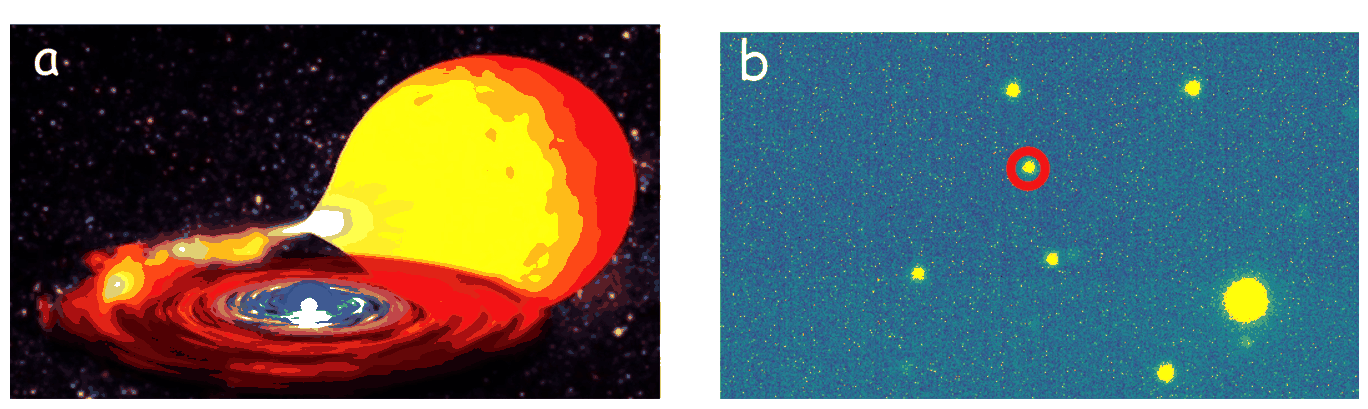
Figure 1 - (a) The falling gases of the companion star onto the neutron star - (b) The companion of the neutron star PSR J2215+5135
A. A Binary System
Consider a simple model in which the black widow and its companion star, are represented by two point masses \(M_1\) and \(M_2\) moving on a circular orbit around their center of mass. To investigate the dynamics of this system, consider a rotating coordinate system in which the two bodies are stationary. Take the center of mass to be the origin of the coordinate system. Assume that the two point masses lie on the \(x\)-axis on both sides of the origin at a distance \(a\) from each other, and that \(M_1\) lies on the negative \(x\)-axis. At an arbitrary point \((x,y)\) in the plane of motion, the effective potential \(\varphi(x,y)\) for a unit test mass is the sum of the gravitational potentials of the two point masses plus the centrifugal potential.
| A-1 | Write \(\varphi(x,y)\) in terms of \(M_1\), \(M_2\), \(G\), and \(a\). | 1.0 pt |
| A-2 | Assuming \(M_1>M_2\), plot the function \(\varphi(x,0)\) qualitatively. | 0.7 pt |
Suppose (just for task A-3) \(M_2=M_1/3\) and assume that \(M_2\) is surrounded by a rarefied gas of very low density. The mass of this gas is insignificant and we ignore its gravitational effects. If the size of this gas envelope becomes greater than a specific limit, the gas will overflow onto \(M_1\). Suppose the overflow occurs through \(x=x_0\) on the \(x\)-axis.
| A-3 | Find the numerical value of \(\dfrac{x_0}{a}\), up to two significant figures. You may use the calculator. | 0.5 pt |
Take the rotational period of the stars around their center of mass to be \(P\). Assume that mass flows from \(M_2\) to \(M_1\) at a very small rate of \(dM_1/dt=\beta\). This rate is so small that in each period of rotation, the distance between the two stars can be assumed to be constant. However, after a long period of time, the distance between the two stars changes, while the motion remains circular.
| A-4 | Calculate the rate of change of \(a\) and \(P\) in terms of \(\beta\), \(M_1\), \(M_2\), \(G\), and \(a\). | 0.6 pt |
The gas separated from \(M_2\) forms a disk rotating around \(M_1\) and heats up due to friction (Figure 1-a). As the gas loses energy, it spirals inward toward \(M_1\) and finally falls onto it. In the steady state, the mass flows at the constant rate of \(\beta\), from \(M_2\) to the disc and from the disc onto \(M_1\). At the same time, the heated disk emits thermal radiation as a blackbody. This disk forms very close to the neutron star so the gravitational pull of the \(M_2\) star can be ignored for the analysis of the disk’s motion. Also, ignore the heat capacity of the gas.
| A-5 | Determine the temperature of the disc at distance \(r\) from the center of the star \(M_1\) in terms of \(\beta\), \(M_1\), \(G\), and \(\sigma\) (Stefan-Boltzmann constant). | 1.0 pt |
In the binary system PSR J2215+5135, the mass of the neutron star is \(M_{\mathrm{NS}}=2.27\,M_\odot\) and the mass of its companion star is \(M_{\mathrm{S}}=0.33\,M_\odot\), where \(M_\odot=1.98\times10^{30}\ \mathrm{kg}\) is the mass of the Sun. The rotational period is \(P=4.14\ \mathrm{hr}\), and the Stefan-Boltzmann constant is \(\sigma=5.67\times10^{-8}\ \mathrm{W/m^2K^4}\), and the gravitational constant is \(G=6.67\times10^{-11}\ \mathrm{m^3/kg\,s^2}\).
Assume that the mass flow rate to the neutron star is \(\beta=\dot M_{\mathrm{NS}}=9\times10^{-10}\,M_\odot\,\mathrm{yr}^{-1}\).
| A-6 | Calculate the temperature of the disc at the radius \(r=\dfrac{a}{10}\) in kelvins. | 0.5 pt |
Assume that after a sudden explosion, the \(M_1\) star ejects a part of its mass out of the binary system at a very high speed, and its mass becomes \(M_1'\). Take the magnitude of the velocity of \(M_1'\) relative to \(M_2\) to be \(v'\) after the explosion.
| A-7 | Determine the maximum value of \(v'\), in terms of \(M_1'\), \(M_2\), \(G\), and \(a\), that allows the new binary system to stay bounded. Assuming that the explosion is isotropic, what is the minimum value of \(M_1'\) for the binary system to remain bounded? | 0.7 pt |
B. Analysis of the Stability of a Star
In this part we study the stability of a single star. Consider a star containing a specific kind of matter with the equation of state \(p=K\rho^\gamma\) where \(K\) and \(\gamma\) are constants. Let \(p(r)\) and \(\rho(r)\) be the pressure and density at a distance \(r\) from the center of the star, respectively. The pressure and density at the center of the star are \(p_c\) and \(\rho_c\), respectively. In all tasks of the part B, take all outward vectors to be positive.
| B-1 | Determine the gravitational acceleration \(g(r)\) near the center of the star in terms of \(r\) and the constants \(G\) and \(\rho_c\). | 0.2 pt |
| B-2 | Derive a (differential) equation for determining \(\rho(r)\) at equilibrium, and write it in the following form: \(\dfrac{d}{dr}\left[h_1(\rho,r)\dfrac{d\rho}{dr}\right]+h_2(r)\rho=0\). Find the functions \(h_1\) and \(h_2\). | 0.6 pt |
| B-3 | Construct a quantity \(r_0\) of the form \(r_0=G^l p_c^m\rho_c^n\) with the dimension of length. | 0.4 pt |
| B-4 | Rewrite the (differential) equation of task B-2 in the following form: \(\dfrac{d}{dx}\left[A_1(u,x)\dfrac{du}{dx}\right]+A_2(x)u(x)=0,\) where \(x=\dfrac{r}{r_0}\) and \(u=\dfrac{\rho}{\rho_c}\). Find the functions \(A_1(u,x)\) and \(A_2(x)\). | 0.3 pt |
| B-5 | For \(\gamma=2\) one finds \(u(x)=\dfrac{f(x)}{x}\). Determine \(f(x)\). | 0.6 pt |
Assume that for a particular star \(\dfrac{du}{dx}\), as a function of \(x\), is given by the curve given in Figure 2.
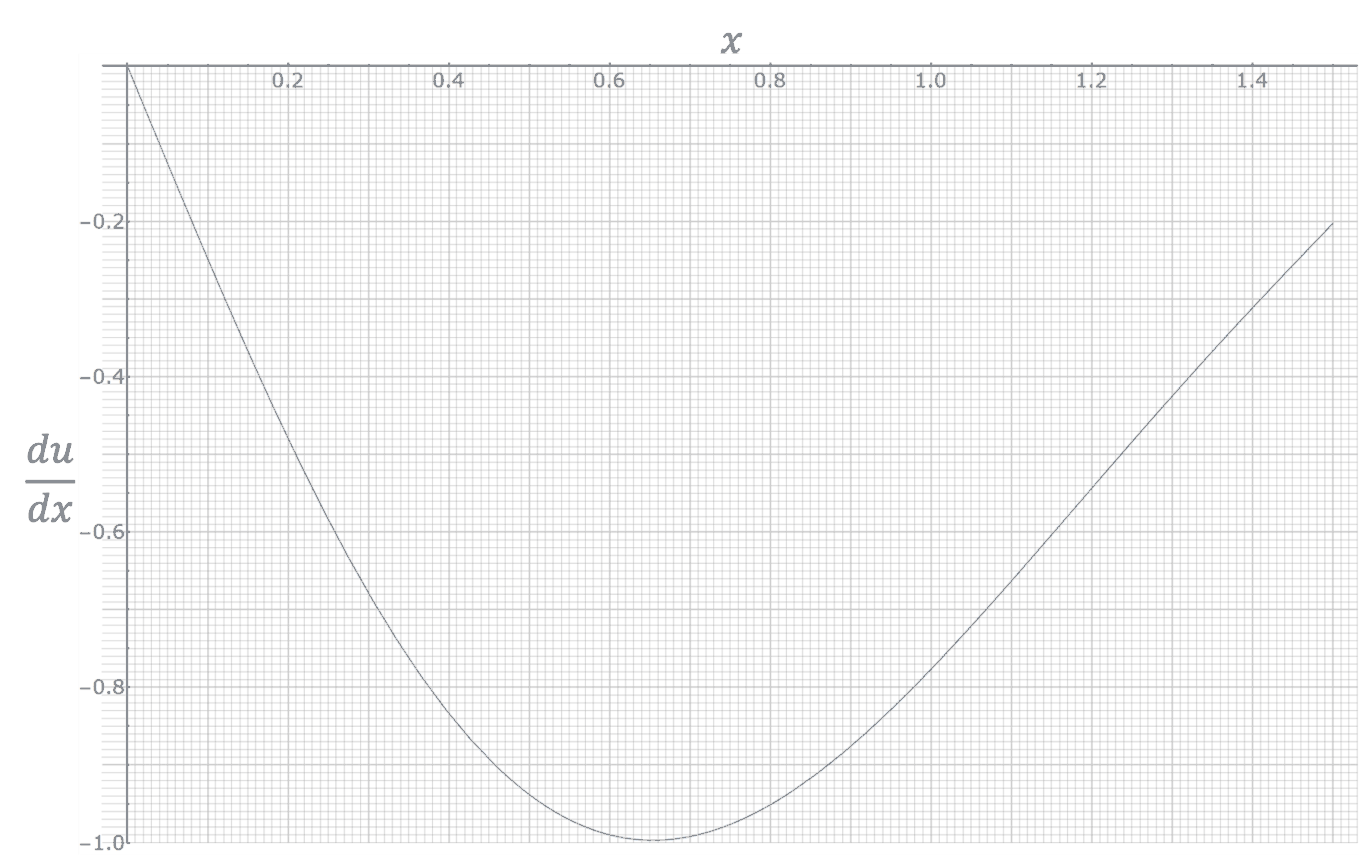
Figure 2 - The plot of \(\dfrac{du}{dx}\)
| B-6 | Use the behavior of the curve in Figure 2, in the vicinity of the point \(x=0\), to find \(\gamma\) up to 3 significant figures. Use the given ruler if necessary. | 0.8 pt |
To analyze the stability of the system, we assume that the star deviates slightly from its equilibrium state: we assume that the spherical shell, which was in equilibrium at radius \(r\), now has a radius \(\tilde r\), similarly the parameters \(g\), \(p\), and \(\rho\) have changed to \(\tilde g\), \(\tilde p\), and \(\tilde\rho\) respectively. For convenience, we shall only consider small \(r\)’s near the center of the star, for which we can assume that \(\tilde r=r(1+\varepsilon(t))\), where \(\varepsilon(t)\ll1\).
| B-7 | Find \(\tilde\rho\) and \(\tilde g\) in terms of \(\rho\) and \(g\) to the first order in \(\varepsilon\). | 0.9 pt |
| B-8 | Using Newton's equation of motion for the spherical layer with the equilibrium radius of \(r\) find \(\dfrac{d^2\tilde r}{dt^2}\) in terms of \(\tilde g\), \(\tilde\rho\), \(K\), \(\gamma\), and \(\dfrac{\partial\tilde\rho}{\partial\tilde r}\) (By \(\dfrac{\partial\tilde\rho}{\partial\tilde r}\) we mean derivative of \(\tilde\rho\) with respect to \(\tilde r\) at constant \(t\).) | 0.6 pt |
| B-9 | Obtain \(\dfrac{d^2\varepsilon}{dt^2}\) in terms of \(\varepsilon\) and the constants given in the problem. Find the minimum value of \(\gamma\) for a stable equilibrium, and find the oscillation's angular frequency of the star. | 0.6 pt |
Official English text of the problem.
Answers
Write \(M=M_1+M_2\), and let the stellar positions be \(x_1=-aM_2/M\) and \(x_2=aM_1/M\).
-
A-1 \[ \boxed{ \varphi(x,y)= -\frac{GM_1}{\sqrt{(x+aM_2/M)^2+y^2}} -\frac{GM_2}{\sqrt{(x-aM_1/M)^2+y^2}} -\frac{GM}{2a^3}(x^2+y^2) } \] up to an additive constant.
-
A-2 There are three strictly concave branches, each with one maximum. The potential tends to \(-\infty\) on both sides of \(x_1,x_2\), and as \(x\to\pm\infty\). With the usual labels, the maxima occur in the order \[ x_{L_3}<x_1<0<x_{L_1}<x_2<x_{L_2}, \] and their heights satisfy \[ \varphi(L_1)<\varphi(L_2)<\varphi(L_3)<0. \]
-
A-3 \[ \boxed{\frac{x_0}{a}=0.36}. \]
-
A-4 \[ \boxed{\dot a=2\beta a\left(\frac1{M_2}-\frac1{M_1}\right)}, \qquad \boxed{\dot P=6\pi\beta\sqrt{\frac{a^3}{GM}} \left(\frac1{M_2}-\frac1{M_1}\right)}. \]
-
A-5 Using local orbital-energy release and radiation from both faces, \[ \boxed{T(r)=\left(\frac{GM_1\beta}{8\pi\sigma r^3}\right)^{1/4}}. \]
-
A-6 \[ \boxed{T(a/10)\simeq8.9\times10^3\ \mathrm K}. \]
-
A-7 The escape-speed threshold is \[ \boxed{v'_{\mathrm{crit}}=\sqrt{\frac{2G(M_1'+M_2)}a}}, \] with a bound orbit requiring \(v'<v'_{\mathrm{crit}}\). For isotropic ejection, \[ \boxed{M_1'>\frac{M_1-M_2}{2}}. \] Equality in either condition is the marginal, parabolic escape case.
-
B-1 \[ \boxed{g(r)\simeq-\frac{4\pi}{3}G\rho_c r}. \]
-
B-2 One convenient normalization is \[ \boxed{h_1(\rho,r)=K\gamma r^2\rho^{\gamma-2}}, \qquad \boxed{h_2(r)=4\pi G r^2}. \]
-
B-3 \[ \boxed{l=-\frac12,\quad m=\frac12,\quad n=-1}, \qquad \boxed{r_0=\sqrt{\frac{p_c}{G\rho_c^2}}}. \]
-
B-4 \[ \boxed{A_1(u,x)=\gamma x^2u^{\gamma-2}}, \qquad \boxed{A_2(x)=4\pi x^2}. \]
-
B-5 \[ \boxed{f(x)=\frac{\sin(\sqrt{2\pi}\,x)}{\sqrt{2\pi}}}. \]
-
B-6 \[ \boxed{\gamma\simeq1.67}. \]
-
B-7 \[ \boxed{\tilde\rho=\rho(1-3\varepsilon)+O(\varepsilon^2)}, \qquad \boxed{\tilde g=g(1-2\varepsilon)+O(\varepsilon^2)}. \]
-
B-8 \[ \boxed{\frac{d^2\tilde r}{dt^2} =\tilde g-K\gamma\tilde\rho^{\gamma-2} \frac{\partial\tilde\rho}{\partial\tilde r}}. \]
-
B-9 \[ \boxed{\ddot\varepsilon+ \frac{4\pi G\rho_c}{3}(3\gamma-4)\varepsilon=0}. \] The critical value is \(\boxed{\gamma_{\mathrm{crit}}=4/3}\), with restoring oscillations for \(\gamma>4/3\) and marginal behavior at equality. Their angular frequency is \[ \boxed{\omega=\sqrt{\frac{4\pi G\rho_c}{3}(3\gamma-4)}}. \]
Solution
A-1
Let \(M=M_1+M_2\). The center-of-mass condition and the separation give \[ M_1x_1+M_2x_2=0,\qquad x_2-x_1=a, \] so \[ x_1=-\frac{M_2}{M}a,\qquad x_2=\frac{M_1}{M}a. \]
If the binary’s angular velocity is \(\Omega\), Newton’s equation for either star gives \[ \Omega^2=\frac{GM}{a^3}. \]
The gravitational potential per unit test mass is the sum of the two point-mass potentials. In the uniformly rotating frame, the outward centrifugal acceleration is generated by the potential \[ \varphi_{\mathrm{cf}}=-\frac12\Omega^2(x^2+y^2). \] Consequently, \[ \boxed{ \varphi(x,y)= -\frac{GM_1}{\sqrt{(x+aM_2/M)^2+y^2}} -\frac{GM_2}{\sqrt{(x-aM_1/M)^2+y^2}} -\frac{GM}{2a^3}(x^2+y^2) }. \]
A-2
On the \(x\)-axis, \[ \varphi(x,0)= -\frac{GM_1}{|x-x_1|} -\frac{GM_2}{|x-x_2|} -\frac12\Omega^2x^2. \]
A precise description of the sketch is as follows:
- There are downward vertical singularities at \(x=x_1\) and \(x=x_2\): the potential approaches \(-\infty\) from either side of each star.
- At large positive or negative \(x\), \[ \varphi(x,0)\sim-\frac12\Omega^2x^2, \] so both outer ends descend to \(-\infty\).
- Each of the three intervals separated by the stars contains exactly one maximum.
To establish the last point, away from the masses, \[ \frac{d^2\varphi}{dx^2} =-\frac{2GM_1}{|x-x_1|^3} -\frac{2GM_2}{|x-x_2|^3} -\Omega^2<0. \] Thus each branch is strictly concave. Its derivative changes from positive to negative between its two ends, giving one maximum.
Denote the left, inner, and right maxima by \(L_3,L_1,L_2\), respectively. Since \(M_1>M_2\), the heavier star is closer to the origin, and \[ \left.\frac{d\varphi}{dx}\right|_{x=0} =\frac{GM_1}{|x_1|^2}-\frac{GM_2}{x_2^2}>0. \] Therefore the inner maximum is to the right of the origin: \[ x_{L_3}<x_1<0<x_{L_1}<x_2<x_{L_2}. \]
The left outer maximum is highest, the right outer maximum is next, and the inner maximum is lowest: \[ \varphi(L_1)<\varphi(L_2)<\varphi(L_3). \]
With the additive constant chosen in A-1, the whole curve is negative and has no horizontal-axis intercept. Its vertical-axis intercept is \[ \boxed{\varphi(0,0) =-\frac{GM}{a}\left(\frac{M_1}{M_2}+\frac{M_2}{M_1}\right)}. \]
A-3
The gas first passes toward \(M_1\) through the inner equilibrium point \(L_1\), where the effective force vanishes. This point is a maximum of \(\varphi(x,0)\) along the line joining the stars and a saddle of the two-dimensional effective potential.
Here \[ M_1=\frac34M,\qquad M_2=\frac14M, \] so \[ x_1=-\frac a4,\qquad x_2=\frac{3a}{4}. \]
Writing \(z=x_0/a\), the condition \(\partial\varphi/\partial x=0\) between the stars becomes \[ \frac{3/4}{(z+1/4)^2} -\frac{1/4}{(3/4-z)^2} -z=0. \]
The root in \(-1/4<z<3/4\) is \[ z=0.360743\ldots. \] Thus, to two significant figures, \[ \boxed{\frac{x_0}{a}=0.36}. \]
A-4
Treat the transfer as conservative: all mass lost by \(M_2\) reaches \(M_1\), and there is no external torque. In the point-mass model, spin and angular momentum temporarily stored in the stream are neglected. Hence \[ \dot M_1=\beta,\qquad \dot M_2=-\beta,\qquad \dot M=0, \] and the orbital angular momentum is conserved.
For a circular binary, \[ L=\frac{M_1M_2}{M}a^2\Omega =M_1M_2\sqrt{\frac{Ga}{M}}. \] Taking its logarithmic derivative, \[ 0=\frac{\dot L}{L} =\frac{\beta}{M_1}-\frac{\beta}{M_2} +\frac12\frac{\dot a}{a}. \] Therefore \[ \boxed{\dot a =2\beta a\left(\frac1{M_2}-\frac1{M_1}\right)}. \]
Kepler’s relation gives \[ P=2\pi\sqrt{\frac{a^3}{GM}}. \] Since \(M\) is constant, \[ \frac{\dot P}{P}=\frac32\frac{\dot a}{a} =3\beta\left(\frac1{M_2}-\frac1{M_1}\right). \] Thus \[ \boxed{\dot P =6\pi\beta\sqrt{\frac{a^3}{GM}} \left(\frac1{M_2}-\frac1{M_1}\right)}. \]
Both the separation and the period increase when mass flows from the lighter star to the heavier one.
A-5
Use a thin disk with nearly circular Keplerian orbits, negligible radial kinetic energy, and local radiation of the orbital mechanical energy lost while matter crosses an annulus.
The circular-orbit condition is \[ v^2=\frac{GM_1}{r}. \] The gas’s mechanical energy per unit mass is consequently \[ e(r)=\frac12v^2-\frac{GM_1}{r} =-\frac{GM_1}{2r}. \]
Consider an annulus between \(r\) and \(r+dr\), where \(dr>0\). Matter enters through its outer edge and leaves through its inner edge. At mass flow rate \(\beta\), the released power is \[ dL=\beta\bigl[e(r+dr)-e(r)\bigr] =\frac{GM_1\beta}{2r^2}\,dr. \]
Both disk faces radiate. Their combined annular area is \[ dA=2(2\pi r\,dr)=4\pi r\,dr. \] Neglecting heat storage and equating the local energy release to blackbody radiation, \[ 4\pi r\,dr\,\sigma T^4 =\frac{GM_1\beta}{2r^2}\,dr. \] Hence \[ \boxed{T(r)=\left(\frac{GM_1\beta}{8\pi\sigma r^3}\right)^{1/4}}. \]
In particular, \(T\propto r^{-3/4}\).
A-6
The total mass and period are \[ M=(2.27+0.33)(1.98\times10^{30}) =5.148\times10^{30}\ \mathrm{kg}, \] \[ P=4.14(3600)=14904\ \mathrm s. \]
Kepler’s relation gives \[ a=\left(\frac{GMP^2}{4\pi^2}\right)^{1/3} =1.24548\times10^9\ \mathrm m. \] Therefore \[ r=\frac a{10}=1.24548\times10^8\ \mathrm m. \]
Using \(1\ \mathrm{yr}\simeq3.156\times10^7\ \mathrm s\), \[ \beta= \frac{9\times10^{-10}(1.98\times10^{30})} {3.156\times10^7} \simeq5.65\times10^{13}\ \mathrm{kg\,s^{-1}}. \]
With \(M_1=2.27(1.98\times10^{30})\ \mathrm{kg}\), \[ T= \left[ \frac{(6.67\times10^{-11}) (2.27\times1.98\times10^{30}) (5.65\times10^{13})} {8\pi(5.67\times10^{-8})(1.24548\times10^8)^3} \right]^{1/4}. \] This yields \[ T\simeq8.86\times10^3\ \mathrm K, \] or \[ \boxed{T\simeq8.9\times10^3\ \mathrm K}. \]
A-7
The explosion is sudden, so the separation immediately afterward remains \(a\). Once the rapidly ejected material has left, the relative orbital energy of the remaining stars is \[ E'=\frac12\mu'v'^2-\frac{GM_1'M_2}{a}, \qquad \mu'=\frac{M_1'M_2}{M_1'+M_2}. \]
A bound two-body orbit requires \(E'<0\). Thus \[ v'^2<\frac{2G(M_1'+M_2)}a, \] and the limiting speed is \[ \boxed{v'_{\mathrm{crit}} =\sqrt{\frac{2G(M_1'+M_2)}a}}. \] At equality the orbit is parabolic and is not bound.
If the ejection is isotropic in the exploding star’s rest frame, there is no recoil. The instantaneous velocities of both remaining stars are unchanged. Their relative speed therefore remains the original circular-orbit speed: \[ v'^2=\Omega^2a^2=\frac{G(M_1+M_2)}a. \]
Substitution into the binding condition gives \[ M_1+M_2<2(M_1'+M_2), \] or \[ \boxed{M_1'>\frac{M_1-M_2}{2}}. \]
Equivalently, less than half of the binary’s original total mass may be ejected: \[ M_1-M_1'<\frac{M_1+M_2}{2}. \] The stated minimum is a critical threshold; equality gives marginal escape.
B-1
By spherical symmetry, only the mass enclosed inside radius \(r\) contributes to the gravitational field there. Near the center, \(\rho\simeq\rho_c\), so \[ m(r)\simeq\frac{4\pi}{3}\rho_c r^3. \]
Taking outward acceleration as positive, \[ g(r)=-\frac{Gm(r)}{r^2} \simeq-\frac{4\pi}{3}G\rho_c r. \] Therefore \[ \boxed{g(r)\simeq-\frac{4\pi}{3}G\rho_c r}. \]
B-2
Hydrostatic equilibrium requires \[ \frac{dp}{dr}=\rho g. \] The enclosed mass satisfies \[ g=-\frac{Gm(r)}{r^2}, \qquad \frac{dm}{dr}=4\pi r^2\rho. \] Consequently, \[ \frac{d}{dr}(r^2g)=-4\pi G r^2\rho. \]
Using \(g=(1/\rho)\,dp/dr\), \[ \frac{d}{dr}\left(\frac{r^2}{\rho}\frac{dp}{dr}\right) +4\pi G r^2\rho=0. \]
From \(p=K\rho^\gamma\), \[ \frac{dp}{dr}=K\gamma\rho^{\gamma-1}\frac{d\rho}{dr}. \] The required density equation is therefore \[ \boxed{ \frac{d}{dr}\left( K\gamma r^2\rho^{\gamma-2}\frac{d\rho}{dr} \right)+4\pi G r^2\rho=0 }. \] Thus one valid choice is \[ \boxed{h_1=K\gamma r^2\rho^{\gamma-2}}, \qquad \boxed{h_2=4\pi G r^2}. \] Multiplying both functions by the same nonzero constant gives an equivalent equation.
B-3
The relevant dimensions are \[ [G]=L^3M^{-1}T^{-2},\qquad [p_c]=ML^{-1}T^{-2},\qquad [\rho_c]=ML^{-3}. \]
Requiring \(G^lp_c^m\rho_c^n\) to have dimension \(L\) gives \[ -l+m+n=0, \qquad 3l-m-3n=1, \qquad -2l-2m=0. \] Solving, \[ l=-\frac12,\qquad m=\frac12,\qquad n=-1. \] Hence \[ \boxed{r_0=\frac{\sqrt{p_c}}{\sqrt G\,\rho_c} =\sqrt{\frac{p_c}{G\rho_c^2}}}. \]
Since \(p_c=K\rho_c^\gamma\), it is also useful to write \[ r_0^2=\frac{K\rho_c^{\gamma-2}}G. \]
B-4
Substitute \[ r=r_0x,\qquad \rho=\rho_cu, \qquad \frac{d\rho}{dr}=\frac{\rho_c}{r_0}\frac{du}{dx} \] into the equation from B-2: \[ K\gamma\rho_c^{\gamma-1} \frac{d}{dx}\left(x^2u^{\gamma-2}\frac{du}{dx}\right) +4\pi G r_0^2\rho_c x^2u=0. \]
Because \(Gr_0^2\rho_c=K\rho_c^{\gamma-1}\), division by \(K\rho_c^{\gamma-1}\) gives \[ \boxed{ \frac{d}{dx}\left( \gamma x^2u^{\gamma-2}\frac{du}{dx} \right)+4\pi x^2u=0 }. \] Thus \[ \boxed{A_1(u,x)=\gamma x^2u^{\gamma-2}}, \qquad \boxed{A_2(x)=4\pi x^2}. \]
The central conditions are \[ u(0)=1,\qquad u'(0)=0, \] the latter following from regularity and spherical symmetry.
B-5
For \(\gamma=2\), the equation reduces to \[ \frac{d}{dx}(x^2u')+2\pi x^2u=0. \]
Let \(u=f/x\). Then \[ x^2u'=xf'-f, \qquad \frac{d}{dx}(x^2u')=xf''. \] For \(x>0\), \[ f''+2\pi f=0. \]
Writing \(k=\sqrt{2\pi}\), the general solution is \[ f=A\sin(kx)+B\cos(kx). \] Finiteness of \(u=f/x\) at the center requires \(B=0\). The normalization \(u(0)=1\) then gives \(Ak=1\). Therefore \[ \boxed{f(x)=\frac{\sin(\sqrt{2\pi}\,x)}{\sqrt{2\pi}}}, \] and \[ u(x)=\frac{\sin(\sqrt{2\pi}\,x)}{\sqrt{2\pi}\,x}. \]
The physical density profile ends at its first zero, \(x=\sqrt{\pi/2}\).
B-6
For this task, return to general \(\gamma\). Near the center, regularity permits the expansion \[ u(x)=1+cx^2+O(x^4), \qquad u'(x)=2cx+O(x^3). \]
Substitution into the dimensionless equilibrium equation gives, at order \(x^2\), \[ 6\gamma c+4\pi=0. \] Hence \[ u'(x)=-\frac{4\pi}{3\gamma}x+O(x^3). \]
If \(s\) is the slope of the plotted \(u'\)-versus-\(x\) curve at the origin, then \[ s=u''(0)=-\frac{4\pi}{3\gamma}, \qquad \gamma=-\frac{4\pi}{3s}. \]
The tangent at the origin in Figure 2 has slope approximately \[ s\simeq-2.51. \] Thus \[ \boxed{\gamma\simeq\frac{4\pi}{3(2.51)}\simeq1.67}. \] This is consistent with \(\gamma=5/3\).
B-7
Follow a particular material shell. Its mass is conserved as it moves from \(r\) to \[ \tilde r=r(1+\varepsilon). \] Since the same scale factor applies to neighboring central shells, \[ d\tilde r=(1+\varepsilon)\,dr. \]
Conservation of the mass in a thin shell gives \[ 4\pi r^2\rho\,dr =4\pi\tilde r^2\tilde\rho\,d\tilde r, \] so \[ \tilde\rho=\frac{\rho}{(1+\varepsilon)^3} =\rho(1-3\varepsilon)+O(\varepsilon^2). \] Therefore \[ \boxed{\tilde\rho\simeq\rho(1-3\varepsilon)}. \]
The mass enclosed by the moving shell is also conserved. Consequently, \[ \tilde g=-\frac{Gm(r)}{\tilde r^2} =\frac{g}{(1+\varepsilon)^2}, \] giving \[ \boxed{\tilde g\simeq g(1-2\varepsilon)}. \] Here \(g\) is negative, consistently with the prescribed outward-positive convention.
B-8
The outward pressure acceleration is \[ -\frac1{\tilde\rho} \frac{\partial\tilde p}{\partial\tilde r}. \] Adding gravity, Newton’s equation is \[ \frac{d^2\tilde r}{dt^2} =\tilde g-\frac1{\tilde\rho} \frac{\partial\tilde p}{\partial\tilde r}. \]
Using the same equation of state for the perturbed matter, \[ \tilde p=K\tilde\rho^\gamma, \] we obtain \[ \frac{\partial\tilde p}{\partial\tilde r} =K\gamma\tilde\rho^{\gamma-1} \frac{\partial\tilde\rho}{\partial\tilde r}. \] Hence \[ \boxed{ \frac{d^2\tilde r}{dt^2} =\tilde g-K\gamma\tilde\rho^{\gamma-2} \frac{\partial\tilde\rho}{\partial\tilde r} }. \]
B-9
At fixed time, \(\varepsilon\) is independent of the central shell label \(r\). Therefore \[ \tilde\rho(\tilde r,t) =(1+\varepsilon)^{-3} \rho\!\left(\frac{\tilde r}{1+\varepsilon}\right), \] and \[ \frac{\partial\tilde\rho}{\partial\tilde r} =(1+\varepsilon)^{-4}\frac{d\rho}{dr}. \]
The pressure term in B-8 consequently scales as \[ K\gamma\tilde\rho^{\gamma-2} \frac{\partial\tilde\rho}{\partial\tilde r} = K\gamma\rho^{\gamma-2}\frac{d\rho}{dr} (1+\varepsilon)^{2-3\gamma}. \]
In the unperturbed equilibrium, \[ K\gamma\rho^{\gamma-2}\frac{d\rho}{dr}=g. \] Together with \(\tilde g=g(1+\varepsilon)^{-2}\), this gives \[ \frac{d^2\tilde r}{dt^2} =g\left[(1+\varepsilon)^{-2} -(1+\varepsilon)^{2-3\gamma}\right]. \]
To first order, \[ (1+\varepsilon)^{-2}=1-2\varepsilon, \] \[ (1+\varepsilon)^{2-3\gamma} =1+(2-3\gamma)\varepsilon. \] Thus \[ \frac{d^2\tilde r}{dt^2}=g(3\gamma-4)\varepsilon. \]
Since \(r\) labels the original shell and is constant, \[ \frac{d^2\tilde r}{dt^2}=r\ddot\varepsilon. \] Using the near-center result \(g/r=-4\pi G\rho_c/3\), \[ \boxed{ \ddot\varepsilon =-\frac{4\pi G\rho_c}{3}(3\gamma-4)\varepsilon }. \]
For a restoring acceleration, the coefficient multiplying \(-\varepsilon\) must be positive. Hence \[ \gamma>\frac43. \] The critical value is therefore \[ \boxed{\gamma_{\mathrm{crit}}=\frac43}. \]
At equality there is no restoring force to this order; for \(\gamma<4/3\), a growing perturbation exists. For \(\gamma>4/3\), the motion is harmonic with \[ \boxed{\omega =\sqrt{\frac{4\pi G\rho_c}{3}(3\gamma-4)} =\sqrt{4\pi G\rho_c\left(\gamma-\frac43\right)}}. \]
The graph-derived value \(\gamma\simeq1.67\) lies in the stable range.
The solution was checked against the official solution.
IPhO 2024 · Theorieaufgabe 3
Schwarze-Witwen-Pulsar
Ein erheblicher Anteil der beobachteten Sterne sind Doppelsterne. Einer oder beide Sterne können Neutronensterne sein, die mit hoher Winkelgeschwindigkeit rotieren und elektromagnetische Wellen aussenden; solche Sterne werden Pulsare genannt. Manchmal ist ein Begleitstern eine ausgedehnte Gasmasse, die allmählich auf den Neutronenstern fällt und dadurch dessen Masse vergrößert (Abbildung 1-a). Auf diese Weise verschlingt ein Neutronenstern nach und nach einen Teil der Masse seines Begleitsterns. Deshalb wurde der Neutronenstern mit einer Schwarzen Witwe (oder Rotrückenspinne) verglichen, einer weiblichen Spinne, die ihren Partner nach der Paarung frisst. Die Erwärmung des auf die Schwarze Witwe fallenden Gases erzeugt beobachtbare Strahlung. Die schwersten Neutronensterne sind häufig Schwarze Witwen und dienen als natürliche Laboratorien zur Überprüfung grundlegender Physik. Abbildung 1-b zeigt eine Aufnahme des Begleiters des Neutronensterns PSR J2215+5135, die mit dem optischen 3,4-Meter-Teleskop des Iranischen Nationalobservatoriums aufgenommen wurde. Auf diesem Bild ist kein Neutronenstern zu sehen; das beobachtete Licht stammt von seinem Begleiter.
Abbildung 1 - (a) Das vom Begleitstern auf den Neutronenstern fallende Gas - (b) Der Begleiter des Neutronensterns PSR J2215+5135
A. Ein Doppelsternsystem
Betrachten Sie ein einfaches Modell, in dem die Schwarze Witwe und ihr Begleitstern durch zwei Punktmassen \(M_1\) und \(M_2\) dargestellt werden, die sich auf Kreisbahnen um ihren gemeinsamen Schwerpunkt bewegen. Um die Dynamik dieses Systems zu untersuchen, betrachten Sie ein rotierendes Koordinatensystem, in dem die beiden Körper ruhen. Wählen Sie den Schwerpunkt als Ursprung des Koordinatensystems. Nehmen Sie an, dass die beiden Punktmassen auf der \(x\)-Achse auf entgegengesetzten Seiten des Ursprungs im Abstand \(a\) voneinander liegen und dass \(M_1\) auf der negativen \(x\)-Achse liegt. An einem beliebigen Punkt \((x,y)\) in der Bewegungsebene ist das effektive Potential \(\varphi(x,y)\) für eine Testmasse der Größe eins die Summe der Gravitationspotentiale der beiden Punktmassen und des Zentrifugalpotentials.
| A-1 | Geben Sie \(\varphi(x,y)\) in Abhängigkeit von \(M_1\), \(M_2\), \(G\) und \(a\) an. | 1.0 Pkt. |
| A-2 | Skizzieren Sie unter der Annahme \(M_1>M_2\) den qualitativen Verlauf der Funktion \(\varphi(x,0)\). | 0.7 Pkt. |
Nehmen Sie (nur für Aufgabe A-3) an, dass \(M_2=M_1/3\) gilt und \(M_2\) von einem verdünnten Gas sehr geringer Dichte umgeben ist. Die Masse dieses Gases ist unbedeutend, und wir vernachlässigen seine Gravitationswirkung. Überschreitet die Größe dieser Gashülle einen bestimmten Grenzwert, strömt Gas auf \(M_1\) über. Nehmen Sie an, dass das Überströmen durch \(x=x_0\) auf der \(x\)-Achse erfolgt.
| A-3 | Bestimmen Sie den Zahlenwert von \(\dfrac{x_0}{a}\) auf zwei signifikante Stellen. Sie dürfen den Taschenrechner verwenden. | 0.5 Pkt. |
Die Umlaufdauer der Sterne um ihren gemeinsamen Schwerpunkt sei \(P\). Nehmen Sie an, dass Masse mit einer sehr geringen Rate von \(dM_1/dt=\beta\) von \(M_2\) zu \(M_1\) strömt. Diese Rate ist so gering, dass der Abstand zwischen den beiden Sternen während jeder Umlaufperiode als konstant angenommen werden kann. Über einen langen Zeitraum ändert sich jedoch der Abstand zwischen den beiden Sternen, während ihre Bahnen kreisförmig bleiben.
| A-4 | Berechnen Sie die Änderungsraten von \(a\) und \(P\) in Abhängigkeit von \(\beta\), \(M_1\), \(M_2\), \(G\) und \(a\). | 0.6 Pkt. |
Das von \(M_2\) abgelöste Gas bildet eine um \(M_1\) rotierende Scheibe und erwärmt sich durch Reibung (Abbildung 1-a). Während das Gas Energie verliert, bewegt es sich spiralförmig nach innen auf \(M_1\) zu und fällt schließlich auf den Stern. Im stationären Zustand strömt die Masse mit der konstanten Rate \(\beta\) von \(M_2\) zur Scheibe und von der Scheibe auf \(M_1\). Gleichzeitig emittiert die erhitzte Scheibe Wärmestrahlung wie ein schwarzer Körper. Diese Scheibe bildet sich sehr nahe am Neutronenstern, sodass die Gravitationskraft des Sterns \(M_2\) bei der Untersuchung der Scheibenbewegung vernachlässigt werden kann. Vernachlässigen Sie außerdem die Wärmekapazität des Gases.
| A-5 | Bestimmen Sie die Temperatur der Scheibe im Abstand \(r\) vom Zentrum des Sterns \(M_1\) in Abhängigkeit von \(\beta\), \(M_1\), \(G\) und \(\sigma\) (Stefan-Boltzmann-Konstante). | 1.0 Pkt. |
Im Doppelsternsystem PSR J2215+5135 beträgt die Masse des Neutronensterns \(M_{\mathrm{NS}}=2.27\,M_\odot\) und die Masse seines Begleitsterns \(M_{\mathrm{S}}=0.33\,M_\odot\), wobei \(M_\odot=1.98\times10^{30}\ \mathrm{kg}\) die Sonnenmasse ist. Die Umlaufdauer beträgt \(P=4.14\ \mathrm{hr}\), die Stefan-Boltzmann-Konstante ist \(\sigma=5.67\times10^{-8}\ \mathrm{W/m^2K^4}\), und die Gravitationskonstante ist \(G=6.67\times10^{-11}\ \mathrm{m^3/kg\,s^2}\).
Nehmen Sie an, dass die Massenstromrate zum Neutronenstern \(\beta=\dot M_{\mathrm{NS}}=9\times10^{-10}\,M_\odot\,\mathrm{yr}^{-1}\) beträgt.
| A-6 | Berechnen Sie die Temperatur der Scheibe beim Radius \(r=\dfrac{a}{10}\) in Kelvin. | 0.5 Pkt. |
Nehmen Sie an, dass der Stern \(M_1\) bei einer plötzlichen Explosion einen Teil seiner Masse mit sehr hoher Geschwindigkeit aus dem Doppelsternsystem ausstößt und seine Masse danach \(M_1'\) beträgt. Der Betrag der Geschwindigkeit von \(M_1'\) relativ zu \(M_2\) nach der Explosion sei \(v'\).
| A-7 | Bestimmen Sie den maximalen Wert von \(v'\) in Abhängigkeit von \(M_1'\), \(M_2\), \(G\) und \(a\), bei dem das neue Doppelsternsystem gebunden bleiben kann. Welchen minimalen Wert muss \(M_1'\) unter der Annahme einer isotropen Explosion haben, damit das Doppelsternsystem gebunden bleibt? | 0.7 Pkt. |
B. Untersuchung der Stabilität eines Sterns
In diesem Teil untersuchen wir die Stabilität eines einzelnen Sterns. Betrachten Sie einen Stern, der eine bestimmte Art von Materie mit der Zustandsgleichung \(p=K\rho^\gamma\) enthält, wobei \(K\) und \(\gamma\) Konstanten sind. Es seien \(p(r)\) und \(\rho(r)\) der Druck bzw. die Dichte im Abstand \(r\) vom Zentrum des Sterns. Der Druck und die Dichte im Zentrum des Sterns seien \(p_c\) bzw. \(\rho_c\). Wählen Sie in allen Aufgaben von Teil B für alle Vektoren die nach außen gerichtete Richtung als positiv.
| B-1 | Bestimmen Sie die Gravitationsbeschleunigung \(g(r)\) nahe dem Zentrum des Sterns in Abhängigkeit von \(r\) und den Konstanten \(G\) und \(\rho_c\). | 0.2 Pkt. |
| B-2 | Leiten Sie eine (Differential-)Gleichung zur Bestimmung von \(\rho(r)\) im Gleichgewicht her und schreiben Sie sie in der folgenden Form: \(\dfrac{d}{dr}\left[h_1(\rho,r)\dfrac{d\rho}{dr}\right]+h_2(r)\rho=0\). Bestimmen Sie die Funktionen \(h_1\) und \(h_2\). | 0.6 Pkt. |
| B-3 | Konstruieren Sie eine Größe \(r_0\) der Form \(r_0=G^l p_c^m\rho_c^n\) mit der Dimension einer Länge. | 0.4 Pkt. |
| B-4 | Schreiben Sie die (Differential-)Gleichung aus Aufgabe B-2 in der folgenden Form um: \(\dfrac{d}{dx}\left[A_1(u,x)\dfrac{du}{dx}\right]+A_2(x)u(x)=0,\) wobei \(x=\dfrac{r}{r_0}\) und \(u=\dfrac{\rho}{\rho_c}\) gelten. Bestimmen Sie die Funktionen \(A_1(u,x)\) und \(A_2(x)\). | 0.3 Pkt. |
| B-5 | Für \(\gamma=2\) erhält man \(u(x)=\dfrac{f(x)}{x}\). Bestimmen Sie \(f(x)\). | 0.6 Pkt. |
Nehmen Sie an, dass für einen bestimmten Stern \(\dfrac{du}{dx}\) als Funktion von \(x\) durch die Kurve in Abbildung 2 gegeben ist.
Abbildung 2 - Der Graph von \(\dfrac{du}{dx}\)
| B-6 | Nutzen Sie das Verhalten der Kurve in Abbildung 2 in der Nähe des Punktes \(x=0\), um \(\gamma\) auf 3 signifikante Stellen zu bestimmen. Verwenden Sie bei Bedarf das bereitgestellte Lineal. | 0.8 Pkt. |
Zur Untersuchung der Stabilität des Systems nehmen wir an, dass der Stern geringfügig von seinem Gleichgewichtszustand abweicht: Wir nehmen an, dass die Kugelschale, die sich beim Radius \(r\) im Gleichgewicht befand, nun den Radius \(\tilde r\) hat; entsprechend haben sich die Größen \(g\), \(p\) und \(\rho\) zu \(\tilde g\), \(\tilde p\) bzw. \(\tilde\rho\) geändert. Der Einfachheit halber betrachten wir nur kleine \(r\) nahe dem Zentrum des Sterns, für die wir \(\tilde r=r(1+\varepsilon(t))\) mit \(\varepsilon(t)\ll1\) annehmen können.
| B-7 | Bestimmen Sie \(\tilde\rho\) und \(\tilde g\) in Abhängigkeit von \(\rho\) und \(g\) bis zur ersten Ordnung in \(\varepsilon\). | 0.9 Pkt. |
| B-8 | Bestimmen Sie mithilfe der Newtonschen Bewegungsgleichung für die Kugelschale mit dem Gleichgewichtsradius \(r\) den Ausdruck \(\dfrac{d^2\tilde r}{dt^2}\) in Abhängigkeit von \(\tilde g\), \(\tilde\rho\), \(K\), \(\gamma\) und \(\dfrac{\partial\tilde\rho}{\partial\tilde r}\). (Mit \(\dfrac{\partial\tilde\rho}{\partial\tilde r}\) ist die Ableitung von \(\tilde\rho\) nach \(\tilde r\) bei konstantem \(t\) gemeint.) | 0.6 Pkt. |
| B-9 | Bestimmen Sie \(\dfrac{d^2\varepsilon}{dt^2}\) in Abhängigkeit von \(\varepsilon\) und den in der Aufgabe angegebenen Konstanten. Bestimmen Sie den minimalen Wert von \(\gamma\) für ein stabiles Gleichgewicht sowie die Kreisfrequenz der Schwingung des Sterns. | 0.6 Pkt. |
Aufgabentext aus dem offiziellen englischen Text übersetzt.
Antworten
Setzen wir \(M=M_1+M_2\); die Positionen der Sterne seien \(x_1=-aM_2/M\) und \(x_2=aM_1/M\).
-
A-1 \[ \boxed{ \varphi(x,y)= -\frac{GM_1}{\sqrt{(x+aM_2/M)^2+y^2}} -\frac{GM_2}{\sqrt{(x-aM_1/M)^2+y^2}} -\frac{GM}{2a^3}(x^2+y^2) } \] bis auf eine additive Konstante.
-
A-2 Es gibt drei streng konkave Äste mit jeweils einem Maximum. Das Potential geht gegen \(-\infty\), sowohl auf beiden Seiten von \(x_1,x_2\) als auch für \(x\to\pm\infty\). Mit den üblichen Bezeichnungen liegen die Maxima in der Reihenfolge \[ x_{L_3}<x_1<0<x_{L_1}<x_2<x_{L_2}, \] und für ihre Höhen gilt \[ \varphi(L_1)<\varphi(L_2)<\varphi(L_3)<0. \]
-
A-3 \[ \boxed{\frac{x_0}{a}=0.36}. \]
-
A-4 \[ \boxed{\dot a=2\beta a\left(\frac1{M_2}-\frac1{M_1}\right)}, \qquad \boxed{\dot P=6\pi\beta\sqrt{\frac{a^3}{GM}} \left(\frac1{M_2}-\frac1{M_1}\right)}. \]
-
A-5 Unter Verwendung der lokalen Freisetzung von Bahnenergie und der Abstrahlung von beiden Seiten ergibt sich \[ \boxed{T(r)=\left(\frac{GM_1\beta}{8\pi\sigma r^3}\right)^{1/4}}. \]
-
A-6 \[ \boxed{T(a/10)\simeq8.9\times10^3\ \mathrm K}. \]
-
A-7 Der Grenzwert der Fluchtgeschwindigkeit ist \[ \boxed{v'_{\mathrm{crit}}=\sqrt{\frac{2G(M_1'+M_2)}a}}, \] wobei eine gebundene Bahn \(v'<v'_{\mathrm{crit}}\) erfordert. Bei isotropem Massenausstoß gilt \[ \boxed{M_1'>\frac{M_1-M_2}{2}}. \] Gleichheit in einer der beiden Bedingungen entspricht dem Grenzfall des Entweichens auf einer Parabelbahn.
-
B-1 \[ \boxed{g(r)\simeq-\frac{4\pi}{3}G\rho_c r}. \]
-
B-2 Eine zweckmäßige Normierung ist \[ \boxed{h_1(\rho,r)=K\gamma r^2\rho^{\gamma-2}}, \qquad \boxed{h_2(r)=4\pi G r^2}. \]
-
B-3 \[ \boxed{l=-\frac12,\quad m=\frac12,\quad n=-1}, \qquad \boxed{r_0=\sqrt{\frac{p_c}{G\rho_c^2}}}. \]
-
B-4 \[ \boxed{A_1(u,x)=\gamma x^2u^{\gamma-2}}, \qquad \boxed{A_2(x)=4\pi x^2}. \]
-
B-5 \[ \boxed{f(x)=\frac{\sin(\sqrt{2\pi}\,x)}{\sqrt{2\pi}}}. \]
-
B-6 \[ \boxed{\gamma\simeq1.67}. \]
-
B-7 \[ \boxed{\tilde\rho=\rho(1-3\varepsilon)+O(\varepsilon^2)}, \qquad \boxed{\tilde g=g(1-2\varepsilon)+O(\varepsilon^2)}. \]
-
B-8 \[ \boxed{\frac{d^2\tilde r}{dt^2} =\tilde g-K\gamma\tilde\rho^{\gamma-2} \frac{\partial\tilde\rho}{\partial\tilde r}}. \]
-
B-9 \[ \boxed{\ddot\varepsilon+ \frac{4\pi G\rho_c}{3}(3\gamma-4)\varepsilon=0}. \] Der kritische Wert ist \(\boxed{\gamma_{\mathrm{crit}}=4/3}\); für \(\gamma>4/3\) treten Schwingungen mit rücktreibender Kraft auf, während bei Gleichheit ein Grenzfall vorliegt. Ihre Kreisfrequenz ist \[ \boxed{\omega=\sqrt{\frac{4\pi G\rho_c}{3}(3\gamma-4)}}. \]
Lösung
A-1
Es sei \(M=M_1+M_2\). Aus der Schwerpunktbedingung und dem Abstand folgt \[ M_1x_1+M_2x_2=0,\qquad x_2-x_1=a, \] also \[ x_1=-\frac{M_2}{M}a,\qquad x_2=\frac{M_1}{M}a. \]
Ist \(\Omega\) die Winkelgeschwindigkeit des Doppelsternsystems, so ergibt die Newtonsche Bewegungsgleichung für jeden der beiden Sterne \[ \Omega^2=\frac{GM}{a^3}. \]
Das Gravitationspotential pro Einheit der Testmasse ist die Summe der Potentiale der beiden Punktmassen. Im gleichförmig rotierenden Bezugssystem wird die nach außen gerichtete Zentrifugalbeschleunigung durch das Potential \[ \varphi_{\mathrm{cf}}=-\frac12\Omega^2(x^2+y^2) \] erzeugt. Folglich gilt \[ \boxed{ \varphi(x,y)= -\frac{GM_1}{\sqrt{(x+aM_2/M)^2+y^2}} -\frac{GM_2}{\sqrt{(x-aM_1/M)^2+y^2}} -\frac{GM}{2a^3}(x^2+y^2) }. \]
A-2
Auf der \(x\)-Achse gilt \[ \varphi(x,0)= -\frac{GM_1}{|x-x_1|} -\frac{GM_2}{|x-x_2|} -\frac12\Omega^2x^2. \]
Die Skizze lässt sich wie folgt genau beschreiben:
- Bei \(x=x_1\) und \(x=x_2\) gibt es nach unten gerichtete vertikale Singularitäten: Das Potential nähert sich auf beiden Seiten jedes Sterns \(-\infty\).
- Für große positive oder negative \(x\) gilt \[ \varphi(x,0)\sim-\frac12\Omega^2x^2, \] sodass beide äußeren Enden gegen \(-\infty\) abfallen.
- Jedes der drei durch die Sterne getrennten Intervalle enthält genau ein Maximum.
Zum Nachweis des letzten Punktes gilt außerhalb der Massen \[ \frac{d^2\varphi}{dx^2} =-\frac{2GM_1}{|x-x_1|^3} -\frac{2GM_2}{|x-x_2|^3} -\Omega^2<0. \] Damit ist jeder Ast streng konkav. Seine Ableitung wechselt zwischen seinen beiden Enden von positiv zu negativ, sodass sich jeweils ein Maximum ergibt.
Bezeichnen wir das linke, das innere und das rechte Maximum mit \(L_3,L_1,L_2\). Da \(M_1>M_2\) gilt, liegt der schwerere Stern näher am Ursprung, und es gilt \[ \left.\frac{d\varphi}{dx}\right|_{x=0} =\frac{GM_1}{|x_1|^2}-\frac{GM_2}{x_2^2}>0. \] Das innere Maximum liegt daher rechts vom Ursprung: \[ x_{L_3}<x_1<0<x_{L_1}<x_2<x_{L_2}. \]
Das linke äußere Maximum liegt am höchsten, das rechte äußere folgt danach, und das innere Maximum liegt am niedrigsten: \[ \varphi(L_1)<\varphi(L_2)<\varphi(L_3). \]
Mit der in A-1 gewählten additiven Konstante ist die gesamte Kurve negativ und schneidet die horizontale Achse nicht. Ihr Achsenabschnitt auf der vertikalen Achse ist \[ \boxed{\varphi(0,0) =-\frac{GM}{a}\left(\frac{M_1}{M_2}+\frac{M_2}{M_1}\right)}. \]
A-3
Das Gas strömt zunächst durch den inneren Gleichgewichtspunkt \(L_1\), an dem die effektive Kraft verschwindet, in Richtung \(M_1\). Dieser Punkt ist entlang der Verbindungslinie der Sterne ein Maximum von \(\varphi(x,0)\) und ein Sattelpunkt des zweidimensionalen effektiven Potentials.
Hier gilt \[ M_1=\frac34M,\qquad M_2=\frac14M, \] also \[ x_1=-\frac a4,\qquad x_2=\frac{3a}{4}. \]
Mit \(z=x_0/a\) wird die Bedingung \(\partial\varphi/\partial x=0\) zwischen den Sternen zu \[ \frac{3/4}{(z+1/4)^2} -\frac{1/4}{(3/4-z)^2} -z=0. \]
Die Nullstelle im Intervall \(-1/4<z<3/4\) ist \[ z=0.360743\ldots. \] Damit ergibt sich auf zwei signifikante Stellen \[ \boxed{\frac{x_0}{a}=0.36}. \]
A-4
Wir behandeln den Massentransfer als konservativ: Die gesamte von \(M_2\) verlorene Masse erreicht \(M_1\), und es wirkt kein äußeres Drehmoment. Im Punktmassenmodell werden die Eigendrehimpulse und der vorübergehend im Gasstrom gespeicherte Drehimpuls vernachlässigt. Somit gilt \[ \dot M_1=\beta,\qquad \dot M_2=-\beta,\qquad \dot M=0, \] und der Bahndrehimpuls bleibt erhalten.
Für ein Doppelsternsystem auf Kreisbahnen gilt \[ L=\frac{M_1M_2}{M}a^2\Omega =M_1M_2\sqrt{\frac{Ga}{M}}. \] Die logarithmische Ableitung ergibt \[ 0=\frac{\dot L}{L} =\frac{\beta}{M_1}-\frac{\beta}{M_2} +\frac12\frac{\dot a}{a}. \] Daher ist \[ \boxed{\dot a =2\beta a\left(\frac1{M_2}-\frac1{M_1}\right)}. \]
Das Keplersche Gesetz liefert \[ P=2\pi\sqrt{\frac{a^3}{GM}}. \] Da \(M\) konstant ist, gilt \[ \frac{\dot P}{P}=\frac32\frac{\dot a}{a} =3\beta\left(\frac1{M_2}-\frac1{M_1}\right). \] Somit ergibt sich \[ \boxed{\dot P =6\pi\beta\sqrt{\frac{a^3}{GM}} \left(\frac1{M_2}-\frac1{M_1}\right)}. \]
Sowohl der Abstand als auch die Umlaufdauer nehmen zu, wenn Masse vom leichteren zum schwereren Stern strömt.
A-5
Wir betrachten eine dünne Scheibe mit nahezu kreisförmigen Keplerbahnen, vernachlässigbarer radialer kinetischer Energie und lokaler Abstrahlung der mechanischen Bahnenergie, die beim Durchströmen eines Kreisrings durch die Materie verloren geht.
Die Bedingung für eine Kreisbahn lautet \[ v^2=\frac{GM_1}{r}. \] Die mechanische Energie des Gases pro Masseneinheit ist folglich \[ e(r)=\frac12v^2-\frac{GM_1}{r} =-\frac{GM_1}{2r}. \]
Betrachten wir einen Kreisring zwischen \(r\) und \(r+dr\), wobei \(dr>0\) gilt. Materie tritt durch seinen äußeren Rand ein und durch seinen inneren Rand aus. Bei der Massenstromrate \(\beta\) beträgt die freigesetzte Leistung \[ dL=\beta\bigl[e(r+dr)-e(r)\bigr] =\frac{GM_1\beta}{2r^2}\,dr. \]
Beide Seiten der Scheibe strahlen. Ihre gesamte Kreisringfläche beträgt \[ dA=2(2\pi r\,dr)=4\pi r\,dr. \] Vernachlässigt man die Wärmespeicherung und setzt die lokale Energiefreisetzung gleich der Schwarzkörperstrahlung, so folgt \[ 4\pi r\,dr\,\sigma T^4 =\frac{GM_1\beta}{2r^2}\,dr. \] Daraus ergibt sich \[ \boxed{T(r)=\left(\frac{GM_1\beta}{8\pi\sigma r^3}\right)^{1/4}}. \]
Insbesondere gilt \(T\propto r^{-3/4}\).
A-6
Die Gesamtmasse und die Umlaufdauer betragen \[ M=(2.27+0.33)(1.98\times10^{30}) =5.148\times10^{30}\ \mathrm{kg}, \] \[ P=4.14(3600)=14904\ \mathrm s. \]
Das Keplersche Gesetz liefert \[ a=\left(\frac{GMP^2}{4\pi^2}\right)^{1/3} =1.24548\times10^9\ \mathrm m. \] Daher gilt \[ r=\frac a{10}=1.24548\times10^8\ \mathrm m. \]
Mit \(1\ \mathrm{yr}\simeq3.156\times10^7\ \mathrm s\) ergibt sich \[ \beta= \frac{9\times10^{-10}(1.98\times10^{30})} {3.156\times10^7} \simeq5.65\times10^{13}\ \mathrm{kg\,s^{-1}}. \]
Mit \(M_1=2.27(1.98\times10^{30})\ \mathrm{kg}\) folgt \[ T= \left[ \frac{(6.67\times10^{-11}) (2.27\times1.98\times10^{30}) (5.65\times10^{13})} {8\pi(5.67\times10^{-8})(1.24548\times10^8)^3} \right]^{1/4}. \] Dies ergibt \[ T\simeq8.86\times10^3\ \mathrm K, \] oder \[ \boxed{T\simeq8.9\times10^3\ \mathrm K}. \]
A-7
Die Explosion erfolgt plötzlich, sodass der Abstand unmittelbar danach weiterhin \(a\) beträgt. Sobald das schnell ausgestoßene Material das System verlassen hat, ist die Energie der relativen Bahnbewegung der verbleibenden Sterne \[ E'=\frac12\mu'v'^2-\frac{GM_1'M_2}{a}, \qquad \mu'=\frac{M_1'M_2}{M_1'+M_2}. \]
Eine gebundene Zweikörperbahn erfordert \(E'<0\). Somit gilt \[ v'^2<\frac{2G(M_1'+M_2)}a, \] und die Grenzgeschwindigkeit ist \[ \boxed{v'_{\mathrm{crit}} =\sqrt{\frac{2G(M_1'+M_2)}a}}. \] Bei Gleichheit ist die Bahn parabelförmig und nicht gebunden.
Ist der Massenausstoß im Ruhesystem des explodierenden Sterns isotrop, gibt es keinen Rückstoß. Die momentanen Geschwindigkeiten beider verbleibenden Sterne bleiben unverändert. Ihre Relativgeschwindigkeit bleibt daher gleich der ursprünglichen Kreisbahngeschwindigkeit: \[ v'^2=\Omega^2a^2=\frac{G(M_1+M_2)}a. \]
Einsetzen in die Bindungsbedingung ergibt \[ M_1+M_2<2(M_1'+M_2), \] also \[ \boxed{M_1'>\frac{M_1-M_2}{2}}. \]
Gleichbedeutend damit darf weniger als die Hälfte der ursprünglichen Gesamtmasse des Doppelsternsystems ausgestoßen werden: \[ M_1-M_1'<\frac{M_1+M_2}{2}. \] Der angegebene Minimalwert ist ein kritischer Grenzwert; Gleichheit entspricht dem Grenzfall des Entweichens.
B-1
Aufgrund der Kugelsymmetrie trägt nur die innerhalb des Radius \(r\) eingeschlossene Masse zum dortigen Gravitationsfeld bei. Nahe dem Zentrum gilt \(\rho\simeq\rho_c\), also \[ m(r)\simeq\frac{4\pi}{3}\rho_c r^3. \]
Wird die nach außen gerichtete Beschleunigung als positiv gewählt, gilt \[ g(r)=-\frac{Gm(r)}{r^2} \simeq-\frac{4\pi}{3}G\rho_c r. \] Daher ist \[ \boxed{g(r)\simeq-\frac{4\pi}{3}G\rho_c r}. \]
B-2
Das hydrostatische Gleichgewicht erfordert \[ \frac{dp}{dr}=\rho g. \] Für die eingeschlossene Masse gilt \[ g=-\frac{Gm(r)}{r^2}, \qquad \frac{dm}{dr}=4\pi r^2\rho. \] Folglich ist \[ \frac{d}{dr}(r^2g)=-4\pi G r^2\rho. \]
Mit \(g=(1/\rho)\,dp/dr\) folgt \[ \frac{d}{dr}\left(\frac{r^2}{\rho}\frac{dp}{dr}\right) +4\pi G r^2\rho=0. \]
Aus \(p=K\rho^\gamma\) ergibt sich \[ \frac{dp}{dr}=K\gamma\rho^{\gamma-1}\frac{d\rho}{dr}. \] Die gesuchte Gleichung für die Dichte lautet daher \[ \boxed{ \frac{d}{dr}\left( K\gamma r^2\rho^{\gamma-2}\frac{d\rho}{dr} \right)+4\pi G r^2\rho=0 }. \] Eine mögliche Wahl ist somit \[ \boxed{h_1=K\gamma r^2\rho^{\gamma-2}}, \qquad \boxed{h_2=4\pi G r^2}. \] Die Multiplikation beider Funktionen mit derselben von null verschiedenen Konstante ergibt eine äquivalente Gleichung.
B-3
Die relevanten Dimensionen sind \[ [G]=L^3M^{-1}T^{-2},\qquad [p_c]=ML^{-1}T^{-2},\qquad [\rho_c]=ML^{-3}. \]
Die Forderung, dass \(G^lp_c^m\rho_c^n\) die Dimension \(L\) hat, ergibt \[ -l+m+n=0, \qquad 3l-m-3n=1, \qquad -2l-2m=0. \] Die Lösung lautet \[ l=-\frac12,\qquad m=\frac12,\qquad n=-1. \] Daher ist \[ \boxed{r_0=\frac{\sqrt{p_c}}{\sqrt G\,\rho_c} =\sqrt{\frac{p_c}{G\rho_c^2}}}. \]
Da \(p_c=K\rho_c^\gamma\) gilt, ist auch die folgende Schreibweise nützlich: \[ r_0^2=\frac{K\rho_c^{\gamma-2}}G. \]
B-4
Wir setzen \[ r=r_0x,\qquad \rho=\rho_cu, \qquad \frac{d\rho}{dr}=\frac{\rho_c}{r_0}\frac{du}{dx} \] in die Gleichung aus B-2 ein: \[ K\gamma\rho_c^{\gamma-1} \frac{d}{dx}\left(x^2u^{\gamma-2}\frac{du}{dx}\right) +4\pi G r_0^2\rho_c x^2u=0. \]
Wegen \(Gr_0^2\rho_c=K\rho_c^{\gamma-1}\) ergibt die Division durch \(K\rho_c^{\gamma-1}\) \[ \boxed{ \frac{d}{dx}\left( \gamma x^2u^{\gamma-2}\frac{du}{dx} \right)+4\pi x^2u=0 }. \] Somit gilt \[ \boxed{A_1(u,x)=\gamma x^2u^{\gamma-2}}, \qquad \boxed{A_2(x)=4\pi x^2}. \]
Die Bedingungen im Zentrum lauten \[ u(0)=1,\qquad u'(0)=0, \] wobei die zweite aus der Regularität und der Kugelsymmetrie folgt.
B-5
Für \(\gamma=2\) vereinfacht sich die Gleichung zu \[ \frac{d}{dx}(x^2u')+2\pi x^2u=0. \]
Es sei \(u=f/x\). Dann gilt \[ x^2u'=xf'-f, \qquad \frac{d}{dx}(x^2u')=xf''. \] Für \(x>0\) folgt \[ f''+2\pi f=0. \]
Mit \(k=\sqrt{2\pi}\) lautet die allgemeine Lösung \[ f=A\sin(kx)+B\cos(kx). \] Die Endlichkeit von \(u=f/x\) im Zentrum erfordert \(B=0\). Die Normierung \(u(0)=1\) ergibt dann \(Ak=1\). Daher gilt \[ \boxed{f(x)=\frac{\sin(\sqrt{2\pi}\,x)}{\sqrt{2\pi}}}, \] und \[ u(x)=\frac{\sin(\sqrt{2\pi}\,x)}{\sqrt{2\pi}\,x}. \]
Das physikalische Dichteprofil endet an seiner ersten Nullstelle, \(x=\sqrt{\pi/2}\).
B-6
Für diese Aufgabe kehren wir zu einem allgemeinen \(\gamma\) zurück. Nahe dem Zentrum erlaubt die Regularität die Entwicklung \[ u(x)=1+cx^2+O(x^4), \qquad u'(x)=2cx+O(x^3). \]
Einsetzen in die dimensionslose Gleichgewichtsgleichung ergibt in der Ordnung \(x^2\) \[ 6\gamma c+4\pi=0. \] Daraus folgt \[ u'(x)=-\frac{4\pi}{3\gamma}x+O(x^3). \]
Ist \(s\) die Steigung der dargestellten Kurve von \(u'\) als Funktion von \(x\) im Ursprung, so gilt \[ s=u''(0)=-\frac{4\pi}{3\gamma}, \qquad \gamma=-\frac{4\pi}{3s}. \]
Die Tangente im Ursprung in Abbildung 2 hat ungefähr die Steigung \[ s\simeq-2.51. \] Somit ergibt sich \[ \boxed{\gamma\simeq\frac{4\pi}{3(2.51)}\simeq1.67}. \] Dies ist mit \(\gamma=5/3\) vereinbar.
B-7
Wir verfolgen eine bestimmte materielle Schale. Ihre Masse bleibt erhalten, während sie sich von \(r\) nach \[ \tilde r=r(1+\varepsilon) \] bewegt. Da derselbe Skalenfaktor für benachbarte Schalen nahe dem Zentrum gilt, ist \[ d\tilde r=(1+\varepsilon)\,dr. \]
Die Massenerhaltung in einer dünnen Schale ergibt \[ 4\pi r^2\rho\,dr =4\pi\tilde r^2\tilde\rho\,d\tilde r, \] also \[ \tilde\rho=\frac{\rho}{(1+\varepsilon)^3} =\rho(1-3\varepsilon)+O(\varepsilon^2). \] Daher gilt \[ \boxed{\tilde\rho\simeq\rho(1-3\varepsilon)}. \]
Auch die von der bewegten Schale eingeschlossene Masse bleibt erhalten. Folglich gilt \[ \tilde g=-\frac{Gm(r)}{\tilde r^2} =\frac{g}{(1+\varepsilon)^2}, \] woraus sich \[ \boxed{\tilde g\simeq g(1-2\varepsilon)} \] ergibt. Hier ist \(g\) negativ, entsprechend der vorgegebenen Konvention, die Richtung nach außen als positiv zu wählen.
B-8
Die nach außen gerichtete Beschleunigung durch den Druck beträgt \[ -\frac1{\tilde\rho} \frac{\partial\tilde p}{\partial\tilde r}. \] Unter Einbeziehung der Gravitation lautet die Newtonsche Bewegungsgleichung \[ \frac{d^2\tilde r}{dt^2} =\tilde g-\frac1{\tilde\rho} \frac{\partial\tilde p}{\partial\tilde r}. \]
Mit derselben Zustandsgleichung für die gestörte Materie, \[ \tilde p=K\tilde\rho^\gamma, \] erhalten wir \[ \frac{\partial\tilde p}{\partial\tilde r} =K\gamma\tilde\rho^{\gamma-1} \frac{\partial\tilde\rho}{\partial\tilde r}. \] Daraus folgt \[ \boxed{ \frac{d^2\tilde r}{dt^2} =\tilde g-K\gamma\tilde\rho^{\gamma-2} \frac{\partial\tilde\rho}{\partial\tilde r} }. \]
B-9
Zu einem festen Zeitpunkt ist \(\varepsilon\) unabhängig von \(r\), das die Schalen nahe dem Zentrum kennzeichnet. Daher gilt \[ \tilde\rho(\tilde r,t) =(1+\varepsilon)^{-3} \rho\!\left(\frac{\tilde r}{1+\varepsilon}\right), \] und \[ \frac{\partial\tilde\rho}{\partial\tilde r} =(1+\varepsilon)^{-4}\frac{d\rho}{dr}. \]
Der Druckterm in B-8 skaliert folglich gemäß \[ K\gamma\tilde\rho^{\gamma-2} \frac{\partial\tilde\rho}{\partial\tilde r} = K\gamma\rho^{\gamma-2}\frac{d\rho}{dr} (1+\varepsilon)^{2-3\gamma}. \]
Im ungestörten Gleichgewicht gilt \[ K\gamma\rho^{\gamma-2}\frac{d\rho}{dr}=g. \] Zusammen mit \(\tilde g=g(1+\varepsilon)^{-2}\) ergibt dies \[ \frac{d^2\tilde r}{dt^2} =g\left[(1+\varepsilon)^{-2} -(1+\varepsilon)^{2-3\gamma}\right]. \]
Bis zur ersten Ordnung gilt \[ (1+\varepsilon)^{-2}=1-2\varepsilon, \] \[ (1+\varepsilon)^{2-3\gamma} =1+(2-3\gamma)\varepsilon. \] Somit folgt \[ \frac{d^2\tilde r}{dt^2}=g(3\gamma-4)\varepsilon. \]
Da \(r\) die ursprüngliche Schale kennzeichnet und konstant ist, gilt \[ \frac{d^2\tilde r}{dt^2}=r\ddot\varepsilon. \] Mit dem Ergebnis \(g/r=-4\pi G\rho_c/3\) für die Nähe des Zentrums folgt \[ \boxed{ \ddot\varepsilon =-\frac{4\pi G\rho_c}{3}(3\gamma-4)\varepsilon }. \]
Für eine rücktreibende Beschleunigung muss der Koeffizient von \(-\varepsilon\) positiv sein. Daher gilt \[ \gamma>\frac43. \] Der kritische Wert ist somit \[ \boxed{\gamma_{\mathrm{crit}}=\frac43}. \]
Bei Gleichheit gibt es in dieser Ordnung keine rücktreibende Kraft; für \(\gamma<4/3\) existiert eine anwachsende Störung. Für \(\gamma>4/3\) ist die Bewegung harmonisch mit \[ \boxed{\omega =\sqrt{\frac{4\pi G\rho_c}{3}(3\gamma-4)} =\sqrt{4\pi G\rho_c\left(\gamma-\frac43\right)}}. \]
Der aus dem Graphen bestimmte Wert \(\gamma\simeq1.67\) liegt im stabilen Bereich.
Die Lösung wurde mit der offiziellen Lösung abgeglichen.
IPhO 2024 · Teori sorusu 3
Karadul Pulsarı
Gözlenen yıldızların önemli bir bölümü çift yıldız sistemlerinde bulunur. Yıldızlardan biri ya da her ikisi, yüksek açısal hızla dönen ve elektromanyetik dalgalar yayan nötron yıldızları olabilir; bu tür yıldızlara pulsar denir. Bazen eş yıldız, nötron yıldızının üzerine yavaş yavaş düşerek onun kütlesini artıran geniş bir gaz kütlesidir (Şekil 1-a). Böylece bir nötron yıldızı, eş yıldızının kütlesinin bir bölümünü zamanla yutar. Bu nedenle nötron yıldızı, çiftleşmeden sonra eşini yiyen dişi bir örümcek olan karadula (ya da kırmızı sırtlı örümceğe) benzetilmiştir. Karadulun üzerine düşen gazın ısınması, gözlenebilen bir ışınım üretir. En ağır nötron yıldızları çoğunlukla karadullardır ve temel fiziğin sınanması için doğal laboratuvarlar olarak işlev görürler. Şekil 1-b, İran Ulusal Gözlemevi'nin 3.4 metrelik optik teleskobuyla çekilmiş, PSR J2215+5135 nötron yıldızının eşinin görüntüsünü göstermektedir. Bu görüntüde herhangi bir nötron yıldızı görülmemektedir ve gözlenen ışık onun eşinden kaynaklanmaktadır.
Şekil 1 - (a) Eş yıldızdan nötron yıldızının üzerine düşen gazlar - (b) PSR J2215+5135 nötron yıldızının eşi
A. Bir Çift Yıldız Sistemi
Karadulun ve eş yıldızının, kütle merkezleri çevresinde dairesel yörüngelerde hareket eden iki noktasal kütle \(M_1\) ve \(M_2\) ile temsil edildiği basit bir model ele alın. Bu sistemin dinamiğini incelemek için, iki cismin durgun olduğu dönen bir koordinat sistemi kullanın. Koordinat sisteminin başlangıç noktasını kütle merkezinde seçin. İki noktasal kütlenin, başlangıç noktasının iki yanında \(x\) ekseni üzerinde, birbirlerinden \(a\) uzaklıkta bulunduğunu ve \(M_1\)'in negatif \(x\) ekseninde yer aldığını varsayın. Hareket düzlemindeki herhangi bir \((x,y)\) noktasında, birim deneme kütlesi için etkin potansiyel \(\varphi(x,y)\), iki noktasal kütlenin kütleçekim potansiyelleri ile merkezkaç potansiyelinin toplamıdır.
| A-1 | \(\varphi(x,y)\)'yi \(M_1\), \(M_2\), \(G\) ve \(a\) cinsinden yazın. | 1.0 puan |
| A-2 | \(M_1>M_2\) olduğunu varsayarak \(\varphi(x,0)\) fonksiyonunun grafiğini nitel olarak çizin. | 0.7 puan |
Yalnızca A-3 sorusu için \(M_2=M_1/3\) olduğunu kabul edin ve \(M_2\)'nin çok düşük yoğunluklu, seyrek bir gazla çevrili olduğunu varsayın. Bu gazın kütlesi önemsizdir ve kütleçekim etkilerini ihmal ediyoruz. Bu gaz zarfının boyutu belirli bir sınırı aşarsa gaz, \(M_1\)'in üzerine taşar. Taşmanın \(x\) eksenindeki \(x=x_0\) noktasından gerçekleştiğini kabul edin.
| A-3 | \(\dfrac{x_0}{a}\)'nın sayısal değerini iki anlamlı basamakla bulun. Hesap makinesi kullanabilirsiniz. | 0.5 puan |
Yıldızların kütle merkezleri çevresindeki dolanım periyodu \(P\) olsun. Kütlenin \(M_2\)'den \(M_1\)'e, çok küçük bir \(dM_1/dt=\beta\) hızıyla aktığını varsayın. Bu hız o kadar küçüktür ki her bir dolanım periyodu boyunca iki yıldız arasındaki uzaklık sabit kabul edilebilir. Ancak uzun bir süre sonra, hareket dairesel kalırken iki yıldız arasındaki uzaklık değişir.
| A-4 | \(a\) ve \(P\)'nin değişim hızlarını \(\beta\), \(M_1\), \(M_2\), \(G\) ve \(a\) cinsinden hesaplayın. | 0.6 puan |
\(M_2\)'den ayrılan gaz, \(M_1\) çevresinde dönen bir disk oluşturur ve sürtünme nedeniyle ısınır (Şekil 1-a). Gaz enerji kaybettikçe \(M_1\)'e doğru içeriye sarmal çizerek ilerler ve sonunda onun üzerine düşer. Kararlı durumda kütle, \(M_2\)'den diske ve diskten \(M_1\)'in üzerine sabit \(\beta\) hızıyla akar. Aynı zamanda ısınan disk, bir kara cisim gibi ısıl ışınım yayar. Bu disk nötron yıldızına çok yakın oluştuğundan, diskin hareketinin analizinde \(M_2\) yıldızının kütleçekim etkisi ihmal edilebilir. Gazın ısı kapasitesini de ihmal edin.
| A-5 | Diskin, \(M_1\) yıldızının merkezinden \(r\) uzaklıktaki sıcaklığını \(\beta\), \(M_1\), \(G\) ve \(\sigma\) (Stefan-Boltzmann sabiti) cinsinden belirleyin. | 1.0 puan |
PSR J2215+5135 çift yıldız sisteminde nötron yıldızının kütlesi \(M_{\mathrm{NS}}=2.27\,M_\odot\) ve eş yıldızının kütlesi \(M_{\mathrm{S}}=0.33\,M_\odot\)'dır; burada \(M_\odot=1.98\times10^{30}\ \mathrm{kg}\), Güneş'in kütlesidir. Dolanım periyodu \(P=4.14\ \mathrm{hr}\), Stefan-Boltzmann sabiti \(\sigma=5.67\times10^{-8}\ \mathrm{W/m^2K^4}\) ve kütleçekim sabiti \(G=6.67\times10^{-11}\ \mathrm{m^3/kg\,s^2}\)'dir.
Nötron yıldızına kütle akış hızının \(\beta=\dot M_{\mathrm{NS}}=9\times10^{-10}\,M_\odot\,\mathrm{yr}^{-1}\) olduğunu varsayın.
| A-6 | Diskin \(r=\dfrac{a}{10}\) yarıçapındaki sıcaklığını kelvin cinsinden hesaplayın. | 0.5 puan |
Ani bir patlamadan sonra \(M_1\) yıldızının, kütlesinin bir bölümünü çok yüksek hızla çift yıldız sisteminin dışına fırlattığını ve kütlesinin \(M_1'\) olduğunu varsayın. Patlamadan sonra \(M_1'\)'in \(M_2\)'ye göre hızının büyüklüğü \(v'\) olsun.
| A-7 | Yeni çift yıldız sisteminin bağlı kalmasını sağlayan en büyük \(v'\) değerini \(M_1'\), \(M_2\), \(G\) ve \(a\) cinsinden belirleyin. Patlamanın izotropik olduğunu varsayarsanız, çift yıldız sisteminin bağlı kalması için \(M_1'\)'in en küçük değeri nedir? | 0.7 puan |
B. Bir Yıldızın Kararlılığının Analizi
Bu bölümde tek bir yıldızın kararlılığını inceliyoruz. \(K\) ve \(\gamma\) sabit olmak üzere, hal denklemi \(p=K\rho^\gamma\) olan belirli bir tür madde içeren bir yıldız ele alın. \(p(r)\) ve \(\rho(r)\), sırasıyla yıldızın merkezinden \(r\) uzaklıktaki basınç ve yoğunluk olsun. Yıldızın merkezindeki basınç ve yoğunluk sırasıyla \(p_c\) ve \(\rho_c\)'dir. B bölümünün tüm sorularında dışarı yönelen tüm vektörleri pozitif alın.
| B-1 | Yıldızın merkezine yakın yerlerde kütleçekim ivmesi \(g(r)\)'yi \(r\) ile \(G\) ve \(\rho_c\) sabitleri cinsinden belirleyin. | 0.2 puan |
| B-2 | Dengede \(\rho(r)\)'yi belirlemek için bir (diferansiyel) denklem türetin ve şu biçimde yazın: \(\dfrac{d}{dr}\left[h_1(\rho,r)\dfrac{d\rho}{dr}\right]+h_2(r)\rho=0\). \(h_1\) ve \(h_2\) fonksiyonlarını bulun. | 0.6 puan |
| B-3 | \(r_0=G^l p_c^m\rho_c^n\) biçiminde, uzunluk boyutuna sahip bir \(r_0\) niceliği oluşturun. | 0.4 puan |
| B-4 | B-2 sorusundaki (diferansiyel) denklemi şu biçimde yeniden yazın: \(\dfrac{d}{dx}\left[A_1(u,x)\dfrac{du}{dx}\right]+A_2(x)u(x)=0,\) burada \(x=\dfrac{r}{r_0}\) ve \(u=\dfrac{\rho}{\rho_c}\)'dir. \(A_1(u,x)\) ve \(A_2(x)\) fonksiyonlarını bulun. | 0.3 puan |
| B-5 | \(\gamma=2\) için \(u(x)=\dfrac{f(x)}{x}\) bulunur. \(f(x)\)'i belirleyin. | 0.6 puan |
Belirli bir yıldız için \(\dfrac{du}{dx}\)'in \(x\)'in fonksiyonu olarak Şekil 2'deki eğriyle verildiğini varsayın.
Şekil 2 - \(\dfrac{du}{dx}\)'in grafiği
| B-6 | Şekil 2'deki eğrinin \(x=0\) noktası yakınındaki davranışını kullanarak \(\gamma\)'yı 3 anlamlı basamakla bulun. Gerekirse verilen cetveli kullanın. | 0.8 puan |
Sistemin kararlılığını analiz etmek için yıldızın denge durumundan az miktarda saptığını varsayıyoruz: dengede yarıçapı \(r\) olan küresel kabuğun artık \(\tilde r\) yarıçapına sahip olduğunu, benzer biçimde \(g\), \(p\) ve \(\rho\) parametrelerinin de sırasıyla \(\tilde g\), \(\tilde p\) ve \(\tilde\rho\) değerlerine değiştiğini varsayıyoruz. Kolaylık olması için, yalnızca yıldızın merkezi yakınındaki küçük \(r\) değerlerini ele alacağız; bu bölgede \(\tilde r=r(1+\varepsilon(t))\) olduğunu varsayabiliriz; burada \(\varepsilon(t)\ll1\)'dir.
| B-7 | \(\tilde\rho\) ve \(\tilde g\)'yi \(\rho\) ve \(g\) cinsinden, \(\varepsilon\)'da birinci mertebeye kadar bulun. | 0.9 puan |
| B-8 | Denge yarıçapı \(r\) olan küresel tabaka için Newton'un hareket denklemini kullanarak \(\dfrac{d^2\tilde r}{dt^2}\)'yi \(\tilde g\), \(\tilde\rho\), \(K\), \(\gamma\) ve \(\dfrac{\partial\tilde\rho}{\partial\tilde r}\) cinsinden bulun (\(\dfrac{\partial\tilde\rho}{\partial\tilde r}\) ile, sabit \(t\)'de \(\tilde\rho\)'nun \(\tilde r\)'ye göre türevini kastediyoruz.) | 0.6 puan |
| B-9 | \(\dfrac{d^2\varepsilon}{dt^2}\)'yi \(\varepsilon\) ve soruda verilen sabitler cinsinden elde edin. Kararlı denge için \(\gamma\)'nın en küçük değerini ve yıldızın salınımının açısal frekansını bulun. | 0.6 puan |
Soru metni resmi İngilizce metinden çevrilmiştir.
Cevaplar
\(M=M_1+M_2\) yazalım ve yıldızların konumları \(x_1=-aM_2/M\) ve \(x_2=aM_1/M\) olsun.
-
A-1 \[ \boxed{ \varphi(x,y)= -\frac{GM_1}{\sqrt{(x+aM_2/M)^2+y^2}} -\frac{GM_2}{\sqrt{(x-aM_1/M)^2+y^2}} -\frac{GM}{2a^3}(x^2+y^2) } \] keyfî bir toplamsal sabit dışında.
-
A-2 Her birinde bir maksimum bulunan, kesinlikle konkav üç dal vardır. Potansiyel, \(x_1,x_2\)'nin her iki yanında ve \(x\to\pm\infty\) iken \(-\infty\)'ye gider. Alışılmış adlandırmayla maksimumların sıralaması \[ x_{L_3}<x_1<0<x_{L_1}<x_2<x_{L_2}, \] biçimindedir ve yükseklikleri \[ \varphi(L_1)<\varphi(L_2)<\varphi(L_3)<0. \] bağıntısını sağlar.
-
A-3 \[ \boxed{\frac{x_0}{a}=0.36}. \]
-
A-4 \[ \boxed{\dot a=2\beta a\left(\frac1{M_2}-\frac1{M_1}\right)}, \qquad \boxed{\dot P=6\pi\beta\sqrt{\frac{a^3}{GM}} \left(\frac1{M_2}-\frac1{M_1}\right)}. \]
-
A-5 Yerel yörünge enerjisi salınımı ve her iki yüzeyden yayılan ışınım kullanıldığında, \[ \boxed{T(r)=\left(\frac{GM_1\beta}{8\pi\sigma r^3}\right)^{1/4}}. \]
-
A-6 \[ \boxed{T(a/10)\simeq8.9\times10^3\ \mathrm K}. \]
-
A-7 Kaçış hızı eşiği \[ \boxed{v'_{\mathrm{crit}}=\sqrt{\frac{2G(M_1'+M_2)}a}}, \] olup bağlı bir yörünge için \(v'<v'_{\mathrm{crit}}\) gerekir. İzotropik kütle atımı için, \[ \boxed{M_1'>\frac{M_1-M_2}{2}}. \] Her iki koşulda da eşitlik, sınırdaki parabolik kaçış durumuna karşılık gelir.
-
B-1 \[ \boxed{g(r)\simeq-\frac{4\pi}{3}G\rho_c r}. \]
-
B-2 Uygun bir normalizasyon seçimi şöyledir: \[ \boxed{h_1(\rho,r)=K\gamma r^2\rho^{\gamma-2}}, \qquad \boxed{h_2(r)=4\pi G r^2}. \]
-
B-3 \[ \boxed{l=-\frac12,\quad m=\frac12,\quad n=-1}, \qquad \boxed{r_0=\sqrt{\frac{p_c}{G\rho_c^2}}}. \]
-
B-4 \[ \boxed{A_1(u,x)=\gamma x^2u^{\gamma-2}}, \qquad \boxed{A_2(x)=4\pi x^2}. \]
-
B-5 \[ \boxed{f(x)=\frac{\sin(\sqrt{2\pi}\,x)}{\sqrt{2\pi}}}. \]
-
B-6 \[ \boxed{\gamma\simeq1.67}. \]
-
B-7 \[ \boxed{\tilde\rho=\rho(1-3\varepsilon)+O(\varepsilon^2)}, \qquad \boxed{\tilde g=g(1-2\varepsilon)+O(\varepsilon^2)}. \]
-
B-8 \[ \boxed{\frac{d^2\tilde r}{dt^2} =\tilde g-K\gamma\tilde\rho^{\gamma-2} \frac{\partial\tilde\rho}{\partial\tilde r}}. \]
-
B-9 \[ \boxed{\ddot\varepsilon+ \frac{4\pi G\rho_c}{3}(3\gamma-4)\varepsilon=0}. \] Kritik değer \(\boxed{\gamma_{\mathrm{crit}}=4/3}\)'tür; \(\gamma>4/3\) için geri çağırıcı kuvvetin yol açtığı salınımlar, eşitlikte ise sınırda bir davranış görülür. Bu salınımların açısal frekansı \[ \boxed{\omega=\sqrt{\frac{4\pi G\rho_c}{3}(3\gamma-4)}}. \] şeklindedir.
Çözüm
A-1
\(M=M_1+M_2\) olsun. Kütle merkezi koşulu ve yıldızlar arasındaki uzaklık \[ M_1x_1+M_2x_2=0,\qquad x_2-x_1=a, \] bağıntılarını verir; dolayısıyla \[ x_1=-\frac{M_2}{M}a,\qquad x_2=\frac{M_1}{M}a. \]
Çift yıldız sisteminin açısal hızı \(\Omega\) ise, yıldızlardan herhangi biri için Newton denklemi \[ \Omega^2=\frac{GM}{a^3}. \] sonucunu verir.
Birim deneme kütlesi başına kütleçekim potansiyeli, iki noktasal kütlenin potansiyellerinin toplamıdır. Düzgün dönen referans sisteminde, dışarı yönelen merkezkaç ivmesi \[ \varphi_{\mathrm{cf}}=-\frac12\Omega^2(x^2+y^2). \] potansiyelinden elde edilir. Dolayısıyla, \[ \boxed{ \varphi(x,y)= -\frac{GM_1}{\sqrt{(x+aM_2/M)^2+y^2}} -\frac{GM_2}{\sqrt{(x-aM_1/M)^2+y^2}} -\frac{GM}{2a^3}(x^2+y^2) }. \]
A-2
\(x\) ekseni üzerinde, \[ \varphi(x,0)= -\frac{GM_1}{|x-x_1|} -\frac{GM_2}{|x-x_2|} -\frac12\Omega^2x^2. \]
Grafik taslağının kesin bir betimlemesi şöyledir:
- \(x=x_1\) ve \(x=x_2\)'de aşağı yönlü düşey tekillikler vardır: potansiyel her bir yıldıza her iki yandan yaklaşırken \(-\infty\)'ye gider.
- Büyük pozitif veya negatif \(x\) değerlerinde, \[ \varphi(x,0)\sim-\frac12\Omega^2x^2, \] dolayısıyla her iki dış uç da \(-\infty\)'ye iner.
- Yıldızların ayırdığı üç aralığın her biri tam olarak bir maksimum içerir.
Son noktayı göstermek için, kütlelerin bulunduğu noktalar dışında, \[ \frac{d^2\varphi}{dx^2} =-\frac{2GM_1}{|x-x_1|^3} -\frac{2GM_2}{|x-x_2|^3} -\Omega^2<0. \] Dolayısıyla her dal kesinlikle konkavdır. Türevi, iki ucu arasında pozitiften negatife değişerek bir maksimum verir.
Soldaki, içteki ve sağdaki maksimumları sırasıyla \(L_3,L_1,L_2\) ile gösterelim. \(M_1>M_2\) olduğundan daha ağır yıldız başlangıç noktasına daha yakındır ve \[ \left.\frac{d\varphi}{dx}\right|_{x=0} =\frac{GM_1}{|x_1|^2}-\frac{GM_2}{x_2^2}>0. \] Bu nedenle içteki maksimum, başlangıç noktasının sağındadır: \[ x_{L_3}<x_1<0<x_{L_1}<x_2<x_{L_2}. \]
Soldaki dış maksimum en yüksek, sağdaki dış maksimum ikinci en yüksek, içteki maksimum ise en düşüktür: \[ \varphi(L_1)<\varphi(L_2)<\varphi(L_3). \]
A-1'de seçilen toplamsal sabitle eğrinin tamamı negatiftir ve yatay ekseni kesmez. Düşey ekseni kestiği değer \[ \boxed{\varphi(0,0) =-\frac{GM}{a}\left(\frac{M_1}{M_2}+\frac{M_2}{M_1}\right)}. \] şeklindedir.
A-3
Gaz, \(M_1\)'e doğru ilk olarak etkin kuvvetin sıfır olduğu iç denge noktası \(L_1\)'den geçer. Bu nokta, yıldızları birleştiren doğru boyunca \(\varphi(x,0)\)'ın bir maksimumu ve iki boyutlu etkin potansiyelin bir eyer noktasıdır.
Burada \[ M_1=\frac34M,\qquad M_2=\frac14M, \] olduğundan \[ x_1=-\frac a4,\qquad x_2=\frac{3a}{4}. \]
\(z=x_0/a\) yazıldığında, yıldızlar arasındaki \(\partial\varphi/\partial x=0\) koşulu \[ \frac{3/4}{(z+1/4)^2} -\frac{1/4}{(3/4-z)^2} -z=0. \] halini alır.
\(-1/4<z<3/4\) aralığındaki kök \[ z=0.360743\ldots. \] değerindedir. Böylece iki anlamlı basamakla, \[ \boxed{\frac{x_0}{a}=0.36}. \]
A-4
Kütle aktarımını korunumlu kabul edelim: \(M_2\)'nin kaybettiği kütlenin tamamı \(M_1\)'e ulaşır ve dış tork yoktur. Noktasal kütle modelinde, öz dönme ve akışta geçici olarak depolanan açısal momentum ihmal edilir. Böylece \[ \dot M_1=\beta,\qquad \dot M_2=-\beta,\qquad \dot M=0, \] olur ve yörüngesel açısal momentum korunur.
Dairesel yörüngeli bir çift yıldız sistemi için, \[ L=\frac{M_1M_2}{M}a^2\Omega =M_1M_2\sqrt{\frac{Ga}{M}}. \] Bu ifadenin logaritmik türevi alınırsa, \[ 0=\frac{\dot L}{L} =\frac{\beta}{M_1}-\frac{\beta}{M_2} +\frac12\frac{\dot a}{a}. \] Dolayısıyla \[ \boxed{\dot a =2\beta a\left(\frac1{M_2}-\frac1{M_1}\right)}. \]
Kepler bağıntısı \[ P=2\pi\sqrt{\frac{a^3}{GM}}. \] sonucunu verir. \(M\) sabit olduğundan, \[ \frac{\dot P}{P}=\frac32\frac{\dot a}{a} =3\beta\left(\frac1{M_2}-\frac1{M_1}\right). \] Böylece \[ \boxed{\dot P =6\pi\beta\sqrt{\frac{a^3}{GM}} \left(\frac1{M_2}-\frac1{M_1}\right)}. \]
Kütle daha hafif yıldızdan daha ağır yıldıza aktığında hem aralarındaki uzaklık hem de periyot artar.
A-5
Yörüngelerin yaklaşık olarak dairesel Kepler yörüngeleri olduğu, radyal kinetik enerjinin ihmal edildiği ve madde bir halkadan geçerken kaybettiği yörüngesel mekanik enerjinin yerel olarak ışınımla yayıldığı ince bir disk kullanalım.
Dairesel yörünge koşulu \[ v^2=\frac{GM_1}{r}. \] şeklindedir. Dolayısıyla gazın birim kütle başına mekanik enerjisi \[ e(r)=\frac12v^2-\frac{GM_1}{r} =-\frac{GM_1}{2r}. \] olur.
\(dr>0\) olmak üzere, \(r\) ile \(r+dr\) arasında bir halka ele alalım. Madde, halkanın dış kenarından girer ve iç kenarından çıkar. \(\beta\) kütle akış hızında açığa çıkan güç \[ dL=\beta\bigl[e(r+dr)-e(r)\bigr] =\frac{GM_1\beta}{2r^2}\,dr. \] olur.
Diskin her iki yüzeyi de ışınım yayar. İki yüzeyin toplam halka alanı \[ dA=2(2\pi r\,dr)=4\pi r\,dr. \] şeklindedir. Isı depolanmasını ihmal edip yerel enerji salınımını kara cisim ışınımına eşitlersek, \[ 4\pi r\,dr\,\sigma T^4 =\frac{GM_1\beta}{2r^2}\,dr. \] Buradan \[ \boxed{T(r)=\left(\frac{GM_1\beta}{8\pi\sigma r^3}\right)^{1/4}}. \]
Özellikle, \(T\propto r^{-3/4}\)'tür.
A-6
Toplam kütle ve periyot şöyledir: \[ M=(2.27+0.33)(1.98\times10^{30}) =5.148\times10^{30}\ \mathrm{kg}, \] \[ P=4.14(3600)=14904\ \mathrm s. \]
Kepler bağıntısı \[ a=\left(\frac{GMP^2}{4\pi^2}\right)^{1/3} =1.24548\times10^9\ \mathrm m. \] sonucunu verir. Dolayısıyla \[ r=\frac a{10}=1.24548\times10^8\ \mathrm m. \]
\(1\ \mathrm{yr}\simeq3.156\times10^7\ \mathrm s\) kullanıldığında, \[ \beta= \frac{9\times10^{-10}(1.98\times10^{30})} {3.156\times10^7} \simeq5.65\times10^{13}\ \mathrm{kg\,s^{-1}}. \]
\(M_1=2.27(1.98\times10^{30})\ \mathrm{kg}\) için, \[ T= \left[ \frac{(6.67\times10^{-11}) (2.27\times1.98\times10^{30}) (5.65\times10^{13})} {8\pi(5.67\times10^{-8})(1.24548\times10^8)^3} \right]^{1/4}. \] Bu ifade \[ T\simeq8.86\times10^3\ \mathrm K, \] ya da \[ \boxed{T\simeq8.9\times10^3\ \mathrm K}. \] sonucunu verir.
A-7
Patlama ani olduğundan, hemen sonrasında yıldızlar arasındaki uzaklık \(a\) olarak kalır. Hızla fırlatılan madde uzaklaştıktan sonra, geriye kalan yıldızların bağıl yörünge enerjisi \[ E'=\frac12\mu'v'^2-\frac{GM_1'M_2}{a}, \qquad \mu'=\frac{M_1'M_2}{M_1'+M_2}. \] şeklindedir.
Bağlı bir iki cisim yörüngesi için \(E'<0\) gerekir. Böylece \[ v'^2<\frac{2G(M_1'+M_2)}a, \] olur ve sınır hız \[ \boxed{v'_{\mathrm{crit}} =\sqrt{\frac{2G(M_1'+M_2)}a}}. \] şeklindedir. Eşitlik durumunda yörünge paraboliktir ve bağlı değildir.
Kütle atımı, patlayan yıldızın durgun olduğu referans sisteminde izotropikse geri tepme olmaz. Geriye kalan iki yıldızın da anlık hızları değişmez. Dolayısıyla bağıl süratleri, başlangıçtaki dairesel yörünge sürati olarak kalır: \[ v'^2=\Omega^2a^2=\frac{G(M_1+M_2)}a. \]
Bağlılık koşulunda yerine konulduğunda \[ M_1+M_2<2(M_1'+M_2), \] ya da \[ \boxed{M_1'>\frac{M_1-M_2}{2}}. \] elde edilir.
Eşdeğer olarak, çift yıldız sisteminin başlangıçtaki toplam kütlesinin yarısından azı dışarı atılabilir: \[ M_1-M_1'<\frac{M_1+M_2}{2}. \] Belirtilen en küçük değer kritik bir eşiktir; eşitlik, sınırda kaçış verir.
B-1
Küresel simetri gereği, \(r\) yarıçapındaki kütleçekim alanına yalnızca bu yarıçapın içinde kalan kütle katkı sağlar. Merkez yakınında \(\rho\simeq\rho_c\) olduğundan \[ m(r)\simeq\frac{4\pi}{3}\rho_c r^3. \]
Dışarı yönelen ivme pozitif alınırsa, \[ g(r)=-\frac{Gm(r)}{r^2} \simeq-\frac{4\pi}{3}G\rho_c r. \] Dolayısıyla \[ \boxed{g(r)\simeq-\frac{4\pi}{3}G\rho_c r}. \]
B-2
Hidrostatik denge \[ \frac{dp}{dr}=\rho g. \] koşulunu gerektirir. İçeride kalan kütle \[ g=-\frac{Gm(r)}{r^2}, \qquad \frac{dm}{dr}=4\pi r^2\rho. \] bağıntılarını sağlar. Dolayısıyla, \[ \frac{d}{dr}(r^2g)=-4\pi G r^2\rho. \]
\(g=(1/\rho)\,dp/dr\) kullanıldığında, \[ \frac{d}{dr}\left(\frac{r^2}{\rho}\frac{dp}{dr}\right) +4\pi G r^2\rho=0. \]
\(p=K\rho^\gamma\) bağıntısından, \[ \frac{dp}{dr}=K\gamma\rho^{\gamma-1}\frac{d\rho}{dr}. \] Dolayısıyla aranan yoğunluk denklemi \[ \boxed{ \frac{d}{dr}\left( K\gamma r^2\rho^{\gamma-2}\frac{d\rho}{dr} \right)+4\pi G r^2\rho=0 }. \] şeklindedir. Böylece geçerli bir seçim \[ \boxed{h_1=K\gamma r^2\rho^{\gamma-2}}, \qquad \boxed{h_2=4\pi G r^2}. \] olur. Her iki fonksiyonu da aynı sıfırdan farklı sabitle çarpmak eşdeğer bir denklem verir.
B-3
İlgili boyutlar şöyledir: \[ [G]=L^3M^{-1}T^{-2},\qquad [p_c]=ML^{-1}T^{-2},\qquad [\rho_c]=ML^{-3}. \]
\(G^lp_c^m\rho_c^n\)'nin \(L\) boyutuna sahip olması koşulu \[ -l+m+n=0, \qquad 3l-m-3n=1, \qquad -2l-2m=0. \] denklemlerini verir. Çözüldüğünde, \[ l=-\frac12,\qquad m=\frac12,\qquad n=-1. \] Buradan \[ \boxed{r_0=\frac{\sqrt{p_c}}{\sqrt G\,\rho_c} =\sqrt{\frac{p_c}{G\rho_c^2}}}. \]
\(p_c=K\rho_c^\gamma\) olduğundan, \[ r_0^2=\frac{K\rho_c^{\gamma-2}}G. \] biçiminde yazmak da yararlıdır.
B-4
\[ r=r_0x,\qquad \rho=\rho_cu, \qquad \frac{d\rho}{dr}=\frac{\rho_c}{r_0}\frac{du}{dx} \] ifadelerini B-2'deki denklemde yerine koyalım: \[ K\gamma\rho_c^{\gamma-1} \frac{d}{dx}\left(x^2u^{\gamma-2}\frac{du}{dx}\right) +4\pi G r_0^2\rho_c x^2u=0. \]
\(Gr_0^2\rho_c=K\rho_c^{\gamma-1}\) olduğundan, \(K\rho_c^{\gamma-1}\)'e bölmek \[ \boxed{ \frac{d}{dx}\left( \gamma x^2u^{\gamma-2}\frac{du}{dx} \right)+4\pi x^2u=0 }. \] sonucunu verir. Böylece \[ \boxed{A_1(u,x)=\gamma x^2u^{\gamma-2}}, \qquad \boxed{A_2(x)=4\pi x^2}. \]
Merkezdeki koşullar \[ u(0)=1,\qquad u'(0)=0, \] şeklindedir; ikinci koşul düzgünlük ve küresel simetriden kaynaklanır.
B-5
\(\gamma=2\) için denklem \[ \frac{d}{dx}(x^2u')+2\pi x^2u=0. \] biçimine indirgenir.
\(u=f/x\) olsun. O halde \[ x^2u'=xf'-f, \qquad \frac{d}{dx}(x^2u')=xf''. \] \(x>0\) için, \[ f''+2\pi f=0. \]
\(k=\sqrt{2\pi}\) yazarsak genel çözüm \[ f=A\sin(kx)+B\cos(kx). \] şeklindedir. \(u=f/x\)'in merkezde sonlu olması \(B=0\) gerektirir. Ardından \(u(0)=1\) normalizasyonu \(Ak=1\) verir. Dolayısıyla \[ \boxed{f(x)=\frac{\sin(\sqrt{2\pi}\,x)}{\sqrt{2\pi}}}, \] ve \[ u(x)=\frac{\sin(\sqrt{2\pi}\,x)}{\sqrt{2\pi}\,x}. \]
Fiziksel yoğunluk profili, ilk sıfırı olan \(x=\sqrt{\pi/2}\) noktasında sona erer.
B-6
Bu soru için genel \(\gamma\) değerine dönelim. Merkez yakınında düzgünlük, \[ u(x)=1+cx^2+O(x^4), \qquad u'(x)=2cx+O(x^3). \] açılımına izin verir.
Boyutsuz denge denkleminde yerine konulduğunda, \(x^2\) mertebesinde, \[ 6\gamma c+4\pi=0. \] elde edilir. Buradan \[ u'(x)=-\frac{4\pi}{3\gamma}x+O(x^3). \]
Çizilen \(u'\)'nün \(x\)'e bağlılık eğrisinin başlangıç noktasındaki eğimi \(s\) ise, \[ s=u''(0)=-\frac{4\pi}{3\gamma}, \qquad \gamma=-\frac{4\pi}{3s}. \]
Şekil 2'de başlangıç noktasındaki teğetin eğimi yaklaşık olarak \[ s\simeq-2.51. \] değerindedir. Böylece \[ \boxed{\gamma\simeq\frac{4\pi}{3(2.51)}\simeq1.67}. \] Bu, \(\gamma=5/3\) ile tutarlıdır.
B-7
Belirli bir maddesel kabuğu izleyelim. Kabuk \(r\)'den \[ \tilde r=r(1+\varepsilon). \] yarıçapına hareket ederken kütlesi korunur. Merkez yakınındaki komşu kabuklara da aynı ölçek çarpanı uygulandığından, \[ d\tilde r=(1+\varepsilon)\,dr. \]
İnce bir kabuktaki kütlenin korunumu \[ 4\pi r^2\rho\,dr =4\pi\tilde r^2\tilde\rho\,d\tilde r, \] bağıntısını verir; böylece \[ \tilde\rho=\frac{\rho}{(1+\varepsilon)^3} =\rho(1-3\varepsilon)+O(\varepsilon^2). \] Dolayısıyla \[ \boxed{\tilde\rho\simeq\rho(1-3\varepsilon)}. \]
Hareket eden kabuğun içinde kalan kütle de korunur. Dolayısıyla, \[ \tilde g=-\frac{Gm(r)}{\tilde r^2} =\frac{g}{(1+\varepsilon)^2}, \] olur ve \[ \boxed{\tilde g\simeq g(1-2\varepsilon)}. \] elde edilir. Burada \(g\), dışarı yönün pozitif alınması kuralıyla tutarlı olarak negatiftir.
B-8
Basınçtan kaynaklanan dışarı yönlü ivme \[ -\frac1{\tilde\rho} \frac{\partial\tilde p}{\partial\tilde r}. \] şeklindedir. Kütleçekimini ekleyince Newton denklemi \[ \frac{d^2\tilde r}{dt^2} =\tilde g-\frac1{\tilde\rho} \frac{\partial\tilde p}{\partial\tilde r}. \] olur.
Pertürbe edilmiş madde için aynı hal denklemini, \[ \tilde p=K\tilde\rho^\gamma, \] kullanarak \[ \frac{\partial\tilde p}{\partial\tilde r} =K\gamma\tilde\rho^{\gamma-1} \frac{\partial\tilde\rho}{\partial\tilde r}. \] elde ederiz. Buradan \[ \boxed{ \frac{d^2\tilde r}{dt^2} =\tilde g-K\gamma\tilde\rho^{\gamma-2} \frac{\partial\tilde\rho}{\partial\tilde r} }. \]
B-9
Sabit bir anda \(\varepsilon\), merkez yakınındaki kabuğu tanımlayan \(r\)'den bağımsızdır. Dolayısıyla \[ \tilde\rho(\tilde r,t) =(1+\varepsilon)^{-3} \rho\!\left(\frac{\tilde r}{1+\varepsilon}\right), \] ve \[ \frac{\partial\tilde\rho}{\partial\tilde r} =(1+\varepsilon)^{-4}\frac{d\rho}{dr}. \]
Bu nedenle B-8'deki basınç terimi şu şekilde ölçeklenir: \[ K\gamma\tilde\rho^{\gamma-2} \frac{\partial\tilde\rho}{\partial\tilde r} = K\gamma\rho^{\gamma-2}\frac{d\rho}{dr} (1+\varepsilon)^{2-3\gamma}. \]
Pertürbe edilmemiş dengede, \[ K\gamma\rho^{\gamma-2}\frac{d\rho}{dr}=g. \] Bu, \(\tilde g=g(1+\varepsilon)^{-2}\) ile birlikte \[ \frac{d^2\tilde r}{dt^2} =g\left[(1+\varepsilon)^{-2} -(1+\varepsilon)^{2-3\gamma}\right]. \] sonucunu verir.
Birinci mertebeye kadar, \[ (1+\varepsilon)^{-2}=1-2\varepsilon, \] \[ (1+\varepsilon)^{2-3\gamma} =1+(2-3\gamma)\varepsilon. \] Böylece \[ \frac{d^2\tilde r}{dt^2}=g(3\gamma-4)\varepsilon. \]
\(r\), başlangıçtaki kabuğu tanımladığı ve sabit olduğu için, \[ \frac{d^2\tilde r}{dt^2}=r\ddot\varepsilon. \] Merkez yakınındaki \(g/r=-4\pi G\rho_c/3\) sonucu kullanılarak, \[ \boxed{ \ddot\varepsilon =-\frac{4\pi G\rho_c}{3}(3\gamma-4)\varepsilon }. \]
Geri çağırıcı bir ivme için \(-\varepsilon\)'u çarpan katsayı pozitif olmalıdır. Dolayısıyla \[ \gamma>\frac43. \] Bu nedenle kritik değer \[ \boxed{\gamma_{\mathrm{crit}}=\frac43}. \] olur.
Eşitlik durumunda bu mertebede geri çağırıcı kuvvet yoktur; \(\gamma<4/3\) için büyüyen bir pertürbasyon vardır. \(\gamma>4/3\) için hareket harmoniktir ve \[ \boxed{\omega =\sqrt{\frac{4\pi G\rho_c}{3}(3\gamma-4)} =\sqrt{4\pi G\rho_c\left(\gamma-\frac43\right)}}. \]
Grafikten elde edilen \(\gamma\simeq1.67\) değeri kararlı aralıkta yer alır.
Çözüm, resmi çözümle karşılaştırılarak kontrol edildi.
IPhO 2024 · Problema teórico 3
Púlsar viuda negra
Un número considerable de las estrellas observadas forman sistemas binarios. Una de las estrellas, o ambas, pueden ser estrellas de neutrones que giran con una elevada velocidad angular y emiten ondas electromagnéticas; estas estrellas se denominan púlsares. En ocasiones, una estrella compañera es una extensa masa de gas que cae gradualmente sobre la estrella de neutrones y provoca un aumento de su masa (Figura 1-a). De este modo, una estrella de neutrones engulle poco a poco una parte de la masa de su estrella compañera. Por esta razón, se ha comparado la estrella de neutrones con una viuda negra (o araña de espalda roja), una araña hembra que se come a su pareja después del apareamiento. El calentamiento del gas que cae sobre la viuda negra genera radiación que puede observarse. Las estrellas de neutrones más masivas suelen ser viudas negras y sirven como laboratorios naturales para poner a prueba la física fundamental. La Figura 1-b muestra una imagen de la compañera de la estrella de neutrones PSR J2215+5135, tomada con el telescopio óptico de 3.4 metros del Observatorio Nacional de Irán. En esta imagen no se puede ver ninguna estrella de neutrones, y la luz observada procede de su compañera.
Figura 1 - (a) Los gases de la estrella compañera que caen sobre la estrella de neutrones - (b) La compañera de la estrella de neutrones PSR J2215+5135
A. Un sistema binario
Considere un modelo sencillo en el que la viuda negra y su estrella compañera se representan mediante dos masas puntuales \(M_1\) y \(M_2\) que describen órbitas circulares alrededor de su centro de masas. Para estudiar la dinámica de este sistema, considere un sistema de coordenadas en rotación en el que los dos cuerpos estén en reposo. Tome el centro de masas como origen del sistema de coordenadas. Suponga que las dos masas puntuales se encuentran sobre el eje \(x\), a ambos lados del origen, separadas por una distancia \(a\), y que \(M_1\) se encuentra en el semieje \(x\) negativo. En un punto arbitrario \((x,y)\) del plano del movimiento, el potencial efectivo \(\varphi(x,y)\) para una masa de prueba unitaria es la suma de los potenciales gravitatorios de las dos masas puntuales más el potencial centrífugo.
| A-1 | Escriba \(\varphi(x,y)\) en función de \(M_1\), \(M_2\), \(G\) y \(a\). | 1.0 pt |
| A-2 | Suponiendo que \(M_1>M_2\), represente cualitativamente la función \(\varphi(x,0)\). | 0.7 pt |
Suponga (solo para el apartado A-3) que \(M_2=M_1/3\) y que \(M_2\) está rodeada por un gas enrarecido de muy baja densidad. La masa de este gas es insignificante y despreciamos sus efectos gravitatorios. Si el tamaño de esta envoltura gaseosa supera cierto límite, el gas se desbordará hacia \(M_1\). Suponga que el desbordamiento se produce a través de \(x=x_0\) sobre el eje \(x\).
| A-3 | Halle el valor numérico de \(\dfrac{x_0}{a}\), con dos cifras significativas. Puede utilizar la calculadora. | 0.5 pt |
Sea \(P\) el período de revolución de las estrellas alrededor de su centro de masas. Suponga que la masa fluye de \(M_2\) a \(M_1\) a una tasa muy pequeña de \(dM_1/dt=\beta\). Esta tasa es tan pequeña que, durante cada período de revolución, puede suponerse que la distancia entre las dos estrellas es constante. Sin embargo, al cabo de un tiempo prolongado, la distancia entre las dos estrellas cambia, mientras que el movimiento sigue siendo circular.
| A-4 | Calcule las tasas de variación de \(a\) y \(P\) en función de \(\beta\), \(M_1\), \(M_2\), \(G\) y \(a\). | 0.6 pt |
El gas que se separa de \(M_2\) forma un disco que gira alrededor de \(M_1\) y se calienta debido al rozamiento (Figura 1-a). A medida que el gas pierde energía, se desplaza en espiral hacia \(M_1\) y finalmente cae sobre ella. En régimen estacionario, la masa fluye a una tasa constante \(\beta\), de \(M_2\) al disco y del disco a \(M_1\). Al mismo tiempo, el disco caliente emite radiación térmica como un cuerpo negro. Este disco se forma muy cerca de la estrella de neutrones, por lo que puede despreciarse la atracción gravitatoria de la estrella \(M_2\) al analizar el movimiento del disco. Desprecie también la capacidad calorífica del gas.
| A-5 | Determine la temperatura del disco a una distancia \(r\) del centro de la estrella \(M_1\) en función de \(\beta\), \(M_1\), \(G\) y \(\sigma\) (constante de Stefan-Boltzmann). | 1.0 pt |
En el sistema binario PSR J2215+5135, la masa de la estrella de neutrones es \(M_{\mathrm{NS}}=2.27\,M_\odot\) y la masa de su estrella compañera es \(M_{\mathrm{S}}=0.33\,M_\odot\), donde \(M_\odot=1.98\times10^{30}\ \mathrm{kg}\) es la masa del Sol. El período de revolución es \(P=4.14\ \mathrm{hr}\), la constante de Stefan-Boltzmann es \(\sigma=5.67\times10^{-8}\ \mathrm{W/m^2K^4}\) y la constante de gravitación es \(G=6.67\times10^{-11}\ \mathrm{m^3/kg\,s^2}\).
Suponga que la tasa de flujo de masa hacia la estrella de neutrones es \(\beta=\dot M_{\mathrm{NS}}=9\times10^{-10}\,M_\odot\,\mathrm{yr}^{-1}\).
| A-6 | Calcule la temperatura del disco al radio \(r=\dfrac{a}{10}\) en kelvin. | 0.5 pt |
Suponga que, tras una explosión repentina, la estrella \(M_1\) expulsa parte de su masa fuera del sistema binario a una velocidad muy elevada, y su masa pasa a ser \(M_1'\). Sea \(v'\) el módulo de la velocidad de \(M_1'\) con respecto a \(M_2\) después de la explosión.
| A-7 | Determine el valor máximo de \(v'\), en función de \(M_1'\), \(M_2\), \(G\) y \(a\), que permite que el nuevo sistema binario permanezca ligado. Suponiendo que la explosión es isótropa, ¿cuál es el valor mínimo de \(M_1'\) para que el sistema binario permanezca ligado? | 0.7 pt |
B. Análisis de la estabilidad de una estrella
En esta parte estudiamos la estabilidad de una estrella aislada. Considere una estrella que contiene un tipo específico de materia con la ecuación de estado \(p=K\rho^\gamma\), donde \(K\) y \(\gamma\) son constantes. Sean \(p(r)\) y \(\rho(r)\) la presión y la densidad a una distancia \(r\) del centro de la estrella, respectivamente. La presión y la densidad en el centro de la estrella son \(p_c\) y \(\rho_c\), respectivamente. En todos los apartados de la parte B, tome como positivos todos los vectores dirigidos hacia fuera.
| B-1 | Determine la aceleración gravitatoria \(g(r)\) cerca del centro de la estrella en función de \(r\) y de las constantes \(G\) y \(\rho_c\). | 0.2 pt |
| B-2 | Deduzca una ecuación (diferencial) para determinar \(\rho(r)\) en el equilibrio y escríbala de la siguiente forma: \(\dfrac{d}{dr}\left[h_1(\rho,r)\dfrac{d\rho}{dr}\right]+h_2(r)\rho=0\). Halle las funciones \(h_1\) y \(h_2\). | 0.6 pt |
| B-3 | Construya una magnitud \(r_0\) de la forma \(r_0=G^l p_c^m\rho_c^n\) que tenga dimensiones de longitud. | 0.4 pt |
| B-4 | Reescriba la ecuación (diferencial) del apartado B-2 de la siguiente forma: \(\dfrac{d}{dx}\left[A_1(u,x)\dfrac{du}{dx}\right]+A_2(x)u(x)=0,\) donde \(x=\dfrac{r}{r_0}\) y \(u=\dfrac{\rho}{\rho_c}\). Halle las funciones \(A_1(u,x)\) y \(A_2(x)\). | 0.3 pt |
| B-5 | Para \(\gamma=2\) se obtiene \(u(x)=\dfrac{f(x)}{x}\). Determine \(f(x)\). | 0.6 pt |
Suponga que, para una estrella determinada, \(\dfrac{du}{dx}\), como función de \(x\), viene dada por la curva de la Figura 2.
Figura 2 - Gráfica de \(\dfrac{du}{dx}\)
| B-6 | Utilice el comportamiento de la curva de la Figura 2 en las proximidades del punto \(x=0\) para hallar \(\gamma\) con 3 cifras significativas. Utilice la regla proporcionada si es necesario. | 0.8 pt |
Para analizar la estabilidad del sistema, suponemos que la estrella se desvía ligeramente de su estado de equilibrio: suponemos que la capa esférica que estaba en equilibrio al radio \(r\) tiene ahora un radio \(\tilde r\); de manera análoga, los parámetros \(g\), \(p\) y \(\rho\) han cambiado a \(\tilde g\), \(\tilde p\) y \(\tilde\rho\), respectivamente. Por comodidad, solo consideraremos valores pequeños de \(r\), cerca del centro de la estrella, para los que podemos suponer que \(\tilde r=r(1+\varepsilon(t))\), donde \(\varepsilon(t)\ll1\).
| B-7 | Halle \(\tilde\rho\) y \(\tilde g\) en función de \(\rho\) y \(g\) a primer orden en \(\varepsilon\). | 0.9 pt |
| B-8 | Utilizando la ecuación de movimiento de Newton para la capa esférica cuyo radio de equilibrio es \(r\), halle \(\dfrac{d^2\tilde r}{dt^2}\) en función de \(\tilde g\), \(\tilde\rho\), \(K\), \(\gamma\) y \(\dfrac{\partial\tilde\rho}{\partial\tilde r}\) (Por \(\dfrac{\partial\tilde\rho}{\partial\tilde r}\) entendemos la derivada de \(\tilde\rho\) con respecto a \(\tilde r\) a \(t\) constante.) | 0.6 pt |
| B-9 | Obtenga \(\dfrac{d^2\varepsilon}{dt^2}\) en función de \(\varepsilon\) y de las constantes dadas en el problema. Halle el valor mínimo de \(\gamma\) para que el equilibrio sea estable y la frecuencia angular de oscilación de la estrella. | 0.6 pt |
Enunciado traducido del texto oficial en inglés.
Respuestas
Escribamos \(M=M_1+M_2\), y sean las posiciones estelares \(x_1=-aM_2/M\) y \(x_2=aM_1/M\).
-
A-1 \[ \boxed{ \varphi(x,y)= -\frac{GM_1}{\sqrt{(x+aM_2/M)^2+y^2}} -\frac{GM_2}{\sqrt{(x-aM_1/M)^2+y^2}} -\frac{GM}{2a^3}(x^2+y^2) } \] salvo una constante aditiva.
-
A-2 Hay tres ramas estrictamente cóncavas, cada una con un máximo. El potencial tiende a \(-\infty\) a ambos lados de \(x_1,x_2\), y cuando \(x\to\pm\infty\). Con las denominaciones habituales, los máximos aparecen en el orden \[ x_{L_3}<x_1<0<x_{L_1}<x_2<x_{L_2}, \] y sus alturas satisfacen \[ \varphi(L_1)<\varphi(L_2)<\varphi(L_3)<0. \]
-
A-3 \[ \boxed{\frac{x_0}{a}=0.36}. \]
-
A-4 \[ \boxed{\dot a=2\beta a\left(\frac1{M_2}-\frac1{M_1}\right)}, \qquad \boxed{\dot P=6\pi\beta\sqrt{\frac{a^3}{GM}} \left(\frac1{M_2}-\frac1{M_1}\right)}. \]
-
A-5 Utilizando la liberación local de energía orbital y la radiación de ambas caras, \[ \boxed{T(r)=\left(\frac{GM_1\beta}{8\pi\sigma r^3}\right)^{1/4}}. \]
-
A-6 \[ \boxed{T(a/10)\simeq8.9\times10^3\ \mathrm K}. \]
-
A-7 El umbral de velocidad de escape es \[ \boxed{v'_{\mathrm{crit}}=\sqrt{\frac{2G(M_1'+M_2)}a}}, \] y una órbita ligada requiere \(v'<v'_{\mathrm{crit}}\). Para una eyección isótropa, \[ \boxed{M_1'>\frac{M_1-M_2}{2}}. \] La igualdad en cualquiera de las dos condiciones corresponde al caso límite de escape parabólico.
-
B-1 \[ \boxed{g(r)\simeq-\frac{4\pi}{3}G\rho_c r}. \]
-
B-2 Una normalización conveniente es \[ \boxed{h_1(\rho,r)=K\gamma r^2\rho^{\gamma-2}}, \qquad \boxed{h_2(r)=4\pi G r^2}. \]
-
B-3 \[ \boxed{l=-\frac12,\quad m=\frac12,\quad n=-1}, \qquad \boxed{r_0=\sqrt{\frac{p_c}{G\rho_c^2}}}. \]
-
B-4 \[ \boxed{A_1(u,x)=\gamma x^2u^{\gamma-2}}, \qquad \boxed{A_2(x)=4\pi x^2}. \]
-
B-5 \[ \boxed{f(x)=\frac{\sin(\sqrt{2\pi}\,x)}{\sqrt{2\pi}}}. \]
-
B-6 \[ \boxed{\gamma\simeq1.67}. \]
-
B-7 \[ \boxed{\tilde\rho=\rho(1-3\varepsilon)+O(\varepsilon^2)}, \qquad \boxed{\tilde g=g(1-2\varepsilon)+O(\varepsilon^2)}. \]
-
B-8 \[ \boxed{\frac{d^2\tilde r}{dt^2} =\tilde g-K\gamma\tilde\rho^{\gamma-2} \frac{\partial\tilde\rho}{\partial\tilde r}}. \]
-
B-9 \[ \boxed{\ddot\varepsilon+ \frac{4\pi G\rho_c}{3}(3\gamma-4)\varepsilon=0}. \] El valor crítico es \(\boxed{\gamma_{\mathrm{crit}}=4/3}\), con oscilaciones restauradoras para \(\gamma>4/3\) y comportamiento marginal en el caso de igualdad. Su frecuencia angular es \[ \boxed{\omega=\sqrt{\frac{4\pi G\rho_c}{3}(3\gamma-4)}}. \]
Solución
A-1
Sea \(M=M_1+M_2\). La condición del centro de masas y la separación dan \[ M_1x_1+M_2x_2=0,\qquad x_2-x_1=a, \] de modo que \[ x_1=-\frac{M_2}{M}a,\qquad x_2=\frac{M_1}{M}a. \]
Si la velocidad angular del sistema binario es \(\Omega\), la ecuación de Newton para cualquiera de las dos estrellas da \[ \Omega^2=\frac{GM}{a^3}. \]
El potencial gravitatorio por unidad de masa de prueba es la suma de los potenciales de las dos masas puntuales. En el sistema de referencia que gira uniformemente, la aceleración centrífuga dirigida hacia fuera se obtiene del potencial \[ \varphi_{\mathrm{cf}}=-\frac12\Omega^2(x^2+y^2). \] Por consiguiente, \[ \boxed{ \varphi(x,y)= -\frac{GM_1}{\sqrt{(x+aM_2/M)^2+y^2}} -\frac{GM_2}{\sqrt{(x-aM_1/M)^2+y^2}} -\frac{GM}{2a^3}(x^2+y^2) }. \]
A-2
Sobre el eje \(x\), \[ \varphi(x,0)= -\frac{GM_1}{|x-x_1|} -\frac{GM_2}{|x-x_2|} -\frac12\Omega^2x^2. \]
Una descripción precisa del esbozo es la siguiente:
- Hay singularidades verticales hacia abajo en \(x=x_1\) y \(x=x_2\): el potencial tiende a \(-\infty\) desde ambos lados de cada estrella.
- Para valores grandes de \(x\), positivos o negativos, \[ \varphi(x,0)\sim-\frac12\Omega^2x^2, \] por lo que ambos extremos exteriores descienden hacia \(-\infty\).
- Cada uno de los tres intervalos separados por las estrellas contiene exactamente un máximo.
Para demostrar el último punto, fuera de las masas, \[ \frac{d^2\varphi}{dx^2} =-\frac{2GM_1}{|x-x_1|^3} -\frac{2GM_2}{|x-x_2|^3} -\Omega^2<0. \] Por tanto, cada rama es estrictamente cóncava. Su derivada cambia de positiva a negativa entre sus dos extremos, lo que da lugar a un máximo.
Denotemos los máximos izquierdo, interior y derecho por \(L_3,L_1,L_2\), respectivamente. Como \(M_1>M_2\), la estrella más masiva está más cerca del origen, y \[ \left.\frac{d\varphi}{dx}\right|_{x=0} =\frac{GM_1}{|x_1|^2}-\frac{GM_2}{x_2^2}>0. \] Por tanto, el máximo interior se encuentra a la derecha del origen: \[ x_{L_3}<x_1<0<x_{L_1}<x_2<x_{L_2}. \]
El máximo exterior izquierdo es el más alto, le sigue el máximo exterior derecho, y el máximo interior es el más bajo: \[ \varphi(L_1)<\varphi(L_2)<\varphi(L_3). \]
Con la constante aditiva elegida en A-1, toda la curva es negativa y no corta el eje horizontal. Su intersección con el eje vertical es \[ \boxed{\varphi(0,0) =-\frac{GM}{a}\left(\frac{M_1}{M_2}+\frac{M_2}{M_1}\right)}. \]
A-3
El gas pasa primero hacia \(M_1\) a través del punto de equilibrio interior \(L_1\), donde la fuerza efectiva se anula. Este punto es un máximo de \(\varphi(x,0)\) a lo largo de la recta que une las estrellas y un punto de silla del potencial efectivo bidimensional.
En este caso, \[ M_1=\frac34M,\qquad M_2=\frac14M, \] de modo que \[ x_1=-\frac a4,\qquad x_2=\frac{3a}{4}. \]
Escribiendo \(z=x_0/a\), la condición \(\partial\varphi/\partial x=0\) entre las estrellas se convierte en \[ \frac{3/4}{(z+1/4)^2} -\frac{1/4}{(3/4-z)^2} -z=0. \]
La raíz en \(-1/4<z<3/4\) es \[ z=0.360743\ldots. \] Así pues, con dos cifras significativas, \[ \boxed{\frac{x_0}{a}=0.36}. \]
A-4
Consideremos que la transferencia es conservativa: toda la masa que pierde \(M_2\) llega a \(M_1\), y no hay momento de fuerzas externo. En el modelo de masas puntuales, se desprecian la rotación propia y el momento angular almacenado temporalmente en la corriente de materia. Por tanto, \[ \dot M_1=\beta,\qquad \dot M_2=-\beta,\qquad \dot M=0, \] y el momento angular orbital se conserva.
Para un sistema binario circular, \[ L=\frac{M_1M_2}{M}a^2\Omega =M_1M_2\sqrt{\frac{Ga}{M}}. \] Tomando su derivada logarítmica, \[ 0=\frac{\dot L}{L} =\frac{\beta}{M_1}-\frac{\beta}{M_2} +\frac12\frac{\dot a}{a}. \] Por tanto, \[ \boxed{\dot a =2\beta a\left(\frac1{M_2}-\frac1{M_1}\right)}. \]
La relación de Kepler da \[ P=2\pi\sqrt{\frac{a^3}{GM}}. \] Como \(M\) es constante, \[ \frac{\dot P}{P}=\frac32\frac{\dot a}{a} =3\beta\left(\frac1{M_2}-\frac1{M_1}\right). \] Así pues, \[ \boxed{\dot P =6\pi\beta\sqrt{\frac{a^3}{GM}} \left(\frac1{M_2}-\frac1{M_1}\right)}. \]
Tanto la separación como el período aumentan cuando la masa fluye de la estrella menos masiva a la más masiva.
A-5
Utilicemos un disco delgado con órbitas keplerianas casi circulares, energía cinética radial despreciable y radiación local de la energía mecánica orbital perdida mientras la materia atraviesa una corona circular.
La condición de órbita circular es \[ v^2=\frac{GM_1}{r}. \] La energía mecánica del gas por unidad de masa es, por consiguiente, \[ e(r)=\frac12v^2-\frac{GM_1}{r} =-\frac{GM_1}{2r}. \]
Consideremos una corona circular entre \(r\) y \(r+dr\), donde \(dr>0\). La materia entra por su borde exterior y sale por su borde interior. Con una tasa de flujo de masa \(\beta\), la potencia liberada es \[ dL=\beta\bigl[e(r+dr)-e(r)\bigr] =\frac{GM_1\beta}{2r^2}\,dr. \]
Ambas caras del disco emiten radiación. Su área anular conjunta es \[ dA=2(2\pi r\,dr)=4\pi r\,dr. \] Despreciando el almacenamiento de calor e igualando la liberación local de energía a la radiación de cuerpo negro, \[ 4\pi r\,dr\,\sigma T^4 =\frac{GM_1\beta}{2r^2}\,dr. \] De aquí, \[ \boxed{T(r)=\left(\frac{GM_1\beta}{8\pi\sigma r^3}\right)^{1/4}}. \]
En particular, \(T\propto r^{-3/4}\).
A-6
La masa total y el período son \[ M=(2.27+0.33)(1.98\times10^{30}) =5.148\times10^{30}\ \mathrm{kg}, \] \[ P=4.14(3600)=14904\ \mathrm s. \]
La relación de Kepler da \[ a=\left(\frac{GMP^2}{4\pi^2}\right)^{1/3} =1.24548\times10^9\ \mathrm m. \] Por tanto, \[ r=\frac a{10}=1.24548\times10^8\ \mathrm m. \]
Utilizando \(1\ \mathrm{yr}\simeq3.156\times10^7\ \mathrm s\), \[ \beta= \frac{9\times10^{-10}(1.98\times10^{30})} {3.156\times10^7} \simeq5.65\times10^{13}\ \mathrm{kg\,s^{-1}}. \]
Con \(M_1=2.27(1.98\times10^{30})\ \mathrm{kg}\), \[ T= \left[ \frac{(6.67\times10^{-11}) (2.27\times1.98\times10^{30}) (5.65\times10^{13})} {8\pi(5.67\times10^{-8})(1.24548\times10^8)^3} \right]^{1/4}. \] Esto da \[ T\simeq8.86\times10^3\ \mathrm K, \] o bien \[ \boxed{T\simeq8.9\times10^3\ \mathrm K}. \]
A-7
La explosión es repentina, por lo que la separación inmediatamente después sigue siendo \(a\). Una vez que el material expulsado a gran velocidad se ha alejado, la energía orbital relativa de las estrellas restantes es \[ E'=\frac12\mu'v'^2-\frac{GM_1'M_2}{a}, \qquad \mu'=\frac{M_1'M_2}{M_1'+M_2}. \]
Una órbita ligada de dos cuerpos requiere \(E'<0\). Así pues, \[ v'^2<\frac{2G(M_1'+M_2)}a, \] y la velocidad límite es \[ \boxed{v'_{\mathrm{crit}} =\sqrt{\frac{2G(M_1'+M_2)}a}}. \] En el caso de igualdad, la órbita es parabólica y no está ligada.
Si la eyección es isótropa en el sistema de referencia en reposo de la estrella que explota, no hay retroceso. Las velocidades instantáneas de ambas estrellas restantes no cambian. Por tanto, su velocidad relativa sigue siendo la velocidad de la órbita circular original: \[ v'^2=\Omega^2a^2=\frac{G(M_1+M_2)}a. \]
Al sustituir en la condición de ligadura se obtiene \[ M_1+M_2<2(M_1'+M_2), \] o bien \[ \boxed{M_1'>\frac{M_1-M_2}{2}}. \]
De forma equivalente, puede expulsarse menos de la mitad de la masa total original del sistema binario: \[ M_1-M_1'<\frac{M_1+M_2}{2}. \] El mínimo indicado es un umbral crítico; la igualdad corresponde al escape marginal.
B-1
Por simetría esférica, solo la masa encerrada dentro del radio \(r\) contribuye al campo gravitatorio en ese punto. Cerca del centro, \(\rho\simeq\rho_c\), de modo que \[ m(r)\simeq\frac{4\pi}{3}\rho_c r^3. \]
Tomando como positiva la aceleración dirigida hacia fuera, \[ g(r)=-\frac{Gm(r)}{r^2} \simeq-\frac{4\pi}{3}G\rho_c r. \] Por tanto, \[ \boxed{g(r)\simeq-\frac{4\pi}{3}G\rho_c r}. \]
B-2
El equilibrio hidrostático requiere \[ \frac{dp}{dr}=\rho g. \] La masa encerrada satisface \[ g=-\frac{Gm(r)}{r^2}, \qquad \frac{dm}{dr}=4\pi r^2\rho. \] Por consiguiente, \[ \frac{d}{dr}(r^2g)=-4\pi G r^2\rho. \]
Utilizando \(g=(1/\rho)\,dp/dr\), \[ \frac{d}{dr}\left(\frac{r^2}{\rho}\frac{dp}{dr}\right) +4\pi G r^2\rho=0. \]
A partir de \(p=K\rho^\gamma\), \[ \frac{dp}{dr}=K\gamma\rho^{\gamma-1}\frac{d\rho}{dr}. \] La ecuación requerida para la densidad es, por tanto, \[ \boxed{ \frac{d}{dr}\left( K\gamma r^2\rho^{\gamma-2}\frac{d\rho}{dr} \right)+4\pi G r^2\rho=0 }. \] Así pues, una elección válida es \[ \boxed{h_1=K\gamma r^2\rho^{\gamma-2}}, \qquad \boxed{h_2=4\pi G r^2}. \] Multiplicar ambas funciones por la misma constante no nula da una ecuación equivalente.
B-3
Las dimensiones pertinentes son \[ [G]=L^3M^{-1}T^{-2},\qquad [p_c]=ML^{-1}T^{-2},\qquad [\rho_c]=ML^{-3}. \]
Exigir que \(G^lp_c^m\rho_c^n\) tenga dimensión \(L\) da \[ -l+m+n=0, \qquad 3l-m-3n=1, \qquad -2l-2m=0. \] Al resolver, \[ l=-\frac12,\qquad m=\frac12,\qquad n=-1. \] De aquí, \[ \boxed{r_0=\frac{\sqrt{p_c}}{\sqrt G\,\rho_c} =\sqrt{\frac{p_c}{G\rho_c^2}}}. \]
Como \(p_c=K\rho_c^\gamma\), también resulta útil escribir \[ r_0^2=\frac{K\rho_c^{\gamma-2}}G. \]
B-4
Sustituimos \[ r=r_0x,\qquad \rho=\rho_cu, \qquad \frac{d\rho}{dr}=\frac{\rho_c}{r_0}\frac{du}{dx} \] en la ecuación de B-2: \[ K\gamma\rho_c^{\gamma-1} \frac{d}{dx}\left(x^2u^{\gamma-2}\frac{du}{dx}\right) +4\pi G r_0^2\rho_c x^2u=0. \]
Como \(Gr_0^2\rho_c=K\rho_c^{\gamma-1}\), al dividir por \(K\rho_c^{\gamma-1}\) se obtiene \[ \boxed{ \frac{d}{dx}\left( \gamma x^2u^{\gamma-2}\frac{du}{dx} \right)+4\pi x^2u=0 }. \] Así pues, \[ \boxed{A_1(u,x)=\gamma x^2u^{\gamma-2}}, \qquad \boxed{A_2(x)=4\pi x^2}. \]
Las condiciones en el centro son \[ u(0)=1,\qquad u'(0)=0, \] la segunda de las cuales se deduce de la regularidad y la simetría esférica.
B-5
Para \(\gamma=2\), la ecuación se reduce a \[ \frac{d}{dx}(x^2u')+2\pi x^2u=0. \]
Sea \(u=f/x\). Entonces \[ x^2u'=xf'-f, \qquad \frac{d}{dx}(x^2u')=xf''. \] Para \(x>0\), \[ f''+2\pi f=0. \]
Escribiendo \(k=\sqrt{2\pi}\), la solución general es \[ f=A\sin(kx)+B\cos(kx). \] Que \(u=f/x\) sea finita en el centro exige \(B=0\). La normalización \(u(0)=1\) da entonces \(Ak=1\). Por tanto, \[ \boxed{f(x)=\frac{\sin(\sqrt{2\pi}\,x)}{\sqrt{2\pi}}}, \] y \[ u(x)=\frac{\sin(\sqrt{2\pi}\,x)}{\sqrt{2\pi}\,x}. \]
El perfil físico de densidad termina en su primer cero, \(x=\sqrt{\pi/2}\).
B-6
Para este apartado, volvamos al caso de \(\gamma\) general. Cerca del centro, la regularidad permite el desarrollo \[ u(x)=1+cx^2+O(x^4), \qquad u'(x)=2cx+O(x^3). \]
Al sustituir en la ecuación adimensional de equilibrio se obtiene, a orden \(x^2\), \[ 6\gamma c+4\pi=0. \] De aquí, \[ u'(x)=-\frac{4\pi}{3\gamma}x+O(x^3). \]
Si \(s\) es la pendiente en el origen de la curva representada de \(u'\) en función de \(x\), entonces \[ s=u''(0)=-\frac{4\pi}{3\gamma}, \qquad \gamma=-\frac{4\pi}{3s}. \]
La tangente en el origen de la Figura 2 tiene una pendiente aproximada de \[ s\simeq-2.51. \] Así pues, \[ \boxed{\gamma\simeq\frac{4\pi}{3(2.51)}\simeq1.67}. \] Esto es compatible con \(\gamma=5/3\).
B-7
Sigamos una capa material concreta. Su masa se conserva al desplazarse desde \(r\) hasta \[ \tilde r=r(1+\varepsilon). \] Como el mismo factor de escala se aplica a las capas centrales vecinas, \[ d\tilde r=(1+\varepsilon)\,dr. \]
La conservación de la masa de una capa delgada da \[ 4\pi r^2\rho\,dr =4\pi\tilde r^2\tilde\rho\,d\tilde r, \] de modo que \[ \tilde\rho=\frac{\rho}{(1+\varepsilon)^3} =\rho(1-3\varepsilon)+O(\varepsilon^2). \] Por tanto, \[ \boxed{\tilde\rho\simeq\rho(1-3\varepsilon)}. \]
La masa encerrada por la capa en movimiento también se conserva. Por consiguiente, \[ \tilde g=-\frac{Gm(r)}{\tilde r^2} =\frac{g}{(1+\varepsilon)^2}, \] lo que da \[ \boxed{\tilde g\simeq g(1-2\varepsilon)}. \] Aquí \(g\) es negativa, de acuerdo con la convención prescrita de tomar como positivo el sentido hacia fuera.
B-8
La aceleración debida a la presión y dirigida hacia fuera es \[ -\frac1{\tilde\rho} \frac{\partial\tilde p}{\partial\tilde r}. \] Al añadir la gravedad, la ecuación de Newton es \[ \frac{d^2\tilde r}{dt^2} =\tilde g-\frac1{\tilde\rho} \frac{\partial\tilde p}{\partial\tilde r}. \]
Utilizando la misma ecuación de estado para la materia perturbada, \[ \tilde p=K\tilde\rho^\gamma, \] obtenemos \[ \frac{\partial\tilde p}{\partial\tilde r} =K\gamma\tilde\rho^{\gamma-1} \frac{\partial\tilde\rho}{\partial\tilde r}. \] De aquí, \[ \boxed{ \frac{d^2\tilde r}{dt^2} =\tilde g-K\gamma\tilde\rho^{\gamma-2} \frac{\partial\tilde\rho}{\partial\tilde r} }. \]
B-9
A tiempo fijo, \(\varepsilon\) es independiente de la coordenada \(r\) que identifica cada capa central. Por tanto, \[ \tilde\rho(\tilde r,t) =(1+\varepsilon)^{-3} \rho\!\left(\frac{\tilde r}{1+\varepsilon}\right), \] y \[ \frac{\partial\tilde\rho}{\partial\tilde r} =(1+\varepsilon)^{-4}\frac{d\rho}{dr}. \]
Por consiguiente, el término de presión de B-8 varía según \[ K\gamma\tilde\rho^{\gamma-2} \frac{\partial\tilde\rho}{\partial\tilde r} = K\gamma\rho^{\gamma-2}\frac{d\rho}{dr} (1+\varepsilon)^{2-3\gamma}. \]
En el equilibrio no perturbado, \[ K\gamma\rho^{\gamma-2}\frac{d\rho}{dr}=g. \] Junto con \(\tilde g=g(1+\varepsilon)^{-2}\), esto da \[ \frac{d^2\tilde r}{dt^2} =g\left[(1+\varepsilon)^{-2} -(1+\varepsilon)^{2-3\gamma}\right]. \]
A primer orden, \[ (1+\varepsilon)^{-2}=1-2\varepsilon, \] \[ (1+\varepsilon)^{2-3\gamma} =1+(2-3\gamma)\varepsilon. \] Así pues, \[ \frac{d^2\tilde r}{dt^2}=g(3\gamma-4)\varepsilon. \]
Como \(r\) identifica la capa original y es constante, \[ \frac{d^2\tilde r}{dt^2}=r\ddot\varepsilon. \] Utilizando el resultado cerca del centro \(g/r=-4\pi G\rho_c/3\), \[ \boxed{ \ddot\varepsilon =-\frac{4\pi G\rho_c}{3}(3\gamma-4)\varepsilon }. \]
Para que la aceleración sea restauradora, el coeficiente que multiplica a \(-\varepsilon\) debe ser positivo. Por tanto, \[ \gamma>\frac43. \] El valor crítico es, por consiguiente, \[ \boxed{\gamma_{\mathrm{crit}}=\frac43}. \]
En el caso de igualdad no hay fuerza restauradora a este orden; para \(\gamma<4/3\), existe una perturbación creciente. Para \(\gamma>4/3\), el movimiento es armónico con \[ \boxed{\omega =\sqrt{\frac{4\pi G\rho_c}{3}(3\gamma-4)} =\sqrt{4\pi G\rho_c\left(\gamma-\frac43\right)}}. \]
El valor deducido de la gráfica, \(\gamma\simeq1.67\), se encuentra en el intervalo estable.
La solución se comprobó con la solución oficial.
IPhO 2024 · 理论题 3
黑寡妇脉冲星
在已观测到的恒星中,双星占相当大的比例。其中一颗或两颗恒星可能是以很高的角速度自转并发射电磁波的中子星;这样的恒星称为脉冲星。有时,伴星是一团膨胀的气体,这些气体逐渐落到中子星上,使其质量增加(图 1-a)。这样,中子星逐渐吞噬其伴星的一部分质量。因此,人们将这种中子星比作黑寡妇蜘蛛(或红背蜘蛛),即交配后吃掉配偶的雌蜘蛛。落向黑寡妇的气体受热,产生可观测到的辐射。质量最大的中子星往往是黑寡妇,它们是检验基础物理的天然实验室。图 1-b 显示了伊朗国家天文台的 3.4 米光学望远镜拍摄的中子星 PSR J2215+5135 的伴星图像。在这幅图像中看不到中子星,所观测到的光来自它的伴星。
图 1 - (a) 从伴星落向中子星的气体 - (b) 中子星 PSR J2215+5135 的伴星
A. 双星系统
考虑一个简单模型,将黑寡妇及其伴星表示为两个质点,质量分别为 \(M_1\) 和 \(M_2\),它们绕共同质心做圆周运动。为研究该系统的动力学,考虑一个旋转坐标系,在该坐标系中两个天体均静止。取质心为坐标原点。假设两个质点位于 \(x\) 轴上、分处原点两侧,相距 \(a\),且 \(M_1\) 位于 \(x\) 轴负半轴上。在运动平面内的任意一点 \((x,y)\),单位试探质量的有效势 \(\varphi(x,y)\) 为两个质点的引力势与离心势之和。
| A-1 | 用 \(M_1\)、\(M_2\)、\(G\) 和 \(a\) 表示 \(\varphi(x,y)\)。 | 1.0 分 |
| A-2 | 假设 \(M_1>M_2\),定性画出函数 \(\varphi(x,0)\) 的图像。 | 0.7 分 |
假设(仅在 A-3 中)\(M_2=M_1/3\),且 \(M_2\) 周围包裹着密度极低的稀薄气体。这些气体的质量微不足道,忽略其引力效应。如果气体包层的尺寸超过某一特定限度,气体就会溢流到 \(M_1\) 上。假设溢流发生在 \(x\) 轴上的 \(x=x_0\) 处。
| A-3 | 求 \(\dfrac{x_0}{a}\) 的数值,保留两位有效数字。可以使用计算器。 | 0.5 分 |
设两颗恒星绕共同质心运动的周期为 \(P\)。假设物质以极小的速率 \(dM_1/dt=\beta\) 从 \(M_2\) 流向 \(M_1\)。这一速率如此之小,以至于在每个公转周期内,两颗恒星之间的距离可以视为不变。然而,经过很长一段时间后,两颗恒星之间的距离会发生变化,而运动仍保持为圆周运动。
| A-4 | 用 \(\beta\)、\(M_1\)、\(M_2\)、\(G\) 和 \(a\) 表示 \(a\) 和 \(P\) 的变化率。 | 0.6 分 |
从 \(M_2\) 脱离的气体形成一个绕 \(M_1\) 旋转的盘,并因摩擦而升温(图 1-a)。随着气体损失能量,它沿螺旋轨迹向内靠近 \(M_1\),最终落到其表面。在稳态下,物质以恒定速率 \(\beta\) 从 \(M_2\) 流入盘,再从盘落到 \(M_1\) 上。与此同时,受热的盘以黑体形式发出热辐射。该盘形成于非常靠近中子星的位置,因此在分析盘的运动时,可以忽略恒星 \(M_2\) 的引力。同时,忽略气体的热容。
| A-5 | 用 \(\beta\)、\(M_1\)、\(G\) 和 \(\sigma\)(斯特藩–玻尔兹曼常量)表示盘在距恒星 \(M_1\) 中心 \(r\) 处的温度。 | 1.0 分 |
在双星系统 PSR J2215+5135 中,中子星的质量为 \(M_{\mathrm{NS}}=2.27\,M_\odot\),伴星的质量为 \(M_{\mathrm{S}}=0.33\,M_\odot\),其中 \(M_\odot=1.98\times10^{30}\ \mathrm{kg}\) 为太阳质量。公转周期为 \(P=4.14\ \mathrm{hr}\),斯特藩–玻尔兹曼常量为 \(\sigma=5.67\times10^{-8}\ \mathrm{W/m^2K^4}\),引力常量为 \(G=6.67\times10^{-11}\ \mathrm{m^3/kg\,s^2}\)。
假设流向中子星的质量流率为 \(\beta=\dot M_{\mathrm{NS}}=9\times10^{-10}\,M_\odot\,\mathrm{yr}^{-1}\)。
| A-6 | 计算盘在半径 \(r=\dfrac{a}{10}\) 处的温度,以开尔文为单位。 | 0.5 分 |
假设在一次突然爆发后,恒星 \(M_1\) 将其一部分质量以极高速度抛出双星系统,其质量变为 \(M_1'\)。设爆发后 \(M_1'\) 相对于 \(M_2\) 的速度大小为 \(v'\)。
| A-7 | 用 \(M_1'\)、\(M_2\)、\(G\) 和 \(a\) 表示使新双星系统保持束缚的 \(v'\) 的最大值。假设爆发是各向同性的,要使双星系统保持束缚,\(M_1'\) 的最小值是多少? | 0.7 分 |
B. 恒星稳定性分析
本部分研究单颗恒星的稳定性。考虑一颗由某种特定物质构成的恒星,该物质的状态方程为 \(p=K\rho^\gamma\),其中 \(K\) 和 \(\gamma\) 为常量。设 \(p(r)\) 和 \(\rho(r)\) 分别为距恒星中心 \(r\) 处的压强和密度。恒星中心的压强和密度分别为 \(p_c\) 和 \(\rho_c\)。在 B 部分的所有题目中,对所有矢量均取向外为正方向。
| B-1 | 用 \(r\) 以及常量 \(G\) 和 \(\rho_c\) 表示恒星中心附近的引力加速度 \(g(r)\)。 | 0.2 分 |
| B-2 | 推导确定平衡时 \(\rho(r)\) 的(微分)方程,并将其写成如下形式:\(\dfrac{d}{dr}\left[h_1(\rho,r)\dfrac{d\rho}{dr}\right]+h_2(r)\rho=0\)。求函数 \(h_1\) 和 \(h_2\)。 | 0.6 分 |
| B-3 | 构造一个具有长度量纲、形式为 \(r_0=G^l p_c^m\rho_c^n\) 的量 \(r_0\)。 | 0.4 分 |
| B-4 | 将 B-2 中的(微分)方程改写为如下形式:\(\dfrac{d}{dx}\left[A_1(u,x)\dfrac{du}{dx}\right]+A_2(x)u(x)=0,\) 其中 \(x=\dfrac{r}{r_0}\),\(u=\dfrac{\rho}{\rho_c}\)。求函数 \(A_1(u,x)\) 和 \(A_2(x)\)。 | 0.3 分 |
| B-5 | 对于 \(\gamma=2\),可得 \(u(x)=\dfrac{f(x)}{x}\)。求 \(f(x)\)。 | 0.6 分 |
假设某颗恒星的 \(\dfrac{du}{dx}\) 随 \(x\) 变化的关系由图 2 中的曲线给出。
图 2 - \(\dfrac{du}{dx}\) 的图像
| B-6 | 利用图 2 中曲线在 \(x=0\) 附近的行为,求 \(\gamma\),保留 3 位有效数字。如有必要,可使用所提供的直尺。 | 0.8 分 |
为分析系统的稳定性,假设恒星略微偏离其平衡态:原先在半径 \(r\) 处处于平衡的球壳,现在的半径为 \(\tilde r\);类似地,参数 \(g\)、\(p\) 和 \(\rho\) 分别变为 \(\tilde g\)、\(\tilde p\) 和 \(\tilde\rho\)。为方便起见,只考虑恒星中心附近较小的 \(r\),此时可以假设 \(\tilde r=r(1+\varepsilon(t))\),其中 \(\varepsilon(t)\ll1\)。
| B-7 | 用 \(\rho\) 和 \(g\) 表示 \(\tilde\rho\) 和 \(\tilde g\),保留到 \(\varepsilon\) 的一阶。 | 0.9 分 |
| B-8 | 对平衡半径为 \(r\) 的球层应用牛顿运动方程,用 \(\tilde g\)、\(\tilde\rho\)、\(K\)、\(\gamma\) 和 \(\dfrac{\partial\tilde\rho}{\partial\tilde r}\) 表示 \(\dfrac{d^2\tilde r}{dt^2}\)(\(\dfrac{\partial\tilde\rho}{\partial\tilde r}\) 表示在 \(t\) 不变时,\(\tilde\rho\) 对 \(\tilde r\) 的导数)。 | 0.6 分 |
| B-9 | 用 \(\varepsilon\) 和题目给出的常量表示 \(\dfrac{d^2\varepsilon}{dt^2}\)。求稳定平衡所需的 \(\gamma\) 的最小值,并求恒星振动的角频率。 | 0.6 分 |
题目译自官方英文原文。
答案
记 \(M=M_1+M_2\),设两颗恒星的位置为 \(x_1=-aM_2/M\) 和 \(x_2=aM_1/M\)。
-
A-1 \[ \boxed{ \varphi(x,y)= -\frac{GM_1}{\sqrt{(x+aM_2/M)^2+y^2}} -\frac{GM_2}{\sqrt{(x-aM_1/M)^2+y^2}} -\frac{GM}{2a^3}(x^2+y^2) } \] 可相差一个加性常数。
-
A-2 共有三个严格凹的分支,每个分支各有一个极大值。在 \(x_1,x_2\) 两侧,以及当 \(x\to\pm\infty\) 时,势均趋于 \(-\infty\)。采用通常的标记,极大值位置的顺序为 \[ x_{L_3}<x_1<0<x_{L_1}<x_2<x_{L_2}, \] 其高度满足 \[ \varphi(L_1)<\varphi(L_2)<\varphi(L_3)<0. \]
-
A-3 \[ \boxed{\frac{x_0}{a}=0.36}. \]
-
A-4 \[ \boxed{\dot a=2\beta a\left(\frac1{M_2}-\frac1{M_1}\right)}, \qquad \boxed{\dot P=6\pi\beta\sqrt{\frac{a^3}{GM}} \left(\frac1{M_2}-\frac1{M_1}\right)}. \]
-
A-5 利用局部轨道能量的释放和盘的双面辐射, \[ \boxed{T(r)=\left(\frac{GM_1\beta}{8\pi\sigma r^3}\right)^{1/4}}. \]
-
A-6 \[ \boxed{T(a/10)\simeq8.9\times10^3\ \mathrm K}. \]
-
A-7 逃逸速度的临界值为 \[ \boxed{v'_{\mathrm{crit}}=\sqrt{\frac{2G(M_1'+M_2)}a}}, \] 束缚轨道要求 \(v'<v'_{\mathrm{crit}}\)。对于各向同性抛射, \[ \boxed{M_1'>\frac{M_1-M_2}{2}}. \] 任一条件取等号时,均对应临界的抛物线逃逸情形。
-
B-1 \[ \boxed{g(r)\simeq-\frac{4\pi}{3}G\rho_c r}. \]
-
B-2 一种方便的归一化选择为 \[ \boxed{h_1(\rho,r)=K\gamma r^2\rho^{\gamma-2}}, \qquad \boxed{h_2(r)=4\pi G r^2}. \]
-
B-3 \[ \boxed{l=-\frac12,\quad m=\frac12,\quad n=-1}, \qquad \boxed{r_0=\sqrt{\frac{p_c}{G\rho_c^2}}}. \]
-
B-4 \[ \boxed{A_1(u,x)=\gamma x^2u^{\gamma-2}}, \qquad \boxed{A_2(x)=4\pi x^2}. \]
-
B-5 \[ \boxed{f(x)=\frac{\sin(\sqrt{2\pi}\,x)}{\sqrt{2\pi}}}. \]
-
B-6 \[ \boxed{\gamma\simeq1.67}. \]
-
B-7 \[ \boxed{\tilde\rho=\rho(1-3\varepsilon)+O(\varepsilon^2)}, \qquad \boxed{\tilde g=g(1-2\varepsilon)+O(\varepsilon^2)}. \]
-
B-8 \[ \boxed{\frac{d^2\tilde r}{dt^2} =\tilde g-K\gamma\tilde\rho^{\gamma-2} \frac{\partial\tilde\rho}{\partial\tilde r}}. \]
-
B-9 \[ \boxed{\ddot\varepsilon+ \frac{4\pi G\rho_c}{3}(3\gamma-4)\varepsilon=0}. \] 临界值为 \(\boxed{\gamma_{\mathrm{crit}}=4/3}\),当 \(\gamma>4/3\) 时有回复振动,取等号时处于临界状态。振动的角频率为 \[ \boxed{\omega=\sqrt{\frac{4\pi G\rho_c}{3}(3\gamma-4)}}. \]
解答
A-1
设 \(M=M_1+M_2\)。由质心条件和两星间距可得 \[ M_1x_1+M_2x_2=0,\qquad x_2-x_1=a, \] 因此 \[ x_1=-\frac{M_2}{M}a,\qquad x_2=\frac{M_1}{M}a. \]
若双星的角速度为 \(\Omega\),对任一恒星应用牛顿运动方程可得 \[ \Omega^2=\frac{GM}{a^3}. \]
单位试探质量的引力势是两个质点引力势的和。在匀速旋转参考系中,向外的离心加速度由下列势产生: \[ \varphi_{\mathrm{cf}}=-\frac12\Omega^2(x^2+y^2). \] 因此, \[ \boxed{ \varphi(x,y)= -\frac{GM_1}{\sqrt{(x+aM_2/M)^2+y^2}} -\frac{GM_2}{\sqrt{(x-aM_1/M)^2+y^2}} -\frac{GM}{2a^3}(x^2+y^2) }. \]
A-2
在 \(x\) 轴上, \[ \varphi(x,0)= -\frac{GM_1}{|x-x_1|} -\frac{GM_2}{|x-x_2|} -\frac12\Omega^2x^2. \]
图像的准确描述如下:
- 在 \(x=x_1\) 和 \(x=x_2\) 处有向下发散的竖直奇点:从每颗恒星的任一侧接近时,势均趋于 \(-\infty\)。
- 当 \(x\) 为很大的正值或负值时, \[ \varphi(x,0)\sim-\frac12\Omega^2x^2, \] 因此两个外端都下降至 \(-\infty\)。
- 被两颗恒星分隔出的三个区间中,每个区间恰有一个极大值。
为证明最后一点,在质点以外的位置, \[ \frac{d^2\varphi}{dx^2} =-\frac{2GM_1}{|x-x_1|^3} -\frac{2GM_2}{|x-x_2|^3} -\Omega^2<0. \] 因此,每个分支均严格凹。其导数在从一端到另一端的过程中由正变负,因而有一个极大值。
将左侧、内部和右侧的极大值点分别记为 \(L_3,L_1,L_2\)。由于 \(M_1>M_2\),较重的恒星更靠近原点,并且 \[ \left.\frac{d\varphi}{dx}\right|_{x=0} =\frac{GM_1}{|x_1|^2}-\frac{GM_2}{x_2^2}>0. \] 因此,内部极大值点位于原点右侧: \[ x_{L_3}<x_1<0<x_{L_1}<x_2<x_{L_2}. \]
左侧外部极大值最高,右侧外部极大值次之,内部极大值最低: \[ \varphi(L_1)<\varphi(L_2)<\varphi(L_3). \]
采用 A-1 中选取的加性常数,整条曲线均为负值,与横轴没有交点。其纵轴截距为 \[ \boxed{\varphi(0,0) =-\frac{GM}{a}\left(\frac{M_1}{M_2}+\frac{M_2}{M_1}\right)}. \]
A-3
气体首先通过内部平衡点 \(L_1\) 流向 \(M_1\),该点处有效力为零。沿两星连线,该点是 \(\varphi(x,0)\) 的极大值点;在二维有效势中,它是一个鞍点。
此处 \[ M_1=\frac34M,\qquad M_2=\frac14M, \] 因此 \[ x_1=-\frac a4,\qquad x_2=\frac{3a}{4}. \]
记 \(z=x_0/a\),则两星之间的条件 \(\partial\varphi/\partial x=0\) 变为 \[ \frac{3/4}{(z+1/4)^2} -\frac{1/4}{(3/4-z)^2} -z=0. \]
位于 \(-1/4<z<3/4\) 内的根为 \[ z=0.360743\ldots. \] 因此,保留两位有效数字, \[ \boxed{\frac{x_0}{a}=0.36}. \]
A-4
将质量转移视为保守过程:\(M_2\) 损失的全部质量都到达 \(M_1\),且不存在外力矩。在质点模型中,忽略自转以及暂时储存在物质流中的角动量。因此 \[ \dot M_1=\beta,\qquad \dot M_2=-\beta,\qquad \dot M=0, \] 且轨道角动量守恒。
对于圆轨道双星, \[ L=\frac{M_1M_2}{M}a^2\Omega =M_1M_2\sqrt{\frac{Ga}{M}}. \] 取其对数导数, \[ 0=\frac{\dot L}{L} =\frac{\beta}{M_1}-\frac{\beta}{M_2} +\frac12\frac{\dot a}{a}. \] 因此 \[ \boxed{\dot a =2\beta a\left(\frac1{M_2}-\frac1{M_1}\right)}. \]
由开普勒关系可得 \[ P=2\pi\sqrt{\frac{a^3}{GM}}. \] 由于 \(M\) 为常量, \[ \frac{\dot P}{P}=\frac32\frac{\dot a}{a} =3\beta\left(\frac1{M_2}-\frac1{M_1}\right). \] 于是 \[ \boxed{\dot P =6\pi\beta\sqrt{\frac{a^3}{GM}} \left(\frac1{M_2}-\frac1{M_1}\right)}. \]
当物质从较轻的恒星流向较重的恒星时,间距和周期均增大。
A-5
采用薄盘模型,假设盘中物质沿近似圆形的开普勒轨道运动,径向动能可忽略,且物质穿过一个环带时损失的轨道机械能在当地辐射出去。
圆轨道条件为 \[ v^2=\frac{GM_1}{r}. \] 因此,气体的单位质量机械能为 \[ e(r)=\frac12v^2-\frac{GM_1}{r} =-\frac{GM_1}{2r}. \]
考虑位于 \(r\) 与 \(r+dr\) 之间的环带,其中 \(dr>0\)。物质从其外缘进入,从其内缘离开。当质量流率为 \(\beta\) 时,释放的功率为 \[ dL=\beta\bigl[e(r+dr)-e(r)\bigr] =\frac{GM_1\beta}{2r^2}\,dr. \]
盘的两面均辐射。两面的环带总面积为 \[ dA=2(2\pi r\,dr)=4\pi r\,dr. \] 忽略热量储存,并令局部能量释放等于黑体辐射,得 \[ 4\pi r\,dr\,\sigma T^4 =\frac{GM_1\beta}{2r^2}\,dr. \] 故 \[ \boxed{T(r)=\left(\frac{GM_1\beta}{8\pi\sigma r^3}\right)^{1/4}}. \]
特别地,\(T\propto r^{-3/4}\)。
A-6
总质量和周期为 \[ M=(2.27+0.33)(1.98\times10^{30}) =5.148\times10^{30}\ \mathrm{kg}, \] \[ P=4.14(3600)=14904\ \mathrm s. \]
由开普勒关系可得 \[ a=\left(\frac{GMP^2}{4\pi^2}\right)^{1/3} =1.24548\times10^9\ \mathrm m. \] 因此 \[ r=\frac a{10}=1.24548\times10^8\ \mathrm m. \]
利用 \(1\ \mathrm{yr}\simeq3.156\times10^7\ \mathrm s\), \[ \beta= \frac{9\times10^{-10}(1.98\times10^{30})} {3.156\times10^7} \simeq5.65\times10^{13}\ \mathrm{kg\,s^{-1}}. \]
代入 \(M_1=2.27(1.98\times10^{30})\ \mathrm{kg}\), \[ T= \left[ \frac{(6.67\times10^{-11}) (2.27\times1.98\times10^{30}) (5.65\times10^{13})} {8\pi(5.67\times10^{-8})(1.24548\times10^8)^3} \right]^{1/4}. \] 由此得 \[ T\simeq8.86\times10^3\ \mathrm K, \] 或 \[ \boxed{T\simeq8.9\times10^3\ \mathrm K}. \]
A-7
爆发是突然发生的,因此爆发后瞬间两星间距仍为 \(a\)。当高速抛射的物质离开后,剩余两颗恒星的相对轨道能量为 \[ E'=\frac12\mu'v'^2-\frac{GM_1'M_2}{a}, \qquad \mu'=\frac{M_1'M_2}{M_1'+M_2}. \]
束缚的二体轨道要求 \(E'<0\)。因此 \[ v'^2<\frac{2G(M_1'+M_2)}a, \] 极限速度为 \[ \boxed{v'_{\mathrm{crit}} =\sqrt{\frac{2G(M_1'+M_2)}a}}. \] 取等号时,轨道为抛物线,并非束缚轨道。
如果抛射在爆发恒星的静止参考系中是各向同性的,则不存在反冲。剩余两颗恒星的瞬时速度均不变。因此,它们的相对速率仍为原来的圆轨道速率: \[ v'^2=\Omega^2a^2=\frac{G(M_1+M_2)}a. \]
代入束缚条件可得 \[ M_1+M_2<2(M_1'+M_2), \] 即 \[ \boxed{M_1'>\frac{M_1-M_2}{2}}. \]
等价地,抛出的质量必须小于双星原有总质量的一半: \[ M_1-M_1'<\frac{M_1+M_2}{2}. \] 所述最小值是一个临界阈值;取等号时恰好发生临界逃逸。
B-1
由球对称性,只有半径 \(r\) 内所包含的质量对该处的引力场有贡献。在中心附近,\(\rho\simeq\rho_c\),因此 \[ m(r)\simeq\frac{4\pi}{3}\rho_c r^3. \]
取向外的加速度为正, \[ g(r)=-\frac{Gm(r)}{r^2} \simeq-\frac{4\pi}{3}G\rho_c r. \] 因此 \[ \boxed{g(r)\simeq-\frac{4\pi}{3}G\rho_c r}. \]
B-2
流体静力学平衡要求 \[ \frac{dp}{dr}=\rho g. \] 内部所包含的质量满足 \[ g=-\frac{Gm(r)}{r^2}, \qquad \frac{dm}{dr}=4\pi r^2\rho. \] 因此, \[ \frac{d}{dr}(r^2g)=-4\pi G r^2\rho. \]
利用 \(g=(1/\rho)\,dp/dr\), \[ \frac{d}{dr}\left(\frac{r^2}{\rho}\frac{dp}{dr}\right) +4\pi G r^2\rho=0. \]
由 \(p=K\rho^\gamma\), \[ \frac{dp}{dr}=K\gamma\rho^{\gamma-1}\frac{d\rho}{dr}. \] 因此,所求的密度方程为 \[ \boxed{ \frac{d}{dr}\left( K\gamma r^2\rho^{\gamma-2}\frac{d\rho}{dr} \right)+4\pi G r^2\rho=0 }. \] 所以,一组可行的选择为 \[ \boxed{h_1=K\gamma r^2\rho^{\gamma-2}}, \qquad \boxed{h_2=4\pi G r^2}. \] 将两个函数同乘一个非零常数,可得到等价的方程。
B-3
相关量纲为 \[ [G]=L^3M^{-1}T^{-2},\qquad [p_c]=ML^{-1}T^{-2},\qquad [\rho_c]=ML^{-3}. \]
要求 \(G^lp_c^m\rho_c^n\) 具有量纲 \(L\),可得 \[ -l+m+n=0, \qquad 3l-m-3n=1, \qquad -2l-2m=0. \] 解得 \[ l=-\frac12,\qquad m=\frac12,\qquad n=-1. \] 故 \[ \boxed{r_0=\frac{\sqrt{p_c}}{\sqrt G\,\rho_c} =\sqrt{\frac{p_c}{G\rho_c^2}}}. \]
由于 \(p_c=K\rho_c^\gamma\),还可方便地写成 \[ r_0^2=\frac{K\rho_c^{\gamma-2}}G. \]
B-4
将 \[ r=r_0x,\qquad \rho=\rho_cu, \qquad \frac{d\rho}{dr}=\frac{\rho_c}{r_0}\frac{du}{dx} \] 代入 B-2 中的方程: \[ K\gamma\rho_c^{\gamma-1} \frac{d}{dx}\left(x^2u^{\gamma-2}\frac{du}{dx}\right) +4\pi G r_0^2\rho_c x^2u=0. \]
由于 \(Gr_0^2\rho_c=K\rho_c^{\gamma-1}\),除以 \(K\rho_c^{\gamma-1}\) 得 \[ \boxed{ \frac{d}{dx}\left( \gamma x^2u^{\gamma-2}\frac{du}{dx} \right)+4\pi x^2u=0 }. \] 于是 \[ \boxed{A_1(u,x)=\gamma x^2u^{\gamma-2}}, \qquad \boxed{A_2(x)=4\pi x^2}. \]
中心处的条件为 \[ u(0)=1,\qquad u'(0)=0, \] 后一个条件由正则性和球对称性得到。
B-5
对于 \(\gamma=2\),方程化为 \[ \frac{d}{dx}(x^2u')+2\pi x^2u=0. \]
令 \(u=f/x\)。则 \[ x^2u'=xf'-f, \qquad \frac{d}{dx}(x^2u')=xf''. \] 对于 \(x>0\), \[ f''+2\pi f=0. \]
记 \(k=\sqrt{2\pi}\),通解为 \[ f=A\sin(kx)+B\cos(kx). \] 中心处 \(u=f/x\) 有限,要求 \(B=0\)。归一化条件 \(u(0)=1\) 随后给出 \(Ak=1\)。因此 \[ \boxed{f(x)=\frac{\sin(\sqrt{2\pi}\,x)}{\sqrt{2\pi}}}, \] 且 \[ u(x)=\frac{\sin(\sqrt{2\pi}\,x)}{\sqrt{2\pi}\,x}. \]
具有物理意义的密度分布在其第一个零点 \(x=\sqrt{\pi/2}\) 处终止。
B-6
本题回到一般的 \(\gamma\)。在中心附近,由正则性可作展开 \[ u(x)=1+cx^2+O(x^4), \qquad u'(x)=2cx+O(x^3). \]
代入无量纲平衡方程,取 \(x^2\) 阶项,得 \[ 6\gamma c+4\pi=0. \] 故 \[ u'(x)=-\frac{4\pi}{3\gamma}x+O(x^3). \]
若 \(s\) 为所绘 \(u'\) 随 \(x\) 变化曲线在原点处的斜率,则 \[ s=u''(0)=-\frac{4\pi}{3\gamma}, \qquad \gamma=-\frac{4\pi}{3s}. \]
图 2 中曲线在原点处的切线斜率约为 \[ s\simeq-2.51. \] 因此 \[ \boxed{\gamma\simeq\frac{4\pi}{3(2.51)}\simeq1.67}. \] 这与 \(\gamma=5/3\) 一致。
B-7
跟踪一个特定的物质壳层。当它从 \(r\) 移动到 \[ \tilde r=r(1+\varepsilon). \] 时,其质量守恒。由于中心附近相邻壳层具有相同的尺度因子, \[ d\tilde r=(1+\varepsilon)\,dr. \]
薄壳层的质量守恒给出 \[ 4\pi r^2\rho\,dr =4\pi\tilde r^2\tilde\rho\,d\tilde r, \] 因此 \[ \tilde\rho=\frac{\rho}{(1+\varepsilon)^3} =\rho(1-3\varepsilon)+O(\varepsilon^2). \] 于是 \[ \boxed{\tilde\rho\simeq\rho(1-3\varepsilon)}. \]
运动壳层内部所包含的质量也守恒。因此, \[ \tilde g=-\frac{Gm(r)}{\tilde r^2} =\frac{g}{(1+\varepsilon)^2}, \] 从而得到 \[ \boxed{\tilde g\simeq g(1-2\varepsilon)}. \] 这里 \(g\) 为负,与规定的向外为正的约定一致。
B-8
向外的压强加速度为 \[ -\frac1{\tilde\rho} \frac{\partial\tilde p}{\partial\tilde r}. \] 加入引力后,牛顿运动方程为 \[ \frac{d^2\tilde r}{dt^2} =\tilde g-\frac1{\tilde\rho} \frac{\partial\tilde p}{\partial\tilde r}. \]
对受扰动物质使用同一状态方程, \[ \tilde p=K\tilde\rho^\gamma, \] 得到 \[ \frac{\partial\tilde p}{\partial\tilde r} =K\gamma\tilde\rho^{\gamma-1} \frac{\partial\tilde\rho}{\partial\tilde r}. \] 故 \[ \boxed{ \frac{d^2\tilde r}{dt^2} =\tilde g-K\gamma\tilde\rho^{\gamma-2} \frac{\partial\tilde\rho}{\partial\tilde r} }. \]
B-9
在固定时刻,\(\varepsilon\) 与中心附近壳层的标记 \(r\) 无关。因此 \[ \tilde\rho(\tilde r,t) =(1+\varepsilon)^{-3} \rho\!\left(\frac{\tilde r}{1+\varepsilon}\right), \] 且 \[ \frac{\partial\tilde\rho}{\partial\tilde r} =(1+\varepsilon)^{-4}\frac{d\rho}{dr}. \]
因此,B-8 中的压强项按如下关系缩放: \[ K\gamma\tilde\rho^{\gamma-2} \frac{\partial\tilde\rho}{\partial\tilde r} = K\gamma\rho^{\gamma-2}\frac{d\rho}{dr} (1+\varepsilon)^{2-3\gamma}. \]
在未受扰动的平衡态中, \[ K\gamma\rho^{\gamma-2}\frac{d\rho}{dr}=g. \] 结合 \(\tilde g=g(1+\varepsilon)^{-2}\),可得 \[ \frac{d^2\tilde r}{dt^2} =g\left[(1+\varepsilon)^{-2} -(1+\varepsilon)^{2-3\gamma}\right]. \]
保留到一阶, \[ (1+\varepsilon)^{-2}=1-2\varepsilon, \] \[ (1+\varepsilon)^{2-3\gamma} =1+(2-3\gamma)\varepsilon. \] 于是 \[ \frac{d^2\tilde r}{dt^2}=g(3\gamma-4)\varepsilon. \]
由于 \(r\) 是原壳层的标记,为常量, \[ \frac{d^2\tilde r}{dt^2}=r\ddot\varepsilon. \] 利用中心附近的结果 \(g/r=-4\pi G\rho_c/3\), \[ \boxed{ \ddot\varepsilon =-\frac{4\pi G\rho_c}{3}(3\gamma-4)\varepsilon }. \]
要使加速度具有回复作用,\(-\varepsilon\) 的系数必须为正。因此 \[ \gamma>\frac43. \] 所以临界值为 \[ \boxed{\gamma_{\mathrm{crit}}=\frac43}. \]
取等号时,在这一阶近似下没有回复力;当 \(\gamma<4/3\) 时,存在随时间增长的扰动。当 \(\gamma>4/3\) 时,运动为简谐运动,其角频率为 \[ \boxed{\omega =\sqrt{\frac{4\pi G\rho_c}{3}(3\gamma-4)} =\sqrt{4\pi G\rho_c\left(\gamma-\frac43\right)}}. \]
从图像得到的数值 \(\gamma\simeq1.67\) 位于稳定范围内。
解答已与官方解答核对。
IPhO 2024 · Теоретическая задача 3
Пульсар «Чёрная вдова»
Значительная часть наблюдаемых звёзд входит в состав двойных систем. Одна или обе звезды могут быть нейтронными звёздами, вращающимися с большой угловой скоростью и испускающими электромагнитные волны; такие звёзды называют пульсарами. Иногда звезда-компаньон представляет собой протяжённое газовое образование, вещество которого постепенно падает на нейтронную звезду и увеличивает её массу (рисунок 1-a). Таким образом, нейтронная звезда постепенно поглощает часть массы своего компаньона. По этой причине нейтронную звезду сравнивают с чёрной вдовой (или красноспинным пауком) — самкой паука, поедающей своего партнёра после спаривания. Нагрев газа, падающего на чёрную вдову, приводит к излучению, которое можно наблюдать. Самые массивные нейтронные звёзды часто являются чёрными вдовами и служат естественными лабораториями для проверки фундаментальных физических законов. На рисунке 1-b показано изображение компаньона нейтронной звезды PSR J2215+5135, полученное с помощью 3.4-метрового оптического телескопа Иранской национальной обсерватории. Нейтронная звезда на этом изображении не видна; наблюдаемый свет испускается её компаньоном.
Рисунок 1 - (a) Падение газа звезды-компаньона на нейтронную звезду - (b) Компаньон нейтронной звезды PSR J2215+5135
A. Двойная система
Рассмотрим простую модель, в которой чёрная вдова и её звезда-компаньон представлены двумя точечными массами \(M_1\) и \(M_2\), движущимися по круговым орбитам вокруг своего центра масс. Для исследования динамики этой системы рассмотрим вращающуюся систему координат, в которой оба тела неподвижны. Поместим начало координат в центр масс. Предположим, что обе точечные массы находятся на оси \(x\) по разные стороны от начала координат на расстоянии \(a\) друг от друга, причём \(M_1\) расположена на отрицательной полуоси \(x\). В произвольной точке \((x,y)\) плоскости движения эффективный потенциал \(\varphi(x,y)\) для единичной пробной массы равен сумме гравитационных потенциалов двух точечных масс и центробежного потенциала.
| A-1 | Запишите \(\varphi(x,y)\) через \(M_1\), \(M_2\), \(G\) и \(a\). | 1.0 балла |
| A-2 | Считая, что \(M_1>M_2\), качественно постройте график функции \(\varphi(x,0)\). | 0.7 балла |
Пусть (только в задании A-3) \(M_2=M_1/3\), и предположим, что \(M_2\) окружена разреженным газом с очень низкой плотностью. Масса этого газа незначительна, и его гравитационным воздействием можно пренебречь. Если размер этой газовой оболочки превысит определённый предел, газ начнёт перетекать на \(M_1\). Пусть перетекание происходит через точку \(x=x_0\) на оси \(x\).
| A-3 | Найдите численное значение \(\dfrac{x_0}{a}\) с точностью до двух значащих цифр. Можно воспользоваться калькулятором. | 0.5 балла |
Обозначим период обращения звёзд вокруг их центра масс через \(P\). Предположим, что вещество перетекает от \(M_2\) к \(M_1\) с очень малой скоростью \(dM_1/dt=\beta\). Эта скорость настолько мала, что в течение каждого периода обращения расстояние между звёздами можно считать постоянным. Однако за длительное время расстояние между звёздами меняется, а движение остаётся круговым.
| A-4 | Вычислите скорости изменения \(a\) и \(P\) через \(\beta\), \(M_1\), \(M_2\), \(G\) и \(a\). | 0.6 балла |
Газ, отделившийся от \(M_2\), образует диск, вращающийся вокруг \(M_1\), и нагревается за счёт трения (рисунок 1-a). По мере потери энергии газ движется по спирали к \(M_1\) и в конце концов падает на неё. В стационарном состоянии вещество перетекает с постоянной скоростью \(\beta\) от \(M_2\) в диск и из диска на \(M_1\). При этом нагретый диск испускает тепловое излучение как абсолютно чёрное тело. Этот диск образуется очень близко к нейтронной звезде, поэтому при анализе движения диска можно пренебречь гравитационным притяжением звезды \(M_2\). Также пренебрегите теплоёмкостью газа.
| A-5 | Определите температуру диска на расстоянии \(r\) от центра звезды \(M_1\) через \(\beta\), \(M_1\), \(G\) и \(\sigma\) (постоянную Стефана—Больцмана). | 1.0 балла |
В двойной системе PSR J2215+5135 масса нейтронной звезды равна \(M_{\mathrm{NS}}=2.27\,M_\odot\), а масса её звезды-компаньона равна \(M_{\mathrm{S}}=0.33\,M_\odot\), где \(M_\odot=1.98\times10^{30}\ \mathrm{kg}\) — масса Солнца. Период обращения равен \(P=4.14\ \mathrm{hr}\), постоянная Стефана—Больцмана равна \(\sigma=5.67\times10^{-8}\ \mathrm{W/m^2K^4}\), а гравитационная постоянная равна \(G=6.67\times10^{-11}\ \mathrm{m^3/kg\,s^2}\).
Предположим, что скорость поступления массы на нейтронную звезду составляет \(\beta=\dot M_{\mathrm{NS}}=9\times10^{-10}\,M_\odot\,\mathrm{yr}^{-1}\).
| A-6 | Вычислите температуру диска на радиусе \(r=\dfrac{a}{10}\) в кельвинах. | 0.5 балла |
Предположим, что при внезапном взрыве звезда \(M_1\) выбрасывает часть своей массы за пределы двойной системы с очень большой скоростью, и её масса становится равной \(M_1'\). Обозначим модуль скорости \(M_1'\) относительно \(M_2\) после взрыва через \(v'\).
| A-7 | Определите максимальное значение \(v'\) через \(M_1'\), \(M_2\), \(G\) и \(a\), при котором новая двойная система остаётся связанной. Считая взрыв изотропным, найдите минимальное значение \(M_1'\), при котором двойная система остаётся связанной. | 0.7 балла |
B. Анализ устойчивости звезды
В этой части мы исследуем устойчивость одиночной звезды. Рассмотрим звезду, состоящую из определённого вида вещества с уравнением состояния \(p=K\rho^\gamma\), где \(K\) и \(\gamma\) — постоянные. Пусть \(p(r)\) и \(\rho(r)\) — соответственно давление и плотность на расстоянии \(r\) от центра звезды. Давление и плотность в центре звезды равны соответственно \(p_c\) и \(\rho_c\). Во всех заданиях части B считайте направление наружу положительным для всех векторных величин.
| B-1 | Определите гравитационное ускорение \(g(r)\) вблизи центра звезды через \(r\) и постоянные \(G\) и \(\rho_c\). | 0.2 балла |
| B-2 | Выведите (дифференциальное) уравнение для определения \(\rho(r)\) в состоянии равновесия и запишите его в следующем виде: \(\dfrac{d}{dr}\left[h_1(\rho,r)\dfrac{d\rho}{dr}\right]+h_2(r)\rho=0\). Найдите функции \(h_1\) и \(h_2\). | 0.6 балла |
| B-3 | Составьте величину \(r_0\) вида \(r_0=G^l p_c^m\rho_c^n\), имеющую размерность длины. | 0.4 балла |
| B-4 | Перепишите (дифференциальное) уравнение из задания B-2 в следующем виде: \(\dfrac{d}{dx}\left[A_1(u,x)\dfrac{du}{dx}\right]+A_2(x)u(x)=0,\) где \(x=\dfrac{r}{r_0}\) и \(u=\dfrac{\rho}{\rho_c}\). Найдите функции \(A_1(u,x)\) и \(A_2(x)\). | 0.3 балла |
| B-5 | При \(\gamma=2\) получается \(u(x)=\dfrac{f(x)}{x}\). Определите \(f(x)\). | 0.6 балла |
Предположим, что для некоторой звезды зависимость \(\dfrac{du}{dx}\) от \(x\) задаётся кривой, приведённой на рисунке 2.
Рисунок 2 - График \(\dfrac{du}{dx}\)
| B-6 | Используя поведение кривой на рисунке 2 вблизи точки \(x=0\), найдите \(\gamma\) с точностью до 3 значащих цифр. При необходимости воспользуйтесь выданной линейкой. | 0.8 балла |
Для анализа устойчивости системы предположим, что звезда немного отклоняется от состояния равновесия: сферическая оболочка, имевшая в равновесии радиус \(r\), теперь имеет радиус \(\tilde r\); аналогично параметры \(g\), \(p\) и \(\rho\) изменились соответственно на \(\tilde g\), \(\tilde p\) и \(\tilde\rho\). Для удобства будем рассматривать только малые \(r\) вблизи центра звезды, для которых можно считать, что \(\tilde r=r(1+\varepsilon(t))\), где \(\varepsilon(t)\ll1\).
| B-7 | Найдите \(\tilde\rho\) и \(\tilde g\) через \(\rho\) и \(g\) в первом порядке по \(\varepsilon\). | 0.9 балла |
| B-8 | Используя уравнение движения Ньютона для сферического слоя с равновесным радиусом \(r\), найдите \(\dfrac{d^2\tilde r}{dt^2}\) через \(\tilde g\), \(\tilde\rho\), \(K\), \(\gamma\) и \(\dfrac{\partial\tilde\rho}{\partial\tilde r}\) (под \(\dfrac{\partial\tilde\rho}{\partial\tilde r}\) понимается производная \(\tilde\rho\) по \(\tilde r\) при постоянном \(t\)). | 0.6 балла |
| B-9 | Получите \(\dfrac{d^2\varepsilon}{dt^2}\) через \(\varepsilon\) и постоянные, заданные в условии. Найдите минимальное значение \(\gamma\) для устойчивого равновесия и угловую частоту колебаний звезды. | 0.6 балла |
Условие переведено с официального английского текста.
Ответы
Обозначим \(M=M_1+M_2\), а координаты звёзд зададим как \(x_1=-aM_2/M\) и \(x_2=aM_1/M\).
-
A-1 \[ \boxed{ \varphi(x,y)= -\frac{GM_1}{\sqrt{(x+aM_2/M)^2+y^2}} -\frac{GM_2}{\sqrt{(x-aM_1/M)^2+y^2}} -\frac{GM}{2a^3}(x^2+y^2) } \] с точностью до аддитивной постоянной.
-
A-2 Имеются три строго вогнутые ветви, каждая с одним максимумом. Потенциал стремится к \(-\infty\) по обе стороны от \(x_1,x_2\), а также при \(x\to\pm\infty\). В стандартных обозначениях максимумы расположены в следующем порядке: \[ x_{L_3}<x_1<0<x_{L_1}<x_2<x_{L_2}, \] а их высоты удовлетворяют соотношению \[ \varphi(L_1)<\varphi(L_2)<\varphi(L_3)<0. \]
-
A-3 \[ \boxed{\frac{x_0}{a}=0.36}. \]
-
A-4 \[ \boxed{\dot a=2\beta a\left(\frac1{M_2}-\frac1{M_1}\right)}, \qquad \boxed{\dot P=6\pi\beta\sqrt{\frac{a^3}{GM}} \left(\frac1{M_2}-\frac1{M_1}\right)}. \]
-
A-5 С учётом локального выделения орбитальной энергии и излучения с обеих сторон диска \[ \boxed{T(r)=\left(\frac{GM_1\beta}{8\pi\sigma r^3}\right)^{1/4}}. \]
-
A-6 \[ \boxed{T(a/10)\simeq8.9\times10^3\ \mathrm K}. \]
-
A-7 Пороговая скорость ухода равна \[ \boxed{v'_{\mathrm{crit}}=\sqrt{\frac{2G(M_1'+M_2)}a}}, \] причём для связанной орбиты требуется \(v'<v'_{\mathrm{crit}}\). При изотропном выбросе \[ \boxed{M_1'>\frac{M_1-M_2}{2}}. \] Равенство в любом из этих условий соответствует предельному случаю ухода по параболической орбите.
-
B-1 \[ \boxed{g(r)\simeq-\frac{4\pi}{3}G\rho_c r}. \]
-
B-2 Один из удобных вариантов нормировки: \[ \boxed{h_1(\rho,r)=K\gamma r^2\rho^{\gamma-2}}, \qquad \boxed{h_2(r)=4\pi G r^2}. \]
-
B-3 \[ \boxed{l=-\frac12,\quad m=\frac12,\quad n=-1}, \qquad \boxed{r_0=\sqrt{\frac{p_c}{G\rho_c^2}}}. \]
-
B-4 \[ \boxed{A_1(u,x)=\gamma x^2u^{\gamma-2}}, \qquad \boxed{A_2(x)=4\pi x^2}. \]
-
B-5 \[ \boxed{f(x)=\frac{\sin(\sqrt{2\pi}\,x)}{\sqrt{2\pi}}}. \]
-
B-6 \[ \boxed{\gamma\simeq1.67}. \]
-
B-7 \[ \boxed{\tilde\rho=\rho(1-3\varepsilon)+O(\varepsilon^2)}, \qquad \boxed{\tilde g=g(1-2\varepsilon)+O(\varepsilon^2)}. \]
-
B-8 \[ \boxed{\frac{d^2\tilde r}{dt^2} =\tilde g-K\gamma\tilde\rho^{\gamma-2} \frac{\partial\tilde\rho}{\partial\tilde r}}. \]
-
B-9 \[ \boxed{\ddot\varepsilon+ \frac{4\pi G\rho_c}{3}(3\gamma-4)\varepsilon=0}. \] Критическое значение равно \(\boxed{\gamma_{\mathrm{crit}}=4/3}\); при \(\gamma>4/3\) возникают колебания под действием возвращающей силы, а при равенстве имеет место предельный случай. Угловая частота колебаний равна \[ \boxed{\omega=\sqrt{\frac{4\pi G\rho_c}{3}(3\gamma-4)}}. \]
Решение
A-1
Пусть \(M=M_1+M_2\). Условие для центра масс и расстояние между звёздами дают \[ M_1x_1+M_2x_2=0,\qquad x_2-x_1=a, \] откуда \[ x_1=-\frac{M_2}{M}a,\qquad x_2=\frac{M_1}{M}a. \]
Если угловая скорость обращения двойной системы равна \(\Omega\), то уравнение Ньютона для любой из звёзд даёт \[ \Omega^2=\frac{GM}{a^3}. \]
Гравитационный потенциал на единицу пробной массы равен сумме потенциалов двух точечных масс. В равномерно вращающейся системе отсчёта направленное наружу центробежное ускорение определяется потенциалом \[ \varphi_{\mathrm{cf}}=-\frac12\Omega^2(x^2+y^2). \] Следовательно, \[ \boxed{ \varphi(x,y)= -\frac{GM_1}{\sqrt{(x+aM_2/M)^2+y^2}} -\frac{GM_2}{\sqrt{(x-aM_1/M)^2+y^2}} -\frac{GM}{2a^3}(x^2+y^2) }. \]
A-2
На оси \(x\) \[ \varphi(x,0)= -\frac{GM_1}{|x-x_1|} -\frac{GM_2}{|x-x_2|} -\frac12\Omega^2x^2. \]
Точное описание эскиза графика имеет следующий вид:
- При \(x=x_1\) и \(x=x_2\) имеются вертикальные особенности, направленные вниз: потенциал стремится к \(-\infty\) при приближении к каждой звезде с любой стороны.
- При больших положительных или отрицательных \(x\) \[ \varphi(x,0)\sim-\frac12\Omega^2x^2, \] поэтому оба внешних конца графика уходят к \(-\infty\).
- Каждый из трёх интервалов, разделённых звёздами, содержит ровно один максимум.
Чтобы доказать последнее утверждение, вдали от точечных масс запишем \[ \frac{d^2\varphi}{dx^2} =-\frac{2GM_1}{|x-x_1|^3} -\frac{2GM_2}{|x-x_2|^3} -\Omega^2<0. \] Таким образом, каждая ветвь строго вогнута. При переходе от одного её конца к другому производная меняет знак с положительного на отрицательный, что даёт один максимум.
Обозначим левый, внутренний и правый максимумы соответственно через \(L_3,L_1,L_2\). Поскольку \(M_1>M_2\), более массивная звезда находится ближе к началу координат, и \[ \left.\frac{d\varphi}{dx}\right|_{x=0} =\frac{GM_1}{|x_1|^2}-\frac{GM_2}{x_2^2}>0. \] Следовательно, внутренний максимум расположен справа от начала координат: \[ x_{L_3}<x_1<0<x_{L_1}<x_2<x_{L_2}. \]
Левый внешний максимум расположен выше всех, правый внешний максимум — ниже него, а внутренний максимум — ниже всех: \[ \varphi(L_1)<\varphi(L_2)<\varphi(L_3). \]
При выборе аддитивной постоянной, принятом в A-1, вся кривая лежит ниже нуля и не пересекает горизонтальную ось. Её пересечение с вертикальной осью определяется значением \[ \boxed{\varphi(0,0) =-\frac{GM}{a}\left(\frac{M_1}{M_2}+\frac{M_2}{M_1}\right)}. \]
A-3
Газ начинает перетекать к \(M_1\) через внутреннюю точку равновесия \(L_1\), в которой эффективная сила обращается в нуль. Эта точка является максимумом \(\varphi(x,0)\) вдоль прямой, соединяющей звёзды, и седловой точкой двумерного эффективного потенциала.
Здесь \[ M_1=\frac34M,\qquad M_2=\frac14M, \] поэтому \[ x_1=-\frac a4,\qquad x_2=\frac{3a}{4}. \]
Вводя обозначение \(z=x_0/a\), запишем условие \(\partial\varphi/\partial x=0\) между звёздами в виде \[ \frac{3/4}{(z+1/4)^2} -\frac{1/4}{(3/4-z)^2} -z=0. \]
Корень на интервале \(-1/4<z<3/4\) равен \[ z=0.360743\ldots. \] Таким образом, с точностью до двух значащих цифр \[ \boxed{\frac{x_0}{a}=0.36}. \]
A-4
Считаем перенос вещества консервативным: вся масса, теряемая \(M_2\), достигает \(M_1\), а внешний момент сил отсутствует. В модели точечных масс пренебрегаем собственным вращением звёзд и моментом импульса, временно находящимся в потоке вещества. Следовательно, \[ \dot M_1=\beta,\qquad \dot M_2=-\beta,\qquad \dot M=0, \] и орбитальный момент импульса сохраняется.
Для двойной системы с круговыми орбитами \[ L=\frac{M_1M_2}{M}a^2\Omega =M_1M_2\sqrt{\frac{Ga}{M}}. \] Взяв логарифмическую производную, получаем \[ 0=\frac{\dot L}{L} =\frac{\beta}{M_1}-\frac{\beta}{M_2} +\frac12\frac{\dot a}{a}. \] Поэтому \[ \boxed{\dot a =2\beta a\left(\frac1{M_2}-\frac1{M_1}\right)}. \]
Закон Кеплера даёт \[ P=2\pi\sqrt{\frac{a^3}{GM}}. \] Поскольку \(M\) постоянна, \[ \frac{\dot P}{P}=\frac32\frac{\dot a}{a} =3\beta\left(\frac1{M_2}-\frac1{M_1}\right). \] Таким образом, \[ \boxed{\dot P =6\pi\beta\sqrt{\frac{a^3}{GM}} \left(\frac1{M_2}-\frac1{M_1}\right)}. \]
При перетекании вещества от менее массивной звезды к более массивной увеличиваются и расстояние между звёздами, и период обращения.
A-5
Рассмотрим тонкий диск с почти круговыми кеплеровскими орбитами, пренебрежимо малой радиальной кинетической энергией и локальным излучением орбитальной механической энергии, теряемой веществом при пересечении кольцевого участка диска.
Условие движения по круговой орбите имеет вид \[ v^2=\frac{GM_1}{r}. \] Следовательно, механическая энергия газа на единицу массы равна \[ e(r)=\frac12v^2-\frac{GM_1}{r} =-\frac{GM_1}{2r}. \]
Рассмотрим кольцо между \(r\) и \(r+dr\), где \(dr>0\). Вещество поступает через его внешний край и уходит через внутренний. При скорости переноса массы \(\beta\) выделяемая мощность равна \[ dL=\beta\bigl[e(r+dr)-e(r)\bigr] =\frac{GM_1\beta}{2r^2}\,dr. \]
Излучают обе стороны диска. Их суммарная площадь в пределах кольца равна \[ dA=2(2\pi r\,dr)=4\pi r\,dr. \] Пренебрегая накоплением тепла и приравнивая локальное выделение энергии к излучению абсолютно чёрного тела, получаем \[ 4\pi r\,dr\,\sigma T^4 =\frac{GM_1\beta}{2r^2}\,dr. \] Отсюда \[ \boxed{T(r)=\left(\frac{GM_1\beta}{8\pi\sigma r^3}\right)^{1/4}}. \]
В частности, \(T\propto r^{-3/4}\).
A-6
Полная масса и период равны \[ M=(2.27+0.33)(1.98\times10^{30}) =5.148\times10^{30}\ \mathrm{kg}, \] \[ P=4.14(3600)=14904\ \mathrm s. \]
Закон Кеплера даёт \[ a=\left(\frac{GMP^2}{4\pi^2}\right)^{1/3} =1.24548\times10^9\ \mathrm m. \] Следовательно, \[ r=\frac a{10}=1.24548\times10^8\ \mathrm m. \]
Используя \(1\ \mathrm{yr}\simeq3.156\times10^7\ \mathrm s\), получаем \[ \beta= \frac{9\times10^{-10}(1.98\times10^{30})} {3.156\times10^7} \simeq5.65\times10^{13}\ \mathrm{kg\,s^{-1}}. \]
При \(M_1=2.27(1.98\times10^{30})\ \mathrm{kg}\) \[ T= \left[ \frac{(6.67\times10^{-11}) (2.27\times1.98\times10^{30}) (5.65\times10^{13})} {8\pi(5.67\times10^{-8})(1.24548\times10^8)^3} \right]^{1/4}. \] Это даёт \[ T\simeq8.86\times10^3\ \mathrm K, \] или \[ \boxed{T\simeq8.9\times10^3\ \mathrm K}. \]
A-7
Взрыв происходит мгновенно, поэтому расстояние между звёздами сразу после него остаётся равным \(a\). После того как быстро выброшенное вещество покинет систему, энергия относительного орбитального движения оставшихся звёзд равна \[ E'=\frac12\mu'v'^2-\frac{GM_1'M_2}{a}, \qquad \mu'=\frac{M_1'M_2}{M_1'+M_2}. \]
Для связанной орбиты двух тел требуется \(E'<0\). Следовательно, \[ v'^2<\frac{2G(M_1'+M_2)}a, \] и предельная скорость равна \[ \boxed{v'_{\mathrm{crit}} =\sqrt{\frac{2G(M_1'+M_2)}a}}. \] При равенстве орбита является параболической и не является связанной.
Если выброс изотропен в системе отсчёта взрывающейся звезды, отдача отсутствует. Мгновенные скорости обеих оставшихся звёзд не изменяются. Поэтому их относительная скорость остаётся равной исходной скорости движения по круговой орбите: \[ v'^2=\Omega^2a^2=\frac{G(M_1+M_2)}a. \]
Подстановка в условие связанности даёт \[ M_1+M_2<2(M_1'+M_2), \] или \[ \boxed{M_1'>\frac{M_1-M_2}{2}}. \]
Иными словами, может быть выброшено менее половины первоначальной полной массы двойной системы: \[ M_1-M_1'<\frac{M_1+M_2}{2}. \] Указанный минимум является критическим порогом; равенство соответствует предельному случаю ухода.
B-1
В силу сферической симметрии гравитационное поле на радиусе \(r\) создаётся только массой, заключённой внутри этого радиуса. Вблизи центра \(\rho\simeq\rho_c\), поэтому \[ m(r)\simeq\frac{4\pi}{3}\rho_c r^3. \]
Считая ускорение, направленное наружу, положительным, получаем \[ g(r)=-\frac{Gm(r)}{r^2} \simeq-\frac{4\pi}{3}G\rho_c r. \] Следовательно, \[ \boxed{g(r)\simeq-\frac{4\pi}{3}G\rho_c r}. \]
B-2
Условие гидростатического равновесия имеет вид \[ \frac{dp}{dr}=\rho g. \] Для массы, заключённой внутри радиуса \(r\), справедливы соотношения \[ g=-\frac{Gm(r)}{r^2}, \qquad \frac{dm}{dr}=4\pi r^2\rho. \] Следовательно, \[ \frac{d}{dr}(r^2g)=-4\pi G r^2\rho. \]
Используя \(g=(1/\rho)\,dp/dr\), получаем \[ \frac{d}{dr}\left(\frac{r^2}{\rho}\frac{dp}{dr}\right) +4\pi G r^2\rho=0. \]
Из \(p=K\rho^\gamma\) следует \[ \frac{dp}{dr}=K\gamma\rho^{\gamma-1}\frac{d\rho}{dr}. \] Таким образом, искомое уравнение для плотности имеет вид \[ \boxed{ \frac{d}{dr}\left( K\gamma r^2\rho^{\gamma-2}\frac{d\rho}{dr} \right)+4\pi G r^2\rho=0 }. \] Поэтому один из допустимых вариантов: \[ \boxed{h_1=K\gamma r^2\rho^{\gamma-2}}, \qquad \boxed{h_2=4\pi G r^2}. \] Умножение обеих функций на одну и ту же ненулевую постоянную даёт эквивалентное уравнение.
B-3
Размерности соответствующих величин равны \[ [G]=L^3M^{-1}T^{-2},\qquad [p_c]=ML^{-1}T^{-2},\qquad [\rho_c]=ML^{-3}. \]
Требование, чтобы \(G^lp_c^m\rho_c^n\) имело размерность \(L\), даёт \[ -l+m+n=0, \qquad 3l-m-3n=1, \qquad -2l-2m=0. \] Решая эту систему, находим \[ l=-\frac12,\qquad m=\frac12,\qquad n=-1. \] Отсюда \[ \boxed{r_0=\frac{\sqrt{p_c}}{\sqrt G\,\rho_c} =\sqrt{\frac{p_c}{G\rho_c^2}}}. \]
Поскольку \(p_c=K\rho_c^\gamma\), полезно также записать \[ r_0^2=\frac{K\rho_c^{\gamma-2}}G. \]
B-4
Подставим \[ r=r_0x,\qquad \rho=\rho_cu, \qquad \frac{d\rho}{dr}=\frac{\rho_c}{r_0}\frac{du}{dx} \] в уравнение из B-2: \[ K\gamma\rho_c^{\gamma-1} \frac{d}{dx}\left(x^2u^{\gamma-2}\frac{du}{dx}\right) +4\pi G r_0^2\rho_c x^2u=0. \]
Поскольку \(Gr_0^2\rho_c=K\rho_c^{\gamma-1}\), деление на \(K\rho_c^{\gamma-1}\) даёт \[ \boxed{ \frac{d}{dx}\left( \gamma x^2u^{\gamma-2}\frac{du}{dx} \right)+4\pi x^2u=0 }. \] Таким образом, \[ \boxed{A_1(u,x)=\gamma x^2u^{\gamma-2}}, \qquad \boxed{A_2(x)=4\pi x^2}. \]
Условия в центре имеют вид \[ u(0)=1,\qquad u'(0)=0, \] причём последнее следует из регулярности решения и сферической симметрии.
B-5
При \(\gamma=2\) уравнение принимает вид \[ \frac{d}{dx}(x^2u')+2\pi x^2u=0. \]
Пусть \(u=f/x\). Тогда \[ x^2u'=xf'-f, \qquad \frac{d}{dx}(x^2u')=xf''. \] При \(x>0\) \[ f''+2\pi f=0. \]
Обозначив \(k=\sqrt{2\pi}\), запишем общее решение: \[ f=A\sin(kx)+B\cos(kx). \] Конечность \(u=f/x\) в центре требует \(B=0\). Тогда нормировка \(u(0)=1\) даёт \(Ak=1\). Следовательно, \[ \boxed{f(x)=\frac{\sin(\sqrt{2\pi}\,x)}{\sqrt{2\pi}}}, \] и \[ u(x)=\frac{\sin(\sqrt{2\pi}\,x)}{\sqrt{2\pi}\,x}. \]
Физический профиль плотности заканчивается в его первом нуле, \(x=\sqrt{\pi/2}\).
B-6
В этом задании вернёмся к произвольному \(\gamma\). Вблизи центра регулярность решения допускает разложение \[ u(x)=1+cx^2+O(x^4), \qquad u'(x)=2cx+O(x^3). \]
Подстановка в безразмерное уравнение равновесия даёт в порядке \(x^2\) \[ 6\gamma c+4\pi=0. \] Отсюда \[ u'(x)=-\frac{4\pi}{3\gamma}x+O(x^3). \]
Если \(s\) — угловой коэффициент касательной к графику зависимости \(u'\) от \(x\) в начале координат, то \[ s=u''(0)=-\frac{4\pi}{3\gamma}, \qquad \gamma=-\frac{4\pi}{3s}. \]
Касательная в начале координат на рисунке 2 имеет угловой коэффициент приблизительно \[ s\simeq-2.51. \] Таким образом, \[ \boxed{\gamma\simeq\frac{4\pi}{3(2.51)}\simeq1.67}. \] Это согласуется с \(\gamma=5/3\).
B-7
Проследим за определённой материальной оболочкой. Её масса сохраняется при перемещении с радиуса \(r\) на радиус \[ \tilde r=r(1+\varepsilon). \] Поскольку к соседним оболочкам вблизи центра применяется тот же масштабный множитель, \[ d\tilde r=(1+\varepsilon)\,dr. \]
Сохранение массы тонкой оболочки даёт \[ 4\pi r^2\rho\,dr =4\pi\tilde r^2\tilde\rho\,d\tilde r, \] поэтому \[ \tilde\rho=\frac{\rho}{(1+\varepsilon)^3} =\rho(1-3\varepsilon)+O(\varepsilon^2). \] Следовательно, \[ \boxed{\tilde\rho\simeq\rho(1-3\varepsilon)}. \]
Масса, заключённая внутри движущейся оболочки, также сохраняется. Следовательно, \[ \tilde g=-\frac{Gm(r)}{\tilde r^2} =\frac{g}{(1+\varepsilon)^2}, \] откуда \[ \boxed{\tilde g\simeq g(1-2\varepsilon)}. \] Здесь \(g\) отрицательно в соответствии с заданным выбором направления наружу в качестве положительного.
B-8
Направленное наружу ускорение, обусловленное давлением, равно \[ -\frac1{\tilde\rho} \frac{\partial\tilde p}{\partial\tilde r}. \] Добавляя гравитацию, запишем уравнение Ньютона: \[ \frac{d^2\tilde r}{dt^2} =\tilde g-\frac1{\tilde\rho} \frac{\partial\tilde p}{\partial\tilde r}. \]
Используя то же уравнение состояния для возмущённого вещества, \[ \tilde p=K\tilde\rho^\gamma, \] получаем \[ \frac{\partial\tilde p}{\partial\tilde r} =K\gamma\tilde\rho^{\gamma-1} \frac{\partial\tilde\rho}{\partial\tilde r}. \] Отсюда \[ \boxed{ \frac{d^2\tilde r}{dt^2} =\tilde g-K\gamma\tilde\rho^{\gamma-2} \frac{\partial\tilde\rho}{\partial\tilde r} }. \]
B-9
В фиксированный момент времени \(\varepsilon\) не зависит от метки \(r\), обозначающей оболочку вблизи центра. Поэтому \[ \tilde\rho(\tilde r,t) =(1+\varepsilon)^{-3} \rho\!\left(\frac{\tilde r}{1+\varepsilon}\right), \] и \[ \frac{\partial\tilde\rho}{\partial\tilde r} =(1+\varepsilon)^{-4}\frac{d\rho}{dr}. \]
Следовательно, член, связанный с давлением, в B-8 преобразуется следующим образом: \[ K\gamma\tilde\rho^{\gamma-2} \frac{\partial\tilde\rho}{\partial\tilde r} = K\gamma\rho^{\gamma-2}\frac{d\rho}{dr} (1+\varepsilon)^{2-3\gamma}. \]
В невозмущённом равновесии \[ K\gamma\rho^{\gamma-2}\frac{d\rho}{dr}=g. \] Вместе с \(\tilde g=g(1+\varepsilon)^{-2}\) это даёт \[ \frac{d^2\tilde r}{dt^2} =g\left[(1+\varepsilon)^{-2} -(1+\varepsilon)^{2-3\gamma}\right]. \]
В первом порядке \[ (1+\varepsilon)^{-2}=1-2\varepsilon, \] \[ (1+\varepsilon)^{2-3\gamma} =1+(2-3\gamma)\varepsilon. \] Таким образом, \[ \frac{d^2\tilde r}{dt^2}=g(3\gamma-4)\varepsilon. \]
Поскольку \(r\) обозначает исходную оболочку и постоянно, \[ \frac{d^2\tilde r}{dt^2}=r\ddot\varepsilon. \] Используя полученное вблизи центра соотношение \(g/r=-4\pi G\rho_c/3\), находим \[ \boxed{ \ddot\varepsilon =-\frac{4\pi G\rho_c}{3}(3\gamma-4)\varepsilon }. \]
Чтобы ускорение было возвращающим, коэффициент при \(-\varepsilon\) должен быть положительным. Следовательно, \[ \gamma>\frac43. \] Поэтому критическое значение равно \[ \boxed{\gamma_{\mathrm{crit}}=\frac43}. \]
При равенстве возвращающая сила в этом порядке отсутствует; при \(\gamma<4/3\) существует нарастающее возмущение. При \(\gamma>4/3\) движение является гармоническим с частотой \[ \boxed{\omega =\sqrt{\frac{4\pi G\rho_c}{3}(3\gamma-4)} =\sqrt{4\pi G\rho_c\left(\gamma-\frac43\right)}}. \]
Полученное по графику значение \(\gamma\simeq1.67\) находится в области устойчивости.
Решение проверено по официальному решению.
IPhO 2024 · مسألة نظرية 3
النجم النابض الأرملة السوداء
نسبة كبيرة من النجوم المرصودة هي نجوم ثنائية. وقد يكون أحد النجمين أو كلاهما نجمًا نيوترونيًا يدور بسرعة زاوية عالية ويصدر موجات كهرومغناطيسية؛ وتُسمّى هذه النجوم نجومًا نابضة. أحيانًا يكون النجم المرافق كتلة ممتدة من الغاز تسقط تدريجيًا على النجم النيوتروني فتؤدي إلى زيادة كتلته (الشكل 1-a). وبهذه الطريقة، يبتلع النجم النيوتروني تدريجيًا جزءًا من كتلة نجمه المرافق. ولهذا السبب، شُبّه النجم النيوتروني بالأرملة السوداء (أو العنكبوت ذي الظهر الأحمر)، وهي أنثى عنكبوت تأكل شريكها بعد التزاوج. ويولّد تسخين الغاز الساقط على الأرملة السوداء إشعاعًا يمكن رصده. وغالبًا ما تكون أثقل النجوم النيوترونية من الأرامل السوداء، وهي تُعدّ مختبرات طبيعية لاختبار الفيزياء الأساسية. يُظهر الشكل 1-b صورة مرافق النجم النيوتروني PSR J2215+5135، التقطها التلسكوب البصري ذو القطر 3.4 متر في المرصد الوطني الإيراني. ولا يمكن رؤية أي نجم نيوتروني في هذه الصورة، إذ يعود الضوء المرصود إلى نجمه المرافق.
الشكل 1 - (a) غازات النجم المرافق الساقطة على النجم النيوتروني - (b) مرافق النجم النيوتروني PSR J2215+5135
A. نظام ثنائي
اعتبر نموذجًا بسيطًا تُمثَّل فيه الأرملة السوداء ونجمها المرافق بكتلتين نقطيتين \(M_1\) و\(M_2\) تتحركان في مدار دائري حول مركز كتلتهما. ولدراسة ديناميكا هذا النظام، اعتبر نظام إحداثيات دوّارًا يكون فيه الجسمان ساكنين. اتخذ مركز الكتلة أصلًا لنظام الإحداثيات. افترض أن الكتلتين النقطيتين تقعان على المحور \(x\) على جانبي الأصل، وتفصل بينهما مسافة \(a\)، وأن \(M_1\) تقع على الجزء السالب من المحور \(x\). عند نقطة اعتباطية \((x,y)\) في مستوى الحركة، يكون الجهد الفعّال \(\varphi(x,y)\) لوحدة كتلة اختبار مساويًا لمجموع جهدي الجاذبية للكتلتين النقطيتين مضافًا إليه جهد الطرد المركزي.
| A-1 | اكتب \(\varphi(x,y)\) بدلالة \(M_1\) و\(M_2\) و\(G\) و\(a\). | 1.0 نقطة |
| A-2 | بافتراض أن \(M_1>M_2\)، ارسم الدالة \(\varphi(x,0)\) رسمًا نوعيًا. | 0.7 نقطة |
افترض (في المهمة A-3 فقط) أن \(M_2=M_1/3\)، وأن \(M_2\) محاطة بغاز مخلخل ذي كثافة منخفضة جدًا. كتلة هذا الغاز ضئيلة، ونهمل تأثيراته الثقالية. إذا تجاوز حجم هذا الغلاف الغازي حدًا معينًا، فسيفيض الغاز نحو \(M_1\). افترض أن الفيضان يحدث عبر \(x=x_0\) على المحور \(x\).
| A-3 | أوجد القيمة العددية للنسبة \(\dfrac{x_0}{a}\)، برقمين معنويين. يمكنك استخدام الآلة الحاسبة. | 0.5 نقطة |
لتكن دورة دوران النجمين حول مركز كتلتهما \(P\). افترض أن الكتلة تتدفق من \(M_2\) إلى \(M_1\) بمعدل صغير جدًا قدره \(dM_1/dt=\beta\). هذا المعدل صغير إلى حد يسمح بافتراض ثبات المسافة بين النجمين خلال كل دورة دوران. لكن المسافة بين النجمين تتغير بعد مرور زمن طويل، بينما تظل الحركة دائرية.
| A-4 | احسب معدل تغير كل من \(a\) و\(P\) بدلالة \(\beta\) و\(M_1\) و\(M_2\) و\(G\) و\(a\). | 0.6 نقطة |
يشكّل الغاز المنفصل عن \(M_2\) قرصًا يدور حول \(M_1\) ويسخن بفعل الاحتكاك (الشكل 1-a). ومع فقدان الغاز للطاقة، يتحرك لولبيًا إلى الداخل نحو \(M_1\) ويسقط عليها في النهاية. في الحالة المستقرة، تتدفق الكتلة بمعدل ثابت \(\beta\)، من \(M_2\) إلى القرص ومن القرص إلى \(M_1\). وفي الوقت نفسه، يصدر القرص الساخن إشعاعًا حراريًا بوصفه جسمًا أسود. يتشكل هذا القرص قريبًا جدًا من النجم النيوتروني، لذا يمكن إهمال جذب النجم \(M_2\) عند تحليل حركة القرص. أهمل أيضًا السعة الحرارية للغاز.
| A-5 | حدّد درجة حرارة القرص على بعد \(r\) من مركز النجم \(M_1\) بدلالة \(\beta\) و\(M_1\) و\(G\) و\(\sigma\) (ثابت ستيفان–بولتزمان). | 1.0 نقطة |
في النظام الثنائي PSR J2215+5135، تبلغ كتلة النجم النيوتروني \(M_{\mathrm{NS}}=2.27\,M_\odot\)، وتبلغ كتلة نجمه المرافق \(M_{\mathrm{S}}=0.33\,M_\odot\)، حيث \(M_\odot=1.98\times10^{30}\ \mathrm{kg}\) هي كتلة الشمس. زمن الدورة هو \(P=4.14\ \mathrm{hr}\)، وثابت ستيفان–بولتزمان هو \(\sigma=5.67\times10^{-8}\ \mathrm{W/m^2K^4}\)، وثابت الجاذبية هو \(G=6.67\times10^{-11}\ \mathrm{m^3/kg\,s^2}\).
افترض أن معدل تدفق الكتلة إلى النجم النيوتروني هو \(\beta=\dot M_{\mathrm{NS}}=9\times10^{-10}\,M_\odot\,\mathrm{yr}^{-1}\).
| A-6 | احسب درجة حرارة القرص عند نصف القطر \(r=\dfrac{a}{10}\) بالكلفن. | 0.5 نقطة |
افترض أن النجم \(M_1\)، إثر انفجار مفاجئ، يقذف جزءًا من كتلته خارج النظام الثنائي بسرعة عالية جدًا، فتصبح كتلته \(M_1'\). ليكن مقدار سرعة \(M_1'\) بالنسبة إلى \(M_2\) بعد الانفجار هو \(v'\).
| A-7 | حدّد القيمة العظمى لـ \(v'\)، بدلالة \(M_1'\) و\(M_2\) و\(G\) و\(a\)، التي تسمح للنظام الثنائي الجديد بأن يظل مرتبطًا. وبافتراض أن الانفجار متساوي الخواص، ما القيمة الدنيا لـ \(M_1'\) اللازمة لبقاء النظام الثنائي مرتبطًا؟ | 0.7 نقطة |
B. تحليل استقرار نجم
ندرس في هذا الجزء استقرار نجم منفرد. اعتبر نجمًا يحتوي على نوع محدد من المادة معادلة حالته \(p=K\rho^\gamma\)، حيث \(K\) و\(\gamma\) ثابتان. لتكن \(p(r)\) و\(\rho(r)\) الضغط والكثافة، على الترتيب، على بعد \(r\) من مركز النجم. الضغط والكثافة عند مركز النجم هما \(p_c\) و\(\rho_c\)، على الترتيب. في جميع مهام الجزء B، اعتبر جميع المتجهات المتجهة إلى الخارج موجبة.
| B-1 | حدّد تسارع الجاذبية \(g(r)\) قرب مركز النجم بدلالة \(r\) والثابتين \(G\) و\(\rho_c\). | 0.2 نقطة |
| B-2 | اشتق معادلة (تفاضلية) لتحديد \(\rho(r)\) عند الاتزان، واكتبها بالشكل الآتي: \(\dfrac{d}{dr}\left[h_1(\rho,r)\dfrac{d\rho}{dr}\right]+h_2(r)\rho=0\). أوجد الدالتين \(h_1\) و\(h_2\). | 0.6 نقطة |
| B-3 | كوّن كمية \(r_0\) على الصورة \(r_0=G^l p_c^m\rho_c^n\) لها بُعد الطول. | 0.4 نقطة |
| B-4 | أعد كتابة المعادلة (التفاضلية) في المهمة B-2 بالشكل الآتي: \(\dfrac{d}{dx}\left[A_1(u,x)\dfrac{du}{dx}\right]+A_2(x)u(x)=0,\) حيث \(x=\dfrac{r}{r_0}\) و\(u=\dfrac{\rho}{\rho_c}\). أوجد الدالتين \(A_1(u,x)\) و\(A_2(x)\). | 0.3 نقطة |
| B-5 | عند \(\gamma=2\)، نجد أن \(u(x)=\dfrac{f(x)}{x}\). حدّد \(f(x)\). | 0.6 نقطة |
افترض أنه، لنجم معين، يُعطى \(\dfrac{du}{dx}\) بوصفه دالة في \(x\) بالمنحنى المبيّن في الشكل 2.
الشكل 2 - منحنى \(\dfrac{du}{dx}\)
| B-6 | استخدم سلوك المنحنى في الشكل 2، في جوار النقطة \(x=0\)، لإيجاد \(\gamma\) بثلاثة أرقام معنوية. استخدم المسطرة المعطاة عند الحاجة. | 0.8 نقطة |
لتحليل استقرار النظام، نفترض أن النجم ينحرف قليلًا عن حالة اتزانه: نفترض أن القشرة الكروية، التي كانت في حالة اتزان عند نصف القطر \(r\)، أصبح نصف قطرها الآن \(\tilde r\)، وبالمثل تغيّرت المعلمات \(g\) و\(p\) و\(\rho\) إلى \(\tilde g\) و\(\tilde p\) و\(\tilde\rho\)، على الترتيب. وللتيسير، سنقتصر على قيم \(r\) الصغيرة قرب مركز النجم، حيث يمكننا افتراض أن \(\tilde r=r(1+\varepsilon(t))\)، مع \(\varepsilon(t)\ll1\).
| B-7 | أوجد \(\tilde\rho\) و\(\tilde g\) بدلالة \(\rho\) و\(g\) إلى الرتبة الأولى في \(\varepsilon\). | 0.9 نقطة |
| B-8 | باستخدام معادلة نيوتن للحركة للطبقة الكروية التي نصف قطر اتزانها \(r\)، أوجد \(\dfrac{d^2\tilde r}{dt^2}\) بدلالة \(\tilde g\) و\(\tilde\rho\) و\(K\) و\(\gamma\) و\(\dfrac{\partial\tilde\rho}{\partial\tilde r}\) (نعني بـ \(\dfrac{\partial\tilde\rho}{\partial\tilde r}\) مشتقة \(\tilde\rho\) بالنسبة إلى \(\tilde r\) عند ثبات \(t\).) | 0.6 نقطة |
| B-9 | استنتج \(\dfrac{d^2\varepsilon}{dt^2}\) بدلالة \(\varepsilon\) والثوابت المعطاة في المسألة. أوجد القيمة الدنيا لـ \(\gamma\) اللازمة لاتزان مستقر، وأوجد التردد الزاوي لاهتزاز النجم. | 0.6 نقطة |
نص المسألة مترجم عن النص الإنجليزي الرسمي.
الإجابات
اكتب \(M=M_1+M_2\)، ولتكن مواضع النجمين \(x_1=-aM_2/M\) و\(x_2=aM_1/M\).
-
A-1 \[ \boxed{ \varphi(x,y)= -\frac{GM_1}{\sqrt{(x+aM_2/M)^2+y^2}} -\frac{GM_2}{\sqrt{(x-aM_1/M)^2+y^2}} -\frac{GM}{2a^3}(x^2+y^2) } \] مع إمكان إضافة ثابت.
-
A-2 توجد ثلاثة فروع مقعّرة تمامًا نحو الأسفل، لكل منها قيمة عظمى واحدة. يؤول الجهد إلى \(-\infty\) على جانبي \(x_1,x_2\)، وكذلك عندما \(x\to\pm\infty\). وباستخدام التسميات المعتادة، تقع نقاط القيم العظمى بالترتيب \[ x_{L_3}<x_1<0<x_{L_1}<x_2<x_{L_2}, \] وتحقق ارتفاعاتها \[ \varphi(L_1)<\varphi(L_2)<\varphi(L_3)<0. \]
-
A-3 \[ \boxed{\frac{x_0}{a}=0.36}. \]
-
A-4 \[ \boxed{\dot a=2\beta a\left(\frac1{M_2}-\frac1{M_1}\right)}, \qquad \boxed{\dot P=6\pi\beta\sqrt{\frac{a^3}{GM}} \left(\frac1{M_2}-\frac1{M_1}\right)}. \]
-
A-5 باستخدام التحرر المحلي للطاقة المدارية والإشعاع من كلا الوجهين، \[ \boxed{T(r)=\left(\frac{GM_1\beta}{8\pi\sigma r^3}\right)^{1/4}}. \]
-
A-6 \[ \boxed{T(a/10)\simeq8.9\times10^3\ \mathrm K}. \]
-
A-7 عتبة سرعة الإفلات هي \[ \boxed{v'_{\mathrm{crit}}=\sqrt{\frac{2G(M_1'+M_2)}a}}, \] ويتطلب المدار المرتبط أن تكون \(v'<v'_{\mathrm{crit}}\). وللقذف المتساوي الخواص، \[ \boxed{M_1'>\frac{M_1-M_2}{2}}. \] تمثل المساواة في أي من الشرطين حالة الإفلات الحدّية ذات المدار المكافئ.
-
B-1 \[ \boxed{g(r)\simeq-\frac{4\pi}{3}G\rho_c r}. \]
-
B-2 أحد اختيارات التطبيع الملائمة هو \[ \boxed{h_1(\rho,r)=K\gamma r^2\rho^{\gamma-2}}, \qquad \boxed{h_2(r)=4\pi G r^2}. \]
-
B-3 \[ \boxed{l=-\frac12,\quad m=\frac12,\quad n=-1}, \qquad \boxed{r_0=\sqrt{\frac{p_c}{G\rho_c^2}}}. \]
-
B-4 \[ \boxed{A_1(u,x)=\gamma x^2u^{\gamma-2}}, \qquad \boxed{A_2(x)=4\pi x^2}. \]
-
B-5 \[ \boxed{f(x)=\frac{\sin(\sqrt{2\pi}\,x)}{\sqrt{2\pi}}}. \]
-
B-6 \[ \boxed{\gamma\simeq1.67}. \]
-
B-7 \[ \boxed{\tilde\rho=\rho(1-3\varepsilon)+O(\varepsilon^2)}, \qquad \boxed{\tilde g=g(1-2\varepsilon)+O(\varepsilon^2)}. \]
-
B-8 \[ \boxed{\frac{d^2\tilde r}{dt^2} =\tilde g-K\gamma\tilde\rho^{\gamma-2} \frac{\partial\tilde\rho}{\partial\tilde r}}. \]
-
B-9 \[ \boxed{\ddot\varepsilon+ \frac{4\pi G\rho_c}{3}(3\gamma-4)\varepsilon=0}. \] القيمة الحرجة هي \(\boxed{\gamma_{\mathrm{crit}}=4/3}\)، وتوجد اهتزازات بفعل قوة إرجاع عندما \(\gamma>4/3\)، وسلوك حدّي عند المساواة. وترددها الزاوي هو \[ \boxed{\omega=\sqrt{\frac{4\pi G\rho_c}{3}(3\gamma-4)}}. \]
الحل
A-1
لتكن \(M=M_1+M_2\). يعطي شرط مركز الكتلة والمسافة الفاصلة \[ M_1x_1+M_2x_2=0,\qquad x_2-x_1=a, \] ومن ثم \[ x_1=-\frac{M_2}{M}a,\qquad x_2=\frac{M_1}{M}a. \]
إذا كانت السرعة الزاوية للنظام الثنائي \(\Omega\)، فإن معادلة نيوتن لأي من النجمين تعطي \[ \Omega^2=\frac{GM}{a^3}. \]
جهد الجاذبية لكل وحدة كتلة اختبار هو مجموع جهدي الكتلتين النقطيتين. وفي الإطار الذي يدور بانتظام، ينشأ تسارع الطرد المركزي المتجه إلى الخارج عن الجهد \[ \varphi_{\mathrm{cf}}=-\frac12\Omega^2(x^2+y^2). \] وبالتالي، \[ \boxed{ \varphi(x,y)= -\frac{GM_1}{\sqrt{(x+aM_2/M)^2+y^2}} -\frac{GM_2}{\sqrt{(x-aM_1/M)^2+y^2}} -\frac{GM}{2a^3}(x^2+y^2) }. \]
A-2
على المحور \(x\)، \[ \varphi(x,0)= -\frac{GM_1}{|x-x_1|} -\frac{GM_2}{|x-x_2|} -\frac12\Omega^2x^2. \]
فيما يأتي وصف دقيق للرسم:
- توجد تفردات رأسية متجهة إلى الأسفل عند \(x=x_1\) و\(x=x_2\): إذ يقترب الجهد من \(-\infty\) من كلا جانبي كل نجم.
- عند القيم الكبيرة الموجبة أو السالبة لـ \(x\)، \[ \varphi(x,0)\sim-\frac12\Omega^2x^2, \] لذا ينخفض الطرفان الخارجيان إلى \(-\infty\).
- تحتوي كل فترة من الفترات الثلاث التي يفصل بينها النجمان على قيمة عظمى واحدة بالضبط.
لإثبات النقطة الأخيرة، بعيدًا عن الكتلتين، \[ \frac{d^2\varphi}{dx^2} =-\frac{2GM_1}{|x-x_1|^3} -\frac{2GM_2}{|x-x_2|^3} -\Omega^2<0. \] إذن كل فرع مقعّر تمامًا نحو الأسفل. وتتغير إشارة مشتقته من الموجب إلى السالب بين طرفيه، مما يعطي قيمة عظمى واحدة.
لنرمز إلى نقاط القيم العظمى اليسرى والداخلية واليمنى بـ \(L_3,L_1,L_2\)، على الترتيب. بما أن \(M_1>M_2\)، فإن النجم الأثقل أقرب إلى الأصل، ولدينا \[ \left.\frac{d\varphi}{dx}\right|_{x=0} =\frac{GM_1}{|x_1|^2}-\frac{GM_2}{x_2^2}>0. \] لذلك تقع نقطة القيمة العظمى الداخلية إلى يمين الأصل: \[ x_{L_3}<x_1<0<x_{L_1}<x_2<x_{L_2}. \]
القيمة العظمى الخارجية اليسرى هي الأعلى، تليها القيمة العظمى الخارجية اليمنى، أما القيمة العظمى الداخلية فهي الأدنى: \[ \varphi(L_1)<\varphi(L_2)<\varphi(L_3). \]
عند اختيار الثابت الجمعي كما في A-1، يكون المنحنى بأكمله سالبًا ولا يتقاطع مع المحور الأفقي. وقيمة تقاطعه مع المحور الرأسي هي \[ \boxed{\varphi(0,0) =-\frac{GM}{a}\left(\frac{M_1}{M_2}+\frac{M_2}{M_1}\right)}. \]
A-3
يمر الغاز أولًا باتجاه \(M_1\) عبر نقطة الاتزان الداخلية \(L_1\)، حيث تنعدم القوة الفعّالة. تمثل هذه النقطة قيمة عظمى لـ \(\varphi(x,0)\) على طول الخط الواصل بين النجمين، ونقطة سرج للجهد الفعّال ثنائي الأبعاد.
لدينا هنا \[ M_1=\frac34M,\qquad M_2=\frac14M, \] ومن ثم \[ x_1=-\frac a4,\qquad x_2=\frac{3a}{4}. \]
بوضع \(z=x_0/a\)، يصبح الشرط \(\partial\varphi/\partial x=0\) بين النجمين \[ \frac{3/4}{(z+1/4)^2} -\frac{1/4}{(3/4-z)^2} -z=0. \]
الجذر الواقع في \(-1/4<z<3/4\) هو \[ z=0.360743\ldots. \] إذن، برقمين معنويين، \[ \boxed{\frac{x_0}{a}=0.36}. \]
A-4
اعتبر انتقال الكتلة محافظًا: فكل الكتلة التي تفقدها \(M_2\) تصل إلى \(M_1\)، ولا يوجد عزم قوة خارجي. وفي نموذج الكتل النقطية، يُهمَل الدوران الذاتي والزخم الزاوي المخزَّن مؤقتًا في تيار المادة. ومن ثم \[ \dot M_1=\beta,\qquad \dot M_2=-\beta,\qquad \dot M=0, \] ويكون الزخم الزاوي المداري محفوظًا.
لنظام ثنائي ذي مدار دائري، \[ L=\frac{M_1M_2}{M}a^2\Omega =M_1M_2\sqrt{\frac{Ga}{M}}. \] بأخذ مشتقته اللوغاريتمية، \[ 0=\frac{\dot L}{L} =\frac{\beta}{M_1}-\frac{\beta}{M_2} +\frac12\frac{\dot a}{a}. \] لذلك \[ \boxed{\dot a =2\beta a\left(\frac1{M_2}-\frac1{M_1}\right)}. \]
تعطي علاقة كبلر \[ P=2\pi\sqrt{\frac{a^3}{GM}}. \] بما أن \(M\) ثابتة، \[ \frac{\dot P}{P}=\frac32\frac{\dot a}{a} =3\beta\left(\frac1{M_2}-\frac1{M_1}\right). \] إذن \[ \boxed{\dot P =6\pi\beta\sqrt{\frac{a^3}{GM}} \left(\frac1{M_2}-\frac1{M_1}\right)}. \]
تزداد كل من المسافة الفاصلة وزمن الدورة عندما تتدفق الكتلة من النجم الأخف إلى النجم الأثقل.
A-5
استخدم قرصًا رقيقًا ذا مدارات كبلرية شبه دائرية، مع إهمال الطاقة الحركية الشعاعية، وافترض أن الطاقة الميكانيكية المدارية المفقودة أثناء عبور المادة حلقة من القرص تُشعّ محليًا.
شرط المدار الدائري هو \[ v^2=\frac{GM_1}{r}. \] وعليه تكون الطاقة الميكانيكية للغاز لكل وحدة كتلة \[ e(r)=\frac12v^2-\frac{GM_1}{r} =-\frac{GM_1}{2r}. \]
اعتبر حلقة بين \(r\) و\(r+dr\)، حيث \(dr>0\). تدخل المادة عبر حافتها الخارجية وتخرج عبر حافتها الداخلية. وعند معدل تدفق كتلة \(\beta\)، تكون القدرة المتحررة \[ dL=\beta\bigl[e(r+dr)-e(r)\bigr] =\frac{GM_1\beta}{2r^2}\,dr. \]
يشعّ وجها القرص كلاهما. وتبلغ المساحة الحلقية الكلية لهما \[ dA=2(2\pi r\,dr)=4\pi r\,dr. \] بإهمال تخزين الحرارة ومساواة التحرر المحلي للطاقة بإشعاع الجسم الأسود، \[ 4\pi r\,dr\,\sigma T^4 =\frac{GM_1\beta}{2r^2}\,dr. \] ومن ثم \[ \boxed{T(r)=\left(\frac{GM_1\beta}{8\pi\sigma r^3}\right)^{1/4}}. \]
وعلى وجه الخصوص، \(T\propto r^{-3/4}\).
A-6
الكتلة الكلية وزمن الدورة هما \[ M=(2.27+0.33)(1.98\times10^{30}) =5.148\times10^{30}\ \mathrm{kg}, \] \[ P=4.14(3600)=14904\ \mathrm s. \]
تعطي علاقة كبلر \[ a=\left(\frac{GMP^2}{4\pi^2}\right)^{1/3} =1.24548\times10^9\ \mathrm m. \] لذلك \[ r=\frac a{10}=1.24548\times10^8\ \mathrm m. \]
باستخدام \(1\ \mathrm{yr}\simeq3.156\times10^7\ \mathrm s\)، \[ \beta= \frac{9\times10^{-10}(1.98\times10^{30})} {3.156\times10^7} \simeq5.65\times10^{13}\ \mathrm{kg\,s^{-1}}. \]
مع \(M_1=2.27(1.98\times10^{30})\ \mathrm{kg}\)، \[ T= \left[ \frac{(6.67\times10^{-11}) (2.27\times1.98\times10^{30}) (5.65\times10^{13})} {8\pi(5.67\times10^{-8})(1.24548\times10^8)^3} \right]^{1/4}. \] ينتج عن ذلك \[ T\simeq8.86\times10^3\ \mathrm K, \] أو \[ \boxed{T\simeq8.9\times10^3\ \mathrm K}. \]
A-7
الانفجار مفاجئ، لذا تظل المسافة الفاصلة بعده مباشرة \(a\). وبعد مغادرة المادة المقذوفة بسرعة، تكون الطاقة المدارية النسبية للنجمين المتبقيين \[ E'=\frac12\mu'v'^2-\frac{GM_1'M_2}{a}, \qquad \mu'=\frac{M_1'M_2}{M_1'+M_2}. \]
يتطلب المدار المرتبط لجسمين أن تكون \(E'<0\). إذن \[ v'^2<\frac{2G(M_1'+M_2)}a, \] وتكون السرعة الحدّية \[ \boxed{v'_{\mathrm{crit}} =\sqrt{\frac{2G(M_1'+M_2)}a}}. \] عند المساواة يكون المدار قطعًا مكافئًا ولا يكون مرتبطًا.
إذا كان القذف متساوي الخواص في إطار سكون النجم المنفجر، فلا يحدث ارتداد. وتظل السرعتان اللحظيتان للنجمين المتبقيين دون تغيير. لذلك تبقى سرعتهما النسبية مساوية لسرعة المدار الدائري الأصلية: \[ v'^2=\Omega^2a^2=\frac{G(M_1+M_2)}a. \]
بالتعويض في شرط الارتباط نحصل على \[ M_1+M_2<2(M_1'+M_2), \] أو \[ \boxed{M_1'>\frac{M_1-M_2}{2}}. \]
وبصورة مكافئة، يجب أن تكون الكتلة المقذوفة أقل من نصف الكتلة الكلية الأصلية للنظام الثنائي: \[ M_1-M_1'<\frac{M_1+M_2}{2}. \] القيمة الدنيا المذكورة هي عتبة حرجة؛ وتعطي المساواة إفلاتًا حدّيًا.
B-1
بفعل التناظر الكروي، لا تسهم في مجال الجاذبية عند نصف القطر \(r\) إلا الكتلة المحصورة داخله. قرب المركز، \(\rho\simeq\rho_c\)، ومن ثم \[ m(r)\simeq\frac{4\pi}{3}\rho_c r^3. \]
باعتبار التسارع المتجه إلى الخارج موجبًا، \[ g(r)=-\frac{Gm(r)}{r^2} \simeq-\frac{4\pi}{3}G\rho_c r. \] لذلك \[ \boxed{g(r)\simeq-\frac{4\pi}{3}G\rho_c r}. \]
B-2
يتطلب الاتزان الهيدروستاتيكي \[ \frac{dp}{dr}=\rho g. \] تحقق الكتلة المحصورة \[ g=-\frac{Gm(r)}{r^2}, \qquad \frac{dm}{dr}=4\pi r^2\rho. \] وبالتالي، \[ \frac{d}{dr}(r^2g)=-4\pi G r^2\rho. \]
باستخدام \(g=(1/\rho)\,dp/dr\)، \[ \frac{d}{dr}\left(\frac{r^2}{\rho}\frac{dp}{dr}\right) +4\pi G r^2\rho=0. \]
من \(p=K\rho^\gamma\)، \[ \frac{dp}{dr}=K\gamma\rho^{\gamma-1}\frac{d\rho}{dr}. \] إذن معادلة الكثافة المطلوبة هي \[ \boxed{ \frac{d}{dr}\left( K\gamma r^2\rho^{\gamma-2}\frac{d\rho}{dr} \right)+4\pi G r^2\rho=0 }. \] وعليه فإن أحد الاختيارات الصحيحة هو \[ \boxed{h_1=K\gamma r^2\rho^{\gamma-2}}, \qquad \boxed{h_2=4\pi G r^2}. \] يؤدي ضرب الدالتين في الثابت غير الصفري نفسه إلى معادلة مكافئة.
B-3
الأبعاد ذات الصلة هي \[ [G]=L^3M^{-1}T^{-2},\qquad [p_c]=ML^{-1}T^{-2},\qquad [\rho_c]=ML^{-3}. \]
باشتراط أن يكون بُعد \(G^lp_c^m\rho_c^n\) هو \(L\)، نحصل على \[ -l+m+n=0, \qquad 3l-m-3n=1, \qquad -2l-2m=0. \] بالحل، \[ l=-\frac12,\qquad m=\frac12,\qquad n=-1. \] ومن ثم \[ \boxed{r_0=\frac{\sqrt{p_c}}{\sqrt G\,\rho_c} =\sqrt{\frac{p_c}{G\rho_c^2}}}. \]
بما أن \(p_c=K\rho_c^\gamma\)، فمن المفيد أيضًا أن نكتب \[ r_0^2=\frac{K\rho_c^{\gamma-2}}G. \]
B-4
عوّض \[ r=r_0x,\qquad \rho=\rho_cu, \qquad \frac{d\rho}{dr}=\frac{\rho_c}{r_0}\frac{du}{dx} \] في معادلة B-2: \[ K\gamma\rho_c^{\gamma-1} \frac{d}{dx}\left(x^2u^{\gamma-2}\frac{du}{dx}\right) +4\pi G r_0^2\rho_c x^2u=0. \]
لأن \(Gr_0^2\rho_c=K\rho_c^{\gamma-1}\)، تعطي القسمة على \(K\rho_c^{\gamma-1}\) \[ \boxed{ \frac{d}{dx}\left( \gamma x^2u^{\gamma-2}\frac{du}{dx} \right)+4\pi x^2u=0 }. \] إذن \[ \boxed{A_1(u,x)=\gamma x^2u^{\gamma-2}}, \qquad \boxed{A_2(x)=4\pi x^2}. \]
الشرطان عند المركز هما \[ u(0)=1,\qquad u'(0)=0, \] وينتج الشرط الأخير من الانتظام والتناظر الكروي.
B-5
عند \(\gamma=2\)، تختزل المعادلة إلى \[ \frac{d}{dx}(x^2u')+2\pi x^2u=0. \]
لتكن \(u=f/x\). عندئذ \[ x^2u'=xf'-f, \qquad \frac{d}{dx}(x^2u')=xf''. \] عندما \(x>0\)، \[ f''+2\pi f=0. \]
بوضع \(k=\sqrt{2\pi}\)، يكون الحل العام \[ f=A\sin(kx)+B\cos(kx). \] يتطلب بقاء \(u=f/x\) منتهية عند المركز أن يكون \(B=0\). ثم يعطي شرط التطبيع \(u(0)=1\) العلاقة \(Ak=1\). لذلك \[ \boxed{f(x)=\frac{\sin(\sqrt{2\pi}\,x)}{\sqrt{2\pi}}}, \] و \[ u(x)=\frac{\sin(\sqrt{2\pi}\,x)}{\sqrt{2\pi}\,x}. \]
ينتهي توزيع الكثافة الفيزيائي عند أول صفر له، \(x=\sqrt{\pi/2}\).
B-6
في هذه المهمة، نعود إلى \(\gamma\) العامة. قرب المركز، يسمح الانتظام بالتوسع \[ u(x)=1+cx^2+O(x^4), \qquad u'(x)=2cx+O(x^3). \]
يعطي التعويض في معادلة الاتزان اللابُعدية، عند الرتبة \(x^2\)، \[ 6\gamma c+4\pi=0. \] ومن ثم \[ u'(x)=-\frac{4\pi}{3\gamma}x+O(x^3). \]
إذا كان \(s\) ميل منحنى \(u'\) المرسوم بدلالة \(x\) عند الأصل، فإن \[ s=u''(0)=-\frac{4\pi}{3\gamma}, \qquad \gamma=-\frac{4\pi}{3s}. \]
ميل المماس عند الأصل في الشكل 2 يساوي تقريبًا \[ s\simeq-2.51. \] إذن \[ \boxed{\gamma\simeq\frac{4\pi}{3(2.51)}\simeq1.67}. \] وهذا يتفق مع \(\gamma=5/3\).
B-7
نتتبع قشرة مادية معينة. تُحفَظ كتلتها أثناء انتقالها من \(r\) إلى \[ \tilde r=r(1+\varepsilon). \] بما أن عامل التحجيم نفسه ينطبق على القشور المركزية المجاورة، \[ d\tilde r=(1+\varepsilon)\,dr. \]
يعطي انحفاظ الكتلة في قشرة رقيقة \[ 4\pi r^2\rho\,dr =4\pi\tilde r^2\tilde\rho\,d\tilde r, \] ومن ثم \[ \tilde\rho=\frac{\rho}{(1+\varepsilon)^3} =\rho(1-3\varepsilon)+O(\varepsilon^2). \] لذلك \[ \boxed{\tilde\rho\simeq\rho(1-3\varepsilon)}. \]
الكتلة المحصورة داخل القشرة المتحركة محفوظة أيضًا. وبالتالي، \[ \tilde g=-\frac{Gm(r)}{\tilde r^2} =\frac{g}{(1+\varepsilon)^2}, \] مما يعطي \[ \boxed{\tilde g\simeq g(1-2\varepsilon)}. \] هنا تكون \(g\) سالبة، اتساقًا مع الاصطلاح المحدد باعتبار الاتجاه إلى الخارج موجبًا.
B-8
التسارع المتجه إلى الخارج الناتج عن الضغط هو \[ -\frac1{\tilde\rho} \frac{\partial\tilde p}{\partial\tilde r}. \] بإضافة الجاذبية، تصبح معادلة نيوتن \[ \frac{d^2\tilde r}{dt^2} =\tilde g-\frac1{\tilde\rho} \frac{\partial\tilde p}{\partial\tilde r}. \]
باستخدام معادلة الحالة نفسها للمادة المضطربة، \[ \tilde p=K\tilde\rho^\gamma, \] نحصل على \[ \frac{\partial\tilde p}{\partial\tilde r} =K\gamma\tilde\rho^{\gamma-1} \frac{\partial\tilde\rho}{\partial\tilde r}. \] ومن ثم \[ \boxed{ \frac{d^2\tilde r}{dt^2} =\tilde g-K\gamma\tilde\rho^{\gamma-2} \frac{\partial\tilde\rho}{\partial\tilde r} }. \]
B-9
عند ثبات الزمن، تكون \(\varepsilon\) مستقلة عن \(r\) الذي يميّز القشرة المركزية. لذلك \[ \tilde\rho(\tilde r,t) =(1+\varepsilon)^{-3} \rho\!\left(\frac{\tilde r}{1+\varepsilon}\right), \] و \[ \frac{\partial\tilde\rho}{\partial\tilde r} =(1+\varepsilon)^{-4}\frac{d\rho}{dr}. \]
وعليه يتغير حد الضغط في B-8 وفق العلاقة \[ K\gamma\tilde\rho^{\gamma-2} \frac{\partial\tilde\rho}{\partial\tilde r} = K\gamma\rho^{\gamma-2}\frac{d\rho}{dr} (1+\varepsilon)^{2-3\gamma}. \]
في حالة الاتزان غير المضطربة، \[ K\gamma\rho^{\gamma-2}\frac{d\rho}{dr}=g. \] وبالجمع مع \(\tilde g=g(1+\varepsilon)^{-2}\)، ينتج \[ \frac{d^2\tilde r}{dt^2} =g\left[(1+\varepsilon)^{-2} -(1+\varepsilon)^{2-3\gamma}\right]. \]
إلى الرتبة الأولى، \[ (1+\varepsilon)^{-2}=1-2\varepsilon, \] \[ (1+\varepsilon)^{2-3\gamma} =1+(2-3\gamma)\varepsilon. \] إذن \[ \frac{d^2\tilde r}{dt^2}=g(3\gamma-4)\varepsilon. \]
بما أن \(r\) يميّز القشرة الأصلية وهو ثابت، \[ \frac{d^2\tilde r}{dt^2}=r\ddot\varepsilon. \] باستخدام النتيجة قرب المركز \(g/r=-4\pi G\rho_c/3\)، \[ \boxed{ \ddot\varepsilon =-\frac{4\pi G\rho_c}{3}(3\gamma-4)\varepsilon }. \]
لكي يكون التسارع إرجاعيًا، يجب أن يكون المعامل الذي يضرب \(-\varepsilon\) موجبًا. ومن ثم \[ \gamma>\frac43. \] وعليه تكون القيمة الحرجة \[ \boxed{\gamma_{\mathrm{crit}}=\frac43}. \]
عند المساواة لا توجد قوة إرجاع إلى هذه الرتبة؛ وعندما \(\gamma<4/3\)، يوجد اضطراب متنامٍ. أما عندما \(\gamma>4/3\)، فتكون الحركة توافقية بتردد زاوي \[ \boxed{\omega =\sqrt{\frac{4\pi G\rho_c}{3}(3\gamma-4)} =\sqrt{4\pi G\rho_c\left(\gamma-\frac43\right)}}. \]
تقع القيمة المستنتجة من الرسم \(\gamma\simeq1.67\) ضمن مجال الاستقرار.
تمت مراجعة الحل بمقارنته بالحل الرسمي.