IPhO 2023 · Theory problem 3
Water and Objects
In this problem, we consider the phenomena caused by the interaction between water and objects, related to surface tension. Part A treats motion, while Parts B and C are regarding static situations.
If necessary, you can use the fact that if the function \(y(x)\) satisfies the differential equation \(y''(x)=ay(x)\) (\(a\) is a positive constant), then its general solution is \(y(x)=Ae^{\sqrt{a}x}+Be^{-\sqrt{a}x}\), where \(A\) and \(B\) are arbitrary constants.
Part A. Merger of water drops (2.0 points)
As shown in Fig.1, we consider two stationary, spherical water drops on the surface of a super-hydrophobic material, i.e., very strong repulsive force exists between material and water.
Initially neighboring two identical spherical water drops are placed on the surface; then these two drops are merged after touching each other and form a larger spherical water drop, which suddenly jumps up.
A.1 2.0pt
The radius \(a\) of both water drops before the merger is \(100\,\mu\mathrm{m}\). The density of water \(\rho\) is \(1.00\times10^3\,\mathrm{kg/m^3}\). The surface tension \(\gamma\) is \(7.27\times10^{-2}\,\mathrm{J/m^2}\).
A portion \(k\) of the difference of the surface energy before and after the merger, \(\Delta E\), is transformed into the kinetic energy of the jumped water drop. Then, determine the initial jump-up velocity, \(v\), of the merged water drop in two significant digits under the following assumptions:
- \(k=0.06\)
- Before and after merger, the total volume of water is conserved.
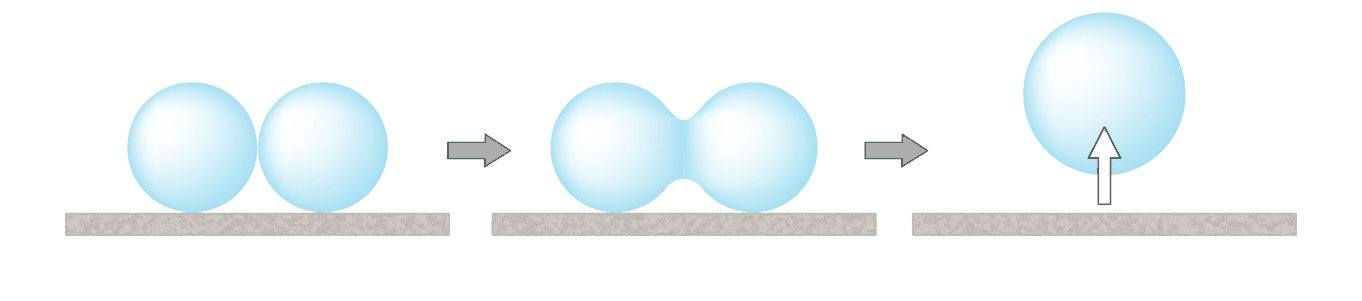
Fig. 1: Merger of two water drops and jump of the merged water drop.
Part B. A vertically placed board (4.5 points)
A flat board is immersed vertically in water. Figures 2(a) and 2(b) respectively show water surface forms for the hydrophilic (attractive) and hydrophobic board materials. We neglect the thickness of the board.
The board surface is on the \(yz\) plane, and the horizontal water surface far away from the board is on the \(xy\) plane with \(z=0\). The surface shape does not depend on the \(y\)-coordinate. Let \(\theta(x)\) be the angle between the water surface and the horizontal plane at a point \((x,z)\) on the water surface in the \(xz\) plane. Here \(\theta(x)\) is measured with respect to the positive \(x\) axis and the counterclockwise rotation is taken as positive. Let \(\theta(x)\) be \(\theta_0\) at the point of contact between the board and the water surface \((x=0)\). In the following, \(\theta_0\) is fixed by the properties of the board material.
Water density \(\rho\) is constant and water surface tension \(\gamma\) is uniform. The gravitational acceleration constant is given by \(g\). The atmospheric pressure, \(P_0\), is assumed to be always uniform. Let us determine the water surface form in the following steps. Note that the unit of surface tension is \(\mathrm{J/m^2}\) as well as \(\mathrm{N/m}\).
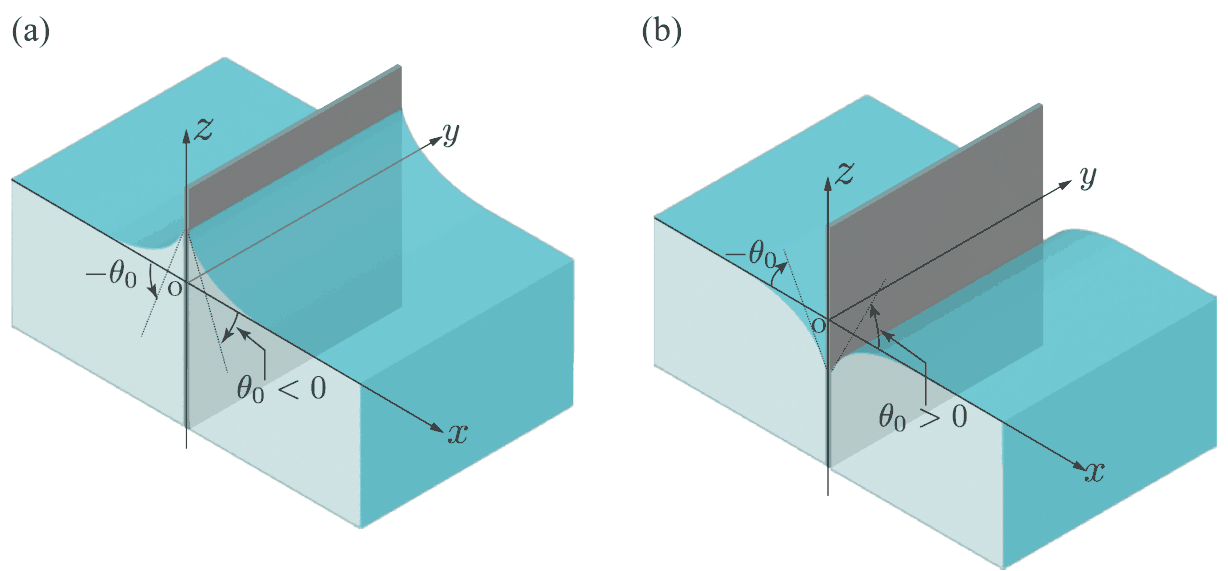
Fig. 2: Boards vertically immersed in the water. (a) hydrophilic board case; (b) hydrophobic board case.
B.1 0.6pt
We consider a hydrophilic board case, as shown in Fig.2(a). We note that the water pressure, \(P\), satisfies the conditions \(P<P_0\) for \(z>0\) and \(P=P_0\) for \(z=0\). Then, express \(P\) at \(z\) in terms of \(\rho\), \(g\), \(z\), and \(P_0\).
B.2 0.8pt
We consider a water block whose cutout is shown as shaded in Fig.3(a). Its \(xz\) plane cross-section is shown in a hatched area in Fig.3(b). Let \(z_1\) and \(z_2\) respectively be the left and right edge coordinates of the boundary (water surface) between the water block and the air.
Obtain a horizontal component (\(x\) component) of the net force per unit length along the \(y\)-axis, \(f_x\), which is exerted on the water block due to the pressure, in terms of \(\rho\), \(g\), \(z_1\), and \(z_2\). Note that \(P_0\) results in no net horizontal force on the water block.
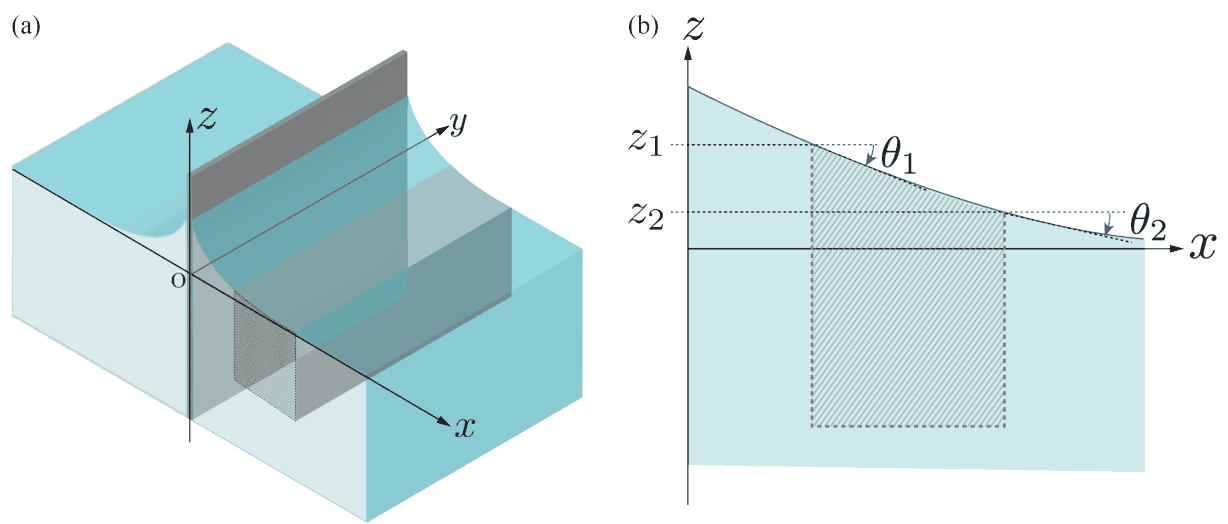
Fig. 3: Cutout form of water block on the water surface. (a) Bird's eye view and (b) cross-sectional view.
B.3 0.8pt
Surface tension acting on the water block is balanced with the force \(f_x\) discussed in B.2. We respectively define \(\theta_1\) and \(\theta_2\) as the angles between the water surface and the horizontal plane at the left and right edges. Express \(f_x\) in terms of \(\gamma\), \(\theta_1\), and \(\theta_2\).
B.4 0.8pt
The following equation holds at an arbitrary point \((x,z)\) on the water surface,
\[ \frac{1}{2}\left(\frac{z}{\ell}\right)^a+\cos\theta(x) =\text{constant}. \tag{1} \]
Determine the exponent \(a\) and express the constant \(\ell\) in terms of \(\gamma\) and \(\rho\). Note that this equation holds regardless of hydrophilic or hydrophobic board materials.
B.5 1.5pt
In Eq. (1) in B.4, we assume that variation of the water surface is slow, i.e., \(\lvert z'(x)\rvert\ll1\), so that we can expand \(\cos\theta(x)\) with respect to \(z'(x)\) up to the second order. Then, differentiating the resultant equation with respect to \(x\), we obtain the differential equation satisfied by \(z(x)\). Solve this differential equation and determine \(z(x)\) for \(x\geq0\) in terms of \(\tan\theta_0\) and \(\ell\). Note that the vertical directions of Figs. 2 and 3 are exaggerated for better view and they do not satisfy the condition, \(\lvert z'(x)\rvert\ll1\).
Part C. Interaction between two rods (3.5 points)
The identical rods A and B made of the same material floating in parallel on the water surface are placed at the same distance away from the \(y\)-axis (Fig.4).
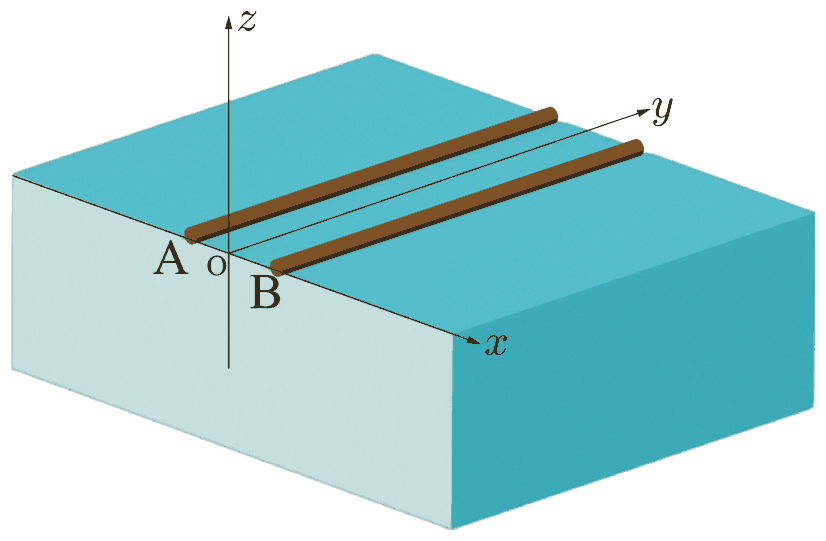
Fig. 4: Two rods A and B floating on the water surface.
C.1 1.0pt
At the contact points of the rod B and the water surface, we define the \(z\)-coordinates \(z_a\) and \(z_b\), and the angles \(\theta_a\) and \(\theta_b\), as shown in Fig.5. Determine the horizontal force component, \(F_x\), on the rod B per unit length along the \(y\)-axis in terms of \(\theta_a\), \(\theta_b\), \(z_a\), \(z_b\), \(\rho\), \(g\), and \(\gamma\).
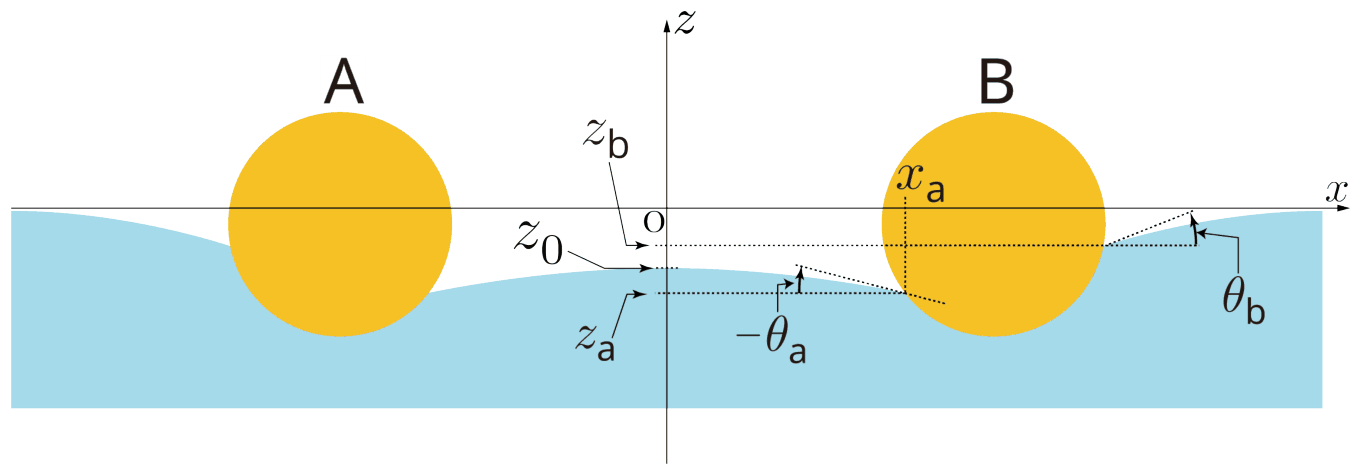
Fig. 5: Vertical cross-sectional view of two rods floating on the water surface.
C.2 1.5pt
We define the \(z\)-coordinate of the water surface, \(z_0\), at the midpoint of two rods in the \(xz\) plane. Express the force \(F_x\) obtained in C.1 without using \(\theta_a\), \(\theta_b\), \(z_a\), and \(z_b\).
C.3 1.0pt
Let \(x_a\) be the \(x\)-coordinate of the contact point between the water surface and the left side of the rod B. Using the differential equation obtained in B.5, express the water level coordinate \(z_0\) of the midpoint of these two rods A and B in terms of \(x_a\) and \(z_a\). You can use the constant \(\ell\) introduced in B.4.
Official English text of the problem.
Answers
Positive horizontal forces point along \(+x\). Both \(f_x\) and \(F_x\) are forces per unit length along \(y\), with units \(\mathrm{N/m}\).
-
A.1 \[ \boxed{v=\sqrt{\frac{3k\gamma}{\rho a}\left(2-2^{2/3}\right)} =0.23\,\mathrm{m/s}\quad\text{upward}.} \]
-
B.1 \[ \boxed{P(z)=P_0-\rho gz.} \]
-
B.2 \[ \boxed{f_x=\frac{\rho g}{2}\left(z_2^2-z_1^2\right).} \]
-
B.3 \[ \boxed{f_x=\gamma\left(\cos\theta_1-\cos\theta_2\right).} \]
-
B.4 \[ \boxed{a=2,\qquad \ell=\sqrt{\frac{\gamma}{\rho g}}.} \] The constant on the right of Eq. (1) is \(1\) for the board’s meniscus.
-
B.5, in the small-slope approximation: \[ \boxed{z''(x)=\frac{z(x)}{\ell^2},\qquad z(x)=-\ell\tan\theta_0\,e^{-x/\ell},\quad x\geq0.} \]
-
C.1 \[ \boxed{F_x=\gamma\left(\cos\theta_b-\cos\theta_a\right) +\frac{\rho g}{2}\left(z_b^2-z_a^2\right).} \]
-
C.2 \[ \boxed{F_x=-\frac{\rho g}{2}z_0^2.} \] The force on B is toward A when \(z_0\neq0\).
-
C.3, in the small-slope approximation: \[ \boxed{z_0=\frac{z_a}{\cosh(x_a/\ell)} =\frac{2z_a}{e^{x_a/\ell}+e^{-x_a/\ell}}.} \]
Solution
A.1
Let \(R\) be the radius of the merged drop. Conservation of volume gives
\[ \frac{4\pi R^3}{3} =2\frac{4\pi a^3}{3}, \qquad R=2^{1/3}a. \]
The mass of the merged drop is therefore
\[ m=\rho\frac{4\pi R^3}{3} =\frac{8\pi}{3}\rho a^3. \]
Surface energy equals surface tension multiplied by surface area. Thus the decrease in surface energy is
\[ \begin{aligned} \Delta E &=\gamma\left(2\cdot4\pi a^2-4\pi R^2\right)\\ &=4\pi\gamma a^2\left(2-2^{2/3}\right). \end{aligned} \]
Using the stipulated conversion of a fraction \(k\) into translational kinetic energy,
\[ \frac12mv^2=k\Delta E. \]
Consequently,
\[ v^2 =\frac{3k\gamma}{\rho a}\left(2-2^{2/3}\right). \]
With \(a=1.00\times10^{-4}\,\mathrm m\),
\[ m=8.3776\times10^{-9}\,\mathrm{kg}, \qquad \Delta E=3.7694\times10^{-9}\,\mathrm J, \]
and
\[ v=0.23236\ldots\,\mathrm{m/s}. \]
To two significant digits, the initial velocity is
\[ \boxed{v=0.23\,\mathrm{m/s}\ \text{upward}.} \]
B.1
In hydrostatic equilibrium, the upward pressure force balances gravity, giving
\[ \frac{dP}{dz}=-\rho g. \]
Since \(\rho\) is constant and \(P(0)=P_0\), integration yields
\[ \boxed{P(z)=P_0-\rho gz.} \]
In particular, water above \(z=0\) has pressure below atmospheric pressure, as stated.
B.2
A uniform pressure \(P_0\) applied over the entire closed boundary produces zero resultant force. We can therefore calculate using the gauge pressure
\[ p(z)=P(z)-P_0=-\rho gz. \]
The gauge pressure on the air-facing surface is zero. Let \(z_*\) be the common height of the block’s bottom. Pressure on the left vertical face pushes toward \(+x\), and pressure on the right face pushes toward \(-x\). The bottom contributes no horizontal force.
Per unit length along \(y\),
\[ \begin{aligned} f_x &=\int_{z_*}^{z_1}p(z)\,dz -\int_{z_*}^{z_2}p(z)\,dz\\ &=-\rho g\int_{z_2}^{z_1}z\,dz\\ &=\frac{\rho g}{2}\left(z_2^2-z_1^2\right). \end{aligned} \]
Hence
\[ \boxed{f_x=\frac{\rho g}{2}\left(z_2^2-z_1^2\right).} \]
For the illustrated hydrophilic meniscus, \(z_1>z_2>0\), so this pressure force points toward \(-x\).
B.3
Surface tension pulls tangentially away from the block at each edge. Its horizontal components per unit length are
\[ -\gamma\cos\theta_1 \quad\text{at the left edge}, \qquad +\gamma\cos\theta_2 \quad\text{at the right edge}. \]
Horizontal equilibrium requires
\[ f_x-\gamma\cos\theta_1+\gamma\cos\theta_2=0. \]
Therefore,
\[ \boxed{f_x=\gamma\left(\cos\theta_1-\cos\theta_2\right).} \]
B.4
Equating the expressions from B.2 and B.3,
\[ \frac{\rho g}{2}\left(z_2^2-z_1^2\right) =\gamma\left(\cos\theta_1-\cos\theta_2\right). \]
Rearranging gives
\[ \frac{\rho g}{2\gamma}z_1^2+\cos\theta_1 = \frac{\rho g}{2\gamma}z_2^2+\cos\theta_2. \]
Since the two edges can be chosen arbitrarily along the surface,
\[ \frac{\rho g}{2\gamma}z^2+\cos\theta(x)=C. \]
Comparison with Eq. (1) gives
\[ \boxed{a=2,\qquad \ell=\sqrt{\frac{\gamma}{\rho g}}.} \]
The length \(\ell\) is the capillary length. The derivation permits either sign of \(z\), so it applies to both raised and depressed menisci.
Far from the board, \(z\to0\) and \(\theta\to0\). Thus \(C=1\), and the board’s exact surface relation is
\[ \boxed{\frac{z^2}{2\ell^2}+\cos\theta(x)=1.} \]
B.5
The tangent to the surface satisfies
\[ \tan\theta(x)=z'(x). \]
For the surface represented as a graph,
\[ \cos\theta(x)=\frac{1}{\sqrt{1+[z'(x)]^2}}. \]
Under the stated approximation \(\lvert z'(x)\rvert\ll1\), its expansion through second order is
\[ \cos\theta(x) =1-\frac12[z'(x)]^2+O([z'(x)]^4). \]
Substitution into Eq. (1) gives, to this order,
\[ \frac{z^2}{2\ell^2}+1-\frac12(z')^2=C. \]
Differentiating,
\[ \frac{zz'}{\ell^2}-z'z''=0. \]
For a nonflat profile this yields
\[ \boxed{z''=\frac{z}{\ell^2},} \]
with the equation extending to isolated stationary points by continuity. The flat profile \(z=0\) also satisfies it.
The general solution is
\[ z(x)=A e^{x/\ell}+B e^{-x/\ell}. \]
The boundary condition \(z(x)\to0\) as \(x\to+\infty\) requires \(A=0\). At the board,
\[ z'(0)=\tan\theta_0=-\frac{B}{\ell}, \]
so \(B=-\ell\tan\theta_0\). Therefore,
\[ \boxed{z(x)=-\ell\tan\theta_0\,e^{-x/\ell}, \qquad x\geq0.} \]
For a hydrophilic board, \(\theta_0<0\), so \(z>0\). For a hydrophobic board, \(\theta_0>0\), so \(z<0\). In both cases the surface approaches \(z=0\) exponentially over the length scale \(\ell\). Consistency requires \(\lvert\tan\theta_0\rvert\ll1\).
C.1
There are two contributions to the horizontal force on rod B: surface tension at the contact lines and pressure on the rod.
Surface tension pulls the rod toward the adjoining free surface. Its net horizontal component is therefore
\[ F_{\gamma,x} =-\gamma\cos\theta_a+\gamma\cos\theta_b. \]
For the pressure force, subtract the uniform atmospheric pressure, whose resultant over the closed rod surface is zero. The remaining pressure on the wetted surface is \(p(z)=-\rho gz\).
The horizontal pressure force on a curved surface is obtained by integrating pressure over its vertical projection. Let \(z_*\) be the height of the bottom of the rod. The left wetted side contributes toward \(+x\), and the right wetted side toward \(-x\):
\[ \begin{aligned} F_{p,x} &=\int_{z_*}^{z_a}(-\rho gz)\,dz -\int_{z_*}^{z_b}(-\rho gz)\,dz\\ &=\frac{\rho g}{2}\left(z_b^2-z_a^2\right). \end{aligned} \]
Gravity has no horizontal component. Adding the two contributions,
\[ \boxed{ F_x=\gamma\left(\cos\theta_b-\cos\theta_a\right) +\frac{\rho g}{2}\left(z_b^2-z_a^2\right). } \]
C.2
The surface relation from B.4 applies separately to the surface between the rods and to the exterior surface. Their integration constants need not be equal.
On the exterior side of B, the surface becomes horizontal at \(z=0\) far away. Thus
\[ \frac{z_b^2}{2\ell^2}+\cos\theta_b=1. \]
Between the identical rods, reflection symmetry about \(x=0\) makes the surface horizontal at the midpoint. There \(z=z_0\), so the interior relation is
\[ \frac{z_a^2}{2\ell^2}+\cos\theta_a =1+\frac{z_0^2}{2\ell^2}. \]
Since \(\rho g=\gamma/\ell^2\), the force from C.1 can be written as
\[ F_x =\gamma\left[ \left(\cos\theta_b+\frac{z_b^2}{2\ell^2}\right) - \left(\cos\theta_a+\frac{z_a^2}{2\ell^2}\right) \right]. \]
Substitution gives
\[ F_x =\gamma\left[1-\left(1+\frac{z_0^2}{2\ell^2}\right)\right]. \]
Hence
\[ \boxed{F_x=-\frac{\gamma z_0^2}{2\ell^2} =-\frac{\rho g}{2}z_0^2.} \]
Rod B lies on the positive-\(x\) side, so the negative sign means attraction toward rod A. The force vanishes when \(z_0=0\). This result does not require the small-slope approximation.
C.3
Now apply the small-slope equation from B.5 to the surface between the rods:
\[ z''=\frac{z}{\ell^2}. \]
Writing its solution in hyperbolic form,
\[ z(x)=C_1\cosh(x/\ell)+C_2\sinh(x/\ell). \]
Symmetry gives \(z'(0)=0\), which requires \(C_2=0\). Since \(z(0)=z_0\), we have \(C_1=z_0\), and therefore
\[ z(x)=z_0\cosh(x/\ell). \]
At the inner contact with rod B, \(x=x_a\) and \(z=z_a\). Consequently,
\[ z_a=z_0\cosh(x_a/\ell), \]
so
\[ \boxed{ z_0=\frac{z_a}{\cosh(x_a/\ell)} =\frac{2z_a}{e^{x_a/\ell}+e^{-x_a/\ell}}. } \]
This height–separation relation is valid within the small-slope approximation.
The solution was checked against the official solution.
IPhO 2023 · Theorieaufgabe 3
Wasser und Körper
In dieser Aufgabe betrachten wir Phänomene, die durch die Wechselwirkung zwischen Wasser und Körpern entstehen und mit der Oberflächenspannung zusammenhängen. Teil A behandelt Bewegungen, während sich die Teile B und C mit statischen Situationen befassen.
Falls erforderlich, können Sie die Tatsache verwenden, dass eine Funktion \(y(x)\), die die Differentialgleichung \(y''(x)=ay(x)\) erfüllt (\(a\) ist eine positive Konstante), die allgemeine Lösung \(y(x)=Ae^{\sqrt{a}x}+Be^{-\sqrt{a}x}\) hat, wobei \(A\) und \(B\) beliebige Konstanten sind.
Teil A. Verschmelzen von Wassertropfen (2.0 Punkte)
Wie in Abb. 1 dargestellt, betrachten wir zwei ruhende, kugelförmige Wassertropfen auf der Oberfläche eines superhydrophoben Materials, d. h., zwischen dem Material und dem Wasser wirkt eine sehr starke abstoßende Kraft.
Zu Beginn werden zwei identische kugelförmige Wassertropfen nebeneinander auf die Oberfläche gesetzt; anschließend verschmelzen diese beiden Tropfen, nachdem sie einander berührt haben, und bilden einen größeren kugelförmigen Wassertropfen, der plötzlich nach oben springt.
A.1 2.0 Punkte
Der Radius \(a\) beider Wassertropfen vor dem Verschmelzen beträgt \(100\,\mu\mathrm{m}\). Die Dichte des Wassers \(\rho\) beträgt \(1.00\times10^3\,\mathrm{kg/m^3}\). Die Oberflächenspannung \(\gamma\) beträgt \(7.27\times10^{-2}\,\mathrm{J/m^2}\).
Ein Anteil \(k\) der Differenz der Oberflächenenergie vor und nach dem Verschmelzen, \(\Delta E\), wird in die kinetische Energie des hochspringenden Wassertropfens umgewandelt. Bestimmen Sie unter den folgenden Annahmen die anfängliche Absprunggeschwindigkeit \(v\) des vereinigten Wassertropfens mit zwei signifikanten Stellen:
- \(k=0.06\)
- Beim Verschmelzen bleibt das gesamte Wasservolumen erhalten.
Abb. 1: Verschmelzen zweier Wassertropfen und Absprung des vereinigten Wassertropfens.
Teil B. Eine senkrecht aufgestellte Platte (4.5 Punkte)
Eine ebene Platte wird senkrecht in Wasser eingetaucht. Die Abbildungen 2(a) und 2(b) zeigen die Formen der Wasseroberfläche für hydrophiles (anziehendes) bzw. hydrophobes Plattenmaterial. Wir vernachlässigen die Dicke der Platte.
Die Plattenoberfläche liegt in der \(yz\)-Ebene, und die horizontale Wasseroberfläche weit entfernt von der Platte liegt in der \(xy\)-Ebene bei \(z=0\). Die Form der Oberfläche hängt nicht von der \(y\)-Koordinate ab. Sei \(\theta(x)\) der Winkel zwischen der Wasseroberfläche und der Horizontalebene an einem Punkt \((x,z)\) auf der Wasseroberfläche in der \(xz\)-Ebene. Dabei wird \(\theta(x)\) bezüglich der positiven \(x\)-Achse gemessen, und eine Drehung gegen den Uhrzeigersinn wird als positiv gewertet. Am Berührungspunkt zwischen der Platte und der Wasseroberfläche \((x=0)\) sei \(\theta(x)\) gleich \(\theta_0\). Im Folgenden ist \(\theta_0\) durch die Eigenschaften des Plattenmaterials festgelegt.
Die Wasserdichte \(\rho\) ist konstant, und die Oberflächenspannung des Wassers \(\gamma\) ist überall gleich. Die konstante Fallbeschleunigung ist durch \(g\) gegeben. Der Atmosphärendruck \(P_0\) wird als stets räumlich konstant angenommen. Wir bestimmen die Form der Wasseroberfläche in den folgenden Schritten. Beachten Sie, dass die Einheit der Oberflächenspannung sowohl \(\mathrm{J/m^2}\) als auch \(\mathrm{N/m}\) ist.
Abb. 2: Senkrecht in das Wasser eingetauchte Platten. (a) Fall einer hydrophilen Platte; (b) Fall einer hydrophoben Platte.
B.1 0.6 Punkte
Wir betrachten den Fall einer hydrophilen Platte, wie in Abb. 2(a) dargestellt. Wir stellen fest, dass der Wasserdruck \(P\) die Bedingungen \(P<P_0\) für \(z>0\) und \(P=P_0\) für \(z=0\) erfüllt. Drücken Sie nun \(P\) in der Höhe \(z\) durch \(\rho\), \(g\), \(z\) und \(P_0\) aus.
B.2 0.8 Punkte
Wir betrachten einen Wasserblock, dessen herausgeschnittene Form in Abb. 3(a) schattiert dargestellt ist. Sein Querschnitt in der \(xz\)-Ebene ist als schraffierter Bereich in Abb. 3(b) dargestellt. Seien \(z_1\) und \(z_2\) die Koordinaten des linken bzw. rechten Randes der Grenzfläche (Wasseroberfläche) zwischen dem Wasserblock und der Luft.
Bestimmen Sie die horizontale Komponente (\(x\)-Komponente) der resultierenden Kraft pro Längeneinheit entlang der \(y\)-Achse, \(f_x\), die aufgrund des Drucks auf den Wasserblock ausgeübt wird, in Abhängigkeit von \(\rho\), \(g\), \(z_1\) und \(z_2\). Beachten Sie, dass \(P_0\) keine resultierende horizontale Kraft auf den Wasserblock bewirkt.
Abb. 3: Form des aus der Wasseroberfläche herausgeschnittenen Wasserblocks. (a) Ansicht aus der Vogelperspektive und (b) Querschnittsansicht.
B.3 0.8 Punkte
Die auf den Wasserblock wirkende Oberflächenspannung steht mit der in B.2 betrachteten Kraft \(f_x\) im Gleichgewicht. Wir definieren \(\theta_1\) und \(\theta_2\) als die Winkel zwischen der Wasseroberfläche und der Horizontalebene am linken bzw. rechten Rand. Drücken Sie \(f_x\) durch \(\gamma\), \(\theta_1\) und \(\theta_2\) aus.
B.4 0.8 Punkte
An einem beliebigen Punkt \((x,z)\) auf der Wasseroberfläche gilt die folgende Gleichung:
\[ \frac{1}{2}\left(\frac{z}{\ell}\right)^a+\cos\theta(x) =\text{konstant}. \tag{1} \]
Bestimmen Sie den Exponenten \(a\) und drücken Sie die Konstante \(\ell\) durch \(\gamma\) und \(\rho\) aus. Beachten Sie, dass diese Gleichung unabhängig davon gilt, ob das Plattenmaterial hydrophil oder hydrophob ist.
B.5 1.5 Punkte
In Gl. (1) aus B.4 nehmen wir an, dass sich die Wasseroberfläche nur langsam ändert, d. h. \(\lvert z'(x)\rvert\ll1\), sodass wir \(\cos\theta(x)\) bezüglich \(z'(x)\) bis zur zweiten Ordnung entwickeln können. Durch anschließendes Differenzieren der erhaltenen Gleichung nach \(x\) erhalten wir die Differentialgleichung, die \(z(x)\) erfüllt. Lösen Sie diese Differentialgleichung und bestimmen Sie \(z(x)\) für \(x\geq0\) in Abhängigkeit von \(\tan\theta_0\) und \(\ell\). Beachten Sie, dass die vertikalen Abmessungen in den Abb. 2 und 3 zur besseren Veranschaulichung überhöht dargestellt sind und die Bedingung \(\lvert z'(x)\rvert\ll1\) dort nicht erfüllt ist.
Teil C. Wechselwirkung zwischen zwei Stäben (3.5 Punkte)
Die identischen Stäbe A und B bestehen aus demselben Material, schwimmen parallel auf der Wasseroberfläche und befinden sich im gleichen Abstand von der \(y\)-Achse (Abb. 4).
Abb. 4: Zwei auf der Wasseroberfläche schwimmende Stäbe A und B.
C.1 1.0 Punkte
An den Berührungspunkten des Stabes B mit der Wasseroberfläche definieren wir die \(z\)-Koordinaten \(z_a\) und \(z_b\) sowie die Winkel \(\theta_a\) und \(\theta_b\), wie in Abb. 5 dargestellt. Bestimmen Sie die horizontale Kraftkomponente \(F_x\) auf den Stab B pro Längeneinheit entlang der \(y\)-Achse in Abhängigkeit von \(\theta_a\), \(\theta_b\), \(z_a\), \(z_b\), \(\rho\), \(g\) und \(\gamma\).
Abb. 5: Vertikaler Querschnitt durch zwei auf der Wasseroberfläche schwimmende Stäbe.
C.2 1.5 Punkte
Wir definieren die \(z\)-Koordinate der Wasseroberfläche in der Mitte zwischen den beiden Stäben in der \(xz\)-Ebene als \(z_0\). Drücken Sie die in C.1 erhaltene Kraft \(F_x\) ohne Verwendung von \(\theta_a\), \(\theta_b\), \(z_a\) und \(z_b\) aus.
C.3 1.0 Punkte
Sei \(x_a\) die \(x\)-Koordinate des Berührungspunktes zwischen der Wasseroberfläche und der linken Seite des Stabes B. Drücken Sie mithilfe der in B.5 erhaltenen Differentialgleichung die Wasserstandskoordinate \(z_0\) in der Mitte zwischen diesen beiden Stäben A und B durch \(x_a\) und \(z_a\) aus. Sie können die in B.4 eingeführte Konstante \(\ell\) verwenden.
Aufgabentext aus dem offiziellen englischen Text übersetzt.
Antworten
Positive horizontale Kräfte zeigen in Richtung \(+x\). Sowohl \(f_x\) als auch \(F_x\) sind Kräfte pro Längeneinheit entlang \(y\) mit der Einheit \(\mathrm{N/m}\).
-
A.1 \[ \boxed{v=\sqrt{\frac{3k\gamma}{\rho a}\left(2-2^{2/3}\right)} =0.23\,\mathrm{m/s}\quad\text{nach oben}.} \]
-
B.1 \[ \boxed{P(z)=P_0-\rho gz.} \]
-
B.2 \[ \boxed{f_x=\frac{\rho g}{2}\left(z_2^2-z_1^2\right).} \]
-
B.3 \[ \boxed{f_x=\gamma\left(\cos\theta_1-\cos\theta_2\right).} \]
-
B.4 \[ \boxed{a=2,\qquad \ell=\sqrt{\frac{\gamma}{\rho g}}.} \] Die Konstante auf der rechten Seite von Gl. (1) ist für den Meniskus an der Platte gleich \(1\).
-
B.5, in der Näherung kleiner Steigungen: \[ \boxed{z''(x)=\frac{z(x)}{\ell^2},\qquad z(x)=-\ell\tan\theta_0\,e^{-x/\ell},\quad x\geq0.} \]
-
C.1 \[ \boxed{F_x=\gamma\left(\cos\theta_b-\cos\theta_a\right) +\frac{\rho g}{2}\left(z_b^2-z_a^2\right).} \]
-
C.2 \[ \boxed{F_x=-\frac{\rho g}{2}z_0^2.} \] Die Kraft auf B ist für \(z_0\neq0\) auf A gerichtet.
-
C.3, in der Näherung kleiner Steigungen: \[ \boxed{z_0=\frac{z_a}{\cosh(x_a/\ell)} =\frac{2z_a}{e^{x_a/\ell}+e^{-x_a/\ell}}.} \]
Lösung
A.1
Sei \(R\) der Radius des vereinigten Tropfens. Aus der Volumenerhaltung folgt
\[ \frac{4\pi R^3}{3} =2\frac{4\pi a^3}{3}, \qquad R=2^{1/3}a. \]
Die Masse des vereinigten Tropfens ist daher
\[ m=\rho\frac{4\pi R^3}{3} =\frac{8\pi}{3}\rho a^3. \]
Die Oberflächenenergie ist gleich dem Produkt aus Oberflächenspannung und Oberflächeninhalt. Somit beträgt die Abnahme der Oberflächenenergie
\[ \begin{aligned} \Delta E &=\gamma\left(2\cdot4\pi a^2-4\pi R^2\right)\\ &=4\pi\gamma a^2\left(2-2^{2/3}\right). \end{aligned} \]
Mit der vorgegebenen Umwandlung eines Anteils \(k\) in kinetische Translationsenergie gilt
\[ \frac12mv^2=k\Delta E. \]
Folglich ist
\[ v^2 =\frac{3k\gamma}{\rho a}\left(2-2^{2/3}\right). \]
Mit \(a=1.00\times10^{-4}\,\mathrm m\) ergeben sich
\[ m=8.3776\times10^{-9}\,\mathrm{kg}, \qquad \Delta E=3.7694\times10^{-9}\,\mathrm J, \]
und
\[ v=0.23236\ldots\,\mathrm{m/s}. \]
Auf zwei signifikante Stellen gerundet beträgt die Anfangsgeschwindigkeit
\[ \boxed{v=0.23\,\mathrm{m/s}\ \text{nach oben}.} \]
B.1
Im hydrostatischen Gleichgewicht gleicht die nach oben gerichtete Druckkraft die Schwerkraft aus. Daraus folgt
\[ \frac{dP}{dz}=-\rho g. \]
Da \(\rho\) konstant ist und \(P(0)=P_0\) gilt, liefert die Integration
\[ \boxed{P(z)=P_0-\rho gz.} \]
Insbesondere liegt der Druck im Wasser oberhalb von \(z=0\) wie angegeben unter dem Atmosphärendruck.
B.2
Ein gleichmäßiger Druck \(P_0\), der auf die gesamte geschlossene Begrenzungsfläche wirkt, erzeugt keine resultierende Kraft. Daher können wir mit dem Relativdruck rechnen:
\[ p(z)=P(z)-P_0=-\rho gz. \]
Der Relativdruck auf der der Luft zugewandten Oberfläche ist null. Sei \(z_*\) die einheitliche Höhe der Unterseite des Blocks. Der Druck auf die linke vertikale Seitenfläche wirkt in Richtung \(+x\), der Druck auf die rechte Seitenfläche in Richtung \(-x\). Die Unterseite trägt nicht zur horizontalen Kraft bei.
Pro Längeneinheit entlang \(y\) gilt
\[ \begin{aligned} f_x &=\int_{z_*}^{z_1}p(z)\,dz -\int_{z_*}^{z_2}p(z)\,dz\\ &=-\rho g\int_{z_2}^{z_1}z\,dz\\ &=\frac{\rho g}{2}\left(z_2^2-z_1^2\right). \end{aligned} \]
Somit ist
\[ \boxed{f_x=\frac{\rho g}{2}\left(z_2^2-z_1^2\right).} \]
Für den dargestellten hydrophilen Meniskus gilt \(z_1>z_2>0\), sodass diese Druckkraft in Richtung \(-x\) zeigt.
B.3
Die Oberflächenspannung zieht an jedem Rand tangential vom Block weg. Ihre horizontalen Komponenten pro Längeneinheit sind
\[ -\gamma\cos\theta_1 \quad\text{am linken Rand}, \qquad +\gamma\cos\theta_2 \quad\text{am rechten Rand}. \]
Das horizontale Gleichgewicht erfordert
\[ f_x-\gamma\cos\theta_1+\gamma\cos\theta_2=0. \]
Daher gilt
\[ \boxed{f_x=\gamma\left(\cos\theta_1-\cos\theta_2\right).} \]
B.4
Gleichsetzen der Ausdrücke aus B.2 und B.3 liefert
\[ \frac{\rho g}{2}\left(z_2^2-z_1^2\right) =\gamma\left(\cos\theta_1-\cos\theta_2\right). \]
Umstellen ergibt
\[ \frac{\rho g}{2\gamma}z_1^2+\cos\theta_1 = \frac{\rho g}{2\gamma}z_2^2+\cos\theta_2. \]
Da die beiden Ränder entlang der Oberfläche beliebig gewählt werden können, gilt
\[ \frac{\rho g}{2\gamma}z^2+\cos\theta(x)=C. \]
Der Vergleich mit Gl. (1) ergibt
\[ \boxed{a=2,\qquad \ell=\sqrt{\frac{\gamma}{\rho g}}.} \]
Die Länge \(\ell\) ist die Kapillarlänge. Die Herleitung lässt beide Vorzeichen von \(z\) zu und gilt daher sowohl für angehobene als auch für abgesenkte Menisken.
Weit entfernt von der Platte gilt \(z\to0\) und \(\theta\to0\). Somit ist \(C=1\), und die exakte Beziehung für die Oberfläche an der Platte lautet
\[ \boxed{\frac{z^2}{2\ell^2}+\cos\theta(x)=1.} \]
B.5
Für die Tangente an die Oberfläche gilt
\[ \tan\theta(x)=z'(x). \]
Für die als Funktionsgraph dargestellte Oberfläche gilt
\[ \cos\theta(x)=\frac{1}{\sqrt{1+[z'(x)]^2}}. \]
Unter der angegebenen Näherung \(\lvert z'(x)\rvert\ll1\) lautet die Entwicklung bis zur zweiten Ordnung
\[ \cos\theta(x) =1-\frac12[z'(x)]^2+O([z'(x)]^4). \]
Einsetzen in Gl. (1) ergibt bis zu dieser Ordnung
\[ \frac{z^2}{2\ell^2}+1-\frac12(z')^2=C. \]
Differenzieren liefert
\[ \frac{zz'}{\ell^2}-z'z''=0. \]
Für ein nicht ebenes Profil ergibt sich daraus
\[ \boxed{z''=\frac{z}{\ell^2},} \]
wobei die Gleichung aufgrund der Stetigkeit auch an isolierten stationären Punkten gilt. Das ebene Profil \(z=0\) erfüllt sie ebenfalls.
Die allgemeine Lösung lautet
\[ z(x)=A e^{x/\ell}+B e^{-x/\ell}. \]
Die Randbedingung \(z(x)\to0\) für \(x\to+\infty\) erfordert \(A=0\). An der Platte gilt
\[ z'(0)=\tan\theta_0=-\frac{B}{\ell}, \]
also \(B=-\ell\tan\theta_0\). Daher ist
\[ \boxed{z(x)=-\ell\tan\theta_0\,e^{-x/\ell}, \qquad x\geq0.} \]
Für eine hydrophile Platte gilt \(\theta_0<0\), also \(z>0\). Für eine hydrophobe Platte gilt \(\theta_0>0\), also \(z<0\). In beiden Fällen nähert sich die Oberfläche auf der Längenskala \(\ell\) exponentiell dem Niveau \(z=0\). Die Konsistenz der Näherung erfordert \(\lvert\tan\theta_0\rvert\ll1\).
C.1
Zur horizontalen Kraft auf den Stab B gibt es zwei Beiträge: die Oberflächenspannung an den Kontaktlinien und den Druck auf den Stab.
Die Oberflächenspannung zieht den Stab zur angrenzenden freien Oberfläche hin. Ihre resultierende horizontale Komponente ist daher
\[ F_{\gamma,x} =-\gamma\cos\theta_a+\gamma\cos\theta_b. \]
Für die Druckkraft ziehen wir den gleichmäßigen Atmosphärendruck ab, dessen resultierende Kraft auf die geschlossene Staboberfläche null ist. Der verbleibende Druck auf der benetzten Oberfläche ist \(p(z)=-\rho gz\).
Die horizontale Druckkraft auf eine gekrümmte Oberfläche erhält man durch Integration des Drucks über ihre vertikale Projektion. Sei \(z_*\) die Höhe des tiefsten Punktes des Stabes. Die linke benetzte Seite liefert einen Beitrag in Richtung \(+x\), die rechte benetzte Seite in Richtung \(-x\):
\[ \begin{aligned} F_{p,x} &=\int_{z_*}^{z_a}(-\rho gz)\,dz -\int_{z_*}^{z_b}(-\rho gz)\,dz\\ &=\frac{\rho g}{2}\left(z_b^2-z_a^2\right). \end{aligned} \]
Die Schwerkraft hat keine horizontale Komponente. Addition der beiden Beiträge ergibt
\[ \boxed{ F_x=\gamma\left(\cos\theta_b-\cos\theta_a\right) +\frac{\rho g}{2}\left(z_b^2-z_a^2\right). } \]
C.2
Die Beziehung für die Oberfläche aus B.4 gilt jeweils getrennt für die Oberfläche zwischen den Stäben und für die äußere Oberfläche. Ihre Integrationskonstanten müssen nicht gleich sein.
Auf der Außenseite von B wird die Oberfläche in großer Entfernung bei \(z=0\) horizontal. Daher gilt
\[ \frac{z_b^2}{2\ell^2}+\cos\theta_b=1. \]
Zwischen den identischen Stäben ist die Oberfläche aufgrund der Spiegelsymmetrie bezüglich \(x=0\) in der Mitte horizontal. Dort gilt \(z=z_0\), sodass die Beziehung im Innenbereich lautet
\[ \frac{z_a^2}{2\ell^2}+\cos\theta_a =1+\frac{z_0^2}{2\ell^2}. \]
Da \(\rho g=\gamma/\ell^2\) gilt, lässt sich die Kraft aus C.1 schreiben als
\[ F_x =\gamma\left[ \left(\cos\theta_b+\frac{z_b^2}{2\ell^2}\right) - \left(\cos\theta_a+\frac{z_a^2}{2\ell^2}\right) \right]. \]
Einsetzen ergibt
\[ F_x =\gamma\left[1-\left(1+\frac{z_0^2}{2\ell^2}\right)\right]. \]
Somit gilt
\[ \boxed{F_x=-\frac{\gamma z_0^2}{2\ell^2} =-\frac{\rho g}{2}z_0^2.} \]
Stab B liegt auf der Seite mit positiver \(x\)-Koordinate, sodass das negative Vorzeichen eine Anziehung zum Stab A hin bedeutet. Die Kraft verschwindet für \(z_0=0\). Dieses Ergebnis erfordert nicht die Näherung kleiner Steigungen.
C.3
Nun wenden wir die Gleichung für kleine Steigungen aus B.5 auf die Oberfläche zwischen den Stäben an:
\[ z''=\frac{z}{\ell^2}. \]
Mit Hyperbelfunktionen geschrieben lautet ihre Lösung
\[ z(x)=C_1\cosh(x/\ell)+C_2\sinh(x/\ell). \]
Aus der Symmetrie folgt \(z'(0)=0\), was \(C_2=0\) erfordert. Da \(z(0)=z_0\) gilt, ist \(C_1=z_0\), und somit
\[ z(x)=z_0\cosh(x/\ell). \]
Am inneren Berührungspunkt mit Stab B gilt \(x=x_a\) und \(z=z_a\). Folglich ist
\[ z_a=z_0\cosh(x_a/\ell), \]
also
\[ \boxed{ z_0=\frac{z_a}{\cosh(x_a/\ell)} =\frac{2z_a}{e^{x_a/\ell}+e^{-x_a/\ell}}. } \]
Diese Beziehung zwischen Höhe und Abstand gilt innerhalb der Näherung kleiner Steigungen.
Die Lösung wurde mit der offiziellen Lösung abgeglichen.
IPhO 2023 · Teori sorusu 3
Su ve Cisimler
Bu soruda, su ile cisimler arasındaki etkileşimin yol açtığı, yüzey gerilimiyle ilişkili olayları ele alıyoruz. Bölüm A hareketi ele alırken, Bölüm B ve C statik durumlarla ilgilidir.
Gerekirse, \(y(x)\) fonksiyonu \(y''(x)=ay(x)\) diferansiyel denklemini sağlıyorsa (\(a\) pozitif bir sabittir), genel çözümünün \(y(x)=Ae^{\sqrt{a}x}+Be^{-\sqrt{a}x}\) olduğu bilgisini kullanabilirsiniz; burada \(A\) ve \(B\) keyfî sabitlerdir.
Bölüm A. Su damlalarının birleşmesi (2.0 puan)
Şekil 1'de gösterildiği gibi, süperhidrofobik bir malzemenin yüzeyinde duran iki küresel su damlasını ele alıyoruz; başka bir deyişle, malzeme ile su arasında çok güçlü bir itme kuvveti vardır.
Başlangıçta birbirine komşu iki özdeş küresel su damlası yüzeye yerleştirilir; ardından bu iki damla birbirine temas ettikten sonra birleşerek daha büyük bir küresel su damlası oluşturur ve bu damla aniden yukarı sıçrar.
A.1 2.0 puan
Birleşmeden önce her iki su damlasının yarıçapı \(a\), \(100\,\mu\mathrm{m}\)'dir. Suyun yoğunluğu \(\rho\), \(1.00\times10^3\,\mathrm{kg/m^3}\)'tür. Yüzey gerilimi \(\gamma\), \(7.27\times10^{-2}\,\mathrm{J/m^2}\)'dir.
Birleşmeden önceki ve sonraki yüzey enerjileri arasındaki farkın, \(\Delta E\), \(k\) oranındaki bir kısmı sıçrayan su damlasının kinetik enerjisine dönüşür. Buna göre, aşağıdaki varsayımlar altında birleşen su damlasının ilk yukarı sıçrama hızını, \(v\), iki anlamlı basamakla belirleyiniz:
- \(k=0.06\)
- Birleşmeden önce ve sonra suyun toplam hacmi korunur.
Şekil 1: İki su damlasının birleşmesi ve birleşen su damlasının sıçraması.
Bölüm B. Düşey yerleştirilmiş bir levha (4.5 puan)
Düz bir levha suya düşey olarak daldırılmıştır. Şekil 2(a) ve 2(b), sırasıyla hidrofilik (çekici) ve hidrofobik levha malzemeleri için su yüzeyinin biçimlerini göstermektedir. Levhanın kalınlığını ihmal ediyoruz.
Levhanın yüzeyi \(yz\) düzlemindedir ve levhadan çok uzaktaki yatay su yüzeyi, \(z=0\) olan \(xy\) düzlemindedir. Yüzeyin biçimi \(y\) koordinatına bağlı değildir. \(\theta(x)\), \(xz\) düzlemindeki su yüzeyi üzerinde bulunan bir \((x,z)\) noktasında su yüzeyi ile yatay düzlem arasındaki açı olsun. Burada \(\theta(x)\), pozitif \(x\) eksenine göre ölçülür ve saat yönünün tersine dönme pozitif kabul edilir. Levha ile su yüzeyinin temas noktasında \((x=0)\), \(\theta(x)\) açısı \(\theta_0\) olsun. Aşağıda, \(\theta_0\) levha malzemesinin özellikleri tarafından belirlenen sabit bir değerdir.
Suyun yoğunluğu \(\rho\) sabittir ve suyun yüzey gerilimi \(\gamma\) her yerde aynıdır. Yerçekimi ivmesi sabiti \(g\) ile verilmiştir. Atmosfer basıncı \(P_0\)'ın her zaman her yerde aynı olduğu varsayılır. Su yüzeyinin biçimini aşağıdaki adımlarla belirleyelim. Yüzey geriliminin biriminin \(\mathrm{J/m^2}\) olduğu gibi \(\mathrm{N/m}\) de olduğuna dikkat ediniz.
Şekil 2: Suya düşey olarak daldırılmış levhalar. (a) hidrofilik levha durumu; (b) hidrofobik levha durumu.
B.1 0.6 puan
Şekil 2(a)'da gösterildiği gibi hidrofilik bir levha durumunu ele alıyoruz. Su basıncı \(P\)'nin, \(z>0\) için \(P<P_0\) ve \(z=0\) için \(P=P_0\) koşullarını sağladığına dikkat ediniz. Buna göre, \(z\) yüksekliğindeki \(P\)'yi \(\rho\), \(g\), \(z\) ve \(P_0\) cinsinden ifade ediniz.
B.2 0.8 puan
Şekil 3(a)'da gölgeli olarak gösterilen, kesilip ayrılmış bir su bloğunu ele alıyoruz. Bu bloğun \(xz\) düzlemindeki kesiti, Şekil 3(b)'de taralı alanla gösterilmiştir. \(z_1\) ve \(z_2\), sırasıyla su bloğu ile hava arasındaki sınırın (su yüzeyinin) sol ve sağ kenarlarının koordinatları olsun.
Basınç nedeniyle su bloğuna etki eden net kuvvetin, \(y\) ekseni boyunca birim uzunluk başına yatay bileşenini (\(x\) bileşenini), \(f_x\), \(\rho\), \(g\), \(z_1\) ve \(z_2\) cinsinden bulunuz. \(P_0\)'ın su bloğu üzerinde net bir yatay kuvvet oluşturmadığına dikkat ediniz.
Şekil 3: Su yüzeyinden kesilip ayrılan su bloğunun biçimi. (a) Kuş bakışı görünüm ve (b) kesit görünümü.
B.3 0.8 puan
Su bloğuna etki eden yüzey gerilimi, B.2'de ele alınan \(f_x\) kuvvetiyle dengelenir. Sol ve sağ kenarlarda su yüzeyi ile yatay düzlem arasındaki açıları sırasıyla \(\theta_1\) ve \(\theta_2\) olarak tanımlıyoruz. \(f_x\)'i \(\gamma\), \(\theta_1\) ve \(\theta_2\) cinsinden ifade ediniz.
B.4 0.8 puan
Su yüzeyi üzerindeki herhangi bir \((x,z)\) noktasında aşağıdaki denklem geçerlidir:
\[ \frac{1}{2}\left(\frac{z}{\ell}\right)^a+\cos\theta(x) =\text{sabit}. \tag{1} \]
\(a\) üssünü belirleyiniz ve \(\ell\) sabitini \(\gamma\) ve \(\rho\) cinsinden ifade ediniz. Bu denklemin levha malzemesinin hidrofilik ya da hidrofobik olmasından bağımsız olarak geçerli olduğuna dikkat ediniz.
B.5 1.5 puan
B.4'teki Denklem (1)'de, su yüzeyinin yavaş değiştiğini, yani \(\lvert z'(x)\rvert\ll1\) olduğunu varsayıyoruz; böylece \(\cos\theta(x)\)'i \(z'(x)\)'e göre ikinci mertebeye kadar açabiliriz. Ardından, elde edilen denklemin \(x\)'e göre türevini alarak \(z(x)\)'in sağladığı diferansiyel denklemi elde ederiz. Bu diferansiyel denklemi çözünüz ve \(x\geq0\) için \(z(x)\)'i \(\tan\theta_0\) ve \(\ell\) cinsinden belirleyiniz. Şekil 2 ve 3'te daha iyi bir görünüm için düşey boyutların abartıldığına ve bu şekillerin \(\lvert z'(x)\rvert\ll1\) koşulunu sağlamadığına dikkat ediniz.
Bölüm C. İki çubuk arasındaki etkileşim (3.5 puan)
Aynı malzemeden yapılmış, su yüzeyinde birbirine paralel olarak yüzen özdeş A ve B çubukları, \(y\) eksenine eşit uzaklıklarda yerleştirilmiştir (Şekil 4).
Şekil 4: Su yüzeyinde yüzen iki çubuk A ve B.
C.1 1.0 puan
B çubuğu ile su yüzeyinin temas noktalarında, Şekil 5'te gösterildiği gibi \(z\) koordinatlarını \(z_a\) ve \(z_b\), açıları ise \(\theta_a\) ve \(\theta_b\) olarak tanımlıyoruz. B çubuğuna etki eden kuvvetin \(y\) ekseni boyunca birim uzunluk başına yatay bileşenini, \(F_x\), \(\theta_a\), \(\theta_b\), \(z_a\), \(z_b\), \(\rho\), \(g\) ve \(\gamma\) cinsinden belirleyiniz.
Şekil 5: Su yüzeyinde yüzen iki çubuğun düşey kesit görünümü.
C.2 1.5 puan
\(xz\) düzleminde iki çubuğun orta noktasındaki su yüzeyinin \(z\) koordinatını \(z_0\) olarak tanımlıyoruz. C.1'de elde edilen \(F_x\) kuvvetini \(\theta_a\), \(\theta_b\), \(z_a\) ve \(z_b\) kullanmadan ifade ediniz.
C.3 1.0 puan
\(x_a\), su yüzeyi ile B çubuğunun sol tarafı arasındaki temas noktasının \(x\) koordinatı olsun. B.5'te elde edilen diferansiyel denklemi kullanarak, bu iki A ve B çubuğunun orta noktasındaki su seviyesi koordinatını, \(z_0\), \(x_a\) ve \(z_a\) cinsinden ifade ediniz. B.4'te tanımlanan \(\ell\) sabitini kullanabilirsiniz.
Soru metni resmi İngilizce metinden çevrilmiştir.
Cevaplar
Pozitif yatay kuvvetler \(+x\) yönündedir. Hem \(f_x\) hem de \(F_x\), \(y\) boyunca birim uzunluk başına kuvvetlerdir ve birimleri \(\mathrm{N/m}\)'dir.
-
A.1 \[ \boxed{v=\sqrt{\frac{3k\gamma}{\rho a}\left(2-2^{2/3}\right)} =0.23\,\mathrm{m/s}\quad\text{yukarı doğru}.} \]
-
B.1 \[ \boxed{P(z)=P_0-\rho gz.} \]
-
B.2 \[ \boxed{f_x=\frac{\rho g}{2}\left(z_2^2-z_1^2\right).} \]
-
B.3 \[ \boxed{f_x=\gamma\left(\cos\theta_1-\cos\theta_2\right).} \]
-
B.4 \[ \boxed{a=2,\qquad \ell=\sqrt{\frac{\gamma}{\rho g}}.} \] Levhanın menisküsü için Denklem (1)'in sağ tarafındaki sabit \(1\)'dir.
-
B.5, küçük eğim yaklaşımında: \[ \boxed{z''(x)=\frac{z(x)}{\ell^2},\qquad z(x)=-\ell\tan\theta_0\,e^{-x/\ell},\quad x\geq0.} \]
-
C.1 \[ \boxed{F_x=\gamma\left(\cos\theta_b-\cos\theta_a\right) +\frac{\rho g}{2}\left(z_b^2-z_a^2\right).} \]
-
C.2 \[ \boxed{F_x=-\frac{\rho g}{2}z_0^2.} \] \(z_0\neq0\) olduğunda B'ye etki eden kuvvet A'ya doğrudur.
-
C.3, küçük eğim yaklaşımında: \[ \boxed{z_0=\frac{z_a}{\cosh(x_a/\ell)} =\frac{2z_a}{e^{x_a/\ell}+e^{-x_a/\ell}}.} \]
Çözüm
A.1
Birleşen damlanın yarıçapı \(R\) olsun. Hacmin korunumundan
\[ \frac{4\pi R^3}{3} =2\frac{4\pi a^3}{3}, \qquad R=2^{1/3}a. \]
Buna göre birleşen damlanın kütlesi
\[ m=\rho\frac{4\pi R^3}{3} =\frac{8\pi}{3}\rho a^3. \]
Yüzey enerjisi, yüzey gerilimi ile yüzey alanının çarpımına eşittir. Dolayısıyla yüzey enerjisindeki azalma
\[ \begin{aligned} \Delta E &=\gamma\left(2\cdot4\pi a^2-4\pi R^2\right)\\ &=4\pi\gamma a^2\left(2-2^{2/3}\right). \end{aligned} \]
Bu enerjinin \(k\) oranındaki bir kısmının öteleme kinetik enerjisine dönüştüğü koşulunu kullanırsak,
\[ \frac12mv^2=k\Delta E. \]
Sonuç olarak,
\[ v^2 =\frac{3k\gamma}{\rho a}\left(2-2^{2/3}\right). \]
\(a=1.00\times10^{-4}\,\mathrm m\) için,
\[ m=8.3776\times10^{-9}\,\mathrm{kg}, \qquad \Delta E=3.7694\times10^{-9}\,\mathrm J, \]
ve
\[ v=0.23236\ldots\,\mathrm{m/s}. \]
İki anlamlı basamakla ilk hız
\[ \boxed{v=0.23\,\mathrm{m/s}\ \text{yukarı doğru}.} \]
B.1
Hidrostatik dengede, yukarı yönlü basınç kuvveti yerçekimini dengeler ve
\[ \frac{dP}{dz}=-\rho g. \]
\(\rho\) sabit ve \(P(0)=P_0\) olduğundan, integral alındığında
\[ \boxed{P(z)=P_0-\rho gz.} \]
Özellikle, belirtildiği gibi \(z=0\)'ın üzerindeki suyun basıncı atmosfer basıncından düşüktür.
B.2
Kapalı sınırın tamamına uygulanan düzgün bir \(P_0\) basıncı, sıfır bileşke kuvvet oluşturur. Bu nedenle hesabı manometrik basıncı kullanarak yapabiliriz:
\[ p(z)=P(z)-P_0=-\rho gz. \]
Havaya bakan yüzeydeki manometrik basınç sıfırdır. \(z_*\), bloğun tabanının ortak yüksekliği olsun. Sol düşey yüzeydeki basınç \(+x\) yönünde, sağ yüzeydeki basınç ise \(-x\) yönünde iter. Tabanın yatay kuvvete katkısı yoktur.
\(y\) boyunca birim uzunluk başına,
\[ \begin{aligned} f_x &=\int_{z_*}^{z_1}p(z)\,dz -\int_{z_*}^{z_2}p(z)\,dz\\ &=-\rho g\int_{z_2}^{z_1}z\,dz\\ &=\frac{\rho g}{2}\left(z_2^2-z_1^2\right). \end{aligned} \]
Böylece
\[ \boxed{f_x=\frac{\rho g}{2}\left(z_2^2-z_1^2\right).} \]
Şekildeki hidrofilik menisküs için \(z_1>z_2>0\) olduğundan, bu basınç kuvveti \(-x\) yönündedir.
B.3
Yüzey gerilimi, her kenarda bloğu teğetsel olarak dışarı doğru çeker. Birim uzunluk başına yatay bileşenleri
\[ -\gamma\cos\theta_1 \quad\text{sol kenarda}, \qquad +\gamma\cos\theta_2 \quad\text{sağ kenarda}. \]
Yatay denge koşulu
\[ f_x-\gamma\cos\theta_1+\gamma\cos\theta_2=0. \]
Dolayısıyla,
\[ \boxed{f_x=\gamma\left(\cos\theta_1-\cos\theta_2\right).} \]
B.4
B.2 ve B.3'teki ifadeleri eşitlersek,
\[ \frac{\rho g}{2}\left(z_2^2-z_1^2\right) =\gamma\left(\cos\theta_1-\cos\theta_2\right). \]
Yeniden düzenlendiğinde
\[ \frac{\rho g}{2\gamma}z_1^2+\cos\theta_1 = \frac{\rho g}{2\gamma}z_2^2+\cos\theta_2. \]
İki kenar yüzey boyunca keyfî olarak seçilebildiğinden,
\[ \frac{\rho g}{2\gamma}z^2+\cos\theta(x)=C. \]
Denklem (1) ile karşılaştırıldığında
\[ \boxed{a=2,\qquad \ell=\sqrt{\frac{\gamma}{\rho g}}.} \]
\(\ell\) uzunluğu, kılcal uzunluktur. Türetim, \(z\)'nin her iki işaretine de izin verdiğinden hem yükselmiş hem de alçalmış menisküslere uygulanır.
Levhadan uzakta \(z\to0\) ve \(\theta\to0\) olur. Böylece \(C=1\) olur ve levha için tam yüzey bağıntısı
\[ \boxed{\frac{z^2}{2\ell^2}+\cos\theta(x)=1.} \]
B.5
Yüzeye teğet doğru şu bağıntıyı sağlar:
\[ \tan\theta(x)=z'(x). \]
Bir fonksiyonun grafiği olarak gösterilen yüzey için,
\[ \cos\theta(x)=\frac{1}{\sqrt{1+[z'(x)]^2}}. \]
Verilen \(\lvert z'(x)\rvert\ll1\) yaklaşımı altında, ikinci mertebeye kadar açılımı
\[ \cos\theta(x) =1-\frac12[z'(x)]^2+O([z'(x)]^4). \]
Denklem (1)'de yerine konulduğunda, bu mertebeye kadar,
\[ \frac{z^2}{2\ell^2}+1-\frac12(z')^2=C. \]
Türev alındığında,
\[ \frac{zz'}{\ell^2}-z'z''=0. \]
Düz olmayan bir profil için buradan
\[ \boxed{z''=\frac{z}{\ell^2},} \]
elde edilir; denklem, süreklilik sayesinde yalıtık durağan noktalarda da geçerlidir. Düz profil \(z=0\) da bu denklemi sağlar.
Genel çözüm
\[ z(x)=A e^{x/\ell}+B e^{-x/\ell}. \]
\(x\to+\infty\) iken \(z(x)\to0\) sınır koşulu \(A=0\) olmasını gerektirir. Levhada,
\[ z'(0)=\tan\theta_0=-\frac{B}{\ell}, \]
olduğundan \(B=-\ell\tan\theta_0\) olur. Dolayısıyla,
\[ \boxed{z(x)=-\ell\tan\theta_0\,e^{-x/\ell}, \qquad x\geq0.} \]
Hidrofilik bir levha için \(\theta_0<0\) olduğundan \(z>0\) olur. Hidrofobik bir levha için \(\theta_0>0\) olduğundan \(z<0\) olur. Her iki durumda da yüzey, \(\ell\) uzunluk ölçeğinde üstel olarak \(z=0\)'a yaklaşır. Tutarlılık, \(\lvert\tan\theta_0\rvert\ll1\) olmasını gerektirir.
C.1
B çubuğuna etki eden yatay kuvvete iki katkı vardır: temas çizgilerindeki yüzey gerilimi ve çubuk üzerindeki basınç.
Yüzey gerilimi çubuğu bitişiğindeki serbest yüzeye doğru çeker. Bu nedenle net yatay bileşeni
\[ F_{\gamma,x} =-\gamma\cos\theta_a+\gamma\cos\theta_b. \]
Basınç kuvveti için, çubuğun kapalı yüzeyi üzerindeki bileşkesi sıfır olan düzgün atmosfer basıncını çıkarırız. Islak yüzeyde kalan basınç \(p(z)=-\rho gz\)'dir.
Eğri bir yüzey üzerindeki yatay basınç kuvveti, basıncın bu yüzeyin düşey izdüşümü üzerinde integrali alınarak elde edilir. \(z_*\), çubuğun en alt noktasının yüksekliği olsun. Islak sol taraf \(+x\) yönünde, ıslak sağ taraf ise \(-x\) yönünde katkıda bulunur:
\[ \begin{aligned} F_{p,x} &=\int_{z_*}^{z_a}(-\rho gz)\,dz -\int_{z_*}^{z_b}(-\rho gz)\,dz\\ &=\frac{\rho g}{2}\left(z_b^2-z_a^2\right). \end{aligned} \]
Yerçekiminin yatay bileşeni yoktur. İki katkıyı toplarsak,
\[ \boxed{ F_x=\gamma\left(\cos\theta_b-\cos\theta_a\right) +\frac{\rho g}{2}\left(z_b^2-z_a^2\right). } \]
C.2
B.4'teki yüzey bağıntısı, çubuklar arasındaki yüzeye ve dış yüzeye ayrı ayrı uygulanır. Bunların integrasyon sabitlerinin eşit olması gerekmez.
B'nin dış tarafında, yüzey uzakta \(z=0\)'da yatay hâle gelir. Dolayısıyla
\[ \frac{z_b^2}{2\ell^2}+\cos\theta_b=1. \]
Özdeş çubuklar arasında, \(x=0\)'a göre yansıma simetrisi nedeniyle yüzey orta noktada yataydır. Burada \(z=z_0\) olduğundan, iç bölgedeki bağıntı
\[ \frac{z_a^2}{2\ell^2}+\cos\theta_a =1+\frac{z_0^2}{2\ell^2}. \]
\(\rho g=\gamma/\ell^2\) olduğundan, C.1'deki kuvvet şu şekilde yazılabilir:
\[ F_x =\gamma\left[ \left(\cos\theta_b+\frac{z_b^2}{2\ell^2}\right) - \left(\cos\theta_a+\frac{z_a^2}{2\ell^2}\right) \right]. \]
Yerine koyarsak
\[ F_x =\gamma\left[1-\left(1+\frac{z_0^2}{2\ell^2}\right)\right]. \]
Böylece
\[ \boxed{F_x=-\frac{\gamma z_0^2}{2\ell^2} =-\frac{\rho g}{2}z_0^2.} \]
B çubuğu pozitif \(x\) tarafında yer aldığından, eksi işareti A çubuğuna doğru bir çekim olduğunu gösterir. \(z_0=0\) olduğunda kuvvet sıfır olur. Bu sonuç küçük eğim yaklaşımını gerektirmez.
C.3
Şimdi B.5'teki küçük eğim denklemini çubuklar arasındaki yüzeye uygulayalım:
\[ z''=\frac{z}{\ell^2}. \]
Çözümünü hiperbolik fonksiyonlarla yazarsak,
\[ z(x)=C_1\cosh(x/\ell)+C_2\sinh(x/\ell). \]
Simetri \(z'(0)=0\) koşulunu verir; bu da \(C_2=0\) olmasını gerektirir. \(z(0)=z_0\) olduğundan \(C_1=z_0\) olur ve dolayısıyla
\[ z(x)=z_0\cosh(x/\ell). \]
B çubuğuyla iç taraftaki temas noktasında \(x=x_a\) ve \(z=z_a\) olur. Sonuç olarak,
\[ z_a=z_0\cosh(x_a/\ell), \]
olduğundan
\[ \boxed{ z_0=\frac{z_a}{\cosh(x_a/\ell)} =\frac{2z_a}{e^{x_a/\ell}+e^{-x_a/\ell}}. } \]
Bu yükseklik–uzaklık bağıntısı, küçük eğim yaklaşımı çerçevesinde geçerlidir.
Çözüm, resmi çözümle karşılaştırılarak kontrol edildi.
IPhO 2023 · Problema teórico 3
Agua y objetos
En este problema, consideramos los fenómenos causados por la interacción entre el agua y los objetos, relacionados con la tensión superficial. La Parte A trata del movimiento, mientras que las Partes B y C se refieren a situaciones estáticas.
Si es necesario, puede utilizar el hecho de que, si la función \(y(x)\) satisface la ecuación diferencial \(y''(x)=ay(x)\) (\(a\) es una constante positiva), entonces su solución general es \(y(x)=Ae^{\sqrt{a}x}+Be^{-\sqrt{a}x}\), donde \(A\) y \(B\) son constantes arbitrarias.
Parte A. Coalescencia de gotas de agua (2.0 puntos)
Como se muestra en la Fig.1, consideramos dos gotas de agua esféricas en reposo sobre la superficie de un material superhidrófobo, es decir, existe una fuerza de repulsión muy intensa entre el material y el agua.
Inicialmente, se colocan sobre la superficie dos gotas de agua esféricas idénticas, una junto a la otra; después, estas dos gotas se unen al entrar en contacto y forman una gota de agua esférica más grande, que de repente salta hacia arriba.
A.1 2.0pt
El radio \(a\) de ambas gotas de agua antes de la coalescencia es \(100\,\mu\mathrm{m}\). La densidad del agua \(\rho\) es \(1.00\times10^3\,\mathrm{kg/m^3}\). La tensión superficial \(\gamma\) es \(7.27\times10^{-2}\,\mathrm{J/m^2}\).
Una fracción \(k\) de la diferencia de energía superficial antes y después de la coalescencia, \(\Delta E\), se transforma en energía cinética de la gota de agua que salta. Determine entonces la velocidad inicial de ascenso, \(v\), de la gota de agua resultante, con dos cifras significativas, bajo las siguientes hipótesis:
- \(k=0.06\)
- Antes y después de la coalescencia, el volumen total de agua se conserva.
Fig. 1: Coalescencia de dos gotas de agua y salto de la gota de agua resultante.
Parte B. Una placa colocada verticalmente (4.5 puntos)
Una placa plana se sumerge verticalmente en agua. Las Figuras 2(a) y 2(b) muestran, respectivamente, las formas de la superficie del agua para placas de materiales hidrófilos (atractivos) e hidrófobos. Despreciamos el espesor de la placa.
La superficie de la placa se encuentra en el plano \(yz\), y la superficie horizontal del agua lejos de la placa se encuentra en el plano \(xy\), con \(z=0\). La forma de la superficie no depende de la coordenada \(y\). Sea \(\theta(x)\) el ángulo entre la superficie del agua y el plano horizontal en un punto \((x,z)\) de la superficie del agua en el plano \(xz\). Aquí, \(\theta(x)\) se mide respecto al semieje positivo \(x\), y se toma como positivo el sentido de giro antihorario. Sea \(\theta_0\) el valor de \(\theta(x)\) en el punto de contacto entre la placa y la superficie del agua \((x=0)\). En lo que sigue, \(\theta_0\) queda fijado por las propiedades del material de la placa.
La densidad del agua \(\rho\) es constante y la tensión superficial del agua \(\gamma\) es uniforme. La aceleración de la gravedad, constante, viene dada por \(g\). Se supone que la presión atmosférica, \(P_0\), es siempre uniforme. Determinemos la forma de la superficie del agua mediante los siguientes pasos. Tenga en cuenta que la unidad de la tensión superficial es tanto \(\mathrm{J/m^2}\) como \(\mathrm{N/m}\).
Fig. 2: Placas sumergidas verticalmente en el agua. (a) Caso de una placa hidrófila; (b) caso de una placa hidrófoba.
B.1 0.6pt
Consideramos el caso de una placa hidrófila, como se muestra en la Fig.2(a). Observamos que la presión del agua, \(P\), satisface las condiciones \(P<P_0\) para \(z>0\) y \(P=P_0\) para \(z=0\). Exprese entonces \(P\) a la altura \(z\) en función de \(\rho\), \(g\), \(z\) y \(P_0\).
B.2 0.8pt
Consideramos un bloque de agua cuya porción recortada se muestra sombreada en la Fig.3(a). Su sección transversal en el plano \(xz\) se muestra como una región rayada en la Fig.3(b). Sean \(z_1\) y \(z_2\), respectivamente, las coordenadas de los extremos izquierdo y derecho de la frontera (superficie del agua) entre el bloque de agua y el aire.
Obtenga la componente horizontal (componente \(x\)) de la fuerza neta por unidad de longitud a lo largo del eje \(y\), \(f_x\), que la presión ejerce sobre el bloque de agua, en función de \(\rho\), \(g\), \(z_1\) y \(z_2\). Tenga en cuenta que \(P_0\) no produce ninguna fuerza horizontal neta sobre el bloque de agua.
Fig. 3: Forma de la porción recortada del bloque de agua en la superficie del agua. (a) Vista aérea y (b) vista en sección transversal.
B.3 0.8pt
La tensión superficial que actúa sobre el bloque de agua se equilibra con la fuerza \(f_x\) considerada en B.2. Definimos \(\theta_1\) y \(\theta_2\), respectivamente, como los ángulos entre la superficie del agua y el plano horizontal en los extremos izquierdo y derecho. Exprese \(f_x\) en función de \(\gamma\), \(\theta_1\) y \(\theta_2\).
B.4 0.8pt
La siguiente ecuación se cumple en un punto arbitrario \((x,z)\) de la superficie del agua:
\[ \frac{1}{2}\left(\frac{z}{\ell}\right)^a+\cos\theta(x) =\text{constante}. \tag{1} \]
Determine el exponente \(a\) y exprese la constante \(\ell\) en función de \(\gamma\) y \(\rho\). Tenga en cuenta que esta ecuación se cumple independientemente de que el material de la placa sea hidrófilo o hidrófobo.
B.5 1.5pt
En la Ec. (1) de B.4, suponemos que la variación de la superficie del agua es lenta, es decir, \(\lvert z'(x)\rvert\ll1\), de modo que podemos desarrollar \(\cos\theta(x)\) respecto a \(z'(x)\) hasta segundo orden. A continuación, derivando la ecuación resultante respecto a \(x\), obtenemos la ecuación diferencial que satisface \(z(x)\). Resuelva esta ecuación diferencial y determine \(z(x)\) para \(x\geq0\) en función de \(\tan\theta_0\) y \(\ell\). Tenga en cuenta que las dimensiones verticales de las Figs. 2 y 3 están exageradas para facilitar la visualización y no satisfacen la condición \(\lvert z'(x)\rvert\ll1\).
Parte C. Interacción entre dos varillas (3.5 puntos)
Las varillas idénticas A y B, hechas del mismo material y que flotan paralelas sobre la superficie del agua, se colocan a la misma distancia del eje \(y\) (Fig.4).
Fig. 4: Dos varillas A y B que flotan sobre la superficie del agua.
C.1 1.0pt
En los puntos de contacto entre la varilla B y la superficie del agua, definimos las coordenadas \(z\), \(z_a\) y \(z_b\), y los ángulos \(\theta_a\) y \(\theta_b\), como se muestra en la Fig.5. Determine la componente horizontal de la fuerza, \(F_x\), sobre la varilla B por unidad de longitud a lo largo del eje \(y\), en función de \(\theta_a\), \(\theta_b\), \(z_a\), \(z_b\), \(\rho\), \(g\) y \(\gamma\).
Fig. 5: Vista en sección transversal vertical de dos varillas que flotan sobre la superficie del agua.
C.2 1.5pt
Definimos la coordenada \(z\) de la superficie del agua, \(z_0\), en el punto medio entre las dos varillas en el plano \(xz\). Exprese la fuerza \(F_x\) obtenida en C.1 sin utilizar \(\theta_a\), \(\theta_b\), \(z_a\) ni \(z_b\).
C.3 1.0pt
Sea \(x_a\) la coordenada \(x\) del punto de contacto entre la superficie del agua y el lado izquierdo de la varilla B. Utilizando la ecuación diferencial obtenida en B.5, exprese la coordenada del nivel del agua \(z_0\) en el punto medio entre estas dos varillas A y B en función de \(x_a\) y \(z_a\). Puede utilizar la constante \(\ell\) introducida en B.4.
Enunciado traducido del texto oficial en inglés.
Respuestas
Las fuerzas horizontales positivas apuntan en la dirección \(+x\). Tanto \(f_x\) como \(F_x\) son fuerzas por unidad de longitud a lo largo de \(y\), con unidades de \(\mathrm{N/m}\).
-
A.1 \[ \boxed{v=\sqrt{\frac{3k\gamma}{\rho a}\left(2-2^{2/3}\right)} =0.23\,\mathrm{m/s}\quad\text{hacia arriba}.} \]
-
B.1 \[ \boxed{P(z)=P_0-\rho gz.} \]
-
B.2 \[ \boxed{f_x=\frac{\rho g}{2}\left(z_2^2-z_1^2\right).} \]
-
B.3 \[ \boxed{f_x=\gamma\left(\cos\theta_1-\cos\theta_2\right).} \]
-
B.4 \[ \boxed{a=2,\qquad \ell=\sqrt{\frac{\gamma}{\rho g}}.} \] La constante del lado derecho de la Ec. (1) es \(1\) para el menisco de la placa.
-
B.5, en la aproximación de pendientes pequeñas: \[ \boxed{z''(x)=\frac{z(x)}{\ell^2},\qquad z(x)=-\ell\tan\theta_0\,e^{-x/\ell},\quad x\geq0.} \]
-
C.1 \[ \boxed{F_x=\gamma\left(\cos\theta_b-\cos\theta_a\right) +\frac{\rho g}{2}\left(z_b^2-z_a^2\right).} \]
-
C.2 \[ \boxed{F_x=-\frac{\rho g}{2}z_0^2.} \] La fuerza sobre B está dirigida hacia A cuando \(z_0\neq0\).
-
C.3, en la aproximación de pendientes pequeñas: \[ \boxed{z_0=\frac{z_a}{\cosh(x_a/\ell)} =\frac{2z_a}{e^{x_a/\ell}+e^{-x_a/\ell}}.} \]
Solución
A.1
Sea \(R\) el radio de la gota resultante de la coalescencia. La conservación del volumen da
\[ \frac{4\pi R^3}{3} =2\frac{4\pi a^3}{3}, \qquad R=2^{1/3}a. \]
La masa de la gota resultante es, por tanto,
\[ m=\rho\frac{4\pi R^3}{3} =\frac{8\pi}{3}\rho a^3. \]
La energía superficial es igual a la tensión superficial multiplicada por el área de la superficie. Por tanto, la disminución de la energía superficial es
\[ \begin{aligned} \Delta E &=\gamma\left(2\cdot4\pi a^2-4\pi R^2\right)\\ &=4\pi\gamma a^2\left(2-2^{2/3}\right). \end{aligned} \]
Utilizando la conversión estipulada de una fracción \(k\) en energía cinética de traslación,
\[ \frac12mv^2=k\Delta E. \]
En consecuencia,
\[ v^2 =\frac{3k\gamma}{\rho a}\left(2-2^{2/3}\right). \]
Con \(a=1.00\times10^{-4}\,\mathrm m\),
\[ m=8.3776\times10^{-9}\,\mathrm{kg}, \qquad \Delta E=3.7694\times10^{-9}\,\mathrm J, \]
y
\[ v=0.23236\ldots\,\mathrm{m/s}. \]
Con dos cifras significativas, la velocidad inicial es
\[ \boxed{v=0.23\,\mathrm{m/s}\ \text{hacia arriba}.} \]
B.1
En equilibrio hidrostático, la fuerza de presión dirigida hacia arriba equilibra la gravedad, lo que da
\[ \frac{dP}{dz}=-\rho g. \]
Como \(\rho\) es constante y \(P(0)=P_0\), la integración da
\[ \boxed{P(z)=P_0-\rho gz.} \]
En particular, el agua situada por encima de \(z=0\) tiene una presión inferior a la atmosférica, como se indica en el enunciado.
B.2
Una presión uniforme \(P_0\) aplicada sobre toda la superficie cerrada produce una fuerza resultante nula. Por tanto, podemos realizar el cálculo utilizando la presión manométrica
\[ p(z)=P(z)-P_0=-\rho gz. \]
La presión manométrica sobre la superficie en contacto con el aire es nula. Sea \(z_*\) la altura común del fondo del bloque. La presión sobre la cara vertical izquierda empuja hacia \(+x\), y la presión sobre la cara derecha empuja hacia \(-x\). El fondo no aporta ninguna fuerza horizontal.
Por unidad de longitud a lo largo de \(y\),
\[ \begin{aligned} f_x &=\int_{z_*}^{z_1}p(z)\,dz -\int_{z_*}^{z_2}p(z)\,dz\\ &=-\rho g\int_{z_2}^{z_1}z\,dz\\ &=\frac{\rho g}{2}\left(z_2^2-z_1^2\right). \end{aligned} \]
Por lo tanto,
\[ \boxed{f_x=\frac{\rho g}{2}\left(z_2^2-z_1^2\right).} \]
Para el menisco hidrófilo representado, \(z_1>z_2>0\), de modo que esta fuerza de presión apunta hacia \(-x\).
B.3
La tensión superficial tira tangencialmente hacia fuera del bloque en cada extremo. Sus componentes horizontales por unidad de longitud son
\[ -\gamma\cos\theta_1 \quad\text{en el extremo izquierdo}, \qquad +\gamma\cos\theta_2 \quad\text{en el extremo derecho}. \]
El equilibrio horizontal exige
\[ f_x-\gamma\cos\theta_1+\gamma\cos\theta_2=0. \]
Por tanto,
\[ \boxed{f_x=\gamma\left(\cos\theta_1-\cos\theta_2\right).} \]
B.4
Igualando las expresiones de B.2 y B.3,
\[ \frac{\rho g}{2}\left(z_2^2-z_1^2\right) =\gamma\left(\cos\theta_1-\cos\theta_2\right). \]
Al reordenar se obtiene
\[ \frac{\rho g}{2\gamma}z_1^2+\cos\theta_1 = \frac{\rho g}{2\gamma}z_2^2+\cos\theta_2. \]
Como los dos extremos pueden elegirse arbitrariamente a lo largo de la superficie,
\[ \frac{\rho g}{2\gamma}z^2+\cos\theta(x)=C. \]
La comparación con la Ec. (1) da
\[ \boxed{a=2,\qquad \ell=\sqrt{\frac{\gamma}{\rho g}}.} \]
La longitud \(\ell\) es la longitud capilar. La deducción admite ambos signos de \(z\), por lo que se aplica tanto a meniscos elevados como deprimidos.
Lejos de la placa, \(z\to0\) y \(\theta\to0\). Así, \(C=1\), y la relación exacta para la superficie junto a la placa es
\[ \boxed{\frac{z^2}{2\ell^2}+\cos\theta(x)=1.} \]
B.5
La tangente a la superficie satisface
\[ \tan\theta(x)=z'(x). \]
Para la superficie representada como la gráfica de una función,
\[ \cos\theta(x)=\frac{1}{\sqrt{1+[z'(x)]^2}}. \]
En la aproximación indicada, \(\lvert z'(x)\rvert\ll1\), su desarrollo hasta segundo orden es
\[ \cos\theta(x) =1-\frac12[z'(x)]^2+O([z'(x)]^4). \]
La sustitución en la Ec. (1) da, hasta este orden,
\[ \frac{z^2}{2\ell^2}+1-\frac12(z')^2=C. \]
Derivando,
\[ \frac{zz'}{\ell^2}-z'z''=0. \]
Para un perfil no plano, esto da
\[ \boxed{z''=\frac{z}{\ell^2},} \]
y la ecuación se extiende por continuidad a los puntos estacionarios aislados. El perfil plano \(z=0\) también la satisface.
La solución general es
\[ z(x)=A e^{x/\ell}+B e^{-x/\ell}. \]
La condición de contorno \(z(x)\to0\) cuando \(x\to+\infty\) exige \(A=0\). En la placa,
\[ z'(0)=\tan\theta_0=-\frac{B}{\ell}, \]
de modo que \(B=-\ell\tan\theta_0\). Por tanto,
\[ \boxed{z(x)=-\ell\tan\theta_0\,e^{-x/\ell}, \qquad x\geq0.} \]
Para una placa hidrófila, \(\theta_0<0\), de modo que \(z>0\). Para una placa hidrófoba, \(\theta_0>0\), de modo que \(z<0\). En ambos casos, la superficie se aproxima exponencialmente a \(z=0\) con una escala de longitud \(\ell\). La consistencia de la aproximación exige \(\lvert\tan\theta_0\rvert\ll1\).
C.1
Hay dos contribuciones a la fuerza horizontal sobre la varilla B: la tensión superficial en las líneas de contacto y la presión sobre la varilla.
La tensión superficial tira de la varilla hacia la superficie libre adyacente. Por tanto, su componente horizontal neta es
\[ F_{\gamma,x} =-\gamma\cos\theta_a+\gamma\cos\theta_b. \]
Para la fuerza de presión, restamos la presión atmosférica uniforme, cuya resultante sobre la superficie cerrada de la varilla es nula. La presión restante sobre la superficie mojada es \(p(z)=-\rho gz\).
La fuerza horizontal de presión sobre una superficie curva se obtiene integrando la presión sobre su proyección vertical. Sea \(z_*\) la altura del punto más bajo de la varilla. El lado izquierdo mojado contribuye hacia \(+x\), y el lado derecho mojado, hacia \(-x\):
\[ \begin{aligned} F_{p,x} &=\int_{z_*}^{z_a}(-\rho gz)\,dz -\int_{z_*}^{z_b}(-\rho gz)\,dz\\ &=\frac{\rho g}{2}\left(z_b^2-z_a^2\right). \end{aligned} \]
La gravedad no tiene componente horizontal. Sumando las dos contribuciones,
\[ \boxed{ F_x=\gamma\left(\cos\theta_b-\cos\theta_a\right) +\frac{\rho g}{2}\left(z_b^2-z_a^2\right). } \]
C.2
La relación para la superficie obtenida en B.4 se aplica por separado a la superficie entre las varillas y a la superficie exterior. Sus constantes de integración no tienen por qué ser iguales.
En el lado exterior de B, la superficie se vuelve horizontal a la altura \(z=0\) a gran distancia. Así,
\[ \frac{z_b^2}{2\ell^2}+\cos\theta_b=1. \]
Entre las varillas idénticas, la simetría de reflexión respecto a \(x=0\) hace que la superficie sea horizontal en el punto medio. Allí, \(z=z_0\), por lo que la relación interior es
\[ \frac{z_a^2}{2\ell^2}+\cos\theta_a =1+\frac{z_0^2}{2\ell^2}. \]
Como \(\rho g=\gamma/\ell^2\), la fuerza de C.1 puede escribirse como
\[ F_x =\gamma\left[ \left(\cos\theta_b+\frac{z_b^2}{2\ell^2}\right) - \left(\cos\theta_a+\frac{z_a^2}{2\ell^2}\right) \right]. \]
La sustitución da
\[ F_x =\gamma\left[1-\left(1+\frac{z_0^2}{2\ell^2}\right)\right]. \]
Por lo tanto,
\[ \boxed{F_x=-\frac{\gamma z_0^2}{2\ell^2} =-\frac{\rho g}{2}z_0^2.} \]
La varilla B se encuentra en el lado de \(x\) positivo, por lo que el signo negativo indica atracción hacia la varilla A. La fuerza se anula cuando \(z_0=0\). Este resultado no requiere la aproximación de pendientes pequeñas.
C.3
Apliquemos ahora la ecuación para pendientes pequeñas de B.5 a la superficie entre las varillas:
\[ z''=\frac{z}{\ell^2}. \]
Escribiendo su solución en forma hiperbólica,
\[ z(x)=C_1\cosh(x/\ell)+C_2\sinh(x/\ell). \]
La simetría da \(z'(0)=0\), lo que exige \(C_2=0\). Como \(z(0)=z_0\), tenemos \(C_1=z_0\) y, por tanto,
\[ z(x)=z_0\cosh(x/\ell). \]
En el contacto interior con la varilla B, \(x=x_a\) y \(z=z_a\). En consecuencia,
\[ z_a=z_0\cosh(x_a/\ell), \]
de modo que
\[ \boxed{ z_0=\frac{z_a}{\cosh(x_a/\ell)} =\frac{2z_a}{e^{x_a/\ell}+e^{-x_a/\ell}}. } \]
Esta relación entre la altura y la separación es válida dentro de la aproximación de pendientes pequeñas.
La solución se comprobó con la solución oficial.
IPhO 2023 · 理论题 3
水与物体
本题研究水与物体相互作用所引起的、与表面张力有关的现象。部分 A 讨论运动,而部分 B 和 C 讨论静态情形。
如有需要,可以使用以下结论:若函数 \(y(x)\) 满足微分方程 \(y''(x)=ay(x)\)(\(a\) 为正常数),则其通解为 \(y(x)=Ae^{\sqrt{a}x}+Be^{-\sqrt{a}x}\),其中 \(A\) 和 \(B\) 为任意常数。
部分 A. 水滴的合并(2.0 分)
如图 1 所示,考虑超疏水材料表面上两个静止的球形水滴,即材料与水之间存在很强的排斥力。
最初,将两个相同的球形水滴相邻放置在该表面上;随后,这两个水滴相互接触后合并,形成一个较大的球形水滴,并突然向上跳起。
A.1 2.0 分
合并前两个水滴的半径 \(a\) 均为 \(100\,\mu\mathrm{m}\)。水的密度 \(\rho\) 为 \(1.00\times10^3\,\mathrm{kg/m^3}\)。表面张力 \(\gamma\) 为 \(7.27\times10^{-2}\,\mathrm{J/m^2}\)。
合并前后的表面能之差 \(\Delta E\) 中有比例为 \(k\) 的部分转化为跳起水滴的动能。在下列假设下,求合并后水滴向上跳起的初速度 \(v\),结果保留两位有效数字:
- \(k=0.06\)
- 合并前后,水的总体积守恒。
图 1:两个水滴的合并及合并后水滴的跳起。
部分 B. 竖直放置的平板(4.5 分)
将一块平板竖直浸入水中。图 2(a) 和图 2(b) 分别展示了平板材料为亲水性(具有吸引作用)和疏水性时的水面形状。忽略平板的厚度。
平板表面位于 \(yz\) 平面内,远离平板处的水平水面位于 \(z=0\) 的 \(xy\) 平面内。水面形状与 \(y\) 坐标无关。设 \(\theta(x)\) 为 \(xz\) 平面内水面上某点 \((x,z)\) 处水面与水平面之间的夹角。这里,\(\theta(x)\) 从 \(x\) 轴正向量起,并以逆时针方向为正。设平板与水面的接触点 \((x=0)\) 处的 \(\theta(x)\) 为 \(\theta_0\)。下文中,\(\theta_0\) 由平板材料的性质确定。
水的密度 \(\rho\) 为常数,水的表面张力 \(\gamma\) 处处相同。重力加速度常量为 \(g\)。假设大气压强 \(P_0\) 始终均匀。下面分步求出水面的形状。注意,表面张力的单位既可以是 \(\mathrm{J/m^2}\),也可以是 \(\mathrm{N/m}\)。
图 2:竖直浸入水中的平板。(a) 亲水性平板的情形;(b) 疏水性平板的情形。
B.1 0.6 分
考虑图 2(a) 所示的亲水性平板情形。注意,水中的压强 \(P\) 满足:当 \(z>0\) 时,\(P<P_0\);当 \(z=0\) 时,\(P=P_0\)。用 \(\rho\)、\(g\)、\(z\) 和 \(P_0\) 表示高度 \(z\) 处的压强 \(P\)。
B.2 0.8 分
考虑从水中截取的一块水体,其形状如图 3(a) 中的阴影部分所示。它在 \(xz\) 平面内的截面如图 3(b) 中的斜线阴影区域所示。设 \(z_1\) 和 \(z_2\) 分别为该水体与空气之间的分界面(水面)左、右边缘的坐标。
求压强作用于该水体所产生的合力沿水平方向的分量(\(x\) 分量),按沿 \(y\) 轴的单位长度计,记为 \(f_x\),用 \(\rho\)、\(g\)、\(z_1\) 和 \(z_2\) 表示。注意,\(P_0\) 对该水体产生的水平合力为零。
图 3:在水面处截取的水体形状。(a) 鸟瞰图及 (b) 截面图。
B.3 0.8 分
作用在该水体上的表面张力与 B.2 中讨论的力 \(f_x\) 平衡。分别将左、右边缘处水面与水平面之间的夹角定义为 \(\theta_1\) 和 \(\theta_2\)。用 \(\gamma\)、\(\theta_1\) 和 \(\theta_2\) 表示 \(f_x\)。
B.4 0.8 分
水面上任意一点 \((x,z)\) 均满足下式:
\[ \frac{1}{2}\left(\frac{z}{\ell}\right)^a+\cos\theta(x) =\text{常数}. \tag{1} \]
确定指数 \(a\),并用 \(\gamma\) 和 \(\rho\) 表示常量 \(\ell\)。注意,无论平板材料是亲水性还是疏水性,该方程都成立。
B.5 1.5 分
对于 B.4 中的式 (1),假设水面的变化缓慢,即 \(\lvert z'(x)\rvert\ll1\),因而可以将 \(\cos\theta(x)\) 按 \(z'(x)\) 展开至二阶。然后,将所得方程对 \(x\) 求导,得到 \(z(x)\) 满足的微分方程。求解此微分方程,并用 \(\tan\theta_0\) 和 \(\ell\) 表示 \(x\geq0\) 时的 \(z(x)\)。注意,为了便于观察,图 2 和图 3 在竖直方向上作了夸张处理,并不满足条件 \(\lvert z'(x)\rvert\ll1\)。
部分 C. 两根杆之间的相互作用(3.5 分)
由同一种材料制成的两根相同的杆 A 和 B 平行漂浮在水面上,它们到 \(y\) 轴的距离相同(图 4)。
图 4:漂浮在水面上的两根杆 A 和 B。
C.1 1.0 分
在杆 B 与水面的接触点处,定义 \(z\) 坐标 \(z_a\) 和 \(z_b\),以及角度 \(\theta_a\) 和 \(\theta_b\),如图 5 所示。求杆 B 沿 \(y\) 轴单位长度所受力的水平分量 \(F_x\),用 \(\theta_a\)、\(\theta_b\)、\(z_a\)、\(z_b\)、\(\rho\)、\(g\) 和 \(\gamma\) 表示。
图 5:漂浮在水面上的两根杆的竖直截面图。
C.2 1.5 分
定义 \(xz\) 平面内两杆中点处水面的 \(z\) 坐标为 \(z_0\)。在不使用 \(\theta_a\)、\(\theta_b\)、\(z_a\) 和 \(z_b\) 的情况下,表示 C.1 中求得的力 \(F_x\)。
C.3 1.0 分
设 \(x_a\) 为水面与杆 B 左侧接触点的 \(x\) 坐标。利用 B.5 中得到的微分方程,用 \(x_a\) 和 \(z_a\) 表示两根杆 A 和 B 的中点处的水面高度坐标 \(z_0\)。可以使用 B.4 中引入的常量 \(\ell\)。
题目译自官方英文原文。
答案
水平力的正方向为 \(+x\) 方向。\(f_x\) 和 \(F_x\) 均为沿 \(y\) 方向单位长度上的力,单位为 \(\mathrm{N/m}\)。
-
A.1 \[ \boxed{v=\sqrt{\frac{3k\gamma}{\rho a}\left(2-2^{2/3}\right)} =0.23\,\mathrm{m/s}\quad\text{向上}.} \]
-
B.1 \[ \boxed{P(z)=P_0-\rho gz.} \]
-
B.2 \[ \boxed{f_x=\frac{\rho g}{2}\left(z_2^2-z_1^2\right).} \]
-
B.3 \[ \boxed{f_x=\gamma\left(\cos\theta_1-\cos\theta_2\right).} \]
-
B.4 \[ \boxed{a=2,\qquad \ell=\sqrt{\frac{\gamma}{\rho g}}.} \] 对于平板处的弯月面,式 (1) 右侧的常数为 \(1\)。
-
B.5,在小斜率近似下: \[ \boxed{z''(x)=\frac{z(x)}{\ell^2},\qquad z(x)=-\ell\tan\theta_0\,e^{-x/\ell},\quad x\geq0.} \]
-
C.1 \[ \boxed{F_x=\gamma\left(\cos\theta_b-\cos\theta_a\right) +\frac{\rho g}{2}\left(z_b^2-z_a^2\right).} \]
-
C.2 \[ \boxed{F_x=-\frac{\rho g}{2}z_0^2.} \] 当 \(z_0\neq0\) 时,B 所受的力指向 A。
-
C.3,在小斜率近似下: \[ \boxed{z_0=\frac{z_a}{\cosh(x_a/\ell)} =\frac{2z_a}{e^{x_a/\ell}+e^{-x_a/\ell}}.} \]
解答
A.1
设合并后水滴的半径为 \(R\)。由体积守恒可得
\[ \frac{4\pi R^3}{3} =2\frac{4\pi a^3}{3}, \qquad R=2^{1/3}a. \]
因此,合并后水滴的质量为
\[ m=\rho\frac{4\pi R^3}{3} =\frac{8\pi}{3}\rho a^3. \]
表面能等于表面张力乘以表面积。因此,表面能的减少量为
\[ \begin{aligned} \Delta E &=\gamma\left(2\cdot4\pi a^2-4\pi R^2\right)\\ &=4\pi\gamma a^2\left(2-2^{2/3}\right). \end{aligned} \]
根据题设,其中比例为 \(k\) 的部分转化为平动动能,故
\[ \frac12mv^2=k\Delta E. \]
于是,
\[ v^2 =\frac{3k\gamma}{\rho a}\left(2-2^{2/3}\right). \]
代入 \(a=1.00\times10^{-4}\,\mathrm m\),得到
\[ m=8.3776\times10^{-9}\,\mathrm{kg}, \qquad \Delta E=3.7694\times10^{-9}\,\mathrm J, \]
以及
\[ v=0.23236\ldots\,\mathrm{m/s}. \]
保留两位有效数字,初速度为
\[ \boxed{v=0.23\,\mathrm{m/s}\ \text{向上}.} \]
B.1
在流体静力平衡状态下,向上的压力与重力平衡,因此
\[ \frac{dP}{dz}=-\rho g. \]
由于 \(\rho\) 为常数,且 \(P(0)=P_0\),积分得到
\[ \boxed{P(z)=P_0-\rho gz.} \]
特别地,\(z=0\) 上方水中的压强低于大气压强,与题述一致。
B.2
在整个封闭边界上施加均匀压强 \(P_0\),产生的合力为零。因此,可以用表压进行计算:
\[ p(z)=P(z)-P_0=-\rho gz. \]
与空气接触的表面上的表压为零。设 \(z_*\) 为该水体底部的共同高度。左侧竖直面上的压力指向 \(+x\) 方向,右侧面上的压力指向 \(-x\) 方向。底面不产生水平力。
按沿 \(y\) 方向的单位长度计,
\[ \begin{aligned} f_x &=\int_{z_*}^{z_1}p(z)\,dz -\int_{z_*}^{z_2}p(z)\,dz\\ &=-\rho g\int_{z_2}^{z_1}z\,dz\\ &=\frac{\rho g}{2}\left(z_2^2-z_1^2\right). \end{aligned} \]
故
\[ \boxed{f_x=\frac{\rho g}{2}\left(z_2^2-z_1^2\right).} \]
对于图示的亲水性弯月面,\(z_1>z_2>0\),因此该压力指向 \(-x\) 方向。
B.3
在每个边缘处,表面张力沿切线方向拉向该水体外侧。其单位长度上的水平分量分别为
\[ -\gamma\cos\theta_1 \quad\text{在左边缘处}, \qquad +\gamma\cos\theta_2 \quad\text{在右边缘处}. \]
水平方向的平衡要求
\[ f_x-\gamma\cos\theta_1+\gamma\cos\theta_2=0. \]
因此,
\[ \boxed{f_x=\gamma\left(\cos\theta_1-\cos\theta_2\right).} \]
B.4
令 B.2 和 B.3 中的表达式相等,得
\[ \frac{\rho g}{2}\left(z_2^2-z_1^2\right) =\gamma\left(\cos\theta_1-\cos\theta_2\right). \]
整理得到
\[ \frac{\rho g}{2\gamma}z_1^2+\cos\theta_1 = \frac{\rho g}{2\gamma}z_2^2+\cos\theta_2. \]
由于两个边缘可以沿水面任意选取,故
\[ \frac{\rho g}{2\gamma}z^2+\cos\theta(x)=C. \]
与式 (1) 比较可得
\[ \boxed{a=2,\qquad \ell=\sqrt{\frac{\gamma}{\rho g}}.} \]
长度 \(\ell\) 称为毛细长度。推导中允许 \(z\) 取任一符号,因此它既适用于上升的弯月面,也适用于下降的弯月面。
在远离平板处,\(z\to0\) 且 \(\theta\to0\)。因此 \(C=1\),平板处水面满足的精确关系为
\[ \boxed{\frac{z^2}{2\ell^2}+\cos\theta(x)=1.} \]
B.5
水面的切线满足
\[ \tan\theta(x)=z'(x). \]
对于用函数图像表示的水面,
\[ \cos\theta(x)=\frac{1}{\sqrt{1+[z'(x)]^2}}. \]
在题设近似 \(\lvert z'(x)\rvert\ll1\) 下,将其展开至二阶,得到
\[ \cos\theta(x) =1-\frac12[z'(x)]^2+O([z'(x)]^4). \]
代入式 (1),保留到这一阶,得
\[ \frac{z^2}{2\ell^2}+1-\frac12(z')^2=C. \]
求导得
\[ \frac{zz'}{\ell^2}-z'z''=0. \]
对于非平坦的水面轮廓,由此得到
\[ \boxed{z''=\frac{z}{\ell^2},} \]
根据连续性,该方程也可延拓至孤立的驻点。平坦水面 \(z=0\) 同样满足此方程。
通解为
\[ z(x)=A e^{x/\ell}+B e^{-x/\ell}. \]
当 \(x\to+\infty\) 时 \(z(x)\to0\) 的边界条件要求 \(A=0\)。在平板处,
\[ z'(0)=\tan\theta_0=-\frac{B}{\ell}, \]
所以 \(B=-\ell\tan\theta_0\)。因此,
\[ \boxed{z(x)=-\ell\tan\theta_0\,e^{-x/\ell}, \qquad x\geq0.} \]
对于亲水性平板,\(\theta_0<0\),故 \(z>0\)。对于疏水性平板,\(\theta_0>0\),故 \(z<0\)。在这两种情形中,水面都以 \(\ell\) 为特征长度,按指数规律趋近于 \(z=0\)。近似的自洽性要求 \(\lvert\tan\theta_0\rvert\ll1\)。
C.1
杆 B 所受的水平力有两个来源:接触线处的表面张力和作用于杆上的压力。
表面张力将杆拉向相邻的自由液面。因此,其水平合力为
\[ F_{\gamma,x} =-\gamma\cos\theta_a+\gamma\cos\theta_b. \]
对于压力,减去均匀的大气压强,因为它在杆的封闭表面上产生的合力为零。润湿表面上剩余的压强为 \(p(z)=-\rho gz\)。
曲面所受压力的水平分量,可通过在其竖直投影面上对压强积分求得。设 \(z_*\) 为杆底部的高度。左侧润湿面产生沿 \(+x\) 方向的分量,右侧润湿面产生沿 \(-x\) 方向的分量:
\[ \begin{aligned} F_{p,x} &=\int_{z_*}^{z_a}(-\rho gz)\,dz -\int_{z_*}^{z_b}(-\rho gz)\,dz\\ &=\frac{\rho g}{2}\left(z_b^2-z_a^2\right). \end{aligned} \]
重力没有水平分量。将这两项相加,得
\[ \boxed{ F_x=\gamma\left(\cos\theta_b-\cos\theta_a\right) +\frac{\rho g}{2}\left(z_b^2-z_a^2\right). } \]
C.2
B.4 中的水面关系式分别适用于两杆之间的水面和外侧的水面。两者的积分常数不一定相等。
在 B 的外侧,远处的水面在 \(z=0\) 处变为水平。因此
\[ \frac{z_b^2}{2\ell^2}+\cos\theta_b=1. \]
在两根相同的杆之间,由于关于 \(x=0\) 的镜像对称性,中点处的水面水平。该处 \(z=z_0\),因此内侧水面满足的关系为
\[ \frac{z_a^2}{2\ell^2}+\cos\theta_a =1+\frac{z_0^2}{2\ell^2}. \]
由于 \(\rho g=\gamma/\ell^2\),C.1 中的力可以写成
\[ F_x =\gamma\left[ \left(\cos\theta_b+\frac{z_b^2}{2\ell^2}\right) - \left(\cos\theta_a+\frac{z_a^2}{2\ell^2}\right) \right]. \]
代入可得
\[ F_x =\gamma\left[1-\left(1+\frac{z_0^2}{2\ell^2}\right)\right]. \]
故
\[ \boxed{F_x=-\frac{\gamma z_0^2}{2\ell^2} =-\frac{\rho g}{2}z_0^2.} \]
杆 B 位于 \(x\) 的正半轴一侧,因此负号表示指向杆 A 的吸引力。当 \(z_0=0\) 时,力为零。这一结果不需要采用小斜率近似。
C.3
现在将 B.5 中的小斜率方程应用于两杆之间的水面:
\[ z''=\frac{z}{\ell^2}. \]
将其解写成双曲函数形式,得
\[ z(x)=C_1\cosh(x/\ell)+C_2\sinh(x/\ell). \]
由对称性可得 \(z'(0)=0\),因而要求 \(C_2=0\)。由于 \(z(0)=z_0\),有 \(C_1=z_0\),因此
\[ z(x)=z_0\cosh(x/\ell). \]
在与杆 B 内侧的接触点处,\(x=x_a\) 且 \(z=z_a\)。于是,
\[ z_a=z_0\cosh(x_a/\ell), \]
所以
\[ \boxed{ z_0=\frac{z_a}{\cosh(x_a/\ell)} =\frac{2z_a}{e^{x_a/\ell}+e^{-x_a/\ell}}. } \]
这一高度与间距的关系在小斜率近似下成立。
解答已与官方解答核对。
IPhO 2023 · Теоретическая задача 3
Вода и тела
В этой задаче рассматриваются явления, вызванные взаимодействием воды с телами и связанные с поверхностным натяжением. В части A рассматривается движение, а части B и C посвящены статическим ситуациям.
При необходимости можно воспользоваться тем, что если функция \(y(x)\) удовлетворяет дифференциальному уравнению \(y''(x)=ay(x)\) (\(a\) — положительная постоянная), то его общее решение имеет вид \(y(x)=Ae^{\sqrt{a}x}+Be^{-\sqrt{a}x}\), где \(A\) и \(B\) — произвольные постоянные.
Часть A. Слияние капель воды (2.0 балла)
Рассмотрим две неподвижные сферические капли воды на поверхности супергидрофобного материала, как показано на рис. 1; это означает, что между материалом и водой действует очень сильная сила отталкивания.
Вначале две одинаковые сферические капли воды расположены рядом на поверхности; затем, соприкоснувшись, они сливаются и образуют более крупную сферическую каплю воды, которая резко подскакивает вверх.
A.1 2.0 балла
Радиус \(a\) обеих капель воды до слияния равен \(100\,\mu\mathrm{m}\). Плотность воды \(\rho\) равна \(1.00\times10^3\,\mathrm{kg/m^3}\). Коэффициент поверхностного натяжения \(\gamma\) равен \(7.27\times10^{-2}\,\mathrm{J/m^2}\).
Доля \(k\) разности поверхностных энергий до и после слияния, \(\Delta E\), превращается в кинетическую энергию подскочившей капли воды. Определите начальную скорость подскока \(v\) образовавшейся капли воды с двумя значащими цифрами при следующих предположениях:
- \(k=0.06\)
- При слиянии общий объём воды сохраняется.
Рис. 1: Слияние двух капель воды и подскок образовавшейся капли.
Часть B. Вертикально расположенная пластина (4.5 балла)
Плоская пластина вертикально погружена в воду. На рис. 2(a) и 2(b) показана форма поверхности воды для гидрофильного (притягивающего воду) и гидрофобного материалов пластины соответственно. Толщиной пластины пренебрегаем.
Поверхность пластины лежит в плоскости \(yz\), а горизонтальная поверхность воды вдали от пластины — в плоскости \(xy\) при \(z=0\). Форма поверхности не зависит от координаты \(y\). Обозначим через \(\theta(x)\) угол между поверхностью воды и горизонтальной плоскостью в точке \((x,z)\) поверхности воды в плоскости \(xz\). Угол \(\theta(x)\) отсчитывается от положительного направления оси \(x\), причём положительным считается поворот против часовой стрелки. Пусть в точке контакта пластины с поверхностью воды \((x=0)\) угол \(\theta(x)\) равен \(\theta_0\). Далее считаем, что \(\theta_0\) определяется свойствами материала пластины и имеет фиксированное значение.
Плотность воды \(\rho\) постоянна, а коэффициент поверхностного натяжения воды \(\gamma\) одинаков во всех точках поверхности. Ускорение свободного падения обозначается через \(g\). Предполагается, что атмосферное давление \(P_0\) всегда одинаково во всех точках. Определим форму поверхности воды, выполнив следующие шаги. Обратите внимание, что единицей коэффициента поверхностного натяжения служит как \(\mathrm{J/m^2}\), так и \(\mathrm{N/m}\).
Рис. 2: Пластины, вертикально погружённые в воду. (a) Гидрофильная пластина; (b) гидрофобная пластина.
B.1 0.6 балла
Рассмотрим гидрофильную пластину, как показано на рис. 2(a). Заметим, что давление воды \(P\) удовлетворяет условиям \(P<P_0\) при \(z>0\) и \(P=P_0\) при \(z=0\). Выразите давление \(P\) на высоте \(z\) через \(\rho\), \(g\), \(z\) и \(P_0\).
B.2 0.8 балла
Рассмотрим выделенный объём воды, показанный затенением на рис. 3(a). Его сечение плоскостью \(xz\) показано заштрихованной областью на рис. 3(b). Пусть \(z_1\) и \(z_2\) — координаты левого и правого краёв границы (поверхности воды) между выделенным объёмом воды и воздухом соответственно.
Найдите горизонтальную составляющую (\(x\)-составляющую) равнодействующей сил давления, действующих на выделенный объём воды, в расчёте на единицу длины вдоль оси \(y\), \(f_x\), выразив её через \(\rho\), \(g\), \(z_1\) и \(z_2\). Учтите, что давление \(P_0\) не создаёт результирующей горизонтальной силы, действующей на выделенный объём воды.
Рис. 3: Форма объёма воды, выделенного у её поверхности. (a) Вид сверху под углом и (b) вид в поперечном сечении.
B.3 0.8 балла
Сила поверхностного натяжения, действующая на выделенный объём воды, уравновешивает силу \(f_x\), рассмотренную в B.2. Обозначим через \(\theta_1\) и \(\theta_2\) углы между поверхностью воды и горизонтальной плоскостью на левом и правом краях соответственно. Выразите \(f_x\) через \(\gamma\), \(\theta_1\) и \(\theta_2\).
B.4 0.8 балла
В произвольной точке \((x,z)\) поверхности воды выполняется следующее уравнение:
\[ \frac{1}{2}\left(\frac{z}{\ell}\right)^a+\cos\theta(x) =\text{постоянная}. \tag{1} \]
Определите показатель степени \(a\) и выразите постоянную \(\ell\) через \(\gamma\) и \(\rho\). Обратите внимание, что это уравнение справедливо как для гидрофильного, так и для гидрофобного материала пластины.
B.5 1.5 балла
В уравнении (1) из B.4 предположим, что высота поверхности воды меняется медленно, то есть \(\lvert z'(x)\rvert\ll1\), так что можно разложить \(\cos\theta(x)\) по \(z'(x)\) до второго порядка. Затем, дифференцируя полученное уравнение по \(x\), получим дифференциальное уравнение для \(z(x)\). Решите это дифференциальное уравнение и определите \(z(x)\) при \(x\geq0\), выразив результат через \(\tan\theta_0\) и \(\ell\). Обратите внимание, что для наглядности вертикальный масштаб на рис. 2 и 3 увеличен и изображённые профили не удовлетворяют условию \(\lvert z'(x)\rvert\ll1\).
Часть C. Взаимодействие двух стержней (3.5 балла)
Одинаковые стержни A и B, изготовленные из одного и того же материала и плавающие параллельно друг другу на поверхности воды, расположены на одинаковом расстоянии от оси \(y\) (рис. 4).
Рис. 4: Два стержня A и B, плавающие на поверхности воды.
C.1 1.0 балла
В точках контакта стержня B с поверхностью воды обозначим координаты \(z\) через \(z_a\) и \(z_b\), а углы — через \(\theta_a\) и \(\theta_b\), как показано на рис. 5. Определите горизонтальную составляющую силы \(F_x\), действующей на стержень B в расчёте на единицу длины вдоль оси \(y\), выразив её через \(\theta_a\), \(\theta_b\), \(z_a\), \(z_b\), \(\rho\), \(g\) и \(\gamma\).
Рис. 5: Вертикальное поперечное сечение двух стержней, плавающих на поверхности воды.
C.2 1.5 балла
Обозначим через \(z_0\) координату \(z\) поверхности воды посередине между двумя стержнями в плоскости \(xz\). Выразите силу \(F_x\), полученную в C.1, не используя \(\theta_a\), \(\theta_b\), \(z_a\) и \(z_b\).
C.3 1.0 балла
Пусть \(x_a\) — координата \(x\) точки контакта поверхности воды с левой стороной стержня B. Используя дифференциальное уравнение, полученное в B.5, выразите координату уровня воды \(z_0\) посередине между двумя стержнями A и B через \(x_a\) и \(z_a\). Можно использовать постоянную \(\ell\), введённую в B.4.
Условие переведено с официального английского текста.
Ответы
Положительные горизонтальные силы направлены вдоль \(+x\). Величины \(f_x\) и \(F_x\) представляют собой силы в расчёте на единицу длины вдоль \(y\) и измеряются в \(\mathrm{N/m}\).
-
A.1 \[ \boxed{v=\sqrt{\frac{3k\gamma}{\rho a}\left(2-2^{2/3}\right)} =0.23\,\mathrm{m/s}\quad\text{вверх}.} \]
-
B.1 \[ \boxed{P(z)=P_0-\rho gz.} \]
-
B.2 \[ \boxed{f_x=\frac{\rho g}{2}\left(z_2^2-z_1^2\right).} \]
-
B.3 \[ \boxed{f_x=\gamma\left(\cos\theta_1-\cos\theta_2\right).} \]
-
B.4 \[ \boxed{a=2,\qquad \ell=\sqrt{\frac{\gamma}{\rho g}}.} \] Для мениска у пластины постоянная в правой части уравнения (1) равна \(1\).
-
B.5, в приближении малых наклонов: \[ \boxed{z''(x)=\frac{z(x)}{\ell^2},\qquad z(x)=-\ell\tan\theta_0\,e^{-x/\ell},\quad x\geq0.} \]
-
C.1 \[ \boxed{F_x=\gamma\left(\cos\theta_b-\cos\theta_a\right) +\frac{\rho g}{2}\left(z_b^2-z_a^2\right).} \]
-
C.2 \[ \boxed{F_x=-\frac{\rho g}{2}z_0^2.} \] При \(z_0\neq0\) сила, действующая на B, направлена к A.
-
C.3, в приближении малых наклонов: \[ \boxed{z_0=\frac{z_a}{\cosh(x_a/\ell)} =\frac{2z_a}{e^{x_a/\ell}+e^{-x_a/\ell}}.} \]
Решение
A.1
Пусть \(R\) — радиус капли, образовавшейся после слияния. Из сохранения объёма следует
\[ \frac{4\pi R^3}{3} =2\frac{4\pi a^3}{3}, \qquad R=2^{1/3}a. \]
Следовательно, масса образовавшейся капли равна
\[ m=\rho\frac{4\pi R^3}{3} =\frac{8\pi}{3}\rho a^3. \]
Поверхностная энергия равна произведению коэффициента поверхностного натяжения на площадь поверхности. Поэтому уменьшение поверхностной энергии составляет
\[ \begin{aligned} \Delta E &=\gamma\left(2\cdot4\pi a^2-4\pi R^2\right)\\ &=4\pi\gamma a^2\left(2-2^{2/3}\right). \end{aligned} \]
Согласно условию, доля \(k\) этой энергии превращается в кинетическую энергию поступательного движения:
\[ \frac12mv^2=k\Delta E. \]
Следовательно,
\[ v^2 =\frac{3k\gamma}{\rho a}\left(2-2^{2/3}\right). \]
При \(a=1.00\times10^{-4}\,\mathrm m\)
\[ m=8.3776\times10^{-9}\,\mathrm{kg}, \qquad \Delta E=3.7694\times10^{-9}\,\mathrm J, \]
и
\[ v=0.23236\ldots\,\mathrm{m/s}. \]
С двумя значащими цифрами начальная скорость равна
\[ \boxed{v=0.23\,\mathrm{m/s}\ \text{вверх}.} \]
B.1
В гидростатическом равновесии направленная вверх сила давления уравновешивает силу тяжести, откуда
\[ \frac{dP}{dz}=-\rho g. \]
Поскольку \(\rho\) постоянна и \(P(0)=P_0\), интегрирование даёт
\[ \boxed{P(z)=P_0-\rho gz.} \]
В частности, выше уровня \(z=0\) давление воды ниже атмосферного, как и указано в условии.
B.2
Равномерное давление \(P_0\), приложенное ко всей замкнутой границе, создаёт нулевую равнодействующую силу. Поэтому расчёт можно вести, используя избыточное давление
\[ p(z)=P(z)-P_0=-\rho gz. \]
Избыточное давление на поверхности, граничащей с воздухом, равно нулю. Пусть \(z_*\) — высота, на которой лежит горизонтальное дно выделенного объёма. Давление на левую вертикальную грань действует в направлении \(+x\), а давление на правую грань — в направлении \(-x\). Давление на дно не создаёт горизонтальной силы.
В расчёте на единицу длины вдоль \(y\)
\[ \begin{aligned} f_x &=\int_{z_*}^{z_1}p(z)\,dz -\int_{z_*}^{z_2}p(z)\,dz\\ &=-\rho g\int_{z_2}^{z_1}z\,dz\\ &=\frac{\rho g}{2}\left(z_2^2-z_1^2\right). \end{aligned} \]
Таким образом,
\[ \boxed{f_x=\frac{\rho g}{2}\left(z_2^2-z_1^2\right).} \]
Для изображённого мениска у гидрофильной пластины \(z_1>z_2>0\), поэтому эта сила давления направлена вдоль \(-x\).
B.3
На каждом краю сила поверхностного натяжения направлена по касательной от выделенного объёма воды. Её горизонтальные составляющие в расчёте на единицу длины равны
\[ -\gamma\cos\theta_1 \quad\text{на левом краю}, \qquad +\gamma\cos\theta_2 \quad\text{на правом краю}. \]
Условие равновесия по горизонтали имеет вид
\[ f_x-\gamma\cos\theta_1+\gamma\cos\theta_2=0. \]
Следовательно,
\[ \boxed{f_x=\gamma\left(\cos\theta_1-\cos\theta_2\right).} \]
B.4
Приравнивая выражения из B.2 и B.3, получаем
\[ \frac{\rho g}{2}\left(z_2^2-z_1^2\right) =\gamma\left(\cos\theta_1-\cos\theta_2\right). \]
После перегруппировки слагаемых
\[ \frac{\rho g}{2\gamma}z_1^2+\cos\theta_1 = \frac{\rho g}{2\gamma}z_2^2+\cos\theta_2. \]
Поскольку оба края можно выбрать произвольно вдоль поверхности,
\[ \frac{\rho g}{2\gamma}z^2+\cos\theta(x)=C. \]
Сравнивая с уравнением (1), получаем
\[ \boxed{a=2,\qquad \ell=\sqrt{\frac{\gamma}{\rho g}}.} \]
Величина \(\ell\) называется капиллярной длиной. Вывод допускает оба знака \(z\), поэтому он применим как к поднятым, так и к опущенным менискам.
Вдали от пластины \(z\to0\) и \(\theta\to0\). Следовательно, \(C=1\), и точное соотношение для поверхности воды у пластины имеет вид
\[ \boxed{\frac{z^2}{2\ell^2}+\cos\theta(x)=1.} \]
B.5
Для касательной к поверхности выполняется
\[ \tan\theta(x)=z'(x). \]
Для поверхности, представленной графиком функции,
\[ \cos\theta(x)=\frac{1}{\sqrt{1+[z'(x)]^2}}. \]
При указанном приближении \(\lvert z'(x)\rvert\ll1\) разложение до второго порядка имеет вид
\[ \cos\theta(x) =1-\frac12[z'(x)]^2+O([z'(x)]^4). \]
Подстановка в уравнение (1) с точностью до этого порядка даёт
\[ \frac{z^2}{2\ell^2}+1-\frac12(z')^2=C. \]
Дифференцируя, получаем
\[ \frac{zz'}{\ell^2}-z'z''=0. \]
Для неплоского профиля отсюда следует
\[ \boxed{z''=\frac{z}{\ell^2},} \]
причём в силу непрерывности это уравнение выполняется и в изолированных стационарных точках. Плоский профиль \(z=0\) также ему удовлетворяет.
Общее решение имеет вид
\[ z(x)=A e^{x/\ell}+B e^{-x/\ell}. \]
Граничное условие \(z(x)\to0\) при \(x\to+\infty\) требует \(A=0\). У пластины
\[ z'(0)=\tan\theta_0=-\frac{B}{\ell}, \]
поэтому \(B=-\ell\tan\theta_0\). Следовательно,
\[ \boxed{z(x)=-\ell\tan\theta_0\,e^{-x/\ell}, \qquad x\geq0.} \]
Для гидрофильной пластины \(\theta_0<0\), поэтому \(z>0\). Для гидрофобной пластины \(\theta_0>0\), поэтому \(z<0\). В обоих случаях поверхность экспоненциально приближается к уровню \(z=0\) на характерной длине \(\ell\). Для согласованности приближения необходимо \(\lvert\tan\theta_0\rvert\ll1\).
C.1
Горизонтальная сила, действующая на стержень B, складывается из двух вкладов: поверхностного натяжения на линиях контакта и давления на стержень.
Поверхностное натяжение тянет стержень в сторону прилегающей свободной поверхности. Поэтому результирующая горизонтальная составляющая этой силы равна
\[ F_{\gamma,x} =-\gamma\cos\theta_a+\gamma\cos\theta_b. \]
При расчёте силы давления вычтем равномерное атмосферное давление, равнодействующая которого по замкнутой поверхности стержня равна нулю. Оставшееся давление на смоченной поверхности равно \(p(z)=-\rho gz\).
Горизонтальная сила давления на криволинейную поверхность находится интегрированием давления по её вертикальной проекции. Пусть \(z_*\) — высота нижней точки стержня. Давление на левую смоченную сторону даёт вклад в направлении \(+x\), а на правую смоченную сторону — в направлении \(-x\):
\[ \begin{aligned} F_{p,x} &=\int_{z_*}^{z_a}(-\rho gz)\,dz -\int_{z_*}^{z_b}(-\rho gz)\,dz\\ &=\frac{\rho g}{2}\left(z_b^2-z_a^2\right). \end{aligned} \]
Сила тяжести не имеет горизонтальной составляющей. Складывая два вклада, получаем
\[ \boxed{ F_x=\gamma\left(\cos\theta_b-\cos\theta_a\right) +\frac{\rho g}{2}\left(z_b^2-z_a^2\right). } \]
C.2
Соотношение для поверхности из B.4 применяется отдельно к поверхности между стержнями и к внешней поверхности. Их постоянные интегрирования не обязаны совпадать.
С внешней стороны стержня B поверхность вдали от него становится горизонтальной на уровне \(z=0\). Следовательно,
\[ \frac{z_b^2}{2\ell^2}+\cos\theta_b=1. \]
Между одинаковыми стержнями зеркальная симметрия относительно \(x=0\) означает, что посередине поверхность горизонтальна. Там \(z=z_0\), поэтому соотношение для внутренней поверхности имеет вид
\[ \frac{z_a^2}{2\ell^2}+\cos\theta_a =1+\frac{z_0^2}{2\ell^2}. \]
Поскольку \(\rho g=\gamma/\ell^2\), силу из C.1 можно записать как
\[ F_x =\gamma\left[ \left(\cos\theta_b+\frac{z_b^2}{2\ell^2}\right) - \left(\cos\theta_a+\frac{z_a^2}{2\ell^2}\right) \right]. \]
Подстановка даёт
\[ F_x =\gamma\left[1-\left(1+\frac{z_0^2}{2\ell^2}\right)\right]. \]
Таким образом,
\[ \boxed{F_x=-\frac{\gamma z_0^2}{2\ell^2} =-\frac{\rho g}{2}z_0^2.} \]
Стержень B находится со стороны положительных значений \(x\), поэтому отрицательный знак означает притяжение к стержню A. При \(z_0=0\) сила обращается в нуль. Этот результат не требует приближения малых наклонов.
C.3
Теперь применим уравнение для малых наклонов из B.5 к поверхности между стержнями:
\[ z''=\frac{z}{\ell^2}. \]
Запишем его решение через гиперболические функции:
\[ z(x)=C_1\cosh(x/\ell)+C_2\sinh(x/\ell). \]
Из симметрии следует \(z'(0)=0\), что требует \(C_2=0\). Поскольку \(z(0)=z_0\), имеем \(C_1=z_0\), и, следовательно,
\[ z(x)=z_0\cosh(x/\ell). \]
В точке контакта с внутренней стороной стержня B \(x=x_a\) и \(z=z_a\). Следовательно,
\[ z_a=z_0\cosh(x_a/\ell), \]
откуда
\[ \boxed{ z_0=\frac{z_a}{\cosh(x_a/\ell)} =\frac{2z_a}{e^{x_a/\ell}+e^{-x_a/\ell}}. } \]
Это соотношение между высотой и расстоянием справедливо в приближении малых наклонов.
Решение проверено по официальному решению.
IPhO 2023 · مسألة نظرية 3
الماء والأجسام
في هذه المسألة، ندرس الظواهر الناجمة عن التفاعل بين الماء والأجسام، والمتعلقة بالتوتر السطحي. يتناول الجزء A الحركة، بينما يتناول الجزآن B وC حالات السكون.
يمكنك، عند الحاجة، استخدام الحقيقة الآتية: إذا كانت الدالة \(y(x)\) تحقق المعادلة التفاضلية \(y''(x)=ay(x)\) (حيث \(a\) ثابت موجب)، فإن حلها العام هو \(y(x)=Ae^{\sqrt{a}x}+Be^{-\sqrt{a}x}\)، حيث \(A\) و\(B\) ثابتان اختياريان.
الجزء A. اندماج قطرات الماء (2.0 نقطة)
كما هو موضح في الشكل 1، ندرس قطرتي ماء كرويتين ساكنتين على سطح مادة فائقة الكراهية للماء، أي إن هناك قوة تنافر شديدة جدًا بين المادة والماء.
في البداية، توضع قطرتا ماء كرويتان متماثلتان ومتجاورتان على السطح؛ ثم تندمجان بعد تلامسهما لتشكّلا قطرة ماء كروية أكبر، تقفز فجأة إلى أعلى.
A.1 2.0 نقطة
نصف قطر كلتا قطرتي الماء قبل الاندماج هو \(a\)، ويساوي \(100\,\mu\mathrm{m}\). كثافة الماء \(\rho\) هي \(1.00\times10^3\,\mathrm{kg/m^3}\). والتوتر السطحي \(\gamma\) هو \(7.27\times10^{-2}\,\mathrm{J/m^2}\).
يتحول جزء \(k\) من فرق الطاقة السطحية قبل الاندماج وبعده، \(\Delta E\)، إلى طاقة حركية لقطرة الماء التي تقفز. أوجد إذن السرعة الابتدائية للقفز إلى أعلى، \(v\)، لقطرة الماء الناتجة عن الاندماج، برقمين معنويين، وفق الافتراضين الآتيين:
- \(k=0.06\)
- يُحفظ الحجم الكلي للماء قبل الاندماج وبعده.
الشكل 1: اندماج قطرتي ماء وقفز قطرة الماء الناتجة عن الاندماج.
الجزء B. لوح موضوع رأسيًا (4.5 نقطة)
يُغمر لوح مستوٍ رأسيًا في الماء. يوضح الشكلان 2(a) و2(b) شكل سطح الماء لمادتي لوح محبة للماء (جاذبة له) وكارهة للماء، على الترتيب. نهمل سُمك اللوح.
يقع سطح اللوح في المستوى \(yz\)، ويقع سطح الماء الأفقي البعيد عن اللوح في المستوى \(xy\) حيث \(z=0\). لا يعتمد شكل السطح على الإحداثي \(y\). لتكن \(\theta(x)\) الزاوية بين سطح الماء والمستوى الأفقي عند نقطة \((x,z)\) على سطح الماء في المستوى \(xz\). تُقاس \(\theta(x)\) هنا بالنسبة إلى محور \(x\) الموجب، ويُعد الدوران عكس اتجاه عقارب الساعة موجبًا. لتكن قيمة \(\theta(x)\) هي \(\theta_0\) عند نقطة التلامس بين اللوح وسطح الماء \((x=0)\). فيما يأتي، تتحدد \(\theta_0\) بخصائص مادة اللوح.
كثافة الماء \(\rho\) ثابتة، والتوتر السطحي للماء \(\gamma\) منتظم. يُرمز إلى ثابت تسارع الجاذبية بـ \(g\). يُفترض أن الضغط الجوي، \(P_0\)، منتظم دائمًا. لنحدد شكل سطح الماء باتباع الخطوات الآتية. لاحظ أن وحدة التوتر السطحي هي \(\mathrm{J/m^2}\)، وكذلك \(\mathrm{N/m}\).
الشكل 2: لوحان مغموران رأسيًا في الماء. (a) حالة اللوح المحب للماء؛ (b) حالة اللوح الكاره للماء.
B.1 0.6 نقطة
ندرس حالة لوح محب للماء، كما هو موضح في الشكل 2(a). نلاحظ أن ضغط الماء، \(P\)، يحقق الشرطين \(P<P_0\) عندما \(z>0\)، و\(P=P_0\) عندما \(z=0\). عبّر إذن عن \(P\) عند \(z\) بدلالة \(\rho\) و\(g\) و\(z\) و\(P_0\).
B.2 0.8 نقطة
ندرس كتلة من الماء يُبيَّن الجزء المقتطع منها بالتظليل في الشكل 3(a). ويُبيَّن مقطعها في المستوى \(xz\) بالمنطقة المهشَّرة في الشكل 3(b). لتكن \(z_1\) و\(z_2\) إحداثيي الحافتين اليسرى واليمنى، على الترتيب، للحد الفاصل (سطح الماء) بين كتلة الماء والهواء.
أوجد المركبة الأفقية (المركبة \(x\)) لمحصلة القوة لكل وحدة طول على امتداد محور \(y\)، \(f_x\)، المؤثرة في كتلة الماء بسبب الضغط، بدلالة \(\rho\) و\(g\) و\(z_1\) و\(z_2\). لاحظ أن \(P_0\) لا ينتج عنه أي محصلة قوة أفقية على كتلة الماء.
الشكل 3: شكل كتلة ماء مقتطعة عند سطح الماء. (a) منظور علوي مائل و(b) منظر المقطع العرضي.
B.3 0.8 نقطة
يتوازن التوتر السطحي المؤثر في كتلة الماء مع القوة \(f_x\) التي نوقشت في B.2. نعرّف \(\theta_1\) و\(\theta_2\) بأنهما الزاويتان بين سطح الماء والمستوى الأفقي عند الحافتين اليسرى واليمنى، على الترتيب. عبّر عن \(f_x\) بدلالة \(\gamma\) و\(\theta_1\) و\(\theta_2\).
B.4 0.8 نقطة
تتحقق المعادلة الآتية عند نقطة اعتباطية \((x,z)\) على سطح الماء،
\[ \frac{1}{2}\left(\frac{z}{\ell}\right)^a+\cos\theta(x) =\text{ثابت}. \tag{1} \]
حدد الأس \(a\)، وعبّر عن الثابت \(\ell\) بدلالة \(\gamma\) و\(\rho\). لاحظ أن هذه المعادلة تصح سواء كانت مادة اللوح محبة للماء أم كارهة له.
B.5 1.5 نقطة
في المعادلة (1) في B.4، نفترض أن تغير سطح الماء بطيء، أي إن \(\lvert z'(x)\rvert\ll1\)، بحيث يمكننا توسيع \(\cos\theta(x)\) بدلالة \(z'(x)\) حتى الرتبة الثانية. ثم، باشتقاق المعادلة الناتجة بالنسبة إلى \(x\)، نحصل على المعادلة التفاضلية التي تحققها \(z(x)\). حل هذه المعادلة التفاضلية وحدد \(z(x)\) من أجل \(x\geq0\) بدلالة \(\tan\theta_0\) و\(\ell\). لاحظ أن الأبعاد الرأسية في الشكلين 2 و3 مبالغ فيها لتحسين الإيضاح، وأنهما لا يحققان الشرط \(\lvert z'(x)\rvert\ll1\).
الجزء C. التفاعل بين قضيبين (3.5 نقطة)
يوضع القضيبان المتماثلان A وB، المصنوعان من المادة نفسها والطافيان بالتوازي على سطح الماء، على المسافة نفسها من محور \(y\) (الشكل 4).
الشكل 4: قضيبان A وB يطفوان على سطح الماء.
C.1 1.0 نقطة
عند نقطتي تلامس القضيب B مع سطح الماء، نعرّف الإحداثيين \(z\)، وهما \(z_a\) و\(z_b\)، والزاويتين \(\theta_a\) و\(\theta_b\)، كما هو موضح في الشكل 5. حدد المركبة الأفقية للقوة، \(F_x\)، المؤثرة في القضيب B لكل وحدة طول على امتداد محور \(y\)، بدلالة \(\theta_a\) و\(\theta_b\) و\(z_a\) و\(z_b\) و\(\rho\) و\(g\) و\(\gamma\).
الشكل 5: منظر مقطع رأسي لقضيبين يطفوان على سطح الماء.
C.2 1.5 نقطة
نعرّف الإحداثي \(z\) لسطح الماء، \(z_0\)، عند نقطة المنتصف بين القضيبين في المستوى \(xz\). عبّر عن القوة \(F_x\) التي حصلت عليها في C.1 دون استخدام \(\theta_a\) و\(\theta_b\) و\(z_a\) و\(z_b\).
C.3 1.0 نقطة
ليكن \(x_a\) الإحداثي \(x\) لنقطة التلامس بين سطح الماء والجانب الأيسر من القضيب B. باستخدام المعادلة التفاضلية التي حصلت عليها في B.5، عبّر عن إحداثي منسوب الماء \(z_0\) عند نقطة المنتصف بين هذين القضيبين A وB بدلالة \(x_a\) و\(z_a\). يمكنك استخدام الثابت \(\ell\) الذي قُدِّم في B.4.
نص المسألة مترجم عن النص الإنجليزي الرسمي.
الإجابات
تتجه القوى الأفقية الموجبة في اتجاه \(+x\). وكل من \(f_x\) و\(F_x\) قوة لكل وحدة طول على امتداد \(y\)، ووحدتهما \(\mathrm{N/m}\).
-
A.1 \[ \boxed{v=\sqrt{\frac{3k\gamma}{\rho a}\left(2-2^{2/3}\right)} =0.23\,\mathrm{m/s}\quad\text{إلى أعلى}.} \]
-
B.1 \[ \boxed{P(z)=P_0-\rho gz.} \]
-
B.2 \[ \boxed{f_x=\frac{\rho g}{2}\left(z_2^2-z_1^2\right).} \]
-
B.3 \[ \boxed{f_x=\gamma\left(\cos\theta_1-\cos\theta_2\right).} \]
-
B.4 \[ \boxed{a=2,\qquad \ell=\sqrt{\frac{\gamma}{\rho g}}.} \] الثابت في الطرف الأيمن من المعادلة (1) يساوي \(1\) للسطح الهلالي عند اللوح.
-
B.5، في تقريب الميل الصغير: \[ \boxed{z''(x)=\frac{z(x)}{\ell^2},\qquad z(x)=-\ell\tan\theta_0\,e^{-x/\ell},\quad x\geq0.} \]
-
C.1 \[ \boxed{F_x=\gamma\left(\cos\theta_b-\cos\theta_a\right) +\frac{\rho g}{2}\left(z_b^2-z_a^2\right).} \]
-
C.2 \[ \boxed{F_x=-\frac{\rho g}{2}z_0^2.} \] تتجه القوة المؤثرة في B نحو A عندما \(z_0\neq0\).
-
C.3، في تقريب الميل الصغير: \[ \boxed{z_0=\frac{z_a}{\cosh(x_a/\ell)} =\frac{2z_a}{e^{x_a/\ell}+e^{-x_a/\ell}}.} \]
الحل
A.1
ليكن \(R\) نصف قطر القطرة الناتجة عن الاندماج. يعطي حفظ الحجم
\[ \frac{4\pi R^3}{3} =2\frac{4\pi a^3}{3}, \qquad R=2^{1/3}a. \]
وعليه، فإن كتلة القطرة الناتجة عن الاندماج هي
\[ m=\rho\frac{4\pi R^3}{3} =\frac{8\pi}{3}\rho a^3. \]
تساوي الطاقة السطحية حاصل ضرب التوتر السطحي في مساحة السطح. ومن ثم فإن النقص في الطاقة السطحية هو
\[ \begin{aligned} \Delta E &=\gamma\left(2\cdot4\pi a^2-4\pi R^2\right)\\ &=4\pi\gamma a^2\left(2-2^{2/3}\right). \end{aligned} \]
باستخدام التحول المفترض لجزء \(k\) إلى طاقة حركية انتقالية،
\[ \frac12mv^2=k\Delta E. \]
وبالتالي،
\[ v^2 =\frac{3k\gamma}{\rho a}\left(2-2^{2/3}\right). \]
عندما \(a=1.00\times10^{-4}\,\mathrm m\)،
\[ m=8.3776\times10^{-9}\,\mathrm{kg}, \qquad \Delta E=3.7694\times10^{-9}\,\mathrm J, \]
و
\[ v=0.23236\ldots\,\mathrm{m/s}. \]
إلى رقمين معنويين، تكون السرعة الابتدائية
\[ \boxed{v=0.23\,\mathrm{m/s}\ \text{إلى أعلى}.} \]
B.1
في الاتزان الهيدروستاتيكي، توازن قوة الضغط المتجهة إلى أعلى قوة الجاذبية، فنحصل على
\[ \frac{dP}{dz}=-\rho g. \]
بما أن \(\rho\) ثابتة و\(P(0)=P_0\)، فإن التكامل يعطي
\[ \boxed{P(z)=P_0-\rho gz.} \]
وعلى وجه الخصوص، يكون ضغط الماء فوق \(z=0\) أقل من الضغط الجوي، كما ورد في نص المسألة.
B.2
ينتج عن ضغط منتظم \(P_0\) يؤثر على كامل السطح الحدّي المغلق محصلة قوة تساوي صفرًا. لذا يمكننا إجراء الحساب باستخدام الضغط النسبي
\[ p(z)=P(z)-P_0=-\rho gz. \]
الضغط النسبي على السطح المواجه للهواء يساوي صفرًا. ليكن \(z_*\) الارتفاع المشترك لقاع الكتلة. يدفع الضغط على الوجه الرأسي الأيسر في اتجاه \(+x\)، ويدفع الضغط على الوجه الأيمن في اتجاه \(-x\). ولا يسهم القاع بأي قوة أفقية.
لكل وحدة طول على امتداد \(y\)،
\[ \begin{aligned} f_x &=\int_{z_*}^{z_1}p(z)\,dz -\int_{z_*}^{z_2}p(z)\,dz\\ &=-\rho g\int_{z_2}^{z_1}z\,dz\\ &=\frac{\rho g}{2}\left(z_2^2-z_1^2\right). \end{aligned} \]
ومن ثم
\[ \boxed{f_x=\frac{\rho g}{2}\left(z_2^2-z_1^2\right).} \]
بالنسبة إلى السطح الهلالي المحب للماء الموضح في الشكل، \(z_1>z_2>0\)، لذا تتجه قوة الضغط هذه في اتجاه \(-x\).
B.3
يشد التوتر السطحي مماسيًا بعيدًا عن الكتلة عند كل حافة. ومركبتاه الأفقيتان لكل وحدة طول هما
\[ -\gamma\cos\theta_1 \quad\text{عند الحافة اليسرى}, \qquad +\gamma\cos\theta_2 \quad\text{عند الحافة اليمنى}. \]
يتطلب الاتزان الأفقي
\[ f_x-\gamma\cos\theta_1+\gamma\cos\theta_2=0. \]
لذلك،
\[ \boxed{f_x=\gamma\left(\cos\theta_1-\cos\theta_2\right).} \]
B.4
بمساواة التعبيرين الواردين في B.2 وB.3،
\[ \frac{\rho g}{2}\left(z_2^2-z_1^2\right) =\gamma\left(\cos\theta_1-\cos\theta_2\right). \]
بإعادة الترتيب نحصل على
\[ \frac{\rho g}{2\gamma}z_1^2+\cos\theta_1 = \frac{\rho g}{2\gamma}z_2^2+\cos\theta_2. \]
بما أنه يمكن اختيار الحافتين اعتباطيًا على امتداد السطح،
\[ \frac{\rho g}{2\gamma}z^2+\cos\theta(x)=C. \]
بالمقارنة مع المعادلة (1) نحصل على
\[ \boxed{a=2,\qquad \ell=\sqrt{\frac{\gamma}{\rho g}}.} \]
الطول \(\ell\) هو الطول الشعري. يجيز الاشتقاق كلتا إشارتي \(z\)، لذا ينطبق على السطوح الهلالية المرتفعة والمنخفضة على السواء.
بعيدًا عن اللوح، \(z\to0\) و\(\theta\to0\). ومن ثم \(C=1\)، وتكون العلاقة الدقيقة لسطح الماء عند اللوح
\[ \boxed{\frac{z^2}{2\ell^2}+\cos\theta(x)=1.} \]
B.5
يحقق المماس للسطح
\[ \tan\theta(x)=z'(x). \]
بالنسبة إلى السطح المُمثَّل بمنحنى دالة،
\[ \cos\theta(x)=\frac{1}{\sqrt{1+[z'(x)]^2}}. \]
في ظل التقريب المذكور \(\lvert z'(x)\rvert\ll1\)، يكون توسعه حتى الرتبة الثانية
\[ \cos\theta(x) =1-\frac12[z'(x)]^2+O([z'(x)]^4). \]
يعطي التعويض في المعادلة (1)، حتى هذه الرتبة،
\[ \frac{z^2}{2\ell^2}+1-\frac12(z')^2=C. \]
بالاشتقاق،
\[ \frac{zz'}{\ell^2}-z'z''=0. \]
لشكل سطح غير مستوٍ، ينتج عن ذلك
\[ \boxed{z''=\frac{z}{\ell^2},} \]
وتمتد صلاحية المعادلة إلى النقاط المعزولة التي تنعدم عندها المشتقة بفضل الاستمرارية. كما يحققها شكل السطح المستوي \(z=0\).
الحل العام هو
\[ z(x)=A e^{x/\ell}+B e^{-x/\ell}. \]
يتطلب الشرط الحدي \(z(x)\to0\) عندما \(x\to+\infty\) أن يكون \(A=0\). وعند اللوح،
\[ z'(0)=\tan\theta_0=-\frac{B}{\ell}, \]
ومن ثم \(B=-\ell\tan\theta_0\). لذلك،
\[ \boxed{z(x)=-\ell\tan\theta_0\,e^{-x/\ell}, \qquad x\geq0.} \]
بالنسبة إلى لوح محب للماء، \(\theta_0<0\)، لذا \(z>0\). وبالنسبة إلى لوح كاره للماء، \(\theta_0>0\)، لذا \(z<0\). وفي كلتا الحالتين، يقترب السطح من \(z=0\) أسيًا على مقياس الطول \(\ell\). ويتطلب الاتساق \(\lvert\tan\theta_0\rvert\ll1\).
C.1
هناك مساهمتان في القوة الأفقية المؤثرة في القضيب B: التوتر السطحي عند خطي التلامس، والضغط على القضيب.
يشد التوتر السطحي القضيب نحو السطح الحر المجاور. ومن ثم فإن محصلة مركبته الأفقية هي
\[ F_{\gamma,x} =-\gamma\cos\theta_a+\gamma\cos\theta_b. \]
لحساب قوة الضغط، نطرح الضغط الجوي المنتظم، الذي تساوي محصلته على سطح القضيب المغلق صفرًا. والضغط المتبقي على السطح المبتل هو \(p(z)=-\rho gz\).
تُحسب قوة الضغط الأفقية على سطح منحنٍ بتكامل الضغط على إسقاطه الرأسي. ليكن \(z_*\) ارتفاع أسفل القضيب. يسهم الجانب الأيسر المبتل بقوة في اتجاه \(+x\)، والجانب الأيمن المبتل بقوة في اتجاه \(-x\):
\[ \begin{aligned} F_{p,x} &=\int_{z_*}^{z_a}(-\rho gz)\,dz -\int_{z_*}^{z_b}(-\rho gz)\,dz\\ &=\frac{\rho g}{2}\left(z_b^2-z_a^2\right). \end{aligned} \]
ليس للجاذبية مركبة أفقية. وبجمع المساهمتين،
\[ \boxed{ F_x=\gamma\left(\cos\theta_b-\cos\theta_a\right) +\frac{\rho g}{2}\left(z_b^2-z_a^2\right). } \]
C.2
تنطبق علاقة السطح الواردة في B.4 بصورة منفصلة على السطح بين القضيبين وعلى السطح الخارجي. وليس من الضروري أن يتساوى ثابتا التكامل لهما.
على الجانب الخارجي من B، يصبح السطح أفقيًا عند \(z=0\) بعيدًا عن القضيب. ومن ثم
\[ \frac{z_b^2}{2\ell^2}+\cos\theta_b=1. \]
بين القضيبين المتماثلين، يجعل التناظر الانعكاسي حول \(x=0\) السطح أفقيًا عند نقطة المنتصف. وهناك \(z=z_0\)، لذا تكون العلاقة الداخلية
\[ \frac{z_a^2}{2\ell^2}+\cos\theta_a =1+\frac{z_0^2}{2\ell^2}. \]
بما أن \(\rho g=\gamma/\ell^2\)، يمكن كتابة القوة الواردة في C.1 على الصورة
\[ F_x =\gamma\left[ \left(\cos\theta_b+\frac{z_b^2}{2\ell^2}\right) - \left(\cos\theta_a+\frac{z_a^2}{2\ell^2}\right) \right]. \]
يعطي التعويض
\[ F_x =\gamma\left[1-\left(1+\frac{z_0^2}{2\ell^2}\right)\right]. \]
ومن ثم
\[ \boxed{F_x=-\frac{\gamma z_0^2}{2\ell^2} =-\frac{\rho g}{2}z_0^2.} \]
يقع القضيب B في جهة \(x\) الموجبة، لذا تعني الإشارة السالبة تجاذبًا نحو القضيب A. وتنعدم القوة عندما \(z_0=0\). لا تتطلب هذه النتيجة تقريب الميل الصغير.
C.3
نطبق الآن معادلة الميل الصغير الواردة في B.5 على السطح بين القضيبين:
\[ z''=\frac{z}{\ell^2}. \]
بكتابة حلها بدلالة الدوال الزائدية،
\[ z(x)=C_1\cosh(x/\ell)+C_2\sinh(x/\ell). \]
يعطي التناظر \(z'(0)=0\)، وهو ما يتطلب \(C_2=0\). وبما أن \(z(0)=z_0\)، فإن \(C_1=z_0\)، وبالتالي
\[ z(x)=z_0\cosh(x/\ell). \]
عند نقطة التلامس الداخلية مع القضيب B، \(x=x_a\) و\(z=z_a\). وبالتالي،
\[ z_a=z_0\cosh(x_a/\ell), \]
ومن ثم
\[ \boxed{ z_0=\frac{z_a}{\cosh(x_a/\ell)} =\frac{2z_a}{e^{x_a/\ell}+e^{-x_a/\ell}}. } \]
تصح هذه العلاقة بين الارتفاع والتباعد ضمن تقريب الميل الصغير.
تمت مراجعة الحل بمقارنته بالحل الرسمي.