IPhO 2022 · Theory problem 3
Scaling laws
Scaling laws describe the functional relationship between two physical quantities that scale with each other over a significant interval. This functional relationship can be a power law, but there are other possibilities, too. Oftentimes, exact expressions are beyond reach, but scaling laws can still be derived.
Part A. Spaghetto (2.0 points)
A.1 2.0pt
A spaghetto straw of diameter \(d\) is being balanced horizontally from its middle. If \(d = 1\,\mathrm{mm}\), the straw breaks under its own weight once its length reaches \(l = 50\,\mathrm{cm}\). What is the maximum length \(l'\) of the straw of diameter \(d' = 1\,\mathrm{cm}\) before it breaks under its own weight?
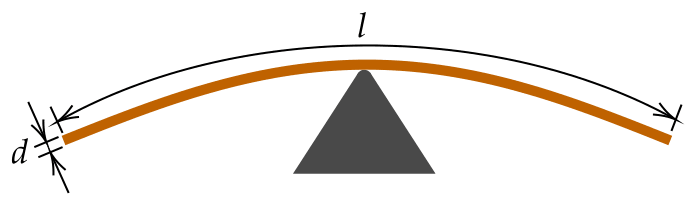
Part B. Sand castle (2.0 points)
B.1 2.0pt
The average grain volume of coarse-grained sand is 10 times as large as that of fine-grained sand. Wet fine-grained sand and wet coarse-grained sand have both optimal water content (i.e. assuming the maximal strength of the constructions from it) and are used to build two cylinders of exactly the same shape and size. The strength of each cylinder is tested by pressing it between two parallel plates. The cylinder made of coarse-grained sand gets destroyed once the force applied to press the plates reaches \(F_{\mathrm c} = 10\,\mathrm{N}\). How large is the force \(F_{\mathrm f}\) needed to destroy the cylinder made of fine-grained sand? You may ignore the effects of gravity.
Part C. Interstellar travel (2.0 points)
C.1 2.0pt
The spaceship of an interstellar expedition travels at a constant magnitude of the proper acceleration \(g = 10\,\mathrm{m/s^2}\), i.e., this is the acceleration of the spaceship in the inertial frame of reference where it is instantaneously at rest. The passengers must be able to return to Earth within their remaining expected lifetime of 50 years. The maximum distance from Earth reached by the spaceship is \(d\). If the acceleration is increased to \(g' = 15\,\mathrm{m/s^2}\), the spaceship can reach a farther distance \(d'\). What is the ratio \(d'/d\)?
Hint 1. You may wish to use the relativistic velocity addition formula, however, there are also other approaches.
Hint 2. You may need to deal with hyperbolic functions defined as follows: \[ \cosh x=\frac12(e^x+e^{-x}),\qquad \sinh x=\frac12(e^x-e^{-x}),\qquad \tanh x=\frac{e^x-e^{-x}}{e^x+e^{-x}}. \]
Hint 3. Depending on your approach, you may need one or more of these integrals: \[ \int\frac{\mathrm dx}{1-x^2}=\operatorname{atanh}x+C,\qquad \int\frac{\mathrm dx}{\sqrt{1+x^2}}=\operatorname{asinh}x+C,\qquad \int\sinh x\,\mathrm dx=\cosh x+C, \] where \(\operatorname{asinh}x\) and \(\operatorname{atanh}x\) are the inverse functions of the respective hyperbolic functions.
Part D. That sinking feeling (2.0 points)
D.1 2.0pt
A solid wooden ball of radius \(r_0\) is floating in the water. Ignoring frictional effects, the frequency of small oscillations would be \(\omega_0\), but because of viscous friction, after being displaced vertically, the frequency of decaying oscillations is actually \(0.99\,\omega_0\). What is the minimum radius \(r_{\min}\) of a wooden ball floating in water that undergos small oscillations when displaced? Hint: the viscous drag force acting on a given body is proportional to its speed relative to the bulk of the fluid, and to the viscosity \(\eta\) of the fluid it is moving in. The unit of the viscosity is \(\mathrm{kg/(m\cdot s)}\).
Official English text of the problem.
Answers
- A.1: \(\displaystyle l'=l\sqrt{\frac{d'}d}=0.50\sqrt{10}\,\mathrm m\approx1.6\,\mathrm m.\)
- B.1: \(\displaystyle F_{\mathrm f}=10^{1/3}F_{\mathrm c}=10^{4/3}\,\mathrm N\approx22\,\mathrm N.\)
- C.1: With \(T=50\,\mathrm{years}\) measured by the passengers, \[ \boxed{\frac{d'}d= \frac{g}{g'}\, \frac{\cosh\!\left(g'T/(4c)\right)-1} {\cosh\!\left(gT/(4c)\right)-1} \approx4.8\times10^2.} \]
- D.1: \(\displaystyle r_{\min}=(1-0.99^2)^{1/3}r_0\approx0.27r_0.\) This is the critical radius; oscillations require \(r>r_{\min}\).
Solution
A.1
Assume the spaghetti has the same density and breaking stress at both diameters, and use the slender-beam approximation. Its cross-sectional area scales as \(A\propto d^2\), so its weight per unit length is \[ q=\rho g_{\mathrm E}A\propto d^2, \] where \(g_{\mathrm E}\) is the gravitational acceleration.
Consider one half of the straw. Its weight is \(q l/2\), acting a distance \(l/4\) from the central support. Thus the largest bending moment, occurring at the middle, is \[ M_{\max}=\frac{ql}{2}\frac l4=\frac{ql^2}{8} \propto d^2l^2. \]
In beam bending, the maximum longitudinal stress is \[ \sigma_{\max}=\frac{M_{\max}(d/2)}{I}, \] where the second moment of area satisfies \(I\propto d^4\). Consequently, \[ \sigma_{\max}\propto\frac{l^2}{d}. \]
Breaking occurs at the same material stress, so \[ \frac{l'^2}{d'}=\frac{l^2}{d}, \qquad l'=l\sqrt{\frac{d'}d}. \] Since \(d'/d=10\), \[ \boxed{l'=0.50\sqrt{10}\,\mathrm m =1.581\ldots\,\mathrm m\approx1.6\,\mathrm m.} \]
B.1
Wet sand is held together by capillary forces from water bridges between grains. Let \(a\) be a characteristic grain size and \(\gamma\) the water surface tension. Assume similar grain shapes, packing and wetting properties. At optimal water content, the bridge geometry scales with \(a\).
The capillary force at a contact scales as \[ f_{\mathrm{cap}}\propto\gamma a. \] This follows either from surface tension acting along a contact line of length proportional to \(a\), or from a capillary pressure of order \(\gamma/a\) acting over an area of order \(a^2\).
The number of contacts transmitting force across a fixed macroscopic area \(S\) scales as \(S/a^2\). Hence the characteristic cohesive stress scales as \[ \sigma_{\mathrm{coh}} \propto \frac{f_{\mathrm{cap}}}{a^2} \propto\frac{\gamma}{a}. \] For cylinders of the same shape and size, the compressive failure load has the same scaling: \[ F_{\mathrm{break}}\propto\frac1a. \]
Because grain volume is proportional to \(a^3\), \[ \frac{a_{\mathrm c}}{a_{\mathrm f}} =\left(\frac{V_{\mathrm c}}{V_{\mathrm f}}\right)^{1/3} =10^{1/3}. \] Therefore, \[ \frac{F_{\mathrm f}}{F_{\mathrm c}} =\frac{a_{\mathrm c}}{a_{\mathrm f}} =10^{1/3}, \] giving \[ \boxed{F_{\mathrm f}=10\,10^{1/3}\,\mathrm N =21.54\ldots\,\mathrm N\approx22\,\mathrm N.} \]
C.1
Treat Earth as an inertial reference frame, neglect gravitational fields, and consider a straight-line journey starting and ending at rest relative to Earth. The available \(50\) years is the passengers’ proper time, denoted by \(T\). Acceleration reversals are idealized as instantaneous.
First derive the displacement under constant proper acceleration. Define the rapidity \[ \theta=\operatorname{atanh}(v/c). \] During a proper-time interval \(\mathrm d\tau\), the velocity change in the instantaneous rest frame is \(g\,\mathrm d\tau\). Relativistic velocity addition gives, to first order, \[ \mathrm dv =g\left(1-\frac{v^2}{c^2}\right)\mathrm d\tau, \] and therefore \[ \frac{\mathrm d\theta}{\mathrm d\tau}=\frac gc. \]
Starting from rest, \[ \theta=\frac{g\tau}{c}, \qquad v=c\tanh\theta, \qquad \frac{\mathrm dt}{\mathrm d\tau}=\cosh\theta. \] It follows that \[ \frac{\mathrm dx}{\mathrm d\tau} =v\frac{\mathrm dt}{\mathrm d\tau} =c\sinh\!\left(\frac{g\tau}{c}\right). \] Integrating, \[ x(\tau)=\frac{c^2}{g} \left[\cosh\!\left(\frac{g\tau}{c}\right)-1\right]. \]
To maximize the outward distance in a given proper time while starting and finishing the outward leg at rest, the ship accelerates outward for half that time and decelerates for the other half. Indeed, for an outward leg of proper duration \(L\), its rapidity cannot exceed \[ \theta(\tau)\leq\frac gc\min(\tau,L-\tau). \] The accelerate-then-decelerate trajectory attains this bound, maximizing the displacement because \(\mathrm dx/\mathrm d\tau=c\sinh\theta\) increases with \(\theta\).
The return journey over the same distance requires the same minimum proper time. Thus the optimal round trip consists of four equal intervals:
- Accelerate away from Earth.
- Decelerate to rest at the greatest distance.
- Accelerate toward Earth.
- Decelerate to rest at Earth.
Each interval lasts \(T/4=12.5\) years. The two outward intervals cover equal distances, so \[ d(g)=\frac{2c^2}{g} \left[\cosh\!\left(\frac{gT}{4c}\right)-1\right]. \] Hence \[ \boxed{\frac{d'}d= \frac{g}{g'}\, \frac{\cosh\!\left(g'T/(4c)\right)-1} {\cosh\!\left(gT/(4c)\right)-1}.} \]
Using \(c\simeq3.00\times10^8\,\mathrm{m/s}\) and \(1\,\mathrm{year}\simeq3.156\times10^7\,\mathrm s\), \[ \frac{gT}{4c}\simeq13.15, \qquad \frac{g'T}{4c}\simeq19.72. \] Both arguments are large, so \(\cosh x-1\simeq e^x/2\). Thus \[ \frac{d'}d \simeq\frac{g}{g'} \exp\!\left(\frac{(g'-g)T}{4c}\right) \simeq\frac23e^{6.575}. \] The result is \[ \boxed{\frac{d'}d\approx4.8\times10^2.} \]
D.1
Assume all balls are made of the same wood, buoyancy determines their equilibrium immersion, and the stated linear viscous-drag model applies.
For a small downward displacement \(z\), the additional submerged volume is \(A_{\mathrm w}z\), where \(A_{\mathrm w}\) is the area of the sphere’s cross-section at the water surface. The additional buoyancy provides a restoring force \[ F_{\mathrm{rest}}=-kz, \qquad k=\rho_{\mathrm w}g_{\mathrm E}A_{\mathrm w}. \]
The equilibrium submerged fraction is fixed by the wood-to-water density ratio. The floating configurations are therefore geometrically similar, giving \[ A_{\mathrm w}\propto r^2,\qquad k\propto r^2,\qquad m\propto r^3. \] The undamped angular frequency consequently satisfies \[ \Omega^2=\frac{k}{m}\propto r^{-1}. \]
Write the viscous force as \[ F_{\mathrm{visc}}=-b\dot z. \] Since it is proportional to viscosity and velocity, dimensional analysis for geometrically similar bodies gives \[ b=C\eta r\propto r, \] where \(C\) is a dimensionless geometric factor.
The equation of motion is \[ m\ddot z+b\dot z+kz=0. \] Define the damping rate \[ \beta=\frac{b}{2m}\propto r^{-2}. \] In the underdamped regime, the oscillation frequency is \[ \omega_{\mathrm d}=\sqrt{\Omega^2-\beta^2}. \]
At radius \(r_0\), the given frequencies imply \[ (0.99\,\omega_0)^2=\omega_0^2-\beta_0^2, \] so \[ \frac{\beta_0^2}{\omega_0^2} =1-0.99^2=0.0199. \]
Combining the radius scalings, \[ \frac{\beta^2(r)}{\Omega^2(r)} =0.0199\left(\frac{r_0}{r}\right)^3. \] Oscillations occur when this ratio is less than one. The critical radius therefore satisfies \[ 0.0199\left(\frac{r_0}{r_{\min}}\right)^3=1, \] which yields \[ \boxed{r_{\min}=(0.0199)^{1/3}r_0 =0.27099\ldots\,r_0\approx0.27r_0.} \]
At equality the motion is critically damped and does not oscillate. Thus \(r_{\min}\) is the limiting minimum radius, with oscillatory motion occurring for \(r>r_{\min}\).
The solution was checked against the official solution.
IPhO 2022 · Theorieaufgabe 3
Skalierungsgesetze
Skalierungsgesetze beschreiben den funktionalen Zusammenhang zwischen zwei physikalischen Größen, die über einen beträchtlichen Bereich miteinander skalieren. Dieser funktionale Zusammenhang kann ein Potenzgesetz sein, es gibt jedoch auch andere Möglichkeiten. Oft lassen sich keine exakten Ausdrücke bestimmen, aber dennoch Skalierungsgesetze herleiten.
Teil A. Spaghetto (2.0 Punkte)
A.1 2.0 Punkte
Ein Spaghetto mit dem Durchmesser \(d\) wird in seiner Mitte so unterstützt, dass er waagerecht im Gleichgewicht ist. Bei \(d = 1\,\mathrm{mm}\) bricht er unter seinem Eigengewicht, sobald seine Länge \(l = 50\,\mathrm{cm}\) erreicht. Wie groß ist die maximale Länge \(l'\) eines Spaghetto mit dem Durchmesser \(d' = 1\,\mathrm{cm}\), bevor er unter seinem Eigengewicht bricht?
Teil B. Sandburg (2.0 Punkte)
B.1 2.0 Punkte
Das mittlere Kornvolumen von grobkörnigem Sand ist 10-mal so groß wie das von feinkörnigem Sand. Feuchter feinkörniger Sand und feuchter grobkörniger Sand haben beide einen optimalen Wassergehalt (d. h., es wird die maximale Festigkeit der daraus errichteten Gebilde angenommen) und werden verwendet, um zwei Zylinder von genau gleicher Form und Größe zu bauen. Die Festigkeit jedes Zylinders wird geprüft, indem er zwischen zwei parallelen Platten zusammengedrückt wird. Der Zylinder aus grobkörnigem Sand wird zerstört, sobald die zum Zusammendrücken der Platten aufgebrachte Kraft \(F_{\mathrm c} = 10\,\mathrm{N}\) erreicht. Wie groß ist die Kraft \(F_{\mathrm f}\), die benötigt wird, um den Zylinder aus feinkörnigem Sand zu zerstören? Die Auswirkungen der Schwerkraft dürfen vernachlässigt werden.
Teil C. Interstellare Reise (2.0 Punkte)
C.1 2.0 Punkte
Das Raumschiff einer interstellaren Expedition bewegt sich mit einem konstanten Betrag der Eigenbeschleunigung \(g = 10\,\mathrm{m/s^2}\), d. h., dies ist die Beschleunigung des Raumschiffs in dem Inertialsystem, in dem es momentan ruht. Die Passagiere müssen innerhalb ihrer verbleibenden erwarteten Lebenszeit von 50 Jahren zur Erde zurückkehren können. Die maximale Entfernung von der Erde, die das Raumschiff erreicht, beträgt \(d\). Wird die Beschleunigung auf \(g' = 15\,\mathrm{m/s^2}\) erhöht, kann das Raumschiff eine größere Entfernung \(d'\) erreichen. Wie groß ist das Verhältnis \(d'/d\)?
Hinweis 1. Es kann hilfreich sein, das relativistische Geschwindigkeitsadditionstheorem zu verwenden; es gibt jedoch auch andere Ansätze.
Hinweis 2. Möglicherweise müssen Sie mit den folgenden Hyperbelfunktionen arbeiten: \[ \cosh x=\frac12(e^x+e^{-x}),\qquad \sinh x=\frac12(e^x-e^{-x}),\qquad \tanh x=\frac{e^x-e^{-x}}{e^x+e^{-x}}. \]
Hinweis 3. Je nach Ansatz benötigen Sie möglicherweise eines oder mehrere der folgenden Integrale: \[ \int\frac{\mathrm dx}{1-x^2}=\operatorname{atanh}x+C,\qquad \int\frac{\mathrm dx}{\sqrt{1+x^2}}=\operatorname{asinh}x+C,\qquad \int\sinh x\,\mathrm dx=\cosh x+C, \] wobei \(\operatorname{asinh}x\) und \(\operatorname{atanh}x\) die Umkehrfunktionen der jeweiligen Hyperbelfunktionen sind.
Teil D. Ein Gefühl des Versinkens (2.0 Punkte)
D.1 2.0 Punkte
Eine massive Holzkugel mit dem Radius \(r_0\) schwimmt im Wasser. Ohne Berücksichtigung von Reibungseffekten wäre die Frequenz kleiner Schwingungen \(\omega_0\), doch aufgrund der viskosen Reibung beträgt die Frequenz der abklingenden Schwingungen nach einer vertikalen Auslenkung tatsächlich \(0.99\,\omega_0\). Wie groß ist der minimale Radius \(r_{\min}\) einer im Wasser schwimmenden Holzkugel, die nach einer Auslenkung kleine Schwingungen ausführt? Hinweis: Die auf einen gegebenen Körper wirkende viskose Widerstandskraft ist proportional zu seiner Geschwindigkeit relativ zum umgebenden Fluid sowie zur Viskosität \(\eta\) des Fluids, in dem er sich bewegt. Die Einheit der Viskosität ist \(\mathrm{kg/(m\cdot s)}\).
Aufgabentext aus dem offiziellen englischen Text übersetzt.
Antworten
- A.1: \(\displaystyle l'=l\sqrt{\frac{d'}d}=0.50\sqrt{10}\,\mathrm m\approx1.6\,\mathrm m.\)
- B.1: \(\displaystyle F_{\mathrm f}=10^{1/3}F_{\mathrm c}=10^{4/3}\,\mathrm N\approx22\,\mathrm N.\)
- C.1: Mit der von den Passagieren gemessenen Zeit \(T=50\) Jahre, \[ \boxed{\frac{d'}d= \frac{g}{g'}\, \frac{\cosh\!\left(g'T/(4c)\right)-1} {\cosh\!\left(gT/(4c)\right)-1} \approx4.8\times10^2.} \]
- D.1: \(\displaystyle r_{\min}=(1-0.99^2)^{1/3}r_0\approx0.27r_0.\) Dies ist der kritische Radius; Schwingungen erfordern \(r>r_{\min}\).
Lösung
A.1
Wir nehmen an, dass die Spaghetti bei beiden Durchmessern dieselbe Dichte und Bruchspannung haben, und verwenden die Näherung eines schlanken Balkens. Die Querschnittsfläche skaliert gemäß \(A\propto d^2\), sodass die Gewichtskraft pro Längeneinheit \[ q=\rho g_{\mathrm E}A\propto d^2, \] beträgt, wobei \(g_{\mathrm E}\) die Erdbeschleunigung ist.
Betrachten wir eine Hälfte des Spaghetto. Ihre Gewichtskraft beträgt \(q l/2\) und greift im Abstand \(l/4\) von der mittigen Auflage an. Somit ist das größte Biegemoment, das in der Mitte auftritt, \[ M_{\max}=\frac{ql}{2}\frac l4=\frac{ql^2}{8} \propto d^2l^2. \]
Bei der Balkenbiegung beträgt die maximale Längsspannung \[ \sigma_{\max}=\frac{M_{\max}(d/2)}{I}, \] wobei für das Flächenträgheitsmoment \(I\propto d^4\) gilt. Folglich ist \[ \sigma_{\max}\propto\frac{l^2}{d}. \]
Der Bruch tritt bei derselben Materialspannung ein, also gilt \[ \frac{l'^2}{d'}=\frac{l^2}{d}, \qquad l'=l\sqrt{\frac{d'}d}. \] Da \(d'/d=10\), ergibt sich \[ \boxed{l'=0.50\sqrt{10}\,\mathrm m =1.581\ldots\,\mathrm m\approx1.6\,\mathrm m.} \]
B.1
Feuchter Sand wird durch Kapillarkräfte zusammengehalten, die von Wasserbrücken zwischen den Körnern ausgehen. Es sei \(a\) eine charakteristische Korngröße und \(\gamma\) die Oberflächenspannung des Wassers. Wir nehmen ähnliche Kornformen, Packungen und Benetzungseigenschaften an. Bei optimalem Wassergehalt skaliert die Geometrie der Wasserbrücken mit \(a\).
Die Kapillarkraft an einer Kontaktstelle skaliert gemäß \[ f_{\mathrm{cap}}\propto\gamma a. \] Dies folgt entweder aus der Oberflächenspannung, die entlang einer Kontaktlinie mit einer zu \(a\) proportionalen Länge wirkt, oder aus einem Kapillardruck der Größenordnung \(\gamma/a\), der auf eine Fläche der Größenordnung \(a^2\) wirkt.
Die Anzahl der Kontaktstellen, die Kraft durch eine feste makroskopische Fläche \(S\) übertragen, skaliert wie \(S/a^2\). Daher skaliert die charakteristische Kohäsionsspannung gemäß \[ \sigma_{\mathrm{coh}} \propto \frac{f_{\mathrm{cap}}}{a^2} \propto\frac{\gamma}{a}. \] Für Zylinder gleicher Form und Größe gilt dieselbe Skalierung für die Druckkraft, bei der sie versagen: \[ F_{\mathrm{break}}\propto\frac1a. \]
Da das Kornvolumen proportional zu \(a^3\) ist, gilt \[ \frac{a_{\mathrm c}}{a_{\mathrm f}} =\left(\frac{V_{\mathrm c}}{V_{\mathrm f}}\right)^{1/3} =10^{1/3}. \] Somit ist \[ \frac{F_{\mathrm f}}{F_{\mathrm c}} =\frac{a_{\mathrm c}}{a_{\mathrm f}} =10^{1/3}, \] woraus sich folgendes Ergebnis ergibt: \[ \boxed{F_{\mathrm f}=10\,10^{1/3}\,\mathrm N =21.54\ldots\,\mathrm N\approx22\,\mathrm N.} \]
C.1
Wir behandeln die Erde als Inertialsystem, vernachlässigen Gravitationsfelder und betrachten eine geradlinige Reise, die in Ruhe relativ zur Erde beginnt und endet. Die verfügbaren \(50\) Jahre sind die Eigenzeit der Passagiere, die wir mit \(T\) bezeichnen. Umkehrungen der Beschleunigungsrichtung werden idealisiert als augenblicklich angenommen.
Zunächst leiten wir die Ortsänderung bei konstanter Eigenbeschleunigung her. Wir definieren die Rapidität \[ \theta=\operatorname{atanh}(v/c). \] Während eines Eigenzeitintervalls \(\mathrm d\tau\) beträgt die Geschwindigkeitsänderung im momentanen Ruhesystem \(g\,\mathrm d\tau\). Das relativistische Geschwindigkeitsadditionstheorem ergibt in erster Ordnung \[ \mathrm dv =g\left(1-\frac{v^2}{c^2}\right)\mathrm d\tau, \] und daher \[ \frac{\mathrm d\theta}{\mathrm d\tau}=\frac gc. \]
Bei einem Start aus der Ruhe gilt \[ \theta=\frac{g\tau}{c}, \qquad v=c\tanh\theta, \qquad \frac{\mathrm dt}{\mathrm d\tau}=\cosh\theta. \] Daraus folgt \[ \frac{\mathrm dx}{\mathrm d\tau} =v\frac{\mathrm dt}{\mathrm d\tau} =c\sinh\!\left(\frac{g\tau}{c}\right). \] Integration ergibt \[ x(\tau)=\frac{c^2}{g} \left[\cosh\!\left(\frac{g\tau}{c}\right)-1\right]. \]
Um bei vorgegebener Eigenzeit die Entfernung auf der Hinreise zu maximieren, wobei das Schiff zu Beginn und am Ende der Hinreise ruht, beschleunigt es während der Hälfte dieser Zeit von der Erde weg und bremst während der anderen Hälfte ab. Tatsächlich kann seine Rapidität bei einer Hinreise mit der Eigenzeitdauer \(L\) die folgende Schranke nicht überschreiten: \[ \theta(\tau)\leq\frac gc\min(\tau,L-\tau). \] Die Bahn mit zunächst beschleunigter und anschließend abgebremster Bewegung erreicht diese Schranke und maximiert die Ortsänderung, da \(\mathrm dx/\mathrm d\tau=c\sinh\theta\) mit \(\theta\) zunimmt.
Die Rückreise über dieselbe Entfernung erfordert dieselbe minimale Eigenzeit. Somit besteht die optimale Hin- und Rückreise aus vier gleich langen Zeitintervallen:
- Von der Erde weg beschleunigen.
- Bis zum Stillstand in der größten Entfernung abbremsen.
- Zur Erde hin beschleunigen.
- Bis zum Stillstand an der Erde abbremsen.
Jedes Intervall dauert \(T/4=12.5\) Jahre. In den beiden Intervallen der Hinreise werden gleiche Strecken zurückgelegt, also gilt \[ d(g)=\frac{2c^2}{g} \left[\cosh\!\left(\frac{gT}{4c}\right)-1\right]. \] Daher ist \[ \boxed{\frac{d'}d= \frac{g}{g'}\, \frac{\cosh\!\left(g'T/(4c)\right)-1} {\cosh\!\left(gT/(4c)\right)-1}.} \]
Mit \(c\simeq3.00\times10^8\,\mathrm{m/s}\) und 1 Jahr \(\simeq3.156\times10^7\,\mathrm s\) erhalten wir \[ \frac{gT}{4c}\simeq13.15, \qquad \frac{g'T}{4c}\simeq19.72. \] Beide Argumente sind groß, sodass \(\cosh x-1\simeq e^x/2\) gilt. Somit ist \[ \frac{d'}d \simeq\frac{g}{g'} \exp\!\left(\frac{(g'-g)T}{4c}\right) \simeq\frac23e^{6.575}. \] Das Ergebnis lautet \[ \boxed{\frac{d'}d\approx4.8\times10^2.} \]
D.1
Wir nehmen an, dass alle Kugeln aus demselben Holz bestehen, dass der Auftrieb ihre Eintauchtiefe im Gleichgewicht bestimmt und dass das angegebene Modell einer linearen viskosen Widerstandskraft gilt.
Bei einer kleinen Auslenkung \(z\) nach unten beträgt das zusätzlich eingetauchte Volumen \(A_{\mathrm w}z\), wobei \(A_{\mathrm w}\) die Querschnittsfläche der Kugel auf Höhe der Wasseroberfläche ist. Der zusätzliche Auftrieb liefert eine rücktreibende Kraft \[ F_{\mathrm{rest}}=-kz, \qquad k=\rho_{\mathrm w}g_{\mathrm E}A_{\mathrm w}. \]
Der im Gleichgewicht eingetauchte Volumenanteil ist durch das Verhältnis der Dichte des Holzes zur Dichte des Wassers festgelegt. Die Schwimmlagen sind daher geometrisch ähnlich, sodass gilt: \[ A_{\mathrm w}\propto r^2,\qquad k\propto r^2,\qquad m\propto r^3. \] Für die ungedämpfte Kreisfrequenz folgt somit \[ \Omega^2=\frac{k}{m}\propto r^{-1}. \]
Wir schreiben die viskose Kraft als \[ F_{\mathrm{visc}}=-b\dot z. \] Da sie proportional zur Viskosität und zur Geschwindigkeit ist, ergibt die Dimensionsanalyse für geometrisch ähnliche Körper \[ b=C\eta r\propto r, \] wobei \(C\) ein dimensionsloser geometrischer Faktor ist.
Die Bewegungsgleichung lautet \[ m\ddot z+b\dot z+kz=0. \] Wir definieren die Abklingkonstante \[ \beta=\frac{b}{2m}\propto r^{-2}. \] Im unterkritisch gedämpften Fall beträgt die Schwingungsfrequenz \[ \omega_{\mathrm d}=\sqrt{\Omega^2-\beta^2}. \]
Für den Radius \(r_0\) folgt aus den gegebenen Frequenzen \[ (0.99\,\omega_0)^2=\omega_0^2-\beta_0^2, \] also \[ \frac{\beta_0^2}{\omega_0^2} =1-0.99^2=0.0199. \]
Durch Kombination der Skalierungen mit dem Radius erhalten wir \[ \frac{\beta^2(r)}{\Omega^2(r)} =0.0199\left(\frac{r_0}{r}\right)^3. \] Schwingungen treten auf, wenn dieses Verhältnis kleiner als eins ist. Der kritische Radius erfüllt daher \[ 0.0199\left(\frac{r_0}{r_{\min}}\right)^3=1, \] woraus sich folgendes Ergebnis ergibt: \[ \boxed{r_{\min}=(0.0199)^{1/3}r_0 =0.27099\ldots\,r_0\approx0.27r_0.} \]
Bei Gleichheit ist die Bewegung kritisch gedämpft und schwingt nicht. Somit ist \(r_{\min}\) der untere Grenzwert des Radius; eine Schwingungsbewegung tritt für \(r>r_{\min}\) auf.
Die Lösung wurde mit der offiziellen Lösung abgeglichen.
IPhO 2022 · Teori sorusu 3
Ölçekleme yasaları
Ölçekleme yasaları, geniş bir aralıkta birbiriyle ölçeklenen iki fiziksel nicelik arasındaki fonksiyonel ilişkiyi tanımlar. Bu fonksiyonel ilişki bir kuvvet yasası olabilir, ancak başka olasılıklar da vardır. Çoğu zaman kesin ifadeler elde edilemese de ölçekleme yasaları yine de türetilebilir.
Bölüm A. Spagetti çubuğu (2.0 puan)
A.1 2.0 puan
Çapı \(d\) olan bir spagetti çubuğu, ortasından desteklenerek yatay dengede tutulmaktadır. \(d = 1\,\mathrm{mm}\) olduğunda çubuk, uzunluğu \(l = 50\,\mathrm{cm}\) değerine ulaştığında kendi ağırlığı altında kırılır. Çapı \(d' = 1\,\mathrm{cm}\) olan çubuğun kendi ağırlığı altında kırılmadan ulaşabileceği en büyük uzunluk \(l'\) nedir?
Bölüm B. Kumdan kale (2.0 puan)
B.1 2.0 puan
İri taneli kumun ortalama tane hacmi, ince taneli kumunkinin 10 katıdır. Islak ince taneli kum ve ıslak iri taneli kumun her ikisi de en uygun su içeriğine sahiptir (yani bunlardan yapılan yapıların en yüksek dayanıma sahip olduğu varsayılmaktadır) ve bunlar, şekilleri ve boyutları tamamen aynı iki silindir yapmak için kullanılır. Her bir silindirin dayanımı, iki paralel plaka arasında sıkıştırılarak sınanır. İri taneli kumdan yapılan silindir, plakaları birbirine bastırmak için uygulanan kuvvet \(F_{\mathrm c} = 10\,\mathrm{N}\) değerine ulaştığında parçalanır. İnce taneli kumdan yapılan silindiri parçalamak için gereken \(F_{\mathrm f}\) kuvveti ne kadardır? Yer çekiminin etkilerini ihmal edebilirsiniz.
Bölüm C. Yıldızlararası yolculuk (2.0 puan)
C.1 2.0 puan
Yıldızlararası bir keşif seferinin uzay gemisi, büyüklüğü sabit ve \(g = 10\,\mathrm{m/s^2}\) olan bir öz ivmeyle yol almaktadır; yani bu, uzay gemisinin anlık olarak durgun olduğu eylemsiz referans sistemindeki ivmesidir. Yolcular, beklenen kalan ömürleri olan 50 yıl içinde Dünya'ya dönebilmelidir. Uzay gemisinin Dünya'dan ulaşabildiği en büyük uzaklık \(d\)'dir. İvme \(g' = 15\,\mathrm{m/s^2}\) değerine çıkarılırsa uzay gemisi daha büyük bir \(d'\) uzaklığına ulaşabilir. \(d'/d\) oranı nedir?
İpucu 1. Göreli hız toplama formülünü kullanmak isteyebilirsiniz; ancak başka yaklaşımlar da vardır.
İpucu 2. Aşağıdaki gibi tanımlanan hiperbolik fonksiyonlarla işlem yapmanız gerekebilir: \[ \cosh x=\frac12(e^x+e^{-x}),\qquad \sinh x=\frac12(e^x-e^{-x}),\qquad \tanh x=\frac{e^x-e^{-x}}{e^x+e^{-x}}. \]
İpucu 3. Yaklaşımınıza bağlı olarak aşağıdaki integrallerden birine veya birkaçına ihtiyaç duyabilirsiniz: \[ \int\frac{\mathrm dx}{1-x^2}=\operatorname{atanh}x+C,\qquad \int\frac{\mathrm dx}{\sqrt{1+x^2}}=\operatorname{asinh}x+C,\qquad \int\sinh x\,\mathrm dx=\cosh x+C, \] burada \(\operatorname{asinh}x\) ve \(\operatorname{atanh}x\), ilgili hiperbolik fonksiyonların ters fonksiyonlarıdır.
Bölüm D. Batma hissi (2.0 puan)
D.1 2.0 puan
Yarıçapı \(r_0\) olan içi dolu bir tahta küre suda yüzmektedir. Sürtünme etkileri ihmal edilseydi küçük salınımların frekansı \(\omega_0\) olurdu; ancak viskoz sürtünme nedeniyle, düşey doğrultuda yerinden uzaklaştırıldıktan sonra yaptığı sönümlü salınımların frekansı gerçekte \(0.99\,\omega_0\)'dır. Suda yüzen ve denge konumundan uzaklaştırıldığında küçük salınımlar yapan bir tahta kürenin en küçük yarıçapı \(r_{\min}\) nedir? İpucu: Belirli bir cisme etki eden viskoz sürükleme kuvveti, cismin akışkanın ana kütlesine göre süratiyle ve içinde hareket ettiği akışkanın \(\eta\) viskozitesiyle orantılıdır. Viskozitenin birimi \(\mathrm{kg/(m\cdot s)}\)'dir.
Soru metni resmi İngilizce metinden çevrilmiştir.
Cevaplar
- A.1: \(\displaystyle l'=l\sqrt{\frac{d'}d}=0.50\sqrt{10}\,\mathrm m\approx1.6\,\mathrm m.\)
- B.1: \(\displaystyle F_{\mathrm f}=10^{1/3}F_{\mathrm c}=10^{4/3}\,\mathrm N\approx22\,\mathrm N.\)
- C.1: Yolcuların ölçtüğü süre \(T=50\) yıl olmak üzere, \[ \boxed{\frac{d'}d= \frac{g}{g'}\, \frac{\cosh\!\left(g'T/(4c)\right)-1} {\cosh\!\left(gT/(4c)\right)-1} \approx4.8\times10^2.} \]
- D.1: \(\displaystyle r_{\min}=(1-0.99^2)^{1/3}r_0\approx0.27r_0.\) Bu kritik yarıçaptır; salınım için \(r>r_{\min}\) gerekir.
Çözüm
A.1
Spagettinin her iki çapta da aynı yoğunluğa ve kırılma gerilmesine sahip olduğunu varsayalım ve ince kiriş yaklaşımını kullanalım. Kesit alanı \(A\propto d^2\) şeklinde ölçeklendiğinden, birim uzunluk başına ağırlığı \[ q=\rho g_{\mathrm E}A\propto d^2, \] olur; burada \(g_{\mathrm E}\) yer çekimi ivmesidir.
Çubuğun bir yarısını ele alalım. Ağırlığı \(q l/2\) olup ortadaki destekten \(l/4\) uzaklıkta etki eder. Dolayısıyla ortada oluşan en büyük eğilme momenti \[ M_{\max}=\frac{ql}{2}\frac l4=\frac{ql^2}{8} \propto d^2l^2 \] olur.
Kiriş eğilmesinde en büyük boyuna gerilme \[ \sigma_{\max}=\frac{M_{\max}(d/2)}{I}, \] ile verilir; burada alanın ikinci momenti \(I\propto d^4\) bağıntısını sağlar. Sonuç olarak, \[ \sigma_{\max}\propto\frac{l^2}{d}. \]
Kırılma, malzemede aynı gerilme değerinde gerçekleştiğinden, \[ \frac{l'^2}{d'}=\frac{l^2}{d}, \qquad l'=l\sqrt{\frac{d'}d}. \] \(d'/d=10\) olduğundan, \[ \boxed{l'=0.50\sqrt{10}\,\mathrm m =1.581\ldots\,\mathrm m\approx1.6\,\mathrm m.} \]
B.1
Islak kum, taneler arasındaki su köprülerinden kaynaklanan kılcal kuvvetlerle bir arada tutulur. \(a\) karakteristik tane boyutu, \(\gamma\) ise suyun yüzey gerilimi olsun. Tanelerin şekillerinin, paketlenme düzenlerinin ve ıslanma özelliklerinin benzer olduğunu varsayalım. En uygun su içeriğinde köprü geometrisi \(a\) ile ölçeklenir.
Bir temas noktasındaki kılcal kuvvet \[ f_{\mathrm{cap}}\propto\gamma a \] şeklinde ölçeklenir. Bu sonuç, ya uzunluğu \(a\) ile orantılı bir temas çizgisi boyunca etki eden yüzey geriliminden ya da \(a^2\) mertebesinde bir alana etki eden \(\gamma/a\) mertebesindeki kılcal basınçtan elde edilir.
Sabit bir makroskopik \(S\) alanı boyunca kuvvet ileten temasların sayısı \(S/a^2\) ile ölçeklenir. Dolayısıyla karakteristik kohezyon gerilmesi \[ \sigma_{\mathrm{coh}} \propto \frac{f_{\mathrm{cap}}}{a^2} \propto\frac{\gamma}{a} \] şeklinde ölçeklenir. Aynı şekil ve boyuttaki silindirler için basınç altında parçalanmaya yol açan yük de aynı şekilde ölçeklenir: \[ F_{\mathrm{break}}\propto\frac1a. \]
Tane hacmi \(a^3\) ile orantılı olduğundan, \[ \frac{a_{\mathrm c}}{a_{\mathrm f}} =\left(\frac{V_{\mathrm c}}{V_{\mathrm f}}\right)^{1/3} =10^{1/3}. \] Bu nedenle, \[ \frac{F_{\mathrm f}}{F_{\mathrm c}} =\frac{a_{\mathrm c}}{a_{\mathrm f}} =10^{1/3}, \] ve buradan \[ \boxed{F_{\mathrm f}=10\,10^{1/3}\,\mathrm N =21.54\ldots\,\mathrm N\approx22\,\mathrm N.} \] elde edilir.
C.1
Dünya'yı eylemsiz bir referans sistemi olarak alalım, kütle çekim alanlarını ihmal edelim ve Dünya'ya göre durgun hâlde başlayıp durgun hâlde biten doğrusal bir yolculuğu ele alalım. Kullanılabilecek \(50\) yıl, yolcuların öz zamanı olup \(T\) ile gösterilir. İvmenin yön değiştirmeleri anlık kabul edilerek idealleştirilir.
Önce sabit öz ivme altındaki yer değiştirmeyi türetelim. Rapiditeyi \[ \theta=\operatorname{atanh}(v/c) \] olarak tanımlayalım. Bir \(\mathrm d\tau\) öz zaman aralığında, anlık durgunluk sistemindeki hız değişimi \(g\,\mathrm d\tau\)'dur. Göreli hız toplama bağıntısı, birinci mertebede, \[ \mathrm dv =g\left(1-\frac{v^2}{c^2}\right)\mathrm d\tau, \] ve dolayısıyla \[ \frac{\mathrm d\theta}{\mathrm d\tau}=\frac gc \] sonucunu verir.
Durgun hâlden başlandığında, \[ \theta=\frac{g\tau}{c}, \qquad v=c\tanh\theta, \qquad \frac{\mathrm dt}{\mathrm d\tau}=\cosh\theta. \] Buradan \[ \frac{\mathrm dx}{\mathrm d\tau} =v\frac{\mathrm dt}{\mathrm d\tau} =c\sinh\!\left(\frac{g\tau}{c}\right) \] elde edilir. İntegral alındığında, \[ x(\tau)=\frac{c^2}{g} \left[\cosh\!\left(\frac{g\tau}{c}\right)-1\right]. \]
Gidiş etabına durgun hâlde başlayıp bu etabı durgun hâlde bitirirken, verilen bir öz zamanda ulaşılan uzaklığı en büyük yapmak için gemi bu sürenin yarısı boyunca Dünya'dan uzaklaşarak hızlanır, diğer yarısı boyunca yavaşlar. Gerçekten de öz zaman cinsinden süresi \(L\) olan bir gidiş etabında rapiditesi şu sınırı aşamaz: \[ \theta(\tau)\leq\frac gc\min(\tau,L-\tau). \] Önce hızlanıp sonra yavaşlanan yörünge bu sınıra ulaşır ve \(\mathrm dx/\mathrm d\tau=c\sinh\theta\), \(\theta\) ile arttığından yer değiştirmeyi en büyük yapar.
Aynı uzaklığın kat edildiği dönüş yolculuğu da aynı minimum öz zamanı gerektirir. Dolayısıyla en uygun gidiş-dönüş yolculuğu dört eşit zaman aralığından oluşur:
- Dünya'dan uzaklaşarak hızlanma.
- En büyük uzaklıkta durgun hâle gelene kadar yavaşlama.
- Dünya'ya doğru hızlanma.
- Dünya'da durgun hâle gelene kadar yavaşlama.
Her bir aralık \(T/4=12.5\) yıl sürer. Gidişteki iki aralıkta eşit uzaklıklar kat edildiğinden, \[ d(g)=\frac{2c^2}{g} \left[\cosh\!\left(\frac{gT}{4c}\right)-1\right]. \] Böylece \[ \boxed{\frac{d'}d= \frac{g}{g'}\, \frac{\cosh\!\left(g'T/(4c)\right)-1} {\cosh\!\left(gT/(4c)\right)-1}.} \]
\(c\simeq3.00\times10^8\,\mathrm{m/s}\) ve 1 yıl \(\simeq3.156\times10^7\,\mathrm s\) kullanıldığında, \[ \frac{gT}{4c}\simeq13.15, \qquad \frac{g'T}{4c}\simeq19.72. \] Her iki argüman da büyük olduğundan \(\cosh x-1\simeq e^x/2\) olur. Dolayısıyla \[ \frac{d'}d \simeq\frac{g}{g'} \exp\!\left(\frac{(g'-g)T}{4c}\right) \simeq\frac23e^{6.575}. \] Sonuç \[ \boxed{\frac{d'}d\approx4.8\times10^2.} \] olur.
D.1
Tüm kürelerin aynı tahtadan yapıldığını, denge durumundaki batma miktarlarını kaldırma kuvvetinin belirlediğini ve belirtilen doğrusal viskoz sürükleme modelinin geçerli olduğunu varsayalım.
Aşağı yöndeki küçük bir \(z\) yer değiştirmesi için suya batan ek hacim \(A_{\mathrm w}z\)'dir; burada \(A_{\mathrm w}\), kürenin su yüzeyindeki kesit alanıdır. Ek kaldırma kuvveti, bir geri çağırıcı kuvvet sağlar: \[ F_{\mathrm{rest}}=-kz, \qquad k=\rho_{\mathrm w}g_{\mathrm E}A_{\mathrm w}. \]
Dengede suya batan hacim oranı, tahtanın yoğunluğunun suyun yoğunluğuna oranıyla belirlenir. Bu nedenle yüzme durumları geometrik olarak benzerdir ve \[ A_{\mathrm w}\propto r^2,\qquad k\propto r^2,\qquad m\propto r^3 \] bağıntıları elde edilir. Dolayısıyla sönümsüz açısal frekans \[ \Omega^2=\frac{k}{m}\propto r^{-1} \] bağıntısını sağlar.
Viskoz kuvveti \[ F_{\mathrm{visc}}=-b\dot z \] olarak yazalım. Viskozite ve hızla orantılı olduğundan, geometrik olarak benzer cisimler için boyut analizi \[ b=C\eta r\propto r, \] sonucunu verir; burada \(C\) boyutsuz bir geometrik katsayıdır.
Hareket denklemi \[ m\ddot z+b\dot z+kz=0 \] olur. Sönüm hızını \[ \beta=\frac{b}{2m}\propto r^{-2} \] olarak tanımlayalım. Az sönümlü rejimde salınım frekansı \[ \omega_{\mathrm d}=\sqrt{\Omega^2-\beta^2} \] olur.
\(r_0\) yarıçapında, verilen frekanslardan \[ (0.99\,\omega_0)^2=\omega_0^2-\beta_0^2, \] dolayısıyla \[ \frac{\beta_0^2}{\omega_0^2} =1-0.99^2=0.0199 \] elde edilir.
Yarıçapa bağlı ölçekleme bağıntıları birleştirildiğinde, \[ \frac{\beta^2(r)}{\Omega^2(r)} =0.0199\left(\frac{r_0}{r}\right)^3. \] Bu oran birden küçük olduğunda salınım gerçekleşir. Bu nedenle kritik yarıçap \[ 0.0199\left(\frac{r_0}{r_{\min}}\right)^3=1, \] bağıntısını sağlar ve buradan \[ \boxed{r_{\min}=(0.0199)^{1/3}r_0 =0.27099\ldots\,r_0\approx0.27r_0.} \] elde edilir.
Eşitlik durumunda hareket kritik sönümlüdür ve salınım yapmaz. Dolayısıyla \(r_{\min}\), en küçük yarıçapın sınır değeridir; salınımlı hareket \(r>r_{\min}\) için gerçekleşir.
Çözüm, resmi çözümle karşılaştırılarak kontrol edildi.
IPhO 2022 · Problema teórico 3
Leyes de escala
Las leyes de escala describen la relación funcional entre dos magnitudes físicas que varían conjuntamente a lo largo de un intervalo considerable. Esta relación funcional puede ser una ley de potencias, pero también hay otras posibilidades. A menudo no es posible obtener expresiones exactas, pero aun así pueden deducirse leyes de escala.
Parte A. Espagueti (2.0 puntos)
A.1 2.0 puntos
Un espagueti de diámetro \(d\) se mantiene en equilibrio horizontal apoyado en su punto medio. Si \(d = 1\,\mathrm{mm}\), el espagueti se rompe por su propio peso cuando su longitud alcanza \(l = 50\,\mathrm{cm}\). ¿Cuál es la longitud máxima \(l'\) del espagueti de diámetro \(d' = 1\,\mathrm{cm}\) antes de romperse por su propio peso?
Parte B. Castillo de arena (2.0 puntos)
B.1 2.0 puntos
El volumen medio de los granos de una arena de grano grueso es 10 veces el de los granos de una arena de grano fino. Tanto la arena húmeda de grano fino como la de grano grueso tienen un contenido óptimo de agua (es decir, se supone que las construcciones hechas con ellas tienen la máxima resistencia) y se utilizan para construir dos cilindros de exactamente la misma forma y tamaño. La resistencia de cada cilindro se comprueba comprimiéndolo entre dos placas paralelas. El cilindro de arena de grano grueso se destruye cuando la fuerza aplicada para comprimir las placas alcanza \(F_{\mathrm c} = 10\,\mathrm{N}\). ¿Qué valor tiene la fuerza \(F_{\mathrm f}\) necesaria para destruir el cilindro de arena de grano fino? Puede despreciar los efectos de la gravedad.
Parte C. Viaje interestelar (2.0 puntos)
C.1 2.0 puntos
La nave espacial de una expedición interestelar viaja con una aceleración propia de módulo constante \(g = 10\,\mathrm{m/s^2}\), es decir, esta es la aceleración de la nave en el sistema de referencia inercial en el que se encuentra instantáneamente en reposo. Los pasajeros deben poder regresar a la Tierra dentro de los 50 años que les quedan de esperanza de vida. La distancia máxima a la Tierra que alcanza la nave es \(d\). Si la aceleración aumenta a \(g' = 15\,\mathrm{m/s^2}\), la nave puede alcanzar una distancia mayor \(d'\). ¿Cuál es la razón \(d'/d\)?
Pista 1. Puede resultar útil emplear la fórmula relativista de adición de velocidades, aunque también existen otros métodos.
Pista 2. Puede que necesite utilizar las funciones hiperbólicas definidas de la siguiente manera: \[ \cosh x=\frac12(e^x+e^{-x}),\qquad \sinh x=\frac12(e^x-e^{-x}),\qquad \tanh x=\frac{e^x-e^{-x}}{e^x+e^{-x}}. \]
Pista 3. Según el método que utilice, puede que necesite una o varias de estas integrales: \[ \int\frac{\mathrm dx}{1-x^2}=\operatorname{atanh}x+C,\qquad \int\frac{\mathrm dx}{\sqrt{1+x^2}}=\operatorname{asinh}x+C,\qquad \int\sinh x\,\mathrm dx=\cosh x+C, \] donde \(\operatorname{asinh}x\) y \(\operatorname{atanh}x\) son las funciones inversas de las respectivas funciones hiperbólicas.
Parte D. Esa sensación de hundirse (2.0 puntos)
D.1 2.0 puntos
Una esfera maciza de madera de radio \(r_0\) flota en el agua. Si se despreciaran los efectos del rozamiento, la frecuencia de las pequeñas oscilaciones sería \(\omega_0\), pero, debido al rozamiento viscoso, tras desplazarla verticalmente, la frecuencia de las oscilaciones amortiguadas es en realidad \(0.99\,\omega_0\). ¿Cuál es el radio mínimo \(r_{\min}\) de una esfera de madera que flota en el agua y experimenta pequeñas oscilaciones al desplazarla? Pista: la fuerza de resistencia viscosa que actúa sobre un cuerpo dado es proporcional a su velocidad respecto al conjunto del fluido y a la viscosidad \(\eta\) del fluido en el que se mueve. La unidad de viscosidad es \(\mathrm{kg/(m\cdot s)}\).
Enunciado traducido del texto oficial en inglés.
Respuestas
- A.1: \(\displaystyle l'=l\sqrt{\frac{d'}d}=0.50\sqrt{10}\,\mathrm m\approx1.6\,\mathrm m.\)
- B.1: \(\displaystyle F_{\mathrm f}=10^{1/3}F_{\mathrm c}=10^{4/3}\,\mathrm N\approx22\,\mathrm N.\)
- C.1: Con \(T=50\) años medidos por los pasajeros, \[ \boxed{\frac{d'}d= \frac{g}{g'}\, \frac{\cosh\!\left(g'T/(4c)\right)-1} {\cosh\!\left(gT/(4c)\right)-1} \approx4.8\times10^2.} \]
- D.1: \(\displaystyle r_{\min}=(1-0.99^2)^{1/3}r_0\approx0.27r_0.\) Este es el radio crítico; para que haya oscilaciones se requiere \(r>r_{\min}\).
Solución
A.1
Supongamos que el espagueti tiene la misma densidad y tensión de rotura para ambos diámetros, y utilicemos la aproximación de viga esbelta. El área de su sección transversal varía según \(A\propto d^2\), por lo que su peso por unidad de longitud es \[ q=\rho g_{\mathrm E}A\propto d^2, \] donde \(g_{\mathrm E}\) es la aceleración gravitatoria.
Consideremos una mitad del espagueti. Su peso es \(q l/2\) y actúa a una distancia \(l/4\) del apoyo central. Por tanto, el momento flector máximo, que se produce en el punto medio, es \[ M_{\max}=\frac{ql}{2}\frac l4=\frac{ql^2}{8} \propto d^2l^2. \]
En la flexión de una viga, la tensión longitudinal máxima es \[ \sigma_{\max}=\frac{M_{\max}(d/2)}{I}, \] donde el segundo momento de área satisface \(I\propto d^4\). En consecuencia, \[ \sigma_{\max}\propto\frac{l^2}{d}. \]
La rotura se produce con la misma tensión en el material, de modo que \[ \frac{l'^2}{d'}=\frac{l^2}{d}, \qquad l'=l\sqrt{\frac{d'}d}. \] Como \(d'/d=10\), \[ \boxed{l'=0.50\sqrt{10}\,\mathrm m =1.581\ldots\,\mathrm m\approx1.6\,\mathrm m.} \]
B.1
La arena húmeda se mantiene cohesionada por las fuerzas capilares de los puentes de agua entre los granos. Sean \(a\) un tamaño característico del grano y \(\gamma\) la tensión superficial del agua. Supongamos que las formas de los granos, su empaquetamiento y sus propiedades de humectación son similares. Con el contenido óptimo de agua, la geometría de los puentes varía proporcionalmente a \(a\).
La fuerza capilar en un contacto varía según \[ f_{\mathrm{cap}}\propto\gamma a. \] Esto se deduce tanto de la tensión superficial que actúa a lo largo de una línea de contacto de longitud proporcional a \(a\), como de una presión capilar del orden de \(\gamma/a\) que actúa sobre un área del orden de \(a^2\).
El número de contactos que transmiten fuerza a través de un área macroscópica fija \(S\) varía según \(S/a^2\). Por tanto, la tensión cohesiva característica varía según \[ \sigma_{\mathrm{coh}} \propto \frac{f_{\mathrm{cap}}}{a^2} \propto\frac{\gamma}{a}. \] Para cilindros de la misma forma y tamaño, la carga de rotura por compresión sigue la misma ley de escala: \[ F_{\mathrm{break}}\propto\frac1a. \]
Como el volumen de los granos es proporcional a \(a^3\), \[ \frac{a_{\mathrm c}}{a_{\mathrm f}} =\left(\frac{V_{\mathrm c}}{V_{\mathrm f}}\right)^{1/3} =10^{1/3}. \] Por tanto, \[ \frac{F_{\mathrm f}}{F_{\mathrm c}} =\frac{a_{\mathrm c}}{a_{\mathrm f}} =10^{1/3}, \] lo que da \[ \boxed{F_{\mathrm f}=10\,10^{1/3}\,\mathrm N =21.54\ldots\,\mathrm N\approx22\,\mathrm N.} \]
C.1
Tratemos la Tierra como un sistema de referencia inercial, despreciemos los campos gravitatorios y consideremos un viaje rectilíneo que comienza y termina en reposo respecto a la Tierra. Los \(50\) años disponibles corresponden al tiempo propio de los pasajeros, que denotamos por \(T\). Los cambios de sentido de la aceleración se idealizan como instantáneos.
Deducimos primero el desplazamiento con aceleración propia constante. Definimos la rapidez hiperbólica \[ \theta=\operatorname{atanh}(v/c). \] Durante un intervalo de tiempo propio \(\mathrm d\tau\), el cambio de velocidad en el sistema de referencia de reposo instantáneo es \(g\,\mathrm d\tau\). La adición relativista de velocidades da, a primer orden, \[ \mathrm dv =g\left(1-\frac{v^2}{c^2}\right)\mathrm d\tau, \] y, por tanto, \[ \frac{\mathrm d\theta}{\mathrm d\tau}=\frac gc. \]
Partiendo del reposo, \[ \theta=\frac{g\tau}{c}, \qquad v=c\tanh\theta, \qquad \frac{\mathrm dt}{\mathrm d\tau}=\cosh\theta. \] Se deduce que \[ \frac{\mathrm dx}{\mathrm d\tau} =v\frac{\mathrm dt}{\mathrm d\tau} =c\sinh\!\left(\frac{g\tau}{c}\right). \] Integrando, \[ x(\tau)=\frac{c^2}{g} \left[\cosh\!\left(\frac{g\tau}{c}\right)-1\right]. \]
Para maximizar la distancia de ida en un tiempo propio dado, comenzando y terminando el trayecto de ida en reposo, la nave acelera alejándose de la Tierra durante la mitad de ese tiempo y desacelera durante la otra mitad. En efecto, para un trayecto de ida de duración propia \(L\), su rapidez hiperbólica no puede superar \[ \theta(\tau)\leq\frac gc\min(\tau,L-\tau). \] La trayectoria de aceleración seguida de desaceleración alcanza esta cota y maximiza el desplazamiento, porque \(\mathrm dx/\mathrm d\tau=c\sinh\theta\) aumenta con \(\theta\).
El viaje de regreso sobre la misma distancia requiere el mismo tiempo propio mínimo. Por ello, el viaje óptimo de ida y vuelta consta de cuatro intervalos iguales:
- Acelerar alejándose de la Tierra.
- Desacelerar hasta quedar en reposo a la distancia máxima.
- Acelerar hacia la Tierra.
- Desacelerar hasta quedar en reposo en la Tierra.
Cada intervalo dura \(T/4=12.5\) años. Los dos intervalos de ida cubren distancias iguales, de modo que \[ d(g)=\frac{2c^2}{g} \left[\cosh\!\left(\frac{gT}{4c}\right)-1\right]. \] Por tanto, \[ \boxed{\frac{d'}d= \frac{g}{g'}\, \frac{\cosh\!\left(g'T/(4c)\right)-1} {\cosh\!\left(gT/(4c)\right)-1}.} \]
Utilizando \(c\simeq3.00\times10^8\,\mathrm{m/s}\) y 1 año \(\simeq3.156\times10^7\,\mathrm s\), \[ \frac{gT}{4c}\simeq13.15, \qquad \frac{g'T}{4c}\simeq19.72. \] Ambos argumentos son grandes, por lo que \(\cosh x-1\simeq e^x/2\). Así, \[ \frac{d'}d \simeq\frac{g}{g'} \exp\!\left(\frac{(g'-g)T}{4c}\right) \simeq\frac23e^{6.575}. \] El resultado es \[ \boxed{\frac{d'}d\approx4.8\times10^2.} \]
D.1
Supongamos que todas las esferas están hechas de la misma madera, que el empuje determina su inmersión de equilibrio y que es aplicable el modelo de resistencia viscosa lineal indicado.
Para un pequeño desplazamiento hacia abajo \(z\), el volumen sumergido adicional es \(A_{\mathrm w}z\), donde \(A_{\mathrm w}\) es el área de la sección transversal de la esfera en la superficie del agua. El empuje adicional proporciona una fuerza restauradora \[ F_{\mathrm{rest}}=-kz, \qquad k=\rho_{\mathrm w}g_{\mathrm E}A_{\mathrm w}. \]
La fracción sumergida en equilibrio viene fijada por la razón entre las densidades de la madera y del agua. Por tanto, las configuraciones de flotación son geométricamente semejantes, lo que da \[ A_{\mathrm w}\propto r^2,\qquad k\propto r^2,\qquad m\propto r^3. \] En consecuencia, la frecuencia angular sin amortiguamiento satisface \[ \Omega^2=\frac{k}{m}\propto r^{-1}. \]
Escribamos la fuerza viscosa como \[ F_{\mathrm{visc}}=-b\dot z. \] Como es proporcional a la viscosidad y a la velocidad, el análisis dimensional para cuerpos geométricamente semejantes da \[ b=C\eta r\propto r, \] donde \(C\) es un factor geométrico adimensional.
La ecuación de movimiento es \[ m\ddot z+b\dot z+kz=0. \] Definimos la tasa de amortiguamiento \[ \beta=\frac{b}{2m}\propto r^{-2}. \] En el régimen subamortiguado, la frecuencia de oscilación es \[ \omega_{\mathrm d}=\sqrt{\Omega^2-\beta^2}. \]
Para el radio \(r_0\), las frecuencias dadas implican \[ (0.99\,\omega_0)^2=\omega_0^2-\beta_0^2, \] de modo que \[ \frac{\beta_0^2}{\omega_0^2} =1-0.99^2=0.0199. \]
Combinando las leyes de escala con el radio, \[ \frac{\beta^2(r)}{\Omega^2(r)} =0.0199\left(\frac{r_0}{r}\right)^3. \] Se producen oscilaciones cuando esta razón es menor que uno. Por tanto, el radio crítico satisface \[ 0.0199\left(\frac{r_0}{r_{\min}}\right)^3=1, \] lo que conduce a \[ \boxed{r_{\min}=(0.0199)^{1/3}r_0 =0.27099\ldots\,r_0\approx0.27r_0.} \]
En el caso de igualdad, el movimiento presenta amortiguamiento crítico y no oscila. Así, \(r_{\min}\) es el radio mínimo límite, y el movimiento oscilatorio se produce para \(r>r_{\min}\).
La solución se comprobó con la solución oficial.
IPhO 2022 · 理论题 3
标度律
标度律描述了两个物理量在相当大的取值区间内随彼此变化的函数关系。这种函数关系可以是幂律,但也有其他可能。很多时候,虽然无法得到精确的表达式,仍然可以推导出标度律。
部分 A. 一根意大利面条(2.0 分)
A.1 2.0 分
一根直径为 \(d\) 的意大利面条由其中点支撑,保持水平平衡。当 \(d = 1\,\mathrm{mm}\) 时,面条的长度一旦达到 \(l = 50\,\mathrm{cm}\),就会在自身重力作用下折断。对于直径为 \(d' = 1\,\mathrm{cm}\) 的面条,在自身重力作用下折断之前的最大长度 \(l'\) 是多少?
部分 B. 沙堡(2.0 分)
B.1 2.0 分
粗沙的平均沙粒体积是细沙的 10 倍。湿细沙和湿粗沙均具有最佳含水量(即假定用它们堆成的结构具有最大的强度),用它们分别堆成两个形状和大小完全相同的圆柱体。将每个圆柱体放在两块平行板之间挤压,以测试其强度。当施加于平行板的压力达到 \(F_{\mathrm c} = 10\,\mathrm{N}\) 时,粗沙制成的圆柱体被压坏。压坏细沙制成的圆柱体所需的力 \(F_{\mathrm f}\) 是多少?可以忽略重力的影响。
部分 C. 星际旅行(2.0 分)
C.1 2.0 分
一艘进行星际探险的飞船以大小恒定的固有加速度 \(g = 10\,\mathrm{m/s^2}\) 飞行,即飞船在其瞬时静止的惯性参考系中的加速度为此值。乘客必须能够在其剩余的 50 年预期寿命内返回地球。飞船能够到达的距地球最远距离为 \(d\)。若将加速度增大至 \(g' = 15\,\mathrm{m/s^2}\),飞船就可以到达更远的距离 \(d'\)。比值 \(d'/d\) 是多少?
提示 1. 可以考虑使用相对论速度叠加公式,不过也有其他方法。
提示 2. 可能需要用到如下定义的双曲函数: \[ \cosh x=\frac12(e^x+e^{-x}),\qquad \sinh x=\frac12(e^x-e^{-x}),\qquad \tanh x=\frac{e^x-e^{-x}}{e^x+e^{-x}}. \]
提示 3. 根据所用的方法,可能需要用到以下一个或多个积分: \[ \int\frac{\mathrm dx}{1-x^2}=\operatorname{atanh}x+C,\qquad \int\frac{\mathrm dx}{\sqrt{1+x^2}}=\operatorname{asinh}x+C,\qquad \int\sinh x\,\mathrm dx=\cosh x+C, \] 其中 \(\operatorname{asinh}x\) 和 \(\operatorname{atanh}x\) 分别是相应双曲函数的反函数。
部分 D. 下沉的感觉(2.0 分)
D.1 2.0 分
一个半径为 \(r_0\) 的实心木球漂浮在水中。若忽略摩擦效应,其小振动的频率应为 \(\omega_0\),但由于黏性摩擦,将其沿竖直方向移离平衡位置后,衰减振动的实际频率为 \(0.99\,\omega_0\)。漂浮在水中的木球被移离平衡位置后能够发生小振动的最小半径 \(r_{\min}\) 是多少?提示:作用于给定物体的黏性阻力与它相对于流体主体的速率成正比,也与它所处流体的黏度 \(\eta\) 成正比。黏度的单位为 \(\mathrm{kg/(m\cdot s)}\)。
题目译自官方英文原文。
答案
- A.1: \(\displaystyle l'=l\sqrt{\frac{d'}d}=0.50\sqrt{10}\,\mathrm m\approx1.6\,\mathrm m.\)
- B.1: \(\displaystyle F_{\mathrm f}=10^{1/3}F_{\mathrm c}=10^{4/3}\,\mathrm N\approx22\,\mathrm N.\)
- C.1: 以乘客测得的 \(T=50\) 年为准, \[ \boxed{\frac{d'}d= \frac{g}{g'}\, \frac{\cosh\!\left(g'T/(4c)\right)-1} {\cosh\!\left(gT/(4c)\right)-1} \approx4.8\times10^2.} \]
- D.1: \(\displaystyle r_{\min}=(1-0.99^2)^{1/3}r_0\approx0.27r_0.\) 这是临界半径;发生振动要求 \(r>r_{\min}\)。
解答
A.1
假设两种直径的意大利面条具有相同的密度和断裂应力,并采用细长梁近似。其横截面积满足标度关系 \(A\propto d^2\),因此其单位长度的重力为 \[ q=\rho g_{\mathrm E}A\propto d^2, \] 其中 \(g_{\mathrm E}\) 为重力加速度。
考虑面条的一半。其重力为 \(q l/2\),作用点距中央支点 \(l/4\)。因此,出现在中点处的最大弯矩为 \[ M_{\max}=\frac{ql}{2}\frac l4=\frac{ql^2}{8} \propto d^2l^2. \]
梁发生弯曲时,最大纵向应力为 \[ \sigma_{\max}=\frac{M_{\max}(d/2)}{I}, \] 其中截面二次矩满足 \(I\propto d^4\)。因此, \[ \sigma_{\max}\propto\frac{l^2}{d}. \]
材料在相同的应力下断裂,因此 \[ \frac{l'^2}{d'}=\frac{l^2}{d}, \qquad l'=l\sqrt{\frac{d'}d}. \] 由于 \(d'/d=10\), \[ \boxed{l'=0.50\sqrt{10}\,\mathrm m =1.581\ldots\,\mathrm m\approx1.6\,\mathrm m.} \]
B.1
湿沙依靠沙粒之间液桥产生的毛细力凝聚在一起。设 \(a\) 为沙粒的特征尺寸,\(\gamma\) 为水的表面张力系数。假设沙粒形状、堆积方式和润湿性质相似。在最佳含水量下,液桥的几何尺寸随 \(a\) 成比例变化。
一个接触点处的毛细力满足标度关系 \[ f_{\mathrm{cap}}\propto\gamma a. \] 这一关系既可以由作用在长度与 \(a\) 成正比的接触线上的表面张力得到,也可以由量级为 \(\gamma/a\) 的毛细压强作用在量级为 \(a^2\) 的面积上得到。
穿过固定宏观面积 \(S\) 传递力的接触点数量与 \(S/a^2\) 成正比。因此,特征黏聚应力满足标度关系 \[ \sigma_{\mathrm{coh}} \propto \frac{f_{\mathrm{cap}}}{a^2} \propto\frac{\gamma}{a}. \] 对于形状和大小相同的圆柱体,压缩破坏载荷具有相同的标度关系: \[ F_{\mathrm{break}}\propto\frac1a. \]
由于沙粒体积与 \(a^3\) 成正比, \[ \frac{a_{\mathrm c}}{a_{\mathrm f}} =\left(\frac{V_{\mathrm c}}{V_{\mathrm f}}\right)^{1/3} =10^{1/3}. \] 因此, \[ \frac{F_{\mathrm f}}{F_{\mathrm c}} =\frac{a_{\mathrm c}}{a_{\mathrm f}} =10^{1/3}, \] 从而得到 \[ \boxed{F_{\mathrm f}=10\,10^{1/3}\,\mathrm N =21.54\ldots\,\mathrm N\approx22\,\mathrm N.} \]
C.1
将地球视为惯性参考系,忽略引力场,并考虑一段在起点和终点均相对于地球静止的直线旅程。可用的 \(50\) 年是乘客的固有时间,记为 \(T\)。将加速度方向的反转理想化为瞬间完成。
首先推导恒定固有加速度下的位移。定义快度 \[ \theta=\operatorname{atanh}(v/c). \] 在固有时间间隔 \(\mathrm d\tau\) 内,瞬时静止参考系中的速度变化为 \(g\,\mathrm d\tau\)。由相对论速度叠加公式,保留至一阶可得 \[ \mathrm dv =g\left(1-\frac{v^2}{c^2}\right)\mathrm d\tau, \] 因此 \[ \frac{\mathrm d\theta}{\mathrm d\tau}=\frac gc. \]
从静止出发, \[ \theta=\frac{g\tau}{c}, \qquad v=c\tanh\theta, \qquad \frac{\mathrm dt}{\mathrm d\tau}=\cosh\theta. \] 由此可得 \[ \frac{\mathrm dx}{\mathrm d\tau} =v\frac{\mathrm dt}{\mathrm d\tau} =c\sinh\!\left(\frac{g\tau}{c}\right). \] 积分得 \[ x(\tau)=\frac{c^2}{g} \left[\cosh\!\left(\frac{g\tau}{c}\right)-1\right]. \]
为了在给定固有时间内使去程距离最大,同时保证去程开始和结束时均处于静止状态,飞船在前一半时间内向外加速,在后一半时间内减速。事实上,对于固有时长为 \(L\) 的去程,其快度不能超过 \[ \theta(\tau)\leq\frac gc\min(\tau,L-\tau). \] 先加速后减速的运动轨迹达到了这一上界;由于 \(\mathrm dx/\mathrm d\tau=c\sinh\theta\) 随 \(\theta\) 增大而增大,这一轨迹使位移最大。
返回相同距离所需的最短固有时间与去程相同。因此,最优往返旅程由四个等长时间段组成:
- 加速远离地球。
- 减速,在最远处停下。
- 向地球加速。
- 减速,在地球处停下。
每个时间段持续 \(T/4=12.5\) 年。去程的两个时间段经过的距离相同,因此 \[ d(g)=\frac{2c^2}{g} \left[\cosh\!\left(\frac{gT}{4c}\right)-1\right]. \] 于是 \[ \boxed{\frac{d'}d= \frac{g}{g'}\, \frac{\cosh\!\left(g'T/(4c)\right)-1} {\cosh\!\left(gT/(4c)\right)-1}.} \]
使用 \(c\simeq3.00\times10^8\,\mathrm{m/s}\) 和 1 年 \(\simeq3.156\times10^7\,\mathrm s\), \[ \frac{gT}{4c}\simeq13.15, \qquad \frac{g'T}{4c}\simeq19.72. \] 两个自变量都很大,因此 \(\cosh x-1\simeq e^x/2\)。于是 \[ \frac{d'}d \simeq\frac{g}{g'} \exp\!\left(\frac{(g'-g)T}{4c}\right) \simeq\frac23e^{6.575}. \] 结果为 \[ \boxed{\frac{d'}d\approx4.8\times10^2.} \]
D.1
假设所有球均由相同的木材制成,其平衡浸没状态由浮力决定,并且题述的线性黏性阻力模型适用。
对于向下的小位移 \(z\),新增的浸没体积为 \(A_{\mathrm w}z\),其中 \(A_{\mathrm w}\) 是球体在水面处的横截面积。新增的浮力提供回复力 \[ F_{\mathrm{rest}}=-kz, \qquad k=\rho_{\mathrm w}g_{\mathrm E}A_{\mathrm w}. \]
平衡时浸没体积所占的比例由木材与水的密度比决定。因此,各球的漂浮构型在几何上相似,从而有 \[ A_{\mathrm w}\propto r^2,\qquad k\propto r^2,\qquad m\propto r^3. \] 因此,无阻尼角频率满足 \[ \Omega^2=\frac{k}{m}\propto r^{-1}. \]
将黏性力写为 \[ F_{\mathrm{visc}}=-b\dot z. \] 由于它与黏度和速度成正比,对几何相似的物体进行量纲分析可得 \[ b=C\eta r\propto r, \] 其中 \(C\) 为无量纲几何因子。
运动方程为 \[ m\ddot z+b\dot z+kz=0. \] 定义阻尼衰减率 \[ \beta=\frac{b}{2m}\propto r^{-2}. \] 在欠阻尼情形下,振动频率为 \[ \omega_{\mathrm d}=\sqrt{\Omega^2-\beta^2}. \]
在半径为 \(r_0\) 时,由给定的频率可得 \[ (0.99\,\omega_0)^2=\omega_0^2-\beta_0^2, \] 因此 \[ \frac{\beta_0^2}{\omega_0^2} =1-0.99^2=0.0199. \]
结合关于半径的标度关系, \[ \frac{\beta^2(r)}{\Omega^2(r)} =0.0199\left(\frac{r_0}{r}\right)^3. \] 当此比值小于一时,才会发生振动。因此,临界半径满足 \[ 0.0199\left(\frac{r_0}{r_{\min}}\right)^3=1, \] 由此得到 \[ \boxed{r_{\min}=(0.0199)^{1/3}r_0 =0.27099\ldots\,r_0\approx0.27r_0.} \]
取等号时,运动处于临界阻尼状态,不发生振动。因此,\(r_{\min}\) 是极限意义下的最小半径,只有当 \(r>r_{\min}\) 时才会发生振动。
解答已与官方解答核对。
IPhO 2022 · Теоретическая задача 3
Законы масштабирования
Законы масштабирования описывают функциональную зависимость между двумя физическими величинами, которые изменяются согласованно в широком диапазоне. Эта функциональная зависимость может быть степенной, но возможны и другие варианты. Часто получить точные выражения не удаётся, однако законы масштабирования всё же можно вывести.
Часть A. Спагеттина (2.0 балла)
A.1 2.0 балла
Спагеттину диаметром \(d\) удерживают в горизонтальном равновесии, поддерживая её посередине. При \(d = 1\,\mathrm{mm}\) спагеттина ломается под собственным весом, когда её длина достигает \(l = 50\,\mathrm{cm}\). Какова максимальная длина \(l'\) спагеттины диаметром \(d' = 1\,\mathrm{cm}\), при которой она ещё не ломается под собственным весом?
Часть B. Замок из песка (2.0 балла)
B.1 2.0 балла
Средний объём песчинки крупнозернистого песка в 10 раз больше, чем мелкозернистого. Влажный мелкозернистый и влажный крупнозернистый песок имеют оптимальное содержание воды (то есть такое, при котором прочность сооружений из них максимальна) и используются для изготовления двух цилиндров совершенно одинаковой формы и размеров. Прочность каждого цилиндра проверяют, сжимая его между двумя параллельными пластинами. Цилиндр из крупнозернистого песка разрушается, когда сила, сжимающая пластины, достигает \(F_{\mathrm c} = 10\,\mathrm{N}\). Какова сила \(F_{\mathrm f}\), необходимая для разрушения цилиндра из мелкозернистого песка? Влиянием силы тяжести можно пренебречь.
Часть C. Межзвёздное путешествие (2.0 балла)
C.1 2.0 балла
Космический корабль межзвёздной экспедиции движется с постоянным по модулю собственным ускорением \(g = 10\,\mathrm{m/s^2}\), то есть ускорением корабля в инерциальной системе отсчёта, в которой он в данный момент покоится. Пассажиры должны иметь возможность вернуться на Землю в течение оставшегося ожидаемого срока их жизни, составляющего 50 лет. Максимальное расстояние от Земли, которого достигает корабль, равно \(d\). Если увеличить ускорение до \(g' = 15\,\mathrm{m/s^2}\), корабль сможет достичь большего расстояния \(d'\). Чему равно отношение \(d'/d\)?
Подсказка 1. Можно воспользоваться релятивистской формулой сложения скоростей, однако существуют и другие подходы.
Подсказка 2. Вам могут понадобиться гиперболические функции, определяемые следующим образом: \[ \cosh x=\frac12(e^x+e^{-x}),\qquad \sinh x=\frac12(e^x-e^{-x}),\qquad \tanh x=\frac{e^x-e^{-x}}{e^x+e^{-x}}. \]
Подсказка 3. В зависимости от выбранного подхода вам могут понадобиться один или несколько из следующих интегралов: \[ \int\frac{\mathrm dx}{1-x^2}=\operatorname{atanh}x+C,\qquad \int\frac{\mathrm dx}{\sqrt{1+x^2}}=\operatorname{asinh}x+C,\qquad \int\sinh x\,\mathrm dx=\cosh x+C, \] где \(\operatorname{asinh}x\) и \(\operatorname{atanh}x\) — функции, обратные соответствующим гиперболическим функциям.
Часть D. Ощущение погружения (2.0 балла)
D.1 2.0 балла
Сплошной деревянный шар радиуса \(r_0\) плавает в воде. Если бы трением можно было пренебречь, частота малых колебаний была бы равна \(\omega_0\), но из-за вязкого трения частота затухающих колебаний после смещения шара по вертикали в действительности равна \(0.99\,\omega_0\). Каков минимальный радиус \(r_{\min}\) деревянного шара, плавающего в воде, который после смещения совершает малые колебания? Подсказка: сила вязкого сопротивления, действующая на данное тело, пропорциональна его скорости относительно основной массы жидкости и вязкости \(\eta\) жидкости, в которой оно движется. Единица измерения вязкости — \(\mathrm{kg/(m\cdot s)}\).
Условие переведено с официального английского текста.
Ответы
- A.1: \(\displaystyle l'=l\sqrt{\frac{d'}d}=0.50\sqrt{10}\,\mathrm m\approx1.6\,\mathrm m.\)
- B.1: \(\displaystyle F_{\mathrm f}=10^{1/3}F_{\mathrm c}=10^{4/3}\,\mathrm N\approx22\,\mathrm N.\)
- C.1: При \(T=50\) лет, измеренном по часам пассажиров, \[ \boxed{\frac{d'}d= \frac{g}{g'}\, \frac{\cosh\!\left(g'T/(4c)\right)-1} {\cosh\!\left(gT/(4c)\right)-1} \approx4.8\times10^2.} \]
- D.1: \(\displaystyle r_{\min}=(1-0.99^2)^{1/3}r_0\approx0.27r_0.\) Это критический радиус; для возникновения колебаний необходимо \(r>r_{\min}\).
Решение
A.1
Предположим, что плотность и разрушающее напряжение спагеттин одинаковы при обоих диаметрах, и воспользуемся приближением тонкой балки. Площадь поперечного сечения изменяется по закону \(A\propto d^2\), поэтому вес единицы длины равен \[ q=\rho g_{\mathrm E}A\propto d^2, \] где \(g_{\mathrm E}\) — ускорение свободного падения.
Рассмотрим одну половину спагеттины. Её вес равен \(q l/2\) и приложен на расстоянии \(l/4\) от центральной опоры. Следовательно, наибольший изгибающий момент, возникающий посередине, равен \[ M_{\max}=\frac{ql}{2}\frac l4=\frac{ql^2}{8} \propto d^2l^2. \]
При изгибе балки максимальное продольное напряжение равно \[ \sigma_{\max}=\frac{M_{\max}(d/2)}{I}, \] где момент инерции площади поперечного сечения удовлетворяет соотношению \(I\propto d^4\). Следовательно, \[ \sigma_{\max}\propto\frac{l^2}{d}. \]
Разрушение происходит при одном и том же напряжении в материале, поэтому \[ \frac{l'^2}{d'}=\frac{l^2}{d}, \qquad l'=l\sqrt{\frac{d'}d}. \] Поскольку \(d'/d=10\), \[ \boxed{l'=0.50\sqrt{10}\,\mathrm m =1.581\ldots\,\mathrm m\approx1.6\,\mathrm m.} \]
B.1
Влажный песок удерживается вместе капиллярными силами, создаваемыми водяными перемычками между песчинками. Пусть \(a\) — характерный размер песчинки, а \(\gamma\) — коэффициент поверхностного натяжения воды. Предположим, что форма песчинок, их упаковка и свойства смачивания подобны. При оптимальном содержании воды геометрические размеры перемычек изменяются пропорционально \(a\).
Капиллярная сила в месте контакта изменяется по закону \[ f_{\mathrm{cap}}\propto\gamma a. \] Это следует либо из рассмотрения силы поверхностного натяжения, действующей вдоль линии контакта, длина которой пропорциональна \(a\), либо из рассмотрения капиллярного давления порядка \(\gamma/a\), действующего на площадь порядка \(a^2\).
Число контактов, передающих силу через фиксированную макроскопическую площадь \(S\), изменяется по закону \(S/a^2\). Поэтому характерное напряжение, обусловленное сцеплением, изменяется по закону \[ \sigma_{\mathrm{coh}} \propto \frac{f_{\mathrm{cap}}}{a^2} \propto\frac{\gamma}{a}. \] Для цилиндров одинаковой формы и размеров разрушающая нагрузка при сжатии подчиняется тому же закону масштабирования: \[ F_{\mathrm{break}}\propto\frac1a. \]
Поскольку объём песчинки пропорционален \(a^3\), \[ \frac{a_{\mathrm c}}{a_{\mathrm f}} =\left(\frac{V_{\mathrm c}}{V_{\mathrm f}}\right)^{1/3} =10^{1/3}. \] Следовательно, \[ \frac{F_{\mathrm f}}{F_{\mathrm c}} =\frac{a_{\mathrm c}}{a_{\mathrm f}} =10^{1/3}, \] откуда \[ \boxed{F_{\mathrm f}=10\,10^{1/3}\,\mathrm N =21.54\ldots\,\mathrm N\approx22\,\mathrm N.} \]
C.1
Будем считать систему отсчёта Земли инерциальной, пренебрежём гравитационными полями и рассмотрим прямолинейное путешествие, в начале и в конце которого корабль покоится относительно Земли. Доступные \(50\) лет — это собственное время пассажиров, обозначаемое \(T\). Смену направления ускорения будем считать мгновенной.
Сначала выведем выражение для перемещения при постоянном собственном ускорении. Определим быстроту \[ \theta=\operatorname{atanh}(v/c). \] За интервал собственного времени \(\mathrm d\tau\) изменение скорости в мгновенной системе покоя равно \(g\,\mathrm d\tau\). Релятивистское сложение скоростей в первом порядке даёт \[ \mathrm dv =g\left(1-\frac{v^2}{c^2}\right)\mathrm d\tau, \] и, следовательно, \[ \frac{\mathrm d\theta}{\mathrm d\tau}=\frac gc. \]
При движении из состояния покоя \[ \theta=\frac{g\tau}{c}, \qquad v=c\tanh\theta, \qquad \frac{\mathrm dt}{\mathrm d\tau}=\cosh\theta. \] Отсюда следует, что \[ \frac{\mathrm dx}{\mathrm d\tau} =v\frac{\mathrm dt}{\mathrm d\tau} =c\sinh\!\left(\frac{g\tau}{c}\right). \] Интегрируя, получаем \[ x(\tau)=\frac{c^2}{g} \left[\cosh\!\left(\frac{g\tau}{c}\right)-1\right]. \]
Чтобы за заданное собственное время удалиться на максимальное расстояние, начиная и заканчивая путь от Земли в состоянии покоя, корабль должен первую половину этого времени разгоняться от Земли, а вторую половину — тормозить. Действительно, если собственная продолжительность пути от Земли равна \(L\), быстрота корабля ограничена неравенством \[ \theta(\tau)\leq\frac gc\min(\tau,L-\tau). \] При движении с разгоном и последующим торможением эта граница достигается, что обеспечивает максимальное перемещение, поскольку \(\mathrm dx/\mathrm d\tau=c\sinh\theta\) возрастает с \(\theta\).
Обратный путь на то же расстояние требует такого же минимального собственного времени. Таким образом, оптимальное путешествие туда и обратно состоит из четырёх равных интервалов:
- Разгон от Земли.
- Торможение до остановки на максимальном расстоянии.
- Разгон в сторону Земли.
- Торможение до остановки у Земли.
Каждый интервал длится \(T/4=12.5\) лет. За два интервала пути от Земли корабль проходит одинаковые расстояния, поэтому \[ d(g)=\frac{2c^2}{g} \left[\cosh\!\left(\frac{gT}{4c}\right)-1\right]. \] Следовательно, \[ \boxed{\frac{d'}d= \frac{g}{g'}\, \frac{\cosh\!\left(g'T/(4c)\right)-1} {\cosh\!\left(gT/(4c)\right)-1}.} \]
Используя \(c\simeq3.00\times10^8\,\mathrm{m/s}\) и 1 год \(\simeq3.156\times10^7\,\mathrm s\), получаем \[ \frac{gT}{4c}\simeq13.15, \qquad \frac{g'T}{4c}\simeq19.72. \] Оба аргумента велики, поэтому \(\cosh x-1\simeq e^x/2\). Таким образом, \[ \frac{d'}d \simeq\frac{g}{g'} \exp\!\left(\frac{(g'-g)T}{4c}\right) \simeq\frac23e^{6.575}. \] В результате получаем \[ \boxed{\frac{d'}d\approx4.8\times10^2.} \]
D.1
Предположим, что все шары изготовлены из одной и той же древесины, их равновесное погружение определяется выталкивающей силой и применима указанная модель линейного вязкого сопротивления.
При малом смещении вниз на \(z\) дополнительный погружённый объём равен \(A_{\mathrm w}z\), где \(A_{\mathrm w}\) — площадь сечения шара на уровне поверхности воды. Приращение выталкивающей силы создаёт возвращающую силу \[ F_{\mathrm{rest}}=-kz, \qquad k=\rho_{\mathrm w}g_{\mathrm E}A_{\mathrm w}. \]
Доля объёма, погружённая в равновесии, определяется отношением плотности древесины к плотности воды. Поэтому равновесные положения плавающих шаров геометрически подобны, откуда \[ A_{\mathrm w}\propto r^2,\qquad k\propto r^2,\qquad m\propto r^3. \] Следовательно, угловая частота незатухающих колебаний удовлетворяет соотношению \[ \Omega^2=\frac{k}{m}\propto r^{-1}. \]
Запишем силу вязкого сопротивления в виде \[ F_{\mathrm{visc}}=-b\dot z. \] Поскольку она пропорциональна вязкости и скорости, анализ размерностей для геометрически подобных тел даёт \[ b=C\eta r\propto r, \] где \(C\) — безразмерный геометрический коэффициент.
Уравнение движения имеет вид \[ m\ddot z+b\dot z+kz=0. \] Определим коэффициент затухания \[ \beta=\frac{b}{2m}\propto r^{-2}. \] В колебательном режиме частота колебаний равна \[ \omega_{\mathrm d}=\sqrt{\Omega^2-\beta^2}. \]
При радиусе \(r_0\) из заданных частот следует \[ (0.99\,\omega_0)^2=\omega_0^2-\beta_0^2, \] поэтому \[ \frac{\beta_0^2}{\omega_0^2} =1-0.99^2=0.0199. \]
Объединяя зависимости от радиуса, получаем \[ \frac{\beta^2(r)}{\Omega^2(r)} =0.0199\left(\frac{r_0}{r}\right)^3. \] Колебания возникают, когда это отношение меньше единицы. Следовательно, критический радиус удовлетворяет уравнению \[ 0.0199\left(\frac{r_0}{r_{\min}}\right)^3=1, \] откуда \[ \boxed{r_{\min}=(0.0199)^{1/3}r_0 =0.27099\ldots\,r_0\approx0.27r_0.} \]
При равенстве имеет место критическое затухание, и движение не является колебательным. Таким образом, \(r_{\min}\) — предельный минимальный радиус, а колебательное движение возникает при \(r>r_{\min}\).
Решение проверено по официальному решению.
IPhO 2022 · مسألة نظرية 3
قوانين التحجيم
تصف قوانين التحجيم العلاقة الدالية بين كميتين فيزيائيتين تتغيران إحداهما بتغير الأخرى على مدى واسع. وقد تكون هذه العلاقة الدالية قانون قوة، لكن ثمة احتمالات أخرى أيضًا. وكثيرًا ما يتعذر التوصل إلى تعبيرات دقيقة، ومع ذلك يظل من الممكن اشتقاق قوانين التحجيم.
الجزء A. عود السباغيتي (2.0 نقطة)
A.1 2.0 نقطة
يُوازَن عود سباغيتي قطره \(d\) أفقيًا بإسناده من منتصفه. إذا كان \(d = 1\,\mathrm{mm}\)، فإن العود ينكسر تحت تأثير وزنه عندما يبلغ طوله \(l = 50\,\mathrm{cm}\). ما أقصى طول \(l'\) لعود قطره \(d' = 1\,\mathrm{cm}\) قبل أن ينكسر تحت تأثير وزنه؟
الجزء B. قلعة رملية (2.0 نقطة)
B.1 2.0 نقطة
متوسط حجم الحبيبات في الرمل الخشن يساوي 10 أمثال متوسط حجمها في الرمل الناعم. يحتوي كل من الرمل الناعم الرطب والرمل الخشن الرطب على المقدار الأمثل من الماء (أي بافتراض بلوغ المنشآت المصنوعة منهما أقصى متانة)، ويُستخدمان لبناء أسطوانتين متطابقتين تمامًا في الشكل والحجم. تُختبر متانة كل أسطوانة بضغطها بين لوحين متوازيين. تنهار الأسطوانة المصنوعة من الرمل الخشن عندما تبلغ القوة المؤثرة لضغط اللوحين \(F_{\mathrm c} = 10\,\mathrm{N}\). ما مقدار القوة \(F_{\mathrm f}\) اللازمة لهدم الأسطوانة المصنوعة من الرمل الناعم؟ يمكنك إهمال تأثيرات الجاذبية.
الجزء C. السفر بين النجوم (2.0 نقطة)
C.1 2.0 نقطة
تسافر مركبة فضائية في بعثة بين النجوم بتسارع ذاتي ثابت المقدار \(g = 10\,\mathrm{m/s^2}\)، أي إن هذا هو تسارع المركبة في الإطار المرجعي العطالي الذي تكون فيه ساكنة لحظيًا. يجب أن يتمكن الركاب من العودة إلى الأرض خلال ما تبقى من أعمارهم المتوقعة، وهو 50 سنة. أقصى مسافة عن الأرض تبلغها المركبة هي \(d\). إذا زيد التسارع إلى \(g' = 15\,\mathrm{m/s^2}\)، أمكن للمركبة بلوغ مسافة أبعد \(d'\). ما النسبة \(d'/d\)؟
تلميح 1. قد ترغب في استخدام صيغة جمع السرعات النسبية، ولكن توجد طرائق أخرى أيضًا.
تلميح 2. قد تحتاج إلى التعامل مع الدوال الزائدية المعرّفة كما يأتي: \[ \cosh x=\frac12(e^x+e^{-x}),\qquad \sinh x=\frac12(e^x-e^{-x}),\qquad \tanh x=\frac{e^x-e^{-x}}{e^x+e^{-x}}. \]
تلميح 3. بحسب الطريقة التي تتبعها، قد تحتاج إلى واحد أو أكثر من التكاملات الآتية: \[ \int\frac{\mathrm dx}{1-x^2}=\operatorname{atanh}x+C,\qquad \int\frac{\mathrm dx}{\sqrt{1+x^2}}=\operatorname{asinh}x+C,\qquad \int\sinh x\,\mathrm dx=\cosh x+C, \] حيث إن \(\operatorname{asinh}x\) و\(\operatorname{atanh}x\) هما الدالتان العكسيتان للدالتين الزائديتين المعنيتين.
الجزء D. ذلك الشعور بالغوص (2.0 نقطة)
D.1 2.0 نقطة
تطفو كرة خشبية مصمتة نصف قطرها \(r_0\) في الماء. بإهمال تأثيرات الاحتكاك، يكون تردد الاهتزازات الصغيرة \(\omega_0\)، ولكن بسبب الاحتكاك اللزج، يكون تردد الاهتزازات المتخامدة بعد إزاحتها رأسيًا في الواقع \(0.99\,\omega_0\). ما أصغر نصف قطر \(r_{\min}\) لكرة خشبية تطفو في الماء وتؤدي اهتزازات صغيرة عند إزاحتها؟ تلميح: تتناسب قوة المقاومة اللزجة المؤثرة في جسم معين مع سرعته بالنسبة إلى كتلة المائع، ومع لزوجة \(\eta\) المائع الذي يتحرك فيه. وحدة اللزوجة هي \(\mathrm{kg/(m\cdot s)}\).
نص المسألة مترجم عن النص الإنجليزي الرسمي.
الإجابات
- A.1: \(\displaystyle l'=l\sqrt{\frac{d'}d}=0.50\sqrt{10}\,\mathrm m\approx1.6\,\mathrm m.\)
- B.1: \(\displaystyle F_{\mathrm f}=10^{1/3}F_{\mathrm c}=10^{4/3}\,\mathrm N\approx22\,\mathrm N.\)
- C.1: مع \(T=50\) سنة مقيسًا لدى الركاب، \[ \boxed{\frac{d'}d= \frac{g}{g'}\, \frac{\cosh\!\left(g'T/(4c)\right)-1} {\cosh\!\left(gT/(4c)\right)-1} \approx4.8\times10^2.} \]
- D.1: \(\displaystyle r_{\min}=(1-0.99^2)^{1/3}r_0\approx0.27r_0.\) هذا هو نصف القطر الحرج؛ ويتطلب حدوث الاهتزازات أن يكون \(r>r_{\min}\).
الحل
A.1
نفترض أن للسباغيتي الكثافة نفسها وإجهاد الكسر نفسه عند كلا القطرين، ونستخدم تقريب العارضة النحيلة. تتناسب مساحة مقطعها العرضي وفقًا للعلاقة \(A\propto d^2\)، ولذلك يكون وزنها لكل وحدة طول \[ q=\rho g_{\mathrm E}A\propto d^2, \] حيث \(g_{\mathrm E}\) هو تسارع الجاذبية.
لننظر إلى أحد نصفي العود. وزنه \(q l/2\)، ويؤثر على بُعد \(l/4\) من المسند المركزي. ومن ثم فإن أكبر عزم انحناء، وهو الذي يحدث عند المنتصف، يساوي \[ M_{\max}=\frac{ql}{2}\frac l4=\frac{ql^2}{8} \propto d^2l^2. \]
في انحناء العوارض، يكون أقصى إجهاد طولي \[ \sigma_{\max}=\frac{M_{\max}(d/2)}{I}, \] حيث يحقق عزم المساحة الثاني العلاقة \(I\propto d^4\). وبناءً على ذلك، \[ \sigma_{\max}\propto\frac{l^2}{d}. \]
يحدث الكسر عند إجهاد المادة نفسه، ومن ثم \[ \frac{l'^2}{d'}=\frac{l^2}{d}, \qquad l'=l\sqrt{\frac{d'}d}. \] وبما أن \(d'/d=10\)، \[ \boxed{l'=0.50\sqrt{10}\,\mathrm m =1.581\ldots\,\mathrm m\approx1.6\,\mathrm m.} \]
B.1
يتماسك الرمل الرطب بفعل القوى الشعرية الناشئة عن الجسور المائية بين الحبيبات. ليرمز \(a\) إلى بُعد مميز للحبيبة، ولترمز \(\gamma\) إلى التوتر السطحي للماء. نفترض تشابه أشكال الحبيبات وتراصّها وخصائص ابتلالها. عند المحتوى المائي الأمثل، تتغير أبعاد الجسور المائية تناسبيًا مع \(a\).
تتناسب القوة الشعرية عند نقطة تلامس وفقًا للعلاقة \[ f_{\mathrm{cap}}\propto\gamma a. \] وينتج ذلك إما عن تأثير التوتر السطحي على امتداد خط تلامس طوله متناسب مع \(a\)، وإما عن ضغط شعري من رتبة \(\gamma/a\) يؤثر على مساحة من رتبة \(a^2\).
يتناسب عدد نقاط التلامس التي تنقل القوة عبر مساحة عيانية ثابتة \(S\) مع \(S/a^2\). ومن ثم يتناسب إجهاد التماسك المميز وفقًا للعلاقة \[ \sigma_{\mathrm{coh}} \propto \frac{f_{\mathrm{cap}}}{a^2} \propto\frac{\gamma}{a}. \] بالنسبة إلى الأسطوانات المتطابقة في الشكل والحجم، يتبع حمل الانهيار تحت الضغط قانون التحجيم نفسه: \[ F_{\mathrm{break}}\propto\frac1a. \]
وبما أن حجم الحبيبة يتناسب مع \(a^3\)، \[ \frac{a_{\mathrm c}}{a_{\mathrm f}} =\left(\frac{V_{\mathrm c}}{V_{\mathrm f}}\right)^{1/3} =10^{1/3}. \] وعليه، \[ \frac{F_{\mathrm f}}{F_{\mathrm c}} =\frac{a_{\mathrm c}}{a_{\mathrm f}} =10^{1/3}, \] مما يعطي \[ \boxed{F_{\mathrm f}=10\,10^{1/3}\,\mathrm N =21.54\ldots\,\mathrm N\approx22\,\mathrm N.} \]
C.1
نعدّ الأرض إطارًا مرجعيًا عطاليًا، ونهمل حقول الجاذبية، وننظر في رحلة على خط مستقيم تبدأ وتنتهي بالسكون بالنسبة إلى الأرض. السنوات الـ\(50\) المتاحة هي الزمن الخاص للركاب، الذي نرمز إليه بـ\(T\). ونفترض، على سبيل المثالية، أن انعكاسات اتجاه التسارع آنية.
نشتق أولًا الإزاحة تحت تسارع ذاتي ثابت. نعرّف معامل السرعة الزائدي \[ \theta=\operatorname{atanh}(v/c). \] خلال فترة من الزمن الخاص \(\mathrm d\tau\)، يكون تغير السرعة في إطار السكون اللحظي \(g\,\mathrm d\tau\). ويعطي جمع السرعات النسبي، إلى الرتبة الأولى، \[ \mathrm dv =g\left(1-\frac{v^2}{c^2}\right)\mathrm d\tau, \] ومن ثم \[ \frac{\mathrm d\theta}{\mathrm d\tau}=\frac gc. \]
بدءًا من السكون، \[ \theta=\frac{g\tau}{c}, \qquad v=c\tanh\theta, \qquad \frac{\mathrm dt}{\mathrm d\tau}=\cosh\theta. \] ويترتب على ذلك أن \[ \frac{\mathrm dx}{\mathrm d\tau} =v\frac{\mathrm dt}{\mathrm d\tau} =c\sinh\!\left(\frac{g\tau}{c}\right). \] وبالتكامل، \[ x(\tau)=\frac{c^2}{g} \left[\cosh\!\left(\frac{g\tau}{c}\right)-1\right]. \]
لتعظيم مسافة الابتعاد خلال زمن خاص معين، مع بدء مرحلة الذهاب وإنهائها بالسكون، تتسارع المركبة مبتعدةً خلال نصف ذلك الزمن، ثم تتباطأ خلال نصفه الآخر. ففي مرحلة ذهاب مدتها من الزمن الخاص \(L\)، لا يمكن أن يتجاوز معامل السرعة الزائدي الحد \[ \theta(\tau)\leq\frac gc\min(\tau,L-\tau). \] ويحقق المسار الذي يتضمن التسارع ثم التباطؤ هذا الحد، فيعظّم الإزاحة لأن \(\mathrm dx/\mathrm d\tau=c\sinh\theta\) تزداد بازدياد \(\theta\).
تتطلب رحلة العودة عبر المسافة نفسها الحد الأدنى نفسه من الزمن الخاص. ومن ثم تتكون رحلة الذهاب والإياب المثلى من أربع فترات متساوية:
- التسارع ابتعادًا عن الأرض.
- التباطؤ حتى السكون عند أقصى مسافة.
- التسارع باتجاه الأرض.
- التباطؤ حتى السكون عند الأرض.
تدوم كل فترة \(T/4=12.5\) سنة. وتُقطع مسافتان متساويتان خلال فترتي الذهاب، ولذلك \[ d(g)=\frac{2c^2}{g} \left[\cosh\!\left(\frac{gT}{4c}\right)-1\right]. \] ومن ثم \[ \boxed{\frac{d'}d= \frac{g}{g'}\, \frac{\cosh\!\left(g'T/(4c)\right)-1} {\cosh\!\left(gT/(4c)\right)-1}.} \]
باستخدام \(c\simeq3.00\times10^8\,\mathrm{m/s}\) وسنة واحدة \(\simeq3.156\times10^7\,\mathrm s\)، \[ \frac{gT}{4c}\simeq13.15, \qquad \frac{g'T}{4c}\simeq19.72. \] كلتا قيمتي وسيط الدالة كبيرتان، ولذلك \(\cosh x-1\simeq e^x/2\). وعليه \[ \frac{d'}d \simeq\frac{g}{g'} \exp\!\left(\frac{(g'-g)T}{4c}\right) \simeq\frac23e^{6.575}. \] فتكون النتيجة \[ \boxed{\frac{d'}d\approx4.8\times10^2.} \]
D.1
نفترض أن جميع الكرات مصنوعة من الخشب نفسه، وأن الطفو يحدد عمق غمرها عند الاتزان، وأن نموذج المقاومة اللزجة الخطية المذكور ينطبق عليها.
عند إزاحة صغيرة إلى أسفل مقدارها \(z\)، تكون الزيادة في الحجم المغمور \(A_{\mathrm w}z\)، حيث \(A_{\mathrm w}\) هي مساحة مقطع الكرة عند سطح الماء. وتولد الزيادة في قوة الطفو قوة إرجاع \[ F_{\mathrm{rest}}=-kz, \qquad k=\rho_{\mathrm w}g_{\mathrm E}A_{\mathrm w}. \]
تحدد نسبة كثافة الخشب إلى كثافة الماء الكسر المغمور عند الاتزان. ولذلك تكون أوضاع الطفو متشابهة هندسيًا، مما يعطي \[ A_{\mathrm w}\propto r^2,\qquad k\propto r^2,\qquad m\propto r^3. \] ومن ثم يحقق التردد الزاوي غير المخمّد العلاقة \[ \Omega^2=\frac{k}{m}\propto r^{-1}. \]
نكتب القوة اللزجة على الصورة \[ F_{\mathrm{visc}}=-b\dot z. \] وبما أنها تتناسب مع اللزوجة والسرعة، فإن تحليل الأبعاد للأجسام المتشابهة هندسيًا يعطي \[ b=C\eta r\propto r, \] حيث \(C\) عامل هندسي عديم الأبعاد.
معادلة الحركة هي \[ m\ddot z+b\dot z+kz=0. \] نعرّف معدل التخميد \[ \beta=\frac{b}{2m}\propto r^{-2}. \] في حالة التخميد دون الحرج، يكون تردد الاهتزاز \[ \omega_{\mathrm d}=\sqrt{\Omega^2-\beta^2}. \]
عند نصف القطر \(r_0\)، تقتضي الترددات المعطاة أن \[ (0.99\,\omega_0)^2=\omega_0^2-\beta_0^2, \] ومن ثم \[ \frac{\beta_0^2}{\omega_0^2} =1-0.99^2=0.0199. \]
بجمع علاقات التناسب مع نصف القطر، \[ \frac{\beta^2(r)}{\Omega^2(r)} =0.0199\left(\frac{r_0}{r}\right)^3. \] تحدث الاهتزازات عندما تكون هذه النسبة أصغر من الواحد. ولذلك يحقق نصف القطر الحرج العلاقة \[ 0.0199\left(\frac{r_0}{r_{\min}}\right)^3=1, \] وهي تعطي \[ \boxed{r_{\min}=(0.0199)^{1/3}r_0 =0.27099\ldots\,r_0\approx0.27r_0.} \]
عند المساواة تكون الحركة مخمّدة تخميدًا حرجًا ولا تهتز. ومن ثم فإن \(r_{\min}\) هو القيمة الحدية الدنيا لنصف القطر، وتحدث الحركة الاهتزازية عندما يكون \(r>r_{\min}\).
تمت مراجعة الحل بمقارنته بالحل الرسمي.