IPhO 2019 · Theory problem 3
Thermoacoustic Engine
A thermoacoustic engine is a device that converts heat into acoustic power, or sound waves - a form of mechanical work. Like many other heat machines, it can be operated in reverse to become a refrigerator, using sound to pump heat from a cold to a hot reservoir. The high operating frequencies reduce heat conduction and eliminate the need for any working chamber confinement. Unlike many other engine types, the thermoacoustic engine has no moving parts except the working fluid itself.
The efficiencies of thermoacoustic machines are typically lower than other engine types, but they have advantages in set up and maintenance costs. This creates opportunities for renewable energy applications, such as solar-thermal power plants and utilization of waste heat. Our analysis will focus on the creation of acoustic energy within the system, ignoring the extraction or conversion for powering external devices.
Part A: Sound wave in a closed tube (3.7 points)
Consider a thermally insulating tube of length \(L\) and cross-sectional area \(S\), whose axis lies along the \(x\) direction. The two ends of the tube are located at \(x=0\) and \(x=L\). The tube is filled with an ideal gas and is sealed on both ends. At equilibrium, the gas has temperature \(T_0\), pressure \(p_0\) and mass density \(\rho_0\). Assume that viscosity can be ignored and that the gas motion is only in the \(x\) direction. The gas properties are uniform in the perpendicular \(y\) and \(z\) directions.
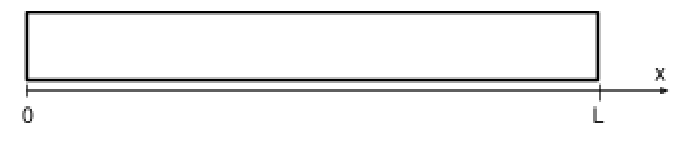
Figure 1
A.1 (0.3pt)
When a standing sound wave forms, the gas elements oscillate in the \(x\) direction with angular frequency \(\omega\). The amplitude of the oscillations depends on each element’s equilibrium position \(x\) along the tube. The longitudinal displacement of each gas element from its equilibrium position \(x\) is given by
\[ u(x,t)=a\sin(kx)\cos(\omega t)=u_1(x)\cos(\omega t) \tag{1} \]
(please note the \(u\) here describes the displacement of a gas element)
where \(a\ll L\) is a positive constant, \(k=2\pi/\lambda\) is the wavenumber and \(\lambda\) is the wavelength. What is the maximum possible wavelength \(\lambda_{\max}\) in this system?
We will assume throughout the question an oscillation mode of \(\lambda=\lambda_{\max}\).
Now, consider a narrow parcel of gas, located at rest between \(x\) and \(x+\Delta x\) (\(\Delta x\ll L\)). As a result of the displacement wave of Task A.1, the parcel oscillates along the \(x\) axis and undergoes a change in volume and other thermodynamic properties.
Throughout the following tasks assume all these changes to the thermodynamic properties to be small compared to the unperturbed values.
A.2 (0.5pt)
The parcel volume \(V(x,t)\) oscillates around the equilibrium value of \(V_0=S\Delta x\) and has the form
\[ V(x,t)=V_0+V_1(x)\cos(\omega t). \tag{2} \]
Obtain an expression for \(V_1(x)\) in terms of \(V_0\), \(a\), \(k\) and \(x\).
A.3 (0.7pt)
Assume that the total pressure of the gas, as a result of the sound wave, takes the approximate form
\[ p(x,t)=p_0-p_1(x)\cos(\omega t). \tag{3} \]
Considering the forces acting on the parcel of gas, compute the amplitude \(p_1(x)\) of the pressure oscillation to leading order, in terms of the position \(x\), the equilibrium density \(\rho_0\), the displacement amplitude \(a\) and the wave parameters \(k\) and \(\omega\).
At acoustic frequencies, the thermal conductivity of the gas can be neglected. We will treat the expansion and contraction of gas parcels as purely adiabatic, satisfying the relation \(pV^\gamma=\mathrm{const}\), where \(\gamma\) is the adiabatic constant.
A.4 (0.3pt)
Use the relation above and the results of the previous tasks to obtain an expression for the speed of sound waves \(c=\omega/k\) in the tube, to first order. Express your answer in terms of \(p_0\), \(\rho_0\) and the adiabatic constant \(\gamma\).
A.5 (0.7pt)
The change in the gas temperature due to the adiabatic expansion and contraction, as a result of the sound wave, takes the form:
\[ T(x,t)=T_0-T_1(x)\cos(\omega t). \tag{4} \]
Compute the amplitude \(T_1(x)\) of the temperature oscillations in terms of \(T_0\), \(\gamma\), \(a\), \(k\) and \(x\).
A.6 (1.2pt)
For the purpose of this task only, we assume a weak thermal interaction between the tube and the gas. As a result, the standing sound wave remains almost unchanged, but the gas can exchange a small amount of heat with the tube. The heating due to viscosity can be neglected.
For each of the points in Figure 2 (A, C at the edges of the tube, B at the center) state whether the temperature of the tube at that point will increase, decrease or remain the same over a long time.
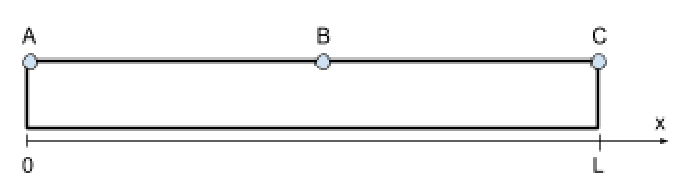
Figure 2
Part B: Sound wave amplification induced by external thermal contact (6.3 points)
A stack of thin well-spaced solid plates is placed inside the tube. The plates of the stack are aligned in parallel to the tube axis, so as not to obstruct the flow of gas along the tube. The center of the stack is positioned at \(x_0=L/4\), and spans a width of \(\ell\ll L\) along the tube axis, filling its entire cross section. The right and left edges of the stack are held at temperature difference \(\tau\). The left edge of the stack, at \(x_H=x_0-\ell/2\), is held by an external thermal reservoir at temperature \(T_H=T_0+\tau/2\), and at the same time, its right edge, at \(x_C=x_0+\ell/2\), is held at a temperature \(T_C=T_0-\tau/2\).
The plate stack allows a slight longitudinal heat flow to maintain a constant temperature gradient between its edges, such that \(T_{\mathrm{plate}}(x)=T_0-\frac{x-x_0}{\ell}\tau\).
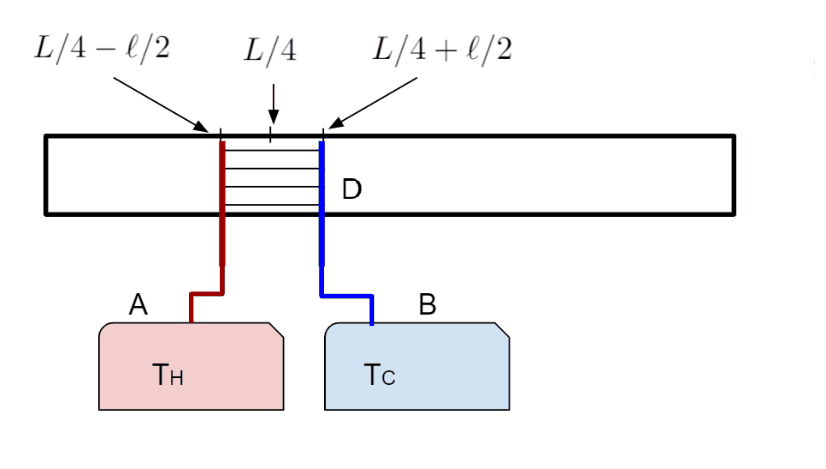
Figure 3. A sketch of the system. (A) and (B) denote the hot and cold heat reservoirs respectively. (D) denotes the stack.
To analyze the effect of the thermal contact between the plate stack and the gas on the sound waves in the tube, make the following assumptions:
- As in the previous part, all changes to the thermodynamic properties are small compared to the unperturbed values.
- The system operates in the fundamental standing-wave mode of the longest possible wavelength. It is only slightly modified by the presence of the plate stack.
- The stack is much shorter than the wavelength \(\ell\ll\lambda_{\max}\), and can be positioned far enough from both displacement and pressure nodes, so that the displacement \(u(x,t)\approx u(x_0,t)\) and the pressure \(p(x,t)\approx p(x_0,t)\) may be considered uniform over the entire length of the stack.
- We may neglect any edge effects, caused by the parcels moving in and out of the stack.
- The temperature difference between the ends of the plate stack, i.e. between the hot and the cold reservoirs, is small compared to the absolute temperature: \(\tau\ll T_0\).
- Heat conduction through the stack, through the gas, and along the tube are all negligible. The only significant sources of heat transfer are convection due to the motion of the gas and conduction between the gas and the stack.
B.1 (0.4pt)
Consider a specific parcel of gas in the region of the stack, originally at \(x_0=L/4\). As the parcel moves within the stack, the local temperature of the nearby part of the stack changes as follows:
\[ T_{\mathrm{env}}(t)=T_0-T_{\mathrm{st}}\cos(\omega t). \tag{5} \]
Express \(T_{\mathrm{st}}\) in terms of \(a\), \(\tau\) and \(\ell\).
B.2 (1.0pt)
Above which critical temperature difference \(\tau_{\mathrm{cr}}\) will the gas be conveying heat from the hot reservoir to the cold one? Express \(\tau_{\mathrm{cr}}\) in terms of \(T_0\), \(\gamma\), \(k\) and \(\ell\).
B.3 (0.8pt)
Obtain the general approximate expression for the heat flow \(\frac{dQ}{dt}\) into a small parcel of gas as a linear function of its volume and pressure change rates. Express your answer in terms of the rate of volume change \(\frac{dV}{dt}\), the rate of pressure change \(\frac{dp}{dt}\), the unperturbed equilibrium values of parcel pressure and volume \(p_0,V_0\) and the adiabatic index \(\gamma\). (You may use the expression for the molar heat capacity at constant volume \(c_v=\frac{R}{\gamma-1}\), where \(R\) is the gas constant.)
The limited heat flow rate between the parcel and the stack causes a phase difference between the pressure and volume oscillations of the parcel. We will see how this generates work.
Let the heat flux into the parcel from the stack be proportional to the temperature difference between the parcel and the neighboring element of the stack, given approximately by \(\frac{dQ}{dt}=-\beta V_0(T_{\mathrm{st}}-T_1)\cos(\omega t)\). Here \(T_1\) and \(T_{\mathrm{st}}\) are the temperature oscillation amplitudes of the gas parcel and the neighbouring stack from Tasks A.5 and B.1, respectively, and \(\beta>0\) is a constant. Assume that at the machine’s operating frequencies, the change in gas temperature as a result of this heat flow is insignificant compared to both \(T_1\) and \(T_{\mathrm{st}}\).
B.4 (1.9pt)
In order to calculate work, we will consider a change to the volume of the moving parcel as a result of the thermal contact with the stack. Let us write the pressure and the volume of the parcel under the stack’s influence in the form:
\[ \begin{aligned} p&=p_0+p_a\sin(\omega t)-p_b\cos(\omega t),\\ V&=V_0+V_a\sin(\omega t)+V_b\cos(\omega t), \end{aligned} \tag{6} \]
Given \(p_a\) and \(p_b\), find the coefficients \(V_a\) and \(V_b\). Express your answer in terms of \(p_a,p_b,p_0,V_0,\gamma,\tau,\tau_{\mathrm{cr}},\beta,\omega,a\) and \(\ell\).
B.5 (0.8pt)
Obtain an approximate expression for the acoustic work per unit volume \(w\) produced by the gas parcel over one cycle. Integrate over the volume of the stack to obtain the total work \(W_{\mathrm{tot}}\) generated by the gas over one cycle. Express \(W_{\mathrm{tot}}\) in terms of \(\gamma,\tau,\tau_{\mathrm{cr}},\beta,\omega,a,k\) and \(S\).
B.6 (0.8pt)
Obtain an approximate expression for the heat \(Q_{\mathrm{tot}}\) transported from the left side of the plane \(x=x_0\) to the right, over a cycle. Express your answer in terms of \(\tau,\tau_{\mathrm{cr}},\beta,\omega,a,S,\ell\).
(Hint: you may use the formula \(j=Q\frac{du}{dt}\) for the heat current due convection.)
B.7 (0.6pt)
Find the efficiency \(\eta\) of the thermoacoustic engine. The efficiency is defined as the ratio of the generated acoustic work to the heat drawn from the hot reservoir. Express your answer in terms of the temperature difference \(\tau\) between the hot and the cold reservoir, the critical temperature difference \(\tau_{\mathrm{cr}}\) and the Carnot efficiency \(\eta_c=1-T_C/T_H\).
Official English text of the problem.
Answers
The coefficients \(V_1,p_1,T_1\) are signed coefficients in the specified oscillatory forms. Throughout, \(k=\pi/L\).
-
A.1 \[ \boxed{\lambda_{\max}=2L.} \]
-
A.2 \[ \boxed{V_1(x)=V_0ak\cos(kx).} \]
-
A.3 \[ \boxed{p_1(x)=\frac{\rho_0a\omega^2}{k}\cos(kx).} \]
-
A.4 \[ \boxed{c=\sqrt{\frac{\gamma p_0}{\rho_0}}.} \]
-
A.5 \[ \boxed{T_1(x)=(\gamma-1)T_0ak\cos(kx).} \]
-
A.6 A: increases; B: decreases; C: increases.
-
B.1 \[ \boxed{T_{\mathrm{st}}=\frac{a\tau}{\sqrt2\,\ell}.} \]
-
B.2 \[ \boxed{\tau_{\mathrm{cr}}=(\gamma-1)T_0k\ell.} \] Heat is transported from hot to cold when \(\tau>\tau_{\mathrm{cr}}\).
-
B.3 \[ \boxed{\frac{dQ}{dt}\simeq \frac{\gamma p_0\,dV/dt+V_0\,dp/dt}{\gamma-1}.} \]
-
B.4 \[ \boxed{ V_a=-\frac{V_0}{\gamma p_0} \left[p_a+ \frac{(\gamma-1)\beta a(\tau-\tau_{\mathrm{cr}})} {\sqrt2\,\omega\ell}\right], \qquad V_b=\frac{V_0p_b}{\gamma p_0}.} \]
-
B.5 \[ \boxed{w\simeq \frac{\pi(\gamma-1)\beta a^2k}{2\omega\ell} (\tau-\tau_{\mathrm{cr}}),} \] \[ \boxed{W_{\mathrm{tot}}\simeq \frac{\pi(\gamma-1)\beta a^2kS}{2\omega} (\tau-\tau_{\mathrm{cr}}).} \]
-
B.6 \[ \boxed{Q_{\mathrm{tot}}\simeq \frac{\pi\beta a^2S}{2\omega\ell} (\tau-\tau_{\mathrm{cr}}).} \]
-
B.7 \[ \boxed{\eta\simeq \frac{\tau_{\mathrm{cr}}}{\tau}\eta_c, \qquad \tau>\tau_{\mathrm{cr}}.} \]
Solution
We retain first-order perturbations when finding the oscillating thermodynamic quantities. Work and transported heat have their first nonzero cycle averages at second order in the wave amplitude. Thermal coupling is weak, so unperturbed wave amplitudes can be used in expressions already proportional to that coupling.
A.1
The sealed, rigid ends require zero longitudinal displacement:
\[ u(0,t)=u(L,t)=0. \]
The first condition is already satisfied. The second gives
\[ \sin(kL)=0 \quad\Longrightarrow\quad kL=n\pi,\qquad n=1,2,\ldots. \]
The choice \(n=0\) gives no wave. Thus
\[ \lambda_n=\frac{2\pi}{k}=\frac{2L}{n}. \]
The longest wavelength corresponds to \(n=1\):
\[ \boxed{\lambda_{\max}=2L,\qquad k=\frac{\pi}{L}.} \]
A.2
The parcel’s two boundaries move to
\[ x+u(x,t),\qquad x+\Delta x+u(x+\Delta x,t). \]
Consequently,
\[ V(x,t) =S\left[\Delta x+u(x+\Delta x,t)-u(x,t)\right]. \]
For \(k\Delta x\ll1\),
\[ V(x,t)\simeq S\Delta x\left(1+\frac{\partial u}{\partial x}\right) =V_0\left[1+ak\cos(kx)\cos(\omega t)\right]. \]
Therefore,
\[ \boxed{V_1(x)=V_0ak\cos(kx).} \]
A.3
The pressure forces on the parcel give, to first order,
\[ F_x=S[p(x,t)-p(x+\Delta x,t)] \simeq-S\Delta x\,\frac{\partial p}{\partial x}. \]
The parcel’s mass is \(\rho_0S\Delta x\). Newton’s second law therefore becomes
\[ \rho_0\frac{\partial^2u}{\partial t^2} =-\frac{\partial p}{\partial x}. \]
Substituting the given oscillations,
\[ -\rho_0a\omega^2\sin(kx)\cos(\omega t) =p_1'(x)\cos(\omega t), \]
so
\[ p_1'(x)=-\rho_0a\omega^2\sin(kx). \]
Integration yields
\[ p_1(x)=\frac{\rho_0a\omega^2}{k}\cos(kx)+C. \]
There is no spatially uniform acoustic compression: the total volume change is proportional to
\[ \int_0^L\frac{\partial u}{\partial x}\,dx=u(L,t)-u(0,t)=0. \]
The linear adiabatic pressure–compression relation, made explicit in A.4, then requires the spatially averaged pressure perturbation to vanish. Since \(\int_0^L\cos(kx)\,dx=0\), this fixes \(C=0\). Hence
\[ \boxed{p_1(x)=\frac{\rho_0a\omega^2}{k}\cos(kx).} \]
A.4
Linearizing \(pV^\gamma=p_0V_0^\gamma\),
\[ \frac{\delta p}{p_0} +\gamma\frac{\delta V}{V_0}=0. \]
Using \(\delta p=-p_1\cos(\omega t)\) and \(\delta V=V_1\cos(\omega t)\),
\[ p_1=\gamma p_0\frac{V_1}{V_0} =\gamma p_0ak\cos(kx). \]
Comparison with A.3 gives
\[ \frac{\rho_0a\omega^2}{k} =\gamma p_0ak, \]
and therefore
\[ \boxed{c=\frac{\omega}{k} =\sqrt{\frac{\gamma p_0}{\rho_0}}.} \]
A.5
For a fixed amount of ideal gas,
\[ pV=nRT. \]
Its linearized form is
\[ \frac{\delta T}{T_0} =\frac{\delta p}{p_0}+\frac{\delta V}{V_0}. \]
Using the adiabatic relation from A.4,
\[ \frac{\delta T}{T_0} =-(\gamma-1)\frac{\delta V}{V_0} =-(\gamma-1)ak\cos(kx)\cos(\omega t). \]
Comparing with the specified temperature oscillation,
\[ \boxed{T_1(x)=(\gamma-1)T_0ak\cos(kx).} \]
A.6
Consider a parcel in the left half of the tube, where \(\cos(kx)>0\).
When it is displaced to the right, it expands and cools. It consequently absorbs heat from the tube at a relatively rightward position. When displaced to the left, it is compressed and heated, so it releases heat to the tube at a relatively leftward position. Repetition transfers heat toward the left end.
In the right half, \(\cos(kx)<0\), so the correspondence reverses: a parcel absorbs heat when displaced toward the center and releases heat when displaced toward the right end.
Thus the acoustic motion pumps heat away from the central region toward both ends:
\[ \boxed{ A:\ \text{temperature increases},\qquad B:\ \text{temperature decreases},\qquad C:\ \text{temperature increases}.} \]
Although the parcel whose equilibrium position is exactly at the center has zero first-order temperature oscillation, neighboring parcels move through the central region and remove heat. The mean thermal effect is second order in amplitude; it is not determined by the first-order temperature at a single equilibrium position.
B.1
At the stack center,
\[ kx_0=\frac{\pi}{L}\frac{L}{4}=\frac{\pi}{4}, \]
so the parcel displacement is
\[ u(x_0,t)=\frac{a}{\sqrt2}\cos(\omega t). \]
Its instantaneous position is \(x_0+u(x_0,t)\). Substitution into the plate temperature profile gives
\[ T_{\mathrm{env}}(t) =T_0-\frac{\tau}{\ell}u(x_0,t) =T_0-\frac{a\tau}{\sqrt2\,\ell}\cos(\omega t). \]
Therefore,
\[ \boxed{T_{\mathrm{st}}=\frac{a\tau}{\sqrt2\,\ell}.} \]
B.2
The adiabatic gas-temperature amplitude at the stack center is
\[ T_1(x_0)=\frac{(\gamma-1)T_0ak}{\sqrt2}. \]
At the leftward extreme of the parcel’s motion, the gas temperature is \(T_0+T_1\), while the neighboring stack temperature is \(T_0+T_{\mathrm{st}}\). To absorb heat there, the parcel must satisfy
\[ T_{\mathrm{st}}>T_1. \]
At the rightward extreme this same condition makes the stack colder than the gas, so the parcel releases heat there. Thus it conveys heat from hot to cold precisely when
\[ \frac{a\tau}{\sqrt2\,\ell} > \frac{(\gamma-1)T_0ak}{\sqrt2}. \]
The critical temperature difference is therefore
\[ \boxed{\tau_{\mathrm{cr}}=(\gamma-1)T_0k\ell.} \]
At equality, the gas and neighboring stack have matching temperature oscillations, so the leading thermal exchange vanishes. Below this threshold, the heat transport reverses.
B.3
Take \(dQ>0\) for heat entering the parcel and \(p\,dV>0\) for work done by the gas. The first law is
\[ dQ=dU+p\,dV. \]
For the ideal gas,
\[ U=nc_vT =\frac{nRT}{\gamma-1} =\frac{pV}{\gamma-1}. \]
Hence
\[ dQ =\frac{V\,dp+p\,dV}{\gamma-1}+p\,dV =\frac{V\,dp+\gamma p\,dV}{\gamma-1}. \]
To first order, the coefficients multiplying the small rates can be replaced by equilibrium values:
\[ \boxed{\frac{dQ}{dt}\simeq \frac{V_0\,dp/dt+\gamma p_0\,dV/dt}{\gamma-1}.} \]
B.4
From B.1 and B.2,
\[ T_{\mathrm{st}}-T_1 =\frac{a}{\sqrt2\,\ell}(\tau-\tau_{\mathrm{cr}}). \]
For brevity, define
\[ \Delta T\equiv \frac{a(\tau-\tau_{\mathrm{cr}})}{\sqrt2\,\ell}. \]
The prescribed heat input is then
\[ \dot Q=-\beta V_0\Delta T\cos(\omega t). \]
Differentiating the pressure and volume expressions,
\[ \dot p=\omega p_a\cos(\omega t)+\omega p_b\sin(\omega t), \]
\[ \dot V=\omega V_a\cos(\omega t)-\omega V_b\sin(\omega t). \]
Substitution into B.3 gives
\[ \dot Q= \frac{\omega}{\gamma-1} \left[ (V_0p_a+\gamma p_0V_a)\cos(\omega t) +(V_0p_b-\gamma p_0V_b)\sin(\omega t) \right]. \]
Matching the sine coefficients,
\[ V_0p_b-\gamma p_0V_b=0, \]
so
\[ \boxed{V_b=\frac{V_0p_b}{\gamma p_0}.} \]
Matching the cosine coefficients,
\[ \frac{\omega}{\gamma-1} (V_0p_a+\gamma p_0V_a) =-\beta V_0\Delta T. \]
Thus
\[ \boxed{ V_a=-\frac{V_0}{\gamma p_0} \left[ p_a+\frac{(\gamma-1)\beta a(\tau-\tau_{\mathrm{cr}})} {\sqrt2\,\omega\ell} \right].} \]
The term proportional to \(\beta\) supplies the volume component needed for nonzero cycle work.
B.5
The work done by a parcel over one cycle is
\[ W_{\mathrm{parcel}}=\oint p\,dV. \]
Writing \(\theta=\omega t\), the constant-pressure contribution integrates to zero, leaving
\[ W_{\mathrm{parcel}} =\int_0^{2\pi} (p_a\sin\theta-p_b\cos\theta) (V_a\cos\theta-V_b\sin\theta)\,d\theta. \]
Using
\[ \int_0^{2\pi}\sin\theta\cos\theta\,d\theta=0, \qquad \int_0^{2\pi}\sin^2\theta\,d\theta =\int_0^{2\pi}\cos^2\theta\,d\theta=\pi, \]
we obtain
\[ W_{\mathrm{parcel}}=-\pi(p_aV_b+p_bV_a). \]
The terms containing \(p_ap_b\) cancel upon substituting B.4:
\[ W_{\mathrm{parcel}} =\frac{\pi(\gamma-1)\beta V_0p_b}{\gamma p_0\omega}\Delta T. \]
Therefore the work per unit equilibrium volume is
\[ w=\frac{W_{\mathrm{parcel}}}{V_0} =\frac{\pi(\gamma-1)\beta p_b}{\gamma p_0\omega} \frac{a(\tau-\tau_{\mathrm{cr}})}{\sqrt2\,\ell}. \]
Since this is already first order in thermal coupling, use the unperturbed pressure coefficient:
\[ p_b\simeq p_1(x_0) =\gamma p_0ak\cos\left(\frac{\pi}{4}\right) =\frac{\gamma p_0ak}{\sqrt2}. \]
Hence
\[ \boxed{ w\simeq \frac{\pi(\gamma-1)\beta a^2k}{2\omega\ell} (\tau-\tau_{\mathrm{cr}}).} \]
The stack is short, so this work density is approximately uniform over its gas volume \(S\ell\). Thus
\[ W_{\mathrm{tot}}\simeq wS\ell, \]
giving
\[ \boxed{ W_{\mathrm{tot}}\simeq \frac{\pi(\gamma-1)\beta a^2kS}{2\omega} (\tau-\tau_{\mathrm{cr}}).} \]
The work is positive in the engine regime \(\tau>\tau_{\mathrm{cr}}\).
B.6
Let \(q(t)\) denote the heat acquired from the stack per unit equilibrium gas volume, measured relative to an arbitrary constant. To the retained order,
\[ \dot q=\frac{\dot Q}{V_0} =-\beta\Delta T\cos(\omega t). \]
Integrating,
\[ q(t)=-\frac{\beta\Delta T}{\omega}\sin(\omega t)+q_*. \]
The parcel velocity at the stack center is
\[ v(t)=\dot u(x_0,t) =-\frac{a\omega}{\sqrt2}\sin(\omega t). \]
With \(q\) expressed per unit volume, the convective heat flux per unit area is
\[ j(t)=q(t)v(t). \]
The arbitrary constant contributes no net transport because the velocity averages to zero. The purely adiabatic contribution also gives zero cycle average: it is proportional to \(\cos(\omega t)\), whereas velocity is proportional to \(\sin(\omega t)\). The net heat transported through the cross section is therefore
\[ \begin{aligned} Q_{\mathrm{tot}} &=S\int_0^{2\pi/\omega}q(t)v(t)\,dt\\ &=\frac{S\beta a\Delta T}{\sqrt2} \int_0^{2\pi/\omega}\sin^2(\omega t)\,dt\\ &=\frac{\pi S\beta a\Delta T}{\sqrt2\,\omega}. \end{aligned} \]
Substituting \(\Delta T\),
\[ \boxed{ Q_{\mathrm{tot}}\simeq \frac{\pi\beta a^2S}{2\omega\ell} (\tau-\tau_{\mathrm{cr}}).} \]
The sign is positive for left-to-right transport when \(\tau>\tau_{\mathrm{cr}}\).
B.7
To the accuracy retained for the short stack and small temperature difference, the heat drawn from the hot reservoir is approximately the heat transported across the stack center:
\[ Q_H\simeq Q_{\mathrm{tot}}. \]
Their difference is of order the acoustic work. Since the efficiency itself is small, accounting for that difference would change the efficiency only at higher order.
Using B.5 and B.6,
\[ \eta=\frac{W_{\mathrm{tot}}}{Q_H} \simeq\frac{W_{\mathrm{tot}}}{Q_{\mathrm{tot}}} =(\gamma-1)k\ell =\frac{\tau_{\mathrm{cr}}}{T_0}. \]
Meanwhile,
\[ \eta_c =1-\frac{T_0-\tau/2}{T_0+\tau/2} =\frac{\tau}{T_0+\tau/2} \simeq\frac{\tau}{T_0}, \]
because \(\tau\ll T_0\). Therefore,
\[ \boxed{\eta\simeq\frac{\tau_{\mathrm{cr}}}{\tau}\eta_c.} \]
For engine operation, \(\tau>\tau_{\mathrm{cr}}\), so the efficiency is below the Carnot efficiency. As the threshold is approached from above, the efficiency approaches the Carnot value at this order, while both work output and heat transport vanish. At the threshold itself their ratio does not define a finite-output engine efficiency.
The solution was checked against the official solution.
IPhO 2019 · Theorieaufgabe 3
Thermoakustische Wärmekraftmaschine
Eine thermoakustische Wärmekraftmaschine ist eine Vorrichtung, die Wärme in akustische Leistung, also Schallwellen, umwandelt – eine Form mechanischer Arbeit. Wie viele andere Wärmekraftmaschinen kann sie umgekehrt als Kältemaschine betrieben werden, wobei Schall genutzt wird, um Wärme von einem kalten zu einem heißen Reservoir zu transportieren. Die hohen Betriebsfrequenzen verringern die Wärmeleitung und machen eine Begrenzung des Arbeitsraums überflüssig. Im Gegensatz zu vielen anderen Maschinentypen besitzt die thermoakustische Wärmekraftmaschine außer dem Arbeitsfluid selbst keine beweglichen Teile.
Die Wirkungsgrade thermoakustischer Maschinen sind typischerweise niedriger als die anderer Maschinentypen, doch bieten sie Vorteile bei den Errichtungs- und Wartungskosten. Dies eröffnet Möglichkeiten für Anwendungen im Bereich erneuerbarer Energien, etwa in solarthermischen Kraftwerken und bei der Nutzung von Abwärme. Unsere Untersuchung konzentriert sich auf die Erzeugung akustischer Energie innerhalb des Systems; die Entnahme oder Umwandlung dieser Energie zum Betrieb externer Geräte bleibt unberücksichtigt.
Teil A: Schallwelle in einem geschlossenen Rohr (3.7 Punkte)
Betrachten Sie ein wärmeisolierendes Rohr der Länge \(L\) mit der Querschnittsfläche \(S\), dessen Achse entlang der \(x\)-Richtung liegt. Die beiden Rohrenden befinden sich bei \(x=0\) und \(x=L\). Das Rohr ist mit einem idealen Gas gefüllt und an beiden Enden verschlossen. Im Gleichgewicht hat das Gas die Temperatur \(T_0\), den Druck \(p_0\) und die Massendichte \(\rho_0\). Nehmen Sie an, dass die Viskosität vernachlässigt werden kann und dass sich das Gas nur in \(x\)-Richtung bewegt. In den dazu senkrechten Richtungen \(y\) und \(z\) sind die Eigenschaften des Gases räumlich einheitlich.
Abbildung 1
A.1 (0.3 Pkt.)
Wenn sich eine stehende Schallwelle ausbildet, schwingen die Gaselemente in \(x\)-Richtung mit der Kreisfrequenz \(\omega\). Die Schwingungsamplitude hängt von der Gleichgewichtslage \(x\) des jeweiligen Elements entlang des Rohres ab. Die longitudinale Auslenkung jedes Gaselements aus seiner Gleichgewichtslage \(x\) ist gegeben durch
\[ u(x,t)=a\sin(kx)\cos(\omega t)=u_1(x)\cos(\omega t) \tag{1} \]
(beachten Sie, dass \(u\) hier die Auslenkung eines Gaselements beschreibt)
wobei \(a\ll L\) eine positive Konstante, \(k=2\pi/\lambda\) die Wellenzahl und \(\lambda\) die Wellenlänge ist. Wie groß ist die maximal mögliche Wellenlänge \(\lambda_{\max}\) in diesem System?
Wir nehmen in der gesamten Aufgabe einen Schwingungsmodus mit \(\lambda=\lambda_{\max}\) an.
Betrachten Sie nun ein schmales Gaspaket, das sich im Ruhezustand zwischen \(x\) und \(x+\Delta x\) befindet (\(\Delta x\ll L\)). Infolge der Auslenkungswelle aus Aufgabe A.1 schwingt das Paket entlang der \(x\)-Achse, wobei sich sein Volumen und seine anderen thermodynamischen Zustandsgrößen ändern.
Nehmen Sie in allen folgenden Teilaufgaben an, dass sämtliche Änderungen dieser thermodynamischen Zustandsgrößen klein gegenüber den ungestörten Werten sind.
A.2 (0.5 Pkt.)
Das Volumen \(V(x,t)\) des Gaspakets schwingt um den Gleichgewichtswert \(V_0=S\Delta x\) und hat die Form
\[ V(x,t)=V_0+V_1(x)\cos(\omega t). \tag{2} \]
Bestimmen Sie einen Ausdruck für \(V_1(x)\) in Abhängigkeit von \(V_0\), \(a\), \(k\) und \(x\).
A.3 (0.7 Pkt.)
Nehmen Sie an, dass der Gesamtdruck des Gases infolge der Schallwelle näherungsweise die Form
\[ p(x,t)=p_0-p_1(x)\cos(\omega t). \tag{3} \]
annimmt. Berechnen Sie unter Berücksichtigung der auf das Gaspaket wirkenden Kräfte die Amplitude \(p_1(x)\) der Druckschwingung in führender Ordnung in Abhängigkeit vom Ort \(x\), der Gleichgewichtsdichte \(\rho_0\), der Auslenkungsamplitude \(a\) und den Wellenparametern \(k\) und \(\omega\).
Bei akustischen Frequenzen kann die Wärmeleitfähigkeit des Gases vernachlässigt werden. Wir behandeln die Expansion und Kompression der Gaspakete als rein adiabatisch, sodass die Beziehung \(pV^\gamma=\mathrm{const}\) gilt, wobei \(\gamma\) der Adiabatenexponent ist.
A.4 (0.3 Pkt.)
Verwenden Sie die obige Beziehung und die Ergebnisse der vorherigen Teilaufgaben, um in erster Ordnung einen Ausdruck für die Schallgeschwindigkeit \(c=\omega/k\) im Rohr herzuleiten. Geben Sie Ihre Antwort in Abhängigkeit von \(p_0\), \(\rho_0\) und dem Adiabatenexponenten \(\gamma\) an.
A.5 (0.7 Pkt.)
Die Änderung der Gastemperatur aufgrund der adiabatischen Expansion und Kompression infolge der Schallwelle hat die Form:
\[ T(x,t)=T_0-T_1(x)\cos(\omega t). \tag{4} \]
Berechnen Sie die Amplitude \(T_1(x)\) der Temperaturschwingungen in Abhängigkeit von \(T_0\), \(\gamma\), \(a\), \(k\) und \(x\).
A.6 (1.2 Pkt.)
Nur für diese Teilaufgabe nehmen wir eine schwache thermische Wechselwirkung zwischen dem Rohr und dem Gas an. Dadurch bleibt die stehende Schallwelle nahezu unverändert, aber das Gas kann eine kleine Wärmemenge mit dem Rohr austauschen. Die Erwärmung durch Viskosität kann vernachlässigt werden.
Geben Sie für jeden der Punkte in Abbildung 2 (A und C an den Rohrenden, B in der Mitte) an, ob die Temperatur des Rohres an diesem Punkt über einen langen Zeitraum steigt, sinkt oder gleich bleibt.
Abbildung 2
Teil B: Verstärkung der Schallwelle durch äußeren thermischen Kontakt (6.3 Punkte)
Ein Stapel dünner Festkörperplatten mit ausreichend großen Zwischenräumen wird in das Rohr eingebracht. Die Platten des Stapels sind parallel zur Rohrachse ausgerichtet, damit sie die Gasströmung entlang des Rohres nicht behindern. Die Mitte des Stapels befindet sich bei \(x_0=L/4\); er erstreckt sich über eine Breite \(\ell\ll L\) entlang der Rohrachse und füllt den gesamten Rohrquerschnitt aus. Zwischen dem rechten und dem linken Rand des Stapels wird eine Temperaturdifferenz \(\tau\) aufrechterhalten. Der linke Rand des Stapels bei \(x_H=x_0-\ell/2\) wird durch ein äußeres Wärmereservoir auf der Temperatur \(T_H=T_0+\tau/2\) gehalten, während gleichzeitig sein rechter Rand bei \(x_C=x_0+\ell/2\) auf einer Temperatur \(T_C=T_0-\tau/2\) gehalten wird.
Der Plattenstapel ermöglicht einen geringen longitudinalen Wärmestrom, der einen konstanten Temperaturgradienten zwischen seinen Rändern aufrechterhält, sodass \(T_{\mathrm{plate}}(x)=T_0-\frac{x-x_0}{\ell}\tau\) gilt.
Abbildung 3. Skizze des Systems. (A) und (B) bezeichnen das heiße beziehungsweise das kalte Wärmereservoir. (D) bezeichnet den Stapel.
Treffen Sie zur Untersuchung des Einflusses des thermischen Kontakts zwischen dem Plattenstapel und dem Gas auf die Schallwellen im Rohr die folgenden Annahmen:
- Wie im vorherigen Teil sind alle Änderungen der thermodynamischen Zustandsgrößen klein gegenüber den ungestörten Werten.
- Das System arbeitet im Grundmodus der stehenden Welle mit der größtmöglichen Wellenlänge. Dieser wird durch den Plattenstapel nur geringfügig verändert.
- Der Stapel ist viel kürzer als die Wellenlänge, \(\ell\ll\lambda_{\max}\), und kann weit genug sowohl von Auslenkungs- als auch von Druckknoten entfernt angeordnet werden, sodass die Auslenkung \(u(x,t)\approx u(x_0,t)\) und der Druck \(p(x,t)\approx p(x_0,t)\) über die gesamte Länge des Stapels als räumlich einheitlich angesehen werden können.
- Sämtliche Randeffekte, die durch das Ein- und Austreten der Gaspakete in den beziehungsweise aus dem Stapel entstehen, können vernachlässigt werden.
- Die Temperaturdifferenz zwischen den Enden des Plattenstapels, also zwischen dem heißen und dem kalten Reservoir, ist klein gegenüber der absoluten Temperatur: \(\tau\ll T_0\).
- Die Wärmeleitung durch den Stapel, durch das Gas und entlang des Rohres ist jeweils vernachlässigbar. Die einzigen wesentlichen Mechanismen der Wärmeübertragung sind Konvektion infolge der Gasbewegung und Wärmeleitung zwischen dem Gas und dem Stapel.
B.1 (0.4 Pkt.)
Betrachten Sie ein bestimmtes Gaspaket im Bereich des Stapels, das sich ursprünglich bei \(x_0=L/4\) befindet. Während sich das Paket innerhalb des Stapels bewegt, ändert sich die lokale Temperatur des benachbarten Stapelabschnitts wie folgt:
\[ T_{\mathrm{env}}(t)=T_0-T_{\mathrm{st}}\cos(\omega t). \tag{5} \]
Drücken Sie \(T_{\mathrm{st}}\) durch \(a\), \(\tau\) und \(\ell\) aus.
B.2 (1.0 Pkt.)
Oberhalb welcher kritischen Temperaturdifferenz \(\tau_{\mathrm{cr}}\) transportiert das Gas Wärme vom heißen zum kalten Reservoir? Drücken Sie \(\tau_{\mathrm{cr}}\) durch \(T_0\), \(\gamma\), \(k\) und \(\ell\) aus.
B.3 (0.8 Pkt.)
Bestimmen Sie den allgemeinen Näherungsausdruck für den Wärmestrom \(\frac{dQ}{dt}\) in ein kleines Gaspaket als lineare Funktion der Änderungsraten seines Volumens und seines Drucks. Geben Sie Ihre Antwort in Abhängigkeit von der Volumenänderungsrate \(\frac{dV}{dt}\), der Druckänderungsrate \(\frac{dp}{dt}\), den ungestörten Gleichgewichtswerten von Druck und Volumen des Pakets \(p_0,V_0\) sowie dem Adiabatenexponenten \(\gamma\) an. (Sie dürfen den Ausdruck für die molare Wärmekapazität bei konstantem Volumen \(c_v=\frac{R}{\gamma-1}\) verwenden, wobei \(R\) die Gaskonstante ist.)
Der begrenzte Wärmestrom zwischen dem Paket und dem Stapel verursacht eine Phasenverschiebung zwischen den Druck- und Volumenschwingungen des Pakets. Wir werden sehen, wie dadurch Arbeit erzeugt wird.
Der Wärmestrom vom Stapel in das Paket sei proportional zur Temperaturdifferenz zwischen dem Paket und dem benachbarten Element des Stapels und näherungsweise gegeben durch \(\frac{dQ}{dt}=-\beta V_0(T_{\mathrm{st}}-T_1)\cos(\omega t)\). Hier sind \(T_1\) und \(T_{\mathrm{st}}\) die Temperaturschwingungsamplituden des Gaspakets beziehungsweise des benachbarten Stapelabschnitts aus den Aufgaben A.5 und B.1, und \(\beta>0\) ist eine Konstante. Nehmen Sie an, dass bei den Betriebsfrequenzen der Maschine die Änderung der Gastemperatur infolge dieses Wärmestroms sowohl gegenüber \(T_1\) als auch gegenüber \(T_{\mathrm{st}}\) vernachlässigbar ist.
B.4 (1.9 Pkt.)
Zur Berechnung der Arbeit betrachten wir die Änderung des Volumens des bewegten Pakets infolge des thermischen Kontakts mit dem Stapel. Wir schreiben Druck und Volumen des Pakets unter dem Einfluss des Stapels in der Form:
\[ \begin{aligned} p&=p_0+p_a\sin(\omega t)-p_b\cos(\omega t),\\ V&=V_0+V_a\sin(\omega t)+V_b\cos(\omega t), \end{aligned} \tag{6} \]
Bestimmen Sie bei gegebenen \(p_a\) und \(p_b\) die Koeffizienten \(V_a\) und \(V_b\). Geben Sie Ihre Antwort in Abhängigkeit von \(p_a,p_b,p_0,V_0,\gamma,\tau,\tau_{\mathrm{cr}},\beta,\omega,a\) und \(\ell\) an.
B.5 (0.8 Pkt.)
Bestimmen Sie einen Näherungsausdruck für die akustische Arbeit pro Volumeneinheit \(w\), die das Gaspaket während eines Zyklus erzeugt. Integrieren Sie über das Volumen des Stapels, um die gesamte vom Gas während eines Zyklus erzeugte Arbeit \(W_{\mathrm{tot}}\) zu erhalten. Drücken Sie \(W_{\mathrm{tot}}\) durch \(\gamma,\tau,\tau_{\mathrm{cr}},\beta,\omega,a,k\) und \(S\) aus.
B.6 (0.8 Pkt.)
Bestimmen Sie einen Näherungsausdruck für die Wärme \(Q_{\mathrm{tot}}\), die während eines Zyklus von der linken Seite der Ebene \(x=x_0\) nach rechts transportiert wird. Geben Sie Ihre Antwort in Abhängigkeit von \(\tau,\tau_{\mathrm{cr}},\beta,\omega,a,S,\ell\) an.
(Hinweis: Sie dürfen die Formel \(j=Q\frac{du}{dt}\) für den konvektiven Wärmestrom verwenden.)
B.7 (0.6 Pkt.)
Bestimmen Sie den Wirkungsgrad \(\eta\) der thermoakustischen Wärmekraftmaschine. Der Wirkungsgrad ist als Verhältnis der erzeugten akustischen Arbeit zur dem heißen Reservoir entnommenen Wärme definiert. Geben Sie Ihre Antwort in Abhängigkeit von der Temperaturdifferenz \(\tau\) zwischen dem heißen und dem kalten Reservoir, der kritischen Temperaturdifferenz \(\tau_{\mathrm{cr}}\) und dem Carnot-Wirkungsgrad \(\eta_c=1-T_C/T_H\) an.
Aufgabentext aus dem offiziellen englischen Text übersetzt.
Antworten
Die Koeffizienten \(V_1,p_1,T_1\) sind vorzeichenbehaftete Koeffizienten in den angegebenen Schwingungsansätzen. Durchgehend gilt \(k=\pi/L\).
-
A.1 \[ \boxed{\lambda_{\max}=2L.} \]
-
A.2 \[ \boxed{V_1(x)=V_0ak\cos(kx).} \]
-
A.3 \[ \boxed{p_1(x)=\frac{\rho_0a\omega^2}{k}\cos(kx).} \]
-
A.4 \[ \boxed{c=\sqrt{\frac{\gamma p_0}{\rho_0}}.} \]
-
A.5 \[ \boxed{T_1(x)=(\gamma-1)T_0ak\cos(kx).} \]
-
A.6 A: steigt; B: sinkt; C: steigt.
-
B.1 \[ \boxed{T_{\mathrm{st}}=\frac{a\tau}{\sqrt2\,\ell}.} \]
-
B.2 \[ \boxed{\tau_{\mathrm{cr}}=(\gamma-1)T_0k\ell.} \] Wärme wird von heiß nach kalt transportiert, wenn \(\tau>\tau_{\mathrm{cr}}\).
-
B.3 \[ \boxed{\frac{dQ}{dt}\simeq \frac{\gamma p_0\,dV/dt+V_0\,dp/dt}{\gamma-1}.} \]
-
B.4 \[ \boxed{ V_a=-\frac{V_0}{\gamma p_0} \left[p_a+ \frac{(\gamma-1)\beta a(\tau-\tau_{\mathrm{cr}})} {\sqrt2\,\omega\ell}\right], \qquad V_b=\frac{V_0p_b}{\gamma p_0}.} \]
-
B.5 \[ \boxed{w\simeq \frac{\pi(\gamma-1)\beta a^2k}{2\omega\ell} (\tau-\tau_{\mathrm{cr}}),} \] \[ \boxed{W_{\mathrm{tot}}\simeq \frac{\pi(\gamma-1)\beta a^2kS}{2\omega} (\tau-\tau_{\mathrm{cr}}).} \]
-
B.6 \[ \boxed{Q_{\mathrm{tot}}\simeq \frac{\pi\beta a^2S}{2\omega\ell} (\tau-\tau_{\mathrm{cr}}).} \]
-
B.7 \[ \boxed{\eta\simeq \frac{\tau_{\mathrm{cr}}}{\tau}\eta_c, \qquad \tau>\tau_{\mathrm{cr}}.} \]
Lösung
Bei der Bestimmung der schwingenden thermodynamischen Größen berücksichtigen wir Störungen erster Ordnung. Die ersten von null verschiedenen Zyklusmittelwerte der Arbeit und der transportierten Wärme treten in zweiter Ordnung in der Wellenamplitude auf. Die thermische Kopplung ist schwach, sodass in Ausdrücken, die bereits proportional zu dieser Kopplung sind, die ungestörten Wellenamplituden verwendet werden können.
A.1
An den verschlossenen, starren Enden muss die longitudinale Auslenkung null sein:
\[ u(0,t)=u(L,t)=0. \]
Die erste Bedingung ist bereits erfüllt. Die zweite ergibt
\[ \sin(kL)=0 \quad\Longrightarrow\quad kL=n\pi,\qquad n=1,2,\ldots. \]
Die Wahl \(n=0\) liefert keine Welle. Somit gilt
\[ \lambda_n=\frac{2\pi}{k}=\frac{2L}{n}. \]
Die größte Wellenlänge entspricht \(n=1\):
\[ \boxed{\lambda_{\max}=2L,\qquad k=\frac{\pi}{L}.} \]
A.2
Die beiden Grenzen des Pakets bewegen sich nach
\[ x+u(x,t),\qquad x+\Delta x+u(x+\Delta x,t). \]
Folglich gilt
\[ V(x,t) =S\left[\Delta x+u(x+\Delta x,t)-u(x,t)\right]. \]
Für \(k\Delta x\ll1\) gilt
\[ V(x,t)\simeq S\Delta x\left(1+\frac{\partial u}{\partial x}\right) =V_0\left[1+ak\cos(kx)\cos(\omega t)\right]. \]
Daher ist
\[ \boxed{V_1(x)=V_0ak\cos(kx).} \]
A.3
Die Druckkräfte auf das Paket ergeben in erster Ordnung
\[ F_x=S[p(x,t)-p(x+\Delta x,t)] \simeq-S\Delta x\,\frac{\partial p}{\partial x}. \]
Die Masse des Pakets beträgt \(\rho_0S\Delta x\). Das zweite Newtonsche Gesetz lautet daher
\[ \rho_0\frac{\partial^2u}{\partial t^2} =-\frac{\partial p}{\partial x}. \]
Einsetzen der gegebenen Schwingungen liefert
\[ -\rho_0a\omega^2\sin(kx)\cos(\omega t) =p_1'(x)\cos(\omega t), \]
also
\[ p_1'(x)=-\rho_0a\omega^2\sin(kx). \]
Integration ergibt
\[ p_1(x)=\frac{\rho_0a\omega^2}{k}\cos(kx)+C. \]
Es gibt keine räumlich gleichförmige akustische Kompression: Die gesamte Volumenänderung ist proportional zu
\[ \int_0^L\frac{\partial u}{\partial x}\,dx=u(L,t)-u(0,t)=0. \]
Die lineare adiabatische Beziehung zwischen Druck und Kompression, die in A.4 explizit angegeben wird, verlangt dann, dass die räumlich gemittelte Druckstörung verschwindet. Da \(\int_0^L\cos(kx)\,dx=0\), folgt daraus \(C=0\). Somit ist
\[ \boxed{p_1(x)=\frac{\rho_0a\omega^2}{k}\cos(kx).} \]
A.4
Die Linearisierung von \(pV^\gamma=p_0V_0^\gamma\) ergibt
\[ \frac{\delta p}{p_0} +\gamma\frac{\delta V}{V_0}=0. \]
Mit \(\delta p=-p_1\cos(\omega t)\) und \(\delta V=V_1\cos(\omega t)\) folgt
\[ p_1=\gamma p_0\frac{V_1}{V_0} =\gamma p_0ak\cos(kx). \]
Der Vergleich mit A.3 liefert
\[ \frac{\rho_0a\omega^2}{k} =\gamma p_0ak, \]
und somit
\[ \boxed{c=\frac{\omega}{k} =\sqrt{\frac{\gamma p_0}{\rho_0}}.} \]
A.5
Für eine feste Stoffmenge eines idealen Gases gilt
\[ pV=nRT. \]
Die linearisierte Form lautet
\[ \frac{\delta T}{T_0} =\frac{\delta p}{p_0}+\frac{\delta V}{V_0}. \]
Mit der adiabatischen Beziehung aus A.4 folgt
\[ \frac{\delta T}{T_0} =-(\gamma-1)\frac{\delta V}{V_0} =-(\gamma-1)ak\cos(kx)\cos(\omega t). \]
Der Vergleich mit der angegebenen Temperaturschwingung ergibt
\[ \boxed{T_1(x)=(\gamma-1)T_0ak\cos(kx).} \]
A.6
Betrachten Sie ein Paket in der linken Rohrhälfte, wo \(\cos(kx)>0\) gilt.
Wird es nach rechts ausgelenkt, expandiert es und kühlt ab. Es nimmt daher an einer relativ weit rechts liegenden Position Wärme vom Rohr auf. Wird es nach links ausgelenkt, wird es komprimiert und erwärmt, sodass es an einer relativ weit links liegenden Position Wärme an das Rohr abgibt. Durch Wiederholung wird Wärme zum linken Ende transportiert.
In der rechten Hälfte gilt \(\cos(kx)<0\), sodass sich die Zuordnung umkehrt: Ein Paket nimmt Wärme auf, wenn es zur Mitte hin ausgelenkt ist, und gibt Wärme ab, wenn es zum rechten Ende hin ausgelenkt ist.
Somit pumpt die akustische Bewegung Wärme aus dem mittleren Bereich zu beiden Enden:
\[ \boxed{ A:\ \text{Temperatur steigt},\qquad B:\ \text{Temperatur sinkt},\qquad C:\ \text{Temperatur steigt}.} \]
Obwohl das Paket, dessen Gleichgewichtslage genau in der Mitte liegt, in erster Ordnung keine Temperaturschwingung aufweist, bewegen sich benachbarte Pakete durch den mittleren Bereich und entziehen ihm Wärme. Der mittlere thermische Effekt ist von zweiter Ordnung in der Amplitude; er wird nicht durch die Temperatur erster Ordnung an einer einzelnen Gleichgewichtslage bestimmt.
B.1
In der Mitte des Stapels gilt
\[ kx_0=\frac{\pi}{L}\frac{L}{4}=\frac{\pi}{4}, \]
sodass die Auslenkung des Pakets
\[ u(x_0,t)=\frac{a}{\sqrt2}\cos(\omega t). \]
beträgt. Seine momentane Position ist \(x_0+u(x_0,t)\). Einsetzen in das Temperaturprofil der Platten ergibt
\[ T_{\mathrm{env}}(t) =T_0-\frac{\tau}{\ell}u(x_0,t) =T_0-\frac{a\tau}{\sqrt2\,\ell}\cos(\omega t). \]
Daher gilt
\[ \boxed{T_{\mathrm{st}}=\frac{a\tau}{\sqrt2\,\ell}.} \]
B.2
Die Amplitude der adiabatischen Gastemperaturschwingung in der Mitte des Stapels beträgt
\[ T_1(x_0)=\frac{(\gamma-1)T_0ak}{\sqrt2}. \]
Am linken Umkehrpunkt der Paketbewegung beträgt die Gastemperatur \(T_0+T_1\), während die Temperatur des benachbarten Stapelabschnitts \(T_0+T_{\mathrm{st}}\) beträgt. Damit das Paket dort Wärme aufnimmt, muss gelten
\[ T_{\mathrm{st}}>T_1. \]
Am rechten Umkehrpunkt bewirkt dieselbe Bedingung, dass der Stapel kälter als das Gas ist, sodass das Paket dort Wärme abgibt. Es transportiert daher genau dann Wärme von heiß nach kalt, wenn
\[ \frac{a\tau}{\sqrt2\,\ell} > \frac{(\gamma-1)T_0ak}{\sqrt2}. \]
Die kritische Temperaturdifferenz ist somit
\[ \boxed{\tau_{\mathrm{cr}}=(\gamma-1)T_0k\ell.} \]
Bei Gleichheit stimmen die Temperaturschwingungen des Gases und des benachbarten Stapelabschnitts überein, sodass der Wärmeaustausch in führender Ordnung verschwindet. Unterhalb dieser Schwelle kehrt sich die Richtung des Wärmetransports um.
B.3
Wir wählen \(dQ>0\) für Wärme, die dem Paket zugeführt wird, und \(p\,dV>0\) für vom Gas verrichtete Arbeit. Der erste Hauptsatz lautet
\[ dQ=dU+p\,dV. \]
Für das ideale Gas gilt
\[ U=nc_vT =\frac{nRT}{\gamma-1} =\frac{pV}{\gamma-1}. \]
Daraus folgt
\[ dQ =\frac{V\,dp+p\,dV}{\gamma-1}+p\,dV =\frac{V\,dp+\gamma p\,dV}{\gamma-1}. \]
In erster Ordnung können die Koeffizienten vor den kleinen Änderungsraten durch die Gleichgewichtswerte ersetzt werden:
\[ \boxed{\frac{dQ}{dt}\simeq \frac{V_0\,dp/dt+\gamma p_0\,dV/dt}{\gamma-1}.} \]
B.4
Aus B.1 und B.2 folgt
\[ T_{\mathrm{st}}-T_1 =\frac{a}{\sqrt2\,\ell}(\tau-\tau_{\mathrm{cr}}). \]
Zur Abkürzung definieren wir
\[ \Delta T\equiv \frac{a(\tau-\tau_{\mathrm{cr}})}{\sqrt2\,\ell}. \]
Die vorgegebene Wärmezufuhr pro Zeit lautet dann
\[ \dot Q=-\beta V_0\Delta T\cos(\omega t). \]
Ableiten der Ausdrücke für Druck und Volumen ergibt
\[ \dot p=\omega p_a\cos(\omega t)+\omega p_b\sin(\omega t), \]
\[ \dot V=\omega V_a\cos(\omega t)-\omega V_b\sin(\omega t). \]
Einsetzen in B.3 liefert
\[ \dot Q= \frac{\omega}{\gamma-1} \left[ (V_0p_a+\gamma p_0V_a)\cos(\omega t) +(V_0p_b-\gamma p_0V_b)\sin(\omega t) \right]. \]
Der Vergleich der Sinuskoeffizienten ergibt
\[ V_0p_b-\gamma p_0V_b=0, \]
also
\[ \boxed{V_b=\frac{V_0p_b}{\gamma p_0}.} \]
Der Vergleich der Kosinuskoeffizienten ergibt
\[ \frac{\omega}{\gamma-1} (V_0p_a+\gamma p_0V_a) =-\beta V_0\Delta T. \]
Somit gilt
\[ \boxed{ V_a=-\frac{V_0}{\gamma p_0} \left[ p_a+\frac{(\gamma-1)\beta a(\tau-\tau_{\mathrm{cr}})} {\sqrt2\,\omega\ell} \right].} \]
Der zu \(\beta\) proportionale Term liefert den Volumenanteil, der für eine von null verschiedene Arbeit pro Zyklus erforderlich ist.
B.5
Die von einem Paket während eines Zyklus verrichtete Arbeit beträgt
\[ W_{\mathrm{parcel}}=\oint p\,dV. \]
Mit \(\theta=\omega t\) integriert sich der Beitrag des konstanten Drucks zu null, und es bleibt
\[ W_{\mathrm{parcel}} =\int_0^{2\pi} (p_a\sin\theta-p_b\cos\theta) (V_a\cos\theta-V_b\sin\theta)\,d\theta. \]
Mit
\[ \int_0^{2\pi}\sin\theta\cos\theta\,d\theta=0, \qquad \int_0^{2\pi}\sin^2\theta\,d\theta =\int_0^{2\pi}\cos^2\theta\,d\theta=\pi, \]
erhalten wir
\[ W_{\mathrm{parcel}}=-\pi(p_aV_b+p_bV_a). \]
Beim Einsetzen von B.4 heben sich die Terme mit \(p_ap_b\) auf:
\[ W_{\mathrm{parcel}} =\frac{\pi(\gamma-1)\beta V_0p_b}{\gamma p_0\omega}\Delta T. \]
Die Arbeit pro Einheit des Gleichgewichtsvolumens beträgt daher
\[ w=\frac{W_{\mathrm{parcel}}}{V_0} =\frac{\pi(\gamma-1)\beta p_b}{\gamma p_0\omega} \frac{a(\tau-\tau_{\mathrm{cr}})}{\sqrt2\,\ell}. \]
Da dieser Ausdruck bereits von erster Ordnung in der thermischen Kopplung ist, verwenden wir den ungestörten Druckkoeffizienten:
\[ p_b\simeq p_1(x_0) =\gamma p_0ak\cos\left(\frac{\pi}{4}\right) =\frac{\gamma p_0ak}{\sqrt2}. \]
Daraus folgt
\[ \boxed{ w\simeq \frac{\pi(\gamma-1)\beta a^2k}{2\omega\ell} (\tau-\tau_{\mathrm{cr}}).} \]
Der Stapel ist kurz, sodass diese Arbeitsdichte über sein Gasvolumen \(S\ell\) näherungsweise räumlich einheitlich ist. Somit gilt
\[ W_{\mathrm{tot}}\simeq wS\ell, \]
woraus sich
\[ \boxed{ W_{\mathrm{tot}}\simeq \frac{\pi(\gamma-1)\beta a^2kS}{2\omega} (\tau-\tau_{\mathrm{cr}}).} \]
ergibt. Die Arbeit ist im Wärmekraftmaschinenbetrieb \(\tau>\tau_{\mathrm{cr}}\) positiv.
B.6
Sei \(q(t)\) die vom Stapel aufgenommene Wärme pro Einheit des Gleichgewichtsvolumens des Gases, bezogen auf eine beliebige Konstante. In der berücksichtigten Ordnung gilt
\[ \dot q=\frac{\dot Q}{V_0} =-\beta\Delta T\cos(\omega t). \]
Integration ergibt
\[ q(t)=-\frac{\beta\Delta T}{\omega}\sin(\omega t)+q_*. \]
Die Geschwindigkeit des Pakets in der Mitte des Stapels beträgt
\[ v(t)=\dot u(x_0,t) =-\frac{a\omega}{\sqrt2}\sin(\omega t). \]
Da \(q\) auf eine Volumeneinheit bezogen ist, lautet die konvektive Wärmestromdichte pro Flächeneinheit
\[ j(t)=q(t)v(t). \]
Die beliebige Konstante trägt nicht zum Nettotransport bei, da der Mittelwert der Geschwindigkeit null ist. Auch der rein adiabatische Beitrag hat einen verschwindenden Zyklusmittelwert: Er ist proportional zu \(\cos(\omega t)\), während die Geschwindigkeit proportional zu \(\sin(\omega t)\) ist. Die netto durch den Querschnitt transportierte Wärme beträgt daher
\[ \begin{aligned} Q_{\mathrm{tot}} &=S\int_0^{2\pi/\omega}q(t)v(t)\,dt\\ &=\frac{S\beta a\Delta T}{\sqrt2} \int_0^{2\pi/\omega}\sin^2(\omega t)\,dt\\ &=\frac{\pi S\beta a\Delta T}{\sqrt2\,\omega}. \end{aligned} \]
Einsetzen von \(\Delta T\) ergibt
\[ \boxed{ Q_{\mathrm{tot}}\simeq \frac{\pi\beta a^2S}{2\omega\ell} (\tau-\tau_{\mathrm{cr}}).} \]
Für \(\tau>\tau_{\mathrm{cr}}\) ist das Vorzeichen positiv, entsprechend einem Transport von links nach rechts.
B.7
Innerhalb der berücksichtigten Genauigkeit für den kurzen Stapel und die kleine Temperaturdifferenz ist die dem heißen Reservoir entnommene Wärme näherungsweise gleich der durch die Mitte des Stapels transportierten Wärme:
\[ Q_H\simeq Q_{\mathrm{tot}}. \]
Ihre Differenz ist von der Größenordnung der akustischen Arbeit. Da der Wirkungsgrad selbst klein ist, würde die Berücksichtigung dieser Differenz den Wirkungsgrad nur in höherer Ordnung verändern.
Mit B.5 und B.6 folgt
\[ \eta=\frac{W_{\mathrm{tot}}}{Q_H} \simeq\frac{W_{\mathrm{tot}}}{Q_{\mathrm{tot}}} =(\gamma-1)k\ell =\frac{\tau_{\mathrm{cr}}}{T_0}. \]
Zugleich gilt
\[ \eta_c =1-\frac{T_0-\tau/2}{T_0+\tau/2} =\frac{\tau}{T_0+\tau/2} \simeq\frac{\tau}{T_0}, \]
weil \(\tau\ll T_0\). Daher ist
\[ \boxed{\eta\simeq\frac{\tau_{\mathrm{cr}}}{\tau}\eta_c.} \]
Für den Wärmekraftmaschinenbetrieb gilt \(\tau>\tau_{\mathrm{cr}}\), sodass der Wirkungsgrad unter dem Carnot-Wirkungsgrad liegt. Nähert man sich der Schwelle von oben, nähert sich der Wirkungsgrad in dieser Ordnung dem Carnot-Wert, während sowohl die abgegebene Arbeit als auch der Wärmetransport verschwinden. An der Schwelle selbst definiert ihr Verhältnis keinen Wirkungsgrad einer Wärmekraftmaschine mit endlicher Leistungsabgabe.
Die Lösung wurde mit der offiziellen Lösung abgeglichen.
IPhO 2019 · Teori sorusu 3
Termoakustik Motor
Termoakustik motor, ısıyı akustik güce, yani mekanik işin bir biçimi olan ses dalgalarına dönüştüren bir aygıttır. Diğer birçok ısı makinesi gibi, ters yönde çalıştırılarak bir soğutucu olarak da kullanılabilir; bu durumda sesi kullanarak soğuk bir depodan sıcak bir depoya ısı pompalar. Yüksek çalışma frekansları ısı iletimini azaltır ve çalışma odasının sınırlandırılması gereğini ortadan kaldırır. Diğer birçok motor türünün aksine, termoakustik motorun çalışma akışkanının kendisi dışında hareketli parçası yoktur.
Termoakustik makinelerin verimleri genellikle diğer motor türlerininkinden düşüktür, ancak kurulum ve bakım maliyetleri açısından avantajları vardır. Bu durum, güneş ısıl enerji santralleri ve atık ısıdan yararlanma gibi yenilenebilir enerji uygulamaları için olanaklar yaratır. İncelememizde, dış aygıtlara güç sağlamak amacıyla enerjinin sistemden alınmasını veya dönüştürülmesini göz ardı ederek, sistem içinde akustik enerji üretilmesine odaklanacağız.
Bölüm A: Kapalı bir boruda ses dalgası (3.7 puan)
Ekseni \(x\) doğrultusunda uzanan, uzunluğu \(L\) ve kesit alanı \(S\) olan, ısıl olarak yalıtılmış bir boru düşünün. Borunun iki ucu \(x=0\) ve \(x=L\) konumlarındadır. Boru ideal bir gazla doldurulmuştur ve her iki ucu da kapalıdır. Dengede gazın sıcaklığı \(T_0\), basıncı \(p_0\) ve kütle yoğunluğu \(\rho_0\)'dır. Viskozitenin ihmal edilebildiğini ve gazın yalnızca \(x\) doğrultusunda hareket ettiğini varsayın. Gazın özellikleri, bu doğrultuya dik olan \(y\) ve \(z\) doğrultularında düzgündür.
Şekil 1
A.1 (0.3 puan)
Bir duran ses dalgası oluştuğunda, gaz elemanları \(x\) doğrultusunda \(\omega\) açısal frekansıyla salınır. Salınımların genliği, her elemanın boru boyunca denge konumu olan \(x\)'e bağlıdır. Her gaz elemanının \(x\) denge konumundan boyuna yer değiştirmesi
\[ u(x,t)=a\sin(kx)\cos(\omega t)=u_1(x)\cos(\omega t) \tag{1} \]
ile verilir (buradaki \(u\)'nun bir gaz elemanının yer değiştirmesini ifade ettiğine dikkat edin).
Burada \(a\ll L\) pozitif bir sabit, \(k=2\pi/\lambda\) dalga sayısı ve \(\lambda\) dalga boyudur. Bu sistemde mümkün olan en büyük dalga boyu \(\lambda_{\max}\) nedir?
Soru boyunca \(\lambda=\lambda_{\max}\) olan bir salınım modu varsayacağız.
Şimdi, durgun hâlde \(x\) ile \(x+\Delta x\) arasında bulunan dar bir gaz paketini ele alın (\(\Delta x\ll L\)). A.1 sorusundaki yer değiştirme dalgasının etkisiyle bu paket \(x\) ekseni boyunca salınır; hacmi ve diğer termodinamik özellikleri değişir.
Aşağıdaki sorular boyunca, termodinamik özelliklerdeki tüm bu değişimlerin pertürbe edilmemiş değerlere kıyasla küçük olduğunu varsayın.
A.2 (0.5 puan)
Paketin \(V(x,t)\) hacmi, \(V_0=S\Delta x\) denge değeri etrafında salınır ve
\[ V(x,t)=V_0+V_1(x)\cos(\omega t). \tag{2} \]
biçimindedir. \(V_1(x)\) için \(V_0\), \(a\), \(k\) ve \(x\) cinsinden bir ifade elde edin.
A.3 (0.7 puan)
Ses dalgasının etkisiyle gazın toplam basıncının yaklaşık olarak
\[ p(x,t)=p_0-p_1(x)\cos(\omega t). \tag{3} \]
biçimini aldığını varsayın. Gaz paketine etki eden kuvvetleri göz önüne alarak, basınç salınımının \(p_1(x)\) genliğini en düşük mertebede; \(x\) konumu, \(\rho_0\) denge yoğunluğu, \(a\) yer değiştirme genliği ve \(k\) ile \(\omega\) dalga parametreleri cinsinden hesaplayın.
Akustik frekanslarda gazın ısıl iletkenliği ihmal edilebilir. Gaz paketlerinin genleşmesini ve sıkışmasını, \(pV^\gamma=\mathrm{const}\) bağıntısını sağlayan, tamamen adyabatik süreçler olarak ele alacağız; burada \(\gamma\) adyabatik sabittir.
A.4 (0.3 puan)
Yukarıdaki bağıntıyı ve önceki soruların sonuçlarını kullanarak, borudaki ses dalgalarının \(c=\omega/k\) hızı için birinci mertebede bir ifade elde edin. Cevabınızı \(p_0\), \(\rho_0\) ve adyabatik sabit \(\gamma\) cinsinden ifade edin.
A.5 (0.7 puan)
Ses dalgasının yol açtığı adyabatik genleşme ve sıkışma nedeniyle gazın sıcaklığındaki değişim şu biçimdedir:
\[ T(x,t)=T_0-T_1(x)\cos(\omega t). \tag{4} \]
Sıcaklık salınımlarının \(T_1(x)\) genliğini \(T_0\), \(\gamma\), \(a\), \(k\) ve \(x\) cinsinden hesaplayın.
A.6 (1.2 puan)
Yalnızca bu soru için, boru ile gaz arasında zayıf bir ısıl etkileşim olduğunu varsayıyoruz. Bunun sonucunda duran ses dalgası hemen hemen değişmeden kalır, ancak gaz boruyla küçük miktarda ısı alışverişi yapabilir. Viskoziteden kaynaklanan ısınma ihmal edilebilir.
Şekil 2'deki noktaların her biri için (A ve C borunun uçlarında, B merkezindedir), borunun o noktadaki sıcaklığının uzun bir süre içinde artacağını, azalacağını veya aynı kalacağını belirtin.
Şekil 2
Bölüm B: Dış ısıl temasın yol açtığı ses dalgası güçlenmesi (6.3 puan)
Borunun içine, aralarında yeterli boşluk bulunan ince katı levhalardan oluşan bir istif yerleştirilir. İstifteki levhalar, boru boyunca gaz akışını engellemeyecek şekilde boru eksenine paralel olarak hizalanmıştır. İstifin merkezi \(x_0=L/4\) konumundadır; istif, boru ekseni boyunca \(\ell\ll L\) genişliğinde bir bölgeyi kaplar ve borunun tüm kesitini doldurur. İstifin sağ ve sol uçları arasında \(\tau\) sıcaklık farkı korunur. İstifin \(x_H=x_0-\ell/2\) konumundaki sol ucu, dış bir ısı deposu tarafından \(T_H=T_0+\tau/2\) sıcaklığında tutulurken, \(x_C=x_0+\ell/2\) konumundaki sağ ucu da \(T_C=T_0-\tau/2\) sıcaklığında tutulur.
Levha istifi, uçları arasında sabit bir sıcaklık gradyanını korumak için boyuna doğrultuda küçük bir ısı akışına izin verir; böylece \(T_{\mathrm{plate}}(x)=T_0-\frac{x-x_0}{\ell}\tau\) olur.
Şekil 3. Sistemin şematik gösterimi. (A) ve (B) sırasıyla sıcak ve soğuk ısı depolarını gösterir. (D) istifi gösterir.
Levha istifi ile gaz arasındaki ısıl temasın borudaki ses dalgaları üzerindeki etkisini incelemek için aşağıdaki varsayımları yapın:
- Önceki bölümde olduğu gibi, termodinamik özelliklerdeki tüm değişimler pertürbe edilmemiş değerlere kıyasla küçüktür.
- Sistem, mümkün olan en uzun dalga boyuna sahip temel duran dalga modunda çalışır. Levha istifinin varlığı bu modu yalnızca çok az değiştirir.
- İstif, dalga boyundan çok daha kısadır: \(\ell\ll\lambda_{\max}\). Hem yer değiştirme hem de basınç düğümlerinden yeterince uzağa yerleştirilebilir; böylece \(u(x,t)\approx u(x_0,t)\) yer değiştirmesi ve \(p(x,t)\approx p(x_0,t)\) basıncı, istifin tüm uzunluğu boyunca düzgün kabul edilebilir.
- Paketlerin istife girip çıkmasından kaynaklanan tüm kenar etkilerini ihmal edebiliriz.
- Levha istifinin uçları, yani sıcak ve soğuk depolar arasındaki sıcaklık farkı, mutlak sıcaklığa kıyasla küçüktür: \(\tau\ll T_0\).
- İstif içinden, gaz içinden ve boru boyunca gerçekleşen ısı iletiminin tümü ihmal edilebilir. Kayda değer tek ısı aktarım mekanizmaları, gazın hareketinden kaynaklanan taşınım ve gaz ile istif arasındaki iletimdir.
B.1 (0.4 puan)
İstif bölgesinde başlangıçta \(x_0=L/4\) konumunda bulunan belirli bir gaz paketini ele alın. Paket istif içinde hareket ederken, istifin paketin yakınındaki bölümünün yerel sıcaklığı aşağıdaki gibi değişir:
\[ T_{\mathrm{env}}(t)=T_0-T_{\mathrm{st}}\cos(\omega t). \tag{5} \]
\(T_{\mathrm{st}}\)'yi \(a\), \(\tau\) ve \(\ell\) cinsinden ifade edin.
B.2 (1.0 puan)
Hangi kritik sıcaklık farkı \(\tau_{\mathrm{cr}}\)'nin üzerinde gaz, sıcak depodan soğuk depoya ısı taşıyacaktır? \(\tau_{\mathrm{cr}}\)'yi \(T_0\), \(\gamma\), \(k\) ve \(\ell\) cinsinden ifade edin.
B.3 (0.8 puan)
Küçük bir gaz paketine giren \(\frac{dQ}{dt}\) ısı akışı için, paketin hacim ve basınç değişim hızlarının doğrusal bir fonksiyonu olarak genel bir yaklaşık ifade elde edin. Cevabınızı hacim değişim hızı \(\frac{dV}{dt}\), basınç değişim hızı \(\frac{dp}{dt}\), paketin basınç ve hacminin pertürbe edilmemiş denge değerleri \(p_0,V_0\) ve adyabatik üs \(\gamma\) cinsinden ifade edin. (Sabit hacimdeki molar ısı kapasitesi için \(c_v=\frac{R}{\gamma-1}\) ifadesini kullanabilirsiniz; burada \(R\) gaz sabitidir.)
Paket ile istif arasındaki ısı akış hızının sınırlı olması, paketin basınç ve hacim salınımları arasında bir faz farkına yol açar. Bunun nasıl iş ürettiğini göreceğiz.
İstiften pakete giren ısı akısı, paket ile istifin komşu elemanı arasındaki sıcaklık farkıyla orantılı olsun ve yaklaşık olarak \(\frac{dQ}{dt}=-\beta V_0(T_{\mathrm{st}}-T_1)\cos(\omega t)\) ile verilsin. Burada \(T_1\) ve \(T_{\mathrm{st}}\), sırasıyla A.5 ve B.1 sorularındaki gaz paketi ile komşu istif bölümünün sıcaklık salınım genlikleridir ve \(\beta>0\) bir sabittir. Makinenin çalışma frekanslarında, bu ısı akışının yol açtığı gaz sıcaklığı değişiminin hem \(T_1\)'e hem de \(T_{\mathrm{st}}\)'ye kıyasla önemsiz olduğunu varsayın.
B.4 (1.9 puan)
İşi hesaplamak için, hareket eden paketin hacminde istifle ısıl temas sonucunda oluşan değişimi ele alacağız. İstifin etkisi altındaki paketin basıncını ve hacmini şu biçimde yazalım:
\[ \begin{aligned} p&=p_0+p_a\sin(\omega t)-p_b\cos(\omega t),\\ V&=V_0+V_a\sin(\omega t)+V_b\cos(\omega t), \end{aligned} \tag{6} \]
\(p_a\) ve \(p_b\) verildiğinde, \(V_a\) ve \(V_b\) katsayılarını bulun. Cevabınızı \(p_a,p_b,p_0,V_0,\gamma,\tau,\tau_{\mathrm{cr}},\beta,\omega,a\) ve \(\ell\) cinsinden ifade edin.
B.5 (0.8 puan)
Gaz paketinin bir çevrim boyunca birim hacim başına ürettiği akustik iş \(w\) için yaklaşık bir ifade elde edin. İstifin hacmi üzerinden integral alarak, gazın bir çevrim boyunca ürettiği toplam iş \(W_{\mathrm{tot}}\)'u bulun. \(W_{\mathrm{tot}}\)'u \(\gamma,\tau,\tau_{\mathrm{cr}},\beta,\omega,a,k\) ve \(S\) cinsinden ifade edin.
B.6 (0.8 puan)
Bir çevrim boyunca \(x=x_0\) düzleminin sol tarafından sağ tarafına taşınan ısı \(Q_{\mathrm{tot}}\) için yaklaşık bir ifade elde edin. Cevabınızı \(\tau,\tau_{\mathrm{cr}},\beta,\omega,a,S,\ell\) cinsinden ifade edin.
(İpucu: Taşınımdan kaynaklanan ısı akımı için \(j=Q\frac{du}{dt}\) formülünü kullanabilirsiniz.)
B.7 (0.6 puan)
Termoakustik motorun \(\eta\) verimini bulun. Verim, üretilen akustik işin sıcak depodan alınan ısıya oranı olarak tanımlanır. Cevabınızı sıcak ve soğuk depolar arasındaki \(\tau\) sıcaklık farkı, kritik sıcaklık farkı \(\tau_{\mathrm{cr}}\) ve Carnot verimi \(\eta_c=1-T_C/T_H\) cinsinden ifade edin.
Soru metni resmi İngilizce metinden çevrilmiştir.
Cevaplar
\(V_1,p_1,T_1\) katsayıları, belirtilen salınımlı biçimlerdeki işaretli katsayılardır. Metin boyunca \(k=\pi/L\)'dir.
-
A.1 \[ \boxed{\lambda_{\max}=2L.} \]
-
A.2 \[ \boxed{V_1(x)=V_0ak\cos(kx).} \]
-
A.3 \[ \boxed{p_1(x)=\frac{\rho_0a\omega^2}{k}\cos(kx).} \]
-
A.4 \[ \boxed{c=\sqrt{\frac{\gamma p_0}{\rho_0}}.} \]
-
A.5 \[ \boxed{T_1(x)=(\gamma-1)T_0ak\cos(kx).} \]
-
A.6 A: artar; B: azalır; C: artar.
-
B.1 \[ \boxed{T_{\mathrm{st}}=\frac{a\tau}{\sqrt2\,\ell}.} \]
-
B.2 \[ \boxed{\tau_{\mathrm{cr}}=(\gamma-1)T_0k\ell.} \] \(\tau>\tau_{\mathrm{cr}}\) olduğunda ısı sıcaktan soğuğa taşınır.
-
B.3 \[ \boxed{\frac{dQ}{dt}\simeq \frac{\gamma p_0\,dV/dt+V_0\,dp/dt}{\gamma-1}.} \]
-
B.4 \[ \boxed{ V_a=-\frac{V_0}{\gamma p_0} \left[p_a+ \frac{(\gamma-1)\beta a(\tau-\tau_{\mathrm{cr}})} {\sqrt2\,\omega\ell}\right], \qquad V_b=\frac{V_0p_b}{\gamma p_0}.} \]
-
B.5 \[ \boxed{w\simeq \frac{\pi(\gamma-1)\beta a^2k}{2\omega\ell} (\tau-\tau_{\mathrm{cr}}),} \] \[ \boxed{W_{\mathrm{tot}}\simeq \frac{\pi(\gamma-1)\beta a^2kS}{2\omega} (\tau-\tau_{\mathrm{cr}}).} \]
-
B.6 \[ \boxed{Q_{\mathrm{tot}}\simeq \frac{\pi\beta a^2S}{2\omega\ell} (\tau-\tau_{\mathrm{cr}}).} \]
-
B.7 \[ \boxed{\eta\simeq \frac{\tau_{\mathrm{cr}}}{\tau}\eta_c, \qquad \tau>\tau_{\mathrm{cr}}.} \]
Çözüm
Salınan termodinamik nicelikleri bulurken birinci mertebeden pertürbasyonları koruyoruz. İşin ve taşınan ısının çevrim ortalamaları, dalga genliğine göre ilk kez ikinci mertebede sıfırdan farklı olur. Isıl bağlaşım zayıf olduğundan, zaten bu bağlaşımla orantılı olan ifadelerde pertürbe edilmemiş dalga genlikleri kullanılabilir.
A.1
Kapalı, rijit uçlar boyuna yer değiştirmenin sıfır olmasını gerektirir:
\[ u(0,t)=u(L,t)=0. \]
İlk koşul zaten sağlanmaktadır. İkinci koşul
\[ \sin(kL)=0 \quad\Longrightarrow\quad kL=n\pi,\qquad n=1,2,\ldots. \]
sonucunu verir. \(n=0\) seçimi bir dalga vermez. Dolayısıyla
\[ \lambda_n=\frac{2\pi}{k}=\frac{2L}{n}. \]
En uzun dalga boyu \(n=1\)'e karşılık gelir:
\[ \boxed{\lambda_{\max}=2L,\qquad k=\frac{\pi}{L}.} \]
A.2
Paketin iki sınırı
\[ x+u(x,t),\qquad x+\Delta x+u(x+\Delta x,t). \]
konumlarına hareket eder. Bunun sonucunda
\[ V(x,t) =S\left[\Delta x+u(x+\Delta x,t)-u(x,t)\right]. \]
\(k\Delta x\ll1\) için,
\[ V(x,t)\simeq S\Delta x\left(1+\frac{\partial u}{\partial x}\right) =V_0\left[1+ak\cos(kx)\cos(\omega t)\right]. \]
Böylece,
\[ \boxed{V_1(x)=V_0ak\cos(kx).} \]
A.3
Pakete etki eden basınç kuvvetleri, birinci mertebede,
\[ F_x=S[p(x,t)-p(x+\Delta x,t)] \simeq-S\Delta x\,\frac{\partial p}{\partial x}. \]
sonucunu verir. Paketin kütlesi \(\rho_0S\Delta x\)'tir. Dolayısıyla Newton'ın ikinci yasası
\[ \rho_0\frac{\partial^2u}{\partial t^2} =-\frac{\partial p}{\partial x}. \]
biçimini alır. Verilen salınım ifadelerini yerine koyarsak,
\[ -\rho_0a\omega^2\sin(kx)\cos(\omega t) =p_1'(x)\cos(\omega t), \]
dolayısıyla
\[ p_1'(x)=-\rho_0a\omega^2\sin(kx). \]
İntegral alındığında
\[ p_1(x)=\frac{\rho_0a\omega^2}{k}\cos(kx)+C. \]
elde edilir. Uzayda düzgün bir akustik sıkışma yoktur: toplam hacim değişimi
\[ \int_0^L\frac{\partial u}{\partial x}\,dx=u(L,t)-u(0,t)=0. \]
ile orantılıdır. A.4'te açıkça yazılan doğrusal adyabatik basınç–sıkışma bağıntısı, bu durumda basınç pertürbasyonunun uzaysal ortalamasının sıfır olmasını gerektirir. \(\int_0^L\cos(kx)\,dx=0\) olduğundan, bu koşul \(C=0\) değerini belirler. Böylece
\[ \boxed{p_1(x)=\frac{\rho_0a\omega^2}{k}\cos(kx).} \]
A.4
\(pV^\gamma=p_0V_0^\gamma\) bağıntısını doğrusallaştırırsak,
\[ \frac{\delta p}{p_0} +\gamma\frac{\delta V}{V_0}=0. \]
\(\delta p=-p_1\cos(\omega t)\) ve \(\delta V=V_1\cos(\omega t)\) kullanılarak,
\[ p_1=\gamma p_0\frac{V_1}{V_0} =\gamma p_0ak\cos(kx). \]
A.3 ile karşılaştırıldığında
\[ \frac{\rho_0a\omega^2}{k} =\gamma p_0ak, \]
ve dolayısıyla
\[ \boxed{c=\frac{\omega}{k} =\sqrt{\frac{\gamma p_0}{\rho_0}}.} \]
elde edilir.
A.5
Sabit miktarda ideal gaz için,
\[ pV=nRT. \]
Bunun doğrusallaştırılmış biçimi
\[ \frac{\delta T}{T_0} =\frac{\delta p}{p_0}+\frac{\delta V}{V_0}. \]
şeklindedir. A.4'teki adyabatik bağıntıyı kullanarak,
\[ \frac{\delta T}{T_0} =-(\gamma-1)\frac{\delta V}{V_0} =-(\gamma-1)ak\cos(kx)\cos(\omega t). \]
Belirtilen sıcaklık salınımıyla karşılaştırırsak,
\[ \boxed{T_1(x)=(\gamma-1)T_0ak\cos(kx).} \]
A.6
Borunun \(\cos(kx)>0\) olan sol yarısındaki bir paketi ele alın.
Sağa yer değiştirdiğinde genleşir ve soğur. Bu nedenle görece daha sağdaki bir konumda borudan ısı alır. Sola yer değiştirdiğinde ise sıkışır ve ısınır; dolayısıyla görece daha soldaki bir konumda boruya ısı verir. Bu sürecin tekrarlanması, ısıyı sol uca doğru aktarır.
Sağ yarıda \(\cos(kx)<0\) olduğundan ilişki tersine döner: bir paket merkeze doğru yer değiştirdiğinde ısı alır, sağ uca doğru yer değiştirdiğinde ise ısı verir.
Böylece akustik hareket, merkez bölgeden her iki uca doğru ısı pompalar:
\[ \boxed{ A:\ \text{sıcaklık artar},\qquad B:\ \text{sıcaklık azalır},\qquad C:\ \text{sıcaklık artar}.} \]
Denge konumu tam merkezde olan paketin birinci mertebeden sıcaklık salınımı sıfır olsa da, komşu paketler merkez bölgeden geçerek ısıyı uzaklaştırır. Ortalama ısıl etki, genliğe göre ikinci mertebedendir; tek bir denge konumundaki birinci mertebeden sıcaklıkla belirlenmez.
B.1
İstifin merkezinde,
\[ kx_0=\frac{\pi}{L}\frac{L}{4}=\frac{\pi}{4}, \]
dolayısıyla paketin yer değiştirmesi
\[ u(x_0,t)=\frac{a}{\sqrt2}\cos(\omega t). \]
olur. Anlık konumu \(x_0+u(x_0,t)\)'dir. Bunu levhanın sıcaklık profiline yerleştirirsek
\[ T_{\mathrm{env}}(t) =T_0-\frac{\tau}{\ell}u(x_0,t) =T_0-\frac{a\tau}{\sqrt2\,\ell}\cos(\omega t). \]
elde edilir. Dolayısıyla,
\[ \boxed{T_{\mathrm{st}}=\frac{a\tau}{\sqrt2\,\ell}.} \]
B.2
İstifin merkezindeki adyabatik gaz sıcaklığı genliği
\[ T_1(x_0)=\frac{(\gamma-1)T_0ak}{\sqrt2}. \]
şeklindedir. Paketin hareketinin en sol noktasında gazın sıcaklığı \(T_0+T_1\), komşu istif bölümünün sıcaklığı ise \(T_0+T_{\mathrm{st}}\)'dir. Paketin burada ısı alabilmesi için
\[ T_{\mathrm{st}}>T_1. \]
koşulu sağlanmalıdır. En sağ noktada aynı koşul, istifin gazdan daha soğuk olmasını sağlar; dolayısıyla paket burada ısı verir. Böylece paket, tam olarak
\[ \frac{a\tau}{\sqrt2\,\ell} > \frac{(\gamma-1)T_0ak}{\sqrt2}. \]
olduğunda sıcaktan soğuğa ısı taşır. Dolayısıyla kritik sıcaklık farkı
\[ \boxed{\tau_{\mathrm{cr}}=(\gamma-1)T_0k\ell.} \]
olur. Eşitlik durumunda gazın ve komşu istif bölümünün sıcaklık salınımları örtüşür; bu nedenle en düşük mertebedeki ısı alışverişi sıfır olur. Bu eşiğin altında ısı taşınımının yönü tersine döner.
B.3
Pakete giren ısı için \(dQ>0\), gazın yaptığı iş için \(p\,dV>0\) alalım. Birinci yasa
\[ dQ=dU+p\,dV. \]
şeklindedir. İdeal gaz için,
\[ U=nc_vT =\frac{nRT}{\gamma-1} =\frac{pV}{\gamma-1}. \]
Böylece
\[ dQ =\frac{V\,dp+p\,dV}{\gamma-1}+p\,dV =\frac{V\,dp+\gamma p\,dV}{\gamma-1}. \]
Birinci mertebede, küçük değişim hızlarını çarpan katsayıların yerine denge değerleri konabilir:
\[ \boxed{\frac{dQ}{dt}\simeq \frac{V_0\,dp/dt+\gamma p_0\,dV/dt}{\gamma-1}.} \]
B.4
B.1 ve B.2'den,
\[ T_{\mathrm{st}}-T_1 =\frac{a}{\sqrt2\,\ell}(\tau-\tau_{\mathrm{cr}}). \]
Kısalık için,
\[ \Delta T\equiv \frac{a(\tau-\tau_{\mathrm{cr}})}{\sqrt2\,\ell}. \]
tanımını yapalım. Bu durumda verilen ısı girişi
\[ \dot Q=-\beta V_0\Delta T\cos(\omega t). \]
olur. Basınç ve hacim ifadelerinin türevlerini alırsak,
\[ \dot p=\omega p_a\cos(\omega t)+\omega p_b\sin(\omega t), \]
\[ \dot V=\omega V_a\cos(\omega t)-\omega V_b\sin(\omega t). \]
B.3'te yerine koyarak
\[ \dot Q= \frac{\omega}{\gamma-1} \left[ (V_0p_a+\gamma p_0V_a)\cos(\omega t) +(V_0p_b-\gamma p_0V_b)\sin(\omega t) \right]. \]
elde ederiz. Sinüs katsayılarını eşitleyince,
\[ V_0p_b-\gamma p_0V_b=0, \]
dolayısıyla
\[ \boxed{V_b=\frac{V_0p_b}{\gamma p_0}.} \]
Kosinüs katsayılarını eşitleyince,
\[ \frac{\omega}{\gamma-1} (V_0p_a+\gamma p_0V_a) =-\beta V_0\Delta T. \]
Böylece
\[ \boxed{ V_a=-\frac{V_0}{\gamma p_0} \left[ p_a+\frac{(\gamma-1)\beta a(\tau-\tau_{\mathrm{cr}})} {\sqrt2\,\omega\ell} \right].} \]
\(\beta\) ile orantılı terim, sıfırdan farklı çevrim işi için gereken hacim bileşenini sağlar.
B.5
Bir paketin bir çevrim boyunca yaptığı iş
\[ W_{\mathrm{parcel}}=\oint p\,dV. \]
şeklindedir. \(\theta=\omega t\) yazıldığında, sabit basıncın katkısının integrali sıfır olur ve geriye
\[ W_{\mathrm{parcel}} =\int_0^{2\pi} (p_a\sin\theta-p_b\cos\theta) (V_a\cos\theta-V_b\sin\theta)\,d\theta. \]
kalır.
\[ \int_0^{2\pi}\sin\theta\cos\theta\,d\theta=0, \qquad \int_0^{2\pi}\sin^2\theta\,d\theta =\int_0^{2\pi}\cos^2\theta\,d\theta=\pi, \]
bağıntılarını kullanarak
\[ W_{\mathrm{parcel}}=-\pi(p_aV_b+p_bV_a). \]
elde ederiz. B.4'teki ifadeler yerine konduğunda, \(p_ap_b\) içeren terimler birbirini götürür:
\[ W_{\mathrm{parcel}} =\frac{\pi(\gamma-1)\beta V_0p_b}{\gamma p_0\omega}\Delta T. \]
Dolayısıyla birim denge hacmi başına iş
\[ w=\frac{W_{\mathrm{parcel}}}{V_0} =\frac{\pi(\gamma-1)\beta p_b}{\gamma p_0\omega} \frac{a(\tau-\tau_{\mathrm{cr}})}{\sqrt2\,\ell}. \]
olur. Bu ifade ısıl bağlaşıma göre zaten birinci mertebeden olduğundan, pertürbe edilmemiş basınç katsayısını kullanırız:
\[ p_b\simeq p_1(x_0) =\gamma p_0ak\cos\left(\frac{\pi}{4}\right) =\frac{\gamma p_0ak}{\sqrt2}. \]
Böylece
\[ \boxed{ w\simeq \frac{\pi(\gamma-1)\beta a^2k}{2\omega\ell} (\tau-\tau_{\mathrm{cr}}).} \]
İstif kısa olduğundan, bu iş yoğunluğu istifin \(S\ell\) gaz hacmi boyunca yaklaşık olarak düzgündür. Dolayısıyla
\[ W_{\mathrm{tot}}\simeq wS\ell, \]
ve buradan
\[ \boxed{ W_{\mathrm{tot}}\simeq \frac{\pi(\gamma-1)\beta a^2kS}{2\omega} (\tau-\tau_{\mathrm{cr}}).} \]
elde edilir. \(\tau>\tau_{\mathrm{cr}}\) olan motor çalışma rejiminde iş pozitiftir.
B.6
\(q(t)\), birim denge gaz hacmi başına istiften alınan ve keyfî bir sabite göre ölçülen ısıyı göstersin. Koruduğumuz mertebede,
\[ \dot q=\frac{\dot Q}{V_0} =-\beta\Delta T\cos(\omega t). \]
İntegral alırsak,
\[ q(t)=-\frac{\beta\Delta T}{\omega}\sin(\omega t)+q_*. \]
İstifin merkezindeki paket hızı
\[ v(t)=\dot u(x_0,t) =-\frac{a\omega}{\sqrt2}\sin(\omega t). \]
şeklindedir. \(q\) birim hacim başına ifade edildiğinde, birim alan başına taşınımla ısı akısı
\[ j(t)=q(t)v(t). \]
olur. Hızın ortalaması sıfır olduğundan, keyfî sabit net taşınıma katkı yapmaz. Tamamen adyabatik katkının çevrim ortalaması da sıfırdır: bu katkı \(\cos(\omega t)\) ile orantılıyken hız \(\sin(\omega t)\) ile orantılıdır. Dolayısıyla kesitten taşınan net ısı
\[ \begin{aligned} Q_{\mathrm{tot}} &=S\int_0^{2\pi/\omega}q(t)v(t)\,dt\\ &=\frac{S\beta a\Delta T}{\sqrt2} \int_0^{2\pi/\omega}\sin^2(\omega t)\,dt\\ &=\frac{\pi S\beta a\Delta T}{\sqrt2\,\omega}. \end{aligned} \]
olur. \(\Delta T\)'yi yerine koyarsak,
\[ \boxed{ Q_{\mathrm{tot}}\simeq \frac{\pi\beta a^2S}{2\omega\ell} (\tau-\tau_{\mathrm{cr}}).} \]
\(\tau>\tau_{\mathrm{cr}}\) olduğunda, soldan sağa taşınım için işaret pozitiftir.
B.7
Kısa istif ve küçük sıcaklık farkı için koruduğumuz doğruluk düzeyinde, sıcak depodan alınan ısı yaklaşık olarak istifin merkezinden taşınan ısıya eşittir:
\[ Q_H\simeq Q_{\mathrm{tot}}. \]
Aralarındaki fark, akustik iş mertebesindedir. Verimin kendisi küçük olduğundan, bu farkı hesaba katmak verimi yalnızca daha yüksek mertebede değiştirir.
B.5 ve B.6'yı kullanarak,
\[ \eta=\frac{W_{\mathrm{tot}}}{Q_H} \simeq\frac{W_{\mathrm{tot}}}{Q_{\mathrm{tot}}} =(\gamma-1)k\ell =\frac{\tau_{\mathrm{cr}}}{T_0}. \]
Öte yandan,
\[ \eta_c =1-\frac{T_0-\tau/2}{T_0+\tau/2} =\frac{\tau}{T_0+\tau/2} \simeq\frac{\tau}{T_0}, \]
çünkü \(\tau\ll T_0\). Dolayısıyla,
\[ \boxed{\eta\simeq\frac{\tau_{\mathrm{cr}}}{\tau}\eta_c.} \]
Motor olarak çalışma için \(\tau>\tau_{\mathrm{cr}}\) olduğundan verim, Carnot veriminin altındadır. Eşiğe yukarıdan yaklaşıldıkça verim, bu mertebede Carnot değerine yaklaşırken hem üretilen iş hem de taşınan ısı sıfıra gider. Tam eşikte bu iki niceliğin oranı, sonlu iş çıktısı olan bir motor verimi tanımlamaz.
Çözüm, resmi çözümle karşılaştırılarak kontrol edildi.
IPhO 2019 · Problema teórico 3
Motor termoacústico
Un motor termoacústico es un dispositivo que convierte calor en potencia acústica, u ondas sonoras, una forma de trabajo mecánico. Como muchas otras máquinas térmicas, puede funcionar en sentido inverso para convertirse en un refrigerador, utilizando el sonido para bombear calor desde un foco frío hasta uno caliente. Las altas frecuencias de funcionamiento reducen la conducción de calor y eliminan la necesidad de confinar una cámara de trabajo. A diferencia de muchos otros tipos de motores, el motor termoacústico no tiene piezas móviles, salvo el propio fluido de trabajo.
Los rendimientos de las máquinas termoacústicas suelen ser inferiores a los de otros tipos de motores, pero presentan ventajas en cuanto a costes de instalación y mantenimiento. Esto abre posibilidades para aplicaciones de energías renovables, como las centrales termosolares y el aprovechamiento del calor residual. Nuestro análisis se centrará en la generación de energía acústica dentro del sistema, sin considerar su extracción o conversión para accionar dispositivos externos.
Parte A: Onda sonora en un tubo cerrado (3.7 puntos)
Consideremos un tubo térmicamente aislante de longitud \(L\) y área de sección transversal \(S\), cuyo eje se encuentra en la dirección \(x\). Los dos extremos del tubo están situados en \(x=0\) y \(x=L\). El tubo está lleno de un gas ideal y cerrado herméticamente por ambos extremos. En equilibrio, el gas tiene temperatura \(T_0\), presión \(p_0\) y densidad de masa \(\rho_0\). Supongamos que la viscosidad puede despreciarse y que el gas solo se mueve en la dirección \(x\). Las propiedades del gas son uniformes en las direcciones perpendiculares \(y\) y \(z\).
Figura 1
A.1 (0.3pt)
Cuando se forma una onda sonora estacionaria, los elementos de gas oscilan en la dirección \(x\) con frecuencia angular \(\omega\). La amplitud de las oscilaciones depende de la posición de equilibrio \(x\) de cada elemento a lo largo del tubo. El desplazamiento longitudinal de cada elemento de gas respecto de su posición de equilibrio \(x\) viene dado por
\[ u(x,t)=a\sin(kx)\cos(\omega t)=u_1(x)\cos(\omega t) \tag{1} \]
(obsérvese que aquí \(u\) describe el desplazamiento de un elemento de gas)
donde \(a\ll L\) es una constante positiva, \(k=2\pi/\lambda\) es el número de onda y \(\lambda\) es la longitud de onda. ¿Cuál es la máxima longitud de onda posible \(\lambda_{\max}\) en este sistema?
A lo largo de todo el problema supondremos un modo de oscilación con \(\lambda=\lambda_{\max}\).
Consideremos ahora una pequeña porción de gas, situada en reposo entre \(x\) y \(x+\Delta x\) (\(\Delta x\ll L\)). Como consecuencia de la onda de desplazamiento del apartado A.1, la porción oscila a lo largo del eje \(x\) y experimenta un cambio de volumen y de otras propiedades termodinámicas.
En todos los apartados siguientes, supongamos que estos cambios de las propiedades termodinámicas son pequeños en comparación con los valores sin perturbar.
A.2 (0.5pt)
El volumen de la porción \(V(x,t)\) oscila alrededor del valor de equilibrio \(V_0=S\Delta x\) y tiene la forma
\[ V(x,t)=V_0+V_1(x)\cos(\omega t). \tag{2} \]
Obtenga una expresión para \(V_1(x)\) en función de \(V_0\), \(a\), \(k\) y \(x\).
A.3 (0.7pt)
Suponga que la presión total del gas, como consecuencia de la onda sonora, toma la forma aproximada
\[ p(x,t)=p_0-p_1(x)\cos(\omega t). \tag{3} \]
Considerando las fuerzas que actúan sobre la porción de gas, calcule la amplitud \(p_1(x)\) de la oscilación de presión al orden dominante, en función de la posición \(x\), la densidad de equilibrio \(\rho_0\), la amplitud de desplazamiento \(a\) y los parámetros de la onda \(k\) y \(\omega\).
A frecuencias acústicas, la conductividad térmica del gas puede despreciarse. Trataremos la expansión y la contracción de las porciones de gas como procesos puramente adiabáticos, que satisfacen la relación \(pV^\gamma=\mathrm{const}\), donde \(\gamma\) es el coeficiente adiabático.
A.4 (0.3pt)
Utilice la relación anterior y los resultados de los apartados anteriores para obtener una expresión para la velocidad de las ondas sonoras \(c=\omega/k\) en el tubo, a primer orden. Exprese su respuesta en función de \(p_0\), \(\rho_0\) y el coeficiente adiabático \(\gamma\).
A.5 (0.7pt)
El cambio de temperatura del gas debido a la expansión y la contracción adiabáticas, como consecuencia de la onda sonora, tiene la forma:
\[ T(x,t)=T_0-T_1(x)\cos(\omega t). \tag{4} \]
Calcule la amplitud \(T_1(x)\) de las oscilaciones de temperatura en función de \(T_0\), \(\gamma\), \(a\), \(k\) y \(x\).
A.6 (1.2pt)
Únicamente para este apartado, suponemos una interacción térmica débil entre el tubo y el gas. Como consecuencia, la onda sonora estacionaria permanece casi inalterada, pero el gas puede intercambiar una pequeña cantidad de calor con el tubo. El calentamiento debido a la viscosidad puede despreciarse.
Para cada uno de los puntos de la Figura 2 (A y C en los extremos del tubo, B en el centro), indique si la temperatura del tubo en ese punto aumentará, disminuirá o permanecerá igual a largo plazo.
Figura 2
Parte B: Amplificación de la onda sonora inducida por contacto térmico externo (6.3 puntos)
Se coloca dentro del tubo un apilamiento de placas sólidas delgadas y bien separadas. Las placas del apilamiento están alineadas en paralelo al eje del tubo, para no obstaculizar el flujo de gas a lo largo de este. El centro del apilamiento se sitúa en \(x_0=L/4\), y este abarca una anchura \(\ell\ll L\) a lo largo del eje del tubo, ocupando toda su sección transversal. Entre los extremos derecho e izquierdo del apilamiento se mantiene una diferencia de temperatura \(\tau\). Un foco térmico externo mantiene el extremo izquierdo del apilamiento, situado en \(x_H=x_0-\ell/2\), a una temperatura \(T_H=T_0+\tau/2\), mientras que su extremo derecho, situado en \(x_C=x_0+\ell/2\), se mantiene a una temperatura \(T_C=T_0-\tau/2\).
El apilamiento de placas permite un pequeño flujo longitudinal de calor para mantener un gradiente de temperatura constante entre sus extremos, de modo que \(T_{\mathrm{plate}}(x)=T_0-\frac{x-x_0}{\ell}\tau\).
Figura 3. Esquema del sistema. (A) y (B) indican los focos térmicos caliente y frío, respectivamente. (D) indica el apilamiento.
Para analizar el efecto del contacto térmico entre el apilamiento de placas y el gas sobre las ondas sonoras en el tubo, adopte las siguientes hipótesis:
- Como en la parte anterior, todos los cambios de las propiedades termodinámicas son pequeños en comparación con los valores sin perturbar.
- El sistema funciona en el modo fundamental de onda estacionaria, con la mayor longitud de onda posible. Este modo solo se ve ligeramente modificado por la presencia del apilamiento de placas.
- El apilamiento es mucho más corto que la longitud de onda \(\ell\ll\lambda_{\max}\), y puede situarse lo bastante lejos tanto de los nodos de desplazamiento como de los de presión, de modo que el desplazamiento \(u(x,t)\approx u(x_0,t)\) y la presión \(p(x,t)\approx p(x_0,t)\) pueden considerarse uniformes en toda la longitud del apilamiento.
- Podemos despreciar los efectos de borde causados por las porciones que entran y salen del apilamiento.
- La diferencia de temperatura entre los extremos del apilamiento de placas, es decir, entre los focos caliente y frío, es pequeña en comparación con la temperatura absoluta: \(\tau\ll T_0\).
- La conducción de calor a través del apilamiento, a través del gas y a lo largo del tubo es despreciable en todos los casos. Los únicos mecanismos significativos de transferencia de calor son la convección debida al movimiento del gas y la conducción entre el gas y el apilamiento.
B.1 (0.4pt)
Considere una porción concreta de gas en la región del apilamiento, situada originalmente en \(x_0=L/4\). A medida que la porción se mueve dentro del apilamiento, la temperatura local de la parte cercana del apilamiento cambia de la siguiente manera:
\[ T_{\mathrm{env}}(t)=T_0-T_{\mathrm{st}}\cos(\omega t). \tag{5} \]
Exprese \(T_{\mathrm{st}}\) en función de \(a\), \(\tau\) y \(\ell\).
B.2 (1.0pt)
¿Por encima de qué diferencia de temperatura crítica \(\tau_{\mathrm{cr}}\) transportará el gas calor desde el foco caliente hasta el frío? Exprese \(\tau_{\mathrm{cr}}\) en función de \(T_0\), \(\gamma\), \(k\) y \(\ell\).
B.3 (0.8pt)
Obtenga la expresión general aproximada del flujo de calor \(\frac{dQ}{dt}\) que entra en una pequeña porción de gas como función lineal de las tasas de variación de su volumen y su presión. Exprese su respuesta en función de la tasa de variación del volumen \(\frac{dV}{dt}\), la tasa de variación de la presión \(\frac{dp}{dt}\), los valores de equilibrio sin perturbar de la presión y el volumen de la porción \(p_0,V_0\) y el índice adiabático \(\gamma\). (Puede utilizar la expresión de la capacidad calorífica molar a volumen constante \(c_v=\frac{R}{\gamma-1}\), donde \(R\) es la constante de los gases.)
La tasa limitada de transferencia de calor entre la porción y el apilamiento provoca una diferencia de fase entre las oscilaciones de presión y de volumen de la porción. Veremos cómo esto genera trabajo.
Supongamos que el flujo de calor que entra en la porción desde el apilamiento es proporcional a la diferencia de temperatura entre la porción y el elemento vecino del apilamiento, y viene dado aproximadamente por \(\frac{dQ}{dt}=-\beta V_0(T_{\mathrm{st}}-T_1)\cos(\omega t)\). Aquí, \(T_1\) y \(T_{\mathrm{st}}\) son las amplitudes de las oscilaciones de temperatura de la porción de gas y de la parte vecina del apilamiento de los apartados A.5 y B.1, respectivamente, y \(\beta>0\) es una constante. Suponga que, a las frecuencias de funcionamiento de la máquina, el cambio de temperatura del gas debido a este flujo de calor es insignificante en comparación tanto con \(T_1\) como con \(T_{\mathrm{st}}\).
B.4 (1.9pt)
Para calcular el trabajo, consideraremos un cambio del volumen de la porción en movimiento debido al contacto térmico con el apilamiento. Escribamos la presión y el volumen de la porción bajo la influencia del apilamiento en la forma:
\[ \begin{aligned} p&=p_0+p_a\sin(\omega t)-p_b\cos(\omega t),\\ V&=V_0+V_a\sin(\omega t)+V_b\cos(\omega t), \end{aligned} \tag{6} \]
Dados \(p_a\) y \(p_b\), halle los coeficientes \(V_a\) y \(V_b\). Exprese su respuesta en función de \(p_a,p_b,p_0,V_0,\gamma,\tau,\tau_{\mathrm{cr}},\beta,\omega,a\) y \(\ell\).
B.5 (0.8pt)
Obtenga una expresión aproximada del trabajo acústico por unidad de volumen \(w\) producido por la porción de gas durante un ciclo. Integre sobre el volumen del apilamiento para obtener el trabajo total \(W_{\mathrm{tot}}\) generado por el gas durante un ciclo. Exprese \(W_{\mathrm{tot}}\) en función de \(\gamma,\tau,\tau_{\mathrm{cr}},\beta,\omega,a,k\) y \(S\).
B.6 (0.8pt)
Obtenga una expresión aproximada del calor \(Q_{\mathrm{tot}}\) transportado desde el lado izquierdo del plano \(x=x_0\) hacia el derecho durante un ciclo. Exprese su respuesta en función de \(\tau,\tau_{\mathrm{cr}},\beta,\omega,a,S,\ell\).
(Pista: puede utilizar la fórmula \(j=Q\frac{du}{dt}\) para la corriente de calor debida a la convección.)
B.7 (0.6pt)
Halle el rendimiento \(\eta\) del motor termoacústico. El rendimiento se define como el cociente entre el trabajo acústico generado y el calor extraído del foco caliente. Exprese su respuesta en función de la diferencia de temperatura \(\tau\) entre los focos caliente y frío, la diferencia de temperatura crítica \(\tau_{\mathrm{cr}}\) y el rendimiento de Carnot \(\eta_c=1-T_C/T_H\).
Enunciado traducido del texto oficial en inglés.
Respuestas
Los coeficientes \(V_1,p_1,T_1\) son coeficientes con signo en las formas oscilatorias especificadas. En todo el problema, \(k=\pi/L\).
-
A.1 \[ \boxed{\lambda_{\max}=2L.} \]
-
A.2 \[ \boxed{V_1(x)=V_0ak\cos(kx).} \]
-
A.3 \[ \boxed{p_1(x)=\frac{\rho_0a\omega^2}{k}\cos(kx).} \]
-
A.4 \[ \boxed{c=\sqrt{\frac{\gamma p_0}{\rho_0}}.} \]
-
A.5 \[ \boxed{T_1(x)=(\gamma-1)T_0ak\cos(kx).} \]
-
A.6 A: aumenta; B: disminuye; C: aumenta.
-
B.1 \[ \boxed{T_{\mathrm{st}}=\frac{a\tau}{\sqrt2\,\ell}.} \]
-
B.2 \[ \boxed{\tau_{\mathrm{cr}}=(\gamma-1)T_0k\ell.} \] El calor se transporta del foco caliente al frío cuando \(\tau>\tau_{\mathrm{cr}}\).
-
B.3 \[ \boxed{\frac{dQ}{dt}\simeq \frac{\gamma p_0\,dV/dt+V_0\,dp/dt}{\gamma-1}.} \]
-
B.4 \[ \boxed{ V_a=-\frac{V_0}{\gamma p_0} \left[p_a+ \frac{(\gamma-1)\beta a(\tau-\tau_{\mathrm{cr}})} {\sqrt2\,\omega\ell}\right], \qquad V_b=\frac{V_0p_b}{\gamma p_0}.} \]
-
B.5 \[ \boxed{w\simeq \frac{\pi(\gamma-1)\beta a^2k}{2\omega\ell} (\tau-\tau_{\mathrm{cr}}),} \] \[ \boxed{W_{\mathrm{tot}}\simeq \frac{\pi(\gamma-1)\beta a^2kS}{2\omega} (\tau-\tau_{\mathrm{cr}}).} \]
-
B.6 \[ \boxed{Q_{\mathrm{tot}}\simeq \frac{\pi\beta a^2S}{2\omega\ell} (\tau-\tau_{\mathrm{cr}}).} \]
-
B.7 \[ \boxed{\eta\simeq \frac{\tau_{\mathrm{cr}}}{\tau}\eta_c, \qquad \tau>\tau_{\mathrm{cr}}.} \]
Solución
Conservamos las perturbaciones de primer orden al determinar las magnitudes termodinámicas oscilantes. Los primeros promedios no nulos por ciclo del trabajo y del calor transportado aparecen a segundo orden en la amplitud de la onda. El acoplamiento térmico es débil, por lo que pueden utilizarse las amplitudes de la onda sin perturbar en las expresiones que ya son proporcionales a dicho acoplamiento.
A.1
Los extremos rígidos y cerrados herméticamente exigen que el desplazamiento longitudinal sea nulo:
\[ u(0,t)=u(L,t)=0. \]
La primera condición ya se cumple. La segunda da
\[ \sin(kL)=0 \quad\Longrightarrow\quad kL=n\pi,\qquad n=1,2,\ldots. \]
La elección \(n=0\) no produce ninguna onda. Por tanto,
\[ \lambda_n=\frac{2\pi}{k}=\frac{2L}{n}. \]
La mayor longitud de onda corresponde a \(n=1\):
\[ \boxed{\lambda_{\max}=2L,\qquad k=\frac{\pi}{L}.} \]
A.2
Los dos límites de la porción se desplazan hasta
\[ x+u(x,t),\qquad x+\Delta x+u(x+\Delta x,t). \]
En consecuencia,
\[ V(x,t) =S\left[\Delta x+u(x+\Delta x,t)-u(x,t)\right]. \]
Para \(k\Delta x\ll1\),
\[ V(x,t)\simeq S\Delta x\left(1+\frac{\partial u}{\partial x}\right) =V_0\left[1+ak\cos(kx)\cos(\omega t)\right]. \]
Por tanto,
\[ \boxed{V_1(x)=V_0ak\cos(kx).} \]
A.3
Las fuerzas de presión sobre la porción dan, a primer orden,
\[ F_x=S[p(x,t)-p(x+\Delta x,t)] \simeq-S\Delta x\,\frac{\partial p}{\partial x}. \]
La masa de la porción es \(\rho_0S\Delta x\). Por tanto, la segunda ley de Newton se convierte en
\[ \rho_0\frac{\partial^2u}{\partial t^2} =-\frac{\partial p}{\partial x}. \]
Sustituyendo las oscilaciones dadas,
\[ -\rho_0a\omega^2\sin(kx)\cos(\omega t) =p_1'(x)\cos(\omega t), \]
de modo que
\[ p_1'(x)=-\rho_0a\omega^2\sin(kx). \]
La integración da
\[ p_1(x)=\frac{\rho_0a\omega^2}{k}\cos(kx)+C. \]
No hay compresión acústica espacialmente uniforme: el cambio total de volumen es proporcional a
\[ \int_0^L\frac{\partial u}{\partial x}\,dx=u(L,t)-u(0,t)=0. \]
La relación adiabática lineal entre presión y compresión, que se explicita en A.4, exige entonces que el promedio espacial de la perturbación de presión sea nulo. Como \(\int_0^L\cos(kx)\,dx=0\), esto fija \(C=0\). Por consiguiente,
\[ \boxed{p_1(x)=\frac{\rho_0a\omega^2}{k}\cos(kx).} \]
A.4
Linealizando \(pV^\gamma=p_0V_0^\gamma\),
\[ \frac{\delta p}{p_0} +\gamma\frac{\delta V}{V_0}=0. \]
Utilizando \(\delta p=-p_1\cos(\omega t)\) y \(\delta V=V_1\cos(\omega t)\),
\[ p_1=\gamma p_0\frac{V_1}{V_0} =\gamma p_0ak\cos(kx). \]
La comparación con A.3 da
\[ \frac{\rho_0a\omega^2}{k} =\gamma p_0ak, \]
y, por tanto,
\[ \boxed{c=\frac{\omega}{k} =\sqrt{\frac{\gamma p_0}{\rho_0}}.} \]
A.5
Para una cantidad fija de gas ideal,
\[ pV=nRT. \]
Su forma linealizada es
\[ \frac{\delta T}{T_0} =\frac{\delta p}{p_0}+\frac{\delta V}{V_0}. \]
Utilizando la relación adiabática de A.4,
\[ \frac{\delta T}{T_0} =-(\gamma-1)\frac{\delta V}{V_0} =-(\gamma-1)ak\cos(kx)\cos(\omega t). \]
Comparando con la oscilación de temperatura especificada,
\[ \boxed{T_1(x)=(\gamma-1)T_0ak\cos(kx).} \]
A.6
Consideremos una porción en la mitad izquierda del tubo, donde \(\cos(kx)>0\).
Cuando se desplaza hacia la derecha, se expande y se enfría. En consecuencia, absorbe calor del tubo en una posición relativamente más a la derecha. Cuando se desplaza hacia la izquierda, se comprime y se calienta, por lo que cede calor al tubo en una posición relativamente más a la izquierda. La repetición de este proceso transfiere calor hacia el extremo izquierdo.
En la mitad derecha, \(\cos(kx)<0\), por lo que la correspondencia se invierte: una porción absorbe calor cuando se desplaza hacia el centro y cede calor cuando se desplaza hacia el extremo derecho.
Así, el movimiento acústico bombea calor desde la región central hacia ambos extremos:
\[ \boxed{ A:\ \text{la temperatura aumenta},\qquad B:\ \text{la temperatura disminuye},\qquad C:\ \text{la temperatura aumenta}.} \]
Aunque la porción cuya posición de equilibrio está exactamente en el centro tiene una oscilación de temperatura de primer orden nula, las porciones vecinas atraviesan la región central y extraen calor. El efecto térmico medio es de segundo orden en la amplitud; no está determinado por la temperatura de primer orden en una única posición de equilibrio.
B.1
En el centro del apilamiento,
\[ kx_0=\frac{\pi}{L}\frac{L}{4}=\frac{\pi}{4}, \]
por lo que el desplazamiento de la porción es
\[ u(x_0,t)=\frac{a}{\sqrt2}\cos(\omega t). \]
Su posición instantánea es \(x_0+u(x_0,t)\). Sustituyendo en el perfil de temperatura de las placas se obtiene
\[ T_{\mathrm{env}}(t) =T_0-\frac{\tau}{\ell}u(x_0,t) =T_0-\frac{a\tau}{\sqrt2\,\ell}\cos(\omega t). \]
Por tanto,
\[ \boxed{T_{\mathrm{st}}=\frac{a\tau}{\sqrt2\,\ell}.} \]
B.2
La amplitud adiabática de la temperatura del gas en el centro del apilamiento es
\[ T_1(x_0)=\frac{(\gamma-1)T_0ak}{\sqrt2}. \]
En el extremo izquierdo del movimiento de la porción, la temperatura del gas es \(T_0+T_1\), mientras que la temperatura de la parte vecina del apilamiento es \(T_0+T_{\mathrm{st}}\). Para absorber calor allí, la porción debe satisfacer
\[ T_{\mathrm{st}}>T_1. \]
En el extremo derecho, esta misma condición hace que el apilamiento esté más frío que el gas, de modo que la porción cede calor allí. Así, transporta calor del foco caliente al frío precisamente cuando
\[ \frac{a\tau}{\sqrt2\,\ell} > \frac{(\gamma-1)T_0ak}{\sqrt2}. \]
La diferencia de temperatura crítica es, por tanto,
\[ \boxed{\tau_{\mathrm{cr}}=(\gamma-1)T_0k\ell.} \]
Cuando se cumple la igualdad, las oscilaciones de temperatura del gas y de la parte vecina del apilamiento coinciden, por lo que el intercambio térmico al orden dominante se anula. Por debajo de este umbral, el transporte de calor se invierte.
B.3
Tomemos \(dQ>0\) para el calor que entra en la porción y \(p\,dV>0\) para el trabajo realizado por el gas. El primer principio es
\[ dQ=dU+p\,dV. \]
Para el gas ideal,
\[ U=nc_vT =\frac{nRT}{\gamma-1} =\frac{pV}{\gamma-1}. \]
Por consiguiente,
\[ dQ =\frac{V\,dp+p\,dV}{\gamma-1}+p\,dV =\frac{V\,dp+\gamma p\,dV}{\gamma-1}. \]
A primer orden, los coeficientes que multiplican las pequeñas tasas de variación pueden sustituirse por los valores de equilibrio:
\[ \boxed{\frac{dQ}{dt}\simeq \frac{V_0\,dp/dt+\gamma p_0\,dV/dt}{\gamma-1}.} \]
B.4
De B.1 y B.2,
\[ T_{\mathrm{st}}-T_1 =\frac{a}{\sqrt2\,\ell}(\tau-\tau_{\mathrm{cr}}). \]
Para abreviar, definimos
\[ \Delta T\equiv \frac{a(\tau-\tau_{\mathrm{cr}})}{\sqrt2\,\ell}. \]
El aporte de calor prescrito es entonces
\[ \dot Q=-\beta V_0\Delta T\cos(\omega t). \]
Derivando las expresiones de la presión y del volumen,
\[ \dot p=\omega p_a\cos(\omega t)+\omega p_b\sin(\omega t), \]
\[ \dot V=\omega V_a\cos(\omega t)-\omega V_b\sin(\omega t). \]
La sustitución en B.3 da
\[ \dot Q= \frac{\omega}{\gamma-1} \left[ (V_0p_a+\gamma p_0V_a)\cos(\omega t) +(V_0p_b-\gamma p_0V_b)\sin(\omega t) \right]. \]
Igualando los coeficientes del seno,
\[ V_0p_b-\gamma p_0V_b=0, \]
de modo que
\[ \boxed{V_b=\frac{V_0p_b}{\gamma p_0}.} \]
Igualando los coeficientes del coseno,
\[ \frac{\omega}{\gamma-1} (V_0p_a+\gamma p_0V_a) =-\beta V_0\Delta T. \]
Así,
\[ \boxed{ V_a=-\frac{V_0}{\gamma p_0} \left[ p_a+\frac{(\gamma-1)\beta a(\tau-\tau_{\mathrm{cr}})} {\sqrt2\,\omega\ell} \right].} \]
El término proporcional a \(\beta\) aporta la componente del volumen necesaria para que el trabajo por ciclo sea no nulo.
B.5
El trabajo realizado por una porción durante un ciclo es
\[ W_{\mathrm{parcel}}=\oint p\,dV. \]
Escribiendo \(\theta=\omega t\), la contribución de la presión constante se anula al integrar, y queda
\[ W_{\mathrm{parcel}} =\int_0^{2\pi} (p_a\sin\theta-p_b\cos\theta) (V_a\cos\theta-V_b\sin\theta)\,d\theta. \]
Utilizando
\[ \int_0^{2\pi}\sin\theta\cos\theta\,d\theta=0, \qquad \int_0^{2\pi}\sin^2\theta\,d\theta =\int_0^{2\pi}\cos^2\theta\,d\theta=\pi, \]
obtenemos
\[ W_{\mathrm{parcel}}=-\pi(p_aV_b+p_bV_a). \]
Los términos que contienen \(p_ap_b\) se cancelan al sustituir B.4:
\[ W_{\mathrm{parcel}} =\frac{\pi(\gamma-1)\beta V_0p_b}{\gamma p_0\omega}\Delta T. \]
Por tanto, el trabajo por unidad de volumen de equilibrio es
\[ w=\frac{W_{\mathrm{parcel}}}{V_0} =\frac{\pi(\gamma-1)\beta p_b}{\gamma p_0\omega} \frac{a(\tau-\tau_{\mathrm{cr}})}{\sqrt2\,\ell}. \]
Como esta expresión ya es de primer orden en el acoplamiento térmico, utilizamos el coeficiente de presión sin perturbar:
\[ p_b\simeq p_1(x_0) =\gamma p_0ak\cos\left(\frac{\pi}{4}\right) =\frac{\gamma p_0ak}{\sqrt2}. \]
Por consiguiente,
\[ \boxed{ w\simeq \frac{\pi(\gamma-1)\beta a^2k}{2\omega\ell} (\tau-\tau_{\mathrm{cr}}).} \]
El apilamiento es corto, por lo que esta densidad de trabajo es aproximadamente uniforme en su volumen de gas \(S\ell\). Así,
\[ W_{\mathrm{tot}}\simeq wS\ell, \]
lo que da
\[ \boxed{ W_{\mathrm{tot}}\simeq \frac{\pi(\gamma-1)\beta a^2kS}{2\omega} (\tau-\tau_{\mathrm{cr}}).} \]
El trabajo es positivo en el régimen de funcionamiento como motor \(\tau>\tau_{\mathrm{cr}}\).
B.6
Sea \(q(t)\) el calor adquirido del apilamiento por unidad de volumen de equilibrio del gas, medido respecto de una constante arbitraria. Al orden conservado,
\[ \dot q=\frac{\dot Q}{V_0} =-\beta\Delta T\cos(\omega t). \]
Integrando,
\[ q(t)=-\frac{\beta\Delta T}{\omega}\sin(\omega t)+q_*. \]
La velocidad de la porción en el centro del apilamiento es
\[ v(t)=\dot u(x_0,t) =-\frac{a\omega}{\sqrt2}\sin(\omega t). \]
Con \(q\) expresado por unidad de volumen, el flujo de calor por convección por unidad de área es
\[ j(t)=q(t)v(t). \]
La constante arbitraria no contribuye al transporte neto porque el promedio de la velocidad es nulo. La contribución puramente adiabática también tiene un promedio por ciclo nulo: es proporcional a \(\cos(\omega t)\), mientras que la velocidad es proporcional a \(\sin(\omega t)\). El calor neto transportado a través de la sección transversal es, por tanto,
\[ \begin{aligned} Q_{\mathrm{tot}} &=S\int_0^{2\pi/\omega}q(t)v(t)\,dt\\ &=\frac{S\beta a\Delta T}{\sqrt2} \int_0^{2\pi/\omega}\sin^2(\omega t)\,dt\\ &=\frac{\pi S\beta a\Delta T}{\sqrt2\,\omega}. \end{aligned} \]
Sustituyendo \(\Delta T\),
\[ \boxed{ Q_{\mathrm{tot}}\simeq \frac{\pi\beta a^2S}{2\omega\ell} (\tau-\tau_{\mathrm{cr}}).} \]
El signo es positivo para el transporte de izquierda a derecha cuando \(\tau>\tau_{\mathrm{cr}}\).
B.7
Con la precisión adoptada para el apilamiento corto y la pequeña diferencia de temperatura, el calor extraído del foco caliente es aproximadamente el calor transportado a través del centro del apilamiento:
\[ Q_H\simeq Q_{\mathrm{tot}}. \]
La diferencia entre ambos es del orden del trabajo acústico. Como el propio rendimiento es pequeño, tener en cuenta esa diferencia solo modificaría el rendimiento a un orden superior.
Utilizando B.5 y B.6,
\[ \eta=\frac{W_{\mathrm{tot}}}{Q_H} \simeq\frac{W_{\mathrm{tot}}}{Q_{\mathrm{tot}}} =(\gamma-1)k\ell =\frac{\tau_{\mathrm{cr}}}{T_0}. \]
Por otra parte,
\[ \eta_c =1-\frac{T_0-\tau/2}{T_0+\tau/2} =\frac{\tau}{T_0+\tau/2} \simeq\frac{\tau}{T_0}, \]
porque \(\tau\ll T_0\). Por tanto,
\[ \boxed{\eta\simeq\frac{\tau_{\mathrm{cr}}}{\tau}\eta_c.} \]
Para el funcionamiento como motor, \(\tau>\tau_{\mathrm{cr}}\), de modo que el rendimiento es inferior al rendimiento de Carnot. Al acercarse al umbral desde valores superiores, el rendimiento se aproxima al valor de Carnot a este orden, mientras que tanto el trabajo producido como el calor transportado se anulan. En el propio umbral, su cociente no define un rendimiento de motor con producción de trabajo finita.
La solución se comprobó con la solución oficial.
IPhO 2019 · 理论题 3
热声发动机
热声发动机是一种将热量转化为声功率,即声波(一种机械功形式)的装置。与许多其他热机一样,它也可以逆向运行,成为制冷机,利用声音将热量从低温热源泵送至高温热源。较高的工作频率减小了热传导,并使其无需设置任何封闭的工作腔。与许多其他类型的发动机不同,热声发动机除工质本身外没有任何运动部件。
热声机械的效率通常低于其他类型的发动机,但在建造和维护成本方面具有优势。这为可再生能源应用带来了机会,例如太阳能热发电站和余热利用。我们的分析将着重于系统内部声能的产生,而不考虑为外部装置供能时声能的提取或转换。
部分 A:封闭管内的声波(3.7 分)
考虑一根长度为 \(L\)、横截面积为 \(S\) 的绝热管,其轴线沿 \(x\) 方向。管的两端分别位于 \(x=0\) 和 \(x=L\)。管内充满理想气体,两端均密封。平衡时,气体的温度为 \(T_0\),压强为 \(p_0\),质量密度为 \(\rho_0\)。假设可以忽略黏性,且气体仅沿 \(x\) 方向运动。气体的性质在与之垂直的 \(y\) 和 \(z\) 方向上均匀一致。
图 1
A.1(0.3 分)
当形成声驻波时,各气体微元沿 \(x\) 方向以角频率 \(\omega\) 振动。振幅取决于各微元沿管的平衡位置 \(x\)。每个气体微元相对于其平衡位置 \(x\) 的纵向位移为
\[ u(x,t)=a\sin(kx)\cos(\omega t)=u_1(x)\cos(\omega t) \tag{1} \]
(请注意,这里的 \(u\) 表示气体微元的位移)
其中,\(a\ll L\) 为正常量,\(k=2\pi/\lambda\) 为波数,\(\lambda\) 为波长。该系统中可能的最大波长 \(\lambda_{\max}\) 是多少?
本题始终假设振动模式满足 \(\lambda=\lambda_{\max}\)。
现在,考虑一小薄层气体,静止时位于 \(x\) 与 \(x+\Delta x\) 之间(\(\Delta x\ll L\))。在 A.1 中位移波的作用下,该气体微团沿 \(x\) 轴振动,其体积及其他热力学性质也随之变化。
在以下各问中,均假设这些热力学性质的变化相对于未受扰动时的值很小。
A.2(0.5 分)
气体微团的体积 \(V(x,t)\) 在平衡值 \(V_0=S\Delta x\) 附近振荡,其形式为
\[ V(x,t)=V_0+V_1(x)\cos(\omega t). \tag{2} \]
求 \(V_1(x)\) 的表达式,用 \(V_0\)、\(a\)、\(k\) 和 \(x\) 表示。
A.3(0.7 分)
假设在声波作用下,气体的总压强近似具有以下形式
\[ p(x,t)=p_0-p_1(x)\cos(\omega t). \tag{3} \]
考虑作用在气体微团上的力,计算压强振荡振幅 \(p_1(x)\) 的最低阶表达式,用位置 \(x\)、平衡密度 \(\rho_0\)、位移振幅 \(a\) 以及波的参数 \(k\) 和 \(\omega\) 表示。
在声频范围内,可以忽略气体的热传导。我们将气体微团的膨胀和收缩视为纯绝热过程,满足关系 \(pV^\gamma=\mathrm{const}\),其中 \(\gamma\) 为绝热指数。
A.4(0.3 分)
利用上述关系及前面各问的结果,在一阶近似下求管内声波传播速度 \(c=\omega/k\) 的表达式。用 \(p_0\)、\(\rho_0\) 和绝热指数 \(\gamma\) 表示答案。
A.5(0.7 分)
声波引起的绝热膨胀和收缩使气体温度发生变化,其形式为:
\[ T(x,t)=T_0-T_1(x)\cos(\omega t). \tag{4} \]
计算温度振荡的振幅 \(T_1(x)\),用 \(T_0\)、\(\gamma\)、\(a\)、\(k\) 和 \(x\) 表示。
A.6(1.2 分)
仅在本问中,我们假设管壁与气体之间存在微弱的热相互作用。因此,声驻波几乎保持不变,但气体可以与管壁交换少量热量。可以忽略黏性产生的热量。
对于图 2 中的各点(A、C 位于管的两端,B 位于中央),分别说明经过较长时间后,该点处管壁的温度会升高、降低还是保持不变。
图 2
部分 B:外部热接触引起的声波放大(6.3 分)
在管内放置一组彼此留有适当间距的固体薄板,组成板叠。板叠中的各板均平行于管轴,以免阻碍气体沿管流动。板叠的中心位于 \(x_0=L/4\),沿管轴方向的宽度为 \(\ell\ll L\),并占满管的整个横截面。板叠左右两端维持温差 \(\tau\)。板叠左端位于 \(x_H=x_0-\ell/2\),由外部热源维持在温度 \(T_H=T_0+\tau/2\);同时,其右端位于 \(x_C=x_0+\ell/2\),维持在温度 \(T_C=T_0-\tau/2\)。
板叠允许少量纵向热流通过,以在两端之间维持恒定的温度梯度,使得 \(T_{\mathrm{plate}}(x)=T_0-\frac{x-x_0}{\ell}\tau\)。
图 3. 系统示意图。(A) 和 (B) 分别表示高温热源和低温热源。(D) 表示板叠。
为分析板叠与气体之间的热接触对管内声波的影响,作如下假设:
- 与上一部分相同,所有热力学性质的变化相对于未受扰动时的值都很小。
- 系统以波长为最大可能波长的基频驻波模式运行。板叠的存在仅使该模式发生微小变化。
- 板叠的长度远小于波长,\(\ell\ll\lambda_{\max}\),且可以放置在距位移波节和压强波节均足够远的位置,从而可认为位移 \(u(x,t)\approx u(x_0,t)\) 和压强 \(p(x,t)\approx p(x_0,t)\) 在板叠的整个长度上均匀一致。
- 可以忽略气体微团进出板叠所引起的任何边缘效应。
- 板叠两端之间,即高温热源与低温热源之间的温差,相对于绝对温度很小:\(\tau\ll T_0\)。
- 通过板叠、通过气体以及沿管壁的热传导均可忽略。只有气体运动引起的对流以及气体与板叠之间的热传导对热传递有显著贡献。
B.1(0.4 分)
考虑板叠区域内一个特定的气体微团,其初始位置为 \(x_0=L/4\)。当该微团在板叠内运动时,附近板叠部分的局部温度按如下方式变化:
\[ T_{\mathrm{env}}(t)=T_0-T_{\mathrm{st}}\cos(\omega t). \tag{5} \]
用 \(a\)、\(\tau\) 和 \(\ell\) 表示 \(T_{\mathrm{st}}\)。
B.2(1.0 分)
当温差超过哪个临界值 \(\tau_{\mathrm{cr}}\) 时,气体会将热量从高温热源输送到低温热源?用 \(T_0\)、\(\gamma\)、\(k\) 和 \(\ell\) 表示 \(\tau_{\mathrm{cr}}\)。
B.3(0.8 分)
求流入一个小气体微团的热流率 \(\frac{dQ}{dt}\) 的一般近似表达式,将其写成体积变化率和压强变化率的线性函数。用体积变化率 \(\frac{dV}{dt}\)、压强变化率 \(\frac{dp}{dt}\)、微团压强和体积未受扰动时的平衡值 \(p_0,V_0\) 以及绝热指数 \(\gamma\) 表示答案。(可以使用定容摩尔热容表达式 \(c_v=\frac{R}{\gamma-1}\),其中 \(R\) 为气体常量。)
微团与板叠之间有限的热流率使微团的压强振荡与体积振荡之间产生相位差。我们将考察这一相位差如何产生功。
设从板叠流入微团的热流率正比于微团与相邻板叠微元之间的温差,近似为 \(\frac{dQ}{dt}=-\beta V_0(T_{\mathrm{st}}-T_1)\cos(\omega t)\)。这里,\(T_1\) 和 \(T_{\mathrm{st}}\) 分别为 A.5 和 B.1 中气体微团与相邻板叠的温度振荡振幅,\(\beta>0\) 为常量。假设在机器的工作频率下,这一热流引起的气体温度变化与 \(T_1\) 和 \(T_{\mathrm{st}}\) 相比均可忽略。
B.4(1.9 分)
为了计算功,我们将考虑运动中的微团因与板叠热接触而产生的体积变化。将受板叠影响的微团压强和体积写成如下形式:
\[ \begin{aligned} p&=p_0+p_a\sin(\omega t)-p_b\cos(\omega t),\\ V&=V_0+V_a\sin(\omega t)+V_b\cos(\omega t), \end{aligned} \tag{6} \]
给定 \(p_a\) 和 \(p_b\),求系数 \(V_a\) 和 \(V_b\)。用 \(p_a,p_b,p_0,V_0,\gamma,\tau,\tau_{\mathrm{cr}},\beta,\omega,a\) 和 \(\ell\) 表示答案。
B.5(0.8 分)
求气体微团在一个周期内产生的单位体积声功 \(w\) 的近似表达式。对板叠的体积积分,求气体在一个周期内产生的总功 \(W_{\mathrm{tot}}\)。用 \(\gamma,\tau,\tau_{\mathrm{cr}},\beta,\omega,a,k\) 和 \(S\) 表示 \(W_{\mathrm{tot}}\)。
B.6(0.8 分)
求一个周期内从平面 \(x=x_0\) 左侧输送到右侧的热量 \(Q_{\mathrm{tot}}\) 的近似表达式。用 \(\tau,\tau_{\mathrm{cr}},\beta,\omega,a,S,\ell\) 表示答案。
(提示:对于对流引起的热流,可以使用公式 \(j=Q\frac{du}{dt}\)。)
B.7(0.6 分)
求热声发动机的效率 \(\eta\)。效率定义为产生的声功与从高温热源吸收的热量之比。用高温热源与低温热源之间的温差 \(\tau\)、临界温差 \(\tau_{\mathrm{cr}}\) 以及卡诺效率 \(\eta_c=1-T_C/T_H\) 表示答案。
题目译自官方英文原文。
答案
系数 \(V_1,p_1,T_1\) 是给定振荡形式中的带符号系数。全文均有 \(k=\pi/L\)。
-
A.1 \[ \boxed{\lambda_{\max}=2L.} \]
-
A.2 \[ \boxed{V_1(x)=V_0ak\cos(kx).} \]
-
A.3 \[ \boxed{p_1(x)=\frac{\rho_0a\omega^2}{k}\cos(kx).} \]
-
A.4 \[ \boxed{c=\sqrt{\frac{\gamma p_0}{\rho_0}}.} \]
-
A.5 \[ \boxed{T_1(x)=(\gamma-1)T_0ak\cos(kx).} \]
-
A.6 A:升高;B:降低;C:升高。
-
B.1 \[ \boxed{T_{\mathrm{st}}=\frac{a\tau}{\sqrt2\,\ell}.} \]
-
B.2 \[ \boxed{\tau_{\mathrm{cr}}=(\gamma-1)T_0k\ell.} \] 当 \(\tau>\tau_{\mathrm{cr}}\) 时,热量从高温端输送到低温端。
-
B.3 \[ \boxed{\frac{dQ}{dt}\simeq \frac{\gamma p_0\,dV/dt+V_0\,dp/dt}{\gamma-1}.} \]
-
B.4 \[ \boxed{ V_a=-\frac{V_0}{\gamma p_0} \left[p_a+ \frac{(\gamma-1)\beta a(\tau-\tau_{\mathrm{cr}})} {\sqrt2\,\omega\ell}\right], \qquad V_b=\frac{V_0p_b}{\gamma p_0}.} \]
-
B.5 \[ \boxed{w\simeq \frac{\pi(\gamma-1)\beta a^2k}{2\omega\ell} (\tau-\tau_{\mathrm{cr}}),} \] \[ \boxed{W_{\mathrm{tot}}\simeq \frac{\pi(\gamma-1)\beta a^2kS}{2\omega} (\tau-\tau_{\mathrm{cr}}).} \]
-
B.6 \[ \boxed{Q_{\mathrm{tot}}\simeq \frac{\pi\beta a^2S}{2\omega\ell} (\tau-\tau_{\mathrm{cr}}).} \]
-
B.7 \[ \boxed{\eta\simeq \frac{\tau_{\mathrm{cr}}}{\tau}\eta_c, \qquad \tau>\tau_{\mathrm{cr}}.} \]
解答
求振荡的热力学量时,我们保留一阶扰动。功和输送热量的周期平均值在波振幅的二阶才首次出现非零项。热耦合很弱,因此在已经正比于该耦合强度的表达式中,可以使用未受扰动的波振幅。
A.1
密封的刚性端面要求纵向位移为零:
\[ u(0,t)=u(L,t)=0. \]
第一个条件已经满足。第二个条件给出
\[ \sin(kL)=0 \quad\Longrightarrow\quad kL=n\pi,\qquad n=1,2,\ldots. \]
取 \(n=0\) 时不存在波。因此
\[ \lambda_n=\frac{2\pi}{k}=\frac{2L}{n}. \]
最长波长对应于 \(n=1\):
\[ \boxed{\lambda_{\max}=2L,\qquad k=\frac{\pi}{L}.} \]
A.2
微团的两个边界移动到
\[ x+u(x,t),\qquad x+\Delta x+u(x+\Delta x,t). \]
因此,
\[ V(x,t) =S\left[\Delta x+u(x+\Delta x,t)-u(x,t)\right]. \]
当 \(k\Delta x\ll1\) 时,
\[ V(x,t)\simeq S\Delta x\left(1+\frac{\partial u}{\partial x}\right) =V_0\left[1+ak\cos(kx)\cos(\omega t)\right]. \]
所以,
\[ \boxed{V_1(x)=V_0ak\cos(kx).} \]
A.3
在一阶近似下,微团所受压力的合力为
\[ F_x=S[p(x,t)-p(x+\Delta x,t)] \simeq-S\Delta x\,\frac{\partial p}{\partial x}. \]
微团的质量为 \(\rho_0S\Delta x\)。因此,牛顿第二定律变为
\[ \rho_0\frac{\partial^2u}{\partial t^2} =-\frac{\partial p}{\partial x}. \]
代入给定的振荡形式,
\[ -\rho_0a\omega^2\sin(kx)\cos(\omega t) =p_1'(x)\cos(\omega t), \]
于是
\[ p_1'(x)=-\rho_0a\omega^2\sin(kx). \]
积分得
\[ p_1(x)=\frac{\rho_0a\omega^2}{k}\cos(kx)+C. \]
不存在空间上均匀的声致压缩:总体积变化正比于
\[ \int_0^L\frac{\partial u}{\partial x}\,dx=u(L,t)-u(0,t)=0. \]
A.4 中将明确写出的线性绝热压强与压缩量关系,因而要求压强扰动的空间平均值为零。由于 \(\int_0^L\cos(kx)\,dx=0\),可确定 \(C=0\)。因此
\[ \boxed{p_1(x)=\frac{\rho_0a\omega^2}{k}\cos(kx).} \]
A.4
将 \(pV^\gamma=p_0V_0^\gamma\) 线性化,
\[ \frac{\delta p}{p_0} +\gamma\frac{\delta V}{V_0}=0. \]
利用 \(\delta p=-p_1\cos(\omega t)\) 和 \(\delta V=V_1\cos(\omega t)\),
\[ p_1=\gamma p_0\frac{V_1}{V_0} =\gamma p_0ak\cos(kx). \]
与 A.3 比较得
\[ \frac{\rho_0a\omega^2}{k} =\gamma p_0ak, \]
因此
\[ \boxed{c=\frac{\omega}{k} =\sqrt{\frac{\gamma p_0}{\rho_0}}.} \]
A.5
对于一定量的理想气体,
\[ pV=nRT. \]
其线性化形式为
\[ \frac{\delta T}{T_0} =\frac{\delta p}{p_0}+\frac{\delta V}{V_0}. \]
利用 A.4 中的绝热关系,
\[ \frac{\delta T}{T_0} =-(\gamma-1)\frac{\delta V}{V_0} =-(\gamma-1)ak\cos(kx)\cos(\omega t). \]
与给定的温度振荡形式比较,
\[ \boxed{T_1(x)=(\gamma-1)T_0ak\cos(kx).} \]
A.6
考虑管左半部的一个微团,此处 \(\cos(kx)>0\)。
当微团向右偏移时,它膨胀并冷却。因此,它在相对偏右的位置从管壁吸热。当微团向左偏移时,它受到压缩并升温,因而在相对偏左的位置向管壁放热。这一过程反复进行,将热量输送至左端。
在管的右半部,\(\cos(kx)<0\),因此上述对应关系反转:微团向中央偏移时吸热,向右端偏移时放热。
因此,声学运动将热量从中央区域泵送至两端:
\[ \boxed{ A:\ \text{温度升高},\qquad B:\ \text{温度降低},\qquad C:\ \text{温度升高}.} \]
虽然平衡位置恰在中央的微团的一阶温度振荡为零,但邻近微团会经过中央区域并带走热量。平均热效应是振幅的二阶效应;它并非由某一个平衡位置处的一阶温度决定。
B.1
在板叠中心,
\[ kx_0=\frac{\pi}{L}\frac{L}{4}=\frac{\pi}{4}, \]
因此微团的位移为
\[ u(x_0,t)=\frac{a}{\sqrt2}\cos(\omega t). \]
它的瞬时位置为 \(x_0+u(x_0,t)\)。将其代入板的温度分布得
\[ T_{\mathrm{env}}(t) =T_0-\frac{\tau}{\ell}u(x_0,t) =T_0-\frac{a\tau}{\sqrt2\,\ell}\cos(\omega t). \]
因此,
\[ \boxed{T_{\mathrm{st}}=\frac{a\tau}{\sqrt2\,\ell}.} \]
B.2
板叠中心处气体的绝热温度振幅为
\[ T_1(x_0)=\frac{(\gamma-1)T_0ak}{\sqrt2}. \]
当微团运动至最左端时,气体温度为 \(T_0+T_1\),而相邻板叠的温度为 \(T_0+T_{\mathrm{st}}\)。若要在此处吸热,微团必须满足
\[ T_{\mathrm{st}}>T_1. \]
在最右端,同一条件使板叠的温度低于气体温度,因此微团在此处放热。所以,微团将热量从高温端输送到低温端的条件恰为
\[ \frac{a\tau}{\sqrt2\,\ell} > \frac{(\gamma-1)T_0ak}{\sqrt2}. \]
因此,临界温差为
\[ \boxed{\tau_{\mathrm{cr}}=(\gamma-1)T_0k\ell.} \]
等号成立时,气体与相邻板叠的温度振荡相同,因此最低阶的热交换为零。低于此阈值时,热输送方向反转。
B.3
规定流入微团的热量为正,即 \(dQ>0\),气体对外做功为正,即 \(p\,dV>0\)。热力学第一定律为
\[ dQ=dU+p\,dV. \]
对于理想气体,
\[ U=nc_vT =\frac{nRT}{\gamma-1} =\frac{pV}{\gamma-1}. \]
因此
\[ dQ =\frac{V\,dp+p\,dV}{\gamma-1}+p\,dV =\frac{V\,dp+\gamma p\,dV}{\gamma-1}. \]
在一阶近似下,与微小变化率相乘的系数可以用平衡值代替:
\[ \boxed{\frac{dQ}{dt}\simeq \frac{V_0\,dp/dt+\gamma p_0\,dV/dt}{\gamma-1}.} \]
B.4
由 B.1 和 B.2,
\[ T_{\mathrm{st}}-T_1 =\frac{a}{\sqrt2\,\ell}(\tau-\tau_{\mathrm{cr}}). \]
为简便起见,定义
\[ \Delta T\equiv \frac{a(\tau-\tau_{\mathrm{cr}})}{\sqrt2\,\ell}. \]
于是,给定的输入热流率为
\[ \dot Q=-\beta V_0\Delta T\cos(\omega t). \]
对压强和体积表达式求导,
\[ \dot p=\omega p_a\cos(\omega t)+\omega p_b\sin(\omega t), \]
\[ \dot V=\omega V_a\cos(\omega t)-\omega V_b\sin(\omega t). \]
代入 B.3 得
\[ \dot Q= \frac{\omega}{\gamma-1} \left[ (V_0p_a+\gamma p_0V_a)\cos(\omega t) +(V_0p_b-\gamma p_0V_b)\sin(\omega t) \right]. \]
比较正弦项的系数,
\[ V_0p_b-\gamma p_0V_b=0, \]
因此
\[ \boxed{V_b=\frac{V_0p_b}{\gamma p_0}.} \]
比较余弦项的系数,
\[ \frac{\omega}{\gamma-1} (V_0p_a+\gamma p_0V_a) =-\beta V_0\Delta T. \]
于是
\[ \boxed{ V_a=-\frac{V_0}{\gamma p_0} \left[ p_a+\frac{(\gamma-1)\beta a(\tau-\tau_{\mathrm{cr}})} {\sqrt2\,\omega\ell} \right].} \]
正比于 \(\beta\) 的项提供了使周期净功非零所需的体积振荡分量。
B.5
微团在一个周期内所做的功为
\[ W_{\mathrm{parcel}}=\oint p\,dV. \]
令 \(\theta=\omega t\),恒定压强项的积分为零,剩下
\[ W_{\mathrm{parcel}} =\int_0^{2\pi} (p_a\sin\theta-p_b\cos\theta) (V_a\cos\theta-V_b\sin\theta)\,d\theta. \]
利用
\[ \int_0^{2\pi}\sin\theta\cos\theta\,d\theta=0, \qquad \int_0^{2\pi}\sin^2\theta\,d\theta =\int_0^{2\pi}\cos^2\theta\,d\theta=\pi, \]
得到
\[ W_{\mathrm{parcel}}=-\pi(p_aV_b+p_bV_a). \]
代入 B.4 后,含 \(p_ap_b\) 的项相互抵消:
\[ W_{\mathrm{parcel}} =\frac{\pi(\gamma-1)\beta V_0p_b}{\gamma p_0\omega}\Delta T. \]
因此,单位平衡体积所做的功为
\[ w=\frac{W_{\mathrm{parcel}}}{V_0} =\frac{\pi(\gamma-1)\beta p_b}{\gamma p_0\omega} \frac{a(\tau-\tau_{\mathrm{cr}})}{\sqrt2\,\ell}. \]
由于此式已经是热耦合的一阶量,使用未受扰动的压强系数:
\[ p_b\simeq p_1(x_0) =\gamma p_0ak\cos\left(\frac{\pi}{4}\right) =\frac{\gamma p_0ak}{\sqrt2}. \]
因此
\[ \boxed{ w\simeq \frac{\pi(\gamma-1)\beta a^2k}{2\omega\ell} (\tau-\tau_{\mathrm{cr}}).} \]
板叠很短,因此这一功密度在其气体体积 \(S\ell\) 内近似均匀。所以
\[ W_{\mathrm{tot}}\simeq wS\ell, \]
得到
\[ \boxed{ W_{\mathrm{tot}}\simeq \frac{\pi(\gamma-1)\beta a^2kS}{2\omega} (\tau-\tau_{\mathrm{cr}}).} \]
在发动机工作区间 \(\tau>\tau_{\mathrm{cr}}\) 内,功为正。
B.6
令 \(q(t)\) 表示单位平衡气体体积从板叠获得的热量,以任意常量为参考零点。在所保留的近似阶数下,
\[ \dot q=\frac{\dot Q}{V_0} =-\beta\Delta T\cos(\omega t). \]
积分得
\[ q(t)=-\frac{\beta\Delta T}{\omega}\sin(\omega t)+q_*. \]
板叠中心处微团的速度为
\[ v(t)=\dot u(x_0,t) =-\frac{a\omega}{\sqrt2}\sin(\omega t). \]
由于 \(q\) 以单位体积计,单位面积的对流热流为
\[ j(t)=q(t)v(t). \]
任意常量不产生净输送,因为速度的平均值为零。纯绝热部分的周期平均贡献也为零:它正比于 \(\cos(\omega t)\),而速度正比于 \(\sin(\omega t)\)。因此,通过横截面输送的净热量为
\[ \begin{aligned} Q_{\mathrm{tot}} &=S\int_0^{2\pi/\omega}q(t)v(t)\,dt\\ &=\frac{S\beta a\Delta T}{\sqrt2} \int_0^{2\pi/\omega}\sin^2(\omega t)\,dt\\ &=\frac{\pi S\beta a\Delta T}{\sqrt2\,\omega}. \end{aligned} \]
代入 \(\Delta T\),
\[ \boxed{ Q_{\mathrm{tot}}\simeq \frac{\pi\beta a^2S}{2\omega\ell} (\tau-\tau_{\mathrm{cr}}).} \]
当 \(\tau>\tau_{\mathrm{cr}}\) 时,符号为正,表示热量从左向右输送。
B.7
在短板叠和小温差所对应的近似精度下,从高温热源吸收的热量近似等于通过板叠中心输送的热量:
\[ Q_H\simeq Q_{\mathrm{tot}}. \]
两者之差与声功同阶。由于效率本身很小,计入这一差异只会对效率产生更高阶的修正。
利用 B.5 和 B.6,
\[ \eta=\frac{W_{\mathrm{tot}}}{Q_H} \simeq\frac{W_{\mathrm{tot}}}{Q_{\mathrm{tot}}} =(\gamma-1)k\ell =\frac{\tau_{\mathrm{cr}}}{T_0}. \]
另一方面,
\[ \eta_c =1-\frac{T_0-\tau/2}{T_0+\tau/2} =\frac{\tau}{T_0+\tau/2} \simeq\frac{\tau}{T_0}, \]
因为 \(\tau\ll T_0\)。因此,
\[ \boxed{\eta\simeq\frac{\tau_{\mathrm{cr}}}{\tau}\eta_c.} \]
发动机运行时,\(\tau>\tau_{\mathrm{cr}}\),因此效率低于卡诺效率。当温差从上方趋近阈值时,在这一近似阶数下,效率趋近卡诺效率,而输出功和热输送量均趋于零。在阈值处,两者之比并不能定义具有有限输出功的发动机效率。
解答已与官方解答核对。
IPhO 2019 · Теоретическая задача 3
Термоакустический двигатель
Термоакустический двигатель — это устройство, которое преобразует теплоту в акустическую энергию, или звуковые волны — одну из форм механической работы. Как и многие другие тепловые машины, он может работать в обратном режиме как холодильная машина, используя звук для переноса теплоты от холодного резервуара к горячему. Высокие рабочие частоты уменьшают теплопроводность и устраняют необходимость в ограничении рабочего объёма какой-либо камерой. В отличие от многих других типов двигателей, термоакустический двигатель не имеет движущихся частей, кроме самого рабочего тела — газа или жидкости.
КПД термоакустических машин обычно ниже, чем у двигателей других типов, однако они имеют преимущества с точки зрения затрат на установку и обслуживание. Это открывает возможности для их применения в возобновляемой энергетике, например на солнечных тепловых электростанциях и для утилизации сбросного тепла. В нашем анализе мы сосредоточимся на возникновении акустической энергии внутри системы, не рассматривая её отбор или преобразование для питания внешних устройств.
Часть A: Звуковая волна в закрытой трубе (3.7 балла)
Рассмотрим теплоизолированную трубу длиной \(L\) с площадью поперечного сечения \(S\), ось которой направлена вдоль оси \(x\). Концы трубы находятся в точках \(x=0\) и \(x=L\). Труба заполнена идеальным газом и герметично закрыта с обоих концов. В равновесии газ имеет температуру \(T_0\), давление \(p_0\) и плотность \(\rho_0\). Считайте, что вязкостью можно пренебречь и что газ движется только вдоль оси \(x\). В перпендикулярных направлениях \(y\) и \(z\) свойства газа однородны.
Рисунок 1
A.1 (0.3 балла)
При возникновении стоячей звуковой волны элементы газа колеблются вдоль оси \(x\) с угловой частотой \(\omega\). Амплитуда колебаний зависит от положения равновесия \(x\) каждого элемента вдоль трубы. Продольное смещение каждого элемента газа из его положения равновесия \(x\) задаётся выражением
\[ u(x,t)=a\sin(kx)\cos(\omega t)=u_1(x)\cos(\omega t) \tag{1} \]
(обратите внимание: здесь \(u\) обозначает смещение элемента газа)
где \(a\ll L\) — положительная постоянная, \(k=2\pi/\lambda\) — волновое число, а \(\lambda\) — длина волны. Какова максимально возможная длина волны \(\lambda_{\max}\) в этой системе?
На протяжении всей задачи будем рассматривать моду колебаний с \(\lambda=\lambda_{\max}\).
Теперь рассмотрим тонкий слой газа, который в состоянии покоя находится между \(x\) и \(x+\Delta x\) (\(\Delta x\ll L\)). Под действием волны смещений из пункта A.1 этот слой колеблется вдоль оси \(x\), причём его объём и другие термодинамические параметры изменяются.
Во всех следующих пунктах считайте, что эти изменения термодинамических параметров малы по сравнению с их невозмущёнными значениями.
A.2 (0.5 балла)
Объём слоя \(V(x,t)\) колеблется около равновесного значения \(V_0=S\Delta x\) и имеет вид
\[ V(x,t)=V_0+V_1(x)\cos(\omega t). \tag{2} \]
Получите выражение для \(V_1(x)\) через \(V_0\), \(a\), \(k\) и \(x\).
A.3 (0.7 балла)
Считайте, что полное давление газа при наличии звуковой волны приближённо имеет вид
\[ p(x,t)=p_0-p_1(x)\cos(\omega t). \tag{3} \]
Рассматривая силы, действующие на слой газа, вычислите в главном порядке амплитуду колебаний давления \(p_1(x)\), выразив её через координату \(x\), равновесную плотность \(\rho_0\), амплитуду смещения \(a\) и параметры волны \(k\) и \(\omega\).
На звуковых частотах теплопроводностью газа можно пренебречь. Будем считать расширение и сжатие слоёв газа чисто адиабатическими, удовлетворяющими соотношению \(pV^\gamma=\mathrm{const}\), где \(\gamma\) — показатель адиабаты.
A.4 (0.3 балла)
Используя приведённое выше соотношение и результаты предыдущих пунктов, получите в первом порядке выражение для скорости звуковых волн \(c=\omega/k\) в трубе. Выразите ответ через \(p_0\), \(\rho_0\) и показатель адиабаты \(\gamma\).
A.5 (0.7 балла)
Изменение температуры газа вследствие адиабатического расширения и сжатия под действием звуковой волны имеет вид:
\[ T(x,t)=T_0-T_1(x)\cos(\omega t). \tag{4} \]
Вычислите амплитуду колебаний температуры \(T_1(x)\), выразив её через \(T_0\), \(\gamma\), \(a\), \(k\) и \(x\).
A.6 (1.2 балла)
Только в этом пункте будем считать, что между трубой и газом существует слабое тепловое взаимодействие. В результате стоячая звуковая волна остаётся почти неизменной, но газ может обмениваться с трубой небольшим количеством теплоты. Нагревом вследствие вязкости можно пренебречь.
Для каждой из точек на рисунке 2 (A и C — на концах трубы, B — в центре) укажите, будет ли температура трубы в этой точке с течением длительного времени повышаться, понижаться или оставаться неизменной.
Рисунок 2
Часть B: Усиление звуковой волны за счёт внешнего теплового контакта (6.3 балла)
Внутрь трубы помещён пакет тонких твёрдых пластин с достаточно большими промежутками между ними. Пластины пакета расположены параллельно оси трубы, чтобы не препятствовать течению газа вдоль неё. Центр пакета находится в точке \(x_0=L/4\); пакет имеет длину \(\ell\ll L\) вдоль оси трубы и заполняет всё её поперечное сечение. Между правым и левым краями пакета поддерживается разность температур \(\tau\). Левый край пакета, находящийся в точке \(x_H=x_0-\ell/2\), поддерживается внешним тепловым резервуаром при температуре \(T_H=T_0+\tau/2\), а его правый край, находящийся в точке \(x_C=x_0+\ell/2\), одновременно поддерживается при температуре \(T_C=T_0-\tau/2\).
Пакет пластин допускает небольшой продольный поток теплоты, поддерживающий постоянный градиент температуры между его краями, так что \(T_{\mathrm{plate}}(x)=T_0-\frac{x-x_0}{\ell}\tau\).
Рисунок 3. Схема системы. (A) и (B) обозначают соответственно горячий и холодный тепловые резервуары. (D) обозначает пакет пластин.
Для анализа влияния теплового контакта между пакетом пластин и газом на звуковые волны в трубе примите следующие допущения:
- Как и в предыдущей части, все изменения термодинамических параметров малы по сравнению с их невозмущёнными значениями.
- Система работает на основной моде стоячей волны с максимально возможной длиной волны. Наличие пакета пластин лишь немного изменяет эту моду.
- Пакет значительно короче длины волны, \(\ell\ll\lambda_{\max}\), и может быть расположен достаточно далеко как от узлов смещения, так и от узлов давления, поэтому смещение \(u(x,t)\approx u(x_0,t)\) и давление \(p(x,t)\approx p(x_0,t)\) можно считать одинаковыми по всей длине пакета.
- Можно пренебречь всеми краевыми эффектами, вызванными движением слоёв газа в пакет и из него.
- Разность температур между концами пакета пластин, то есть между горячим и холодным резервуарами, мала по сравнению с абсолютной температурой: \(\tau\ll T_0\).
- Теплопроводностью вдоль пакета, через газ и вдоль трубы можно пренебречь. Единственные существенные механизмы переноса теплоты — конвекция вследствие движения газа и теплопроводность между газом и пакетом.
B.1 (0.4 балла)
Рассмотрим определённый слой газа в области пакета, первоначально находящийся в точке \(x_0=L/4\). Когда слой движется внутри пакета, локальная температура соседнего участка пакета изменяется следующим образом:
\[ T_{\mathrm{env}}(t)=T_0-T_{\mathrm{st}}\cos(\omega t). \tag{5} \]
Выразите \(T_{\mathrm{st}}\) через \(a\), \(\tau\) и \(\ell\).
B.2 (1.0 балла)
При превышении какой критической разности температур \(\tau_{\mathrm{cr}}\) газ будет переносить теплоту от горячего резервуара к холодному? Выразите \(\tau_{\mathrm{cr}}\) через \(T_0\), \(\gamma\), \(k\) и \(\ell\).
B.3 (0.8 балла)
Получите общее приближённое выражение для потока теплоты \(\frac{dQ}{dt}\), поступающего в малый слой газа, как линейной функции скоростей изменения его объёма и давления. Выразите ответ через скорость изменения объёма \(\frac{dV}{dt}\), скорость изменения давления \(\frac{dp}{dt}\), невозмущённые равновесные значения давления и объёма слоя \(p_0,V_0\) и показатель адиабаты \(\gamma\). (Можно использовать выражение для молярной теплоёмкости при постоянном объёме \(c_v=\frac{R}{\gamma-1}\), где \(R\) — универсальная газовая постоянная.)
Ограниченная скорость теплообмена между слоем газа и пакетом вызывает разность фаз между колебаниями давления и объёма слоя. Мы увидим, как это приводит к совершению работы.
Пусть поток теплоты, поступающий в слой газа от пакета, пропорционален разности температур слоя газа и соседнего элемента пакета и приближённо задаётся выражением \(\frac{dQ}{dt}=-\beta V_0(T_{\mathrm{st}}-T_1)\cos(\omega t)\). Здесь \(T_1\) и \(T_{\mathrm{st}}\) — амплитуды колебаний температуры слоя газа и соседнего участка пакета из пунктов A.5 и B.1 соответственно, а \(\beta>0\) — постоянная. Считайте, что на рабочих частотах машины изменение температуры газа вследствие этого потока теплоты пренебрежимо мало по сравнению как с \(T_1\), так и с \(T_{\mathrm{st}}\).
B.4 (1.9 балла)
Чтобы вычислить работу, рассмотрим изменение объёма движущегося слоя газа вследствие теплового контакта с пакетом. Запишем давление и объём слоя под влиянием пакета в виде:
\[ \begin{aligned} p&=p_0+p_a\sin(\omega t)-p_b\cos(\omega t),\\ V&=V_0+V_a\sin(\omega t)+V_b\cos(\omega t), \end{aligned} \tag{6} \]
При заданных \(p_a\) и \(p_b\) найдите коэффициенты \(V_a\) и \(V_b\). Выразите ответ через \(p_a,p_b,p_0,V_0,\gamma,\tau,\tau_{\mathrm{cr}},\beta,\omega,a\) и \(\ell\).
B.5 (0.8 балла)
Получите приближённое выражение для акустической работы на единицу объёма \(w\), совершаемой слоем газа за один цикл. Проинтегрируйте по объёму пакета, чтобы получить полную работу \(W_{\mathrm{tot}}\), совершаемую газом за один цикл. Выразите \(W_{\mathrm{tot}}\) через \(\gamma,\tau,\tau_{\mathrm{cr}},\beta,\omega,a,k\) и \(S\).
B.6 (0.8 балла)
Получите приближённое выражение для количества теплоты \(Q_{\mathrm{tot}}\), переносимого за один цикл с левой стороны плоскости \(x=x_0\) на правую. Выразите ответ через \(\tau,\tau_{\mathrm{cr}},\beta,\omega,a,S,\ell\).
(Указание: можно использовать формулу \(j=Q\frac{du}{dt}\) для конвективного потока теплоты.)
B.7 (0.6 балла)
Найдите КПД \(\eta\) термоакустического двигателя. КПД определяется как отношение произведённой акустической работы к количеству теплоты, полученному от горячего резервуара. Выразите ответ через разность температур \(\tau\) между горячим и холодным резервуарами, критическую разность температур \(\tau_{\mathrm{cr}}\) и КПД Карно \(\eta_c=1-T_C/T_H\).
Условие переведено с официального английского текста.
Ответы
Коэффициенты \(V_1,p_1,T_1\) в заданных выражениях для колебаний могут иметь любой знак. Всюду \(k=\pi/L\).
-
A.1 \[ \boxed{\lambda_{\max}=2L.} \]
-
A.2 \[ \boxed{V_1(x)=V_0ak\cos(kx).} \]
-
A.3 \[ \boxed{p_1(x)=\frac{\rho_0a\omega^2}{k}\cos(kx).} \]
-
A.4 \[ \boxed{c=\sqrt{\frac{\gamma p_0}{\rho_0}}.} \]
-
A.5 \[ \boxed{T_1(x)=(\gamma-1)T_0ak\cos(kx).} \]
-
A.6 A: повышается; B: понижается; C: повышается.
-
B.1 \[ \boxed{T_{\mathrm{st}}=\frac{a\tau}{\sqrt2\,\ell}.} \]
-
B.2 \[ \boxed{\tau_{\mathrm{cr}}=(\gamma-1)T_0k\ell.} \] Теплота переносится от горячего резервуара к холодному при \(\tau>\tau_{\mathrm{cr}}\).
-
B.3 \[ \boxed{\frac{dQ}{dt}\simeq \frac{\gamma p_0\,dV/dt+V_0\,dp/dt}{\gamma-1}.} \]
-
B.4 \[ \boxed{ V_a=-\frac{V_0}{\gamma p_0} \left[p_a+ \frac{(\gamma-1)\beta a(\tau-\tau_{\mathrm{cr}})} {\sqrt2\,\omega\ell}\right], \qquad V_b=\frac{V_0p_b}{\gamma p_0}.} \]
-
B.5 \[ \boxed{w\simeq \frac{\pi(\gamma-1)\beta a^2k}{2\omega\ell} (\tau-\tau_{\mathrm{cr}}),} \] \[ \boxed{W_{\mathrm{tot}}\simeq \frac{\pi(\gamma-1)\beta a^2kS}{2\omega} (\tau-\tau_{\mathrm{cr}}).} \]
-
B.6 \[ \boxed{Q_{\mathrm{tot}}\simeq \frac{\pi\beta a^2S}{2\omega\ell} (\tau-\tau_{\mathrm{cr}}).} \]
-
B.7 \[ \boxed{\eta\simeq \frac{\tau_{\mathrm{cr}}}{\tau}\eta_c, \qquad \tau>\tau_{\mathrm{cr}}.} \]
Решение
При определении колеблющихся термодинамических величин сохраняем возмущения первого порядка. Первые ненулевые средние за цикл значения работы и переносимой теплоты имеют второй порядок по амплитуде волны. Тепловое взаимодействие слабое, поэтому в выражениях, уже пропорциональных его интенсивности, можно использовать невозмущённые амплитуды волны.
A.1
На герметично закрытых жёстких концах продольное смещение должно быть равно нулю:
\[ u(0,t)=u(L,t)=0. \]
Первое условие уже выполнено. Второе даёт
\[ \sin(kL)=0 \quad\Longrightarrow\quad kL=n\pi,\qquad n=1,2,\ldots. \]
При выборе \(n=0\) волна отсутствует. Следовательно,
\[ \lambda_n=\frac{2\pi}{k}=\frac{2L}{n}. \]
Наибольшая длина волны соответствует \(n=1\):
\[ \boxed{\lambda_{\max}=2L,\qquad k=\frac{\pi}{L}.} \]
A.2
Две границы слоя перемещаются в положения
\[ x+u(x,t),\qquad x+\Delta x+u(x+\Delta x,t). \]
Следовательно,
\[ V(x,t) =S\left[\Delta x+u(x+\Delta x,t)-u(x,t)\right]. \]
При \(k\Delta x\ll1\)
\[ V(x,t)\simeq S\Delta x\left(1+\frac{\partial u}{\partial x}\right) =V_0\left[1+ak\cos(kx)\cos(\omega t)\right]. \]
Поэтому
\[ \boxed{V_1(x)=V_0ak\cos(kx).} \]
A.3
Силы давления, действующие на слой, в первом порядке дают
\[ F_x=S[p(x,t)-p(x+\Delta x,t)] \simeq-S\Delta x\,\frac{\partial p}{\partial x}. \]
Масса слоя равна \(\rho_0S\Delta x\). Поэтому второй закон Ньютона принимает вид
\[ \rho_0\frac{\partial^2u}{\partial t^2} =-\frac{\partial p}{\partial x}. \]
Подставляя заданные выражения для колебаний, получаем
\[ -\rho_0a\omega^2\sin(kx)\cos(\omega t) =p_1'(x)\cos(\omega t), \]
откуда
\[ p_1'(x)=-\rho_0a\omega^2\sin(kx). \]
Интегрирование даёт
\[ p_1(x)=\frac{\rho_0a\omega^2}{k}\cos(kx)+C. \]
Пространственно однородное акустическое сжатие отсутствует: полное изменение объёма пропорционально
\[ \int_0^L\frac{\partial u}{\partial x}\,dx=u(L,t)-u(0,t)=0. \]
Тогда линейная адиабатическая связь между давлением и сжатием, явно записанная в A.4, требует, чтобы усреднённое по пространству возмущение давления было равно нулю. Поскольку \(\int_0^L\cos(kx)\,dx=0\), это определяет \(C=0\). Таким образом,
\[ \boxed{p_1(x)=\frac{\rho_0a\omega^2}{k}\cos(kx).} \]
A.4
Линеаризуя \(pV^\gamma=p_0V_0^\gamma\), получаем
\[ \frac{\delta p}{p_0} +\gamma\frac{\delta V}{V_0}=0. \]
Используя \(\delta p=-p_1\cos(\omega t)\) и \(\delta V=V_1\cos(\omega t)\), получаем
\[ p_1=\gamma p_0\frac{V_1}{V_0} =\gamma p_0ak\cos(kx). \]
Сравнение с A.3 даёт
\[ \frac{\rho_0a\omega^2}{k} =\gamma p_0ak, \]
и, следовательно,
\[ \boxed{c=\frac{\omega}{k} =\sqrt{\frac{\gamma p_0}{\rho_0}}.} \]
A.5
Для неизменного количества идеального газа
\[ pV=nRT. \]
Линеаризованная форма этого уравнения имеет вид
\[ \frac{\delta T}{T_0} =\frac{\delta p}{p_0}+\frac{\delta V}{V_0}. \]
Используя адиабатическое соотношение из A.4, получаем
\[ \frac{\delta T}{T_0} =-(\gamma-1)\frac{\delta V}{V_0} =-(\gamma-1)ak\cos(kx)\cos(\omega t). \]
Сравнивая с заданным выражением для колебаний температуры, находим
\[ \boxed{T_1(x)=(\gamma-1)T_0ak\cos(kx).} \]
A.6
Рассмотрим слой газа в левой половине трубы, где \(\cos(kx)>0\).
При смещении вправо он расширяется и охлаждается. Поэтому он поглощает теплоту от трубы в положении, смещённом вправо. При смещении влево он сжимается и нагревается, поэтому отдаёт теплоту трубе в положении, смещённом влево. Повторение этого процесса переносит теплоту к левому концу.
В правой половине \(\cos(kx)<0\), поэтому соответствие меняется на противоположное: слой поглощает теплоту при смещении к центру и отдаёт её при смещении к правому концу.
Таким образом, акустическое движение перекачивает теплоту из центральной области к обоим концам:
\[ \boxed{ A:\ \text{температура повышается},\qquad B:\ \text{температура понижается},\qquad C:\ \text{температура повышается}.} \]
Хотя у слоя, положение равновесия которого находится точно в центре, колебания температуры первого порядка отсутствуют, соседние слои проходят через центральную область и отводят из неё теплоту. Средний тепловой эффект имеет второй порядок по амплитуде; он не определяется температурой первого порядка в одной точке равновесия.
B.1
В центре пакета
\[ kx_0=\frac{\pi}{L}\frac{L}{4}=\frac{\pi}{4}, \]
поэтому смещение слоя равно
\[ u(x_0,t)=\frac{a}{\sqrt2}\cos(\omega t). \]
Его мгновенное положение равно \(x_0+u(x_0,t)\). Подстановка в профиль температуры пластин даёт
\[ T_{\mathrm{env}}(t) =T_0-\frac{\tau}{\ell}u(x_0,t) =T_0-\frac{a\tau}{\sqrt2\,\ell}\cos(\omega t). \]
Следовательно,
\[ \boxed{T_{\mathrm{st}}=\frac{a\tau}{\sqrt2\,\ell}.} \]
B.2
Амплитуда адиабатических колебаний температуры газа в центре пакета равна
\[ T_1(x_0)=\frac{(\gamma-1)T_0ak}{\sqrt2}. \]
В крайнем левом положении слоя температура газа равна \(T_0+T_1\), а температура соседнего участка пакета равна \(T_0+T_{\mathrm{st}}\). Чтобы слой поглощал там теплоту, должно выполняться условие
\[ T_{\mathrm{st}}>T_1. \]
В крайнем правом положении это же условие означает, что пакет холоднее газа, поэтому слой отдаёт там теплоту. Таким образом, он переносит теплоту от горячего резервуара к холодному именно при условии
\[ \frac{a\tau}{\sqrt2\,\ell} > \frac{(\gamma-1)T_0ak}{\sqrt2}. \]
Следовательно, критическая разность температур равна
\[ \boxed{\tau_{\mathrm{cr}}=(\gamma-1)T_0k\ell.} \]
При равенстве колебания температуры газа и соседнего участка пакета совпадают, поэтому теплообмен в главном порядке отсутствует. Ниже этого порога направление переноса теплоты меняется на противоположное.
B.3
Примем \(dQ>0\) для теплоты, поступающей в слой, и \(p\,dV>0\) для работы, совершаемой газом. Первое начало термодинамики имеет вид
\[ dQ=dU+p\,dV. \]
Для идеального газа
\[ U=nc_vT =\frac{nRT}{\gamma-1} =\frac{pV}{\gamma-1}. \]
Отсюда
\[ dQ =\frac{V\,dp+p\,dV}{\gamma-1}+p\,dV =\frac{V\,dp+\gamma p\,dV}{\gamma-1}. \]
В первом порядке коэффициенты при малых скоростях изменения можно заменить равновесными значениями:
\[ \boxed{\frac{dQ}{dt}\simeq \frac{V_0\,dp/dt+\gamma p_0\,dV/dt}{\gamma-1}.} \]
B.4
Из B.1 и B.2
\[ T_{\mathrm{st}}-T_1 =\frac{a}{\sqrt2\,\ell}(\tau-\tau_{\mathrm{cr}}). \]
Для краткости введём обозначение
\[ \Delta T\equiv \frac{a(\tau-\tau_{\mathrm{cr}})}{\sqrt2\,\ell}. \]
Тогда заданный поток поступающей теплоты равен
\[ \dot Q=-\beta V_0\Delta T\cos(\omega t). \]
Дифференцируя выражения для давления и объёма, получаем
\[ \dot p=\omega p_a\cos(\omega t)+\omega p_b\sin(\omega t), \]
\[ \dot V=\omega V_a\cos(\omega t)-\omega V_b\sin(\omega t). \]
Подстановка в B.3 даёт
\[ \dot Q= \frac{\omega}{\gamma-1} \left[ (V_0p_a+\gamma p_0V_a)\cos(\omega t) +(V_0p_b-\gamma p_0V_b)\sin(\omega t) \right]. \]
Приравнивая коэффициенты при синусе, получаем
\[ V_0p_b-\gamma p_0V_b=0, \]
откуда
\[ \boxed{V_b=\frac{V_0p_b}{\gamma p_0}.} \]
Приравнивая коэффициенты при косинусе, получаем
\[ \frac{\omega}{\gamma-1} (V_0p_a+\gamma p_0V_a) =-\beta V_0\Delta T. \]
Таким образом,
\[ \boxed{ V_a=-\frac{V_0}{\gamma p_0} \left[ p_a+\frac{(\gamma-1)\beta a(\tau-\tau_{\mathrm{cr}})} {\sqrt2\,\omega\ell} \right].} \]
Член, пропорциональный \(\beta\), создаёт составляющую колебаний объёма, необходимую для ненулевой работы за цикл.
B.5
Работа, совершаемая слоем за один цикл, равна
\[ W_{\mathrm{parcel}}=\oint p\,dV. \]
Введём \(\theta=\omega t\). Вклад постоянного давления при интегрировании обращается в нуль, и остаётся
\[ W_{\mathrm{parcel}} =\int_0^{2\pi} (p_a\sin\theta-p_b\cos\theta) (V_a\cos\theta-V_b\sin\theta)\,d\theta. \]
Используя
\[ \int_0^{2\pi}\sin\theta\cos\theta\,d\theta=0, \qquad \int_0^{2\pi}\sin^2\theta\,d\theta =\int_0^{2\pi}\cos^2\theta\,d\theta=\pi, \]
получаем
\[ W_{\mathrm{parcel}}=-\pi(p_aV_b+p_bV_a). \]
После подстановки B.4 члены, содержащие \(p_ap_b\), сокращаются:
\[ W_{\mathrm{parcel}} =\frac{\pi(\gamma-1)\beta V_0p_b}{\gamma p_0\omega}\Delta T. \]
Поэтому работа на единицу равновесного объёма равна
\[ w=\frac{W_{\mathrm{parcel}}}{V_0} =\frac{\pi(\gamma-1)\beta p_b}{\gamma p_0\omega} \frac{a(\tau-\tau_{\mathrm{cr}})}{\sqrt2\,\ell}. \]
Поскольку это выражение уже имеет первый порядок по интенсивности теплового взаимодействия, используем невозмущённый коэффициент давления:
\[ p_b\simeq p_1(x_0) =\gamma p_0ak\cos\left(\frac{\pi}{4}\right) =\frac{\gamma p_0ak}{\sqrt2}. \]
Следовательно,
\[ \boxed{ w\simeq \frac{\pi(\gamma-1)\beta a^2k}{2\omega\ell} (\tau-\tau_{\mathrm{cr}}).} \]
Пакет короткий, поэтому эта объёмная плотность работы приблизительно одинакова во всём занимаемом газом объёме пакета \(S\ell\). Таким образом,
\[ W_{\mathrm{tot}}\simeq wS\ell, \]
откуда
\[ \boxed{ W_{\mathrm{tot}}\simeq \frac{\pi(\gamma-1)\beta a^2kS}{2\omega} (\tau-\tau_{\mathrm{cr}}).} \]
Работа положительна в режиме двигателя \(\tau>\tau_{\mathrm{cr}}\).
B.6
Пусть \(q(t)\) обозначает теплоту, полученную от пакета на единицу равновесного объёма газа, отсчитываемую от произвольной постоянной. В сохраняемом порядке
\[ \dot q=\frac{\dot Q}{V_0} =-\beta\Delta T\cos(\omega t). \]
Интегрируя, получаем
\[ q(t)=-\frac{\beta\Delta T}{\omega}\sin(\omega t)+q_*. \]
Скорость слоя в центре пакета равна
\[ v(t)=\dot u(x_0,t) =-\frac{a\omega}{\sqrt2}\sin(\omega t). \]
Поскольку \(q\) выражено на единицу объёма, конвективный поток теплоты на единицу площади равен
\[ j(t)=q(t)v(t). \]
Произвольная постоянная не даёт вклада в результирующий перенос, поскольку средняя скорость равна нулю. Чисто адиабатический вклад также имеет нулевое среднее за цикл: он пропорционален \(\cos(\omega t)\), тогда как скорость пропорциональна \(\sin(\omega t)\). Поэтому результирующее количество теплоты, перенесённое через поперечное сечение, равно
\[ \begin{aligned} Q_{\mathrm{tot}} &=S\int_0^{2\pi/\omega}q(t)v(t)\,dt\\ &=\frac{S\beta a\Delta T}{\sqrt2} \int_0^{2\pi/\omega}\sin^2(\omega t)\,dt\\ &=\frac{\pi S\beta a\Delta T}{\sqrt2\,\omega}. \end{aligned} \]
Подставляя \(\Delta T\), получаем
\[ \boxed{ Q_{\mathrm{tot}}\simeq \frac{\pi\beta a^2S}{2\omega\ell} (\tau-\tau_{\mathrm{cr}}).} \]
При \(\tau>\tau_{\mathrm{cr}}\) знак положителен, что соответствует переносу слева направо.
B.7
С точностью принятого приближения короткого пакета и малой разности температур теплота, полученная от горячего резервуара, приблизительно равна теплоте, перенесённой через центр пакета:
\[ Q_H\simeq Q_{\mathrm{tot}}. \]
Их разность имеет порядок акустической работы. Поскольку сам КПД мал, учёт этой разности изменил бы КПД лишь в более высоком порядке.
Используя B.5 и B.6, получаем
\[ \eta=\frac{W_{\mathrm{tot}}}{Q_H} \simeq\frac{W_{\mathrm{tot}}}{Q_{\mathrm{tot}}} =(\gamma-1)k\ell =\frac{\tau_{\mathrm{cr}}}{T_0}. \]
В то же время
\[ \eta_c =1-\frac{T_0-\tau/2}{T_0+\tau/2} =\frac{\tau}{T_0+\tau/2} \simeq\frac{\tau}{T_0}, \]
поскольку \(\tau\ll T_0\). Поэтому
\[ \boxed{\eta\simeq\frac{\tau_{\mathrm{cr}}}{\tau}\eta_c.} \]
Для работы в режиме двигателя требуется \(\tau>\tau_{\mathrm{cr}}\), поэтому КПД ниже КПД Карно. При приближении к порогу сверху КПД в данном порядке приближения стремится к значению Карно, тогда как и совершаемая работа, и перенос теплоты стремятся к нулю. На самом пороге их отношение не определяет КПД двигателя с ненулевой отдаваемой мощностью.
Решение проверено по официальному решению.
IPhO 2019 · مسألة نظرية 3
المحرك الحراري الصوتي
المحرك الحراري الصوتي جهاز يحوّل الحرارة إلى قدرة صوتية، أو موجات صوتية، وهي صورة من صور الشغل الميكانيكي. وكما في كثير من الآلات الحرارية الأخرى، يمكن تشغيله بصورة معكوسة ليصبح ثلاجة، باستخدام الصوت لضخ الحرارة من مستودع بارد إلى مستودع ساخن. وتقلل ترددات التشغيل العالية من التوصيل الحراري وتلغي الحاجة إلى حصر مائع التشغيل في حجرة. وعلى خلاف كثير من أنواع المحركات الأخرى، لا يحتوي المحرك الحراري الصوتي على أجزاء متحركة سوى مائع التشغيل نفسه.
تكون كفاءات الآلات الحرارية الصوتية عادةً أقل من كفاءات أنواع المحركات الأخرى، لكنها تتميز بانخفاض تكاليف الإنشاء والصيانة. ويتيح ذلك فرصًا لتطبيقات الطاقة المتجددة، مثل محطات الطاقة الشمسية الحرارية والاستفادة من الحرارة المهدرة. وسيركز تحليلنا على توليد الطاقة الصوتية داخل النظام، مع إهمال استخلاصها أو تحويلها لتشغيل أجهزة خارجية.
الجزء A: موجة صوتية في أنبوب مغلق (3.7 نقطة)
اعتبر أنبوبًا عازلًا حراريًا طوله \(L\) ومساحة مقطعه العرضي \(S\)، يقع محوره على امتداد الاتجاه \(x\). يقع طرفا الأنبوب عند \(x=0\) و\(x=L\). الأنبوب مملوء بغاز مثالي ومحكم الإغلاق عند كلا الطرفين. عند الاتزان، تكون درجة حرارة الغاز \(T_0\)، وضغطه \(p_0\)، وكثافته الكتلية \(\rho_0\). افترض إمكان إهمال اللزوجة، وأن حركة الغاز تقتصر على الاتجاه \(x\). خواص الغاز منتظمة في الاتجاهين العموديين \(y\) و\(z\).
الشكل 1
A.1 (0.3 نقطة)
عندما تتشكل موجة صوتية واقفة، تهتز عناصر الغاز في الاتجاه \(x\) بتردد زاوي \(\omega\). وتعتمد سعة الاهتزازات على موضع اتزان كل عنصر \(x\) على امتداد الأنبوب. وتُعطى الإزاحة الطولية لكل عنصر من الغاز عن موضع اتزانه \(x\) بالعلاقة
\[ u(x,t)=a\sin(kx)\cos(\omega t)=u_1(x)\cos(\omega t) \tag{1} \]
(يرجى ملاحظة أن \(u\) هنا تصف إزاحة عنصر من الغاز)
حيث \(a\ll L\) ثابت موجب، و\(k=2\pi/\lambda\) هو العدد الموجي، و\(\lambda\) هو الطول الموجي. ما أكبر طول موجي ممكن \(\lambda_{\max}\) في هذا النظام؟
سنفترض في جميع أجزاء المسألة نمط اهتزاز طوله الموجي \(\lambda=\lambda_{\max}\).
اعتبر الآن شريحة ضيقة من الغاز تقع في حالة السكون بين \(x\) و\(x+\Delta x\) (\(\Delta x\ll L\)). نتيجةً لموجة الإزاحة في البند A.1، تهتز الشريحة على امتداد المحور \(x\)، ويتغير حجمها وخواصها الديناميكية الحرارية الأخرى.
افترض في جميع البنود التالية أن كل هذه التغيرات في الخواص الديناميكية الحرارية صغيرة مقارنةً بالقيم غير المضطربة.
A.2 (0.5 نقطة)
يتذبذب حجم الشريحة \(V(x,t)\) حول قيمة الاتزان \(V_0=S\Delta x\)، ويأخذ الصورة
\[ V(x,t)=V_0+V_1(x)\cos(\omega t). \tag{2} \]
أوجد تعبيرًا عن \(V_1(x)\) بدلالة \(V_0\) و\(a\) و\(k\) و\(x\).
A.3 (0.7 نقطة)
افترض أن الضغط الكلي للغاز، نتيجةً للموجة الصوتية، يأخذ الصورة التقريبية
\[ p(x,t)=p_0-p_1(x)\cos(\omega t). \tag{3} \]
بالنظر إلى القوى المؤثرة في شريحة الغاز، احسب سعة تذبذب الضغط \(p_1(x)\) إلى الرتبة الرائدة، بدلالة الموضع \(x\)، وكثافة الاتزان \(\rho_0\)، وسعة الإزاحة \(a\)، ومعلمتَي الموجة \(k\) و\(\omega\).
عند الترددات الصوتية، يمكن إهمال التوصيل الحراري للغاز. وسنعامل تمدد شرائح الغاز وانكماشها على أنهما عمليتان كظوميتان تمامًا، تحققان العلاقة \(pV^\gamma=\mathrm{const}\)، حيث \(\gamma\) هو ثابت الكظومة.
A.4 (0.3 نقطة)
استخدم العلاقة أعلاه ونتائج البنود السابقة لإيجاد تعبير عن سرعة الموجات الصوتية \(c=\omega/k\) في الأنبوب، إلى الرتبة الأولى. عبّر عن إجابتك بدلالة \(p_0\) و\(\rho_0\) وثابت الكظومة \(\gamma\).
A.5 (0.7 نقطة)
يأخذ تغير درجة حرارة الغاز بسبب التمدد والانكماش الكظوميين، نتيجةً للموجة الصوتية، الصورة:
\[ T(x,t)=T_0-T_1(x)\cos(\omega t). \tag{4} \]
احسب سعة تذبذبات درجة الحرارة \(T_1(x)\) بدلالة \(T_0\) و\(\gamma\) و\(a\) و\(k\) و\(x\).
A.6 (1.2 نقطة)
لأغراض هذا البند فقط، نفترض وجود تفاعل حراري ضعيف بين الأنبوب والغاز. ونتيجةً لذلك، تبقى الموجة الصوتية الواقفة دون تغير يُذكر، لكن يمكن للغاز تبادل كمية صغيرة من الحرارة مع الأنبوب. ويمكن إهمال التسخين الناجم عن اللزوجة.
لكل نقطة من النقاط في الشكل 2 (A وC عند طرفَي الأنبوب، وB عند مركزه)، بيّن ما إذا كانت درجة حرارة الأنبوب عند تلك النقطة سترتفع أو تنخفض أو تبقى كما هي على مدى زمن طويل.
الشكل 2
الجزء B: تضخيم الموجة الصوتية بفعل التلامس الحراري الخارجي (6.3 نقطة)
توضع داخل الأنبوب حزمة من صفائح صلبة رقيقة تفصل بينها مسافات كافية. تصطف صفائح الحزمة موازيةً لمحور الأنبوب، كي لا تعيق جريان الغاز على امتداده. يقع مركز الحزمة عند \(x_0=L/4\)، وتمتد بعرض \(\ell\ll L\) على امتداد محور الأنبوب، وتملأ مقطعه العرضي بالكامل. ويُحافَظ على فرق في درجة الحرارة مقداره \(\tau\) بين طرفَي الحزمة الأيمن والأيسر. يُحافَظ على الطرف الأيسر للحزمة، عند \(x_H=x_0-\ell/2\)، بواسطة مستودع حراري خارجي عند درجة الحرارة \(T_H=T_0+\tau/2\)، وفي الوقت نفسه، يُحافَظ على طرفها الأيمن، عند \(x_C=x_0+\ell/2\)، عند درجة الحرارة \(T_C=T_0-\tau/2\).
تسمح حزمة الصفائح بسريان حراري طولي طفيف للحفاظ على تدرج ثابت لدرجة الحرارة بين طرفيها، بحيث يكون \(T_{\mathrm{plate}}(x)=T_0-\frac{x-x_0}{\ell}\tau\).
الشكل 3. رسم تخطيطي للنظام. يرمز (A) و(B) إلى المستودعين الحراريين الساخن والبارد على الترتيب. ويرمز (D) إلى الحزمة.
لتحليل أثر التلامس الحراري بين حزمة الصفائح والغاز في الموجات الصوتية داخل الأنبوب، خذ بالافتراضات التالية:
- كما في الجزء السابق، تكون جميع التغيرات في الخواص الديناميكية الحرارية صغيرة مقارنةً بالقيم غير المضطربة.
- يعمل النظام في النمط الأساسي للموجة الواقفة ذي أكبر طول موجي ممكن. ولا يتغير هذا النمط إلا قليلًا بوجود حزمة الصفائح.
- الحزمة أقصر بكثير من الطول الموجي \(\ell\ll\lambda_{\max}\)، ويمكن وضعها بعيدًا بما يكفي عن كل من عقد الإزاحة وعقد الضغط، بحيث يمكن اعتبار الإزاحة \(u(x,t)\approx u(x_0,t)\) والضغط \(p(x,t)\approx p(x_0,t)\) منتظمين على امتداد الحزمة كله.
- يمكننا إهمال أي تأثيرات طرفية ناتجة عن دخول الشرائح إلى الحزمة وخروجها منها.
- فرق درجة الحرارة بين طرفَي حزمة الصفائح، أي بين المستودعين الساخن والبارد، صغير مقارنةً بدرجة الحرارة المطلقة: \(\tau\ll T_0\).
- يمكن إهمال التوصيل الحراري عبر الحزمة وعبر الغاز وعلى امتداد الأنبوب. والآليتان الوحيدتان المهمتان لانتقال الحرارة هما الحمل الناجم عن حركة الغاز والتوصيل بين الغاز والحزمة.
B.1 (0.4 نقطة)
اعتبر شريحة معينة من الغاز في منطقة الحزمة، تقع أصلًا عند \(x_0=L/4\). عندما تتحرك الشريحة داخل الحزمة، تتغير درجة الحرارة المحلية للجزء المجاور من الحزمة على النحو التالي:
\[ T_{\mathrm{env}}(t)=T_0-T_{\mathrm{st}}\cos(\omega t). \tag{5} \]
عبّر عن \(T_{\mathrm{st}}\) بدلالة \(a\) و\(\tau\) و\(\ell\).
B.2 (1.0 نقطة)
ما فرق درجة الحرارة الحرج \(\tau_{\mathrm{cr}}\) الذي إذا جرى تجاوزه ينقل الغاز الحرارة من المستودع الساخن إلى المستودع البارد؟ عبّر عن \(\tau_{\mathrm{cr}}\) بدلالة \(T_0\) و\(\gamma\) و\(k\) و\(\ell\).
B.3 (0.8 نقطة)
أوجد التعبير التقريبي العام لمعدل سريان الحرارة \(\frac{dQ}{dt}\) إلى داخل شريحة صغيرة من الغاز بوصفه دالة خطية في معدلَي تغير حجمها وضغطها. عبّر عن إجابتك بدلالة معدل تغير الحجم \(\frac{dV}{dt}\)، ومعدل تغير الضغط \(\frac{dp}{dt}\)، وقيمتَي الاتزان غير المضطربتين لضغط الشريحة وحجمها \(p_0,V_0\)، ومعامل الكظومة \(\gamma\). (يمكنك استخدام تعبير السعة الحرارية المولية عند حجم ثابت \(c_v=\frac{R}{\gamma-1}\)، حيث \(R\) هو ثابت الغازات.)
يتسبب معدل سريان الحرارة المحدود بين الشريحة والحزمة في فرق طور بين تذبذبَي ضغط الشريحة وحجمها. وسنرى كيف يولّد ذلك شغلًا.
ليكن التدفق الحراري الداخل إلى الشريحة من الحزمة متناسبًا مع فرق درجة الحرارة بين الشريحة والعنصر المجاور من الحزمة، ويُعطى تقريبًا بالعلاقة \(\frac{dQ}{dt}=-\beta V_0(T_{\mathrm{st}}-T_1)\cos(\omega t)\). هنا \(T_1\) و\(T_{\mathrm{st}}\) هما سعتا تذبذب درجة حرارة شريحة الغاز والحزمة المجاورة من البندين A.5 وB.1، على الترتيب، و\(\beta>0\) ثابت. افترض أنه عند ترددات تشغيل الآلة، يكون تغير درجة حرارة الغاز نتيجةً لهذا السريان الحراري ضئيلًا مقارنةً بكل من \(T_1\) و\(T_{\mathrm{st}}\).
B.4 (1.9 نقطة)
لحساب الشغل، سنأخذ في الحسبان تغيرًا في حجم الشريحة المتحركة نتيجةً للتلامس الحراري مع الحزمة. لنكتب ضغط الشريحة وحجمها تحت تأثير الحزمة على الصورة:
\[ \begin{aligned} p&=p_0+p_a\sin(\omega t)-p_b\cos(\omega t),\\ V&=V_0+V_a\sin(\omega t)+V_b\cos(\omega t), \end{aligned} \tag{6} \]
بمعلومية \(p_a\) و\(p_b\)، أوجد المعاملين \(V_a\) و\(V_b\). عبّر عن إجابتك بدلالة \(p_a,p_b,p_0,V_0,\gamma,\tau,\tau_{\mathrm{cr}},\beta,\omega,a\) و\(\ell\).
B.5 (0.8 نقطة)
أوجد تعبيرًا تقريبيًا عن الشغل الصوتي لكل وحدة حجم \(w\) الذي تنتجه شريحة الغاز خلال دورة واحدة. أجرِ التكامل على حجم الحزمة لإيجاد الشغل الكلي \(W_{\mathrm{tot}}\) الذي يولّده الغاز خلال دورة واحدة. عبّر عن \(W_{\mathrm{tot}}\) بدلالة \(\gamma,\tau,\tau_{\mathrm{cr}},\beta,\omega,a,k\) و\(S\).
B.6 (0.8 نقطة)
أوجد تعبيرًا تقريبيًا عن الحرارة \(Q_{\mathrm{tot}}\) المنقولة من الجانب الأيسر للمستوى \(x=x_0\) إلى الجانب الأيمن خلال دورة. عبّر عن إجابتك بدلالة \(\tau,\tau_{\mathrm{cr}},\beta,\omega,a,S,\ell\).
(تلميح: يمكنك استخدام الصيغة \(j=Q\frac{du}{dt}\) للتيار الحراري الناجم عن الحمل.)
B.7 (0.6 نقطة)
أوجد كفاءة المحرك الحراري الصوتي \(\eta\). تُعرَّف الكفاءة بأنها نسبة الشغل الصوتي المتولد إلى الحرارة المسحوبة من المستودع الساخن. عبّر عن إجابتك بدلالة فرق درجة الحرارة \(\tau\) بين المستودعين الساخن والبارد، وفرق درجة الحرارة الحرج \(\tau_{\mathrm{cr}}\)، وكفاءة كارنو \(\eta_c=1-T_C/T_H\).
نص المسألة مترجم عن النص الإنجليزي الرسمي.
الإجابات
المعاملات \(V_1,p_1,T_1\) معاملات ذات إشارة في الصيغ التذبذبية المحددة. وفي جميع ما يلي، \(k=\pi/L\).
-
A.1 \[ \boxed{\lambda_{\max}=2L.} \]
-
A.2 \[ \boxed{V_1(x)=V_0ak\cos(kx).} \]
-
A.3 \[ \boxed{p_1(x)=\frac{\rho_0a\omega^2}{k}\cos(kx).} \]
-
A.4 \[ \boxed{c=\sqrt{\frac{\gamma p_0}{\rho_0}}.} \]
-
A.5 \[ \boxed{T_1(x)=(\gamma-1)T_0ak\cos(kx).} \]
-
A.6 A: ترتفع؛ B: تنخفض؛ C: ترتفع.
-
B.1 \[ \boxed{T_{\mathrm{st}}=\frac{a\tau}{\sqrt2\,\ell}.} \]
-
B.2 \[ \boxed{\tau_{\mathrm{cr}}=(\gamma-1)T_0k\ell.} \] تنتقل الحرارة من الساخن إلى البارد عندما \(\tau>\tau_{\mathrm{cr}}\).
-
B.3 \[ \boxed{\frac{dQ}{dt}\simeq \frac{\gamma p_0\,dV/dt+V_0\,dp/dt}{\gamma-1}.} \]
-
B.4 \[ \boxed{ V_a=-\frac{V_0}{\gamma p_0} \left[p_a+ \frac{(\gamma-1)\beta a(\tau-\tau_{\mathrm{cr}})} {\sqrt2\,\omega\ell}\right], \qquad V_b=\frac{V_0p_b}{\gamma p_0}.} \]
-
B.5 \[ \boxed{w\simeq \frac{\pi(\gamma-1)\beta a^2k}{2\omega\ell} (\tau-\tau_{\mathrm{cr}}),} \] \[ \boxed{W_{\mathrm{tot}}\simeq \frac{\pi(\gamma-1)\beta a^2kS}{2\omega} (\tau-\tau_{\mathrm{cr}}).} \]
-
B.6 \[ \boxed{Q_{\mathrm{tot}}\simeq \frac{\pi\beta a^2S}{2\omega\ell} (\tau-\tau_{\mathrm{cr}}).} \]
-
B.7 \[ \boxed{\eta\simeq \frac{\tau_{\mathrm{cr}}}{\tau}\eta_c, \qquad \tau>\tau_{\mathrm{cr}}.} \]
الحل
نحتفظ بالاضطرابات من الرتبة الأولى عند إيجاد الكميات الديناميكية الحرارية المتذبذبة. أما الشغل والحرارة المنقولة، فأول متوسطاتهما غير الصفرية على دورة تكون من الرتبة الثانية في سعة الموجة. والاقتران الحراري ضعيف، لذا يمكن استخدام سعات الموجة غير المضطربة في التعابير التي تتناسب أصلًا مع ذلك الاقتران.
A.1
يشترط الطرفان الصلبان المحكمان انعدام الإزاحة الطولية:
\[ u(0,t)=u(L,t)=0. \]
الشرط الأول متحقق بالفعل. أما الثاني فيعطي
\[ \sin(kL)=0 \quad\Longrightarrow\quad kL=n\pi,\qquad n=1,2,\ldots. \]
الاختيار \(n=0\) لا يعطي موجة. ومن ثم
\[ \lambda_n=\frac{2\pi}{k}=\frac{2L}{n}. \]
يقابل أكبر طول موجي القيمة \(n=1\):
\[ \boxed{\lambda_{\max}=2L,\qquad k=\frac{\pi}{L}.} \]
A.2
ينتقل حدّا الشريحة إلى
\[ x+u(x,t),\qquad x+\Delta x+u(x+\Delta x,t). \]
وبناءً على ذلك،
\[ V(x,t) =S\left[\Delta x+u(x+\Delta x,t)-u(x,t)\right]. \]
عندما \(k\Delta x\ll1\)،
\[ V(x,t)\simeq S\Delta x\left(1+\frac{\partial u}{\partial x}\right) =V_0\left[1+ak\cos(kx)\cos(\omega t)\right]. \]
إذن،
\[ \boxed{V_1(x)=V_0ak\cos(kx).} \]
A.3
تعطي قوى الضغط المؤثرة في الشريحة، إلى الرتبة الأولى،
\[ F_x=S[p(x,t)-p(x+\Delta x,t)] \simeq-S\Delta x\,\frac{\partial p}{\partial x}. \]
كتلة الشريحة هي \(\rho_0S\Delta x\). ولذلك يصبح قانون نيوتن الثاني
\[ \rho_0\frac{\partial^2u}{\partial t^2} =-\frac{\partial p}{\partial x}. \]
بالتعويض بالتذبذبات المعطاة،
\[ -\rho_0a\omega^2\sin(kx)\cos(\omega t) =p_1'(x)\cos(\omega t), \]
ومن ثم
\[ p_1'(x)=-\rho_0a\omega^2\sin(kx). \]
يعطي التكامل
\[ p_1(x)=\frac{\rho_0a\omega^2}{k}\cos(kx)+C. \]
لا يوجد انضغاط صوتي منتظم مكانيًا: فتغير الحجم الكلي يتناسب مع
\[ \int_0^L\frac{\partial u}{\partial x}\,dx=u(L,t)-u(0,t)=0. \]
وعليه، فإن العلاقة الكظومية الخطية بين الضغط والانضغاط، التي تُبيَّن صراحةً في A.4، تقتضي انعدام المتوسط المكاني لاضطراب الضغط. وبما أن \(\int_0^L\cos(kx)\,dx=0\)، فإن هذا يحدد \(C=0\). ومن ثم
\[ \boxed{p_1(x)=\frac{\rho_0a\omega^2}{k}\cos(kx).} \]
A.4
بأخذ التقريب الخطي للعلاقة \(pV^\gamma=p_0V_0^\gamma\)،
\[ \frac{\delta p}{p_0} +\gamma\frac{\delta V}{V_0}=0. \]
باستخدام \(\delta p=-p_1\cos(\omega t)\) و \(\delta V=V_1\cos(\omega t)\)،
\[ p_1=\gamma p_0\frac{V_1}{V_0} =\gamma p_0ak\cos(kx). \]
تعطي المقارنة مع A.3
\[ \frac{\rho_0a\omega^2}{k} =\gamma p_0ak, \]
وبالتالي
\[ \boxed{c=\frac{\omega}{k} =\sqrt{\frac{\gamma p_0}{\rho_0}}.} \]
A.5
لكمية ثابتة من الغاز المثالي،
\[ pV=nRT. \]
الصورة الخطية لهذه العلاقة هي
\[ \frac{\delta T}{T_0} =\frac{\delta p}{p_0}+\frac{\delta V}{V_0}. \]
باستخدام العلاقة الكظومية من A.4،
\[ \frac{\delta T}{T_0} =-(\gamma-1)\frac{\delta V}{V_0} =-(\gamma-1)ak\cos(kx)\cos(\omega t). \]
بالمقارنة مع تذبذب درجة الحرارة المحدد،
\[ \boxed{T_1(x)=(\gamma-1)T_0ak\cos(kx).} \]
A.6
اعتبر شريحة في النصف الأيسر من الأنبوب، حيث \(\cos(kx)>0\).
عندما تُزاح نحو اليمين، تتمدد وتبرد. ولذلك تمتص الحرارة من الأنبوب عند موضع يقع نسبيًا إلى اليمين. وعندما تُزاح نحو اليسار، تنضغط وتسخن، فتطلق الحرارة إلى الأنبوب عند موضع يقع نسبيًا إلى اليسار. وينقل تكرار هذه العملية الحرارة نحو الطرف الأيسر.
في النصف الأيمن، \(\cos(kx)<0\)، فتنعكس العلاقة: تمتص الشريحة الحرارة عندما تُزاح نحو المركز، وتطلق الحرارة عندما تُزاح نحو الطرف الأيمن.
وهكذا تضخ الحركة الصوتية الحرارة بعيدًا عن المنطقة المركزية نحو كلا الطرفين:
\[ \boxed{ A:\ \text{ترتفع درجة الحرارة},\qquad B:\ \text{تنخفض درجة الحرارة},\qquad C:\ \text{ترتفع درجة الحرارة}.} \]
على الرغم من أن الشريحة التي يقع موضع اتزانها عند المركز تمامًا ليس لها تذبذب في درجة الحرارة من الرتبة الأولى، فإن الشرائح المجاورة تتحرك عبر المنطقة المركزية وتسحب منها الحرارة. والأثر الحراري المتوسط من الرتبة الثانية في السعة؛ ولا تحدده درجة الحرارة من الرتبة الأولى عند موضع اتزان واحد.
B.1
عند مركز الحزمة،
\[ kx_0=\frac{\pi}{L}\frac{L}{4}=\frac{\pi}{4}, \]
فتكون إزاحة الشريحة
\[ u(x_0,t)=\frac{a}{\sqrt2}\cos(\omega t). \]
موضعها اللحظي هو \(x_0+u(x_0,t)\). وبالتعويض في توزيع درجة حرارة الصفائح نحصل على
\[ T_{\mathrm{env}}(t) =T_0-\frac{\tau}{\ell}u(x_0,t) =T_0-\frac{a\tau}{\sqrt2\,\ell}\cos(\omega t). \]
إذن،
\[ \boxed{T_{\mathrm{st}}=\frac{a\tau}{\sqrt2\,\ell}.} \]
B.2
سعة تذبذب درجة حرارة الغاز الكظومي عند مركز الحزمة هي
\[ T_1(x_0)=\frac{(\gamma-1)T_0ak}{\sqrt2}. \]
عند أقصى موضع يسارًا في حركة الشريحة، تكون درجة حرارة الغاز \(T_0+T_1\)، بينما تكون درجة حرارة الحزمة المجاورة \(T_0+T_{\mathrm{st}}\). ولكي تمتص الشريحة الحرارة هناك، يجب أن يتحقق
\[ T_{\mathrm{st}}>T_1. \]
وعند أقصى موضع يمينًا، يجعل الشرط نفسه الحزمة أبرد من الغاز، فتطلق الشريحة الحرارة هناك. ومن ثم فإنها تنقل الحرارة من الساخن إلى البارد تحديدًا عندما
\[ \frac{a\tau}{\sqrt2\,\ell} > \frac{(\gamma-1)T_0ak}{\sqrt2}. \]
ولذلك يكون فرق درجة الحرارة الحرج
\[ \boxed{\tau_{\mathrm{cr}}=(\gamma-1)T_0k\ell.} \]
عند المساواة، تتطابق تذبذبات درجة حرارة الغاز والحزمة المجاورة، فينعدم التبادل الحراري من الرتبة الرائدة. ودون هذه العتبة، ينعكس اتجاه انتقال الحرارة.
B.3
نأخذ \(dQ>0\) للحرارة الداخلة إلى الشريحة، و\(p\,dV>0\) للشغل الذي يبذله الغاز. القانون الأول هو
\[ dQ=dU+p\,dV. \]
للغاز المثالي،
\[ U=nc_vT =\frac{nRT}{\gamma-1} =\frac{pV}{\gamma-1}. \]
ومن ثم
\[ dQ =\frac{V\,dp+p\,dV}{\gamma-1}+p\,dV =\frac{V\,dp+\gamma p\,dV}{\gamma-1}. \]
إلى الرتبة الأولى، يمكن استبدال المعاملات المضروبة في المعدلات الصغيرة بقيم الاتزان:
\[ \boxed{\frac{dQ}{dt}\simeq \frac{V_0\,dp/dt+\gamma p_0\,dV/dt}{\gamma-1}.} \]
B.4
من B.1 وB.2،
\[ T_{\mathrm{st}}-T_1 =\frac{a}{\sqrt2\,\ell}(\tau-\tau_{\mathrm{cr}}). \]
للاختصار، نعرّف
\[ \Delta T\equiv \frac{a(\tau-\tau_{\mathrm{cr}})}{\sqrt2\,\ell}. \]
وعندئذ يكون معدل دخول الحرارة المعطى
\[ \dot Q=-\beta V_0\Delta T\cos(\omega t). \]
باشتقاق تعبيري الضغط والحجم،
\[ \dot p=\omega p_a\cos(\omega t)+\omega p_b\sin(\omega t), \]
\[ \dot V=\omega V_a\cos(\omega t)-\omega V_b\sin(\omega t). \]
يعطي التعويض في B.3
\[ \dot Q= \frac{\omega}{\gamma-1} \left[ (V_0p_a+\gamma p_0V_a)\cos(\omega t) +(V_0p_b-\gamma p_0V_b)\sin(\omega t) \right]. \]
بمساواة معاملي الجيب،
\[ V_0p_b-\gamma p_0V_b=0, \]
ومن ثم
\[ \boxed{V_b=\frac{V_0p_b}{\gamma p_0}.} \]
بمساواة معاملي جيب التمام،
\[ \frac{\omega}{\gamma-1} (V_0p_a+\gamma p_0V_a) =-\beta V_0\Delta T. \]
إذن
\[ \boxed{ V_a=-\frac{V_0}{\gamma p_0} \left[ p_a+\frac{(\gamma-1)\beta a(\tau-\tau_{\mathrm{cr}})} {\sqrt2\,\omega\ell} \right].} \]
يوفر الحد المتناسب مع \(\beta\) مركبة الحجم اللازمة للحصول على شغل غير صفري خلال دورة.
B.5
الشغل الذي تبذله شريحة خلال دورة واحدة هو
\[ W_{\mathrm{parcel}}=\oint p\,dV. \]
بكتابة \(\theta=\omega t\)، يكون تكامل مساهمة الضغط الثابت صفرًا، ويتبقى
\[ W_{\mathrm{parcel}} =\int_0^{2\pi} (p_a\sin\theta-p_b\cos\theta) (V_a\cos\theta-V_b\sin\theta)\,d\theta. \]
باستخدام
\[ \int_0^{2\pi}\sin\theta\cos\theta\,d\theta=0, \qquad \int_0^{2\pi}\sin^2\theta\,d\theta =\int_0^{2\pi}\cos^2\theta\,d\theta=\pi, \]
نحصل على
\[ W_{\mathrm{parcel}}=-\pi(p_aV_b+p_bV_a). \]
تُلغى الحدود التي تحتوي على \(p_ap_b\) عند التعويض من B.4:
\[ W_{\mathrm{parcel}} =\frac{\pi(\gamma-1)\beta V_0p_b}{\gamma p_0\omega}\Delta T. \]
إذن، الشغل لكل وحدة من حجم الاتزان هو
\[ w=\frac{W_{\mathrm{parcel}}}{V_0} =\frac{\pi(\gamma-1)\beta p_b}{\gamma p_0\omega} \frac{a(\tau-\tau_{\mathrm{cr}})}{\sqrt2\,\ell}. \]
بما أن هذا التعبير من الرتبة الأولى أصلًا في الاقتران الحراري، نستخدم معامل الضغط غير المضطرب:
\[ p_b\simeq p_1(x_0) =\gamma p_0ak\cos\left(\frac{\pi}{4}\right) =\frac{\gamma p_0ak}{\sqrt2}. \]
ومن ثم
\[ \boxed{ w\simeq \frac{\pi(\gamma-1)\beta a^2k}{2\omega\ell} (\tau-\tau_{\mathrm{cr}}).} \]
الحزمة قصيرة، لذا تكون كثافة الشغل هذه منتظمة تقريبًا على حجم الغاز فيها \(S\ell\). ومن ثم
\[ W_{\mathrm{tot}}\simeq wS\ell, \]
فنحصل على
\[ \boxed{ W_{\mathrm{tot}}\simeq \frac{\pi(\gamma-1)\beta a^2kS}{2\omega} (\tau-\tau_{\mathrm{cr}}).} \]
يكون الشغل موجبًا في نظام التشغيل كمحرك \(\tau>\tau_{\mathrm{cr}}\).
B.6
ليرمز \(q(t)\) إلى الحرارة المكتسبة من الحزمة لكل وحدة من حجم الغاز عند الاتزان، مقاسةً بالنسبة إلى ثابت اعتباطي. إلى الرتبة المحتفظ بها،
\[ \dot q=\frac{\dot Q}{V_0} =-\beta\Delta T\cos(\omega t). \]
بالتكامل،
\[ q(t)=-\frac{\beta\Delta T}{\omega}\sin(\omega t)+q_*. \]
سرعة الشريحة عند مركز الحزمة هي
\[ v(t)=\dot u(x_0,t) =-\frac{a\omega}{\sqrt2}\sin(\omega t). \]
مع التعبير عن \(q\) لكل وحدة حجم، يكون التدفق الحراري بالحمل لكل وحدة مساحة
\[ j(t)=q(t)v(t). \]
لا يسهم الثابت الاعتباطي في أي انتقال صافٍ لأن متوسط السرعة يساوي صفرًا. وتعطي المساهمة الكظومية البحتة أيضًا متوسطًا صفريًا على دورة: فهي تتناسب مع \(\cos(\omega t)\)، بينما تتناسب السرعة مع \(\sin(\omega t)\). ولذلك تكون الحرارة الصافية المنقولة عبر المقطع العرضي
\[ \begin{aligned} Q_{\mathrm{tot}} &=S\int_0^{2\pi/\omega}q(t)v(t)\,dt\\ &=\frac{S\beta a\Delta T}{\sqrt2} \int_0^{2\pi/\omega}\sin^2(\omega t)\,dt\\ &=\frac{\pi S\beta a\Delta T}{\sqrt2\,\omega}. \end{aligned} \]
بالتعويض عن \(\Delta T\)،
\[ \boxed{ Q_{\mathrm{tot}}\simeq \frac{\pi\beta a^2S}{2\omega\ell} (\tau-\tau_{\mathrm{cr}}).} \]
تكون الإشارة موجبة للانتقال من اليسار إلى اليمين عندما \(\tau>\tau_{\mathrm{cr}}\).
B.7
ضمن الدقة المعتمدة للحزمة القصيرة وفرق درجة الحرارة الصغير، تساوي الحرارة المسحوبة من المستودع الساخن تقريبًا الحرارة المنقولة عبر مركز الحزمة:
\[ Q_H\simeq Q_{\mathrm{tot}}. \]
الفرق بينهما من رتبة الشغل الصوتي. وبما أن الكفاءة نفسها صغيرة، فإن أخذ هذا الفرق في الحسبان لن يغير الكفاءة إلا في رتبة أعلى.
باستخدام B.5 وB.6،
\[ \eta=\frac{W_{\mathrm{tot}}}{Q_H} \simeq\frac{W_{\mathrm{tot}}}{Q_{\mathrm{tot}}} =(\gamma-1)k\ell =\frac{\tau_{\mathrm{cr}}}{T_0}. \]
وفي الوقت نفسه،
\[ \eta_c =1-\frac{T_0-\tau/2}{T_0+\tau/2} =\frac{\tau}{T_0+\tau/2} \simeq\frac{\tau}{T_0}, \]
لأن \(\tau\ll T_0\). ولذلك،
\[ \boxed{\eta\simeq\frac{\tau_{\mathrm{cr}}}{\tau}\eta_c.} \]
للتشغيل كمحرك، \(\tau>\tau_{\mathrm{cr}}\)، فتكون الكفاءة أقل من كفاءة كارنو. وعند الاقتراب من العتبة من الأعلى، تقترب الكفاءة من قيمة كارنو عند هذه الرتبة، بينما ينعدم كل من الشغل الناتج وانتقال الحرارة. وعند العتبة نفسها، لا تُعرِّف نسبتهما كفاءة محرك ذي خرج غير صفري.
تمت مراجعة الحل بمقارنته بالحل الرسمي.