IPhO 2019 · Theory problem 1
Zero-length springs and slinky coils
A zero effective length spring (ZLS) is a spring for which the force is proportional to the spring's length, \(F=kL\) for \(L>L_0\) where \(L_0\) is the minimal length of the spring as well as its unstretched length. Figure 1 shows the relation between the force \(F\) and the spring length \(L\), for a ZLS, where the slope of the line is the spring constant \(k\).
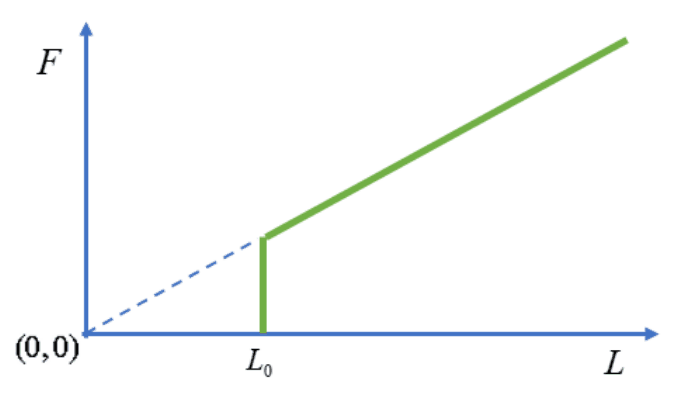
Figure 1: the relation between the force \(F\) and the spring length \(L\)
A ZLS is useful in seismography and allows very accurate measurement of changes in the gravitational acceleration \(g\). Here, we shall consider a homogenous ZLS, whose weight \(Mg\) exceeds \(kL_0\). We define a corresponding dimensionless ratio, \(\alpha=kL_0/Mg<1\) to characterize the relative softness of the spring. The toy known as “slinky” may be (but not necessarily) such a ZLS.
Part A: Statics (3.0 points)
| A.1 | Consider a segment of length \(\Delta\ell\) of the unstretched ZLS spring which is then stretched by a force \(F\), under weightless conditions. What is the length \(\Delta y\) of this segment as a function of \(F\), \(\Delta\ell\) and the parameters of the spring? | 0.5pt |
| A.2 | For a segment of length \(\Delta\ell\), calculate the work \(\Delta W\) required to stretch it from its original length \(\Delta\ell\) to a length \(\Delta y\). | 0.5pt |
Throughout this question, we will denote a point on the spring by its distance \(0\leq\ell\leq L_0\) from the bottom of the spring when it is unstretched. In particular, for every point on the spring, \(\ell\) remains unchanged as the spring stretches.
| A.3 | Suppose that we hang the spring by its top end, so that it stretches under its own weight. What is the total length \(H\) of the suspended spring in equilibrium? Express your answers in terms of \(L_0\) and \(\alpha\). | 2.0pt |
Part B: Dynamics (5.5 points)
Experiments show that when the spring is hung at rest and then released, it gradually contracts from the top, while the lower part remains stationary (see Figure 2). As time advances, the contracting part moves as a solid chunk and accumulates additional turns of the spring, while the stationary part becomes shorter. Every point on the spring begins to move only when the moving part reaches it. The bottom end of the spring starts moving only when the spring is fully collapsed and reaches its unstretched length \(L_0\). After that, the contracted spring continues falling straight downwards, without tumbling, as a rigid body under the influence of gravity.
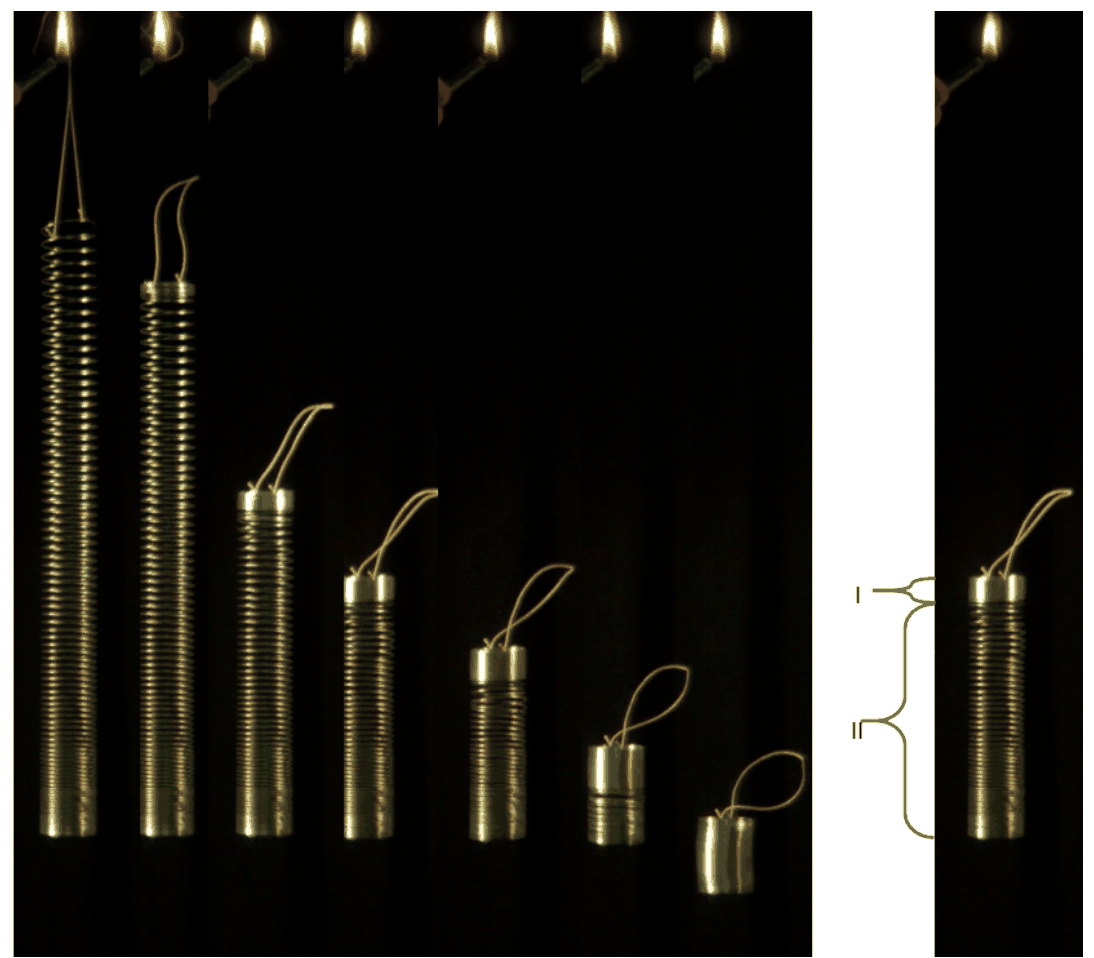
Figure 2: Left: a sequence of pictures taken during the free fall of slinky. Right: the moving part I and the stationary part II during the free fall of the spring.
In the remaining parts of the question, you are asked to base your solution on this described model. You may neglect air resistance, but you are not allowed to neglect \(L_0\).
| B.1 | Calculate the time \(t_c\) it takes from the moment the spring is released, until it fully collapses back to its minimal length \(L_0\). Express your answer in terms of \(L_0\), \(g\) and \(\alpha\). Compute the numerical value of \(t_c\) for a spring with \(k=1.02\ \mathrm{N/m}\), \(L_0=0.055\ \mathrm{m}\) and \(M=0.201\ \mathrm{kg}\), while taking \(g\) to be \(9.80\ \mathrm{m/s^2}\). | 2.5pt |
| B.2 | In this task \(\ell\) is used to denote the coordinate of the boundary between parts I (in figure 2, the moving part) and II (the stationary part). At a certain moment, while a stationary part still exists its mass is \(m(\ell)=\frac{\ell}{L_0}M\), and the moving part moves with uniform instantaneous velocity \(v_I(\ell)\). Show that at this moment (while there exists a stationary part) the velocity of the moving part is \(v_I(\ell)=\sqrt{A\ell+B}\). Express the constants \(A\) and \(B\) in terms of \(L_0\), \(g\) and \(\alpha\). | 2.5pt |
| B.3 | Based on B.2, find the minimum speed \(v_{\min}\) of the moving part of the spring in the course of its motion, after its release and before it hits the ground. Express your answer in terms of \(L_0\), \(\alpha\), \(A\) and \(B\). | 0.5pt |
Part C: Energetics (1.5 points)
| C.1 | Calculate the amount of mechanical energy \(Q\) that was lost by generating heat, from the moment the spring is released until just before the spring hits the ground. Express your answer in terms of \(L_0\), \(M\), \(g\) and \(\alpha\). | 1.5pt |
Official English text of the problem.
Answers
-
A.1 \[ \boxed{\Delta y=\Delta\ell\max\!\left(1,\frac{F}{kL_0}\right)} \]
-
A.2, for \(\Delta y\geq\Delta\ell\): \[ \boxed{\Delta W=\frac{kL_0}{2\Delta\ell} \left[(\Delta y)^2-(\Delta\ell)^2\right]} \]
-
A.3 \[ \boxed{H=\frac{L_0}{2\alpha}(1+\alpha^2)} \]
-
B.1 \[ \boxed{t_c=\sqrt{\frac{L_0(1-\alpha)^3}{3\alpha g}}} \qquad \boxed{t_c\approx0.245\ \mathrm{s}} \]
-
B.2, taking downward velocity as positive: \[ \boxed{A=\frac{2g}{3\alpha},\qquad B=\frac{gL_0(1-3\alpha)}{3\alpha}} \] The collapse proceeds through \(\alpha L_0\leq\ell<L_0\).
-
B.3 \[ \boxed{v_{\min}=(1-\alpha)\sqrt{A\alpha L_0+B}} \] This occurs immediately after the moving part collides with the initially compact bottom portion.
-
C.1 \[ \boxed{Q=\frac{MgL_0}{6\alpha}(1-\alpha)^2(1+2\alpha)} \]
Solution
A.1
Under weightless conditions the tension is uniform. Since the spring is homogeneous, every segment has the same ratio of stretched length to unstretched length.
When \(F>kL_0\), the whole spring has length \(L=F/k\), so \[ \frac{\Delta y}{\Delta\ell}=\frac{L}{L_0} =\frac{F}{kL_0}. \] Equivalently, the segment has spring constant \[ k_{\mathrm{seg}}=\frac{kL_0}{\Delta\ell}. \]
For \(0\leq F\leq kL_0\), the segment remains at its minimum length. Thus \[ \boxed{ \Delta y= \begin{cases} \Delta\ell,&0\leq F\leq kL_0,\\[2mm] \dfrac{F\Delta\ell}{kL_0},&F>kL_0. \end{cases}} \]
A.2
Increasing the tension up to \(kL_0\) produces no displacement and therefore requires no mechanical work. During subsequent stretching, at instantaneous segment length \(s\), \[ F(s)=\frac{kL_0}{\Delta\ell}s. \] The work required for quasistatic stretching is \[ \Delta W=\int_{\Delta\ell}^{\Delta y}F(s)\,ds =\frac{kL_0}{\Delta\ell} \int_{\Delta\ell}^{\Delta y}s\,ds. \] Hence \[ \boxed{\Delta W= \frac{kL_0}{2\Delta\ell} \left[(\Delta y)^2-(\Delta\ell)^2\right]}. \] This is also the increase in elastic potential energy.
A.3
The mass per unit unstretched length is \[ \mu=\frac{M}{L_0}. \] At material coordinate \(\ell\), the tension supports all the spring below that point: \[ T(\ell)=\mu g\ell=\frac{Mg}{L_0}\ell. \]
Stretching occurs only where \(T(\ell)>kL_0\). The boundary between the compact and stretched portions is therefore \[ \frac{Mg}{L_0}\ell_*=kL_0, \qquad \boxed{\ell_*=\alpha L_0}. \] Thus the lowest fraction \(\alpha\) of the spring remains unstretched.
Let \(y_0(\ell)\) be the equilibrium height above the bottom end. Applying A.1 locally, \[ \frac{dy_0}{d\ell}= \begin{cases} 1,&0\leq\ell\leq\alpha L_0,\\[1mm] \dfrac{\ell}{\alpha L_0},& \alpha L_0\leq\ell\leq L_0. \end{cases} \] Integrating with \(y_0(0)=0\) gives \[ y_0(\ell)= \begin{cases} \ell,&0\leq\ell\leq\alpha L_0,\\[2mm] \dfrac{\ell^2}{2\alpha L_0}+\dfrac{\alpha L_0}{2}, &\alpha L_0\leq\ell\leq L_0. \end{cases} \] In particular, \[ \boxed{H=y_0(L_0)=\frac{L_0}{2\alpha}(1+\alpha^2)}. \]
B.1
After release, gravity is the only external force. Consequently, the center of mass falls with acceleration \(g\), even though internal collisions dissipate energy.
The initial center-of-mass height is \[ \begin{aligned} y_{\mathrm{cm},0} &=\frac{1}{L_0}\int_0^{L_0}y_0(\ell)\,d\ell\\ &=\frac{1}{L_0}\left[ \int_0^{\alpha L_0}\ell\,d\ell+ \int_{\alpha L_0}^{L_0} \left(\frac{\ell^2}{2\alpha L_0} +\frac{\alpha L_0}{2}\right)d\ell \right]\\ &=\frac{L_0}{6\alpha}(1+3\alpha^2-\alpha^3). \end{aligned} \]
At the instant of complete collapse, the bottom end has not yet moved. The spring occupies the interval from \(y=0\) to \(y=L_0\), so \[ y_{\mathrm{cm},c}=\frac{L_0}{2}. \] The center of mass has therefore fallen through \[ \begin{aligned} y_{\mathrm{cm},0}-y_{\mathrm{cm},c} &=\frac{L_0}{6\alpha} (1-3\alpha+3\alpha^2-\alpha^3)\\ &=\frac{L_0}{6\alpha}(1-\alpha)^3. \end{aligned} \] Since it starts from rest, \[ \frac12gt_c^2=\frac{L_0}{6\alpha}(1-\alpha)^3, \] and hence \[ \boxed{t_c=\sqrt{\frac{L_0(1-\alpha)^3}{3\alpha g}}}. \]
For the supplied data, \[ \alpha=\frac{1.02(0.055)}{0.201(9.80)} =0.0284800. \] It is convenient to use the equivalent expression \[ t_c=\sqrt{\frac{M}{3k}}(1-\alpha)^{3/2}. \] Numerically, \[ \boxed{t_c=0.2454228\ldots\ \mathrm{s}\approx0.245\ \mathrm{s}}. \]
B.2
Take downward velocities as positive. Introduce \[ x=L_0-\ell,\qquad D=(1-\alpha)L_0. \] Here \(x\) is the unstretched length already incorporated into the moving compact chunk. Its mass and actual length are \[ m_I=\frac{M}{L_0}x, \qquad L_I=x. \]
Because the remaining spring is stationary, the total downward momentum is \(m_Iv_I\). Integrating the external force \(Mg\) from release gives \[ \frac{M}{L_0}xv_I=Mgt, \] or \[ \boxed{xv_I=L_0gt}. \] This momentum equation includes the effect of the moving chunk gaining mass.
The lower boundary of the moving chunk is at height \(y_0(\ell)\). Its top is consequently at \[ Y_{\mathrm{top}}=y_0(\ell)+L_0-\ell. \] While the boundary is in the initially stretched portion, \[ \begin{aligned} v_I &=-\frac{dY_{\mathrm{top}}}{dt}\\ &=-\left(\frac{\ell}{\alpha L_0}-1\right)\dot\ell\\ &=\frac{D-x}{\alpha L_0}\dot x. \end{aligned} \] Combining this with \(xv_I=L_0gt\), \[ x(D-x)\dot x=\alpha L_0^2gt. \] Integrating from \(x=0,\ t=0\), \[ \frac{Dx^2}{2}-\frac{x^3}{3} =\frac{\alpha L_0^2gt^2}{2}. \] Therefore \[ t^2=\frac{x^2}{\alpha L_0^2g} \left(D-\frac{2x}{3}\right). \] Substitution into the momentum relation gives \[ \begin{aligned} v_I^2 &=\frac{L_0^2g^2t^2}{x^2}\\ &=\frac{g}{\alpha}\left(D-\frac{2x}{3}\right)\\ &=\frac{g}{\alpha} \left[(1-\alpha)L_0-\frac23(L_0-\ell)\right]\\ &=\frac{2g}{3\alpha}\ell +\frac{gL_0(1-3\alpha)}{3\alpha}. \end{aligned} \] Thus \[ \boxed{v_I(\ell)=\sqrt{A\ell+B}}, \qquad \boxed{A=\frac{2g}{3\alpha},\quad B=\frac{gL_0(1-3\alpha)}{3\alpha}}. \]
The moving boundary reaches the initially compact bottom portion at \(\ell=\alpha L_0\). Hence this continuous contraction stage covers \[ \alpha L_0\leq\ell<L_0. \]
B.3
Since \(A>0\), the moving chunk slows down as \(\ell\) decreases. Just before it reaches the initially compact bottom portion, its speed is \[ v_-=\sqrt{A\alpha L_0+B}. \]
At this instant, the moving mass is \((1-\alpha)M\), while the compact bottom mass \(\alpha M\) is still stationary. The spring has reached its minimum total length, so these portions join in a perfectly inelastic collision, as required by the stipulated rigid-body motion afterward.
The gravitational impulse during this instantaneous collision is negligible. Conservation of momentum gives \[ (1-\alpha)Mv_-=Mv_c, \] and therefore \[ v_c=(1-\alpha)\sqrt{A\alpha L_0+B}. \] This is smaller than \(v_-\). Subsequently the entire spring accelerates downward at \(g\), so its speed increases. Consequently, \[ \boxed{v_{\min}=(1-\alpha)\sqrt{A\alpha L_0+B}}. \]
As a check, \[ A\alpha L_0+B=\frac{gL_0(1-\alpha)}{3\alpha}, \] so \[ v_{\min} =\sqrt{\frac{gL_0(1-\alpha)^3}{3\alpha}} =gt_c, \] as required by the total momentum at complete collapse.
The exactly stationary state at release is excluded by “after its release.” In the prescribed continuum model, the moving chunk has vanishing mass as \(t\to0^+\), allowing a finite limiting speed while total momentum tends to zero.
C.1
Choose zero elastic potential energy for the spring at its minimum length. Applying A.2 to an infinitesimal segment gives \[ dU_{\mathrm{el}} =\frac{kL_0}{2} \left[\left(\frac{dy_0}{d\ell}\right)^2-1\right]d\ell. \] The initially compact bottom portion contributes zero. Thus \[ \begin{aligned} U_{\mathrm{el},0} &=\frac{kL_0}{2} \int_{\alpha L_0}^{L_0} \left[\frac{\ell^2}{\alpha^2L_0^2}-1\right]d\ell\\ &=\frac{kL_0^2}{6\alpha^2} (1-3\alpha^2+2\alpha^3). \end{aligned} \] Using \(kL_0=\alpha Mg\), \[ U_{\mathrm{el},0} =\frac{MgL_0}{6\alpha} (1-3\alpha^2+2\alpha^3). \]
Immediately after complete collapse, the elastic energy is zero and the entire spring translates with speed \(v_c=gt_c\). The dissipated energy up to this moment is \[ Q=U_{\mathrm{el},0} +Mg(y_{\mathrm{cm},0}-y_{\mathrm{cm},c}) -\frac12Mv_c^2. \] However, free fall of the center of mass gives \[ Mg(y_{\mathrm{cm},0}-y_{\mathrm{cm},c}) =\frac12Mg^2t_c^2 =\frac12Mv_c^2. \] These two terms cancel, leaving \[ Q=U_{\mathrm{el},0}. \]
After collapse, the rigid spring falls without air resistance or tumbling, so no further mechanical energy is lost before impact. Factoring the result, \[ \boxed{ Q=\frac{MgL_0}{6\alpha} (1-3\alpha^2+2\alpha^3) =\frac{MgL_0}{6\alpha}(1-\alpha)^2(1+2\alpha) }. \]
The solution was checked against the official solution.
IPhO 2019 · Theorieaufgabe 1
Federn mit effektiver Länge null und Slinky-Spiralfedern
Eine Feder mit effektiver Länge null (ZLS) ist eine Feder, bei der die Kraft proportional zur Federlänge ist, \(F=kL\) für \(L>L_0\), wobei \(L_0\) sowohl die minimale Länge der Feder als auch ihre ungedehnte Länge ist. Abbildung 1 zeigt den Zusammenhang zwischen der Kraft \(F\) und der Federlänge \(L\) für eine ZLS; die Steigung der Geraden ist die Federkonstante \(k\).
Abbildung 1: Zusammenhang zwischen der Kraft \(F\) und der Federlänge \(L\)
Eine ZLS ist in der Seismografie nützlich und ermöglicht eine sehr genaue Messung von Änderungen der Fallbeschleunigung \(g\). Hier betrachten wir eine homogene ZLS, deren Gewichtskraft \(Mg\) größer als \(kL_0\) ist. Wir definieren das entsprechende dimensionslose Verhältnis \(\alpha=kL_0/Mg<1\), um die relative Weichheit der Feder zu charakterisieren. Das als „Slinky“ bekannte Spielzeug kann eine solche ZLS sein, muss es aber nicht.
Teil A: Statik (3.0 Punkte)
| A.1 | Betrachten Sie einen Abschnitt der ungedehnten ZLS-Feder mit der Länge \(\Delta\ell\), der anschließend unter schwerelosen Bedingungen durch eine Kraft \(F\) gedehnt wird. Wie groß ist die Länge \(\Delta y\) dieses Abschnitts als Funktion von \(F\), \(\Delta\ell\) und den Parametern der Feder? | 0.5 Pkt. |
| A.2 | Berechnen Sie für einen Abschnitt der Länge \(\Delta\ell\) die Arbeit \(\Delta W\), die erforderlich ist, um ihn von seiner ursprünglichen Länge \(\Delta\ell\) auf eine Länge \(\Delta y\) zu dehnen. | 0.5 Pkt. |
In dieser gesamten Aufgabe kennzeichnen wir einen Punkt auf der Feder durch seinen Abstand \(0\leq\ell\leq L_0\) vom unteren Ende der Feder im ungedehnten Zustand. Insbesondere bleibt \(\ell\) für jeden Punkt auf der Feder unverändert, wenn sich die Feder dehnt.
| A.3 | Angenommen, wir hängen die Feder an ihrem oberen Ende auf, sodass sie sich unter ihrem Eigengewicht dehnt. Wie groß ist die Gesamtlänge \(H\) der aufgehängten Feder im Gleichgewicht? Drücken Sie Ihre Antworten durch \(L_0\) und \(\alpha\) aus. | 2.0 Pkt. |
Teil B: Dynamik (5.5 Punkte)
Experimente zeigen, dass sich die Feder, wenn sie zunächst ruhend aufgehängt und dann losgelassen wird, allmählich vom oberen Ende her zusammenzieht, während der untere Teil in Ruhe bleibt (siehe Abbildung 2). Im weiteren zeitlichen Verlauf bewegt sich der sich zusammenziehende Teil als kompakter Block und nimmt weitere Windungen der Feder auf, während der ruhende Teil kürzer wird. Jeder Punkt auf der Feder beginnt sich erst dann zu bewegen, wenn der bewegte Teil ihn erreicht. Das untere Ende der Feder beginnt sich erst dann zu bewegen, wenn sich die Feder vollständig zusammengezogen und ihre ungedehnte Länge \(L_0\) erreicht hat. Danach fällt die zusammengezogene Feder unter dem Einfluss der Schwerkraft als starrer Körper geradlinig nach unten weiter, ohne zu taumeln.
Abbildung 2: Links: eine Folge von Aufnahmen während des freien Falls eines Slinkys. Rechts: der bewegte Teil I und der ruhende Teil II während des freien Falls der Feder.
In den verbleibenden Teilen der Aufgabe sollen Sie Ihre Lösung auf dieses beschriebene Modell stützen. Sie dürfen den Luftwiderstand vernachlässigen, \(L_0\) jedoch nicht.
| B.1 | Berechnen Sie die Zeit \(t_c\) vom Loslassen der Feder bis zu dem Zeitpunkt, an dem sie sich wieder vollständig auf ihre minimale Länge \(L_0\) zusammengezogen hat. Drücken Sie Ihre Antwort durch \(L_0\), \(g\) und \(\alpha\) aus. Berechnen Sie den Zahlenwert von \(t_c\) für eine Feder mit \(k=1.02\ \mathrm{N/m}\), \(L_0=0.055\ \mathrm{m}\) und \(M=0.201\ \mathrm{kg}\), wobei Sie für \(g\) den Wert \(9.80\ \mathrm{m/s^2}\) verwenden. | 2.5 Pkt. |
| B.2 | In dieser Teilaufgabe bezeichnet \(\ell\) die Koordinate der Grenze zwischen den Teilen I (in Abbildung 2 der bewegte Teil) und II (der ruhende Teil). Zu einem bestimmten Zeitpunkt, zu dem noch ein ruhender Teil vorhanden ist, beträgt dessen Masse \(m(\ell)=\frac{\ell}{L_0}M\), und der bewegte Teil bewegt sich mit der räumlich einheitlichen momentanen Geschwindigkeit \(v_I(\ell)\). Zeigen Sie, dass zu diesem Zeitpunkt (solange ein ruhender Teil vorhanden ist) die Geschwindigkeit des bewegten Teils \(v_I(\ell)=\sqrt{A\ell+B}\) beträgt. Drücken Sie die Konstanten \(A\) und \(B\) durch \(L_0\), \(g\) und \(\alpha\) aus. | 2.5 Pkt. |
| B.3 | Bestimmen Sie auf Grundlage von B.2 den kleinsten Geschwindigkeitsbetrag \(v_{\min}\) des bewegten Teils der Feder im Verlauf seiner Bewegung nach dem Loslassen und vor dem Auftreffen auf den Boden. Drücken Sie Ihre Antwort durch \(L_0\), \(\alpha\), \(A\) und \(B\) aus. | 0.5 Pkt. |
Teil C: Energetik (1.5 Punkte)
| C.1 | Berechnen Sie den Betrag der mechanischen Energie \(Q\), der vom Loslassen der Feder bis unmittelbar vor ihrem Auftreffen auf den Boden durch Wärmeentwicklung verloren geht. Drücken Sie Ihre Antwort durch \(L_0\), \(M\), \(g\) und \(\alpha\) aus. | 1.5 Pkt. |
Aufgabentext aus dem offiziellen englischen Text übersetzt.
Antworten
-
A.1 \[ \boxed{\Delta y=\Delta\ell\max\!\left(1,\frac{F}{kL_0}\right)} \]
-
A.2, für \(\Delta y\geq\Delta\ell\): \[ \boxed{\Delta W=\frac{kL_0}{2\Delta\ell} \left[(\Delta y)^2-(\Delta\ell)^2\right]} \]
-
A.3 \[ \boxed{H=\frac{L_0}{2\alpha}(1+\alpha^2)} \]
-
B.1 \[ \boxed{t_c=\sqrt{\frac{L_0(1-\alpha)^3}{3\alpha g}}} \qquad \boxed{t_c\approx0.245\ \mathrm{s}} \]
-
B.2, wobei nach unten gerichtete Geschwindigkeiten als positiv gelten: \[ \boxed{A=\frac{2g}{3\alpha},\qquad B=\frac{gL_0(1-3\alpha)}{3\alpha}} \] Das Zusammenziehen erfolgt im Bereich \(\alpha L_0\leq\ell<L_0\).
-
B.3 \[ \boxed{v_{\min}=(1-\alpha)\sqrt{A\alpha L_0+B}} \] Dieser Wert wird unmittelbar nach dem Stoß des bewegten Teils mit dem anfangs kompakten unteren Abschnitt erreicht.
-
C.1 \[ \boxed{Q=\frac{MgL_0}{6\alpha}(1-\alpha)^2(1+2\alpha)} \]
Lösung
A.1
Unter schwerelosen Bedingungen ist die Zugkraft überall gleich. Da die Feder homogen ist, ist das Verhältnis von gedehnter zu ungedehnter Länge für jeden Abschnitt gleich.
Für \(F>kL_0\) hat die gesamte Feder die Länge \(L=F/k\), also gilt \[ \frac{\Delta y}{\Delta\ell}=\frac{L}{L_0} =\frac{F}{kL_0}. \] Gleichbedeutend damit hat der Abschnitt die Federkonstante \[ k_{\mathrm{seg}}=\frac{kL_0}{\Delta\ell}. \]
Für \(0\leq F\leq kL_0\) behält der Abschnitt seine minimale Länge. Somit gilt \[ \boxed{ \Delta y= \begin{cases} \Delta\ell,&0\leq F\leq kL_0,\\[2mm] \dfrac{F\Delta\ell}{kL_0},&F>kL_0. \end{cases}} \]
A.2
Eine Erhöhung der Zugkraft bis auf \(kL_0\) bewirkt keine Verschiebung und erfordert daher keine mechanische Arbeit. Während der anschließenden Dehnung gilt bei der momentanen Abschnittslänge \(s\) \[ F(s)=\frac{kL_0}{\Delta\ell}s. \] Die für eine quasistatische Dehnung erforderliche Arbeit ist \[ \Delta W=\int_{\Delta\ell}^{\Delta y}F(s)\,ds =\frac{kL_0}{\Delta\ell} \int_{\Delta\ell}^{\Delta y}s\,ds. \] Daraus folgt \[ \boxed{\Delta W= \frac{kL_0}{2\Delta\ell} \left[(\Delta y)^2-(\Delta\ell)^2\right]}. \] Dies ist zugleich die Zunahme der elastischen potenziellen Energie.
A.3
Die Masse pro Einheit der ungedehnten Länge beträgt \[ \mu=\frac{M}{L_0}. \] An der Materialkoordinate \(\ell\) trägt die Zugkraft die gesamte Feder unterhalb dieses Punktes: \[ T(\ell)=\mu g\ell=\frac{Mg}{L_0}\ell. \]
Eine Dehnung tritt nur dort auf, wo \(T(\ell)>kL_0\) gilt. Für die Grenze zwischen dem kompakten und dem gedehnten Abschnitt gilt daher \[ \frac{Mg}{L_0}\ell_*=kL_0, \qquad \boxed{\ell_*=\alpha L_0}. \] Somit bleibt der unterste Anteil \(\alpha\) der Feder ungedehnt.
Sei \(y_0(\ell)\) die Gleichgewichtshöhe über dem unteren Ende. Die lokale Anwendung von A.1 ergibt \[ \frac{dy_0}{d\ell}= \begin{cases} 1,&0\leq\ell\leq\alpha L_0,\\[1mm] \dfrac{\ell}{\alpha L_0},& \alpha L_0\leq\ell\leq L_0. \end{cases} \] Integration mit \(y_0(0)=0\) liefert \[ y_0(\ell)= \begin{cases} \ell,&0\leq\ell\leq\alpha L_0,\\[2mm] \dfrac{\ell^2}{2\alpha L_0}+\dfrac{\alpha L_0}{2}, &\alpha L_0\leq\ell\leq L_0. \end{cases} \] Insbesondere gilt \[ \boxed{H=y_0(L_0)=\frac{L_0}{2\alpha}(1+\alpha^2)}. \]
B.1
Nach dem Loslassen ist die Schwerkraft die einzige äußere Kraft. Folglich fällt der Schwerpunkt mit der Beschleunigung \(g\), obwohl innere Stöße Energie dissipieren.
Die anfängliche Schwerpunkthöhe beträgt \[ \begin{aligned} y_{\mathrm{cm},0} &=\frac{1}{L_0}\int_0^{L_0}y_0(\ell)\,d\ell\\ &=\frac{1}{L_0}\left[ \int_0^{\alpha L_0}\ell\,d\ell+ \int_{\alpha L_0}^{L_0} \left(\frac{\ell^2}{2\alpha L_0} +\frac{\alpha L_0}{2}\right)d\ell \right]\\ &=\frac{L_0}{6\alpha}(1+3\alpha^2-\alpha^3). \end{aligned} \]
In dem Augenblick, in dem sich die Feder vollständig zusammengezogen hat, hat sich ihr unteres Ende noch nicht bewegt. Die Feder erstreckt sich über das Intervall von \(y=0\) bis \(y=L_0\), also gilt \[ y_{\mathrm{cm},c}=\frac{L_0}{2}. \] Der Schwerpunkt ist daher um die Strecke \[ \begin{aligned} y_{\mathrm{cm},0}-y_{\mathrm{cm},c} &=\frac{L_0}{6\alpha} (1-3\alpha+3\alpha^2-\alpha^3)\\ &=\frac{L_0}{6\alpha}(1-\alpha)^3 \end{aligned} \] gefallen. Da er aus der Ruhe startet, gilt \[ \frac12gt_c^2=\frac{L_0}{6\alpha}(1-\alpha)^3, \] und somit \[ \boxed{t_c=\sqrt{\frac{L_0(1-\alpha)^3}{3\alpha g}}}. \]
Für die angegebenen Daten gilt \[ \alpha=\frac{1.02(0.055)}{0.201(9.80)} =0.0284800. \] Es ist zweckmäßig, den äquivalenten Ausdruck \[ t_c=\sqrt{\frac{M}{3k}}(1-\alpha)^{3/2} \] zu verwenden. Numerisch ergibt sich \[ \boxed{t_c=0.2454228\ldots\ \mathrm{s}\approx0.245\ \mathrm{s}}. \]
B.2
Wir wählen nach unten gerichtete Geschwindigkeiten als positiv. Wir führen \[ x=L_0-\ell,\qquad D=(1-\alpha)L_0 \] ein. Dabei ist \(x\) die ungedehnte Länge, die bereits in den bewegten kompakten Block aufgenommen wurde. Seine Masse und seine tatsächliche Länge betragen \[ m_I=\frac{M}{L_0}x, \qquad L_I=x. \]
Da die übrige Feder ruht, beträgt der gesamte nach unten gerichtete Impuls \(m_Iv_I\). Die Integration der äußeren Kraft \(Mg\) ab dem Loslassen ergibt \[ \frac{M}{L_0}xv_I=Mgt, \] also \[ \boxed{xv_I=L_0gt}. \] Diese Impulsgleichung berücksichtigt die Massenzunahme des bewegten Blocks.
Die untere Grenze des bewegten Blocks befindet sich auf der Höhe \(y_0(\ell)\). Sein oberes Ende befindet sich folglich bei \[ Y_{\mathrm{top}}=y_0(\ell)+L_0-\ell. \] Solange die Grenze im anfangs gedehnten Abschnitt liegt, gilt \[ \begin{aligned} v_I &=-\frac{dY_{\mathrm{top}}}{dt}\\ &=-\left(\frac{\ell}{\alpha L_0}-1\right)\dot\ell\\ &=\frac{D-x}{\alpha L_0}\dot x. \end{aligned} \] Zusammen mit \(xv_I=L_0gt\) ergibt dies \[ x(D-x)\dot x=\alpha L_0^2gt. \] Integration ausgehend von \(x=0,\ t=0\) liefert \[ \frac{Dx^2}{2}-\frac{x^3}{3} =\frac{\alpha L_0^2gt^2}{2}. \] Damit gilt \[ t^2=\frac{x^2}{\alpha L_0^2g} \left(D-\frac{2x}{3}\right). \] Einsetzen in die Impulsbeziehung ergibt \[ \begin{aligned} v_I^2 &=\frac{L_0^2g^2t^2}{x^2}\\ &=\frac{g}{\alpha}\left(D-\frac{2x}{3}\right)\\ &=\frac{g}{\alpha} \left[(1-\alpha)L_0-\frac23(L_0-\ell)\right]\\ &=\frac{2g}{3\alpha}\ell +\frac{gL_0(1-3\alpha)}{3\alpha}. \end{aligned} \] Somit gilt \[ \boxed{v_I(\ell)=\sqrt{A\ell+B}}, \qquad \boxed{A=\frac{2g}{3\alpha},\quad B=\frac{gL_0(1-3\alpha)}{3\alpha}}. \]
Die bewegte Grenze erreicht den anfangs kompakten unteren Abschnitt bei \(\ell=\alpha L_0\). Diese Phase des kontinuierlichen Zusammenziehens umfasst daher den Bereich \[ \alpha L_0\leq\ell<L_0. \]
B.3
Da \(A>0\) gilt, wird der bewegte Block mit abnehmendem \(\ell\) langsamer. Unmittelbar bevor er den anfangs kompakten unteren Abschnitt erreicht, beträgt sein Geschwindigkeitsbetrag \[ v_-=\sqrt{A\alpha L_0+B}. \]
In diesem Augenblick beträgt die bewegte Masse \((1-\alpha)M\), während die kompakte untere Masse \(\alpha M\) noch ruht. Die Feder hat ihre minimale Gesamtlänge erreicht, sodass sich diese Abschnitte in einem vollkommen unelastischen Stoß vereinigen, wie es die vorgegebene anschließende Bewegung als starrer Körper erfordert.
Der Kraftstoß der Schwerkraft während dieses momentanen Stoßes ist vernachlässigbar. Die Impulserhaltung ergibt \[ (1-\alpha)Mv_-=Mv_c, \] und daher \[ v_c=(1-\alpha)\sqrt{A\alpha L_0+B}. \] Dieser Wert ist kleiner als \(v_-\). Anschließend wird die gesamte Feder mit \(g\) nach unten beschleunigt, sodass ihr Geschwindigkeitsbetrag zunimmt. Folglich gilt \[ \boxed{v_{\min}=(1-\alpha)\sqrt{A\alpha L_0+B}}. \]
Zur Kontrolle gilt \[ A\alpha L_0+B=\frac{gL_0(1-\alpha)}{3\alpha}, \] also \[ v_{\min} =\sqrt{\frac{gL_0(1-\alpha)^3}{3\alpha}} =gt_c, \] wie es der Gesamtimpuls beim vollständigen Zusammenziehen erfordert.
Der exakt ruhende Zustand beim Loslassen ist durch „nach dem Loslassen“ ausgeschlossen. Im vorgegebenen Kontinuumsmodell geht die Masse des bewegten Blocks für \(t\to0^+\) gegen null, wodurch ein endlicher Grenzwert des Geschwindigkeitsbetrags möglich ist, während der Gesamtimpuls gegen null geht.
C.1
Wir wählen die elastische potenzielle Energie der Feder bei ihrer minimalen Länge gleich null. Die Anwendung von A.2 auf einen infinitesimalen Abschnitt ergibt \[ dU_{\mathrm{el}} =\frac{kL_0}{2} \left[\left(\frac{dy_0}{d\ell}\right)^2-1\right]d\ell. \] Der anfangs kompakte untere Abschnitt liefert keinen Beitrag. Somit gilt \[ \begin{aligned} U_{\mathrm{el},0} &=\frac{kL_0}{2} \int_{\alpha L_0}^{L_0} \left[\frac{\ell^2}{\alpha^2L_0^2}-1\right]d\ell\\ &=\frac{kL_0^2}{6\alpha^2} (1-3\alpha^2+2\alpha^3). \end{aligned} \] Mit \(kL_0=\alpha Mg\) folgt \[ U_{\mathrm{el},0} =\frac{MgL_0}{6\alpha} (1-3\alpha^2+2\alpha^3). \]
Unmittelbar nach dem vollständigen Zusammenziehen ist die elastische Energie null, und die gesamte Feder führt eine Translation mit der Geschwindigkeit \(v_c=gt_c\) aus. Die bis zu diesem Zeitpunkt dissipierte Energie beträgt \[ Q=U_{\mathrm{el},0} +Mg(y_{\mathrm{cm},0}-y_{\mathrm{cm},c}) -\frac12Mv_c^2. \] Aus dem freien Fall des Schwerpunkts folgt jedoch \[ Mg(y_{\mathrm{cm},0}-y_{\mathrm{cm},c}) =\frac12Mg^2t_c^2 =\frac12Mv_c^2. \] Diese beiden Terme heben sich auf, sodass \[ Q=U_{\mathrm{el},0} \] übrig bleibt.
Nach dem Zusammenziehen fällt die starre Feder ohne Luftwiderstand und ohne zu taumeln, sodass vor dem Aufprall keine weitere mechanische Energie verloren geht. Durch Faktorisieren des Ergebnisses erhält man \[ \boxed{ Q=\frac{MgL_0}{6\alpha} (1-3\alpha^2+2\alpha^3) =\frac{MgL_0}{6\alpha}(1-\alpha)^2(1+2\alpha) }. \]
Die Lösung wurde mit der offiziellen Lösung abgeglichen.
IPhO 2019 · Teori sorusu 1
Sıfır uzunluklu yaylar ve slinky sarmalları
Etkin uzunluğu sıfır olan bir yay (ZLS), kuvvetin yayın uzunluğuyla orantılı olduğu bir yaydır: \(L>L_0\) için \(F=kL\); burada \(L_0\), yayın hem en küçük uzunluğu hem de gerilmemiş uzunluğudur. Şekil 1, bir ZLS için \(F\) kuvveti ile \(L\) yay uzunluğu arasındaki ilişkiyi göstermektedir; doğrunun eğimi yay sabiti \(k\)'dır.
Şekil 1: \(F\) kuvveti ile \(L\) yay uzunluğu arasındaki ilişki
ZLS, sismografide kullanışlıdır ve yerçekimi ivmesi \(g\)'deki değişimlerin çok hassas biçimde ölçülmesini sağlar. Burada, ağırlığı \(Mg\), \(kL_0\)'dan büyük olan homojen bir ZLS ele alacağız. Yayın göreli yumuşaklığını nitelemek için buna karşılık gelen boyutsuz bir oranı, \(\alpha=kL_0/Mg<1\), tanımlıyoruz. “Slinky” olarak bilinen oyuncak böyle bir ZLS olabilir (ancak olması şart değildir).
Bölüm A: Statik (3.0 puan)
| A.1 | Gerilmemiş ZLS yayının \(\Delta\ell\) uzunluğundaki bir parçasının, ağırlıksızlık koşullarında \(F\) kuvvetiyle gerildiğini düşünün. Bu parçanın \(\Delta y\) uzunluğu, \(F\), \(\Delta\ell\) ve yayın parametrelerinin bir fonksiyonu olarak nedir? | 0.5 puan |
| A.2 | \(\Delta\ell\) uzunluğundaki bir parçayı, başlangıçtaki \(\Delta\ell\) uzunluğundan \(\Delta y\) uzunluğuna germek için gereken \(\Delta W\) işini hesaplayın. | 0.5 puan |
Bu soru boyunca, yay üzerindeki bir noktayı, yay gerilmemiş durumdayken yayın alt ucuna olan \(0\leq\ell\leq L_0\) uzaklığıyla belirteceğiz. Özellikle, yay üzerindeki her nokta için \(\ell\), yay gerilirken değişmeden kalır.
| A.3 | Yayı üst ucundan astığımızı ve böylece kendi ağırlığı altında gerildiğini varsayın. Asılı yayın denge durumundaki toplam \(H\) uzunluğu nedir? Yanıtlarınızı \(L_0\) ve \(\alpha\) cinsinden ifade edin. | 2.0 puan |
Bölüm B: Dinamik (5.5 puan)
Deneyler, yay asılı ve durgun durumdayken serbest bırakıldığında, alt kısmı hareketsiz kalırken üstten başlayarak giderek büzüldüğünü göstermektedir (bkz. Şekil 2). Zaman ilerledikçe, büzülen kısım tek bir katı parça gibi hareket eder ve yayın diğer sarımlarını da bünyesine katarken, hareketsiz kısım kısalır. Yay üzerindeki her nokta, ancak hareketli kısım kendisine ulaştığında hareket etmeye başlar. Yayın alt ucu, ancak yay tamamen büzülüp gerilmemiş uzunluğu \(L_0\)'a ulaştığında hareket etmeye başlar. Bundan sonra büzülmüş yay, yerçekiminin etkisi altında rijit bir cisim olarak, takla atmadan, düşey doğrultuda aşağıya düşmeye devam eder.
Şekil 2: Sol: Slinky'nin serbest düşüşü sırasında çekilmiş bir dizi fotoğraf. Sağ: Yayın serbest düşüşü sırasında hareketli kısım I ve hareketsiz kısım II.
Sorunun kalan bölümlerinde, çözümünüzü burada açıklanan modele dayandırmanız istenmektedir. Hava direncini ihmal edebilirsiniz, ancak \(L_0\)'ı ihmal etmenize izin verilmemektedir.
| B.1 | Yayın serbest bırakıldığı andan, tamamen büzülerek yeniden en küçük uzunluğu \(L_0\)'a ulaşmasına kadar geçen \(t_c\) süresini hesaplayın. Yanıtınızı \(L_0\), \(g\) ve \(\alpha\) cinsinden ifade edin. \(k=1.02\ \mathrm{N/m}\), \(L_0=0.055\ \mathrm{m}\) ve \(M=0.201\ \mathrm{kg}\) olan bir yay için, \(g\)'yi \(9.80\ \mathrm{m/s^2}\) alarak \(t_c\)'nin sayısal değerini hesaplayın. | 2.5 puan |
| B.2 | Bu soruda \(\ell\), I (Şekil 2'deki hareketli kısım) ve II (hareketsiz kısım) arasındaki sınırın koordinatını belirtmek için kullanılmaktadır. Hareketsiz kısmın hâlâ var olduğu belirli bir anda, bu kısmın kütlesi \(m(\ell)=\frac{\ell}{L_0}M\)'dir ve hareketli kısmın her noktası aynı anlık \(v_I(\ell)\) hızıyla hareket etmektedir. Bu anda (hareketsiz bir kısım varken) hareketli kısmın hızının \(v_I(\ell)=\sqrt{A\ell+B}\) olduğunu gösterin. \(A\) ve \(B\) sabitlerini \(L_0\), \(g\) ve \(\alpha\) cinsinden ifade edin. | 2.5 puan |
| B.3 | B.2'ye dayanarak, yayın hareketli kısmının serbest bırakıldıktan sonra ve yere çarpmadan önceki hareketi boyunca sahip olduğu en küçük \(v_{\min}\) süratini bulun. Yanıtınızı \(L_0\), \(\alpha\), \(A\) ve \(B\) cinsinden ifade edin. | 0.5 puan |
Bölüm C: Enerji (1.5 puan)
| C.1 | Yayın serbest bırakıldığı andan yere çarpmasından hemen öncesine kadar, ısıya dönüşerek kaybolan mekanik enerji miktarı \(Q\)'yu hesaplayın. Yanıtınızı \(L_0\), \(M\), \(g\) ve \(\alpha\) cinsinden ifade edin. | 1.5 puan |
Soru metni resmi İngilizce metinden çevrilmiştir.
Cevaplar
-
A.1 \[ \boxed{\Delta y=\Delta\ell\max\!\left(1,\frac{F}{kL_0}\right)} \]
-
A.2, \(\Delta y\geq\Delta\ell\) için: \[ \boxed{\Delta W=\frac{kL_0}{2\Delta\ell} \left[(\Delta y)^2-(\Delta\ell)^2\right]} \]
-
A.3 \[ \boxed{H=\frac{L_0}{2\alpha}(1+\alpha^2)} \]
-
B.1 \[ \boxed{t_c=\sqrt{\frac{L_0(1-\alpha)^3}{3\alpha g}}} \qquad \boxed{t_c\approx0.245\ \mathrm{s}} \]
-
B.2, aşağı yönlü hız pozitif alınırsa: \[ \boxed{A=\frac{2g}{3\alpha},\qquad B=\frac{gL_0(1-3\alpha)}{3\alpha}} \] Büzülme, \(\alpha L_0\leq\ell<L_0\) aralığı boyunca ilerler.
-
B.3 \[ \boxed{v_{\min}=(1-\alpha)\sqrt{A\alpha L_0+B}} \] Bu, hareketli kısmın başlangıçta sıkışık olan alt kısımla çarpışmasından hemen sonra gerçekleşir.
-
C.1 \[ \boxed{Q=\frac{MgL_0}{6\alpha}(1-\alpha)^2(1+2\alpha)} \]
Çözüm
A.1
Ağırlıksızlık koşullarında gerilme kuvveti her yerde aynıdır. Yay homojen olduğundan, her parçanın gerilmiş uzunluğunun gerilmemiş uzunluğuna oranı aynıdır.
\(F>kL_0\) olduğunda, yayın tamamının uzunluğu \(L=F/k\) olur; dolayısıyla \[ \frac{\Delta y}{\Delta\ell}=\frac{L}{L_0} =\frac{F}{kL_0}. \] Eşdeğer olarak, parçanın yay sabiti \[ k_{\mathrm{seg}}=\frac{kL_0}{\Delta\ell}. \]
\(0\leq F\leq kL_0\) için parça en küçük uzunluğunda kalır. Böylece \[ \boxed{ \Delta y= \begin{cases} \Delta\ell,&0\leq F\leq kL_0,\\[2mm] \dfrac{F\Delta\ell}{kL_0},&F>kL_0. \end{cases}} \]
A.2
Gerilme kuvvetini \(kL_0\)'a kadar artırmak herhangi bir yer değiştirmeye yol açmaz ve bu nedenle mekanik iş gerektirmez. Daha sonraki gerilme sırasında, parçanın anlık uzunluğu \(s\) iken, \[ F(s)=\frac{kL_0}{\Delta\ell}s. \] Kuazistatik germe için gereken iş \[ \Delta W=\int_{\Delta\ell}^{\Delta y}F(s)\,ds =\frac{kL_0}{\Delta\ell} \int_{\Delta\ell}^{\Delta y}s\,ds. \] Böylece \[ \boxed{\Delta W= \frac{kL_0}{2\Delta\ell} \left[(\Delta y)^2-(\Delta\ell)^2\right]}. \] Bu, aynı zamanda esneklik potansiyel enerjisindeki artıştır.
A.3
Birim gerilmemiş uzunluk başına kütle \[ \mu=\frac{M}{L_0}. \] \(\ell\) malzeme koordinatında, gerilme kuvveti bu noktanın altında kalan yayın tamamını taşır: \[ T(\ell)=\mu g\ell=\frac{Mg}{L_0}\ell. \]
Gerilme yalnızca \(T(\ell)>kL_0\) olan yerlerde gerçekleşir. Bu nedenle sıkışık ve gerilmiş kısımlar arasındaki sınır \[ \frac{Mg}{L_0}\ell_*=kL_0, \qquad \boxed{\ell_*=\alpha L_0}. \] Böylece yayın en alttaki \(\alpha\) oranındaki kısmı gerilmemiş olarak kalır.
\(y_0(\ell)\), denge durumunda alt uçtan ölçülen yükseklik olsun. A.1 yerel olarak uygulanırsa, \[ \frac{dy_0}{d\ell}= \begin{cases} 1,&0\leq\ell\leq\alpha L_0,\\[1mm] \dfrac{\ell}{\alpha L_0},& \alpha L_0\leq\ell\leq L_0. \end{cases} \] \(y_0(0)=0\) koşuluyla integral alınırsa \[ y_0(\ell)= \begin{cases} \ell,&0\leq\ell\leq\alpha L_0,\\[2mm] \dfrac{\ell^2}{2\alpha L_0}+\dfrac{\alpha L_0}{2}, &\alpha L_0\leq\ell\leq L_0. \end{cases} \] Özel olarak, \[ \boxed{H=y_0(L_0)=\frac{L_0}{2\alpha}(1+\alpha^2)}. \]
B.1
Serbest bırakıldıktan sonra, tek dış kuvvet yerçekimi kuvvetidir. Dolayısıyla, iç çarpışmalar enerji kaybına yol açsa da kütle merkezi \(g\) ivmesiyle düşer.
Kütle merkezinin başlangıçtaki yüksekliği \[ \begin{aligned} y_{\mathrm{cm},0} &=\frac{1}{L_0}\int_0^{L_0}y_0(\ell)\,d\ell\\ &=\frac{1}{L_0}\left[ \int_0^{\alpha L_0}\ell\,d\ell+ \int_{\alpha L_0}^{L_0} \left(\frac{\ell^2}{2\alpha L_0} +\frac{\alpha L_0}{2}\right)d\ell \right]\\ &=\frac{L_0}{6\alpha}(1+3\alpha^2-\alpha^3). \end{aligned} \]
Tam büzülme anında alt uç henüz hareket etmemiştir. Yay, \(y=0\) ile \(y=L_0\) arasındaki bölgeyi kaplar; dolayısıyla \[ y_{\mathrm{cm},c}=\frac{L_0}{2}. \] Bu nedenle kütle merkezinin düştüğü mesafe \[ \begin{aligned} y_{\mathrm{cm},0}-y_{\mathrm{cm},c} &=\frac{L_0}{6\alpha} (1-3\alpha+3\alpha^2-\alpha^3)\\ &=\frac{L_0}{6\alpha}(1-\alpha)^3. \end{aligned} \] Başlangıçta durgun olduğundan, \[ \frac12gt_c^2=\frac{L_0}{6\alpha}(1-\alpha)^3, \] ve buradan \[ \boxed{t_c=\sqrt{\frac{L_0(1-\alpha)^3}{3\alpha g}}}. \]
Verilen değerler için, \[ \alpha=\frac{1.02(0.055)}{0.201(9.80)} =0.0284800. \] Şu eşdeğer ifadeyi kullanmak uygundur: \[ t_c=\sqrt{\frac{M}{3k}}(1-\alpha)^{3/2}. \] Sayısal olarak, \[ \boxed{t_c=0.2454228\ldots\ \mathrm{s}\approx0.245\ \mathrm{s}}. \]
B.2
Aşağı yönlü hızları pozitif alalım. Şu tanımları yapalım: \[ x=L_0-\ell,\qquad D=(1-\alpha)L_0. \] Burada \(x\), hareketli sıkışık parçaya o ana kadar katılmış olan kısmın gerilmemiş uzunluğudur. Bu parçanın kütlesi ve gerçek uzunluğu \[ m_I=\frac{M}{L_0}x, \qquad L_I=x. \]
Yayın geri kalanı hareketsiz olduğundan, aşağı yönlü toplam momentum \(m_Iv_I\)'dir. Serbest bırakılma anından itibaren \(Mg\) dış kuvvetinin zamana göre integrali alınırsa \[ \frac{M}{L_0}xv_I=Mgt, \] ya da \[ \boxed{xv_I=L_0gt}. \] Bu momentum denklemi, hareketli parçanın kütle kazanmasının etkisini de içerir.
Hareketli parçanın alt sınırı \(y_0(\ell)\) yüksekliğindedir. Dolayısıyla üst ucu şu yüksekliktedir: \[ Y_{\mathrm{top}}=y_0(\ell)+L_0-\ell. \] Sınır, başlangıçta gerilmiş olan kısımdayken, \[ \begin{aligned} v_I &=-\frac{dY_{\mathrm{top}}}{dt}\\ &=-\left(\frac{\ell}{\alpha L_0}-1\right)\dot\ell\\ &=\frac{D-x}{\alpha L_0}\dot x. \end{aligned} \] Bu ifade \(xv_I=L_0gt\) ile birleştirilirse, \[ x(D-x)\dot x=\alpha L_0^2gt. \] \(x=0,\ t=0\)'dan başlayarak integral alınırsa, \[ \frac{Dx^2}{2}-\frac{x^3}{3} =\frac{\alpha L_0^2gt^2}{2}. \] Dolayısıyla \[ t^2=\frac{x^2}{\alpha L_0^2g} \left(D-\frac{2x}{3}\right). \] Momentum bağıntısında yerine konursa \[ \begin{aligned} v_I^2 &=\frac{L_0^2g^2t^2}{x^2}\\ &=\frac{g}{\alpha}\left(D-\frac{2x}{3}\right)\\ &=\frac{g}{\alpha} \left[(1-\alpha)L_0-\frac23(L_0-\ell)\right]\\ &=\frac{2g}{3\alpha}\ell +\frac{gL_0(1-3\alpha)}{3\alpha}. \end{aligned} \] Böylece \[ \boxed{v_I(\ell)=\sqrt{A\ell+B}}, \qquad \boxed{A=\frac{2g}{3\alpha},\quad B=\frac{gL_0(1-3\alpha)}{3\alpha}}. \]
Hareketli sınır, başlangıçta sıkışık olan alt kısma \(\ell=\alpha L_0\)'da ulaşır. Dolayısıyla bu sürekli büzülme evresi şu aralığı kapsar: \[ \alpha L_0\leq\ell<L_0. \]
B.3
\(A>0\) olduğundan, \(\ell\) azaldıkça hareketli parça yavaşlar. Başlangıçta sıkışık olan alt kısma ulaşmasından hemen önce sürati \[ v_-=\sqrt{A\alpha L_0+B}. \]
Bu anda hareketli kütle \((1-\alpha)M\) iken, sıkışık alt kısmın \(\alpha M\) kütlesi hâlâ hareketsizdir. Yay, en küçük toplam uzunluğuna ulaşmıştır; dolayısıyla bu kısımlar, sonrasında öngörülen rijit cisim hareketinin gerektirdiği üzere, tamamen esnek olmayan bir çarpışmayla birleşir.
Bu anlık çarpışma sırasında yerçekimi kuvvetinin itmesi ihmal edilebilir. Momentumun korunumundan \[ (1-\alpha)Mv_-=Mv_c, \] ve dolayısıyla \[ v_c=(1-\alpha)\sqrt{A\alpha L_0+B}. \] Bu değer \(v_-\)'den küçüktür. Ardından yayın tamamı aşağı doğru \(g\) ivmesiyle hızlanır, dolayısıyla sürati artar. Sonuç olarak, \[ \boxed{v_{\min}=(1-\alpha)\sqrt{A\alpha L_0+B}}. \]
Bir kontrol olarak, \[ A\alpha L_0+B=\frac{gL_0(1-\alpha)}{3\alpha}, \] dolayısıyla \[ v_{\min} =\sqrt{\frac{gL_0(1-\alpha)^3}{3\alpha}} =gt_c, \] ki tam büzülme anındaki toplam momentum da bunu gerektirir.
Serbest bırakılma anındaki tam hareketsiz durum, “serbest bırakıldıktan sonra” ifadesiyle kapsam dışında tutulmuştur. Öngörülen sürekli ortam modelinde, \(t\to0^+\) iken hareketli parçanın kütlesi sıfıra yaklaşır; bu da toplam momentum sıfıra yaklaşırken süratin sonlu bir limit değerine sahip olmasına izin verir.
C.1
Yayın en küçük uzunluğundaki esneklik potansiyel enerjisini sıfır seçelim. A.2 sonsuz küçük bir parçaya uygulanırsa \[ dU_{\mathrm{el}} =\frac{kL_0}{2} \left[\left(\frac{dy_0}{d\ell}\right)^2-1\right]d\ell. \] Başlangıçta sıkışık olan alt kısmın katkısı sıfırdır. Böylece \[ \begin{aligned} U_{\mathrm{el},0} &=\frac{kL_0}{2} \int_{\alpha L_0}^{L_0} \left[\frac{\ell^2}{\alpha^2L_0^2}-1\right]d\ell\\ &=\frac{kL_0^2}{6\alpha^2} (1-3\alpha^2+2\alpha^3). \end{aligned} \] \(kL_0=\alpha Mg\) kullanılarak, \[ U_{\mathrm{el},0} =\frac{MgL_0}{6\alpha} (1-3\alpha^2+2\alpha^3). \]
Tam büzülmeden hemen sonra, esneklik enerjisi sıfırdır ve yayın tamamı \(v_c=gt_c\) süratiyle öteleme hareketi yapar. Bu ana kadar ısıya dönüşen enerji \[ Q=U_{\mathrm{el},0} +Mg(y_{\mathrm{cm},0}-y_{\mathrm{cm},c}) -\frac12Mv_c^2. \] Ancak kütle merkezinin serbest düşüşünden \[ Mg(y_{\mathrm{cm},0}-y_{\mathrm{cm},c}) =\frac12Mg^2t_c^2 =\frac12Mv_c^2. \] Bu iki terim birbirini götürür ve geriye \[ Q=U_{\mathrm{el},0}. \]
Büzülmeden sonra rijit yay, hava direnci olmadan ve takla atmadan düşer; dolayısıyla çarpmadan önce başka mekanik enerji kaybı olmaz. Sonuç çarpanlarına ayrılırsa, \[ \boxed{ Q=\frac{MgL_0}{6\alpha} (1-3\alpha^2+2\alpha^3) =\frac{MgL_0}{6\alpha}(1-\alpha)^2(1+2\alpha) }. \]
Çözüm, resmi çözümle karşılaştırılarak kontrol edildi.
IPhO 2019 · Problema teórico 1
Muelles de longitud nula y espiras de un slinky
Un muelle de longitud efectiva nula (ZLS) es un muelle en el que la fuerza es proporcional a su longitud, \(F=kL\) para \(L>L_0\), donde \(L_0\) es tanto la longitud mínima del muelle como su longitud sin estirar. La figura 1 muestra la relación entre la fuerza \(F\) y la longitud del muelle \(L\) para un ZLS, donde la pendiente de la recta es la constante elástica \(k\).
Figura 1: relación entre la fuerza \(F\) y la longitud del muelle \(L\)
Un ZLS resulta útil en sismografía y permite medir con gran precisión las variaciones de la aceleración de la gravedad \(g\). Aquí consideraremos un ZLS homogéneo cuyo peso \(Mg\) es mayor que \(kL_0\). Definimos el correspondiente cociente adimensional, \(\alpha=kL_0/Mg<1\), para caracterizar la flexibilidad relativa del muelle. El juguete conocido como «slinky» puede ser (aunque no necesariamente) un ZLS de este tipo.
Parte A: Estática (3.0 puntos)
| A.1 | Considere un segmento de longitud \(\Delta\ell\) del muelle ZLS sin estirar, que posteriormente se estira mediante una fuerza \(F\), en condiciones de ingravidez. ¿Cuál es la longitud \(\Delta y\) de este segmento en función de \(F\), \(\Delta\ell\) y los parámetros del muelle? | 0.5pt |
| A.2 | Para un segmento de longitud \(\Delta\ell\), calcule el trabajo \(\Delta W\) necesario para estirarlo desde su longitud original \(\Delta\ell\) hasta una longitud \(\Delta y\). | 0.5pt |
A lo largo de este problema, identificaremos cada punto del muelle mediante su distancia \(0\leq\ell\leq L_0\) al extremo inferior del muelle cuando este se encuentra sin estirar. En particular, para cada punto del muelle, \(\ell\) permanece invariable mientras el muelle se estira.
| A.3 | Suponga que colgamos el muelle por su extremo superior, de modo que se estira bajo su propio peso. ¿Cuál es la longitud total \(H\) del muelle suspendido en equilibrio? Exprese sus respuestas en función de \(L_0\) y \(\alpha\). | 2.0pt |
Parte B: Dinámica (5.5 puntos)
Los experimentos muestran que, cuando el muelle está colgado en reposo y luego se suelta, se contrae gradualmente desde arriba, mientras que la parte inferior permanece inmóvil (véase la figura 2). A medida que transcurre el tiempo, la parte que se contrae se mueve como un bloque sólido e incorpora más espiras del muelle, mientras que la parte inmóvil se hace más corta. Cada punto del muelle comienza a moverse únicamente cuando la parte móvil lo alcanza. El extremo inferior del muelle empieza a moverse solo cuando el muelle se ha contraído por completo y ha alcanzado su longitud sin estirar \(L_0\). A partir de entonces, el muelle contraído sigue cayendo verticalmente hacia abajo, sin dar tumbos, como un cuerpo rígido bajo la acción de la gravedad.
Figura 2: Izquierda: secuencia de fotografías tomadas durante la caída libre de un slinky. Derecha: la parte móvil I y la parte inmóvil II durante la caída libre del muelle.
En los apartados restantes del problema, debe basar su solución en el modelo descrito. Puede despreciar la resistencia del aire, pero no puede despreciar \(L_0\).
| B.1 | Calcule el tiempo \(t_c\) que transcurre desde el instante en que se suelta el muelle hasta que se contrae por completo y vuelve a su longitud mínima \(L_0\). Exprese su respuesta en función de \(L_0\), \(g\) y \(\alpha\). Calcule el valor numérico de \(t_c\) para un muelle con \(k=1.02\ \mathrm{N/m}\), \(L_0=0.055\ \mathrm{m}\) y \(M=0.201\ \mathrm{kg}\), tomando \(g\) igual a \(9.80\ \mathrm{m/s^2}\). | 2.5pt |
| B.2 | En este apartado, \(\ell\) se utiliza para denotar la coordenada de la frontera entre las partes I (la parte móvil de la figura 2) y II (la parte inmóvil). En cierto instante, mientras aún existe una parte inmóvil, su masa es \(m(\ell)=\frac{\ell}{L_0}M\), y la parte móvil se mueve con una velocidad instantánea uniforme \(v_I(\ell)\). Demuestre que en ese instante (mientras existe una parte inmóvil) la velocidad de la parte móvil es \(v_I(\ell)=\sqrt{A\ell+B}\). Exprese las constantes \(A\) y \(B\) en función de \(L_0\), \(g\) y \(\alpha\). | 2.5pt |
| B.3 | A partir de B.2, halle la rapidez mínima \(v_{\min}\) de la parte móvil del muelle durante su movimiento, después de soltarlo y antes de que choque con el suelo. Exprese su respuesta en función de \(L_0\), \(\alpha\), \(A\) y \(B\). | 0.5pt |
Parte C: Energética (1.5 puntos)
| C.1 | Calcule la cantidad de energía mecánica \(Q\) que se pierde al transformarse en calor, desde el instante en que se suelta el muelle hasta justo antes de que choque con el suelo. Exprese su respuesta en función de \(L_0\), \(M\), \(g\) y \(\alpha\). | 1.5pt |
Enunciado traducido del texto oficial en inglés.
Respuestas
-
A.1 \[ \boxed{\Delta y=\Delta\ell\max\!\left(1,\frac{F}{kL_0}\right)} \]
-
A.2, para \(\Delta y\geq\Delta\ell\): \[ \boxed{\Delta W=\frac{kL_0}{2\Delta\ell} \left[(\Delta y)^2-(\Delta\ell)^2\right]} \]
-
A.3 \[ \boxed{H=\frac{L_0}{2\alpha}(1+\alpha^2)} \]
-
B.1 \[ \boxed{t_c=\sqrt{\frac{L_0(1-\alpha)^3}{3\alpha g}}} \qquad \boxed{t_c\approx0.245\ \mathrm{s}} \]
-
B.2, tomando como positiva la velocidad hacia abajo: \[ \boxed{A=\frac{2g}{3\alpha},\qquad B=\frac{gL_0(1-3\alpha)}{3\alpha}} \] La contracción se desarrolla en el intervalo \(\alpha L_0\leq\ell<L_0\).
-
B.3 \[ \boxed{v_{\min}=(1-\alpha)\sqrt{A\alpha L_0+B}} \] Esto ocurre inmediatamente después de que la parte móvil choque con la porción inferior inicialmente compacta.
-
C.1 \[ \boxed{Q=\frac{MgL_0}{6\alpha}(1-\alpha)^2(1+2\alpha)} \]
Solución
A.1
En condiciones de ingravidez, la tensión es uniforme. Como el muelle es homogéneo, todos los segmentos tienen el mismo cociente entre su longitud estirada y su longitud sin estirar.
Cuando \(F>kL_0\), el muelle completo tiene una longitud \(L=F/k\), por lo que \[ \frac{\Delta y}{\Delta\ell}=\frac{L}{L_0} =\frac{F}{kL_0}. \] De forma equivalente, la constante elástica del segmento es \[ k_{\mathrm{seg}}=\frac{kL_0}{\Delta\ell}. \]
Para \(0\leq F\leq kL_0\), el segmento permanece en su longitud mínima. Por tanto, \[ \boxed{ \Delta y= \begin{cases} \Delta\ell,&0\leq F\leq kL_0,\\[2mm] \dfrac{F\Delta\ell}{kL_0},&F>kL_0. \end{cases}} \]
A.2
Aumentar la tensión hasta \(kL_0\) no produce ningún desplazamiento y, por tanto, no requiere trabajo mecánico. Durante el estiramiento posterior, cuando la longitud instantánea del segmento es \(s\), \[ F(s)=\frac{kL_0}{\Delta\ell}s. \] El trabajo necesario para un estiramiento cuasiestático es \[ \Delta W=\int_{\Delta\ell}^{\Delta y}F(s)\,ds =\frac{kL_0}{\Delta\ell} \int_{\Delta\ell}^{\Delta y}s\,ds. \] Por consiguiente, \[ \boxed{\Delta W= \frac{kL_0}{2\Delta\ell} \left[(\Delta y)^2-(\Delta\ell)^2\right]}. \] Este es también el aumento de la energía potencial elástica.
A.3
La masa por unidad de longitud sin estirar es \[ \mu=\frac{M}{L_0}. \] En la coordenada material \(\ell\), la tensión sostiene todo el muelle situado por debajo de ese punto: \[ T(\ell)=\mu g\ell=\frac{Mg}{L_0}\ell. \]
El estiramiento solo se produce donde \(T(\ell)>kL_0\). Por tanto, la frontera entre las porciones compacta y estirada viene dada por \[ \frac{Mg}{L_0}\ell_*=kL_0, \qquad \boxed{\ell_*=\alpha L_0}. \] Así pues, la fracción inferior \(\alpha\) del muelle permanece sin estirar.
Sea \(y_0(\ell)\) la altura de equilibrio respecto al extremo inferior. Aplicando A.1 localmente, \[ \frac{dy_0}{d\ell}= \begin{cases} 1,&0\leq\ell\leq\alpha L_0,\\[1mm] \dfrac{\ell}{\alpha L_0},& \alpha L_0\leq\ell\leq L_0. \end{cases} \] Al integrar con \(y_0(0)=0\), se obtiene \[ y_0(\ell)= \begin{cases} \ell,&0\leq\ell\leq\alpha L_0,\\[2mm] \dfrac{\ell^2}{2\alpha L_0}+\dfrac{\alpha L_0}{2}, &\alpha L_0\leq\ell\leq L_0. \end{cases} \] En particular, \[ \boxed{H=y_0(L_0)=\frac{L_0}{2\alpha}(1+\alpha^2)}. \]
B.1
Después de soltar el muelle, la gravedad es la única fuerza externa. En consecuencia, el centro de masas cae con aceleración \(g\), aunque las colisiones internas disipen energía.
La altura inicial del centro de masas es \[ \begin{aligned} y_{\mathrm{cm},0} &=\frac{1}{L_0}\int_0^{L_0}y_0(\ell)\,d\ell\\ &=\frac{1}{L_0}\left[ \int_0^{\alpha L_0}\ell\,d\ell+ \int_{\alpha L_0}^{L_0} \left(\frac{\ell^2}{2\alpha L_0} +\frac{\alpha L_0}{2}\right)d\ell \right]\\ &=\frac{L_0}{6\alpha}(1+3\alpha^2-\alpha^3). \end{aligned} \]
En el instante en que se completa la contracción, el extremo inferior todavía no se ha movido. El muelle ocupa el intervalo de \(y=0\) a \(y=L_0\), por lo que \[ y_{\mathrm{cm},c}=\frac{L_0}{2}. \] Por tanto, el centro de masas ha descendido una distancia \[ \begin{aligned} y_{\mathrm{cm},0}-y_{\mathrm{cm},c} &=\frac{L_0}{6\alpha} (1-3\alpha+3\alpha^2-\alpha^3)\\ &=\frac{L_0}{6\alpha}(1-\alpha)^3. \end{aligned} \] Como parte del reposo, \[ \frac12gt_c^2=\frac{L_0}{6\alpha}(1-\alpha)^3, \] y, por consiguiente, \[ \boxed{t_c=\sqrt{\frac{L_0(1-\alpha)^3}{3\alpha g}}}. \]
Para los datos proporcionados, \[ \alpha=\frac{1.02(0.055)}{0.201(9.80)} =0.0284800. \] Resulta conveniente utilizar la expresión equivalente \[ t_c=\sqrt{\frac{M}{3k}}(1-\alpha)^{3/2}. \] Numéricamente, \[ \boxed{t_c=0.2454228\ldots\ \mathrm{s}\approx0.245\ \mathrm{s}}. \]
B.2
Tomemos como positivas las velocidades hacia abajo. Introduzcamos \[ x=L_0-\ell,\qquad D=(1-\alpha)L_0. \] Aquí, \(x\) es la longitud sin estirar que ya se ha incorporado al bloque compacto móvil. Su masa y su longitud real son \[ m_I=\frac{M}{L_0}x, \qquad L_I=x. \]
Como el resto del muelle permanece inmóvil, la cantidad de movimiento total hacia abajo es \(m_Iv_I\). Al integrar la fuerza externa \(Mg\) desde el instante en que se suelta el muelle, se obtiene \[ \frac{M}{L_0}xv_I=Mgt, \] o bien \[ \boxed{xv_I=L_0gt}. \] Esta ecuación de la cantidad de movimiento incluye el efecto del aumento de masa del bloque móvil.
La frontera inferior del bloque móvil se encuentra a la altura \(y_0(\ell)\). Por consiguiente, su extremo superior está en \[ Y_{\mathrm{top}}=y_0(\ell)+L_0-\ell. \] Mientras la frontera se encuentra en la porción inicialmente estirada, \[ \begin{aligned} v_I &=-\frac{dY_{\mathrm{top}}}{dt}\\ &=-\left(\frac{\ell}{\alpha L_0}-1\right)\dot\ell\\ &=\frac{D-x}{\alpha L_0}\dot x. \end{aligned} \] Combinando esto con \(xv_I=L_0gt\), \[ x(D-x)\dot x=\alpha L_0^2gt. \] Integrando desde \(x=0,\ t=0\), \[ \frac{Dx^2}{2}-\frac{x^3}{3} =\frac{\alpha L_0^2gt^2}{2}. \] Por tanto, \[ t^2=\frac{x^2}{\alpha L_0^2g} \left(D-\frac{2x}{3}\right). \] Al sustituir en la relación de la cantidad de movimiento, se obtiene \[ \begin{aligned} v_I^2 &=\frac{L_0^2g^2t^2}{x^2}\\ &=\frac{g}{\alpha}\left(D-\frac{2x}{3}\right)\\ &=\frac{g}{\alpha} \left[(1-\alpha)L_0-\frac23(L_0-\ell)\right]\\ &=\frac{2g}{3\alpha}\ell +\frac{gL_0(1-3\alpha)}{3\alpha}. \end{aligned} \] Así pues, \[ \boxed{v_I(\ell)=\sqrt{A\ell+B}}, \qquad \boxed{A=\frac{2g}{3\alpha},\quad B=\frac{gL_0(1-3\alpha)}{3\alpha}}. \]
La frontera móvil alcanza la porción inferior inicialmente compacta en \(\ell=\alpha L_0\). Por tanto, esta etapa de contracción continua abarca \[ \alpha L_0\leq\ell<L_0. \]
B.3
Como \(A>0\), el bloque móvil se frena a medida que \(\ell\) disminuye. Justo antes de alcanzar la porción inferior inicialmente compacta, su rapidez es \[ v_-=\sqrt{A\alpha L_0+B}. \]
En ese instante, la masa móvil es \((1-\alpha)M\), mientras que la masa compacta inferior \(\alpha M\) sigue inmóvil. El muelle ha alcanzado su longitud total mínima, de modo que estas porciones se unen en una colisión perfectamente inelástica, tal como exige el movimiento posterior como cuerpo rígido estipulado en el enunciado.
El impulso gravitatorio durante esta colisión instantánea es despreciable. La conservación de la cantidad de movimiento da \[ (1-\alpha)Mv_-=Mv_c, \] y, por tanto, \[ v_c=(1-\alpha)\sqrt{A\alpha L_0+B}. \] Esta rapidez es menor que \(v_-\). Posteriormente, todo el muelle acelera hacia abajo con aceleración \(g\), por lo que su rapidez aumenta. En consecuencia, \[ \boxed{v_{\min}=(1-\alpha)\sqrt{A\alpha L_0+B}}. \]
Como comprobación, \[ A\alpha L_0+B=\frac{gL_0(1-\alpha)}{3\alpha}, \] por lo que \[ v_{\min} =\sqrt{\frac{gL_0(1-\alpha)^3}{3\alpha}} =gt_c, \] tal como exige la cantidad de movimiento total al completarse la contracción.
El estado de reposo exacto en el instante en que se suelta el muelle queda excluido por la expresión «después de soltarlo». En el modelo continuo prescrito, la masa del bloque móvil tiende a cero cuando \(t\to0^+\), lo que permite una rapidez límite finita mientras la cantidad de movimiento total tiende a cero.
C.1
Elijamos como cero de la energía potencial elástica la del muelle en su longitud mínima. Aplicando A.2 a un segmento infinitesimal, se obtiene \[ dU_{\mathrm{el}} =\frac{kL_0}{2} \left[\left(\frac{dy_0}{d\ell}\right)^2-1\right]d\ell. \] La contribución de la porción inferior inicialmente compacta es nula. Por tanto, \[ \begin{aligned} U_{\mathrm{el},0} &=\frac{kL_0}{2} \int_{\alpha L_0}^{L_0} \left[\frac{\ell^2}{\alpha^2L_0^2}-1\right]d\ell\\ &=\frac{kL_0^2}{6\alpha^2} (1-3\alpha^2+2\alpha^3). \end{aligned} \] Utilizando \(kL_0=\alpha Mg\), \[ U_{\mathrm{el},0} =\frac{MgL_0}{6\alpha} (1-3\alpha^2+2\alpha^3). \]
Inmediatamente después de completarse la contracción, la energía elástica es nula y todo el muelle se traslada con rapidez \(v_c=gt_c\). La energía disipada hasta ese momento es \[ Q=U_{\mathrm{el},0} +Mg(y_{\mathrm{cm},0}-y_{\mathrm{cm},c}) -\frac12Mv_c^2. \] Sin embargo, la caída libre del centro de masas da \[ Mg(y_{\mathrm{cm},0}-y_{\mathrm{cm},c}) =\frac12Mg^2t_c^2 =\frac12Mv_c^2. \] Estos dos términos se cancelan, y queda \[ Q=U_{\mathrm{el},0}. \]
Después de la contracción, el muelle rígido cae sin resistencia del aire ni tumbos, de modo que no se pierde más energía mecánica antes del impacto. Factorizando el resultado, \[ \boxed{ Q=\frac{MgL_0}{6\alpha} (1-3\alpha^2+2\alpha^3) =\frac{MgL_0}{6\alpha}(1-\alpha)^2(1+2\alpha) }. \]
La solución se comprobó con la solución oficial.
IPhO 2019 · 理论题 1
零长度弹簧与彩虹弹簧
零有效长度弹簧(ZLS)是一种弹力与弹簧长度成正比的弹簧,即当 \(L>L_0\) 时,\(F=kL\),其中 \(L_0\) 是弹簧的最小长度,也是其未拉伸时的长度。图 1 给出了 ZLS 的弹力 \(F\) 与弹簧长度 \(L\) 之间的关系,其中直线的斜率为劲度系数 \(k\)。
图 1:弹力 \(F\) 与弹簧长度 \(L\) 之间的关系
ZLS 可用于地震测量,并能够非常精确地测量重力加速度 \(g\) 的变化。这里,我们将考虑一根均匀的 ZLS,其重力 \(Mg\) 大于 \(kL_0\)。我们定义相应的无量纲比值 \(\alpha=kL_0/Mg<1\),以表征弹簧的相对柔软程度。名为“彩虹弹簧”(slinky)的玩具可能是(但不一定是)这样的 ZLS。
部分 A:静力学(3.0 分)
| A.1 | 考虑未拉伸的 ZLS 弹簧中长度为 \(\Delta\ell\) 的一段,在失重条件下,用力 \(F\) 将其拉伸。该段的长度 \(\Delta y\) 是 \(F\)、\(\Delta\ell\) 及弹簧参数的什么函数? | 0.5 分 |
| A.2 | 对于长度为 \(\Delta\ell\) 的一段弹簧,计算将其从原长 \(\Delta\ell\) 拉伸至长度 \(\Delta y\) 所需做的功 \(\Delta W\)。 | 0.5 分 |
在本题中,我们用弹簧未拉伸时某点到弹簧底端的距离 \(0\leq\ell\leq L_0\) 来标记弹簧上的该点。特别地,对于弹簧上的每一点,\(\ell\) 在弹簧拉伸过程中保持不变。
| A.3 | 假设将弹簧的顶端悬挂起来,使其在自身重力作用下伸长。悬挂的弹簧达到平衡时,其总长度 \(H\) 是多少?用 \(L_0\) 和 \(\alpha\) 表示你的答案。 | 2.0 分 |
部分 B:动力学(5.5 分)
实验表明,将弹簧悬挂至静止后释放,它会从顶端开始逐渐收缩,而下部保持静止(见图 2)。随着时间推移,收缩部分作为一个整体运动,并不断吸纳更多的弹簧线圈,而静止部分则逐渐变短。弹簧上的每一点只有在运动部分到达该点时才开始运动。只有当弹簧完全收拢、达到其未拉伸时的长度 \(L_0\) 时,弹簧底端才开始运动。此后,收拢的弹簧在重力作用下作为刚体继续竖直下落,不发生翻滚。
图 2:左:彩虹弹簧自由下落过程中拍摄的一组连续照片。右:弹簧自由下落过程中的运动部分 I 和静止部分 II。
在本题的其余部分中,请根据上述模型求解。可以忽略空气阻力,但不能忽略 \(L_0\)。
| B.1 | 计算从弹簧释放的瞬间起,到其完全收拢并恢复至最小长度 \(L_0\) 所需的时间 \(t_c\)。用 \(L_0\)、\(g\) 和 \(\alpha\) 表示你的答案。对于 \(k=1.02\ \mathrm{N/m}\)、\(L_0=0.055\ \mathrm{m}\)、\(M=0.201\ \mathrm{kg}\) 的弹簧,取 \(g\) 为 \(9.80\ \mathrm{m/s^2}\),计算 \(t_c\) 的数值。 | 2.5 分 |
| B.2 | 在本小题中,\(\ell\) 表示部分 I(图 2 中的运动部分)与部分 II(静止部分)之间分界处的坐标。在静止部分仍然存在的某一时刻,其质量为 \(m(\ell)=\frac{\ell}{L_0}M\),运动部分各点以相同的瞬时速度 \(v_I(\ell)\) 运动。证明在该时刻(静止部分仍然存在时),运动部分的速度为 \(v_I(\ell)=\sqrt{A\ell+B}\)。用 \(L_0\)、\(g\) 和 \(\alpha\) 表示常数 \(A\) 和 \(B\)。 | 2.5 分 |
| B.3 | 根据 B.2,求弹簧释放后、撞击地面前的运动过程中,其运动部分的最小速率 \(v_{\min}\)。用 \(L_0\)、\(\alpha\)、\(A\) 和 \(B\) 表示你的答案。 | 0.5 分 |
部分 C:能量分析(1.5 分)
| C.1 | 计算从弹簧释放的瞬间起,到弹簧即将撞击地面之前,因生热而损失的机械能 \(Q\)。用 \(L_0\)、\(M\)、\(g\) 和 \(\alpha\) 表示你的答案。 | 1.5 分 |
题目译自官方英文原文。
答案
-
A.1 \[ \boxed{\Delta y=\Delta\ell\max\!\left(1,\frac{F}{kL_0}\right)} \]
-
A.2,对于 \(\Delta y\geq\Delta\ell\): \[ \boxed{\Delta W=\frac{kL_0}{2\Delta\ell} \left[(\Delta y)^2-(\Delta\ell)^2\right]} \]
-
A.3 \[ \boxed{H=\frac{L_0}{2\alpha}(1+\alpha^2)} \]
-
B.1 \[ \boxed{t_c=\sqrt{\frac{L_0(1-\alpha)^3}{3\alpha g}}} \qquad \boxed{t_c\approx0.245\ \mathrm{s}} \]
-
B.2,取向下的速度为正: \[ \boxed{A=\frac{2g}{3\alpha},\qquad B=\frac{gL_0(1-3\alpha)}{3\alpha}} \] 收拢过程经过的范围为 \(\alpha L_0\leq\ell<L_0\)。
-
B.3 \[ \boxed{v_{\min}=(1-\alpha)\sqrt{A\alpha L_0+B}} \] 该最小速率出现在运动部分与初始时紧密并拢的底部发生碰撞之后的瞬间。
-
C.1 \[ \boxed{Q=\frac{MgL_0}{6\alpha}(1-\alpha)^2(1+2\alpha)} \]
解答
A.1
在失重条件下,各处张力相同。由于弹簧是均匀的,每一段拉伸后的长度与未拉伸时的长度之比都相同。
当 \(F>kL_0\) 时,整根弹簧的长度为 \(L=F/k\),因此 \[ \frac{\Delta y}{\Delta\ell}=\frac{L}{L_0} =\frac{F}{kL_0}. \] 等价地,该段弹簧的劲度系数为 \[ k_{\mathrm{seg}}=\frac{kL_0}{\Delta\ell}. \]
当 \(0\leq F\leq kL_0\) 时,该段弹簧保持最小长度。因此 \[ \boxed{ \Delta y= \begin{cases} \Delta\ell,&0\leq F\leq kL_0,\\[2mm] \dfrac{F\Delta\ell}{kL_0},&F>kL_0. \end{cases}} \]
A.2
将张力增大到 \(kL_0\) 的过程不产生位移,因此不需要做机械功。在随后的拉伸过程中,当该段弹簧的瞬时长度为 \(s\) 时, \[ F(s)=\frac{kL_0}{\Delta\ell}s. \] 准静态拉伸所需做的功为 \[ \Delta W=\int_{\Delta\ell}^{\Delta y}F(s)\,ds =\frac{kL_0}{\Delta\ell} \int_{\Delta\ell}^{\Delta y}s\,ds. \] 因此 \[ \boxed{\Delta W= \frac{kL_0}{2\Delta\ell} \left[(\Delta y)^2-(\Delta\ell)^2\right]}. \] 这也是弹性势能的增加量。
A.3
单位未拉伸长度的质量为 \[ \mu=\frac{M}{L_0}. \] 在物质坐标 \(\ell\) 处,张力支撑着该点下方的全部弹簧: \[ T(\ell)=\mu g\ell=\frac{Mg}{L_0}\ell. \]
只有在 \(T(\ell)>kL_0\) 的位置才会发生拉伸。因此,紧密并拢部分与拉伸部分的分界处满足 \[ \frac{Mg}{L_0}\ell_*=kL_0, \qquad \boxed{\ell_*=\alpha L_0}. \] 因此,弹簧最下方占比为 \(\alpha\) 的部分保持未拉伸状态。
设 \(y_0(\ell)\) 为平衡时相对于底端的高度。在局部应用 A.1 的结果,得 \[ \frac{dy_0}{d\ell}= \begin{cases} 1,&0\leq\ell\leq\alpha L_0,\\[1mm] \dfrac{\ell}{\alpha L_0},& \alpha L_0\leq\ell\leq L_0. \end{cases} \] 积分并利用 \(y_0(0)=0\),得 \[ y_0(\ell)= \begin{cases} \ell,&0\leq\ell\leq\alpha L_0,\\[2mm] \dfrac{\ell^2}{2\alpha L_0}+\dfrac{\alpha L_0}{2}, &\alpha L_0\leq\ell\leq L_0. \end{cases} \] 特别地, \[ \boxed{H=y_0(L_0)=\frac{L_0}{2\alpha}(1+\alpha^2)}. \]
B.1
释放后,重力是唯一的外力。因此,即使内部碰撞耗散能量,质心仍以加速度 \(g\) 下落。
初始质心高度为 \[ \begin{aligned} y_{\mathrm{cm},0} &=\frac{1}{L_0}\int_0^{L_0}y_0(\ell)\,d\ell\\ &=\frac{1}{L_0}\left[ \int_0^{\alpha L_0}\ell\,d\ell+ \int_{\alpha L_0}^{L_0} \left(\frac{\ell^2}{2\alpha L_0} +\frac{\alpha L_0}{2}\right)d\ell \right]\\ &=\frac{L_0}{6\alpha}(1+3\alpha^2-\alpha^3). \end{aligned} \]
在完全收拢的瞬间,底端尚未移动。弹簧占据从 \(y=0\) 到 \(y=L_0\) 的区间,因此 \[ y_{\mathrm{cm},c}=\frac{L_0}{2}. \] 所以质心下落的距离为 \[ \begin{aligned} y_{\mathrm{cm},0}-y_{\mathrm{cm},c} &=\frac{L_0}{6\alpha} (1-3\alpha+3\alpha^2-\alpha^3)\\ &=\frac{L_0}{6\alpha}(1-\alpha)^3. \end{aligned} \] 由于质心从静止开始下落, \[ \frac12gt_c^2=\frac{L_0}{6\alpha}(1-\alpha)^3, \] 因此 \[ \boxed{t_c=\sqrt{\frac{L_0(1-\alpha)^3}{3\alpha g}}}. \]
对于题给数据, \[ \alpha=\frac{1.02(0.055)}{0.201(9.80)} =0.0284800. \] 使用以下等价表达式较为方便: \[ t_c=\sqrt{\frac{M}{3k}}(1-\alpha)^{3/2}. \] 数值计算得 \[ \boxed{t_c=0.2454228\ldots\ \mathrm{s}\approx0.245\ \mathrm{s}}. \]
B.2
取向下的速度为正。引入 \[ x=L_0-\ell,\qquad D=(1-\alpha)L_0. \] 这里,\(x\) 是已并入运动的紧密并拢部分的弹簧在未拉伸时的长度。该部分的质量和实际长度为 \[ m_I=\frac{M}{L_0}x, \qquad L_I=x. \]
由于剩余弹簧静止,向下的总动量为 \(m_Iv_I\)。从释放时刻起对外力 \(Mg\) 作时间积分,得 \[ \frac{M}{L_0}xv_I=Mgt, \] 即 \[ \boxed{xv_I=L_0gt}. \] 这一动量方程包含了运动部分质量增加的影响。
运动部分的下边界位于高度 \(y_0(\ell)\) 处。因此,其顶端的高度为 \[ Y_{\mathrm{top}}=y_0(\ell)+L_0-\ell. \] 当分界处位于初始时被拉伸的部分内时, \[ \begin{aligned} v_I &=-\frac{dY_{\mathrm{top}}}{dt}\\ &=-\left(\frac{\ell}{\alpha L_0}-1\right)\dot\ell\\ &=\frac{D-x}{\alpha L_0}\dot x. \end{aligned} \] 将此式与 \(xv_I=L_0gt\) 联立,得 \[ x(D-x)\dot x=\alpha L_0^2gt. \] 从 \(x=0,\ t=0\) 开始积分,得 \[ \frac{Dx^2}{2}-\frac{x^3}{3} =\frac{\alpha L_0^2gt^2}{2}. \] 因此 \[ t^2=\frac{x^2}{\alpha L_0^2g} \left(D-\frac{2x}{3}\right). \] 代入动量关系式,得 \[ \begin{aligned} v_I^2 &=\frac{L_0^2g^2t^2}{x^2}\\ &=\frac{g}{\alpha}\left(D-\frac{2x}{3}\right)\\ &=\frac{g}{\alpha} \left[(1-\alpha)L_0-\frac23(L_0-\ell)\right]\\ &=\frac{2g}{3\alpha}\ell +\frac{gL_0(1-3\alpha)}{3\alpha}. \end{aligned} \] 于是 \[ \boxed{v_I(\ell)=\sqrt{A\ell+B}}, \qquad \boxed{A=\frac{2g}{3\alpha},\quad B=\frac{gL_0(1-3\alpha)}{3\alpha}}. \]
运动的分界处在 \(\ell=\alpha L_0\) 时到达初始时紧密并拢的底部。因此,这一连续收缩阶段所涵盖的范围为 \[ \alpha L_0\leq\ell<L_0. \]
B.3
由于 \(A>0\),运动部分的速率随 \(\ell\) 减小而降低。在即将到达初始时紧密并拢的底部之前,其速率为 \[ v_-=\sqrt{A\alpha L_0+B}. \]
此时,运动部分的质量为 \((1-\alpha)M\),而紧密并拢的底部质量为 \(\alpha M\),仍然静止。弹簧已达到最小总长度,因此这两部分通过一次完全非弹性碰撞结合在一起,这与题设要求此后作刚体运动相符。
在这一瞬时碰撞过程中,重力的冲量可以忽略。由动量守恒,得 \[ (1-\alpha)Mv_-=Mv_c, \] 因此 \[ v_c=(1-\alpha)\sqrt{A\alpha L_0+B}. \] 这一速率小于 \(v_-\)。此后,整根弹簧以加速度 \(g\) 向下加速,速率增大。因此, \[ \boxed{v_{\min}=(1-\alpha)\sqrt{A\alpha L_0+B}}. \]
作为检验, \[ A\alpha L_0+B=\frac{gL_0(1-\alpha)}{3\alpha}, \] 所以 \[ v_{\min} =\sqrt{\frac{gL_0(1-\alpha)^3}{3\alpha}} =gt_c, \] 这与完全收拢时总动量的要求一致。
“释放后”排除了释放瞬间完全静止的状态。在题设的连续介质模型中,当 \(t\to0^+\) 时,运动部分的质量趋于零,因此在总动量趋于零的同时,速率可以趋于一个有限值。
C.1
取弹簧处于最小长度时的弹性势能为零。对无穷小的一段弹簧应用 A.2 的结果,得 \[ dU_{\mathrm{el}} =\frac{kL_0}{2} \left[\left(\frac{dy_0}{d\ell}\right)^2-1\right]d\ell. \] 初始时紧密并拢的底部对弹性势能的贡献为零。因此 \[ \begin{aligned} U_{\mathrm{el},0} &=\frac{kL_0}{2} \int_{\alpha L_0}^{L_0} \left[\frac{\ell^2}{\alpha^2L_0^2}-1\right]d\ell\\ &=\frac{kL_0^2}{6\alpha^2} (1-3\alpha^2+2\alpha^3). \end{aligned} \] 利用 \(kL_0=\alpha Mg\),得 \[ U_{\mathrm{el},0} =\frac{MgL_0}{6\alpha} (1-3\alpha^2+2\alpha^3). \]
完全收拢之后的瞬间,弹性势能为零,整根弹簧以速率 \(v_c=gt_c\) 平动。截至这一时刻,耗散的能量为 \[ Q=U_{\mathrm{el},0} +Mg(y_{\mathrm{cm},0}-y_{\mathrm{cm},c}) -\frac12Mv_c^2. \] 然而,由质心的自由落体运动可得 \[ Mg(y_{\mathrm{cm},0}-y_{\mathrm{cm},c}) =\frac12Mg^2t_c^2 =\frac12Mv_c^2. \] 这两项相消,剩下 \[ Q=U_{\mathrm{el},0}. \]
收拢后,弹簧作为刚体下落,不受空气阻力,也不发生翻滚,因此在撞击前不再损失机械能。将结果因式分解,得 \[ \boxed{ Q=\frac{MgL_0}{6\alpha} (1-3\alpha^2+2\alpha^3) =\frac{MgL_0}{6\alpha}(1-\alpha)^2(1+2\alpha) }. \]
解答已与官方解答核对。
IPhO 2019 · Теоретическая задача 1
Пружины нулевой длины и витки слинки
Пружина с нулевой эффективной длиной (ZLS) — это пружина, для которой сила пропорциональна длине пружины, \(F=kL\) при \(L>L_0\), где \(L_0\) — минимальная длина пружины, совпадающая с её длиной в нерастянутом состоянии. На рисунке 1 показана зависимость силы \(F\) от длины пружины \(L\) для ZLS; наклон прямой равен жёсткости пружины \(k\).
Рисунок 1: зависимость силы \(F\) от длины пружины \(L\)
ZLS применяются в сейсмографии и позволяют очень точно измерять изменения ускорения свободного падения \(g\). Здесь мы рассмотрим однородную ZLS, вес \(Mg\) которой превышает \(kL_0\). Введём соответствующее безразмерное отношение \(\alpha=kL_0/Mg<1\), характеризующее относительную мягкость пружины. Игрушка, известная как «слинки», может быть (но не обязательно является) такой ZLS.
Часть A: Статика (3.0 балла)
| A.1 | Рассмотрим участок нерастянутой пружины ZLS длиной \(\Delta\ell\), который затем растягивают силой \(F\) в условиях невесомости. Какова длина \(\Delta y\) этого участка в зависимости от \(F\), \(\Delta\ell\) и параметров пружины? | 0.5 балла |
| A.2 | Для участка длиной \(\Delta\ell\) вычислите работу \(\Delta W\), необходимую для его растяжения от исходной длины \(\Delta\ell\) до длины \(\Delta y\). | 0.5 балла |
Во всей задаче мы будем обозначать точку пружины расстоянием \(0\leq\ell\leq L_0\) от нижнего конца пружины в её нерастянутом состоянии. В частности, для каждой точки пружины величина \(\ell\) остаётся неизменной при растяжении пружины.
| A.3 | Предположим, что пружину подвесили за верхний конец, так что она растянулась под собственным весом. Какова полная длина \(H\) подвешенной пружины в равновесии? Выразите ответы через \(L_0\) и \(\alpha\). | 2.0 балла |
Часть B: Динамика (5.5 балла)
Эксперименты показывают, что если неподвижно висящую пружину отпустить, она постепенно сжимается начиная сверху, а её нижняя часть остаётся неподвижной (см. рисунок 2). С течением времени сжимающаяся часть движется как единый плотный блок и собирает в себя новые витки пружины, тогда как неподвижная часть становится короче. Каждая точка пружины начинает двигаться лишь тогда, когда до неё доходит движущаяся часть. Нижний конец пружины начинает двигаться лишь тогда, когда пружина полностью сожмётся и достигнет своей длины в нерастянутом состоянии \(L_0\). После этого сжатая пружина продолжает падать вертикально вниз, не переворачиваясь, как твёрдое тело под действием силы тяжести.
Рисунок 2: Слева: последовательность фотографий, сделанных во время свободного падения слинки. Справа: движущаяся часть I и неподвижная часть II во время свободного падения пружины.
В оставшихся частях задачи следует основывать решение на описанной модели. Сопротивлением воздуха можно пренебречь, но пренебрегать \(L_0\) нельзя.
| B.1 | Вычислите время \(t_c\) от момента отпускания пружины до её полного сжатия обратно до минимальной длины \(L_0\). Выразите ответ через \(L_0\), \(g\) и \(\alpha\). Вычислите численное значение \(t_c\) для пружины с \(k=1.02\ \mathrm{N/m}\), \(L_0=0.055\ \mathrm{m}\) и \(M=0.201\ \mathrm{kg}\), приняв \(g\) равным \(9.80\ \mathrm{m/s^2}\). | 2.5 балла |
| B.2 | В этом пункте \(\ell\) обозначает координату границы между частями I (движущаяся часть на рисунке 2) и II (неподвижная часть). В некоторый момент, пока неподвижная часть ещё существует, её масса равна \(m(\ell)=\frac{\ell}{L_0}M\), а все точки движущейся части имеют одинаковую мгновенную скорость \(v_I(\ell)\). Покажите, что в этот момент (пока существует неподвижная часть) скорость движущейся части равна \(v_I(\ell)=\sqrt{A\ell+B}\). Выразите постоянные \(A\) и \(B\) через \(L_0\), \(g\) и \(\alpha\). | 2.5 балла |
| B.3 | На основании B.2 найдите минимальную скорость \(v_{\min}\) движущейся части пружины в ходе её движения после отпускания и до удара о землю. Выразите ответ через \(L_0\), \(\alpha\), \(A\) и \(B\). | 0.5 балла |
Часть C: Энергетика (1.5 балла)
| C.1 | Вычислите количество механической энергии \(Q\), перешедшей в тепло с момента отпускания пружины до момента непосредственно перед её ударом о землю. Выразите ответ через \(L_0\), \(M\), \(g\) и \(\alpha\). | 1.5 балла |
Условие переведено с официального английского текста.
Ответы
-
A.1 \[ \boxed{\Delta y=\Delta\ell\max\!\left(1,\frac{F}{kL_0}\right)} \]
-
A.2, при \(\Delta y\geq\Delta\ell\): \[ \boxed{\Delta W=\frac{kL_0}{2\Delta\ell} \left[(\Delta y)^2-(\Delta\ell)^2\right]} \]
-
A.3 \[ \boxed{H=\frac{L_0}{2\alpha}(1+\alpha^2)} \]
-
B.1 \[ \boxed{t_c=\sqrt{\frac{L_0(1-\alpha)^3}{3\alpha g}}} \qquad \boxed{t_c\approx0.245\ \mathrm{s}} \]
-
B.2, если считать скорость, направленную вниз, положительной: \[ \boxed{A=\frac{2g}{3\alpha},\qquad B=\frac{gL_0(1-3\alpha)}{3\alpha}} \] Сжатие происходит в диапазоне \(\alpha L_0\leq\ell<L_0\).
-
B.3 \[ \boxed{v_{\min}=(1-\alpha)\sqrt{A\alpha L_0+B}} \] Этот минимум достигается сразу после столкновения движущейся части с изначально нерастянутым нижним участком.
-
C.1 \[ \boxed{Q=\frac{MgL_0}{6\alpha}(1-\alpha)^2(1+2\alpha)} \]
Решение
A.1
В условиях невесомости сила натяжения одинакова по всей длине. Поскольку пружина однородна, отношение длины в растянутом состоянии к длине в нерастянутом состоянии одинаково для всех её участков.
При \(F>kL_0\) длина всей пружины равна \(L=F/k\), поэтому \[ \frac{\Delta y}{\Delta\ell}=\frac{L}{L_0} =\frac{F}{kL_0}. \] Иными словами, жёсткость участка равна \[ k_{\mathrm{seg}}=\frac{kL_0}{\Delta\ell}. \]
При \(0\leq F\leq kL_0\) участок сохраняет минимальную длину. Таким образом, \[ \boxed{ \Delta y= \begin{cases} \Delta\ell,&0\leq F\leq kL_0,\\[2mm] \dfrac{F\Delta\ell}{kL_0},&F>kL_0. \end{cases}} \]
A.2
Увеличение силы натяжения до \(kL_0\) не вызывает перемещения и потому не требует совершения механической работы. При последующем растяжении, когда текущая длина участка равна \(s\), \[ F(s)=\frac{kL_0}{\Delta\ell}s. \] Работа, необходимая для квазистатического растяжения, равна \[ \Delta W=\int_{\Delta\ell}^{\Delta y}F(s)\,ds =\frac{kL_0}{\Delta\ell} \int_{\Delta\ell}^{\Delta y}s\,ds. \] Следовательно, \[ \boxed{\Delta W= \frac{kL_0}{2\Delta\ell} \left[(\Delta y)^2-(\Delta\ell)^2\right]}. \] Это также равно увеличению потенциальной энергии упругой деформации.
A.3
Масса единицы длины нерастянутой пружины равна \[ \mu=\frac{M}{L_0}. \] В точке с материальной координатой \(\ell\) сила натяжения удерживает всю часть пружины, находящуюся ниже этой точки: \[ T(\ell)=\mu g\ell=\frac{Mg}{L_0}\ell. \]
Растяжение происходит только там, где \(T(\ell)>kL_0\). Поэтому граница между нерастянутым и растянутым участками определяется условием \[ \frac{Mg}{L_0}\ell_*=kL_0, \qquad \boxed{\ell_*=\alpha L_0}. \] Таким образом, нижняя доля \(\alpha\) пружины остаётся нерастянутой.
Пусть \(y_0(\ell)\) — высота над нижним концом в состоянии равновесия. Применяя A.1 к малому участку, получаем \[ \frac{dy_0}{d\ell}= \begin{cases} 1,&0\leq\ell\leq\alpha L_0,\\[1mm] \dfrac{\ell}{\alpha L_0},& \alpha L_0\leq\ell\leq L_0. \end{cases} \] Интегрирование с условием \(y_0(0)=0\) даёт \[ y_0(\ell)= \begin{cases} \ell,&0\leq\ell\leq\alpha L_0,\\[2mm] \dfrac{\ell^2}{2\alpha L_0}+\dfrac{\alpha L_0}{2}, &\alpha L_0\leq\ell\leq L_0. \end{cases} \] В частности, \[ \boxed{H=y_0(L_0)=\frac{L_0}{2\alpha}(1+\alpha^2)}. \]
B.1
После отпускания единственной внешней силой является сила тяжести. Следовательно, центр масс падает с ускорением \(g\), хотя при внутренних столкновениях энергия рассеивается.
Начальная высота центра масс равна \[ \begin{aligned} y_{\mathrm{cm},0} &=\frac{1}{L_0}\int_0^{L_0}y_0(\ell)\,d\ell\\ &=\frac{1}{L_0}\left[ \int_0^{\alpha L_0}\ell\,d\ell+ \int_{\alpha L_0}^{L_0} \left(\frac{\ell^2}{2\alpha L_0} +\frac{\alpha L_0}{2}\right)d\ell \right]\\ &=\frac{L_0}{6\alpha}(1+3\alpha^2-\alpha^3). \end{aligned} \]
В момент полного сжатия нижний конец ещё не сместился. Пружина занимает интервал от \(y=0\) до \(y=L_0\), поэтому \[ y_{\mathrm{cm},c}=\frac{L_0}{2}. \] Следовательно, центр масс опустился на расстояние \[ \begin{aligned} y_{\mathrm{cm},0}-y_{\mathrm{cm},c} &=\frac{L_0}{6\alpha} (1-3\alpha+3\alpha^2-\alpha^3)\\ &=\frac{L_0}{6\alpha}(1-\alpha)^3. \end{aligned} \] Поскольку он начинает движение из состояния покоя, \[ \frac12gt_c^2=\frac{L_0}{6\alpha}(1-\alpha)^3, \] и, следовательно, \[ \boxed{t_c=\sqrt{\frac{L_0(1-\alpha)^3}{3\alpha g}}}. \]
Для приведённых данных \[ \alpha=\frac{1.02(0.055)}{0.201(9.80)} =0.0284800. \] Удобно использовать эквивалентное выражение \[ t_c=\sqrt{\frac{M}{3k}}(1-\alpha)^{3/2}. \] Численно получаем \[ \boxed{t_c=0.2454228\ldots\ \mathrm{s}\approx0.245\ \mathrm{s}}. \]
B.2
Будем считать скорости, направленные вниз, положительными. Введём \[ x=L_0-\ell,\qquad D=(1-\alpha)L_0. \] Здесь \(x\) — длина в нерастянутом состоянии той части пружины, которая уже вошла в движущийся плотный блок. Его масса и фактическая длина равны \[ m_I=\frac{M}{L_0}x, \qquad L_I=x. \]
Поскольку оставшаяся часть пружины неподвижна, полный импульс, направленный вниз, равен \(m_Iv_I\). Интегрируя внешнюю силу \(Mg\) по времени с момента отпускания, получаем \[ \frac{M}{L_0}xv_I=Mgt, \] или \[ \boxed{xv_I=L_0gt}. \] Это уравнение для импульса учитывает увеличение массы движущегося блока.
Нижняя граница движущегося блока находится на высоте \(y_0(\ell)\). Следовательно, его верхняя граница находится на высоте \[ Y_{\mathrm{top}}=y_0(\ell)+L_0-\ell. \] Пока граница находится в изначально растянутом участке, \[ \begin{aligned} v_I &=-\frac{dY_{\mathrm{top}}}{dt}\\ &=-\left(\frac{\ell}{\alpha L_0}-1\right)\dot\ell\\ &=\frac{D-x}{\alpha L_0}\dot x. \end{aligned} \] Объединяя это с \(xv_I=L_0gt\), получаем \[ x(D-x)\dot x=\alpha L_0^2gt. \] Интегрируя с начальными условиями \(x=0,\ t=0\), \[ \frac{Dx^2}{2}-\frac{x^3}{3} =\frac{\alpha L_0^2gt^2}{2}. \] Следовательно, \[ t^2=\frac{x^2}{\alpha L_0^2g} \left(D-\frac{2x}{3}\right). \] Подстановка в соотношение для импульса даёт \[ \begin{aligned} v_I^2 &=\frac{L_0^2g^2t^2}{x^2}\\ &=\frac{g}{\alpha}\left(D-\frac{2x}{3}\right)\\ &=\frac{g}{\alpha} \left[(1-\alpha)L_0-\frac23(L_0-\ell)\right]\\ &=\frac{2g}{3\alpha}\ell +\frac{gL_0(1-3\alpha)}{3\alpha}. \end{aligned} \] Таким образом, \[ \boxed{v_I(\ell)=\sqrt{A\ell+B}}, \qquad \boxed{A=\frac{2g}{3\alpha},\quad B=\frac{gL_0(1-3\alpha)}{3\alpha}}. \]
Движущаяся граница достигает изначально нерастянутого нижнего участка при \(\ell=\alpha L_0\). Следовательно, эта стадия непрерывного сжатия охватывает диапазон \[ \alpha L_0\leq\ell<L_0. \]
B.3
Поскольку \(A>0\), движущийся блок замедляется по мере уменьшения \(\ell\). Непосредственно перед достижением изначально нерастянутого нижнего участка его скорость равна \[ v_-=\sqrt{A\alpha L_0+B}. \]
В этот момент движущаяся масса равна \((1-\alpha)M\), а нерастянутый нижний участок массой \(\alpha M\) ещё неподвижен. Пружина достигла своей минимальной полной длины, поэтому эти участки объединяются при абсолютно неупругом столкновении, как того требует заданное последующее движение в качестве твёрдого тела.
Импульсом силы тяжести за время этого мгновенного столкновения можно пренебречь. Закон сохранения импульса даёт \[ (1-\alpha)Mv_-=Mv_c, \] и, следовательно, \[ v_c=(1-\alpha)\sqrt{A\alpha L_0+B}. \] Эта скорость меньше \(v_-\). В дальнейшем вся пружина движется вниз с ускорением \(g\), поэтому её скорость возрастает. Следовательно, \[ \boxed{v_{\min}=(1-\alpha)\sqrt{A\alpha L_0+B}}. \]
Для проверки заметим, что \[ A\alpha L_0+B=\frac{gL_0(1-\alpha)}{3\alpha}, \] поэтому \[ v_{\min} =\sqrt{\frac{gL_0(1-\alpha)^3}{3\alpha}} =gt_c, \] как и следует из полного импульса в момент полного сжатия.
Строго неподвижное состояние в момент отпускания исключено словами «после отпускания». В заданной непрерывной модели масса движущегося блока стремится к нулю при \(t\to0^+\), что допускает конечную предельную скорость при стремящемся к нулю полном импульсе.
C.1
Выберем нулевую потенциальную энергию упругой деформации для пружины при её минимальной длине. Применение A.2 к бесконечно малому участку даёт \[ dU_{\mathrm{el}} =\frac{kL_0}{2} \left[\left(\frac{dy_0}{d\ell}\right)^2-1\right]d\ell. \] Вклад изначально нерастянутого нижнего участка равен нулю. Таким образом, \[ \begin{aligned} U_{\mathrm{el},0} &=\frac{kL_0}{2} \int_{\alpha L_0}^{L_0} \left[\frac{\ell^2}{\alpha^2L_0^2}-1\right]d\ell\\ &=\frac{kL_0^2}{6\alpha^2} (1-3\alpha^2+2\alpha^3). \end{aligned} \] Используя \(kL_0=\alpha Mg\), получаем \[ U_{\mathrm{el},0} =\frac{MgL_0}{6\alpha} (1-3\alpha^2+2\alpha^3). \]
Сразу после полного сжатия энергия упругой деформации равна нулю, а вся пружина движется поступательно со скоростью \(v_c=gt_c\). Энергия, рассеянная к этому моменту, равна \[ Q=U_{\mathrm{el},0} +Mg(y_{\mathrm{cm},0}-y_{\mathrm{cm},c}) -\frac12Mv_c^2. \] Однако из свободного падения центра масс следует \[ Mg(y_{\mathrm{cm},0}-y_{\mathrm{cm},c}) =\frac12Mg^2t_c^2 =\frac12Mv_c^2. \] Эти два слагаемых взаимно сокращаются, и остаётся \[ Q=U_{\mathrm{el},0}. \]
После сжатия пружина падает как твёрдое тело без сопротивления воздуха и без переворачивания, поэтому до удара дальнейших потерь механической энергии не происходит. Разлагая результат на множители, получаем \[ \boxed{ Q=\frac{MgL_0}{6\alpha} (1-3\alpha^2+2\alpha^3) =\frac{MgL_0}{6\alpha}(1-\alpha)^2(1+2\alpha) }. \]
Решение проверено по официальному решению.
IPhO 2019 · مسألة نظرية 1
النوابض ذات الطول الصفري ولفّات سلنكي
النابض ذو الطول الفعّال الصفري (ZLS) هو نابض تتناسب فيه القوة طرديًا مع طول النابض، بحيث \(F=kL\) عندما \(L>L_0\)، حيث \(L_0\) هو الطول الأدنى للنابض، وهو أيضًا طوله في حالة عدم الاستطالة. يبيّن الشكل 1 العلاقة بين القوة \(F\) وطول النابض \(L\) لنابض من نوع ZLS، حيث يمثّل ميل المستقيم ثابت النابض \(k\).
الشكل 1: العلاقة بين القوة \(F\) وطول النابض \(L\)
يفيد النابض من نوع ZLS في تسجيل الزلازل، ويتيح قياس التغيّرات في تسارع الجاذبية \(g\) بدقة عالية جدًا. سنتناول هنا نابضًا متجانسًا من نوع ZLS، يزيد وزنه \(Mg\) على \(kL_0\). ونعرّف نسبة مقابلة عديمة الأبعاد، \(\alpha=kL_0/Mg<1\)، لوصف الليونة النسبية للنابض. وقد تكون اللعبة المعروفة باسم «سلنكي» نابضًا من هذا النوع، ولكن ليس بالضرورة.
الجزء A: الاستاتيكا (3.0 نقاط)
| A.1 | اعتبر مقطعًا طوله \(\Delta\ell\) من نابض ZLS غير مستطال، ثم مُدِّد هذا المقطع بقوة \(F\) في ظروف انعدام الوزن. ما طول هذا المقطع \(\Delta y\) بدلالة \(F\) و\(\Delta\ell\) ومعلمات النابض؟ | 0.5 نقطة |
| A.2 | لمقطع طوله \(\Delta\ell\)، احسب الشغل \(\Delta W\) اللازم لتمديده من طوله الأصلي \(\Delta\ell\) إلى طول \(\Delta y\). | 0.5 نقطة |
في جميع أجزاء هذه المسألة، سنحدّد موضع نقطة على النابض بمسافتها \(0\leq\ell\leq L_0\) عن الطرف السفلي للنابض عندما يكون غير مستطال. وعلى وجه الخصوص، تبقى \(\ell\) ثابتة لكل نقطة على النابض أثناء استطالته.
| A.3 | افترض أننا نعلّق النابض من طرفه العلوي، فيستطيل تحت تأثير وزنه. ما الطول الكلي \(H\) للنابض المعلّق في حالة الاتزان؟ عبّر عن إجاباتك بدلالة \(L_0\) و\(\alpha\). | 2.0 نقطة |
الجزء B: الديناميكا (5.5 نقاط)
تُظهر التجارب أنه عندما يُعلَّق النابض ساكنًا ثم يُترك، فإنه ينكمش تدريجيًا بدءًا من الأعلى، بينما يبقى الجزء السفلي ساكنًا (انظر الشكل 2). ومع مرور الزمن، يتحرّك الجزء المنكمش ككتلة متماسكة ويضمّ إليه لفّات إضافية من النابض، بينما يقصر الجزء الساكن. ولا تبدأ أي نقطة على النابض بالحركة إلا عندما يصل إليها الجزء المتحرّك. ولا يبدأ الطرف السفلي للنابض بالحركة إلا عندما ينكمش النابض بالكامل ويبلغ طوله غير المستطال \(L_0\). وبعد ذلك، يواصل النابض المنكمش السقوط رأسيًا إلى الأسفل، من دون تقلّب، كجسم صلب تحت تأثير الجاذبية.
الشكل 2: يسارًا: سلسلة من الصور الملتقطة أثناء السقوط الحر للعبة سلنكي. يمينًا: الجزء المتحرّك I والجزء الساكن II أثناء السقوط الحر للنابض.
في الأجزاء المتبقية من المسألة، يُطلب منك أن تبني حلك على النموذج الموصوف أعلاه. يمكنك إهمال مقاومة الهواء، ولكن لا يجوز لك إهمال \(L_0\).
| B.1 | احسب الزمن \(t_c\) الذي يستغرقه النابض منذ لحظة تركه حتى ينكمش بالكامل عائدًا إلى طوله الأدنى \(L_0\). عبّر عن إجابتك بدلالة \(L_0\) و\(g\) و\(\alpha\). احسب القيمة العددية لـ\(t_c\) لنابض ذي \(k=1.02\ \mathrm{N/m}\) و\(L_0=0.055\ \mathrm{m}\) و\(M=0.201\ \mathrm{kg}\)، مع أخذ قيمة \(g\) مساوية لـ\(9.80\ \mathrm{m/s^2}\). | 2.5 نقطة |
| B.2 | في هذه المهمة، تُستخدم \(\ell\) للدلالة على إحداثي الحد الفاصل بين الجزأين I (الجزء المتحرّك في الشكل 2) وII (الجزء الساكن). في لحظة معينة، ما دام جزء ساكن موجودًا، تكون كتلته \(m(\ell)=\frac{\ell}{L_0}M\)، ويتحرّك الجزء المتحرّك بسرعة لحظية موحّدة \(v_I(\ell)\). بيّن أن سرعة الجزء المتحرّك في هذه اللحظة (ما دام جزء ساكن موجودًا) هي \(v_I(\ell)=\sqrt{A\ell+B}\). عبّر عن الثابتين \(A\) و\(B\) بدلالة \(L_0\) و\(g\) و\(\alpha\). | 2.5 نقطة |
| B.3 | استنادًا إلى B.2، أوجد السرعة الدنيا \(v_{\min}\) للجزء المتحرّك من النابض أثناء حركته، بعد تركه وقبل اصطدامه بالأرض. عبّر عن إجابتك بدلالة \(L_0\) و\(\alpha\) و\(A\) و\(B\). | 0.5 نقطة |
الجزء C: الطاقة (1.5 نقطة)
| C.1 | احسب مقدار الطاقة الميكانيكية \(Q\) المفقودة نتيجة توليد الحرارة، منذ لحظة ترك النابض حتى اللحظة التي تسبق اصطدامه بالأرض مباشرة. عبّر عن إجابتك بدلالة \(L_0\) و\(M\) و\(g\) و\(\alpha\). | 1.5 نقطة |
نص المسألة مترجم عن النص الإنجليزي الرسمي.
الإجابات
-
A.1 \[ \boxed{\Delta y=\Delta\ell\max\!\left(1,\frac{F}{kL_0}\right)} \]
-
A.2، عندما \(\Delta y\geq\Delta\ell\): \[ \boxed{\Delta W=\frac{kL_0}{2\Delta\ell} \left[(\Delta y)^2-(\Delta\ell)^2\right]} \]
-
A.3 \[ \boxed{H=\frac{L_0}{2\alpha}(1+\alpha^2)} \]
-
B.1 \[ \boxed{t_c=\sqrt{\frac{L_0(1-\alpha)^3}{3\alpha g}}} \qquad \boxed{t_c\approx0.245\ \mathrm{s}} \]
-
B.2، باعتماد السرعة المتجهة نحو الأسفل موجبة: \[ \boxed{A=\frac{2g}{3\alpha},\qquad B=\frac{gL_0(1-3\alpha)}{3\alpha}} \] يجري الانكماش عبر المجال \(\alpha L_0\leq\ell<L_0\).
-
B.3 \[ \boxed{v_{\min}=(1-\alpha)\sqrt{A\alpha L_0+B}} \] تتحقق هذه السرعة مباشرة بعد اصطدام الجزء المتحرّك بالجزء السفلي الذي كان متراصًّا في البداية.
-
C.1 \[ \boxed{Q=\frac{MgL_0}{6\alpha}(1-\alpha)^2(1+2\alpha)} \]
الحل
A.1
في ظروف انعدام الوزن، يكون الشد منتظمًا. وبما أن النابض متجانس، فإن نسبة الطول في حالة الاستطالة إلى الطول في حالة عدم الاستطالة واحدة لجميع المقاطع.
عندما \(F>kL_0\)، يكون طول النابض بأكمله \(L=F/k\)، ومن ثم \[ \frac{\Delta y}{\Delta\ell}=\frac{L}{L_0} =\frac{F}{kL_0}. \] وبصيغة مكافئة، يكون ثابت النابض لهذا المقطع \[ k_{\mathrm{seg}}=\frac{kL_0}{\Delta\ell}. \]
عندما \(0\leq F\leq kL_0\)، يبقى المقطع عند طوله الأدنى. وعليه \[ \boxed{ \Delta y= \begin{cases} \Delta\ell,&0\leq F\leq kL_0,\\[2mm] \dfrac{F\Delta\ell}{kL_0},&F>kL_0. \end{cases}} \]
A.2
لا تؤدي زيادة الشد حتى \(kL_0\) إلى أي إزاحة، ولذلك لا تتطلب شغلًا ميكانيكيًا. وأثناء الاستطالة اللاحقة، عندما يكون الطول اللحظي للمقطع \(s\)، \[ F(s)=\frac{kL_0}{\Delta\ell}s. \] الشغل اللازم للتمديد شبه الساكن هو \[ \Delta W=\int_{\Delta\ell}^{\Delta y}F(s)\,ds =\frac{kL_0}{\Delta\ell} \int_{\Delta\ell}^{\Delta y}s\,ds. \] ومن ثم \[ \boxed{\Delta W= \frac{kL_0}{2\Delta\ell} \left[(\Delta y)^2-(\Delta\ell)^2\right]}. \] وهذا يساوي أيضًا الزيادة في طاقة الوضع المرونية.
A.3
الكتلة لكل وحدة طول غير مستطال هي \[ \mu=\frac{M}{L_0}. \] عند الإحداثي المادي \(\ell\)، يحمل الشد وزن النابض كله أسفل تلك النقطة: \[ T(\ell)=\mu g\ell=\frac{Mg}{L_0}\ell. \]
لا تحدث الاستطالة إلا حيث \(T(\ell)>kL_0\). ولذلك يُحدَّد الحد الفاصل بين الجزأين المتراص والمستطال بالعلاقة \[ \frac{Mg}{L_0}\ell_*=kL_0, \qquad \boxed{\ell_*=\alpha L_0}. \] وهكذا يبقى الكسر السفلي \(\alpha\) من النابض غير مستطال.
لتكن \(y_0(\ell)\) ارتفاع النقطة فوق الطرف السفلي في حالة الاتزان. بتطبيق A.1 موضعيًا، \[ \frac{dy_0}{d\ell}= \begin{cases} 1,&0\leq\ell\leq\alpha L_0,\\[1mm] \dfrac{\ell}{\alpha L_0},& \alpha L_0\leq\ell\leq L_0. \end{cases} \] بالتكامل مع الشرط \(y_0(0)=0\) نحصل على \[ y_0(\ell)= \begin{cases} \ell,&0\leq\ell\leq\alpha L_0,\\[2mm] \dfrac{\ell^2}{2\alpha L_0}+\dfrac{\alpha L_0}{2}, &\alpha L_0\leq\ell\leq L_0. \end{cases} \] وعلى وجه الخصوص، \[ \boxed{H=y_0(L_0)=\frac{L_0}{2\alpha}(1+\alpha^2)}. \]
B.1
بعد ترك النابض، تكون الجاذبية القوة الخارجية الوحيدة. ولذلك يسقط مركز الكتلة بتسارع \(g\)، على الرغم من أن التصادمات الداخلية تبدّد الطاقة.
الارتفاع الابتدائي لمركز الكتلة هو \[ \begin{aligned} y_{\mathrm{cm},0} &=\frac{1}{L_0}\int_0^{L_0}y_0(\ell)\,d\ell\\ &=\frac{1}{L_0}\left[ \int_0^{\alpha L_0}\ell\,d\ell+ \int_{\alpha L_0}^{L_0} \left(\frac{\ell^2}{2\alpha L_0} +\frac{\alpha L_0}{2}\right)d\ell \right]\\ &=\frac{L_0}{6\alpha}(1+3\alpha^2-\alpha^3). \end{aligned} \]
عند لحظة اكتمال الانكماش، لا يكون الطرف السفلي قد تحرّك بعد. ويشغل النابض المجال من \(y=0\) إلى \(y=L_0\)، ولذلك \[ y_{\mathrm{cm},c}=\frac{L_0}{2}. \] إذن يكون مركز الكتلة قد هبط مسافة \[ \begin{aligned} y_{\mathrm{cm},0}-y_{\mathrm{cm},c} &=\frac{L_0}{6\alpha} (1-3\alpha+3\alpha^2-\alpha^3)\\ &=\frac{L_0}{6\alpha}(1-\alpha)^3. \end{aligned} \] وبما أنه يبدأ من السكون، \[ \frac12gt_c^2=\frac{L_0}{6\alpha}(1-\alpha)^3, \] ومن ثم \[ \boxed{t_c=\sqrt{\frac{L_0(1-\alpha)^3}{3\alpha g}}}. \]
للمعطيات الواردة، \[ \alpha=\frac{1.02(0.055)}{0.201(9.80)} =0.0284800. \] من الملائم استخدام الصيغة المكافئة \[ t_c=\sqrt{\frac{M}{3k}}(1-\alpha)^{3/2}. \] عدديًا، \[ \boxed{t_c=0.2454228\ldots\ \mathrm{s}\approx0.245\ \mathrm{s}}. \]
B.2
نعتمد السرعات المتجهة نحو الأسفل موجبة. ونعرّف \[ x=L_0-\ell,\qquad D=(1-\alpha)L_0. \] هنا تمثّل \(x\) الطول غير المستطال الذي انضم بالفعل إلى الكتلة المتراصّة المتحرّكة. وتكون كتلتها وطولها الفعلي \[ m_I=\frac{M}{L_0}x, \qquad L_I=x. \]
بما أن بقية النابض ساكنة، فإن الزخم الكلي نحو الأسفل هو \(m_Iv_I\). ويعطي تكامل القوة الخارجية \(Mg\) منذ لحظة الترك \[ \frac{M}{L_0}xv_I=Mgt, \] أي \[ \boxed{xv_I=L_0gt}. \] تتضمن معادلة الزخم هذه أثر اكتساب الكتلة المتحرّكة مزيدًا من الكتلة.
يقع الحد السفلي للكتلة المتحرّكة عند الارتفاع \(y_0(\ell)\). وبالتالي يقع طرفها العلوي عند \[ Y_{\mathrm{top}}=y_0(\ell)+L_0-\ell. \] ما دام الحد الفاصل ضمن الجزء الذي كان مستطالًا في البداية، \[ \begin{aligned} v_I &=-\frac{dY_{\mathrm{top}}}{dt}\\ &=-\left(\frac{\ell}{\alpha L_0}-1\right)\dot\ell\\ &=\frac{D-x}{\alpha L_0}\dot x. \end{aligned} \] بدمج ذلك مع \(xv_I=L_0gt\)، \[ x(D-x)\dot x=\alpha L_0^2gt. \] بالتكامل انطلاقًا من \(x=0,\ t=0\)، \[ \frac{Dx^2}{2}-\frac{x^3}{3} =\frac{\alpha L_0^2gt^2}{2}. \] إذن \[ t^2=\frac{x^2}{\alpha L_0^2g} \left(D-\frac{2x}{3}\right). \] بالتعويض في علاقة الزخم نحصل على \[ \begin{aligned} v_I^2 &=\frac{L_0^2g^2t^2}{x^2}\\ &=\frac{g}{\alpha}\left(D-\frac{2x}{3}\right)\\ &=\frac{g}{\alpha} \left[(1-\alpha)L_0-\frac23(L_0-\ell)\right]\\ &=\frac{2g}{3\alpha}\ell +\frac{gL_0(1-3\alpha)}{3\alpha}. \end{aligned} \] وعليه \[ \boxed{v_I(\ell)=\sqrt{A\ell+B}}, \qquad \boxed{A=\frac{2g}{3\alpha},\quad B=\frac{gL_0(1-3\alpha)}{3\alpha}}. \]
يصل الحد الفاصل المتحرّك إلى الجزء السفلي الذي كان متراصًّا في البداية عند \(\ell=\alpha L_0\). ومن ثم تشمل مرحلة الانكماش المستمر هذه المجال \[ \alpha L_0\leq\ell<L_0. \]
B.3
بما أن \(A>0\)، فإن الكتلة المتحرّكة تتباطأ مع تناقص \(\ell\). وقبيل وصولها إلى الجزء السفلي الذي كان متراصًّا في البداية، تكون سرعتها \[ v_-=\sqrt{A\alpha L_0+B}. \]
في هذه اللحظة، تكون الكتلة المتحرّكة \((1-\alpha)M\)، بينما تظل الكتلة السفلية المتراصّة \(\alpha M\) ساكنة. ويكون النابض قد بلغ طوله الكلي الأدنى، لذا يلتحم هذان الجزءان في تصادم غير مرن تمامًا، كما تقتضي الحركة اللاحقة المفترضة كجسم صلب.
يمكن إهمال دفع قوة الجاذبية خلال هذا التصادم اللحظي. ويعطي حفظ الزخم \[ (1-\alpha)Mv_-=Mv_c, \] ومن ثم \[ v_c=(1-\alpha)\sqrt{A\alpha L_0+B}. \] وهذه أصغر من \(v_-\). بعد ذلك، يتسارع النابض بأكمله نحو الأسفل بتسارع \(g\)، فتزداد سرعته. وبالتالي، \[ \boxed{v_{\min}=(1-\alpha)\sqrt{A\alpha L_0+B}}. \]
وللتحقق، \[ A\alpha L_0+B=\frac{gL_0(1-\alpha)}{3\alpha}, \] لذا \[ v_{\min} =\sqrt{\frac{gL_0(1-\alpha)^3}{3\alpha}} =gt_c, \] كما يقتضي الزخم الكلي عند اكتمال الانكماش.
تستبعد عبارة «بعد تركه» حالة السكون التام عند لحظة الترك. في نموذج الوسط المتصل المفروض، تؤول كتلة الجزء المتحرّك إلى الصفر عندما \(t\to0^+\)، مما يسمح بسرعة حدّية منتهية بينما يؤول الزخم الكلي إلى الصفر.
C.1
نختار طاقة الوضع المرونية للنابض مساوية للصفر عند طوله الأدنى. بتطبيق A.2 على مقطع متناهي الصغر نحصل على \[ dU_{\mathrm{el}} =\frac{kL_0}{2} \left[\left(\frac{dy_0}{d\ell}\right)^2-1\right]d\ell. \] مساهمة الجزء السفلي الذي كان متراصًّا في البداية تساوي صفرًا. وعليه \[ \begin{aligned} U_{\mathrm{el},0} &=\frac{kL_0}{2} \int_{\alpha L_0}^{L_0} \left[\frac{\ell^2}{\alpha^2L_0^2}-1\right]d\ell\\ &=\frac{kL_0^2}{6\alpha^2} (1-3\alpha^2+2\alpha^3). \end{aligned} \] باستخدام \(kL_0=\alpha Mg\)، \[ U_{\mathrm{el},0} =\frac{MgL_0}{6\alpha} (1-3\alpha^2+2\alpha^3). \]
مباشرة بعد اكتمال الانكماش، تكون الطاقة المرونية صفرًا ويتحرّك النابض بأكمله حركة انتقالية بسرعة \(v_c=gt_c\). وتكون الطاقة المبدّدة حتى هذه اللحظة \[ Q=U_{\mathrm{el},0} +Mg(y_{\mathrm{cm},0}-y_{\mathrm{cm},c}) -\frac12Mv_c^2. \] لكن السقوط الحر لمركز الكتلة يعطي \[ Mg(y_{\mathrm{cm},0}-y_{\mathrm{cm},c}) =\frac12Mg^2t_c^2 =\frac12Mv_c^2. \] يلغي هذان الحدّان أحدهما الآخر، فيتبقى \[ Q=U_{\mathrm{el},0}. \]
بعد الانكماش، يسقط النابض الصلب من دون مقاومة هواء أو تقلّب، فلا تُفقد أي طاقة ميكانيكية إضافية قبل الاصطدام. وبتحليل النتيجة إلى عوامل، \[ \boxed{ Q=\frac{MgL_0}{6\alpha} (1-3\alpha^2+2\alpha^3) =\frac{MgL_0}{6\alpha}(1-\alpha)^2(1+2\alpha) }. \]
تمت مراجعة الحل بمقارنته بالحل الرسمي.