IPhO 2013 · Theory problem 1
The Maribo Meteorite
Introduction
A meteoroid is a small particle (typically smaller than 1 m) from a comet or an asteroid. A meteoroid that impacts the ground is called a meteorite.
On the night of 17 January 2009 many people near the Baltic Sea saw the glowing trail or fireball of a meteoroid falling through the atmosphere of the Earth. In Sweden a surveillance camera recorded a video of the event, see Fig. 1.1(a). From these pictures and eyewitness accounts it was possible to narrow down the impact area, and six weeks later a meteorite with the mass 0.025 kg was found in the vicinity of the town Maribo in southern Denmark. Measurements on the meteorite, now named Maribo, and its orbit in the sky showed interesting results. Its speed when entering the atmosphere had been exceptionally high. Its age, \(4.567\times10^9\) year, shows that it had been formed shortly after the birth of the solar system. The Maribo meteorite is possibly a part of Comet Encke.
The speed of Maribo
The fireball was moving in westerly direction, heading \(285^\circ\) relative to north, toward the location where the meteorite was subsequently found, as sketched in Fig. 1.1. The meteorite was found at a distance 195 km from the surveillance camera in the direction \(230^\circ\) relative to north.
| Part | Question | Points |
|---|---|---|
| 1.1 | Use this and the data in Fig. 1.1 to calculate the average speed of Maribo in the time interval between frames 155 and 161. The curvature of the Earth and the gravitational force on the meteoroid can both be neglected. | 1.3 |
Through the atmosphere and melting?
The friction from the air on a meteoroid moving in the higher atmosphere depends in a complicated way on the shape and velocity of the meteoroid, and on the temperature and density of the atmosphere. As a reasonable approximation the friction force \(F\) in the upper atmosphere is given by the expression \(F=k\rho_{\mathrm{atm}}Av^2\), where \(k\) is a constant, \(\rho_{\mathrm{atm}}\) the density of the atmosphere, \(A\) the projected cross-section area of the meteorite, and \(v\) its speed.
The following simplifying assumptions are made to analyze the meteoroid: The object entering the atmosphere was a sphere of mass \(m_{\mathrm M}=30\ \mathrm{kg}\), radius \(R_{\mathrm M}=0.13\ \mathrm m\), temperature \(T_0=200\ \mathrm K\), and speed \(v_{\mathrm M}=2.91\times10^4\ \mathrm{m/s}\). The density of the atmosphere is constant (its value 40 km above the surface of the Earth), \(\rho_{\mathrm{atm}}=4.1\times10^{-3}\ \mathrm{kg/m^3}\), and the friction coefficient is \(k=0.60\).
| Part | Question | Points |
|---|---|---|
| 1.2a | Estimate how long time after entering the atmosphere it takes the meteoroid to have its speed reduced by 10 % from \(v_{\mathrm M}\) to \(0.90v_{\mathrm M}\). You can neglect the gravitational force on the meteoroid and assume, that it maintains its mass and shape. | 0.7 |
| 1.2b | Calculate how many times larger the kinetic energy \(E_{\mathrm{kin}}\) of the meteoroid entering the atmosphere is than the energy \(E_{\mathrm{melt}}\) necessary for melting it completely (see data sheet). | 0.3 |
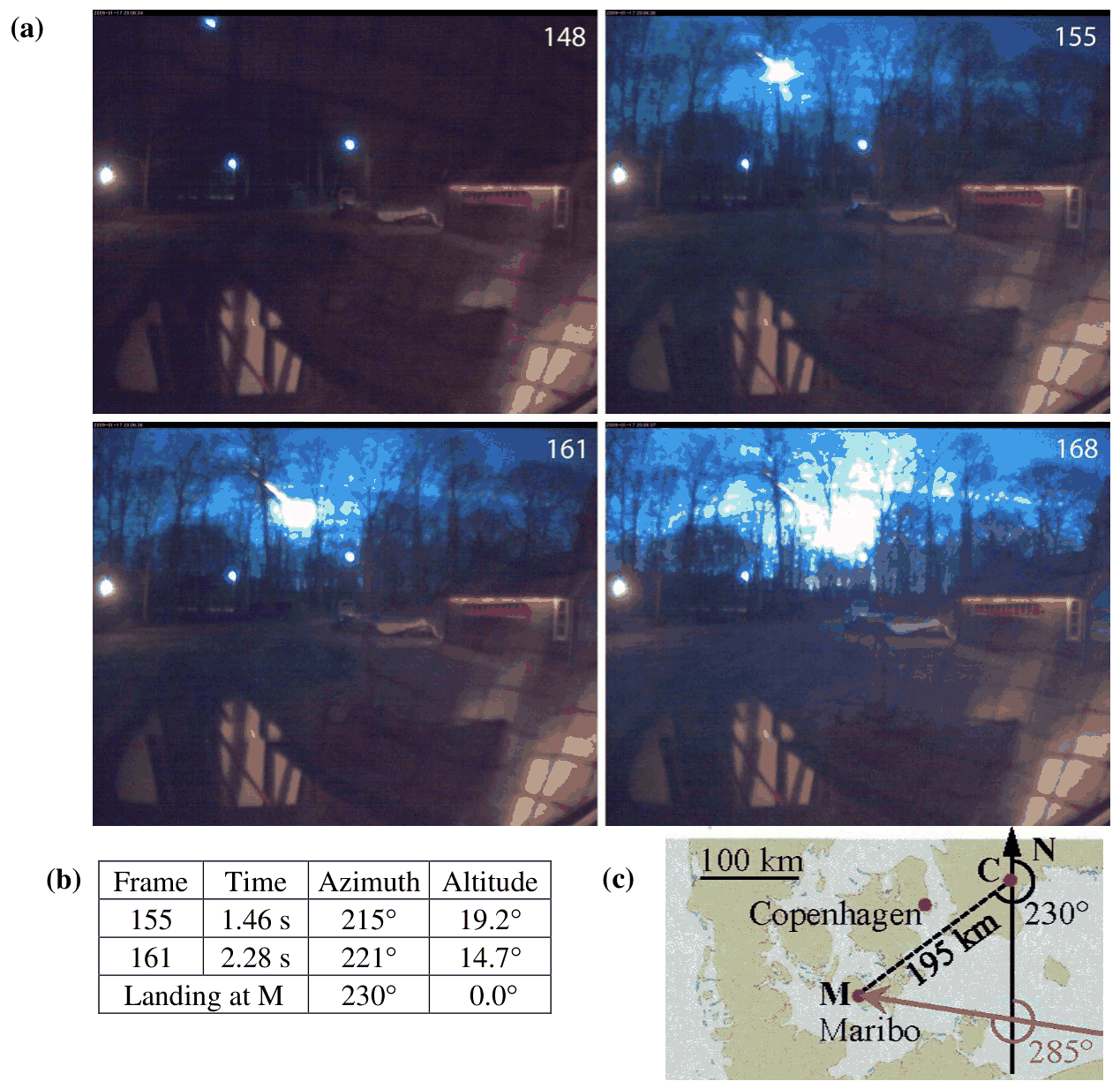
Figure 1.1 (a) Azimuth is the clockwise angular position from north in the horizontal plane, and altitude is the angular position above the horizon. A series of frames recorded by the surveillance camera in Sweden, showing the motion of Maribo as a fireball on its way down through the atmosphere. (b) The data from two frames indicating the time, the direction (azimuth) in degrees, as seen by the camera (C), and the height above the horizon (altitude) in degrees. (c) Sketch of the directions of the path (magenta arrow) of Maribo relative to north (N) and of the landing site (M) in Denmark as seen by the camera (C).
Heating of Maribo during its fall in the atmosphere
When the stony meteoroid Maribo entered the atmosphere at supersonic speed it appeared as a fireball because the surrounding air was glowing. Nevertheless, only the outermost layer of Maribo was heated. Assume that Maribo is a homogenous sphere with density \(\rho_{\mathrm{sm}}\), specific heat capacity \(c_{\mathrm{sm}}\), and thermal conductivity \(k_{\mathrm{sm}}\) (for values see the data sheet). Furthermore, when entering the atmosphere, it had the temperature \(T_0=200\ \mathrm K\). While falling through the atmosphere its surface temperature was constant \(T_{\mathrm s}=1000\ \mathrm K\) due to the air friction, thus gradually heating the interior.
After falling a time \(t\) in the atmosphere, an outer shell of Maribo of thickness \(x\) will have been heated to a temperature significantly larger than \(T_0\). This thickness can be estimated by dimensional analysis as the simple product of powers of the thermodynamic parameters: \(x\approx t^\alpha\rho_{\mathrm{sm}}^\beta c_{\mathrm{sm}}^\gamma k_{\mathrm{sm}}^\delta\).
| Part | Question | Points |
|---|---|---|
| 1.3a | Determine by dimensional (unit) analysis the value of the four powers \(\alpha,\beta,\gamma,\) and \(\delta\). | 0.6 |
| 1.3b | Calculate the thickness \(x\) after a fall time \(t=5\ \mathrm s\), and determine the ratio \(x/R_{\mathrm M}\). | 0.4 |
The age of a meteorite
The chemical properties of radioactive elements may be different, so during the crystallization of the minerals in a given meteorite, some minerals will have a high content of a specific radioactive element and others a low content. This difference can be used to determine the age of a meteorite by radiometric dating of its radioactive minerals.
As a specific example, we study the isotope \({}^{87}\mathrm{Rb}\) (element no. 37), which decays into the stable isotope \({}^{87}\mathrm{Sr}\) (element no. 38) with a half-life of \(T_{\frac12}=4.9\times10^{10}\) year, relative to the stable isotope \({}^{86}\mathrm{Sr}\). At the time of crystallization the ratio \({}^{87}\mathrm{Sr}/{}^{86}\mathrm{Sr}\) was identical for all minerals, while the ratio \({}^{87}\mathrm{Rb}/{}^{86}\mathrm{Sr}\) was different. As time passes on, the amount of \({}^{87}\mathrm{Rb}\) decreases by decay, while consequently the amount of \({}^{87}\mathrm{Sr}\) increases. As a result, the ratio \({}^{87}\mathrm{Sr}/{}^{86}\mathrm{Sr}\) will be different today. In Fig. 1.2(a), the points on the horizontal line refer to the ratio \({}^{87}\mathrm{Rb}/{}^{86}\mathrm{Sr}\) in different minerals at the time, when they are crystallized.
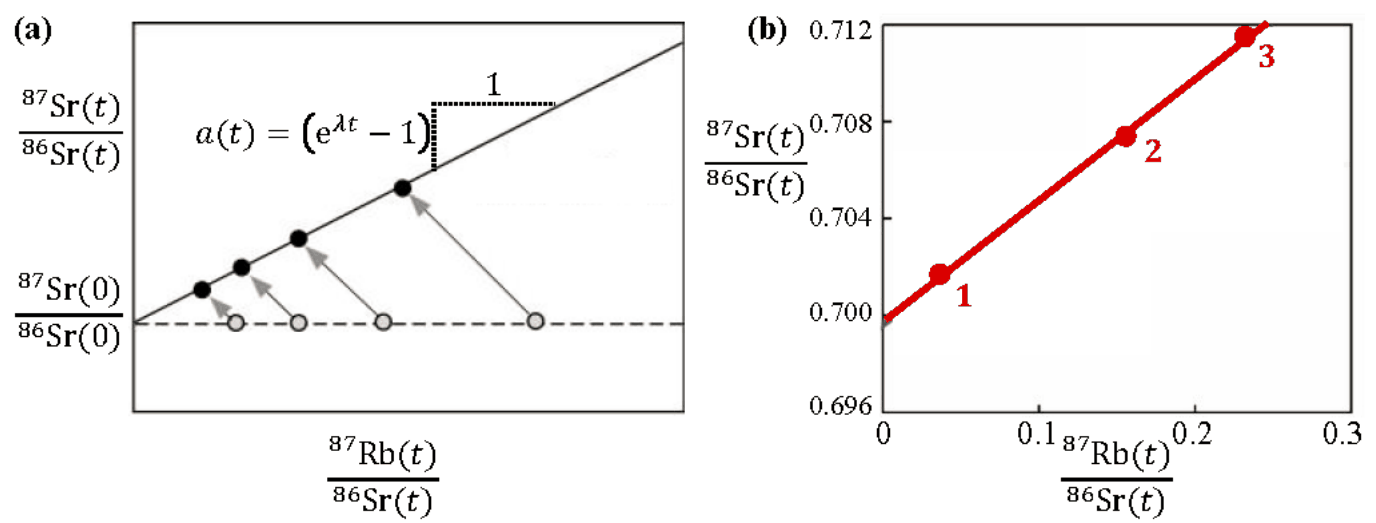
Figure 1.2 (a) The ratio \({}^{87}\mathrm{Sr}/{}^{86}\mathrm{Sr}\) in different minerals at the time \(t=0\) of crystallization (open circles) and at present time (filled circles). (b) The isochron-line for three different mineral samples taken from a meteorite at present time.
| Part | Question | Points |
|---|---|---|
| 1.4a | Write down the decay scheme for the transformation of \({}^{87}_{37}\mathrm{Rb}\) to \({}^{87}_{38}\mathrm{Sr}\). | 0.3 |
| 1.4b | Show that the present-time ratio \({}^{87}\mathrm{Sr}/{}^{86}\mathrm{Sr}\) plotted versus the present-time ratio \({}^{87}\mathrm{Rb}/{}^{86}\mathrm{Sr}\) in different mineral samples from the same meteorite forms a straight line, the so-called isochron-line, with slope \(a(t)=(e^{\lambda t}-1)\). Here \(t\) is the time since the formation of the minerals, while \(\lambda\) is the decay constant inversely proportional to half-life \(T_{\frac12}\). | 0.7 |
| 1.4c | Determine the age \(\tau_{\mathrm M}\) of the meteorite using the isochron-line of Fig. 1.2(b). | 0.4 |
Comet Encke, from which Maribo may originate
In its orbit around the Sun, the minimum and maximum distances between comet Encke and the Sun are \(a_{\min}=4.95\times10^{10}\ \mathrm m\) and \(a_{\max}=6.16\times10^{11}\ \mathrm m\), respectively.
| Part | Question | Points |
|---|---|---|
| 1.5 | Calculate the orbital period \(t_{\mathrm{Encke}}\) of comet Encke. | 0.6 |
Consequences of an asteroid impact on Earth
65 million years ago Earth was hit by a huge asteroid with density \(\rho_{\mathrm{ast}}=3.0\times10^3\ \mathrm{kg\,m^{-3}}\), radius \(R_{\mathrm{ast}}=5.0\ \mathrm{km}\), and final speed of \(v_{\mathrm{ast}}=2.5\times10^4\ \mathrm{m/s}\). This impact resulted in the extermination of most of the life on Earth and the formation of the enormous Chicxulub Crater. Assume that an identical asteroid would hit Earth today in a completely inelastic collision, and use the fact that the moment of inertia of Earth is 0.83 times that for a homogeneous sphere of the same mass and radius. The moment of inertia of a homogeneous sphere with mass \(M\) and radius \(R\) is \(\frac25MR^2\). Neglect changes in the orbit of the Earth.
| Part | Question | Points |
|---|---|---|
| 1.6a | Let the asteroid hit the North Pole. Find the maximum change in angular orientation of the axis of Earth after the impact. | 0.7 |
| 1.6b | Let the asteroid hit the Equator in a radial impact. Find the change \(\Delta\tau_{\mathrm{vrt}}\) in the duration of one revolution of Earth after the impact. | 0.7 |
| 1.6c | Let the asteroid hit the Equator in a tangential impact in the equatorial plane. Find the change \(\Delta\tau_{\mathrm{tan}}\) in the duration of one revolution of Earth after the impact. | 0.7 |
Maximum impact speed
Consider a celestial body, gravitationally bound in the solar system, which impacts the surface of Earth with a speed \(v_{\mathrm{imp}}\). Initially the effect of the gravitational field of the Earth on the body can be neglected. Disregard the friction in the atmosphere, the effect of other celestial bodies, and the rotation of the Earth.
| Part | Question | Points |
|---|---|---|
| 1.7 | Calculate \(v_{\mathrm{imp}}^{\max}\), the largest possible value of \(v_{\mathrm{imp}}\). | 1.6 |
Data sheet: Table of physical parameters
| Physical parameter | Value |
|---|---|
| Speed of light in vacuum | \(c=2.998\times10^8\ \mathrm{m\,s^{-1}}\) |
| Planck's constant over \(2\pi\) | \(\hbar=1.055\times10^{-34}\ \mathrm{J\,s}\) |
| Gravitational constant | \(G=6.67\times10^{-11}\ \mathrm{m^3\,kg^{-1}\,s^{-2}}\) |
| Gravitational acceleration | \(g=9.82\ \mathrm{m\,s^{-2}}\) |
| Elementary charge | \(e=1.602\times10^{-19}\ \mathrm C\) |
| Electric permittivity of vacuum | \(\epsilon_0=8.854\times10^{-12}\ \mathrm{C^2\,J^{-1}\,m^{-1}}\) |
| Electron mass | \(m_{\mathrm e}=9.109\times10^{-31}\ \mathrm{kg}\) |
| Avogadro constant | \(N_{\mathrm A}=6.022\times10^{23}\ \mathrm{mol^{-1}}\) |
| Boltzmann constant | \(k_{\mathrm B}=1.381\times10^{-23}\ \mathrm{J\,K^{-1}}\) |
| Stony meteorite, specific heat | \(c_{\mathrm{sm}}=1.2\times10^3\ \mathrm{J\,kg^{-1}\,K^{-1}}\) |
| Stony meteorite, thermal conductivity | \(k_{\mathrm{sm}}=2.0\ \mathrm{W\,m^{-1}\,K^{-1}}\) |
| Stony meteorite, density | \(\rho_{\mathrm{sm}}=3.3\times10^3\ \mathrm{kg\,m^{-3}}\) |
| Stony meteorite, melting point | \(T_{\mathrm{sm}}=1.7\times10^3\ \mathrm K\) |
| Stony meteorite, specific melting heat | \(L_{\mathrm{sm}}=2.6\times10^5\ \mathrm{J\,kg^{-1}}\) |
| Silver, molar mass | \(M_{\mathrm{Ag}}=1.079\times10^{-1}\ \mathrm{kg\,mol^{-1}}\) |
| Silver, density | \(\rho_{\mathrm{Ag}}=1.049\times10^4\ \mathrm{kg\,m^{-3}}\) |
| Silver, specific heat capacity | \(c_{\mathrm{Ag}}=2.40\times10^2\ \mathrm{J\,kg^{-1}\,K^{-1}}\) |
| Water, molar mass | \(M_{\mathrm{wa}}=1.801\times10^{-2}\ \mathrm{kg\,mol^{-1}}\) |
| Water, density | \(\rho_{\mathrm{wa}}=0.998\times10^3\ \mathrm{kg\,m^{-3}}\) |
| Water, specific heat capacity | \(c_{\mathrm{wa}}=4.181\times10^3\ \mathrm{J\,kg^{-1}\,K^{-1}}\) |
| Water, heat of vaporization | \(L_{\mathrm{wa}}=2.260\times10^6\ \mathrm{J\,kg^{-1}}\) |
| Water, boiling temperature | \(T_{100}=100\,^\circ\mathrm C=373.15\ \mathrm K\) |
| Ice, density of glacier | \(\rho_{\mathrm{ice}}=0.917\times10^3\ \mathrm{kg\,m^{-3}}\) |
| Steam, specific heat capacity | \(c_{\mathrm{st}}=2.080\times10^3\ \mathrm{J\,kg^{-1}\,K^{-1}}\) |
| Earth, mass of the | \(m_{\mathrm E}=5.97\times10^{24}\ \mathrm{kg}\) |
| Earth, radius of the | \(R_{\mathrm E}=6.38\times10^6\ \mathrm m\) |
| Sun, mass of the | \(m_{\mathrm S}=1.99\times10^{30}\ \mathrm{kg}\) |
| Sun, radius of the | \(R_{\mathrm S}=6.96\times10^8\ \mathrm m\) |
| Average Sun-Earth distance | \(a_{\mathrm E}=1.50\times10^{11}\ \mathrm m\) |
Official English text of the problem.
Answers
- 1.1: \(\boxed{\bar v=2.86\times10^4\ \mathrm{m\,s^{-1}}=28.6\ \mathrm{km\,s^{-1}}}\).
- 1.2a: \(\boxed{t=0.88\ \mathrm s}\).
- 1.2b: \(\boxed{E_{\mathrm{kin}}/E_{\mathrm{melt}}\approx2.1\times10^2}\).
- 1.3a: \(\boxed{\alpha=\delta=\tfrac12,\quad\beta=\gamma=-\tfrac12}\), so \(x\approx\sqrt{k_{\mathrm{sm}}t/(\rho_{\mathrm{sm}}c_{\mathrm{sm}})}\).
- 1.3b: \(\boxed{x\approx1.6\ \mathrm{mm},\quad x/R_{\mathrm M}\approx0.012=1.2\%}\).
- 1.4a: \(\boxed{{}^{87}_{37}\mathrm{Rb}\rightarrow{}^{87}_{38}\mathrm{Sr}+{}^0_{-1}e+\bar\nu_{\mathrm e}}\).
- 1.4b: \(\boxed{Y(t)=Y_0+(e^{\lambda t}-1)X(t)}\), where \(Y={}^{87}\mathrm{Sr}/{}^{86}\mathrm{Sr}\), \(X={}^{87}\mathrm{Rb}/{}^{86}\mathrm{Sr}\), and \(\lambda=\ln2/T_{\frac12}\).
- 1.4c: \(\boxed{\tau_{\mathrm M}\approx3.5\times10^9\ \mathrm{yr}}\), from a graph slope of approximately \(0.050\).
- 1.5: \(\boxed{t_{\mathrm{Encke}}=1.05\times10^8\ \mathrm s\approx3.32\ \mathrm{yr}}\).
- 1.6a: \(\boxed{\theta_{\max}\approx4.3\times10^{-8}\ \mathrm{rad}\approx2.4\times10^{-6}\ \mathrm{degree}}\).
- 1.6b: \(\boxed{\Delta\tau_{\mathrm{vrt}}\approx+6.8\times10^{-5}\ \mathrm s}\).
- 1.6c: \(\boxed{\Delta\tau_{\mathrm{tan}}\approx-3.6\times10^{-3}\ \mathrm s}\) for a prograde impact; \(\boxed{\Delta\tau_{\mathrm{tan}}\approx+3.8\times10^{-3}\ \mathrm s}\) for a retrograde impact.
- 1.7: \(\boxed{v_{\mathrm{imp}}^{\max}\approx7.27\times10^4\ \mathrm{m\,s^{-1}}=72.7\ \mathrm{km\,s^{-1}}}\), understood as a limiting upper bound for a gravitationally bound body.
Solution
1.1
Let \(C\) denote the camera, \(M\) the landing site, and \(P_i\) the horizontal projection of the meteoroid’s position in frame \(i\). Write
\[ CM=D=195\ \mathrm{km},\qquad CP_i=r_i,\qquad MP_i=s_i. \]
The observed quantities are:
| Frame | Time \(t_i\) | Azimuth \(\phi_i\) | Altitude angle \(h_i\) |
|---|---|---|---|
| 155 | \(1.46\ \mathrm s\) | \(215^\circ\) | \(19.2^\circ\) |
| 161 | \(2.28\ \mathrm s\) | \(221^\circ\) | \(14.7^\circ\) |
The horizontal trajectory has heading \(285^\circ\). Viewed from \(M\), the camera has bearing \(50^\circ\), while the earlier meteoroid positions have bearing \(105^\circ\). Hence the angle at \(M\) in triangle \(CMP_i\) is \(55^\circ\). The angle at \(C\) is \(230^\circ-\phi_i\).
The sine rule therefore gives
\[ r_i =D\frac{\sin55^\circ}{\sin(285^\circ-\phi_i)}, \qquad s_i =D\frac{\sin(230^\circ-\phi_i)}{\sin(285^\circ-\phi_i)}. \]
Since Earth’s curvature is neglected, the meteoroid’s height is
\[ z_i=r_i\tan h_i. \]
Numerically,
| Frame | \(r_i\) (km) | \(s_i\) (km) | \(z_i\) (km) |
|---|---|---|---|
| 155 | 169.986 | 53.709 | 59.195 |
| 161 | 177.721 | 33.940 | 46.624 |
Thus the horizontal and vertical distances travelled are
\[ \Delta s=19.769\ \mathrm{km}, \qquad |\Delta z|=12.571\ \mathrm{km}. \]
Taking the trajectory over this short interval to be straight,
\[ \Delta\ell =\sqrt{(\Delta s)^2+(\Delta z)^2} =23.428\ \mathrm{km}. \]
The elapsed time is \(2.28-1.46=0.82\ \mathrm s\), so
\[ \boxed{ \bar v=\frac{23.428\ \mathrm{km}}{0.82\ \mathrm s} =28.6\ \mathrm{km\,s^{-1}}. } \]
For the subsequent parts, we use the separately specified initial speed \(v_{\mathrm M}=2.91\times10^4\ \mathrm{m\,s^{-1}}\).
1.2a
The projected area of the sphere is \(A=\pi R_{\mathrm M}^2\). Newton’s second law, with gravity neglected, gives
\[ m_{\mathrm M}\frac{dv}{dt} =-k\rho_{\mathrm{atm}}\pi R_{\mathrm M}^2v^2. \]
Separating variables and integrating from \(v_{\mathrm M}\) to \(v\),
\[ \frac1v-\frac1{v_{\mathrm M}} =\frac{k\rho_{\mathrm{atm}}\pi R_{\mathrm M}^2}{m_{\mathrm M}}t. \]
For \(v=0.90v_{\mathrm M}\),
\[ t =\frac{m_{\mathrm M}} {k\rho_{\mathrm{atm}}\pi R_{\mathrm M}^2v_{\mathrm M}} \left(\frac1{0.90}-1\right). \]
Substitution yields
\[ t= \frac{30} {(0.60)(4.1\times10^{-3})\pi(0.13)^2(2.91\times10^4)} \left(\frac1{0.90}-1\right) =0.877\ \mathrm s. \]
Therefore,
\[ \boxed{t\approx0.88\ \mathrm s.} \]
1.2b
Complete melting requires both heating the material from \(T_0\) to its melting point and supplying its latent heat of fusion. Using the constant specific heat given in the data sheet,
\[ E_{\mathrm{melt}} =m_{\mathrm M}\left[c_{\mathrm{sm}}(T_{\mathrm{sm}}-T_0)+L_{\mathrm{sm}}\right]. \]
Thus
\[ E_{\mathrm{melt}} =30\left[(1.2\times10^3)(1700-200)+2.6\times10^5\right] =6.18\times10^7\ \mathrm J. \]
The initial kinetic energy is
\[ E_{\mathrm{kin}} =\frac12m_{\mathrm M}v_{\mathrm M}^2 =\frac12(30)(2.91\times10^4)^2 =1.2702\times10^{10}\ \mathrm J. \]
Consequently,
\[ \boxed{ \frac{E_{\mathrm{kin}}}{E_{\mathrm{melt}}} =\frac{v_{\mathrm M}^2} {2[c_{\mathrm{sm}}(T_{\mathrm{sm}}-T_0)+L_{\mathrm{sm}}]} =205.5\approx2.1\times10^2. } \]
This energy comparison does not imply complete melting: the kinetic energy need not be deposited as heat throughout the meteoroid.
1.3a
Use \(M,L,\mathsf T,\Theta\) for the dimensions of mass, length, time, and temperature. The relevant dimensions are
\[ [\rho_{\mathrm{sm}}]=ML^{-3}, \qquad [c_{\mathrm{sm}}]=L^2\mathsf T^{-2}\Theta^{-1}, \qquad [k_{\mathrm{sm}}]=ML\mathsf T^{-3}\Theta^{-1}. \]
Therefore,
\[ [t^\alpha\rho_{\mathrm{sm}}^\beta c_{\mathrm{sm}}^\gamma k_{\mathrm{sm}}^\delta] = M^{\beta+\delta} L^{-3\beta+2\gamma+\delta} \mathsf T^{\alpha-2\gamma-3\delta} \Theta^{-\gamma-\delta}. \]
Equating this to the dimension \(L\) of \(x\) gives
\[ \begin{aligned} \beta+\delta&=0,\\ -3\beta+2\gamma+\delta&=1,\\ \alpha-2\gamma-3\delta&=0,\\ -\gamma-\delta&=0. \end{aligned} \]
The first and fourth equations give \(\beta=\gamma=-\delta\). The length equation then gives \(2\delta=1\), and the time equation gives \(\alpha=\delta\). Hence
\[ \boxed{\alpha=\delta=\frac12,\qquad\beta=\gamma=-\frac12.} \]
The resulting estimate is
\[ \boxed{x\approx\sqrt{\frac{k_{\mathrm{sm}}t}{\rho_{\mathrm{sm}}c_{\mathrm{sm}}}}.} \]
Dimensional analysis determines the exponents but leaves an undetermined dimensionless coefficient. The requested estimate takes this coefficient to be unity.
1.3b
The thermal diffusivity is
\[ \chi=\frac{k_{\mathrm{sm}}}{\rho_{\mathrm{sm}}c_{\mathrm{sm}}} =\frac{2.0}{(3.3\times10^3)(1.2\times10^3)} =5.05\times10^{-7}\ \mathrm{m^2\,s^{-1}}. \]
At \(t=5\ \mathrm s\),
\[ x\approx\sqrt{\chi t} =\sqrt{(5.05\times10^{-7})(5)} =1.589\times10^{-3}\ \mathrm m. \]
Thus
\[ \boxed{x\approx1.6\ \mathrm{mm}}, \qquad \boxed{ \frac{x}{R_{\mathrm M}} =\frac{1.589\times10^{-3}}{0.13} \approx0.012=1.2\%. } \]
The heated depth is small compared with the radius, consistent with only an outer layer warming appreciably during the fall.
1.4a
The atomic number increases by one while the mass number remains unchanged. This is beta-minus decay:
\[ \boxed{ {}^{87}_{37}\mathrm{Rb} \longrightarrow {}^{87}_{38}\mathrm{Sr} +{}^0_{-1}e+\bar\nu_{\mathrm e}. } \]
An electron and an electron antineutrino are emitted.
1.4b
Consider one mineral sample as a closed system after crystallization. Let \(N_{\mathrm{Rb}}(t)\), \(N_{87}(t)\), and \(N_{86}\) be the numbers of \({}^{87}\mathrm{Rb}\), \({}^{87}\mathrm{Sr}\), and \({}^{86}\mathrm{Sr}\) nuclei. The stable reference population \(N_{86}\) is constant.
Radioactive decay gives
\[ N_{\mathrm{Rb}}(t)=N_{\mathrm{Rb}}(0)e^{-\lambda t}, \qquad \lambda=\frac{\ln2}{T_{\frac12}}. \]
Each decayed rubidium nucleus produces one strontium-87 nucleus, so
\[ \begin{aligned} N_{87}(t) &=N_{87}(0)+N_{\mathrm{Rb}}(0)-N_{\mathrm{Rb}}(t)\\ &=N_{87}(0)+N_{\mathrm{Rb}}(t)(e^{\lambda t}-1). \end{aligned} \]
Dividing by \(N_{86}\), define
\[ Y(t)=\frac{N_{87}(t)}{N_{86}}, \qquad X(t)=\frac{N_{\mathrm{Rb}}(t)}{N_{86}}, \qquad Y_0=\frac{N_{87}(0)}{N_{86}}. \]
Then
\[ \boxed{Y(t)=Y_0+(e^{\lambda t}-1)X(t).} \]
All samples have the same initial strontium isotope ratio \(Y_0\) and the same age \(t\). Their present values therefore lie on a straight line with vertical intercept \(Y_0\) and slope
\[ \boxed{a(t)=e^{\lambda t}-1.} \]
At crystallization the slope is zero; it subsequently increases with age.
1.4c
The line in Fig. 1.2(b) passes approximately through
\[ (X,Y)\approx(0.05,0.702) \quad\text{and}\quad (0.25,0.712). \]
Its slope is therefore approximately
\[ a\approx\frac{0.712-0.702}{0.25-0.05}=0.050. \]
Inverting the result of part 1.4b,
\[ \tau_{\mathrm M} =\frac{\ln(1+a)}{\lambda} =\frac{T_{\frac12}}{\ln2}\ln(1+a). \]
Hence
\[ \tau_{\mathrm M} \approx \frac{4.9\times10^{10}\ \mathrm{yr}}{\ln2}\ln(1.050) =3.45\times10^9\ \mathrm{yr}. \]
Allowing for the graphical reading,
\[ \boxed{\tau_{\mathrm M}\approx3.5\times10^9\ \mathrm{yr}.} \]
Figure 1.2(b) refers to samples from “a meteorite”; its inferred age need not equal Maribo’s age quoted in the introduction.
1.5
For an elliptical orbit, the perihelion and aphelion distances sum to twice the semimajor axis:
\[ a=\frac{a_{\min}+a_{\max}}2 =\frac{4.95\times10^{10}+6.16\times10^{11}}2 =3.3275\times10^{11}\ \mathrm m. \]
Neglecting the comet’s mass compared with the Sun’s mass, Kepler’s third law gives
\[ t_{\mathrm{Encke}}^2=\frac{4\pi^2a^3}{Gm_{\mathrm S}}. \]
Thus
\[ t_{\mathrm{Encke}} =2\pi\sqrt{ \frac{(3.3275\times10^{11})^3} {(6.67\times10^{-11})(1.99\times10^{30})} } =1.0468\times10^8\ \mathrm s. \]
Using \(1\ \mathrm{yr}\approx3.156\times10^7\ \mathrm s\),
\[ \boxed{t_{\mathrm{Encke}}\approx1.05\times10^8\ \mathrm s\approx3.32\ \mathrm{yr}.} \]
1.6a
First calculate the quantities used in all three impact questions. The asteroid’s mass is
\[ m_{\mathrm{ast}} =\frac43\pi R_{\mathrm{ast}}^3\rho_{\mathrm{ast}} =\frac43\pi(5.0\times10^3)^3(3.0\times10^3) =1.571\times10^{15}\ \mathrm{kg}. \]
Earth’s moment of inertia is
\[ I_{\mathrm E} =0.83\frac25m_{\mathrm E}R_{\mathrm E}^2 =8.068\times10^{37}\ \mathrm{kg\,m^2}. \]
Taking its initial rotation period to be \(\tau_{\mathrm E}=24\ \mathrm h=86400\ \mathrm s\),
\[ \omega_{\mathrm E}=\frac{2\pi}{\tau_{\mathrm E}} =7.272\times10^{-5}\ \mathrm{s^{-1}}, \]
and its spin angular momentum is
\[ L_{\mathrm E}=I_{\mathrm E}\omega_{\mathrm E} =5.867\times10^{33}\ \mathrm{kg\,m^2\,s^{-1}}. \]
We treat the accreted asteroid as a point mass at Earth’s surface. Its size and the displacement of the common center of mass give negligible corrections.
At the North Pole, the asteroid’s position vector is parallel to Earth’s initial rotation axis. Consequently, its angular momentum
\[ \mathbf L_{\mathrm{ast}} =\mathbf r\times m_{\mathrm{ast}}\mathbf v_{\mathrm{ast}} \]
is perpendicular to Earth’s initial spin angular momentum. Its magnitude is largest for a tangential impact:
\[ L_{\mathrm{ast}}^{\max} =m_{\mathrm{ast}}R_{\mathrm E}v_{\mathrm{ast}} =2.505\times10^{26}\ \mathrm{kg\,m^2\,s^{-1}}. \]
Conservation of angular momentum then gives, to leading order in the small asteroid-to-Earth mass ratio,
\[ \tan\theta_{\max} \simeq\frac{L_{\mathrm{ast}}^{\max}}{L_{\mathrm E}}. \]
The angle is extremely small, so
\[ \boxed{ \theta_{\max} \simeq \frac{m_{\mathrm{ast}}R_{\mathrm E}v_{\mathrm{ast}}} {I_{\mathrm E}\omega_{\mathrm E}} =4.27\times10^{-8}\ \mathrm{rad} \approx2.4\times10^{-6}\ \mathrm{degree}. } \]
The change in the inertia tensor contributes only a higher-order correction to this small tilt.
1.6b
For a radial impact, the incoming asteroid has zero angular momentum about Earth’s center. After it sticks at the Equator, the moment of inertia increases to
\[ I'=I_{\mathrm E}+m_{\mathrm{ast}}R_{\mathrm E}^2. \]
Angular momentum conservation requires
\[ I_{\mathrm E}\omega_{\mathrm E} =(I_{\mathrm E}+m_{\mathrm{ast}}R_{\mathrm E}^2)\omega'. \]
Since the period is inversely proportional to angular speed,
\[ \tau' =\tau_{\mathrm E} \left(1+\frac{m_{\mathrm{ast}}R_{\mathrm E}^2}{I_{\mathrm E}}\right). \]
Therefore,
\[ \Delta\tau_{\mathrm{vrt}} =\tau_{\mathrm E}\frac{m_{\mathrm{ast}}R_{\mathrm E}^2}{I_{\mathrm E}} =\tau_{\mathrm E}\frac{m_{\mathrm{ast}}}{0.332m_{\mathrm E}}. \]
Numerically,
\[ \boxed{ \Delta\tau_{\mathrm{vrt}} =6.85\times10^{-5}\ \mathrm s \approx+6.8\times10^{-5}\ \mathrm s. } \]
The day becomes approximately \(68\ \mu\mathrm s\) longer.
1.6c
The direction of the tangential impact matters. Let \(\sigma=+1\) for a prograde impact, which adds spin angular momentum, and \(\sigma=-1\) for a retrograde impact.
Conservation of angular momentum gives
\[ I_{\mathrm E}\omega_{\mathrm E} +\sigma m_{\mathrm{ast}}R_{\mathrm E}v_{\mathrm{ast}} =(I_{\mathrm E}+m_{\mathrm{ast}}R_{\mathrm E}^2)\omega'. \]
Define the small dimensionless quantities
\[ \epsilon =\frac{m_{\mathrm{ast}}R_{\mathrm E}^2}{I_{\mathrm E}} =7.925\times10^{-10}, \qquad \eta =\frac{m_{\mathrm{ast}}R_{\mathrm E}v_{\mathrm{ast}}} {I_{\mathrm E}\omega_{\mathrm E}} =4.270\times10^{-8}. \]
The new period and its change are
\[ \tau'=\tau_{\mathrm E}\frac{1+\epsilon}{1+\sigma\eta}, \]
\[ \boxed{ \Delta\tau_{\mathrm{tan}} =\tau_{\mathrm E}\frac{\epsilon-\sigma\eta}{1+\sigma\eta}. } \]
Since both \(\epsilon\) and \(\eta\) are very small, this is also accurately
\[ \Delta\tau_{\mathrm{tan}}\approx\tau_{\mathrm E}(\epsilon-\sigma\eta). \]
Thus:
-
Prograde impact:
\[ \boxed{\Delta\tau_{\mathrm{tan}}=-3.621\times10^{-3}\ \mathrm s\approx-3.6\ \mathrm{ms}.} \] -
Retrograde impact:
\[ \boxed{\Delta\tau_{\mathrm{tan}}=+3.758\times10^{-3}\ \mathrm s\approx+3.8\ \mathrm{ms}.} \]
The added moment of inertia lengthens the day in both cases. The incoming angular momentum produces the larger effect and determines the sign.
1.7
First consider the body’s motion relative to the Sun, before Earth’s gravity becomes significant. At Earth’s orbital distance, a gravitationally bound body has negative specific orbital energy:
\[ \mathcal E =\frac{u^2}{2}-\frac{Gm_{\mathrm S}}{a_{\mathrm E}}<0. \]
Its heliocentric speed is therefore bounded by the local solar escape speed:
\[ u<u_{\max} =\sqrt{\frac{2Gm_{\mathrm S}}{a_{\mathrm E}}}. \]
The limiting case is an orbit whose binding energy tends to zero.
Approximating Earth’s orbit as circular at the given mean distance, its orbital speed is
\[ v_{\mathrm E}=\sqrt{\frac{Gm_{\mathrm S}}{a_{\mathrm E}}}. \]
The largest relative approach speed occurs when the body moves directly opposite to Earth’s orbital motion. Hence
\[ v_\infty^{\max} =u_{\max}+v_{\mathrm E} =(1+\sqrt2)\sqrt{\frac{Gm_{\mathrm S}}{a_{\mathrm E}}}. \]
Numerically,
\[ v_{\mathrm E}=29.75\ \mathrm{km\,s^{-1}}, \qquad u_{\max}=42.07\ \mathrm{km\,s^{-1}}, \]
so
\[ v_\infty^{\max}=71.82\ \mathrm{km\,s^{-1}}. \]
Earth’s gravity further accelerates the body. In the terrestrial encounter, conservation of mechanical energy gives
\[ \frac12v_{\mathrm{imp}}^2-\frac{Gm_{\mathrm E}}{R_{\mathrm E}} =\frac12v_\infty^2. \]
Thus
\[ \boxed{ v_{\mathrm{imp}}^{\max} = \sqrt{ (1+\sqrt2)^2\frac{Gm_{\mathrm S}}{a_{\mathrm E}} +\frac{2Gm_{\mathrm E}}{R_{\mathrm E}} }. } \]
Earth’s surface escape speed is
\[ \sqrt{\frac{2Gm_{\mathrm E}}{R_{\mathrm E}}} =11.17\ \mathrm{km\,s^{-1}}. \]
Therefore,
\[ \boxed{ v_{\mathrm{imp}}^{\max} =\sqrt{(71.82)^2+(11.17)^2}\ \mathrm{km\,s^{-1}} \approx72.7\ \mathrm{km\,s^{-1}}. } \]
For a strictly bound orbit, the speed is strictly below this value. It can approach the value arbitrarily closely as the initial solar binding energy tends to zero.
The solution was checked against the official solution.
IPhO 2013 · Theorieaufgabe 1
Der Meteorit Maribo
Einleitung
Ein Meteoroid ist ein kleines Teilchen (typischerweise kleiner als 1 m) von einem Kometen oder einem Asteroiden. Ein Meteoroid, der auf dem Erdboden aufschlägt, wird als Meteorit bezeichnet.
In der Nacht des 17. Januar 2009 sahen viele Menschen in der Nähe der Ostsee die Leuchtspur oder den Feuerball eines Meteoroiden, der durch die Erdatmosphäre fiel. In Schweden zeichnete eine Überwachungskamera ein Video des Ereignisses auf, siehe Abb. 1.1(a). Anhand dieser Bilder und von Augenzeugenberichten konnte das Einschlaggebiet eingegrenzt werden, und sechs Wochen später wurde in der Nähe der Stadt Maribo in Süddänemark ein Meteorit mit der Masse 0.025 kg gefunden. Messungen an dem nun Maribo genannten Meteoriten und seiner Bahn am Himmel lieferten interessante Ergebnisse. Seine Geschwindigkeit beim Eintritt in die Atmosphäre war außergewöhnlich hoch gewesen. Sein Alter von \(4.567\times10^9\) Jahren zeigt, dass er kurz nach der Entstehung des Sonnensystems entstanden war. Der Meteorit Maribo ist möglicherweise ein Teil des Kometen Encke.
Die Geschwindigkeit von Maribo
Der Feuerball bewegte sich in westlicher Richtung mit einem Kurs von \(285^\circ\) gegenüber Norden auf den Ort zu, an dem der Meteorit später gefunden wurde, wie in Abb. 1.1 skizziert. Der Meteorit wurde in einer Entfernung von 195 km von der Überwachungskamera in Richtung \(230^\circ\) gegenüber Norden gefunden.
| Teil | Frage | Punkte |
|---|---|---|
| 1.1 | Berechnen Sie anhand dieser Angaben und der Daten in Abb. 1.1 die mittlere Geschwindigkeit von Maribo im Zeitintervall zwischen den Einzelbildern 155 und 161. Sowohl die Erdkrümmung als auch die auf den Meteoroiden wirkende Gravitationskraft können vernachlässigt werden. | 1.3 |
Durch die Atmosphäre und dabei schmelzen?
Die Luftreibung an einem Meteoroiden, der sich in der höheren Atmosphäre bewegt, hängt auf komplizierte Weise von seiner Form und Geschwindigkeit sowie von der Temperatur und Dichte der Atmosphäre ab. In guter Näherung ist die Reibungskraft \(F\) in der oberen Atmosphäre durch den Ausdruck \(F=k\rho_{\mathrm{atm}}Av^2\) gegeben, wobei \(k\) eine Konstante, \(\rho_{\mathrm{atm}}\) die Dichte der Atmosphäre, \(A\) die projizierte Querschnittsfläche des Meteoriten und \(v\) seine Geschwindigkeit ist.
Zur Untersuchung des Meteoroiden werden folgende vereinfachende Annahmen getroffen: Das in die Atmosphäre eintretende Objekt war eine Kugel mit der Masse \(m_{\mathrm M}=30\ \mathrm{kg}\), dem Radius \(R_{\mathrm M}=0.13\ \mathrm m\), der Temperatur \(T_0=200\ \mathrm K\) und der Geschwindigkeit \(v_{\mathrm M}=2.91\times10^4\ \mathrm{m/s}\). Die Dichte der Atmosphäre ist konstant (gleich ihrem Wert 40 km über der Erdoberfläche), \(\rho_{\mathrm{atm}}=4.1\times10^{-3}\ \mathrm{kg/m^3}\), und der Reibungskoeffizient beträgt \(k=0.60\).
| Teil | Frage | Punkte |
|---|---|---|
| 1.2a | Schätzen Sie ab, wie lange es nach dem Eintritt in die Atmosphäre dauert, bis die Geschwindigkeit des Meteoroiden um 10 % von \(v_{\mathrm M}\) auf \(0.90v_{\mathrm M}\) abgenommen hat. Sie können die Gravitationskraft auf den Meteoroiden vernachlässigen und annehmen, dass seine Masse und Form unverändert bleiben. | 0.7 |
| 1.2b | Berechnen Sie, um welchen Faktor die kinetische Energie \(E_{\mathrm{kin}}\) des in die Atmosphäre eintretenden Meteoroiden größer ist als die Energie \(E_{\mathrm{melt}}\), die erforderlich ist, um ihn vollständig zu schmelzen (siehe Datenblatt). | 0.3 |
Abbildung 1.1 (a) Der Azimut ist der in der Horizontalebene im Uhrzeigersinn von Norden aus gemessene Winkel, und die Höhe ist der Winkel über dem Horizont. Eine Folge von Einzelbildern der Überwachungskamera in Schweden zeigt die Bewegung von Maribo als Feuerball auf seinem Weg durch die Atmosphäre nach unten. (b) Die Daten zweier Einzelbilder geben die Zeit, die von der Kamera (C) aus gesehene Richtung (Azimut) in Grad und die Höhe über dem Horizont (Höhenwinkel) in Grad an. (c) Skizze der Richtungen der Bahn (magentafarbener Pfeil) von Maribo gegenüber Norden (N) und des Fundorts (M) in Dänemark, von der Kamera (C) aus gesehen.
Erwärmung von Maribo während seines Falls durch die Atmosphäre
Als der steinerne Meteoroid Maribo mit Überschallgeschwindigkeit in die Atmosphäre eintrat, erschien er als Feuerball, weil die umgebende Luft leuchtete. Dennoch wurde nur die äußerste Schicht von Maribo erwärmt. Nehmen Sie an, dass Maribo eine homogene Kugel mit der Dichte \(\rho_{\mathrm{sm}}\), der spezifischen Wärmekapazität \(c_{\mathrm{sm}}\) und der Wärmeleitfähigkeit \(k_{\mathrm{sm}}\) ist (Werte siehe Datenblatt). Außerdem hatte er beim Eintritt in die Atmosphäre die Temperatur \(T_0=200\ \mathrm K\). Während des Falls durch die Atmosphäre betrug seine Oberflächentemperatur aufgrund der Luftreibung konstant \(T_{\mathrm s}=1000\ \mathrm K\), wodurch sich das Innere allmählich erwärmte.
Nach einer Fallzeit \(t\) in der Atmosphäre wird eine äußere Schale von Maribo mit der Dicke \(x\) auf eine Temperatur erwärmt worden sein, die deutlich über \(T_0\) liegt. Diese Dicke lässt sich durch Dimensionsanalyse als einfaches Produkt von Potenzen der thermodynamischen Parameter abschätzen: \(x\approx t^\alpha\rho_{\mathrm{sm}}^\beta c_{\mathrm{sm}}^\gamma k_{\mathrm{sm}}^\delta\).
| Teil | Frage | Punkte |
|---|---|---|
| 1.3a | Bestimmen Sie durch Dimensionsanalyse (Einheitenanalyse) die Werte der vier Exponenten \(\alpha,\beta,\gamma,\) und \(\delta\). | 0.6 |
| 1.3b | Berechnen Sie die Dicke \(x\) nach einer Fallzeit \(t=5\ \mathrm s\) und bestimmen Sie das Verhältnis \(x/R_{\mathrm M}\). | 0.4 |
Das Alter eines Meteoriten
Die chemischen Eigenschaften radioaktiver Elemente können unterschiedlich sein. Daher weisen bei der Kristallisation der Minerale in einem bestimmten Meteoriten einige Minerale einen hohen Gehalt an einem bestimmten radioaktiven Element auf, andere dagegen einen niedrigen. Dieser Unterschied kann genutzt werden, um das Alter eines Meteoriten durch radiometrische Datierung seiner radioaktiven Minerale zu bestimmen.
Als konkretes Beispiel untersuchen wir das Isotop \({}^{87}\mathrm{Rb}\) (Ordnungszahl 37), das mit einer Halbwertszeit von \(T_{\frac12}=4.9\times10^{10}\) Jahren in das stabile Isotop \({}^{87}\mathrm{Sr}\) (Ordnungszahl 38) zerfällt, im Verhältnis zum stabilen Isotop \({}^{86}\mathrm{Sr}\). Zum Zeitpunkt der Kristallisation war das Verhältnis \({}^{87}\mathrm{Sr}/{}^{86}\mathrm{Sr}\) für alle Minerale gleich, während das Verhältnis \({}^{87}\mathrm{Rb}/{}^{86}\mathrm{Sr}\) unterschiedlich war. Im Laufe der Zeit nimmt die Menge an \({}^{87}\mathrm{Rb}\) durch Zerfall ab, während infolgedessen die Menge an \({}^{87}\mathrm{Sr}\) zunimmt. Daher ist das Verhältnis \({}^{87}\mathrm{Sr}/{}^{86}\mathrm{Sr}\) heute unterschiedlich. In Abb. 1.2(a) beziehen sich die Punkte auf der horizontalen Linie auf das Verhältnis \({}^{87}\mathrm{Rb}/{}^{86}\mathrm{Sr}\) in verschiedenen Mineralen zum Zeitpunkt ihrer Kristallisation.
Abbildung 1.2 (a) Das Verhältnis \({}^{87}\mathrm{Sr}/{}^{86}\mathrm{Sr}\) in verschiedenen Mineralen zum Zeitpunkt \(t=0\) der Kristallisation (offene Kreise) und zum heutigen Zeitpunkt (ausgefüllte Kreise). (b) Die Isochronengerade für drei verschiedene Mineralproben, die heute einem Meteoriten entnommen wurden.
| Teil | Frage | Punkte |
|---|---|---|
| 1.4a | Geben Sie das Zerfallsschema für die Umwandlung von \({}^{87}_{37}\mathrm{Rb}\) in \({}^{87}_{38}\mathrm{Sr}\) an. | 0.3 |
| 1.4b | Zeigen Sie, dass die heutigen Verhältnisse \({}^{87}\mathrm{Sr}/{}^{86}\mathrm{Sr}\), aufgetragen gegen die heutigen Verhältnisse \({}^{87}\mathrm{Rb}/{}^{86}\mathrm{Sr}\) in verschiedenen Mineralproben desselben Meteoriten, auf einer Geraden liegen, der sogenannten Isochronengeraden, mit der Steigung \(a(t)=(e^{\lambda t}-1)\). Dabei ist \(t\) die seit der Bildung der Minerale vergangene Zeit, während \(\lambda\) die Zerfallskonstante ist, die umgekehrt proportional zur Halbwertszeit \(T_{\frac12}\) ist. | 0.7 |
| 1.4c | Bestimmen Sie mithilfe der Isochronengeraden in Abb. 1.2(b) das Alter \(\tau_{\mathrm M}\) des Meteoriten. | 0.4 |
Der Komet Encke, von dem Maribo stammen könnte
Auf seiner Bahn um die Sonne betragen der kleinste und der größte Abstand zwischen dem Kometen Encke und der Sonne \(a_{\min}=4.95\times10^{10}\ \mathrm m\) beziehungsweise \(a_{\max}=6.16\times10^{11}\ \mathrm m\).
| Teil | Frage | Punkte |
|---|---|---|
| 1.5 | Berechnen Sie die Umlaufzeit \(t_{\mathrm{Encke}}\) des Kometen Encke. | 0.6 |
Folgen eines Asteroideneinschlags auf der Erde
Vor 65 Millionen Jahren wurde die Erde von einem riesigen Asteroiden mit der Dichte \(\rho_{\mathrm{ast}}=3.0\times10^3\ \mathrm{kg\,m^{-3}}\), dem Radius \(R_{\mathrm{ast}}=5.0\ \mathrm{km}\) und der Endgeschwindigkeit \(v_{\mathrm{ast}}=2.5\times10^4\ \mathrm{m/s}\) getroffen. Dieser Einschlag führte zur Auslöschung des größten Teils des Lebens auf der Erde und zur Entstehung des gewaltigen Chicxulub-Kraters. Nehmen Sie an, dass ein identischer Asteroid heute in einem vollkommen unelastischen Stoß auf die Erde trifft, und nutzen Sie die Tatsache, dass das Trägheitsmoment der Erde das 0.83-Fache des Trägheitsmoments einer homogenen Kugel gleicher Masse und gleichen Radius beträgt. Das Trägheitsmoment einer homogenen Kugel mit der Masse \(M\) und dem Radius \(R\) beträgt \(\frac25MR^2\). Vernachlässigen Sie Änderungen der Erdbahn.
| Teil | Frage | Punkte |
|---|---|---|
| 1.6a | Der Asteroid treffe den Nordpol. Bestimmen Sie die maximale Winkeländerung der Ausrichtung der Erdachse nach dem Einschlag. | 0.7 |
| 1.6b | Der Asteroid treffe den Äquator bei einem radialen Einschlag. Bestimmen Sie die Änderung \(\Delta\tau_{\mathrm{vrt}}\) der Dauer einer Erdumdrehung nach dem Einschlag. | 0.7 |
| 1.6c | Der Asteroid treffe den Äquator bei einem tangentialen Einschlag in der Äquatorebene. Bestimmen Sie die Änderung \(\Delta\tau_{\mathrm{tan}}\) der Dauer einer Erdumdrehung nach dem Einschlag. | 0.7 |
Maximale Einschlaggeschwindigkeit
Betrachten Sie einen Himmelskörper, der im Sonnensystem gravitativ gebunden ist und mit einer Geschwindigkeit \(v_{\mathrm{imp}}\) auf die Erdoberfläche trifft. Anfangs kann der Einfluss des Gravitationsfeldes der Erde auf den Körper vernachlässigt werden. Vernachlässigen Sie die Reibung in der Atmosphäre, den Einfluss anderer Himmelskörper und die Erdrotation.
| Teil | Frage | Punkte |
|---|---|---|
| 1.7 | Berechnen Sie \(v_{\mathrm{imp}}^{\max}\), den größtmöglichen Wert von \(v_{\mathrm{imp}}\). | 1.6 |
Datenblatt: Tabelle physikalischer Größen
| Physikalische Größe | Wert |
|---|---|
| Lichtgeschwindigkeit im Vakuum | \(c=2.998\times10^8\ \mathrm{m\,s^{-1}}\) |
| Plancksches Wirkungsquantum dividiert durch \(2\pi\) | \(\hbar=1.055\times10^{-34}\ \mathrm{J\,s}\) |
| Gravitationskonstante | \(G=6.67\times10^{-11}\ \mathrm{m^3\,kg^{-1}\,s^{-2}}\) |
| Fallbeschleunigung | \(g=9.82\ \mathrm{m\,s^{-2}}\) |
| Elementarladung | \(e=1.602\times10^{-19}\ \mathrm C\) |
| Elektrische Permittivität des Vakuums | \(\epsilon_0=8.854\times10^{-12}\ \mathrm{C^2\,J^{-1}\,m^{-1}}\) |
| Elektronenmasse | \(m_{\mathrm e}=9.109\times10^{-31}\ \mathrm{kg}\) |
| Avogadro-Konstante | \(N_{\mathrm A}=6.022\times10^{23}\ \mathrm{mol^{-1}}\) |
| Boltzmann-Konstante | \(k_{\mathrm B}=1.381\times10^{-23}\ \mathrm{J\,K^{-1}}\) |
| Steinmeteorit, spezifische Wärmekapazität | \(c_{\mathrm{sm}}=1.2\times10^3\ \mathrm{J\,kg^{-1}\,K^{-1}}\) |
| Steinmeteorit, Wärmeleitfähigkeit | \(k_{\mathrm{sm}}=2.0\ \mathrm{W\,m^{-1}\,K^{-1}}\) |
| Steinmeteorit, Dichte | \(\rho_{\mathrm{sm}}=3.3\times10^3\ \mathrm{kg\,m^{-3}}\) |
| Steinmeteorit, Schmelztemperatur | \(T_{\mathrm{sm}}=1.7\times10^3\ \mathrm K\) |
| Steinmeteorit, spezifische Schmelzwärme | \(L_{\mathrm{sm}}=2.6\times10^5\ \mathrm{J\,kg^{-1}}\) |
| Silber, molare Masse | \(M_{\mathrm{Ag}}=1.079\times10^{-1}\ \mathrm{kg\,mol^{-1}}\) |
| Silber, Dichte | \(\rho_{\mathrm{Ag}}=1.049\times10^4\ \mathrm{kg\,m^{-3}}\) |
| Silber, spezifische Wärmekapazität | \(c_{\mathrm{Ag}}=2.40\times10^2\ \mathrm{J\,kg^{-1}\,K^{-1}}\) |
| Wasser, molare Masse | \(M_{\mathrm{wa}}=1.801\times10^{-2}\ \mathrm{kg\,mol^{-1}}\) |
| Wasser, Dichte | \(\rho_{\mathrm{wa}}=0.998\times10^3\ \mathrm{kg\,m^{-3}}\) |
| Wasser, spezifische Wärmekapazität | \(c_{\mathrm{wa}}=4.181\times10^3\ \mathrm{J\,kg^{-1}\,K^{-1}}\) |
| Wasser, Verdampfungswärme | \(L_{\mathrm{wa}}=2.260\times10^6\ \mathrm{J\,kg^{-1}}\) |
| Wasser, Siedetemperatur | \(T_{100}=100\,^\circ\mathrm C=373.15\ \mathrm K\) |
| Eis, Dichte von Gletschereis | \(\rho_{\mathrm{ice}}=0.917\times10^3\ \mathrm{kg\,m^{-3}}\) |
| Wasserdampf, spezifische Wärmekapazität | \(c_{\mathrm{st}}=2.080\times10^3\ \mathrm{J\,kg^{-1}\,K^{-1}}\) |
| Erde, Masse | \(m_{\mathrm E}=5.97\times10^{24}\ \mathrm{kg}\) |
| Erde, Radius | \(R_{\mathrm E}=6.38\times10^6\ \mathrm m\) |
| Sonne, Masse | \(m_{\mathrm S}=1.99\times10^{30}\ \mathrm{kg}\) |
| Sonne, Radius | \(R_{\mathrm S}=6.96\times10^8\ \mathrm m\) |
| Mittlerer Abstand Sonne–Erde | \(a_{\mathrm E}=1.50\times10^{11}\ \mathrm m\) |
Aufgabentext aus dem offiziellen englischen Text übersetzt.
Antworten
- 1.1: \(\boxed{\bar v=2.86\times10^4\ \mathrm{m\,s^{-1}}=28.6\ \mathrm{km\,s^{-1}}}\).
- 1.2a: \(\boxed{t=0.88\ \mathrm s}\).
- 1.2b: \(\boxed{E_{\mathrm{kin}}/E_{\mathrm{melt}}\approx2.1\times10^2}\).
- 1.3a: \(\boxed{\alpha=\delta=\tfrac12,\quad\beta=\gamma=-\tfrac12}\), also \(x\approx\sqrt{k_{\mathrm{sm}}t/(\rho_{\mathrm{sm}}c_{\mathrm{sm}})}\).
- 1.3b: \(\boxed{x\approx1.6\ \mathrm{mm},\quad x/R_{\mathrm M}\approx0.012=1.2\%}\).
- 1.4a: \(\boxed{{}^{87}_{37}\mathrm{Rb}\rightarrow{}^{87}_{38}\mathrm{Sr}+{}^0_{-1}e+\bar\nu_{\mathrm e}}\).
- 1.4b: \(\boxed{Y(t)=Y_0+(e^{\lambda t}-1)X(t)}\), wobei \(Y={}^{87}\mathrm{Sr}/{}^{86}\mathrm{Sr}\), \(X={}^{87}\mathrm{Rb}/{}^{86}\mathrm{Sr}\) und \(\lambda=\ln2/T_{\frac12}\).
- 1.4c: \(\boxed{\tau_{\mathrm M}\approx3.5\times10^9\ \mathrm{yr}}\), aus einer Geradensteigung von ungefähr \(0.050\).
- 1.5: \(\boxed{t_{\mathrm{Encke}}=1.05\times10^8\ \mathrm s\approx3.32\ \mathrm{yr}}\).
- 1.6a: \(\boxed{\theta_{\max}\approx4.3\times10^{-8}\ \mathrm{rad}\approx2.4\times10^{-6}\ \mathrm{degree}}\).
- 1.6b: \(\boxed{\Delta\tau_{\mathrm{vrt}}\approx+6.8\times10^{-5}\ \mathrm s}\).
- 1.6c: \(\boxed{\Delta\tau_{\mathrm{tan}}\approx-3.6\times10^{-3}\ \mathrm s}\) für einen prograden Einschlag; \(\boxed{\Delta\tau_{\mathrm{tan}}\approx+3.8\times10^{-3}\ \mathrm s}\) für einen retrograden Einschlag.
- 1.7: \(\boxed{v_{\mathrm{imp}}^{\max}\approx7.27\times10^4\ \mathrm{m\,s^{-1}}=72.7\ \mathrm{km\,s^{-1}}}\), als obere Grenzschranke für einen gravitativ gebundenen Körper zu verstehen.
Lösung
1.1
Es bezeichne \(C\) die Kamera, \(M\) den Fundort und \(P_i\) die horizontale Projektion der Position des Meteoroiden im Einzelbild \(i\). Wir setzen
\[ CM=D=195\ \mathrm{km},\qquad CP_i=r_i,\qquad MP_i=s_i. \]
Die beobachteten Größen sind:
| Einzelbild | Zeit \(t_i\) | Azimut \(\phi_i\) | Höhenwinkel \(h_i\) |
|---|---|---|---|
| 155 | \(1.46\ \mathrm s\) | \(215^\circ\) | \(19.2^\circ\) |
| 161 | \(2.28\ \mathrm s\) | \(221^\circ\) | \(14.7^\circ\) |
Die horizontale Flugbahn hat einen Kurs von \(285^\circ\). Von \(M\) aus gesehen liegt die Kamera in Richtung \(50^\circ\), während die früheren Positionen des Meteoroiden in Richtung \(105^\circ\) liegen. Daher beträgt der Winkel bei \(M\) im Dreieck \(CMP_i\) \(55^\circ\). Der Winkel bei \(C\) ist \(230^\circ-\phi_i\).
Der Sinussatz liefert daher
\[ r_i =D\frac{\sin55^\circ}{\sin(285^\circ-\phi_i)}, \qquad s_i =D\frac{\sin(230^\circ-\phi_i)}{\sin(285^\circ-\phi_i)}. \]
Da die Erdkrümmung vernachlässigt wird, beträgt die Höhe des Meteoroiden
\[ z_i=r_i\tan h_i. \]
Numerisch ergibt sich:
| Einzelbild | \(r_i\) (km) | \(s_i\) (km) | \(z_i\) (km) |
|---|---|---|---|
| 155 | 169.986 | 53.709 | 59.195 |
| 161 | 177.721 | 33.940 | 46.624 |
Damit sind die horizontal und vertikal zurückgelegten Strecken
\[ \Delta s=19.769\ \mathrm{km}, \qquad |\Delta z|=12.571\ \mathrm{km}. \]
Wenn wir die Flugbahn während dieses kurzen Intervalls als geradlinig annehmen, gilt
\[ \Delta\ell =\sqrt{(\Delta s)^2+(\Delta z)^2} =23.428\ \mathrm{km}. \]
Die verstrichene Zeit beträgt \(2.28-1.46=0.82\ \mathrm s\), also
\[ \boxed{ \bar v=\frac{23.428\ \mathrm{km}}{0.82\ \mathrm s} =28.6\ \mathrm{km\,s^{-1}}. } \]
Für die folgenden Teilaufgaben verwenden wir die gesondert vorgegebene Anfangsgeschwindigkeit \(v_{\mathrm M}=2.91\times10^4\ \mathrm{m\,s^{-1}}\).
1.2a
Die projizierte Fläche der Kugel beträgt \(A=\pi R_{\mathrm M}^2\). Das zweite Newtonsche Gesetz liefert unter Vernachlässigung der Gravitation
\[ m_{\mathrm M}\frac{dv}{dt} =-k\rho_{\mathrm{atm}}\pi R_{\mathrm M}^2v^2. \]
Durch Trennung der Variablen und Integration von \(v_{\mathrm M}\) bis \(v\) erhalten wir
\[ \frac1v-\frac1{v_{\mathrm M}} =\frac{k\rho_{\mathrm{atm}}\pi R_{\mathrm M}^2}{m_{\mathrm M}}t. \]
Für \(v=0.90v_{\mathrm M}\) gilt
\[ t =\frac{m_{\mathrm M}} {k\rho_{\mathrm{atm}}\pi R_{\mathrm M}^2v_{\mathrm M}} \left(\frac1{0.90}-1\right). \]
Einsetzen ergibt
\[ t= \frac{30} {(0.60)(4.1\times10^{-3})\pi(0.13)^2(2.91\times10^4)} \left(\frac1{0.90}-1\right) =0.877\ \mathrm s. \]
Damit folgt
\[ \boxed{t\approx0.88\ \mathrm s.} \]
1.2b
Zum vollständigen Schmelzen muss das Material sowohl von \(T_0\) auf seine Schmelztemperatur erwärmt als auch mit seiner latenten Schmelzwärme versorgt werden. Mit der im Datenblatt angegebenen konstanten spezifischen Wärmekapazität gilt
\[ E_{\mathrm{melt}} =m_{\mathrm M}\left[c_{\mathrm{sm}}(T_{\mathrm{sm}}-T_0)+L_{\mathrm{sm}}\right]. \]
Somit
\[ E_{\mathrm{melt}} =30\left[(1.2\times10^3)(1700-200)+2.6\times10^5\right] =6.18\times10^7\ \mathrm J. \]
Die anfängliche kinetische Energie beträgt
\[ E_{\mathrm{kin}} =\frac12m_{\mathrm M}v_{\mathrm M}^2 =\frac12(30)(2.91\times10^4)^2 =1.2702\times10^{10}\ \mathrm J. \]
Folglich
\[ \boxed{ \frac{E_{\mathrm{kin}}}{E_{\mathrm{melt}}} =\frac{v_{\mathrm M}^2} {2[c_{\mathrm{sm}}(T_{\mathrm{sm}}-T_0)+L_{\mathrm{sm}}]} =205.5\approx2.1\times10^2. } \]
Dieser Energievergleich bedeutet nicht, dass der Meteoroid vollständig schmilzt: Die kinetische Energie muss nicht im gesamten Meteoroiden als Wärme deponiert werden.
1.3a
Wir verwenden \(M,L,\mathsf T,\Theta\) für die Dimensionen von Masse, Länge, Zeit und Temperatur. Die relevanten Dimensionen sind
\[ [\rho_{\mathrm{sm}}]=ML^{-3}, \qquad [c_{\mathrm{sm}}]=L^2\mathsf T^{-2}\Theta^{-1}, \qquad [k_{\mathrm{sm}}]=ML\mathsf T^{-3}\Theta^{-1}. \]
Daher gilt
\[ [t^\alpha\rho_{\mathrm{sm}}^\beta c_{\mathrm{sm}}^\gamma k_{\mathrm{sm}}^\delta] = M^{\beta+\delta} L^{-3\beta+2\gamma+\delta} \mathsf T^{\alpha-2\gamma-3\delta} \Theta^{-\gamma-\delta}. \]
Gleichsetzen mit der Dimension \(L\) von \(x\) ergibt
\[ \begin{aligned} \beta+\delta&=0,\\ -3\beta+2\gamma+\delta&=1,\\ \alpha-2\gamma-3\delta&=0,\\ -\gamma-\delta&=0. \end{aligned} \]
Aus der ersten und vierten Gleichung folgt \(\beta=\gamma=-\delta\). Die Gleichung für die Länge liefert dann \(2\delta=1\), und die Gleichung für die Zeit ergibt \(\alpha=\delta\). Somit
\[ \boxed{\alpha=\delta=\frac12,\qquad\beta=\gamma=-\frac12.} \]
Die daraus folgende Abschätzung lautet
\[ \boxed{x\approx\sqrt{\frac{k_{\mathrm{sm}}t}{\rho_{\mathrm{sm}}c_{\mathrm{sm}}}}.} \]
Die Dimensionsanalyse bestimmt die Exponenten, lässt jedoch einen dimensionslosen Koeffizienten unbestimmt. Für die verlangte Abschätzung wird dieser Koeffizient gleich eins gesetzt.
1.3b
Die Temperaturleitfähigkeit beträgt
\[ \chi=\frac{k_{\mathrm{sm}}}{\rho_{\mathrm{sm}}c_{\mathrm{sm}}} =\frac{2.0}{(3.3\times10^3)(1.2\times10^3)} =5.05\times10^{-7}\ \mathrm{m^2\,s^{-1}}. \]
Bei \(t=5\ \mathrm s\) gilt
\[ x\approx\sqrt{\chi t} =\sqrt{(5.05\times10^{-7})(5)} =1.589\times10^{-3}\ \mathrm m. \]
Somit
\[ \boxed{x\approx1.6\ \mathrm{mm}}, \qquad \boxed{ \frac{x}{R_{\mathrm M}} =\frac{1.589\times10^{-3}}{0.13} \approx0.012=1.2\%. } \]
Die erwärmte Tiefe ist klein gegenüber dem Radius. Dies steht damit im Einklang, dass sich während des Falls nur eine äußere Schicht nennenswert erwärmt.
1.4a
Die Ordnungszahl steigt um eins, während die Massenzahl unverändert bleibt. Es handelt sich um einen Beta-Minus-Zerfall:
\[ \boxed{ {}^{87}_{37}\mathrm{Rb} \longrightarrow {}^{87}_{38}\mathrm{Sr} +{}^0_{-1}e+\bar\nu_{\mathrm e}. } \]
Ein Elektron und ein Elektron-Antineutrino werden emittiert.
1.4b
Wir betrachten eine Mineralprobe nach der Kristallisation als geschlossenes System. Es seien \(N_{\mathrm{Rb}}(t)\), \(N_{87}(t)\) und \(N_{86}\) die Anzahlen der \({}^{87}\mathrm{Rb}\)-, \({}^{87}\mathrm{Sr}\)- und \({}^{86}\mathrm{Sr}\)-Kerne. Die Anzahl \(N_{86}\) der stabilen Referenzkerne ist konstant.
Das radioaktive Zerfallsgesetz liefert
\[ N_{\mathrm{Rb}}(t)=N_{\mathrm{Rb}}(0)e^{-\lambda t}, \qquad \lambda=\frac{\ln2}{T_{\frac12}}. \]
Jeder zerfallene Rubidiumkern erzeugt einen Strontium-87-Kern, also
\[ \begin{aligned} N_{87}(t) &=N_{87}(0)+N_{\mathrm{Rb}}(0)-N_{\mathrm{Rb}}(t)\\ &=N_{87}(0)+N_{\mathrm{Rb}}(t)(e^{\lambda t}-1). \end{aligned} \]
Wir dividieren durch \(N_{86}\) und definieren
\[ Y(t)=\frac{N_{87}(t)}{N_{86}}, \qquad X(t)=\frac{N_{\mathrm{Rb}}(t)}{N_{86}}, \qquad Y_0=\frac{N_{87}(0)}{N_{86}}. \]
Dann gilt
\[ \boxed{Y(t)=Y_0+(e^{\lambda t}-1)X(t).} \]
Alle Proben haben dasselbe anfängliche Strontium-Isotopenverhältnis \(Y_0\) und dasselbe Alter \(t\). Ihre heutigen Werte liegen daher auf einer Geraden mit dem Ordinatenabschnitt \(Y_0\) und der Steigung
\[ \boxed{a(t)=e^{\lambda t}-1.} \]
Bei der Kristallisation ist die Steigung null; anschließend nimmt sie mit dem Alter zu.
1.4c
Die Gerade in Abb. 1.2(b) verläuft näherungsweise durch
\[ (X,Y)\approx(0.05,0.702) \quad\text{und}\quad (0.25,0.712). \]
Ihre Steigung beträgt daher ungefähr
\[ a\approx\frac{0.712-0.702}{0.25-0.05}=0.050. \]
Durch Umstellen des Ergebnisses aus Teil 1.4b erhalten wir
\[ \tau_{\mathrm M} =\frac{\ln(1+a)}{\lambda} =\frac{T_{\frac12}}{\ln2}\ln(1+a). \]
Daraus folgt
\[ \tau_{\mathrm M} \approx \frac{4.9\times10^{10}\ \mathrm{yr}}{\ln2}\ln(1.050) =3.45\times10^9\ \mathrm{yr}. \]
Unter Berücksichtigung der Ablesegenauigkeit des Diagramms ergibt sich
\[ \boxed{\tau_{\mathrm M}\approx3.5\times10^9\ \mathrm{yr}.} \]
Abbildung 1.2(b) bezieht sich auf Proben aus „einem Meteoriten“; sein daraus abgeleitetes Alter muss nicht mit dem in der Einleitung genannten Alter von Maribo übereinstimmen.
1.5
Für eine elliptische Bahn ist die Summe aus Perihel- und Apheldistanz gleich dem Doppelten der großen Halbachse:
\[ a=\frac{a_{\min}+a_{\max}}2 =\frac{4.95\times10^{10}+6.16\times10^{11}}2 =3.3275\times10^{11}\ \mathrm m. \]
Unter Vernachlässigung der Kometenmasse gegenüber der Sonnenmasse liefert das dritte Keplersche Gesetz
\[ t_{\mathrm{Encke}}^2=\frac{4\pi^2a^3}{Gm_{\mathrm S}}. \]
Somit
\[ t_{\mathrm{Encke}} =2\pi\sqrt{ \frac{(3.3275\times10^{11})^3} {(6.67\times10^{-11})(1.99\times10^{30})} } =1.0468\times10^8\ \mathrm s. \]
Mit \(1\ \mathrm{yr}\approx3.156\times10^7\ \mathrm s\) erhalten wir
\[ \boxed{t_{\mathrm{Encke}}\approx1.05\times10^8\ \mathrm s\approx3.32\ \mathrm{yr}.} \]
1.6a
Zunächst berechnen wir die Größen, die in allen drei Teilaufgaben zum Einschlag verwendet werden. Die Masse des Asteroiden beträgt
\[ m_{\mathrm{ast}} =\frac43\pi R_{\mathrm{ast}}^3\rho_{\mathrm{ast}} =\frac43\pi(5.0\times10^3)^3(3.0\times10^3) =1.571\times10^{15}\ \mathrm{kg}. \]
Das Trägheitsmoment der Erde beträgt
\[ I_{\mathrm E} =0.83\frac25m_{\mathrm E}R_{\mathrm E}^2 =8.068\times10^{37}\ \mathrm{kg\,m^2}. \]
Mit der anfänglichen Rotationsperiode \(\tau_{\mathrm E}=24\ \mathrm h=86400\ \mathrm s\) gilt
\[ \omega_{\mathrm E}=\frac{2\pi}{\tau_{\mathrm E}} =7.272\times10^{-5}\ \mathrm{s^{-1}}, \]
und ihr Eigendrehimpuls beträgt
\[ L_{\mathrm E}=I_{\mathrm E}\omega_{\mathrm E} =5.867\times10^{33}\ \mathrm{kg\,m^2\,s^{-1}}. \]
Wir behandeln den an der Erde haften gebliebenen Asteroiden als Punktmasse an der Erdoberfläche. Seine Größe und die Verschiebung des gemeinsamen Schwerpunkts ergeben vernachlässigbare Korrekturen.
Am Nordpol ist der Ortsvektor des Asteroiden parallel zur ursprünglichen Rotationsachse der Erde. Daher steht sein Drehimpuls
\[ \mathbf L_{\mathrm{ast}} =\mathbf r\times m_{\mathrm{ast}}\mathbf v_{\mathrm{ast}} \]
senkrecht zum ursprünglichen Eigendrehimpuls der Erde. Sein Betrag ist bei einem tangentialen Einschlag am größten:
\[ L_{\mathrm{ast}}^{\max} =m_{\mathrm{ast}}R_{\mathrm E}v_{\mathrm{ast}} =2.505\times10^{26}\ \mathrm{kg\,m^2\,s^{-1}}. \]
Die Drehimpulserhaltung liefert dann in führender Ordnung im kleinen Massenverhältnis von Asteroid zu Erde
\[ \tan\theta_{\max} \simeq\frac{L_{\mathrm{ast}}^{\max}}{L_{\mathrm E}}. \]
Der Winkel ist äußerst klein, daher
\[ \boxed{ \theta_{\max} \simeq \frac{m_{\mathrm{ast}}R_{\mathrm E}v_{\mathrm{ast}}} {I_{\mathrm E}\omega_{\mathrm E}} =4.27\times10^{-8}\ \mathrm{rad} \approx2.4\times10^{-6}\ \mathrm{degree}. } \]
Die Änderung des Trägheitstensors trägt zu dieser kleinen Neigung nur eine Korrektur höherer Ordnung bei.
1.6b
Bei einem radialen Einschlag hat der ankommende Asteroid bezüglich des Erdmittelpunkts keinen Drehimpuls. Nachdem er am Äquator haften geblieben ist, steigt das Trägheitsmoment auf
\[ I'=I_{\mathrm E}+m_{\mathrm{ast}}R_{\mathrm E}^2. \]
Die Drehimpulserhaltung verlangt
\[ I_{\mathrm E}\omega_{\mathrm E} =(I_{\mathrm E}+m_{\mathrm{ast}}R_{\mathrm E}^2)\omega'. \]
Da die Periodendauer umgekehrt proportional zur Winkelgeschwindigkeit ist, gilt
\[ \tau' =\tau_{\mathrm E} \left(1+\frac{m_{\mathrm{ast}}R_{\mathrm E}^2}{I_{\mathrm E}}\right). \]
Daher
\[ \Delta\tau_{\mathrm{vrt}} =\tau_{\mathrm E}\frac{m_{\mathrm{ast}}R_{\mathrm E}^2}{I_{\mathrm E}} =\tau_{\mathrm E}\frac{m_{\mathrm{ast}}}{0.332m_{\mathrm E}}. \]
Numerisch ergibt sich
\[ \boxed{ \Delta\tau_{\mathrm{vrt}} =6.85\times10^{-5}\ \mathrm s \approx+6.8\times10^{-5}\ \mathrm s. } \]
Der Tag wird um ungefähr \(68\ \mu\mathrm s\) länger.
1.6c
Die Richtung des tangentialen Einschlags ist entscheidend. Es sei \(\sigma=+1\) für einen prograden Einschlag, der den Eigendrehimpuls erhöht, und \(\sigma=-1\) für einen retrograden Einschlag.
Die Drehimpulserhaltung liefert
\[ I_{\mathrm E}\omega_{\mathrm E} +\sigma m_{\mathrm{ast}}R_{\mathrm E}v_{\mathrm{ast}} =(I_{\mathrm E}+m_{\mathrm{ast}}R_{\mathrm E}^2)\omega'. \]
Wir definieren die kleinen dimensionslosen Größen
\[ \epsilon =\frac{m_{\mathrm{ast}}R_{\mathrm E}^2}{I_{\mathrm E}} =7.925\times10^{-10}, \qquad \eta =\frac{m_{\mathrm{ast}}R_{\mathrm E}v_{\mathrm{ast}}} {I_{\mathrm E}\omega_{\mathrm E}} =4.270\times10^{-8}. \]
Die neue Periodendauer und ihre Änderung sind
\[ \tau'=\tau_{\mathrm E}\frac{1+\epsilon}{1+\sigma\eta}, \]
\[ \boxed{ \Delta\tau_{\mathrm{tan}} =\tau_{\mathrm E}\frac{\epsilon-\sigma\eta}{1+\sigma\eta}. } \]
Da sowohl \(\epsilon\) als auch \(\eta\) sehr klein sind, gilt mit hoher Genauigkeit auch
\[ \Delta\tau_{\mathrm{tan}}\approx\tau_{\mathrm E}(\epsilon-\sigma\eta). \]
Somit:
-
Prograder Einschlag:
\[ \boxed{\Delta\tau_{\mathrm{tan}}=-3.621\times10^{-3}\ \mathrm s\approx-3.6\ \mathrm{ms}.} \] -
Retrograder Einschlag:
\[ \boxed{\Delta\tau_{\mathrm{tan}}=+3.758\times10^{-3}\ \mathrm s\approx+3.8\ \mathrm{ms}.} \]
Das zusätzliche Trägheitsmoment verlängert den Tag in beiden Fällen. Der eingetragene Drehimpuls bewirkt den größeren Effekt und bestimmt das Vorzeichen.
1.7
Zunächst betrachten wir die Bewegung des Körpers relativ zur Sonne, bevor die Gravitation der Erde bedeutsam wird. Im Abstand der Erdbahn hat ein gravitativ gebundener Körper eine negative spezifische Bahnenergie:
\[ \mathcal E =\frac{u^2}{2}-\frac{Gm_{\mathrm S}}{a_{\mathrm E}}<0. \]
Seine heliozentrische Geschwindigkeit ist daher durch die lokale Fluchtgeschwindigkeit aus dem Gravitationsfeld der Sonne begrenzt:
\[ u<u_{\max} =\sqrt{\frac{2Gm_{\mathrm S}}{a_{\mathrm E}}}. \]
Der Grenzfall ist eine Bahn, deren Bindungsenergie gegen null geht.
Wenn wir die Erdbahn als Kreisbahn im gegebenen mittleren Abstand annähern, beträgt ihre Bahngeschwindigkeit
\[ v_{\mathrm E}=\sqrt{\frac{Gm_{\mathrm S}}{a_{\mathrm E}}}. \]
Die größte relative Annäherungsgeschwindigkeit ergibt sich, wenn sich der Körper genau entgegengesetzt zur Bahnbewegung der Erde bewegt. Daher
\[ v_\infty^{\max} =u_{\max}+v_{\mathrm E} =(1+\sqrt2)\sqrt{\frac{Gm_{\mathrm S}}{a_{\mathrm E}}}. \]
Numerisch gilt
\[ v_{\mathrm E}=29.75\ \mathrm{km\,s^{-1}}, \qquad u_{\max}=42.07\ \mathrm{km\,s^{-1}}, \]
also
\[ v_\infty^{\max}=71.82\ \mathrm{km\,s^{-1}}. \]
Die Gravitation der Erde beschleunigt den Körper weiter. Bei der Annäherung an die Erde liefert die Erhaltung der mechanischen Energie
\[ \frac12v_{\mathrm{imp}}^2-\frac{Gm_{\mathrm E}}{R_{\mathrm E}} =\frac12v_\infty^2. \]
Somit
\[ \boxed{ v_{\mathrm{imp}}^{\max} = \sqrt{ (1+\sqrt2)^2\frac{Gm_{\mathrm S}}{a_{\mathrm E}} +\frac{2Gm_{\mathrm E}}{R_{\mathrm E}} }. } \]
Die Fluchtgeschwindigkeit an der Erdoberfläche beträgt
\[ \sqrt{\frac{2Gm_{\mathrm E}}{R_{\mathrm E}}} =11.17\ \mathrm{km\,s^{-1}}. \]
Daher
\[ \boxed{ v_{\mathrm{imp}}^{\max} =\sqrt{(71.82)^2+(11.17)^2}\ \mathrm{km\,s^{-1}} \approx72.7\ \mathrm{km\,s^{-1}}. } \]
Für eine strikt gebundene Bahn liegt die Geschwindigkeit strikt unter diesem Wert. Sie kann sich ihm beliebig weit annähern, wenn die anfängliche Bindungsenergie im Gravitationsfeld der Sonne gegen null geht.
Die Lösung wurde mit der offiziellen Lösung abgeglichen.
IPhO 2013 · Teori sorusu 1
Maribo Gök Taşı
Giriş
Meteoroit, bir kuyruklu yıldızdan veya asteroitten gelen küçük bir parçacıktır (genellikle 1 m'den küçüktür). Yere çarpan bir meteoroide gök taşı denir.
17 Ocak 2009 gecesi Baltık Denizi yakınlarında birçok kişi, Dünya atmosferinden geçerek düşen bir meteoroidin ışıklı izini, yani ateş topunu gördü. İsveç'te bir güvenlik kamerası olayın videosunu kaydetti; bkz. Şekil 1.1(a). Bu görüntüler ve görgü tanıklarının anlatımları sayesinde çarpma bölgesi daraltılabildi ve altı hafta sonra Danimarka'nın güneyindeki Maribo kasabası yakınlarında 0.025 kg kütleli bir gök taşı bulundu. Artık Maribo adı verilen gök taşı ve gökyüzündeki yörüngesi üzerinde yapılan ölçümler ilginç sonuçlar ortaya koydu. Atmosfere girerken sürati olağanüstü yüksekti. \(4.567\times10^9\) yıllık yaşı, Güneş sisteminin doğuşundan kısa bir süre sonra oluştuğunu göstermektedir. Maribo gök taşı, Encke Kuyruklu Yıldızı'nın bir parçası olabilir.
Maribo'nun sürati
Ateş topu, Şekil 1.1'de çizildiği gibi, kuzeye göre \(285^\circ\) doğrultusunda batıya doğru, gök taşının daha sonra bulunduğu konuma yönelerek ilerliyordu. Gök taşı, güvenlik kamerasından 195 km uzaklıkta, kuzeye göre \(230^\circ\) doğrultusunda bulundu.
| Kısım | Soru | Puan |
|---|---|---|
| 1.1 | Bu bilgileri ve Şekil 1.1'deki verileri kullanarak Maribo'nun 155 ve 161 numaralı kareler arasındaki zaman aralığında ortalama süratini hesaplayınız. Hem Dünya'nın eğriliği hem de meteoroide etki eden kütle çekim kuvveti ihmal edilebilir. | 1.3 |
Atmosferden geçiş ve erime?
Üst atmosferde hareket eden bir meteoroide havanın uyguladığı sürtünme, meteoroidin şekline ve hızına, ayrıca atmosferin sıcaklığına ve yoğunluğuna karmaşık bir biçimde bağlıdır. Makul bir yaklaşımla, üst atmosferdeki sürtünme kuvveti \(F\), \(F=k\rho_{\mathrm{atm}}Av^2\) ifadesiyle verilir; burada \(k\) bir sabit, \(\rho_{\mathrm{atm}}\) atmosferin yoğunluğu, \(A\) gök taşının izdüşüm kesit alanı ve \(v\) süratidir.
Meteoroidi incelemek için şu basitleştirici varsayımlar yapılmaktadır: Atmosfere giren cisim, kütlesi \(m_{\mathrm M}=30\ \mathrm{kg}\), yarıçapı \(R_{\mathrm M}=0.13\ \mathrm m\), sıcaklığı \(T_0=200\ \mathrm K\) ve sürati \(v_{\mathrm M}=2.91\times10^4\ \mathrm{m/s}\) olan bir küreydi. Atmosferin yoğunluğu sabittir (Dünya yüzeyinin 40 km üzerindeki değerindedir), \(\rho_{\mathrm{atm}}=4.1\times10^{-3}\ \mathrm{kg/m^3}\), ve sürtünme katsayısı \(k=0.60\)'tır.
| Kısım | Soru | Puan |
|---|---|---|
| 1.2a | Atmosfere girdikten ne kadar süre sonra meteoroidin süratinin %10 azalarak \(v_{\mathrm M}\)'den \(0.90v_{\mathrm M}\)'ye düşeceğini tahmin ediniz. Meteoroide etki eden kütle çekim kuvvetini ihmal edebilir, kütlesini ve şeklini koruduğunu varsayabilirsiniz. | 0.7 |
| 1.2b | Atmosfere giren meteoroidin kinetik enerjisinin \(E_{\mathrm{kin}}\), onu tamamen eritmek için gereken enerjinin \(E_{\mathrm{melt}}\) kaç katı olduğunu hesaplayınız (veri çizelgesine bakınız). | 0.3 |
Şekil 1.1 (a) Azimut, yatay düzlemde kuzeyden başlayarak saat yönünde ölçülen açısal konumdur; yükseklik açısı ise ufkun üzerindeki açısal konumdur. İsveç'teki güvenlik kamerasının kaydettiği bir dizi kare, Maribo'nun atmosferden aşağı inerken bir ateş topu olarak hareketini göstermektedir. (b) İki kareye ait veriler; zamanı, kameradan (C) görülen doğrultuyu (azimut) derece cinsinden ve ufkun üzerindeki yüksekliği (yükseklik açısı) derece cinsinden göstermektedir. (c) Maribo'nun izlediği yolun (macenta ok) kuzeye (N) göre doğrultusunun ve Danimarka'daki düşme yerinin (M) kameradan (C) görülen doğrultusunun şematik gösterimi.
Maribo'nun atmosferde düşerken ısınması
Taşsı meteoroit Maribo atmosfere ses üstü süratle girdiğinde, çevresindeki hava ışık yaydığı için bir ateş topu olarak görünüyordu. Buna rağmen Maribo'nun yalnızca en dış katmanı ısındı. Maribo'nun yoğunluğu \(\rho_{\mathrm{sm}}\), öz ısı kapasitesi \(c_{\mathrm{sm}}\) ve ısıl iletkenliği \(k_{\mathrm{sm}}\) olan homojen bir küre olduğunu varsayınız (değerler için veri çizelgesine bakınız). Ayrıca, atmosfere girerken sıcaklığı \(T_0=200\ \mathrm K\) idi. Atmosferden düşerken hava sürtünmesi nedeniyle yüzey sıcaklığı sabit \(T_{\mathrm s}=1000\ \mathrm K\) değerindeydi; böylece iç kısmı giderek ısınıyordu.
Atmosferde \(t\) süresi boyunca düştükten sonra, Maribo'nun \(x\) kalınlığındaki dış kabuğu \(T_0\)'dan belirgin biçimde daha yüksek bir sıcaklığa kadar ısınmış olacaktır. Bu kalınlık, boyut analiziyle termodinamik parametrelerin kuvvetlerinin basit bir çarpımı olarak tahmin edilebilir: \(x\approx t^\alpha\rho_{\mathrm{sm}}^\beta c_{\mathrm{sm}}^\gamma k_{\mathrm{sm}}^\delta\).
| Kısım | Soru | Puan |
|---|---|---|
| 1.3a | Boyut (birim) analiziyle \(\alpha,\beta,\gamma,\) ve \(\delta\) üslerinin değerlerini belirleyiniz. | 0.6 |
| 1.3b | \(t=5\ \mathrm s\) düşme süresinden sonraki \(x\) kalınlığını hesaplayınız ve \(x/R_{\mathrm M}\) oranını belirleyiniz. | 0.4 |
Bir gök taşının yaşı
Radyoaktif elementlerin kimyasal özellikleri farklı olabilir; bu nedenle belirli bir gök taşındaki mineraller kristalleşirken, bazı mineraller belirli bir radyoaktif elementi yüksek oranda, diğerleri ise düşük oranda içerir. Bu fark, gök taşının radyoaktif minerallerine radyometrik tarihleme uygulanarak yaşını belirlemek için kullanılabilir.
Somut bir örnek olarak, kararlı \({}^{86}\mathrm{Sr}\) izotopunu referans alarak, \(T_{\frac12}=4.9\times10^{10}\) yıl yarı ömürle kararlı \({}^{87}\mathrm{Sr}\) izotopuna (element no. 38) bozunan \({}^{87}\mathrm{Rb}\) izotopunu (element no. 37) inceliyoruz. Kristalleşme anında \({}^{87}\mathrm{Sr}/{}^{86}\mathrm{Sr}\) oranı tüm minerallerde aynıyken, \({}^{87}\mathrm{Rb}/{}^{86}\mathrm{Sr}\) oranı farklıydı. Zaman geçtikçe \({}^{87}\mathrm{Rb}\) miktarı bozunma nedeniyle azalırken, buna bağlı olarak \({}^{87}\mathrm{Sr}\) miktarı artar. Sonuç olarak, \({}^{87}\mathrm{Sr}/{}^{86}\mathrm{Sr}\) oranları bugün farklı olacaktır. Şekil 1.2(a)'da yatay doğru üzerindeki noktalar, farklı minerallerde kristalleştikleri andaki \({}^{87}\mathrm{Rb}/{}^{86}\mathrm{Sr}\) oranını göstermektedir.
Şekil 1.2 (a) Farklı minerallerde kristalleşme anındaki \(t=0\) (boş daireler) ve günümüzdeki (dolu daireler) \({}^{87}\mathrm{Sr}/{}^{86}\mathrm{Sr}\) oranı. (b) Günümüzde bir gök taşından alınan üç farklı mineral örneğinin izokron doğrusu.
| Kısım | Soru | Puan |
|---|---|---|
| 1.4a | \({}^{87}_{37}\mathrm{Rb}\)'nin \({}^{87}_{38}\mathrm{Sr}\)'ye dönüşümünün bozunma şemasını yazınız. | 0.3 |
| 1.4b | Aynı gök taşından alınan farklı mineral örneklerinde, günümüzdeki \({}^{87}\mathrm{Sr}/{}^{86}\mathrm{Sr}\) oranı günümüzdeki \({}^{87}\mathrm{Rb}/{}^{86}\mathrm{Sr}\) oranına karşı çizildiğinde, eğimi \(a(t)=(e^{\lambda t}-1)\) olan ve izokron doğrusu adı verilen bir doğru oluştuğunu gösteriniz. Burada \(t\), minerallerin oluşumundan bu yana geçen süre, \(\lambda\) ise yarı ömür \(T_{\frac12}\) ile ters orantılı olan bozunma sabitidir. | 0.7 |
| 1.4c | Şekil 1.2(b)'deki izokron doğrusunu kullanarak gök taşının yaşını \(\tau_{\mathrm M}\) belirleyiniz. | 0.4 |
Maribo'nun kaynağı olabilecek Encke Kuyruklu Yıldızı
Encke Kuyruklu Yıldızı'nın Güneş çevresindeki yörüngesinde, Güneş'e olan en küçük ve en büyük uzaklıkları sırasıyla \(a_{\min}=4.95\times10^{10}\ \mathrm m\) ve \(a_{\max}=6.16\times10^{11}\ \mathrm m\)'dir.
| Kısım | Soru | Puan |
|---|---|---|
| 1.5 | Encke Kuyruklu Yıldızı'nın yörünge periyodunu \(t_{\mathrm{Encke}}\) hesaplayınız. | 0.6 |
Bir asteroidin Dünya'ya çarpmasının sonuçları
65 milyon yıl önce Dünya'ya, yoğunluğu \(\rho_{\mathrm{ast}}=3.0\times10^3\ \mathrm{kg\,m^{-3}}\), yarıçapı \(R_{\mathrm{ast}}=5.0\ \mathrm{km}\) ve son sürati \(v_{\mathrm{ast}}=2.5\times10^4\ \mathrm{m/s}\) olan dev bir asteroit çarptı. Bu çarpma, Dünya'daki canlıların çoğunun yok olmasına ve devasa Chicxulub Krateri'nin oluşmasına yol açtı. Özdeş bir asteroidin bugün Dünya'ya tamamen esnek olmayan bir çarpışmayla çarptığını varsayınız ve Dünya'nın eylemsizlik momentinin, aynı kütle ve yarıçapa sahip homojen bir küreninkinin 0.83 katı olduğunu kullanınız. Kütlesi \(M\) ve yarıçapı \(R\) olan homojen bir kürenin eylemsizlik momenti \(\frac25MR^2\)'dir. Dünya'nın yörüngesindeki değişimleri ihmal ediniz.
| Kısım | Soru | Puan |
|---|---|---|
| 1.6a | Asteroit Kuzey Kutbu'na çarpsın. Çarpışmadan sonra Dünya'nın ekseninin açısal yönelimindeki en büyük değişimi bulunuz. | 0.7 |
| 1.6b | Asteroit Ekvator'a radyal doğrultuda çarpsın. Çarpışmadan sonra Dünya'nın bir tam dönüş süresindeki değişimi \(\Delta\tau_{\mathrm{vrt}}\) bulunuz. | 0.7 |
| 1.6c | Asteroit Ekvator'a, ekvator düzleminde teğetsel doğrultuda çarpsın. Çarpışmadan sonra Dünya'nın bir tam dönüş süresindeki değişimi \(\Delta\tau_{\mathrm{tan}}\) bulunuz. | 0.7 |
En büyük çarpma sürati
Güneş sistemine kütle çekimiyle bağlı olan ve Dünya yüzeyine \(v_{\mathrm{imp}}\) süratiyle çarpan bir gök cismini ele alınız. Başlangıçta Dünya'nın kütle çekim alanının cisim üzerindeki etkisi ihmal edilebilir. Atmosferdeki sürtünmeyi, diğer gök cisimlerinin etkisini ve Dünya'nın dönmesini ihmal ediniz.
| Kısım | Soru | Puan |
|---|---|---|
| 1.7 | \(v_{\mathrm{imp}}\)'nin mümkün olan en büyük değeri \(v_{\mathrm{imp}}^{\max}\)'ı hesaplayınız. | 1.6 |
Veri çizelgesi: Fiziksel parametreler tablosu
| Fiziksel parametre | Değer |
|---|---|
| Işığın boşluktaki sürati | \(c=2.998\times10^8\ \mathrm{m\,s^{-1}}\) |
| Planck sabitinin \(2\pi\)'ye bölümü | \(\hbar=1.055\times10^{-34}\ \mathrm{J\,s}\) |
| Kütle çekim sabiti | \(G=6.67\times10^{-11}\ \mathrm{m^3\,kg^{-1}\,s^{-2}}\) |
| Yer çekimi ivmesi | \(g=9.82\ \mathrm{m\,s^{-2}}\) |
| Temel yük | \(e=1.602\times10^{-19}\ \mathrm C\) |
| Boşluğun elektriksel geçirgenliği | \(\epsilon_0=8.854\times10^{-12}\ \mathrm{C^2\,J^{-1}\,m^{-1}}\) |
| Elektron kütlesi | \(m_{\mathrm e}=9.109\times10^{-31}\ \mathrm{kg}\) |
| Avogadro sabiti | \(N_{\mathrm A}=6.022\times10^{23}\ \mathrm{mol^{-1}}\) |
| Boltzmann sabiti | \(k_{\mathrm B}=1.381\times10^{-23}\ \mathrm{J\,K^{-1}}\) |
| Taşsı gök taşı, öz ısı | \(c_{\mathrm{sm}}=1.2\times10^3\ \mathrm{J\,kg^{-1}\,K^{-1}}\) |
| Taşsı gök taşı, ısıl iletkenlik | \(k_{\mathrm{sm}}=2.0\ \mathrm{W\,m^{-1}\,K^{-1}}\) |
| Taşsı gök taşı, yoğunluk | \(\rho_{\mathrm{sm}}=3.3\times10^3\ \mathrm{kg\,m^{-3}}\) |
| Taşsı gök taşı, erime noktası | \(T_{\mathrm{sm}}=1.7\times10^3\ \mathrm K\) |
| Taşsı gök taşı, özgül erime ısısı | \(L_{\mathrm{sm}}=2.6\times10^5\ \mathrm{J\,kg^{-1}}\) |
| Gümüş, molar kütle | \(M_{\mathrm{Ag}}=1.079\times10^{-1}\ \mathrm{kg\,mol^{-1}}\) |
| Gümüş, yoğunluk | \(\rho_{\mathrm{Ag}}=1.049\times10^4\ \mathrm{kg\,m^{-3}}\) |
| Gümüş, öz ısı kapasitesi | \(c_{\mathrm{Ag}}=2.40\times10^2\ \mathrm{J\,kg^{-1}\,K^{-1}}\) |
| Su, molar kütle | \(M_{\mathrm{wa}}=1.801\times10^{-2}\ \mathrm{kg\,mol^{-1}}\) |
| Su, yoğunluk | \(\rho_{\mathrm{wa}}=0.998\times10^3\ \mathrm{kg\,m^{-3}}\) |
| Su, öz ısı kapasitesi | \(c_{\mathrm{wa}}=4.181\times10^3\ \mathrm{J\,kg^{-1}\,K^{-1}}\) |
| Su, buharlaşma ısısı | \(L_{\mathrm{wa}}=2.260\times10^6\ \mathrm{J\,kg^{-1}}\) |
| Su, kaynama sıcaklığı | \(T_{100}=100\,^\circ\mathrm C=373.15\ \mathrm K\) |
| Buz, buzul yoğunluğu | \(\rho_{\mathrm{ice}}=0.917\times10^3\ \mathrm{kg\,m^{-3}}\) |
| Su buharı, öz ısı kapasitesi | \(c_{\mathrm{st}}=2.080\times10^3\ \mathrm{J\,kg^{-1}\,K^{-1}}\) |
| Dünya'nın kütlesi | \(m_{\mathrm E}=5.97\times10^{24}\ \mathrm{kg}\) |
| Dünya'nın yarıçapı | \(R_{\mathrm E}=6.38\times10^6\ \mathrm m\) |
| Güneş'in kütlesi | \(m_{\mathrm S}=1.99\times10^{30}\ \mathrm{kg}\) |
| Güneş'in yarıçapı | \(R_{\mathrm S}=6.96\times10^8\ \mathrm m\) |
| Ortalama Güneş-Dünya uzaklığı | \(a_{\mathrm E}=1.50\times10^{11}\ \mathrm m\) |
Soru metni resmi İngilizce metinden çevrilmiştir.
Cevaplar
- 1.1: \(\boxed{\bar v=2.86\times10^4\ \mathrm{m\,s^{-1}}=28.6\ \mathrm{km\,s^{-1}}}\).
- 1.2a: \(\boxed{t=0.88\ \mathrm s}\).
- 1.2b: \(\boxed{E_{\mathrm{kin}}/E_{\mathrm{melt}}\approx2.1\times10^2}\).
- 1.3a: \(\boxed{\alpha=\delta=\tfrac12,\quad\beta=\gamma=-\tfrac12}\), dolayısıyla \(x\approx\sqrt{k_{\mathrm{sm}}t/(\rho_{\mathrm{sm}}c_{\mathrm{sm}})}\).
- 1.3b: \(\boxed{x\approx1.6\ \mathrm{mm},\quad x/R_{\mathrm M}\approx0.012=1.2\%}\).
- 1.4a: \(\boxed{{}^{87}_{37}\mathrm{Rb}\rightarrow{}^{87}_{38}\mathrm{Sr}+{}^0_{-1}e+\bar\nu_{\mathrm e}}\).
- 1.4b: \(\boxed{Y(t)=Y_0+(e^{\lambda t}-1)X(t)}\); burada \(Y={}^{87}\mathrm{Sr}/{}^{86}\mathrm{Sr}\), \(X={}^{87}\mathrm{Rb}/{}^{86}\mathrm{Sr}\) ve \(\lambda=\ln2/T_{\frac12}\).
- 1.4c: \(\boxed{\tau_{\mathrm M}\approx3.5\times10^9\ \mathrm{yr}}\); grafiğin yaklaşık \(0.050\) olan eğiminden elde edilir.
- 1.5: \(\boxed{t_{\mathrm{Encke}}=1.05\times10^8\ \mathrm s\approx3.32\ \mathrm{yr}}\).
- 1.6a: \(\boxed{\theta_{\max}\approx4.3\times10^{-8}\ \mathrm{rad}\approx2.4\times10^{-6}\ \mathrm{degree}}\).
- 1.6b: \(\boxed{\Delta\tau_{\mathrm{vrt}}\approx+6.8\times10^{-5}\ \mathrm s}\).
- 1.6c: Dönme yönündeki bir çarpma için \(\boxed{\Delta\tau_{\mathrm{tan}}\approx-3.6\times10^{-3}\ \mathrm s}\); dönmeye ters yöndeki bir çarpma için \(\boxed{\Delta\tau_{\mathrm{tan}}\approx+3.8\times10^{-3}\ \mathrm s}\).
- 1.7: \(\boxed{v_{\mathrm{imp}}^{\max}\approx7.27\times10^4\ \mathrm{m\,s^{-1}}=72.7\ \mathrm{km\,s^{-1}}}\); bu değer, kütle çekimiyle bağlı bir cisim için limitte yaklaşılan bir üst sınır olarak anlaşılmalıdır.
Çözüm
1.1
\(C\) kamerayı, \(M\) düşme yerini ve \(P_i\), meteoroidin \(i\) numaralı karedeki konumunun yatay izdüşümünü göstersin. Şöyle yazalım:
\[ CM=D=195\ \mathrm{km},\qquad CP_i=r_i,\qquad MP_i=s_i. \]
Gözlenen büyüklükler şunlardır:
| Kare | Zaman \(t_i\) | Azimut \(\phi_i\) | Yükseklik açısı \(h_i\) |
|---|---|---|---|
| 155 | \(1.46\ \mathrm s\) | \(215^\circ\) | \(19.2^\circ\) |
| 161 | \(2.28\ \mathrm s\) | \(221^\circ\) | \(14.7^\circ\) |
Yatay yörüngenin doğrultusu \(285^\circ\)'dir. \(M\)'den bakıldığında kamera \(50^\circ\) kerterizinde, meteoroidin önceki konumları ise \(105^\circ\) kerterizindedir. Dolayısıyla \(CMP_i\) üçgeninin \(M\) köşesindeki açı \(55^\circ\)'dir. \(C\) köşesindeki açı \(230^\circ-\phi_i\)'dir.
Bu nedenle sinüs teoremi şu sonucu verir:
\[ r_i =D\frac{\sin55^\circ}{\sin(285^\circ-\phi_i)}, \qquad s_i =D\frac{\sin(230^\circ-\phi_i)}{\sin(285^\circ-\phi_i)}. \]
Dünya'nın eğriliği ihmal edildiğinden meteoroidin yüksekliği şöyledir:
\[ z_i=r_i\tan h_i. \]
Sayısal olarak,
| Kare | \(r_i\) (km) | \(s_i\) (km) | \(z_i\) (km) |
|---|---|---|---|
| 155 | 169.986 | 53.709 | 59.195 |
| 161 | 177.721 | 33.940 | 46.624 |
Böylece yatay ve düşey doğrultularda alınan yollar şunlardır:
\[ \Delta s=19.769\ \mathrm{km}, \qquad |\Delta z|=12.571\ \mathrm{km}. \]
Bu kısa aralıkta yörüngeyi doğrusal kabul edersek,
\[ \Delta\ell =\sqrt{(\Delta s)^2+(\Delta z)^2} =23.428\ \mathrm{km}. \]
Geçen süre \(2.28-1.46=0.82\ \mathrm s\) olduğundan,
\[ \boxed{ \bar v=\frac{23.428\ \mathrm{km}}{0.82\ \mathrm s} =28.6\ \mathrm{km\,s^{-1}}. } \]
Sonraki kısımlarda, ayrıca belirtilen \(v_{\mathrm M}=2.91\times10^4\ \mathrm{m\,s^{-1}}\) başlangıç süratini kullanacağız.
1.2a
Kürenin izdüşüm alanı \(A=\pi R_{\mathrm M}^2\)'dir. Kütle çekimi ihmal edildiğinde Newton'un ikinci yasası şu sonucu verir:
\[ m_{\mathrm M}\frac{dv}{dt} =-k\rho_{\mathrm{atm}}\pi R_{\mathrm M}^2v^2. \]
Değişkenleri ayırıp \(v_{\mathrm M}\)'den \(v\)'ye kadar integral alırsak,
\[ \frac1v-\frac1{v_{\mathrm M}} =\frac{k\rho_{\mathrm{atm}}\pi R_{\mathrm M}^2}{m_{\mathrm M}}t. \]
\(v=0.90v_{\mathrm M}\) için,
\[ t =\frac{m_{\mathrm M}} {k\rho_{\mathrm{atm}}\pi R_{\mathrm M}^2v_{\mathrm M}} \left(\frac1{0.90}-1\right). \]
Değerleri yerine koyunca,
\[ t= \frac{30} {(0.60)(4.1\times10^{-3})\pi(0.13)^2(2.91\times10^4)} \left(\frac1{0.90}-1\right) =0.877\ \mathrm s. \]
Dolayısıyla,
\[ \boxed{t\approx0.88\ \mathrm s.} \]
1.2b
Tam erime için hem malzemenin \(T_0\)'dan erime noktasına kadar ısıtılması hem de gizli erime ısısının sağlanması gerekir. Veri çizelgesinde verilen sabit öz ısıyı kullanırsak,
\[ E_{\mathrm{melt}} =m_{\mathrm M}\left[c_{\mathrm{sm}}(T_{\mathrm{sm}}-T_0)+L_{\mathrm{sm}}\right]. \]
Böylece,
\[ E_{\mathrm{melt}} =30\left[(1.2\times10^3)(1700-200)+2.6\times10^5\right] =6.18\times10^7\ \mathrm J. \]
Başlangıçtaki kinetik enerji şöyledir:
\[ E_{\mathrm{kin}} =\frac12m_{\mathrm M}v_{\mathrm M}^2 =\frac12(30)(2.91\times10^4)^2 =1.2702\times10^{10}\ \mathrm J. \]
Sonuç olarak,
\[ \boxed{ \frac{E_{\mathrm{kin}}}{E_{\mathrm{melt}}} =\frac{v_{\mathrm M}^2} {2[c_{\mathrm{sm}}(T_{\mathrm{sm}}-T_0)+L_{\mathrm{sm}}]} =205.5\approx2.1\times10^2. } \]
Bu enerji karşılaştırması tam erime olacağını göstermez: kinetik enerjinin meteoroidin tamamına ısı olarak aktarılması gerekmez.
1.3a
Kütle, uzunluk, zaman ve sıcaklık boyutları için \(M,L,\mathsf T,\Theta\) sembollerini kullanalım. İlgili boyutlar şunlardır:
\[ [\rho_{\mathrm{sm}}]=ML^{-3}, \qquad [c_{\mathrm{sm}}]=L^2\mathsf T^{-2}\Theta^{-1}, \qquad [k_{\mathrm{sm}}]=ML\mathsf T^{-3}\Theta^{-1}. \]
Dolayısıyla,
\[ [t^\alpha\rho_{\mathrm{sm}}^\beta c_{\mathrm{sm}}^\gamma k_{\mathrm{sm}}^\delta] = M^{\beta+\delta} L^{-3\beta+2\gamma+\delta} \mathsf T^{\alpha-2\gamma-3\delta} \Theta^{-\gamma-\delta}. \]
Bunu \(x\)'in boyutu olan \(L\)'ye eşitleyince,
\[ \begin{aligned} \beta+\delta&=0,\\ -3\beta+2\gamma+\delta&=1,\\ \alpha-2\gamma-3\delta&=0,\\ -\gamma-\delta&=0. \end{aligned} \]
Birinci ve dördüncü denklemler \(\beta=\gamma=-\delta\) sonucunu verir. Ardından uzunluk denklemi \(2\delta=1\), zaman denklemi ise \(\alpha=\delta\) sonucunu verir. Dolayısıyla,
\[ \boxed{\alpha=\delta=\frac12,\qquad\beta=\gamma=-\frac12.} \]
Elde edilen tahmin şöyledir:
\[ \boxed{x\approx\sqrt{\frac{k_{\mathrm{sm}}t}{\rho_{\mathrm{sm}}c_{\mathrm{sm}}}}.} \]
Boyut analizi üsleri belirler, ancak boyutsuz bir katsayıyı belirsiz bırakır. İstenen tahminde bu katsayı bir alınmaktadır.
1.3b
Isıl yayınım katsayısı şöyledir:
\[ \chi=\frac{k_{\mathrm{sm}}}{\rho_{\mathrm{sm}}c_{\mathrm{sm}}} =\frac{2.0}{(3.3\times10^3)(1.2\times10^3)} =5.05\times10^{-7}\ \mathrm{m^2\,s^{-1}}. \]
\(t=5\ \mathrm s\) anında,
\[ x\approx\sqrt{\chi t} =\sqrt{(5.05\times10^{-7})(5)} =1.589\times10^{-3}\ \mathrm m. \]
Böylece,
\[ \boxed{x\approx1.6\ \mathrm{mm}}, \qquad \boxed{ \frac{x}{R_{\mathrm M}} =\frac{1.589\times10^{-3}}{0.13} \approx0.012=1.2\%. } \]
Isınan derinlik yarıçapa göre küçüktür; bu, düşüş sırasında yalnızca dış katmanın kayda değer ölçüde ısınmasıyla tutarlıdır.
1.4a
Atom numarası bir artarken kütle numarası değişmeden kalır. Bu, beta eksi bozunmasıdır:
\[ \boxed{ {}^{87}_{37}\mathrm{Rb} \longrightarrow {}^{87}_{38}\mathrm{Sr} +{}^0_{-1}e+\bar\nu_{\mathrm e}. } \]
Bir elektron ve bir elektron antinötrinosu yayılır.
1.4b
Bir mineral örneğini kristalleşmeden sonra kapalı bir sistem olarak ele alalım. \(N_{\mathrm{Rb}}(t)\), \(N_{87}(t)\) ve \(N_{86}\), sırasıyla \({}^{87}\mathrm{Rb}\), \({}^{87}\mathrm{Sr}\) ve \({}^{86}\mathrm{Sr}\) çekirdeklerinin sayıları olsun. Kararlı referans çekirdeklerinin sayısı \(N_{86}\) sabittir.
Radyoaktif bozunma şu sonucu verir:
\[ N_{\mathrm{Rb}}(t)=N_{\mathrm{Rb}}(0)e^{-\lambda t}, \qquad \lambda=\frac{\ln2}{T_{\frac12}}. \]
Bozunan her rubidyum çekirdeği bir stronsiyum-87 çekirdeği oluşturduğundan,
\[ \begin{aligned} N_{87}(t) &=N_{87}(0)+N_{\mathrm{Rb}}(0)-N_{\mathrm{Rb}}(t)\\ &=N_{87}(0)+N_{\mathrm{Rb}}(t)(e^{\lambda t}-1). \end{aligned} \]
\(N_{86}\)'ya bölerek şu tanımları yapalım:
\[ Y(t)=\frac{N_{87}(t)}{N_{86}}, \qquad X(t)=\frac{N_{\mathrm{Rb}}(t)}{N_{86}}, \qquad Y_0=\frac{N_{87}(0)}{N_{86}}. \]
O hâlde,
\[ \boxed{Y(t)=Y_0+(e^{\lambda t}-1)X(t).} \]
Tüm örnekler aynı başlangıç stronsiyum izotop oranına \(Y_0\) ve aynı yaşa \(t\) sahiptir. Dolayısıyla günümüzdeki değerleri, düşey ekseni \(Y_0\)'da kesen ve eğimi aşağıdaki gibi olan bir doğru üzerinde yer alır:
\[ \boxed{a(t)=e^{\lambda t}-1.} \]
Kristalleşme anında eğim sıfırdır; daha sonra yaşla birlikte artar.
1.4c
Şekil 1.2(b)'deki doğru yaklaşık olarak şu noktalardan geçer:
\[ (X,Y)\approx(0.05,0.702) \quad\text{ve}\quad (0.25,0.712). \]
Dolayısıyla eğimi yaklaşık olarak şöyledir:
\[ a\approx\frac{0.712-0.702}{0.25-0.05}=0.050. \]
1.4b kısmındaki sonucu yaş için çözersek,
\[ \tau_{\mathrm M} =\frac{\ln(1+a)}{\lambda} =\frac{T_{\frac12}}{\ln2}\ln(1+a). \]
Böylece,
\[ \tau_{\mathrm M} \approx \frac{4.9\times10^{10}\ \mathrm{yr}}{\ln2}\ln(1.050) =3.45\times10^9\ \mathrm{yr}. \]
Grafikten okumanın hassasiyetini göz önünde bulundurarak,
\[ \boxed{\tau_{\mathrm M}\approx3.5\times10^9\ \mathrm{yr}.} \]
Şekil 1.2(b), “bir gök taşından” alınan örneklerle ilgilidir; buradan çıkarılan yaşın, girişte belirtilen Maribo'nun yaşına eşit olması gerekmez.
1.5
Eliptik bir yörüngede günberi ve günöte uzaklıklarının toplamı, yarı büyük eksenin iki katına eşittir:
\[ a=\frac{a_{\min}+a_{\max}}2 =\frac{4.95\times10^{10}+6.16\times10^{11}}2 =3.3275\times10^{11}\ \mathrm m. \]
Kuyruklu yıldızın kütlesini Güneş'in kütlesine göre ihmal edersek, Kepler'in üçüncü yasası şu sonucu verir:
\[ t_{\mathrm{Encke}}^2=\frac{4\pi^2a^3}{Gm_{\mathrm S}}. \]
Böylece,
\[ t_{\mathrm{Encke}} =2\pi\sqrt{ \frac{(3.3275\times10^{11})^3} {(6.67\times10^{-11})(1.99\times10^{30})} } =1.0468\times10^8\ \mathrm s. \]
\(1\ \mathrm{yr}\approx3.156\times10^7\ \mathrm s\) kullanılarak,
\[ \boxed{t_{\mathrm{Encke}}\approx1.05\times10^8\ \mathrm s\approx3.32\ \mathrm{yr}.} \]
1.6a
Önce üç çarpma sorusunda da kullanılan büyüklükleri hesaplayalım. Asteroidin kütlesi şöyledir:
\[ m_{\mathrm{ast}} =\frac43\pi R_{\mathrm{ast}}^3\rho_{\mathrm{ast}} =\frac43\pi(5.0\times10^3)^3(3.0\times10^3) =1.571\times10^{15}\ \mathrm{kg}. \]
Dünya'nın eylemsizlik momenti şöyledir:
\[ I_{\mathrm E} =0.83\frac25m_{\mathrm E}R_{\mathrm E}^2 =8.068\times10^{37}\ \mathrm{kg\,m^2}. \]
Başlangıçtaki dönme periyodunu \(\tau_{\mathrm E}=24\ \mathrm h=86400\ \mathrm s\) alırsak,
\[ \omega_{\mathrm E}=\frac{2\pi}{\tau_{\mathrm E}} =7.272\times10^{-5}\ \mathrm{s^{-1}}, \]
ve kendi ekseni etrafındaki dönme açısal momentumu şöyledir:
\[ L_{\mathrm E}=I_{\mathrm E}\omega_{\mathrm E} =5.867\times10^{33}\ \mathrm{kg\,m^2\,s^{-1}}. \]
Dünya'ya katılan asteroidi, Dünya yüzeyinde bir noktasal kütle olarak ele alıyoruz. Asteroidin boyutu ve ortak kütle merkezinin yer değiştirmesi ihmal edilebilir düzeltmeler getirir.
Kuzey Kutbu'nda asteroidin konum vektörü, Dünya'nın başlangıçtaki dönme eksenine paraleldir. Dolayısıyla açısal momentumu
\[ \mathbf L_{\mathrm{ast}} =\mathbf r\times m_{\mathrm{ast}}\mathbf v_{\mathrm{ast}} \]
Dünya'nın başlangıçtaki dönme açısal momentumuna diktir. Büyüklüğü, teğetsel bir çarpmada en yüksek değerini alır:
\[ L_{\mathrm{ast}}^{\max} =m_{\mathrm{ast}}R_{\mathrm E}v_{\mathrm{ast}} =2.505\times10^{26}\ \mathrm{kg\,m^2\,s^{-1}}. \]
Açısal momentumun korunumu, küçük olan asteroit kütlesinin Dünya kütlesine oranında başat mertebede şu sonucu verir:
\[ \tan\theta_{\max} \simeq\frac{L_{\mathrm{ast}}^{\max}}{L_{\mathrm E}}. \]
Açı son derece küçük olduğundan,
\[ \boxed{ \theta_{\max} \simeq \frac{m_{\mathrm{ast}}R_{\mathrm E}v_{\mathrm{ast}}} {I_{\mathrm E}\omega_{\mathrm E}} =4.27\times10^{-8}\ \mathrm{rad} \approx2.4\times10^{-6}\ \mathrm{degree}. } \]
Eylemsizlik tensöründeki değişim, bu küçük eğilmeye yalnızca daha yüksek mertebeden bir düzeltme getirir.
1.6b
Radyal bir çarpmada, gelen asteroidin Dünya'nın merkezine göre açısal momentumu sıfırdır. Ekvator'a yapıştıktan sonra eylemsizlik momenti şu değere yükselir:
\[ I'=I_{\mathrm E}+m_{\mathrm{ast}}R_{\mathrm E}^2. \]
Açısal momentumun korunumu şunu gerektirir:
\[ I_{\mathrm E}\omega_{\mathrm E} =(I_{\mathrm E}+m_{\mathrm{ast}}R_{\mathrm E}^2)\omega'. \]
Periyot açısal süratle ters orantılı olduğundan,
\[ \tau' =\tau_{\mathrm E} \left(1+\frac{m_{\mathrm{ast}}R_{\mathrm E}^2}{I_{\mathrm E}}\right). \]
Dolayısıyla,
\[ \Delta\tau_{\mathrm{vrt}} =\tau_{\mathrm E}\frac{m_{\mathrm{ast}}R_{\mathrm E}^2}{I_{\mathrm E}} =\tau_{\mathrm E}\frac{m_{\mathrm{ast}}}{0.332m_{\mathrm E}}. \]
Sayısal olarak,
\[ \boxed{ \Delta\tau_{\mathrm{vrt}} =6.85\times10^{-5}\ \mathrm s \approx+6.8\times10^{-5}\ \mathrm s. } \]
Gün yaklaşık \(68\ \mu\mathrm s\) uzar.
1.6c
Teğetsel çarpmanın yönü önemlidir. Dönme açısal momentumunu artıran, dönme yönündeki bir çarpma için \(\sigma=+1\), dönmeye ters yöndeki bir çarpma için ise \(\sigma=-1\) olsun.
Açısal momentumun korunumu şu sonucu verir:
\[ I_{\mathrm E}\omega_{\mathrm E} +\sigma m_{\mathrm{ast}}R_{\mathrm E}v_{\mathrm{ast}} =(I_{\mathrm E}+m_{\mathrm{ast}}R_{\mathrm E}^2)\omega'. \]
Şu küçük boyutsuz büyüklükleri tanımlayalım:
\[ \epsilon =\frac{m_{\mathrm{ast}}R_{\mathrm E}^2}{I_{\mathrm E}} =7.925\times10^{-10}, \qquad \eta =\frac{m_{\mathrm{ast}}R_{\mathrm E}v_{\mathrm{ast}}} {I_{\mathrm E}\omega_{\mathrm E}} =4.270\times10^{-8}. \]
Yeni periyot ve periyottaki değişim şöyledir:
\[ \tau'=\tau_{\mathrm E}\frac{1+\epsilon}{1+\sigma\eta}, \]
\[ \boxed{ \Delta\tau_{\mathrm{tan}} =\tau_{\mathrm E}\frac{\epsilon-\sigma\eta}{1+\sigma\eta}. } \]
Hem \(\epsilon\) hem de \(\eta\) çok küçük olduğundan, bu ifade iyi bir doğrulukla şöyle de yazılabilir:
\[ \Delta\tau_{\mathrm{tan}}\approx\tau_{\mathrm E}(\epsilon-\sigma\eta). \]
Böylece:
-
Dönme yönündeki çarpma:
\[ \boxed{\Delta\tau_{\mathrm{tan}}=-3.621\times10^{-3}\ \mathrm s\approx-3.6\ \mathrm{ms}.} \] -
Dönmeye ters yöndeki çarpma:
\[ \boxed{\Delta\tau_{\mathrm{tan}}=+3.758\times10^{-3}\ \mathrm s\approx+3.8\ \mathrm{ms}.} \]
Eklenen eylemsizlik momenti her iki durumda da günü uzatır. Gelen açısal momentum daha büyük etkiyi oluşturur ve işareti belirler.
1.7
Önce, Dünya'nın kütle çekimi önem kazanmadan önce cismin Güneş'e göre hareketini ele alalım. Dünya'nın yörünge uzaklığında, kütle çekimiyle bağlı bir cismin birim kütle başına yörünge enerjisi negatiftir:
\[ \mathcal E =\frac{u^2}{2}-\frac{Gm_{\mathrm S}}{a_{\mathrm E}}<0. \]
Dolayısıyla Güneş merkezli sürati, bulunduğu konumdaki Güneş'ten kaçış süratiyle sınırlıdır:
\[ u<u_{\max} =\sqrt{\frac{2Gm_{\mathrm S}}{a_{\mathrm E}}}. \]
Sınır durum, bağlanma enerjisi sıfıra yaklaşan bir yörüngedir.
Dünya'nın yörüngesini verilen ortalama uzaklıkta dairesel kabul edersek, yörünge sürati şöyledir:
\[ v_{\mathrm E}=\sqrt{\frac{Gm_{\mathrm S}}{a_{\mathrm E}}}. \]
En büyük bağıl yaklaşma sürati, cisim Dünya'nın yörünge hareketine tam zıt yönde hareket ettiğinde ortaya çıkar. Dolayısıyla,
\[ v_\infty^{\max} =u_{\max}+v_{\mathrm E} =(1+\sqrt2)\sqrt{\frac{Gm_{\mathrm S}}{a_{\mathrm E}}}. \]
Sayısal olarak,
\[ v_{\mathrm E}=29.75\ \mathrm{km\,s^{-1}}, \qquad u_{\max}=42.07\ \mathrm{km\,s^{-1}}, \]
dolayısıyla,
\[ v_\infty^{\max}=71.82\ \mathrm{km\,s^{-1}}. \]
Dünya'nın kütle çekimi cismi daha da hızlandırır. Dünya ile karşılaşma sırasında mekanik enerjinin korunumu şu sonucu verir:
\[ \frac12v_{\mathrm{imp}}^2-\frac{Gm_{\mathrm E}}{R_{\mathrm E}} =\frac12v_\infty^2. \]
Böylece,
\[ \boxed{ v_{\mathrm{imp}}^{\max} = \sqrt{ (1+\sqrt2)^2\frac{Gm_{\mathrm S}}{a_{\mathrm E}} +\frac{2Gm_{\mathrm E}}{R_{\mathrm E}} }. } \]
Dünya yüzeyinden kaçış sürati şöyledir:
\[ \sqrt{\frac{2Gm_{\mathrm E}}{R_{\mathrm E}}} =11.17\ \mathrm{km\,s^{-1}}. \]
Dolayısıyla,
\[ \boxed{ v_{\mathrm{imp}}^{\max} =\sqrt{(71.82)^2+(11.17)^2}\ \mathrm{km\,s^{-1}} \approx72.7\ \mathrm{km\,s^{-1}}. } \]
Kesin olarak bağlı bir yörünge için sürat bu değerden kesin olarak küçüktür. Başlangıçtaki Güneş'e bağlanma enerjisi sıfıra yaklaşırken sürat bu değere istenildiği kadar yaklaşabilir.
Çözüm, resmi çözümle karşılaştırılarak kontrol edildi.
IPhO 2013 · Problema teórico 1
El meteorito Maribo
Introducción
Un meteoroide es una pequeña partícula (normalmente de menos de 1 m) procedente de un cometa o de un asteroide. Un meteoroide que impacta contra el suelo se denomina meteorito.
La noche del 17 de enero de 2009, muchas personas cerca del mar Báltico vieron la estela luminosa o bola de fuego de un meteoroide que caía a través de la atmósfera terrestre. En Suecia, una cámara de vigilancia grabó un vídeo del suceso; véase la Fig. 1.1(a). A partir de estas imágenes y de los testimonios de los testigos, fue posible delimitar la zona de impacto y, seis semanas después, se encontró un meteorito de masa 0.025 kg en las proximidades de la localidad de Maribo, en el sur de Dinamarca. Las mediciones del meteorito, ahora denominado Maribo, y de su órbita en el cielo arrojaron resultados interesantes. Su rapidez al entrar en la atmósfera había sido excepcionalmente elevada. Su edad, \(4.567\times10^9\) años, indica que se había formado poco después del nacimiento del sistema solar. Es posible que el meteorito Maribo sea un fragmento del cometa Encke.
La rapidez de Maribo
La bola de fuego se desplazaba hacia el oeste, con un rumbo de \(285^\circ\) respecto al norte, hacia el lugar donde posteriormente se encontró el meteorito, como se representa en la Fig. 1.1. El meteorito se encontró a una distancia de 195 km de la cámara de vigilancia, en la dirección de \(230^\circ\) respecto al norte.
| Parte | Pregunta | Puntos |
|---|---|---|
| 1.1 | Utilice esta información y los datos de la Fig. 1.1 para calcular la rapidez media de Maribo en el intervalo de tiempo entre los fotogramas 155 y 161. Se pueden despreciar tanto la curvatura de la Tierra como la fuerza gravitatoria sobre el meteoroide. | 1.3 |
¿Paso por la atmósfera y fusión?
El rozamiento del aire sobre un meteoroide que se desplaza por las capas altas de la atmósfera depende de forma compleja de la forma y la velocidad del meteoroide, así como de la temperatura y la densidad de la atmósfera. Como aproximación razonable, la fuerza de rozamiento \(F\) en la atmósfera superior viene dada por la expresión \(F=k\rho_{\mathrm{atm}}Av^2\), donde \(k\) es una constante, \(\rho_{\mathrm{atm}}\) es la densidad de la atmósfera, \(A\) es el área de la sección transversal proyectada del meteorito y \(v\) es su rapidez.
Para analizar el meteoroide se adoptan las siguientes hipótesis simplificadoras: el objeto que entró en la atmósfera era una esfera de masa \(m_{\mathrm M}=30\ \mathrm{kg}\), radio \(R_{\mathrm M}=0.13\ \mathrm m\), temperatura \(T_0=200\ \mathrm K\) y rapidez \(v_{\mathrm M}=2.91\times10^4\ \mathrm{m/s}\). La densidad de la atmósfera es constante (su valor a 40 km sobre la superficie terrestre), \(\rho_{\mathrm{atm}}=4.1\times10^{-3}\ \mathrm{kg/m^3}\), y el coeficiente de rozamiento es \(k=0.60\).
| Parte | Pregunta | Puntos |
|---|---|---|
| 1.2a | Estime cuánto tiempo tarda el meteoroide, desde su entrada en la atmósfera, en reducir su rapidez un 10 %, de \(v_{\mathrm M}\) a \(0.90v_{\mathrm M}\). Puede despreciar la fuerza gravitatoria sobre el meteoroide y suponer que conserva su masa y su forma. | 0.7 |
| 1.2b | Calcule cuántas veces mayor es la energía cinética \(E_{\mathrm{kin}}\) del meteoroide al entrar en la atmósfera que la energía \(E_{\mathrm{melt}}\) necesaria para fundirlo por completo (véase la hoja de datos). | 0.3 |
Figura 1.1 (a) El acimut es la posición angular medida en sentido horario desde el norte en el plano horizontal, y la altura angular es la posición angular sobre el horizonte. Secuencia de fotogramas grabados por la cámara de vigilancia en Suecia, que muestra el movimiento de Maribo como una bola de fuego durante su descenso a través de la atmósfera. (b) Datos de dos fotogramas que indican el tiempo, la dirección (acimut) en grados, vista desde la cámara (C), y la altura sobre el horizonte (altura angular) en grados. (c) Esquema de las direcciones de la trayectoria (flecha magenta) de Maribo respecto al norte (N) y del lugar de caída (M) en Dinamarca, visto desde la cámara (C).
Calentamiento de Maribo durante su caída en la atmósfera
Cuando el meteoroide rocoso Maribo entró en la atmósfera a rapidez supersónica, se observó como una bola de fuego porque el aire que lo rodeaba brillaba. Sin embargo, solo se calentó la capa más externa de Maribo. Suponga que Maribo es una esfera homogénea de densidad \(\rho_{\mathrm{sm}}\), capacidad calorífica específica \(c_{\mathrm{sm}}\) y conductividad térmica \(k_{\mathrm{sm}}\) (véanse los valores en la hoja de datos). Además, al entrar en la atmósfera tenía una temperatura \(T_0=200\ \mathrm K\). Durante su caída a través de la atmósfera, su temperatura superficial se mantuvo constante en \(T_{\mathrm s}=1000\ \mathrm K\) debido al rozamiento con el aire, calentando así gradualmente el interior.
Tras caer durante un tiempo \(t\) en la atmósfera, una capa externa de Maribo de espesor \(x\) se habrá calentado hasta una temperatura significativamente superior a \(T_0\). Este espesor puede estimarse mediante análisis dimensional como un simple producto de potencias de los parámetros termodinámicos: \(x\approx t^\alpha\rho_{\mathrm{sm}}^\beta c_{\mathrm{sm}}^\gamma k_{\mathrm{sm}}^\delta\).
| Parte | Pregunta | Puntos |
|---|---|---|
| 1.3a | Determine mediante análisis dimensional (de unidades) el valor de los cuatro exponentes \(\alpha,\beta,\gamma,\) y \(\delta\). | 0.6 |
| 1.3b | Calcule el espesor \(x\) tras un tiempo de caída \(t=5\ \mathrm s\) y determine la razón \(x/R_{\mathrm M}\). | 0.4 |
La edad de un meteorito
Las propiedades químicas de los elementos radiactivos pueden ser diferentes, de modo que, durante la cristalización de los minerales de un meteorito dado, algunos minerales tendrán un contenido elevado de un determinado elemento radiactivo y otros un contenido bajo. Esta diferencia puede utilizarse para determinar la edad de un meteorito mediante la datación radiométrica de sus minerales radiactivos.
Como ejemplo concreto, estudiamos el isótopo \({}^{87}\mathrm{Rb}\) (elemento n.º 37), que se desintegra en el isótopo estable \({}^{87}\mathrm{Sr}\) (elemento n.º 38) con un período de semidesintegración de \(T_{\frac12}=4.9\times10^{10}\) años, tomando como referencia el isótopo estable \({}^{86}\mathrm{Sr}\). En el momento de la cristalización, la razón \({}^{87}\mathrm{Sr}/{}^{86}\mathrm{Sr}\) era idéntica en todos los minerales, mientras que la razón \({}^{87}\mathrm{Rb}/{}^{86}\mathrm{Sr}\) era diferente. Con el paso del tiempo, la cantidad de \({}^{87}\mathrm{Rb}\) disminuye por desintegración y, en consecuencia, aumenta la cantidad de \({}^{87}\mathrm{Sr}\). Como resultado, la razón \({}^{87}\mathrm{Sr}/{}^{86}\mathrm{Sr}\) será diferente en la actualidad. En la Fig. 1.2(a), los puntos de la línea horizontal corresponden a la razón \({}^{87}\mathrm{Rb}/{}^{86}\mathrm{Sr}\) en distintos minerales en el momento de su cristalización.
Figura 1.2 (a) La razón \({}^{87}\mathrm{Sr}/{}^{86}\mathrm{Sr}\) en distintos minerales en el instante \(t=0\) de cristalización (círculos vacíos) y en la actualidad (círculos rellenos). (b) La recta isócrona de tres muestras minerales diferentes tomadas de un meteorito en la actualidad.
| Parte | Pregunta | Puntos |
|---|---|---|
| 1.4a | Escriba el esquema de desintegración correspondiente a la transformación de \({}^{87}_{37}\mathrm{Rb}\) en \({}^{87}_{38}\mathrm{Sr}\). | 0.3 |
| 1.4b | Demuestre que, al representar la razón actual \({}^{87}\mathrm{Sr}/{}^{86}\mathrm{Sr}\) frente a la razón actual \({}^{87}\mathrm{Rb}/{}^{86}\mathrm{Sr}\) de distintas muestras minerales del mismo meteorito, se obtiene una línea recta, denominada recta isócrona, de pendiente \(a(t)=(e^{\lambda t}-1)\). Aquí, \(t\) es el tiempo transcurrido desde la formación de los minerales y \(\lambda\) es la constante de desintegración, inversamente proporcional al período de semidesintegración \(T_{\frac12}\). | 0.7 |
| 1.4c | Determine la edad \(\tau_{\mathrm M}\) del meteorito utilizando la recta isócrona de la Fig. 1.2(b). | 0.4 |
El cometa Encke, del que podría proceder Maribo
En su órbita alrededor del Sol, las distancias mínima y máxima entre el cometa Encke y el Sol son \(a_{\min}=4.95\times10^{10}\ \mathrm m\) y \(a_{\max}=6.16\times10^{11}\ \mathrm m\), respectivamente.
| Parte | Pregunta | Puntos |
|---|---|---|
| 1.5 | Calcule el período orbital \(t_{\mathrm{Encke}}\) del cometa Encke. | 0.6 |
Consecuencias del impacto de un asteroide contra la Tierra
Hace 65 millones de años, la Tierra recibió el impacto de un enorme asteroide de densidad \(\rho_{\mathrm{ast}}=3.0\times10^3\ \mathrm{kg\,m^{-3}}\), radio \(R_{\mathrm{ast}}=5.0\ \mathrm{km}\) y rapidez final \(v_{\mathrm{ast}}=2.5\times10^4\ \mathrm{m/s}\). Este impacto provocó la exterminación de la mayor parte de la vida en la Tierra y la formación del enorme cráter de Chicxulub. Suponga que un asteroide idéntico impactara hoy contra la Tierra en una colisión completamente inelástica y utilice el hecho de que el momento de inercia de la Tierra es 0.83 veces el de una esfera homogénea de la misma masa y radio. El momento de inercia de una esfera homogénea de masa \(M\) y radio \(R\) es \(\frac25MR^2\). Desprecie los cambios en la órbita de la Tierra.
| Parte | Pregunta | Puntos |
|---|---|---|
| 1.6a | Suponga que el asteroide impacta en el polo norte. Halle el cambio máximo en la orientación angular del eje de la Tierra tras el impacto. | 0.7 |
| 1.6b | Suponga que el asteroide impacta en el ecuador de forma radial. Halle el cambio \(\Delta\tau_{\mathrm{vrt}}\) en la duración de una rotación de la Tierra tras el impacto. | 0.7 |
| 1.6c | Suponga que el asteroide impacta en el ecuador de forma tangencial en el plano ecuatorial. Halle el cambio \(\Delta\tau_{\mathrm{tan}}\) en la duración de una rotación de la Tierra tras el impacto. | 0.7 |
Rapidez máxima de impacto
Considere un cuerpo celeste ligado gravitatoriamente al sistema solar que impacta contra la superficie terrestre con una rapidez \(v_{\mathrm{imp}}\). Inicialmente puede despreciarse el efecto del campo gravitatorio terrestre sobre el cuerpo. Desprecie el rozamiento en la atmósfera, el efecto de otros cuerpos celestes y la rotación de la Tierra.
| Parte | Pregunta | Puntos |
|---|---|---|
| 1.7 | Calcule \(v_{\mathrm{imp}}^{\max}\), el mayor valor posible de \(v_{\mathrm{imp}}\). | 1.6 |
Hoja de datos: tabla de parámetros físicos
| Parámetro físico | Valor |
|---|---|
| Rapidez de la luz en el vacío | \(c=2.998\times10^8\ \mathrm{m\,s^{-1}}\) |
| Constante de Planck dividida por \(2\pi\) | \(\hbar=1.055\times10^{-34}\ \mathrm{J\,s}\) |
| Constante de gravitación universal | \(G=6.67\times10^{-11}\ \mathrm{m^3\,kg^{-1}\,s^{-2}}\) |
| Aceleración de la gravedad | \(g=9.82\ \mathrm{m\,s^{-2}}\) |
| Carga elemental | \(e=1.602\times10^{-19}\ \mathrm C\) |
| Permitividad eléctrica del vacío | \(\epsilon_0=8.854\times10^{-12}\ \mathrm{C^2\,J^{-1}\,m^{-1}}\) |
| Masa del electrón | \(m_{\mathrm e}=9.109\times10^{-31}\ \mathrm{kg}\) |
| Constante de Avogadro | \(N_{\mathrm A}=6.022\times10^{23}\ \mathrm{mol^{-1}}\) |
| Constante de Boltzmann | \(k_{\mathrm B}=1.381\times10^{-23}\ \mathrm{J\,K^{-1}}\) |
| Meteorito rocoso, calor específico | \(c_{\mathrm{sm}}=1.2\times10^3\ \mathrm{J\,kg^{-1}\,K^{-1}}\) |
| Meteorito rocoso, conductividad térmica | \(k_{\mathrm{sm}}=2.0\ \mathrm{W\,m^{-1}\,K^{-1}}\) |
| Meteorito rocoso, densidad | \(\rho_{\mathrm{sm}}=3.3\times10^3\ \mathrm{kg\,m^{-3}}\) |
| Meteorito rocoso, punto de fusión | \(T_{\mathrm{sm}}=1.7\times10^3\ \mathrm K\) |
| Meteorito rocoso, calor latente específico de fusión | \(L_{\mathrm{sm}}=2.6\times10^5\ \mathrm{J\,kg^{-1}}\) |
| Plata, masa molar | \(M_{\mathrm{Ag}}=1.079\times10^{-1}\ \mathrm{kg\,mol^{-1}}\) |
| Plata, densidad | \(\rho_{\mathrm{Ag}}=1.049\times10^4\ \mathrm{kg\,m^{-3}}\) |
| Plata, capacidad calorífica específica | \(c_{\mathrm{Ag}}=2.40\times10^2\ \mathrm{J\,kg^{-1}\,K^{-1}}\) |
| Agua, masa molar | \(M_{\mathrm{wa}}=1.801\times10^{-2}\ \mathrm{kg\,mol^{-1}}\) |
| Agua, densidad | \(\rho_{\mathrm{wa}}=0.998\times10^3\ \mathrm{kg\,m^{-3}}\) |
| Agua, capacidad calorífica específica | \(c_{\mathrm{wa}}=4.181\times10^3\ \mathrm{J\,kg^{-1}\,K^{-1}}\) |
| Agua, calor de vaporización | \(L_{\mathrm{wa}}=2.260\times10^6\ \mathrm{J\,kg^{-1}}\) |
| Agua, temperatura de ebullición | \(T_{100}=100\,^\circ\mathrm C=373.15\ \mathrm K\) |
| Hielo, densidad del hielo glaciar | \(\rho_{\mathrm{ice}}=0.917\times10^3\ \mathrm{kg\,m^{-3}}\) |
| Vapor de agua, capacidad calorífica específica | \(c_{\mathrm{st}}=2.080\times10^3\ \mathrm{J\,kg^{-1}\,K^{-1}}\) |
| Tierra, masa | \(m_{\mathrm E}=5.97\times10^{24}\ \mathrm{kg}\) |
| Tierra, radio | \(R_{\mathrm E}=6.38\times10^6\ \mathrm m\) |
| Sol, masa | \(m_{\mathrm S}=1.99\times10^{30}\ \mathrm{kg}\) |
| Sol, radio | \(R_{\mathrm S}=6.96\times10^8\ \mathrm m\) |
| Distancia media entre el Sol y la Tierra | \(a_{\mathrm E}=1.50\times10^{11}\ \mathrm m\) |
Enunciado traducido del texto oficial en inglés.
Respuestas
- 1.1: \(\boxed{\bar v=2.86\times10^4\ \mathrm{m\,s^{-1}}=28.6\ \mathrm{km\,s^{-1}}}\).
- 1.2a: \(\boxed{t=0.88\ \mathrm s}\).
- 1.2b: \(\boxed{E_{\mathrm{kin}}/E_{\mathrm{melt}}\approx2.1\times10^2}\).
- 1.3a: \(\boxed{\alpha=\delta=\tfrac12,\quad\beta=\gamma=-\tfrac12}\), por lo que \(x\approx\sqrt{k_{\mathrm{sm}}t/(\rho_{\mathrm{sm}}c_{\mathrm{sm}})}\).
- 1.3b: \(\boxed{x\approx1.6\ \mathrm{mm},\quad x/R_{\mathrm M}\approx0.012=1.2\%}\).
- 1.4a: \(\boxed{{}^{87}_{37}\mathrm{Rb}\rightarrow{}^{87}_{38}\mathrm{Sr}+{}^0_{-1}e+\bar\nu_{\mathrm e}}\).
- 1.4b: \(\boxed{Y(t)=Y_0+(e^{\lambda t}-1)X(t)}\), donde \(Y={}^{87}\mathrm{Sr}/{}^{86}\mathrm{Sr}\), \(X={}^{87}\mathrm{Rb}/{}^{86}\mathrm{Sr}\) y \(\lambda=\ln2/T_{\frac12}\).
- 1.4c: \(\boxed{\tau_{\mathrm M}\approx3.5\times10^9\ \mathrm{yr}}\), a partir de una pendiente de la gráfica de aproximadamente \(0.050\).
- 1.5: \(\boxed{t_{\mathrm{Encke}}=1.05\times10^8\ \mathrm s\approx3.32\ \mathrm{yr}}\).
- 1.6a: \(\boxed{\theta_{\max}\approx4.3\times10^{-8}\ \mathrm{rad}\approx2.4\times10^{-6}\ \mathrm{degree}}\).
- 1.6b: \(\boxed{\Delta\tau_{\mathrm{vrt}}\approx+6.8\times10^{-5}\ \mathrm s}\).
- 1.6c: \(\boxed{\Delta\tau_{\mathrm{tan}}\approx-3.6\times10^{-3}\ \mathrm s}\) para un impacto prógrado; \(\boxed{\Delta\tau_{\mathrm{tan}}\approx+3.8\times10^{-3}\ \mathrm s}\) para un impacto retrógrado.
- 1.7: \(\boxed{v_{\mathrm{imp}}^{\max}\approx7.27\times10^4\ \mathrm{m\,s^{-1}}=72.7\ \mathrm{km\,s^{-1}}}\), entendido como una cota superior límite para un cuerpo ligado gravitatoriamente.
Solución
1.1
Sean \(C\) la cámara, \(M\) el lugar de caída y \(P_i\) la proyección horizontal de la posición del meteoroide en el fotograma \(i\). Escribimos
\[ CM=D=195\ \mathrm{km},\qquad CP_i=r_i,\qquad MP_i=s_i. \]
Las magnitudes observadas son:
| Fotograma | Tiempo \(t_i\) | Acimut \(\phi_i\) | Altura angular \(h_i\) |
|---|---|---|---|
| 155 | \(1.46\ \mathrm s\) | \(215^\circ\) | \(19.2^\circ\) |
| 161 | \(2.28\ \mathrm s\) | \(221^\circ\) | \(14.7^\circ\) |
La trayectoria horizontal tiene un rumbo de \(285^\circ\). Vista desde \(M\), la cámara se encuentra en la dirección de \(50^\circ\), mientras que las posiciones anteriores del meteoroide se encuentran en la dirección de \(105^\circ\). Por tanto, el ángulo en \(M\) del triángulo \(CMP_i\) es \(55^\circ\). El ángulo en \(C\) es \(230^\circ-\phi_i\).
El teorema de los senos da entonces
\[ r_i =D\frac{\sin55^\circ}{\sin(285^\circ-\phi_i)}, \qquad s_i =D\frac{\sin(230^\circ-\phi_i)}{\sin(285^\circ-\phi_i)}. \]
Como se desprecia la curvatura terrestre, la altura del meteoroide es
\[ z_i=r_i\tan h_i. \]
Numéricamente,
| Fotograma | \(r_i\) (km) | \(s_i\) (km) | \(z_i\) (km) |
|---|---|---|---|
| 155 | 169.986 | 53.709 | 59.195 |
| 161 | 177.721 | 33.940 | 46.624 |
Así, las distancias recorridas en las direcciones horizontal y vertical son
\[ \Delta s=19.769\ \mathrm{km}, \qquad |\Delta z|=12.571\ \mathrm{km}. \]
Suponiendo rectilínea la trayectoria durante este breve intervalo,
\[ \Delta\ell =\sqrt{(\Delta s)^2+(\Delta z)^2} =23.428\ \mathrm{km}. \]
El tiempo transcurrido es \(2.28-1.46=0.82\ \mathrm s\), por lo que
\[ \boxed{ \bar v=\frac{23.428\ \mathrm{km}}{0.82\ \mathrm s} =28.6\ \mathrm{km\,s^{-1}}. } \]
En los apartados siguientes utilizamos la rapidez inicial especificada por separado, \(v_{\mathrm M}=2.91\times10^4\ \mathrm{m\,s^{-1}}\).
1.2a
El área proyectada de la esfera es \(A=\pi R_{\mathrm M}^2\). La segunda ley de Newton, despreciando la gravedad, da
\[ m_{\mathrm M}\frac{dv}{dt} =-k\rho_{\mathrm{atm}}\pi R_{\mathrm M}^2v^2. \]
Separando variables e integrando desde \(v_{\mathrm M}\) hasta \(v\),
\[ \frac1v-\frac1{v_{\mathrm M}} =\frac{k\rho_{\mathrm{atm}}\pi R_{\mathrm M}^2}{m_{\mathrm M}}t. \]
Para \(v=0.90v_{\mathrm M}\),
\[ t =\frac{m_{\mathrm M}} {k\rho_{\mathrm{atm}}\pi R_{\mathrm M}^2v_{\mathrm M}} \left(\frac1{0.90}-1\right). \]
Al sustituir los valores se obtiene
\[ t= \frac{30} {(0.60)(4.1\times10^{-3})\pi(0.13)^2(2.91\times10^4)} \left(\frac1{0.90}-1\right) =0.877\ \mathrm s. \]
Por tanto,
\[ \boxed{t\approx0.88\ \mathrm s.} \]
1.2b
La fusión completa requiere tanto calentar el material desde \(T_0\) hasta su punto de fusión como suministrarle su calor latente de fusión. Utilizando el calor específico constante indicado en la hoja de datos,
\[ E_{\mathrm{melt}} =m_{\mathrm M}\left[c_{\mathrm{sm}}(T_{\mathrm{sm}}-T_0)+L_{\mathrm{sm}}\right]. \]
Así,
\[ E_{\mathrm{melt}} =30\left[(1.2\times10^3)(1700-200)+2.6\times10^5\right] =6.18\times10^7\ \mathrm J. \]
La energía cinética inicial es
\[ E_{\mathrm{kin}} =\frac12m_{\mathrm M}v_{\mathrm M}^2 =\frac12(30)(2.91\times10^4)^2 =1.2702\times10^{10}\ \mathrm J. \]
En consecuencia,
\[ \boxed{ \frac{E_{\mathrm{kin}}}{E_{\mathrm{melt}}} =\frac{v_{\mathrm M}^2} {2[c_{\mathrm{sm}}(T_{\mathrm{sm}}-T_0)+L_{\mathrm{sm}}]} =205.5\approx2.1\times10^2. } \]
Esta comparación de energías no implica una fusión completa: la energía cinética no tiene por qué depositarse en forma de calor en todo el meteoroide.
1.3a
Utilizamos \(M,L,\mathsf T,\Theta\) para las dimensiones de masa, longitud, tiempo y temperatura. Las dimensiones relevantes son
\[ [\rho_{\mathrm{sm}}]=ML^{-3}, \qquad [c_{\mathrm{sm}}]=L^2\mathsf T^{-2}\Theta^{-1}, \qquad [k_{\mathrm{sm}}]=ML\mathsf T^{-3}\Theta^{-1}. \]
Por tanto,
\[ [t^\alpha\rho_{\mathrm{sm}}^\beta c_{\mathrm{sm}}^\gamma k_{\mathrm{sm}}^\delta] = M^{\beta+\delta} L^{-3\beta+2\gamma+\delta} \mathsf T^{\alpha-2\gamma-3\delta} \Theta^{-\gamma-\delta}. \]
Al igualar esta expresión a la dimensión \(L\) de \(x\), se obtiene
\[ \begin{aligned} \beta+\delta&=0,\\ -3\beta+2\gamma+\delta&=1,\\ \alpha-2\gamma-3\delta&=0,\\ -\gamma-\delta&=0. \end{aligned} \]
La primera y la cuarta ecuaciones dan \(\beta=\gamma=-\delta\). La ecuación de la longitud da entonces \(2\delta=1\), y la del tiempo da \(\alpha=\delta\). Por tanto,
\[ \boxed{\alpha=\delta=\frac12,\qquad\beta=\gamma=-\frac12.} \]
La estimación resultante es
\[ \boxed{x\approx\sqrt{\frac{k_{\mathrm{sm}}t}{\rho_{\mathrm{sm}}c_{\mathrm{sm}}}}.} \]
El análisis dimensional determina los exponentes, pero deja sin determinar un coeficiente adimensional. La estimación solicitada toma este coeficiente igual a la unidad.
1.3b
La difusividad térmica es
\[ \chi=\frac{k_{\mathrm{sm}}}{\rho_{\mathrm{sm}}c_{\mathrm{sm}}} =\frac{2.0}{(3.3\times10^3)(1.2\times10^3)} =5.05\times10^{-7}\ \mathrm{m^2\,s^{-1}}. \]
Para \(t=5\ \mathrm s\),
\[ x\approx\sqrt{\chi t} =\sqrt{(5.05\times10^{-7})(5)} =1.589\times10^{-3}\ \mathrm m. \]
Así,
\[ \boxed{x\approx1.6\ \mathrm{mm}}, \qquad \boxed{ \frac{x}{R_{\mathrm M}} =\frac{1.589\times10^{-3}}{0.13} \approx0.012=1.2\%. } \]
La profundidad calentada es pequeña en comparación con el radio, lo que concuerda con que solo una capa externa se caliente apreciablemente durante la caída.
1.4a
El número atómico aumenta en una unidad mientras que el número másico permanece invariable. Se trata de una desintegración beta menos:
\[ \boxed{ {}^{87}_{37}\mathrm{Rb} \longrightarrow {}^{87}_{38}\mathrm{Sr} +{}^0_{-1}e+\bar\nu_{\mathrm e}. } \]
Se emiten un electrón y un antineutrino electrónico.
1.4b
Consideremos una muestra mineral como un sistema cerrado tras la cristalización. Sean \(N_{\mathrm{Rb}}(t)\), \(N_{87}(t)\) y \(N_{86}\) los números de núcleos de \({}^{87}\mathrm{Rb}\), \({}^{87}\mathrm{Sr}\) y \({}^{86}\mathrm{Sr}\). La población estable de referencia \(N_{86}\) es constante.
La desintegración radiactiva da
\[ N_{\mathrm{Rb}}(t)=N_{\mathrm{Rb}}(0)e^{-\lambda t}, \qquad \lambda=\frac{\ln2}{T_{\frac12}}. \]
Cada núcleo de rubidio que se desintegra produce un núcleo de estroncio-87, por lo que
\[ \begin{aligned} N_{87}(t) &=N_{87}(0)+N_{\mathrm{Rb}}(0)-N_{\mathrm{Rb}}(t)\\ &=N_{87}(0)+N_{\mathrm{Rb}}(t)(e^{\lambda t}-1). \end{aligned} \]
Dividiendo por \(N_{86}\), definimos
\[ Y(t)=\frac{N_{87}(t)}{N_{86}}, \qquad X(t)=\frac{N_{\mathrm{Rb}}(t)}{N_{86}}, \qquad Y_0=\frac{N_{87}(0)}{N_{86}}. \]
Entonces,
\[ \boxed{Y(t)=Y_0+(e^{\lambda t}-1)X(t).} \]
Todas las muestras tienen la misma razón isotópica inicial de estroncio \(Y_0\) y la misma edad \(t\). Por ello, sus valores actuales se sitúan sobre una recta con ordenada en el origen \(Y_0\) y pendiente
\[ \boxed{a(t)=e^{\lambda t}-1.} \]
En el momento de la cristalización, la pendiente es cero; posteriormente aumenta con la edad.
1.4c
La recta de la Fig. 1.2(b) pasa aproximadamente por
\[ (X,Y)\approx(0.05,0.702) \quad\text{y}\quad (0.25,0.712). \]
Su pendiente es, por tanto, aproximadamente
\[ a\approx\frac{0.712-0.702}{0.25-0.05}=0.050. \]
Despejando el tiempo en el resultado del apartado 1.4b,
\[ \tau_{\mathrm M} =\frac{\ln(1+a)}{\lambda} =\frac{T_{\frac12}}{\ln2}\ln(1+a). \]
Por tanto,
\[ \tau_{\mathrm M} \approx \frac{4.9\times10^{10}\ \mathrm{yr}}{\ln2}\ln(1.050) =3.45\times10^9\ \mathrm{yr}. \]
Teniendo en cuenta la lectura de la gráfica,
\[ \boxed{\tau_{\mathrm M}\approx3.5\times10^9\ \mathrm{yr}.} \]
La Figura 1.2(b) se refiere a muestras de «un meteorito»; la edad inferida no tiene por qué coincidir con la edad de Maribo citada en la introducción.
1.5
En una órbita elíptica, la suma de las distancias de perihelio y afelio es igual al doble del semieje mayor:
\[ a=\frac{a_{\min}+a_{\max}}2 =\frac{4.95\times10^{10}+6.16\times10^{11}}2 =3.3275\times10^{11}\ \mathrm m. \]
Despreciando la masa del cometa frente a la del Sol, la tercera ley de Kepler da
\[ t_{\mathrm{Encke}}^2=\frac{4\pi^2a^3}{Gm_{\mathrm S}}. \]
Así,
\[ t_{\mathrm{Encke}} =2\pi\sqrt{ \frac{(3.3275\times10^{11})^3} {(6.67\times10^{-11})(1.99\times10^{30})} } =1.0468\times10^8\ \mathrm s. \]
Utilizando \(1\ \mathrm{yr}\approx3.156\times10^7\ \mathrm s\),
\[ \boxed{t_{\mathrm{Encke}}\approx1.05\times10^8\ \mathrm s\approx3.32\ \mathrm{yr}.} \]
1.6a
Primero calculamos las magnitudes utilizadas en las tres preguntas sobre el impacto. La masa del asteroide es
\[ m_{\mathrm{ast}} =\frac43\pi R_{\mathrm{ast}}^3\rho_{\mathrm{ast}} =\frac43\pi(5.0\times10^3)^3(3.0\times10^3) =1.571\times10^{15}\ \mathrm{kg}. \]
El momento de inercia de la Tierra es
\[ I_{\mathrm E} =0.83\frac25m_{\mathrm E}R_{\mathrm E}^2 =8.068\times10^{37}\ \mathrm{kg\,m^2}. \]
Tomando como período inicial de rotación \(\tau_{\mathrm E}=24\ \mathrm h=86400\ \mathrm s\),
\[ \omega_{\mathrm E}=\frac{2\pi}{\tau_{\mathrm E}} =7.272\times10^{-5}\ \mathrm{s^{-1}}, \]
y su momento angular de rotación es
\[ L_{\mathrm E}=I_{\mathrm E}\omega_{\mathrm E} =5.867\times10^{33}\ \mathrm{kg\,m^2\,s^{-1}}. \]
Tratamos el asteroide incorporado como una masa puntual en la superficie terrestre. Su tamaño y el desplazamiento del centro de masas común dan lugar a correcciones despreciables.
En el polo norte, el vector de posición del asteroide es paralelo al eje inicial de rotación de la Tierra. En consecuencia, su momento angular
\[ \mathbf L_{\mathrm{ast}} =\mathbf r\times m_{\mathrm{ast}}\mathbf v_{\mathrm{ast}} \]
es perpendicular al momento angular inicial de rotación de la Tierra. Su módulo es máximo para un impacto tangencial:
\[ L_{\mathrm{ast}}^{\max} =m_{\mathrm{ast}}R_{\mathrm E}v_{\mathrm{ast}} =2.505\times10^{26}\ \mathrm{kg\,m^2\,s^{-1}}. \]
La conservación del momento angular da entonces, al orden dominante en la pequeña razón entre la masa del asteroide y la de la Tierra,
\[ \tan\theta_{\max} \simeq\frac{L_{\mathrm{ast}}^{\max}}{L_{\mathrm E}}. \]
El ángulo es extremadamente pequeño, por lo que
\[ \boxed{ \theta_{\max} \simeq \frac{m_{\mathrm{ast}}R_{\mathrm E}v_{\mathrm{ast}}} {I_{\mathrm E}\omega_{\mathrm E}} =4.27\times10^{-8}\ \mathrm{rad} \approx2.4\times10^{-6}\ \mathrm{degree}. } \]
El cambio en el tensor de inercia solo aporta una corrección de orden superior a esta pequeña inclinación.
1.6b
En un impacto radial, el momento angular del asteroide incidente respecto al centro de la Tierra es nulo. Tras quedar adherido en el ecuador, el momento de inercia aumenta hasta
\[ I'=I_{\mathrm E}+m_{\mathrm{ast}}R_{\mathrm E}^2. \]
La conservación del momento angular exige
\[ I_{\mathrm E}\omega_{\mathrm E} =(I_{\mathrm E}+m_{\mathrm{ast}}R_{\mathrm E}^2)\omega'. \]
Como el período es inversamente proporcional a la rapidez angular,
\[ \tau' =\tau_{\mathrm E} \left(1+\frac{m_{\mathrm{ast}}R_{\mathrm E}^2}{I_{\mathrm E}}\right). \]
Por tanto,
\[ \Delta\tau_{\mathrm{vrt}} =\tau_{\mathrm E}\frac{m_{\mathrm{ast}}R_{\mathrm E}^2}{I_{\mathrm E}} =\tau_{\mathrm E}\frac{m_{\mathrm{ast}}}{0.332m_{\mathrm E}}. \]
Numéricamente,
\[ \boxed{ \Delta\tau_{\mathrm{vrt}} =6.85\times10^{-5}\ \mathrm s \approx+6.8\times10^{-5}\ \mathrm s. } \]
El día se alarga aproximadamente \(68\ \mu\mathrm s\).
1.6c
El sentido del impacto tangencial es relevante. Sea \(\sigma=+1\) para un impacto prógrado, que añade momento angular de rotación, y \(\sigma=-1\) para un impacto retrógrado.
La conservación del momento angular da
\[ I_{\mathrm E}\omega_{\mathrm E} +\sigma m_{\mathrm{ast}}R_{\mathrm E}v_{\mathrm{ast}} =(I_{\mathrm E}+m_{\mathrm{ast}}R_{\mathrm E}^2)\omega'. \]
Definimos las pequeñas magnitudes adimensionales
\[ \epsilon =\frac{m_{\mathrm{ast}}R_{\mathrm E}^2}{I_{\mathrm E}} =7.925\times10^{-10}, \qquad \eta =\frac{m_{\mathrm{ast}}R_{\mathrm E}v_{\mathrm{ast}}} {I_{\mathrm E}\omega_{\mathrm E}} =4.270\times10^{-8}. \]
El nuevo período y su variación son
\[ \tau'=\tau_{\mathrm E}\frac{1+\epsilon}{1+\sigma\eta}, \]
\[ \boxed{ \Delta\tau_{\mathrm{tan}} =\tau_{\mathrm E}\frac{\epsilon-\sigma\eta}{1+\sigma\eta}. } \]
Como tanto \(\epsilon\) como \(\eta\) son muy pequeños, también se cumple con gran precisión
\[ \Delta\tau_{\mathrm{tan}}\approx\tau_{\mathrm E}(\epsilon-\sigma\eta). \]
Así:
-
Impacto prógrado:
\[ \boxed{\Delta\tau_{\mathrm{tan}}=-3.621\times10^{-3}\ \mathrm s\approx-3.6\ \mathrm{ms}.} \] -
Impacto retrógrado:
\[ \boxed{\Delta\tau_{\mathrm{tan}}=+3.758\times10^{-3}\ \mathrm s\approx+3.8\ \mathrm{ms}.} \]
El momento de inercia añadido alarga el día en ambos casos. El momento angular incidente produce el efecto de mayor magnitud y determina el signo.
1.7
Consideremos primero el movimiento del cuerpo respecto al Sol, antes de que la gravedad terrestre sea significativa. A la distancia orbital de la Tierra, un cuerpo ligado gravitatoriamente tiene energía orbital específica negativa:
\[ \mathcal E =\frac{u^2}{2}-\frac{Gm_{\mathrm S}}{a_{\mathrm E}}<0. \]
Su rapidez heliocéntrica está, por tanto, acotada por la rapidez local de escape del Sol:
\[ u<u_{\max} =\sqrt{\frac{2Gm_{\mathrm S}}{a_{\mathrm E}}}. \]
El caso límite es una órbita cuya energía de ligadura tiende a cero.
Aproximando la órbita terrestre por una circunferencia a la distancia media dada, su rapidez orbital es
\[ v_{\mathrm E}=\sqrt{\frac{Gm_{\mathrm S}}{a_{\mathrm E}}}. \]
La mayor rapidez relativa de aproximación se produce cuando el cuerpo se mueve en sentido directamente opuesto al movimiento orbital terrestre. Por tanto,
\[ v_\infty^{\max} =u_{\max}+v_{\mathrm E} =(1+\sqrt2)\sqrt{\frac{Gm_{\mathrm S}}{a_{\mathrm E}}}. \]
Numéricamente,
\[ v_{\mathrm E}=29.75\ \mathrm{km\,s^{-1}}, \qquad u_{\max}=42.07\ \mathrm{km\,s^{-1}}, \]
por lo que
\[ v_\infty^{\max}=71.82\ \mathrm{km\,s^{-1}}. \]
La gravedad terrestre acelera aún más el cuerpo. Durante el encuentro con la Tierra, la conservación de la energía mecánica da
\[ \frac12v_{\mathrm{imp}}^2-\frac{Gm_{\mathrm E}}{R_{\mathrm E}} =\frac12v_\infty^2. \]
Así,
\[ \boxed{ v_{\mathrm{imp}}^{\max} = \sqrt{ (1+\sqrt2)^2\frac{Gm_{\mathrm S}}{a_{\mathrm E}} +\frac{2Gm_{\mathrm E}}{R_{\mathrm E}} }. } \]
La rapidez de escape desde la superficie terrestre es
\[ \sqrt{\frac{2Gm_{\mathrm E}}{R_{\mathrm E}}} =11.17\ \mathrm{km\,s^{-1}}. \]
Por tanto,
\[ \boxed{ v_{\mathrm{imp}}^{\max} =\sqrt{(71.82)^2+(11.17)^2}\ \mathrm{km\,s^{-1}} \approx72.7\ \mathrm{km\,s^{-1}}. } \]
Para una órbita estrictamente ligada, la rapidez es estrictamente inferior a este valor. Puede aproximarse a él tanto como se desee cuando la energía inicial de ligadura al Sol tiende a cero.
La solución se comprobó con la solución oficial.
IPhO 2013 · 理论题 1
马里博陨石
引言
流星体是来自彗星或小行星的小颗粒(通常小于 1 m)。撞击地面的流星体称为陨石。
2009 年 1 月 17 日夜间,波罗的海附近的许多人看到了一个流星体穿过地球大气层下落时形成的发光轨迹,即火流星。在瑞典,一台监控摄像机记录下了这一事件的视频,见图 1.1(a)。根据这些图像和目击者的描述,人们得以缩小撞击区域的范围。六周后,在丹麦南部马里博镇附近发现了一块质量为 0.025 kg 的陨石。对这块如今被命名为马里博的陨石及其空中轨迹的测量得出了一些有趣的结果。它进入大气层时的速率异常高。它的年龄为 \(4.567\times10^9\) 年,表明它在太阳系诞生后不久就已形成。马里博陨石可能是恩克彗星的一部分。
马里博的速率
火流星向西运动,相对于正北方向的航向角为 \(285^\circ\),朝向后来发现陨石的地点,如图 1.1 所示。陨石发现地点距监控摄像机 195 km,相对于正北方向的方位角为 \(230^\circ\)。
| 部分 | 问题 | 分值 |
|---|---|---|
| 1.1 | 利用上述信息和图 1.1 中的数据,计算马里博在第 155 帧到第 161 帧之间这段时间内的平均速率。地球的曲率和流星体所受的引力均可忽略。 | 1.3 |
穿过大气层时会熔化吗?
流星体在高层大气中运动时所受的空气摩擦力,以复杂的方式取决于流星体的形状和速度,以及大气的温度和密度。作为合理的近似,高层大气中的摩擦力 \(F\) 可用表达式 \(F=k\rho_{\mathrm{atm}}Av^2\) 给出,其中 \(k\) 为常数,\(\rho_{\mathrm{atm}}\) 为大气密度,\(A\) 为陨石的投影截面积,\(v\) 为其速率。
为分析流星体,作如下简化假设:进入大气层的物体是一个球体,其质量为 \(m_{\mathrm M}=30\ \mathrm{kg}\),半径为 \(R_{\mathrm M}=0.13\ \mathrm m\),温度为 \(T_0=200\ \mathrm K\),速率为 \(v_{\mathrm M}=2.91\times10^4\ \mathrm{m/s}\)。大气密度为常量(取地表上方 40 km 处的数值),\(\rho_{\mathrm{atm}}=4.1\times10^{-3}\ \mathrm{kg/m^3}\),摩擦系数为 \(k=0.60\)。
| 部分 | 问题 | 分值 |
|---|---|---|
| 1.2a | 估算流星体进入大气层后,需要多长时间才能使其速率降低 10 %,即从 \(v_{\mathrm M}\) 降至 \(0.90v_{\mathrm M}\)。可忽略流星体所受的引力,并假设其质量和形状保持不变。 | 0.7 |
| 1.2b | 计算流星体进入大气层时的动能 \(E_{\mathrm{kin}}\) 是使其完全熔化所需能量 \(E_{\mathrm{melt}}\) 的多少倍(见数据表)。 | 0.3 |
图 1.1 (a) 方位角是在水平面内从正北方向起顺时针量取的角度,高度角是相对于地平线向上量取的角度。瑞典的监控摄像机记录的一系列画面,显示了马里博以火流星的形式穿过大气层下落时的运动。(b) 两帧画面的数据,给出了时间、摄像机(C)所见的方向(方位角,以度为单位),以及高出地平线的角度(高度角,以度为单位)。(c) 示意图,表示摄像机(C)所见的马里博轨迹(品红色箭头)以及丹麦着陆点(M)相对于正北方向(N)的方位。
马里博在大气层下落过程中的受热
当石质流星体马里博以超声速进入大气层时,周围空气发光,使其呈现为火流星。然而,马里博只有最外层被加热。假设马里博是一个均匀球体,密度为 \(\rho_{\mathrm{sm}}\),比热容为 \(c_{\mathrm{sm}}\),热导率为 \(k_{\mathrm{sm}}\)(数值见数据表)。此外,它进入大气层时的温度为 \(T_0=200\ \mathrm K\)。在穿过大气层下落的过程中,由于空气摩擦,其表面温度恒为 \(T_{\mathrm s}=1000\ \mathrm K\),从而使内部逐渐升温。
在大气层中下落时间 \(t\) 后,马里博厚度为 \(x\) 的外壳将被加热到显著高于 \(T_0\) 的温度。可通过量纲分析,将这一厚度估算为各热力学参数幂的简单乘积:\(x\approx t^\alpha\rho_{\mathrm{sm}}^\beta c_{\mathrm{sm}}^\gamma k_{\mathrm{sm}}^\delta\)。
| 部分 | 问题 | 分值 |
|---|---|---|
| 1.3a | 利用量纲(单位)分析,确定四个指数 \(\alpha,\beta,\gamma,\) 和 \(\delta\) 的值。 | 0.6 |
| 1.3b | 计算下落时间 \(t=5\ \mathrm s\) 后的厚度 \(x\),并确定比值 \(x/R_{\mathrm M}\)。 | 0.4 |
陨石的年龄
放射性元素的化学性质可能不同,因此,在一块陨石中的矿物结晶过程中,某些矿物中的某种放射性元素含量较高,而其他矿物中的含量较低。利用这种差异,可以通过对陨石中放射性矿物进行放射性定年,确定陨石的年龄。
作为一个具体例子,我们研究同位素 \({}^{87}\mathrm{Rb}\)(第 37 号元素),它衰变为稳定同位素 \({}^{87}\mathrm{Sr}\)(第 38 号元素),半衰期为 \(T_{\frac12}=4.9\times10^{10}\) 年,并以稳定同位素 \({}^{86}\mathrm{Sr}\) 为参照。结晶时,所有矿物中的比值 \({}^{87}\mathrm{Sr}/{}^{86}\mathrm{Sr}\) 均相同,而比值 \({}^{87}\mathrm{Rb}/{}^{86}\mathrm{Sr}\) 各不相同。随着时间推移,\({}^{87}\mathrm{Rb}\) 的数量因衰变而减少,\({}^{87}\mathrm{Sr}\) 的数量则相应增加。因此,如今各矿物中的比值 \({}^{87}\mathrm{Sr}/{}^{86}\mathrm{Sr}\) 将有所不同。在图 1.2(a) 中,水平线上的各点对应不同矿物结晶时的比值 \({}^{87}\mathrm{Rb}/{}^{86}\mathrm{Sr}\)。
图 1.2 (a) 不同矿物在结晶时刻 \(t=0\)(空心圆)及当前时刻(实心圆)的比值 \({}^{87}\mathrm{Sr}/{}^{86}\mathrm{Sr}\)。(b) 目前从一块陨石中取得的三种不同矿物样品的等时线。
| 部分 | 问题 | 分值 |
|---|---|---|
| 1.4a | 写出 \({}^{87}_{37}\mathrm{Rb}\) 转变为 \({}^{87}_{38}\mathrm{Sr}\) 的衰变方程。 | 0.3 |
| 1.4b | 证明:对于同一块陨石中的不同矿物样品,以当前的比值 \({}^{87}\mathrm{Sr}/{}^{86}\mathrm{Sr}\) 为纵坐标、当前的比值 \({}^{87}\mathrm{Rb}/{}^{86}\mathrm{Sr}\) 为横坐标作图,所得各点位于一条直线上,即所谓的等时线,其斜率为 \(a(t)=(e^{\lambda t}-1)\)。其中,\(t\) 为矿物形成以来经过的时间,\(\lambda\) 为衰变常数,与半衰期 \(T_{\frac12}\) 成反比。 | 0.7 |
| 1.4c | 利用图 1.2(b) 中的等时线,确定陨石的年龄 \(\tau_{\mathrm M}\)。 | 0.4 |
马里博可能来自的恩克彗星
恩克彗星绕太阳运行时,与太阳之间的最小距离和最大距离分别为 \(a_{\min}=4.95\times10^{10}\ \mathrm m\) 和 \(a_{\max}=6.16\times10^{11}\ \mathrm m\)。
| 部分 | 问题 | 分值 |
|---|---|---|
| 1.5 | 计算恩克彗星的公转周期 \(t_{\mathrm{Encke}}\)。 | 0.6 |
小行星撞击地球的后果
6500 万年前,一颗巨大的小行星撞击了地球,其密度为 \(\rho_{\mathrm{ast}}=3.0\times10^3\ \mathrm{kg\,m^{-3}}\),半径为 \(R_{\mathrm{ast}}=5.0\ \mathrm{km}\),最终速率为 \(v_{\mathrm{ast}}=2.5\times10^4\ \mathrm{m/s}\)。这次撞击导致地球上大多数生命灭绝,并形成了巨大的希克苏鲁伯陨石坑。假设今天一颗完全相同的小行星以完全非弹性碰撞的方式撞击地球,并利用以下事实:地球的转动惯量是质量和半径均与地球相同的均匀球体的转动惯量的 0.83 倍。质量为 \(M\)、半径为 \(R\) 的均匀球体的转动惯量为 \(\frac25MR^2\)。忽略地球轨道的变化。
| 部分 | 问题 | 分值 |
|---|---|---|
| 1.6a | 设小行星撞击北极。求撞击后地轴方向的最大角度变化。 | 0.7 |
| 1.6b | 设小行星沿径向撞击赤道。求撞击后地球自转一周所需时间的变化 \(\Delta\tau_{\mathrm{vrt}}\)。 | 0.7 |
| 1.6c | 设小行星在赤道平面内沿切向撞击赤道。求撞击后地球自转一周所需时间的变化 \(\Delta\tau_{\mathrm{tan}}\)。 | 0.7 |
最大撞击速率
考虑一个受引力束缚在太阳系内的天体,它以速率 \(v_{\mathrm{imp}}\) 撞击地球表面。最初,地球引力场对该天体的影响可以忽略。不考虑大气摩擦、其他天体的影响以及地球自转。
| 部分 | 问题 | 分值 |
|---|---|---|
| 1.7 | 计算 \(v_{\mathrm{imp}}^{\max}\),即 \(v_{\mathrm{imp}}\) 的最大可能值。 | 1.6 |
数据表:物理参数表
| 物理参数 | 数值 |
|---|---|
| 真空中的光速 | \(c=2.998\times10^8\ \mathrm{m\,s^{-1}}\) |
| 普朗克常量除以 \(2\pi\) | \(\hbar=1.055\times10^{-34}\ \mathrm{J\,s}\) |
| 万有引力常量 | \(G=6.67\times10^{-11}\ \mathrm{m^3\,kg^{-1}\,s^{-2}}\) |
| 重力加速度 | \(g=9.82\ \mathrm{m\,s^{-2}}\) |
| 元电荷 | \(e=1.602\times10^{-19}\ \mathrm C\) |
| 真空介电常数 | \(\epsilon_0=8.854\times10^{-12}\ \mathrm{C^2\,J^{-1}\,m^{-1}}\) |
| 电子质量 | \(m_{\mathrm e}=9.109\times10^{-31}\ \mathrm{kg}\) |
| 阿伏伽德罗常量 | \(N_{\mathrm A}=6.022\times10^{23}\ \mathrm{mol^{-1}}\) |
| 玻尔兹曼常量 | \(k_{\mathrm B}=1.381\times10^{-23}\ \mathrm{J\,K^{-1}}\) |
| 石陨石的比热容 | \(c_{\mathrm{sm}}=1.2\times10^3\ \mathrm{J\,kg^{-1}\,K^{-1}}\) |
| 石陨石的热导率 | \(k_{\mathrm{sm}}=2.0\ \mathrm{W\,m^{-1}\,K^{-1}}\) |
| 石陨石的密度 | \(\rho_{\mathrm{sm}}=3.3\times10^3\ \mathrm{kg\,m^{-3}}\) |
| 石陨石的熔点 | \(T_{\mathrm{sm}}=1.7\times10^3\ \mathrm K\) |
| 石陨石的比熔化热 | \(L_{\mathrm{sm}}=2.6\times10^5\ \mathrm{J\,kg^{-1}}\) |
| 银的摩尔质量 | \(M_{\mathrm{Ag}}=1.079\times10^{-1}\ \mathrm{kg\,mol^{-1}}\) |
| 银的密度 | \(\rho_{\mathrm{Ag}}=1.049\times10^4\ \mathrm{kg\,m^{-3}}\) |
| 银的比热容 | \(c_{\mathrm{Ag}}=2.40\times10^2\ \mathrm{J\,kg^{-1}\,K^{-1}}\) |
| 水的摩尔质量 | \(M_{\mathrm{wa}}=1.801\times10^{-2}\ \mathrm{kg\,mol^{-1}}\) |
| 水的密度 | \(\rho_{\mathrm{wa}}=0.998\times10^3\ \mathrm{kg\,m^{-3}}\) |
| 水的比热容 | \(c_{\mathrm{wa}}=4.181\times10^3\ \mathrm{J\,kg^{-1}\,K^{-1}}\) |
| 水的汽化热 | \(L_{\mathrm{wa}}=2.260\times10^6\ \mathrm{J\,kg^{-1}}\) |
| 水的沸点 | \(T_{100}=100\,^\circ\mathrm C=373.15\ \mathrm K\) |
| 冰川冰的密度 | \(\rho_{\mathrm{ice}}=0.917\times10^3\ \mathrm{kg\,m^{-3}}\) |
| 水蒸气的比热容 | \(c_{\mathrm{st}}=2.080\times10^3\ \mathrm{J\,kg^{-1}\,K^{-1}}\) |
| 地球的质量 | \(m_{\mathrm E}=5.97\times10^{24}\ \mathrm{kg}\) |
| 地球的半径 | \(R_{\mathrm E}=6.38\times10^6\ \mathrm m\) |
| 太阳的质量 | \(m_{\mathrm S}=1.99\times10^{30}\ \mathrm{kg}\) |
| 太阳的半径 | \(R_{\mathrm S}=6.96\times10^8\ \mathrm m\) |
| 日地平均距离 | \(a_{\mathrm E}=1.50\times10^{11}\ \mathrm m\) |
题目译自官方英文原文。
答案
- 1.1: \(\boxed{\bar v=2.86\times10^4\ \mathrm{m\,s^{-1}}=28.6\ \mathrm{km\,s^{-1}}}\)。
- 1.2a: \(\boxed{t=0.88\ \mathrm s}\)。
- 1.2b: \(\boxed{E_{\mathrm{kin}}/E_{\mathrm{melt}}\approx2.1\times10^2}\)。
- 1.3a: \(\boxed{\alpha=\delta=\tfrac12,\quad\beta=\gamma=-\tfrac12}\),因此 \(x\approx\sqrt{k_{\mathrm{sm}}t/(\rho_{\mathrm{sm}}c_{\mathrm{sm}})}\)。
- 1.3b: \(\boxed{x\approx1.6\ \mathrm{mm},\quad x/R_{\mathrm M}\approx0.012=1.2\%}\)。
- 1.4a: \(\boxed{{}^{87}_{37}\mathrm{Rb}\rightarrow{}^{87}_{38}\mathrm{Sr}+{}^0_{-1}e+\bar\nu_{\mathrm e}}\)。
- 1.4b: \(\boxed{Y(t)=Y_0+(e^{\lambda t}-1)X(t)}\),其中 \(Y={}^{87}\mathrm{Sr}/{}^{86}\mathrm{Sr}\),\(X={}^{87}\mathrm{Rb}/{}^{86}\mathrm{Sr}\),且 \(\lambda=\ln2/T_{\frac12}\)。
- 1.4c: \(\boxed{\tau_{\mathrm M}\approx3.5\times10^9\ \mathrm{yr}}\),由图线斜率约为 \(0.050\) 得出。
- 1.5: \(\boxed{t_{\mathrm{Encke}}=1.05\times10^8\ \mathrm s\approx3.32\ \mathrm{yr}}\)。
- 1.6a: \(\boxed{\theta_{\max}\approx4.3\times10^{-8}\ \mathrm{rad}\approx2.4\times10^{-6}\ \mathrm{degree}}\)。
- 1.6b: \(\boxed{\Delta\tau_{\mathrm{vrt}}\approx+6.8\times10^{-5}\ \mathrm s}\)。
- 1.6c: 顺行撞击时,\(\boxed{\Delta\tau_{\mathrm{tan}}\approx-3.6\times10^{-3}\ \mathrm s}\);逆行撞击时,\(\boxed{\Delta\tau_{\mathrm{tan}}\approx+3.8\times10^{-3}\ \mathrm s}\)。
- 1.7: \(\boxed{v_{\mathrm{imp}}^{\max}\approx7.27\times10^4\ \mathrm{m\,s^{-1}}=72.7\ \mathrm{km\,s^{-1}}}\),应理解为受引力束缚的天体所能趋近的上限。
解答
1.1
设 \(C\) 表示摄像机,\(M\) 表示着陆点,\(P_i\) 表示第 \(i\) 帧中流星体位置在水平面上的投影。记
\[ CM=D=195\ \mathrm{km},\qquad CP_i=r_i,\qquad MP_i=s_i. \]
观测量如下:
| 帧 | 时间 \(t_i\) | 方位角 \(\phi_i\) | 高度角 \(h_i\) |
|---|---|---|---|
| 155 | \(1.46\ \mathrm s\) | \(215^\circ\) | \(19.2^\circ\) |
| 161 | \(2.28\ \mathrm s\) | \(221^\circ\) | \(14.7^\circ\) |
水平轨迹的航向角为 \(285^\circ\)。从 \(M\) 看,摄像机的方位角为 \(50^\circ\),而流星体先前位置的方位角为 \(105^\circ\)。因此,三角形 \(CMP_i\) 在 \(M\) 处的内角为 \(55^\circ\)。在 \(C\) 处的内角为 \(230^\circ-\phi_i\)。
由正弦定理可得
\[ r_i =D\frac{\sin55^\circ}{\sin(285^\circ-\phi_i)}, \qquad s_i =D\frac{\sin(230^\circ-\phi_i)}{\sin(285^\circ-\phi_i)}. \]
由于忽略地球曲率,流星体的高度为
\[ z_i=r_i\tan h_i. \]
数值为
| 帧 | \(r_i\) (km) | \(s_i\) (km) | \(z_i\) (km) |
|---|---|---|---|
| 155 | 169.986 | 53.709 | 59.195 |
| 161 | 177.721 | 33.940 | 46.624 |
因此,水平和竖直方向上运动的距离分别为
\[ \Delta s=19.769\ \mathrm{km}, \qquad |\Delta z|=12.571\ \mathrm{km}. \]
将这一短时间间隔内的轨迹视为直线,
\[ \Delta\ell =\sqrt{(\Delta s)^2+(\Delta z)^2} =23.428\ \mathrm{km}. \]
经过的时间为 \(2.28-1.46=0.82\ \mathrm s\),因此
\[ \boxed{ \bar v=\frac{23.428\ \mathrm{km}}{0.82\ \mathrm s} =28.6\ \mathrm{km\,s^{-1}}. } \]
在后续各问中,使用另行给定的初始速率 \(v_{\mathrm M}=2.91\times10^4\ \mathrm{m\,s^{-1}}\)。
1.2a
球体的投影面积为 \(A=\pi R_{\mathrm M}^2\)。忽略重力,由牛顿第二定律得
\[ m_{\mathrm M}\frac{dv}{dt} =-k\rho_{\mathrm{atm}}\pi R_{\mathrm M}^2v^2. \]
分离变量,并从 \(v_{\mathrm M}\) 到 \(v\) 积分,得
\[ \frac1v-\frac1{v_{\mathrm M}} =\frac{k\rho_{\mathrm{atm}}\pi R_{\mathrm M}^2}{m_{\mathrm M}}t. \]
当 \(v=0.90v_{\mathrm M}\) 时,
\[ t =\frac{m_{\mathrm M}} {k\rho_{\mathrm{atm}}\pi R_{\mathrm M}^2v_{\mathrm M}} \left(\frac1{0.90}-1\right). \]
代入数值得
\[ t= \frac{30} {(0.60)(4.1\times10^{-3})\pi(0.13)^2(2.91\times10^4)} \left(\frac1{0.90}-1\right) =0.877\ \mathrm s. \]
因此,
\[ \boxed{t\approx0.88\ \mathrm s.} \]
1.2b
要使物质完全熔化,既需要将其从 \(T_0\) 加热至熔点,又需要提供熔化潜热。采用数据表中给出的恒定比热容,
\[ E_{\mathrm{melt}} =m_{\mathrm M}\left[c_{\mathrm{sm}}(T_{\mathrm{sm}}-T_0)+L_{\mathrm{sm}}\right]. \]
因此
\[ E_{\mathrm{melt}} =30\left[(1.2\times10^3)(1700-200)+2.6\times10^5\right] =6.18\times10^7\ \mathrm J. \]
初始动能为
\[ E_{\mathrm{kin}} =\frac12m_{\mathrm M}v_{\mathrm M}^2 =\frac12(30)(2.91\times10^4)^2 =1.2702\times10^{10}\ \mathrm J. \]
所以,
\[ \boxed{ \frac{E_{\mathrm{kin}}}{E_{\mathrm{melt}}} =\frac{v_{\mathrm M}^2} {2[c_{\mathrm{sm}}(T_{\mathrm{sm}}-T_0)+L_{\mathrm{sm}}]} =205.5\approx2.1\times10^2. } \]
这一能量比较并不意味着会完全熔化:动能未必会以热的形式沉积到整个流星体中。
1.3a
用 \(M,L,\mathsf T,\Theta\) 分别表示质量、长度、时间和温度的量纲。相关量纲为
\[ [\rho_{\mathrm{sm}}]=ML^{-3}, \qquad [c_{\mathrm{sm}}]=L^2\mathsf T^{-2}\Theta^{-1}, \qquad [k_{\mathrm{sm}}]=ML\mathsf T^{-3}\Theta^{-1}. \]
因此,
\[ [t^\alpha\rho_{\mathrm{sm}}^\beta c_{\mathrm{sm}}^\gamma k_{\mathrm{sm}}^\delta] = M^{\beta+\delta} L^{-3\beta+2\gamma+\delta} \mathsf T^{\alpha-2\gamma-3\delta} \Theta^{-\gamma-\delta}. \]
令其等于 \(x\) 的量纲 \(L\),得
\[ \begin{aligned} \beta+\delta&=0,\\ -3\beta+2\gamma+\delta&=1,\\ \alpha-2\gamma-3\delta&=0,\\ -\gamma-\delta&=0. \end{aligned} \]
第一个和第四个方程给出 \(\beta=\gamma=-\delta\)。于是,长度量纲对应的方程给出 \(2\delta=1\),时间量纲对应的方程给出 \(\alpha=\delta\)。因此
\[ \boxed{\alpha=\delta=\frac12,\qquad\beta=\gamma=-\frac12.} \]
所得估算式为
\[ \boxed{x\approx\sqrt{\frac{k_{\mathrm{sm}}t}{\rho_{\mathrm{sm}}c_{\mathrm{sm}}}}.} \]
量纲分析确定了各个指数,但仍有一个无量纲系数无法确定。题目要求的估算将这一系数取为 1。
1.3b
热扩散率为
\[ \chi=\frac{k_{\mathrm{sm}}}{\rho_{\mathrm{sm}}c_{\mathrm{sm}}} =\frac{2.0}{(3.3\times10^3)(1.2\times10^3)} =5.05\times10^{-7}\ \mathrm{m^2\,s^{-1}}. \]
在 \(t=5\ \mathrm s\) 时,
\[ x\approx\sqrt{\chi t} =\sqrt{(5.05\times10^{-7})(5)} =1.589\times10^{-3}\ \mathrm m. \]
因此
\[ \boxed{x\approx1.6\ \mathrm{mm}}, \qquad \boxed{ \frac{x}{R_{\mathrm M}} =\frac{1.589\times10^{-3}}{0.13} \approx0.012=1.2\%. } \]
受热深度远小于半径,这与下落过程中只有外层显著升温相一致。
1.4a
原子序数增加 1,而质量数保持不变。这是负贝塔衰变:
\[ \boxed{ {}^{87}_{37}\mathrm{Rb} \longrightarrow {}^{87}_{38}\mathrm{Sr} +{}^0_{-1}e+\bar\nu_{\mathrm e}. } \]
衰变时放出一个电子和一个电子反中微子。
1.4b
将一个矿物样品视为结晶后的封闭系统。设 \(N_{\mathrm{Rb}}(t)\)、\(N_{87}(t)\) 和 \(N_{86}\) 分别为 \({}^{87}\mathrm{Rb}\)、\({}^{87}\mathrm{Sr}\) 和 \({}^{86}\mathrm{Sr}\) 的原子核数。作为稳定参照的核数 \(N_{86}\) 保持不变。
由放射性衰变规律得
\[ N_{\mathrm{Rb}}(t)=N_{\mathrm{Rb}}(0)e^{-\lambda t}, \qquad \lambda=\frac{\ln2}{T_{\frac12}}. \]
每个衰变的铷原子核都会产生一个锶-87 原子核,因此
\[ \begin{aligned} N_{87}(t) &=N_{87}(0)+N_{\mathrm{Rb}}(0)-N_{\mathrm{Rb}}(t)\\ &=N_{87}(0)+N_{\mathrm{Rb}}(t)(e^{\lambda t}-1). \end{aligned} \]
除以 \(N_{86}\),并定义
\[ Y(t)=\frac{N_{87}(t)}{N_{86}}, \qquad X(t)=\frac{N_{\mathrm{Rb}}(t)}{N_{86}}, \qquad Y_0=\frac{N_{87}(0)}{N_{86}}. \]
则有
\[ \boxed{Y(t)=Y_0+(e^{\lambda t}-1)X(t).} \]
所有样品具有相同的初始锶同位素比值 \(Y_0\) 和相同的年龄 \(t\)。因此,它们的当前数值位于一条直线上,其纵轴截距为 \(Y_0\),斜率为
\[ \boxed{a(t)=e^{\lambda t}-1.} \]
结晶时斜率为零;此后随年龄增加而增大。
1.4c
图 1.2(b) 中的直线近似经过
\[ (X,Y)\approx(0.05,0.702) \quad\text{和}\quad (0.25,0.712). \]
因此,其斜率近似为
\[ a\approx\frac{0.712-0.702}{0.25-0.05}=0.050. \]
由 1.4b 的结果反解得
\[ \tau_{\mathrm M} =\frac{\ln(1+a)}{\lambda} =\frac{T_{\frac12}}{\ln2}\ln(1+a). \]
因此
\[ \tau_{\mathrm M} \approx \frac{4.9\times10^{10}\ \mathrm{yr}}{\ln2}\ln(1.050) =3.45\times10^9\ \mathrm{yr}. \]
考虑图像读数的精度,
\[ \boxed{\tau_{\mathrm M}\approx3.5\times10^9\ \mathrm{yr}.} \]
图 1.2(b) 所指的是取自“一块陨石”的样品;由其推得的年龄不必等于引言中给出的马里博年龄。
1.5
对于椭圆轨道,近日点距离与远日点距离之和等于半长轴的两倍:
\[ a=\frac{a_{\min}+a_{\max}}2 =\frac{4.95\times10^{10}+6.16\times10^{11}}2 =3.3275\times10^{11}\ \mathrm m. \]
相对于太阳质量,忽略彗星质量,由开普勒第三定律得
\[ t_{\mathrm{Encke}}^2=\frac{4\pi^2a^3}{Gm_{\mathrm S}}. \]
因此
\[ t_{\mathrm{Encke}} =2\pi\sqrt{ \frac{(3.3275\times10^{11})^3} {(6.67\times10^{-11})(1.99\times10^{30})} } =1.0468\times10^8\ \mathrm s. \]
利用 \(1\ \mathrm{yr}\approx3.156\times10^7\ \mathrm s\),
\[ \boxed{t_{\mathrm{Encke}}\approx1.05\times10^8\ \mathrm s\approx3.32\ \mathrm{yr}.} \]
1.6a
首先计算三个撞击问题都要用到的物理量。小行星的质量为
\[ m_{\mathrm{ast}} =\frac43\pi R_{\mathrm{ast}}^3\rho_{\mathrm{ast}} =\frac43\pi(5.0\times10^3)^3(3.0\times10^3) =1.571\times10^{15}\ \mathrm{kg}. \]
地球的转动惯量为
\[ I_{\mathrm E} =0.83\frac25m_{\mathrm E}R_{\mathrm E}^2 =8.068\times10^{37}\ \mathrm{kg\,m^2}. \]
取其初始自转周期为 \(\tau_{\mathrm E}=24\ \mathrm h=86400\ \mathrm s\),
\[ \omega_{\mathrm E}=\frac{2\pi}{\tau_{\mathrm E}} =7.272\times10^{-5}\ \mathrm{s^{-1}}, \]
其自转角动量为
\[ L_{\mathrm E}=I_{\mathrm E}\omega_{\mathrm E} =5.867\times10^{33}\ \mathrm{kg\,m^2\,s^{-1}}. \]
将撞击后附着的小行星视为地球表面上的质点。其尺寸以及共同质心的位移所带来的修正均可忽略。
在北极,小行星的位置矢量平行于地球的初始自转轴。因此,其角动量
\[ \mathbf L_{\mathrm{ast}} =\mathbf r\times m_{\mathrm{ast}}\mathbf v_{\mathrm{ast}} \]
垂直于地球的初始自转角动量。切向撞击时,其大小最大:
\[ L_{\mathrm{ast}}^{\max} =m_{\mathrm{ast}}R_{\mathrm E}v_{\mathrm{ast}} =2.505\times10^{26}\ \mathrm{kg\,m^2\,s^{-1}}. \]
由角动量守恒,在小行星与地球质量比这一小量的最低阶近似下,有
\[ \tan\theta_{\max} \simeq\frac{L_{\mathrm{ast}}^{\max}}{L_{\mathrm E}}. \]
该角度极小,因此
\[ \boxed{ \theta_{\max} \simeq \frac{m_{\mathrm{ast}}R_{\mathrm E}v_{\mathrm{ast}}} {I_{\mathrm E}\omega_{\mathrm E}} =4.27\times10^{-8}\ \mathrm{rad} \approx2.4\times10^{-6}\ \mathrm{degree}. } \]
惯性张量的变化对这一微小倾角仅产生高阶修正。
1.6b
对于径向撞击,入射小行星相对于地心的角动量为零。当它附着在赤道上后,转动惯量增大为
\[ I'=I_{\mathrm E}+m_{\mathrm{ast}}R_{\mathrm E}^2. \]
由角动量守恒,必须满足
\[ I_{\mathrm E}\omega_{\mathrm E} =(I_{\mathrm E}+m_{\mathrm{ast}}R_{\mathrm E}^2)\omega'. \]
由于周期与角速度成反比,
\[ \tau' =\tau_{\mathrm E} \left(1+\frac{m_{\mathrm{ast}}R_{\mathrm E}^2}{I_{\mathrm E}}\right). \]
因此,
\[ \Delta\tau_{\mathrm{vrt}} =\tau_{\mathrm E}\frac{m_{\mathrm{ast}}R_{\mathrm E}^2}{I_{\mathrm E}} =\tau_{\mathrm E}\frac{m_{\mathrm{ast}}}{0.332m_{\mathrm E}}. \]
代入数值得
\[ \boxed{ \Delta\tau_{\mathrm{vrt}} =6.85\times10^{-5}\ \mathrm s \approx+6.8\times10^{-5}\ \mathrm s. } \]
一天的时长增加约 \(68\ \mu\mathrm s\)。
1.6c
切向撞击的方向会影响结果。令顺行撞击时 \(\sigma=+1\),这种撞击增加自转角动量;逆行撞击时 \(\sigma=-1\)。
由角动量守恒得
\[ I_{\mathrm E}\omega_{\mathrm E} +\sigma m_{\mathrm{ast}}R_{\mathrm E}v_{\mathrm{ast}} =(I_{\mathrm E}+m_{\mathrm{ast}}R_{\mathrm E}^2)\omega'. \]
定义以下无量纲小量
\[ \epsilon =\frac{m_{\mathrm{ast}}R_{\mathrm E}^2}{I_{\mathrm E}} =7.925\times10^{-10}, \qquad \eta =\frac{m_{\mathrm{ast}}R_{\mathrm E}v_{\mathrm{ast}}} {I_{\mathrm E}\omega_{\mathrm E}} =4.270\times10^{-8}. \]
新的周期及其变化量为
\[ \tau'=\tau_{\mathrm E}\frac{1+\epsilon}{1+\sigma\eta}, \]
\[ \boxed{ \Delta\tau_{\mathrm{tan}} =\tau_{\mathrm E}\frac{\epsilon-\sigma\eta}{1+\sigma\eta}. } \]
由于 \(\epsilon\) 和 \(\eta\) 都很小,下式也是精确的近似:
\[ \Delta\tau_{\mathrm{tan}}\approx\tau_{\mathrm E}(\epsilon-\sigma\eta). \]
因此:
-
顺行撞击:
\[ \boxed{\Delta\tau_{\mathrm{tan}}=-3.621\times10^{-3}\ \mathrm s\approx-3.6\ \mathrm{ms}.} \] -
逆行撞击:
\[ \boxed{\Delta\tau_{\mathrm{tan}}=+3.758\times10^{-3}\ \mathrm s\approx+3.8\ \mathrm{ms}.} \]
两种情况下,转动惯量的增加都会使一天变长。入射角动量产生的影响更大,并决定变化量的正负。
1.7
首先考虑地球引力变得显著之前,天体相对于太阳的运动。在地球轨道距离处,受引力束缚的天体具有负的单位质量轨道能量:
\[ \mathcal E =\frac{u^2}{2}-\frac{Gm_{\mathrm S}}{a_{\mathrm E}}<0. \]
因此,其日心速率受当地太阳逃逸速度的限制:
\[ u<u_{\max} =\sqrt{\frac{2Gm_{\mathrm S}}{a_{\mathrm E}}}. \]
极限情况对应于束缚能趋于零的轨道。
将地球轨道近似为半径等于给定平均距离的圆,其公转速率为
\[ v_{\mathrm E}=\sqrt{\frac{Gm_{\mathrm S}}{a_{\mathrm E}}}. \]
当天体的运动方向与地球公转方向恰好相反时,相对接近速率最大。因此
\[ v_\infty^{\max} =u_{\max}+v_{\mathrm E} =(1+\sqrt2)\sqrt{\frac{Gm_{\mathrm S}}{a_{\mathrm E}}}. \]
代入数值得
\[ v_{\mathrm E}=29.75\ \mathrm{km\,s^{-1}}, \qquad u_{\max}=42.07\ \mathrm{km\,s^{-1}}, \]
因此
\[ v_\infty^{\max}=71.82\ \mathrm{km\,s^{-1}}. \]
地球引力进一步加速该天体。在接近地球的过程中,由机械能守恒得
\[ \frac12v_{\mathrm{imp}}^2-\frac{Gm_{\mathrm E}}{R_{\mathrm E}} =\frac12v_\infty^2. \]
因此
\[ \boxed{ v_{\mathrm{imp}}^{\max} = \sqrt{ (1+\sqrt2)^2\frac{Gm_{\mathrm S}}{a_{\mathrm E}} +\frac{2Gm_{\mathrm E}}{R_{\mathrm E}} }. } \]
地球表面的逃逸速度为
\[ \sqrt{\frac{2Gm_{\mathrm E}}{R_{\mathrm E}}} =11.17\ \mathrm{km\,s^{-1}}. \]
因此,
\[ \boxed{ v_{\mathrm{imp}}^{\max} =\sqrt{(71.82)^2+(11.17)^2}\ \mathrm{km\,s^{-1}} \approx72.7\ \mathrm{km\,s^{-1}}. } \]
对于严格束缚的轨道,速率严格小于这一数值。当初始太阳引力束缚能趋于零时,速率可以任意接近这一数值。
解答已与官方解答核对。
IPhO 2013 · Теоретическая задача 1
Метеорит Марибо
Введение
Метеороид — это небольшая частица (обычно размером менее 1 м), происходящая из кометы или астероида. Метеороид, достигший поверхности Земли, называется метеоритом.
В ночь на 17 января 2009 года многие люди вблизи Балтийского моря наблюдали светящийся след, или болид, метеороида, падавшего сквозь атмосферу Земли. В Швеции камера наблюдения записала это событие на видео, см. рис. 1.1(a). По этим кадрам и свидетельствам очевидцев удалось сузить область падения, и через шесть недель в окрестностях города Марибо на юге Дании был найден метеорит массой 0.025 кг. Исследования метеорита, получившего название Марибо, и его небесной орбиты дали интересные результаты. Его скорость при входе в атмосферу была исключительно высокой. Его возраст, \(4.567\times10^9\) лет, показывает, что он образовался вскоре после рождения Солнечной системы. Возможно, метеорит Марибо является частью кометы Энке.
Скорость Марибо
Болид двигался в западном направлении, с курсом \(285^\circ\) относительно севера, к месту, где впоследствии был найден метеорит, как схематически показано на рис. 1.1. Метеорит был найден на расстоянии 195 км от камеры наблюдения в направлении \(230^\circ\) относительно севера.
| Часть | Вопрос | Баллы |
|---|---|---|
| 1.1 | Используя эту информацию и данные на рис. 1.1, вычислите среднюю скорость Марибо в промежутке времени между кадрами 155 и 161. Кривизной Земли и силой тяжести, действующей на метеороид, можно пренебречь. | 1.3 |
Полёт через атмосферу и плавление?
Сила сопротивления воздуха, действующая на метеороид, движущийся в высоких слоях атмосферы, сложным образом зависит от формы и скорости метеороида, а также от температуры и плотности атмосферы. В качестве разумного приближения сила сопротивления \(F\) в верхних слоях атмосферы задаётся выражением \(F=k\rho_{\mathrm{atm}}Av^2\), где \(k\) — постоянная, \(\rho_{\mathrm{atm}}\) — плотность атмосферы, \(A\) — площадь поперечного сечения метеорита в проекции на плоскость, перпендикулярную скорости, а \(v\) — его скорость.
Для анализа движения метеороида примем следующие упрощающие предположения. Тело, вошедшее в атмосферу, представляло собой шар массой \(m_{\mathrm M}=30\ \mathrm{kg}\), радиусом \(R_{\mathrm M}=0.13\ \mathrm m\), с температурой \(T_0=200\ \mathrm K\) и скоростью \(v_{\mathrm M}=2.91\times10^4\ \mathrm{m/s}\). Плотность атмосферы постоянна и равна её значению на высоте 40 км над поверхностью Земли: \(\rho_{\mathrm{atm}}=4.1\times10^{-3}\ \mathrm{kg/m^3}\), а коэффициент сопротивления равен \(k=0.60\).
| Часть | Вопрос | Баллы |
|---|---|---|
| 1.2a | Оцените, за какое время после входа в атмосферу скорость метеороида уменьшится на 10 %: от \(v_{\mathrm M}\) до \(0.90v_{\mathrm M}\). Можно пренебречь силой тяжести, действующей на метеороид, и считать, что он сохраняет свою массу и форму. | 0.7 |
| 1.2b | Вычислите, во сколько раз кинетическая энергия \(E_{\mathrm{kin}}\) метеороида при входе в атмосферу превышает энергию \(E_{\mathrm{melt}}\), необходимую для его полного плавления (см. таблицу справочных данных). | 0.3 |
Рисунок 1.1 (a) Азимут — это угол в горизонтальной плоскости, отсчитываемый по часовой стрелке от направления на север, а угловая высота — угол над горизонтом. Последовательность кадров, снятых камерой наблюдения в Швеции и показывающих движение Марибо в виде болида при его падении сквозь атмосферу. (b) Данные двух кадров: время, направление (азимут) в градусах при наблюдении камерой (C) и высота над горизонтом (угловая высота) в градусах. (c) Схема направлений траектории Марибо (пурпурная стрелка) относительно севера (N) и на место падения (M) в Дании при наблюдении камерой (C).
Нагрев Марибо при падении в атмосфере
Когда каменный метеороид Марибо вошёл в атмосферу со сверхзвуковой скоростью, он наблюдался как болид из-за свечения окружающего воздуха. Тем не менее нагрелся только самый внешний слой Марибо. Считайте, что Марибо — однородный шар с плотностью \(\rho_{\mathrm{sm}}\), удельной теплоёмкостью \(c_{\mathrm{sm}}\) и коэффициентом теплопроводности \(k_{\mathrm{sm}}\) (значения приведены в таблице справочных данных). Кроме того, при входе в атмосферу его температура была равна \(T_0=200\ \mathrm K\). Во время падения сквозь атмосферу из-за трения о воздух температура его поверхности оставалась постоянной и равной \(T_{\mathrm s}=1000\ \mathrm K\), вследствие чего внутренняя область постепенно нагревалась.
После падения в атмосфере в течение времени \(t\) внешний слой Марибо толщиной \(x\) нагреется до температуры, значительно превышающей \(T_0\). Эту толщину можно оценить методом анализа размерностей как простое произведение степеней термодинамических параметров: \(x\approx t^\alpha\rho_{\mathrm{sm}}^\beta c_{\mathrm{sm}}^\gamma k_{\mathrm{sm}}^\delta\).
| Часть | Вопрос | Баллы |
|---|---|---|
| 1.3a | Методом анализа размерностей (единиц измерения) определите значения четырёх показателей степени \(\alpha,\beta,\gamma,\) и \(\delta\). | 0.6 |
| 1.3b | Вычислите толщину \(x\) после падения в течение времени \(t=5\ \mathrm s\) и определите отношение \(x/R_{\mathrm M}\). | 0.4 |
Возраст метеорита
Химические свойства радиоактивных элементов могут различаться, поэтому при кристаллизации минералов в данном метеорите одни минералы будут иметь высокое содержание определённого радиоактивного элемента, а другие — низкое. Это различие можно использовать для определения возраста метеорита методом радиометрического датирования его радиоактивных минералов.
В качестве конкретного примера рассмотрим изотоп \({}^{87}\mathrm{Rb}\) (элемент № 37), который распадается с образованием стабильного изотопа \({}^{87}\mathrm{Sr}\) (элемент № 38) с периодом полураспада \(T_{\frac12}=4.9\times10^{10}\) лет, используя стабильный изотоп \({}^{86}\mathrm{Sr}\) в качестве эталона. В момент кристаллизации отношение \({}^{87}\mathrm{Sr}/{}^{86}\mathrm{Sr}\) было одинаковым для всех минералов, тогда как отношение \({}^{87}\mathrm{Rb}/{}^{86}\mathrm{Sr}\) различалось. С течением времени количество \({}^{87}\mathrm{Rb}\) уменьшается вследствие распада, а количество \({}^{87}\mathrm{Sr}\) соответственно увеличивается. В результате к настоящему времени отношение \({}^{87}\mathrm{Sr}/{}^{86}\mathrm{Sr}\) будет различным. На рис. 1.2(a) точки на горизонтальной прямой соответствуют отношению \({}^{87}\mathrm{Rb}/{}^{86}\mathrm{Sr}\) в различных минералах в момент их кристаллизации.
Рисунок 1.2 (a) Отношение \({}^{87}\mathrm{Sr}/{}^{86}\mathrm{Sr}\) в различных минералах в момент кристаллизации \(t=0\) (незакрашенные кружки) и в настоящее время (закрашенные кружки). (b) Изохрона для трёх различных образцов минералов, взятых из метеорита в настоящее время.
| Часть | Вопрос | Баллы |
|---|---|---|
| 1.4a | Запишите схему распада при превращении \({}^{87}_{37}\mathrm{Rb}\) в \({}^{87}_{38}\mathrm{Sr}\). | 0.3 |
| 1.4b | Покажите, что график зависимости современного отношения \({}^{87}\mathrm{Sr}/{}^{86}\mathrm{Sr}\) от современного отношения \({}^{87}\mathrm{Rb}/{}^{86}\mathrm{Sr}\) в различных образцах минералов из одного и того же метеорита представляет собой прямую, так называемую изохрону, с угловым коэффициентом \(a(t)=(e^{\lambda t}-1)\). Здесь \(t\) — время, прошедшее с момента образования минералов, а \(\lambda\) — постоянная распада, обратно пропорциональная периоду полураспада \(T_{\frac12}\). | 0.7 |
| 1.4c | Определите возраст \(\tau_{\mathrm M}\) метеорита, используя изохрону на рис. 1.2(b). | 0.4 |
Комета Энке, от которой, возможно, происходит Марибо
При движении кометы Энке по орбите вокруг Солнца минимальное и максимальное расстояния между ней и Солнцем равны соответственно \(a_{\min}=4.95\times10^{10}\ \mathrm m\) и \(a_{\max}=6.16\times10^{11}\ \mathrm m\).
| Часть | Вопрос | Баллы |
|---|---|---|
| 1.5 | Вычислите период обращения \(t_{\mathrm{Encke}}\) кометы Энке по орбите. | 0.6 |
Последствия столкновения астероида с Землёй
65 миллионов лет назад с Землёй столкнулся огромный астероид плотностью \(\rho_{\mathrm{ast}}=3.0\times10^3\ \mathrm{kg\,m^{-3}}\), радиусом \(R_{\mathrm{ast}}=5.0\ \mathrm{km}\) и конечной скоростью \(v_{\mathrm{ast}}=2.5\times10^4\ \mathrm{m/s}\). Этот удар привёл к гибели большей части жизни на Земле и образованию огромного кратера Чиксулуб. Предположите, что такой же астероид столкнулся бы с Землёй сегодня, причём столкновение было бы абсолютно неупругим, и используйте тот факт, что момент инерции Земли составляет 0.83 от момента инерции однородного шара той же массы и радиуса. Момент инерции однородного шара массой \(M\) и радиусом \(R\) равен \(\frac25MR^2\). Изменениями орбиты Земли пренебрегите.
| Часть | Вопрос | Баллы |
|---|---|---|
| 1.6a | Пусть астероид ударит в Северный полюс. Найдите максимальное изменение угловой ориентации оси Земли после удара. | 0.7 |
| 1.6b | Пусть астероид ударит в экватор в радиальном направлении. Найдите изменение \(\Delta\tau_{\mathrm{vrt}}\) продолжительности одного оборота Земли после удара. | 0.7 |
| 1.6c | Пусть астероид ударит в экватор по касательной в экваториальной плоскости. Найдите изменение \(\Delta\tau_{\mathrm{tan}}\) продолжительности одного оборота Земли после удара. | 0.7 |
Максимальная скорость столкновения
Рассмотрим небесное тело, гравитационно связанное с Солнечной системой, которое сталкивается с поверхностью Земли со скоростью \(v_{\mathrm{imp}}\). Вначале влиянием гравитационного поля Земли на тело можно пренебречь. Не учитывайте трение в атмосфере, влияние других небесных тел и вращение Земли.
| Часть | Вопрос | Баллы |
|---|---|---|
| 1.7 | Вычислите \(v_{\mathrm{imp}}^{\max}\) — наибольшее возможное значение \(v_{\mathrm{imp}}\). | 1.6 |
Справочные данные: таблица физических параметров
| Физический параметр | Значение |
|---|---|
| Скорость света в вакууме | \(c=2.998\times10^8\ \mathrm{m\,s^{-1}}\) |
| Постоянная Планка, делённая на \(2\pi\) | \(\hbar=1.055\times10^{-34}\ \mathrm{J\,s}\) |
| Гравитационная постоянная | \(G=6.67\times10^{-11}\ \mathrm{m^3\,kg^{-1}\,s^{-2}}\) |
| Ускорение свободного падения | \(g=9.82\ \mathrm{m\,s^{-2}}\) |
| Элементарный заряд | \(e=1.602\times10^{-19}\ \mathrm C\) |
| Электрическая постоянная | \(\epsilon_0=8.854\times10^{-12}\ \mathrm{C^2\,J^{-1}\,m^{-1}}\) |
| Масса электрона | \(m_{\mathrm e}=9.109\times10^{-31}\ \mathrm{kg}\) |
| Постоянная Авогадро | \(N_{\mathrm A}=6.022\times10^{23}\ \mathrm{mol^{-1}}\) |
| Постоянная Больцмана | \(k_{\mathrm B}=1.381\times10^{-23}\ \mathrm{J\,K^{-1}}\) |
| Удельная теплоёмкость каменного метеорита | \(c_{\mathrm{sm}}=1.2\times10^3\ \mathrm{J\,kg^{-1}\,K^{-1}}\) |
| Коэффициент теплопроводности каменного метеорита | \(k_{\mathrm{sm}}=2.0\ \mathrm{W\,m^{-1}\,K^{-1}}\) |
| Плотность каменного метеорита | \(\rho_{\mathrm{sm}}=3.3\times10^3\ \mathrm{kg\,m^{-3}}\) |
| Температура плавления каменного метеорита | \(T_{\mathrm{sm}}=1.7\times10^3\ \mathrm K\) |
| Удельная теплота плавления каменного метеорита | \(L_{\mathrm{sm}}=2.6\times10^5\ \mathrm{J\,kg^{-1}}\) |
| Молярная масса серебра | \(M_{\mathrm{Ag}}=1.079\times10^{-1}\ \mathrm{kg\,mol^{-1}}\) |
| Плотность серебра | \(\rho_{\mathrm{Ag}}=1.049\times10^4\ \mathrm{kg\,m^{-3}}\) |
| Удельная теплоёмкость серебра | \(c_{\mathrm{Ag}}=2.40\times10^2\ \mathrm{J\,kg^{-1}\,K^{-1}}\) |
| Молярная масса воды | \(M_{\mathrm{wa}}=1.801\times10^{-2}\ \mathrm{kg\,mol^{-1}}\) |
| Плотность воды | \(\rho_{\mathrm{wa}}=0.998\times10^3\ \mathrm{kg\,m^{-3}}\) |
| Удельная теплоёмкость воды | \(c_{\mathrm{wa}}=4.181\times10^3\ \mathrm{J\,kg^{-1}\,K^{-1}}\) |
| Удельная теплота парообразования воды | \(L_{\mathrm{wa}}=2.260\times10^6\ \mathrm{J\,kg^{-1}}\) |
| Температура кипения воды | \(T_{100}=100\,^\circ\mathrm C=373.15\ \mathrm K\) |
| Плотность ледникового льда | \(\rho_{\mathrm{ice}}=0.917\times10^3\ \mathrm{kg\,m^{-3}}\) |
| Удельная теплоёмкость водяного пара | \(c_{\mathrm{st}}=2.080\times10^3\ \mathrm{J\,kg^{-1}\,K^{-1}}\) |
| Масса Земли | \(m_{\mathrm E}=5.97\times10^{24}\ \mathrm{kg}\) |
| Радиус Земли | \(R_{\mathrm E}=6.38\times10^6\ \mathrm m\) |
| Масса Солнца | \(m_{\mathrm S}=1.99\times10^{30}\ \mathrm{kg}\) |
| Радиус Солнца | \(R_{\mathrm S}=6.96\times10^8\ \mathrm m\) |
| Среднее расстояние от Солнца до Земли | \(a_{\mathrm E}=1.50\times10^{11}\ \mathrm m\) |
Условие переведено с официального английского текста.
Ответы
- 1.1: \(\boxed{\bar v=2.86\times10^4\ \mathrm{m\,s^{-1}}=28.6\ \mathrm{km\,s^{-1}}}\).
- 1.2a: \(\boxed{t=0.88\ \mathrm s}\).
- 1.2b: \(\boxed{E_{\mathrm{kin}}/E_{\mathrm{melt}}\approx2.1\times10^2}\).
- 1.3a: \(\boxed{\alpha=\delta=\tfrac12,\quad\beta=\gamma=-\tfrac12}\), поэтому \(x\approx\sqrt{k_{\mathrm{sm}}t/(\rho_{\mathrm{sm}}c_{\mathrm{sm}})}\).
- 1.3b: \(\boxed{x\approx1.6\ \mathrm{mm},\quad x/R_{\mathrm M}\approx0.012=1.2\%}\).
- 1.4a: \(\boxed{{}^{87}_{37}\mathrm{Rb}\rightarrow{}^{87}_{38}\mathrm{Sr}+{}^0_{-1}e+\bar\nu_{\mathrm e}}\).
- 1.4b: \(\boxed{Y(t)=Y_0+(e^{\lambda t}-1)X(t)}\), где \(Y={}^{87}\mathrm{Sr}/{}^{86}\mathrm{Sr}\), \(X={}^{87}\mathrm{Rb}/{}^{86}\mathrm{Sr}\) и \(\lambda=\ln2/T_{\frac12}\).
- 1.4c: \(\boxed{\tau_{\mathrm M}\approx3.5\times10^9\ \mathrm{yr}}\), при угловом коэффициенте графика, приблизительно равном \(0.050\).
- 1.5: \(\boxed{t_{\mathrm{Encke}}=1.05\times10^8\ \mathrm s\approx3.32\ \mathrm{yr}}\).
- 1.6a: \(\boxed{\theta_{\max}\approx4.3\times10^{-8}\ \mathrm{rad}\approx2.4\times10^{-6}\ \mathrm{degree}}\).
- 1.6b: \(\boxed{\Delta\tau_{\mathrm{vrt}}\approx+6.8\times10^{-5}\ \mathrm s}\).
- 1.6c: \(\boxed{\Delta\tau_{\mathrm{tan}}\approx-3.6\times10^{-3}\ \mathrm s}\) для удара по направлению вращения; \(\boxed{\Delta\tau_{\mathrm{tan}}\approx+3.8\times10^{-3}\ \mathrm s}\) для удара против направления вращения.
- 1.7: \(\boxed{v_{\mathrm{imp}}^{\max}\approx7.27\times10^4\ \mathrm{m\,s^{-1}}=72.7\ \mathrm{km\,s^{-1}}}\), понимаемое как предельная верхняя граница для гравитационно связанного тела.
Решение
1.1
Обозначим через \(C\) камеру, через \(M\) — место падения, а через \(P_i\) — горизонтальную проекцию положения метеороида в кадре \(i\). Запишем
\[ CM=D=195\ \mathrm{km},\qquad CP_i=r_i,\qquad MP_i=s_i. \]
Наблюдаемые величины:
| Кадр | Время \(t_i\) | Азимут \(\phi_i\) | Угловая высота \(h_i\) |
|---|---|---|---|
| 155 | \(1.46\ \mathrm s\) | \(215^\circ\) | \(19.2^\circ\) |
| 161 | \(2.28\ \mathrm s\) | \(221^\circ\) | \(14.7^\circ\) |
Горизонтальная проекция траектории имеет направление \(285^\circ\). При наблюдении из \(M\) азимут камеры равен \(50^\circ\), а азимут предыдущих положений метеороида равен \(105^\circ\). Следовательно, угол при вершине \(M\) треугольника \(CMP_i\) равен \(55^\circ\). Угол при вершине \(C\) равен \(230^\circ-\phi_i\).
Поэтому по теореме синусов
\[ r_i =D\frac{\sin55^\circ}{\sin(285^\circ-\phi_i)}, \qquad s_i =D\frac{\sin(230^\circ-\phi_i)}{\sin(285^\circ-\phi_i)}. \]
Поскольку кривизной Земли пренебрегаем, высота метеороида равна
\[ z_i=r_i\tan h_i. \]
Численно получаем:
| Кадр | \(r_i\) (км) | \(s_i\) (км) | \(z_i\) (км) |
|---|---|---|---|
| 155 | 169.986 | 53.709 | 59.195 |
| 161 | 177.721 | 33.940 | 46.624 |
Таким образом, пройденные расстояния по горизонтали и вертикали равны
\[ \Delta s=19.769\ \mathrm{km}, \qquad |\Delta z|=12.571\ \mathrm{km}. \]
Считая траекторию на этом коротком интервале прямолинейной, получаем
\[ \Delta\ell =\sqrt{(\Delta s)^2+(\Delta z)^2} =23.428\ \mathrm{km}. \]
Прошедшее время равно \(2.28-1.46=0.82\ \mathrm s\), поэтому
\[ \boxed{ \bar v=\frac{23.428\ \mathrm{km}}{0.82\ \mathrm s} =28.6\ \mathrm{km\,s^{-1}}. } \]
В последующих пунктах используем отдельно заданную начальную скорость \(v_{\mathrm M}=2.91\times10^4\ \mathrm{m\,s^{-1}}\).
1.2a
Площадь проекции шара равна \(A=\pi R_{\mathrm M}^2\). Пренебрегая силой тяжести, из второго закона Ньютона получаем
\[ m_{\mathrm M}\frac{dv}{dt} =-k\rho_{\mathrm{atm}}\pi R_{\mathrm M}^2v^2. \]
Разделяя переменные и интегрируя от \(v_{\mathrm M}\) до \(v\), получаем
\[ \frac1v-\frac1{v_{\mathrm M}} =\frac{k\rho_{\mathrm{atm}}\pi R_{\mathrm M}^2}{m_{\mathrm M}}t. \]
При \(v=0.90v_{\mathrm M}\)
\[ t =\frac{m_{\mathrm M}} {k\rho_{\mathrm{atm}}\pi R_{\mathrm M}^2v_{\mathrm M}} \left(\frac1{0.90}-1\right). \]
Подстановка даёт
\[ t= \frac{30} {(0.60)(4.1\times10^{-3})\pi(0.13)^2(2.91\times10^4)} \left(\frac1{0.90}-1\right) =0.877\ \mathrm s. \]
Следовательно,
\[ \boxed{t\approx0.88\ \mathrm s.} \]
1.2b
Для полного плавления необходимо как нагреть вещество от \(T_0\) до температуры плавления, так и сообщить ему теплоту плавления. Используя постоянную удельную теплоёмкость из таблицы справочных данных, получаем
\[ E_{\mathrm{melt}} =m_{\mathrm M}\left[c_{\mathrm{sm}}(T_{\mathrm{sm}}-T_0)+L_{\mathrm{sm}}\right]. \]
Таким образом,
\[ E_{\mathrm{melt}} =30\left[(1.2\times10^3)(1700-200)+2.6\times10^5\right] =6.18\times10^7\ \mathrm J. \]
Начальная кинетическая энергия равна
\[ E_{\mathrm{kin}} =\frac12m_{\mathrm M}v_{\mathrm M}^2 =\frac12(30)(2.91\times10^4)^2 =1.2702\times10^{10}\ \mathrm J. \]
Следовательно,
\[ \boxed{ \frac{E_{\mathrm{kin}}}{E_{\mathrm{melt}}} =\frac{v_{\mathrm M}^2} {2[c_{\mathrm{sm}}(T_{\mathrm{sm}}-T_0)+L_{\mathrm{sm}}]} =205.5\approx2.1\times10^2. } \]
Это сравнение энергий не означает полного плавления: кинетическая энергия не обязательно превращается в теплоту, распределённую по всему объёму метеороида.
1.3a
Обозначим размерности массы, длины, времени и температуры через \(M,L,\mathsf T,\Theta\). Соответствующие размерности равны
\[ [\rho_{\mathrm{sm}}]=ML^{-3}, \qquad [c_{\mathrm{sm}}]=L^2\mathsf T^{-2}\Theta^{-1}, \qquad [k_{\mathrm{sm}}]=ML\mathsf T^{-3}\Theta^{-1}. \]
Следовательно,
\[ [t^\alpha\rho_{\mathrm{sm}}^\beta c_{\mathrm{sm}}^\gamma k_{\mathrm{sm}}^\delta] = M^{\beta+\delta} L^{-3\beta+2\gamma+\delta} \mathsf T^{\alpha-2\gamma-3\delta} \Theta^{-\gamma-\delta}. \]
Приравнивая это выражение размерности \(L\) величины \(x\), получаем
\[ \begin{aligned} \beta+\delta&=0,\\ -3\beta+2\gamma+\delta&=1,\\ \alpha-2\gamma-3\delta&=0,\\ -\gamma-\delta&=0. \end{aligned} \]
Из первого и четвёртого уравнений следует \(\beta=\gamma=-\delta\). Тогда уравнение для размерности длины даёт \(2\delta=1\), а уравнение для размерности времени — \(\alpha=\delta\). Следовательно,
\[ \boxed{\alpha=\delta=\frac12,\qquad\beta=\gamma=-\frac12.} \]
Полученная оценка имеет вид
\[ \boxed{x\approx\sqrt{\frac{k_{\mathrm{sm}}t}{\rho_{\mathrm{sm}}c_{\mathrm{sm}}}}.} \]
Анализ размерностей определяет показатели степеней, но оставляет неопределённым безразмерный коэффициент. В требуемой оценке этот коэффициент принимается равным единице.
1.3b
Коэффициент температуропроводности равен
\[ \chi=\frac{k_{\mathrm{sm}}}{\rho_{\mathrm{sm}}c_{\mathrm{sm}}} =\frac{2.0}{(3.3\times10^3)(1.2\times10^3)} =5.05\times10^{-7}\ \mathrm{m^2\,s^{-1}}. \]
При \(t=5\ \mathrm s\)
\[ x\approx\sqrt{\chi t} =\sqrt{(5.05\times10^{-7})(5)} =1.589\times10^{-3}\ \mathrm m. \]
Таким образом,
\[ \boxed{x\approx1.6\ \mathrm{mm}}, \qquad \boxed{ \frac{x}{R_{\mathrm M}} =\frac{1.589\times10^{-3}}{0.13} \approx0.012=1.2\%. } \]
Глубина прогрева мала по сравнению с радиусом, что согласуется с тем, что во время падения заметно нагревается лишь внешний слой.
1.4a
Атомный номер увеличивается на единицу, а массовое число остаётся неизменным. Это бета-минус-распад:
\[ \boxed{ {}^{87}_{37}\mathrm{Rb} \longrightarrow {}^{87}_{38}\mathrm{Sr} +{}^0_{-1}e+\bar\nu_{\mathrm e}. } \]
Испускаются электрон и электронное антинейтрино.
1.4b
Рассмотрим один образец минерала как замкнутую систему после кристаллизации. Пусть \(N_{\mathrm{Rb}}(t)\), \(N_{87}(t)\) и \(N_{86}\) — числа ядер \({}^{87}\mathrm{Rb}\), \({}^{87}\mathrm{Sr}\) и \({}^{86}\mathrm{Sr}\). Число ядер стабильного эталонного изотопа \(N_{86}\) постоянно.
Закон радиоактивного распада даёт
\[ N_{\mathrm{Rb}}(t)=N_{\mathrm{Rb}}(0)e^{-\lambda t}, \qquad \lambda=\frac{\ln2}{T_{\frac12}}. \]
Каждое распавшееся ядро рубидия образует одно ядро стронция-87, поэтому
\[ \begin{aligned} N_{87}(t) &=N_{87}(0)+N_{\mathrm{Rb}}(0)-N_{\mathrm{Rb}}(t)\\ &=N_{87}(0)+N_{\mathrm{Rb}}(t)(e^{\lambda t}-1). \end{aligned} \]
Разделив на \(N_{86}\), введём обозначения
\[ Y(t)=\frac{N_{87}(t)}{N_{86}}, \qquad X(t)=\frac{N_{\mathrm{Rb}}(t)}{N_{86}}, \qquad Y_0=\frac{N_{87}(0)}{N_{86}}. \]
Тогда
\[ \boxed{Y(t)=Y_0+(e^{\lambda t}-1)X(t).} \]
Все образцы имеют одинаковое начальное отношение изотопов стронция \(Y_0\) и одинаковый возраст \(t\). Поэтому точки, соответствующие их современным значениям, лежат на прямой, пересекающей вертикальную ось в точке \(Y_0\) и имеющей угловой коэффициент
\[ \boxed{a(t)=e^{\lambda t}-1.} \]
В момент кристаллизации угловой коэффициент равен нулю; затем он увеличивается с возрастом.
1.4c
Прямая на рис. 1.2(b) проходит приблизительно через точки
\[ (X,Y)\approx(0.05,0.702) \quad\text{и}\quad (0.25,0.712). \]
Поэтому её угловой коэффициент приблизительно равен
\[ a\approx\frac{0.712-0.702}{0.25-0.05}=0.050. \]
Выражая время из результата пункта 1.4b, получаем
\[ \tau_{\mathrm M} =\frac{\ln(1+a)}{\lambda} =\frac{T_{\frac12}}{\ln2}\ln(1+a). \]
Следовательно,
\[ \tau_{\mathrm M} \approx \frac{4.9\times10^{10}\ \mathrm{yr}}{\ln2}\ln(1.050) =3.45\times10^9\ \mathrm{yr}. \]
С учётом точности считывания с графика
\[ \boxed{\tau_{\mathrm M}\approx3.5\times10^9\ \mathrm{yr}.} \]
Рисунок 1.2(b) относится к образцам из «некоторого метеорита»; полученный для него возраст не обязательно совпадает с возрастом Марибо, указанным во введении.
1.5
Для эллиптической орбиты сумма расстояний в перигелии и афелии равна удвоенной большой полуоси:
\[ a=\frac{a_{\min}+a_{\max}}2 =\frac{4.95\times10^{10}+6.16\times10^{11}}2 =3.3275\times10^{11}\ \mathrm m. \]
Пренебрегая массой кометы по сравнению с массой Солнца, из третьего закона Кеплера получаем
\[ t_{\mathrm{Encke}}^2=\frac{4\pi^2a^3}{Gm_{\mathrm S}}. \]
Таким образом,
\[ t_{\mathrm{Encke}} =2\pi\sqrt{ \frac{(3.3275\times10^{11})^3} {(6.67\times10^{-11})(1.99\times10^{30})} } =1.0468\times10^8\ \mathrm s. \]
Используя \(1\ \mathrm{yr}\approx3.156\times10^7\ \mathrm s\), получаем
\[ \boxed{t_{\mathrm{Encke}}\approx1.05\times10^8\ \mathrm s\approx3.32\ \mathrm{yr}.} \]
1.6a
Сначала вычислим величины, используемые во всех трёх вопросах о столкновении. Масса астероида равна
\[ m_{\mathrm{ast}} =\frac43\pi R_{\mathrm{ast}}^3\rho_{\mathrm{ast}} =\frac43\pi(5.0\times10^3)^3(3.0\times10^3) =1.571\times10^{15}\ \mathrm{kg}. \]
Момент инерции Земли равен
\[ I_{\mathrm E} =0.83\frac25m_{\mathrm E}R_{\mathrm E}^2 =8.068\times10^{37}\ \mathrm{kg\,m^2}. \]
Принимая начальный период её вращения равным \(\tau_{\mathrm E}=24\ \mathrm h=86400\ \mathrm s\), получаем
\[ \omega_{\mathrm E}=\frac{2\pi}{\tau_{\mathrm E}} =7.272\times10^{-5}\ \mathrm{s^{-1}}, \]
а её момент импульса собственного вращения равен
\[ L_{\mathrm E}=I_{\mathrm E}\omega_{\mathrm E} =5.867\times10^{33}\ \mathrm{kg\,m^2\,s^{-1}}. \]
Будем считать присоединившийся астероид точечной массой на поверхности Земли. Его размеры и смещение общего центра масс дают пренебрежимо малые поправки.
На Северном полюсе радиус-вектор астероида параллелен начальной оси вращения Земли. Следовательно, его момент импульса
\[ \mathbf L_{\mathrm{ast}} =\mathbf r\times m_{\mathrm{ast}}\mathbf v_{\mathrm{ast}} \]
перпендикулярен начальному моменту импульса собственного вращения Земли. Его величина максимальна при ударе по касательной:
\[ L_{\mathrm{ast}}^{\max} =m_{\mathrm{ast}}R_{\mathrm E}v_{\mathrm{ast}} =2.505\times10^{26}\ \mathrm{kg\,m^2\,s^{-1}}. \]
Тогда закон сохранения момента импульса в ведущем порядке по малому отношению массы астероида к массе Земли даёт
\[ \tan\theta_{\max} \simeq\frac{L_{\mathrm{ast}}^{\max}}{L_{\mathrm E}}. \]
Угол чрезвычайно мал, поэтому
\[ \boxed{ \theta_{\max} \simeq \frac{m_{\mathrm{ast}}R_{\mathrm E}v_{\mathrm{ast}}} {I_{\mathrm E}\omega_{\mathrm E}} =4.27\times10^{-8}\ \mathrm{rad} \approx2.4\times10^{-6}\ \mathrm{degree}. } \]
Изменение тензора инерции вносит в этот малый наклон лишь поправку более высокого порядка.
1.6b
При радиальном ударе налетающий астероид имеет нулевой момент импульса относительно центра Земли. После его прилипания на экваторе момент инерции увеличивается до
\[ I'=I_{\mathrm E}+m_{\mathrm{ast}}R_{\mathrm E}^2. \]
Закон сохранения момента импульса требует
\[ I_{\mathrm E}\omega_{\mathrm E} =(I_{\mathrm E}+m_{\mathrm{ast}}R_{\mathrm E}^2)\omega'. \]
Поскольку период обратно пропорционален угловой скорости,
\[ \tau' =\tau_{\mathrm E} \left(1+\frac{m_{\mathrm{ast}}R_{\mathrm E}^2}{I_{\mathrm E}}\right). \]
Следовательно,
\[ \Delta\tau_{\mathrm{vrt}} =\tau_{\mathrm E}\frac{m_{\mathrm{ast}}R_{\mathrm E}^2}{I_{\mathrm E}} =\tau_{\mathrm E}\frac{m_{\mathrm{ast}}}{0.332m_{\mathrm E}}. \]
Численно получаем
\[ \boxed{ \Delta\tau_{\mathrm{vrt}} =6.85\times10^{-5}\ \mathrm s \approx+6.8\times10^{-5}\ \mathrm s. } \]
Сутки становятся длиннее приблизительно на \(68\ \mu\mathrm s\).
1.6c
Направление удара по касательной имеет значение. Положим \(\sigma=+1\) для удара по направлению вращения, увеличивающего момент импульса собственного вращения, и \(\sigma=-1\) для удара против направления вращения.
Закон сохранения момента импульса даёт
\[ I_{\mathrm E}\omega_{\mathrm E} +\sigma m_{\mathrm{ast}}R_{\mathrm E}v_{\mathrm{ast}} =(I_{\mathrm E}+m_{\mathrm{ast}}R_{\mathrm E}^2)\omega'. \]
Введём малые безразмерные величины
\[ \epsilon =\frac{m_{\mathrm{ast}}R_{\mathrm E}^2}{I_{\mathrm E}} =7.925\times10^{-10}, \qquad \eta =\frac{m_{\mathrm{ast}}R_{\mathrm E}v_{\mathrm{ast}}} {I_{\mathrm E}\omega_{\mathrm E}} =4.270\times10^{-8}. \]
Новый период и его изменение равны
\[ \tau'=\tau_{\mathrm E}\frac{1+\epsilon}{1+\sigma\eta}, \]
\[ \boxed{ \Delta\tau_{\mathrm{tan}} =\tau_{\mathrm E}\frac{\epsilon-\sigma\eta}{1+\sigma\eta}. } \]
Поскольку и \(\epsilon\), и \(\eta\) очень малы, с высокой точностью можно также записать
\[ \Delta\tau_{\mathrm{tan}}\approx\tau_{\mathrm E}(\epsilon-\sigma\eta). \]
Таким образом:
-
Удар по направлению вращения:
\[ \boxed{\Delta\tau_{\mathrm{tan}}=-3.621\times10^{-3}\ \mathrm s\approx-3.6\ \mathrm{ms}.} \] -
Удар против направления вращения:
\[ \boxed{\Delta\tau_{\mathrm{tan}}=+3.758\times10^{-3}\ \mathrm s\approx+3.8\ \mathrm{ms}.} \]
Добавленный момент инерции увеличивает продолжительность суток в обоих случаях. Момент импульса налетающего астероида оказывает более сильное влияние и определяет знак изменения.
1.7
Сначала рассмотрим движение тела относительно Солнца, прежде чем притяжение Земли становится существенным. На расстоянии земной орбиты гравитационно связанное тело имеет отрицательную удельную орбитальную энергию:
\[ \mathcal E =\frac{u^2}{2}-\frac{Gm_{\mathrm S}}{a_{\mathrm E}}<0. \]
Поэтому его гелиоцентрическая скорость ограничена сверху местной скоростью убегания из поля Солнца:
\[ u<u_{\max} =\sqrt{\frac{2Gm_{\mathrm S}}{a_{\mathrm E}}}. \]
Предельному случаю соответствует орбита, энергия связи на которой стремится к нулю.
Считая орбиту Земли круговой с радиусом, равным заданному среднему расстоянию, получаем её орбитальную скорость
\[ v_{\mathrm E}=\sqrt{\frac{Gm_{\mathrm S}}{a_{\mathrm E}}}. \]
Наибольшая относительная скорость сближения достигается, когда тело движется точно против направления орбитального движения Земли. Следовательно,
\[ v_\infty^{\max} =u_{\max}+v_{\mathrm E} =(1+\sqrt2)\sqrt{\frac{Gm_{\mathrm S}}{a_{\mathrm E}}}. \]
Численно получаем
\[ v_{\mathrm E}=29.75\ \mathrm{km\,s^{-1}}, \qquad u_{\max}=42.07\ \mathrm{km\,s^{-1}}, \]
поэтому
\[ v_\infty^{\max}=71.82\ \mathrm{km\,s^{-1}}. \]
Притяжение Земли дополнительно ускоряет тело. При сближении с Землёй закон сохранения механической энергии даёт
\[ \frac12v_{\mathrm{imp}}^2-\frac{Gm_{\mathrm E}}{R_{\mathrm E}} =\frac12v_\infty^2. \]
Таким образом,
\[ \boxed{ v_{\mathrm{imp}}^{\max} = \sqrt{ (1+\sqrt2)^2\frac{Gm_{\mathrm S}}{a_{\mathrm E}} +\frac{2Gm_{\mathrm E}}{R_{\mathrm E}} }. } \]
Скорость убегания с поверхности Земли равна
\[ \sqrt{\frac{2Gm_{\mathrm E}}{R_{\mathrm E}}} =11.17\ \mathrm{km\,s^{-1}}. \]
Следовательно,
\[ \boxed{ v_{\mathrm{imp}}^{\max} =\sqrt{(71.82)^2+(11.17)^2}\ \mathrm{km\,s^{-1}} \approx72.7\ \mathrm{km\,s^{-1}}. } \]
Для строго связанной орбиты скорость строго меньше этого значения. Она может приближаться к нему сколь угодно близко по мере того, как начальная энергия связи с Солнцем стремится к нулю.
Решение проверено по официальному решению.
IPhO 2013 · مسألة نظرية 1
نيزك ماريبو
مقدمة
الجُسيم النيزكي هو جسيم صغير (عادةً أصغر من 1 m) مصدره مذنّب أو كويكب. ويُسمّى الجسيم النيزكي الذي يصطدم بالأرض نيزكًا.
في ليلة 17 يناير 2009، رأى كثير من الناس بالقرب من بحر البلطيق المسار المتوهّج، أو الكرة النارية، لجسيم نيزكي يسقط عبر الغلاف الجوي للأرض. وفي السويد، سجّلت كاميرا مراقبة مقطع فيديو للحدث، انظر الشكل 1.1(a). ومن هذه الصور وروايات شهود العيان، أمكن تضييق نطاق منطقة الاصطدام، وبعد ستة أسابيع عُثر على نيزك كتلته 0.025 kg بالقرب من بلدة ماريبو في جنوب الدنمارك. وأظهرت القياسات التي أُجريت على النيزك، الذي سُمّي الآن ماريبو، وعلى مداره في السماء نتائج مثيرة للاهتمام. فقد كانت سرعته عند دخوله الغلاف الجوي عاليةً على نحو استثنائي. ويُظهر عمره، البالغ \(4.567\times10^9\) سنة، أنه تكوّن بعد نشأة المجموعة الشمسية بوقت قصير. ومن المحتمل أن يكون نيزك ماريبو جزءًا من المذنّب إنكه.
سرعة ماريبو
كانت الكرة النارية تتحرك باتجاه الغرب، بزاوية \(285^\circ\) بالنسبة إلى الشمال، نحو الموقع الذي عُثر فيه لاحقًا على النيزك، كما هو موضّح تخطيطيًا في الشكل 1.1. وقد عُثر على النيزك على مسافة 195 km من كاميرا المراقبة، في الاتجاه \(230^\circ\) بالنسبة إلى الشمال.
| الجزء | السؤال | الدرجات |
|---|---|---|
| 1.1 | استخدم هذه المعلومات والبيانات الواردة في الشكل 1.1 لحساب متوسط سرعة ماريبو في الفترة الزمنية بين الإطارين 155 و161. يمكن إهمال كلٍّ من انحناء الأرض وقوة الجاذبية المؤثّرة في الجسيم النيزكي. | 1.3 |
عبر الغلاف الجوي، وهل ينصهر؟
يعتمد احتكاك الهواء بجسيم نيزكي يتحرك في الطبقات العليا من الغلاف الجوي اعتمادًا معقّدًا على شكل الجسيم النيزكي وسرعته، وعلى درجة حرارة الغلاف الجوي وكثافته. وكتقريب معقول، تُعطى قوة الاحتكاك \(F\) في الطبقات العليا من الغلاف الجوي بالعلاقة \(F=k\rho_{\mathrm{atm}}Av^2\)، حيث \(k\) ثابت، و\(\rho_{\mathrm{atm}}\) كثافة الغلاف الجوي، و\(A\) مساحة المقطع العرضي المسقَط للنيزك، و\(v\) سرعته.
تُعتمد الافتراضات التبسيطية الآتية لتحليل الجسيم النيزكي: كان الجسم الداخل إلى الغلاف الجوي كرةً كتلتها \(m_{\mathrm M}=30\ \mathrm{kg}\)، ونصف قطرها \(R_{\mathrm M}=0.13\ \mathrm m\)، ودرجة حرارتها \(T_0=200\ \mathrm K\)، وسرعتها \(v_{\mathrm M}=2.91\times10^4\ \mathrm{m/s}\). وكثافة الغلاف الجوي ثابتة (وتساوي قيمتها على ارتفاع 40 km فوق سطح الأرض)، \(\rho_{\mathrm{atm}}=4.1\times10^{-3}\ \mathrm{kg/m^3}\)، ومعامل الاحتكاك هو \(k=0.60\).
| الجزء | السؤال | الدرجات |
|---|---|---|
| 1.2a | قدّر الزمن اللازم بعد دخول الجسيم النيزكي الغلاف الجوي حتى تنخفض سرعته بنسبة 10 % من \(v_{\mathrm M}\) إلى \(0.90v_{\mathrm M}\). يمكنك إهمال قوة الجاذبية المؤثّرة في الجسيم النيزكي وافتراض أنه يحتفظ بكتلته وشكله. | 0.7 |
| 1.2b | احسب عدد المرات التي تتجاوز بها الطاقة الحركية \(E_{\mathrm{kin}}\) للجسيم النيزكي عند دخوله الغلاف الجوي الطاقة \(E_{\mathrm{melt}}\) اللازمة لصهره بالكامل (انظر ورقة البيانات). | 0.3 |
الشكل 1.1 (a) السمت هو الموضع الزاوي المقاس في اتجاه عقارب الساعة بدءًا من الشمال في المستوى الأفقي، والارتفاع هو الموضع الزاوي فوق الأفق. سلسلة من الإطارات التي سجّلتها كاميرا المراقبة في السويد، تُظهر حركة ماريبو بوصفه كرةً نارية أثناء هبوطه عبر الغلاف الجوي. (b) بيانات من إطارين تبيّن الزمن والاتجاه (السمت) بالدرجات، كما تراه الكاميرا (C)، والارتفاع فوق الأفق (زاوية الارتفاع) بالدرجات. (c) رسم تخطيطي لاتجاه مسار ماريبو (السهم الأرجواني) بالنسبة إلى الشمال (N)، واتجاه موقع سقوطه (M) في الدنمارك كما تراه الكاميرا (C).
تسخّن ماريبو أثناء سقوطه في الغلاف الجوي
عندما دخل الجسيم النيزكي الصخري ماريبو الغلاف الجوي بسرعة تفوق سرعة الصوت، ظهر ككرة نارية لأن الهواء المحيط به كان متوهّجًا. ومع ذلك، لم تسخن إلا الطبقة الخارجية القصوى من ماريبو. افترض أن ماريبو كرة متجانسة كثافتها \(\rho_{\mathrm{sm}}\)، وسعتها الحرارية النوعية \(c_{\mathrm{sm}}\)، وموصليتها الحرارية \(k_{\mathrm{sm}}\) (للقيم، انظر ورقة البيانات). وافترض أيضًا أن درجة حرارته عند دخول الغلاف الجوي كانت \(T_0=200\ \mathrm K\). وأثناء سقوطه عبر الغلاف الجوي، كانت درجة حرارة سطحه ثابتة عند \(T_{\mathrm s}=1000\ \mathrm K\) بفعل الاحتكاك بالهواء، ممّا أدّى إلى تسخين داخله تدريجيًا.
بعد سقوط ماريبو مدةً زمنية \(t\) في الغلاف الجوي، تكون قشرة خارجية منه سُمكها \(x\) قد سُخّنت إلى درجة حرارة أعلى بكثير من \(T_0\). ويمكن تقدير هذا السُّمك بالتحليل البُعدي على صورة حاصل ضرب بسيط لقوى المعاملات الديناميكية الحرارية: \(x\approx t^\alpha\rho_{\mathrm{sm}}^\beta c_{\mathrm{sm}}^\gamma k_{\mathrm{sm}}^\delta\).
| الجزء | السؤال | الدرجات |
|---|---|---|
| 1.3a | حدّد بالتحليل البُعدي (تحليل الوحدات) قيم الأسس الأربعة \(\alpha,\beta,\gamma,\) و\(\delta\). | 0.6 |
| 1.3b | احسب السُّمك \(x\) بعد زمن سقوط \(t=5\ \mathrm s\)، وحدّد النسبة \(x/R_{\mathrm M}\). | 0.4 |
عمر النيزك
قد تختلف الخواص الكيميائية للعناصر المشعّة، لذا فإن بعض المعادن، أثناء تبلور المعادن في نيزك معيّن، تحتوي على نسبة عالية من عنصر مشعّ محدّد، بينما تحتوي معادن أخرى على نسبة منخفضة منه. ويمكن استخدام هذا الاختلاف لتحديد عمر النيزك بالتأريخ الإشعاعي لمعادنه المشعّة.
كمثال محدّد، ندرس النظير \({}^{87}\mathrm{Rb}\) (العنصر رقم 37)، الذي يضمحلّ إلى النظير المستقر \({}^{87}\mathrm{Sr}\) (العنصر رقم 38) بعمر نصف مقداره \(T_{\frac12}=4.9\times10^{10}\) سنة، وذلك بالنسبة إلى النظير المستقر \({}^{86}\mathrm{Sr}\). عند التبلور، كانت النسبة \({}^{87}\mathrm{Sr}/{}^{86}\mathrm{Sr}\) متطابقة في جميع المعادن، بينما كانت النسبة \({}^{87}\mathrm{Rb}/{}^{86}\mathrm{Sr}\) مختلفة. ومع مرور الزمن، تتناقص كمية \({}^{87}\mathrm{Rb}\) بفعل الاضمحلال، وتزداد تبعًا لذلك كمية \({}^{87}\mathrm{Sr}\). ونتيجةً لذلك، تكون النسبة \({}^{87}\mathrm{Sr}/{}^{86}\mathrm{Sr}\) مختلفة اليوم. في الشكل 1.2(a)، تشير النقاط الواقعة على الخط الأفقي إلى النسبة \({}^{87}\mathrm{Rb}/{}^{86}\mathrm{Sr}\) في معادن مختلفة عند تبلورها.
الشكل 1.2 (a) النسبة \({}^{87}\mathrm{Sr}/{}^{86}\mathrm{Sr}\) في معادن مختلفة عند زمن التبلور \(t=0\) (الدوائر الفارغة) وفي الوقت الحاضر (الدوائر المصمتة). (b) خط تساوي العمر لثلاث عينات معدنية مختلفة مأخوذة من نيزك في الوقت الحاضر.
| الجزء | السؤال | الدرجات |
|---|---|---|
| 1.4a | اكتب مخطّط الاضمحلال لتحوّل \({}^{87}_{37}\mathrm{Rb}\) إلى \({}^{87}_{38}\mathrm{Sr}\). | 0.3 |
| 1.4b | بيّن أن تمثيل النسبة الحالية \({}^{87}\mathrm{Sr}/{}^{86}\mathrm{Sr}\) بدلالة النسبة الحالية \({}^{87}\mathrm{Rb}/{}^{86}\mathrm{Sr}\) في عينات معدنية مختلفة من النيزك نفسه يعطي خطًا مستقيمًا، يُسمّى خط تساوي العمر، وميله \(a(t)=(e^{\lambda t}-1)\). هنا \(t\) هو الزمن المنقضي منذ تكوّن المعادن، و\(\lambda\) هو ثابت الاضمحلال الذي يتناسب عكسيًا مع عمر النصف \(T_{\frac12}\). | 0.7 |
| 1.4c | حدّد عمر النيزك \(\tau_{\mathrm M}\) باستخدام خط تساوي العمر في الشكل 1.2(b). | 0.4 |
المذنّب إنكه، الذي قد يكون مصدر ماريبو
في مدار المذنّب إنكه حول الشمس، تبلغ المسافتان الدنيا والعظمى بينه وبين الشمس \(a_{\min}=4.95\times10^{10}\ \mathrm m\) و\(a_{\max}=6.16\times10^{11}\ \mathrm m\)، على الترتيب.
| الجزء | السؤال | الدرجات |
|---|---|---|
| 1.5 | احسب الزمن الدوري المداري \(t_{\mathrm{Encke}}\) للمذنّب إنكه. | 0.6 |
عواقب اصطدام كويكب بالأرض
قبل 65 مليون سنة، اصطدم بالأرض كويكب ضخم كثافته \(\rho_{\mathrm{ast}}=3.0\times10^3\ \mathrm{kg\,m^{-3}}\)، ونصف قطره \(R_{\mathrm{ast}}=5.0\ \mathrm{km}\)، وسرعته النهائية \(v_{\mathrm{ast}}=2.5\times10^4\ \mathrm{m/s}\). وأدّى هذا الاصطدام إلى انقراض معظم أشكال الحياة على الأرض وتكوّن فوهة تشيكشولوب الهائلة. افترض أن كويكبًا مماثلًا يصطدم بالأرض اليوم اصطدامًا عديم المرونة تمامًا، واستخدم حقيقة أن عزم القصور الذاتي للأرض يساوي 0.83 من عزم القصور الذاتي لكرة متجانسة لها الكتلة ونصف القطر نفسيهما. وعزم القصور الذاتي لكرة متجانسة كتلتها \(M\) ونصف قطرها \(R\) هو \(\frac25MR^2\). أهمل التغيّرات في مدار الأرض.
| الجزء | السؤال | الدرجات |
|---|---|---|
| 1.6a | ليصطدم الكويكب بالقطب الشمالي. أوجد أقصى تغيّر في الاتجاه الزاوي لمحور الأرض بعد الاصطدام. | 0.7 |
| 1.6b | ليصطدم الكويكب بخط الاستواء اصطدامًا شعاعيًا. أوجد التغيّر \(\Delta\tau_{\mathrm{vrt}}\) في مدة دورة واحدة للأرض بعد الاصطدام. | 0.7 |
| 1.6c | ليصطدم الكويكب بخط الاستواء اصطدامًا مماسيًا في المستوى الاستوائي. أوجد التغيّر \(\Delta\tau_{\mathrm{tan}}\) في مدة دورة واحدة للأرض بعد الاصطدام. | 0.7 |
أقصى سرعة اصطدام
اعتبر جسمًا سماويًا مرتبطًا بالجاذبية ضمن المجموعة الشمسية، يصطدم بسطح الأرض بسرعة \(v_{\mathrm{imp}}\). في البداية، يمكن إهمال تأثير مجال جاذبية الأرض في الجسم. أهمل الاحتكاك في الغلاف الجوي، وتأثير الأجرام السماوية الأخرى، ودوران الأرض.
| الجزء | السؤال | الدرجات |
|---|---|---|
| 1.7 | احسب \(v_{\mathrm{imp}}^{\max}\)، وهي أكبر قيمة ممكنة لـ\(v_{\mathrm{imp}}\). | 1.6 |
ورقة البيانات: جدول المعاملات الفيزيائية
| المعامل الفيزيائي | القيمة |
|---|---|
| سرعة الضوء في الفراغ | \(c=2.998\times10^8\ \mathrm{m\,s^{-1}}\) |
| ثابت بلانك مقسومًا على \(2\pi\) | \(\hbar=1.055\times10^{-34}\ \mathrm{J\,s}\) |
| ثابت الجاذبية | \(G=6.67\times10^{-11}\ \mathrm{m^3\,kg^{-1}\,s^{-2}}\) |
| تسارع الجاذبية | \(g=9.82\ \mathrm{m\,s^{-2}}\) |
| الشحنة الأولية | \(e=1.602\times10^{-19}\ \mathrm C\) |
| السماحية الكهربائية للفراغ | \(\epsilon_0=8.854\times10^{-12}\ \mathrm{C^2\,J^{-1}\,m^{-1}}\) |
| كتلة الإلكترون | \(m_{\mathrm e}=9.109\times10^{-31}\ \mathrm{kg}\) |
| ثابت أفوغادرو | \(N_{\mathrm A}=6.022\times10^{23}\ \mathrm{mol^{-1}}\) |
| ثابت بولتزمان | \(k_{\mathrm B}=1.381\times10^{-23}\ \mathrm{J\,K^{-1}}\) |
| النيزك الصخري، الحرارة النوعية | \(c_{\mathrm{sm}}=1.2\times10^3\ \mathrm{J\,kg^{-1}\,K^{-1}}\) |
| النيزك الصخري، الموصلية الحرارية | \(k_{\mathrm{sm}}=2.0\ \mathrm{W\,m^{-1}\,K^{-1}}\) |
| النيزك الصخري، الكثافة | \(\rho_{\mathrm{sm}}=3.3\times10^3\ \mathrm{kg\,m^{-3}}\) |
| النيزك الصخري، درجة الانصهار | \(T_{\mathrm{sm}}=1.7\times10^3\ \mathrm K\) |
| النيزك الصخري، الحرارة النوعية للانصهار | \(L_{\mathrm{sm}}=2.6\times10^5\ \mathrm{J\,kg^{-1}}\) |
| الفضة، الكتلة المولية | \(M_{\mathrm{Ag}}=1.079\times10^{-1}\ \mathrm{kg\,mol^{-1}}\) |
| الفضة، الكثافة | \(\rho_{\mathrm{Ag}}=1.049\times10^4\ \mathrm{kg\,m^{-3}}\) |
| الفضة، السعة الحرارية النوعية | \(c_{\mathrm{Ag}}=2.40\times10^2\ \mathrm{J\,kg^{-1}\,K^{-1}}\) |
| الماء، الكتلة المولية | \(M_{\mathrm{wa}}=1.801\times10^{-2}\ \mathrm{kg\,mol^{-1}}\) |
| الماء، الكثافة | \(\rho_{\mathrm{wa}}=0.998\times10^3\ \mathrm{kg\,m^{-3}}\) |
| الماء، السعة الحرارية النوعية | \(c_{\mathrm{wa}}=4.181\times10^3\ \mathrm{J\,kg^{-1}\,K^{-1}}\) |
| الماء، حرارة التبخّر | \(L_{\mathrm{wa}}=2.260\times10^6\ \mathrm{J\,kg^{-1}}\) |
| الماء، درجة الغليان | \(T_{100}=100\,^\circ\mathrm C=373.15\ \mathrm K\) |
| الجليد، كثافة الجليد النهري | \(\rho_{\mathrm{ice}}=0.917\times10^3\ \mathrm{kg\,m^{-3}}\) |
| البخار، السعة الحرارية النوعية | \(c_{\mathrm{st}}=2.080\times10^3\ \mathrm{J\,kg^{-1}\,K^{-1}}\) |
| كتلة الأرض | \(m_{\mathrm E}=5.97\times10^{24}\ \mathrm{kg}\) |
| نصف قطر الأرض | \(R_{\mathrm E}=6.38\times10^6\ \mathrm m\) |
| كتلة الشمس | \(m_{\mathrm S}=1.99\times10^{30}\ \mathrm{kg}\) |
| نصف قطر الشمس | \(R_{\mathrm S}=6.96\times10^8\ \mathrm m\) |
| متوسط المسافة بين الشمس والأرض | \(a_{\mathrm E}=1.50\times10^{11}\ \mathrm m\) |
نص المسألة مترجم عن النص الإنجليزي الرسمي.
الإجابات
- 1.1: \(\boxed{\bar v=2.86\times10^4\ \mathrm{m\,s^{-1}}=28.6\ \mathrm{km\,s^{-1}}}\).
- 1.2a: \(\boxed{t=0.88\ \mathrm s}\).
- 1.2b: \(\boxed{E_{\mathrm{kin}}/E_{\mathrm{melt}}\approx2.1\times10^2}\).
- 1.3a: \(\boxed{\alpha=\delta=\tfrac12,\quad\beta=\gamma=-\tfrac12}\)، ومن ثم \(x\approx\sqrt{k_{\mathrm{sm}}t/(\rho_{\mathrm{sm}}c_{\mathrm{sm}})}\).
- 1.3b: \(\boxed{x\approx1.6\ \mathrm{mm},\quad x/R_{\mathrm M}\approx0.012=1.2\%}\).
- 1.4a: \(\boxed{{}^{87}_{37}\mathrm{Rb}\rightarrow{}^{87}_{38}\mathrm{Sr}+{}^0_{-1}e+\bar\nu_{\mathrm e}}\).
- 1.4b: \(\boxed{Y(t)=Y_0+(e^{\lambda t}-1)X(t)}\)، حيث \(Y={}^{87}\mathrm{Sr}/{}^{86}\mathrm{Sr}\)، و\(X={}^{87}\mathrm{Rb}/{}^{86}\mathrm{Sr}\)، و\(\lambda=\ln2/T_{\frac12}\).
- 1.4c: \(\boxed{\tau_{\mathrm M}\approx3.5\times10^9\ \mathrm{yr}}\)، من ميل الرسم البياني البالغ نحو \(0.050\).
- 1.5: \(\boxed{t_{\mathrm{Encke}}=1.05\times10^8\ \mathrm s\approx3.32\ \mathrm{yr}}\).
- 1.6a: \(\boxed{\theta_{\max}\approx4.3\times10^{-8}\ \mathrm{rad}\approx2.4\times10^{-6}\ \mathrm{degree}}\).
- 1.6b: \(\boxed{\Delta\tau_{\mathrm{vrt}}\approx+6.8\times10^{-5}\ \mathrm s}\).
- 1.6c: \(\boxed{\Delta\tau_{\mathrm{tan}}\approx-3.6\times10^{-3}\ \mathrm s}\) لاصطدام في اتجاه الدوران؛ و\(\boxed{\Delta\tau_{\mathrm{tan}}\approx+3.8\times10^{-3}\ \mathrm s}\) لاصطدام عكس اتجاه الدوران.
- 1.7: \(\boxed{v_{\mathrm{imp}}^{\max}\approx7.27\times10^4\ \mathrm{m\,s^{-1}}=72.7\ \mathrm{km\,s^{-1}}}\)، وتُفهم هذه القيمة بوصفها حدًا علويًا حديًا لجسم مرتبط بالجاذبية.
الحل
1.1
لنرمز بـ\(C\) إلى الكاميرا، وبـ\(M\) إلى موقع السقوط، وبـ\(P_i\) إلى الإسقاط الأفقي لموضع الجسيم النيزكي في الإطار \(i\). نكتب
\[ CM=D=195\ \mathrm{km},\qquad CP_i=r_i,\qquad MP_i=s_i. \]
الكميات المرصودة هي:
| الإطار | الزمن \(t_i\) | السمت \(\phi_i\) | زاوية الارتفاع \(h_i\) |
|---|---|---|---|
| 155 | \(1.46\ \mathrm s\) | \(215^\circ\) | \(19.2^\circ\) |
| 161 | \(2.28\ \mathrm s\) | \(221^\circ\) | \(14.7^\circ\) |
اتجاه المسار الأفقي هو \(285^\circ\). وعند النظر من \(M\)، يكون سمت الكاميرا \(50^\circ\)، بينما يكون سمت المواضع السابقة للجسيم النيزكي \(105^\circ\). ومن ثم فإن الزاوية عند \(M\) في المثلث \(CMP_i\) تساوي \(55^\circ\). أما الزاوية عند \(C\) فتساوي \(230^\circ-\phi_i\).
لذلك يعطي قانون الجيوب
\[ r_i =D\frac{\sin55^\circ}{\sin(285^\circ-\phi_i)}, \qquad s_i =D\frac{\sin(230^\circ-\phi_i)}{\sin(285^\circ-\phi_i)}. \]
وبما أننا نهمل انحناء الأرض، فإن ارتفاع الجسيم النيزكي هو
\[ z_i=r_i\tan h_i. \]
عدديًا،
| الإطار | \(r_i\) (km) | \(s_i\) (km) | \(z_i\) (km) |
|---|---|---|---|
| 155 | 169.986 | 53.709 | 59.195 |
| 161 | 177.721 | 33.940 | 46.624 |
إذًا المسافتان المقطوعتان أفقيًا ورأسيًا هما
\[ \Delta s=19.769\ \mathrm{km}, \qquad |\Delta z|=12.571\ \mathrm{km}. \]
وباعتبار المسار مستقيمًا خلال هذه الفترة القصيرة،
\[ \Delta\ell =\sqrt{(\Delta s)^2+(\Delta z)^2} =23.428\ \mathrm{km}. \]
الزمن المنقضي هو \(2.28-1.46=0.82\ \mathrm s\)، ومن ثم
\[ \boxed{ \bar v=\frac{23.428\ \mathrm{km}}{0.82\ \mathrm s} =28.6\ \mathrm{km\,s^{-1}}. } \]
في الأجزاء اللاحقة، نستخدم السرعة الابتدائية المحدّدة على نحو مستقل \(v_{\mathrm M}=2.91\times10^4\ \mathrm{m\,s^{-1}}\).
1.2a
المساحة المسقَطة للكرة هي \(A=\pi R_{\mathrm M}^2\). ويعطي قانون نيوتن الثاني، مع إهمال الجاذبية،
\[ m_{\mathrm M}\frac{dv}{dt} =-k\rho_{\mathrm{atm}}\pi R_{\mathrm M}^2v^2. \]
بفصل المتغيّرات والتكامل من \(v_{\mathrm M}\) إلى \(v\)،
\[ \frac1v-\frac1{v_{\mathrm M}} =\frac{k\rho_{\mathrm{atm}}\pi R_{\mathrm M}^2}{m_{\mathrm M}}t. \]
عندما \(v=0.90v_{\mathrm M}\)،
\[ t =\frac{m_{\mathrm M}} {k\rho_{\mathrm{atm}}\pi R_{\mathrm M}^2v_{\mathrm M}} \left(\frac1{0.90}-1\right). \]
بالتعويض نحصل على
\[ t= \frac{30} {(0.60)(4.1\times10^{-3})\pi(0.13)^2(2.91\times10^4)} \left(\frac1{0.90}-1\right) =0.877\ \mathrm s. \]
إذًا،
\[ \boxed{t\approx0.88\ \mathrm s.} \]
1.2b
يتطلّب الانصهار الكامل تسخين المادة من \(T_0\) إلى درجة انصهارها، وتزويدها بالحرارة الكامنة للانصهار. وباستخدام الحرارة النوعية الثابتة المعطاة في ورقة البيانات،
\[ E_{\mathrm{melt}} =m_{\mathrm M}\left[c_{\mathrm{sm}}(T_{\mathrm{sm}}-T_0)+L_{\mathrm{sm}}\right]. \]
إذًا
\[ E_{\mathrm{melt}} =30\left[(1.2\times10^3)(1700-200)+2.6\times10^5\right] =6.18\times10^7\ \mathrm J. \]
الطاقة الحركية الابتدائية هي
\[ E_{\mathrm{kin}} =\frac12m_{\mathrm M}v_{\mathrm M}^2 =\frac12(30)(2.91\times10^4)^2 =1.2702\times10^{10}\ \mathrm J. \]
وبالتالي،
\[ \boxed{ \frac{E_{\mathrm{kin}}}{E_{\mathrm{melt}}} =\frac{v_{\mathrm M}^2} {2[c_{\mathrm{sm}}(T_{\mathrm{sm}}-T_0)+L_{\mathrm{sm}}]} =205.5\approx2.1\times10^2. } \]
لا تعني هذه المقارنة بين الطاقتين حدوث انصهار كامل؛ إذ لا يلزم أن تنتقل الطاقة الحركية على هيئة حرارة إلى جميع أنحاء الجسيم النيزكي.
1.3a
نستخدم \(M,L,\mathsf T,\Theta\) لأبعاد الكتلة والطول والزمن ودرجة الحرارة. والأبعاد ذات الصلة هي
\[ [\rho_{\mathrm{sm}}]=ML^{-3}, \qquad [c_{\mathrm{sm}}]=L^2\mathsf T^{-2}\Theta^{-1}, \qquad [k_{\mathrm{sm}}]=ML\mathsf T^{-3}\Theta^{-1}. \]
إذًا،
\[ [t^\alpha\rho_{\mathrm{sm}}^\beta c_{\mathrm{sm}}^\gamma k_{\mathrm{sm}}^\delta] = M^{\beta+\delta} L^{-3\beta+2\gamma+\delta} \mathsf T^{\alpha-2\gamma-3\delta} \Theta^{-\gamma-\delta}. \]
وبمساواة ذلك ببُعد \(x\)، وهو \(L\)، نحصل على
\[ \begin{aligned} \beta+\delta&=0,\\ -3\beta+2\gamma+\delta&=1,\\ \alpha-2\gamma-3\delta&=0,\\ -\gamma-\delta&=0. \end{aligned} \]
تعطي المعادلتان الأولى والرابعة \(\beta=\gamma=-\delta\). ثم تعطي معادلة الطول \(2\delta=1\)، وتعطي معادلة الزمن \(\alpha=\delta\). ومن ثم
\[ \boxed{\alpha=\delta=\frac12,\qquad\beta=\gamma=-\frac12.} \]
والتقدير الناتج هو
\[ \boxed{x\approx\sqrt{\frac{k_{\mathrm{sm}}t}{\rho_{\mathrm{sm}}c_{\mathrm{sm}}}}.} \]
يحدّد التحليل البُعدي الأسس، لكنه يترك معاملًا عديم الأبعاد غير محدّد. ويأخذ التقدير المطلوب هذا المعامل مساويًا للواحد.
1.3b
الانتشارية الحرارية هي
\[ \chi=\frac{k_{\mathrm{sm}}}{\rho_{\mathrm{sm}}c_{\mathrm{sm}}} =\frac{2.0}{(3.3\times10^3)(1.2\times10^3)} =5.05\times10^{-7}\ \mathrm{m^2\,s^{-1}}. \]
عند \(t=5\ \mathrm s\)،
\[ x\approx\sqrt{\chi t} =\sqrt{(5.05\times10^{-7})(5)} =1.589\times10^{-3}\ \mathrm m. \]
إذًا
\[ \boxed{x\approx1.6\ \mathrm{mm}}, \qquad \boxed{ \frac{x}{R_{\mathrm M}} =\frac{1.589\times10^{-3}}{0.13} \approx0.012=1.2\%. } \]
العمق الذي يصل إليه التسخين صغير مقارنةً بنصف القطر، وهو ما يتوافق مع ارتفاع درجة حرارة طبقة خارجية فقط ارتفاعًا ملحوظًا أثناء السقوط.
1.4a
يزداد العدد الذري بمقدار واحد، بينما يبقى العدد الكتلي دون تغيّر. وهذا اضمحلال بيتا السالب:
\[ \boxed{ {}^{87}_{37}\mathrm{Rb} \longrightarrow {}^{87}_{38}\mathrm{Sr} +{}^0_{-1}e+\bar\nu_{\mathrm e}. } \]
ينبعث إلكترون وضديد نيوترينو إلكتروني.
1.4b
نعتبر عينة معدنية واحدة نظامًا مغلقًا بعد التبلور. لتكن \(N_{\mathrm{Rb}}(t)\)، و\(N_{87}(t)\)، و\(N_{86}\) أعداد نوى \({}^{87}\mathrm{Rb}\)، و\({}^{87}\mathrm{Sr}\)، و\({}^{86}\mathrm{Sr}\). ويظل عدد النوى المرجعية المستقرة \(N_{86}\) ثابتًا.
يعطي الاضمحلال الإشعاعي
\[ N_{\mathrm{Rb}}(t)=N_{\mathrm{Rb}}(0)e^{-\lambda t}, \qquad \lambda=\frac{\ln2}{T_{\frac12}}. \]
تنتج كل نواة روبيديوم تضمحلّ نواة سترونشيوم-87 واحدة، ومن ثم
\[ \begin{aligned} N_{87}(t) &=N_{87}(0)+N_{\mathrm{Rb}}(0)-N_{\mathrm{Rb}}(t)\\ &=N_{87}(0)+N_{\mathrm{Rb}}(t)(e^{\lambda t}-1). \end{aligned} \]
بالقسمة على \(N_{86}\)، نعرّف
\[ Y(t)=\frac{N_{87}(t)}{N_{86}}, \qquad X(t)=\frac{N_{\mathrm{Rb}}(t)}{N_{86}}, \qquad Y_0=\frac{N_{87}(0)}{N_{86}}. \]
عندئذٍ
\[ \boxed{Y(t)=Y_0+(e^{\lambda t}-1)X(t).} \]
لجميع العينات النسبة الابتدائية نفسها لنظيري السترونشيوم \(Y_0\)، والعمر نفسه \(t\). ولذلك تقع قيمها الحالية على خط مستقيم مقطعه على المحور الرأسي \(Y_0\)، وميله
\[ \boxed{a(t)=e^{\lambda t}-1.} \]
عند التبلور يكون الميل صفرًا؛ ثم يزداد مع العمر.
1.4c
يمرّ الخط في الشكل 1.2(b) تقريبًا بالنقطتين
\[ (X,Y)\approx(0.05,0.702) \quad\text{و}\quad (0.25,0.712). \]
ولذلك يكون ميله تقريبًا
\[ a\approx\frac{0.712-0.702}{0.25-0.05}=0.050. \]
بحلّ نتيجة الجزء 1.4b لإيجاد العمر،
\[ \tau_{\mathrm M} =\frac{\ln(1+a)}{\lambda} =\frac{T_{\frac12}}{\ln2}\ln(1+a). \]
ومن ثم
\[ \tau_{\mathrm M} \approx \frac{4.9\times10^{10}\ \mathrm{yr}}{\ln2}\ln(1.050) =3.45\times10^9\ \mathrm{yr}. \]
مع مراعاة دقة القراءة من الرسم البياني،
\[ \boxed{\tau_{\mathrm M}\approx3.5\times10^9\ \mathrm{yr}.} \]
يشير الشكل 1.2(b) إلى عينات من «نيزك ما»؛ ولا يلزم أن يساوي العمر المستنتج منه عمر ماريبو المذكور في المقدمة.
1.5
في المدار الإهليلجي، يساوي مجموع مسافتي الحضيض الشمسي والأوج الشمسي ضعف نصف المحور الأكبر:
\[ a=\frac{a_{\min}+a_{\max}}2 =\frac{4.95\times10^{10}+6.16\times10^{11}}2 =3.3275\times10^{11}\ \mathrm m. \]
بإهمال كتلة المذنّب مقارنةً بكتلة الشمس، يعطي قانون كبلر الثالث
\[ t_{\mathrm{Encke}}^2=\frac{4\pi^2a^3}{Gm_{\mathrm S}}. \]
إذًا
\[ t_{\mathrm{Encke}} =2\pi\sqrt{ \frac{(3.3275\times10^{11})^3} {(6.67\times10^{-11})(1.99\times10^{30})} } =1.0468\times10^8\ \mathrm s. \]
وباستخدام \(1\ \mathrm{yr}\approx3.156\times10^7\ \mathrm s\)،
\[ \boxed{t_{\mathrm{Encke}}\approx1.05\times10^8\ \mathrm s\approx3.32\ \mathrm{yr}.} \]
1.6a
نحسب أولًا الكميات المستخدمة في أسئلة الاصطدام الثلاثة جميعها. كتلة الكويكب هي
\[ m_{\mathrm{ast}} =\frac43\pi R_{\mathrm{ast}}^3\rho_{\mathrm{ast}} =\frac43\pi(5.0\times10^3)^3(3.0\times10^3) =1.571\times10^{15}\ \mathrm{kg}. \]
عزم القصور الذاتي للأرض هو
\[ I_{\mathrm E} =0.83\frac25m_{\mathrm E}R_{\mathrm E}^2 =8.068\times10^{37}\ \mathrm{kg\,m^2}. \]
بأخذ زمن دورانها الابتدائي مساويًا لـ\(\tau_{\mathrm E}=24\ \mathrm h=86400\ \mathrm s\)،
\[ \omega_{\mathrm E}=\frac{2\pi}{\tau_{\mathrm E}} =7.272\times10^{-5}\ \mathrm{s^{-1}}, \]
ويكون زخمها الزاوي الناتج عن دورانها حول محورها
\[ L_{\mathrm E}=I_{\mathrm E}\omega_{\mathrm E} =5.867\times10^{33}\ \mathrm{kg\,m^2\,s^{-1}}. \]
نعامل الكويكب الملتحم بالأرض ككتلة نقطية عند سطحها. فالتصحيحات الناتجة عن حجمه وإزاحة مركز الكتلة المشترك قابلة للإهمال.
عند القطب الشمالي، يكون متّجه موضع الكويكب موازيًا لمحور دوران الأرض الابتدائي. ولذلك فإن زخمه الزاوي
\[ \mathbf L_{\mathrm{ast}} =\mathbf r\times m_{\mathrm{ast}}\mathbf v_{\mathrm{ast}} \]
يكون عموديًا على الزخم الزاوي الابتدائي لدوران الأرض حول محورها. ويبلغ مقداره أكبر قيمة في حالة الاصطدام المماسي:
\[ L_{\mathrm{ast}}^{\max} =m_{\mathrm{ast}}R_{\mathrm E}v_{\mathrm{ast}} =2.505\times10^{26}\ \mathrm{kg\,m^2\,s^{-1}}. \]
وعندئذٍ يعطي انحفاظ الزخم الزاوي، إلى الرتبة الأولى في نسبة كتلة الكويكب الصغيرة إلى كتلة الأرض،
\[ \tan\theta_{\max} \simeq\frac{L_{\mathrm{ast}}^{\max}}{L_{\mathrm E}}. \]
الزاوية صغيرة جدًا، ومن ثم
\[ \boxed{ \theta_{\max} \simeq \frac{m_{\mathrm{ast}}R_{\mathrm E}v_{\mathrm{ast}}} {I_{\mathrm E}\omega_{\mathrm E}} =4.27\times10^{-8}\ \mathrm{rad} \approx2.4\times10^{-6}\ \mathrm{degree}. } \]
لا يسهم التغيّر في موتر القصور الذاتي إلا بتصحيح من رتبة أعلى لهذا الميل الصغير.
1.6b
في الاصطدام الشعاعي، يكون الزخم الزاوي للكويكب القادم حول مركز الأرض صفرًا. وبعد التصاقه بخط الاستواء، يزداد عزم القصور الذاتي إلى
\[ I'=I_{\mathrm E}+m_{\mathrm{ast}}R_{\mathrm E}^2. \]
يتطلّب انحفاظ الزخم الزاوي
\[ I_{\mathrm E}\omega_{\mathrm E} =(I_{\mathrm E}+m_{\mathrm{ast}}R_{\mathrm E}^2)\omega'. \]
وبما أن الزمن الدوري يتناسب عكسيًا مع السرعة الزاوية،
\[ \tau' =\tau_{\mathrm E} \left(1+\frac{m_{\mathrm{ast}}R_{\mathrm E}^2}{I_{\mathrm E}}\right). \]
إذًا،
\[ \Delta\tau_{\mathrm{vrt}} =\tau_{\mathrm E}\frac{m_{\mathrm{ast}}R_{\mathrm E}^2}{I_{\mathrm E}} =\tau_{\mathrm E}\frac{m_{\mathrm{ast}}}{0.332m_{\mathrm E}}. \]
عدديًا،
\[ \boxed{ \Delta\tau_{\mathrm{vrt}} =6.85\times10^{-5}\ \mathrm s \approx+6.8\times10^{-5}\ \mathrm s. } \]
يزداد طول اليوم بنحو \(68\ \mu\mathrm s\).
1.6c
لاتجاه الاصطدام المماسي أثر في النتيجة. لتكن \(\sigma=+1\) للاصطدام في اتجاه الدوران، الذي يضيف زخمًا زاويًا إلى دوران الأرض حول محورها، و\(\sigma=-1\) للاصطدام عكس اتجاه الدوران.
يعطي انحفاظ الزخم الزاوي
\[ I_{\mathrm E}\omega_{\mathrm E} +\sigma m_{\mathrm{ast}}R_{\mathrm E}v_{\mathrm{ast}} =(I_{\mathrm E}+m_{\mathrm{ast}}R_{\mathrm E}^2)\omega'. \]
نعرّف الكميتين الصغيرتين عديمتي الأبعاد
\[ \epsilon =\frac{m_{\mathrm{ast}}R_{\mathrm E}^2}{I_{\mathrm E}} =7.925\times10^{-10}, \qquad \eta =\frac{m_{\mathrm{ast}}R_{\mathrm E}v_{\mathrm{ast}}} {I_{\mathrm E}\omega_{\mathrm E}} =4.270\times10^{-8}. \]
الزمن الدوري الجديد والتغيّر فيه هما
\[ \tau'=\tau_{\mathrm E}\frac{1+\epsilon}{1+\sigma\eta}, \]
\[ \boxed{ \Delta\tau_{\mathrm{tan}} =\tau_{\mathrm E}\frac{\epsilon-\sigma\eta}{1+\sigma\eta}. } \]
وبما أن كلًّا من \(\epsilon\) و\(\eta\) صغير جدًا، فإن التعبير الآتي دقيق أيضًا
\[ \Delta\tau_{\mathrm{tan}}\approx\tau_{\mathrm E}(\epsilon-\sigma\eta). \]
إذًا:
-
اصطدام في اتجاه الدوران:
\[ \boxed{\Delta\tau_{\mathrm{tan}}=-3.621\times10^{-3}\ \mathrm s\approx-3.6\ \mathrm{ms}.} \] -
اصطدام عكس اتجاه الدوران:
\[ \boxed{\Delta\tau_{\mathrm{tan}}=+3.758\times10^{-3}\ \mathrm s\approx+3.8\ \mathrm{ms}.} \]
تؤدّي الزيادة في عزم القصور الذاتي إلى إطالة اليوم في كلتا الحالتين. أما الزخم الزاوي القادم فيُحدث الأثر الأكبر ويحدّد الإشارة.
1.7
ننظر أولًا في حركة الجسم بالنسبة إلى الشمس، قبل أن تصبح جاذبية الأرض مؤثّرة بدرجة ملحوظة. عند مسافة مدار الأرض، تكون الطاقة المدارية النوعية لجسم مرتبط بالجاذبية سالبة:
\[ \mathcal E =\frac{u^2}{2}-\frac{Gm_{\mathrm S}}{a_{\mathrm E}}<0. \]
ولذلك تحدّ سرعةُ الإفلات المحلية من جاذبية الشمس سرعتَه بالنسبة إلى الشمس:
\[ u<u_{\max} =\sqrt{\frac{2Gm_{\mathrm S}}{a_{\mathrm E}}}. \]
الحالة الحدّية هي مدار تؤول طاقة ارتباطه إلى الصفر.
بتقريب مدار الأرض إلى دائرة عند المسافة المتوسطة المعطاة، تكون سرعتها المدارية
\[ v_{\mathrm E}=\sqrt{\frac{Gm_{\mathrm S}}{a_{\mathrm E}}}. \]
تتحقّق أكبر سرعة اقتراب نسبية عندما يتحرك الجسم في اتجاه معاكس تمامًا لحركة الأرض المدارية. ومن ثم
\[ v_\infty^{\max} =u_{\max}+v_{\mathrm E} =(1+\sqrt2)\sqrt{\frac{Gm_{\mathrm S}}{a_{\mathrm E}}}. \]
عدديًا،
\[ v_{\mathrm E}=29.75\ \mathrm{km\,s^{-1}}, \qquad u_{\max}=42.07\ \mathrm{km\,s^{-1}}, \]
ومن ثم
\[ v_\infty^{\max}=71.82\ \mathrm{km\,s^{-1}}. \]
تزيد جاذبية الأرض سرعة الجسم أكثر. وأثناء اقترابه من الأرض، يعطي انحفاظ الطاقة الميكانيكية
\[ \frac12v_{\mathrm{imp}}^2-\frac{Gm_{\mathrm E}}{R_{\mathrm E}} =\frac12v_\infty^2. \]
إذًا
\[ \boxed{ v_{\mathrm{imp}}^{\max} = \sqrt{ (1+\sqrt2)^2\frac{Gm_{\mathrm S}}{a_{\mathrm E}} +\frac{2Gm_{\mathrm E}}{R_{\mathrm E}} }. } \]
سرعة الإفلات من سطح الأرض هي
\[ \sqrt{\frac{2Gm_{\mathrm E}}{R_{\mathrm E}}} =11.17\ \mathrm{km\,s^{-1}}. \]
إذًا،
\[ \boxed{ v_{\mathrm{imp}}^{\max} =\sqrt{(71.82)^2+(11.17)^2}\ \mathrm{km\,s^{-1}} \approx72.7\ \mathrm{km\,s^{-1}}. } \]
في مدار مرتبط ارتباطًا صارمًا، تكون السرعة أقل من هذه القيمة حتمًا. ويمكن أن تقترب منها اقترابًا كيفما نشاء كلما آلت طاقة الارتباط الابتدائية بالشمس إلى الصفر.
تمت مراجعة الحل بمقارنته بالحل الرسمي.