IPhO 2005 · Theory problem 3
Neutrons in a Gravitational Field
Th 3 NEUTRONS IN A GRAVITATIONAL FIELD
In the familiar classical world, an elastic bouncing ball on the Earth’s surface is an ideal example for perpetual motion. The ball is trapped: it can not go below the surface or above its turning point. It will remain bounded in this state, turning down and bouncing up once and again, forever. Only air drag or inelastic bounces could stop the process and will be ignored in the following.
A group of physicists from the Institute Laue - Langevin in Grenoble reported\(^{1}\) in 2002 experimental evidence on the behaviour of neutrons in the gravitational field of the Earth. In the experiment, neutrons moving to the right were allowed to fall towards a horizontal crystal surface acting as a neutron mirror, where they bounced back elastically up to the initial height once and again.
The setup of the experiment is sketched in Figure F-1. It consists of the opening W, the neutron mirror M (at height \(z = 0\)), the neutron absorber A (at height \(z = H\) and with length \(L\)) and the neutron detector D. The beam of neutrons flies with constant horizontal velocity component \(v_x\) from W to D through the cavity between A and M. All the neutrons that reach the surface of A are absorbed and disappear from the experiment. Those that reach the surface of M are reflected elastically. The detector D counts the transmission rate \(N(H)\), that is, the total number of neutrons that reach D per unit time.
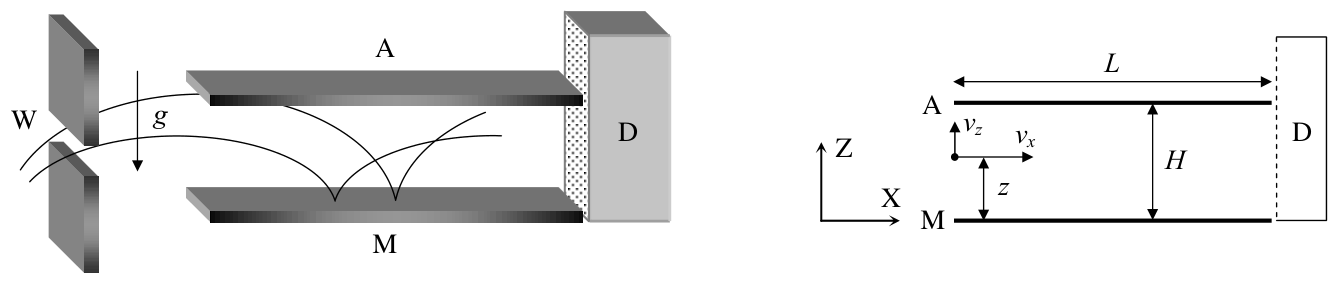
F-1
Marks are indicated at the beginning of each subquestion, in parenthesis.
The neutrons enter the cavity with a wide range of positive and negative vertical velocities, \(v_z\). Once in the cavity, they fly between the mirror below and the absorber above.
-
(1.5) Compute classically the range of vertical velocities \(v_z(z)\) of the neutrons that, entering at a height \(z\), can arrive at the detector D. Assume that \(L\) is much larger than any other length in the problem.
-
(1.5) Calculate classically the minimum length \(L_c\) of the cavity to ensure that all neutrons outside the previous velocity range, regardless of the values of \(z\), are absorbed by A. Use \(v_x = 10\ \mathrm{m\,s^{-1}}\) and \(H = 50\ \mu\mathrm{m}\).
The neutron transmission rate \(N(H)\) is measured at D. We expect that it increases monotonically with \(H\).
- (2.5) Compute the classical rate \(N_c(H)\) assuming that neutrons arrive at the cavity with vertical velocity \(v_z\) and at height \(z\), being all the values of \(v_z\) and \(z\) equally probable. Give the answer in terms of \(\rho\), the constant number of neutrons per unit time, per unit vertical velocity, per unit height, that enter the cavity with vertical velocity \(v_z\) and at height \(z\).
\(^{1}\) V. V. Nesvizhevsky et al. “Quantum states of neutrons in the Earth’s gravitational field.” Nature, 415 (2002) 297. Phys Rev D 67, 102002 (2003).
The experimental results obtained by the Grenoble group disagree with the above classical predictions, showing instead that the value of \(N(H)\) experiences sharp increases when \(H\) crosses some critical heights \(H_1\), \(H_2\) ... (Figure F-2 shows a sketch). In other words, the experiment showed that the vertical motion of neutrons bouncing on the mirror is quantized. In the language that Bohr and Sommerfeld used to obtain the energy levels of the hydrogen atom, this can be written as: “The action \(S\) of these neutrons along the vertical direction is an integer multiple of the Planck action constant \(h\)”. Here \(S\) is given by
\[ S=\int p_z(z)\,dz=nh,\qquad n=1,2,3\ldots \qquad\text{(Bohr-Sommerfeld quantization rule)} \]
where \(p_z\) is the vertical component of the classical momentum, and the integral covers a whole bouncing cycle. Only neutrons with these values of \(S\) are allowed in the cavity.
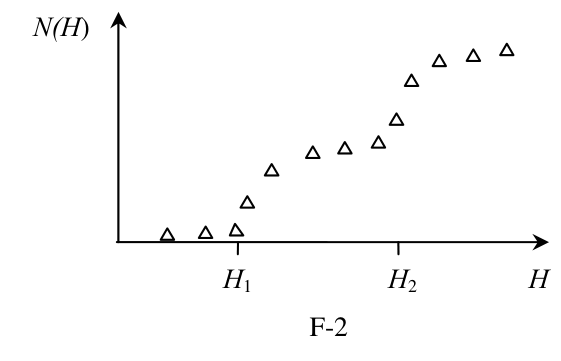
F-2
- (2.5) Compute the turning heights \(H_n\) and energy levels \(E_n\) (associated to the vertical motion) using the Bohr-Sommerfeld quantization condition. Give the numerical result for \(H_1\) in \(\mu\mathrm{m}\) and for \(E_1\) in eV.
The uniform initial distribution \(\rho\) of neutrons at the entrance changes, during the flight through a long cavity, into the step-like distribution detected at D (see Figure F-2). From now on, we consider for simplicity the case of a long cavity with \(H < H_2\). Classically, all neutrons with energies in the range considered in question 1 were allowed through it, while quantum mechanically only neutrons in the energy level \(E_1\) are permitted. According to the time-energy Heisenberg uncertainty principle, this reshuffling requires a minimum time of flight. The uncertainty of the vertical motion energy will be significant if the cavity length is small. This phenomenon will give rise to the widening of the energy levels.
- (2.0) Estimate the minimum time of flight \(t_q\) and the minimum length \(L_q\) of the cavity needed to observe the first sharp increase in the number of neutrons at D. Use \(v_x = 10\ \mathrm{m\,s^{-1}}\).
Data:
| Quantity | Value |
|---|---|
| Planck action constant | \(h = 6.63\cdot10^{-34}\ \mathrm{J\,s}\) |
| Speed of light in vacuum | \(c = 3.00\cdot10^8\ \mathrm{m\,s^{-1}}\) |
| Elementary charge | \(e = 1.60\cdot10^{-19}\ \mathrm{C}\) |
| Neutron mass | \(M = 1.67\cdot10^{-27}\ \mathrm{kg}\) |
| Acceleration of gravity on Earth | \(g = 9.81\ \mathrm{m\,s^{-2}}\) |
If necessary, use the expression:
\[ \int(1-x)^{1/2}\,dx=-\frac{2(1-x)^{3/2}}{3} \]
Official English text of the problem.
Answers
-
For \(0\le z<H\), the transmitted velocities satisfy \[ \boxed{-\sqrt{2g(H-z)}<v_z(z)<\sqrt{2g(H-z)}.} \] The endpoints reach the absorber and are therefore excluded.
-
The minimum classical cavity length is \[ \boxed{L_c=2v_x\sqrt{\frac{2H}{g}} =6.39\times10^{-2}\ \mathrm{m}=6.39\ \mathrm{cm}.} \]
-
The classical transmission rate is \[ \boxed{N_c(H)=\frac{4}{3}\rho\sqrt{2g}\,H^{3/2}.} \]
-
Using precisely the quantization rule stated in the problem, \[ \boxed{H_n=\left(\frac{9n^2h^2}{32M^2g}\right)^{1/3} =H_1n^{2/3},} \] \[ \boxed{E_n=MgH_n =\left(\frac{9n^2h^2Mg^2}{32}\right)^{1/3} =E_1n^{2/3}.} \] Numerically, \[ \boxed{H_1=16.5\ \mu\mathrm{m},\qquad E_1=1.69\times10^{-12}\ \mathrm{eV}.} \]
-
Using \(\Delta E\,t_q\gtrsim\hbar/2\) and the resolution scale \(\Delta E\sim E_1\), the uncertainty-limit estimates are \[ \boxed{t_q\gtrsim\frac{h}{4\pi E_1} =1.95\times10^{-4}\ \mathrm{s},\qquad L_q\gtrsim1.95\times10^{-3}\ \mathrm{m}.} \] A sharply resolved step requires longer flight. If the rough uncertainty estimate is instead written as \(\Delta E\,t_q\sim h\), the corresponding estimates are \[ \boxed{t_q\sim2.45\times10^{-3}\ \mathrm{s},\qquad L_q\sim2.45\times10^{-2}\ \mathrm{m}.} \] The numerical prefactor is not fixed without a quantitative sharpness criterion.
Solution
1. Classical range of transmitted vertical velocities
The horizontal motion is uniform and does not affect the vertical energy. Between reflections, conservation of mechanical energy gives
\[ E_z=\frac12 Mv_z^2+Mgz. \]
An elastic reflection at the mirror reverses \(v_z\) without changing \(E_z\). At the upper turning point \(z_{\mathrm{t}}\), the vertical velocity vanishes, so
\[ Mgz_{\mathrm{t}}=\frac12 Mv_z^2+Mgz, \]
and therefore
\[ z_{\mathrm{t}}=z+\frac{v_z^2}{2g}. \]
In a sufficiently long cavity, every neutron whose trajectory reaches \(z=H\) is absorbed. Transmission consequently requires \(z_{\mathrm{t}}<H\), or
\[ v_z^2<2g(H-z). \]
Thus
\[ \boxed{-\sqrt{2g(H-z)}<v_z<\sqrt{2g(H-z)},\qquad 0\le z<H.} \]
Both signs occur: an initially downward-moving neutron first reflects from the mirror, then rises to the same turning height. Equality is excluded because the problem states that every neutron reaching the absorber is absorbed.
2. Minimum classical cavity length
We must find the longest possible time before a neutron outside this range reaches the absorber.
Write its conserved vertical energy as \(E_z=Mga\), where \(a\ge H\) is the turning height it would have without the absorber. Its vertical speed at height \(z\) is
\[ |v_z(z)|=\sqrt{2g(a-z)}. \]
The time to travel upward from the mirror to the absorber is
\[ \begin{aligned} \tau(a) &=\int_0^H\frac{dz}{\sqrt{2g(a-z)}}\\ &=\sqrt{\frac{2}{g}} \left(\sqrt a-\sqrt{a-H}\right). \end{aligned} \]
This decreases as \(a\) increases, and its largest value is
\[ \tau(H)=\sqrt{\frac{2H}{g}}. \]
An initially upward-moving neutron reaches the absorber within one such upward passage. An initially downward-moving neutron can first descend to the mirror and then rise to the absorber. Its total time is at most \(2\tau(a)\).
The limiting longest trajectory starts just below the absorber, moving downward very slowly, with energy just sufficient to return to height \(H\). Hence the supremum of the absorption time is
\[ t_c=2\sqrt{\frac{2H}{g}}. \]
Since the horizontal flight time is \(L/v_x\), all such neutrons are removed when \(L/v_x\ge t_c\). Any smaller length allows some trajectories sufficiently close to the limiting one to escape absorption. Therefore
\[ \boxed{L_c=2v_x\sqrt{\frac{2H}{g}}.} \]
Numerically,
\[ t_c=2\sqrt{\frac{2(50\times10^{-6}\ \mathrm{m})} {9.81\ \mathrm{m\,s^{-2}}}} =6.39\times10^{-3}\ \mathrm{s}, \]
so
\[ \boxed{L_c=(10\ \mathrm{m\,s^{-1}})t_c =6.39\times10^{-2}\ \mathrm{m}.} \]
3. Classical transmission rate
By definition, the incident rate in an element \(dz\,dv_z\) is
\[ dN=\rho\,dz\,dv_z. \]
For a long cavity, only the velocity interval found in part 1 contributes. Integrating over this interval and over all entrance heights,
\[ N_c(H)= \rho\int_0^H \int_{-\sqrt{2g(H-z)}}^{+\sqrt{2g(H-z)}} dv_z\,dz. \]
Thus
\[ \begin{aligned} N_c(H) &=2\rho\sqrt{2g}\int_0^H(H-z)^{1/2}\,dz\\ &=2\rho\sqrt{2g}\,\frac23H^{3/2}. \end{aligned} \]
Therefore
\[ \boxed{N_c(H)=\frac43\rho\sqrt{2g}\,H^{3/2}.} \]
This predicts a smooth, increasing curve starting at \(N_c(0)=0\), with no steps.
4. Quantized turning heights and energies
For a neutron whose vertical turning height is \(H_n\),
\[ E_n=MgH_n. \]
The vertical momentum on the upward part of its trajectory is
\[ p_z(z)=\sqrt{2M(E_n-Mgz)} =M\sqrt{2g(H_n-z)}. \]
During descent, both \(p_z\) and \(dz\) are negative, so the downward contribution to the action equals the upward contribution. The instantaneous reflection at the mirror contributes no displacement. Consequently, the action over one full bounce is
\[ \begin{aligned} S &=2\int_0^{H_n}M\sqrt{2g(H_n-z)}\,dz\\ &=\frac43M\sqrt{2g}\,H_n^{3/2}. \end{aligned} \]
Applying the supplied Bohr-Sommerfeld rule \(S=nh\),
\[ \frac43M\sqrt{2g}\,H_n^{3/2}=nh. \]
Solving,
\[ \boxed{ H_n=\left(\frac{3nh}{4M\sqrt{2g}}\right)^{2/3} =\left(\frac{9n^2h^2}{32M^2g}\right)^{1/3}. } \]
Multiplication by \(Mg\) gives
\[ \boxed{ E_n=\left(\frac{9n^2h^2Mg^2}{32}\right)^{1/3}. } \]
Both quantities scale as \(n^{2/3}\).
For \(n=1\),
\[ H_1= \left[ \frac{3(6.63\times10^{-34})} {4(1.67\times10^{-27})\sqrt{2(9.81)}} \right]^{2/3} =1.653\times10^{-5}\ \mathrm{m}. \]
Therefore
\[ \boxed{H_1=16.5\ \mu\mathrm{m}.} \]
The corresponding energy is
\[ E_1=MgH_1 =2.708\times10^{-31}\ \mathrm{J}. \]
Using \(1\ \mathrm{eV}=1.60\times10^{-19}\ \mathrm{J}\),
\[ \boxed{ E_1=\frac{2.708\times10^{-31}}{1.60\times10^{-19}} =1.69\times10^{-12}\ \mathrm{eV}. } \]
5. Minimum quantum flight time and cavity length
The first onset of transmission occurs near \(MgH=E_1\). If the energy width of the first level is comparable to \(E_1\), this onset is substantially smeared. The relevant energy scale for an initial resolution estimate is therefore
\[ \Delta E\sim E_1. \]
Using the time-energy uncertainty estimate in the form
\[ \Delta E\,t_q\gtrsim\frac{\hbar}{2} =\frac{h}{4\pi}, \]
a necessary flight-time scale is
\[ t_q\gtrsim\frac{h}{4\pi E_1}. \]
Substituting the energy in joules,
\[ t_q\gtrsim \frac{6.63\times10^{-34}} {4\pi(2.708\times10^{-31})} =1.95\times10^{-4}\ \mathrm{s}. \]
The horizontal motion then gives
\[ \boxed{ L_q=v_xt_q\gtrsim (10)(1.95\times10^{-4}) =1.95\times10^{-3}\ \mathrm{m}. } \]
These values characterize an uncertainty bound, rather than guaranteeing a particular experimental sharpness. To make that distinction quantitative, suppose the permitted energy width is \(\Delta E=\epsilon E_1\). Since \(E=MgH\), this also corresponds to a relative height width \(\Delta H/H_1=\epsilon\). The estimates become
\[ t_q\gtrsim\frac{1.95\times10^{-4}}{\epsilon}\ \mathrm{s}, \qquad L_q\gtrsim\frac{1.95\times10^{-3}}{\epsilon}\ \mathrm{m}. \]
A sharp step, with \(\epsilon\ll1\), requires times and lengths appreciably larger than the basic bound.
For an order-of-magnitude treatment using \(\Delta E\,t_q\sim h\), one instead quotes
\[ t_q\sim\frac{h}{E_1} =2.45\times10^{-3}\ \mathrm{s}, \qquad \boxed{L_q\sim2.45\times10^{-2}\ \mathrm{m}=2.45\ \mathrm{cm}.} \]
The solution was checked against the official solution.
IPhO 2005 · Theorieaufgabe 3
Neutronen im Gravitationsfeld
Th 3 NEUTRONEN IM GRAVITATIONSFELD
In der vertrauten klassischen Welt ist ein elastisch auf der Erdoberfläche hüpfender Ball ein ideales Beispiel für eine unaufhörliche Bewegung. Der Ball ist eingeschlossen: Er kann weder unter die Oberfläche noch über seinen Umkehrpunkt gelangen. Er bleibt in diesem Zustand räumlich begrenzt und wird immer wieder nach unten umkehren und nach oben zurückprallen, bis in alle Ewigkeit. Nur Luftwiderstand oder unelastische Stöße könnten den Vorgang zum Stillstand bringen; sie werden im Folgenden vernachlässigt.
Eine Gruppe von Physikern des Instituts Laue - Langevin in Grenoble berichtete\(^{1}\) im Jahr 2002 über experimentelle Nachweise zum Verhalten von Neutronen im Gravitationsfeld der Erde. Im Experiment ließ man nach rechts fliegende Neutronen auf eine horizontale Kristalloberfläche fallen, die als Neutronenspiegel wirkte und an der sie immer wieder elastisch bis zur ursprünglichen Höhe zurückprallten.
Der Versuchsaufbau ist in Abbildung F-1 skizziert. Er besteht aus der Öffnung W, dem Neutronenspiegel M (auf der Höhe \(z = 0\)), dem Neutronenabsorber A (auf der Höhe \(z = H\) und mit der Länge \(L\)) und dem Neutronendetektor D. Der Neutronenstrahl fliegt mit einer konstanten horizontalen Geschwindigkeitskomponente \(v_x\) von W nach D durch den Hohlraum zwischen A und M. Alle Neutronen, die die Oberfläche von A erreichen, werden absorbiert und scheiden aus dem Experiment aus. Diejenigen, die die Oberfläche von M erreichen, werden elastisch reflektiert. Der Detektor D misst die Transmissionsrate \(N(H)\), also die Gesamtzahl der Neutronen, die D pro Zeiteinheit erreichen.
F-1
Die Punktzahlen sind am Anfang jeder Teilaufgabe in Klammern angegeben.
Die Neutronen treten mit einem breiten Spektrum positiver und negativer vertikaler Geschwindigkeiten \(v_z\) in den Hohlraum ein. Im Hohlraum fliegen sie zwischen dem Spiegel unten und dem Absorber oben.
-
(1.5) Berechnen Sie klassisch den Bereich der vertikalen Geschwindigkeiten \(v_z(z)\) der Neutronen, die beim Eintritt auf einer Höhe \(z\) den Detektor D erreichen können. Nehmen Sie an, dass \(L\) wesentlich größer als jede andere Länge in dieser Aufgabe ist.
-
(1.5) Berechnen Sie klassisch die Mindestlänge \(L_c\) des Hohlraums, die sicherstellt, dass alle Neutronen außerhalb des zuvor bestimmten Geschwindigkeitsbereichs unabhängig vom Wert von \(z\) durch A absorbiert werden. Verwenden Sie \(v_x = 10\ \mathrm{m\,s^{-1}}\) und \(H = 50\ \mu\mathrm{m}\).
Die Neutronentransmissionsrate \(N(H)\) wird bei D gemessen. Wir erwarten, dass sie mit \(H\) monoton zunimmt.
- (2.5) Berechnen Sie die klassische Rate \(N_c(H)\) unter der Annahme, dass Neutronen mit einer vertikalen Geschwindigkeit \(v_z\) auf einer Höhe \(z\) am Hohlraum eintreffen, wobei alle Werte von \(v_z\) und \(z\) gleich wahrscheinlich sind. Geben Sie das Ergebnis in Abhängigkeit von \(\rho\) an, der konstanten Anzahl von Neutronen pro Zeiteinheit, pro Einheit der vertikalen Geschwindigkeit und pro Höheneinheit, die mit der vertikalen Geschwindigkeit \(v_z\) auf der Höhe \(z\) in den Hohlraum eintreten.
\(^{1}\) V. V. Nesvizhevsky et al. „Quantenzustände von Neutronen im Gravitationsfeld der Erde.“ Nature, 415 (2002) 297. Phys Rev D 67, 102002 (2003).
Die experimentellen Ergebnisse der Gruppe aus Grenoble stimmen nicht mit den obigen klassischen Vorhersagen überein. Sie zeigen stattdessen, dass der Wert von \(N(H)\) sprunghaft ansteigt, wenn \(H\) bestimmte kritische Höhen \(H_1\), \(H_2\) ... überschreitet (Abbildung F-2 zeigt eine Skizze). Mit anderen Worten zeigte das Experiment, dass die vertikale Bewegung der am Spiegel zurückprallenden Neutronen quantisiert ist. In der Sprache, die Bohr und Sommerfeld zur Bestimmung der Energieniveaus des Wasserstoffatoms verwendeten, lässt sich dies so ausdrücken: „Die Wirkung \(S\) dieser Neutronen in vertikaler Richtung ist ein ganzzahliges Vielfaches des planckschen Wirkungsquantums \(h\).“ Dabei ist \(S\) gegeben durch
\[ S=\int p_z(z)\,dz=nh,\qquad n=1,2,3\ldots \qquad\text{(Bohr-Sommerfeld-Quantisierungsregel)} \]
wobei \(p_z\) die vertikale Komponente des klassischen Impulses ist und sich das Integral über einen vollständigen Zyklus der Hüpfbewegung erstreckt. Nur Neutronen mit diesen Werten von \(S\) sind im Hohlraum erlaubt.
F-2
- (2.5) Berechnen Sie die Umkehrhöhen \(H_n\) und die (zur vertikalen Bewegung gehörenden) Energieniveaus \(E_n\) mithilfe der Bohr-Sommerfeld-Quantisierungsbedingung. Geben Sie das numerische Ergebnis für \(H_1\) in \(\mu\mathrm{m}\) und für \(E_1\) in eV an.
Die anfänglich gleichförmige Verteilung \(\rho\) der Neutronen am Eingang geht während des Flugs durch einen langen Hohlraum in die bei D nachgewiesene stufenförmige Verteilung über (siehe Abbildung F-2). Von nun an betrachten wir der Einfachheit halber den Fall eines langen Hohlraums mit \(H < H_2\). Klassisch konnten alle Neutronen mit Energien in dem in Aufgabe 1 betrachteten Bereich den Hohlraum durchqueren, während quantenmechanisch nur Neutronen im Energieniveau \(E_1\) erlaubt sind. Nach der Energie-Zeit-Unschärferelation von Heisenberg erfordert diese Umverteilung eine Mindestflugzeit. Bei geringer Hohlraumlänge ist die Unschärfe der Energie der vertikalen Bewegung beträchtlich. Dieses Phänomen führt zu einer Verbreiterung der Energieniveaus.
- (2.0) Schätzen Sie die Mindestflugzeit \(t_q\) und die Mindestlänge \(L_q\) des Hohlraums ab, die erforderlich sind, um den ersten sprunghaften Anstieg der Neutronenzahl bei D zu beobachten. Verwenden Sie \(v_x = 10\ \mathrm{m\,s^{-1}}\).
Gegebene Größen:
| Größe | Wert |
|---|---|
| Plancksches Wirkungsquantum | \(h = 6.63\cdot10^{-34}\ \mathrm{J\,s}\) |
| Lichtgeschwindigkeit im Vakuum | \(c = 3.00\cdot10^8\ \mathrm{m\,s^{-1}}\) |
| Elementarladung | \(e = 1.60\cdot10^{-19}\ \mathrm{C}\) |
| Neutronenmasse | \(M = 1.67\cdot10^{-27}\ \mathrm{kg}\) |
| Erdbeschleunigung | \(g = 9.81\ \mathrm{m\,s^{-2}}\) |
Verwenden Sie bei Bedarf den Ausdruck:
\[ \int(1-x)^{1/2}\,dx=-\frac{2(1-x)^{3/2}}{3} \]
Aufgabentext aus dem offiziellen englischen Text übersetzt.
Antworten
-
Für \(0\le z<H\) erfüllen die durchgelassenen Geschwindigkeiten \[ \boxed{-\sqrt{2g(H-z)}<v_z(z)<\sqrt{2g(H-z)}.} \] Bei den Randwerten erreichen die Neutronen den Absorber; diese Werte sind daher ausgeschlossen.
-
Die klassische Mindestlänge des Hohlraums beträgt \[ \boxed{L_c=2v_x\sqrt{\frac{2H}{g}} =6.39\times10^{-2}\ \mathrm{m}=6.39\ \mathrm{cm}.} \]
-
Die klassische Transmissionsrate beträgt \[ \boxed{N_c(H)=\frac{4}{3}\rho\sqrt{2g}\,H^{3/2}.} \]
-
Bei Verwendung genau der in der Aufgabe angegebenen Quantisierungsregel gilt \[ \boxed{H_n=\left(\frac{9n^2h^2}{32M^2g}\right)^{1/3} =H_1n^{2/3},} \] \[ \boxed{E_n=MgH_n =\left(\frac{9n^2h^2Mg^2}{32}\right)^{1/3} =E_1n^{2/3}.} \] Numerisch ergibt sich \[ \boxed{H_1=16.5\ \mu\mathrm{m},\qquad E_1=1.69\times10^{-12}\ \mathrm{eV}.} \]
-
Mit \(\Delta E\,t_q\gtrsim\hbar/2\) und der Auflösungsskala \(\Delta E\sim E_1\) ergeben sich als Abschätzungen der durch die Unschärferelation gesetzten Grenze \[ \boxed{t_q\gtrsim\frac{h}{4\pi E_1} =1.95\times10^{-4}\ \mathrm{s},\qquad L_q\gtrsim1.95\times10^{-3}\ \mathrm{m}.} \] Eine scharf aufgelöste Stufe erfordert eine längere Flugzeit. Wird die grobe Unschärfeabschätzung stattdessen als \(\Delta E\,t_q\sim h\) geschrieben, lauten die entsprechenden Abschätzungen \[ \boxed{t_q\sim2.45\times10^{-3}\ \mathrm{s},\qquad L_q\sim2.45\times10^{-2}\ \mathrm{m}.} \] Ohne ein quantitatives Kriterium für die Schärfe ist der numerische Vorfaktor nicht festgelegt.
Lösung
1. Klassischer Bereich der durchgelassenen vertikalen Geschwindigkeiten
Die horizontale Bewegung ist gleichförmig und beeinflusst die Energie der vertikalen Bewegung nicht. Zwischen den Reflexionen ergibt die Erhaltung der mechanischen Energie
\[ E_z=\frac12 Mv_z^2+Mgz. \]
Eine elastische Reflexion am Spiegel kehrt das Vorzeichen von \(v_z\) um, ohne \(E_z\) zu verändern. Am oberen Umkehrpunkt \(z_{\mathrm{t}}\) verschwindet die vertikale Geschwindigkeit, sodass
\[ Mgz_{\mathrm{t}}=\frac12 Mv_z^2+Mgz, \]
und daher
\[ z_{\mathrm{t}}=z+\frac{v_z^2}{2g}. \]
In einem hinreichend langen Hohlraum wird jedes Neutron absorbiert, dessen Bahn \(z=H\) erreicht. Für die Transmission ist folglich \(z_{\mathrm{t}}<H\) erforderlich, also
\[ v_z^2<2g(H-z). \]
Damit gilt
\[ \boxed{-\sqrt{2g(H-z)}<v_z<\sqrt{2g(H-z)},\qquad 0\le z<H.} \]
Beide Vorzeichen treten auf: Ein anfangs abwärts fliegendes Neutron wird zunächst am Spiegel reflektiert und steigt dann bis zur gleichen Umkehrhöhe auf. Der Gleichheitsfall ist ausgeschlossen, da laut Aufgabenstellung jedes Neutron, das den Absorber erreicht, absorbiert wird.
2. Klassische Mindestlänge des Hohlraums
Wir müssen die längstmögliche Zeit bestimmen, die vergeht, bevor ein Neutron außerhalb dieses Bereichs den Absorber erreicht.
Wir schreiben seine erhaltene Energie der vertikalen Bewegung als \(E_z=Mga\), wobei \(a\ge H\) die Umkehrhöhe ist, die es ohne den Absorber hätte. Der Betrag seiner vertikalen Geschwindigkeit auf der Höhe \(z\) ist
\[ |v_z(z)|=\sqrt{2g(a-z)}. \]
Die Zeit für den Aufstieg vom Spiegel zum Absorber beträgt
\[ \begin{aligned} \tau(a) &=\int_0^H\frac{dz}{\sqrt{2g(a-z)}}\\ &=\sqrt{\frac{2}{g}} \left(\sqrt a-\sqrt{a-H}\right). \end{aligned} \]
Sie nimmt mit wachsendem \(a\) ab, und ihr größter Wert ist
\[ \tau(H)=\sqrt{\frac{2H}{g}}. \]
Ein anfangs aufwärts fliegendes Neutron erreicht den Absorber innerhalb eines solchen Aufstiegs. Ein anfangs abwärts fliegendes Neutron kann zuerst zum Spiegel hinabfallen und dann zum Absorber aufsteigen. Seine Gesamtzeit beträgt höchstens \(2\tau(a)\).
Im Grenzfall beginnt die längste Bahn unmittelbar unterhalb des Absorbers mit einer sehr langsamen Abwärtsbewegung und einer Energie, die gerade ausreicht, um zur Höhe \(H\) zurückzukehren. Das Supremum der Zeit bis zur Absorption ist daher
\[ t_c=2\sqrt{\frac{2H}{g}}. \]
Da die horizontale Flugzeit \(L/v_x\) beträgt, werden alle solchen Neutronen bei \(L/v_x\ge t_c\) entfernt. Bei jeder kleineren Länge können einige Bahnen, die der Grenzbahn hinreichend nahe kommen, der Absorption entgehen. Daher gilt
\[ \boxed{L_c=2v_x\sqrt{\frac{2H}{g}}.} \]
Numerisch ergibt sich
\[ t_c=2\sqrt{\frac{2(50\times10^{-6}\ \mathrm{m})} {9.81\ \mathrm{m\,s^{-2}}}} =6.39\times10^{-3}\ \mathrm{s}, \]
also
\[ \boxed{L_c=(10\ \mathrm{m\,s^{-1}})t_c =6.39\times10^{-2}\ \mathrm{m}.} \]
3. Klassische Transmissionsrate
Definitionsgemäß beträgt die einfallende Rate in einem Element \(dz\,dv_z\)
\[ dN=\rho\,dz\,dv_z. \]
Bei einem langen Hohlraum trägt nur das in Teil 1 bestimmte Geschwindigkeitsintervall bei. Die Integration über dieses Intervall und über alle Eintrittshöhen ergibt
\[ N_c(H)= \rho\int_0^H \int_{-\sqrt{2g(H-z)}}^{+\sqrt{2g(H-z)}} dv_z\,dz. \]
Somit gilt
\[ \begin{aligned} N_c(H) &=2\rho\sqrt{2g}\int_0^H(H-z)^{1/2}\,dz\\ &=2\rho\sqrt{2g}\,\frac23H^{3/2}. \end{aligned} \]
Daher folgt
\[ \boxed{N_c(H)=\frac43\rho\sqrt{2g}\,H^{3/2}.} \]
Dies sagt eine glatte, ansteigende Kurve ohne Stufen voraus, die bei \(N_c(0)=0\) beginnt.
4. Quantisierte Umkehrhöhen und Energien
Für ein Neutron mit der vertikalen Umkehrhöhe \(H_n\) gilt
\[ E_n=MgH_n. \]
Der vertikale Impuls auf dem aufwärts gerichteten Teil seiner Bahn ist
\[ p_z(z)=\sqrt{2M(E_n-Mgz)} =M\sqrt{2g(H_n-z)}. \]
Beim Abstieg sind sowohl \(p_z\) als auch \(dz\) negativ, sodass der Beitrag zur Wirkung beim Abstieg gleich dem Beitrag beim Aufstieg ist. Bei der momentanen Reflexion am Spiegel findet keine Ortsänderung statt. Folglich beträgt die Wirkung über einen vollständigen Zyklus der Hüpfbewegung
\[ \begin{aligned} S &=2\int_0^{H_n}M\sqrt{2g(H_n-z)}\,dz\\ &=\frac43M\sqrt{2g}\,H_n^{3/2}. \end{aligned} \]
Die Anwendung der angegebenen Bohr-Sommerfeld-Regel \(S=nh\) ergibt
\[ \frac43M\sqrt{2g}\,H_n^{3/2}=nh. \]
Auflösen liefert
\[ \boxed{ H_n=\left(\frac{3nh}{4M\sqrt{2g}}\right)^{2/3} =\left(\frac{9n^2h^2}{32M^2g}\right)^{1/3}. } \]
Multiplikation mit \(Mg\) ergibt
\[ \boxed{ E_n=\left(\frac{9n^2h^2Mg^2}{32}\right)^{1/3}. } \]
Beide Größen sind proportional zu \(n^{2/3}\).
Für \(n=1\) gilt
\[ H_1= \left[ \frac{3(6.63\times10^{-34})} {4(1.67\times10^{-27})\sqrt{2(9.81)}} \right]^{2/3} =1.653\times10^{-5}\ \mathrm{m}. \]
Daher ist
\[ \boxed{H_1=16.5\ \mu\mathrm{m}.} \]
Die zugehörige Energie beträgt
\[ E_1=MgH_1 =2.708\times10^{-31}\ \mathrm{J}. \]
Mit \(1\ \mathrm{eV}=1.60\times10^{-19}\ \mathrm{J}\) ergibt sich
\[ \boxed{ E_1=\frac{2.708\times10^{-31}}{1.60\times10^{-19}} =1.69\times10^{-12}\ \mathrm{eV}. } \]
5. Quantenmechanische Mindestflugzeit und Mindestlänge des Hohlraums
Die Transmission setzt erstmals nahe \(MgH=E_1\) ein. Ist die Energiebreite des ersten Niveaus mit \(E_1\) vergleichbar, wird dieser Einsatz deutlich verschmiert. Die maßgebliche Energieskala für eine erste Abschätzung der Auflösung ist daher
\[ \Delta E\sim E_1. \]
Verwendet man die Energie-Zeit-Unschärfeabschätzung in der Form
\[ \Delta E\,t_q\gtrsim\frac{\hbar}{2} =\frac{h}{4\pi}, \]
so ergibt sich als notwendige Flugzeitskala
\[ t_q\gtrsim\frac{h}{4\pi E_1}. \]
Einsetzen der Energie in Joule ergibt
\[ t_q\gtrsim \frac{6.63\times10^{-34}} {4\pi(2.708\times10^{-31})} =1.95\times10^{-4}\ \mathrm{s}. \]
Aus der horizontalen Bewegung folgt dann
\[ \boxed{ L_q=v_xt_q\gtrsim (10)(1.95\times10^{-4}) =1.95\times10^{-3}\ \mathrm{m}. } \]
Diese Werte kennzeichnen eine durch die Unschärferelation gesetzte Grenze, garantieren jedoch keine bestimmte experimentelle Schärfe. Um diesen Unterschied quantitativ zu erfassen, nehmen wir an, dass die zulässige Energiebreite \(\Delta E=\epsilon E_1\) beträgt. Wegen \(E=MgH\) entspricht dies auch einer relativen Höhenbreite \(\Delta H/H_1=\epsilon\). Die Abschätzungen lauten dann
\[ t_q\gtrsim\frac{1.95\times10^{-4}}{\epsilon}\ \mathrm{s}, \qquad L_q\gtrsim\frac{1.95\times10^{-3}}{\epsilon}\ \mathrm{m}. \]
Eine scharfe Stufe mit \(\epsilon\ll1\) erfordert Zeiten und Längen, die erheblich größer als die grundlegende Schranke sind.
Bei einer Größenordnungsbetrachtung mit \(\Delta E\,t_q\sim h\) gibt man stattdessen an
\[ t_q\sim\frac{h}{E_1} =2.45\times10^{-3}\ \mathrm{s}, \qquad \boxed{L_q\sim2.45\times10^{-2}\ \mathrm{m}=2.45\ \mathrm{cm}.} \]
Die Lösung wurde mit der offiziellen Lösung abgeglichen.
IPhO 2005 · Teori sorusu 3
Kütleçekim Alanında Nötronlar
Th 3 KÜTLEÇEKİM ALANINDA NÖTRONLAR
Alışık olduğumuz klasik dünyada, Dünya'nın yüzeyinde esnek olarak sıçrayan bir top, sürekli hareket için ideal bir örnektir. Top hapsolmuştur: yüzeyin altına inemez veya dönüş noktasının üzerine çıkamaz. Bu durumda sınırlı bir bölgede kalacak, tekrar tekrar aşağı dönüp yukarı sıçrayarak bunu sonsuza dek sürdürecektir. Süreci yalnızca hava direnci veya esnek olmayan çarpmalar durdurabilir; bunlar aşağıda göz ardı edilecektir.
Grenoble'daki Institute Laue - Langevin'den bir grup fizikçi, 2002 yılında nötronların Dünya'nın kütleçekim alanındaki davranışına ilişkin deneysel kanıtlar bildirdi\(^{1}\). Deneyde, sağa doğru hareket eden nötronların, nötron aynası görevi gören yatay bir kristal yüzeye doğru düşmelerine izin verildi; nötronlar bu yüzeyden esnek olarak yansıyıp tekrar tekrar başlangıç yüksekliklerine kadar yükseldiler.
Deney düzeneği Şekil F-1'de şematik olarak gösterilmiştir. Düzenek, W açıklığından, M nötron aynasından (\(z = 0\) yüksekliğinde), A nötron soğurucusundan (\(z = H\) yüksekliğinde ve \(L\) uzunluğunda) ve D nötron dedektöründen oluşur. Nötron demeti, A ile M arasındaki boşluktan geçerek W'den D'ye sabit yatay hız bileşeni \(v_x\) ile ilerler. A'nın yüzeyine ulaşan tüm nötronlar soğurulur ve deneyden çıkar. M'nin yüzeyine ulaşanlar ise esnek olarak yansır. D dedektörü, geçiş hızını \(N(H)\), yani birim zamanda D'ye ulaşan toplam nötron sayısını ölçer.
F-1
Her alt sorunun başında, parantez içinde puanı belirtilmiştir.
Nötronlar boşluğa, geniş bir aralıktaki pozitif ve negatif düşey hızlarla, \(v_z\), girer. Boşluğa girdikten sonra alttaki ayna ile üstteki soğurucu arasında hareket ederler.
-
(1.5) Boşluğa \(z\) yüksekliğinde girip D dedektörüne ulaşabilen nötronların düşey hız aralığını \(v_z(z)\) klasik olarak hesaplayınız. \(L\)'nin sorudaki diğer tüm uzunluklardan çok daha büyük olduğunu varsayınız.
-
(1.5) Önceki hız aralığının dışında kalan tüm nötronların, \(z\) değerlerinden bağımsız olarak, A tarafından soğurulmasını sağlayacak en küçük boşluk uzunluğunu \(L_c\) klasik olarak hesaplayınız. \(v_x = 10\ \mathrm{m\,s^{-1}}\) ve \(H = 50\ \mu\mathrm{m}\) kullanınız.
Nötron geçiş hızı \(N(H)\), D'de ölçülür. Bunun \(H\) ile monoton olarak artmasını bekleriz.
- (2.5) Nötronların boşluğa \(v_z\) düşey hızıyla ve \(z\) yüksekliğinde geldiğini, tüm \(v_z\) ve \(z\) değerlerinin eşit olasılıklı olduğunu varsayarak klasik geçiş hızını \(N_c(H)\) hesaplayınız. Yanıtınızı, boşluğa \(v_z\) düşey hızıyla ve \(z\) yüksekliğinde giren nötronların birim zaman, birim düşey hız ve birim yükseklik başına sabit sayısı olan \(\rho\) cinsinden veriniz.
\(^{1}\) V. V. Nesvizhevsky ve diğerleri. “Dünya'nın kütleçekim alanında nötronların kuantum durumları.” Nature, 415 (2002) 297. Phys Rev D 67, 102002 (2003).
Grenoble grubunun elde ettiği deneysel sonuçlar, yukarıdaki klasik öngörülerle uyuşmamaktadır; bunun yerine, \(H\) bazı kritik yükseklikleri, \(H_1\), \(H_2\) ... geçtiğinde \(N(H)\) değerinin keskin artışlar gösterdiğini ortaya koymaktadır (Şekil F-2'de şematik bir gösterim verilmiştir). Başka bir deyişle deney, ayna üzerinde sıçrayan nötronların düşey hareketinin kuantumlanmış olduğunu göstermiştir. Bohr ve Sommerfeld'in hidrojen atomunun enerji düzeylerini elde etmek için kullandıkları dille bu şöyle ifade edilebilir: “Bu nötronların düşey doğrultudaki eylemi \(S\), Planck eylem sabiti \(h\)'nin bir tam sayı katıdır.” Burada \(S\) şöyle verilir:
\[ S=\int p_z(z)\,dz=nh,\qquad n=1,2,3\ldots \qquad\text{(Bohr-Sommerfeld kuantumlama kuralı)} \]
Burada \(p_z\), klasik momentumun düşey bileşenidir ve integral tam bir sıçrama çevrimini kapsar. Boşlukta yalnızca bu \(S\) değerlerine sahip nötronlara izin verilir.
F-2
- (2.5) Bohr-Sommerfeld kuantumlama koşulunu kullanarak dönüş yüksekliklerini \(H_n\) ve (düşey hareketle ilişkili) enerji düzeylerini \(E_n\) hesaplayınız. \(H_1\) için sayısal sonucu \(\mu\mathrm{m}\), \(E_1\) için ise eV cinsinden veriniz.
Nötronların girişteki düzgün başlangıç dağılımı \(\rho\), uzun bir boşluk boyunca uçuş sırasında, D'de algılanan basamaklı dağılıma dönüşür (bkz. Şekil F-2). Bundan sonra, basitlik için \(H < H_2\) olan uzun bir boşluk durumunu ele alacağız. Klasik olarak, enerjileri 1. soruda ele alınan aralıkta bulunan tüm nötronların boşluktan geçmesine izin verilirken, kuantum mekaniğine göre yalnızca \(E_1\) enerji düzeyindeki nötronlara izin verilir. Heisenberg'in zaman-enerji belirsizlik ilkesine göre, bu yeniden düzenlenme için bir en küçük uçuş süresi gereklidir. Boşluğun uzunluğu küçükse düşey hareketin enerjisindeki belirsizlik önemli olacaktır. Bu olgu, enerji düzeylerinin genişlemesine yol açacaktır.
- (2.0) D'deki nötron sayısında ilk keskin artışı gözlemlemek için gereken en küçük uçuş süresini \(t_q\) ve en küçük boşluk uzunluğunu \(L_q\) tahmin ediniz. \(v_x = 10\ \mathrm{m\,s^{-1}}\) kullanınız.
Veriler:
| Nicelik | Değer |
|---|---|
| Planck eylem sabiti | \(h = 6.63\cdot10^{-34}\ \mathrm{J\,s}\) |
| Işığın boşluktaki hızı | \(c = 3.00\cdot10^8\ \mathrm{m\,s^{-1}}\) |
| Temel yük | \(e = 1.60\cdot10^{-19}\ \mathrm{C}\) |
| Nötron kütlesi | \(M = 1.67\cdot10^{-27}\ \mathrm{kg}\) |
| Dünya'daki yerçekimi ivmesi | \(g = 9.81\ \mathrm{m\,s^{-2}}\) |
Gerekirse şu ifadeyi kullanınız:
\[ \int(1-x)^{1/2}\,dx=-\frac{2(1-x)^{3/2}}{3} \]
Soru metni resmi İngilizce metinden çevrilmiştir.
Cevaplar
-
\(0\le z<H\) için, geçiş yapan nötronların hızları şu koşulu sağlar: \[ \boxed{-\sqrt{2g(H-z)}<v_z(z)<\sqrt{2g(H-z)}.} \] Uç noktalardaki hızlara sahip nötronlar soğurucuya ulaşır ve bu nedenle aralığa dahil edilmez.
-
En küçük klasik boşluk uzunluğu şöyledir: \[ \boxed{L_c=2v_x\sqrt{\frac{2H}{g}} =6.39\times10^{-2}\ \mathrm{m}=6.39\ \mathrm{cm}.} \]
-
Klasik geçiş hızı şöyledir: \[ \boxed{N_c(H)=\frac{4}{3}\rho\sqrt{2g}\,H^{3/2}.} \]
-
Soruda belirtilen kuantumlama kuralı tam olarak kullanıldığında, \[ \boxed{H_n=\left(\frac{9n^2h^2}{32M^2g}\right)^{1/3} =H_1n^{2/3},} \] \[ \boxed{E_n=MgH_n =\left(\frac{9n^2h^2Mg^2}{32}\right)^{1/3} =E_1n^{2/3}.} \] Sayısal olarak, \[ \boxed{H_1=16.5\ \mu\mathrm{m},\qquad E_1=1.69\times10^{-12}\ \mathrm{eV}.} \]
-
\(\Delta E\,t_q\gtrsim\hbar/2\) ve \(\Delta E\sim E_1\) çözünürlük ölçeği kullanıldığında, belirsizlik sınırına ilişkin tahminler şöyledir: \[ \boxed{t_q\gtrsim\frac{h}{4\pi E_1} =1.95\times10^{-4}\ \mathrm{s},\qquad L_q\gtrsim1.95\times10^{-3}\ \mathrm{m}.} \] Keskin biçimde ayırt edilebilen bir basamak için daha uzun bir uçuş gerekir. Kaba belirsizlik tahmini bunun yerine \(\Delta E\,t_q\sim h\) biçiminde yazılırsa, karşılık gelen tahminler şöyledir: \[ \boxed{t_q\sim2.45\times10^{-3}\ \mathrm{s},\qquad L_q\sim2.45\times10^{-2}\ \mathrm{m}.} \] Nicel bir keskinlik ölçütü olmadan sayısal ön çarpan belirlenemez.
Çözüm
1. Geçiş yapan nötronların düşey hızlarının klasik aralığı
Yatay hareket sabit hızlıdır ve düşey hareketin enerjisini etkilemez. Yansımalar arasında mekanik enerjinin korunumu şu sonucu verir:
\[ E_z=\frac12 Mv_z^2+Mgz. \]
Aynadaki esnek yansıma, \(E_z\)'yi değiştirmeden \(v_z\)'nin işaretini tersine çevirir. Üst dönüş noktası \(z_{\mathrm{t}}\)'de düşey hız sıfır olur; dolayısıyla
\[ Mgz_{\mathrm{t}}=\frac12 Mv_z^2+Mgz, \]
ve buradan
\[ z_{\mathrm{t}}=z+\frac{v_z^2}{2g}. \]
Yeterince uzun bir boşlukta, yörüngesi \(z=H\)'ye ulaşan her nötron soğurulur. Bu nedenle geçiş için \(z_{\mathrm{t}}<H\), yani şu koşul gerekir:
\[ v_z^2<2g(H-z). \]
Böylece
\[ \boxed{-\sqrt{2g(H-z)}<v_z<\sqrt{2g(H-z)},\qquad 0\le z<H.} \]
Her iki işaret de mümkündür: başlangıçta aşağı doğru hareket eden bir nötron önce aynadan yansır, ardından aynı dönüş yüksekliğine kadar yükselir. Soruda soğurucuya ulaşan her nötronun soğurulduğu belirtildiği için eşitlik durumu dışlanır.
2. En küçük klasik boşluk uzunluğu
Bu aralığın dışındaki bir nötronun soğurucuya ulaşmasına kadar geçebilecek en uzun süreyi bulmalıyız.
Korunan düşey hareket enerjisini \(E_z=Mga\) biçiminde yazalım; burada \(a\ge H\), soğurucu olmasaydı nötronun ulaşacağı dönüş yüksekliğidir. \(z\) yüksekliğindeki düşey sürati şöyledir:
\[ |v_z(z)|=\sqrt{2g(a-z)}. \]
Aynadan soğurucuya yukarı doğru yolculuk süresi şöyledir:
\[ \begin{aligned} \tau(a) &=\int_0^H\frac{dz}{\sqrt{2g(a-z)}}\\ &=\sqrt{\frac{2}{g}} \left(\sqrt a-\sqrt{a-H}\right). \end{aligned} \]
Bu süre \(a\) arttıkça azalır ve en büyük değeri şöyledir:
\[ \tau(H)=\sqrt{\frac{2H}{g}}. \]
Başlangıçta yukarı doğru hareket eden bir nötron, böyle bir yukarı çıkış süresi içinde soğurucuya ulaşır. Başlangıçta aşağı doğru hareket eden bir nötron ise önce aynaya inip sonra soğurucuya yükselebilir. Bunun toplam süresi en fazla \(2\tau(a)\)'dır.
En uzun yörüngenin sınır durumunda nötron, soğurucunun hemen altında, aşağı doğru çok yavaş hareket ederek başlar ve enerjisi \(H\) yüksekliğine geri dönmeye ancak yeterlidir. Dolayısıyla soğurulma süresinin supremumu şöyledir:
\[ t_c=2\sqrt{\frac{2H}{g}}. \]
Yatay uçuş süresi \(L/v_x\) olduğundan, \(L/v_x\ge t_c\) olduğunda bu nötronların tümü elenir. Daha küçük herhangi bir uzunluk, sınır durumdaki yörüngeye yeterince yakın bazı yörüngelerdeki nötronların soğurulmadan geçmesine izin verir. Bu nedenle
\[ \boxed{L_c=2v_x\sqrt{\frac{2H}{g}}.} \]
Sayısal olarak,
\[ t_c=2\sqrt{\frac{2(50\times10^{-6}\ \mathrm{m})} {9.81\ \mathrm{m\,s^{-2}}}} =6.39\times10^{-3}\ \mathrm{s}, \]
dolayısıyla
\[ \boxed{L_c=(10\ \mathrm{m\,s^{-1}})t_c =6.39\times10^{-2}\ \mathrm{m}.} \]
3. Klasik geçiş hızı
Tanım gereği, bir \(dz\,dv_z\) elemanında birim zamanda gelen nötron sayısı şöyledir:
\[ dN=\rho\,dz\,dv_z. \]
Uzun bir boşluk için yalnızca 1. kısımda bulunan hız aralığı katkıda bulunur. Bu aralık ve tüm giriş yükseklikleri üzerinden integral alınırsa,
\[ N_c(H)= \rho\int_0^H \int_{-\sqrt{2g(H-z)}}^{+\sqrt{2g(H-z)}} dv_z\,dz. \]
Böylece
\[ \begin{aligned} N_c(H) &=2\rho\sqrt{2g}\int_0^H(H-z)^{1/2}\,dz\\ &=2\rho\sqrt{2g}\,\frac23H^{3/2}. \end{aligned} \]
Dolayısıyla
\[ \boxed{N_c(H)=\frac43\rho\sqrt{2g}\,H^{3/2}.} \]
Bu sonuç, \(N_c(0)=0\)'dan başlayan, basamak içermeyen, düzgün ve artan bir eğri öngörür.
4. Kuantumlanmış dönüş yükseklikleri ve enerjiler
Düşey dönüş yüksekliği \(H_n\) olan bir nötron için,
\[ E_n=MgH_n. \]
Yörüngesinin yukarı yönlü kısmındaki düşey momentum şöyledir:
\[ p_z(z)=\sqrt{2M(E_n-Mgz)} =M\sqrt{2g(H_n-z)}. \]
İniş sırasında hem \(p_z\) hem de \(dz\) negatiftir; bu nedenle inişin eyleme katkısı, çıkışın katkısına eşittir. Aynadaki anlık yansıma herhangi bir yer değiştirme katkısı yapmaz. Sonuç olarak, tam bir sıçrama çevrimi boyunca eylem şöyledir:
\[ \begin{aligned} S &=2\int_0^{H_n}M\sqrt{2g(H_n-z)}\,dz\\ &=\frac43M\sqrt{2g}\,H_n^{3/2}. \end{aligned} \]
Verilen Bohr-Sommerfeld kuralı \(S=nh\) uygulanırsa,
\[ \frac43M\sqrt{2g}\,H_n^{3/2}=nh. \]
Çözüldüğünde,
\[ \boxed{ H_n=\left(\frac{3nh}{4M\sqrt{2g}}\right)^{2/3} =\left(\frac{9n^2h^2}{32M^2g}\right)^{1/3}. } \]
\(Mg\) ile çarpılması şu sonucu verir:
\[ \boxed{ E_n=\left(\frac{9n^2h^2Mg^2}{32}\right)^{1/3}. } \]
Her iki nicelik de \(n^{2/3}\) ile orantılıdır.
\(n=1\) için,
\[ H_1= \left[ \frac{3(6.63\times10^{-34})} {4(1.67\times10^{-27})\sqrt{2(9.81)}} \right]^{2/3} =1.653\times10^{-5}\ \mathrm{m}. \]
Dolayısıyla
\[ \boxed{H_1=16.5\ \mu\mathrm{m}.} \]
Karşılık gelen enerji şöyledir:
\[ E_1=MgH_1 =2.708\times10^{-31}\ \mathrm{J}. \]
\(1\ \mathrm{eV}=1.60\times10^{-19}\ \mathrm{J}\) kullanılarak,
\[ \boxed{ E_1=\frac{2.708\times10^{-31}}{1.60\times10^{-19}} =1.69\times10^{-12}\ \mathrm{eV}. } \]
5. En küçük kuantum uçuş süresi ve boşluk uzunluğu
Geçiş ilk olarak \(MgH=E_1\) yakınında başlar. Birinci düzeyin enerji genişliği \(E_1\) ile karşılaştırılabilir büyüklükteyse, bu başlangıç önemli ölçüde yayvanlaşır. Bu nedenle, ilk çözünürlük tahmini için ilgili enerji ölçeği şöyledir:
\[ \Delta E\sim E_1. \]
Zaman-enerji belirsizliği tahmini şu biçimde kullanıldığında,
\[ \Delta E\,t_q\gtrsim\frac{\hbar}{2} =\frac{h}{4\pi}, \]
gerekli uçuş süresi ölçeği şöyle olur:
\[ t_q\gtrsim\frac{h}{4\pi E_1}. \]
Enerji joule cinsinden yerine konursa,
\[ t_q\gtrsim \frac{6.63\times10^{-34}} {4\pi(2.708\times10^{-31})} =1.95\times10^{-4}\ \mathrm{s}. \]
Yatay hareket buradan şu sonucu verir:
\[ \boxed{ L_q=v_xt_q\gtrsim (10)(1.95\times10^{-4}) =1.95\times10^{-3}\ \mathrm{m}. } \]
Bu değerler, belirli bir deneysel keskinliği garanti etmekten ziyade bir belirsizlik sınırını niteler. Bu ayrımı nicel hâle getirmek için izin verilen enerji genişliğinin \(\Delta E=\epsilon E_1\) olduğunu varsayalım. \(E=MgH\) olduğundan, bu aynı zamanda \(\Delta H/H_1=\epsilon\) bağıl yükseklik genişliğine karşılık gelir. Tahminler şu hâli alır:
\[ t_q\gtrsim\frac{1.95\times10^{-4}}{\epsilon}\ \mathrm{s}, \qquad L_q\gtrsim\frac{1.95\times10^{-3}}{\epsilon}\ \mathrm{m}. \]
\(\epsilon\ll1\) olan keskin bir basamak, temel sınırdan belirgin ölçüde daha büyük süreler ve uzunluklar gerektirir.
\(\Delta E\,t_q\sim h\) kullanan bir mertebe hesabında ise şu değerler verilir:
\[ t_q\sim\frac{h}{E_1} =2.45\times10^{-3}\ \mathrm{s}, \qquad \boxed{L_q\sim2.45\times10^{-2}\ \mathrm{m}=2.45\ \mathrm{cm}.} \]
Çözüm, resmi çözümle karşılaştırılarak kontrol edildi.
IPhO 2005 · Problema teórico 3
Neutrones en un campo gravitatorio
Th 3 NEUTRONES EN UN CAMPO GRAVITATORIO
En el mundo clásico que nos resulta familiar, una pelota que rebota elásticamente sobre la superficie terrestre es un ejemplo ideal de movimiento perpetuo. La pelota está confinada: no puede descender por debajo de la superficie ni ascender por encima de su punto de retorno. Permanecerá confinada en este estado, descendiendo y rebotando hacia arriba una y otra vez, para siempre. Solo la resistencia del aire o los rebotes inelásticos podrían detener el proceso, y ambos se ignorarán en lo que sigue.
Un grupo de físicos del Instituto Laue - Langevin de Grenoble publicó\(^{1}\) en 2002 pruebas experimentales sobre el comportamiento de los neutrones en el campo gravitatorio de la Tierra. En el experimento, se dejaba que unos neutrones que se desplazaban hacia la derecha cayeran hacia una superficie cristalina horizontal que actuaba como espejo de neutrones, donde rebotaban elásticamente hasta alcanzar la altura inicial una y otra vez.
El montaje experimental se representa esquemáticamente en la Figura F-1. Consta de la abertura W, el espejo de neutrones M (a la altura \(z = 0\)), el absorbedor de neutrones A (a la altura \(z = H\) y de longitud \(L\)) y el detector de neutrones D. El haz de neutrones se desplaza con una componente horizontal constante de la velocidad \(v_x\) desde W hasta D a través de la cavidad entre A y M. Todos los neutrones que alcanzan la superficie de A son absorbidos y desaparecen del experimento. Los que alcanzan la superficie de M se reflejan elásticamente. El detector D mide la tasa de transmisión \(N(H)\), es decir, el número total de neutrones que llegan a D por unidad de tiempo.
F-1
La puntuación se indica entre paréntesis al comienzo de cada apartado.
Los neutrones entran en la cavidad con un amplio intervalo de velocidades verticales positivas y negativas, \(v_z\). Una vez dentro de la cavidad, se desplazan entre el espejo situado debajo y el absorbedor situado encima.
-
(1.5) Calcule, según la mecánica clásica, el intervalo de velocidades verticales \(v_z(z)\) de los neutrones que, al entrar a una altura \(z\), pueden llegar al detector D. Suponga que \(L\) es mucho mayor que cualquier otra longitud del problema.
-
(1.5) Calcule, según la mecánica clásica, la longitud mínima \(L_c\) de la cavidad necesaria para garantizar que todos los neutrones cuyas velocidades queden fuera del intervalo anterior, independientemente de los valores de \(z\), sean absorbidos por A. Utilice \(v_x = 10\ \mathrm{m\,s^{-1}}\) y \(H = 50\ \mu\mathrm{m}\).
La tasa de transmisión de neutrones \(N(H)\) se mide en D. Se espera que aumente monótonamente con \(H\).
- (2.5) Calcule la tasa clásica \(N_c(H)\) suponiendo que los neutrones llegan a la cavidad con velocidad vertical \(v_z\) y a una altura \(z\), siendo todos los valores de \(v_z\) y \(z\) igualmente probables. Exprese la respuesta en función de \(\rho\), el número constante de neutrones por unidad de tiempo, por unidad de velocidad vertical y por unidad de altura que entran en la cavidad con velocidad vertical \(v_z\) y a una altura \(z\).
\(^{1}\) V. V. Nesvizhevsky et al. «Estados cuánticos de neutrones en el campo gravitatorio de la Tierra». Nature, 415 (2002) 297. Phys Rev D 67, 102002 (2003).
Los resultados experimentales obtenidos por el grupo de Grenoble discrepan de las predicciones clásicas anteriores y muestran, en cambio, que el valor de \(N(H)\) experimenta aumentos bruscos cuando \(H\) supera ciertas alturas críticas \(H_1\), \(H_2\) ... (la Figura F-2 muestra un esquema). En otras palabras, el experimento mostró que el movimiento vertical de los neutrones que rebotan sobre el espejo está cuantizado. En el lenguaje que Bohr y Sommerfeld utilizaron para obtener los niveles de energía del átomo de hidrógeno, esto puede escribirse así: «La acción \(S\) de estos neutrones a lo largo de la dirección vertical es un múltiplo entero de la constante de acción de Planck \(h\)». Aquí, \(S\) viene dada por
\[ S=\int p_z(z)\,dz=nh,\qquad n=1,2,3\ldots \qquad\text{(regla de cuantización de Bohr-Sommerfeld)} \]
donde \(p_z\) es la componente vertical de la cantidad de movimiento clásica, y la integral abarca un ciclo completo de rebote. Solo se permiten en la cavidad neutrones con estos valores de \(S\).
F-2
- (2.5) Calcule las alturas de retorno \(H_n\) y los niveles de energía \(E_n\) (asociados al movimiento vertical) utilizando la condición de cuantización de Bohr-Sommerfeld. Dé el resultado numérico de \(H_1\) en \(\mu\mathrm{m}\) y de \(E_1\) en eV.
La distribución inicial uniforme \(\rho\) de neutrones a la entrada se transforma, durante el vuelo a través de una cavidad larga, en la distribución escalonada detectada en D (véase la Figura F-2). A partir de ahora, consideraremos por simplicidad el caso de una cavidad larga con \(H < H_2\). Clásicamente, todos los neutrones con energías dentro del intervalo considerado en la pregunta 1 podían atravesarla, mientras que, según la mecánica cuántica, solo se permiten neutrones en el nivel de energía \(E_1\). Según el principio de incertidumbre de Heisenberg entre tiempo y energía, esta redistribución requiere un tiempo de vuelo mínimo. La incertidumbre de la energía del movimiento vertical será significativa si la longitud de la cavidad es pequeña. Este fenómeno dará lugar al ensanchamiento de los niveles de energía.
- (2.0) Estime el tiempo de vuelo mínimo \(t_q\) y la longitud mínima \(L_q\) de la cavidad necesarios para observar el primer aumento brusco en el número de neutrones en D. Utilice \(v_x = 10\ \mathrm{m\,s^{-1}}\).
Datos:
| Magnitud | Valor |
|---|---|
| Constante de acción de Planck | \(h = 6.63\cdot10^{-34}\ \mathrm{J\,s}\) |
| Velocidad de la luz en el vacío | \(c = 3.00\cdot10^8\ \mathrm{m\,s^{-1}}\) |
| Carga elemental | \(e = 1.60\cdot10^{-19}\ \mathrm{C}\) |
| Masa del neutrón | \(M = 1.67\cdot10^{-27}\ \mathrm{kg}\) |
| Aceleración de la gravedad en la Tierra | \(g = 9.81\ \mathrm{m\,s^{-2}}\) |
Si es necesario, utilice la expresión:
\[ \int(1-x)^{1/2}\,dx=-\frac{2(1-x)^{3/2}}{3} \]
Enunciado traducido del texto oficial en inglés.
Respuestas
-
Para \(0\le z<H\), las velocidades de los neutrones transmitidos satisfacen \[ \boxed{-\sqrt{2g(H-z)}<v_z(z)<\sqrt{2g(H-z)}.} \] Los valores extremos corresponden a neutrones que alcanzan el absorbedor y, por tanto, quedan excluidos.
-
La longitud clásica mínima de la cavidad es \[ \boxed{L_c=2v_x\sqrt{\frac{2H}{g}} =6.39\times10^{-2}\ \mathrm{m}=6.39\ \mathrm{cm}.} \]
-
La tasa clásica de transmisión es \[ \boxed{N_c(H)=\frac{4}{3}\rho\sqrt{2g}\,H^{3/2}.} \]
-
Utilizando exactamente la regla de cuantización indicada en el enunciado, \[ \boxed{H_n=\left(\frac{9n^2h^2}{32M^2g}\right)^{1/3} =H_1n^{2/3},} \] \[ \boxed{E_n=MgH_n =\left(\frac{9n^2h^2Mg^2}{32}\right)^{1/3} =E_1n^{2/3}.} \] Numéricamente, \[ \boxed{H_1=16.5\ \mu\mathrm{m},\qquad E_1=1.69\times10^{-12}\ \mathrm{eV}.} \]
-
Utilizando \(\Delta E\,t_q\gtrsim\hbar/2\) y la escala de resolución \(\Delta E\sim E_1\), las estimaciones del límite impuesto por la incertidumbre son \[ \boxed{t_q\gtrsim\frac{h}{4\pi E_1} =1.95\times10^{-4}\ \mathrm{s},\qquad L_q\gtrsim1.95\times10^{-3}\ \mathrm{m}.} \] Un escalón bien resuelto requiere un vuelo más largo. Si, en cambio, la estimación aproximada de incertidumbre se escribe como \(\Delta E\,t_q\sim h\), las estimaciones correspondientes son \[ \boxed{t_q\sim2.45\times10^{-3}\ \mathrm{s},\qquad L_q\sim2.45\times10^{-2}\ \mathrm{m}.} \] El prefactor numérico no queda determinado sin un criterio cuantitativo de nitidez.
Solución
1. Intervalo clásico de velocidades verticales de los neutrones transmitidos
El movimiento horizontal es uniforme y no afecta a la energía vertical. Entre reflexiones, la conservación de la energía mecánica da
\[ E_z=\frac12 Mv_z^2+Mgz. \]
Una reflexión elástica en el espejo invierte \(v_z\) sin cambiar \(E_z\). En el punto de retorno superior \(z_{\mathrm{t}}\), la velocidad vertical se anula, de modo que
\[ Mgz_{\mathrm{t}}=\frac12 Mv_z^2+Mgz, \]
y, por tanto,
\[ z_{\mathrm{t}}=z+\frac{v_z^2}{2g}. \]
En una cavidad suficientemente larga, todo neutrón cuya trayectoria alcance \(z=H\) es absorbido. Por consiguiente, la transmisión requiere \(z_{\mathrm{t}}<H\), o bien
\[ v_z^2<2g(H-z). \]
Así pues,
\[ \boxed{-\sqrt{2g(H-z)}<v_z<\sqrt{2g(H-z)},\qquad 0\le z<H.} \]
Ambos signos son posibles: un neutrón que inicialmente se mueve hacia abajo primero se refleja en el espejo y luego asciende hasta la misma altura de retorno. Se excluye la igualdad porque el enunciado establece que todo neutrón que alcanza el absorbedor es absorbido.
2. Longitud clásica mínima de la cavidad
Debemos encontrar el tiempo máximo posible que transcurre antes de que un neutrón fuera de este intervalo alcance el absorbedor.
Escribamos su energía vertical conservada como \(E_z=Mga\), donde \(a\ge H\) es la altura de retorno que tendría sin el absorbedor. El módulo de su velocidad vertical a la altura \(z\) es
\[ |v_z(z)|=\sqrt{2g(a-z)}. \]
El tiempo que tarda en ascender desde el espejo hasta el absorbedor es
\[ \begin{aligned} \tau(a) &=\int_0^H\frac{dz}{\sqrt{2g(a-z)}}\\ &=\sqrt{\frac{2}{g}} \left(\sqrt a-\sqrt{a-H}\right). \end{aligned} \]
Este tiempo disminuye al aumentar \(a\), y su valor máximo es
\[ \tau(H)=\sqrt{\frac{2H}{g}}. \]
Un neutrón que inicialmente se mueve hacia arriba alcanza el absorbedor en un tiempo no mayor que el de uno de estos trayectos ascendentes. Un neutrón que inicialmente se mueve hacia abajo puede descender primero hasta el espejo y después ascender hasta el absorbedor. Su tiempo total es, como máximo, \(2\tau(a)\).
La trayectoria límite de mayor duración comienza justo debajo del absorbedor, con un movimiento descendente muy lento y con la energía apenas suficiente para regresar a la altura \(H\). Por tanto, el supremo del tiempo de absorción es
\[ t_c=2\sqrt{\frac{2H}{g}}. \]
Como el tiempo de vuelo horizontal es \(L/v_x\), todos estos neutrones se eliminan cuando \(L/v_x\ge t_c\). Cualquier longitud menor permite que algunas trayectorias suficientemente próximas a la trayectoria límite eviten la absorción. Por tanto,
\[ \boxed{L_c=2v_x\sqrt{\frac{2H}{g}}.} \]
Numéricamente,
\[ t_c=2\sqrt{\frac{2(50\times10^{-6}\ \mathrm{m})} {9.81\ \mathrm{m\,s^{-2}}}} =6.39\times10^{-3}\ \mathrm{s}, \]
de modo que
\[ \boxed{L_c=(10\ \mathrm{m\,s^{-1}})t_c =6.39\times10^{-2}\ \mathrm{m}.} \]
3. Tasa clásica de transmisión
Por definición, la tasa incidente en un elemento \(dz\,dv_z\) es
\[ dN=\rho\,dz\,dv_z. \]
Para una cavidad larga, solo contribuye el intervalo de velocidades obtenido en el apartado 1. Integrando sobre este intervalo y sobre todas las alturas de entrada,
\[ N_c(H)= \rho\int_0^H \int_{-\sqrt{2g(H-z)}}^{+\sqrt{2g(H-z)}} dv_z\,dz. \]
Así pues,
\[ \begin{aligned} N_c(H) &=2\rho\sqrt{2g}\int_0^H(H-z)^{1/2}\,dz\\ &=2\rho\sqrt{2g}\,\frac23H^{3/2}. \end{aligned} \]
Por tanto,
\[ \boxed{N_c(H)=\frac43\rho\sqrt{2g}\,H^{3/2}.} \]
Esto predice una curva suave y creciente que parte de \(N_c(0)=0\), sin escalones.
4. Alturas de retorno y energías cuantizadas
Para un neutrón cuya altura de retorno vertical es \(H_n\),
\[ E_n=MgH_n. \]
La cantidad de movimiento vertical en el tramo ascendente de su trayectoria es
\[ p_z(z)=\sqrt{2M(E_n-Mgz)} =M\sqrt{2g(H_n-z)}. \]
Durante el descenso, tanto \(p_z\) como \(dz\) son negativos, por lo que la contribución del descenso a la acción es igual a la del ascenso. La reflexión instantánea en el espejo no aporta desplazamiento alguno. En consecuencia, la acción a lo largo de un rebote completo es
\[ \begin{aligned} S &=2\int_0^{H_n}M\sqrt{2g(H_n-z)}\,dz\\ &=\frac43M\sqrt{2g}\,H_n^{3/2}. \end{aligned} \]
Aplicando la regla de Bohr-Sommerfeld proporcionada, \(S=nh\),
\[ \frac43M\sqrt{2g}\,H_n^{3/2}=nh. \]
Despejando,
\[ \boxed{ H_n=\left(\frac{3nh}{4M\sqrt{2g}}\right)^{2/3} =\left(\frac{9n^2h^2}{32M^2g}\right)^{1/3}. } \]
Al multiplicar por \(Mg\) se obtiene
\[ \boxed{ E_n=\left(\frac{9n^2h^2Mg^2}{32}\right)^{1/3}. } \]
Ambas magnitudes son proporcionales a \(n^{2/3}\).
Para \(n=1\),
\[ H_1= \left[ \frac{3(6.63\times10^{-34})} {4(1.67\times10^{-27})\sqrt{2(9.81)}} \right]^{2/3} =1.653\times10^{-5}\ \mathrm{m}. \]
Por tanto,
\[ \boxed{H_1=16.5\ \mu\mathrm{m}.} \]
La energía correspondiente es
\[ E_1=MgH_1 =2.708\times10^{-31}\ \mathrm{J}. \]
Utilizando \(1\ \mathrm{eV}=1.60\times10^{-19}\ \mathrm{J}\),
\[ \boxed{ E_1=\frac{2.708\times10^{-31}}{1.60\times10^{-19}} =1.69\times10^{-12}\ \mathrm{eV}. } \]
5. Tiempo de vuelo cuántico mínimo y longitud mínima de la cavidad
El primer umbral de transmisión se encuentra cerca de \(MgH=E_1\). Si la anchura energética del primer nivel es comparable a \(E_1\), este umbral queda considerablemente difuminado. Por tanto, la escala de energía pertinente para una estimación inicial de la resolución es
\[ \Delta E\sim E_1. \]
Utilizando la estimación de incertidumbre entre tiempo y energía en la forma
\[ \Delta E\,t_q\gtrsim\frac{\hbar}{2} =\frac{h}{4\pi}, \]
una escala necesaria del tiempo de vuelo es
\[ t_q\gtrsim\frac{h}{4\pi E_1}. \]
Sustituyendo la energía en julios,
\[ t_q\gtrsim \frac{6.63\times10^{-34}} {4\pi(2.708\times10^{-31})} =1.95\times10^{-4}\ \mathrm{s}. \]
El movimiento horizontal da entonces
\[ \boxed{ L_q=v_xt_q\gtrsim (10)(1.95\times10^{-4}) =1.95\times10^{-3}\ \mathrm{m}. } \]
Estos valores caracterizan una cota impuesta por la incertidumbre, sin garantizar una nitidez experimental determinada. Para cuantificar esta distinción, supongamos que la anchura energética permitida es \(\Delta E=\epsilon E_1\). Puesto que \(E=MgH\), esto también corresponde a una anchura relativa en altura \(\Delta H/H_1=\epsilon\). Las estimaciones pasan a ser
\[ t_q\gtrsim\frac{1.95\times10^{-4}}{\epsilon}\ \mathrm{s}, \qquad L_q\gtrsim\frac{1.95\times10^{-3}}{\epsilon}\ \mathrm{m}. \]
Un escalón nítido, con \(\epsilon\ll1\), requiere tiempos y longitudes apreciablemente mayores que la cota básica.
En un tratamiento de orden de magnitud que utilice \(\Delta E\,t_q\sim h\), se dan, en cambio, los valores
\[ t_q\sim\frac{h}{E_1} =2.45\times10^{-3}\ \mathrm{s}, \qquad \boxed{L_q\sim2.45\times10^{-2}\ \mathrm{m}=2.45\ \mathrm{cm}.} \]
La solución se comprobó con la solución oficial.
IPhO 2005 · 理论题 3
引力场中的中子
Th 3 引力场中的中子
在我们熟悉的经典世界中,一个在地球表面弹性跳动的小球是永恒运动的理想例子。小球被束缚着:它既不能进入地表以下,也不能越过其转向点。它将始终处于这一束缚状态,一次又一次地转而下落、反弹上升,永不停息。只有空气阻力或非弹性碰撞才能使这一过程停止,以下将忽略这些因素。
格勒诺布尔劳厄–朗之万研究所的一组物理学家于 2002 年报告了中子在地球引力场中运动行为的实验证据\(^{1}\)。在实验中,向右运动的中子向一块水平晶体表面下落,该表面充当中子反射镜;中子在其上发生弹性反弹,一次又一次地回到初始高度。
实验装置如图 F-1 所示。它由开口 W、中子反射镜 M(位于高度 \(z = 0\) 处)、中子吸收体 A(位于高度 \(z = H\) 处,长度为 \(L\))和中子探测器 D 组成。中子束以恒定的水平速度分量 \(v_x\) 从 W 出发,穿过 A 与 M 之间的腔体,到达 D。所有到达 A 表面的中子都会被吸收,从实验中消失。到达 M 表面的中子则发生弹性反射。探测器 D 测量透射计数率 \(N(H)\),即单位时间内到达 D 的中子总数。
F-1
各小问的分值在该小问开头的括号中给出。
进入腔体的中子具有范围很广的正、负竖直速度 \(v_z\)。进入腔体后,它们在下方的反射镜与上方的吸收体之间飞行。
-
(1.5) 用经典力学计算:在高度 \(z\) 处进入腔体并能到达探测器 D 的中子,其竖直速度 \(v_z(z)\) 的取值范围。假设 \(L\) 远大于本题中的其他任何长度。
-
(1.5) 用经典力学计算腔体的最小长度 \(L_c\),使竖直速度不在上述范围内的所有中子,无论其 \(z\) 值如何,都能被 A 吸收。取 \(v_x = 10\ \mathrm{m\,s^{-1}}\) 和 \(H = 50\ \mu\mathrm{m}\)。
在 D 处测量中子的透射计数率 \(N(H)\)。我们预期它随 \(H\) 单调增加。
- (2.5) 假设中子以竖直速度 \(v_z\) 在高度 \(z\) 处到达腔体,且 \(v_z\) 和 \(z\) 的所有取值都等可能,计算经典透射计数率 \(N_c(H)\)。答案用常量 \(\rho\) 表示,它表示以竖直速度 \(v_z\) 在高度 \(z\) 处进入腔体的中子,在单位时间、单位竖直速度区间和单位高度区间内的数目。
\(^{1}\) V. V. Nesvizhevsky 等,“地球引力场中中子的量子态”。Nature, 415 (2002) 297. Phys Rev D 67, 102002 (2003).
格勒诺布尔小组获得的实验结果与上述经典预言不符,而是表明,当 \(H\) 越过某些临界高度 \(H_1\)、\(H_2\) ……时,\(N(H)\) 的值会急剧增加(图 F-2 给出了示意图)。换言之,实验表明,在反射镜上反弹的中子,其竖直运动是量子化的。用玻尔和索末菲求取氢原子能级时所采用的语言,可以表述为:“这些中子沿竖直方向的作用量 \(S\) 是普朗克作用量常数 \(h\) 的整数倍。”这里,\(S\) 由下式给出:
\[ S=\int p_z(z)\,dz=nh,\qquad n=1,2,3\ldots \qquad\text{(Bohr-Sommerfeld 量子化规则)} \]
其中,\(p_z\) 是经典动量的竖直分量,积分涵盖一个完整的反弹周期。只有具有这些 \(S\) 值的中子才允许存在于腔体中。
F-2
- (2.5) 利用玻尔–索末菲量子化条件,计算转向高度 \(H_n\) 及(与竖直运动相对应的)能级 \(E_n\)。给出 \(H_1\) 以 \(\mu\mathrm{m}\) 为单位的数值,以及 \(E_1\) 以 eV 为单位的数值。
中子在入口处的均匀初始分布 \(\rho\),在穿过长腔体的飞行过程中,转变为 D 处探测到的阶梯状分布(见图 F-2)。从现在起,为简单起见,我们考虑 \(H < H_2\) 的长腔体情形。经典力学允许能量处于第 1 问所考虑范围内的所有中子通过,而量子力学只允许处于能级 \(E_1\) 的中子通过。根据海森堡时间—能量不确定性原理,这种重新分布需要一个最短飞行时间。如果腔体长度很短,竖直运动能量的不确定度就会很显著。这一现象将导致能级展宽。
- (2.0) 估算在 D 处观察到中子数第一次急剧增加所需的最短飞行时间 \(t_q\) 和腔体的最小长度 \(L_q\)。取 \(v_x = 10\ \mathrm{m\,s^{-1}}\)。
数据:
| 物理量 | 数值 |
|---|---|
| 普朗克作用量常数 | \(h = 6.63\cdot10^{-34}\ \mathrm{J\,s}\) |
| 真空中的光速 | \(c = 3.00\cdot10^8\ \mathrm{m\,s^{-1}}\) |
| 元电荷 | \(e = 1.60\cdot10^{-19}\ \mathrm{C}\) |
| 中子质量 | \(M = 1.67\cdot10^{-27}\ \mathrm{kg}\) |
| 地球上的重力加速度 | \(g = 9.81\ \mathrm{m\,s^{-2}}\) |
如有需要,可使用以下表达式:
\[ \int(1-x)^{1/2}\,dx=-\frac{2(1-x)^{3/2}}{3} \]
题目译自官方英文原文。
答案
-
对于 \(0\le z<H\),能够透射的速度满足 \[ \boxed{-\sqrt{2g(H-z)}<v_z(z)<\sqrt{2g(H-z)}.} \] 取端点速度的中子会到达吸收体,因此不包含端点。
-
经典情形下腔体的最小长度为 \[ \boxed{L_c=2v_x\sqrt{\frac{2H}{g}} =6.39\times10^{-2}\ \mathrm{m}=6.39\ \mathrm{cm}.} \]
-
经典透射计数率为 \[ \boxed{N_c(H)=\frac{4}{3}\rho\sqrt{2g}\,H^{3/2}.} \]
-
严格采用题目给出的量子化规则,有 \[ \boxed{H_n=\left(\frac{9n^2h^2}{32M^2g}\right)^{1/3} =H_1n^{2/3},} \] \[ \boxed{E_n=MgH_n =\left(\frac{9n^2h^2Mg^2}{32}\right)^{1/3} =E_1n^{2/3}.} \] 数值为 \[ \boxed{H_1=16.5\ \mu\mathrm{m},\qquad E_1=1.69\times10^{-12}\ \mathrm{eV}.} \]
-
采用 \(\Delta E\,t_q\gtrsim\hbar/2\),并取分辨所需的能量尺度 \(\Delta E\sim E_1\),由不确定性关系给出的极限估计为 \[ \boxed{t_q\gtrsim\frac{h}{4\pi E_1} =1.95\times10^{-4}\ \mathrm{s},\qquad L_q\gtrsim1.95\times10^{-3}\ \mathrm{m}.} \] 要清晰分辨出陡峭的阶跃,需要更长的飞行时间。如果将粗略的不确定性估计写成 \(\Delta E\,t_q\sim h\),则相应的估计为 \[ \boxed{t_q\sim2.45\times10^{-3}\ \mathrm{s},\qquad L_q\sim2.45\times10^{-2}\ \mathrm{m}.} \] 若没有定量的陡峭程度判据,就无法确定数值前因子。
解答
1. 经典情形下能够透射的竖直速度范围
水平运动是匀速运动,不影响竖直运动的能量。在两次反射之间,由机械能守恒可得
\[ E_z=\frac12 Mv_z^2+Mgz. \]
在反射镜上发生的弹性反射使 \(v_z\) 反号,但不改变 \(E_z\)。在上方转向点 \(z_{\mathrm{t}}\) 处,竖直速度为零,因此
\[ Mgz_{\mathrm{t}}=\frac12 Mv_z^2+Mgz, \]
从而
\[ z_{\mathrm{t}}=z+\frac{v_z^2}{2g}. \]
在足够长的腔体中,所有轨迹能到达 \(z=H\) 的中子都会被吸收。因此,透射要求 \(z_{\mathrm{t}}<H\),即
\[ v_z^2<2g(H-z). \]
于是
\[ \boxed{-\sqrt{2g(H-z)}<v_z<\sqrt{2g(H-z)},\qquad 0\le z<H.} \]
正、负两种速度都可能出现:初始向下运动的中子先在反射镜上反射,然后上升到相同的转向高度。等号不取,因为题目说明,所有到达吸收体的中子都会被吸收。
2. 经典情形下腔体的最小长度
我们必须求出速度在上述范围之外的中子到达吸收体之前所可能经历的最长时间。
将其守恒的竖直运动能量写为 \(E_z=Mga\),其中 \(a\ge H\) 是没有吸收体时它将达到的转向高度。它在高度 \(z\) 处的竖直速率为
\[ |v_z(z)|=\sqrt{2g(a-z)}. \]
从反射镜向上运动到吸收体所需的时间为
\[ \begin{aligned} \tau(a) &=\int_0^H\frac{dz}{\sqrt{2g(a-z)}}\\ &=\sqrt{\frac{2}{g}} \left(\sqrt a-\sqrt{a-H}\right). \end{aligned} \]
它随 \(a\) 的增大而减小,其最大值为
\[ \tau(H)=\sqrt{\frac{2H}{g}}. \]
初始向上运动的中子,在不超过这样一次向上运动所需的时间内就会到达吸收体。初始向下运动的中子则可能先下降到反射镜,再上升到吸收体。其总时间至多为 \(2\tau(a)\)。
在最长轨迹的极限情形下,中子从紧靠吸收体下方的位置出发,以极小的速度向下运动,其能量恰好足以使它返回高度 \(H\)。因此,吸收时间的上确界为
\[ t_c=2\sqrt{\frac{2H}{g}}. \]
由于水平飞行时间为 \(L/v_x\),当 \(L/v_x\ge t_c\) 时,所有这类中子都会被移除。任何更短的长度都会使某些足够接近这一极限情形的轨迹逃过吸收。因此
\[ \boxed{L_c=2v_x\sqrt{\frac{2H}{g}}.} \]
代入数值,
\[ t_c=2\sqrt{\frac{2(50\times10^{-6}\ \mathrm{m})} {9.81\ \mathrm{m\,s^{-2}}}} =6.39\times10^{-3}\ \mathrm{s}, \]
所以
\[ \boxed{L_c=(10\ \mathrm{m\,s^{-1}})t_c =6.39\times10^{-2}\ \mathrm{m}.} \]
3. 经典透射计数率
根据定义,微元 \(dz\,dv_z\) 内的入射计数率为
\[ dN=\rho\,dz\,dv_z. \]
对于长腔体,只有第 1 问求出的速度区间对透射有贡献。对这一速度区间及所有入口高度积分,得到
\[ N_c(H)= \rho\int_0^H \int_{-\sqrt{2g(H-z)}}^{+\sqrt{2g(H-z)}} dv_z\,dz. \]
于是
\[ \begin{aligned} N_c(H) &=2\rho\sqrt{2g}\int_0^H(H-z)^{1/2}\,dz\\ &=2\rho\sqrt{2g}\,\frac23H^{3/2}. \end{aligned} \]
因此
\[ \boxed{N_c(H)=\frac43\rho\sqrt{2g}\,H^{3/2}.} \]
这一结果预言的是一条从 \(N_c(0)=0\) 开始、平滑递增且没有阶跃的曲线。
4. 量子化的转向高度和能量
对于竖直转向高度为 \(H_n\) 的中子,
\[ E_n=MgH_n. \]
在其轨迹的上升阶段,竖直动量为
\[ p_z(z)=\sqrt{2M(E_n-Mgz)} =M\sqrt{2g(H_n-z)}. \]
在下降过程中,\(p_z\) 和 \(dz\) 均为负,因此下降过程对作用量的贡献与上升过程相等。在反射镜上的瞬时反射不产生位移。因此,一个完整反弹周期的作用量为
\[ \begin{aligned} S &=2\int_0^{H_n}M\sqrt{2g(H_n-z)}\,dz\\ &=\frac43M\sqrt{2g}\,H_n^{3/2}. \end{aligned} \]
应用题目给出的玻尔–索末菲规则 \(S=nh\),得
\[ \frac43M\sqrt{2g}\,H_n^{3/2}=nh. \]
解得
\[ \boxed{ H_n=\left(\frac{3nh}{4M\sqrt{2g}}\right)^{2/3} =\left(\frac{9n^2h^2}{32M^2g}\right)^{1/3}. } \]
乘以 \(Mg\),得到
\[ \boxed{ E_n=\left(\frac{9n^2h^2Mg^2}{32}\right)^{1/3}. } \]
这两个量都与 \(n^{2/3}\) 成正比。
当 \(n=1\) 时,
\[ H_1= \left[ \frac{3(6.63\times10^{-34})} {4(1.67\times10^{-27})\sqrt{2(9.81)}} \right]^{2/3} =1.653\times10^{-5}\ \mathrm{m}. \]
因此
\[ \boxed{H_1=16.5\ \mu\mathrm{m}.} \]
对应的能量为
\[ E_1=MgH_1 =2.708\times10^{-31}\ \mathrm{J}. \]
利用 \(1\ \mathrm{eV}=1.60\times10^{-19}\ \mathrm{J}\),得
\[ \boxed{ E_1=\frac{2.708\times10^{-31}}{1.60\times10^{-19}} =1.69\times10^{-12}\ \mathrm{eV}. } \]
5. 量子情形下的最短飞行时间和最小腔体长度
透射首次出现于 \(MgH=E_1\) 附近。如果第一能级的能量宽度与 \(E_1\) 相当,这一透射起始处就会被显著抹平。因此,用于初步估计分辨能力的相关能量尺度为
\[ \Delta E\sim E_1. \]
采用如下形式的时间—能量不确定性估计:
\[ \Delta E\,t_q\gtrsim\frac{\hbar}{2} =\frac{h}{4\pi}, \]
可得所必需的飞行时间尺度为
\[ t_q\gtrsim\frac{h}{4\pi E_1}. \]
将以焦耳为单位的能量代入,得到
\[ t_q\gtrsim \frac{6.63\times10^{-34}} {4\pi(2.708\times10^{-31})} =1.95\times10^{-4}\ \mathrm{s}. \]
由水平运动可得
\[ \boxed{ L_q=v_xt_q\gtrsim (10)(1.95\times10^{-4}) =1.95\times10^{-3}\ \mathrm{m}. } \]
这些数值表征的是不确定性关系给出的下限,并不能保证实验中达到某一特定的陡峭程度。为了定量说明这一区别,设允许的能量宽度为 \(\Delta E=\epsilon E_1\)。由于 \(E=MgH\),这也对应于相对高度宽度 \(\Delta H/H_1=\epsilon\)。估计变为
\[ t_q\gtrsim\frac{1.95\times10^{-4}}{\epsilon}\ \mathrm{s}, \qquad L_q\gtrsim\frac{1.95\times10^{-3}}{\epsilon}\ \mathrm{m}. \]
陡峭的阶跃要求 \(\epsilon\ll1\),因而所需的时间和长度都要显著大于上述基本下限。
若采用 \(\Delta E\,t_q\sim h\) 作数量级估计,则给出
\[ t_q\sim\frac{h}{E_1} =2.45\times10^{-3}\ \mathrm{s}, \qquad \boxed{L_q\sim2.45\times10^{-2}\ \mathrm{m}=2.45\ \mathrm{cm}.} \]
解答已与官方解答核对。
IPhO 2005 · Теоретическая задача 3
Нейтроны в гравитационном поле
Th 3 НЕЙТРОНЫ В ГРАВИТАЦИОННОМ ПОЛЕ
В привычном нам классическом мире мяч, упруго отскакивающий от поверхности Земли, служит идеальным примером вечного движения. Мяч оказывается заперт: он не может опуститься ниже поверхности или подняться выше точки поворота. Он будет вечно оставаться в этом ограниченном пространстве, раз за разом опускаясь и отскакивая вверх. Остановить этот процесс могли бы лишь сопротивление воздуха или неупругие удары, которыми далее мы будем пренебрегать.
В 2002 году группа физиков из Института Лауэ — Ланжевена в Гренобле сообщила\(^{1}\) об экспериментальных данных о поведении нейтронов в гравитационном поле Земли. В эксперименте нейтроны, движущиеся вправо, падали на горизонтальную поверхность кристалла, служившую нейтронным зеркалом, и раз за разом упруго отскакивали от неё до первоначальной высоты.
Схема экспериментальной установки показана на рисунке F-1. Она состоит из отверстия W, нейтронного зеркала M (на высоте \(z = 0\)), поглотителя нейтронов A (на высоте \(z = H\), длиной \(L\)) и детектора нейтронов D. Пучок нейтронов летит с постоянной горизонтальной составляющей скорости \(v_x\) от W к D через полость между A и M. Все нейтроны, достигающие поверхности A, поглощаются и выбывают из эксперимента. Нейтроны, достигающие поверхности M, отражаются упруго. Детектор D измеряет интенсивность прошедшего потока \(N(H)\), то есть общее число нейтронов, достигающих D за единицу времени.
F-1
В начале каждого пункта в скобках указано число баллов.
Нейтроны входят в полость с широким диапазоном положительных и отрицательных вертикальных скоростей \(v_z\). Оказавшись в полости, они летят между зеркалом снизу и поглотителем сверху.
-
(1.5) Вычислите в рамках классической механики диапазон вертикальных скоростей \(v_z(z)\) нейтронов, которые, входя на высоте \(z\), могут достичь детектора D. Считайте, что \(L\) намного больше любого другого размера в задаче.
-
(1.5) Вычислите в рамках классической механики минимальную длину \(L_c\) полости, при которой все нейтроны со скоростями вне найденного выше диапазона, независимо от значений \(z\), поглощаются поглотителем A. Используйте \(v_x = 10\ \mathrm{m\,s^{-1}}\) и \(H = 50\ \mu\mathrm{m}\).
Интенсивность прошедшего потока нейтронов \(N(H)\) измеряется детектором D. Ожидается, что она монотонно возрастает с \(H\).
- (2.5) Вычислите классическую интенсивность \(N_c(H)\), считая, что нейтроны входят в полость с вертикальной скоростью \(v_z\) на высоте \(z\), причём все значения \(v_z\) и \(z\) равновероятны. Выразите ответ через \(\rho\) — постоянное число нейтронов, входящих в полость с вертикальной скоростью \(v_z\) на высоте \(z\), в расчёте на единицу времени, единицу вертикальной скорости и единицу высоты.
\(^{1}\) В. В. Несвижевский и др. «Квантовые состояния нейтронов в гравитационном поле Земли». Nature, 415 (2002) 297. Phys Rev D 67, 102002 (2003).
Экспериментальные результаты, полученные гренобльской группой, расходятся с приведёнными выше классическими предсказаниями: вместо этого значение \(N(H)\) резко возрастает, когда \(H\) проходит через некоторые критические высоты \(H_1\), \(H_2\) ... (схематически это показано на рисунке F-2). Иными словами, эксперимент показал, что вертикальное движение нейтронов, отскакивающих от зеркала, квантовано. На языке, который Бор и Зоммерфельд использовали для получения уровней энергии атома водорода, это можно записать так: «Действие \(S\) этих нейтронов при движении в вертикальном направлении кратно постоянной действия Планка \(h\)». Здесь \(S\) определяется выражением
\[ S=\int p_z(z)\,dz=nh,\qquad n=1,2,3\ldots \qquad\text{(правило квантования Бора — Зоммерфельда)} \]
где \(p_z\) — вертикальная составляющая классического импульса, а интеграл берётся по полному циклу движения между последовательными отскоками. В полости могут находиться только нейтроны с такими значениями \(S\).
F-2
- (2.5) Вычислите высоты точек поворота \(H_n\) и уровни энергии \(E_n\) (связанные с вертикальным движением), используя условие квантования Бора — Зоммерфельда. Приведите численный результат для \(H_1\) в \(\mu\mathrm{m}\) и для \(E_1\) в эВ.
Начальное равномерное распределение \(\rho\) нейтронов на входе в процессе пролёта через длинную полость превращается в ступенчатое распределение, регистрируемое детектором D (см. рисунок F-2). Далее для простоты рассматривается длинная полость с \(H < H_2\). С классической точки зрения через неё могли проходить все нейтроны с энергиями в диапазоне, рассмотренном в пункте 1, тогда как с квантово-механической точки зрения допускаются только нейтроны на уровне энергии \(E_1\). Согласно соотношению неопределённостей Гейзенберга для энергии и времени, такое перераспределение требует некоторого минимального времени пролёта. Если длина полости мала, неопределённость энергии вертикального движения будет значительной. Это явление приводит к уширению уровней энергии.
- (2.0) Оцените минимальное время пролёта \(t_q\) и минимальную длину \(L_q\) полости, необходимые для наблюдения первого резкого увеличения числа нейтронов, регистрируемых детектором D. Используйте \(v_x = 10\ \mathrm{m\,s^{-1}}\).
Данные:
| Величина | Значение |
|---|---|
| Постоянная действия Планка | \(h = 6.63\cdot10^{-34}\ \mathrm{J\,s}\) |
| Скорость света в вакууме | \(c = 3.00\cdot10^8\ \mathrm{m\,s^{-1}}\) |
| Элементарный заряд | \(e = 1.60\cdot10^{-19}\ \mathrm{C}\) |
| Масса нейтрона | \(M = 1.67\cdot10^{-27}\ \mathrm{kg}\) |
| Ускорение свободного падения на Земле | \(g = 9.81\ \mathrm{m\,s^{-2}}\) |
При необходимости используйте выражение:
\[ \int(1-x)^{1/2}\,dx=-\frac{2(1-x)^{3/2}}{3} \]
Условие переведено с официального английского текста.
Ответы
-
При \(0\le z<H\) скорости нейтронов, проходящих через полость, удовлетворяют условию \[ \boxed{-\sqrt{2g(H-z)}<v_z(z)<\sqrt{2g(H-z)}.} \] При граничных значениях скорости нейтроны достигают поглотителя, поэтому эти значения исключены.
-
Минимальная классическая длина полости равна \[ \boxed{L_c=2v_x\sqrt{\frac{2H}{g}} =6.39\times10^{-2}\ \mathrm{m}=6.39\ \mathrm{cm}.} \]
-
Классическая интенсивность прошедшего потока равна \[ \boxed{N_c(H)=\frac{4}{3}\rho\sqrt{2g}\,H^{3/2}.} \]
-
Используя в точности правило квантования, приведённое в условии задачи, получаем \[ \boxed{H_n=\left(\frac{9n^2h^2}{32M^2g}\right)^{1/3} =H_1n^{2/3},} \] \[ \boxed{E_n=MgH_n =\left(\frac{9n^2h^2Mg^2}{32}\right)^{1/3} =E_1n^{2/3}.} \] Численно: \[ \boxed{H_1=16.5\ \mu\mathrm{m},\qquad E_1=1.69\times10^{-12}\ \mathrm{eV}.} \]
-
Используя \(\Delta E\,t_q\gtrsim\hbar/2\) и масштаб разрешения \(\Delta E\sim E_1\), получаем оценки пределов, задаваемых соотношением неопределённостей: \[ \boxed{t_q\gtrsim\frac{h}{4\pi E_1} =1.95\times10^{-4}\ \mathrm{s},\qquad L_q\gtrsim1.95\times10^{-3}\ \mathrm{m}.} \] Для чёткого разрешения ступеньки требуется более длительный пролёт. Если же записать грубую оценку по соотношению неопределённостей в виде \(\Delta E\,t_q\sim h\), соответствующие оценки имеют вид \[ \boxed{t_q\sim2.45\times10^{-3}\ \mathrm{s},\qquad L_q\sim2.45\times10^{-2}\ \mathrm{m}.} \] Без количественного критерия резкости численный коэффициент не определяется однозначно.
Решение
1. Классический диапазон вертикальных скоростей проходящих нейтронов
Горизонтальное движение равномерно и не влияет на энергию вертикального движения. Между отражениями закон сохранения механической энергии даёт
\[ E_z=\frac12 Mv_z^2+Mgz. \]
При упругом отражении от зеркала \(v_z\) меняет знак, а \(E_z\) остаётся неизменной. В верхней точке поворота \(z_{\mathrm{t}}\) вертикальная скорость обращается в нуль, поэтому
\[ Mgz_{\mathrm{t}}=\frac12 Mv_z^2+Mgz, \]
и, следовательно,
\[ z_{\mathrm{t}}=z+\frac{v_z^2}{2g}. \]
В достаточно длинной полости каждый нейтрон, траектория которого достигает \(z=H\), поглощается. Поэтому для прохождения необходимо \(z_{\mathrm{t}}<H\), или
\[ v_z^2<2g(H-z). \]
Таким образом,
\[ \boxed{-\sqrt{2g(H-z)}<v_z<\sqrt{2g(H-z)},\qquad 0\le z<H.} \]
Допустимы оба знака: нейтрон, первоначально движущийся вниз, сначала отражается от зеркала, а затем поднимается до той же высоты точки поворота. Равенство исключено, поскольку в условии сказано, что каждый нейтрон, достигающий поглотителя, поглощается.
2. Минимальная классическая длина полости
Нужно найти наибольшее возможное время, за которое нейтрон со скоростью вне этого диапазона достигает поглотителя.
Запишем его сохраняющуюся энергию вертикального движения как \(E_z=Mga\), где \(a\ge H\) — высота точки поворота, которой он достиг бы в отсутствие поглотителя. Модуль его вертикальной скорости на высоте \(z\) равен
\[ |v_z(z)|=\sqrt{2g(a-z)}. \]
Время движения вверх от зеркала до поглотителя равно
\[ \begin{aligned} \tau(a) &=\int_0^H\frac{dz}{\sqrt{2g(a-z)}}\\ &=\sqrt{\frac{2}{g}} \left(\sqrt a-\sqrt{a-H}\right). \end{aligned} \]
Это время уменьшается с ростом \(a\), и его наибольшее значение равно
\[ \tau(H)=\sqrt{\frac{2H}{g}}. \]
Нейтрон, первоначально движущийся вверх, достигает поглотителя за время, не превышающее длительности одного такого подъёма. Нейтрон, первоначально движущийся вниз, может сначала опуститься до зеркала, а затем подняться до поглотителя. Полное время его движения не превышает \(2\tau(a)\).
Предельная траектория с наибольшим временем движения начинается непосредственно под поглотителем: нейтрон движется вниз с очень малой скоростью, обладая энергией, едва достаточной для возвращения на высоту \(H\). Поэтому точная верхняя грань времени до поглощения равна
\[ t_c=2\sqrt{\frac{2H}{g}}. \]
Поскольку время горизонтального пролёта равно \(L/v_x\), все такие нейтроны удаляются из пучка при \(L/v_x\ge t_c\). При любой меньшей длине некоторые траектории, достаточно близкие к предельной, позволяют избежать поглощения. Следовательно,
\[ \boxed{L_c=2v_x\sqrt{\frac{2H}{g}}.} \]
Численно:
\[ t_c=2\sqrt{\frac{2(50\times10^{-6}\ \mathrm{m})} {9.81\ \mathrm{m\,s^{-2}}}} =6.39\times10^{-3}\ \mathrm{s}, \]
так что
\[ \boxed{L_c=(10\ \mathrm{m\,s^{-1}})t_c =6.39\times10^{-2}\ \mathrm{m}.} \]
3. Классическая интенсивность прошедшего потока
По определению, интенсивность входящего потока в элементе \(dz\,dv_z\) равна
\[ dN=\rho\,dz\,dv_z. \]
Для длинной полости вклад даёт только интервал скоростей, найденный в пункте 1. Интегрируя по этому интервалу и по всем высотам входа, получаем
\[ N_c(H)= \rho\int_0^H \int_{-\sqrt{2g(H-z)}}^{+\sqrt{2g(H-z)}} dv_z\,dz. \]
Таким образом,
\[ \begin{aligned} N_c(H) &=2\rho\sqrt{2g}\int_0^H(H-z)^{1/2}\,dz\\ &=2\rho\sqrt{2g}\,\frac23H^{3/2}. \end{aligned} \]
Следовательно,
\[ \boxed{N_c(H)=\frac43\rho\sqrt{2g}\,H^{3/2}.} \]
Полученная зависимость представляет собой гладкую возрастающую кривую, начинающуюся при \(N_c(0)=0\), без ступенек.
4. Квантованные высоты точек поворота и энергии
Для нейтрона, высота точки поворота вертикального движения которого равна \(H_n\),
\[ E_n=MgH_n. \]
Вертикальная составляющая импульса на восходящем участке его траектории равна
\[ p_z(z)=\sqrt{2M(E_n-Mgz)} =M\sqrt{2g(H_n-z)}. \]
При движении вниз и \(p_z\), и \(dz\) отрицательны, поэтому вклад нисходящего участка в действие равен вкладу восходящего участка. Мгновенное отражение от зеркала не сопровождается перемещением. Следовательно, действие за один полный цикл между отскоками равно
\[ \begin{aligned} S &=2\int_0^{H_n}M\sqrt{2g(H_n-z)}\,dz\\ &=\frac43M\sqrt{2g}\,H_n^{3/2}. \end{aligned} \]
Применяя данное в условии правило Бора — Зоммерфельда \(S=nh\), получаем
\[ \frac43M\sqrt{2g}\,H_n^{3/2}=nh. \]
Решая это уравнение, находим
\[ \boxed{ H_n=\left(\frac{3nh}{4M\sqrt{2g}}\right)^{2/3} =\left(\frac{9n^2h^2}{32M^2g}\right)^{1/3}. } \]
Умножение на \(Mg\) даёт
\[ \boxed{ E_n=\left(\frac{9n^2h^2Mg^2}{32}\right)^{1/3}. } \]
Обе величины пропорциональны \(n^{2/3}\).
При \(n=1\)
\[ H_1= \left[ \frac{3(6.63\times10^{-34})} {4(1.67\times10^{-27})\sqrt{2(9.81)}} \right]^{2/3} =1.653\times10^{-5}\ \mathrm{m}. \]
Следовательно,
\[ \boxed{H_1=16.5\ \mu\mathrm{m}.} \]
Соответствующая энергия равна
\[ E_1=MgH_1 =2.708\times10^{-31}\ \mathrm{J}. \]
Используя \(1\ \mathrm{eV}=1.60\times10^{-19}\ \mathrm{J}\), получаем
\[ \boxed{ E_1=\frac{2.708\times10^{-31}}{1.60\times10^{-19}} =1.69\times10^{-12}\ \mathrm{eV}. } \]
5. Минимальное квантовое время пролёта и длина полости
Прохождение нейтронов впервые начинается вблизи \(MgH=E_1\). Если энергетическая ширина первого уровня сравнима с \(E_1\), этот порог существенно размывается. Поэтому характерный масштаб энергии для первоначальной оценки разрешения равен
\[ \Delta E\sim E_1. \]
Используя оценку по соотношению неопределённостей для энергии и времени в виде
\[ \Delta E\,t_q\gtrsim\frac{\hbar}{2} =\frac{h}{4\pi}, \]
получаем необходимый масштаб времени пролёта:
\[ t_q\gtrsim\frac{h}{4\pi E_1}. \]
Подставляя энергию в джоулях, находим
\[ t_q\gtrsim \frac{6.63\times10^{-34}} {4\pi(2.708\times10^{-31})} =1.95\times10^{-4}\ \mathrm{s}. \]
Тогда из горизонтального движения получаем
\[ \boxed{ L_q=v_xt_q\gtrsim (10)(1.95\times10^{-4}) =1.95\times10^{-3}\ \mathrm{m}. } \]
Эти значения характеризуют границу, задаваемую соотношением неопределённостей, но не гарантируют определённой резкости экспериментальной ступеньки. Чтобы выразить это различие количественно, предположим, что допустимая энергетическая ширина равна \(\Delta E=\epsilon E_1\). Поскольку \(E=MgH\), ей также соответствует относительная ширина по высоте \(\Delta H/H_1=\epsilon\). Оценки принимают вид
\[ t_q\gtrsim\frac{1.95\times10^{-4}}{\epsilon}\ \mathrm{s}, \qquad L_q\gtrsim\frac{1.95\times10^{-3}}{\epsilon}\ \mathrm{m}. \]
Для резкой ступеньки, при \(\epsilon\ll1\), требуются времена и длины, существенно превышающие базовую границу.
При оценке по порядку величины с использованием \(\Delta E\,t_q\sim h\) вместо этого приводят
\[ t_q\sim\frac{h}{E_1} =2.45\times10^{-3}\ \mathrm{s}, \qquad \boxed{L_q\sim2.45\times10^{-2}\ \mathrm{m}=2.45\ \mathrm{cm}.} \]
Решение проверено по официальному решению.
IPhO 2005 · مسألة نظرية 3
النيوترونات في مجال الجاذبية
Th 3 النيوترونات في مجال الجاذبية
في العالم الكلاسيكي المألوف، تُعدّ كرة ترتد ارتدادًا مرنًا على سطح الأرض مثالًا مثاليًا للحركة الدائمة. فالكرة محصورة: لا يمكنها أن تهبط إلى ما دون السطح أو أن ترتفع فوق نقطة انقلاب حركتها. وستبقى محصورة في هذه الحالة، فتنعكس حركتها إلى أسفل ثم ترتد إلى أعلى مرة بعد أخرى، إلى الأبد. ولا يمكن أن يوقف هذه العملية إلا مقاومة الهواء أو الارتدادات غير المرنة، وسنهمل كليهما فيما يأتي.
أعلنت مجموعة من الفيزيائيين من معهد لاو - لانجفان في غرونوبل في عام 2002 عن أدلة تجريبية على سلوك النيوترونات في مجال جاذبية الأرض\(^{1}\). في التجربة، سُمح لنيوترونات تتحرك نحو اليمين بالسقوط نحو سطح بلوري أفقي يعمل مرآةً للنيوترونات، فكانت ترتد عنه ارتدادًا مرنًا إلى الارتفاع الابتدائي مرة بعد أخرى.
يوضح الشكل F-1 مخطط ترتيب التجربة. وهو يتكون من الفتحة W، ومرآة النيوترونات M (عند الارتفاع \(z = 0\))، وماصّ النيوترونات A (عند الارتفاع \(z = H\) وبطول \(L\))، وكاشف النيوترونات D. تنتقل حزمة النيوترونات بمركبة سرعة أفقية ثابتة \(v_x\) من W إلى D عبر التجويف الواقع بين A وM. تُمتص جميع النيوترونات التي تصل إلى سطح A وتختفي من التجربة. أما تلك التي تصل إلى سطح M فتنعكس انعكاسًا مرنًا. يقيس الكاشف D معدل النفاذ \(N(H)\)، أي العدد الكلي للنيوترونات التي تصل إلى D في وحدة الزمن.
F-1
تُبيَّن الدرجات في بداية كل سؤال فرعي، بين قوسين.
تدخل النيوترونات التجويف بسرعات رأسية \(v_z\) تغطي نطاقًا واسعًا من القيم الموجبة والسالبة. وما إن تدخل التجويف حتى تتحرك بين المرآة في الأسفل والماصّ في الأعلى.
-
(1.5) احسب وفق الميكانيكا الكلاسيكية نطاق السرعات الرأسية \(v_z(z)\) للنيوترونات التي تدخل عند ارتفاع \(z\) ويمكنها الوصول إلى الكاشف D. افترض أن \(L\) أكبر بكثير من أي طول آخر في المسألة.
-
(1.5) احسب وفق الميكانيكا الكلاسيكية الطول الأدنى \(L_c\) للتجويف الذي يضمن أن يمتص A جميع النيوترونات الواقعة خارج نطاق السرعات السابق، بصرف النظر عن قيم \(z\). استخدم \(v_x = 10\ \mathrm{m\,s^{-1}}\) و\(H = 50\ \mu\mathrm{m}\).
يُقاس معدل نفاذ النيوترونات \(N(H)\) عند D. ونتوقع أن يزداد رتيبًا مع \(H\).
- (2.5) احسب معدل النفاذ الكلاسيكي \(N_c(H)\) بافتراض أن النيوترونات تصل إلى التجويف بسرعة رأسية \(v_z\) وعند ارتفاع \(z\)، وأن جميع قيم \(v_z\) و\(z\) متساوية الاحتمال. أعطِ الإجابة بدلالة \(\rho\)، وهو العدد الثابت للنيوترونات، لكل وحدة زمن ولكل وحدة سرعة رأسية ولكل وحدة ارتفاع، التي تدخل التجويف بسرعة رأسية \(v_z\) وعند ارتفاع \(z\).
\(^{1}\) V. V. Nesvizhevsky وآخرون. «الحالات الكمومية للنيوترونات في مجال جاذبية الأرض». Nature, 415 (2002) 297. Phys Rev D 67, 102002 (2003).
تختلف النتائج التجريبية التي حصلت عليها مجموعة غرونوبل عن التنبؤات الكلاسيكية السابقة، إذ تُظهر بدلًا من ذلك أن قيمة \(N(H)\) تشهد زيادات حادة عندما تتجاوز \(H\) بعض الارتفاعات الحرجة \(H_1\)، \(H_2\) ... (يعرض الشكل F-2 رسمًا تخطيطيًا لذلك). وبعبارة أخرى، أظهرت التجربة أن الحركة الرأسية للنيوترونات المرتدة عن المرآة مكمّاة. وبلغة بور وسومرفلد التي استخدماها للحصول على مستويات طاقة ذرة الهيدروجين، يمكن كتابة ذلك كما يأتي: «الفعل \(S\) لهذه النيوترونات في الاتجاه الرأسي يساوي مضاعفًا صحيحًا لثابت بلانك للفعل \(h\)». وهنا يُعطى \(S\) بالعلاقة
\[ S=\int p_z(z)\,dz=nh,\qquad n=1,2,3\ldots \qquad\text{(قاعدة بور-سومرفلد للتكميم)} \]
حيث \(p_z\) هو المركبة الرأسية للزخم الكلاسيكي، ويشمل التكامل دورة ارتداد كاملة. ولا يُسمح في التجويف إلا بالنيوترونات التي لها هذه القيم من \(S\).
F-2
- (2.5) احسب ارتفاعات انقلاب الحركة \(H_n\) ومستويات الطاقة \(E_n\) (المرتبطة بالحركة الرأسية) باستخدام شرط بور-سومرفلد للتكميم. أعطِ النتيجة العددية لـ\(H_1\) بوحدة \(\mu\mathrm{m}\) ولـ\(E_1\) بوحدة eV.
يتحول التوزيع الابتدائي المنتظم \(\rho\) للنيوترونات عند المدخل، أثناء انتقالها عبر تجويف طويل، إلى التوزيع المتدرج الذي يُرصد عند D (انظر الشكل F-2). من الآن فصاعدًا، ندرس للتبسيط حالة تجويف طويل يحقق \(H < H_2\). وفق الميكانيكا الكلاسيكية، كان يُسمح لجميع النيوترونات ذات الطاقات الواقعة ضمن النطاق المدروس في السؤال 1 بالمرور عبره، بينما لا يُسمح وفق ميكانيكا الكم إلا بالنيوترونات في مستوى الطاقة \(E_1\). وبحسب مبدأ هايزنبرغ لعدم اليقين بين الزمن والطاقة، تتطلب إعادة التوزيع هذه زمن عبور أدنى. وسيكون عدم اليقين في طاقة الحركة الرأسية ملحوظًا إذا كان طول التجويف صغيرًا. وتؤدي هذه الظاهرة إلى اتساع مستويات الطاقة.
- (2.0) قدّر زمن العبور الأدنى \(t_q\) والطول الأدنى \(L_q\) للتجويف اللازمين لرصد أول زيادة حادة في عدد النيوترونات عند D. استخدم \(v_x = 10\ \mathrm{m\,s^{-1}}\).
المعطيات:
| الكمية | القيمة |
|---|---|
| ثابت بلانك للفعل | \(h = 6.63\cdot10^{-34}\ \mathrm{J\,s}\) |
| سرعة الضوء في الفراغ | \(c = 3.00\cdot10^8\ \mathrm{m\,s^{-1}}\) |
| الشحنة الأولية | \(e = 1.60\cdot10^{-19}\ \mathrm{C}\) |
| كتلة النيوترون | \(M = 1.67\cdot10^{-27}\ \mathrm{kg}\) |
| تسارع الجاذبية على الأرض | \(g = 9.81\ \mathrm{m\,s^{-2}}\) |
استخدم، عند الحاجة، العلاقة:
\[ \int(1-x)^{1/2}\,dx=-\frac{2(1-x)^{3/2}}{3} \]
نص المسألة مترجم عن النص الإنجليزي الرسمي.
الإجابات
-
عندما يكون \(0\le z<H\)، تحقق السرعات النافذة \[ \boxed{-\sqrt{2g(H-z)}<v_z(z)<\sqrt{2g(H-z)}.} \] تصل النيوترونات ذات سرعتي طرفي النطاق إلى الماصّ، ولذلك تُستبعد هاتان القيمتان.
-
الطول الأدنى الكلاسيكي للتجويف هو \[ \boxed{L_c=2v_x\sqrt{\frac{2H}{g}} =6.39\times10^{-2}\ \mathrm{m}=6.39\ \mathrm{cm}.} \]
-
معدل النفاذ الكلاسيكي هو \[ \boxed{N_c(H)=\frac{4}{3}\rho\sqrt{2g}\,H^{3/2}.} \]
-
باستخدام قاعدة التكميم الواردة في المسألة بحذافيرها، \[ \boxed{H_n=\left(\frac{9n^2h^2}{32M^2g}\right)^{1/3} =H_1n^{2/3},} \] \[ \boxed{E_n=MgH_n =\left(\frac{9n^2h^2Mg^2}{32}\right)^{1/3} =E_1n^{2/3}.} \] عدديًا، \[ \boxed{H_1=16.5\ \mu\mathrm{m},\qquad E_1=1.69\times10^{-12}\ \mathrm{eV}.} \]
-
باستخدام \(\Delta E\,t_q\gtrsim\hbar/2\) ومقياس التمييز \(\Delta E\sim E_1\)، تكون التقديرات عند حد عدم اليقين \[ \boxed{t_q\gtrsim\frac{h}{4\pi E_1} =1.95\times10^{-4}\ \mathrm{s},\qquad L_q\gtrsim1.95\times10^{-3}\ \mathrm{m}.} \] يتطلب تمييز درجة حادة زمن عبور أطول. وإذا كُتب التقدير التقريبي لعدم اليقين بدلًا من ذلك على الصورة \(\Delta E\,t_q\sim h\)، فإن التقديرات المقابلة تكون \[ \boxed{t_q\sim2.45\times10^{-3}\ \mathrm{s},\qquad L_q\sim2.45\times10^{-2}\ \mathrm{m}.} \] لا يتحدد المعامل العددي من دون معيار كمي لحدة الدرجة.
الحل
1. النطاق الكلاسيكي للسرعات الرأسية النافذة
الحركة الأفقية منتظمة ولا تؤثر في طاقة الحركة الرأسية. وبين الانعكاسات، يعطي حفظ الطاقة الميكانيكية
\[ E_z=\frac12 Mv_z^2+Mgz. \]
يعكس الانعكاس المرن عند المرآة إشارة \(v_z\) من دون تغيير \(E_z\). وعند نقطة انقلاب الحركة العليا \(z_{\mathrm{t}}\)، تنعدم السرعة الرأسية، ومن ثم
\[ Mgz_{\mathrm{t}}=\frac12 Mv_z^2+Mgz, \]
وبالتالي
\[ z_{\mathrm{t}}=z+\frac{v_z^2}{2g}. \]
في تجويف طويل بما يكفي، يُمتص كل نيوترون يصل مساره إلى \(z=H\). لذلك يتطلب النفاذ أن يكون \(z_{\mathrm{t}}<H\)، أي
\[ v_z^2<2g(H-z). \]
إذن
\[ \boxed{-\sqrt{2g(H-z)}<v_z<\sqrt{2g(H-z)},\qquad 0\le z<H.} \]
ترد كلتا الإشارتين: فالنيوترون الذي يتحرك في البداية إلى أسفل ينعكس أولًا عن المرآة، ثم يصعد إلى ارتفاع انقلاب الحركة نفسه. وتُستبعد المساواة لأن المسألة تنص على أن كل نيوترون يصل إلى الماصّ يُمتص.
2. الطول الأدنى الكلاسيكي للتجويف
يجب أن نجد أطول زمن ممكن قبل أن يصل نيوترون خارج هذا النطاق إلى الماصّ.
نكتب طاقته الرأسية المحفوظة على الصورة \(E_z=Mga\)، حيث \(a\ge H\) هو ارتفاع انقلاب حركته لو لم يكن الماصّ موجودًا. ويكون مقدار سرعته الرأسية عند الارتفاع \(z\) هو
\[ |v_z(z)|=\sqrt{2g(a-z)}. \]
الزمن اللازم للصعود من المرآة إلى الماصّ هو
\[ \begin{aligned} \tau(a) &=\int_0^H\frac{dz}{\sqrt{2g(a-z)}}\\ &=\sqrt{\frac{2}{g}} \left(\sqrt a-\sqrt{a-H}\right). \end{aligned} \]
يتناقص هذا الزمن مع ازدياد \(a\)، وتكون قيمته العظمى
\[ \tau(H)=\sqrt{\frac{2H}{g}}. \]
يصل النيوترون الذي يتحرك في البداية إلى أعلى إلى الماصّ خلال مدة لا تتجاوز زمن رحلة صعود واحدة كهذه. أما النيوترون الذي يتحرك في البداية إلى أسفل، فقد يهبط أولًا إلى المرآة ثم يصعد إلى الماصّ. ويكون زمنه الكلي على الأكثر \(2\tau(a)\).
يبدأ أطول مسار في الحالة الحدية من موضع أسفل الماصّ مباشرة، بحركة بطيئة جدًا إلى أسفل، وبطاقة تكفي بالكاد للعودة إلى الارتفاع \(H\). ومن ثم فإن أصغر حد علوي لزمن الامتصاص هو
\[ t_c=2\sqrt{\frac{2H}{g}}. \]
بما أن زمن العبور الأفقي هو \(L/v_x\)، تُزال جميع هذه النيوترونات عندما يكون \(L/v_x\ge t_c\). وأي طول أصغر يسمح لبعض المسارات القريبة بما يكفي من المسار الحدي بالإفلات من الامتصاص. لذلك
\[ \boxed{L_c=2v_x\sqrt{\frac{2H}{g}}.} \]
عدديًا،
\[ t_c=2\sqrt{\frac{2(50\times10^{-6}\ \mathrm{m})} {9.81\ \mathrm{m\,s^{-2}}}} =6.39\times10^{-3}\ \mathrm{s}, \]
ومن ثم
\[ \boxed{L_c=(10\ \mathrm{m\,s^{-1}})t_c =6.39\times10^{-2}\ \mathrm{m}.} \]
3. معدل النفاذ الكلاسيكي
بحسب التعريف، يكون معدل ورود النيوترونات في العنصر \(dz\,dv_z\) هو
\[ dN=\rho\,dz\,dv_z. \]
في تجويف طويل، لا يسهم إلا نطاق السرعات الذي وُجد في الجزء 1. وبالتكامل على هذا النطاق وعلى جميع ارتفاعات الدخول،
\[ N_c(H)= \rho\int_0^H \int_{-\sqrt{2g(H-z)}}^{+\sqrt{2g(H-z)}} dv_z\,dz. \]
إذن
\[ \begin{aligned} N_c(H) &=2\rho\sqrt{2g}\int_0^H(H-z)^{1/2}\,dz\\ &=2\rho\sqrt{2g}\,\frac23H^{3/2}. \end{aligned} \]
وبالتالي
\[ \boxed{N_c(H)=\frac43\rho\sqrt{2g}\,H^{3/2}.} \]
يتنبأ هذا بمنحنى أملس متزايد يبدأ عند \(N_c(0)=0\)، ولا يتضمن درجات.
4. ارتفاعات انقلاب الحركة والطاقات المكمّاة
لنيوترون يبلغ ارتفاع انقلاب حركته الرأسية \(H_n\)،
\[ E_n=MgH_n. \]
يكون الزخم الرأسي في الجزء الصاعد من مساره
\[ p_z(z)=\sqrt{2M(E_n-Mgz)} =M\sqrt{2g(H_n-z)}. \]
أثناء الهبوط، تكون كل من \(p_z\) و\(dz\) سالبة، لذا تساوي مساهمة الهبوط في الفعل مساهمة الصعود. ولا يضيف الانعكاس اللحظي عند المرآة أي إزاحة. وبالتالي، يكون الفعل خلال دورة ارتداد كاملة واحدة
\[ \begin{aligned} S &=2\int_0^{H_n}M\sqrt{2g(H_n-z)}\,dz\\ &=\frac43M\sqrt{2g}\,H_n^{3/2}. \end{aligned} \]
بتطبيق قاعدة بور-سومرفلد المعطاة \(S=nh\)،
\[ \frac43M\sqrt{2g}\,H_n^{3/2}=nh. \]
وبالحل،
\[ \boxed{ H_n=\left(\frac{3nh}{4M\sqrt{2g}}\right)^{2/3} =\left(\frac{9n^2h^2}{32M^2g}\right)^{1/3}. } \]
يعطي الضرب في \(Mg\)
\[ \boxed{ E_n=\left(\frac{9n^2h^2Mg^2}{32}\right)^{1/3}. } \]
تتناسب كلتا الكميتين مع \(n^{2/3}\).
عند \(n=1\)،
\[ H_1= \left[ \frac{3(6.63\times10^{-34})} {4(1.67\times10^{-27})\sqrt{2(9.81)}} \right]^{2/3} =1.653\times10^{-5}\ \mathrm{m}. \]
وبالتالي
\[ \boxed{H_1=16.5\ \mu\mathrm{m}.} \]
الطاقة المقابلة هي
\[ E_1=MgH_1 =2.708\times10^{-31}\ \mathrm{J}. \]
وباستخدام \(1\ \mathrm{eV}=1.60\times10^{-19}\ \mathrm{J}\)،
\[ \boxed{ E_1=\frac{2.708\times10^{-31}}{1.60\times10^{-19}} =1.69\times10^{-12}\ \mathrm{eV}. } \]
5. زمن العبور الكمومي الأدنى والطول الأدنى للتجويف
تحدث البداية الأولى للنفاذ قرب \(MgH=E_1\). وإذا كان عرض الطاقة للمستوى الأول مقاربًا لـ\(E_1\)، فإن هذه البداية تصبح مطموسة بدرجة كبيرة. ولذلك فإن مقياس الطاقة المناسب لتقدير أولي للقدرة على التمييز هو
\[ \Delta E\sim E_1. \]
باستخدام تقدير عدم اليقين بين الزمن والطاقة على الصورة
\[ \Delta E\,t_q\gtrsim\frac{\hbar}{2} =\frac{h}{4\pi}, \]
يكون المقياس اللازم لزمن العبور
\[ t_q\gtrsim\frac{h}{4\pi E_1}. \]
بالتعويض عن الطاقة بوحدة الجول،
\[ t_q\gtrsim \frac{6.63\times10^{-34}} {4\pi(2.708\times10^{-31})} =1.95\times10^{-4}\ \mathrm{s}. \]
تعطي الحركة الأفقية عندئذ
\[ \boxed{ L_q=v_xt_q\gtrsim (10)(1.95\times10^{-4}) =1.95\times10^{-3}\ \mathrm{m}. } \]
تحدد هذه القيم حدًا لعدم اليقين، ولا تضمن حدة تجريبية بعينها. ولصياغة هذا التمييز كميًا، لنفترض أن عرض الطاقة المسموح به هو \(\Delta E=\epsilon E_1\). وبما أن \(E=MgH\)، فإن ذلك يقابل أيضًا عرضًا نسبيًا في الارتفاع \(\Delta H/H_1=\epsilon\). تصبح التقديرات
\[ t_q\gtrsim\frac{1.95\times10^{-4}}{\epsilon}\ \mathrm{s}, \qquad L_q\gtrsim\frac{1.95\times10^{-3}}{\epsilon}\ \mathrm{m}. \]
تتطلب درجة حادة، حيث \(\epsilon\ll1\)، أزمنة وأطوالًا أكبر بكثير من الحد الأساسي.
أما في معالجة تقديرية لرتبة المقدار باستخدام \(\Delta E\,t_q\sim h\)، فتُعطى بدلًا من ذلك القيم
\[ t_q\sim\frac{h}{E_1} =2.45\times10^{-3}\ \mathrm{s}, \qquad \boxed{L_q\sim2.45\times10^{-2}\ \mathrm{m}=2.45\ \mathrm{cm}.} \]
تمت مراجعة الحل بمقارنته بالحل الرسمي.