IPhO 1998 · Theory problem 3
Faster than light?
In this problem we analyze and interpret measurements made in 1994 on radio wave emission from a compound source within our galaxy.
The receiver was tuned to a broad band of radio waves of wavelengths of several centimeters. Figure 3.1 shows a series of images recorded at different times. The contours indicate constant radiation strength in much the same way as do altitude contours on a geographical map. In the figure the two maxima are interpreted as showing two objects moving away from a common center shown by crosses in the images. (The center, which is assumed to be fixed in space, is also a strong radiation emitter but mainly at other wavelengths). The measurements conducted on the various dates were made at the same time of day.
The scale of the figure is given by a line segment showing one arc second (as). (1 as = 1/3600 of a degree). The distance to the celestial body at the center of the figure, indicated by crosses, is estimated to be \(R=12.5\ \mathrm{kpc}\). A kiloparsec (kpc) equals \(3.09\cdot10^{19}\ \mathrm{m}\). The speed of light is \(c=3.00\cdot10^8\ \mathrm{m/s}\). Error calculations are not required in the solution.
a) (2 points) We denote the angular positions of the two ejected radio emitters, relative to the common center, by \(\theta_1(t)\) and \(\theta_2(t)\), where the subscripts 1 and 2 refer to the left and right hand ones, respectively, and \(t\) is the time of observation. The angular speeds, as seen from the Earth, are \(\omega_1\) and \(\omega_2\). The corresponding apparent transverse linear speeds of the two sources are denoted by \(v'_{1,\perp}\) and \(v'_{2,\perp}\).
Using Figure 3.1, make a graph to find the numerical values of \(\omega_1\) and \(\omega_2\) in milli-arc-seconds per day (mas/d). Also determine the numerical values of \(v'_{1,\perp}\) and \(v'_{2,\perp}\), and write all answers on the answer sheet. (You may be puzzled by some of the results).
b) (3 points) In order to resolve the puzzle arising in part (a), consider a light-source moving with velocity \(\vec v\) at an angle \(\phi\) (\(0\leq\phi\leq\pi\)) to the direction towards a distant observer \(O\) (Figure 3.2). The speed may be written as \(v=\beta c\), where \(c\) is the speed of light. The distance to the source, as measured by the observer, is \(R\). The angular speed of the source, as seen from the observer, is \(\omega\), and the apparent linear speed perpendicular to the line of sight is \(v'_\perp\).
Find \(\omega\) and \(v'_\perp\) in terms of \(\beta\), \(R\) and \(\phi\) and write your answer on the answer sheet.
c) (1 point) We assume that the two ejected objects, described in the introduction and in part (a), are moving in opposite directions with equal speeds \(v=\beta c\). Then the results of part (b) make it possible to calculate \(\beta\) and \(\phi\) from the angular speeds \(\omega_1\) and \(\omega_2\) and the distance \(R\). Here \(\phi\) is the angle defined in part (b), for the left hand object, corresponding to subscript 1 in part (a).
Derive formulas for \(\beta\) and \(\phi\) in terms of known quantities and determine their numerical values from the data in part (a). Write your answers in the designated fields on the answer sheet.
d) (2 points) In the one-body situation of part (b), find the condition for the apparent perpendicular speed \(v'_\perp\) to be larger than the speed of light \(c\).
\(^{7}\) Authors: Einar Gudmundsson, Knútur Árnason and Thorsteinn Vilhjálmsson
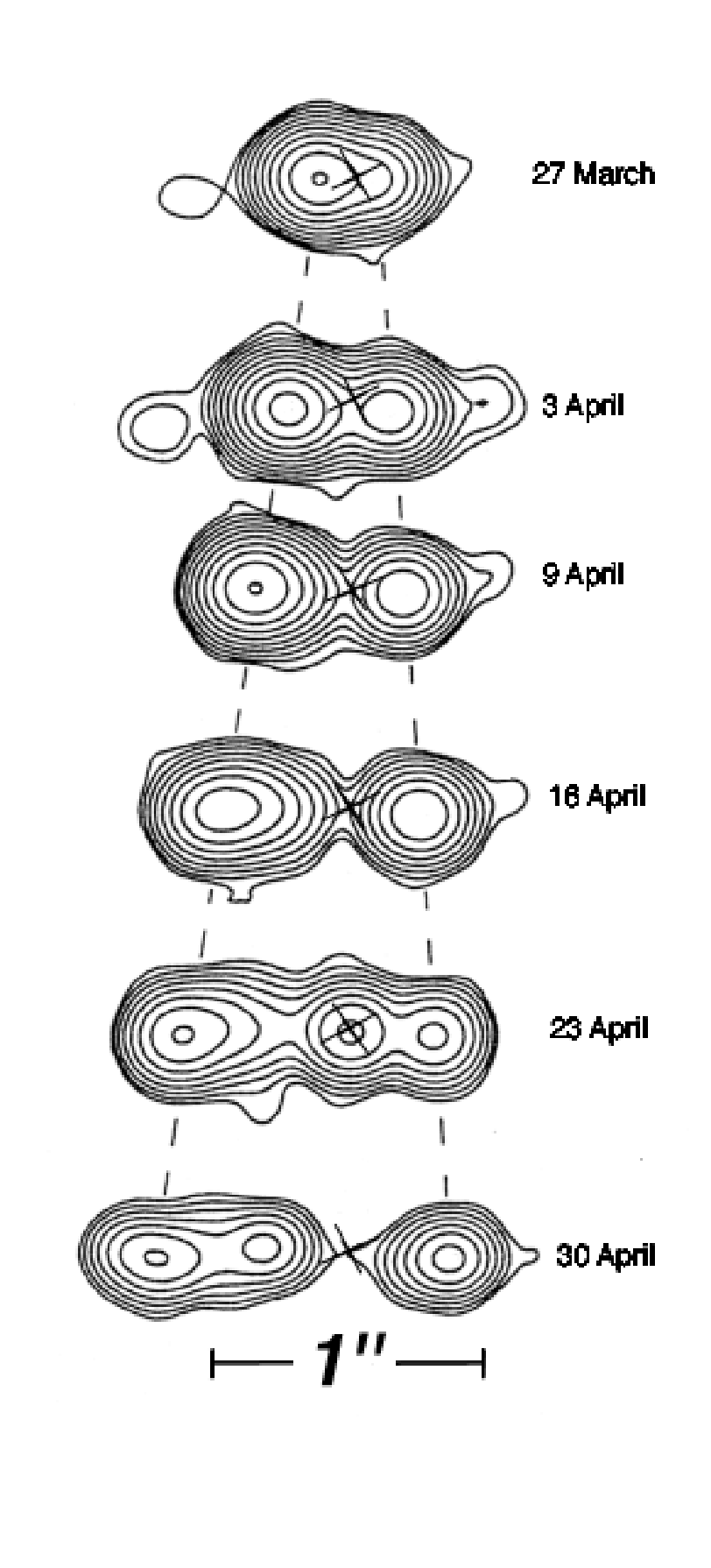
Figure 3.1: Radio emission from a source in our galaxy.
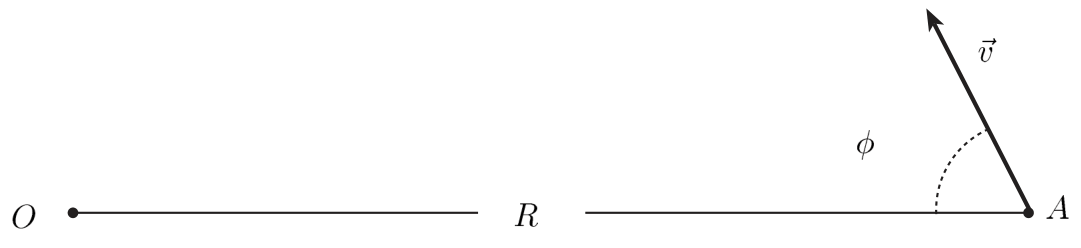
Figure 3.2: The observer is at \(O\) and the original position of the light source is at \(A\). The velocity vector is \(\vec v\).
Write the condition in the form \(\beta>f(\phi)\) and provide an analytic expression for the function \(f\) on the answer sheet.
Draw on the graph answer sheet the physically relevant region of the \((\beta,\phi)\)-plane. Show by shading in which part of this region the condition \(v'_\perp>c\) holds.
e) (1 point) Still in the one-body situation of part (b), find an expression for the maximum value \((v'_\perp)_{\max}\) of the apparent perpendicular speed \(v'_\perp\) for a given \(\beta\) and write it in the designated field on the answer sheet. Note that this speed increases without limit when \(\beta\to1\).
f) (1 point) The estimate for \(R\) given in the introduction is not very reliable. Scientists have therefore started speculating on a better and more direct method of determining \(R\). One idea for this goes as follows. Assume that we can identify and measure the Doppler shifted wavelengths \(\lambda_1\) and \(\lambda_2\) of radiation from the two ejected objects, corresponding to the same known original wavelength \(\lambda_0\) in the rest frames of the objects.
Starting from the equations for the relativistic Doppler shift, \(\lambda=\lambda_0(1-\beta\cos\phi)(1-\beta^2)^{-1/2}\), and assuming, as before, that both objects have the same speed, \(v\), show that the unknown \(\beta=v/c\) can be expressed in terms of \(\lambda_0,\lambda_1,\) and \(\lambda_2\) as
\[ \beta=\sqrt{1-\frac{\alpha\lambda_0^2}{(\lambda_1+\lambda_2)^2}}. \tag{3.1} \]
Write the numerical value of the coefficient \(\alpha\) in the designated field on the answer sheet.
You may note that this means that the suggested wavelength measurements will in practice provide a new estimate of the distance.
Official English text of the problem.
Answers
-
a) Representative graphical values are \[ \boxed{\omega_1\simeq17.5\ \mathrm{mas/d},\qquad \omega_2\simeq9.0\ \mathrm{mas/d}.} \] Consequently, \[ \boxed{v'_{1,\perp}\simeq3.8\times10^8\ \mathrm{m/s}\simeq1.3c,\qquad v'_{2,\perp}\simeq2.0\times10^8\ \mathrm{m/s}\simeq0.65c.} \]
-
b) \[ \boxed{\omega=\frac{\beta c\sin\phi}{R(1-\beta\cos\phi)},\qquad v'_\perp=\frac{\beta c\sin\phi}{1-\beta\cos\phi}.} \]
-
c) With angular speeds expressed in radians per unit time, define \[ X=\frac{\omega_1-\omega_2}{\omega_1+\omega_2}, \qquad Y=\frac{2R\omega_1\omega_2}{c(\omega_1+\omega_2)}. \] Then \[ \boxed{\beta=\sqrt{X^2+Y^2}\simeq0.92,\qquad \phi=\arccos\!\left(\frac{X}{\beta}\right)\simeq70^\circ.} \] The left-hand object is approaching.
-
d) The superluminal region is \[ \boxed{0<\phi<\frac{\pi}{2},\qquad \frac{1}{\sin\phi+\cos\phi}<\beta<1.} \] Thus \(f(\phi)=1/(\sin\phi+\cos\phi)\) on the relevant angular interval. Such motion requires \(\beta>1/\sqrt2\).
-
e) \[ \boxed{(v'_\perp)_{\max}=\frac{\beta c}{\sqrt{1-\beta^2}},\qquad \phi_{\max}=\arccos\beta.} \]
-
f) \[ \boxed{\alpha=4,\qquad \beta=\sqrt{1-\frac{4\lambda_0^2}{(\lambda_1+\lambda_2)^2}}.} \]
Solution
a) Angular motions and apparent transverse speeds
Take \(t=0\) on 27 March. Measure each component’s angular distance from the cross in its own image, using the full marked scale length as \(1''=1000\ \mathrm{mas}\). Follow the two outward-moving components indicated by the dashed tracks. We use positive angular distances on both sides of the center.
Approximate readings from the supplied figure are:
| Date | \(t\) (days) | \(\theta_1\) (arcseconds) | \(\theta_2\) (arcseconds) |
|---|---|---|---|
| 27 March | 0 | 0.12 | 0.07 |
| 3 April | 7 | 0.22 | 0.14 |
| 9 April | 13 | 0.35 | 0.20 |
| 16 April | 20 | 0.46 | 0.26 |
| 23 April | 27 | 0.61 | 0.31 |
| 30 April | 34 | 0.70 | 0.38 |
Plot \(t\) horizontally and angular distance vertically. Each set of points lies approximately on a straight line; the left-hand component has the greater slope. Representative lines are
\[ \frac{\theta_1}{\mathrm{arcsec}} \simeq0.11+0.0175\,\frac{t}{\mathrm d}, \qquad \frac{\theta_2}{\mathrm{arcsec}} \simeq0.08+0.0090\,\frac{t}{\mathrm d}. \]
Thus their vertical intercepts are approximately \(0.11''\) and \(0.08''\), and their slopes give
\[ \omega_1\simeq17.5\ \mathrm{mas/d}, \qquad \omega_2\simeq9.0\ \mathrm{mas/d}. \]
The angles are extremely small, so the transverse displacement corresponding to an angular displacement \(\theta\) is \(R\theta\). Consequently,
\[ v'_{i,\perp}=R\omega_i, \]
where \(\omega_i\) must be expressed in radians per second. The required conversions are
\[ R=12.5(3.09\times10^{19}) =3.8625\times10^{20}\ \mathrm m, \]
\[ 1\ \mathrm{mas} =\frac{\pi}{180\times3600\times1000}\ \mathrm{rad} =4.8481\times10^{-9}\ \mathrm{rad}, \]
and therefore
\[ 1\ \mathrm{mas/d} =5.6113\times10^{-14}\ \mathrm{rad/s}. \]
At the stated distance, \(1\ \mathrm{mas/d}\) corresponds to
\[ R(5.6113\times10^{-14}) =2.1674\times10^7\ \mathrm{m/s}. \]
Hence
\[ v'_{1,\perp} \simeq17.5(2.1674\times10^7) \simeq3.8\times10^8\ \mathrm{m/s} \simeq1.3c, \]
\[ v'_{2,\perp} \simeq9.0(2.1674\times10^7) \simeq2.0\times10^8\ \mathrm{m/s} \simeq0.65c. \]
The first value exceeds \(c\). These speeds use the time interval between the arrivals of signals at Earth; that interval differs from the interval between their emissions.
b) Effect of light-travel time
Work in the inertial frame in which the observer and central source are stationary. Let two signals be emitted a time \(\Delta t_{\mathrm e}\) apart in this frame.
During this interval, the emitter moves a transverse distance
\[ \Delta x_\perp=v\sin\phi\,\Delta t_{\mathrm e}. \]
Its displacement toward the observer is
\[ \Delta x_\parallel=v\cos\phi\,\Delta t_{\mathrm e}. \]
For a distant observer, the second signal’s path is shorter by approximately \(\Delta x_\parallel\). The arrival-time interval is therefore
\[ \Delta t_{\mathrm{obs}} =\Delta t_{\mathrm e}-\frac{\Delta x_\parallel}{c} =(1-\beta\cos\phi)\Delta t_{\mathrm e}. \]
The same expression covers a receding source: then \(\cos\phi<0\), so the second signal travels farther.
The angular displacement is, in the small-angle approximation,
\[ \Delta\theta\simeq\frac{\Delta x_\perp}{R}. \]
Thus
\[ \boxed{ \omega=\frac{\Delta\theta}{\Delta t_{\mathrm{obs}}} =\frac{\beta c\sin\phi}{R(1-\beta\cos\phi)} } \]
and
\[ \boxed{ v'_\perp=R\omega =\frac{\beta c\sin\phi}{1-\beta\cos\phi}. } \]
Here the source’s displacement is negligible compared with \(R\), allowing \(R\) and \(\phi\) to be treated as constant over the observations.
For an approaching emitter, successive signals arrive closer together than they were emitted. Dividing the transverse displacement by this shortened interval can give \(v'_\perp>c\), although the actual emitter speed remains \(v=\beta c<c\).
c) Recovering the true speed and direction
The two directions make angles \(\phi\) and \(\pi-\phi\) with the direction toward the observer. Their transverse velocity magnitudes are equal, while their radial components have opposite signs. Therefore,
\[ \frac{R\omega_1}{c} =\frac{\beta\sin\phi}{1-\beta\cos\phi}, \qquad \frac{R\omega_2}{c} =\frac{\beta\sin\phi}{1+\beta\cos\phi}. \]
Set
\[ X=\beta\cos\phi,\qquad Y=\beta\sin\phi. \]
Then
\[ \omega_1(1-X)=\omega_2(1+X)=\frac{cY}{R}. \]
Equating the first two expressions gives
\[ \boxed{ X=\beta\cos\phi =\frac{\omega_1-\omega_2}{\omega_1+\omega_2}. } \]
Substitution into either angular-speed equation gives
\[ \boxed{ Y=\beta\sin\phi =\frac{2R\omega_1\omega_2}{c(\omega_1+\omega_2)}. } \]
Consequently,
\[ \boxed{ \beta= \frac{\sqrt{(\omega_1-\omega_2)^2+ \left(2R\omega_1\omega_2/c\right)^2}} {\omega_1+\omega_2} } \]
and an expression valid throughout \(0\leq\phi\leq\pi\) is
\[ \boxed{ \phi=\arccos\!\left[ \frac{\omega_1-\omega_2} {\beta(\omega_1+\omega_2)} \right]. } \]
For these observations, \(\omega_1>\omega_2\), so \(\phi\) is acute. We can also use
\[ \tan\phi=\frac{2R\omega_1\omega_2}{c(\omega_1-\omega_2)}. \]
Using the representative rates from (a),
\[ X\simeq\frac{17.5-9.0}{17.5+9.0} \simeq0.321, \]
\[ Y\simeq0.859. \]
Thus
\[ \beta\simeq\sqrt{0.321^2+0.859^2} \simeq0.917, \qquad \phi\simeq69.5^\circ. \]
To the precision justified by the graph,
\[ \boxed{\beta\simeq0.92,\qquad \phi\simeq70^\circ.} \]
The true speed is approximately \(2.8\times10^8\ \mathrm{m/s}\). Since \(\beta\cos\phi>0\), the left-hand component is approaching and the right-hand component is receding.
d) Condition and region for apparent superluminal motion
For a material emitter, \(0\leq\beta<1\). Hence \(1-\beta\cos\phi>0\), and the condition \(v'_\perp>c\) becomes
\[ \frac{\beta\sin\phi}{1-\beta\cos\phi}>1, \]
or
\[ \boxed{\beta(\sin\phi+\cos\phi)>1.} \]
For \(\phi\geq\pi/2\), the denominator of \(v'_\perp/c\) is at least one, while its numerator is at most \(\beta<1\). Superluminal apparent motion is therefore impossible for a receding or exactly transverse source. It is also impossible at \(\phi=0\), where the transverse motion vanishes.
Within the relevant interval \(0<\phi<\pi/2\),
\[ \boxed{\beta>f(\phi),\qquad f(\phi)=\frac{1}{\sin\phi+\cos\phi}.} \]
The complete physical condition is thus
\[ \boxed{ 0<\phi<\frac{\pi}{2}, \qquad \frac{1}{\sin\phi+\cos\phi}<\beta<1. } \]
For the requested diagram, the physically relevant region has
\[ 0\leq\beta<1,\qquad 0\leq\phi\leq\pi. \]
With \(\phi\) horizontal and \(\beta\) vertical, draw the threshold curve over \(0\leq\phi\leq\pi/2\). Its useful points are:
| \(\phi\) | \(f(\phi)\) |
|---|---|
| \(0\) | \(1\) |
| \(\pi/6\) | \(0.732\) |
| \(\pi/4\) | \(1/\sqrt2\simeq0.707\) |
| \(\pi/3\) | \(0.732\) |
| \(\pi/2\) | \(1\) |
The curve is symmetric about \(\phi=\pi/4\). It decreases from \(1\) to its minimum \(1/\sqrt2\), then rises to \(1\). Shade the region strictly above this curve and strictly below \(\beta=1\). The threshold curve itself has \(v'_\perp=c\), so it is excluded from the shading. No region at \(\phi\geq\pi/2\) is shaded.
Since
\[ \sin\phi+\cos\phi =\sqrt2\cos\!\left(\phi-\frac{\pi}{4}\right)\leq\sqrt2, \]
such a region exists only when
\[ \boxed{\beta>\frac{1}{\sqrt2}.} \]
Equivalently, for any fixed \(\beta>1/\sqrt2\), its angular extent is
\[ \left|\phi-\frac{\pi}{4}\right| < \arccos\!\left(\frac{1}{\sqrt2\,\beta}\right). \]
e) Maximum apparent transverse speed
At fixed \(0<\beta<1\), differentiate the result of (b):
\[ \frac{\mathrm d}{\mathrm d\phi} \left(\frac{v'_\perp}{c}\right) = \frac{\mathrm d}{\mathrm d\phi} \left(\frac{\beta\sin\phi}{1-\beta\cos\phi}\right) = \frac{\beta(\cos\phi-\beta)} {(1-\beta\cos\phi)^2}. \]
The derivative changes from positive to negative where
\[ \cos\phi=\beta. \]
Because the apparent transverse speed vanishes at both \(\phi=0\) and \(\phi=\pi\), this stationary point is the global maximum. At that angle,
\[ \sin\phi=\sqrt{1-\beta^2}, \qquad 1-\beta\cos\phi=1-\beta^2. \]
Therefore,
\[ \boxed{ (v'_\perp)_{\max} =\frac{\beta c}{\sqrt{1-\beta^2}}, \qquad \phi_{\max}=\arccos\beta. } \]
As \(\beta\to1^{-}\), the denominator tends to zero and the maximum apparent speed increases without limit. For \(\beta=0\), the apparent speed is zero at every angle.
f) Determination of \(\beta\) from the Doppler shifts
Let
\[ \gamma=\frac{1}{\sqrt{1-\beta^2}}. \]
For the first object, the given Doppler formula is
\[ \lambda_1=\lambda_0\gamma(1-\beta\cos\phi). \]
For the oppositely moving object, \(\cos(\pi-\phi)=-\cos\phi\), giving
\[ \lambda_2=\lambda_0\gamma(1+\beta\cos\phi). \]
Adding these expressions eliminates the direction:
\[ \lambda_1+\lambda_2 =2\lambda_0\gamma =\frac{2\lambda_0}{\sqrt{1-\beta^2}}. \]
Thus
\[ 1-\beta^2 =\frac{4\lambda_0^2}{(\lambda_1+\lambda_2)^2}, \]
and, taking the nonnegative speed,
\[ \boxed{ \beta=\sqrt{1-\frac{4\lambda_0^2}{(\lambda_1+\lambda_2)^2}}, \qquad \alpha=4. } \]
This also explains how the distance could be obtained. The angular motions determine
\[ X=\beta\cos\phi =\frac{\omega_1-\omega_2}{\omega_1+\omega_2}, \]
while the wavelengths determine \(\beta\). Therefore \(\beta\sin\phi=\sqrt{\beta^2-X^2}\), and the relation derived in (c) gives
\[ R= \frac{c(\omega_1+\omega_2)}{2\omega_1\omega_2} \sqrt{\beta^2-X^2}. \]
Thus the combined angular and wavelength measurements determine \(R\) without adopting its initial estimate.
The solution was checked against the official solution.
IPhO 1998 · Theorieaufgabe 3
Schneller als Licht?
In dieser Aufgabe analysieren und interpretieren wir Messungen der Radiowellenemission einer aus mehreren Komponenten bestehenden Quelle innerhalb unserer Galaxie, die 1994 durchgeführt wurden.
Der Empfänger war auf ein breites Band von Radiowellen mit Wellenlängen von mehreren Zentimetern abgestimmt. Abbildung 3.1 zeigt eine Reihe von Bildern, die zu verschiedenen Zeiten aufgenommen wurden. Die Konturlinien kennzeichnen eine konstante Strahlungsintensität, ähnlich wie Höhenlinien auf einer geografischen Karte. Die beiden Maxima in der Abbildung werden als zwei Objekte gedeutet, die sich von einem gemeinsamen Zentrum entfernen, das in den Bildern durch Kreuze markiert ist. (Das Zentrum, das als im Raum ruhend angenommen wird, ist ebenfalls eine starke Strahlungsquelle, allerdings hauptsächlich bei anderen Wellenlängen). Die Messungen an den verschiedenen Tagen wurden jeweils zur selben Tageszeit durchgeführt.
Der Maßstab der Abbildung ist durch eine Strecke angegeben, die einer Bogensekunde (as) entspricht. (1 as = 1/3600 eines Grades). Die Entfernung zu dem Himmelskörper im Zentrum der Abbildung, der durch Kreuze markiert ist, wird auf \(R=12.5\ \mathrm{kpc}\) geschätzt. Ein Kiloparsec (kpc) entspricht \(3.09\cdot10^{19}\ \mathrm{m}\). Die Lichtgeschwindigkeit beträgt \(c=3.00\cdot10^8\ \mathrm{m/s}\). Fehlerrechnungen sind bei der Lösung nicht erforderlich.
a) (2 Punkte) Wir bezeichnen die Winkelpositionen der beiden ausgestoßenen Radioquellen relativ zum gemeinsamen Zentrum mit \(\theta_1(t)\) und \(\theta_2(t)\), wobei sich die Indizes 1 und 2 auf die linke beziehungsweise die rechte Quelle beziehen und \(t\) die Beobachtungszeit ist. Die von der Erde aus beobachteten Winkelgeschwindigkeiten sind \(\omega_1\) und \(\omega_2\). Die entsprechenden scheinbaren transversalen Geschwindigkeiten der beiden Quellen werden mit \(v'_{1,\perp}\) und \(v'_{2,\perp}\) bezeichnet.
Erstellen Sie mithilfe von Abbildung 3.1 ein Diagramm, um die Zahlenwerte von \(\omega_1\) und \(\omega_2\) in Millibogensekunden pro Tag (mas/d) zu bestimmen. Bestimmen Sie auch die Zahlenwerte von \(v'_{1,\perp}\) und \(v'_{2,\perp}\) und tragen Sie alle Antworten auf dem Antwortblatt ein. (Einige Ergebnisse könnten Sie verwundern).
b) (3 Punkte) Um das in Teil (a) auftretende Rätsel zu lösen, betrachten Sie eine Lichtquelle, die sich mit der Geschwindigkeit \(\vec v\) unter einem Winkel \(\phi\) (\(0\leq\phi\leq\pi\)) zur Richtung auf einen weit entfernten Beobachter \(O\) zu bewegt (Abbildung 3.2). Der Geschwindigkeitsbetrag lässt sich als \(v=\beta c\) schreiben, wobei \(c\) die Lichtgeschwindigkeit ist. Die vom Beobachter gemessene Entfernung zur Quelle beträgt \(R\). Die vom Beobachter aus gesehene Winkelgeschwindigkeit der Quelle ist \(\omega\), und die scheinbare Geschwindigkeit senkrecht zur Sichtlinie ist \(v'_\perp\).
Bestimmen Sie \(\omega\) und \(v'_\perp\) in Abhängigkeit von \(\beta\), \(R\) und \(\phi\) und tragen Sie Ihre Antwort auf dem Antwortblatt ein.
c) (1 Punkt) Wir nehmen an, dass sich die beiden ausgestoßenen Objekte, die in der Einleitung und in Teil (a) beschrieben wurden, mit gleichen Geschwindigkeitsbeträgen \(v=\beta c\) in entgegengesetzte Richtungen bewegen. Dann ermöglichen es die Ergebnisse aus Teil (b), \(\beta\) und \(\phi\) aus den Winkelgeschwindigkeiten \(\omega_1\) und \(\omega_2\) sowie der Entfernung \(R\) zu berechnen. Dabei ist \(\phi\) der in Teil (b) definierte Winkel für das linke Objekt, das dem Index 1 in Teil (a) entspricht.
Leiten Sie Formeln für \(\beta\) und \(\phi\) in Abhängigkeit von bekannten Größen her und bestimmen Sie ihre Zahlenwerte aus den Daten in Teil (a). Tragen Sie Ihre Antworten in die dafür vorgesehenen Felder auf dem Antwortblatt ein.
d) (2 Punkte) Bestimmen Sie für die Situation mit einem Körper aus Teil (b) die Bedingung dafür, dass die scheinbare senkrechte Geschwindigkeit \(v'_\perp\) größer als die Lichtgeschwindigkeit \(c\) ist.
\(^{7}\) Autoren: Einar Gudmundsson, Knútur Árnason und Thorsteinn Vilhjálmsson
Abbildung 3.1: Radioemission einer Quelle in unserer Galaxie.
Abbildung 3.2: Der Beobachter befindet sich bei \(O\), und die ursprüngliche Position der Lichtquelle liegt bei \(A\). Der Geschwindigkeitsvektor ist \(\vec v\).
Schreiben Sie die Bedingung in der Form \(\beta>f(\phi)\) und geben Sie auf dem Antwortblatt einen analytischen Ausdruck für die Funktion \(f\) an.
Zeichnen Sie auf dem Diagramm-Antwortblatt den physikalisch relevanten Bereich der \((\beta,\phi)\)-Ebene. Kennzeichnen Sie durch Schraffur, in welchem Teil dieses Bereichs die Bedingung \(v'_\perp>c\) erfüllt ist.
e) (1 Punkt) Bestimmen Sie weiterhin für die Situation mit einem Körper aus Teil (b) einen Ausdruck für den Maximalwert \((v'_\perp)_{\max}\) der scheinbaren senkrechten Geschwindigkeit \(v'_\perp\) bei gegebenem \(\beta\) und tragen Sie ihn in das dafür vorgesehene Feld auf dem Antwortblatt ein. Beachten Sie, dass diese Geschwindigkeit für \(\beta\to1\) unbegrenzt zunimmt.
f) (1 Punkt) Die in der Einleitung angegebene Schätzung für \(R\) ist nicht sehr zuverlässig. Wissenschaftler haben daher begonnen, über eine bessere und direktere Methode zur Bestimmung von \(R\) nachzudenken. Eine Idee dazu lautet wie folgt. Nehmen Sie an, dass wir die durch den Dopplereffekt verschobenen Wellenlängen \(\lambda_1\) und \(\lambda_2\) der Strahlung der beiden ausgestoßenen Objekte identifizieren und messen können, die derselben bekannten ursprünglichen Wellenlänge \(\lambda_0\) in den Ruhesystemen der Objekte entsprechen.
Zeigen Sie ausgehend von den Gleichungen für die relativistische Dopplerverschiebung, \(\lambda=\lambda_0(1-\beta\cos\phi)(1-\beta^2)^{-1/2}\), und unter der bisherigen Annahme, dass beide Objekte denselben Geschwindigkeitsbetrag \(v\) haben, dass sich das unbekannte \(\beta=v/c\) durch \(\lambda_0,\lambda_1,\) und \(\lambda_2\) ausdrücken lässt als
\[ \beta=\sqrt{1-\frac{\alpha\lambda_0^2}{(\lambda_1+\lambda_2)^2}}. \tag{3.1} \]
Tragen Sie den Zahlenwert des Koeffizienten \(\alpha\) in das dafür vorgesehene Feld auf dem Antwortblatt ein.
Beachten Sie, dass dies bedeutet, dass die vorgeschlagenen Wellenlängenmessungen in der Praxis eine neue Schätzung der Entfernung liefern werden.
Aufgabentext aus dem offiziellen englischen Text übersetzt.
Antworten
-
a) Repräsentative grafisch ermittelte Werte sind \[ \boxed{\omega_1\simeq17.5\ \mathrm{mas/d},\qquad \omega_2\simeq9.0\ \mathrm{mas/d}.} \] Folglich gilt \[ \boxed{v'_{1,\perp}\simeq3.8\times10^8\ \mathrm{m/s}\simeq1.3c,\qquad v'_{2,\perp}\simeq2.0\times10^8\ \mathrm{m/s}\simeq0.65c.} \]
-
b) \[ \boxed{\omega=\frac{\beta c\sin\phi}{R(1-\beta\cos\phi)},\qquad v'_\perp=\frac{\beta c\sin\phi}{1-\beta\cos\phi}.} \]
-
c) Mit Winkelgeschwindigkeiten in Radiant pro Zeiteinheit definieren wir \[ X=\frac{\omega_1-\omega_2}{\omega_1+\omega_2}, \qquad Y=\frac{2R\omega_1\omega_2}{c(\omega_1+\omega_2)}. \] Dann gilt \[ \boxed{\beta=\sqrt{X^2+Y^2}\simeq0.92,\qquad \phi=\arccos\!\left(\frac{X}{\beta}\right)\simeq70^\circ.} \] Das linke Objekt nähert sich dem Beobachter.
-
d) Der Bereich scheinbarer Überlichtgeschwindigkeit ist \[ \boxed{0<\phi<\frac{\pi}{2},\qquad \frac{1}{\sin\phi+\cos\phi}<\beta<1.} \] Somit gilt \(f(\phi)=1/(\sin\phi+\cos\phi)\) im relevanten Winkelintervall. Eine solche Bewegung erfordert \(\beta>1/\sqrt2\).
-
e) \[ \boxed{(v'_\perp)_{\max}=\frac{\beta c}{\sqrt{1-\beta^2}},\qquad \phi_{\max}=\arccos\beta.} \]
-
f) \[ \boxed{\alpha=4,\qquad \beta=\sqrt{1-\frac{4\lambda_0^2}{(\lambda_1+\lambda_2)^2}}.} \]
Lösung
a) Winkelbewegungen und scheinbare Transversalgeschwindigkeiten
Wir setzen \(t=0\) auf den 27. März. Messen Sie den Winkelabstand jeder Komponente vom Kreuz in ihrem jeweiligen Bild und verwenden Sie dabei die gesamte eingezeichnete Maßstabsstrecke als \(1''=1000\ \mathrm{mas}\). Verfolgen Sie die beiden sich nach außen bewegenden Komponenten, die durch die gestrichelten Bahnen gekennzeichnet sind. Wir verwenden auf beiden Seiten des Zentrums positive Winkelabstände.
Aus der vorgegebenen Abbildung lassen sich näherungsweise folgende Werte ablesen:
| Datum | \(t\) (Tage) | \(\theta_1\) (Bogensekunden) | \(\theta_2\) (Bogensekunden) |
|---|---|---|---|
| 27. März | 0 | 0.12 | 0.07 |
| 3. April | 7 | 0.22 | 0.14 |
| 9. April | 13 | 0.35 | 0.20 |
| 16. April | 20 | 0.46 | 0.26 |
| 23. April | 27 | 0.61 | 0.31 |
| 30. April | 34 | 0.70 | 0.38 |
Tragen Sie \(t\) auf der horizontalen und den Winkelabstand auf der vertikalen Achse auf. Die Punkte jeder Messreihe liegen näherungsweise auf einer Geraden; die linke Komponente hat die größere Steigung. Repräsentative Geraden sind
\[ \frac{\theta_1}{\mathrm{arcsec}} \simeq0.11+0.0175\,\frac{t}{\mathrm d}, \qquad \frac{\theta_2}{\mathrm{arcsec}} \simeq0.08+0.0090\,\frac{t}{\mathrm d}. \]
Ihre Achsenabschnitte auf der vertikalen Achse betragen somit ungefähr \(0.11''\) und \(0.08''\), und ihre Steigungen ergeben
\[ \omega_1\simeq17.5\ \mathrm{mas/d}, \qquad \omega_2\simeq9.0\ \mathrm{mas/d}. \]
Die Winkel sind äußerst klein, sodass die zu einer Winkeländerung \(\theta\) gehörende transversale Verschiebung \(R\theta\) beträgt. Folglich gilt
\[ v'_{i,\perp}=R\omega_i, \]
wobei \(\omega_i\) in Radiant pro Sekunde angegeben werden muss. Die erforderlichen Umrechnungen lauten
\[ R=12.5(3.09\times10^{19}) =3.8625\times10^{20}\ \mathrm m, \]
\[ 1\ \mathrm{mas} =\frac{\pi}{180\times3600\times1000}\ \mathrm{rad} =4.8481\times10^{-9}\ \mathrm{rad}, \]
und damit
\[ 1\ \mathrm{mas/d} =5.6113\times10^{-14}\ \mathrm{rad/s}. \]
Bei der angegebenen Entfernung entspricht \(1\ \mathrm{mas/d}\) einer Geschwindigkeit von
\[ R(5.6113\times10^{-14}) =2.1674\times10^7\ \mathrm{m/s}. \]
Daraus folgt
\[ v'_{1,\perp} \simeq17.5(2.1674\times10^7) \simeq3.8\times10^8\ \mathrm{m/s} \simeq1.3c, \]
\[ v'_{2,\perp} \simeq9.0(2.1674\times10^7) \simeq2.0\times10^8\ \mathrm{m/s} \simeq0.65c. \]
Der erste Wert übersteigt \(c\). Bei diesen Geschwindigkeiten wird das Zeitintervall zwischen den Ankünften der Signale auf der Erde verwendet; dieses Intervall unterscheidet sich vom Intervall zwischen ihren Aussendungen.
b) Einfluss der Lichtlaufzeit
Wir arbeiten in dem Inertialsystem, in dem der Beobachter und die zentrale Quelle ruhen. Zwei Signale sollen in diesem System im zeitlichen Abstand \(\Delta t_{\mathrm e}\) ausgesendet werden.
Während dieses Intervalls beträgt die transversale Verschiebung der Quelle
\[ \Delta x_\perp=v\sin\phi\,\Delta t_{\mathrm e}. \]
Ihre Verschiebung in Richtung auf den Beobachter beträgt
\[ \Delta x_\parallel=v\cos\phi\,\Delta t_{\mathrm e}. \]
Für einen weit entfernten Beobachter ist der Weg des zweiten Signals um ungefähr \(\Delta x_\parallel\) kürzer. Das Zeitintervall zwischen den Ankünften beträgt daher
\[ \Delta t_{\mathrm{obs}} =\Delta t_{\mathrm e}-\frac{\Delta x_\parallel}{c} =(1-\beta\cos\phi)\Delta t_{\mathrm e}. \]
Derselbe Ausdruck gilt auch für eine sich entfernende Quelle: Dann ist \(\cos\phi<0\), sodass das zweite Signal einen längeren Weg zurücklegt.
In der Kleinwinkelnäherung beträgt die Winkeländerung
\[ \Delta\theta\simeq\frac{\Delta x_\perp}{R}. \]
Somit gilt
\[ \boxed{ \omega=\frac{\Delta\theta}{\Delta t_{\mathrm{obs}}} =\frac{\beta c\sin\phi}{R(1-\beta\cos\phi)} } \]
und
\[ \boxed{ v'_\perp=R\omega =\frac{\beta c\sin\phi}{1-\beta\cos\phi}. } \]
Dabei ist die Verschiebung der Quelle gegenüber \(R\) vernachlässigbar, sodass \(R\) und \(\phi\) während der Beobachtungen als konstant behandelt werden können.
Bei einer sich nähernden Quelle treffen aufeinanderfolgende Signale in kürzeren Zeitabständen ein, als sie ausgesendet wurden. Die Division der transversalen Verschiebung durch dieses verkürzte Intervall kann \(v'_\perp>c\) ergeben, obwohl die tatsächliche Geschwindigkeit der Quelle weiterhin \(v=\beta c<c\) ist.
c) Bestimmung der tatsächlichen Geschwindigkeit und Richtung
Die beiden Bewegungsrichtungen bilden mit der Richtung auf den Beobachter die Winkel \(\phi\) und \(\pi-\phi\). Die Beträge ihrer transversalen Geschwindigkeiten sind gleich, während ihre radialen Komponenten entgegengesetzte Vorzeichen haben. Daher gilt
\[ \frac{R\omega_1}{c} =\frac{\beta\sin\phi}{1-\beta\cos\phi}, \qquad \frac{R\omega_2}{c} =\frac{\beta\sin\phi}{1+\beta\cos\phi}. \]
Wir setzen
\[ X=\beta\cos\phi,\qquad Y=\beta\sin\phi. \]
Dann gilt
\[ \omega_1(1-X)=\omega_2(1+X)=\frac{cY}{R}. \]
Gleichsetzen der ersten beiden Ausdrücke ergibt
\[ \boxed{ X=\beta\cos\phi =\frac{\omega_1-\omega_2}{\omega_1+\omega_2}. } \]
Einsetzen in eine der beiden Gleichungen für die Winkelgeschwindigkeit ergibt
\[ \boxed{ Y=\beta\sin\phi =\frac{2R\omega_1\omega_2}{c(\omega_1+\omega_2)}. } \]
Folglich gilt
\[ \boxed{ \beta= \frac{\sqrt{(\omega_1-\omega_2)^2+ \left(2R\omega_1\omega_2/c\right)^2}} {\omega_1+\omega_2} } \]
und ein im gesamten Bereich \(0\leq\phi\leq\pi\) gültiger Ausdruck lautet
\[ \boxed{ \phi=\arccos\!\left[ \frac{\omega_1-\omega_2} {\beta(\omega_1+\omega_2)} \right]. } \]
Für diese Beobachtungen gilt \(\omega_1>\omega_2\), sodass \(\phi\) ein spitzer Winkel ist. Außerdem gilt
\[ \tan\phi=\frac{2R\omega_1\omega_2}{c(\omega_1-\omega_2)}. \]
Mit den repräsentativen Winkelgeschwindigkeiten aus (a) erhalten wir
\[ X\simeq\frac{17.5-9.0}{17.5+9.0} \simeq0.321, \]
\[ Y\simeq0.859. \]
Somit gilt
\[ \beta\simeq\sqrt{0.321^2+0.859^2} \simeq0.917, \qquad \phi\simeq69.5^\circ. \]
Mit der durch das Diagramm gerechtfertigten Genauigkeit ergibt sich
\[ \boxed{\beta\simeq0.92,\qquad \phi\simeq70^\circ.} \]
Die tatsächliche Geschwindigkeit beträgt ungefähr \(2.8\times10^8\ \mathrm{m/s}\). Da \(\beta\cos\phi>0\) ist, nähert sich die linke Komponente dem Beobachter, während sich die rechte Komponente von ihm entfernt.
d) Bedingung und Bereich für scheinbare Überlichtgeschwindigkeit
Für eine materielle Quelle gilt \(0\leq\beta<1\). Daher ist \(1-\beta\cos\phi>0\), und die Bedingung \(v'_\perp>c\) wird zu
\[ \frac{\beta\sin\phi}{1-\beta\cos\phi}>1, \]
oder
\[ \boxed{\beta(\sin\phi+\cos\phi)>1.} \]
Für \(\phi\geq\pi/2\) ist der Nenner von \(v'_\perp/c\) mindestens eins, während der Zähler höchstens \(\beta<1\) beträgt. Eine scheinbare Bewegung mit Überlichtgeschwindigkeit ist daher für eine sich entfernende oder genau transversal bewegende Quelle unmöglich. Sie ist auch bei \(\phi=0\) unmöglich, wo die transversale Bewegung verschwindet.
Innerhalb des relevanten Intervalls \(0<\phi<\pi/2\) gilt
\[ \boxed{\beta>f(\phi),\qquad f(\phi)=\frac{1}{\sin\phi+\cos\phi}.} \]
Die vollständige physikalische Bedingung lautet somit
\[ \boxed{ 0<\phi<\frac{\pi}{2}, \qquad \frac{1}{\sin\phi+\cos\phi}<\beta<1. } \]
Für das geforderte Diagramm gelten im physikalisch relevanten Bereich die Grenzen
\[ 0\leq\beta<1,\qquad 0\leq\phi\leq\pi. \]
Tragen Sie \(\phi\) horizontal und \(\beta\) vertikal auf und zeichnen Sie die Grenzkurve im Bereich \(0\leq\phi\leq\pi/2\). Nützliche Punkte der Kurve sind:
| \(\phi\) | \(f(\phi)\) |
|---|---|
| \(0\) | \(1\) |
| \(\pi/6\) | \(0.732\) |
| \(\pi/4\) | \(1/\sqrt2\simeq0.707\) |
| \(\pi/3\) | \(0.732\) |
| \(\pi/2\) | \(1\) |
Die Kurve ist symmetrisch bezüglich \(\phi=\pi/4\). Sie fällt von \(1\) auf ihr Minimum \(1/\sqrt2\) ab und steigt dann wieder auf \(1\) an. Schraffieren Sie den Bereich strikt oberhalb dieser Kurve und strikt unterhalb von \(\beta=1\). Auf der Grenzkurve selbst gilt \(v'_\perp=c\), daher gehört sie nicht zum schraffierten Bereich. Für \(\phi\geq\pi/2\) wird kein Bereich schraffiert.
Wegen
\[ \sin\phi+\cos\phi =\sqrt2\cos\!\left(\phi-\frac{\pi}{4}\right)\leq\sqrt2, \]
existiert ein solcher Bereich nur für
\[ \boxed{\beta>\frac{1}{\sqrt2}.} \]
Äquivalent dazu gilt für seine Winkelausdehnung bei jedem festen \(\beta>1/\sqrt2\)
\[ \left|\phi-\frac{\pi}{4}\right| < \arccos\!\left(\frac{1}{\sqrt2\,\beta}\right). \]
e) Maximale scheinbare Transversalgeschwindigkeit
Bei festem \(0<\beta<1\) differenzieren wir das Ergebnis aus (b):
\[ \frac{\mathrm d}{\mathrm d\phi} \left(\frac{v'_\perp}{c}\right) = \frac{\mathrm d}{\mathrm d\phi} \left(\frac{\beta\sin\phi}{1-\beta\cos\phi}\right) = \frac{\beta(\cos\phi-\beta)} {(1-\beta\cos\phi)^2}. \]
Die Ableitung wechselt von positiv zu negativ bei
\[ \cos\phi=\beta. \]
Da die scheinbare Transversalgeschwindigkeit sowohl bei \(\phi=0\) als auch bei \(\phi=\pi\) verschwindet, ist dieser stationäre Punkt das globale Maximum. Bei diesem Winkel gilt
\[ \sin\phi=\sqrt{1-\beta^2}, \qquad 1-\beta\cos\phi=1-\beta^2. \]
Daher ergibt sich
\[ \boxed{ (v'_\perp)_{\max} =\frac{\beta c}{\sqrt{1-\beta^2}}, \qquad \phi_{\max}=\arccos\beta. } \]
Für \(\beta\to1^{-}\) geht der Nenner gegen null, und die maximale scheinbare Geschwindigkeit wächst unbegrenzt. Für \(\beta=0\) ist die scheinbare Geschwindigkeit bei jedem Winkel null.
f) Bestimmung von \(\beta\) aus den Dopplerverschiebungen
Es sei
\[ \gamma=\frac{1}{\sqrt{1-\beta^2}}. \]
Für das erste Objekt lautet die gegebene Dopplerformel
\[ \lambda_1=\lambda_0\gamma(1-\beta\cos\phi). \]
Für das entgegengesetzt bewegte Objekt gilt \(\cos(\pi-\phi)=-\cos\phi\), woraus folgt
\[ \lambda_2=\lambda_0\gamma(1+\beta\cos\phi). \]
Durch Addition dieser Ausdrücke wird die Richtung eliminiert:
\[ \lambda_1+\lambda_2 =2\lambda_0\gamma =\frac{2\lambda_0}{\sqrt{1-\beta^2}}. \]
Somit gilt
\[ 1-\beta^2 =\frac{4\lambda_0^2}{(\lambda_1+\lambda_2)^2}, \]
und mit dem nichtnegativen Geschwindigkeitsbetrag erhalten wir
\[ \boxed{ \beta=\sqrt{1-\frac{4\lambda_0^2}{(\lambda_1+\lambda_2)^2}}, \qquad \alpha=4. } \]
Dies erklärt auch, wie die Entfernung bestimmt werden könnte. Aus den Winkelbewegungen ergibt sich
\[ X=\beta\cos\phi =\frac{\omega_1-\omega_2}{\omega_1+\omega_2}, \]
während die Wellenlängen \(\beta\) bestimmen. Daher ist \(\beta\sin\phi=\sqrt{\beta^2-X^2}\), und die in (c) hergeleitete Beziehung ergibt
\[ R= \frac{c(\omega_1+\omega_2)}{2\omega_1\omega_2} \sqrt{\beta^2-X^2}. \]
Somit bestimmen die kombinierten Winkel- und Wellenlängenmessungen \(R\), ohne dessen anfängliche Schätzung zu übernehmen.
Die Lösung wurde mit der offiziellen Lösung abgeglichen.
IPhO 1998 · Teori sorusu 3
Işıktan daha hızlı mı?
Bu soruda, gökadamızdaki bileşik bir kaynağın radyo dalgası yayımı üzerine 1994 yılında yapılan ölçümleri analiz edip yorumlayacağız.
Alıcı, dalga boyları birkaç santimetre olan radyo dalgalarını kapsayan geniş bir banda ayarlanmıştı. Şekil 3.1, farklı zamanlarda kaydedilmiş bir dizi görüntüyü göstermektedir. Eş düzey eğrileri, bir coğrafi haritadaki eş yükselti eğrilerine çok benzer biçimde, sabit ışınım şiddetini göstermektedir. Şekildeki iki maksimum, görüntülerde çarpı işaretleriyle gösterilen ortak bir merkezden uzaklaşan iki cisim olarak yorumlanmaktadır. (Uzayda sabit olduğu varsayılan merkez de güçlü bir ışınım kaynağıdır, ancak esas olarak başka dalga boylarında ışınım yaymaktadır). Farklı tarihlerdeki ölçümler günün aynı saatinde yapılmıştır.
Şeklin ölçeği, bir yay saniyesini (as) gösteren bir doğru parçasıyla verilmiştir. (1 as = bir derecenin 1/3600'ü). Şeklin merkezinde çarpı işaretleriyle gösterilen gök cisminin uzaklığının \(R=12.5\ \mathrm{kpc}\) olduğu tahmin edilmektedir. Bir kiloparsek (kpc), \(3.09\cdot10^{19}\ \mathrm{m}\) değerine eşittir. Işık hızı \(c=3.00\cdot10^8\ \mathrm{m/s}\) olarak verilmiştir. Çözümde hata hesaplamaları yapılması gerekmemektedir.
a) (2 puan) Dışarı fırlatılan iki radyo kaynağının ortak merkeze göre açısal konumlarını \(\theta_1(t)\) ve \(\theta_2(t)\) ile gösteriyoruz; burada 1 ve 2 alt indisleri sırasıyla soldaki ve sağdaki kaynağı, \(t\) ise gözlem zamanını belirtmektedir. Dünya'dan görülen açısal hızlar \(\omega_1\) ve \(\omega_2\) olsun. İki kaynağın bunlara karşılık gelen görünür enine doğrusal hızları \(v'_{1,\perp}\) ve \(v'_{2,\perp}\) ile gösterilmektedir.
Şekil 3.1'i kullanarak bir grafik çiziniz ve \(\omega_1\) ile \(\omega_2\) değerlerini gün başına miliyay saniyesi (mas/d) cinsinden bulunuz. Ayrıca \(v'_{1,\perp}\) ve \(v'_{2,\perp}\) değerlerini belirleyiniz ve tüm cevaplarınızı cevap kâğıdına yazınız. (Bazı sonuçlar sizi şaşırtabilir).
b) (3 puan) (a) kısmında ortaya çıkan şaşırtıcı durumu açıklığa kavuşturmak için, uzaktaki bir \(O\) gözlemcisine doğru olan yönle \(\phi\) (\(0\leq\phi\leq\pi\)) açısı yapacak şekilde \(\vec v\) hızıyla hareket eden bir ışık kaynağı düşününüz (Şekil 3.2). Sürat, \(c\) ışık hızı olmak üzere \(v=\beta c\) şeklinde yazılabilir. Gözlemcinin ölçtüğü kaynak uzaklığı \(R\)'dir. Gözlemcinin gördüğü açısal hız \(\omega\), görüş doğrultusuna dik görünür doğrusal hız ise \(v'_\perp\)'dir.
\(\omega\) ve \(v'_\perp\) için \(\beta\), \(R\) ve \(\phi\) cinsinden ifadeler bulunuz ve cevabınızı cevap kâğıdına yazınız.
c) (1 puan) Girişte ve (a) kısmında betimlenen, dışarı fırlatılmış iki cismin zıt yönlerde eşit \(v=\beta c\) süratleriyle hareket ettiğini varsayıyoruz. Bu durumda (b) kısmının sonuçları, \(\omega_1\) ve \(\omega_2\) açısal hızları ile \(R\) uzaklığından \(\beta\) ve \(\phi\)'nin hesaplanmasını mümkün kılar. Burada \(\phi\), (a) kısmında 1 alt indisiyle gösterilen soldaki cisim için (b) kısmında tanımlanan açıdır.
\(\beta\) ve \(\phi\) için bilinen nicelikler cinsinden formüller türetiniz ve (a) kısmındaki verilerden sayısal değerlerini belirleyiniz. Cevaplarınızı cevap kâğıdında ayrılan alanlara yazınız.
d) (2 puan) (b) kısmındaki tek cisimli durumda, görünür dik hızın \(v'_\perp\) ışık hızı \(c\)'den büyük olması için gereken koşulu bulunuz.
\(^{7}\) Yazarlar: Einar Gudmundsson, Knútur Árnason ve Thorsteinn Vilhjálmsson
Şekil 3.1: Gökadamızdaki bir kaynaktan gelen radyo yayımı.
Şekil 3.2: Gözlemci \(O\) noktasında, ışık kaynağının başlangıç konumu ise \(A\) noktasındadır. Hız vektörü \(\vec v\)'dir.
Koşulu \(\beta>f(\phi)\) biçiminde yazınız ve cevap kâğıdında \(f\) fonksiyonu için analitik bir ifade veriniz.
Grafik cevap kâğıdına \((\beta,\phi)\) düzleminin fiziksel olarak anlamlı bölgesini çiziniz. Bu bölgenin hangi kısmında \(v'_\perp>c\) koşulunun sağlandığını tarayarak gösteriniz.
e) (1 puan) Yine (b) kısmındaki tek cisimli durumda, verilen bir \(\beta\) için görünür dik hız \(v'_\perp\)'nin maksimum değeri \((v'_\perp)_{\max}\) için bir ifade bulunuz ve bunu cevap kâğıdında ayrılan alana yazınız. \(\beta\to1\) iken bu hızın sınırsız arttığına dikkat ediniz.
f) (1 puan) Girişte verilen \(R\) tahmini pek güvenilir değildir. Bu nedenle bilim insanları, \(R\)'yi belirlemek için daha iyi ve daha doğrudan bir yöntem üzerinde düşünmeye başlamışlardır. Bu konudaki fikirlerden biri şöyledir. Dışarı fırlatılan iki cisimden gelen ışınımın, cisimlerin durgun referans sistemlerinde aynı bilinen özgün \(\lambda_0\) dalga boyuna karşılık gelen, Doppler kaymasına uğramış \(\lambda_1\) ve \(\lambda_2\) dalga boylarını tanımlayıp ölçebildiğimizi varsayınız.
Göreli Doppler kayması denklemlerinden, \(\lambda=\lambda_0(1-\beta\cos\phi)(1-\beta^2)^{-1/2}\), yola çıkarak ve daha önce olduğu gibi her iki cismin de aynı \(v\) süratine sahip olduğunu varsayarak, bilinmeyen \(\beta=v/c\)'nin \(\lambda_0,\lambda_1,\) ve \(\lambda_2\) cinsinden
\[ \beta=\sqrt{1-\frac{\alpha\lambda_0^2}{(\lambda_1+\lambda_2)^2}}. \tag{3.1} \]
şeklinde ifade edilebileceğini gösteriniz.
\(\alpha\) katsayısının sayısal değerini cevap kâğıdında ayrılan alana yazınız.
Bu sonucun, önerilen dalga boyu ölçümlerinin uygulamada uzaklık için yeni bir tahmin sağlayacağı anlamına geldiğini görebilirsiniz.
Soru metni resmi İngilizce metinden çevrilmiştir.
Cevaplar
-
a) Grafikten elde edilen temsili değerler \[ \boxed{\omega_1\simeq17.5\ \mathrm{mas/d},\qquad \omega_2\simeq9.0\ \mathrm{mas/d}.} \] şeklindedir. Dolayısıyla, \[ \boxed{v'_{1,\perp}\simeq3.8\times10^8\ \mathrm{m/s}\simeq1.3c,\qquad v'_{2,\perp}\simeq2.0\times10^8\ \mathrm{m/s}\simeq0.65c.} \]
-
b) \[ \boxed{\omega=\frac{\beta c\sin\phi}{R(1-\beta\cos\phi)},\qquad v'_\perp=\frac{\beta c\sin\phi}{1-\beta\cos\phi}.} \]
-
c) Açısal hızlar birim zaman başına radyan cinsinden ifade edilmek üzere, \[ X=\frac{\omega_1-\omega_2}{\omega_1+\omega_2}, \qquad Y=\frac{2R\omega_1\omega_2}{c(\omega_1+\omega_2)}. \] tanımlarını yapalım. O hâlde \[ \boxed{\beta=\sqrt{X^2+Y^2}\simeq0.92,\qquad \phi=\arccos\!\left(\frac{X}{\beta}\right)\simeq70^\circ.} \] Soldaki cisim yaklaşmaktadır.
-
d) Işık hızının aşıldığı bölge \[ \boxed{0<\phi<\frac{\pi}{2},\qquad \frac{1}{\sin\phi+\cos\phi}<\beta<1.} \] şeklindedir. Dolayısıyla ilgili açı aralığında \(f(\phi)=1/(\sin\phi+\cos\phi)\) olur. Böyle bir hareket için \(\beta>1/\sqrt2\) gereklidir.
-
e) \[ \boxed{(v'_\perp)_{\max}=\frac{\beta c}{\sqrt{1-\beta^2}},\qquad \phi_{\max}=\arccos\beta.} \]
-
f) \[ \boxed{\alpha=4,\qquad \beta=\sqrt{1-\frac{4\lambda_0^2}{(\lambda_1+\lambda_2)^2}}.} \]
Çözüm
a) Açısal hareketler ve görünür enine hızlar
27 Mart tarihini \(t=0\) olarak alalım. İşaretli ölçeğin tüm uzunluğunu \(1''=1000\ \mathrm{mas}\) kabul ederek, her bileşenin kendi görüntüsündeki çarpı işaretinden açısal uzaklığını ölçelim. Kesikli izlerle belirtilen, dışarı doğru hareket eden iki bileşeni izleyelim. Merkezin her iki tarafında da açısal uzaklıkları pozitif alıyoruz.
Verilen şekilden okunan yaklaşık değerler şöyledir:
| Tarih | \(t\) (gün) | \(\theta_1\) (yay saniyesi) | \(\theta_2\) (yay saniyesi) |
|---|---|---|---|
| 27 Mart | 0 | 0.12 | 0.07 |
| 3 Nisan | 7 | 0.22 | 0.14 |
| 9 Nisan | 13 | 0.35 | 0.20 |
| 16 Nisan | 20 | 0.46 | 0.26 |
| 23 Nisan | 27 | 0.61 | 0.31 |
| 30 Nisan | 34 | 0.70 | 0.38 |
Yatay eksene \(t\)'yi, düşey eksene açısal uzaklığı yerleştirelim. Her nokta kümesi yaklaşık olarak bir doğru üzerinde yer alır; soldaki bileşenin eğimi daha büyüktür. Temsili doğrular şöyledir:
\[ \frac{\theta_1}{\mathrm{arcsec}} \simeq0.11+0.0175\,\frac{t}{\mathrm d}, \qquad \frac{\theta_2}{\mathrm{arcsec}} \simeq0.08+0.0090\,\frac{t}{\mathrm d}. \]
Dolayısıyla düşey ekseni kestikleri değerler yaklaşık olarak \(0.11''\) ve \(0.08''\)'dir; eğimleri ise
\[ \omega_1\simeq17.5\ \mathrm{mas/d}, \qquad \omega_2\simeq9.0\ \mathrm{mas/d}. \]
değerlerini verir.
Açılar son derece küçük olduğundan, \(\theta\) açısal yer değiştirmesine karşılık gelen enine yer değiştirme \(R\theta\)'dır. Dolayısıyla,
\[ v'_{i,\perp}=R\omega_i, \]
burada \(\omega_i\) saniye başına radyan cinsinden ifade edilmelidir. Gerekli dönüşümler şunlardır:
\[ R=12.5(3.09\times10^{19}) =3.8625\times10^{20}\ \mathrm m, \]
\[ 1\ \mathrm{mas} =\frac{\pi}{180\times3600\times1000}\ \mathrm{rad} =4.8481\times10^{-9}\ \mathrm{rad}, \]
ve dolayısıyla
\[ 1\ \mathrm{mas/d} =5.6113\times10^{-14}\ \mathrm{rad/s}. \]
Belirtilen uzaklıkta \(1\ \mathrm{mas/d}\),
\[ R(5.6113\times10^{-14}) =2.1674\times10^7\ \mathrm{m/s}. \]
değerine karşılık gelir.
Böylece
\[ v'_{1,\perp} \simeq17.5(2.1674\times10^7) \simeq3.8\times10^8\ \mathrm{m/s} \simeq1.3c, \]
\[ v'_{2,\perp} \simeq9.0(2.1674\times10^7) \simeq2.0\times10^8\ \mathrm{m/s} \simeq0.65c. \]
İlk değer \(c\)'yi aşmaktadır. Bu hızlar, sinyallerin Dünya'ya varışları arasındaki zaman aralığı kullanılarak elde edilir; bu aralık, sinyallerin yayımlanmaları arasındaki aralıktan farklıdır.
b) Işığın yol alma süresinin etkisi
Gözlemcinin ve merkezdeki kaynağın durgun olduğu eylemsiz referans sisteminde çalışalım. Bu sistemde iki sinyal \(\Delta t_{\mathrm e}\) zaman aralığıyla yayımlansın.
Bu aralıkta kaynak enine yönde
\[ \Delta x_\perp=v\sin\phi\,\Delta t_{\mathrm e}. \]
kadar yol alır.
Gözlemciye doğru yer değiştirmesi ise
\[ \Delta x_\parallel=v\cos\phi\,\Delta t_{\mathrm e}. \]
kadardır.
Uzaktaki bir gözlemci için ikinci sinyalin yolu yaklaşık \(\Delta x_\parallel\) kadar daha kısadır. Bu nedenle varış zamanları arasındaki aralık
\[ \Delta t_{\mathrm{obs}} =\Delta t_{\mathrm e}-\frac{\Delta x_\parallel}{c} =(1-\beta\cos\phi)\Delta t_{\mathrm e}. \]
olur.
Aynı ifade uzaklaşan bir kaynak için de geçerlidir: bu durumda \(\cos\phi<0\) olduğundan ikinci sinyal daha uzun bir yol alır.
Küçük açı yaklaşımında açısal yer değiştirme
\[ \Delta\theta\simeq\frac{\Delta x_\perp}{R}. \]
şeklindedir.
Böylece
\[ \boxed{ \omega=\frac{\Delta\theta}{\Delta t_{\mathrm{obs}}} =\frac{\beta c\sin\phi}{R(1-\beta\cos\phi)} } \]
ve
\[ \boxed{ v'_\perp=R\omega =\frac{\beta c\sin\phi}{1-\beta\cos\phi}. } \]
Burada kaynağın yer değiştirmesi \(R\)'ye kıyasla ihmal edilebilir olduğundan, gözlemler boyunca \(R\) ve \(\phi\) sabit kabul edilebilir.
Yaklaşan bir kaynak için ardışık sinyaller, yayımlanmaları arasındaki aralıktan daha kısa aralıklarla ulaşır. Enine yer değiştirmeyi bu kısalmış aralığa bölmek, kaynağın gerçek sürati \(v=\beta c<c\) olarak kalmasına rağmen \(v'_\perp>c\) sonucunu verebilir.
c) Gerçek süratin ve yönün belirlenmesi
İki hareket yönü, gözlemciye doğru olan yönle \(\phi\) ve \(\pi-\phi\) açılarını yapar. Enine hız büyüklükleri eşitken radyal bileşenleri zıt işaretlidir. Dolayısıyla,
\[ \frac{R\omega_1}{c} =\frac{\beta\sin\phi}{1-\beta\cos\phi}, \qquad \frac{R\omega_2}{c} =\frac{\beta\sin\phi}{1+\beta\cos\phi}. \]
Şu tanımları yapalım:
\[ X=\beta\cos\phi,\qquad Y=\beta\sin\phi. \]
O hâlde
\[ \omega_1(1-X)=\omega_2(1+X)=\frac{cY}{R}. \]
İlk iki ifadeyi eşitleyince
\[ \boxed{ X=\beta\cos\phi =\frac{\omega_1-\omega_2}{\omega_1+\omega_2}. } \]
elde edilir.
Bunu açısal hız denklemlerinden herhangi birinde yerine koyunca
\[ \boxed{ Y=\beta\sin\phi =\frac{2R\omega_1\omega_2}{c(\omega_1+\omega_2)}. } \]
elde edilir.
Dolayısıyla,
\[ \boxed{ \beta= \frac{\sqrt{(\omega_1-\omega_2)^2+ \left(2R\omega_1\omega_2/c\right)^2}} {\omega_1+\omega_2} } \]
ve \(0\leq\phi\leq\pi\) aralığının tamamında geçerli bir ifade
\[ \boxed{ \phi=\arccos\!\left[ \frac{\omega_1-\omega_2} {\beta(\omega_1+\omega_2)} \right]. } \]
şeklindedir.
Bu gözlemlerde \(\omega_1>\omega_2\) olduğundan \(\phi\) dar açıdır. Ayrıca şu ifadeyi de kullanabiliriz:
\[ \tan\phi=\frac{2R\omega_1\omega_2}{c(\omega_1-\omega_2)}. \]
(a) kısmındaki temsili açısal hızları kullanarak,
\[ X\simeq\frac{17.5-9.0}{17.5+9.0} \simeq0.321, \]
\[ Y\simeq0.859. \]
Böylece
\[ \beta\simeq\sqrt{0.321^2+0.859^2} \simeq0.917, \qquad \phi\simeq69.5^\circ. \]
Grafiğin izin verdiği duyarlıkla,
\[ \boxed{\beta\simeq0.92,\qquad \phi\simeq70^\circ.} \]
Gerçek sürat yaklaşık \(2.8\times10^8\ \mathrm{m/s}\)'dir. \(\beta\cos\phi>0\) olduğundan soldaki bileşen yaklaşmakta, sağdaki bileşen ise uzaklaşmaktadır.
d) Görünür hareketin ışık hızını aşma koşulu ve bölgesi
Maddesel bir kaynak için \(0\leq\beta<1\) olur. Bu nedenle \(1-\beta\cos\phi>0\)'dır ve \(v'_\perp>c\) koşulu
\[ \frac{\beta\sin\phi}{1-\beta\cos\phi}>1, \]
ya da
\[ \boxed{\beta(\sin\phi+\cos\phi)>1.} \]
biçimini alır.
\(\phi\geq\pi/2\) için \(v'_\perp/c\)'nin paydası en az bir, payı ise en fazla \(\beta<1\)'dir. Bu nedenle uzaklaşan ya da tam olarak enine hareket eden bir kaynak için ışık hızını aşan görünür hareket mümkün değildir. Enine hareketin sıfır olduğu \(\phi=0\) durumunda da bu mümkün değildir.
İlgili \(0<\phi<\pi/2\) aralığında,
\[ \boxed{\beta>f(\phi),\qquad f(\phi)=\frac{1}{\sin\phi+\cos\phi}.} \]
Böylece fiziksel koşulun tamamı
\[ \boxed{ 0<\phi<\frac{\pi}{2}, \qquad \frac{1}{\sin\phi+\cos\phi}<\beta<1. } \]
şeklindedir.
İstenen diyagramda fiziksel olarak anlamlı bölge
\[ 0\leq\beta<1,\qquad 0\leq\phi\leq\pi. \]
ile verilir.
\(\phi\)'yi yatay, \(\beta\)'yı düşey eksene yerleştirerek \(0\leq\phi\leq\pi/2\) aralığında eşik eğrisini çizelim. Çizimde yararlı olacak noktalar şunlardır:
| \(\phi\) | \(f(\phi)\) |
|---|---|
| \(0\) | \(1\) |
| \(\pi/6\) | \(0.732\) |
| \(\pi/4\) | \(1/\sqrt2\simeq0.707\) |
| \(\pi/3\) | \(0.732\) |
| \(\pi/2\) | \(1\) |
Eğri \(\phi=\pi/4\)'e göre simetriktir. \(1\)'den minimum değeri olan \(1/\sqrt2\)'ye iner, ardından \(1\)'e yükselir. Bu eğrinin kesinlikle üstünde ve \(\beta=1\)'in kesinlikle altında kalan bölgeyi tarayalım. Eşik eğrisinin üzerinde \(v'_\perp=c\) olduğundan eğrinin kendisi taramaya dâhil edilmez. \(\phi\geq\pi/2\) bölgesinde hiçbir yer taranmaz.
Şu eşitsizlikten dolayı,
\[ \sin\phi+\cos\phi =\sqrt2\cos\!\left(\phi-\frac{\pi}{4}\right)\leq\sqrt2, \]
böyle bir bölge yalnızca
\[ \boxed{\beta>\frac{1}{\sqrt2}.} \]
olduğunda vardır.
Eş değer olarak, sabit herhangi bir \(\beta>1/\sqrt2\) için bu bölgenin açısal kapsamı
\[ \left|\phi-\frac{\pi}{4}\right| < \arccos\!\left(\frac{1}{\sqrt2\,\beta}\right). \]
ile verilir.
e) Maksimum görünür enine hız
Sabit \(0<\beta<1\) için (b) kısmındaki sonucun türevini alalım:
\[ \frac{\mathrm d}{\mathrm d\phi} \left(\frac{v'_\perp}{c}\right) = \frac{\mathrm d}{\mathrm d\phi} \left(\frac{\beta\sin\phi}{1-\beta\cos\phi}\right) = \frac{\beta(\cos\phi-\beta)} {(1-\beta\cos\phi)^2}. \]
Türev,
\[ \cos\phi=\beta. \]
olduğu noktada pozitiften negatife geçer.
Görünür enine hız hem \(\phi=0\) hem de \(\phi=\pi\) için sıfır olduğundan, bu durağan nokta mutlak maksimumdur. Bu açıda,
\[ \sin\phi=\sqrt{1-\beta^2}, \qquad 1-\beta\cos\phi=1-\beta^2. \]
Dolayısıyla,
\[ \boxed{ (v'_\perp)_{\max} =\frac{\beta c}{\sqrt{1-\beta^2}}, \qquad \phi_{\max}=\arccos\beta. } \]
\(\beta\to1^{-}\) iken payda sıfıra yaklaşır ve maksimum görünür hız sınırsız artar. \(\beta=0\) için görünür hız her açıda sıfırdır.
f) Doppler kaymalarından \(\beta\)'nın belirlenmesi
Şu tanımı yapalım:
\[ \gamma=\frac{1}{\sqrt{1-\beta^2}}. \]
Birinci cisim için verilen Doppler formülü şöyledir:
\[ \lambda_1=\lambda_0\gamma(1-\beta\cos\phi). \]
Zıt yönde hareket eden cisim için \(\cos(\pi-\phi)=-\cos\phi\) olduğundan,
\[ \lambda_2=\lambda_0\gamma(1+\beta\cos\phi). \]
Bu ifadeleri toplamak yön bağımlılığını ortadan kaldırır:
\[ \lambda_1+\lambda_2 =2\lambda_0\gamma =\frac{2\lambda_0}{\sqrt{1-\beta^2}}. \]
Böylece
\[ 1-\beta^2 =\frac{4\lambda_0^2}{(\lambda_1+\lambda_2)^2}, \]
ve süratin negatif olmadığını kullanarak,
\[ \boxed{ \beta=\sqrt{1-\frac{4\lambda_0^2}{(\lambda_1+\lambda_2)^2}}, \qquad \alpha=4. } \]
Bu sonuç, uzaklığın nasıl elde edilebileceğini de açıklar. Açısal hareketler
\[ X=\beta\cos\phi =\frac{\omega_1-\omega_2}{\omega_1+\omega_2}, \]
değerini belirlerken, dalga boyları \(\beta\)'yı belirler. Dolayısıyla \(\beta\sin\phi=\sqrt{\beta^2-X^2}\) olur ve (c) kısmında türetilen bağıntı
\[ R= \frac{c(\omega_1+\omega_2)}{2\omega_1\omega_2} \sqrt{\beta^2-X^2}. \]
sonucunu verir.
Böylece açısal ölçümler ile dalga boyu ölçümleri birlikte kullanılarak, başlangıçtaki tahmini benimsemeye gerek kalmadan \(R\) belirlenir.
Çözüm, resmi çözümle karşılaştırılarak kontrol edildi.
IPhO 1998 · Problema teórico 3
¿Más rápido que la luz?
En este problema analizamos e interpretamos mediciones realizadas en 1994 de la emisión de ondas de radio de una fuente compuesta situada en nuestra galaxia.
El receptor estaba sintonizado a una banda ancha de ondas de radio con longitudes de onda de varios centímetros. La figura 3.1 muestra una serie de imágenes registradas en distintos momentos. Las curvas de nivel indican una intensidad de radiación constante, de manera muy similar a las curvas de nivel de altitud de un mapa geográfico. En la figura, los dos máximos se interpretan como dos objetos que se alejan de un centro común señalado mediante cruces en las imágenes. (El centro, que se supone fijo en el espacio, también es un potente emisor de radiación, aunque principalmente en otras longitudes de onda). Las mediciones de las distintas fechas se realizaron a la misma hora del día.
La escala de la figura viene dada por un segmento que representa un segundo de arco (as). (1 as = 1/3600 de grado). Se estima que la distancia al cuerpo celeste situado en el centro de la figura, indicado mediante cruces, es \(R=12.5\ \mathrm{kpc}\). Un kilopársec (kpc) equivale a \(3.09\cdot10^{19}\ \mathrm{m}\). La velocidad de la luz es \(c=3.00\cdot10^8\ \mathrm{m/s}\). No se requieren cálculos de errores en la solución.
a) (2 puntos) Denotamos las posiciones angulares de los dos emisores de radio expulsados, respecto al centro común, mediante \(\theta_1(t)\) y \(\theta_2(t)\), donde los subíndices 1 y 2 se refieren al de la izquierda y al de la derecha, respectivamente, y \(t\) es el instante de observación. Las velocidades angulares, vistas desde la Tierra, son \(\omega_1\) y \(\omega_2\). Las correspondientes velocidades lineales transversales aparentes de las dos fuentes se denotan mediante \(v'_{1,\perp}\) y \(v'_{2,\perp}\).
Utilizando la figura 3.1, elabore una gráfica para hallar los valores numéricos de \(\omega_1\) y \(\omega_2\) en milisegundos de arco por día (mas/d). Determine también los valores numéricos de \(v'_{1,\perp}\) y \(v'_{2,\perp}\), y escriba todas las respuestas en la hoja de respuestas. (Algunos de los resultados pueden resultarle desconcertantes).
b) (3 puntos) Para resolver la paradoja que surge en el apartado (a), considere una fuente de luz que se mueve con velocidad \(\vec v\) formando un ángulo \(\phi\) (\(0\leq\phi\leq\pi\)) con la dirección hacia un observador lejano \(O\) (figura 3.2). El módulo de la velocidad puede escribirse como \(v=\beta c\), donde \(c\) es la velocidad de la luz. La distancia a la fuente, medida por el observador, es \(R\). La velocidad angular de la fuente, vista por el observador, es \(\omega\), y la velocidad lineal aparente perpendicular a la línea de visión es \(v'_\perp\).
Halle \(\omega\) y \(v'_\perp\) en función de \(\beta\), \(R\) y \(\phi\), y escriba su respuesta en la hoja de respuestas.
c) (1 punto) Suponemos que los dos objetos expulsados, descritos en la introducción y en el apartado (a), se mueven en sentidos opuestos con velocidades de igual módulo \(v=\beta c\). Entonces, los resultados del apartado (b) permiten calcular \(\beta\) y \(\phi\) a partir de las velocidades angulares \(\omega_1\) y \(\omega_2\) y de la distancia \(R\). Aquí, \(\phi\) es el ángulo definido en el apartado (b) para el objeto de la izquierda, que corresponde al subíndice 1 del apartado (a).
Deduzca fórmulas para \(\beta\) y \(\phi\) en función de las magnitudes conocidas y determine sus valores numéricos a partir de los datos del apartado (a). Escriba sus respuestas en los espacios correspondientes de la hoja de respuestas.
d) (2 puntos) En la situación de un solo cuerpo del apartado (b), halle la condición para que la velocidad perpendicular aparente \(v'_\perp\) sea mayor que la velocidad de la luz \(c\).
\(^{7}\) Autores: Einar Gudmundsson, Knútur Árnason y Thorsteinn Vilhjálmsson
Figura 3.1: Emisión de radio de una fuente de nuestra galaxia.
Figura 3.2: El observador está en \(O\) y la posición inicial de la fuente de luz es \(A\). El vector velocidad es \(\vec v\).
Escriba la condición en la forma \(\beta>f(\phi)\) y proporcione una expresión analítica de la función \(f\) en la hoja de respuestas.
Dibuje en la hoja de respuestas para gráficas la región físicamente pertinente del plano \((\beta,\phi)\). Indique mediante sombreado en qué parte de esta región se cumple la condición \(v'_\perp>c\).
e) (1 punto) Siguiendo con la situación de un solo cuerpo del apartado (b), halle una expresión para el valor máximo \((v'_\perp)_{\max}\) de la velocidad perpendicular aparente \(v'_\perp\) para un \(\beta\) dado y escríbala en el espacio correspondiente de la hoja de respuestas. Observe que esta velocidad aumenta sin límite cuando \(\beta\to1\).
f) (1 punto) La estimación de \(R\) dada en la introducción no es muy fiable. Por ello, los científicos han empezado a plantearse un método mejor y más directo para determinar \(R\). Una de las ideas es la siguiente. Suponga que podemos identificar y medir las longitudes de onda \(\lambda_1\) y \(\lambda_2\), desplazadas por el efecto Doppler, de la radiación de los dos objetos expulsados, correspondientes a una misma longitud de onda original conocida \(\lambda_0\) en los sistemas de referencia en reposo de los objetos.
Partiendo de las ecuaciones del desplazamiento Doppler relativista, \(\lambda=\lambda_0(1-\beta\cos\phi)(1-\beta^2)^{-1/2}\), y suponiendo, como antes, que ambos objetos tienen velocidades de igual módulo \(v\), demuestre que la incógnita \(\beta=v/c\) puede expresarse en función de \(\lambda_0,\lambda_1,\) y \(\lambda_2\) como
\[ \beta=\sqrt{1-\frac{\alpha\lambda_0^2}{(\lambda_1+\lambda_2)^2}}. \tag{3.1} \]
Escriba el valor numérico del coeficiente \(\alpha\) en el espacio correspondiente de la hoja de respuestas.
Observe que esto significa que las mediciones de longitudes de onda propuestas proporcionarán, en la práctica, una nueva estimación de la distancia.
Enunciado traducido del texto oficial en inglés.
Respuestas
-
a) Unos valores gráficos representativos son \[ \boxed{\omega_1\simeq17.5\ \mathrm{mas/d},\qquad \omega_2\simeq9.0\ \mathrm{mas/d}.} \] Por consiguiente, \[ \boxed{v'_{1,\perp}\simeq3.8\times10^8\ \mathrm{m/s}\simeq1.3c,\qquad v'_{2,\perp}\simeq2.0\times10^8\ \mathrm{m/s}\simeq0.65c.} \]
-
b) \[ \boxed{\omega=\frac{\beta c\sin\phi}{R(1-\beta\cos\phi)},\qquad v'_\perp=\frac{\beta c\sin\phi}{1-\beta\cos\phi}.} \]
-
c) Con las velocidades angulares expresadas en radianes por unidad de tiempo, definimos \[ X=\frac{\omega_1-\omega_2}{\omega_1+\omega_2}, \qquad Y=\frac{2R\omega_1\omega_2}{c(\omega_1+\omega_2)}. \] Entonces \[ \boxed{\beta=\sqrt{X^2+Y^2}\simeq0.92,\qquad \phi=\arccos\!\left(\frac{X}{\beta}\right)\simeq70^\circ.} \] El objeto de la izquierda se está acercando.
-
d) La región superlumínica es \[ \boxed{0<\phi<\frac{\pi}{2},\qquad \frac{1}{\sin\phi+\cos\phi}<\beta<1.} \] Por tanto, \(f(\phi)=1/(\sin\phi+\cos\phi)\) en el intervalo angular pertinente. Este movimiento requiere \(\beta>1/\sqrt2\).
-
e) \[ \boxed{(v'_\perp)_{\max}=\frac{\beta c}{\sqrt{1-\beta^2}},\qquad \phi_{\max}=\arccos\beta.} \]
-
f) \[ \boxed{\alpha=4,\qquad \beta=\sqrt{1-\frac{4\lambda_0^2}{(\lambda_1+\lambda_2)^2}}.} \]
Solución
a) Movimientos angulares y velocidades transversales aparentes
Tomamos \(t=0\) el 27 de marzo. Medimos la distancia angular de cada componente a la cruz de su propia imagen, utilizando la longitud completa de la escala marcada como \(1''=1000\ \mathrm{mas}\). Seguimos los dos componentes que se alejan del centro, indicados por las trayectorias discontinuas. Utilizamos distancias angulares positivas a ambos lados del centro.
Las lecturas aproximadas de la figura proporcionada son:
| Fecha | \(t\) (días) | \(\theta_1\) (segundos de arco) | \(\theta_2\) (segundos de arco) |
|---|---|---|---|
| 27 de marzo | 0 | 0.12 | 0.07 |
| 3 de abril | 7 | 0.22 | 0.14 |
| 9 de abril | 13 | 0.35 | 0.20 |
| 16 de abril | 20 | 0.46 | 0.26 |
| 23 de abril | 27 | 0.61 | 0.31 |
| 30 de abril | 34 | 0.70 | 0.38 |
Representamos \(t\) en el eje horizontal y la distancia angular en el vertical. Cada conjunto de puntos se sitúa aproximadamente sobre una recta; el componente de la izquierda tiene la mayor pendiente. Unas rectas representativas son
\[ \frac{\theta_1}{\mathrm{arcsec}} \simeq0.11+0.0175\,\frac{t}{\mathrm d}, \qquad \frac{\theta_2}{\mathrm{arcsec}} \simeq0.08+0.0090\,\frac{t}{\mathrm d}. \]
Así, sus ordenadas en el origen son aproximadamente \(0.11''\) y \(0.08''\), y sus pendientes dan
\[ \omega_1\simeq17.5\ \mathrm{mas/d}, \qquad \omega_2\simeq9.0\ \mathrm{mas/d}. \]
Los ángulos son extremadamente pequeños, por lo que el desplazamiento transversal correspondiente a un desplazamiento angular \(\theta\) es \(R\theta\). Por consiguiente,
\[ v'_{i,\perp}=R\omega_i, \]
donde \(\omega_i\) debe expresarse en radianes por segundo. Las conversiones necesarias son
\[ R=12.5(3.09\times10^{19}) =3.8625\times10^{20}\ \mathrm m, \]
\[ 1\ \mathrm{mas} =\frac{\pi}{180\times3600\times1000}\ \mathrm{rad} =4.8481\times10^{-9}\ \mathrm{rad}, \]
y, por tanto,
\[ 1\ \mathrm{mas/d} =5.6113\times10^{-14}\ \mathrm{rad/s}. \]
A la distancia indicada, \(1\ \mathrm{mas/d}\) corresponde a
\[ R(5.6113\times10^{-14}) =2.1674\times10^7\ \mathrm{m/s}. \]
Por tanto,
\[ v'_{1,\perp} \simeq17.5(2.1674\times10^7) \simeq3.8\times10^8\ \mathrm{m/s} \simeq1.3c, \]
\[ v'_{2,\perp} \simeq9.0(2.1674\times10^7) \simeq2.0\times10^8\ \mathrm{m/s} \simeq0.65c. \]
El primer valor supera \(c\). Estas velocidades se calculan utilizando el intervalo de tiempo entre las llegadas de las señales a la Tierra; ese intervalo difiere del intervalo entre sus emisiones.
b) Efecto del tiempo de propagación de la luz
Trabajamos en el sistema de referencia inercial en el que el observador y la fuente central están en reposo. Sean dos señales emitidas con un intervalo de tiempo \(\Delta t_{\mathrm e}\) entre ellas en este sistema.
Durante este intervalo, el emisor recorre una distancia transversal
\[ \Delta x_\perp=v\sin\phi\,\Delta t_{\mathrm e}. \]
Su desplazamiento hacia el observador es
\[ \Delta x_\parallel=v\cos\phi\,\Delta t_{\mathrm e}. \]
Para un observador lejano, el recorrido de la segunda señal es más corto en aproximadamente \(\Delta x_\parallel\). Por tanto, el intervalo entre los instantes de llegada es
\[ \Delta t_{\mathrm{obs}} =\Delta t_{\mathrm e}-\frac{\Delta x_\parallel}{c} =(1-\beta\cos\phi)\Delta t_{\mathrm e}. \]
La misma expresión es válida para una fuente que se aleja: en ese caso, \(\cos\phi<0\), por lo que la segunda señal recorre una distancia mayor.
En la aproximación de ángulos pequeños, el desplazamiento angular es
\[ \Delta\theta\simeq\frac{\Delta x_\perp}{R}. \]
Así,
\[ \boxed{ \omega=\frac{\Delta\theta}{\Delta t_{\mathrm{obs}}} =\frac{\beta c\sin\phi}{R(1-\beta\cos\phi)} } \]
y
\[ \boxed{ v'_\perp=R\omega =\frac{\beta c\sin\phi}{1-\beta\cos\phi}. } \]
Aquí, el desplazamiento de la fuente es despreciable frente a \(R\), lo que permite tratar \(R\) y \(\phi\) como constantes durante las observaciones.
Para un emisor que se acerca, las señales sucesivas llegan con un intervalo menor que el que separa sus emisiones. Dividir el desplazamiento transversal por este intervalo reducido puede dar \(v'_\perp>c\), aunque la velocidad real del emisor sigue siendo \(v=\beta c<c\).
c) Obtención de la velocidad y la dirección reales
Las dos direcciones forman ángulos \(\phi\) y \(\pi-\phi\) con la dirección hacia el observador. Los módulos de sus velocidades transversales son iguales, mientras que sus componentes radiales tienen signos opuestos. Por tanto,
\[ \frac{R\omega_1}{c} =\frac{\beta\sin\phi}{1-\beta\cos\phi}, \qquad \frac{R\omega_2}{c} =\frac{\beta\sin\phi}{1+\beta\cos\phi}. \]
Definimos
\[ X=\beta\cos\phi,\qquad Y=\beta\sin\phi. \]
Entonces
\[ \omega_1(1-X)=\omega_2(1+X)=\frac{cY}{R}. \]
Al igualar las dos primeras expresiones se obtiene
\[ \boxed{ X=\beta\cos\phi =\frac{\omega_1-\omega_2}{\omega_1+\omega_2}. } \]
Al sustituir en cualquiera de las ecuaciones de las velocidades angulares se obtiene
\[ \boxed{ Y=\beta\sin\phi =\frac{2R\omega_1\omega_2}{c(\omega_1+\omega_2)}. } \]
Por consiguiente,
\[ \boxed{ \beta= \frac{\sqrt{(\omega_1-\omega_2)^2+ \left(2R\omega_1\omega_2/c\right)^2}} {\omega_1+\omega_2} } \]
y una expresión válida en todo el intervalo \(0\leq\phi\leq\pi\) es
\[ \boxed{ \phi=\arccos\!\left[ \frac{\omega_1-\omega_2} {\beta(\omega_1+\omega_2)} \right]. } \]
En estas observaciones, \(\omega_1>\omega_2\), por lo que \(\phi\) es agudo. También podemos utilizar
\[ \tan\phi=\frac{2R\omega_1\omega_2}{c(\omega_1-\omega_2)}. \]
Utilizando las velocidades angulares representativas de (a),
\[ X\simeq\frac{17.5-9.0}{17.5+9.0} \simeq0.321, \]
\[ Y\simeq0.859. \]
Así,
\[ \beta\simeq\sqrt{0.321^2+0.859^2} \simeq0.917, \qquad \phi\simeq69.5^\circ. \]
Con la precisión que permite la gráfica,
\[ \boxed{\beta\simeq0.92,\qquad \phi\simeq70^\circ.} \]
La velocidad real es aproximadamente \(2.8\times10^8\ \mathrm{m/s}\). Como \(\beta\cos\phi>0\), el componente de la izquierda se acerca y el de la derecha se aleja.
d) Condición y región del movimiento superlumínico aparente
Para un emisor material, \(0\leq\beta<1\). Por tanto, \(1-\beta\cos\phi>0\), y la condición \(v'_\perp>c\) se convierte en
\[ \frac{\beta\sin\phi}{1-\beta\cos\phi}>1, \]
o bien
\[ \boxed{\beta(\sin\phi+\cos\phi)>1.} \]
Para \(\phi\geq\pi/2\), el denominador de \(v'_\perp/c\) es al menos uno, mientras que su numerador es como máximo \(\beta<1\). Por tanto, el movimiento superlumínico aparente es imposible para una fuente que se aleja o cuyo movimiento es exactamente transversal. También es imposible para \(\phi=0\), donde el movimiento transversal se anula.
En el intervalo pertinente \(0<\phi<\pi/2\),
\[ \boxed{\beta>f(\phi),\qquad f(\phi)=\frac{1}{\sin\phi+\cos\phi}.} \]
La condición física completa es, por tanto,
\[ \boxed{ 0<\phi<\frac{\pi}{2}, \qquad \frac{1}{\sin\phi+\cos\phi}<\beta<1. } \]
Para el diagrama solicitado, la región físicamente pertinente cumple
\[ 0\leq\beta<1,\qquad 0\leq\phi\leq\pi. \]
Con \(\phi\) en el eje horizontal y \(\beta\) en el vertical, dibujamos la curva umbral en \(0\leq\phi\leq\pi/2\). Algunos puntos útiles son:
| \(\phi\) | \(f(\phi)\) |
|---|---|
| \(0\) | \(1\) |
| \(\pi/6\) | \(0.732\) |
| \(\pi/4\) | \(1/\sqrt2\simeq0.707\) |
| \(\pi/3\) | \(0.732\) |
| \(\pi/2\) | \(1\) |
La curva es simétrica respecto a \(\phi=\pi/4\). Desciende desde \(1\) hasta su mínimo \(1/\sqrt2\) y luego asciende hasta \(1\). Sombreamos la región situada estrictamente por encima de esta curva y estrictamente por debajo de \(\beta=1\). En la propia curva umbral se cumple \(v'_\perp=c\), por lo que queda excluida del sombreado. No se sombrea ninguna región con \(\phi\geq\pi/2\).
Como
\[ \sin\phi+\cos\phi =\sqrt2\cos\!\left(\phi-\frac{\pi}{4}\right)\leq\sqrt2, \]
esta región solo existe cuando
\[ \boxed{\beta>\frac{1}{\sqrt2}.} \]
De forma equivalente, para cualquier valor fijo \(\beta>1/\sqrt2\), su extensión angular es
\[ \left|\phi-\frac{\pi}{4}\right| < \arccos\!\left(\frac{1}{\sqrt2\,\beta}\right). \]
e) Velocidad transversal aparente máxima
Para un valor fijo \(0<\beta<1\), derivamos el resultado de (b):
\[ \frac{\mathrm d}{\mathrm d\phi} \left(\frac{v'_\perp}{c}\right) = \frac{\mathrm d}{\mathrm d\phi} \left(\frac{\beta\sin\phi}{1-\beta\cos\phi}\right) = \frac{\beta(\cos\phi-\beta)} {(1-\beta\cos\phi)^2}. \]
La derivada pasa de positiva a negativa donde
\[ \cos\phi=\beta. \]
Como la velocidad transversal aparente se anula tanto en \(\phi=0\) como en \(\phi=\pi\), este punto estacionario es el máximo global. En ese ángulo,
\[ \sin\phi=\sqrt{1-\beta^2}, \qquad 1-\beta\cos\phi=1-\beta^2. \]
Por tanto,
\[ \boxed{ (v'_\perp)_{\max} =\frac{\beta c}{\sqrt{1-\beta^2}}, \qquad \phi_{\max}=\arccos\beta. } \]
Cuando \(\beta\to1^{-}\), el denominador tiende a cero y la velocidad aparente máxima aumenta sin límite. Para \(\beta=0\), la velocidad aparente es cero en todos los ángulos.
f) Determinación de \(\beta\) a partir de los desplazamientos Doppler
Sea
\[ \gamma=\frac{1}{\sqrt{1-\beta^2}}. \]
Para el primer objeto, la fórmula Doppler dada es
\[ \lambda_1=\lambda_0\gamma(1-\beta\cos\phi). \]
Para el objeto que se mueve en sentido opuesto, \(\cos(\pi-\phi)=-\cos\phi\), lo que da
\[ \lambda_2=\lambda_0\gamma(1+\beta\cos\phi). \]
Al sumar estas expresiones se elimina la dirección:
\[ \lambda_1+\lambda_2 =2\lambda_0\gamma =\frac{2\lambda_0}{\sqrt{1-\beta^2}}. \]
Así,
\[ 1-\beta^2 =\frac{4\lambda_0^2}{(\lambda_1+\lambda_2)^2}, \]
y, tomando el módulo no negativo de la velocidad,
\[ \boxed{ \beta=\sqrt{1-\frac{4\lambda_0^2}{(\lambda_1+\lambda_2)^2}}, \qquad \alpha=4. } \]
Esto también explica cómo podría obtenerse la distancia. Los movimientos angulares determinan
\[ X=\beta\cos\phi =\frac{\omega_1-\omega_2}{\omega_1+\omega_2}, \]
mientras que las longitudes de onda determinan \(\beta\). Por tanto, \(\beta\sin\phi=\sqrt{\beta^2-X^2}\), y la relación deducida en (c) da
\[ R= \frac{c(\omega_1+\omega_2)}{2\omega_1\omega_2} \sqrt{\beta^2-X^2}. \]
Así, las mediciones combinadas de posiciones angulares y longitudes de onda determinan \(R\) sin adoptar su estimación inicial.
La solución se comprobó con la solución oficial.
IPhO 1998 · 理论题 3
比光更快?
在本题中,我们将分析并解释 1994 年对银河系内一个复合源的射电辐射所作的测量。
接收机调谐到一个较宽的射电波段,其波长为数厘米。图 3.1 显示了在不同时刻记录的一系列图像。图中的等值线表示辐射强度相同的位置,与地理地图上的等高线十分相似。图中的两个极大值被解释为两个正在远离共同中心的物体,各幅图像中的十字标记表示这个中心。(假定该中心在空间中固定不动,它也是一个强辐射源,但主要在其他波长上发射辐射。)不同日期的测量均在一天中的同一时刻进行。
图中的比例尺是一条表示一角秒(as)的线段。(1 as = 1/3600 度。)图中十字标记所示的中心天体到我们的距离估计为 \(R=12.5\ \mathrm{kpc}\)。一千秒差距(kpc)等于 \(3.09\cdot10^{19}\ \mathrm{m}\)。光速为 \(c=3.00\cdot10^8\ \mathrm{m/s}\)。解答中不要求进行误差计算。
a)(2 分)我们用 \(\theta_1(t)\) 和 \(\theta_2(t)\) 表示两个被抛射出的射电辐射源相对于共同中心的角位置,其中下标 1 和 2 分别指左侧和右侧的辐射源,\(t\) 为观测时刻。从地球上观测到的角速度分别为 \(\omega_1\) 和 \(\omega_2\)。两个辐射源相应的视横向线速度分别记为 \(v'_{1,\perp}\) 和 \(v'_{2,\perp}\)。
利用图 3.1 作图,求出 \(\omega_1\) 和 \(\omega_2\) 的数值,以毫角秒每天(mas/d)为单位。还要求出 \(v'_{1,\perp}\) 和 \(v'_{2,\perp}\) 的数值,并将所有答案写在答题纸上。(其中一些结果可能会令你感到困惑。)
b)(3 分)为了解决 (a) 部分中出现的疑惑,考虑一个以速度 \(\vec v\) 运动的光源,其运动方向与指向远处观测者 \(O\) 的方向成 \(\phi\) 角(\(0\leq\phi\leq\pi\))(图 3.2)。其速率可写为 \(v=\beta c\),其中 \(c\) 为光速。观测者测得的光源距离为 \(R\)。观测者看到的光源角速度为 \(\omega\),垂直于视线方向的视线性速度为 \(v'_\perp\)。
用 \(\beta\)、\(R\) 和 \(\phi\) 表示 \(\omega\) 和 \(v'_\perp\),并将答案写在答题纸上。
c)(1 分)假定引言和 (a) 部分中描述的两个被抛射出的物体以相同的速率 \(v=\beta c\) 沿相反方向运动。这样,利用 (b) 部分的结果,就可以由角速度 \(\omega_1\) 和 \(\omega_2\) 以及距离 \(R\) 计算出 \(\beta\) 和 \(\phi\)。这里,\(\phi\) 是 (b) 部分中定义的角度,针对的是左侧物体,即 (a) 部分中下标为 1 的物体。
推导用已知量表示 \(\beta\) 和 \(\phi\) 的公式,并根据 (a) 部分中的数据求出它们的数值。将答案写在答题纸的指定位置。
d)(2 分)在 (b) 部分的单物体情形中,求视横向速度 \(v'_\perp\) 大于光速 \(c\) 的条件。
\(^{7}\) 作者:Einar Gudmundsson、Knútur Árnason 和 Thorsteinn Vilhjálmsson
图 3.1:银河系内一个源的射电辐射。
图 3.2:观测者位于 \(O\),光源的初始位置为 \(A\)。速度矢量为 \(\vec v\)。
将条件写成 \(\beta>f(\phi)\) 的形式,并在答题纸上给出函数 \(f\) 的解析表达式。
在作图答题纸上画出 \((\beta,\phi)\) 平面中具有物理意义的区域。用阴影标明该区域中满足条件 \(v'_\perp>c\) 的部分。
e)(1 分)仍考虑 (b) 部分的单物体情形,求给定 \(\beta\) 时视横向速度 \(v'_\perp\) 的最大值 \((v'_\perp)_{\max}\) 的表达式,并将其写在答题纸的指定位置。注意,当 \(\beta\to1\) 时,这一速度无限增大。
f)(1 分)引言中给出的 \(R\) 的估计值并不十分可靠。因此,科学家已开始探讨一种更好、更直接的确定 \(R\) 的方法。一种设想如下。假定我们能够识别并测量两个被抛射物体的辐射经过多普勒频移后的波长 \(\lambda_1\) 和 \(\lambda_2\),它们在各自物体的静止参考系中对应同一个已知的原始波长 \(\lambda_0\)。
从相对论多普勒频移公式 \(\lambda=\lambda_0(1-\beta\cos\phi)(1-\beta^2)^{-1/2}\) 出发,并与前面一样假定两个物体具有相同的速率 \(v\),证明未知量 \(\beta=v/c\) 可以用 \(\lambda_0,\lambda_1,\) 和 \(\lambda_2\) 表示为
\[ \beta=\sqrt{1-\frac{\alpha\lambda_0^2}{(\lambda_1+\lambda_2)^2}}. \tag{3.1} \]
将系数 \(\alpha\) 的数值写在答题纸的指定位置。
你可以注意到,这意味着所提出的波长测量实际上将给出一个新的距离估计值。
题目译自官方英文原文。
答案
-
a) 由图得到的代表性数值为 \[ \boxed{\omega_1\simeq17.5\ \mathrm{mas/d},\qquad \omega_2\simeq9.0\ \mathrm{mas/d}.} \] 因此, \[ \boxed{v'_{1,\perp}\simeq3.8\times10^8\ \mathrm{m/s}\simeq1.3c,\qquad v'_{2,\perp}\simeq2.0\times10^8\ \mathrm{m/s}\simeq0.65c.} \]
-
b) \[ \boxed{\omega=\frac{\beta c\sin\phi}{R(1-\beta\cos\phi)},\qquad v'_\perp=\frac{\beta c\sin\phi}{1-\beta\cos\phi}.} \]
-
c) 将角速度用单位时间内转过的弧度数表示,定义 \[ X=\frac{\omega_1-\omega_2}{\omega_1+\omega_2}, \qquad Y=\frac{2R\omega_1\omega_2}{c(\omega_1+\omega_2)}. \] 则 \[ \boxed{\beta=\sqrt{X^2+Y^2}\simeq0.92,\qquad \phi=\arccos\!\left(\frac{X}{\beta}\right)\simeq70^\circ.} \] 左侧物体正在接近观测者。
-
d) 视超光速运动的区域为 \[ \boxed{0<\phi<\frac{\pi}{2},\qquad \frac{1}{\sin\phi+\cos\phi}<\beta<1.} \] 因此,在相关的角度区间内,\(f(\phi)=1/(\sin\phi+\cos\phi)\)。这种运动要求 \(\beta>1/\sqrt2\)。
-
e) \[ \boxed{(v'_\perp)_{\max}=\frac{\beta c}{\sqrt{1-\beta^2}},\qquad \phi_{\max}=\arccos\beta.} \]
-
f) \[ \boxed{\alpha=4,\qquad \beta=\sqrt{1-\frac{4\lambda_0^2}{(\lambda_1+\lambda_2)^2}}.} \]
解答
a) 角运动与视横向速度
取 3 月 27 日为 \(t=0\)。以图中标出的整段比例尺长度作为 \(1''=1000\ \mathrm{mas}\),在各幅图像中测量每个分量到十字标记的角距离。沿虚线轨迹追踪两个向外运动的分量。中心两侧的角距离均取正值。
从所给图中读出的近似数值如下:
| 日期 | \(t\)(天) | \(\theta_1\)(角秒) | \(\theta_2\)(角秒) |
|---|---|---|---|
| 3 月 27 日 | 0 | 0.12 | 0.07 |
| 4 月 3 日 | 7 | 0.22 | 0.14 |
| 4 月 9 日 | 13 | 0.35 | 0.20 |
| 4 月 16 日 | 20 | 0.46 | 0.26 |
| 4 月 23 日 | 27 | 0.61 | 0.31 |
| 4 月 30 日 | 34 | 0.70 | 0.38 |
以 \(t\) 为横坐标、角距离为纵坐标作图。每组数据点都近似位于一条直线上;左侧分量对应的斜率较大。具有代表性的直线为
\[ \frac{\theta_1}{\mathrm{arcsec}} \simeq0.11+0.0175\,\frac{t}{\mathrm d}, \qquad \frac{\theta_2}{\mathrm{arcsec}} \simeq0.08+0.0090\,\frac{t}{\mathrm d}. \]
因此,它们在纵轴上的截距分别约为 \(0.11''\) 和 \(0.08''\),由斜率可得
\[ \omega_1\simeq17.5\ \mathrm{mas/d}, \qquad \omega_2\simeq9.0\ \mathrm{mas/d}. \]
这些角度极小,因此角位移 \(\theta\) 所对应的横向位移为 \(R\theta\)。于是,
\[ v'_{i,\perp}=R\omega_i, \]
其中 \(\omega_i\) 必须以弧度每秒为单位。所需的单位换算为
\[ R=12.5(3.09\times10^{19}) =3.8625\times10^{20}\ \mathrm m, \]
\[ 1\ \mathrm{mas} =\frac{\pi}{180\times3600\times1000}\ \mathrm{rad} =4.8481\times10^{-9}\ \mathrm{rad}, \]
因而
\[ 1\ \mathrm{mas/d} =5.6113\times10^{-14}\ \mathrm{rad/s}. \]
在给定距离处,\(1\ \mathrm{mas/d}\) 对应于
\[ R(5.6113\times10^{-14}) =2.1674\times10^7\ \mathrm{m/s}. \]
所以
\[ v'_{1,\perp} \simeq17.5(2.1674\times10^7) \simeq3.8\times10^8\ \mathrm{m/s} \simeq1.3c, \]
\[ v'_{2,\perp} \simeq9.0(2.1674\times10^7) \simeq2.0\times10^8\ \mathrm{m/s} \simeq0.65c. \]
第一个数值超过了 \(c\)。计算这些速度时使用的是信号到达地球的时间间隔;这一间隔不同于信号发射的时间间隔。
b) 光传播时间的影响
在观测者和中心源均静止的惯性参考系中进行分析。设两个信号在此参考系中相隔 \(\Delta t_{\mathrm e}\) 发射。
在这一时间间隔内,辐射源移动的横向距离为
\[ \Delta x_\perp=v\sin\phi\,\Delta t_{\mathrm e}. \]
它沿朝向观测者方向的位移为
\[ \Delta x_\parallel=v\cos\phi\,\Delta t_{\mathrm e}. \]
对于远处的观测者,第二个信号的传播路程约缩短了 \(\Delta x_\parallel\)。因此,到达时间间隔为
\[ \Delta t_{\mathrm{obs}} =\Delta t_{\mathrm e}-\frac{\Delta x_\parallel}{c} =(1-\beta\cos\phi)\Delta t_{\mathrm e}. \]
同一表达式也适用于远离观测者的源:此时 \(\cos\phi<0\),所以第二个信号传播的路程更长。
在小角近似下,角位移为
\[ \Delta\theta\simeq\frac{\Delta x_\perp}{R}. \]
因此
\[ \boxed{ \omega=\frac{\Delta\theta}{\Delta t_{\mathrm{obs}}} =\frac{\beta c\sin\phi}{R(1-\beta\cos\phi)} } \]
以及
\[ \boxed{ v'_\perp=R\omega =\frac{\beta c\sin\phi}{1-\beta\cos\phi}. } \]
这里,源的位移与 \(R\) 相比可以忽略,因此在观测期间可将 \(R\) 和 \(\phi\) 视为常量。
对于正在接近观测者的辐射源,连续信号到达的时间间隔比发射的时间间隔更短。用横向位移除以这个缩短的时间间隔,可能得到 \(v'_\perp>c\),尽管辐射源的实际速率仍为 \(v=\beta c<c\)。
c) 求出真实速率和方向
两个运动方向与指向观测者的方向分别成 \(\phi\) 和 \(\pi-\phi\) 角。它们的横向速度大小相等,而径向分量的符号相反。因此,
\[ \frac{R\omega_1}{c} =\frac{\beta\sin\phi}{1-\beta\cos\phi}, \qquad \frac{R\omega_2}{c} =\frac{\beta\sin\phi}{1+\beta\cos\phi}. \]
令
\[ X=\beta\cos\phi,\qquad Y=\beta\sin\phi. \]
则
\[ \omega_1(1-X)=\omega_2(1+X)=\frac{cY}{R}. \]
令前两个表达式相等,得到
\[ \boxed{ X=\beta\cos\phi =\frac{\omega_1-\omega_2}{\omega_1+\omega_2}. } \]
将其代入任一角速度方程,得到
\[ \boxed{ Y=\beta\sin\phi =\frac{2R\omega_1\omega_2}{c(\omega_1+\omega_2)}. } \]
因此,
\[ \boxed{ \beta= \frac{\sqrt{(\omega_1-\omega_2)^2+ \left(2R\omega_1\omega_2/c\right)^2}} {\omega_1+\omega_2} } \]
而在整个 \(0\leq\phi\leq\pi\) 范围内适用的表达式为
\[ \boxed{ \phi=\arccos\!\left[ \frac{\omega_1-\omega_2} {\beta(\omega_1+\omega_2)} \right]. } \]
对于这些观测,\(\omega_1>\omega_2\),因此 \(\phi\) 为锐角。我们也可以使用
\[ \tan\phi=\frac{2R\omega_1\omega_2}{c(\omega_1-\omega_2)}. \]
使用 (a) 中具有代表性的角速度值,
\[ X\simeq\frac{17.5-9.0}{17.5+9.0} \simeq0.321, \]
\[ Y\simeq0.859. \]
于是
\[ \beta\simeq\sqrt{0.321^2+0.859^2} \simeq0.917, \qquad \phi\simeq69.5^\circ. \]
按照图像所能支持的精度,
\[ \boxed{\beta\simeq0.92,\qquad \phi\simeq70^\circ.} \]
真实速率约为 \(2.8\times10^8\ \mathrm{m/s}\)。由于 \(\beta\cos\phi>0\),左侧分量正在接近观测者,右侧分量则正在远离观测者。
d) 视超光速运动的条件和区域
对于实物辐射源,\(0\leq\beta<1\)。因此 \(1-\beta\cos\phi>0\),条件 \(v'_\perp>c\) 变为
\[ \frac{\beta\sin\phi}{1-\beta\cos\phi}>1, \]
即
\[ \boxed{\beta(\sin\phi+\cos\phi)>1.} \]
当 \(\phi\geq\pi/2\) 时,\(v'_\perp/c\) 的分母至少为一,而分子至多为 \(\beta<1\)。因此,远离观测者或完全沿横向运动的源不可能出现视超光速运动。在 \(\phi=0\) 时,横向运动为零,也不可能出现这种现象。
在相关区间 \(0<\phi<\pi/2\) 内,
\[ \boxed{\beta>f(\phi),\qquad f(\phi)=\frac{1}{\sin\phi+\cos\phi}.} \]
因此,完整的物理条件为
\[ \boxed{ 0<\phi<\frac{\pi}{2}, \qquad \frac{1}{\sin\phi+\cos\phi}<\beta<1. } \]
对于题目要求的图,具有物理意义的区域满足
\[ 0\leq\beta<1,\qquad 0\leq\phi\leq\pi. \]
以 \(\phi\) 为横坐标、\(\beta\) 为纵坐标,在 \(0\leq\phi\leq\pi/2\) 范围内画出临界曲线。可用于作图的点如下:
| \(\phi\) | \(f(\phi)\) |
|---|---|
| \(0\) | \(1\) |
| \(\pi/6\) | \(0.732\) |
| \(\pi/4\) | \(1/\sqrt2\simeq0.707\) |
| \(\pi/3\) | \(0.732\) |
| \(\pi/2\) | \(1\) |
曲线关于 \(\phi=\pi/4\) 对称。它从 \(1\) 下降到最小值 \(1/\sqrt2\),然后上升到 \(1\)。将严格位于这条曲线上方且严格位于 \(\beta=1\) 下方的区域涂上阴影。在临界曲线本身上,\(v'_\perp=c\),因此阴影不包括这条曲线。\(\phi\geq\pi/2\) 的区域不涂阴影。
由于
\[ \sin\phi+\cos\phi =\sqrt2\cos\!\left(\phi-\frac{\pi}{4}\right)\leq\sqrt2, \]
只有在下列条件成立时,这样的区域才存在:
\[ \boxed{\beta>\frac{1}{\sqrt2}.} \]
等价地,对于任意固定的 \(\beta>1/\sqrt2\),其角度范围为
\[ \left|\phi-\frac{\pi}{4}\right| < \arccos\!\left(\frac{1}{\sqrt2\,\beta}\right). \]
e) 最大视横向速度
固定 \(0<\beta<1\),对 (b) 的结果求导:
\[ \frac{\mathrm d}{\mathrm d\phi} \left(\frac{v'_\perp}{c}\right) = \frac{\mathrm d}{\mathrm d\phi} \left(\frac{\beta\sin\phi}{1-\beta\cos\phi}\right) = \frac{\beta(\cos\phi-\beta)} {(1-\beta\cos\phi)^2}. \]
导数在满足下式的位置由正变负:
\[ \cos\phi=\beta. \]
由于视横向速度在 \(\phi=0\) 和 \(\phi=\pi\) 处均为零,这个驻点对应全局最大值。在该角度处,
\[ \sin\phi=\sqrt{1-\beta^2}, \qquad 1-\beta\cos\phi=1-\beta^2. \]
因此,
\[ \boxed{ (v'_\perp)_{\max} =\frac{\beta c}{\sqrt{1-\beta^2}}, \qquad \phi_{\max}=\arccos\beta. } \]
当 \(\beta\to1^{-}\) 时,分母趋于零,最大视速度无限增大。对于 \(\beta=0\),视速度在所有角度下均为零。
f) 由多普勒频移确定 \(\beta\)
令
\[ \gamma=\frac{1}{\sqrt{1-\beta^2}}. \]
对于第一个物体,给定的多普勒公式为
\[ \lambda_1=\lambda_0\gamma(1-\beta\cos\phi). \]
对于沿相反方向运动的物体,\(\cos(\pi-\phi)=-\cos\phi\),从而
\[ \lambda_2=\lambda_0\gamma(1+\beta\cos\phi). \]
将这两个表达式相加,即可消去方向因素:
\[ \lambda_1+\lambda_2 =2\lambda_0\gamma =\frac{2\lambda_0}{\sqrt{1-\beta^2}}. \]
因此
\[ 1-\beta^2 =\frac{4\lambda_0^2}{(\lambda_1+\lambda_2)^2}, \]
取非负的速率,得到
\[ \boxed{ \beta=\sqrt{1-\frac{4\lambda_0^2}{(\lambda_1+\lambda_2)^2}}, \qquad \alpha=4. } \]
这也说明了如何求得距离。角运动可确定
\[ X=\beta\cos\phi =\frac{\omega_1-\omega_2}{\omega_1+\omega_2}, \]
而波长可确定 \(\beta\)。因此 \(\beta\sin\phi=\sqrt{\beta^2-X^2}\),由 (c) 中推导出的关系可得
\[ R= \frac{c(\omega_1+\omega_2)}{2\omega_1\omega_2} \sqrt{\beta^2-X^2}. \]
因此,结合角运动和波长的测量即可确定 \(R\),无需采用其初始估计值。
解答已与官方解答核对。
IPhO 1998 · Теоретическая задача 3
Быстрее света?
В этой задаче мы анализируем и интерпретируем измерения радиоизлучения составного источника в нашей Галактике, выполненные в 1994 году.
Приёмник был настроен на широкую полосу радиоволн с длинами волн в несколько сантиметров. На рисунке 3.1 показана серия изображений, полученных в разные моменты времени. Контурные линии соединяют точки с одинаковой интенсивностью излучения подобно тому, как горизонтали на географической карте соединяют точки с одинаковой высотой. Два максимума на рисунке интерпретируются как два объекта, удаляющихся от общего центра, отмеченного на изображениях крестиками. (Центр, который считается неподвижным в пространстве, также является мощным источником излучения, но преимущественно на других длинах волн.) Измерения в разные даты проводились в одно и то же время суток.
Масштаб рисунка задан отрезком, соответствующим одной угловой секунде (as). (1 as = 1/3600 градуса). Расстояние до небесного тела в центре рисунка, отмеченного крестиками, оценивается как \(R=12.5\ \mathrm{kpc}\). Один килопарсек (kpc) равен \(3.09\cdot10^{19}\ \mathrm{m}\). Скорость света равна \(c=3.00\cdot10^8\ \mathrm{m/s}\). Вычислять погрешности в решении не требуется.
a) (2 балла) Обозначим угловые положения двух выброшенных радиоизлучающих объектов относительно общего центра через \(\theta_1(t)\) и \(\theta_2(t)\), где индексы 1 и 2 относятся соответственно к левому и правому объектам, а \(t\) — время наблюдения. Их угловые скорости, наблюдаемые с Земли, равны \(\omega_1\) и \(\omega_2\). Соответствующие кажущиеся поперечные линейные скорости двух источников обозначим через \(v'_{1,\perp}\) и \(v'_{2,\perp}\).
Используя рисунок 3.1, постройте график и найдите численные значения \(\omega_1\) и \(\omega_2\) в миллисекундах дуги в сутки (mas/d). Определите также численные значения \(v'_{1,\perp}\) и \(v'_{2,\perp}\) и запишите все ответы в бланк ответов. (Некоторые результаты могут вас озадачить.)
b) (3 балла) Чтобы разрешить загадку, возникшую в пункте (a), рассмотрим источник света, движущийся со скоростью \(\vec v\) под углом \(\phi\) (\(0\leq\phi\leq\pi\)) к направлению на удалённого наблюдателя \(O\) (рисунок 3.2). Модуль скорости можно записать в виде \(v=\beta c\), где \(c\) — скорость света. Измеренное наблюдателем расстояние до источника равно \(R\). Наблюдаемая угловая скорость источника равна \(\omega\), а кажущаяся линейная скорость, перпендикулярная лучу зрения, равна \(v'_\perp\).
Найдите \(\omega\) и \(v'_\perp\) через \(\beta\), \(R\) и \(\phi\) и запишите ответ в бланк ответов.
c) (1 балл) Предположим, что два выброшенных объекта, описанных во введении и в пункте (a), движутся в противоположных направлениях с одинаковыми по модулю скоростями \(v=\beta c\). Тогда результаты пункта (b) позволяют вычислить \(\beta\) и \(\phi\) по угловым скоростям \(\omega_1\) и \(\omega_2\) и расстоянию \(R\). Здесь \(\phi\) — угол, определённый в пункте (b), для левого объекта, которому в пункте (a) соответствует индекс 1.
Выведите формулы для \(\beta\) и \(\phi\) через известные величины и определите их численные значения по данным пункта (a). Запишите ответы в отведённые для них поля бланка ответов.
d) (2 балла) Для случая одного тела из пункта (b) найдите условие, при котором кажущаяся поперечная скорость \(v'_\perp\) превышает скорость света \(c\).
\(^{7}\) Авторы: Эйнар Гудмундссон, Кнутур Арнасон и Торстейнн Вильхьяльмссон
Рисунок 3.1: Радиоизлучение источника в нашей Галактике.
Рисунок 3.2: Наблюдатель находится в точке \(O\), а начальное положение источника света — в точке \(A\). Вектор скорости — \(\vec v\).
Запишите условие в виде \(\beta>f(\phi)\) и приведите аналитическое выражение для функции \(f\) в бланке ответов.
Изобразите на бланке для графиков физически допустимую область плоскости \((\beta,\phi)\). Заштрихуйте ту часть этой области, в которой выполняется условие \(v'_\perp>c\).
e) (1 балл) По-прежнему рассматривая случай одного тела из пункта (b), найдите выражение для максимального значения \((v'_\perp)_{\max}\) кажущейся поперечной скорости \(v'_\perp\) при заданном \(\beta\) и запишите его в отведённое поле бланка ответов. Обратите внимание, что эта скорость неограниченно возрастает при \(\beta\to1\).
f) (1 балл) Приведённая во введении оценка \(R\) не очень надёжна. Поэтому учёные стали задумываться о более точном и прямом способе определения \(R\). Одна из идей состоит в следующем. Предположим, что мы можем идентифицировать и измерить смещённые вследствие эффекта Доплера длины волн \(\lambda_1\) и \(\lambda_2\) излучения двух выброшенных объектов, соответствующие одной и той же известной исходной длине волны \(\lambda_0\) в системах отсчёта покоя объектов.
Исходя из формулы релятивистского доплеровского сдвига \(\lambda=\lambda_0(1-\beta\cos\phi)(1-\beta^2)^{-1/2}\) и предполагая, как и прежде, что оба объекта имеют одинаковую по модулю скорость \(v\), покажите, что неизвестную величину \(\beta=v/c\) можно выразить через \(\lambda_0,\lambda_1,\) и \(\lambda_2\) следующим образом:
\[ \beta=\sqrt{1-\frac{\alpha\lambda_0^2}{(\lambda_1+\lambda_2)^2}}. \tag{3.1} \]
Запишите численное значение коэффициента \(\alpha\) в отведённое поле бланка ответов.
Заметим, что это означает, что предложенные измерения длин волн на практике позволят получить новую оценку расстояния.
Условие переведено с официального английского текста.
Ответы
-
a) Характерные значения, получаемые графически: \[ \boxed{\omega_1\simeq17.5\ \mathrm{mas/d},\qquad \omega_2\simeq9.0\ \mathrm{mas/d}.} \] Следовательно, \[ \boxed{v'_{1,\perp}\simeq3.8\times10^8\ \mathrm{m/s}\simeq1.3c,\qquad v'_{2,\perp}\simeq2.0\times10^8\ \mathrm{m/s}\simeq0.65c.} \]
-
b) \[ \boxed{\omega=\frac{\beta c\sin\phi}{R(1-\beta\cos\phi)},\qquad v'_\perp=\frac{\beta c\sin\phi}{1-\beta\cos\phi}.} \]
-
c) Выражая угловые скорости в радианах за единицу времени, введём обозначения \[ X=\frac{\omega_1-\omega_2}{\omega_1+\omega_2}, \qquad Y=\frac{2R\omega_1\omega_2}{c(\omega_1+\omega_2)}. \] Тогда \[ \boxed{\beta=\sqrt{X^2+Y^2}\simeq0.92,\qquad \phi=\arccos\!\left(\frac{X}{\beta}\right)\simeq70^\circ.} \] Левый объект приближается.
-
d) Область кажущегося сверхсветового движения: \[ \boxed{0<\phi<\frac{\pi}{2},\qquad \frac{1}{\sin\phi+\cos\phi}<\beta<1.} \] Таким образом, \(f(\phi)=1/(\sin\phi+\cos\phi)\) в соответствующем интервале углов. Для такого движения необходимо \(\beta>1/\sqrt2\).
-
e) \[ \boxed{(v'_\perp)_{\max}=\frac{\beta c}{\sqrt{1-\beta^2}},\qquad \phi_{\max}=\arccos\beta.} \]
-
f) \[ \boxed{\alpha=4,\qquad \beta=\sqrt{1-\frac{4\lambda_0^2}{(\lambda_1+\lambda_2)^2}}.} \]
Решение
a) Угловое движение и кажущиеся поперечные скорости
Примем 27 марта за \(t=0\). Измерим угловое расстояние каждой компоненты от крестика на соответствующем изображении, принимая полную длину отмеченного масштабного отрезка за \(1''=1000\ \mathrm{mas}\). Проследим за двумя удаляющимися от центра компонентами, траектории которых обозначены штриховыми линиями. По обе стороны от центра будем считать угловые расстояния положительными.
Приближённые значения, считанные с данного рисунка:
| Дата | \(t\) (сутки) | \(\theta_1\) (угловые секунды) | \(\theta_2\) (угловые секунды) |
|---|---|---|---|
| 27 марта | 0 | 0.12 | 0.07 |
| 3 апреля | 7 | 0.22 | 0.14 |
| 9 апреля | 13 | 0.35 | 0.20 |
| 16 апреля | 20 | 0.46 | 0.26 |
| 23 апреля | 27 | 0.61 | 0.31 |
| 30 апреля | 34 | 0.70 | 0.38 |
Отложим \(t\) по горизонтальной оси, а угловое расстояние — по вертикальной. Точки каждого набора лежат приблизительно на прямой; у левой компоненты наклон больше. Подходящие прямые имеют вид
\[ \frac{\theta_1}{\mathrm{arcsec}} \simeq0.11+0.0175\,\frac{t}{\mathrm d}, \qquad \frac{\theta_2}{\mathrm{arcsec}} \simeq0.08+0.0090\,\frac{t}{\mathrm d}. \]
Таким образом, их ординаты при нулевом времени приблизительно равны \(0.11''\) и \(0.08''\), а угловые коэффициенты дают
\[ \omega_1\simeq17.5\ \mathrm{mas/d}, \qquad \omega_2\simeq9.0\ \mathrm{mas/d}. \]
Углы чрезвычайно малы, поэтому поперечное перемещение, соответствующее угловому смещению \(\theta\), равно \(R\theta\). Следовательно,
\[ v'_{i,\perp}=R\omega_i, \]
где \(\omega_i\) необходимо выразить в радианах в секунду. Нужные преобразования единиц:
\[ R=12.5(3.09\times10^{19}) =3.8625\times10^{20}\ \mathrm m, \]
\[ 1\ \mathrm{mas} =\frac{\pi}{180\times3600\times1000}\ \mathrm{rad} =4.8481\times10^{-9}\ \mathrm{rad}, \]
и, следовательно,
\[ 1\ \mathrm{mas/d} =5.6113\times10^{-14}\ \mathrm{rad/s}. \]
На указанном расстоянии \(1\ \mathrm{mas/d}\) соответствует
\[ R(5.6113\times10^{-14}) =2.1674\times10^7\ \mathrm{m/s}. \]
Отсюда
\[ v'_{1,\perp} \simeq17.5(2.1674\times10^7) \simeq3.8\times10^8\ \mathrm{m/s} \simeq1.3c, \]
\[ v'_{2,\perp} \simeq9.0(2.1674\times10^7) \simeq2.0\times10^8\ \mathrm{m/s} \simeq0.65c. \]
Первое значение превышает \(c\). Эти скорости вычислены с использованием интервала времени между приходами сигналов на Землю; этот интервал отличается от интервала между их испусканиями.
b) Влияние времени распространения света
Будем работать в инерциальной системе отсчёта, в которой наблюдатель и центральный источник неподвижны. Пусть в этой системе два сигнала испущены с интервалом времени \(\Delta t_{\mathrm e}\).
За этот интервал излучатель перемещается в поперечном направлении на расстояние
\[ \Delta x_\perp=v\sin\phi\,\Delta t_{\mathrm e}. \]
Его перемещение в направлении наблюдателя равно
\[ \Delta x_\parallel=v\cos\phi\,\Delta t_{\mathrm e}. \]
Для удалённого наблюдателя путь второго сигнала приблизительно на \(\Delta x_\parallel\) короче. Поэтому интервал между моментами прихода сигналов равен
\[ \Delta t_{\mathrm{obs}} =\Delta t_{\mathrm e}-\frac{\Delta x_\parallel}{c} =(1-\beta\cos\phi)\Delta t_{\mathrm e}. \]
Это же выражение применимо и к удаляющемуся источнику: в этом случае \(\cos\phi<0\), поэтому второй сигнал проходит больший путь.
В приближении малых углов угловое смещение равно
\[ \Delta\theta\simeq\frac{\Delta x_\perp}{R}. \]
Таким образом,
\[ \boxed{ \omega=\frac{\Delta\theta}{\Delta t_{\mathrm{obs}}} =\frac{\beta c\sin\phi}{R(1-\beta\cos\phi)} } \]
и
\[ \boxed{ v'_\perp=R\omega =\frac{\beta c\sin\phi}{1-\beta\cos\phi}. } \]
Здесь перемещение источника пренебрежимо мало по сравнению с \(R\), что позволяет считать \(R\) и \(\phi\) постоянными в течение наблюдений.
Для приближающегося излучателя последовательные сигналы приходят с меньшим интервалом, чем интервал между их испусканиями. Деление поперечного перемещения на этот сокращённый интервал может дать \(v'_\perp>c\), хотя истинная скорость излучателя остаётся равной \(v=\beta c<c\).
c) Определение истинной скорости и направления движения
Два направления движения образуют углы \(\phi\) и \(\pi-\phi\) с направлением на наблюдателя. Модули поперечных составляющих скоростей равны, а радиальные составляющие имеют противоположные знаки. Поэтому
\[ \frac{R\omega_1}{c} =\frac{\beta\sin\phi}{1-\beta\cos\phi}, \qquad \frac{R\omega_2}{c} =\frac{\beta\sin\phi}{1+\beta\cos\phi}. \]
Положим
\[ X=\beta\cos\phi,\qquad Y=\beta\sin\phi. \]
Тогда
\[ \omega_1(1-X)=\omega_2(1+X)=\frac{cY}{R}. \]
Приравнивая первые два выражения, получаем
\[ \boxed{ X=\beta\cos\phi =\frac{\omega_1-\omega_2}{\omega_1+\omega_2}. } \]
Подстановка в любое из уравнений для угловых скоростей даёт
\[ \boxed{ Y=\beta\sin\phi =\frac{2R\omega_1\omega_2}{c(\omega_1+\omega_2)}. } \]
Следовательно,
\[ \boxed{ \beta= \frac{\sqrt{(\omega_1-\omega_2)^2+ \left(2R\omega_1\omega_2/c\right)^2}} {\omega_1+\omega_2} } \]
а выражение, справедливое во всём интервале \(0\leq\phi\leq\pi\), имеет вид
\[ \boxed{ \phi=\arccos\!\left[ \frac{\omega_1-\omega_2} {\beta(\omega_1+\omega_2)} \right]. } \]
Для данных наблюдений \(\omega_1>\omega_2\), поэтому угол \(\phi\) острый. Можно также использовать
\[ \tan\phi=\frac{2R\omega_1\omega_2}{c(\omega_1-\omega_2)}. \]
Используя характерные значения угловых скоростей из (a), получаем
\[ X\simeq\frac{17.5-9.0}{17.5+9.0} \simeq0.321, \]
\[ Y\simeq0.859. \]
Таким образом,
\[ \beta\simeq\sqrt{0.321^2+0.859^2} \simeq0.917, \qquad \phi\simeq69.5^\circ. \]
С точностью, которую позволяет график,
\[ \boxed{\beta\simeq0.92,\qquad \phi\simeq70^\circ.} \]
Истинная скорость приблизительно равна \(2.8\times10^8\ \mathrm{m/s}\). Поскольку \(\beta\cos\phi>0\), левая компонента приближается, а правая удаляется.
d) Условие и область кажущегося сверхсветового движения
Для материального излучателя \(0\leq\beta<1\). Поэтому \(1-\beta\cos\phi>0\), и условие \(v'_\perp>c\) принимает вид
\[ \frac{\beta\sin\phi}{1-\beta\cos\phi}>1, \]
или
\[ \boxed{\beta(\sin\phi+\cos\phi)>1.} \]
При \(\phi\geq\pi/2\) знаменатель выражения для \(v'_\perp/c\) не меньше единицы, а числитель не превышает \(\beta<1\). Поэтому кажущееся сверхсветовое движение невозможно для источника, который удаляется или движется строго в поперечном направлении. Оно также невозможно при \(\phi=0\), когда поперечное движение отсутствует.
В соответствующем интервале \(0<\phi<\pi/2\)
\[ \boxed{\beta>f(\phi),\qquad f(\phi)=\frac{1}{\sin\phi+\cos\phi}.} \]
Таким образом, полное физическое условие имеет вид
\[ \boxed{ 0<\phi<\frac{\pi}{2}, \qquad \frac{1}{\sin\phi+\cos\phi}<\beta<1. } \]
На требуемой диаграмме физически допустимая область задаётся условиями
\[ 0\leq\beta<1,\qquad 0\leq\phi\leq\pi. \]
Отложив \(\phi\) по горизонтальной оси, а \(\beta\) по вертикальной, построим пороговую кривую на интервале \(0\leq\phi\leq\pi/2\). Для построения удобны следующие точки:
| \(\phi\) | \(f(\phi)\) |
|---|---|
| \(0\) | \(1\) |
| \(\pi/6\) | \(0.732\) |
| \(\pi/4\) | \(1/\sqrt2\simeq0.707\) |
| \(\pi/3\) | \(0.732\) |
| \(\pi/2\) | \(1\) |
Кривая симметрична относительно \(\phi=\pi/4\). Она убывает от \(1\) до своего минимума \(1/\sqrt2\), а затем возрастает до \(1\). Заштрихуем область строго выше этой кривой и строго ниже \(\beta=1\). На самой пороговой кривой \(v'_\perp=c\), поэтому она не входит в заштрихованную область. При \(\phi\geq\pi/2\) заштрихованных областей нет.
Поскольку
\[ \sin\phi+\cos\phi =\sqrt2\cos\!\left(\phi-\frac{\pi}{4}\right)\leq\sqrt2, \]
такая область существует лишь при
\[ \boxed{\beta>\frac{1}{\sqrt2}.} \]
Эквивалентно, при любом фиксированном \(\beta>1/\sqrt2\) её угловые границы задаются условием
\[ \left|\phi-\frac{\pi}{4}\right| < \arccos\!\left(\frac{1}{\sqrt2\,\beta}\right). \]
e) Максимальная кажущаяся поперечная скорость
При фиксированном \(0<\beta<1\) продифференцируем результат пункта (b):
\[ \frac{\mathrm d}{\mathrm d\phi} \left(\frac{v'_\perp}{c}\right) = \frac{\mathrm d}{\mathrm d\phi} \left(\frac{\beta\sin\phi}{1-\beta\cos\phi}\right) = \frac{\beta(\cos\phi-\beta)} {(1-\beta\cos\phi)^2}. \]
Производная меняет знак с положительного на отрицательный при
\[ \cos\phi=\beta. \]
Поскольку кажущаяся поперечная скорость обращается в нуль как при \(\phi=0\), так и при \(\phi=\pi\), эта стационарная точка является точкой глобального максимума. При этом угле
\[ \sin\phi=\sqrt{1-\beta^2}, \qquad 1-\beta\cos\phi=1-\beta^2. \]
Следовательно,
\[ \boxed{ (v'_\perp)_{\max} =\frac{\beta c}{\sqrt{1-\beta^2}}, \qquad \phi_{\max}=\arccos\beta. } \]
При \(\beta\to1^{-}\) знаменатель стремится к нулю, и максимальная кажущаяся скорость неограниченно возрастает. При \(\beta=0\) кажущаяся скорость равна нулю при любом угле.
f) Определение \(\beta\) по доплеровским сдвигам
Пусть
\[ \gamma=\frac{1}{\sqrt{1-\beta^2}}. \]
Для первого объекта данная формула Доплера имеет вид
\[ \lambda_1=\lambda_0\gamma(1-\beta\cos\phi). \]
Для объекта, движущегося в противоположном направлении, \(\cos(\pi-\phi)=-\cos\phi\), откуда
\[ \lambda_2=\lambda_0\gamma(1+\beta\cos\phi). \]
Сложение этих выражений исключает зависимость от направления:
\[ \lambda_1+\lambda_2 =2\lambda_0\gamma =\frac{2\lambda_0}{\sqrt{1-\beta^2}}. \]
Таким образом,
\[ 1-\beta^2 =\frac{4\lambda_0^2}{(\lambda_1+\lambda_2)^2}, \]
и, выбирая неотрицательный модуль скорости, получаем
\[ \boxed{ \beta=\sqrt{1-\frac{4\lambda_0^2}{(\lambda_1+\lambda_2)^2}}, \qquad \alpha=4. } \]
Это также объясняет, как можно определить расстояние. Угловое движение позволяет найти
\[ X=\beta\cos\phi =\frac{\omega_1-\omega_2}{\omega_1+\omega_2}, \]
а длины волн позволяют определить \(\beta\). Поэтому \(\beta\sin\phi=\sqrt{\beta^2-X^2}\), и соотношение, полученное в (c), даёт
\[ R= \frac{c(\omega_1+\omega_2)}{2\omega_1\omega_2} \sqrt{\beta^2-X^2}. \]
Таким образом, совместные измерения углового движения и длин волн позволяют определить \(R\), не используя его первоначальную оценку.
Решение проверено по официальному решению.
IPhO 1998 · مسألة نظرية 3
أسرع من الضوء؟
في هذه المسألة نحلل ونفسر قياسات أُجريت عام 1994 للانبعاث الراديوي من مصدر مركب داخل مجرتنا.
ضُبط جهاز الاستقبال على نطاق عريض من الموجات الراديوية ذات أطوال موجية تبلغ عدة سنتيمترات. يبين الشكل 3.1 سلسلة من الصور المسجلة في أوقات مختلفة. تشير خطوط التساوي إلى شدة إشعاع ثابتة، على نحو يشبه إلى حد بعيد خطوط تساوي الارتفاع على خريطة جغرافية. تُفسَّر القمتان في الشكل على أنهما تمثلان جسمين يبتعدان عن مركز مشترك تشير إليه علامات تقاطع في الصور. (وهذا المركز، الذي يُفترض أنه ثابت في الفضاء، مصدر قوي للإشعاع أيضًا، ولكن أساسًا عند أطوال موجية أخرى). أُجريت القياسات في التواريخ المختلفة في الوقت نفسه من اليوم.
يُعطى مقياس الشكل بقطعة مستقيمة تمثل ثانية قوسية واحدة (as). (1 as = 1/3600 من الدرجة). تُقدَّر المسافة إلى الجرم السماوي الواقع في مركز الشكل، والمشار إليه بعلامات التقاطع، بأنها \(R=12.5\ \mathrm{kpc}\). يساوي الكيلوفرسخ الفلكي (kpc) مقدار \(3.09\cdot10^{19}\ \mathrm{m}\). سرعة الضوء هي \(c=3.00\cdot10^8\ \mathrm{m/s}\). لا يُطلب حساب الأخطاء في الحل.
a) (درجتان) نرمز إلى الموضعين الزاويين للمصدرين الراديويين المقذوفين، بالنسبة إلى المركز المشترك، بالرمزين \(\theta_1(t)\) و\(\theta_2(t)\)، حيث يشير الدليلان 1 و2 إلى المصدر الأيسر والمصدر الأيمن، على الترتيب، ويمثل \(t\) زمن الرصد. السرعتان الزاويتان، كما تُريان من الأرض، هما \(\omega_1\) و\(\omega_2\). ونرمز إلى السرعتين الخطيتين العرضيتين الظاهريتين المناظرتين للمصدرين بالرمزين \(v'_{1,\perp}\) و\(v'_{2,\perp}\).
باستخدام الشكل 3.1، ارسم رسمًا بيانيًا لإيجاد القيمتين العدديتين لـ \(\omega_1\) و\(\omega_2\) بوحدة ملي ثانية قوسية في اليوم (mas/d). حدد أيضًا القيمتين العدديتين لـ \(v'_{1,\perp}\) و\(v'_{2,\perp}\)، واكتب جميع الإجابات على ورقة الإجابة. (قد تثير بعض النتائج حيرتك).
b) (3 درجات) لحل اللغز الناشئ في الجزء (a)، انظر في مصدر ضوئي يتحرك بسرعة متجهة \(\vec v\) تصنع زاوية \(\phi\) (\(0\leq\phi\leq\pi\)) مع الاتجاه نحو راصد بعيد \(O\) (الشكل 3.2). يمكن كتابة مقدار السرعة على الصورة \(v=\beta c\)، حيث \(c\) سرعة الضوء. المسافة إلى المصدر، كما يقيسها الراصد، هي \(R\). السرعة الزاوية للمصدر، كما يراها الراصد، هي \(\omega\)، والسرعة الخطية الظاهرية العمودية على خط النظر هي \(v'_\perp\).
أوجد \(\omega\) و\(v'_\perp\) بدلالة \(\beta\) و\(R\) و\(\phi\)، واكتب إجابتك على ورقة الإجابة.
c) (درجة واحدة) نفترض أن الجسمين المقذوفين، الموصوفين في المقدمة وفي الجزء (a)، يتحركان في اتجاهين متعاكسين بمقداري سرعة متساويين \(v=\beta c\). عندئذ تتيح نتائج الجزء (b) حساب \(\beta\) و\(\phi\) من السرعتين الزاويتين \(\omega_1\) و\(\omega_2\) والمسافة \(R\). هنا تمثل \(\phi\) الزاوية المعرَّفة في الجزء (b) للجسم الأيسر، الموافق للدليل 1 في الجزء (a).
اشتق صيغتين لـ \(\beta\) و\(\phi\) بدلالة الكميات المعلومة، وحدد قيمتيهما العدديتين من بيانات الجزء (a). اكتب إجاباتك في الخانات المخصصة على ورقة الإجابة.
d) (درجتان) في حالة الجسم الواحد الواردة في الجزء (b)، أوجد الشرط اللازم لكي تكون السرعة الظاهرية العمودية \(v'_\perp\) أكبر من سرعة الضوء \(c\).
\(^{7}\) المؤلفون: Einar Gudmundsson وKnútur Árnason وThorsteinn Vilhjálmsson
الشكل 3.1: انبعاث راديوي من مصدر في مجرتنا.
الشكل 3.2: يقع الراصد عند \(O\)، والموضع الأصلي للمصدر الضوئي عند \(A\). متجه السرعة هو \(\vec v\).
اكتب الشرط على الصورة \(\beta>f(\phi)\)، وقدم تعبيرًا تحليليًا للدالة \(f\) على ورقة الإجابة.
ارسم على ورقة الإجابة البيانية المنطقة ذات المعنى الفيزيائي من المستوى \((\beta,\phi)\). وبيّن بالتظليل الجزء من هذه المنطقة الذي يتحقق فيه الشرط \(v'_\perp>c\).
e) (درجة واحدة) مع الاستمرار في حالة الجسم الواحد الواردة في الجزء (b)، أوجد تعبيرًا للقيمة العظمى \((v'_\perp)_{\max}\) للسرعة الظاهرية العمودية \(v'_\perp\) عند قيمة معطاة لـ \(\beta\)، واكتبه في الخانة المخصصة على ورقة الإجابة. لاحظ أن هذه السرعة تزداد بلا حد عندما \(\beta\to1\).
f) (درجة واحدة) تقدير \(R\) المعطى في المقدمة ليس موثوقًا جدًا. لذلك بدأ العلماء يفكرون في طريقة أفضل وأكثر مباشرة لتحديد \(R\). وتقوم إحدى الأفكار على ما يلي. افترض أننا نستطيع تحديد وقياس الطولين الموجيين \(\lambda_1\) و\(\lambda_2\)، المزاحين بفعل دوبلر، للإشعاع الصادر عن الجسمين المقذوفين، والموافقين للطول الموجي الأصلي المعلوم نفسه \(\lambda_0\) في إطاري سكون الجسمين.
انطلاقًا من معادلات انزياح دوبلر النسبي، \(\lambda=\lambda_0(1-\beta\cos\phi)(1-\beta^2)^{-1/2}\)، وبافتراض أن الجسمين لهما مقدار السرعة نفسه، \(v\)، كما سبق، بيّن أن المجهول \(\beta=v/c\) يمكن التعبير عنه بدلالة \(\lambda_0,\lambda_1,\) و\(\lambda_2\) على الصورة
\[ \beta=\sqrt{1-\frac{\alpha\lambda_0^2}{(\lambda_1+\lambda_2)^2}}. \tag{3.1} \]
اكتب القيمة العددية للمعامل \(\alpha\) في الخانة المخصصة على ورقة الإجابة.
يمكنك ملاحظة أن هذا يعني أن قياسات الأطوال الموجية المقترحة ستوفر عمليًا تقديرًا جديدًا للمسافة.
نص المسألة مترجم عن النص الإنجليزي الرسمي.
الإجابات
-
a) قيم نموذجية مستخلصة من الرسم البياني هي \[ \boxed{\omega_1\simeq17.5\ \mathrm{mas/d},\qquad \omega_2\simeq9.0\ \mathrm{mas/d}.} \] ومن ثم، \[ \boxed{v'_{1,\perp}\simeq3.8\times10^8\ \mathrm{m/s}\simeq1.3c,\qquad v'_{2,\perp}\simeq2.0\times10^8\ \mathrm{m/s}\simeq0.65c.} \]
-
b) \[ \boxed{\omega=\frac{\beta c\sin\phi}{R(1-\beta\cos\phi)},\qquad v'_\perp=\frac{\beta c\sin\phi}{1-\beta\cos\phi}.} \]
-
c) مع التعبير عن السرعات الزاوية بالراديان لكل وحدة زمن، نعرّف \[ X=\frac{\omega_1-\omega_2}{\omega_1+\omega_2}, \qquad Y=\frac{2R\omega_1\omega_2}{c(\omega_1+\omega_2)}. \] عندئذ \[ \boxed{\beta=\sqrt{X^2+Y^2}\simeq0.92,\qquad \phi=\arccos\!\left(\frac{X}{\beta}\right)\simeq70^\circ.} \] الجسم الأيسر يقترب.
-
d) المنطقة التي تتجاوز فيها السرعة الظاهرية سرعة الضوء هي \[ \boxed{0<\phi<\frac{\pi}{2},\qquad \frac{1}{\sin\phi+\cos\phi}<\beta<1.} \] إذن \(f(\phi)=1/(\sin\phi+\cos\phi)\) في المجال الزاوي المعني. وتتطلب هذه الحركة \(\beta>1/\sqrt2\).
-
e) \[ \boxed{(v'_\perp)_{\max}=\frac{\beta c}{\sqrt{1-\beta^2}},\qquad \phi_{\max}=\arccos\beta.} \]
-
f) \[ \boxed{\alpha=4,\qquad \beta=\sqrt{1-\frac{4\lambda_0^2}{(\lambda_1+\lambda_2)^2}}.} \]
الحل
a) الحركات الزاوية والسرعات العرضية الظاهرية
نأخذ \(t=0\) في 27 مارس. نقيس البعد الزاوي لكل مكوّن عن علامة التقاطع في صورته، باستخدام طول المقياس المحدد كاملًا بوصفه \(1''=1000\ \mathrm{mas}\). نتتبع المكوّنين المتحركين إلى الخارج والمشار إليهما بالمسارين المتقطعين. نستخدم أبعادًا زاوية موجبة على جانبي المركز.
القراءات التقريبية من الشكل المعطى هي:
| التاريخ | \(t\) (أيام) | \(\theta_1\) (ثوانٍ قوسية) | \(\theta_2\) (ثوانٍ قوسية) |
|---|---|---|---|
| 27 مارس | 0 | 0.12 | 0.07 |
| 3 أبريل | 7 | 0.22 | 0.14 |
| 9 أبريل | 13 | 0.35 | 0.20 |
| 16 أبريل | 20 | 0.46 | 0.26 |
| 23 أبريل | 27 | 0.61 | 0.31 |
| 30 أبريل | 34 | 0.70 | 0.38 |
نرسم \(t\) على المحور الأفقي والبعد الزاوي على المحور الرأسي. تقع كل مجموعة من النقاط تقريبًا على خط مستقيم؛ ويكون ميل خط المكوّن الأيسر أكبر. ومن الخطوط النموذجية
\[ \frac{\theta_1}{\mathrm{arcsec}} \simeq0.11+0.0175\,\frac{t}{\mathrm d}, \qquad \frac{\theta_2}{\mathrm{arcsec}} \simeq0.08+0.0090\,\frac{t}{\mathrm d}. \]
إذن مقطعا الخطين على المحور الرأسي يساويان تقريبًا \(0.11''\) و\(0.08''\)، ويعطي ميلاهما
\[ \omega_1\simeq17.5\ \mathrm{mas/d}, \qquad \omega_2\simeq9.0\ \mathrm{mas/d}. \]
الزوايا صغيرة للغاية، لذا فإن الإزاحة العرضية الموافقة لإزاحة زاوية \(\theta\) هي \(R\theta\). ومن ثم،
\[ v'_{i,\perp}=R\omega_i, \]
حيث يجب التعبير عن \(\omega_i\) بالراديان في الثانية. التحويلات المطلوبة هي
\[ R=12.5(3.09\times10^{19}) =3.8625\times10^{20}\ \mathrm m, \]
\[ 1\ \mathrm{mas} =\frac{\pi}{180\times3600\times1000}\ \mathrm{rad} =4.8481\times10^{-9}\ \mathrm{rad}, \]
وبالتالي
\[ 1\ \mathrm{mas/d} =5.6113\times10^{-14}\ \mathrm{rad/s}. \]
عند المسافة المذكورة، تقابل \(1\ \mathrm{mas/d}\) سرعة مقدارها
\[ R(5.6113\times10^{-14}) =2.1674\times10^7\ \mathrm{m/s}. \]
وعليه
\[ v'_{1,\perp} \simeq17.5(2.1674\times10^7) \simeq3.8\times10^8\ \mathrm{m/s} \simeq1.3c, \]
\[ v'_{2,\perp} \simeq9.0(2.1674\times10^7) \simeq2.0\times10^8\ \mathrm{m/s} \simeq0.65c. \]
تتجاوز القيمة الأولى \(c\). تُحسب هذه السرعات باستخدام الفاصل الزمني بين وصول الإشارات إلى الأرض؛ وهذا الفاصل يختلف عن الفاصل بين انبعاثاتها.
b) تأثير زمن انتقال الضوء
نعمل في الإطار العطالي الذي يكون فيه الراصد والمصدر المركزي ساكنين. لنفترض انبعاث إشارتين بفاصل زمني \(\Delta t_{\mathrm e}\) في هذا الإطار.
خلال هذا الفاصل، يتحرك المصدر مسافة عرضية
\[ \Delta x_\perp=v\sin\phi\,\Delta t_{\mathrm e}. \]
وإزاحته نحو الراصد هي
\[ \Delta x_\parallel=v\cos\phi\,\Delta t_{\mathrm e}. \]
بالنسبة إلى راصد بعيد، يكون مسار الإشارة الثانية أقصر بمقدار يقارب \(\Delta x_\parallel\). لذلك فإن الفاصل بين زمني الوصول هو
\[ \Delta t_{\mathrm{obs}} =\Delta t_{\mathrm e}-\frac{\Delta x_\parallel}{c} =(1-\beta\cos\phi)\Delta t_{\mathrm e}. \]
يشمل التعبير نفسه حالة مصدر مبتعد: عندئذ \(\cos\phi<0\)، فتقطع الإشارة الثانية مسافة أطول.
الإزاحة الزاوية، في تقريب الزوايا الصغيرة، هي
\[ \Delta\theta\simeq\frac{\Delta x_\perp}{R}. \]
إذن
\[ \boxed{ \omega=\frac{\Delta\theta}{\Delta t_{\mathrm{obs}}} =\frac{\beta c\sin\phi}{R(1-\beta\cos\phi)} } \]
و
\[ \boxed{ v'_\perp=R\omega =\frac{\beta c\sin\phi}{1-\beta\cos\phi}. } \]
هنا تكون إزاحة المصدر مهملة مقارنةً بـ \(R\)، مما يسمح باعتبار \(R\) و\(\phi\) ثابتتين خلال الرصد.
بالنسبة إلى مصدر مقترب، تصل الإشارات المتتالية بفواصل زمنية أقصر من فواصل انبعاثها. وقد تعطي قسمة الإزاحة العرضية على هذا الفاصل المختصر \(v'_\perp>c\)، مع أن السرعة الفعلية للمصدر تبقى \(v=\beta c<c\).
c) استنتاج السرعة الحقيقية والاتجاه
يصنع الاتجاهان زاويتين \(\phi\) و\(\pi-\phi\) مع الاتجاه نحو الراصد. يتساوى مقدارا مركبتي السرعة العرضيتين، بينما تكون للمركبتين الشعاعيتين إشارتان متعاكستان. لذلك،
\[ \frac{R\omega_1}{c} =\frac{\beta\sin\phi}{1-\beta\cos\phi}, \qquad \frac{R\omega_2}{c} =\frac{\beta\sin\phi}{1+\beta\cos\phi}. \]
نضع
\[ X=\beta\cos\phi,\qquad Y=\beta\sin\phi. \]
عندئذ
\[ \omega_1(1-X)=\omega_2(1+X)=\frac{cY}{R}. \]
بمساواة التعبيرين الأولين نحصل على
\[ \boxed{ X=\beta\cos\phi =\frac{\omega_1-\omega_2}{\omega_1+\omega_2}. } \]
بالتعويض في أي من معادلتي السرعة الزاوية نحصل على
\[ \boxed{ Y=\beta\sin\phi =\frac{2R\omega_1\omega_2}{c(\omega_1+\omega_2)}. } \]
ومن ثم،
\[ \boxed{ \beta= \frac{\sqrt{(\omega_1-\omega_2)^2+ \left(2R\omega_1\omega_2/c\right)^2}} {\omega_1+\omega_2} } \]
وتعبير صالح في كامل المجال \(0\leq\phi\leq\pi\) هو
\[ \boxed{ \phi=\arccos\!\left[ \frac{\omega_1-\omega_2} {\beta(\omega_1+\omega_2)} \right]. } \]
في هذه الأرصاد، \(\omega_1>\omega_2\)، لذا فإن \(\phi\) حادة. ويمكننا أيضًا استخدام
\[ \tan\phi=\frac{2R\omega_1\omega_2}{c(\omega_1-\omega_2)}. \]
باستخدام قيم السرعتين النموذجية من (a)،
\[ X\simeq\frac{17.5-9.0}{17.5+9.0} \simeq0.321, \]
\[ Y\simeq0.859. \]
إذن
\[ \beta\simeq\sqrt{0.321^2+0.859^2} \simeq0.917, \qquad \phi\simeq69.5^\circ. \]
بالدقة التي يتيحها الرسم البياني،
\[ \boxed{\beta\simeq0.92,\qquad \phi\simeq70^\circ.} \]
السرعة الحقيقية تساوي تقريبًا \(2.8\times10^8\ \mathrm{m/s}\). وبما أن \(\beta\cos\phi>0\)، فإن المكوّن الأيسر يقترب والمكوّن الأيمن يبتعد.
d) شرط الحركة الظاهرية الأسرع من الضوء ومنطقتها
بالنسبة إلى مصدر مادي، \(0\leq\beta<1\). ومن ثم \(1-\beta\cos\phi>0\)، ويصبح الشرط \(v'_\perp>c\)
\[ \frac{\beta\sin\phi}{1-\beta\cos\phi}>1, \]
أو
\[ \boxed{\beta(\sin\phi+\cos\phi)>1.} \]
عندما \(\phi\geq\pi/2\)، يكون مقام \(v'_\perp/c\) مساويًا للواحد على الأقل، بينما لا يتجاوز بسطه \(\beta<1\). لذلك تستحيل الحركة الظاهرية الأسرع من الضوء لمصدر مبتعد أو متحرك في اتجاه عرضي تمامًا. كما أنها مستحيلة عند \(\phi=0\)، حيث تنعدم الحركة العرضية.
ضمن المجال المعني \(0<\phi<\pi/2\)،
\[ \boxed{\beta>f(\phi),\qquad f(\phi)=\frac{1}{\sin\phi+\cos\phi}.} \]
إذن الشرط الفيزيائي الكامل هو
\[ \boxed{ 0<\phi<\frac{\pi}{2}, \qquad \frac{1}{\sin\phi+\cos\phi}<\beta<1. } \]
في الرسم المطلوب، تحقق المنطقة ذات المعنى الفيزيائي
\[ 0\leq\beta<1,\qquad 0\leq\phi\leq\pi. \]
مع وضع \(\phi\) على المحور الأفقي و\(\beta\) على المحور الرأسي، نرسم منحنى العتبة على المجال \(0\leq\phi\leq\pi/2\). ومن النقاط المفيدة لرسمه:
| \(\phi\) | \(f(\phi)\) |
|---|---|
| \(0\) | \(1\) |
| \(\pi/6\) | \(0.732\) |
| \(\pi/4\) | \(1/\sqrt2\simeq0.707\) |
| \(\pi/3\) | \(0.732\) |
| \(\pi/2\) | \(1\) |
المنحنى متناظر حول \(\phi=\pi/4\). يتناقص من \(1\) إلى قيمته الصغرى \(1/\sqrt2\)، ثم يرتفع إلى \(1\). نظلل المنطقة الواقعة فوق هذا المنحنى تمامًا وتحت \(\beta=1\) تمامًا. وعلى منحنى العتبة نفسه تكون \(v'_\perp=c\)، لذا يُستثنى من التظليل. ولا تُظلَّل أي منطقة عند \(\phi\geq\pi/2\).
بما أن
\[ \sin\phi+\cos\phi =\sqrt2\cos\!\left(\phi-\frac{\pi}{4}\right)\leq\sqrt2, \]
فإن هذه المنطقة لا توجد إلا عندما
\[ \boxed{\beta>\frac{1}{\sqrt2}.} \]
وبصورة مكافئة، لأي قيمة ثابتة \(\beta>1/\sqrt2\)، يكون امتدادها الزاوي
\[ \left|\phi-\frac{\pi}{4}\right| < \arccos\!\left(\frac{1}{\sqrt2\,\beta}\right). \]
e) السرعة العرضية الظاهرية العظمى
عند تثبيت \(0<\beta<1\)، نشتق نتيجة (b):
\[ \frac{\mathrm d}{\mathrm d\phi} \left(\frac{v'_\perp}{c}\right) = \frac{\mathrm d}{\mathrm d\phi} \left(\frac{\beta\sin\phi}{1-\beta\cos\phi}\right) = \frac{\beta(\cos\phi-\beta)} {(1-\beta\cos\phi)^2}. \]
تتغير إشارة المشتقة من موجبة إلى سالبة حيث
\[ \cos\phi=\beta. \]
بما أن السرعة العرضية الظاهرية تنعدم عند كل من \(\phi=0\) و\(\phi=\pi\)، فإن هذه النقطة الساكنة تمثل القيمة العظمى المطلقة. وعند تلك الزاوية،
\[ \sin\phi=\sqrt{1-\beta^2}, \qquad 1-\beta\cos\phi=1-\beta^2. \]
لذلك،
\[ \boxed{ (v'_\perp)_{\max} =\frac{\beta c}{\sqrt{1-\beta^2}}, \qquad \phi_{\max}=\arccos\beta. } \]
عندما \(\beta\to1^{-}\)، يؤول المقام إلى الصفر وتزداد السرعة الظاهرية العظمى بلا حد. وعند \(\beta=0\)، تكون السرعة الظاهرية صفرًا عند كل زاوية.
f) تحديد \(\beta\) من انزياحي دوبلر
لتكن
\[ \gamma=\frac{1}{\sqrt{1-\beta^2}}. \]
بالنسبة إلى الجسم الأول، تكون صيغة دوبلر المعطاة
\[ \lambda_1=\lambda_0\gamma(1-\beta\cos\phi). \]
بالنسبة إلى الجسم المتحرك في الاتجاه المعاكس، \(\cos(\pi-\phi)=-\cos\phi\)، مما يعطي
\[ \lambda_2=\lambda_0\gamma(1+\beta\cos\phi). \]
بجمع هذين التعبيرين يُحذف الاعتماد على الاتجاه:
\[ \lambda_1+\lambda_2 =2\lambda_0\gamma =\frac{2\lambda_0}{\sqrt{1-\beta^2}}. \]
إذن
\[ 1-\beta^2 =\frac{4\lambda_0^2}{(\lambda_1+\lambda_2)^2}, \]
وبأخذ مقدار السرعة غير السالب،
\[ \boxed{ \beta=\sqrt{1-\frac{4\lambda_0^2}{(\lambda_1+\lambda_2)^2}}, \qquad \alpha=4. } \]
يوضح هذا أيضًا كيفية إيجاد المسافة. فالحركات الزاوية تحدد
\[ X=\beta\cos\phi =\frac{\omega_1-\omega_2}{\omega_1+\omega_2}, \]
بينما تحدد الأطوال الموجية \(\beta\). لذلك \(\beta\sin\phi=\sqrt{\beta^2-X^2}\)، وتعطي العلاقة المشتقة في (c)
\[ R= \frac{c(\omega_1+\omega_2)}{2\omega_1\omega_2} \sqrt{\beta^2-X^2}. \]
وهكذا تحدد قياسات الزوايا والأطوال الموجية مجتمعةً \(R\) دون اعتماد تقديرها الأولي.
تمت مراجعة الحل بمقارنته بالحل الرسمي.