IPhO 1998 · Theory problem 1
Rolling of a hexagonal prism
Consider a long, solid, rigid, regular hexagonal prism like a common type of pencil (Figure 1.1). The mass of the prism is \(M\) and it is uniformly distributed. The length of each side of the cross-sectional hexagon is \(a\). The moment of inertia \(I\) of the hexagonal prism about its central axis is
\[ I=\frac{5}{12}Ma^2 \tag{1.1} \]
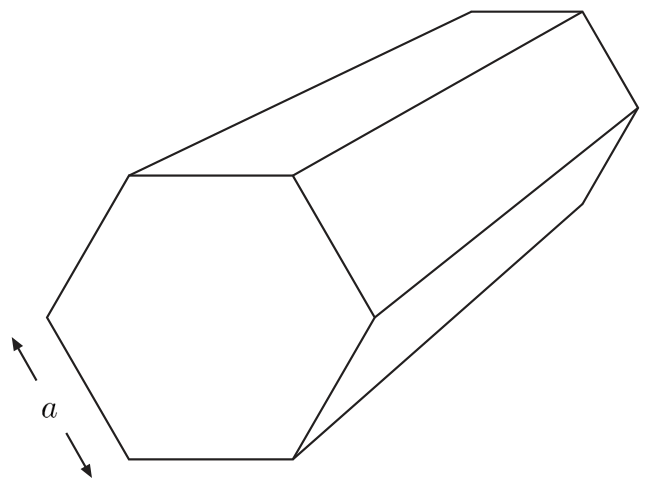
Figure 1.1: A solid prism with the cross section of a regular hexagon.
The moment of inertia \(I'\) about an edge of the prism is
\[ I'=\frac{17}{12}Ma^2 \tag{1.2} \]
a) (3.5 points) The prism is initially at rest with its axis horizontal on an inclined plane which makes a small angle \(\theta\) with the horizontal (Figure 1.2). Assume that the surfaces of the prism are slightly concave so that the prism only touches the plane at its edges. The effect of this concavity on the moment of inertia can be ignored. The prism is now displaced from rest and starts an uneven rolling down the plane. Assume that friction prevents any sliding and that the prism does not lose contact with the plane. The angular velocity just before a given edge hits the plane is \(\omega_i\) while \(\omega_f\) is the angular velocity immediately after the impact.
Show that we may write
\[ \omega_f=s\omega_i \tag{1.3} \]
and write the value of the coefficient \(s\) on the answer sheet.
¹Authors: Leó Kristjánsson and Thorsteinn Vilhjálmsson
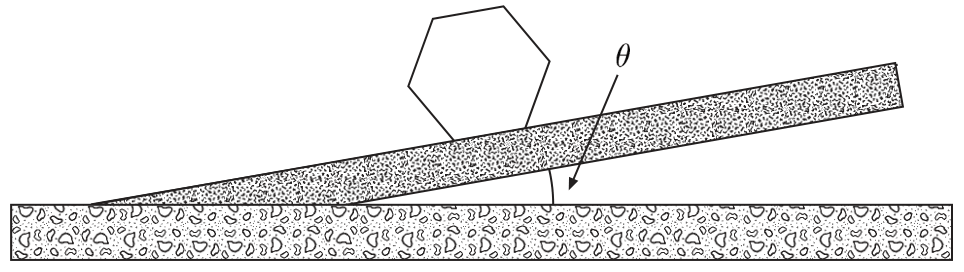
Figure 1.2: A hexagonal prism lying on an inclined plane.
b) (1 point) The kinetic energy of the prism just before and after impact is similarly \(K_i\) and \(K_f\).
Show that we may write
\[ K_f=rK_i \tag{1.4} \]
and write the value of the coefficient \(r\) on the answer sheet.
c) (1.5 points) For the next impact to occur \(K_i\) must exceed a minimum value \(K_{i,min}\) which may be written in the form
\[ K_{i,min}=\delta Mga \tag{1.5} \]
where \(g=9.81\ \mathrm{m/s^2}\) is the acceleration of gravity.
Find the coefficient \(\delta\) in terms of the slope angle \(\theta\) and the coefficient \(r\). Write your answer on the answer sheet. (Use the algebraic symbol \(r\), not its value.)
d) (2 points) If the condition of part (c) is satisfied, the kinetic energy \(K_i\) will approach a fixed value \(K_{i,0}\) as the prism rolls down the incline.
Given that the limit exists, show that \(K_{i,0}\) may be written as:
\[ K_{i,0}=\kappa Mga \tag{1.6} \]
and write the coefficient \(\kappa\) in terms of \(\theta\) and \(r\) on the answer sheet.
e) (2 points) Calculate, to within \(0.1^\circ\), the minimum slope angle \(\theta_0\) for which the uneven rolling, once started, will continue indefinitely. Write your numerical answer on the answer sheet.
Official English text of the problem.
Answers
- a) \(\displaystyle s=\frac{11}{17}\approx0.6471.\)
- b) \(\displaystyle r=\frac{121}{289}\approx0.4187.\)
- c) \(\displaystyle \delta=\frac{1-\cos(\pi/6-\theta)}{r}.\)
- d) \(\displaystyle \kappa=\frac{\sin\theta}{1-r}.\)
- e) \(\displaystyle \theta_0=6.5724\ldots^\circ\approx\boxed{6.6^\circ}.\)
The coefficients \(s,r,\delta,\kappa\) are dimensionless.
Solution
We treat each impact as instantaneous, neglecting gravity’s impulse during it. Between impacts the prism rotates about its stationary contact edge; the contact force does no work, so mechanical energy is conserved. We retain the exact trigonometric functions throughout.
a) Change of angular velocity at impact
In a cross section, let \(A\) denote the old contact edge, \(B\) the next edge to strike the plane, and \(C\) the centre of mass. For a regular hexagon,
\[ AC=BC=AB=a, \qquad \angle ACB=60^\circ. \]
Immediately before impact, the prism rotates about \(A\), so
\[ \mathbf v_C=\boldsymbol\omega_i\times\overrightarrow{AC}. \]
At impact the old edge releases and the new edge becomes the pivot. The impulsive contact force acts through \(B\), so angular momentum about the fixed line where \(B\) strikes is conserved.
Before impact, the angular momentum about \(B\) comprises rotation about the centre of mass and the centre of mass’s orbital angular momentum:
\[ \begin{aligned} \mathbf L_{B,i} &=I\boldsymbol\omega_i+ \overrightarrow{BC}\times M\mathbf v_C\\ &=\left(I+M\overrightarrow{BC}\cdot\overrightarrow{AC}\right) \boldsymbol\omega_i\\ &=\left(I+\frac12 Ma^2\right)\boldsymbol\omega_i. \end{aligned} \]
After impact, the prism rotates about \(B\), giving
\[ \mathbf L_{B,f}=I'\boldsymbol\omega_f. \]
Consequently,
\[ \left(\frac{5}{12}+\frac12\right)Ma^2\omega_i =\frac{17}{12}Ma^2\omega_f, \]
and therefore
\[ \boxed{\omega_f=\frac{11}{17}\omega_i}, \qquad \boxed{s=\frac{11}{17}}. \]
b) Change of kinetic energy at impact
Immediately before and after impact, the motion is pure rotation about a stationary edge. Both edges have the same moment of inertia \(I'\), so
\[ K_i=\frac12 I'\omega_i^2, \qquad K_f=\frac12 I'\omega_f^2. \]
It follows that
\[ \frac{K_f}{K_i} =\left(\frac{\omega_f}{\omega_i}\right)^2=s^2. \]
Thus
\[ \boxed{K_f=\frac{121}{289}K_i}, \qquad \boxed{r=\frac{121}{289}}. \]
c) Minimum energy needed for the next impact
After impact at \(B\), the centre of mass must rise until it is vertically above \(B\), then descend toward the next impact.
At the instant of impact, \(C\) lies a perpendicular distance \(\sqrt3a/2\) above the plane and a distance \(a/2\) uphill from \(B\). Its vertical height relative to \(B\) is therefore
\[ h_{\mathrm{start}} =\frac{\sqrt3a}{2}\cos\theta+\frac a2\sin\theta =a\cos\left(\frac{\pi}{6}-\theta\right). \]
For the small slopes under consideration, \(0\leq\theta<\pi/6\), the centre of mass subsequently reaches the maximum height
\[ h_{\mathrm{top}}=a. \]
The gravitational potential-energy barrier is
\[ \Delta U =Mga\left[1-\cos\left(\frac{\pi}{6}-\theta\right)\right]. \]
The available kinetic energy just after impact is \(rK_i\). To pass the highest point and reach the next edge, it must satisfy
\[ rK_i>\Delta U. \]
Hence the threshold pre-impact energy is
\[ K_{i,\min} =\frac{Mga}{r} \left[1-\cos\left(\frac{\pi}{6}-\theta\right)\right], \]
so
\[ \boxed{\delta= \frac{1-\cos(\pi/6-\theta)}{r}}. \]
The inequality is strict: at exactly the threshold energy, the prism approaches the unstable balance position without crossing it.
d) Limiting pre-impact kinetic energy
Successive impact configurations are identical apart from a translation by one side length \(a\) down the plane. Thus the centre of mass loses a vertical height \(a\sin\theta\) between impacts.
Let \(E_n\) be the kinetic energy immediately before impact \(n\). Impact reduces it to \(rE_n\), and gravity supplies \(Mga\sin\theta\) before the following impact. Therefore, for successive completed steps,
\[ E_{n+1}=rE_n+Mga\sin\theta. \]
Taking the stated limit \(E_n\to K_{i,0}\),
\[ K_{i,0}=rK_{i,0}+Mga\sin\theta. \]
Thus
\[ \boxed{K_{i,0}=\frac{Mga\sin\theta}{1-r}}, \qquad \boxed{\kappa=\frac{\sin\theta}{1-r}}. \]
Indeed, the recurrence gives
\[ E_n=K_{i,0}+r^n(E_0-K_{i,0}), \]
which converges because \(0<r<1\), provided the prism continues to cross each energy barrier.
e) Minimum slope for indefinite rolling
If \(K_{i,0}<K_{i,\min}\), any finite initial energy eventually decreases enough that the prism cannot cross the next barrier. If \(K_{i,0}\geq K_{i,\min}\) and the initial energy satisfies \(E_0>K_{i,\min}\), the recurrence keeps every finite subsequent \(E_n\) above the threshold.
The critical angle is therefore determined by
\[ K_{i,0}=K_{i,\min}, \]
or
\[ \frac{\sin\theta_0}{1-r} =\frac{1-\cos(\pi/6-\theta_0)}{r}. \]
Substituting \(r=121/289\),
\[ 121\sin\theta_0 =168\left[1-\cos\left(\frac{\pi}{6}-\theta_0\right)\right]. \]
Expanding the cosine yields
\[ 205\sin\theta_0+84\sqrt3\cos\theta_0=168. \]
Using \(t=\tan(\theta_0/2)\), this becomes
\[ (168+84\sqrt3)t^2-410t+(168-84\sqrt3)=0. \]
The root in the physical interval \(0<\theta_0<30^\circ\) is
\[ t=\frac{3(2-\sqrt3)}{14}. \]
Consequently,
\[ \theta_0 =2\arctan\left[\frac{3(2-\sqrt3)}{14}\right] =6.5723657\ldots^\circ, \]
and to the requested precision,
\[ \boxed{\theta_0=6.6^\circ}. \]
At the critical slope, an initial energy strictly above the threshold permits every subsequent step, although the prism spends progressively longer near each unstable balance position.
The solution was checked against the official solution.
IPhO 1998 · Theorieaufgabe 1
Rollen eines hexagonalen Prismas
Betrachten Sie ein langes, massives, starres Prisma mit regelmäßigem sechseckigem Querschnitt, wie es etwa ein gewöhnlicher Bleistift aufweist (Abbildung 1.1). Die Masse des Prismas beträgt \(M\) und ist gleichmäßig verteilt. Die Seitenlänge des sechseckigen Querschnitts beträgt \(a\). Das Trägheitsmoment \(I\) des hexagonalen Prismas bezüglich seiner Mittelachse ist
\[ I=\frac{5}{12}Ma^2 \tag{1.1} \]
Abbildung 1.1: Ein massives Prisma mit dem Querschnitt eines regelmäßigen Sechsecks.
Das Trägheitsmoment \(I'\) bezüglich einer Kante des Prismas ist
\[ I'=\frac{17}{12}Ma^2 \tag{1.2} \]
a) (3.5 Punkte) Das Prisma ruht zunächst mit horizontaler Achse auf einer schiefen Ebene, die mit der Horizontalen einen kleinen Winkel \(\theta\) bildet (Abbildung 1.2). Nehmen Sie an, dass die Seitenflächen des Prismas leicht konkav sind, sodass das Prisma die Ebene nur an seinen Kanten berührt. Der Einfluss dieser Konkavität auf das Trägheitsmoment kann vernachlässigt werden. Das Prisma wird nun aus seiner Ruhelage ausgelenkt und beginnt, ungleichmäßig die Ebene hinabzurollen. Nehmen Sie an, dass die Reibung jegliches Gleiten verhindert und dass das Prisma den Kontakt mit der Ebene nicht verliert. Die Winkelgeschwindigkeit unmittelbar bevor eine bestimmte Kante auf die Ebene auftrifft, ist \(\omega_i\), während \(\omega_f\) die Winkelgeschwindigkeit unmittelbar nach dem Stoß ist.
Zeigen Sie, dass sich die Beziehung
\[ \omega_f=s\omega_i \tag{1.3} \]
schreiben lässt, und tragen Sie den Wert des Koeffizienten \(s\) auf dem Antwortbogen ein.
¹Autoren: Leó Kristjánsson und Thorsteinn Vilhjálmsson
Abbildung 1.2: Ein hexagonales Prisma auf einer schiefen Ebene.
b) (1 Punkt) Entsprechend sind die kinetischen Energien des Prismas unmittelbar vor und nach dem Stoß \(K_i\) und \(K_f\).
Zeigen Sie, dass sich die Beziehung
\[ K_f=rK_i \tag{1.4} \]
schreiben lässt, und tragen Sie den Wert des Koeffizienten \(r\) auf dem Antwortbogen ein.
c) (1.5 Punkte) Damit der nächste Stoß stattfinden kann, muss \(K_i\) einen Mindestwert \(K_{i,min}\) überschreiten, der sich in der Form
\[ K_{i,min}=\delta Mga \tag{1.5} \]
schreiben lässt, wobei \(g=9.81\ \mathrm{m/s^2}\) die Erdbeschleunigung ist.
Bestimmen Sie den Koeffizienten \(\delta\) in Abhängigkeit vom Neigungswinkel \(\theta\) und vom Koeffizienten \(r\). Tragen Sie Ihre Antwort auf dem Antwortbogen ein. (Verwenden Sie das algebraische Symbol \(r\), nicht seinen Zahlenwert.)
d) (2 Punkte) Wenn die Bedingung aus Teil (c) erfüllt ist, nähert sich die kinetische Energie \(K_i\) einem festen Wert \(K_{i,0}\), während das Prisma die schiefe Ebene hinabrollt.
Zeigen Sie unter der Voraussetzung, dass der Grenzwert existiert, dass sich \(K_{i,0}\) wie folgt schreiben lässt:
\[ K_{i,0}=\kappa Mga \tag{1.6} \]
Tragen Sie den Koeffizienten \(\kappa\) in Abhängigkeit von \(\theta\) und \(r\) auf dem Antwortbogen ein.
e) (2 Punkte) Berechnen Sie auf \(0.1^\circ\) genau den kleinsten Neigungswinkel \(\theta_0\), bei dem das ungleichmäßige Rollen, nachdem es einmal begonnen hat, unbegrenzt anhält. Tragen Sie Ihr numerisches Ergebnis auf dem Antwortbogen ein.
Aufgabentext aus dem offiziellen englischen Text übersetzt.
Antworten
- a) \(\displaystyle s=\frac{11}{17}\approx0.6471.\)
- b) \(\displaystyle r=\frac{121}{289}\approx0.4187.\)
- c) \(\displaystyle \delta=\frac{1-\cos(\pi/6-\theta)}{r}.\)
- d) \(\displaystyle \kappa=\frac{\sin\theta}{1-r}.\)
- e) \(\displaystyle \theta_0=6.5724\ldots^\circ\approx\boxed{6.6^\circ}.\)
Die Koeffizienten \(s,r,\delta,\kappa\) sind dimensionslos.
Lösung
Wir behandeln jeden Stoß als augenblicklich und vernachlässigen dabei den Kraftstoß der Schwerkraft. Zwischen den Stößen dreht sich das Prisma um seine ruhende Auflagekante; die Kontaktkraft verrichtet keine Arbeit, sodass die mechanische Energie erhalten bleibt. Wir verwenden durchgehend die exakten trigonometrischen Funktionen.
a) Änderung der Winkelgeschwindigkeit beim Stoß
In einem Querschnitt bezeichne \(A\) die bisherige Auflagekante, \(B\) die nächste Kante, die auf die Ebene trifft, und \(C\) den Schwerpunkt. Für ein regelmäßiges Sechseck gilt
\[ AC=BC=AB=a, \qquad \angle ACB=60^\circ. \]
Unmittelbar vor dem Stoß dreht sich das Prisma um \(A\), sodass
\[ \mathbf v_C=\boldsymbol\omega_i\times\overrightarrow{AC}. \]
Beim Stoß hebt die bisherige Kante ab, und die neue Kante wird zur Drehachse. Die stoßartige Kontaktkraft greift an \(B\) an, sodass der Drehimpuls bezüglich der ortsfesten Geraden, auf die \(B\) trifft, erhalten bleibt.
Vor dem Stoß setzt sich der Drehimpuls bezüglich \(B\) aus dem Drehimpuls der Rotation um den Schwerpunkt und dem Bahndrehimpuls des Schwerpunkts zusammen:
\[ \begin{aligned} \mathbf L_{B,i} &=I\boldsymbol\omega_i+ \overrightarrow{BC}\times M\mathbf v_C\\ &=\left(I+M\overrightarrow{BC}\cdot\overrightarrow{AC}\right) \boldsymbol\omega_i\\ &=\left(I+\frac12 Ma^2\right)\boldsymbol\omega_i. \end{aligned} \]
Nach dem Stoß dreht sich das Prisma um \(B\), woraus folgt:
\[ \mathbf L_{B,f}=I'\boldsymbol\omega_f. \]
Somit gilt
\[ \left(\frac{5}{12}+\frac12\right)Ma^2\omega_i =\frac{17}{12}Ma^2\omega_f, \]
und daher
\[ \boxed{\omega_f=\frac{11}{17}\omega_i}, \qquad \boxed{s=\frac{11}{17}}. \]
b) Änderung der kinetischen Energie beim Stoß
Unmittelbar vor und nach dem Stoß ist die Bewegung eine reine Rotation um eine ruhende Kante. Bezüglich beider Kanten ist das Trägheitsmoment gleich \(I'\), sodass
\[ K_i=\frac12 I'\omega_i^2, \qquad K_f=\frac12 I'\omega_f^2. \]
Daraus folgt
\[ \frac{K_f}{K_i} =\left(\frac{\omega_f}{\omega_i}\right)^2=s^2. \]
Damit ergibt sich
\[ \boxed{K_f=\frac{121}{289}K_i}, \qquad \boxed{r=\frac{121}{289}}. \]
c) Für den nächsten Stoß erforderliche Mindestenergie
Nach dem Stoß an \(B\) muss der Schwerpunkt ansteigen, bis er sich senkrecht über \(B\) befindet, und anschließend bis zum nächsten Stoß absinken.
Im Augenblick des Stoßes liegt \(C\) im senkrechten Abstand \(\sqrt3a/2\) über der Ebene und um die Strecke \(a/2\) hangaufwärts von \(B\) versetzt. Seine vertikale Höhe relativ zu \(B\) beträgt daher
\[ h_{\mathrm{start}} =\frac{\sqrt3a}{2}\cos\theta+\frac a2\sin\theta =a\cos\left(\frac{\pi}{6}-\theta\right). \]
Für die hier betrachteten kleinen Neigungswinkel \(0\leq\theta<\pi/6\) erreicht der Schwerpunkt anschließend die maximale Höhe
\[ h_{\mathrm{top}}=a. \]
Die zu überwindende Barriere der potenziellen Energie im Schwerefeld beträgt
\[ \Delta U =Mga\left[1-\cos\left(\frac{\pi}{6}-\theta\right)\right]. \]
Die unmittelbar nach dem Stoß verfügbare kinetische Energie beträgt \(rK_i\). Damit der Schwerpunkt den höchsten Punkt überschreitet und das Prisma die nächste Kante erreicht, muss gelten:
\[ rK_i>\Delta U. \]
Damit beträgt der Schwellenwert der Energie vor dem Stoß
\[ K_{i,\min} =\frac{Mga}{r} \left[1-\cos\left(\frac{\pi}{6}-\theta\right)\right], \]
also
\[ \boxed{\delta= \frac{1-\cos(\pi/6-\theta)}{r}}. \]
Die Ungleichung ist strikt: Bei einer Energie, die genau dem Schwellenwert entspricht, nähert sich das Prisma der instabilen Gleichgewichtslage, ohne sie zu überschreiten.
d) Grenzwert der kinetischen Energie vor dem Stoß
Aufeinanderfolgende Stoßkonfigurationen sind bis auf eine Verschiebung um eine Seitenlänge \(a\) die Ebene hinab identisch. Daher verliert der Schwerpunkt zwischen den Stößen die vertikale Höhe \(a\sin\theta\).
Sei \(E_n\) die kinetische Energie unmittelbar vor dem Stoß \(n\). Der Stoß verringert sie auf \(rE_n\), und die Schwerkraft führt bis zum folgenden Stoß die Energie \(Mga\sin\theta\) zu. Für aufeinanderfolgende vollständig ausgeführte Schritte gilt daher
\[ E_{n+1}=rE_n+Mga\sin\theta. \]
Mit dem vorausgesetzten Grenzübergang \(E_n\to K_{i,0}\) folgt
\[ K_{i,0}=rK_{i,0}+Mga\sin\theta. \]
Somit gilt
\[ \boxed{K_{i,0}=\frac{Mga\sin\theta}{1-r}}, \qquad \boxed{\kappa=\frac{\sin\theta}{1-r}}. \]
Tatsächlich ergibt die Rekursionsbeziehung
\[ E_n=K_{i,0}+r^n(E_0-K_{i,0}), \]
was wegen \(0<r<1\) konvergiert, sofern das Prisma weiterhin jede Energiebarriere überwindet.
e) Kleinster Neigungswinkel für unbegrenzt anhaltendes Rollen
Falls \(K_{i,0}<K_{i,\min}\), nimmt jede endliche Anfangsenergie schließlich so weit ab, dass das Prisma die nächste Barriere nicht mehr überwinden kann. Falls \(K_{i,0}\geq K_{i,\min}\) und die Anfangsenergie die Bedingung \(E_0>K_{i,\min}\) erfüllt, bleibt gemäß der Rekursionsbeziehung jedes nachfolgende \(E_n\) bei endlicher Schrittzahl oberhalb des Schwellenwerts.
Der kritische Winkel ist daher bestimmt durch
\[ K_{i,0}=K_{i,\min}, \]
oder
\[ \frac{\sin\theta_0}{1-r} =\frac{1-\cos(\pi/6-\theta_0)}{r}. \]
Einsetzen von \(r=121/289\) ergibt
\[ 121\sin\theta_0 =168\left[1-\cos\left(\frac{\pi}{6}-\theta_0\right)\right]. \]
Mit dem Additionstheorem für den Kosinus folgt
\[ 205\sin\theta_0+84\sqrt3\cos\theta_0=168. \]
Mit \(t=\tan(\theta_0/2)\) wird daraus
\[ (168+84\sqrt3)t^2-410t+(168-84\sqrt3)=0. \]
Die Lösung im physikalisch relevanten Intervall \(0<\theta_0<30^\circ\) ist
\[ t=\frac{3(2-\sqrt3)}{14}. \]
Folglich gilt
\[ \theta_0 =2\arctan\left[\frac{3(2-\sqrt3)}{14}\right] =6.5723657\ldots^\circ, \]
und mit der geforderten Genauigkeit
\[ \boxed{\theta_0=6.6^\circ}. \]
Beim kritischen Neigungswinkel ermöglicht eine Anfangsenergie, die strikt oberhalb des Schwellenwerts liegt, jeden nachfolgenden Schritt, obwohl das Prisma in der Nähe jeder instabilen Gleichgewichtslage zunehmend länger verweilt.
Die Lösung wurde mit der offiziellen Lösung abgeglichen.
IPhO 1998 · Teori sorusu 1
Altıgen bir prizmanın yuvarlanması
Yaygın bir kurşun kalem türü gibi uzun, içi dolu, rijit, düzgün altıgen bir prizma düşünün (Şekil 1.1). Prizmanın kütlesi \(M\) olup düzgün dağılmıştır. Altıgen kesitin her bir kenarının uzunluğu \(a\)'dır. Altıgen prizmanın merkez ekseni etrafındaki eylemsizlik momenti \(I\) şöyledir:
\[ I=\frac{5}{12}Ma^2 \tag{1.1} \]
Şekil 1.1: Kesiti düzgün altıgen olan, içi dolu bir prizma.
Prizmanın bir ayrıtı etrafındaki eylemsizlik momenti \(I'\) şöyledir:
\[ I'=\frac{17}{12}Ma^2 \tag{1.2} \]
a) (3.5 puan) Prizma başlangıçta, yatayla küçük bir \(\theta\) açısı yapan eğik bir düzlem üzerinde, ekseni yatay olacak biçimde durmaktadır (Şekil 1.2). Prizmanın yüzeylerinin hafifçe içbükey olduğunu, dolayısıyla prizmanın düzleme yalnızca ayrıtlarından temas ettiğini varsayın. Bu içbükeyliğin eylemsizlik momenti üzerindeki etkisi ihmal edilebilir. Prizma şimdi durgun konumundan hareket ettirilir ve düzlem boyunca aşağıya doğru düzensiz biçimde yuvarlanmaya başlar. Sürtünmenin her türlü kaymayı önlediğini ve prizmanın düzlemle temasını kaybetmediğini varsayın. Belirli bir ayrıtın düzleme çarpmasından hemen önceki açısal hız \(\omega_i\), çarpışmadan hemen sonraki açısal hız ise \(\omega_f\)'dir.
Şu bağıntının yazılabileceğini gösterin:
\[ \omega_f=s\omega_i \tag{1.3} \]
ve \(s\) katsayısının değerini cevap kâğıdına yazın.
¹Yazarlar: Leó Kristjánsson ve Thorsteinn Vilhjálmsson
Şekil 1.2: Eğik bir düzlem üzerinde duran altıgen bir prizma.
b) (1 puan) Prizmanın çarpışmadan hemen önceki ve hemen sonraki kinetik enerjileri de benzer biçimde \(K_i\) ve \(K_f\) ile gösterilmektedir.
Şu bağıntının yazılabileceğini gösterin:
\[ K_f=rK_i \tag{1.4} \]
ve \(r\) katsayısının değerini cevap kâğıdına yazın.
c) (1.5 puan) Bir sonraki çarpışmanın gerçekleşmesi için \(K_i\), aşağıdaki biçimde yazılabilen bir minimum \(K_{i,min}\) değerini aşmalıdır:
\[ K_{i,min}=\delta Mga \tag{1.5} \]
Burada \(g=9.81\ \mathrm{m/s^2}\) yerçekimi ivmesidir.
\(\delta\) katsayısını eğim açısı \(\theta\) ve \(r\) katsayısı cinsinden bulun. Cevabınızı cevap kâğıdına yazın. (\(r\)'nin değerini değil, cebirsel simgesi olan \(r\)'yi kullanın.)
d) (2 puan) (c) kısmındaki koşul sağlanırsa prizma eğik düzlem boyunca aşağıya yuvarlandıkça kinetik enerji \(K_i\), sabit bir \(K_{i,0}\) değerine yaklaşır.
Limitin var olduğu verildiğine göre, \(K_{i,0}\)'ın şu biçimde yazılabileceğini gösterin:
\[ K_{i,0}=\kappa Mga \tag{1.6} \]
ve \(\kappa\) katsayısını \(\theta\) ve \(r\) cinsinden cevap kâğıdına yazın.
e) (2 puan) Düzensiz yuvarlanmanın bir kez başladıktan sonra süresiz olarak devam edeceği minimum eğim açısı \(\theta_0\)'ı \(0.1^\circ\) doğrulukla hesaplayın. Sayısal cevabınızı cevap kâğıdına yazın.
Soru metni resmi İngilizce metinden çevrilmiştir.
Cevaplar
- a) \(\displaystyle s=\frac{11}{17}\approx0.6471.\)
- b) \(\displaystyle r=\frac{121}{289}\approx0.4187.\)
- c) \(\displaystyle \delta=\frac{1-\cos(\pi/6-\theta)}{r}.\)
- d) \(\displaystyle \kappa=\frac{\sin\theta}{1-r}.\)
- e) \(\displaystyle \theta_0=6.5724\ldots^\circ\approx\boxed{6.6^\circ}.\)
\(s,r,\delta,\kappa\) katsayıları boyutsuzdur.
Çözüm
Her çarpışmayı anlık kabul ediyor ve çarpışma sırasında yerçekiminin itmesini ihmal ediyoruz. Çarpışmalar arasında prizma, sabit duran temas ayrıtı etrafında döner; temas kuvveti iş yapmadığından mekanik enerji korunur. Çözüm boyunca trigonometrik fonksiyonları yaklaştırma yapmadan kullanıyoruz.
a) Çarpışmada açısal hızın değişimi
Bir kesitte, eski temas ayrıtını \(A\), düzleme çarpacak bir sonraki ayrıtı \(B\) ve kütle merkezini \(C\) ile gösterelim. Düzgün bir altıgen için
\[ AC=BC=AB=a, \qquad \angle ACB=60^\circ. \]
Çarpışmadan hemen önce prizma \(A\) etrafında döndüğünden
\[ \mathbf v_C=\boldsymbol\omega_i\times\overrightarrow{AC}. \]
Çarpışma anında eski ayrıtın teması kesilir ve yeni ayrıt dönme ekseni hâline gelir. İtme oluşturan temas kuvveti \(B\)'den geçtiği için, \(B\)'nin çarptığı sabit doğruya göre açısal momentum korunur.
Çarpışmadan önce \(B\)'ye göre açısal momentum, kütle merkezi etrafındaki dönmeye ait açısal momentum ile kütle merkezinin yörüngesel açısal momentumundan oluşur:
\[ \begin{aligned} \mathbf L_{B,i} &=I\boldsymbol\omega_i+ \overrightarrow{BC}\times M\mathbf v_C\\ &=\left(I+M\overrightarrow{BC}\cdot\overrightarrow{AC}\right) \boldsymbol\omega_i\\ &=\left(I+\frac12 Ma^2\right)\boldsymbol\omega_i. \end{aligned} \]
Çarpışmadan sonra prizma \(B\) etrafında döner ve dolayısıyla
\[ \mathbf L_{B,f}=I'\boldsymbol\omega_f. \]
Böylece,
\[ \left(\frac{5}{12}+\frac12\right)Ma^2\omega_i =\frac{17}{12}Ma^2\omega_f, \]
ve buradan
\[ \boxed{\omega_f=\frac{11}{17}\omega_i}, \qquad \boxed{s=\frac{11}{17}}. \]
b) Çarpışmada kinetik enerjinin değişimi
Çarpışmadan hemen önce ve hemen sonra hareket, sabit duran bir ayrıt etrafındaki saf dönme hareketidir. Her iki ayrıta göre eylemsizlik momenti de aynı \(I'\) değerine sahip olduğundan
\[ K_i=\frac12 I'\omega_i^2, \qquad K_f=\frac12 I'\omega_f^2. \]
Buradan
\[ \frac{K_f}{K_i} =\left(\frac{\omega_f}{\omega_i}\right)^2=s^2. \]
Böylece
\[ \boxed{K_f=\frac{121}{289}K_i}, \qquad \boxed{r=\frac{121}{289}}. \]
c) Bir sonraki çarpışma için gereken minimum enerji
\(B\)'deki çarpışmadan sonra kütle merkezi, \(B\)'nin düşey olarak tam üstüne gelene kadar yükselmeli, ardından bir sonraki çarpışmaya doğru alçalmalıdır.
Çarpışma anında \(C\), düzlemin üzerinde düzleme dik doğrultuda \(\sqrt3a/2\) uzaklıkta ve \(B\)'ye göre eğim boyunca yukarı yönde \(a/2\) uzaklıktadır. Dolayısıyla \(B\)'ye göre düşey yüksekliği
\[ h_{\mathrm{start}} =\frac{\sqrt3a}{2}\cos\theta+\frac a2\sin\theta =a\cos\left(\frac{\pi}{6}-\theta\right). \]
Ele alınan küçük eğimler için, \(0\leq\theta<\pi/6\), kütle merkezi daha sonra şu maksimum yüksekliğe ulaşır:
\[ h_{\mathrm{top}}=a. \]
Yerçekimi potansiyel enerjisi engeli şöyledir:
\[ \Delta U =Mga\left[1-\cos\left(\frac{\pi}{6}-\theta\right)\right]. \]
Çarpışmadan hemen sonra mevcut kinetik enerji \(rK_i\)'dir. En yüksek noktayı aşıp bir sonraki ayrıta ulaşmak için şu koşul sağlanmalıdır:
\[ rK_i>\Delta U. \]
Dolayısıyla çarpışma öncesi enerjinin eşik değeri
\[ K_{i,\min} =\frac{Mga}{r} \left[1-\cos\left(\frac{\pi}{6}-\theta\right)\right], \]
olduğundan
\[ \boxed{\delta= \frac{1-\cos(\pi/6-\theta)}{r}}. \]
Eşitsizlik kesindir: enerji tam olarak eşik değerindeyken prizma, kararsız denge konumunu aşmadan bu konuma yaklaşır.
d) Çarpışma öncesi kinetik enerjinin limit değeri
Ardışık çarpışmalardaki geometrik durumlar, düzlem boyunca aşağı yönde bir kenar uzunluğu \(a\) kadar ötelenme dışında aynıdır. Dolayısıyla çarpışmalar arasında kütle merkezinin düşey yüksekliği \(a\sin\theta\) kadar azalır.
\(n\). çarpışmadan hemen önceki kinetik enerji \(E_n\) olsun. Çarpışma bu enerjiyi \(rE_n\)'ye düşürür ve bir sonraki çarpışmadan önce yerçekimi \(Mga\sin\theta\) kadar enerji sağlar. Bu nedenle, ardışık olarak tamamlanan adımlar için
\[ E_{n+1}=rE_n+Mga\sin\theta. \]
Verilen \(E_n\to K_{i,0}\) limitini alırsak,
\[ K_{i,0}=rK_{i,0}+Mga\sin\theta. \]
Böylece
\[ \boxed{K_{i,0}=\frac{Mga\sin\theta}{1-r}}, \qquad \boxed{\kappa=\frac{\sin\theta}{1-r}}. \]
Nitekim yineleme bağıntısı
\[ E_n=K_{i,0}+r^n(E_0-K_{i,0}), \]
sonucunu verir; prizmanın her bir enerji engelini aşmaya devam etmesi koşuluyla, \(0<r<1\) olduğundan bu ifade yakınsar.
e) Süresiz yuvarlanma için minimum eğim
\(K_{i,0}<K_{i,\min}\) ise sonlu herhangi bir başlangıç enerjisi, sonunda prizmanın bir sonraki engeli aşamayacağı kadar azalır. \(K_{i,0}\geq K_{i,\min}\) ise ve başlangıç enerjisi \(E_0>K_{i,\min}\) koşulunu sağlıyorsa yineleme bağıntısı, daha sonraki her sonlu adımda \(E_n\)'nin eşik değerinin üzerinde kalmasını sağlar.
Bu nedenle kritik açı şu eşitlikle belirlenir:
\[ K_{i,0}=K_{i,\min}, \]
ya da
\[ \frac{\sin\theta_0}{1-r} =\frac{1-\cos(\pi/6-\theta_0)}{r}. \]
\(r=121/289\) yerine konulduğunda,
\[ 121\sin\theta_0 =168\left[1-\cos\left(\frac{\pi}{6}-\theta_0\right)\right]. \]
Kosinüs açılımı yapıldığında
\[ 205\sin\theta_0+84\sqrt3\cos\theta_0=168. \]
\(t=\tan(\theta_0/2)\) kullanılırsa bu eşitlik şu hâle gelir:
\[ (168+84\sqrt3)t^2-410t+(168-84\sqrt3)=0. \]
Fiziksel olarak anlamlı \(0<\theta_0<30^\circ\) aralığındaki kök
\[ t=\frac{3(2-\sqrt3)}{14}. \]
Dolayısıyla,
\[ \theta_0 =2\arctan\left[\frac{3(2-\sqrt3)}{14}\right] =6.5723657\ldots^\circ, \]
ve istenen duyarlılıkla,
\[ \boxed{\theta_0=6.6^\circ}. \]
Kritik eğimde, eşik değerinden kesin olarak büyük bir başlangıç enerjisi, sonraki her adımın gerçekleşmesini sağlar; ancak prizma her bir kararsız denge konumunun yakınında giderek daha uzun süre geçirir.
Çözüm, resmi çözümle karşılaştırılarak kontrol edildi.
IPhO 1998 · Problema teórico 1
Rodadura de un prisma hexagonal
Considere un prisma hexagonal regular, largo, macizo y rígido, como un tipo común de lápiz (Figura 1.1). La masa del prisma es \(M\) y está distribuida uniformemente. La longitud de cada lado del hexágono de la sección transversal es \(a\). El momento de inercia \(I\) del prisma hexagonal respecto a su eje central es
\[ I=\frac{5}{12}Ma^2 \tag{1.1} \]
Figura 1.1: Un prisma macizo cuya sección transversal es un hexágono regular.
El momento de inercia \(I'\) respecto a una arista del prisma es
\[ I'=\frac{17}{12}Ma^2 \tag{1.2} \]
a) (3.5 puntos) El prisma se encuentra inicialmente en reposo, con su eje horizontal, sobre un plano inclinado que forma un ángulo pequeño \(\theta\) con la horizontal (Figura 1.2). Suponga que las caras del prisma son ligeramente cóncavas, de modo que el prisma solo toca el plano por sus aristas. Puede despreciarse el efecto de esta concavidad sobre el momento de inercia. A continuación, se saca el prisma de su posición de reposo y este comienza a rodar de forma irregular cuesta abajo por el plano. Suponga que el rozamiento impide cualquier deslizamiento y que el prisma no pierde el contacto con el plano. La velocidad angular justo antes de que una determinada arista golpee el plano es \(\omega_i\), mientras que \(\omega_f\) es la velocidad angular inmediatamente después del impacto.
Demuestre que podemos escribir
\[ \omega_f=s\omega_i \tag{1.3} \]
y escriba el valor del coeficiente \(s\) en la hoja de respuestas.
¹Autores: Leó Kristjánsson y Thorsteinn Vilhjálmsson
Figura 1.2: Un prisma hexagonal apoyado sobre un plano inclinado.
b) (1 punto) Las energías cinéticas del prisma justo antes y después del impacto son, de forma análoga, \(K_i\) y \(K_f\).
Demuestre que podemos escribir
\[ K_f=rK_i \tag{1.4} \]
y escriba el valor del coeficiente \(r\) en la hoja de respuestas.
c) (1.5 puntos) Para que se produzca el siguiente impacto, \(K_i\) debe superar un valor mínimo \(K_{i,min}\), que puede escribirse de la forma
\[ K_{i,min}=\delta Mga \tag{1.5} \]
donde \(g=9.81\ \mathrm{m/s^2}\) es la aceleración de la gravedad.
Halle el coeficiente \(\delta\) en función del ángulo de inclinación \(\theta\) y del coeficiente \(r\). Escriba su respuesta en la hoja de respuestas. (Utilice el símbolo algebraico \(r\), no su valor.)
d) (2 puntos) Si se cumple la condición del apartado (c), la energía cinética \(K_i\) se aproximará a un valor fijo \(K_{i,0}\) a medida que el prisma ruede cuesta abajo por el plano inclinado.
Dado que el límite existe, demuestre que \(K_{i,0}\) puede escribirse como:
\[ K_{i,0}=\kappa Mga \tag{1.6} \]
y escriba el coeficiente \(\kappa\) en función de \(\theta\) y \(r\) en la hoja de respuestas.
e) (2 puntos) Calcule, con una precisión de \(0.1^\circ\), el ángulo mínimo de inclinación \(\theta_0\) para el que la rodadura irregular, una vez iniciada, continuará indefinidamente. Escriba su respuesta numérica en la hoja de respuestas.
Enunciado traducido del texto oficial en inglés.
Respuestas
- a) \(\displaystyle s=\frac{11}{17}\approx0.6471.\)
- b) \(\displaystyle r=\frac{121}{289}\approx0.4187.\)
- c) \(\displaystyle \delta=\frac{1-\cos(\pi/6-\theta)}{r}.\)
- d) \(\displaystyle \kappa=\frac{\sin\theta}{1-r}.\)
- e) \(\displaystyle \theta_0=6.5724\ldots^\circ\approx\boxed{6.6^\circ}.\)
Los coeficientes \(s,r,\delta,\kappa\) son adimensionales.
Solución
Consideramos cada impacto como instantáneo y despreciamos el impulso de la gravedad durante él. Entre impactos, el prisma gira alrededor de su arista de contacto fija; la fuerza de contacto no realiza trabajo, por lo que se conserva la energía mecánica. Mantenemos las funciones trigonométricas exactas en todo el desarrollo.
a) Cambio de velocidad angular en el impacto
En una sección transversal, sean \(A\) la arista de contacto anterior, \(B\) la siguiente arista que golpeará el plano y \(C\) el centro de masas. Para un hexágono regular,
\[ AC=BC=AB=a, \qquad \angle ACB=60^\circ. \]
Inmediatamente antes del impacto, el prisma gira alrededor de \(A\), por lo que
\[ \mathbf v_C=\boldsymbol\omega_i\times\overrightarrow{AC}. \]
En el impacto, la arista anterior deja de estar en contacto y la nueva arista se convierte en el eje de giro. La fuerza impulsiva de contacto actúa pasando por \(B\), por lo que se conserva el momento angular respecto a la recta fija sobre la que impacta \(B\).
Antes del impacto, el momento angular respecto a \(B\) comprende la rotación alrededor del centro de masas y el momento angular orbital del centro de masas:
\[ \begin{aligned} \mathbf L_{B,i} &=I\boldsymbol\omega_i+ \overrightarrow{BC}\times M\mathbf v_C\\ &=\left(I+M\overrightarrow{BC}\cdot\overrightarrow{AC}\right) \boldsymbol\omega_i\\ &=\left(I+\frac12 Ma^2\right)\boldsymbol\omega_i. \end{aligned} \]
Después del impacto, el prisma gira alrededor de \(B\), lo que da
\[ \mathbf L_{B,f}=I'\boldsymbol\omega_f. \]
En consecuencia,
\[ \left(\frac{5}{12}+\frac12\right)Ma^2\omega_i =\frac{17}{12}Ma^2\omega_f, \]
y, por tanto,
\[ \boxed{\omega_f=\frac{11}{17}\omega_i}, \qquad \boxed{s=\frac{11}{17}}. \]
b) Cambio de energía cinética en el impacto
Inmediatamente antes y después del impacto, el movimiento es una rotación pura alrededor de una arista fija. Ambas aristas tienen el mismo momento de inercia \(I'\), por lo que
\[ K_i=\frac12 I'\omega_i^2, \qquad K_f=\frac12 I'\omega_f^2. \]
Se deduce que
\[ \frac{K_f}{K_i} =\left(\frac{\omega_f}{\omega_i}\right)^2=s^2. \]
Así pues,
\[ \boxed{K_f=\frac{121}{289}K_i}, \qquad \boxed{r=\frac{121}{289}}. \]
c) Energía mínima necesaria para el siguiente impacto
Después del impacto en \(B\), el centro de masas debe ascender hasta situarse verticalmente sobre \(B\) y luego descender hacia el siguiente impacto.
En el instante del impacto, \(C\) se encuentra a una distancia perpendicular \(\sqrt3a/2\) por encima del plano y a una distancia \(a/2\) cuesta arriba de \(B\). Por tanto, su altura vertical respecto a \(B\) es
\[ h_{\mathrm{start}} =\frac{\sqrt3a}{2}\cos\theta+\frac a2\sin\theta =a\cos\left(\frac{\pi}{6}-\theta\right). \]
Para las pequeñas inclinaciones consideradas, \(0\leq\theta<\pi/6\), el centro de masas alcanza posteriormente la altura máxima
\[ h_{\mathrm{top}}=a. \]
La barrera de energía potencial gravitatoria es
\[ \Delta U =Mga\left[1-\cos\left(\frac{\pi}{6}-\theta\right)\right]. \]
La energía cinética disponible justo después del impacto es \(rK_i\). Para superar el punto más alto y alcanzar la siguiente arista, debe satisfacer
\[ rK_i>\Delta U. \]
Por tanto, la energía umbral anterior al impacto es
\[ K_{i,\min} =\frac{Mga}{r} \left[1-\cos\left(\frac{\pi}{6}-\theta\right)\right], \]
de modo que
\[ \boxed{\delta= \frac{1-\cos(\pi/6-\theta)}{r}}. \]
La desigualdad es estricta: si la energía es exactamente igual al umbral, el prisma se aproxima a la posición de equilibrio inestable sin sobrepasarla.
d) Energía cinética límite anterior al impacto
Las configuraciones de impactos sucesivos son idénticas salvo por una traslación de una longitud de lado \(a\) cuesta abajo por el plano. Así, el centro de masas pierde una altura vertical \(a\sin\theta\) entre impactos.
Sea \(E_n\) la energía cinética inmediatamente antes del impacto \(n\). El impacto la reduce a \(rE_n\), y la gravedad aporta \(Mga\sin\theta\) antes del siguiente impacto. Por tanto, para pasos sucesivos completados,
\[ E_{n+1}=rE_n+Mga\sin\theta. \]
Tomando el límite indicado \(E_n\to K_{i,0}\),
\[ K_{i,0}=rK_{i,0}+Mga\sin\theta. \]
Así pues,
\[ \boxed{K_{i,0}=\frac{Mga\sin\theta}{1-r}}, \qquad \boxed{\kappa=\frac{\sin\theta}{1-r}}. \]
En efecto, la relación de recurrencia da
\[ E_n=K_{i,0}+r^n(E_0-K_{i,0}), \]
que converge porque \(0<r<1\), siempre que el prisma siga superando cada barrera de energía.
e) Inclinación mínima para una rodadura indefinida
Si \(K_{i,0}<K_{i,\min}\), cualquier energía inicial finita termina disminuyendo lo suficiente como para que el prisma no pueda superar la siguiente barrera. Si \(K_{i,0}\geq K_{i,\min}\) y la energía inicial satisface \(E_0>K_{i,\min}\), la relación de recurrencia mantiene cada término posterior \(E_n\) de índice finito por encima del umbral.
Por tanto, el ángulo crítico queda determinado por
\[ K_{i,0}=K_{i,\min}, \]
o bien
\[ \frac{\sin\theta_0}{1-r} =\frac{1-\cos(\pi/6-\theta_0)}{r}. \]
Sustituyendo \(r=121/289\),
\[ 121\sin\theta_0 =168\left[1-\cos\left(\frac{\pi}{6}-\theta_0\right)\right]. \]
Al desarrollar el coseno se obtiene
\[ 205\sin\theta_0+84\sqrt3\cos\theta_0=168. \]
Utilizando \(t=\tan(\theta_0/2)\), esta ecuación se convierte en
\[ (168+84\sqrt3)t^2-410t+(168-84\sqrt3)=0. \]
La raíz en el intervalo físico \(0<\theta_0<30^\circ\) es
\[ t=\frac{3(2-\sqrt3)}{14}. \]
En consecuencia,
\[ \theta_0 =2\arctan\left[\frac{3(2-\sqrt3)}{14}\right] =6.5723657\ldots^\circ, \]
y, con la precisión solicitada,
\[ \boxed{\theta_0=6.6^\circ}. \]
Con la inclinación crítica, una energía inicial estrictamente superior al umbral permite completar cada paso posterior, aunque el prisma permanece cada vez más tiempo cerca de cada posición de equilibrio inestable.
La solución se comprobó con la solución oficial.
IPhO 1998 · 理论题 1
六棱柱的滚动
考虑一根细长、实心、刚性的正六棱柱,其形状如一种常见的铅笔(图 1.1)。棱柱的质量为 \(M\),且质量分布均匀。其正六边形横截面的边长为 \(a\)。六棱柱绕其中心轴的转动惯量 \(I\) 为
\[ I=\frac{5}{12}Ma^2 \tag{1.1} \]
图 1.1:横截面为正六边形的实心棱柱。
棱柱绕其一条侧棱的转动惯量 \(I'\) 为
\[ I'=\frac{17}{12}Ma^2 \tag{1.2} \]
a)(3.5 分)棱柱最初静止在一个与水平面成小角度 \(\theta\) 的斜面上,其轴线保持水平(图 1.2)。假设棱柱的各侧面略微内凹,使棱柱仅以侧棱接触斜面。这种内凹对转动惯量的影响可以忽略。现在使棱柱偏离静止位置,棱柱开始沿斜面向下作不均匀滚动。假设摩擦力阻止了任何滑动,且棱柱始终不脱离斜面。在某一条侧棱即将撞击斜面之前,角速度为 \(\omega_i\),而撞击刚结束时的角速度为 \(\omega_f\)。
证明可以写成
\[ \omega_f=s\omega_i \tag{1.3} \]
并将系数 \(s\) 的值写在答题纸上。
¹命题人:Leó Kristjánsson 和 Thorsteinn Vilhjálmsson
图 1.2:放置在斜面上的六棱柱。
b)(1 分)类似地,棱柱在撞击即将发生之前和刚结束时的动能分别为 \(K_i\) 和 \(K_f\)。
证明可以写成
\[ K_f=rK_i \tag{1.4} \]
并将系数 \(r\) 的值写在答题纸上。
c)(1.5 分)要使下一次撞击发生,\(K_i\) 必须超过一个最小值 \(K_{i,min}\),该最小值可写成如下形式
\[ K_{i,min}=\delta Mga \tag{1.5} \]
其中,\(g=9.81\ \mathrm{m/s^2}\) 为重力加速度。
求出用斜面倾角 \(\theta\) 和系数 \(r\) 表示的系数 \(\delta\)。将答案写在答题纸上。(使用代数符号 \(r\),不要代入其数值。)
d)(2 分)如果满足 (c) 部分的条件,则当棱柱沿斜面向下滚动时,动能 \(K_i\) 将趋于一个固定值 \(K_{i,0}\)。
已知这一极限存在,证明 \(K_{i,0}\) 可写为:
\[ K_{i,0}=\kappa Mga \tag{1.6} \]
并将用 \(\theta\) 和 \(r\) 表示的系数 \(\kappa\) 写在答题纸上。
e)(2 分)计算使这种不均匀滚动一旦开始就能无限持续下去的最小斜面倾角 \(\theta_0\),精确到 \(0.1^\circ\)。将数值答案写在答题纸上。
题目译自官方英文原文。
答案
- a) \(\displaystyle s=\frac{11}{17}\approx0.6471.\)
- b) \(\displaystyle r=\frac{121}{289}\approx0.4187.\)
- c) \(\displaystyle \delta=\frac{1-\cos(\pi/6-\theta)}{r}.\)
- d) \(\displaystyle \kappa=\frac{\sin\theta}{1-r}.\)
- e) \(\displaystyle \theta_0=6.5724\ldots^\circ\approx\boxed{6.6^\circ}.\)
系数 \(s,r,\delta,\kappa\) 均为无量纲量。
解答
将每次撞击视为瞬时过程,忽略撞击期间重力的冲量。在两次撞击之间,棱柱绕静止的接触侧棱转动;接触力不做功,因此机械能守恒。全程保留精确的三角函数表达式。
a) 撞击时角速度的变化
在横截面中,用 \(A\) 表示原来的接触侧棱,\(B\) 表示下一条将撞击斜面的侧棱,\(C\) 表示质心。对于正六边形,有
\[ AC=BC=AB=a, \qquad \angle ACB=60^\circ. \]
在撞击即将发生之前,棱柱绕 \(A\) 转动,因此
\[ \mathbf v_C=\boldsymbol\omega_i\times\overrightarrow{AC}. \]
撞击时,原来的侧棱脱离接触,新的侧棱成为转轴。接触冲力通过 \(B\),因此,相对于 \(B\) 撞击处的固定直线,角动量守恒。
撞击前,相对于 \(B\) 的角动量由绕质心转动的角动量和质心运动的轨道角动量组成:
\[ \begin{aligned} \mathbf L_{B,i} &=I\boldsymbol\omega_i+ \overrightarrow{BC}\times M\mathbf v_C\\ &=\left(I+M\overrightarrow{BC}\cdot\overrightarrow{AC}\right) \boldsymbol\omega_i\\ &=\left(I+\frac12 Ma^2\right)\boldsymbol\omega_i. \end{aligned} \]
撞击后,棱柱绕 \(B\) 转动,故有
\[ \mathbf L_{B,f}=I'\boldsymbol\omega_f. \]
于是,
\[ \left(\frac{5}{12}+\frac12\right)Ma^2\omega_i =\frac{17}{12}Ma^2\omega_f, \]
因此
\[ \boxed{\omega_f=\frac{11}{17}\omega_i}, \qquad \boxed{s=\frac{11}{17}}. \]
b) 撞击时动能的变化
在撞击即将发生之前和刚结束时,棱柱均绕一条静止的侧棱作纯转动。绕这两条侧棱的转动惯量均为 \(I'\),因此
\[ K_i=\frac12 I'\omega_i^2, \qquad K_f=\frac12 I'\omega_f^2. \]
由此可得
\[ \frac{K_f}{K_i} =\left(\frac{\omega_f}{\omega_i}\right)^2=s^2. \]
因此
\[ \boxed{K_f=\frac{121}{289}K_i}, \qquad \boxed{r=\frac{121}{289}}. \]
c) 发生下一次撞击所需的最小能量
在 \(B\) 处撞击后,质心必须先上升到 \(B\) 的正上方,然后下降,直至下一次撞击发生。
在撞击瞬间,\(C\) 到斜面的垂直距离为 \(\sqrt3a/2\),且相对于 \(B\),沿斜面向上的距离为 \(a/2\)。因此,它相对于 \(B\) 的竖直高度为
\[ h_{\mathrm{start}} =\frac{\sqrt3a}{2}\cos\theta+\frac a2\sin\theta =a\cos\left(\frac{\pi}{6}-\theta\right). \]
对于所考虑的小倾角,\(0\leq\theta<\pi/6\),质心随后达到的最大高度为
\[ h_{\mathrm{top}}=a. \]
重力势垒为
\[ \Delta U =Mga\left[1-\cos\left(\frac{\pi}{6}-\theta\right)\right]. \]
撞击刚结束时可用的动能为 \(rK_i\)。要越过最高点并使下一条侧棱接触斜面,必须满足
\[ rK_i>\Delta U. \]
因此,撞击前动能的阈值为
\[ K_{i,\min} =\frac{Mga}{r} \left[1-\cos\left(\frac{\pi}{6}-\theta\right)\right], \]
所以
\[ \boxed{\delta= \frac{1-\cos(\pi/6-\theta)}{r}}. \]
这里的不等式是严格不等式:当能量恰好等于阈值时,棱柱会趋近不稳定平衡位置,但不会越过该位置。
d) 撞击前动能的极限值
相邻两次撞击时的构型完全相同,只是沿斜面向下平移了一个边长 \(a\)。因此,在两次撞击之间,质心的竖直高度下降了 \(a\sin\theta\)。
设 \(E_n\) 为第 \(n\) 次撞击即将发生之前的动能。撞击使其降为 \(rE_n\),而在下一次撞击之前,重力做功使动能增加 \(Mga\sin\theta\)。因此,对于连续完成的滚动步,有
\[ E_{n+1}=rE_n+Mga\sin\theta. \]
取题目给出的极限 \(E_n\to K_{i,0}\),得
\[ K_{i,0}=rK_{i,0}+Mga\sin\theta. \]
因此
\[ \boxed{K_{i,0}=\frac{Mga\sin\theta}{1-r}}, \qquad \boxed{\kappa=\frac{\sin\theta}{1-r}}. \]
事实上,由递推关系可得
\[ E_n=K_{i,0}+r^n(E_0-K_{i,0}), \]
由于 \(0<r<1\),只要棱柱持续越过每一个势垒,该式就会收敛。
e) 无限持续滚动的最小倾角
如果 \(K_{i,0}<K_{i,\min}\),那么无论初始能量为多大的有限值,它最终都会减小到不足以使棱柱越过下一个势垒。如果 \(K_{i,0}\geq K_{i,\min}\),且初始能量满足 \(E_0>K_{i,\min}\),则递推关系保证后续每个有限序号对应的 \(E_n\) 都高于阈值。
因此,临界倾角由下式确定:
\[ K_{i,0}=K_{i,\min}, \]
即
\[ \frac{\sin\theta_0}{1-r} =\frac{1-\cos(\pi/6-\theta_0)}{r}. \]
代入 \(r=121/289\),得
\[ 121\sin\theta_0 =168\left[1-\cos\left(\frac{\pi}{6}-\theta_0\right)\right]. \]
展开余弦项,得到
\[ 205\sin\theta_0+84\sqrt3\cos\theta_0=168. \]
令 \(t=\tan(\theta_0/2)\),上式化为
\[ (168+84\sqrt3)t^2-410t+(168-84\sqrt3)=0. \]
物理区间 \(0<\theta_0<30^\circ\) 内的根为
\[ t=\frac{3(2-\sqrt3)}{14}. \]
于是,
\[ \theta_0 =2\arctan\left[\frac{3(2-\sqrt3)}{14}\right] =6.5723657\ldots^\circ, \]
按要求的精度取值,得
\[ \boxed{\theta_0=6.6^\circ}. \]
在临界倾角下,严格高于阈值的初始能量能够使此后的每一步滚动都得以完成,不过棱柱在每个不稳定平衡位置附近停留的时间会越来越长。
解答已与官方解答核对。
IPhO 1998 · Теоретическая задача 1
Качение шестиугольной призмы
Рассмотрим длинную сплошную жёсткую правильную шестиугольную призму, похожую на обычный карандаш (рисунок 1.1). Масса призмы равна \(M\) и распределена равномерно. Длина каждой стороны шестиугольника в поперечном сечении равна \(a\). Момент инерции \(I\) шестиугольной призмы относительно её центральной оси равен
\[ I=\frac{5}{12}Ma^2 \tag{1.1} \]
Рисунок 1.1: Сплошная призма с поперечным сечением в форме правильного шестиугольника.
Момент инерции \(I'\) относительно ребра призмы равен
\[ I'=\frac{17}{12}Ma^2 \tag{1.2} \]
a) (3.5 балла) Первоначально призма покоится на наклонной плоскости, составляющей малый угол \(\theta\) с горизонтом, причём ось призмы горизонтальна (рисунок 1.2). Предположим, что грани призмы слегка вогнуты, так что призма касается плоскости только своими рёбрами. Влиянием этой вогнутости на момент инерции можно пренебречь. Теперь призму выводят из состояния покоя, и она начинает неравномерно катиться вниз по плоскости. Предположим, что трение предотвращает любое скольжение и что призма не отрывается от плоскости. Угловая скорость непосредственно перед ударом очередного ребра о плоскость равна \(\omega_i\), а угловая скорость сразу после удара равна \(\omega_f\).
Покажите, что можно записать
\[ \omega_f=s\omega_i \tag{1.3} \]
и запишите значение коэффициента \(s\) в бланк ответов.
¹Авторы: Лео Кристьянссон и Торстейнн Вильхьяльмссон
Рисунок 1.2: Шестиугольная призма, лежащая на наклонной плоскости.
b) (1 балл) Аналогично обозначим кинетическую энергию призмы непосредственно перед ударом и сразу после него через \(K_i\) и \(K_f\).
Покажите, что можно записать
\[ K_f=rK_i \tag{1.4} \]
и запишите значение коэффициента \(r\) в бланк ответов.
c) (1.5 балла) Чтобы произошёл следующий удар, энергия \(K_i\) должна превышать минимальное значение \(K_{i,min}\), которое можно записать в виде
\[ K_{i,min}=\delta Mga \tag{1.5} \]
где \(g=9.81\ \mathrm{m/s^2}\) — ускорение свободного падения.
Найдите коэффициент \(\delta\) через угол наклона \(\theta\) и коэффициент \(r\). Запишите ответ в бланк ответов. (Используйте буквенное обозначение \(r\), а не его численное значение.)
d) (2 балла) Если условие пункта (c) выполнено, то по мере качения призмы вниз по наклонной плоскости кинетическая энергия \(K_i\) будет приближаться к постоянному значению \(K_{i,0}\).
Считая, что этот предел существует, покажите, что \(K_{i,0}\) можно записать в виде:
\[ K_{i,0}=\kappa Mga \tag{1.6} \]
и запишите в бланк ответов выражение для коэффициента \(\kappa\) через \(\theta\) и \(r\).
e) (2 балла) Вычислите с точностью до \(0.1^\circ\) минимальный угол наклона \(\theta_0\), при котором неравномерное качение, однажды начавшись, будет продолжаться неограниченно долго. Запишите численный ответ в бланк ответов.
Условие переведено с официального английского текста.
Ответы
- a) \(\displaystyle s=\frac{11}{17}\approx0.6471.\)
- b) \(\displaystyle r=\frac{121}{289}\approx0.4187.\)
- c) \(\displaystyle \delta=\frac{1-\cos(\pi/6-\theta)}{r}.\)
- d) \(\displaystyle \kappa=\frac{\sin\theta}{1-r}.\)
- e) \(\displaystyle \theta_0=6.5724\ldots^\circ\approx\boxed{6.6^\circ}.\)
Коэффициенты \(s,r,\delta,\kappa\) безразмерны.
Решение
Будем считать каждый удар мгновенным, пренебрегая импульсом силы тяжести за время удара. Между ударами призма вращается вокруг неподвижного ребра, соприкасающегося с плоскостью; сила реакции в месте контакта не совершает работы, поэтому механическая энергия сохраняется. Во всём решении будем использовать точные тригонометрические функции.
a) Изменение угловой скорости при ударе
В поперечном сечении обозначим через \(A\) прежнее опорное ребро, через \(B\) — следующее ребро, которое ударится о плоскость, а через \(C\) — центр масс. Для правильного шестиугольника
\[ AC=BC=AB=a, \qquad \angle ACB=60^\circ. \]
Непосредственно перед ударом призма вращается вокруг \(A\), поэтому
\[ \mathbf v_C=\boldsymbol\omega_i\times\overrightarrow{AC}. \]
При ударе прежнее ребро отрывается от плоскости, а новое становится осью вращения. Ударная сила реакции проходит через \(B\), поэтому момент импульса относительно неподвижной прямой, на которую приходится удар ребра \(B\), сохраняется.
Перед ударом момент импульса относительно \(B\) складывается из момента импульса вращения вокруг центра масс и момента импульса, обусловленного движением центра масс:
\[ \begin{aligned} \mathbf L_{B,i} &=I\boldsymbol\omega_i+ \overrightarrow{BC}\times M\mathbf v_C\\ &=\left(I+M\overrightarrow{BC}\cdot\overrightarrow{AC}\right) \boldsymbol\omega_i\\ &=\left(I+\frac12 Ma^2\right)\boldsymbol\omega_i. \end{aligned} \]
После удара призма вращается вокруг \(B\), так что
\[ \mathbf L_{B,f}=I'\boldsymbol\omega_f. \]
Следовательно,
\[ \left(\frac{5}{12}+\frac12\right)Ma^2\omega_i =\frac{17}{12}Ma^2\omega_f, \]
и потому
\[ \boxed{\omega_f=\frac{11}{17}\omega_i}, \qquad \boxed{s=\frac{11}{17}}. \]
b) Изменение кинетической энергии при ударе
Непосредственно перед ударом и сразу после него движение представляет собой чистое вращение вокруг неподвижного ребра. Моменты инерции относительно обоих рёбер одинаковы и равны \(I'\), поэтому
\[ K_i=\frac12 I'\omega_i^2, \qquad K_f=\frac12 I'\omega_f^2. \]
Отсюда следует, что
\[ \frac{K_f}{K_i} =\left(\frac{\omega_f}{\omega_i}\right)^2=s^2. \]
Таким образом,
\[ \boxed{K_f=\frac{121}{289}K_i}, \qquad \boxed{r=\frac{121}{289}}. \]
c) Минимальная энергия, необходимая для следующего удара
После удара ребром \(B\) центр масс должен подняться до положения вертикально над \(B\), а затем опуститься до следующего удара.
В момент удара точка \(C\) находится на расстоянии \(\sqrt3a/2\) от плоскости по перпендикуляру к ней и смещена относительно \(B\) на расстояние \(a/2\) вверх вдоль плоскости. Поэтому её высота по вертикали относительно \(B\) равна
\[ h_{\mathrm{start}} =\frac{\sqrt3a}{2}\cos\theta+\frac a2\sin\theta =a\cos\left(\frac{\pi}{6}-\theta\right). \]
При рассматриваемых малых углах наклона, \(0\leq\theta<\pi/6\), центр масс затем достигает максимальной высоты
\[ h_{\mathrm{top}}=a. \]
Барьер потенциальной энергии в поле тяжести равен
\[ \Delta U =Mga\left[1-\cos\left(\frac{\pi}{6}-\theta\right)\right]. \]
Кинетическая энергия, которой призма располагает сразу после удара, равна \(rK_i\). Чтобы пройти высшую точку и перекатиться на следующее ребро, необходимо выполнение условия
\[ rK_i>\Delta U. \]
Следовательно, пороговая энергия перед ударом равна
\[ K_{i,\min} =\frac{Mga}{r} \left[1-\cos\left(\frac{\pi}{6}-\theta\right)\right], \]
так что
\[ \boxed{\delta= \frac{1-\cos(\pi/6-\theta)}{r}}. \]
Неравенство строгое: при энергии, точно равной пороговой, призма приближается к положению неустойчивого равновесия, но не проходит через него.
d) Предельная кинетическая энергия перед ударом
Положения призмы при последовательных ударах отличаются только сдвигом вниз по плоскости на длину одной стороны \(a\). Поэтому между ударами центр масс опускается по вертикали на \(a\sin\theta\).
Пусть \(E_n\) — кинетическая энергия непосредственно перед ударом \(n\). Удар уменьшает её до \(rE_n\), а до следующего удара сила тяжести совершает работу \(Mga\sin\theta\). Поэтому для последовательных завершённых перекатываний
\[ E_{n+1}=rE_n+Mga\sin\theta. \]
Переходя к указанному в условии пределу \(E_n\to K_{i,0}\), получаем
\[ K_{i,0}=rK_{i,0}+Mga\sin\theta. \]
Таким образом,
\[ \boxed{K_{i,0}=\frac{Mga\sin\theta}{1-r}}, \qquad \boxed{\kappa=\frac{\sin\theta}{1-r}}. \]
Действительно, рекуррентное соотношение даёт
\[ E_n=K_{i,0}+r^n(E_0-K_{i,0}), \]
и эта последовательность сходится, поскольку \(0<r<1\), при условии, что призма продолжает преодолевать каждый энергетический барьер.
e) Минимальный угол наклона для неограниченно долгого качения
Если \(K_{i,0}<K_{i,\min}\), то при любой конечной начальной энергии энергия в конце концов уменьшается настолько, что призма не может преодолеть следующий барьер. Если \(K_{i,0}\geq K_{i,\min}\) и начальная энергия удовлетворяет условию \(E_0>K_{i,\min}\), то согласно рекуррентному соотношению каждое последующее значение \(E_n\) после конечного числа ударов остаётся выше порога.
Следовательно, критический угол определяется условием
\[ K_{i,0}=K_{i,\min}, \]
или
\[ \frac{\sin\theta_0}{1-r} =\frac{1-\cos(\pi/6-\theta_0)}{r}. \]
Подставляя \(r=121/289\), получаем
\[ 121\sin\theta_0 =168\left[1-\cos\left(\frac{\pi}{6}-\theta_0\right)\right]. \]
Раскрывая косинус разности, находим
\[ 205\sin\theta_0+84\sqrt3\cos\theta_0=168. \]
После замены \(t=\tan(\theta_0/2)\) это уравнение принимает вид
\[ (168+84\sqrt3)t^2-410t+(168-84\sqrt3)=0. \]
Корень, соответствующий физически допустимому интервалу \(0<\theta_0<30^\circ\), равен
\[ t=\frac{3(2-\sqrt3)}{14}. \]
Следовательно,
\[ \theta_0 =2\arctan\left[\frac{3(2-\sqrt3)}{14}\right] =6.5723657\ldots^\circ, \]
и с требуемой точностью
\[ \boxed{\theta_0=6.6^\circ}. \]
При критическом угле наклона начальная энергия, строго превышающая пороговую, позволяет совершить каждое последующее перекатывание, хотя вблизи каждого положения неустойчивого равновесия призма проводит всё больше времени.
Решение проверено по официальному решению.
IPhO 1998 · مسألة نظرية 1
تدحرج منشور سداسي
لنعتبر منشورًا سداسيًا منتظمًا طويلًا ومصمتًا وصلبًا، يشبه نوعًا شائعًا من أقلام الرصاص (الشكل 1.1). كتلة المنشور هي \(M\)، وهي موزعة بانتظام. طول كل ضلع من أضلاع المقطع السداسي هو \(a\). عزم القصور الذاتي \(I\) للمنشور السداسي حول محوره المركزي هو
\[ I=\frac{5}{12}Ma^2 \tag{1.1} \]
الشكل 1.1: منشور مصمت مقطعه العرضي سداسي منتظم.
عزم القصور الذاتي \(I'\) حول إحدى حواف المنشور هو
\[ I'=\frac{17}{12}Ma^2 \tag{1.2} \]
a) (3.5 درجات) يكون المنشور ساكنًا في البداية، ومحوره أفقي، على مستوى مائل يصنع زاوية صغيرة \(\theta\) مع الأفقي (الشكل 1.2). افترض أن أوجه المنشور مقعرة قليلًا، بحيث لا يلامس المنشور المستوى إلا عند حوافه. يمكن إهمال تأثير هذا التقعر في عزم القصور الذاتي. يُزاح المنشور الآن عن وضع سكونه، ويبدأ بالتدحرج بصورة غير منتظمة إلى أسفل المستوى. افترض أن الاحتكاك يمنع أي انزلاق، وأن المنشور لا يفقد تلامسه مع المستوى. السرعة الزاوية قبيل اصطدام حافة معينة بالمستوى هي \(\omega_i\)، بينما \(\omega_f\) هي السرعة الزاوية فور الاصطدام.
بيّن أنه يمكننا كتابة
\[ \omega_f=s\omega_i \tag{1.3} \]
واكتب قيمة المعامل \(s\) في ورقة الإجابة.
¹المؤلفان: Leó Kristjánsson وThorsteinn Vilhjálmsson
الشكل 1.2: منشور سداسي مستقر على مستوى مائل.
b) (1 درجة) وبالمثل، تكون الطاقة الحركية للمنشور قبيل الاصطدام وبُعيده هي \(K_i\) و\(K_f\)، على الترتيب.
بيّن أنه يمكننا كتابة
\[ K_f=rK_i \tag{1.4} \]
واكتب قيمة المعامل \(r\) في ورقة الإجابة.
c) (1.5 درجة) لكي يحدث الاصطدام التالي، يجب أن تتجاوز \(K_i\) قيمة دنيا \(K_{i,min}\)، يمكن كتابتها على الصورة
\[ K_{i,min}=\delta Mga \tag{1.5} \]
حيث \(g=9.81\ \mathrm{m/s^2}\) هو تسارع الجاذبية.
أوجد المعامل \(\delta\) بدلالة زاوية الميل \(\theta\) والمعامل \(r\). اكتب إجابتك في ورقة الإجابة. (استخدم الرمز الجبري \(r\)، لا قيمته.)
d) (2 درجة) إذا تحقق شرط الجزء (c)، فإن الطاقة الحركية \(K_i\) ستقترب من قيمة ثابتة \(K_{i,0}\) أثناء تدحرج المنشور إلى أسفل المستوى المائل.
بفرض وجود النهاية، بيّن أنه يمكن كتابة \(K_{i,0}\) على الصورة:
\[ K_{i,0}=\kappa Mga \tag{1.6} \]
واكتب المعامل \(\kappa\) بدلالة \(\theta\) و\(r\) في ورقة الإجابة.
e) (2 درجة) احسب، بدقة \(0.1^\circ\)، أصغر زاوية ميل \(\theta_0\) يستمر عندها التدحرج غير المنتظم إلى ما لا نهاية بعد بدئه. اكتب إجابتك العددية في ورقة الإجابة.
نص المسألة مترجم عن النص الإنجليزي الرسمي.
الإجابات
- a) \(\displaystyle s=\frac{11}{17}\approx0.6471.\)
- b) \(\displaystyle r=\frac{121}{289}\approx0.4187.\)
- c) \(\displaystyle \delta=\frac{1-\cos(\pi/6-\theta)}{r}.\)
- d) \(\displaystyle \kappa=\frac{\sin\theta}{1-r}.\)
- e) \(\displaystyle \theta_0=6.5724\ldots^\circ\approx\boxed{6.6^\circ}.\)
المعاملات \(s,r,\delta,\kappa\) عديمة الأبعاد.
الحل
نعدّ كل اصطدام لحظيًا، ونهمل دفع قوة الجاذبية خلاله. بين الاصطدامات، يدور المنشور حول حافة تلامسه الساكنة؛ ولا تبذل قوة التلامس شغلًا، لذا تنحفظ الطاقة الميكانيكية. نستخدم الدوال المثلثية الدقيقة دون تقريب طوال الحل.
a) تغير السرعة الزاوية عند الاصطدام
في مقطع عرضي، لنرمز بـ \(A\) إلى حافة التلامس السابقة، وبـ \(B\) إلى الحافة التالية التي ستصطدم بالمستوى، وبـ \(C\) إلى مركز الكتلة. في السداسي المنتظم،
\[ AC=BC=AB=a, \qquad \angle ACB=60^\circ. \]
قبيل الاصطدام مباشرة، يدور المنشور حول \(A\)، ومن ثم
\[ \mathbf v_C=\boldsymbol\omega_i\times\overrightarrow{AC}. \]
عند الاصطدام، تنفصل الحافة السابقة عن المستوى، وتصبح الحافة الجديدة محور الارتكاز. تمر قوة التلامس الاندفاعية عبر \(B\)، لذا ينحفظ الزخم الزاوي حول الخط الثابت الذي تصطدم به \(B\).
قبل الاصطدام، يتكون الزخم الزاوي حول \(B\) من الزخم الزاوي للدوران حول مركز الكتلة والزخم الزاوي المداري لمركز الكتلة:
\[ \begin{aligned} \mathbf L_{B,i} &=I\boldsymbol\omega_i+ \overrightarrow{BC}\times M\mathbf v_C\\ &=\left(I+M\overrightarrow{BC}\cdot\overrightarrow{AC}\right) \boldsymbol\omega_i\\ &=\left(I+\frac12 Ma^2\right)\boldsymbol\omega_i. \end{aligned} \]
بعد الاصطدام، يدور المنشور حول \(B\)، فنحصل على
\[ \mathbf L_{B,f}=I'\boldsymbol\omega_f. \]
وبناءً على ذلك،
\[ \left(\frac{5}{12}+\frac12\right)Ma^2\omega_i =\frac{17}{12}Ma^2\omega_f, \]
ومن ثم
\[ \boxed{\omega_f=\frac{11}{17}\omega_i}, \qquad \boxed{s=\frac{11}{17}}. \]
b) تغير الطاقة الحركية عند الاصطدام
قبيل الاصطدام وبُعيده مباشرة، تكون الحركة دورانًا محضًا حول حافة ساكنة. وعزم القصور الذاتي حول كلتا الحافتين هو نفسه \(I'\)، لذا
\[ K_i=\frac12 I'\omega_i^2, \qquad K_f=\frac12 I'\omega_f^2. \]
ويترتب على ذلك أن
\[ \frac{K_f}{K_i} =\left(\frac{\omega_f}{\omega_i}\right)^2=s^2. \]
إذن
\[ \boxed{K_f=\frac{121}{289}K_i}, \qquad \boxed{r=\frac{121}{289}}. \]
c) الطاقة الدنيا اللازمة للاصطدام التالي
بعد الاصطدام عند \(B\)، يجب أن يرتفع مركز الكتلة حتى يصبح فوق \(B\) رأسيًا، ثم يهبط نحو الاصطدام التالي.
عند لحظة الاصطدام، تقع \(C\) على مسافة عمودية \(\sqrt3a/2\) فوق المستوى، وعلى مسافة \(a/2\) من \(B\) في اتجاه الصعود على المستوى. لذلك يكون ارتفاعها الرأسي بالنسبة إلى \(B\) هو
\[ h_{\mathrm{start}} =\frac{\sqrt3a}{2}\cos\theta+\frac a2\sin\theta =a\cos\left(\frac{\pi}{6}-\theta\right). \]
لزوايا الميل الصغيرة قيد النظر، \(0\leq\theta<\pi/6\)، يصل مركز الكتلة بعد ذلك إلى أقصى ارتفاع
\[ h_{\mathrm{top}}=a. \]
حاجز طاقة وضع الجاذبية هو
\[ \Delta U =Mga\left[1-\cos\left(\frac{\pi}{6}-\theta\right)\right]. \]
الطاقة الحركية المتاحة فور الاصطدام هي \(rK_i\). ولكي يتجاوز المنشور أعلى نقطة ويصل إلى الحافة التالية، يجب أن تحقق هذه الطاقة
\[ rK_i>\Delta U. \]
ومن ثم فإن طاقة العتبة قبل الاصطدام هي
\[ K_{i,\min} =\frac{Mga}{r} \left[1-\cos\left(\frac{\pi}{6}-\theta\right)\right], \]
وبالتالي
\[ \boxed{\delta= \frac{1-\cos(\pi/6-\theta)}{r}}. \]
المتباينة صارمة: عند طاقة تساوي طاقة العتبة تمامًا، يقترب المنشور من وضع الاتزان غير المستقر دون أن يتجاوزه.
d) القيمة الحدية للطاقة الحركية قبل الاصطدام
تتطابق أوضاع الاصطدامات المتتالية، باستثناء إزاحة بمقدار طول ضلع واحد \(a\) إلى أسفل المستوى. ومن ثم ينخفض مركز الكتلة رأسيًا بمقدار \(a\sin\theta\) بين الاصطدامات.
لتكن \(E_n\) الطاقة الحركية قبيل الاصطدام \(n\) مباشرة. يخفضها الاصطدام إلى \(rE_n\)، وتضيف الجاذبية طاقة مقدارها \(Mga\sin\theta\) قبل الاصطدام التالي. لذلك، بالنسبة إلى الخطوات المتتالية المكتملة،
\[ E_{n+1}=rE_n+Mga\sin\theta. \]
بأخذ النهاية المذكورة \(E_n\to K_{i,0}\)،
\[ K_{i,0}=rK_{i,0}+Mga\sin\theta. \]
إذن
\[ \boxed{K_{i,0}=\frac{Mga\sin\theta}{1-r}}, \qquad \boxed{\kappa=\frac{\sin\theta}{1-r}}. \]
وبالفعل، تعطي العلاقة التكرارية
\[ E_n=K_{i,0}+r^n(E_0-K_{i,0}), \]
وهي تتقارب لأن \(0<r<1\)، شريطة أن يستمر المنشور في تجاوز كل حاجز طاقة.
e) أصغر زاوية ميل لاستمرار التدحرج إلى ما لا نهاية
إذا كان \(K_{i,0}<K_{i,\min}\)، فإن أي طاقة ابتدائية منتهية تنخفض في نهاية المطاف بما يكفي لجعل المنشور عاجزًا عن تجاوز الحاجز التالي. أما إذا كان \(K_{i,0}\geq K_{i,\min}\) وكانت الطاقة الابتدائية تحقق \(E_0>K_{i,\min}\)، فإن العلاقة التكرارية تُبقي كل قيمة لاحقة \(E_n\) ذات دليل منتهٍ أعلى من العتبة.
لذلك تتحدد الزاوية الحرجة من
\[ K_{i,0}=K_{i,\min}, \]
أو
\[ \frac{\sin\theta_0}{1-r} =\frac{1-\cos(\pi/6-\theta_0)}{r}. \]
بالتعويض بـ \(r=121/289\)،
\[ 121\sin\theta_0 =168\left[1-\cos\left(\frac{\pi}{6}-\theta_0\right)\right]. \]
بتوسيع جيب التمام نحصل على
\[ 205\sin\theta_0+84\sqrt3\cos\theta_0=168. \]
وباستخدام \(t=\tan(\theta_0/2)\)، تصبح المعادلة
\[ (168+84\sqrt3)t^2-410t+(168-84\sqrt3)=0. \]
الجذر الواقع في المجال الفيزيائي \(0<\theta_0<30^\circ\) هو
\[ t=\frac{3(2-\sqrt3)}{14}. \]
وبناءً على ذلك،
\[ \theta_0 =2\arctan\left[\frac{3(2-\sqrt3)}{14}\right] =6.5723657\ldots^\circ, \]
وبالدقة المطلوبة،
\[ \boxed{\theta_0=6.6^\circ}. \]
عند الميل الحرج، تتيح طاقة ابتدائية أعلى من العتبة قطعًا إتمام كل خطوة لاحقة، وإن كان المنشور يمكث زمنًا أطول تدريجيًا قرب كل وضع اتزان غير مستقر.
تمت مراجعة الحل بمقارنته بالحل الرسمي.