International Chemistry Olympiad
IChO 2007
Moscow, Russian Federation · 8 theory problems with complete solutions
Problem 1: Proton tunneling
Proton tunneling through energy barriers is an important effect, which can be observed in many complex species containing hydrogen bonds (DNA, proteins, etc.). Propanedial (malonaldehyde) is one of the simplest molecules for which intramolecular proton transfer can occur.
1.1 Draw the condensed formula of propanedial and the structures of two of its isomers, which can exist in equilibrium with propanedial.
1.2 In a water solution propanedial is a weak acid, its strength being comparable with that of acetic acid. Specify the acidic hydrogen atom. Explain its acidity (choose one version in the Answer Sheet).
On the plot below an energy profile of the intramolecular proton transfer is given (the dependence of energy on the distance of proton motion (in nm)). Energy curve has a symmetric double-well form.
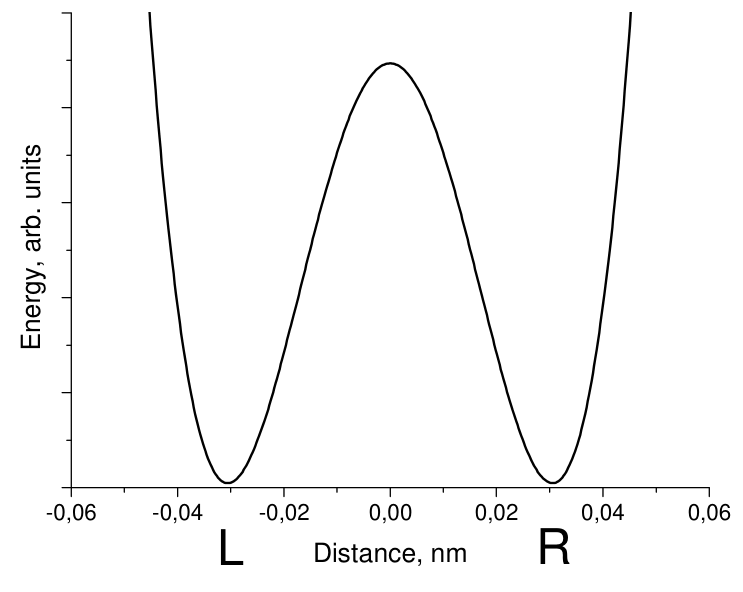
1.3 Draw the structures corresponding to two minima on this curve.
A proton is delocalized between two atoms and oscillates between two minima L and R with an angular frequency \(\omega = 6.48\times10^{11}\ \mathrm{s^{-1}}\). Probability density for a proton depends on time as follows:
\[ \Psi^{2}(x,t)=\frac{1}{2}\left[ \Psi_{\mathrm L}^{2}(x)+\Psi_{\mathrm R}^{2}(x) +\left(\Psi_{\mathrm L}^{2}(x)-\Psi_{\mathrm R}^{2}(x)\right) \cos(\omega t) \right], \]
wavefunctions \(\Psi_{\mathrm L}(x)\) and \(\Psi_{\mathrm R}(x)\) describe a proton localized in the left and right wells, respectively:
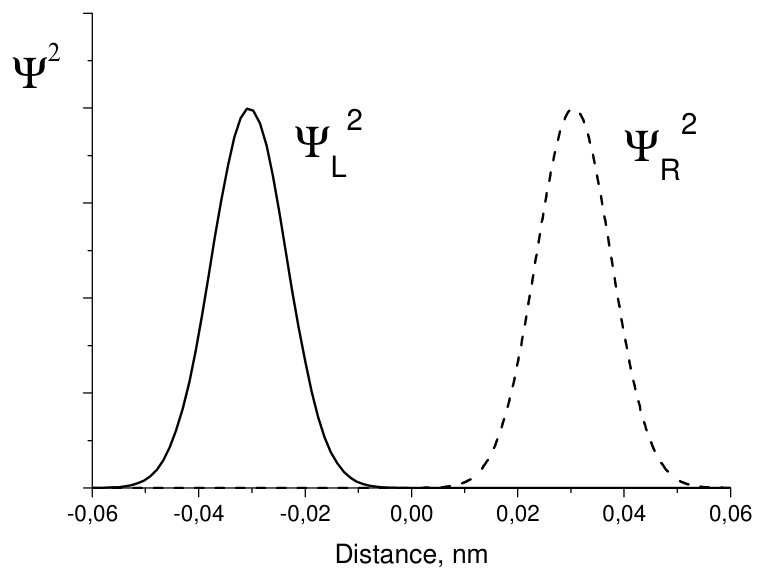
1.4 Write down the expressions for the probability density at three moments: (a) \(t = 0\), (b) \(t = \pi/(2\omega)\), (c) \(t = \pi/\omega\). Sketch the graphs of these three functions.
1.5 Without calculations, determine the probability of finding the proton in the left well at \(t = \pi/(2\omega)\)
1.6 How much time is required for a proton to move from one well to another? What is the proton mean speed during the transfer?
1.7 From the energy curve, estimate the uncertainty of the position of proton forming hydrogen bonds. Estimate the minimal uncertainty of the proton speed. Compare this value with that obtained in 1.6 and draw a conclusion about the proton tunneling (choose one of the versions in the Answer Sheet).
Official English text of the problem.
Problem 2: Nanochemistry
Metals of the iron subgroup are effective catalysts of hydrogenation of \(\ce{CO}\) (Fischer-Tropsch reaction)

Catalyst (e.g. cobalt) is often used in the form of solid nanoparticles that have a spherical structure (fig.1). The reduction in size of the catalyst increases catalytic activity significantly. The unwanted side-reaction however involves the oxidation of the catalyst:

Solid cobalt oxide (bulk) is formed in the reaction vessel. This causes an irreversible loss of the catalyst’s mass. Solid cobalt oxide can also be deposited on the surface of \(\ce{Co(s)}\). In this case the new spherical layer is formed around the surface of the catalyst (see figure 2) and the catalytic activity drops.
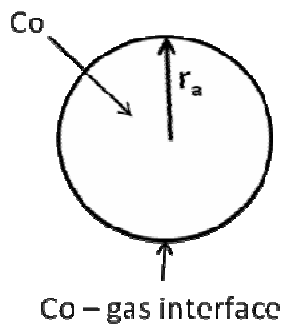
Fig. 1
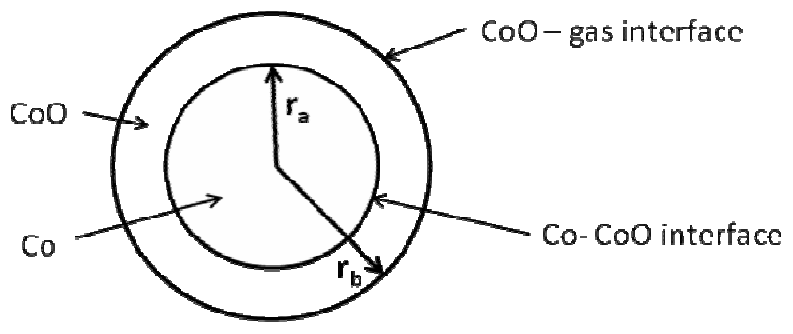
Fig. 2
Let us see how formation of nanoparticles affects the equilibrium of reaction (1).
\[ G^0(r)=G^0(\mathrm{bulk})+\frac{2\sigma}{r}V \]
2.1 Calculate the standard Gibbs energy \(\Delta_rG^0(1)\) and the equilibrium constant for the reaction (1) at \(T=500\ \mathrm{K}\).
2.2 Calculate the equilibrium constant for reaction (1) when the cobalt catalyst is dispersed in the form of spherical particles (Fig. 1) of radius:
(a) \(10^{-8}\ \mathrm{m}\),·
(b) \(10^{-9}\ \mathrm{m}\).
The surface tension at the Co-gas interface is \(0.16\ \mathrm{J\,m^{-2}}\). \(\ce{CoO}\) forms a bulk phase.
The mixture of gases involved in the Fischer-Tropsch (\(\ce{CO}\), \(\ce{CH4}\), \(\ce{H2}\), \(\ce{H2O}\)) reaction was put into a reaction vessel containing the cobalt catalyst. The total pressure is \(p=1\ \mathrm{bar}\), temperature is \(T=500\ \mathrm{K}\). The mole fraction of hydrogen (%) in the mixture is \(0.15\ \%\).
2.3 At what minimum mole fraction of water (%) in the gas mixture the unwanted spontaneous oxidation of the catalyst becomes possible so that solid bulk \(\ce{CoO}\) may appear in the system? Assume that cobalt catalyst is in the form of
(a) a bulk phase
(b) spherical nanoparticles with \(r_a=1\ \mathrm{nm}\) (Fig. 1).
2.4 What would you suggest to protect \(\ce{Co}\) nanoparticles from the spontaneous oxidation with the formation of bulk \(\ce{CoO}\) at a constant ratio \(p(\ce{H2O})/p(\ce{H2})\) and a constant temperature:
(a) to increase \(r_a\);
(b) to decrease \(r_a\);
(c) change of \(r_a\) has no effect.
Assume now that solid cobalt oxide forms a spherical layer around a nanoparticle of cobalt. In this case the nanoparticle contains both a reactant (\(\ce{Co}\)) and a product (\(\ce{CoO}\)) (Fig. 2).
In the following problems denote surface tensions as \(\sigma_{\ce{CoO}-\mathrm{gas}}\), \(\sigma_{\ce{CoO}-\ce{Co}}\), radii as \(r_a\), \(r_b\), molar volumes as \(V(\ce{Co})\); \(V(\ce{CoO})\).
2.5 Write down the expression for the standard molar Gibbs function of \(\ce{CoO}\).
2.6 Write down the expression for the standard molar Gibbs function of \(\ce{Co}\).
Hint. If two spherical interfaces surround a nanoparticle, the excess pressure at its centre is given by the expression
\[ P_{\mathrm{in}}-P_{\mathrm{ex}} =\Delta P=\Delta P_1+\Delta P_2 =2\frac{\sigma_1}{r_1}+2\frac{\sigma_2}{r_2} \]
\(r_i\), \(\sigma_i\) are radius and surface tension at the spherical interface \(i\), respectively.
2.7 Express the standard Gibbs energy of the reaction (1) \(\Delta_rG^0(1,r_a,r_b)\) in terms of \(\sigma_{\ce{CoO}-\mathrm{gas}}\), \(\sigma_{\ce{CoO}-\ce{Co}}\), \(r_a\), \(r_b\), \(V(\ce{Co})\); \(V(\ce{CoO})\) and \(\Delta_rG^0(1)\).
2.8 When spontaneous oxidation of \(\ce{Co}\) begins the radii of two layers in the nanoparticle (Fig. 2) are almost equal, \(r_a=r_b=r_0\), and \(\Delta_rG^0(1,r_a,r_b)=\Delta_rG^0(1,r_0)\). Assume that \(\sigma_{\ce{CoO}-\mathrm{gas}}=2\sigma_{\ce{CoO}-\ce{Co}}\). Which plot in the Answer Sheet describes correctly the dependence of \(\Delta_rG^0(1,r_0)\) on \(r_0\)?
2.9 What would you choose to protect \(\ce{Co}\) nanoparticles from the spontaneous formation of the external layer of \(\ce{CoO}\) at a constant ratio \(p(\ce{H2O})/p(\ce{H2})\) and a constant temperature:
a) increase \(r_0\)
b) decrease \(r_0\)
c) change of \(r_0\) has no effect.
.
Reference data:
Substance \(\rho,\ \mathrm{g\,cm^{-3}}\) \(\Delta_{\mathrm f}G^0_{500},\ \mathrm{kJ\,mol^{-1}}\) \(\ce{Co}\) (s) 8.90 \(\ce{CoO}\) (s) 5.68 \(-198.4\) \(\ce{H2O}\) (gas) \(-219.1\) Official English text of the problem.
Problem 3: Unstable chemical reactions
Many chemical reactions display unstable kinetic behavior. At different conditions (concentrations and temperature) such reactions can proceed in various modes: stable, oscillatory or chaotic. Most of these reactions include autocatalytic elementary steps.
Consider a simple reaction mechanism involving autocatalytic step:
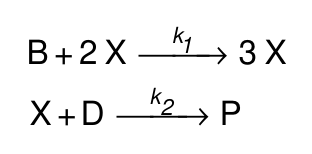
(\(\ce{B}\) and \(\ce{D}\) are reagents, \(\ce{X}\) is an intermediate and \(\ce{P}\) is a product).
3.1 Write down the overall reaction equation for this two-step mechanism. Write the rate equation for \(\ce{X}\).
3.2 Deduce a rate equation using steady-state approximation. Find the orders:
(i) a partial reaction order with respect to \(\ce{B}\);
(ii) a partial reaction order with respect to \(\ce{D}\);
(iii) the overall order of a reaction.
Let the reaction occur in an open system where reagents \(\ce{B}\) and \(\ce{D}\) are being continuously added to the mixture so that their concentrations are maintained constant and equal: \([\ce{B}]=[\ce{D}]=\mathrm{const}\).
3.3 Without solving the kinetic equation draw the kinetic curve \([\ce{X}](t)\) for the cases:
\[ 1)\quad [\ce{X}]_0>\frac{k_2}{k_1}; \qquad 2)\quad [\ce{X}]_0<\frac{k_2}{k_1}. \]
3.4 Without solving the kinetic equation draw the kinetic curve \([\ce{X}](t)\) for the case when the reaction proceeds in a closed vessel with the initial concentrations: \([\ce{B}]_0=[\ce{D}]_0\), \([\ce{X}]_0>\dfrac{k_2}{k_1}\).
Much more complex kinetic behavior is possible for the reactions with several intermediates. Consider a simplified reaction mechanism for cold burning of ethane in oxygen:
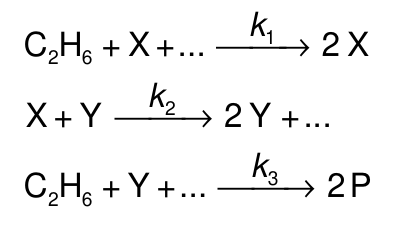
Under specific conditions this reaction displays oscillatory behavior:
Intermediates are peroxide \(\ce{C2H6O2}\) and aldehyde \(\ce{C2H4O}\), \(\ce{P}\) is a stable product.
3.5 Identify \(\ce{X}\), \(\ce{Y}\), and \(\ce{P}\). Fill the blanks in the reaction mechanism.
Behavior of unstable reactions is often controlled by temperature which affects the rate constants. In the above oxidation mechanism oscillations of concentrations are possible only if \(k_1\geq k_2\). Parameters of the Arrhenius equations were determined experimentally:
Step \(A,\ \mathrm{cm^3\,mol^{-1}\,s^{-1}}\) \(E_{\mathrm A},\ \mathrm{kJ\,mol^{-1}}\) 1 \(1.0\times10^{11}\) 90 2 \(3.0\times10^{12}\) 100 3.6 What is the highest temperature at which oscillatory regime is possible? Show your calculations.
Official English text of the problem.
Problem 4: Determination of water by Fischer titration
Determination of water by Fischer titraton
Determination of water by the classical Fischer method involves titration of a sample solution (or suspension) in methanol by a methanolic iodine solution, containing also an excess of \(\ce{SO2}\) and pyridine (\(\ce{C5H5N}\), Py) – Fischer reagent. The following reactions occur during the titration:
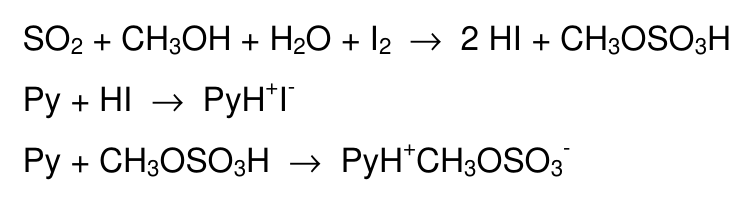
Iodine content is usually expressed in mg of water reacting with \(1\ \mathrm{cm^3}\) of the titrant solution (hereunder T, \(\mathrm{mg\ cm^{-3}}\)), which equals the mass of water (mg) reacting with \(1.00\ \mathrm{cm^3}\) of the iodine solution. T is determined experimentally by titration of a sample with a known water content. The sample may be, for example, a hydrated compound or a standard solution of water in methanol. In the latter case it should be taken into account that methanol itself can contain certain amount of water.
In all calculations please use the atomic masses accurate to 2 decimal points.
4.1 Sometimes titration of water is performed in pyridine medium without methanol. How would the reaction of \(\ce{I2}\) with \(\ce{SO2}\) and \(\ce{H2O}\) occur in this case? Write down balanced reaction equation.
Calculate the T values of iodine solution in each of the following cases:
4.2 \(12.20\ \mathrm{cm^3}\) of Fischer reagent solution were used for titration of \(1.352\ \mathrm{g}\) of sodium tartrate dihydrate \(\ce{Na2C4H4O6 . 2H2O}\).
4.3 A known amount of water (\(21.537\ \mathrm{g}\)) was placed into a \(1.000\ \mathrm{dm^3}\) volumetric flask which was filled by methanol up to the mark. For titration of \(10.00\ \mathrm{cm^3}\) of the obtained solution, \(22.70\ \mathrm{cm^3}\) of Fischer reagent solution were needed, whereas \(2.20\ \mathrm{cm^3}\) of iodine were used for titration of \(25.00\ \mathrm{cm^3}\) of methanol.
4.4 \(5.624\ \mathrm{g}\) of water were diluted by methanol up to a total volume of \(1.000\ \mathrm{dm^3}\) (solution A); \(22.45\ \mathrm{cm^3}\) of this solution were used for titration of \(15.00\ \mathrm{cm^3}\) of a Fischer reagent (solution B).
Then \(25.00\ \mathrm{cm^3}\) of methanol (of the same batch as used for the preparation of solution A) and \(10.00\ \mathrm{cm^3}\) of solution B were mixed, and the mixture was titrated by the solution A. \(10.79\ \mathrm{cm^3}\) of the latter solution were spent.
4.5 An inexperienced analyst tried to determine water content in a sample of \(\ce{CaO}\) using Fischer reagent. Write down the equation(s) of reaction(s) demonstrating possible sources of errors.
For the titration of \(0.6387\ \mathrm{g}\) of a hydrated compound \(\ce{Fe2(SO4)3 . xH2O}\), \(10.59\ \mathrm{cm^3}\) of iodine solution (\(T=15.46\ \mathrm{mg/cm^3}\)) were consumed.
4.6 What other reaction(s), beside those given in the problem, can occur during the titration? Write down the equations of two such processes.
4.7 Write down an equation of the overall reaction of \(\ce{Fe2(SO4)3 . xH2O}\) with the Fischer reagent.
4.8 Calculate the composition of the hydrate \(\ce{Fe2(SO4)3 . xH2O}\) (\(x=\text{integer}\)).
Official English text of the problem.
Problem 5: A mysterious mixture (organic hide-and-seek game)
An equimolar mixture X of three coluorless organic liquids A, B, C was treated by water containing a drop of hydrochloric acid at heating to give (after separation from water) a 1 : 2 (molar ratio) mixture of acetic acid and ethanol without any other components. A catalytic amount (one-two drops) of concentrated sulfuric acid was added o the mixture after hydrolysis and after a long reflux (boiling with reflux condenser) a compound D, a volatile liquid with pleasant smell, was formed in 85% yield. Compound D is not identical with any of A, B, C.
5.1 Draw the structure of compound D?
5.2 Which class of organic compounds does D belong to? Choose the proper variant from those given in the Answer Sheet.
5.3 Even if the reflux is continued twice as long, the yield of D would not exceed 85%. Calculate the expected yield of D if 1 : 1 (molar ratio) mixture of ethanol and acetic acid is taken. Assume that: a) volumes do not change during the reactions; b) all concomitant factors, such as solvent effects, non-additivity of volumes, variation of temperature, etc. are negligible. If you cannot make a quantitative estimate, please indicate whether the yield will be: a) the same (85 %); b) higher than 85 %; c) lower than 85 %.
\(\ce{^1H}\) NMR spectra of compounds A, B, C look very similar and each shows singlet, triplet and quartet with the ratio of integral intensities equal to 1 : 3 : 2.
The same mixture X was subjected to alkaline hydrolysis. A remained unchanged, and was separated. After acidification and short boiling the remaining solution gave 2 : 3 (molar ratio) mixture of acetic acid and ethanol with evolution of gas.
The mixture X (3.92 g) was dissolved in diethyl ether and underwent hydrogenation in the presence of \(\ce{Pd}\) on charcoal catalyst. 0.448 \(\mathrm{dm^3}\) (standard conditions) of hydrogen were absorbed, but after the reaction A and C were isolated unchanged (3.22 g of mixture were recovered) while neither B, nor any other organic compounds, except diethyl ether, could be identified after hydrogenation.
5.4 Determine and draw the structures of A, B, and C.
5.5 Which intermediate compounds are formed during the acidic hydrolysis of C and the basic hydrolysis of B.
The reaction of either B or C with acetone (in the presence of a base) with subsequent acidification by dilute \(\ce{HCl}\) at gentle heating gives the same product, senecioic acid (SA), a compound widely occurring in Nature. Alternatively, senecioic acid can be obtained from acetone by treating it with concentrated \(\ce{HCl}\) and subsequent oxidation of the intermediate product by iodine in alkaline solution. The latter reaction gives, besides sodium salt of senecioic acid, a heavy yellow precipitate E (see the scheme 2).


5.6 Determine the structure of senecioic acid and draw the reaction scheme leading to senecioic acid from acetone.
5.7 Give structure of E
Official English text of the problem.
Problem 6: Silicates as the base of the Earth crust
Silica and compounds derived from it, silicates, constitute ca. 90 % of the Earth crust substances. Silica gives rise to a beautiful material – glass. Nobody knows exactly how glass was discovered. There is a well-favored story related to Phoenician sailors who fused occasionally sea sand and soda ash. It is likely that they discovered the secret of “liquid glass” (LGL) – sodium metasilicate (\(\ce{Na2SiO3}\)) soluble in water.
6.1 The solution of LGL was used earlier as office glue. Write down the net ionic equation accounting for the ability of LGL to set in air.
Hydrolysis of LGL in water allows obtaining a colloidal solution of silicic acid.
6.2 Complete the Table in the Answer Sheet. Write down the net ionic equations matching the processes enumerated in the Table. For each process check the “Yes” box if it leads to changes of pH. Otherwise check the “No” box.
The structure of species occurring in aqueous solutions of silicates is rather complex. However, it is possible to distinguish the main building block of all species – orthosilicate tetrahedron (\(\ce{SiO4^4-}\), 1):
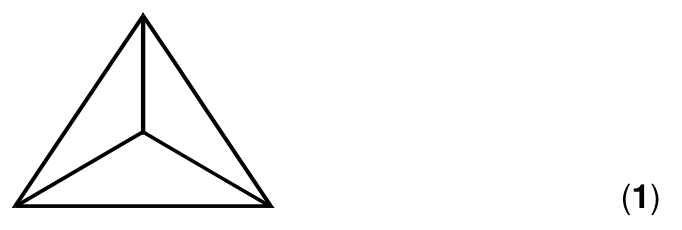
For \(\ce{[Si3O9]^{n-}}\) ion found in aqueous solutions of silicates:
6.3 Determine the charge (n).
6.4 Determine the number of oxygen atoms bridging adjacent tetrahedra.
6.5 Depict its structure joining together several tetrahedra (1). Take into account that any adjacent tetrahedron shares one vertex.
Charged monolayers with the composition \(\ce{[Si4O10]^{m-}}\) are found in kaolinite (clay).
6.6 Using the same strategy as in 6.3 - 6.5, depict a fragment of the layered structure joining 16 tetrahedra (1). Note that 10 tetrahedra have shared vertices with 2 neighbours each, and the rest 6 have shared vertices with 3 neighbours each.
Being placed into the LGL solution, salts of transition metals give rise to fancy “trees” tinted relevant to the colour of the salt of the corresponding transition metal. Crystals of \(\ce{CuSO4 . 5H2O}\) produce “trees” of blue colour, whereas those of \(\ce{NiSO4 . 7H2O}\) form green “trees”.
6.7 Determine the pH of 0.1 M aqueous solution of copper sulphate at 25 °C assuming that its hydrolysis occurs in small degree only. Use the value of the first acidity constant of \(\ce{[Cu(H2O)4]^2+}\) \(K_a^{I}=1\times10^{-7}\).
6.8 Write down equation of a reaction between aqueous solutions of \(\ce{CuSO4}\) and sodium metasilicate (LGL). Take into account the pH values of aqueous solutions of the salts.
Official English text of the problem.
Problem 7: Atherosclerosis and intermediates of cholesterol biosynthesis
Cholesterol is a lipid wide-spread in living nature. Disruption of its metabolism leads to atherosclerosis and related potentially fatal diseases.
Substances X and Y are two key intermediates of cholesterol biosynthesis in animals.
X is an optically active monocarbonic acid composed of atoms of only three elements. It is formed in organisms from (S)-3-hydroxy-3-methylpentanedioyl-coenzyme A (HMG-CoA). This reaction is catalyzed by enzyme E1 (which catalyses two types of reactions) and does not involve water as a substrate. X is further metabolized into X1 through a three-stage process requiring enzymes E2, E3, E4, which catalyze reactions of one and the same (and only one) type. Finally, X1 spontaneously (non-enzymatically) decomposes to give isopentenyl pyrophosphate (3-methylbut-3-enyl diphosphate, IPP) and inorganic products:

Scheme 1
7.1 In the Answer Sheet, choose the reaction type(s) for E1 and E3.
7.2 Draw the structure of X with stereochemical details and indicate absolute configuration (R or S) of the stereocenter.
Y is an unsaturated acyclic hydrocarbon. Its reductive ozonolysis leads to a mixture of only three organic substances Y1, Y2 and Y3 in a molar ratio of 2:4:1. Y is formed as a result of a number of successive coupling reactions of two isomeric substances: IPP and dimethyl allyl pyrophosphate (3-methylbut-2-enyl diphosphate, DAP) with subsequent reduction of a double bond in the final coupling product Y5. Carbon atoms IPP and DAP involved in the formation of C-C bonds during biosynthesis of Y are marked with asterisks.
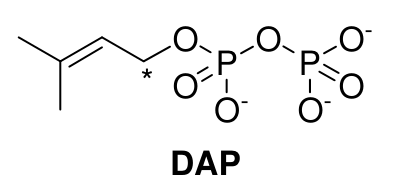
7.3 Write down the overall reaction equation for reductive ozonolysis of DAP, if dimethyl sulfide is used as the reducing agent.
The product of the final coupling reaction (hydrocarbon Y5) is formed when two hydrocarbon residues (R) of intermediate Y4 are combined:
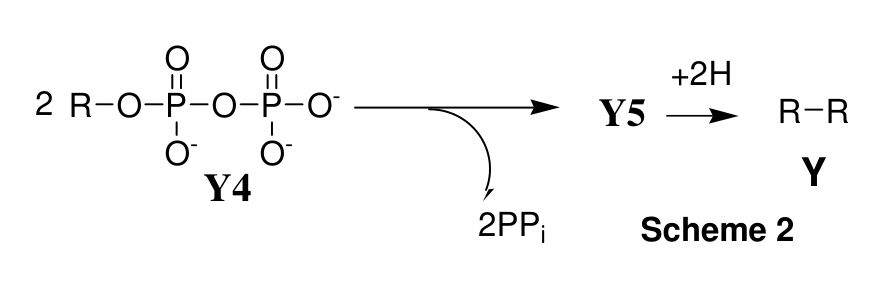
Scheme 2
At each coupling stage but that shown in Scheme 2, pyrophosphate is released in a molar ratio of 1 : 1 to the coupling product.
7.4 Determine molecular formula of Y, if it is known that Y2 and Y3 contain 5 and 4 carbon atoms, respectively.
7.5 Calculate the number of IPP and DAP molecules needed to give Y5, if it is known that all carbon atoms of isomeric pyrophosphates are incorporated into Y.
7.6 Draw the product of coupling reaction of one IPP molecule with one DAP molecule (C-C bond can be formed only by carbon atoms marked with asterisks), if it is known that subsequent reductive ozonolysis of the product of the coupling reaction gives Y1, Y2 and one more product, the latter containing phosphorus.
The only double bond reduced in Y5 during its metabolism into Y was formed in the reaction described in Scheme 2. All double bonds in Y and Y4 exist in trans configuration.
7.7 Draw structures of Y and Y4 with stereochemical details.
Official English text of the problem.
Problem 8: ATRP allows new polymers
ATRP (Atom Transfer Radical Polymerization) is one of the most promising novel approaches towards polymer synthesis. This modification of radical polymerization is based on a redox reaction of organic halides with complexes of transition metals, Cu (I) in particular. The process can be described by the following scheme (M – monomer, Hal – halogen):
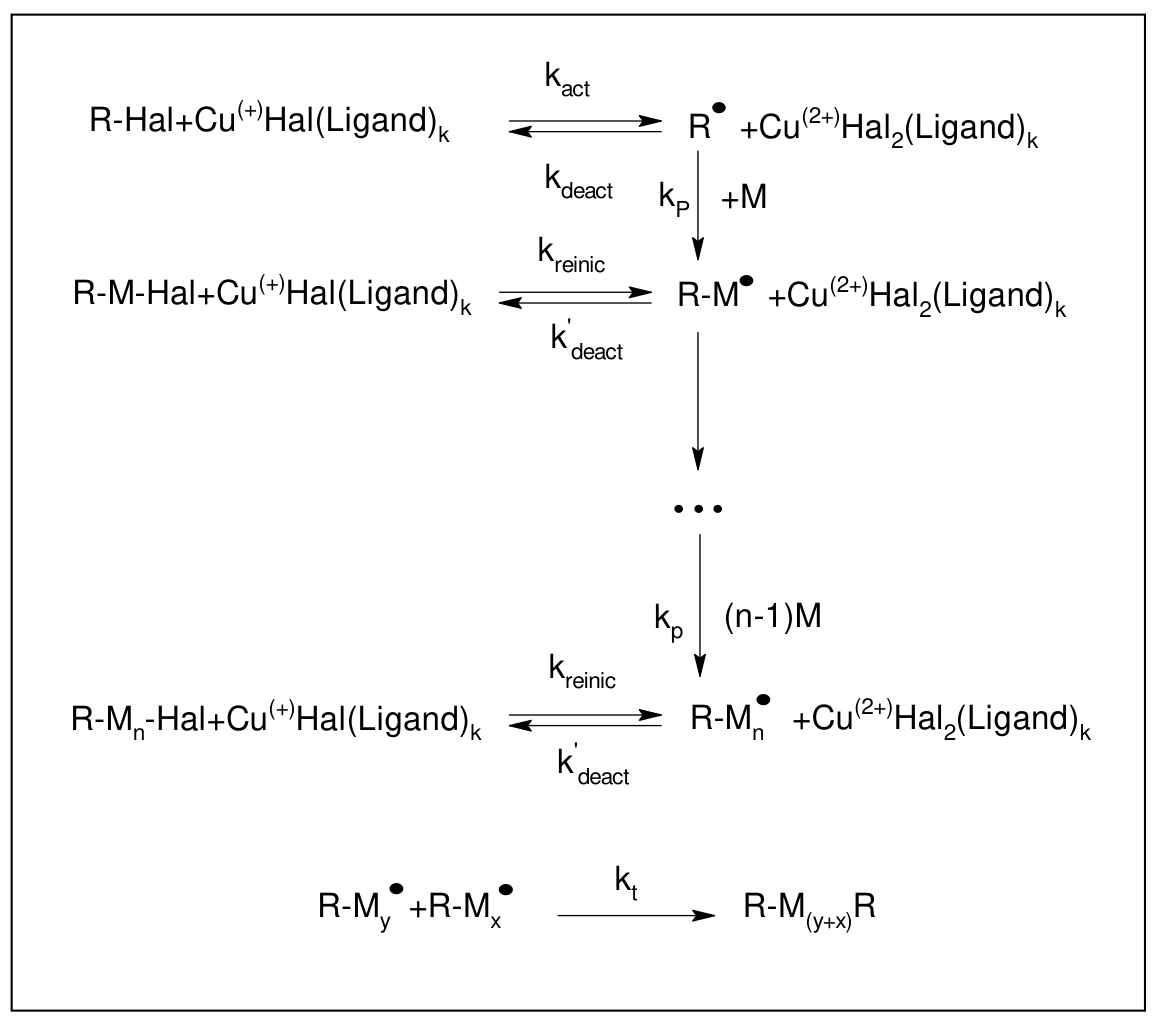
The reaction rate constants are:
\(k_{\mathrm{act}}\) - all activation reactions, \(k_{\mathrm{deact}}\) – all reversible deactivation reactions, \(k_p\) - chain propagation, and \(k_t\) - irreversible termination.
8.1 Write down expressions for the rates of ATRP elementary stages: activation (\(v_{\mathrm{act}}\)), deactivation (\(v_{\mathrm{deact}}\)), propagation (\(v_p\)) and termination (\(v_t\)). Write down generalized equation assuming just one reacting species \(\ce{R'X}\).
Consider that the total number of polymeric chains is equal to that of initiator molecules. Assume that at each moment throughout polymerization all chains are of the same length.
8.2 Compare the rate of deactivation to the rates of ATRP elementary stages.
Dependence of monomer concentration (\([\mathrm{M}]\)) on reaction time (\(t\)) for ATRP is:
\[ \ln\left(\frac{[\mathrm{M}]}{[\mathrm{M}]_0}\right) =-k_p[\ce{R^{\bullet}}]t, \]
\([\mathrm{M}]_0\) - initial monomer concentration, \(k_p\) – rate constant of propagation, \([\ce{R^{\bullet}}]\) – concentration of active radicals.
To prepare a polymer sample by using ATRP, catalytic amounts of \(\ce{CuCl}\), organic ligand (L) and 31.0 mmol of monomer (methylmethacrylate, or MMA) were mixed. The reaction was initiated by adding 0.12 mmol of tosyl chloride (TsCl). Polymerization was conducted for 1400 s. \(k_p\) is 1616 \(\mathrm{L\,mol^{-1}\,s^{-1}}\), and the steady state concentration of radicals is \(1.76\times10^{-7}\ \mathrm{mol\,dm^{-3}}\).
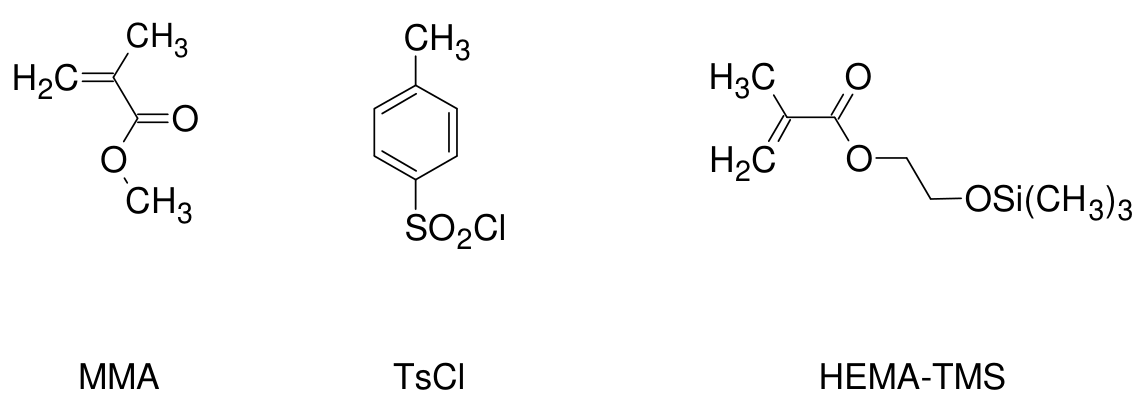
8.3 Calculate mass (\(m\)) of the polymer obtained.
In another experiment the time of MMA polymerization was changed, all the rest reaction conditions being the same. The mass of the obtained polymer was 0.73 g. Then 2-(trimethylsilyloxy)ethyl methacrylate, HEMA-TMS (23.7 mmol) was added to the mixture and polymerization was continued for another 1295 s. MMA and HEMA-TMS reactivities are the same under reaction conditions.
8.4 Calculate degree of polymerization (DP) of the obtained polymer.
8.5 Depict the structure of the obtained polymer (including end groups), showing MMA and HEMA-TMS units as A and B, respectively. If necessary, use the symbols in the copolymer structure representation: block (block), stat (statistical), alt (alternating), grad (gradient), graft (grafted). For example, \((\mathrm{A}_{65}\text{-graft-}\mathrm{C}_{100})\text{-stat-}\mathrm{B}_{34}\) means that chains of polymer C are grafted on units A in the statistic copolymer of A and B.
ATRP was applied to synthesize two block copolymers, \(P_1\) and \(P_2\). One block in both block-copolymers was the same and was synthesized from mono-(2-chloropropionyl)-polyethylene oxide used as a macroinitiator:
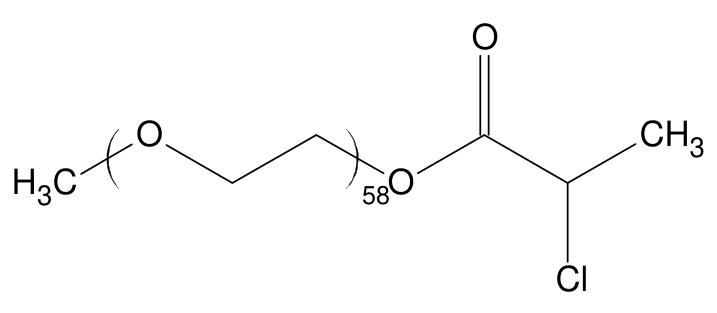
The other block in \(P_1\) consisted of styrene (C), and in \(P_2\) of p-chloromethylstyrene (D) units.
\({}^{1}\mathrm{H}\) NMR spectra of the macroinitiator, \(P_1\) and \(P_2\) are given below. Integral intensities of characteristic signals can be found in the table.
8.6 Assign \({}^{1}\mathrm{H}\) NMR signals to substructures given in the Answer Sheet.
8.7 Determine molar fractions of units C and D and molecular weights of \(P_1\) and \(P_2\).
8.8 Write down all possible reactions of activation occurring during the synthesis of \(P_1\) and \(P_2\). You may use R symbol to depict any unchanged part of the macromolecule, but you should specify what substructure you use it for.
8.9 Draw the structure of \(P_1\) and one of possible structures of \(P_2\) representing poly(ethylene oxide) chain by a wavy line and showing units of co-monomers as C and D, respectively.
signal Integral intensity a - b 40.2 c 13.0 d 10.4 e 1.2 f 2.75 g 40.2 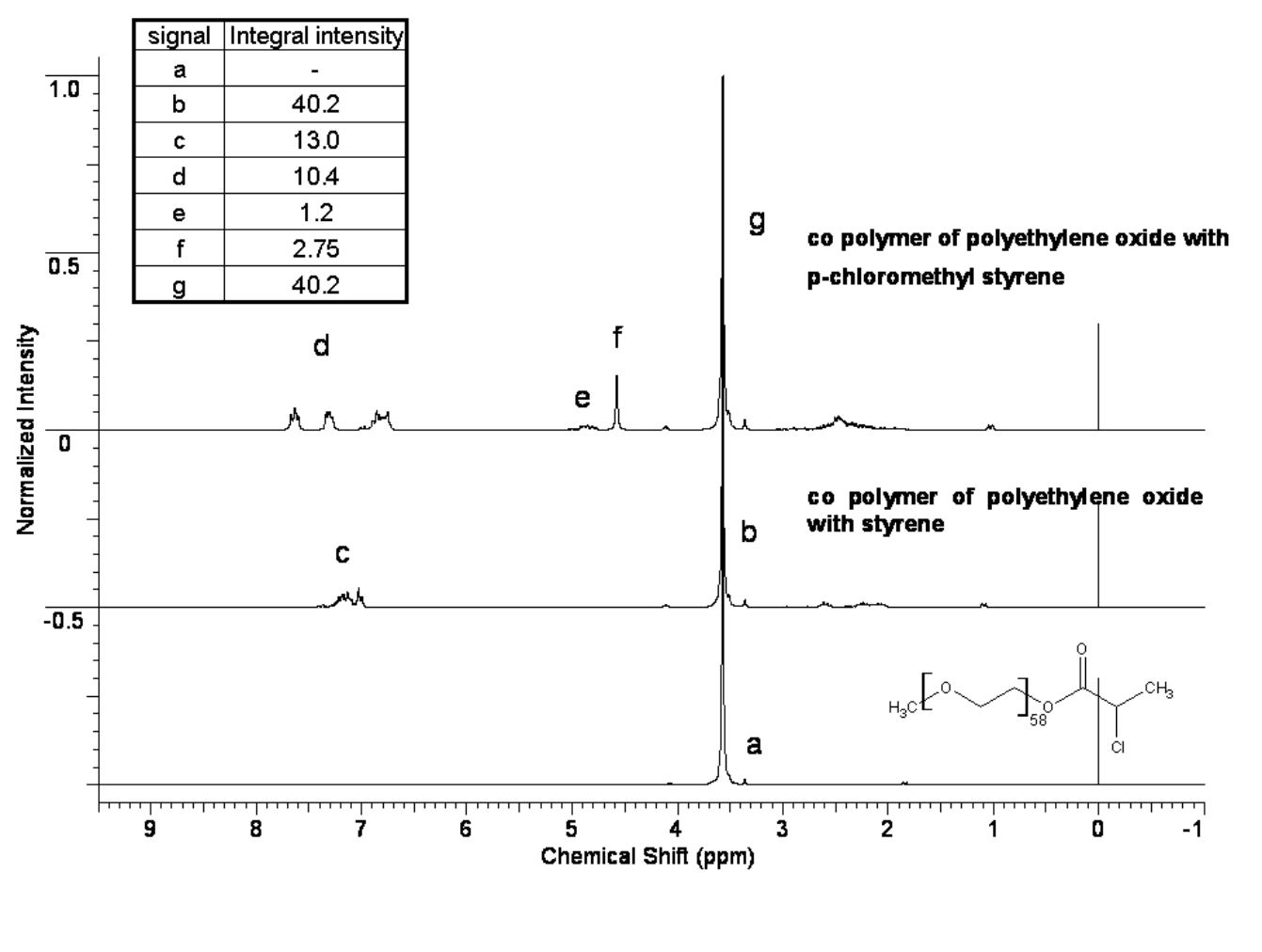
Official English text of the problem.
Internationale Chemie-Olympiade
IChO 2007
Moskau, Russische Föderation · 8 Theorieaufgaben mit vollständigen Lösungen
Aufgabe 1: Protonentunneln
Das Tunneln von Protonen durch Energiebarrieren ist ein wichtiger Effekt, der in vielen komplexen Spezies mit Wasserstoffbrückenbindungen (DNA, Proteine usw.) beobachtet werden kann. Propandial (Malonaldehyd) ist eines der einfachsten Moleküle, bei denen ein intramolekularer Protonentransfer auftreten kann.
1.1 Zeichnen Sie die Halbstrukturformel von Propandial und die Strukturen zweier seiner Isomere, die mit Propandial im Gleichgewicht vorliegen können.
1.2 In wässriger Lösung ist Propandial eine schwache Säure, deren Stärke mit der von Essigsäure vergleichbar ist. Geben Sie das saure Wasserstoffatom an. Erklären Sie seine Acidität (wählen Sie eine Antwortmöglichkeit auf dem Antwortbogen).
In der folgenden Abbildung ist ein Energieprofil des intramolekularen Protonentransfers dargestellt (die Abhängigkeit der Energie von der Strecke der Protonenbewegung (in nm)). Die Energiekurve hat die Form eines symmetrischen Doppelmuldenpotentials.
1.3 Zeichnen Sie die Strukturen, die den beiden Minima dieser Kurve entsprechen.
Ein Proton ist zwischen zwei Atomen delokalisiert und oszilliert zwischen zwei Minima L und R mit einer Kreisfrequenz von \(\omega = 6.48\times10^{11}\ \mathrm{s^{-1}}\). Die Wahrscheinlichkeitsdichte für ein Proton hängt wie folgt von der Zeit ab:
\[ \Psi^{2}(x,t)=\frac{1}{2}\left[ \Psi_{\mathrm L}^{2}(x)+\Psi_{\mathrm R}^{2}(x) +\left(\Psi_{\mathrm L}^{2}(x)-\Psi_{\mathrm R}^{2}(x)\right) \cos(\omega t) \right], \]
wobei die Wellenfunktionen \(\Psi_{\mathrm L}(x)\) und \(\Psi_{\mathrm R}(x)\) ein in der linken bzw. rechten Potentialmulde lokalisiertes Proton beschreiben:
1.4 Geben Sie die Ausdrücke für die Wahrscheinlichkeitsdichte zu drei Zeitpunkten an: (a) \(t = 0\), (b) \(t = \pi/(2\omega)\), (c) \(t = \pi/\omega\). Skizzieren Sie die Graphen dieser drei Funktionen.
1.5 Bestimmen Sie ohne Rechnung die Wahrscheinlichkeit, das Proton bei \(t = \pi/(2\omega)\) in der linken Potentialmulde zu finden.
1.6 Wie viel Zeit benötigt ein Proton, um sich von einer Potentialmulde zur anderen zu bewegen? Wie groß ist die mittlere Geschwindigkeit des Protons während des Transfers?
1.7 Schätzen Sie anhand der Energiekurve die Ortsunschärfe des Protons ab, das Wasserstoffbrückenbindungen bildet. Schätzen Sie die minimale Geschwindigkeitsunschärfe des Protons ab. Vergleichen Sie diesen Wert mit dem in 1.6 erhaltenen Wert und ziehen Sie eine Schlussfolgerung zum Protonentunneln (wählen Sie eine der Antwortmöglichkeiten auf dem Antwortbogen).
Aufgabentext aus dem offiziellen englischen Text übersetzt.
Aufgabe 2: Nanochemie
Metalle der Eisengruppe sind wirksame Katalysatoren für die Hydrierung von \(\ce{CO}\) (Fischer-Tropsch-Reaktion)
Der Katalysator (z. B. Cobalt) wird häufig in Form fester Nanopartikel mit kugelförmiger Struktur eingesetzt (Abb. 1). Eine Verringerung der Größe des Katalysators erhöht die katalytische Aktivität erheblich. Bei der unerwünschten Nebenreaktion wird jedoch der Katalysator oxidiert:
Im Reaktionsgefäß entsteht festes Cobaltoxid als Volumenphase. Dies führt zu einem irreversiblen Verlust an Katalysatormasse. Festes Cobaltoxid kann sich auch auf der Oberfläche von \(\ce{Co(s)}\) ablagern. In diesem Fall bildet sich eine neue kugelförmige Schicht um die Oberfläche des Katalysators (siehe Abbildung 2), und die katalytische Aktivität nimmt ab.
Abb. 1
Abb. 2
Betrachten wir, wie sich die Bildung von Nanopartikeln auf das Gleichgewicht der Reaktion (1) auswirkt.
\[ G^0(r)=G^0(\mathrm{bulk})+\frac{2\sigma}{r}V \]
2.1 Berechnen Sie die Standard-Gibbs-Energie \(\Delta_rG^0(1)\) und die Gleichgewichtskonstante für die Reaktion (1) bei \(T=500\ \mathrm{K}\).
2.2 Berechnen Sie die Gleichgewichtskonstante für die Reaktion (1), wenn der Cobaltkatalysator in Form kugelförmiger Partikel (Abb. 1) mit folgendem Radius dispergiert ist:
(a) \(10^{-8}\ \mathrm{m}\),·
(b) \(10^{-9}\ \mathrm{m}\).
Die Oberflächenspannung an der Co-Gas-Grenzfläche beträgt \(0.16\ \mathrm{J\,m^{-2}}\). \(\ce{CoO}\) bildet eine Volumenphase.
Das Gemisch der an der Fischer-Tropsch-Reaktion beteiligten Gase (\(\ce{CO}\), \(\ce{CH4}\), \(\ce{H2}\), \(\ce{H2O}\)) wurde in ein Reaktionsgefäß mit dem Cobaltkatalysator eingebracht. Der Gesamtdruck beträgt \(p=1\ \mathrm{bar}\), die Temperatur beträgt \(T=500\ \mathrm{K}\). Der Stoffmengenanteil von Wasserstoff (%) im Gemisch beträgt \(0.15\ \%\).
2.3 Ab welchem minimalen Stoffmengenanteil von Wasser (%) im Gasgemisch wird die unerwünschte spontane Oxidation des Katalysators möglich, sodass festes \(\ce{CoO}\) als Volumenphase im System auftreten kann? Nehmen Sie an, dass der Cobaltkatalysator in folgender Form vorliegt:
(a) als Volumenphase
(b) als kugelförmige Nanopartikel mit \(r_a=1\ \mathrm{nm}\) (Abb. 1).
2.4 Was würden Sie vorschlagen, um \(\ce{Co}\)-Nanopartikel bei konstantem Verhältnis \(p(\ce{H2O})/p(\ce{H2})\) und konstanter Temperatur vor spontaner Oxidation unter Bildung von \(\ce{CoO}\) als Volumenphase zu schützen:
(a) \(r_a\) vergrößern;
(b) \(r_a\) verkleinern;
(c) eine Änderung von \(r_a\) hat keinen Einfluss.
Nehmen Sie nun an, dass festes Cobaltoxid eine kugelförmige Schicht um ein Cobalt-Nanopartikel bildet. In diesem Fall enthält das Nanopartikel sowohl einen Reaktanten (\(\ce{Co}\)) als auch ein Produkt (\(\ce{CoO}\)) (Abb. 2).
Bezeichnen Sie in den folgenden Teilaufgaben die Oberflächenspannungen mit \(\sigma_{\ce{CoO}-\mathrm{gas}}\), \(\sigma_{\ce{CoO}-\ce{Co}}\), die Radien mit \(r_a\), \(r_b\) und die molaren Volumina mit \(V(\ce{Co})\); \(V(\ce{CoO})\).
2.5 Geben Sie den Ausdruck für die molare Standard-Gibbs-Funktion von \(\ce{CoO}\) an.
2.6 Geben Sie den Ausdruck für die molare Standard-Gibbs-Funktion von \(\ce{Co}\) an.
Hinweis. Wenn zwei kugelförmige Grenzflächen ein Nanopartikel umgeben, ist der Überdruck in seinem Mittelpunkt durch folgenden Ausdruck gegeben:
\[ P_{\mathrm{in}}-P_{\mathrm{ex}} =\Delta P=\Delta P_1+\Delta P_2 =2\frac{\sigma_1}{r_1}+2\frac{\sigma_2}{r_2} \]
\(r_i\) und \(\sigma_i\) sind der Radius bzw. die Oberflächenspannung an der kugelförmigen Grenzfläche \(i\).
2.7 Drücken Sie die Standard-Gibbs-Energie der Reaktion (1), \(\Delta_rG^0(1,r_a,r_b)\), durch \(\sigma_{\ce{CoO}-\mathrm{gas}}\), \(\sigma_{\ce{CoO}-\ce{Co}}\), \(r_a\), \(r_b\), \(V(\ce{Co})\); \(V(\ce{CoO})\) und \(\Delta_rG^0(1)\) aus.
2.8 Wenn die spontane Oxidation von \(\ce{Co}\) beginnt, sind die Radien der beiden Schichten im Nanopartikel (Abb. 2) nahezu gleich, \(r_a=r_b=r_0\), und es gilt \(\Delta_rG^0(1,r_a,r_b)=\Delta_rG^0(1,r_0)\). Nehmen Sie an, dass \(\sigma_{\ce{CoO}-\mathrm{gas}}=2\sigma_{\ce{CoO}-\ce{Co}}\) gilt. Welcher Graph auf dem Antwortbogen beschreibt die Abhängigkeit von \(\Delta_rG^0(1,r_0)\) von \(r_0\) korrekt?
2.9 Was würden Sie wählen, um \(\ce{Co}\)-Nanopartikel bei konstantem Verhältnis \(p(\ce{H2O})/p(\ce{H2})\) und konstanter Temperatur vor der spontanen Bildung einer äußeren Schicht aus \(\ce{CoO}\) zu schützen:
a) \(r_0\) vergrößern
b) \(r_0\) verkleinern
c) eine Änderung von \(r_0\) hat keinen Einfluss.
.
Referenzdaten:
Stoff \(\rho,\ \mathrm{g\,cm^{-3}}\) \(\Delta_{\mathrm f}G^0_{500},\ \mathrm{kJ\,mol^{-1}}\) \(\ce{Co}\) (s) 8.90 \(\ce{CoO}\) (s) 5.68 \(-198.4\) \(\ce{H2O}\) (gasförmig) \(-219.1\) Aufgabentext aus dem offiziellen englischen Text übersetzt.
Aufgabe 3: Instabile chemische Reaktionen
Viele chemische Reaktionen zeigen ein instabiles kinetisches Verhalten. Unter unterschiedlichen Bedingungen (Konzentrationen und Temperatur) können solche Reaktionen in verschiedenen Zuständen ablaufen: stabil, oszillierend oder chaotisch. Die meisten dieser Reaktionen enthalten autokatalytische Elementarschritte.
Betrachten Sie einen einfachen Reaktionsmechanismus mit einem autokatalytischen Schritt:
(\(\ce{B}\) und \(\ce{D}\) sind Edukte, \(\ce{X}\) ist ein Zwischenprodukt und \(\ce{P}\) ist ein Produkt).
3.1 Geben Sie die Gesamtreaktionsgleichung für diesen zweistufigen Mechanismus an. Stellen Sie die Geschwindigkeitsgleichung für \(\ce{X}\) auf.
3.2 Leiten Sie mithilfe der Quasistationaritätsnäherung ein Geschwindigkeitsgesetz her. Bestimmen Sie die Ordnungen:
(i) die Teilreaktionsordnung bezüglich \(\ce{B}\);
(ii) die Teilreaktionsordnung bezüglich \(\ce{D}\);
(iii) die Gesamtreaktionsordnung.
Die Reaktion soll in einem offenen System ablaufen, in dem die Edukte \(\ce{B}\) und \(\ce{D}\) dem Gemisch kontinuierlich zugeführt werden, sodass ihre Konzentrationen konstant und gleich gehalten werden: \([\ce{B}]=[\ce{D}]=\mathrm{const}\).
3.3 Zeichnen Sie, ohne die kinetische Gleichung zu lösen, die Konzentrations-Zeit-Kurve \([\ce{X}](t)\) für die Fälle:
\[ 1)\quad [\ce{X}]_0>\frac{k_2}{k_1}; \qquad 2)\quad [\ce{X}]_0<\frac{k_2}{k_1}. \]
3.4 Zeichnen Sie, ohne die kinetische Gleichung zu lösen, die Konzentrations-Zeit-Kurve \([\ce{X}](t)\) für den Fall, dass die Reaktion in einem geschlossenen Gefäß mit den Anfangskonzentrationen \([\ce{B}]_0=[\ce{D}]_0\), \([\ce{X}]_0>\dfrac{k_2}{k_1}\) abläuft.
Bei Reaktionen mit mehreren Zwischenprodukten ist ein wesentlich komplexeres kinetisches Verhalten möglich. Betrachten Sie einen vereinfachten Reaktionsmechanismus für die kalte Verbrennung von Ethan in Sauerstoff:
Unter bestimmten Bedingungen zeigt diese Reaktion ein oszillierendes Verhalten:
Die Zwischenprodukte sind das Peroxid \(\ce{C2H6O2}\) und der Aldehyd \(\ce{C2H4O}\), \(\ce{P}\) ist ein stabiles Produkt.
3.5 Identifizieren Sie \(\ce{X}\), \(\ce{Y}\) und \(\ce{P}\). Ergänzen Sie die Lücken im Reaktionsmechanismus.
Das Verhalten instabiler Reaktionen wird häufig durch die Temperatur gesteuert, die die Geschwindigkeitskonstanten beeinflusst. Im obigen Oxidationsmechanismus sind Konzentrationsoszillationen nur möglich, wenn \(k_1\geq k_2\). Die Parameter der Arrhenius-Gleichungen wurden experimentell bestimmt:
Schritt \(A,\ \mathrm{cm^3\,mol^{-1}\,s^{-1}}\) \(E_{\mathrm A},\ \mathrm{kJ\,mol^{-1}}\) 1 \(1.0\times10^{11}\) 90 2 \(3.0\times10^{12}\) 100 3.6 Wie hoch ist die höchste Temperatur, bei der ein oszillierender Reaktionsverlauf möglich ist? Zeigen Sie Ihre Berechnungen.
Aufgabentext aus dem offiziellen englischen Text übersetzt.
Aufgabe 4: Wasserbestimmung durch Fischer-Titration
Wasserbestimmung durch Fischer-Titration
Die Wasserbestimmung nach der klassischen Fischer-Methode erfolgt durch Titration einer Probenlösung (oder Suspension) in Methanol mit einer methanolischen Iodlösung, die außerdem einen Überschuss an \(\ce{SO2}\) und Pyridin (\(\ce{C5H5N}\), Py) enthält – dem Fischer-Reagenz. Während der Titration laufen folgende Reaktionen ab:
Der Iodgehalt wird üblicherweise in mg Wasser angegeben, die mit \(1\ \mathrm{cm^3}\) der Maßlösung reagieren (im Folgenden T, \(\mathrm{mg\ cm^{-3}}\)); dies entspricht der Masse an Wasser (mg), die mit \(1.00\ \mathrm{cm^3}\) der Iodlösung reagiert. T wird experimentell durch Titration einer Probe mit bekanntem Wassergehalt bestimmt. Die Probe kann beispielsweise eine hydratisierte Verbindung oder eine Standardlösung von Wasser in Methanol sein. Im letzteren Fall ist zu berücksichtigen, dass Methanol selbst eine gewisse Menge Wasser enthalten kann.
Verwenden Sie bei allen Berechnungen die auf zwei Dezimalstellen angegebenen Atommassen.
4.1 Mitunter wird die Titration von Wasser in Pyridin ohne Methanol durchgeführt. Wie würde die Reaktion von \(\ce{I2}\) mit \(\ce{SO2}\) und \(\ce{H2O}\) in diesem Fall ablaufen? Geben Sie die ausgeglichene Reaktionsgleichung an.
Berechnen Sie die T-Werte der Iodlösung für jeden der folgenden Fälle:
4.2 Für die Titration von \(1.352\ \mathrm{g}\) Natriumtartrat-Dihydrat \(\ce{Na2C4H4O6 . 2H2O}\) wurden \(12.20\ \mathrm{cm^3}\) Fischer-Reagenzlösung verbraucht.
4.3 Eine bekannte Menge Wasser (\(21.537\ \mathrm{g}\)) wurde in einen \(1.000\ \mathrm{dm^3}\)-Messkolben gegeben, der mit Methanol bis zur Marke aufgefüllt wurde. Für die Titration von \(10.00\ \mathrm{cm^3}\) der erhaltenen Lösung wurden \(22.70\ \mathrm{cm^3}\) Fischer-Reagenzlösung benötigt, während für die Titration von \(25.00\ \mathrm{cm^3}\) Methanol \(2.20\ \mathrm{cm^3}\) Iodlösung verbraucht wurden.
4.4 \(5.624\ \mathrm{g}\) Wasser wurden mit Methanol auf ein Gesamtvolumen von \(1.000\ \mathrm{dm^3}\) verdünnt (Lösung A); \(22.45\ \mathrm{cm^3}\) dieser Lösung wurden für die Titration von \(15.00\ \mathrm{cm^3}\) eines Fischer-Reagenzes (Lösung B) verbraucht.
Anschließend wurden \(25.00\ \mathrm{cm^3}\) Methanol (aus derselben Charge wie das zur Herstellung von Lösung A verwendete Methanol) und \(10.00\ \mathrm{cm^3}\) der Lösung B gemischt und das Gemisch mit Lösung A titriert. Von letzterer Lösung wurden \(10.79\ \mathrm{cm^3}\) verbraucht.
4.5 Ein unerfahrener Analytiker versuchte, den Wassergehalt einer Probe von \(\ce{CaO}\) mit Fischer-Reagenz zu bestimmen. Geben Sie die Reaktionsgleichung(en) an, die mögliche Fehlerquellen aufzeigen.
Für die Titration von \(0.6387\ \mathrm{g}\) einer hydratisierten Verbindung \(\ce{Fe2(SO4)3 . xH2O}\) wurden \(10.59\ \mathrm{cm^3}\) Iodlösung (\(T=15.46\ \mathrm{mg/cm^3}\)) verbraucht.
4.6 Welche weitere(n) Reaktion(en) können neben den in der Aufgabenstellung angegebenen während der Titration ablaufen? Geben Sie die Gleichungen für zwei solche Vorgänge an.
4.7 Geben Sie eine Gleichung für die Gesamtreaktion von \(\ce{Fe2(SO4)3 . xH2O}\) mit dem Fischer-Reagenz an.
4.8 Berechnen Sie die Zusammensetzung des Hydrats \(\ce{Fe2(SO4)3 . xH2O}\) (\(x=\text{ganze Zahl}\)).
Aufgabentext aus dem offiziellen englischen Text übersetzt.
Aufgabe 5: Ein geheimnisvolles Gemisch (organisches Versteckspiel)
Ein äquimolares Gemisch X aus drei farblosen organischen Flüssigkeiten A, B, C wurde unter Erwärmen mit Wasser behandelt, das einen Tropfen Salzsäure enthielt. Dabei entstand (nach Abtrennung vom Wasser) ein Gemisch aus Essigsäure und Ethanol im Molverhältnis 1 : 2 ohne weitere Bestandteile. Nach der Hydrolyse wurde dem Gemisch eine katalytische Menge (ein bis zwei Tropfen) konzentrierter Schwefelsäure zugesetzt. Nach längerem Erhitzen unter Rückfluss (Sieden mit Rückflusskühler) bildete sich mit einer Ausbeute von 85% eine Verbindung D, eine flüchtige Flüssigkeit mit angenehmem Geruch. Die Verbindung D ist mit keiner der Verbindungen A, B, C identisch.
5.1 Zeichnen Sie die Struktur der Verbindung D.
5.2 Zu welcher Klasse organischer Verbindungen gehört D? Wählen Sie die passende Antwort aus den auf dem Antwortbogen angegebenen Möglichkeiten aus.
5.3 Selbst wenn das Erhitzen unter Rückfluss doppelt so lange fortgesetzt wird, würde die Ausbeute an D 85% nicht überschreiten. Berechnen Sie die zu erwartende Ausbeute an D, wenn ein Gemisch aus Ethanol und Essigsäure im Molverhältnis 1 : 1 eingesetzt wird. Nehmen Sie an, dass: a) sich die Volumina während der Reaktionen nicht ändern; b) alle Begleiteinflüsse, wie Lösungsmitteleffekte, Nichtadditivität der Volumina, Temperaturänderungen usw., vernachlässigbar sind. Falls Sie keine quantitative Abschätzung vornehmen können, geben Sie bitte an, ob die Ausbeute: a) gleich (85 %); b) höher als 85 %; c) niedriger als 85 % sein wird.
Die \(\ce{^1H}\)-NMR-Spektren der Verbindungen A, B, C sehen sehr ähnlich aus und zeigen jeweils ein Singulett, ein Triplett und ein Quartett mit einem Verhältnis der integralen Intensitäten von 1 : 3 : 2.
Dasselbe Gemisch X wurde einer alkalischen Hydrolyse unterzogen. A blieb unverändert und wurde abgetrennt. Nach Ansäuern und kurzem Aufkochen lieferte die verbleibende Lösung unter Gasentwicklung ein Gemisch aus Essigsäure und Ethanol im Molverhältnis 2 : 3.
Das Gemisch X (3.92 g) wurde in Diethylether gelöst und in Gegenwart von \(\ce{Pd}\) auf Aktivkohle als Katalysator hydriert. Dabei wurden 0.448 \(\mathrm{dm^3}\) Wasserstoff (unter Normbedingungen) aufgenommen. Nach der Reaktion wurden jedoch A und C unverändert isoliert (3.22 g des Gemisches wurden zurückgewonnen), während nach der Hydrierung weder B noch andere organische Verbindungen außer Diethylether nachgewiesen werden konnten.
5.4 Bestimmen und zeichnen Sie die Strukturen von A, B, und C.
5.5 Welche Zwischenverbindungen entstehen bei der sauren Hydrolyse von C und der basischen Hydrolyse von B?
Die Reaktion von B oder C mit Aceton (in Gegenwart einer Base) und anschließendem Ansäuern mit verdünnter \(\ce{HCl}\) unter vorsichtigem Erwärmen ergibt dasselbe Produkt, Seneciosäure (SA), eine in der Natur weitverbreitete Verbindung. Alternativ lässt sich Seneciosäure aus Aceton durch Behandlung mit konzentrierter \(\ce{HCl}\) und anschließende Oxidation des Zwischenprodukts mit Iod in alkalischer Lösung gewinnen. Die letztgenannte Reaktion liefert neben dem Natriumsalz der Seneciosäure einen schweren gelben Niederschlag E (siehe Schema 2).
5.6 Bestimmen Sie die Struktur der Seneciosäure und zeichnen Sie das Reaktionsschema, das von Aceton zur Seneciosäure führt.
5.7 Geben Sie die Struktur von E an.
Aufgabentext aus dem offiziellen englischen Text übersetzt.
Aufgabe 6: Silicate als Grundlage der Erdkruste
Siliciumdioxid und die davon abgeleiteten Verbindungen, die Silicate, machen etwa 90 % der Stoffe der Erdkruste aus. Aus Siliciumdioxid entsteht ein wunderschönes Material – Glas. Niemand weiß genau, wie Glas entdeckt wurde. Eine beliebte Geschichte handelt von phönizischen Seefahrern, die zufällig Meeressand und Soda zusammenschmolzen. Wahrscheinlich entdeckten sie das Geheimnis des „Wasserglases“ (LGL) – des wasserlöslichen Natriummetasilicats (\(\ce{Na2SiO3}\)).
6.1 Die LGL-Lösung wurde früher als Büroklebstoff verwendet. Geben Sie die Netto-Ionengleichung an, die erklärt, warum LGL an der Luft aushärtet.
Durch Hydrolyse von LGL in Wasser lässt sich eine kolloidale Lösung von Kieselsäure erhalten.
6.2 Vervollständigen Sie die Tabelle im Antwortbogen. Geben Sie die Netto-Ionengleichungen für die in der Tabelle aufgeführten Vorgänge an. Kreuzen Sie für jeden Vorgang das Kästchen „Ja“ an, wenn er zu einer Änderung des pH-Werts führt. Andernfalls kreuzen Sie das Kästchen „Nein“ an.
Die Struktur der in wässrigen Silicatlösungen vorkommenden Spezies ist recht komplex. Dennoch lässt sich der grundlegende Baustein aller Spezies erkennen – das Orthosilicat-Tetraeder (\(\ce{SiO4^4-}\), 1):
Für das in wässrigen Silicatlösungen vorkommende \(\ce{[Si3O9]^{n-}}\)-Ion:
6.3 Bestimmen Sie die Ladung (n).
6.4 Bestimmen Sie die Anzahl der Sauerstoffatome, die benachbarte Tetraeder miteinander verbrücken.
6.5 Stellen Sie seine Struktur dar, indem Sie mehrere Tetraeder (1) miteinander verbinden. Berücksichtigen Sie dabei, dass benachbarte Tetraeder jeweils eine gemeinsame Ecke besitzen.
Geladene Einzelschichten mit der Zusammensetzung \(\ce{[Si4O10]^{m-}}\) kommen in Kaolinit (Ton) vor.
6.6 Stellen Sie mit derselben Vorgehensweise wie in 6.3 - 6.5 einen Ausschnitt der Schichtstruktur dar, indem Sie 16 Tetraeder (1) miteinander verbinden. Beachten Sie, dass 10 Tetraeder mit jeweils 2 Nachbarn gemeinsame Ecken besitzen und die übrigen 6 mit jeweils 3 Nachbarn.
Werden Salze von Übergangsmetallen in die LGL-Lösung gegeben, entstehen fantasievolle „Bäume“, deren Färbung der Farbe des Salzes des jeweiligen Übergangsmetalls entspricht. Kristalle von \(\ce{CuSO4 . 5H2O}\) erzeugen blaue „Bäume“, während Kristalle von \(\ce{NiSO4 . 7H2O}\) grüne „Bäume“ bilden.
6.7 Bestimmen Sie den pH-Wert einer 0.1 M wässrigen Kupfersulfatlösung bei 25 °C unter der Annahme, dass die Hydrolyse nur in geringem Umfang stattfindet. Verwenden Sie für die erste Säurekonstante von \(\ce{[Cu(H2O)4]^2+}\) den Wert \(K_a^{I}=1\times10^{-7}\).
6.8 Geben Sie die Gleichung einer Reaktion zwischen wässrigen Lösungen von \(\ce{CuSO4}\) und Natriummetasilicat (LGL) an. Berücksichtigen Sie dabei die pH-Werte der wässrigen Lösungen der Salze.
Aufgabentext aus dem offiziellen englischen Text übersetzt.
Aufgabe 7: Atherosklerose und Zwischenprodukte der Cholesterinbiosynthese
Cholesterin ist ein in der belebten Natur weitverbreitetes Lipid. Störungen seines Stoffwechsels führen zu Atherosklerose und damit verbundenen, potenziell tödlichen Erkrankungen.
Die Substanzen X und Y sind zwei zentrale Zwischenprodukte der Cholesterinbiosynthese bei Tieren.
X ist eine optisch aktive Monocarbonsäure, die aus Atomen von nur drei Elementen besteht. Sie wird in Organismen aus (S)-3-Hydroxy-3-methylpentandioyl-Coenzym A (HMG-CoA) gebildet. Diese Reaktion wird durch das Enzym E1 katalysiert (das zwei Reaktionstypen katalysiert) und benötigt kein Wasser als Substrat. X wird anschließend in einem dreistufigen Prozess zu X1 verstoffwechselt. Dafür werden die Enzyme E2, E3, E4 benötigt, die Reaktionen ein und desselben (und nur eines) Typs katalysieren. Schließlich zerfällt X1 spontan (nichtenzymatisch) unter Bildung von Isopentenylpyrophosphat (3-Methylbut-3-enyldiphosphat, IPP) und anorganischen Produkten:
Schema 1
7.1 Wählen Sie im Antwortbogen den bzw. die Reaktionstypen für E1 und E3 aus.
7.2 Zeichnen Sie die Struktur von X mit stereochemischen Details und geben Sie die absolute Konfiguration (R oder S) des Stereozentrums an.
Y ist ein ungesättigter acyclischer Kohlenwasserstoff. Seine reduktive Ozonolyse führt zu einem Gemisch aus nur drei organischen Substanzen Y1, Y2 und Y3 im Stoffmengenverhältnis 2:4:1. Y entsteht durch eine Reihe aufeinanderfolgender Kupplungsreaktionen zweier isomerer Substanzen: IPP und Dimethylallylpyrophosphat (3-Methylbut-2-enyldiphosphat, DAP), gefolgt von der Reduktion einer Doppelbindung im letzten Kupplungsprodukt Y5. Die Kohlenstoffatome von IPP und DAP, die bei der Biosynthese von Y an der Bildung von C-C-Bindungen beteiligt sind, sind mit Sternchen markiert.
7.3 Geben Sie die Gesamtreaktionsgleichung für die reduktive Ozonolyse von DAP an, wenn Dimethylsulfid als Reduktionsmittel verwendet wird.
Das Produkt der letzten Kupplungsreaktion (der Kohlenwasserstoff Y5) entsteht durch die Verknüpfung zweier Kohlenwasserstoffreste (R) des Zwischenprodukts Y4:
Schema 2
Bei jedem Kupplungsschritt außer dem in Schema 2 gezeigten wird Pyrophosphat im Stoffmengenverhältnis 1 : 1 zum Kupplungsprodukt freigesetzt.
7.4 Bestimmen Sie die Summenformel von Y, wenn bekannt ist, dass Y2 und Y3 5 bzw. 4 Kohlenstoffatome enthalten.
7.5 Berechnen Sie die Anzahl der IPP- und DAP-Moleküle, die zur Bildung von Y5 benötigt werden, wenn bekannt ist, dass alle Kohlenstoffatome der isomeren Pyrophosphate in Y eingebaut werden.
7.6 Zeichnen Sie das Produkt der Kupplungsreaktion eines IPP-Moleküls mit einem DAP-Molekül (eine C-C-Bindung kann nur zwischen den mit Sternchen markierten Kohlenstoffatomen gebildet werden), wenn bekannt ist, dass die anschließende reduktive Ozonolyse des Kupplungsprodukts Y1, Y2 und ein weiteres Produkt liefert, wobei Letzteres Phosphor enthält.
Die einzige Doppelbindung, die bei der Verstoffwechselung von Y5 zu Y reduziert wird, wurde in der in Schema 2 beschriebenen Reaktion gebildet. Alle Doppelbindungen in Y und Y4 liegen in trans-Konfiguration vor.
7.7 Zeichnen Sie die Strukturen von Y und Y4 mit stereochemischen Details.
Aufgabentext aus dem offiziellen englischen Text übersetzt.
Aufgabe 8: ATRP ermöglicht neue Polymere
Die ATRP (radikalische Atomtransferpolymerisation) ist einer der vielversprechendsten neuartigen Ansätze zur Polymersynthese. Diese Modifikation der radikalischen Polymerisation beruht auf einer Redoxreaktion organischer Halogenide mit Komplexen von Übergangsmetallen, insbesondere Cu (I). Der Prozess lässt sich durch das folgende Schema beschreiben (M – Monomer, Hal – Halogen):
Die Geschwindigkeitskonstanten der Reaktionen sind:
\(k_{\mathrm{act}}\) – alle Aktivierungsreaktionen, \(k_{\mathrm{deact}}\) – alle reversiblen Deaktivierungsreaktionen, \(k_p\) – Kettenwachstum und \(k_t\) – irreversibler Kettenabbruch.
8.1 Geben Sie Ausdrücke für die Geschwindigkeiten der Elementarschritte der ATRP an: Aktivierung (\(v_{\mathrm{act}}\)), Deaktivierung (\(v_{\mathrm{deact}}\)), Kettenwachstum (\(v_p\)) und Kettenabbruch (\(v_t\)). Geben Sie eine verallgemeinerte Gleichung an, wobei Sie nur eine reagierende Spezies \(\ce{R'X}\) annehmen.
Gehen Sie davon aus, dass die Gesamtzahl der Polymerketten gleich der Anzahl der Initiatormoleküle ist. Nehmen Sie an, dass zu jedem Zeitpunkt während der Polymerisation alle Ketten gleich lang sind.
8.2 Vergleichen Sie die Deaktivierungsgeschwindigkeit mit den Geschwindigkeiten der Elementarschritte der ATRP.
Die Abhängigkeit der Monomerkonzentration (\([\mathrm{M}]\)) von der Reaktionszeit (\(t\)) bei der ATRP lautet:
\[ \ln\left(\frac{[\mathrm{M}]}{[\mathrm{M}]_0}\right) =-k_p[\ce{R^{\bullet}}]t, \]
\([\mathrm{M}]_0\) – anfängliche Monomerkonzentration, \(k_p\) – Geschwindigkeitskonstante des Kettenwachstums, \([\ce{R^{\bullet}}]\) – Konzentration der aktiven Radikale.
Zur Herstellung einer Polymerprobe mittels ATRP wurden katalytische Mengen an \(\ce{CuCl}\), einem organischen Liganden (L) und 31.0 mmol Monomer (Methylmethacrylat, kurz MMA) gemischt. Die Reaktion wurde durch Zugabe von 0.12 mmol Tosylchlorid (TsCl) initiiert. Die Polymerisation wurde 1400 s lang durchgeführt. \(k_p\) beträgt 1616 \(\mathrm{L\,mol^{-1}\,s^{-1}}\), und die stationäre Radikalkonzentration beträgt \(1.76\times10^{-7}\ \mathrm{mol\,dm^{-3}}\).
8.3 Berechnen Sie die Masse (\(m\)) des erhaltenen Polymers.
In einem weiteren Versuch wurde die Dauer der MMA-Polymerisation geändert, während alle übrigen Reaktionsbedingungen gleich blieben. Die Masse des erhaltenen Polymers betrug 0.73 g. Anschließend wurde dem Gemisch 2-(Trimethylsilyloxy)ethylmethacrylat, HEMA-TMS (23.7 mmol), zugesetzt und die Polymerisation weitere 1295 s fortgesetzt. MMA und HEMA-TMS besitzen unter den Reaktionsbedingungen die gleiche Reaktivität.
8.4 Berechnen Sie den Polymerisationsgrad (DP) des erhaltenen Polymers.
8.5 Stellen Sie die Struktur des erhaltenen Polymers (einschließlich der Endgruppen) dar und bezeichnen Sie die MMA- bzw. HEMA-TMS-Einheiten mit A bzw. B. Verwenden Sie gegebenenfalls die folgenden Symbole zur Darstellung der Copolymerstruktur: block (Block), stat (statistisch), alt (alternierend), grad (Gradient), graft (gepfropft). Beispielsweise bedeutet \((\mathrm{A}_{65}\text{-graft-}\mathrm{C}_{100})\text{-stat-}\mathrm{B}_{34}\), dass Ketten des Polymers C auf die Einheiten A im statistischen Copolymer aus A und B aufgepfropft sind.
Mittels ATRP wurden zwei Blockcopolymere, \(P_1\) und \(P_2\), synthetisiert. Ein Block war in beiden Blockcopolymeren gleich und wurde aus Mono-(2-chlorpropionyl)-polyethylenoxid synthetisiert, das als Makroinitiator verwendet wurde:
Der andere Block bestand in \(P_1\) aus Styrol-Einheiten (C) und in \(P_2\) aus p-Chlormethylstyrol-Einheiten (D).
Die \({}^{1}\mathrm{H}\)-NMR-Spektren des Makroinitiators, von \(P_1\) und von \(P_2\) sind unten angegeben. Die Integralintensitäten charakteristischer Signale sind der Tabelle zu entnehmen.
8.6 Ordnen Sie die \({}^{1}\mathrm{H}\)-NMR-Signale den im Antwortbogen angegebenen Teilstrukturen zu.
8.7 Bestimmen Sie die Stoffmengenanteile der Einheiten C und D sowie die molaren Massen von \(P_1\) und \(P_2\).
8.8 Geben Sie alle möglichen Aktivierungsreaktionen an, die bei der Synthese von \(P_1\) und \(P_2\) auftreten. Sie dürfen das Symbol R zur Darstellung eines beliebigen unveränderten Teils des Makromoleküls verwenden, müssen aber angeben, für welche Teilstruktur es steht.
8.9 Zeichnen Sie die Struktur von \(P_1\) und eine der möglichen Strukturen von \(P_2\). Stellen Sie dabei die Polyethylenoxidkette durch eine Wellenlinie dar und bezeichnen Sie die Einheiten der Comonomere mit C bzw. D.
Signal Integralintensität a - b 40.2 c 13.0 d 10.4 e 1.2 f 2.75 g 40.2 Aufgabentext aus dem offiziellen englischen Text übersetzt.
Uluslararası Kimya Olimpiyatı
IChO 2007
Moskova, Rusya Federasyonu · 8 teori sorusu, tam çözümleriyle
Soru 1: Proton tünellemesi
Protonların enerji engellerinden tünelleme yoluyla geçmesi, hidrojen bağları içeren birçok karmaşık türde (DNA, proteinler vb.) gözlenebilen önemli bir etkidir. Propandial (malonaldehit), molekül içi proton aktarımının gerçekleşebildiği en basit moleküllerden biridir.
1.1 Propandialin yoğunlaştırılmış formülünü ve propandial ile dengede bulunabilen iki izomerinin yapılarını çiziniz.
1.2 Propandial, sulu çözeltide asitliği asetik asidinkiyle karşılaştırılabilir düzeyde olan zayıf bir asittir. Asidik hidrojen atomunu belirtiniz. Asitliğini açıklayınız (Cevap Kâğıdı'ndaki seçeneklerden birini seçiniz).
Aşağıdaki grafikte molekül içi proton aktarımının enerji profili (enerjinin protonun hareket mesafesine (nm cinsinden) bağlılığı) verilmiştir. Enerji eğrisi simetrik bir çift kuyu biçimindedir.
1.3 Bu eğrideki iki minimuma karşılık gelen yapıları çiziniz.
Bir proton iki atom arasında delokalizedir ve L ile R minimumları arasında \(\omega = 6.48\times10^{11}\ \mathrm{s^{-1}}\) açısal frekansıyla salınım yapar. Protonun olasılık yoğunluğu zamana aşağıdaki gibi bağlıdır:
\[ \Psi^{2}(x,t)=\frac{1}{2}\left[ \Psi_{\mathrm L}^{2}(x)+\Psi_{\mathrm R}^{2}(x) +\left(\Psi_{\mathrm L}^{2}(x)-\Psi_{\mathrm R}^{2}(x)\right) \cos(\omega t) \right], \]
\(\Psi_{\mathrm L}(x)\) ve \(\Psi_{\mathrm R}(x)\) dalga fonksiyonları, sırasıyla sol ve sağ kuyuda lokalize olmuş bir protonu betimler:
1.4 Üç an için olasılık yoğunluğu ifadelerini yazınız: (a) \(t = 0\), (b) \(t = \pi/(2\omega)\), (c) \(t = \pi/\omega\). Bu üç fonksiyonun grafiklerini kabaca çiziniz.
1.5 Hesaplama yapmadan, \(t = \pi/(2\omega)\) anında protonu sol kuyuda bulma olasılığını belirleyiniz.
1.6 Bir protonun bir kuyudan diğerine geçmesi için ne kadar süre gerekir? Aktarım sırasında protonun ortalama sürati nedir?
1.7 Enerji eğrisinden, hidrojen bağları oluşturan protonun konum belirsizliğini tahmin ediniz. Protonun süratindeki en küçük belirsizliği tahmin ediniz. Bu değeri 1.6'da elde edilen değerle karşılaştırınız ve proton tünellemesi hakkında bir sonuca varınız (Cevap Kâğıdı'ndaki seçeneklerden birini seçiniz).
Soru metni resmi İngilizce metinden çevrilmiştir.
Soru 2: Nanokimya
Demir alt grubundaki metaller, \(\ce{CO}\)'nun hidrojenlenmesinde etkili katalizörlerdir (Fischer-Tropsch tepkimesi)
Katalizör (örneğin kobalt), genellikle küresel yapıya sahip katı nanoparçacıklar biçiminde kullanılır (şek. 1). Katalizörün boyutunun küçülmesi, katalitik etkinliği önemli ölçüde artırır. Ancak istenmeyen yan tepkime, katalizörün yükseltgenmesini içerir:
Tepkime kabında makroskopik katı kobalt oksit oluşur. Bu, katalizörün kütlesinde geri dönüşümsüz bir kayba yol açar. Katı kobalt oksit, \(\ce{Co(s)}\) yüzeyinde de birikebilir. Bu durumda katalizörün yüzeyini çevreleyen yeni bir küresel tabaka oluşur (bkz. şekil 2) ve katalitik etkinlik azalır.
Şek. 1
Şek. 2
Nanoparçacık oluşumunun (1) tepkimesinin dengesini nasıl etkilediğini inceleyelim.
\[ G^0(r)=G^0(\mathrm{bulk})+\frac{2\sigma}{r}V \]
2.1 \(T=500\ \mathrm{K}\) sıcaklığında (1) tepkimesinin standart Gibbs enerjisini \(\Delta_rG^0(1)\) ve denge sabitini hesaplayın.
2.2 Kobalt katalizörün aşağıdaki yarıçaplara sahip küresel parçacıklar (Şek. 1) biçiminde dağıldığı durumda (1) tepkimesinin denge sabitini hesaplayın:
(a) \(10^{-8}\ \mathrm{m}\),·
(b) \(10^{-9}\ \mathrm{m}\).
Co-gaz ara yüzeyindeki yüzey gerilimi \(0.16\ \mathrm{J\,m^{-2}}\)'dir. \(\ce{CoO}\) makroskopik bir faz oluşturur.
Fischer-Tropsch tepkimesinde yer alan gazların (\(\ce{CO}\), \(\ce{CH4}\), \(\ce{H2}\), \(\ce{H2O}\)) karışımı, kobalt katalizör içeren bir tepkime kabına konulmuştur. Toplam basınç \(p=1\ \mathrm{bar}\), sıcaklık \(T=500\ \mathrm{K}\)'dir. Karışımdaki hidrojenin mol kesri (%) \(0.15\ \%\)'tir.
2.3 Gaz karışımındaki suyun mol kesri (%) en az ne olduğunda, katalizörün istenmeyen kendiliğinden yükseltgenmesi mümkün hâle gelerek sistemde makroskopik katı \(\ce{CoO}\) oluşabilir? Kobalt katalizörün aşağıdaki biçimlerde olduğunu varsayın:
(a) makroskopik bir faz
(b) \(r_a=1\ \mathrm{nm}\) yarıçaplı küresel nanoparçacıklar (Şek. 1).
2.4 Sabit \(p(\ce{H2O})/p(\ce{H2})\) oranında ve sabit sıcaklıkta, \(\ce{Co}\) nanoparçacıklarını makroskopik \(\ce{CoO}\) oluşumuyla gerçekleşen kendiliğinden yükseltgenmeden korumak için ne önerirsiniz:
(a) \(r_a\)'yı artırmak;
(b) \(r_a\)'yı azaltmak;
(c) \(r_a\)'nın değişmesinin etkisi yoktur.
Şimdi katı kobalt oksidin bir kobalt nanoparçacığının çevresinde küresel bir tabaka oluşturduğunu varsayın. Bu durumda nanoparçacık hem bir giren (\(\ce{Co}\)) hem de bir ürün (\(\ce{CoO}\)) içerir (Şek. 2).
Aşağıdaki sorularda yüzey gerilimlerini \(\sigma_{\ce{CoO}-\mathrm{gas}}\), \(\sigma_{\ce{CoO}-\ce{Co}}\), yarıçapları \(r_a\), \(r_b\), molar hacimleri \(V(\ce{Co})\); \(V(\ce{CoO})\) ile gösterin.
2.5 \(\ce{CoO}\)'nun standart molar Gibbs fonksiyonu için ifadeyi yazın.
2.6 \(\ce{Co}\)'nun standart molar Gibbs fonksiyonu için ifadeyi yazın.
İpucu. Bir nanoparçacığı iki küresel ara yüzey çevreliyorsa, merkezindeki ek basınç şu ifadeyle verilir:
\[ P_{\mathrm{in}}-P_{\mathrm{ex}} =\Delta P=\Delta P_1+\Delta P_2 =2\frac{\sigma_1}{r_1}+2\frac{\sigma_2}{r_2} \]
\(r_i\) ve \(\sigma_i\), sırasıyla \(i\) küresel ara yüzeyinin yarıçapı ve bu ara yüzeydeki yüzey gerilimidir.
2.7 (1) tepkimesinin standart Gibbs enerjisini, \(\Delta_rG^0(1,r_a,r_b)\), \(\sigma_{\ce{CoO}-\mathrm{gas}}\), \(\sigma_{\ce{CoO}-\ce{Co}}\), \(r_a\), \(r_b\), \(V(\ce{Co})\); \(V(\ce{CoO})\) ve \(\Delta_rG^0(1)\) cinsinden ifade edin.
2.8 \(\ce{Co}\)'nun kendiliğinden yükseltgenmesi başladığında, nanoparçacıktaki iki tabakanın yarıçapları (Şek. 2) hemen hemen eşittir: \(r_a=r_b=r_0\) ve \(\Delta_rG^0(1,r_a,r_b)=\Delta_rG^0(1,r_0)\). \(\sigma_{\ce{CoO}-\mathrm{gas}}=2\sigma_{\ce{CoO}-\ce{Co}}\) olduğunu varsayın. Cevap Kâğıdı'ndaki hangi grafik, \(\Delta_rG^0(1,r_0)\)'ın \(r_0\)'a bağımlılığını doğru biçimde gösterir?
2.9 Sabit \(p(\ce{H2O})/p(\ce{H2})\) oranında ve sabit sıcaklıkta, \(\ce{Co}\) nanoparçacıklarını dış \(\ce{CoO}\) tabakasının kendiliğinden oluşumundan korumak için hangisini seçersiniz:
a) \(r_0\)'ı artırmak
b) \(r_0\)'ı azaltmak
c) \(r_0\)'ın değişmesinin etkisi yoktur.
.
Referans verileri:
Madde \(\rho,\ \mathrm{g\,cm^{-3}}\) \(\Delta_{\mathrm f}G^0_{500},\ \mathrm{kJ\,mol^{-1}}\) \(\ce{Co}\) (katı) 8.90 \(\ce{CoO}\) (katı) 5.68 \(-198.4\) \(\ce{H2O}\) (gaz) \(-219.1\) Soru metni resmi İngilizce metinden çevrilmiştir.
Soru 3: Kararsız kimyasal tepkimeler
Birçok kimyasal tepkime kararsız kinetik davranış gösterir. Farklı koşullarda (derişimler ve sıcaklık) bu tür tepkimeler çeşitli biçimlerde ilerleyebilir: kararlı, salınımlı veya kaotik. Bu tepkimelerin çoğu otokatalitik elementer basamaklar içerir.
Otokatalitik bir basamak içeren basit bir tepkime mekanizmasını ele alalım:
(\(\ce{B}\) ve \(\ce{D}\) reaktifler, \(\ce{X}\) bir ara ürün ve \(\ce{P}\) bir üründür).
3.1 Bu iki basamaklı mekanizmanın toplam tepkime denklemini yazınız. \(\ce{X}\) için hız denklemini yazınız.
3.2 Kararlı hâl yaklaşımını kullanarak bir hız denklemi türetiniz. Aşağıdaki dereceleri bulunuz:
(i) \(\ce{B}\)'ye göre kısmi tepkime derecesi;
(ii) \(\ce{D}\)'ye göre kısmi tepkime derecesi;
(iii) tepkimenin toplam derecesi.
Tepkimenin, \(\ce{B}\) ve \(\ce{D}\) reaktiflerinin derişimleri sabit ve birbirine eşit tutulacak şekilde karışıma sürekli eklendiği açık bir sistemde gerçekleştiğini varsayalım: \([\ce{B}]=[\ce{D}]=\mathrm{const}\).
3.3 Kinetik denklemi çözmeden, aşağıdaki durumlar için \([\ce{X}](t)\) kinetik eğrisini çiziniz:
\[ 1)\quad [\ce{X}]_0>\frac{k_2}{k_1}; \qquad 2)\quad [\ce{X}]_0<\frac{k_2}{k_1}. \]
3.4 Tepkimenin kapalı bir kapta şu başlangıç derişimleriyle gerçekleştiği durum için, kinetik denklemi çözmeden \([\ce{X}](t)\) kinetik eğrisini çiziniz: \([\ce{B}]_0=[\ce{D}]_0\), \([\ce{X}]_0>\dfrac{k_2}{k_1}\).
Birden fazla ara ürün içeren tepkimelerde çok daha karmaşık kinetik davranışlar mümkündür. Etanın oksijen içinde soğuk yanmasına ilişkin basitleştirilmiş bir tepkime mekanizmasını ele alalım:
Belirli koşullar altında bu tepkime salınımlı davranış gösterir:
Ara ürünler peroksit \(\ce{C2H6O2}\) ve aldehit \(\ce{C2H4O}\)'dur; \(\ce{P}\) ise kararlı bir üründür.
3.5 \(\ce{X}\), \(\ce{Y}\) ve \(\ce{P}\)'yi belirleyiniz. Tepkime mekanizmasındaki boşlukları doldurunuz.
Kararsız tepkimelerin davranışı çoğu zaman hız sabitlerini etkileyen sıcaklık tarafından kontrol edilir. Yukarıdaki yükseltgenme mekanizmasında derişim salınımları yalnızca \(k_1\geq k_2\) ise mümkündür. Arrhenius denklemlerinin parametreleri deneysel olarak belirlenmiştir:
Basamak \(A,\ \mathrm{cm^3\,mol^{-1}\,s^{-1}}\) \(E_{\mathrm A},\ \mathrm{kJ\,mol^{-1}}\) 1 \(1.0\times10^{11}\) 90 2 \(3.0\times10^{12}\) 100 3.6 Salınımlı rejimin mümkün olduğu en yüksek sıcaklık nedir? Hesaplamalarınızı gösteriniz.
Soru metni resmi İngilizce metinden çevrilmiştir.
Soru 4: Fischer titrasyonu ile su tayini
Fischer titrasyonu ile su tayini
Klasik Fischer yöntemiyle su tayini, metanol içindeki bir numune çözeltisinin (veya süspansiyonunun), ayrıca aşırı miktarda \(\ce{SO2}\) ve piridin (\(\ce{C5H5N}\), Py) içeren metanollü bir iyot çözeltisiyle (Fischer reaktifi) titre edilmesine dayanır. Titrasyon sırasında aşağıdaki tepkimeler gerçekleşir:
İyot içeriği genellikle titrant çözeltisinin \(1\ \mathrm{cm^3}\)'ü ile tepkimeye giren suyun mg cinsinden miktarıyla ifade edilir (bundan sonra T, \(\mathrm{mg\ cm^{-3}}\)); bu değer, iyot çözeltisinin \(1.00\ \mathrm{cm^3}\)'ü ile tepkimeye giren suyun kütlesine (mg) eşittir. T, su içeriği bilinen bir numunenin titrasyonuyla deneysel olarak belirlenir. Numune, örneğin hidratlı bir bileşik veya suyun metanoldeki standart bir çözeltisi olabilir. İkinci durumda, metanolün kendisinin de belirli miktarda su içerebileceği dikkate alınmalıdır.
Tüm hesaplamalarda lütfen virgülden sonra 2 basamak duyarlılığındaki atom kütlelerini kullanınız.
4.1 Su titrasyonu bazen metanol olmadan piridin ortamında gerçekleştirilir. Bu durumda \(\ce{I2}\)'nin \(\ce{SO2}\) ve \(\ce{H2O}\) ile tepkimesi nasıl gerçekleşir? Denkleştirilmiş tepkime denklemini yazınız.
Aşağıdaki durumların her biri için iyot çözeltisinin T değerlerini hesaplayınız:
4.2 \(1.352\ \mathrm{g}\) sodyum tartarat dihidratın, \(\ce{Na2C4H4O6 . 2H2O}\), titrasyonu için \(12.20\ \mathrm{cm^3}\) Fischer reaktifi çözeltisi kullanılmıştır.
4.3 Bilinen miktarda su (\(21.537\ \mathrm{g}\)), \(1.000\ \mathrm{dm^3}\)'lük bir balonjojeye konulmuş ve balonjoje işaret çizgisine kadar metanolle doldurulmuştur. Elde edilen çözeltinin \(10.00\ \mathrm{cm^3}\)'ünün titrasyonu için \(22.70\ \mathrm{cm^3}\) Fischer reaktifi çözeltisi gerekirken, \(25.00\ \mathrm{cm^3}\) metanolün titrasyonu için \(2.20\ \mathrm{cm^3}\) iyot çözeltisi kullanılmıştır.
4.4 \(5.624\ \mathrm{g}\) su, metanol ile toplam hacim \(1.000\ \mathrm{dm^3}\) olacak şekilde seyreltilmiştir (A çözeltisi); bu çözeltinin \(22.45\ \mathrm{cm^3}\)'ü, \(15.00\ \mathrm{cm^3}\) Fischer reaktifinin (B çözeltisi) titrasyonu için kullanılmıştır.
Ardından \(25.00\ \mathrm{cm^3}\) metanol (A çözeltisinin hazırlanmasında kullanılanla aynı partiden) ile \(10.00\ \mathrm{cm^3}\) B çözeltisi karıştırılmış ve karışım A çözeltisiyle titre edilmiştir. Bu son çözeltiden \(10.79\ \mathrm{cm^3}\) harcanmıştır.
4.5 Deneyimsiz bir analist, Fischer reaktifi kullanarak bir \(\ce{CaO}\) numunesinin su içeriğini belirlemeye çalışmıştır. Olası hata kaynaklarını gösteren tepkimenin (tepkimelerin) denklemini (denklemlerini) yazınız.
\(0.6387\ \mathrm{g}\) hidratlı \(\ce{Fe2(SO4)3 . xH2O}\) bileşiğinin titrasyonu için \(10.59\ \mathrm{cm^3}\) iyot çözeltisi (\(T=15.46\ \mathrm{mg/cm^3}\)) tüketilmiştir.
4.6 Titrasyon sırasında, soruda verilenlerin yanı sıra başka hangi tepkime(ler) gerçekleşebilir? Bu tür iki sürecin denklemlerini yazınız.
4.7 \(\ce{Fe2(SO4)3 . xH2O}\)'nun Fischer reaktifiyle toplam tepkimesinin denklemini yazınız.
4.8 \(\ce{Fe2(SO4)3 . xH2O}\) hidratının bileşimini hesaplayınız (\(x=\text{tam sayı}\)).
Soru metni resmi İngilizce metinden çevrilmiştir.
Soru 5: Gizemli bir karışım (organik saklambaç oyunu)
Renksiz üç organik sıvının (A, B, C) eşmolar karışımı X, bir damla hidroklorik asit içeren suyla ısıtılarak işleme tabi tutulduğunda, sudan ayrıldıktan sonra başka hiçbir bileşen içermeyen, mol oranı 1 : 2 olan bir asetik asit ve etanol karışımı elde edildi. Hidrolizden sonra karışıma katalitik miktarda (bir-iki damla) derişik sülfürik asit eklendi ve geri soğutucu altında uzun süre kaynatıldıktan sonra hoş kokulu, uçucu bir sıvı olan D bileşiği %85 verimle oluştu. D bileşiği, A, B, C bileşiklerinin hiçbirisiyle aynı değildir.
5.1 D bileşiğinin yapısını çiziniz.
5.2 D, hangi organik bileşik sınıfına aittir? Cevap Kâğıdı'nda verilen seçeneklerden uygun olanı seçiniz.
5.3 Geri soğutucu altında kaynatma süresi iki katına çıkarılsa bile D'nin verimi %85'i aşmaz. Etanol ve asetik asidin mol oranı 1 : 1 olan bir karışımı kullanılırsa D için beklenen verimi hesaplayınız. Şunları varsayınız: a) tepkimeler sırasında hacimler değişmez; b) çözücü etkileri, hacimlerin toplamsal olmaması, sıcaklık değişimi vb. eşlik eden tüm etkenler ihmal edilebilir. Nicel bir tahmin yapamıyorsanız, verimin a) aynı (%85); b) %85'ten yüksek; c) %85'ten düşük olacağını belirtiniz.
A, B, C bileşiklerinin \(\ce{^1H}\) NMR spektrumları birbirine çok benzer ve her birinde integral şiddetlerinin oranı 1 : 3 : 2 olan bir singlet, bir triplet ve bir kuartet görülür.
Aynı X karışımı bazik hidrolize tabi tutuldu. A değişmeden kaldı ve ayrıldı. Kalan çözelti, asitlendirildikten ve kısa süre kaynatıldıktan sonra gaz çıkışıyla birlikte mol oranı 2 : 3 olan bir asetik asit ve etanol karışımı verdi.
X karışımı (3.92 g) dietil eterde çözüldü ve aktif karbon üzerine tutturulmuş \(\ce{Pd}\) katalizörü varlığında hidrojenlendi. 0.448 \(\mathrm{dm^3}\) (standart koşullarda) hidrojen soğuruldu; ancak tepkimeden sonra A ve C değişmeden izole edildi (3.22 g karışım geri elde edildi). Hidrojenlemeden sonra ise ne B ne de dietil eter dışında başka bir organik bileşik saptanabildi.
5.4 A, B ve C'nin yapılarını belirleyiniz ve çiziniz.
5.5 C'nin asidik hidrolizi ve B'nin bazik hidrolizi sırasında hangi ara bileşikler oluşur?
B veya C'nin asetonla (bir baz varlığında) tepkimesi ve ardından hafifçe ısıtılarak seyreltik \(\ce{HCl}\) ile asitlendirilmesi, doğada yaygın olarak bulunan aynı ürünü, senesiyoik asidi (SA) verir. Alternatif olarak senesiyoik asit, asetonun derişik \(\ce{HCl}\) ile işleme tabi tutulması ve ardından ara ürünün bazik çözeltide iyotla yükseltgenmesi yoluyla elde edilebilir. Son tepkimede, senesiyoik asidin sodyum tuzunun yanı sıra ağır, sarı bir çökelek olan E oluşur (bkz. şema 2).
5.6 Senesiyoik asidin yapısını belirleyiniz ve asetondan senesiyoik aside giden tepkime şemasını çiziniz.
5.7 E'nin yapısını veriniz.
Soru metni resmi İngilizce metinden çevrilmiştir.
Soru 6: Yer kabuğunun temeli olarak silikatlar
Silis ve ondan türeyen bileşikler olan silikatlar, yer kabuğunu oluşturan maddelerin yaklaşık %90'ını oluşturur. Silisten güzel bir malzeme elde edilir: cam. Camın nasıl keşfedildiğini hiç kimse tam olarak bilmez. Fenikeli denizcilerin deniz kumunu ve sodayı tesadüfen birlikte eritmesiyle ilgili yaygın bir öykü vardır. Suda çözünen sodyum metasilikatın (\(\ce{Na2SiO3}\)), yani “sıvı cam”ın (LGL) sırrını keşfetmiş olmaları muhtemeldir.
6.1 LGL çözeltisi eskiden büro yapıştırıcısı olarak kullanılırdı. LGL'nin havada sertleşebilmesini açıklayan net iyon denklemini yazınız.
LGL'nin suda hidrolizi, silisik asidin kolloidal bir çözeltisinin elde edilmesini sağlar.
6.2 Cevap Kâğıdındaki tabloyu tamamlayınız. Tabloda sıralanan süreçlere karşılık gelen net iyon denklemlerini yazınız. Her süreç için, pH değişimine yol açıyorsa “Evet” kutusunu işaretleyiniz. Aksi hâlde “Hayır” kutusunu işaretleyiniz.
Silikatların sulu çözeltilerinde bulunan türlerin yapısı oldukça karmaşıktır. Bununla birlikte, tüm türlerin temel yapı taşı olan ortosilikat tetrahedronunu (\(\ce{SiO4^4-}\), 1) ayırt etmek mümkündür:
Silikatların sulu çözeltilerinde bulunan \(\ce{[Si3O9]^{n-}}\) iyonu için:
6.3 Yükü (n) belirleyiniz.
6.4 Komşu tetrahedronlar arasında köprü oluşturan oksijen atomlarının sayısını belirleyiniz.
6.5 Birkaç tetrahedronu (1) birleştirerek iyonun yapısını çiziniz. Komşu tetrahedronların bir köşeyi paylaştığını dikkate alınız.
Kaolinitte (kil), bileşimi \(\ce{[Si4O10]^{m-}}\) olan yüklü tek katmanlar bulunur.
6.6 6.3 - 6.5'tekiyle aynı yöntemi kullanarak, 16 tetrahedronu (1) birleştiren katmanlı yapının bir parçasını çiziniz. 10 tetrahedronun her birinin 2 komşusuyla, geri kalan 6 tetrahedronun her birinin ise 3 komşusuyla ortak köşeler paylaştığına dikkat ediniz.
Geçiş metallerinin tuzları LGL çözeltisine konulduğunda, ilgili geçiş metali tuzunun rengine uygun renklerde, ilginç görünümlü “ağaçlar” oluşturur. \(\ce{CuSO4 . 5H2O}\) kristalleri mavi renkli “ağaçlar” oluştururken, \(\ce{NiSO4 . 7H2O}\) kristalleri yeşil “ağaçlar” oluşturur.
6.7 Hidrolizin yalnızca düşük bir derecede gerçekleştiğini varsayarak, 25 °C'de 0.1 M sulu bakır sülfat çözeltisinin pH'sını belirleyiniz. \(\ce{[Cu(H2O)4]^2+}\) iyonunun birinci asitlik sabiti için \(K_a^{I}=1\times10^{-7}\) değerini kullanınız.
6.8 \(\ce{CuSO4}\) ve sodyum metasilikatın (LGL) sulu çözeltileri arasındaki tepkimenin denklemini yazınız. Tuzların sulu çözeltilerinin pH değerlerini dikkate alınız.
Soru metni resmi İngilizce metinden çevrilmiştir.
Soru 7: Ateroskleroz ve kolesterol biyosentezinin ara ürünleri
Kolesterol, canlı doğada yaygın olarak bulunan bir lipittir. Metabolizmasının bozulması, ateroskleroza ve bununla ilişkili, ölümcül olabilen hastalıklara yol açar.
X ve Y maddeleri, hayvanlarda kolesterol biyosentezinin iki temel ara ürünüdür.
X, yalnızca üç elementin atomlarından oluşan, optikçe aktif bir monokarboksilik asittir. Organizmalarda (S)-3-hidroksi-3-metilpentandioil-koenzim A'dan (HMG-CoA) oluşur. Bu tepkime, (iki tür tepkimeyi katalizleyen) E1 enzimi tarafından katalizlenir ve substrat olarak su içermez. X daha sonra, bir ve aynı (ve yalnızca bir) türdeki tepkimeleri katalizleyen E2, E3, E4 enzimlerini gerektiren üç aşamalı bir süreçle X1'e metabolize edilir. Son olarak X1, kendiliğinden (enzimatik olmayan yolla) bozunarak izopentenil pirofosfat (3-metilbut-3-enil difosfat, IPP) ve inorganik ürünler verir:
Şema 1
7.1 Cevap Kâğıdı'nda E1 ve E3 için tepkime türünü/türlerini seçiniz.
7.2 X'in yapısını stereokimyasal ayrıntılarıyla çiziniz ve stereomerkezin mutlak konfigürasyonunu (R veya S) belirtiniz.
Y, doymamış, açık zincirli bir hidrokarbondur. İndirgeyici ozonolizi, yalnızca üç organik maddeden, Y1, Y2 ve Y3'ten oluşan ve bunları 2:4:1 mol oranında içeren bir karışım verir. Y, iki izomerik maddenin, IPP ve dimetil alil pirofosfatın (3-metilbut-2-enil difosfat, DAP), art arda gerçekleşen bir dizi kenetlenme tepkimesi ve ardından son kenetlenme ürünü Y5'teki bir çift bağın indirgenmesi sonucunda oluşur. Y'nin biyosentezi sırasında C-C bağlarının oluşumuna katılan IPP ve DAP karbon atomları yıldız işaretleriyle gösterilmiştir.
7.3 İndirgen olarak dimetil sülfür kullanılması durumunda DAP'ın indirgeyici ozonolizinin toplam tepkime denklemini yazınız.
Son kenetlenme tepkimesinin ürünü (Y5 hidrokarbonu), Y4 ara ürününün iki hidrokarbon kalıntısının (R) birleşmesiyle oluşur:
Şema 2
Şema 2'de gösterilen dışındaki her kenetlenme aşamasında, kenetlenme ürününe göre 1 : 1 mol oranında pirofosfat açığa çıkar.
7.4 Y2 ve Y3'ün sırasıyla 5 ve 4 karbon atomu içerdiği bilindiğine göre Y'nin molekül formülünü belirleyiniz.
7.5 İzomerik pirofosfatların tüm karbon atomlarının Y'nin yapısına katıldığı bilindiğine göre Y5'i elde etmek için gereken IPP ve DAP moleküllerinin sayısını hesaplayınız.
7.6 Kenetlenme ürününün daha sonra indirgeyici ozonolize uğratılmasının Y1, Y2 ve fosfor içeren bir başka ürün verdiği bilindiğine göre bir IPP molekülü ile bir DAP molekülünün kenetlenme tepkimesinin ürününü çiziniz (C-C bağı yalnızca yıldız işaretli karbon atomları arasında oluşabilir).
Y5'in Y'ye metabolize edilmesi sırasında indirgenen tek çift bağ, Şema 2'de açıklanan tepkimede oluşmuştur. Y ve Y4'teki tüm çift bağlar trans konfigürasyonundadır.
7.7 Y ve Y4'ün yapılarını stereokimyasal ayrıntılarıyla çiziniz.
Soru metni resmi İngilizce metinden çevrilmiştir.
Soru 8: ATRP yeni polimerlerin elde edilmesini sağlar
ATRP (Atom Transfer Radikal Polimerizasyonu), polimer sentezine yönelik en umut verici yeni yaklaşımlardan biridir. Radikal polimerizasyonunun bu değişikliğe uğratılmış biçimi, organik halojenürlerin geçiş metallerinin, özellikle Cu (I)'in kompleksleriyle verdiği bir redoks tepkimesine dayanır. Süreç aşağıdaki şemayla açıklanabilir (M – monomer, Hal – halojen):
Tepkime hız sabitleri şunlardır:
\(k_{\mathrm{act}}\) - tüm aktivasyon tepkimeleri, \(k_{\mathrm{deact}}\) – tüm tersinir deaktivasyon tepkimeleri, \(k_p\) - zincir büyümesi ve \(k_t\) - tersinmez sonlanma.
8.1 ATRP'nin temel basamaklarının hızları için ifadeleri yazınız: aktivasyon (\(v_{\mathrm{act}}\)), deaktivasyon (\(v_{\mathrm{deact}}\)), büyüme (\(v_p\)) ve sonlanma (\(v_t\)). Tepkimeye giren tek türün \(\ce{R'X}\) olduğunu varsayarak genelleştirilmiş denklemi yazınız.
Polimer zincirlerinin toplam sayısının başlatıcı moleküllerinin sayısına eşit olduğunu kabul ediniz. Polimerizasyon boyunca her anda tüm zincirlerin aynı uzunlukta olduğunu varsayınız.
8.2 Deaktivasyon hızını ATRP'nin temel basamaklarının hızlarıyla karşılaştırınız.
ATRP için monomer derişiminin (\([\mathrm{M}]\)) tepkime süresine (\(t\)) bağlılığı şöyledir:
\[ \ln\left(\frac{[\mathrm{M}]}{[\mathrm{M}]_0}\right) =-k_p[\ce{R^{\bullet}}]t, \]
\([\mathrm{M}]_0\) - başlangıç monomer derişimi, \(k_p\) – büyüme hız sabiti, \([\ce{R^{\bullet}}]\) – aktif radikallerin derişimi.
ATRP kullanılarak bir polimer örneği hazırlamak için katalitik miktarlarda \(\ce{CuCl}\), organik ligand (L) ve 31.0 mmol monomer (metil metakrilat veya MMA) karıştırılmıştır. Tepkime, 0.12 mmol tosil klorür (TsCl) eklenerek başlatılmıştır. Polimerizasyon 1400 s boyunca yürütülmüştür. \(k_p\), 1616 \(\mathrm{L\,mol^{-1}\,s^{-1}}\) ve radikallerin kararlı hâl derişimi \(1.76\times10^{-7}\ \mathrm{mol\,dm^{-3}}\)'tür.
8.3 Elde edilen polimerin kütlesini (\(m\)) hesaplayınız.
Başka bir deneyde, diğer tüm tepkime koşulları aynı tutulurken MMA'nın polimerizasyon süresi değiştirilmiştir. Elde edilen polimerin kütlesi 0.73 g olmuştur. Daha sonra karışıma 2-(trimetilsililoksi)etil metakrilat, HEMA-TMS (23.7 mmol) eklenmiş ve polimerizasyona 1295 s daha devam edilmiştir. Tepkime koşullarında MMA ve HEMA-TMS'nin reaktiviteleri aynıdır.
8.4 Elde edilen polimerin polimerizasyon derecesini (DP) hesaplayınız.
8.5 MMA ve HEMA-TMS birimlerini sırasıyla A ve B ile göstererek elde edilen polimerin yapısını (uç gruplar dâhil) çiziniz. Gerekirse kopolimer yapısının gösteriminde şu simgeleri kullanınız: block (blok), stat (istatistiksel), alt (alternan), grad (gradyan), graft (aşılanmış). Örneğin, \((\mathrm{A}_{65}\text{-graft-}\mathrm{C}_{100})\text{-stat-}\mathrm{B}_{34}\), A ve B'nin istatistiksel kopolimerindeki A birimlerine C polimerinin zincirlerinin aşılandığı anlamına gelir.
ATRP, \(P_1\) ve \(P_2\) olmak üzere iki blok kopolimer sentezlemek için uygulanmıştır. Her iki blok kopolimerde de bloklardan biri aynıdır ve makrobaşlatıcı olarak kullanılan mono-(2-kloropropiyonil)-polietilen oksitten sentezlenmiştir:
Diğer blok, \(P_1\)'de stiren (C), \(P_2\)'de ise p-klorometilstiren (D) birimlerinden oluşmuştur.
Makrobaşlatıcının, \(P_1\)'in ve \(P_2\)'nin \({}^{1}\mathrm{H}\) NMR spektrumları aşağıda verilmiştir. Karakteristik sinyallerin integral şiddetleri tabloda bulunabilir.
8.6 \({}^{1}\mathrm{H}\) NMR sinyallerini Cevap Kâğıdı'nda verilen alt yapılara atayınız.
8.7 C ve D birimlerinin mol kesirlerini ve \(P_1\) ile \(P_2\)'nin molekül ağırlıklarını belirleyiniz.
8.8 \(P_1\) ve \(P_2\)'nin sentezi sırasında gerçekleşebilecek tüm aktivasyon tepkimelerini yazınız. Makromolekülün değişmeden kalan herhangi bir bölümünü göstermek için R simgesini kullanabilirsiniz; ancak bunu hangi alt yapı için kullandığınızı belirtmelisiniz.
8.9 Poli(etilen oksit) zincirini dalgalı bir çizgiyle temsil ederek ve komonomer birimlerini sırasıyla C ve D ile göstererek \(P_1\)'in yapısını ve \(P_2\)'nin olası yapılarından birini çiziniz.
sinyal İntegral şiddeti a - b 40.2 c 13.0 d 10.4 e 1.2 f 2.75 g 40.2 Soru metni resmi İngilizce metinden çevrilmiştir.
Olimpiada Internacional de Química
IChO 2007
Moscú, Federación de Rusia · 8 problemas teóricos con soluciones completas
Problema 1: Efecto túnel de protones
El paso de protones a través de barreras de energía por efecto túnel es un fenómeno importante que puede observarse en muchas especies complejas que contienen enlaces de hidrógeno (ADN, proteínas, etc.). El propanodial (malonaldehído) es una de las moléculas más sencillas en las que puede producirse una transferencia intramolecular de protones.
1.1 Dibuje la fórmula semidesarrollada del propanodial y las estructuras de dos de sus isómeros que pueden existir en equilibrio con el propanodial.
1.2 En disolución acuosa, el propanodial es un ácido débil cuya fuerza es comparable a la del ácido acético. Indique el átomo de hidrógeno ácido. Explique su acidez (elija una opción en la hoja de respuestas).
En la gráfica siguiente se muestra un perfil de energía de la transferencia intramolecular de protones (la dependencia de la energía con la distancia recorrida por el protón (en nm)). La curva de energía tiene la forma de un doble pozo simétrico.
1.3 Dibuje las estructuras correspondientes a los dos mínimos de esta curva.
Un protón está deslocalizado entre dos átomos y oscila entre dos mínimos L y R con una frecuencia angular \(\omega = 6.48\times10^{11}\ \mathrm{s^{-1}}\). La densidad de probabilidad del protón depende del tiempo de la siguiente manera:
\[ \Psi^{2}(x,t)=\frac{1}{2}\left[ \Psi_{\mathrm L}^{2}(x)+\Psi_{\mathrm R}^{2}(x) +\left(\Psi_{\mathrm L}^{2}(x)-\Psi_{\mathrm R}^{2}(x)\right) \cos(\omega t) \right], \]
las funciones de onda \(\Psi_{\mathrm L}(x)\) y \(\Psi_{\mathrm R}(x)\) describen un protón localizado en los pozos izquierdo y derecho, respectivamente:
1.4 Escriba las expresiones de la densidad de probabilidad en tres instantes: (a) \(t = 0\), (b) \(t = \pi/(2\omega)\), (c) \(t = \pi/\omega\). Esboce las gráficas de estas tres funciones.
1.5 Sin realizar cálculos, determine la probabilidad de encontrar el protón en el pozo izquierdo en \(t = \pi/(2\omega)\)
1.6 ¿Cuánto tiempo necesita un protón para pasar de un pozo al otro? ¿Cuál es la rapidez media del protón durante la transferencia?
1.7 A partir de la curva de energía, estime la incertidumbre en la posición del protón que forma enlaces de hidrógeno. Estime la incertidumbre mínima en la velocidad del protón. Compare este valor con el obtenido en 1.6 y extraiga una conclusión sobre el efecto túnel del protón (elija una de las opciones en la hoja de respuestas).
Enunciado traducido del texto oficial en inglés.
Problema 2: Nanoquímica
Los metales del subgrupo del hierro son catalizadores eficaces de la hidrogenación del \(\ce{CO}\) (reacción de Fischer-Tropsch)
El catalizador (p. ej., cobalto) se utiliza a menudo en forma de nanopartículas sólidas de estructura esférica (fig. 1). La reducción del tamaño del catalizador aumenta significativamente la actividad catalítica. Sin embargo, la reacción secundaria no deseada implica la oxidación del catalizador:
En el recipiente de reacción se forma óxido de cobalto sólido en fase macroscópica. Esto provoca una pérdida irreversible de masa del catalizador. El óxido de cobalto sólido también puede depositarse sobre la superficie del \(\ce{Co(s)}\). En este caso se forma una nueva capa esférica alrededor de la superficie del catalizador (véase la figura 2) y disminuye la actividad catalítica.
Fig. 1
Fig. 2
Veamos cómo afecta la formación de nanopartículas al equilibrio de la reacción (1).
\[ G^0(r)=G^0(\mathrm{bulk})+\frac{2\sigma}{r}V \]
2.1 Calcule la energía de Gibbs estándar \(\Delta_rG^0(1)\) y la constante de equilibrio de la reacción (1) a \(T=500\ \mathrm{K}\).
2.2 Calcule la constante de equilibrio de la reacción (1) cuando el catalizador de cobalto está disperso en forma de partículas esféricas (Fig. 1) de radio:
(a) \(10^{-8}\ \mathrm{m}\),·
(b) \(10^{-9}\ \mathrm{m}\).
La tensión superficial en la interfaz Co-gas es de \(0.16\ \mathrm{J\,m^{-2}}\). El \(\ce{CoO}\) forma una fase macroscópica.
La mezcla de gases que intervienen en la reacción de Fischer-Tropsch (\(\ce{CO}\), \(\ce{CH4}\), \(\ce{H2}\), \(\ce{H2O}\)) se introdujo en un recipiente de reacción que contenía el catalizador de cobalto. La presión total es \(p=1\ \mathrm{bar}\) y la temperatura es \(T=500\ \mathrm{K}\). La fracción molar de hidrógeno (%) en la mezcla es de \(0.15\ \%\).
2.3 ¿A partir de qué fracción molar mínima de agua (%) en la mezcla gaseosa resulta posible la oxidación espontánea no deseada del catalizador, de modo que pueda aparecer \(\ce{CoO}\) sólido en fase macroscópica en el sistema? Suponga que el catalizador de cobalto se encuentra en forma de
(a) una fase macroscópica
(b) nanopartículas esféricas con \(r_a=1\ \mathrm{nm}\) (Fig. 1).
2.4 ¿Qué propondría para proteger las nanopartículas de \(\ce{Co}\) frente a la oxidación espontánea con formación de \(\ce{CoO}\) en fase macroscópica, manteniendo constantes la relación \(p(\ce{H2O})/p(\ce{H2})\) y la temperatura:
(a) aumentar \(r_a\);
(b) disminuir \(r_a\);
(c) la variación de \(r_a\) no tiene efecto.
Suponga ahora que el óxido de cobalto sólido forma una capa esférica alrededor de una nanopartícula de cobalto. En este caso, la nanopartícula contiene tanto un reactivo (\(\ce{Co}\)) como un producto (\(\ce{CoO}\)) (Fig. 2).
En los siguientes apartados, denote las tensiones superficiales por \(\sigma_{\ce{CoO}-\mathrm{gas}}\), \(\sigma_{\ce{CoO}-\ce{Co}}\), los radios por \(r_a\), \(r_b\) y los volúmenes molares por \(V(\ce{Co})\); \(V(\ce{CoO})\).
2.5 Escriba la expresión de la función de Gibbs molar estándar del \(\ce{CoO}\).
2.6 Escriba la expresión de la función de Gibbs molar estándar del \(\ce{Co}\).
Indicación. Si dos interfaces esféricas rodean una nanopartícula, el exceso de presión en su centro viene dado por la expresión
\[ P_{\mathrm{in}}-P_{\mathrm{ex}} =\Delta P=\Delta P_1+\Delta P_2 =2\frac{\sigma_1}{r_1}+2\frac{\sigma_2}{r_2} \]
\(r_i\), \(\sigma_i\) son, respectivamente, el radio y la tensión superficial en la interfaz esférica \(i\).
2.7 Exprese la energía de Gibbs estándar de la reacción (1), \(\Delta_rG^0(1,r_a,r_b)\), en función de \(\sigma_{\ce{CoO}-\mathrm{gas}}\), \(\sigma_{\ce{CoO}-\ce{Co}}\), \(r_a\), \(r_b\), \(V(\ce{Co})\); \(V(\ce{CoO})\) y \(\Delta_rG^0(1)\).
2.8 Cuando comienza la oxidación espontánea del \(\ce{Co}\), los radios de las dos capas de la nanopartícula (Fig. 2) son casi iguales, \(r_a=r_b=r_0\), y \(\Delta_rG^0(1,r_a,r_b)=\Delta_rG^0(1,r_0)\). Suponga que \(\sigma_{\ce{CoO}-\mathrm{gas}}=2\sigma_{\ce{CoO}-\ce{Co}}\). ¿Qué gráfica de la hoja de respuestas describe correctamente la dependencia de \(\Delta_rG^0(1,r_0)\) respecto de \(r_0\)?
2.9 ¿Qué elegiría para proteger las nanopartículas de \(\ce{Co}\) frente a la formación espontánea de la capa externa de \(\ce{CoO}\), manteniendo constantes la relación \(p(\ce{H2O})/p(\ce{H2})\) y la temperatura:
a) aumentar \(r_0\)
b) disminuir \(r_0\)
c) la variación de \(r_0\) no tiene efecto.
.
Datos de referencia:
Sustancia \(\rho,\ \mathrm{g\,cm^{-3}}\) \(\Delta_{\mathrm f}G^0_{500},\ \mathrm{kJ\,mol^{-1}}\) \(\ce{Co}\) (s) 8.90 \(\ce{CoO}\) (s) 5.68 \(-198.4\) \(\ce{H2O}\) (gas) \(-219.1\) Enunciado traducido del texto oficial en inglés.
Problema 3: Reacciones químicas inestables
Muchas reacciones químicas presentan un comportamiento cinético inestable. En distintas condiciones (concentraciones y temperatura), estas reacciones pueden transcurrir en diversos regímenes: estable, oscilatorio o caótico. La mayoría de estas reacciones incluyen etapas elementales autocatalíticas.
Considere un mecanismo de reacción sencillo que incluye una etapa autocatalítica:
(\(\ce{B}\) y \(\ce{D}\) son reactivos, \(\ce{X}\) es un intermedio y \(\ce{P}\) es un producto).
3.1 Escriba la ecuación global de la reacción correspondiente a este mecanismo de dos etapas. Escriba la ecuación de velocidad para \(\ce{X}\).
3.2 Deduzca una ecuación de velocidad utilizando la aproximación del estado estacionario. Determine los órdenes:
(i) el orden parcial de reacción respecto a \(\ce{B}\);
(ii) el orden parcial de reacción respecto a \(\ce{D}\);
(iii) el orden global de la reacción.
Suponga que la reacción tiene lugar en un sistema abierto en el que los reactivos \(\ce{B}\) y \(\ce{D}\) se añaden continuamente a la mezcla, de modo que sus concentraciones se mantienen constantes e iguales: \([\ce{B}]=[\ce{D}]=\mathrm{const}\).
3.3 Sin resolver la ecuación cinética, dibuje la curva cinética \([\ce{X}](t)\) para los casos:
\[ 1)\quad [\ce{X}]_0>\frac{k_2}{k_1}; \qquad 2)\quad [\ce{X}]_0<\frac{k_2}{k_1}. \]
3.4 Sin resolver la ecuación cinética, dibuje la curva cinética \([\ce{X}](t)\) para el caso en que la reacción transcurre en un recipiente cerrado con las concentraciones iniciales: \([\ce{B}]_0=[\ce{D}]_0\), \([\ce{X}]_0>\dfrac{k_2}{k_1}\).
Las reacciones con varios intermedios pueden presentar un comportamiento cinético mucho más complejo. Considere un mecanismo de reacción simplificado para la combustión fría del etano en oxígeno:
En determinadas condiciones, esta reacción presenta un comportamiento oscilatorio:
Los intermedios son el peróxido \(\ce{C2H6O2}\) y el aldehído \(\ce{C2H4O}\), y \(\ce{P}\) es un producto estable.
3.5 Identifique \(\ce{X}\), \(\ce{Y}\) y \(\ce{P}\). Complete los espacios en blanco del mecanismo de reacción.
El comportamiento de las reacciones inestables suele estar controlado por la temperatura, que afecta a las constantes de velocidad. En el mecanismo de oxidación anterior, las oscilaciones de las concentraciones solo son posibles si \(k_1\geq k_2\). Los parámetros de las ecuaciones de Arrhenius se determinaron experimentalmente:
Etapa \(A,\ \mathrm{cm^3\,mol^{-1}\,s^{-1}}\) \(E_{\mathrm A},\ \mathrm{kJ\,mol^{-1}}\) 1 \(1.0\times10^{11}\) 90 2 \(3.0\times10^{12}\) 100 3.6 ¿Cuál es la temperatura máxima a la que es posible un régimen oscilatorio? Muestre sus cálculos.
Enunciado traducido del texto oficial en inglés.
Problema 4: Determinación de agua mediante valoración de Fischer
Determinación de agua mediante valoración de Fischer
La determinación de agua mediante el método clásico de Fischer consiste en valorar una disolución (o suspensión) de la muestra en metanol con una disolución metanólica de yodo que contiene también un exceso de \(\ce{SO2}\) y piridina (\(\ce{C5H5N}\), Py): el reactivo de Fischer. Durante la valoración tienen lugar las siguientes reacciones:
El contenido de yodo suele expresarse en mg de agua que reaccionan con \(1\ \mathrm{cm^3}\) de la disolución valorante (en adelante T, \(\mathrm{mg\ cm^{-3}}\)), lo que equivale a la masa de agua (mg) que reacciona con \(1.00\ \mathrm{cm^3}\) de la disolución de yodo. T se determina experimentalmente mediante la valoración de una muestra con un contenido de agua conocido. La muestra puede ser, por ejemplo, un compuesto hidratado o una disolución patrón de agua en metanol. En este último caso debe tenerse en cuenta que el propio metanol puede contener cierta cantidad de agua.
En todos los cálculos, utilice las masas atómicas con dos cifras decimales.
4.1 A veces, la valoración de agua se realiza en un medio de piridina sin metanol. ¿Cómo tendría lugar en este caso la reacción de \(\ce{I2}\) con \(\ce{SO2}\) y \(\ce{H2O}\)? Escriba la ecuación química ajustada.
Calcule los valores de T de la disolución de yodo en cada uno de los siguientes casos:
4.2 Se utilizaron \(12.20\ \mathrm{cm^3}\) de disolución de reactivo de Fischer para valorar \(1.352\ \mathrm{g}\) de tartrato de sodio dihidrato \(\ce{Na2C4H4O6 . 2H2O}\).
4.3 Se introdujo una cantidad conocida de agua (\(21.537\ \mathrm{g}\)) en un matraz aforado de \(1.000\ \mathrm{dm^3}\), que se enrasó con metanol. Para valorar \(10.00\ \mathrm{cm^3}\) de la disolución obtenida se necesitaron \(22.70\ \mathrm{cm^3}\) de disolución de reactivo de Fischer, mientras que se utilizaron \(2.20\ \mathrm{cm^3}\) de yodo para valorar \(25.00\ \mathrm{cm^3}\) de metanol.
4.4 Se diluyeron \(5.624\ \mathrm{g}\) de agua con metanol hasta un volumen total de \(1.000\ \mathrm{dm^3}\) (disolución A); se utilizaron \(22.45\ \mathrm{cm^3}\) de esta disolución para valorar \(15.00\ \mathrm{cm^3}\) de un reactivo de Fischer (disolución B).
A continuación se mezclaron \(25.00\ \mathrm{cm^3}\) de metanol (del mismo lote que el utilizado para preparar la disolución A) y \(10.00\ \mathrm{cm^3}\) de la disolución B, y la mezcla se valoró con la disolución A. Se consumieron \(10.79\ \mathrm{cm^3}\) de esta última disolución.
4.5 Un analista sin experiencia intentó determinar el contenido de agua de una muestra de \(\ce{CaO}\) utilizando el reactivo de Fischer. Escriba la ecuación o las ecuaciones de las reacciones que ponen de manifiesto las posibles fuentes de error.
Para valorar \(0.6387\ \mathrm{g}\) de un compuesto hidratado \(\ce{Fe2(SO4)3 . xH2O}\), se consumieron \(10.59\ \mathrm{cm^3}\) de disolución de yodo (\(T=15.46\ \mathrm{mg/cm^3}\)).
4.6 ¿Qué otras reacciones, además de las indicadas en el enunciado, pueden tener lugar durante la valoración? Escriba las ecuaciones de dos de estos procesos.
4.7 Escriba una ecuación de la reacción global de \(\ce{Fe2(SO4)3 . xH2O}\) con el reactivo de Fischer.
4.8 Calcule la composición del hidrato \(\ce{Fe2(SO4)3 . xH2O}\) (\(x=\text{entero}\)).
Enunciado traducido del texto oficial en inglés.
Problema 5: Una mezcla misteriosa (juego del escondite orgánico)
Una mezcla equimolar X de tres líquidos orgánicos incoloros A, B, C se trató con agua que contenía una gota de ácido clorhídrico, calentando, para obtener (tras separarla del agua) una mezcla de ácido acético y etanol en proporción molar 1 : 2, sin ningún otro componente. Se añadió una cantidad catalítica (una o dos gotas) de ácido sulfúrico concentrado a la mezcla después de la hidrólisis y, tras un período prolongado de reflujo (ebullición con un refrigerante de reflujo), se formó un compuesto D, un líquido volátil de olor agradable, con un rendimiento del 85%. El compuesto D no es idéntico a ninguno de los compuestos A, B, C.
5.1 ¿Cuál es la estructura del compuesto D? Dibújela.
5.2 ¿A qué clase de compuestos orgánicos pertenece D? Elija la opción adecuada entre las que figuran en la hoja de respuestas.
5.3 Aunque se prolongue el reflujo durante el doble de tiempo, el rendimiento de D no superaría el 85%. Calcule el rendimiento esperado de D si se parte de una mezcla de etanol y ácido acético en proporción molar 1 : 1. Suponga que: a) los volúmenes no cambian durante las reacciones; b) todos los factores concomitantes, como los efectos del disolvente, la no aditividad de los volúmenes, la variación de la temperatura, etc., son despreciables. Si no puede realizar una estimación cuantitativa, indique si el rendimiento será: a) el mismo (85 %); b) superior al 85 %; c) inferior al 85 %.
Los espectros de RMN de \(\ce{^1H}\) de los compuestos A, B, C son muy similares y cada uno presenta un singlete, un triplete y un cuarteto con una relación de intensidades integradas de 1 : 3 : 2.
La misma mezcla X se sometió a hidrólisis alcalina. A permaneció inalterado y se separó. Tras la acidificación y una breve ebullición, la disolución restante dio una mezcla de ácido acético y etanol en proporción molar 2 : 3, con desprendimiento de gas.
La mezcla X (3.92 g) se disolvió en éter dietílico y se sometió a hidrogenación en presencia de un catalizador de \(\ce{Pd}\) sobre carbón. Se absorbieron 0.448 \(\mathrm{dm^3}\) (en condiciones estándar) de hidrógeno, pero, tras la reacción, se aislaron A y C inalterados (se recuperaron 3.22 g de mezcla), mientras que después de la hidrogenación no pudo identificarse ni B ni ningún otro compuesto orgánico, excepto el éter dietílico.
5.4 Determine y dibuje las estructuras de A, B, y C.
5.5 ¿Qué compuestos intermedios se forman durante la hidrólisis ácida de C y la hidrólisis básica de B?
La reacción tanto de B como de C con acetona (en presencia de una base), seguida de acidificación con \(\ce{HCl}\) diluido y calentamiento suave, da el mismo producto, el ácido senecioico (SA), un compuesto ampliamente distribuido en la naturaleza. Como alternativa, el ácido senecioico puede obtenerse a partir de acetona mediante su tratamiento con \(\ce{HCl}\) concentrado y la posterior oxidación del producto intermedio con yodo en disolución alcalina. Esta última reacción da, además de la sal sódica del ácido senecioico, un precipitado amarillo pesado E (véase el esquema 2).
5.6 Determine la estructura del ácido senecioico y dibuje el esquema de reacción que conduce al ácido senecioico a partir de acetona.
5.7 Indique la estructura de E.
Enunciado traducido del texto oficial en inglés.
Problema 6: Los silicatos como base de la corteza terrestre
La sílice y los compuestos derivados de ella, los silicatos, constituyen aproximadamente el 90 % de las sustancias de la corteza terrestre. La sílice da lugar a un material hermoso: el vidrio. Nadie sabe exactamente cómo se descubrió el vidrio. Existe una historia muy popular relacionada con unos marineros fenicios que fundieron accidentalmente arena de mar y carbonato de sodio. Es probable que descubrieran el secreto del «vidrio líquido» (LGL): el metasilicato de sodio (\(\ce{Na2SiO3}\)), soluble en agua.
6.1 La disolución de LGL se utilizaba antiguamente como pegamento de oficina. Escriba la ecuación iónica neta que explica la capacidad del LGL para endurecerse al aire.
La hidrólisis del LGL en agua permite obtener una disolución coloidal de ácido silícico.
6.2 Complete la tabla de la hoja de respuestas. Escriba las ecuaciones iónicas netas correspondientes a los procesos enumerados en la tabla. Para cada proceso, marque la casilla «Sí» si provoca cambios en el pH. En caso contrario, marque la casilla «No».
La estructura de las especies presentes en las disoluciones acuosas de silicatos es bastante compleja. Sin embargo, es posible distinguir la unidad estructural básica de todas las especies: el tetraedro de ortosilicato (\(\ce{SiO4^4-}\), 1):
Para el ion \(\ce{[Si3O9]^{n-}}\) presente en las disoluciones acuosas de silicatos:
6.3 Determine la carga (n).
6.4 Determine el número de átomos de oxígeno que forman puentes entre tetraedros adyacentes.
6.5 Represente su estructura uniendo varios tetraedros (1). Tenga en cuenta que dos tetraedros adyacentes comparten un vértice.
En la caolinita (arcilla) se encuentran monocapas cargadas de composición \(\ce{[Si4O10]^{m-}}\).
6.6 Siguiendo la misma estrategia que en 6.3 - 6.5, represente un fragmento de la estructura laminar uniendo 16 tetraedros (1). Observe que 10 tetraedros comparten vértices con 2 vecinos cada uno, y los 6 restantes comparten vértices con 3 vecinos cada uno.
Al introducirlas en la disolución de LGL, las sales de metales de transición dan lugar a curiosos «árboles» teñidos del color de la sal del metal de transición correspondiente. Los cristales de \(\ce{CuSO4 . 5H2O}\) producen «árboles» de color azul, mientras que los de \(\ce{NiSO4 . 7H2O}\) forman «árboles» verdes.
6.7 Determine el pH de una disolución acuosa 0.1 M de sulfato de cobre a 25 °C, suponiendo que su grado de hidrólisis es pequeño. Utilice el valor de la primera constante de acidez de \(\ce{[Cu(H2O)4]^2+}\), \(K_a^{I}=1\times10^{-7}\).
6.8 Escriba la ecuación de una reacción entre disoluciones acuosas de \(\ce{CuSO4}\) y metasilicato de sodio (LGL). Tenga en cuenta los valores de pH de las disoluciones acuosas de las sales.
Enunciado traducido del texto oficial en inglés.
Problema 7: Aterosclerosis e intermediarios de la biosíntesis del colesterol
El colesterol es un lípido ampliamente distribuido en los seres vivos. Las alteraciones de su metabolismo provocan aterosclerosis y enfermedades relacionadas potencialmente mortales.
Las sustancias X e Y son dos intermediarios clave de la biosíntesis del colesterol en los animales.
X es un ácido monocarboxílico ópticamente activo compuesto por átomos de solo tres elementos. Se forma en los organismos a partir de la (S)-3-hidroxi-3-metilpentanodioil-coenzima A (HMG-CoA). Esta reacción está catalizada por la enzima E1 (que cataliza dos tipos de reacciones) y no utiliza agua como sustrato. A continuación, X se metaboliza a X1 mediante un proceso de tres etapas que requiere las enzimas E2, E3, E4, las cuales catalizan reacciones de un mismo tipo (y solo de ese tipo). Finalmente, X1 se descompone espontáneamente (sin intervención enzimática) para dar pirofosfato de isopentenilo (difosfato de 3-metilbut-3-enilo, IPP) y productos inorgánicos:
Esquema 1
7.1 En la hoja de respuestas, elija el tipo o los tipos de reacción correspondientes a E1 y E3.
7.2 Dibuje la estructura de X con los detalles estereoquímicos e indique la configuración absoluta (R o S) del estereocentro.
Y es un hidrocarburo acíclico insaturado. Su ozonólisis reductora produce una mezcla de solo tres sustancias orgánicas Y1, Y2 e Y3 en una proporción molar de 2:4:1. Y se forma como resultado de varias reacciones sucesivas de acoplamiento de dos sustancias isómeras: IPP y pirofosfato de dimetilalilo (difosfato de 3-metilbut-2-enilo, DAP), seguidas de la reducción de un doble enlace en el producto final de acoplamiento Y5. Los átomos de carbono de IPP y DAP que intervienen en la formación de enlaces C-C durante la biosíntesis de Y están marcados con asteriscos.
7.3 Escriba la ecuación global de la reacción de ozonólisis reductora de DAP si se utiliza sulfuro de dimetilo como agente reductor.
El producto de la reacción final de acoplamiento (el hidrocarburo Y5) se forma al combinarse dos residuos hidrocarbonados (R) del intermediario Y4:
Esquema 2
En cada etapa de acoplamiento, excepto en la mostrada en el Esquema 2, se libera pirofosfato en una proporción molar de 1 : 1 respecto al producto de acoplamiento.
7.4 Determine la fórmula molecular de Y, sabiendo que Y2 e Y3 contienen 5 y 4 átomos de carbono, respectivamente.
7.5 Calcule el número de moléculas de IPP y DAP necesarias para obtener Y5, sabiendo que todos los átomos de carbono de los pirofosfatos isómeros se incorporan a Y.
7.6 Dibuje el producto de la reacción de acoplamiento de una molécula de IPP con una molécula de DAP (el enlace C-C solo puede formarse entre átomos de carbono marcados con asteriscos), sabiendo que la ozonólisis reductora posterior del producto de la reacción de acoplamiento da Y1, Y2 y un producto más, que contiene fósforo.
El único doble enlace que se reduce en Y5 durante su metabolismo a Y se formó en la reacción descrita en el Esquema 2. Todos los dobles enlaces de Y e Y4 presentan configuración trans.
7.7 Dibuje las estructuras de Y e Y4 con los detalles estereoquímicos.
Enunciado traducido del texto oficial en inglés.
Problema 8: La ATRP permite obtener nuevos polímeros
La ATRP (polimerización radicalaria por transferencia de átomos) es uno de los nuevos métodos más prometedores para la síntesis de polímeros. Esta modificación de la polimerización radicalaria se basa en una reacción redox de haluros orgánicos con complejos de metales de transición, en particular de Cu (I). El proceso puede describirse mediante el siguiente esquema (M – monómero, Hal – halógeno):
Las constantes de velocidad de reacción son:
\(k_{\mathrm{act}}\) - todas las reacciones de activación, \(k_{\mathrm{deact}}\) – todas las reacciones de desactivación reversible, \(k_p\) - propagación de la cadena y \(k_t\) - terminación irreversible.
8.1 Escriba las expresiones de las velocidades de las etapas elementales de la ATRP: activación (\(v_{\mathrm{act}}\)), desactivación (\(v_{\mathrm{deact}}\)), propagación (\(v_p\)) y terminación (\(v_t\)). Escriba la ecuación generalizada suponiendo una sola especie reactiva \(\ce{R'X}\).
Considere que el número total de cadenas poliméricas es igual al de moléculas de iniciador. Suponga que, en cada instante de la polimerización, todas las cadenas tienen la misma longitud.
8.2 Compare la velocidad de desactivación con las velocidades de las etapas elementales de la ATRP.
La dependencia de la concentración de monómero (\([\mathrm{M}]\)) con el tiempo de reacción (\(t\)) en la ATRP es:
\[ \ln\left(\frac{[\mathrm{M}]}{[\mathrm{M}]_0}\right) =-k_p[\ce{R^{\bullet}}]t, \]
\([\mathrm{M}]_0\) - concentración inicial de monómero, \(k_p\) – constante de velocidad de propagación, \([\ce{R^{\bullet}}]\) – concentración de radicales activos.
Para preparar una muestra de polímero mediante ATRP, se mezclaron cantidades catalíticas de \(\ce{CuCl}\), ligando orgánico (L) y 31.0 mmol de monómero (metacrilato de metilo, o MMA). La reacción se inició añadiendo 0.12 mmol de cloruro de tosilo (TsCl). La polimerización se llevó a cabo durante 1400 s. \(k_p\) es 1616 \(\mathrm{L\,mol^{-1}\,s^{-1}}\), y la concentración de radicales en estado estacionario es \(1.76\times10^{-7}\ \mathrm{mol\,dm^{-3}}\).
8.3 Calcule la masa (\(m\)) del polímero obtenido.
En otro experimento se modificó el tiempo de polimerización del MMA, manteniendo iguales todas las demás condiciones de reacción. La masa del polímero obtenido fue de 0.73 g. A continuación se añadió a la mezcla metacrilato de 2-(trimetilsililoxi)etilo, HEMA-TMS (23.7 mmol), y la polimerización continuó durante otros 1295 s. Las reactividades del MMA y del HEMA-TMS son iguales en las condiciones de reacción.
8.4 Calcule el grado de polimerización (DP) del polímero obtenido.
8.5 Represente la estructura del polímero obtenido (incluidos los grupos terminales), indicando las unidades de MMA y HEMA-TMS como A y B, respectivamente. Si es necesario, utilice los símbolos de representación de estructuras de copolímeros: block (en bloques), stat (estadístico), alt (alternante), grad (en gradiente), graft (de injerto). Por ejemplo, \((\mathrm{A}_{65}\text{-graft-}\mathrm{C}_{100})\text{-stat-}\mathrm{B}_{34}\) significa que las cadenas del polímero C están injertadas sobre las unidades A del copolímero estadístico de A y B.
Se utilizó la ATRP para sintetizar dos copolímeros en bloques, \(P_1\) y \(P_2\). Uno de los bloques era el mismo en ambos copolímeros y se sintetizó a partir de óxido de polietileno mono-(2-cloropropionilado), utilizado como macroiniciador:
El otro bloque de \(P_1\) estaba formado por unidades de estireno (C), y el de \(P_2\), por unidades de p-clorometilestireno (D).
A continuación se muestran los espectros de RMN de \({}^{1}\mathrm{H}\) del macroiniciador, de \(P_1\) y de \(P_2\). Las intensidades integradas de las señales características se encuentran en la tabla.
8.6 Asigne las señales de RMN de \({}^{1}\mathrm{H}\) a las subestructuras indicadas en la hoja de respuestas.
8.7 Determine las fracciones molares de las unidades C y D y las masas moleculares de \(P_1\) y \(P_2\).
8.8 Escriba todas las reacciones de activación posibles durante la síntesis de \(P_1\) y \(P_2\). Puede utilizar el símbolo R para representar cualquier parte de la macromolécula que no cambie, pero debe especificar qué subestructura representa.
8.9 Dibuje la estructura de \(P_1\) y una de las estructuras posibles de \(P_2\), representando la cadena de poli(óxido de etileno) mediante una línea ondulada e indicando las unidades de los comonómeros como C y D, respectivamente.
señal Intensidad integrada a - b 40.2 c 13.0 d 10.4 e 1.2 f 2.75 g 40.2 Enunciado traducido del texto oficial en inglés.
国际化学奥林匹克
IChO 2007
俄罗斯联邦莫斯科 · 8 道理论题及完整解答
题目 1:质子隧穿
质子穿过能垒的隧穿是一种重要效应,在许多含氢键的复杂物种(DNA、蛋白质等)中都可以观察到。丙二醛是能够发生分子内质子转移的最简单分子之一。
1.1 写出丙二醛的结构简式,并画出其两种能与丙二醛处于平衡的异构体的结构。
1.2 在水溶液中,丙二醛是一种弱酸,其酸性强度与乙酸相近。指出具有酸性的氢原子。解释其酸性(在答题纸上选择一个选项)。
下图给出了分子内质子转移的能量曲线(能量随质子运动距离(单位为 nm)的变化关系)。能量曲线呈对称的双势阱形状。
1.3 画出与此曲线上两个极小值相对应的结构。
一个质子在两个原子之间离域,并以角频率 \(\omega = 6.48\times10^{11}\ \mathrm{s^{-1}}\) 在两个极小值位置 L 和 R 之间振荡。质子的概率密度随时间的变化如下:
\[ \Psi^{2}(x,t)=\frac{1}{2}\left[ \Psi_{\mathrm L}^{2}(x)+\Psi_{\mathrm R}^{2}(x) +\left(\Psi_{\mathrm L}^{2}(x)-\Psi_{\mathrm R}^{2}(x)\right) \cos(\omega t) \right], \]
波函数 \(\Psi_{\mathrm L}(x)\) 和 \(\Psi_{\mathrm R}(x)\) 分别描述局域于左势阱和右势阱中的质子:
1.4 写出三个时刻的概率密度表达式:(a) \(t = 0\),(b) \(t = \pi/(2\omega)\),(c) \(t = \pi/\omega\)。画出这三个函数的示意图。
1.5 无需计算,确定在 \(t = \pi/(2\omega)\) 时于左势阱中找到质子的概率。
1.6 质子从一个势阱移至另一个势阱需要多长时间?质子在转移过程中的平均速率是多少?
1.7 根据能量曲线,估算形成氢键的质子的位置不确定度。估算质子速率的最小不确定度。将此值与 1.6 中所得的值比较,并对质子隧穿得出结论(在答题纸上选择一个选项)。
题目译自官方英文原文。
题目 2:纳米化学
铁系金属是催化 \(\ce{CO}\) 加氢反应(Fischer-Tropsch 反应)的有效催化剂
催化剂(例如钴)通常以具有球形结构的固体纳米颗粒形式使用(图 1)。减小催化剂的尺寸可显著提高其催化活性。然而,不希望发生的副反应会使催化剂氧化:
反应容器中形成块体固态氧化钴。这会导致催化剂质量的不可逆损失。固态氧化钴也可能沉积在 \(\ce{Co(s)}\) 的表面。在这种情况下,催化剂表面周围会形成新的球形壳层(见图 2),催化活性随之下降。
图 1
图 2
下面考察形成纳米颗粒如何影响反应 (1) 的平衡。
\[ G^0(r)=G^0(\mathrm{bulk})+\frac{2\sigma}{r}V \]
2.1 计算 \(T=500\ \mathrm{K}\) 时反应 (1) 的标准吉布斯能 \(\Delta_rG^0(1)\) 和平衡常数。
2.2 当钴催化剂以球形颗粒(图 1)的形式分散,且半径分别为下列数值时,计算反应 (1) 的平衡常数:
(a) \(10^{-8}\ \mathrm{m}\),·
(b) \(10^{-9}\ \mathrm{m}\)。
Co–气体界面的表面张力为 \(0.16\ \mathrm{J\,m^{-2}}\)。\(\ce{CoO}\) 形成块体相。
将参与 Fischer-Tropsch 反应的混合气体(\(\ce{CO}\)、\(\ce{CH4}\)、\(\ce{H2}\)、\(\ce{H2O}\))通入含有钴催化剂的反应容器中。总压为 \(p=1\ \mathrm{bar}\),温度为 \(T=500\ \mathrm{K}\)。混合气体中氢气的摩尔分数(%)为 \(0.15\ \%\)。
2.3 混合气体中水的摩尔分数(%)最低达到多少时,催化剂才可能发生不希望出现的自发氧化,从而使体系中出现块体固态 \(\ce{CoO}\)?假设钴催化剂以下列形式存在:
(a) 块体相
(b) \(r_a=1\ \mathrm{nm}\) 的球形纳米颗粒(图 1)。
2.4 在比值 \(p(\ce{H2O})/p(\ce{H2})\) 和温度保持不变的条件下,为防止 \(\ce{Co}\) 纳米颗粒自发氧化形成块体 \(\ce{CoO}\),你会建议:
(a) 增大 \(r_a\);
(b) 减小 \(r_a\);
(c) 改变 \(r_a\) 没有影响。
现在假设固态氧化钴在钴纳米颗粒周围形成球形壳层。在这种情况下,纳米颗粒同时含有反应物(\(\ce{Co}\))和产物(\(\ce{CoO}\))(图 2)。
在以下各问中,将表面张力记为 \(\sigma_{\ce{CoO}-\mathrm{gas}}\)、\(\sigma_{\ce{CoO}-\ce{Co}}\),半径记为 \(r_a\)、\(r_b\),摩尔体积记为 \(V(\ce{Co})\);\(V(\ce{CoO})\)。
2.5 写出 \(\ce{CoO}\) 的标准摩尔吉布斯函数表达式。
2.6 写出 \(\ce{Co}\) 的标准摩尔吉布斯函数表达式。
提示。如果一个纳米颗粒被两个球形界面包围,则其中心的附加压力由下式给出
\[ P_{\mathrm{in}}-P_{\mathrm{ex}} =\Delta P=\Delta P_1+\Delta P_2 =2\frac{\sigma_1}{r_1}+2\frac{\sigma_2}{r_2} \]
\(r_i\)、\(\sigma_i\) 分别为球形界面 \(i\) 的半径和表面张力。
2.7 用 \(\sigma_{\ce{CoO}-\mathrm{gas}}\)、\(\sigma_{\ce{CoO}-\ce{Co}}\)、\(r_a\)、\(r_b\)、\(V(\ce{Co})\);\(V(\ce{CoO})\) 和 \(\Delta_rG^0(1)\) 表示反应 (1) 的标准吉布斯能 \(\Delta_rG^0(1,r_a,r_b)\)。
2.8 当 \(\ce{Co}\) 开始自发氧化时,纳米颗粒中两层的半径(图 2)几乎相等,即 \(r_a=r_b=r_0\),且 \(\Delta_rG^0(1,r_a,r_b)=\Delta_rG^0(1,r_0)\)。假设 \(\sigma_{\ce{CoO}-\mathrm{gas}}=2\sigma_{\ce{CoO}-\ce{Co}}\)。答题纸上的哪幅图正确描述了 \(\Delta_rG^0(1,r_0)\) 随 \(r_0\) 的变化关系?
2.9 在比值 \(p(\ce{H2O})/p(\ce{H2})\) 和温度保持不变的条件下,为防止 \(\ce{Co}\) 纳米颗粒自发形成 \(\ce{CoO}\) 外层,你会选择:
a) 增大 \(r_0\)
b) 减小 \(r_0\)
c) 改变 \(r_0\) 没有影响。
。
参考数据:
物质 \(\rho,\ \mathrm{g\,cm^{-3}}\) \(\Delta_{\mathrm f}G^0_{500},\ \mathrm{kJ\,mol^{-1}}\) \(\ce{Co}\)(固态) 8.90 \(\ce{CoO}\)(固态) 5.68 \(-198.4\) \(\ce{H2O}\)(气态) \(-219.1\) 题目译自官方英文原文。
题目 3:不稳定的化学反应
许多化学反应表现出不稳定的动力学行为。在不同条件(浓度和温度)下,这类反应可以按不同模式进行:稳定、振荡或混沌。这些反应大多包含自催化基元步骤。
考虑一个包含自催化步骤的简单反应机理:
(\(\ce{B}\) 和 \(\ce{D}\) 是反应物,\(\ce{X}\) 是中间体,\(\ce{P}\) 是产物)。
3.1 写出这一两步机理的总反应方程式。写出 \(\ce{X}\) 的速率方程。
3.2 利用稳态近似推导反应速率方程。求出以下反应级数:
(i) 对 \(\ce{B}\) 的分反应级数;
(ii) 对 \(\ce{D}\) 的分反应级数;
(iii) 反应的总级数。
设反应在开放体系中进行,不断向混合物中加入反应物 \(\ce{B}\) 和 \(\ce{D}\),使其浓度保持恒定且相等:\([\ce{B}]=[\ce{D}]=\mathrm{const}\)。
3.3 不求解动力学方程,画出下列情况下的动力学曲线 \([\ce{X}](t)\):
\[ 1)\quad [\ce{X}]_0>\frac{k_2}{k_1}; \qquad 2)\quad [\ce{X}]_0<\frac{k_2}{k_1}. \]
3.4 不求解动力学方程,画出反应在密闭容器中进行时的动力学曲线 \([\ce{X}](t)\),初始浓度为:\([\ce{B}]_0=[\ce{D}]_0\),\([\ce{X}]_0>\dfrac{k_2}{k_1}\)。
具有多种中间体的反应可能表现出复杂得多的动力学行为。考虑乙烷在氧气中冷焰燃烧的一个简化反应机理:
在特定条件下,该反应表现出振荡行为:
中间体为过氧化物 \(\ce{C2H6O2}\) 和醛 \(\ce{C2H4O}\),\(\ce{P}\) 为稳定产物。
3.5 确定 \(\ce{X}\)、\(\ce{Y}\) 和 \(\ce{P}\)。填补反应机理中的空白。
不稳定反应的行为通常受温度控制,因为温度会影响速率常数。在上述氧化机理中,只有当 \(k_1\geq k_2\) 时才可能发生浓度振荡。实验测得的阿伦尼乌斯方程参数如下:
步骤 \(A,\ \mathrm{cm^3\,mol^{-1}\,s^{-1}}\) \(E_{\mathrm A},\ \mathrm{kJ\,mol^{-1}}\) 1 \(1.0\times10^{11}\) 90 2 \(3.0\times10^{12}\) 100 3.6 可能出现振荡状态的最高温度是多少?写出计算过程。
题目译自官方英文原文。
题目 4:费歇尔滴定法测定水分
费歇尔滴定法测定水分
经典费歇尔法测定水分时,用含有过量 \(\ce{SO2}\) 和吡啶(\(\ce{C5H5N}\),Py)的碘甲醇溶液——费歇尔试剂,滴定样品的甲醇溶液(或悬浊液)。滴定过程中发生下列反应:
碘含量通常以与 \(1\ \mathrm{cm^3}\) 滴定剂溶液反应的水的毫克数表示(以下记为 T,\(\mathrm{mg\ cm^{-3}}\)),即与 \(1.00\ \mathrm{cm^3}\) 碘溶液反应的水的质量(mg)。T 通过滴定已知含水量的样品来实验测定。例如,样品可以是水合物,也可以是水的甲醇标准溶液。在后一种情况下,应考虑到甲醇本身可能含有一定量的水。
所有计算均请使用精确到小数点后 2 位的原子量。
4.1 有时在不含甲醇的吡啶介质中进行水分滴定。在这种情况下,\(\ce{I2}\) 与 \(\ce{SO2}\) 和 \(\ce{H2O}\) 将如何反应?写出配平的反应方程式。
计算下列各种情况下碘溶液的 T 值:
4.2 滴定 \(1.352\ \mathrm{g}\) 二水合酒石酸钠 \(\ce{Na2C4H4O6 . 2H2O}\) 时,消耗了 \(12.20\ \mathrm{cm^3}\) 费歇尔试剂溶液。
4.3 将已知质量的水(\(21.537\ \mathrm{g}\))置于 \(1.000\ \mathrm{dm^3}\) 容量瓶中,用甲醇定容至刻度。滴定 \(10.00\ \mathrm{cm^3}\) 所得溶液需要 \(22.70\ \mathrm{cm^3}\) 费歇尔试剂溶液,而滴定 \(25.00\ \mathrm{cm^3}\) 甲醇消耗了 \(2.20\ \mathrm{cm^3}\) 碘溶液。
4.4 将 \(5.624\ \mathrm{g}\) 水用甲醇稀释至总体积为 \(1.000\ \mathrm{dm^3}\)(溶液 A);滴定 \(15.00\ \mathrm{cm^3}\) 费歇尔试剂(溶液 B)时,消耗了 \(22.45\ \mathrm{cm^3}\) 此溶液。
随后,将 \(25.00\ \mathrm{cm^3}\) 甲醇(与配制溶液 A 所用的甲醇为同一批次)与 \(10.00\ \mathrm{cm^3}\) 溶液 B 混合,用溶液 A 滴定该混合液。消耗了 \(10.79\ \mathrm{cm^3}\) 溶液 A。
4.5 一位经验不足的分析人员试图用费歇尔试剂测定 \(\ce{CaO}\) 样品中的水分含量。写出能够说明可能误差来源的反应方程式。
滴定 \(0.6387\ \mathrm{g}\) 水合物 \(\ce{Fe2(SO4)3 . xH2O}\) 时,消耗了 \(10.59\ \mathrm{cm^3}\) 碘溶液(\(T=15.46\ \mathrm{mg/cm^3}\))。
4.6 除题目所给的反应外,滴定过程中还可能发生哪些反应?写出其中两个过程的反应方程式。
4.7 写出 \(\ce{Fe2(SO4)3 . xH2O}\) 与费歇尔试剂反应的总反应方程式。
4.8 计算水合物 \(\ce{Fe2(SO4)3 . xH2O}\) 的组成(\(x=\text{整数}\))。
题目译自官方英文原文。
题目 5:神秘的混合物(有机化学捉迷藏游戏)
将三种无色有机液体 A、B、C 的等物质的量混合物 X 用含一滴盐酸的水加热处理,得到(与水分离后)乙酸和乙醇的混合物,二者的物质的量之比为 1 : 2,不含任何其他组分。向水解后的混合物中加入催化量(一至两滴)的浓硫酸,长时间回流(使用回流冷凝管加热煮沸)后,以 85% 的产率生成化合物 D,它是一种具有宜人气味的挥发性液体。化合物 D 与 A、B、C 中的任何一种均不相同。
5.1 画出化合物 D 的结构。
5.2 D 属于哪一类有机化合物?从答题纸上给出的选项中选择正确的一项。
5.3 即使将回流时间延长至原来的两倍,D 的产率也不会超过 85%。若使用乙醇与乙酸的物质的量之比为 1 : 1 的混合物,计算 D 的预期产率。假设:a) 反应过程中体积不变;b) 所有伴随因素,如溶剂效应、体积的非加和性、温度变化等,均可忽略。如果无法进行定量估算,请指出产率将为:a) 相同(85 %);b) 高于 85 %;c) 低于 85 %。
化合物 A、B、C 的 \(\ce{^1H}\) 核磁共振谱非常相似,每一种均显示一个单峰、一个三重峰和一个四重峰,其积分强度之比为 1 : 3 : 2。
将同样的混合物 X 进行碱性水解。A 保持不变,并被分离出来。剩余溶液经酸化并短时间煮沸后,得到乙酸与乙醇的物质的量之比为 2 : 3 的混合物,同时有气体逸出。
将混合物 X(3.92 g)溶于乙醚,在炭载 \(\ce{Pd}\) 催化剂存在下进行氢化。吸收了 0.448 \(\mathrm{dm^3}\)(标准状况)的氢气,但反应后分离得到的 A 和 C 均未发生变化(回收了 3.22 g 混合物),而氢化后既未检出 B,也未检出除乙醚以外的任何其他有机化合物。
5.4 确定并画出 A、B、C 的结构。
5.5 C 的酸性水解和 B 的碱性水解过程中分别生成哪些中间化合物?
B 或 C 与丙酮在碱存在下反应,随后用稀 \(\ce{HCl}\) 酸化并温和加热,均得到同一种产物——千里光酸(SA),这是一种广泛存在于自然界中的化合物。另一种制备千里光酸的方法是用浓 \(\ce{HCl}\) 处理丙酮,再用碱性溶液中的碘氧化所得中间产物。后一反应除生成千里光酸钠外,还生成一种沉重的黄色沉淀 E(见反应示意图 2)。
5.6 确定千里光酸的结构,并画出由丙酮制备千里光酸的反应路线。
5.7 给出 E 的结构。
题目译自官方英文原文。
题目 6:作为地壳基础的硅酸盐
二氧化硅及其衍生化合物——硅酸盐,约占地壳物质的 90 %。二氧化硅可以制成一种美丽的材料——玻璃。没有人确切知道玻璃是如何被发现的。有一个广为流传的故事,说腓尼基水手偶然将海砂和纯碱熔融在一起。他们很可能由此发现了“水玻璃”(LGL)的秘密——即溶于水的偏硅酸钠(\(\ce{Na2SiO3}\))。
6.1 水玻璃溶液早先曾用作办公胶水。写出解释水玻璃能在空气中凝固的净离子方程式。
水玻璃在水中水解,可以得到硅酸的胶体溶液。
6.2 完成答题纸中的表格。写出与表中所列过程对应的净离子方程式。对于每个过程,如果它会引起 pH 变化,请勾选“是”;否则勾选“否”。
硅酸盐水溶液中各种物种的结构相当复杂。不过,可以识别出所有物种的主要结构单元——正硅酸根四面体(\(\ce{SiO4^4-}\),1):
对于硅酸盐水溶液中存在的 \(\ce{[Si3O9]^{n-}}\) 离子:
6.3 确定其电荷(n)。
6.4 确定连接相邻四面体的桥氧原子数。
6.5 将若干四面体(1)连接起来,画出该离子的结构。注意,任意两个相邻四面体共用一个顶点。
高岭石(黏土)中存在组成为 \(\ce{[Si4O10]^{m-}}\) 的带电单层。
6.6 采用与 6.3 - 6.5 相同的方法,将 16 个四面体(1)连接起来,画出层状结构的一个片段。注意,其中 10 个四面体各与 2 个相邻四面体共用顶点,其余 6 个各与 3 个相邻四面体共用顶点。
将过渡金属盐放入水玻璃溶液中,会生成形态奇特的“树”,其颜色与相应过渡金属盐的颜色有关。\(\ce{CuSO4 . 5H2O}\) 晶体生成蓝色的“树”,而 \(\ce{NiSO4 . 7H2O}\) 晶体则形成绿色的“树”。
6.7 假设硫酸铜仅发生少量水解,求 25 °C 时 0.1 M 硫酸铜水溶液的 pH。使用 \(\ce{[Cu(H2O)4]^2+}\) 的第一级酸解离常数 \(K_a^{I}=1\times10^{-7}\)。
6.8 写出 \(\ce{CuSO4}\) 水溶液与偏硅酸钠(水玻璃)水溶液之间的反应方程式。需考虑这两种盐的水溶液的 pH。
题目译自官方英文原文。
题目 7:动脉粥样硬化与胆固醇生物合成的中间体
胆固醇是一种广泛存在于生物界的脂质。其代谢紊乱会导致动脉粥样硬化及相关的潜在致命疾病。
物质 X 和 Y 是动物体内胆固醇生物合成的两种关键中间体。
X 是一种具有旋光性的一元羧酸,仅由三种元素的原子组成。在生物体内,它由 (S)-3-羟基-3-甲基戊二酰辅酶 A(HMG-CoA)生成。该反应由酶 E1(可催化两种类型的反应)催化,且不以水为底物。X 进一步经过一个三步过程代谢为 X1,这一过程需要酶 E2, E3, E4,它们催化的反应均属于同一种(且仅一种)类型。最后,X1 自发地(非酶促地)分解,生成焦磷酸异戊烯酯(3-甲基-3-丁烯基二磷酸酯,IPP)和无机产物:
反应示意图 1
7.1 在答题纸上选择 E1 和 E3 所催化的反应类型。
7.2 画出 X 的结构,注明立体化学细节,并标明立体中心的绝对构型(R 或 S)。
Y 是一种不饱和开链烃。对其进行还原性臭氧分解,仅得到三种有机物 Y1, Y2 和 Y3 的混合物,摩尔比为 2:4:1。Y 的形成过程如下:两种互为异构体的物质——IPP 和焦磷酸二甲基烯丙酯(3-甲基-2-丁烯基二磷酸酯,DAP)——经过一系列连续的偶联反应,随后最终偶联产物 Y5 中的一个双键被还原。在 Y 的生物合成过程中,IPP 和 DAP 中参与形成 C-C 键的碳原子用星号标出。
7.3 若以二甲硫醚为还原剂,写出 DAP 还原性臭氧分解的总反应方程式。
最后一步偶联反应的产物(烃 Y5)由中间体 Y4 的两个烃基(R)结合而成:
反应示意图 2
除反应示意图 2 所示步骤外,每一步偶联反应都会释放焦磷酸,其与偶联产物的摩尔比为 1 : 1。
7.4 已知 Y2 和 Y3 分别含有 5 个和 4 个碳原子,确定 Y 的分子式。
7.5 已知这两种互为异构体的焦磷酸酯中的所有碳原子均进入 Y,计算生成 Y5 所需的 IPP 和 DAP 分子数。
7.6 画出一个 IPP 分子与一个 DAP 分子的偶联反应产物(C-C 键只能由标有星号的碳原子形成)。已知该偶联产物随后经还原性臭氧分解,得到 Y1, Y2 以及另一种含磷产物。
在 Y5 代谢为 Y 的过程中,唯一被还原的双键是在反应示意图 2 所述反应中形成的。Y 和 Y4 中的所有双键均为反式构型。
7.7 画出 Y 和 Y4 的结构,注明立体化学细节。
题目译自官方英文原文。
题目 8:ATRP 实现新型聚合物的合成
ATRP(原子转移自由基聚合)是最有前景的新型聚合物合成方法之一。这种改进的自由基聚合方法基于有机卤化物与过渡金属配合物,尤其是 Cu (I) 配合物之间的氧化还原反应。该过程可用下图表示(M——单体,Hal——卤素):
反应速率常数如下:
\(k_{\mathrm{act}}\)——所有活化反应,\(k_{\mathrm{deact}}\)——所有可逆失活反应,\(k_p\)——链增长,\(k_t\)——不可逆终止。
8.1 写出 ATRP 各基元步骤的速率表达式:活化(\(v_{\mathrm{act}}\))、失活(\(v_{\mathrm{deact}}\))、增长(\(v_p\))和终止(\(v_t\))。假设只有一种反应物种 \(\ce{R'X}\),写出通式。
认为聚合物链的总数等于引发剂分子的数目。假设在整个聚合过程中的任一时刻,所有链的长度都相同。
8.2 比较失活速率与 ATRP 各基元步骤的速率。
ATRP 中单体浓度(\([\mathrm{M}]\))与反应时间(\(t\))的关系为:
\[ \ln\left(\frac{[\mathrm{M}]}{[\mathrm{M}]_0}\right) =-k_p[\ce{R^{\bullet}}]t, \]
\([\mathrm{M}]_0\)——初始单体浓度,\(k_p\)——增长速率常数,\([\ce{R^{\bullet}}]\)——活性自由基浓度。
为利用 ATRP 制备聚合物样品,将催化量的 \(\ce{CuCl}\)、有机配体(L)与 31.0 mmol 单体(甲基丙烯酸甲酯,简称 MMA)混合。加入 0.12 mmol 对甲苯磺酰氯(TsCl)引发反应。聚合反应进行 1400 s。\(k_p\) 为 1616 \(\mathrm{L\,mol^{-1}\,s^{-1}}\),自由基的稳态浓度为 \(1.76\times10^{-7}\ \mathrm{mol\,dm^{-3}}\)。
8.3 计算所得聚合物的质量(\(m\))。
在另一实验中,改变 MMA 的聚合时间,其余反应条件均保持不变。所得聚合物的质量为 0.73 g。随后向混合物中加入甲基丙烯酸 2-(三甲基硅氧基)乙酯,即 HEMA-TMS(23.7 mmol),继续聚合 1295 s。在该反应条件下,MMA 和 HEMA-TMS 的反应活性相同。
8.4 计算所得聚合物的聚合度(DP)。
8.5 画出所得聚合物的结构(包括端基),分别用 A 和 B 表示 MMA 和 HEMA-TMS 单元。必要时,在共聚物结构表示中使用以下符号:block(嵌段)、stat(统计)、alt(交替)、grad(梯度)、graft(接枝)。例如,\((\mathrm{A}_{65}\text{-graft-}\mathrm{C}_{100})\text{-stat-}\mathrm{B}_{34}\) 表示聚合物 C 的链接枝在 A 与 B 的统计共聚物中的 A 单元上。
采用 ATRP 合成了两种嵌段共聚物 \(P_1\) 和 \(P_2\)。两种嵌段共聚物中的一个嵌段相同,均由用作大分子引发剂的单-(2-氯丙酰基)-聚氧化乙烯合成:
\(P_1\) 中的另一个嵌段由苯乙烯(C)单元组成,\(P_2\) 中的另一个嵌段则由对氯甲基苯乙烯(D)单元组成。
下方给出了大分子引发剂、\(P_1\) 和 \(P_2\) 的 \({}^{1}\mathrm{H}\) NMR 谱。特征信号的积分强度见表。
8.6 将 \({}^{1}\mathrm{H}\) NMR 信号归属于答题纸所给的各子结构。
8.7 确定 C 和 D 单元的摩尔分数以及 \(P_1\) 和 \(P_2\) 的分子量。
8.8 写出合成 \(P_1\) 和 \(P_2\) 过程中所有可能发生的活化反应。可以用符号 R 表示大分子中任何未发生变化的部分,但应说明它所代表的子结构。
8.9 画出 \(P_1\) 的结构和 \(P_2\) 的一种可能结构,用波浪线表示聚氧化乙烯链,并分别用 C 和 D 表示共聚单体单元。
信号 积分强度 a - b 40.2 c 13.0 d 10.4 e 1.2 f 2.75 g 40.2 题目译自官方英文原文。
Международная химическая олимпиада
IChO 2007
Москва, Российская Федерация · 8 теоретических задач с полными решениями
Задача 1: Туннелирование протона
Туннелирование протона через энергетические барьеры — важный эффект, который можно наблюдать во многих сложных химических системах, содержащих водородные связи (ДНК, белки и т. д.). Пропандиаль (малоновый диальдегид) — одна из простейших молекул, в которых может происходить внутримолекулярный перенос протона.
1.1 Напишите сокращённую структурную формулу пропандиаля и изобразите структуры двух его изомеров, которые могут находиться в равновесии с пропандиалем.
1.2 В водном растворе пропандиаль является слабой кислотой, по силе сравнимой с уксусной кислотой. Укажите атом водорода, обусловливающий кислотные свойства. Объясните эти свойства (выберите один вариант в листе ответов).
На приведённом ниже графике показан энергетический профиль внутримолекулярного переноса протона (зависимость энергии от расстояния, на которое перемещается протон (в нм)). Энергетическая кривая имеет симметричную форму с двумя потенциальными ямами.
1.3 Изобразите структуры, соответствующие двум минимумам на этой кривой.
Протон делокализован между двумя атомами и совершает колебания между двумя минимумами L и R с угловой частотой \(\omega = 6.48\times10^{11}\ \mathrm{s^{-1}}\). Плотность вероятности для протона зависит от времени следующим образом:
\[ \Psi^{2}(x,t)=\frac{1}{2}\left[ \Psi_{\mathrm L}^{2}(x)+\Psi_{\mathrm R}^{2}(x) +\left(\Psi_{\mathrm L}^{2}(x)-\Psi_{\mathrm R}^{2}(x)\right) \cos(\omega t) \right], \]
волновые функции \(\Psi_{\mathrm L}(x)\) и \(\Psi_{\mathrm R}(x)\) описывают протон, локализованный соответственно в левой и правой ямах:
1.4 Запишите выражения для плотности вероятности в три момента времени: (a) \(t = 0\), (b) \(t = \pi/(2\omega)\), (c) \(t = \pi/\omega\). Схематически изобразите графики этих трёх функций.
1.5 Без вычислений определите вероятность обнаружить протон в левой яме при \(t = \pi/(2\omega)\)
1.6 Сколько времени требуется протону для перехода из одной ямы в другую? Какова средняя скорость протона при переносе?
1.7 По энергетической кривой оцените неопределённость положения протона, образующего водородные связи. Оцените минимальную неопределённость скорости протона. Сравните эту величину с полученной в 1.6 и сделайте вывод о туннелировании протона (выберите один из вариантов в листе ответов).
Условие переведено с официального английского текста.
Задача 2: Нанохимия
Металлы подгруппы железа являются эффективными катализаторами гидрирования \(\ce{CO}\) (реакция Фишера — Тропша)
Катализатор (например, кобальт) часто используют в виде твёрдых наночастиц сферической формы (рис. 1). Уменьшение размера частиц катализатора значительно повышает каталитическую активность. Однако нежелательная побочная реакция приводит к окислению катализатора:
В реакционном сосуде образуется твёрдый оксид кобальта в виде объёмной фазы. Это вызывает необратимую потерю массы катализатора. Твёрдый оксид кобальта также может осаждаться на поверхности \(\ce{Co(s)}\). В этом случае вокруг поверхности катализатора образуется новый сферический слой (см. рисунок 2), и каталитическая активность снижается.
Рис. 1
Рис. 2
Рассмотрим, как образование наночастиц влияет на равновесие реакции (1).
\[ G^0(r)=G^0(\mathrm{bulk})+\frac{2\sigma}{r}V \]
2.1 Рассчитайте стандартную энергию Гиббса \(\Delta_rG^0(1)\) и константу равновесия реакции (1) при \(T=500\ \mathrm{K}\).
2.2 Рассчитайте константу равновесия реакции (1), если кобальтовый катализатор диспергирован в виде сферических частиц (рис. 1) радиусом:
(a) \(10^{-8}\ \mathrm{m}\),·
(b) \(10^{-9}\ \mathrm{m}\).
Поверхностное натяжение на границе раздела Co–газ составляет \(0.16\ \mathrm{J\,m^{-2}}\). \(\ce{CoO}\) образует объёмную фазу.
Смесь газов, участвующих в реакции Фишера — Тропша (\(\ce{CO}\), \(\ce{CH4}\), \(\ce{H2}\), \(\ce{H2O}\)), поместили в реакционный сосуд, содержащий кобальтовый катализатор. Общее давление составляет \(p=1\ \mathrm{bar}\), температура — \(T=500\ \mathrm{K}\). Мольная доля водорода (%) в смеси составляет \(0.15\ \%\).
2.3 При какой минимальной мольной доле воды (%) в газовой смеси становится возможным нежелательное самопроизвольное окисление катализатора, в результате которого в системе может появиться твёрдый \(\ce{CoO}\) в виде объёмной фазы? Предположите, что кобальтовый катализатор находится в виде
(a) объёмной фазы
(b) сферических наночастиц с \(r_a=1\ \mathrm{nm}\) (рис. 1).
2.4 Что вы предложили бы для защиты наночастиц \(\ce{Co}\) от самопроизвольного окисления с образованием объёмной фазы \(\ce{CoO}\) при постоянном отношении \(p(\ce{H2O})/p(\ce{H2})\) и постоянной температуре:
(a) увеличить \(r_a\);
(b) уменьшить \(r_a\);
(c) изменение \(r_a\) не оказывает влияния.
Теперь предположите, что твёрдый оксид кобальта образует сферический слой вокруг наночастицы кобальта. В этом случае наночастица содержит как реагент (\(\ce{Co}\)), так и продукт (\(\ce{CoO}\)) (рис. 2).
В следующих заданиях обозначайте поверхностные натяжения как \(\sigma_{\ce{CoO}-\mathrm{gas}}\), \(\sigma_{\ce{CoO}-\ce{Co}}\), радиусы — как \(r_a\), \(r_b\), молярные объёмы — как \(V(\ce{Co})\); \(V(\ce{CoO})\).
2.5 Запишите выражение для стандартной молярной функции Гиббса \(\ce{CoO}\).
2.6 Запишите выражение для стандартной молярной функции Гиббса \(\ce{Co}\).
Указание. Если наночастицу окружают две сферические границы раздела, избыточное давление в её центре задаётся выражением
\[ P_{\mathrm{in}}-P_{\mathrm{ex}} =\Delta P=\Delta P_1+\Delta P_2 =2\frac{\sigma_1}{r_1}+2\frac{\sigma_2}{r_2} \]
\(r_i\), \(\sigma_i\) — соответственно радиус и поверхностное натяжение на сферической границе раздела \(i\).
2.7 Выразите стандартную энергию Гиббса реакции (1) \(\Delta_rG^0(1,r_a,r_b)\) через \(\sigma_{\ce{CoO}-\mathrm{gas}}\), \(\sigma_{\ce{CoO}-\ce{Co}}\), \(r_a\), \(r_b\), \(V(\ce{Co})\); \(V(\ce{CoO})\) и \(\Delta_rG^0(1)\).
2.8 Когда начинается самопроизвольное окисление \(\ce{Co}\), радиусы двух слоёв в наночастице (рис. 2) почти равны, \(r_a=r_b=r_0\), и \(\Delta_rG^0(1,r_a,r_b)=\Delta_rG^0(1,r_0)\). Предположите, что \(\sigma_{\ce{CoO}-\mathrm{gas}}=2\sigma_{\ce{CoO}-\ce{Co}}\). Какой график в листе ответов правильно описывает зависимость \(\Delta_rG^0(1,r_0)\) от \(r_0\)?
2.9 Что вы выбрали бы для защиты наночастиц \(\ce{Co}\) от самопроизвольного образования внешнего слоя \(\ce{CoO}\) при постоянном отношении \(p(\ce{H2O})/p(\ce{H2})\) и постоянной температуре:
a) увеличить \(r_0\)
b) уменьшить \(r_0\)
c) изменение \(r_0\) не оказывает влияния.
.
Справочные данные:
Вещество \(\rho,\ \mathrm{g\,cm^{-3}}\) \(\Delta_{\mathrm f}G^0_{500},\ \mathrm{kJ\,mol^{-1}}\) \(\ce{Co}\) (тв.) 8.90 \(\ce{CoO}\) (тв.) 5.68 \(-198.4\) \(\ce{H2O}\) (газ) \(-219.1\) Условие переведено с официального английского текста.
Задача 3: Неустойчивые химические реакции
Многие химические реакции проявляют неустойчивое кинетическое поведение. При различных условиях (концентрациях и температуре) такие реакции могут протекать в различных режимах: устойчивом, колебательном или хаотическом. Большинство этих реакций включает автокаталитические элементарные стадии.
Рассмотрим простой механизм реакции, включающий автокаталитическую стадию:
(\(\ce{B}\) и \(\ce{D}\) — реагенты, \(\ce{X}\) — промежуточное вещество, а \(\ce{P}\) — продукт).
3.1 Запишите суммарное уравнение реакции для этого двухстадийного механизма. Запишите уравнение скорости изменения концентрации \(\ce{X}\).
3.2 Выведите кинетическое уравнение, используя квазистационарное приближение. Найдите порядки реакции:
(i) частный порядок реакции по \(\ce{B}\);
(ii) частный порядок реакции по \(\ce{D}\);
(iii) общий порядок реакции.
Пусть реакция протекает в открытой системе, в которой реагенты \(\ce{B}\) и \(\ce{D}\) непрерывно добавляют в смесь так, чтобы их концентрации оставались постоянными и равными: \([\ce{B}]=[\ce{D}]=\mathrm{const}\).
3.3 Не решая кинетического уравнения, изобразите кинетическую кривую \([\ce{X}](t)\) для следующих случаев:
\[ 1)\quad [\ce{X}]_0>\frac{k_2}{k_1}; \qquad 2)\quad [\ce{X}]_0<\frac{k_2}{k_1}. \]
3.4 Не решая кинетического уравнения, изобразите кинетическую кривую \([\ce{X}](t)\) для случая, когда реакция протекает в закрытом сосуде при начальных концентрациях: \([\ce{B}]_0=[\ce{D}]_0\), \([\ce{X}]_0>\dfrac{k_2}{k_1}\).
Для реакций с несколькими промежуточными веществами возможно гораздо более сложное кинетическое поведение. Рассмотрим упрощённый механизм реакции холодного горения этана в кислороде:
При определённых условиях эта реакция проявляет колебательное поведение:
Промежуточными веществами являются пероксид \(\ce{C2H6O2}\) и альдегид \(\ce{C2H4O}\), а \(\ce{P}\) — устойчивый продукт.
3.5 Определите \(\ce{X}\), \(\ce{Y}\) и \(\ce{P}\). Заполните пропуски в механизме реакции.
Поведение неустойчивых реакций часто определяется температурой, которая влияет на константы скорости. В приведённом выше механизме окисления колебания концентраций возможны только при \(k_1\geq k_2\). Параметры уравнений Аррениуса были определены экспериментально:
Стадия \(A,\ \mathrm{cm^3\,mol^{-1}\,s^{-1}}\) \(E_{\mathrm A},\ \mathrm{kJ\,mol^{-1}}\) 1 \(1.0\times10^{11}\) 90 2 \(3.0\times10^{12}\) 100 3.6 Какова наибольшая температура, при которой возможен колебательный режим? Приведите расчёты.
Условие переведено с официального английского текста.
Задача 4: Определение воды титрованием по Фишеру
Определение воды титрованием по Фишеру
Определение воды классическим методом Фишера заключается в титровании раствора (или суспензии) образца в метаноле метанольным раствором иода, содержащим также избыток \(\ce{SO2}\) и пиридина (\(\ce{C5H5N}\), Py), — реактивом Фишера. В ходе титрования протекают следующие реакции:
Содержание иода обычно выражают в мг воды, реагирующей с \(1\ \mathrm{cm^3}\) раствора титранта (далее T, \(\mathrm{mg\ cm^{-3}}\)); эта величина равна массе воды (мг), реагирующей с \(1.00\ \mathrm{cm^3}\) раствора иода. T определяют экспериментально титрованием образца с известным содержанием воды. Таким образцом может быть, например, кристаллогидрат или стандартный раствор воды в метаноле. В последнем случае следует учитывать, что сам метанол может содержать некоторое количество воды.
Во всех расчётах используйте атомные массы с точностью до двух знаков после десятичной точки.
4.1 Иногда титрование воды проводят в среде пиридина без метанола. Как в этом случае будет протекать реакция \(\ce{I2}\) с \(\ce{SO2}\) и \(\ce{H2O}\)? Запишите уравнение реакции с расставленными коэффициентами.
Рассчитайте значения T раствора иода в каждом из следующих случаев:
4.2 На титрование \(1.352\ \mathrm{g}\) дигидрата тартрата натрия \(\ce{Na2C4H4O6 . 2H2O}\) израсходовано \(12.20\ \mathrm{cm^3}\) раствора реактива Фишера.
4.3 Известное количество воды (\(21.537\ \mathrm{g}\)) поместили в мерную колбу вместимостью \(1.000\ \mathrm{dm^3}\) и довели метанолом до метки. Для титрования \(10.00\ \mathrm{cm^3}\) полученного раствора потребовалось \(22.70\ \mathrm{cm^3}\) раствора реактива Фишера, тогда как на титрование \(25.00\ \mathrm{cm^3}\) метанола было израсходовано \(2.20\ \mathrm{cm^3}\) раствора иода.
4.4 \(5.624\ \mathrm{g}\) воды разбавили метанолом до общего объёма \(1.000\ \mathrm{dm^3}\) (раствор A); на титрование \(15.00\ \mathrm{cm^3}\) реактива Фишера (раствор B) израсходовали \(22.45\ \mathrm{cm^3}\) этого раствора.
Затем смешали \(25.00\ \mathrm{cm^3}\) метанола (из той же партии, что использовалась для приготовления раствора A) и \(10.00\ \mathrm{cm^3}\) раствора B, после чего смесь оттитровали раствором A. Расход последнего составил \(10.79\ \mathrm{cm^3}\).
4.5 Неопытный аналитик попытался определить содержание воды в образце \(\ce{CaO}\) с помощью реактива Фишера. Запишите уравнение (уравнения) реакции (реакций), показывающее (показывающие) возможные источники погрешностей.
На титрование \(0.6387\ \mathrm{g}\) кристаллогидрата \(\ce{Fe2(SO4)3 . xH2O}\) израсходовано \(10.59\ \mathrm{cm^3}\) раствора иода (\(T=15.46\ \mathrm{mg/cm^3}\)).
4.6 Какие другие реакции, помимо приведённых в условии, могут протекать при титровании? Запишите уравнения двух таких процессов.
4.7 Запишите суммарное уравнение реакции \(\ce{Fe2(SO4)3 . xH2O}\) с реактивом Фишера.
4.8 Рассчитайте состав кристаллогидрата \(\ce{Fe2(SO4)3 . xH2O}\) (\(x=\text{целое число}\)).
Условие переведено с официального английского текста.
Задача 5: Загадочная смесь (органические прятки)
Эквимолярную смесь X трёх бесцветных органических жидкостей A, B, C обработали при нагревании водой, содержащей каплю соляной кислоты. В результате (после отделения от воды) получили смесь уксусной кислоты и этанола в молярном соотношении 1 : 2, не содержащую никаких других компонентов. К смеси после гидролиза добавили каталитическое количество (одну-две капли) концентрированной серной кислоты и после длительного кипячения с обратным холодильником получили с выходом 85% соединение D — летучую жидкость с приятным запахом. Соединение D не совпадает ни с одним из соединений A, B, C.
5.1 Изобразите структуру соединения D.
5.2 К какому классу органических соединений относится D? Выберите подходящий вариант из приведённых в листе ответов.
5.3 Даже если кипячение с обратным холодильником продолжать вдвое дольше, выход D не превысит 85%. Рассчитайте ожидаемый выход D, если взять смесь этанола и уксусной кислоты в молярном соотношении 1 : 1. Примите, что: a) объёмы в ходе реакций не изменяются; b) всеми сопутствующими факторами, такими как влияние растворителя, неаддитивность объёмов, изменение температуры и т. д., можно пренебречь. Если вы не можете дать количественную оценку, укажите, будет ли выход: a) таким же (85 %); b) выше 85 %; c) ниже 85 %.
Спектры ЯМР \(\ce{^1H}\) соединений A, B, C очень похожи: в каждом наблюдаются синглет, триплет и квартет с соотношением интегральных интенсивностей 1 : 3 : 2.
Ту же смесь X подвергли щелочному гидролизу. A осталось неизменным и было отделено. После подкисления и непродолжительного кипячения оставшегося раствора получили смесь уксусной кислоты и этанола в молярном соотношении 2 : 3; при этом выделялся газ.
Смесь X (3.92 г) растворили в диэтиловом эфире и подвергли гидрированию в присутствии катализатора \(\ce{Pd}\) на угле. Было поглощено 0.448 \(\mathrm{dm^3}\) водорода (при нормальных условиях), однако после реакции A и C были выделены в неизменном виде (было получено обратно 3.22 г смеси), тогда как ни B, ни какие-либо другие органические соединения, кроме диэтилового эфира, после гидрирования обнаружить не удалось.
5.4 Определите и изобразите структуры A, B, и C.
5.5 Какие промежуточные соединения образуются при кислотном гидролизе C и щелочном гидролизе B?
Реакция как B, так и C с ацетоном (в присутствии основания) с последующим подкислением разбавленной \(\ce{HCl}\) при слабом нагревании даёт один и тот же продукт — сенециовую кислоту (SA), соединение, широко распространённое в природе. Сенециовую кислоту также можно получить из ацетона обработкой концентрированной \(\ce{HCl}\) с последующим окислением промежуточного продукта иодом в щелочном растворе. В последней реакции, помимо натриевой соли сенециовой кислоты, образуется тяжёлый жёлтый осадок E (см. схему 2).
5.6 Определите структуру сенециовой кислоты и изобразите схему её получения из ацетона.
5.7 Приведите структуру E.
Условие переведено с официального английского текста.
Задача 6: Силикаты как основа земной коры
Диоксид кремния и его производные — силикаты — составляют около 90 % веществ земной коры. Из диоксида кремния получают прекрасный материал — стекло. Никто точно не знает, как было открыто стекло. Широко известна история о финикийских моряках, которые случайно сплавили морской песок с кальцинированной содой. Вероятно, они открыли секрет «жидкого стекла» (LGL) — растворимого в воде метасиликата натрия (\(\ce{Na2SiO3}\)).
6.1 Раствор LGL раньше использовали в качестве канцелярского клея. Запишите сокращённое ионное уравнение, объясняющее способность LGL затвердевать на воздухе.
Гидролиз LGL в воде позволяет получить коллоидный раствор кремниевой кислоты.
6.2 Заполните таблицу в бланке ответов. Запишите сокращённые ионные уравнения, соответствующие перечисленным в таблице процессам. Для каждого процесса отметьте клетку «Да», если он приводит к изменению pH. В противном случае отметьте клетку «Нет».
Строение частиц, присутствующих в водных растворах силикатов, довольно сложно. Однако можно выделить основной структурный элемент всех этих частиц — ортосиликатный тетраэдр (\(\ce{SiO4^4-}\), 1):
Для иона \(\ce{[Si3O9]^{n-}}\), встречающегося в водных растворах силикатов:
6.3 Определите заряд (n).
6.4 Определите число атомов кислорода, образующих мостики между соседними тетраэдрами.
6.5 Изобразите его структуру, соединив несколько тетраэдров (1). Учтите, что соседние тетраэдры имеют одну общую вершину.
Заряженные монослои состава \(\ce{[Si4O10]^{m-}}\) встречаются в каолините (глине).
6.6 Используя тот же подход, что и в 6.3 - 6.5, изобразите фрагмент слоистой структуры, соединив 16 тетраэдров (1). Обратите внимание, что 10 тетраэдров имеют общие вершины с 2 соседями каждый, а остальные 6 — с 3 соседями каждый.
При помещении в раствор LGL соли переходных металлов образуют причудливые «деревья», окраска которых соответствует цвету соли данного переходного металла. Кристаллы \(\ce{CuSO4 . 5H2O}\) образуют голубые «деревья», а кристаллы \(\ce{NiSO4 . 7H2O}\) — зелёные.
6.7 Определите pH 0.1 M водного раствора сульфата меди при 25 °C, считая, что степень его гидролиза мала. Используйте значение первой константы кислотности \(\ce{[Cu(H2O)4]^2+}\) \(K_a^{I}=1\times10^{-7}\).
6.8 Запишите уравнение реакции между водными растворами \(\ce{CuSO4}\) и метасиликата натрия (LGL). Учтите значения pH водных растворов этих солей.
Условие переведено с официального английского текста.
Задача 7: Атеросклероз и промежуточные продукты биосинтеза холестерина
Холестерин — липид, широко распространённый в живой природе. Нарушение его метаболизма приводит к атеросклерозу и связанным с ним потенциально смертельным заболеваниям.
Вещества X и Y — два ключевых промежуточных продукта биосинтеза холестерина у животных.
X — оптически активная монокарбоновая кислота, состоящая из атомов лишь трёх элементов. В организмах она образуется из (S)-3-гидрокси-3-метилпентандиоил-коэнзима A (HMG-CoA). Эта реакция катализируется ферментом E1 (который катализирует реакции двух типов), и вода в ней не участвует в качестве субстрата. Далее X превращается в X1 в ходе трёхстадийного процесса с участием ферментов E2, E3, E4, которые катализируют реакции одного и того же (и только одного) типа. Наконец, X1 самопроизвольно (неферментативно) разлагается с образованием изопентенилпирофосфата (3-метилбут-3-енилдифосфата, IPP) и неорганических продуктов:
Схема 1
7.1 Выберите в листе ответов тип(ы) реакций для E1 и E3.
7.2 Изобразите структуру X с указанием стереохимии и укажите абсолютную конфигурацию (R или S) стереоцентра.
Y — ненасыщенный ациклический углеводород. Его восстановительный озонолиз приводит к смеси лишь трёх органических веществ Y1, Y2 и Y3 в молярном соотношении 2:4:1. Y образуется в результате ряда последовательных реакций сочетания двух изомерных веществ: IPP и диметилаллилпирофосфата (3-метилбут-2-енилдифосфата, DAP) с последующим восстановлением двойной связи в конечном продукте сочетания Y5. Атомы углерода IPP и DAP, участвующие в образовании связей C-C при биосинтезе Y, отмечены звёздочками.
7.3 Напишите суммарное уравнение реакции восстановительного озонолиза DAP, если в качестве восстановителя используется диметилсульфид.
Продукт последней реакции сочетания (углеводород Y5) образуется при соединении двух углеводородных остатков (R) промежуточного продукта Y4:
Схема 2
На каждой стадии сочетания, кроме показанной на схеме 2, пирофосфат выделяется в молярном соотношении 1 : 1 к продукту сочетания.
7.4 Определите молекулярную формулу Y, если известно, что Y2 и Y3 содержат соответственно 5 и 4 атома углерода.
7.5 Рассчитайте число молекул IPP и DAP, необходимых для получения Y5, если известно, что все атомы углерода изомерных пирофосфатов входят в состав Y.
7.6 Изобразите продукт реакции сочетания одной молекулы IPP с одной молекулой DAP (связь C-C может образоваться только между атомами углерода, отмеченными звёздочками), если известно, что последующий восстановительный озонолиз продукта реакции сочетания даёт Y1, Y2 и ещё один продукт, содержащий фосфор.
Единственная двойная связь, восстанавливаемая в Y5 при его превращении в Y, образовалась в реакции, описанной на схеме 2. Все двойные связи в Y и Y4 имеют транс-конфигурацию.
7.7 Изобразите структуры Y и Y4 с указанием стереохимии.
Условие переведено с официального английского текста.
Задача 8: ATRP позволяет получать новые полимеры
ATRP (радикальная полимеризация с переносом атома) — один из наиболее перспективных новых подходов к синтезу полимеров. Эта модификация радикальной полимеризации основана на окислительно-восстановительной реакции органических галогенидов с комплексами переходных металлов, в частности Cu (I). Процесс можно описать следующей схемой (M — мономер, Hal — галоген):
Константы скоростей реакций:
\(k_{\mathrm{act}}\) — все реакции активации, \(k_{\mathrm{deact}}\) — все реакции обратимой дезактивации, \(k_p\) — рост цепи, а \(k_t\) — необратимый обрыв цепи.
8.1 Запишите выражения для скоростей элементарных стадий ATRP: активации (\(v_{\mathrm{act}}\)), дезактивации (\(v_{\mathrm{deact}}\)), роста цепи (\(v_p\)) и обрыва цепи (\(v_t\)). Запишите обобщённое уравнение, предполагая наличие лишь одного реагирующего вида частиц \(\ce{R'X}\).
Считайте, что общее число полимерных цепей равно числу молекул инициатора. Предположите, что в каждый момент на протяжении полимеризации все цепи имеют одинаковую длину.
8.2 Сравните скорость дезактивации со скоростями элементарных стадий ATRP.
Зависимость концентрации мономера (\([\mathrm{M}]\)) от времени реакции (\(t\)) для ATRP имеет вид:
\[ \ln\left(\frac{[\mathrm{M}]}{[\mathrm{M}]_0}\right) =-k_p[\ce{R^{\bullet}}]t, \]
\([\mathrm{M}]_0\) — начальная концентрация мономера, \(k_p\) — константа скорости роста цепи, \([\ce{R^{\bullet}}]\) — концентрация активных радикалов.
Для получения образца полимера методом ATRP смешали каталитические количества \(\ce{CuCl}\), органического лиганда (L) и 31.0 ммоль мономера (метилметакрилата, или MMA). Реакцию инициировали добавлением 0.12 ммоль тозилхлорида (TsCl). Полимеризацию проводили в течение 1400 с. \(k_p\) составляет 1616 \(\mathrm{L\,mol^{-1}\,s^{-1}}\), а стационарная концентрация радикалов равна \(1.76\times10^{-7}\ \mathrm{mol\,dm^{-3}}\).
8.3 Рассчитайте массу (\(m\)) полученного полимера.
В другом опыте изменили продолжительность полимеризации MMA, сохранив все остальные условия реакции. Масса полученного полимера составила 0.73 г. Затем к смеси добавили 2-(триметилсилилокси)этилметакрилат, HEMA-TMS (23.7 ммоль), и продолжили полимеризацию ещё в течение 1295 с. Реакционные способности MMA и HEMA-TMS в условиях реакции одинаковы.
8.4 Рассчитайте степень полимеризации (DP) полученного полимера.
8.5 Изобразите структуру полученного полимера (включая концевые группы), обозначив звенья MMA и HEMA-TMS как A и B соответственно. При необходимости используйте следующие обозначения в записи структуры сополимера: block (блочный), stat (статистический), alt (чередующийся), grad (градиентный), graft (привитой). Например, \((\mathrm{A}_{65}\text{-graft-}\mathrm{C}_{100})\text{-stat-}\mathrm{B}_{34}\) означает, что цепи полимера C привиты к звеньям A в статистическом сополимере A и B.
Метод ATRP использовали для синтеза двух блок-сополимеров, \(P_1\) и \(P_2\). Один из блоков в обоих блок-сополимерах был одинаковым и был синтезирован из моно-(2-хлорпропионил)-полиэтиленоксида, использованного в качестве макроинициатора:
Другой блок в \(P_1\) состоял из звеньев стирола (C), а в \(P_2\) — из звеньев п-хлорметилстирола (D).
Спектры ЯМР \({}^{1}\mathrm{H}\) макроинициатора, \(P_1\) и \(P_2\) приведены ниже. Интегральные интенсивности характеристических сигналов указаны в таблице.
8.6 Отнесите сигналы ЯМР \({}^{1}\mathrm{H}\) к структурным фрагментам, приведённым в листе ответов.
8.7 Определите мольные доли звеньев C и D и молекулярные массы \(P_1\) и \(P_2\).
8.8 Запишите все возможные реакции активации, протекающие при синтезе \(P_1\) и \(P_2\). Можно использовать символ R для обозначения любой неизменяющейся части макромолекулы, но необходимо указать, какой структурный фрагмент он обозначает.
8.9 Изобразите структуру \(P_1\) и одну из возможных структур \(P_2\), обозначив цепь полиэтиленоксида волнистой линией, а звенья сомономеров — C и D соответственно.
Сигнал Интегральная интенсивность a - b 40.2 c 13.0 d 10.4 e 1.2 f 2.75 g 40.2 Условие переведено с официального английского текста.
الأولمبياد الدولي للكيمياء
IChO 2007
موسكو، الاتحاد الروسي · 8 مسائل نظرية مع حلول كاملة
المسألة 1: النفق البروتوني
إن نفاذ البروتون عبر حواجز الطاقة بفعل النفق الكمومي ظاهرة مهمة يمكن رصدها في كثير من الأنواع الكيميائية المعقدة التي تحتوي على روابط هيدروجينية (DNA، والبروتينات، وغيرها). ويُعد البروبانديال (المالونالدهيد) من أبسط الجزيئات التي يمكن أن يحدث فيها انتقال للبروتون داخل الجزيء.
1.1 ارسم الصيغة المكثفة للبروبانديال وبنيتي اثنين من متماكباته اللذين يمكن أن يوجدا في حالة اتزان مع البروبانديال.
1.2 يكون البروبانديال في المحلول المائي حمضًا ضعيفًا، وتُقارَب قوته قوة حمض الأسيتيك. حدِّد ذرة الهيدروجين الحمضية. فسِّر حموضته (اختر أحد الخيارات في ورقة الإجابة).
يوضح الرسم أدناه منحنى الطاقة لانتقال البروتون داخل الجزيء (اعتماد الطاقة على مسافة حركة البروتون (بوحدة nm)). ويتخذ منحنى الطاقة شكل بئرين متناظرين.
1.3 ارسم البنيتين المقابلتين لنقطتي الحد الأدنى على هذا المنحنى.
يكون البروتون غير متموضع بين ذرتين، ويتذبذب بين نقطتي الحد الأدنى L وR بتردد زاوي \(\omega = 6.48\times10^{11}\ \mathrm{s^{-1}}\). وتعتمد كثافة احتمال البروتون على الزمن كما يأتي:
\[ \Psi^{2}(x,t)=\frac{1}{2}\left[ \Psi_{\mathrm L}^{2}(x)+\Psi_{\mathrm R}^{2}(x) +\left(\Psi_{\mathrm L}^{2}(x)-\Psi_{\mathrm R}^{2}(x)\right) \cos(\omega t) \right], \]
تصف الدالتان الموجيتان \(\Psi_{\mathrm L}(x)\) و\(\Psi_{\mathrm R}(x)\) بروتونًا متموضعًا في البئر اليسرى والبئر اليمنى، على الترتيب:
1.4 اكتب تعبيرات كثافة الاحتمال عند ثلاث لحظات: (a) \(t = 0\)، (b) \(t = \pi/(2\omega)\)، (c) \(t = \pi/\omega\). ارسم رسومًا تخطيطية لهذه الدوال الثلاث.
1.5 حدِّد، دون إجراء حسابات، احتمال العثور على البروتون في البئر اليسرى عند \(t = \pi/(2\omega)\)
1.6 ما الزمن اللازم لانتقال بروتون من إحدى البئرين إلى الأخرى؟ وما متوسط سرعة البروتون أثناء الانتقال؟
1.7 قدِّر، انطلاقًا من منحنى الطاقة، عدم اليقين في موضع البروتون الذي يُكوِّن الروابط الهيدروجينية. قدِّر الحد الأدنى لعدم اليقين في سرعة البروتون. قارن هذه القيمة بالقيمة التي حصلت عليها في 1.6، واستنتج نتيجة بشأن النفق البروتوني (اختر أحد الخيارات في ورقة الإجابة).
نص المسألة مترجم عن النص الإنجليزي الرسمي.
المسألة 2: كيمياء النانو
تُعدّ فلزات مجموعة الحديد الفرعية حفّازات فعّالة لهدرجة \(\ce{CO}\) (تفاعل فيشر–تروبش)
غالبًا ما يُستخدم الحفّاز (مثل الكوبالت) على هيئة جسيمات نانوية صلبة ذات بنية كروية (الشكل 1). ويؤدي تصغير حجم الحفّاز إلى زيادة نشاطه الحفزي بدرجة كبيرة. غير أن التفاعل الجانبي غير المرغوب فيه يتضمن أكسدة الحفّاز:
يتكوّن أكسيد الكوبالت الصلب في طور كتلي في وعاء التفاعل. ويتسبب ذلك في فقدان غير عكوس من كتلة الحفّاز. ويمكن أيضًا أن يترسّب أكسيد الكوبالت الصلب على سطح \(\ce{Co(s)}\). وفي هذه الحالة تتكوّن طبقة كروية جديدة حول سطح الحفّاز (انظر الشكل 2)، وينخفض النشاط الحفزي.
الشكل 1
الشكل 2
لنرَ كيف يؤثر تكوّن الجسيمات النانوية في اتزان التفاعل (1).
\[ G^0(r)=G^0(\mathrm{bulk})+\frac{2\sigma}{r}V \]
2.1 احسب طاقة غيبس القياسية \(\Delta_rG^0(1)\) وثابت الاتزان للتفاعل (1) عند \(T=500\ \mathrm{K}\).
2.2 احسب ثابت الاتزان للتفاعل (1) عندما يكون حفّاز الكوبالت مشتّتًا على هيئة جسيمات كروية (الشكل 1) نصف قطرها:
(a) \(10^{-8}\ \mathrm{m}\)،·
(b) \(10^{-9}\ \mathrm{m}\).
التوتر السطحي عند السطح الفاصل بين Co والغاز هو \(0.16\ \mathrm{J\,m^{-2}}\). ويكوّن \(\ce{CoO}\) طورًا كتليًا.
وُضع مزيج الغازات المشاركة في تفاعل فيشر–تروبش (\(\ce{CO}\)، \(\ce{CH4}\)، \(\ce{H2}\)، \(\ce{H2O}\)) في وعاء تفاعل يحتوي على حفّاز الكوبالت. الضغط الكلي هو \(p=1\ \mathrm{bar}\)، ودرجة الحرارة هي \(T=500\ \mathrm{K}\). والكسر المولي للهيدروجين (%) في المزيج هو \(0.15\ \%\).
2.3 ما الحد الأدنى للكسر المولي للماء (%) في مزيج الغازات الذي تصبح عنده الأكسدة التلقائية غير المرغوب فيها للحفّاز ممكنة، بحيث يمكن أن يظهر \(\ce{CoO}\) الصلب في طور كتلي في النظام؟ افترض أن حفّاز الكوبالت يكون على هيئة
(a) طور كتلي
(b) جسيمات نانوية كروية ذات \(r_a=1\ \mathrm{nm}\) (الشكل 1).
2.4 ماذا تقترح لحماية جسيمات \(\ce{Co}\) النانوية من الأكسدة التلقائية المصحوبة بتكوّن \(\ce{CoO}\) في طور كتلي، عند ثبات النسبة \(p(\ce{H2O})/p(\ce{H2})\) وثبات درجة الحرارة:
(a) زيادة \(r_a\)؛
(b) تقليل \(r_a\)؛
(c) تغيير \(r_a\) ليس له تأثير.
افترض الآن أن أكسيد الكوبالت الصلب يكوّن طبقة كروية حول جسيم نانوي من الكوبالت. في هذه الحالة يحتوي الجسيم النانوي على كلٍّ من مادة متفاعلة (\(\ce{Co}\)) وناتج (\(\ce{CoO}\)) (الشكل 2).
في المسائل التالية، ارمز إلى التوترات السطحية بالرمزين \(\sigma_{\ce{CoO}-\mathrm{gas}}\)، \(\sigma_{\ce{CoO}-\ce{Co}}\)، وإلى أنصاف الأقطار بالرمزين \(r_a\)، \(r_b\)، وإلى الحجوم المولية بالرمزين \(V(\ce{Co})\)؛ \(V(\ce{CoO})\).
2.5 اكتب التعبير عن دالة غيبس المولية القياسية لـ \(\ce{CoO}\).
2.6 اكتب التعبير عن دالة غيبس المولية القياسية لـ \(\ce{Co}\).
تلميح. إذا أحاط سطحان فاصلان كرويان بجسيم نانوي، فإن الضغط الزائد عند مركزه يُعطى بالتعبير
\[ P_{\mathrm{in}}-P_{\mathrm{ex}} =\Delta P=\Delta P_1+\Delta P_2 =2\frac{\sigma_1}{r_1}+2\frac{\sigma_2}{r_2} \]
حيث \(r_i\)، \(\sigma_i\) هما نصف القطر والتوتر السطحي عند السطح الفاصل الكروي \(i\)، على الترتيب.
2.7 عبّر عن طاقة غيبس القياسية للتفاعل (1)، \(\Delta_rG^0(1,r_a,r_b)\)، بدلالة \(\sigma_{\ce{CoO}-\mathrm{gas}}\)، \(\sigma_{\ce{CoO}-\ce{Co}}\)، \(r_a\)، \(r_b\)، \(V(\ce{Co})\)؛ \(V(\ce{CoO})\) و\(\Delta_rG^0(1)\).
2.8 عندما تبدأ الأكسدة التلقائية لـ \(\ce{Co}\)، يكون نصفا قطر الطبقتين في الجسيم النانوي (الشكل 2) متساويين تقريبًا، \(r_a=r_b=r_0\)، ويكون \(\Delta_rG^0(1,r_a,r_b)=\Delta_rG^0(1,r_0)\). افترض أن \(\sigma_{\ce{CoO}-\mathrm{gas}}=2\sigma_{\ce{CoO}-\ce{Co}}\). أيّ رسم بياني في ورقة الإجابة يصف بصورة صحيحة اعتماد \(\Delta_rG^0(1,r_0)\) على \(r_0\)؟
2.9 ماذا تختار لحماية جسيمات \(\ce{Co}\) النانوية من التكوّن التلقائي للطبقة الخارجية من \(\ce{CoO}\)، عند ثبات النسبة \(p(\ce{H2O})/p(\ce{H2})\) وثبات درجة الحرارة:
a) زيادة \(r_0\)
b) تقليل \(r_0\)
c) تغيير \(r_0\) ليس له تأثير.
.
بيانات مرجعية:
المادة \(\rho,\ \mathrm{g\,cm^{-3}}\) \(\Delta_{\mathrm f}G^0_{500},\ \mathrm{kJ\,mol^{-1}}\) \(\ce{Co}\) (صلب) 8.90 \(\ce{CoO}\) (صلب) 5.68 \(-198.4\) \(\ce{H2O}\) (غاز) \(-219.1\) نص المسألة مترجم عن النص الإنجليزي الرسمي.
المسألة 3: التفاعلات الكيميائية غير المستقرة
تُظهر تفاعلات كيميائية عديدة سلوكًا حركيًا غير مستقر. ففي ظروف مختلفة من التركيز ودرجة الحرارة، يمكن أن تجري هذه التفاعلات بأنماط متنوعة: مستقرة أو تذبذبية أو فوضوية. وتتضمن معظم هذه التفاعلات خطوات أولية ذات حفز ذاتي.
تأمل آلية تفاعل بسيطة تتضمن خطوة ذات حفز ذاتي:
(حيث إن \(\ce{B}\) و\(\ce{D}\) متفاعلان، و\(\ce{X}\) وسيط، و\(\ce{P}\) ناتج).
3.1 اكتب معادلة التفاعل الكلية لهذه الآلية المكوّنة من خطوتين. واكتب معادلة السرعة الخاصة بـ\(\ce{X}\).
3.2 استنتج معادلة للسرعة باستخدام تقريب الحالة المستقرة. وأوجد الرتب الآتية:
(i) رتبة التفاعل الجزئية بالنسبة إلى \(\ce{B}\)؛
(ii) رتبة التفاعل الجزئية بالنسبة إلى \(\ce{D}\)؛
(iii) الرتبة الكلية للتفاعل.
لنفترض أن التفاعل يجري في نظام مفتوح يُضاف فيه المتفاعلان \(\ce{B}\) و\(\ce{D}\) باستمرار إلى المزيج، بحيث يظل تركيزاهما ثابتين ومتساويين: \([\ce{B}]=[\ce{D}]=\mathrm{const}\).
3.3 من دون حل المعادلة الحركية، ارسم المنحنى الحركي \([\ce{X}](t)\) للحالتين:
\[ 1)\quad [\ce{X}]_0>\frac{k_2}{k_1}; \qquad 2)\quad [\ce{X}]_0<\frac{k_2}{k_1}. \]
3.4 من دون حل المعادلة الحركية، ارسم المنحنى الحركي \([\ce{X}](t)\) في الحالة التي يجري فيها التفاعل في وعاء مغلق، مع التراكيز الابتدائية: \([\ce{B}]_0=[\ce{D}]_0\)، \([\ce{X}]_0>\dfrac{k_2}{k_1}\).
يمكن أن يكون السلوك الحركي أكثر تعقيدًا بكثير في التفاعلات التي تتضمن عدة وسائط. تأمل آلية تفاعل مبسطة للاحتراق البارد للإيثان في الأكسجين:
في ظروف محددة، يُظهر هذا التفاعل سلوكًا تذبذبيًا:
الوسيطان هما البيروكسيد \(\ce{C2H6O2}\) والألدهيد \(\ce{C2H4O}\)، أما \(\ce{P}\) فهو ناتج مستقر.
3.5 حدّد \(\ce{X}\) و\(\ce{Y}\) و\(\ce{P}\). واملأ الفراغات في آلية التفاعل.
غالبًا ما تتحكم درجة الحرارة في سلوك التفاعلات غير المستقرة، إذ تؤثر في ثوابت السرعة. وفي آلية الأكسدة السابقة، لا تكون تذبذبات التراكيز ممكنة إلا إذا كان \(k_1\geq k_2\). وقد حُدّدت معاملات معادلات أرهينيوس تجريبيًا:
الخطوة \(A,\ \mathrm{cm^3\,mol^{-1}\,s^{-1}}\) \(E_{\mathrm A},\ \mathrm{kJ\,mol^{-1}}\) 1 \(1.0\times10^{11}\) 90 2 \(3.0\times10^{12}\) 100 3.6 ما أعلى درجة حرارة يمكن عندها حدوث النمط التذبذبي؟ بيّن حساباتك.
نص المسألة مترجم عن النص الإنجليزي الرسمي.
المسألة 4: تعيين الماء بمعايرة فيشر
تعيين الماء بمعايرة فيشر
يتضمن تعيين الماء بطريقة فيشر التقليدية معايرة محلول العينة (أو معلّقها) في الميثانول بمحلول لليود في الميثانول، يحتوي أيضًا على فائض من \(\ce{SO2}\) والبيريدين (\(\ce{C5H5N}\)، Py)، وهو كاشف فيشر. تحدث التفاعلات الآتية أثناء المعايرة:
يُعبَّر عادةً عن محتوى اليود بوحدة mg من الماء الذي يتفاعل مع \(1\ \mathrm{cm^3}\) من محلول المعايِر (ويُرمز إليه فيما يلي بـ T، بوحدة \(\mathrm{mg\ cm^{-3}}\))، وهو يساوي كتلة الماء (mg) التي تتفاعل مع \(1.00\ \mathrm{cm^3}\) من محلول اليود. تُعيَّن T تجريبيًا بمعايرة عينة معلومة المحتوى المائي. وقد تكون العينة، مثلًا، مركبًا مميَّهًا أو محلولًا قياسيًا للماء في الميثانول. وفي الحالة الأخيرة، ينبغي مراعاة أن الميثانول نفسه قد يحتوي على كمية معينة من الماء.
يُرجى استخدام الكتل الذرية بدقة منزلتين عشريتين في جميع الحسابات.
4.1 تُجرى معايرة الماء أحيانًا في وسط من البيريدين دون ميثانول. كيف يحدث تفاعل \(\ce{I2}\) مع \(\ce{SO2}\) و\(\ce{H2O}\) في هذه الحالة؟ اكتب معادلة التفاعل الموزونة.
احسب قيم T لمحلول اليود في كل حالة من الحالات الآتية:
4.2 استُخدم \(12.20\ \mathrm{cm^3}\) من محلول كاشف فيشر لمعايرة \(1.352\ \mathrm{g}\) من طرطرات الصوديوم ثنائية الماء \(\ce{Na2C4H4O6 . 2H2O}\).
4.3 وُضعت كمية معلومة من الماء (\(21.537\ \mathrm{g}\)) في دورق حجمي سعته \(1.000\ \mathrm{dm^3}\)، ثم مُلئ بالميثانول حتى العلامة. تطلّبت معايرة \(10.00\ \mathrm{cm^3}\) من المحلول الناتج \(22.70\ \mathrm{cm^3}\) من محلول كاشف فيشر، في حين استُخدم \(2.20\ \mathrm{cm^3}\) من اليود لمعايرة \(25.00\ \mathrm{cm^3}\) من الميثانول.
4.4 خُفِّف \(5.624\ \mathrm{g}\) من الماء بالميثانول إلى حجم كلي قدره \(1.000\ \mathrm{dm^3}\) (المحلول A)؛ واستُخدم \(22.45\ \mathrm{cm^3}\) من هذا المحلول لمعايرة \(15.00\ \mathrm{cm^3}\) من كاشف فيشر (المحلول B).
ثم مُزج \(25.00\ \mathrm{cm^3}\) من الميثانول (من الدفعة نفسها المستخدمة لتحضير المحلول A) مع \(10.00\ \mathrm{cm^3}\) من المحلول B، وعُويِر المزيج بالمحلول A. استُهلك \(10.79\ \mathrm{cm^3}\) من هذا المحلول الأخير.
4.5 حاول محلّل قليل الخبرة تعيين المحتوى المائي في عينة من \(\ce{CaO}\) باستخدام كاشف فيشر. اكتب معادلة (أو معادلات) التفاعل (أو التفاعلات) التي توضّح المصادر المحتملة للأخطاء.
لمعايرة \(0.6387\ \mathrm{g}\) من مركب مميَّه \(\ce{Fe2(SO4)3 . xH2O}\)، استُهلك \(10.59\ \mathrm{cm^3}\) من محلول اليود (\(T=15.46\ \mathrm{mg/cm^3}\)).
4.6 ما التفاعل (أو التفاعلات) الآخر الذي يمكن أن يحدث أثناء المعايرة، إلى جانب التفاعلات الواردة في المسألة؟ اكتب معادلتي عمليتين من هذا النوع.
4.7 اكتب معادلة التفاعل الكلي لـ \(\ce{Fe2(SO4)3 . xH2O}\) مع كاشف فيشر.
4.8 احسب تركيب المميَّه \(\ce{Fe2(SO4)3 . xH2O}\) (\(x=\text{عدد صحيح}\)).
نص المسألة مترجم عن النص الإنجليزي الرسمي.
المسألة 5: مزيج غامض (لعبة الغميضة العضوية)
عولج مزيج X متساوي المولات من ثلاثة سوائل عضوية عديمة اللون A, B, C بالماء المحتوي على قطرة من حمض الهيدروكلوريك مع التسخين، فأعطى (بعد فصله عن الماء) مزيجًا من حمض الأسيتيك والإيثانول بنسبة مولية 1 : 2، دون أي مكونات أخرى. أضيفت كمية حفزية (قطرة إلى قطرتين) من حمض الكبريتيك المركز إلى المزيج بعد التحلل المائي، وبعد التسخين المطوّل تحت الارتجاع (الغليان باستخدام مكثف ارتجاعي)، تكوّن مركب D، وهو سائل متطاير ذو رائحة طيبة، بمردود 85%. والمركب D ليس مطابقًا لأيٍّ من A, B, C.
5.1 ارسم الصيغة البنائية للمركب D؟
5.2 إلى أي فئة من المركبات العضوية ينتمي D؟ اختر الإجابة المناسبة من الخيارات الواردة في ورقة الإجابة.
5.3 حتى لو استمر التسخين تحت الارتجاع ضعف المدة، فلن يتجاوز مردود D نسبة 85%. احسب المردود المتوقع للمركب D عند استخدام مزيج من الإيثانول وحمض الأسيتيك بنسبة مولية 1 : 1. افترض أن: a) الحجوم لا تتغير أثناء التفاعلات؛ b) جميع العوامل المصاحبة، مثل تأثيرات المذيب، وعدم قابلية الحجوم للجمع، وتغير درجة الحرارة، وما إلى ذلك، مهملة. إذا لم تتمكن من إجراء تقدير كمي، فحدّد ما إذا كان المردود سيكون: a) نفسه (85 %)؛ b) أعلى من 85 %؛ c) أقل من 85 %.
تبدو أطياف الرنين المغناطيسي النووي لـ \(\ce{^1H}\) للمركبات A, B, C متشابهة جدًا، ويُظهر كل منها إشارة أحادية وأخرى ثلاثية وثالثة رباعية، بنسبة شدات تكاملية تساوي 1 : 3 : 2.
أُخضع المزيج X نفسه للتحلل المائي القلوي. بقي A دون تغير، وفُصل. وبعد التحميض والغليان لفترة قصيرة، أعطى المحلول المتبقي مزيجًا من حمض الأسيتيك والإيثانول بنسبة مولية 2 : 3، مع تصاعد غاز.
أُذيب المزيج X (3.92 g) في إيثر ثنائي الإيثيل، وأُخضع للهدرجة بوجود حفاز من \(\ce{Pd}\) المحمول على الفحم. امتُصّ 0.448 \(\mathrm{dm^3}\) (في الظروف القياسية) من الهيدروجين، ولكن عُزل A وC بعد التفاعل دون تغير (استُرجع 3.22 g من المزيج)، في حين لم يمكن الكشف بعد الهدرجة عن B أو أي مركبات عضوية أخرى، باستثناء إيثر ثنائي الإيثيل.
5.4 حدّد الصيغ البنائية للمركبات A, B, وC وارسمها.
5.5 ما المركبات الوسيطة التي تتكوّن أثناء التحلل المائي الحمضي للمركب C والتحلل المائي القاعدي للمركب B؟
يعطي تفاعل أيٍّ من B أو C مع الأسيتون (بوجود قاعدة)، متبوعًا بالتحميض باستخدام \(\ce{HCl}\) المخفف مع تسخين لطيف، الناتج نفسه، وهو حمض السينيسيويك (SA)، وهو مركب واسع الانتشار في الطبيعة. ويمكن، بديلًا عن ذلك، الحصول على حمض السينيسيويك من الأسيتون بمعالجته بـ \(\ce{HCl}\) المركز، ثم أكسدة الناتج الوسيط باليود في محلول قلوي. ويعطي التفاعل الأخير، إلى جانب ملح الصوديوم لحمض السينيسيويك، راسبًا أصفر ثقيلًا E (انظر المخطط 2).
5.6 حدّد الصيغة البنائية لحمض السينيسيويك، وارسم مخطط التفاعل المؤدي إلى حمض السينيسيويك انطلاقًا من الأسيتون.
5.7 أعطِ الصيغة البنائية للمركب E.
نص المسألة مترجم عن النص الإنجليزي الرسمي.
المسألة 6: السيليكات أساس القشرة الأرضية
تشكل السيليكا والمركبات المشتقة منها، أي السيليكات، نحو 90 % من مواد القشرة الأرضية. وينتج من السيليكا مادة جميلة هي الزجاج. لا أحد يعرف على وجه الدقة كيف اكتُشف الزجاج. وهناك رواية شائعة تتعلق ببحارة فينيقيين صهروا رمل البحر ورماد الصودا مصادفةً. ومن المرجح أنهم اكتشفوا سر «الزجاج السائل» (LGL)، وهو ميتاسيليكات الصوديوم (\(\ce{Na2SiO3}\)) القابلة للذوبان في الماء.
6.1 كان محلول LGL يُستخدم سابقًا غراءً مكتبيًا. اكتب المعادلة الأيونية الصافية التي تفسر قدرة LGL على التصلب في الهواء.
يتيح التحلل المائي لـ LGL في الماء الحصول على محلول غروي لحمض السيليسيك.
6.2 أكمل الجدول في ورقة الإجابة. اكتب المعادلات الأيونية الصافية الموافقة للعمليات المذكورة في الجدول. ولكل عملية، ضع علامة في خانة «نعم» إذا كانت تؤدي إلى تغير في الأس الهيدروجيني. وإلا، فضع علامة في خانة «لا».
إن بنية الأنواع الكيميائية الموجودة في المحاليل المائية للسيليكات معقدة إلى حد ما. ومع ذلك، يمكن تمييز وحدة البناء الأساسية لجميع هذه الأنواع، وهي رباعي سطوح الأورثوسيليكات (\(\ce{SiO4^4-}\)، 1):
بالنسبة إلى أيون \(\ce{[Si3O9]^{n-}}\) الموجود في المحاليل المائية للسيليكات:
6.3 حدد الشحنة (n).
6.4 حدد عدد ذرات الأكسجين التي تصل بين رباعيات السطوح المتجاورة على هيئة جسور.
6.5 ارسم بنيته بوصل عدة رباعيات سطوح (1) بعضها ببعض. ضع في الحسبان أن كل رباعيي سطوح متجاورين يشتركان في رأس واحد.
توجد طبقات أحادية مشحونة ذات التركيب \(\ce{[Si4O10]^{m-}}\) في الكاولينيت (الطين).
6.6 باستخدام الاستراتيجية نفسها المتبعة في 6.3 - 6.5، ارسم جزءًا من البنية الطبقية بوصل 16 رباعي سطوح (1). لاحظ أن 10 رباعيات سطوح تشترك في رؤوس مع جارين لكل منها، وأن رباعيات السطوح الستة المتبقية تشترك في رؤوس مع ثلاثة جيران لكل منها.
عند وضع أملاح الفلزات الانتقالية في محلول LGL، تتكون «أشجار» غريبة الأشكال تكتسب لونًا يتوافق مع لون ملح الفلز الانتقالي المعني. تُنتج بلورات \(\ce{CuSO4 . 5H2O}\) «أشجارًا» زرقاء اللون، بينما تُنتج بلورات \(\ce{NiSO4 . 7H2O}\) «أشجارًا» خضراء.
6.7 حدد الأس الهيدروجيني لمحلول مائي من كبريتات النحاس تركيزه 0.1 M عند 25 °C، بافتراض أن تحلله المائي يحدث بدرجة ضئيلة فقط. استخدم قيمة ثابت الحموضة الأول لـ \(\ce{[Cu(H2O)4]^2+}\)، وهي \(K_a^{I}=1\times10^{-7}\).
6.8 اكتب معادلة تفاعل بين محلولين مائيين من \(\ce{CuSO4}\) وميتاسيليكات الصوديوم (LGL). ضع في الحسبان قيم الأس الهيدروجيني للمحاليل المائية للملحين.
نص المسألة مترجم عن النص الإنجليزي الرسمي.
المسألة 7: التصلب العصيدي والمركبات الوسيطة في التخليق الحيوي للكوليسترول
الكوليسترول ليبيد واسع الانتشار في الطبيعة الحية. ويؤدي اضطراب استقلابه إلى التصلب العصيدي وأمراض مرتبطة به قد تكون مميتة.
المادتان X وY مركبان وسيطان أساسيان في التخليق الحيوي للكوليسترول لدى الحيوانات.
X حمض أحادي الكربوكسيل نشط ضوئيًا، يتكون من ذرات ثلاثة عناصر فقط. ويتشكل في الكائنات الحية من (S)-3-هيدروكسي-3-ميثيل بنتان ثنائي الأويل-مرافق الإنزيم A (HMG-CoA). يحفز هذا التفاعل الإنزيم E1 (الذي يحفز نوعين من التفاعلات)، ولا يدخل الماء فيه بوصفه ركيزة. ثم يُستقلب X إلى X1 عبر عملية من ثلاث مراحل تتطلب الإنزيمات E2, E3, E4، التي تحفز تفاعلات من النوع نفسه (ومن نوع واحد فقط). وأخيرًا، يتحلل X1 تلقائيًا (دون تدخل إنزيمي) ليعطي بيروفوسفات الإيزوبنتينيل (ثنائي فوسفات 3-ميثيل بوت-3-ينيل، IPP) ونواتج غير عضوية:
المخطط 1
7.1 اختر في ورقة الإجابة نوع التفاعل أو أنواعه لكل من E1 وE3.
7.2 ارسم بنية X مع تفاصيل الكيمياء الفراغية، وحدد التشكيل المطلق (R أو S) للمركز الفراغي.
Y هيدروكربون غير مشبع وغير حلقي. ويؤدي تحلله بالأوزون في ظروف اختزالية إلى مزيج من ثلاث مواد عضوية فقط، هي Y1, Y2 وY3، بنسبة مولية قدرها 2:4:1. يتشكل Y نتيجة عدد من تفاعلات الاقتران المتعاقبة لمادتين متماكبتين: IPP وبيروفوسفات ثنائي ميثيل الأليل (ثنائي فوسفات 3-ميثيل بوت-2-ينيل، DAP)، يليها اختزال رابطة مزدوجة في ناتج الاقتران النهائي Y5. وقد وُضعت علامات نجمية على ذرات الكربون في IPP وDAP التي تشارك في تكوين روابط C-C أثناء التخليق الحيوي لـ Y.
7.3 اكتب المعادلة الإجمالية لتفاعل التحلل بالأوزون في ظروف اختزالية لـ DAP، عند استخدام كبريتيد ثنائي الميثيل عاملًا مختزلًا.
يتشكل ناتج تفاعل الاقتران النهائي (الهيدروكربون Y5) عند اتحاد مجموعتين هيدروكربونيتين (R) من المركب الوسيط Y4:
المخطط 2
في كل مرحلة اقتران، باستثناء المرحلة المبينة في المخطط 2، تتحرر البيروفوسفات بنسبة مولية قدرها 1 : 1 إلى ناتج الاقتران.
7.4 حدد الصيغة الجزيئية لـ Y، إذا عُلم أن Y2 وY3 يحتويان على 5 و4 ذرات كربون، على الترتيب.
7.5 احسب عدد جزيئات IPP وDAP اللازمة لإنتاج Y5، إذا عُلم أن جميع ذرات الكربون في البيروفوسفات المتماكبة تدخل في تركيب Y.
7.6 ارسم ناتج تفاعل اقتران جزيء واحد من IPP مع جزيء واحد من DAP (لا يمكن أن تتشكل رابطة C-C إلا بين ذرات الكربون المعلَّمة بنجوم)، إذا عُلم أن التحلل اللاحق بالأوزون في ظروف اختزالية لناتج تفاعل الاقتران يعطي Y1, Y2 وناتجًا آخر يحتوي على الفوسفور.
الرابطة المزدوجة الوحيدة التي تُختزل في Y5 أثناء استقلابه إلى Y هي التي تشكلت في التفاعل الموصوف في المخطط 2. وجميع الروابط المزدوجة في Y وY4 ذات تشكيل متقابل.
7.7 ارسم بنيتي Y وY4 مع تفاصيل الكيمياء الفراغية.
نص المسألة مترجم عن النص الإنجليزي الرسمي.
المسألة 8: تتيح ATRP الحصول على بوليمرات جديدة
تُعدّ ATRP (البلمرة الجذرية بنقل الذرة) من أكثر الطرائق الحديثة الواعدة لتخليق البوليمرات. ويستند هذا التعديل للبلمرة الجذرية إلى تفاعل أكسدة واختزال بين الهاليدات العضوية ومعقّدات الفلزات الانتقالية، ولا سيما Cu (I). ويمكن وصف العملية بالمخطط الآتي (M – مونومر، Hal – هالوجين):
ثوابت سرعة التفاعل هي:
\(k_{\mathrm{act}}\) - جميع تفاعلات التنشيط، \(k_{\mathrm{deact}}\) – جميع تفاعلات إلغاء التنشيط العكوسة، \(k_p\) - نمو السلسلة، و\(k_t\) - الإنهاء غير العكوس.
8.1 اكتب تعبيرات سرعات المراحل الأولية في ATRP: التنشيط (\(v_{\mathrm{act}}\))، وإلغاء التنشيط (\(v_{\mathrm{deact}}\))، والنمو (\(v_p\))، والإنهاء (\(v_t\)). اكتب معادلة معمّمة بافتراض وجود نوع متفاعل واحد فقط هو \(\ce{R'X}\).
اعتبر أن العدد الكلي للسلاسل البوليمرية يساوي عدد جزيئات البادئ. وافترض أن جميع السلاسل متساوية الطول في كل لحظة طوال البلمرة.
8.2 قارن سرعة إلغاء التنشيط بسرعات المراحل الأولية في ATRP.
تُعطى علاقة تركيز المونومر (\([\mathrm{M}]\)) بزمن التفاعل (\(t\)) في ATRP بالصيغة:
\[ \ln\left(\frac{[\mathrm{M}]}{[\mathrm{M}]_0}\right) =-k_p[\ce{R^{\bullet}}]t, \]
\([\mathrm{M}]_0\) - التركيز الابتدائي للمونومر، \(k_p\) – ثابت سرعة النمو، \([\ce{R^{\bullet}}]\) – تركيز الجذور النشطة.
لتحضير عينة بوليمر باستخدام ATRP، مُزجت كميات حفزية من \(\ce{CuCl}\) وربيطة عضوية (L) مع 31.0 mmol من المونومر (ميثاكريلات الميثيل، أو MMA). وبُدئ التفاعل بإضافة 0.12 mmol من كلوريد التوسيل (TsCl). وأُجريت البلمرة مدة 1400 s. تبلغ قيمة \(k_p\) مقدار 1616 \(\mathrm{L\,mol^{-1}\,s^{-1}}\)، ويبلغ تركيز الجذور في الحالة المستقرة \(1.76\times10^{-7}\ \mathrm{mol\,dm^{-3}}\).
8.3 احسب كتلة (\(m\)) البوليمر الناتج.
في تجربة أخرى، غُيّرت مدة بلمرة MMA مع إبقاء سائر شروط التفاعل كما هي. وكانت كتلة البوليمر الناتج 0.73 g. ثم أُضيفت ميثاكريلات 2-(ثلاثي ميثيل سيليلوكسي) الإيثيل، HEMA-TMS، بكمية (23.7 mmol) إلى المزيج، واستُكملت البلمرة مدة 1295 s إضافية. تتساوى تفاعلية MMA وHEMA-TMS في شروط التفاعل.
8.4 احسب درجة البلمرة (DP) للبوليمر الناتج.
8.5 ارسم بنية البوليمر الناتج (بما في ذلك المجموعات الطرفية)، مع تمثيل وحدات MMA وHEMA-TMS بالرمزين A وB، على الترتيب. استخدم، عند الحاجة، الرموز الآتية في تمثيل بنية البوليمر المشترك: block (كتلي)، stat (إحصائي)، alt (متناوب)، grad (متدرّج)، graft (مطعّم). فعلى سبيل المثال، يعني \((\mathrm{A}_{65}\text{-graft-}\mathrm{C}_{100})\text{-stat-}\mathrm{B}_{34}\) أن سلاسل البوليمر C مطعّمة على الوحدات A في البوليمر المشترك الإحصائي المكوّن من A وB.
استُخدمت ATRP لتخليق بوليمرين مشتركين كتليين، \(P_1\) و\(P_2\). وكانت إحدى الكتلتين متماثلة في كلا البوليمرين المشتركين الكتليين، وخُلّقت من أكسيد البولي إيثيلين أحادي-(2-كلوروبروبيونيل) المستخدم بوصفه بادئًا جزيئيًا ضخمًا:
تألّفت الكتلة الأخرى في \(P_1\) من وحدات الستايرين (C)، وفي \(P_2\) من وحدات بارا-كلوروميثيل ستايرين (D).
تُعرض أدناه أطياف الرنين المغناطيسي النووي لـ\({}^{1}\mathrm{H}\) للبادئ الجزيئي الضخم و\(P_1\) و\(P_2\). وترد الشدّات التكاملية للإشارات المميّزة في الجدول.
8.6 عيّن إشارات الرنين المغناطيسي النووي لـ\({}^{1}\mathrm{H}\) للبنى الجزئية الواردة في ورقة الإجابة.
8.7 حدّد الكسور المولية للوحدتين C وD والكتلتين الجزيئيتين لـ\(P_1\) و\(P_2\).
8.8 اكتب جميع تفاعلات التنشيط الممكنة التي تحدث أثناء تخليق \(P_1\) و\(P_2\). يمكنك استخدام الرمز R لتمثيل أي جزء غير متغيّر من الجزيء الضخم، لكن ينبغي أن تحدّد البنية الجزئية التي تستخدمه لتمثيلها.
8.9 ارسم بنية \(P_1\) وإحدى البنى الممكنة لـ\(P_2\)، ممثّلًا سلسلة بولي(أكسيد الإيثيلين) بخط متموّج، ومبيّنًا وحدات المونومرات المشاركة بالرمزين C وD، على الترتيب.
الإشارة الشدّة التكاملية a - b 40.2 c 13.0 d 10.4 e 1.2 f 2.75 g 40.2 نص المسألة مترجم عن النص الإنجليزي الرسمي.