IChO 2007 · Theory problem 8
ATRP allows new polymers
ATRP (Atom Transfer Radical Polymerization) is one of the most promising novel approaches towards polymer synthesis. This modification of radical polymerization is based on a redox reaction of organic halides with complexes of transition metals, Cu (I) in particular. The process can be described by the following scheme (M – monomer, Hal – halogen):
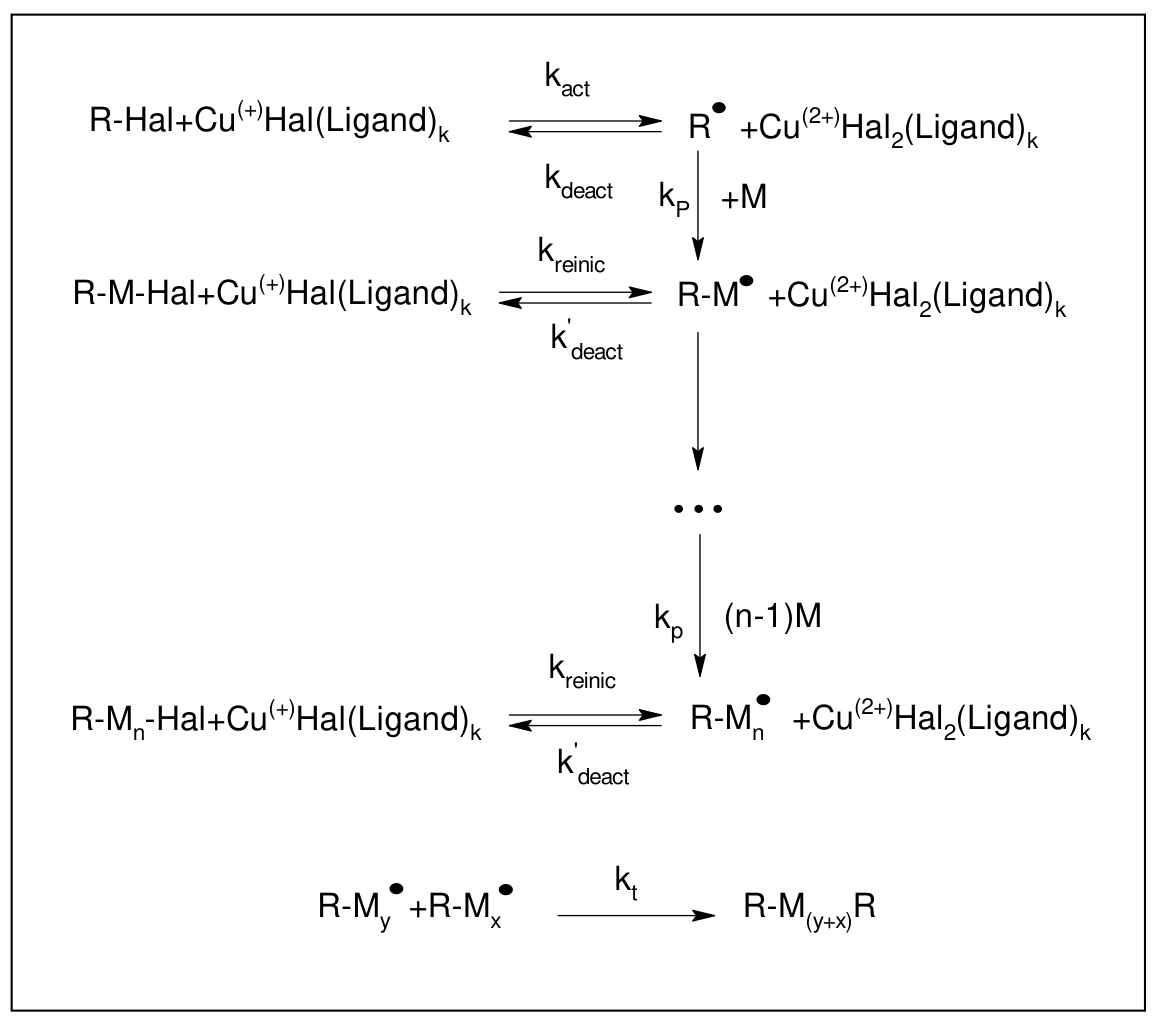
The reaction rate constants are:
\(k_{\mathrm{act}}\) - all activation reactions, \(k_{\mathrm{deact}}\) – all reversible deactivation reactions, \(k_p\) - chain propagation, and \(k_t\) - irreversible termination.
8.1 Write down expressions for the rates of ATRP elementary stages: activation (\(v_{\mathrm{act}}\)), deactivation (\(v_{\mathrm{deact}}\)), propagation (\(v_p\)) and termination (\(v_t\)). Write down generalized equation assuming just one reacting species \(\ce{R'X}\).
Consider that the total number of polymeric chains is equal to that of initiator molecules. Assume that at each moment throughout polymerization all chains are of the same length.
8.2 Compare the rate of deactivation to the rates of ATRP elementary stages.
Dependence of monomer concentration (\([\mathrm{M}]\)) on reaction time (\(t\)) for ATRP is:
\[ \ln\left(\frac{[\mathrm{M}]}{[\mathrm{M}]_0}\right) =-k_p[\ce{R^{\bullet}}]t, \]
\([\mathrm{M}]_0\) - initial monomer concentration, \(k_p\) – rate constant of propagation, \([\ce{R^{\bullet}}]\) – concentration of active radicals.
To prepare a polymer sample by using ATRP, catalytic amounts of \(\ce{CuCl}\), organic ligand (L) and 31.0 mmol of monomer (methylmethacrylate, or MMA) were mixed. The reaction was initiated by adding 0.12 mmol of tosyl chloride (TsCl). Polymerization was conducted for 1400 s. \(k_p\) is 1616 \(\mathrm{L\,mol^{-1}\,s^{-1}}\), and the steady state concentration of radicals is \(1.76\times10^{-7}\ \mathrm{mol\,dm^{-3}}\).
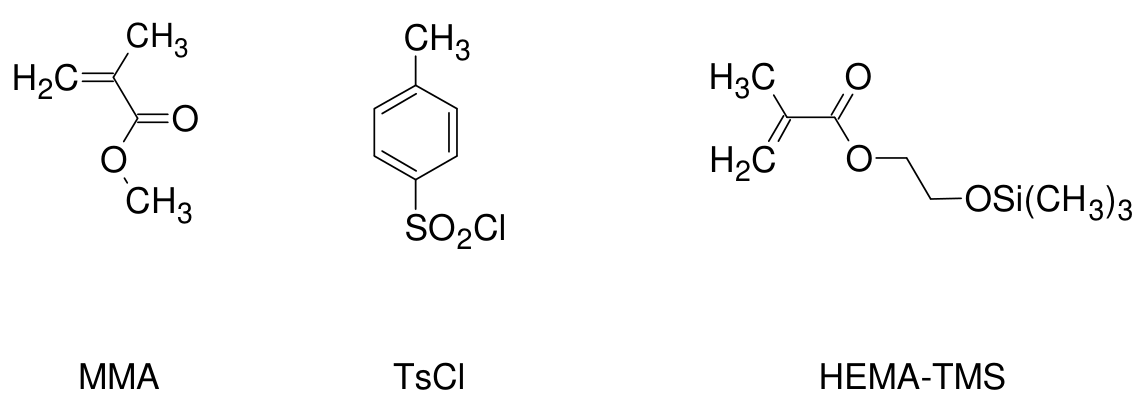
8.3 Calculate mass (\(m\)) of the polymer obtained.
In another experiment the time of MMA polymerization was changed, all the rest reaction conditions being the same. The mass of the obtained polymer was 0.73 g. Then 2-(trimethylsilyloxy)ethyl methacrylate, HEMA-TMS (23.7 mmol) was added to the mixture and polymerization was continued for another 1295 s. MMA and HEMA-TMS reactivities are the same under reaction conditions.
8.4 Calculate degree of polymerization (DP) of the obtained polymer.
8.5 Depict the structure of the obtained polymer (including end groups), showing MMA and HEMA-TMS units as A and B, respectively. If necessary, use the symbols in the copolymer structure representation: block (block), stat (statistical), alt (alternating), grad (gradient), graft (grafted). For example, \((\mathrm{A}_{65}\text{-graft-}\mathrm{C}_{100})\text{-stat-}\mathrm{B}_{34}\) means that chains of polymer C are grafted on units A in the statistic copolymer of A and B.
ATRP was applied to synthesize two block copolymers, \(P_1\) and \(P_2\). One block in both block-copolymers was the same and was synthesized from mono-(2-chloropropionyl)-polyethylene oxide used as a macroinitiator:
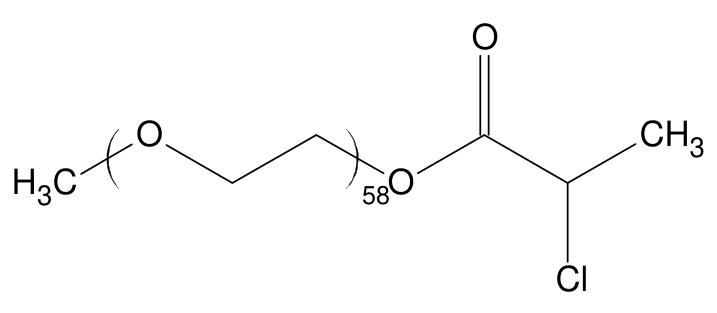
The other block in \(P_1\) consisted of styrene (C), and in \(P_2\) of p-chloromethylstyrene (D) units.
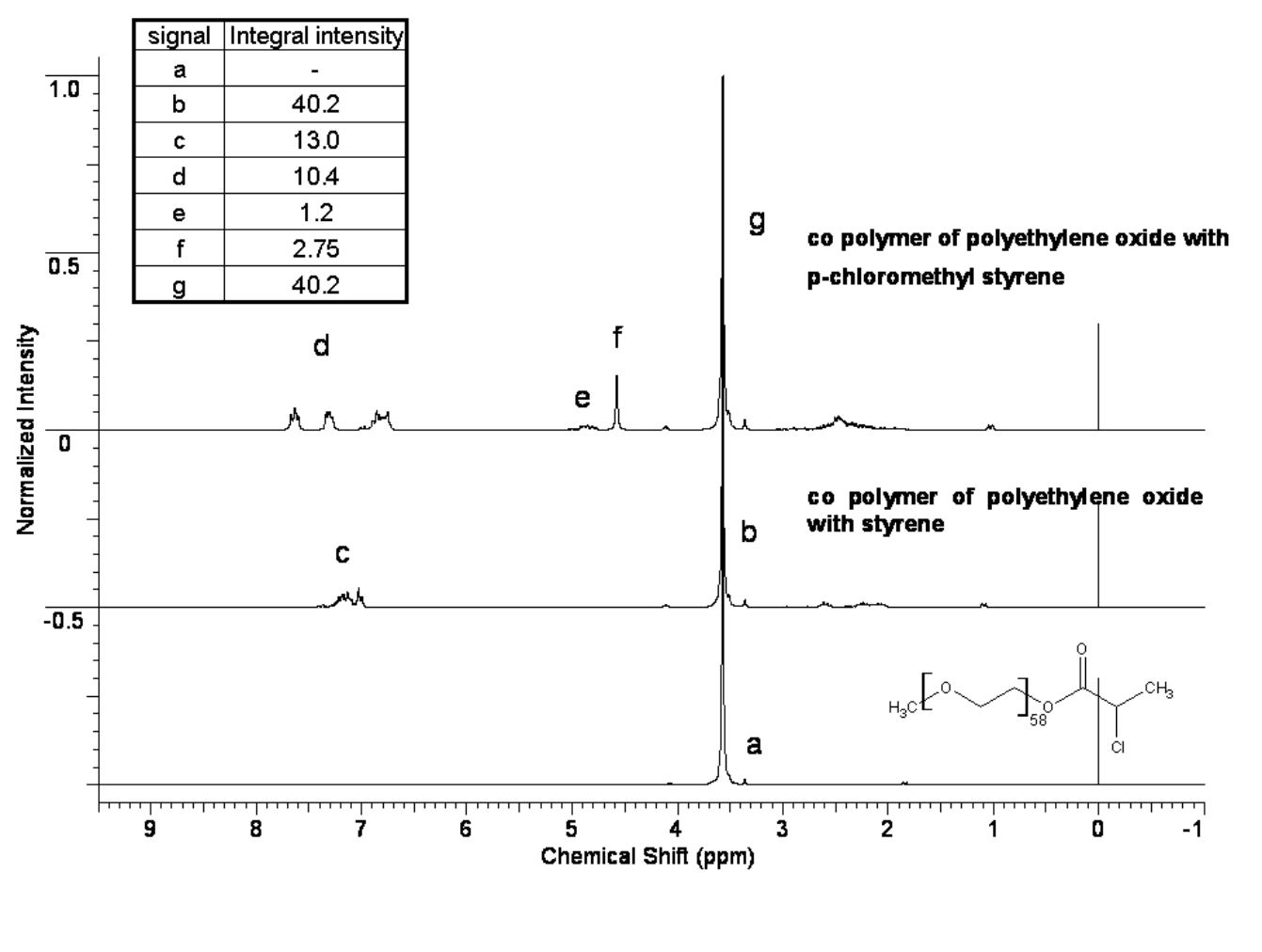
\({}^{1}\mathrm{H}\) NMR spectra of the macroinitiator, \(P_1\) and \(P_2\) are given below. Integral intensities of characteristic signals can be found in the table.
8.6 Assign \({}^{1}\mathrm{H}\) NMR signals to substructures given in the Answer Sheet.
8.7 Determine molar fractions of units C and D and molecular weights of \(P_1\) and \(P_2\).
8.8 Write down all possible reactions of activation occurring during the synthesis of \(P_1\) and \(P_2\). You may use R symbol to depict any unchanged part of the macromolecule, but you should specify what substructure you use it for.
8.9 Draw the structure of \(P_1\) and one of possible structures of \(P_2\) representing poly(ethylene oxide) chain by a wavy line and showing units of co-monomers as C and D, respectively.
| signal | Integral intensity |
|---|---|
| a | - |
| b | 40.2 |
| c | 13.0 |
| d | 10.4 |
| e | 1.2 |
| f | 2.75 |
| g | 40.2 |
Official English text of the problem.
Answers
-
8.1 \[ \begin{aligned} v_{\mathrm{act}}&=k_{\mathrm{act}}[\ce{R'X}][\ce{Cu^{I}X(L)_k}],\\ v_{\mathrm{deact}}&=k_{\mathrm{deact}}[\ce{R'^{\bullet}}][\ce{Cu^{II}X2(L)_k}],\\ v_p&=k_p[\ce{R'^{\bullet}}][\mathrm M],\\ v_t&=k_t[\ce{R'^{\bullet}}]^2. \end{aligned} \] Here \(v_t\) counts termination events; radical disappearance by termination is \(2v_t\). The activation–deactivation equation is \[ \ce{R'X + Cu^{I}X(L)_k <=> R'^{\bullet} + Cu^{II}X2(L)_k}. \]
-
8.2 \[ \boxed{v_{\mathrm{deact}}\simeq v_{\mathrm{act}},\qquad v_{\mathrm{deact}}\gg v_p,\qquad v_{\mathrm{deact}}\gg v_t.} \]
-
8.3 Including the retained initiator-derived end groups, \[ \boxed{m=1.04\ \mathrm g.} \] Neglecting their mass gives \(1.02\ \mathrm g\).
-
8.4 Consistently including end-group mass, \[ \boxed{\mathrm{DP}\approx181.} \] The approximation that neglects end-group mass gives approximately \(183\).
-
8.5 \[ \boxed{\mathrm{Ts}-\mathrm A_{59}\text{-block-} (\mathrm A_{61}\text{-stat-}\mathrm B_{61})-\ce{Cl}.} \] Subscripts are rounded average numbers of units. The initiating end is a tosyl group; the dormant growing end bears chlorine.
-
8.6 a, b, g: PEO methylene protons; c: styrene aromatic protons; d: p-chloromethylstyrene aromatic protons; e: terminal benzylic \(\ce{-CH(Cl)-}\) protons; f: pendant benzylic \(\ce{-CH2Cl}\) protons.
-
8.7 \[ \boxed{n_C\simeq n_D\simeq15,\qquad x_C=x_D\simeq0.205} \] and \[ \boxed{M(P_1)\simeq4.24\times10^3\ \mathrm{g\,mol^{-1}},\qquad M(P_2)\simeq4.97\times10^3\ \mathrm{g\,mol^{-1}}.} \]
-
8.8 Both syntheses permit activation of the macroinitiator’s α-chloroester and of dormant benzylic chain ends. \(P_2\) additionally permits activation of the benzyl chloride group in free D and in incorporated D units. The balanced reactions appear below.
-
8.9 \(P_1\) is a linear PEO–polystyrene block copolymer, with approximately 58 EO and 15 C units. \(P_2\) can contain a branched, approximately 15-unit D portion attached to PEO, because pendant chloromethyl groups can initiate additional arms. An explicit idealized example is described below.
Solution
SMILES containing * describe fragments, with * marking attachment to the rest of a molecule. A statistical polymer does not have one unique finite SMILES; its repeat units and end groups must therefore be specified separately. Stereochemical configurations and polymer tacticity are not determined by the problem.
8.1 — Elementary reactions and rate laws
Let \(\ce{R'X}\) represent any dormant initiator or polymer chain, and let \(\ce{R'^{\bullet}}\) represent its active radical.
The elementary reactions are
\[ \ce{R'X + Cu^{I}X(L)_k ->[k_{act}] R'^{\bullet} + Cu^{II}X2(L)_k}, \]
\[ \ce{R'^{\bullet} + Cu^{II}X2(L)_k ->[k_{deact}] R'X + Cu^{I}X(L)_k}, \]
\[ \ce{R'^{\bullet} + M ->[k_p] R'M^{\bullet}}, \]
\[ \ce{2 R'^{\bullet} ->[k_t] R'-R'}. \]
Mass action gives
\[ \boxed{ \begin{aligned} v_{\mathrm{act}}&=k_{\mathrm{act}}[\ce{R'X}] [\ce{Cu^{I}X(L)_k}],\\ v_{\mathrm{deact}}&=k_{\mathrm{deact}}[\ce{R'^{\bullet}}] [\ce{Cu^{II}X2(L)_k}],\\ v_p&=k_p[\ce{R'^{\bullet}}][\mathrm M],\\ v_t&=k_t[\ce{R'^{\bullet}}]^2. \end{aligned}} \]
These rates have units \(\mathrm{mol\,L^{-1}\,s^{-1}}\). With \(v_t\) defined as the number of coupling events per unit volume and time, the balance for the total active-radical concentration is
\[ \boxed{ \frac{d[\ce{R^{\bullet}}]}{dt} =v_{\mathrm{act}}-v_{\mathrm{deact}}-2v_t. } \]
Propagation does not appear in this balance because one radical enters and one radical leaves each propagation event.
The generalized reversible activation equation is
\[ \boxed{\ce{R'X + Cu^{I}X(L)_k <=> R'^{\bullet} + Cu^{II}X2(L)_k}.} \]
Neglecting termination, the overall chain-growth equation is
\[ \ce{R'X + n M ->[ATRP] R'M_nX}. \]
For the chloride system, copper(I) chloride has the ionic SMILES representation [Cu+].[Cl-], and copper(II) chloride [Cu+2].[Cl-].[Cl-]. These represent compositions, not the actual ligand-bound catalyst structures. Since L is unspecified, neither a complete catalyst SMILES nor its coordination geometry can be determined.
8.2 — Required relative rates
At steady radical concentration,
\[ v_{\mathrm{act}}=v_{\mathrm{deact}}+2v_t. \]
The assumption that the number of polymer molecules remains equal to the number of initiator molecules requires negligible coupling termination. Hence
\[ v_t\ll v_{\mathrm{deact}}, \qquad v_{\mathrm{act}}\simeq v_{\mathrm{deact}}. \]
For all chains to grow nearly equally, an activated chain should usually be deactivated before adding many monomers. Frequent activation–deactivation cycles distribute growth among the chains. Thus
\[ v_{\mathrm{deact}}\gg v_p. \]
Together,
\[ \boxed{ v_{\mathrm{deact}}\simeq v_{\mathrm{act}},\quad v_{\mathrm{deact}}\gg v_p,\quad v_{\mathrm{deact}}\gg v_t. } \]
These are comparisons of reaction rates, not simply of the corresponding rate constants.
8.3 — Mass of the first polymer
The relevant molecules are:
| Molecule | Formula | SMILES | Approximate molar mass |
|---|---|---|---|
| Methyl methacrylate, MMA; methyl 2-methylprop-2-enoate | \(\ce{C5H8O2}\) | C=C(C)C(=O)OC |
\(100.114\ \mathrm{g\,mol^{-1}}\) |
| Tosyl chloride; 4-methylbenzenesulfonyl chloride | \(\ce{C7H7ClO2S}\) | Cc1ccc(S(=O)(=O)Cl)cc1 |
\(190.636\ \mathrm{g\,mol^{-1}}\) |
The effective first-order constant is
\[ k_{\mathrm{obs}} =k_p[\ce{R^{\bullet}}] =(1616)(1.76\times10^{-7}) =2.84416\times10^{-4}\ \mathrm{s^{-1}}. \]
After 1400 s, the fraction of MMA consumed is
\[ f_1=1-e^{-k_{\mathrm{obs}}t} =1-e^{-0.3981824} =0.328460. \]
Therefore,
\[ n_{\mathrm{MMA,consumed}} =(31.0\ \mathrm{mmol})(0.328460) =10.1823\ \mathrm{mmol}. \]
The mass contributed by the repeat units is
\[ m_{\mathrm{repeat}} =(10.1823\times10^{-3})(100.114) =1.01939\ \mathrm g. \]
In the supplied mechanism, the initiating organic group and the terminal chlorine are retained in the polymer. Their combined mass per chain equals the mass of one TsCl molecule. Thus
\[ m_{\mathrm{ends}} =(0.120\times10^{-3})(190.636) =0.022876\ \mathrm g, \]
and
\[ \boxed{ m=1.01939+0.022876 =1.04226\ \mathrm g \approx1.04\ \mathrm g. } \]
If end-group mass is neglected, the result is instead \(1.02\ \mathrm g\).
8.4 — Degree of polymerization after the second feed
The second monomer is 2-(trimethylsilyloxy)ethyl methacrylate, HEMA-TMS, SMILES C=C(C)C(=O)OCCO[Si](C)(C)C.
The first-stage polymer mass in this experiment is 0.73 g. Subtracting the end-group contribution gives the amount of MMA already incorporated:
\[ n_{A,1} =\frac{0.730-0.022876}{100.114} =7.06318\times10^{-3}\ \mathrm{mol}. \]
Thus the remaining MMA is
\[ n_{A,\mathrm{remaining}} =31.0-7.06318 =23.9368\ \mathrm{mmol}. \]
The newly added amount of B is 23.7 mmol.
Because the monomers have equal reactivities, each undergoes the same fractional conversion during the additional 1295 s:
\[ f_2 =1-e^{-(2.84416\times10^{-4})(1295)} =1-e^{-0.36831872} =0.308103. \]
Consequently,
\[ \Delta n_A =(23.9368)(0.308103) =7.37501\ \mathrm{mmol}, \]
\[ \Delta n_B =(23.7)(0.308103) =7.30205\ \mathrm{mmol}. \]
The total number of incorporated monomer units, expressed as an amount, is
\[ n_{\mathrm{units}} =7.06318+7.37501+7.30205 =21.7402\ \mathrm{mmol}. \]
There are 0.120 mmol of polymer chains, so
\[ \boxed{ \mathrm{DP} =\frac{21.7402}{0.120} =181.17 \approx181. } \]
For comparison, neglecting end-group mass and using \(M_{\mathrm{MMA}}\approx100\ \mathrm{g\,mol^{-1}}\) gives
\[ n_{A,1}=7.30\ \mathrm{mmol}, \qquad n_{A,\mathrm{remaining}}=23.7\ \mathrm{mmol}, \]
and
\[ \mathrm{DP} =\frac{7.30+2(23.7)(0.308103)}{0.120} =182.53\approx183. \]
8.5 — Sequence and end groups
The average numbers of units incorporated per chain are
\[ N_{A,1}=\frac{7.06318}{0.120}=58.86, \]
\[ N_{A,2}=\frac{7.37501}{0.120}=61.46, \qquad N_{B,2}=\frac{7.30205}{0.120}=60.85. \]
The first segment contains only A. MMA remains present when B is added, so the second segment contains both monomers.
Equal reactivities mean that neither monomer is preferentially consumed. Their ratio remains constant during this stage, producing a statistical segment, approximately equimolar in A and B.
The polymer is therefore tosyl-initiated, chlorine-terminated poly(methyl methacrylate)-block-poly(methyl methacrylate-stat-HEMA-TMS):
\[ \boxed{ \ce{p-CH3C6H4SO2}- \mathrm A_{58.86}\text{-block-} (\mathrm A_{61.46}\text{-stat-}\mathrm B_{60.85}) -\ce{Cl}. } \]
With rounded subscripts,
\[ \boxed{\mathrm{Ts}-\mathrm A_{59}\text{-block-} (\mathrm A_{61}\text{-stat-}\mathrm B_{61})-\ce{Cl}.} \]
The structures needed to draw it are:
| Component | Structure or meaning | SMILES fragment |
|---|---|---|
| A, an MMA repeat unit | \(\ce{-CH2-C(CH3)(C(=O)OCH3)-}\) | *CC(C)(C(=O)OC)* |
| B, a HEMA-TMS repeat unit | \(\ce{-CH2-C(CH3)(C(=O)OCH2CH2OSi(CH3)3)-}\) | *CC(C)(C(=O)OCCO[Si](C)(C)C)* |
| Tosyl initiating end | 4-Methylbenzenesulfonyl group, attached through sulfur | Cc1ccc(S(=O)(=O)*)cc1 |
| Chlorine-capped terminal A unit | Chlorine bonded to the substituted backbone carbon | *CC(C)(Cl)C(=O)OC |
| Chlorine-capped terminal B unit | Same terminal arrangement, with the B ester substituent | *CC(C)(Cl)C(=O)OCCO[Si](C)(C)C |
Draw the tosyl sulfur bonded to the first backbone methylene. At the other end, attach chlorine to the substituted carbon of whichever monomer was incorporated last. The statistical sequence does not specify whether the final unit is A or B.
Under the end-group-mass-neglecting convention, the corresponding rounded notation is \(\mathrm{Ts}-\mathrm A_{61}\text{-block-}(\mathrm A_{61}\text{-stat-}\mathrm B_{61})-\ce{Cl}\).
8.6 — NMR assignments
The monomers in this part are:
- Styrene, ethenylbenzene:
C=Cc1ccccc1. - p-Chloromethylstyrene, 1-(chloromethyl)-4-ethenylbenzene:
C=Cc1ccc(CCl)cc1.
Their polymerized repeat-unit fragments are:
- C, a styrene unit:
*CC(c1ccccc1)*. - D, a p-chloromethylstyrene unit with an unactivated pendant group:
*CC(c1ccc(CCl)cc1)*.
The assignments are:
| Signal | Approximate shift | Assignment and reasoning |
|---|---|---|
| a | \(3.6\ \mathrm{ppm}\) | PEO \(\ce{-OCH2CH2-}\) protons in the macroinitiator |
| b | \(3.6\ \mathrm{ppm}\) | The same PEO protons in \(P_1\) |
| c | Around \(7\ \mathrm{ppm}\) | The five aromatic protons per C unit |
| d | Around \(7\ \mathrm{ppm}\) | The four aromatic protons per para-disubstituted D ring |
| e | About \(4.9\ \mathrm{ppm}\) | Benzylic terminal methine, \(\ce{-CH2-CH(Cl)-Ar}\), one proton per such end |
| f | About \(4.6\ \mathrm{ppm}\) | Pendant benzyl chloride, \(\ce{Ar-CH2Cl}\), two protons per unactivated group |
| g | \(3.6\ \mathrm{ppm}\) | PEO protons in \(P_2\) |
The PEO repeat fragment is *OCC*. A representative D-derived terminal chloromethine fragment is *CC(Cl)c1ccc(CCl)cc1; the pendant benzyl chloride substructure is *c1ccc(CCl)cc1.
Oxygen shifts the PEO methylene signals downfield from ordinary aliphatic protons. Aromatic protons occur around 7 ppm. Carbon bonded both to chlorine and to an aromatic ring gives the characteristic benzylic signals e and f.
8.7 — Composition and molecular weights
Each EO repeat contributes four protons to the PEO signal. Each C unit contributes five aromatic protons; each D unit contributes four.
For \(P_1\),
\[ \frac{N_C}{58} =\frac{I_c/5}{I_b/4}, \]
so
\[ N_C =58\frac{13.0/5}{40.2/4} =15.005\approx15. \]
For \(P_2\),
\[ \frac{N_D}{58} =\frac{I_d/4}{I_g/4}, \]
giving
\[ N_D =58\frac{10.4/4}{40.2/4} =15.005\approx15. \]
Therefore,
\[ \boxed{ x_C=\frac{15}{58+15}=0.2055,\qquad x_D=\frac{15}{58+15}=0.2055. } \]
Both copolymers contain approximately \(20.5\%\) styrene-derived repeat units on a molar basis.
The macroinitiator is monomethyl poly(ethylene glycol) 2-chloropropanoate, with the structure
\[ \ce{CH3(OCH2CH2)58OC(=O)CH(Cl)CH3}. \]
Its formula is \(\ce{C120H239ClO60}\), and its SMILES is:
COCCOCCOCCOCCOCCOCCOCCOCCOCCOCCOCCOCCOCCOCCOCCOCCOCCOCCOCCOCCOCCOCCOCCOCCOCCOCCOCCOCCOCCOCCOCCOCCOCCOCCOCCOCCOCCOCCOCCOCCOCCOCCOCCOCCOCCOCCOCCOCCOCCOCCOCCOCCOCCOCCOCCOCCOCCOCCOC(=O)C(C)Cl
Its molar mass is approximately
\[ M_{\mathrm{macro}}=2677.6\ \mathrm{g\,mol^{-1}}. \]
Addition polymerization retains the atoms of the monomers, so
\[ M(P_1) =M_{\mathrm{macro}}+15M(\ce{C8H8}) =2677.6+15(104.14), \]
\[ \boxed{M(P_1)\approx4.24\times10^3\ \mathrm{g\,mol^{-1}}.} \]
Likewise,
\[ M(P_2) =M_{\mathrm{macro}}+15M(\ce{C9H9Cl}) =2677.6+15(152.61), \]
\[ \boxed{M(P_2)\approx4.97\times10^3\ \mathrm{g\,mol^{-1}}.} \]
Branching changes connectivity but does not change this mass sum, provided the initiator and monomer atoms are retained.
8.8 — All types of activation
Write
\[ Q=\ce{CH3(OCH2CH2)58}. \]
Thus \(Q\) denotes the unchanged methoxy-capped PEO portion up to the terminal ethylene carbon. In every equation below, the copper(I) chloride complex accepts chlorine and becomes the copper(II) dichloride complex.
Activation of the macroinitiator, common to \(P_1\) and \(P_2\):
\[ \boxed{ \ce{ Q-O-C(=O)-CH(Cl)-CH3 + Cu^{I}Cl(L)_k -> Q-O-C(=O)-CH^{\bullet}-CH3 + Cu^{II}Cl2(L)_k }. } \]
The radical is stabilized by the adjacent carbonyl group.
The dormant α-chloroester fragment is *OC(=O)C(C)Cl; the activated α-carbonyl radical fragment is *OC(=O)[CH]C.
Activation of dormant benzylic growing ends, common to both polymers:
\[ \boxed{ \ce{ R-CH2-CH(Cl)-Ar + Cu^{I}Cl(L)_k -> R-CH2-CH^{\bullet}-Ar + Cu^{II}Cl2(L)_k }. } \]
Here:
- \(R\) is the entire unchanged chain preceding the terminal unit.
- For \(P_1\), \(\ce{Ar}\) is phenyl.
- For \(P_2\), \(\ce{Ar}\) is a para-substituted phenyl group bearing either an unreacted chloromethyl group or an already grown branch.
Representative SMILES pairs are:
| End type | Dormant fragment | Activated radical fragment |
|---|---|---|
| Styrene-derived end | *CC(Cl)c1ccccc1 |
*C[CH]c1ccccc1 |
| D-derived end with pendant \(\ce{CH2Cl}\) | *CC(Cl)c1ccc(CCl)cc1 |
*C[CH]c1ccc(CCl)cc1 |
For an already branched D ring, replace its CCl substituent by C*, where the second * denotes the branch.
Activation of the chloromethyl group of free D, possible in the \(P_2\) synthesis:
\[ \boxed{ \ce{ CH2=CH-C6H4-CH2Cl + Cu^{I}Cl(L)_k -> CH2=CH-C6H4-CH2^{\bullet} + Cu^{II}Cl2(L)_k }. } \]
The aromatic substituents are para. The product is the 4-vinylbenzyl radical, SMILES C=Cc1ccc([CH2])cc1.
The vinyl group remains intact during this activation. The benzyl radical can initiate a growing chain, while the retained vinyl group can subsequently participate in polymerization.
Activation of a pendant chloromethyl group in an incorporated D unit:
\[ \boxed{ \ce{ R_a-CH2-CH(C6H4-CH2Cl)-R_b + Cu^{I}Cl(L)_k -> R_a-CH2-CH(C6H4-CH2^{\bullet})-R_b + Cu^{II}Cl2(L)_k }. } \]
Here \(R_a\) and \(R_b\) are the unchanged backbone portions on either side of the selected D unit. Again, the aromatic substituents are para.
The dormant fragment is *CC(c1ccc(CCl)cc1)*; the activated pendant benzyl radical fragment is *CC(c1ccc([CH2])cc1)*.
Addition of monomer to this pendant radical starts a branch. These reactions explain why \(P_2\) need not have a linear D block.
8.9 — Structures of \(P_1\) and \(P_2\)
Define the initiator-derived attachment group
\[ E=\ce{CH3(OCH2CH2)58OC(=O)CH(CH3)-}. \]
For the requested drawings, replace the PEO chain in \(E\) by a wavy line, retaining its methoxy end and the ester linkage to \(\ce{-CH(CH3)-}\).
For \(P_1\), the PEO–polystyrene block copolymer, draw
\[ \boxed{E-\mathrm C_{15}-\ce{Cl}.} \]
The expanded connectivity is
\[ \ce{ CH3(OCH2CH2)58OC(=O)CH(CH3) -[CH2-CH(C6H5)]15-Cl }. \]
Chlorine is attached to the benzylic carbon of the last C unit. One 15-unit representative has SMILES:
COCCOCCOCCOCCOCCOCCOCCOCCOCCOCCOCCOCCOCCOCCOCCOCCOCCOCCOCCOCCOCCOCCOCCOCCOCCOCCOCCOCCOCCOCCOCCOCCOCCOCCOCCOCCOCCOCCOCCOCCOCCOCCOCCOCCOCCOCCOCCOCCOCCOCCOCCOCCOCCOCCOCCOCCOCCOCCOC(=O)C(C)CC(c1ccccc1)CC(c1ccccc1)CC(c1ccccc1)CC(c1ccccc1)CC(c1ccccc1)CC(c1ccccc1)CC(c1ccccc1)CC(c1ccccc1)CC(c1ccccc1)CC(c1ccccc1)CC(c1ccccc1)CC(c1ccccc1)CC(c1ccccc1)CC(c1ccccc1)CC(Cl)c1ccccc1
For \(P_2\), PEO attached to branched poly(p-chloromethylstyrene), a branch grows through the former chloromethyl carbon:
\[ \ce{ backbone-C6H4-CH2-CH2-CH(C6H4CH2Cl)-\ldots }. \]
Thus a branch junction lies in the para side group of a D ring, rather than directly on its main-chain carbon.
An explicit idealized 15-D-unit example is:
- Draw eight D units along the main path attached to \(E\).
- From the para chloromethyl carbon of each of the first seven main-path D units, grow a branch containing one additional D unit.
- Cap the main growing end and all seven branch ends with chlorine.
- Retain the pendant \(\ce{CH2Cl}\) groups on the seven branch D units and on the eighth main-path D unit.
This contains \(8+7=15\) D units. Each branch-bearing main-path unit has the fragment SMILES
*CC(c1ccc(CCC(Cl)c2ccc(CCl)cc2)cc1)*.
The complete representative comb-shaped molecule has SMILES:
COCCOCCOCCOCCOCCOCCOCCOCCOCCOCCOCCOCCOCCOCCOCCOCCOCCOCCOCCOCCOCCOCCOCCOCCOCCOCCOCCOCCOCCOCCOCCOCCOCCOCCOCCOCCOCCOCCOCCOCCOCCOCCOCCOCCOCCOCCOCCOCCOCCOCCOCCOCCOCCOCCOCCOCCOCCOCCOC(=O)C(C)CC(c1ccc(CCC(Cl)c2ccc(CCl)cc2)cc1)CC(c1ccc(CCC(Cl)c2ccc(CCl)cc2)cc1)CC(c1ccc(CCC(Cl)c2ccc(CCl)cc2)cc1)CC(c1ccc(CCC(Cl)c2ccc(CCl)cc2)cc1)CC(c1ccc(CCC(Cl)c2ccc(CCl)cc2)cc1)CC(c1ccc(CCC(Cl)c2ccc(CCl)cc2)cc1)CC(c1ccc(CCC(Cl)c2ccc(CCl)cc2)cc1)CC(Cl)c1ccc(CCl)cc1
This is an illustrative allowed connectivity. The spectrum does not uniquely determine the arrangement of the branches.
The solution was checked against the official solution. Where this solution differs from the official solution, the official solution contains an error or a misprint.
IChO 2007 · Theorieaufgabe 8
ATRP ermöglicht neue Polymere
Die ATRP (radikalische Atomtransferpolymerisation) ist einer der vielversprechendsten neuartigen Ansätze zur Polymersynthese. Diese Modifikation der radikalischen Polymerisation beruht auf einer Redoxreaktion organischer Halogenide mit Komplexen von Übergangsmetallen, insbesondere Cu (I). Der Prozess lässt sich durch das folgende Schema beschreiben (M – Monomer, Hal – Halogen):
Die Geschwindigkeitskonstanten der Reaktionen sind:
\(k_{\mathrm{act}}\) – alle Aktivierungsreaktionen, \(k_{\mathrm{deact}}\) – alle reversiblen Deaktivierungsreaktionen, \(k_p\) – Kettenwachstum und \(k_t\) – irreversibler Kettenabbruch.
8.1 Geben Sie Ausdrücke für die Geschwindigkeiten der Elementarschritte der ATRP an: Aktivierung (\(v_{\mathrm{act}}\)), Deaktivierung (\(v_{\mathrm{deact}}\)), Kettenwachstum (\(v_p\)) und Kettenabbruch (\(v_t\)). Geben Sie eine verallgemeinerte Gleichung an, wobei Sie nur eine reagierende Spezies \(\ce{R'X}\) annehmen.
Gehen Sie davon aus, dass die Gesamtzahl der Polymerketten gleich der Anzahl der Initiatormoleküle ist. Nehmen Sie an, dass zu jedem Zeitpunkt während der Polymerisation alle Ketten gleich lang sind.
8.2 Vergleichen Sie die Deaktivierungsgeschwindigkeit mit den Geschwindigkeiten der Elementarschritte der ATRP.
Die Abhängigkeit der Monomerkonzentration (\([\mathrm{M}]\)) von der Reaktionszeit (\(t\)) bei der ATRP lautet:
\[ \ln\left(\frac{[\mathrm{M}]}{[\mathrm{M}]_0}\right) =-k_p[\ce{R^{\bullet}}]t, \]
\([\mathrm{M}]_0\) – anfängliche Monomerkonzentration, \(k_p\) – Geschwindigkeitskonstante des Kettenwachstums, \([\ce{R^{\bullet}}]\) – Konzentration der aktiven Radikale.
Zur Herstellung einer Polymerprobe mittels ATRP wurden katalytische Mengen an \(\ce{CuCl}\), einem organischen Liganden (L) und 31.0 mmol Monomer (Methylmethacrylat, kurz MMA) gemischt. Die Reaktion wurde durch Zugabe von 0.12 mmol Tosylchlorid (TsCl) initiiert. Die Polymerisation wurde 1400 s lang durchgeführt. \(k_p\) beträgt 1616 \(\mathrm{L\,mol^{-1}\,s^{-1}}\), und die stationäre Radikalkonzentration beträgt \(1.76\times10^{-7}\ \mathrm{mol\,dm^{-3}}\).
8.3 Berechnen Sie die Masse (\(m\)) des erhaltenen Polymers.
In einem weiteren Versuch wurde die Dauer der MMA-Polymerisation geändert, während alle übrigen Reaktionsbedingungen gleich blieben. Die Masse des erhaltenen Polymers betrug 0.73 g. Anschließend wurde dem Gemisch 2-(Trimethylsilyloxy)ethylmethacrylat, HEMA-TMS (23.7 mmol), zugesetzt und die Polymerisation weitere 1295 s fortgesetzt. MMA und HEMA-TMS besitzen unter den Reaktionsbedingungen die gleiche Reaktivität.
8.4 Berechnen Sie den Polymerisationsgrad (DP) des erhaltenen Polymers.
8.5 Stellen Sie die Struktur des erhaltenen Polymers (einschließlich der Endgruppen) dar und bezeichnen Sie die MMA- bzw. HEMA-TMS-Einheiten mit A bzw. B. Verwenden Sie gegebenenfalls die folgenden Symbole zur Darstellung der Copolymerstruktur: block (Block), stat (statistisch), alt (alternierend), grad (Gradient), graft (gepfropft). Beispielsweise bedeutet \((\mathrm{A}_{65}\text{-graft-}\mathrm{C}_{100})\text{-stat-}\mathrm{B}_{34}\), dass Ketten des Polymers C auf die Einheiten A im statistischen Copolymer aus A und B aufgepfropft sind.
Mittels ATRP wurden zwei Blockcopolymere, \(P_1\) und \(P_2\), synthetisiert. Ein Block war in beiden Blockcopolymeren gleich und wurde aus Mono-(2-chlorpropionyl)-polyethylenoxid synthetisiert, das als Makroinitiator verwendet wurde:
Der andere Block bestand in \(P_1\) aus Styrol-Einheiten (C) und in \(P_2\) aus p-Chlormethylstyrol-Einheiten (D).
Die \({}^{1}\mathrm{H}\)-NMR-Spektren des Makroinitiators, von \(P_1\) und von \(P_2\) sind unten angegeben. Die Integralintensitäten charakteristischer Signale sind der Tabelle zu entnehmen.
8.6 Ordnen Sie die \({}^{1}\mathrm{H}\)-NMR-Signale den im Antwortbogen angegebenen Teilstrukturen zu.
8.7 Bestimmen Sie die Stoffmengenanteile der Einheiten C und D sowie die molaren Massen von \(P_1\) und \(P_2\).
8.8 Geben Sie alle möglichen Aktivierungsreaktionen an, die bei der Synthese von \(P_1\) und \(P_2\) auftreten. Sie dürfen das Symbol R zur Darstellung eines beliebigen unveränderten Teils des Makromoleküls verwenden, müssen aber angeben, für welche Teilstruktur es steht.
8.9 Zeichnen Sie die Struktur von \(P_1\) und eine der möglichen Strukturen von \(P_2\). Stellen Sie dabei die Polyethylenoxidkette durch eine Wellenlinie dar und bezeichnen Sie die Einheiten der Comonomere mit C bzw. D.
| Signal | Integralintensität |
|---|---|
| a | - |
| b | 40.2 |
| c | 13.0 |
| d | 10.4 |
| e | 1.2 |
| f | 2.75 |
| g | 40.2 |
Aufgabentext aus dem offiziellen englischen Text übersetzt.
Antworten
-
8.1 \[ \begin{aligned} v_{\mathrm{act}}&=k_{\mathrm{act}}[\ce{R'X}][\ce{Cu^{I}X(L)_k}],\\ v_{\mathrm{deact}}&=k_{\mathrm{deact}}[\ce{R'^{\bullet}}][\ce{Cu^{II}X2(L)_k}],\\ v_p&=k_p[\ce{R'^{\bullet}}][\mathrm M],\\ v_t&=k_t[\ce{R'^{\bullet}}]^2. \end{aligned} \] Hier zählt \(v_t\) die Abbruchereignisse; der Radikalverbrauch durch Kettenabbruch beträgt \(2v_t\). Die Aktivierungs-Deaktivierungs-Gleichung lautet \[ \ce{R'X + Cu^{I}X(L)_k <=> R'^{\bullet} + Cu^{II}X2(L)_k}. \]
-
8.2 \[ \boxed{v_{\mathrm{deact}}\simeq v_{\mathrm{act}},\qquad v_{\mathrm{deact}}\gg v_p,\qquad v_{\mathrm{deact}}\gg v_t.} \]
-
8.3 Unter Einbeziehung der erhalten bleibenden, vom Initiator stammenden Endgruppen ergibt sich \[ \boxed{m=1.04\ \mathrm g.} \] Bei Vernachlässigung ihrer Masse erhält man \(1.02\ \mathrm g\).
-
8.4 Bei konsequenter Berücksichtigung der Endgruppenmasse gilt \[ \boxed{\mathrm{DP}\approx181.} \] Die Näherung unter Vernachlässigung der Endgruppenmasse ergibt ungefähr \(183\).
-
8.5 \[ \boxed{\mathrm{Ts}-\mathrm A_{59}\text{-block-} (\mathrm A_{61}\text{-stat-}\mathrm B_{61})-\ce{Cl}.} \] Die Indizes sind gerundete mittlere Anzahlen von Einheiten. Das initiierende Ende ist eine Tosylgruppe; das ruhende Wachstumsende trägt Chlor.
-
8.6 a, b, g: PEO-Methylenprotonen; c: aromatische Protonen des Styrols; d: aromatische Protonen des p-Chlormethylstyrols; e: endständige benzylische \(\ce{-CH(Cl)-}\)-Protonen; f: benzylische \(\ce{-CH2Cl}\)-Protonen der Seitengruppen.
-
8.7 \[ \boxed{n_C\simeq n_D\simeq15,\qquad x_C=x_D\simeq0.205} \] und \[ \boxed{M(P_1)\simeq4.24\times10^3\ \mathrm{g\,mol^{-1}},\qquad M(P_2)\simeq4.97\times10^3\ \mathrm{g\,mol^{-1}}.} \]
-
8.8 Bei beiden Synthesen können der α-Chlorester des Makroinitiators und die ruhenden benzylischen Kettenenden aktiviert werden. Bei \(P_2\) ist zusätzlich die Aktivierung der Benzylchloridgruppe im freien D und in eingebauten D-Einheiten möglich. Die ausgeglichenen Reaktionsgleichungen sind unten angegeben.
-
8.9 \(P_1\) ist ein lineares PEO–Polystyrol-Blockcopolymer mit ungefähr 58 EO- und 15 C-Einheiten. \(P_2\) kann einen verzweigten, aus ungefähr 15 D-Einheiten bestehenden Teil enthalten, der an PEO gebunden ist, da die seitlichen Chlormethylgruppen zusätzliche Arme initiieren können. Ein konkretes idealisiertes Beispiel wird unten beschrieben.
Lösung
SMILES, die * enthalten, beschreiben Fragmente, wobei * die Bindungsstelle zum Rest eines Moleküls kennzeichnet. Ein statistisches Polymer besitzt keine einzige eindeutige endliche SMILES-Darstellung; seine Wiederholungseinheiten und Endgruppen müssen daher getrennt angegeben werden. Stereochemische Konfigurationen und die Taktizität des Polymers werden durch die Aufgabe nicht festgelegt.
8.1 — Elementarreaktionen und Geschwindigkeitsgesetze
\(\ce{R'X}\) bezeichne einen beliebigen ruhenden Initiator oder eine ruhende Polymerkette und \(\ce{R'^{\bullet}}\) das zugehörige aktive Radikal.
Die Elementarreaktionen lauten
\[ \ce{R'X + Cu^{I}X(L)_k ->[k_{act}] R'^{\bullet} + Cu^{II}X2(L)_k}, \]
\[ \ce{R'^{\bullet} + Cu^{II}X2(L)_k ->[k_{deact}] R'X + Cu^{I}X(L)_k}, \]
\[ \ce{R'^{\bullet} + M ->[k_p] R'M^{\bullet}}, \]
\[ \ce{2 R'^{\bullet} ->[k_t] R'-R'}. \]
Aus dem Massenwirkungsgesetz folgt
\[ \boxed{ \begin{aligned} v_{\mathrm{act}}&=k_{\mathrm{act}}[\ce{R'X}] [\ce{Cu^{I}X(L)_k}],\\ v_{\mathrm{deact}}&=k_{\mathrm{deact}}[\ce{R'^{\bullet}}] [\ce{Cu^{II}X2(L)_k}],\\ v_p&=k_p[\ce{R'^{\bullet}}][\mathrm M],\\ v_t&=k_t[\ce{R'^{\bullet}}]^2. \end{aligned}} \]
Diese Geschwindigkeiten haben die Einheit \(\mathrm{mol\,L^{-1}\,s^{-1}}\). Wird \(v_t\) als Anzahl der Rekombinationsereignisse pro Volumen- und Zeiteinheit definiert, so lautet die Bilanz für die Gesamtkonzentration aktiver Radikale
\[ \boxed{ \frac{d[\ce{R^{\bullet}}]}{dt} =v_{\mathrm{act}}-v_{\mathrm{deact}}-2v_t. } \]
Das Kettenwachstum erscheint in dieser Bilanz nicht, da bei jedem Wachstumsschritt ein Radikal eingesetzt wird und ein Radikal entsteht.
Die verallgemeinerte Gleichung der reversiblen Aktivierung lautet
\[ \boxed{\ce{R'X + Cu^{I}X(L)_k <=> R'^{\bullet} + Cu^{II}X2(L)_k}.} \]
Unter Vernachlässigung des Kettenabbruchs lautet die Gesamtgleichung des Kettenwachstums
\[ \ce{R'X + n M ->[ATRP] R'M_nX}. \]
Für das Chloridsystem lautet die ionische SMILES-Darstellung von Kupfer(I)-chlorid [Cu+].[Cl-] und die von Kupfer(II)-chlorid [Cu+2].[Cl-].[Cl-]. Diese geben die Zusammensetzung wieder, nicht die tatsächlichen Strukturen der an Liganden gebundenen Katalysatoren. Da L nicht näher angegeben ist, lassen sich weder eine vollständige SMILES-Darstellung des Katalysators noch seine Koordinationsgeometrie bestimmen.
8.2 — Erforderliche relative Geschwindigkeiten
Bei stationärer Radikalkonzentration gilt
\[ v_{\mathrm{act}}=v_{\mathrm{deact}}+2v_t. \]
Die Annahme, dass die Anzahl der Polymermoleküle gleich der Anzahl der Initiatormoleküle bleibt, erfordert einen vernachlässigbaren Kettenabbruch durch Rekombination. Daher gilt
\[ v_t\ll v_{\mathrm{deact}}, \qquad v_{\mathrm{act}}\simeq v_{\mathrm{deact}}. \]
Damit alle Ketten nahezu gleichmäßig wachsen, sollte eine aktivierte Kette gewöhnlich deaktiviert werden, bevor sie viele Monomere addiert. Häufige Aktivierungs-Deaktivierungs-Zyklen verteilen das Wachstum auf die Ketten. Somit gilt
\[ v_{\mathrm{deact}}\gg v_p. \]
Zusammen ergibt sich
\[ \boxed{ v_{\mathrm{deact}}\simeq v_{\mathrm{act}},\quad v_{\mathrm{deact}}\gg v_p,\quad v_{\mathrm{deact}}\gg v_t. } \]
Hier werden Reaktionsgeschwindigkeiten verglichen, nicht lediglich die entsprechenden Geschwindigkeitskonstanten.
8.3 — Masse des ersten Polymers
Die relevanten Moleküle sind:
| Molekül | Formel | SMILES | Ungefähre molare Masse |
|---|---|---|---|
| Methylmethacrylat, MMA; Methyl-2-methylprop-2-enoat | \(\ce{C5H8O2}\) | C=C(C)C(=O)OC |
\(100.114\ \mathrm{g\,mol^{-1}}\) |
| Tosylchlorid; 4-Methylbenzolsulfonylchlorid | \(\ce{C7H7ClO2S}\) | Cc1ccc(S(=O)(=O)Cl)cc1 |
\(190.636\ \mathrm{g\,mol^{-1}}\) |
Die effektive Geschwindigkeitskonstante erster Ordnung beträgt
\[ k_{\mathrm{obs}} =k_p[\ce{R^{\bullet}}] =(1616)(1.76\times10^{-7}) =2.84416\times10^{-4}\ \mathrm{s^{-1}}. \]
Nach 1400 s beträgt der umgesetzte Anteil des MMA
\[ f_1=1-e^{-k_{\mathrm{obs}}t} =1-e^{-0.3981824} =0.328460. \]
Daher gilt
\[ n_{\mathrm{MMA,consumed}} =(31.0\ \mathrm{mmol})(0.328460) =10.1823\ \mathrm{mmol}. \]
Der Massenbeitrag der Wiederholungseinheiten beträgt
\[ m_{\mathrm{repeat}} =(10.1823\times10^{-3})(100.114) =1.01939\ \mathrm g. \]
Im angegebenen Mechanismus bleiben die initiierende organische Gruppe und das endständige Chlor im Polymer erhalten. Ihre gemeinsame Masse pro Kette entspricht der Masse eines TsCl-Moleküls. Somit gilt
\[ m_{\mathrm{ends}} =(0.120\times10^{-3})(190.636) =0.022876\ \mathrm g, \]
und
\[ \boxed{ m=1.01939+0.022876 =1.04226\ \mathrm g \approx1.04\ \mathrm g. } \]
Wird die Endgruppenmasse vernachlässigt, ergibt sich stattdessen \(1.02\ \mathrm g\).
8.4 — Polymerisationsgrad nach der zweiten Monomerzugabe
Das zweite Monomer ist 2-(Trimethylsilyloxy)ethylmethacrylat, HEMA-TMS, mit der SMILES-Darstellung C=C(C)C(=O)OCCO[Si](C)(C)C.
Die Polymermasse nach der ersten Stufe beträgt in diesem Versuch 0.73 g. Nach Abzug des Endgruppenbeitrags ergibt sich die Stoffmenge des bereits eingebauten MMA:
\[ n_{A,1} =\frac{0.730-0.022876}{100.114} =7.06318\times10^{-3}\ \mathrm{mol}. \]
Damit beträgt die verbleibende MMA-Stoffmenge
\[ n_{A,\mathrm{remaining}} =31.0-7.06318 =23.9368\ \mathrm{mmol}. \]
Die neu zugesetzte Stoffmenge von B beträgt 23.7 mmol.
Da die Monomere die gleiche Reaktivität besitzen, wird während der zusätzlichen 1295 s von beiden derselbe Anteil umgesetzt:
\[ f_2 =1-e^{-(2.84416\times10^{-4})(1295)} =1-e^{-0.36831872} =0.308103. \]
Folglich gilt
\[ \Delta n_A =(23.9368)(0.308103) =7.37501\ \mathrm{mmol}, \]
\[ \Delta n_B =(23.7)(0.308103) =7.30205\ \mathrm{mmol}. \]
Die Gesamtzahl der eingebauten Monomereinheiten, ausgedrückt als Stoffmenge, beträgt
\[ n_{\mathrm{units}} =7.06318+7.37501+7.30205 =21.7402\ \mathrm{mmol}. \]
Es liegen 0.120 mmol Polymerketten vor, daher gilt
\[ \boxed{ \mathrm{DP} =\frac{21.7402}{0.120} =181.17 \approx181. } \]
Zum Vergleich erhält man bei Vernachlässigung der Endgruppenmasse und mit \(M_{\mathrm{MMA}}\approx100\ \mathrm{g\,mol^{-1}}\)
\[ n_{A,1}=7.30\ \mathrm{mmol}, \qquad n_{A,\mathrm{remaining}}=23.7\ \mathrm{mmol}, \]
und
\[ \mathrm{DP} =\frac{7.30+2(23.7)(0.308103)}{0.120} =182.53\approx183. \]
8.5 — Sequenz und Endgruppen
Die mittleren Anzahlen der pro Kette eingebauten Einheiten betragen
\[ N_{A,1}=\frac{7.06318}{0.120}=58.86, \]
\[ N_{A,2}=\frac{7.37501}{0.120}=61.46, \qquad N_{B,2}=\frac{7.30205}{0.120}=60.85. \]
Das erste Segment enthält nur A. Bei der Zugabe von B ist weiterhin MMA vorhanden, sodass das zweite Segment beide Monomere enthält.
Gleiche Reaktivitäten bedeuten, dass keines der Monomere bevorzugt verbraucht wird. Ihr Verhältnis bleibt während dieser Stufe konstant, wodurch ein statistisches Segment entsteht, das A und B in ungefähr äquimolaren Anteilen enthält.
Das Polymer ist daher tosylinitiiertes, chlorterminiertes Poly(methylmethacrylat)-block-poly(methylmethacrylat-stat-HEMA-TMS):
\[ \boxed{ \ce{p-CH3C6H4SO2}- \mathrm A_{58.86}\text{-block-} (\mathrm A_{61.46}\text{-stat-}\mathrm B_{60.85}) -\ce{Cl}. } \]
Mit gerundeten Indizes ergibt sich
\[ \boxed{\mathrm{Ts}-\mathrm A_{59}\text{-block-} (\mathrm A_{61}\text{-stat-}\mathrm B_{61})-\ce{Cl}.} \]
Die zum Zeichnen benötigten Strukturen sind:
| Bestandteil | Struktur oder Bedeutung | SMILES-Fragment |
|---|---|---|
| A, eine MMA-Wiederholungseinheit | \(\ce{-CH2-C(CH3)(C(=O)OCH3)-}\) | *CC(C)(C(=O)OC)* |
| B, eine HEMA-TMS-Wiederholungseinheit | \(\ce{-CH2-C(CH3)(C(=O)OCH2CH2OSi(CH3)3)-}\) | *CC(C)(C(=O)OCCO[Si](C)(C)C)* |
| Initiierendes Tosylende | 4-Methylbenzolsulfonylgruppe, über Schwefel gebunden | Cc1ccc(S(=O)(=O)*)cc1 |
| Mit Chlor abgeschlossene endständige A-Einheit | Chlor ist an das substituierte Kohlenstoffatom der Hauptkette gebunden | *CC(C)(Cl)C(=O)OC |
| Mit Chlor abgeschlossene endständige B-Einheit | Gleiche Anordnung am Kettenende, mit dem Estersubstituenten von B | *CC(C)(Cl)C(=O)OCCO[Si](C)(C)C |
Zeichnen Sie eine Bindung zwischen dem Schwefelatom der Tosylgruppe und der ersten Methylengruppe der Hauptkette. Binden Sie am anderen Ende Chlor an das substituierte Kohlenstoffatom des zuletzt eingebauten Monomers. Die statistische Sequenz legt nicht fest, ob die letzte Einheit A oder B ist.
Bei Vernachlässigung der Endgruppenmasse lautet die entsprechende gerundete Schreibweise \(\mathrm{Ts}-\mathrm A_{61}\text{-block-}(\mathrm A_{61}\text{-stat-}\mathrm B_{61})-\ce{Cl}\).
8.6 — NMR-Zuordnungen
Die Monomere in diesem Teil sind:
- Styrol, Ethenylbenzol:
C=Cc1ccccc1. - p-Chlormethylstyrol, 1-(Chlormethyl)-4-ethenylbenzol:
C=Cc1ccc(CCl)cc1.
Die Fragmente ihrer polymerisierten Wiederholungseinheiten sind:
- C, eine Styroleinheit:
*CC(c1ccccc1)*. - D, eine p-Chlormethylstyroleinheit mit einer nicht aktivierten Seitengruppe:
*CC(c1ccc(CCl)cc1)*.
Die Zuordnungen lauten:
| Signal | Ungefähre Verschiebung | Zuordnung und Begründung |
|---|---|---|
| a | \(3.6\ \mathrm{ppm}\) | PEO-\(\ce{-OCH2CH2-}\)-Protonen im Makroinitiator |
| b | \(3.6\ \mathrm{ppm}\) | Dieselben PEO-Protonen in \(P_1\) |
| c | Um \(7\ \mathrm{ppm}\) | Die fünf aromatischen Protonen pro C-Einheit |
| d | Um \(7\ \mathrm{ppm}\) | Die vier aromatischen Protonen pro para-disubstituiertem D-Ring |
| e | Etwa \(4.9\ \mathrm{ppm}\) | Benzylische endständige Methingruppe, \(\ce{-CH2-CH(Cl)-Ar}\), ein Proton pro derartigem Ende |
| f | Etwa \(4.6\ \mathrm{ppm}\) | Seitliche Benzylchloridgruppe, \(\ce{Ar-CH2Cl}\), zwei Protonen pro nicht aktivierter Gruppe |
| g | \(3.6\ \mathrm{ppm}\) | PEO-Protonen in \(P_2\) |
Das PEO-Wiederholungsfragment lautet *OCC*. Ein repräsentatives, von D abgeleitetes endständiges Chlormethinfragment lautet *CC(Cl)c1ccc(CCl)cc1; die seitliche Benzylchlorid-Teilstruktur lautet *c1ccc(CCl)cc1.
Sauerstoff verschiebt die PEO-Methylensignale gegenüber gewöhnlichen aliphatischen Protonen zu tieferem Feld. Aromatische Protonen erscheinen bei etwa 7 ppm. Kohlenstoffatome, die sowohl an Chlor als auch an einen aromatischen Ring gebunden sind, ergeben die charakteristischen benzylischen Signale e und f.
8.7 — Zusammensetzung und molare Massen
Jede EO-Wiederholungseinheit trägt vier Protonen zum PEO-Signal bei. Jede C-Einheit liefert fünf aromatische Protonen, jede D-Einheit vier.
Für \(P_1\) gilt
\[ \frac{N_C}{58} =\frac{I_c/5}{I_b/4}, \]
also
\[ N_C =58\frac{13.0/5}{40.2/4} =15.005\approx15. \]
Für \(P_2\) gilt
\[ \frac{N_D}{58} =\frac{I_d/4}{I_g/4}, \]
woraus folgt
\[ N_D =58\frac{10.4/4}{40.2/4} =15.005\approx15. \]
Daher gilt
\[ \boxed{ x_C=\frac{15}{58+15}=0.2055,\qquad x_D=\frac{15}{58+15}=0.2055. } \]
Beide Copolymere enthalten bezogen auf die Stoffmenge ungefähr \(20.5\%\) von Styrol abgeleitete Wiederholungseinheiten.
Der Makroinitiator ist Monomethylpolyethylenglykol-2-chlorpropanoat mit der Struktur
\[ \ce{CH3(OCH2CH2)58OC(=O)CH(Cl)CH3}. \]
Seine Summenformel lautet \(\ce{C120H239ClO60}\), und seine SMILES-Darstellung lautet:
COCCOCCOCCOCCOCCOCCOCCOCCOCCOCCOCCOCCOCCOCCOCCOCCOCCOCCOCCOCCOCCOCCOCCOCCOCCOCCOCCOCCOCCOCCOCCOCCOCCOCCOCCOCCOCCOCCOCCOCCOCCOCCOCCOCCOCCOCCOCCOCCOCCOCCOCCOCCOCCOCCOCCOCCOCCOCCOC(=O)C(C)Cl
Seine molare Masse beträgt ungefähr
\[ M_{\mathrm{macro}}=2677.6\ \mathrm{g\,mol^{-1}}. \]
Bei der Additionspolymerisation bleiben die Atome der Monomere erhalten, sodass gilt
\[ M(P_1) =M_{\mathrm{macro}}+15M(\ce{C8H8}) =2677.6+15(104.14), \]
\[ \boxed{M(P_1)\approx4.24\times10^3\ \mathrm{g\,mol^{-1}}.} \]
Entsprechend gilt
\[ M(P_2) =M_{\mathrm{macro}}+15M(\ce{C9H9Cl}) =2677.6+15(152.61), \]
\[ \boxed{M(P_2)\approx4.97\times10^3\ \mathrm{g\,mol^{-1}}.} \]
Verzweigungen verändern die Verknüpfung der Atome, nicht aber diese Massensumme, sofern die Atome des Initiators und der Monomere erhalten bleiben.
8.8 — Alle Arten der Aktivierung
Wir setzen
\[ Q=\ce{CH3(OCH2CH2)58}. \]
Somit bezeichnet \(Q\) den unveränderten, mit einer Methoxygruppe abgeschlossenen PEO-Teil bis zum endständigen Ethylen-Kohlenstoffatom. In jeder der folgenden Gleichungen nimmt der Kupfer(I)-chlorid-Komplex Chlor auf und wird zum Kupfer(II)-dichlorid-Komplex.
Aktivierung des Makroinitiators, gemeinsam für \(P_1\) und \(P_2\):
\[ \boxed{ \ce{ Q-O-C(=O)-CH(Cl)-CH3 + Cu^{I}Cl(L)_k -> Q-O-C(=O)-CH^{\bullet}-CH3 + Cu^{II}Cl2(L)_k }. } \]
Das Radikal wird durch die benachbarte Carbonylgruppe stabilisiert.
Das ruhende α-Chloresterfragment lautet *OC(=O)C(C)Cl; das aktivierte α-Carbonylradikalfragment lautet *OC(=O)[CH]C.
Aktivierung ruhender benzylischer Wachstumsenden, gemeinsam für beide Polymere:
\[ \boxed{ \ce{ R-CH2-CH(Cl)-Ar + Cu^{I}Cl(L)_k -> R-CH2-CH^{\bullet}-Ar + Cu^{II}Cl2(L)_k }. } \]
Dabei gilt:
- \(R\) ist die gesamte unveränderte Kette vor der endständigen Einheit.
- Bei \(P_1\) ist \(\ce{Ar}\) Phenyl.
- Bei \(P_2\) ist \(\ce{Ar}\) eine para-substituierte Phenylgruppe, die entweder eine nicht umgesetzte Chlormethylgruppe oder einen bereits gewachsenen Seitenast trägt.
Repräsentative SMILES-Paare sind:
| Art des Endes | Ruhendes Fragment | Aktiviertes Radikalfragment |
|---|---|---|
| Von Styrol abgeleitetes Ende | *CC(Cl)c1ccccc1 |
*C[CH]c1ccccc1 |
| Von D abgeleitetes Ende mit seitlicher \(\ce{CH2Cl}\)-Gruppe | *CC(Cl)c1ccc(CCl)cc1 |
*C[CH]c1ccc(CCl)cc1 |
Ersetzen Sie bei einem bereits verzweigten D-Ring dessen CCl-Substituenten durch C*, wobei das zweite * den Seitenast bezeichnet.
Aktivierung der Chlormethylgruppe von freiem D, möglich bei der Synthese von \(P_2\):
\[ \boxed{ \ce{ CH2=CH-C6H4-CH2Cl + Cu^{I}Cl(L)_k -> CH2=CH-C6H4-CH2^{\bullet} + Cu^{II}Cl2(L)_k }. } \]
Die aromatischen Substituenten stehen in para-Stellung. Das Produkt ist das 4-Vinylbenzylradikal, mit der SMILES-Darstellung C=Cc1ccc([CH2])cc1.
Die Vinylgruppe bleibt bei dieser Aktivierung intakt. Das Benzylradikal kann eine wachsende Kette initiieren, während die erhalten gebliebene Vinylgruppe anschließend an der Polymerisation teilnehmen kann.
Aktivierung einer seitlichen Chlormethylgruppe in einer eingebauten D-Einheit:
\[ \boxed{ \ce{ R_a-CH2-CH(C6H4-CH2Cl)-R_b + Cu^{I}Cl(L)_k -> R_a-CH2-CH(C6H4-CH2^{\bullet})-R_b + Cu^{II}Cl2(L)_k }. } \]
Hier sind \(R_a\) und \(R_b\) die unveränderten Hauptkettenabschnitte auf beiden Seiten der ausgewählten D-Einheit. Auch hier stehen die aromatischen Substituenten in para-Stellung.
Das ruhende Fragment lautet *CC(c1ccc(CCl)cc1)*; das aktivierte Fragment mit seitlichem Benzylradikal lautet *CC(c1ccc([CH2])cc1)*.
Die Addition eines Monomers an dieses seitliche Radikal startet einen Seitenast. Diese Reaktionen erklären, weshalb \(P_2\) keinen linearen D-Block besitzen muss.
8.9 — Strukturen von \(P_1\) und \(P_2\)
Wir definieren die vom Initiator stammende Verknüpfungsgruppe
\[ E=\ce{CH3(OCH2CH2)58OC(=O)CH(CH3)-}. \]
Ersetzen Sie für die geforderten Zeichnungen die PEO-Kette in \(E\) durch eine Wellenlinie, wobei ihr Methoxyende und die Esterverknüpfung zu \(\ce{-CH(CH3)-}\) erhalten bleiben.
Zeichnen Sie für \(P_1\), das PEO–Polystyrol-Blockcopolymer,
\[ \boxed{E-\mathrm C_{15}-\ce{Cl}.} \]
Die ausgeschriebene Verknüpfung lautet
\[ \ce{ CH3(OCH2CH2)58OC(=O)CH(CH3) -[CH2-CH(C6H5)]15-Cl }. \]
Chlor ist an das benzylische Kohlenstoffatom der letzten C-Einheit gebunden. Ein repräsentatives Molekül mit 15 Einheiten hat die SMILES-Darstellung:
COCCOCCOCCOCCOCCOCCOCCOCCOCCOCCOCCOCCOCCOCCOCCOCCOCCOCCOCCOCCOCCOCCOCCOCCOCCOCCOCCOCCOCCOCCOCCOCCOCCOCCOCCOCCOCCOCCOCCOCCOCCOCCOCCOCCOCCOCCOCCOCCOCCOCCOCCOCCOCCOCCOCCOCCOCCOCCOC(=O)C(C)CC(c1ccccc1)CC(c1ccccc1)CC(c1ccccc1)CC(c1ccccc1)CC(c1ccccc1)CC(c1ccccc1)CC(c1ccccc1)CC(c1ccccc1)CC(c1ccccc1)CC(c1ccccc1)CC(c1ccccc1)CC(c1ccccc1)CC(c1ccccc1)CC(c1ccccc1)CC(Cl)c1ccccc1
Bei \(P_2\), PEO mit angeknüpftem verzweigtem Poly(p-chlormethylstyrol), wächst ein Seitenast über das ehemalige Chlormethyl-Kohlenstoffatom:
\[ \ce{ backbone-C6H4-CH2-CH2-CH(C6H4CH2Cl)-\ldots }. \]
Eine Verzweigungsstelle liegt somit in der para-Seitengruppe eines D-Rings und nicht unmittelbar an dessen Hauptketten-Kohlenstoffatom.
Ein konkretes idealisiertes Beispiel mit 15 D-Einheiten ist:
- Zeichnen Sie acht D-Einheiten entlang der an \(E\) gebundenen Hauptkette.
- Lassen Sie vom para-Chlormethyl-Kohlenstoffatom jeder der ersten sieben D-Einheiten der Hauptkette einen Seitenast wachsen, der eine zusätzliche D-Einheit enthält.
- Schließen Sie das Wachstumsende der Hauptkette und alle sieben Seitenastenden mit Chlor ab.
- Behalten Sie die seitlichen \(\ce{CH2Cl}\)-Gruppen an den sieben D-Einheiten der Seitenäste und an der achten D-Einheit der Hauptkette bei.
Dies ergibt \(8+7=15\) D-Einheiten. Jede einen Seitenast tragende Hauptketteneinheit hat die Fragment-SMILES-Darstellung
*CC(c1ccc(CCC(Cl)c2ccc(CCl)cc2)cc1)*.
Das vollständige repräsentative kammförmige Molekül hat die SMILES-Darstellung:
COCCOCCOCCOCCOCCOCCOCCOCCOCCOCCOCCOCCOCCOCCOCCOCCOCCOCCOCCOCCOCCOCCOCCOCCOCCOCCOCCOCCOCCOCCOCCOCCOCCOCCOCCOCCOCCOCCOCCOCCOCCOCCOCCOCCOCCOCCOCCOCCOCCOCCOCCOCCOCCOCCOCCOCCOCCOCCOC(=O)C(C)CC(c1ccc(CCC(Cl)c2ccc(CCl)cc2)cc1)CC(c1ccc(CCC(Cl)c2ccc(CCl)cc2)cc1)CC(c1ccc(CCC(Cl)c2ccc(CCl)cc2)cc1)CC(c1ccc(CCC(Cl)c2ccc(CCl)cc2)cc1)CC(c1ccc(CCC(Cl)c2ccc(CCl)cc2)cc1)CC(c1ccc(CCC(Cl)c2ccc(CCl)cc2)cc1)CC(c1ccc(CCC(Cl)c2ccc(CCl)cc2)cc1)CC(Cl)c1ccc(CCl)cc1
Dies ist ein veranschaulichendes Beispiel für eine zulässige Verknüpfung. Das Spektrum legt die Anordnung der Seitenäste nicht eindeutig fest.
Die Lösung wurde mit der offiziellen Lösung abgeglichen. Wo diese Lösung von der offiziellen Lösung abweicht, enthält die offizielle Lösung einen Fehler oder Druckfehler.
IChO 2007 · Teori sorusu 8
ATRP yeni polimerlerin elde edilmesini sağlar
ATRP (Atom Transfer Radikal Polimerizasyonu), polimer sentezine yönelik en umut verici yeni yaklaşımlardan biridir. Radikal polimerizasyonunun bu değişikliğe uğratılmış biçimi, organik halojenürlerin geçiş metallerinin, özellikle Cu (I)'in kompleksleriyle verdiği bir redoks tepkimesine dayanır. Süreç aşağıdaki şemayla açıklanabilir (M – monomer, Hal – halojen):
Tepkime hız sabitleri şunlardır:
\(k_{\mathrm{act}}\) - tüm aktivasyon tepkimeleri, \(k_{\mathrm{deact}}\) – tüm tersinir deaktivasyon tepkimeleri, \(k_p\) - zincir büyümesi ve \(k_t\) - tersinmez sonlanma.
8.1 ATRP'nin temel basamaklarının hızları için ifadeleri yazınız: aktivasyon (\(v_{\mathrm{act}}\)), deaktivasyon (\(v_{\mathrm{deact}}\)), büyüme (\(v_p\)) ve sonlanma (\(v_t\)). Tepkimeye giren tek türün \(\ce{R'X}\) olduğunu varsayarak genelleştirilmiş denklemi yazınız.
Polimer zincirlerinin toplam sayısının başlatıcı moleküllerinin sayısına eşit olduğunu kabul ediniz. Polimerizasyon boyunca her anda tüm zincirlerin aynı uzunlukta olduğunu varsayınız.
8.2 Deaktivasyon hızını ATRP'nin temel basamaklarının hızlarıyla karşılaştırınız.
ATRP için monomer derişiminin (\([\mathrm{M}]\)) tepkime süresine (\(t\)) bağlılığı şöyledir:
\[ \ln\left(\frac{[\mathrm{M}]}{[\mathrm{M}]_0}\right) =-k_p[\ce{R^{\bullet}}]t, \]
\([\mathrm{M}]_0\) - başlangıç monomer derişimi, \(k_p\) – büyüme hız sabiti, \([\ce{R^{\bullet}}]\) – aktif radikallerin derişimi.
ATRP kullanılarak bir polimer örneği hazırlamak için katalitik miktarlarda \(\ce{CuCl}\), organik ligand (L) ve 31.0 mmol monomer (metil metakrilat veya MMA) karıştırılmıştır. Tepkime, 0.12 mmol tosil klorür (TsCl) eklenerek başlatılmıştır. Polimerizasyon 1400 s boyunca yürütülmüştür. \(k_p\), 1616 \(\mathrm{L\,mol^{-1}\,s^{-1}}\) ve radikallerin kararlı hâl derişimi \(1.76\times10^{-7}\ \mathrm{mol\,dm^{-3}}\)'tür.
8.3 Elde edilen polimerin kütlesini (\(m\)) hesaplayınız.
Başka bir deneyde, diğer tüm tepkime koşulları aynı tutulurken MMA'nın polimerizasyon süresi değiştirilmiştir. Elde edilen polimerin kütlesi 0.73 g olmuştur. Daha sonra karışıma 2-(trimetilsililoksi)etil metakrilat, HEMA-TMS (23.7 mmol) eklenmiş ve polimerizasyona 1295 s daha devam edilmiştir. Tepkime koşullarında MMA ve HEMA-TMS'nin reaktiviteleri aynıdır.
8.4 Elde edilen polimerin polimerizasyon derecesini (DP) hesaplayınız.
8.5 MMA ve HEMA-TMS birimlerini sırasıyla A ve B ile göstererek elde edilen polimerin yapısını (uç gruplar dâhil) çiziniz. Gerekirse kopolimer yapısının gösteriminde şu simgeleri kullanınız: block (blok), stat (istatistiksel), alt (alternan), grad (gradyan), graft (aşılanmış). Örneğin, \((\mathrm{A}_{65}\text{-graft-}\mathrm{C}_{100})\text{-stat-}\mathrm{B}_{34}\), A ve B'nin istatistiksel kopolimerindeki A birimlerine C polimerinin zincirlerinin aşılandığı anlamına gelir.
ATRP, \(P_1\) ve \(P_2\) olmak üzere iki blok kopolimer sentezlemek için uygulanmıştır. Her iki blok kopolimerde de bloklardan biri aynıdır ve makrobaşlatıcı olarak kullanılan mono-(2-kloropropiyonil)-polietilen oksitten sentezlenmiştir:
Diğer blok, \(P_1\)'de stiren (C), \(P_2\)'de ise p-klorometilstiren (D) birimlerinden oluşmuştur.
Makrobaşlatıcının, \(P_1\)'in ve \(P_2\)'nin \({}^{1}\mathrm{H}\) NMR spektrumları aşağıda verilmiştir. Karakteristik sinyallerin integral şiddetleri tabloda bulunabilir.
8.6 \({}^{1}\mathrm{H}\) NMR sinyallerini Cevap Kâğıdı'nda verilen alt yapılara atayınız.
8.7 C ve D birimlerinin mol kesirlerini ve \(P_1\) ile \(P_2\)'nin molekül ağırlıklarını belirleyiniz.
8.8 \(P_1\) ve \(P_2\)'nin sentezi sırasında gerçekleşebilecek tüm aktivasyon tepkimelerini yazınız. Makromolekülün değişmeden kalan herhangi bir bölümünü göstermek için R simgesini kullanabilirsiniz; ancak bunu hangi alt yapı için kullandığınızı belirtmelisiniz.
8.9 Poli(etilen oksit) zincirini dalgalı bir çizgiyle temsil ederek ve komonomer birimlerini sırasıyla C ve D ile göstererek \(P_1\)'in yapısını ve \(P_2\)'nin olası yapılarından birini çiziniz.
| sinyal | İntegral şiddeti |
|---|---|
| a | - |
| b | 40.2 |
| c | 13.0 |
| d | 10.4 |
| e | 1.2 |
| f | 2.75 |
| g | 40.2 |
Soru metni resmi İngilizce metinden çevrilmiştir.
Cevaplar
-
8.1 \[ \begin{aligned} v_{\mathrm{act}}&=k_{\mathrm{act}}[\ce{R'X}][\ce{Cu^{I}X(L)_k}],\\ v_{\mathrm{deact}}&=k_{\mathrm{deact}}[\ce{R'^{\bullet}}][\ce{Cu^{II}X2(L)_k}],\\ v_p&=k_p[\ce{R'^{\bullet}}][\mathrm M],\\ v_t&=k_t[\ce{R'^{\bullet}}]^2. \end{aligned} \] Burada \(v_t\) sonlanma olaylarını sayar; sonlanma yoluyla radikallerin kaybolma hızı \(2v_t\)'dir. Aktivasyon–deaktivasyon denklemi şöyledir: \[ \ce{R'X + Cu^{I}X(L)_k <=> R'^{\bullet} + Cu^{II}X2(L)_k}. \]
-
8.2 \[ \boxed{v_{\mathrm{deact}}\simeq v_{\mathrm{act}},\qquad v_{\mathrm{deact}}\gg v_p,\qquad v_{\mathrm{deact}}\gg v_t.} \]
-
8.3 Polimerde kalan, başlatıcıdan türemiş uç gruplar dâhil edildiğinde, \[ \boxed{m=1.04\ \mathrm g.} \] Bunların kütlesi ihmal edildiğinde \(1.02\ \mathrm g\) elde edilir.
-
8.4 Uç grup kütlesi tutarlı biçimde hesaba katıldığında, \[ \boxed{\mathrm{DP}\approx181.} \] Uç grup kütlesini ihmal eden yaklaşım yaklaşık \(183\) verir.
-
8.5 \[ \boxed{\mathrm{Ts}-\mathrm A_{59}\text{-block-} (\mathrm A_{61}\text{-stat-}\mathrm B_{61})-\ce{Cl}.} \] Alt indisler, yuvarlanmış ortalama birim sayılarıdır. Başlatıcı uç bir tosil grubudur; dormant büyüyen uç klor taşır.
-
8.6 a, b, g: PEO metilen protonları; c: stirenin aromatik protonları; d: p-klorometilstirenin aromatik protonları; e: uçtaki benzilik \(\ce{-CH(Cl)-}\) protonları; f: yan gruplardaki benzilik \(\ce{-CH2Cl}\) protonları.
-
8.7 \[ \boxed{n_C\simeq n_D\simeq15,\qquad x_C=x_D\simeq0.205} \] ve \[ \boxed{M(P_1)\simeq4.24\times10^3\ \mathrm{g\,mol^{-1}},\qquad M(P_2)\simeq4.97\times10^3\ \mathrm{g\,mol^{-1}}.} \]
-
8.8 Her iki sentezde de makrobaşlatıcının α-kloroesterinin ve dormant benzilik zincir uçlarının aktivasyonu mümkündür. \(P_2\)'de ayrıca serbest D'deki ve zincire katılmış D birimlerindeki benzil klorür grubunun aktivasyonu da mümkündür. Denkleştirilmiş tepkimeler aşağıda verilmiştir.
-
8.9 \(P_1\), yaklaşık 58 EO ve 15 C birimi içeren doğrusal bir PEO–polistiren blok kopolimeridir. \(P_2\), PEO'ya bağlı, yaklaşık 15 birimlik dallanmış bir D bölümü içerebilir; çünkü yan klorometil grupları ek kolların oluşumunu başlatabilir. İdealleştirilmiş somut bir örnek aşağıda açıklanmıştır.
Çözüm
* içeren SMILES gösterimleri, * işaretinin molekülün geri kalanına bağlanma yerini belirttiği parçaları tanımlar. İstatistiksel bir polimerin tek ve benzersiz bir sonlu SMILES gösterimi yoktur; dolayısıyla tekrar birimleri ve uç grupları ayrı ayrı belirtilmelidir. Stereokimyasal konfigürasyonlar ve polimerin taktisitesi soruda belirlenmemiştir.
8.1 — Temel tepkimeler ve hız yasaları
\(\ce{R'X}\) herhangi bir dormant başlatıcıyı veya polimer zincirini, \(\ce{R'^{\bullet}}\) ise bunun aktif radikalini temsil etsin.
Temel tepkimeler şunlardır:
\[ \ce{R'X + Cu^{I}X(L)_k ->[k_{act}] R'^{\bullet} + Cu^{II}X2(L)_k}, \]
\[ \ce{R'^{\bullet} + Cu^{II}X2(L)_k ->[k_{deact}] R'X + Cu^{I}X(L)_k}, \]
\[ \ce{R'^{\bullet} + M ->[k_p] R'M^{\bullet}}, \]
\[ \ce{2 R'^{\bullet} ->[k_t] R'-R'}. \]
Kütle etkisi yasası şu ifadeleri verir:
\[ \boxed{ \begin{aligned} v_{\mathrm{act}}&=k_{\mathrm{act}}[\ce{R'X}] [\ce{Cu^{I}X(L)_k}],\\ v_{\mathrm{deact}}&=k_{\mathrm{deact}}[\ce{R'^{\bullet}}] [\ce{Cu^{II}X2(L)_k}],\\ v_p&=k_p[\ce{R'^{\bullet}}][\mathrm M],\\ v_t&=k_t[\ce{R'^{\bullet}}]^2. \end{aligned}} \]
Bu hızların birimi \(\mathrm{mol\,L^{-1}\,s^{-1}}\)'dir. \(v_t\), birim hacim ve birim zaman başına birleşme olaylarının sayısı olarak tanımlandığında, toplam aktif radikal derişiminin bilançosu şöyledir:
\[ \boxed{ \frac{d[\ce{R^{\bullet}}]}{dt} =v_{\mathrm{act}}-v_{\mathrm{deact}}-2v_t. } \]
Büyüme bu bilançoda yer almaz; çünkü her büyüme olayına bir radikal girer ve olaydan bir radikal çıkar.
Genelleştirilmiş tersinir aktivasyon denklemi şöyledir:
\[ \boxed{\ce{R'X + Cu^{I}X(L)_k <=> R'^{\bullet} + Cu^{II}X2(L)_k}.} \]
Sonlanma ihmal edildiğinde toplam zincir büyüme denklemi şöyledir:
\[ \ce{R'X + n M ->[ATRP] R'M_nX}. \]
Klorür sistemi için bakır(I) klorürün iyonik SMILES gösterimi [Cu+].[Cl-], bakır(II) klorürünki ise [Cu+2].[Cl-].[Cl-]'dir. Bunlar, liganda bağlı gerçek katalizör yapılarını değil, bileşimleri temsil eder. L belirtilmediği için ne katalizörün tam SMILES gösterimi ne de koordinasyon geometrisi belirlenebilir.
8.2 — Gerekli bağıl hızlar
Kararlı radikal derişiminde,
\[ v_{\mathrm{act}}=v_{\mathrm{deact}}+2v_t. \]
Polimer moleküllerinin sayısının başlatıcı moleküllerinin sayısına eşit kalması varsayımı, birleşmeyle sonlanmanın ihmal edilebilir olmasını gerektirir. Dolayısıyla
\[ v_t\ll v_{\mathrm{deact}}, \qquad v_{\mathrm{act}}\simeq v_{\mathrm{deact}}. \]
Tüm zincirlerin hemen hemen eşit biçimde büyümesi için aktive edilmiş bir zincir, genellikle çok sayıda monomer eklemeden önce deaktive edilmelidir. Sık aktivasyon–deaktivasyon çevrimleri, büyümeyi zincirler arasında dağıtır. Bu nedenle
\[ v_{\mathrm{deact}}\gg v_p. \]
Birlikte ele alındığında,
\[ \boxed{ v_{\mathrm{deact}}\simeq v_{\mathrm{act}},\quad v_{\mathrm{deact}}\gg v_p,\quad v_{\mathrm{deact}}\gg v_t. } \]
Bunlar, yalnızca karşılık gelen hız sabitlerinin değil, tepkime hızlarının karşılaştırmalarıdır.
8.3 — İlk polimerin kütlesi
İlgili moleküller şunlardır:
| Molekül | Formül | SMILES | Yaklaşık mol kütlesi |
|---|---|---|---|
| Metil metakrilat, MMA; metil 2-metilprop-2-enoat | \(\ce{C5H8O2}\) | C=C(C)C(=O)OC |
\(100.114\ \mathrm{g\,mol^{-1}}\) |
| Tosil klorür; 4-metilbenzensülfonil klorür | \(\ce{C7H7ClO2S}\) | Cc1ccc(S(=O)(=O)Cl)cc1 |
\(190.636\ \mathrm{g\,mol^{-1}}\) |
Etkin birinci dereceden hız sabiti şöyledir:
\[ k_{\mathrm{obs}} =k_p[\ce{R^{\bullet}}] =(1616)(1.76\times10^{-7}) =2.84416\times10^{-4}\ \mathrm{s^{-1}}. \]
1400 s sonunda MMA'nın tüketilen kesri şöyledir:
\[ f_1=1-e^{-k_{\mathrm{obs}}t} =1-e^{-0.3981824} =0.328460. \]
Dolayısıyla,
\[ n_{\mathrm{MMA,consumed}} =(31.0\ \mathrm{mmol})(0.328460) =10.1823\ \mathrm{mmol}. \]
Tekrar birimlerinin kütleye katkısı şöyledir:
\[ m_{\mathrm{repeat}} =(10.1823\times10^{-3})(100.114) =1.01939\ \mathrm g. \]
Verilen mekanizmada, başlatıcı organik grup ve uçtaki klor polimerde kalır. Bunların zincir başına toplam kütlesi, bir TsCl molekülünün kütlesine eşittir. Bu nedenle
\[ m_{\mathrm{ends}} =(0.120\times10^{-3})(190.636) =0.022876\ \mathrm g, \]
ve
\[ \boxed{ m=1.01939+0.022876 =1.04226\ \mathrm g \approx1.04\ \mathrm g. } \]
Uç grup kütlesi ihmal edilirse bunun yerine \(1.02\ \mathrm g\) sonucu elde edilir.
8.4 — İkinci monomer beslemesinden sonraki polimerizasyon derecesi
İkinci monomer 2-(trimetilsililoksi)etil metakrilat, HEMA-TMS olup SMILES gösterimi C=C(C)C(=O)OCCO[Si](C)(C)C'dir.
Bu deneyde ilk aşamadaki polimer kütlesi 0.73 g'dır. Uç grupların katkısı çıkarıldığında, zincire önceden katılmış MMA miktarı elde edilir:
\[ n_{A,1} =\frac{0.730-0.022876}{100.114} =7.06318\times10^{-3}\ \mathrm{mol}. \]
Böylece kalan MMA miktarı şöyledir:
\[ n_{A,\mathrm{remaining}} =31.0-7.06318 =23.9368\ \mathrm{mmol}. \]
Yeni eklenen B miktarı 23.7 mmol'dür.
Monomerlerin reaktiviteleri eşit olduğundan, ek 1295 s boyunca her biri aynı kesirsel dönüşüme uğrar:
\[ f_2 =1-e^{-(2.84416\times10^{-4})(1295)} =1-e^{-0.36831872} =0.308103. \]
Sonuç olarak,
\[ \Delta n_A =(23.9368)(0.308103) =7.37501\ \mathrm{mmol}, \]
\[ \Delta n_B =(23.7)(0.308103) =7.30205\ \mathrm{mmol}. \]
Zincire katılan monomer birimlerinin madde miktarı cinsinden ifade edilen toplam sayısı şöyledir:
\[ n_{\mathrm{units}} =7.06318+7.37501+7.30205 =21.7402\ \mathrm{mmol}. \]
0.120 mmol polimer zinciri bulunduğundan,
\[ \boxed{ \mathrm{DP} =\frac{21.7402}{0.120} =181.17 \approx181. } \]
Karşılaştırma için, uç grup kütlesi ihmal edilip \(M_{\mathrm{MMA}}\approx100\ \mathrm{g\,mol^{-1}}\) kullanıldığında
\[ n_{A,1}=7.30\ \mathrm{mmol}, \qquad n_{A,\mathrm{remaining}}=23.7\ \mathrm{mmol}, \]
ve
\[ \mathrm{DP} =\frac{7.30+2(23.7)(0.308103)}{0.120} =182.53\approx183. \]
8.5 — Dizilim ve uç gruplar
Zincir başına katılan ortalama birim sayıları şöyledir:
\[ N_{A,1}=\frac{7.06318}{0.120}=58.86, \]
\[ N_{A,2}=\frac{7.37501}{0.120}=61.46, \qquad N_{B,2}=\frac{7.30205}{0.120}=60.85. \]
İlk bölüm yalnızca A içerir. B eklendiğinde ortamda hâlâ MMA bulunduğundan ikinci bölüm her iki monomeri de içerir.
Reaktivitelerin eşit olması, monomerlerden hiçbirinin tercihli olarak tüketilmediği anlamına gelir. Bu aşamada oranları sabit kalır ve A ile B bakımından yaklaşık eşmolar bir istatistiksel bölüm oluşur.
Dolayısıyla polimer, tosille başlatılmış, klorla sonlanmış poli(metil metakrilat)-block-poli(metil metakrilat-stat-HEMA-TMS)'dir:
\[ \boxed{ \ce{p-CH3C6H4SO2}- \mathrm A_{58.86}\text{-block-} (\mathrm A_{61.46}\text{-stat-}\mathrm B_{60.85}) -\ce{Cl}. } \]
Alt indisler yuvarlandığında,
\[ \boxed{\mathrm{Ts}-\mathrm A_{59}\text{-block-} (\mathrm A_{61}\text{-stat-}\mathrm B_{61})-\ce{Cl}.} \]
Yapıyı çizmek için gereken yapısal bileşenler şunlardır:
| Bileşen | Yapı veya anlam | SMILES parçası |
|---|---|---|
| A, bir MMA tekrar birimi | \(\ce{-CH2-C(CH3)(C(=O)OCH3)-}\) | *CC(C)(C(=O)OC)* |
| B, bir HEMA-TMS tekrar birimi | \(\ce{-CH2-C(CH3)(C(=O)OCH2CH2OSi(CH3)3)-}\) | *CC(C)(C(=O)OCCO[Si](C)(C)C)* |
| Tosil başlatıcı uç | Kükürt üzerinden bağlı 4-metilbenzensülfonil grubu | Cc1ccc(S(=O)(=O)*)cc1 |
| Klorla kapatılmış uç A birimi | Sübstitüe ana zincir karbonuna bağlı klor | *CC(C)(Cl)C(=O)OC |
| Klorla kapatılmış uç B birimi | B'nin ester sübstitüentiyle aynı uç düzeni | *CC(C)(Cl)C(=O)OCCO[Si](C)(C)C |
Tosil grubunun kükürdünü ana zincirin ilk metilenine bağlı olarak çiziniz. Diğer uçta kloru, en son katılan monomerin sübstitüe karbonuna bağlayınız. İstatistiksel dizilim, son birimin A mı yoksa B mi olduğunu belirtmez.
Uç grup kütlesinin ihmal edildiği kabul altında, karşılık gelen yuvarlanmış gösterim \(\mathrm{Ts}-\mathrm A_{61}\text{-block-}(\mathrm A_{61}\text{-stat-}\mathrm B_{61})-\ce{Cl}\)'dir.
8.6 — NMR atamaları
Bu kısımdaki monomerler şunlardır:
- Stiren, etenilbenzen:
C=Cc1ccccc1. - p-Klorometilstiren, 1-(klorometil)-4-etenilbenzen:
C=Cc1ccc(CCl)cc1.
Bunların polimerleşmiş tekrar birimi parçaları şöyledir:
- C, bir stiren birimi:
*CC(c1ccccc1)*. - D, aktive edilmemiş bir yan grup taşıyan p-klorometilstiren birimi:
*CC(c1ccc(CCl)cc1)*.
Atamalar şöyledir:
| Sinyal | Yaklaşık kimyasal kayma | Atama ve gerekçe |
|---|---|---|
| a | \(3.6\ \mathrm{ppm}\) | Makrobaşlatıcıdaki PEO \(\ce{-OCH2CH2-}\) protonları |
| b | \(3.6\ \mathrm{ppm}\) | \(P_1\)'deki aynı PEO protonları |
| c | \(7\ \mathrm{ppm}\) civarında | C birimi başına beş aromatik proton |
| d | \(7\ \mathrm{ppm}\) civarında | Para-disübstitüe D halkası başına dört aromatik proton |
| e | Yaklaşık \(4.9\ \mathrm{ppm}\) | Uçtaki benzilik metin, \(\ce{-CH2-CH(Cl)-Ar}\), bu tür uç başına bir proton |
| f | Yaklaşık \(4.6\ \mathrm{ppm}\) | Yan gruptaki benzil klorür, \(\ce{Ar-CH2Cl}\), aktive edilmemiş grup başına iki proton |
| g | \(3.6\ \mathrm{ppm}\) | \(P_2\)'deki PEO protonları |
PEO tekrar parçası *OCC*'dir. D'den türemiş uç klorometin parçasının temsili bir örneği *CC(Cl)c1ccc(CCl)cc1; yan benzil klorür alt yapısı ise *c1ccc(CCl)cc1'dir.
Oksijen, PEO metilen sinyallerini sıradan alifatik protonlara göre düşük alana kaydırır. Aromatik protonlar 7 ppm civarında görülür. Hem klora hem de aromatik bir halkaya bağlı karbon, karakteristik benzilik e ve f sinyallerini verir.
8.7 — Bileşim ve molekül ağırlıkları
Her EO tekrar birimi, PEO sinyaline dört protonla katkıda bulunur. Her C birimi beş, her D birimi ise dört aromatik protonla katkıda bulunur.
\(P_1\) için,
\[ \frac{N_C}{58} =\frac{I_c/5}{I_b/4}, \]
dolayısıyla
\[ N_C =58\frac{13.0/5}{40.2/4} =15.005\approx15. \]
\(P_2\) için,
\[ \frac{N_D}{58} =\frac{I_d/4}{I_g/4}, \]
buradan
\[ N_D =58\frac{10.4/4}{40.2/4} =15.005\approx15. \]
Dolayısıyla,
\[ \boxed{ x_C=\frac{15}{58+15}=0.2055,\qquad x_D=\frac{15}{58+15}=0.2055. } \]
Her iki kopolimer de mol bazında yaklaşık \(20.5\%\) stiren türevi tekrar birimi içerir.
Makrobaşlatıcı, aşağıdaki yapıya sahip monometil poli(etilen glikol) 2-kloropropanoat'tır:
\[ \ce{CH3(OCH2CH2)58OC(=O)CH(Cl)CH3}. \]
Formülü \(\ce{C120H239ClO60}\), SMILES gösterimi ise şöyledir:
COCCOCCOCCOCCOCCOCCOCCOCCOCCOCCOCCOCCOCCOCCOCCOCCOCCOCCOCCOCCOCCOCCOCCOCCOCCOCCOCCOCCOCCOCCOCCOCCOCCOCCOCCOCCOCCOCCOCCOCCOCCOCCOCCOCCOCCOCCOCCOCCOCCOCCOCCOCCOCCOCCOCCOCCOCCOCCOC(=O)C(C)Cl
Mol kütlesi yaklaşık olarak şöyledir:
\[ M_{\mathrm{macro}}=2677.6\ \mathrm{g\,mol^{-1}}. \]
Katılma polimerizasyonunda monomerlerin atomları korunduğundan,
\[ M(P_1) =M_{\mathrm{macro}}+15M(\ce{C8H8}) =2677.6+15(104.14), \]
\[ \boxed{M(P_1)\approx4.24\times10^3\ \mathrm{g\,mol^{-1}}.} \]
Benzer şekilde,
\[ M(P_2) =M_{\mathrm{macro}}+15M(\ce{C9H9Cl}) =2677.6+15(152.61), \]
\[ \boxed{M(P_2)\approx4.97\times10^3\ \mathrm{g\,mol^{-1}}.} \]
Dallanma, bağlanma düzenini değiştirir; ancak başlatıcı ve monomer atomlarının korunması koşuluyla bu kütle toplamını değiştirmez.
8.8 — Tüm aktivasyon türleri
Şöyle yazalım:
\[ Q=\ce{CH3(OCH2CH2)58}. \]
Böylece \(Q\), uçtaki etilen karbonuna kadar uzanan, metoksiyle kapatılmış ve değişmeden kalan PEO bölümünü gösterir. Aşağıdaki her denklemde bakır(I) klorür kompleksi kloru alır ve bakır(II) diklorür kompleksine dönüşür.
Makrobaşlatıcının aktivasyonu, \(P_1\) ve \(P_2\) için ortak:
\[ \boxed{ \ce{ Q-O-C(=O)-CH(Cl)-CH3 + Cu^{I}Cl(L)_k -> Q-O-C(=O)-CH^{\bullet}-CH3 + Cu^{II}Cl2(L)_k }. } \]
Radikal, komşu karbonil grubu tarafından kararlılaştırılır.
Dormant α-kloroester parçası *OC(=O)C(C)Cl; aktive edilmiş α-karbonil radikali parçası ise *OC(=O)[CH]C'dir.
Dormant benzilik büyüyen uçların aktivasyonu, her iki polimer için ortak:
\[ \boxed{ \ce{ R-CH2-CH(Cl)-Ar + Cu^{I}Cl(L)_k -> R-CH2-CH^{\bullet}-Ar + Cu^{II}Cl2(L)_k }. } \]
Burada:
- \(R\), uç birimden önce gelen ve değişmeden kalan zincirin tamamıdır.
- \(P_1\) için \(\ce{Ar}\) fenildir.
- \(P_2\) için \(\ce{Ar}\), tepkimeye girmemiş bir klorometil grubu veya önceden büyümüş bir dal taşıyan para-sübstitüe bir fenil grubudur.
Temsili SMILES çiftleri şöyledir:
| Uç türü | Dormant parça | Aktive edilmiş radikal parçası |
|---|---|---|
| Stirenden türemiş uç | *CC(Cl)c1ccccc1 |
*C[CH]c1ccccc1 |
| Yan \(\ce{CH2Cl}\) grubu taşıyan, D'den türemiş uç | *CC(Cl)c1ccc(CCl)cc1 |
*C[CH]c1ccc(CCl)cc1 |
Önceden dallanmış bir D halkası için CCl sübstitüentini C* ile değiştiriniz; burada ikinci * dalı gösterir.
Serbest D'nin klorometil grubunun aktivasyonu, \(P_2\) sentezinde mümkün:
\[ \boxed{ \ce{ CH2=CH-C6H4-CH2Cl + Cu^{I}Cl(L)_k -> CH2=CH-C6H4-CH2^{\bullet} + Cu^{II}Cl2(L)_k }. } \]
Aromatik sübstitüentler para konumundadır. Ürün, SMILES gösterimi C=Cc1ccc([CH2])cc1 olan 4-vinilbenzil radikali'dir.
Bu aktivasyon sırasında vinil grubu değişmeden kalır. Benzil radikali büyüyen bir zinciri başlatabilir; korunan vinil grubu ise daha sonra polimerizasyona katılabilir.
Zincire katılmış bir D birimindeki yan klorometil grubunun aktivasyonu:
\[ \boxed{ \ce{ R_a-CH2-CH(C6H4-CH2Cl)-R_b + Cu^{I}Cl(L)_k -> R_a-CH2-CH(C6H4-CH2^{\bullet})-R_b + Cu^{II}Cl2(L)_k }. } \]
Burada \(R_a\) ve \(R_b\), seçilen D biriminin iki yanında bulunan ve değişmeden kalan ana zincir bölümleridir. Aromatik sübstitüentler yine para konumundadır.
Dormant parça *CC(c1ccc(CCl)cc1)*; aktive edilmiş yan benzil radikali parçası ise *CC(c1ccc([CH2])cc1)*'dir.
Bu yan radikale monomer eklenmesi bir dalın oluşumunu başlatır. Bu tepkimeler, \(P_2\)'nin neden doğrusal bir D bloğuna sahip olmak zorunda olmadığını açıklar.
8.9 — \(P_1\) ve \(P_2\)'nin yapıları
Başlatıcıdan türemiş bağlanma grubunu şöyle tanımlayalım:
\[ E=\ce{CH3(OCH2CH2)58OC(=O)CH(CH3)-}. \]
İstenen çizimlerde, \(E\)'deki PEO zincirini dalgalı bir çizgiyle değiştiriniz; metoksi ucunu ve \(\ce{-CH(CH3)-}\) grubuna bağlanan ester bağını koruyunuz.
PEO–polistiren blok kopolimeri \(P_1\) için şu yapıyı çiziniz:
\[ \boxed{E-\mathrm C_{15}-\ce{Cl}.} \]
Açık bağlanma düzeni şöyledir:
\[ \ce{ CH3(OCH2CH2)58OC(=O)CH(CH3) -[CH2-CH(C6H5)]15-Cl }. \]
Klor, son C biriminin benzilik karbonuna bağlıdır. 15 birimlik temsili bir yapının SMILES gösterimi şöyledir:
COCCOCCOCCOCCOCCOCCOCCOCCOCCOCCOCCOCCOCCOCCOCCOCCOCCOCCOCCOCCOCCOCCOCCOCCOCCOCCOCCOCCOCCOCCOCCOCCOCCOCCOCCOCCOCCOCCOCCOCCOCCOCCOCCOCCOCCOCCOCCOCCOCCOCCOCCOCCOCCOCCOCCOCCOCCOCCOC(=O)C(C)CC(c1ccccc1)CC(c1ccccc1)CC(c1ccccc1)CC(c1ccccc1)CC(c1ccccc1)CC(c1ccccc1)CC(c1ccccc1)CC(c1ccccc1)CC(c1ccccc1)CC(c1ccccc1)CC(c1ccccc1)CC(c1ccccc1)CC(c1ccccc1)CC(c1ccccc1)CC(Cl)c1ccccc1
PEO'nun dallanmış poli(p-klorometilstiren)e bağlı olduğu \(P_2\) için bir dal, eski klorometil karbonu üzerinden büyür:
\[ \ce{ backbone-C6H4-CH2-CH2-CH(C6H4CH2Cl)-\ldots }. \]
Dolayısıyla bir dallanma noktası, doğrudan D halkasının ana zincir karbonunda değil, para konumundaki yan grubunda bulunur.
15 D birimi içeren idealleştirilmiş somut bir örnek şöyledir:
- \(E\)'ye bağlı ana yol boyunca sekiz D birimi çiziniz.
- Ana yoldaki ilk yedi D biriminin her birinin para konumundaki klorometil karbonundan, bir ek D birimi içeren bir dal büyütünüz.
- Ana büyüyen ucu ve yedi dal ucunun tümünü klorla kapatınız.
- Yedi dal D birimindeki ve ana yolun sekizinci D birimindeki yan \(\ce{CH2Cl}\) gruplarını koruyunuz.
Bu yapı \(8+7=15\) D birimi içerir. Ana yolda dal taşıyan her birimin SMILES parçası şöyledir:
*CC(c1ccc(CCC(Cl)c2ccc(CCl)cc2)cc1)*.
Tarak biçimindeki temsili molekülün tam SMILES gösterimi şöyledir:
COCCOCCOCCOCCOCCOCCOCCOCCOCCOCCOCCOCCOCCOCCOCCOCCOCCOCCOCCOCCOCCOCCOCCOCCOCCOCCOCCOCCOCCOCCOCCOCCOCCOCCOCCOCCOCCOCCOCCOCCOCCOCCOCCOCCOCCOCCOCCOCCOCCOCCOCCOCCOCCOCCOCCOCCOCCOCCOC(=O)C(C)CC(c1ccc(CCC(Cl)c2ccc(CCl)cc2)cc1)CC(c1ccc(CCC(Cl)c2ccc(CCl)cc2)cc1)CC(c1ccc(CCC(Cl)c2ccc(CCl)cc2)cc1)CC(c1ccc(CCC(Cl)c2ccc(CCl)cc2)cc1)CC(c1ccc(CCC(Cl)c2ccc(CCl)cc2)cc1)CC(c1ccc(CCC(Cl)c2ccc(CCl)cc2)cc1)CC(c1ccc(CCC(Cl)c2ccc(CCl)cc2)cc1)CC(Cl)c1ccc(CCl)cc1
Bu, izin verilen bir bağlanma düzenini açıklayan bir örnektir. Spektrum, dalların yerleşimini benzersiz biçimde belirlemez.
Çözüm, resmi çözümle karşılaştırılarak kontrol edildi. Bu çözümün resmi çözümden ayrıldığı yerlerde resmi çözümde bir hata ya da baskı hatası vardır.
IChO 2007 · Problema teórico 8
La ATRP permite obtener nuevos polímeros
La ATRP (polimerización radicalaria por transferencia de átomos) es uno de los nuevos métodos más prometedores para la síntesis de polímeros. Esta modificación de la polimerización radicalaria se basa en una reacción redox de haluros orgánicos con complejos de metales de transición, en particular de Cu (I). El proceso puede describirse mediante el siguiente esquema (M – monómero, Hal – halógeno):
Las constantes de velocidad de reacción son:
\(k_{\mathrm{act}}\) - todas las reacciones de activación, \(k_{\mathrm{deact}}\) – todas las reacciones de desactivación reversible, \(k_p\) - propagación de la cadena y \(k_t\) - terminación irreversible.
8.1 Escriba las expresiones de las velocidades de las etapas elementales de la ATRP: activación (\(v_{\mathrm{act}}\)), desactivación (\(v_{\mathrm{deact}}\)), propagación (\(v_p\)) y terminación (\(v_t\)). Escriba la ecuación generalizada suponiendo una sola especie reactiva \(\ce{R'X}\).
Considere que el número total de cadenas poliméricas es igual al de moléculas de iniciador. Suponga que, en cada instante de la polimerización, todas las cadenas tienen la misma longitud.
8.2 Compare la velocidad de desactivación con las velocidades de las etapas elementales de la ATRP.
La dependencia de la concentración de monómero (\([\mathrm{M}]\)) con el tiempo de reacción (\(t\)) en la ATRP es:
\[ \ln\left(\frac{[\mathrm{M}]}{[\mathrm{M}]_0}\right) =-k_p[\ce{R^{\bullet}}]t, \]
\([\mathrm{M}]_0\) - concentración inicial de monómero, \(k_p\) – constante de velocidad de propagación, \([\ce{R^{\bullet}}]\) – concentración de radicales activos.
Para preparar una muestra de polímero mediante ATRP, se mezclaron cantidades catalíticas de \(\ce{CuCl}\), ligando orgánico (L) y 31.0 mmol de monómero (metacrilato de metilo, o MMA). La reacción se inició añadiendo 0.12 mmol de cloruro de tosilo (TsCl). La polimerización se llevó a cabo durante 1400 s. \(k_p\) es 1616 \(\mathrm{L\,mol^{-1}\,s^{-1}}\), y la concentración de radicales en estado estacionario es \(1.76\times10^{-7}\ \mathrm{mol\,dm^{-3}}\).
8.3 Calcule la masa (\(m\)) del polímero obtenido.
En otro experimento se modificó el tiempo de polimerización del MMA, manteniendo iguales todas las demás condiciones de reacción. La masa del polímero obtenido fue de 0.73 g. A continuación se añadió a la mezcla metacrilato de 2-(trimetilsililoxi)etilo, HEMA-TMS (23.7 mmol), y la polimerización continuó durante otros 1295 s. Las reactividades del MMA y del HEMA-TMS son iguales en las condiciones de reacción.
8.4 Calcule el grado de polimerización (DP) del polímero obtenido.
8.5 Represente la estructura del polímero obtenido (incluidos los grupos terminales), indicando las unidades de MMA y HEMA-TMS como A y B, respectivamente. Si es necesario, utilice los símbolos de representación de estructuras de copolímeros: block (en bloques), stat (estadístico), alt (alternante), grad (en gradiente), graft (de injerto). Por ejemplo, \((\mathrm{A}_{65}\text{-graft-}\mathrm{C}_{100})\text{-stat-}\mathrm{B}_{34}\) significa que las cadenas del polímero C están injertadas sobre las unidades A del copolímero estadístico de A y B.
Se utilizó la ATRP para sintetizar dos copolímeros en bloques, \(P_1\) y \(P_2\). Uno de los bloques era el mismo en ambos copolímeros y se sintetizó a partir de óxido de polietileno mono-(2-cloropropionilado), utilizado como macroiniciador:
El otro bloque de \(P_1\) estaba formado por unidades de estireno (C), y el de \(P_2\), por unidades de p-clorometilestireno (D).
A continuación se muestran los espectros de RMN de \({}^{1}\mathrm{H}\) del macroiniciador, de \(P_1\) y de \(P_2\). Las intensidades integradas de las señales características se encuentran en la tabla.
8.6 Asigne las señales de RMN de \({}^{1}\mathrm{H}\) a las subestructuras indicadas en la hoja de respuestas.
8.7 Determine las fracciones molares de las unidades C y D y las masas moleculares de \(P_1\) y \(P_2\).
8.8 Escriba todas las reacciones de activación posibles durante la síntesis de \(P_1\) y \(P_2\). Puede utilizar el símbolo R para representar cualquier parte de la macromolécula que no cambie, pero debe especificar qué subestructura representa.
8.9 Dibuje la estructura de \(P_1\) y una de las estructuras posibles de \(P_2\), representando la cadena de poli(óxido de etileno) mediante una línea ondulada e indicando las unidades de los comonómeros como C y D, respectivamente.
| señal | Intensidad integrada |
|---|---|
| a | - |
| b | 40.2 |
| c | 13.0 |
| d | 10.4 |
| e | 1.2 |
| f | 2.75 |
| g | 40.2 |
Enunciado traducido del texto oficial en inglés.
Respuestas
-
8.1 \[ \begin{aligned} v_{\mathrm{act}}&=k_{\mathrm{act}}[\ce{R'X}][\ce{Cu^{I}X(L)_k}],\\ v_{\mathrm{deact}}&=k_{\mathrm{deact}}[\ce{R'^{\bullet}}][\ce{Cu^{II}X2(L)_k}],\\ v_p&=k_p[\ce{R'^{\bullet}}][\mathrm M],\\ v_t&=k_t[\ce{R'^{\bullet}}]^2. \end{aligned} \] Aquí, \(v_t\) cuenta los eventos de terminación; la desaparición de radicales por terminación es \(2v_t\). La ecuación de activación–desactivación es \[ \ce{R'X + Cu^{I}X(L)_k <=> R'^{\bullet} + Cu^{II}X2(L)_k}. \]
-
8.2 \[ \boxed{v_{\mathrm{deact}}\simeq v_{\mathrm{act}},\qquad v_{\mathrm{deact}}\gg v_p,\qquad v_{\mathrm{deact}}\gg v_t.} \]
-
8.3 Incluyendo los grupos terminales derivados del iniciador que se conservan, \[ \boxed{m=1.04\ \mathrm g.} \] Si se desprecia su masa, se obtiene \(1.02\ \mathrm g\).
-
8.4 Incluyendo de forma coherente la masa de los grupos terminales, \[ \boxed{\mathrm{DP}\approx181.} \] La aproximación que desprecia la masa de los grupos terminales da aproximadamente \(183\).
-
8.5 \[ \boxed{\mathrm{Ts}-\mathrm A_{59}\text{-block-} (\mathrm A_{61}\text{-stat-}\mathrm B_{61})-\ce{Cl}.} \] Los subíndices son números medios de unidades redondeados. El extremo iniciador es un grupo tosilo; el extremo de crecimiento durmiente lleva cloro.
-
8.6 a, b, g: protones metilénicos del PEO; c: protones aromáticos del estireno; d: protones aromáticos del p-clorometilestireno; e: protones bencílicos terminales \(\ce{-CH(Cl)-}\); f: protones bencílicos de los grupos laterales \(\ce{-CH2Cl}\).
-
8.7 \[ \boxed{n_C\simeq n_D\simeq15,\qquad x_C=x_D\simeq0.205} \] y \[ \boxed{M(P_1)\simeq4.24\times10^3\ \mathrm{g\,mol^{-1}},\qquad M(P_2)\simeq4.97\times10^3\ \mathrm{g\,mol^{-1}}.} \]
-
8.8 Ambas síntesis permiten la activación del α-cloroéster del macroiniciador y de los extremos de cadena bencílicos durmientes. \(P_2\) permite además la activación del grupo cloruro de bencilo en D libre y en las unidades D incorporadas. Las reacciones ajustadas se muestran a continuación.
-
8.9 \(P_1\) es un copolímero lineal en bloques de PEO–poliestireno, con aproximadamente 58 unidades EO y 15 unidades C. \(P_2\) puede contener una porción D ramificada de aproximadamente 15 unidades unida al PEO, porque los grupos clorometilo laterales pueden iniciar brazos adicionales. A continuación se describe un ejemplo idealizado explícito.
Solución
Los SMILES que contienen * describen fragmentos, y * indica la unión con el resto de una molécula. Un polímero estadístico no tiene un único SMILES finito; por tanto, sus unidades repetitivas y sus grupos terminales deben especificarse por separado. El problema no determina las configuraciones estereoquímicas ni la tacticidad del polímero.
8.1 — Reacciones elementales y leyes de velocidad
Sea \(\ce{R'X}\) cualquier iniciador o cadena polimérica durmiente, y sea \(\ce{R'^{\bullet}}\) su radical activo.
Las reacciones elementales son
\[ \ce{R'X + Cu^{I}X(L)_k ->[k_{act}] R'^{\bullet} + Cu^{II}X2(L)_k}, \]
\[ \ce{R'^{\bullet} + Cu^{II}X2(L)_k ->[k_{deact}] R'X + Cu^{I}X(L)_k}, \]
\[ \ce{R'^{\bullet} + M ->[k_p] R'M^{\bullet}}, \]
\[ \ce{2 R'^{\bullet} ->[k_t] R'-R'}. \]
La ley de acción de masas da
\[ \boxed{ \begin{aligned} v_{\mathrm{act}}&=k_{\mathrm{act}}[\ce{R'X}] [\ce{Cu^{I}X(L)_k}],\\ v_{\mathrm{deact}}&=k_{\mathrm{deact}}[\ce{R'^{\bullet}}] [\ce{Cu^{II}X2(L)_k}],\\ v_p&=k_p[\ce{R'^{\bullet}}][\mathrm M],\\ v_t&=k_t[\ce{R'^{\bullet}}]^2. \end{aligned}} \]
Estas velocidades tienen unidades de \(\mathrm{mol\,L^{-1}\,s^{-1}}\). Definiendo \(v_t\) como el número de eventos de acoplamiento por unidad de volumen y tiempo, el balance de la concentración total de radicales activos es
\[ \boxed{ \frac{d[\ce{R^{\bullet}}]}{dt} =v_{\mathrm{act}}-v_{\mathrm{deact}}-2v_t. } \]
La propagación no aparece en este balance porque en cada evento de propagación entra un radical y sale otro.
La ecuación generalizada de activación reversible es
\[ \boxed{\ce{R'X + Cu^{I}X(L)_k <=> R'^{\bullet} + Cu^{II}X2(L)_k}.} \]
Despreciando la terminación, la ecuación global de crecimiento de la cadena es
\[ \ce{R'X + n M ->[ATRP] R'M_nX}. \]
Para el sistema con cloruro, el cloruro de cobre(I) tiene la representación SMILES iónica [Cu+].[Cl-], y el cloruro de cobre(II), [Cu+2].[Cl-].[Cl-]. Estas representaciones indican composiciones, no las estructuras reales de los catalizadores unidos a ligandos. Como L no está especificado, no pueden determinarse ni un SMILES completo del catalizador ni su geometría de coordinación.
8.2 — Velocidades relativas requeridas
Cuando la concentración de radicales es estacionaria,
\[ v_{\mathrm{act}}=v_{\mathrm{deact}}+2v_t. \]
La suposición de que el número de moléculas de polímero permanece igual al número de moléculas de iniciador requiere que la terminación por acoplamiento sea despreciable. Por tanto,
\[ v_t\ll v_{\mathrm{deact}}, \qquad v_{\mathrm{act}}\simeq v_{\mathrm{deact}}. \]
Para que todas las cadenas crezcan casi por igual, una cadena activada debe desactivarse normalmente antes de añadir muchos monómeros. Los ciclos frecuentes de activación–desactivación distribuyen el crecimiento entre las cadenas. Así,
\[ v_{\mathrm{deact}}\gg v_p. \]
En conjunto,
\[ \boxed{ v_{\mathrm{deact}}\simeq v_{\mathrm{act}},\quad v_{\mathrm{deact}}\gg v_p,\quad v_{\mathrm{deact}}\gg v_t. } \]
Estas son comparaciones de velocidades de reacción, no simplemente de las constantes de velocidad correspondientes.
8.3 — Masa del primer polímero
Las moléculas relevantes son:
| Molécula | Fórmula | SMILES | Masa molar aproximada |
|---|---|---|---|
| Metacrilato de metilo, MMA; 2-metilprop-2-enoato de metilo | \(\ce{C5H8O2}\) | C=C(C)C(=O)OC |
\(100.114\ \mathrm{g\,mol^{-1}}\) |
| Cloruro de tosilo; cloruro de 4-metilbencenosulfonilo | \(\ce{C7H7ClO2S}\) | Cc1ccc(S(=O)(=O)Cl)cc1 |
\(190.636\ \mathrm{g\,mol^{-1}}\) |
La constante efectiva de primer orden es
\[ k_{\mathrm{obs}} =k_p[\ce{R^{\bullet}}] =(1616)(1.76\times10^{-7}) =2.84416\times10^{-4}\ \mathrm{s^{-1}}. \]
Después de 1400 s, la fracción de MMA consumida es
\[ f_1=1-e^{-k_{\mathrm{obs}}t} =1-e^{-0.3981824} =0.328460. \]
Por tanto,
\[ n_{\mathrm{MMA,consumed}} =(31.0\ \mathrm{mmol})(0.328460) =10.1823\ \mathrm{mmol}. \]
La masa aportada por las unidades repetitivas es
\[ m_{\mathrm{repeat}} =(10.1823\times10^{-3})(100.114) =1.01939\ \mathrm g. \]
En el mecanismo proporcionado, el grupo orgánico iniciador y el cloro terminal se conservan en el polímero. Su masa conjunta por cadena es igual a la masa de una molécula de TsCl. Así,
\[ m_{\mathrm{ends}} =(0.120\times10^{-3})(190.636) =0.022876\ \mathrm g, \]
y
\[ \boxed{ m=1.01939+0.022876 =1.04226\ \mathrm g \approx1.04\ \mathrm g. } \]
Si se desprecia la masa de los grupos terminales, el resultado es, en cambio, \(1.02\ \mathrm g\).
8.4 — Grado de polimerización después de la segunda adición
El segundo monómero es el metacrilato de 2-(trimetilsililoxi)etilo, HEMA-TMS, SMILES C=C(C)C(=O)OCCO[Si](C)(C)C.
La masa de polímero de la primera etapa de este experimento es 0.73 g. Restando la contribución de los grupos terminales se obtiene la cantidad de MMA ya incorporada:
\[ n_{A,1} =\frac{0.730-0.022876}{100.114} =7.06318\times10^{-3}\ \mathrm{mol}. \]
Por tanto, el MMA restante es
\[ n_{A,\mathrm{remaining}} =31.0-7.06318 =23.9368\ \mathrm{mmol}. \]
La cantidad de B recién añadida es 23.7 mmol.
Como los monómeros tienen reactividades iguales, ambos experimentan la misma conversión fraccionaria durante los 1295 s adicionales:
\[ f_2 =1-e^{-(2.84416\times10^{-4})(1295)} =1-e^{-0.36831872} =0.308103. \]
En consecuencia,
\[ \Delta n_A =(23.9368)(0.308103) =7.37501\ \mathrm{mmol}, \]
\[ \Delta n_B =(23.7)(0.308103) =7.30205\ \mathrm{mmol}. \]
El número total de unidades monoméricas incorporadas, expresado como cantidad de sustancia, es
\[ n_{\mathrm{units}} =7.06318+7.37501+7.30205 =21.7402\ \mathrm{mmol}. \]
Hay 0.120 mmol de cadenas poliméricas, de modo que
\[ \boxed{ \mathrm{DP} =\frac{21.7402}{0.120} =181.17 \approx181. } \]
A modo de comparación, despreciando la masa de los grupos terminales y utilizando \(M_{\mathrm{MMA}}\approx100\ \mathrm{g\,mol^{-1}}\), se obtiene
\[ n_{A,1}=7.30\ \mathrm{mmol}, \qquad n_{A,\mathrm{remaining}}=23.7\ \mathrm{mmol}, \]
y
\[ \mathrm{DP} =\frac{7.30+2(23.7)(0.308103)}{0.120} =182.53\approx183. \]
8.5 — Secuencia y grupos terminales
Los números medios de unidades incorporadas por cadena son
\[ N_{A,1}=\frac{7.06318}{0.120}=58.86, \]
\[ N_{A,2}=\frac{7.37501}{0.120}=61.46, \qquad N_{B,2}=\frac{7.30205}{0.120}=60.85. \]
El primer segmento contiene solo A. Cuando se añade B aún queda MMA, por lo que el segundo segmento contiene ambos monómeros.
Las reactividades iguales implican que ninguno de los monómeros se consume preferentemente. Su proporción permanece constante durante esta etapa, lo que produce un segmento estadístico, aproximadamente equimolar en A y B.
Por tanto, el polímero es poli(metacrilato de metilo)-block-poli(metacrilato de metilo-stat-HEMA-TMS) iniciado por tosilo y terminado en cloro:
\[ \boxed{ \ce{p-CH3C6H4SO2}- \mathrm A_{58.86}\text{-block-} (\mathrm A_{61.46}\text{-stat-}\mathrm B_{60.85}) -\ce{Cl}. } \]
Con subíndices redondeados,
\[ \boxed{\mathrm{Ts}-\mathrm A_{59}\text{-block-} (\mathrm A_{61}\text{-stat-}\mathrm B_{61})-\ce{Cl}.} \]
Las estructuras necesarias para dibujarlo son:
| Componente | Estructura o significado | Fragmento SMILES |
|---|---|---|
| A, una unidad repetitiva de MMA | \(\ce{-CH2-C(CH3)(C(=O)OCH3)-}\) | *CC(C)(C(=O)OC)* |
| B, una unidad repetitiva de HEMA-TMS | \(\ce{-CH2-C(CH3)(C(=O)OCH2CH2OSi(CH3)3)-}\) | *CC(C)(C(=O)OCCO[Si](C)(C)C)* |
| Extremo iniciador de tosilo | Grupo 4-metilbencenosulfonilo, unido a través del azufre | Cc1ccc(S(=O)(=O)*)cc1 |
| Unidad A terminal rematada con cloro | Cloro unido al carbono sustituido de la cadena principal | *CC(C)(Cl)C(=O)OC |
| Unidad B terminal rematada con cloro | La misma disposición terminal, con el sustituyente éster de B | *CC(C)(Cl)C(=O)OCCO[Si](C)(C)C |
Dibuje el azufre del tosilo unido al primer metileno de la cadena principal. En el otro extremo, una el cloro al carbono sustituido del monómero que se haya incorporado en último lugar. La secuencia estadística no especifica si la unidad final es A o B.
Si se adopta la convención de despreciar la masa de los grupos terminales, la notación redondeada correspondiente es \(\mathrm{Ts}-\mathrm A_{61}\text{-block-}(\mathrm A_{61}\text{-stat-}\mathrm B_{61})-\ce{Cl}\).
8.6 — Asignaciones de RMN
Los monómeros de esta parte son:
- Estireno, etenilbenceno:
C=Cc1ccccc1. - p-Clorometilestireno, 1-(clorometil)-4-etenilbenceno:
C=Cc1ccc(CCl)cc1.
Los fragmentos de sus unidades repetitivas polimerizadas son:
- C, una unidad de estireno:
*CC(c1ccccc1)*. - D, una unidad de p-clorometilestireno con un grupo lateral no activado:
*CC(c1ccc(CCl)cc1)*.
Las asignaciones son:
| Señal | Desplazamiento aproximado | Asignación y razonamiento |
|---|---|---|
| a | \(3.6\ \mathrm{ppm}\) | Protones \(\ce{-OCH2CH2-}\) del PEO en el macroiniciador |
| b | \(3.6\ \mathrm{ppm}\) | Los mismos protones del PEO en \(P_1\) |
| c | Alrededor de \(7\ \mathrm{ppm}\) | Los cinco protones aromáticos por unidad C |
| d | Alrededor de \(7\ \mathrm{ppm}\) | Los cuatro protones aromáticos por anillo D para-disustituido |
| e | Aproximadamente \(4.9\ \mathrm{ppm}\) | Metino bencílico terminal, \(\ce{-CH2-CH(Cl)-Ar}\), un protón por cada extremo de este tipo |
| f | Aproximadamente \(4.6\ \mathrm{ppm}\) | Cloruro de bencilo lateral, \(\ce{Ar-CH2Cl}\), dos protones por grupo no activado |
| g | \(3.6\ \mathrm{ppm}\) | Protones del PEO en \(P_2\) |
El fragmento repetitivo del PEO es *OCC*. Un fragmento representativo de clorometino terminal derivado de D es *CC(Cl)c1ccc(CCl)cc1; la subestructura lateral de cloruro de bencilo es *c1ccc(CCl)cc1.
El oxígeno desplaza las señales de los metilenos del PEO hacia campos más bajos con respecto a los protones alifáticos ordinarios. Los protones aromáticos aparecen alrededor de 7 ppm. El carbono unido tanto a cloro como a un anillo aromático da lugar a las señales bencílicas características e y f.
8.7 — Composición y masas moleculares
Cada unidad repetitiva EO aporta cuatro protones a la señal del PEO. Cada unidad C aporta cinco protones aromáticos; cada unidad D aporta cuatro.
Para \(P_1\),
\[ \frac{N_C}{58} =\frac{I_c/5}{I_b/4}, \]
por lo que
\[ N_C =58\frac{13.0/5}{40.2/4} =15.005\approx15. \]
Para \(P_2\),
\[ \frac{N_D}{58} =\frac{I_d/4}{I_g/4}, \]
lo que da
\[ N_D =58\frac{10.4/4}{40.2/4} =15.005\approx15. \]
Por tanto,
\[ \boxed{ x_C=\frac{15}{58+15}=0.2055,\qquad x_D=\frac{15}{58+15}=0.2055. } \]
Ambos copolímeros contienen aproximadamente un \(20.5\%\) de unidades repetitivas derivadas del estireno en términos molares.
El macroiniciador es el 2-cloropropanoato del éter monometílico de poli(etilenglicol), con la estructura
\[ \ce{CH3(OCH2CH2)58OC(=O)CH(Cl)CH3}. \]
Su fórmula es \(\ce{C120H239ClO60}\), y su SMILES es:
COCCOCCOCCOCCOCCOCCOCCOCCOCCOCCOCCOCCOCCOCCOCCOCCOCCOCCOCCOCCOCCOCCOCCOCCOCCOCCOCCOCCOCCOCCOCCOCCOCCOCCOCCOCCOCCOCCOCCOCCOCCOCCOCCOCCOCCOCCOCCOCCOCCOCCOCCOCCOCCOCCOCCOCCOCCOCCOC(=O)C(C)Cl
Su masa molar es aproximadamente
\[ M_{\mathrm{macro}}=2677.6\ \mathrm{g\,mol^{-1}}. \]
La polimerización por adición conserva los átomos de los monómeros, por lo que
\[ M(P_1) =M_{\mathrm{macro}}+15M(\ce{C8H8}) =2677.6+15(104.14), \]
\[ \boxed{M(P_1)\approx4.24\times10^3\ \mathrm{g\,mol^{-1}}.} \]
Del mismo modo,
\[ M(P_2) =M_{\mathrm{macro}}+15M(\ce{C9H9Cl}) =2677.6+15(152.61), \]
\[ \boxed{M(P_2)\approx4.97\times10^3\ \mathrm{g\,mol^{-1}}.} \]
La ramificación cambia la conectividad, pero no modifica esta suma de masas, siempre que se conserven los átomos del iniciador y de los monómeros.
8.8 — Todos los tipos de activación
Escribamos
\[ Q=\ce{CH3(OCH2CH2)58}. \]
Así, \(Q\) designa la porción de PEO terminada en metoxi que no cambia, hasta el carbono terminal del grupo etileno. En todas las ecuaciones siguientes, el complejo de cloruro de cobre(I) acepta cloro y se convierte en el complejo de dicloruro de cobre(II).
Activación del macroiniciador, común a \(P_1\) y \(P_2\):
\[ \boxed{ \ce{ Q-O-C(=O)-CH(Cl)-CH3 + Cu^{I}Cl(L)_k -> Q-O-C(=O)-CH^{\bullet}-CH3 + Cu^{II}Cl2(L)_k }. } \]
El radical está estabilizado por el grupo carbonilo adyacente.
El fragmento de α-cloroéster durmiente es *OC(=O)C(C)Cl; el fragmento del radical activado en posición α respecto al carbonilo es *OC(=O)[CH]C.
Activación de los extremos de crecimiento bencílicos durmientes, común a ambos polímeros:
\[ \boxed{ \ce{ R-CH2-CH(Cl)-Ar + Cu^{I}Cl(L)_k -> R-CH2-CH^{\bullet}-Ar + Cu^{II}Cl2(L)_k }. } \]
Aquí:
- \(R\) es toda la cadena que precede a la unidad terminal y que no cambia.
- Para \(P_1\), \(\ce{Ar}\) es fenilo.
- Para \(P_2\), \(\ce{Ar}\) es un grupo fenilo sustituido en para que lleva un grupo clorometilo sin reaccionar o una rama que ya ha crecido.
Algunos pares representativos de SMILES son:
| Tipo de extremo | Fragmento durmiente | Fragmento radicalario activado |
|---|---|---|
| Extremo derivado del estireno | *CC(Cl)c1ccccc1 |
*C[CH]c1ccccc1 |
| Extremo derivado de D con \(\ce{CH2Cl}\) lateral | *CC(Cl)c1ccc(CCl)cc1 |
*C[CH]c1ccc(CCl)cc1 |
Para un anillo D que ya presenta una rama, sustituya su sustituyente CCl por C*, donde el segundo * designa la rama.
Activación del grupo clorometilo de D libre, posible en la síntesis de \(P_2\):
\[ \boxed{ \ce{ CH2=CH-C6H4-CH2Cl + Cu^{I}Cl(L)_k -> CH2=CH-C6H4-CH2^{\bullet} + Cu^{II}Cl2(L)_k }. } \]
Los sustituyentes aromáticos están en posición para. El producto es el radical 4-vinilbencilo, SMILES C=Cc1ccc([CH2])cc1.
El grupo vinilo permanece intacto durante esta activación. El radical bencilo puede iniciar una cadena en crecimiento, mientras que el grupo vinilo conservado puede participar posteriormente en la polimerización.
Activación de un grupo clorometilo lateral en una unidad D incorporada:
\[ \boxed{ \ce{ R_a-CH2-CH(C6H4-CH2Cl)-R_b + Cu^{I}Cl(L)_k -> R_a-CH2-CH(C6H4-CH2^{\bullet})-R_b + Cu^{II}Cl2(L)_k }. } \]
Aquí, \(R_a\) y \(R_b\) son las porciones de la cadena principal que no cambian, a ambos lados de la unidad D seleccionada. De nuevo, los sustituyentes aromáticos están en posición para.
El fragmento durmiente es *CC(c1ccc(CCl)cc1)*; el fragmento del radical bencilo lateral activado es *CC(c1ccc([CH2])cc1)*.
La adición de monómero a este radical lateral inicia una rama. Estas reacciones explican por qué \(P_2\) no tiene necesariamente un bloque D lineal.
8.9 — Estructuras de \(P_1\) y \(P_2\)
Definamos el grupo de unión derivado del iniciador
\[ E=\ce{CH3(OCH2CH2)58OC(=O)CH(CH3)-}. \]
En los dibujos solicitados, sustituya la cadena de PEO de \(E\) por una línea ondulada, conservando su extremo metoxi y el enlace éster con \(\ce{-CH(CH3)-}\).
Para \(P_1\), el copolímero en bloques de PEO–poliestireno, dibuje
\[ \boxed{E-\mathrm C_{15}-\ce{Cl}.} \]
La conectividad desarrollada es
\[ \ce{ CH3(OCH2CH2)58OC(=O)CH(CH3) -[CH2-CH(C6H5)]15-Cl }. \]
El cloro está unido al carbono bencílico de la última unidad C. Una estructura representativa de 15 unidades tiene el SMILES:
COCCOCCOCCOCCOCCOCCOCCOCCOCCOCCOCCOCCOCCOCCOCCOCCOCCOCCOCCOCCOCCOCCOCCOCCOCCOCCOCCOCCOCCOCCOCCOCCOCCOCCOCCOCCOCCOCCOCCOCCOCCOCCOCCOCCOCCOCCOCCOCCOCCOCCOCCOCCOCCOCCOCCOCCOCCOCCOC(=O)C(C)CC(c1ccccc1)CC(c1ccccc1)CC(c1ccccc1)CC(c1ccccc1)CC(c1ccccc1)CC(c1ccccc1)CC(c1ccccc1)CC(c1ccccc1)CC(c1ccccc1)CC(c1ccccc1)CC(c1ccccc1)CC(c1ccccc1)CC(c1ccccc1)CC(c1ccccc1)CC(Cl)c1ccccc1
Para \(P_2\), PEO unido a poli(p-clorometilestireno) ramificado, una rama crece a través del carbono que antes pertenecía al grupo clorometilo:
\[ \ce{ backbone-C6H4-CH2-CH2-CH(C6H4CH2Cl)-\ldots }. \]
Por tanto, el punto de ramificación se encuentra en el grupo lateral en para de un anillo D, y no directamente en su carbono de la cadena principal.
Un ejemplo idealizado explícito de 15 unidades D es:
- Dibuje ocho unidades D a lo largo de la cadena principal unida a \(E\).
- A partir del carbono del grupo clorometilo en para de cada una de las siete primeras unidades D de la cadena principal, haga crecer una rama que contenga una unidad D adicional.
- Remate el extremo principal de crecimiento y los siete extremos de las ramas con cloro.
- Conserve los grupos \(\ce{CH2Cl}\) laterales de las siete unidades D de las ramas y de la octava unidad D de la cadena principal.
Esto contiene \(8+7=15\) unidades D. Cada unidad de la cadena principal que lleva una rama tiene el fragmento SMILES
*CC(c1ccc(CCC(Cl)c2ccc(CCl)cc2)cc1)*.
La molécula representativa completa con forma de peine tiene el SMILES:
COCCOCCOCCOCCOCCOCCOCCOCCOCCOCCOCCOCCOCCOCCOCCOCCOCCOCCOCCOCCOCCOCCOCCOCCOCCOCCOCCOCCOCCOCCOCCOCCOCCOCCOCCOCCOCCOCCOCCOCCOCCOCCOCCOCCOCCOCCOCCOCCOCCOCCOCCOCCOCCOCCOCCOCCOCCOCCOC(=O)C(C)CC(c1ccc(CCC(Cl)c2ccc(CCl)cc2)cc1)CC(c1ccc(CCC(Cl)c2ccc(CCl)cc2)cc1)CC(c1ccc(CCC(Cl)c2ccc(CCl)cc2)cc1)CC(c1ccc(CCC(Cl)c2ccc(CCl)cc2)cc1)CC(c1ccc(CCC(Cl)c2ccc(CCl)cc2)cc1)CC(c1ccc(CCC(Cl)c2ccc(CCl)cc2)cc1)CC(c1ccc(CCC(Cl)c2ccc(CCl)cc2)cc1)CC(Cl)c1ccc(CCl)cc1
Esta es una conectividad permitida que se presenta como ejemplo ilustrativo. El espectro no determina de manera única la disposición de las ramas.
La solución se comprobó con la solución oficial. Donde esta solución difiere de la solución oficial, la solución oficial contiene un error o una errata.
IChO 2007 · 理论题 8
ATRP 实现新型聚合物的合成
ATRP(原子转移自由基聚合)是最有前景的新型聚合物合成方法之一。这种改进的自由基聚合方法基于有机卤化物与过渡金属配合物,尤其是 Cu (I) 配合物之间的氧化还原反应。该过程可用下图表示(M——单体,Hal——卤素):
反应速率常数如下:
\(k_{\mathrm{act}}\)——所有活化反应,\(k_{\mathrm{deact}}\)——所有可逆失活反应,\(k_p\)——链增长,\(k_t\)——不可逆终止。
8.1 写出 ATRP 各基元步骤的速率表达式:活化(\(v_{\mathrm{act}}\))、失活(\(v_{\mathrm{deact}}\))、增长(\(v_p\))和终止(\(v_t\))。假设只有一种反应物种 \(\ce{R'X}\),写出通式。
认为聚合物链的总数等于引发剂分子的数目。假设在整个聚合过程中的任一时刻,所有链的长度都相同。
8.2 比较失活速率与 ATRP 各基元步骤的速率。
ATRP 中单体浓度(\([\mathrm{M}]\))与反应时间(\(t\))的关系为:
\[ \ln\left(\frac{[\mathrm{M}]}{[\mathrm{M}]_0}\right) =-k_p[\ce{R^{\bullet}}]t, \]
\([\mathrm{M}]_0\)——初始单体浓度,\(k_p\)——增长速率常数,\([\ce{R^{\bullet}}]\)——活性自由基浓度。
为利用 ATRP 制备聚合物样品,将催化量的 \(\ce{CuCl}\)、有机配体(L)与 31.0 mmol 单体(甲基丙烯酸甲酯,简称 MMA)混合。加入 0.12 mmol 对甲苯磺酰氯(TsCl)引发反应。聚合反应进行 1400 s。\(k_p\) 为 1616 \(\mathrm{L\,mol^{-1}\,s^{-1}}\),自由基的稳态浓度为 \(1.76\times10^{-7}\ \mathrm{mol\,dm^{-3}}\)。
8.3 计算所得聚合物的质量(\(m\))。
在另一实验中,改变 MMA 的聚合时间,其余反应条件均保持不变。所得聚合物的质量为 0.73 g。随后向混合物中加入甲基丙烯酸 2-(三甲基硅氧基)乙酯,即 HEMA-TMS(23.7 mmol),继续聚合 1295 s。在该反应条件下,MMA 和 HEMA-TMS 的反应活性相同。
8.4 计算所得聚合物的聚合度(DP)。
8.5 画出所得聚合物的结构(包括端基),分别用 A 和 B 表示 MMA 和 HEMA-TMS 单元。必要时,在共聚物结构表示中使用以下符号:block(嵌段)、stat(统计)、alt(交替)、grad(梯度)、graft(接枝)。例如,\((\mathrm{A}_{65}\text{-graft-}\mathrm{C}_{100})\text{-stat-}\mathrm{B}_{34}\) 表示聚合物 C 的链接枝在 A 与 B 的统计共聚物中的 A 单元上。
采用 ATRP 合成了两种嵌段共聚物 \(P_1\) 和 \(P_2\)。两种嵌段共聚物中的一个嵌段相同,均由用作大分子引发剂的单-(2-氯丙酰基)-聚氧化乙烯合成:
\(P_1\) 中的另一个嵌段由苯乙烯(C)单元组成,\(P_2\) 中的另一个嵌段则由对氯甲基苯乙烯(D)单元组成。
下方给出了大分子引发剂、\(P_1\) 和 \(P_2\) 的 \({}^{1}\mathrm{H}\) NMR 谱。特征信号的积分强度见表。
8.6 将 \({}^{1}\mathrm{H}\) NMR 信号归属于答题纸所给的各子结构。
8.7 确定 C 和 D 单元的摩尔分数以及 \(P_1\) 和 \(P_2\) 的分子量。
8.8 写出合成 \(P_1\) 和 \(P_2\) 过程中所有可能发生的活化反应。可以用符号 R 表示大分子中任何未发生变化的部分,但应说明它所代表的子结构。
8.9 画出 \(P_1\) 的结构和 \(P_2\) 的一种可能结构,用波浪线表示聚氧化乙烯链,并分别用 C 和 D 表示共聚单体单元。
| 信号 | 积分强度 |
|---|---|
| a | - |
| b | 40.2 |
| c | 13.0 |
| d | 10.4 |
| e | 1.2 |
| f | 2.75 |
| g | 40.2 |
题目译自官方英文原文。
答案
-
8.1 \[ \begin{aligned} v_{\mathrm{act}}&=k_{\mathrm{act}}[\ce{R'X}][\ce{Cu^{I}X(L)_k}],\\ v_{\mathrm{deact}}&=k_{\mathrm{deact}}[\ce{R'^{\bullet}}][\ce{Cu^{II}X2(L)_k}],\\ v_p&=k_p[\ce{R'^{\bullet}}][\mathrm M],\\ v_t&=k_t[\ce{R'^{\bullet}}]^2. \end{aligned} \] 此处 \(v_t\) 按终止事件计数;由终止引起的自由基消失速率为 \(2v_t\)。活化–失活反应方程式为 \[ \ce{R'X + Cu^{I}X(L)_k <=> R'^{\bullet} + Cu^{II}X2(L)_k}. \]
-
8.2 \[ \boxed{v_{\mathrm{deact}}\simeq v_{\mathrm{act}},\qquad v_{\mathrm{deact}}\gg v_p,\qquad v_{\mathrm{deact}}\gg v_t.} \]
-
8.3 计入保留在聚合物中的引发剂来源端基, \[ \boxed{m=1.04\ \mathrm g.} \] 忽略其质量则得到 \(1.02\ \mathrm g\)。
-
8.4 同样计入端基质量, \[ \boxed{\mathrm{DP}\approx181.} \] 忽略端基质量的近似计算给出约 \(183\)。
-
8.5 \[ \boxed{\mathrm{Ts}-\mathrm A_{59}\text{-block-} (\mathrm A_{61}\text{-stat-}\mathrm B_{61})-\ce{Cl}.} \] 下标为取整后的平均单元数。引发端为对甲苯磺酰基;休眠的增长端带有氯原子。
-
8.6 a、b、g: PEO 的亚甲基质子;c: 苯乙烯的芳香环质子;d: 对氯甲基苯乙烯的芳香环质子;e: 末端苄位 \(\ce{-CH(Cl)-}\) 质子;f: 侧基苄位 \(\ce{-CH2Cl}\) 质子。
-
8.7 \[ \boxed{n_C\simeq n_D\simeq15,\qquad x_C=x_D\simeq0.205} \] 以及 \[ \boxed{M(P_1)\simeq4.24\times10^3\ \mathrm{g\,mol^{-1}},\qquad M(P_2)\simeq4.97\times10^3\ \mathrm{g\,mol^{-1}}.} \]
-
8.8 两种合成过程中,大分子引发剂的 α-氯代酯基团以及休眠的苄位链端均可发生活化。\(P_2\) 的合成过程中,游离 D 以及已结合到聚合物中的 D 单元上的氯化苄基团也可发生活化。配平的反应方程式见下文。
-
8.9 \(P_1\) 是线型 PEO–聚苯乙烯嵌段共聚物,约含 58 个 EO 单元和 15 个 C 单元。\(P_2\) 可以含有与 PEO 相连、约由 15 个 D 单元组成的支化部分,因为侧链氯甲基能够引发额外的支链。下文给出了一个明确的理想化示例。
解答
含有 * 的 SMILES 表示片段,其中 * 标记与分子其余部分的连接位置。统计聚合物没有唯一的有限长度 SMILES,因此必须分别指定其重复单元和端基。本题无法确定立体化学构型和聚合物的立构规整性。
8.1 — 基元反应与速率方程
用 \(\ce{R'X}\) 表示任意休眠的引发剂或聚合物链,用 \(\ce{R'^{\bullet}}\) 表示其活性自由基。
基元反应为
\[ \ce{R'X + Cu^{I}X(L)_k ->[k_{act}] R'^{\bullet} + Cu^{II}X2(L)_k}, \]
\[ \ce{R'^{\bullet} + Cu^{II}X2(L)_k ->[k_{deact}] R'X + Cu^{I}X(L)_k}, \]
\[ \ce{R'^{\bullet} + M ->[k_p] R'M^{\bullet}}, \]
\[ \ce{2 R'^{\bullet} ->[k_t] R'-R'}. \]
由质量作用定律得到
\[ \boxed{ \begin{aligned} v_{\mathrm{act}}&=k_{\mathrm{act}}[\ce{R'X}] [\ce{Cu^{I}X(L)_k}],\\ v_{\mathrm{deact}}&=k_{\mathrm{deact}}[\ce{R'^{\bullet}}] [\ce{Cu^{II}X2(L)_k}],\\ v_p&=k_p[\ce{R'^{\bullet}}][\mathrm M],\\ v_t&=k_t[\ce{R'^{\bullet}}]^2. \end{aligned}} \]
这些速率的单位为 \(\mathrm{mol\,L^{-1}\,s^{-1}}\)。将 \(v_t\) 定义为单位体积、单位时间内的偶合事件数,则总活性自由基浓度的衡算式为
\[ \boxed{ \frac{d[\ce{R^{\bullet}}]}{dt} =v_{\mathrm{act}}-v_{\mathrm{deact}}-2v_t. } \]
链增长不出现在该衡算式中,因为每次链增长事件都消耗一个自由基,同时生成一个自由基。
可逆活化反应的通式为
\[ \boxed{\ce{R'X + Cu^{I}X(L)_k <=> R'^{\bullet} + Cu^{II}X2(L)_k}.} \]
忽略终止反应时,链增长的总反应方程式为
\[ \ce{R'X + n M ->[ATRP] R'M_nX}. \]
对于氯化物体系,氯化亚铜的离子 SMILES 表示为 [Cu+].[Cl-],氯化铜为 [Cu+2].[Cl-].[Cl-]。这些表示的是组成,而非与配体结合的实际催化剂结构。由于 L 未指定,无法确定完整的催化剂 SMILES 或其配位几何构型。
8.2 — 所需的相对速率关系
在自由基浓度处于稳态时,
\[ v_{\mathrm{act}}=v_{\mathrm{deact}}+2v_t. \]
聚合物分子数始终等于引发剂分子数这一假设要求偶合终止可以忽略。因此
\[ v_t\ll v_{\mathrm{deact}}, \qquad v_{\mathrm{act}}\simeq v_{\mathrm{deact}}. \]
为了使所有链的增长程度近乎相同,活化的链通常应在加成许多单体之前就失活。频繁的活化–失活循环使增长分配到各条链上。因此
\[ v_{\mathrm{deact}}\gg v_p. \]
综合可得,
\[ \boxed{ v_{\mathrm{deact}}\simeq v_{\mathrm{act}},\quad v_{\mathrm{deact}}\gg v_p,\quad v_{\mathrm{deact}}\gg v_t. } \]
这些关系比较的是反应速率,而不仅仅是相应的速率常数。
8.3 — 第一份聚合物的质量
相关分子如下:
| 分子 | 分子式 | SMILES | 近似摩尔质量 |
|---|---|---|---|
| 甲基丙烯酸甲酯,MMA;2-甲基丙-2-烯酸甲酯 | \(\ce{C5H8O2}\) | C=C(C)C(=O)OC |
\(100.114\ \mathrm{g\,mol^{-1}}\) |
| 对甲苯磺酰氯;4-甲基苯磺酰氯 | \(\ce{C7H7ClO2S}\) | Cc1ccc(S(=O)(=O)Cl)cc1 |
\(190.636\ \mathrm{g\,mol^{-1}}\) |
有效一级速率常数为
\[ k_{\mathrm{obs}} =k_p[\ce{R^{\bullet}}] =(1616)(1.76\times10^{-7}) =2.84416\times10^{-4}\ \mathrm{s^{-1}}. \]
1400 s 后,MMA 的消耗分数为
\[ f_1=1-e^{-k_{\mathrm{obs}}t} =1-e^{-0.3981824} =0.328460. \]
因此,
\[ n_{\mathrm{MMA,consumed}} =(31.0\ \mathrm{mmol})(0.328460) =10.1823\ \mathrm{mmol}. \]
重复单元贡献的质量为
\[ m_{\mathrm{repeat}} =(10.1823\times10^{-3})(100.114) =1.01939\ \mathrm g. \]
在所给机理中,引发反应的有机基团和末端氯原子均保留在聚合物中。它们在每条链上的总质量等于一个 TsCl 分子的质量。因此
\[ m_{\mathrm{ends}} =(0.120\times10^{-3})(190.636) =0.022876\ \mathrm g, \]
且
\[ \boxed{ m=1.01939+0.022876 =1.04226\ \mathrm g \approx1.04\ \mathrm g. } \]
若忽略端基质量,结果则为 \(1.02\ \mathrm g\)。
8.4 — 第二次投料后的聚合度
第二种单体为甲基丙烯酸 2-(三甲基硅氧基)乙酯,HEMA-TMS,其 SMILES 为 C=C(C)C(=O)OCCO[Si](C)(C)C。
本实验中第一阶段的聚合物质量为 0.73 g。扣除端基的质量贡献,得到已结合到聚合物中的 MMA 的物质的量:
\[ n_{A,1} =\frac{0.730-0.022876}{100.114} =7.06318\times10^{-3}\ \mathrm{mol}. \]
因此,剩余 MMA 的物质的量为
\[ n_{A,\mathrm{remaining}} =31.0-7.06318 =23.9368\ \mathrm{mmol}. \]
新加入的 B 的物质的量为 23.7 mmol。
由于两种单体的反应活性相同,在额外的 1295 s 内,它们的转化分数相同:
\[ f_2 =1-e^{-(2.84416\times10^{-4})(1295)} =1-e^{-0.36831872} =0.308103. \]
于是,
\[ \Delta n_A =(23.9368)(0.308103) =7.37501\ \mathrm{mmol}, \]
\[ \Delta n_B =(23.7)(0.308103) =7.30205\ \mathrm{mmol}. \]
以物质的量表示,结合到聚合物中的单体单元总量为
\[ n_{\mathrm{units}} =7.06318+7.37501+7.30205 =21.7402\ \mathrm{mmol}. \]
聚合物链的物质的量为 0.120 mmol,因此
\[ \boxed{ \mathrm{DP} =\frac{21.7402}{0.120} =181.17 \approx181. } \]
作为比较,忽略端基质量并采用 \(M_{\mathrm{MMA}}\approx100\ \mathrm{g\,mol^{-1}}\),得到
\[ n_{A,1}=7.30\ \mathrm{mmol}, \qquad n_{A,\mathrm{remaining}}=23.7\ \mathrm{mmol}, \]
以及
\[ \mathrm{DP} =\frac{7.30+2(23.7)(0.308103)}{0.120} =182.53\approx183. \]
8.5 — 序列与端基
每条链中结合的各单元平均数为
\[ N_{A,1}=\frac{7.06318}{0.120}=58.86, \]
\[ N_{A,2}=\frac{7.37501}{0.120}=61.46, \qquad N_{B,2}=\frac{7.30205}{0.120}=60.85. \]
第一链段仅含 A。加入 B 时仍有 MMA 存在,因此第二链段含有两种单体单元。
反应活性相同意味着两种单体均不会被优先消耗。在此阶段,它们的比例保持不变,从而形成 A 与 B 近似等摩尔的统计链段。
因此,该聚合物为由对甲苯磺酰基引发、以氯封端的聚甲基丙烯酸甲酯-嵌段-聚(甲基丙烯酸甲酯-统计-HEMA-TMS):
\[ \boxed{ \ce{p-CH3C6H4SO2}- \mathrm A_{58.86}\text{-block-} (\mathrm A_{61.46}\text{-stat-}\mathrm B_{60.85}) -\ce{Cl}. } \]
将下标取整,得
\[ \boxed{\mathrm{Ts}-\mathrm A_{59}\text{-block-} (\mathrm A_{61}\text{-stat-}\mathrm B_{61})-\ce{Cl}.} \]
绘制该结构所需的各部分如下:
| 组成部分 | 结构或含义 | SMILES 片段 |
|---|---|---|
| A,一个 MMA 重复单元 | \(\ce{-CH2-C(CH3)(C(=O)OCH3)-}\) | *CC(C)(C(=O)OC)* |
| B,一个 HEMA-TMS 重复单元 | \(\ce{-CH2-C(CH3)(C(=O)OCH2CH2OSi(CH3)3)-}\) | *CC(C)(C(=O)OCCO[Si](C)(C)C)* |
| 对甲苯磺酰基引发端 | 4-甲基苯磺酰基,通过硫原子连接 | Cc1ccc(S(=O)(=O)*)cc1 |
| 氯封端的末端 A 单元 | 氯与主链上带有取代基的碳原子成键 | *CC(C)(Cl)C(=O)OC |
| 氯封端的末端 B 单元 | 相同的末端连接方式,但带有 B 的酯基取代基 | *CC(C)(Cl)C(=O)OCCO[Si](C)(C)C |
绘图时,将对甲苯磺酰基的硫原子与主链的第一个亚甲基相连。在另一端,将氯连接到最后结合的单体单元中带有取代基的碳原子上。统计序列并未指定末端单元是 A 还是 B。
采用忽略端基质量的约定时,相应的取整表示为 \(\mathrm{Ts}-\mathrm A_{61}\text{-block-}(\mathrm A_{61}\text{-stat-}\mathrm B_{61})-\ce{Cl}\)。
8.6 — NMR 信号归属
本部分的单体为:
- 苯乙烯,乙烯基苯:
C=Cc1ccccc1。 - 对氯甲基苯乙烯,1-(氯甲基)-4-乙烯基苯:
C=Cc1ccc(CCl)cc1。
它们聚合后的重复单元片段为:
- C,苯乙烯单元:
*CC(c1ccccc1)*。 - D,带有未活化侧基的对氯甲基苯乙烯单元:
*CC(c1ccc(CCl)cc1)*。
归属如下:
| 信号 | 近似化学位移 | 归属及依据 |
|---|---|---|
| a | \(3.6\ \mathrm{ppm}\) | 大分子引发剂中 PEO 的 \(\ce{-OCH2CH2-}\) 质子 |
| b | \(3.6\ \mathrm{ppm}\) | \(P_1\) 中相同的 PEO 质子 |
| c | 约 \(7\ \mathrm{ppm}\) | 每个 C 单元的五个芳香环质子 |
| d | 约 \(7\ \mathrm{ppm}\) | 每个对位二取代 D 环的四个芳香环质子 |
| e | 约 \(4.9\ \mathrm{ppm}\) | 苄位末端次甲基,\(\ce{-CH2-CH(Cl)-Ar}\),每个此类端基有一个质子 |
| f | 约 \(4.6\ \mathrm{ppm}\) | 氯化苄侧基,\(\ce{Ar-CH2Cl}\),每个未活化基团有两个质子 |
| g | \(3.6\ \mathrm{ppm}\) | \(P_2\) 中的 PEO 质子 |
PEO 的重复片段为 *OCC*。一个代表性的 D 来源末端氯代次甲基片段为 *CC(Cl)c1ccc(CCl)cc1;氯化苄侧基的子结构为 *c1ccc(CCl)cc1。
氧使 PEO 亚甲基信号相对于普通脂肪族质子向低场移动。芳香环质子的信号出现在约 7 ppm 处。与氯和芳香环同时相连的碳原子上的质子产生特征性的苄位信号 e 和 f。
8.7 — 组成与分子量
每个 EO 重复单元向 PEO 信号贡献四个质子。每个 C 单元贡献五个芳香环质子;每个 D 单元贡献四个。
对于 \(P_1\),
\[ \frac{N_C}{58} =\frac{I_c/5}{I_b/4}, \]
因此
\[ N_C =58\frac{13.0/5}{40.2/4} =15.005\approx15. \]
对于 \(P_2\),
\[ \frac{N_D}{58} =\frac{I_d/4}{I_g/4}, \]
得到
\[ N_D =58\frac{10.4/4}{40.2/4} =15.005\approx15. \]
因此,
\[ \boxed{ x_C=\frac{15}{58+15}=0.2055,\qquad x_D=\frac{15}{58+15}=0.2055. } \]
按物质的量计,两种共聚物中苯乙烯类重复单元的含量均约为 \(20.5\%\)。
大分子引发剂为聚乙二醇单甲醚的 2-氯丙酸酯,其结构为
\[ \ce{CH3(OCH2CH2)58OC(=O)CH(Cl)CH3}. \]
其分子式为 \(\ce{C120H239ClO60}\),SMILES 为:
COCCOCCOCCOCCOCCOCCOCCOCCOCCOCCOCCOCCOCCOCCOCCOCCOCCOCCOCCOCCOCCOCCOCCOCCOCCOCCOCCOCCOCCOCCOCCOCCOCCOCCOCCOCCOCCOCCOCCOCCOCCOCCOCCOCCOCCOCCOCCOCCOCCOCCOCCOCCOCCOCCOCCOCCOCCOCCOC(=O)C(C)Cl
其摩尔质量约为
\[ M_{\mathrm{macro}}=2677.6\ \mathrm{g\,mol^{-1}}. \]
加成聚合保留单体的所有原子,因此
\[ M(P_1) =M_{\mathrm{macro}}+15M(\ce{C8H8}) =2677.6+15(104.14), \]
\[ \boxed{M(P_1)\approx4.24\times10^3\ \mathrm{g\,mol^{-1}}.} \]
同理,
\[ M(P_2) =M_{\mathrm{macro}}+15M(\ce{C9H9Cl}) =2677.6+15(152.61), \]
\[ \boxed{M(P_2)\approx4.97\times10^3\ \mathrm{g\,mol^{-1}}.} \]
只要引发剂和单体的原子均被保留,支化虽然改变连接方式,却不会改变上述质量总和。
8.8 — 所有类型的活化反应
记
\[ Q=\ce{CH3(OCH2CH2)58}. \]
因此,\(Q\) 表示以甲氧基封端、延伸至末端亚乙基碳原子的未变化 PEO 部分。在以下每个方程式中,氯化亚铜配合物接受氯,转变为二氯化铜配合物。
大分子引发剂的活化,\(P_1\) 和 \(P_2\) 均可发生:
\[ \boxed{ \ce{ Q-O-C(=O)-CH(Cl)-CH3 + Cu^{I}Cl(L)_k -> Q-O-C(=O)-CH^{\bullet}-CH3 + Cu^{II}Cl2(L)_k }. } \]
该自由基因相邻羰基而得到稳定。
休眠的 α-氯代酯片段为 *OC(=O)C(C)Cl;活化后的羰基 α 位自由基片段为 *OC(=O)[CH]C。
休眠的苄位增长端的活化,两种聚合物均可发生:
\[ \boxed{ \ce{ R-CH2-CH(Cl)-Ar + Cu^{I}Cl(L)_k -> R-CH2-CH^{\bullet}-Ar + Cu^{II}Cl2(L)_k }. } \]
其中:
- \(R\) 是末端单元之前的整条未变化的链。
- 对于 \(P_1\),\(\ce{Ar}\) 为苯基。
- 对于 \(P_2\),\(\ce{Ar}\) 为对位取代苯基,带有未反应的氯甲基或已经生长出的支链。
代表性的 SMILES 对如下:
| 端基类型 | 休眠片段 | 活化自由基片段 |
|---|---|---|
| 苯乙烯来源的端基 | *CC(Cl)c1ccccc1 |
*C[CH]c1ccccc1 |
| 带有 \(\ce{CH2Cl}\) 侧基的 D 来源端基 | *CC(Cl)c1ccc(CCl)cc1 |
*C[CH]c1ccc(CCl)cc1 |
对于已经支化的 D 环,将其 CCl 取代基替换为 C*,其中第二个 * 表示支链。
游离 D 的氯甲基的活化,可在 \(P_2\) 的合成中发生:
\[ \boxed{ \ce{ CH2=CH-C6H4-CH2Cl + Cu^{I}Cl(L)_k -> CH2=CH-C6H4-CH2^{\bullet} + Cu^{II}Cl2(L)_k }. } \]
芳香环上的取代基处于对位。产物为 4-乙烯基苄基自由基,SMILES 为 C=Cc1ccc([CH2])cc1。
在这一活化过程中,乙烯基保持不变。苄基自由基可以引发链增长,而保留的乙烯基随后也可参与聚合。
已结合到聚合物中的 D 单元上氯甲基侧基的活化:
\[ \boxed{ \ce{ R_a-CH2-CH(C6H4-CH2Cl)-R_b + Cu^{I}Cl(L)_k -> R_a-CH2-CH(C6H4-CH2^{\bullet})-R_b + Cu^{II}Cl2(L)_k }. } \]
此处 \(R_a\) 和 \(R_b\) 为所选 D 单元两侧未发生变化的主链部分。同样,芳香环上的取代基处于对位。
休眠片段为 *CC(c1ccc(CCl)cc1)*;活化后的侧基苄基自由基片段为 *CC(c1ccc([CH2])cc1)*。
单体加成到这一侧基自由基上便开始形成支链。这些反应解释了为什么 \(P_2\) 的 D 嵌段不一定是线型的。
8.9 — \(P_1\) 和 \(P_2\) 的结构
定义源自引发剂的连接基团
\[ E=\ce{CH3(OCH2CH2)58OC(=O)CH(CH3)-}. \]
按题目要求绘图时,将 \(E\) 中的 PEO 链替换为波浪线,保留其甲氧基端基以及与 \(\ce{-CH(CH3)-}\) 相连的酯键。
对于 \(P_1\),即 PEO–聚苯乙烯嵌段共聚物,画出
\[ \boxed{E-\mathrm C_{15}-\ce{Cl}.} \]
展开后的连接结构为
\[ \ce{ CH3(OCH2CH2)58OC(=O)CH(CH3) -[CH2-CH(C6H5)]15-Cl }. \]
氯连接在最后一个 C 单元的苄位碳原子上。一个含 15 个单元的代表性结构的 SMILES 为:
COCCOCCOCCOCCOCCOCCOCCOCCOCCOCCOCCOCCOCCOCCOCCOCCOCCOCCOCCOCCOCCOCCOCCOCCOCCOCCOCCOCCOCCOCCOCCOCCOCCOCCOCCOCCOCCOCCOCCOCCOCCOCCOCCOCCOCCOCCOCCOCCOCCOCCOCCOCCOCCOCCOCCOCCOCCOCCOC(=O)C(C)CC(c1ccccc1)CC(c1ccccc1)CC(c1ccccc1)CC(c1ccccc1)CC(c1ccccc1)CC(c1ccccc1)CC(c1ccccc1)CC(c1ccccc1)CC(c1ccccc1)CC(c1ccccc1)CC(c1ccccc1)CC(c1ccccc1)CC(c1ccccc1)CC(c1ccccc1)CC(Cl)c1ccccc1
对于 \(P_2\),即 PEO 与支化聚对氯甲基苯乙烯相连的聚合物,支链通过原氯甲基的碳原子生长:
\[ \ce{ backbone-C6H4-CH2-CH2-CH(C6H4CH2Cl)-\ldots }. \]
因此,支化连接点位于 D 环的对位侧基中,而非直接位于其主链碳原子上。
一个明确的、含 15 个 D 单元的理想化示例如下:
- 沿与 \(E\) 相连的主链路径画出八个 D 单元。
- 从主链路径上前七个 D 单元各自的对位氯甲基碳原子出发,生长出一条含有一个额外 D 单元的支链。
- 用氯封闭主增长端和全部七个支链端。
- 保留七个支链 D 单元以及主链路径上第八个 D 单元上的 \(\ce{CH2Cl}\) 侧基。
该结构含有 \(8+7=15\) 个 D 单元。主链路径上每个带有支链的单元的片段 SMILES 为
*CC(c1ccc(CCC(Cl)c2ccc(CCl)cc2)cc1)*。
这一完整的代表性梳形分子的 SMILES 为:
COCCOCCOCCOCCOCCOCCOCCOCCOCCOCCOCCOCCOCCOCCOCCOCCOCCOCCOCCOCCOCCOCCOCCOCCOCCOCCOCCOCCOCCOCCOCCOCCOCCOCCOCCOCCOCCOCCOCCOCCOCCOCCOCCOCCOCCOCCOCCOCCOCCOCCOCCOCCOCCOCCOCCOCCOCCOCCOC(=O)C(C)CC(c1ccc(CCC(Cl)c2ccc(CCl)cc2)cc1)CC(c1ccc(CCC(Cl)c2ccc(CCl)cc2)cc1)CC(c1ccc(CCC(Cl)c2ccc(CCl)cc2)cc1)CC(c1ccc(CCC(Cl)c2ccc(CCl)cc2)cc1)CC(c1ccc(CCC(Cl)c2ccc(CCl)cc2)cc1)CC(c1ccc(CCC(Cl)c2ccc(CCl)cc2)cc1)CC(c1ccc(CCC(Cl)c2ccc(CCl)cc2)cc1)CC(Cl)c1ccc(CCl)cc1
这是一种符合条件的连接方式示例。该谱图不能唯一确定支链的排列方式。
解答已与官方解答核对。本解答与官方解答不同之处,均为官方解答中的错误或印刷错误。
IChO 2007 · Теоретическая задача 8
ATRP позволяет получать новые полимеры
ATRP (радикальная полимеризация с переносом атома) — один из наиболее перспективных новых подходов к синтезу полимеров. Эта модификация радикальной полимеризации основана на окислительно-восстановительной реакции органических галогенидов с комплексами переходных металлов, в частности Cu (I). Процесс можно описать следующей схемой (M — мономер, Hal — галоген):
Константы скоростей реакций:
\(k_{\mathrm{act}}\) — все реакции активации, \(k_{\mathrm{deact}}\) — все реакции обратимой дезактивации, \(k_p\) — рост цепи, а \(k_t\) — необратимый обрыв цепи.
8.1 Запишите выражения для скоростей элементарных стадий ATRP: активации (\(v_{\mathrm{act}}\)), дезактивации (\(v_{\mathrm{deact}}\)), роста цепи (\(v_p\)) и обрыва цепи (\(v_t\)). Запишите обобщённое уравнение, предполагая наличие лишь одного реагирующего вида частиц \(\ce{R'X}\).
Считайте, что общее число полимерных цепей равно числу молекул инициатора. Предположите, что в каждый момент на протяжении полимеризации все цепи имеют одинаковую длину.
8.2 Сравните скорость дезактивации со скоростями элементарных стадий ATRP.
Зависимость концентрации мономера (\([\mathrm{M}]\)) от времени реакции (\(t\)) для ATRP имеет вид:
\[ \ln\left(\frac{[\mathrm{M}]}{[\mathrm{M}]_0}\right) =-k_p[\ce{R^{\bullet}}]t, \]
\([\mathrm{M}]_0\) — начальная концентрация мономера, \(k_p\) — константа скорости роста цепи, \([\ce{R^{\bullet}}]\) — концентрация активных радикалов.
Для получения образца полимера методом ATRP смешали каталитические количества \(\ce{CuCl}\), органического лиганда (L) и 31.0 ммоль мономера (метилметакрилата, или MMA). Реакцию инициировали добавлением 0.12 ммоль тозилхлорида (TsCl). Полимеризацию проводили в течение 1400 с. \(k_p\) составляет 1616 \(\mathrm{L\,mol^{-1}\,s^{-1}}\), а стационарная концентрация радикалов равна \(1.76\times10^{-7}\ \mathrm{mol\,dm^{-3}}\).
8.3 Рассчитайте массу (\(m\)) полученного полимера.
В другом опыте изменили продолжительность полимеризации MMA, сохранив все остальные условия реакции. Масса полученного полимера составила 0.73 г. Затем к смеси добавили 2-(триметилсилилокси)этилметакрилат, HEMA-TMS (23.7 ммоль), и продолжили полимеризацию ещё в течение 1295 с. Реакционные способности MMA и HEMA-TMS в условиях реакции одинаковы.
8.4 Рассчитайте степень полимеризации (DP) полученного полимера.
8.5 Изобразите структуру полученного полимера (включая концевые группы), обозначив звенья MMA и HEMA-TMS как A и B соответственно. При необходимости используйте следующие обозначения в записи структуры сополимера: block (блочный), stat (статистический), alt (чередующийся), grad (градиентный), graft (привитой). Например, \((\mathrm{A}_{65}\text{-graft-}\mathrm{C}_{100})\text{-stat-}\mathrm{B}_{34}\) означает, что цепи полимера C привиты к звеньям A в статистическом сополимере A и B.
Метод ATRP использовали для синтеза двух блок-сополимеров, \(P_1\) и \(P_2\). Один из блоков в обоих блок-сополимерах был одинаковым и был синтезирован из моно-(2-хлорпропионил)-полиэтиленоксида, использованного в качестве макроинициатора:
Другой блок в \(P_1\) состоял из звеньев стирола (C), а в \(P_2\) — из звеньев п-хлорметилстирола (D).
Спектры ЯМР \({}^{1}\mathrm{H}\) макроинициатора, \(P_1\) и \(P_2\) приведены ниже. Интегральные интенсивности характеристических сигналов указаны в таблице.
8.6 Отнесите сигналы ЯМР \({}^{1}\mathrm{H}\) к структурным фрагментам, приведённым в листе ответов.
8.7 Определите мольные доли звеньев C и D и молекулярные массы \(P_1\) и \(P_2\).
8.8 Запишите все возможные реакции активации, протекающие при синтезе \(P_1\) и \(P_2\). Можно использовать символ R для обозначения любой неизменяющейся части макромолекулы, но необходимо указать, какой структурный фрагмент он обозначает.
8.9 Изобразите структуру \(P_1\) и одну из возможных структур \(P_2\), обозначив цепь полиэтиленоксида волнистой линией, а звенья сомономеров — C и D соответственно.
| Сигнал | Интегральная интенсивность |
|---|---|
| a | - |
| b | 40.2 |
| c | 13.0 |
| d | 10.4 |
| e | 1.2 |
| f | 2.75 |
| g | 40.2 |
Условие переведено с официального английского текста.
Ответы
-
8.1 \[ \begin{aligned} v_{\mathrm{act}}&=k_{\mathrm{act}}[\ce{R'X}][\ce{Cu^{I}X(L)_k}],\\ v_{\mathrm{deact}}&=k_{\mathrm{deact}}[\ce{R'^{\bullet}}][\ce{Cu^{II}X2(L)_k}],\\ v_p&=k_p[\ce{R'^{\bullet}}][\mathrm M],\\ v_t&=k_t[\ce{R'^{\bullet}}]^2. \end{aligned} \] Здесь \(v_t\) учитывает акты обрыва цепи; скорость исчезновения радикалов в результате обрыва равна \(2v_t\). Уравнение активации–дезактивации: \[ \ce{R'X + Cu^{I}X(L)_k <=> R'^{\bullet} + Cu^{II}X2(L)_k}. \]
-
8.2 \[ \boxed{v_{\mathrm{deact}}\simeq v_{\mathrm{act}},\qquad v_{\mathrm{deact}}\gg v_p,\qquad v_{\mathrm{deact}}\gg v_t.} \]
-
8.3 С учётом сохраняющихся концевых групп, образованных инициатором, \[ \boxed{m=1.04\ \mathrm g.} \] Если пренебречь их массой, получается \(1.02\ \mathrm g\).
-
8.4 При последовательном учёте массы концевых групп \[ \boxed{\mathrm{DP}\approx181.} \] Приближение, в котором массой концевых групп пренебрегают, даёт приблизительно \(183\).
-
8.5 \[ \boxed{\mathrm{Ts}-\mathrm A_{59}\text{-block-} (\mathrm A_{61}\text{-stat-}\mathrm B_{61})-\ce{Cl}.} \] Нижние индексы — округлённые средние числа звеньев. Инициирующий конец представляет собой тозильную группу; неактивный растущий конец несёт атом хлора.
-
8.6 a, b, g: метиленовые протоны PEO; c: ароматические протоны стирола; d: ароматические протоны п-хлорметилстирола; e: концевые бензильные протоны \(\ce{-CH(Cl)-}\); f: боковые бензильные протоны \(\ce{-CH2Cl}\).
-
8.7 \[ \boxed{n_C\simeq n_D\simeq15,\qquad x_C=x_D\simeq0.205} \] и \[ \boxed{M(P_1)\simeq4.24\times10^3\ \mathrm{g\,mol^{-1}},\qquad M(P_2)\simeq4.97\times10^3\ \mathrm{g\,mol^{-1}}.} \]
-
8.8 В обоих синтезах возможна активация α-хлорэфирной группы макроинициатора и неактивных бензильных концов цепей. При синтезе \(P_2\) дополнительно возможна активация бензилхлоридной группы в свободном D и во включённых в цепь звеньях D. Уравнения реакций с расставленными коэффициентами приведены ниже.
-
8.9 \(P_1\) — линейный блок-сополимер PEO–полистирол, содержащий приблизительно 58 звеньев EO и 15 звеньев C. \(P_2\) может содержать разветвлённый участок из приблизительно 15 звеньев D, присоединённый к PEO, поскольку боковые хлорметильные группы могут инициировать дополнительные ветви. Ниже описан конкретный идеализированный пример.
Решение
SMILES, содержащие *, описывают фрагменты, причём * отмечает место присоединения к остальной части молекулы. Статистический полимер не имеет единственной конечной записи SMILES; поэтому его повторяющиеся звенья и концевые группы необходимо задавать отдельно. Стереохимические конфигурации и тактичность полимера из условия задачи не определяются.
8.1 — Элементарные реакции и кинетические уравнения
Пусть \(\ce{R'X}\) обозначает любую неактивную молекулу инициатора или полимерную цепь, а \(\ce{R'^{\bullet}}\) — соответствующий активный радикал.
Элементарные реакции:
\[ \ce{R'X + Cu^{I}X(L)_k ->[k_{act}] R'^{\bullet} + Cu^{II}X2(L)_k}, \]
\[ \ce{R'^{\bullet} + Cu^{II}X2(L)_k ->[k_{deact}] R'X + Cu^{I}X(L)_k}, \]
\[ \ce{R'^{\bullet} + M ->[k_p] R'M^{\bullet}}, \]
\[ \ce{2 R'^{\bullet} ->[k_t] R'-R'}. \]
По закону действующих масс
\[ \boxed{ \begin{aligned} v_{\mathrm{act}}&=k_{\mathrm{act}}[\ce{R'X}] [\ce{Cu^{I}X(L)_k}],\\ v_{\mathrm{deact}}&=k_{\mathrm{deact}}[\ce{R'^{\bullet}}] [\ce{Cu^{II}X2(L)_k}],\\ v_p&=k_p[\ce{R'^{\bullet}}][\mathrm M],\\ v_t&=k_t[\ce{R'^{\bullet}}]^2. \end{aligned}} \]
Эти скорости выражаются в \(\mathrm{mol\,L^{-1}\,s^{-1}}\). Если \(v_t\) определена как число актов рекомбинации в единицу времени и объёма, баланс общей концентрации активных радикалов имеет вид
\[ \boxed{ \frac{d[\ce{R^{\bullet}}]}{dt} =v_{\mathrm{act}}-v_{\mathrm{deact}}-2v_t. } \]
Рост цепи не входит в этот баланс, поскольку в каждом акте роста один радикал расходуется и один образуется.
Обобщённое уравнение обратимой активации:
\[ \boxed{\ce{R'X + Cu^{I}X(L)_k <=> R'^{\bullet} + Cu^{II}X2(L)_k}.} \]
Если пренебречь обрывом цепи, суммарное уравнение роста цепи имеет вид
\[ \ce{R'X + n M ->[ATRP] R'M_nX}. \]
Для хлоридной системы ионная запись SMILES хлорида меди(I) имеет вид [Cu+].[Cl-], а хлорида меди(II) — [Cu+2].[Cl-].[Cl-]. Эти записи отражают состав, а не реальные структуры катализаторов с координированными лигандами. Поскольку L не задан, нельзя определить ни полную запись SMILES катализатора, ни его координационную геометрию.
8.2 — Необходимые соотношения скоростей
При стационарной концентрации радикалов
\[ v_{\mathrm{act}}=v_{\mathrm{deact}}+2v_t. \]
Предположение о том, что число молекул полимера остаётся равным числу молекул инициатора, требует пренебрежимо малого обрыва цепей путём рекомбинации. Следовательно,
\[ v_t\ll v_{\mathrm{deact}}, \qquad v_{\mathrm{act}}\simeq v_{\mathrm{deact}}. \]
Чтобы все цепи росли почти одинаково, активированная цепь обычно должна дезактивироваться прежде, чем успеет присоединить много молекул мономера. Частые циклы активации–дезактивации распределяют рост между цепями. Таким образом,
\[ v_{\mathrm{deact}}\gg v_p. \]
Объединяя эти соотношения, получаем
\[ \boxed{ v_{\mathrm{deact}}\simeq v_{\mathrm{act}},\quad v_{\mathrm{deact}}\gg v_p,\quad v_{\mathrm{deact}}\gg v_t. } \]
Это сравнения скоростей реакций, а не просто соответствующих констант скоростей.
8.3 — Масса первого полимера
Используемые молекулы:
| Молекула | Формула | SMILES | Приблизительная молярная масса |
|---|---|---|---|
| Метилметакрилат, MMA; метил-2-метилпроп-2-еноат | \(\ce{C5H8O2}\) | C=C(C)C(=O)OC |
\(100.114\ \mathrm{g\,mol^{-1}}\) |
| Тозилхлорид; 4-метилбензолсульфонилхлорид | \(\ce{C7H7ClO2S}\) | Cc1ccc(S(=O)(=O)Cl)cc1 |
\(190.636\ \mathrm{g\,mol^{-1}}\) |
Эффективная константа первого порядка равна
\[ k_{\mathrm{obs}} =k_p[\ce{R^{\bullet}}] =(1616)(1.76\times10^{-7}) =2.84416\times10^{-4}\ \mathrm{s^{-1}}. \]
Через 1400 с доля израсходованного MMA составляет
\[ f_1=1-e^{-k_{\mathrm{obs}}t} =1-e^{-0.3981824} =0.328460. \]
Следовательно,
\[ n_{\mathrm{MMA,consumed}} =(31.0\ \mathrm{mmol})(0.328460) =10.1823\ \mathrm{mmol}. \]
Вклад повторяющихся звеньев в массу равен
\[ m_{\mathrm{repeat}} =(10.1823\times10^{-3})(100.114) =1.01939\ \mathrm g. \]
В приведённом механизме инициирующая органическая группа и концевой атом хлора сохраняются в полимере. Их суммарная масса в расчёте на одну цепь равна массе одной молекулы TsCl. Таким образом,
\[ m_{\mathrm{ends}} =(0.120\times10^{-3})(190.636) =0.022876\ \mathrm g, \]
и
\[ \boxed{ m=1.01939+0.022876 =1.04226\ \mathrm g \approx1.04\ \mathrm g. } \]
Если пренебречь массой концевых групп, результат составит \(1.02\ \mathrm g\).
8.4 — Степень полимеризации после второго добавления мономера
Второй мономер — 2-(триметилсилилокси)этилметакрилат, HEMA-TMS, SMILES C=C(C)C(=O)OCCO[Si](C)(C)C.
Масса полимера после первой стадии в этом опыте составляет 0.73 г. Вычитая вклад концевых групп, находим количество MMA, уже включённого в цепи:
\[ n_{A,1} =\frac{0.730-0.022876}{100.114} =7.06318\times10^{-3}\ \mathrm{mol}. \]
Таким образом, количество оставшегося MMA равно
\[ n_{A,\mathrm{remaining}} =31.0-7.06318 =23.9368\ \mathrm{mmol}. \]
Количество вновь добавленного B составляет 23.7 ммоль.
Поскольку реакционные способности мономеров одинаковы, за дополнительные 1295 с каждый из них достигает одинаковой степени превращения:
\[ f_2 =1-e^{-(2.84416\times10^{-4})(1295)} =1-e^{-0.36831872} =0.308103. \]
Следовательно,
\[ \Delta n_A =(23.9368)(0.308103) =7.37501\ \mathrm{mmol}, \]
\[ \Delta n_B =(23.7)(0.308103) =7.30205\ \mathrm{mmol}. \]
Общее число включённых в цепи мономерных звеньев, выраженное как количество вещества, равно
\[ n_{\mathrm{units}} =7.06318+7.37501+7.30205 =21.7402\ \mathrm{mmol}. \]
Количество полимерных цепей составляет 0.120 ммоль, поэтому
\[ \boxed{ \mathrm{DP} =\frac{21.7402}{0.120} =181.17 \approx181. } \]
Для сравнения, пренебрегая массой концевых групп и используя \(M_{\mathrm{MMA}}\approx100\ \mathrm{g\,mol^{-1}}\), получаем
\[ n_{A,1}=7.30\ \mathrm{mmol}, \qquad n_{A,\mathrm{remaining}}=23.7\ \mathrm{mmol}, \]
и
\[ \mathrm{DP} =\frac{7.30+2(23.7)(0.308103)}{0.120} =182.53\approx183. \]
8.5 — Последовательность звеньев и концевые группы
Средние числа звеньев, включённых в одну цепь, равны
\[ N_{A,1}=\frac{7.06318}{0.120}=58.86, \]
\[ N_{A,2}=\frac{7.37501}{0.120}=61.46, \qquad N_{B,2}=\frac{7.30205}{0.120}=60.85. \]
Первый сегмент содержит только A. При добавлении B в смеси ещё остаётся MMA, поэтому второй сегмент содержит оба мономера.
Одинаковая реакционная способность означает, что ни один из мономеров не расходуется преимущественно. Их соотношение на этой стадии остаётся постоянным, что приводит к образованию статистического сегмента с приблизительно эквимолярным содержанием A и B.
Таким образом, полимер представляет собой поли(метилметакрилат)-блок-поли(метилметакрилат-стат-HEMA-TMS) с инициирующей тозильной группой и концевым атомом хлора:
\[ \boxed{ \ce{p-CH3C6H4SO2}- \mathrm A_{58.86}\text{-block-} (\mathrm A_{61.46}\text{-stat-}\mathrm B_{60.85}) -\ce{Cl}. } \]
С округлёнными нижними индексами:
\[ \boxed{\mathrm{Ts}-\mathrm A_{59}\text{-block-} (\mathrm A_{61}\text{-stat-}\mathrm B_{61})-\ce{Cl}.} \]
Структуры, необходимые для его изображения:
| Компонент | Структура или значение | Фрагмент SMILES |
|---|---|---|
| A, повторяющееся звено MMA | \(\ce{-CH2-C(CH3)(C(=O)OCH3)-}\) | *CC(C)(C(=O)OC)* |
| B, повторяющееся звено HEMA-TMS | \(\ce{-CH2-C(CH3)(C(=O)OCH2CH2OSi(CH3)3)-}\) | *CC(C)(C(=O)OCCO[Si](C)(C)C)* |
| Инициирующая концевая тозильная группа | 4-Метилбензолсульфонильная группа, присоединённая через атом серы | Cc1ccc(S(=O)(=O)*)cc1 |
| Концевое звено A с атомом хлора | Хлор связан с замещённым атомом углерода основной цепи | *CC(C)(Cl)C(=O)OC |
| Концевое звено B с атомом хлора | Такое же строение конца цепи, но со сложноэфирным заместителем звена B | *CC(C)(Cl)C(=O)OCCO[Si](C)(C)C |
Изобразите атом серы тозильной группы связанным с первой метиленовой группой основной цепи. На другом конце присоедините хлор к замещённому атому углерода того мономера, который был включён последним. Статистическая последовательность не определяет, будет ли последним звеном A или B.
При принятом пренебрежении массой концевых групп соответствующая запись с округлёнными индексами имеет вид \(\mathrm{Ts}-\mathrm A_{61}\text{-block-}(\mathrm A_{61}\text{-stat-}\mathrm B_{61})-\ce{Cl}\).
8.6 — Отнесение сигналов ЯМР
Мономеры в этой части задачи:
- Стирол, этенилбензол:
C=Cc1ccccc1. - п-Хлорметилстирол, 1-(хлорметил)-4-этенилбензол:
C=Cc1ccc(CCl)cc1.
Фрагменты их повторяющихся звеньев после полимеризации:
- C, звено стирола:
*CC(c1ccccc1)*. - D, звено п-хлорметилстирола с неактивированной боковой группой:
*CC(c1ccc(CCl)cc1)*.
Отнесения сигналов:
| Сигнал | Приблизительный сдвиг | Отнесение и обоснование |
|---|---|---|
| a | \(3.6\ \mathrm{ppm}\) | Протоны PEO \(\ce{-OCH2CH2-}\) в макроинициаторе |
| b | \(3.6\ \mathrm{ppm}\) | Те же протоны PEO в \(P_1\) |
| c | Около \(7\ \mathrm{ppm}\) | Пять ароматических протонов на каждое звено C |
| d | Около \(7\ \mathrm{ppm}\) | Четыре ароматических протона на каждое пара-дизамещённое кольцо D |
| e | Около \(4.9\ \mathrm{ppm}\) | Концевая бензильная метиновая группа, \(\ce{-CH2-CH(Cl)-Ar}\), один протон на каждый такой конец |
| f | Около \(4.6\ \mathrm{ppm}\) | Боковая бензилхлоридная группа, \(\ce{Ar-CH2Cl}\), два протона на каждую неактивированную группу |
| g | \(3.6\ \mathrm{ppm}\) | Протоны PEO в \(P_2\) |
Повторяющийся фрагмент PEO имеет вид *OCC*. Пример концевого хлорметинового фрагмента, образованного D, — *CC(Cl)c1ccc(CCl)cc1; боковой бензилхлоридный структурный фрагмент — *c1ccc(CCl)cc1.
Кислород смещает сигналы метиленовых групп PEO в слабое поле относительно обычных алифатических протонов. Сигналы ароматических протонов находятся около 7 м. д. Атом углерода, связанный одновременно с хлором и ароматическим кольцом, даёт характерные бензильные сигналы e и f.
8.7 — Состав и молекулярные массы
Каждое повторяющееся звено EO даёт вклад четырёх протонов в сигнал PEO. Каждое звено C даёт пять ароматических протонов, а каждое звено D — четыре.
Для \(P_1\)
\[ \frac{N_C}{58} =\frac{I_c/5}{I_b/4}, \]
поэтому
\[ N_C =58\frac{13.0/5}{40.2/4} =15.005\approx15. \]
Для \(P_2\)
\[ \frac{N_D}{58} =\frac{I_d/4}{I_g/4}, \]
откуда
\[ N_D =58\frac{10.4/4}{40.2/4} =15.005\approx15. \]
Следовательно,
\[ \boxed{ x_C=\frac{15}{58+15}=0.2055,\qquad x_D=\frac{15}{58+15}=0.2055. } \]
Оба сополимера содержат приблизительно \(20.5\%\) повторяющихся звеньев стирольного типа в мольном выражении.
Макроинициатор — 2-хлорпропаноат монометилового эфира полиэтиленгликоля, имеющий структуру
\[ \ce{CH3(OCH2CH2)58OC(=O)CH(Cl)CH3}. \]
Его формула — \(\ce{C120H239ClO60}\), а SMILES:
COCCOCCOCCOCCOCCOCCOCCOCCOCCOCCOCCOCCOCCOCCOCCOCCOCCOCCOCCOCCOCCOCCOCCOCCOCCOCCOCCOCCOCCOCCOCCOCCOCCOCCOCCOCCOCCOCCOCCOCCOCCOCCOCCOCCOCCOCCOCCOCCOCCOCCOCCOCCOCCOCCOCCOCCOCCOCCOC(=O)C(C)Cl
Его молярная масса приблизительно равна
\[ M_{\mathrm{macro}}=2677.6\ \mathrm{g\,mol^{-1}}. \]
При полимеризации присоединения атомы мономеров сохраняются, поэтому
\[ M(P_1) =M_{\mathrm{macro}}+15M(\ce{C8H8}) =2677.6+15(104.14), \]
\[ \boxed{M(P_1)\approx4.24\times10^3\ \mathrm{g\,mol^{-1}}.} \]
Аналогично,
\[ M(P_2) =M_{\mathrm{macro}}+15M(\ce{C9H9Cl}) =2677.6+15(152.61), \]
\[ \boxed{M(P_2)\approx4.97\times10^3\ \mathrm{g\,mol^{-1}}.} \]
Разветвление изменяет порядок соединения атомов, но не изменяет эту сумму масс при условии сохранения атомов инициатора и мономеров.
8.8 — Все типы активации
Обозначим
\[ Q=\ce{CH3(OCH2CH2)58}. \]
Таким образом, \(Q\) обозначает неизменяющийся участок PEO с метоксигруппой на конце вплоть до концевого атома углерода этиленовой группы. В каждом из приведённых ниже уравнений комплекс хлорида меди(I) принимает хлор и превращается в комплекс дихлорида меди(II).
Активация макроинициатора, общая для \(P_1\) и \(P_2\):
\[ \boxed{ \ce{ Q-O-C(=O)-CH(Cl)-CH3 + Cu^{I}Cl(L)_k -> Q-O-C(=O)-CH^{\bullet}-CH3 + Cu^{II}Cl2(L)_k }. } \]
Радикал стабилизирован соседней карбонильной группой.
Неактивный α-хлорэфирный фрагмент имеет вид *OC(=O)C(C)Cl; активированный α-карбонильный радикальный фрагмент — *OC(=O)[CH]C.
Активация неактивных бензильных растущих концов, общая для обоих полимеров:
\[ \boxed{ \ce{ R-CH2-CH(Cl)-Ar + Cu^{I}Cl(L)_k -> R-CH2-CH^{\bullet}-Ar + Cu^{II}Cl2(L)_k }. } \]
Здесь:
- \(R\) — вся неизменяющаяся цепь, предшествующая концевому звену.
- Для \(P_1\) \(\ce{Ar}\) — фенил.
- Для \(P_2\) \(\ce{Ar}\) — пара-замещённая фенильная группа, несущая либо непрореагировавшую хлорметильную группу, либо уже выросшую ветвь.
Примеры пар SMILES:
| Тип конца цепи | Неактивный фрагмент | Активированный радикальный фрагмент |
|---|---|---|
| Конец, образованный стиролом | *CC(Cl)c1ccccc1 |
*C[CH]c1ccccc1 |
| Конец, образованный D, с боковой группой \(\ce{CH2Cl}\) | *CC(Cl)c1ccc(CCl)cc1 |
*C[CH]c1ccc(CCl)cc1 |
Для кольца D, уже несущего ветвь, замените его заместитель CCl на C*, где второй символ * обозначает ветвь.
Активация хлорметильной группы свободного D, возможная при синтезе \(P_2\):
\[ \boxed{ \ce{ CH2=CH-C6H4-CH2Cl + Cu^{I}Cl(L)_k -> CH2=CH-C6H4-CH2^{\bullet} + Cu^{II}Cl2(L)_k }. } \]
Заместители в ароматическом кольце находятся в пара-положениях. Продукт — 4-винилбензильный радикал, SMILES C=Cc1ccc([CH2])cc1.
При этой активации винильная группа остаётся неизменной. Бензильный радикал может инициировать рост цепи, а сохранившаяся винильная группа впоследствии может участвовать в полимеризации.
Активация боковой хлорметильной группы во включённом в цепь звене D:
\[ \boxed{ \ce{ R_a-CH2-CH(C6H4-CH2Cl)-R_b + Cu^{I}Cl(L)_k -> R_a-CH2-CH(C6H4-CH2^{\bullet})-R_b + Cu^{II}Cl2(L)_k }. } \]
Здесь \(R_a\) и \(R_b\) — неизменяющиеся участки основной цепи по обе стороны выбранного звена D. Заместители в ароматическом кольце вновь находятся в пара-положениях.
Неактивный фрагмент имеет вид *CC(c1ccc(CCl)cc1)*; активированный боковой бензильный радикальный фрагмент — *CC(c1ccc([CH2])cc1)*.
Присоединение мономера к этому боковому радикалу начинает рост ветви. Эти реакции объясняют, почему блок D в \(P_2\) не обязательно является линейным.
8.9 — Структуры \(P_1\) и \(P_2\)
Обозначим образованную инициатором группу присоединения
\[ E=\ce{CH3(OCH2CH2)58OC(=O)CH(CH3)-}. \]
В требуемых рисунках замените цепь PEO в \(E\) волнистой линией, сохранив её метоксильный конец и сложноэфирную связь с \(\ce{-CH(CH3)-}\).
Для \(P_1\), блок-сополимера PEO–полистирол, изобразите
\[ \boxed{E-\mathrm C_{15}-\ce{Cl}.} \]
Развёрнутая запись соединения звеньев:
\[ \ce{ CH3(OCH2CH2)58OC(=O)CH(CH3) -[CH2-CH(C6H5)]15-Cl }. \]
Хлор присоединён к бензильному атому углерода последнего звена C. Один из представителей с 15 звеньями имеет SMILES:
COCCOCCOCCOCCOCCOCCOCCOCCOCCOCCOCCOCCOCCOCCOCCOCCOCCOCCOCCOCCOCCOCCOCCOCCOCCOCCOCCOCCOCCOCCOCCOCCOCCOCCOCCOCCOCCOCCOCCOCCOCCOCCOCCOCCOCCOCCOCCOCCOCCOCCOCCOCCOCCOCCOCCOCCOCCOCCOC(=O)C(C)CC(c1ccccc1)CC(c1ccccc1)CC(c1ccccc1)CC(c1ccccc1)CC(c1ccccc1)CC(c1ccccc1)CC(c1ccccc1)CC(c1ccccc1)CC(c1ccccc1)CC(c1ccccc1)CC(c1ccccc1)CC(c1ccccc1)CC(c1ccccc1)CC(c1ccccc1)CC(Cl)c1ccccc1
Для \(P_2\), PEO, присоединённого к разветвлённому поли(п-хлорметилстиролу), ветвь растёт через атом углерода бывшей хлорметильной группы:
\[ \ce{ backbone-C6H4-CH2-CH2-CH(C6H4CH2Cl)-\ldots }. \]
Таким образом, узел разветвления находится в боковой группе в пара-положении кольца D, а не непосредственно на атоме углерода его основной цепи.
Конкретный идеализированный пример с 15 звеньями D:
- Изобразите восемь звеньев D вдоль основной цепи, присоединённой к \(E\).
- От атома углерода хлорметильной группы в пара-положении каждого из первых семи звеньев D основной цепи проведите ветвь, содержащую одно дополнительное звено D.
- Завершите основной растущий конец и все семь концов ветвей атомами хлора.
- Сохраните боковые группы \(\ce{CH2Cl}\) на семи звеньях D в ветвях и на восьмом звене D основной цепи.
Такая структура содержит \(8+7=15\) звеньев D. Каждое несущее ветвь звено основной цепи имеет следующий SMILES фрагмента:
*CC(c1ccc(CCC(Cl)c2ccc(CCl)cc2)cc1)*.
Полная запись SMILES этой представительной гребнеобразной молекулы:
COCCOCCOCCOCCOCCOCCOCCOCCOCCOCCOCCOCCOCCOCCOCCOCCOCCOCCOCCOCCOCCOCCOCCOCCOCCOCCOCCOCCOCCOCCOCCOCCOCCOCCOCCOCCOCCOCCOCCOCCOCCOCCOCCOCCOCCOCCOCCOCCOCCOCCOCCOCCOCCOCCOCCOCCOCCOCCOC(=O)C(C)CC(c1ccc(CCC(Cl)c2ccc(CCl)cc2)cc1)CC(c1ccc(CCC(Cl)c2ccc(CCl)cc2)cc1)CC(c1ccc(CCC(Cl)c2ccc(CCl)cc2)cc1)CC(c1ccc(CCC(Cl)c2ccc(CCl)cc2)cc1)CC(c1ccc(CCC(Cl)c2ccc(CCl)cc2)cc1)CC(c1ccc(CCC(Cl)c2ccc(CCl)cc2)cc1)CC(c1ccc(CCC(Cl)c2ccc(CCl)cc2)cc1)CC(Cl)c1ccc(CCl)cc1
Это иллюстративный пример допустимого порядка соединения звеньев. Спектр не позволяет однозначно определить расположение ветвей.
Решение проверено по официальному решению. Там, где это решение расходится с официальным, в официальном решении есть ошибка или опечатка.
IChO 2007 · مسألة نظرية 8
تتيح ATRP الحصول على بوليمرات جديدة
تُعدّ ATRP (البلمرة الجذرية بنقل الذرة) من أكثر الطرائق الحديثة الواعدة لتخليق البوليمرات. ويستند هذا التعديل للبلمرة الجذرية إلى تفاعل أكسدة واختزال بين الهاليدات العضوية ومعقّدات الفلزات الانتقالية، ولا سيما Cu (I). ويمكن وصف العملية بالمخطط الآتي (M – مونومر، Hal – هالوجين):
ثوابت سرعة التفاعل هي:
\(k_{\mathrm{act}}\) - جميع تفاعلات التنشيط، \(k_{\mathrm{deact}}\) – جميع تفاعلات إلغاء التنشيط العكوسة، \(k_p\) - نمو السلسلة، و\(k_t\) - الإنهاء غير العكوس.
8.1 اكتب تعبيرات سرعات المراحل الأولية في ATRP: التنشيط (\(v_{\mathrm{act}}\))، وإلغاء التنشيط (\(v_{\mathrm{deact}}\))، والنمو (\(v_p\))، والإنهاء (\(v_t\)). اكتب معادلة معمّمة بافتراض وجود نوع متفاعل واحد فقط هو \(\ce{R'X}\).
اعتبر أن العدد الكلي للسلاسل البوليمرية يساوي عدد جزيئات البادئ. وافترض أن جميع السلاسل متساوية الطول في كل لحظة طوال البلمرة.
8.2 قارن سرعة إلغاء التنشيط بسرعات المراحل الأولية في ATRP.
تُعطى علاقة تركيز المونومر (\([\mathrm{M}]\)) بزمن التفاعل (\(t\)) في ATRP بالصيغة:
\[ \ln\left(\frac{[\mathrm{M}]}{[\mathrm{M}]_0}\right) =-k_p[\ce{R^{\bullet}}]t, \]
\([\mathrm{M}]_0\) - التركيز الابتدائي للمونومر، \(k_p\) – ثابت سرعة النمو، \([\ce{R^{\bullet}}]\) – تركيز الجذور النشطة.
لتحضير عينة بوليمر باستخدام ATRP، مُزجت كميات حفزية من \(\ce{CuCl}\) وربيطة عضوية (L) مع 31.0 mmol من المونومر (ميثاكريلات الميثيل، أو MMA). وبُدئ التفاعل بإضافة 0.12 mmol من كلوريد التوسيل (TsCl). وأُجريت البلمرة مدة 1400 s. تبلغ قيمة \(k_p\) مقدار 1616 \(\mathrm{L\,mol^{-1}\,s^{-1}}\)، ويبلغ تركيز الجذور في الحالة المستقرة \(1.76\times10^{-7}\ \mathrm{mol\,dm^{-3}}\).
8.3 احسب كتلة (\(m\)) البوليمر الناتج.
في تجربة أخرى، غُيّرت مدة بلمرة MMA مع إبقاء سائر شروط التفاعل كما هي. وكانت كتلة البوليمر الناتج 0.73 g. ثم أُضيفت ميثاكريلات 2-(ثلاثي ميثيل سيليلوكسي) الإيثيل، HEMA-TMS، بكمية (23.7 mmol) إلى المزيج، واستُكملت البلمرة مدة 1295 s إضافية. تتساوى تفاعلية MMA وHEMA-TMS في شروط التفاعل.
8.4 احسب درجة البلمرة (DP) للبوليمر الناتج.
8.5 ارسم بنية البوليمر الناتج (بما في ذلك المجموعات الطرفية)، مع تمثيل وحدات MMA وHEMA-TMS بالرمزين A وB، على الترتيب. استخدم، عند الحاجة، الرموز الآتية في تمثيل بنية البوليمر المشترك: block (كتلي)، stat (إحصائي)، alt (متناوب)، grad (متدرّج)، graft (مطعّم). فعلى سبيل المثال، يعني \((\mathrm{A}_{65}\text{-graft-}\mathrm{C}_{100})\text{-stat-}\mathrm{B}_{34}\) أن سلاسل البوليمر C مطعّمة على الوحدات A في البوليمر المشترك الإحصائي المكوّن من A وB.
استُخدمت ATRP لتخليق بوليمرين مشتركين كتليين، \(P_1\) و\(P_2\). وكانت إحدى الكتلتين متماثلة في كلا البوليمرين المشتركين الكتليين، وخُلّقت من أكسيد البولي إيثيلين أحادي-(2-كلوروبروبيونيل) المستخدم بوصفه بادئًا جزيئيًا ضخمًا:
تألّفت الكتلة الأخرى في \(P_1\) من وحدات الستايرين (C)، وفي \(P_2\) من وحدات بارا-كلوروميثيل ستايرين (D).
تُعرض أدناه أطياف الرنين المغناطيسي النووي لـ\({}^{1}\mathrm{H}\) للبادئ الجزيئي الضخم و\(P_1\) و\(P_2\). وترد الشدّات التكاملية للإشارات المميّزة في الجدول.
8.6 عيّن إشارات الرنين المغناطيسي النووي لـ\({}^{1}\mathrm{H}\) للبنى الجزئية الواردة في ورقة الإجابة.
8.7 حدّد الكسور المولية للوحدتين C وD والكتلتين الجزيئيتين لـ\(P_1\) و\(P_2\).
8.8 اكتب جميع تفاعلات التنشيط الممكنة التي تحدث أثناء تخليق \(P_1\) و\(P_2\). يمكنك استخدام الرمز R لتمثيل أي جزء غير متغيّر من الجزيء الضخم، لكن ينبغي أن تحدّد البنية الجزئية التي تستخدمه لتمثيلها.
8.9 ارسم بنية \(P_1\) وإحدى البنى الممكنة لـ\(P_2\)، ممثّلًا سلسلة بولي(أكسيد الإيثيلين) بخط متموّج، ومبيّنًا وحدات المونومرات المشاركة بالرمزين C وD، على الترتيب.
| الإشارة | الشدّة التكاملية |
|---|---|
| a | - |
| b | 40.2 |
| c | 13.0 |
| d | 10.4 |
| e | 1.2 |
| f | 2.75 |
| g | 40.2 |
نص المسألة مترجم عن النص الإنجليزي الرسمي.
الإجابات
-
8.1 \[ \begin{aligned} v_{\mathrm{act}}&=k_{\mathrm{act}}[\ce{R'X}][\ce{Cu^{I}X(L)_k}],\\ v_{\mathrm{deact}}&=k_{\mathrm{deact}}[\ce{R'^{\bullet}}][\ce{Cu^{II}X2(L)_k}],\\ v_p&=k_p[\ce{R'^{\bullet}}][\mathrm M],\\ v_t&=k_t[\ce{R'^{\bullet}}]^2. \end{aligned} \] هنا تحسب \(v_t\) أحداث الإنهاء؛ وتبلغ سرعة اختفاء الجذور بفعل الإنهاء \(2v_t\). ومعادلة التنشيط–إلغاء التنشيط هي \[ \ce{R'X + Cu^{I}X(L)_k <=> R'^{\bullet} + Cu^{II}X2(L)_k}. \]
-
8.2 \[ \boxed{v_{\mathrm{deact}}\simeq v_{\mathrm{act}},\qquad v_{\mathrm{deact}}\gg v_p,\qquad v_{\mathrm{deact}}\gg v_t.} \]
-
8.3 مع احتساب المجموعات الطرفية المشتقة من البادئ والمحتفَظ بها، \[ \boxed{m=1.04\ \mathrm g.} \] يعطي إهمال كتلتها \(1.02\ \mathrm g\).
-
8.4 مع احتساب كتلة المجموعات الطرفية على نحو متّسق، \[ \boxed{\mathrm{DP}\approx181.} \] يعطي التقريب الذي يهمل كتلة المجموعات الطرفية نحو \(183\).
-
8.5 \[ \boxed{\mathrm{Ts}-\mathrm A_{59}\text{-block-} (\mathrm A_{61}\text{-stat-}\mathrm B_{61})-\ce{Cl}.} \] الأرقام السفلية هي متوسطات مقرّبة لأعداد الوحدات. الطرف البادئ مجموعة توسيل؛ ويحمل الطرف النامي الخامل ذرة كلور.
-
8.6 a, b, g: بروتونات الميثيلين في PEO؛ c: البروتونات العطرية للستايرين؛ d: البروتونات العطرية لبارا-كلوروميثيل ستايرين؛ e: بروتونات \(\ce{-CH(Cl)-}\) البنزيلية الطرفية؛ f: بروتونات \(\ce{-CH2Cl}\) البنزيلية الجانبية.
-
8.7 \[ \boxed{n_C\simeq n_D\simeq15,\qquad x_C=x_D\simeq0.205} \] و \[ \boxed{M(P_1)\simeq4.24\times10^3\ \mathrm{g\,mol^{-1}},\qquad M(P_2)\simeq4.97\times10^3\ \mathrm{g\,mol^{-1}}.} \]
-
8.8 يتيح كلا التخليقين تنشيط مجموعة α-كلوروإستر في البادئ الجزيئي الضخم وتنشيط نهايات السلاسل البنزيلية الخاملة. ويتيح \(P_2\)، بالإضافة إلى ذلك، تنشيط مجموعة كلوريد البنزيل في D الحرّة وفي وحدات D المدمجة. وترد التفاعلات الموزونة أدناه.
-
8.9 \(P_1\) بوليمر مشترك كتلي خطّي من PEO–بولي ستايرين، يحوي نحو 58 وحدة EO و15 وحدة C. ويمكن أن يحتوي \(P_2\) على جزء متفرّع من D يضم نحو 15 وحدة ويرتبط بـPEO، لأن مجموعات الكلوروميثيل الجانبية يمكن أن تبدأ نمو أذرع إضافية. ويرد أدناه وصف مثال مثالي محدّد.
الحل
تصف صيغ SMILES المحتوية على * شظايا بنيوية، حيث تشير * إلى موضع الارتباط ببقية الجزيء. وليس للبوليمر الإحصائي صيغة SMILES محدودة وحيدة؛ لذا يجب تحديد وحداته المتكررة ومجموعاته الطرفية كلًّا على حدة. ولا تحدّد المسألة التشكيلات الكيميائية الفراغية ولا الانتظام الفراغي للبوليمر.
8.1 — التفاعلات الأولية وقوانين السرعة
ليُمثّل \(\ce{R'X}\) أي بادئ خامل أو سلسلة بوليمرية خاملة، وليُمثّل \(\ce{R'^{\bullet}}\) الجذر النشط المقابل له.
التفاعلات الأولية هي
\[ \ce{R'X + Cu^{I}X(L)_k ->[k_{act}] R'^{\bullet} + Cu^{II}X2(L)_k}, \]
\[ \ce{R'^{\bullet} + Cu^{II}X2(L)_k ->[k_{deact}] R'X + Cu^{I}X(L)_k}, \]
\[ \ce{R'^{\bullet} + M ->[k_p] R'M^{\bullet}}, \]
\[ \ce{2 R'^{\bullet} ->[k_t] R'-R'}. \]
يعطي قانون فعل الكتلة
\[ \boxed{ \begin{aligned} v_{\mathrm{act}}&=k_{\mathrm{act}}[\ce{R'X}] [\ce{Cu^{I}X(L)_k}],\\ v_{\mathrm{deact}}&=k_{\mathrm{deact}}[\ce{R'^{\bullet}}] [\ce{Cu^{II}X2(L)_k}],\\ v_p&=k_p[\ce{R'^{\bullet}}][\mathrm M],\\ v_t&=k_t[\ce{R'^{\bullet}}]^2. \end{aligned}} \]
وحدات هذه السرعات هي \(\mathrm{mol\,L^{-1}\,s^{-1}}\). وعند تعريف \(v_t\) بأنه عدد أحداث الاقتران في وحدة الحجم ووحدة الزمن، تكون معادلة الموازنة للتركيز الكلي للجذور النشطة
\[ \boxed{ \frac{d[\ce{R^{\bullet}}]}{dt} =v_{\mathrm{act}}-v_{\mathrm{deact}}-2v_t. } \]
لا يظهر النمو في هذه الموازنة لأن جذرًا واحدًا يدخل وجذرًا واحدًا يخرج في كل حدث نمو.
معادلة التنشيط العكوس المعمّمة هي
\[ \boxed{\ce{R'X + Cu^{I}X(L)_k <=> R'^{\bullet} + Cu^{II}X2(L)_k}.} \]
بإهمال الإنهاء، تكون المعادلة الإجمالية لنمو السلسلة
\[ \ce{R'X + n M ->[ATRP] R'M_nX}. \]
في نظام الكلوريد، يُمثّل كلوريد النحاس(I) بصيغة SMILES الأيونية [Cu+].[Cl-]، وكلوريد النحاس(II) بالصيغة [Cu+2].[Cl-].[Cl-]. وتمثّل هاتان الصيغتان التركيب، ولا تمثّلان البنى الفعلية للحفّاز المرتبط بالربيطات. ولأن L غير محدّدة، فلا يمكن تحديد صيغة SMILES كاملة للحفّاز ولا هندسته التناسقية.
8.2 — السرعات النسبية المطلوبة
عند ثبات تركيز الجذور،
\[ v_{\mathrm{act}}=v_{\mathrm{deact}}+2v_t. \]
يتطلّب افتراض بقاء عدد جزيئات البوليمر مساويًا لعدد جزيئات البادئ أن يكون الإنهاء بالاقتران ضئيلًا إلى حدّ الإهمال. ومن ثمّ
\[ v_t\ll v_{\mathrm{deact}}, \qquad v_{\mathrm{act}}\simeq v_{\mathrm{deact}}. \]
لكي تنمو جميع السلاسل نموًا متساويًا تقريبًا، ينبغي عادةً إلغاء تنشيط السلسلة المنشطة قبل أن تضيف عددًا كبيرًا من المونومرات. وتوزّع دورات التنشيط–إلغاء التنشيط المتكررة النمو بين السلاسل. ولذلك
\[ v_{\mathrm{deact}}\gg v_p. \]
وبجمع هذه العلاقات،
\[ \boxed{ v_{\mathrm{deact}}\simeq v_{\mathrm{act}},\quad v_{\mathrm{deact}}\gg v_p,\quad v_{\mathrm{deact}}\gg v_t. } \]
هذه مقارنات بين سرعات التفاعل، وليست مجرد مقارنات بين ثوابت السرعة المقابلة.
8.3 — كتلة البوليمر الأول
الجزيئات ذات الصلة هي:
| الجزيء | الصيغة | SMILES | الكتلة المولية التقريبية |
|---|---|---|---|
| ميثاكريلات الميثيل، MMA؛ 2-ميثيل بروب-2-ينوات الميثيل | \(\ce{C5H8O2}\) | C=C(C)C(=O)OC |
\(100.114\ \mathrm{g\,mol^{-1}}\) |
| كلوريد التوسيل؛ كلوريد 4-ميثيل بنزين سلفونيل | \(\ce{C7H7ClO2S}\) | Cc1ccc(S(=O)(=O)Cl)cc1 |
\(190.636\ \mathrm{g\,mol^{-1}}\) |
ثابت السرعة الفعّال من الرتبة الأولى هو
\[ k_{\mathrm{obs}} =k_p[\ce{R^{\bullet}}] =(1616)(1.76\times10^{-7}) =2.84416\times10^{-4}\ \mathrm{s^{-1}}. \]
بعد 1400 s، يكون الكسر المستهلَك من MMA
\[ f_1=1-e^{-k_{\mathrm{obs}}t} =1-e^{-0.3981824} =0.328460. \]
وعليه،
\[ n_{\mathrm{MMA,consumed}} =(31.0\ \mathrm{mmol})(0.328460) =10.1823\ \mathrm{mmol}. \]
الكتلة التي تسهم بها الوحدات المتكررة هي
\[ m_{\mathrm{repeat}} =(10.1823\times10^{-3})(100.114) =1.01939\ \mathrm g. \]
في الآلية المعطاة، يُحتفَظ بالمجموعة العضوية البادئة وبذرة الكلور الطرفية في البوليمر. وتساوي كتلتهما مجتمعتين في كل سلسلة كتلة جزيء واحد من TsCl. ولذلك
\[ m_{\mathrm{ends}} =(0.120\times10^{-3})(190.636) =0.022876\ \mathrm g, \]
و
\[ \boxed{ m=1.01939+0.022876 =1.04226\ \mathrm g \approx1.04\ \mathrm g. } \]
إذا أُهملت كتلة المجموعات الطرفية، تصبح النتيجة بدلًا من ذلك \(1.02\ \mathrm g\).
8.4 — درجة البلمرة بعد الإضافة الثانية
المونومر الثاني هو ميثاكريلات 2-(ثلاثي ميثيل سيليلوكسي) الإيثيل، HEMA-TMS، وصيغة SMILES له هي C=C(C)C(=O)OCCO[Si](C)(C)C.
تبلغ كتلة البوليمر في المرحلة الأولى من هذه التجربة 0.73 g. ويعطي طرح مساهمة المجموعات الطرفية كمية MMA المدمجة بالفعل:
\[ n_{A,1} =\frac{0.730-0.022876}{100.114} =7.06318\times10^{-3}\ \mathrm{mol}. \]
إذن، كمية MMA المتبقية هي
\[ n_{A,\mathrm{remaining}} =31.0-7.06318 =23.9368\ \mathrm{mmol}. \]
كمية B المضافة حديثًا هي 23.7 mmol.
لأن تفاعليتي المونومرين متساويتان، يخضع كل منهما للكسر نفسه من التحوّل خلال مدة 1295 s الإضافية:
\[ f_2 =1-e^{-(2.84416\times10^{-4})(1295)} =1-e^{-0.36831872} =0.308103. \]
وبناءً على ذلك،
\[ \Delta n_A =(23.9368)(0.308103) =7.37501\ \mathrm{mmol}, \]
\[ \Delta n_B =(23.7)(0.308103) =7.30205\ \mathrm{mmol}. \]
العدد الكلي لوحدات المونومر المدمجة، معبّرًا عنه بكمية المادة، هو
\[ n_{\mathrm{units}} =7.06318+7.37501+7.30205 =21.7402\ \mathrm{mmol}. \]
توجد 0.120 mmol من سلاسل البوليمر، لذا
\[ \boxed{ \mathrm{DP} =\frac{21.7402}{0.120} =181.17 \approx181. } \]
للمقارنة، يعطي إهمال كتلة المجموعات الطرفية واستخدام \(M_{\mathrm{MMA}}\approx100\ \mathrm{g\,mol^{-1}}\)
\[ n_{A,1}=7.30\ \mathrm{mmol}, \qquad n_{A,\mathrm{remaining}}=23.7\ \mathrm{mmol}, \]
و
\[ \mathrm{DP} =\frac{7.30+2(23.7)(0.308103)}{0.120} =182.53\approx183. \]
8.5 — التتابع والمجموعات الطرفية
متوسطات أعداد الوحدات المدمجة في كل سلسلة هي
\[ N_{A,1}=\frac{7.06318}{0.120}=58.86, \]
\[ N_{A,2}=\frac{7.37501}{0.120}=61.46, \qquad N_{B,2}=\frac{7.30205}{0.120}=60.85. \]
يحتوي المقطع الأول على A فقط. وتبقى MMA موجودة عند إضافة B، لذا يحتوي المقطع الثاني على كلا المونومرين.
يعني تساوي التفاعليتين أن أيًّا من المونومرين لا يُستهلَك تفضيليًا. وتبقى نسبتهما ثابتة خلال هذه المرحلة، مما ينتج مقطعًا إحصائيًا متساوي المولات تقريبًا من A وB.
إذن، البوليمر هو بولي(ميثاكريلات الميثيل)-كتلي-بولي(ميثاكريلات الميثيل-إحصائي-HEMA-TMS)، يبدأ بمجموعة توسيل وينتهي بذرة كلور:
\[ \boxed{ \ce{p-CH3C6H4SO2}- \mathrm A_{58.86}\text{-block-} (\mathrm A_{61.46}\text{-stat-}\mathrm B_{60.85}) -\ce{Cl}. } \]
وبتقريب الأرقام السفلية،
\[ \boxed{\mathrm{Ts}-\mathrm A_{59}\text{-block-} (\mathrm A_{61}\text{-stat-}\mathrm B_{61})-\ce{Cl}.} \]
البنى اللازمة لرسمه هي:
| المكوّن | البنية أو المعنى | شظية SMILES |
|---|---|---|
| A، وحدة متكررة من MMA | \(\ce{-CH2-C(CH3)(C(=O)OCH3)-}\) | *CC(C)(C(=O)OC)* |
| B، وحدة متكررة من HEMA-TMS | \(\ce{-CH2-C(CH3)(C(=O)OCH2CH2OSi(CH3)3)-}\) | *CC(C)(C(=O)OCCO[Si](C)(C)C)* |
| طرف التوسيل البادئ | مجموعة 4-ميثيل بنزين سلفونيل، مرتبطة عبر الكبريت | Cc1ccc(S(=O)(=O)*)cc1 |
| وحدة A طرفية مختومة بالكلور | يرتبط الكلور بذرة الكربون المستبدلة في السلسلة الرئيسية | *CC(C)(Cl)C(=O)OC |
| وحدة B طرفية مختومة بالكلور | الترتيب الطرفي نفسه، مع مستبدَل الإستر الخاص بـB | *CC(C)(Cl)C(=O)OCCO[Si](C)(C)C |
ارسم ذرة كبريت التوسيل مرتبطة بأول مجموعة ميثيلين في السلسلة الرئيسية. وعند الطرف الآخر، اربط الكلور بذرة الكربون المستبدلة في المونومر الذي أُدمج أخيرًا، أيًّا كان. ولا يحدّد التتابع الإحصائي ما إذا كانت الوحدة الأخيرة A أم B.
وفق الاصطلاح الذي يهمل كتلة المجموعات الطرفية، يكون الترميز المقابل بعد التقريب هو \(\mathrm{Ts}-\mathrm A_{61}\text{-block-}(\mathrm A_{61}\text{-stat-}\mathrm B_{61})-\ce{Cl}\).
8.6 — تعيينات الرنين المغناطيسي النووي
المونومرات في هذا الجزء هي:
- الستايرين، إيثينيل بنزين:
C=Cc1ccccc1. - بارا-كلوروميثيل ستايرين، 1-(كلوروميثيل)-4-إيثينيل بنزين:
C=Cc1ccc(CCl)cc1.
شظايا وحداتهما المتكررة بعد البلمرة هي:
- C، وحدة ستايرين:
*CC(c1ccccc1)*. - D، وحدة بارا-كلوروميثيل ستايرين ذات مجموعة جانبية غير منشّطة:
*CC(c1ccc(CCl)cc1)*.
التعيينات هي:
| الإشارة | الإزاحة التقريبية | التعيين والتعليل |
|---|---|---|
| a | \(3.6\ \mathrm{ppm}\) | بروتونات \(\ce{-OCH2CH2-}\) في PEO في البادئ الجزيئي الضخم |
| b | \(3.6\ \mathrm{ppm}\) | بروتونات PEO نفسها في \(P_1\) |
| c | حول \(7\ \mathrm{ppm}\) | البروتونات العطرية الخمسة في كل وحدة C |
| d | حول \(7\ \mathrm{ppm}\) | البروتونات العطرية الأربعة في كل حلقة D ثنائية الاستبدال في موضعي بارا |
| e | نحو \(4.9\ \mathrm{ppm}\) | الميثين البنزيلي الطرفي، \(\ce{-CH2-CH(Cl)-Ar}\)، بروتون واحد لكل طرف من هذا النوع |
| f | نحو \(4.6\ \mathrm{ppm}\) | كلوريد البنزيل الجانبي، \(\ce{Ar-CH2Cl}\)، بروتونان لكل مجموعة غير منشّطة |
| g | \(3.6\ \mathrm{ppm}\) | بروتونات PEO في \(P_2\) |
شظية الوحدة المتكررة في PEO هي *OCC*. وشظية تمثيلية للكلوروميثين الطرفي المشتق من D هي *CC(Cl)c1ccc(CCl)cc1؛ أما البنية الجزئية لكلوريد البنزيل الجانبي فهي *c1ccc(CCl)cc1.
يزيح الأكسجين إشارات ميثيلين PEO نحو المجال المنخفض مقارنةً بالبروتونات الأليفاتية المعتادة. وتظهر البروتونات العطرية حول 7 ppm. وتعطي ذرة الكربون المرتبطة بكلٍّ من الكلور وحلقة عطرية الإشارتين البنزيليتين المميّزتين e وf.
8.7 — التركيب والكتل الجزيئية
تسهم كل وحدة EO متكررة بأربعة بروتونات في إشارة PEO. وتسهم كل وحدة C بخمسة بروتونات عطرية؛ وتسهم كل وحدة D بأربعة.
بالنسبة إلى \(P_1\)،
\[ \frac{N_C}{58} =\frac{I_c/5}{I_b/4}, \]
ومن ثمّ
\[ N_C =58\frac{13.0/5}{40.2/4} =15.005\approx15. \]
بالنسبة إلى \(P_2\)،
\[ \frac{N_D}{58} =\frac{I_d/4}{I_g/4}, \]
مما يعطي
\[ N_D =58\frac{10.4/4}{40.2/4} =15.005\approx15. \]
وعليه،
\[ \boxed{ x_C=\frac{15}{58+15}=0.2055,\qquad x_D=\frac{15}{58+15}=0.2055. } \]
يحتوي كلا البوليمرين المشتركين على نحو \(20.5\%\) من الوحدات المتكررة المشتقة من الستايرين على أساس مولي.
البادئ الجزيئي الضخم هو 2-كلوروبروبانوات بولي(إيثيلين غليكول) أحادي الميثيل، وله البنية
\[ \ce{CH3(OCH2CH2)58OC(=O)CH(Cl)CH3}. \]
صيغته هي \(\ce{C120H239ClO60}\)، وصيغة SMILES له هي:
COCCOCCOCCOCCOCCOCCOCCOCCOCCOCCOCCOCCOCCOCCOCCOCCOCCOCCOCCOCCOCCOCCOCCOCCOCCOCCOCCOCCOCCOCCOCCOCCOCCOCCOCCOCCOCCOCCOCCOCCOCCOCCOCCOCCOCCOCCOCCOCCOCCOCCOCCOCCOCCOCCOCCOCCOCCOCCOC(=O)C(C)Cl
كتلته المولية تساوي تقريبًا
\[ M_{\mathrm{macro}}=2677.6\ \mathrm{g\,mol^{-1}}. \]
تحتفظ بلمرة الإضافة بذرات المونومرات، لذا
\[ M(P_1) =M_{\mathrm{macro}}+15M(\ce{C8H8}) =2677.6+15(104.14), \]
\[ \boxed{M(P_1)\approx4.24\times10^3\ \mathrm{g\,mol^{-1}}.} \]
وبالمثل،
\[ M(P_2) =M_{\mathrm{macro}}+15M(\ce{C9H9Cl}) =2677.6+15(152.61), \]
\[ \boxed{M(P_2)\approx4.97\times10^3\ \mathrm{g\,mol^{-1}}.} \]
يغيّر التفرّع كيفية الترابط، لكنه لا يغيّر مجموع الكتل هذا، بشرط الاحتفاظ بذرات البادئ والمونومرات.
8.8 — جميع أنواع التنشيط
لنكتب
\[ Q=\ce{CH3(OCH2CH2)58}. \]
إذن، يرمز \(Q\) إلى جزء PEO غير المتغيّر المختوم بمجموعة ميثوكسي، وصولًا إلى ذرة كربون الإيثيلين الطرفية. وفي كل معادلة أدناه، يستقبل معقّد كلوريد النحاس(I) الكلور ويتحوّل إلى معقّد ثنائي كلوريد النحاس(II).
تنشيط البادئ الجزيئي الضخم، المشترك بين \(P_1\) و\(P_2\):
\[ \boxed{ \ce{ Q-O-C(=O)-CH(Cl)-CH3 + Cu^{I}Cl(L)_k -> Q-O-C(=O)-CH^{\bullet}-CH3 + Cu^{II}Cl2(L)_k }. } \]
تثبّت مجموعة الكربونيل المجاورة الجذر.
شظية α-كلوروإستر الخاملة هي *OC(=O)C(C)Cl؛ وشظية الجذر المنشّط في الموضع α بالنسبة إلى الكربونيل هي *OC(=O)[CH]C.
تنشيط الأطراف النامية البنزيلية الخاملة، المشترك بين كلا البوليمرين:
\[ \boxed{ \ce{ R-CH2-CH(Cl)-Ar + Cu^{I}Cl(L)_k -> R-CH2-CH^{\bullet}-Ar + Cu^{II}Cl2(L)_k }. } \]
حيث:
- \(R\) هي السلسلة غير المتغيّرة بأكملها التي تسبق الوحدة الطرفية.
- في \(P_1\)، تكون \(\ce{Ar}\) مجموعة فينيل.
- في \(P_2\)، تكون \(\ce{Ar}\) مجموعة فينيل مستبدلة في الموضع بارا، وتحمل إما مجموعة كلوروميثيل لم تتفاعل وإما فرعًا نما بالفعل.
أزواج تمثيلية من صيغ SMILES هي:
| نوع الطرف | الشظية الخاملة | شظية الجذر المنشّط |
|---|---|---|
| طرف مشتق من الستايرين | *CC(Cl)c1ccccc1 |
*C[CH]c1ccccc1 |
| طرف مشتق من D ويحمل مجموعة \(\ce{CH2Cl}\) جانبية | *CC(Cl)c1ccc(CCl)cc1 |
*C[CH]c1ccc(CCl)cc1 |
لحلقة D متفرّعة بالفعل، استبدل المستبدَل CCl فيها بـC*، حيث تشير * الثانية إلى الفرع.
تنشيط مجموعة الكلوروميثيل في D الحرّة، الممكن أثناء تخليق \(P_2\):
\[ \boxed{ \ce{ CH2=CH-C6H4-CH2Cl + Cu^{I}Cl(L)_k -> CH2=CH-C6H4-CH2^{\bullet} + Cu^{II}Cl2(L)_k }. } \]
المستبدَلان العطريان في موضعي بارا. والناتج هو جذر 4-فاينيل بنزيل، وصيغة SMILES له هي C=Cc1ccc([CH2])cc1.
تبقى مجموعة الفاينيل سليمة أثناء هذا التنشيط. ويمكن لجذر البنزيل أن يبدأ سلسلة نامية، بينما يمكن لمجموعة الفاينيل المحتفَظ بها أن تشارك لاحقًا في البلمرة.
تنشيط مجموعة كلوروميثيل جانبية في وحدة D مدمجة:
\[ \boxed{ \ce{ R_a-CH2-CH(C6H4-CH2Cl)-R_b + Cu^{I}Cl(L)_k -> R_a-CH2-CH(C6H4-CH2^{\bullet})-R_b + Cu^{II}Cl2(L)_k }. } \]
هنا يمثّل \(R_a\) و\(R_b\) الجزأين غير المتغيّرين من السلسلة الرئيسية على جانبي وحدة D المختارة. ومرة أخرى، يقع المستبدَلان العطريان في موضعي بارا.
الشظية الخاملة هي *CC(c1ccc(CCl)cc1)*؛ وشظية جذر البنزيل الجانبي المنشّط هي *CC(c1ccc([CH2])cc1)*.
تبدأ إضافة المونومر إلى هذا الجذر الجانبي نمو فرع. وتفسّر هذه التفاعلات لماذا لا يلزم أن تكون كتلة D في \(P_2\) خطّية.
8.9 — بنيتا \(P_1\) و\(P_2\)
لنعرّف مجموعة الارتباط المشتقة من البادئ
\[ E=\ce{CH3(OCH2CH2)58OC(=O)CH(CH3)-}. \]
في الرسوم المطلوبة، استبدل سلسلة PEO في \(E\) بخط متموّج، مع الإبقاء على طرفها الميثوكسي والرابطة الإسترية مع \(\ce{-CH(CH3)-}\).
بالنسبة إلى \(P_1\)، البوليمر المشترك الكتلي PEO–بولي ستايرين، ارسم
\[ \boxed{E-\mathrm C_{15}-\ce{Cl}.} \]
الترابط المفصّل هو
\[ \ce{ CH3(OCH2CH2)58OC(=O)CH(CH3) -[CH2-CH(C6H5)]15-Cl }. \]
يرتبط الكلور بذرة الكربون البنزيلية في آخر وحدة C. ولأحد النماذج التمثيلية المكوّنة من 15 وحدة صيغة SMILES الآتية:
COCCOCCOCCOCCOCCOCCOCCOCCOCCOCCOCCOCCOCCOCCOCCOCCOCCOCCOCCOCCOCCOCCOCCOCCOCCOCCOCCOCCOCCOCCOCCOCCOCCOCCOCCOCCOCCOCCOCCOCCOCCOCCOCCOCCOCCOCCOCCOCCOCCOCCOCCOCCOCCOCCOCCOCCOCCOCCOC(=O)C(C)CC(c1ccccc1)CC(c1ccccc1)CC(c1ccccc1)CC(c1ccccc1)CC(c1ccccc1)CC(c1ccccc1)CC(c1ccccc1)CC(c1ccccc1)CC(c1ccccc1)CC(c1ccccc1)CC(c1ccccc1)CC(c1ccccc1)CC(c1ccccc1)CC(c1ccccc1)CC(Cl)c1ccccc1
بالنسبة إلى \(P_2\)، وهو PEO مرتبط ببولي(بارا-كلوروميثيل ستايرين) متفرّع، ينمو الفرع عبر ذرة الكربون التي كانت ضمن مجموعة الكلوروميثيل:
\[ \ce{ backbone-C6H4-CH2-CH2-CH(C6H4CH2Cl)-\ldots }. \]
لذلك تقع نقطة اتصال الفرع في المجموعة الجانبية عند الموضع بارا من حلقة D، لا مباشرةً على ذرة كربون السلسلة الرئيسية فيها.
مثال مثالي محدّد يضم 15 وحدة D هو:
- ارسم ثماني وحدات D على امتداد المسار الرئيسي المرتبط بـ\(E\).
- من ذرة كربون الكلوروميثيل في الموضع بارا لكل وحدة من وحدات D السبع الأولى في المسار الرئيسي، أنمِ فرعًا يحتوي على وحدة D إضافية واحدة.
- اختم الطرف النامي الرئيسي وأطراف الفروع السبعة جميعها بالكلور.
- أبقِ مجموعات \(\ce{CH2Cl}\) الجانبية على وحدات D السبع في الفروع وعلى وحدة D الثامنة في المسار الرئيسي.
يحتوي هذا على \(8+7=15\) وحدة D. ولكل وحدة حاملة لفرع في المسار الرئيسي شظية SMILES
*CC(c1ccc(CCC(Cl)c2ccc(CCl)cc2)cc1)*.
صيغة SMILES للجزيء التمثيلي الكامل ذي الشكل المشطي هي:
COCCOCCOCCOCCOCCOCCOCCOCCOCCOCCOCCOCCOCCOCCOCCOCCOCCOCCOCCOCCOCCOCCOCCOCCOCCOCCOCCOCCOCCOCCOCCOCCOCCOCCOCCOCCOCCOCCOCCOCCOCCOCCOCCOCCOCCOCCOCCOCCOCCOCCOCCOCCOCCOCCOCCOCCOCCOCCOC(=O)C(C)CC(c1ccc(CCC(Cl)c2ccc(CCl)cc2)cc1)CC(c1ccc(CCC(Cl)c2ccc(CCl)cc2)cc1)CC(c1ccc(CCC(Cl)c2ccc(CCl)cc2)cc1)CC(c1ccc(CCC(Cl)c2ccc(CCl)cc2)cc1)CC(c1ccc(CCC(Cl)c2ccc(CCl)cc2)cc1)CC(c1ccc(CCC(Cl)c2ccc(CCl)cc2)cc1)CC(c1ccc(CCC(Cl)c2ccc(CCl)cc2)cc1)CC(Cl)c1ccc(CCl)cc1
هذا مثال توضيحي لكيفية ترابط مسموح بها. ولا يحدّد الطيف ترتيب الفروع تحديدًا وحيدًا.
تمت مراجعة الحل بمقارنته بالحل الرسمي. حيثما يختلف هذا الحل عن الحل الرسمي، يحتوي الحل الرسمي على خطأ أو خطأ مطبعي.