IChO 2007 · Theory problem 7
Atherosclerosis and intermediates of cholesterol biosynthesis
Cholesterol is a lipid wide-spread in living nature. Disruption of its metabolism leads to atherosclerosis and related potentially fatal diseases.
Substances X and Y are two key intermediates of cholesterol biosynthesis in animals.
X is an optically active monocarbonic acid composed of atoms of only three elements. It is formed in organisms from (S)-3-hydroxy-3-methylpentanedioyl-coenzyme A (HMG-CoA). This reaction is catalyzed by enzyme E1 (which catalyses two types of reactions) and does not involve water as a substrate. X is further metabolized into X1 through a three-stage process requiring enzymes E2, E3, E4, which catalyze reactions of one and the same (and only one) type. Finally, X1 spontaneously (non-enzymatically) decomposes to give isopentenyl pyrophosphate (3-methylbut-3-enyl diphosphate, IPP) and inorganic products:

Scheme 1
7.1 In the Answer Sheet, choose the reaction type(s) for E1 and E3.
7.2 Draw the structure of X with stereochemical details and indicate absolute configuration (R or S) of the stereocenter.
Y is an unsaturated acyclic hydrocarbon. Its reductive ozonolysis leads to a mixture of only three organic substances Y1, Y2 and Y3 in a molar ratio of 2:4:1. Y is formed as a result of a number of successive coupling reactions of two isomeric substances: IPP and dimethyl allyl pyrophosphate (3-methylbut-2-enyl diphosphate, DAP) with subsequent reduction of a double bond in the final coupling product Y5. Carbon atoms IPP and DAP involved in the formation of C-C bonds during biosynthesis of Y are marked with asterisks.
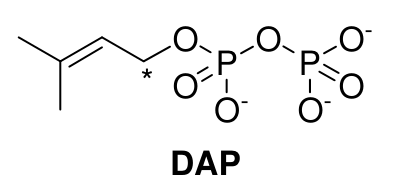
7.3 Write down the overall reaction equation for reductive ozonolysis of DAP, if dimethyl sulfide is used as the reducing agent.
The product of the final coupling reaction (hydrocarbon Y5) is formed when two hydrocarbon residues (R) of intermediate Y4 are combined:
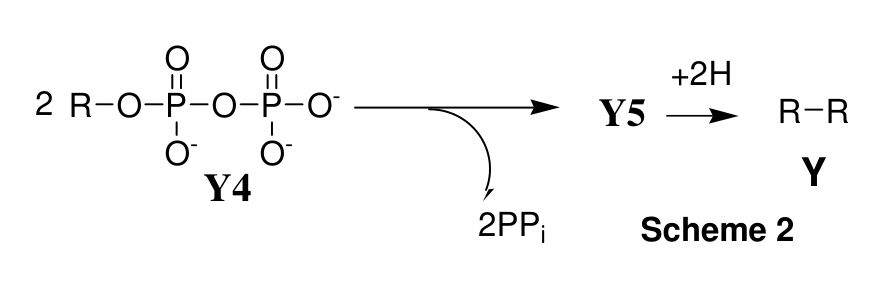
Scheme 2
At each coupling stage but that shown in Scheme 2, pyrophosphate is released in a molar ratio of 1 : 1 to the coupling product.
7.4 Determine molecular formula of Y, if it is known that Y2 and Y3 contain 5 and 4 carbon atoms, respectively.
7.5 Calculate the number of IPP and DAP molecules needed to give Y5, if it is known that all carbon atoms of isomeric pyrophosphates are incorporated into Y.
7.6 Draw the product of coupling reaction of one IPP molecule with one DAP molecule (C-C bond can be formed only by carbon atoms marked with asterisks), if it is known that subsequent reductive ozonolysis of the product of the coupling reaction gives Y1, Y2 and one more product, the latter containing phosphorus.
The only double bond reduced in Y5 during its metabolism into Y was formed in the reaction described in Scheme 2. All double bonds in Y and Y4 exist in trans configuration.
7.7 Draw structures of Y and Y4 with stereochemical details.
Official English text of the problem.
Answers
In the condensed structures below, \(\ce{-OPP}\) denotes the diphosphate ester group \(\ce{-O-P(=O)(O^-)-O-P(=O)(O^-)O^-}\). Its charge is included implicitly.
-
7.1 E1: reduction and elimination of the CoA thiol fragment—nonhydrolytic cleavage of the thioester \(\ce{C-S}\) bond. E3: phosphorylation.
-
7.2 X is (R)-mevalonic acid, or (3R)-3,5-dihydroxy-3-methylpentanoic acid, \(\ce{C6H12O4}\).
SMILES:C[C@@](O)(CCO)CC(=O)O -
7.3 \[ \ce{(CH3)2C=CHCH2OPP + O3 + (CH3)2S -> (CH3)2CO + OHCCH2OPP + (CH3)2SO} \] The products are acetone, 2-oxoethyl diphosphate, and dimethyl sulfoxide.
-
7.4 \(\boxed{\ce{Y = C30H50}}\).
-
7.5 Each molecule of Y5 requires \(\boxed{4\text{ IPP molecules}+2\text{ DAP molecules}}\).
-
7.6 The product is geranyl diphosphate, (2E)-3,7-dimethylocta-2,6-dien-1-yl diphosphate: \[ \ce{(CH3)2C=CHCH2CH2C(CH3)=CHCH2OPP}. \] SMILES:
CC(C)=CCC/C(C)=C/COP(=O)([O-])OP(=O)([O-])[O-] -
7.7 Y is all-trans-squalene, with \(E\) configurations at positions \(6,10,14,18\).
SMILES:CC(C)=CCC/C(C)=C/CC/C(C)=C/CC/C=C(C)/CC/C=C(C)/CCC=C(C)C
Y4 is (2E,6E)-farnesyl diphosphate, or (2E,6E)-3,7,11-trimethyldodeca-2,6,10-trien-1-yl diphosphate.
SMILES: CC(C)=CCC/C(C)=C/CC/C(C)=C/COP(=O)([O-])OP(=O)([O-])[O-]
Solution
7.1 — Reaction types
The thioester end of HMG-CoA is converted into a primary alcohol. The functional-group balance is
\[ \ce{A-C(=O)-SCoA + 4[H] -> A-CH2OH + HSCoA}, \]
where \(A\) represents the unchanged remainder of the substrate and \([H]\) denotes formal hydrogen equivalents.
This transformation involves reduction of the acyl carbon and cleavage of its bond to sulfur. Mechanistically, reduction of the thioester produces an aldehyde with elimination of the CoA thiol fragment; further reduction gives the primary alcohol. The overall thioester cleavage is a hydrogenolysis, and no water is consumed.
Thus E1 performs reduction and elimination/nonhydrolytic C–S cleavage.
The three subsequent steps are phosphorylations:
- E2 phosphorylates the terminal primary alcohol.
- E3 adds a second phosphoryl group to form the diphosphate ester.
- E4 phosphorylates the tertiary hydroxyl group.
The last phosphorylation makes that oxygen substituent a suitable leaving group. Subsequent loss of phosphate and decarboxylation produces IPP. Therefore E3 catalyzes phosphorylation.
7.2 — Identification and absolute configuration of X
Reduction of the thioester group gives
\[ \ce{HOOC-CH2-C(OH)(CH3)-CH2-CH2OH}, \]
which is mevalonic acid. Its stereocenter is C3.
The CIP priorities in the product are
\[ \ce{OH} > \ce{CH2COOH} > \ce{CH2CH2OH} > \ce{CH3}. \]
In the starting HMG-CoA, the thioester-containing side chain has higher priority than the carboxylic-acid-containing side chain: the comparison ultimately encounters sulfur versus oxygen. After reduction, the carboxylic-acid-containing chain has higher priority than the hydroxyethyl chain.
Consequently, priorities 2 and 3 exchange places while the spatial arrangement at C3 is retained. The starting \(S\) descriptor therefore becomes \(R\).
The required drawing is (R)-mevalonic acid, SMILES C[C@@](O)(CCO)CC(=O)O. An unambiguous Fischer projection has:
- \(\ce{CH2COOH}\) above the stereocenter;
- \(\ce{CH2CH2OH}\) below;
- \(\ce{CH3}\) on the left;
- \(\ce{OH}\) on the right.
As usual for a Fischer projection, the horizontal bonds point toward the viewer and the vertical bonds point away.
7.3 — Reductive ozonolysis of DAP
DAP is 3-methylbut-2-en-1-yl diphosphate:
CC(C)=CCOP(=O)([O-])OP(=O)([O-])[O-]
Its alkene has two methyl groups on one carbon and one hydrogen plus a diphosphate-bearing side chain on the other:
\[ \ce{(CH3)2C=CH-CH2-OPP}. \]
Reductive cleavage therefore produces a ketone at the dimethyl-substituted carbon and an aldehyde at the other carbon. Dimethyl sulfide accepts the remaining oxygen atom from ozone:
\[ \boxed{ \ce{(CH3)2C=CHCH2OPP + O3 + (CH3)2S -> (CH3)2CO + OHCCH2OPP + (CH3)2SO} } \]
The named species and their SMILES are:
| Species | Name | SMILES |
|---|---|---|
| \(\ce{O3}\) | Ozone | [O-][O+]=O |
| \(\ce{(CH3)2S}\) | Dimethyl sulfide | CSC |
| \(\ce{(CH3)2CO}\) | Acetone, or propanone | CC(=O)C |
| \(\ce{OHCCH2OPP}\) | 2-Oxoethyl diphosphate | O=CCOP(=O)([O-])OP(=O)([O-])[O-] |
| \(\ce{(CH3)2SO}\) | Dimethyl sulfoxide | CS(=O)C |
The equation conserves every atom and the diphosphate ester’s charge. Each alkene consumes one molecule each of ozone and dimethyl sulfide.
7.4 — Molecular formula of Y
The DAP-derived terminal \(\ce{(CH3)2C=}\) groups yield acetone on ozonolysis. Hence Y1 is acetone, containing three carbon atoms.
The final coupling joins two prenyl chains, each with one such terminal group. One molecule of Y therefore gives two acetone molecules, so the stated ratio corresponds to
\[ 2\,\mathrm{Y1}+4\,\mathrm{Y2}+1\,\mathrm{Y3} \]
per molecule of Y.
Since reductive ozonolysis preserves the carbon atoms in these organic fragments,
\[ N_{\mathrm C} =2(3)+4(5)+1(4) =30. \]
There are seven fragments. Cleaving each double bond in an acyclic carbon skeleton increases the number of separate fragments by one, so
\[ N_{\text{double bonds}}=7-1=6. \]
An acyclic hydrocarbon with 30 carbon atoms and six double bonds has
\[ N_{\mathrm H}=2(30)+2-2(6)=50. \]
Thus
\[ \boxed{\ce{Y = C30H50}}. \]
7.5 — Numbers of IPP and DAP molecules
Both IPP and DAP contain five carbon atoms. No carbon is lost during assembly, and the final reduction changes only the hydrogen count. Therefore six five-carbon building blocks are required:
\[ N_{\mathrm{IPP}}+N_{\mathrm{DAP}}=\frac{30}{5}=6. \]
The two identical residues in Scheme 2 each contain 15 carbon atoms, hence three five-carbon units.
Each residue has one DAP-derived terminal dimethyl-substituted alkene. The remaining two units extend that chain and come from IPP. Thus each Y4 is assembled from
\[ 1\text{ DAP}+2\text{ IPP}. \]
For two molecules of Y4,
\[ \boxed{N_{\mathrm{DAP}}=2,\qquad N_{\mathrm{IPP}}=4}. \]
This also satisfies the diphosphate balance: four ordinary coupling steps release four diphosphates, and the final coupling releases two more, accounting for all six starting diphosphate groups.
7.6 — Coupling one IPP with one DAP
IPP is 3-methylbut-3-en-1-yl diphosphate:
C=C(C)CCOP(=O)([O-])OP(=O)([O-])[O-]
Numbering from the carbon bearing the diphosphate ester, the required new bond joins C1 of DAP to C4 of IPP, the terminal methylene carbon.
The DAP diphosphate group leaves, while the IPP diphosphate group is retained. Formation of the new bond and loss of a proton relocate the IPP double bond from C3–C4 to C2–C3. The product is
\[ \ce{PP-O-CH2-CH=C(CH3)-CH2-CH2-CH=C(CH3)2}. \]
This is geranyl diphosphate, with the stereochemical SMILES given in the Answers.
Its reductive ozonolysis gives
\[ \ce{GPP + 2O3 + 2(CH3)2S -> (CH3)2CO + CH3COCH2CH2CHO + OHCCH2OPP + 2(CH3)2SO}. \]
The three organic fragments are:
- Y1: acetone,
CC(=O)C; - Y2: 4-oxopentanal, \(\ce{CH3COCH2CH2CHO}\),
CC(=O)CCC=O; - 2-oxoethyl diphosphate,
O=CCOP(=O)([O-])OP(=O)([O-])[O-].
Their carbon counts are \(3+5+2=10\), as required.
Ozonolysis determines the connectivity but does not distinguish alkene geometries. The later trans requirement for Y4, whose existing double bonds are retained during chain extension, selects the \(2E\) geranyl structure.
7.7 — Structures and stereochemistry of Y and Y4
Adding a second IPP unit to geranyl diphosphate gives the 15-carbon intermediate farnesyl diphosphate, Y4:
\[ \ce{PP-O-CH2-CH=C(CH3)-CH2-CH2-CH=C(CH3)-CH2-CH2-CH=C(CH3)2}. \]
For the required drawing, place the double bonds at C2–C3 and C6–C7 in the \(E\) configuration. The terminal C10–C11 double bond has two identical methyl substituents at C11 and therefore has no \(E/Z\) designation.
Thus Y4 is (2E,6E)-farnesyl diphosphate:
CC(C)=CCC/C(C)=C/CC/C(C)=C/COP(=O)([O-])OP(=O)([O-])[O-]
In Scheme 2, the two farnesyl residues join through the carbons that originally bore diphosphate. The newly formed double bond is subsequently reduced. Therefore, to draw Y, replace the two terminal \(\ce{C1-O}\) bonds of two Y4 molecules with a C1–C1′ single bond, retaining all pre-existing alkene configurations.
The central segment is consequently
\[ \ce{-C(CH3)=CH-CH2-CH2-CH=C(CH3)-}. \]
The resulting hydrocarbon is squalene, specifically
(6E,10E,14E,18E)-2,6,10,15,19,23-hexamethyltetracosa-2,6,10,14,18,22-hexaene:
CC(C)=CCC/C(C)=C/CC/C(C)=C/CC/C=C(C)/CC/C=C(C)/CCC=C(C)C
Its ozonolysis provides a direct structural check:
| Product | Origin in squalene | Molecules per molecule of Y | SMILES |
|---|---|---|---|
| Y1: acetone | Two terminal dimethyl-substituted alkene carbons | 2 | CC(=O)C |
| Y2: 4-oxopentanal | Four intervening five-carbon segments | 4 | CC(=O)CCC=O |
| Y3: butane-1,4-dial, or succinaldehyde | Central four-carbon segment | 1 | O=CCCC=O |
The balanced overall check is
\[ \ce{C30H50 + 6O3 + 6(CH3)2S -> 2(CH3)2CO + 4CH3COCH2CH2CHO + OHCCH2CH2CHO + 6(CH3)2SO}. \]
This reproduces the required \(2:4:1\) ratio and the specified carbon counts.
The solution was checked against the official solution.
IChO 2007 · Theorieaufgabe 7
Atherosklerose und Zwischenprodukte der Cholesterinbiosynthese
Cholesterin ist ein in der belebten Natur weitverbreitetes Lipid. Störungen seines Stoffwechsels führen zu Atherosklerose und damit verbundenen, potenziell tödlichen Erkrankungen.
Die Substanzen X und Y sind zwei zentrale Zwischenprodukte der Cholesterinbiosynthese bei Tieren.
X ist eine optisch aktive Monocarbonsäure, die aus Atomen von nur drei Elementen besteht. Sie wird in Organismen aus (S)-3-Hydroxy-3-methylpentandioyl-Coenzym A (HMG-CoA) gebildet. Diese Reaktion wird durch das Enzym E1 katalysiert (das zwei Reaktionstypen katalysiert) und benötigt kein Wasser als Substrat. X wird anschließend in einem dreistufigen Prozess zu X1 verstoffwechselt. Dafür werden die Enzyme E2, E3, E4 benötigt, die Reaktionen ein und desselben (und nur eines) Typs katalysieren. Schließlich zerfällt X1 spontan (nichtenzymatisch) unter Bildung von Isopentenylpyrophosphat (3-Methylbut-3-enyldiphosphat, IPP) und anorganischen Produkten:
Schema 1
7.1 Wählen Sie im Antwortbogen den bzw. die Reaktionstypen für E1 und E3 aus.
7.2 Zeichnen Sie die Struktur von X mit stereochemischen Details und geben Sie die absolute Konfiguration (R oder S) des Stereozentrums an.
Y ist ein ungesättigter acyclischer Kohlenwasserstoff. Seine reduktive Ozonolyse führt zu einem Gemisch aus nur drei organischen Substanzen Y1, Y2 und Y3 im Stoffmengenverhältnis 2:4:1. Y entsteht durch eine Reihe aufeinanderfolgender Kupplungsreaktionen zweier isomerer Substanzen: IPP und Dimethylallylpyrophosphat (3-Methylbut-2-enyldiphosphat, DAP), gefolgt von der Reduktion einer Doppelbindung im letzten Kupplungsprodukt Y5. Die Kohlenstoffatome von IPP und DAP, die bei der Biosynthese von Y an der Bildung von C-C-Bindungen beteiligt sind, sind mit Sternchen markiert.
7.3 Geben Sie die Gesamtreaktionsgleichung für die reduktive Ozonolyse von DAP an, wenn Dimethylsulfid als Reduktionsmittel verwendet wird.
Das Produkt der letzten Kupplungsreaktion (der Kohlenwasserstoff Y5) entsteht durch die Verknüpfung zweier Kohlenwasserstoffreste (R) des Zwischenprodukts Y4:
Schema 2
Bei jedem Kupplungsschritt außer dem in Schema 2 gezeigten wird Pyrophosphat im Stoffmengenverhältnis 1 : 1 zum Kupplungsprodukt freigesetzt.
7.4 Bestimmen Sie die Summenformel von Y, wenn bekannt ist, dass Y2 und Y3 5 bzw. 4 Kohlenstoffatome enthalten.
7.5 Berechnen Sie die Anzahl der IPP- und DAP-Moleküle, die zur Bildung von Y5 benötigt werden, wenn bekannt ist, dass alle Kohlenstoffatome der isomeren Pyrophosphate in Y eingebaut werden.
7.6 Zeichnen Sie das Produkt der Kupplungsreaktion eines IPP-Moleküls mit einem DAP-Molekül (eine C-C-Bindung kann nur zwischen den mit Sternchen markierten Kohlenstoffatomen gebildet werden), wenn bekannt ist, dass die anschließende reduktive Ozonolyse des Kupplungsprodukts Y1, Y2 und ein weiteres Produkt liefert, wobei Letzteres Phosphor enthält.
Die einzige Doppelbindung, die bei der Verstoffwechselung von Y5 zu Y reduziert wird, wurde in der in Schema 2 beschriebenen Reaktion gebildet. Alle Doppelbindungen in Y und Y4 liegen in trans-Konfiguration vor.
7.7 Zeichnen Sie die Strukturen von Y und Y4 mit stereochemischen Details.
Aufgabentext aus dem offiziellen englischen Text übersetzt.
Antworten
In den folgenden Halbstrukturformeln bezeichnet \(\ce{-OPP}\) die Diphosphatestergruppe \(\ce{-O-P(=O)(O^-)-O-P(=O)(O^-)O^-}\). Ihre Ladung ist implizit berücksichtigt.
-
7.1 E1: Reduktion und Eliminierung des CoA-Thiolfragments — nichthydrolytische Spaltung der \(\ce{C-S}\)-Bindung des Thioesters. E3: Phosphorylierung.
-
7.2 X ist (R)-Mevalonsäure oder (3R)-3,5-Dihydroxy-3-methylpentansäure, \(\ce{C6H12O4}\).
SMILES:C[C@@](O)(CCO)CC(=O)O -
7.3 \[ \ce{(CH3)2C=CHCH2OPP + O3 + (CH3)2S -> (CH3)2CO + OHCCH2OPP + (CH3)2SO} \] Die Produkte sind Aceton, 2-Oxoethyldiphosphat und Dimethylsulfoxid.
-
7.4 \(\boxed{\ce{Y = C30H50}}\).
-
7.5 Für jedes Molekül Y5 werden \(\boxed{4\text{ IPP-Moleküle}+2\text{ DAP-Moleküle}}\) benötigt.
-
7.6 Das Produkt ist Geranyldiphosphat, (2E)-3,7-Dimethylocta-2,6-dien-1-yldiphosphat: \[ \ce{(CH3)2C=CHCH2CH2C(CH3)=CHCH2OPP}. \] SMILES:
CC(C)=CCC/C(C)=C/COP(=O)([O-])OP(=O)([O-])[O-] -
7.7 Y ist all-trans-Squalen, mit \(E\)-Konfigurationen an den Positionen \(6,10,14,18\).
SMILES:CC(C)=CCC/C(C)=C/CC/C(C)=C/CC/C=C(C)/CC/C=C(C)/CCC=C(C)C
Y4 ist (2E,6E)-Farnesyldiphosphat oder (2E,6E)-3,7,11-Trimethyldodeca-2,6,10-trien-1-yldiphosphat.
SMILES: CC(C)=CCC/C(C)=C/CC/C(C)=C/COP(=O)([O-])OP(=O)([O-])[O-]
Lösung
7.1 — Reaktionstypen
Das Thioesterende von HMG-CoA wird in einen primären Alkohol umgewandelt. Die Bilanz der funktionellen Gruppen lautet
\[ \ce{A-C(=O)-SCoA + 4[H] -> A-CH2OH + HSCoA}, \]
wobei \(A\) für den unveränderten Rest des Substrats steht und \([H]\) formale Wasserstoffäquivalente bezeichnet.
Diese Umwandlung umfasst die Reduktion des Acylkohlenstoffatoms und die Spaltung seiner Bindung zum Schwefel. Mechanistisch entsteht bei der Reduktion des Thioesters unter Eliminierung des CoA-Thiolfragments ein Aldehyd; die weitere Reduktion liefert den primären Alkohol. Insgesamt handelt es sich bei der Thioesterspaltung um eine Hydrogenolyse, und es wird kein Wasser verbraucht.
Somit bewirkt E1 eine Reduktion und eine Eliminierung/nichthydrolytische C–S-Spaltung.
Die drei anschließenden Schritte sind Phosphorylierungen:
- E2 phosphoryliert den endständigen primären Alkohol.
- E3 fügt eine zweite Phosphorylgruppe hinzu, sodass der Diphosphatester entsteht.
- E4 phosphoryliert die tertiäre Hydroxygruppe.
Durch die letzte Phosphorylierung wird dieser Sauerstoffsubstituent zu einer geeigneten Abgangsgruppe. Die anschließende Abspaltung von Phosphat und Decarboxylierung liefert IPP. Daher katalysiert E3 eine Phosphorylierung.
7.2 — Identifizierung und absolute Konfiguration von X
Die Reduktion der Thioestergruppe ergibt
\[ \ce{HOOC-CH2-C(OH)(CH3)-CH2-CH2OH}, \]
also Mevalonsäure. Ihr Stereozentrum ist C3.
Die CIP-Prioritäten im Produkt sind
\[ \ce{OH} > \ce{CH2COOH} > \ce{CH2CH2OH} > \ce{CH3}. \]
Im Ausgangsstoff HMG-CoA hat die thioesterhaltige Seitenkette eine höhere Priorität als die carbonsäurehaltige Seitenkette: Beim Vergleich ist letztlich Schwefel gegenüber Sauerstoff ausschlaggebend. Nach der Reduktion hat die carbonsäurehaltige Kette eine höhere Priorität als die Hydroxyethylkette.
Folglich vertauschen die Prioritäten 2 und 3 ihre Plätze, während die räumliche Anordnung an C3 erhalten bleibt. Der ursprüngliche Deskriptor \(S\) wird daher zu \(R\).
Die geforderte Zeichnung zeigt (R)-Mevalonsäure, SMILES C[C@@](O)(CCO)CC(=O)O. Eine eindeutige Fischer-Projektion hat:
- \(\ce{CH2COOH}\) oberhalb des Stereozentrums;
- \(\ce{CH2CH2OH}\) unterhalb;
- \(\ce{CH3}\) links;
- \(\ce{OH}\) rechts.
Wie bei einer Fischer-Projektion üblich, zeigen die horizontalen Bindungen zum Betrachter hin und die vertikalen Bindungen von ihm weg.
7.3 — Reduktive Ozonolyse von DAP
DAP ist 3-Methylbut-2-en-1-yldiphosphat:
CC(C)=CCOP(=O)([O-])OP(=O)([O-])[O-]
Seine Alkenfunktion trägt an einem Kohlenstoffatom zwei Methylgruppen und am anderen ein Wasserstoffatom sowie eine diphosphattragende Seitenkette:
\[ \ce{(CH3)2C=CH-CH2-OPP}. \]
Die reduktive Spaltung liefert daher am dimethylsubstituierten Kohlenstoffatom ein Keton und am anderen Kohlenstoffatom einen Aldehyd. Dimethylsulfid nimmt das verbleibende Sauerstoffatom des Ozons auf:
\[ \boxed{ \ce{(CH3)2C=CHCH2OPP + O3 + (CH3)2S -> (CH3)2CO + OHCCH2OPP + (CH3)2SO} } \]
Die genannten Spezies und ihre SMILES sind:
| Spezies | Name | SMILES |
|---|---|---|
| \(\ce{O3}\) | Ozon | [O-][O+]=O |
| \(\ce{(CH3)2S}\) | Dimethylsulfid | CSC |
| \(\ce{(CH3)2CO}\) | Aceton oder Propanon | CC(=O)C |
| \(\ce{OHCCH2OPP}\) | 2-Oxoethyldiphosphat | O=CCOP(=O)([O-])OP(=O)([O-])[O-] |
| \(\ce{(CH3)2SO}\) | Dimethylsulfoxid | CS(=O)C |
Die Gleichung erhält jedes Atom und die Ladung des Diphosphatesters. Jede Alkenfunktion verbraucht jeweils ein Molekül Ozon und Dimethylsulfid.
7.4 — Summenformel von Y
Die aus DAP stammenden endständigen \(\ce{(CH3)2C=}\)-Gruppen liefern bei der Ozonolyse Aceton. Somit ist Y1 Aceton und enthält drei Kohlenstoffatome.
Die letzte Kupplung verknüpft zwei Prenylketten, die jeweils eine solche endständige Gruppe besitzen. Ein Molekül Y ergibt daher zwei Acetonmoleküle, sodass das angegebene Verhältnis
\[ 2\,\mathrm{Y1}+4\,\mathrm{Y2}+1\,\mathrm{Y3} \]
pro Molekül Y entspricht.
Da bei der reduktiven Ozonolyse die Kohlenstoffatome in diesen organischen Fragmenten erhalten bleiben, gilt
\[ N_{\mathrm C} =2(3)+4(5)+1(4) =30. \]
Es gibt sieben Fragmente. Die Spaltung jeder Doppelbindung in einem acyclischen Kohlenstoffgerüst erhöht die Anzahl der getrennten Fragmente um eins, daher gilt
\[ N_{\text{Doppelbindungen}}=7-1=6. \]
Ein acyclischer Kohlenwasserstoff mit 30 Kohlenstoffatomen und sechs Doppelbindungen hat
\[ N_{\mathrm H}=2(30)+2-2(6)=50. \]
Somit gilt
\[ \boxed{\ce{Y = C30H50}}. \]
7.5 — Anzahl der IPP- und DAP-Moleküle
Sowohl IPP als auch DAP enthalten fünf Kohlenstoffatome. Beim Aufbau geht kein Kohlenstoff verloren, und die abschließende Reduktion verändert nur die Anzahl der Wasserstoffatome. Daher werden sechs Bausteine mit je fünf Kohlenstoffatomen benötigt:
\[ N_{\mathrm{IPP}}+N_{\mathrm{DAP}}=\frac{30}{5}=6. \]
Die beiden identischen Reste in Schema 2 enthalten jeweils 15 Kohlenstoffatome, also drei Einheiten mit je fünf Kohlenstoffatomen.
Jeder Rest besitzt eine aus DAP stammende endständige dimethylsubstituierte Alkenfunktion. Die beiden übrigen Einheiten verlängern diese Kette und stammen aus IPP. Somit besteht jedes Y4 aus
\[ 1\text{ DAP}+2\text{ IPP}. \]
Für zwei Moleküle Y4 gilt
\[ \boxed{N_{\mathrm{DAP}}=2,\qquad N_{\mathrm{IPP}}=4}. \]
Dies erfüllt auch die Diphosphatbilanz: Vier gewöhnliche Kupplungsschritte setzen vier Diphosphate frei, und die letzte Kupplung setzt zwei weitere frei, womit alle sechs ursprünglichen Diphosphatgruppen erfasst sind.
7.6 — Kupplung eines IPP mit einem DAP
IPP ist 3-Methylbut-3-en-1-yldiphosphat:
C=C(C)CCOP(=O)([O-])OP(=O)([O-])[O-]
Bei Nummerierung ab dem Kohlenstoffatom, das den Diphosphatester trägt, verknüpft die erforderliche neue Bindung C1 von DAP mit C4 von IPP, dem endständigen Methylenkohlenstoffatom.
Die Diphosphatgruppe von DAP wird abgespalten, während die Diphosphatgruppe von IPP erhalten bleibt. Durch die Bildung der neuen Bindung und die Abspaltung eines Protons wird die Doppelbindung von IPP von C3–C4 nach C2–C3 verlagert. Das Produkt ist
\[ \ce{PP-O-CH2-CH=C(CH3)-CH2-CH2-CH=C(CH3)2}. \]
Dies ist Geranyldiphosphat, dessen stereochemischer SMILES im Abschnitt Antworten angegeben ist.
Seine reduktive Ozonolyse ergibt
\[ \ce{GPP + 2O3 + 2(CH3)2S -> (CH3)2CO + CH3COCH2CH2CHO + OHCCH2OPP + 2(CH3)2SO}. \]
Die drei organischen Fragmente sind:
- Y1: Aceton,
CC(=O)C; - Y2: 4-Oxopentanal, \(\ce{CH3COCH2CH2CHO}\),
CC(=O)CCC=O; - 2-Oxoethyldiphosphat,
O=CCOP(=O)([O-])OP(=O)([O-])[O-].
Ihre Kohlenstoffzahlen ergeben wie gefordert \(3+5+2=10\).
Die Ozonolyse bestimmt die Konnektivität, unterscheidet jedoch nicht zwischen den Doppelbindungsgeometrien. Die spätere Forderung nach trans-Konfiguration für Y4, dessen bereits vorhandene Doppelbindungen bei der Kettenverlängerung erhalten bleiben, legt die \(2E\)-Geranylstruktur fest.
7.7 — Strukturen und Stereochemie von Y und Y4
Durch Anfügen einer zweiten IPP-Einheit an Geranyldiphosphat entsteht das Zwischenprodukt Farnesyldiphosphat, Y4, mit 15 Kohlenstoffatomen:
\[ \ce{PP-O-CH2-CH=C(CH3)-CH2-CH2-CH=C(CH3)-CH2-CH2-CH=C(CH3)2}. \]
Zeichnen Sie für die geforderte Struktur die Doppelbindungen C2–C3 und C6–C7 in der \(E\)-Konfiguration. Die endständige Doppelbindung C10–C11 trägt an C11 zwei identische Methylsubstituenten und hat daher keine \(E/Z\)-Bezeichnung.
Somit ist Y4 (2E,6E)-Farnesyldiphosphat:
CC(C)=CCC/C(C)=C/CC/C(C)=C/COP(=O)([O-])OP(=O)([O-])[O-]
In Schema 2 verknüpfen sich die beiden Farnesylreste über die Kohlenstoffatome, die ursprünglich Diphosphat trugen. Die neu gebildete Doppelbindung wird anschließend reduziert. Um Y zu zeichnen, ersetzen Sie daher die beiden endständigen \(\ce{C1-O}\)-Bindungen zweier Y4-Moleküle durch eine C1–C1′-Einfachbindung, wobei alle bereits vorhandenen Doppelbindungskonfigurationen erhalten bleiben.
Der zentrale Abschnitt ist folglich
\[ \ce{-C(CH3)=CH-CH2-CH2-CH=C(CH3)-}. \]
Der resultierende Kohlenwasserstoff ist Squalen, genauer
(6E,10E,14E,18E)-2,6,10,15,19,23-Hexamethyltetracosa-2,6,10,14,18,22-hexaen:
CC(C)=CCC/C(C)=C/CC/C(C)=C/CC/C=C(C)/CC/C=C(C)/CCC=C(C)C
Seine Ozonolyse ermöglicht eine direkte Überprüfung der Struktur:
| Produkt | Herkunft im Squalen | Moleküle pro Molekül Y | SMILES |
|---|---|---|---|
| Y1: Aceton | Zwei endständige dimethylsubstituierte Alkenkohlenstoffatome | 2 | CC(=O)C |
| Y2: 4-Oxopentanal | Vier dazwischenliegende Abschnitte mit je fünf Kohlenstoffatomen | 4 | CC(=O)CCC=O |
| Y3: Butan-1,4-dial oder Succinaldehyd | Zentraler Abschnitt mit vier Kohlenstoffatomen | 1 | O=CCCC=O |
Die ausgeglichene Gesamtgleichung zur Überprüfung lautet
\[ \ce{C30H50 + 6O3 + 6(CH3)2S -> 2(CH3)2CO + 4CH3COCH2CH2CHO + OHCCH2CH2CHO + 6(CH3)2SO}. \]
Damit werden das geforderte Verhältnis \(2:4:1\) und die angegebenen Kohlenstoffzahlen reproduziert.
Die Lösung wurde mit der offiziellen Lösung abgeglichen.
IChO 2007 · Teori sorusu 7
Ateroskleroz ve kolesterol biyosentezinin ara ürünleri
Kolesterol, canlı doğada yaygın olarak bulunan bir lipittir. Metabolizmasının bozulması, ateroskleroza ve bununla ilişkili, ölümcül olabilen hastalıklara yol açar.
X ve Y maddeleri, hayvanlarda kolesterol biyosentezinin iki temel ara ürünüdür.
X, yalnızca üç elementin atomlarından oluşan, optikçe aktif bir monokarboksilik asittir. Organizmalarda (S)-3-hidroksi-3-metilpentandioil-koenzim A'dan (HMG-CoA) oluşur. Bu tepkime, (iki tür tepkimeyi katalizleyen) E1 enzimi tarafından katalizlenir ve substrat olarak su içermez. X daha sonra, bir ve aynı (ve yalnızca bir) türdeki tepkimeleri katalizleyen E2, E3, E4 enzimlerini gerektiren üç aşamalı bir süreçle X1'e metabolize edilir. Son olarak X1, kendiliğinden (enzimatik olmayan yolla) bozunarak izopentenil pirofosfat (3-metilbut-3-enil difosfat, IPP) ve inorganik ürünler verir:
Şema 1
7.1 Cevap Kâğıdı'nda E1 ve E3 için tepkime türünü/türlerini seçiniz.
7.2 X'in yapısını stereokimyasal ayrıntılarıyla çiziniz ve stereomerkezin mutlak konfigürasyonunu (R veya S) belirtiniz.
Y, doymamış, açık zincirli bir hidrokarbondur. İndirgeyici ozonolizi, yalnızca üç organik maddeden, Y1, Y2 ve Y3'ten oluşan ve bunları 2:4:1 mol oranında içeren bir karışım verir. Y, iki izomerik maddenin, IPP ve dimetil alil pirofosfatın (3-metilbut-2-enil difosfat, DAP), art arda gerçekleşen bir dizi kenetlenme tepkimesi ve ardından son kenetlenme ürünü Y5'teki bir çift bağın indirgenmesi sonucunda oluşur. Y'nin biyosentezi sırasında C-C bağlarının oluşumuna katılan IPP ve DAP karbon atomları yıldız işaretleriyle gösterilmiştir.
7.3 İndirgen olarak dimetil sülfür kullanılması durumunda DAP'ın indirgeyici ozonolizinin toplam tepkime denklemini yazınız.
Son kenetlenme tepkimesinin ürünü (Y5 hidrokarbonu), Y4 ara ürününün iki hidrokarbon kalıntısının (R) birleşmesiyle oluşur:
Şema 2
Şema 2'de gösterilen dışındaki her kenetlenme aşamasında, kenetlenme ürününe göre 1 : 1 mol oranında pirofosfat açığa çıkar.
7.4 Y2 ve Y3'ün sırasıyla 5 ve 4 karbon atomu içerdiği bilindiğine göre Y'nin molekül formülünü belirleyiniz.
7.5 İzomerik pirofosfatların tüm karbon atomlarının Y'nin yapısına katıldığı bilindiğine göre Y5'i elde etmek için gereken IPP ve DAP moleküllerinin sayısını hesaplayınız.
7.6 Kenetlenme ürününün daha sonra indirgeyici ozonolize uğratılmasının Y1, Y2 ve fosfor içeren bir başka ürün verdiği bilindiğine göre bir IPP molekülü ile bir DAP molekülünün kenetlenme tepkimesinin ürününü çiziniz (C-C bağı yalnızca yıldız işaretli karbon atomları arasında oluşabilir).
Y5'in Y'ye metabolize edilmesi sırasında indirgenen tek çift bağ, Şema 2'de açıklanan tepkimede oluşmuştur. Y ve Y4'teki tüm çift bağlar trans konfigürasyonundadır.
7.7 Y ve Y4'ün yapılarını stereokimyasal ayrıntılarıyla çiziniz.
Soru metni resmi İngilizce metinden çevrilmiştir.
Cevaplar
Aşağıdaki kısaltılmış yapı formüllerinde \(\ce{-OPP}\), \(\ce{-O-P(=O)(O^-)-O-P(=O)(O^-)O^-}\) difosfat ester grubunu gösterir. Grubun yükü örtük olarak dâhil edilmiştir.
-
7.1 E1: indirgenme ve CoA tiyol parçasının eliminasyonu—tiyoesterin \(\ce{C-S}\) bağının hidrolitik olmayan yolla kırılması. E3: fosforilasyon.
-
7.2 X, (R)-mevalonik asit, diğer adıyla (3R)-3,5-dihidroksi-3-metilpentanoik asit, \(\ce{C6H12O4}\)'tür.
SMILES:C[C@@](O)(CCO)CC(=O)O -
7.3 \[ \ce{(CH3)2C=CHCH2OPP + O3 + (CH3)2S -> (CH3)2CO + OHCCH2OPP + (CH3)2SO} \] Ürünler aseton, 2-oksoetil difosfat ve dimetil sülfoksittir.
-
7.4 \(\boxed{\ce{Y = C30H50}}\).
-
7.5 Her bir Y5 molekülü için \(\boxed{4\text{ IPP molekülü}+2\text{ DAP molekülü}}\) gerekir.
-
7.6 Ürün geranil difosfat, (2E)-3,7-dimetilokta-2,6-dien-1-il difosfattır: \[ \ce{(CH3)2C=CHCH2CH2C(CH3)=CHCH2OPP}. \] SMILES:
CC(C)=CCC/C(C)=C/COP(=O)([O-])OP(=O)([O-])[O-] -
7.7 Y, \(6,10,14,18\) konumlarında \(E\) konfigürasyonlarına sahip tümü-trans-skualendir.
SMILES:CC(C)=CCC/C(C)=C/CC/C(C)=C/CC/C=C(C)/CC/C=C(C)/CCC=C(C)C
Y4, (2E,6E)-farnesil difosfat, diğer adıyla (2E,6E)-3,7,11-trimetildodeka-2,6,10-trien-1-il difosfattır.
SMILES: CC(C)=CCC/C(C)=C/CC/C(C)=C/COP(=O)([O-])OP(=O)([O-])[O-]
Çözüm
7.1 — Tepkime türleri
HMG-CoA'nın tiyoester ucu bir birincil alkole dönüştürülür. Fonksiyonel grup dönüşümünün denklemi şöyledir:
\[ \ce{A-C(=O)-SCoA + 4[H] -> A-CH2OH + HSCoA}, \]
burada \(A\), substratın değişmeden kalan kısmını, \([H]\) ise biçimsel hidrojen eşdeğerlerini gösterir.
Bu dönüşüm, açil karbonunun indirgenmesini ve kükürtle yaptığı bağın kırılmasını içerir. Mekanizma açısından, tiyoesterin indirgenmesi, CoA tiyol parçasının eliminasyonuyla bir aldehit oluşturur; sonraki indirgenme birincil alkolü verir. Tiyoester bağının toplam kırılma süreci bir hidrojenolizdir ve su tüketilmez.
Dolayısıyla E1, indirgenme ve eliminasyon/hidrolitik olmayan C–S bağı kırılmasını gerçekleştirir.
Sonraki üç basamak fosforilasyondur:
- E2, uçtaki birincil alkolü fosforiller.
- E3, difosfat esterini oluşturmak üzere ikinci bir fosforil grubu ekler.
- E4, üçüncül hidroksil grubunu fosforiller.
Son fosforilasyon, bu oksijen sübstitüentini uygun bir ayrılan grup hâline getirir. Ardından gerçekleşen fosfat kaybı ve dekarboksilasyon IPP'yi oluşturur. Bu nedenle E3 fosforilasyonu katalizler.
7.2 — X'in belirlenmesi ve mutlak konfigürasyonu
Tiyoester grubunun indirgenmesiyle
\[ \ce{HOOC-CH2-C(OH)(CH3)-CH2-CH2OH}, \]
yapısı elde edilir; bu bileşik mevalonik asittir. Stereomerkezi C3'tür.
Üründeki CIP öncelikleri şöyledir:
\[ \ce{OH} > \ce{CH2COOH} > \ce{CH2CH2OH} > \ce{CH3}. \]
Başlangıçtaki HMG-CoA'da tiyoester içeren yan zincirin önceliği, karboksilik asit içeren yan zincirinkinden daha yüksektir: karşılaştırmada sonunda kükürt ile oksijen karşı karşıya gelir. İndirgenmeden sonra karboksilik asit içeren zincirin önceliği, hidroksietil zincirinkinden daha yüksektir.
Sonuç olarak, C3'teki uzaysal düzen korunurken 2 ve 3 numaralı öncelikler yer değiştirir. Bu nedenle başlangıçtaki \(S\) tanımlayıcısı \(R\) olur.
İstenen çizim, SMILES gösterimi C[C@@](O)(CCO)CC(=O)O olan (R)-mevalonik asittir. Yapıyı tek anlamlı biçimde gösteren bir Fischer izdüşümünde:
- \(\ce{CH2COOH}\) stereomerkezin üstündedir;
- \(\ce{CH2CH2OH}\) altındadır;
- \(\ce{CH3}\) soldadır;
- \(\ce{OH}\) sağdadır.
Fischer izdüşümünde her zaman olduğu gibi yatay bağlar gözlemciye doğru, düşey bağlar ise gözlemciden uzağa yönelir.
7.3 — DAP'ın indirgeyici ozonolizi
DAP, 3-metilbut-2-en-1-il difosfattır:
CC(C)=CCOP(=O)([O-])OP(=O)([O-])[O-]
Alken grubunun bir karbonunda iki metil grubu, diğer karbonunda ise bir hidrojen ve difosfat taşıyan bir yan zincir bulunur:
\[ \ce{(CH3)2C=CH-CH2-OPP}. \]
Bu nedenle indirgeyici parçalanma, iki metil sübstitüenti taşıyan karbonda bir keton, diğer karbonda ise bir aldehit oluşturur. Dimetil sülfür, ozondan geriye kalan oksijen atomunu alır:
\[ \boxed{ \ce{(CH3)2C=CHCH2OPP + O3 + (CH3)2S -> (CH3)2CO + OHCCH2OPP + (CH3)2SO} } \]
Türlerin adları ve SMILES gösterimleri şöyledir:
| Tür | Adı | SMILES |
|---|---|---|
| \(\ce{O3}\) | Ozon | [O-][O+]=O |
| \(\ce{(CH3)2S}\) | Dimetil sülfür | CSC |
| \(\ce{(CH3)2CO}\) | Aseton veya propanon | CC(=O)C |
| \(\ce{OHCCH2OPP}\) | 2-Oksoetil difosfat | O=CCOP(=O)([O-])OP(=O)([O-])[O-] |
| \(\ce{(CH3)2SO}\) | Dimetil sülfoksit | CS(=O)C |
Denklemde tüm atomlar ve difosfat esterinin yükü korunur. Her alken, birer molekül ozon ve dimetil sülfür tüketir.
7.4 — Y'nin molekül formülü
DAP'tan gelen uç \(\ce{(CH3)2C=}\) grupları ozonolizde aseton verir. Dolayısıyla Y1 asetondur ve üç karbon atomu içerir.
Son kenetlenme, her biri böyle bir uç grup taşıyan iki prenil zincirini birleştirir. Bu nedenle bir Y molekülü iki aseton molekülü verir; dolayısıyla belirtilen oran, Y molekülü başına
\[ 2\,\mathrm{Y1}+4\,\mathrm{Y2}+1\,\mathrm{Y3} \]
elde edilmesine karşılık gelir.
İndirgeyici ozonoliz bu organik parçalardaki karbon atomlarını koruduğundan,
\[ N_{\mathrm C} =2(3)+4(5)+1(4) =30. \]
Yedi parça vardır. Açık zincirli bir karbon iskeletinde her çift bağın parçalanması, ayrı parçaların sayısını bir artırır; dolayısıyla
\[ N_{\text{çift bağlar}}=7-1=6. \]
30 karbon atomu ve altı çift bağ içeren açık zincirli bir hidrokarbonun hidrojen atomu sayısı
\[ N_{\mathrm H}=2(30)+2-2(6)=50. \]
olur. Böylece
\[ \boxed{\ce{Y = C30H50}}. \]
7.5 — IPP ve DAP moleküllerinin sayıları
Hem IPP hem de DAP beş karbon atomu içerir. Yapının oluşturulması sırasında karbon kaybı olmaz ve son indirgenme yalnızca hidrojen sayısını değiştirir. Bu nedenle beş karbonlu altı yapı taşı gerekir:
\[ N_{\mathrm{IPP}}+N_{\mathrm{DAP}}=\frac{30}{5}=6. \]
Şema 2'deki iki özdeş kalıntının her biri 15 karbon atomu, dolayısıyla beş karbonlu üç birim içerir.
Her kalıntıda, DAP'tan gelen ve iki metil sübstitüenti taşıyan bir uç alken grubu vardır. Geriye kalan iki birim bu zinciri uzatır ve IPP'den gelir. Böylece her bir Y4,
\[ 1\text{ DAP}+2\text{ IPP}. \]
birleşimiyle oluşturulur. İki Y4 molekülü için,
\[ \boxed{N_{\mathrm{DAP}}=2,\qquad N_{\mathrm{IPP}}=4}. \]
Bu sonuç difosfat bilançosunu da sağlar: dört olağan kenetlenme basamağında dört difosfat açığa çıkar ve son kenetlenmede iki difosfat daha açığa çıkar; böylece başlangıçtaki altı difosfat grubunun tümü hesaba katılmış olur.
7.6 — Bir IPP ile bir DAP'ın kenetlenmesi
IPP, 3-metilbut-3-en-1-il difosfattır:
C=C(C)CCOP(=O)([O-])OP(=O)([O-])[O-]
Numaralandırma difosfat esterini taşıyan karbondan başlatıldığında, gerekli yeni bağ DAP'ın C1 atomunu IPP'nin C4 atomuna, yani uç metilen karbonuna bağlar.
DAP'ın difosfat grubu ayrılırken IPP'nin difosfat grubu korunur. Yeni bağın oluşması ve bir protonun kaybı, IPP'nin çift bağını C3–C4 konumundan C2–C3 konumuna taşır. Ürün şöyledir:
\[ \ce{PP-O-CH2-CH=C(CH3)-CH2-CH2-CH=C(CH3)2}. \]
Bu bileşik, stereokimyasal SMILES gösterimi Cevaplar bölümünde verilen geranil difosfattır.
İndirgeyici ozonolizi şu ürünleri verir:
\[ \ce{GPP + 2O3 + 2(CH3)2S -> (CH3)2CO + CH3COCH2CH2CHO + OHCCH2OPP + 2(CH3)2SO}. \]
Üç organik parça şunlardır:
- Y1: aseton,
CC(=O)C; - Y2: 4-oksopentanal, \(\ce{CH3COCH2CH2CHO}\),
CC(=O)CCC=O; - 2-oksoetil difosfat,
O=CCOP(=O)([O-])OP(=O)([O-])[O-].
Karbon sayıları, gerektiği gibi \(3+5+2=10\) toplamını verir.
Ozonoliz, atomların bağlanma düzenini belirler ancak alken geometrilerini birbirinden ayırt etmez. Mevcut çift bağları zincir uzaması sırasında korunan Y4 için daha sonra verilen trans koşulu, \(2E\) geranil yapısını belirler.
7.7 — Y ve Y4'ün yapıları ve stereokimyası
Geranil difosfata ikinci bir IPP biriminin eklenmesi, 15 karbonlu ara ürün farnesil difosfatı, Y4'ü verir:
\[ \ce{PP-O-CH2-CH=C(CH3)-CH2-CH2-CH=C(CH3)-CH2-CH2-CH=C(CH3)2}. \]
İstenen çizimde C2–C3 ve C6–C7 çift bağlarını \(E\) konfigürasyonunda yerleştiriniz. Uçtaki C10–C11 çift bağının C11 atomunda iki özdeş metil sübstitüenti bulunduğundan bu bağ için \(E/Z\) tanımlaması yoktur.
Dolayısıyla Y4, (2E,6E)-farnesil difosfattır:
CC(C)=CCC/C(C)=C/CC/C(C)=C/COP(=O)([O-])OP(=O)([O-])[O-]
Şema 2'de iki farnesil kalıntısı, başlangıçta difosfat taşıyan karbonlar üzerinden birleşir. Yeni oluşan çift bağ daha sonra indirgenir. Bu nedenle Y'yi çizmek için iki Y4 molekülünün uçlarındaki iki \(\ce{C1-O}\) bağının yerine bir C1–C1′ tekli bağı yerleştiriniz ve önceden var olan tüm alken konfigürasyonlarını koruyunuz.
Buna göre orta bölüm şöyledir:
\[ \ce{-C(CH3)=CH-CH2-CH2-CH=C(CH3)-}. \]
Ortaya çıkan hidrokarbon skualendir; daha açık adıyla
(6E,10E,14E,18E)-2,6,10,15,19,23-heksametiltetrakosa-2,6,10,14,18,22-heksaen:
CC(C)=CCC/C(C)=C/CC/C(C)=C/CC/C=C(C)/CC/C=C(C)/CCC=C(C)C
Ozonolizi, yapının doğrudan kontrol edilmesini sağlar:
| Ürün | Skualendeki kökeni | Y molekülü başına molekül sayısı | SMILES |
|---|---|---|---|
| Y1: aseton | Uçlardaki, iki metil sübstitüenti taşıyan iki alken karbonu | 2 | CC(=O)C |
| Y2: 4-oksopentanal | Aradaki beş karbonlu dört bölüm | 4 | CC(=O)CCC=O |
| Y3: bütan-1,4-dial, diğer adıyla süksinaldehit | Ortadaki dört karbonlu bölüm | 1 | O=CCCC=O |
Denkleştirilmiş toplam kontrol denklemi şöyledir:
\[ \ce{C30H50 + 6O3 + 6(CH3)2S -> 2(CH3)2CO + 4CH3COCH2CH2CHO + OHCCH2CH2CHO + 6(CH3)2SO}. \]
Bu sonuç, istenen \(2:4:1\) oranını ve belirtilen karbon sayılarını verir.
Çözüm, resmi çözümle karşılaştırılarak kontrol edildi.
IChO 2007 · Problema teórico 7
Aterosclerosis e intermediarios de la biosíntesis del colesterol
El colesterol es un lípido ampliamente distribuido en los seres vivos. Las alteraciones de su metabolismo provocan aterosclerosis y enfermedades relacionadas potencialmente mortales.
Las sustancias X e Y son dos intermediarios clave de la biosíntesis del colesterol en los animales.
X es un ácido monocarboxílico ópticamente activo compuesto por átomos de solo tres elementos. Se forma en los organismos a partir de la (S)-3-hidroxi-3-metilpentanodioil-coenzima A (HMG-CoA). Esta reacción está catalizada por la enzima E1 (que cataliza dos tipos de reacciones) y no utiliza agua como sustrato. A continuación, X se metaboliza a X1 mediante un proceso de tres etapas que requiere las enzimas E2, E3, E4, las cuales catalizan reacciones de un mismo tipo (y solo de ese tipo). Finalmente, X1 se descompone espontáneamente (sin intervención enzimática) para dar pirofosfato de isopentenilo (difosfato de 3-metilbut-3-enilo, IPP) y productos inorgánicos:
Esquema 1
7.1 En la hoja de respuestas, elija el tipo o los tipos de reacción correspondientes a E1 y E3.
7.2 Dibuje la estructura de X con los detalles estereoquímicos e indique la configuración absoluta (R o S) del estereocentro.
Y es un hidrocarburo acíclico insaturado. Su ozonólisis reductora produce una mezcla de solo tres sustancias orgánicas Y1, Y2 e Y3 en una proporción molar de 2:4:1. Y se forma como resultado de varias reacciones sucesivas de acoplamiento de dos sustancias isómeras: IPP y pirofosfato de dimetilalilo (difosfato de 3-metilbut-2-enilo, DAP), seguidas de la reducción de un doble enlace en el producto final de acoplamiento Y5. Los átomos de carbono de IPP y DAP que intervienen en la formación de enlaces C-C durante la biosíntesis de Y están marcados con asteriscos.
7.3 Escriba la ecuación global de la reacción de ozonólisis reductora de DAP si se utiliza sulfuro de dimetilo como agente reductor.
El producto de la reacción final de acoplamiento (el hidrocarburo Y5) se forma al combinarse dos residuos hidrocarbonados (R) del intermediario Y4:
Esquema 2
En cada etapa de acoplamiento, excepto en la mostrada en el Esquema 2, se libera pirofosfato en una proporción molar de 1 : 1 respecto al producto de acoplamiento.
7.4 Determine la fórmula molecular de Y, sabiendo que Y2 e Y3 contienen 5 y 4 átomos de carbono, respectivamente.
7.5 Calcule el número de moléculas de IPP y DAP necesarias para obtener Y5, sabiendo que todos los átomos de carbono de los pirofosfatos isómeros se incorporan a Y.
7.6 Dibuje el producto de la reacción de acoplamiento de una molécula de IPP con una molécula de DAP (el enlace C-C solo puede formarse entre átomos de carbono marcados con asteriscos), sabiendo que la ozonólisis reductora posterior del producto de la reacción de acoplamiento da Y1, Y2 y un producto más, que contiene fósforo.
El único doble enlace que se reduce en Y5 durante su metabolismo a Y se formó en la reacción descrita en el Esquema 2. Todos los dobles enlaces de Y e Y4 presentan configuración trans.
7.7 Dibuje las estructuras de Y e Y4 con los detalles estereoquímicos.
Enunciado traducido del texto oficial en inglés.
Respuestas
En las estructuras condensadas que se muestran a continuación, \(\ce{-OPP}\) representa el grupo éster difosfato \(\ce{-O-P(=O)(O^-)-O-P(=O)(O^-)O^-}\). Su carga está incluida implícitamente.
-
7.1 E1: reducción y eliminación del fragmento tiol de CoA: ruptura no hidrolítica del enlace \(\ce{C-S}\) del tioéster. E3: fosforilación.
-
7.2 X es el ácido (R)-mevalónico, o ácido (3R)-3,5-dihidroxi-3-metilpentanoico, \(\ce{C6H12O4}\).
SMILES:C[C@@](O)(CCO)CC(=O)O -
7.3 \[ \ce{(CH3)2C=CHCH2OPP + O3 + (CH3)2S -> (CH3)2CO + OHCCH2OPP + (CH3)2SO} \] Los productos son acetona, difosfato de 2-oxoetilo y sulfóxido de dimetilo.
-
7.4 \(\boxed{\ce{Y = C30H50}}\).
-
7.5 Cada molécula de Y5 requiere \(\boxed{4\text{ moléculas de IPP}+2\text{ moléculas de DAP}}\).
-
7.6 El producto es difosfato de geranilo, difosfato de (2E)-3,7-dimetilocta-2,6-dien-1-ilo: \[ \ce{(CH3)2C=CHCH2CH2C(CH3)=CHCH2OPP}. \] SMILES:
CC(C)=CCC/C(C)=C/COP(=O)([O-])OP(=O)([O-])[O-] -
7.7 Y es escualeno todo-trans, con configuraciones \(E\) en las posiciones \(6,10,14,18\).
SMILES:CC(C)=CCC/C(C)=C/CC/C(C)=C/CC/C=C(C)/CC/C=C(C)/CCC=C(C)C
Y4 es difosfato de (2E,6E)-farnesilo, o difosfato de (2E,6E)-3,7,11-trimetildodeca-2,6,10-trien-1-ilo.
SMILES: CC(C)=CCC/C(C)=C/CC/C(C)=C/COP(=O)([O-])OP(=O)([O-])[O-]
Solución
7.1 — Tipos de reacción
El extremo tioéster de HMG-CoA se convierte en un alcohol primario. El balance de grupos funcionales es
\[ \ce{A-C(=O)-SCoA + 4[H] -> A-CH2OH + HSCoA}, \]
donde \(A\) representa el resto del sustrato, que permanece inalterado, y \([H]\) denota equivalentes formales de hidrógeno.
Esta transformación implica la reducción del carbono acílico y la ruptura de su enlace con el azufre. Desde el punto de vista mecanístico, la reducción del tioéster produce un aldehído con eliminación del fragmento tiol de CoA; una reducción posterior da el alcohol primario. La ruptura global del tioéster es una hidrogenólisis y no se consume agua.
Por tanto, E1 lleva a cabo una reducción y una eliminación/ruptura no hidrolítica de C–S.
Las tres etapas posteriores son fosforilaciones:
- E2 fosforila el alcohol primario terminal.
- E3 añade un segundo grupo fosforilo para formar el éster difosfato.
- E4 fosforila el grupo hidroxilo terciario.
La última fosforilación convierte ese sustituyente oxigenado en un grupo saliente adecuado. La pérdida posterior de fosfato y la descarboxilación producen IPP. Por tanto, E3 cataliza una fosforilación.
7.2 — Identificación y configuración absoluta de X
La reducción del grupo tioéster da
\[ \ce{HOOC-CH2-C(OH)(CH3)-CH2-CH2OH}, \]
que es el ácido mevalónico. Su estereocentro es C3.
Las prioridades CIP en el producto son
\[ \ce{OH} > \ce{CH2COOH} > \ce{CH2CH2OH} > \ce{CH3}. \]
En el HMG-CoA de partida, la cadena lateral que contiene el tioéster tiene mayor prioridad que la cadena lateral que contiene el grupo ácido carboxílico: la comparación llega finalmente a un átomo de azufre frente a uno de oxígeno. Tras la reducción, la cadena que contiene el grupo ácido carboxílico tiene mayor prioridad que la cadena hidroxietilo.
En consecuencia, las prioridades 2 y 3 intercambian sus posiciones, mientras que se conserva la disposición espacial en C3. Por ello, el descriptor \(S\) inicial pasa a ser \(R\).
La estructura que debe dibujarse es la del ácido (R)-mevalónico, SMILES C[C@@](O)(CCO)CC(=O)O. Una proyección de Fischer inequívoca tiene:
- \(\ce{CH2COOH}\) por encima del estereocentro;
- \(\ce{CH2CH2OH}\) por debajo;
- \(\ce{CH3}\) a la izquierda;
- \(\ce{OH}\) a la derecha.
Como es habitual en una proyección de Fischer, los enlaces horizontales apuntan hacia el observador y los verticales se alejan de él.
7.3 — Ozonólisis reductora de DAP
DAP es difosfato de 3-metilbut-2-en-1-ilo:
CC(C)=CCOP(=O)([O-])OP(=O)([O-])[O-]
Su doble enlace tiene dos grupos metilo en uno de los carbonos y un hidrógeno más una cadena lateral que porta un grupo difosfato en el otro:
\[ \ce{(CH3)2C=CH-CH2-OPP}. \]
Por tanto, la ruptura reductora produce una cetona en el carbono sustituido por dos grupos metilo y un aldehído en el otro carbono. El sulfuro de dimetilo acepta el átomo de oxígeno restante del ozono:
\[ \boxed{ \ce{(CH3)2C=CHCH2OPP + O3 + (CH3)2S -> (CH3)2CO + OHCCH2OPP + (CH3)2SO} } \]
Los nombres de las especies y sus SMILES son:
| Especie | Nombre | SMILES |
|---|---|---|
| \(\ce{O3}\) | Ozono | [O-][O+]=O |
| \(\ce{(CH3)2S}\) | Sulfuro de dimetilo | CSC |
| \(\ce{(CH3)2CO}\) | Acetona, o propanona | CC(=O)C |
| \(\ce{OHCCH2OPP}\) | Difosfato de 2-oxoetilo | O=CCOP(=O)([O-])OP(=O)([O-])[O-] |
| \(\ce{(CH3)2SO}\) | Sulfóxido de dimetilo | CS(=O)C |
La ecuación conserva todos los átomos y la carga del éster difosfato. Cada doble enlace consume una molécula de ozono y una de sulfuro de dimetilo.
7.4 — Fórmula molecular de Y
Los grupos terminales \(\ce{(CH3)2C=}\) derivados de DAP dan acetona por ozonólisis. Por tanto, Y1 es acetona, que contiene tres átomos de carbono.
El acoplamiento final une dos cadenas prenilo, cada una de ellas con uno de esos grupos terminales. Por ello, una molécula de Y da dos moléculas de acetona, de modo que la proporción indicada corresponde a
\[ 2\,\mathrm{Y1}+4\,\mathrm{Y2}+1\,\mathrm{Y3} \]
por molécula de Y.
Como la ozonólisis reductora conserva los átomos de carbono en estos fragmentos orgánicos,
\[ N_{\mathrm C} =2(3)+4(5)+1(4) =30. \]
Hay siete fragmentos. La ruptura de cada doble enlace en un esqueleto carbonado acíclico aumenta en uno el número de fragmentos separados, por lo que
\[ N_{\text{dobles enlaces}}=7-1=6. \]
Un hidrocarburo acíclico con 30 átomos de carbono y seis dobles enlaces tiene
\[ N_{\mathrm H}=2(30)+2-2(6)=50. \]
Por tanto,
\[ \boxed{\ce{Y = C30H50}}. \]
7.5 — Número de moléculas de IPP y DAP
Tanto IPP como DAP contienen cinco átomos de carbono. No se pierde carbono durante el ensamblaje y la reducción final solo cambia el número de átomos de hidrógeno. Por tanto, se necesitan seis unidades de cinco carbonos:
\[ N_{\mathrm{IPP}}+N_{\mathrm{DAP}}=\frac{30}{5}=6. \]
Los dos residuos idénticos del Esquema 2 contienen cada uno 15 átomos de carbono, es decir, tres unidades de cinco carbonos.
Cada residuo tiene un doble enlace terminal sustituido por dos grupos metilo y derivado de DAP. Las otras dos unidades alargan esa cadena y proceden de IPP. Por tanto, cada Y4 se ensambla a partir de
\[ 1\text{ DAP}+2\text{ IPP}. \]
Para dos moléculas de Y4,
\[ \boxed{N_{\mathrm{DAP}}=2,\qquad N_{\mathrm{IPP}}=4}. \]
Esto también satisface el balance de difosfato: cuatro etapas ordinarias de acoplamiento liberan cuatro difosfatos y el acoplamiento final libera otros dos, lo que da cuenta de los seis grupos difosfato iniciales.
7.6 — Acoplamiento de un IPP con un DAP
IPP es difosfato de 3-metilbut-3-en-1-ilo:
C=C(C)CCOP(=O)([O-])OP(=O)([O-])[O-]
Numerando desde el carbono que porta el éster difosfato, el nuevo enlace requerido une C1 de DAP con C4 de IPP, el carbono metilénico terminal.
El grupo difosfato de DAP se libera, mientras que el grupo difosfato de IPP se conserva. La formación del nuevo enlace y la pérdida de un protón desplazan el doble enlace de IPP de C3–C4 a C2–C3. El producto es
\[ \ce{PP-O-CH2-CH=C(CH3)-CH2-CH2-CH=C(CH3)2}. \]
Se trata del difosfato de geranilo, cuyo SMILES estereoquímico se indica en las Respuestas.
Su ozonólisis reductora da
\[ \ce{GPP + 2O3 + 2(CH3)2S -> (CH3)2CO + CH3COCH2CH2CHO + OHCCH2OPP + 2(CH3)2SO}. \]
Los tres fragmentos orgánicos son:
- Y1: acetona,
CC(=O)C; - Y2: 4-oxopentanal, \(\ce{CH3COCH2CH2CHO}\),
CC(=O)CCC=O; - difosfato de 2-oxoetilo,
O=CCOP(=O)([O-])OP(=O)([O-])[O-].
Sus números de átomos de carbono suman \(3+5+2=10\), como se requiere.
La ozonólisis determina la conectividad, pero no distingue las geometrías de los dobles enlaces. El requisito posterior de configuración trans para Y4, cuyos dobles enlaces existentes se conservan durante el alargamiento de la cadena, selecciona la estructura de geranilo \(2E\).
7.7 — Estructuras y estereoquímica de Y e Y4
La adición de una segunda unidad de IPP al difosfato de geranilo da el intermediario de 15 carbonos difosfato de farnesilo, Y4:
\[ \ce{PP-O-CH2-CH=C(CH3)-CH2-CH2-CH=C(CH3)-CH2-CH2-CH=C(CH3)2}. \]
Para dibujar la estructura requerida, sitúe los dobles enlaces C2–C3 y C6–C7 en la configuración \(E\). El doble enlace terminal C10–C11 tiene dos sustituyentes metilo idénticos en C11 y, por tanto, no tiene designación \(E/Z\).
Por tanto, Y4 es difosfato de (2E,6E)-farnesilo:
CC(C)=CCC/C(C)=C/CC/C(C)=C/COP(=O)([O-])OP(=O)([O-])[O-]
En el Esquema 2, los dos residuos farnesilo se unen a través de los carbonos que originalmente portaban difosfato. El doble enlace recién formado se reduce posteriormente. Por tanto, para dibujar Y, sustituya los dos enlaces terminales \(\ce{C1-O}\) de dos moléculas de Y4 por un enlace sencillo C1–C1′, conservando todas las configuraciones de los dobles enlaces preexistentes.
En consecuencia, el segmento central es
\[ \ce{-C(CH3)=CH-CH2-CH2-CH=C(CH3)-}. \]
El hidrocarburo resultante es el escualeno, concretamente
(6E,10E,14E,18E)-2,6,10,15,19,23-hexametiltetracosa-2,6,10,14,18,22-hexaeno:
CC(C)=CCC/C(C)=C/CC/C(C)=C/CC/C=C(C)/CC/C=C(C)/CCC=C(C)C
Su ozonólisis permite una comprobación directa de la estructura:
| Producto | Origen en el escualeno | Moléculas por molécula de Y | SMILES |
|---|---|---|---|
| Y1: acetona | Dos carbonos de los dobles enlaces terminales, cada uno sustituido por dos grupos metilo | 2 | CC(=O)C |
| Y2: 4-oxopentanal | Cuatro segmentos intermedios de cinco carbonos | 4 | CC(=O)CCC=O |
| Y3: butano-1,4-dial, o succinaldehído | Segmento central de cuatro carbonos | 1 | O=CCCC=O |
La comprobación global ajustada es
\[ \ce{C30H50 + 6O3 + 6(CH3)2S -> 2(CH3)2CO + 4CH3COCH2CH2CHO + OHCCH2CH2CHO + 6(CH3)2SO}. \]
Esto reproduce la proporción requerida de \(2:4:1\) y los números de átomos de carbono especificados.
La solución se comprobó con la solución oficial.
IChO 2007 · 理论题 7
动脉粥样硬化与胆固醇生物合成的中间体
胆固醇是一种广泛存在于生物界的脂质。其代谢紊乱会导致动脉粥样硬化及相关的潜在致命疾病。
物质 X 和 Y 是动物体内胆固醇生物合成的两种关键中间体。
X 是一种具有旋光性的一元羧酸,仅由三种元素的原子组成。在生物体内,它由 (S)-3-羟基-3-甲基戊二酰辅酶 A(HMG-CoA)生成。该反应由酶 E1(可催化两种类型的反应)催化,且不以水为底物。X 进一步经过一个三步过程代谢为 X1,这一过程需要酶 E2, E3, E4,它们催化的反应均属于同一种(且仅一种)类型。最后,X1 自发地(非酶促地)分解,生成焦磷酸异戊烯酯(3-甲基-3-丁烯基二磷酸酯,IPP)和无机产物:
反应示意图 1
7.1 在答题纸上选择 E1 和 E3 所催化的反应类型。
7.2 画出 X 的结构,注明立体化学细节,并标明立体中心的绝对构型(R 或 S)。
Y 是一种不饱和开链烃。对其进行还原性臭氧分解,仅得到三种有机物 Y1, Y2 和 Y3 的混合物,摩尔比为 2:4:1。Y 的形成过程如下:两种互为异构体的物质——IPP 和焦磷酸二甲基烯丙酯(3-甲基-2-丁烯基二磷酸酯,DAP)——经过一系列连续的偶联反应,随后最终偶联产物 Y5 中的一个双键被还原。在 Y 的生物合成过程中,IPP 和 DAP 中参与形成 C-C 键的碳原子用星号标出。
7.3 若以二甲硫醚为还原剂,写出 DAP 还原性臭氧分解的总反应方程式。
最后一步偶联反应的产物(烃 Y5)由中间体 Y4 的两个烃基(R)结合而成:
反应示意图 2
除反应示意图 2 所示步骤外,每一步偶联反应都会释放焦磷酸,其与偶联产物的摩尔比为 1 : 1。
7.4 已知 Y2 和 Y3 分别含有 5 个和 4 个碳原子,确定 Y 的分子式。
7.5 已知这两种互为异构体的焦磷酸酯中的所有碳原子均进入 Y,计算生成 Y5 所需的 IPP 和 DAP 分子数。
7.6 画出一个 IPP 分子与一个 DAP 分子的偶联反应产物(C-C 键只能由标有星号的碳原子形成)。已知该偶联产物随后经还原性臭氧分解,得到 Y1, Y2 以及另一种含磷产物。
在 Y5 代谢为 Y 的过程中,唯一被还原的双键是在反应示意图 2 所述反应中形成的。Y 和 Y4 中的所有双键均为反式构型。
7.7 画出 Y 和 Y4 的结构,注明立体化学细节。
题目译自官方英文原文。
答案
在以下缩写结构式中,\(\ce{-OPP}\) 表示二磷酸酯基团 \(\ce{-O-P(=O)(O^-)-O-P(=O)(O^-)O^-}\)。其电荷隐含在该表示法中。
-
7.1 E1:还原与 CoA 硫醇片段的消除——硫酯 \(\ce{C-S}\) 键的非水解断裂。E3:磷酸化。
-
7.2 X 是 (R)-甲羟戊酸,即 (3R)-3,5-二羟基-3-甲基戊酸,\(\ce{C6H12O4}\)。
SMILES:C[C@@](O)(CCO)CC(=O)O -
7.3 \[ \ce{(CH3)2C=CHCH2OPP + O3 + (CH3)2S -> (CH3)2CO + OHCCH2OPP + (CH3)2SO} \] 产物为丙酮、2-氧代乙基二磷酸酯和二甲基亚砜。
-
7.4 \(\boxed{\ce{Y = C30H50}}\)。
-
7.5 每生成一个 Y5 分子,需要 \(\boxed{4\text{ 个 IPP 分子}+2\text{ 个 DAP 分子}}\)。
-
7.6 产物为香叶基二磷酸酯,即 (2E)-3,7-二甲基-2,6-辛二烯-1-基二磷酸酯: \[ \ce{(CH3)2C=CHCH2CH2C(CH3)=CHCH2OPP}. \] SMILES:
CC(C)=CCC/C(C)=C/COP(=O)([O-])OP(=O)([O-])[O-] -
7.7 Y 是全反式角鲨烯,在 \(6,10,14,18\) 位具有 \(E\) 构型。
SMILES:CC(C)=CCC/C(C)=C/CC/C(C)=C/CC/C=C(C)/CC/C=C(C)/CCC=C(C)C
Y4 是 (2E,6E)-法呢基二磷酸酯,即 (2E,6E)-3,7,11-三甲基-2,6,10-十二碳三烯-1-基二磷酸酯。
SMILES:CC(C)=CCC/C(C)=C/CC/C(C)=C/COP(=O)([O-])OP(=O)([O-])[O-]
解答
7.1 — 反应类型
HMG-CoA 的硫酯端转化为伯醇。官能团转化的配平方程式为
\[ \ce{A-C(=O)-SCoA + 4[H] -> A-CH2OH + HSCoA}, \]
其中,\(A\) 表示底物中未发生变化的其余部分,\([H]\) 表示形式上的氢当量。
这一转化涉及酰基碳的还原,以及该碳与硫之间键的断裂。从反应机理来看,硫酯被还原生成醛,同时消除 CoA 硫醇片段;醛进一步还原生成伯醇。硫酯断裂的总过程属于氢解,不消耗水。
因此,E1 催化还原以及消除/非水解性 C–S 键断裂。
随后的三个步骤均为磷酸化:
- E2 使末端伯醇发生磷酸化。
- E3 引入第二个磷酰基,形成二磷酸酯。
- E4 使叔羟基发生磷酸化。
最后一次磷酸化使该含氧取代基成为适宜的离去基团。随后脱去磷酸基团并脱羧,生成 IPP。因此,E3 催化磷酸化。
7.2 — X 的鉴定与绝对构型
硫酯基团还原后得到
\[ \ce{HOOC-CH2-C(OH)(CH3)-CH2-CH2OH}, \]
即甲羟戊酸。其立体中心为 C3。
产物中各基团的 CIP 优先顺序为
\[ \ce{OH} > \ce{CH2COOH} > \ce{CH2CH2OH} > \ce{CH3}. \]
在起始物 HMG-CoA 中,含硫酯的侧链优先于含羧酸的侧链:逐级比较最终涉及硫与氧的比较。还原后,含羧酸的侧链优先于羟乙基侧链。
因此,优先级第 2 和第 3 的基团互换了次序,而 C3 处的空间排列保持不变。所以,起始的 \(S\) 构型描述符变为 \(R\)。
所需绘制的结构为 (R)-甲羟戊酸,SMILES 为 C[C@@](O)(CCO)CC(=O)O。一种明确无歧义的费歇尔投影式具有如下排列:
- \(\ce{CH2COOH}\) 位于立体中心上方;
- \(\ce{CH2CH2OH}\) 位于下方;
- \(\ce{CH3}\) 位于左侧;
- \(\ce{OH}\) 位于右侧。
按照费歇尔投影式的惯例,水平键指向观察者,竖直键背向观察者。
7.3 — DAP 的还原性臭氧分解
DAP 为 3-甲基-2-丁烯-1-基二磷酸酯:
CC(C)=CCOP(=O)([O-])OP(=O)([O-])[O-]
其碳碳双键的一个碳原子连有两个甲基,另一个碳原子连有一个氢原子和一条带有二磷酸酯基团的侧链:
\[ \ce{(CH3)2C=CH-CH2-OPP}. \]
因此,还原性断裂在二甲基取代的碳原子处生成酮,在另一个碳原子处生成醛。二甲硫醚接受臭氧中剩余的氧原子:
\[ \boxed{ \ce{(CH3)2C=CHCH2OPP + O3 + (CH3)2S -> (CH3)2CO + OHCCH2OPP + (CH3)2SO} } \]
各物质的名称及其 SMILES 如下:
| 物质 | 名称 | SMILES |
|---|---|---|
| \(\ce{O3}\) | 臭氧 | [O-][O+]=O |
| \(\ce{(CH3)2S}\) | 二甲硫醚 | CSC |
| \(\ce{(CH3)2CO}\) | 丙酮,或丙烷-2-酮 | CC(=O)C |
| \(\ce{OHCCH2OPP}\) | 2-氧代乙基二磷酸酯 | O=CCOP(=O)([O-])OP(=O)([O-])[O-] |
| \(\ce{(CH3)2SO}\) | 二甲基亚砜 | CS(=O)C |
该方程式满足所有原子的守恒,也保持了二磷酸酯的电荷。每个烯烃分子各消耗一个臭氧分子和一个二甲硫醚分子。
7.4 — Y 的分子式
来源于 DAP 的末端 \(\ce{(CH3)2C=}\) 基团经臭氧分解生成丙酮。因此,Y1 为丙酮,含有三个碳原子。
最终偶联将两条异戊烯基链连接起来,每条链各含一个这样的末端基团。因此,一个 Y 分子生成两个丙酮分子,所以题给比例对应于每个 Y 分子生成
\[ 2\,\mathrm{Y1}+4\,\mathrm{Y2}+1\,\mathrm{Y3} \]
这些产物。
由于还原性臭氧分解将碳原子保留在这些有机片段中,
\[ N_{\mathrm C} =2(3)+4(5)+1(4) =30. \]
共有七个片段。在开链碳骨架中,每断裂一个双键,独立片段的数目就增加一个,因此
\[ N_{\text{双键}}=7-1=6. \]
含有 30 个碳原子和六个双键的开链烃具有的氢原子数为
\[ N_{\mathrm H}=2(30)+2-2(6)=50. \]
因此
\[ \boxed{\ce{Y = C30H50}}. \]
7.5 — IPP 和 DAP 的分子数
IPP 和 DAP 均含有五个碳原子。组装过程中没有碳原子损失,而最后的还原只改变氢原子数。因此,需要六个五碳构建单元:
\[ N_{\mathrm{IPP}}+N_{\mathrm{DAP}}=\frac{30}{5}=6. \]
反应示意图 2 中两个相同的烃基各含 15 个碳原子,因此各由三个五碳单元组成。
每个烃基各含一个来源于 DAP 的末端二甲基取代烯烃基团。其余两个单元用于延长该链,来源于 IPP。因此,每个 Y4 由以下单元组装而成:
\[ 1\text{ DAP}+2\text{ IPP}. \]
对于两个 Y4 分子,
\[ \boxed{N_{\mathrm{DAP}}=2,\qquad N_{\mathrm{IPP}}=4}. \]
这也符合二磷酸基团的物料衡算:四次普通偶联释放四个二磷酸基团,最终偶联再释放两个,恰好对应起始的全部六个二磷酸基团。
7.6 — 一个 IPP 与一个 DAP 的偶联
IPP 为 3-甲基-3-丁烯-1-基二磷酸酯:
C=C(C)CCOP(=O)([O-])OP(=O)([O-])[O-]
从连接二磷酸酯基团的碳原子开始编号,所需形成的新键连接 DAP 的 C1 与 IPP 的 C4,后者为末端亚甲基碳原子。
DAP 的二磷酸基团离去,而 IPP 的二磷酸基团保留。新键的形成及一个质子的脱去,使 IPP 的双键从 C3–C4 移至 C2–C3。产物为
\[ \ce{PP-O-CH2-CH=C(CH3)-CH2-CH2-CH=C(CH3)2}. \]
这就是香叶基二磷酸酯,其包含立体化学信息的 SMILES 已在答案中给出。
其还原性臭氧分解反应为
\[ \ce{GPP + 2O3 + 2(CH3)2S -> (CH3)2CO + CH3COCH2CH2CHO + OHCCH2OPP + 2(CH3)2SO}. \]
三个有机片段为:
- Y1:丙酮,
CC(=O)C; - Y2: 4-氧代戊醛,\(\ce{CH3COCH2CH2CHO}\),
CC(=O)CCC=O; - 2-氧代乙基二磷酸酯,
O=CCOP(=O)([O-])OP(=O)([O-])[O-]。
它们的碳原子数之和为 \(3+5+2=10\),符合要求。
臭氧分解可确定连接关系,但不能区分烯烃的几何构型。在链延长过程中,Y4 中原有的双键保持不变,因此后文对 Y4 的反式构型要求确定了香叶基结构为 \(2E\) 构型。
7.7 — Y 和 Y4 的结构与立体化学
向香叶基二磷酸酯中加入第二个 IPP 单元,得到含 15 个碳原子的中间体法呢基二磷酸酯,即 Y4:
\[ \ce{PP-O-CH2-CH=C(CH3)-CH2-CH2-CH=C(CH3)-CH2-CH2-CH=C(CH3)2}. \]
绘制所需结构时,将 C2–C3 和 C6–C7 处的双键画成 \(E\) 构型。末端 C10–C11 双键的 C11 上连有两个相同的甲基取代基,因此没有 \(E/Z\) 构型之分。
因此,Y4 为 (2E,6E)-法呢基二磷酸酯:
CC(C)=CCC/C(C)=C/CC/C(C)=C/COP(=O)([O-])OP(=O)([O-])[O-]
在反应示意图 2 中,两个法呢基通过原先连接二磷酸基团的碳原子相互连接。新形成的双键随后被还原。因此,绘制 Y 时,将两个 Y4 分子末端的两个 \(\ce{C1-O}\) 键替换为一个 C1–C1′ 单键,同时保留所有原有烯烃的构型。
因此,中央链段为
\[ \ce{-C(CH3)=CH-CH2-CH2-CH=C(CH3)-}. \]
所得烃为角鲨烯,具体名称为
(6E,10E,14E,18E)-2,6,10,15,19,23-六甲基-2,6,10,14,18,22-二十四碳六烯:
CC(C)=CCC/C(C)=C/CC/C(C)=C/CC/C=C(C)/CC/C=C(C)/CCC=C(C)C
其臭氧分解可直接验证该结构:
| 产物 | 在角鲨烯中的来源 | 每个 Y 分子对应的产物分子数 | SMILES |
|---|---|---|---|
| Y1:丙酮 | 两个末端二甲基取代的烯烃碳原子 | 2 | CC(=O)C |
| Y2:4-氧代戊醛 | 中间的四个五碳链段 | 4 | CC(=O)CCC=O |
| Y3:1,4-丁二醛,又称琥珀醛 | 中央四碳链段 | 1 | O=CCCC=O |
用于总体验证的配平反应方程式为
\[ \ce{C30H50 + 6O3 + 6(CH3)2S -> 2(CH3)2CO + 4CH3COCH2CH2CHO + OHCCH2CH2CHO + 6(CH3)2SO}. \]
这与所要求的 \(2:4:1\) 比例及指定的碳原子数相符。
解答已与官方解答核对。
IChO 2007 · Теоретическая задача 7
Атеросклероз и промежуточные продукты биосинтеза холестерина
Холестерин — липид, широко распространённый в живой природе. Нарушение его метаболизма приводит к атеросклерозу и связанным с ним потенциально смертельным заболеваниям.
Вещества X и Y — два ключевых промежуточных продукта биосинтеза холестерина у животных.
X — оптически активная монокарбоновая кислота, состоящая из атомов лишь трёх элементов. В организмах она образуется из (S)-3-гидрокси-3-метилпентандиоил-коэнзима A (HMG-CoA). Эта реакция катализируется ферментом E1 (который катализирует реакции двух типов), и вода в ней не участвует в качестве субстрата. Далее X превращается в X1 в ходе трёхстадийного процесса с участием ферментов E2, E3, E4, которые катализируют реакции одного и того же (и только одного) типа. Наконец, X1 самопроизвольно (неферментативно) разлагается с образованием изопентенилпирофосфата (3-метилбут-3-енилдифосфата, IPP) и неорганических продуктов:
Схема 1
7.1 Выберите в листе ответов тип(ы) реакций для E1 и E3.
7.2 Изобразите структуру X с указанием стереохимии и укажите абсолютную конфигурацию (R или S) стереоцентра.
Y — ненасыщенный ациклический углеводород. Его восстановительный озонолиз приводит к смеси лишь трёх органических веществ Y1, Y2 и Y3 в молярном соотношении 2:4:1. Y образуется в результате ряда последовательных реакций сочетания двух изомерных веществ: IPP и диметилаллилпирофосфата (3-метилбут-2-енилдифосфата, DAP) с последующим восстановлением двойной связи в конечном продукте сочетания Y5. Атомы углерода IPP и DAP, участвующие в образовании связей C-C при биосинтезе Y, отмечены звёздочками.
7.3 Напишите суммарное уравнение реакции восстановительного озонолиза DAP, если в качестве восстановителя используется диметилсульфид.
Продукт последней реакции сочетания (углеводород Y5) образуется при соединении двух углеводородных остатков (R) промежуточного продукта Y4:
Схема 2
На каждой стадии сочетания, кроме показанной на схеме 2, пирофосфат выделяется в молярном соотношении 1 : 1 к продукту сочетания.
7.4 Определите молекулярную формулу Y, если известно, что Y2 и Y3 содержат соответственно 5 и 4 атома углерода.
7.5 Рассчитайте число молекул IPP и DAP, необходимых для получения Y5, если известно, что все атомы углерода изомерных пирофосфатов входят в состав Y.
7.6 Изобразите продукт реакции сочетания одной молекулы IPP с одной молекулой DAP (связь C-C может образоваться только между атомами углерода, отмеченными звёздочками), если известно, что последующий восстановительный озонолиз продукта реакции сочетания даёт Y1, Y2 и ещё один продукт, содержащий фосфор.
Единственная двойная связь, восстанавливаемая в Y5 при его превращении в Y, образовалась в реакции, описанной на схеме 2. Все двойные связи в Y и Y4 имеют транс-конфигурацию.
7.7 Изобразите структуры Y и Y4 с указанием стереохимии.
Условие переведено с официального английского текста.
Ответы
В приведённых ниже сокращённых структурных формулах \(\ce{-OPP}\) обозначает сложноэфирную дифосфатную группу \(\ce{-O-P(=O)(O^-)-O-P(=O)(O^-)O^-}\). Её заряд подразумевается.
-
7.1 E1: восстановление и отщепление тиольного фрагмента CoA — негидролитический разрыв тиоэфирной связи \(\ce{C-S}\). E3: фосфорилирование.
-
7.2 X — (R)-мевалоновая кислота, или (3R)-3,5-дигидрокси-3-метилпентановая кислота, \(\ce{C6H12O4}\).
SMILES:C[C@@](O)(CCO)CC(=O)O -
7.3 \[ \ce{(CH3)2C=CHCH2OPP + O3 + (CH3)2S -> (CH3)2CO + OHCCH2OPP + (CH3)2SO} \] Продукты — ацетон, 2-оксоэтилдифосфат и диметилсульфоксид.
-
7.4 \(\boxed{\ce{Y = C30H50}}\).
-
7.5 Для каждой молекулы Y5 требуются \(\boxed{4\text{ молекулы IPP}+2\text{ молекулы DAP}}\).
-
7.6 Продукт — геранилдифосфат, (2E)-3,7-диметилокта-2,6-диен-1-илдифосфат: \[ \ce{(CH3)2C=CHCH2CH2C(CH3)=CHCH2OPP}. \] SMILES:
CC(C)=CCC/C(C)=C/COP(=O)([O-])OP(=O)([O-])[O-] -
7.7 Y — полностью транс-сквален, имеющий конфигурации \(E\) в положениях \(6,10,14,18\).
SMILES:CC(C)=CCC/C(C)=C/CC/C(C)=C/CC/C=C(C)/CC/C=C(C)/CCC=C(C)C
Y4 — (2E,6E)-фарнезилдифосфат, или (2E,6E)-3,7,11-триметилдодека-2,6,10-триен-1-илдифосфат.
SMILES: CC(C)=CCC/C(C)=C/CC/C(C)=C/COP(=O)([O-])OP(=O)([O-])[O-]
Решение
7.1 — Типы реакций
Тиоэфирная концевая группа HMG-CoA превращается в первичную спиртовую группу. Превращение функциональных групп описывается уравнением
\[ \ce{A-C(=O)-SCoA + 4[H] -> A-CH2OH + HSCoA}, \]
где \(A\) обозначает неизменяющийся остаток субстрата, а \([H]\) — формальные эквиваленты водорода.
Это превращение включает восстановление ацильного атома углерода и разрыв его связи с серой. С точки зрения механизма восстановление тиоэфира приводит к образованию альдегида с отщеплением тиольного фрагмента CoA; дальнейшее восстановление даёт первичный спирт. В целом расщепление тиоэфира представляет собой гидрогенолиз, и вода при этом не расходуется.
Таким образом, E1 осуществляет восстановление и отщепление/негидролитический разрыв связи C–S.
Три последующие стадии представляют собой фосфорилирование:
- E2 фосфорилирует концевую первичную спиртовую группу.
- E3 присоединяет вторую фосфорильную группу с образованием сложного эфира дифосфорной кислоты.
- E4 фосфорилирует третичную гидроксильную группу.
Последнее фосфорилирование превращает этот кислородсодержащий заместитель в подходящую уходящую группу. Последующее отщепление фосфата и декарбоксилирование приводят к образованию IPP. Следовательно, E3 катализирует фосфорилирование.
7.2 — Идентификация и абсолютная конфигурация X
Восстановление тиоэфирной группы даёт
\[ \ce{HOOC-CH2-C(OH)(CH3)-CH2-CH2OH}, \]
то есть мевалоновую кислоту. Её стереоцентр — C3.
Приоритеты по правилам CIP в продукте имеют следующий порядок:
\[ \ce{OH} > \ce{CH2COOH} > \ce{CH2CH2OH} > \ce{CH3}. \]
В исходном HMG-CoA боковая цепь, содержащая тиоэфирную группу, имеет более высокий приоритет, чем боковая цепь, содержащая карбоксильную группу: в конечном счёте сравнение сводится к сопоставлению серы и кислорода. После восстановления цепь, содержащая карбоксильную группу, имеет более высокий приоритет, чем гидроксиэтильная цепь.
Следовательно, приоритеты 2 и 3 меняются местами, тогда как пространственное расположение заместителей при C3 сохраняется. Поэтому исходный дескриптор \(S\) меняется на \(R\).
Искомая структура — (R)-мевалоновая кислота, SMILES C[C@@](O)(CCO)CC(=O)O. Однозначная проекция Фишера имеет следующее расположение групп:
- \(\ce{CH2COOH}\) над стереоцентром;
- \(\ce{CH2CH2OH}\) под ним;
- \(\ce{CH3}\) слева;
- \(\ce{OH}\) справа.
Как обычно в проекции Фишера, горизонтальные связи направлены к наблюдателю, а вертикальные — от него.
7.3 — Восстановительный озонолиз DAP
DAP — 3-метилбут-2-ен-1-илдифосфат:
CC(C)=CCOP(=O)([O-])OP(=O)([O-])[O-]
При одном атоме углерода его двойной связи находятся две метильные группы, а при другом — один атом водорода и боковая цепь, несущая дифосфатную группу:
\[ \ce{(CH3)2C=CH-CH2-OPP}. \]
Поэтому при восстановительном расщеплении на атоме углерода с двумя метильными заместителями образуется кетонная группа, а на другом атоме углерода — альдегидная. Диметилсульфид принимает оставшийся атом кислорода озона:
\[ \boxed{ \ce{(CH3)2C=CHCH2OPP + O3 + (CH3)2S -> (CH3)2CO + OHCCH2OPP + (CH3)2SO} } \]
Названия веществ и их SMILES:
| Вещество | Название | SMILES |
|---|---|---|
| \(\ce{O3}\) | Озон | [O-][O+]=O |
| \(\ce{(CH3)2S}\) | Диметилсульфид | CSC |
| \(\ce{(CH3)2CO}\) | Ацетон, или пропанон | CC(=O)C |
| \(\ce{OHCCH2OPP}\) | 2-Оксоэтилдифосфат | O=CCOP(=O)([O-])OP(=O)([O-])[O-] |
| \(\ce{(CH3)2SO}\) | Диметилсульфоксид | CS(=O)C |
В уравнении соблюдаются баланс всех атомов и сохранение заряда сложноэфирной дифосфатной группы. На каждую молекулу алкена расходуется по одной молекуле озона и диметилсульфида.
7.4 — Молекулярная формула Y
Концевые группы \(\ce{(CH3)2C=}\), происходящие из DAP, при озонолизе дают ацетон. Следовательно, Y1 — ацетон, содержащий три атома углерода.
Последняя реакция сочетания соединяет две пренильные цепи, каждая из которых содержит одну такую концевую группу. Поэтому одна молекула Y даёт две молекулы ацетона, и указанному соотношению соответствует
\[ 2\,\mathrm{Y1}+4\,\mathrm{Y2}+1\,\mathrm{Y3} \]
на одну молекулу Y.
Поскольку при восстановительном озонолизе атомы углерода сохраняются в этих органических фрагментах,
\[ N_{\mathrm C} =2(3)+4(5)+1(4) =30. \]
Образуется семь фрагментов. Расщепление каждой двойной связи в ациклическом углеродном скелете увеличивает число отдельных фрагментов на один, поэтому
\[ N_{\text{двойных связей}}=7-1=6. \]
Ациклический углеводород с 30 атомами углерода и шестью двойными связями содержит
\[ N_{\mathrm H}=2(30)+2-2(6)=50. \]
Таким образом,
\[ \boxed{\ce{Y = C30H50}}. \]
7.5 — Число молекул IPP и DAP
И IPP, и DAP содержат пять атомов углерода. При сборке углерод не теряется, а заключительное восстановление изменяет только число атомов водорода. Поэтому необходимы шесть пятиуглеродных строительных блоков:
\[ N_{\mathrm{IPP}}+N_{\mathrm{DAP}}=\frac{30}{5}=6. \]
Каждый из двух одинаковых остатков на схеме 2 содержит 15 атомов углерода, то есть три пятиуглеродных звена.
Каждый остаток содержит одну концевую двойную связь с двумя метильными заместителями, происходящую из DAP. Два остальных звена удлиняют эту цепь и происходят из IPP. Таким образом, каждая молекула Y4 собирается из
\[ 1\text{ DAP}+2\text{ IPP}. \]
Для двух молекул Y4
\[ \boxed{N_{\mathrm{DAP}}=2,\qquad N_{\mathrm{IPP}}=4}. \]
Это также согласуется с балансом дифосфата: на четырёх обычных стадиях сочетания выделяются четыре дифосфата, а при последнем сочетании — ещё два, что учитывает все шесть исходных дифосфатных групп.
7.6 — Сочетание одной молекулы IPP с одной молекулой DAP
IPP — 3-метилбут-3-ен-1-илдифосфат:
C=C(C)CCOP(=O)([O-])OP(=O)([O-])[O-]
При нумерации от атома углерода, несущего сложноэфирную дифосфатную группу, необходимая новая связь соединяет C1 DAP с C4 IPP, концевым метиленовым атомом углерода.
Дифосфатная группа DAP отщепляется, тогда как дифосфатная группа IPP сохраняется. Образование новой связи и отщепление протона перемещают двойную связь IPP из положения C3–C4 в положение C2–C3. Продукт имеет структуру
\[ \ce{PP-O-CH2-CH=C(CH3)-CH2-CH2-CH=C(CH3)2}. \]
Это геранилдифосфат, стереохимическая запись SMILES которого приведена в разделе «Ответы».
Его восстановительный озонолиз даёт
\[ \ce{GPP + 2O3 + 2(CH3)2S -> (CH3)2CO + CH3COCH2CH2CHO + OHCCH2OPP + 2(CH3)2SO}. \]
Три органических фрагмента:
- Y1: ацетон,
CC(=O)C; - Y2: 4-оксопентаналь, \(\ce{CH3COCH2CH2CHO}\),
CC(=O)CCC=O; - 2-оксоэтилдифосфат,
O=CCOP(=O)([O-])OP(=O)([O-])[O-].
Суммарное число атомов углерода в них равно \(3+5+2=10\), как и требуется.
Озонолиз определяет порядок соединения атомов, но не позволяет различить геометрические изомеры алкенов. Приведённое далее условие о транс-конфигурации Y4, уже имеющиеся двойные связи которого сохраняются при удлинении цепи, позволяет выбрать геранильную структуру \(2E\).
7.7 — Структуры и стереохимия Y и Y4
Присоединение второго звена IPP к геранилдифосфату даёт 15-углеродный промежуточный продукт фарнезилдифосфат, Y4:
\[ \ce{PP-O-CH2-CH=C(CH3)-CH2-CH2-CH=C(CH3)-CH2-CH2-CH=C(CH3)2}. \]
В искомой структуре изобразите двойные связи C2–C3 и C6–C7 в конфигурации \(E\). Концевая двойная связь C10–C11 имеет два одинаковых метильных заместителя при C11, поэтому обозначение \(E/Z\) к ней неприменимо.
Таким образом, Y4 — (2E,6E)-фарнезилдифосфат:
CC(C)=CCC/C(C)=C/CC/C(C)=C/COP(=O)([O-])OP(=O)([O-])[O-]
На схеме 2 два фарнезильных остатка соединяются через атомы углерода, которые первоначально несли дифосфатные группы. Вновь образовавшаяся двойная связь затем восстанавливается. Поэтому, чтобы изобразить Y, замените две концевые связи \(\ce{C1-O}\) двух молекул Y4 на одинарную связь C1–C1′, сохранив конфигурации всех ранее существовавших двойных связей.
Следовательно, центральный фрагмент имеет вид
\[ \ce{-C(CH3)=CH-CH2-CH2-CH=C(CH3)-}. \]
Полученный углеводород — сквален, а именно
(6E,10E,14E,18E)-2,6,10,15,19,23-гексаметилтетракоза-2,6,10,14,18,22-гексаен:
CC(C)=CCC/C(C)=C/CC/C(C)=C/CC/C=C(C)/CC/C=C(C)/CCC=C(C)C
Его озонолиз позволяет непосредственно проверить структуру:
| Продукт | Происхождение в сквалене | Число молекул на одну молекулу Y | SMILES |
|---|---|---|---|
| Y1: ацетон | Два концевых атома углерода двойных связей, каждый с двумя метильными заместителями | 2 | CC(=O)C |
| Y2: 4-оксопентаналь | Четыре промежуточных пятиуглеродных фрагмента | 4 | CC(=O)CCC=O |
| Y3: бутан-1,4-диаль, или янтарный альдегид | Центральный четырёхуглеродный фрагмент | 1 | O=CCCC=O |
Сбалансированное суммарное уравнение для проверки имеет вид
\[ \ce{C30H50 + 6O3 + 6(CH3)2S -> 2(CH3)2CO + 4CH3COCH2CH2CHO + OHCCH2CH2CHO + 6(CH3)2SO}. \]
Оно воспроизводит требуемое соотношение \(2:4:1\) и указанное число атомов углерода.
Решение проверено по официальному решению.
IChO 2007 · مسألة نظرية 7
التصلب العصيدي والمركبات الوسيطة في التخليق الحيوي للكوليسترول
الكوليسترول ليبيد واسع الانتشار في الطبيعة الحية. ويؤدي اضطراب استقلابه إلى التصلب العصيدي وأمراض مرتبطة به قد تكون مميتة.
المادتان X وY مركبان وسيطان أساسيان في التخليق الحيوي للكوليسترول لدى الحيوانات.
X حمض أحادي الكربوكسيل نشط ضوئيًا، يتكون من ذرات ثلاثة عناصر فقط. ويتشكل في الكائنات الحية من (S)-3-هيدروكسي-3-ميثيل بنتان ثنائي الأويل-مرافق الإنزيم A (HMG-CoA). يحفز هذا التفاعل الإنزيم E1 (الذي يحفز نوعين من التفاعلات)، ولا يدخل الماء فيه بوصفه ركيزة. ثم يُستقلب X إلى X1 عبر عملية من ثلاث مراحل تتطلب الإنزيمات E2, E3, E4، التي تحفز تفاعلات من النوع نفسه (ومن نوع واحد فقط). وأخيرًا، يتحلل X1 تلقائيًا (دون تدخل إنزيمي) ليعطي بيروفوسفات الإيزوبنتينيل (ثنائي فوسفات 3-ميثيل بوت-3-ينيل، IPP) ونواتج غير عضوية:
المخطط 1
7.1 اختر في ورقة الإجابة نوع التفاعل أو أنواعه لكل من E1 وE3.
7.2 ارسم بنية X مع تفاصيل الكيمياء الفراغية، وحدد التشكيل المطلق (R أو S) للمركز الفراغي.
Y هيدروكربون غير مشبع وغير حلقي. ويؤدي تحلله بالأوزون في ظروف اختزالية إلى مزيج من ثلاث مواد عضوية فقط، هي Y1, Y2 وY3، بنسبة مولية قدرها 2:4:1. يتشكل Y نتيجة عدد من تفاعلات الاقتران المتعاقبة لمادتين متماكبتين: IPP وبيروفوسفات ثنائي ميثيل الأليل (ثنائي فوسفات 3-ميثيل بوت-2-ينيل، DAP)، يليها اختزال رابطة مزدوجة في ناتج الاقتران النهائي Y5. وقد وُضعت علامات نجمية على ذرات الكربون في IPP وDAP التي تشارك في تكوين روابط C-C أثناء التخليق الحيوي لـ Y.
7.3 اكتب المعادلة الإجمالية لتفاعل التحلل بالأوزون في ظروف اختزالية لـ DAP، عند استخدام كبريتيد ثنائي الميثيل عاملًا مختزلًا.
يتشكل ناتج تفاعل الاقتران النهائي (الهيدروكربون Y5) عند اتحاد مجموعتين هيدروكربونيتين (R) من المركب الوسيط Y4:
المخطط 2
في كل مرحلة اقتران، باستثناء المرحلة المبينة في المخطط 2، تتحرر البيروفوسفات بنسبة مولية قدرها 1 : 1 إلى ناتج الاقتران.
7.4 حدد الصيغة الجزيئية لـ Y، إذا عُلم أن Y2 وY3 يحتويان على 5 و4 ذرات كربون، على الترتيب.
7.5 احسب عدد جزيئات IPP وDAP اللازمة لإنتاج Y5، إذا عُلم أن جميع ذرات الكربون في البيروفوسفات المتماكبة تدخل في تركيب Y.
7.6 ارسم ناتج تفاعل اقتران جزيء واحد من IPP مع جزيء واحد من DAP (لا يمكن أن تتشكل رابطة C-C إلا بين ذرات الكربون المعلَّمة بنجوم)، إذا عُلم أن التحلل اللاحق بالأوزون في ظروف اختزالية لناتج تفاعل الاقتران يعطي Y1, Y2 وناتجًا آخر يحتوي على الفوسفور.
الرابطة المزدوجة الوحيدة التي تُختزل في Y5 أثناء استقلابه إلى Y هي التي تشكلت في التفاعل الموصوف في المخطط 2. وجميع الروابط المزدوجة في Y وY4 ذات تشكيل متقابل.
7.7 ارسم بنيتي Y وY4 مع تفاصيل الكيمياء الفراغية.
نص المسألة مترجم عن النص الإنجليزي الرسمي.
الإجابات
في الصيغ البنائية المكثفة أدناه، ترمز \(\ce{-OPP}\) إلى مجموعة إستر ثنائي الفوسفات \(\ce{-O-P(=O)(O^-)-O-P(=O)(O^-)O^-}\). وتُحتسب شحنتها ضمنيًا.
-
7.1 E1: اختزال وحذف الجزء الثيولي من CoA — شطر غير حلمهي لرابطة \(\ce{C-S}\) في الثيوإستر. E3: فسفرة.
-
7.2 X هو حمض (R)-الميفالونيك، أو حمض (3R)-3,5-ثنائي هيدروكسي-3-ميثيل البنتانويك، \(\ce{C6H12O4}\).
SMILES:C[C@@](O)(CCO)CC(=O)O -
7.3 \[ \ce{(CH3)2C=CHCH2OPP + O3 + (CH3)2S -> (CH3)2CO + OHCCH2OPP + (CH3)2SO} \] النواتج هي الأسيتون، وثنائي فوسفات 2-أوكسوإيثيل، وثنائي ميثيل السلفوكسيد.
-
7.4 \(\boxed{\ce{Y = C30H50}}\).
-
7.5 يتطلب كل جزيء من Y5 \(\boxed{4\text{ جزيئات IPP}+2\text{ جزيئات DAP}}\).
-
7.6 الناتج هو ثنائي فوسفات الجيرانيل، ثنائي فوسفات (2E)-3,7-ثنائي ميثيل أوكتا-2,6-ديين-1-يل: \[ \ce{(CH3)2C=CHCH2CH2C(CH3)=CHCH2OPP}. \] SMILES:
CC(C)=CCC/C(C)=C/COP(=O)([O-])OP(=O)([O-])[O-] -
7.7 Y هو السكوالين ذو التشكيل المتقابل في جميع المواضع، بتشكيلات \(E\) في المواضع \(6,10,14,18\).
SMILES:CC(C)=CCC/C(C)=C/CC/C(C)=C/CC/C=C(C)/CC/C=C(C)/CCC=C(C)C
Y4 هو ثنائي فوسفات (2E,6E)-الفارنيسيل، أو ثنائي فوسفات (2E,6E)-3,7,11-ثلاثي ميثيل دوديكا-2,6,10-تريين-1-يل.
SMILES: CC(C)=CCC/C(C)=C/CC/C(C)=C/COP(=O)([O-])OP(=O)([O-])[O-]
الحل
7.1 — أنواع التفاعلات
تتحول النهاية الثيوإسترية في HMG-CoA إلى كحول أولي. وتكون موازنة المجموعات الوظيفية كما يلي:
\[ \ce{A-C(=O)-SCoA + 4[H] -> A-CH2OH + HSCoA}, \]
حيث يمثل \(A\) الجزء المتبقي من الركيزة الذي لا يتغير، ويرمز \([H]\) إلى مكافئات الهيدروجين الصورية.
يتضمن هذا التحول اختزال كربون الأسيل وشطر رابطته بالكبريت. ومن حيث الآلية، ينتج عن اختزال الثيوإستر ألدهيد مع حذف الجزء الثيولي من CoA؛ ثم يعطي الاختزال اللاحق الكحول الأولي. والشطر الإجمالي للثيوإستر هو تحلل هيدروجيني، ولا يُستهلك فيه الماء.
إذًا، يُجري E1 الاختزال والحذف/الشطر غير الحلمهي لرابطة C–S.
الخطوات الثلاث اللاحقة هي عمليات فسفرة:
- يفسفر E2 الكحول الأولي الطرفي.
- يضيف E3 مجموعة فسفوريل ثانية لتكوين إستر ثنائي الفوسفات.
- يفسفر E4 مجموعة الهيدروكسيل الثالثية.
تجعل الفسفرة الأخيرة ذلك المستبدَل الأكسجيني مجموعة مغادرة مناسبة. ويؤدي فقد الفوسفات اللاحق ونزع الكربوكسيل إلى إنتاج IPP. ولذلك، يحفز E3 الفسفرة.
7.2 — تحديد هوية X وتشكيله المطلق
يعطي اختزال مجموعة الثيوإستر
\[ \ce{HOOC-CH2-C(OH)(CH3)-CH2-CH2OH}, \]
وهو حمض الميفالونيك. ويقع مركزه الفراغي عند C3.
أولويات CIP في الناتج هي
\[ \ce{OH} > \ce{CH2COOH} > \ce{CH2CH2OH} > \ce{CH3}. \]
في HMG-CoA الابتدائي، تكون أولوية السلسلة الجانبية المحتوية على الثيوإستر أعلى من أولوية السلسلة الجانبية المحتوية على الحمض الكربوكسيلي: إذ تصل المقارنة في النهاية إلى الكبريت مقابل الأكسجين. وبعد الاختزال، تصبح أولوية السلسلة المحتوية على الحمض الكربوكسيلي أعلى من أولوية سلسلة الهيدروكسي إيثيل.
وبالتالي، تتبادل الأولويتان 2 و3 موضعيهما مع الاحتفاظ بالترتيب الفراغي عند C3. ولذلك يتحول الواصف الابتدائي \(S\) إلى \(R\).
الرسم المطلوب هو حمض (R)-الميفالونيك، وصيغة SMILES له هي C[C@@](O)(CCO)CC(=O)O. ويكون إسقاط فيشر غير الملتبس له كما يلي:
- \(\ce{CH2COOH}\) أعلى المركز الفراغي؛
- \(\ce{CH2CH2OH}\) أسفله؛
- \(\ce{CH3}\) على اليسار؛
- \(\ce{OH}\) على اليمين.
وكالمعتاد في إسقاط فيشر، تتجه الروابط الأفقية نحو الناظر، وتتجه الروابط العمودية بعيدًا عنه.
7.3 — التحلل بالأوزون في ظروف اختزالية لـ DAP
DAP هو ثنائي فوسفات 3-ميثيل بوت-2-ين-1-يل:
CC(C)=CCOP(=O)([O-])OP(=O)([O-])[O-]
تحمل إحدى ذرتي كربون الرابطة الألكينية فيه مجموعتي ميثيل، وتحمل الأخرى ذرة هيدروجين وسلسلة جانبية حاملة لثنائي الفوسفات:
\[ \ce{(CH3)2C=CH-CH2-OPP}. \]
لذلك ينتج عن الشطر الاختزالي كيتون عند ذرة الكربون المستبدَلة بمجموعتي ميثيل، وألدهيد عند ذرة الكربون الأخرى. ويتقبل كبريتيد ثنائي الميثيل ذرة الأكسجين المتبقية من الأوزون:
\[ \boxed{ \ce{(CH3)2C=CHCH2OPP + O3 + (CH3)2S -> (CH3)2CO + OHCCH2OPP + (CH3)2SO} } \]
الأنواع الكيميائية المسماة وصيغ SMILES الخاصة بها هي:
| النوع الكيميائي | الاسم | SMILES |
|---|---|---|
| \(\ce{O3}\) | الأوزون | [O-][O+]=O |
| \(\ce{(CH3)2S}\) | كبريتيد ثنائي الميثيل | CSC |
| \(\ce{(CH3)2CO}\) | الأسيتون، أو البروبانون | CC(=O)C |
| \(\ce{OHCCH2OPP}\) | ثنائي فوسفات 2-أوكسوإيثيل | O=CCOP(=O)([O-])OP(=O)([O-])[O-] |
| \(\ce{(CH3)2SO}\) | ثنائي ميثيل السلفوكسيد | CS(=O)C |
تحافظ المعادلة على جميع الذرات وعلى شحنة إستر ثنائي الفوسفات. ويستهلك كل ألكين جزيئًا واحدًا من الأوزون وجزيئًا واحدًا من كبريتيد ثنائي الميثيل.
7.4 — الصيغة الجزيئية لـ Y
تعطي مجموعات \(\ce{(CH3)2C=}\) الطرفية المشتقة من DAP الأسيتون عند التحلل بالأوزون. ومن ثم فإن Y1 هو الأسيتون، ويحتوي على ثلاث ذرات كربون.
يصل الاقتران النهائي بين سلسلتي برينيل، في كل منهما مجموعة طرفية واحدة من هذا النوع. ولذلك يعطي جزيء واحد من Y جزيئين من الأسيتون، فتقابل النسبة المذكورة
\[ 2\,\mathrm{Y1}+4\,\mathrm{Y2}+1\,\mathrm{Y3} \]
لكل جزيء من Y.
بما أن التحلل بالأوزون في ظروف اختزالية يحافظ على ذرات الكربون في هذه الأجزاء العضوية، فإن
\[ N_{\mathrm C} =2(3)+4(5)+1(4) =30. \]
توجد سبعة أجزاء. ويزيد شطر كل رابطة مزدوجة في هيكل كربوني غير حلقي عدد الأجزاء المنفصلة بمقدار واحد، ولذلك
\[ N_{\text{الروابط المزدوجة}}=7-1=6. \]
يحتوي هيدروكربون غير حلقي ذو 30 ذرة كربون وست روابط مزدوجة على
\[ N_{\mathrm H}=2(30)+2-2(6)=50. \]
إذًا
\[ \boxed{\ce{Y = C30H50}}. \]
7.5 — عدد جزيئات IPP وDAP
يحتوي كل من IPP وDAP على خمس ذرات كربون. ولا يُفقد أي كربون أثناء التجميع، ولا يغير الاختزال النهائي إلا عدد ذرات الهيدروجين. ولذلك تلزم ست وحدات بنائية خماسية الكربون:
\[ N_{\mathrm{IPP}}+N_{\mathrm{DAP}}=\frac{30}{5}=6. \]
تحتوي كل من المجموعتين المتماثلتين في المخطط 2 على 15 ذرة كربون، أي على ثلاث وحدات خماسية الكربون.
تحتوي كل مجموعة على ألكين طرفي واحد مستبدَل بمجموعتي ميثيل ومشتق من DAP. أما الوحدتان المتبقيتان فتطيلان تلك السلسلة وتأتيان من IPP. وهكذا يُجمَّع كل Y4 من
\[ 1\text{ DAP}+2\text{ IPP}. \]
ولجزيئين من Y4،
\[ \boxed{N_{\mathrm{DAP}}=2,\qquad N_{\mathrm{IPP}}=4}. \]
يحقق هذا أيضًا موازنة ثنائي الفوسفات: إذ تُحرر أربع خطوات اقتران اعتيادية أربع مجموعات ثنائي فوسفات، ويحرر الاقتران النهائي مجموعتين أخريين، وبذلك تُحتسب مجموعات ثنائي الفوسفات الابتدائية الست جميعها.
7.6 — اقتران جزيء واحد من IPP مع جزيء واحد من DAP
IPP هو ثنائي فوسفات 3-ميثيل بوت-3-ين-1-يل:
C=C(C)CCOP(=O)([O-])OP(=O)([O-])[O-]
عند الترقيم بدءًا من ذرة الكربون الحاملة لإستر ثنائي الفوسفات، تصل الرابطة الجديدة المطلوبة C1 في DAP بـ C4 في IPP، وهي ذرة كربون الميثيلين الطرفية.
تغادر مجموعة ثنائي الفوسفات في DAP، بينما يُحتفظ بمجموعة ثنائي الفوسفات في IPP. وينقل تكوُّن الرابطة الجديدة وفقد بروتون الرابطة المزدوجة في IPP من C3–C4 إلى C2–C3. ويكون الناتج
\[ \ce{PP-O-CH2-CH=C(CH3)-CH2-CH2-CH=C(CH3)2}. \]
وهذا هو ثنائي فوسفات الجيرانيل، الذي ترد صيغة SMILES المحددة لكيميائه الفراغية في الإجابات.
يعطي تحلله بالأوزون في ظروف اختزالية
\[ \ce{GPP + 2O3 + 2(CH3)2S -> (CH3)2CO + CH3COCH2CH2CHO + OHCCH2OPP + 2(CH3)2SO}. \]
الأجزاء العضوية الثلاثة هي:
- Y1: الأسيتون،
CC(=O)C؛ - Y2: 4-أوكسوبنتانال، \(\ce{CH3COCH2CH2CHO}\)،
CC(=O)CCC=O؛ - ثنائي فوسفات 2-أوكسوإيثيل،
O=CCOP(=O)([O-])OP(=O)([O-])[O-].
أعداد ذرات الكربون فيها هي \(3+5+2=10\)، كما هو مطلوب.
يحدد التحلل بالأوزون كيفية اتصال الذرات، لكنه لا يميز بين الأشكال الهندسية للألكينات. ويحدد الشرط اللاحق القاضي بالتشكيل المتقابل لـ Y4، الذي تُحفظ روابطه المزدوجة الموجودة أثناء إطالة السلسلة، بنية الجيرانيل ذات التشكيل \(2E\).
7.7 — بنيتا Y وY4 وكيمياؤهما الفراغية
تعطي إضافة وحدة IPP ثانية إلى ثنائي فوسفات الجيرانيل المركب الوسيط ذا 15 ذرة كربون، ثنائي فوسفات الفارنيسيل، Y4:
\[ \ce{PP-O-CH2-CH=C(CH3)-CH2-CH2-CH=C(CH3)-CH2-CH2-CH=C(CH3)2}. \]
في الرسم المطلوب، اجعل الرابطتين المزدوجتين عند C2–C3 وC6–C7 في التشكيل \(E\). وتحمل الرابطة المزدوجة الطرفية C10–C11 مستبدَلَي ميثيل متماثلين عند C11، ولذلك لا يكون لها واصف \(E/Z\).
إذًا، Y4 هو ثنائي فوسفات (2E,6E)-الفارنيسيل:
CC(C)=CCC/C(C)=C/CC/C(C)=C/COP(=O)([O-])OP(=O)([O-])[O-]
في المخطط 2، تتحد مجموعتا الفارنيسيل عبر ذرتي الكربون اللتين كانتا تحملان ثنائي الفوسفات أصلًا. ثم تُختزل الرابطة المزدوجة المتشكلة حديثًا. ولذلك، لرسم Y، استبدل رابطتي \(\ce{C1-O}\) الطرفيتين في جزيئين من Y4 برابطة أحادية C1–C1′، مع الاحتفاظ بجميع تشكيلات الألكينات الموجودة مسبقًا.
وبالتالي يكون المقطع المركزي
\[ \ce{-C(CH3)=CH-CH2-CH2-CH=C(CH3)-}. \]
الهيدروكربون الناتج هو السكوالين، وتحديدًا
(6E,10E,14E,18E)-2,6,10,15,19,23-سداسي ميثيل تتراكوزا-2,6,10,14,18,22-هكسايين:
CC(C)=CCC/C(C)=C/CC/C(C)=C/CC/C=C(C)/CC/C=C(C)/CCC=C(C)C
يوفر تحلله بالأوزون تحققًا بنيويًا مباشرًا:
| الناتج | منشؤه في السكوالين | عدد الجزيئات لكل جزيء من Y | SMILES |
|---|---|---|---|
| Y1: الأسيتون | ذرتا كربون الألكين الطرفيتان المستبدَلتان بمجموعتي ميثيل | 2 | CC(=O)C |
| Y2: 4-أوكسوبنتانال | أربعة مقاطع خماسية الكربون واقعة بينهما | 4 | CC(=O)CCC=O |
| Y3: بوتان-1,4-ديال، أو السكسينالدهيد | المقطع المركزي رباعي الكربون | 1 | O=CCCC=O |
معادلة التحقق الإجمالية الموزونة هي
\[ \ce{C30H50 + 6O3 + 6(CH3)2S -> 2(CH3)2CO + 4CH3COCH2CH2CHO + OHCCH2CH2CHO + 6(CH3)2SO}. \]
وهذا يعيد إنتاج النسبة المطلوبة \(2:4:1\) وأعداد ذرات الكربون المحددة.
تمت مراجعة الحل بمقارنته بالحل الرسمي.