IChO 2007 · Theory problem 6
Silicates as the base of the Earth crust
Silica and compounds derived from it, silicates, constitute ca. 90 % of the Earth crust substances. Silica gives rise to a beautiful material – glass. Nobody knows exactly how glass was discovered. There is a well-favored story related to Phoenician sailors who fused occasionally sea sand and soda ash. It is likely that they discovered the secret of “liquid glass” (LGL) – sodium metasilicate (\(\ce{Na2SiO3}\)) soluble in water.
6.1 The solution of LGL was used earlier as office glue. Write down the net ionic equation accounting for the ability of LGL to set in air.
Hydrolysis of LGL in water allows obtaining a colloidal solution of silicic acid.
6.2 Complete the Table in the Answer Sheet. Write down the net ionic equations matching the processes enumerated in the Table. For each process check the “Yes” box if it leads to changes of pH. Otherwise check the “No” box.
The structure of species occurring in aqueous solutions of silicates is rather complex. However, it is possible to distinguish the main building block of all species – orthosilicate tetrahedron (\(\ce{SiO4^4-}\), 1):
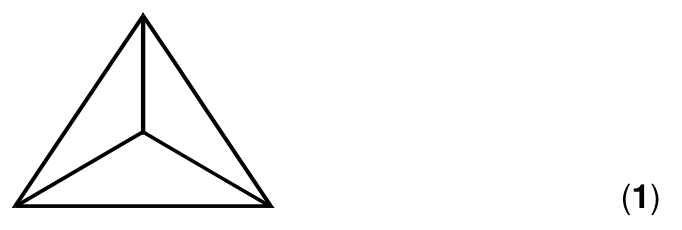
For \(\ce{[Si3O9]^{n-}}\) ion found in aqueous solutions of silicates:
6.3 Determine the charge (n).
6.4 Determine the number of oxygen atoms bridging adjacent tetrahedra.
6.5 Depict its structure joining together several tetrahedra (1). Take into account that any adjacent tetrahedron shares one vertex.
Charged monolayers with the composition \(\ce{[Si4O10]^{m-}}\) are found in kaolinite (clay).
6.6 Using the same strategy as in 6.3 - 6.5, depict a fragment of the layered structure joining 16 tetrahedra (1). Note that 10 tetrahedra have shared vertices with 2 neighbours each, and the rest 6 have shared vertices with 3 neighbours each.
Being placed into the LGL solution, salts of transition metals give rise to fancy “trees” tinted relevant to the colour of the salt of the corresponding transition metal. Crystals of \(\ce{CuSO4 . 5H2O}\) produce “trees” of blue colour, whereas those of \(\ce{NiSO4 . 7H2O}\) form green “trees”.
6.7 Determine the pH of 0.1 M aqueous solution of copper sulphate at 25 °C assuming that its hydrolysis occurs in small degree only. Use the value of the first acidity constant of \(\ce{[Cu(H2O)4]^2+}\) \(K_a^{I}=1\times10^{-7}\).
6.8 Write down equation of a reaction between aqueous solutions of \(\ce{CuSO4}\) and sodium metasilicate (LGL). Take into account the pH values of aqueous solutions of the salts.
Official English text of the problem.
Answers
Names and SMILES representations are supplied with the corresponding explanations in the Solution.
-
6.1 \[ \ce{SiO3^2- + CO2 + H2O -> H2SiO3 v + CO3^2-} \] Here \(\ce{H2SiO3}\) denotes hydrated silica gel.
-
6.2
| Process | Net ionic equation | Changes pH? |
|---|---|---|
| (a) Protonation | \(\ce{SiO4^4- + H2O <=> HSiO4^3- + OH-}\) | Yes |
| (b) Hydration | \(\ce{SiO4^4- + 2H2O <=> [SiO4(H2O)2]^4-}\) | No |
| (c) Polycondensation | \(\ce{2SiO4^4- + H2O <=> Si2O7^6- + 2OH-}\) | Yes |
-
6.3 \(n=6\); the ion is \(\ce{[Si3O9]^6-}\).
-
6.4 Three bridging oxygen atoms.
-
6.5 A closed ring of three corner-sharing tetrahedra, containing an alternating six-membered \(\ce{Si-O-Si-O-Si-O}\) ring.
-
6.6 \(m=4\). Draw a patch of four fused hexagonal rings containing 16 tetrahedra, with 19 shared oxygen vertices. Ten tetrahedra have two neighbours and six have three; an exact drawing prescription is given below.
-
6.7 \[ \boxed{\mathrm{pH}\approx4.0} \]
-
6.8 \[ \boxed{\ce{CuSO4 + Na2SiO3 + 2H2O -> Cu(OH)2 v + H2SiO3 v + Na2SO4}} \]
Solution
6.1 — Setting of liquid glass in air
Atmospheric carbon dioxide acidifies the alkaline silicate solution. Protonation of silicate produces hydrated silica, which forms a gel and hardens as water is lost:
\[ \ce{SiO3^2- + CO2 + H2O -> H2SiO3 v + CO3^2-} \]
The equation balances both atoms and charge: each side has total charge \(-2\).
The species are carbon dioxide O=C=O, water O, carbonate ion [O-]C(=O)[O-], and metasilicate ion, formally [O-][Si](=O)[O-].
Here metasilicic acid, \(\ce{H2SiO3}\), with formal formula-unit SMILES O=[Si](O)O, is conventional shorthand for hydrated, polymeric silica. The actual gel contains an extended network of \(\ce{Si-O-Si}\) bonds and has no unique molecular SMILES.
6.2 — Protonation, hydration, and polycondensation
(a) Protonation. An orthosilicate oxygen accepts a proton from water, forming a \(\ce{Si-OH}\) group:
\[ \ce{SiO4^4- + H2O <=> HSiO4^3- + OH-} \]
Hydroxide ions are produced, so this process changes pH: Yes, increasing it.
(b) Hydration. Two water molecules coordinate to silicon:
\[ \ce{SiO4^4- + 2H2O <=> [SiO4(H2O)2]^4-} \]
This hydration step neither releases nor consumes protons or hydroxide ions. Thus changes pH: No, for the process as written.
(c) Polycondensation. The simplest condensation product is the disilicate ion, containing one bridging oxygen:
\[ \ce{2SiO4^4- + H2O <=> Si2O7^6- + 2OH-} \]
Consequently, changes pH: Yes, increasing it.
The hydroxide production follows explicitly by combining twice the protonation reaction in (a) with condensation of the resulting silanol groups:
\[ \ce{2HSiO4^3- <=> Si2O7^6- + H2O} \]
Although this last silanol-condensation equation releases only water, the overall process starting from orthosilicate ions releases two hydroxide ions.
The relevant structural representations are:
| Species | Name | SMILES |
|---|---|---|
| \(\ce{SiO4^4-}\) | Orthosilicate ion | [O-][Si]([O-])([O-])[O-] |
| \(\ce{HSiO4^3-}\) | Hydrogen orthosilicate ion | O[Si]([O-])([O-])[O-] |
| \(\ce{[SiO4(H2O)2]^4-}\) | Hydrated orthosilicate ion | [OH2+][Si-2]([O-])([O-])([O-])([O-])[OH2+] |
| \(\ce{Si2O7^6-}\) | Disilicate, or pyrosilicate, ion | [O-][Si]([O-])([O-])O[Si]([O-])([O-])[O-] |
| \(\ce{OH-}\) | Hydroxide ion | [OH-] |
The hydrate’s SMILES uses single bonds with formal charge separation to represent the two water-to-silicon donor bonds; its total charge is \(-4\). Its six-coordinate silicon has an idealized octahedral environment. The other silicon centres in this table are tetrahedral. These geometries are not encoded by the SMILES.
6.3 — Charge of the trisilicate ion
Silicon has oxidation state \(+4\), and oxygen has oxidation state \(-2\). Therefore,
\[ q=3(+4)+9(-2)=-6. \]
Thus
\[ \boxed{n=6,\qquad \ce{[Si3O9]^6-}}. \]
6.4 — Number of bridging oxygen atoms
Let \(B\) be the number of bridging oxygens and \(T\) the number of nonbridging oxygens.
There are nine distinct oxygen atoms:
\[ B+T=9. \]
Three tetrahedra have \(3\times4=12\) oxygen-vertex incidences. Each bridging oxygen belongs to two tetrahedra, so
\[ 2B+T=12. \]
Subtracting gives
\[ \boxed{B=3},\qquad T=6. \]
6.5 — Structure of the trisilicate ion
There are three tetrahedra and three shared corners. Since each pair of adjacent tetrahedra shares only one corner, the tetrahedra form a closed triangular arrangement.
To draw it:
- Place three tetrahedra around a central opening.
- Make each tetrahedron share one distinct oxygen vertex with each of the other two.
- Leave the other two oxygen vertices of each tetrahedron unshared.
The resulting cyclotrisilicate ion, \(\ce{[Si3O9]^6-}\), has SMILES:
[O-][Si]1([O-])O[Si]([O-])([O-])O[Si]([O-])([O-])O1
Its ring backbone alternates three silicon atoms and three bridging oxygen atoms. Six additional, nonbridging oxygens carry the formal negative charges. Each silicon remains tetrahedral; the SMILES does not specify ring conformation.
6.6 — The silicate layer and its 16-tetrahedron fragment
First, the charge per stated composition unit is
\[ q=4(+4)+10(-2)=-4, \]
so
\[ \boxed{m=4}. \]
In the extended sheet, each tetrahedron shares three oxygen corners with three neighbouring tetrahedra. Its fourth corner is unshared with other silicon tetrahedra. Therefore the number of distinct oxygens per silicon is
\[ \frac{3}{2}+1=\frac{5}{2}, \]
giving the composition \(\ce{[Si4O10]^4-}\). Per four silicon atoms, there are six bridging oxygens and four oxygens unshared with other silicon tetrahedra.
A suitable finite patch consists of four fused hexagonal rings. The following prescription specifies the drawing exactly:
- Draw an outer cycle of 14 tetrahedra, labelled consecutively \(1,2,\ldots,14\), with 14 joined back to 1.
- Place tetrahedra 15 and 16 inside this boundary.
- Add the five connections \(3\!-\!15\), \(13\!-\!15\), \(15\!-\!16\), \(6\!-\!16\), and \(10\!-\!16\).
- Represent every connection by one shared oxygen corner.
The four hexagonal rings then have the vertex sequences
\[ \begin{aligned} &1-2-3-15-13-14-1,\\ &3-4-5-6-16-15-3,\\ &6-7-8-9-10-16-6,\\ &10-11-12-13-15-16-10. \end{aligned} \]
Tetrahedra \(3,6,10,13,15,16\) each have three neighbours; the remaining ten each have two. The number of shared oxygens is consequently
\[ \boxed{B=\frac{10(2)+6(3)}{2}=19}. \]
For the polyhedral drawing, keep the three potentially shared corners of each tetrahedron in the basal plane, with its fourth corner pointing to the same side of the sheet.
An infinite layer has no single finite molecular SMILES. The fully deprotonated 16-tetrahedron silicate-sheet fragment just specified can, however, be represented by:
[O-][Si]1([O-])O[Si]([O-])([O-])O[Si]2([O-])O[Si]([O-])([O-])O[Si]([O-])([O-])O[Si]3([O-])O[Si]([O-])([O-])O[Si]([O-])([O-])O[Si]([O-])([O-])O[Si]4([O-])O[Si]([O-])([O-])O[Si]([O-])([O-])O[Si]([O-])(O[Si]([O-])(O2)O[Si]([O-])(O3)O4)O[Si]([O-])([O-])O1
As an isolated fragment, this has 19 bridging and 26 nonbridging oxygens:
\[ N_{\mathrm O}=16(4)-19=45, \qquad q=16(4)-45(2)=-26. \]
Thus its isolated formula is \(\ce{[Si16O45]^26-}\). The boundary oxygens account for the difference between this finite fragment’s composition and the periodic layer composition.
6.7 — pH of the copper(II) sulfate solution
In the specified model, the tetraaquacopper(II) ion, O->[Cu+2](<-O)(<-O)<-O, undergoes its first acid dissociation:
\[ \ce{[Cu(H2O)4]^2+ <=> [Cu(OH)(H2O)3]^+ + H+}. \]
The product is the triaquahydroxidocopper(II) ion, [OH-]->[Cu+2](<-O)(<-O)<-O. The proton is represented formally by [H+]. These dative-bond SMILES specify oxygen-to-copper coordination connectivity, without fixing coordination geometry or the surrounding solvent structure.
Let the initial copper concentration be
\[ c_0=0.1\ \mathrm{mol\,L^{-1}}, \]
and let the hydrogen-ion concentration produced be \(x\). In the usual ideal, single-equilibrium treatment,
\[ K_a^{I}=\frac{x^2}{c_0-x}. \]
Because hydrolysis is small, \(c_0-x\approx c_0\). Using molar concentrations,
\[ [\ce{H+}] \approx\sqrt{K_a^{I}c_0} =\sqrt{(1\times10^{-7})(0.1)} =1\times10^{-4}\ \mathrm{mol\,L^{-1}}. \]
Therefore,
\[ \boxed{\mathrm{pH} =-\log_{10}\left(\frac{[\ce{H+}]}{1\ \mathrm{mol\,L^{-1}}}\right) =4.0}. \]
The fraction hydrolysed is
\[ \frac{x}{c_0} =\frac{10^{-4}}{0.1} =10^{-3}=0.1\%, \]
which confirms the assumed small degree of hydrolysis.
6.8 — Reaction of copper(II) sulfate with liquid glass
The copper(II) solution is acidic through cation hydrolysis, whereas metasilicate solution is alkaline through anion hydrolysis. Mixing them promotes mutual hydrolysis, producing copper(II) hydroxide and hydrated silica.
One way to express the coupled processes is
\[ \ce{SiO3^2- + 2H2O <=> H2SiO3 + 2OH-} \]
and
\[ \ce{Cu^2+ + 2OH- -> Cu(OH)2 v}. \]
The overall net ionic equation is
\[ \boxed{\ce{Cu^2+ + SiO3^2- + 2H2O -> Cu(OH)2 v + H2SiO3 v}}. \]
Including the spectator ions gives
\[ \boxed{\ce{CuSO4 + Na2SiO3 + 2H2O -> Cu(OH)2 v + H2SiO3 v + Na2SO4}}. \]
Copper(II) hydroxide is the blue precipitate, and \(\ce{H2SiO3}\) denotes the hydrated silica gel discussed in 6.1.
The copper(II) ion is [Cu+2]; the spectator ions are sodium [Na+] and sulfate [O-]S(=O)(=O)[O-]. Composition SMILES for the ionic substances are:
| Substance | SMILES |
|---|---|
| Copper(II) sulfate | [Cu+2].[O-]S(=O)(=O)[O-] |
| Sodium metasilicate | [Na+].[Na+].[O-][Si](=O)[O-] |
| Copper(II) hydroxide | [Cu+2].[OH-].[OH-] |
| Sodium sulfate | [Na+].[Na+].[O-]S(=O)(=O)[O-] |
These disconnected-ion SMILES specify composition; they do not describe solid-state coordination networks.
The solution was checked against the official solution.
IChO 2007 · Theorieaufgabe 6
Silicate als Grundlage der Erdkruste
Siliciumdioxid und die davon abgeleiteten Verbindungen, die Silicate, machen etwa 90 % der Stoffe der Erdkruste aus. Aus Siliciumdioxid entsteht ein wunderschönes Material – Glas. Niemand weiß genau, wie Glas entdeckt wurde. Eine beliebte Geschichte handelt von phönizischen Seefahrern, die zufällig Meeressand und Soda zusammenschmolzen. Wahrscheinlich entdeckten sie das Geheimnis des „Wasserglases“ (LGL) – des wasserlöslichen Natriummetasilicats (\(\ce{Na2SiO3}\)).
6.1 Die LGL-Lösung wurde früher als Büroklebstoff verwendet. Geben Sie die Netto-Ionengleichung an, die erklärt, warum LGL an der Luft aushärtet.
Durch Hydrolyse von LGL in Wasser lässt sich eine kolloidale Lösung von Kieselsäure erhalten.
6.2 Vervollständigen Sie die Tabelle im Antwortbogen. Geben Sie die Netto-Ionengleichungen für die in der Tabelle aufgeführten Vorgänge an. Kreuzen Sie für jeden Vorgang das Kästchen „Ja“ an, wenn er zu einer Änderung des pH-Werts führt. Andernfalls kreuzen Sie das Kästchen „Nein“ an.
Die Struktur der in wässrigen Silicatlösungen vorkommenden Spezies ist recht komplex. Dennoch lässt sich der grundlegende Baustein aller Spezies erkennen – das Orthosilicat-Tetraeder (\(\ce{SiO4^4-}\), 1):
Für das in wässrigen Silicatlösungen vorkommende \(\ce{[Si3O9]^{n-}}\)-Ion:
6.3 Bestimmen Sie die Ladung (n).
6.4 Bestimmen Sie die Anzahl der Sauerstoffatome, die benachbarte Tetraeder miteinander verbrücken.
6.5 Stellen Sie seine Struktur dar, indem Sie mehrere Tetraeder (1) miteinander verbinden. Berücksichtigen Sie dabei, dass benachbarte Tetraeder jeweils eine gemeinsame Ecke besitzen.
Geladene Einzelschichten mit der Zusammensetzung \(\ce{[Si4O10]^{m-}}\) kommen in Kaolinit (Ton) vor.
6.6 Stellen Sie mit derselben Vorgehensweise wie in 6.3 - 6.5 einen Ausschnitt der Schichtstruktur dar, indem Sie 16 Tetraeder (1) miteinander verbinden. Beachten Sie, dass 10 Tetraeder mit jeweils 2 Nachbarn gemeinsame Ecken besitzen und die übrigen 6 mit jeweils 3 Nachbarn.
Werden Salze von Übergangsmetallen in die LGL-Lösung gegeben, entstehen fantasievolle „Bäume“, deren Färbung der Farbe des Salzes des jeweiligen Übergangsmetalls entspricht. Kristalle von \(\ce{CuSO4 . 5H2O}\) erzeugen blaue „Bäume“, während Kristalle von \(\ce{NiSO4 . 7H2O}\) grüne „Bäume“ bilden.
6.7 Bestimmen Sie den pH-Wert einer 0.1 M wässrigen Kupfersulfatlösung bei 25 °C unter der Annahme, dass die Hydrolyse nur in geringem Umfang stattfindet. Verwenden Sie für die erste Säurekonstante von \(\ce{[Cu(H2O)4]^2+}\) den Wert \(K_a^{I}=1\times10^{-7}\).
6.8 Geben Sie die Gleichung einer Reaktion zwischen wässrigen Lösungen von \(\ce{CuSO4}\) und Natriummetasilicat (LGL) an. Berücksichtigen Sie dabei die pH-Werte der wässrigen Lösungen der Salze.
Aufgabentext aus dem offiziellen englischen Text übersetzt.
Antworten
Namen und SMILES-Darstellungen sind zusammen mit den entsprechenden Erläuterungen in der Lösung angegeben.
-
6.1 \[ \ce{SiO3^2- + CO2 + H2O -> H2SiO3 v + CO3^2-} \] Dabei bezeichnet \(\ce{H2SiO3}\) hydratisiertes Kieselgel.
-
6.2
| Vorgang | Netto-Ionengleichung | Ändert sich der pH-Wert? |
|---|---|---|
| (a) Protonierung | \(\ce{SiO4^4- + H2O <=> HSiO4^3- + OH-}\) | Ja |
| (b) Hydratation | \(\ce{SiO4^4- + 2H2O <=> [SiO4(H2O)2]^4-}\) | Nein |
| (c) Polykondensation | \(\ce{2SiO4^4- + H2O <=> Si2O7^6- + 2OH-}\) | Ja |
-
6.3 \(n=6\); das Ion ist \(\ce{[Si3O9]^6-}\).
-
6.4 Drei verbrückende Sauerstoffatome.
-
6.5 Ein geschlossener Ring aus drei eckenverknüpften Tetraedern, der einen alternierenden sechsgliedrigen \(\ce{Si-O-Si-O-Si-O}\)-Ring enthält.
-
6.6 \(m=4\). Zeichnen Sie einen Ausschnitt aus vier anellierten Sechsringen mit 16 Tetraedern und 19 gemeinsamen Sauerstoffecken. Zehn Tetraeder haben zwei Nachbarn und sechs haben drei; eine genaue Zeichenanleitung folgt weiter unten.
-
6.7 \[ \boxed{\mathrm{pH}\approx4.0} \]
-
6.8 \[ \boxed{\ce{CuSO4 + Na2SiO3 + 2H2O -> Cu(OH)2 v + H2SiO3 v + Na2SO4}} \]
Lösung
6.1 — Aushärten von Wasserglas an der Luft
Atmosphärisches Kohlenstoffdioxid säuert die alkalische Silicatlösung an. Die Protonierung des Silicats erzeugt hydratisiertes Siliciumdioxid, das ein Gel bildet und beim Verlust von Wasser aushärtet:
\[ \ce{SiO3^2- + CO2 + H2O -> H2SiO3 v + CO3^2-} \]
In der Gleichung sind sowohl die Atome als auch die Ladung ausgeglichen: Jede Seite hat die Gesamtladung \(-2\).
Die Spezies sind Kohlenstoffdioxid O=C=O, Wasser O, das Carbonat-Ion [O-]C(=O)[O-] und das Metasilicat-Ion, formal [O-][Si](=O)[O-].
Hier ist Metakieselsäure, \(\ce{H2SiO3}\), mit der formalen SMILES-Darstellung der Formeleinheit O=[Si](O)O eine übliche Kurzschreibweise für hydratisiertes, polymeres Siliciumdioxid. Das tatsächliche Gel enthält ein ausgedehntes Netzwerk aus \(\ce{Si-O-Si}\)-Bindungen und besitzt keine eindeutige molekulare SMILES-Darstellung.
6.2 — Protonierung, Hydratation und Polykondensation
(a) Protonierung. Ein Sauerstoffatom des Orthosilicats nimmt ein Proton von Wasser auf, wobei eine \(\ce{Si-OH}\)-Gruppe entsteht:
\[ \ce{SiO4^4- + H2O <=> HSiO4^3- + OH-} \]
Es entstehen Hydroxid-Ionen, daher gilt für diesen Vorgang Ändert sich der pH-Wert: Ja; er steigt.
(b) Hydratation. Zwei Wassermoleküle koordinieren an Silicium:
\[ \ce{SiO4^4- + 2H2O <=> [SiO4(H2O)2]^4-} \]
Bei diesem Hydratationsschritt werden weder Protonen noch Hydroxid-Ionen freigesetzt oder verbraucht. Für den Vorgang in der angegebenen Form gilt somit Ändert sich der pH-Wert: Nein.
(c) Polykondensation. Das einfachste Kondensationsprodukt ist das Disilicat-Ion, das ein verbrückendes Sauerstoffatom enthält:
\[ \ce{2SiO4^4- + H2O <=> Si2O7^6- + 2OH-} \]
Folglich gilt Ändert sich der pH-Wert: Ja; er steigt.
Die Bildung von Hydroxid-Ionen ergibt sich ausdrücklich durch Kombination der doppelten Protonierungsreaktion aus (a) mit der Kondensation der entstandenen Silanolgruppen:
\[ \ce{2HSiO4^3- <=> Si2O7^6- + H2O} \]
Obwohl diese letzte Gleichung der Silanolkondensation nur Wasser freisetzt, werden beim Gesamtvorgang ausgehend von Orthosilicat-Ionen zwei Hydroxid-Ionen freigesetzt.
Die relevanten Strukturdarstellungen sind:
| Spezies | Name | SMILES |
|---|---|---|
| \(\ce{SiO4^4-}\) | Orthosilicat-Ion | [O-][Si]([O-])([O-])[O-] |
| \(\ce{HSiO4^3-}\) | Hydrogenorthosilicat-Ion | O[Si]([O-])([O-])[O-] |
| \(\ce{[SiO4(H2O)2]^4-}\) | Hydratisiertes Orthosilicat-Ion | [OH2+][Si-2]([O-])([O-])([O-])([O-])[OH2+] |
| \(\ce{Si2O7^6-}\) | Disilicat- oder Pyrosilicat-Ion | [O-][Si]([O-])([O-])O[Si]([O-])([O-])[O-] |
| \(\ce{OH-}\) | Hydroxid-Ion | [OH-] |
Die SMILES-Darstellung des Hydrats verwendet Einfachbindungen mit formaler Ladungstrennung, um die beiden Donorbindungen vom Wasser zum Silicium darzustellen; seine Gesamtladung beträgt \(-4\). Sein sechsfach koordiniertes Silicium besitzt eine idealisierte oktaedrische Umgebung. Die anderen Siliciumzentren in dieser Tabelle sind tetraedrisch. Diese Geometrien werden durch die SMILES-Darstellungen nicht codiert.
6.3 — Ladung des Trisilicat-Ions
Silicium hat die Oxidationszahl \(+4\), Sauerstoff die Oxidationszahl \(-2\). Daher gilt:
\[ q=3(+4)+9(-2)=-6. \]
Somit gilt:
\[ \boxed{n=6,\qquad \ce{[Si3O9]^6-}}. \]
6.4 — Anzahl der verbrückenden Sauerstoffatome
Es sei \(B\) die Anzahl der verbrückenden und \(T\) die Anzahl der nicht verbrückenden Sauerstoffatome.
Es gibt neun verschiedene Sauerstoffatome:
\[ B+T=9. \]
Drei Tetraeder weisen insgesamt \(3\times4=12\) Zuordnungen von Sauerstoffatomen zu Tetraederecken auf. Jedes verbrückende Sauerstoffatom gehört zu zwei Tetraedern, also gilt:
\[ 2B+T=12. \]
Subtraktion ergibt:
\[ \boxed{B=3},\qquad T=6. \]
6.5 — Struktur des Trisilicat-Ions
Es gibt drei Tetraeder und drei gemeinsame Ecken. Da jedes Paar benachbarter Tetraeder nur eine gemeinsame Ecke besitzt, bilden die Tetraeder eine geschlossene dreieckige Anordnung.
Zeichenanleitung:
- Ordnen Sie drei Tetraeder um eine zentrale Öffnung an.
- Lassen Sie jedes Tetraeder mit jedem der beiden anderen jeweils eine andere Sauerstoffecke teilen.
- Lassen Sie die beiden übrigen Sauerstoffecken jedes Tetraeders unverknüpft.
Das entstehende Cyclotrisilicat-Ion, \(\ce{[Si3O9]^6-}\), hat die SMILES-Darstellung:
[O-][Si]1([O-])O[Si]([O-])([O-])O[Si]([O-])([O-])O1
In seinem Ringgerüst wechseln sich drei Siliciumatome und drei verbrückende Sauerstoffatome ab. Sechs zusätzliche, nicht verbrückende Sauerstoffatome tragen die formalen negativen Ladungen. Jedes Silicium bleibt tetraedrisch koordiniert; die SMILES-Darstellung legt die Ringkonformation nicht fest.
6.6 — Die Silicatschicht und ihr Fragment aus 16 Tetraedern
Zunächst beträgt die Ladung pro angegebener Zusammensetzungseinheit
\[ q=4(+4)+10(-2)=-4, \]
also gilt:
\[ \boxed{m=4}. \]
In der ausgedehnten Schicht teilt jedes Tetraeder drei Sauerstoffecken mit drei benachbarten Tetraedern. Seine vierte Ecke wird mit keinem anderen Siliciumtetraeder geteilt. Daher beträgt die Anzahl verschiedener Sauerstoffatome pro Siliciumatom
\[ \frac{3}{2}+1=\frac{5}{2}, \]
woraus sich die Zusammensetzung \(\ce{[Si4O10]^4-}\) ergibt. Auf vier Siliciumatome kommen sechs verbrückende Sauerstoffatome und vier Sauerstoffatome, die mit keinen anderen Siliciumtetraedern geteilt werden.
Ein geeigneter endlicher Ausschnitt besteht aus vier anellierten Sechsringen. Die folgende Anleitung legt die Zeichnung genau fest:
- Zeichnen Sie einen äußeren Ring aus 14 Tetraedern, die fortlaufend mit \(1,2,\ldots,14\) beschriftet werden, wobei 14 wieder mit 1 verbunden wird.
- Platzieren Sie die Tetraeder 15 und 16 innerhalb dieser Begrenzung.
- Ergänzen Sie die fünf Verbindungen \(3\!-\!15\), \(13\!-\!15\), \(15\!-\!16\), \(6\!-\!16\) und \(10\!-\!16\).
- Stellen Sie jede Verbindung durch eine gemeinsame Sauerstoffecke dar.
Die vier Sechsringe haben dann die Knotenfolgen
\[ \begin{aligned} &1-2-3-15-13-14-1,\\ &3-4-5-6-16-15-3,\\ &6-7-8-9-10-16-6,\\ &10-11-12-13-15-16-10. \end{aligned} \]
Die Tetraeder \(3,6,10,13,15,16\) haben jeweils drei Nachbarn; die übrigen zehn haben jeweils zwei. Die Anzahl gemeinsamer Sauerstoffatome beträgt folglich
\[ \boxed{B=\frac{10(2)+6(3)}{2}=19}. \]
Lassen Sie in der Polyederzeichnung die drei potenziell gemeinsamen Ecken jedes Tetraeders in der Basalebene liegen, wobei seine vierte Ecke jeweils zur selben Seite der Schicht zeigt.
Eine unendliche Schicht besitzt keine einzelne endliche molekulare SMILES-Darstellung. Das soeben festgelegte vollständig deprotonierte Silicatschichtfragment aus 16 Tetraedern kann jedoch wie folgt dargestellt werden:
[O-][Si]1([O-])O[Si]([O-])([O-])O[Si]2([O-])O[Si]([O-])([O-])O[Si]([O-])([O-])O[Si]3([O-])O[Si]([O-])([O-])O[Si]([O-])([O-])O[Si]([O-])([O-])O[Si]4([O-])O[Si]([O-])([O-])O[Si]([O-])([O-])O[Si]([O-])(O[Si]([O-])(O2)O[Si]([O-])(O3)O4)O[Si]([O-])([O-])O1
Als isoliertes Fragment besitzt es 19 verbrückende und 26 nicht verbrückende Sauerstoffatome:
\[ N_{\mathrm O}=16(4)-19=45, \qquad q=16(4)-45(2)=-26. \]
Seine isolierte Formel lautet somit \(\ce{[Si16O45]^26-}\). Die Sauerstoffatome am Rand erklären den Unterschied zwischen der Zusammensetzung dieses endlichen Fragments und der Zusammensetzung der periodischen Schicht.
6.7 — pH-Wert der Kupfer(II)-sulfatlösung
Im angegebenen Modell durchläuft das Tetraaquakupfer(II)-Ion, O->[Cu+2](<-O)(<-O)<-O, seine erste Säuredissoziation:
\[ \ce{[Cu(H2O)4]^2+ <=> [Cu(OH)(H2O)3]^+ + H+}. \]
Das Produkt ist das Triaquahydroxidokupfer(II)-Ion, [OH-]->[Cu+2](<-O)(<-O)<-O. Das Proton wird formal durch [H+] dargestellt. Diese SMILES-Darstellungen mit koordinativen Bindungen geben die Verknüpfung durch Koordination von Sauerstoff an Kupfer an, ohne die Koordinationsgeometrie oder die Struktur des umgebenden Lösungsmittels festzulegen.
Die anfängliche Kupferkonzentration sei
\[ c_0=0.1\ \mathrm{mol\,L^{-1}}, \]
und die Konzentration der gebildeten Wasserstoff-Ionen sei \(x\). Bei der üblichen idealen Betrachtung mit einem einzigen Gleichgewicht gilt:
\[ K_a^{I}=\frac{x^2}{c_0-x}. \]
Da die Hydrolyse gering ist, gilt \(c_0-x\approx c_0\). Unter Verwendung molarer Konzentrationen ergibt sich:
\[ [\ce{H+}] \approx\sqrt{K_a^{I}c_0} =\sqrt{(1\times10^{-7})(0.1)} =1\times10^{-4}\ \mathrm{mol\,L^{-1}}. \]
Daher gilt:
\[ \boxed{\mathrm{pH} =-\log_{10}\left(\frac{[\ce{H+}]}{1\ \mathrm{mol\,L^{-1}}}\right) =4.0}. \]
Der hydrolysierte Anteil beträgt
\[ \frac{x}{c_0} =\frac{10^{-4}}{0.1} =10^{-3}=0.1\%, \]
womit der angenommene geringe Hydrolysegrad bestätigt wird.
6.8 — Reaktion von Kupfer(II)-sulfat mit Wasserglas
Die Kupfer(II)-Lösung ist aufgrund der Kationenhydrolyse sauer, während die Metasilicatlösung aufgrund der Anionenhydrolyse alkalisch ist. Beim Mischen wird die wechselseitige Hydrolyse begünstigt, wobei Kupfer(II)-hydroxid und hydratisiertes Siliciumdioxid entstehen.
Eine Möglichkeit, die gekoppelten Vorgänge auszudrücken, ist
\[ \ce{SiO3^2- + 2H2O <=> H2SiO3 + 2OH-} \]
und
\[ \ce{Cu^2+ + 2OH- -> Cu(OH)2 v}. \]
Die gesamte Netto-Ionengleichung lautet:
\[ \boxed{\ce{Cu^2+ + SiO3^2- + 2H2O -> Cu(OH)2 v + H2SiO3 v}}. \]
Unter Einbeziehung der Zuschauerionen ergibt sich:
\[ \boxed{\ce{CuSO4 + Na2SiO3 + 2H2O -> Cu(OH)2 v + H2SiO3 v + Na2SO4}}. \]
Kupfer(II)-hydroxid ist der blaue Niederschlag, und \(\ce{H2SiO3}\) bezeichnet das in 6.1 besprochene hydratisierte Kieselgel.
Das Kupfer(II)-Ion ist [Cu+2]; die Zuschauerionen sind Natrium [Na+] und Sulfat [O-]S(=O)(=O)[O-]. SMILES-Darstellungen der Zusammensetzung der ionischen Stoffe sind:
| Stoff | SMILES |
|---|---|
| Kupfer(II)-sulfat | [Cu+2].[O-]S(=O)(=O)[O-] |
| Natriummetasilicat | [Na+].[Na+].[O-][Si](=O)[O-] |
| Kupfer(II)-hydroxid | [Cu+2].[OH-].[OH-] |
| Natriumsulfat | [Na+].[Na+].[O-]S(=O)(=O)[O-] |
Diese SMILES-Darstellungen mit unverbundenen Ionen geben die Zusammensetzung an; sie beschreiben keine Koordinationsnetzwerke im Festkörper.
Die Lösung wurde mit der offiziellen Lösung abgeglichen.
IChO 2007 · Teori sorusu 6
Yer kabuğunun temeli olarak silikatlar
Silis ve ondan türeyen bileşikler olan silikatlar, yer kabuğunu oluşturan maddelerin yaklaşık %90'ını oluşturur. Silisten güzel bir malzeme elde edilir: cam. Camın nasıl keşfedildiğini hiç kimse tam olarak bilmez. Fenikeli denizcilerin deniz kumunu ve sodayı tesadüfen birlikte eritmesiyle ilgili yaygın bir öykü vardır. Suda çözünen sodyum metasilikatın (\(\ce{Na2SiO3}\)), yani “sıvı cam”ın (LGL) sırrını keşfetmiş olmaları muhtemeldir.
6.1 LGL çözeltisi eskiden büro yapıştırıcısı olarak kullanılırdı. LGL'nin havada sertleşebilmesini açıklayan net iyon denklemini yazınız.
LGL'nin suda hidrolizi, silisik asidin kolloidal bir çözeltisinin elde edilmesini sağlar.
6.2 Cevap Kâğıdındaki tabloyu tamamlayınız. Tabloda sıralanan süreçlere karşılık gelen net iyon denklemlerini yazınız. Her süreç için, pH değişimine yol açıyorsa “Evet” kutusunu işaretleyiniz. Aksi hâlde “Hayır” kutusunu işaretleyiniz.
Silikatların sulu çözeltilerinde bulunan türlerin yapısı oldukça karmaşıktır. Bununla birlikte, tüm türlerin temel yapı taşı olan ortosilikat tetrahedronunu (\(\ce{SiO4^4-}\), 1) ayırt etmek mümkündür:
Silikatların sulu çözeltilerinde bulunan \(\ce{[Si3O9]^{n-}}\) iyonu için:
6.3 Yükü (n) belirleyiniz.
6.4 Komşu tetrahedronlar arasında köprü oluşturan oksijen atomlarının sayısını belirleyiniz.
6.5 Birkaç tetrahedronu (1) birleştirerek iyonun yapısını çiziniz. Komşu tetrahedronların bir köşeyi paylaştığını dikkate alınız.
Kaolinitte (kil), bileşimi \(\ce{[Si4O10]^{m-}}\) olan yüklü tek katmanlar bulunur.
6.6 6.3 - 6.5'tekiyle aynı yöntemi kullanarak, 16 tetrahedronu (1) birleştiren katmanlı yapının bir parçasını çiziniz. 10 tetrahedronun her birinin 2 komşusuyla, geri kalan 6 tetrahedronun her birinin ise 3 komşusuyla ortak köşeler paylaştığına dikkat ediniz.
Geçiş metallerinin tuzları LGL çözeltisine konulduğunda, ilgili geçiş metali tuzunun rengine uygun renklerde, ilginç görünümlü “ağaçlar” oluşturur. \(\ce{CuSO4 . 5H2O}\) kristalleri mavi renkli “ağaçlar” oluştururken, \(\ce{NiSO4 . 7H2O}\) kristalleri yeşil “ağaçlar” oluşturur.
6.7 Hidrolizin yalnızca düşük bir derecede gerçekleştiğini varsayarak, 25 °C'de 0.1 M sulu bakır sülfat çözeltisinin pH'sını belirleyiniz. \(\ce{[Cu(H2O)4]^2+}\) iyonunun birinci asitlik sabiti için \(K_a^{I}=1\times10^{-7}\) değerini kullanınız.
6.8 \(\ce{CuSO4}\) ve sodyum metasilikatın (LGL) sulu çözeltileri arasındaki tepkimenin denklemini yazınız. Tuzların sulu çözeltilerinin pH değerlerini dikkate alınız.
Soru metni resmi İngilizce metinden çevrilmiştir.
Cevaplar
Adlar ve SMILES gösterimleri, ilgili açıklamalarla birlikte Çözüm bölümünde verilmiştir.
-
6.1 \[ \ce{SiO3^2- + CO2 + H2O -> H2SiO3 v + CO3^2-} \] Burada \(\ce{H2SiO3}\), hidratlı silis jelini gösterir.
-
6.2
| Süreç | Net iyon denklemi | pH'ı değiştirir mi? |
|---|---|---|
| (a) Protonlanma | \(\ce{SiO4^4- + H2O <=> HSiO4^3- + OH-}\) | Evet |
| (b) Hidratasyon | \(\ce{SiO4^4- + 2H2O <=> [SiO4(H2O)2]^4-}\) | Hayır |
| (c) Polikondenzasyon | \(\ce{2SiO4^4- + H2O <=> Si2O7^6- + 2OH-}\) | Evet |
-
6.3 \(n=6\); iyon \(\ce{[Si3O9]^6-}\) şeklindedir.
-
6.4 Üç köprü oksijen atomu.
-
6.5 Dönüşümlü olarak sıralanan atomlardan oluşan altı üyeli bir \(\ce{Si-O-Si-O-Si-O}\) halkası içeren, köşe paylaşan üç tetrahedrondan oluşmuş kapalı bir halka.
-
6.6 \(m=4\). 19 ortak oksijen köşesine sahip, 16 tetrahedron içeren dört kaynaşmış altıgen halkadan oluşan bir parça çiziniz. On tetrahedronun iki, altı tetrahedronun ise üç komşusu vardır; çizim için kesin yönergeler aşağıda verilmiştir.
-
6.7 \[ \boxed{\mathrm{pH}\approx4.0} \]
-
6.8 \[ \boxed{\ce{CuSO4 + Na2SiO3 + 2H2O -> Cu(OH)2 v + H2SiO3 v + Na2SO4}} \]
Çözüm
6.1 — Sıvı camın havada sertleşmesi
Atmosferdeki karbondioksit, bazik silikat çözeltisini asitleştirir. Silikatın protonlanması, jel oluşturan ve su kaybettikçe sertleşen hidratlı silis meydana getirir:
\[ \ce{SiO3^2- + CO2 + H2O -> H2SiO3 v + CO3^2-} \]
Denklem hem atomlar hem de yük bakımından denktir: her iki tarafın toplam yükü \(-2\)'dir.
Türler; karbondioksit O=C=O, su O, karbonat iyonu [O-]C(=O)[O-] ve biçimsel gösterimi [O-][Si](=O)[O-] olan metasilikat iyonudur.
Burada, biçimsel formül birimi SMILES gösterimi O=[Si](O)O olan metasilisik asit, \(\ce{H2SiO3}\), hidratlı, polimerik silis için kullanılan geleneksel bir kısa gösterimdir. Gerçek jel, geniş bir \(\ce{Si-O-Si}\) bağ ağı içerir ve tek bir moleküler SMILES gösterimine sahip değildir.
6.2 — Protonlanma, hidratasyon ve polikondenzasyon
(a) Protonlanma. Bir ortosilikat oksijeni sudan bir proton alarak bir \(\ce{Si-OH}\) grubu oluşturur:
\[ \ce{SiO4^4- + H2O <=> HSiO4^3- + OH-} \]
Hidroksit iyonları oluştuğundan, bu süreç için pH'ı değiştirir mi: Evet; pH artar.
(b) Hidratasyon. İki su molekülü silisyuma koordine olur:
\[ \ce{SiO4^4- + 2H2O <=> [SiO4(H2O)2]^4-} \]
Bu hidratasyon basamağında proton veya hidroksit iyonu ne açığa çıkar ne de tüketilir. Dolayısıyla, yazıldığı şekliyle bu süreç için pH'ı değiştirir mi: Hayır.
(c) Polikondenzasyon. En basit kondenzasyon ürünü, bir köprü oksijeni içeren disilikat iyonudur:
\[ \ce{2SiO4^4- + H2O <=> Si2O7^6- + 2OH-} \]
Sonuç olarak, pH'ı değiştirir mi: Evet; pH artar.
Hidroksit oluşumu, (a)'daki protonlanma tepkimesinin iki katının, oluşan silanol gruplarının kondenzasyonuyla birleştirilmesiyle açıkça görülür:
\[ \ce{2HSiO4^3- <=> Si2O7^6- + H2O} \]
Bu son silanol kondenzasyonu denkleminde yalnızca su açığa çıksa da, ortosilikat iyonlarından başlayan toplam süreçte iki hidroksit iyonu açığa çıkar.
İlgili yapısal gösterimler şunlardır:
| Tür | Adı | SMILES |
|---|---|---|
| \(\ce{SiO4^4-}\) | Ortosilikat iyonu | [O-][Si]([O-])([O-])[O-] |
| \(\ce{HSiO4^3-}\) | Hidrojen ortosilikat iyonu | O[Si]([O-])([O-])[O-] |
| \(\ce{[SiO4(H2O)2]^4-}\) | Hidratlı ortosilikat iyonu | [OH2+][Si-2]([O-])([O-])([O-])([O-])[OH2+] |
| \(\ce{Si2O7^6-}\) | Disilikat veya pirosilikat iyonu | [O-][Si]([O-])([O-])O[Si]([O-])([O-])[O-] |
| \(\ce{OH-}\) | Hidroksit iyonu | [OH-] |
Hidratın SMILES gösteriminde, sudan silisyuma uzanan iki donör bağı temsil etmek için biçimsel yük ayrımı içeren tekli bağlar kullanılır; toplam yükü \(-4\)'tür. Altı koordinasyonlu silisyumu, idealize edilmiş oktahedral bir çevreye sahiptir. Bu tablodaki diğer silisyum merkezleri tetrahedraldir. Bu geometriler SMILES gösteriminde kodlanmaz.
6.3 — Trisilikat iyonunun yükü
Silisyumun yükseltgenme basamağı \(+4\), oksijeninki ise \(-2\)'dir. Dolayısıyla,
\[ q=3(+4)+9(-2)=-6. \]
Böylece
\[ \boxed{n=6,\qquad \ce{[Si3O9]^6-}}. \]
6.4 — Köprü oksijen atomlarının sayısı
Köprü oksijenlerinin sayısı \(B\), köprü oluşturmayan oksijenlerin sayısı ise \(T\) olsun.
Dokuz farklı oksijen atomu vardır:
\[ B+T=9. \]
Üç tetrahedronda oksijen köşeleri toplam \(3\times4=12\) kez sayılır. Her köprü oksijeni iki tetrahedrona ait olduğundan
\[ 2B+T=12. \]
Çıkarma işlemiyle
\[ \boxed{B=3},\qquad T=6. \]
6.5 — Trisilikat iyonunun yapısı
Üç tetrahedron ve üç ortak köşe vardır. Komşu tetrahedronların her çifti yalnızca bir köşe paylaştığından, tetrahedronlar kapalı, üçgensel bir düzen oluşturur.
Çizmek için:
- Merkezde bir boşluk bırakacak şekilde üç tetrahedron yerleştiriniz.
- Her tetrahedronun, diğer ikisinin her biriyle farklı bir oksijen köşesini paylaşmasını sağlayınız.
- Her tetrahedronun diğer iki oksijen köşesini paylaşılmamış olarak bırakınız.
Oluşan siklotrisilikat iyonunun, \(\ce{[Si3O9]^6-}\), SMILES gösterimi şöyledir:
[O-][Si]1([O-])O[Si]([O-])([O-])O[Si]([O-])([O-])O1
Halka iskeletinde üç silisyum atomu ve üç köprü oksijen atomu dönüşümlü olarak sıralanır. Köprü oluşturmayan altı ek oksijen, biçimsel negatif yükleri taşır. Her silisyum tetrahedral kalır; SMILES gösterimi halkanın konformasyonunu belirtmez.
6.6 — Silikat katmanı ve 16 tetrahedronlu parçası
İlk olarak, belirtilen bileşim birimi başına yük
\[ q=4(+4)+10(-2)=-4, \]
olduğundan
\[ \boxed{m=4}. \]
Genişleyen tabakada her tetrahedron, üç oksijen köşesini üç komşu tetrahedronla paylaşır. Dördüncü köşesi diğer silisyum tetrahedronlarıyla paylaşılmaz. Dolayısıyla, silisyum başına farklı oksijen sayısı
\[ \frac{3}{2}+1=\frac{5}{2}, \]
olur ve bu da \(\ce{[Si4O10]^4-}\) bileşimini verir. Her dört silisyum atomu başına altı köprü oksijeni ve diğer silisyum tetrahedronlarıyla paylaşılmayan dört oksijen bulunur.
Uygun bir sonlu parça, dört kaynaşmış altıgen halkadan oluşur. Aşağıdaki yönergeler çizimi kesin olarak tanımlar:
- Ardışık olarak \(1,2,\ldots,14\) şeklinde numaralandırılmış 14 tetrahedrondan oluşan bir dış halka çiziniz ve 14'ü tekrar 1'e bağlayınız.
- 15 ve 16 numaralı tetrahedronları bu sınırın içine yerleştiriniz.
- \(3\!-\!15\), \(13\!-\!15\), \(15\!-\!16\), \(6\!-\!16\) ve \(10\!-\!16\) olmak üzere beş bağlantıyı ekleyiniz.
- Her bağlantıyı bir ortak oksijen köşesiyle gösteriniz.
Böylece dört altıgen halkanın köşe sıraları şu şekilde olur:
\[ \begin{aligned} &1-2-3-15-13-14-1,\\ &3-4-5-6-16-15-3,\\ &6-7-8-9-10-16-6,\\ &10-11-12-13-15-16-10. \end{aligned} \]
\(3,6,10,13,15,16\) numaralı tetrahedronların her birinin üç komşusu vardır; kalan on tetrahedronun her birinin ise iki komşusu vardır. Buna göre ortak oksijenlerin sayısı
\[ \boxed{B=\frac{10(2)+6(3)}{2}=19}. \]
Çokyüzlü çiziminde, her tetrahedronun paylaşılabilecek üç köşesini taban düzleminde tutunuz ve dördüncü köşesini tabakanın aynı tarafına yöneltiniz.
Sonsuz bir katmanın tek bir sonlu moleküler SMILES gösterimi yoktur. Bununla birlikte, az önce tanımlanan tamamen deprotonlanmış, 16 tetrahedronlu silikat tabakası parçası şu şekilde gösterilebilir:
[O-][Si]1([O-])O[Si]([O-])([O-])O[Si]2([O-])O[Si]([O-])([O-])O[Si]([O-])([O-])O[Si]3([O-])O[Si]([O-])([O-])O[Si]([O-])([O-])O[Si]([O-])([O-])O[Si]4([O-])O[Si]([O-])([O-])O[Si]([O-])([O-])O[Si]([O-])(O[Si]([O-])(O2)O[Si]([O-])(O3)O4)O[Si]([O-])([O-])O1
Yalıtılmış bir parça olarak bu yapı, 19 köprü oksijeni ve köprü oluşturmayan 26 oksijen içerir:
\[ N_{\mathrm O}=16(4)-19=45, \qquad q=16(4)-45(2)=-26. \]
Dolayısıyla yalıtılmış hâlinin formülü \(\ce{[Si16O45]^26-}\)'dir. Bu sonlu parçanın bileşimi ile periyodik katmanın bileşimi arasındaki fark, sınırdaki oksijenlerden kaynaklanır.
6.7 — Bakır(II) sülfat çözeltisinin pH'sı
Belirtilen modelde tetraakuabakır(II) iyonu, O->[Cu+2](<-O)(<-O)<-O, ilk asit ayrışmasına uğrar:
\[ \ce{[Cu(H2O)4]^2+ <=> [Cu(OH)(H2O)3]^+ + H+}. \]
Ürün, triakuahidroksidobakır(II) iyonudur, [OH-]->[Cu+2](<-O)(<-O)<-O. Proton biçimsel olarak [H+] ile gösterilir. Bu koordinatif bağ içeren SMILES gösterimleri, koordinasyon geometrisini veya çevredeki çözücü yapısını sabitlemeden, oksijenden bakıra koordinasyon bağlantılarını belirtir.
Başlangıç bakır derişimi
\[ c_0=0.1\ \mathrm{mol\,L^{-1}}, \]
ve oluşan hidrojen iyonu derişimi \(x\) olsun. Alışılmış ideal, tek dengeli yaklaşımda,
\[ K_a^{I}=\frac{x^2}{c_0-x}. \]
Hidroliz derecesi küçük olduğundan, \(c_0-x\approx c_0\). Molar derişimler kullanılarak,
\[ [\ce{H+}] \approx\sqrt{K_a^{I}c_0} =\sqrt{(1\times10^{-7})(0.1)} =1\times10^{-4}\ \mathrm{mol\,L^{-1}}. \]
Dolayısıyla,
\[ \boxed{\mathrm{pH} =-\log_{10}\left(\frac{[\ce{H+}]}{1\ \mathrm{mol\,L^{-1}}}\right) =4.0}. \]
Hidrolize uğrayan kesir
\[ \frac{x}{c_0} =\frac{10^{-4}}{0.1} =10^{-3}=0.1\%, \]
olup bu sonuç, hidroliz derecesinin küçük olduğu varsayımını doğrular.
6.8 — Bakır(II) sülfatın sıvı camla tepkimesi
Bakır(II) çözeltisi katyon hidrolizi nedeniyle asidik, metasilikat çözeltisi ise anyon hidrolizi nedeniyle baziktir. Bunların karıştırılması karşılıklı hidrolizi destekleyerek bakır(II) hidroksit ve hidratlı silis oluşturur.
Birbirine bağlı süreçleri ifade etmenin bir yolu
\[ \ce{SiO3^2- + 2H2O <=> H2SiO3 + 2OH-} \]
ve
\[ \ce{Cu^2+ + 2OH- -> Cu(OH)2 v}. \]
Toplam net iyon denklemi şöyledir:
\[ \boxed{\ce{Cu^2+ + SiO3^2- + 2H2O -> Cu(OH)2 v + H2SiO3 v}}. \]
Seyirci iyonlar da dâhil edildiğinde
\[ \boxed{\ce{CuSO4 + Na2SiO3 + 2H2O -> Cu(OH)2 v + H2SiO3 v + Na2SO4}}. \]
Bakır(II) hidroksit mavi çökelektir ve \(\ce{H2SiO3}\), 6.1'de ele alınan hidratlı silis jelini gösterir.
Bakır(II) iyonu [Cu+2] şeklindedir; seyirci iyonlar sodyum [Na+] ve sülfat [O-]S(=O)(=O)[O-] iyonlarıdır. İyonik maddelerin bileşimlerini gösteren SMILES ifadeleri şunlardır:
| Madde | SMILES |
|---|---|
| Bakır(II) sülfat | [Cu+2].[O-]S(=O)(=O)[O-] |
| Sodyum metasilikat | [Na+].[Na+].[O-][Si](=O)[O-] |
| Bakır(II) hidroksit | [Cu+2].[OH-].[OH-] |
| Sodyum sülfat | [Na+].[Na+].[O-]S(=O)(=O)[O-] |
Bu birbirine bağlı olmayan iyonlardan oluşan SMILES gösterimleri bileşimi belirtir; katı hâldeki koordinasyon ağlarını betimlemez.
Çözüm, resmi çözümle karşılaştırılarak kontrol edildi.
IChO 2007 · Problema teórico 6
Los silicatos como base de la corteza terrestre
La sílice y los compuestos derivados de ella, los silicatos, constituyen aproximadamente el 90 % de las sustancias de la corteza terrestre. La sílice da lugar a un material hermoso: el vidrio. Nadie sabe exactamente cómo se descubrió el vidrio. Existe una historia muy popular relacionada con unos marineros fenicios que fundieron accidentalmente arena de mar y carbonato de sodio. Es probable que descubrieran el secreto del «vidrio líquido» (LGL): el metasilicato de sodio (\(\ce{Na2SiO3}\)), soluble en agua.
6.1 La disolución de LGL se utilizaba antiguamente como pegamento de oficina. Escriba la ecuación iónica neta que explica la capacidad del LGL para endurecerse al aire.
La hidrólisis del LGL en agua permite obtener una disolución coloidal de ácido silícico.
6.2 Complete la tabla de la hoja de respuestas. Escriba las ecuaciones iónicas netas correspondientes a los procesos enumerados en la tabla. Para cada proceso, marque la casilla «Sí» si provoca cambios en el pH. En caso contrario, marque la casilla «No».
La estructura de las especies presentes en las disoluciones acuosas de silicatos es bastante compleja. Sin embargo, es posible distinguir la unidad estructural básica de todas las especies: el tetraedro de ortosilicato (\(\ce{SiO4^4-}\), 1):
Para el ion \(\ce{[Si3O9]^{n-}}\) presente en las disoluciones acuosas de silicatos:
6.3 Determine la carga (n).
6.4 Determine el número de átomos de oxígeno que forman puentes entre tetraedros adyacentes.
6.5 Represente su estructura uniendo varios tetraedros (1). Tenga en cuenta que dos tetraedros adyacentes comparten un vértice.
En la caolinita (arcilla) se encuentran monocapas cargadas de composición \(\ce{[Si4O10]^{m-}}\).
6.6 Siguiendo la misma estrategia que en 6.3 - 6.5, represente un fragmento de la estructura laminar uniendo 16 tetraedros (1). Observe que 10 tetraedros comparten vértices con 2 vecinos cada uno, y los 6 restantes comparten vértices con 3 vecinos cada uno.
Al introducirlas en la disolución de LGL, las sales de metales de transición dan lugar a curiosos «árboles» teñidos del color de la sal del metal de transición correspondiente. Los cristales de \(\ce{CuSO4 . 5H2O}\) producen «árboles» de color azul, mientras que los de \(\ce{NiSO4 . 7H2O}\) forman «árboles» verdes.
6.7 Determine el pH de una disolución acuosa 0.1 M de sulfato de cobre a 25 °C, suponiendo que su grado de hidrólisis es pequeño. Utilice el valor de la primera constante de acidez de \(\ce{[Cu(H2O)4]^2+}\), \(K_a^{I}=1\times10^{-7}\).
6.8 Escriba la ecuación de una reacción entre disoluciones acuosas de \(\ce{CuSO4}\) y metasilicato de sodio (LGL). Tenga en cuenta los valores de pH de las disoluciones acuosas de las sales.
Enunciado traducido del texto oficial en inglés.
Respuestas
Los nombres y las representaciones SMILES se proporcionan junto con las explicaciones correspondientes en la Solución.
-
6.1 \[ \ce{SiO3^2- + CO2 + H2O -> H2SiO3 v + CO3^2-} \] Aquí, \(\ce{H2SiO3}\) representa el gel de sílice hidratada.
-
6.2
| Proceso | Ecuación iónica neta | ¿Cambia el pH? |
|---|---|---|
| (a) Protonación | \(\ce{SiO4^4- + H2O <=> HSiO4^3- + OH-}\) | Sí |
| (b) Hidratación | \(\ce{SiO4^4- + 2H2O <=> [SiO4(H2O)2]^4-}\) | No |
| (c) Policondensación | \(\ce{2SiO4^4- + H2O <=> Si2O7^6- + 2OH-}\) | Sí |
-
6.3 \(n=6\); el ion es \(\ce{[Si3O9]^6-}\).
-
6.4 Tres átomos de oxígeno puente.
-
6.5 Un anillo cerrado de tres tetraedros que comparten vértices, que contiene un anillo de seis miembros con alternancia \(\ce{Si-O-Si-O-Si-O}\).
-
6.6 \(m=4\). Dibuje un fragmento de cuatro anillos hexagonales fusionados que contengan 16 tetraedros, con 19 vértices de oxígeno compartidos. Diez tetraedros tienen dos vecinos y seis tienen tres; más abajo se dan instrucciones precisas para dibujarlo.
-
6.7 \[ \boxed{\mathrm{pH}\approx4.0} \]
-
6.8 \[ \boxed{\ce{CuSO4 + Na2SiO3 + 2H2O -> Cu(OH)2 v + H2SiO3 v + Na2SO4}} \]
Solución
6.1 — Endurecimiento del vidrio líquido al aire
El dióxido de carbono atmosférico acidifica la disolución alcalina de silicato. La protonación del silicato produce sílice hidratada, que forma un gel y se endurece al perder agua:
\[ \ce{SiO3^2- + CO2 + H2O -> H2SiO3 v + CO3^2-} \]
La ecuación está ajustada tanto en átomos como en carga: cada miembro tiene una carga total de \(-2\).
Las especies son el dióxido de carbono O=C=O, el agua O, el ion carbonato [O-]C(=O)[O-] y el ion metasilicato, formalmente [O-][Si](=O)[O-].
Aquí, el ácido metasilícico, \(\ce{H2SiO3}\), con el SMILES formal de su unidad fórmula O=[Si](O)O, es una notación abreviada convencional para la sílice polimérica hidratada. El gel real contiene una red extensa de enlaces \(\ce{Si-O-Si}\) y no tiene un SMILES molecular único.
6.2 — Protonación, hidratación y policondensación
(a) Protonación. Un oxígeno del ortosilicato acepta un protón del agua y forma un grupo \(\ce{Si-OH}\):
\[ \ce{SiO4^4- + H2O <=> HSiO4^3- + OH-} \]
Se producen iones hidróxido, por lo que este proceso cambia el pH: Sí, aumentándolo.
(b) Hidratación. Dos moléculas de agua se coordinan al silicio:
\[ \ce{SiO4^4- + 2H2O <=> [SiO4(H2O)2]^4-} \]
Esta etapa de hidratación no libera ni consume protones ni iones hidróxido. Por tanto, cambia el pH: No, para el proceso tal como está escrito.
(c) Policondensación. El producto de condensación más sencillo es el ion disilicato, que contiene un oxígeno puente:
\[ \ce{2SiO4^4- + H2O <=> Si2O7^6- + 2OH-} \]
En consecuencia, cambia el pH: Sí, aumentándolo.
La producción de hidróxido se obtiene explícitamente al combinar dos veces la reacción de protonación de (a) con la condensación de los grupos silanol resultantes:
\[ \ce{2HSiO4^3- <=> Si2O7^6- + H2O} \]
Aunque esta última ecuación de condensación de silanoles solo libera agua, el proceso global que parte de iones ortosilicato libera dos iones hidróxido.
Las representaciones estructurales pertinentes son:
| Especie | Nombre | SMILES |
|---|---|---|
| \(\ce{SiO4^4-}\) | Ion ortosilicato | [O-][Si]([O-])([O-])[O-] |
| \(\ce{HSiO4^3-}\) | Ion hidrogenoortosilicato | O[Si]([O-])([O-])[O-] |
| \(\ce{[SiO4(H2O)2]^4-}\) | Ion ortosilicato hidratado | [OH2+][Si-2]([O-])([O-])([O-])([O-])[OH2+] |
| \(\ce{Si2O7^6-}\) | Ion disilicato, o pirosilicato | [O-][Si]([O-])([O-])O[Si]([O-])([O-])[O-] |
| \(\ce{OH-}\) | Ion hidróxido | [OH-] |
El SMILES del hidrato utiliza enlaces simples con separación de cargas formales para representar los dos enlaces donadores del agua al silicio; su carga total es \(-4\). Su silicio hexacoordinado tiene un entorno octaédrico idealizado. Los demás centros de silicio de esta tabla son tetraédricos. Estas geometrías no están codificadas en los SMILES.
6.3 — Carga del ion trisilicato
El silicio tiene un estado de oxidación de \(+4\), y el oxígeno tiene un estado de oxidación de \(-2\). Por tanto,
\[ q=3(+4)+9(-2)=-6. \]
Así,
\[ \boxed{n=6,\qquad \ce{[Si3O9]^6-}}. \]
6.4 — Número de átomos de oxígeno puente
Sea \(B\) el número de oxígenos puente y \(T\) el número de oxígenos no puente.
Hay nueve átomos de oxígeno distintos:
\[ B+T=9. \]
Tres tetraedros tienen \(3\times4=12\) incidencias de vértices de oxígeno. Cada oxígeno puente pertenece a dos tetraedros, por lo que
\[ 2B+T=12. \]
Al restar se obtiene
\[ \boxed{B=3},\qquad T=6. \]
6.5 — Estructura del ion trisilicato
Hay tres tetraedros y tres vértices compartidos. Puesto que cada par de tetraedros adyacentes comparte un solo vértice, los tetraedros forman una disposición triangular cerrada.
Para dibujarla:
- Coloque tres tetraedros alrededor de un hueco central.
- Haga que cada tetraedro comparta un vértice de oxígeno distinto con cada uno de los otros dos.
- Deje sin compartir los otros dos vértices de oxígeno de cada tetraedro.
El ion ciclotrisilicato resultante, \(\ce{[Si3O9]^6-}\), tiene el SMILES:
[O-][Si]1([O-])O[Si]([O-])([O-])O[Si]([O-])([O-])O1
El esqueleto de su anillo alterna tres átomos de silicio y tres átomos de oxígeno puente. Seis oxígenos adicionales, no puente, portan las cargas negativas formales. Cada silicio sigue siendo tetraédrico; el SMILES no especifica la conformación del anillo.
6.6 — La capa de silicato y su fragmento de 16 tetraedros
En primer lugar, la carga por unidad de composición indicada es
\[ q=4(+4)+10(-2)=-4, \]
por lo que
\[ \boxed{m=4}. \]
En la lámina extensa, cada tetraedro comparte tres vértices de oxígeno con tres tetraedros vecinos. Su cuarto vértice no se comparte con otros tetraedros de silicio. Por tanto, el número de oxígenos distintos por silicio es
\[ \frac{3}{2}+1=\frac{5}{2}, \]
lo que da la composición \(\ce{[Si4O10]^4-}\). Por cada cuatro átomos de silicio, hay seis oxígenos puente y cuatro oxígenos no compartidos con otros tetraedros de silicio.
Un fragmento finito adecuado consta de cuatro anillos hexagonales fusionados. Las siguientes instrucciones especifican el dibujo con exactitud:
- Dibuje un ciclo exterior de 14 tetraedros, etiquetados consecutivamente \(1,2,\ldots,14\), uniendo de nuevo el 14 con el 1.
- Coloque los tetraedros 15 y 16 dentro de este contorno.
- Añada las cinco conexiones \(3\!-\!15\), \(13\!-\!15\), \(15\!-\!16\), \(6\!-\!16\) y \(10\!-\!16\).
- Represente cada conexión mediante un vértice de oxígeno compartido.
Los cuatro anillos hexagonales tienen entonces las secuencias de vértices
\[ \begin{aligned} &1-2-3-15-13-14-1,\\ &3-4-5-6-16-15-3,\\ &6-7-8-9-10-16-6,\\ &10-11-12-13-15-16-10. \end{aligned} \]
Los tetraedros \(3,6,10,13,15,16\) tienen tres vecinos cada uno; los diez restantes tienen dos cada uno. En consecuencia, el número de oxígenos compartidos es
\[ \boxed{B=\frac{10(2)+6(3)}{2}=19}. \]
Para el dibujo poliédrico, mantenga los tres vértices potencialmente compartidos de cada tetraedro en el plano basal, con su cuarto vértice apuntando hacia el mismo lado de la lámina.
Una capa infinita no tiene un único SMILES molecular finito. Sin embargo, el fragmento de lámina de silicato de 16 tetraedros completamente desprotonado que se acaba de especificar puede representarse mediante:
[O-][Si]1([O-])O[Si]([O-])([O-])O[Si]2([O-])O[Si]([O-])([O-])O[Si]([O-])([O-])O[Si]3([O-])O[Si]([O-])([O-])O[Si]([O-])([O-])O[Si]([O-])([O-])O[Si]4([O-])O[Si]([O-])([O-])O[Si]([O-])([O-])O[Si]([O-])(O[Si]([O-])(O2)O[Si]([O-])(O3)O4)O[Si]([O-])([O-])O1
Como fragmento aislado, este tiene 19 oxígenos puente y 26 no puente:
\[ N_{\mathrm O}=16(4)-19=45, \qquad q=16(4)-45(2)=-26. \]
Así, su fórmula aislada es \(\ce{[Si16O45]^26-}\). Los oxígenos del borde explican la diferencia entre la composición de este fragmento finito y la de la capa periódica.
6.7 — pH de la disolución de sulfato de cobre(II)
En el modelo especificado, el ion tetraaquacobre(II), O->[Cu+2](<-O)(<-O)<-O, experimenta su primera disociación ácida:
\[ \ce{[Cu(H2O)4]^2+ <=> [Cu(OH)(H2O)3]^+ + H+}. \]
El producto es el ion triaquahidroxidocobre(II), [OH-]->[Cu+2](<-O)(<-O)<-O. El protón se representa formalmente mediante [H+]. Estos SMILES con enlaces dativos especifican la conectividad de coordinación del oxígeno al cobre, sin fijar la geometría de coordinación ni la estructura del disolvente circundante.
Sea la concentración inicial de cobre
\[ c_0=0.1\ \mathrm{mol\,L^{-1}}, \]
y sea \(x\) la concentración de iones hidrógeno producidos. En el tratamiento ideal habitual con un único equilibrio,
\[ K_a^{I}=\frac{x^2}{c_0-x}. \]
Como la hidrólisis es pequeña, \(c_0-x\approx c_0\). Utilizando concentraciones molares,
\[ [\ce{H+}] \approx\sqrt{K_a^{I}c_0} =\sqrt{(1\times10^{-7})(0.1)} =1\times10^{-4}\ \mathrm{mol\,L^{-1}}. \]
Por tanto,
\[ \boxed{\mathrm{pH} =-\log_{10}\left(\frac{[\ce{H+}]}{1\ \mathrm{mol\,L^{-1}}}\right) =4.0}. \]
La fracción hidrolizada es
\[ \frac{x}{c_0} =\frac{10^{-4}}{0.1} =10^{-3}=0.1\%, \]
lo que confirma el pequeño grado de hidrólisis supuesto.
6.8 — Reacción del sulfato de cobre(II) con el vidrio líquido
La disolución de cobre(II) es ácida por la hidrólisis del catión, mientras que la disolución de metasilicato es alcalina por la hidrólisis del anión. Al mezclarlas se favorece la hidrólisis mutua, produciéndose hidróxido de cobre(II) y sílice hidratada.
Una forma de expresar los procesos acoplados es
\[ \ce{SiO3^2- + 2H2O <=> H2SiO3 + 2OH-} \]
y
\[ \ce{Cu^2+ + 2OH- -> Cu(OH)2 v}. \]
La ecuación iónica neta global es
\[ \boxed{\ce{Cu^2+ + SiO3^2- + 2H2O -> Cu(OH)2 v + H2SiO3 v}}. \]
Al incluir los iones espectadores se obtiene
\[ \boxed{\ce{CuSO4 + Na2SiO3 + 2H2O -> Cu(OH)2 v + H2SiO3 v + Na2SO4}}. \]
El hidróxido de cobre(II) es el precipitado azul, y \(\ce{H2SiO3}\) representa el gel de sílice hidratada descrito en 6.1.
El ion cobre(II) es [Cu+2]; los iones espectadores son el sodio [Na+] y el sulfato [O-]S(=O)(=O)[O-]. Los SMILES de composición de las sustancias iónicas son:
| Sustancia | SMILES |
|---|---|
| Sulfato de cobre(II) | [Cu+2].[O-]S(=O)(=O)[O-] |
| Metasilicato de sodio | [Na+].[Na+].[O-][Si](=O)[O-] |
| Hidróxido de cobre(II) | [Cu+2].[OH-].[OH-] |
| Sulfato de sodio | [Na+].[Na+].[O-]S(=O)(=O)[O-] |
Estos SMILES de iones desconectados especifican la composición; no describen las redes de coordinación en estado sólido.
La solución se comprobó con la solución oficial.
IChO 2007 · 理论题 6
作为地壳基础的硅酸盐
二氧化硅及其衍生化合物——硅酸盐,约占地壳物质的 90 %。二氧化硅可以制成一种美丽的材料——玻璃。没有人确切知道玻璃是如何被发现的。有一个广为流传的故事,说腓尼基水手偶然将海砂和纯碱熔融在一起。他们很可能由此发现了“水玻璃”(LGL)的秘密——即溶于水的偏硅酸钠(\(\ce{Na2SiO3}\))。
6.1 水玻璃溶液早先曾用作办公胶水。写出解释水玻璃能在空气中凝固的净离子方程式。
水玻璃在水中水解,可以得到硅酸的胶体溶液。
6.2 完成答题纸中的表格。写出与表中所列过程对应的净离子方程式。对于每个过程,如果它会引起 pH 变化,请勾选“是”;否则勾选“否”。
硅酸盐水溶液中各种物种的结构相当复杂。不过,可以识别出所有物种的主要结构单元——正硅酸根四面体(\(\ce{SiO4^4-}\),1):
对于硅酸盐水溶液中存在的 \(\ce{[Si3O9]^{n-}}\) 离子:
6.3 确定其电荷(n)。
6.4 确定连接相邻四面体的桥氧原子数。
6.5 将若干四面体(1)连接起来,画出该离子的结构。注意,任意两个相邻四面体共用一个顶点。
高岭石(黏土)中存在组成为 \(\ce{[Si4O10]^{m-}}\) 的带电单层。
6.6 采用与 6.3 - 6.5 相同的方法,将 16 个四面体(1)连接起来,画出层状结构的一个片段。注意,其中 10 个四面体各与 2 个相邻四面体共用顶点,其余 6 个各与 3 个相邻四面体共用顶点。
将过渡金属盐放入水玻璃溶液中,会生成形态奇特的“树”,其颜色与相应过渡金属盐的颜色有关。\(\ce{CuSO4 . 5H2O}\) 晶体生成蓝色的“树”,而 \(\ce{NiSO4 . 7H2O}\) 晶体则形成绿色的“树”。
6.7 假设硫酸铜仅发生少量水解,求 25 °C 时 0.1 M 硫酸铜水溶液的 pH。使用 \(\ce{[Cu(H2O)4]^2+}\) 的第一级酸解离常数 \(K_a^{I}=1\times10^{-7}\)。
6.8 写出 \(\ce{CuSO4}\) 水溶液与偏硅酸钠(水玻璃)水溶液之间的反应方程式。需考虑这两种盐的水溶液的 pH。
题目译自官方英文原文。
答案
名称和 SMILES 表示法随相应说明一并列于解答中。
-
6.1 \[ \ce{SiO3^2- + CO2 + H2O -> H2SiO3 v + CO3^2-} \] 这里的 \(\ce{H2SiO3}\) 表示水合二氧化硅凝胶。
-
6.2
| 过程 | 净离子方程式 | 是否改变 pH? |
|---|---|---|
| (a) 质子化 | \(\ce{SiO4^4- + H2O <=> HSiO4^3- + OH-}\) | 是 |
| (b) 水合 | \(\ce{SiO4^4- + 2H2O <=> [SiO4(H2O)2]^4-}\) | 否 |
| (c) 缩聚 | \(\ce{2SiO4^4- + H2O <=> Si2O7^6- + 2OH-}\) | 是 |
-
6.3 \(n=6\);该离子为 \(\ce{[Si3O9]^6-}\)。
-
6.4 三个桥氧原子。
-
6.5 由三个共顶点四面体组成的闭合环,其中包含一个由硅、氧交替排列的六元 \(\ce{Si-O-Si-O-Si-O}\) 环。
-
6.6 \(m=4\)。画出由四个稠合六元环组成、包含 16 个四面体的片段,其中有 19 个共用氧顶点。十个四面体各有两个相邻四面体,六个各有三个;下文给出了精确的绘图方法。
-
6.7 \[ \boxed{\mathrm{pH}\approx4.0} \]
-
6.8 \[ \boxed{\ce{CuSO4 + Na2SiO3 + 2H2O -> Cu(OH)2 v + H2SiO3 v + Na2SO4}} \]
解答
6.1 — 水玻璃在空气中的凝固
空气中的二氧化碳使碱性的硅酸盐溶液酸化。硅酸根经质子化生成水合二氧化硅,后者形成凝胶,并随水分流失而硬化:
\[ \ce{SiO3^2- + CO2 + H2O -> H2SiO3 v + CO3^2-} \]
该方程式满足原子和电荷守恒:两边的总电荷均为 \(-2\)。
各物种分别为二氧化碳 O=C=O、水 O、碳酸根离子 [O-]C(=O)[O-],以及形式上表示为 [O-][Si](=O)[O-] 的偏硅酸根离子。
这里的偏硅酸 \(\ce{H2SiO3}\),其形式上的化学式单元 SMILES 为 O=[Si](O)O,是水合聚合态二氧化硅的惯用简写。实际的凝胶含有由 \(\ce{Si-O-Si}\) 键构成的延展网络,不具有唯一的分子 SMILES。
6.2 — 质子化、水合与缩聚
(a) 质子化。 正硅酸根中的一个氧原子从水中接受一个质子,形成一个 \(\ce{Si-OH}\) 基团:
\[ \ce{SiO4^4- + H2O <=> HSiO4^3- + OH-} \]
反应生成氢氧根离子,因此该过程是否改变 pH:是,使 pH 升高。
(b) 水合。 两个水分子与硅配位:
\[ \ce{SiO4^4- + 2H2O <=> [SiO4(H2O)2]^4-} \]
此水合步骤既不释放也不消耗质子或氢氧根离子。因此,对于所写的过程,是否改变 pH:否。
(c) 缩聚。 最简单的缩合产物是含有一个桥氧的二硅酸根离子:
\[ \ce{2SiO4^4- + H2O <=> Si2O7^6- + 2OH-} \]
因此,是否改变 pH:是,使 pH 升高。
将 (a) 中的质子化反应乘以二,再与生成的硅醇基团的缩合反应相加,即可明确看出氢氧根离子的生成:
\[ \ce{2HSiO4^3- <=> Si2O7^6- + H2O} \]
尽管最后这个硅醇缩合方程式只释放水,从正硅酸根离子出发的总过程却释放两个氢氧根离子。
相关结构表示如下:
| 物种 | 名称 | SMILES |
|---|---|---|
| \(\ce{SiO4^4-}\) | 正硅酸根离子 | [O-][Si]([O-])([O-])[O-] |
| \(\ce{HSiO4^3-}\) | 正硅酸氢根离子 | O[Si]([O-])([O-])[O-] |
| \(\ce{[SiO4(H2O)2]^4-}\) | 水合正硅酸根离子 | [OH2+][Si-2]([O-])([O-])([O-])([O-])[OH2+] |
| \(\ce{Si2O7^6-}\) | 二硅酸根离子,又称焦硅酸根离子 | [O-][Si]([O-])([O-])O[Si]([O-])([O-])[O-] |
| \(\ce{OH-}\) | 氢氧根离子 | [OH-] |
该水合物的 SMILES 采用单键并结合形式电荷分离,表示由两个水分子向硅提供电子对所形成的配位键;其总电荷为 \(-4\)。其中六配位的硅具有理想化的八面体配位环境。表中其他硅中心均为四面体构型。这些几何构型未编码在 SMILES 中。
6.3 — 三硅酸根离子的电荷
硅的氧化态为 \(+4\),氧的氧化态为 \(-2\)。因此,
\[ q=3(+4)+9(-2)=-6. \]
所以
\[ \boxed{n=6,\qquad \ce{[Si3O9]^6-}}. \]
6.4 — 桥氧原子数
设 \(B\) 为桥氧数,\(T\) 为非桥氧数。
共有九个不同的氧原子:
\[ B+T=9. \]
三个四面体共有 \(3\times4=12\) 个氧顶点计数。每个桥氧属于两个四面体,因此
\[ 2B+T=12. \]
两式相减得
\[ \boxed{B=3},\qquad T=6. \]
6.5 — 三硅酸根离子的结构
共有三个四面体和三个共用顶点。由于每对相邻四面体只共用一个顶点,这些四面体排列成一个闭合的三角形。
绘图步骤如下:
- 将三个四面体围绕中央空隙排列。
- 使每个四面体分别以两个不同的氧顶点与另外两个四面体各共用一个顶点。
- 每个四面体的另外两个氧顶点不与其他四面体共用。
所得的环三硅酸根离子 \(\ce{[Si3O9]^6-}\) 的 SMILES 为:
[O-][Si]1([O-])O[Si]([O-])([O-])O[Si]([O-])([O-])O1
其环骨架由三个硅原子与三个桥氧原子交替排列组成。另外六个非桥氧带有形式负电荷。每个硅仍保持四面体构型;该 SMILES 未指定环的构象。
6.6 — 硅酸盐层及其含 16 个四面体的片段
首先,所给组成单元的电荷为
\[ q=4(+4)+10(-2)=-4, \]
因此
\[ \boxed{m=4}. \]
在延展的层中,每个四面体通过三个氧顶点分别与三个相邻四面体共用顶点。其第四个顶点不与其他硅氧四面体共用。因此,每个硅对应的不同氧原子数为
\[ \frac{3}{2}+1=\frac{5}{2}, \]
由此得到组成 \(\ce{[Si4O10]^4-}\)。每四个硅原子对应六个桥氧和四个不与其他硅氧四面体共用的氧。
一个合适的有限片段由四个稠合六元环组成。以下步骤精确规定了绘图方法:
- 画出由 14 个四面体组成的外环,依次标记为 \(1,2,\ldots,14\),并将 14 与 1 连接,使其闭合。
- 将四面体 15 和 16 放在该边界内。
- 添加五条连接:\(3\!-\!15\)、\(13\!-\!15\)、\(15\!-\!16\)、\(6\!-\!16\) 和 \(10\!-\!16\)。
- 每条连接均表示一个共用氧顶点。
于是,四个六元环的顶点序列为
\[ \begin{aligned} &1-2-3-15-13-14-1,\\ &3-4-5-6-16-15-3,\\ &6-7-8-9-10-16-6,\\ &10-11-12-13-15-16-10. \end{aligned} \]
四面体 \(3,6,10,13,15,16\) 各有三个相邻四面体;其余十个各有两个。因此,共用氧的数目为
\[ \boxed{B=\frac{10(2)+6(3)}{2}=19}. \]
绘制多面体图时,使每个四面体的三个可能共用的顶点位于底面平面内,第四个顶点均指向该层的同一侧。
无限延展的层没有单一的有限分子 SMILES。不过,刚才指定的完全去质子化的、含 16 个四面体的硅酸盐层片段可以表示为:
[O-][Si]1([O-])O[Si]([O-])([O-])O[Si]2([O-])O[Si]([O-])([O-])O[Si]([O-])([O-])O[Si]3([O-])O[Si]([O-])([O-])O[Si]([O-])([O-])O[Si]([O-])([O-])O[Si]4([O-])O[Si]([O-])([O-])O[Si]([O-])([O-])O[Si]([O-])(O[Si]([O-])(O2)O[Si]([O-])(O3)O4)O[Si]([O-])([O-])O1
作为一个孤立片段,它含有 19 个桥氧和 26 个非桥氧:
\[ N_{\mathrm O}=16(4)-19=45, \qquad q=16(4)-45(2)=-26. \]
因此,其孤立形式的化学式为 \(\ce{[Si16O45]^26-}\)。边界上的氧使这一有限片段的组成与周期性层的组成有所不同。
6.7 — 硫酸铜(II)溶液的 pH
在指定模型中,四水合铜(II)离子 O->[Cu+2](<-O)(<-O)<-O 发生第一级酸解离:
\[ \ce{[Cu(H2O)4]^2+ <=> [Cu(OH)(H2O)3]^+ + H+}. \]
产物为三水合羟基铜(II)离子 [OH-]->[Cu+2](<-O)(<-O)<-O。质子形式上表示为 [H+]。这些含配位键的 SMILES 指定了从氧到铜的配位连接关系,并未限定配位几何构型或周围溶剂的结构。
设铜的初始浓度为
\[ c_0=0.1\ \mathrm{mol\,L^{-1}}, \]
并设生成的氢离子浓度为 \(x\)。按照通常的理想溶液、单一平衡处理,
\[ K_a^{I}=\frac{x^2}{c_0-x}. \]
由于水解程度很小,\(c_0-x\approx c_0\)。采用物质的量浓度,
\[ [\ce{H+}] \approx\sqrt{K_a^{I}c_0} =\sqrt{(1\times10^{-7})(0.1)} =1\times10^{-4}\ \mathrm{mol\,L^{-1}}. \]
因此,
\[ \boxed{\mathrm{pH} =-\log_{10}\left(\frac{[\ce{H+}]}{1\ \mathrm{mol\,L^{-1}}}\right) =4.0}. \]
水解的比例为
\[ \frac{x}{c_0} =\frac{10^{-4}}{0.1} =10^{-3}=0.1\%, \]
这证实了水解程度很小的假设。
6.8 — 硫酸铜(II)与水玻璃的反应
铜(II)溶液因阳离子水解而呈酸性,偏硅酸盐溶液则因阴离子水解而呈碱性。将两者混合会促进相互水解,生成氢氧化铜(II)和水合二氧化硅。
这些耦合过程的一种表示方式为
\[ \ce{SiO3^2- + 2H2O <=> H2SiO3 + 2OH-} \]
以及
\[ \ce{Cu^2+ + 2OH- -> Cu(OH)2 v}. \]
总净离子方程式为
\[ \boxed{\ce{Cu^2+ + SiO3^2- + 2H2O -> Cu(OH)2 v + H2SiO3 v}}. \]
加入旁观离子后得到
\[ \boxed{\ce{CuSO4 + Na2SiO3 + 2H2O -> Cu(OH)2 v + H2SiO3 v + Na2SO4}}. \]
氢氧化铜(II)是蓝色沉淀,\(\ce{H2SiO3}\) 表示 6.1 中讨论的水合二氧化硅凝胶。
铜(II)离子为 [Cu+2];旁观离子为钠离子 [Na+] 和硫酸根离子 [O-]S(=O)(=O)[O-]。这些离子化合物的组成 SMILES 为:
| 物质 | SMILES |
|---|---|
| 硫酸铜(II) | [Cu+2].[O-]S(=O)(=O)[O-] |
| 偏硅酸钠 | [Na+].[Na+].[O-][Si](=O)[O-] |
| 氢氧化铜(II) | [Cu+2].[OH-].[OH-] |
| 硫酸钠 | [Na+].[Na+].[O-]S(=O)(=O)[O-] |
这些由不相连的离子构成的 SMILES 指定的是组成,并不描述固态配位网络。
解答已与官方解答核对。
IChO 2007 · Теоретическая задача 6
Силикаты как основа земной коры
Диоксид кремния и его производные — силикаты — составляют около 90 % веществ земной коры. Из диоксида кремния получают прекрасный материал — стекло. Никто точно не знает, как было открыто стекло. Широко известна история о финикийских моряках, которые случайно сплавили морской песок с кальцинированной содой. Вероятно, они открыли секрет «жидкого стекла» (LGL) — растворимого в воде метасиликата натрия (\(\ce{Na2SiO3}\)).
6.1 Раствор LGL раньше использовали в качестве канцелярского клея. Запишите сокращённое ионное уравнение, объясняющее способность LGL затвердевать на воздухе.
Гидролиз LGL в воде позволяет получить коллоидный раствор кремниевой кислоты.
6.2 Заполните таблицу в бланке ответов. Запишите сокращённые ионные уравнения, соответствующие перечисленным в таблице процессам. Для каждого процесса отметьте клетку «Да», если он приводит к изменению pH. В противном случае отметьте клетку «Нет».
Строение частиц, присутствующих в водных растворах силикатов, довольно сложно. Однако можно выделить основной структурный элемент всех этих частиц — ортосиликатный тетраэдр (\(\ce{SiO4^4-}\), 1):
Для иона \(\ce{[Si3O9]^{n-}}\), встречающегося в водных растворах силикатов:
6.3 Определите заряд (n).
6.4 Определите число атомов кислорода, образующих мостики между соседними тетраэдрами.
6.5 Изобразите его структуру, соединив несколько тетраэдров (1). Учтите, что соседние тетраэдры имеют одну общую вершину.
Заряженные монослои состава \(\ce{[Si4O10]^{m-}}\) встречаются в каолините (глине).
6.6 Используя тот же подход, что и в 6.3 - 6.5, изобразите фрагмент слоистой структуры, соединив 16 тетраэдров (1). Обратите внимание, что 10 тетраэдров имеют общие вершины с 2 соседями каждый, а остальные 6 — с 3 соседями каждый.
При помещении в раствор LGL соли переходных металлов образуют причудливые «деревья», окраска которых соответствует цвету соли данного переходного металла. Кристаллы \(\ce{CuSO4 . 5H2O}\) образуют голубые «деревья», а кристаллы \(\ce{NiSO4 . 7H2O}\) — зелёные.
6.7 Определите pH 0.1 M водного раствора сульфата меди при 25 °C, считая, что степень его гидролиза мала. Используйте значение первой константы кислотности \(\ce{[Cu(H2O)4]^2+}\) \(K_a^{I}=1\times10^{-7}\).
6.8 Запишите уравнение реакции между водными растворами \(\ce{CuSO4}\) и метасиликата натрия (LGL). Учтите значения pH водных растворов этих солей.
Условие переведено с официального английского текста.
Ответы
Названия и представления SMILES приведены с соответствующими пояснениями в разделе «Решение».
-
6.1 \[ \ce{SiO3^2- + CO2 + H2O -> H2SiO3 v + CO3^2-} \] Здесь \(\ce{H2SiO3}\) обозначает гель гидратированного диоксида кремния.
-
6.2
| Процесс | Сокращённое ионное уравнение | Изменяет pH? |
|---|---|---|
| (a) Протонирование | \(\ce{SiO4^4- + H2O <=> HSiO4^3- + OH-}\) | Да |
| (b) Гидратация | \(\ce{SiO4^4- + 2H2O <=> [SiO4(H2O)2]^4-}\) | Нет |
| (c) Поликонденсация | \(\ce{2SiO4^4- + H2O <=> Si2O7^6- + 2OH-}\) | Да |
-
6.3 \(n=6\); ион имеет формулу \(\ce{[Si3O9]^6-}\).
-
6.4 Три мостиковых атома кислорода.
-
6.5 Замкнутое кольцо из трёх тетраэдров, соединённых общими вершинами, содержащее шестичленный цикл с чередованием атомов \(\ce{Si-O-Si-O-Si-O}\).
-
6.6 \(m=4\). Нарисуйте фрагмент из четырёх конденсированных шестичленных колец, содержащий 16 тетраэдров, с 19 общими кислородными вершинами. Десять тетраэдров имеют по два соседа, а шесть — по три; точные указания для построения рисунка приведены ниже.
-
6.7 \[ \boxed{\mathrm{pH}\approx4.0} \]
-
6.8 \[ \boxed{\ce{CuSO4 + Na2SiO3 + 2H2O -> Cu(OH)2 v + H2SiO3 v + Na2SO4}} \]
Решение
6.1 — Затвердевание жидкого стекла на воздухе
Углекислый газ воздуха подкисляет щелочной раствор силиката. Протонирование силиката приводит к образованию гидратированного диоксида кремния, который образует гель и затвердевает по мере потери воды:
\[ \ce{SiO3^2- + CO2 + H2O -> H2SiO3 v + CO3^2-} \]
В уравнении соблюдается баланс как атомов, так и заряда: суммарный заряд каждой части равен \(-2\).
Участвующие частицы — диоксид углерода O=C=O, вода O, карбонат-ион [O-]C(=O)[O-] и метасиликат-ион, формально [O-][Si](=O)[O-].
Здесь метакремниевая кислота, \(\ce{H2SiO3}\), с формальной записью формульной единицы в виде SMILES O=[Si](O)O, служит условным сокращённым обозначением гидратированного полимерного диоксида кремния. Реальный гель содержит протяжённую сетку связей \(\ce{Si-O-Si}\) и не имеет единственного молекулярного представления SMILES.
6.2 — Протонирование, гидратация и поликонденсация
(a) Протонирование. Атом кислорода ортосиликат-иона принимает протон от воды с образованием группы \(\ce{Si-OH}\):
\[ \ce{SiO4^4- + H2O <=> HSiO4^3- + OH-} \]
Образуются гидроксид-ионы, поэтому для этого процесса изменяет pH: Да, причём pH повышается.
(b) Гидратация. Две молекулы воды координируются к атому кремния:
\[ \ce{SiO4^4- + 2H2O <=> [SiO4(H2O)2]^4-} \]
На этой стадии гидратации протоны и гидроксид-ионы не выделяются и не расходуются. Следовательно, для процесса в записанном виде изменяет pH: Нет.
(c) Поликонденсация. Простейший продукт конденсации — дисиликат-ион, содержащий один мостиковый атом кислорода:
\[ \ce{2SiO4^4- + H2O <=> Si2O7^6- + 2OH-} \]
Следовательно, изменяет pH: Да, причём pH повышается.
Образование гидроксид-ионов явно следует из сложения удвоенной реакции протонирования из (a) с реакцией конденсации образовавшихся силанольных групп:
\[ \ce{2HSiO4^3- <=> Si2O7^6- + H2O} \]
Хотя в этом последнем уравнении конденсации силанольных групп выделяется только вода, в суммарном процессе, исходящем из ортосиликат-ионов, выделяются два гидроксид-иона.
Соответствующие структурные представления:
| Частица | Название | SMILES |
|---|---|---|
| \(\ce{SiO4^4-}\) | Ортосиликат-ион | [O-][Si]([O-])([O-])[O-] |
| \(\ce{HSiO4^3-}\) | Гидроортосиликат-ион | O[Si]([O-])([O-])[O-] |
| \(\ce{[SiO4(H2O)2]^4-}\) | Гидратированный ортосиликат-ион | [OH2+][Si-2]([O-])([O-])([O-])([O-])[OH2+] |
| \(\ce{Si2O7^6-}\) | Дисиликат-ион, или пиросиликат-ион | [O-][Si]([O-])([O-])O[Si]([O-])([O-])[O-] |
| \(\ce{OH-}\) | Гидроксид-ион | [OH-] |
В SMILES гидрата две донорные связи от молекул воды к кремнию представлены одинарными связями с формальным разделением зарядов; его суммарный заряд равен \(-4\). Атом кремния с координационным числом шесть имеет идеализированное октаэдрическое окружение. Остальные центры кремния в этой таблице имеют тетраэдрическое окружение. Эти геометрические характеристики не закодированы в SMILES.
6.3 — Заряд трисиликат-иона
Кремний имеет степень окисления \(+4\), а кислород — \(-2\). Поэтому
\[ q=3(+4)+9(-2)=-6. \]
Таким образом,
\[ \boxed{n=6,\qquad \ce{[Si3O9]^6-}}. \]
6.4 — Число мостиковых атомов кислорода
Пусть \(B\) — число мостиковых атомов кислорода, а \(T\) — число немостиковых атомов кислорода.
Всего имеется девять различных атомов кислорода:
\[ B+T=9. \]
У трёх тетраэдров имеется \(3\times4=12\) кислородных вершин, если учитывать их принадлежность каждому тетраэдру. Каждый мостиковый атом кислорода принадлежит двум тетраэдрам, поэтому
\[ 2B+T=12. \]
Вычитание даёт
\[ \boxed{B=3},\qquad T=6. \]
6.5 — Структура трисиликат-иона
Имеются три тетраэдра и три общие вершины. Поскольку каждая пара соседних тетраэдров имеет только одну общую вершину, тетраэдры образуют замкнутую треугольную структуру.
Чтобы её нарисовать:
- Расположите три тетраэдра вокруг центрального отверстия.
- Соедините каждый тетраэдр с каждым из двух остальных через отдельную общую кислородную вершину.
- Оставьте две другие кислородные вершины каждого тетраэдра необщими.
Полученный циклотрисиликат-ион, \(\ce{[Si3O9]^6-}\), имеет следующее представление SMILES:
[O-][Si]1([O-])O[Si]([O-])([O-])O[Si]([O-])([O-])O1
В его кольцевом скелете чередуются три атома кремния и три мостиковых атома кислорода. Шесть дополнительных немостиковых атомов кислорода несут формальные отрицательные заряды. Каждый атом кремния сохраняет тетраэдрическое окружение; SMILES не задаёт конформацию кольца.
6.6 — Силикатный слой и его фрагмент из 16 тетраэдров
Сначала найдём заряд, приходящийся на указанную формульную единицу:
\[ q=4(+4)+10(-2)=-4, \]
поэтому
\[ \boxed{m=4}. \]
В протяжённом слое каждый тетраэдр имеет три общие кислородные вершины с тремя соседними тетраэдрами. Его четвёртая вершина не является общей с другими кремниевыми тетраэдрами. Поэтому число различных атомов кислорода на один атом кремния равно
\[ \frac{3}{2}+1=\frac{5}{2}, \]
что даёт состав \(\ce{[Si4O10]^4-}\). На четыре атома кремния приходится шесть мостиковых атомов кислорода и четыре атома кислорода, не являющихся общими с другими кремниевыми тетраэдрами.
Подходящий конечный фрагмент состоит из четырёх конденсированных шестичленных колец. Следующие указания точно определяют рисунок:
- Нарисуйте внешний цикл из 14 тетраэдров, последовательно обозначенных \(1,2,\ldots,14\), соединив 14 с 1 для замыкания цикла.
- Расположите тетраэдры 15 и 16 внутри этой границы.
- Добавьте пять соединений \(3\!-\!15\), \(13\!-\!15\), \(15\!-\!16\), \(6\!-\!16\) и \(10\!-\!16\).
- Представьте каждое соединение одной общей кислородной вершиной.
Тогда четыре шестичленных кольца будут иметь следующие последовательности вершин:
\[ \begin{aligned} &1-2-3-15-13-14-1,\\ &3-4-5-6-16-15-3,\\ &6-7-8-9-10-16-6,\\ &10-11-12-13-15-16-10. \end{aligned} \]
Тетраэдры \(3,6,10,13,15,16\) имеют по три соседа; остальные десять — по два. Следовательно, число общих атомов кислорода равно
\[ \boxed{B=\frac{10(2)+6(3)}{2}=19}. \]
При изображении многогранников расположите три потенциально общие вершины каждого тетраэдра в плоскости основания, а его четвёртую вершину направьте в одну и ту же сторону относительно слоя.
Бесконечный слой не имеет единственного конечного молекулярного представления SMILES. Однако только что заданный полностью депротонированный фрагмент силикатного слоя из 16 тетраэдров можно представить следующим образом:
[O-][Si]1([O-])O[Si]([O-])([O-])O[Si]2([O-])O[Si]([O-])([O-])O[Si]([O-])([O-])O[Si]3([O-])O[Si]([O-])([O-])O[Si]([O-])([O-])O[Si]([O-])([O-])O[Si]4([O-])O[Si]([O-])([O-])O[Si]([O-])([O-])O[Si]([O-])(O[Si]([O-])(O2)O[Si]([O-])(O3)O4)O[Si]([O-])([O-])O1
В виде изолированного фрагмента он содержит 19 мостиковых и 26 немостиковых атомов кислорода:
\[ N_{\mathrm O}=16(4)-19=45, \qquad q=16(4)-45(2)=-26. \]
Таким образом, формула изолированного фрагмента — \(\ce{[Si16O45]^26-}\). Атомы кислорода на границе обусловливают различие между составом этого конечного фрагмента и составом периодического слоя.
6.7 — pH раствора сульфата меди(II)
В заданной модели ион тетрааквамеди(II), O->[Cu+2](<-O)(<-O)<-O, подвергается первой ступени кислотной диссоциации:
\[ \ce{[Cu(H2O)4]^2+ <=> [Cu(OH)(H2O)3]^+ + H+}. \]
Продуктом является ион триаквагидроксидомеди(II), [OH-]->[Cu+2](<-O)(<-O)<-O. Протон формально представлен как [H+]. Эти SMILES с донорно-акцепторными связями задают координационные связи от кислорода к меди, не фиксируя геометрию координационного окружения или структуру окружающего растворителя.
Пусть начальная концентрация меди равна
\[ c_0=0.1\ \mathrm{mol\,L^{-1}}, \]
а концентрация образовавшихся ионов водорода равна \(x\). В обычном приближении идеального раствора с единственным равновесием
\[ K_a^{I}=\frac{x^2}{c_0-x}. \]
Поскольку степень гидролиза мала, \(c_0-x\approx c_0\). Используя молярные концентрации, получаем
\[ [\ce{H+}] \approx\sqrt{K_a^{I}c_0} =\sqrt{(1\times10^{-7})(0.1)} =1\times10^{-4}\ \mathrm{mol\,L^{-1}}. \]
Следовательно,
\[ \boxed{\mathrm{pH} =-\log_{10}\left(\frac{[\ce{H+}]}{1\ \mathrm{mol\,L^{-1}}}\right) =4.0}. \]
Доля вещества, подвергшегося гидролизу, равна
\[ \frac{x}{c_0} =\frac{10^{-4}}{0.1} =10^{-3}=0.1\%, \]
что подтверждает предположение о малой степени гидролиза.
6.8 — Реакция сульфата меди(II) с жидким стеклом
Раствор меди(II) имеет кислую реакцию вследствие гидролиза по катиону, а раствор метасиликата — щелочную вследствие гидролиза по аниону. Их смешивание способствует взаимному гидролизу с образованием гидроксида меди(II) и гидратированного диоксида кремния.
Один из способов записи сопряжённых процессов:
\[ \ce{SiO3^2- + 2H2O <=> H2SiO3 + 2OH-} \]
и
\[ \ce{Cu^2+ + 2OH- -> Cu(OH)2 v}. \]
Суммарное сокращённое ионное уравнение:
\[ \boxed{\ce{Cu^2+ + SiO3^2- + 2H2O -> Cu(OH)2 v + H2SiO3 v}}. \]
С учётом ионов, не участвующих в реакции, получаем
\[ \boxed{\ce{CuSO4 + Na2SiO3 + 2H2O -> Cu(OH)2 v + H2SiO3 v + Na2SO4}}. \]
Гидроксид меди(II) — голубой осадок, а \(\ce{H2SiO3}\) обозначает гель гидратированного диоксида кремния, рассмотренный в 6.1.
Ион меди(II) — [Cu+2]; ионы, не участвующие в реакции, — ион натрия [Na+] и сульфат-ион [O-]S(=O)(=O)[O-]. Представления SMILES, отражающие состав ионных веществ:
| Вещество | SMILES |
|---|---|
| Сульфат меди(II) | [Cu+2].[O-]S(=O)(=O)[O-] |
| Метасиликат натрия | [Na+].[Na+].[O-][Si](=O)[O-] |
| Гидроксид меди(II) | [Cu+2].[OH-].[OH-] |
| Сульфат натрия | [Na+].[Na+].[O-]S(=O)(=O)[O-] |
Эти SMILES с несвязанными ионами задают состав; они не описывают координационные сетки в твёрдом состоянии.
Решение проверено по официальному решению.
IChO 2007 · مسألة نظرية 6
السيليكات أساس القشرة الأرضية
تشكل السيليكا والمركبات المشتقة منها، أي السيليكات، نحو 90 % من مواد القشرة الأرضية. وينتج من السيليكا مادة جميلة هي الزجاج. لا أحد يعرف على وجه الدقة كيف اكتُشف الزجاج. وهناك رواية شائعة تتعلق ببحارة فينيقيين صهروا رمل البحر ورماد الصودا مصادفةً. ومن المرجح أنهم اكتشفوا سر «الزجاج السائل» (LGL)، وهو ميتاسيليكات الصوديوم (\(\ce{Na2SiO3}\)) القابلة للذوبان في الماء.
6.1 كان محلول LGL يُستخدم سابقًا غراءً مكتبيًا. اكتب المعادلة الأيونية الصافية التي تفسر قدرة LGL على التصلب في الهواء.
يتيح التحلل المائي لـ LGL في الماء الحصول على محلول غروي لحمض السيليسيك.
6.2 أكمل الجدول في ورقة الإجابة. اكتب المعادلات الأيونية الصافية الموافقة للعمليات المذكورة في الجدول. ولكل عملية، ضع علامة في خانة «نعم» إذا كانت تؤدي إلى تغير في الأس الهيدروجيني. وإلا، فضع علامة في خانة «لا».
إن بنية الأنواع الكيميائية الموجودة في المحاليل المائية للسيليكات معقدة إلى حد ما. ومع ذلك، يمكن تمييز وحدة البناء الأساسية لجميع هذه الأنواع، وهي رباعي سطوح الأورثوسيليكات (\(\ce{SiO4^4-}\)، 1):
بالنسبة إلى أيون \(\ce{[Si3O9]^{n-}}\) الموجود في المحاليل المائية للسيليكات:
6.3 حدد الشحنة (n).
6.4 حدد عدد ذرات الأكسجين التي تصل بين رباعيات السطوح المتجاورة على هيئة جسور.
6.5 ارسم بنيته بوصل عدة رباعيات سطوح (1) بعضها ببعض. ضع في الحسبان أن كل رباعيي سطوح متجاورين يشتركان في رأس واحد.
توجد طبقات أحادية مشحونة ذات التركيب \(\ce{[Si4O10]^{m-}}\) في الكاولينيت (الطين).
6.6 باستخدام الاستراتيجية نفسها المتبعة في 6.3 - 6.5، ارسم جزءًا من البنية الطبقية بوصل 16 رباعي سطوح (1). لاحظ أن 10 رباعيات سطوح تشترك في رؤوس مع جارين لكل منها، وأن رباعيات السطوح الستة المتبقية تشترك في رؤوس مع ثلاثة جيران لكل منها.
عند وضع أملاح الفلزات الانتقالية في محلول LGL، تتكون «أشجار» غريبة الأشكال تكتسب لونًا يتوافق مع لون ملح الفلز الانتقالي المعني. تُنتج بلورات \(\ce{CuSO4 . 5H2O}\) «أشجارًا» زرقاء اللون، بينما تُنتج بلورات \(\ce{NiSO4 . 7H2O}\) «أشجارًا» خضراء.
6.7 حدد الأس الهيدروجيني لمحلول مائي من كبريتات النحاس تركيزه 0.1 M عند 25 °C، بافتراض أن تحلله المائي يحدث بدرجة ضئيلة فقط. استخدم قيمة ثابت الحموضة الأول لـ \(\ce{[Cu(H2O)4]^2+}\)، وهي \(K_a^{I}=1\times10^{-7}\).
6.8 اكتب معادلة تفاعل بين محلولين مائيين من \(\ce{CuSO4}\) وميتاسيليكات الصوديوم (LGL). ضع في الحسبان قيم الأس الهيدروجيني للمحاليل المائية للملحين.
نص المسألة مترجم عن النص الإنجليزي الرسمي.
الإجابات
ترد الأسماء وتمثيلات SMILES مع التفسيرات المقابلة لها في الحل.
-
6.1 \[ \ce{SiO3^2- + CO2 + H2O -> H2SiO3 v + CO3^2-} \] تشير \(\ce{H2SiO3}\) هنا إلى هلام السيليكا المميهة.
-
6.2
| العملية | المعادلة الأيونية الصافية | هل يتغير الأس الهيدروجيني؟ |
|---|---|---|
| (a) البروتنة | \(\ce{SiO4^4- + H2O <=> HSiO4^3- + OH-}\) | نعم |
| (b) الإماهة | \(\ce{SiO4^4- + 2H2O <=> [SiO4(H2O)2]^4-}\) | لا |
| (c) التكاثف المتعدد | \(\ce{2SiO4^4- + H2O <=> Si2O7^6- + 2OH-}\) | نعم |
-
6.3 \(n=6\)؛ والأيون هو \(\ce{[Si3O9]^6-}\).
-
6.4 ثلاث ذرات أكسجين جسرية.
-
6.5 حلقة مغلقة من ثلاثة رباعيات سطوح مشتركة الرؤوس، تحتوي على حلقة سداسية الأعضاء تتناوب فيها الذرات وفق التسلسل \(\ce{Si-O-Si-O-Si-O}\).
-
6.6 \(m=4\). ارسم رقعة من أربع حلقات سداسية مندمجة تحتوي على 16 رباعي سطوح، فيها 19 رأسًا أكسجينيًا مشتركًا. لعشرة رباعيات سطوح جاران لكل منها، ولستة منها ثلاثة جيران لكل منها؛ وترد أدناه تعليمات دقيقة للرسم.
-
6.7 \[ \boxed{\mathrm{pH}\approx4.0} \]
-
6.8 \[ \boxed{\ce{CuSO4 + Na2SiO3 + 2H2O -> Cu(OH)2 v + H2SiO3 v + Na2SO4}} \]
الحل
6.1 — تصلب الزجاج السائل في الهواء
يُحمِّض ثاني أكسيد الكربون الجوي محلول السيليكات القلوي. وتُنتج بروتنة السيليكات سيليكا مميهة، تُشكِّل هلامًا يتصلب مع فقدان الماء:
\[ \ce{SiO3^2- + CO2 + H2O -> H2SiO3 v + CO3^2-} \]
المعادلة موزونة من حيث الذرات والشحنة معًا: فالشحنة الكلية في كل طرف هي \(-2\).
الأنواع الكيميائية هي ثاني أكسيد الكربون O=C=O، والماء O، وأيون الكربونات [O-]C(=O)[O-]، وأيون الميتاسيليكات، الذي يُمثَّل صوريًا بالصيغة [O-][Si](=O)[O-].
هنا، يُعد حمض الميتاسيليسيك، \(\ce{H2SiO3}\)، الذي يكون تمثيل SMILES الصوري لوحدة صيغته O=[Si](O)O، اختصارًا اصطلاحيًا للسيليكا البوليمرية المميهة. ويحتوي الهلام الفعلي على شبكة ممتدة من روابط \(\ce{Si-O-Si}\)، وليس له تمثيل SMILES جزيئي وحيد.
6.2 — البروتنة والإماهة والتكاثف المتعدد
(a) البروتنة. تتقبل ذرة أكسجين في الأورثوسيليكات بروتونًا من الماء، فتتكون مجموعة \(\ce{Si-OH}\):
\[ \ce{SiO4^4- + H2O <=> HSiO4^3- + OH-} \]
تنتج أيونات الهيدروكسيد، ولذلك فإن الإجابة عن هل يتغير الأس الهيدروجيني: نعم، إذ يرتفع.
(b) الإماهة. يتناسق جزيئان من الماء مع السيليكون:
\[ \ce{SiO4^4- + 2H2O <=> [SiO4(H2O)2]^4-} \]
لا تُطلِق خطوة الإماهة هذه بروتونات أو أيونات هيدروكسيد ولا تستهلكها. ومن ثم فإن الإجابة عن هل يتغير الأس الهيدروجيني: لا، بالنسبة إلى العملية كما كُتبت.
(c) التكاثف المتعدد. أبسط ناتج للتكاثف هو أيون ثنائي السيليكات، الذي يحتوي على ذرة أكسجين جسرية واحدة:
\[ \ce{2SiO4^4- + H2O <=> Si2O7^6- + 2OH-} \]
وبناءً على ذلك، فإن الإجابة عن هل يتغير الأس الهيدروجيني: نعم، إذ يرتفع.
يتضح إنتاج الهيدروكسيد صراحةً بجمع تفاعل البروتنة في (a) مضروبًا في اثنين مع تكاثف مجموعات السيلانول الناتجة:
\[ \ce{2HSiO4^3- <=> Si2O7^6- + H2O} \]
على الرغم من أن معادلة تكاثف السيلانول الأخيرة هذه لا تُطلِق إلا الماء، فإن العملية الكلية التي تبدأ من أيونات الأورثوسيليكات تُطلِق أيوني هيدروكسيد.
التمثيلات البنيوية ذات الصلة هي:
| النوع الكيميائي | الاسم | SMILES |
|---|---|---|
| \(\ce{SiO4^4-}\) | أيون الأورثوسيليكات | [O-][Si]([O-])([O-])[O-] |
| \(\ce{HSiO4^3-}\) | أيون هيدروجين الأورثوسيليكات | O[Si]([O-])([O-])[O-] |
| \(\ce{[SiO4(H2O)2]^4-}\) | أيون الأورثوسيليكات المميه | [OH2+][Si-2]([O-])([O-])([O-])([O-])[OH2+] |
| \(\ce{Si2O7^6-}\) | أيون ثنائي السيليكات، أو البيروسيليكات | [O-][Si]([O-])([O-])O[Si]([O-])([O-])[O-] |
| \(\ce{OH-}\) | أيون الهيدروكسيد | [OH-] |
يستخدم تمثيل SMILES للأيون المميه روابط أحادية مع فصل للشحنات الصورية لتمثيل الرابطتين التناسقيتين الممنوحتين من الماء إلى السيليكون؛ وشحنته الكلية هي \(-4\). ويحيط بذرة السيليكون سداسية التناسق فيه ترتيب مثالي ثماني السطوح. أما مراكز السيليكون الأخرى في هذا الجدول فهي رباعية السطوح. ولا يرمّز تمثيل SMILES هذه الأشكال الهندسية.
6.3 — شحنة أيون ثلاثي السيليكات
عدد تأكسد السيليكون هو \(+4\)، وعدد تأكسد الأكسجين هو \(-2\). لذلك،
\[ q=3(+4)+9(-2)=-6. \]
ومن ثم
\[ \boxed{n=6,\qquad \ce{[Si3O9]^6-}}. \]
6.4 — عدد ذرات الأكسجين الجسرية
ليكن \(B\) عدد ذرات الأكسجين الجسرية، و\(T\) عدد ذرات الأكسجين غير الجسرية.
توجد تسع ذرات أكسجين متميزة:
\[ B+T=9. \]
في رباعيات السطوح الثلاثة، يبلغ عدد مرات ورود ذرات الأكسجين في الرؤوس \(3\times4=12\). وتنتمي كل ذرة أكسجين جسرية إلى رباعيي سطوح، لذا
\[ 2B+T=12. \]
وبالطرح نحصل على
\[ \boxed{B=3},\qquad T=6. \]
6.5 — بنية أيون ثلاثي السيليكات
توجد ثلاثة رباعيات سطوح وثلاثة رؤوس مشتركة. وبما أن كل زوج من رباعيات السطوح المتجاورة يشترك في رأس واحد فقط، فإن رباعيات السطوح تشكل ترتيبًا مثلثيًا مغلقًا.
لرسمه:
- ضع ثلاثة رباعيات سطوح حول فتحة مركزية.
- اجعل كل رباعي سطوح يشترك في رأس أكسجيني مختلف مع كل من رباعيي السطوح الآخرين.
- اترك الرأسين الأكسجينيين الآخرين لكل رباعي سطوح غير مشتركين.
يكون تمثيل SMILES لـ أيون ثلاثي السيليكات الحلقي الناتج، \(\ce{[Si3O9]^6-}\)، كما يلي:
[O-][Si]1([O-])O[Si]([O-])([O-])O[Si]([O-])([O-])O1
تتناوب في الهيكل الأساسي لحلقته ثلاث ذرات سيليكون وثلاث ذرات أكسجين جسرية. وتحمل ست ذرات أكسجين إضافية غير جسرية الشحنات الصورية السالبة. وتبقى كل ذرة سيليكون ذات هندسة رباعية السطوح؛ ولا يحدد تمثيل SMILES الهيئة الفراغية للحلقة.
6.6 — طبقة السيليكات وجزؤها المكوّن من 16 رباعي سطوح
أولًا، الشحنة لكل وحدة من التركيب المذكور هي
\[ q=4(+4)+10(-2)=-4, \]
لذا
\[ \boxed{m=4}. \]
في الصفيحة الممتدة، يشترك كل رباعي سطوح في ثلاثة رؤوس أكسجينية مع ثلاثة رباعيات سطوح مجاورة. أما رأسه الرابع فغير مشترك مع رباعيات سطوح السيليكون الأخرى. لذلك، فإن عدد ذرات الأكسجين المتميزة لكل ذرة سيليكون هو
\[ \frac{3}{2}+1=\frac{5}{2}, \]
مما يعطي التركيب \(\ce{[Si4O10]^4-}\). ولكل أربع ذرات سيليكون، توجد ست ذرات أكسجين جسرية وأربع ذرات أكسجين غير مشتركة مع رباعيات سطوح السيليكون الأخرى.
تتكون رقعة محدودة مناسبة من أربع حلقات سداسية مندمجة. وتحدد التعليمات التالية الرسم بدقة:
- ارسم حلقة خارجية من 14 رباعي سطوح، مرقمة بالتتابع \(1,2,\ldots,14\)، مع وصل 14 مجددًا بـ 1.
- ضع رباعيي السطوح 15 و16 داخل هذا الحد.
- أضف الوصلات الخمس \(3\!-\!15\)، و\(13\!-\!15\)، و\(15\!-\!16\)، و\(6\!-\!16\)، و\(10\!-\!16\).
- مثّل كل وصلة بـ رأس أكسجيني مشترك واحد.
تكون تسلسلات رؤوس الحلقات السداسية الأربع عندئذ كما يلي
\[ \begin{aligned} &1-2-3-15-13-14-1,\\ &3-4-5-6-16-15-3,\\ &6-7-8-9-10-16-6,\\ &10-11-12-13-15-16-10. \end{aligned} \]
لكل من رباعيات السطوح \(3,6,10,13,15,16\) ثلاثة جيران؛ ولكل من العشرة المتبقية جاران. ومن ثم فإن عدد ذرات الأكسجين المشتركة هو
\[ \boxed{B=\frac{10(2)+6(3)}{2}=19}. \]
في الرسم متعدد السطوح، أبقِ الرؤوس الثلاثة القابلة للمشاركة في كل رباعي سطوح في المستوى القاعدي، مع توجيه رأسه الرابع إلى الجانب نفسه من الصفيحة.
ليس للطبقة اللانهائية تمثيل SMILES جزيئي محدود واحد. إلا أنه يمكن تمثيل جزء صفيحة السيليكات المكوّن من 16 رباعي سطوح والمنزوع البروتونات بالكامل، الذي حُدد للتو، بما يلي:
[O-][Si]1([O-])O[Si]([O-])([O-])O[Si]2([O-])O[Si]([O-])([O-])O[Si]([O-])([O-])O[Si]3([O-])O[Si]([O-])([O-])O[Si]([O-])([O-])O[Si]([O-])([O-])O[Si]4([O-])O[Si]([O-])([O-])O[Si]([O-])([O-])O[Si]([O-])(O[Si]([O-])(O2)O[Si]([O-])(O3)O4)O[Si]([O-])([O-])O1
بوصفه جزءًا معزولًا، يحتوي هذا الجزء على 19 ذرة أكسجين جسرية و26 ذرة أكسجين غير جسرية:
\[ N_{\mathrm O}=16(4)-19=45, \qquad q=16(4)-45(2)=-26. \]
وعليه، فإن صيغته وهو معزول هي \(\ce{[Si16O45]^26-}\). وتفسر ذرات الأكسجين عند الحدود الفرق بين تركيب هذا الجزء المحدود وتركيب الطبقة الدورية.
6.7 — الأس الهيدروجيني لمحلول كبريتات النحاس(II)
في النموذج المحدد، يخضع أيون رباعي أكوا النحاس(II)، O->[Cu+2](<-O)(<-O)<-O، لتفككه الحمضي الأول:
\[ \ce{[Cu(H2O)4]^2+ <=> [Cu(OH)(H2O)3]^+ + H+}. \]
الناتج هو أيون ثلاثي أكوا هيدروكسيدو النحاس(II)، [OH-]->[Cu+2](<-O)(<-O)<-O. ويُمثَّل البروتون صوريًا بالصيغة [H+]. وتحدد تمثيلات SMILES ذات الروابط التناسقية هذه كيفية اتصال الأكسجين بالنحاس تناسقيًا، دون تثبيت هندسة التناسق أو بنية المذيب المحيط.
ليكن التركيز الابتدائي للنحاس
\[ c_0=0.1\ \mathrm{mol\,L^{-1}}, \]
وليكن تركيز أيونات الهيدروجين الناتجة \(x\). في المعالجة المثالية المعتادة القائمة على اتزان واحد،
\[ K_a^{I}=\frac{x^2}{c_0-x}. \]
بما أن التحلل المائي ضئيل، فإن \(c_0-x\approx c_0\). وباستخدام التراكيز المولارية،
\[ [\ce{H+}] \approx\sqrt{K_a^{I}c_0} =\sqrt{(1\times10^{-7})(0.1)} =1\times10^{-4}\ \mathrm{mol\,L^{-1}}. \]
لذلك،
\[ \boxed{\mathrm{pH} =-\log_{10}\left(\frac{[\ce{H+}]}{1\ \mathrm{mol\,L^{-1}}}\right) =4.0}. \]
الكسر المتحلل مائيًا هو
\[ \frac{x}{c_0} =\frac{10^{-4}}{0.1} =10^{-3}=0.1\%, \]
مما يؤكد افتراض ضآلة درجة التحلل المائي.
6.8 — تفاعل كبريتات النحاس(II) مع الزجاج السائل
محلول النحاس(II) حمضي بسبب التحلل المائي للكاتيون، بينما محلول الميتاسيليكات قلوي بسبب التحلل المائي للأنيون. ويعزز مزجهما التحلل المائي المتبادل، فينتج هيدروكسيد النحاس(II) والسيليكا المميهة.
إحدى طرق التعبير عن العمليتين المقترنتين هي
\[ \ce{SiO3^2- + 2H2O <=> H2SiO3 + 2OH-} \]
و
\[ \ce{Cu^2+ + 2OH- -> Cu(OH)2 v}. \]
المعادلة الأيونية الصافية الكلية هي
\[ \boxed{\ce{Cu^2+ + SiO3^2- + 2H2O -> Cu(OH)2 v + H2SiO3 v}}. \]
وبإدراج الأيونات المتفرجة نحصل على
\[ \boxed{\ce{CuSO4 + Na2SiO3 + 2H2O -> Cu(OH)2 v + H2SiO3 v + Na2SO4}}. \]
هيدروكسيد النحاس(II) هو الراسب الأزرق، وتشير \(\ce{H2SiO3}\) إلى هلام السيليكا المميهة الذي نوقش في 6.1.
أيون النحاس(II) هو [Cu+2]؛ والأيونات المتفرجة هي الصوديوم [Na+] والكبريتات [O-]S(=O)(=O)[O-]. وتمثيلات SMILES التي تبين تركيب المواد الأيونية هي:
| المادة | SMILES |
|---|---|
| كبريتات النحاس(II) | [Cu+2].[O-]S(=O)(=O)[O-] |
| ميتاسيليكات الصوديوم | [Na+].[Na+].[O-][Si](=O)[O-] |
| هيدروكسيد النحاس(II) | [Cu+2].[OH-].[OH-] |
| كبريتات الصوديوم | [Na+].[Na+].[O-]S(=O)(=O)[O-] |
تحدد تمثيلات SMILES هذه، ذات الأيونات المنفصلة، التركيب؛ ولا تصف شبكات التناسق في الحالة الصلبة.
تمت مراجعة الحل بمقارنته بالحل الرسمي.