IChO 2007 · Theory problem 4
Determination of water by Fischer titration
Determination of water by Fischer titraton
Determination of water by the classical Fischer method involves titration of a sample solution (or suspension) in methanol by a methanolic iodine solution, containing also an excess of \(\ce{SO2}\) and pyridine (\(\ce{C5H5N}\), Py) – Fischer reagent. The following reactions occur during the titration:
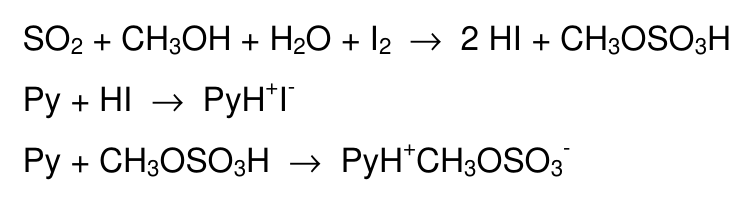
Iodine content is usually expressed in mg of water reacting with \(1\ \mathrm{cm^3}\) of the titrant solution (hereunder T, \(\mathrm{mg\ cm^{-3}}\)), which equals the mass of water (mg) reacting with \(1.00\ \mathrm{cm^3}\) of the iodine solution. T is determined experimentally by titration of a sample with a known water content. The sample may be, for example, a hydrated compound or a standard solution of water in methanol. In the latter case it should be taken into account that methanol itself can contain certain amount of water.
In all calculations please use the atomic masses accurate to 2 decimal points.
4.1 Sometimes titration of water is performed in pyridine medium without methanol. How would the reaction of \(\ce{I2}\) with \(\ce{SO2}\) and \(\ce{H2O}\) occur in this case? Write down balanced reaction equation.
Calculate the T values of iodine solution in each of the following cases:
4.2 \(12.20\ \mathrm{cm^3}\) of Fischer reagent solution were used for titration of \(1.352\ \mathrm{g}\) of sodium tartrate dihydrate \(\ce{Na2C4H4O6 . 2H2O}\).
4.3 A known amount of water (\(21.537\ \mathrm{g}\)) was placed into a \(1.000\ \mathrm{dm^3}\) volumetric flask which was filled by methanol up to the mark. For titration of \(10.00\ \mathrm{cm^3}\) of the obtained solution, \(22.70\ \mathrm{cm^3}\) of Fischer reagent solution were needed, whereas \(2.20\ \mathrm{cm^3}\) of iodine were used for titration of \(25.00\ \mathrm{cm^3}\) of methanol.
4.4 \(5.624\ \mathrm{g}\) of water were diluted by methanol up to a total volume of \(1.000\ \mathrm{dm^3}\) (solution A); \(22.45\ \mathrm{cm^3}\) of this solution were used for titration of \(15.00\ \mathrm{cm^3}\) of a Fischer reagent (solution B).
Then \(25.00\ \mathrm{cm^3}\) of methanol (of the same batch as used for the preparation of solution A) and \(10.00\ \mathrm{cm^3}\) of solution B were mixed, and the mixture was titrated by the solution A. \(10.79\ \mathrm{cm^3}\) of the latter solution were spent.
4.5 An inexperienced analyst tried to determine water content in a sample of \(\ce{CaO}\) using Fischer reagent. Write down the equation(s) of reaction(s) demonstrating possible sources of errors.
For the titration of \(0.6387\ \mathrm{g}\) of a hydrated compound \(\ce{Fe2(SO4)3 . xH2O}\), \(10.59\ \mathrm{cm^3}\) of iodine solution (\(T=15.46\ \mathrm{mg/cm^3}\)) were consumed.
4.6 What other reaction(s), beside those given in the problem, can occur during the titration? Write down the equations of two such processes.
4.7 Write down an equation of the overall reaction of \(\ce{Fe2(SO4)3 . xH2O}\) with the Fischer reagent.
4.8 Calculate the composition of the hydrate \(\ce{Fe2(SO4)3 . xH2O}\) (\(x=\text{integer}\)).
Official English text of the problem.
Answers
-
4.1 \[ \boxed{\ce{SO2 + I2 + 2H2O -> H2SO4 + 2HI}} \] One mole of iodine consumes two moles of water.
-
4.2 \[ \boxed{T=17.36\ \mathrm{mg\,cm^{-3}}} \]
-
4.3 \[ \boxed{T\approx9.870\ \mathrm{mg\,cm^{-3}}} \] This uses the dilute-solution volume approximation explained below.
-
4.4 \[ \boxed{T\approx10.11\ \mathrm{mg\,cm^{-3}}} \] This uses the same volume approximation.
-
4.5 Acid neutralization by calcium oxide generates additional water, causing an erroneously high result. For example, \[ \boxed{\ce{CaO + 2HI -> Ca^2+ + 2I- + H2O}} \]
-
4.6 Iron(III) can oxidize iodide and sulfur dioxide: \[ \boxed{\ce{2Fe^3+ + 2I- -> 2Fe^2+ + I2}} \] \[ \boxed{\ce{2Fe^3+ + SO2 + CH3OH + H2O -> 2Fe^2+ + CH3OSO3H + 2H+}} \]
-
4.7 An overall equation, with the products written as ions, is \[ \boxed{ \begin{aligned} &\ce{Fe2(SO4)3 . xH2O} +(x-1)\ce{I2}+x\ce{SO2}+x\ce{CH3OH}+3x\ce{Py}\\ &\qquad\ce{->} 2\ce{Fe^2+}+3\ce{SO4^2-} +(2x-2)\ce{I-}+x\ce{CH3OSO3-}+3x\ce{PyH+}. \end{aligned}} \]
-
4.8 \[ \boxed{x=9,\qquad \ce{Fe2(SO4)3 . 9H2O}} \] The compound is iron(III) sulfate nonahydrate.
Solution
Names and SMILES for the species used in the equations are collected here once. Disconnected SMILES for ionic compounds describe composition; they do not specify a crystal structure or coordination geometry.
| Species | Name | SMILES |
|---|---|---|
| \(\ce{H2O}\) | Water | O |
| \(\ce{CH3OH}\) | Methanol | CO |
| \(\ce{SO2}\) | Sulfur dioxide | O=S=O |
| \(\ce{I2}\) | Iodine | II |
| \(\ce{Py}\) | Pyridine | n1ccccc1 |
| \(\ce{HI}\) | Hydrogen iodide | [H]I |
| \(\ce{H2SO4}\) | Sulfuric acid | OS(=O)(=O)O |
| \(\ce{CH3OSO3H}\) | Methyl hydrogen sulfate | COS(=O)(=O)O |
| \(\ce{H+}\) | Hydrogen ion, or proton | [H+] |
| \(\ce{I-}\) | Iodide ion | [I-] |
| \(\ce{PyH+}\) | Pyridinium ion | [nH+]1ccccc1 |
| \(\ce{CH3OSO3-}\) | Methyl sulfate ion | COS(=O)(=O)[O-] |
| \(\ce{SO4^2-}\) | Sulfate ion | [O-]S(=O)(=O)[O-] |
| \(\ce{Fe^3+}\) | Iron(III) ion | [Fe+3] |
| \(\ce{Fe^2+}\) | Iron(II) ion | [Fe+2] |
| \(\ce{Ca^2+}\) | Calcium ion | [Ca+2] |
| \(\ce{CaO}\) | Calcium oxide | [Ca+2].[O-2] |
The given methanolic reaction is \[ \ce{SO2 + CH3OH + H2O + I2 -> 2HI + CH3OSO3H}. \] Thus, in the absence of interfering reactions, \[ n(\ce{I2})=n(\ce{H2O}), \qquad T=\frac{m(\ce{H2O})}{V_{\text{reagent}}}. \]
The atomic masses used are \[ \begin{gathered} A_{\mathrm r}(\ce{H})=1.01,\quad A_{\mathrm r}(\ce{C})=12.01,\quad A_{\mathrm r}(\ce{O})=16.00,\\ A_{\mathrm r}(\ce{Na})=22.99,\quad A_{\mathrm r}(\ce{S})=32.07,\quad A_{\mathrm r}(\ce{Fe})=55.85. \end{gathered} \] Consequently, \[ M(\ce{H2O})=18.02\ \mathrm{g\,mol^{-1}}. \]
4.1
Without methanol, oxidation of sulfur dioxide produces sulfate. The balanced oxidation and reduction half-reactions are \[ \ce{SO2 + 2H2O -> SO4^2- + 4H+ + 2e-}, \] \[ \ce{I2 + 2e- -> 2I-}. \]
Their sum can be written in molecular form as \[ \boxed{\ce{SO2 + I2 + 2H2O -> H2SO4 + 2HI}}. \]
Including neutralization by excess pyridine gives \[ \ce{SO2 + I2 + 2H2O + 4Py -> SO4^2- + 2I- + 4PyH+}. \]
Two water molecules supply the two additional oxygen atoms required to convert sulfur dioxide into sulfate. In the methanolic reaction, methanol supplies one of these oxygen atoms, so only one water molecule is consumed per iodine molecule.
4.2
Sodium tartrate dihydrate has the composition-only SMILES
[Na+].[Na+].[O-]C(=O)C(O)C(O)C(=O)[O-].O.O.
The statement does not specify tartrate stereochemistry, so none is assigned in the SMILES.
Its molar mass is \[ \begin{aligned} M(\ce{Na2C4H4O6 . 2H2O}) &=2(22.99)+4(12.01)+4(1.01)+6(16.00)+2(18.02)\\ &=230.10\ \mathrm{g\,mol^{-1}}. \end{aligned} \]
The mass of crystallization water in the sample is \[ m_{\mathrm w} =(1.352\ \mathrm g)\frac{2(18.02)}{230.10} =0.2117605\ \mathrm g =211.7605\ \mathrm{mg}. \]
Therefore, \[ \boxed{ T=\frac{211.7605\ \mathrm{mg}}{12.20\ \mathrm{cm^3}} =17.36\ \mathrm{mg\,cm^{-3}}. } \]
4.3
For this part and 4.4, use the usual dilute-solution approximation that the methanol contribution to a \(1.000\ \mathrm{dm^3}\) preparation is approximately the water contained in \(1.000\ \mathrm{dm^3}\) of the original methanol.
The deliberately added water in the aliquot is \[ m_{\mathrm{added}} =(21.537\ \mathrm g)\frac{10.00}{1000} =0.21537\ \mathrm g =215.37\ \mathrm{mg}. \]
The methanol blank corresponding to the aliquot requires \[ V_{\mathrm{blank}} =(2.20\ \mathrm{cm^3})\frac{10.00}{25.00} =0.880\ \mathrm{cm^3} \] of reagent.
The reagent volume attributable to the deliberately added water is consequently \[ V_{\mathrm{corrected}} =22.70-0.880 =21.82\ \mathrm{cm^3}. \]
Hence \[ \boxed{ T=\frac{215.37\ \mathrm{mg}}{21.82\ \mathrm{cm^3}} \approx9.870\ \mathrm{mg\,cm^{-3}}. } \]
4.4
Let \(c_m\) be the water concentration in the original methanol, and \(c_A\) the total water concentration in solution A, both in \(\mathrm{mg\,cm^{-3}}\).
Under the stated volume approximation, \[ c_A =\frac{5624\ \mathrm{mg}}{1000\ \mathrm{cm^3}}+c_m =5.624\ \mathrm{mg\,cm^{-3}}+c_m. \]
The first titration gives \[ (15.00\ \mathrm{cm^3})T =(22.45\ \mathrm{cm^3})c_A. \]
In the second experiment, water from the added methanol consumes part of the iodine initially present in solution B. Solution A consumes the remainder: \[ (10.00\ \mathrm{cm^3})T =(25.00\ \mathrm{cm^3})c_m +(10.79\ \mathrm{cm^3})c_A. \]
Eliminating \(T\), \[ c_m =\frac{10.00(22.45/15.00)-10.79}{25.00}\,c_A =0.1670667\,c_A. \]
Thus \[ c_A =\frac{5.624}{1-0.1670667} =6.752041\ \mathrm{mg\,cm^{-3}}, \] and \[ c_m=1.128041\ \mathrm{mg\,cm^{-3}}. \]
Finally, \[ \boxed{ T=\frac{22.45}{15.00}c_A =10.10555\ \mathrm{mg\,cm^{-3}} \approx10.11\ \mathrm{mg\,cm^{-3}}. } \]
4.5
Calcium oxide is a basic oxide. It reacts with acidic components of the reagent system and generates water. Two examples, with the calcium salts written as ions, are \[ \ce{CaO + 2HI -> Ca^2+ + 2I- + H2O}, \] \[ \ce{CaO + 2CH3OSO3H -> Ca^2+ + 2CH3OSO3- + H2O}. \]
The corresponding reaction with protonated pyridine is \[ \ce{CaO + 2PyH+ -> Ca^2+ + 2Py + H2O}. \]
The newly generated water consumes additional iodine. Combining the first equation with the Fischer reaction makes the interference explicit: \[ \ce{CaO + SO2 + CH3OH + I2 -> Ca^2+ + 2I- + CH3OSO3H}. \]
Thus even anhydrous calcium oxide can consume iodine. Each mole of calcium oxide reacting through this process produces one mole of apparent water, giving an erroneously high water determination.
4.6
Iron(III) is an additional oxidizing agent in the sample. Its reduction is \[ \ce{Fe^3+ + e- -> Fe^2+}. \]
It can accept electrons from iodide: \[ \boxed{\ce{2Fe^3+ + 2I- -> 2Fe^2+ + I2}}. \]
This regenerates iodine from iodide formed during the Fischer reaction.
Iron(III) can also accept electrons directly from sulfur dioxide. Written consistently with the methyl hydrogen sulfate product specified for the methanolic medium, \[ \boxed{ \ce{2Fe^3+ + SO2 + CH3OH + H2O -> 2Fe^2+ + CH3OSO3H + 2H+}. } \]
Here sulfur is oxidized from \(+4\) to \(+6\), releasing two electrons, while two iron(III) ions each accept one electron.
These are alternative routes for reduction of the same iron(III): each formula unit of the hydrate accepts two electrons in total through its two iron ions.
4.7
Including dissociation of methyl hydrogen sulfate, the sulfur oxidation half-reaction is \[ \ce{SO2 + CH3OH + H2O -> CH3OSO3- + 3H+ + 2e-}. \]
For \(x\) waters of hydration, this process releases \(2x\) electrons. Reduction of the two iron(III) ions consumes two electrons: \[ \ce{2Fe^3+ + 2e- -> 2Fe^2+}. \]
The remaining \(2x-2\) electrons reduce \(x-1\) iodine molecules. Pyridine binds the \(3x\) protons produced. Therefore, \[ \boxed{ \begin{aligned} &\ce{Fe2(SO4)3 . xH2O} +(x-1)\ce{I2}+x\ce{SO2}+x\ce{CH3OH}+3x\ce{Py}\\ &\qquad\ce{->} 2\ce{Fe^2+}+3\ce{SO4^2-} +(2x-2)\ce{I-}+x\ce{CH3OSO3-}+3x\ce{PyH+}. \end{aligned} } \]
The three sulfate ions originally present in the hydrate are retained. Both atoms and charge balance; the total product charge is \[ 2(2)+3(-2)-(2x-2)-x+3x=0. \]
The analytical consequence is \[ \boxed{ n(\ce{I2})=(x-1)\,n(\text{hydrate}). } \]
4.8
The anhydrous iron(III) sulfate formula unit has composition-only SMILES
[Fe+3].[Fe+3].[O-]S(=O)(=O)[O-].[O-]S(=O)(=O)[O-].[O-]S(=O)(=O)[O-].
Its molar mass is \[ M_0=2(55.85)+3[32.07+4(16.00)] =399.91\ \mathrm{g\,mol^{-1}}. \]
The iodine consumed corresponds to an apparent water mass of \[ m_{\mathrm{equiv}} =(15.46\ \mathrm{mg\,cm^{-3}})(10.59\ \mathrm{cm^3}) =163.7214\ \mathrm{mg}. \]
Because the reagent titer is based on the ordinary \(1:1\) iodine–water reaction, \[ n(\ce{I2}) =\frac{0.1637214\ \mathrm g}{18.02\ \mathrm{g\,mol^{-1}}} =0.009085538\ \mathrm{mol}. \]
Meanwhile, \[ n(\text{hydrate}) =\frac{0.6387\ \mathrm g} {(399.91+18.02x)\ \mathrm{g\,mol^{-1}}}. \]
Using the stoichiometry established in 4.7, \[ 0.009085538 =\frac{0.6387(x-1)}{399.91+18.02x}. \]
Solving, \[ x =\frac{0.6387+(0.009085538)(399.91)} {0.6387-(0.009085538)(18.02)} =8.9943. \]
Since \(x\) must be an integer, \[ \boxed{x=9,\qquad \ce{Fe2(SO4)3 . 9H2O}}. \]
The compound is iron(III) sulfate nonahydrate, with composition-only SMILES
[Fe+3].[Fe+3].[O-]S(=O)(=O)[O-].[O-]S(=O)(=O)[O-].[O-]S(=O)(=O)[O-].O.O.O.O.O.O.O.O.O.
The formula and this SMILES specify nine waters per formula unit. They do not establish which waters coordinate iron or the hydrate’s crystal geometry.
The solution was checked against the official solution.
IChO 2007 · Theorieaufgabe 4
Wasserbestimmung durch Fischer-Titration
Wasserbestimmung durch Fischer-Titration
Die Wasserbestimmung nach der klassischen Fischer-Methode erfolgt durch Titration einer Probenlösung (oder Suspension) in Methanol mit einer methanolischen Iodlösung, die außerdem einen Überschuss an \(\ce{SO2}\) und Pyridin (\(\ce{C5H5N}\), Py) enthält – dem Fischer-Reagenz. Während der Titration laufen folgende Reaktionen ab:
Der Iodgehalt wird üblicherweise in mg Wasser angegeben, die mit \(1\ \mathrm{cm^3}\) der Maßlösung reagieren (im Folgenden T, \(\mathrm{mg\ cm^{-3}}\)); dies entspricht der Masse an Wasser (mg), die mit \(1.00\ \mathrm{cm^3}\) der Iodlösung reagiert. T wird experimentell durch Titration einer Probe mit bekanntem Wassergehalt bestimmt. Die Probe kann beispielsweise eine hydratisierte Verbindung oder eine Standardlösung von Wasser in Methanol sein. Im letzteren Fall ist zu berücksichtigen, dass Methanol selbst eine gewisse Menge Wasser enthalten kann.
Verwenden Sie bei allen Berechnungen die auf zwei Dezimalstellen angegebenen Atommassen.
4.1 Mitunter wird die Titration von Wasser in Pyridin ohne Methanol durchgeführt. Wie würde die Reaktion von \(\ce{I2}\) mit \(\ce{SO2}\) und \(\ce{H2O}\) in diesem Fall ablaufen? Geben Sie die ausgeglichene Reaktionsgleichung an.
Berechnen Sie die T-Werte der Iodlösung für jeden der folgenden Fälle:
4.2 Für die Titration von \(1.352\ \mathrm{g}\) Natriumtartrat-Dihydrat \(\ce{Na2C4H4O6 . 2H2O}\) wurden \(12.20\ \mathrm{cm^3}\) Fischer-Reagenzlösung verbraucht.
4.3 Eine bekannte Menge Wasser (\(21.537\ \mathrm{g}\)) wurde in einen \(1.000\ \mathrm{dm^3}\)-Messkolben gegeben, der mit Methanol bis zur Marke aufgefüllt wurde. Für die Titration von \(10.00\ \mathrm{cm^3}\) der erhaltenen Lösung wurden \(22.70\ \mathrm{cm^3}\) Fischer-Reagenzlösung benötigt, während für die Titration von \(25.00\ \mathrm{cm^3}\) Methanol \(2.20\ \mathrm{cm^3}\) Iodlösung verbraucht wurden.
4.4 \(5.624\ \mathrm{g}\) Wasser wurden mit Methanol auf ein Gesamtvolumen von \(1.000\ \mathrm{dm^3}\) verdünnt (Lösung A); \(22.45\ \mathrm{cm^3}\) dieser Lösung wurden für die Titration von \(15.00\ \mathrm{cm^3}\) eines Fischer-Reagenzes (Lösung B) verbraucht.
Anschließend wurden \(25.00\ \mathrm{cm^3}\) Methanol (aus derselben Charge wie das zur Herstellung von Lösung A verwendete Methanol) und \(10.00\ \mathrm{cm^3}\) der Lösung B gemischt und das Gemisch mit Lösung A titriert. Von letzterer Lösung wurden \(10.79\ \mathrm{cm^3}\) verbraucht.
4.5 Ein unerfahrener Analytiker versuchte, den Wassergehalt einer Probe von \(\ce{CaO}\) mit Fischer-Reagenz zu bestimmen. Geben Sie die Reaktionsgleichung(en) an, die mögliche Fehlerquellen aufzeigen.
Für die Titration von \(0.6387\ \mathrm{g}\) einer hydratisierten Verbindung \(\ce{Fe2(SO4)3 . xH2O}\) wurden \(10.59\ \mathrm{cm^3}\) Iodlösung (\(T=15.46\ \mathrm{mg/cm^3}\)) verbraucht.
4.6 Welche weitere(n) Reaktion(en) können neben den in der Aufgabenstellung angegebenen während der Titration ablaufen? Geben Sie die Gleichungen für zwei solche Vorgänge an.
4.7 Geben Sie eine Gleichung für die Gesamtreaktion von \(\ce{Fe2(SO4)3 . xH2O}\) mit dem Fischer-Reagenz an.
4.8 Berechnen Sie die Zusammensetzung des Hydrats \(\ce{Fe2(SO4)3 . xH2O}\) (\(x=\text{ganze Zahl}\)).
Aufgabentext aus dem offiziellen englischen Text übersetzt.
Antworten
-
4.1 \[ \boxed{\ce{SO2 + I2 + 2H2O -> H2SO4 + 2HI}} \] Ein Mol Iod verbraucht zwei Mol Wasser.
-
4.2 \[ \boxed{T=17.36\ \mathrm{mg\,cm^{-3}}} \]
-
4.3 \[ \boxed{T\approx9.870\ \mathrm{mg\,cm^{-3}}} \] Hierbei wird die unten erläuterte Volumennäherung für verdünnte Lösungen verwendet.
-
4.4 \[ \boxed{T\approx10.11\ \mathrm{mg\,cm^{-3}}} \] Hierbei wird dieselbe Volumennäherung verwendet.
-
4.5 Durch die Neutralisation von Säure mit Calciumoxid entsteht zusätzliches Wasser, was zu einem fälschlich zu hohen Ergebnis führt. Beispielsweise gilt \[ \boxed{\ce{CaO + 2HI -> Ca^2+ + 2I- + H2O}} \]
-
4.6 Eisen(III) kann Iodid und Schwefeldioxid oxidieren: \[ \boxed{\ce{2Fe^3+ + 2I- -> 2Fe^2+ + I2}} \] \[ \boxed{\ce{2Fe^3+ + SO2 + CH3OH + H2O -> 2Fe^2+ + CH3OSO3H + 2H+}} \]
-
4.7 Eine Gesamtgleichung, in der die Produkte als Ionen geschrieben sind, lautet \[ \boxed{ \begin{aligned} &\ce{Fe2(SO4)3 . xH2O} +(x-1)\ce{I2}+x\ce{SO2}+x\ce{CH3OH}+3x\ce{Py}\\ &\qquad\ce{->} 2\ce{Fe^2+}+3\ce{SO4^2-} +(2x-2)\ce{I-}+x\ce{CH3OSO3-}+3x\ce{PyH+}. \end{aligned}} \]
-
4.8 \[ \boxed{x=9,\qquad \ce{Fe2(SO4)3 . 9H2O}} \] Die Verbindung ist Eisen(III)-sulfat-Nonahydrat.
Lösung
Die Namen und SMILES der in den Gleichungen verwendeten Spezies sind hier einmal zusammengestellt. SMILES mit getrennten Komponenten für ionische Verbindungen beschreiben die Zusammensetzung; sie legen weder eine Kristallstruktur noch eine Koordinationsgeometrie fest.
| Spezies | Name | SMILES |
|---|---|---|
| \(\ce{H2O}\) | Wasser | O |
| \(\ce{CH3OH}\) | Methanol | CO |
| \(\ce{SO2}\) | Schwefeldioxid | O=S=O |
| \(\ce{I2}\) | Iod | II |
| \(\ce{Py}\) | Pyridin | n1ccccc1 |
| \(\ce{HI}\) | Iodwasserstoff | [H]I |
| \(\ce{H2SO4}\) | Schwefelsäure | OS(=O)(=O)O |
| \(\ce{CH3OSO3H}\) | Methylhydrogensulfat | COS(=O)(=O)O |
| \(\ce{H+}\) | Wasserstoffion oder Proton | [H+] |
| \(\ce{I-}\) | Iodidion | [I-] |
| \(\ce{PyH+}\) | Pyridiniumion | [nH+]1ccccc1 |
| \(\ce{CH3OSO3-}\) | Methylsulfation | COS(=O)(=O)[O-] |
| \(\ce{SO4^2-}\) | Sulfation | [O-]S(=O)(=O)[O-] |
| \(\ce{Fe^3+}\) | Eisen(III)-Ion | [Fe+3] |
| \(\ce{Fe^2+}\) | Eisen(II)-Ion | [Fe+2] |
| \(\ce{Ca^2+}\) | Calciumion | [Ca+2] |
| \(\ce{CaO}\) | Calciumoxid | [Ca+2].[O-2] |
Die angegebene Reaktion in Methanol lautet \[ \ce{SO2 + CH3OH + H2O + I2 -> 2HI + CH3OSO3H}. \] Somit gilt bei Abwesenheit störender Reaktionen \[ n(\ce{I2})=n(\ce{H2O}), \qquad T=\frac{m(\ce{H2O})}{V_{\text{Reagenz}}}. \]
Die verwendeten Atommassen sind \[ \begin{gathered} A_{\mathrm r}(\ce{H})=1.01,\quad A_{\mathrm r}(\ce{C})=12.01,\quad A_{\mathrm r}(\ce{O})=16.00,\\ A_{\mathrm r}(\ce{Na})=22.99,\quad A_{\mathrm r}(\ce{S})=32.07,\quad A_{\mathrm r}(\ce{Fe})=55.85. \end{gathered} \] Daraus folgt \[ M(\ce{H2O})=18.02\ \mathrm{g\,mol^{-1}}. \]
4.1
Ohne Methanol entsteht bei der Oxidation von Schwefeldioxid Sulfat. Die ausgeglichenen Teilgleichungen für Oxidation und Reduktion lauten \[ \ce{SO2 + 2H2O -> SO4^2- + 4H+ + 2e-}, \] \[ \ce{I2 + 2e- -> 2I-}. \]
Ihre Summe lässt sich in molekularer Form schreiben als \[ \boxed{\ce{SO2 + I2 + 2H2O -> H2SO4 + 2HI}}. \]
Unter Einbeziehung der Neutralisation durch überschüssiges Pyridin ergibt sich \[ \ce{SO2 + I2 + 2H2O + 4Py -> SO4^2- + 2I- + 4PyH+}. \]
Zwei Wassermoleküle liefern die beiden zusätzlichen Sauerstoffatome, die zur Umwandlung von Schwefeldioxid in Sulfat benötigt werden. Bei der Reaktion in Methanol liefert Methanol eines dieser Sauerstoffatome, sodass pro Iodmolekül nur ein Wassermolekül verbraucht wird.
4.2
Für Natriumtartrat-Dihydrat lautet der SMILES, der nur die Zusammensetzung beschreibt:
[Na+].[Na+].[O-]C(=O)C(O)C(O)C(=O)[O-].O.O.
Die Aufgabenstellung legt die Stereochemie des Tartrats nicht fest, daher wird auch im SMILES keine angegeben.
Seine molare Masse beträgt \[ \begin{aligned} M(\ce{Na2C4H4O6 . 2H2O}) &=2(22.99)+4(12.01)+4(1.01)+6(16.00)+2(18.02)\\ &=230.10\ \mathrm{g\,mol^{-1}}. \end{aligned} \]
Die Masse des Kristallwassers in der Probe beträgt \[ m_{\mathrm w} =(1.352\ \mathrm g)\frac{2(18.02)}{230.10} =0.2117605\ \mathrm g =211.7605\ \mathrm{mg}. \]
Daher gilt \[ \boxed{ T=\frac{211.7605\ \mathrm{mg}}{12.20\ \mathrm{cm^3}} =17.36\ \mathrm{mg\,cm^{-3}}. } \]
4.3
Für diesen Teil und 4.4 wird die übliche Näherung für verdünnte Lösungen verwendet, nach der der Wasserbeitrag des Methanols bei einem Ansatz von \(1.000\ \mathrm{dm^3}\) ungefähr der in \(1.000\ \mathrm{dm^3}\) des ursprünglichen Methanols enthaltenen Wassermenge entspricht.
Die gezielt zugesetzte Wassermenge im Aliquot beträgt \[ m_{\mathrm{added}} =(21.537\ \mathrm g)\frac{10.00}{1000} =0.21537\ \mathrm g =215.37\ \mathrm{mg}. \]
Der dem Aliquot entsprechende Methanolblindwert erfordert \[ V_{\mathrm{blank}} =(2.20\ \mathrm{cm^3})\frac{10.00}{25.00} =0.880\ \mathrm{cm^3} \] Reagenz.
Das auf das gezielt zugesetzte Wasser entfallende Reagenzvolumen beträgt folglich \[ V_{\mathrm{corrected}} =22.70-0.880 =21.82\ \mathrm{cm^3}. \]
Somit gilt \[ \boxed{ T=\frac{215.37\ \mathrm{mg}}{21.82\ \mathrm{cm^3}} \approx9.870\ \mathrm{mg\,cm^{-3}}. } \]
4.4
Es sei \(c_m\) die Wasserkonzentration im ursprünglichen Methanol und \(c_A\) die gesamte Wasserkonzentration in Lösung A, jeweils in \(\mathrm{mg\,cm^{-3}}\).
Unter der angegebenen Volumennäherung gilt \[ c_A =\frac{5624\ \mathrm{mg}}{1000\ \mathrm{cm^3}}+c_m =5.624\ \mathrm{mg\,cm^{-3}}+c_m. \]
Die erste Titration ergibt \[ (15.00\ \mathrm{cm^3})T =(22.45\ \mathrm{cm^3})c_A. \]
Im zweiten Versuch verbraucht das Wasser aus dem zugesetzten Methanol einen Teil des ursprünglich in Lösung B vorhandenen Iods. Lösung A verbraucht den Rest: \[ (10.00\ \mathrm{cm^3})T =(25.00\ \mathrm{cm^3})c_m +(10.79\ \mathrm{cm^3})c_A. \]
Durch Eliminieren von \(T\) erhält man \[ c_m =\frac{10.00(22.45/15.00)-10.79}{25.00}\,c_A =0.1670667\,c_A. \]
Somit gilt \[ c_A =\frac{5.624}{1-0.1670667} =6.752041\ \mathrm{mg\,cm^{-3}}, \] und \[ c_m=1.128041\ \mathrm{mg\,cm^{-3}}. \]
Schließlich ergibt sich \[ \boxed{ T=\frac{22.45}{15.00}c_A =10.10555\ \mathrm{mg\,cm^{-3}} \approx10.11\ \mathrm{mg\,cm^{-3}}. } \]
4.5
Calciumoxid ist ein basisches Oxid. Es reagiert mit sauren Bestandteilen des Reagenzsystems und bildet dabei Wasser. Zwei Beispiele, bei denen die Calciumsalze als Ionen geschrieben sind, lauten \[ \ce{CaO + 2HI -> Ca^2+ + 2I- + H2O}, \] \[ \ce{CaO + 2CH3OSO3H -> Ca^2+ + 2CH3OSO3- + H2O}. \]
Die entsprechende Reaktion mit protoniertem Pyridin lautet \[ \ce{CaO + 2PyH+ -> Ca^2+ + 2Py + H2O}. \]
Das neu gebildete Wasser verbraucht zusätzliches Iod. Die Kombination der ersten Gleichung mit der Fischer-Reaktion macht die Störung deutlich: \[ \ce{CaO + SO2 + CH3OH + I2 -> Ca^2+ + 2I- + CH3OSO3H}. \]
Somit kann selbst wasserfreies Calciumoxid Iod verbrauchen. Jedes Mol Calciumoxid, das auf diesem Weg reagiert, ergibt ein Mol scheinbar vorhandenes Wasser und führt damit zu einem fälschlich zu hohen Ergebnis der Wasserbestimmung.
4.6
Eisen(III) ist ein zusätzliches Oxidationsmittel in der Probe. Seine Reduktion lautet \[ \ce{Fe^3+ + e- -> Fe^2+}. \]
Es kann Elektronen von Iodid aufnehmen: \[ \boxed{\ce{2Fe^3+ + 2I- -> 2Fe^2+ + I2}}. \]
Dadurch wird aus dem während der Fischer-Reaktion gebildeten Iodid wieder Iod erzeugt.
Eisen(III) kann Elektronen auch direkt von Schwefeldioxid aufnehmen. In Übereinstimmung mit dem für das methanolische Medium angegebenen Produkt Methylhydrogensulfat geschrieben, lautet die Gleichung \[ \boxed{ \ce{2Fe^3+ + SO2 + CH3OH + H2O -> 2Fe^2+ + CH3OSO3H + 2H+}. } \]
Hier wird Schwefel von \(+4\) zu \(+6\) oxidiert und gibt dabei zwei Elektronen ab, während zwei Eisen(III)-Ionen jeweils ein Elektron aufnehmen.
Dies sind alternative Wege zur Reduktion desselben Eisen(III): Jede Formeleinheit des Hydrats nimmt über ihre beiden Eisenionen insgesamt zwei Elektronen auf.
4.7
Unter Einbeziehung der Dissoziation von Methylhydrogensulfat lautet die Teilgleichung für die Oxidation des Schwefels \[ \ce{SO2 + CH3OH + H2O -> CH3OSO3- + 3H+ + 2e-}. \]
Für \(x\) Kristallwassermoleküle werden bei diesem Vorgang \(2x\) Elektronen freigesetzt. Die Reduktion der beiden Eisen(III)-Ionen verbraucht zwei Elektronen: \[ \ce{2Fe^3+ + 2e- -> 2Fe^2+}. \]
Die verbleibenden \(2x-2\) Elektronen reduzieren \(x-1\) Iodmoleküle. Pyridin bindet die gebildeten \(3x\) Protonen. Daher gilt \[ \boxed{ \begin{aligned} &\ce{Fe2(SO4)3 . xH2O} +(x-1)\ce{I2}+x\ce{SO2}+x\ce{CH3OH}+3x\ce{Py}\\ &\qquad\ce{->} 2\ce{Fe^2+}+3\ce{SO4^2-} +(2x-2)\ce{I-}+x\ce{CH3OSO3-}+3x\ce{PyH+}. \end{aligned} } \]
Die drei ursprünglich im Hydrat vorhandenen Sulfationen bleiben erhalten. Sowohl die Atombilanz als auch die Ladungsbilanz sind ausgeglichen; die Gesamtladung der Produkte beträgt \[ 2(2)+3(-2)-(2x-2)-x+3x=0. \]
Für die Analyse folgt daraus \[ \boxed{ n(\ce{I2})=(x-1)\,n(\text{Hydrat}). } \]
4.8
Für die Formeleinheit des wasserfreien Eisen(III)-sulfats lautet der SMILES, der nur die Zusammensetzung beschreibt:
[Fe+3].[Fe+3].[O-]S(=O)(=O)[O-].[O-]S(=O)(=O)[O-].[O-]S(=O)(=O)[O-].
Seine molare Masse beträgt \[ M_0=2(55.85)+3[32.07+4(16.00)] =399.91\ \mathrm{g\,mol^{-1}}. \]
Das verbrauchte Iod entspricht einer scheinbaren Wassermasse von \[ m_{\mathrm{equiv}} =(15.46\ \mathrm{mg\,cm^{-3}})(10.59\ \mathrm{cm^3}) =163.7214\ \mathrm{mg}. \]
Da der Titer des Reagenzes auf der gewöhnlichen \(1:1\)-Reaktion zwischen Iod und Wasser beruht, gilt \[ n(\ce{I2}) =\frac{0.1637214\ \mathrm g}{18.02\ \mathrm{g\,mol^{-1}}} =0.009085538\ \mathrm{mol}. \]
Zugleich gilt \[ n(\text{Hydrat}) =\frac{0.6387\ \mathrm g} {(399.91+18.02x)\ \mathrm{g\,mol^{-1}}}. \]
Mit der in 4.7 hergeleiteten Stöchiometrie ergibt sich \[ 0.009085538 =\frac{0.6387(x-1)}{399.91+18.02x}. \]
Auflösen ergibt \[ x =\frac{0.6387+(0.009085538)(399.91)} {0.6387-(0.009085538)(18.02)} =8.9943. \]
Da \(x\) eine ganze Zahl sein muss, gilt \[ \boxed{x=9,\qquad \ce{Fe2(SO4)3 . 9H2O}}. \]
Die Verbindung ist Eisen(III)-sulfat-Nonahydrat, mit dem folgenden SMILES, der nur die Zusammensetzung beschreibt:
[Fe+3].[Fe+3].[O-]S(=O)(=O)[O-].[O-]S(=O)(=O)[O-].[O-]S(=O)(=O)[O-].O.O.O.O.O.O.O.O.O.
Die Formel und dieser SMILES geben neun Wassermoleküle pro Formeleinheit an. Sie legen weder fest, welche Wassermoleküle an Eisen koordinieren, noch bestimmen sie die Kristallgeometrie des Hydrats.
Die Lösung wurde mit der offiziellen Lösung abgeglichen.
IChO 2007 · Teori sorusu 4
Fischer titrasyonu ile su tayini
Fischer titrasyonu ile su tayini
Klasik Fischer yöntemiyle su tayini, metanol içindeki bir numune çözeltisinin (veya süspansiyonunun), ayrıca aşırı miktarda \(\ce{SO2}\) ve piridin (\(\ce{C5H5N}\), Py) içeren metanollü bir iyot çözeltisiyle (Fischer reaktifi) titre edilmesine dayanır. Titrasyon sırasında aşağıdaki tepkimeler gerçekleşir:
İyot içeriği genellikle titrant çözeltisinin \(1\ \mathrm{cm^3}\)'ü ile tepkimeye giren suyun mg cinsinden miktarıyla ifade edilir (bundan sonra T, \(\mathrm{mg\ cm^{-3}}\)); bu değer, iyot çözeltisinin \(1.00\ \mathrm{cm^3}\)'ü ile tepkimeye giren suyun kütlesine (mg) eşittir. T, su içeriği bilinen bir numunenin titrasyonuyla deneysel olarak belirlenir. Numune, örneğin hidratlı bir bileşik veya suyun metanoldeki standart bir çözeltisi olabilir. İkinci durumda, metanolün kendisinin de belirli miktarda su içerebileceği dikkate alınmalıdır.
Tüm hesaplamalarda lütfen virgülden sonra 2 basamak duyarlılığındaki atom kütlelerini kullanınız.
4.1 Su titrasyonu bazen metanol olmadan piridin ortamında gerçekleştirilir. Bu durumda \(\ce{I2}\)'nin \(\ce{SO2}\) ve \(\ce{H2O}\) ile tepkimesi nasıl gerçekleşir? Denkleştirilmiş tepkime denklemini yazınız.
Aşağıdaki durumların her biri için iyot çözeltisinin T değerlerini hesaplayınız:
4.2 \(1.352\ \mathrm{g}\) sodyum tartarat dihidratın, \(\ce{Na2C4H4O6 . 2H2O}\), titrasyonu için \(12.20\ \mathrm{cm^3}\) Fischer reaktifi çözeltisi kullanılmıştır.
4.3 Bilinen miktarda su (\(21.537\ \mathrm{g}\)), \(1.000\ \mathrm{dm^3}\)'lük bir balonjojeye konulmuş ve balonjoje işaret çizgisine kadar metanolle doldurulmuştur. Elde edilen çözeltinin \(10.00\ \mathrm{cm^3}\)'ünün titrasyonu için \(22.70\ \mathrm{cm^3}\) Fischer reaktifi çözeltisi gerekirken, \(25.00\ \mathrm{cm^3}\) metanolün titrasyonu için \(2.20\ \mathrm{cm^3}\) iyot çözeltisi kullanılmıştır.
4.4 \(5.624\ \mathrm{g}\) su, metanol ile toplam hacim \(1.000\ \mathrm{dm^3}\) olacak şekilde seyreltilmiştir (A çözeltisi); bu çözeltinin \(22.45\ \mathrm{cm^3}\)'ü, \(15.00\ \mathrm{cm^3}\) Fischer reaktifinin (B çözeltisi) titrasyonu için kullanılmıştır.
Ardından \(25.00\ \mathrm{cm^3}\) metanol (A çözeltisinin hazırlanmasında kullanılanla aynı partiden) ile \(10.00\ \mathrm{cm^3}\) B çözeltisi karıştırılmış ve karışım A çözeltisiyle titre edilmiştir. Bu son çözeltiden \(10.79\ \mathrm{cm^3}\) harcanmıştır.
4.5 Deneyimsiz bir analist, Fischer reaktifi kullanarak bir \(\ce{CaO}\) numunesinin su içeriğini belirlemeye çalışmıştır. Olası hata kaynaklarını gösteren tepkimenin (tepkimelerin) denklemini (denklemlerini) yazınız.
\(0.6387\ \mathrm{g}\) hidratlı \(\ce{Fe2(SO4)3 . xH2O}\) bileşiğinin titrasyonu için \(10.59\ \mathrm{cm^3}\) iyot çözeltisi (\(T=15.46\ \mathrm{mg/cm^3}\)) tüketilmiştir.
4.6 Titrasyon sırasında, soruda verilenlerin yanı sıra başka hangi tepkime(ler) gerçekleşebilir? Bu tür iki sürecin denklemlerini yazınız.
4.7 \(\ce{Fe2(SO4)3 . xH2O}\)'nun Fischer reaktifiyle toplam tepkimesinin denklemini yazınız.
4.8 \(\ce{Fe2(SO4)3 . xH2O}\) hidratının bileşimini hesaplayınız (\(x=\text{tam sayı}\)).
Soru metni resmi İngilizce metinden çevrilmiştir.
Cevaplar
-
4.1 \[ \boxed{\ce{SO2 + I2 + 2H2O -> H2SO4 + 2HI}} \] Bir mol iyot, iki mol su tüketir.
-
4.2 \[ \boxed{T=17.36\ \mathrm{mg\,cm^{-3}}} \]
-
4.3 \[ \boxed{T\approx9.870\ \mathrm{mg\,cm^{-3}}} \] Burada, aşağıda açıklanan seyreltik çözelti hacim yaklaşımı kullanılmıştır.
-
4.4 \[ \boxed{T\approx10.11\ \mathrm{mg\,cm^{-3}}} \] Burada aynı hacim yaklaşımı kullanılmıştır.
-
4.5 Asidin kalsiyum oksitle nötrleşmesi ek su oluşturur ve sonucun hatalı biçimde yüksek çıkmasına neden olur. Örneğin, \[ \boxed{\ce{CaO + 2HI -> Ca^2+ + 2I- + H2O}} \]
-
4.6 Demir(III), iyodürü ve kükürt dioksiti yükseltgeyebilir: \[ \boxed{\ce{2Fe^3+ + 2I- -> 2Fe^2+ + I2}} \] \[ \boxed{\ce{2Fe^3+ + SO2 + CH3OH + H2O -> 2Fe^2+ + CH3OSO3H + 2H+}} \]
-
4.7 Ürünlerin iyonlar hâlinde yazıldığı bir toplam tepkime denklemi şöyledir: \[ \boxed{ \begin{aligned} &\ce{Fe2(SO4)3 . xH2O} +(x-1)\ce{I2}+x\ce{SO2}+x\ce{CH3OH}+3x\ce{Py}\\ &\qquad\ce{->} 2\ce{Fe^2+}+3\ce{SO4^2-} +(2x-2)\ce{I-}+x\ce{CH3OSO3-}+3x\ce{PyH+}. \end{aligned}} \]
-
4.8 \[ \boxed{x=9,\qquad \ce{Fe2(SO4)3 . 9H2O}} \] Bileşik, demir(III) sülfat nonahidrattır.
Çözüm
Denklemlerde kullanılan türlerin adları ve SMILES gösterimleri burada bir araya getirilmiştir. İyonik bileşiklerin birbirinden bağımsız bileşenler içeren SMILES gösterimleri bileşimi tanımlar; kristal yapısını veya koordinasyon geometrisini belirtmez.
| Tür | Adı | SMILES |
|---|---|---|
| \(\ce{H2O}\) | Su | O |
| \(\ce{CH3OH}\) | Metanol | CO |
| \(\ce{SO2}\) | Kükürt dioksit | O=S=O |
| \(\ce{I2}\) | İyot | II |
| \(\ce{Py}\) | Piridin | n1ccccc1 |
| \(\ce{HI}\) | Hidrojen iyodür | [H]I |
| \(\ce{H2SO4}\) | Sülfürik asit | OS(=O)(=O)O |
| \(\ce{CH3OSO3H}\) | Metil hidrojen sülfat | COS(=O)(=O)O |
| \(\ce{H+}\) | Hidrojen iyonu veya proton | [H+] |
| \(\ce{I-}\) | İyodür iyonu | [I-] |
| \(\ce{PyH+}\) | Piridinyum iyonu | [nH+]1ccccc1 |
| \(\ce{CH3OSO3-}\) | Metil sülfat iyonu | COS(=O)(=O)[O-] |
| \(\ce{SO4^2-}\) | Sülfat iyonu | [O-]S(=O)(=O)[O-] |
| \(\ce{Fe^3+}\) | Demir(III) iyonu | [Fe+3] |
| \(\ce{Fe^2+}\) | Demir(II) iyonu | [Fe+2] |
| \(\ce{Ca^2+}\) | Kalsiyum iyonu | [Ca+2] |
| \(\ce{CaO}\) | Kalsiyum oksit | [Ca+2].[O-2] |
Metanollü ortam için verilen tepkime şöyledir: \[ \ce{SO2 + CH3OH + H2O + I2 -> 2HI + CH3OSO3H}. \] Dolayısıyla, girişime neden olan tepkimeler yoksa, \[ n(\ce{I2})=n(\ce{H2O}), \qquad T=\frac{m(\ce{H2O})}{V_{\text{reaktif}}}. \]
Kullanılan atom kütleleri şöyledir: \[ \begin{gathered} A_{\mathrm r}(\ce{H})=1.01,\quad A_{\mathrm r}(\ce{C})=12.01,\quad A_{\mathrm r}(\ce{O})=16.00,\\ A_{\mathrm r}(\ce{Na})=22.99,\quad A_{\mathrm r}(\ce{S})=32.07,\quad A_{\mathrm r}(\ce{Fe})=55.85. \end{gathered} \] Buna göre, \[ M(\ce{H2O})=18.02\ \mathrm{g\,mol^{-1}}. \]
4.1
Metanol bulunmadığında, kükürt dioksitin yükseltgenmesiyle sülfat oluşur. Denkleştirilmiş yükseltgenme ve indirgenme yarı tepkimeleri şöyledir: \[ \ce{SO2 + 2H2O -> SO4^2- + 4H+ + 2e-}, \] \[ \ce{I2 + 2e- -> 2I-}. \]
Bu tepkimelerin toplamı moleküler biçimde şöyle yazılabilir: \[ \boxed{\ce{SO2 + I2 + 2H2O -> H2SO4 + 2HI}}. \]
Aşırı miktardaki piridinle nötrleşme de hesaba katıldığında, \[ \ce{SO2 + I2 + 2H2O + 4Py -> SO4^2- + 2I- + 4PyH+}. \]
İki su molekülü, kükürt dioksitin sülfata dönüşmesi için gereken iki ek oksijen atomunu sağlar. Metanollü ortamdaki tepkimede bu oksijen atomlarından birini metanol sağlar; bu nedenle her iyot molekülü başına yalnızca bir su molekülü tüketilir.
4.2
Sodyum tartarat dihidratın yalnızca bileşimini gösteren SMILES ifadesi şöyledir:
[Na+].[Na+].[O-]C(=O)C(O)C(O)C(=O)[O-].O.O.
Soru metninde tartaratın stereokimyası belirtilmediği için SMILES gösteriminde de herhangi bir stereokimya atanmamıştır.
Molar kütlesi şöyledir: \[ \begin{aligned} M(\ce{Na2C4H4O6 . 2H2O}) &=2(22.99)+4(12.01)+4(1.01)+6(16.00)+2(18.02)\\ &=230.10\ \mathrm{g\,mol^{-1}}. \end{aligned} \]
Numunedeki kristal suyunun kütlesi şöyledir: \[ m_{\mathrm w} =(1.352\ \mathrm g)\frac{2(18.02)}{230.10} =0.2117605\ \mathrm g =211.7605\ \mathrm{mg}. \]
Dolayısıyla, \[ \boxed{ T=\frac{211.7605\ \mathrm{mg}}{12.20\ \mathrm{cm^3}} =17.36\ \mathrm{mg\,cm^{-3}}. } \]
4.3
Bu kısımda ve 4.4'te, \(1.000\ \mathrm{dm^3}\) çözelti hazırlanırken metanolün sağladığı su miktarının, başlangıçtaki metanolün \(1.000\ \mathrm{dm^3}\)'ünde bulunan su miktarına yaklaşık olarak eşit olduğu şeklindeki yaygın seyreltik çözelti yaklaşımını kullanınız.
Alınan örnek hacminde, özellikle eklenen sudan bulunan miktar şöyledir: \[ m_{\mathrm{added}} =(21.537\ \mathrm g)\frac{10.00}{1000} =0.21537\ \mathrm g =215.37\ \mathrm{mg}. \]
Alınan örnek hacmine karşılık gelen metanol körü için gereken reaktif hacmi şöyledir: \[ V_{\mathrm{blank}} =(2.20\ \mathrm{cm^3})\frac{10.00}{25.00} =0.880\ \mathrm{cm^3} \]
Buna göre, özellikle eklenen suya karşılık gelen reaktif hacmi şöyledir: \[ V_{\mathrm{corrected}} =22.70-0.880 =21.82\ \mathrm{cm^3}. \]
Buradan, \[ \boxed{ T=\frac{215.37\ \mathrm{mg}}{21.82\ \mathrm{cm^3}} \approx9.870\ \mathrm{mg\,cm^{-3}}. } \]
4.4
\(c_m\), başlangıçtaki metanolün su derişimi; \(c_A\) ise A çözeltisinin toplam su derişimi olsun. Her ikisinin birimi de \(\mathrm{mg\,cm^{-3}}\)'tür.
Belirtilen hacim yaklaşımı altında, \[ c_A =\frac{5624\ \mathrm{mg}}{1000\ \mathrm{cm^3}}+c_m =5.624\ \mathrm{mg\,cm^{-3}}+c_m. \]
İlk titrasyondan şu eşitlik elde edilir: \[ (15.00\ \mathrm{cm^3})T =(22.45\ \mathrm{cm^3})c_A. \]
İkinci deneyde, eklenen metanolden gelen su, B çözeltisinde başlangıçta bulunan iyodun bir kısmını tüketir. Kalanını A çözeltisi tüketir: \[ (10.00\ \mathrm{cm^3})T =(25.00\ \mathrm{cm^3})c_m +(10.79\ \mathrm{cm^3})c_A. \]
\(T\) elimine edildiğinde, \[ c_m =\frac{10.00(22.45/15.00)-10.79}{25.00}\,c_A =0.1670667\,c_A. \]
Böylece, \[ c_A =\frac{5.624}{1-0.1670667} =6.752041\ \mathrm{mg\,cm^{-3}}, \] ve \[ c_m=1.128041\ \mathrm{mg\,cm^{-3}}. \]
Son olarak, \[ \boxed{ T=\frac{22.45}{15.00}c_A =10.10555\ \mathrm{mg\,cm^{-3}} \approx10.11\ \mathrm{mg\,cm^{-3}}. } \]
4.5
Kalsiyum oksit bazik bir oksittir. Reaktif sisteminin asidik bileşenleriyle tepkimeye girerek su oluşturur. Kalsiyum tuzlarının iyonlar hâlinde yazıldığı iki örnek şöyledir: \[ \ce{CaO + 2HI -> Ca^2+ + 2I- + H2O}, \] \[ \ce{CaO + 2CH3OSO3H -> Ca^2+ + 2CH3OSO3- + H2O}. \]
Protonlanmış piridinle gerçekleşen karşılık gelen tepkime şöyledir: \[ \ce{CaO + 2PyH+ -> Ca^2+ + 2Py + H2O}. \]
Yeni oluşan su ek iyot tüketir. İlk denklem Fischer tepkimesiyle birleştirildiğinde girişim açıkça görülür: \[ \ce{CaO + SO2 + CH3OH + I2 -> Ca^2+ + 2I- + CH3OSO3H}. \]
Dolayısıyla susuz kalsiyum oksit bile iyot tüketebilir. Bu süreçle tepkimeye giren her bir mol kalsiyum oksit, bir mol görünür suya karşılık gelir ve su tayini sonucunun hatalı biçimde yüksek çıkmasına yol açar.
4.6
Demir(III), numunede bulunan ek bir yükseltgeyicidir. İndirgenmesi şöyledir: \[ \ce{Fe^3+ + e- -> Fe^2+}. \]
İyodürden elektron alabilir: \[ \boxed{\ce{2Fe^3+ + 2I- -> 2Fe^2+ + I2}}. \]
Bu tepkime, Fischer tepkimesi sırasında oluşan iyodürden yeniden iyot oluşturur.
Demir(III), doğrudan kükürt dioksitten de elektron alabilir. Metanollü ortam için belirtilen metil hidrojen sülfat ürünüyle tutarlı biçimde yazıldığında, \[ \boxed{ \ce{2Fe^3+ + SO2 + CH3OH + H2O -> 2Fe^2+ + CH3OSO3H + 2H+}. } \]
Burada kükürt, \(+4\)'ten \(+6\)'ya yükseltgenerek iki elektron verirken, iki demir(III) iyonunun her biri bir elektron alır.
Bunlar, aynı demir(III)'ün indirgenmesi için alternatif yollardır: hidratın her formül birimi, içerdiği iki demir iyonu aracılığıyla toplam iki elektron alır.
4.7
Metil hidrojen sülfatın ayrışması da hesaba katıldığında, kükürdün yükseltgenme yarı tepkimesi şöyledir: \[ \ce{SO2 + CH3OH + H2O -> CH3OSO3- + 3H+ + 2e-}. \]
\(x\) hidrat suyu molekülü için bu süreçte \(2x\) elektron açığa çıkar. İki demir(III) iyonunun indirgenmesi iki elektron tüketir: \[ \ce{2Fe^3+ + 2e- -> 2Fe^2+}. \]
Kalan \(2x-2\) elektron, \(x-1\) iyot molekülünü indirger. Piridin, oluşan \(3x\) protonu bağlar. Dolayısıyla, \[ \boxed{ \begin{aligned} &\ce{Fe2(SO4)3 . xH2O} +(x-1)\ce{I2}+x\ce{SO2}+x\ce{CH3OH}+3x\ce{Py}\\ &\qquad\ce{->} 2\ce{Fe^2+}+3\ce{SO4^2-} +(2x-2)\ce{I-}+x\ce{CH3OSO3-}+3x\ce{PyH+}. \end{aligned} } \]
Hidratta başlangıçta bulunan üç sülfat iyonu korunur. Hem atom hem de yük denkliği sağlanır; ürünlerin toplam yükü şöyledir: \[ 2(2)+3(-2)-(2x-2)-x+3x=0. \]
Analitik açıdan sonuç şöyledir: \[ \boxed{ n(\ce{I2})=(x-1)\,n(\text{hidrat}). } \]
4.8
Susuz demir(III) sülfatın formül biriminin yalnızca bileşimini gösteren SMILES ifadesi şöyledir:
[Fe+3].[Fe+3].[O-]S(=O)(=O)[O-].[O-]S(=O)(=O)[O-].[O-]S(=O)(=O)[O-].
Molar kütlesi şöyledir: \[ M_0=2(55.85)+3[32.07+4(16.00)] =399.91\ \mathrm{g\,mol^{-1}}. \]
Tüketilen iyot, aşağıdaki görünür su kütlesine karşılık gelir: \[ m_{\mathrm{equiv}} =(15.46\ \mathrm{mg\,cm^{-3}})(10.59\ \mathrm{cm^3}) =163.7214\ \mathrm{mg}. \]
Reaktifin titresi, olağan \(1:1\) iyot–su tepkimesine dayandığından, \[ n(\ce{I2}) =\frac{0.1637214\ \mathrm g}{18.02\ \mathrm{g\,mol^{-1}}} =0.009085538\ \mathrm{mol}. \]
Öte yandan, \[ n(\text{hidrat}) =\frac{0.6387\ \mathrm g} {(399.91+18.02x)\ \mathrm{g\,mol^{-1}}}. \]
4.7'de belirlenen stokiyometri kullanıldığında, \[ 0.009085538 =\frac{0.6387(x-1)}{399.91+18.02x}. \]
Çözüldüğünde, \[ x =\frac{0.6387+(0.009085538)(399.91)} {0.6387-(0.009085538)(18.02)} =8.9943. \]
\(x\) bir tam sayı olmak zorunda olduğundan, \[ \boxed{x=9,\qquad \ce{Fe2(SO4)3 . 9H2O}}. \]
Bileşik, demir(III) sülfat nonahidrattır ve yalnızca bileşimini gösteren SMILES ifadesi şöyledir:
[Fe+3].[Fe+3].[O-]S(=O)(=O)[O-].[O-]S(=O)(=O)[O-].[O-]S(=O)(=O)[O-].O.O.O.O.O.O.O.O.O.
Formül ve bu SMILES gösterimi, her formül birimi başına dokuz su molekülü bulunduğunu belirtir. Hangi su moleküllerinin demire koordine olduğunu veya hidratın kristal geometrisini belirlemez.
Çözüm, resmi çözümle karşılaştırılarak kontrol edildi.
IChO 2007 · Problema teórico 4
Determinación de agua mediante valoración de Fischer
Determinación de agua mediante valoración de Fischer
La determinación de agua mediante el método clásico de Fischer consiste en valorar una disolución (o suspensión) de la muestra en metanol con una disolución metanólica de yodo que contiene también un exceso de \(\ce{SO2}\) y piridina (\(\ce{C5H5N}\), Py): el reactivo de Fischer. Durante la valoración tienen lugar las siguientes reacciones:
El contenido de yodo suele expresarse en mg de agua que reaccionan con \(1\ \mathrm{cm^3}\) de la disolución valorante (en adelante T, \(\mathrm{mg\ cm^{-3}}\)), lo que equivale a la masa de agua (mg) que reacciona con \(1.00\ \mathrm{cm^3}\) de la disolución de yodo. T se determina experimentalmente mediante la valoración de una muestra con un contenido de agua conocido. La muestra puede ser, por ejemplo, un compuesto hidratado o una disolución patrón de agua en metanol. En este último caso debe tenerse en cuenta que el propio metanol puede contener cierta cantidad de agua.
En todos los cálculos, utilice las masas atómicas con dos cifras decimales.
4.1 A veces, la valoración de agua se realiza en un medio de piridina sin metanol. ¿Cómo tendría lugar en este caso la reacción de \(\ce{I2}\) con \(\ce{SO2}\) y \(\ce{H2O}\)? Escriba la ecuación química ajustada.
Calcule los valores de T de la disolución de yodo en cada uno de los siguientes casos:
4.2 Se utilizaron \(12.20\ \mathrm{cm^3}\) de disolución de reactivo de Fischer para valorar \(1.352\ \mathrm{g}\) de tartrato de sodio dihidrato \(\ce{Na2C4H4O6 . 2H2O}\).
4.3 Se introdujo una cantidad conocida de agua (\(21.537\ \mathrm{g}\)) en un matraz aforado de \(1.000\ \mathrm{dm^3}\), que se enrasó con metanol. Para valorar \(10.00\ \mathrm{cm^3}\) de la disolución obtenida se necesitaron \(22.70\ \mathrm{cm^3}\) de disolución de reactivo de Fischer, mientras que se utilizaron \(2.20\ \mathrm{cm^3}\) de yodo para valorar \(25.00\ \mathrm{cm^3}\) de metanol.
4.4 Se diluyeron \(5.624\ \mathrm{g}\) de agua con metanol hasta un volumen total de \(1.000\ \mathrm{dm^3}\) (disolución A); se utilizaron \(22.45\ \mathrm{cm^3}\) de esta disolución para valorar \(15.00\ \mathrm{cm^3}\) de un reactivo de Fischer (disolución B).
A continuación se mezclaron \(25.00\ \mathrm{cm^3}\) de metanol (del mismo lote que el utilizado para preparar la disolución A) y \(10.00\ \mathrm{cm^3}\) de la disolución B, y la mezcla se valoró con la disolución A. Se consumieron \(10.79\ \mathrm{cm^3}\) de esta última disolución.
4.5 Un analista sin experiencia intentó determinar el contenido de agua de una muestra de \(\ce{CaO}\) utilizando el reactivo de Fischer. Escriba la ecuación o las ecuaciones de las reacciones que ponen de manifiesto las posibles fuentes de error.
Para valorar \(0.6387\ \mathrm{g}\) de un compuesto hidratado \(\ce{Fe2(SO4)3 . xH2O}\), se consumieron \(10.59\ \mathrm{cm^3}\) de disolución de yodo (\(T=15.46\ \mathrm{mg/cm^3}\)).
4.6 ¿Qué otras reacciones, además de las indicadas en el enunciado, pueden tener lugar durante la valoración? Escriba las ecuaciones de dos de estos procesos.
4.7 Escriba una ecuación de la reacción global de \(\ce{Fe2(SO4)3 . xH2O}\) con el reactivo de Fischer.
4.8 Calcule la composición del hidrato \(\ce{Fe2(SO4)3 . xH2O}\) (\(x=\text{entero}\)).
Enunciado traducido del texto oficial en inglés.
Respuestas
-
4.1 \[ \boxed{\ce{SO2 + I2 + 2H2O -> H2SO4 + 2HI}} \] Un mol de yodo consume dos moles de agua.
-
4.2 \[ \boxed{T=17.36\ \mathrm{mg\,cm^{-3}}} \]
-
4.3 \[ \boxed{T\approx9.870\ \mathrm{mg\,cm^{-3}}} \] Este resultado utiliza la aproximación de volumen para disoluciones diluidas que se explica más adelante.
-
4.4 \[ \boxed{T\approx10.11\ \mathrm{mg\,cm^{-3}}} \] Este resultado utiliza la misma aproximación de volumen.
-
4.5 La neutralización de ácidos por el óxido de calcio genera agua adicional, lo que provoca un resultado erróneamente elevado. Por ejemplo, \[ \boxed{\ce{CaO + 2HI -> Ca^2+ + 2I- + H2O}} \]
-
4.6 El hierro(III) puede oxidar el yoduro y el dióxido de azufre: \[ \boxed{\ce{2Fe^3+ + 2I- -> 2Fe^2+ + I2}} \] \[ \boxed{\ce{2Fe^3+ + SO2 + CH3OH + H2O -> 2Fe^2+ + CH3OSO3H + 2H+}} \]
-
4.7 Una ecuación global, con los productos escritos en forma de iones, es \[ \boxed{ \begin{aligned} &\ce{Fe2(SO4)3 . xH2O} +(x-1)\ce{I2}+x\ce{SO2}+x\ce{CH3OH}+3x\ce{Py}\\ &\qquad\ce{->} 2\ce{Fe^2+}+3\ce{SO4^2-} +(2x-2)\ce{I-}+x\ce{CH3OSO3-}+3x\ce{PyH+}. \end{aligned}} \]
-
4.8 \[ \boxed{x=9,\qquad \ce{Fe2(SO4)3 . 9H2O}} \] El compuesto es sulfato de hierro(III) nonahidrato.
Solución
Los nombres y los SMILES de las especies utilizadas en las ecuaciones se recopilan aquí una sola vez. Los SMILES desconectados de los compuestos iónicos describen su composición; no especifican una estructura cristalina ni una geometría de coordinación.
| Especie | Nombre | SMILES |
|---|---|---|
| \(\ce{H2O}\) | Agua | O |
| \(\ce{CH3OH}\) | Metanol | CO |
| \(\ce{SO2}\) | Dióxido de azufre | O=S=O |
| \(\ce{I2}\) | Yodo | II |
| \(\ce{Py}\) | Piridina | n1ccccc1 |
| \(\ce{HI}\) | Yoduro de hidrógeno | [H]I |
| \(\ce{H2SO4}\) | Ácido sulfúrico | OS(=O)(=O)O |
| \(\ce{CH3OSO3H}\) | Hidrogenosulfato de metilo | COS(=O)(=O)O |
| \(\ce{H+}\) | Ion hidrógeno, o protón | [H+] |
| \(\ce{I-}\) | Ion yoduro | [I-] |
| \(\ce{PyH+}\) | Ion piridinio | [nH+]1ccccc1 |
| \(\ce{CH3OSO3-}\) | Ion metilsulfato | COS(=O)(=O)[O-] |
| \(\ce{SO4^2-}\) | Ion sulfato | [O-]S(=O)(=O)[O-] |
| \(\ce{Fe^3+}\) | Ion hierro(III) | [Fe+3] |
| \(\ce{Fe^2+}\) | Ion hierro(II) | [Fe+2] |
| \(\ce{Ca^2+}\) | Ion calcio | [Ca+2] |
| \(\ce{CaO}\) | Óxido de calcio | [Ca+2].[O-2] |
La reacción dada en medio metanólico es \[ \ce{SO2 + CH3OH + H2O + I2 -> 2HI + CH3OSO3H}. \] Por tanto, en ausencia de reacciones interferentes, \[ n(\ce{I2})=n(\ce{H2O}), \qquad T=\frac{m(\ce{H2O})}{V_{\text{reactivo}}}. \]
Las masas atómicas utilizadas son \[ \begin{gathered} A_{\mathrm r}(\ce{H})=1.01,\quad A_{\mathrm r}(\ce{C})=12.01,\quad A_{\mathrm r}(\ce{O})=16.00,\\ A_{\mathrm r}(\ce{Na})=22.99,\quad A_{\mathrm r}(\ce{S})=32.07,\quad A_{\mathrm r}(\ce{Fe})=55.85. \end{gathered} \] En consecuencia, \[ M(\ce{H2O})=18.02\ \mathrm{g\,mol^{-1}}. \]
4.1
Sin metanol, la oxidación del dióxido de azufre produce sulfato. Las semirreacciones ajustadas de oxidación y reducción son \[ \ce{SO2 + 2H2O -> SO4^2- + 4H+ + 2e-}, \] \[ \ce{I2 + 2e- -> 2I-}. \]
Su suma puede escribirse en forma molecular como \[ \boxed{\ce{SO2 + I2 + 2H2O -> H2SO4 + 2HI}}. \]
Al incluir la neutralización por el exceso de piridina se obtiene \[ \ce{SO2 + I2 + 2H2O + 4Py -> SO4^2- + 2I- + 4PyH+}. \]
Dos moléculas de agua aportan los dos átomos de oxígeno adicionales necesarios para convertir el dióxido de azufre en sulfato. En la reacción en medio metanólico, el metanol aporta uno de estos átomos de oxígeno, de modo que solo se consume una molécula de agua por molécula de yodo.
4.2
El tartrato de sodio dihidrato tiene el siguiente SMILES, que describe únicamente su composición:
[Na+].[Na+].[O-]C(=O)C(O)C(O)C(=O)[O-].O.O.
El enunciado no especifica la estereoquímica del tartrato, por lo que no se asigna ninguna en el SMILES.
Su masa molar es \[ \begin{aligned} M(\ce{Na2C4H4O6 . 2H2O}) &=2(22.99)+4(12.01)+4(1.01)+6(16.00)+2(18.02)\\ &=230.10\ \mathrm{g\,mol^{-1}}. \end{aligned} \]
La masa de agua de cristalización de la muestra es \[ m_{\mathrm w} =(1.352\ \mathrm g)\frac{2(18.02)}{230.10} =0.2117605\ \mathrm g =211.7605\ \mathrm{mg}. \]
Por tanto, \[ \boxed{ T=\frac{211.7605\ \mathrm{mg}}{12.20\ \mathrm{cm^3}} =17.36\ \mathrm{mg\,cm^{-3}}. } \]
4.3
Para este apartado y el 4.4, se utiliza la aproximación habitual para disoluciones diluidas según la cual la contribución del metanol a una preparación de \(1.000\ \mathrm{dm^3}\) es aproximadamente el agua contenida en \(1.000\ \mathrm{dm^3}\) del metanol original.
El agua añadida deliberadamente que contiene la alícuota es \[ m_{\mathrm{added}} =(21.537\ \mathrm g)\frac{10.00}{1000} =0.21537\ \mathrm g =215.37\ \mathrm{mg}. \]
El blanco de metanol correspondiente a la alícuota requiere \[ V_{\mathrm{blank}} =(2.20\ \mathrm{cm^3})\frac{10.00}{25.00} =0.880\ \mathrm{cm^3} \] de reactivo.
El volumen de reactivo atribuible al agua añadida deliberadamente es, en consecuencia, \[ V_{\mathrm{corrected}} =22.70-0.880 =21.82\ \mathrm{cm^3}. \]
Por consiguiente, \[ \boxed{ T=\frac{215.37\ \mathrm{mg}}{21.82\ \mathrm{cm^3}} \approx9.870\ \mathrm{mg\,cm^{-3}}. } \]
4.4
Sea \(c_m\) la concentración de agua en el metanol original, y \(c_A\) la concentración total de agua en la disolución A, ambas en \(\mathrm{mg\,cm^{-3}}\).
Con la aproximación de volumen indicada, \[ c_A =\frac{5624\ \mathrm{mg}}{1000\ \mathrm{cm^3}}+c_m =5.624\ \mathrm{mg\,cm^{-3}}+c_m. \]
La primera valoración da \[ (15.00\ \mathrm{cm^3})T =(22.45\ \mathrm{cm^3})c_A. \]
En el segundo experimento, el agua del metanol añadido consume parte del yodo inicialmente presente en la disolución B. La disolución A consume el resto: \[ (10.00\ \mathrm{cm^3})T =(25.00\ \mathrm{cm^3})c_m +(10.79\ \mathrm{cm^3})c_A. \]
Eliminando \(T\), \[ c_m =\frac{10.00(22.45/15.00)-10.79}{25.00}\,c_A =0.1670667\,c_A. \]
Así, \[ c_A =\frac{5.624}{1-0.1670667} =6.752041\ \mathrm{mg\,cm^{-3}}, \] y \[ c_m=1.128041\ \mathrm{mg\,cm^{-3}}. \]
Finalmente, \[ \boxed{ T=\frac{22.45}{15.00}c_A =10.10555\ \mathrm{mg\,cm^{-3}} \approx10.11\ \mathrm{mg\,cm^{-3}}. } \]
4.5
El óxido de calcio es un óxido básico. Reacciona con los componentes ácidos del sistema de reactivos y genera agua. Dos ejemplos, con las sales de calcio escritas en forma de iones, son \[ \ce{CaO + 2HI -> Ca^2+ + 2I- + H2O}, \] \[ \ce{CaO + 2CH3OSO3H -> Ca^2+ + 2CH3OSO3- + H2O}. \]
La reacción correspondiente con la piridina protonada es \[ \ce{CaO + 2PyH+ -> Ca^2+ + 2Py + H2O}. \]
El agua recién generada consume yodo adicional. La combinación de la primera ecuación con la reacción de Fischer pone de manifiesto la interferencia: \[ \ce{CaO + SO2 + CH3OH + I2 -> Ca^2+ + 2I- + CH3OSO3H}. \]
Por tanto, incluso el óxido de calcio anhidro puede consumir yodo. Cada mol de óxido de calcio que reacciona mediante este proceso produce un mol de agua aparente, lo que da lugar a una determinación de agua erróneamente elevada.
4.6
El hierro(III) es un agente oxidante adicional presente en la muestra. Su reducción es \[ \ce{Fe^3+ + e- -> Fe^2+}. \]
Puede aceptar electrones del yoduro: \[ \boxed{\ce{2Fe^3+ + 2I- -> 2Fe^2+ + I2}}. \]
Esto regenera yodo a partir del yoduro formado durante la reacción de Fischer.
El hierro(III) también puede aceptar electrones directamente del dióxido de azufre. Escribiendo la reacción de forma coherente con el hidrogenosulfato de metilo especificado como producto en el medio metanólico, \[ \boxed{ \ce{2Fe^3+ + SO2 + CH3OH + H2O -> 2Fe^2+ + CH3OSO3H + 2H+}. } \]
Aquí, el azufre se oxida de \(+4\) a \(+6\), liberando dos electrones, mientras que cada uno de los dos iones hierro(III) acepta un electrón.
Estas son vías alternativas para la reducción del mismo hierro(III): cada unidad fórmula del hidrato acepta dos electrones en total a través de sus dos iones hierro.
4.7
Incluyendo la disociación del hidrogenosulfato de metilo, la semirreacción de oxidación del azufre es \[ \ce{SO2 + CH3OH + H2O -> CH3OSO3- + 3H+ + 2e-}. \]
Para \(x\) moléculas de agua de hidratación, este proceso libera \(2x\) electrones. La reducción de los dos iones hierro(III) consume dos electrones: \[ \ce{2Fe^3+ + 2e- -> 2Fe^2+}. \]
Los \(2x-2\) electrones restantes reducen \(x-1\) moléculas de yodo. La piridina capta los \(3x\) protones producidos. Por tanto, \[ \boxed{ \begin{aligned} &\ce{Fe2(SO4)3 . xH2O} +(x-1)\ce{I2}+x\ce{SO2}+x\ce{CH3OH}+3x\ce{Py}\\ &\qquad\ce{->} 2\ce{Fe^2+}+3\ce{SO4^2-} +(2x-2)\ce{I-}+x\ce{CH3OSO3-}+3x\ce{PyH+}. \end{aligned} } \]
Los tres iones sulfato originalmente presentes en el hidrato se conservan. Tanto los átomos como la carga están equilibrados; la carga total de los productos es \[ 2(2)+3(-2)-(2x-2)-x+3x=0. \]
La consecuencia analítica es \[ \boxed{ n(\ce{I2})=(x-1)\,n(\text{hidrato}). } \]
4.8
La unidad fórmula del sulfato de hierro(III) anhidro tiene el siguiente SMILES, que describe únicamente su composición:
[Fe+3].[Fe+3].[O-]S(=O)(=O)[O-].[O-]S(=O)(=O)[O-].[O-]S(=O)(=O)[O-].
Su masa molar es \[ M_0=2(55.85)+3[32.07+4(16.00)] =399.91\ \mathrm{g\,mol^{-1}}. \]
El yodo consumido corresponde a una masa aparente de agua de \[ m_{\mathrm{equiv}} =(15.46\ \mathrm{mg\,cm^{-3}})(10.59\ \mathrm{cm^3}) =163.7214\ \mathrm{mg}. \]
Como el título del reactivo se basa en la reacción habitual \(1:1\) entre el yodo y el agua, \[ n(\ce{I2}) =\frac{0.1637214\ \mathrm g}{18.02\ \mathrm{g\,mol^{-1}}} =0.009085538\ \mathrm{mol}. \]
Por otra parte, \[ n(\text{hidrato}) =\frac{0.6387\ \mathrm g} {(399.91+18.02x)\ \mathrm{g\,mol^{-1}}}. \]
Utilizando la estequiometría establecida en 4.7, \[ 0.009085538 =\frac{0.6387(x-1)}{399.91+18.02x}. \]
Resolviendo, \[ x =\frac{0.6387+(0.009085538)(399.91)} {0.6387-(0.009085538)(18.02)} =8.9943. \]
Puesto que \(x\) debe ser un entero, \[ \boxed{x=9,\qquad \ce{Fe2(SO4)3 . 9H2O}}. \]
El compuesto es sulfato de hierro(III) nonahidrato, con el siguiente SMILES, que describe únicamente su composición:
[Fe+3].[Fe+3].[O-]S(=O)(=O)[O-].[O-]S(=O)(=O)[O-].[O-]S(=O)(=O)[O-].O.O.O.O.O.O.O.O.O.
La fórmula y este SMILES especifican nueve moléculas de agua por unidad fórmula. No establecen qué moléculas de agua se coordinan al hierro ni la geometría cristalina del hidrato.
La solución se comprobó con la solución oficial.
IChO 2007 · 理论题 4
费歇尔滴定法测定水分
费歇尔滴定法测定水分
经典费歇尔法测定水分时,用含有过量 \(\ce{SO2}\) 和吡啶(\(\ce{C5H5N}\),Py)的碘甲醇溶液——费歇尔试剂,滴定样品的甲醇溶液(或悬浊液)。滴定过程中发生下列反应:
碘含量通常以与 \(1\ \mathrm{cm^3}\) 滴定剂溶液反应的水的毫克数表示(以下记为 T,\(\mathrm{mg\ cm^{-3}}\)),即与 \(1.00\ \mathrm{cm^3}\) 碘溶液反应的水的质量(mg)。T 通过滴定已知含水量的样品来实验测定。例如,样品可以是水合物,也可以是水的甲醇标准溶液。在后一种情况下,应考虑到甲醇本身可能含有一定量的水。
所有计算均请使用精确到小数点后 2 位的原子量。
4.1 有时在不含甲醇的吡啶介质中进行水分滴定。在这种情况下,\(\ce{I2}\) 与 \(\ce{SO2}\) 和 \(\ce{H2O}\) 将如何反应?写出配平的反应方程式。
计算下列各种情况下碘溶液的 T 值:
4.2 滴定 \(1.352\ \mathrm{g}\) 二水合酒石酸钠 \(\ce{Na2C4H4O6 . 2H2O}\) 时,消耗了 \(12.20\ \mathrm{cm^3}\) 费歇尔试剂溶液。
4.3 将已知质量的水(\(21.537\ \mathrm{g}\))置于 \(1.000\ \mathrm{dm^3}\) 容量瓶中,用甲醇定容至刻度。滴定 \(10.00\ \mathrm{cm^3}\) 所得溶液需要 \(22.70\ \mathrm{cm^3}\) 费歇尔试剂溶液,而滴定 \(25.00\ \mathrm{cm^3}\) 甲醇消耗了 \(2.20\ \mathrm{cm^3}\) 碘溶液。
4.4 将 \(5.624\ \mathrm{g}\) 水用甲醇稀释至总体积为 \(1.000\ \mathrm{dm^3}\)(溶液 A);滴定 \(15.00\ \mathrm{cm^3}\) 费歇尔试剂(溶液 B)时,消耗了 \(22.45\ \mathrm{cm^3}\) 此溶液。
随后,将 \(25.00\ \mathrm{cm^3}\) 甲醇(与配制溶液 A 所用的甲醇为同一批次)与 \(10.00\ \mathrm{cm^3}\) 溶液 B 混合,用溶液 A 滴定该混合液。消耗了 \(10.79\ \mathrm{cm^3}\) 溶液 A。
4.5 一位经验不足的分析人员试图用费歇尔试剂测定 \(\ce{CaO}\) 样品中的水分含量。写出能够说明可能误差来源的反应方程式。
滴定 \(0.6387\ \mathrm{g}\) 水合物 \(\ce{Fe2(SO4)3 . xH2O}\) 时,消耗了 \(10.59\ \mathrm{cm^3}\) 碘溶液(\(T=15.46\ \mathrm{mg/cm^3}\))。
4.6 除题目所给的反应外,滴定过程中还可能发生哪些反应?写出其中两个过程的反应方程式。
4.7 写出 \(\ce{Fe2(SO4)3 . xH2O}\) 与费歇尔试剂反应的总反应方程式。
4.8 计算水合物 \(\ce{Fe2(SO4)3 . xH2O}\) 的组成(\(x=\text{整数}\))。
题目译自官方英文原文。
答案
-
4.1 \[ \boxed{\ce{SO2 + I2 + 2H2O -> H2SO4 + 2HI}} \] 一摩尔碘消耗两摩尔水。
-
4.2 \[ \boxed{T=17.36\ \mathrm{mg\,cm^{-3}}} \]
-
4.3 \[ \boxed{T\approx9.870\ \mathrm{mg\,cm^{-3}}} \] 此处采用了下文说明的稀溶液体积近似。
-
4.4 \[ \boxed{T\approx10.11\ \mathrm{mg\,cm^{-3}}} \] 此处采用了相同的体积近似。
-
4.5 氧化钙中和酸时生成额外的水,导致测定结果偏高。例如, \[ \boxed{\ce{CaO + 2HI -> Ca^2+ + 2I- + H2O}} \]
-
4.6 铁(III)离子能氧化碘离子和二氧化硫: \[ \boxed{\ce{2Fe^3+ + 2I- -> 2Fe^2+ + I2}} \] \[ \boxed{\ce{2Fe^3+ + SO2 + CH3OH + H2O -> 2Fe^2+ + CH3OSO3H + 2H+}} \]
-
4.7 将产物写成离子形式,可得总反应方程式 \[ \boxed{ \begin{aligned} &\ce{Fe2(SO4)3 . xH2O} +(x-1)\ce{I2}+x\ce{SO2}+x\ce{CH3OH}+3x\ce{Py}\\ &\qquad\ce{->} 2\ce{Fe^2+}+3\ce{SO4^2-} +(2x-2)\ce{I-}+x\ce{CH3OSO3-}+3x\ce{PyH+}. \end{aligned}} \]
-
4.8 \[ \boxed{x=9,\qquad \ce{Fe2(SO4)3 . 9H2O}} \] 该化合物为九水合硫酸铁(III)。
解答
这里统一列出方程式中所用各物种的名称和 SMILES。离子化合物中以点号分隔的不相连 SMILES 仅描述组成,并不指定晶体结构或配位几何构型。
| 物种 | 名称 | SMILES |
|---|---|---|
| \(\ce{H2O}\) | 水 | O |
| \(\ce{CH3OH}\) | 甲醇 | CO |
| \(\ce{SO2}\) | 二氧化硫 | O=S=O |
| \(\ce{I2}\) | 碘 | II |
| \(\ce{Py}\) | 吡啶 | n1ccccc1 |
| \(\ce{HI}\) | 碘化氢 | [H]I |
| \(\ce{H2SO4}\) | 硫酸 | OS(=O)(=O)O |
| \(\ce{CH3OSO3H}\) | 硫酸氢甲酯 | COS(=O)(=O)O |
| \(\ce{H+}\) | 氢离子,或质子 | [H+] |
| \(\ce{I-}\) | 碘离子 | [I-] |
| \(\ce{PyH+}\) | 吡啶鎓离子 | [nH+]1ccccc1 |
| \(\ce{CH3OSO3-}\) | 甲基硫酸根离子 | COS(=O)(=O)[O-] |
| \(\ce{SO4^2-}\) | 硫酸根离子 | [O-]S(=O)(=O)[O-] |
| \(\ce{Fe^3+}\) | 铁(III)离子 | [Fe+3] |
| \(\ce{Fe^2+}\) | 铁(II)离子 | [Fe+2] |
| \(\ce{Ca^2+}\) | 钙离子 | [Ca+2] |
| \(\ce{CaO}\) | 氧化钙 | [Ca+2].[O-2] |
题目给出的甲醇介质中的反应为 \[ \ce{SO2 + CH3OH + H2O + I2 -> 2HI + CH3OSO3H}. \] 因此,在没有干扰反应的情况下, \[ n(\ce{I2})=n(\ce{H2O}), \qquad T=\frac{m(\ce{H2O})}{V_{\text{试剂}}}. \]
所用的原子量为 \[ \begin{gathered} A_{\mathrm r}(\ce{H})=1.01,\quad A_{\mathrm r}(\ce{C})=12.01,\quad A_{\mathrm r}(\ce{O})=16.00,\\ A_{\mathrm r}(\ce{Na})=22.99,\quad A_{\mathrm r}(\ce{S})=32.07,\quad A_{\mathrm r}(\ce{Fe})=55.85. \end{gathered} \] 因此, \[ M(\ce{H2O})=18.02\ \mathrm{g\,mol^{-1}}. \]
4.1
在没有甲醇时,二氧化硫被氧化生成硫酸根。配平的氧化和还原半反应为 \[ \ce{SO2 + 2H2O -> SO4^2- + 4H+ + 2e-}, \] \[ \ce{I2 + 2e- -> 2I-}. \]
将两者相加,可写成分子形式的方程式 \[ \boxed{\ce{SO2 + I2 + 2H2O -> H2SO4 + 2HI}}. \]
计入过量吡啶的中和作用,可得 \[ \ce{SO2 + I2 + 2H2O + 4Py -> SO4^2- + 2I- + 4PyH+}. \]
二氧化硫转化为硫酸根所需的两个额外氧原子由两个水分子提供。在甲醇介质中的反应中,甲醇提供其中一个氧原子,因此每个碘分子仅消耗一个水分子。
4.2
二水合酒石酸钠仅表示组成的 SMILES 为
[Na+].[Na+].[O-]C(=O)C(O)C(O)C(=O)[O-].O.O。
题目未指定酒石酸根的立体化学,因此 SMILES 中也未指定。
其摩尔质量为 \[ \begin{aligned} M(\ce{Na2C4H4O6 . 2H2O}) &=2(22.99)+4(12.01)+4(1.01)+6(16.00)+2(18.02)\\ &=230.10\ \mathrm{g\,mol^{-1}}. \end{aligned} \]
样品中结晶水的质量为 \[ m_{\mathrm w} =(1.352\ \mathrm g)\frac{2(18.02)}{230.10} =0.2117605\ \mathrm g =211.7605\ \mathrm{mg}. \]
因此, \[ \boxed{ T=\frac{211.7605\ \mathrm{mg}}{12.20\ \mathrm{cm^3}} =17.36\ \mathrm{mg\,cm^{-3}}. } \]
4.3
本小题及 4.4 采用通常的稀溶液近似:配制 \(1.000\ \mathrm{dm^3}\) 溶液时,甲醇带入的水量近似等于 \(1.000\ \mathrm{dm^3}\) 原甲醇中的含水量。
所取等分试液中人为加入的水的质量为 \[ m_{\mathrm{added}} =(21.537\ \mathrm g)\frac{10.00}{1000} =0.21537\ \mathrm g =215.37\ \mathrm{mg}. \]
与该等分试液相对应的甲醇空白所需的试剂体积为 \[ V_{\mathrm{blank}} =(2.20\ \mathrm{cm^3})\frac{10.00}{25.00} =0.880\ \mathrm{cm^3} \] 。
因此,由人为加入的水所消耗的试剂体积为 \[ V_{\mathrm{corrected}} =22.70-0.880 =21.82\ \mathrm{cm^3}. \]
于是 \[ \boxed{ T=\frac{215.37\ \mathrm{mg}}{21.82\ \mathrm{cm^3}} \approx9.870\ \mathrm{mg\,cm^{-3}}. } \]
4.4
设 \(c_m\) 为原甲醇中的水浓度,\(c_A\) 为溶液 A 中水的总浓度,两者的单位均为 \(\mathrm{mg\,cm^{-3}}\)。
根据上述体积近似, \[ c_A =\frac{5624\ \mathrm{mg}}{1000\ \mathrm{cm^3}}+c_m =5.624\ \mathrm{mg\,cm^{-3}}+c_m. \]
由第一次滴定可得 \[ (15.00\ \mathrm{cm^3})T =(22.45\ \mathrm{cm^3})c_A. \]
在第二次实验中,所加甲醇中的水消耗了溶液 B 中原有的一部分碘。溶液 A 消耗剩余的碘: \[ (10.00\ \mathrm{cm^3})T =(25.00\ \mathrm{cm^3})c_m +(10.79\ \mathrm{cm^3})c_A. \]
消去 \(T\), \[ c_m =\frac{10.00(22.45/15.00)-10.79}{25.00}\,c_A =0.1670667\,c_A. \]
因此 \[ c_A =\frac{5.624}{1-0.1670667} =6.752041\ \mathrm{mg\,cm^{-3}}, \] 且 \[ c_m=1.128041\ \mathrm{mg\,cm^{-3}}. \]
最后, \[ \boxed{ T=\frac{22.45}{15.00}c_A =10.10555\ \mathrm{mg\,cm^{-3}} \approx10.11\ \mathrm{mg\,cm^{-3}}. } \]
4.5
氧化钙是一种碱性氧化物。它与试剂体系中的酸性组分反应并生成水。将钙盐写成离子形式,可举出以下两个例子: \[ \ce{CaO + 2HI -> Ca^2+ + 2I- + H2O}, \] \[ \ce{CaO + 2CH3OSO3H -> Ca^2+ + 2CH3OSO3- + H2O}. \]
与质子化吡啶的相应反应为 \[ \ce{CaO + 2PyH+ -> Ca^2+ + 2Py + H2O}. \]
新生成的水会消耗额外的碘。将第一个方程式与费歇尔反应合并,即可明确看出这种干扰: \[ \ce{CaO + SO2 + CH3OH + I2 -> Ca^2+ + 2I- + CH3OSO3H}. \]
因此,即使无水氧化钙也能消耗碘。每摩尔氧化钙经此过程反应,都会产生相当于一摩尔水的表观含水量,使水分测定结果偏高。
4.6
铁(III)离子是样品中的另一种氧化剂。其还原反应为 \[ \ce{Fe^3+ + e- -> Fe^2+}. \]
它能接受碘离子提供的电子: \[ \boxed{\ce{2Fe^3+ + 2I- -> 2Fe^2+ + I2}}. \]
这使费歇尔反应中形成的碘离子重新生成碘。
铁(III)离子也能直接接受二氧化硫提供的电子。按照题目指定的甲醇介质中的产物硫酸氢甲酯,可将反应写为 \[ \boxed{ \ce{2Fe^3+ + SO2 + CH3OH + H2O -> 2Fe^2+ + CH3OSO3H + 2H+}. } \]
这里,硫的氧化数从 \(+4\) 升至 \(+6\),释放两个电子,而两个铁(III)离子各接受一个电子。
这些是同一批铁(III)离子发生还原的不同途径:每个水合物化学式单位通过其中的两个铁离子总共接受两个电子。
4.7
计入硫酸氢甲酯的解离,硫的氧化半反应为 \[ \ce{SO2 + CH3OH + H2O -> CH3OSO3- + 3H+ + 2e-}. \]
对于 \(x\) 个结晶水分子,此过程释放 \(2x\) 个电子。两个铁(III)离子的还原消耗两个电子: \[ \ce{2Fe^3+ + 2e- -> 2Fe^2+}. \]
剩余的 \(2x-2\) 个电子还原 \(x-1\) 个碘分子。吡啶结合所生成的 \(3x\) 个质子。因此, \[ \boxed{ \begin{aligned} &\ce{Fe2(SO4)3 . xH2O} +(x-1)\ce{I2}+x\ce{SO2}+x\ce{CH3OH}+3x\ce{Py}\\ &\qquad\ce{->} 2\ce{Fe^2+}+3\ce{SO4^2-} +(2x-2)\ce{I-}+x\ce{CH3OSO3-}+3x\ce{PyH+}. \end{aligned} } \]
水合物中原有的三个硫酸根离子保持不变。原子和电荷均守恒;产物的总电荷为 \[ 2(2)+3(-2)-(2x-2)-x+3x=0. \]
由此得到用于分析计算的关系: \[ \boxed{ n(\ce{I2})=(x-1)\,n(\text{水合物}). } \]
4.8
无水硫酸铁(III)化学式单位仅表示组成的 SMILES 为
[Fe+3].[Fe+3].[O-]S(=O)(=O)[O-].[O-]S(=O)(=O)[O-].[O-]S(=O)(=O)[O-]。
其摩尔质量为 \[ M_0=2(55.85)+3[32.07+4(16.00)] =399.91\ \mathrm{g\,mol^{-1}}. \]
所消耗的碘对应的表观水质量为 \[ m_{\mathrm{equiv}} =(15.46\ \mathrm{mg\,cm^{-3}})(10.59\ \mathrm{cm^3}) =163.7214\ \mathrm{mg}. \]
由于试剂的滴定度以通常的 \(1:1\) 碘与水的反应为依据, \[ n(\ce{I2}) =\frac{0.1637214\ \mathrm g}{18.02\ \mathrm{g\,mol^{-1}}} =0.009085538\ \mathrm{mol}. \]
同时, \[ n(\text{水合物}) =\frac{0.6387\ \mathrm g} {(399.91+18.02x)\ \mathrm{g\,mol^{-1}}}. \]
利用 4.7 中确定的化学计量关系, \[ 0.009085538 =\frac{0.6387(x-1)}{399.91+18.02x}. \]
解得, \[ x =\frac{0.6387+(0.009085538)(399.91)} {0.6387-(0.009085538)(18.02)} =8.9943. \]
由于 \(x\) 必须为整数, \[ \boxed{x=9,\qquad \ce{Fe2(SO4)3 . 9H2O}}. \]
该化合物为九水合硫酸铁(III),其仅表示组成的 SMILES 为
[Fe+3].[Fe+3].[O-]S(=O)(=O)[O-].[O-]S(=O)(=O)[O-].[O-]S(=O)(=O)[O-].O.O.O.O.O.O.O.O.O。
该化学式及此 SMILES 指定每个化学式单位含有九个水分子。它们并不能确定哪些水分子与铁配位,也不能确定该水合物的晶体几何构型。
解答已与官方解答核对。
IChO 2007 · Теоретическая задача 4
Определение воды титрованием по Фишеру
Определение воды титрованием по Фишеру
Определение воды классическим методом Фишера заключается в титровании раствора (или суспензии) образца в метаноле метанольным раствором иода, содержащим также избыток \(\ce{SO2}\) и пиридина (\(\ce{C5H5N}\), Py), — реактивом Фишера. В ходе титрования протекают следующие реакции:
Содержание иода обычно выражают в мг воды, реагирующей с \(1\ \mathrm{cm^3}\) раствора титранта (далее T, \(\mathrm{mg\ cm^{-3}}\)); эта величина равна массе воды (мг), реагирующей с \(1.00\ \mathrm{cm^3}\) раствора иода. T определяют экспериментально титрованием образца с известным содержанием воды. Таким образцом может быть, например, кристаллогидрат или стандартный раствор воды в метаноле. В последнем случае следует учитывать, что сам метанол может содержать некоторое количество воды.
Во всех расчётах используйте атомные массы с точностью до двух знаков после десятичной точки.
4.1 Иногда титрование воды проводят в среде пиридина без метанола. Как в этом случае будет протекать реакция \(\ce{I2}\) с \(\ce{SO2}\) и \(\ce{H2O}\)? Запишите уравнение реакции с расставленными коэффициентами.
Рассчитайте значения T раствора иода в каждом из следующих случаев:
4.2 На титрование \(1.352\ \mathrm{g}\) дигидрата тартрата натрия \(\ce{Na2C4H4O6 . 2H2O}\) израсходовано \(12.20\ \mathrm{cm^3}\) раствора реактива Фишера.
4.3 Известное количество воды (\(21.537\ \mathrm{g}\)) поместили в мерную колбу вместимостью \(1.000\ \mathrm{dm^3}\) и довели метанолом до метки. Для титрования \(10.00\ \mathrm{cm^3}\) полученного раствора потребовалось \(22.70\ \mathrm{cm^3}\) раствора реактива Фишера, тогда как на титрование \(25.00\ \mathrm{cm^3}\) метанола было израсходовано \(2.20\ \mathrm{cm^3}\) раствора иода.
4.4 \(5.624\ \mathrm{g}\) воды разбавили метанолом до общего объёма \(1.000\ \mathrm{dm^3}\) (раствор A); на титрование \(15.00\ \mathrm{cm^3}\) реактива Фишера (раствор B) израсходовали \(22.45\ \mathrm{cm^3}\) этого раствора.
Затем смешали \(25.00\ \mathrm{cm^3}\) метанола (из той же партии, что использовалась для приготовления раствора A) и \(10.00\ \mathrm{cm^3}\) раствора B, после чего смесь оттитровали раствором A. Расход последнего составил \(10.79\ \mathrm{cm^3}\).
4.5 Неопытный аналитик попытался определить содержание воды в образце \(\ce{CaO}\) с помощью реактива Фишера. Запишите уравнение (уравнения) реакции (реакций), показывающее (показывающие) возможные источники погрешностей.
На титрование \(0.6387\ \mathrm{g}\) кристаллогидрата \(\ce{Fe2(SO4)3 . xH2O}\) израсходовано \(10.59\ \mathrm{cm^3}\) раствора иода (\(T=15.46\ \mathrm{mg/cm^3}\)).
4.6 Какие другие реакции, помимо приведённых в условии, могут протекать при титровании? Запишите уравнения двух таких процессов.
4.7 Запишите суммарное уравнение реакции \(\ce{Fe2(SO4)3 . xH2O}\) с реактивом Фишера.
4.8 Рассчитайте состав кристаллогидрата \(\ce{Fe2(SO4)3 . xH2O}\) (\(x=\text{целое число}\)).
Условие переведено с официального английского текста.
Ответы
-
4.1 \[ \boxed{\ce{SO2 + I2 + 2H2O -> H2SO4 + 2HI}} \] На один моль иода расходуется два моля воды.
-
4.2 \[ \boxed{T=17.36\ \mathrm{mg\,cm^{-3}}} \]
-
4.3 \[ \boxed{T\approx9.870\ \mathrm{mg\,cm^{-3}}} \] Здесь использовано приближение для объёма разбавленного раствора, пояснённое ниже.
-
4.4 \[ \boxed{T\approx10.11\ \mathrm{mg\,cm^{-3}}} \] Здесь использовано то же приближение для объёма.
-
4.5 Нейтрализация кислоты оксидом кальция приводит к образованию дополнительного количества воды, что завышает результат. Например, \[ \boxed{\ce{CaO + 2HI -> Ca^2+ + 2I- + H2O}} \]
-
4.6 Железо(III) может окислять иодид-ионы и диоксид серы: \[ \boxed{\ce{2Fe^3+ + 2I- -> 2Fe^2+ + I2}} \] \[ \boxed{\ce{2Fe^3+ + SO2 + CH3OH + H2O -> 2Fe^2+ + CH3OSO3H + 2H+}} \]
-
4.7 Суммарное уравнение с продуктами, записанными в виде ионов: \[ \boxed{ \begin{aligned} &\ce{Fe2(SO4)3 . xH2O} +(x-1)\ce{I2}+x\ce{SO2}+x\ce{CH3OH}+3x\ce{Py}\\ &\qquad\ce{->} 2\ce{Fe^2+}+3\ce{SO4^2-} +(2x-2)\ce{I-}+x\ce{CH3OSO3-}+3x\ce{PyH+}. \end{aligned}} \]
-
4.8 \[ \boxed{x=9,\qquad \ce{Fe2(SO4)3 . 9H2O}} \] Это соединение — нонагидрат сульфата железа(III).
Решение
Названия и SMILES частиц, используемых в уравнениях, собраны здесь в одном месте. SMILES ионных соединений с раздельными компонентами описывают состав; они не задают кристаллическую структуру или координационную геометрию.
| Частица | Название | SMILES |
|---|---|---|
| \(\ce{H2O}\) | Вода | O |
| \(\ce{CH3OH}\) | Метанол | CO |
| \(\ce{SO2}\) | Диоксид серы | O=S=O |
| \(\ce{I2}\) | Иод | II |
| \(\ce{Py}\) | Пиридин | n1ccccc1 |
| \(\ce{HI}\) | Иодоводород | [H]I |
| \(\ce{H2SO4}\) | Серная кислота | OS(=O)(=O)O |
| \(\ce{CH3OSO3H}\) | Метилсерная кислота | COS(=O)(=O)O |
| \(\ce{H+}\) | Ион водорода, или протон | [H+] |
| \(\ce{I-}\) | Иодид-ион | [I-] |
| \(\ce{PyH+}\) | Ион пиридиния | [nH+]1ccccc1 |
| \(\ce{CH3OSO3-}\) | Метилсульфат-ион | COS(=O)(=O)[O-] |
| \(\ce{SO4^2-}\) | Сульфат-ион | [O-]S(=O)(=O)[O-] |
| \(\ce{Fe^3+}\) | Ион железа(III) | [Fe+3] |
| \(\ce{Fe^2+}\) | Ион железа(II) | [Fe+2] |
| \(\ce{Ca^2+}\) | Ион кальция | [Ca+2] |
| \(\ce{CaO}\) | Оксид кальция | [Ca+2].[O-2] |
Приведённая реакция в метанольной среде имеет вид \[ \ce{SO2 + CH3OH + H2O + I2 -> 2HI + CH3OSO3H}. \] Таким образом, в отсутствие мешающих реакций \[ n(\ce{I2})=n(\ce{H2O}), \qquad T=\frac{m(\ce{H2O})}{V_{\text{реактива}}}. \]
Используемые атомные массы: \[ \begin{gathered} A_{\mathrm r}(\ce{H})=1.01,\quad A_{\mathrm r}(\ce{C})=12.01,\quad A_{\mathrm r}(\ce{O})=16.00,\\ A_{\mathrm r}(\ce{Na})=22.99,\quad A_{\mathrm r}(\ce{S})=32.07,\quad A_{\mathrm r}(\ce{Fe})=55.85. \end{gathered} \] Следовательно, \[ M(\ce{H2O})=18.02\ \mathrm{g\,mol^{-1}}. \]
4.1
В отсутствие метанола при окислении диоксида серы образуется сульфат. Уравнения полуреакций окисления и восстановления с расставленными коэффициентами: \[ \ce{SO2 + 2H2O -> SO4^2- + 4H+ + 2e-}, \] \[ \ce{I2 + 2e- -> 2I-}. \]
Их сумму можно записать в молекулярной форме: \[ \boxed{\ce{SO2 + I2 + 2H2O -> H2SO4 + 2HI}}. \]
С учётом нейтрализации избытком пиридина получаем \[ \ce{SO2 + I2 + 2H2O + 4Py -> SO4^2- + 2I- + 4PyH+}. \]
Две молекулы воды служат источником двух дополнительных атомов кислорода, необходимых для превращения диоксида серы в сульфат. В реакции в метанольной среде один из этих атомов кислорода поступает из метанола, поэтому на одну молекулу иода расходуется лишь одна молекула воды.
4.2
SMILES дигидрата тартрата натрия, описывающий только его состав:
[Na+].[Na+].[O-]C(=O)C(O)C(O)C(=O)[O-].O.O.
В условии не указана стереохимия тартрата, поэтому она не задана и в SMILES.
Его молярная масса равна \[ \begin{aligned} M(\ce{Na2C4H4O6 . 2H2O}) &=2(22.99)+4(12.01)+4(1.01)+6(16.00)+2(18.02)\\ &=230.10\ \mathrm{g\,mol^{-1}}. \end{aligned} \]
Масса кристаллизационной воды в образце составляет \[ m_{\mathrm w} =(1.352\ \mathrm g)\frac{2(18.02)}{230.10} =0.2117605\ \mathrm g =211.7605\ \mathrm{mg}. \]
Следовательно, \[ \boxed{ T=\frac{211.7605\ \mathrm{mg}}{12.20\ \mathrm{cm^3}} =17.36\ \mathrm{mg\,cm^{-3}}. } \]
4.3
В этом пункте и в пункте 4.4 используем обычное приближение для разбавленных растворов: количество воды, вносимой с метанолом при приготовлении \(1.000\ \mathrm{dm^3}\) раствора, приблизительно равно количеству воды, содержащейся в \(1.000\ \mathrm{dm^3}\) исходного метанола.
Масса специально добавленной воды в аликвоте составляет \[ m_{\mathrm{added}} =(21.537\ \mathrm g)\frac{10.00}{1000} =0.21537\ \mathrm g =215.37\ \mathrm{mg}. \]
На холостое титрование метанола в количестве, соответствующем аликвоте, требуется \[ V_{\mathrm{blank}} =(2.20\ \mathrm{cm^3})\frac{10.00}{25.00} =0.880\ \mathrm{cm^3} \] реактива.
Следовательно, объём реактива, израсходованный на специально добавленную воду, равен \[ V_{\mathrm{corrected}} =22.70-0.880 =21.82\ \mathrm{cm^3}. \]
Отсюда \[ \boxed{ T=\frac{215.37\ \mathrm{mg}}{21.82\ \mathrm{cm^3}} \approx9.870\ \mathrm{mg\,cm^{-3}}. } \]
4.4
Пусть \(c_m\) — концентрация воды в исходном метаноле, а \(c_A\) — суммарная концентрация воды в растворе A, обе в \(\mathrm{mg\,cm^{-3}}\).
В рамках указанного приближения для объёма \[ c_A =\frac{5624\ \mathrm{mg}}{1000\ \mathrm{cm^3}}+c_m =5.624\ \mathrm{mg\,cm^{-3}}+c_m. \]
Первое титрование даёт \[ (15.00\ \mathrm{cm^3})T =(22.45\ \mathrm{cm^3})c_A. \]
Во втором опыте вода из добавленного метанола расходует часть иода, первоначально присутствовавшего в растворе B. Оставшийся иод расходуется при добавлении раствора A: \[ (10.00\ \mathrm{cm^3})T =(25.00\ \mathrm{cm^3})c_m +(10.79\ \mathrm{cm^3})c_A. \]
Исключая \(T\), получаем \[ c_m =\frac{10.00(22.45/15.00)-10.79}{25.00}\,c_A =0.1670667\,c_A. \]
Таким образом, \[ c_A =\frac{5.624}{1-0.1670667} =6.752041\ \mathrm{mg\,cm^{-3}}, \] и \[ c_m=1.128041\ \mathrm{mg\,cm^{-3}}. \]
Наконец, \[ \boxed{ T=\frac{22.45}{15.00}c_A =10.10555\ \mathrm{mg\,cm^{-3}} \approx10.11\ \mathrm{mg\,cm^{-3}}. } \]
4.5
Оксид кальция — основный оксид. Он реагирует с кислотными компонентами реагентной системы с образованием воды. Два примера, в которых соли кальция записаны в виде ионов: \[ \ce{CaO + 2HI -> Ca^2+ + 2I- + H2O}, \] \[ \ce{CaO + 2CH3OSO3H -> Ca^2+ + 2CH3OSO3- + H2O}. \]
Соответствующая реакция с протонированным пиридином: \[ \ce{CaO + 2PyH+ -> Ca^2+ + 2Py + H2O}. \]
Образующаяся вода расходует дополнительное количество иода. Сложение первого уравнения с уравнением реакции Фишера наглядно показывает мешающее влияние: \[ \ce{CaO + SO2 + CH3OH + I2 -> Ca^2+ + 2I- + CH3OSO3H}. \]
Таким образом, даже безводный оксид кальция может расходовать иод. Каждый моль оксида кальция, реагирующий по этому механизму, даёт один моль кажущегося содержания воды, что приводит к завышению результата определения воды.
4.6
Железо(III) является дополнительным окислителем в образце. Его восстановление описывается уравнением \[ \ce{Fe^3+ + e- -> Fe^2+}. \]
Оно может принимать электроны от иодид-ионов: \[ \boxed{\ce{2Fe^3+ + 2I- -> 2Fe^2+ + I2}}. \]
При этом иод регенерируется из иодид-ионов, образовавшихся в ходе реакции Фишера.
Железо(III) также может принимать электроны непосредственно от диоксида серы. Если записать уравнение с образованием метилсерной кислоты, указанной в качестве продукта для метанольной среды, получим \[ \boxed{ \ce{2Fe^3+ + SO2 + CH3OH + H2O -> 2Fe^2+ + CH3OSO3H + 2H+}. } \]
Здесь сера окисляется от \(+4\) до \(+6\), отдавая два электрона, а каждый из двух ионов железа(III) принимает по одному электрону.
Это альтернативные пути восстановления одного и того же железа(III): каждая формульная единица кристаллогидрата в сумме принимает два электрона за счёт двух содержащихся в ней ионов железа.
4.7
С учётом диссоциации метилсерной кислоты полуреакция окисления серы имеет вид \[ \ce{SO2 + CH3OH + H2O -> CH3OSO3- + 3H+ + 2e-}. \]
Для \(x\) молекул кристаллизационной воды в этом процессе высвобождается \(2x\) электронов. На восстановление двух ионов железа(III) расходуется два электрона: \[ \ce{2Fe^3+ + 2e- -> 2Fe^2+}. \]
Оставшиеся \(2x-2\) электронов восстанавливают \(x-1\) молекул иода. Пиридин связывает образовавшиеся \(3x\) протонов. Следовательно, \[ \boxed{ \begin{aligned} &\ce{Fe2(SO4)3 . xH2O} +(x-1)\ce{I2}+x\ce{SO2}+x\ce{CH3OH}+3x\ce{Py}\\ &\qquad\ce{->} 2\ce{Fe^2+}+3\ce{SO4^2-} +(2x-2)\ce{I-}+x\ce{CH3OSO3-}+3x\ce{PyH+}. \end{aligned} } \]
Три сульфат-иона, первоначально присутствовавшие в кристаллогидрате, сохраняются. Соблюдается баланс как атомов, так и заряда; суммарный заряд продуктов равен \[ 2(2)+3(-2)-(2x-2)-x+3x=0. \]
Для анализа из этого следует соотношение \[ \boxed{ n(\ce{I2})=(x-1)\,n(\text{кристаллогидрата}). } \]
4.8
SMILES формульной единицы безводного сульфата железа(III), описывающий только состав:
[Fe+3].[Fe+3].[O-]S(=O)(=O)[O-].[O-]S(=O)(=O)[O-].[O-]S(=O)(=O)[O-].
Его молярная масса равна \[ M_0=2(55.85)+3[32.07+4(16.00)] =399.91\ \mathrm{g\,mol^{-1}}. \]
Израсходованному иоду соответствует кажущаяся масса воды \[ m_{\mathrm{equiv}} =(15.46\ \mathrm{mg\,cm^{-3}})(10.59\ \mathrm{cm^3}) =163.7214\ \mathrm{mg}. \]
Поскольку титр реактива основан на обычной реакции иода с водой в соотношении \(1:1\), \[ n(\ce{I2}) =\frac{0.1637214\ \mathrm g}{18.02\ \mathrm{g\,mol^{-1}}} =0.009085538\ \mathrm{mol}. \]
В то же время \[ n(\text{кристаллогидрата}) =\frac{0.6387\ \mathrm g} {(399.91+18.02x)\ \mathrm{g\,mol^{-1}}}. \]
Используя стехиометрическое соотношение, установленное в пункте 4.7, получаем \[ 0.009085538 =\frac{0.6387(x-1)}{399.91+18.02x}. \]
Решая уравнение, находим \[ x =\frac{0.6387+(0.009085538)(399.91)} {0.6387-(0.009085538)(18.02)} =8.9943. \]
Поскольку \(x\) должно быть целым числом, \[ \boxed{x=9,\qquad \ce{Fe2(SO4)3 . 9H2O}}. \]
Это соединение — нонагидрат сульфата железа(III), со SMILES, описывающим только состав:
[Fe+3].[Fe+3].[O-]S(=O)(=O)[O-].[O-]S(=O)(=O)[O-].[O-]S(=O)(=O)[O-].O.O.O.O.O.O.O.O.O.
Формула и этот SMILES задают девять молекул воды на формульную единицу. Они не определяют, какие молекулы воды координированы с железом, и не устанавливают геометрию кристаллической структуры кристаллогидрата.
Решение проверено по официальному решению.
IChO 2007 · مسألة نظرية 4
تعيين الماء بمعايرة فيشر
تعيين الماء بمعايرة فيشر
يتضمن تعيين الماء بطريقة فيشر التقليدية معايرة محلول العينة (أو معلّقها) في الميثانول بمحلول لليود في الميثانول، يحتوي أيضًا على فائض من \(\ce{SO2}\) والبيريدين (\(\ce{C5H5N}\)، Py)، وهو كاشف فيشر. تحدث التفاعلات الآتية أثناء المعايرة:
يُعبَّر عادةً عن محتوى اليود بوحدة mg من الماء الذي يتفاعل مع \(1\ \mathrm{cm^3}\) من محلول المعايِر (ويُرمز إليه فيما يلي بـ T، بوحدة \(\mathrm{mg\ cm^{-3}}\))، وهو يساوي كتلة الماء (mg) التي تتفاعل مع \(1.00\ \mathrm{cm^3}\) من محلول اليود. تُعيَّن T تجريبيًا بمعايرة عينة معلومة المحتوى المائي. وقد تكون العينة، مثلًا، مركبًا مميَّهًا أو محلولًا قياسيًا للماء في الميثانول. وفي الحالة الأخيرة، ينبغي مراعاة أن الميثانول نفسه قد يحتوي على كمية معينة من الماء.
يُرجى استخدام الكتل الذرية بدقة منزلتين عشريتين في جميع الحسابات.
4.1 تُجرى معايرة الماء أحيانًا في وسط من البيريدين دون ميثانول. كيف يحدث تفاعل \(\ce{I2}\) مع \(\ce{SO2}\) و\(\ce{H2O}\) في هذه الحالة؟ اكتب معادلة التفاعل الموزونة.
احسب قيم T لمحلول اليود في كل حالة من الحالات الآتية:
4.2 استُخدم \(12.20\ \mathrm{cm^3}\) من محلول كاشف فيشر لمعايرة \(1.352\ \mathrm{g}\) من طرطرات الصوديوم ثنائية الماء \(\ce{Na2C4H4O6 . 2H2O}\).
4.3 وُضعت كمية معلومة من الماء (\(21.537\ \mathrm{g}\)) في دورق حجمي سعته \(1.000\ \mathrm{dm^3}\)، ثم مُلئ بالميثانول حتى العلامة. تطلّبت معايرة \(10.00\ \mathrm{cm^3}\) من المحلول الناتج \(22.70\ \mathrm{cm^3}\) من محلول كاشف فيشر، في حين استُخدم \(2.20\ \mathrm{cm^3}\) من اليود لمعايرة \(25.00\ \mathrm{cm^3}\) من الميثانول.
4.4 خُفِّف \(5.624\ \mathrm{g}\) من الماء بالميثانول إلى حجم كلي قدره \(1.000\ \mathrm{dm^3}\) (المحلول A)؛ واستُخدم \(22.45\ \mathrm{cm^3}\) من هذا المحلول لمعايرة \(15.00\ \mathrm{cm^3}\) من كاشف فيشر (المحلول B).
ثم مُزج \(25.00\ \mathrm{cm^3}\) من الميثانول (من الدفعة نفسها المستخدمة لتحضير المحلول A) مع \(10.00\ \mathrm{cm^3}\) من المحلول B، وعُويِر المزيج بالمحلول A. استُهلك \(10.79\ \mathrm{cm^3}\) من هذا المحلول الأخير.
4.5 حاول محلّل قليل الخبرة تعيين المحتوى المائي في عينة من \(\ce{CaO}\) باستخدام كاشف فيشر. اكتب معادلة (أو معادلات) التفاعل (أو التفاعلات) التي توضّح المصادر المحتملة للأخطاء.
لمعايرة \(0.6387\ \mathrm{g}\) من مركب مميَّه \(\ce{Fe2(SO4)3 . xH2O}\)، استُهلك \(10.59\ \mathrm{cm^3}\) من محلول اليود (\(T=15.46\ \mathrm{mg/cm^3}\)).
4.6 ما التفاعل (أو التفاعلات) الآخر الذي يمكن أن يحدث أثناء المعايرة، إلى جانب التفاعلات الواردة في المسألة؟ اكتب معادلتي عمليتين من هذا النوع.
4.7 اكتب معادلة التفاعل الكلي لـ \(\ce{Fe2(SO4)3 . xH2O}\) مع كاشف فيشر.
4.8 احسب تركيب المميَّه \(\ce{Fe2(SO4)3 . xH2O}\) (\(x=\text{عدد صحيح}\)).
نص المسألة مترجم عن النص الإنجليزي الرسمي.
الإجابات
-
4.1 \[ \boxed{\ce{SO2 + I2 + 2H2O -> H2SO4 + 2HI}} \] يستهلك مول واحد من اليود مولين من الماء.
-
4.2 \[ \boxed{T=17.36\ \mathrm{mg\,cm^{-3}}} \]
-
4.3 \[ \boxed{T\approx9.870\ \mathrm{mg\,cm^{-3}}} \] تعتمد هذه النتيجة على التقريب الحجمي للمحاليل المخففة الموضَّح أدناه.
-
4.4 \[ \boxed{T\approx10.11\ \mathrm{mg\,cm^{-3}}} \] تعتمد هذه النتيجة على التقريب الحجمي نفسه.
-
4.5 يولّد تعادل الحمض بأكسيد الكالسيوم ماءً إضافيًا، مما يؤدي إلى نتيجة أعلى من القيمة الصحيحة. مثلًا، \[ \boxed{\ce{CaO + 2HI -> Ca^2+ + 2I- + H2O}} \]
-
4.6 يمكن للحديد(III) أن يؤكسد اليوديد وثاني أكسيد الكبريت: \[ \boxed{\ce{2Fe^3+ + 2I- -> 2Fe^2+ + I2}} \] \[ \boxed{\ce{2Fe^3+ + SO2 + CH3OH + H2O -> 2Fe^2+ + CH3OSO3H + 2H+}} \]
-
4.7 إحدى المعادلات الكلية، مع كتابة النواتج على هيئة أيونات، هي \[ \boxed{ \begin{aligned} &\ce{Fe2(SO4)3 . xH2O} +(x-1)\ce{I2}+x\ce{SO2}+x\ce{CH3OH}+3x\ce{Py}\\ &\qquad\ce{->} 2\ce{Fe^2+}+3\ce{SO4^2-} +(2x-2)\ce{I-}+x\ce{CH3OSO3-}+3x\ce{PyH+}. \end{aligned}} \]
-
4.8 \[ \boxed{x=9,\qquad \ce{Fe2(SO4)3 . 9H2O}} \] المركب هو كبريتات الحديد(III) تساعية الماء.
الحل
جُمعت هنا، مرة واحدة، أسماء الأنواع الكيميائية المستخدمة في المعادلات وتمثيلاتها بصيغة SMILES. تصف تمثيلات SMILES ذات الأجزاء المنفصلة للمركبات الأيونية التركيب؛ ولا تحدد بنية بلورية أو هندسة تناسقية.
| النوع الكيميائي | الاسم | SMILES |
|---|---|---|
| \(\ce{H2O}\) | الماء | O |
| \(\ce{CH3OH}\) | الميثانول | CO |
| \(\ce{SO2}\) | ثاني أكسيد الكبريت | O=S=O |
| \(\ce{I2}\) | اليود | II |
| \(\ce{Py}\) | البيريدين | n1ccccc1 |
| \(\ce{HI}\) | يوديد الهيدروجين | [H]I |
| \(\ce{H2SO4}\) | حمض الكبريتيك | OS(=O)(=O)O |
| \(\ce{CH3OSO3H}\) | هيدروجين كبريتات الميثيل | COS(=O)(=O)O |
| \(\ce{H+}\) | أيون الهيدروجين، أو البروتون | [H+] |
| \(\ce{I-}\) | أيون اليوديد | [I-] |
| \(\ce{PyH+}\) | أيون البيريدينيوم | [nH+]1ccccc1 |
| \(\ce{CH3OSO3-}\) | أيون كبريتات الميثيل | COS(=O)(=O)[O-] |
| \(\ce{SO4^2-}\) | أيون الكبريتات | [O-]S(=O)(=O)[O-] |
| \(\ce{Fe^3+}\) | أيون الحديد(III) | [Fe+3] |
| \(\ce{Fe^2+}\) | أيون الحديد(II) | [Fe+2] |
| \(\ce{Ca^2+}\) | أيون الكالسيوم | [Ca+2] |
| \(\ce{CaO}\) | أكسيد الكالسيوم | [Ca+2].[O-2] |
التفاعل المعطى في الوسط الميثانولي هو \[ \ce{SO2 + CH3OH + H2O + I2 -> 2HI + CH3OSO3H}. \] وعليه، في غياب التفاعلات المتداخلة، \[ n(\ce{I2})=n(\ce{H2O}), \qquad T=\frac{m(\ce{H2O})}{V_{\text{الكاشف}}}. \]
الكتل الذرية المستخدمة هي \[ \begin{gathered} A_{\mathrm r}(\ce{H})=1.01,\quad A_{\mathrm r}(\ce{C})=12.01,\quad A_{\mathrm r}(\ce{O})=16.00,\\ A_{\mathrm r}(\ce{Na})=22.99,\quad A_{\mathrm r}(\ce{S})=32.07,\quad A_{\mathrm r}(\ce{Fe})=55.85. \end{gathered} \] ومن ثم، \[ M(\ce{H2O})=18.02\ \mathrm{g\,mol^{-1}}. \]
4.1
في غياب الميثانول، تنتج الكبريتات عن أكسدة ثاني أكسيد الكبريت. ونصفا تفاعل الأكسدة والاختزال الموزونان هما \[ \ce{SO2 + 2H2O -> SO4^2- + 4H+ + 2e-}, \] \[ \ce{I2 + 2e- -> 2I-}. \]
يمكن كتابة مجموعهما بالصيغة الجزيئية كما يأتي \[ \boxed{\ce{SO2 + I2 + 2H2O -> H2SO4 + 2HI}}. \]
وبإدراج التعادل بفائض البيريدين نحصل على \[ \ce{SO2 + I2 + 2H2O + 4Py -> SO4^2- + 2I- + 4PyH+}. \]
يوفّر جزيئان من الماء ذرتَي الأكسجين الإضافيتين اللازمتين لتحويل ثاني أكسيد الكبريت إلى كبريتات. وفي التفاعل في الوسط الميثانولي، يوفّر الميثانول إحدى ذرتَي الأكسجين هاتين، ولذلك يُستهلك جزيء ماء واحد فقط لكل جزيء يود.
4.2
لطرطرات الصوديوم ثنائية الماء تمثيل SMILES الآتي، الذي يصف التركيب فقط:
[Na+].[Na+].[O-]C(=O)C(O)C(O)C(=O)[O-].O.O.
لا يحدد نص المسألة الكيمياء الفراغية للطرطرات، ولذلك لا يُعيَّن أي ترتيب فراغي في تمثيل SMILES.
كتلتها المولية هي \[ \begin{aligned} M(\ce{Na2C4H4O6 . 2H2O}) &=2(22.99)+4(12.01)+4(1.01)+6(16.00)+2(18.02)\\ &=230.10\ \mathrm{g\,mol^{-1}}. \end{aligned} \]
كتلة ماء التبلور في العينة هي \[ m_{\mathrm w} =(1.352\ \mathrm g)\frac{2(18.02)}{230.10} =0.2117605\ \mathrm g =211.7605\ \mathrm{mg}. \]
إذن، \[ \boxed{ T=\frac{211.7605\ \mathrm{mg}}{12.20\ \mathrm{cm^3}} =17.36\ \mathrm{mg\,cm^{-3}}. } \]
4.3
في هذا الجزء وفي 4.4، نستخدم التقريب المعتاد للمحاليل المخففة، الذي يفترض أن مساهمة الميثانول في الماء عند تحضير \(1.000\ \mathrm{dm^3}\) من المحلول تساوي تقريبًا الماء الموجود في \(1.000\ \mathrm{dm^3}\) من الميثانول الأصلي.
كتلة الماء المضاف عمدًا في الجزء المأخوذ من المحلول هي \[ m_{\mathrm{added}} =(21.537\ \mathrm g)\frac{10.00}{1000} =0.21537\ \mathrm g =215.37\ \mathrm{mg}. \]
يتطلب شاهد الميثانول الموافق للجزء المأخوذ \[ V_{\mathrm{blank}} =(2.20\ \mathrm{cm^3})\frac{10.00}{25.00} =0.880\ \mathrm{cm^3} \] من الكاشف.
وبالتالي، فإن حجم الكاشف المنسوب إلى الماء المضاف عمدًا هو \[ V_{\mathrm{corrected}} =22.70-0.880 =21.82\ \mathrm{cm^3}. \]
ومن ثم \[ \boxed{ T=\frac{215.37\ \mathrm{mg}}{21.82\ \mathrm{cm^3}} \approx9.870\ \mathrm{mg\,cm^{-3}}. } \]
4.4
ليكن \(c_m\) تركيز الماء في الميثانول الأصلي، و\(c_A\) التركيز الكلي للماء في المحلول A، وكلاهما بوحدة \(\mathrm{mg\,cm^{-3}}\).
وفق التقريب الحجمي المذكور، \[ c_A =\frac{5624\ \mathrm{mg}}{1000\ \mathrm{cm^3}}+c_m =5.624\ \mathrm{mg\,cm^{-3}}+c_m. \]
تعطي المعايرة الأولى \[ (15.00\ \mathrm{cm^3})T =(22.45\ \mathrm{cm^3})c_A. \]
في التجربة الثانية، يستهلك الماء الموجود في الميثانول المضاف جزءًا من اليود الموجود ابتداءً في المحلول B. ويستهلك المحلول A الجزء المتبقي: \[ (10.00\ \mathrm{cm^3})T =(25.00\ \mathrm{cm^3})c_m +(10.79\ \mathrm{cm^3})c_A. \]
بحذف \(T\)، \[ c_m =\frac{10.00(22.45/15.00)-10.79}{25.00}\,c_A =0.1670667\,c_A. \]
وعليه \[ c_A =\frac{5.624}{1-0.1670667} =6.752041\ \mathrm{mg\,cm^{-3}}, \] و \[ c_m=1.128041\ \mathrm{mg\,cm^{-3}}. \]
وأخيرًا، \[ \boxed{ T=\frac{22.45}{15.00}c_A =10.10555\ \mathrm{mg\,cm^{-3}} \approx10.11\ \mathrm{mg\,cm^{-3}}. } \]
4.5
أكسيد الكالسيوم أكسيد قاعدي. يتفاعل مع المكونات الحمضية في منظومة الكاشف ويولّد الماء. وفيما يأتي مثالان، مع كتابة أملاح الكالسيوم على هيئة أيونات: \[ \ce{CaO + 2HI -> Ca^2+ + 2I- + H2O}, \] \[ \ce{CaO + 2CH3OSO3H -> Ca^2+ + 2CH3OSO3- + H2O}. \]
التفاعل المقابل مع البيريدين المُبرتن هو \[ \ce{CaO + 2PyH+ -> Ca^2+ + 2Py + H2O}. \]
يستهلك الماء المتولد حديثًا يودًا إضافيًا. ويُظهر جمع المعادلة الأولى مع تفاعل فيشر هذا التداخل بوضوح: \[ \ce{CaO + SO2 + CH3OH + I2 -> Ca^2+ + 2I- + CH3OSO3H}. \]
وهكذا، يمكن حتى لأكسيد الكالسيوم اللامائي أن يستهلك اليود. وكل مول من أكسيد الكالسيوم يتفاعل بهذه العملية ينتج مولًا واحدًا من الماء الظاهري، مما يعطي نتيجة لتعيين الماء أعلى من القيمة الصحيحة.
4.6
الحديد(III) عامل مؤكسد إضافي في العينة. ويكون اختزاله وفق المعادلة \[ \ce{Fe^3+ + e- -> Fe^2+}. \]
يمكنه استقبال إلكترونات من اليوديد: \[ \boxed{\ce{2Fe^3+ + 2I- -> 2Fe^2+ + I2}}. \]
يُجدِّد هذا التفاعل اليود من اليوديد المتكوّن أثناء تفاعل فيشر.
يمكن للحديد(III) أيضًا استقبال إلكترونات مباشرةً من ثاني أكسيد الكبريت. وبكتابة التفاعل بما يتوافق مع ناتج هيدروجين كبريتات الميثيل المحدد للوسط الميثانولي، نحصل على \[ \boxed{ \ce{2Fe^3+ + SO2 + CH3OH + H2O -> 2Fe^2+ + CH3OSO3H + 2H+}. } \]
هنا يتأكسد الكبريت من \(+4\) إلى \(+6\)، مطلقًا إلكترونين، بينما يستقبل كل من أيونَي الحديد(III) إلكترونًا واحدًا.
هذان مساران بديلان لاختزال الحديد(III) نفسه: تستقبل كل وحدة صيغة من المميَّه إلكترونين إجمالًا عبر أيونَي الحديد فيها.
4.7
بإدراج تفكك هيدروجين كبريتات الميثيل، يكون نصف تفاعل أكسدة الكبريت \[ \ce{SO2 + CH3OH + H2O -> CH3OSO3- + 3H+ + 2e-}. \]
عند وجود \(x\) من جزيئات ماء التميّه، تطلق هذه العملية \(2x\) من الإلكترونات. ويستهلك اختزال أيونَي الحديد(III) إلكترونين: \[ \ce{2Fe^3+ + 2e- -> 2Fe^2+}. \]
تختزل الإلكترونات المتبقية، وعددها \(2x-2\)، عددًا قدره \(x-1\) من جزيئات اليود. ويرتبط البيريدين بالبروتونات الناتجة وعددها \(3x\). لذلك، \[ \boxed{ \begin{aligned} &\ce{Fe2(SO4)3 . xH2O} +(x-1)\ce{I2}+x\ce{SO2}+x\ce{CH3OH}+3x\ce{Py}\\ &\qquad\ce{->} 2\ce{Fe^2+}+3\ce{SO4^2-} +(2x-2)\ce{I-}+x\ce{CH3OSO3-}+3x\ce{PyH+}. \end{aligned} } \]
تبقى أيونات الكبريتات الثلاثة الموجودة أصلًا في المميَّه محفوظة. وتتوازن الذرات والشحنة معًا؛ إذ تبلغ الشحنة الكلية للنواتج \[ 2(2)+3(-2)-(2x-2)-x+3x=0. \]
والنتيجة التحليلية هي \[ \boxed{ n(\ce{I2})=(x-1)\,n(\text{المميَّه}). } \]
4.8
لوحدة صيغة كبريتات الحديد(III) اللامائية تمثيل SMILES الآتي، الذي يصف التركيب فقط:
[Fe+3].[Fe+3].[O-]S(=O)(=O)[O-].[O-]S(=O)(=O)[O-].[O-]S(=O)(=O)[O-].
كتلتها المولية هي \[ M_0=2(55.85)+3[32.07+4(16.00)] =399.91\ \mathrm{g\,mol^{-1}}. \]
يقابل اليود المستهلك كتلة ظاهرية من الماء مقدارها \[ m_{\mathrm{equiv}} =(15.46\ \mathrm{mg\,cm^{-3}})(10.59\ \mathrm{cm^3}) =163.7214\ \mathrm{mg}. \]
لأن عيار الكاشف يستند إلى التفاعل المعتاد بين اليود والماء بنسبة \(1:1\)، \[ n(\ce{I2}) =\frac{0.1637214\ \mathrm g}{18.02\ \mathrm{g\,mol^{-1}}} =0.009085538\ \mathrm{mol}. \]
وفي الوقت نفسه، \[ n(\text{المميَّه}) =\frac{0.6387\ \mathrm g} {(399.91+18.02x)\ \mathrm{g\,mol^{-1}}}. \]
باستخدام العلاقة الستوكيومترية المثبتة في 4.7، \[ 0.009085538 =\frac{0.6387(x-1)}{399.91+18.02x}. \]
وبالحل، \[ x =\frac{0.6387+(0.009085538)(399.91)} {0.6387-(0.009085538)(18.02)} =8.9943. \]
بما أن \(x\) يجب أن يكون عددًا صحيحًا، \[ \boxed{x=9,\qquad \ce{Fe2(SO4)3 . 9H2O}}. \]
المركب هو كبريتات الحديد(III) تساعية الماء، وله تمثيل SMILES الآتي، الذي يصف التركيب فقط:
[Fe+3].[Fe+3].[O-]S(=O)(=O)[O-].[O-]S(=O)(=O)[O-].[O-]S(=O)(=O)[O-].O.O.O.O.O.O.O.O.O.
تحدد الصيغة وهذا التمثيل بصيغة SMILES وجود تسعة جزيئات ماء لكل وحدة صيغة. ولا يحددان أي جزيئات الماء تتناسق مع الحديد، ولا الهندسة البلورية للمميَّه.
تمت مراجعة الحل بمقارنته بالحل الرسمي.