IChO 2007 · Theory problem 2
Nanochemistry
Metals of the iron subgroup are effective catalysts of hydrogenation of \(\ce{CO}\) (Fischer-Tropsch reaction)

Catalyst (e.g. cobalt) is often used in the form of solid nanoparticles that have a spherical structure (fig.1). The reduction in size of the catalyst increases catalytic activity significantly. The unwanted side-reaction however involves the oxidation of the catalyst:

Solid cobalt oxide (bulk) is formed in the reaction vessel. This causes an irreversible loss of the catalyst’s mass. Solid cobalt oxide can also be deposited on the surface of \(\ce{Co(s)}\). In this case the new spherical layer is formed around the surface of the catalyst (see figure 2) and the catalytic activity drops.
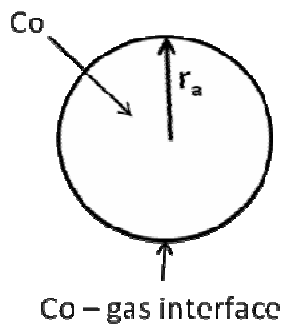
Fig. 1
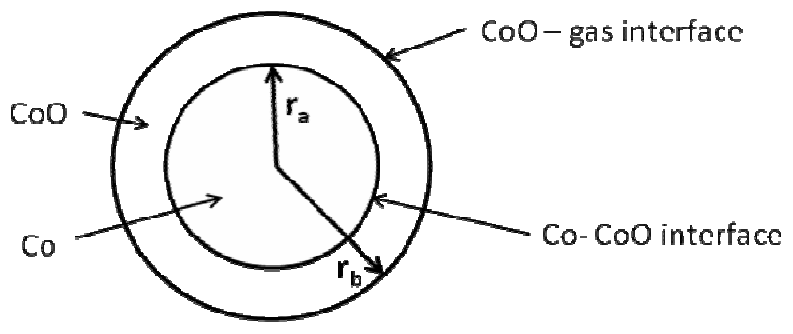
Fig. 2
Let us see how formation of nanoparticles affects the equilibrium of reaction (1).
\[ G^0(r)=G^0(\mathrm{bulk})+\frac{2\sigma}{r}V \]
2.1 Calculate the standard Gibbs energy \(\Delta_rG^0(1)\) and the equilibrium constant for the reaction (1) at \(T=500\ \mathrm{K}\).
2.2 Calculate the equilibrium constant for reaction (1) when the cobalt catalyst is dispersed in the form of spherical particles (Fig. 1) of radius:
(a) \(10^{-8}\ \mathrm{m}\),·
(b) \(10^{-9}\ \mathrm{m}\).
The surface tension at the Co-gas interface is \(0.16\ \mathrm{J\,m^{-2}}\). \(\ce{CoO}\) forms a bulk phase.
The mixture of gases involved in the Fischer-Tropsch (\(\ce{CO}\), \(\ce{CH4}\), \(\ce{H2}\), \(\ce{H2O}\)) reaction was put into a reaction vessel containing the cobalt catalyst. The total pressure is \(p=1\ \mathrm{bar}\), temperature is \(T=500\ \mathrm{K}\). The mole fraction of hydrogen (%) in the mixture is \(0.15\ \%\).
2.3 At what minimum mole fraction of water (%) in the gas mixture the unwanted spontaneous oxidation of the catalyst becomes possible so that solid bulk \(\ce{CoO}\) may appear in the system? Assume that cobalt catalyst is in the form of
(a) a bulk phase
(b) spherical nanoparticles with \(r_a=1\ \mathrm{nm}\) (Fig. 1).
2.4 What would you suggest to protect \(\ce{Co}\) nanoparticles from the spontaneous oxidation with the formation of bulk \(\ce{CoO}\) at a constant ratio \(p(\ce{H2O})/p(\ce{H2})\) and a constant temperature:
(a) to increase \(r_a\);
(b) to decrease \(r_a\);
(c) change of \(r_a\) has no effect.
Assume now that solid cobalt oxide forms a spherical layer around a nanoparticle of cobalt. In this case the nanoparticle contains both a reactant (\(\ce{Co}\)) and a product (\(\ce{CoO}\)) (Fig. 2).
In the following problems denote surface tensions as \(\sigma_{\ce{CoO}-\mathrm{gas}}\), \(\sigma_{\ce{CoO}-\ce{Co}}\), radii as \(r_a\), \(r_b\), molar volumes as \(V(\ce{Co})\); \(V(\ce{CoO})\).
2.5 Write down the expression for the standard molar Gibbs function of \(\ce{CoO}\).
2.6 Write down the expression for the standard molar Gibbs function of \(\ce{Co}\).
Hint. If two spherical interfaces surround a nanoparticle, the excess pressure at its centre is given by the expression
\[ P_{\mathrm{in}}-P_{\mathrm{ex}} =\Delta P=\Delta P_1+\Delta P_2 =2\frac{\sigma_1}{r_1}+2\frac{\sigma_2}{r_2} \]
\(r_i\), \(\sigma_i\) are radius and surface tension at the spherical interface \(i\), respectively.
2.7 Express the standard Gibbs energy of the reaction (1) \(\Delta_rG^0(1,r_a,r_b)\) in terms of \(\sigma_{\ce{CoO}-\mathrm{gas}}\), \(\sigma_{\ce{CoO}-\ce{Co}}\), \(r_a\), \(r_b\), \(V(\ce{Co})\); \(V(\ce{CoO})\) and \(\Delta_rG^0(1)\).
2.8 When spontaneous oxidation of \(\ce{Co}\) begins the radii of two layers in the nanoparticle (Fig. 2) are almost equal, \(r_a=r_b=r_0\), and \(\Delta_rG^0(1,r_a,r_b)=\Delta_rG^0(1,r_0)\). Assume that \(\sigma_{\ce{CoO}-\mathrm{gas}}=2\sigma_{\ce{CoO}-\ce{Co}}\). Which plot in the Answer Sheet describes correctly the dependence of \(\Delta_rG^0(1,r_0)\) on \(r_0\)?
2.9 What would you choose to protect \(\ce{Co}\) nanoparticles from the spontaneous formation of the external layer of \(\ce{CoO}\) at a constant ratio \(p(\ce{H2O})/p(\ce{H2})\) and a constant temperature:
a) increase \(r_0\)
b) decrease \(r_0\)
c) change of \(r_0\) has no effect.
.
Reference data:
| Substance | \(\rho,\ \mathrm{g\,cm^{-3}}\) | \(\Delta_{\mathrm f}G^0_{500},\ \mathrm{kJ\,mol^{-1}}\) |
|---|---|---|
| \(\ce{Co}\) (s) | 8.90 | |
| \(\ce{CoO}\) (s) | 5.68 | \(-198.4\) |
| \(\ce{H2O}\) (gas) | \(-219.1\) |
Official English text of the problem.
Answers
For compactness, define \[ \sigma_o=\sigma_{\ce{CoO}-\mathrm{gas}},\qquad \sigma_i=\sigma_{\ce{CoO}-\ce{Co}},\qquad V_c=V(\ce{Co}),\qquad V_o=V(\ce{CoO}). \]
- 2.1: \(\boxed{\Delta_rG^0(1)=+20.7\ \mathrm{kJ\,mol^{-1}}}\), \(\boxed{K_{\mathrm{bulk}}=6.88\times10^{-3}}\).
- 2.2: (a) \(\boxed{K(10^{-8}\ \mathrm m)=7.24\times10^{-3}}\); (b) \(\boxed{K(10^{-9}\ \mathrm m)=1.14\times10^{-2}}\).
- 2.3: Water mole-fraction thresholds: (a) \(\boxed{21.8\%}\); (b) \(\boxed{13.1\%}\). Forward oxidation is spontaneous above the respective threshold.
- 2.4: \(\boxed{\text{(a) Increase }r_a}\).
- 2.5: \(\boxed{G^0_{\ce{CoO}}=G^0_{\ce{CoO}}(\mathrm{bulk})+\dfrac{2\sigma_oV_o}{r_b}}\).
- 2.6: \(\boxed{G^0_{\ce{Co}}=G^0_{\ce{Co}}(\mathrm{bulk})+2V_c\left(\dfrac{\sigma_o}{r_b}+\dfrac{\sigma_i}{r_a}\right)}\).
- 2.7: \(\boxed{\Delta_rG^0(1,r_a,r_b)=\Delta_rG^0(1)+\dfrac{2\sigma_o}{r_b}(V_o-V_c)-\dfrac{2\sigma_iV_c}{r_a}}\).
- 2.8: \(\boxed{\Delta_rG^0(1,r_0)=\Delta_rG^0(1)+A/r_0}\), where \(A=2\sigma_i(2V_o-3V_c)>0\). The curve decreases, is convex upward, and approaches \(+20.7\ \mathrm{kJ\,mol^{-1}}\) from above as \(r_0\) increases.
- 2.9: \(\boxed{\text{(b) Decrease }r_0}\), under the surface-tension assumption in 2.8.
Solution
The molecular species are carbon monoxide, \(\ce{CO}\), [C-]#[O+]; methane, \(\ce{CH4}\), C; hydrogen, \(\ce{H2}\), [H][H]; and water, \(\ce{H2O}\), O. Cobalt is a metallic solid: [Co] represents an individual atom, not its metallic lattice. Cobalt(II) oxide is an ionic solid: [Co+2].[O-2] records its constituent ions but does not specify its crystal lattice.
The balanced catalytic reaction is \[ \ce{CO + 3H2 ->[Fe,Co] CH4 + H2O}. \] The oxidation equilibrium considered throughout the problem is \[ \ce{Co(s) + H2O(g) <=> CoO(s) + H2(g)}. \tag{1} \]
For the calculations, use \[ R=8.314\ \mathrm{J\,mol^{-1}\,K^{-1}},\qquad M(\ce{Co})=58.93\ \mathrm{g\,mol^{-1}},\qquad M(\ce{O})=16.00\ \mathrm{g\,mol^{-1}}. \]
2.1 — Bulk reaction Gibbs energy and equilibrium constant
The standard Gibbs energies of formation of elemental cobalt and hydrogen in their standard states are zero. Therefore, \[ \begin{aligned} \Delta_rG^0(1) &=\Delta_{\mathrm f}G^0(\ce{CoO}) +\Delta_{\mathrm f}G^0(\ce{H2}) -\Delta_{\mathrm f}G^0(\ce{Co}) -\Delta_{\mathrm f}G^0(\ce{H2O})\\ &=(-198.4)+0-0-(-219.1)\\ &=\boxed{+20.7\ \mathrm{kJ\,mol^{-1}}}. \end{aligned} \]
Since \(\Delta_rG^0=-RT\ln K\), \[ K_{\mathrm{bulk}} =\exp\!\left(-\frac{20700}{8.314\times500}\right) =\boxed{6.88\times10^{-3}}. \]
For bulk pure solids, their activities are unity. Treating the gases as ideal, \[ K_{\mathrm{bulk}} =\frac{p(\ce{H2})/p^0}{p(\ce{H2O})/p^0} =\frac{p(\ce{H2})}{p(\ce{H2O})}. \] Thus \(K\) is dimensionless.
2.2 — Equilibrium constants for cobalt nanoparticles
The molar volume of cobalt is \[ V_c=\frac{M(\ce{Co})}{\rho(\ce{Co})} =\frac{58.93}{8.90} =6.621\ \mathrm{cm^3\,mol^{-1}} =6.621\times10^{-6}\ \mathrm{m^3\,mol^{-1}}. \]
The surface correction raises the molar Gibbs energy of the cobalt reactant: \[ G^0_{\ce{Co}}(r_a) =G^0_{\ce{Co}}(\mathrm{bulk}) +\frac{2\sigma_{\ce{Co}-\mathrm{gas}}V_c}{r_a}. \] Because the oxide product remains bulk, \[ \boxed{ \Delta_rG^0(1,r_a) =\Delta_rG^0(1) -\frac{2\sigma_{\ce{Co}-\mathrm{gas}}V_c}{r_a} }. \]
Consequently, \[ K(r_a) =K_{\mathrm{bulk}} \exp\!\left(\frac{2\sigma_{\ce{Co}-\mathrm{gas}}V_c}{r_aRT}\right). \]
With \(\sigma_{\ce{Co}-\mathrm{gas}}=0.16\ \mathrm{J\,m^{-2}}\):
| Part | \(r_a\), \(\mathrm m\) | \(2\sigma V_c/r_a\), \(\mathrm{kJ\,mol^{-1}}\) | \(\Delta_rG^0(1,r_a)\), \(\mathrm{kJ\,mol^{-1}}\) | \(K(r_a)\) |
|---|---|---|---|---|
| (a) | \(10^{-8}\) | 0.2119 | 20.488 | \(\boxed{7.24\times10^{-3}}\) |
| (b) | \(10^{-9}\) | 2.1188 | 18.581 | \(\boxed{1.14\times10^{-2}}\) |
Smaller cobalt particles have a larger molar Gibbs energy, making their oxidation to bulk oxide more favorable.
2.3 — Minimum water mole fraction
At a specified gas composition, \[ \Delta_rG =\Delta_rG^0+RT\ln Q,\qquad Q=\frac{p(\ce{H2})}{p(\ce{H2O})} =\frac{x_{\ce{H2}}}{x_{\ce{H2O}}}. \] The total pressure cancels because the reaction consumes and produces equal numbers of gas molecules.
Forward oxidation is favorable when \[ \Delta_rG<0 \quad\Longleftrightarrow\quad Q<K \quad\Longleftrightarrow\quad x_{\ce{H2O}}>\frac{x_{\ce{H2}}}{K}. \]
The critical composition is therefore \[ x_{\ce{H2O},\mathrm{crit}}=\frac{x_{\ce{H2}}}{K}, \qquad x_{\ce{H2}}=\frac{0.15}{100}=0.0015. \]
For (a) bulk cobalt, using the unrounded equilibrium constant, \[ x_{\ce{H2O},\mathrm{crit}} =\frac{0.0015}{0.00687714} =0.2181, \] so \[ \boxed{x_{\ce{H2O},\mathrm{crit}}=21.8\%}. \]
For (b) cobalt particles with \(r_a=1\ \mathrm{nm}\), \[ x_{\ce{H2O},\mathrm{crit}} =\frac{0.0015}{0.0114490} =0.1310, \] so \[ \boxed{x_{\ce{H2O},\mathrm{crit}}=13.1\%}. \]
At these thresholds, \(\Delta_rG=0\); strictly spontaneous forward oxidation requires a slightly higher water mole fraction at the stated hydrogen mole fraction.
2.4 — Protecting cobalt against formation of bulk oxide
At fixed temperature and gas-pressure ratio, \[ \Delta_rG =\Delta_rG^0(1) -\frac{2\sigma_{\ce{Co}-\mathrm{gas}}V_c}{r_a} +RT\ln\frac{p(\ce{H2})}{p(\ce{H2O})}. \] Hence \[ \frac{\partial\Delta_rG}{\partial r_a} =\frac{2\sigma_{\ce{Co}-\mathrm{gas}}V_c}{r_a^2}>0. \]
Increasing the particle radius raises the reaction Gibbs energy and suppresses oxidation: \[ \boxed{\text{Choose (a): increase }r_a.} \]
2.5 — Molar Gibbs function of the oxide shell
For the geometry in Fig. 2, the oxide shell lies beneath the outer interface of radius \(r_b\). Its pressure exceeds the external gas pressure by \[ P_{\ce{CoO}}-P_{\mathrm{gas}}=\frac{2\sigma_o}{r_b}. \]
At constant temperature, an approximately incompressible phase obeys \(dG_m=V_m\,dP\). Therefore, \[ \boxed{ G^0_{\ce{CoO}} =G^0_{\ce{CoO}}(\mathrm{bulk}) +\frac{2\sigma_oV_o}{r_b} }. \]
2.6 — Molar Gibbs function of the cobalt core
The cobalt core experiences the pressure increments across both interfaces: \[ P_{\ce{Co}}-P_{\mathrm{gas}} =\frac{2\sigma_o}{r_b}+\frac{2\sigma_i}{r_a}. \]
Thus, \[ \boxed{ G^0_{\ce{Co}} =G^0_{\ce{Co}}(\mathrm{bulk}) +2V_c\left(\frac{\sigma_o}{r_b}+\frac{\sigma_i}{r_a}\right) }. \]
2.7 — Reaction Gibbs energy for a particle with an oxide shell
Subtract the cobalt correction from the oxide correction. The gas contributions remain unchanged: \[ \begin{aligned} \Delta_rG^0(1,r_a,r_b) &=\Delta_rG^0(1) +\frac{2\sigma_oV_o}{r_b} -\left(\frac{2\sigma_oV_c}{r_b} +\frac{2\sigma_iV_c}{r_a}\right). \end{aligned} \]
Therefore, \[ \boxed{ \Delta_rG^0(1,r_a,r_b) =\Delta_rG^0(1) +\frac{2\sigma_o}{r_b}(V_o-V_c) -\frac{2\sigma_iV_c}{r_a} }. \]
2.8 — Dependence on the initial radius
Set \(r_a=r_b=r_0\) and \(\sigma_o=2\sigma_i\): \[ \begin{aligned} \Delta_rG^0(1,r_0) &=\Delta_rG^0(1) +\frac{4\sigma_i}{r_0}(V_o-V_c) -\frac{2\sigma_iV_c}{r_0}\\ &=\boxed{ \Delta_rG^0(1) +\frac{2\sigma_i}{r_0}(2V_o-3V_c) }. \end{aligned} \]
The oxide molar volume is \[ V_o =\frac{58.93+16.00}{5.68} =13.192\ \mathrm{cm^3\,mol^{-1}}. \] Consequently, \[ 2V_o-3V_c =2(13.192)-3(6.621) =6.520\ \mathrm{cm^3\,mol^{-1}}>0. \]
Define \[ A=2\sigma_i(2V_o-3V_c)>0. \] The required function is \[ \boxed{ \Delta_rG^0(1,r_0) =20.7\ \mathrm{kJ\,mol^{-1}}+\frac{A}{r_0} }, \] with consistent units used for \(A/r_0\).
Its derivatives are \[ \frac{d\Delta_rG^0}{dr_0}=-\frac{A}{r_0^2}<0, \qquad \frac{d^2\Delta_rG^0}{dr_0^2}=\frac{2A}{r_0^3}>0. \]
The required plot has \(r_0>0\) on the horizontal axis and \(\Delta_rG^0(1,r_0)\) on the vertical axis. It decreases steeply at small radii, curves upward, and flattens toward the horizontal asymptote \[ \Delta_rG^0=+20.7\ \mathrm{kJ\,mol^{-1}} \] from above. Within the given mathematical model, it tends to \(+\infty\) as \(r_0\to0^+\).
2.9 — Protecting cobalt against formation of an oxide shell
Under the assumptions of 2.8, \[ \Delta_rG =\Delta_rG^0(1)+\frac{A}{r_0} +RT\ln\frac{p(\ce{H2})}{p(\ce{H2O})}, \qquad A>0. \]
At fixed temperature and gas ratio, decreasing \(r_0\) increases the positive surface contribution \(A/r_0\). This makes oxide-shell formation less favorable.
\[ \boxed{\text{Choose (b): decrease }r_0.} \]
The solution was checked against the official solution.
IChO 2007 · Theorieaufgabe 2
Nanochemie
Metalle der Eisengruppe sind wirksame Katalysatoren für die Hydrierung von \(\ce{CO}\) (Fischer-Tropsch-Reaktion)
Der Katalysator (z. B. Cobalt) wird häufig in Form fester Nanopartikel mit kugelförmiger Struktur eingesetzt (Abb. 1). Eine Verringerung der Größe des Katalysators erhöht die katalytische Aktivität erheblich. Bei der unerwünschten Nebenreaktion wird jedoch der Katalysator oxidiert:
Im Reaktionsgefäß entsteht festes Cobaltoxid als Volumenphase. Dies führt zu einem irreversiblen Verlust an Katalysatormasse. Festes Cobaltoxid kann sich auch auf der Oberfläche von \(\ce{Co(s)}\) ablagern. In diesem Fall bildet sich eine neue kugelförmige Schicht um die Oberfläche des Katalysators (siehe Abbildung 2), und die katalytische Aktivität nimmt ab.
Abb. 1
Abb. 2
Betrachten wir, wie sich die Bildung von Nanopartikeln auf das Gleichgewicht der Reaktion (1) auswirkt.
\[ G^0(r)=G^0(\mathrm{bulk})+\frac{2\sigma}{r}V \]
2.1 Berechnen Sie die Standard-Gibbs-Energie \(\Delta_rG^0(1)\) und die Gleichgewichtskonstante für die Reaktion (1) bei \(T=500\ \mathrm{K}\).
2.2 Berechnen Sie die Gleichgewichtskonstante für die Reaktion (1), wenn der Cobaltkatalysator in Form kugelförmiger Partikel (Abb. 1) mit folgendem Radius dispergiert ist:
(a) \(10^{-8}\ \mathrm{m}\),·
(b) \(10^{-9}\ \mathrm{m}\).
Die Oberflächenspannung an der Co-Gas-Grenzfläche beträgt \(0.16\ \mathrm{J\,m^{-2}}\). \(\ce{CoO}\) bildet eine Volumenphase.
Das Gemisch der an der Fischer-Tropsch-Reaktion beteiligten Gase (\(\ce{CO}\), \(\ce{CH4}\), \(\ce{H2}\), \(\ce{H2O}\)) wurde in ein Reaktionsgefäß mit dem Cobaltkatalysator eingebracht. Der Gesamtdruck beträgt \(p=1\ \mathrm{bar}\), die Temperatur beträgt \(T=500\ \mathrm{K}\). Der Stoffmengenanteil von Wasserstoff (%) im Gemisch beträgt \(0.15\ \%\).
2.3 Ab welchem minimalen Stoffmengenanteil von Wasser (%) im Gasgemisch wird die unerwünschte spontane Oxidation des Katalysators möglich, sodass festes \(\ce{CoO}\) als Volumenphase im System auftreten kann? Nehmen Sie an, dass der Cobaltkatalysator in folgender Form vorliegt:
(a) als Volumenphase
(b) als kugelförmige Nanopartikel mit \(r_a=1\ \mathrm{nm}\) (Abb. 1).
2.4 Was würden Sie vorschlagen, um \(\ce{Co}\)-Nanopartikel bei konstantem Verhältnis \(p(\ce{H2O})/p(\ce{H2})\) und konstanter Temperatur vor spontaner Oxidation unter Bildung von \(\ce{CoO}\) als Volumenphase zu schützen:
(a) \(r_a\) vergrößern;
(b) \(r_a\) verkleinern;
(c) eine Änderung von \(r_a\) hat keinen Einfluss.
Nehmen Sie nun an, dass festes Cobaltoxid eine kugelförmige Schicht um ein Cobalt-Nanopartikel bildet. In diesem Fall enthält das Nanopartikel sowohl einen Reaktanten (\(\ce{Co}\)) als auch ein Produkt (\(\ce{CoO}\)) (Abb. 2).
Bezeichnen Sie in den folgenden Teilaufgaben die Oberflächenspannungen mit \(\sigma_{\ce{CoO}-\mathrm{gas}}\), \(\sigma_{\ce{CoO}-\ce{Co}}\), die Radien mit \(r_a\), \(r_b\) und die molaren Volumina mit \(V(\ce{Co})\); \(V(\ce{CoO})\).
2.5 Geben Sie den Ausdruck für die molare Standard-Gibbs-Funktion von \(\ce{CoO}\) an.
2.6 Geben Sie den Ausdruck für die molare Standard-Gibbs-Funktion von \(\ce{Co}\) an.
Hinweis. Wenn zwei kugelförmige Grenzflächen ein Nanopartikel umgeben, ist der Überdruck in seinem Mittelpunkt durch folgenden Ausdruck gegeben:
\[ P_{\mathrm{in}}-P_{\mathrm{ex}} =\Delta P=\Delta P_1+\Delta P_2 =2\frac{\sigma_1}{r_1}+2\frac{\sigma_2}{r_2} \]
\(r_i\) und \(\sigma_i\) sind der Radius bzw. die Oberflächenspannung an der kugelförmigen Grenzfläche \(i\).
2.7 Drücken Sie die Standard-Gibbs-Energie der Reaktion (1), \(\Delta_rG^0(1,r_a,r_b)\), durch \(\sigma_{\ce{CoO}-\mathrm{gas}}\), \(\sigma_{\ce{CoO}-\ce{Co}}\), \(r_a\), \(r_b\), \(V(\ce{Co})\); \(V(\ce{CoO})\) und \(\Delta_rG^0(1)\) aus.
2.8 Wenn die spontane Oxidation von \(\ce{Co}\) beginnt, sind die Radien der beiden Schichten im Nanopartikel (Abb. 2) nahezu gleich, \(r_a=r_b=r_0\), und es gilt \(\Delta_rG^0(1,r_a,r_b)=\Delta_rG^0(1,r_0)\). Nehmen Sie an, dass \(\sigma_{\ce{CoO}-\mathrm{gas}}=2\sigma_{\ce{CoO}-\ce{Co}}\) gilt. Welcher Graph auf dem Antwortbogen beschreibt die Abhängigkeit von \(\Delta_rG^0(1,r_0)\) von \(r_0\) korrekt?
2.9 Was würden Sie wählen, um \(\ce{Co}\)-Nanopartikel bei konstantem Verhältnis \(p(\ce{H2O})/p(\ce{H2})\) und konstanter Temperatur vor der spontanen Bildung einer äußeren Schicht aus \(\ce{CoO}\) zu schützen:
a) \(r_0\) vergrößern
b) \(r_0\) verkleinern
c) eine Änderung von \(r_0\) hat keinen Einfluss.
.
Referenzdaten:
| Stoff | \(\rho,\ \mathrm{g\,cm^{-3}}\) | \(\Delta_{\mathrm f}G^0_{500},\ \mathrm{kJ\,mol^{-1}}\) |
|---|---|---|
| \(\ce{Co}\) (s) | 8.90 | |
| \(\ce{CoO}\) (s) | 5.68 | \(-198.4\) |
| \(\ce{H2O}\) (gasförmig) | \(-219.1\) |
Aufgabentext aus dem offiziellen englischen Text übersetzt.
Antworten
Zur Abkürzung definieren wir \[ \sigma_o=\sigma_{\ce{CoO}-\mathrm{gas}},\qquad \sigma_i=\sigma_{\ce{CoO}-\ce{Co}},\qquad V_c=V(\ce{Co}),\qquad V_o=V(\ce{CoO}). \]
- 2.1: \(\boxed{\Delta_rG^0(1)=+20.7\ \mathrm{kJ\,mol^{-1}}}\), \(\boxed{K_{\mathrm{bulk}}=6.88\times10^{-3}}\).
- 2.2: (a) \(\boxed{K(10^{-8}\ \mathrm m)=7.24\times10^{-3}}\); (b) \(\boxed{K(10^{-9}\ \mathrm m)=1.14\times10^{-2}}\).
- 2.3: Schwellenwerte für den Stoffmengenanteil von Wasser: (a) \(\boxed{21.8\%}\); (b) \(\boxed{13.1\%}\). Oberhalb des jeweiligen Schwellenwerts verläuft die Oxidation in Hinrichtung spontan.
- 2.4: \(\boxed{\text{(a) Vergrößern von }r_a}\).
- 2.5: \(\boxed{G^0_{\ce{CoO}}=G^0_{\ce{CoO}}(\mathrm{bulk})+\dfrac{2\sigma_oV_o}{r_b}}\).
- 2.6: \(\boxed{G^0_{\ce{Co}}=G^0_{\ce{Co}}(\mathrm{bulk})+2V_c\left(\dfrac{\sigma_o}{r_b}+\dfrac{\sigma_i}{r_a}\right)}\).
- 2.7: \(\boxed{\Delta_rG^0(1,r_a,r_b)=\Delta_rG^0(1)+\dfrac{2\sigma_o}{r_b}(V_o-V_c)-\dfrac{2\sigma_iV_c}{r_a}}\).
- 2.8: \(\boxed{\Delta_rG^0(1,r_0)=\Delta_rG^0(1)+A/r_0}\), wobei \(A=2\sigma_i(2V_o-3V_c)>0\). Die Kurve fällt, ist nach oben gekrümmt und nähert sich mit zunehmendem \(r_0\) dem Wert \(+20.7\ \mathrm{kJ\,mol^{-1}}\) von oben.
- 2.9: \(\boxed{\text{(b) Verkleinern von }r_0}\), unter der Annahme über die Oberflächenspannungen aus 2.8.
Lösung
Die molekularen Spezies sind Kohlenstoffmonoxid, \(\ce{CO}\), [C-]#[O+]; Methan, \(\ce{CH4}\), C; Wasserstoff, \(\ce{H2}\), [H][H]; und Wasser, \(\ce{H2O}\), O. Cobalt ist ein metallischer Feststoff: [Co] stellt ein einzelnes Atom dar, nicht sein Metallgitter. Cobalt(II)-oxid ist ein ionischer Feststoff: [Co+2].[O-2] gibt die enthaltenen Ionen an, legt jedoch sein Kristallgitter nicht fest.
Die ausgeglichene katalytische Reaktion lautet \[ \ce{CO + 3H2 ->[Fe,Co] CH4 + H2O}. \] Das in der gesamten Aufgabe betrachtete Oxidationsgleichgewicht lautet \[ \ce{Co(s) + H2O(g) <=> CoO(s) + H2(g)}. \tag{1} \]
Für die Berechnungen verwenden wir \[ R=8.314\ \mathrm{J\,mol^{-1}\,K^{-1}},\qquad M(\ce{Co})=58.93\ \mathrm{g\,mol^{-1}},\qquad M(\ce{O})=16.00\ \mathrm{g\,mol^{-1}}. \]
2.1 — Gibbs-Reaktionsenergie und Gleichgewichtskonstante für Volumenphasen
Die Standard-Gibbs-Bildungsenergien von elementarem Cobalt und Wasserstoff in ihren Standardzuständen sind null. Daher gilt \[ \begin{aligned} \Delta_rG^0(1) &=\Delta_{\mathrm f}G^0(\ce{CoO}) +\Delta_{\mathrm f}G^0(\ce{H2}) -\Delta_{\mathrm f}G^0(\ce{Co}) -\Delta_{\mathrm f}G^0(\ce{H2O})\\ &=(-198.4)+0-0-(-219.1)\\ &=\boxed{+20.7\ \mathrm{kJ\,mol^{-1}}}. \end{aligned} \]
Da \(\Delta_rG^0=-RT\ln K\) gilt, folgt \[ K_{\mathrm{bulk}} =\exp\!\left(-\frac{20700}{8.314\times500}\right) =\boxed{6.88\times10^{-3}}. \]
Für reine Feststoffe als Volumenphasen sind die Aktivitäten gleich eins. Bei idealem Verhalten der Gase gilt \[ K_{\mathrm{bulk}} =\frac{p(\ce{H2})/p^0}{p(\ce{H2O})/p^0} =\frac{p(\ce{H2})}{p(\ce{H2O})}. \] Somit ist \(K\) dimensionslos.
2.2 — Gleichgewichtskonstanten für Cobalt-Nanopartikel
Das molare Volumen von Cobalt beträgt \[ V_c=\frac{M(\ce{Co})}{\rho(\ce{Co})} =\frac{58.93}{8.90} =6.621\ \mathrm{cm^3\,mol^{-1}} =6.621\times10^{-6}\ \mathrm{m^3\,mol^{-1}}. \]
Die Oberflächenkorrektur erhöht die molare Gibbs-Energie des Reaktanten Cobalt: \[ G^0_{\ce{Co}}(r_a) =G^0_{\ce{Co}}(\mathrm{bulk}) +\frac{2\sigma_{\ce{Co}-\mathrm{gas}}V_c}{r_a}. \] Da das Oxidprodukt weiterhin als Volumenphase vorliegt, gilt \[ \boxed{ \Delta_rG^0(1,r_a) =\Delta_rG^0(1) -\frac{2\sigma_{\ce{Co}-\mathrm{gas}}V_c}{r_a} }. \]
Folglich ist \[ K(r_a) =K_{\mathrm{bulk}} \exp\!\left(\frac{2\sigma_{\ce{Co}-\mathrm{gas}}V_c}{r_aRT}\right). \]
Mit \(\sigma_{\ce{Co}-\mathrm{gas}}=0.16\ \mathrm{J\,m^{-2}}\):
| Teil | \(r_a\), \(\mathrm m\) | \(2\sigma V_c/r_a\), \(\mathrm{kJ\,mol^{-1}}\) | \(\Delta_rG^0(1,r_a)\), \(\mathrm{kJ\,mol^{-1}}\) | \(K(r_a)\) |
|---|---|---|---|---|
| (a) | \(10^{-8}\) | 0.2119 | 20.488 | \(\boxed{7.24\times10^{-3}}\) |
| (b) | \(10^{-9}\) | 2.1188 | 18.581 | \(\boxed{1.14\times10^{-2}}\) |
Kleinere Cobaltpartikel besitzen eine höhere molare Gibbs-Energie, wodurch ihre Oxidation zum Oxid als Volumenphase begünstigt wird.
2.3 — Minimaler Stoffmengenanteil von Wasser
Bei einer vorgegebenen Gaszusammensetzung gilt \[ \Delta_rG =\Delta_rG^0+RT\ln Q,\qquad Q=\frac{p(\ce{H2})}{p(\ce{H2O})} =\frac{x_{\ce{H2}}}{x_{\ce{H2O}}}. \] Der Gesamtdruck kürzt sich heraus, da bei der Reaktion gleich viele Gasmoleküle verbraucht und gebildet werden.
Die Oxidation in Hinrichtung ist begünstigt, wenn \[ \Delta_rG<0 \quad\Longleftrightarrow\quad Q<K \quad\Longleftrightarrow\quad x_{\ce{H2O}}>\frac{x_{\ce{H2}}}{K}. \]
Die kritische Zusammensetzung ist daher \[ x_{\ce{H2O},\mathrm{crit}}=\frac{x_{\ce{H2}}}{K}, \qquad x_{\ce{H2}}=\frac{0.15}{100}=0.0015. \]
Für (a) Cobalt als Volumenphase ergibt sich mit der ungerundeten Gleichgewichtskonstante \[ x_{\ce{H2O},\mathrm{crit}} =\frac{0.0015}{0.00687714} =0.2181, \] also \[ \boxed{x_{\ce{H2O},\mathrm{crit}}=21.8\%}. \]
Für (b) Cobaltpartikel mit \(r_a=1\ \mathrm{nm}\) gilt \[ x_{\ce{H2O},\mathrm{crit}} =\frac{0.0015}{0.0114490} =0.1310, \] also \[ \boxed{x_{\ce{H2O},\mathrm{crit}}=13.1\%}. \]
An diesen Schwellenwerten gilt \(\Delta_rG=0\); eine streng spontane Oxidation in Hinrichtung erfordert bei dem angegebenen Stoffmengenanteil von Wasserstoff einen geringfügig höheren Stoffmengenanteil von Wasser.
2.4 — Schutz von Cobalt vor der Bildung von Oxid als Volumenphase
Bei konstanter Temperatur und konstantem Verhältnis der Gaspartialdrücke gilt \[ \Delta_rG =\Delta_rG^0(1) -\frac{2\sigma_{\ce{Co}-\mathrm{gas}}V_c}{r_a} +RT\ln\frac{p(\ce{H2})}{p(\ce{H2O})}. \] Daraus folgt \[ \frac{\partial\Delta_rG}{\partial r_a} =\frac{2\sigma_{\ce{Co}-\mathrm{gas}}V_c}{r_a^2}>0. \]
Eine Vergrößerung des Partikelradius erhöht die Gibbs-Reaktionsenergie und unterdrückt die Oxidation: \[ \boxed{\text{Wählen Sie (a): Vergrößern von }r_a.} \]
2.5 — Molare Gibbs-Funktion der Oxidhülle
Bei der Geometrie in Abb. 2 liegt die Oxidhülle unterhalb der äußeren Grenzfläche mit dem Radius \(r_b\). Ihr Druck übersteigt den äußeren Gasdruck um \[ P_{\ce{CoO}}-P_{\mathrm{gas}}=\frac{2\sigma_o}{r_b}. \]
Bei konstanter Temperatur gilt für eine näherungsweise inkompressible Phase \(dG_m=V_m\,dP\). Daher ist \[ \boxed{ G^0_{\ce{CoO}} =G^0_{\ce{CoO}}(\mathrm{bulk}) +\frac{2\sigma_oV_o}{r_b} }. \]
2.6 — Molare Gibbs-Funktion des Cobaltkerns
Auf den Cobaltkern wirken die Druckerhöhungen über beide Grenzflächen hinweg: \[ P_{\ce{Co}}-P_{\mathrm{gas}} =\frac{2\sigma_o}{r_b}+\frac{2\sigma_i}{r_a}. \]
Somit gilt \[ \boxed{ G^0_{\ce{Co}} =G^0_{\ce{Co}}(\mathrm{bulk}) +2V_c\left(\frac{\sigma_o}{r_b}+\frac{\sigma_i}{r_a}\right) }. \]
2.7 — Gibbs-Reaktionsenergie für ein Partikel mit Oxidhülle
Subtrahieren Sie die Cobaltkorrektur von der Oxidkorrektur. Die Beiträge der Gase bleiben unverändert: \[ \begin{aligned} \Delta_rG^0(1,r_a,r_b) &=\Delta_rG^0(1) +\frac{2\sigma_oV_o}{r_b} -\left(\frac{2\sigma_oV_c}{r_b} +\frac{2\sigma_iV_c}{r_a}\right). \end{aligned} \]
Daher gilt \[ \boxed{ \Delta_rG^0(1,r_a,r_b) =\Delta_rG^0(1) +\frac{2\sigma_o}{r_b}(V_o-V_c) -\frac{2\sigma_iV_c}{r_a} }. \]
2.8 — Abhängigkeit vom Anfangsradius
Setzen Sie \(r_a=r_b=r_0\) und \(\sigma_o=2\sigma_i\): \[ \begin{aligned} \Delta_rG^0(1,r_0) &=\Delta_rG^0(1) +\frac{4\sigma_i}{r_0}(V_o-V_c) -\frac{2\sigma_iV_c}{r_0}\\ &=\boxed{ \Delta_rG^0(1) +\frac{2\sigma_i}{r_0}(2V_o-3V_c) }. \end{aligned} \]
Das molare Volumen des Oxids beträgt \[ V_o =\frac{58.93+16.00}{5.68} =13.192\ \mathrm{cm^3\,mol^{-1}}. \] Folglich ist \[ 2V_o-3V_c =2(13.192)-3(6.621) =6.520\ \mathrm{cm^3\,mol^{-1}}>0. \]
Wir definieren \[ A=2\sigma_i(2V_o-3V_c)>0. \] Die gesuchte Funktion lautet \[ \boxed{ \Delta_rG^0(1,r_0) =20.7\ \mathrm{kJ\,mol^{-1}}+\frac{A}{r_0} }, \] wobei für \(A/r_0\) konsistente Einheiten verwendet werden.
Ihre Ableitungen lauten \[ \frac{d\Delta_rG^0}{dr_0}=-\frac{A}{r_0^2}<0, \qquad \frac{d^2\Delta_rG^0}{dr_0^2}=\frac{2A}{r_0^3}>0. \]
Im gesuchten Diagramm ist \(r_0>0\) auf der horizontalen Achse und \(\Delta_rG^0(1,r_0)\) auf der vertikalen Achse aufgetragen. Der Graph fällt bei kleinen Radien steil ab, ist nach oben gekrümmt und flacht bei Annäherung von oben an die horizontale Asymptote \[ \Delta_rG^0=+20.7\ \mathrm{kJ\,mol^{-1}} \] ab. Innerhalb des gegebenen mathematischen Modells strebt er gegen \(+\infty\), wenn \(r_0\to0^+\).
2.9 — Schutz von Cobalt vor der Bildung einer Oxidhülle
Unter den Annahmen aus 2.8 gilt \[ \Delta_rG =\Delta_rG^0(1)+\frac{A}{r_0} +RT\ln\frac{p(\ce{H2})}{p(\ce{H2O})}, \qquad A>0. \]
Bei konstanter Temperatur und konstantem Gasverhältnis erhöht eine Verringerung von \(r_0\) den positiven Oberflächenbeitrag \(A/r_0\). Dadurch wird die Bildung einer Oxidhülle weniger begünstigt.
\[ \boxed{\text{Wählen Sie (b): Verkleinern von }r_0.} \]
Die Lösung wurde mit der offiziellen Lösung abgeglichen.
IChO 2007 · Teori sorusu 2
Nanokimya
Demir alt grubundaki metaller, \(\ce{CO}\)'nun hidrojenlenmesinde etkili katalizörlerdir (Fischer-Tropsch tepkimesi)
Katalizör (örneğin kobalt), genellikle küresel yapıya sahip katı nanoparçacıklar biçiminde kullanılır (şek. 1). Katalizörün boyutunun küçülmesi, katalitik etkinliği önemli ölçüde artırır. Ancak istenmeyen yan tepkime, katalizörün yükseltgenmesini içerir:
Tepkime kabında makroskopik katı kobalt oksit oluşur. Bu, katalizörün kütlesinde geri dönüşümsüz bir kayba yol açar. Katı kobalt oksit, \(\ce{Co(s)}\) yüzeyinde de birikebilir. Bu durumda katalizörün yüzeyini çevreleyen yeni bir küresel tabaka oluşur (bkz. şekil 2) ve katalitik etkinlik azalır.
Şek. 1
Şek. 2
Nanoparçacık oluşumunun (1) tepkimesinin dengesini nasıl etkilediğini inceleyelim.
\[ G^0(r)=G^0(\mathrm{bulk})+\frac{2\sigma}{r}V \]
2.1 \(T=500\ \mathrm{K}\) sıcaklığında (1) tepkimesinin standart Gibbs enerjisini \(\Delta_rG^0(1)\) ve denge sabitini hesaplayın.
2.2 Kobalt katalizörün aşağıdaki yarıçaplara sahip küresel parçacıklar (Şek. 1) biçiminde dağıldığı durumda (1) tepkimesinin denge sabitini hesaplayın:
(a) \(10^{-8}\ \mathrm{m}\),·
(b) \(10^{-9}\ \mathrm{m}\).
Co-gaz ara yüzeyindeki yüzey gerilimi \(0.16\ \mathrm{J\,m^{-2}}\)'dir. \(\ce{CoO}\) makroskopik bir faz oluşturur.
Fischer-Tropsch tepkimesinde yer alan gazların (\(\ce{CO}\), \(\ce{CH4}\), \(\ce{H2}\), \(\ce{H2O}\)) karışımı, kobalt katalizör içeren bir tepkime kabına konulmuştur. Toplam basınç \(p=1\ \mathrm{bar}\), sıcaklık \(T=500\ \mathrm{K}\)'dir. Karışımdaki hidrojenin mol kesri (%) \(0.15\ \%\)'tir.
2.3 Gaz karışımındaki suyun mol kesri (%) en az ne olduğunda, katalizörün istenmeyen kendiliğinden yükseltgenmesi mümkün hâle gelerek sistemde makroskopik katı \(\ce{CoO}\) oluşabilir? Kobalt katalizörün aşağıdaki biçimlerde olduğunu varsayın:
(a) makroskopik bir faz
(b) \(r_a=1\ \mathrm{nm}\) yarıçaplı küresel nanoparçacıklar (Şek. 1).
2.4 Sabit \(p(\ce{H2O})/p(\ce{H2})\) oranında ve sabit sıcaklıkta, \(\ce{Co}\) nanoparçacıklarını makroskopik \(\ce{CoO}\) oluşumuyla gerçekleşen kendiliğinden yükseltgenmeden korumak için ne önerirsiniz:
(a) \(r_a\)'yı artırmak;
(b) \(r_a\)'yı azaltmak;
(c) \(r_a\)'nın değişmesinin etkisi yoktur.
Şimdi katı kobalt oksidin bir kobalt nanoparçacığının çevresinde küresel bir tabaka oluşturduğunu varsayın. Bu durumda nanoparçacık hem bir giren (\(\ce{Co}\)) hem de bir ürün (\(\ce{CoO}\)) içerir (Şek. 2).
Aşağıdaki sorularda yüzey gerilimlerini \(\sigma_{\ce{CoO}-\mathrm{gas}}\), \(\sigma_{\ce{CoO}-\ce{Co}}\), yarıçapları \(r_a\), \(r_b\), molar hacimleri \(V(\ce{Co})\); \(V(\ce{CoO})\) ile gösterin.
2.5 \(\ce{CoO}\)'nun standart molar Gibbs fonksiyonu için ifadeyi yazın.
2.6 \(\ce{Co}\)'nun standart molar Gibbs fonksiyonu için ifadeyi yazın.
İpucu. Bir nanoparçacığı iki küresel ara yüzey çevreliyorsa, merkezindeki ek basınç şu ifadeyle verilir:
\[ P_{\mathrm{in}}-P_{\mathrm{ex}} =\Delta P=\Delta P_1+\Delta P_2 =2\frac{\sigma_1}{r_1}+2\frac{\sigma_2}{r_2} \]
\(r_i\) ve \(\sigma_i\), sırasıyla \(i\) küresel ara yüzeyinin yarıçapı ve bu ara yüzeydeki yüzey gerilimidir.
2.7 (1) tepkimesinin standart Gibbs enerjisini, \(\Delta_rG^0(1,r_a,r_b)\), \(\sigma_{\ce{CoO}-\mathrm{gas}}\), \(\sigma_{\ce{CoO}-\ce{Co}}\), \(r_a\), \(r_b\), \(V(\ce{Co})\); \(V(\ce{CoO})\) ve \(\Delta_rG^0(1)\) cinsinden ifade edin.
2.8 \(\ce{Co}\)'nun kendiliğinden yükseltgenmesi başladığında, nanoparçacıktaki iki tabakanın yarıçapları (Şek. 2) hemen hemen eşittir: \(r_a=r_b=r_0\) ve \(\Delta_rG^0(1,r_a,r_b)=\Delta_rG^0(1,r_0)\). \(\sigma_{\ce{CoO}-\mathrm{gas}}=2\sigma_{\ce{CoO}-\ce{Co}}\) olduğunu varsayın. Cevap Kâğıdı'ndaki hangi grafik, \(\Delta_rG^0(1,r_0)\)'ın \(r_0\)'a bağımlılığını doğru biçimde gösterir?
2.9 Sabit \(p(\ce{H2O})/p(\ce{H2})\) oranında ve sabit sıcaklıkta, \(\ce{Co}\) nanoparçacıklarını dış \(\ce{CoO}\) tabakasının kendiliğinden oluşumundan korumak için hangisini seçersiniz:
a) \(r_0\)'ı artırmak
b) \(r_0\)'ı azaltmak
c) \(r_0\)'ın değişmesinin etkisi yoktur.
.
Referans verileri:
| Madde | \(\rho,\ \mathrm{g\,cm^{-3}}\) | \(\Delta_{\mathrm f}G^0_{500},\ \mathrm{kJ\,mol^{-1}}\) |
|---|---|---|
| \(\ce{Co}\) (katı) | 8.90 | |
| \(\ce{CoO}\) (katı) | 5.68 | \(-198.4\) |
| \(\ce{H2O}\) (gaz) | \(-219.1\) |
Soru metni resmi İngilizce metinden çevrilmiştir.
Cevaplar
Kısa bir gösterim için şu tanımları yapalım: \[ \sigma_o=\sigma_{\ce{CoO}-\mathrm{gas}},\qquad \sigma_i=\sigma_{\ce{CoO}-\ce{Co}},\qquad V_c=V(\ce{Co}),\qquad V_o=V(\ce{CoO}). \]
- 2.1: \(\boxed{\Delta_rG^0(1)=+20.7\ \mathrm{kJ\,mol^{-1}}}\), \(\boxed{K_{\mathrm{bulk}}=6.88\times10^{-3}}\).
- 2.2: (a) \(\boxed{K(10^{-8}\ \mathrm m)=7.24\times10^{-3}}\); (b) \(\boxed{K(10^{-9}\ \mathrm m)=1.14\times10^{-2}}\).
- 2.3: Suyun mol kesri için eşik değerler: (a) \(\boxed{21.8\%}\); (b) \(\boxed{13.1\%}\). İleri yöndeki yükseltgenme, ilgili eşik değerin üzerinde kendiliğinden gerçekleşir.
- 2.4: \(\boxed{\text{(a) Artırın: }r_a}\).
- 2.5: \(\boxed{G^0_{\ce{CoO}}=G^0_{\ce{CoO}}(\mathrm{bulk})+\dfrac{2\sigma_oV_o}{r_b}}\).
- 2.6: \(\boxed{G^0_{\ce{Co}}=G^0_{\ce{Co}}(\mathrm{bulk})+2V_c\left(\dfrac{\sigma_o}{r_b}+\dfrac{\sigma_i}{r_a}\right)}\).
- 2.7: \(\boxed{\Delta_rG^0(1,r_a,r_b)=\Delta_rG^0(1)+\dfrac{2\sigma_o}{r_b}(V_o-V_c)-\dfrac{2\sigma_iV_c}{r_a}}\).
- 2.8: \(\boxed{\Delta_rG^0(1,r_0)=\Delta_rG^0(1)+A/r_0}\); burada \(A=2\sigma_i(2V_o-3V_c)>0\). Eğri azalandır, yukarı doğru dışbükeydir ve \(r_0\) arttıkça \(+20.7\ \mathrm{kJ\,mol^{-1}}\) değerine üstten yaklaşır.
- 2.9: \(\boxed{\text{(b) Azaltın: }r_0}\), 2.8'deki yüzey gerilimi varsayımı altında.
Çözüm
Moleküler türler karbon monoksit, \(\ce{CO}\), [C-]#[O+]; metan, \(\ce{CH4}\), C; hidrojen, \(\ce{H2}\), [H][H]; ve su, \(\ce{H2O}\), O'dur. Kobalt metalik bir katıdır: [Co], metalik örgüsünü değil, tek bir atomu temsil eder. Kobalt(II) oksit iyonik bir katıdır: [Co+2].[O-2], onu oluşturan iyonları gösterir ancak kristal örgüsünü belirtmez.
Denkleştirilmiş katalitik tepkime şöyledir: \[ \ce{CO + 3H2 ->[Fe,Co] CH4 + H2O}. \] Soru boyunca ele alınan yükseltgenme dengesi şöyledir: \[ \ce{Co(s) + H2O(g) <=> CoO(s) + H2(g)}. \tag{1} \]
Hesaplamalarda şu değerleri kullanın: \[ R=8.314\ \mathrm{J\,mol^{-1}\,K^{-1}},\qquad M(\ce{Co})=58.93\ \mathrm{g\,mol^{-1}},\qquad M(\ce{O})=16.00\ \mathrm{g\,mol^{-1}}. \]
2.1 — Makroskopik fazlar için tepkime Gibbs enerjisi ve denge sabiti
Elementel kobaltın ve hidrojenin standart hâllerindeki standart oluşum Gibbs enerjileri sıfırdır. Dolayısıyla, \[ \begin{aligned} \Delta_rG^0(1) &=\Delta_{\mathrm f}G^0(\ce{CoO}) +\Delta_{\mathrm f}G^0(\ce{H2}) -\Delta_{\mathrm f}G^0(\ce{Co}) -\Delta_{\mathrm f}G^0(\ce{H2O})\\ &=(-198.4)+0-0-(-219.1)\\ &=\boxed{+20.7\ \mathrm{kJ\,mol^{-1}}}. \end{aligned} \]
\(\Delta_rG^0=-RT\ln K\) olduğundan, \[ K_{\mathrm{bulk}} =\exp\!\left(-\frac{20700}{8.314\times500}\right) =\boxed{6.88\times10^{-3}}. \]
Makroskopik saf katıların aktiviteleri birdir. Gazlar ideal kabul edildiğinde, \[ K_{\mathrm{bulk}} =\frac{p(\ce{H2})/p^0}{p(\ce{H2O})/p^0} =\frac{p(\ce{H2})}{p(\ce{H2O})}. \] Böylece \(K\) boyutsuzdur.
2.2 — Kobalt nanoparçacıkları için denge sabitleri
Kobaltın molar hacmi şöyledir: \[ V_c=\frac{M(\ce{Co})}{\rho(\ce{Co})} =\frac{58.93}{8.90} =6.621\ \mathrm{cm^3\,mol^{-1}} =6.621\times10^{-6}\ \mathrm{m^3\,mol^{-1}}. \]
Yüzey düzeltmesi, giren kobaltın molar Gibbs enerjisini artırır: \[ G^0_{\ce{Co}}(r_a) =G^0_{\ce{Co}}(\mathrm{bulk}) +\frac{2\sigma_{\ce{Co}-\mathrm{gas}}V_c}{r_a}. \] Oksit ürünü makroskopik faz olarak kaldığından, \[ \boxed{ \Delta_rG^0(1,r_a) =\Delta_rG^0(1) -\frac{2\sigma_{\ce{Co}-\mathrm{gas}}V_c}{r_a} }. \]
Bunun sonucunda, \[ K(r_a) =K_{\mathrm{bulk}} \exp\!\left(\frac{2\sigma_{\ce{Co}-\mathrm{gas}}V_c}{r_aRT}\right). \]
\(\sigma_{\ce{Co}-\mathrm{gas}}=0.16\ \mathrm{J\,m^{-2}}\) için:
| Kısım | \(r_a\), \(\mathrm m\) | \(2\sigma V_c/r_a\), \(\mathrm{kJ\,mol^{-1}}\) | \(\Delta_rG^0(1,r_a)\), \(\mathrm{kJ\,mol^{-1}}\) | \(K(r_a)\) |
|---|---|---|---|---|
| (a) | \(10^{-8}\) | 0.2119 | 20.488 | \(\boxed{7.24\times10^{-3}}\) |
| (b) | \(10^{-9}\) | 2.1188 | 18.581 | \(\boxed{1.14\times10^{-2}}\) |
Daha küçük kobalt parçacıklarının molar Gibbs enerjisi daha yüksektir; bu da makroskopik okside yükseltgenmelerini daha elverişli kılar.
2.3 — Suyun minimum mol kesri
Belirli bir gaz bileşiminde, \[ \Delta_rG =\Delta_rG^0+RT\ln Q,\qquad Q=\frac{p(\ce{H2})}{p(\ce{H2O})} =\frac{x_{\ce{H2}}}{x_{\ce{H2O}}}. \] Tepkime eşit sayıda gaz molekülü tüketip ürettiği için toplam basınç sadeleşir.
İleri yöndeki yükseltgenme şu koşulda elverişlidir: \[ \Delta_rG<0 \quad\Longleftrightarrow\quad Q<K \quad\Longleftrightarrow\quad x_{\ce{H2O}}>\frac{x_{\ce{H2}}}{K}. \]
Dolayısıyla kritik bileşim şöyledir: \[ x_{\ce{H2O},\mathrm{crit}}=\frac{x_{\ce{H2}}}{K}, \qquad x_{\ce{H2}}=\frac{0.15}{100}=0.0015. \]
(a) Makroskopik kobalt için, yuvarlanmamış denge sabiti kullanıldığında, \[ x_{\ce{H2O},\mathrm{crit}} =\frac{0.0015}{0.00687714} =0.2181, \] böylece \[ \boxed{x_{\ce{H2O},\mathrm{crit}}=21.8\%}. \]
(b) \(r_a=1\ \mathrm{nm}\) yarıçaplı kobalt parçacıkları için, \[ x_{\ce{H2O},\mathrm{crit}} =\frac{0.0015}{0.0114490} =0.1310, \] böylece \[ \boxed{x_{\ce{H2O},\mathrm{crit}}=13.1\%}. \]
Bu eşik değerlerde \(\Delta_rG=0\)'dır; ileri yöndeki yükseltgenmenin kesin olarak kendiliğinden gerçekleşmesi için, belirtilen hidrojen mol kesrinde suyun mol kesrinin biraz daha yüksek olması gerekir.
2.4 — Kobaltın makroskopik oksit oluşumuna karşı korunması
Sabit sıcaklıkta ve sabit gaz basıncı oranında, \[ \Delta_rG =\Delta_rG^0(1) -\frac{2\sigma_{\ce{Co}-\mathrm{gas}}V_c}{r_a} +RT\ln\frac{p(\ce{H2})}{p(\ce{H2O})}. \] Buradan, \[ \frac{\partial\Delta_rG}{\partial r_a} =\frac{2\sigma_{\ce{Co}-\mathrm{gas}}V_c}{r_a^2}>0. \]
Parçacık yarıçapının artırılması, tepkime Gibbs enerjisini yükseltir ve yükseltgenmeyi baskılar: \[ \boxed{\text{(a) seçeneğini seçin: artırın }r_a.} \]
2.5 — Oksit kabuğunun molar Gibbs fonksiyonu
Şek. 2'deki geometride oksit kabuğu, yarıçapı \(r_b\) olan dış ara yüzeyin altında bulunur. Basıncı, dış gaz basıncından şu kadar yüksektir: \[ P_{\ce{CoO}}-P_{\mathrm{gas}}=\frac{2\sigma_o}{r_b}. \]
Sabit sıcaklıkta, yaklaşık olarak sıkıştırılamaz bir faz \(dG_m=V_m\,dP\) bağıntısına uyar. Dolayısıyla, \[ \boxed{ G^0_{\ce{CoO}} =G^0_{\ce{CoO}}(\mathrm{bulk}) +\frac{2\sigma_oV_o}{r_b} }. \]
2.6 — Kobalt çekirdeğinin molar Gibbs fonksiyonu
Kobalt çekirdeği, her iki ara yüzeyden kaynaklanan basınç artışlarına maruz kalır: \[ P_{\ce{Co}}-P_{\mathrm{gas}} =\frac{2\sigma_o}{r_b}+\frac{2\sigma_i}{r_a}. \]
Böylece, \[ \boxed{ G^0_{\ce{Co}} =G^0_{\ce{Co}}(\mathrm{bulk}) +2V_c\left(\frac{\sigma_o}{r_b}+\frac{\sigma_i}{r_a}\right) }. \]
2.7 — Oksit kabuğuna sahip bir parçacık için tepkime Gibbs enerjisi
Oksit düzeltmesinden kobalt düzeltmesini çıkarın. Gazların katkıları değişmeden kalır: \[ \begin{aligned} \Delta_rG^0(1,r_a,r_b) &=\Delta_rG^0(1) +\frac{2\sigma_oV_o}{r_b} -\left(\frac{2\sigma_oV_c}{r_b} +\frac{2\sigma_iV_c}{r_a}\right). \end{aligned} \]
Dolayısıyla, \[ \boxed{ \Delta_rG^0(1,r_a,r_b) =\Delta_rG^0(1) +\frac{2\sigma_o}{r_b}(V_o-V_c) -\frac{2\sigma_iV_c}{r_a} }. \]
2.8 — Başlangıç yarıçapına bağımlılık
\(r_a=r_b=r_0\) ve \(\sigma_o=2\sigma_i\) alın: \[ \begin{aligned} \Delta_rG^0(1,r_0) &=\Delta_rG^0(1) +\frac{4\sigma_i}{r_0}(V_o-V_c) -\frac{2\sigma_iV_c}{r_0}\\ &=\boxed{ \Delta_rG^0(1) +\frac{2\sigma_i}{r_0}(2V_o-3V_c) }. \end{aligned} \]
Oksidin molar hacmi şöyledir: \[ V_o =\frac{58.93+16.00}{5.68} =13.192\ \mathrm{cm^3\,mol^{-1}}. \] Bunun sonucunda, \[ 2V_o-3V_c =2(13.192)-3(6.621) =6.520\ \mathrm{cm^3\,mol^{-1}}>0. \]
Şu tanımı yapalım: \[ A=2\sigma_i(2V_o-3V_c)>0. \] İstenen fonksiyon şöyledir: \[ \boxed{ \Delta_rG^0(1,r_0) =20.7\ \mathrm{kJ\,mol^{-1}}+\frac{A}{r_0} }, \] burada \(A/r_0\) için tutarlı birimler kullanılır.
Türevleri şöyledir: \[ \frac{d\Delta_rG^0}{dr_0}=-\frac{A}{r_0^2}<0, \qquad \frac{d^2\Delta_rG^0}{dr_0^2}=\frac{2A}{r_0^3}>0. \]
İstenen grafiğin yatay ekseninde \(r_0>0\), düşey ekseninde ise \(\Delta_rG^0(1,r_0)\) bulunur. Eğri küçük yarıçaplarda hızla azalır, yukarı doğru kıvrılır ve yatay asimptotu olan \[ \Delta_rG^0=+20.7\ \mathrm{kJ\,mol^{-1}} \] değerine üstten yaklaşırken yataylaşır. Verilen matematiksel model kapsamında, \(r_0\to0^+\) iken \(+\infty\)'a gider.
2.9 — Kobaltın oksit kabuğu oluşumuna karşı korunması
2.8'deki varsayımlar altında, \[ \Delta_rG =\Delta_rG^0(1)+\frac{A}{r_0} +RT\ln\frac{p(\ce{H2})}{p(\ce{H2O})}, \qquad A>0. \]
Sabit sıcaklıkta ve sabit gaz oranında, \(r_0\)'ın azaltılması pozitif yüzey katkısı \(A/r_0\)'ı artırır. Bu, oksit kabuğu oluşumunu daha az elverişli kılar.
\[ \boxed{\text{(b) seçeneğini seçin: azaltın }r_0.} \]
Çözüm, resmi çözümle karşılaştırılarak kontrol edildi.
IChO 2007 · Problema teórico 2
Nanoquímica
Los metales del subgrupo del hierro son catalizadores eficaces de la hidrogenación del \(\ce{CO}\) (reacción de Fischer-Tropsch)
El catalizador (p. ej., cobalto) se utiliza a menudo en forma de nanopartículas sólidas de estructura esférica (fig. 1). La reducción del tamaño del catalizador aumenta significativamente la actividad catalítica. Sin embargo, la reacción secundaria no deseada implica la oxidación del catalizador:
En el recipiente de reacción se forma óxido de cobalto sólido en fase macroscópica. Esto provoca una pérdida irreversible de masa del catalizador. El óxido de cobalto sólido también puede depositarse sobre la superficie del \(\ce{Co(s)}\). En este caso se forma una nueva capa esférica alrededor de la superficie del catalizador (véase la figura 2) y disminuye la actividad catalítica.
Fig. 1
Fig. 2
Veamos cómo afecta la formación de nanopartículas al equilibrio de la reacción (1).
\[ G^0(r)=G^0(\mathrm{bulk})+\frac{2\sigma}{r}V \]
2.1 Calcule la energía de Gibbs estándar \(\Delta_rG^0(1)\) y la constante de equilibrio de la reacción (1) a \(T=500\ \mathrm{K}\).
2.2 Calcule la constante de equilibrio de la reacción (1) cuando el catalizador de cobalto está disperso en forma de partículas esféricas (Fig. 1) de radio:
(a) \(10^{-8}\ \mathrm{m}\),·
(b) \(10^{-9}\ \mathrm{m}\).
La tensión superficial en la interfaz Co-gas es de \(0.16\ \mathrm{J\,m^{-2}}\). El \(\ce{CoO}\) forma una fase macroscópica.
La mezcla de gases que intervienen en la reacción de Fischer-Tropsch (\(\ce{CO}\), \(\ce{CH4}\), \(\ce{H2}\), \(\ce{H2O}\)) se introdujo en un recipiente de reacción que contenía el catalizador de cobalto. La presión total es \(p=1\ \mathrm{bar}\) y la temperatura es \(T=500\ \mathrm{K}\). La fracción molar de hidrógeno (%) en la mezcla es de \(0.15\ \%\).
2.3 ¿A partir de qué fracción molar mínima de agua (%) en la mezcla gaseosa resulta posible la oxidación espontánea no deseada del catalizador, de modo que pueda aparecer \(\ce{CoO}\) sólido en fase macroscópica en el sistema? Suponga que el catalizador de cobalto se encuentra en forma de
(a) una fase macroscópica
(b) nanopartículas esféricas con \(r_a=1\ \mathrm{nm}\) (Fig. 1).
2.4 ¿Qué propondría para proteger las nanopartículas de \(\ce{Co}\) frente a la oxidación espontánea con formación de \(\ce{CoO}\) en fase macroscópica, manteniendo constantes la relación \(p(\ce{H2O})/p(\ce{H2})\) y la temperatura:
(a) aumentar \(r_a\);
(b) disminuir \(r_a\);
(c) la variación de \(r_a\) no tiene efecto.
Suponga ahora que el óxido de cobalto sólido forma una capa esférica alrededor de una nanopartícula de cobalto. En este caso, la nanopartícula contiene tanto un reactivo (\(\ce{Co}\)) como un producto (\(\ce{CoO}\)) (Fig. 2).
En los siguientes apartados, denote las tensiones superficiales por \(\sigma_{\ce{CoO}-\mathrm{gas}}\), \(\sigma_{\ce{CoO}-\ce{Co}}\), los radios por \(r_a\), \(r_b\) y los volúmenes molares por \(V(\ce{Co})\); \(V(\ce{CoO})\).
2.5 Escriba la expresión de la función de Gibbs molar estándar del \(\ce{CoO}\).
2.6 Escriba la expresión de la función de Gibbs molar estándar del \(\ce{Co}\).
Indicación. Si dos interfaces esféricas rodean una nanopartícula, el exceso de presión en su centro viene dado por la expresión
\[ P_{\mathrm{in}}-P_{\mathrm{ex}} =\Delta P=\Delta P_1+\Delta P_2 =2\frac{\sigma_1}{r_1}+2\frac{\sigma_2}{r_2} \]
\(r_i\), \(\sigma_i\) son, respectivamente, el radio y la tensión superficial en la interfaz esférica \(i\).
2.7 Exprese la energía de Gibbs estándar de la reacción (1), \(\Delta_rG^0(1,r_a,r_b)\), en función de \(\sigma_{\ce{CoO}-\mathrm{gas}}\), \(\sigma_{\ce{CoO}-\ce{Co}}\), \(r_a\), \(r_b\), \(V(\ce{Co})\); \(V(\ce{CoO})\) y \(\Delta_rG^0(1)\).
2.8 Cuando comienza la oxidación espontánea del \(\ce{Co}\), los radios de las dos capas de la nanopartícula (Fig. 2) son casi iguales, \(r_a=r_b=r_0\), y \(\Delta_rG^0(1,r_a,r_b)=\Delta_rG^0(1,r_0)\). Suponga que \(\sigma_{\ce{CoO}-\mathrm{gas}}=2\sigma_{\ce{CoO}-\ce{Co}}\). ¿Qué gráfica de la hoja de respuestas describe correctamente la dependencia de \(\Delta_rG^0(1,r_0)\) respecto de \(r_0\)?
2.9 ¿Qué elegiría para proteger las nanopartículas de \(\ce{Co}\) frente a la formación espontánea de la capa externa de \(\ce{CoO}\), manteniendo constantes la relación \(p(\ce{H2O})/p(\ce{H2})\) y la temperatura:
a) aumentar \(r_0\)
b) disminuir \(r_0\)
c) la variación de \(r_0\) no tiene efecto.
.
Datos de referencia:
| Sustancia | \(\rho,\ \mathrm{g\,cm^{-3}}\) | \(\Delta_{\mathrm f}G^0_{500},\ \mathrm{kJ\,mol^{-1}}\) |
|---|---|---|
| \(\ce{Co}\) (s) | 8.90 | |
| \(\ce{CoO}\) (s) | 5.68 | \(-198.4\) |
| \(\ce{H2O}\) (gas) | \(-219.1\) |
Enunciado traducido del texto oficial en inglés.
Respuestas
Para abreviar, definimos \[ \sigma_o=\sigma_{\ce{CoO}-\mathrm{gas}},\qquad \sigma_i=\sigma_{\ce{CoO}-\ce{Co}},\qquad V_c=V(\ce{Co}),\qquad V_o=V(\ce{CoO}). \]
- 2.1: \(\boxed{\Delta_rG^0(1)=+20.7\ \mathrm{kJ\,mol^{-1}}}\), \(\boxed{K_{\mathrm{bulk}}=6.88\times10^{-3}}\).
- 2.2: (a) \(\boxed{K(10^{-8}\ \mathrm m)=7.24\times10^{-3}}\); (b) \(\boxed{K(10^{-9}\ \mathrm m)=1.14\times10^{-2}}\).
- 2.3: Umbrales de fracción molar de agua: (a) \(\boxed{21.8\%}\); (b) \(\boxed{13.1\%}\). La oxidación en el sentido directo es espontánea por encima del umbral correspondiente.
- 2.4: \(\boxed{\text{(a) Aumentar }r_a}\).
- 2.5: \(\boxed{G^0_{\ce{CoO}}=G^0_{\ce{CoO}}(\mathrm{bulk})+\dfrac{2\sigma_oV_o}{r_b}}\).
- 2.6: \(\boxed{G^0_{\ce{Co}}=G^0_{\ce{Co}}(\mathrm{bulk})+2V_c\left(\dfrac{\sigma_o}{r_b}+\dfrac{\sigma_i}{r_a}\right)}\).
- 2.7: \(\boxed{\Delta_rG^0(1,r_a,r_b)=\Delta_rG^0(1)+\dfrac{2\sigma_o}{r_b}(V_o-V_c)-\dfrac{2\sigma_iV_c}{r_a}}\).
- 2.8: \(\boxed{\Delta_rG^0(1,r_0)=\Delta_rG^0(1)+A/r_0}\), donde \(A=2\sigma_i(2V_o-3V_c)>0\). La curva es decreciente, convexa hacia arriba y se aproxima a \(+20.7\ \mathrm{kJ\,mol^{-1}}\) desde valores superiores al aumentar \(r_0\).
- 2.9: \(\boxed{\text{(b) Disminuir }r_0}\), bajo la hipótesis sobre las tensiones superficiales del apartado 2.8.
Solución
Las especies moleculares son monóxido de carbono, \(\ce{CO}\), [C-]#[O+]; metano, \(\ce{CH4}\), C; hidrógeno, \(\ce{H2}\), [H][H]; y agua, \(\ce{H2O}\), O. El cobalto es un sólido metálico: [Co] representa un átomo individual, no su red metálica. El óxido de cobalto(II) es un sólido iónico: [Co+2].[O-2] recoge los iones que lo constituyen, pero no especifica su red cristalina.
La reacción catalítica ajustada es \[ \ce{CO + 3H2 ->[Fe,Co] CH4 + H2O}. \] El equilibrio de oxidación considerado a lo largo del problema es \[ \ce{Co(s) + H2O(g) <=> CoO(s) + H2(g)}. \tag{1} \]
Para los cálculos, utilizamos \[ R=8.314\ \mathrm{J\,mol^{-1}\,K^{-1}},\qquad M(\ce{Co})=58.93\ \mathrm{g\,mol^{-1}},\qquad M(\ce{O})=16.00\ \mathrm{g\,mol^{-1}}. \]
2.1 — Energía de Gibbs de reacción en fase macroscópica y constante de equilibrio
Las energías de Gibbs estándar de formación del cobalto y del hidrógeno elementales en sus estados estándar son cero. Por tanto, \[ \begin{aligned} \Delta_rG^0(1) &=\Delta_{\mathrm f}G^0(\ce{CoO}) +\Delta_{\mathrm f}G^0(\ce{H2}) -\Delta_{\mathrm f}G^0(\ce{Co}) -\Delta_{\mathrm f}G^0(\ce{H2O})\\ &=(-198.4)+0-0-(-219.1)\\ &=\boxed{+20.7\ \mathrm{kJ\,mol^{-1}}}. \end{aligned} \]
Como \(\Delta_rG^0=-RT\ln K\), \[ K_{\mathrm{bulk}} =\exp\!\left(-\frac{20700}{8.314\times500}\right) =\boxed{6.88\times10^{-3}}. \]
Las actividades de los sólidos puros en fase macroscópica son iguales a la unidad. Tratando los gases como ideales, \[ K_{\mathrm{bulk}} =\frac{p(\ce{H2})/p^0}{p(\ce{H2O})/p^0} =\frac{p(\ce{H2})}{p(\ce{H2O})}. \] Por tanto, \(K\) es adimensional.
2.2 — Constantes de equilibrio para nanopartículas de cobalto
El volumen molar del cobalto es \[ V_c=\frac{M(\ce{Co})}{\rho(\ce{Co})} =\frac{58.93}{8.90} =6.621\ \mathrm{cm^3\,mol^{-1}} =6.621\times10^{-6}\ \mathrm{m^3\,mol^{-1}}. \]
La corrección superficial eleva la energía de Gibbs molar del cobalto que actúa como reactivo: \[ G^0_{\ce{Co}}(r_a) =G^0_{\ce{Co}}(\mathrm{bulk}) +\frac{2\sigma_{\ce{Co}-\mathrm{gas}}V_c}{r_a}. \] Como el óxido producido permanece en fase macroscópica, \[ \boxed{ \Delta_rG^0(1,r_a) =\Delta_rG^0(1) -\frac{2\sigma_{\ce{Co}-\mathrm{gas}}V_c}{r_a} }. \]
En consecuencia, \[ K(r_a) =K_{\mathrm{bulk}} \exp\!\left(\frac{2\sigma_{\ce{Co}-\mathrm{gas}}V_c}{r_aRT}\right). \]
Con \(\sigma_{\ce{Co}-\mathrm{gas}}=0.16\ \mathrm{J\,m^{-2}}\):
| Parte | \(r_a\), \(\mathrm m\) | \(2\sigma V_c/r_a\), \(\mathrm{kJ\,mol^{-1}}\) | \(\Delta_rG^0(1,r_a)\), \(\mathrm{kJ\,mol^{-1}}\) | \(K(r_a)\) |
|---|---|---|---|---|
| (a) | \(10^{-8}\) | 0.2119 | 20.488 | \(\boxed{7.24\times10^{-3}}\) |
| (b) | \(10^{-9}\) | 2.1188 | 18.581 | \(\boxed{1.14\times10^{-2}}\) |
Las partículas de cobalto más pequeñas tienen una mayor energía de Gibbs molar, lo que hace más favorable su oxidación a óxido en fase macroscópica.
2.3 — Fracción molar mínima de agua
Para una composición gaseosa determinada, \[ \Delta_rG =\Delta_rG^0+RT\ln Q,\qquad Q=\frac{p(\ce{H2})}{p(\ce{H2O})} =\frac{x_{\ce{H2}}}{x_{\ce{H2O}}}. \] La presión total se cancela porque la reacción consume y produce el mismo número de moléculas gaseosas.
La oxidación en el sentido directo es favorable cuando \[ \Delta_rG<0 \quad\Longleftrightarrow\quad Q<K \quad\Longleftrightarrow\quad x_{\ce{H2O}}>\frac{x_{\ce{H2}}}{K}. \]
La composición crítica es, por tanto, \[ x_{\ce{H2O},\mathrm{crit}}=\frac{x_{\ce{H2}}}{K}, \qquad x_{\ce{H2}}=\frac{0.15}{100}=0.0015. \]
Para (a) cobalto en fase macroscópica, utilizando la constante de equilibrio sin redondear, \[ x_{\ce{H2O},\mathrm{crit}} =\frac{0.0015}{0.00687714} =0.2181, \] por lo que \[ \boxed{x_{\ce{H2O},\mathrm{crit}}=21.8\%}. \]
Para (b) partículas de cobalto con \(r_a=1\ \mathrm{nm}\), \[ x_{\ce{H2O},\mathrm{crit}} =\frac{0.0015}{0.0114490} =0.1310, \] por lo que \[ \boxed{x_{\ce{H2O},\mathrm{crit}}=13.1\%}. \]
En estos umbrales, \(\Delta_rG=0\); una oxidación estrictamente espontánea en el sentido directo requiere una fracción molar de agua ligeramente superior para la fracción molar de hidrógeno indicada.
2.4 — Protección del cobalto frente a la formación de óxido en fase macroscópica
A temperatura y relación de presiones gaseosas constantes, \[ \Delta_rG =\Delta_rG^0(1) -\frac{2\sigma_{\ce{Co}-\mathrm{gas}}V_c}{r_a} +RT\ln\frac{p(\ce{H2})}{p(\ce{H2O})}. \] Por tanto, \[ \frac{\partial\Delta_rG}{\partial r_a} =\frac{2\sigma_{\ce{Co}-\mathrm{gas}}V_c}{r_a^2}>0. \]
Aumentar el radio de la partícula eleva la energía de Gibbs de reacción e inhibe la oxidación: \[ \boxed{\text{Elegir (a): aumentar }r_a.} \]
2.5 — Función de Gibbs molar de la capa de óxido
Para la geometría de la Fig. 2, la capa de óxido se encuentra bajo la interfaz exterior de radio \(r_b\). Su presión supera la presión del gas exterior en \[ P_{\ce{CoO}}-P_{\mathrm{gas}}=\frac{2\sigma_o}{r_b}. \]
A temperatura constante, una fase aproximadamente incompresible cumple \(dG_m=V_m\,dP\). Por tanto, \[ \boxed{ G^0_{\ce{CoO}} =G^0_{\ce{CoO}}(\mathrm{bulk}) +\frac{2\sigma_oV_o}{r_b} }. \]
2.6 — Función de Gibbs molar del núcleo de cobalto
El núcleo de cobalto experimenta los incrementos de presión a través de ambas interfaces: \[ P_{\ce{Co}}-P_{\mathrm{gas}} =\frac{2\sigma_o}{r_b}+\frac{2\sigma_i}{r_a}. \]
Así, \[ \boxed{ G^0_{\ce{Co}} =G^0_{\ce{Co}}(\mathrm{bulk}) +2V_c\left(\frac{\sigma_o}{r_b}+\frac{\sigma_i}{r_a}\right) }. \]
2.7 — Energía de Gibbs de reacción para una partícula con una capa de óxido
Restamos la corrección del cobalto de la corrección del óxido. Las contribuciones de los gases permanecen inalteradas: \[ \begin{aligned} \Delta_rG^0(1,r_a,r_b) &=\Delta_rG^0(1) +\frac{2\sigma_oV_o}{r_b} -\left(\frac{2\sigma_oV_c}{r_b} +\frac{2\sigma_iV_c}{r_a}\right). \end{aligned} \]
Por tanto, \[ \boxed{ \Delta_rG^0(1,r_a,r_b) =\Delta_rG^0(1) +\frac{2\sigma_o}{r_b}(V_o-V_c) -\frac{2\sigma_iV_c}{r_a} }. \]
2.8 — Dependencia respecto del radio inicial
Tomamos \(r_a=r_b=r_0\) y \(\sigma_o=2\sigma_i\): \[ \begin{aligned} \Delta_rG^0(1,r_0) &=\Delta_rG^0(1) +\frac{4\sigma_i}{r_0}(V_o-V_c) -\frac{2\sigma_iV_c}{r_0}\\ &=\boxed{ \Delta_rG^0(1) +\frac{2\sigma_i}{r_0}(2V_o-3V_c) }. \end{aligned} \]
El volumen molar del óxido es \[ V_o =\frac{58.93+16.00}{5.68} =13.192\ \mathrm{cm^3\,mol^{-1}}. \] En consecuencia, \[ 2V_o-3V_c =2(13.192)-3(6.621) =6.520\ \mathrm{cm^3\,mol^{-1}}>0. \]
Definimos \[ A=2\sigma_i(2V_o-3V_c)>0. \] La función buscada es \[ \boxed{ \Delta_rG^0(1,r_0) =20.7\ \mathrm{kJ\,mol^{-1}}+\frac{A}{r_0} }, \] utilizando unidades coherentes para \(A/r_0\).
Sus derivadas son \[ \frac{d\Delta_rG^0}{dr_0}=-\frac{A}{r_0^2}<0, \qquad \frac{d^2\Delta_rG^0}{dr_0^2}=\frac{2A}{r_0^3}>0. \]
La gráfica buscada tiene \(r_0>0\) en el eje horizontal y \(\Delta_rG^0(1,r_0)\) en el eje vertical. Decrece pronunciadamente para radios pequeños, se curva hacia arriba y se aplana al aproximarse a la asíntota horizontal \[ \Delta_rG^0=+20.7\ \mathrm{kJ\,mol^{-1}} \] desde valores superiores. Dentro del modelo matemático dado, tiende a \(+\infty\) cuando \(r_0\to0^+\).
2.9 — Protección del cobalto frente a la formación de una capa de óxido
Bajo las hipótesis del apartado 2.8, \[ \Delta_rG =\Delta_rG^0(1)+\frac{A}{r_0} +RT\ln\frac{p(\ce{H2})}{p(\ce{H2O})}, \qquad A>0. \]
A temperatura y relación de gases constantes, disminuir \(r_0\) aumenta la contribución superficial positiva \(A/r_0\). Esto hace menos favorable la formación de la capa de óxido.
\[ \boxed{\text{Elegir (b): disminuir }r_0.} \]
La solución se comprobó con la solución oficial.
IChO 2007 · 理论题 2
纳米化学
铁系金属是催化 \(\ce{CO}\) 加氢反应(Fischer-Tropsch 反应)的有效催化剂
催化剂(例如钴)通常以具有球形结构的固体纳米颗粒形式使用(图 1)。减小催化剂的尺寸可显著提高其催化活性。然而,不希望发生的副反应会使催化剂氧化:
反应容器中形成块体固态氧化钴。这会导致催化剂质量的不可逆损失。固态氧化钴也可能沉积在 \(\ce{Co(s)}\) 的表面。在这种情况下,催化剂表面周围会形成新的球形壳层(见图 2),催化活性随之下降。
图 1
图 2
下面考察形成纳米颗粒如何影响反应 (1) 的平衡。
\[ G^0(r)=G^0(\mathrm{bulk})+\frac{2\sigma}{r}V \]
2.1 计算 \(T=500\ \mathrm{K}\) 时反应 (1) 的标准吉布斯能 \(\Delta_rG^0(1)\) 和平衡常数。
2.2 当钴催化剂以球形颗粒(图 1)的形式分散,且半径分别为下列数值时,计算反应 (1) 的平衡常数:
(a) \(10^{-8}\ \mathrm{m}\),·
(b) \(10^{-9}\ \mathrm{m}\)。
Co–气体界面的表面张力为 \(0.16\ \mathrm{J\,m^{-2}}\)。\(\ce{CoO}\) 形成块体相。
将参与 Fischer-Tropsch 反应的混合气体(\(\ce{CO}\)、\(\ce{CH4}\)、\(\ce{H2}\)、\(\ce{H2O}\))通入含有钴催化剂的反应容器中。总压为 \(p=1\ \mathrm{bar}\),温度为 \(T=500\ \mathrm{K}\)。混合气体中氢气的摩尔分数(%)为 \(0.15\ \%\)。
2.3 混合气体中水的摩尔分数(%)最低达到多少时,催化剂才可能发生不希望出现的自发氧化,从而使体系中出现块体固态 \(\ce{CoO}\)?假设钴催化剂以下列形式存在:
(a) 块体相
(b) \(r_a=1\ \mathrm{nm}\) 的球形纳米颗粒(图 1)。
2.4 在比值 \(p(\ce{H2O})/p(\ce{H2})\) 和温度保持不变的条件下,为防止 \(\ce{Co}\) 纳米颗粒自发氧化形成块体 \(\ce{CoO}\),你会建议:
(a) 增大 \(r_a\);
(b) 减小 \(r_a\);
(c) 改变 \(r_a\) 没有影响。
现在假设固态氧化钴在钴纳米颗粒周围形成球形壳层。在这种情况下,纳米颗粒同时含有反应物(\(\ce{Co}\))和产物(\(\ce{CoO}\))(图 2)。
在以下各问中,将表面张力记为 \(\sigma_{\ce{CoO}-\mathrm{gas}}\)、\(\sigma_{\ce{CoO}-\ce{Co}}\),半径记为 \(r_a\)、\(r_b\),摩尔体积记为 \(V(\ce{Co})\);\(V(\ce{CoO})\)。
2.5 写出 \(\ce{CoO}\) 的标准摩尔吉布斯函数表达式。
2.6 写出 \(\ce{Co}\) 的标准摩尔吉布斯函数表达式。
提示。如果一个纳米颗粒被两个球形界面包围,则其中心的附加压力由下式给出
\[ P_{\mathrm{in}}-P_{\mathrm{ex}} =\Delta P=\Delta P_1+\Delta P_2 =2\frac{\sigma_1}{r_1}+2\frac{\sigma_2}{r_2} \]
\(r_i\)、\(\sigma_i\) 分别为球形界面 \(i\) 的半径和表面张力。
2.7 用 \(\sigma_{\ce{CoO}-\mathrm{gas}}\)、\(\sigma_{\ce{CoO}-\ce{Co}}\)、\(r_a\)、\(r_b\)、\(V(\ce{Co})\);\(V(\ce{CoO})\) 和 \(\Delta_rG^0(1)\) 表示反应 (1) 的标准吉布斯能 \(\Delta_rG^0(1,r_a,r_b)\)。
2.8 当 \(\ce{Co}\) 开始自发氧化时,纳米颗粒中两层的半径(图 2)几乎相等,即 \(r_a=r_b=r_0\),且 \(\Delta_rG^0(1,r_a,r_b)=\Delta_rG^0(1,r_0)\)。假设 \(\sigma_{\ce{CoO}-\mathrm{gas}}=2\sigma_{\ce{CoO}-\ce{Co}}\)。答题纸上的哪幅图正确描述了 \(\Delta_rG^0(1,r_0)\) 随 \(r_0\) 的变化关系?
2.9 在比值 \(p(\ce{H2O})/p(\ce{H2})\) 和温度保持不变的条件下,为防止 \(\ce{Co}\) 纳米颗粒自发形成 \(\ce{CoO}\) 外层,你会选择:
a) 增大 \(r_0\)
b) 减小 \(r_0\)
c) 改变 \(r_0\) 没有影响。
。
参考数据:
| 物质 | \(\rho,\ \mathrm{g\,cm^{-3}}\) | \(\Delta_{\mathrm f}G^0_{500},\ \mathrm{kJ\,mol^{-1}}\) |
|---|---|---|
| \(\ce{Co}\)(固态) | 8.90 | |
| \(\ce{CoO}\)(固态) | 5.68 | \(-198.4\) |
| \(\ce{H2O}\)(气态) | \(-219.1\) |
题目译自官方英文原文。
答案
为使表达简洁,定义 \[ \sigma_o=\sigma_{\ce{CoO}-\mathrm{gas}},\qquad \sigma_i=\sigma_{\ce{CoO}-\ce{Co}},\qquad V_c=V(\ce{Co}),\qquad V_o=V(\ce{CoO}). \]
- 2.1: \(\boxed{\Delta_rG^0(1)=+20.7\ \mathrm{kJ\,mol^{-1}}}\),\(\boxed{K_{\mathrm{bulk}}=6.88\times10^{-3}}\)。
- 2.2: (a) \(\boxed{K(10^{-8}\ \mathrm m)=7.24\times10^{-3}}\);(b) \(\boxed{K(10^{-9}\ \mathrm m)=1.14\times10^{-2}}\)。
- 2.3: 水的摩尔分数阈值:(a) \(\boxed{21.8\%}\);(b) \(\boxed{13.1\%}\)。高于相应阈值时,正向氧化反应自发进行。
- 2.4: \(\boxed{\text{(a) 增大 }r_a}\)。
- 2.5: \(\boxed{G^0_{\ce{CoO}}=G^0_{\ce{CoO}}(\mathrm{bulk})+\dfrac{2\sigma_oV_o}{r_b}}\)。
- 2.6: \(\boxed{G^0_{\ce{Co}}=G^0_{\ce{Co}}(\mathrm{bulk})+2V_c\left(\dfrac{\sigma_o}{r_b}+\dfrac{\sigma_i}{r_a}\right)}\)。
- 2.7: \(\boxed{\Delta_rG^0(1,r_a,r_b)=\Delta_rG^0(1)+\dfrac{2\sigma_o}{r_b}(V_o-V_c)-\dfrac{2\sigma_iV_c}{r_a}}\)。
- 2.8: \(\boxed{\Delta_rG^0(1,r_0)=\Delta_rG^0(1)+A/r_0}\),其中 \(A=2\sigma_i(2V_o-3V_c)>0\)。曲线单调递减,向上弯曲,并在 \(r_0\) 增大时从上方趋近于 \(+20.7\ \mathrm{kJ\,mol^{-1}}\)。
- 2.9: \(\boxed{\text{(b) 减小 }r_0}\),采用 2.8 中的表面张力假设。
解答
涉及的分子物种为一氧化碳,\(\ce{CO}\),[C-]#[O+];甲烷,\(\ce{CH4}\),C;氢气,\(\ce{H2}\),[H][H];以及水,\(\ce{H2O}\),O。钴是金属固体:[Co] 表示单个原子,而非其金属晶格。氧化钴(II)是离子固体:[Co+2].[O-2] 表示其组成离子,但不指定其晶格。
配平后的催化反应为 \[ \ce{CO + 3H2 ->[Fe,Co] CH4 + H2O}. \] 本题始终考察的氧化平衡为 \[ \ce{Co(s) + H2O(g) <=> CoO(s) + H2(g)}. \tag{1} \]
计算时采用 \[ R=8.314\ \mathrm{J\,mol^{-1}\,K^{-1}},\qquad M(\ce{Co})=58.93\ \mathrm{g\,mol^{-1}},\qquad M(\ce{O})=16.00\ \mathrm{g\,mol^{-1}}. \]
2.1 — 块体反应的吉布斯能和平衡常数
处于标准态的单质钴和氢气的标准生成吉布斯能均为零。因此, \[ \begin{aligned} \Delta_rG^0(1) &=\Delta_{\mathrm f}G^0(\ce{CoO}) +\Delta_{\mathrm f}G^0(\ce{H2}) -\Delta_{\mathrm f}G^0(\ce{Co}) -\Delta_{\mathrm f}G^0(\ce{H2O})\\ &=(-198.4)+0-0-(-219.1)\\ &=\boxed{+20.7\ \mathrm{kJ\,mol^{-1}}}. \end{aligned} \]
由于 \(\Delta_rG^0=-RT\ln K\), \[ K_{\mathrm{bulk}} =\exp\!\left(-\frac{20700}{8.314\times500}\right) =\boxed{6.88\times10^{-3}}. \]
块体纯固体的活度为 1。将气体视为理想气体,则 \[ K_{\mathrm{bulk}} =\frac{p(\ce{H2})/p^0}{p(\ce{H2O})/p^0} =\frac{p(\ce{H2})}{p(\ce{H2O})}. \] 因此,\(K\) 是无量纲量。
2.2 — 钴纳米颗粒的平衡常数
钴的摩尔体积为 \[ V_c=\frac{M(\ce{Co})}{\rho(\ce{Co})} =\frac{58.93}{8.90} =6.621\ \mathrm{cm^3\,mol^{-1}} =6.621\times10^{-6}\ \mathrm{m^3\,mol^{-1}}. \]
表面修正项使反应物钴的摩尔吉布斯能升高: \[ G^0_{\ce{Co}}(r_a) =G^0_{\ce{Co}}(\mathrm{bulk}) +\frac{2\sigma_{\ce{Co}-\mathrm{gas}}V_c}{r_a}. \] 由于氧化物产物仍为块体, \[ \boxed{ \Delta_rG^0(1,r_a) =\Delta_rG^0(1) -\frac{2\sigma_{\ce{Co}-\mathrm{gas}}V_c}{r_a} }. \]
因此, \[ K(r_a) =K_{\mathrm{bulk}} \exp\!\left(\frac{2\sigma_{\ce{Co}-\mathrm{gas}}V_c}{r_aRT}\right). \]
取 \(\sigma_{\ce{Co}-\mathrm{gas}}=0.16\ \mathrm{J\,m^{-2}}\):
| 部分 | \(r_a\), \(\mathrm m\) | \(2\sigma V_c/r_a\), \(\mathrm{kJ\,mol^{-1}}\) | \(\Delta_rG^0(1,r_a)\), \(\mathrm{kJ\,mol^{-1}}\) | \(K(r_a)\) |
|---|---|---|---|---|
| (a) | \(10^{-8}\) | 0.2119 | 20.488 | \(\boxed{7.24\times10^{-3}}\) |
| (b) | \(10^{-9}\) | 2.1188 | 18.581 | \(\boxed{1.14\times10^{-2}}\) |
钴颗粒越小,其摩尔吉布斯能越大,因而越有利于氧化生成块体氧化物。
2.3 — 水的最低摩尔分数
在给定的气体组成下, \[ \Delta_rG =\Delta_rG^0+RT\ln Q,\qquad Q=\frac{p(\ce{H2})}{p(\ce{H2O})} =\frac{x_{\ce{H2}}}{x_{\ce{H2O}}}. \] 由于反应消耗和生成的气体分子数相等,总压相消。
当满足下列条件时,正向氧化反应在热力学上有利: \[ \Delta_rG<0 \quad\Longleftrightarrow\quad Q<K \quad\Longleftrightarrow\quad x_{\ce{H2O}}>\frac{x_{\ce{H2}}}{K}. \]
因此,临界组成为 \[ x_{\ce{H2O},\mathrm{crit}}=\frac{x_{\ce{H2}}}{K}, \qquad x_{\ce{H2}}=\frac{0.15}{100}=0.0015. \]
对于 (a) 块体钴,使用未经舍入的平衡常数, \[ x_{\ce{H2O},\mathrm{crit}} =\frac{0.0015}{0.00687714} =0.2181, \] 所以 \[ \boxed{x_{\ce{H2O},\mathrm{crit}}=21.8\%}. \]
对于 (b) \(r_a=1\ \mathrm{nm}\) 的钴颗粒, \[ x_{\ce{H2O},\mathrm{crit}} =\frac{0.0015}{0.0114490} =0.1310, \] 所以 \[ \boxed{x_{\ce{H2O},\mathrm{crit}}=13.1\%}. \]
在这些阈值处,\(\Delta_rG=0\);严格而言,在给定的氢气摩尔分数下,正向氧化反应要自发进行,水的摩尔分数必须略高于相应阈值。
2.4 — 防止钴氧化生成块体氧化物
在温度和气体分压比固定时, \[ \Delta_rG =\Delta_rG^0(1) -\frac{2\sigma_{\ce{Co}-\mathrm{gas}}V_c}{r_a} +RT\ln\frac{p(\ce{H2})}{p(\ce{H2O})}. \] 因此 \[ \frac{\partial\Delta_rG}{\partial r_a} =\frac{2\sigma_{\ce{Co}-\mathrm{gas}}V_c}{r_a^2}>0. \]
增大颗粒半径会提高反应吉布斯能,从而抑制氧化: \[ \boxed{\text{选择 (a):增大 }r_a.} \]
2.5 — 氧化物壳层的摩尔吉布斯函数
对于图 2 中的几何结构,氧化物壳层位于半径为 \(r_b\) 的外界面以内。其压力高于外部气体压力,差值为 \[ P_{\ce{CoO}}-P_{\mathrm{gas}}=\frac{2\sigma_o}{r_b}. \]
恒温下,近似不可压缩的相满足 \(dG_m=V_m\,dP\)。因此, \[ \boxed{ G^0_{\ce{CoO}} =G^0_{\ce{CoO}}(\mathrm{bulk}) +\frac{2\sigma_oV_o}{r_b} }. \]
2.6 — 钴内核的摩尔吉布斯函数
钴内核承受跨越两个界面产生的压力增量: \[ P_{\ce{Co}}-P_{\mathrm{gas}} =\frac{2\sigma_o}{r_b}+\frac{2\sigma_i}{r_a}. \]
因此, \[ \boxed{ G^0_{\ce{Co}} =G^0_{\ce{Co}}(\mathrm{bulk}) +2V_c\left(\frac{\sigma_o}{r_b}+\frac{\sigma_i}{r_a}\right) }. \]
2.7 — 具有氧化物壳层的颗粒的反应吉布斯能
从氧化物的修正项中减去钴的修正项。气体的贡献保持不变: \[ \begin{aligned} \Delta_rG^0(1,r_a,r_b) &=\Delta_rG^0(1) +\frac{2\sigma_oV_o}{r_b} -\left(\frac{2\sigma_oV_c}{r_b} +\frac{2\sigma_iV_c}{r_a}\right). \end{aligned} \]
因此, \[ \boxed{ \Delta_rG^0(1,r_a,r_b) =\Delta_rG^0(1) +\frac{2\sigma_o}{r_b}(V_o-V_c) -\frac{2\sigma_iV_c}{r_a} }. \]
2.8 — 与初始半径的关系
令 \(r_a=r_b=r_0\) 且 \(\sigma_o=2\sigma_i\): \[ \begin{aligned} \Delta_rG^0(1,r_0) &=\Delta_rG^0(1) +\frac{4\sigma_i}{r_0}(V_o-V_c) -\frac{2\sigma_iV_c}{r_0}\\ &=\boxed{ \Delta_rG^0(1) +\frac{2\sigma_i}{r_0}(2V_o-3V_c) }. \end{aligned} \]
氧化物的摩尔体积为 \[ V_o =\frac{58.93+16.00}{5.68} =13.192\ \mathrm{cm^3\,mol^{-1}}. \] 因此, \[ 2V_o-3V_c =2(13.192)-3(6.621) =6.520\ \mathrm{cm^3\,mol^{-1}}>0. \]
定义 \[ A=2\sigma_i(2V_o-3V_c)>0. \] 所求函数为 \[ \boxed{ \Delta_rG^0(1,r_0) =20.7\ \mathrm{kJ\,mol^{-1}}+\frac{A}{r_0} }, \] 其中 \(A/r_0\) 采用相容的单位。
其导数为 \[ \frac{d\Delta_rG^0}{dr_0}=-\frac{A}{r_0^2}<0, \qquad \frac{d^2\Delta_rG^0}{dr_0^2}=\frac{2A}{r_0^3}>0. \]
所需图像以 \(r_0>0\) 为横轴,以 \(\Delta_rG^0(1,r_0)\) 为纵轴。在半径较小时,曲线陡峭下降,向上弯曲,随后逐渐变平,并从上方趋近于水平渐近线 \[ \Delta_rG^0=+20.7\ \mathrm{kJ\,mol^{-1}} \] 。在给定的数学模型内,当 \(r_0\to0^+\) 时,它趋于 \(+\infty\)。
2.9 — 防止钴形成氧化物壳层
在 2.8 的假设下, \[ \Delta_rG =\Delta_rG^0(1)+\frac{A}{r_0} +RT\ln\frac{p(\ce{H2})}{p(\ce{H2O})}, \qquad A>0. \]
在温度和气体比例固定时,减小 \(r_0\) 会增大正的表面贡献项 \(A/r_0\)。这使氧化物壳层的形成在热力学上更不利。
\[ \boxed{\text{选择 (b):减小 }r_0.} \]
解答已与官方解答核对。
IChO 2007 · Теоретическая задача 2
Нанохимия
Металлы подгруппы железа являются эффективными катализаторами гидрирования \(\ce{CO}\) (реакция Фишера — Тропша)
Катализатор (например, кобальт) часто используют в виде твёрдых наночастиц сферической формы (рис. 1). Уменьшение размера частиц катализатора значительно повышает каталитическую активность. Однако нежелательная побочная реакция приводит к окислению катализатора:
В реакционном сосуде образуется твёрдый оксид кобальта в виде объёмной фазы. Это вызывает необратимую потерю массы катализатора. Твёрдый оксид кобальта также может осаждаться на поверхности \(\ce{Co(s)}\). В этом случае вокруг поверхности катализатора образуется новый сферический слой (см. рисунок 2), и каталитическая активность снижается.
Рис. 1
Рис. 2
Рассмотрим, как образование наночастиц влияет на равновесие реакции (1).
\[ G^0(r)=G^0(\mathrm{bulk})+\frac{2\sigma}{r}V \]
2.1 Рассчитайте стандартную энергию Гиббса \(\Delta_rG^0(1)\) и константу равновесия реакции (1) при \(T=500\ \mathrm{K}\).
2.2 Рассчитайте константу равновесия реакции (1), если кобальтовый катализатор диспергирован в виде сферических частиц (рис. 1) радиусом:
(a) \(10^{-8}\ \mathrm{m}\),·
(b) \(10^{-9}\ \mathrm{m}\).
Поверхностное натяжение на границе раздела Co–газ составляет \(0.16\ \mathrm{J\,m^{-2}}\). \(\ce{CoO}\) образует объёмную фазу.
Смесь газов, участвующих в реакции Фишера — Тропша (\(\ce{CO}\), \(\ce{CH4}\), \(\ce{H2}\), \(\ce{H2O}\)), поместили в реакционный сосуд, содержащий кобальтовый катализатор. Общее давление составляет \(p=1\ \mathrm{bar}\), температура — \(T=500\ \mathrm{K}\). Мольная доля водорода (%) в смеси составляет \(0.15\ \%\).
2.3 При какой минимальной мольной доле воды (%) в газовой смеси становится возможным нежелательное самопроизвольное окисление катализатора, в результате которого в системе может появиться твёрдый \(\ce{CoO}\) в виде объёмной фазы? Предположите, что кобальтовый катализатор находится в виде
(a) объёмной фазы
(b) сферических наночастиц с \(r_a=1\ \mathrm{nm}\) (рис. 1).
2.4 Что вы предложили бы для защиты наночастиц \(\ce{Co}\) от самопроизвольного окисления с образованием объёмной фазы \(\ce{CoO}\) при постоянном отношении \(p(\ce{H2O})/p(\ce{H2})\) и постоянной температуре:
(a) увеличить \(r_a\);
(b) уменьшить \(r_a\);
(c) изменение \(r_a\) не оказывает влияния.
Теперь предположите, что твёрдый оксид кобальта образует сферический слой вокруг наночастицы кобальта. В этом случае наночастица содержит как реагент (\(\ce{Co}\)), так и продукт (\(\ce{CoO}\)) (рис. 2).
В следующих заданиях обозначайте поверхностные натяжения как \(\sigma_{\ce{CoO}-\mathrm{gas}}\), \(\sigma_{\ce{CoO}-\ce{Co}}\), радиусы — как \(r_a\), \(r_b\), молярные объёмы — как \(V(\ce{Co})\); \(V(\ce{CoO})\).
2.5 Запишите выражение для стандартной молярной функции Гиббса \(\ce{CoO}\).
2.6 Запишите выражение для стандартной молярной функции Гиббса \(\ce{Co}\).
Указание. Если наночастицу окружают две сферические границы раздела, избыточное давление в её центре задаётся выражением
\[ P_{\mathrm{in}}-P_{\mathrm{ex}} =\Delta P=\Delta P_1+\Delta P_2 =2\frac{\sigma_1}{r_1}+2\frac{\sigma_2}{r_2} \]
\(r_i\), \(\sigma_i\) — соответственно радиус и поверхностное натяжение на сферической границе раздела \(i\).
2.7 Выразите стандартную энергию Гиббса реакции (1) \(\Delta_rG^0(1,r_a,r_b)\) через \(\sigma_{\ce{CoO}-\mathrm{gas}}\), \(\sigma_{\ce{CoO}-\ce{Co}}\), \(r_a\), \(r_b\), \(V(\ce{Co})\); \(V(\ce{CoO})\) и \(\Delta_rG^0(1)\).
2.8 Когда начинается самопроизвольное окисление \(\ce{Co}\), радиусы двух слоёв в наночастице (рис. 2) почти равны, \(r_a=r_b=r_0\), и \(\Delta_rG^0(1,r_a,r_b)=\Delta_rG^0(1,r_0)\). Предположите, что \(\sigma_{\ce{CoO}-\mathrm{gas}}=2\sigma_{\ce{CoO}-\ce{Co}}\). Какой график в листе ответов правильно описывает зависимость \(\Delta_rG^0(1,r_0)\) от \(r_0\)?
2.9 Что вы выбрали бы для защиты наночастиц \(\ce{Co}\) от самопроизвольного образования внешнего слоя \(\ce{CoO}\) при постоянном отношении \(p(\ce{H2O})/p(\ce{H2})\) и постоянной температуре:
a) увеличить \(r_0\)
b) уменьшить \(r_0\)
c) изменение \(r_0\) не оказывает влияния.
.
Справочные данные:
| Вещество | \(\rho,\ \mathrm{g\,cm^{-3}}\) | \(\Delta_{\mathrm f}G^0_{500},\ \mathrm{kJ\,mol^{-1}}\) |
|---|---|---|
| \(\ce{Co}\) (тв.) | 8.90 | |
| \(\ce{CoO}\) (тв.) | 5.68 | \(-198.4\) |
| \(\ce{H2O}\) (газ) | \(-219.1\) |
Условие переведено с официального английского текста.
Ответы
Для краткости введём обозначения \[ \sigma_o=\sigma_{\ce{CoO}-\mathrm{gas}},\qquad \sigma_i=\sigma_{\ce{CoO}-\ce{Co}},\qquad V_c=V(\ce{Co}),\qquad V_o=V(\ce{CoO}). \]
- 2.1: \(\boxed{\Delta_rG^0(1)=+20.7\ \mathrm{kJ\,mol^{-1}}}\), \(\boxed{K_{\mathrm{bulk}}=6.88\times10^{-3}}\).
- 2.2: (a) \(\boxed{K(10^{-8}\ \mathrm m)=7.24\times10^{-3}}\); (b) \(\boxed{K(10^{-9}\ \mathrm m)=1.14\times10^{-2}}\).
- 2.3: Пороговые значения мольной доли воды: (a) \(\boxed{21.8\%}\); (b) \(\boxed{13.1\%}\). При превышении соответствующего порога окисление в прямом направлении протекает самопроизвольно.
- 2.4: \(\boxed{\text{(a) Увеличить }r_a}\).
- 2.5: \(\boxed{G^0_{\ce{CoO}}=G^0_{\ce{CoO}}(\mathrm{bulk})+\dfrac{2\sigma_oV_o}{r_b}}\).
- 2.6: \(\boxed{G^0_{\ce{Co}}=G^0_{\ce{Co}}(\mathrm{bulk})+2V_c\left(\dfrac{\sigma_o}{r_b}+\dfrac{\sigma_i}{r_a}\right)}\).
- 2.7: \(\boxed{\Delta_rG^0(1,r_a,r_b)=\Delta_rG^0(1)+\dfrac{2\sigma_o}{r_b}(V_o-V_c)-\dfrac{2\sigma_iV_c}{r_a}}\).
- 2.8: \(\boxed{\Delta_rG^0(1,r_0)=\Delta_rG^0(1)+A/r_0}\), где \(A=2\sigma_i(2V_o-3V_c)>0\). Кривая убывает, изгибается вверх и при увеличении \(r_0\) приближается сверху к \(+20.7\ \mathrm{kJ\,mol^{-1}}\).
- 2.9: \(\boxed{\text{(b) Уменьшить }r_0}\), при условии о поверхностных натяжениях, принятом в 2.8.
Решение
Молекулярные вещества — это монооксид углерода, \(\ce{CO}\), [C-]#[O+]; метан, \(\ce{CH4}\), C; водород, \(\ce{H2}\), [H][H]; и вода, \(\ce{H2O}\), O. Кобальт — твёрдое вещество с металлической решёткой: [Co] обозначает отдельный атом, а не его металлическую решётку. Оксид кобальта(II) — твёрдое ионное вещество: [Co+2].[O-2] указывает составляющие его ионы, но не задаёт его кристаллическую решётку.
Уравнение каталитической реакции с расставленными коэффициентами имеет вид \[ \ce{CO + 3H2 ->[Fe,Co] CH4 + H2O}. \] Равновесие окисления, рассматриваемое во всей задаче, описывается уравнением \[ \ce{Co(s) + H2O(g) <=> CoO(s) + H2(g)}. \tag{1} \]
Для расчётов используем \[ R=8.314\ \mathrm{J\,mol^{-1}\,K^{-1}},\qquad M(\ce{Co})=58.93\ \mathrm{g\,mol^{-1}},\qquad M(\ce{O})=16.00\ \mathrm{g\,mol^{-1}}. \]
2.1 — Энергия Гиббса реакции объёмных фаз и константа равновесия
Стандартные энергии Гиббса образования простых веществ кобальта и водорода в их стандартных состояниях равны нулю. Поэтому \[ \begin{aligned} \Delta_rG^0(1) &=\Delta_{\mathrm f}G^0(\ce{CoO}) +\Delta_{\mathrm f}G^0(\ce{H2}) -\Delta_{\mathrm f}G^0(\ce{Co}) -\Delta_{\mathrm f}G^0(\ce{H2O})\\ &=(-198.4)+0-0-(-219.1)\\ &=\boxed{+20.7\ \mathrm{kJ\,mol^{-1}}}. \end{aligned} \]
Поскольку \(\Delta_rG^0=-RT\ln K\), \[ K_{\mathrm{bulk}} =\exp\!\left(-\frac{20700}{8.314\times500}\right) =\boxed{6.88\times10^{-3}}. \]
Активности чистых твёрдых веществ в объёмных фазах равны единице. Считая газы идеальными, получаем \[ K_{\mathrm{bulk}} =\frac{p(\ce{H2})/p^0}{p(\ce{H2O})/p^0} =\frac{p(\ce{H2})}{p(\ce{H2O})}. \] Таким образом, \(K\) безразмерна.
2.2 — Константы равновесия для наночастиц кобальта
Молярный объём кобальта равен \[ V_c=\frac{M(\ce{Co})}{\rho(\ce{Co})} =\frac{58.93}{8.90} =6.621\ \mathrm{cm^3\,mol^{-1}} =6.621\times10^{-6}\ \mathrm{m^3\,mol^{-1}}. \]
Поверхностная поправка повышает молярную энергию Гиббса кобальта, выступающего в роли реагента: \[ G^0_{\ce{Co}}(r_a) =G^0_{\ce{Co}}(\mathrm{bulk}) +\frac{2\sigma_{\ce{Co}-\mathrm{gas}}V_c}{r_a}. \] Поскольку продукт реакции — оксид — остаётся объёмной фазой, \[ \boxed{ \Delta_rG^0(1,r_a) =\Delta_rG^0(1) -\frac{2\sigma_{\ce{Co}-\mathrm{gas}}V_c}{r_a} }. \]
Следовательно, \[ K(r_a) =K_{\mathrm{bulk}} \exp\!\left(\frac{2\sigma_{\ce{Co}-\mathrm{gas}}V_c}{r_aRT}\right). \]
При \(\sigma_{\ce{Co}-\mathrm{gas}}=0.16\ \mathrm{J\,m^{-2}}\):
| Часть | \(r_a\), \(\mathrm m\) | \(2\sigma V_c/r_a\), \(\mathrm{kJ\,mol^{-1}}\) | \(\Delta_rG^0(1,r_a)\), \(\mathrm{kJ\,mol^{-1}}\) | \(K(r_a)\) |
|---|---|---|---|---|
| (a) | \(10^{-8}\) | 0.2119 | 20.488 | \(\boxed{7.24\times10^{-3}}\) |
| (b) | \(10^{-9}\) | 2.1188 | 18.581 | \(\boxed{1.14\times10^{-2}}\) |
Более мелкие частицы кобальта имеют более высокую молярную энергию Гиббса, что делает их окисление до объёмной фазы оксида более выгодным.
2.3 — Минимальная мольная доля воды
При заданном составе газовой смеси \[ \Delta_rG =\Delta_rG^0+RT\ln Q,\qquad Q=\frac{p(\ce{H2})}{p(\ce{H2O})} =\frac{x_{\ce{H2}}}{x_{\ce{H2O}}}. \] Общее давление сокращается, поскольку в реакции расходуется и образуется одинаковое число молекул газа.
Окисление в прямом направлении термодинамически выгодно, когда \[ \Delta_rG<0 \quad\Longleftrightarrow\quad Q<K \quad\Longleftrightarrow\quad x_{\ce{H2O}}>\frac{x_{\ce{H2}}}{K}. \]
Следовательно, критический состав определяется выражением \[ x_{\ce{H2O},\mathrm{crit}}=\frac{x_{\ce{H2}}}{K}, \qquad x_{\ce{H2}}=\frac{0.15}{100}=0.0015. \]
Для (a) кобальта в виде объёмной фазы, используя неокруглённую константу равновесия, получаем \[ x_{\ce{H2O},\mathrm{crit}} =\frac{0.0015}{0.00687714} =0.2181, \] так что \[ \boxed{x_{\ce{H2O},\mathrm{crit}}=21.8\%}. \]
Для (b) частиц кобальта с \(r_a=1\ \mathrm{nm}\) \[ x_{\ce{H2O},\mathrm{crit}} =\frac{0.0015}{0.0114490} =0.1310, \] так что \[ \boxed{x_{\ce{H2O},\mathrm{crit}}=13.1\%}. \]
При этих пороговых значениях \(\Delta_rG=0\); строго говоря, для самопроизвольного окисления в прямом направлении при указанной мольной доле водорода требуется несколько более высокая мольная доля воды.
2.4 — Защита кобальта от образования объёмной фазы оксида
При постоянной температуре и постоянном отношении парциальных давлений газов \[ \Delta_rG =\Delta_rG^0(1) -\frac{2\sigma_{\ce{Co}-\mathrm{gas}}V_c}{r_a} +RT\ln\frac{p(\ce{H2})}{p(\ce{H2O})}. \] Отсюда \[ \frac{\partial\Delta_rG}{\partial r_a} =\frac{2\sigma_{\ce{Co}-\mathrm{gas}}V_c}{r_a^2}>0. \]
Увеличение радиуса частиц повышает энергию Гиббса реакции и подавляет окисление: \[ \boxed{\text{Выбрать (a): увеличить }r_a.} \]
2.5 — Молярная функция Гиббса оксидной оболочки
В геометрии, показанной на рис. 2, оксидная оболочка находится под внешней границей раздела радиуса \(r_b\). Давление в ней превышает внешнее давление газа на \[ P_{\ce{CoO}}-P_{\mathrm{gas}}=\frac{2\sigma_o}{r_b}. \]
При постоянной температуре для приближённо несжимаемой фазы выполняется соотношение \(dG_m=V_m\,dP\). Поэтому \[ \boxed{ G^0_{\ce{CoO}} =G^0_{\ce{CoO}}(\mathrm{bulk}) +\frac{2\sigma_oV_o}{r_b} }. \]
2.6 — Молярная функция Гиббса кобальтового ядра
Кобальтовое ядро испытывает повышение давления за счёт скачков давления на обеих границах раздела: \[ P_{\ce{Co}}-P_{\mathrm{gas}} =\frac{2\sigma_o}{r_b}+\frac{2\sigma_i}{r_a}. \]
Таким образом, \[ \boxed{ G^0_{\ce{Co}} =G^0_{\ce{Co}}(\mathrm{bulk}) +2V_c\left(\frac{\sigma_o}{r_b}+\frac{\sigma_i}{r_a}\right) }. \]
2.7 — Энергия Гиббса реакции для частицы с оксидной оболочкой
Вычтем поправку для кобальта из поправки для оксида. Вклады газов остаются неизменными: \[ \begin{aligned} \Delta_rG^0(1,r_a,r_b) &=\Delta_rG^0(1) +\frac{2\sigma_oV_o}{r_b} -\left(\frac{2\sigma_oV_c}{r_b} +\frac{2\sigma_iV_c}{r_a}\right). \end{aligned} \]
Следовательно, \[ \boxed{ \Delta_rG^0(1,r_a,r_b) =\Delta_rG^0(1) +\frac{2\sigma_o}{r_b}(V_o-V_c) -\frac{2\sigma_iV_c}{r_a} }. \]
2.8 — Зависимость от начального радиуса
Положим \(r_a=r_b=r_0\) и \(\sigma_o=2\sigma_i\): \[ \begin{aligned} \Delta_rG^0(1,r_0) &=\Delta_rG^0(1) +\frac{4\sigma_i}{r_0}(V_o-V_c) -\frac{2\sigma_iV_c}{r_0}\\ &=\boxed{ \Delta_rG^0(1) +\frac{2\sigma_i}{r_0}(2V_o-3V_c) }. \end{aligned} \]
Молярный объём оксида равен \[ V_o =\frac{58.93+16.00}{5.68} =13.192\ \mathrm{cm^3\,mol^{-1}}. \] Следовательно, \[ 2V_o-3V_c =2(13.192)-3(6.621) =6.520\ \mathrm{cm^3\,mol^{-1}}>0. \]
Введём обозначение \[ A=2\sigma_i(2V_o-3V_c)>0. \] Искомая функция имеет вид \[ \boxed{ \Delta_rG^0(1,r_0) =20.7\ \mathrm{kJ\,mol^{-1}}+\frac{A}{r_0} }, \] где для \(A/r_0\) используются согласованные единицы измерения.
Её производные равны \[ \frac{d\Delta_rG^0}{dr_0}=-\frac{A}{r_0^2}<0, \qquad \frac{d^2\Delta_rG^0}{dr_0^2}=\frac{2A}{r_0^3}>0. \]
На искомом графике по горизонтальной оси отложен \(r_0>0\), а по вертикальной — \(\Delta_rG^0(1,r_0)\). Кривая резко убывает при малых радиусах, изгибается вверх и становится всё более пологой, приближаясь к горизонтальной асимптоте \[ \Delta_rG^0=+20.7\ \mathrm{kJ\,mol^{-1}} \] сверху. В рамках данной математической модели она стремится к \(+\infty\) при \(r_0\to0^+\).
2.9 — Защита кобальта от образования оксидной оболочки
При предположениях, принятых в 2.8, \[ \Delta_rG =\Delta_rG^0(1)+\frac{A}{r_0} +RT\ln\frac{p(\ce{H2})}{p(\ce{H2O})}, \qquad A>0. \]
При постоянной температуре и постоянном соотношении газов уменьшение \(r_0\) увеличивает положительный поверхностный вклад \(A/r_0\). Это делает образование оксидной оболочки менее выгодным.
\[ \boxed{\text{Выбрать (b): уменьшить }r_0.} \]
Решение проверено по официальному решению.
IChO 2007 · مسألة نظرية 2
كيمياء النانو
تُعدّ فلزات مجموعة الحديد الفرعية حفّازات فعّالة لهدرجة \(\ce{CO}\) (تفاعل فيشر–تروبش)
غالبًا ما يُستخدم الحفّاز (مثل الكوبالت) على هيئة جسيمات نانوية صلبة ذات بنية كروية (الشكل 1). ويؤدي تصغير حجم الحفّاز إلى زيادة نشاطه الحفزي بدرجة كبيرة. غير أن التفاعل الجانبي غير المرغوب فيه يتضمن أكسدة الحفّاز:
يتكوّن أكسيد الكوبالت الصلب في طور كتلي في وعاء التفاعل. ويتسبب ذلك في فقدان غير عكوس من كتلة الحفّاز. ويمكن أيضًا أن يترسّب أكسيد الكوبالت الصلب على سطح \(\ce{Co(s)}\). وفي هذه الحالة تتكوّن طبقة كروية جديدة حول سطح الحفّاز (انظر الشكل 2)، وينخفض النشاط الحفزي.
الشكل 1
الشكل 2
لنرَ كيف يؤثر تكوّن الجسيمات النانوية في اتزان التفاعل (1).
\[ G^0(r)=G^0(\mathrm{bulk})+\frac{2\sigma}{r}V \]
2.1 احسب طاقة غيبس القياسية \(\Delta_rG^0(1)\) وثابت الاتزان للتفاعل (1) عند \(T=500\ \mathrm{K}\).
2.2 احسب ثابت الاتزان للتفاعل (1) عندما يكون حفّاز الكوبالت مشتّتًا على هيئة جسيمات كروية (الشكل 1) نصف قطرها:
(a) \(10^{-8}\ \mathrm{m}\)،·
(b) \(10^{-9}\ \mathrm{m}\).
التوتر السطحي عند السطح الفاصل بين Co والغاز هو \(0.16\ \mathrm{J\,m^{-2}}\). ويكوّن \(\ce{CoO}\) طورًا كتليًا.
وُضع مزيج الغازات المشاركة في تفاعل فيشر–تروبش (\(\ce{CO}\)، \(\ce{CH4}\)، \(\ce{H2}\)، \(\ce{H2O}\)) في وعاء تفاعل يحتوي على حفّاز الكوبالت. الضغط الكلي هو \(p=1\ \mathrm{bar}\)، ودرجة الحرارة هي \(T=500\ \mathrm{K}\). والكسر المولي للهيدروجين (%) في المزيج هو \(0.15\ \%\).
2.3 ما الحد الأدنى للكسر المولي للماء (%) في مزيج الغازات الذي تصبح عنده الأكسدة التلقائية غير المرغوب فيها للحفّاز ممكنة، بحيث يمكن أن يظهر \(\ce{CoO}\) الصلب في طور كتلي في النظام؟ افترض أن حفّاز الكوبالت يكون على هيئة
(a) طور كتلي
(b) جسيمات نانوية كروية ذات \(r_a=1\ \mathrm{nm}\) (الشكل 1).
2.4 ماذا تقترح لحماية جسيمات \(\ce{Co}\) النانوية من الأكسدة التلقائية المصحوبة بتكوّن \(\ce{CoO}\) في طور كتلي، عند ثبات النسبة \(p(\ce{H2O})/p(\ce{H2})\) وثبات درجة الحرارة:
(a) زيادة \(r_a\)؛
(b) تقليل \(r_a\)؛
(c) تغيير \(r_a\) ليس له تأثير.
افترض الآن أن أكسيد الكوبالت الصلب يكوّن طبقة كروية حول جسيم نانوي من الكوبالت. في هذه الحالة يحتوي الجسيم النانوي على كلٍّ من مادة متفاعلة (\(\ce{Co}\)) وناتج (\(\ce{CoO}\)) (الشكل 2).
في المسائل التالية، ارمز إلى التوترات السطحية بالرمزين \(\sigma_{\ce{CoO}-\mathrm{gas}}\)، \(\sigma_{\ce{CoO}-\ce{Co}}\)، وإلى أنصاف الأقطار بالرمزين \(r_a\)، \(r_b\)، وإلى الحجوم المولية بالرمزين \(V(\ce{Co})\)؛ \(V(\ce{CoO})\).
2.5 اكتب التعبير عن دالة غيبس المولية القياسية لـ \(\ce{CoO}\).
2.6 اكتب التعبير عن دالة غيبس المولية القياسية لـ \(\ce{Co}\).
تلميح. إذا أحاط سطحان فاصلان كرويان بجسيم نانوي، فإن الضغط الزائد عند مركزه يُعطى بالتعبير
\[ P_{\mathrm{in}}-P_{\mathrm{ex}} =\Delta P=\Delta P_1+\Delta P_2 =2\frac{\sigma_1}{r_1}+2\frac{\sigma_2}{r_2} \]
حيث \(r_i\)، \(\sigma_i\) هما نصف القطر والتوتر السطحي عند السطح الفاصل الكروي \(i\)، على الترتيب.
2.7 عبّر عن طاقة غيبس القياسية للتفاعل (1)، \(\Delta_rG^0(1,r_a,r_b)\)، بدلالة \(\sigma_{\ce{CoO}-\mathrm{gas}}\)، \(\sigma_{\ce{CoO}-\ce{Co}}\)، \(r_a\)، \(r_b\)، \(V(\ce{Co})\)؛ \(V(\ce{CoO})\) و\(\Delta_rG^0(1)\).
2.8 عندما تبدأ الأكسدة التلقائية لـ \(\ce{Co}\)، يكون نصفا قطر الطبقتين في الجسيم النانوي (الشكل 2) متساويين تقريبًا، \(r_a=r_b=r_0\)، ويكون \(\Delta_rG^0(1,r_a,r_b)=\Delta_rG^0(1,r_0)\). افترض أن \(\sigma_{\ce{CoO}-\mathrm{gas}}=2\sigma_{\ce{CoO}-\ce{Co}}\). أيّ رسم بياني في ورقة الإجابة يصف بصورة صحيحة اعتماد \(\Delta_rG^0(1,r_0)\) على \(r_0\)؟
2.9 ماذا تختار لحماية جسيمات \(\ce{Co}\) النانوية من التكوّن التلقائي للطبقة الخارجية من \(\ce{CoO}\)، عند ثبات النسبة \(p(\ce{H2O})/p(\ce{H2})\) وثبات درجة الحرارة:
a) زيادة \(r_0\)
b) تقليل \(r_0\)
c) تغيير \(r_0\) ليس له تأثير.
.
بيانات مرجعية:
| المادة | \(\rho,\ \mathrm{g\,cm^{-3}}\) | \(\Delta_{\mathrm f}G^0_{500},\ \mathrm{kJ\,mol^{-1}}\) |
|---|---|---|
| \(\ce{Co}\) (صلب) | 8.90 | |
| \(\ce{CoO}\) (صلب) | 5.68 | \(-198.4\) |
| \(\ce{H2O}\) (غاز) | \(-219.1\) |
نص المسألة مترجم عن النص الإنجليزي الرسمي.
الإجابات
للاختصار، نعرّف \[ \sigma_o=\sigma_{\ce{CoO}-\mathrm{gas}},\qquad \sigma_i=\sigma_{\ce{CoO}-\ce{Co}},\qquad V_c=V(\ce{Co}),\qquad V_o=V(\ce{CoO}). \]
- 2.1: \(\boxed{\Delta_rG^0(1)=+20.7\ \mathrm{kJ\,mol^{-1}}}\)، \(\boxed{K_{\mathrm{bulk}}=6.88\times10^{-3}}\).
- 2.2: (a) \(\boxed{K(10^{-8}\ \mathrm m)=7.24\times10^{-3}}\)؛ (b) \(\boxed{K(10^{-9}\ \mathrm m)=1.14\times10^{-2}}\).
- 2.3: القيم الحدّية للكسر المولي للماء: (a) \(\boxed{21.8\%}\)؛ (b) \(\boxed{13.1\%}\). تكون الأكسدة في الاتجاه الأمامي تلقائية عند تجاوز القيمة الحدّية لكل حالة.
- 2.4: \(\boxed{\text{(a) زيادة }r_a}\).
- 2.5: \(\boxed{G^0_{\ce{CoO}}=G^0_{\ce{CoO}}(\mathrm{bulk})+\dfrac{2\sigma_oV_o}{r_b}}\).
- 2.6: \(\boxed{G^0_{\ce{Co}}=G^0_{\ce{Co}}(\mathrm{bulk})+2V_c\left(\dfrac{\sigma_o}{r_b}+\dfrac{\sigma_i}{r_a}\right)}\).
- 2.7: \(\boxed{\Delta_rG^0(1,r_a,r_b)=\Delta_rG^0(1)+\dfrac{2\sigma_o}{r_b}(V_o-V_c)-\dfrac{2\sigma_iV_c}{r_a}}\).
- 2.8: \(\boxed{\Delta_rG^0(1,r_0)=\Delta_rG^0(1)+A/r_0}\)، حيث \(A=2\sigma_i(2V_o-3V_c)>0\). المنحنى متناقص ومحدّب نحو الأعلى، ويقترب من \(+20.7\ \mathrm{kJ\,mol^{-1}}\) من الأعلى مع ازدياد \(r_0\).
- 2.9: \(\boxed{\text{(b) تقليل }r_0}\)، في ظل افتراض التوتر السطحي الوارد في 2.8.
الحل
الأنواع الجزيئية هي أول أكسيد الكربون، \(\ce{CO}\)، [C-]#[O+]؛ والميثان، \(\ce{CH4}\)، C؛ والهيدروجين، \(\ce{H2}\)، [H][H]؛ والماء، \(\ce{H2O}\)، O. الكوبالت مادة صلبة فلزية: يمثّل [Co] ذرة منفردة، ولا يمثّل شبكته الفلزية. وأكسيد الكوبالت الثنائي مادة صلبة أيونية: يبيّن [Co+2].[O-2] الأيونات المكوّنة له، لكنه لا يحدّد شبكته البلورية.
معادلة التفاعل الحفزي الموزونة هي \[ \ce{CO + 3H2 ->[Fe,Co] CH4 + H2O}. \] واتزان الأكسدة المدروس في جميع أجزاء المسألة هو \[ \ce{Co(s) + H2O(g) <=> CoO(s) + H2(g)}. \tag{1} \]
نستخدم في الحسابات \[ R=8.314\ \mathrm{J\,mol^{-1}\,K^{-1}},\qquad M(\ce{Co})=58.93\ \mathrm{g\,mol^{-1}},\qquad M(\ce{O})=16.00\ \mathrm{g\,mol^{-1}}. \]
2.1 — طاقة غيبس للتفاعل في الطور الكتلي وثابت الاتزان
طاقتا غيبس القياسيتان لتكوّن عنصري الكوبالت والهيدروجين في حالتيهما القياسيتين تساويان صفرًا. لذلك، \[ \begin{aligned} \Delta_rG^0(1) &=\Delta_{\mathrm f}G^0(\ce{CoO}) +\Delta_{\mathrm f}G^0(\ce{H2}) -\Delta_{\mathrm f}G^0(\ce{Co}) -\Delta_{\mathrm f}G^0(\ce{H2O})\\ &=(-198.4)+0-0-(-219.1)\\ &=\boxed{+20.7\ \mathrm{kJ\,mol^{-1}}}. \end{aligned} \]
بما أن \(\Delta_rG^0=-RT\ln K\)، فإن \[ K_{\mathrm{bulk}} =\exp\!\left(-\frac{20700}{8.314\times500}\right) =\boxed{6.88\times10^{-3}}. \]
تساوي فعالية كل مادة صلبة نقية في الطور الكتلي الواحد الصحيح. وباعتبار الغازات مثالية، \[ K_{\mathrm{bulk}} =\frac{p(\ce{H2})/p^0}{p(\ce{H2O})/p^0} =\frac{p(\ce{H2})}{p(\ce{H2O})}. \] إذن \(K\) كمية لا بُعدية.
2.2 — ثوابت الاتزان لجسيمات الكوبالت النانوية
الحجم المولي للكوبالت هو \[ V_c=\frac{M(\ce{Co})}{\rho(\ce{Co})} =\frac{58.93}{8.90} =6.621\ \mathrm{cm^3\,mol^{-1}} =6.621\times10^{-6}\ \mathrm{m^3\,mol^{-1}}. \]
يرفع التصحيح السطحي طاقة غيبس المولية للكوبالت المتفاعل: \[ G^0_{\ce{Co}}(r_a) =G^0_{\ce{Co}}(\mathrm{bulk}) +\frac{2\sigma_{\ce{Co}-\mathrm{gas}}V_c}{r_a}. \] ولأن الأكسيد الناتج يبقى في طور كتلي، فإن \[ \boxed{ \Delta_rG^0(1,r_a) =\Delta_rG^0(1) -\frac{2\sigma_{\ce{Co}-\mathrm{gas}}V_c}{r_a} }. \]
وبناءً على ذلك، \[ K(r_a) =K_{\mathrm{bulk}} \exp\!\left(\frac{2\sigma_{\ce{Co}-\mathrm{gas}}V_c}{r_aRT}\right). \]
باستخدام \(\sigma_{\ce{Co}-\mathrm{gas}}=0.16\ \mathrm{J\,m^{-2}}\):
| الجزء | \(r_a\)، \(\mathrm m\) | \(2\sigma V_c/r_a\)، \(\mathrm{kJ\,mol^{-1}}\) | \(\Delta_rG^0(1,r_a)\)، \(\mathrm{kJ\,mol^{-1}}\) | \(K(r_a)\) |
|---|---|---|---|---|
| (a) | \(10^{-8}\) | 0.2119 | 20.488 | \(\boxed{7.24\times10^{-3}}\) |
| (b) | \(10^{-9}\) | 2.1188 | 18.581 | \(\boxed{1.14\times10^{-2}}\) |
تكون طاقة غيبس المولية لجسيمات الكوبالت الأصغر أعلى، مما يجعل أكسدتها إلى أكسيد في طور كتلي أكثر ملاءمة ترموديناميكيًا.
2.3 — الحد الأدنى للكسر المولي للماء
عند تركيب غازي محدّد، \[ \Delta_rG =\Delta_rG^0+RT\ln Q,\qquad Q=\frac{p(\ce{H2})}{p(\ce{H2O})} =\frac{x_{\ce{H2}}}{x_{\ce{H2O}}}. \] يُختزل الضغط الكلي لأن التفاعل يستهلك وينتج عددين متساويين من جزيئات الغاز.
تكون الأكسدة في الاتجاه الأمامي ملائمة ترموديناميكيًا عندما \[ \Delta_rG<0 \quad\Longleftrightarrow\quad Q<K \quad\Longleftrightarrow\quad x_{\ce{H2O}}>\frac{x_{\ce{H2}}}{K}. \]
ومن ثم فإن التركيب الحرج هو \[ x_{\ce{H2O},\mathrm{crit}}=\frac{x_{\ce{H2}}}{K}, \qquad x_{\ce{H2}}=\frac{0.15}{100}=0.0015. \]
بالنسبة إلى (a) الكوبالت في الطور الكتلي، باستخدام ثابت الاتزان دون تقريب، \[ x_{\ce{H2O},\mathrm{crit}} =\frac{0.0015}{0.00687714} =0.2181, \] وعليه، \[ \boxed{x_{\ce{H2O},\mathrm{crit}}=21.8\%}. \]
بالنسبة إلى (b) جسيمات الكوبالت ذات \(r_a=1\ \mathrm{nm}\)، \[ x_{\ce{H2O},\mathrm{crit}} =\frac{0.0015}{0.0114490} =0.1310, \] وعليه، \[ \boxed{x_{\ce{H2O},\mathrm{crit}}=13.1\%}. \]
عند هاتين القيمتين الحدّيتين، يكون \(\Delta_rG=0\)؛ ولكي تكون الأكسدة في الاتجاه الأمامي تلقائية فعلًا، يلزم كسر مولي للماء أعلى قليلًا عند الكسر المولي المذكور للهيدروجين.
2.4 — حماية الكوبالت من تكوّن الأكسيد في طور كتلي
عند ثبات درجة الحرارة ونسبة ضغطي الغازين، \[ \Delta_rG =\Delta_rG^0(1) -\frac{2\sigma_{\ce{Co}-\mathrm{gas}}V_c}{r_a} +RT\ln\frac{p(\ce{H2})}{p(\ce{H2O})}. \] ومن ثم، \[ \frac{\partial\Delta_rG}{\partial r_a} =\frac{2\sigma_{\ce{Co}-\mathrm{gas}}V_c}{r_a^2}>0. \]
تؤدي زيادة نصف قطر الجسيم إلى رفع طاقة غيبس للتفاعل وتثبيط الأكسدة: \[ \boxed{\text{نختار (a): زيادة }r_a.} \]
2.5 — دالة غيبس المولية للقشرة الأكسيدية
في الشكل الهندسي الموضّح في الشكل 2، تقع القشرة الأكسيدية تحت السطح الفاصل الخارجي ذي نصف القطر \(r_b\). ويتجاوز ضغطها ضغط الغاز الخارجي بمقدار \[ P_{\ce{CoO}}-P_{\mathrm{gas}}=\frac{2\sigma_o}{r_b}. \]
عند ثبات درجة الحرارة، يخضع الطور غير القابل للانضغاط تقريبًا للعلاقة \(dG_m=V_m\,dP\). لذلك، \[ \boxed{ G^0_{\ce{CoO}} =G^0_{\ce{CoO}}(\mathrm{bulk}) +\frac{2\sigma_oV_o}{r_b} }. \]
2.6 — دالة غيبس المولية للبّ الكوبالت
يتعرّض لبّ الكوبالت لزيادتي الضغط عبر كلا السطحين الفاصلين: \[ P_{\ce{Co}}-P_{\mathrm{gas}} =\frac{2\sigma_o}{r_b}+\frac{2\sigma_i}{r_a}. \]
وعليه، \[ \boxed{ G^0_{\ce{Co}} =G^0_{\ce{Co}}(\mathrm{bulk}) +2V_c\left(\frac{\sigma_o}{r_b}+\frac{\sigma_i}{r_a}\right) }. \]
2.7 — طاقة غيبس للتفاعل لجسيم ذي قشرة أكسيدية
نطرح تصحيح الكوبالت من تصحيح الأكسيد. وتبقى مساهمات الغازات دون تغيير: \[ \begin{aligned} \Delta_rG^0(1,r_a,r_b) &=\Delta_rG^0(1) +\frac{2\sigma_oV_o}{r_b} -\left(\frac{2\sigma_oV_c}{r_b} +\frac{2\sigma_iV_c}{r_a}\right). \end{aligned} \]
لذلك، \[ \boxed{ \Delta_rG^0(1,r_a,r_b) =\Delta_rG^0(1) +\frac{2\sigma_o}{r_b}(V_o-V_c) -\frac{2\sigma_iV_c}{r_a} }. \]
2.8 — الاعتماد على نصف القطر الابتدائي
نضع \(r_a=r_b=r_0\) و\(\sigma_o=2\sigma_i\): \[ \begin{aligned} \Delta_rG^0(1,r_0) &=\Delta_rG^0(1) +\frac{4\sigma_i}{r_0}(V_o-V_c) -\frac{2\sigma_iV_c}{r_0}\\ &=\boxed{ \Delta_rG^0(1) +\frac{2\sigma_i}{r_0}(2V_o-3V_c) }. \end{aligned} \]
الحجم المولي للأكسيد هو \[ V_o =\frac{58.93+16.00}{5.68} =13.192\ \mathrm{cm^3\,mol^{-1}}. \] وبناءً على ذلك، \[ 2V_o-3V_c =2(13.192)-3(6.621) =6.520\ \mathrm{cm^3\,mol^{-1}}>0. \]
نعرّف \[ A=2\sigma_i(2V_o-3V_c)>0. \] الدالة المطلوبة هي \[ \boxed{ \Delta_rG^0(1,r_0) =20.7\ \mathrm{kJ\,mol^{-1}}+\frac{A}{r_0} }, \] مع استخدام وحدات متسقة لـ \(A/r_0\).
مشتقتاها هما \[ \frac{d\Delta_rG^0}{dr_0}=-\frac{A}{r_0^2}<0, \qquad \frac{d^2\Delta_rG^0}{dr_0^2}=\frac{2A}{r_0^3}>0. \]
يكون \(r_0>0\) على المحور الأفقي للرسم البياني المطلوب، و\(\Delta_rG^0(1,r_0)\) على المحور الرأسي. ويتناقص المنحنى بشدة عند أنصاف الأقطار الصغيرة، وينحني نحو الأعلى، ويصبح أكثر تسطّحًا مقتربًا من خط التقارب الأفقي \[ \Delta_rG^0=+20.7\ \mathrm{kJ\,mol^{-1}} \] من الأعلى. وفي إطار النموذج الرياضي المعطى، يؤول إلى \(+\infty\) عندما \(r_0\to0^+\).
2.9 — حماية الكوبالت من تكوّن قشرة أكسيدية
في ظل افتراضات 2.8، \[ \Delta_rG =\Delta_rG^0(1)+\frac{A}{r_0} +RT\ln\frac{p(\ce{H2})}{p(\ce{H2O})}, \qquad A>0. \]
عند ثبات درجة الحرارة ونسبة الغازين، يؤدي تقليل \(r_0\) إلى زيادة المساهمة السطحية الموجبة \(A/r_0\). وهذا يجعل تكوّن القشرة الأكسيدية أقل ملاءمة ترموديناميكيًا.
\[ \boxed{\text{نختار (b): تقليل }r_0.} \]
تمت مراجعة الحل بمقارنته بالحل الرسمي.