International Chemistry Olympiad
IChO 1996
Moscow, Russian Federation · 7 theory problems with complete solutions
Problem 1: Tellurium chloroaluminates from the Te - TeCl4/AlCl3 system
The stereoregular polymerization of unsaturated hydrocarbons is usually considered as one of the most important for the industrial organic chemistry. The salts of big nonlinear cations carrying a sufficiently high charge to attack the electron density distributed along the \(\pi\)-bonds of the olefin molecules are usually used as the catalysts in these processes. Chloroaluminate anions (like \(\ce{AlCl4-}\)) possessing a highly delocalized negative charge are used usually as the anions. The necessity to develop new catalysts of this kind urged the chemists to study the interaction in the system A - B, where A = \(\ce{Te(cryst.)}\) and B = (\(\ce{TeCl4 + 4AlCl3}\)). The second component B was considered as an analog of Te(IV) chloroaluminate \(\ce{Te[AlCl4]4}\) which, however, cannot be isolated as an individual compound. It was found out that the interaction of the components A and B can lead to the formation of three new compounds (I, II and III) in the systems containing initially 77.8, 87.5 and 91.7 mol. % of the component A, respectively. It was also noticed that while in the case of compounds II and III no side products were formed, the formation of I was accompanied by the evolution of 1 mole of volatile \(\ce{TeCl4}\) per two moles of I.
The compounds I and II attracted a particular interest of investigators. They both have pinkish-purple color and both dissociate into three ions as the conductivity studies in melted \(\ce{NaAlCl4}\) showed. The cryoscopic measurements in \(\ce{NaAlCl4}\) melt enabled to determine the molecular weights of these compounds being equal to \(1126 \pm 43\ \mathrm{g\,mol^{-1}}\) and \(867 \pm 48\ \mathrm{g\,mol^{-1}}\) for I and II, respectively. In the IR spectra of both compounds there is only one band observed which can be attributed to a vibration mode of a bond formed by Te atom. This band lies at \(133\ \mathrm{cm^{-1}}\) and is therefore so low in energy that this bond undoubtedly is a kind of Te – Te interaction. The \(\ce{^{27}Al}\) NMR data for the complexes I and II show that in each compound there is only one type of tetrahedrally coordinated aluminum. However, the observed chemical shifts of aluminium for the compounds I and II are different, thus manifesting that Al atoms are different in them.
1.1 Determine Te : Al : Cl minimal atomic ratio for the complexes I, II and III.
1.2 Write the molecular-formulae of the compounds I and II.
1.3 Write the formulae of the anions and cations in compounds I and II.
1.4 Draw stereochemical formulae of cations and anions in the structures of I and II assuming that the cations in I and II are examples of inorganic aromatic systems.
1.5 Which compound has a higher thermal stability, I or II, taking into account that \(\ce{AlCl3}\) is extremely volatile compound.
1.6 If one of the compounds I or II can be transformed into the other by heating, write the corresponding reaction equation.
Official English text of the problem.
Problem 2: Detection limit for bismuth: gravimetric and multiplicative methods
The detection limit is one of the basic parameters in quantitative analysis of trace amounts of elements. The detection limit is expressed as the least mass of an element which can be determined by a given method with a given accuracy.
As an example we shall consider the method used for the determination of microscopic amounts of bismuth. In 1927 German chemist Berg suggested to precipitate bismuth as a practically insoluble salt: 8-hydroxyquinolinium tetraiodobismuthate \(\ce{[C9H6(OH)NH][BiI4]}\) (\(M_r = 862.7\)).
2.1 a) Draw the structural formulae of the cation and anion of this salt.
b) What is the oxidation state of \(\ce{Bi}\) atom in this compound?
2.2 Evaluate the smallest mass of bismuth (in mg), which can be determined reliably by Berg method, if the smallest mass of precipitate which can be reliably measured is 50.0 mg.
For the determination of trace amounts of bismuth R. Belcher and co-workers from Birmingham developed a multiplicative method. According to this method a chain of reactions followed by a titration of the final product is carried out. A detailed description follows.
Step 1: To a given small amount (\(\approx 2\ \mathrm{cm^3}\)) of cold acidified solution containing trace amounts of \(\ce{Bi^3+}\) 50 mg of potassium hexathiocyanatochromate(III) (\(\ce{K3[Cr(SCN)6]}\)) is added in the cold, that leads to practically quantitative precipitation of bismuth.
2.3 Write a balanced net ionic equation of this reaction.
Step 2: The precipitate is filtered off, washed by cold water, and treated with \(5\ \mathrm{cm^3}\) of 10 % solution of sodium hydrogen carbonate. Upon this treatment the initial precipitate transforms into the precipitate of oxobismuth(III) carbonate \(\ce{(BiO)2CO3}\) with liberation of hexathiocyanatochromate(III) ions into solution.
2.4 Write a balanced net ionic equation of this reaction.
Step 3: To the slightly acidified filtrate transferred to a separatory funnel \(0.5\ \mathrm{cm^3}\) of saturated iodine solution in chloroform are added, and the mixture is vigorously shaken. Iodine oxidizes the ligand of the complex ion to \(\ce{ICN}\) and sulphate ion.
2.5 Write a balanced net ionic equation of this reaction.
Step 4: Upon 5 minutes \(4\ \mathrm{cm^3}\) of 2 M \(\ce{H2SO4}\) solution are added to the mixture. The acidification leads to the reaction of coproportionation with the evolution of molecular iodine.
2.6 Write a balanced net ionic equation of the reaction occurred on acidification.
Step 5: Iodine is quantitatively extracted by 4 portions of chloroform. Aqueous layer is transferred to a flask, to which \(1\ \mathrm{cm^3}\) of bromine water is added, and the mixture is mixed for 5 minutes.
2.7 Write the balanced net ionic equations of the reactions occurred upon the addition of bromine water. Note that an excess of bromine can react with hydrogen cyanide to give \(\ce{BrCN}\), and iodide is oxidized into \(\ce{IO3^-}\).
Step 6: To eliminate an excess of molecular bromine \(3\ \mathrm{cm^3}\) of 90 % methanoic (formic) acid is added to the mixture.
2.8 Write a balanced net ionic equation of this reaction.
Step 7: To the slightly acidic solution an excess (1.5 g) of potassium iodide is added.
2.9 Write the balanced net ionic equations of the reactions occurred upon the addition of \(\ce{KI}\), taking into consideration that iodide reacts with \(\ce{BrCN}\) in a similar manner as with \(\ce{ICN}\) to form molecular iodine.
Step 8: The resulting solution is titrated by a standard 0.00200 M \(\ce{Na2S2O3}\) solution. The results thus obtained are used to calculate the content of bismuth in the sample taken for analysis.
2.10 a) How many moles of thiosulphate are equivalent to 1 mol of bismuth in the initial sample?
b) What is the least mass of bismuth which can be determined by this method (assume that reliable determination requires no less than \(1\ \mathrm{cm^3}\) of standard 0.00200 M \(\ce{Na2S2O3}\) solution)?
2.11 By how many times the multiplicative method just described is more sensitive than Berg’s gravimetric method?
Official English text of the problem.
Problem 3: Avogadro's number from the decay of radium
In 1908 Rutherford together with H.Geiger measured the rate of emission of \(\alpha\)-particles (\(x\)) by radium (in the nature this element is represented by a single nuclide \(\ce{^{226}_{88}Ra}\)) and found that 1.00 g of radium emits \(x = 3.42\times10^{10}\) \(\alpha\) - particles per second.
In 1911 Rutherford and American physical chemist B.Boltwood measured the rate of formation of helium from radium. This experiment permits to obtain the most accurate value of Avogadro’s number available at that time, given that the value of molar volume of ideal gas was well established. To achieve this goal a sample of radium salt purified from decay products and containing \(m = 192\) mg of \(\ce{Ra}\) was put into a device and the volume of the evolved helium was measured. After 83 days (\(t = 83.0\) days) of the experiment 6.58 \(\mathrm{mm^3}\) of \(\ce{He}\) was collected (\(V_{\mathrm{He}} = 6.58\ \mathrm{mm^3}\) corrected to \(0^\circ\mathrm{C}\) and 1 atm).
To understand the results of this experiment we shall need the kinetic scheme of radioactive decay of \(\ce{Ra}\) which is given below (half-lives are over the arrows, the type of decay is below the arrows).

(RaA - RaE are intermediate products of radon decay).
3.1 Write the first six radioactive decays using a modern notation showing atomic and mass numbers of all nuclei involved.
As a rough first approximation half-lives of all radium decay products, except those of RaD and \(\ce{Po}\), may be assumed to be negligible compared to the time of measurement \(t\). Using this approximation perform the following calculations.
3.2 a) How many helium atoms were formed from each decayed radium atom after 83 days?
b) How many helium atoms were formed in total during the experiment?
3.3 Calculate an approximate value of Avogadro’s number from the above data.
For a more accurate computation of Avogadro’s number the half-life of radon \(T_{1/2}(\ce{Rn}) = 3.83\) days cannot be neglected as it is comparable with the duration of experiment \(t\) and not all of radon atoms decayed to the end of experiment.
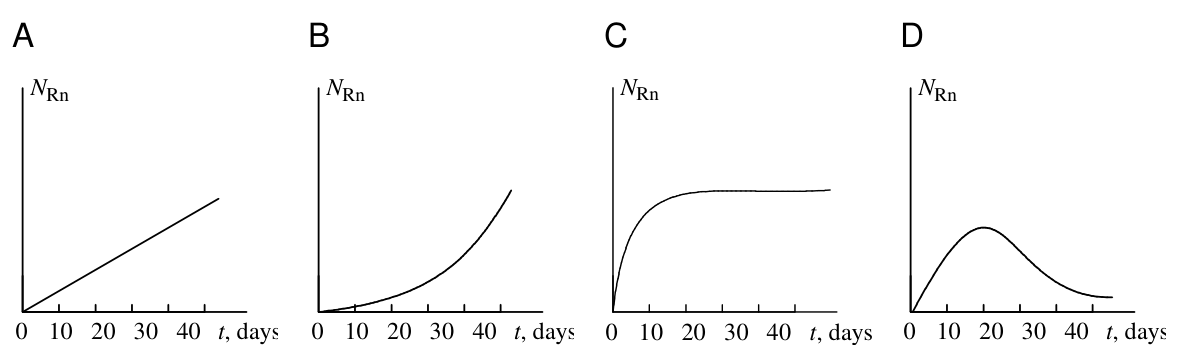
3.4 Choose which of the plots given below displays the time dependence of the number \(N_{\mathrm{Rn}}\) of radon atoms in the course of the experiment.
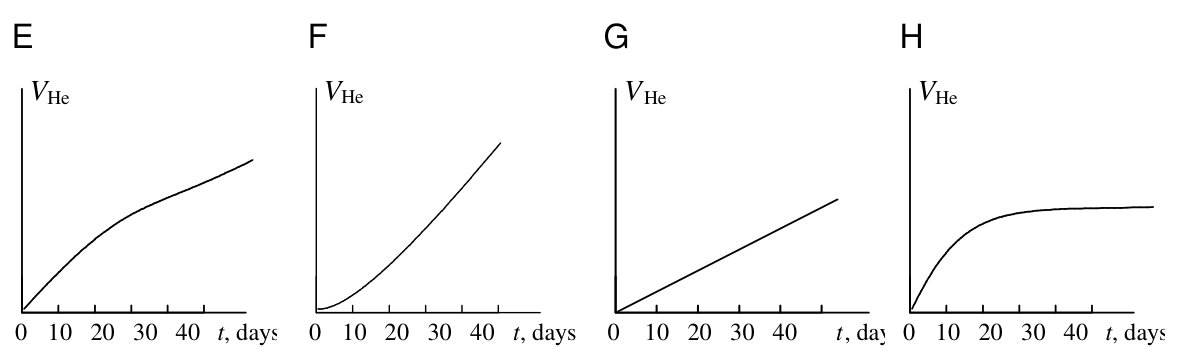
3.5 Choose which of the plots given below shows the time dependence of the volume of helium in the course of the experiment.
3.6 Choose the relation between the decay rate \(k\) of any given nuclide and its half-life \(T_{1/2}\).
3.7 a) Using a short kinetic scheme

(where \(k_1\) and \(k_2\) are the rate constants of the corresponding reactions) and the plot which you have selected in question 4, write a relation between the number of radon atoms at the end of experiment \(N'_{\mathrm{Rn}}\) and the number of radium atoms \(N_{\mathrm{Ra}}\).
b) Calculate \(N'_{\mathrm{Rn}}\) using the rate of radium decay given above (\(x = 3.42\times10^{10}\) \(\alpha\)-particles per gram of radium per second).
3.8 How many helium atoms could be formed from radon atoms remaining at the end of experiment \(N'_{\mathrm{Rn}}\), if all these atoms had decayed to RaD?
3.9 Using the solutions of the above questions calculate a better approximation to:
a) the number of helium atoms formed;
b) the Avogadro’s number.
Official English text of the problem.
Problem 4: Chromate-dichromate equilibria and precipitation
The precipitation is widely used in classical methods of the quantitative and qualitative analysis for the separation of ions. The possibility of separation is determined by the equilibrium concentrations of all species in a solution to be analyzed.
Potassium dichromate is one of the most widely used precipitating reagents. The following equilibria are established in aqueous solutions of Cr(VI).

4.1 Calculate the equilibrium constants
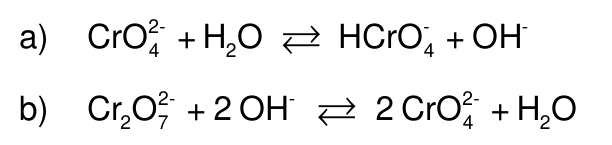
The ionic product of water \(K_{\mathrm W}=1.0\times10^{-14}\).
4.2 In what direction shall the equilibrium state 1b shift upon the addition of the following reagents to the aqueous solution of potassium dichromate?
a) \(\ce{KOH}\)
b) \(\ce{HCl}\)
c) \(\ce{BaCl2}\)
d) \(\ce{H2O}\)
The solubility product of \(\ce{BaCrO4}\) is \(1.2\times10^{-10}\). \(\ce{BaCr2O7}\) is well soluble in water.
4.3 Calculate the pH value of the following solutions
a) \(0.010\ \mathrm M\ \ce{K2CrO4}\)
b) \(0.010\ \mathrm M\ \ce{K2Cr2O7}\)
c) \(0.010\ \mathrm M\ \ce{K2Cr2O7}+0.100\ \mathrm M\ \ce{CH3COOH}\)
Dissociation constant of acetic acid \(K_{\mathrm a}=1.8\times10^{-5}\).
4.4 Calculate the equilibrium concentrations of the following ions in the solution of \(0.010\ \mathrm M\ \ce{K2Cr2O7}+0.100\ \mathrm M\ \ce{CH3COOH}\)
a) \(\ce{CrO4^2-}\)
b) \(\ce{Cr2O7^2-}\)
\(\ce{Pb^2+}\) and \(\ce{Ag+}\) form poorly soluble compounds with chromate and dichromate ions.
The solubility products of these compounds are indicated below.
\(\ce{PbCrO4}\) \(K_{s1}=1.2\times10^{-14}\) \(\ce{Ag2CrO4}\) \(K_{s2}=1.3\times10^{-12}\) \(\ce{Ag2Cr2O7}\) \(K_{s3}=1.1\times10^{-10}\) To the aqueous solution of the mixture of \(1.0\times10^{-3}\ \mathrm M\ \ce{Pb(NO3)2}\) and \(2.0\times10^{-4}\ \mathrm M\ \ce{AgNO3}\) an equal volume of \(0.020\ \mathrm M\) solution of \(\ce{K2Cr2O7}\) in \(0.200\ \mathrm M\ \ce{CH3COOH}\) was added.
4.5 a) Shall \(\ce{Pb^2+}\) be precipitated?
b) Shall \(\ce{Ag+}\) be precipitated?
c) Shall a quantitative separation of \(\ce{Pb^2+}\) and \(\ce{Ag+}\) ions be thus achieved?
The quantitative precipitation is achieved if the residual concentration of the ion being precipitated is not higher than \(1\times10^{-6}\ \mathrm M\).
Official English text of the problem.
Problem 5: Potentiometry and spectrophotometry of iron and its cyanide complexes
Potentiometric and spectrophotometric methods are widely used for the determination of equilibrium concentrations and equilibrium constants in solution. Both methods are frequently used in combination to achieve simultaneous determination of several species.
Solution I contains a mixture of \(\ce{FeCl2}\) (aq)) and \(\ce{FeCl3(aq)}\), and solution II contains a mixture of \(\ce{K4Fe(CN)6}\) and \(\ce{K3Fe(CN)6}\). The concentrations of iron-containing species satisfy the relations \([\ce{Fe^2+}]_{\mathrm I}=[\ce{Fe(CN)6^4-}]_{\mathrm{II}}\) and \([\ce{Fe^3+}]_{\mathrm I}=[\ce{Fe(CN)6^3-}]_{\mathrm{II}}\). The potential of platinum electrode immersed into the solution I is 0.652 V, while the potential of platinum electrode immersed into solution II is 0.242 V. The transmittance of the solution II measured relative to the solution I at 420 nm is 10.7 % (optical pathlength \(l=5.02\ \mathrm{mm}\)). The complexes \(\ce{Fe(CN)6^4-}\), \(\ce{Fe(H2O)6^3+}\), and \(\ce{Fe(H2O)6^2+}\) do not absorb light at 420 nm.
Molar absorption at this wavelength \(\varepsilon([\ce{Fe(CN)6^3-}])=1100\ \mathrm{M^{-1}\,cm^{-1}}\).
Standard redox potential for \(\ce{Fe(H2O)6^3+}/\ce{Fe(H2O)6^2+}\) is 0.771 V.
The factor before the logarithm in the Nernst equation is 0.0590.
5.1 Write Nernst equations for redox systems of
a) solution I,
b) solution II.5.2 What are the units of the pre-logarithm factor 0.0590 in the Nernst equation?
5.3 Calculate the ratio of the stability constants \(\beta[\ce{Fe(CN)6^3-}]/\beta[\ce{Fe(CN)6^4-}]\).
5.4 What is the absolute range of variation for the following physical values
a) transmittance \(T\);
b) absorbance \(A\).5.5 Sketch the graphs of concentration dependences satisfying the Lambert-Beer law for
a) absorbance \(A\);
b) transmittance \(T\);
c) molar absorption \(\varepsilon\).5.6 Calculate the concentrations of
a) \(\ce{Fe^2+}\) in solution I;
b) \(\ce{Fe^3+}\) in solution II.5.7 Mixing solutions I and II gives intense blue colour. What species is characterized by this colour? Write the reaction equation.
Official English text of the problem.
Problem 6: Two isomeric alkenes: ozonolysis, oxidation, bromination and epoxidation
Two isomeric hydrocarbons A and B contain 85.7 mass % of carbon.
6.1 Write a general formula which satisfies this condition.
The hydrocarbons A and B possess the following properties. The reaction of each of the compounds with ozone with subsequent treatment of the product with zinc dust in the presence of acid gives a single organic product C. The oxidation of compound C gives a single product, the carboxylic acid D. According to spectral data all hydrogen atoms in this acid except the one in carboxylic group are contained in methyl groups. The density of vapours of D corrected to normal conditions (0 °C, 1 atm) is \(9.1\ \mathrm{g\,dm^{-3}}\).
Compound A is more reactive than compound B in the reaction with cold neutral potassium permanganate. A single compound F is formed from A, and a 1 : 1 mixture of isomers G1 and G2 is formed from B.
6.2 Draw the structural formulae of the compound D both in aqueous solution and in vapour phase.
6.3 Write the formula of compound C.
6.4 Draw the structures of isomers A and B.
6.5 a) Write the reactions of the transformation of A or B into C and D.
b) Write the reactions of the transformation of A and B into F, G1 and G2.6.6 Compounds G1 and G2 readily react with acetone in the presence of acids and form compounds H1 and H2. Draw the structures of H1 and H2.
6.7 Compounds A and B react with bromine. One of the products of these reactions is non-polar (dipole moment of this molecule is practically equal to zero) and optically inactive. Draw the stereochemical formula of this product, and write the reaction of its formation. Determine the absolute configuration of chiral atoms in this molecule (if any) and mark them according to \(R,S\) nomenclature by \(R\) or \(S\) letters.
Alkenes react with peroxoacids with the addition of oxygen to double bond to form a three-member oxygen-containing ring. This epoxidation reaction is highly stereospecific to retain the relative positions of substituents at the bond to which the oxygen atom is attached.
The epoxidation of compound A by peroxoacetic acid yields a single compound K. Under the same conditions B gives a mixture of isomers L1 and L2 (the ratio is 1:1).
6.8 Is the compound K optically active? Draw the stereochemical formula of K. Are the individual compounds L1 and L2 optically active? Draw the stereochemical formulae of L1 and L2.
Official English text of the problem.
Problem 7: Stereochemistry of 5-norbornene-2,3-dicarboxylic acids
Stereochemistry of organic compounds can sometimes be determined by studying their chemical behaviour. The stereochemical configuration of one of the isomers of 5-norbornene-2,3-dicarboxylic acids (compound X)
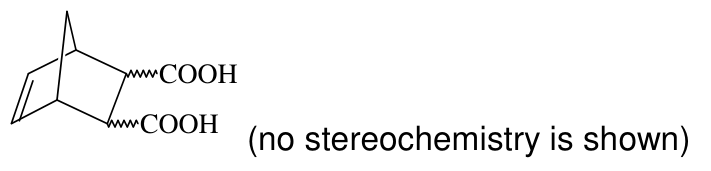
was established by the following experiments.
On heating this substance decomposes producing water and a new compound Y. Compound Y slowly dissolves in excess of aqueous \(\ce{NaOH}\) with the formation of product \(X_1\) same to that is formed in the reaction of X with \(\ce{NaOH}\). The resulting solution of \(X_1\) is treated by \(\ce{I2}\) to give compounds containing iodine. Acidification of the solution leads to a mixture of two isomeric compounds, A and B in the 3 : 1 ratio. The titration of 0.3913 g of compound A by 0.1000 M aqueous solution of \(\ce{NaOH}\) in the presence of phenolphthalein takes 12.70 \(\mathrm{cm^3}\) of alkali. The same amount of 0.1000 M solution of \(\ce{NaOH}\) is required for the titration of 0.3913 g of compound B. On heating compound A slowly transforms into compound C, which contains no iodine and is able to react with water. Under the same conditions compound B does not undergo this transformation, but on heating with hydrochloric acid slowly transforms into A.
All reactions must be written as balance equations. No mechanisms are required.
7.1 Mark by asterisks (*) the asymmetric carbon atoms in the structure of 5-norbornene-2,3-dicarboxylic acids.
7.2 Draw the stereochemical formulas of all stereoisomers of compound X, and the structures of products of their dehydration in those cases when it is possible.
7.3 Write the reactions of \(\ce{NaOH}\) with a stereoisomer of X and a stereoisomer of Y.
7.4 Calculate the molar mass of compound A. Write the reactions leading from \(X_1\) to A.
7.5 Write the reaction of the formation of C from A and the reaction of C with water.
7.6 Draw the stereochemical formula of compound X which satisfies all of the data given in the problem.
7.7 Write the reactions leading from B to A.
7.8 Are the compounds A and B diastereomers?
Official English text of the problem.
Internationale Chemie-Olympiade
IChO 1996
Moskau, Russische Föderation · 7 Theorieaufgaben mit vollständigen Lösungen
Aufgabe 1: Tellur-Chloroaluminate aus dem System Te - TeCl4/AlCl3
Die stereoreguläre Polymerisation ungesättigter Kohlenwasserstoffe wird gewöhnlich als eines der wichtigsten Verfahren der industriellen organischen Chemie angesehen. Als Katalysatoren werden bei diesen Prozessen üblicherweise Salze großer, nichtlinearer Kationen verwendet, deren Ladung ausreichend hoch ist, um die entlang der \(\pi\)-Bindungen der Olefinmoleküle verteilte Elektronendichte anzugreifen. Als Anionen dienen gewöhnlich Chloroaluminat-Anionen (wie \(\ce{AlCl4-}\)), deren negative Ladung stark delokalisiert ist. Die Notwendigkeit, neue Katalysatoren dieser Art zu entwickeln, veranlasste Chemiker, die Wechselwirkungen im System A - B zu untersuchen, wobei A = \(\ce{Te(cryst.)}\) und B = (\(\ce{TeCl4 + 4AlCl3}\)) ist. Die zweite Komponente B wurde als Analogon des Te(IV)-Chloroaluminats \(\ce{Te[AlCl4]4}\) betrachtet, das jedoch nicht als eigenständige Verbindung isoliert werden kann. Es wurde festgestellt, dass die Reaktion der Komponenten A und B zur Bildung dreier neuer Verbindungen (I, II und III) in Systemen führen kann, die anfangs 77.8, 87.5 beziehungsweise 91.7 Mol-% der Komponente A enthalten. Außerdem wurde beobachtet, dass bei der Bildung der Verbindungen II und III keine Nebenprodukte entstehen, während bei der Bildung von I pro zwei Mol I ein Mol flüchtiges \(\ce{TeCl4}\) freigesetzt wird.
Die Verbindungen I und II weckten besonderes Interesse bei den Forschern. Beide sind rosaviolett gefärbt und dissoziieren jeweils in drei Ionen, wie Leitfähigkeitsuntersuchungen in geschmolzenem \(\ce{NaAlCl4}\) zeigten. Kryoskopische Messungen in einer \(\ce{NaAlCl4}\)-Schmelze ermöglichten die Bestimmung der molaren Massen dieser Verbindungen; sie betragen \(1126 \pm 43\ \mathrm{g\,mol^{-1}}\) für I und \(867 \pm 48\ \mathrm{g\,mol^{-1}}\) für II. In den IR-Spektren beider Verbindungen wird jeweils nur eine Bande beobachtet, die einer Schwingungsmode einer Bindung unter Beteiligung eines Te-Atoms zugeordnet werden kann. Diese Bande liegt bei \(133\ \mathrm{cm^{-1}}\) und ist damit so energiearm, dass es sich bei dieser Bindung zweifellos um eine Art Te–Te-Wechselwirkung handelt. Die \(\ce{^{27}Al}\)-NMR-Daten der Komplexe I und II zeigen, dass in jeder Verbindung nur eine Art tetraedrisch koordinierten Aluminiums vorliegt. Die beobachteten chemischen Verschiebungen des Aluminiums unterscheiden sich jedoch für die Verbindungen I und II, was zeigt, dass die Al-Atome darin unterschiedliche Umgebungen aufweisen.
1.1 Bestimmen Sie das kleinste ganzzahlige Atomverhältnis Te : Al : Cl für die Komplexe I, II und III.
1.2 Geben Sie die Molekülformeln der Verbindungen I und II an.
1.3 Geben Sie die Formeln der Anionen und Kationen in den Verbindungen I und II an.
1.4 Zeichnen Sie die stereochemischen Formeln der Kationen und Anionen in den Strukturen von I und II unter der Annahme, dass die Kationen in I und II Beispiele für anorganische aromatische Systeme sind.
1.5 Welche Verbindung besitzt die höhere thermische Stabilität, I oder II, wenn Sie berücksichtigen, dass \(\ce{AlCl3}\) eine äußerst flüchtige Verbindung ist?
1.6 Falls sich eine der Verbindungen I oder II durch Erhitzen in die andere umwandeln lässt, geben Sie die entsprechende Reaktionsgleichung an.
Aufgabentext aus dem offiziellen englischen Text übersetzt.
Aufgabe 2: Nachweisgrenze für Bismut: gravimetrische und multiplikative Methoden
Die Nachweisgrenze ist einer der grundlegenden Parameter bei der quantitativen Analyse von Elementen in Spurenmengen. Sie wird als die kleinste Masse eines Elements angegeben, die mit einer bestimmten Methode mit einer vorgegebenen Genauigkeit bestimmt werden kann.
Als Beispiel betrachten wir die Methode zur Bestimmung mikroskopischer Mengen von Bismut. Im Jahr 1927 schlug der deutsche Chemiker Berg vor, Bismut als praktisch unlösliches Salz zu fällen: 8-Hydroxychinoliniumtetraiodobismutat \(\ce{[C9H6(OH)NH][BiI4]}\) (\(M_r = 862.7\)).
2.1 a) Zeichnen Sie die Strukturformeln des Kations und des Anions dieses Salzes.
b) Welche Oxidationszahl hat das \(\ce{Bi}\)-Atom in dieser Verbindung?
2.2 Bestimmen Sie die kleinste Masse an Bismut (in mg), die mit der Methode nach Berg zuverlässig bestimmt werden kann, wenn die kleinste zuverlässig messbare Niederschlagsmasse 50.0 mg beträgt.
Zur Bestimmung von Bismut in Spurenmengen entwickelten R. Belcher und Mitarbeiter aus Birmingham eine multiplikative Methode. Bei dieser Methode wird eine Folge von Reaktionen durchgeführt, an die sich eine Titration des Endprodukts anschließt. Im Folgenden wird das Verfahren ausführlich beschrieben.
Schritt 1: Zu einer vorgegebenen kleinen Menge (\(\approx 2\ \mathrm{cm^3}\)) einer kalten, angesäuerten Lösung, die Spurenmengen von \(\ce{Bi^3+}\) enthält, werden in der Kälte 50 mg Kaliumhexathiocyanatochromat(III) (\(\ce{K3[Cr(SCN)6]}\)) gegeben; dies führt zu einer praktisch quantitativen Fällung des Bismuts.
2.3 Stellen Sie die ausgeglichene Netto-Ionengleichung dieser Reaktion auf.
Schritt 2: Der Niederschlag wird abfiltriert, mit kaltem Wasser gewaschen und mit \(5\ \mathrm{cm^3}\) einer 10 %igen Natriumhydrogencarbonatlösung behandelt. Bei dieser Behandlung wird der ursprüngliche Niederschlag in einen Niederschlag von Oxobismut(III)-carbonat \(\ce{(BiO)2CO3}\) umgewandelt, wobei Hexathiocyanatochromat(III)-Ionen in die Lösung freigesetzt werden.
2.4 Stellen Sie die ausgeglichene Netto-Ionengleichung dieser Reaktion auf.
Schritt 3: Das schwach angesäuerte Filtrat wird in einen Scheidetrichter überführt und mit \(0.5\ \mathrm{cm^3}\) einer gesättigten Iodlösung in Chloroform versetzt; anschließend wird das Gemisch kräftig geschüttelt. Iod oxidiert den Liganden des Komplexions zu \(\ce{ICN}\) und Sulfat-Ionen.
2.5 Stellen Sie die ausgeglichene Netto-Ionengleichung dieser Reaktion auf.
Schritt 4: Nach 5 Minuten werden dem Gemisch \(4\ \mathrm{cm^3}\) einer 2 M \(\ce{H2SO4}\)-Lösung zugesetzt. Das Ansäuern führt zu einer Komproportionierungsreaktion, bei der molekulares Iod freigesetzt wird.
2.6 Stellen Sie die ausgeglichene Netto-Ionengleichung der beim Ansäuern ablaufenden Reaktion auf.
Schritt 5: Das Iod wird mit 4 Portionen Chloroform quantitativ extrahiert. Die wässrige Phase wird in einen Kolben überführt und mit \(1\ \mathrm{cm^3}\) Bromwasser versetzt; anschließend wird das Gemisch 5 Minuten lang durchmischt.
2.7 Stellen Sie die ausgeglichenen Netto-Ionengleichungen der bei der Zugabe von Bromwasser ablaufenden Reaktionen auf. Beachten Sie, dass überschüssiges Brom mit Cyanwasserstoff zu \(\ce{BrCN}\) reagieren kann und Iodid zu \(\ce{IO3^-}\) oxidiert wird.
Schritt 6: Zur Entfernung des überschüssigen molekularen Broms werden dem Gemisch \(3\ \mathrm{cm^3}\) 90 %ige Methansäure (Ameisensäure) zugesetzt.
2.8 Stellen Sie die ausgeglichene Netto-Ionengleichung dieser Reaktion auf.
Schritt 7: Zur schwach sauren Lösung wird Kaliumiodid im Überschuss (1.5 g) gegeben.
2.9 Stellen Sie die ausgeglichenen Netto-Ionengleichungen der bei der Zugabe von \(\ce{KI}\) ablaufenden Reaktionen auf. Berücksichtigen Sie dabei, dass Iodid mit \(\ce{BrCN}\) in ähnlicher Weise wie mit \(\ce{ICN}\) unter Bildung von molekularem Iod reagiert.
Schritt 8: Die erhaltene Lösung wird mit einer 0.00200 M \(\ce{Na2S2O3}\)-Maßlösung titriert. Aus den so erhaltenen Ergebnissen wird der Bismutgehalt der zur Analyse entnommenen Probe berechnet.
2.10 a) Wie viele Mol Thiosulfat entsprechen 1 mol Bismut in der ursprünglichen Probe?
b) Welche kleinste Masse an Bismut kann mit dieser Methode bestimmt werden (nehmen Sie an, dass eine zuverlässige Bestimmung mindestens \(1\ \mathrm{cm^3}\) der 0.00200 M \(\ce{Na2S2O3}\)-Maßlösung erfordert)?
2.11 Um welchen Faktor ist die soeben beschriebene multiplikative Methode empfindlicher als die gravimetrische Methode nach Berg?
Aufgabentext aus dem offiziellen englischen Text übersetzt.
Aufgabe 3: Die Avogadro-Zahl aus dem Zerfall von Radium
Im Jahr 1908 maßen Rutherford und H.Geiger gemeinsam die Emissionsrate von \(\alpha\)-Teilchen (\(x\)) durch Radium (in der Natur ist dieses Element durch ein einziges Nuklid, \(\ce{^{226}_{88}Ra}\), vertreten) und stellten fest, dass 1.00 g Radium pro Sekunde \(x = 3.42\times10^{10}\) \(\alpha\)-Teilchen emittiert.
Im Jahr 1911 maßen Rutherford und der amerikanische Physikochemiker B.Boltwood die Bildungsrate von Helium aus Radium. Dieses Experiment ermöglichte die Bestimmung des genauesten damals verfügbaren Wertes der Avogadro-Zahl, da das molare Volumen eines idealen Gases bereits gut bekannt war. Hierzu wurde eine von Zerfallsprodukten gereinigte Radiumsalzprobe, die \(m = 192\) mg \(\ce{Ra}\) enthielt, in eine Apparatur eingebracht und das Volumen des entstandenen Heliums gemessen. Nach 83 Versuchstagen (\(t = 83.0\) Tage) waren 6.58 \(\mathrm{mm^3}\) \(\ce{He}\) aufgefangen worden (\(V_{\mathrm{He}} = 6.58\ \mathrm{mm^3}\), umgerechnet auf \(0^\circ\mathrm{C}\) und 1 atm).
Zum Verständnis der Ergebnisse dieses Experiments benötigen wir das unten dargestellte kinetische Schema des radioaktiven Zerfalls von \(\ce{Ra}\) (die Halbwertszeiten stehen über den Pfeilen, die Zerfallsart unter den Pfeilen).
(RaA - RaE sind Zwischenprodukte des Radonzerfalls).
3.1 Schreiben Sie die ersten sechs radioaktiven Zerfälle in moderner Schreibweise unter Angabe der Ordnungs- und Massenzahlen aller beteiligten Kerne auf.
In einer groben ersten Näherung können die Halbwertszeiten aller Zerfallsprodukte des Radiums mit Ausnahme von RaD und \(\ce{Po}\) gegenüber der Messdauer \(t\) als vernachlässigbar angenommen werden. Führen Sie mit dieser Näherung die folgenden Berechnungen durch.
3.2 a) Wie viele Heliumatome waren nach 83 Tagen aus jedem zerfallenen Radiumatom entstanden?
b) Wie viele Heliumatome entstanden insgesamt während des Experiments?
3.3 Berechnen Sie aus den obigen Daten einen Näherungswert für die Avogadro-Zahl.
Für eine genauere Berechnung der Avogadro-Zahl darf die Halbwertszeit von Radon, \(T_{1/2}(\ce{Rn}) = 3.83\) Tage, nicht vernachlässigt werden, da sie mit der Versuchsdauer \(t\) vergleichbar ist und bis zum Ende des Experiments nicht alle Radonatome zerfallen waren.
3.4 Wählen Sie aus den unten angegebenen Diagrammen dasjenige aus, das die Zeitabhängigkeit der Anzahl \(N_{\mathrm{Rn}}\) der Radonatome während des Experiments darstellt.
3.5 Wählen Sie aus den unten angegebenen Diagrammen dasjenige aus, das die Zeitabhängigkeit des Heliumvolumens während des Experiments zeigt.
3.6 Wählen Sie die Beziehung zwischen der Zerfallskonstante \(k\) eines beliebigen Nuklids und seiner Halbwertszeit \(T_{1/2}\) aus.
3.7 a) Verwenden Sie das verkürzte kinetische Schema
(wobei \(k_1\) und \(k_2\) die Geschwindigkeitskonstanten der entsprechenden Reaktionen sind) und das in Frage 4 ausgewählte Diagramm, um eine Beziehung zwischen der Anzahl der Radonatome am Ende des Experiments \(N'_{\mathrm{Rn}}\) und der Anzahl der Radiumatome \(N_{\mathrm{Ra}}\) aufzustellen.
b) Berechnen Sie \(N'_{\mathrm{Rn}}\) mithilfe der oben angegebenen Zerfallsrate von Radium (\(x = 3.42\times10^{10}\) \(\alpha\)-Teilchen pro Gramm Radium und Sekunde).
3.8 Wie viele Heliumatome könnten aus den am Ende des Experiments verbliebenen Radonatomen \(N'_{\mathrm{Rn}}\) entstehen, wenn alle diese Atome zu RaD zerfallen wären?
3.9 Berechnen Sie mithilfe der Lösungen der obigen Fragen eine bessere Näherung für:
a) die Anzahl der entstandenen Heliumatome;
b) die Avogadro-Zahl.
Aufgabentext aus dem offiziellen englischen Text übersetzt.
Aufgabe 4: Chromat-Dichromat-Gleichgewichte und Fällung
Die Fällung wird in klassischen Methoden der quantitativen und qualitativen Analyse häufig zur Trennung von Ionen eingesetzt. Die Möglichkeit einer Trennung wird durch die Gleichgewichtskonzentrationen aller Spezies in der zu analysierenden Lösung bestimmt.
Kaliumdichromat ist eines der am häufigsten verwendeten Fällungsreagenzien. In wässrigen Lösungen von Cr(VI) stellen sich die folgenden Gleichgewichte ein.
4.1 Berechnen Sie die Gleichgewichtskonstanten
Das Ionenprodukt des Wassers beträgt \(K_{\mathrm W}=1.0\times10^{-14}\).
4.2 In welche Richtung verschiebt sich das Gleichgewicht 1b bei Zugabe der folgenden Reagenzien zur wässrigen Kaliumdichromatlösung?
a) \(\ce{KOH}\)
b) \(\ce{HCl}\)
c) \(\ce{BaCl2}\)
d) \(\ce{H2O}\)
Das Löslichkeitsprodukt von \(\ce{BaCrO4}\) beträgt \(1.2\times10^{-10}\). \(\ce{BaCr2O7}\) ist gut in Wasser löslich.
4.3 Berechnen Sie den pH-Wert der folgenden Lösungen
a) \(0.010\ \mathrm M\ \ce{K2CrO4}\)
b) \(0.010\ \mathrm M\ \ce{K2Cr2O7}\)
c) \(0.010\ \mathrm M\ \ce{K2Cr2O7}+0.100\ \mathrm M\ \ce{CH3COOH}\)
Die Dissoziationskonstante der Essigsäure beträgt \(K_{\mathrm a}=1.8\times10^{-5}\).
4.4 Berechnen Sie die Gleichgewichtskonzentrationen der folgenden Ionen in der Lösung von \(0.010\ \mathrm M\ \ce{K2Cr2O7}+0.100\ \mathrm M\ \ce{CH3COOH}\)
a) \(\ce{CrO4^2-}\)
b) \(\ce{Cr2O7^2-}\)
\(\ce{Pb^2+}\) und \(\ce{Ag+}\) bilden mit Chromat- und Dichromationen schwer lösliche Verbindungen.
Die Löslichkeitsprodukte dieser Verbindungen sind nachstehend angegeben.
\(\ce{PbCrO4}\) \(K_{s1}=1.2\times10^{-14}\) \(\ce{Ag2CrO4}\) \(K_{s2}=1.3\times10^{-12}\) \(\ce{Ag2Cr2O7}\) \(K_{s3}=1.1\times10^{-10}\) Zu einer wässrigen Lösung einer Mischung aus \(1.0\times10^{-3}\ \mathrm M\ \ce{Pb(NO3)2}\) und \(2.0\times10^{-4}\ \mathrm M\ \ce{AgNO3}\) wurde das gleiche Volumen einer \(0.020\ \mathrm M\)-Lösung von \(\ce{K2Cr2O7}\) in \(0.200\ \mathrm M\ \ce{CH3COOH}\) gegeben.
4.5 a) Wird \(\ce{Pb^2+}\) gefällt?
b) Wird \(\ce{Ag+}\) gefällt?
c) Wird dadurch eine quantitative Trennung der \(\ce{Pb^2+}\)- und \(\ce{Ag+}\)-Ionen erreicht?
Eine quantitative Fällung ist erreicht, wenn die Restkonzentration des zu fällenden Ions nicht höher als \(1\times10^{-6}\ \mathrm M\) ist.
Aufgabentext aus dem offiziellen englischen Text übersetzt.
Aufgabe 5: Potentiometrie und Spektrophotometrie von Eisen und seinen Cyanidkomplexen
Potentiometrische und spektrophotometrische Methoden werden häufig zur Bestimmung von Gleichgewichtskonzentrationen und Gleichgewichtskonstanten in Lösung eingesetzt. Beide Methoden werden oft kombiniert, um mehrere Spezies gleichzeitig bestimmen zu können.
Lösung I enthält ein Gemisch aus \(\ce{FeCl2}\) (aq)) und \(\ce{FeCl3(aq)}\), und Lösung II enthält ein Gemisch aus \(\ce{K4Fe(CN)6}\) und \(\ce{K3Fe(CN)6}\). Die Konzentrationen der eisenhaltigen Spezies erfüllen die Beziehungen \([\ce{Fe^2+}]_{\mathrm I}=[\ce{Fe(CN)6^4-}]_{\mathrm{II}}\) und \([\ce{Fe^3+}]_{\mathrm I}=[\ce{Fe(CN)6^3-}]_{\mathrm{II}}\). Das Potential einer in Lösung I eingetauchten Platinelektrode beträgt 0.652 V, während das Potential einer in Lösung II eingetauchten Platinelektrode 0.242 V beträgt. Der bei 420 nm relativ zu Lösung I gemessene Transmissionsgrad der Lösung II beträgt 10.7 % (optische Schichtdicke \(l=5.02\ \mathrm{mm}\)). Die Komplexe \(\ce{Fe(CN)6^4-}\), \(\ce{Fe(H2O)6^3+}\) und \(\ce{Fe(H2O)6^2+}\) absorbieren bei 420 nm kein Licht.
Der molare Extinktionskoeffizient bei dieser Wellenlänge beträgt \(\varepsilon([\ce{Fe(CN)6^3-}])=1100\ \mathrm{M^{-1}\,cm^{-1}}\).
Das Standardredoxpotential für \(\ce{Fe(H2O)6^3+}/\ce{Fe(H2O)6^2+}\) beträgt 0.771 V.
Der Faktor vor dem Logarithmus in der Nernst-Gleichung beträgt 0.0590.
5.1 Geben Sie die Nernst-Gleichungen für die Redoxsysteme in
a) Lösung I,
b) Lösung II an.5.2 Welche Einheit hat der Faktor 0.0590 vor dem Logarithmus in der Nernst-Gleichung?
5.3 Berechnen Sie das Verhältnis der Stabilitätskonstanten \(\beta[\ce{Fe(CN)6^3-}]/\beta[\ce{Fe(CN)6^4-}]\).
5.4 Welchen gesamten Wertebereich können die folgenden physikalischen Größen annehmen?
a) Transmissionsgrad \(T\);
b) Extinktion \(A\).5.5 Skizzieren Sie die Graphen der Konzentrationsabhängigkeiten gemäß dem Lambert-Beer-Gesetz für
a) die Extinktion \(A\);
b) den Transmissionsgrad \(T\);
c) den molaren Extinktionskoeffizienten \(\varepsilon\).5.6 Berechnen Sie die Konzentrationen von
a) \(\ce{Fe^2+}\) in Lösung I;
b) \(\ce{Fe^3+}\) in Lösung II.5.7 Beim Mischen der Lösungen I und II entsteht eine intensiv blaue Färbung. Für welche Spezies ist diese Farbe charakteristisch? Geben Sie die Reaktionsgleichung an.
Aufgabentext aus dem offiziellen englischen Text übersetzt.
Aufgabe 6: Zwei isomere Alkene: Ozonolyse, Oxidation, Bromierung und Epoxidierung
Zwei isomere Kohlenwasserstoffe A und B enthalten 85.7 Massen-% Kohlenstoff.
6.1 Geben Sie eine allgemeine Formel an, die diese Bedingung erfüllt.
Die Kohlenwasserstoffe A und B besitzen die folgenden Eigenschaften. Die Reaktion jeder der beiden Verbindungen mit Ozon und die anschließende Behandlung des Produkts mit Zinkstaub in Gegenwart von Säure ergibt ein einziges organisches Produkt C. Die Oxidation der Verbindung C ergibt ein einziges Produkt, die Carbonsäure D. Nach spektroskopischen Daten befinden sich alle Wasserstoffatome dieser Säure mit Ausnahme desjenigen in der Carboxylgruppe in Methylgruppen. Die auf Normalbedingungen (0 °C, 1 atm) umgerechnete Dampfdichte von D beträgt \(9.1\ \mathrm{g\,dm^{-3}}\).
Verbindung A ist bei der Reaktion mit kalter, neutraler Kaliumpermanganatlösung reaktiver als Verbindung B. Aus A entsteht eine einzige Verbindung F, aus B ein 1 : 1-Gemisch der Isomere G1 und G2.
6.2 Zeichnen Sie die Strukturformeln der Verbindung D sowohl in wässriger Lösung als auch in der Dampfphase.
6.3 Geben Sie die Formel der Verbindung C an.
6.4 Zeichnen Sie die Strukturen der Isomere A und B.
6.5 a) Geben Sie die Reaktionen zur Umwandlung von A oder B in C und D an.
b) Geben Sie die Reaktionen zur Umwandlung von A und B in F, G1 und G2 an.6.6 Die Verbindungen G1 und G2 reagieren leicht mit Aceton in Gegenwart von Säuren und bilden die Verbindungen H1 und H2. Zeichnen Sie die Strukturen von H1 und H2.
6.7 Die Verbindungen A und B reagieren mit Brom. Eines der Produkte dieser Reaktionen ist unpolar (das Dipolmoment dieses Moleküls ist praktisch gleich null) und optisch inaktiv. Zeichnen Sie die stereochemische Formel dieses Produkts und geben Sie die Reaktion seiner Bildung an. Bestimmen Sie die absolute Konfiguration der chiralen Atome in diesem Molekül (sofern vorhanden) und kennzeichnen Sie diese gemäß der \(R,S\)-Nomenklatur mit den Buchstaben \(R\) oder \(S\).
Alkene reagieren mit Peroxosäuren unter Addition von Sauerstoff an die Doppelbindung, wobei ein dreigliedriger sauerstoffhaltiger Ring entsteht. Diese Epoxidierungsreaktion ist hochgradig stereospezifisch und erhält die relative Anordnung der Substituenten an der Bindung, an die das Sauerstoffatom angelagert wird.
Die Epoxidierung der Verbindung A mit Peroxoessigsäure liefert eine einzige Verbindung K. Unter denselben Bedingungen ergibt B ein Gemisch der Isomere L1 und L2 (im Verhältnis 1:1).
6.8 Ist die Verbindung K optisch aktiv? Zeichnen Sie die stereochemische Formel von K. Sind die einzelnen Verbindungen L1 und L2 optisch aktiv? Zeichnen Sie die stereochemischen Formeln von L1 und L2.
Aufgabentext aus dem offiziellen englischen Text übersetzt.
Aufgabe 7: Stereochemie der 5-Norbornen-2,3-dicarbonsäuren
Die Stereochemie organischer Verbindungen lässt sich manchmal durch Untersuchung ihres chemischen Verhaltens bestimmen. Die stereochemische Konfiguration eines der Isomere der 5-Norbornen-2,3-dicarbonsäuren (Verbindung X)
wurde durch die folgenden Experimente ermittelt.
Beim Erhitzen zersetzt sich diese Substanz unter Bildung von Wasser und einer neuen Verbindung Y. Verbindung Y löst sich langsam in überschüssiger wässriger \(\ce{NaOH}\) unter Bildung des Produkts \(X_1\), das mit dem bei der Reaktion von X mit \(\ce{NaOH}\) gebildeten Produkt identisch ist. Die entstandene Lösung von \(X_1\) wird mit \(\ce{I2}\) behandelt, wobei iodhaltige Verbindungen entstehen. Das Ansäuern der Lösung führt zu einem Gemisch zweier isomerer Verbindungen A und B im Verhältnis 3 : 1. Für die Titration von 0.3913 g der Verbindung A mit einer wässrigen 0.1000 M Lösung von \(\ce{NaOH}\) in Gegenwart von Phenolphthalein werden 12.70 \(\mathrm{cm^3}\) Lauge benötigt. Dieselbe Menge an 0.1000 M Lösung von \(\ce{NaOH}\) wird für die Titration von 0.3913 g der Verbindung B benötigt. Beim Erhitzen wandelt sich Verbindung A langsam in Verbindung C um, die kein Iod enthält und mit Wasser reagieren kann. Unter denselben Bedingungen erfährt Verbindung B diese Umwandlung nicht, wandelt sich jedoch beim Erhitzen mit Salzsäure langsam in A um.
Alle Reaktionen müssen als ausgeglichene Reaktionsgleichungen angegeben werden. Mechanismen sind nicht erforderlich.
7.1 Markieren Sie die asymmetrischen Kohlenstoffatome in der Struktur der 5-Norbornen-2,3-dicarbonsäuren mit Sternchen (*).
7.2 Zeichnen Sie die stereochemischen Formeln aller Stereoisomere der Verbindung X sowie die Strukturen ihrer Dehydratisierungsprodukte in den Fällen, in denen eine Dehydratisierung möglich ist.
7.3 Geben Sie die Reaktionen von \(\ce{NaOH}\) mit einem Stereoisomer von X und einem Stereoisomer von Y an.
7.4 Berechnen Sie die molare Masse der Verbindung A. Geben Sie die Reaktionen an, die von \(X_1\) zu A führen.
7.5 Geben Sie die Reaktion zur Bildung von C aus A und die Reaktion von C mit Wasser an.
7.6 Zeichnen Sie die stereochemische Formel der Verbindung X, die allen in der Aufgabe angegebenen Daten entspricht.
7.7 Geben Sie die Reaktionen an, die von B zu A führen.
7.8 Sind die Verbindungen A und B Diastereomere?
Aufgabentext aus dem offiziellen englischen Text übersetzt.
Uluslararası Kimya Olimpiyatı
IChO 1996
Moskova, Rusya Federasyonu · 7 teori sorusu, tam çözümleriyle
Soru 1: Te - TeCl4/AlCl3 sisteminden elde edilen tellür kloroalüminatlar
Doymamış hidrokarbonların stereodüzenli polimerleşmesi, genellikle endüstriyel organik kimyanın en önemli süreçlerinden biri olarak kabul edilir. Bu süreçlerde katalizör olarak genellikle, olefin moleküllerinin \(\pi\)-bağları boyunca dağılmış elektron yoğunluğuna saldırabilecek kadar yüksek yük taşıyan, büyük ve doğrusal olmayan katyonların tuzları kullanılır. Anyon olarak ise genellikle negatif yükü büyük ölçüde delokalize olmuş kloroalüminat anyonları (\(\ce{AlCl4-}\) gibi) kullanılır. Bu tür yeni katalizörler geliştirme gereksinimi, kimyacıları A = \(\ce{Te(cryst.)}\) ve B = (\(\ce{TeCl4 + 4AlCl3}\)) olan A - B sistemindeki etkileşimi incelemeye yöneltmiştir. İkinci bileşen B, tek bir bileşik olarak izole edilemeyen Te(IV) kloroalüminatın, \(\ce{Te[AlCl4]4}\), bir analoğu olarak ele alınmıştır. A ve B bileşenlerinin etkileşiminin, başlangıçta sırasıyla molce %77.8, %87.5 ve %91.7 A bileşeni içeren sistemlerde üç yeni bileşiğin (I, II ve III) oluşumuna yol açabildiği bulunmuştur. Ayrıca II ve III bileşiklerinin oluşumunda hiçbir yan ürün oluşmazken, I oluşumuna her iki mol I başına 1 mol uçucu \(\ce{TeCl4}\) çıkışının eşlik ettiği gözlenmiştir.
I ve II bileşikleri araştırmacıların özellikle ilgisini çekmiştir. Her ikisi de pembemsi mor renktedir ve erimiş \(\ce{NaAlCl4}\) içindeki iletkenlik çalışmalarının gösterdiği üzere her ikisi de üç iyona ayrışır. \(\ce{NaAlCl4}\) eriyiğindeki kriyoskopik ölçümler, bu bileşiklerin molar kütlelerinin I ve II için sırasıyla \(1126 \pm 43\ \mathrm{g\,mol^{-1}}\) ve \(867 \pm 48\ \mathrm{g\,mol^{-1}}\) olarak belirlenmesini sağlamıştır. Her iki bileşiğin IR spektrumlarında, Te atomunun oluşturduğu bir bağın titreşim moduna atfedilebilecek yalnızca bir bant gözlenir. Bu bant \(133\ \mathrm{cm^{-1}}\) konumundadır ve dolayısıyla enerjisi o kadar düşüktür ki bu bağın bir tür Te – Te etkileşimi olduğuna şüphe yoktur. I ve II komplekslerinin \(\ce{^{27}Al}\) NMR verileri, her bileşikte tetrahedral koordinasyona sahip yalnızca bir tür alüminyum bulunduğunu gösterir. Ancak I ve II bileşikleri için gözlenen alüminyum kimyasal kaymaları farklıdır; bu da bu bileşiklerdeki Al atomlarının farklı ortamlarda bulunduğunu ortaya koyar.
1.1 I, II ve III kompleksleri için en sade Te : Al : Cl atom oranını belirleyiniz.
1.2 I ve II bileşiklerinin molekül formüllerini yazınız.
1.3 I ve II bileşiklerindeki anyonların ve katyonların formüllerini yazınız.
1.4 I ve II içindeki katyonların inorganik aromatik sistemlere örnek olduğunu varsayarak, I ve II yapılarındaki katyonların ve anyonların stereokimyasal formüllerini çiziniz.
1.5 \(\ce{AlCl3}\)'ün son derece uçucu bir bileşik olduğunu dikkate alarak, I ve II bileşiklerinden hangisinin ısıl kararlılığının daha yüksek olduğunu belirtiniz.
1.6 I veya II bileşiklerinden biri ısıtılarak diğerine dönüştürülebiliyorsa, ilgili tepkime denklemini yazınız.
Soru metni resmi İngilizce metinden çevrilmiştir.
Soru 2: Bizmut için tayin sınırı: gravimetrik ve çoğaltmalı yöntemler
Tayin sınırı, eser miktardaki elementlerin nicel analizinde temel parametrelerden biridir. Tayin sınırı, belirli bir yöntemle belirli bir doğrulukta tayin edilebilen en küçük element kütlesi olarak ifade edilir.
Örnek olarak, mikroskobik miktarlardaki bizmutun tayininde kullanılan yöntemi ele alacağız. Alman kimyager Berg, 1927 yılında bizmutun pratikte çözünmeyen bir tuz olan 8-hidroksikinolinyum tetraiyodobizmutat \(\ce{[C9H6(OH)NH][BiI4]}\) (\(M_r = 862.7\)) şeklinde çöktürülmesini önermiştir.
2.1 a) Bu tuzun katyonunun ve anyonunun yapı formüllerini çiziniz.
b) Bu bileşikteki \(\ce{Bi}\) atomunun yükseltgenme basamağı nedir?
2.2 Güvenilir biçimde ölçülebilen en küçük çökelek kütlesi 50.0 mg ise, Berg yöntemiyle güvenilir biçimde tayin edilebilen en küçük bizmut kütlesini (mg cinsinden) hesaplayınız.
Eser miktarlardaki bizmutun tayini için Birmingham'dan R. Belcher ve çalışma arkadaşları çoğaltmalı bir yöntem geliştirmiştir. Bu yöntemde, bir tepkimeler zincirinin ardından son ürünün titrasyonu gerçekleştirilir. Yöntem aşağıda ayrıntılı olarak açıklanmıştır.
Adım 1: Eser miktarda \(\ce{Bi^3+}\) içeren, asitlendirilmiş soğuk çözeltinin belirli küçük bir hacmine (\(\approx 2\ \mathrm{cm^3}\)), soğukta 50 mg potasyum hekzatiyosiyanatokromat(III) (\(\ce{K3[Cr(SCN)6]}\)) eklenir; bu işlem bizmutun pratikte nicel olarak çökmesini sağlar.
2.3 Bu tepkimenin denkleştirilmiş net iyon denklemini yazınız.
Adım 2: Çökelek süzülerek ayrılır, soğuk suyla yıkanır ve %10'luk sodyum hidrojen karbonat çözeltisinin \(5\ \mathrm{cm^3}\)'ü ile işleme tabi tutulur. Bu işlem sırasında başlangıçtaki çökelek, okso bizmut(III) karbonat \(\ce{(BiO)2CO3}\) çökeleğine dönüşürken hekzatiyosiyanatokromat(III) iyonları çözeltiye geçer.
2.4 Bu tepkimenin denkleştirilmiş net iyon denklemini yazınız.
Adım 3: Bir ayırma hunisine aktarılan hafifçe asitlendirilmiş süzüntüye, iyodun kloroformdaki doymuş çözeltisinden \(0.5\ \mathrm{cm^3}\) eklenir ve karışım kuvvetlice çalkalanır. İyot, kompleks iyonun ligandını \(\ce{ICN}\) ve sülfat iyonuna yükseltger.
2.5 Bu tepkimenin denkleştirilmiş net iyon denklemini yazınız.
Adım 4: 5 dakika sonra karışıma 2 M \(\ce{H2SO4}\) çözeltisinden \(4\ \mathrm{cm^3}\) eklenir. Asitlendirme, moleküler iyot oluşumuyla sonuçlanan bir komproporsiyonlaşma tepkimesine yol açar.
2.6 Asitlendirme sırasında gerçekleşen tepkimenin denkleştirilmiş net iyon denklemini yazınız.
Adım 5: İyot, dört ayrı porsiyon kloroformla nicel olarak özütlenir. Sulu faz bir balona aktarılır, üzerine \(1\ \mathrm{cm^3}\) bromlu su eklenir ve karışım 5 dakika boyunca karıştırılır.
2.7 Bromlu su eklendiğinde gerçekleşen tepkimelerin denkleştirilmiş net iyon denklemlerini yazınız. Bromun fazlasının hidrojen siyanürle tepkimeye girerek \(\ce{BrCN}\) oluşturabileceğini ve iyodürün \(\ce{IO3^-}\)'a yükseltgendiğini dikkate alınız.
Adım 6: Moleküler bromun fazlasını gidermek için karışıma %90'lık metanoik (formik) asitten \(3\ \mathrm{cm^3}\) eklenir.
2.8 Bu tepkimenin denkleştirilmiş net iyon denklemini yazınız.
Adım 7: Hafif asidik çözeltiye fazla miktarda (1.5 g) potasyum iyodür eklenir.
2.9 İyodürün, \(\ce{ICN}\) ile olduğu gibi \(\ce{BrCN}\) ile de benzer biçimde tepkimeye girerek moleküler iyot oluşturduğunu dikkate alarak, \(\ce{KI}\) eklendiğinde gerçekleşen tepkimelerin denkleştirilmiş net iyon denklemlerini yazınız.
Adım 8: Elde edilen çözelti, standart 0.00200 M \(\ce{Na2S2O3}\) çözeltisiyle titre edilir. Böylece elde edilen sonuçlar, analiz için alınan numunenin bizmut içeriğini hesaplamakta kullanılır.
2.10 a) Başlangıç numunesindeki 1 mol bizmuta kaç mol tiyosülfat eşdeğerdir?
b) Bu yöntemle tayin edilebilen en küçük bizmut kütlesi nedir (güvenilir bir tayin için standart 0.00200 M \(\ce{Na2S2O3}\) çözeltisinden en az \(1\ \mathrm{cm^3}\) gerektiğini varsayınız)?
2.11 Açıklanan çoğaltmalı yöntem, Berg'in gravimetrik yönteminden kaç kat daha duyarlıdır?
Soru metni resmi İngilizce metinden çevrilmiştir.
Soru 3: Radyumun bozunmasından Avogadro sayısının belirlenmesi
1908 yılında Rutherford, H.Geiger ile birlikte radyumun (bu element doğada tek bir nüklitle, \(\ce{^{226}_{88}Ra}\), temsil edilir) \(\alpha\)-parçacığı yayma hızını (\(x\)) ölçmüş ve 1.00 g radyumun saniyede \(x = 3.42\times10^{10}\) \(\alpha\)-parçacığı yaydığını bulmuştur.
1911 yılında Rutherford ve Amerikalı fizikokimyacı B.Boltwood, radyumdan helyum oluşma hızını ölçmüştür. İdeal gazın molar hacmi o dönemde güvenilir biçimde bilindiğinden, bu deney Avogadro sayısının o zamana kadar elde edilebilen en doğru değerinin bulunmasını sağlamıştır. Bu amaçla, bozunma ürünlerinden arındırılmış ve \(m = 192\) mg \(\ce{Ra}\) içeren bir radyum tuzu örneği bir düzeneğe yerleştirilmiş ve açığa çıkan helyumun hacmi ölçülmüştür. Deneyin 83 günü (\(t = 83.0\) gün) sonunda 6.58 \(\mathrm{mm^3}\) \(\ce{He}\) toplanmıştır (\(0^\circ\mathrm{C}\) ve 1 atm koşullarına düzeltilmiş hacim \(V_{\mathrm{He}} = 6.58\ \mathrm{mm^3}\)).
Bu deneyin sonuçlarını anlamak için aşağıda verilen \(\ce{Ra}\)'nın radyoaktif bozunmasına ait kinetik şemaya ihtiyacımız olacaktır (yarı ömürler okların üzerinde, bozunma türleri ise okların altında verilmiştir).
(RaA - RaE, radonun bozunmasının ara ürünleridir).
3.1 İlk altı radyoaktif bozunmayı, katılan tüm çekirdeklerin atom ve kütle numaralarını gösteren modern gösterimle yazınız.
Kaba bir ilk yaklaşım olarak, RaD ve \(\ce{Po}\) dışındaki tüm radyum bozunma ürünlerinin yarı ömürlerinin ölçüm süresi \(t\)'ye kıyasla ihmal edilebilir olduğu varsayılabilir. Bu yaklaşımı kullanarak aşağıdaki hesaplamaları yapınız.
3.2 a) 83 gün sonunda, bozunan her radyum atomundan kaç helyum atomu oluşmuştur?
b) Deney boyunca toplam kaç helyum atomu oluşmuştur?
3.3 Yukarıdaki verilerden Avogadro sayısının yaklaşık bir değerini hesaplayınız.
Avogadro sayısının daha doğru hesaplanması için radonun yarı ömrü \(T_{1/2}(\ce{Rn}) = 3.83\) gün ihmal edilemez; çünkü bu süre deney süresi \(t\) ile karşılaştırılabilir büyüklüktedir ve deneyin sonunda radon atomlarının tamamı bozunmuş değildir.
3.4 Aşağıdaki grafiklerden hangisinin deney süresince radon atomlarının sayısı \(N_{\mathrm{Rn}}\)'nin zamana bağlı değişimini gösterdiğini seçiniz.
3.5 Aşağıdaki grafiklerden hangisinin deney süresince helyum hacminin zamana bağlı değişimini gösterdiğini seçiniz.
3.6 Herhangi bir nüklidin bozunma hızı \(k\) ile yarı ömrü \(T_{1/2}\) arasındaki bağıntıyı seçiniz.
3.7 a) Kısa kinetik şemayı
(burada \(k_1\) ve \(k_2\), ilgili tepkimelerin hız sabitleridir) ve 4. soruda seçtiğiniz grafiği kullanarak deneyin sonundaki radon atomlarının sayısı \(N'_{\mathrm{Rn}}\) ile radyum atomlarının sayısı \(N_{\mathrm{Ra}}\) arasında bir bağıntı yazınız.
b) Yukarıda verilen radyum bozunma hızını (gram radyum başına saniyede \(x = 3.42\times10^{10}\) \(\alpha\)-parçacığı) kullanarak \(N'_{\mathrm{Rn}}\)'yi hesaplayınız.
3.8 Deneyin sonunda kalan \(N'_{\mathrm{Rn}}\) radon atomunun tümü RaD'ye kadar bozunsaydı, bu atomlardan kaç helyum atomu oluşabilirdi?
3.9 Yukarıdaki soruların çözümlerini kullanarak aşağıdakiler için daha iyi bir yaklaşık değer hesaplayınız:
a) oluşan helyum atomlarının sayısı;
b) Avogadro sayısı.
Soru metni resmi İngilizce metinden çevrilmiştir.
Soru 4: Kromat-dikromat dengeleri ve çöktürme
Çöktürme, klasik nicel ve nitel analiz yöntemlerinde iyonların ayrılması için yaygın olarak kullanılır. Ayırmanın mümkün olup olmadığı, analiz edilecek çözeltideki tüm türlerin denge derişimleri tarafından belirlenir.
Potasyum dikromat, en yaygın kullanılan çöktürücü reaktiflerden biridir. Cr(VI)'nın sulu çözeltilerinde aşağıdaki dengeler kurulur.
4.1 Denge sabitlerini hesaplayınız.
Suyun iyonlar çarpımı \(K_{\mathrm W}=1.0\times10^{-14}\).
4.2 Potasyum dikromatın sulu çözeltisine aşağıdaki reaktifler eklendiğinde 1b dengesi hangi yöne kayar?
a) \(\ce{KOH}\)
b) \(\ce{HCl}\)
c) \(\ce{BaCl2}\)
d) \(\ce{H2O}\)
\(\ce{BaCrO4}\)'ün çözünürlük çarpımı \(1.2\times10^{-10}\)'dur. \(\ce{BaCr2O7}\) suda iyi çözünür.
4.3 Aşağıdaki çözeltilerin pH değerini hesaplayınız.
a) \(0.010\ \mathrm M\ \ce{K2CrO4}\)
b) \(0.010\ \mathrm M\ \ce{K2Cr2O7}\)
c) \(0.010\ \mathrm M\ \ce{K2Cr2O7}+0.100\ \mathrm M\ \ce{CH3COOH}\)
Asetik asidin ayrışma sabiti \(K_{\mathrm a}=1.8\times10^{-5}\).
4.4 \(0.010\ \mathrm M\ \ce{K2Cr2O7}+0.100\ \mathrm M\ \ce{CH3COOH}\) çözeltisinde aşağıdaki iyonların denge derişimlerini hesaplayınız.
a) \(\ce{CrO4^2-}\)
b) \(\ce{Cr2O7^2-}\)
\(\ce{Pb^2+}\) ve \(\ce{Ag+}\), kromat ve dikromat iyonlarıyla az çözünen bileşikler oluşturur.
Bu bileşiklerin çözünürlük çarpımları aşağıda verilmiştir.
\(\ce{PbCrO4}\) \(K_{s1}=1.2\times10^{-14}\) \(\ce{Ag2CrO4}\) \(K_{s2}=1.3\times10^{-12}\) \(\ce{Ag2Cr2O7}\) \(K_{s3}=1.1\times10^{-10}\) \(1.0\times10^{-3}\ \mathrm M\ \ce{Pb(NO3)2}\) ve \(2.0\times10^{-4}\ \mathrm M\ \ce{AgNO3}\) karışımının sulu çözeltisine, eşit hacimde, \(0.200\ \mathrm M\ \ce{CH3COOH}\) içinde hazırlanmış \(0.020\ \mathrm M\) \(\ce{K2Cr2O7}\) çözeltisi eklenmiştir.
4.5 a) \(\ce{Pb^2+}\) çöker mi?
b) \(\ce{Ag+}\) çöker mi?
c) Böylece \(\ce{Pb^2+}\) ve \(\ce{Ag+}\) iyonlarının nicel olarak ayrılması sağlanır mı?
Çöktürülen iyonun çözeltide kalan derişimi \(1\times10^{-6}\ \mathrm M\)'dan büyük değilse nicel çöktürme sağlanmış olur.
Soru metni resmi İngilizce metinden çevrilmiştir.
Soru 5: Demir ve siyanür komplekslerinin potansiyometrisi ve spektrofotometrisi
Potansiyometrik ve spektrofotometrik yöntemler, çözeltideki denge derişimlerinin ve denge sabitlerinin belirlenmesinde yaygın olarak kullanılır. Birden fazla türün eş zamanlı olarak belirlenmesini sağlamak için her iki yöntem sıklıkla birlikte kullanılır.
I çözeltisi, \(\ce{FeCl2}\) (aq)) ve \(\ce{FeCl3(aq)}\) karışımı; II çözeltisi ise \(\ce{K4Fe(CN)6}\) ve \(\ce{K3Fe(CN)6}\) karışımı içerir. Demir içeren türlerin derişimleri, \([\ce{Fe^2+}]_{\mathrm I}=[\ce{Fe(CN)6^4-}]_{\mathrm{II}}\) ve \([\ce{Fe^3+}]_{\mathrm I}=[\ce{Fe(CN)6^3-}]_{\mathrm{II}}\) bağıntılarını sağlar. I çözeltisine daldırılan platin elektrodun potansiyeli 0.652 V iken II çözeltisine daldırılan platin elektrodun potansiyeli 0.242 V'tur. II çözeltisinin I çözeltisine göre 420 nm'de ölçülen geçirgenliği %10.7'dir (optik yol uzunluğu \(l=5.02\ \mathrm{mm}\)). \(\ce{Fe(CN)6^4-}\), \(\ce{Fe(H2O)6^3+}\) ve \(\ce{Fe(H2O)6^2+}\) kompleksleri 420 nm'de ışığı soğurmaz.
Bu dalga boyundaki molar soğurma katsayısı \(\varepsilon([\ce{Fe(CN)6^3-}])=1100\ \mathrm{M^{-1}\,cm^{-1}}\)'dir.
\(\ce{Fe(H2O)6^3+}/\ce{Fe(H2O)6^2+}\) için standart redoks potansiyeli 0.771 V'tur.
Nernst denkleminde logaritmanın önündeki katsayı 0.0590'dır.
5.1 Aşağıdaki çözeltilerin redoks sistemleri için Nernst denklemlerini yazınız:
a) I çözeltisi,
b) II çözeltisi.5.2 Nernst denkleminde logaritmanın önündeki 0.0590 katsayısının birimi nedir?
5.3 Kararlılık sabitlerinin \(\beta[\ce{Fe(CN)6^3-}]/\beta[\ce{Fe(CN)6^4-}]\) oranını hesaplayınız.
5.4 Aşağıdaki fiziksel büyüklüklerin alabileceği değerlerin mutlak aralığı nedir?
a) geçirgenlik \(T\);
b) absorbans \(A\).5.5 Lambert-Beer yasasını sağlayan aşağıdaki büyüklüklerin derişime bağlı değişim grafiklerini çiziniz:
a) absorbans \(A\);
b) geçirgenlik \(T\);
c) molar soğurma katsayısı \(\varepsilon\).5.6 Aşağıdaki derişimleri hesaplayınız:
a) I çözeltisindeki \(\ce{Fe^2+}\);
b) II çözeltisindeki \(\ce{Fe^3+}\).5.7 I ve II çözeltilerinin karıştırılması koyu mavi bir renk oluşturur. Bu renk hangi türün karakteristik özelliğidir? Tepkime denklemini yazınız.
Soru metni resmi İngilizce metinden çevrilmiştir.
Soru 6: İki izomer alken: ozonoliz, yükseltgenme, bromlama ve epoksidasyon
Birbirinin izomeri olan A ve B hidrokarbonları kütlece %85.7 karbon içerir.
6.1 Bu koşulu sağlayan bir genel formül yazınız.
A ve B hidrokarbonları aşağıdaki özelliklere sahiptir. Bileşiklerin her birinin ozonla tepkimesinin ardından ürünün asit varlığında çinko tozuyla işleme tabi tutulması, tek bir organik ürün C verir. C bileşiğinin yükseltgenmesiyle tek bir ürün, D karboksilik asidi elde edilir. Spektral verilere göre bu asitteki, karboksil grubunda bulunan dışında, tüm hidrojen atomları metil gruplarında yer alır. D'nin normal koşullara (0 °C, 1 atm) düzeltilmiş buhar yoğunluğu \(9.1\ \mathrm{g\,dm^{-3}}\)'tür.
A bileşiği, soğuk ve nötr potasyum permanganatla tepkimede B bileşiğinden daha reaktiftir. A'dan tek bir F bileşiği, B'den ise G1 ve G2 izomerlerinin 1 : 1 oranında bir karışımı oluşur.
6.2 D bileşiğinin hem sulu çözeltideki hem de buhar fazındaki yapı formüllerini çiziniz.
6.3 C bileşiğinin formülünü yazınız.
6.4 A ve B izomerlerinin yapılarını çiziniz.
6.5 a) A veya B'nin C ve D'ye dönüşüm tepkimelerini yazınız.
b) A ve B'nin F, G1 ve G2'ye dönüşüm tepkimelerini yazınız.6.6 G1 ve G2 bileşikleri asit varlığında asetonla kolayca tepkimeye girerek H1 ve H2 bileşiklerini oluşturur. H1 ve H2'nin yapılarını çiziniz.
6.7 A ve B bileşikleri bromla tepkimeye girer. Bu tepkimelerin ürünlerinden biri apolar (bu molekülün dipol momenti pratik olarak sıfıra eşittir) ve optikçe inaktiftir. Bu ürünün stereokimyasal formülünü çiziniz ve oluşum tepkimesini yazınız. Bu moleküldeki kiral atomların (varsa) mutlak konfigürasyonlarını belirleyiniz ve bunları \(R,S\) adlandırmasına göre \(R\) veya \(S\) harfleriyle işaretleyiniz.
Alkenler, peroksoasitlerle tepkimeye girerken çift bağa oksijen katılmasıyla oksijen içeren üç üyeli bir halka oluşturur. Bu epoksidasyon tepkimesi yüksek derecede stereospesifiktir ve oksijen atomunun bağlandığı bağdaki sübstitüentlerin birbirlerine göre konumlarını korur.
A bileşiğinin peroksoasetik asitle epoksidasyonu tek bir K bileşiği verir. Aynı koşullarda B, L1 ve L2 izomerlerinin bir karışımını verir (oran 1:1'dir).
6.8 K bileşiği optikçe aktif midir? K'nin stereokimyasal formülünü çiziniz. L1 ve L2 bileşikleri ayrı ayrı optikçe aktif midir? L1 ve L2'nin stereokimyasal formüllerini çiziniz.
Soru metni resmi İngilizce metinden çevrilmiştir.
Soru 7: 5-norbornen-2,3-dikarboksilik asitlerin stereokimyası
Organik bileşiklerin stereokimyası bazen kimyasal davranışları incelenerek belirlenebilir. 5-norbornen-2,3-dikarboksilik asitlerin izomerlerinden birinin (X bileşiği)
stereokimyasal konfigürasyonu aşağıdaki deneylerle belirlenmiştir.
Bu madde ısıtıldığında ayrışarak su ve yeni bir Y bileşiği oluşturur. Y bileşiği, fazla miktarda sulu \(\ce{NaOH}\) içinde yavaşça çözünerek X'in \(\ce{NaOH}\) ile tepkimesinde oluşan ürünle aynı olan \(X_1\) ürününü oluşturur. Elde edilen \(X_1\) çözeltisi \(\ce{I2}\) ile işleme sokulduğunda iyot içeren bileşikler oluşur. Çözelti asitlendirildiğinde, A ve B olmak üzere iki izomerik bileşiğin 3 : 1 oranındaki karışımı elde edilir. A bileşiğinin 0.3913 g'ının fenolftalein varlığında 0.1000 M sulu \(\ce{NaOH}\) çözeltisiyle titrasyonu için 12.70 \(\mathrm{cm^3}\) baz gerekir. B bileşiğinin 0.3913 g'ının titrasyonu için de aynı miktarda 0.1000 M \(\ce{NaOH}\) çözeltisi gerekir. A bileşiği ısıtıldığında yavaşça, iyot içermeyen ve suyla tepkimeye girebilen C bileşiğine dönüşür. Aynı koşullarda B bileşiği bu dönüşümü geçirmez; ancak hidroklorik asitle ısıtıldığında yavaşça A'ya dönüşür.
Tüm tepkimeler denkleştirilmiş denklemler olarak yazılmalıdır. Mekanizma yazılması gerekli değildir.
7.1 5-norbornen-2,3-dikarboksilik asitlerin yapısındaki asimetrik karbon atomlarını yıldız (*) ile işaretleyiniz.
7.2 X bileşiğinin tüm stereoizomerlerinin stereokimyasal formüllerini ve mümkün olan durumlarda bunların dehidrasyon ürünlerinin yapılarını çiziniz.
7.3 \(\ce{NaOH}\)'in X'in bir stereoizomeri ve Y'nin bir stereoizomeri ile tepkimelerini yazınız.
7.4 A bileşiğinin molar kütlesini hesaplayınız. \(X_1\)'den A'ya giden tepkimeleri yazınız.
7.5 A'dan C'nin oluşum tepkimesini ve C'nin suyla tepkimesini yazınız.
7.6 Soruda verilen tüm verileri sağlayan X bileşiğinin stereokimyasal formülünü çiziniz.
7.7 B'den A'ya giden tepkimeleri yazınız.
7.8 A ve B bileşikleri diastereomer midir?
Soru metni resmi İngilizce metinden çevrilmiştir.
Olimpiada Internacional de Química
IChO 1996
Moscú, Federación de Rusia · 7 problemas teóricos con soluciones completas
Problema 1: Cloroaluminatos de telurio del sistema Te - TeCl4/AlCl3
La polimerización estereorregular de hidrocarburos insaturados suele considerarse uno de los procesos más importantes de la química orgánica industrial. Como catalizadores de estos procesos suelen utilizarse sales de cationes grandes no lineales que poseen una carga suficientemente elevada como para atacar la densidad electrónica distribuida a lo largo de los enlaces \(\pi\) de las moléculas de olefina. Como aniones suelen utilizarse aniones cloroaluminato (como \(\ce{AlCl4-}\)), que poseen una carga negativa muy deslocalizada. La necesidad de desarrollar nuevos catalizadores de este tipo impulsó a los químicos a estudiar la interacción en el sistema A - B, donde A = \(\ce{Te(cryst.)}\) y B = (\(\ce{TeCl4 + 4AlCl3}\)). El segundo componente, B, se consideró un análogo del cloroaluminato de Te(IV), \(\ce{Te[AlCl4]4}\), que, sin embargo, no puede aislarse como compuesto individual. Se descubrió que la interacción de los componentes A y B puede dar lugar a la formación de tres nuevos compuestos (I, II y III) en los sistemas que contienen inicialmente un 77.8, un 87.5 y un 91.7 % molar del componente A, respectivamente. También se observó que, mientras que en el caso de los compuestos II y III no se formaban productos secundarios, la formación de I iba acompañada del desprendimiento de 1 mol de \(\ce{TeCl4}\) volátil por cada dos moles de I.
Los compuestos I y II despertaron un interés especial entre los investigadores. Ambos tienen un color púrpura rosado y ambos se disocian en tres iones, como mostraron los estudios de conductividad en \(\ce{NaAlCl4}\) fundido. Las medidas crioscópicas en \(\ce{NaAlCl4}\) fundido permitieron determinar las masas molares de estos compuestos, que resultaron ser \(1126 \pm 43\ \mathrm{g\,mol^{-1}}\) y \(867 \pm 48\ \mathrm{g\,mol^{-1}}\) para I y II, respectivamente. En los espectros IR de ambos compuestos solo se observa una banda que puede atribuirse a un modo de vibración de un enlace formado por un átomo de Te. Esta banda se encuentra a \(133\ \mathrm{cm^{-1}}\) y, por tanto, tiene una energía tan baja que este enlace es, sin duda, algún tipo de interacción Te – Te. Los datos de RMN de \(\ce{^{27}Al}\) de los complejos I y II muestran que en cada compuesto solo hay un tipo de aluminio con coordinación tetraédrica. Sin embargo, los desplazamientos químicos del aluminio observados para los compuestos I y II son distintos, lo que pone de manifiesto que los átomos de Al son diferentes en ellos.
1.1 Determine la proporción atómica mínima Te : Al : Cl de los complejos I, II y III.
1.2 Escriba las fórmulas moleculares de los compuestos I y II.
1.3 Escriba las fórmulas de los aniones y cationes de los compuestos I y II.
1.4 Dibuje las fórmulas estereoquímicas de los cationes y aniones de las estructuras de I y II, suponiendo que los cationes de I y II son ejemplos de sistemas aromáticos inorgánicos.
1.5 ¿Qué compuesto tiene mayor estabilidad térmica, I o II, teniendo en cuenta que \(\ce{AlCl3}\) es un compuesto extremadamente volátil?
1.6 Si uno de los compuestos I o II puede transformarse en el otro mediante calentamiento, escriba la ecuación de reacción correspondiente.
Enunciado traducido del texto oficial en inglés.
Problema 2: Límite de detección del bismuto: métodos gravimétrico y multiplicativo
El límite de detección es uno de los parámetros básicos del análisis cuantitativo de cantidades traza de elementos. El límite de detección se expresa como la masa mínima de un elemento que puede determinarse mediante un método dado con una exactitud determinada.
Como ejemplo, consideraremos el método utilizado para determinar cantidades microscópicas de bismuto. En 1927, el químico alemán Berg propuso precipitar el bismuto en forma de una sal prácticamente insoluble: tetrayodobismutato de 8-hidroxiquinolinio \(\ce{[C9H6(OH)NH][BiI4]}\) (\(M_r = 862.7\)).
2.1 a) Dibuje las fórmulas estructurales del catión y del anión de esta sal.
b) ¿Cuál es el estado de oxidación del átomo de \(\ce{Bi}\) en este compuesto?
2.2 Calcule la masa mínima de bismuto (en mg) que puede determinarse de manera fiable mediante el método de Berg, si la masa mínima de precipitado que puede medirse de manera fiable es de 50.0 mg.
Para determinar cantidades traza de bismuto, R. Belcher y sus colaboradores de Birmingham desarrollaron un método multiplicativo. Según este método, se lleva a cabo una cadena de reacciones seguida de una valoración del producto final. A continuación se presenta una descripción detallada.
Paso 1: A un pequeño volumen dado (\(\approx 2\ \mathrm{cm^3}\)) de una disolución acidificada fría que contiene cantidades traza de \(\ce{Bi^3+}\) se le añaden, en frío, 50 mg de hexatiocianatocromato(III) de potasio (\(\ce{K3[Cr(SCN)6]}\)), lo que provoca la precipitación prácticamente cuantitativa del bismuto.
2.3 Escriba una ecuación iónica neta ajustada de esta reacción.
Paso 2: El precipitado se separa por filtración, se lava con agua fría y se trata con \(5\ \mathrm{cm^3}\) de una disolución de hidrogenocarbonato de sodio al 10 %. Mediante este tratamiento, el precipitado inicial se transforma en un precipitado de carbonato de oxobismuto(III), \(\ce{(BiO)2CO3}\), y se liberan iones hexatiocianatocromato(III) a la disolución.
2.4 Escriba una ecuación iónica neta ajustada de esta reacción.
Paso 3: Al filtrado ligeramente acidificado, transferido a un embudo de decantación, se le añaden \(0.5\ \mathrm{cm^3}\) de una disolución saturada de yodo en cloroformo, y la mezcla se agita enérgicamente. El yodo oxida el ligando del ion complejo a \(\ce{ICN}\) e ion sulfato.
2.5 Escriba una ecuación iónica neta ajustada de esta reacción.
Paso 4: Transcurridos 5 minutos, se añaden a la mezcla \(4\ \mathrm{cm^3}\) de una disolución de \(\ce{H2SO4}\) 2 M. La acidificación provoca una reacción de comproporción con liberación de yodo molecular.
2.6 Escriba una ecuación iónica neta ajustada de la reacción que se produce al acidificar.
Paso 5: El yodo se extrae cuantitativamente con 4 porciones de cloroformo. La fase acuosa se transfiere a un matraz, al que se añade \(1\ \mathrm{cm^3}\) de agua de bromo, y la mezcla se agita durante 5 minutos.
2.7 Escriba las ecuaciones iónicas netas ajustadas de las reacciones que se producen al añadir agua de bromo. Tenga en cuenta que un exceso de bromo puede reaccionar con el cianuro de hidrógeno para dar \(\ce{BrCN}\), y que el yoduro se oxida a \(\ce{IO3^-}\).
Paso 6: Para eliminar el exceso de bromo molecular, se añaden a la mezcla \(3\ \mathrm{cm^3}\) de ácido metanoico (fórmico) al 90 %.
2.8 Escriba una ecuación iónica neta ajustada de esta reacción.
Paso 7: A la disolución ligeramente ácida se le añade un exceso (1.5 g) de yoduro de potasio.
2.9 Escriba las ecuaciones iónicas netas ajustadas de las reacciones que se producen al añadir \(\ce{KI}\), teniendo en cuenta que el yoduro reacciona con \(\ce{BrCN}\) de manera similar a como lo hace con \(\ce{ICN}\), para formar yodo molecular.
Paso 8: La disolución resultante se valora con una disolución patrón de \(\ce{Na2S2O3}\) 0.00200 M. Los resultados así obtenidos se utilizan para calcular el contenido de bismuto en la muestra tomada para el análisis.
2.10 a) ¿Cuántos moles de tiosulfato equivalen a 1 mol de bismuto en la muestra inicial?
b) ¿Cuál es la masa mínima de bismuto que puede determinarse mediante este método (suponga que una determinación fiable requiere al menos \(1\ \mathrm{cm^3}\) de disolución patrón de \(\ce{Na2S2O3}\) 0.00200 M)?
2.11 ¿Cuántas veces es más sensible el método multiplicativo que se acaba de describir que el método gravimétrico de Berg?
Enunciado traducido del texto oficial en inglés.
Problema 3: El número de Avogadro a partir de la desintegración del radio
En 1908, Rutherford, junto con H.Geiger, midió la tasa de emisión de partículas \(\alpha\) (\(x\)) del radio (en la naturaleza, este elemento está representado por un único nucleido, \(\ce{^{226}_{88}Ra}\)) y encontró que 1.00 g de radio emite \(x = 3.42\times10^{10}\) partículas \(\alpha\) por segundo.
En 1911, Rutherford y el fisicoquímico estadounidense B.Boltwood midieron la tasa de formación de helio a partir del radio. Este experimento permite obtener el valor más preciso del número de Avogadro disponible en aquella época, dado que el valor del volumen molar de un gas ideal estaba bien establecido. Para lograr este objetivo, se introdujo en un dispositivo una muestra de una sal de radio, purificada para eliminar los productos de desintegración y que contenía \(m = 192\) mg de \(\ce{Ra}\), y se midió el volumen de helio desprendido. Tras 83 días (\(t = 83.0\) días) de experimento, se recogieron 6.58 \(\mathrm{mm^3}\) de \(\ce{He}\) (\(V_{\mathrm{He}} = 6.58\ \mathrm{mm^3}\), corregido a \(0^\circ\mathrm{C}\) y 1 atm).
Para comprender los resultados de este experimento, necesitaremos el esquema cinético de la desintegración radiactiva del \(\ce{Ra}\), que se presenta a continuación (los períodos de semidesintegración figuran sobre las flechas y el tipo de desintegración, debajo de ellas).
(RaA - RaE son productos intermedios de la desintegración del radón).
3.1 Escriba las seis primeras desintegraciones radiactivas utilizando la notación moderna e indicando los números atómicos y másicos de todos los núcleos implicados.
Como primera aproximación, de carácter preliminar, puede suponerse que los períodos de semidesintegración de todos los productos de desintegración del radio, excepto los de RaD y \(\ce{Po}\), son despreciables en comparación con el tiempo de medida \(t\). Utilizando esta aproximación, realice los siguientes cálculos.
3.2 a) ¿Cuántos átomos de helio se habían formado por cada átomo de radio desintegrado al cabo de 83 días?
b) ¿Cuántos átomos de helio se formaron en total durante el experimento?
3.3 Calcule un valor aproximado del número de Avogadro a partir de los datos anteriores.
Para calcular el número de Avogadro con mayor precisión, no puede despreciarse el período de semidesintegración del radón, \(T_{1/2}(\ce{Rn}) = 3.83\) días, ya que es comparable con la duración del experimento \(t\) y no todos los átomos de radón se habían desintegrado al finalizar el experimento.
3.4 Elija cuál de las gráficas siguientes representa la dependencia temporal del número \(N_{\mathrm{Rn}}\) de átomos de radón durante el experimento.
3.5 Elija cuál de las gráficas siguientes muestra la dependencia temporal del volumen de helio durante el experimento.
3.6 Elija la relación entre la constante de desintegración \(k\) de un nucleido cualquiera y su período de semidesintegración \(T_{1/2}\).
3.7 a) Utilizando el esquema cinético simplificado
(donde \(k_1\) y \(k_2\) son las constantes de velocidad de las reacciones correspondientes) y la gráfica que ha seleccionado en la pregunta 4, escriba una relación entre el número de átomos de radón al finalizar el experimento, \(N'_{\mathrm{Rn}}\), y el número de átomos de radio, \(N_{\mathrm{Ra}}\).
b) Calcule \(N'_{\mathrm{Rn}}\) utilizando la tasa de desintegración del radio indicada anteriormente (\(x = 3.42\times10^{10}\) partículas \(\alpha\) por gramo de radio y por segundo).
3.8 ¿Cuántos átomos de helio podrían formarse a partir de los átomos de radón restantes al finalizar el experimento, \(N'_{\mathrm{Rn}}\), si todos estos átomos se hubieran desintegrado hasta RaD?
3.9 Utilizando las soluciones de las preguntas anteriores, calcule una mejor aproximación de:
a) el número de átomos de helio formados;
b) el número de Avogadro.
Enunciado traducido del texto oficial en inglés.
Problema 4: Equilibrios cromato-dicromato y precipitación
La precipitación se utiliza ampliamente en los métodos clásicos de análisis cuantitativo y cualitativo para la separación de iones. La posibilidad de separación está determinada por las concentraciones de equilibrio de todas las especies en la disolución que se va a analizar.
El dicromato de potasio es uno de los reactivos precipitantes más utilizados. En las disoluciones acuosas de Cr(VI) se establecen los siguientes equilibrios.
4.1 Calcule las constantes de equilibrio
El producto iónico del agua es \(K_{\mathrm W}=1.0\times10^{-14}\).
4.2 ¿En qué sentido se desplazará el equilibrio 1b al añadir los siguientes reactivos a la disolución acuosa de dicromato de potasio?
a) \(\ce{KOH}\)
b) \(\ce{HCl}\)
c) \(\ce{BaCl2}\)
d) \(\ce{H2O}\)
El producto de solubilidad del \(\ce{BaCrO4}\) es \(1.2\times10^{-10}\). El \(\ce{BaCr2O7}\) es muy soluble en agua.
4.3 Calcule el valor del pH de las siguientes disoluciones
a) \(0.010\ \mathrm M\ \ce{K2CrO4}\)
b) \(0.010\ \mathrm M\ \ce{K2Cr2O7}\)
c) \(0.010\ \mathrm M\ \ce{K2Cr2O7}+0.100\ \mathrm M\ \ce{CH3COOH}\)
La constante de disociación del ácido acético es \(K_{\mathrm a}=1.8\times10^{-5}\).
4.4 Calcule las concentraciones de equilibrio de los siguientes iones en la disolución de \(0.010\ \mathrm M\ \ce{K2Cr2O7}+0.100\ \mathrm M\ \ce{CH3COOH}\)
a) \(\ce{CrO4^2-}\)
b) \(\ce{Cr2O7^2-}\)
El \(\ce{Pb^2+}\) y el \(\ce{Ag+}\) forman compuestos poco solubles con los iones cromato y dicromato.
Los productos de solubilidad de estos compuestos se indican a continuación.
\(\ce{PbCrO4}\) \(K_{s1}=1.2\times10^{-14}\) \(\ce{Ag2CrO4}\) \(K_{s2}=1.3\times10^{-12}\) \(\ce{Ag2Cr2O7}\) \(K_{s3}=1.1\times10^{-10}\) A la disolución acuosa de la mezcla de \(1.0\times10^{-3}\ \mathrm M\ \ce{Pb(NO3)2}\) y \(2.0\times10^{-4}\ \mathrm M\ \ce{AgNO3}\) se añadió un volumen igual de una disolución \(0.020\ \mathrm M\) de \(\ce{K2Cr2O7}\) en \(0.200\ \mathrm M\ \ce{CH3COOH}\).
4.5 a) ¿Precipitará el \(\ce{Pb^2+}\)?
b) ¿Precipitará el \(\ce{Ag+}\)?
c) ¿Se logrará así una separación cuantitativa de los iones \(\ce{Pb^2+}\) y \(\ce{Ag+}\)?
La precipitación cuantitativa se alcanza si la concentración residual del ion que precipita no es superior a \(1\times10^{-6}\ \mathrm M\).
Enunciado traducido del texto oficial en inglés.
Problema 5: Potenciometría y espectrofotometría del hierro y sus complejos con cianuro
Los métodos potenciométricos y espectrofotométricos se utilizan ampliamente para determinar concentraciones y constantes de equilibrio en disolución. Ambos métodos se emplean con frecuencia de forma combinada para lograr la determinación simultánea de varias especies.
La disolución I contiene una mezcla de \(\ce{FeCl2}\) (aq)) y \(\ce{FeCl3(aq)}\), y la disolución II contiene una mezcla de \(\ce{K4Fe(CN)6}\) y \(\ce{K3Fe(CN)6}\). Las concentraciones de las especies que contienen hierro satisfacen las relaciones \([\ce{Fe^2+}]_{\mathrm I}=[\ce{Fe(CN)6^4-}]_{\mathrm{II}}\) y \([\ce{Fe^3+}]_{\mathrm I}=[\ce{Fe(CN)6^3-}]_{\mathrm{II}}\). El potencial de un electrodo de platino sumergido en la disolución I es de 0.652 V, mientras que el potencial de un electrodo de platino sumergido en la disolución II es de 0.242 V. La transmitancia de la disolución II, medida con respecto a la disolución I a 420 nm, es del 10.7 % (longitud del trayecto óptico \(l=5.02\ \mathrm{mm}\)). Los complejos \(\ce{Fe(CN)6^4-}\), \(\ce{Fe(H2O)6^3+}\) y \(\ce{Fe(H2O)6^2+}\) no absorben luz a 420 nm.
La absortividad molar a esta longitud de onda es \(\varepsilon([\ce{Fe(CN)6^3-}])=1100\ \mathrm{M^{-1}\,cm^{-1}}\).
El potencial redox estándar de \(\ce{Fe(H2O)6^3+}/\ce{Fe(H2O)6^2+}\) es de 0.771 V.
El factor que precede al logaritmo en la ecuación de Nernst es 0.0590.
5.1 Escriba las ecuaciones de Nernst para los sistemas redox de
a) la disolución I,
b) la disolución II.5.2 ¿Cuáles son las unidades del factor 0.0590 que precede al logaritmo en la ecuación de Nernst?
5.3 Calcule el cociente de las constantes de estabilidad \(\beta[\ce{Fe(CN)6^3-}]/\beta[\ce{Fe(CN)6^4-}]\).
5.4 ¿Cuál es el intervalo absoluto de variación de las siguientes magnitudes físicas?
a) transmitancia \(T\);
b) absorbancia \(A\).5.5 Esboce las gráficas de la dependencia con la concentración que satisfacen la ley de Lambert-Beer para
a) la absorbancia \(A\);
b) la transmitancia \(T\);
c) la absortividad molar \(\varepsilon\).5.6 Calcule las concentraciones de
a) \(\ce{Fe^2+}\) en la disolución I;
b) \(\ce{Fe^3+}\) en la disolución II.5.7 Al mezclar las disoluciones I y II se obtiene un color azul intenso. ¿Qué especie se caracteriza por este color? Escriba la ecuación de la reacción.
Enunciado traducido del texto oficial en inglés.
Problema 6: Dos alquenos isómeros: ozonólisis, oxidación, bromación y epoxidación
Dos hidrocarburos isómeros A y B contienen un 85.7 % en masa de carbono.
6.1 Escriba una fórmula general que satisfaga esta condición.
Los hidrocarburos A y B presentan las siguientes propiedades. La reacción de cada uno de los compuestos con ozono, seguida del tratamiento del producto con polvo de zinc en presencia de ácido, da un único producto orgánico C. La oxidación del compuesto C da un único producto, el ácido carboxílico D. Según los datos espectrales, todos los átomos de hidrógeno de este ácido, excepto el del grupo carboxilo, se encuentran en grupos metilo. La densidad del vapor de D, corregida a condiciones normales (0 °C, 1 atm), es de \(9.1\ \mathrm{g\,dm^{-3}}\).
El compuesto A es más reactivo que el compuesto B en la reacción con permanganato de potasio neutro y frío. A partir de A se forma un único compuesto F, y a partir de B se forma una mezcla 1 : 1 de los isómeros G1 y G2.
6.2 Dibuje las fórmulas estructurales del compuesto D tanto en disolución acuosa como en fase de vapor.
6.3 Escriba la fórmula del compuesto C.
6.4 Dibuje las estructuras de los isómeros A y B.
6.5 a) Escriba las reacciones de transformación de A o B en C y D.
b) Escriba las reacciones de transformación de A y B en F, G1 y G2.6.6 Los compuestos G1 y G2 reaccionan fácilmente con acetona en presencia de ácidos y forman los compuestos H1 y H2. Dibuje las estructuras de H1 y H2.
6.7 Los compuestos A y B reaccionan con bromo. Uno de los productos de estas reacciones es apolar (el momento dipolar de esta molécula es prácticamente igual a cero) y ópticamente inactivo. Dibuje la fórmula estereoquímica de este producto y escriba la reacción de su formación. Determine la configuración absoluta de los átomos quirales de esta molécula (si los hay) e indíquela según la nomenclatura \(R,S\) mediante las letras \(R\) o \(S\).
Los alquenos reaccionan con peroxoácidos mediante la adición de oxígeno al doble enlace para formar un anillo de tres miembros que contiene oxígeno. Esta reacción de epoxidación es muy estereoespecífica y conserva las posiciones relativas de los sustituyentes del enlace al que se une el átomo de oxígeno.
La epoxidación del compuesto A con ácido peroxoacético da un único compuesto K. En las mismas condiciones, B da una mezcla de los isómeros L1 y L2 (en proporción 1:1).
6.8 ¿Es ópticamente activo el compuesto K? Dibuje la fórmula estereoquímica de K. ¿Son ópticamente activos los compuestos individuales L1 y L2? Dibuje las fórmulas estereoquímicas de L1 y L2.
Enunciado traducido del texto oficial en inglés.
Problema 7: Estereoquímica de los ácidos 5-norborneno-2,3-dicarboxílicos
La estereoquímica de los compuestos orgánicos puede determinarse en ocasiones estudiando su comportamiento químico. La configuración estereoquímica de uno de los isómeros de los ácidos 5-norborneno-2,3-dicarboxílicos (compuesto X)
se estableció mediante los siguientes experimentos.
Al calentarse, esta sustancia se descompone y produce agua y un nuevo compuesto Y. El compuesto Y se disuelve lentamente en un exceso de disolución acuosa de \(\ce{NaOH}\), con formación del producto \(X_1\), idéntico al que se forma en la reacción de X con \(\ce{NaOH}\). La disolución resultante de \(X_1\) se trata con \(\ce{I2}\) para obtener compuestos que contienen yodo. La acidificación de la disolución da lugar a una mezcla de dos compuestos isómeros, A y B, en una proporción de 3 : 1. La valoración de 0.3913 g del compuesto A con una disolución acuosa de \(\ce{NaOH}\) 0.1000 M en presencia de fenolftaleína requiere 12.70 \(\mathrm{cm^3}\) de álcali. Para valorar 0.3913 g del compuesto B se requiere la misma cantidad de disolución de \(\ce{NaOH}\) 0.1000 M. Al calentarse, el compuesto A se transforma lentamente en el compuesto C, que no contiene yodo y puede reaccionar con agua. En las mismas condiciones, el compuesto B no experimenta esta transformación, pero al calentarlo con ácido clorhídrico se transforma lentamente en A.
Todas las reacciones deben escribirse como ecuaciones ajustadas. No se requieren mecanismos.
7.1 Marque con asteriscos (*) los átomos de carbono asimétricos en la estructura de los ácidos 5-norborneno-2,3-dicarboxílicos.
7.2 Dibuje las fórmulas estereoquímicas de todos los estereoisómeros del compuesto X, así como las estructuras de los productos de su deshidratación en los casos en que esta sea posible.
7.3 Escriba las reacciones de \(\ce{NaOH}\) con un estereoisómero de X y un estereoisómero de Y.
7.4 Calcule la masa molar del compuesto A. Escriba las reacciones que conducen de \(X_1\) a A.
7.5 Escriba la reacción de formación de C a partir de A y la reacción de C con agua.
7.6 Dibuje la fórmula estereoquímica del compuesto X que satisface todos los datos proporcionados en el problema.
7.7 Escriba las reacciones que conducen de B a A.
7.8 ¿Son diastereómeros los compuestos A y B?
Enunciado traducido del texto oficial en inglés.
国际化学奥林匹克
IChO 1996
俄罗斯联邦莫斯科 · 7 道理论题及完整解答
题目 1:Te - TeCl4/AlCl3 体系中的碲氯铝酸盐
不饱和烃的立构规整聚合通常被认为是工业有机化学中最重要的过程之一。在这些过程中,通常使用体积大、呈非线性结构的阳离子所形成的盐作为催化剂;这些阳离子带有足够高的电荷,能够进攻沿烯烃分子中 \(\pi\) 键分布的电子云。阴离子通常采用负电荷高度离域的氯铝酸根阴离子(如 \(\ce{AlCl4-}\))。开发此类新催化剂的需要促使化学家研究 A - B 体系中的相互作用,其中 A = \(\ce{Te(cryst.)}\),B = (\(\ce{TeCl4 + 4AlCl3}\))。第二组分 B 被视为碲(IV)的氯铝酸盐 \(\ce{Te[AlCl4]4}\) 的类似物,然而后者无法作为单一化合物分离出来。研究发现,在初始组分 A 的摩尔百分含量分别为 77.8、87.5 和 91.7 mol. % 的体系中,组分 A 与 B 的相互作用可分别生成三种新化合物(I、II 和 III)。还观察到,生成化合物 II 和 III 时没有副产物,而每生成两摩尔 I,会伴随逸出 1 摩尔挥发性的 \(\ce{TeCl4}\)。
化合物 I 和 II 引起了研究者的特别关注。两者均呈粉紫色;在熔融 \(\ce{NaAlCl4}\) 中的电导率研究表明,两者均解离为三个离子。在 \(\ce{NaAlCl4}\) 熔体中进行的凝固点降低法测量确定,化合物 I 和 II 的摩尔质量分别为 \(1126 \pm 43\ \mathrm{g\,mol^{-1}}\) 和 \(867 \pm 48\ \mathrm{g\,mol^{-1}}\)。在这两种化合物的红外光谱中,都只观察到一条可归属于 Te 原子所形成的键的振动模式的谱带。该谱带位于 \(133\ \mathrm{cm^{-1}}\),能量如此之低,因而该键无疑属于某种 Te – Te 相互作用。配合物 I 和 II 的 \(\ce{^{27}Al}\) 核磁共振数据表明,每种化合物中均只有一种呈四面体配位的铝。然而,化合物 I 和 II 中观测到的铝的化学位移不同,表明两者中的 Al 原子所处环境不同。
1.1 确定配合物 I、II 和 III 中 Te : Al : Cl 的最简原子个数比。
1.2 写出化合物 I 和 II 的分子式。
1.3 写出化合物 I 和 II 中阴离子和阳离子的化学式。
1.4 假设 I 和 II 中的阳离子属于无机芳香体系,画出 I 和 II 结构中阳离子和阴离子的立体结构式。
1.5 考虑到 \(\ce{AlCl3}\) 是极易挥发的化合物,I 和 II 中哪一种化合物的热稳定性更高?
1.6 如果化合物 I 和 II 中的一种可通过加热转化为另一种,写出相应的反应方程式。
题目译自官方英文原文。
题目 2:铋的检出限:重量法与倍增法
检出限是元素痕量定量分析的基本参数之一。检出限表示用给定方法在给定准确度下能够测定的某元素的最小质量。
我们以微量铋的测定方法为例。1927 年,德国化学家 Berg 提出将铋沉淀为一种实际上不溶的盐:四碘合铋(III)酸-8-羟基喹啉鎓 \(\ce{[C9H6(OH)NH][BiI4]}\)(\(M_r = 862.7\))。
2.1 a) 画出该盐的阳离子和阴离子的结构式。
b) 该化合物中 \(\ce{Bi}\) 原子的氧化态是多少?
2.2 若能够可靠称量的沉淀的最小质量为 50.0 mg,估算用 Berg 法能够可靠测定的铋的最小质量(以 mg 为单位)。
为测定痕量铋,伯明翰的 R. Belcher 及其合作者开发了一种倍增法。该方法先进行一系列反应,再滴定最终产物。详细过程如下。
步骤 1: 向一定量(\(\approx 2\ \mathrm{cm^3}\))含有痕量 \(\ce{Bi^3+}\) 的冷酸化溶液中,在冷态下加入 50 mg 六硫氰酸根合铬(III)酸钾(\(\ce{K3[Cr(SCN)6]}\)),使铋几乎定量沉淀。
2.3 写出该反应配平的净离子方程式。
步骤 2: 将沉淀过滤分离,用冷水洗涤,再用 \(5\ \mathrm{cm^3}\) 的 10 % 碳酸氢钠溶液处理。经此处理,原沉淀转化为碳酸氧铋(III) \(\ce{(BiO)2CO3}\) 沉淀,同时六硫氰酸根合铬(III)酸根离子释放到溶液中。
2.4 写出该反应配平的净离子方程式。
步骤 3: 将略微酸化的滤液转移至分液漏斗中,加入 \(0.5\ \mathrm{cm^3}\) 碘的饱和氯仿溶液,并剧烈振荡混合物。碘将配离子的配体氧化为 \(\ce{ICN}\) 和硫酸根离子。
2.5 写出该反应配平的净离子方程式。
步骤 4: 5 分钟后,向混合物中加入 \(4\ \mathrm{cm^3}\) 的 2 M \(\ce{H2SO4}\) 溶液。酸化引发归中反应,生成分子碘。
2.6 写出酸化时所发生反应的配平净离子方程式。
步骤 5: 用氯仿分 4 次定量萃取碘。将水层转移至烧瓶中,加入 \(1\ \mathrm{cm^3}\) 溴水,并混合 5 分钟。
2.7 写出加入溴水后所发生反应的配平净离子方程式。注意,过量的溴可与氰化氢反应生成 \(\ce{BrCN}\),而碘离子被氧化为 \(\ce{IO3^-}\)。
步骤 6: 为除去过量的分子溴,向混合物中加入 \(3\ \mathrm{cm^3}\) 的 90 % 甲酸(蚁酸)。
2.8 写出该反应配平的净离子方程式。
步骤 7: 向微酸性溶液中加入过量(1.5 g)的碘化钾。
2.9 写出加入 \(\ce{KI}\) 后所发生反应的配平净离子方程式,需考虑碘离子与 \(\ce{BrCN}\) 的反应方式和与 \(\ce{ICN}\) 的反应方式相似,均生成分子碘。
步骤 8: 用 0.00200 M \(\ce{Na2S2O3}\) 标准溶液滴定所得溶液。根据所得结果计算所取分析试样中的铋含量。
2.10 a) 初始试样中的 1 mol 铋相当于多少摩尔硫代硫酸根?
b) 用此方法能够测定的铋的最小质量是多少(假设可靠测定所需的 0.00200 M \(\ce{Na2S2O3}\) 标准溶液不少于 \(1\ \mathrm{cm^3}\))?
2.11 上述倍增法的灵敏度是 Berg 重量法的多少倍?
题目译自官方英文原文。
题目 3:由镭的衰变测定阿伏伽德罗常数
1908 年,卢瑟福与 H.盖革测量了镭发射 \(\alpha\) 粒子的速率(\(x\))(在自然界中,该元素仅以一种核素 \(\ce{^{226}_{88}Ra}\) 的形式存在),发现 1.00 g 镭每秒发射 \(x = 3.42\times10^{10}\) 个 \(\alpha\) 粒子。
1911 年,卢瑟福与美国物理化学家 B.博尔特伍德测量了镭生成氦的速率。由于当时理想气体的摩尔体积已得到准确测定,这一实验能够给出当时最精确的阿伏伽德罗常数值。为此,将一份已除去衰变产物、含有 \(m = 192\) mg \(\ce{Ra}\) 的镭盐样品放入装置中,并测量释放出的氦的体积。实验进行 83 天(\(t = 83.0\) 天)后,收集到 6.58 \(\mathrm{mm^3}\) 的 \(\ce{He}\)(\(V_{\mathrm{He}} = 6.58\ \mathrm{mm^3}\),已校正至 \(0^\circ\mathrm{C}\) 和 1 atm)。
为理解这一实验的结果,我们需要用到下列 \(\ce{Ra}\) 放射性衰变的动力学示意图(箭头上方为半衰期,箭头下方为衰变类型)。
(RaA - RaE 为氡衰变的中间产物)。
3.1 用现代符号写出前六步放射性衰变,标明所有参与反应的原子核的原子序数和质量数。
作为粗略的初步近似,可以认为除 RaD 和 \(\ce{Po}\) 之外,镭的所有衰变产物的半衰期与测量时间 \(t\) 相比均可忽略不计。利用这一近似进行以下计算。
3.2 a) 83 天后,每个已衰变的镭原子生成了多少个氦原子?
b) 实验期间总共生成了多少个氦原子?
3.3 根据上述数据计算阿伏伽德罗常数的近似值。
为了更准确地计算阿伏伽德罗常数,不能忽略氡的半衰期 \(T_{1/2}(\ce{Rn}) = 3.83\) 天,因为它与实验持续时间 \(t\) 相比并非微不足道,而且到实验结束时,并非所有氡原子都已衰变。
3.4 从下列图中选出表示实验期间氡原子数 \(N_{\mathrm{Rn}}\) 随时间变化的图。
3.5 从下列图中选出表示实验期间氦的体积随时间变化的图。
3.6 选择任意给定核素的衰变速率常数 \(k\) 与其半衰期 \(T_{1/2}\) 之间的关系式。
3.7 a) 利用简化的动力学示意图
(其中 \(k_1\) 和 \(k_2\) 为相应反应的速率常数)以及你在第 4 问中选择的图,写出实验结束时氡原子数 \(N'_{\mathrm{Rn}}\) 与镭原子数 \(N_{\mathrm{Ra}}\) 之间的关系式。
b) 利用上述镭的衰变速率(每克镭每秒发射 \(x = 3.42\times10^{10}\) 个 \(\alpha\) 粒子),计算 \(N'_{\mathrm{Rn}}\)。
3.8 如果实验结束时剩余的 \(N'_{\mathrm{Rn}}\) 个氡原子全部衰变为 RaD,它们还能生成多少个氦原子?
3.9 利用以上各问的结果,计算下列各量更准确的近似值:
a) 已生成的氦原子数;
b) 阿伏伽德罗常数。
题目译自官方英文原文。
题目 4:铬酸根与重铬酸根的平衡及沉淀
在经典的定量分析和定性分析方法中,沉淀法广泛用于离子的分离。能否实现分离,取决于待分析溶液中所有物种的平衡浓度。
重铬酸钾是最常用的沉淀试剂之一。在 Cr(VI) 的水溶液中存在以下平衡。
4.1 计算下列平衡常数
水的离子积为 \(K_{\mathrm W}=1.0\times10^{-14}\)。
4.2 向重铬酸钾水溶液中加入下列试剂时,平衡 1b 将向哪个方向移动?
a) \(\ce{KOH}\)
b) \(\ce{HCl}\)
c) \(\ce{BaCl2}\)
d) \(\ce{H2O}\)
\(\ce{BaCrO4}\) 的溶度积为 \(1.2\times10^{-10}\)。\(\ce{BaCr2O7}\) 易溶于水。
4.3 计算下列溶液的 pH 值
a) \(0.010\ \mathrm M\ \ce{K2CrO4}\)
b) \(0.010\ \mathrm M\ \ce{K2Cr2O7}\)
c) \(0.010\ \mathrm M\ \ce{K2Cr2O7}+0.100\ \mathrm M\ \ce{CH3COOH}\)
乙酸的电离常数为 \(K_{\mathrm a}=1.8\times10^{-5}\)。
4.4 计算 \(0.010\ \mathrm M\ \ce{K2Cr2O7}+0.100\ \mathrm M\ \ce{CH3COOH}\) 溶液中下列离子的平衡浓度
a) \(\ce{CrO4^2-}\)
b) \(\ce{Cr2O7^2-}\)
\(\ce{Pb^2+}\) 和 \(\ce{Ag+}\) 与铬酸根离子及重铬酸根离子形成难溶化合物。
这些化合物的溶度积列于下表。
\(\ce{PbCrO4}\) \(K_{s1}=1.2\times10^{-14}\) \(\ce{Ag2CrO4}\) \(K_{s2}=1.3\times10^{-12}\) \(\ce{Ag2Cr2O7}\) \(K_{s3}=1.1\times10^{-10}\) 向含有 \(1.0\times10^{-3}\ \mathrm M\ \ce{Pb(NO3)2}\) 和 \(2.0\times10^{-4}\ \mathrm M\ \ce{AgNO3}\) 的混合水溶液中,加入等体积的以 \(0.200\ \mathrm M\ \ce{CH3COOH}\) 为介质的 \(0.020\ \mathrm M\) \(\ce{K2Cr2O7}\) 溶液。
4.5 a) \(\ce{Pb^2+}\) 是否会沉淀?
b) \(\ce{Ag+}\) 是否会沉淀?
c) 这样能否实现 \(\ce{Pb^2+}\) 和 \(\ce{Ag+}\) 离子的定量分离?
当被沉淀离子的残余浓度不高于 \(1\times10^{-6}\ \mathrm M\) 时,即认为实现了定量沉淀。
题目译自官方英文原文。
题目 5:铁及其氰配合物的电位分析与分光光度分析
电位分析法和分光光度法广泛用于测定溶液中的平衡浓度和平衡常数。这两种方法经常结合使用,以实现多种物种的同时测定。
溶液 I 含有 \(\ce{FeCl2}\) (aq)) 和 \(\ce{FeCl3(aq)}\) 的混合物,溶液 II 含有 \(\ce{K4Fe(CN)6}\) 和 \(\ce{K3Fe(CN)6}\) 的混合物。含铁物种的浓度满足关系 \([\ce{Fe^2+}]_{\mathrm I}=[\ce{Fe(CN)6^4-}]_{\mathrm{II}}\) 和 \([\ce{Fe^3+}]_{\mathrm I}=[\ce{Fe(CN)6^3-}]_{\mathrm{II}}\)。浸入溶液 I 中的铂电极的电位为 0.652 V,而浸入溶液 II 中的铂电极的电位为 0.242 V。在 420 nm 处,以溶液 I 为参比测得溶液 II 的透射比为 10.7 %(光程 \(l=5.02\ \mathrm{mm}\))。配合物 \(\ce{Fe(CN)6^4-}\)、\(\ce{Fe(H2O)6^3+}\) 和 \(\ce{Fe(H2O)6^2+}\) 在 420 nm 处不吸收光。
在此波长处,摩尔吸光系数 \(\varepsilon([\ce{Fe(CN)6^3-}])=1100\ \mathrm{M^{-1}\,cm^{-1}}\)。
\(\ce{Fe(H2O)6^3+}/\ce{Fe(H2O)6^2+}\) 的标准氧化还原电位为 0.771 V。
能斯特方程中对数项前的系数为 0.0590。
5.1 写出下列氧化还原体系的能斯特方程:
a) 溶液 I;
b) 溶液 II。5.2 能斯特方程中对数项前的系数 0.0590 的单位是什么?
5.3 计算稳定常数之比 \(\beta[\ce{Fe(CN)6^3-}]/\beta[\ce{Fe(CN)6^4-}]\)。
5.4 下列物理量的完整取值范围是什么?
a) 透射比 \(T\);
b) 吸光度 \(A\)。5.5 画出符合朗伯–比尔定律的下列量随浓度变化的示意图:
a) 吸光度 \(A\);
b) 透射比 \(T\);
c) 摩尔吸光系数 \(\varepsilon\)。5.6 计算下列物种的浓度:
a) 溶液 I 中的 \(\ce{Fe^2+}\);
b) 溶液 II 中的 \(\ce{Fe^3+}\)。5.7 将溶液 I 和 II 混合,会出现深蓝色。哪种物种具有这种特征颜色?写出反应方程式。
题目译自官方英文原文。
题目 6:两种互为异构体的烯烃:臭氧分解、氧化、溴化和环氧化
两种互为异构体的烃 A 和 B 的碳质量分数均为 85.7%。
6.1 写出符合这一条件的通式。
烃 A 和 B 具有以下性质。两种化合物分别与臭氧反应,随后在酸存在下用锌粉处理产物,均只得到一种有机产物 C。化合物 C 氧化后只得到一种产物,即羧酸 D。根据光谱数据,该酸中除羧基上的一个氢原子外,其余所有氢原子均属于甲基。D 的蒸气密度折算至标准状况(0 °C,1 atm)后为 \(9.1\ \mathrm{g\,dm^{-3}}\)。
在与冷的中性高锰酸钾反应时,化合物 A 比化合物 B 更活泼。A 生成单一化合物 F,而 B 生成异构体 G1 和 G2 的 1 : 1 混合物。
6.2 画出化合物 D 在水溶液中和气相中的结构式。
6.3 写出化合物 C 的化学式。
6.4 画出异构体 A 和 B 的结构。
6.5 a) 写出 A 或 B 转化为 C 和 D 的反应。
b) 写出 A 和 B 转化为 F、G1 和 G2 的反应。6.6 化合物 G1 和 G2 在酸存在下易与丙酮反应,生成化合物 H1 和 H2。画出 H1 和 H2 的结构。
6.7 化合物 A 和 B 均能与溴反应。这些反应的产物中有一种是非极性的(该分子的偶极矩实际上等于零),且无旋光性。画出该产物的立体化学结构式,并写出其生成反应。确定该分子中手性原子(若存在)的绝对构型,并按照 \(R,S\) 命名法用字母 \(R\) 或 \(S\) 标注。
烯烃与过氧酸反应时,氧加成到双键上,形成一个含氧三元环。这种环氧化反应具有高度的立体专一性,能够保持与氧原子所加成的键相连的各取代基的相对位置。
化合物 A 用过氧乙酸进行环氧化时,生成单一化合物 K。在相同条件下,B 生成异构体 L1 和 L2 的混合物(比例为 1:1)。
6.8 化合物 K 是否具有旋光性?画出 K 的立体化学结构式。单独的化合物 L1 和 L2 是否具有旋光性?画出 L1 和 L2 的立体化学结构式。
题目译自官方英文原文。
题目 7:5-降冰片烯-2,3-二羧酸的立体化学
有机化合物的立体化学有时可以通过研究其化学行为来确定。5-降冰片烯-2,3-二羧酸的一种异构体(化合物 X)的立体构型
通过以下实验得以确定。
该物质受热分解,生成水和一种新化合物 Y。化合物 Y 在过量的 \(\ce{NaOH}\) 水溶液中缓慢溶解,生成产物 \(X_1\),与 X 和 \(\ce{NaOH}\) 反应生成的产物相同。向所得 \(X_1\) 溶液中加入 \(\ce{I2}\),生成含碘化合物。将溶液酸化,得到两种互为异构体的化合物 A 和 B 的混合物,二者比例为 3 : 1。以酚酞为指示剂,用 0.1000 M 的 \(\ce{NaOH}\) 水溶液滴定 0.3913 g 化合物 A,消耗碱液 12.70 \(\mathrm{cm^3}\)。滴定 0.3913 g 化合物 B 需要等量的 0.1000 M \(\ce{NaOH}\) 溶液。加热时,化合物 A 缓慢转化为化合物 C,后者不含碘,并且能与水反应。在相同条件下,化合物 B 不发生这种转化,但与盐酸一起加热时会缓慢转化为 A。
所有反应均须写成配平的方程式。无需写出反应机理。
7.1 用星号 (*) 标出 5-降冰片烯-2,3-二羧酸结构中的不对称碳原子。
7.2 画出化合物 X 的所有立体异构体的立体化学结构式,并在能够发生脱水的情况下画出其脱水产物的结构。
7.3 写出 \(\ce{NaOH}\) 分别与 X 的一种立体异构体和 Y 的一种立体异构体发生的反应。
7.4 计算化合物 A 的摩尔质量。写出由 \(X_1\) 生成 A 的各步反应。
7.5 写出由 A 生成 C 的反应,以及 C 与水的反应。
7.6 画出符合题目所给全部信息的化合物 X 的立体化学结构式。
7.7 写出由 B 转化为 A 的各步反应。
7.8 化合物 A 和 B 是否为非对映异构体?
题目译自官方英文原文。
Международная химическая олимпиада
IChO 1996
Москва, Российская Федерация · 7 теоретических задач с полными решениями
Задача 1: Хлороалюминаты теллура из системы Te - TeCl4/AlCl3
Стереорегулярную полимеризацию непредельных углеводородов обычно считают одним из важнейших процессов промышленной органической химии. В качестве катализаторов этих процессов обычно используют соли крупных нелинейных катионов, обладающих достаточно высоким зарядом для атаки электронной плотности, распределённой вдоль \(\pi\)-связей молекул олефинов. В качестве анионов обычно используют хлороалюминат-анионы (например, \(\ce{AlCl4-}\)), обладающие сильно делокализованным отрицательным зарядом. Необходимость разработки новых катализаторов такого типа побудила химиков изучить взаимодействие в системе A - B, где A = \(\ce{Te(cryst.)}\), а B = (\(\ce{TeCl4 + 4AlCl3}\)). Второй компонент B рассматривали как аналог хлороалюмината Te(IV) \(\ce{Te[AlCl4]4}\), который, однако, невозможно выделить в виде индивидуального соединения. Было установлено, что взаимодействие компонентов A и B может приводить к образованию трёх новых соединений (I, II и III) в системах, исходно содержащих соответственно 77.8, 87.5 и 91.7 мол. % компонента A. Было также отмечено, что, если в случае соединений II и III побочные продукты не образуются, то образование I сопровождается выделением 1 моль летучего \(\ce{TeCl4}\) на каждые два моля I.
Особый интерес исследователей вызвали соединения I и II. Оба имеют розовато-пурпурную окраску и, как показали исследования электропроводности в расплавленном \(\ce{NaAlCl4}\), диссоциируют на три иона. Криоскопические измерения в расплаве \(\ce{NaAlCl4}\) позволили определить молярные массы этих соединений, равные \(1126 \pm 43\ \mathrm{g\,mol^{-1}}\) и \(867 \pm 48\ \mathrm{g\,mol^{-1}}\) для I и II соответственно. В ИК-спектрах обоих соединений наблюдается лишь одна полоса, которую можно отнести к колебанию связи, образованной атомом Te. Эта полоса расположена при \(133\ \mathrm{cm^{-1}}\), то есть соответствует настолько низкой энергии, что данная связь, несомненно, представляет собой взаимодействие Te – Te. Данные ЯМР \(\ce{^{27}Al}\) для комплексов I и II показывают, что в каждом соединении присутствует только один тип тетраэдрически координированного алюминия. Однако наблюдаемые химические сдвиги алюминия для соединений I и II различаются, что указывает на различие атомов Al в этих соединениях.
1.1 Определите минимальное атомное отношение Te : Al : Cl для комплексов I, II и III.
1.2 Напишите молекулярные формулы соединений I и II.
1.3 Напишите формулы анионов и катионов в соединениях I и II.
1.4 Изобразите стереохимические формулы катионов и анионов в структурах I и II, предполагая, что катионы в I и II являются примерами неорганических ароматических систем.
1.5 Какое соединение обладает более высокой термической устойчивостью, I или II, если учесть, что \(\ce{AlCl3}\) — чрезвычайно летучее соединение?
1.6 Если одно из соединений I или II можно превратить в другое нагреванием, напишите соответствующее уравнение реакции.
Условие переведено с официального английского текста.
Задача 2: Предел обнаружения висмута: гравиметрический и мультипликативный методы
Предел обнаружения — один из основных параметров количественного анализа следовых количеств элементов. Предел обнаружения выражают как наименьшую массу элемента, которую можно определить данным методом с заданной точностью.
В качестве примера рассмотрим метод определения микроколичеств висмута. В 1927 году немецкий химик Берг предложил осаждать висмут в виде практически нерастворимой соли: тетраиодовисмутата 8-гидроксихинолиния \(\ce{[C9H6(OH)NH][BiI4]}\) (\(M_r = 862.7\)).
2.1 a) Изобразите структурные формулы катиона и аниона этой соли.
b) Какова степень окисления атома \(\ce{Bi}\) в этом соединении?
2.2 Оцените наименьшую массу висмута (в мг), которую можно достоверно определить методом Берга, если наименьшая масса осадка, которую можно достоверно измерить, составляет 50.0 мг.
Для определения следовых количеств висмута Р. Белчер и его сотрудники из Бирмингема разработали мультипликативный метод. В этом методе проводят цепочку реакций с последующим титрованием конечного продукта. Ниже приведено подробное описание.
Этап 1: К небольшому объёму (\(\approx 2\ \mathrm{cm^3}\)) холодного подкисленного раствора, содержащего следовые количества \(\ce{Bi^3+}\), на холоду добавляют 50 мг гексатиоцианатохромата(III) калия (\(\ce{K3[Cr(SCN)6]}\)), что приводит к практически количественному осаждению висмута.
2.3 Напишите сокращённое ионное уравнение этой реакции, расставив коэффициенты.
Этап 2: Осадок отфильтровывают, промывают холодной водой и обрабатывают \(5\ \mathrm{cm^3}\) 10 %-ного раствора гидрокарбоната натрия. При такой обработке исходный осадок превращается в осадок карбоната оксовисмута(III) \(\ce{(BiO)2CO3}\), а ионы гексатиоцианатохромата(III) переходят в раствор.
2.4 Напишите сокращённое ионное уравнение этой реакции, расставив коэффициенты.
Этап 3: К слегка подкисленному фильтрату, перенесённому в делительную воронку, добавляют \(0.5\ \mathrm{cm^3}\) насыщенного раствора иода в хлороформе и энергично встряхивают смесь. Иод окисляет лиганд комплексного иона до \(\ce{ICN}\) и сульфат-иона.
2.5 Напишите сокращённое ионное уравнение этой реакции, расставив коэффициенты.
Этап 4: Через 5 минут к смеси добавляют \(4\ \mathrm{cm^3}\) 2 М раствора \(\ce{H2SO4}\). Подкисление приводит к реакции сопропорционирования с выделением молекулярного иода.
2.6 Напишите сокращённое ионное уравнение реакции, протекающей при подкислении, расставив коэффициенты.
Этап 5: Иод количественно экстрагируют четырьмя порциями хлороформа. Водный слой переносят в колбу, в которую добавляют \(1\ \mathrm{cm^3}\) бромной воды, и перемешивают смесь в течение 5 минут.
2.7 Напишите сокращённые ионные уравнения реакций, протекающих при добавлении бромной воды, расставив коэффициенты. Учтите, что избыток брома может реагировать с циановодородом с образованием \(\ce{BrCN}\), а иодид окисляется до \(\ce{IO3^-}\).
Этап 6: Для удаления избытка молекулярного брома к смеси добавляют \(3\ \mathrm{cm^3}\) 90 %-ной метановой (муравьиной) кислоты.
2.8 Напишите сокращённое ионное уравнение этой реакции, расставив коэффициенты.
Этап 7: К слабокислому раствору добавляют избыток (1.5 г) иодида калия.
2.9 Напишите сокращённые ионные уравнения реакций, протекающих при добавлении \(\ce{KI}\), расставив коэффициенты и учитывая, что иодид реагирует с \(\ce{BrCN}\) аналогично его реакции с \(\ce{ICN}\), с образованием молекулярного иода.
Этап 8: Полученный раствор титруют стандартным 0.00200 М раствором \(\ce{Na2S2O3}\). Полученные результаты используют для расчёта содержания висмута в пробе, взятой для анализа.
2.10 a) Сколько молей тиосульфата эквивалентно 1 молю висмута в исходной пробе?
b) Какова наименьшая масса висмута, которую можно определить этим методом (считайте, что для достоверного определения требуется не менее \(1\ \mathrm{cm^3}\) стандартного 0.00200 М раствора \(\ce{Na2S2O3}\))?
2.11 Во сколько раз описанный мультипликативный метод чувствительнее гравиметрического метода Берга?
Условие переведено с официального английского текста.
Задача 3: Число Авогадро по данным о распаде радия
В 1908 году Резерфорд совместно с Г. Гейгером измерил скорость испускания \(\alpha\)-частиц (\(x\)) радием (в природе этот элемент представлен единственным нуклидом \(\ce{^{226}_{88}Ra}\)) и установил, что 1.00 г радия испускает \(x = 3.42\times10^{10}\) \(\alpha\)-частиц в секунду.
В 1911 году Резерфорд и американский физикохимик Б. Болтвуд измерили скорость образования гелия из радия. Этот эксперимент позволил получить наиболее точное на тот момент значение числа Авогадро, поскольку значение молярного объёма идеального газа было хорошо известно. Для этого образец соли радия, очищенный от продуктов распада и содержащий \(m = 192\) мг \(\ce{Ra}\), поместили в прибор и измеряли объём выделявшегося гелия. За 83 дня (\(t = 83.0\) суток) эксперимента было собрано 6.58 \(\mathrm{mm^3}\) \(\ce{He}\) (\(V_{\mathrm{He}} = 6.58\ \mathrm{mm^3}\), приведённый к \(0^\circ\mathrm{C}\) и 1 атм).
Для понимания результатов этого эксперимента нам понадобится кинетическая схема радиоактивного распада \(\ce{Ra}\), приведённая ниже (периоды полураспада указаны над стрелками, тип распада — под стрелками).
(RaA - RaE — промежуточные продукты распада радона).
3.1 Запишите первые шесть радиоактивных распадов в современных обозначениях, указав атомные и массовые числа всех участвующих ядер.
В грубом первом приближении периоды полураспада всех продуктов распада радия, кроме RaD и \(\ce{Po}\), можно считать пренебрежимо малыми по сравнению со временем измерения \(t\). Используя это приближение, выполните следующие расчёты.
3.2 a) Сколько атомов гелия образовалось из каждого распавшегося атома радия за 83 дня?
b) Сколько всего атомов гелия образовалось за время эксперимента?
3.3 Рассчитайте приближённое значение числа Авогадро по приведённым выше данным.
Для более точного вычисления числа Авогадро нельзя пренебрегать периодом полураспада радона \(T_{1/2}(\ce{Rn}) = 3.83\) суток, поскольку он сопоставим с продолжительностью эксперимента \(t\) и не все атомы радона распались к концу эксперимента.
3.4 Выберите, какой из приведённых ниже графиков показывает зависимость числа атомов радона \(N_{\mathrm{Rn}}\) от времени в ходе эксперимента.
3.5 Выберите, какой из приведённых ниже графиков показывает зависимость объёма гелия от времени в ходе эксперимента.
3.6 Выберите соотношение между константой скорости распада \(k\) любого данного нуклида и его периодом полураспада \(T_{1/2}\).
3.7 a) Используя сокращённую кинетическую схему
(где \(k_1\) и \(k_2\) — константы скорости соответствующих реакций) и график, выбранный вами в вопросе 4, запишите соотношение между числом атомов радона в конце эксперимента \(N'_{\mathrm{Rn}}\) и числом атомов радия \(N_{\mathrm{Ra}}\).
b) Рассчитайте \(N'_{\mathrm{Rn}}\), используя приведённую выше скорость распада радия (\(x = 3.42\times10^{10}\) \(\alpha\)-частиц на грамм радия в секунду).
3.8 Сколько атомов гелия могло бы образоваться из атомов радона, оставшихся в конце эксперимента, \(N'_{\mathrm{Rn}}\), если бы все эти атомы распались до RaD?
3.9 Используя решения предыдущих вопросов, рассчитайте более точные приближённые значения:
a) числа образовавшихся атомов гелия;
b) числа Авогадро.
Условие переведено с официального английского текста.
Задача 4: Хромат-дихроматные равновесия и осаждение
Осаждение широко используется в классических методах количественного и качественного анализа для разделения ионов. Возможность разделения определяется равновесными концентрациями всех частиц в анализируемом растворе.
Дихромат калия — один из наиболее широко используемых осадителей. В водных растворах Cr(VI) устанавливаются следующие равновесия.
4.1 Рассчитайте константы равновесия
Ионное произведение воды \(K_{\mathrm W}=1.0\times10^{-14}\).
4.2 В какую сторону сместится равновесие 1b при добавлении следующих реагентов к водному раствору дихромата калия?
a) \(\ce{KOH}\)
b) \(\ce{HCl}\)
c) \(\ce{BaCl2}\)
d) \(\ce{H2O}\)
Произведение растворимости \(\ce{BaCrO4}\) равно \(1.2\times10^{-10}\). \(\ce{BaCr2O7}\) хорошо растворим в воде.
4.3 Рассчитайте pH следующих растворов
a) \(0.010\ \mathrm M\ \ce{K2CrO4}\)
b) \(0.010\ \mathrm M\ \ce{K2Cr2O7}\)
c) \(0.010\ \mathrm M\ \ce{K2Cr2O7}+0.100\ \mathrm M\ \ce{CH3COOH}\)
Константа диссоциации уксусной кислоты \(K_{\mathrm a}=1.8\times10^{-5}\).
4.4 Рассчитайте равновесные концентрации следующих ионов в растворе \(0.010\ \mathrm M\ \ce{K2Cr2O7}+0.100\ \mathrm M\ \ce{CH3COOH}\)
a) \(\ce{CrO4^2-}\)
b) \(\ce{Cr2O7^2-}\)
\(\ce{Pb^2+}\) и \(\ce{Ag+}\) образуют малорастворимые соединения с хромат- и дихромат-ионами.
Произведения растворимости этих соединений приведены ниже.
\(\ce{PbCrO4}\) \(K_{s1}=1.2\times10^{-14}\) \(\ce{Ag2CrO4}\) \(K_{s2}=1.3\times10^{-12}\) \(\ce{Ag2Cr2O7}\) \(K_{s3}=1.1\times10^{-10}\) К водному раствору смеси \(1.0\times10^{-3}\ \mathrm M\ \ce{Pb(NO3)2}\) и \(2.0\times10^{-4}\ \mathrm M\ \ce{AgNO3}\) добавили равный объём \(0.020\ \mathrm M\) раствора \(\ce{K2Cr2O7}\) в \(0.200\ \mathrm M\ \ce{CH3COOH}\).
4.5 a) Будут ли ионы \(\ce{Pb^2+}\) осаждаться?
b) Будут ли ионы \(\ce{Ag+}\) осаждаться?
c) Будет ли таким образом достигнуто количественное разделение ионов \(\ce{Pb^2+}\) и \(\ce{Ag+}\)?
Осаждение считается количественным, если остаточная концентрация осаждаемого иона не превышает \(1\times10^{-6}\ \mathrm M\).
Условие переведено с официального английского текста.
Задача 5: Потенциометрия и спектрофотометрия железа и его цианидных комплексов
Потенциометрические и спектрофотометрические методы широко применяются для определения равновесных концентраций и констант равновесия в растворе. Оба метода часто используют совместно для одновременного определения нескольких химических форм.
Раствор I содержит смесь \(\ce{FeCl2}\) (водн.)) и \(\ce{FeCl3(aq)}\), а раствор II содержит смесь \(\ce{K4Fe(CN)6}\) и \(\ce{K3Fe(CN)6}\). Концентрации железосодержащих частиц удовлетворяют соотношениям \([\ce{Fe^2+}]_{\mathrm I}=[\ce{Fe(CN)6^4-}]_{\mathrm{II}}\) и \([\ce{Fe^3+}]_{\mathrm I}=[\ce{Fe(CN)6^3-}]_{\mathrm{II}}\). Потенциал платинового электрода, погружённого в раствор I, составляет 0.652 В, а потенциал платинового электрода, погружённого в раствор II, — 0.242 В. Коэффициент пропускания раствора II, измеренный относительно раствора I при 420 нм, составляет 10.7 % (длина оптического пути \(l=5.02\ \mathrm{mm}\)). Комплексы \(\ce{Fe(CN)6^4-}\), \(\ce{Fe(H2O)6^3+}\) и \(\ce{Fe(H2O)6^2+}\) не поглощают свет при 420 нм.
Молярный коэффициент поглощения при этой длине волны \(\varepsilon([\ce{Fe(CN)6^3-}])=1100\ \mathrm{M^{-1}\,cm^{-1}}\).
Стандартный окислительно-восстановительный потенциал пары \(\ce{Fe(H2O)6^3+}/\ce{Fe(H2O)6^2+}\) равен 0.771 В.
Множитель перед логарифмом в уравнении Нернста равен 0.0590.
5.1 Запишите уравнения Нернста для окислительно-восстановительных систем
a) раствора I,
b) раствора II.5.2 В каких единицах выражается множитель 0.0590 перед логарифмом в уравнении Нернста?
5.3 Рассчитайте отношение констант устойчивости \(\beta[\ce{Fe(CN)6^3-}]/\beta[\ce{Fe(CN)6^4-}]\).
5.4 Каков полный диапазон изменения следующих физических величин:
a) коэффициента пропускания \(T\);
b) оптической плотности \(A\).5.5 Изобразите схематически графики зависимостей от концентрации, соответствующих закону Бугера — Ламберта — Бера, для
a) оптической плотности \(A\);
b) коэффициента пропускания \(T\);
c) молярного коэффициента поглощения \(\varepsilon\).5.6 Рассчитайте концентрации
a) \(\ce{Fe^2+}\) в растворе I;
b) \(\ce{Fe^3+}\) в растворе II.5.7 При смешивании растворов I и II появляется интенсивная синяя окраска. Для какого вещества характерна эта окраска? Запишите уравнение реакции.
Условие переведено с официального английского текста.
Задача 6: Два изомерных алкена: озонолиз, окисление, бромирование и эпоксидирование
Два изомерных углеводорода A и B содержат 85.7 % углерода по массе.
6.1 Напишите общую формулу, удовлетворяющую этому условию.
Углеводороды A и B обладают следующими свойствами. При реакции каждого из соединений с озоном с последующей обработкой продукта цинковой пылью в присутствии кислоты образуется единственный органический продукт C. Окисление соединения C приводит к единственному продукту — карбоновой кислоте D. Согласно спектральным данным, все атомы водорода в этой кислоте, кроме атома водорода карбоксильной группы, входят в состав метильных групп. Плотность паров D, приведённая к нормальным условиям (0 °C, 1 атм), составляет \(9.1\ \mathrm{g\,dm^{-3}}\).
Соединение A более реакционноспособно, чем соединение B, в реакции с холодным нейтральным раствором перманганата калия. Из A образуется единственное соединение F, а из B — смесь изомеров G1 и G2 в соотношении 1 : 1.
6.2 Изобразите структурные формулы соединения D в водном растворе и в паровой фазе.
6.3 Напишите формулу соединения C.
6.4 Изобразите структуры изомеров A и B.
6.5 a) Напишите реакции превращения A или B в C и D.
b) Напишите реакции превращения A и B в F, G1 и G2.6.6 Соединения G1 и G2 легко реагируют с ацетоном в присутствии кислот, образуя соединения H1 и H2. Изобразите структуры H1 и H2.
6.7 Соединения A и B реагируют с бромом. Один из продуктов этих реакций неполярен (дипольный момент его молекулы практически равен нулю) и оптически неактивен. Изобразите стереохимическую формулу этого продукта и напишите реакцию его образования. Определите абсолютную конфигурацию хиральных атомов в этой молекуле (если они есть) и обозначьте их согласно номенклатуре \(R,S\) буквами \(R\) или \(S\).
Алкены реагируют с пероксокислотами: кислород присоединяется по двойной связи с образованием трёхчленного кислородсодержащего цикла. Эта реакция эпоксидирования обладает высокой стереоспецифичностью и сохраняет взаимное расположение заместителей при связи, к которой присоединяется атом кислорода.
Эпоксидирование соединения A пероксоуксусной кислотой приводит к единственному соединению K. В тех же условиях B даёт смесь изомеров L1 и L2 (в соотношении 1:1).
6.8 Оптически активно ли соединение K? Изобразите стереохимическую формулу K. Оптически активны ли индивидуальные соединения L1 и L2? Изобразите стереохимические формулы L1 и L2.
Условие переведено с официального английского текста.
Задача 7: Стереохимия 5-норборнен-2,3-дикарбоновых кислот
Стереохимию органических соединений иногда можно установить, изучая их химические свойства. Стереохимическая конфигурация одного из изомеров 5-норборнен-2,3-дикарбоновых кислот (соединение X)
была установлена с помощью следующих экспериментов.
При нагревании это вещество разлагается с образованием воды и нового соединения Y. Соединение Y медленно растворяется в избытке водного раствора \(\ce{NaOH}\) с образованием продукта \(X_1\), такого же, как и при реакции X с \(\ce{NaOH}\). Полученный раствор \(X_1\) обрабатывают \(\ce{I2}\), при этом образуются соединения, содержащие иод. Подкисление раствора приводит к образованию смеси двух изомерных соединений A и B в соотношении 3 : 1. На титрование 0.3913 г соединения A водным раствором \(\ce{NaOH}\) с концентрацией 0.1000 М в присутствии фенолфталеина расходуется 12.70 \(\mathrm{cm^3}\) щёлочи. Такое же количество раствора \(\ce{NaOH}\) с концентрацией 0.1000 М требуется для титрования 0.3913 г соединения B. При нагревании соединение A медленно превращается в соединение C, которое не содержит иода и способно реагировать с водой. В тех же условиях соединение B не претерпевает такого превращения, но при нагревании с соляной кислотой медленно превращается в A.
Все реакции необходимо записать в виде уравнений с расставленными коэффициентами. Механизмы не требуются.
7.1 Отметьте звёздочками (*) асимметрические атомы углерода в структуре 5-норборнен-2,3-дикарбоновых кислот.
7.2 Изобразите стереохимические формулы всех стереоизомеров соединения X, а также структуры продуктов их дегидратации в тех случаях, когда она возможна.
7.3 Напишите реакции \(\ce{NaOH}\) со стереоизомером X и стереоизомером Y.
7.4 Рассчитайте молярную массу соединения A. Напишите реакции, приводящие от \(X_1\) к A.
7.5 Напишите реакцию образования C из A и реакцию C с водой.
7.6 Изобразите стереохимическую формулу соединения X, удовлетворяющую всем данным условия задачи.
7.7 Напишите реакции, приводящие от B к A.
7.8 Являются ли соединения A и B диастереомерами?
Условие переведено с официального английского текста.
الأولمبياد الدولي للكيمياء
IChO 1996
موسكو، الاتحاد الروسي · 7 مسائل نظرية مع حلول كاملة
المسألة 1: كلوروألومينات التيلوريوم من النظام Te - TeCl4/AlCl3
تُعدّ البلمرة المنتظمة فراغيًا للهيدروكربونات غير المشبعة عادةً من أهم العمليات في الكيمياء العضوية الصناعية. وتُستخدم عادةً أملاح الكاتيونات الكبيرة غير الخطية، التي تحمل شحنة عالية بما يكفي لمهاجمة الكثافة الإلكترونية الموزعة على امتداد روابط \(\pi\) في جزيئات الأوليفينات، حفّازاتٍ في هذه العمليات. وتُستخدم عادةً أنيونات الكلوروألومينات (مثل \(\ce{AlCl4-}\))، التي تمتلك شحنة سالبة شديدة اللاتمركز، بوصفها الأنيونات. وقد دفعت ضرورة تطوير حفّازات جديدة من هذا النوع الكيميائيين إلى دراسة التفاعل في النظام A - B، حيث A = \(\ce{Te(cryst.)}\) وB = (\(\ce{TeCl4 + 4AlCl3}\)). واعتُبر المكوّن الثاني B نظيرًا لكلوروألومينات التيلوريوم(IV)، \(\ce{Te[AlCl4]4}\)، الذي لا يمكن، مع ذلك، عزله بوصفه مركّبًا منفردًا. وتبيّن أن تفاعل المكوّنين A وB يمكن أن يؤدي إلى تكوّن ثلاثة مركّبات جديدة (I وII وIII) في الأنظمة التي تحتوي في البداية على نسب مولية من المكوّن A مقدارها 77.8 و87.5 و91.7 %، على الترتيب. ولوحظ أيضًا أنه، في حين لم تتكوّن نواتج جانبية في حالتي المركّبين II وIII، رافق تكوّن I انطلاق 1 مول من \(\ce{TeCl4}\) المتطاير لكل مولين من I.
استأثر المركّبان I وII باهتمام خاص لدى الباحثين. فكلاهما ذو لون أرجواني مائل إلى الوردي، وكلاهما يتفكك إلى ثلاثة أيونات، كما أظهرت دراسات التوصيلية في مصهور \(\ce{NaAlCl4}\). وأتاحت قياسات انخفاض درجة التجمد في مصهور \(\ce{NaAlCl4}\) تحديد الكتلتين الموليتين لهذين المركّبين، فكانتا \(1126 \pm 43\ \mathrm{g\,mol^{-1}}\) و\(867 \pm 48\ \mathrm{g\,mol^{-1}}\) للمركّبين I وII، على الترتيب. ولا يُلاحظ في أطياف الأشعة تحت الحمراء لكلا المركّبين سوى حزمة واحدة يمكن إسنادها إلى نمط اهتزاز لرابطة تكوّنها ذرة Te. وتقع هذه الحزمة عند \(133\ \mathrm{cm^{-1}}\)، ومن ثم فإن طاقتها منخفضة إلى حدّ يدلّ دون شك على أن هذه الرابطة نوع من تآثر Te – Te. وتُظهر بيانات الرنين المغناطيسي النووي للنواة \(\ce{^{27}Al}\) في المعقّدين I وII أن كل مركّب يحتوي على نوع واحد فقط من الألومنيوم ذي التناسق رباعي السطوح. غير أن الإزاحات الكيميائية المرصودة للألومنيوم في المركّبين I وII مختلفة، مما يدلّ على اختلاف ذرات Al فيهما.
1.1 حدّد أبسط نسبة ذرية Te : Al : Cl للمعقّدات I وII وIII.
1.2 اكتب الصيغتين الجزيئيتين للمركّبين I وII.
1.3 اكتب صيغ الأنيونات والكاتيونات في المركّبين I وII.
1.4 ارسم الصيغ الكيميائية الفراغية للكاتيونات والأنيونات في بنيتي I وII، بافتراض أن الكاتيونات في I وII أمثلة على أنظمة عطرية غير عضوية.
1.5 أيّ المركّبين أعلى ثباتًا حراريًا، I أم II، مع أخذ كون \(\ce{AlCl3}\) مركّبًا شديد التطاير في الحسبان؟
1.6 إذا أمكن تحويل أحد المركّبين I أو II إلى الآخر بالتسخين، فاكتب معادلة التفاعل المقابلة.
نص المسألة مترجم عن النص الإنجليزي الرسمي.
المسألة 2: حد الكشف عن البزموت: الطريقة الوزنية وطريقة المضاعفة
حد الكشف أحد المعايير الأساسية في التحليل الكمي للكميات النزرة من العناصر. ويُعبَّر عن حد الكشف بأقل كتلة من عنصر يمكن تعيينها بطريقة معينة وبدقة معينة.
سننظر، على سبيل المثال، في الطريقة المستخدمة لتعيين كميات متناهية الصغر من البزموت. في عام 1927، اقترح الكيميائي الألماني Berg ترسيب البزموت على هيئة ملح غير قابل للذوبان عمليًا: رباعي يودوبزموتات 8-هيدروكسي كينولينيوم \(\ce{[C9H6(OH)NH][BiI4]}\) (\(M_r = 862.7\)).
2.1 a) ارسم الصيغ البنائية للكاتيون والأنيون في هذا الملح.
b) ما عدد تأكسد ذرة \(\ce{Bi}\) في هذا المركب؟
2.2 احسب أصغر كتلة من البزموت (بوحدة mg) يمكن تعيينها تعيينًا موثوقًا بطريقة Berg، إذا كانت أصغر كتلة من الراسب يمكن قياسها قياسًا موثوقًا هي 50.0 mg.
لتعيين الكميات النزرة من البزموت، طوّر R. Belcher وزملاؤه في برمنغهام طريقة مضاعفة. وفقًا لهذه الطريقة، تُجرى سلسلة من التفاعلات تتبعها معايرة الناتج النهائي. وفيما يلي وصف مفصل لها.
الخطوة 1: تُضاف، على البارد، كمية مقدارها 50 mg من سداسي ثيوسياناتوكرومات(III) البوتاسيوم (\(\ce{K3[Cr(SCN)6]}\)) إلى كمية صغيرة محددة (\(\approx 2\ \mathrm{cm^3}\)) من محلول بارد مُحمَّض يحتوي على كميات نزرة من \(\ce{Bi^3+}\)، مما يؤدي إلى ترسيب البزموت ترسيبًا كميًا عمليًا.
2.3 اكتب معادلة أيونية صافية موزونة لهذا التفاعل.
الخطوة 2: يُفصل الراسب بالترشيح، ويُغسل بالماء البارد، ويُعالَج بـ \(5\ \mathrm{cm^3}\) من محلول هيدروجين كربونات الصوديوم بتركيز 10 %. عند هذه المعالجة، يتحول الراسب الأولي إلى راسب كربونات أوكسوبزموت(III)، \(\ce{(BiO)2CO3}\)، مع تحرر أيونات سداسي ثيوسياناتوكرومات(III) إلى المحلول.
2.4 اكتب معادلة أيونية صافية موزونة لهذا التفاعل.
الخطوة 3: يُنقل الراشح المُحمَّض قليلًا إلى قمع فصل، ويُضاف إليه \(0.5\ \mathrm{cm^3}\) من محلول مشبع من اليود في الكلوروفورم، ويُرجّ المزيج بقوة. يؤكسد اليود ربيطة الأيون المعقد إلى \(\ce{ICN}\) وأيون الكبريتات.
2.5 اكتب معادلة أيونية صافية موزونة لهذا التفاعل.
الخطوة 4: بعد 5 دقائق، يُضاف إلى المزيج \(4\ \mathrm{cm^3}\) من محلول \(\ce{H2SO4}\) بتركيز 2 M. يؤدي التحميض إلى تفاعل تناسب مشترك يصاحبه تحرر اليود الجزيئي.
2.6 اكتب معادلة أيونية صافية موزونة للتفاعل الذي يحدث عند التحميض.
الخطوة 5: يُستخلص اليود استخلاصًا كميًا باستخدام 4 دفعات من الكلوروفورم. تُنقل الطبقة المائية إلى دورق، ويُضاف إليها \(1\ \mathrm{cm^3}\) من ماء البروم، ويُمزج الخليط لمدة 5 دقائق.
2.7 اكتب المعادلات الأيونية الصافية الموزونة للتفاعلات التي تحدث عند إضافة ماء البروم. لاحظ أن فائض البروم يمكن أن يتفاعل مع سيانيد الهيدروجين ليعطي \(\ce{BrCN}\)، وأن اليوديد يتأكسد إلى \(\ce{IO3^-}\).
الخطوة 6: للتخلص من فائض البروم الجزيئي، يُضاف إلى المزيج \(3\ \mathrm{cm^3}\) من حمض الميثانويك (الفورميك) بتركيز 90 %.
2.8 اكتب معادلة أيونية صافية موزونة لهذا التفاعل.
الخطوة 7: تُضاف كمية فائضة (1.5 g) من يوديد البوتاسيوم إلى المحلول الحمضي قليلًا.
2.9 اكتب المعادلات الأيونية الصافية الموزونة للتفاعلات التي تحدث عند إضافة \(\ce{KI}\)، مع مراعاة أن اليوديد يتفاعل مع \(\ce{BrCN}\) بطريقة مماثلة لتفاعله مع \(\ce{ICN}\)، مكوِّنًا اليود الجزيئي.
الخطوة 8: يُعايَر المحلول الناتج بمحلول قياسي من \(\ce{Na2S2O3}\) بتركيز 0.00200 M. وتُستخدم النتائج المتحصَّل عليها لحساب محتوى البزموت في العينة المأخوذة للتحليل.
2.10 a) كم مولًا من الثيوكبريتات يكافئ 1 mol من البزموت في العينة الأولية؟
b) ما أقل كتلة من البزموت يمكن تعيينها بهذه الطريقة (افترض أن التعيين الموثوق يتطلب ما لا يقل عن \(1\ \mathrm{cm^3}\) من محلول \(\ce{Na2S2O3}\) القياسي بتركيز 0.00200 M)؟
2.11 بكم مرة تفوق حساسية طريقة المضاعفة الموصوفة أعلاه حساسية طريقة Berg الوزنية؟
نص المسألة مترجم عن النص الإنجليزي الرسمي.
المسألة 3: عدد أفوجادرو من اضمحلال الراديوم
في عام 1908، قاس رذرفورد بالاشتراك مع H.Geiger معدل انبعاث جسيمات \(\alpha\) (\(x\)) من الراديوم (يتمثل هذا العنصر في الطبيعة بنويدة واحدة هي \(\ce{^{226}_{88}Ra}\))، ووجدا أن 1.00 g من الراديوم تُصدر \(x = 3.42\times10^{10}\) من جسيمات \(\alpha\) في الثانية.
في عام 1911، قاس رذرفورد والكيميائي الفيزيائي الأمريكي B.Boltwood معدل تكوّن الهيليوم من الراديوم. تتيح هذه التجربة الحصول على أدق قيمة لعدد أفوجادرو كانت متاحة آنذاك، نظرًا إلى أن قيمة الحجم المولي للغاز المثالي كانت معروفة بدقة. ولتحقيق هذا الهدف، وُضعت في جهاز عينة من ملح الراديوم، نُقّيت من نواتج الاضمحلال وتحتوي على \(m = 192\) mg من \(\ce{Ra}\)، وقيس حجم الهيليوم المتصاعد. وبعد 83 يومًا (\(t = 83.0\) يومًا) من بدء التجربة، جُمع 6.58 \(\mathrm{mm^3}\) من \(\ce{He}\) (\(V_{\mathrm{He}} = 6.58\ \mathrm{mm^3}\) بعد تصحيحه إلى \(0^\circ\mathrm{C}\) و1 atm).
لفهم نتائج هذه التجربة، سنحتاج إلى المخطط الحركي للاضمحلال الإشعاعي لـ \(\ce{Ra}\) المبين أدناه (أعمار النصف فوق الأسهم، ونوع الاضمحلال تحت الأسهم).
(RaA - RaE نواتج وسيطة لاضمحلال الرادون).
3.1 اكتب الاضمحلالات الإشعاعية الستة الأولى باستخدام الترميز الحديث، مع إظهار العددين الذري والكتلي لجميع النوى المشاركة.
كتقريب أولي خشن، يمكن افتراض أن أعمار النصف لجميع نواتج اضمحلال الراديوم، باستثناء RaD و\(\ce{Po}\)، مهملة مقارنة بزمن القياس \(t\). باستخدام هذا التقريب، أجرِ الحسابات التالية.
3.2 a) كم ذرة هيليوم تكوّنت من كل ذرة راديوم اضمحلّت بعد 83 يومًا؟
b) كم ذرة هيليوم تكوّنت إجمالًا خلال التجربة؟
3.3 احسب قيمة تقريبية لعدد أفوجادرو من البيانات أعلاه.
لإجراء حساب أدق لعدد أفوجادرو، لا يمكن إهمال عمر النصف للرادون \(T_{1/2}(\ce{Rn}) = 3.83\) يومًا، لأنه من رتبة مدة التجربة \(t\)، ولأن ذرات الرادون لم تضمحلّ جميعها بحلول نهاية التجربة.
3.4 اختر أيًّا من الرسوم البيانية الواردة أدناه يمثّل اعتماد عدد ذرات الرادون \(N_{\mathrm{Rn}}\) على الزمن خلال التجربة.
3.5 اختر أيًّا من الرسوم البيانية الواردة أدناه يبيّن اعتماد حجم الهيليوم على الزمن خلال التجربة.
3.6 اختر العلاقة بين معدل الاضمحلال \(k\) لأي نويدة معينة وعمر نصفها \(T_{1/2}\).
3.7 a) باستخدام المخطط الحركي المختصر
(حيث \(k_1\) و\(k_2\) ثابتا سرعة التفاعلين المقابلين) والرسم البياني الذي اخترته في السؤال 4، اكتب علاقة بين عدد ذرات الرادون في نهاية التجربة \(N'_{\mathrm{Rn}}\) وعدد ذرات الراديوم \(N_{\mathrm{Ra}}\).
b) احسب \(N'_{\mathrm{Rn}}\) باستخدام معدل اضمحلال الراديوم المعطى أعلاه (\(x = 3.42\times10^{10}\) من جسيمات \(\alpha\) لكل غرام من الراديوم في الثانية).
3.8 كم ذرة هيليوم كان يمكن أن تتكوّن من ذرات الرادون المتبقية في نهاية التجربة \(N'_{\mathrm{Rn}}\)، لو اضمحلّت جميع هذه الذرات إلى RaD؟
3.9 باستخدام حلول الأسئلة السابقة، احسب تقريبًا أفضل لكل مما يلي:
a) عدد ذرات الهيليوم المتكوّنة؛
b) عدد أفوجادرو.
نص المسألة مترجم عن النص الإنجليزي الرسمي.
المسألة 4: اتزانات الكرومات وثنائي الكرومات والترسيب
يُستخدم الترسيب على نطاق واسع في الطرق التقليدية للتحليل الكمي والنوعي لفصل الأيونات. وتتحدد إمكانية الفصل بتراكيز الاتزان لجميع الأنواع الكيميائية في المحلول المراد تحليله.
ثنائي كرومات البوتاسيوم من أكثر كواشف الترسيب استخدامًا. وتقوم الاتزانات الآتية في المحاليل المائية للكروم Cr(VI).
4.1 احسب ثوابت الاتزان
الحاصل الأيوني للماء هو \(K_{\mathrm W}=1.0\times10^{-14}\).
4.2 في أي اتجاه ينزاح الاتزان 1b عند إضافة الكواشف الآتية إلى المحلول المائي لثنائي كرومات البوتاسيوم؟
a) \(\ce{KOH}\)
b) \(\ce{HCl}\)
c) \(\ce{BaCl2}\)
d) \(\ce{H2O}\)
حاصل الإذابة للمركب \(\ce{BaCrO4}\) هو \(1.2\times10^{-10}\). أما \(\ce{BaCr2O7}\) فهو جيد الذوبان في الماء.
4.3 احسب قيمة الأس الهيدروجيني للمحاليل الآتية
a) \(0.010\ \mathrm M\ \ce{K2CrO4}\)
b) \(0.010\ \mathrm M\ \ce{K2Cr2O7}\)
c) \(0.010\ \mathrm M\ \ce{K2Cr2O7}+0.100\ \mathrm M\ \ce{CH3COOH}\)
ثابت تفكك حمض الأسيتيك هو \(K_{\mathrm a}=1.8\times10^{-5}\).
4.4 احسب تراكيز الاتزان للأيونات الآتية في محلول \(0.010\ \mathrm M\ \ce{K2Cr2O7}+0.100\ \mathrm M\ \ce{CH3COOH}\)
a) \(\ce{CrO4^2-}\)
b) \(\ce{Cr2O7^2-}\)
يُكوّن \(\ce{Pb^2+}\) و\(\ce{Ag+}\) مركبات شحيحة الذوبان مع أيونات الكرومات وثنائي الكرومات.
ترد حواصل الإذابة لهذه المركبات أدناه.
\(\ce{PbCrO4}\) \(K_{s1}=1.2\times10^{-14}\) \(\ce{Ag2CrO4}\) \(K_{s2}=1.3\times10^{-12}\) \(\ce{Ag2Cr2O7}\) \(K_{s3}=1.1\times10^{-10}\) أُضيف إلى محلول مائي لمزيج من \(1.0\times10^{-3}\ \mathrm M\ \ce{Pb(NO3)2}\) و\(2.0\times10^{-4}\ \mathrm M\ \ce{AgNO3}\) حجم مساوٍ من محلول بتركيز \(0.020\ \mathrm M\) من \(\ce{K2Cr2O7}\) في \(0.200\ \mathrm M\ \ce{CH3COOH}\).
4.5 a) هل يترسب \(\ce{Pb^2+}\)؟
b) هل يترسب \(\ce{Ag+}\)؟
c) هل يتحقق بذلك فصل كمي لأيونات \(\ce{Pb^2+}\) و\(\ce{Ag+}\)؟
يتحقق الترسيب الكمي إذا لم يتجاوز التركيز المتبقي للأيون المراد ترسيبه \(1\times10^{-6}\ \mathrm M\).
نص المسألة مترجم عن النص الإنجليزي الرسمي.
المسألة 5: قياس الجهد والقياس الطيفي الضوئي للحديد ومعقّداته السيانيدية
تُستخدم طرائق قياس الجهد والقياس الطيفي الضوئي على نطاق واسع لتعيين تراكيز الاتزان وثوابت الاتزان في المحاليل. وكثيرًا ما تُستخدم الطريقتان معًا لتعيين عدة أنواع كيميائية في آن واحد.
يحتوي المحلول I على مزيج من \(\ce{FeCl2}\) (aq)) و\(\ce{FeCl3(aq)}\)، ويحتوي المحلول II على مزيج من \(\ce{K4Fe(CN)6}\) و\(\ce{K3Fe(CN)6}\). وتحقق تراكيز الأنواع المحتوية على الحديد العلاقتين \([\ce{Fe^2+}]_{\mathrm I}=[\ce{Fe(CN)6^4-}]_{\mathrm{II}}\) و\([\ce{Fe^3+}]_{\mathrm I}=[\ce{Fe(CN)6^3-}]_{\mathrm{II}}\). جهد قطب البلاتين المغمور في المحلول I هو 0.652 V، بينما جهد قطب البلاتين المغمور في المحلول II هو 0.242 V. تبلغ نفاذية المحلول II المقيسة بالنسبة إلى المحلول I عند 420 nm مقدار 10.7 % (طول المسار الضوئي \(l=5.02\ \mathrm{mm}\)). لا تمتص المعقّدات \(\ce{Fe(CN)6^4-}\) و\(\ce{Fe(H2O)6^3+}\) و\(\ce{Fe(H2O)6^2+}\) الضوء عند 420 nm.
معامل الامتصاص المولي عند هذا الطول الموجي هو \(\varepsilon([\ce{Fe(CN)6^3-}])=1100\ \mathrm{M^{-1}\,cm^{-1}}\).
جهد الأكسدة والاختزال القياسي للزوج \(\ce{Fe(H2O)6^3+}/\ce{Fe(H2O)6^2+}\) هو 0.771 V.
المعامل الذي يسبق اللوغاريتم في معادلة نرنست هو 0.0590.
5.1 اكتب معادلات نرنست لأنظمة الأكسدة والاختزال في
a) المحلول I،
b) المحلول II.5.2 ما وحدات المعامل 0.0590 الذي يسبق اللوغاريتم في معادلة نرنست؟
5.3 احسب نسبة ثابتي الاستقرار \(\beta[\ce{Fe(CN)6^3-}]/\beta[\ce{Fe(CN)6^4-}]\).
5.4 ما المجال المطلق لتغيّر الكميتين الفيزيائيتين الآتيتين
a) النفاذية \(T\)؛
b) الامتصاصية \(A\).5.5 ارسم رسمًا تخطيطيًا لمنحنيات الاعتماد على التركيز التي تحقق قانون لامبرت–بير لكل من
a) الامتصاصية \(A\)؛
b) النفاذية \(T\)؛
c) معامل الامتصاص المولي \(\varepsilon\).5.6 احسب تركيزي
a) \(\ce{Fe^2+}\) في المحلول I؛
b) \(\ce{Fe^3+}\) في المحلول II.5.7 ينتج عن مزج المحلولين I وII لون أزرق شديد. ما النوع الكيميائي الذي يتميز بهذا اللون؟ اكتب معادلة التفاعل.
نص المسألة مترجم عن النص الإنجليزي الرسمي.
المسألة 6: ألكينان متماكبان: التحلل بالأوزون والأكسدة والبرومة وتكوين الإيبوكسيد
يحتوي هيدروكربونان متماكبان A وB على 85.7% من الكربون كتليًا.
6.1 اكتب صيغة عامة تحقق هذا الشرط.
يتصف الهيدروكربونان A وB بالخواص الآتية. يؤدي تفاعل كل من المركبين مع الأوزون، ثم معالجة الناتج بمسحوق الزنك في وجود حمض، إلى ناتج عضوي واحد C. وتؤدي أكسدة المركب C إلى ناتج واحد، هو الحمض الكربوكسيلي D. ووفقًا للبيانات الطيفية، تقع جميع ذرات الهيدروجين في هذا الحمض، باستثناء الذرة الموجودة في مجموعة الكربوكسيل، ضمن مجموعات ميثيل. وتبلغ كثافة أبخرة D، بعد تصحيحها إلى الظروف النظامية (0 °C، و1 atm)، \(9.1\ \mathrm{g\,dm^{-3}}\).
المركب A أكثر تفاعلية من المركب B في التفاعل مع برمنغنات البوتاسيوم الباردة المتعادلة. ويتكوّن من A مركب واحد F، بينما يتكوّن من B مزيج بنسبة 1 : 1 من المتماكبين G1 وG2.
6.2 ارسم الصيغ البنائية للمركب D في كل من المحلول المائي والطور البخاري.
6.3 اكتب صيغة المركب C.
6.4 ارسم بنيتي المتماكبين A وB.
6.5 a) اكتب تفاعلات تحوّل A أو B إلى C وD.
b) اكتب تفاعلات تحوّل A وB إلى F وG1 وG2.6.6 يتفاعل المركبان G1 وG2 بسهولة مع الأسيتون في وجود الأحماض، ويكوّنان المركبين H1 وH2. ارسم بنيتي H1 وH2.
6.7 يتفاعل المركبان A وB مع البروم. أحد نواتج هذه التفاعلات غير قطبي (عزم ثنائي القطب لهذا الجزيء يساوي الصفر عمليًا) وغير نشط ضوئيًا. ارسم الصيغة الكيميائية الفراغية لهذا الناتج، واكتب تفاعل تكوّنه. عيّن التشكيل المطلق للذرات الكيرالية في هذا الجزيء (إن وجدت)، وميّزها وفق تسمية \(R,S\) بالحرفين \(R\) أو \(S\).
تتفاعل الألكينات مع الأحماض البيروكسية بإضافة الأكسجين إلى الرابطة المزدوجة لتكوين حلقة ثلاثية الأعضاء تحتوي على الأكسجين. يتميز تفاعل تكوين الإيبوكسيد هذا بنوعية فراغية عالية، بحيث يحافظ على المواضع النسبية للمستبدلات عند الرابطة التي ترتبط بها ذرة الأكسجين.
ينتج عن تفاعل المركب A مع حمض البيروكسي أسيتيك لتكوين الإيبوكسيد مركب واحد K. وفي الظروف نفسها، يعطي B مزيجًا من المتماكبين L1 وL2 (بنسبة 1:1).
6.8 هل المركب K نشط ضوئيًا؟ ارسم الصيغة الكيميائية الفراغية للمركب K. هل كل من المركبين L1 وL2 منفردًا نشط ضوئيًا؟ ارسم الصيغتين الكيميائيتين الفراغيتين للمركبين L1 وL2.
نص المسألة مترجم عن النص الإنجليزي الرسمي.
المسألة 7: الكيمياء الفراغية لأحماض 5-نوربورنين-2،3-ثنائي الكربوكسيليك
يمكن أحيانًا تحديد الكيمياء الفراغية للمركبات العضوية بدراسة سلوكها الكيميائي. وقد حُدِّد التكوين الفراغي لأحد متماكبات أحماض 5-نوربورنين-2،3-ثنائي الكربوكسيليك (المركب X)
بالتجارب الآتية.
عند تسخين هذه المادة، تتفكك منتجةً الماء ومركبًا جديدًا Y. يذوب المركب Y ببطء في فائض من محلول \(\ce{NaOH}\) المائي، مع تكوُّن الناتج \(X_1\) نفسه الذي يتكوَّن من تفاعل X مع \(\ce{NaOH}\). يُعالَج المحلول الناتج من \(X_1\) باليود \(\ce{I2}\) ليعطي مركبات تحتوي على اليود. ويؤدي تحميض المحلول إلى مزيج من مركبين متماكبين، A وB، بنسبة 3 : 1. تتطلب معايرة 0.3913 g من المركب A بمحلول مائي تركيزه 0.1000 M من \(\ce{NaOH}\)، بوجود الفينولفثالين، مقدارًا قدره 12.70 \(\mathrm{cm^3}\) من القلوي. وتلزم الكمية نفسها من محلول \(\ce{NaOH}\) ذي التركيز 0.1000 M لمعايرة 0.3913 g من المركب B. عند التسخين، يتحول المركب A ببطء إلى المركب C، الذي لا يحتوي على اليود ويمكنه التفاعل مع الماء. وفي الظروف نفسها، لا يخضع المركب B لهذا التحول، ولكنه يتحول ببطء إلى A عند تسخينه مع حمض الهيدروكلوريك.
يجب كتابة جميع التفاعلات في صورة معادلات موزونة. ولا تُطلَب آليات التفاعل.
7.1 ضع علامات النجمة (*) على ذرات الكربون غير المتناظرة في بنية أحماض 5-نوربورنين-2،3-ثنائي الكربوكسيليك.
7.2 ارسم الصيغ الفراغية لجميع المتماكبات الفراغية للمركب X، وبنى نواتج نزع الماء منها في الحالات التي يكون فيها ذلك ممكنًا.
7.3 اكتب تفاعلات \(\ce{NaOH}\) مع متماكب فراغي للمركب X ومتماكب فراغي للمركب Y.
7.4 احسب الكتلة المولية للمركب A. واكتب التفاعلات المؤدية من \(X_1\) إلى A.
7.5 اكتب تفاعل تكوُّن C من A وتفاعل C مع الماء.
7.6 ارسم الصيغة الفراغية للمركب X التي تتفق مع جميع المعطيات الواردة في المسألة.
7.7 اكتب التفاعلات المؤدية من B إلى A.
7.8 هل المركبان A وB متماكبان فراغيان غير مرآتيين؟
نص المسألة مترجم عن النص الإنجليزي الرسمي.