International Chemistry Olympiad
IChO 1995
Beijing, China · 6 theory problems with complete solutions
Problem 1: Corrosion of ancient bronze and a Cu-Zn alloy
1.1 Excavated Chinese ancient bronze musical instrument, carillon, was covered entirely by rust. Chemical analysis showed that the rust contains \(\ce{CuCl}\), \(\ce{Cu2O}\) and \(\ce{Cu2(OH)3Cl}\). Simulation experiments showed that \(\ce{CuCl}\) was formed first under the action of both air and \(\ce{Cl}\) containing aqueous solution and then \(\ce{Cu2(OH)3Cl}\) produced through the following two different ways:
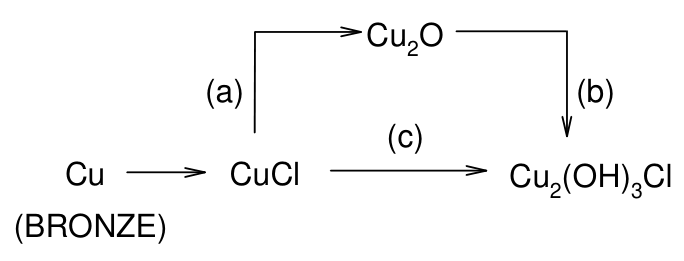
Using the molar standard formation Gibbs free energies of the species concerned answer the following questions:
Species \(\ce{Cu2O(s)}\) \(\ce{CuO(s)}\) \(\ce{CuCl(s)}\) \(\ce{Cu2(OH)3Cl(s)}\) \(\ce{Cl(aq)}\) \(\ce{OH(aq)}\) \(\ce{H2O(l)}\) \(\Delta_{\mathrm f}G^0(298\ \mathrm K)\;(\mathrm{kJ\,mol^{-1}})\) −146 −130 −120 −1338 −131 −157 −237 i) Write balanced equations for reactions (a), (b) and (c).
ii) Calculate the molar standard Gibbs free energy \(\Delta_{\mathrm f}G^0(298\ \mathrm K)\) for reactions (a), (b) and (c).
iii) Decide the spontaneous direction of reaction (a) in air through calculation, when \(T=298\mathrm K\), \(c(\ce{HCl})=1.0\times10^{-4}\ \mathrm{mol\,dm^{-3}}\).
1.2 Rate constants \(k_c\) for reaction (c) were measured at various temperatures in a simulation experiment in order to obtain its kinetic parameters. On the basis of the data given below answer the following questions:
\(t\;^\circ\mathrm C\) 25 40 \(k_c\,/\,\mathrm{mol\,dm^{-3}\,s^{-1}}\) \(1.29\times10^{-4}\) \(2.50\times10^{-4}\) i) Write the equation for calculating the activation energy of reaction (c) and find the value.
ii) Assign the overall reaction order of reaction (c).
iii) Knowing that the rate determining step of reaction (c) is the monolayer adsorption of \(\ce{O2(g)}\) on solid \(\ce{CuCl}\), write the overall rate equation of this heterogeneous reaction (c). Under what condition might the reaction order be the same as that you have given in ii)? Assume only \(\ce{O2}\) can be adsorbed.
1.3 A copper plate was divided into two parts, \(\ce{Cu}(1)\) and \(\ce{Cu}(2)\). \(\ce{Cu}(1)\) was then hammered so that \(\ce{Cu}(1)\) and \(\ce{Cu}(2)\) are different in certain thermodynamic properties.
i) An galvanic cell with \(\ce{Cu}(1)\) and \(\ce{Cu}(2)\) was designed as \(\ce{Cu}(1)|\ce{CuSO4(aq)}|\ce{Cu}(2)\) and the electromotive force \(E\) of the above cell was expressed as \(E=\Phi_{\mathrm R}-\Phi_{\mathrm L}\), where \(\Phi_{\mathrm R}\) and \(\Phi_{\mathrm L}\) being the right and left electrode potentials (i. e. half-cell potentials), respectively. Please choose the correct \(E\) value from the following and give the thermodynamic reason for your choice.
(A) \(E<0\) (B) \(E=0\) (C) \(E>0\) (D) It cannot be decided
ii) Write the net cell reaction for the cell.
1.4 In a \(\ce{Cu-Zn}\) alloy the molar fractions of \(\ce{Cu}\) and \(\ce{Zn}\) are 0.750 and 0.250, respectively. The structure type of the alloy is the same as that of pure copper, except \(\ce{Zn}\) atoms substitute some \(\ce{Cu}\) atoms randomly and statistically, i. e. at every atomic position, the probability of the occupation of \(\ce{Cu}\) and \(\ce{Zn}\) is proportional to the composition of the alloy. In this sense the alloy can be considered as composed of statistical atoms \(\ce{Cu_{x}Zn_{1-x}}\). X-ray analysis shows that the arrangement of atoms in the alloy is of the cubic face-centred close packing type. Density of the alloy \(d=8.51\ \mathrm{g\,cm^{-3}}\). Calculate the radius of the statistical atoms in the alloy.
Given: \(A_{\mathrm r}(\ce{Cu})=63.5,\quad A_{\mathrm r}(\ce{Zn})=65.4\).
Official English text of the problem.
Problem 2: Nitrate in milk serum: ion-selective electrode
To control the quality of milk serum, a dairy by-product, the concentration of \(\ce{NO3-}\) ion in serum is monitored by means of an ion selective electrode. Generally there is about 15 mg \(\ce{NO3-}\) ion per litre in serum, measured on the basis of nitrogen mass.
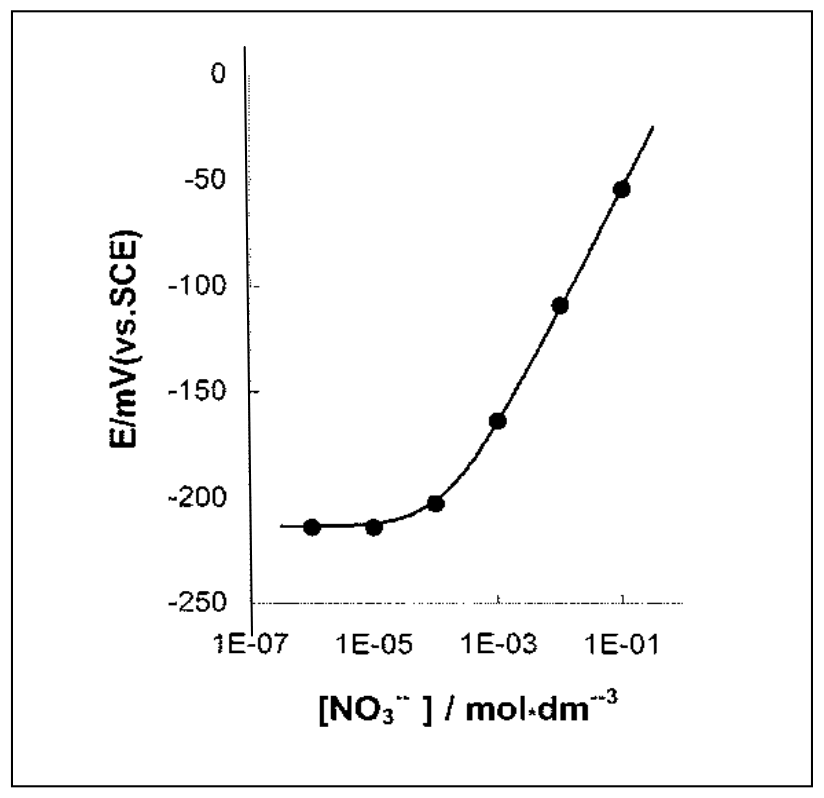
2.1 For a nitrate ion selective electrode a calibration curve as shown below was obtained using a series of standard nitrate solutions containing \(0.5\ \mathrm{mol\,dm^{-3}}\) \(\ce{K2SO4}\), \(1.0\times10^{-3}\ \mathrm{mol\,dm^{-3}}\) \(\ce{H2SO4}\) and \(2.6\times10^{-3}\ \mathrm{mol\,dm^{-3}}\) \(\ce{Cl-}\) ion as the background. Decide whether it is feasible to measure concentration \(\ce{NO3-}\) in serum under the above conditions.
2.2 Given are selective coefficients of \(\ce{Cl-}\), \(\ce{SO4^2-}\) and \(\ce{ClO4-}\) versus \(\ce{NO3-}\) as follow
\[ K_{\ce{NO3-},\ce{Cl-}} =\frac{c_{\ce{NO3-}}}{c_{\ce{Cl-}}} =4.9\times10^{-2} \qquad K_{\ce{NO3-},\ce{SO4^2-}} =\frac{c_{\ce{NO3-}}}{c_{\ce{SO4^2-}}^{1/2}} =4.1\times10^{-3} \]
\[ K_{\ce{NO3-},\ce{ClO4-}} =\frac{c_{\ce{NO3-}}}{c_{\ce{ClO4-}}} =1.0\times10^{-3} \]
where the units of the concentrations are in \(\mathrm{mol\,dm^{-3}}\) which is the best to reduce the interference of \(\ce{Cl-}\) to \(\ce{NO3-}\) determination, so as to control the error in the \(\ce{NO3-}\) concentration within 1 %, when there are \(1.40\times10^{-3}\ \mathrm{mol\,dm^{-3}}\) \(\ce{NO3-}\) and \(1.60\times10^{-2}\ \mathrm{mol\,dm^{-3}}\) \(\ce{Cl-}\) in serum:
\[ \text{(a)}\quad\ce{AgNO3} \qquad \text{(b)}\quad\ce{Ag2SO4} \qquad \text{(c)}\quad\ce{AgClO4} \]
Calculate the amount of the salt that should be added to \(1\ \mathrm{dm^3}\) of the sample solution to be measured.
2.3 The \(\ce{NO3-}\) ion concentration was determined by this method at 298 K. For \(25.00\ \mathrm{cm^3}\) sample solution the electronic potential, \(E\), is measured to be \(-160\ \mathrm{mV}\). After adding \(1.00\ \mathrm{cm^3}\) \(1.00\times10^{-3}\ \mathrm{mol\,dm^{-3}}\) \(\ce{NO3-}\) standard solution to the above solution, \(E\) changes to \(-130\ \mathrm{mV}\). Find the \(\mathrm{pNO_3}\) of the serum.
2.4 The selective coefficient of \(\ce{CH3COO-}\) versus \(\ce{NO3-}\), \(K(\ce{NO3-}/\ce{CH3COO-})=2.7\times10^{-3}\). If \(\ce{AgCH3COO}\) instead of \(\ce{Ag2SO4}\) is added to the sample solution of question 2.2, find the upper limit of the pH value below which the same requirement in question 2.2 can be met.
\[ K_{\mathrm{sp}}(\ce{AgCl})=3.2\times10^{-10} \qquad K_{\mathrm{sp}}(\ce{Ag2SO4})=8.0\times10^{-5} \]
\[ K_{\mathrm{sp}}(\ce{AgCH3COO})=8.0\times10^{-3} \qquad K_a(\ce{CH3COOH})=2.2\times10^{-5} \]
\[ A_{\mathrm r}(\ce{N})=14.00 \]
Official English text of the problem.
Problem 3: Glyceraldehyde and its cyclic dimer
1,3-Dihydroxyacetone can be converted to glyceraldehyde. On standing this glyceraldehyde changes spontaneously into a six member cyclic dimer \(\ce{C6H12O6}\). The infrared spectrum of the dimer shows no absorption peak between 1600 – 1800 \(\mathrm{cm^{-1}}\) and the dipole moment of the dimer is determined to be zero.
3.1 Write the Fischer projection structural formula(e) for the resulting glyceraldehyde and indicate configuration using D(+) and/or L(-).
3.2 Write the structural formula for the reaction intermediate of the conversion of 1,3-dihydroxyacetone to glyceraldehyde.
3.3 Write the structural formula for the dimer.
3.4 Using Haworth projection formula represent the possible stereoisomers which fit the dipole moment data.
3.5 Denote each chiral carbon atom in the above formulae with \(R\) or \(S\).
Official English text of the problem.
Problem 4: Bacterial poly(3-hydroxyalkanoic acids)
Poly[(R)-3-hydroxyalkanoic acids], PHAs, are synthesized by a variety of bacteria and function as intracellular carbon and energy storage materials. These polymers are also biodegradable in environments, such as soil, anaerobic sewage and sea water. The inherent biologically mediated environmental degradability, useful physical properties, slow hydrolytic degradation and other favourable properties make bacterial polyesters exciting materials for both disposable biodegradable plastics (good for a clean environment) and special medical products.
4.1 PHB, Poly(3-hydroxybutanoic acid), produced by bacteria contains only (R)-HB repeating units, while that synthesized by polymer chemists may contain only (R)-HB or only (S)-HB or both (R)-and (S)-HB in an alternating manner or both but in random distributions. Sketch chain structures of the atactic PHB, syndiotactic PHB and isotactic PHBs and denote each chiral carbon with (R) or (S). Five monomeric units are enough for each chain.
{Note: In "PHB", P means "poly" or "polymer of, HB represents the monomeric units contained in poly(3-hydroxybutanoic acid) molecules.)
4.2 Suggest two types of monomers that could be used for polymer chemists to synthesize a PHB, regardless of the stereochemistry of the products.
4.3 Poly[(R)-3-hydroxybutanoic acid] can be synthesized by feeding the bacteria (such as Alcaligenes Eutrophus) with sodium acetate in a nitrogen-free media. It is believed that the key steps for the conversion of acetate to PHB are the activation of acetate molecules by coenzyme A and the subsequent formation of the coenzyme A activated acetoacetate, which is then reduced by a reductase to form coenzyme A activated monomer 3-hydroxybutyrate. Polymerization of the monomer is achieved by a polymerase which would build the polymer molecules with unique stereospecificity. Sketch these steps with structural formulae. For coenzyme A the conventional abbreviation, -S-CoA (-CoA is as good), should be used in the sketch.
4.4 If sodium propanoate is used (as the sole carbon source) in the feeding media instead of sodium acetate, the principal product will be a copolymer of 3-hydroxybutanoic acid and 3-hydroxypentanoic acid with the following generalized structure:

Rationalize the result.
(Note: Two different monomers are needed for the formation of the copolymer. The letters m and n in the structural formula are numbers of the units and have nothing to do with the answer, in other words, you may leave them out in your answer.)
Official English text of the problem.
Problem 5: Nitric oxide in biology and iron-sulphur nitrosyl complexes
The action of nitric oxide upon human body is dual. The nitric oxide generated in nerve cells will damage the cells, while the nitric oxide generated in endothelial cells of blood vessels can relax the vessels and control blood pressure.
5.1 Indicate the highest occupied molecular orbital (HOMO) and the lowest unoccupied molecular orbital (LUMO) of \(\ce{NO}\) molecule using one of symbols \(\pi\), \(\sigma\), \(\pi^*\) or \(\sigma^*\), and indicate the electron(s) residing in the corresponding orbital using symbols \(\uparrow\) and/or \(\downarrow\).
5.2 The relaxation of blood vessels is caused by a series of changes which are mediated by the coordination of \(\ce{NO}\) molecule to iron ion, the latter being a component of an enzyme containing heme. It was known that the coordinated \(\ce{NO}\) behaves as \(\ce{CO}\) molecule (isoelectronic), which one of the following species really exists in the iron complex?
a) \(\ce{NO}\) b) \(\ce{NO+}\) c) \(\ce{NO-}\)
5.3 The cell damage is caused by free radical \(\ce{OH}\), which is one of the product of reaction between \(\ce{O2-}\) and \(\ce{NO}\):

in which an intermediate with composition of \(\ce{HOONO}\) is evolved. \(\ce{HOONO}\) is a weak acid. Choose the structural formula with correct bond angles for the intermediate.

5.4 For preservation of meat, sodium nitrite is usually added and as a result \(\ce{NO}\) is, then, formed. Consequently, \(\ce{NO}\) reacts with the sulphur and iron atoms from decomposition of proteins, forming \(\ce{[Fe4S3(NO)7]-}\). The complex anion is bacteriostatic and antiseptic. X-ray crystallography shows that the complex anion has a structure as shown below:
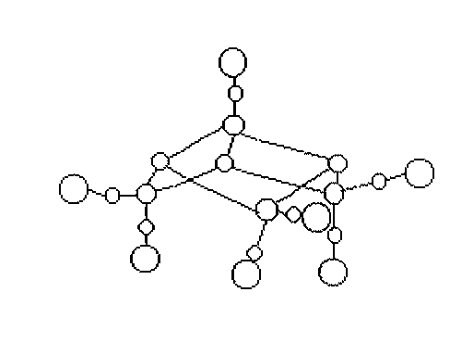
i) Blacken all the circles corresponding to iron atoms and add symbols Fe(A), Fe(B), Fe(C) and Fe(D) beside the circles in the sequence of top \(\rightarrow\) left \(\rightarrow\) right.
ii) The configuration of \(3d\) electron shell of the iron atoms has been studied with modern structural analysis. Knowing that the mean oxidation number of the four iron atoms is \(-0.5\), give their configurations of \(3d\) shell, respectively. Assume that each iron atom adopt \(sp\) hybridization.
5.5 \(\ce{[Fe4S3(NO)7]-}\) anion can be reduced and a new complex \(\ce{[Fe2S2(NO)4]^2-}\) is formed which contains a cyclic structure unit of \(\ce{Fe2S2}\).
i) Write the structural formula for the anion \(\ce{[Fe2S2(NO)4]^2-}\).
ii) Give the oxidation state of each iron atom with Arabic numerals.
iii) \(\ce{[Fe2S2(NO)4]^2-}\) can be converted into \(\ce{[Fe2(SCH3)2(NO)4]^n}\), a carcinogen. Which of the following three species is added to \(\ce{[Fe2S2(NO)4]^2-}\): \(\ce{CH3+}\), \(\ce{^{\bullet}CH3}\) or \(\ce{CH3-}\)? Assign the value of \(n\).
Official English text of the problem.
Problem 6: The surfactant AOT and micellar extraction of proteins
A surfactant molecule can generally be modelled as Fig. 1 where a circle presents the polar head (PH), i.e. the hydrophilic part of the molecule, and a rectangle represents the non-polar tail (NT), i. e. the hydrophobic part of the molecule.
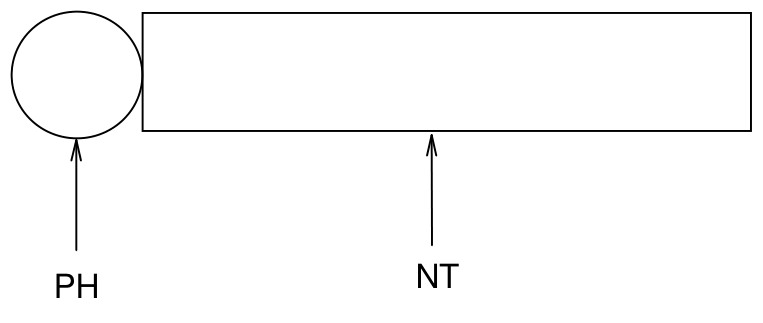
Fig. 1
6.1 AOT is a surfactant. Its systematic name (IUPAC name) is sulfobutanedioic acid 1,4-bis-(2-ethylhexyl) ester sodium salt (formula \(\ce{C20H37NaO7S}\)).
i) Write the structural formula for AOT and fill its PH and NT in the circle and rectangle on your answer sheet.
ii) Choose the type of surfactant AOT among the following.
a) Non-ionic; b) Anionic; c) Cationic; d) Others.
6.2 Mixing an aqueous solution of 50 mmol AOT with isooctane (volume ratio 1 : 1), a micellar extraction system will be formed in the isooctane phase (organic phase).
i) Using the model as shown in Fig. 1, draw a micelle with 10 AOT molecules under the given condition.
ii) What species are in the inner cavity of this micelle? Write their chemical formulas.
6.3 There is an aqueous solution containing the proteins as listed below:
Protein Molecular mass (\(M_r\))\(\times10^4\) Isoelectronic point (PI) A 1.45 11.1 B 1.37 7.8 C 6.45 4.9 D 6.80 4.9 E 2.40 4.7 F 2.38 0.5 The separation of proteins can be performed by mixing the AOT micellar extraction system with the solution. Adjusting the \(pH\) value of the solution to 4.5, only three of the above listed six proteins can be extracted into the micelles. Which proteins will be extracted?
6.4 The three proteins entered into the micelles will be separated from each other by the following procedure shown as in Fig. 2. Each extracted protein can be sequentially transported into a respective water phase.
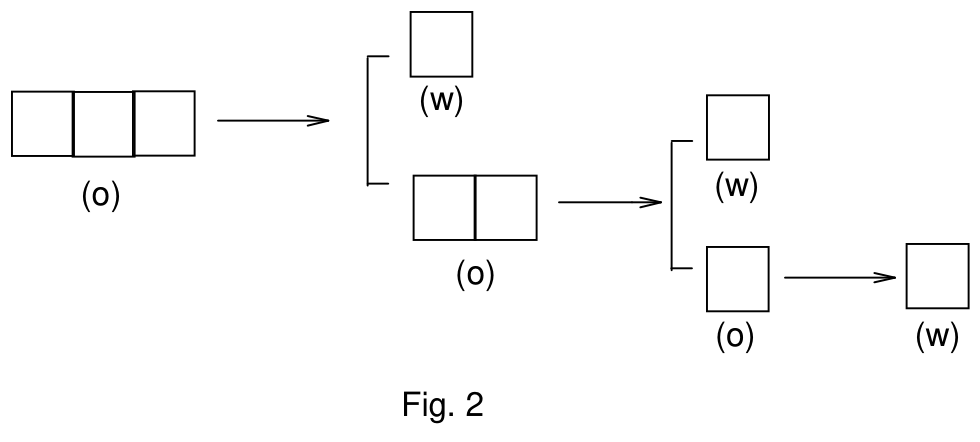
Fig. 2
Note: (w) represents water phase; (o) represents organic phase
Fill the three extracted proteins in the left boxes first and then separate them by the procedure given, and give the separation conditions above each arrow as well.
Official English text of the problem.
Internationale Chemie-Olympiade
IChO 1995
Peking, China · 6 Theorieaufgaben mit vollständigen Lösungen
Aufgabe 1: Korrosion antiker Bronze und einer Cu-Zn-Legierung
1.1 Ein ausgegrabenes antikes chinesisches Musikinstrument aus Bronze, ein Glockenspiel, war vollständig mit Rost bedeckt. Eine chemische Analyse ergab, dass der Rost \(\ce{CuCl}\), \(\ce{Cu2O}\) und \(\ce{Cu2(OH)3Cl}\) enthält. Simulationsexperimente zeigten, dass sich unter der gemeinsamen Einwirkung von Luft und einer \(\ce{Cl}\)-haltigen wässrigen Lösung zunächst \(\ce{CuCl}\) bildete und anschließend \(\ce{Cu2(OH)3Cl}\) auf den folgenden zwei unterschiedlichen Wegen entstand:
Beantworten Sie anhand der molaren Standard-Gibbs-Bildungsenergien der beteiligten Spezies die folgenden Fragen:
Spezies \(\ce{Cu2O(s)}\) \(\ce{CuO(s)}\) \(\ce{CuCl(s)}\) \(\ce{Cu2(OH)3Cl(s)}\) \(\ce{Cl(aq)}\) \(\ce{OH(aq)}\) \(\ce{H2O(l)}\) \(\Delta_{\mathrm f}G^0(298\ \mathrm K)\;(\mathrm{kJ\,mol^{-1}})\) −146 −130 −120 −1338 −131 −157 −237 i) Stellen Sie die ausgeglichenen Gleichungen für die Reaktionen (a), (b) und (c) auf.
ii) Berechnen Sie die molare Standard-Gibbs-Energie \(\Delta_{\mathrm f}G^0(298\ \mathrm K)\) für die Reaktionen (a), (b) und (c).
iii) Bestimmen Sie durch Berechnung die spontane Reaktionsrichtung der Reaktion (a) an Luft bei \(T=298\mathrm K\), \(c(\ce{HCl})=1.0\times10^{-4}\ \mathrm{mol\,dm^{-3}}\).
1.2 In einem Simulationsexperiment wurden die Geschwindigkeitskonstanten \(k_c\) der Reaktion (c) bei verschiedenen Temperaturen gemessen, um ihre kinetischen Parameter zu bestimmen. Beantworten Sie anhand der folgenden Daten die nachstehenden Fragen:
\(t\;^\circ\mathrm C\) 25 40 \(k_c\,/\,\mathrm{mol\,dm^{-3}\,s^{-1}}\) \(1.29\times10^{-4}\) \(2.50\times10^{-4}\) i) Geben Sie die Gleichung zur Berechnung der Aktivierungsenergie der Reaktion (c) an und bestimmen Sie deren Wert.
ii) Geben Sie die Gesamtreaktionsordnung der Reaktion (c) an.
iii) Der geschwindigkeitsbestimmende Schritt der Reaktion (c) ist die Adsorption von \(\ce{O2(g)}\) in einer Monoschicht auf festem \(\ce{CuCl}\). Stellen Sie unter dieser Voraussetzung das Gesamtgeschwindigkeitsgesetz dieser heterogenen Reaktion (c) auf. Unter welcher Bedingung könnte die Reaktionsordnung mit der von Ihnen in ii) angegebenen übereinstimmen? Nehmen Sie an, dass nur \(\ce{O2}\) adsorbiert werden kann.
1.3 Eine Kupferplatte wurde in zwei Teile, \(\ce{Cu}(1)\) und \(\ce{Cu}(2)\), geteilt. Anschließend wurde \(\ce{Cu}(1)\) gehämmert, sodass sich \(\ce{Cu}(1)\) und \(\ce{Cu}(2)\) in bestimmten thermodynamischen Eigenschaften unterscheiden.
i) Eine galvanische Zelle mit \(\ce{Cu}(1)\) und \(\ce{Cu}(2)\) wurde gemäß \(\ce{Cu}(1)|\ce{CuSO4(aq)}|\ce{Cu}(2)\) aufgebaut. Die elektromotorische Kraft \(E\) dieser Zelle wurde als \(E=\Phi_{\mathrm R}-\Phi_{\mathrm L}\) ausgedrückt, wobei \(\Phi_{\mathrm R}\) und \(\Phi_{\mathrm L}\) das rechte bzw. linke Elektrodenpotential (d. h. Halbzellenpotential) sind. Wählen Sie aus den folgenden Möglichkeiten den richtigen Wert für \(E\) aus und begründen Sie Ihre Wahl thermodynamisch.
(A) \(E<0\) (B) \(E=0\) (C) \(E>0\) (D) Es lässt sich nicht entscheiden
ii) Geben Sie die Nettoreaktion der Zelle an.
1.4 In einer \(\ce{Cu-Zn}\)-Legierung betragen die Stoffmengenanteile von \(\ce{Cu}\) und \(\ce{Zn}\) 0.750 bzw. 0.250. Der Strukturtyp der Legierung ist derselbe wie der von reinem Kupfer, mit dem Unterschied, dass \(\ce{Zn}\)-Atome einige \(\ce{Cu}\)-Atome zufällig und statistisch ersetzen; d. h., an jeder Atomposition ist die Wahrscheinlichkeit der Besetzung durch \(\ce{Cu}\) bzw. \(\ce{Zn}\) proportional zur Zusammensetzung der Legierung. In diesem Sinne kann die Legierung als aus statistischen Atomen \(\ce{Cu_{x}Zn_{1-x}}\) aufgebaut betrachtet werden. Eine Röntgenstrukturanalyse zeigt, dass die Atome in der Legierung in einer kubisch flächenzentrierten dichtesten Packung angeordnet sind. Die Dichte der Legierung beträgt \(d=8.51\ \mathrm{g\,cm^{-3}}\). Berechnen Sie den Radius der statistischen Atome in der Legierung.
Gegeben: \(A_{\mathrm r}(\ce{Cu})=63.5,\quad A_{\mathrm r}(\ce{Zn})=65.4\).
Aufgabentext aus dem offiziellen englischen Text übersetzt.
Aufgabe 2: Nitrat in Milchserum: ionenselektive Elektrode
Zur Qualitätskontrolle von Milchserum, einem Nebenprodukt der Milchverarbeitung, wird die Konzentration der \(\ce{NO3-}\)-Ionen im Serum mithilfe einer ionenselektiven Elektrode überwacht. Im Allgemeinen enthält Serum etwa 15 mg \(\ce{NO3-}\)-Ionen pro Liter, bezogen auf die Stickstoffmasse.
2.1 Für eine nitratselektive Elektrode wurde die unten dargestellte Kalibrierkurve mithilfe einer Reihe von Nitratstandardlösungen aufgenommen, die als Hintergrundelektrolyt \(0.5\ \mathrm{mol\,dm^{-3}}\) \(\ce{K2SO4}\), \(1.0\times10^{-3}\ \mathrm{mol\,dm^{-3}}\) \(\ce{H2SO4}\) und \(2.6\times10^{-3}\ \mathrm{mol\,dm^{-3}}\) \(\ce{Cl-}\)-Ionen enthielten. Entscheiden Sie, ob es unter den oben genannten Bedingungen möglich ist, die Konzentration von \(\ce{NO3-}\) im Serum zu messen.
2.2 Die Selektivitätskoeffizienten von \(\ce{Cl-}\), \(\ce{SO4^2-}\) und \(\ce{ClO4-}\) gegenüber \(\ce{NO3-}\) sind wie folgt gegeben:
\[ K_{\ce{NO3-},\ce{Cl-}} =\frac{c_{\ce{NO3-}}}{c_{\ce{Cl-}}} =4.9\times10^{-2} \qquad K_{\ce{NO3-},\ce{SO4^2-}} =\frac{c_{\ce{NO3-}}}{c_{\ce{SO4^2-}}^{1/2}} =4.1\times10^{-3} \]
\[ K_{\ce{NO3-},\ce{ClO4-}} =\frac{c_{\ce{NO3-}}}{c_{\ce{ClO4-}}} =1.0\times10^{-3} \]
Dabei werden die Konzentrationen in \(\mathrm{mol\,dm^{-3}}\) angegeben. Welches der folgenden Salze eignet sich am besten, um die Störung der \(\ce{NO3-}\)-Bestimmung durch \(\ce{Cl-}\) so weit zu verringern, dass der Fehler der \(\ce{NO3-}\)-Konzentration höchstens 1 % beträgt, wenn das Serum \(1.40\times10^{-3}\ \mathrm{mol\,dm^{-3}}\) \(\ce{NO3-}\) und \(1.60\times10^{-2}\ \mathrm{mol\,dm^{-3}}\) \(\ce{Cl-}\) enthält:
\[ \text{(a)}\quad\ce{AgNO3} \qquad \text{(b)}\quad\ce{Ag2SO4} \qquad \text{(c)}\quad\ce{AgClO4} \]
Berechnen Sie die Menge des Salzes, die zu \(1\ \mathrm{dm^3}\) der zu messenden Probelösung gegeben werden sollte.
2.3 Die Konzentration der \(\ce{NO3-}\)-Ionen wurde mit dieser Methode bei 298 K bestimmt. Für \(25.00\ \mathrm{cm^3}\) Probelösung wird das elektrische Potential \(E\) zu \(-160\ \mathrm{mV}\) gemessen. Nach Zugabe von \(1.00\ \mathrm{cm^3}\) einer \(1.00\times10^{-3}\ \mathrm{mol\,dm^{-3}}\) \(\ce{NO3-}\)-Standardlösung zu dieser Lösung ändert sich \(E\) auf \(-130\ \mathrm{mV}\). Bestimmen Sie den \(\mathrm{pNO_3}\)-Wert des Serums.
2.4 Der Selektivitätskoeffizient von \(\ce{CH3COO-}\) gegenüber \(\ce{NO3-}\) beträgt \(K(\ce{NO3-}/\ce{CH3COO-})=2.7\times10^{-3}\). Wenn der Probelösung aus Teilaufgabe 2.2 anstelle von \(\ce{Ag2SO4}\) \(\ce{AgCH3COO}\) zugesetzt wird, bestimmen Sie die obere Grenze des pH-Werts, unterhalb derer dieselbe Anforderung wie in Teilaufgabe 2.2 erfüllt werden kann.
\[ K_{\mathrm{sp}}(\ce{AgCl})=3.2\times10^{-10} \qquad K_{\mathrm{sp}}(\ce{Ag2SO4})=8.0\times10^{-5} \]
\[ K_{\mathrm{sp}}(\ce{AgCH3COO})=8.0\times10^{-3} \qquad K_a(\ce{CH3COOH})=2.2\times10^{-5} \]
\[ A_{\mathrm r}(\ce{N})=14.00 \]
Aufgabentext aus dem offiziellen englischen Text übersetzt.
Aufgabe 3: Glycerinaldehyd und sein cyclisches Dimer
1,3-Dihydroxyaceton kann in Glycerinaldehyd umgewandelt werden. Beim Stehenlassen wandelt sich dieser Glycerinaldehyd spontan in ein sechsgliedriges cyclisches Dimer \(\ce{C6H12O6}\) um. Das Infrarotspektrum des Dimers zeigt keine Absorptionsbande zwischen 1600 – 1800 \(\mathrm{cm^{-1}}\), und das Dipolmoment des Dimers wird zu null bestimmt.
3.1 Geben Sie die Strukturformel(n) des entstehenden Glycerinaldehyds in der Fischer-Projektion an und kennzeichnen Sie die Konfiguration mit D(+) und/oder L(-).
3.2 Geben Sie die Strukturformel des Reaktionszwischenprodukts bei der Umwandlung von 1,3-Dihydroxyaceton in Glycerinaldehyd an.
3.3 Geben Sie die Strukturformel des Dimers an.
3.4 Stellen Sie mithilfe der Haworth-Projektion die möglichen Stereoisomere dar, die mit den Angaben zum Dipolmoment vereinbar sind.
3.5 Kennzeichnen Sie jedes chirale Kohlenstoffatom in den obigen Formeln mit \(R\) oder \(S\).
Aufgabentext aus dem offiziellen englischen Text übersetzt.
Aufgabe 4: Bakterielle Poly(3-hydroxyalkansäuren)
Poly[(R)-3-hydroxyalkansäuren], PHAs, werden von einer Vielzahl von Bakterien synthetisiert und dienen als intrazelluläre Kohlenstoff- und Energiespeicher. Diese Polymere sind auch in Umgebungen wie Böden, anaeroben Abwässern und Meerwasser biologisch abbaubar. Die ihnen eigene biologisch vermittelte Abbaubarkeit in der Umwelt, nützliche physikalische Eigenschaften, langsamer hydrolytischer Abbau und weitere günstige Eigenschaften machen bakterielle Polyester zu vielversprechenden Materialien sowohl für biologisch abbaubare Einwegkunststoffe (gut für eine saubere Umwelt) als auch für spezielle Medizinprodukte.
4.1 PHB, Poly(3-hydroxybutansäure), das von Bakterien produziert wird, enthält ausschließlich (R)-HB-Wiederholungseinheiten, während das von Polymerchemikern synthetisierte PHB ausschließlich (R)-HB oder ausschließlich (S)-HB oder sowohl (R)- als auch (S)-HB in alternierender Anordnung oder beide in zufälliger Verteilung enthalten kann. Skizzieren Sie die Kettenstrukturen von ataktischem PHB, syndiotaktischem PHB und isotaktischen PHBs und kennzeichnen Sie jedes chirale Kohlenstoffatom mit (R) oder (S). Fünf Monomereinheiten reichen für jede Kette aus.
{Hinweis: In „PHB“ bedeutet P „Poly“ oder „Polymer aus“, HB bezeichnet die in Poly(3-hydroxybutansäure)-Molekülen enthaltenen Monomereinheiten.)
4.2 Schlagen Sie zwei Monomertypen vor, die Polymerchemiker zur Synthese eines PHB verwenden könnten, unabhängig von der Stereochemie der Produkte.
4.3 Poly[(R)-3-hydroxybutansäure] kann synthetisiert werden, indem man Bakterien (wie Alcaligenes Eutrophus) in einem stickstofffreien Medium mit Natriumacetat versorgt. Man nimmt an, dass die entscheidenden Schritte bei der Umwandlung von Acetat in PHB die Aktivierung der Acetatmoleküle durch Coenzym A und die anschließende Bildung von durch Coenzym A aktiviertem Acetoacetat sind, das dann durch eine Reduktase zum durch Coenzym A aktivierten Monomer 3-Hydroxybutyrat reduziert wird. Die Polymerisation des Monomers erfolgt durch eine Polymerase, die die Polymermoleküle mit eindeutiger Stereospezifität aufbaut. Skizzieren Sie diese Schritte mit Strukturformeln. Für Coenzym A sollte in der Skizze die übliche Abkürzung -S-CoA (-CoA ist ebenso zulässig) verwendet werden.
4.4 Wird im Nährmedium anstelle von Natriumacetat Natriumpropanoat (als einzige Kohlenstoffquelle) verwendet, so ist das Hauptprodukt ein Copolymer aus 3-Hydroxybutansäure und 3-Hydroxypentansäure mit der folgenden allgemeinen Struktur:
Begründen Sie dieses Ergebnis.
(Hinweis: Für die Bildung des Copolymers werden zwei verschiedene Monomere benötigt. Die Buchstaben m und n in der Strukturformel geben die Anzahlen der Einheiten an und haben mit der Antwort nichts zu tun; mit anderen Worten, Sie können sie in Ihrer Antwort weglassen.)
Aufgabentext aus dem offiziellen englischen Text übersetzt.
Aufgabe 5: Stickstoffmonoxid in der Biologie und Eisen-Schwefel-Nitrosylkomplexe
Stickstoffmonoxid hat eine zweifache Wirkung auf den menschlichen Körper. Das in Nervenzellen gebildete Stickstoffmonoxid schädigt die Zellen, während das in den Endothelzellen der Blutgefäße gebildete Stickstoffmonoxid die Gefäße entspannen und den Blutdruck regulieren kann.
5.1 Geben Sie das höchste besetzte Molekülorbital (HOMO) und das niedrigste unbesetzte Molekülorbital (LUMO) des \(\ce{NO}\)-Moleküls mithilfe eines der Symbole \(\pi\), \(\sigma\), \(\pi^*\) oder \(\sigma^*\) an und kennzeichnen Sie das Elektron bzw. die Elektronen im jeweiligen Orbital mit den Symbolen \(\uparrow\) und/oder \(\downarrow\).
5.2 Die Entspannung der Blutgefäße wird durch eine Reihe von Veränderungen verursacht, die durch die Koordination des \(\ce{NO}\)-Moleküls an ein Eisenion vermittelt werden; dieses ist Bestandteil eines hämhaltigen Enzyms. Es war bekannt, dass sich das koordinierte \(\ce{NO}\) wie ein \(\ce{CO}\)-Molekül verhält (isoelektronisch). Welche der folgenden Spezies liegt tatsächlich im Eisenkomplex vor?
a) \(\ce{NO}\) b) \(\ce{NO+}\) c) \(\ce{NO-}\)
5.3 Die Zellschädigung wird durch das freie Radikal \(\ce{OH}\) verursacht, das eines der Produkte der Reaktion zwischen \(\ce{O2-}\) und \(\ce{NO}\) ist:
Dabei entsteht ein Zwischenprodukt mit der Zusammensetzung \(\ce{HOONO}\). \(\ce{HOONO}\) ist eine schwache Säure. Wählen Sie die Strukturformel mit den richtigen Bindungswinkeln für das Zwischenprodukt aus.
5.4 Zur Konservierung von Fleisch wird üblicherweise Natriumnitrit zugesetzt, wodurch anschließend \(\ce{NO}\) entsteht. Daraufhin reagiert \(\ce{NO}\) mit den beim Abbau von Proteinen freigesetzten Schwefel- und Eisenatomen unter Bildung von \(\ce{[Fe4S3(NO)7]-}\). Das Komplexanion wirkt bakteriostatisch und antiseptisch. Die Röntgenstrukturanalyse zeigt, dass das Komplexanion die nachstehend dargestellte Struktur aufweist:
i) Schwärzen Sie alle Kreise, die Eisenatomen entsprechen, und schreiben Sie die Symbole Fe(A), Fe(B), Fe(C) und Fe(D) neben die Kreise in der Reihenfolge oben \(\rightarrow\) links \(\rightarrow\) rechts.
ii) Die Konfiguration der \(3d\)-Elektronenschale der Eisenatome wurde mit modernen Methoden der Strukturanalyse untersucht. Geben Sie unter Berücksichtigung der Tatsache, dass die mittlere Oxidationszahl der vier Eisenatome \(-0.5\) beträgt, ihre jeweiligen Konfigurationen der \(3d\)-Schale an. Nehmen Sie an, dass jedes Eisenatom eine \(sp\)-Hybridisierung aufweist.
5.5 Das \(\ce{[Fe4S3(NO)7]-}\)-Anion kann reduziert werden, wobei ein neuer Komplex \(\ce{[Fe2S2(NO)4]^2-}\) entsteht, der eine cyclische Struktureinheit \(\ce{Fe2S2}\) enthält.
i) Geben Sie die Strukturformel des Anions \(\ce{[Fe2S2(NO)4]^2-}\) an.
ii) Geben Sie die Oxidationszahl jedes Eisenatoms mit arabischen Ziffern an.
iii) \(\ce{[Fe2S2(NO)4]^2-}\) kann in \(\ce{[Fe2(SCH3)2(NO)4]^n}\), eine krebserregende Verbindung, umgewandelt werden. Welche der folgenden drei Spezies wird zu \(\ce{[Fe2S2(NO)4]^2-}\) hinzugefügt: \(\ce{CH3+}\), \(\ce{^{\bullet}CH3}\) oder \(\ce{CH3-}\)? Bestimmen Sie den Wert von \(n\).
Aufgabentext aus dem offiziellen englischen Text übersetzt.
Aufgabe 6: Das Tensid AOT und die mizellare Extraktion von Proteinen
Ein Tensidmolekül lässt sich im Allgemeinen wie in Abb. 1 modellhaft darstellen, wobei ein Kreis den polaren Kopf (PH), d. h. den hydrophilen Teil des Moleküls, und ein Rechteck den unpolaren Schwanz (NT), d. h. den hydrophoben Teil des Moleküls, darstellt.
Abb. 1
6.1 AOT ist ein Tensid. Sein systematischer Name (IUPAC-Name) lautet Sulfobutandisäure-1,4-bis(2-ethylhexyl)ester-Natriumsalz (Formel \(\ce{C20H37NaO7S}\)).
i) Geben Sie die Strukturformel von AOT an und tragen Sie seinen PH und NT in den Kreis bzw. das Rechteck auf Ihrem Antwortblatt ein.
ii) Wählen Sie aus den folgenden Tensidtypen denjenigen aus, zu dem AOT gehört.
a) Nichtionisch; b) Anionisch; c) Kationisch; d) Sonstige.
6.2 Beim Mischen einer wässrigen Lösung von 50 mmol AOT mit Isooctan (Volumenverhältnis 1 : 1) entsteht in der Isooctanphase (organischen Phase) ein mizellares Extraktionssystem.
i) Zeichnen Sie anhand des in Abb. 1 dargestellten Modells eine Mizelle aus 10 AOT-Molekülen unter den gegebenen Bedingungen.
ii) Welche Spezies befinden sich im inneren Hohlraum dieser Mizelle? Geben Sie ihre chemischen Formeln an.
6.3 Es liegt eine wässrige Lösung vor, die die nachstehend aufgeführten Proteine enthält:
Protein Molekülmasse (\(M_r\))\(\times10^4\) Isoelektronischer Punkt (PI) A 1.45 11.1 B 1.37 7.8 C 6.45 4.9 D 6.80 4.9 E 2.40 4.7 F 2.38 0.5 Die Trennung der Proteine kann durch Mischen des mizellaren AOT-Extraktionssystems mit der Lösung erfolgen. Wird der \(pH\)-Wert der Lösung auf 4.5 eingestellt, können nur drei der sechs oben aufgeführten Proteine in die Mizellen extrahiert werden. Welche Proteine werden extrahiert?
6.4 Die drei in die Mizellen aufgenommenen Proteine werden durch das folgende, in Abb. 2 dargestellte Verfahren voneinander getrennt. Jedes extrahierte Protein kann nacheinander in eine eigene Wasserphase überführt werden.
Abb. 2
Hinweis: (w) bezeichnet die Wasserphase; (o) bezeichnet die organische Phase
Tragen Sie zunächst die drei extrahierten Proteine in die linken Kästchen ein, trennen Sie sie anschließend nach dem angegebenen Verfahren und geben Sie außerdem über jedem Pfeil die Trennbedingungen an.
Aufgabentext aus dem offiziellen englischen Text übersetzt.
Uluslararası Kimya Olimpiyatı
IChO 1995
Pekin, Çin · 6 teori sorusu, tam çözümleriyle
Soru 1: Antik bronzun ve bir Cu-Zn alaşımının korozyonu
1.1 Kazılarda ortaya çıkarılan, karilyon adı verilen antik Çin bronz müzik aletinin yüzeyi tamamen pasla kaplanmıştı. Kimyasal analiz, pasın \(\ce{CuCl}\), \(\ce{Cu2O}\) ve \(\ce{Cu2(OH)3Cl}\) içerdiğini gösterdi. Benzetim deneyleri, hem havanın hem de \(\ce{Cl}\) içeren sulu çözeltinin etkisiyle önce \(\ce{CuCl}\) oluştuğunu, ardından aşağıdaki iki farklı yoldan \(\ce{Cu2(OH)3Cl}\) meydana geldiğini gösterdi:
İlgili türlerin standart molar oluşum Gibbs serbest enerjilerini kullanarak aşağıdaki soruları cevaplayınız:
Tür \(\ce{Cu2O(s)}\) \(\ce{CuO(s)}\) \(\ce{CuCl(s)}\) \(\ce{Cu2(OH)3Cl(s)}\) \(\ce{Cl(aq)}\) \(\ce{OH(aq)}\) \(\ce{H2O(l)}\) \(\Delta_{\mathrm f}G^0(298\ \mathrm K)\;(\mathrm{kJ\,mol^{-1}})\) −146 −130 −120 −1338 −131 −157 −237 i) (a), (b) ve (c) tepkimelerinin denkleştirilmiş denklemlerini yazınız.
ii) (a), (b) ve (c) tepkimeleri için standart molar Gibbs serbest enerjisini \(\Delta_{\mathrm f}G^0(298\ \mathrm K)\) hesaplayınız.
iii) \(T=298\mathrm K\), \(c(\ce{HCl})=1.0\times10^{-4}\ \mathrm{mol\,dm^{-3}}\) olduğunda, hesaplama yaparak (a) tepkimesinin havada kendiliğinden ilerlediği yönü belirleyiniz.
1.2 (c) tepkimesinin kinetik parametrelerini elde etmek amacıyla bir benzetim deneyinde çeşitli sıcaklıklarda hız sabitleri \(k_c\) ölçülmüştür. Aşağıda verilen verilere dayanarak aşağıdaki soruları cevaplayınız:
\(t\;^\circ\mathrm C\) 25 40 \(k_c\,/\,\mathrm{mol\,dm^{-3}\,s^{-1}}\) \(1.29\times10^{-4}\) \(2.50\times10^{-4}\) i) (c) tepkimesinin aktivasyon enerjisini hesaplamak için kullanılan denklemi yazınız ve değerini bulunuz.
ii) (c) tepkimesinin toplam tepkime derecesini belirleyiniz.
iii) (c) tepkimesinin hız belirleyen basamağının katı \(\ce{CuCl}\) üzerinde \(\ce{O2(g)}\)'nin tek tabakalı adsorpsiyonu olduğu bilindiğine göre, bu heterojen (c) tepkimesinin toplam hız denklemini yazınız. Hangi koşulda tepkime derecesi ii)'de verdiğinizle aynı olabilir? Yalnızca \(\ce{O2}\)'nin adsorplanabildiğini varsayınız.
1.3 Bir bakır levha, \(\ce{Cu}(1)\) ve \(\ce{Cu}(2)\) olmak üzere iki parçaya ayrılmıştır. Ardından \(\ce{Cu}(1)\) dövülerek \(\ce{Cu}(1)\) ile \(\ce{Cu}(2)\)'nin bazı termodinamik özelliklerinin farklı olması sağlanmıştır.
i) \(\ce{Cu}(1)\) ve \(\ce{Cu}(2)\) kullanılarak \(\ce{Cu}(1)|\ce{CuSO4(aq)}|\ce{Cu}(2)\) biçiminde bir galvanik hücre tasarlanmış ve bu hücrenin elektromotor kuvveti \(E\), \(E=\Phi_{\mathrm R}-\Phi_{\mathrm L}\) olarak ifade edilmiştir; burada \(\Phi_{\mathrm R}\) ve \(\Phi_{\mathrm L}\), sırasıyla sağ ve sol elektrot potansiyelleridir (yani yarı hücre potansiyelleridir). Aşağıdakilerden doğru \(E\) değerini seçiniz ve seçiminizin termodinamik gerekçesini belirtiniz.
(A) \(E<0\) (B) \(E=0\) (C) \(E>0\) (D) Belirlenemez
ii) Hücrenin net tepkimesini yazınız.
1.4 Bir \(\ce{Cu-Zn}\) alaşımında \(\ce{Cu}\) ve \(\ce{Zn}\)'nin mol kesirleri sırasıyla 0.750 ve 0.250'dir. Alaşımın yapı tipi saf bakırınkiyle aynıdır; tek fark, \(\ce{Zn}\) atomlarının bazı \(\ce{Cu}\) atomlarının yerini rastgele ve istatistiksel olarak almasıdır; yani her atom konumunun \(\ce{Cu}\) ve \(\ce{Zn}\) tarafından işgal edilme olasılığı alaşımın bileşimiyle orantılıdır. Bu anlamda alaşımın \(\ce{Cu_{x}Zn_{1-x}}\) istatistiksel atomlarından oluştuğu düşünülebilir. X-ışını analizi, alaşımdaki atomların yüzey merkezli kübik sıkı paketlenme düzeninde olduğunu göstermektedir. Alaşımın yoğunluğu \(d=8.51\ \mathrm{g\,cm^{-3}}\)'tür. Alaşımdaki istatistiksel atomların yarıçapını hesaplayınız.
Verilen: \(A_{\mathrm r}(\ce{Cu})=63.5,\quad A_{\mathrm r}(\ce{Zn})=65.4\).
Soru metni resmi İngilizce metinden çevrilmiştir.
Soru 2: Süt serumunda nitrat: iyon seçici elektrot
Bir süt endüstrisi yan ürünü olan süt serumunun kalitesini kontrol etmek için serumdaki \(\ce{NO3-}\) iyonu derişimi, iyon seçici bir elektrotla izlenir. Serumda genellikle, azot kütlesi esas alınarak ölçüldüğünde, litre başına yaklaşık 15 mg \(\ce{NO3-}\) iyonu bulunur.
2.1 Bir nitrat iyonu seçici elektrot için, arka plan olarak \(0.5\ \mathrm{mol\,dm^{-3}}\) \(\ce{K2SO4}\), \(1.0\times10^{-3}\ \mathrm{mol\,dm^{-3}}\) \(\ce{H2SO4}\) ve \(2.6\times10^{-3}\ \mathrm{mol\,dm^{-3}}\) \(\ce{Cl-}\) iyonu içeren bir dizi standart nitrat çözeltisi kullanılarak aşağıda gösterilen kalibrasyon eğrisi elde edilmiştir. Yukarıdaki koşullarda serumdaki \(\ce{NO3-}\) derişiminin ölçülmesinin mümkün olup olmadığına karar veriniz.
2.2 \(\ce{Cl-}\), \(\ce{SO4^2-}\) ve \(\ce{ClO4-}\) iyonlarının \(\ce{NO3-}\) iyonuna göre seçicilik katsayıları aşağıdaki gibi verilmiştir:
\[ K_{\ce{NO3-},\ce{Cl-}} =\frac{c_{\ce{NO3-}}}{c_{\ce{Cl-}}} =4.9\times10^{-2} \qquad K_{\ce{NO3-},\ce{SO4^2-}} =\frac{c_{\ce{NO3-}}}{c_{\ce{SO4^2-}}^{1/2}} =4.1\times10^{-3} \]
\[ K_{\ce{NO3-},\ce{ClO4-}} =\frac{c_{\ce{NO3-}}}{c_{\ce{ClO4-}}} =1.0\times10^{-3} \]
Burada derişimlerin birimi \(\mathrm{mol\,dm^{-3}}\)'tür. Serumda \(1.40\times10^{-3}\ \mathrm{mol\,dm^{-3}}\) \(\ce{NO3-}\) ve \(1.60\times10^{-2}\ \mathrm{mol\,dm^{-3}}\) \(\ce{Cl-}\) bulunduğunda, \(\ce{NO3-}\) derişimindeki hatayı %1 içinde tutmak üzere, \(\ce{Cl-}\) iyonunun \(\ce{NO3-}\) tayinine girişimini azaltmak için aşağıdakilerden hangisi en uygundur?
\[ \text{(a)}\quad\ce{AgNO3} \qquad \text{(b)}\quad\ce{Ag2SO4} \qquad \text{(c)}\quad\ce{AgClO4} \]
Ölçülecek numune çözeltisinin \(1\ \mathrm{dm^3}\)'üne eklenmesi gereken tuz miktarını hesaplayınız.
2.3 \(\ce{NO3-}\) iyonu derişimi bu yöntemle 298 K'de belirlenmiştir. \(25.00\ \mathrm{cm^3}\) numune çözeltisi için elektriksel potansiyel, \(E\), \(-160\ \mathrm{mV}\) olarak ölçülmüştür. Yukarıdaki çözeltiye \(1.00\ \mathrm{cm^3}\) hacminde \(1.00\times10^{-3}\ \mathrm{mol\,dm^{-3}}\) \(\ce{NO3-}\) standart çözeltisi eklendikten sonra \(E\), \(-130\ \mathrm{mV}\) değerine değişmektedir. Serumun \(\mathrm{pNO_3}\) değerini bulunuz.
2.4 \(\ce{CH3COO-}\) iyonunun \(\ce{NO3-}\) iyonuna göre seçicilik katsayısı \(K(\ce{NO3-}/\ce{CH3COO-})=2.7\times10^{-3}\)'tür. 2.2 sorusundaki numune çözeltisine \(\ce{Ag2SO4}\) yerine \(\ce{AgCH3COO}\) eklenirse, altında 2.2 sorusundaki aynı koşulun sağlanabileceği pH üst sınırını bulunuz.
\[ K_{\mathrm{sp}}(\ce{AgCl})=3.2\times10^{-10} \qquad K_{\mathrm{sp}}(\ce{Ag2SO4})=8.0\times10^{-5} \]
\[ K_{\mathrm{sp}}(\ce{AgCH3COO})=8.0\times10^{-3} \qquad K_a(\ce{CH3COOH})=2.2\times10^{-5} \]
\[ A_{\mathrm r}(\ce{N})=14.00 \]
Soru metni resmi İngilizce metinden çevrilmiştir.
Soru 3: Gliseraldehit ve halkalı dimeri
1,3-Dihidroksiaseton, gliseraldehide dönüştürülebilir. Bu gliseraldehit bekletildiğinde kendiliğinden altı üyeli halkalı bir dimere, \(\ce{C6H12O6}\), dönüşür. Dimerin kızılötesi spektrumunda 1600 – 1800 \(\mathrm{cm^{-1}}\) arasında hiçbir soğurma piki görülmez ve dimerin dipol momentinin sıfır olduğu belirlenmiştir.
3.1 Oluşan gliseraldehidin Fischer izdüşümü yapı formülünü (formüllerini) yazınız ve konfigürasyonunu D(+) ve/veya L(-) kullanarak belirtiniz.
3.2 1,3-Dihidroksiasetonun gliseraldehide dönüşümündeki tepkime ara ürününün yapı formülünü yazınız.
3.3 Dimerin yapı formülünü yazınız.
3.4 Dipol momenti verilerine uyan olası stereoizomerleri Haworth izdüşümü formülünü kullanarak gösteriniz.
3.5 Yukarıdaki formüllerde her bir kiral karbon atomunu \(R\) veya \(S\) ile belirtiniz.
Soru metni resmi İngilizce metinden çevrilmiştir.
Soru 4: Bakteriyel poli(3-hidroksialkanoik asitler)
Poli[(R)-3-hidroksialkanoik asitler], PHA'lar, çeşitli bakteriler tarafından sentezlenir ve hücre içi karbon ve enerji depolama maddeleri olarak işlev görür. Bu polimerler ayrıca toprak, anaerobik atık su ve deniz suyu gibi ortamlarda biyolojik olarak parçalanabilir. Doğaları gereği çevrede biyolojik süreçler aracılığıyla parçalanabilmeleri, kullanışlı fiziksel özellikleri, hidrolitik parçalanmalarının yavaş olması ve diğer elverişli özellikleri, bakteriyel poliesterleri hem tek kullanımlık, biyolojik olarak parçalanabilen plastikler (temiz bir çevre için yararlıdır) hem de özel tıbbi ürünler açısından ilgi çekici malzemeler hâline getirir.
4.1 Bakteriler tarafından üretilen PHB, poli(3-hidroksibütanoik asit), yalnızca (R)-HB tekrar birimleri içerirken, polimer kimyacıları tarafından sentezlenen PHB yalnızca (R)-HB veya yalnızca (S)-HB ya da dönüşümlü olarak hem (R)- hem de (S)-HB veya rastgele dağılımlarla her ikisini birden içerebilir. Ataktik PHB'nin, sindiyotaktik PHB'nin ve izotaktik PHB'lerin zincir yapılarını çiziniz ve her kiral karbonu (R) veya (S) ile belirtiniz. Her zincir için beş monomer birimi yeterlidir.
{Not: "PHB" kısaltmasında P, "poli" veya "polimeri" anlamına gelir; HB ise poli(3-hidroksibütanoik asit) moleküllerinde bulunan monomer birimlerini temsil eder.)
4.2 Ürünlerin stereokimyasından bağımsız olarak, polimer kimyacılarının bir PHB sentezlemek için kullanabileceği iki monomer türü öneriniz.
4.3 Poli[(R)-3-hidroksibütanoik asit], bakterilerin (Alcaligenes Eutrophus gibi) azot içermeyen bir ortamda sodyum asetatla beslenmesiyle sentezlenebilir. Asetatın PHB'ye dönüşümündeki temel basamakların, asetat moleküllerinin koenzim A ile etkinleştirilmesi ve ardından koenzim A ile etkinleştirilmiş asetoasetatın oluşması olduğu düşünülmektedir; bu asetoasetat daha sonra bir redüktaz tarafından indirgenerek koenzim A ile etkinleştirilmiş 3-hidroksibütirat monomerini oluşturur. Monomerin polimerleşmesi, polimer moleküllerini tek bir stereospesifiklikle oluşturacak bir polimeraz tarafından gerçekleştirilir. Bu basamakları yapı formülleriyle çiziniz. Çizimde koenzim A için geleneksel -S-CoA kısaltması (-CoA da uygundur) kullanılmalıdır.
4.4 Besleme ortamında sodyum asetat yerine (tek karbon kaynağı olarak) sodyum propanoat kullanılırsa, başlıca ürün, aşağıdaki genel yapıya sahip bir 3-hidroksibütanoik asit ve 3-hidroksipentanoik asit kopolimeri olacaktır:
Bu sonucu gerekçelendiriniz.
(Not: Kopolimerin oluşması için iki farklı monomer gereklidir. Yapı formülündeki m ve n harfleri birim sayılarını gösterir ve cevapla bir ilgileri yoktur; başka bir deyişle, cevabınızda bunları kullanmayabilirsiniz.)
Soru metni resmi İngilizce metinden çevrilmiştir.
Soru 5: Biyolojide azot monoksit ve demir-kükürt nitrozil kompleksleri
Azot monoksitin insan vücudu üzerindeki etkisi iki yönlüdür. Sinir hücrelerinde oluşan azot monoksit hücrelere zarar verirken, kan damarlarının endotel hücrelerinde oluşan azot monoksit damarları gevşetebilir ve kan basıncını kontrol edebilir.
5.1 \(\ce{NO}\) molekülünün en yüksek enerjili dolu molekül orbitalini (HOMO) ve en düşük enerjili boş molekül orbitalini (LUMO), \(\pi\), \(\sigma\), \(\pi^*\) veya \(\sigma^*\) simgelerinden birini kullanarak belirtiniz ve ilgili orbitalde bulunan elektronu veya elektronları \(\uparrow\) ve/veya \(\downarrow\) simgelerini kullanarak gösteriniz.
5.2 Kan damarlarının gevşemesi, \(\ce{NO}\) molekülünün, hem içeren bir enzimin bileşeni olan demir iyonuna koordine olması aracılığıyla gerçekleşen bir dizi değişimden kaynaklanır. Koordine olmuş \(\ce{NO}\)'nun \(\ce{CO}\) molekülü gibi davrandığı (izoelektronik olduğu) bilinmektedir; aşağıdaki türlerden hangisi demir kompleksinde gerçekte bulunmaktadır?
a) \(\ce{NO}\) b) \(\ce{NO+}\) c) \(\ce{NO-}\)
5.3 Hücre hasarına, \(\ce{O2-}\) ile \(\ce{NO}\) arasındaki tepkimenin ürünlerinden biri olan \(\ce{OH}\) serbest radikali neden olur:
Bu tepkimede \(\ce{HOONO}\) bileşimine sahip bir ara ürün oluşur. \(\ce{HOONO}\) zayıf bir asittir. Ara ürün için bağ açılarını doğru gösteren yapı formülünü seçiniz.
5.4 Etin korunması için genellikle sodyum nitrit eklenir ve bunun sonucunda \(\ce{NO}\) oluşur. Ardından \(\ce{NO}\), proteinlerin parçalanmasıyla açığa çıkan kükürt ve demir atomlarıyla tepkimeye girerek \(\ce{[Fe4S3(NO)7]-}\) oluşturur. Bu kompleks anyon bakteriyostatiktir ve antiseptik özellik taşır. X-ışını kristalografisi, kompleks anyonun aşağıda gösterilen yapıya sahip olduğunu ortaya koymaktadır:
i) Demir atomlarına karşılık gelen tüm daireleri karalayınız ve üst \(\rightarrow\) sol \(\rightarrow\) sağ sırasıyla dairelerin yanına Fe(A), Fe(B), Fe(C) ve Fe(D) simgelerini ekleyiniz.
ii) Demir atomlarının \(3d\) elektron kabuğunun dizilimi, modern yapı analizi yöntemleriyle incelenmiştir. Dört demir atomunun ortalama yükseltgenme basamağının \(-0.5\) olduğu bilindiğine göre, her birinin \(3d\) kabuğu dizilimini sırasıyla veriniz. Her demir atomunun \(sp\) hibritleşmesi yaptığını varsayınız.
5.5 \(\ce{[Fe4S3(NO)7]-}\) anyonu indirgenebilir ve halkalı bir \(\ce{Fe2S2}\) yapı birimi içeren yeni bir \(\ce{[Fe2S2(NO)4]^2-}\) kompleksi oluşur.
i) \(\ce{[Fe2S2(NO)4]^2-}\) anyonunun yapı formülünü yazınız.
ii) Her demir atomunun yükseltgenme basamağını Arap rakamlarıyla veriniz.
iii) \(\ce{[Fe2S2(NO)4]^2-}\), kanserojen bir madde olan \(\ce{[Fe2(SCH3)2(NO)4]^n}\)'ye dönüştürülebilir. Şu üç türden hangisi \(\ce{[Fe2S2(NO)4]^2-}\)'ye eklenir: \(\ce{CH3+}\), \(\ce{^{\bullet}CH3}\) veya \(\ce{CH3-}\)? \(n\) değerini belirleyiniz.
Soru metni resmi İngilizce metinden çevrilmiştir.
Soru 6: AOT yüzey aktif maddesi ve proteinlerin misel ekstraksiyonu
Bir yüzey aktif madde molekülü genellikle Şekil 1'deki gibi modellenebilir; burada daire polar başı (PH), yani molekülün hidrofilik kısmını, dikdörtgen ise apolar kuyruğu (NT), yani molekülün hidrofobik kısmını temsil eder.
Şekil 1
6.1 AOT bir yüzey aktif maddedir. Sistematik adı (IUPAC adı), sülfobütandioik asit 1,4-bis-(2-etilheksil) esteri sodyum tuzudur (formülü \(\ce{C20H37NaO7S}\)).
i) AOT'nin yapı formülünü yazınız ve cevap kâğıdınızdaki daire ve dikdörtgene PH ve NT kısımlarını yerleştiriniz.
ii) Aşağıdakiler arasından AOT'nin yüzey aktif madde türünü seçiniz.
a) İyonik olmayan; b) Anyonik; c) Katyonik; d) Diğerleri.
6.2 50 mmol AOT içeren sulu bir çözelti izooktanla karıştırıldığında (hacim oranı 1 : 1), izooktan fazında (organik faz) bir misel ekstraksiyon sistemi oluşur.
i) Şekil 1'de gösterilen modeli kullanarak verilen koşulda 10 AOT molekülünden oluşan bir misel çiziniz.
ii) Bu miselin iç boşluğunda hangi türler bulunur? Kimyasal formüllerini yazınız.
6.3 Aşağıda listelenen proteinleri içeren sulu bir çözelti bulunmaktadır:
Protein Molekül kütlesi (\(M_r\))\(\times10^4\) İzoelektronik nokta (PI) A 1.45 11.1 B 1.37 7.8 C 6.45 4.9 D 6.80 4.9 E 2.40 4.7 F 2.38 0.5 Proteinler, AOT misel ekstraksiyon sistemi çözeltiyle karıştırılarak ayrılabilir. Çözeltinin \(pH\) değeri 4.5'e ayarlandığında, yukarıda listelenen altı proteinden yalnızca üçü misellere ekstrakte edilebilir. Hangi proteinler ekstrakte edilir?
6.4 Misellere giren üç protein, Şekil 2'de gösterilen aşağıdaki işlemle birbirinden ayrılacaktır. Ekstrakte edilen her protein, sırayla kendisine ait ayrı bir su fazına aktarılabilir.
Şekil 2
Not: (w) su fazını; (o) organik fazı temsil eder
Önce ekstrakte edilen üç proteini soldaki kutulara yazınız, ardından verilen işlemle bunları ayırınız ve her okun üzerine ayırma koşullarını da yazınız.
Soru metni resmi İngilizce metinden çevrilmiştir.
Olimpiada Internacional de Química
IChO 1995
Pekín, China · 6 problemas teóricos con soluciones completas
Problema 1: Corrosión de un bronce antiguo y de una aleación de Cu-Zn
1.1 Un carillón, instrumento musical chino antiguo de bronce hallado en una excavación, estaba completamente cubierto de productos de corrosión. El análisis químico mostró que estos contienen \(\ce{CuCl}\), \(\ce{Cu2O}\) y \(\ce{Cu2(OH)3Cl}\). Los experimentos de simulación mostraron que primero se formaba \(\ce{CuCl}\) por la acción conjunta del aire y de una disolución acuosa que contenía \(\ce{Cl}\), y que después se producía \(\ce{Cu2(OH)3Cl}\) por las dos vías diferentes siguientes:
Utilizando las energías libres de Gibbs molares estándar de formación de las especies implicadas, responda a las siguientes preguntas:
Especie \(\ce{Cu2O(s)}\) \(\ce{CuO(s)}\) \(\ce{CuCl(s)}\) \(\ce{Cu2(OH)3Cl(s)}\) \(\ce{Cl(aq)}\) \(\ce{OH(aq)}\) \(\ce{H2O(l)}\) \(\Delta_{\mathrm f}G^0(298\ \mathrm K)\;(\mathrm{kJ\,mol^{-1}})\) −146 −130 −120 −1338 −131 −157 −237 i) Escriba las ecuaciones ajustadas de las reacciones (a), (b) y (c).
ii) Calcule la energía libre de Gibbs molar estándar \(\Delta_{\mathrm f}G^0(298\ \mathrm K)\) de las reacciones (a), (b) y (c).
iii) Determine mediante cálculos el sentido espontáneo de la reacción (a) en el aire cuando \(T=298\mathrm K\), \(c(\ce{HCl})=1.0\times10^{-4}\ \mathrm{mol\,dm^{-3}}\).
1.2 Se midieron las constantes de velocidad \(k_c\) de la reacción (c) a diversas temperaturas en un experimento de simulación para obtener sus parámetros cinéticos. A partir de los datos que se presentan a continuación, responda a las siguientes preguntas:
\(t\;^\circ\mathrm C\) 25 40 \(k_c\,/\,\mathrm{mol\,dm^{-3}\,s^{-1}}\) \(1.29\times10^{-4}\) \(2.50\times10^{-4}\) i) Escriba la ecuación para calcular la energía de activación de la reacción (c) y determine su valor.
ii) Determine el orden global de la reacción (c).
iii) Sabiendo que la etapa determinante de la velocidad de la reacción (c) es la adsorción en monocapa de \(\ce{O2(g)}\) sobre \(\ce{CuCl}\) sólido, escriba la ecuación global de velocidad de esta reacción heterogénea (c). ¿En qué condición podría el orden de reacción ser el mismo que ha indicado en ii)? Suponga que solo puede adsorberse \(\ce{O2}\).
1.3 Una placa de cobre se dividió en dos partes, \(\ce{Cu}(1)\) y \(\ce{Cu}(2)\). A continuación, se martilló \(\ce{Cu}(1)\), de modo que \(\ce{Cu}(1)\) y \(\ce{Cu}(2)\) difieren en ciertas propiedades termodinámicas.
i) Se diseñó una pila galvánica con \(\ce{Cu}(1)\) y \(\ce{Cu}(2)\) según el esquema \(\ce{Cu}(1)|\ce{CuSO4(aq)}|\ce{Cu}(2)\), y la fuerza electromotriz \(E\) de dicha pila se expresó como \(E=\Phi_{\mathrm R}-\Phi_{\mathrm L}\), donde \(\Phi_{\mathrm R}\) y \(\Phi_{\mathrm L}\) son los potenciales de los electrodos derecho e izquierdo (es decir, los potenciales de las semiceldas), respectivamente. Elija el valor correcto de \(E\) entre las siguientes opciones y dé la razón termodinámica de su elección.
(A) \(E<0\) (B) \(E=0\) (C) \(E>0\) (D) No se puede determinar
ii) Escriba la reacción neta de la pila.
1.4 En una aleación de \(\ce{Cu-Zn}\), las fracciones molares de \(\ce{Cu}\) y \(\ce{Zn}\) son 0.750 y 0.250, respectivamente. El tipo de estructura de la aleación es el mismo que el del cobre puro, salvo que los átomos de \(\ce{Zn}\) sustituyen a algunos átomos de \(\ce{Cu}\) de forma aleatoria y estadística; es decir, en cada posición atómica, la probabilidad de ocupación por \(\ce{Cu}\) y \(\ce{Zn}\) es proporcional a la composición de la aleación. En este sentido, puede considerarse que la aleación está compuesta por átomos estadísticos \(\ce{Cu_{x}Zn_{1-x}}\). El análisis por rayos X muestra que la disposición de los átomos en la aleación es de tipo cúbico compacto centrado en las caras. La densidad de la aleación es \(d=8.51\ \mathrm{g\,cm^{-3}}\). Calcule el radio de los átomos estadísticos de la aleación.
Datos: \(A_{\mathrm r}(\ce{Cu})=63.5,\quad A_{\mathrm r}(\ce{Zn})=65.4\).
Enunciado traducido del texto oficial en inglés.
Problema 2: Nitrato en el suero lácteo: electrodo selectivo de iones
Para controlar la calidad del suero lácteo, un subproducto de la industria láctea, se determina la concentración del ion \(\ce{NO3-}\) en el suero mediante un electrodo selectivo de iones. Generalmente, el suero contiene unos 15 mg de ion \(\ce{NO3-}\) por litro, expresados en masa de nitrógeno.
2.1 Para un electrodo selectivo de iones nitrato se obtuvo la curva de calibración que se muestra a continuación utilizando una serie de disoluciones patrón de nitrato que contenían \(0.5\ \mathrm{mol\,dm^{-3}}\) de \(\ce{K2SO4}\), \(1.0\times10^{-3}\ \mathrm{mol\,dm^{-3}}\) de \(\ce{H2SO4}\) y \(2.6\times10^{-3}\ \mathrm{mol\,dm^{-3}}\) de ion \(\ce{Cl-}\) como medio de fondo. Determine si es factible medir la concentración de \(\ce{NO3-}\) en el suero en las condiciones anteriores.
2.2 Se dan los siguientes coeficientes de selectividad de \(\ce{Cl-}\), \(\ce{SO4^2-}\) y \(\ce{ClO4-}\) respecto de \(\ce{NO3-}\):
\[ K_{\ce{NO3-},\ce{Cl-}} =\frac{c_{\ce{NO3-}}}{c_{\ce{Cl-}}} =4.9\times10^{-2} \qquad K_{\ce{NO3-},\ce{SO4^2-}} =\frac{c_{\ce{NO3-}}}{c_{\ce{SO4^2-}}^{1/2}} =4.1\times10^{-3} \]
\[ K_{\ce{NO3-},\ce{ClO4-}} =\frac{c_{\ce{NO3-}}}{c_{\ce{ClO4-}}} =1.0\times10^{-3} \]
donde las concentraciones se expresan en \(\mathrm{mol\,dm^{-3}}\). ¿Cuál de las siguientes sales es la más adecuada para reducir la interferencia de \(\ce{Cl-}\) en la determinación de \(\ce{NO3-}\), de modo que el error en la concentración de \(\ce{NO3-}\) no supere el 1 %, cuando el suero contiene \(1.40\times10^{-3}\ \mathrm{mol\,dm^{-3}}\) de \(\ce{NO3-}\) y \(1.60\times10^{-2}\ \mathrm{mol\,dm^{-3}}\) de \(\ce{Cl-}\)?
\[ \text{(a)}\quad\ce{AgNO3} \qquad \text{(b)}\quad\ce{Ag2SO4} \qquad \text{(c)}\quad\ce{AgClO4} \]
Calcule la cantidad de sal que debe añadirse a \(1\ \mathrm{dm^3}\) de la disolución de muestra que se va a medir.
2.3 La concentración del ion \(\ce{NO3-}\) se determinó mediante este método a 298 K. Para \(25.00\ \mathrm{cm^3}\) de disolución de muestra, el potencial eléctrico, \(E\), medido es de \(-160\ \mathrm{mV}\). Tras añadir \(1.00\ \mathrm{cm^3}\) de una disolución patrón de \(\ce{NO3-}\) de \(1.00\times10^{-3}\ \mathrm{mol\,dm^{-3}}\) a la disolución anterior, \(E\) pasa a ser \(-130\ \mathrm{mV}\). Halle el \(\mathrm{pNO_3}\) del suero.
2.4 El coeficiente de selectividad de \(\ce{CH3COO-}\) respecto de \(\ce{NO3-}\) es \(K(\ce{NO3-}/\ce{CH3COO-})=2.7\times10^{-3}\). Si se añade \(\ce{AgCH3COO}\) en lugar de \(\ce{Ag2SO4}\) a la disolución de muestra del apartado 2.2, halle el límite superior del pH por debajo del cual puede cumplirse el mismo requisito del apartado 2.2.
\[ K_{\mathrm{sp}}(\ce{AgCl})=3.2\times10^{-10} \qquad K_{\mathrm{sp}}(\ce{Ag2SO4})=8.0\times10^{-5} \]
\[ K_{\mathrm{sp}}(\ce{AgCH3COO})=8.0\times10^{-3} \qquad K_a(\ce{CH3COOH})=2.2\times10^{-5} \]
\[ A_{\mathrm r}(\ce{N})=14.00 \]
Enunciado traducido del texto oficial en inglés.
Problema 3: El gliceraldehído y su dímero cíclico
La 1,3-dihidroxiacetona puede convertirse en gliceraldehído. Al dejarlo reposar, este gliceraldehído se transforma espontáneamente en un dímero cíclico de seis miembros \(\ce{C6H12O6}\). El espectro infrarrojo del dímero no muestra ningún pico de absorción entre 1600 – 1800 \(\mathrm{cm^{-1}}\) y se determina que el momento dipolar del dímero es cero.
3.1 Escriba la fórmula o las fórmulas estructurales en proyección de Fischer del gliceraldehído resultante e indique la configuración utilizando D(+) y/o L(-).
3.2 Escriba la fórmula estructural del intermedio de reacción de la conversión de la 1,3-dihidroxiacetona en gliceraldehído.
3.3 Escriba la fórmula estructural del dímero.
3.4 Mediante fórmulas de proyección de Haworth, represente los posibles estereoisómeros compatibles con los datos del momento dipolar.
3.5 Designe cada átomo de carbono quiral de las fórmulas anteriores con \(R\) o \(S\).
Enunciado traducido del texto oficial en inglés.
Problema 4: Poli(ácidos 3-hidroxialcanoicos) bacterianos
Los poli(ácidos (R)-3-hidroxialcanoicos), PHA, son sintetizados por diversas bacterias y actúan como materiales de reserva intracelular de carbono y energía. Estos polímeros también son biodegradables en entornos como el suelo, las aguas residuales anaerobias y el agua de mar. Su capacidad inherente de degradarse en el medio ambiente por acción biológica, sus propiedades físicas útiles, su lenta degradación hidrolítica y otras propiedades favorables hacen que los poliésteres bacterianos sean materiales prometedores tanto para plásticos biodegradables desechables (beneficiosos para mantener limpio el medio ambiente) como para productos médicos especiales.
4.1 El PHB, poli(ácido 3-hidroxibutanoico), producido por bacterias contiene únicamente unidades repetitivas (R)-HB, mientras que el sintetizado por químicos de polímeros puede contener únicamente (R)-HB o únicamente (S)-HB, o tanto (R)-HB como (S)-HB de forma alternada, o ambos con una distribución aleatoria. Dibuje las estructuras de las cadenas del PHB atáctico, del PHB sindiotáctico y de los PHB isotácticos e indique cada carbono quiral con (R) o (S). Bastan cinco unidades monoméricas para cada cadena.
{Nota: En «PHB», P significa «poli» o «polímero de», y HB representa las unidades monoméricas contenidas en las moléculas de poli(ácido 3-hidroxibutanoico).)
4.2 Proponga dos tipos de monómeros que los químicos de polímeros podrían utilizar para sintetizar un PHB, independientemente de la estereoquímica de los productos.
4.3 El poli(ácido (R)-3-hidroxibutanoico) puede sintetizarse alimentando las bacterias (como Alcaligenes Eutrophus) con acetato de sodio en un medio sin nitrógeno. Se considera que las etapas clave de la conversión de acetato en PHB son la activación de las moléculas de acetato por la coenzima A y la posterior formación de acetoacetato activado por la coenzima A, que después es reducido por una reductasa para formar el monómero 3-hidroxibutirato activado por la coenzima A. La polimerización del monómero se lleva a cabo mediante una polimerasa que forma las moléculas del polímero con una estereoespecificidad única. Represente estas etapas mediante fórmulas estructurales. Para la coenzima A, debe utilizarse en el esquema la abreviatura convencional -S-CoA (también sirve -CoA).
4.4 Si en el medio de alimentación se utiliza propanoato de sodio (como única fuente de carbono) en lugar de acetato de sodio, el producto principal será un copolímero de ácido 3-hidroxibutanoico y ácido 3-hidroxipentanoico con la siguiente estructura generalizada:
Justifique el resultado.
(Nota: Para la formación del copolímero se necesitan dos monómeros distintos. Las letras m y n de la fórmula estructural son los números de unidades y no tienen relación con la respuesta; en otras palabras, puede omitirlas en su respuesta.)
Enunciado traducido del texto oficial en inglés.
Problema 5: El óxido nítrico en biología y los complejos nitrosilo de hierro-azufre
La acción del óxido nítrico sobre el cuerpo humano es doble. El óxido nítrico generado en las células nerviosas daña las células, mientras que el óxido nítrico generado en las células endoteliales de los vasos sanguíneos puede relajar los vasos y regular la presión arterial.
5.1 Indique el orbital molecular ocupado de mayor energía (HOMO) y el orbital molecular desocupado de menor energía (LUMO) de la molécula de \(\ce{NO}\) utilizando uno de los símbolos \(\pi\), \(\sigma\), \(\pi^*\) o \(\sigma^*\), e indique el electrón o los electrones que se encuentran en el orbital correspondiente utilizando los símbolos \(\uparrow\) y/o \(\downarrow\).
5.2 La relajación de los vasos sanguíneos se debe a una serie de cambios mediados por la coordinación de la molécula de \(\ce{NO}\) al ion hierro, que es un componente de una enzima que contiene hemo. Se sabía que el \(\ce{NO}\) coordinado se comporta como la molécula de \(\ce{CO}\) (es isoelectrónico). ¿Cuál de las siguientes especies existe realmente en el complejo de hierro?
a) \(\ce{NO}\) b) \(\ce{NO+}\) c) \(\ce{NO-}\)
5.3 El daño celular se debe al radical libre \(\ce{OH}\), que es uno de los productos de la reacción entre \(\ce{O2-}\) y \(\ce{NO}\):
en la que se forma un intermedio de composición \(\ce{HOONO}\). El \(\ce{HOONO}\) es un ácido débil. Elija la fórmula estructural con los ángulos de enlace correctos para el intermedio.
5.4 Para conservar la carne, suele añadirse nitrito de sodio y, como resultado, se forma \(\ce{NO}\). A continuación, el \(\ce{NO}\) reacciona con los átomos de azufre y hierro procedentes de la descomposición de las proteínas, formando \(\ce{[Fe4S3(NO)7]-}\). El anión complejo es bacteriostático y antiséptico. La cristalografía de rayos X muestra que el anión complejo tiene la estructura que se indica a continuación:
i) Rellene de negro todos los círculos correspondientes a átomos de hierro y añada los símbolos Fe(A), Fe(B), Fe(C) y Fe(D) junto a los círculos siguiendo la secuencia arriba \(\rightarrow\) izquierda \(\rightarrow\) derecha.
ii) La configuración de la capa electrónica \(3d\) de los átomos de hierro se ha estudiado mediante técnicas modernas de análisis estructural. Sabiendo que el número de oxidación medio de los cuatro átomos de hierro es \(-0.5\), indique sus respectivas configuraciones de la capa \(3d\). Suponga que cada átomo de hierro adopta una hibridación \(sp\).
5.5 El anión \(\ce{[Fe4S3(NO)7]-}\) puede reducirse y formar un nuevo complejo, \(\ce{[Fe2S2(NO)4]^2-}\), que contiene una unidad estructural cíclica de \(\ce{Fe2S2}\).
i) Escriba la fórmula estructural del anión \(\ce{[Fe2S2(NO)4]^2-}\).
ii) Indique el estado de oxidación de cada átomo de hierro con números arábigos.
iii) El \(\ce{[Fe2S2(NO)4]^2-}\) puede convertirse en \(\ce{[Fe2(SCH3)2(NO)4]^n}\), un carcinógeno. ¿Cuál de las tres especies siguientes se añade al \(\ce{[Fe2S2(NO)4]^2-}\): \(\ce{CH3+}\), \(\ce{^{\bullet}CH3}\) o \(\ce{CH3-}\)? Determine el valor de \(n\).
Enunciado traducido del texto oficial en inglés.
Problema 6: El tensioactivo AOT y la extracción micelar de proteínas
Una molécula de tensioactivo puede representarse generalmente mediante el modelo de la Fig. 1, donde un círculo representa la cabeza polar (PH), es decir, la parte hidrófila de la molécula, y un rectángulo representa la cola apolar (NT), es decir, la parte hidrófoba de la molécula.
Fig. 1
6.1 El AOT es un tensioactivo. Su nombre sistemático (nombre IUPAC) es sal sódica del éster 1,4-bis(2-etilhexílico) del ácido sulfobutanodioico (fórmula \(\ce{C20H37NaO7S}\)).
i) Escriba la fórmula estructural del AOT e indique su PH y su NT en el círculo y el rectángulo de la hoja de respuestas.
ii) Elija el tipo de tensioactivo al que pertenece el AOT entre los siguientes.
a) No iónico; b) Aniónico; c) Catiónico; d) Otros.
6.2 Al mezclar una disolución acuosa de 50 mmol de AOT con isooctano (relación de volúmenes 1 : 1), se formará un sistema de extracción micelar en la fase de isooctano (fase orgánica).
i) Utilizando el modelo que se muestra en la Fig. 1, dibuje una micela con 10 moléculas de AOT en las condiciones indicadas.
ii) ¿Qué especies se encuentran en la cavidad interna de esta micela? Escriba sus fórmulas químicas.
6.3 Se dispone de una disolución acuosa que contiene las proteínas que se indican a continuación:
Proteína Masa molecular (\(M_r\))\(\times10^4\) Punto isoelectrónico (PI) A 1.45 11.1 B 1.37 7.8 C 6.45 4.9 D 6.80 4.9 E 2.40 4.7 F 2.38 0.5 La separación de las proteínas puede realizarse mezclando el sistema de extracción micelar de AOT con la disolución. Al ajustar el valor del \(pH\) de la disolución a 4.5, solo tres de las seis proteínas indicadas anteriormente pueden extraerse hacia el interior de las micelas. ¿Qué proteínas se extraerán?
6.4 Las tres proteínas que han entrado en las micelas se separarán entre sí mediante el siguiente procedimiento, que se muestra en la Fig. 2. Cada proteína extraída puede transferirse secuencialmente a una fase acuosa distinta.
Fig. 2
Nota: (w) representa la fase acuosa; (o) representa la fase orgánica
Escriba primero las tres proteínas extraídas en los recuadros de la izquierda y, a continuación, sepárelas mediante el procedimiento indicado; indique también las condiciones de separación encima de cada flecha.
Enunciado traducido del texto oficial en inglés.
国际化学奥林匹克
IChO 1995
中国北京 · 6 道理论题及完整解答
题目 1:古代青铜的腐蚀与 Cu-Zn 合金
1.1 出土的中国古代青铜乐器编钟表面完全覆盖着锈蚀产物。化学分析表明,锈蚀产物含有 \(\ce{CuCl}\)、\(\ce{Cu2O}\) 和 \(\ce{Cu2(OH)3Cl}\)。模拟实验表明,在空气和含 \(\ce{Cl}\) 的水溶液共同作用下,首先生成 \(\ce{CuCl}\),随后通过以下两种不同途径生成 \(\ce{Cu2(OH)3Cl}\):
利用有关物种的标准摩尔生成吉布斯自由能,回答下列问题:
物种 \(\ce{Cu2O(s)}\) \(\ce{CuO(s)}\) \(\ce{CuCl(s)}\) \(\ce{Cu2(OH)3Cl(s)}\) \(\ce{Cl(aq)}\) \(\ce{OH(aq)}\) \(\ce{H2O(l)}\) \(\Delta_{\mathrm f}G^0(298\ \mathrm K)\;(\mathrm{kJ\,mol^{-1}})\) −146 −130 −120 −1338 −131 −157 −237 i) 写出反应 (a)、(b) 和 (c) 的配平方程式。
ii) 计算反应 (a)、(b) 和 (c) 的标准摩尔吉布斯自由能 \(\Delta_{\mathrm f}G^0(298\ \mathrm K)\)。
iii) 当 \(T=298\mathrm K\)、\(c(\ce{HCl})=1.0\times10^{-4}\ \mathrm{mol\,dm^{-3}}\) 时,通过计算判断反应 (a) 在空气中自发进行的方向。
1.2 为获得反应 (c) 的动力学参数,在模拟实验中测定了不同温度下的速率常数 \(k_c\)。根据下列数据回答问题:
\(t\;^\circ\mathrm C\) 25 40 \(k_c\,/\,\mathrm{mol\,dm^{-3}\,s^{-1}}\) \(1.29\times10^{-4}\) \(2.50\times10^{-4}\) i) 写出计算反应 (c) 活化能的方程式,并求出其数值。
ii) 确定反应 (c) 的总反应级数。
iii) 已知反应 (c) 的速率决定步骤是 \(\ce{O2(g)}\) 在固体 \(\ce{CuCl}\) 上的单分子层吸附,写出该多相反应 (c) 的总速率方程。在什么条件下,其反应级数可能与你在 ii) 中给出的相同?假设只有 \(\ce{O2}\) 能被吸附。
1.3 将一块铜板分为 \(\ce{Cu}(1)\) 和 \(\ce{Cu}(2)\) 两部分。随后对 \(\ce{Cu}(1)\) 进行锤打,使 \(\ce{Cu}(1)\) 和 \(\ce{Cu}(2)\) 的某些热力学性质有所不同。
i) 用 \(\ce{Cu}(1)\) 和 \(\ce{Cu}(2)\) 组成原电池 \(\ce{Cu}(1)|\ce{CuSO4(aq)}|\ce{Cu}(2)\),该电池的电动势 \(E\) 表示为 \(E=\Phi_{\mathrm R}-\Phi_{\mathrm L}\),其中 \(\Phi_{\mathrm R}\) 和 \(\Phi_{\mathrm L}\) 分别为右、左电极的电极电势(即半电池电势)。请从下列选项中选择正确的 \(E\) 值,并给出选择的热力学依据。
(A) \(E<0\) (B) \(E=0\) (C) \(E>0\) (D) 无法确定
ii) 写出该电池的总反应。
1.4 在一种 \(\ce{Cu-Zn}\) 合金中,\(\ce{Cu}\) 和 \(\ce{Zn}\) 的摩尔分数分别为 0.750 和 0.250。该合金的结构类型与纯铜相同,只是部分 \(\ce{Cu}\) 原子被 \(\ce{Zn}\) 原子随机地、按统计规律取代,即在每个原子位置上,\(\ce{Cu}\) 和 \(\ce{Zn}\) 占据该位置的概率与合金的组成成正比。从这一意义上说,可以将该合金视为由统计原子 \(\ce{Cu_{x}Zn_{1-x}}\) 组成。X 射线分析表明,合金中原子的排列属于面心立方最密堆积。合金的密度为 \(d=8.51\ \mathrm{g\,cm^{-3}}\)。计算合金中统计原子的半径。
已知:\(A_{\mathrm r}(\ce{Cu})=63.5,\quad A_{\mathrm r}(\ce{Zn})=65.4\)。
题目译自官方英文原文。
题目 2:乳清中的硝酸根:离子选择性电极
为控制乳制品副产物乳清的质量,采用离子选择性电极监测乳清中 \(\ce{NO3-}\) 离子的浓度。通常,乳清中每升含有约 15 mg 的 \(\ce{NO3-}\) 离子,以氮的质量计。
2.1 对于硝酸根离子选择性电极,使用一系列硝酸根标准溶液得到了如下所示的校准曲线。这些溶液均含有 \(0.5\ \mathrm{mol\,dm^{-3}}\) \(\ce{K2SO4}\)、\(1.0\times10^{-3}\ \mathrm{mol\,dm^{-3}}\) \(\ce{H2SO4}\) 和 \(2.6\times10^{-3}\ \mathrm{mol\,dm^{-3}}\) \(\ce{Cl-}\) 离子作为背景。判断在上述条件下测量乳清中的 \(\ce{NO3-}\) 浓度是否可行。
2.2 已知 \(\ce{Cl-}\)、\(\ce{SO4^2-}\) 和 \(\ce{ClO4-}\) 相对于 \(\ce{NO3-}\) 的选择性系数如下:
\[ K_{\ce{NO3-},\ce{Cl-}} =\frac{c_{\ce{NO3-}}}{c_{\ce{Cl-}}} =4.9\times10^{-2} \qquad K_{\ce{NO3-},\ce{SO4^2-}} =\frac{c_{\ce{NO3-}}}{c_{\ce{SO4^2-}}^{1/2}} =4.1\times10^{-3} \]
\[ K_{\ce{NO3-},\ce{ClO4-}} =\frac{c_{\ce{NO3-}}}{c_{\ce{ClO4-}}} =1.0\times10^{-3} \]
其中浓度的单位为 \(\mathrm{mol\,dm^{-3}}\)。当乳清中含有 \(1.40\times10^{-3}\ \mathrm{mol\,dm^{-3}}\) \(\ce{NO3-}\) 和 \(1.60\times10^{-2}\ \mathrm{mol\,dm^{-3}}\) \(\ce{Cl-}\) 时,为减小 \(\ce{Cl-}\) 对 \(\ce{NO3-}\) 测定的干扰,并将 \(\ce{NO3-}\) 浓度的误差控制在 1 % 以内,下列哪种试剂最合适:
\[ \text{(a)}\quad\ce{AgNO3} \qquad \text{(b)}\quad\ce{Ag2SO4} \qquad \text{(c)}\quad\ce{AgClO4} \]
计算应向 \(1\ \mathrm{dm^3}\) 待测样品溶液中加入该盐的量。
2.3 在 298 K 下用此方法测定 \(\ce{NO3-}\) 离子浓度。对于 \(25.00\ \mathrm{cm^3}\) 样品溶液,测得电势 \(E\) 为 \(-160\ \mathrm{mV}\)。向上述溶液中加入 \(1.00\ \mathrm{cm^3}\) 的 \(1.00\times10^{-3}\ \mathrm{mol\,dm^{-3}}\) \(\ce{NO3-}\) 标准溶液后,\(E\) 变为 \(-130\ \mathrm{mV}\)。求乳清的 \(\mathrm{pNO_3}\)。
2.4 \(\ce{CH3COO-}\) 相对于 \(\ce{NO3-}\) 的选择性系数为 \(K(\ce{NO3-}/\ce{CH3COO-})=2.7\times10^{-3}\)。若向第 2.2 问的样品溶液中加入 \(\ce{AgCH3COO}\) 而非 \(\ce{Ag2SO4}\),求能够满足第 2.2 问中相同要求的 pH 上限,即 pH 低于此值时可满足要求。
\[ K_{\mathrm{sp}}(\ce{AgCl})=3.2\times10^{-10} \qquad K_{\mathrm{sp}}(\ce{Ag2SO4})=8.0\times10^{-5} \]
\[ K_{\mathrm{sp}}(\ce{AgCH3COO})=8.0\times10^{-3} \qquad K_a(\ce{CH3COOH})=2.2\times10^{-5} \]
\[ A_{\mathrm r}(\ce{N})=14.00 \]
题目译自官方英文原文。
题目 3:甘油醛及其环状二聚体
1,3-二羟基丙酮可转化为甘油醛。静置时,该甘油醛会自发转变为六元环状二聚体 \(\ce{C6H12O6}\)。该二聚体的红外光谱在 1600 – 1800 \(\mathrm{cm^{-1}}\) 之间没有吸收峰,且测得其偶极矩为零。
3.1 写出所生成甘油醛的 Fischer 投影结构式,并用 D(+) 和/或 L(-) 标明构型。
3.2 写出 1,3-二羟基丙酮转化为甘油醛的反应中间体的结构式。
3.3 写出该二聚体的结构式。
3.4 用 Haworth 投影式表示符合偶极矩数据的可能立体异构体。
3.5 用 \(R\) 或 \(S\) 标明上述各式中的每个手性碳原子。
题目译自官方英文原文。
题目 4:细菌合成的聚(3-羟基烷酸)
聚[(R)-3-羟基烷酸](PHA)可由多种细菌合成,在细胞内起储存碳源和能量的作用。这些聚合物在土壤、厌氧污水和海水等环境中也可发生生物降解。细菌聚酯固有的、由生物作用介导的环境降解性、实用的物理性能、缓慢的水解降解过程以及其他优良性能,使其成为备受关注的材料,既可用于制造一次性可生物降解塑料(有利于保持环境清洁),也可用于制造特殊医用产品。
4.1 细菌产生的 PHB,即聚(3-羟基丁酸),仅含 (R)-HB 重复单元,而高分子化学家合成的 PHB 可以仅含 (R)-HB,也可以仅含 (S)-HB,或同时含有交替排列的 (R)-HB 和 (S)-HB,或同时含有随机分布的这两种单元。画出无规 PHB、间规 PHB 和等规 PHB 的链结构,并用 (R) 或 (S) 标明每个手性碳原子。每条链画出五个单体单元即可。
{注:在“PHB”中,P 表示“聚”或“……的聚合物”,HB 表示聚(3-羟基丁酸)分子中所含的单体单元。)
4.2 提出两类可供高分子化学家合成 PHB 使用的单体,无须考虑产物的立体化学。
4.3 在无氮培养基中,以乙酸钠培养细菌(如真养产碱杆菌 Alcaligenes Eutrophus),可合成聚[(R)-3-羟基丁酸]。一般认为,乙酸盐转化为 PHB 的关键步骤是乙酸分子经辅酶 A 活化,随后形成经辅酶 A 活化的乙酰乙酸,再由还原酶将其还原,生成经辅酶 A 活化的单体 3-羟基丁酸。单体的聚合由聚合酶完成,该酶以独特的立体专一性构建聚合物分子。用结构式画出这些步骤。图中辅酶 A 应采用惯用缩写 -S-CoA(也可使用 -CoA)。
4.4 若在培养基中用丙酸钠代替乙酸钠(作为唯一碳源),主要产物将是 3-羟基丁酸与 3-羟基戊酸的共聚物,其通式如下:
解释这一结果。
(注:形成该共聚物需要两种不同的单体。结构式中的字母 m 和 n 表示单元数目,与答案无关;换言之,作答时可以省略它们。)
题目译自官方英文原文。
题目 5:生物体内的一氧化氮与铁硫亚硝酰配合物
一氧化氮对人体的作用具有双重性。神经细胞中产生的一氧化氮会损伤细胞,而血管内皮细胞中产生的一氧化氮则能使血管舒张并调节血压。
5.1 从符号 \(\pi\)、\(\sigma\)、\(\pi^*\) 或 \(\sigma^*\) 中选取合适的符号,指出 \(\ce{NO}\) 分子的最高占据分子轨道(HOMO)和最低未占据分子轨道(LUMO),并用符号 \(\uparrow\) 和/或 \(\downarrow\) 表示相应轨道中的电子。
5.2 血管舒张是由一系列变化引起的,这些变化由 \(\ce{NO}\) 分子与铁离子的配位作用介导,后者是含血红素酶的组成部分。已知配位的 \(\ce{NO}\) 表现得如同 \(\ce{CO}\) 分子(等电子体),那么铁配合物中实际存在的是下列哪一种物种?
a) \(\ce{NO}\) b) \(\ce{NO+}\) c) \(\ce{NO-}\)
5.3 细胞损伤由自由基 \(\ce{OH}\) 引起,它是 \(\ce{O2-}\) 与 \(\ce{NO}\) 反应的产物之一:
该反应中生成一种组成为 \(\ce{HOONO}\) 的中间体。\(\ce{HOONO}\) 是一种弱酸。选出具有正确键角的中间体结构式。
5.4 为保存肉类,通常加入亚硝酸钠,随后由此生成 \(\ce{NO}\)。接着,\(\ce{NO}\) 与蛋白质分解产生的硫原子和铁原子反应,形成 \(\ce{[Fe4S3(NO)7]-}\)。该配阴离子具有抑菌和防腐作用。X 射线晶体学表明,该配阴离子具有如下结构:
i) 将所有对应铁原子的圆圈涂黑,并按上 \(\rightarrow\) 左 \(\rightarrow\) 右的顺序,在圆圈旁标上符号 Fe(A)、Fe(B)、Fe(C) 和 Fe(D)。
ii) 现代结构分析已研究了这些铁原子的 \(3d\) 电子层构型。已知四个铁原子的平均氧化数为 \(-0.5\),分别给出它们的 \(3d\) 电子层构型。假定每个铁原子均采用 \(sp\) 杂化。
5.5 \(\ce{[Fe4S3(NO)7]-}\) 阴离子可被还原,形成新的配合物 \(\ce{[Fe2S2(NO)4]^2-}\),其中含有 \(\ce{Fe2S2}\) 环状结构单元。
i) 写出阴离子 \(\ce{[Fe2S2(NO)4]^2-}\) 的结构式。
ii) 用阿拉伯数字给出每个铁原子的氧化态。
iii) \(\ce{[Fe2S2(NO)4]^2-}\) 可转化为致癌物 \(\ce{[Fe2(SCH3)2(NO)4]^n}\)。向 \(\ce{[Fe2S2(NO)4]^2-}\) 中加入的是下列三种物种中的哪一种:\(\ce{CH3+}\)、\(\ce{^{\bullet}CH3}\) 还是 \(\ce{CH3-}\)?确定 \(n\) 的值。
题目译自官方英文原文。
题目 6:表面活性剂 AOT 与蛋白质的胶束萃取
表面活性剂分子通常可用图 1 所示的模型表示,其中圆形表示极性头部(PH),即分子的亲水部分;矩形表示非极性尾部(NT),即分子的疏水部分。
图 1
6.1 AOT 是一种表面活性剂。其系统名称(IUPAC 名称)为磺基丁二酸-1,4-双(2-乙基己基)酯钠盐(分子式为 \(\ce{C20H37NaO7S}\))。
i) 写出 AOT 的结构式,并将其 PH 和 NT 填入答题纸上的圆形和矩形中。
ii) 从以下选项中选出 AOT 所属的表面活性剂类型。
a) 非离子型; b) 阴离子型; c) 阳离子型; d) 其他。
6.2 将含有 50 mmol AOT 的水溶液与异辛烷混合(体积比为 1 : 1),异辛烷相(有机相)中将形成胶束萃取体系。
i) 使用图 1 所示的模型,画出在给定条件下由 10 个 AOT 分子组成的胶束。
ii) 该胶束的内腔中有哪些物种?写出它们的化学式。
6.3 有一份含有下列蛋白质的水溶液:
蛋白质 分子质量(\(M_r\))\(\times10^4\) 等电点(PI) A 1.45 11.1 B 1.37 7.8 C 6.45 4.9 D 6.80 4.9 E 2.40 4.7 F 2.38 0.5 将 AOT 胶束萃取体系与该溶液混合,即可进行蛋白质的分离。将溶液的 \(pH\) 值调至 4.5 时,上述六种蛋白质中只有三种可被萃取进入胶束。哪些蛋白质会被萃取?
6.4 进入胶束的三种蛋白质将按图 2 所示的步骤彼此分离。每种被萃取的蛋白质可依次转移至各自的水相中。
图 2
注:(w) 表示水相; (o) 表示有机相
先将被萃取的三种蛋白质填入左侧方框中,然后按照给定步骤将它们分离,并在每个箭头上方注明分离条件。
题目译自官方英文原文。
Международная химическая олимпиада
IChO 1995
Пекин, Китай · 6 теоретических задач с полными решениями
Задача 1: Коррозия древней бронзы и сплава Cu-Zn
1.1 Найденный при раскопках древнекитайский бронзовый музыкальный инструмент — карильон — был полностью покрыт продуктами коррозии. Химический анализ показал, что продукты коррозии содержат \(\ce{CuCl}\), \(\ce{Cu2O}\) и \(\ce{Cu2(OH)3Cl}\). Модельные эксперименты показали, что под совместным действием воздуха и водного раствора, содержащего \(\ce{Cl}\), сначала образуется \(\ce{CuCl}\), а затем \(\ce{Cu2(OH)3Cl}\) образуется двумя следующими различными путями:
Используя стандартные молярные энергии Гиббса образования соответствующих веществ и ионов, ответьте на следующие вопросы:
Вещество или ион \(\ce{Cu2O(s)}\) \(\ce{CuO(s)}\) \(\ce{CuCl(s)}\) \(\ce{Cu2(OH)3Cl(s)}\) \(\ce{Cl(aq)}\) \(\ce{OH(aq)}\) \(\ce{H2O(l)}\) \(\Delta_{\mathrm f}G^0(298\ \mathrm K)\;(\mathrm{kJ\,mol^{-1}})\) −146 −130 −120 −1338 −131 −157 −237 i) Запишите уравнения реакций (a), (b) и (c), расставив коэффициенты.
ii) Рассчитайте стандартную молярную энергию Гиббса \(\Delta_{\mathrm f}G^0(298\ \mathrm K)\) для реакций (a), (b) и (c).
iii) Определите расчётом направление самопроизвольного протекания реакции (a) на воздухе при \(T=298\mathrm K\), \(c(\ce{HCl})=1.0\times10^{-4}\ \mathrm{mol\,dm^{-3}}\).
1.2 Для определения кинетических параметров реакции (c) в модельном эксперименте были измерены константы скорости \(k_c\) этой реакции при различных температурах. На основании приведённых ниже данных ответьте на следующие вопросы:
\(t\;^\circ\mathrm C\) 25 40 \(k_c\,/\,\mathrm{mol\,dm^{-3}\,s^{-1}}\) \(1.29\times10^{-4}\) \(2.50\times10^{-4}\) i) Запишите уравнение для расчёта энергии активации реакции (c) и найдите её значение.
ii) Определите общий порядок реакции (c).
iii) Зная, что лимитирующей стадией реакции (c) является монослойная адсорбция \(\ce{O2(g)}\) на твёрдом \(\ce{CuCl}\), запишите общее кинетическое уравнение этой гетерогенной реакции (c). При каком условии порядок реакции может совпадать с указанным вами в ii)? Предположите, что адсорбироваться может только \(\ce{O2}\).
1.3 Медную пластину разделили на две части, \(\ce{Cu}(1)\) и \(\ce{Cu}(2)\). Затем \(\ce{Cu}(1)\) подвергли ковке, вследствие чего \(\ce{Cu}(1)\) и \(\ce{Cu}(2)\) стали различаться по некоторым термодинамическим свойствам.
i) Из \(\ce{Cu}(1)\) и \(\ce{Cu}(2)\) составили гальванический элемент \(\ce{Cu}(1)|\ce{CuSO4(aq)}|\ce{Cu}(2)\), электродвижущая сила \(E\) которого выражается как \(E=\Phi_{\mathrm R}-\Phi_{\mathrm L}\), где \(\Phi_{\mathrm R}\) и \(\Phi_{\mathrm L}\) — потенциалы правого и левого электродов (то есть потенциалы полуэлементов) соответственно. Выберите правильный вариант для \(E\) из приведённых ниже и дайте термодинамическое обоснование своего выбора.
(A) \(E<0\) (B) \(E=0\) (C) \(E>0\) (D) Определить невозможно
ii) Запишите суммарную реакцию, протекающую в этом элементе.
1.4 В сплаве \(\ce{Cu-Zn}\) мольные доли \(\ce{Cu}\) и \(\ce{Zn}\) равны 0.750 и 0.250 соответственно. Структурный тип сплава такой же, как у чистой меди, за исключением того, что атомы \(\ce{Zn}\) замещают часть атомов \(\ce{Cu}\) случайным, статистическим образом, то есть в каждой атомной позиции вероятность нахождения \(\ce{Cu}\) или \(\ce{Zn}\) пропорциональна содержанию соответствующего элемента в сплаве. В этом смысле сплав можно считать состоящим из статистических атомов \(\ce{Cu_{x}Zn_{1-x}}\). Рентгеноструктурный анализ показывает, что расположение атомов в сплаве соответствует гранецентрированной кубической плотнейшей упаковке. Плотность сплава \(d=8.51\ \mathrm{g\,cm^{-3}}\). Рассчитайте радиус статистических атомов в сплаве.
Дано: \(A_{\mathrm r}(\ce{Cu})=63.5,\quad A_{\mathrm r}(\ce{Zn})=65.4\).
Условие переведено с официального английского текста.
Задача 2: Нитрат в молочной сыворотке: ионоселективный электрод
Для контроля качества молочной сыворотки, побочного продукта молочной промышленности, концентрацию ионов \(\ce{NO3-}\) в сыворотке определяют с помощью ионоселективного электрода. Обычно сыворотка содержит около 15 мг ионов \(\ce{NO3-}\) на литр в пересчёте на массу азота.
2.1 Для нитрат-селективного электрода была получена приведённая ниже градуировочная кривая с использованием серии стандартных растворов нитрата, содержащих в качестве фона \(0.5\ \mathrm{mol\,dm^{-3}}\) \(\ce{K2SO4}\), \(1.0\times10^{-3}\ \mathrm{mol\,dm^{-3}}\) \(\ce{H2SO4}\) и \(2.6\times10^{-3}\ \mathrm{mol\,dm^{-3}}\) ионов \(\ce{Cl-}\). Определите, возможно ли измерить концентрацию \(\ce{NO3-}\) в сыворотке в указанных выше условиях.
2.2 Даны следующие коэффициенты селективности по отношению к \(\ce{Cl-}\), \(\ce{SO4^2-}\) и \(\ce{ClO4-}\) при определении \(\ce{NO3-}\):
\[ K_{\ce{NO3-},\ce{Cl-}} =\frac{c_{\ce{NO3-}}}{c_{\ce{Cl-}}} =4.9\times10^{-2} \qquad K_{\ce{NO3-},\ce{SO4^2-}} =\frac{c_{\ce{NO3-}}}{c_{\ce{SO4^2-}}^{1/2}} =4.1\times10^{-3} \]
\[ K_{\ce{NO3-},\ce{ClO4-}} =\frac{c_{\ce{NO3-}}}{c_{\ce{ClO4-}}} =1.0\times10^{-3} \]
где концентрации выражены в \(\mathrm{mol\,dm^{-3}}\). Какая из следующих солей лучше всего подходит для уменьшения мешающего влияния \(\ce{Cl-}\) на определение \(\ce{NO3-}\), чтобы погрешность определения концентрации \(\ce{NO3-}\) не превышала 1 %, если сыворотка содержит \(1.40\times10^{-3}\ \mathrm{mol\,dm^{-3}}\) \(\ce{NO3-}\) и \(1.60\times10^{-2}\ \mathrm{mol\,dm^{-3}}\) \(\ce{Cl-}\):
\[ \text{(a)}\quad\ce{AgNO3} \qquad \text{(b)}\quad\ce{Ag2SO4} \qquad \text{(c)}\quad\ce{AgClO4} \]
Рассчитайте количество соли, которое следует добавить к \(1\ \mathrm{dm^3}\) исследуемого раствора пробы.
2.3 Концентрацию ионов \(\ce{NO3-}\) определяли этим методом при 298 K. Для \(25.00\ \mathrm{cm^3}\) раствора пробы измеренный электрический потенциал \(E\) составляет \(-160\ \mathrm{mV}\). После добавления к этому раствору \(1.00\ \mathrm{cm^3}\) стандартного раствора \(\ce{NO3-}\) с концентрацией \(1.00\times10^{-3}\ \mathrm{mol\,dm^{-3}}\) значение \(E\) изменяется до \(-130\ \mathrm{mV}\). Найдите \(\mathrm{pNO_3}\) сыворотки.
2.4 Коэффициент селективности по отношению к \(\ce{CH3COO-}\) при определении \(\ce{NO3-}\) равен \(K(\ce{NO3-}/\ce{CH3COO-})=2.7\times10^{-3}\). Если к раствору пробы из пункта 2.2 вместо \(\ce{Ag2SO4}\) добавить \(\ce{AgCH3COO}\), найдите верхний предел pH, ниже которого может быть выполнено то же требование, что и в пункте 2.2.
\[ K_{\mathrm{sp}}(\ce{AgCl})=3.2\times10^{-10} \qquad K_{\mathrm{sp}}(\ce{Ag2SO4})=8.0\times10^{-5} \]
\[ K_{\mathrm{sp}}(\ce{AgCH3COO})=8.0\times10^{-3} \qquad K_a(\ce{CH3COOH})=2.2\times10^{-5} \]
\[ A_{\mathrm r}(\ce{N})=14.00 \]
Условие переведено с официального английского текста.
Задача 3: Глицеральдегид и его циклический димер
1,3-Дигидроксиацетон можно превратить в глицеральдегид. При стоянии этот глицеральдегид самопроизвольно превращается в шестичленный циклический димер \(\ce{C6H12O6}\). В инфракрасном спектре димера отсутствует полоса поглощения в интервале 1600 – 1800 \(\mathrm{cm^{-1}}\), а его дипольный момент, как установлено экспериментально, равен нулю.
3.1 Напишите структурную формулу (формулы) образующегося глицеральдегида в проекции Фишера и укажите конфигурацию с помощью обозначений D(+) и/или L(-).
3.2 Напишите структурную формулу промежуточного продукта реакции превращения 1,3-дигидроксиацетона в глицеральдегид.
3.3 Напишите структурную формулу димера.
3.4 Изобразите в проекции Хеуорса возможные стереоизомеры, согласующиеся с данными о дипольном моменте.
3.5 Обозначьте каждый хиральный атом углерода в приведённых выше формулах символом \(R\) или \(S\).
Условие переведено с официального английского текста.
Задача 4: Бактериальные поли(3-гидроксиалкановые кислоты)
Поли[(R)-3-гидроксиалкановые кислоты], PHAs, синтезируются различными бактериями и служат внутриклеточными запасами углерода и энергии. Эти полимеры также подвергаются биологическому разложению в таких средах, как почва, анаэробные сточные воды и морская вода. Присущая им способность к биологическому разложению в окружающей среде, полезные физические свойства, медленное гидролитическое разложение и другие благоприятные свойства делают бактериальные полиэфиры перспективными материалами как для одноразовых биоразлагаемых пластмасс (способствующих сохранению чистоты окружающей среды), так и для специальных изделий медицинского назначения.
4.1 PHB, поли(3-гидроксибутановая кислота), получаемая бактериями, содержит только повторяющиеся звенья (R)-HB, тогда как полимер, синтезируемый химиками, может содержать только (R)-HB, только (S)-HB, оба типа звеньев (R)-HB и (S)-HB в чередующейся последовательности либо оба типа звеньев в случайном распределении. Изобразите структуры цепей атактического PHB, синдиотактического PHB и изотактических PHB и обозначьте каждый хиральный атом углерода как (R) или (S). Для каждой цепи достаточно пяти мономерных звеньев.
{Примечание: В обозначении «PHB» P означает «поли» или «полимер», а HB обозначает мономерные звенья, содержащиеся в молекулах поли(3-гидроксибутановой кислоты).)
4.2 Предложите два типа мономеров, которые химики могли бы использовать для синтеза PHB независимо от стереохимии продуктов.
4.3 Поли[(R)-3-гидроксибутановую кислоту] можно синтезировать, выращивая бактерии (например, Alcaligenes Eutrophus) на безазотной среде с ацетатом натрия. Считается, что ключевыми стадиями превращения ацетата в PHB являются активация молекул ацетата коферментом A и последующее образование активированного коферментом A ацетоацетата, который затем восстанавливается редуктазой с образованием активированного коферментом A мономера — 3-гидроксибутирата. Полимеризация мономера осуществляется полимеразой, которая формирует молекулы полимера со строго определённой стереоспецифичностью. Изобразите эти стадии с помощью структурных формул. Для кофермента A на схеме следует использовать общепринятое сокращение -S-CoA (сокращение -CoA также допустимо).
4.4 Если вместо ацетата натрия в питательной среде использовать пропаноат натрия (в качестве единственного источника углерода), основным продуктом будет сополимер 3-гидроксибутановой и 3-гидроксипентановой кислот со следующей обобщённой структурой:
Объясните этот результат.
(Примечание: Для образования сополимера необходимы два различных мономера. Буквы m и n в структурной формуле обозначают числа звеньев и не имеют отношения к ответу; иными словами, их можно не указывать в ответе.)
Условие переведено с официального английского текста.
Задача 5: Оксид азота в биологии и железосерные нитрозильные комплексы
Действие оксида азота на организм человека двойственно. Оксид азота, образующийся в нервных клетках, повреждает клетки, тогда как оксид азота, образующийся в эндотелиальных клетках кровеносных сосудов, может вызывать расслабление сосудов и регулировать кровяное давление.
5.1 Укажите высшую занятую молекулярную орбиталь (HOMO) и низшую свободную молекулярную орбиталь (LUMO) молекулы \(\ce{NO}\), используя один из символов \(\pi\), \(\sigma\), \(\pi^*\) или \(\sigma^*\), и обозначьте электрон(ы), находящийся(еся) на соответствующей орбитали, символами \(\uparrow\) и/или \(\downarrow\).
5.2 Расслабление кровеносных сосудов вызывается рядом изменений, опосредованных координацией молекулы \(\ce{NO}\) с ионом железа, входящим в состав гемсодержащего фермента. Известно, что координированный \(\ce{NO}\) ведёт себя подобно молекуле \(\ce{CO}\) (изоэлектронен ей). Какая из следующих частиц в действительности присутствует в комплексе железа?
a) \(\ce{NO}\) b) \(\ce{NO+}\) c) \(\ce{NO-}\)
5.3 Повреждение клеток вызывается свободным радикалом \(\ce{OH}\), одним из продуктов реакции между \(\ce{O2-}\) и \(\ce{NO}\):
в ходе которой образуется промежуточное соединение состава \(\ce{HOONO}\). \(\ce{HOONO}\) — слабая кислота. Выберите структурную формулу промежуточного соединения с правильными валентными углами.
5.4 Для консервирования мяса обычно добавляют нитрит натрия, в результате чего затем образуется \(\ce{NO}\). Далее \(\ce{NO}\) реагирует с атомами серы и железа, высвобождающимися при разложении белков, с образованием \(\ce{[Fe4S3(NO)7]-}\). Комплексный анион обладает бактериостатическим и антисептическим действием. Рентгеноструктурный анализ показывает, что комплексный анион имеет приведённую ниже структуру:
i) Закрасьте все кружки, соответствующие атомам железа, и проставьте рядом с ними обозначения Fe(A), Fe(B), Fe(C) и Fe(D) в последовательности сверху \(\rightarrow\) слева \(\rightarrow\) справа.
ii) Конфигурация \(3d\)-электронной оболочки атомов железа была изучена современными методами структурного анализа. Зная, что средняя степень окисления четырёх атомов железа равна \(-0.5\), укажите конфигурацию \(3d\)-оболочки каждого из них. Предположите, что каждый атом железа находится в состоянии \(sp\)-гибридизации.
5.5 Анион \(\ce{[Fe4S3(NO)7]-}\) можно восстановить, при этом образуется новый комплекс \(\ce{[Fe2S2(NO)4]^2-}\), содержащий циклическую структурную единицу \(\ce{Fe2S2}\).
i) Напишите структурную формулу аниона \(\ce{[Fe2S2(NO)4]^2-}\).
ii) Укажите степень окисления каждого атома железа арабскими цифрами.
iii) \(\ce{[Fe2S2(NO)4]^2-}\) можно превратить в \(\ce{[Fe2(SCH3)2(NO)4]^n}\), являющийся канцерогеном. Какую из следующих трёх частиц добавляют к \(\ce{[Fe2S2(NO)4]^2-}\): \(\ce{CH3+}\), \(\ce{^{\bullet}CH3}\) или \(\ce{CH3-}\)? Определите значение \(n\).
Условие переведено с официального английского текста.
Задача 6: Поверхностно-активное вещество AOT и мицеллярная экстракция белков
Молекулу поверхностно-активного вещества в общем случае можно представить моделью, показанной на рис. 1, где круг обозначает полярную головку (PH), т. е. гидрофильную часть молекулы, а прямоугольник — неполярный хвост (NT), т. е. гидрофобную часть молекулы.
Рис. 1
6.1 AOT — поверхностно-активное вещество. Его систематическое название (название по ИЮПАК) — натриевая соль 1,4-бис(2-этилгексилового) эфира сульфобутандиовой кислоты (формула \(\ce{C20H37NaO7S}\)).
i) Напишите структурную формулу AOT и впишите его PH и NT соответственно в круг и прямоугольник на бланке ответов.
ii) Выберите тип поверхностно-активного вещества, к которому относится AOT, из перечисленных ниже.
a) Неионогенное; b) Анионное; c) Катионное; d) Другое.
6.2 При смешивании водного раствора, содержащего 50 ммоль AOT, с изооктаном (объёмное соотношение 1 : 1) в изооктановой фазе (органической фазе) образуется мицеллярная экстракционная система.
i) Используя модель, показанную на рис. 1, нарисуйте мицеллу из 10 молекул AOT в заданных условиях.
ii) Какие частицы находятся во внутренней полости этой мицеллы? Напишите их химические формулы.
6.3 Имеется водный раствор, содержащий перечисленные ниже белки:
Белок Молекулярная масса (\(M_r\))\(\times10^4\) Изоэлектронная точка (PI) A 1.45 11.1 B 1.37 7.8 C 6.45 4.9 D 6.80 4.9 E 2.40 4.7 F 2.38 0.5 Разделение белков можно провести, смешав мицеллярную экстракционную систему AOT с этим раствором. Если установить значение \(pH\) раствора равным 4.5, только три из шести перечисленных выше белков могут быть экстрагированы в мицеллы. Какие белки будут экстрагированы?
6.4 Три белка, перешедшие в мицеллы, будут отделены друг от друга по схеме, показанной на рис. 2. Каждый экстрагированный белок можно последовательно перевести в отдельную водную фазу.
Рис. 2
Примечание: (w) обозначает водную фазу; (o) обозначает органическую фазу
Сначала впишите три экстрагированных белка в левые ячейки, затем разделите их по приведённой схеме, указав также условия разделения над каждой стрелкой.
Условие переведено с официального английского текста.
الأولمبياد الدولي للكيمياء
IChO 1995
بكين، الصين · 6 مسائل نظرية مع حلول كاملة
المسألة 1: تآكل البرونز القديم وسبيكة Cu-Zn
1.1 كانت آلة موسيقية صينية قديمة من البرونز، وهي مجموعة أجراس موسيقية (كاريلون) عُثر عليها في التنقيبات، مغطاة بالكامل بالصدأ. أظهر التحليل الكيميائي أن الصدأ يحتوي على \(\ce{CuCl}\) و\(\ce{Cu2O}\) و\(\ce{Cu2(OH)3Cl}\). وأظهرت تجارب المحاكاة أن \(\ce{CuCl}\) تكوّن أولًا بفعل كلٍّ من الهواء ومحلول مائي يحتوي على \(\ce{Cl}\)، ثم تكوّن \(\ce{Cu2(OH)3Cl}\) عبر المسارين المختلفين التاليين:
باستخدام طاقات غيبس الحرة المولية القياسية لتكوين الأنواع الكيميائية المعنية، أجب عن الأسئلة التالية:
النوع الكيميائي \(\ce{Cu2O(s)}\) \(\ce{CuO(s)}\) \(\ce{CuCl(s)}\) \(\ce{Cu2(OH)3Cl(s)}\) \(\ce{Cl(aq)}\) \(\ce{OH(aq)}\) \(\ce{H2O(l)}\) \(\Delta_{\mathrm f}G^0(298\ \mathrm K)\;(\mathrm{kJ\,mol^{-1}})\) −146 −130 −120 −1338 −131 −157 −237 i) اكتب معادلات موزونة للتفاعلات (a) و(b) و(c).
ii) احسب طاقة غيبس الحرة المولية القياسية \(\Delta_{\mathrm f}G^0(298\ \mathrm K)\) للتفاعلات (a) و(b) و(c).
iii) حدّد بالحساب الاتجاه التلقائي للتفاعل (a) في الهواء، عندما يكون \(T=298\mathrm K\)، و\(c(\ce{HCl})=1.0\times10^{-4}\ \mathrm{mol\,dm^{-3}}\).
1.2 قِيست ثوابت السرعة \(k_c\) للتفاعل (c) عند درجات حرارة مختلفة في تجربة محاكاة لتحديد معلماته الحركية. أجب عن الأسئلة التالية استنادًا إلى البيانات الواردة أدناه:
\(t\;^\circ\mathrm C\) 25 40 \(k_c\,/\,\mathrm{mol\,dm^{-3}\,s^{-1}}\) \(1.29\times10^{-4}\) \(2.50\times10^{-4}\) i) اكتب معادلة حساب طاقة التنشيط للتفاعل (c)، وأوجد قيمتها.
ii) حدّد الرتبة الكلية للتفاعل (c).
iii) مع العلم بأن الخطوة المحدِّدة لسرعة التفاعل (c) هي امتزاز \(\ce{O2(g)}\) في طبقة أحادية على \(\ce{CuCl}\) الصلب، اكتب معادلة السرعة الكلية لهذا التفاعل غير المتجانس (c). تحت أي شرط يمكن أن تكون رتبة التفاعل مماثلة لما أعطيته في ii)؟ افترض أن \(\ce{O2}\) وحده يمكن أن يُمتزّ.
1.3 قُسّمت صفيحة نحاسية إلى جزأين، \(\ce{Cu}(1)\) و\(\ce{Cu}(2)\). ثم طُرق \(\ce{Cu}(1)\) بحيث أصبح \(\ce{Cu}(1)\) و\(\ce{Cu}(2)\) مختلفين في بعض الخواص الديناميكية الحرارية.
i) صُمّمت خلية جلفانية باستخدام \(\ce{Cu}(1)\) و\(\ce{Cu}(2)\) على الصورة \(\ce{Cu}(1)|\ce{CuSO4(aq)}|\ce{Cu}(2)\)، وعُبّر عن القوة الدافعة الكهربائية \(E\) للخلية المذكورة بالعلاقة \(E=\Phi_{\mathrm R}-\Phi_{\mathrm L}\)، حيث يمثّل \(\Phi_{\mathrm R}\) و\(\Phi_{\mathrm L}\) جهدي القطبين الأيمن والأيسر (أي جهدي نصفي الخلية)، على الترتيب. اختر القيمة الصحيحة لـ\(E\) مما يلي، واذكر السبب الديناميكي الحراري لاختيارك.
(A) \(E<0\) (B) \(E=0\) (C) \(E>0\) (D) لا يمكن تحديدها
ii) اكتب التفاعل الصافي للخلية.
1.4 في سبيكة \(\ce{Cu-Zn}\)، يساوي الكسران الموليان لـ\(\ce{Cu}\) و\(\ce{Zn}\) القيمتين 0.750 و0.250، على الترتيب. نوع بنية السبيكة مماثل لنوع بنية النحاس النقي، باستثناء أن ذرات \(\ce{Zn}\) تحل محل بعض ذرات \(\ce{Cu}\) عشوائيًا وإحصائيًا؛ أي إن احتمال إشغال كل موضع ذري بذرة \(\ce{Cu}\) أو \(\ce{Zn}\) يتناسب مع تركيب السبيكة. وبهذا المعنى، يمكن اعتبار السبيكة مؤلفة من ذرات إحصائية \(\ce{Cu_{x}Zn_{1-x}}\). ويُظهر تحليل الأشعة السينية أن ترتيب الذرات في السبيكة من نوع التراص المحكم المكعّب متمركز الوجوه. كثافة السبيكة \(d=8.51\ \mathrm{g\,cm^{-3}}\). احسب نصف قطر الذرات الإحصائية في السبيكة.
المعطيات: \(A_{\mathrm r}(\ce{Cu})=63.5,\quad A_{\mathrm r}(\ce{Zn})=65.4\).
نص المسألة مترجم عن النص الإنجليزي الرسمي.
المسألة 2: النترات في مصل الحليب: قطب انتقائي للأيونات
لمراقبة جودة مصل الحليب، وهو منتج ثانوي لصناعة الألبان، يُراقَب تركيز أيون \(\ce{NO3-}\) في المصل باستخدام قطب انتقائي للأيونات. يحتوي المصل عادةً على نحو 15 mg من أيون \(\ce{NO3-}\) لكل لتر، مقيسةً على أساس كتلة النيتروجين.
2.1 حُصل لقطب انتقائي لأيون النترات على منحنى المعايرة المبين أدناه باستخدام سلسلة من محاليل النترات القياسية المحتوية على \(0.5\ \mathrm{mol\,dm^{-3}}\) من \(\ce{K2SO4}\)، و\(1.0\times10^{-3}\ \mathrm{mol\,dm^{-3}}\) من \(\ce{H2SO4}\)، و\(2.6\times10^{-3}\ \mathrm{mol\,dm^{-3}}\) من أيون \(\ce{Cl-}\) بوصفها وسطًا خلفيًا. قرر ما إذا كان من الممكن قياس تركيز \(\ce{NO3-}\) في المصل في الظروف المذكورة أعلاه.
2.2 معاملات انتقائية \(\ce{Cl-}\) و\(\ce{SO4^2-}\) و\(\ce{ClO4-}\) بالنسبة إلى \(\ce{NO3-}\) معطاة كما يأتي:
\[ K_{\ce{NO3-},\ce{Cl-}} =\frac{c_{\ce{NO3-}}}{c_{\ce{Cl-}}} =4.9\times10^{-2} \qquad K_{\ce{NO3-},\ce{SO4^2-}} =\frac{c_{\ce{NO3-}}}{c_{\ce{SO4^2-}}^{1/2}} =4.1\times10^{-3} \]
\[ K_{\ce{NO3-},\ce{ClO4-}} =\frac{c_{\ce{NO3-}}}{c_{\ce{ClO4-}}} =1.0\times10^{-3} \]
حيث تُعبَّر التراكيز بوحدة \(\mathrm{mol\,dm^{-3}}\). أيٌّ مما يأتي هو الأفضل لتقليل تداخل \(\ce{Cl-}\) في تعيين \(\ce{NO3-}\)، بحيث يُحافَظ على الخطأ في تركيز \(\ce{NO3-}\) ضمن 1 %، عندما يحتوي المصل على \(1.40\times10^{-3}\ \mathrm{mol\,dm^{-3}}\) من \(\ce{NO3-}\) و\(1.60\times10^{-2}\ \mathrm{mol\,dm^{-3}}\) من \(\ce{Cl-}\):
\[ \text{(a)}\quad\ce{AgNO3} \qquad \text{(b)}\quad\ce{Ag2SO4} \qquad \text{(c)}\quad\ce{AgClO4} \]
احسب كمية الملح التي ينبغي إضافتها إلى \(1\ \mathrm{dm^3}\) من محلول العينة المراد قياسه.
2.3 عُيِّن تركيز أيون \(\ce{NO3-}\) بهذه الطريقة عند 298 K. قيس الجهد الكهربائي، \(E\)، لمحلول عينة حجمه \(25.00\ \mathrm{cm^3}\)، فكان \(-160\ \mathrm{mV}\). وبعد إضافة \(1.00\ \mathrm{cm^3}\) من محلول \(\ce{NO3-}\) قياسي تركيزه \(1.00\times10^{-3}\ \mathrm{mol\,dm^{-3}}\) إلى المحلول السابق، تغير \(E\) إلى \(-130\ \mathrm{mV}\). أوجد \(\mathrm{pNO_3}\) للمصل.
2.4 معامل انتقائية \(\ce{CH3COO-}\) بالنسبة إلى \(\ce{NO3-}\) هو \(K(\ce{NO3-}/\ce{CH3COO-})=2.7\times10^{-3}\). إذا أُضيف \(\ce{AgCH3COO}\) بدلًا من \(\ce{Ag2SO4}\) إلى محلول العينة في السؤال 2.2، فأوجد الحد الأعلى لقيمة pH الذي يمكن دونه استيفاء المتطلب نفسه الوارد في السؤال 2.2.
\[ K_{\mathrm{sp}}(\ce{AgCl})=3.2\times10^{-10} \qquad K_{\mathrm{sp}}(\ce{Ag2SO4})=8.0\times10^{-5} \]
\[ K_{\mathrm{sp}}(\ce{AgCH3COO})=8.0\times10^{-3} \qquad K_a(\ce{CH3COOH})=2.2\times10^{-5} \]
\[ A_{\mathrm r}(\ce{N})=14.00 \]
نص المسألة مترجم عن النص الإنجليزي الرسمي.
المسألة 3: الغليسرألدهيد وثنائي وحداته الحلقي
يمكن تحويل 1,3-ثنائي هيدروكسي الأسيتون إلى الغليسرألدهيد. وعند ترك هذا الغليسرألدهيد، يتحول تلقائيًا إلى ثنائي وحدات حلقي ذي حلقة سداسية الأعضاء \(\ce{C6H12O6}\). لا يُظهر طيف الأشعة تحت الحمراء لثنائي الوحدات أي قمة امتصاص بين 1600 – 1800 \(\mathrm{cm^{-1}}\)، وقد وُجد أن عزم ثنائي القطب لثنائي الوحدات يساوي صفرًا.
3.1 اكتب الصيغة أو الصيغ البنائية بإسقاط فيشر للغليسرألدهيد الناتج، وحدد التكوين الفراغي باستخدام D(+) و/أو L(-).
3.2 اكتب الصيغة البنائية للوسيط التفاعلي في تحويل 1,3-ثنائي هيدروكسي الأسيتون إلى الغليسرألدهيد.
3.3 اكتب الصيغة البنائية لثنائي الوحدات.
3.4 مثّل، باستخدام صيغة إسقاط هاوورث، المتماكبات الفراغية الممكنة التي تتوافق مع بيانات عزم ثنائي القطب.
3.5 عيّن كل ذرة كربون كيرالية في الصيغ السابقة بالرمز \(R\) أو \(S\).
نص المسألة مترجم عن النص الإنجليزي الرسمي.
المسألة 4: عديد(أحماض 3-هيدروكسي الألكانويك) البكتيري
تُصنِّع أنواع مختلفة من البكتيريا عديد[(R)-أحماض 3-هيدروكسي الألكانويك]، PHAs، ويؤدي دور مواد لتخزين الكربون والطاقة داخل الخلايا. وهذه البوليمرات قابلة أيضًا للتحلل الحيوي في بيئات مثل التربة ومياه الصرف الصحي اللاهوائية ومياه البحر. وتجعل قابلية التحلل البيئي المتأصلة بوساطة العمليات الحيوية، والخواص الفيزيائية المفيدة، وبطء التحلل المائي، وغيرها من الخواص الملائمة، عديدات الإستر البكتيرية مواد واعدة لكلٍّ من اللدائن القابلة للتحلل الحيوي المعدّة للاستعمال مرة واحدة (وهي مفيدة للحفاظ على بيئة نظيفة) والمنتجات الطبية الخاصة.
4.1 يحتوي PHB، عديد(حمض 3-هيدروكسي البوتانويك)، الذي تنتجه البكتيريا على وحدات متكررة من (R)-HB فقط، في حين قد يحتوي ما يصنّعه كيميائيو البوليمرات على (R)-HB فقط أو (S)-HB فقط، أو على كلٍّ من (R)-HB و(S)-HB بالتناوب، أو عليهما معًا بتوزيعات عشوائية. ارسم تراكيب سلاسل PHB غير المنتظم فراغيًا، وPHB المتناوب الانتظام الفراغي، وأنواع PHB المتماثلة الانتظام الفراغي، وعيّن كل ذرة كربون كيرالية بالرمز (R) أو (S). تكفي خمس وحدات مونومرية لكل سلسلة.
{ملاحظة: في «PHB»، يعني P «عديد» أو «بوليمر من»، ويمثّل HB الوحدات المونومرية الموجودة في جزيئات عديد(حمض 3-هيدروكسي البوتانويك).)
4.2 اقترح نوعين من المونومرات يمكن لكيميائيي البوليمرات استخدامهما لتحضير PHB، بصرف النظر عن الكيمياء الفراغية للنواتج.
4.3 يمكن تحضير عديد[(R)-حمض 3-هيدروكسي البوتانويك] بتغذية البكتيريا (مثل Alcaligenes Eutrophus) بأسيتات الصوديوم في وسط خالٍ من النيتروجين. ويُعتقد أن الخطوات الرئيسية لتحويل الأسيتات إلى PHB هي تنشيط جزيئات الأسيتات بواسطة مرافق الإنزيم A، ثم تكوّن الأسيتوأسيتات المنشَّطة بمرافق الإنزيم A، التي تُختزل بعد ذلك بواسطة إنزيم مختزِل لتكوين مونومر 3-هيدروكسي البوتيرات المنشَّط بمرافق الإنزيم A. وتتم بلمرة المونومر بواسطة إنزيم بلمرة يبني جزيئات البوليمر بنوعية فراغية فريدة. ارسم هذه الخطوات باستخدام الصيغ البنائية. وينبغي استخدام الاختصار المتعارف عليه -S-CoA (ويصلح أيضًا -CoA) لمرافق الإنزيم A في الرسم.
4.4 إذا استُخدمت بروبانوات الصوديوم (بوصفها المصدر الوحيد للكربون) في وسط التغذية بدلًا من أسيتات الصوديوم، فسيكون الناتج الرئيسي بوليمرًا مشتركًا من حمض 3-هيدروكسي البوتانويك وحمض 3-هيدروكسي البنتانويك، له التركيب العام الآتي:
فسّر هذه النتيجة.
(ملاحظة: يلزم مونومران مختلفان لتكوين البوليمر المشترك. ويمثّل الحرفان m وn في الصيغة البنائية عددَي الوحدات، ولا علاقة لهما بالإجابة؛ وبعبارة أخرى، يمكنك إغفالهما في إجابتك.)
نص المسألة مترجم عن النص الإنجليزي الرسمي.
المسألة 5: أحادي أكسيد النيتروجين في علم الأحياء ومعقّدات نتروزيل الحديد والكبريت
لأحادي أكسيد النيتروجين تأثير مزدوج في جسم الإنسان. فأحادي أكسيد النيتروجين المتولّد في الخلايا العصبية يُتلف الخلايا، في حين أن أحادي أكسيد النيتروجين المتولّد في الخلايا البطانية للأوعية الدموية يمكنه إرخاء الأوعية والتحكّم في ضغط الدم.
5.1 حدّد أعلى مدار جزيئي مشغول (HOMO) وأدنى مدار جزيئي غير مشغول (LUMO) لجزيء \(\ce{NO}\) باستخدام أحد الرموز \(\pi\) أو \(\sigma\) أو \(\pi^*\) أو \(\sigma^*\)، وبيّن الإلكترون أو الإلكترونات الموجودة في المدار المقابل باستخدام الرمزين \(\uparrow\) و/أو \(\downarrow\).
5.2 ينجم ارتخاء الأوعية الدموية عن سلسلة من التغيّرات يتوسّطها تناسق جزيء \(\ce{NO}\) مع أيون الحديد، الذي يُعدّ مكوّنًا من مكوّنات إنزيم يحتوي على الهيم. ومن المعروف أن \(\ce{NO}\) المتناسق يسلك سلوك جزيء \(\ce{CO}\) (مماثل له إلكترونيًا)؛ فأيّ الأنواع الآتية يوجد فعليًا في معقّد الحديد؟
a) \(\ce{NO}\) b) \(\ce{NO+}\) c) \(\ce{NO-}\)
5.3 ينجم تلف الخلايا عن الجذر الحر \(\ce{OH}\)، وهو أحد نواتج التفاعل بين \(\ce{O2-}\) و\(\ce{NO}\):
ويتكوّن في هذا التفاعل وسيط تركيبه \(\ce{HOONO}\). ويُعدّ \(\ce{HOONO}\) حمضًا ضعيفًا. اختر الصيغة البنائية التي تبيّن زوايا الروابط الصحيحة لهذا الوسيط.
5.4 تُضاف نتريت الصوديوم عادةً لحفظ اللحوم، ونتيجة لذلك يتكوّن \(\ce{NO}\). ثم يتفاعل \(\ce{NO}\) مع ذرات الكبريت والحديد الناتجة عن تحلّل البروتينات، مكوّنًا \(\ce{[Fe4S3(NO)7]-}\). وهذا الأنيون المعقّد مثبّط لنمو البكتيريا ومطهّر. ويبيّن علم البلورات بالأشعة السينية أن للأنيون المعقّد البنية الموضّحة أدناه:
i) سوّد جميع الدوائر التي تمثّل ذرات الحديد، وأضف الرموز Fe(A) وFe(B) وFe(C) وFe(D) بجانب الدوائر بالترتيب من الأعلى \(\rightarrow\) اليسار \(\rightarrow\) اليمين.
ii) دُرس التوزيع الإلكتروني لغلاف \(3d\) في ذرات الحديد باستخدام التحليل البنيوي الحديث. علمًا بأن متوسط عدد التأكسد لذرات الحديد الأربع هو \(-0.5\)، أعطِ توزيعاتها الإلكترونية في غلاف \(3d\)، على الترتيب. افترض أن كل ذرة حديد تتخذ تهجينًا من نوع \(sp\).
5.5 يمكن اختزال الأنيون \(\ce{[Fe4S3(NO)7]-}\)، فيتكوّن معقّد جديد هو \(\ce{[Fe2S2(NO)4]^2-}\)، يحتوي على وحدة بنائية حلقية من \(\ce{Fe2S2}\).
i) اكتب الصيغة البنائية للأنيون \(\ce{[Fe2S2(NO)4]^2-}\).
ii) أعطِ حالة تأكسد كل ذرة حديد بالأرقام العربية.
iii) يمكن تحويل \(\ce{[Fe2S2(NO)4]^2-}\) إلى \(\ce{[Fe2(SCH3)2(NO)4]^n}\)، وهو مركّب مسرطن. أيّ الأنواع الثلاثة الآتية يُضاف إلى \(\ce{[Fe2S2(NO)4]^2-}\): \(\ce{CH3+}\) أم \(\ce{^{\bullet}CH3}\) أم \(\ce{CH3-}\)؟ حدّد قيمة \(n\).
نص المسألة مترجم عن النص الإنجليزي الرسمي.
المسألة 6: العامل الفعّال سطحيًا AOT والاستخلاص المذيلي للبروتينات
يمكن عمومًا تمثيل جزيء عامل فعّال سطحيًا بنموذج كما في الشكل 1، حيث تمثّل الدائرة الرأس القطبي (PH)، أي الجزء المحب للماء من الجزيء، ويمثّل المستطيل الذيل غير القطبي (NT)، أي الجزء الكاره للماء من الجزيء.
الشكل 1
6.1 AOT عامل فعّال سطحيًا. واسمه النظامي (اسم IUPAC) هو ملح الصوديوم لإستر 1,4-بيس-(2-إيثيل هكسيل) لحمض السلفوبوتانيديويك (صيغته \(\ce{C20H37NaO7S}\)).
i) اكتب الصيغة البنائية لـ AOT، واملأ الدائرة والمستطيل في ورقة إجابتك بالرأس القطبي PH والذيل غير القطبي NT الخاصين به.
ii) اختر نوع العامل الفعّال سطحيًا AOT من بين الأنواع الآتية.
a) غير أيوني؛ b) أنيوني؛ c) كاتيوني؛ d) غير ذلك.
6.2 عند مزج محلول مائي يحتوي على 50 mmol من AOT مع الأيزوأوكتان (بنسبة حجمية 1 : 1)، يتكوّن نظام استخلاص مذيلي في طور الأيزوأوكتان (الطور العضوي).
i) باستخدام النموذج الموضّح في الشكل 1، ارسم مذيلة تتكوّن من 10 جزيئات من AOT في الظروف المعطاة.
ii) ما الأنواع الكيميائية الموجودة في التجويف الداخلي لهذه المذيلة؟ اكتب صيغها الكيميائية.
6.3 يوجد محلول مائي يحتوي على البروتينات المدرجة أدناه:
البروتين الكتلة الجزيئية (\(M_r\))\(\times10^4\) نقطة التعادل الإلكتروني (PI) A 1.45 11.1 B 1.37 7.8 C 6.45 4.9 D 6.80 4.9 E 2.40 4.7 F 2.38 0.5 يمكن فصل البروتينات بمزج نظام الاستخلاص المذيلي القائم على AOT مع المحلول. وعند ضبط قيمة \(pH\) للمحلول على 4.5، يمكن استخلاص ثلاثة فقط من البروتينات الستة المدرجة أعلاه إلى داخل المذيلات. أيّ البروتينات ستُستخلص؟
6.4 ستُفصل البروتينات الثلاثة التي دخلت المذيلات بعضها عن بعض بالإجراء الآتي الموضّح في الشكل 2. ويمكن نقل كل بروتين مستخلص بالتتابع إلى طور مائي خاص به.
الشكل 2
ملاحظة: يمثّل (w) الطور المائي؛ ويمثّل (o) الطور العضوي
املأ أولًا المربعات اليسرى بالبروتينات الثلاثة المستخلصة، ثم افصلها باتباع الإجراء المعطى، واذكر أيضًا شروط الفصل فوق كل سهم.
نص المسألة مترجم عن النص الإنجليزي الرسمي.