IChO 1995 · Theory problem 1
Corrosion of ancient bronze and a Cu-Zn alloy
1.1 Excavated Chinese ancient bronze musical instrument, carillon, was covered entirely by rust. Chemical analysis showed that the rust contains \(\ce{CuCl}\), \(\ce{Cu2O}\) and \(\ce{Cu2(OH)3Cl}\). Simulation experiments showed that \(\ce{CuCl}\) was formed first under the action of both air and \(\ce{Cl}\) containing aqueous solution and then \(\ce{Cu2(OH)3Cl}\) produced through the following two different ways:
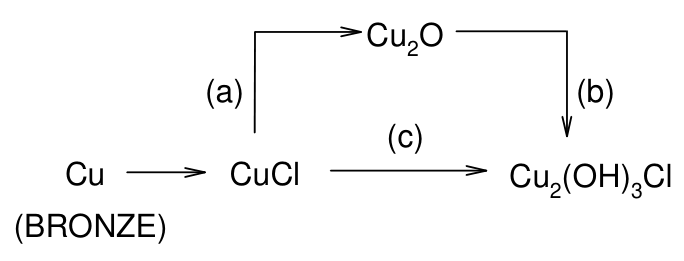
Using the molar standard formation Gibbs free energies of the species concerned answer the following questions:
| Species | \(\ce{Cu2O(s)}\) | \(\ce{CuO(s)}\) | \(\ce{CuCl(s)}\) | \(\ce{Cu2(OH)3Cl(s)}\) | \(\ce{Cl(aq)}\) | \(\ce{OH(aq)}\) | \(\ce{H2O(l)}\) |
|---|---|---|---|---|---|---|---|
| \(\Delta_{\mathrm f}G^0(298\ \mathrm K)\;(\mathrm{kJ\,mol^{-1}})\) | −146 | −130 | −120 | −1338 | −131 | −157 | −237 |
i) Write balanced equations for reactions (a), (b) and (c).
ii) Calculate the molar standard Gibbs free energy \(\Delta_{\mathrm f}G^0(298\ \mathrm K)\) for reactions (a), (b) and (c).
iii) Decide the spontaneous direction of reaction (a) in air through calculation, when \(T=298\mathrm K\), \(c(\ce{HCl})=1.0\times10^{-4}\ \mathrm{mol\,dm^{-3}}\).
1.2 Rate constants \(k_c\) for reaction (c) were measured at various temperatures in a simulation experiment in order to obtain its kinetic parameters. On the basis of the data given below answer the following questions:
| \(t\;^\circ\mathrm C\) | 25 | 40 |
|---|---|---|
| \(k_c\,/\,\mathrm{mol\,dm^{-3}\,s^{-1}}\) | \(1.29\times10^{-4}\) | \(2.50\times10^{-4}\) |
i) Write the equation for calculating the activation energy of reaction (c) and find the value.
ii) Assign the overall reaction order of reaction (c).
iii) Knowing that the rate determining step of reaction (c) is the monolayer adsorption of \(\ce{O2(g)}\) on solid \(\ce{CuCl}\), write the overall rate equation of this heterogeneous reaction (c). Under what condition might the reaction order be the same as that you have given in ii)? Assume only \(\ce{O2}\) can be adsorbed.
1.3 A copper plate was divided into two parts, \(\ce{Cu}(1)\) and \(\ce{Cu}(2)\). \(\ce{Cu}(1)\) was then hammered so that \(\ce{Cu}(1)\) and \(\ce{Cu}(2)\) are different in certain thermodynamic properties.
i) An galvanic cell with \(\ce{Cu}(1)\) and \(\ce{Cu}(2)\) was designed as \(\ce{Cu}(1)|\ce{CuSO4(aq)}|\ce{Cu}(2)\) and the electromotive force \(E\) of the above cell was expressed as \(E=\Phi_{\mathrm R}-\Phi_{\mathrm L}\), where \(\Phi_{\mathrm R}\) and \(\Phi_{\mathrm L}\) being the right and left electrode potentials (i. e. half-cell potentials), respectively. Please choose the correct \(E\) value from the following and give the thermodynamic reason for your choice.
(A) \(E<0\) (B) \(E=0\) (C) \(E>0\) (D) It cannot be decided
ii) Write the net cell reaction for the cell.
1.4 In a \(\ce{Cu-Zn}\) alloy the molar fractions of \(\ce{Cu}\) and \(\ce{Zn}\) are 0.750 and 0.250, respectively. The structure type of the alloy is the same as that of pure copper, except \(\ce{Zn}\) atoms substitute some \(\ce{Cu}\) atoms randomly and statistically, i. e. at every atomic position, the probability of the occupation of \(\ce{Cu}\) and \(\ce{Zn}\) is proportional to the composition of the alloy. In this sense the alloy can be considered as composed of statistical atoms \(\ce{Cu_{x}Zn_{1-x}}\). X-ray analysis shows that the arrangement of atoms in the alloy is of the cubic face-centred close packing type. Density of the alloy \(d=8.51\ \mathrm{g\,cm^{-3}}\). Calculate the radius of the statistical atoms in the alloy.
Given: \(A_{\mathrm r}(\ce{Cu})=63.5,\quad A_{\mathrm r}(\ce{Zn})=65.4\).
Official English text of the problem.
Answers
The reaction Gibbs energies below refer to the equations as written, each involving two copper atoms.
-
1.1(i)
(a) \[ \ce{2CuCl(s) + H2O(l) -> Cu2O(s) + 2H+(aq) + 2Cl-(aq)} \] (b) \[ \ce{Cu2O(s) + 1/2O2(g) + H2O(l) + H+(aq) + Cl-(aq) -> Cu2(OH)3Cl(s)} \] (c) \[ \ce{2CuCl(s) + 1/2O2(g) + 2H2O(l) -> Cu2(OH)3Cl(s) + H+(aq) + Cl-(aq)} \] -
1.1(ii) \[ \boxed{\Delta_{\mathrm r}G_a^\circ=+69,\quad \Delta_{\mathrm r}G_b^\circ=-824,\quad \Delta_{\mathrm r}G_c^\circ=-755\ \mathrm{kJ\,mol^{-1}}} \]
-
1.1(iii) \(\boxed{\Delta_{\mathrm r}G_a=-22.3\ \mathrm{kJ\,mol^{-1}}}\). Reaction (a) proceeds spontaneously toward \(\ce{Cu2O}\).
-
1.2(i) \[ E_a=\frac{R\ln(k_{c,2}/k_{c,1})}{1/T_1-1/T_2} =\boxed{34.2\ \mathrm{kJ\,mol^{-1}}}. \]
-
1.2(ii) The measured overall reaction order is \(\boxed{0}\).
-
1.2(iii) The intended Langmuir saturation rate law is \[ \boxed{v=k_{\mathrm{sat}} \frac{K_{\mathrm{ads}}p_{\ce{O2}}} {1+K_{\mathrm{ads}}p_{\ce{O2}}}}. \] It becomes zero order when \(\boxed{K_{\mathrm{ads}}p_{\ce{O2}}\gg1}\), with \(k_c=k_{\mathrm{sat}}\).
-
1.3(i) \(\boxed{\text{(C)}\ E>0}\), because hammered copper has the higher chemical potential.
-
1.3(ii) \[ \boxed{\ce{Cu(1) -> Cu(2)}} \] Copper dissolves from the hammered electrode and deposits on the unhammered electrode.
-
1.4 \[ \boxed{r=1.30\times10^{-8}\ \mathrm{cm}=130\ \mathrm{pm}}. \]
Solution
Chemical names and SMILES
These names and representations apply throughout the solution.
| Species | Name | SMILES |
|---|---|---|
| \(\ce{H2O}\) | Water | O |
| \(\ce{O2}\) | Dioxygen | O=O |
| \(\ce{H+}\) | Hydrogen ion, using the thermodynamic proton convention | [H+] |
| \(\ce{Cl-}\) | Chloride ion | [Cl-] |
| \(\ce{OH-}\) | Hydroxide ion | [OH-] |
| \(\ce{Cu^2+}\) | Copper(II) ion | [Cu+2] |
| \(\ce{SO4^2-}\) | Sulfate ion | [O-]S(=O)(=O)[O-] |
| \(\ce{HCl(aq)}\) | Hydrochloric acid, represented as dissociated ions | [H+].[Cl-] |
| \(\ce{CuCl}\) | Copper(I) chloride | [Cu+].[Cl-] |
| \(\ce{Cu2O}\) | Copper(I) oxide | [Cu+].[Cu+].[O-2] |
| \(\ce{CuO}\) | Copper(II) oxide | [Cu+2].[O-2] |
| \(\ce{Cu2(OH)3Cl}\) | Copper(II) hydroxychloride, or basic copper(II) chloride | [Cu+2].[Cu+2].[OH-].[OH-].[OH-].[Cl-] |
| \(\ce{CuSO4}\) | Copper(II) sulfate | [Cu+2].[O-]S(=O)(=O)[O-] |
The disconnected SMILES for ionic solids specify composition and formal charges; they do not describe crystal connectivity or coordination geometry. Copper and zinc have atomic representations [Cu] and [Zn], but these do not encode metallic lattices or deformation. A statistical alloy atom is an average lattice-site description and has no molecular SMILES.
1.1(i) Balanced reactions
In reaction (a), copper remains in oxidation state \(+1\): copper(I) chloride hydrolyses to copper(I) oxide.
\[ \ce{2CuCl(s) + H2O(l) -> Cu2O(s) + 2H+(aq) + 2Cl-(aq)} \tag{a} \]
In \(\ce{Cu2(OH)3Cl}\), three hydroxide ions and one chloride ion have total charge \(-4\), so both copper atoms are in oxidation state \(+2\). Therefore, reactions (b) and (c) require oxidation of copper(I). Dioxygen supplies the oxidizing agent.
\[ \ce{Cu2O(s) + 1/2O2(g) + H2O(l) + H+(aq) + Cl-(aq) -> Cu2(OH)3Cl(s)} \tag{b} \]
\[ \ce{2CuCl(s) + 1/2O2(g) + 2H2O(l) -> Cu2(OH)3Cl(s) + H+(aq) + Cl-(aq)} \tag{c} \]
Each equation balances both atoms and charge. Adding (a) and (b), then cancelling common species, gives (c).
1.1(ii) Standard reaction Gibbs energies
For a balanced reaction,
\[ \Delta_{\mathrm r}G^\circ =\sum_{\text{products}}\nu_i\Delta_{\mathrm f}G_i^\circ -\sum_{\text{reactants}}\nu_i\Delta_{\mathrm f}G_i^\circ. \]
We use the conventional values
\[ \Delta_{\mathrm f}G^\circ[\ce{H+(aq)}]=0, \qquad \Delta_{\mathrm f}G^\circ[\ce{O2(g)}]=0, \]
and the supplied value \(-1338\ \mathrm{kJ\,mol^{-1}}\) for \(\ce{Cu2(OH)3Cl(s)}\).
For (a),
\[ \begin{aligned} \Delta_{\mathrm r}G_a^\circ &=[-146+2(-131)]-[2(-120)+(-237)]\\ &=\boxed{+69\ \mathrm{kJ\,mol^{-1}}}. \end{aligned} \]
For (b),
\[ \begin{aligned} \Delta_{\mathrm r}G_b^\circ &=-1338-[(-146)+(-237)+(-131)]\\ &=\boxed{-824\ \mathrm{kJ\,mol^{-1}}}. \end{aligned} \]
For (c),
\[ \begin{aligned} \Delta_{\mathrm r}G_c^\circ &=[-1338+(-131)]-[2(-120)+2(-237)]\\ &=\boxed{-755\ \mathrm{kJ\,mol^{-1}}}. \end{aligned} \]
The independent calculations satisfy Hess’s law:
\[ 69-824=-755\ \mathrm{kJ\,mol^{-1}}. \]
If equations (b) and (c) are doubled to give integer coefficients, their reaction Gibbs energies also double, to \(-1648\) and \(-1510\ \mathrm{kJ\,mol^{-1}}\), respectively.
1.1(iii) Spontaneous direction at the specified acid concentration
For reaction (a), the activities of the pure solids and liquid water are taken as unity. Therefore,
\[ Q_a=a_{\ce{H+}}^2a_{\ce{Cl-}}^2. \]
Treating the dilute hydrochloric acid as fully dissociated and approximating activities by concentrations divided by \(c^\circ=1\ \mathrm{mol\,dm^{-3}}\),
\[ a_{\ce{H+}}\simeq a_{\ce{Cl-}}\simeq 1.0\times10^{-4}, \]
so
\[ Q_a=(10^{-4})^2(10^{-4})^2=10^{-16}. \]
Using \(R=8.314\ \mathrm{J\,mol^{-1}\,K^{-1}}\),
\[ \begin{aligned} \Delta_{\mathrm r}G_a &=\Delta_{\mathrm r}G_a^\circ+RT\ln Q_a\\ &=69.0+ \frac{(8.314)(298)\ln(10^{-16})}{1000}\\ &=69.0-91.3\\ &=\boxed{-22.3\ \mathrm{kJ\,mol^{-1}}}. \end{aligned} \]
Thus, under the specified conditions, reaction (a) proceeds spontaneously to the right, producing copper(I) oxide. Oxygen pressure does not enter this calculation because reaction (a) itself does not consume oxygen.
1.2(i) Activation energy
The Arrhenius equation is
\[ k_c=Ae^{-E_a/(RT)}. \]
Taking the ratio at two temperatures eliminates \(A\):
\[ \ln\left(\frac{k_{c,2}}{k_{c,1}}\right) =\frac{E_a}{R}\left(\frac1{T_1}-\frac1{T_2}\right). \]
With \(T_1=298.15\ \mathrm K\) and \(T_2=313.15\ \mathrm K\),
\[ \begin{aligned} E_a &= \frac{(8.314)\ln\left[ (2.50\times10^{-4})/(1.29\times10^{-4}) \right]} {1/298.15-1/313.15}\\ &=3.424\times10^4\ \mathrm{J\,mol^{-1}}\\ &=\boxed{34.2\ \mathrm{kJ\,mol^{-1}}}. \end{aligned} \]
This is the apparent activation energy associated with the measured rate constant.
1.2(ii) Overall reaction order
For an overall order \(n\), a concentration-based rate constant has dimensions
\[ [k]=(\mathrm{mol\,dm^{-3}})^{1-n}\mathrm{s^{-1}}. \]
The supplied units are
\[ [k_c]=\mathrm{mol\,dm^{-3}\,s^{-1}}. \]
Hence \(1-n=1\), giving
\[ \boxed{n=0}. \]
Thus, under the measurement conditions, \(v=k_c\).
1.2(iii) Surface rate equation and zero-order limit
The intended model is single-component Langmuir adsorption on a fixed population of surface sites. Let \(p=p_{\ce{O2}}\), and let \(K_{\mathrm{ads}}\) be an adsorption parameter with reciprocal-pressure units.
For molecular adsorption, the occupied fraction of the surface is
\[ \theta=\frac{K_{\mathrm{ads}}p}{1+K_{\mathrm{ads}}p}. \]
The corresponding phenomenological saturation rate equation is
\[ \boxed{ v=k_{\mathrm{sat}}\frac{K_{\mathrm{ads}}p}{1+K_{\mathrm{ads}}p} }. \]
Equivalently, it can be written as \(v=k'p/(1+K_{\mathrm{ads}}p)\), where \(k'=k_{\mathrm{sat}}K_{\mathrm{ads}}\). The coefficient \(k_{\mathrm{sat}}\) includes the available reactive surface per unit reaction volume.
At sufficiently high oxygen pressure or sufficiently strong adsorption,
\[ K_{\mathrm{ads}}p\gg1, \qquad \theta\simeq1, \]
and therefore
\[ v\simeq k_{\mathrm{sat}}=k_c. \]
The surface is effectively saturated, and the reaction is zero order in oxygen, agreeing with part (ii). This conclusion assumes that the exposed surface area remains effectively constant.
At low coverage,
\[ K_{\mathrm{ads}}p\ll1, \qquad v\simeq k_{\mathrm{sat}}K_{\mathrm{ads}}p, \]
so the same model predicts first-order dependence on oxygen pressure.
1.3(i) Sign of the cell emf
Hammering stores deformation energy in the copper through lattice strain and defects. Consequently, the hammered copper has a greater chemical potential:
\[ \mu_1>\mu_2. \]
Transfer of copper from the hammered to the unhammered state has
\[ \Delta_{\mathrm r}G=\mu_2-\mu_1<0. \]
The electrode process transfers two electrons per copper atom, so
\[ \Delta_{\mathrm r}G=-2FE. \]
Thus,
\[ E=\frac{\mu_1-\mu_2}{2F}>0. \]
The right electrode, unhammered copper, has the higher reduction potential:
\[ \boxed{\Phi_{\mathrm R}>\Phi_{\mathrm L},\qquad E>0,\qquad \text{choice (C)}}. \]
1.3(ii) Net cell reaction
At the left electrode, hammered copper dissolves:
\[ \ce{Cu(1) -> Cu^2+(aq) + 2e-}. \]
At the right electrode, copper deposits:
\[ \ce{Cu^2+(aq) + 2e- -> Cu(2)}. \]
Adding these half-reactions gives
\[ \boxed{\ce{Cu(1) -> Cu(2)}}. \]
The sulfate ion is a spectator.
1.4 Radius of the statistical atoms
The average molar mass per mole of occupied atomic sites is
\[ \begin{aligned} \overline M &=x_{\ce{Cu}}M_{\ce{Cu}}+x_{\ce{Zn}}M_{\ce{Zn}}\\ &=(0.750)(63.5)+(0.250)(65.4)\\ &=63.975\ \mathrm{g\,mol^{-1}}. \end{aligned} \]
A face-centred cubic unit cell contains
\[ 8\left(\frac18\right)+6\left(\frac12\right)=4 \]
statistical atoms. Its average mass is therefore
\[ m_{\mathrm{cell}}=\frac{4\overline M}{N_{\mathrm A}}. \]
Writing its edge length as \(a\),
\[ d=\frac{m_{\mathrm{cell}}}{a^3} =\frac{4\overline M}{N_{\mathrm A}a^3}. \]
Using \(N_{\mathrm A}=6.022\times10^{23}\ \mathrm{mol^{-1}}\),
\[ \begin{aligned} a &=\left[ \frac{4(63.975)} {(8.51)(6.022\times10^{23})} \right]^{1/3}\mathrm{cm}\\ &=3.682\times10^{-8}\ \mathrm{cm}. \end{aligned} \]
In the face-centred cubic close-packed model, atoms touch along a face diagonal. That diagonal spans four radii:
\[ \sqrt2\,a=4r. \]
Hence,
\[ \begin{aligned} r&=\frac{a}{2\sqrt2}\\ &=1.302\times10^{-8}\ \mathrm{cm}\\ &=\boxed{130\ \mathrm{pm}}. \end{aligned} \]
This is the effective radius of the average statistical atom, rather than a separately determined radius for each element.
The solution was checked against the official solution.
IChO 1995 · Theorieaufgabe 1
Korrosion antiker Bronze und einer Cu-Zn-Legierung
1.1 Ein ausgegrabenes antikes chinesisches Musikinstrument aus Bronze, ein Glockenspiel, war vollständig mit Rost bedeckt. Eine chemische Analyse ergab, dass der Rost \(\ce{CuCl}\), \(\ce{Cu2O}\) und \(\ce{Cu2(OH)3Cl}\) enthält. Simulationsexperimente zeigten, dass sich unter der gemeinsamen Einwirkung von Luft und einer \(\ce{Cl}\)-haltigen wässrigen Lösung zunächst \(\ce{CuCl}\) bildete und anschließend \(\ce{Cu2(OH)3Cl}\) auf den folgenden zwei unterschiedlichen Wegen entstand:
Beantworten Sie anhand der molaren Standard-Gibbs-Bildungsenergien der beteiligten Spezies die folgenden Fragen:
| Spezies | \(\ce{Cu2O(s)}\) | \(\ce{CuO(s)}\) | \(\ce{CuCl(s)}\) | \(\ce{Cu2(OH)3Cl(s)}\) | \(\ce{Cl(aq)}\) | \(\ce{OH(aq)}\) | \(\ce{H2O(l)}\) |
|---|---|---|---|---|---|---|---|
| \(\Delta_{\mathrm f}G^0(298\ \mathrm K)\;(\mathrm{kJ\,mol^{-1}})\) | −146 | −130 | −120 | −1338 | −131 | −157 | −237 |
i) Stellen Sie die ausgeglichenen Gleichungen für die Reaktionen (a), (b) und (c) auf.
ii) Berechnen Sie die molare Standard-Gibbs-Energie \(\Delta_{\mathrm f}G^0(298\ \mathrm K)\) für die Reaktionen (a), (b) und (c).
iii) Bestimmen Sie durch Berechnung die spontane Reaktionsrichtung der Reaktion (a) an Luft bei \(T=298\mathrm K\), \(c(\ce{HCl})=1.0\times10^{-4}\ \mathrm{mol\,dm^{-3}}\).
1.2 In einem Simulationsexperiment wurden die Geschwindigkeitskonstanten \(k_c\) der Reaktion (c) bei verschiedenen Temperaturen gemessen, um ihre kinetischen Parameter zu bestimmen. Beantworten Sie anhand der folgenden Daten die nachstehenden Fragen:
| \(t\;^\circ\mathrm C\) | 25 | 40 |
|---|---|---|
| \(k_c\,/\,\mathrm{mol\,dm^{-3}\,s^{-1}}\) | \(1.29\times10^{-4}\) | \(2.50\times10^{-4}\) |
i) Geben Sie die Gleichung zur Berechnung der Aktivierungsenergie der Reaktion (c) an und bestimmen Sie deren Wert.
ii) Geben Sie die Gesamtreaktionsordnung der Reaktion (c) an.
iii) Der geschwindigkeitsbestimmende Schritt der Reaktion (c) ist die Adsorption von \(\ce{O2(g)}\) in einer Monoschicht auf festem \(\ce{CuCl}\). Stellen Sie unter dieser Voraussetzung das Gesamtgeschwindigkeitsgesetz dieser heterogenen Reaktion (c) auf. Unter welcher Bedingung könnte die Reaktionsordnung mit der von Ihnen in ii) angegebenen übereinstimmen? Nehmen Sie an, dass nur \(\ce{O2}\) adsorbiert werden kann.
1.3 Eine Kupferplatte wurde in zwei Teile, \(\ce{Cu}(1)\) und \(\ce{Cu}(2)\), geteilt. Anschließend wurde \(\ce{Cu}(1)\) gehämmert, sodass sich \(\ce{Cu}(1)\) und \(\ce{Cu}(2)\) in bestimmten thermodynamischen Eigenschaften unterscheiden.
i) Eine galvanische Zelle mit \(\ce{Cu}(1)\) und \(\ce{Cu}(2)\) wurde gemäß \(\ce{Cu}(1)|\ce{CuSO4(aq)}|\ce{Cu}(2)\) aufgebaut. Die elektromotorische Kraft \(E\) dieser Zelle wurde als \(E=\Phi_{\mathrm R}-\Phi_{\mathrm L}\) ausgedrückt, wobei \(\Phi_{\mathrm R}\) und \(\Phi_{\mathrm L}\) das rechte bzw. linke Elektrodenpotential (d. h. Halbzellenpotential) sind. Wählen Sie aus den folgenden Möglichkeiten den richtigen Wert für \(E\) aus und begründen Sie Ihre Wahl thermodynamisch.
(A) \(E<0\) (B) \(E=0\) (C) \(E>0\) (D) Es lässt sich nicht entscheiden
ii) Geben Sie die Nettoreaktion der Zelle an.
1.4 In einer \(\ce{Cu-Zn}\)-Legierung betragen die Stoffmengenanteile von \(\ce{Cu}\) und \(\ce{Zn}\) 0.750 bzw. 0.250. Der Strukturtyp der Legierung ist derselbe wie der von reinem Kupfer, mit dem Unterschied, dass \(\ce{Zn}\)-Atome einige \(\ce{Cu}\)-Atome zufällig und statistisch ersetzen; d. h., an jeder Atomposition ist die Wahrscheinlichkeit der Besetzung durch \(\ce{Cu}\) bzw. \(\ce{Zn}\) proportional zur Zusammensetzung der Legierung. In diesem Sinne kann die Legierung als aus statistischen Atomen \(\ce{Cu_{x}Zn_{1-x}}\) aufgebaut betrachtet werden. Eine Röntgenstrukturanalyse zeigt, dass die Atome in der Legierung in einer kubisch flächenzentrierten dichtesten Packung angeordnet sind. Die Dichte der Legierung beträgt \(d=8.51\ \mathrm{g\,cm^{-3}}\). Berechnen Sie den Radius der statistischen Atome in der Legierung.
Gegeben: \(A_{\mathrm r}(\ce{Cu})=63.5,\quad A_{\mathrm r}(\ce{Zn})=65.4\).
Aufgabentext aus dem offiziellen englischen Text übersetzt.
Antworten
Die nachstehenden Gibbs-Reaktionsenergien beziehen sich auf die Gleichungen in der angegebenen Form, an denen jeweils zwei Kupferatome beteiligt sind.
-
1.1(i)
(a) \[ \ce{2CuCl(s) + H2O(l) -> Cu2O(s) + 2H+(aq) + 2Cl-(aq)} \] (b) \[ \ce{Cu2O(s) + 1/2O2(g) + H2O(l) + H+(aq) + Cl-(aq) -> Cu2(OH)3Cl(s)} \] (c) \[ \ce{2CuCl(s) + 1/2O2(g) + 2H2O(l) -> Cu2(OH)3Cl(s) + H+(aq) + Cl-(aq)} \] -
1.1(ii) \[ \boxed{\Delta_{\mathrm r}G_a^\circ=+69,\quad \Delta_{\mathrm r}G_b^\circ=-824,\quad \Delta_{\mathrm r}G_c^\circ=-755\ \mathrm{kJ\,mol^{-1}}} \]
-
1.1(iii) \(\boxed{\Delta_{\mathrm r}G_a=-22.3\ \mathrm{kJ\,mol^{-1}}}\). Reaktion (a) läuft spontan in Richtung \(\ce{Cu2O}\) ab.
-
1.2(i) \[ E_a=\frac{R\ln(k_{c,2}/k_{c,1})}{1/T_1-1/T_2} =\boxed{34.2\ \mathrm{kJ\,mol^{-1}}}. \]
-
1.2(ii) Die gemessene Gesamtreaktionsordnung ist \(\boxed{0}\).
-
1.2(iii) Das hier gemeinte Langmuir-Sättigungsgeschwindigkeitsgesetz lautet \[ \boxed{v=k_{\mathrm{sat}} \frac{K_{\mathrm{ads}}p_{\ce{O2}}} {1+K_{\mathrm{ads}}p_{\ce{O2}}}}. \] Für \(\boxed{K_{\mathrm{ads}}p_{\ce{O2}}\gg1}\) ergibt sich eine Reaktion nullter Ordnung mit \(k_c=k_{\mathrm{sat}}\).
-
1.3(i) \(\boxed{\text{(C)}\ E>0}\), da gehämmertes Kupfer das höhere chemische Potential besitzt.
-
1.3(ii) \[ \boxed{\ce{Cu(1) -> Cu(2)}} \] Kupfer löst sich an der gehämmerten Elektrode auf und scheidet sich an der ungehämmerten Elektrode ab.
-
1.4 \[ \boxed{r=1.30\times10^{-8}\ \mathrm{cm}=130\ \mathrm{pm}}. \]
Lösung
Chemische Namen und SMILES
Diese Namen und Darstellungen gelten für die gesamte Lösung.
| Spezies | Name | SMILES |
|---|---|---|
| \(\ce{H2O}\) | Wasser | O |
| \(\ce{O2}\) | Disauerstoff | O=O |
| \(\ce{H+}\) | Wasserstoffion unter Verwendung der thermodynamischen Protonenkonvention | [H+] |
| \(\ce{Cl-}\) | Chloridion | [Cl-] |
| \(\ce{OH-}\) | Hydroxidion | [OH-] |
| \(\ce{Cu^2+}\) | Kupfer(II)-Ion | [Cu+2] |
| \(\ce{SO4^2-}\) | Sulfation | [O-]S(=O)(=O)[O-] |
| \(\ce{HCl(aq)}\) | Salzsäure, als dissoziierte Ionen dargestellt | [H+].[Cl-] |
| \(\ce{CuCl}\) | Kupfer(I)-chlorid | [Cu+].[Cl-] |
| \(\ce{Cu2O}\) | Kupfer(I)-oxid | [Cu+].[Cu+].[O-2] |
| \(\ce{CuO}\) | Kupfer(II)-oxid | [Cu+2].[O-2] |
| \(\ce{Cu2(OH)3Cl}\) | Kupfer(II)-hydroxychlorid oder basisches Kupfer(II)-chlorid | [Cu+2].[Cu+2].[OH-].[OH-].[OH-].[Cl-] |
| \(\ce{CuSO4}\) | Kupfer(II)-sulfat | [Cu+2].[O-]S(=O)(=O)[O-] |
Die SMILES-Darstellungen mit getrennten Komponenten für ionische Feststoffe geben die Zusammensetzung und die Formalladungen an; sie beschreiben weder die Verknüpfungen im Kristall noch die Koordinationsgeometrie. Kupfer und Zink besitzen die atomaren Darstellungen [Cu] und [Zn], doch diese kodieren weder metallische Gitter noch Verformungen. Ein statistisches Legierungsatom ist eine gemittelte Beschreibung eines Gitterplatzes und besitzt keine molekulare SMILES-Darstellung.
1.1(i) Ausgeglichene Reaktionsgleichungen
In Reaktion (a) bleibt Kupfer in der Oxidationsstufe \(+1\): Kupfer(I)-chlorid hydrolysiert zu Kupfer(I)-oxid.
\[ \ce{2CuCl(s) + H2O(l) -> Cu2O(s) + 2H+(aq) + 2Cl-(aq)} \tag{a} \]
In \(\ce{Cu2(OH)3Cl}\) haben drei Hydroxidionen und ein Chloridion die Gesamtladung \(-4\), sodass beide Kupferatome die Oxidationsstufe \(+2\) aufweisen. Daher erfordern die Reaktionen (b) und (c) eine Oxidation von Kupfer(I). Disauerstoff dient als Oxidationsmittel.
\[ \ce{Cu2O(s) + 1/2O2(g) + H2O(l) + H+(aq) + Cl-(aq) -> Cu2(OH)3Cl(s)} \tag{b} \]
\[ \ce{2CuCl(s) + 1/2O2(g) + 2H2O(l) -> Cu2(OH)3Cl(s) + H+(aq) + Cl-(aq)} \tag{c} \]
In jeder Gleichung sind sowohl die Atome als auch die Ladungen bilanziert. Addiert man (a) und (b) und kürzt anschließend die auf beiden Seiten vorkommenden Spezies, erhält man (c).
1.1(ii) Standard-Gibbs-Reaktionsenergien
Für eine ausgeglichene Reaktion gilt
\[ \Delta_{\mathrm r}G^\circ =\sum_{\text{Produkte}}\nu_i\Delta_{\mathrm f}G_i^\circ -\sum_{\text{Edukte}}\nu_i\Delta_{\mathrm f}G_i^\circ. \]
Wir verwenden die konventionellen Werte
\[ \Delta_{\mathrm f}G^\circ[\ce{H+(aq)}]=0, \qquad \Delta_{\mathrm f}G^\circ[\ce{O2(g)}]=0, \]
und den angegebenen Wert \(-1338\ \mathrm{kJ\,mol^{-1}}\) für \(\ce{Cu2(OH)3Cl(s)}\).
Für (a) gilt
\[ \begin{aligned} \Delta_{\mathrm r}G_a^\circ &=[-146+2(-131)]-[2(-120)+(-237)]\\ &=\boxed{+69\ \mathrm{kJ\,mol^{-1}}}. \end{aligned} \]
Für (b) gilt
\[ \begin{aligned} \Delta_{\mathrm r}G_b^\circ &=-1338-[(-146)+(-237)+(-131)]\\ &=\boxed{-824\ \mathrm{kJ\,mol^{-1}}}. \end{aligned} \]
Für (c) gilt
\[ \begin{aligned} \Delta_{\mathrm r}G_c^\circ &=[-1338+(-131)]-[2(-120)+2(-237)]\\ &=\boxed{-755\ \mathrm{kJ\,mol^{-1}}}. \end{aligned} \]
Die unabhängigen Berechnungen erfüllen den Satz von Hess:
\[ 69-824=-755\ \mathrm{kJ\,mol^{-1}}. \]
Werden die Gleichungen (b) und (c) verdoppelt, um ganzzahlige Koeffizienten zu erhalten, verdoppeln sich auch ihre Gibbs-Reaktionsenergien auf \(-1648\) bzw. \(-1510\ \mathrm{kJ\,mol^{-1}}\).
1.1(iii) Spontane Reaktionsrichtung bei der angegebenen Säurekonzentration
Für Reaktion (a) werden die Aktivitäten der reinen Feststoffe und des flüssigen Wassers gleich eins gesetzt. Daher gilt
\[ Q_a=a_{\ce{H+}}^2a_{\ce{Cl-}}^2. \]
Wird die verdünnte Salzsäure als vollständig dissoziiert betrachtet und werden die Aktivitäten durch die Konzentrationen dividiert durch \(c^\circ=1\ \mathrm{mol\,dm^{-3}}\) angenähert, gilt
\[ a_{\ce{H+}}\simeq a_{\ce{Cl-}}\simeq 1.0\times10^{-4}, \]
also
\[ Q_a=(10^{-4})^2(10^{-4})^2=10^{-16}. \]
Mit \(R=8.314\ \mathrm{J\,mol^{-1}\,K^{-1}}\) ergibt sich
\[ \begin{aligned} \Delta_{\mathrm r}G_a &=\Delta_{\mathrm r}G_a^\circ+RT\ln Q_a\\ &=69.0+ \frac{(8.314)(298)\ln(10^{-16})}{1000}\\ &=69.0-91.3\\ &=\boxed{-22.3\ \mathrm{kJ\,mol^{-1}}}. \end{aligned} \]
Unter den angegebenen Bedingungen läuft Reaktion (a) somit spontan nach rechts ab, wobei Kupfer(I)-oxid entsteht. Der Sauerstoffdruck geht nicht in diese Berechnung ein, da Reaktion (a) selbst keinen Sauerstoff verbraucht.
1.2(i) Aktivierungsenergie
Die Arrhenius-Gleichung lautet
\[ k_c=Ae^{-E_a/(RT)}. \]
Durch Bildung des Verhältnisses bei zwei Temperaturen wird \(A\) eliminiert:
\[ \ln\left(\frac{k_{c,2}}{k_{c,1}}\right) =\frac{E_a}{R}\left(\frac1{T_1}-\frac1{T_2}\right). \]
Mit \(T_1=298.15\ \mathrm K\) und \(T_2=313.15\ \mathrm K\) ergibt sich
\[ \begin{aligned} E_a &= \frac{(8.314)\ln\left[ (2.50\times10^{-4})/(1.29\times10^{-4}) \right]} {1/298.15-1/313.15}\\ &=3.424\times10^4\ \mathrm{J\,mol^{-1}}\\ &=\boxed{34.2\ \mathrm{kJ\,mol^{-1}}}. \end{aligned} \]
Dies ist die scheinbare Aktivierungsenergie, die der gemessenen Geschwindigkeitskonstanten zugeordnet ist.
1.2(ii) Gesamtreaktionsordnung
Bei einer Gesamtordnung \(n\) hat eine konzentrationsbezogene Geschwindigkeitskonstante die Dimension
\[ [k]=(\mathrm{mol\,dm^{-3}})^{1-n}\mathrm{s^{-1}}. \]
Die angegebenen Einheiten sind
\[ [k_c]=\mathrm{mol\,dm^{-3}\,s^{-1}}. \]
Somit gilt \(1-n=1\), woraus folgt:
\[ \boxed{n=0}. \]
Unter den Messbedingungen gilt daher \(v=k_c\).
1.2(iii) Geschwindigkeitsgesetz der Oberflächenreaktion und Grenzfall nullter Ordnung
Das hier gemeinte Modell ist die Langmuir-Adsorption einer einzelnen Komponente an einer festen Anzahl von Oberflächenplätzen. Es sei \(p=p_{\ce{O2}}\), und \(K_{\mathrm{ads}}\) sei ein Adsorptionsparameter mit der Einheit eines reziproken Drucks.
Bei molekularer Adsorption beträgt der besetzte Anteil der Oberfläche
\[ \theta=\frac{K_{\mathrm{ads}}p}{1+K_{\mathrm{ads}}p}. \]
Das entsprechende phänomenologische Sättigungsgeschwindigkeitsgesetz lautet
\[ \boxed{ v=k_{\mathrm{sat}}\frac{K_{\mathrm{ads}}p}{1+K_{\mathrm{ads}}p} }. \]
Äquivalent lässt es sich als \(v=k'p/(1+K_{\mathrm{ads}}p)\) schreiben, wobei \(k'=k_{\mathrm{sat}}K_{\mathrm{ads}}\). Der Koeffizient \(k_{\mathrm{sat}}\) schließt die verfügbare reaktive Oberfläche pro Einheit des Reaktionsvolumens ein.
Bei hinreichend hohem Sauerstoffdruck oder hinreichend starker Adsorption gilt
\[ K_{\mathrm{ads}}p\gg1, \qquad \theta\simeq1, \]
und daher
\[ v\simeq k_{\mathrm{sat}}=k_c. \]
Die Oberfläche ist praktisch gesättigt, und die Reaktion ist bezüglich Sauerstoff von nullter Ordnung, in Übereinstimmung mit Teil (ii). Diese Schlussfolgerung setzt voraus, dass die zugängliche Oberfläche praktisch konstant bleibt.
Bei geringem Bedeckungsgrad gilt
\[ K_{\mathrm{ads}}p\ll1, \qquad v\simeq k_{\mathrm{sat}}K_{\mathrm{ads}}p, \]
sodass dasselbe Modell eine Abhängigkeit erster Ordnung vom Sauerstoffdruck vorhersagt.
1.3(i) Vorzeichen der elektromotorischen Kraft der Zelle
Durch das Hämmern wird im Kupfer aufgrund von Gitterverzerrungen und Defekten Verformungsenergie gespeichert. Folglich besitzt das gehämmerte Kupfer ein höheres chemisches Potential:
\[ \mu_1>\mu_2. \]
Für die Überführung von Kupfer aus dem gehämmerten in den ungehämmerten Zustand gilt
\[ \Delta_{\mathrm r}G=\mu_2-\mu_1<0. \]
Beim Elektrodenprozess werden zwei Elektronen pro Kupferatom übertragen, sodass gilt
\[ \Delta_{\mathrm r}G=-2FE. \]
Somit ist
\[ E=\frac{\mu_1-\mu_2}{2F}>0. \]
Die rechte Elektrode aus ungehämmertem Kupfer besitzt das höhere Reduktionspotential:
\[ \boxed{\Phi_{\mathrm R}>\Phi_{\mathrm L},\qquad E>0,\qquad \text{Antwort (C)}}. \]
1.3(ii) Nettoreaktion der Zelle
An der linken Elektrode löst sich gehämmertes Kupfer auf:
\[ \ce{Cu(1) -> Cu^2+(aq) + 2e-}. \]
An der rechten Elektrode scheidet sich Kupfer ab:
\[ \ce{Cu^2+(aq) + 2e- -> Cu(2)}. \]
Die Addition dieser Teilreaktionen ergibt
\[ \boxed{\ce{Cu(1) -> Cu(2)}}. \]
Das Sulfation ist ein Zuschauerion.
1.4 Radius der statistischen Atome
Die mittlere molare Masse pro Mol besetzter Atomplätze beträgt
\[ \begin{aligned} \overline M &=x_{\ce{Cu}}M_{\ce{Cu}}+x_{\ce{Zn}}M_{\ce{Zn}}\\ &=(0.750)(63.5)+(0.250)(65.4)\\ &=63.975\ \mathrm{g\,mol^{-1}}. \end{aligned} \]
Eine kubisch flächenzentrierte Elementarzelle enthält
\[ 8\left(\frac18\right)+6\left(\frac12\right)=4 \]
statistische Atome. Ihre mittlere Masse beträgt daher
\[ m_{\mathrm{cell}}=\frac{4\overline M}{N_{\mathrm A}}. \]
Bezeichnet man ihre Kantenlänge mit \(a\), gilt
\[ d=\frac{m_{\mathrm{cell}}}{a^3} =\frac{4\overline M}{N_{\mathrm A}a^3}. \]
Mit \(N_{\mathrm A}=6.022\times10^{23}\ \mathrm{mol^{-1}}\) ergibt sich
\[ \begin{aligned} a &=\left[ \frac{4(63.975)} {(8.51)(6.022\times10^{23})} \right]^{1/3}\mathrm{cm}\\ &=3.682\times10^{-8}\ \mathrm{cm}. \end{aligned} \]
Im Modell der kubisch flächenzentrierten dichtesten Packung berühren sich die Atome entlang einer Flächendiagonalen. Diese Diagonale erstreckt sich über vier Radien:
\[ \sqrt2\,a=4r. \]
Damit folgt
\[ \begin{aligned} r&=\frac{a}{2\sqrt2}\\ &=1.302\times10^{-8}\ \mathrm{cm}\\ &=\boxed{130\ \mathrm{pm}}. \end{aligned} \]
Dies ist der effektive Radius des gemittelten statistischen Atoms und kein für jedes Element separat bestimmter Radius.
Die Lösung wurde mit der offiziellen Lösung abgeglichen.
IChO 1995 · Teori sorusu 1
Antik bronzun ve bir Cu-Zn alaşımının korozyonu
1.1 Kazılarda ortaya çıkarılan, karilyon adı verilen antik Çin bronz müzik aletinin yüzeyi tamamen pasla kaplanmıştı. Kimyasal analiz, pasın \(\ce{CuCl}\), \(\ce{Cu2O}\) ve \(\ce{Cu2(OH)3Cl}\) içerdiğini gösterdi. Benzetim deneyleri, hem havanın hem de \(\ce{Cl}\) içeren sulu çözeltinin etkisiyle önce \(\ce{CuCl}\) oluştuğunu, ardından aşağıdaki iki farklı yoldan \(\ce{Cu2(OH)3Cl}\) meydana geldiğini gösterdi:
İlgili türlerin standart molar oluşum Gibbs serbest enerjilerini kullanarak aşağıdaki soruları cevaplayınız:
| Tür | \(\ce{Cu2O(s)}\) | \(\ce{CuO(s)}\) | \(\ce{CuCl(s)}\) | \(\ce{Cu2(OH)3Cl(s)}\) | \(\ce{Cl(aq)}\) | \(\ce{OH(aq)}\) | \(\ce{H2O(l)}\) |
|---|---|---|---|---|---|---|---|
| \(\Delta_{\mathrm f}G^0(298\ \mathrm K)\;(\mathrm{kJ\,mol^{-1}})\) | −146 | −130 | −120 | −1338 | −131 | −157 | −237 |
i) (a), (b) ve (c) tepkimelerinin denkleştirilmiş denklemlerini yazınız.
ii) (a), (b) ve (c) tepkimeleri için standart molar Gibbs serbest enerjisini \(\Delta_{\mathrm f}G^0(298\ \mathrm K)\) hesaplayınız.
iii) \(T=298\mathrm K\), \(c(\ce{HCl})=1.0\times10^{-4}\ \mathrm{mol\,dm^{-3}}\) olduğunda, hesaplama yaparak (a) tepkimesinin havada kendiliğinden ilerlediği yönü belirleyiniz.
1.2 (c) tepkimesinin kinetik parametrelerini elde etmek amacıyla bir benzetim deneyinde çeşitli sıcaklıklarda hız sabitleri \(k_c\) ölçülmüştür. Aşağıda verilen verilere dayanarak aşağıdaki soruları cevaplayınız:
| \(t\;^\circ\mathrm C\) | 25 | 40 |
|---|---|---|
| \(k_c\,/\,\mathrm{mol\,dm^{-3}\,s^{-1}}\) | \(1.29\times10^{-4}\) | \(2.50\times10^{-4}\) |
i) (c) tepkimesinin aktivasyon enerjisini hesaplamak için kullanılan denklemi yazınız ve değerini bulunuz.
ii) (c) tepkimesinin toplam tepkime derecesini belirleyiniz.
iii) (c) tepkimesinin hız belirleyen basamağının katı \(\ce{CuCl}\) üzerinde \(\ce{O2(g)}\)'nin tek tabakalı adsorpsiyonu olduğu bilindiğine göre, bu heterojen (c) tepkimesinin toplam hız denklemini yazınız. Hangi koşulda tepkime derecesi ii)'de verdiğinizle aynı olabilir? Yalnızca \(\ce{O2}\)'nin adsorplanabildiğini varsayınız.
1.3 Bir bakır levha, \(\ce{Cu}(1)\) ve \(\ce{Cu}(2)\) olmak üzere iki parçaya ayrılmıştır. Ardından \(\ce{Cu}(1)\) dövülerek \(\ce{Cu}(1)\) ile \(\ce{Cu}(2)\)'nin bazı termodinamik özelliklerinin farklı olması sağlanmıştır.
i) \(\ce{Cu}(1)\) ve \(\ce{Cu}(2)\) kullanılarak \(\ce{Cu}(1)|\ce{CuSO4(aq)}|\ce{Cu}(2)\) biçiminde bir galvanik hücre tasarlanmış ve bu hücrenin elektromotor kuvveti \(E\), \(E=\Phi_{\mathrm R}-\Phi_{\mathrm L}\) olarak ifade edilmiştir; burada \(\Phi_{\mathrm R}\) ve \(\Phi_{\mathrm L}\), sırasıyla sağ ve sol elektrot potansiyelleridir (yani yarı hücre potansiyelleridir). Aşağıdakilerden doğru \(E\) değerini seçiniz ve seçiminizin termodinamik gerekçesini belirtiniz.
(A) \(E<0\) (B) \(E=0\) (C) \(E>0\) (D) Belirlenemez
ii) Hücrenin net tepkimesini yazınız.
1.4 Bir \(\ce{Cu-Zn}\) alaşımında \(\ce{Cu}\) ve \(\ce{Zn}\)'nin mol kesirleri sırasıyla 0.750 ve 0.250'dir. Alaşımın yapı tipi saf bakırınkiyle aynıdır; tek fark, \(\ce{Zn}\) atomlarının bazı \(\ce{Cu}\) atomlarının yerini rastgele ve istatistiksel olarak almasıdır; yani her atom konumunun \(\ce{Cu}\) ve \(\ce{Zn}\) tarafından işgal edilme olasılığı alaşımın bileşimiyle orantılıdır. Bu anlamda alaşımın \(\ce{Cu_{x}Zn_{1-x}}\) istatistiksel atomlarından oluştuğu düşünülebilir. X-ışını analizi, alaşımdaki atomların yüzey merkezli kübik sıkı paketlenme düzeninde olduğunu göstermektedir. Alaşımın yoğunluğu \(d=8.51\ \mathrm{g\,cm^{-3}}\)'tür. Alaşımdaki istatistiksel atomların yarıçapını hesaplayınız.
Verilen: \(A_{\mathrm r}(\ce{Cu})=63.5,\quad A_{\mathrm r}(\ce{Zn})=65.4\).
Soru metni resmi İngilizce metinden çevrilmiştir.
Cevaplar
Aşağıdaki tepkime Gibbs enerjileri, her biri iki bakır atomu içeren denklemlerin yazıldığı hâline aittir.
-
1.1(i)
(a) \[ \ce{2CuCl(s) + H2O(l) -> Cu2O(s) + 2H+(aq) + 2Cl-(aq)} \] (b) \[ \ce{Cu2O(s) + 1/2O2(g) + H2O(l) + H+(aq) + Cl-(aq) -> Cu2(OH)3Cl(s)} \] (c) \[ \ce{2CuCl(s) + 1/2O2(g) + 2H2O(l) -> Cu2(OH)3Cl(s) + H+(aq) + Cl-(aq)} \] -
1.1(ii) \[ \boxed{\Delta_{\mathrm r}G_a^\circ=+69,\quad \Delta_{\mathrm r}G_b^\circ=-824,\quad \Delta_{\mathrm r}G_c^\circ=-755\ \mathrm{kJ\,mol^{-1}}} \]
-
1.1(iii) \(\boxed{\Delta_{\mathrm r}G_a=-22.3\ \mathrm{kJ\,mol^{-1}}}\). (a) tepkimesi kendiliğinden \(\ce{Cu2O}\) oluşumu yönünde ilerler.
-
1.2(i) \[ E_a=\frac{R\ln(k_{c,2}/k_{c,1})}{1/T_1-1/T_2} =\boxed{34.2\ \mathrm{kJ\,mol^{-1}}}. \]
-
1.2(ii) Ölçülen toplam tepkime derecesi \(\boxed{0}\)'dır.
-
1.2(iii) Kastedilen Langmuir doygunluk hız yasası şöyledir: \[ \boxed{v=k_{\mathrm{sat}} \frac{K_{\mathrm{ads}}p_{\ce{O2}}} {1+K_{\mathrm{ads}}p_{\ce{O2}}}}. \] \(\boxed{K_{\mathrm{ads}}p_{\ce{O2}}\gg1}\) olduğunda sıfırıncı dereceden olur ve \(k_c=k_{\mathrm{sat}}\)'tır.
-
1.3(i) \(\boxed{\text{(C)}\ E>0}\), çünkü dövülmüş bakırın kimyasal potansiyeli daha yüksektir.
-
1.3(ii) \[ \boxed{\ce{Cu(1) -> Cu(2)}} \] Bakır, dövülmüş elektrottan çözünür ve dövülmemiş elektrot üzerinde birikir.
-
1.4 \[ \boxed{r=1.30\times10^{-8}\ \mathrm{cm}=130\ \mathrm{pm}}. \]
Çözüm
Kimyasal adlar ve SMILES
Bu adlar ve gösterimler çözümün tamamında geçerlidir.
| Tür | Ad | SMILES |
|---|---|---|
| \(\ce{H2O}\) | Su | O |
| \(\ce{O2}\) | Dioksijen | O=O |
| \(\ce{H+}\) | Termodinamik proton kabulüne göre hidrojen iyonu | [H+] |
| \(\ce{Cl-}\) | Klorür iyonu | [Cl-] |
| \(\ce{OH-}\) | Hidroksit iyonu | [OH-] |
| \(\ce{Cu^2+}\) | Bakır(II) iyonu | [Cu+2] |
| \(\ce{SO4^2-}\) | Sülfat iyonu | [O-]S(=O)(=O)[O-] |
| \(\ce{HCl(aq)}\) | Ayrışmış iyonlar biçiminde gösterilen hidroklorik asit | [H+].[Cl-] |
| \(\ce{CuCl}\) | Bakır(I) klorür | [Cu+].[Cl-] |
| \(\ce{Cu2O}\) | Bakır(I) oksit | [Cu+].[Cu+].[O-2] |
| \(\ce{CuO}\) | Bakır(II) oksit | [Cu+2].[O-2] |
| \(\ce{Cu2(OH)3Cl}\) | Bakır(II) hidroksiklorür veya bazik bakır(II) klorür | [Cu+2].[Cu+2].[OH-].[OH-].[OH-].[Cl-] |
| \(\ce{CuSO4}\) | Bakır(II) sülfat | [Cu+2].[O-]S(=O)(=O)[O-] |
İyonik katılar için bağlantısız SMILES gösterimleri, bileşimi ve formal yükleri belirtir; kristaldeki bağlantı düzenini veya koordinasyon geometrisini tanımlamaz. Bakır ve çinkonun atomik gösterimleri [Cu] ve [Zn] şeklindedir, ancak bunlar metalik örgüleri veya deformasyonu kodlamaz. İstatistiksel bir alaşım atomu, ortalama bir örgü konumunun betimlemesidir ve moleküler SMILES gösterimi yoktur.
1.1(i) Denkleştirilmiş tepkimeler
(a) tepkimesinde bakırın yükseltgenme basamağı \(+1\) olarak kalır: bakır(I) klorür hidrolize uğrayarak bakır(I) okside dönüşür.
\[ \ce{2CuCl(s) + H2O(l) -> Cu2O(s) + 2H+(aq) + 2Cl-(aq)} \tag{a} \]
\(\ce{Cu2(OH)3Cl}\)'de üç hidroksit iyonunun ve bir klorür iyonunun toplam yükü \(-4\) olduğundan, her iki bakır atomunun yükseltgenme basamağı \(+2\)'dir. Bu nedenle (b) ve (c) tepkimeleri bakır(I)'in yükseltgenmesini gerektirir. Dioksijen, yükseltgen madde olarak görev yapar.
\[ \ce{Cu2O(s) + 1/2O2(g) + H2O(l) + H+(aq) + Cl-(aq) -> Cu2(OH)3Cl(s)} \tag{b} \]
\[ \ce{2CuCl(s) + 1/2O2(g) + 2H2O(l) -> Cu2(OH)3Cl(s) + H+(aq) + Cl-(aq)} \tag{c} \]
Her denklemde hem atomlar hem de yük dengelenmiştir. (a) ve (b) toplanıp ortak türler sadeleştirildiğinde (c) elde edilir.
1.1(ii) Standart tepkime Gibbs enerjileri
Denkleştirilmiş bir tepkime için,
\[ \Delta_{\mathrm r}G^\circ =\sum_{\text{ürünler}}\nu_i\Delta_{\mathrm f}G_i^\circ -\sum_{\text{girenler}}\nu_i\Delta_{\mathrm f}G_i^\circ. \]
Kabul gereği tanımlanan
\[ \Delta_{\mathrm f}G^\circ[\ce{H+(aq)}]=0, \qquad \Delta_{\mathrm f}G^\circ[\ce{O2(g)}]=0, \]
değerlerini ve \(\ce{Cu2(OH)3Cl(s)}\) için verilen \(-1338\ \mathrm{kJ\,mol^{-1}}\) değerini kullanırız.
(a) için,
\[ \begin{aligned} \Delta_{\mathrm r}G_a^\circ &=[-146+2(-131)]-[2(-120)+(-237)]\\ &=\boxed{+69\ \mathrm{kJ\,mol^{-1}}}. \end{aligned} \]
(b) için,
\[ \begin{aligned} \Delta_{\mathrm r}G_b^\circ &=-1338-[(-146)+(-237)+(-131)]\\ &=\boxed{-824\ \mathrm{kJ\,mol^{-1}}}. \end{aligned} \]
(c) için,
\[ \begin{aligned} \Delta_{\mathrm r}G_c^\circ &=[-1338+(-131)]-[2(-120)+2(-237)]\\ &=\boxed{-755\ \mathrm{kJ\,mol^{-1}}}. \end{aligned} \]
Bağımsız hesaplamalar Hess yasasını sağlar:
\[ 69-824=-755\ \mathrm{kJ\,mol^{-1}}. \]
Tam sayı katsayılar elde etmek için (b) ve (c) denklemleri ikiyle çarpılırsa tepkime Gibbs enerjileri de iki katına çıkarak sırasıyla \(-1648\) ve \(-1510\ \mathrm{kJ\,mol^{-1}}\) olur.
1.1(iii) Belirtilen asit derişiminde kendiliğinden ilerleme yönü
(a) tepkimesi için saf katıların ve sıvı suyun aktiviteleri bir alınır. Dolayısıyla,
\[ Q_a=a_{\ce{H+}}^2a_{\ce{Cl-}}^2. \]
Seyreltik hidroklorik asidin tamamen ayrıştığı kabul edilip aktiviteler yaklaşık olarak derişimlerin \(c^\circ=1\ \mathrm{mol\,dm^{-3}}\)'e bölünmesiyle hesaplandığında,
\[ a_{\ce{H+}}\simeq a_{\ce{Cl-}}\simeq 1.0\times10^{-4}, \]
böylece
\[ Q_a=(10^{-4})^2(10^{-4})^2=10^{-16}. \]
\(R=8.314\ \mathrm{J\,mol^{-1}\,K^{-1}}\) kullanılarak,
\[ \begin{aligned} \Delta_{\mathrm r}G_a &=\Delta_{\mathrm r}G_a^\circ+RT\ln Q_a\\ &=69.0+ \frac{(8.314)(298)\ln(10^{-16})}{1000}\\ &=69.0-91.3\\ &=\boxed{-22.3\ \mathrm{kJ\,mol^{-1}}}. \end{aligned} \]
Dolayısıyla, belirtilen koşullarda (a) tepkimesi kendiliğinden sağa doğru ilerleyerek bakır(I) oksit oluşturur. (a) tepkimesinin kendisi oksijen tüketmediği için oksijen basıncı bu hesaplamada yer almaz.
1.2(i) Aktivasyon enerjisi
Arrhenius denklemi şöyledir:
\[ k_c=Ae^{-E_a/(RT)}. \]
İki sıcaklıktaki değerlerin oranı alınarak \(A\) elenir:
\[ \ln\left(\frac{k_{c,2}}{k_{c,1}}\right) =\frac{E_a}{R}\left(\frac1{T_1}-\frac1{T_2}\right). \]
\(T_1=298.15\ \mathrm K\) ve \(T_2=313.15\ \mathrm K\) için,
\[ \begin{aligned} E_a &= \frac{(8.314)\ln\left[ (2.50\times10^{-4})/(1.29\times10^{-4}) \right]} {1/298.15-1/313.15}\\ &=3.424\times10^4\ \mathrm{J\,mol^{-1}}\\ &=\boxed{34.2\ \mathrm{kJ\,mol^{-1}}}. \end{aligned} \]
Bu, ölçülen hız sabitiyle ilişkili görünür aktivasyon enerjisidir.
1.2(ii) Toplam tepkime derecesi
Toplam derecesi \(n\) olan bir tepkimede derişime dayalı hız sabitinin boyutları şöyledir:
\[ [k]=(\mathrm{mol\,dm^{-3}})^{1-n}\mathrm{s^{-1}}. \]
Verilen birimler şöyledir:
\[ [k_c]=\mathrm{mol\,dm^{-3}\,s^{-1}}. \]
Buradan \(1-n=1\) olur ve
\[ \boxed{n=0}. \]
Dolayısıyla ölçüm koşullarında \(v=k_c\)'dir.
1.2(iii) Yüzey hız denklemi ve sıfırıncı derece sınırı
Kastedilen model, sayısı sabit yüzey merkezleri üzerinde tek bileşenli Langmuir adsorpsiyonudur. \(p=p_{\ce{O2}}\) olsun ve \(K_{\mathrm{ads}}\), birimi basıncın tersi olan bir adsorpsiyon parametresi olsun.
Moleküler adsorpsiyon için yüzeyin kaplanan kesri şöyledir:
\[ \theta=\frac{K_{\mathrm{ads}}p}{1+K_{\mathrm{ads}}p}. \]
Buna karşılık gelen fenomenolojik doygunluk hız denklemi şöyledir:
\[ \boxed{ v=k_{\mathrm{sat}}\frac{K_{\mathrm{ads}}p}{1+K_{\mathrm{ads}}p} }. \]
Eşdeğer olarak \(v=k'p/(1+K_{\mathrm{ads}}p)\) biçiminde yazılabilir; burada \(k'=k_{\mathrm{sat}}K_{\mathrm{ads}}\)'tır. \(k_{\mathrm{sat}}\) katsayısı, birim tepkime hacmi başına kullanılabilir reaktif yüzeyi içerir.
Yeterince yüksek oksijen basıncında veya yeterince güçlü adsorpsiyon durumunda,
\[ K_{\mathrm{ads}}p\gg1, \qquad \theta\simeq1, \]
ve dolayısıyla
\[ v\simeq k_{\mathrm{sat}}=k_c. \]
Yüzey pratik olarak doygundur ve tepkime, (ii) kısmıyla uyumlu olarak oksijene göre sıfırıncı derecedendir. Bu sonuç, açıkta kalan yüzey alanının pratik olarak sabit kaldığını varsayar.
Düşük yüzey kaplanmasında,
\[ K_{\mathrm{ads}}p\ll1, \qquad v\simeq k_{\mathrm{sat}}K_{\mathrm{ads}}p, \]
dolayısıyla aynı model, oksijen basıncına birinci dereceden bir bağımlılık öngörür.
1.3(i) Hücrenin elektromotor kuvvetinin işareti
Dövme işlemi, örgü gerinimi ve kusurlar aracılığıyla bakırda deformasyon enerjisi depolar. Bu nedenle dövülmüş bakırın kimyasal potansiyeli daha yüksektir:
\[ \mu_1>\mu_2. \]
Bakırın dövülmüş durumdan dövülmemiş duruma geçişi için
\[ \Delta_{\mathrm r}G=\mu_2-\mu_1<0. \]
Elektrot sürecinde bakır atomu başına iki elektron aktarılır, dolayısıyla
\[ \Delta_{\mathrm r}G=-2FE. \]
Böylece,
\[ E=\frac{\mu_1-\mu_2}{2F}>0. \]
Sağ elektrot olan dövülmemiş bakırın indirgenme potansiyeli daha yüksektir:
\[ \boxed{\Phi_{\mathrm R}>\Phi_{\mathrm L},\qquad E>0,\qquad \text{seçenek (C)}}. \]
1.3(ii) Net hücre tepkimesi
Sol elektrotta dövülmüş bakır çözünür:
\[ \ce{Cu(1) -> Cu^2+(aq) + 2e-}. \]
Sağ elektrotta bakır birikir:
\[ \ce{Cu^2+(aq) + 2e- -> Cu(2)}. \]
Bu yarı tepkimeler toplandığında
\[ \boxed{\ce{Cu(1) -> Cu(2)}}. \]
Sülfat iyonu seyirci iyondur.
1.4 İstatistiksel atomların yarıçapı
Dolu atom konumlarının bir molü başına ortalama molar kütle şöyledir:
\[ \begin{aligned} \overline M &=x_{\ce{Cu}}M_{\ce{Cu}}+x_{\ce{Zn}}M_{\ce{Zn}}\\ &=(0.750)(63.5)+(0.250)(65.4)\\ &=63.975\ \mathrm{g\,mol^{-1}}. \end{aligned} \]
Yüzey merkezli kübik bir birim hücre
\[ 8\left(\frac18\right)+6\left(\frac12\right)=4 \]
istatistiksel atom içerir. Dolayısıyla ortalama kütlesi şöyledir:
\[ m_{\mathrm{cell}}=\frac{4\overline M}{N_{\mathrm A}}. \]
Kenar uzunluğu \(a\) ile gösterildiğinde,
\[ d=\frac{m_{\mathrm{cell}}}{a^3} =\frac{4\overline M}{N_{\mathrm A}a^3}. \]
\(N_{\mathrm A}=6.022\times10^{23}\ \mathrm{mol^{-1}}\) kullanılarak,
\[ \begin{aligned} a &=\left[ \frac{4(63.975)} {(8.51)(6.022\times10^{23})} \right]^{1/3}\mathrm{cm}\\ &=3.682\times10^{-8}\ \mathrm{cm}. \end{aligned} \]
Yüzey merkezli kübik sıkı paketlenme modelinde atomlar bir yüzey köşegeni boyunca birbirine temas eder. Bu köşegenin uzunluğu dört yarıçapa eşittir:
\[ \sqrt2\,a=4r. \]
Buradan,
\[ \begin{aligned} r&=\frac{a}{2\sqrt2}\\ &=1.302\times10^{-8}\ \mathrm{cm}\\ &=\boxed{130\ \mathrm{pm}}. \end{aligned} \]
Bu değer, her element için ayrı ayrı belirlenmiş bir yarıçap değil, ortalama istatistiksel atomun etkin yarıçapıdır.
Çözüm, resmi çözümle karşılaştırılarak kontrol edildi.
IChO 1995 · Problema teórico 1
Corrosión de un bronce antiguo y de una aleación de Cu-Zn
1.1 Un carillón, instrumento musical chino antiguo de bronce hallado en una excavación, estaba completamente cubierto de productos de corrosión. El análisis químico mostró que estos contienen \(\ce{CuCl}\), \(\ce{Cu2O}\) y \(\ce{Cu2(OH)3Cl}\). Los experimentos de simulación mostraron que primero se formaba \(\ce{CuCl}\) por la acción conjunta del aire y de una disolución acuosa que contenía \(\ce{Cl}\), y que después se producía \(\ce{Cu2(OH)3Cl}\) por las dos vías diferentes siguientes:
Utilizando las energías libres de Gibbs molares estándar de formación de las especies implicadas, responda a las siguientes preguntas:
| Especie | \(\ce{Cu2O(s)}\) | \(\ce{CuO(s)}\) | \(\ce{CuCl(s)}\) | \(\ce{Cu2(OH)3Cl(s)}\) | \(\ce{Cl(aq)}\) | \(\ce{OH(aq)}\) | \(\ce{H2O(l)}\) |
|---|---|---|---|---|---|---|---|
| \(\Delta_{\mathrm f}G^0(298\ \mathrm K)\;(\mathrm{kJ\,mol^{-1}})\) | −146 | −130 | −120 | −1338 | −131 | −157 | −237 |
i) Escriba las ecuaciones ajustadas de las reacciones (a), (b) y (c).
ii) Calcule la energía libre de Gibbs molar estándar \(\Delta_{\mathrm f}G^0(298\ \mathrm K)\) de las reacciones (a), (b) y (c).
iii) Determine mediante cálculos el sentido espontáneo de la reacción (a) en el aire cuando \(T=298\mathrm K\), \(c(\ce{HCl})=1.0\times10^{-4}\ \mathrm{mol\,dm^{-3}}\).
1.2 Se midieron las constantes de velocidad \(k_c\) de la reacción (c) a diversas temperaturas en un experimento de simulación para obtener sus parámetros cinéticos. A partir de los datos que se presentan a continuación, responda a las siguientes preguntas:
| \(t\;^\circ\mathrm C\) | 25 | 40 |
|---|---|---|
| \(k_c\,/\,\mathrm{mol\,dm^{-3}\,s^{-1}}\) | \(1.29\times10^{-4}\) | \(2.50\times10^{-4}\) |
i) Escriba la ecuación para calcular la energía de activación de la reacción (c) y determine su valor.
ii) Determine el orden global de la reacción (c).
iii) Sabiendo que la etapa determinante de la velocidad de la reacción (c) es la adsorción en monocapa de \(\ce{O2(g)}\) sobre \(\ce{CuCl}\) sólido, escriba la ecuación global de velocidad de esta reacción heterogénea (c). ¿En qué condición podría el orden de reacción ser el mismo que ha indicado en ii)? Suponga que solo puede adsorberse \(\ce{O2}\).
1.3 Una placa de cobre se dividió en dos partes, \(\ce{Cu}(1)\) y \(\ce{Cu}(2)\). A continuación, se martilló \(\ce{Cu}(1)\), de modo que \(\ce{Cu}(1)\) y \(\ce{Cu}(2)\) difieren en ciertas propiedades termodinámicas.
i) Se diseñó una pila galvánica con \(\ce{Cu}(1)\) y \(\ce{Cu}(2)\) según el esquema \(\ce{Cu}(1)|\ce{CuSO4(aq)}|\ce{Cu}(2)\), y la fuerza electromotriz \(E\) de dicha pila se expresó como \(E=\Phi_{\mathrm R}-\Phi_{\mathrm L}\), donde \(\Phi_{\mathrm R}\) y \(\Phi_{\mathrm L}\) son los potenciales de los electrodos derecho e izquierdo (es decir, los potenciales de las semiceldas), respectivamente. Elija el valor correcto de \(E\) entre las siguientes opciones y dé la razón termodinámica de su elección.
(A) \(E<0\) (B) \(E=0\) (C) \(E>0\) (D) No se puede determinar
ii) Escriba la reacción neta de la pila.
1.4 En una aleación de \(\ce{Cu-Zn}\), las fracciones molares de \(\ce{Cu}\) y \(\ce{Zn}\) son 0.750 y 0.250, respectivamente. El tipo de estructura de la aleación es el mismo que el del cobre puro, salvo que los átomos de \(\ce{Zn}\) sustituyen a algunos átomos de \(\ce{Cu}\) de forma aleatoria y estadística; es decir, en cada posición atómica, la probabilidad de ocupación por \(\ce{Cu}\) y \(\ce{Zn}\) es proporcional a la composición de la aleación. En este sentido, puede considerarse que la aleación está compuesta por átomos estadísticos \(\ce{Cu_{x}Zn_{1-x}}\). El análisis por rayos X muestra que la disposición de los átomos en la aleación es de tipo cúbico compacto centrado en las caras. La densidad de la aleación es \(d=8.51\ \mathrm{g\,cm^{-3}}\). Calcule el radio de los átomos estadísticos de la aleación.
Datos: \(A_{\mathrm r}(\ce{Cu})=63.5,\quad A_{\mathrm r}(\ce{Zn})=65.4\).
Enunciado traducido del texto oficial en inglés.
Respuestas
Las energías de Gibbs de reacción que figuran a continuación corresponden a las ecuaciones tal como están escritas, cada una de las cuales implica dos átomos de cobre.
-
1.1(i)
(a) \[ \ce{2CuCl(s) + H2O(l) -> Cu2O(s) + 2H+(aq) + 2Cl-(aq)} \] (b) \[ \ce{Cu2O(s) + 1/2O2(g) + H2O(l) + H+(aq) + Cl-(aq) -> Cu2(OH)3Cl(s)} \] (c) \[ \ce{2CuCl(s) + 1/2O2(g) + 2H2O(l) -> Cu2(OH)3Cl(s) + H+(aq) + Cl-(aq)} \] -
1.1(ii) \[ \boxed{\Delta_{\mathrm r}G_a^\circ=+69,\quad \Delta_{\mathrm r}G_b^\circ=-824,\quad \Delta_{\mathrm r}G_c^\circ=-755\ \mathrm{kJ\,mol^{-1}}} \]
-
1.1(iii) \(\boxed{\Delta_{\mathrm r}G_a=-22.3\ \mathrm{kJ\,mol^{-1}}}\). La reacción (a) transcurre espontáneamente hacia la formación de \(\ce{Cu2O}\).
-
1.2(i) \[ E_a=\frac{R\ln(k_{c,2}/k_{c,1})}{1/T_1-1/T_2} =\boxed{34.2\ \mathrm{kJ\,mol^{-1}}}. \]
-
1.2(ii) El orden global de reacción medido es \(\boxed{0}\).
-
1.2(iii) La ley de velocidad de saturación de Langmuir que se pretende obtener es \[ \boxed{v=k_{\mathrm{sat}} \frac{K_{\mathrm{ads}}p_{\ce{O2}}} {1+K_{\mathrm{ads}}p_{\ce{O2}}}}. \] Se convierte en una ley de orden cero cuando \(\boxed{K_{\mathrm{ads}}p_{\ce{O2}}\gg1}\), con \(k_c=k_{\mathrm{sat}}\).
-
1.3(i) \(\boxed{\text{(C)}\ E>0}\), porque el cobre martillado tiene un potencial químico mayor.
-
1.3(ii) \[ \boxed{\ce{Cu(1) -> Cu(2)}} \] El cobre se disuelve en el electrodo martillado y se deposita en el electrodo sin martillar.
-
1.4 \[ \boxed{r=1.30\times10^{-8}\ \mathrm{cm}=130\ \mathrm{pm}}. \]
Solución
Nombres químicos y SMILES
Estos nombres y representaciones se utilizan en toda la solución.
| Especie | Nombre | SMILES |
|---|---|---|
| \(\ce{H2O}\) | Agua | O |
| \(\ce{O2}\) | Dioxígeno | O=O |
| \(\ce{H+}\) | Ion hidrógeno, utilizando la convención termodinámica del protón | [H+] |
| \(\ce{Cl-}\) | Ion cloruro | [Cl-] |
| \(\ce{OH-}\) | Ion hidróxido | [OH-] |
| \(\ce{Cu^2+}\) | Ion cobre(II) | [Cu+2] |
| \(\ce{SO4^2-}\) | Ion sulfato | [O-]S(=O)(=O)[O-] |
| \(\ce{HCl(aq)}\) | Ácido clorhídrico, representado como iones disociados | [H+].[Cl-] |
| \(\ce{CuCl}\) | Cloruro de cobre(I) | [Cu+].[Cl-] |
| \(\ce{Cu2O}\) | Óxido de cobre(I) | [Cu+].[Cu+].[O-2] |
| \(\ce{CuO}\) | Óxido de cobre(II) | [Cu+2].[O-2] |
| \(\ce{Cu2(OH)3Cl}\) | Hidroxicloruro de cobre(II), o cloruro básico de cobre(II) | [Cu+2].[Cu+2].[OH-].[OH-].[OH-].[Cl-] |
| \(\ce{CuSO4}\) | Sulfato de cobre(II) | [Cu+2].[O-]S(=O)(=O)[O-] |
Los SMILES con componentes desconectados de los sólidos iónicos especifican la composición y las cargas formales; no describen la conectividad cristalina ni la geometría de coordinación. El cobre y el zinc tienen las representaciones atómicas [Cu] y [Zn], pero estas no codifican las redes metálicas ni la deformación. Un átomo estadístico de una aleación es una descripción promedio de un sitio de la red y no tiene un SMILES molecular.
1.1(i) Reacciones ajustadas
En la reacción (a), el cobre permanece en el estado de oxidación \(+1\): el cloruro de cobre(I) se hidroliza para formar óxido de cobre(I).
\[ \ce{2CuCl(s) + H2O(l) -> Cu2O(s) + 2H+(aq) + 2Cl-(aq)} \tag{a} \]
En \(\ce{Cu2(OH)3Cl}\), tres iones hidróxido y un ion cloruro tienen una carga total de \(-4\), por lo que ambos átomos de cobre están en el estado de oxidación \(+2\). Por tanto, las reacciones (b) y (c) requieren la oxidación del cobre(I). El dioxígeno actúa como agente oxidante.
\[ \ce{Cu2O(s) + 1/2O2(g) + H2O(l) + H+(aq) + Cl-(aq) -> Cu2(OH)3Cl(s)} \tag{b} \]
\[ \ce{2CuCl(s) + 1/2O2(g) + 2H2O(l) -> Cu2(OH)3Cl(s) + H+(aq) + Cl-(aq)} \tag{c} \]
Cada ecuación conserva tanto los átomos como la carga. Al sumar (a) y (b) y cancelar después las especies comunes, se obtiene (c).
1.1(ii) Energías de Gibbs estándar de reacción
Para una reacción ajustada,
\[ \Delta_{\mathrm r}G^\circ =\sum_{\text{productos}}\nu_i\Delta_{\mathrm f}G_i^\circ -\sum_{\text{reactivos}}\nu_i\Delta_{\mathrm f}G_i^\circ. \]
Utilizamos los valores convencionales
\[ \Delta_{\mathrm f}G^\circ[\ce{H+(aq)}]=0, \qquad \Delta_{\mathrm f}G^\circ[\ce{O2(g)}]=0, \]
y el valor proporcionado de \(-1338\ \mathrm{kJ\,mol^{-1}}\) para \(\ce{Cu2(OH)3Cl(s)}\).
Para (a),
\[ \begin{aligned} \Delta_{\mathrm r}G_a^\circ &=[-146+2(-131)]-[2(-120)+(-237)]\\ &=\boxed{+69\ \mathrm{kJ\,mol^{-1}}}. \end{aligned} \]
Para (b),
\[ \begin{aligned} \Delta_{\mathrm r}G_b^\circ &=-1338-[(-146)+(-237)+(-131)]\\ &=\boxed{-824\ \mathrm{kJ\,mol^{-1}}}. \end{aligned} \]
Para (c),
\[ \begin{aligned} \Delta_{\mathrm r}G_c^\circ &=[-1338+(-131)]-[2(-120)+2(-237)]\\ &=\boxed{-755\ \mathrm{kJ\,mol^{-1}}}. \end{aligned} \]
Los cálculos independientes satisfacen la ley de Hess:
\[ 69-824=-755\ \mathrm{kJ\,mol^{-1}}. \]
Si las ecuaciones (b) y (c) se multiplican por dos para obtener coeficientes enteros, sus energías de Gibbs de reacción también se duplican, hasta \(-1648\) y \(-1510\ \mathrm{kJ\,mol^{-1}}\), respectivamente.
1.1(iii) Sentido espontáneo a la concentración de ácido especificada
Para la reacción (a), se considera que las actividades de los sólidos puros y del agua líquida son iguales a la unidad. Por tanto,
\[ Q_a=a_{\ce{H+}}^2a_{\ce{Cl-}}^2. \]
Considerando que el ácido clorhídrico diluido está completamente disociado y aproximando las actividades mediante las concentraciones divididas por \(c^\circ=1\ \mathrm{mol\,dm^{-3}}\),
\[ a_{\ce{H+}}\simeq a_{\ce{Cl-}}\simeq 1.0\times10^{-4}, \]
se obtiene
\[ Q_a=(10^{-4})^2(10^{-4})^2=10^{-16}. \]
Utilizando \(R=8.314\ \mathrm{J\,mol^{-1}\,K^{-1}}\),
\[ \begin{aligned} \Delta_{\mathrm r}G_a &=\Delta_{\mathrm r}G_a^\circ+RT\ln Q_a\\ &=69.0+ \frac{(8.314)(298)\ln(10^{-16})}{1000}\\ &=69.0-91.3\\ &=\boxed{-22.3\ \mathrm{kJ\,mol^{-1}}}. \end{aligned} \]
Así, en las condiciones especificadas, la reacción (a) transcurre espontáneamente hacia la derecha, produciendo óxido de cobre(I). La presión de oxígeno no interviene en este cálculo porque la propia reacción (a) no consume oxígeno.
1.2(i) Energía de activación
La ecuación de Arrhenius es
\[ k_c=Ae^{-E_a/(RT)}. \]
Al tomar el cociente a dos temperaturas se elimina \(A\):
\[ \ln\left(\frac{k_{c,2}}{k_{c,1}}\right) =\frac{E_a}{R}\left(\frac1{T_1}-\frac1{T_2}\right). \]
Con \(T_1=298.15\ \mathrm K\) y \(T_2=313.15\ \mathrm K\),
\[ \begin{aligned} E_a &= \frac{(8.314)\ln\left[ (2.50\times10^{-4})/(1.29\times10^{-4}) \right]} {1/298.15-1/313.15}\\ &=3.424\times10^4\ \mathrm{J\,mol^{-1}}\\ &=\boxed{34.2\ \mathrm{kJ\,mol^{-1}}}. \end{aligned} \]
Esta es la energía de activación aparente asociada a la constante de velocidad medida.
1.2(ii) Orden global de reacción
Para un orden global \(n\), una constante de velocidad expresada en función de las concentraciones tiene las dimensiones
\[ [k]=(\mathrm{mol\,dm^{-3}})^{1-n}\mathrm{s^{-1}}. \]
Las unidades proporcionadas son
\[ [k_c]=\mathrm{mol\,dm^{-3}\,s^{-1}}. \]
Por tanto, \(1-n=1\), de donde se obtiene
\[ \boxed{n=0}. \]
Así, en las condiciones de medida, \(v=k_c\).
1.2(iii) Ecuación de velocidad superficial y límite de orden cero
El modelo que se pretende utilizar es la adsorción de Langmuir de un solo componente sobre una población fija de sitios superficiales. Sea \(p=p_{\ce{O2}}\), y sea \(K_{\mathrm{ads}}\) un parámetro de adsorción con unidades de inversa de presión.
Para la adsorción molecular, la fracción ocupada de la superficie es
\[ \theta=\frac{K_{\mathrm{ads}}p}{1+K_{\mathrm{ads}}p}. \]
La ecuación fenomenológica de velocidad de saturación correspondiente es
\[ \boxed{ v=k_{\mathrm{sat}}\frac{K_{\mathrm{ads}}p}{1+K_{\mathrm{ads}}p} }. \]
De forma equivalente, puede escribirse como \(v=k'p/(1+K_{\mathrm{ads}}p)\), donde \(k'=k_{\mathrm{sat}}K_{\mathrm{ads}}\). El coeficiente \(k_{\mathrm{sat}}\) incluye la superficie reactiva disponible por unidad de volumen de reacción.
A una presión de oxígeno suficientemente alta o con una adsorción suficientemente fuerte,
\[ K_{\mathrm{ads}}p\gg1, \qquad \theta\simeq1, \]
y, por tanto,
\[ v\simeq k_{\mathrm{sat}}=k_c. \]
La superficie está prácticamente saturada y la reacción es de orden cero respecto al oxígeno, en concordancia con la parte (ii). Esta conclusión supone que el área superficial expuesta permanece prácticamente constante.
A bajo grado de recubrimiento,
\[ K_{\mathrm{ads}}p\ll1, \qquad v\simeq k_{\mathrm{sat}}K_{\mathrm{ads}}p, \]
por lo que el mismo modelo predice una dependencia de primer orden respecto a la presión de oxígeno.
1.3(i) Signo de la fuerza electromotriz de la pila
El martillado almacena energía de deformación en el cobre mediante deformaciones de la red y defectos. En consecuencia, el cobre martillado tiene un potencial químico mayor:
\[ \mu_1>\mu_2. \]
La transferencia de cobre del estado martillado al estado sin martillar tiene
\[ \Delta_{\mathrm r}G=\mu_2-\mu_1<0. \]
El proceso electródico transfiere dos electrones por átomo de cobre, por lo que
\[ \Delta_{\mathrm r}G=-2FE. \]
Así,
\[ E=\frac{\mu_1-\mu_2}{2F}>0. \]
El electrodo derecho, de cobre sin martillar, tiene el potencial de reducción mayor:
\[ \boxed{\Phi_{\mathrm R}>\Phi_{\mathrm L},\qquad E>0,\qquad \text{opción (C)}}. \]
1.3(ii) Reacción neta de la pila
En el electrodo izquierdo, el cobre martillado se disuelve:
\[ \ce{Cu(1) -> Cu^2+(aq) + 2e-}. \]
En el electrodo derecho, el cobre se deposita:
\[ \ce{Cu^2+(aq) + 2e- -> Cu(2)}. \]
Al sumar estas semirreacciones se obtiene
\[ \boxed{\ce{Cu(1) -> Cu(2)}}. \]
El ion sulfato es un ion espectador.
1.4 Radio de los átomos estadísticos
La masa molar promedio por mol de sitios atómicos ocupados es
\[ \begin{aligned} \overline M &=x_{\ce{Cu}}M_{\ce{Cu}}+x_{\ce{Zn}}M_{\ce{Zn}}\\ &=(0.750)(63.5)+(0.250)(65.4)\\ &=63.975\ \mathrm{g\,mol^{-1}}. \end{aligned} \]
Una celda unidad cúbica centrada en las caras contiene
\[ 8\left(\frac18\right)+6\left(\frac12\right)=4 \]
átomos estadísticos. Por tanto, su masa promedio es
\[ m_{\mathrm{cell}}=\frac{4\overline M}{N_{\mathrm A}}. \]
Denotando la longitud de su arista por \(a\),
\[ d=\frac{m_{\mathrm{cell}}}{a^3} =\frac{4\overline M}{N_{\mathrm A}a^3}. \]
Utilizando \(N_{\mathrm A}=6.022\times10^{23}\ \mathrm{mol^{-1}}\),
\[ \begin{aligned} a &=\left[ \frac{4(63.975)} {(8.51)(6.022\times10^{23})} \right]^{1/3}\mathrm{cm}\\ &=3.682\times10^{-8}\ \mathrm{cm}. \end{aligned} \]
En el modelo de empaquetamiento compacto cúbico centrado en las caras, los átomos se tocan a lo largo de la diagonal de una cara. Esa diagonal abarca cuatro radios:
\[ \sqrt2\,a=4r. \]
Por tanto,
\[ \begin{aligned} r&=\frac{a}{2\sqrt2}\\ &=1.302\times10^{-8}\ \mathrm{cm}\\ &=\boxed{130\ \mathrm{pm}}. \end{aligned} \]
Este es el radio efectivo del átomo estadístico promedio, y no un radio determinado por separado para cada elemento.
La solución se comprobó con la solución oficial.
IChO 1995 · 理论题 1
古代青铜的腐蚀与 Cu-Zn 合金
1.1 出土的中国古代青铜乐器编钟表面完全覆盖着锈蚀产物。化学分析表明,锈蚀产物含有 \(\ce{CuCl}\)、\(\ce{Cu2O}\) 和 \(\ce{Cu2(OH)3Cl}\)。模拟实验表明,在空气和含 \(\ce{Cl}\) 的水溶液共同作用下,首先生成 \(\ce{CuCl}\),随后通过以下两种不同途径生成 \(\ce{Cu2(OH)3Cl}\):
利用有关物种的标准摩尔生成吉布斯自由能,回答下列问题:
| 物种 | \(\ce{Cu2O(s)}\) | \(\ce{CuO(s)}\) | \(\ce{CuCl(s)}\) | \(\ce{Cu2(OH)3Cl(s)}\) | \(\ce{Cl(aq)}\) | \(\ce{OH(aq)}\) | \(\ce{H2O(l)}\) |
|---|---|---|---|---|---|---|---|
| \(\Delta_{\mathrm f}G^0(298\ \mathrm K)\;(\mathrm{kJ\,mol^{-1}})\) | −146 | −130 | −120 | −1338 | −131 | −157 | −237 |
i) 写出反应 (a)、(b) 和 (c) 的配平方程式。
ii) 计算反应 (a)、(b) 和 (c) 的标准摩尔吉布斯自由能 \(\Delta_{\mathrm f}G^0(298\ \mathrm K)\)。
iii) 当 \(T=298\mathrm K\)、\(c(\ce{HCl})=1.0\times10^{-4}\ \mathrm{mol\,dm^{-3}}\) 时,通过计算判断反应 (a) 在空气中自发进行的方向。
1.2 为获得反应 (c) 的动力学参数,在模拟实验中测定了不同温度下的速率常数 \(k_c\)。根据下列数据回答问题:
| \(t\;^\circ\mathrm C\) | 25 | 40 |
|---|---|---|
| \(k_c\,/\,\mathrm{mol\,dm^{-3}\,s^{-1}}\) | \(1.29\times10^{-4}\) | \(2.50\times10^{-4}\) |
i) 写出计算反应 (c) 活化能的方程式,并求出其数值。
ii) 确定反应 (c) 的总反应级数。
iii) 已知反应 (c) 的速率决定步骤是 \(\ce{O2(g)}\) 在固体 \(\ce{CuCl}\) 上的单分子层吸附,写出该多相反应 (c) 的总速率方程。在什么条件下,其反应级数可能与你在 ii) 中给出的相同?假设只有 \(\ce{O2}\) 能被吸附。
1.3 将一块铜板分为 \(\ce{Cu}(1)\) 和 \(\ce{Cu}(2)\) 两部分。随后对 \(\ce{Cu}(1)\) 进行锤打,使 \(\ce{Cu}(1)\) 和 \(\ce{Cu}(2)\) 的某些热力学性质有所不同。
i) 用 \(\ce{Cu}(1)\) 和 \(\ce{Cu}(2)\) 组成原电池 \(\ce{Cu}(1)|\ce{CuSO4(aq)}|\ce{Cu}(2)\),该电池的电动势 \(E\) 表示为 \(E=\Phi_{\mathrm R}-\Phi_{\mathrm L}\),其中 \(\Phi_{\mathrm R}\) 和 \(\Phi_{\mathrm L}\) 分别为右、左电极的电极电势(即半电池电势)。请从下列选项中选择正确的 \(E\) 值,并给出选择的热力学依据。
(A) \(E<0\) (B) \(E=0\) (C) \(E>0\) (D) 无法确定
ii) 写出该电池的总反应。
1.4 在一种 \(\ce{Cu-Zn}\) 合金中,\(\ce{Cu}\) 和 \(\ce{Zn}\) 的摩尔分数分别为 0.750 和 0.250。该合金的结构类型与纯铜相同,只是部分 \(\ce{Cu}\) 原子被 \(\ce{Zn}\) 原子随机地、按统计规律取代,即在每个原子位置上,\(\ce{Cu}\) 和 \(\ce{Zn}\) 占据该位置的概率与合金的组成成正比。从这一意义上说,可以将该合金视为由统计原子 \(\ce{Cu_{x}Zn_{1-x}}\) 组成。X 射线分析表明,合金中原子的排列属于面心立方最密堆积。合金的密度为 \(d=8.51\ \mathrm{g\,cm^{-3}}\)。计算合金中统计原子的半径。
已知:\(A_{\mathrm r}(\ce{Cu})=63.5,\quad A_{\mathrm r}(\ce{Zn})=65.4\)。
题目译自官方英文原文。
答案
以下反应吉布斯能均对应于所写形式的反应方程式,每个方程式均涉及两个铜原子。
-
1.1(i)
(a) \[ \ce{2CuCl(s) + H2O(l) -> Cu2O(s) + 2H+(aq) + 2Cl-(aq)} \] (b) \[ \ce{Cu2O(s) + 1/2O2(g) + H2O(l) + H+(aq) + Cl-(aq) -> Cu2(OH)3Cl(s)} \] (c) \[ \ce{2CuCl(s) + 1/2O2(g) + 2H2O(l) -> Cu2(OH)3Cl(s) + H+(aq) + Cl-(aq)} \] -
1.1(ii) \[ \boxed{\Delta_{\mathrm r}G_a^\circ=+69,\quad \Delta_{\mathrm r}G_b^\circ=-824,\quad \Delta_{\mathrm r}G_c^\circ=-755\ \mathrm{kJ\,mol^{-1}}} \]
-
1.1(iii) \(\boxed{\Delta_{\mathrm r}G_a=-22.3\ \mathrm{kJ\,mol^{-1}}}\)。反应 (a) 自发向生成 \(\ce{Cu2O}\) 的方向进行。
-
1.2(i) \[ E_a=\frac{R\ln(k_{c,2}/k_{c,1})}{1/T_1-1/T_2} =\boxed{34.2\ \mathrm{kJ\,mol^{-1}}}. \]
-
1.2(ii) 测得的总反应级数为 \(\boxed{0}\)。
-
1.2(iii) 本题预期采用的朗缪尔饱和速率定律为 \[ \boxed{v=k_{\mathrm{sat}} \frac{K_{\mathrm{ads}}p_{\ce{O2}}} {1+K_{\mathrm{ads}}p_{\ce{O2}}}}. \] 当 \(\boxed{K_{\mathrm{ads}}p_{\ce{O2}}\gg1}\) 时,反应成为零级反应,此时 \(k_c=k_{\mathrm{sat}}\)。
-
1.3(i) \(\boxed{\text{(C)}\ E>0}\),因为经锤打的铜具有更高的化学势。
-
1.3(ii) \[ \boxed{\ce{Cu(1) -> Cu(2)}} \] 铜从经锤打的电极上溶解,并沉积在未经锤打的电极上。
-
1.4 \[ \boxed{r=1.30\times10^{-8}\ \mathrm{cm}=130\ \mathrm{pm}}. \]
解答
化学名称与 SMILES
以下名称和表示法适用于整个解答。
| 物种 | 名称 | SMILES |
|---|---|---|
| \(\ce{H2O}\) | 水 | O |
| \(\ce{O2}\) | 氧气 | O=O |
| \(\ce{H+}\) | 氢离子,采用热力学中的质子约定 | [H+] |
| \(\ce{Cl-}\) | 氯离子 | [Cl-] |
| \(\ce{OH-}\) | 氢氧根离子 | [OH-] |
| \(\ce{Cu^2+}\) | 铜(II)离子 | [Cu+2] |
| \(\ce{SO4^2-}\) | 硫酸根离子 | [O-]S(=O)(=O)[O-] |
| \(\ce{HCl(aq)}\) | 盐酸,以解离的离子表示 | [H+].[Cl-] |
| \(\ce{CuCl}\) | 氯化亚铜 | [Cu+].[Cl-] |
| \(\ce{Cu2O}\) | 氧化亚铜 | [Cu+].[Cu+].[O-2] |
| \(\ce{CuO}\) | 氧化铜 | [Cu+2].[O-2] |
| \(\ce{Cu2(OH)3Cl}\) | 羟基氯化铜(II),或碱式氯化铜(II) | [Cu+2].[Cu+2].[OH-].[OH-].[OH-].[Cl-] |
| \(\ce{CuSO4}\) | 硫酸铜 | [Cu+2].[O-]S(=O)(=O)[O-] |
离子固体的非连接式 SMILES 表明其组成和形式电荷;它们不描述晶体中的连接关系或配位几何构型。铜和锌的原子表示分别为 [Cu] 和 [Zn],但这些表示不包含金属晶格或形变信息。合金的统计原子是对晶格位点的平均描述,没有对应的分子 SMILES。
1.1(i) 配平的反应方程式
在反应 (a) 中,铜的氧化态保持为 \(+1\):氯化亚铜水解生成氧化亚铜。
\[ \ce{2CuCl(s) + H2O(l) -> Cu2O(s) + 2H+(aq) + 2Cl-(aq)} \tag{a} \]
在 \(\ce{Cu2(OH)3Cl}\) 中,三个氢氧根离子和一个氯离子的总电荷为 \(-4\),因此两个铜原子的氧化态均为 \(+2\)。所以,反应 (b) 和 (c) 均需要氧化一价铜。氧气充当氧化剂。
\[ \ce{Cu2O(s) + 1/2O2(g) + H2O(l) + H+(aq) + Cl-(aq) -> Cu2(OH)3Cl(s)} \tag{b} \]
\[ \ce{2CuCl(s) + 1/2O2(g) + 2H2O(l) -> Cu2(OH)3Cl(s) + H+(aq) + Cl-(aq)} \tag{c} \]
每个方程式中的原子数和电荷均守恒。将 (a) 与 (b) 相加,再消去两边相同的物种,即得 (c)。
1.1(ii) 标准反应吉布斯能
对于一个配平的反应,
\[ \Delta_{\mathrm r}G^\circ =\sum_{\text{产物}}\nu_i\Delta_{\mathrm f}G_i^\circ -\sum_{\text{反应物}}\nu_i\Delta_{\mathrm f}G_i^\circ. \]
采用约定值
\[ \Delta_{\mathrm f}G^\circ[\ce{H+(aq)}]=0, \qquad \Delta_{\mathrm f}G^\circ[\ce{O2(g)}]=0, \]
以及题目给出的 \(\ce{Cu2(OH)3Cl(s)}\) 的数值 \(-1338\ \mathrm{kJ\,mol^{-1}}\)。
对于 (a),
\[ \begin{aligned} \Delta_{\mathrm r}G_a^\circ &=[-146+2(-131)]-[2(-120)+(-237)]\\ &=\boxed{+69\ \mathrm{kJ\,mol^{-1}}}. \end{aligned} \]
对于 (b),
\[ \begin{aligned} \Delta_{\mathrm r}G_b^\circ &=-1338-[(-146)+(-237)+(-131)]\\ &=\boxed{-824\ \mathrm{kJ\,mol^{-1}}}. \end{aligned} \]
对于 (c),
\[ \begin{aligned} \Delta_{\mathrm r}G_c^\circ &=[-1338+(-131)]-[2(-120)+2(-237)]\\ &=\boxed{-755\ \mathrm{kJ\,mol^{-1}}}. \end{aligned} \]
这些独立计算的结果满足盖斯定律:
\[ 69-824=-755\ \mathrm{kJ\,mol^{-1}}. \]
若将方程式 (b) 和 (c) 乘以 2,使其系数均为整数,则它们的反应吉布斯能也相应加倍,分别为 \(-1648\) 和 \(-1510\ \mathrm{kJ\,mol^{-1}}\)。
1.1(iii) 指定酸浓度下的自发反应方向
对于反应 (a),取纯固体和液态水的活度为 1。因此,
\[ Q_a=a_{\ce{H+}}^2a_{\ce{Cl-}}^2. \]
将稀盐酸视为完全解离,并用浓度除以 \(c^\circ=1\ \mathrm{mol\,dm^{-3}}\) 近似表示活度,
\[ a_{\ce{H+}}\simeq a_{\ce{Cl-}}\simeq 1.0\times10^{-4}, \]
于是
\[ Q_a=(10^{-4})^2(10^{-4})^2=10^{-16}. \]
采用 \(R=8.314\ \mathrm{J\,mol^{-1}\,K^{-1}}\),
\[ \begin{aligned} \Delta_{\mathrm r}G_a &=\Delta_{\mathrm r}G_a^\circ+RT\ln Q_a\\ &=69.0+ \frac{(8.314)(298)\ln(10^{-16})}{1000}\\ &=69.0-91.3\\ &=\boxed{-22.3\ \mathrm{kJ\,mol^{-1}}}. \end{aligned} \]
因此,在指定条件下,反应 (a) 自发向右进行,生成氧化亚铜。氧气压力不参与这一计算,因为反应 (a) 本身不消耗氧气。
1.2(i) 活化能
阿伦尼乌斯方程为
\[ k_c=Ae^{-E_a/(RT)}. \]
将两个温度下的速率常数相除,可消去 \(A\):
\[ \ln\left(\frac{k_{c,2}}{k_{c,1}}\right) =\frac{E_a}{R}\left(\frac1{T_1}-\frac1{T_2}\right). \]
取 \(T_1=298.15\ \mathrm K\) 和 \(T_2=313.15\ \mathrm K\),
\[ \begin{aligned} E_a &= \frac{(8.314)\ln\left[ (2.50\times10^{-4})/(1.29\times10^{-4}) \right]} {1/298.15-1/313.15}\\ &=3.424\times10^4\ \mathrm{J\,mol^{-1}}\\ &=\boxed{34.2\ \mathrm{kJ\,mol^{-1}}}. \end{aligned} \]
这是与测得的速率常数相对应的表观活化能。
1.2(ii) 总反应级数
对于总反应级数为 \(n\) 的反应,以浓度表示的速率常数具有如下量纲:
\[ [k]=(\mathrm{mol\,dm^{-3}})^{1-n}\mathrm{s^{-1}}. \]
题目给出的单位为
\[ [k_c]=\mathrm{mol\,dm^{-3}\,s^{-1}}. \]
因此 \(1-n=1\),得到
\[ \boxed{n=0}. \]
所以,在测量条件下,\(v=k_c\)。
1.2(iii) 表面反应速率方程与零级极限
本题预期采用的模型是在固定数量的表面位点上发生的单组分朗缪尔吸附。令 \(p=p_{\ce{O2}}\),并令 \(K_{\mathrm{ads}}\) 为具有压力倒数单位的吸附参数。
对于分子吸附,表面被占据的比例为
\[ \theta=\frac{K_{\mathrm{ads}}p}{1+K_{\mathrm{ads}}p}. \]
相应的唯象饱和速率方程为
\[ \boxed{ v=k_{\mathrm{sat}}\frac{K_{\mathrm{ads}}p}{1+K_{\mathrm{ads}}p} }. \]
等价地,也可将其写为 \(v=k'p/(1+K_{\mathrm{ads}}p)\),其中 \(k'=k_{\mathrm{sat}}K_{\mathrm{ads}}\)。系数 \(k_{\mathrm{sat}}\) 包含单位反应体积内可参与反应的表面积。
当氧气压力足够高或吸附足够强时,
\[ K_{\mathrm{ads}}p\gg1, \qquad \theta\simeq1, \]
因此
\[ v\simeq k_{\mathrm{sat}}=k_c. \]
此时表面实际上已达到饱和,反应对氧气为零级,与 (ii) 部分的结果一致。这一结论假定暴露的表面积基本保持不变。
在低覆盖度下,
\[ K_{\mathrm{ads}}p\ll1, \qquad v\simeq k_{\mathrm{sat}}K_{\mathrm{ads}}p, \]
因此,同一模型预测反应速率对氧气压力呈一级依赖关系。
1.3(i) 电池电动势的符号
锤打通过晶格应变和缺陷将形变能储存在铜中。因此,经锤打的铜具有更高的化学势:
\[ \mu_1>\mu_2. \]
铜从经锤打状态转移到未经锤打状态时,有
\[ \Delta_{\mathrm r}G=\mu_2-\mu_1<0. \]
电极过程每转移一个铜原子便转移两个电子,因此
\[ \Delta_{\mathrm r}G=-2FE. \]
于是,
\[ E=\frac{\mu_1-\mu_2}{2F}>0. \]
右电极,即未经锤打的铜,具有更高的还原电势:
\[ \boxed{\Phi_{\mathrm R}>\Phi_{\mathrm L},\qquad E>0,\qquad \text{选项 (C)}}. \]
1.3(ii) 电池总反应
在左电极,经锤打的铜溶解:
\[ \ce{Cu(1) -> Cu^2+(aq) + 2e-}. \]
在右电极,铜沉积:
\[ \ce{Cu^2+(aq) + 2e- -> Cu(2)}. \]
将这两个半反应相加,得到
\[ \boxed{\ce{Cu(1) -> Cu(2)}}. \]
硫酸根离子是旁观离子。
1.4 统计原子的半径
以每摩尔被占据的原子位点计,平均摩尔质量为
\[ \begin{aligned} \overline M &=x_{\ce{Cu}}M_{\ce{Cu}}+x_{\ce{Zn}}M_{\ce{Zn}}\\ &=(0.750)(63.5)+(0.250)(65.4)\\ &=63.975\ \mathrm{g\,mol^{-1}}. \end{aligned} \]
一个面心立方晶胞含有
\[ 8\left(\frac18\right)+6\left(\frac12\right)=4 \]
个统计原子。因此,其平均质量为
\[ m_{\mathrm{cell}}=\frac{4\overline M}{N_{\mathrm A}}. \]
将其棱长记为 \(a\),
\[ d=\frac{m_{\mathrm{cell}}}{a^3} =\frac{4\overline M}{N_{\mathrm A}a^3}. \]
采用 \(N_{\mathrm A}=6.022\times10^{23}\ \mathrm{mol^{-1}}\),
\[ \begin{aligned} a &=\left[ \frac{4(63.975)} {(8.51)(6.022\times10^{23})} \right]^{1/3}\mathrm{cm}\\ &=3.682\times10^{-8}\ \mathrm{cm}. \end{aligned} \]
在面心立方最密堆积模型中,原子沿面对角线相切。该对角线的长度等于四个原子半径:
\[ \sqrt2\,a=4r. \]
因此,
\[ \begin{aligned} r&=\frac{a}{2\sqrt2}\\ &=1.302\times10^{-8}\ \mathrm{cm}\\ &=\boxed{130\ \mathrm{pm}}. \end{aligned} \]
这是平均统计原子的有效半径,而不是分别测定的各元素原子的半径。
解答已与官方解答核对。
IChO 1995 · Теоретическая задача 1
Коррозия древней бронзы и сплава Cu-Zn
1.1 Найденный при раскопках древнекитайский бронзовый музыкальный инструмент — карильон — был полностью покрыт продуктами коррозии. Химический анализ показал, что продукты коррозии содержат \(\ce{CuCl}\), \(\ce{Cu2O}\) и \(\ce{Cu2(OH)3Cl}\). Модельные эксперименты показали, что под совместным действием воздуха и водного раствора, содержащего \(\ce{Cl}\), сначала образуется \(\ce{CuCl}\), а затем \(\ce{Cu2(OH)3Cl}\) образуется двумя следующими различными путями:
Используя стандартные молярные энергии Гиббса образования соответствующих веществ и ионов, ответьте на следующие вопросы:
| Вещество или ион | \(\ce{Cu2O(s)}\) | \(\ce{CuO(s)}\) | \(\ce{CuCl(s)}\) | \(\ce{Cu2(OH)3Cl(s)}\) | \(\ce{Cl(aq)}\) | \(\ce{OH(aq)}\) | \(\ce{H2O(l)}\) |
|---|---|---|---|---|---|---|---|
| \(\Delta_{\mathrm f}G^0(298\ \mathrm K)\;(\mathrm{kJ\,mol^{-1}})\) | −146 | −130 | −120 | −1338 | −131 | −157 | −237 |
i) Запишите уравнения реакций (a), (b) и (c), расставив коэффициенты.
ii) Рассчитайте стандартную молярную энергию Гиббса \(\Delta_{\mathrm f}G^0(298\ \mathrm K)\) для реакций (a), (b) и (c).
iii) Определите расчётом направление самопроизвольного протекания реакции (a) на воздухе при \(T=298\mathrm K\), \(c(\ce{HCl})=1.0\times10^{-4}\ \mathrm{mol\,dm^{-3}}\).
1.2 Для определения кинетических параметров реакции (c) в модельном эксперименте были измерены константы скорости \(k_c\) этой реакции при различных температурах. На основании приведённых ниже данных ответьте на следующие вопросы:
| \(t\;^\circ\mathrm C\) | 25 | 40 |
|---|---|---|
| \(k_c\,/\,\mathrm{mol\,dm^{-3}\,s^{-1}}\) | \(1.29\times10^{-4}\) | \(2.50\times10^{-4}\) |
i) Запишите уравнение для расчёта энергии активации реакции (c) и найдите её значение.
ii) Определите общий порядок реакции (c).
iii) Зная, что лимитирующей стадией реакции (c) является монослойная адсорбция \(\ce{O2(g)}\) на твёрдом \(\ce{CuCl}\), запишите общее кинетическое уравнение этой гетерогенной реакции (c). При каком условии порядок реакции может совпадать с указанным вами в ii)? Предположите, что адсорбироваться может только \(\ce{O2}\).
1.3 Медную пластину разделили на две части, \(\ce{Cu}(1)\) и \(\ce{Cu}(2)\). Затем \(\ce{Cu}(1)\) подвергли ковке, вследствие чего \(\ce{Cu}(1)\) и \(\ce{Cu}(2)\) стали различаться по некоторым термодинамическим свойствам.
i) Из \(\ce{Cu}(1)\) и \(\ce{Cu}(2)\) составили гальванический элемент \(\ce{Cu}(1)|\ce{CuSO4(aq)}|\ce{Cu}(2)\), электродвижущая сила \(E\) которого выражается как \(E=\Phi_{\mathrm R}-\Phi_{\mathrm L}\), где \(\Phi_{\mathrm R}\) и \(\Phi_{\mathrm L}\) — потенциалы правого и левого электродов (то есть потенциалы полуэлементов) соответственно. Выберите правильный вариант для \(E\) из приведённых ниже и дайте термодинамическое обоснование своего выбора.
(A) \(E<0\) (B) \(E=0\) (C) \(E>0\) (D) Определить невозможно
ii) Запишите суммарную реакцию, протекающую в этом элементе.
1.4 В сплаве \(\ce{Cu-Zn}\) мольные доли \(\ce{Cu}\) и \(\ce{Zn}\) равны 0.750 и 0.250 соответственно. Структурный тип сплава такой же, как у чистой меди, за исключением того, что атомы \(\ce{Zn}\) замещают часть атомов \(\ce{Cu}\) случайным, статистическим образом, то есть в каждой атомной позиции вероятность нахождения \(\ce{Cu}\) или \(\ce{Zn}\) пропорциональна содержанию соответствующего элемента в сплаве. В этом смысле сплав можно считать состоящим из статистических атомов \(\ce{Cu_{x}Zn_{1-x}}\). Рентгеноструктурный анализ показывает, что расположение атомов в сплаве соответствует гранецентрированной кубической плотнейшей упаковке. Плотность сплава \(d=8.51\ \mathrm{g\,cm^{-3}}\). Рассчитайте радиус статистических атомов в сплаве.
Дано: \(A_{\mathrm r}(\ce{Cu})=63.5,\quad A_{\mathrm r}(\ce{Zn})=65.4\).
Условие переведено с официального английского текста.
Ответы
Приведённые ниже энергии Гиббса реакций относятся к уравнениям в записанном виде, каждое из которых включает два атома меди.
-
1.1(i)
(a) \[ \ce{2CuCl(s) + H2O(l) -> Cu2O(s) + 2H+(aq) + 2Cl-(aq)} \] (b) \[ \ce{Cu2O(s) + 1/2O2(g) + H2O(l) + H+(aq) + Cl-(aq) -> Cu2(OH)3Cl(s)} \] (c) \[ \ce{2CuCl(s) + 1/2O2(g) + 2H2O(l) -> Cu2(OH)3Cl(s) + H+(aq) + Cl-(aq)} \] -
1.1(ii) \[ \boxed{\Delta_{\mathrm r}G_a^\circ=+69,\quad \Delta_{\mathrm r}G_b^\circ=-824,\quad \Delta_{\mathrm r}G_c^\circ=-755\ \mathrm{kJ\,mol^{-1}}} \]
-
1.1(iii) \(\boxed{\Delta_{\mathrm r}G_a=-22.3\ \mathrm{kJ\,mol^{-1}}}\). Реакция (a) протекает самопроизвольно в сторону образования \(\ce{Cu2O}\).
-
1.2(i) \[ E_a=\frac{R\ln(k_{c,2}/k_{c,1})}{1/T_1-1/T_2} =\boxed{34.2\ \mathrm{kJ\,mol^{-1}}}. \]
-
1.2(ii) Измеренный общий порядок реакции равен \(\boxed{0}\).
-
1.2(iii) Предполагаемое кинетическое уравнение насыщения по модели Ленгмюра имеет вид \[ \boxed{v=k_{\mathrm{sat}} \frac{K_{\mathrm{ads}}p_{\ce{O2}}} {1+K_{\mathrm{ads}}p_{\ce{O2}}}}. \] Порядок становится нулевым при \(\boxed{K_{\mathrm{ads}}p_{\ce{O2}}\gg1}\), причём \(k_c=k_{\mathrm{sat}}\).
-
1.3(i) \(\boxed{\text{(C)}\ E>0}\), поскольку медь, подвергнутая ковке, имеет более высокий химический потенциал.
-
1.3(ii) \[ \boxed{\ce{Cu(1) -> Cu(2)}} \] Медь растворяется на электроде, подвергнутом ковке, и осаждается на электроде, не подвергавшемся ковке.
-
1.4 \[ \boxed{r=1.30\times10^{-8}\ \mathrm{cm}=130\ \mathrm{pm}}. \]
Решение
Химические названия и SMILES
Эти названия и представления используются во всём решении.
| Вещество или ион | Название | SMILES |
|---|---|---|
| \(\ce{H2O}\) | Вода | O |
| \(\ce{O2}\) | Молекулярный кислород | O=O |
| \(\ce{H+}\) | Ион водорода в рамках термодинамического соглашения о протоне | [H+] |
| \(\ce{Cl-}\) | Хлорид-ион | [Cl-] |
| \(\ce{OH-}\) | Гидроксид-ион | [OH-] |
| \(\ce{Cu^2+}\) | Ион меди(II) | [Cu+2] |
| \(\ce{SO4^2-}\) | Сульфат-ион | [O-]S(=O)(=O)[O-] |
| \(\ce{HCl(aq)}\) | Соляная кислота, представленная в виде диссоциированных ионов | [H+].[Cl-] |
| \(\ce{CuCl}\) | Хлорид меди(I) | [Cu+].[Cl-] |
| \(\ce{Cu2O}\) | Оксид меди(I) | [Cu+].[Cu+].[O-2] |
| \(\ce{CuO}\) | Оксид меди(II) | [Cu+2].[O-2] |
| \(\ce{Cu2(OH)3Cl}\) | Гидроксохлорид меди(II), или основной хлорид меди(II) | [Cu+2].[Cu+2].[OH-].[OH-].[OH-].[Cl-] |
| \(\ce{CuSO4}\) | Сульфат меди(II) | [Cu+2].[O-]S(=O)(=O)[O-] |
Записи SMILES с несвязанными фрагментами для ионных твёрдых веществ задают состав и формальные заряды; они не описывают связи в кристалле или координационную геометрию. Медь и цинк имеют атомные представления [Cu] и [Zn], но они не кодируют металлические решётки или деформацию. Статистический атом сплава представляет собой усреднённое описание узла решётки и не имеет молекулярной записи SMILES.
1.1(i) Уравнения реакций с расставленными коэффициентами
В реакции (a) медь сохраняет степень окисления \(+1\): хлорид меди(I) гидролизуется с образованием оксида меди(I).
\[ \ce{2CuCl(s) + H2O(l) -> Cu2O(s) + 2H+(aq) + 2Cl-(aq)} \tag{a} \]
В \(\ce{Cu2(OH)3Cl}\) три гидроксид-иона и один хлорид-ион имеют суммарный заряд \(-4\), поэтому оба атома меди находятся в степени окисления \(+2\). Следовательно, реакции (b) и (c) требуют окисления меди(I). Окислителем служит молекулярный кислород.
\[ \ce{Cu2O(s) + 1/2O2(g) + H2O(l) + H+(aq) + Cl-(aq) -> Cu2(OH)3Cl(s)} \tag{b} \]
\[ \ce{2CuCl(s) + 1/2O2(g) + 2H2O(l) -> Cu2(OH)3Cl(s) + H+(aq) + Cl-(aq)} \tag{c} \]
В каждом уравнении соблюдается баланс как атомов, так и заряда. Сложение (a) и (b) с последующим сокращением одинаковых веществ и ионов даёт (c).
1.1(ii) Стандартные энергии Гиббса реакций
Для уравнения реакции с расставленными коэффициентами
\[ \Delta_{\mathrm r}G^\circ =\sum_{\text{продукты}}\nu_i\Delta_{\mathrm f}G_i^\circ -\sum_{\text{реагенты}}\nu_i\Delta_{\mathrm f}G_i^\circ. \]
Используем принятые по соглашению значения
\[ \Delta_{\mathrm f}G^\circ[\ce{H+(aq)}]=0, \qquad \Delta_{\mathrm f}G^\circ[\ce{O2(g)}]=0, \]
и данное значение \(-1338\ \mathrm{kJ\,mol^{-1}}\) для \(\ce{Cu2(OH)3Cl(s)}\).
Для (a)
\[ \begin{aligned} \Delta_{\mathrm r}G_a^\circ &=[-146+2(-131)]-[2(-120)+(-237)]\\ &=\boxed{+69\ \mathrm{kJ\,mol^{-1}}}. \end{aligned} \]
Для (b)
\[ \begin{aligned} \Delta_{\mathrm r}G_b^\circ &=-1338-[(-146)+(-237)+(-131)]\\ &=\boxed{-824\ \mathrm{kJ\,mol^{-1}}}. \end{aligned} \]
Для (c)
\[ \begin{aligned} \Delta_{\mathrm r}G_c^\circ &=[-1338+(-131)]-[2(-120)+2(-237)]\\ &=\boxed{-755\ \mathrm{kJ\,mol^{-1}}}. \end{aligned} \]
Результаты независимых расчётов удовлетворяют закону Гесса:
\[ 69-824=-755\ \mathrm{kJ\,mol^{-1}}. \]
Если уравнения (b) и (c) умножить на два для получения целочисленных коэффициентов, энергии Гиббса этих реакций также удвоятся и составят \(-1648\) и \(-1510\ \mathrm{kJ\,mol^{-1}}\) соответственно.
1.1(iii) Направление самопроизвольного протекания при заданной концентрации кислоты
Для реакции (a) активности чистых твёрдых веществ и жидкой воды принимаются равными единице. Поэтому
\[ Q_a=a_{\ce{H+}}^2a_{\ce{Cl-}}^2. \]
Считая разбавленную соляную кислоту полностью диссоциированной и приближённо заменяя активности концентрациями, делёнными на \(c^\circ=1\ \mathrm{mol\,dm^{-3}}\), получаем
\[ a_{\ce{H+}}\simeq a_{\ce{Cl-}}\simeq 1.0\times10^{-4}, \]
так что
\[ Q_a=(10^{-4})^2(10^{-4})^2=10^{-16}. \]
Используя \(R=8.314\ \mathrm{J\,mol^{-1}\,K^{-1}}\), получаем
\[ \begin{aligned} \Delta_{\mathrm r}G_a &=\Delta_{\mathrm r}G_a^\circ+RT\ln Q_a\\ &=69.0+ \frac{(8.314)(298)\ln(10^{-16})}{1000}\\ &=69.0-91.3\\ &=\boxed{-22.3\ \mathrm{kJ\,mol^{-1}}}. \end{aligned} \]
Таким образом, при заданных условиях реакция (a) протекает самопроизвольно вправо, с образованием оксида меди(I). Давление кислорода не входит в этот расчёт, поскольку в самой реакции (a) кислород не расходуется.
1.2(i) Энергия активации
Уравнение Аррениуса имеет вид
\[ k_c=Ae^{-E_a/(RT)}. \]
Отношение констант при двух температурах позволяет исключить \(A\):
\[ \ln\left(\frac{k_{c,2}}{k_{c,1}}\right) =\frac{E_a}{R}\left(\frac1{T_1}-\frac1{T_2}\right). \]
При \(T_1=298.15\ \mathrm K\) и \(T_2=313.15\ \mathrm K\)
\[ \begin{aligned} E_a &= \frac{(8.314)\ln\left[ (2.50\times10^{-4})/(1.29\times10^{-4}) \right]} {1/298.15-1/313.15}\\ &=3.424\times10^4\ \mathrm{J\,mol^{-1}}\\ &=\boxed{34.2\ \mathrm{kJ\,mol^{-1}}}. \end{aligned} \]
Это кажущаяся энергия активации, соответствующая измеренной константе скорости.
1.2(ii) Общий порядок реакции
Для общего порядка \(n\) константа скорости в кинетическом уравнении, выраженном через концентрации, имеет размерность
\[ [k]=(\mathrm{mol\,dm^{-3}})^{1-n}\mathrm{s^{-1}}. \]
Приведённые единицы измерения имеют вид
\[ [k_c]=\mathrm{mol\,dm^{-3}\,s^{-1}}. \]
Следовательно, \(1-n=1\), откуда
\[ \boxed{n=0}. \]
Таким образом, в условиях измерений \(v=k_c\).
1.2(iii) Кинетическое уравнение поверхностной реакции и предельный случай нулевого порядка
Предполагается модель однокомпонентной адсорбции Ленгмюра на фиксированном числе поверхностных центров. Пусть \(p=p_{\ce{O2}}\), а \(K_{\mathrm{ads}}\) — параметр адсорбции с размерностью, обратной размерности давления.
При молекулярной адсорбции доля занятой поверхности равна
\[ \theta=\frac{K_{\mathrm{ads}}p}{1+K_{\mathrm{ads}}p}. \]
Соответствующее феноменологическое кинетическое уравнение насыщения имеет вид
\[ \boxed{ v=k_{\mathrm{sat}}\frac{K_{\mathrm{ads}}p}{1+K_{\mathrm{ads}}p} }. \]
Эквивалентная запись: \(v=k'p/(1+K_{\mathrm{ads}}p)\), где \(k'=k_{\mathrm{sat}}K_{\mathrm{ads}}\). Коэффициент \(k_{\mathrm{sat}}\) включает доступную реакционную поверхность на единицу объёма реакционной системы.
При достаточно высоком давлении кислорода или достаточно сильной адсорбции
\[ K_{\mathrm{ads}}p\gg1, \qquad \theta\simeq1, \]
и поэтому
\[ v\simeq k_{\mathrm{sat}}=k_c. \]
Поверхность практически насыщена, и реакция имеет нулевой порядок по кислороду, что согласуется с пунктом (ii). Этот вывод предполагает, что площадь открытой поверхности остаётся практически постоянной.
При малой степени заполнения поверхности
\[ K_{\mathrm{ads}}p\ll1, \qquad v\simeq k_{\mathrm{sat}}K_{\mathrm{ads}}p, \]
так что та же модель предсказывает зависимость первого порядка от давления кислорода.
1.3(i) Знак ЭДС элемента
При ковке в меди накапливается энергия деформации за счёт искажений решётки и дефектов. Следовательно, медь, подвергнутая ковке, имеет более высокий химический потенциал:
\[ \mu_1>\mu_2. \]
Для перехода меди из состояния после ковки в состояние, соответствующее меди, не подвергавшейся ковке,
\[ \Delta_{\mathrm r}G=\mu_2-\mu_1<0. \]
В электродном процессе на каждый атом меди переносятся два электрона, поэтому
\[ \Delta_{\mathrm r}G=-2FE. \]
Таким образом,
\[ E=\frac{\mu_1-\mu_2}{2F}>0. \]
Правый электрод — медь, не подвергавшаяся ковке, — имеет более высокий потенциал восстановления:
\[ \boxed{\Phi_{\mathrm R}>\Phi_{\mathrm L},\qquad E>0,\qquad \text{вариант (C)}}. \]
1.3(ii) Суммарная реакция в элементе
На левом электроде медь, подвергнутая ковке, растворяется:
\[ \ce{Cu(1) -> Cu^2+(aq) + 2e-}. \]
На правом электроде медь осаждается:
\[ \ce{Cu^2+(aq) + 2e- -> Cu(2)}. \]
Сложение этих полуреакций даёт
\[ \boxed{\ce{Cu(1) -> Cu(2)}}. \]
Сульфат-ион не участвует в суммарной реакции.
1.4 Радиус статистических атомов
Средняя молярная масса в расчёте на моль занятых атомных позиций равна
\[ \begin{aligned} \overline M &=x_{\ce{Cu}}M_{\ce{Cu}}+x_{\ce{Zn}}M_{\ce{Zn}}\\ &=(0.750)(63.5)+(0.250)(65.4)\\ &=63.975\ \mathrm{g\,mol^{-1}}. \end{aligned} \]
Гранецентрированная кубическая элементарная ячейка содержит
\[ 8\left(\frac18\right)+6\left(\frac12\right)=4 \]
статистических атома. Поэтому её средняя масса равна
\[ m_{\mathrm{cell}}=\frac{4\overline M}{N_{\mathrm A}}. \]
Обозначив длину её ребра через \(a\), получаем
\[ d=\frac{m_{\mathrm{cell}}}{a^3} =\frac{4\overline M}{N_{\mathrm A}a^3}. \]
Используя \(N_{\mathrm A}=6.022\times10^{23}\ \mathrm{mol^{-1}}\), получаем
\[ \begin{aligned} a &=\left[ \frac{4(63.975)} {(8.51)(6.022\times10^{23})} \right]^{1/3}\mathrm{cm}\\ &=3.682\times10^{-8}\ \mathrm{cm}. \end{aligned} \]
В модели гранецентрированной кубической плотнейшей упаковки атомы соприкасаются вдоль диагонали грани. Длина этой диагонали равна четырём радиусам:
\[ \sqrt2\,a=4r. \]
Следовательно,
\[ \begin{aligned} r&=\frac{a}{2\sqrt2}\\ &=1.302\times10^{-8}\ \mathrm{cm}\\ &=\boxed{130\ \mathrm{pm}}. \end{aligned} \]
Это эффективный радиус усреднённого статистического атома, а не отдельно определённый радиус каждого элемента.
Решение проверено по официальному решению.
IChO 1995 · مسألة نظرية 1
تآكل البرونز القديم وسبيكة Cu-Zn
1.1 كانت آلة موسيقية صينية قديمة من البرونز، وهي مجموعة أجراس موسيقية (كاريلون) عُثر عليها في التنقيبات، مغطاة بالكامل بالصدأ. أظهر التحليل الكيميائي أن الصدأ يحتوي على \(\ce{CuCl}\) و\(\ce{Cu2O}\) و\(\ce{Cu2(OH)3Cl}\). وأظهرت تجارب المحاكاة أن \(\ce{CuCl}\) تكوّن أولًا بفعل كلٍّ من الهواء ومحلول مائي يحتوي على \(\ce{Cl}\)، ثم تكوّن \(\ce{Cu2(OH)3Cl}\) عبر المسارين المختلفين التاليين:
باستخدام طاقات غيبس الحرة المولية القياسية لتكوين الأنواع الكيميائية المعنية، أجب عن الأسئلة التالية:
| النوع الكيميائي | \(\ce{Cu2O(s)}\) | \(\ce{CuO(s)}\) | \(\ce{CuCl(s)}\) | \(\ce{Cu2(OH)3Cl(s)}\) | \(\ce{Cl(aq)}\) | \(\ce{OH(aq)}\) | \(\ce{H2O(l)}\) |
|---|---|---|---|---|---|---|---|
| \(\Delta_{\mathrm f}G^0(298\ \mathrm K)\;(\mathrm{kJ\,mol^{-1}})\) | −146 | −130 | −120 | −1338 | −131 | −157 | −237 |
i) اكتب معادلات موزونة للتفاعلات (a) و(b) و(c).
ii) احسب طاقة غيبس الحرة المولية القياسية \(\Delta_{\mathrm f}G^0(298\ \mathrm K)\) للتفاعلات (a) و(b) و(c).
iii) حدّد بالحساب الاتجاه التلقائي للتفاعل (a) في الهواء، عندما يكون \(T=298\mathrm K\)، و\(c(\ce{HCl})=1.0\times10^{-4}\ \mathrm{mol\,dm^{-3}}\).
1.2 قِيست ثوابت السرعة \(k_c\) للتفاعل (c) عند درجات حرارة مختلفة في تجربة محاكاة لتحديد معلماته الحركية. أجب عن الأسئلة التالية استنادًا إلى البيانات الواردة أدناه:
| \(t\;^\circ\mathrm C\) | 25 | 40 |
|---|---|---|
| \(k_c\,/\,\mathrm{mol\,dm^{-3}\,s^{-1}}\) | \(1.29\times10^{-4}\) | \(2.50\times10^{-4}\) |
i) اكتب معادلة حساب طاقة التنشيط للتفاعل (c)، وأوجد قيمتها.
ii) حدّد الرتبة الكلية للتفاعل (c).
iii) مع العلم بأن الخطوة المحدِّدة لسرعة التفاعل (c) هي امتزاز \(\ce{O2(g)}\) في طبقة أحادية على \(\ce{CuCl}\) الصلب، اكتب معادلة السرعة الكلية لهذا التفاعل غير المتجانس (c). تحت أي شرط يمكن أن تكون رتبة التفاعل مماثلة لما أعطيته في ii)؟ افترض أن \(\ce{O2}\) وحده يمكن أن يُمتزّ.
1.3 قُسّمت صفيحة نحاسية إلى جزأين، \(\ce{Cu}(1)\) و\(\ce{Cu}(2)\). ثم طُرق \(\ce{Cu}(1)\) بحيث أصبح \(\ce{Cu}(1)\) و\(\ce{Cu}(2)\) مختلفين في بعض الخواص الديناميكية الحرارية.
i) صُمّمت خلية جلفانية باستخدام \(\ce{Cu}(1)\) و\(\ce{Cu}(2)\) على الصورة \(\ce{Cu}(1)|\ce{CuSO4(aq)}|\ce{Cu}(2)\)، وعُبّر عن القوة الدافعة الكهربائية \(E\) للخلية المذكورة بالعلاقة \(E=\Phi_{\mathrm R}-\Phi_{\mathrm L}\)، حيث يمثّل \(\Phi_{\mathrm R}\) و\(\Phi_{\mathrm L}\) جهدي القطبين الأيمن والأيسر (أي جهدي نصفي الخلية)، على الترتيب. اختر القيمة الصحيحة لـ\(E\) مما يلي، واذكر السبب الديناميكي الحراري لاختيارك.
(A) \(E<0\) (B) \(E=0\) (C) \(E>0\) (D) لا يمكن تحديدها
ii) اكتب التفاعل الصافي للخلية.
1.4 في سبيكة \(\ce{Cu-Zn}\)، يساوي الكسران الموليان لـ\(\ce{Cu}\) و\(\ce{Zn}\) القيمتين 0.750 و0.250، على الترتيب. نوع بنية السبيكة مماثل لنوع بنية النحاس النقي، باستثناء أن ذرات \(\ce{Zn}\) تحل محل بعض ذرات \(\ce{Cu}\) عشوائيًا وإحصائيًا؛ أي إن احتمال إشغال كل موضع ذري بذرة \(\ce{Cu}\) أو \(\ce{Zn}\) يتناسب مع تركيب السبيكة. وبهذا المعنى، يمكن اعتبار السبيكة مؤلفة من ذرات إحصائية \(\ce{Cu_{x}Zn_{1-x}}\). ويُظهر تحليل الأشعة السينية أن ترتيب الذرات في السبيكة من نوع التراص المحكم المكعّب متمركز الوجوه. كثافة السبيكة \(d=8.51\ \mathrm{g\,cm^{-3}}\). احسب نصف قطر الذرات الإحصائية في السبيكة.
المعطيات: \(A_{\mathrm r}(\ce{Cu})=63.5,\quad A_{\mathrm r}(\ce{Zn})=65.4\).
نص المسألة مترجم عن النص الإنجليزي الرسمي.
الإجابات
تشير طاقات غيبس للتفاعل الواردة أدناه إلى المعادلات كما كُتبت، وتتضمن كل منها ذرتي نحاس.
-
1.1(i)
(a) \[ \ce{2CuCl(s) + H2O(l) -> Cu2O(s) + 2H+(aq) + 2Cl-(aq)} \] (b) \[ \ce{Cu2O(s) + 1/2O2(g) + H2O(l) + H+(aq) + Cl-(aq) -> Cu2(OH)3Cl(s)} \] (c) \[ \ce{2CuCl(s) + 1/2O2(g) + 2H2O(l) -> Cu2(OH)3Cl(s) + H+(aq) + Cl-(aq)} \] -
1.1(ii) \[ \boxed{\Delta_{\mathrm r}G_a^\circ=+69,\quad \Delta_{\mathrm r}G_b^\circ=-824,\quad \Delta_{\mathrm r}G_c^\circ=-755\ \mathrm{kJ\,mol^{-1}}} \]
-
1.1(iii) \(\boxed{\Delta_{\mathrm r}G_a=-22.3\ \mathrm{kJ\,mol^{-1}}}\). يسير التفاعل (a) تلقائيًا نحو \(\ce{Cu2O}\).
-
1.2(i) \[ E_a=\frac{R\ln(k_{c,2}/k_{c,1})}{1/T_1-1/T_2} =\boxed{34.2\ \mathrm{kJ\,mol^{-1}}}. \]
-
1.2(ii) الرتبة الكلية المقيسة للتفاعل هي \(\boxed{0}\).
-
1.2(iii) قانون سرعة التشبّع وفق نموذج لانغموير المقصود هو \[ \boxed{v=k_{\mathrm{sat}} \frac{K_{\mathrm{ads}}p_{\ce{O2}}} {1+K_{\mathrm{ads}}p_{\ce{O2}}}}. \] تصبح الرتبة صفرًا عندما يكون \(\boxed{K_{\mathrm{ads}}p_{\ce{O2}}\gg1}\)، مع \(k_c=k_{\mathrm{sat}}\).
-
1.3(i) \(\boxed{\text{(C)}\ E>0}\)، لأن النحاس المطروق له كمون كيميائي أعلى.
-
1.3(ii) \[ \boxed{\ce{Cu(1) -> Cu(2)}} \] ينحلّ النحاس من القطب المطروق ويترسّب على القطب غير المطروق.
-
1.4 \[ \boxed{r=1.30\times10^{-8}\ \mathrm{cm}=130\ \mathrm{pm}}. \]
الحل
الأسماء الكيميائية وتمثيلات SMILES
تُستخدم هذه الأسماء والتمثيلات في جميع أجزاء الحل.
| النوع الكيميائي | الاسم | SMILES |
|---|---|---|
| \(\ce{H2O}\) | الماء | O |
| \(\ce{O2}\) | ثنائي الأكسجين | O=O |
| \(\ce{H+}\) | أيون الهيدروجين، وفق الاصطلاح الديناميكي الحراري للبروتون | [H+] |
| \(\ce{Cl-}\) | أيون الكلوريد | [Cl-] |
| \(\ce{OH-}\) | أيون الهيدروكسيد | [OH-] |
| \(\ce{Cu^2+}\) | أيون النحاس(II) | [Cu+2] |
| \(\ce{SO4^2-}\) | أيون الكبريتات | [O-]S(=O)(=O)[O-] |
| \(\ce{HCl(aq)}\) | حمض الهيدروكلوريك، ممثّلًا بأيوناته المتفككة | [H+].[Cl-] |
| \(\ce{CuCl}\) | كلوريد النحاس(I) | [Cu+].[Cl-] |
| \(\ce{Cu2O}\) | أكسيد النحاس(I) | [Cu+].[Cu+].[O-2] |
| \(\ce{CuO}\) | أكسيد النحاس(II) | [Cu+2].[O-2] |
| \(\ce{Cu2(OH)3Cl}\) | هيدروكسي كلوريد النحاس(II)، أو كلوريد النحاس(II) القاعدي | [Cu+2].[Cu+2].[OH-].[OH-].[OH-].[Cl-] |
| \(\ce{CuSO4}\) | كبريتات النحاس(II) | [Cu+2].[O-]S(=O)(=O)[O-] |
تحدّد تمثيلات SMILES ذات الأجزاء المنفصلة للمواد الصلبة الأيونية التركيب والشحنات الشكلية؛ ولا تصف الترابط البلوري أو هندسة التناسق. وللنحاس والزنك تمثيلان ذريّان هما [Cu] و[Zn]، لكنهما لا يرمزان إلى الشبكات الفلزية أو التشوّه. أما الذرة الإحصائية في السبيكة فهي وصف متوسط لموقع في الشبكة، وليس لها تمثيل جزيئي بصيغة SMILES.
1.1(i) التفاعلات الموزونة
في التفاعل (a)، يبقى النحاس في حالة الأكسدة \(+1\): يتحلّل كلوريد النحاس(I) مائيًا إلى أكسيد النحاس(I).
\[ \ce{2CuCl(s) + H2O(l) -> Cu2O(s) + 2H+(aq) + 2Cl-(aq)} \tag{a} \]
في \(\ce{Cu2(OH)3Cl}\)، تبلغ الشحنة الكلية لأيونات الهيدروكسيد الثلاثة وأيون الكلوريد الواحد \(-4\)، ولذلك تكون ذرتا النحاس كلتاهما في حالة الأكسدة \(+2\). لذا، يتطلب التفاعلان (b) و(c) أكسدة النحاس(I). ويؤدي ثنائي الأكسجين دور العامل المؤكسِد.
\[ \ce{Cu2O(s) + 1/2O2(g) + H2O(l) + H+(aq) + Cl-(aq) -> Cu2(OH)3Cl(s)} \tag{b} \]
\[ \ce{2CuCl(s) + 1/2O2(g) + 2H2O(l) -> Cu2(OH)3Cl(s) + H+(aq) + Cl-(aq)} \tag{c} \]
كل معادلة موزونة من حيث الذرات والشحنة معًا. وبجمع (a) و(b)، ثم اختزال الأنواع الكيميائية المشتركة، نحصل على (c).
1.1(ii) طاقات غيبس القياسية للتفاعل
لتفاعل موزون،
\[ \Delta_{\mathrm r}G^\circ =\sum_{\text{النواتج}}\nu_i\Delta_{\mathrm f}G_i^\circ -\sum_{\text{المتفاعلات}}\nu_i\Delta_{\mathrm f}G_i^\circ. \]
نستخدم القيم الاصطلاحية
\[ \Delta_{\mathrm f}G^\circ[\ce{H+(aq)}]=0, \qquad \Delta_{\mathrm f}G^\circ[\ce{O2(g)}]=0, \]
والقيمة المعطاة \(-1338\ \mathrm{kJ\,mol^{-1}}\) لـ\(\ce{Cu2(OH)3Cl(s)}\).
للتفاعل (a)،
\[ \begin{aligned} \Delta_{\mathrm r}G_a^\circ &=[-146+2(-131)]-[2(-120)+(-237)]\\ &=\boxed{+69\ \mathrm{kJ\,mol^{-1}}}. \end{aligned} \]
للتفاعل (b)،
\[ \begin{aligned} \Delta_{\mathrm r}G_b^\circ &=-1338-[(-146)+(-237)+(-131)]\\ &=\boxed{-824\ \mathrm{kJ\,mol^{-1}}}. \end{aligned} \]
للتفاعل (c)،
\[ \begin{aligned} \Delta_{\mathrm r}G_c^\circ &=[-1338+(-131)]-[2(-120)+2(-237)]\\ &=\boxed{-755\ \mathrm{kJ\,mol^{-1}}}. \end{aligned} \]
تحقّق الحسابات المستقلة قانون هس:
\[ 69-824=-755\ \mathrm{kJ\,mol^{-1}}. \]
إذا ضُوعفت المعادلتان (b) و(c) للحصول على معاملات صحيحة، فإن طاقتي غيبس للتفاعلين تتضاعفان أيضًا، لتصبحا \(-1648\) و\(-1510\ \mathrm{kJ\,mol^{-1}}\)، على الترتيب.
1.1(iii) الاتجاه التلقائي عند تركيز الحمض المحدّد
في التفاعل (a)، تُعدّ أنشطة المواد الصلبة النقية والماء السائل مساوية للواحد. ومن ثم،
\[ Q_a=a_{\ce{H+}}^2a_{\ce{Cl-}}^2. \]
باعتبار حمض الهيدروكلوريك المخفّف متفككًا بالكامل، وتقريب الأنشطة بالتراكيز مقسومة على \(c^\circ=1\ \mathrm{mol\,dm^{-3}}\)،
\[ a_{\ce{H+}}\simeq a_{\ce{Cl-}}\simeq 1.0\times10^{-4}, \]
إذن
\[ Q_a=(10^{-4})^2(10^{-4})^2=10^{-16}. \]
باستخدام \(R=8.314\ \mathrm{J\,mol^{-1}\,K^{-1}}\)،
\[ \begin{aligned} \Delta_{\mathrm r}G_a &=\Delta_{\mathrm r}G_a^\circ+RT\ln Q_a\\ &=69.0+ \frac{(8.314)(298)\ln(10^{-16})}{1000}\\ &=69.0-91.3\\ &=\boxed{-22.3\ \mathrm{kJ\,mol^{-1}}}. \end{aligned} \]
وهكذا، في الظروف المحدّدة، يسير التفاعل (a) تلقائيًا نحو اليمين، منتجًا أكسيد النحاس(I). ولا يدخل ضغط الأكسجين في هذا الحساب لأن التفاعل (a) نفسه لا يستهلك الأكسجين.
1.2(i) طاقة التنشيط
معادلة أرهينيوس هي
\[ k_c=Ae^{-E_a/(RT)}. \]
بأخذ النسبة عند درجتي حرارة، يُحذف \(A\):
\[ \ln\left(\frac{k_{c,2}}{k_{c,1}}\right) =\frac{E_a}{R}\left(\frac1{T_1}-\frac1{T_2}\right). \]
عند \(T_1=298.15\ \mathrm K\) و\(T_2=313.15\ \mathrm K\)،
\[ \begin{aligned} E_a &= \frac{(8.314)\ln\left[ (2.50\times10^{-4})/(1.29\times10^{-4}) \right]} {1/298.15-1/313.15}\\ &=3.424\times10^4\ \mathrm{J\,mol^{-1}}\\ &=\boxed{34.2\ \mathrm{kJ\,mol^{-1}}}. \end{aligned} \]
هذه هي طاقة التنشيط الظاهرية المرتبطة بثابت السرعة المقيس.
1.2(ii) الرتبة الكلية للتفاعل
عندما تكون الرتبة الكلية \(n\)، تكون أبعاد ثابت السرعة المستند إلى التركيز
\[ [k]=(\mathrm{mol\,dm^{-3}})^{1-n}\mathrm{s^{-1}}. \]
الوحدات المعطاة هي
\[ [k_c]=\mathrm{mol\,dm^{-3}\,s^{-1}}. \]
إذن \(1-n=1\)، وهو ما يعطي
\[ \boxed{n=0}. \]
وعليه، في ظروف القياس، \(v=k_c\).
1.2(iii) معادلة سرعة التفاعل السطحي وحدّ الرتبة الصفرية
النموذج المقصود هو امتزاز لانغموير أحادي المكوّن على عدد ثابت من المواقع السطحية. لنضع \(p=p_{\ce{O2}}\)، وليكن \(K_{\mathrm{ads}}\) معلمة امتزاز وحداتها مقلوب وحدات الضغط.
في الامتزاز الجزيئي، يكون الكسر المشغول من السطح
\[ \theta=\frac{K_{\mathrm{ads}}p}{1+K_{\mathrm{ads}}p}. \]
معادلة سرعة التشبّع الظواهرية المقابلة هي
\[ \boxed{ v=k_{\mathrm{sat}}\frac{K_{\mathrm{ads}}p}{1+K_{\mathrm{ads}}p} }. \]
ويمكن كتابتها على نحو مكافئ بالصورة \(v=k'p/(1+K_{\mathrm{ads}}p)\)، حيث \(k'=k_{\mathrm{sat}}K_{\mathrm{ads}}\). ويتضمن المعامل \(k_{\mathrm{sat}}\) مساحة السطح المتاح للتفاعل لكل وحدة من حجم التفاعل.
عند ضغط أكسجين مرتفع بما يكفي أو امتزاز قوي بما يكفي،
\[ K_{\mathrm{ads}}p\gg1, \qquad \theta\simeq1, \]
ومن ثم
\[ v\simeq k_{\mathrm{sat}}=k_c. \]
يكون السطح مشبعًا عمليًا، ويكون التفاعل من الرتبة الصفرية بالنسبة إلى الأكسجين، بما يتفق مع الجزء (ii). ويفترض هذا الاستنتاج أن مساحة السطح المكشوف تبقى ثابتة عمليًا.
عند انخفاض التغطية السطحية،
\[ K_{\mathrm{ads}}p\ll1, \qquad v\simeq k_{\mathrm{sat}}K_{\mathrm{ads}}p, \]
لذلك يتنبأ النموذج نفسه باعتماد من الرتبة الأولى على ضغط الأكسجين.
1.3(i) إشارة القوة الدافعة الكهربائية للخلية
يُخزّن الطرق طاقة التشوّه في النحاس من خلال انفعال الشبكة وعيوبها. وبناءً على ذلك، يكون للنحاس المطروق كمون كيميائي أكبر:
\[ \mu_1>\mu_2. \]
لانتقال النحاس من الحالة المطروقة إلى الحالة غير المطروقة، يكون
\[ \Delta_{\mathrm r}G=\mu_2-\mu_1<0. \]
تتضمن العملية القطبية انتقال إلكترونين لكل ذرة نحاس، ولذلك
\[ \Delta_{\mathrm r}G=-2FE. \]
إذن،
\[ E=\frac{\mu_1-\mu_2}{2F}>0. \]
القطب الأيمن، وهو النحاس غير المطروق، له جهد اختزال أعلى:
\[ \boxed{\Phi_{\mathrm R}>\Phi_{\mathrm L},\qquad E>0,\qquad \text{الاختيار (C)}}. \]
1.3(ii) التفاعل الصافي للخلية
عند القطب الأيسر، ينحلّ النحاس المطروق:
\[ \ce{Cu(1) -> Cu^2+(aq) + 2e-}. \]
عند القطب الأيمن، يترسّب النحاس:
\[ \ce{Cu^2+(aq) + 2e- -> Cu(2)}. \]
بجمع هذين التفاعلين النصفيين نحصل على
\[ \boxed{\ce{Cu(1) -> Cu(2)}}. \]
أيون الكبريتات أيون متفرّج.
1.4 نصف قطر الذرات الإحصائية
متوسط الكتلة المولية لكل مول من المواقع الذرية المشغولة هو
\[ \begin{aligned} \overline M &=x_{\ce{Cu}}M_{\ce{Cu}}+x_{\ce{Zn}}M_{\ce{Zn}}\\ &=(0.750)(63.5)+(0.250)(65.4)\\ &=63.975\ \mathrm{g\,mol^{-1}}. \end{aligned} \]
تحتوي خلية الوحدة المكعّبة متمركزة الوجوه على
\[ 8\left(\frac18\right)+6\left(\frac12\right)=4 \]
ذرات إحصائية. ولذلك فإن متوسط كتلتها هو
\[ m_{\mathrm{cell}}=\frac{4\overline M}{N_{\mathrm A}}. \]
إذا رمزنا إلى طول حرفها بـ\(a\)،
\[ d=\frac{m_{\mathrm{cell}}}{a^3} =\frac{4\overline M}{N_{\mathrm A}a^3}. \]
باستخدام \(N_{\mathrm A}=6.022\times10^{23}\ \mathrm{mol^{-1}}\)،
\[ \begin{aligned} a &=\left[ \frac{4(63.975)} {(8.51)(6.022\times10^{23})} \right]^{1/3}\mathrm{cm}\\ &=3.682\times10^{-8}\ \mathrm{cm}. \end{aligned} \]
في نموذج التراص المحكم المكعّب متمركز الوجوه، تتلامس الذرات على امتداد قطر أحد الوجوه. ويبلغ طول ذلك القطر أربعة أنصاف أقطار:
\[ \sqrt2\,a=4r. \]
ومن ثم،
\[ \begin{aligned} r&=\frac{a}{2\sqrt2}\\ &=1.302\times10^{-8}\ \mathrm{cm}\\ &=\boxed{130\ \mathrm{pm}}. \end{aligned} \]
هذا هو نصف القطر الفعّال للذرة الإحصائية المتوسطة، وليس نصف قطر محدّدًا على حدة لكل عنصر.
تمت مراجعة الحل بمقارنته بالحل الرسمي.