IChO 1995 · Theory problem 2
Nitrate in milk serum: ion-selective electrode
To control the quality of milk serum, a dairy by-product, the concentration of \(\ce{NO3-}\) ion in serum is monitored by means of an ion selective electrode. Generally there is about 15 mg \(\ce{NO3-}\) ion per litre in serum, measured on the basis of nitrogen mass.
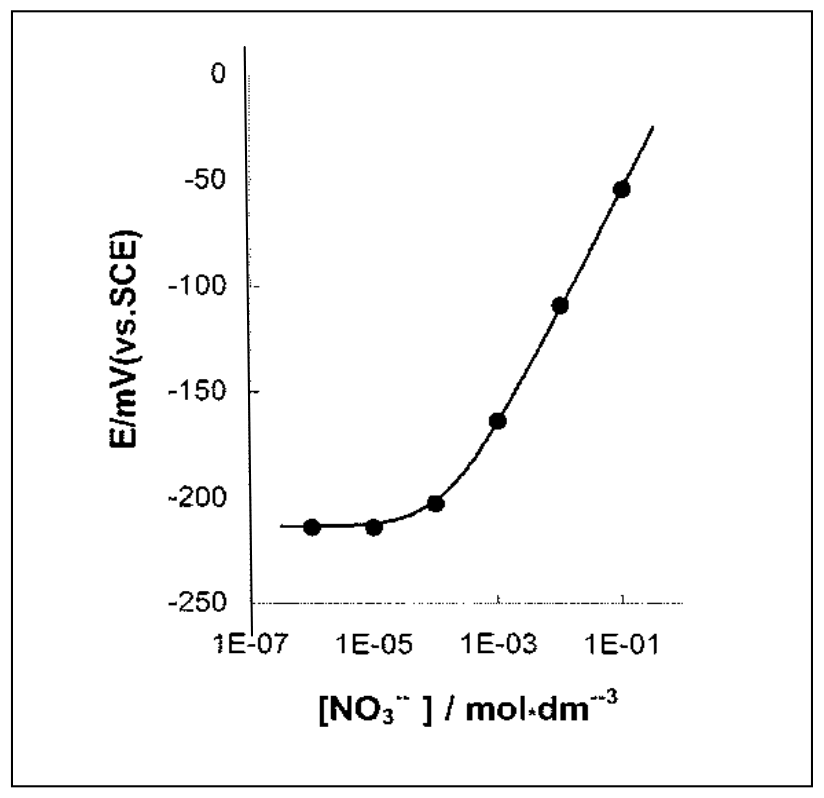
2.1 For a nitrate ion selective electrode a calibration curve as shown below was obtained using a series of standard nitrate solutions containing \(0.5\ \mathrm{mol\,dm^{-3}}\) \(\ce{K2SO4}\), \(1.0\times10^{-3}\ \mathrm{mol\,dm^{-3}}\) \(\ce{H2SO4}\) and \(2.6\times10^{-3}\ \mathrm{mol\,dm^{-3}}\) \(\ce{Cl-}\) ion as the background. Decide whether it is feasible to measure concentration \(\ce{NO3-}\) in serum under the above conditions.
2.2 Given are selective coefficients of \(\ce{Cl-}\), \(\ce{SO4^2-}\) and \(\ce{ClO4-}\) versus \(\ce{NO3-}\) as follow
\[ K_{\ce{NO3-},\ce{Cl-}} =\frac{c_{\ce{NO3-}}}{c_{\ce{Cl-}}} =4.9\times10^{-2} \qquad K_{\ce{NO3-},\ce{SO4^2-}} =\frac{c_{\ce{NO3-}}}{c_{\ce{SO4^2-}}^{1/2}} =4.1\times10^{-3} \]
\[ K_{\ce{NO3-},\ce{ClO4-}} =\frac{c_{\ce{NO3-}}}{c_{\ce{ClO4-}}} =1.0\times10^{-3} \]
where the units of the concentrations are in \(\mathrm{mol\,dm^{-3}}\) which is the best to reduce the interference of \(\ce{Cl-}\) to \(\ce{NO3-}\) determination, so as to control the error in the \(\ce{NO3-}\) concentration within 1 %, when there are \(1.40\times10^{-3}\ \mathrm{mol\,dm^{-3}}\) \(\ce{NO3-}\) and \(1.60\times10^{-2}\ \mathrm{mol\,dm^{-3}}\) \(\ce{Cl-}\) in serum:
\[ \text{(a)}\quad\ce{AgNO3} \qquad \text{(b)}\quad\ce{Ag2SO4} \qquad \text{(c)}\quad\ce{AgClO4} \]
Calculate the amount of the salt that should be added to \(1\ \mathrm{dm^3}\) of the sample solution to be measured.
2.3 The \(\ce{NO3-}\) ion concentration was determined by this method at 298 K. For \(25.00\ \mathrm{cm^3}\) sample solution the electronic potential, \(E\), is measured to be \(-160\ \mathrm{mV}\). After adding \(1.00\ \mathrm{cm^3}\) \(1.00\times10^{-3}\ \mathrm{mol\,dm^{-3}}\) \(\ce{NO3-}\) standard solution to the above solution, \(E\) changes to \(-130\ \mathrm{mV}\). Find the \(\mathrm{pNO_3}\) of the serum.
2.4 The selective coefficient of \(\ce{CH3COO-}\) versus \(\ce{NO3-}\), \(K(\ce{NO3-}/\ce{CH3COO-})=2.7\times10^{-3}\). If \(\ce{AgCH3COO}\) instead of \(\ce{Ag2SO4}\) is added to the sample solution of question 2.2, find the upper limit of the pH value below which the same requirement in question 2.2 can be met.
\[ K_{\mathrm{sp}}(\ce{AgCl})=3.2\times10^{-10} \qquad K_{\mathrm{sp}}(\ce{Ag2SO4})=8.0\times10^{-5} \]
\[ K_{\mathrm{sp}}(\ce{AgCH3COO})=8.0\times10^{-3} \qquad K_a(\ce{CH3COOH})=2.2\times10^{-5} \]
\[ A_{\mathrm r}(\ce{N})=14.00 \]
Official English text of the problem.
Answers
- 2.1: Yes. The expected nitrate concentration is \(1.07\times10^{-3}\ \mathrm{mol\,dm^{-3}}\), near the beginning of the approximately linear part of the calibration curve.
- 2.2: Choose silver sulfate, \(\ce{Ag2SO4}\), SMILES
[Ag+].[Ag+].[O-]S(=O)(=O)[O-]. The minimum addition to \(1\ \mathrm{dm^3}\) is \(7.86\times10^{-3}\ \mathrm{mol}\), approximately \(2.45\ \mathrm g\). - 2.3: \(\boxed{\mathrm{pNO_3}=4.77}\), corresponding to \(c_{\ce{NO3-}}=1.71\times10^{-5}\ \mathrm{mol\,dm^{-3}}\).
- 2.4: The usual quantitative-precipitation approximation gives \(\boxed{\mathrm{pH}_{\max}\approx4.34}\). Retaining both residual chloride and acetate interference gives the slightly stricter limit \(\boxed{\mathrm{pH}_{\max}\approx4.33}\).
Solution
2.1 — Feasibility of the measurement
Nitrate, \(\ce{NO3-}\), has SMILES [O-][N+](=O)[O-]. Each nitrate ion contains one nitrogen atom. Because the stated concentration is expressed as nitrogen mass,
\[ c_{\ce{NO3-}} =\frac{15\times10^{-3}\ \mathrm{g\,dm^{-3}}} {14.00\ \mathrm{g\,mol^{-1}}} =1.07\times10^{-3}\ \mathrm{mol\,dm^{-3}}. \]
The graph becomes approximately linear in \(E\) versus \(\log c_{\ce{NO3-}}\) around \(10^{-3}\ \mathrm{mol\,dm^{-3}}\), and remains so at higher concentrations. The expected serum concentration therefore lies in the useful, concentration-sensitive region.
Thus, measurement is feasible using the supplied calibration.
2.2 — Choice and minimum amount of silver salt
Silver(I) ion, [Ag+], precipitates chloride, [Cl-], as silver chloride, [Ag+].[Cl-]:
\[ \ce{Ag+(aq) + Cl-(aq) -> AgCl(s)}. \]
The candidate salts are:
| Salt | Name and SMILES | Assessment |
|---|---|---|
| \(\ce{AgNO3}\) | Silver nitrate, [Ag+].[O-][N+](=O)[O-] |
Adds the analyte itself in a large amount. |
| \(\ce{Ag2SO4}\) | Silver sulfate, [Ag+].[Ag+].[O-]S(=O)(=O)[O-] |
Suitable because sulfate is already the large, calibrated background. |
| \(\ce{AgClO4}\) | Silver perchlorate, [Ag+].[O-]Cl(=O)(=O)=O |
Introduces too much additional perchlorate interference. |
Here sulfate is [O-]S(=O)(=O)[O-], and perchlorate is [O-]Cl(=O)(=O)=O. These oxyanion SMILES represent individual resonance forms. The disconnected SMILES for salts specify ionic composition; they do not describe crystal lattices.
For silver perchlorate, nearly complete removal of the initial chloride would introduce approximately \(0.0160\ \mathrm{mol\,dm^{-3}}\) perchlorate. Its nitrate-equivalent contribution alone would be
\[ (1.0\times10^{-3})(1.60\times10^{-2}) =1.60\times10^{-5}\ \mathrm{mol\,dm^{-3}}, \]
which exceeds the permitted error,
\[ B=0.01(1.40\times10^{-3}) =1.40\times10^{-5}\ \mathrm{mol\,dm^{-3}}. \]
Leaving more chloride cannot solve this problem, because chloride has the larger selectivity coefficient.
For silver sulfate, the sulfate response is treated as part of the existing \(0.5\ \mathrm{mol\,dm^{-3}}\) background, since the solution already contains 0.5 M potassium sulfate. The precipitation reaction is
\[ \ce{Ag2SO4(s) + 2Cl-(aq) -> 2AgCl(s) + SO4^2-(aq)}. \]
The maximum permissible residual chloride concentration satisfies
\[ K_{\ce{NO3-},\ce{Cl-}}c_{\ce{Cl-}}\le B. \]
Consequently,
\[ c_{\ce{Cl-},\max} =\frac{1.40\times10^{-5}}{4.9\times10^{-2}} =2.857\times10^{-4}\ \mathrm{mol\,dm^{-3}}. \]
At this boundary, the dissolved silver concentration is
\[ c_{\ce{Ag+}} =\frac{K_{\mathrm{sp}}(\ce{AgCl})}{c_{\ce{Cl-}}} =\frac{3.2\times10^{-10}}{2.857\times10^{-4}} =1.12\times10^{-6}\ \mathrm{mol\,dm^{-3}}. \]
The silver added must supply both the precipitated silver chloride and this small dissolved remainder. Neglecting the volume change on adding solid salt,
\[ 2n_{\ce{Ag2SO4}} =V\left(c_{\ce{Cl-},0}-c_{\ce{Cl-},\max}+c_{\ce{Ag+}}\right). \]
For \(V=1\ \mathrm{dm^3}\),
\[ n_{\ce{Ag2SO4},\min} =\frac{1}{2} \left(1.60\times10^{-2}-2.857\times10^{-4} +1.12\times10^{-6}\right) =7.8577\times10^{-3}\ \mathrm{mol}. \]
Therefore,
\[ \boxed{n_{\ce{Ag2SO4},\min}=7.86\times10^{-3}\ \mathrm{mol}}. \]
Using \(M(\ce{Ag2SO4})\approx311.8\ \mathrm{g\,mol^{-1}}\), this is approximately \(2.45\ \mathrm g\).
The dose is compatible with complete dissolution of the added silver sulfate: at the calculated endpoint,
\[ c_{\ce{Ag+}}^2c_{\ce{SO4^2-}} \approx(1.12\times10^{-6})^2(0.51) \approx6.4\times10^{-13} \ll8.0\times10^{-5}. \]
Thus, saturation with solid silver sulfate does not determine the minimum dose.
2.3 — Standard addition
For a monovalent ion at \(298\ \mathrm K\), the magnitude of the Nernst slope is
\[ S=\frac{2.303RT}{F} =0.05913\ \mathrm V. \]
Using the measured-potential polarity shown in the problem, increasing nitrate concentration increases \(E\). Hence
\[ E_2-E_1=S\log_{10}\frac{c_2}{c_1}. \]
Since \(\Delta E=30\ \mathrm{mV}\),
\[ r=\frac{c_2}{c_1} =10^{30/59.13} =3.216. \]
Let \(c\) be the original nitrate concentration. Including dilution by the added standard,
\[ c_2=\frac{cV_0+c_sV_s}{V_0+V_s}. \]
Therefore,
\[ c=\frac{c_sV_s}{r(V_0+V_s)-V_0}. \]
Substitution gives
\[ c= \frac{(1.00\times10^{-3}\ \mathrm{mol\,dm^{-3}}) (0.00100\ \mathrm{dm^3})} {3.216(0.02600\ \mathrm{dm^3})-0.02500\ \mathrm{dm^3}} =1.706\times10^{-5}\ \mathrm{mol\,dm^{-3}}. \]
Thus,
\[ \boxed{ \mathrm{pNO_3} =-\log_{10}\left( \frac{c_{\ce{NO3-}}}{1\ \mathrm{mol\,dm^{-3}}} \right) =4.77 }. \]
2.4 — Suppressing acetate interference by protonation
The relevant species are silver acetate, \(\ce{AgCH3COO}\), [Ag+].CC(=O)[O-]; acetate, \(\ce{CH3COO-}\), CC(=O)[O-]; acetic acid, \(\ce{CH3COOH}\), CC(=O)O; and hydrogen ion, \(\ce{H+}\), [H+].
Silver acetate removes chloride through
\[ \ce{AgCH3COO(s) + Cl-(aq) -> AgCl(s) + CH3COO-(aq)}. \]
Acidification suppresses the concentration of interfering acetate:
\[ \ce{CH3COOH(aq) <=> H+(aq) + CH3COO-(aq)}. \]
The combined reaction can be written as
\[ \ce{AgCH3COO(s) + Cl-(aq) + H+(aq) -> AgCl(s) + CH3COOH(aq)}. \]
Usual quantitative-precipitation approximation. Removing approximately \(0.0160\ \mathrm{mol\,dm^{-3}}\) chloride introduces the same total concentration of acetate species:
\[ C_{\mathrm{Ac}} =c_{\ce{CH3COO-}}+c_{\ce{CH3COOH}} \approx1.60\times10^{-2}\ \mathrm{mol\,dm^{-3}}. \]
If residual chloride interference is neglected, the maximum free acetate concentration is
\[ c_{\ce{CH3COO-},\max} =\frac{B}{K_{\ce{NO3-},\ce{CH3COO-}}} =\frac{1.40\times10^{-5}}{2.7\times10^{-3}} =5.185\times10^{-3}\ \mathrm{mol\,dm^{-3}}. \]
Using
\[ K_a=\frac{c_{\ce{H+}}c_{\ce{CH3COO-}}} {c_{\ce{CH3COOH}}}, \]
the minimum hydrogen-ion concentration is
\[ c_{\ce{H+},\min} =K_a\frac{C_{\mathrm{Ac}}-c_{\ce{CH3COO-},\max}} {c_{\ce{CH3COO-},\max}} \]
\[ =(2.2\times10^{-5}) \frac{0.0160-0.005185}{0.005185} =4.589\times10^{-5}\ \mathrm{mol\,dm^{-3}}. \]
Therefore,
\[ \boxed{\mathrm{pH}_{\max}\approx4.34}. \]
Lower pH increases protonation and reduces acetate interference.
Retaining both interferences. The chloride concentration allowed at the minimum sulfate dose in 2.2 already consumes the entire 1% error allowance. With acetate present, chloride must be precipitated more completely.
To find the strict maximum pH, let \(x=c_{\ce{Cl-}}\), and let
\[ \alpha=\frac{K_a}{K_a+c_{\ce{H+}}} \]
be the fraction of total acetate present as acetate ion. Silver chloride equilibrium and the silver balance give
\[ c_{\ce{Ag+}}=\frac{K_{\mathrm{sp}}(\ce{AgCl})}{x}, \]
\[ C_{\mathrm{Ac}} =0.0160-x+\frac{K_{\mathrm{sp}}(\ce{AgCl})}{x}. \]
The combined nitrate-equivalent interference is consequently
\[ \Delta c =k_{\mathrm{Cl}}x+ k_{\mathrm{Ac}}\alpha \left(0.0160-x+\frac{K_{\mathrm{sp}}}{x}\right), \]
where \(k_{\mathrm{Cl}}=0.049\) and \(k_{\mathrm{Ac}}=0.0027\).
Writing \(b=k_{\mathrm{Ac}}\alpha\),
\[ \Delta c =0.0160b+(k_{\mathrm{Cl}}-b)x+\frac{bK_{\mathrm{sp}}}{x}. \]
For a fixed pH, its minimum over the silver acetate dose is
\[ \Delta c_{\min} =0.0160b+ 2\sqrt{(k_{\mathrm{Cl}}-b)bK_{\mathrm{sp}}}. \]
Setting this equal to \(B=1.40\times10^{-5}\) gives
\[ \alpha=0.31874, \qquad c_{\ce{H+}}=K_a\frac{1-\alpha}{\alpha} =4.702\times10^{-5}\ \mathrm{mol\,dm^{-3}}, \]
and therefore
\[ \boxed{\mathrm{pH}_{\max}=4.3277\approx4.33}. \]
This boundary is attainable with approximately
\[ c_{\ce{Cl-}}=2.39\times10^{-6}\ \mathrm{mol\,dm^{-3}}, \qquad C_{\mathrm{Ac}}=0.01613\ \mathrm{mol\,dm^{-3}}, \]
corresponding to \(0.01613\ \mathrm{mol}\) silver acetate per litre. Its dissolved-ion product is only
\[ c_{\ce{Ag+}}c_{\ce{CH3COO-}} \approx6.9\times10^{-7} < K_{\mathrm{sp}}(\ce{AgCH3COO}), \]
so silver acetate solubility does not prevent this result.
The solution was checked against the official solution. Where this solution differs from the official solution, the official solution contains an error or a misprint.
IChO 1995 · Theorieaufgabe 2
Nitrat in Milchserum: ionenselektive Elektrode
Zur Qualitätskontrolle von Milchserum, einem Nebenprodukt der Milchverarbeitung, wird die Konzentration der \(\ce{NO3-}\)-Ionen im Serum mithilfe einer ionenselektiven Elektrode überwacht. Im Allgemeinen enthält Serum etwa 15 mg \(\ce{NO3-}\)-Ionen pro Liter, bezogen auf die Stickstoffmasse.
2.1 Für eine nitratselektive Elektrode wurde die unten dargestellte Kalibrierkurve mithilfe einer Reihe von Nitratstandardlösungen aufgenommen, die als Hintergrundelektrolyt \(0.5\ \mathrm{mol\,dm^{-3}}\) \(\ce{K2SO4}\), \(1.0\times10^{-3}\ \mathrm{mol\,dm^{-3}}\) \(\ce{H2SO4}\) und \(2.6\times10^{-3}\ \mathrm{mol\,dm^{-3}}\) \(\ce{Cl-}\)-Ionen enthielten. Entscheiden Sie, ob es unter den oben genannten Bedingungen möglich ist, die Konzentration von \(\ce{NO3-}\) im Serum zu messen.
2.2 Die Selektivitätskoeffizienten von \(\ce{Cl-}\), \(\ce{SO4^2-}\) und \(\ce{ClO4-}\) gegenüber \(\ce{NO3-}\) sind wie folgt gegeben:
\[ K_{\ce{NO3-},\ce{Cl-}} =\frac{c_{\ce{NO3-}}}{c_{\ce{Cl-}}} =4.9\times10^{-2} \qquad K_{\ce{NO3-},\ce{SO4^2-}} =\frac{c_{\ce{NO3-}}}{c_{\ce{SO4^2-}}^{1/2}} =4.1\times10^{-3} \]
\[ K_{\ce{NO3-},\ce{ClO4-}} =\frac{c_{\ce{NO3-}}}{c_{\ce{ClO4-}}} =1.0\times10^{-3} \]
Dabei werden die Konzentrationen in \(\mathrm{mol\,dm^{-3}}\) angegeben. Welches der folgenden Salze eignet sich am besten, um die Störung der \(\ce{NO3-}\)-Bestimmung durch \(\ce{Cl-}\) so weit zu verringern, dass der Fehler der \(\ce{NO3-}\)-Konzentration höchstens 1 % beträgt, wenn das Serum \(1.40\times10^{-3}\ \mathrm{mol\,dm^{-3}}\) \(\ce{NO3-}\) und \(1.60\times10^{-2}\ \mathrm{mol\,dm^{-3}}\) \(\ce{Cl-}\) enthält:
\[ \text{(a)}\quad\ce{AgNO3} \qquad \text{(b)}\quad\ce{Ag2SO4} \qquad \text{(c)}\quad\ce{AgClO4} \]
Berechnen Sie die Menge des Salzes, die zu \(1\ \mathrm{dm^3}\) der zu messenden Probelösung gegeben werden sollte.
2.3 Die Konzentration der \(\ce{NO3-}\)-Ionen wurde mit dieser Methode bei 298 K bestimmt. Für \(25.00\ \mathrm{cm^3}\) Probelösung wird das elektrische Potential \(E\) zu \(-160\ \mathrm{mV}\) gemessen. Nach Zugabe von \(1.00\ \mathrm{cm^3}\) einer \(1.00\times10^{-3}\ \mathrm{mol\,dm^{-3}}\) \(\ce{NO3-}\)-Standardlösung zu dieser Lösung ändert sich \(E\) auf \(-130\ \mathrm{mV}\). Bestimmen Sie den \(\mathrm{pNO_3}\)-Wert des Serums.
2.4 Der Selektivitätskoeffizient von \(\ce{CH3COO-}\) gegenüber \(\ce{NO3-}\) beträgt \(K(\ce{NO3-}/\ce{CH3COO-})=2.7\times10^{-3}\). Wenn der Probelösung aus Teilaufgabe 2.2 anstelle von \(\ce{Ag2SO4}\) \(\ce{AgCH3COO}\) zugesetzt wird, bestimmen Sie die obere Grenze des pH-Werts, unterhalb derer dieselbe Anforderung wie in Teilaufgabe 2.2 erfüllt werden kann.
\[ K_{\mathrm{sp}}(\ce{AgCl})=3.2\times10^{-10} \qquad K_{\mathrm{sp}}(\ce{Ag2SO4})=8.0\times10^{-5} \]
\[ K_{\mathrm{sp}}(\ce{AgCH3COO})=8.0\times10^{-3} \qquad K_a(\ce{CH3COOH})=2.2\times10^{-5} \]
\[ A_{\mathrm r}(\ce{N})=14.00 \]
Aufgabentext aus dem offiziellen englischen Text übersetzt.
Antworten
- 2.1: Ja. Die erwartete Nitratkonzentration beträgt \(1.07\times10^{-3}\ \mathrm{mol\,dm^{-3}}\) und liegt nahe dem Beginn des annähernd linearen Bereichs der Kalibrierkurve.
- 2.2: Zu wählen ist Silbersulfat, \(\ce{Ag2SO4}\), SMILES
[Ag+].[Ag+].[O-]S(=O)(=O)[O-]. Die Mindestzugabe zu \(1\ \mathrm{dm^3}\) beträgt \(7.86\times10^{-3}\ \mathrm{mol}\), entsprechend etwa \(2.45\ \mathrm g\). - 2.3: \(\boxed{\mathrm{pNO_3}=4.77}\), entsprechend \(c_{\ce{NO3-}}=1.71\times10^{-5}\ \mathrm{mol\,dm^{-3}}\).
- 2.4: Die übliche Näherung einer quantitativen Fällung ergibt \(\boxed{\mathrm{pH}_{\max}\approx4.34}\). Werden sowohl die Störung durch verbleibendes Chlorid als auch die durch Acetat berücksichtigt, ergibt sich die etwas strengere Grenze \(\boxed{\mathrm{pH}_{\max}\approx4.33}\).
Lösung
2.1 — Durchführbarkeit der Messung
Nitrat, \(\ce{NO3-}\), hat den SMILES-Code [O-][N+](=O)[O-]. Jedes Nitration enthält ein Stickstoffatom. Da die angegebene Konzentration auf die Stickstoffmasse bezogen ist, gilt
\[ c_{\ce{NO3-}} =\frac{15\times10^{-3}\ \mathrm{g\,dm^{-3}}} {14.00\ \mathrm{g\,mol^{-1}}} =1.07\times10^{-3}\ \mathrm{mol\,dm^{-3}}. \]
Die Auftragung von \(E\) gegen \(\log c_{\ce{NO3-}}\) wird bei etwa \(10^{-3}\ \mathrm{mol\,dm^{-3}}\) annähernd linear und bleibt es bei höheren Konzentrationen. Die erwartete Konzentration im Serum liegt somit im nutzbaren, konzentrationsempfindlichen Bereich.
Damit ist die Messung mithilfe der vorgegebenen Kalibrierung möglich.
2.2 — Auswahl und Mindestmenge des Silbersalzes
Das Silber(I)-Ion, [Ag+], fällt Chlorid, [Cl-], als Silberchlorid, [Ag+].[Cl-], aus:
\[ \ce{Ag+(aq) + Cl-(aq) -> AgCl(s)}. \]
Die zur Auswahl stehenden Salze sind:
| Salz | Name und SMILES | Beurteilung |
|---|---|---|
| \(\ce{AgNO3}\) | Silbernitrat, [Ag+].[O-][N+](=O)[O-] |
Führt den Analyten selbst in großer Menge zu. |
| \(\ce{Ag2SO4}\) | Silbersulfat, [Ag+].[Ag+].[O-]S(=O)(=O)[O-] |
Geeignet, da Sulfat bereits den in hoher Konzentration vorhandenen, bei der Kalibrierung berücksichtigten Hintergrund bildet. |
| \(\ce{AgClO4}\) | Silberperchlorat, [Ag+].[O-]Cl(=O)(=O)=O |
Verursacht eine zu große zusätzliche Störung durch Perchlorat. |
Hier steht [O-]S(=O)(=O)[O-] für Sulfat und [O-]Cl(=O)(=O)=O für Perchlorat. Diese SMILES-Codes der Oxoanionen stellen einzelne mesomere Grenzstrukturen dar. Die durch Punkte getrennten SMILES-Codes der Salze geben deren ionische Zusammensetzung an; sie beschreiben keine Kristallgitter.
Bei Verwendung von Silberperchlorat würde die nahezu vollständige Entfernung des ursprünglich vorhandenen Chlorids etwa \(0.0160\ \mathrm{mol\,dm^{-3}}\) Perchlorat einbringen. Allein dessen nitratäquivalenter Beitrag wäre
\[ (1.0\times10^{-3})(1.60\times10^{-2}) =1.60\times10^{-5}\ \mathrm{mol\,dm^{-3}}, \]
und würde damit den zulässigen Fehler überschreiten:
\[ B=0.01(1.40\times10^{-3}) =1.40\times10^{-5}\ \mathrm{mol\,dm^{-3}}. \]
Mehr Chlorid in der Lösung zu belassen, kann dieses Problem nicht lösen, da Chlorid den größeren Selektivitätskoeffizienten besitzt.
Bei Silbersulfat wird das Ansprechen auf Sulfat als Teil des bereits vorhandenen Hintergrunds von \(0.5\ \mathrm{mol\,dm^{-3}}\) behandelt, da die Lösung bereits 0.5 M Kaliumsulfat enthält. Die Fällungsreaktion lautet
\[ \ce{Ag2SO4(s) + 2Cl-(aq) -> 2AgCl(s) + SO4^2-(aq)}. \]
Die maximal zulässige Restkonzentration an Chlorid erfüllt die Bedingung
\[ K_{\ce{NO3-},\ce{Cl-}}c_{\ce{Cl-}}\le B. \]
Folglich gilt
\[ c_{\ce{Cl-},\max} =\frac{1.40\times10^{-5}}{4.9\times10^{-2}} =2.857\times10^{-4}\ \mathrm{mol\,dm^{-3}}. \]
An dieser Grenze beträgt die Konzentration des gelösten Silbers
\[ c_{\ce{Ag+}} =\frac{K_{\mathrm{sp}}(\ce{AgCl})}{c_{\ce{Cl-}}} =\frac{3.2\times10^{-10}}{2.857\times10^{-4}} =1.12\times10^{-6}\ \mathrm{mol\,dm^{-3}}. \]
Das zugesetzte Silber muss sowohl das ausgefällte Silberchlorid als auch diesen kleinen gelösten Rest liefern. Unter Vernachlässigung der Volumenänderung bei Zugabe des festen Salzes gilt
\[ 2n_{\ce{Ag2SO4}} =V\left(c_{\ce{Cl-},0}-c_{\ce{Cl-},\max}+c_{\ce{Ag+}}\right). \]
Für \(V=1\ \mathrm{dm^3}\) ergibt sich
\[ n_{\ce{Ag2SO4},\min} =\frac{1}{2} \left(1.60\times10^{-2}-2.857\times10^{-4} +1.12\times10^{-6}\right) =7.8577\times10^{-3}\ \mathrm{mol}. \]
Daher gilt
\[ \boxed{n_{\ce{Ag2SO4},\min}=7.86\times10^{-3}\ \mathrm{mol}}. \]
Mit \(M(\ce{Ag2SO4})\approx311.8\ \mathrm{g\,mol^{-1}}\) entspricht dies etwa \(2.45\ \mathrm g\).
Diese Zugabemenge ist mit einer vollständigen Auflösung des zugesetzten Silbersulfats vereinbar: Am berechneten Endpunkt gilt
\[ c_{\ce{Ag+}}^2c_{\ce{SO4^2-}} \approx(1.12\times10^{-6})^2(0.51) \approx6.4\times10^{-13} \ll8.0\times10^{-5}. \]
Die Sättigung bezüglich festen Silbersulfats bestimmt somit nicht die Mindestzugabemenge.
2.3 — Standardaddition
Für ein einwertiges Ion bei \(298\ \mathrm K\) beträgt der Betrag der Nernst-Steigung
\[ S=\frac{2.303RT}{F} =0.05913\ \mathrm V. \]
Bei der in der Aufgabe angegebenen Polarität des gemessenen Potentials steigt \(E\) mit zunehmender Nitratkonzentration. Daher gilt
\[ E_2-E_1=S\log_{10}\frac{c_2}{c_1}. \]
Da \(\Delta E=30\ \mathrm{mV}\), gilt
\[ r=\frac{c_2}{c_1} =10^{30/59.13} =3.216. \]
Sei \(c\) die ursprüngliche Nitratkonzentration. Unter Berücksichtigung der Verdünnung durch die zugesetzte Standardlösung gilt
\[ c_2=\frac{cV_0+c_sV_s}{V_0+V_s}. \]
Daraus folgt
\[ c=\frac{c_sV_s}{r(V_0+V_s)-V_0}. \]
Einsetzen ergibt
\[ c= \frac{(1.00\times10^{-3}\ \mathrm{mol\,dm^{-3}}) (0.00100\ \mathrm{dm^3})} {3.216(0.02600\ \mathrm{dm^3})-0.02500\ \mathrm{dm^3}} =1.706\times10^{-5}\ \mathrm{mol\,dm^{-3}}. \]
Somit gilt
\[ \boxed{ \mathrm{pNO_3} =-\log_{10}\left( \frac{c_{\ce{NO3-}}}{1\ \mathrm{mol\,dm^{-3}}} \right) =4.77 }. \]
2.4 — Unterdrückung der Acetatstörung durch Protonierung
Die relevanten Spezies sind Silberacetat, \(\ce{AgCH3COO}\), [Ag+].CC(=O)[O-]; Acetat, \(\ce{CH3COO-}\), CC(=O)[O-]; Essigsäure, \(\ce{CH3COOH}\), CC(=O)O; und das Wasserstoffion, \(\ce{H+}\), [H+].
Silberacetat entfernt Chlorid gemäß
\[ \ce{AgCH3COO(s) + Cl-(aq) -> AgCl(s) + CH3COO-(aq)}. \]
Durch Ansäuern wird die Konzentration des störenden Acetats verringert:
\[ \ce{CH3COOH(aq) <=> H+(aq) + CH3COO-(aq)}. \]
Die Gesamtreaktion lässt sich schreiben als
\[ \ce{AgCH3COO(s) + Cl-(aq) + H+(aq) -> AgCl(s) + CH3COOH(aq)}. \]
Übliche Näherung einer quantitativen Fällung. Die Entfernung von etwa \(0.0160\ \mathrm{mol\,dm^{-3}}\) Chlorid führt die gleiche Gesamtkonzentration an Acetatspezies zu:
\[ C_{\mathrm{Ac}} =c_{\ce{CH3COO-}}+c_{\ce{CH3COOH}} \approx1.60\times10^{-2}\ \mathrm{mol\,dm^{-3}}. \]
Wird die Störung durch verbleibendes Chlorid vernachlässigt, beträgt die maximale Konzentration an freiem Acetat
\[ c_{\ce{CH3COO-},\max} =\frac{B}{K_{\ce{NO3-},\ce{CH3COO-}}} =\frac{1.40\times10^{-5}}{2.7\times10^{-3}} =5.185\times10^{-3}\ \mathrm{mol\,dm^{-3}}. \]
Mit
\[ K_a=\frac{c_{\ce{H+}}c_{\ce{CH3COO-}}} {c_{\ce{CH3COOH}}}, \]
ergibt sich die minimale Wasserstoffionenkonzentration zu
\[ c_{\ce{H+},\min} =K_a\frac{C_{\mathrm{Ac}}-c_{\ce{CH3COO-},\max}} {c_{\ce{CH3COO-},\max}} \]
\[ =(2.2\times10^{-5}) \frac{0.0160-0.005185}{0.005185} =4.589\times10^{-5}\ \mathrm{mol\,dm^{-3}}. \]
Daher gilt
\[ \boxed{\mathrm{pH}_{\max}\approx4.34}. \]
Ein niedrigerer pH-Wert verstärkt die Protonierung und verringert die Störung durch Acetat.
Berücksichtigung beider Störungen. Die bei der Mindestzugabe von Sulfat in 2.2 zulässige Chloridkonzentration schöpft bereits den gesamten zulässigen Fehler von 1 % aus. In Gegenwart von Acetat muss Chlorid vollständiger ausgefällt werden.
Zur Bestimmung des streng berechneten maximalen pH-Werts sei \(x=c_{\ce{Cl-}}\), und
\[ \alpha=\frac{K_a}{K_a+c_{\ce{H+}}} \]
sei der Anteil des Gesamtacetats, der als Acetation vorliegt. Aus dem Silberchloridgleichgewicht und der Silberbilanz folgt
\[ c_{\ce{Ag+}}=\frac{K_{\mathrm{sp}}(\ce{AgCl})}{x}, \]
\[ C_{\mathrm{Ac}} =0.0160-x+\frac{K_{\mathrm{sp}}(\ce{AgCl})}{x}. \]
Die gesamte nitratäquivalente Störung beträgt folglich
\[ \Delta c =k_{\mathrm{Cl}}x+ k_{\mathrm{Ac}}\alpha \left(0.0160-x+\frac{K_{\mathrm{sp}}}{x}\right), \]
wobei \(k_{\mathrm{Cl}}=0.049\) und \(k_{\mathrm{Ac}}=0.0027\).
Mit \(b=k_{\mathrm{Ac}}\alpha\) lässt sich dies schreiben als
\[ \Delta c =0.0160b+(k_{\mathrm{Cl}}-b)x+\frac{bK_{\mathrm{sp}}}{x}. \]
Bei einem festen pH-Wert beträgt ihr Minimum bei Variation der Silberacetatzugabe
\[ \Delta c_{\min} =0.0160b+ 2\sqrt{(k_{\mathrm{Cl}}-b)bK_{\mathrm{sp}}}. \]
Setzt man diesen Ausdruck gleich \(B=1.40\times10^{-5}\), ergibt sich
\[ \alpha=0.31874, \qquad c_{\ce{H+}}=K_a\frac{1-\alpha}{\alpha} =4.702\times10^{-5}\ \mathrm{mol\,dm^{-3}}, \]
und damit
\[ \boxed{\mathrm{pH}_{\max}=4.3277\approx4.33}. \]
Diese Grenze ist erreichbar bei etwa
\[ c_{\ce{Cl-}}=2.39\times10^{-6}\ \mathrm{mol\,dm^{-3}}, \qquad C_{\mathrm{Ac}}=0.01613\ \mathrm{mol\,dm^{-3}}, \]
entsprechend \(0.01613\ \mathrm{mol}\) Silberacetat pro Liter. Das Ionenprodukt der gelösten Ionen beträgt dabei nur
\[ c_{\ce{Ag+}}c_{\ce{CH3COO-}} \approx6.9\times10^{-7} < K_{\mathrm{sp}}(\ce{AgCH3COO}), \]
sodass die Löslichkeit von Silberacetat dieses Ergebnis nicht verhindert.
Die Lösung wurde mit der offiziellen Lösung abgeglichen. Wo diese Lösung von der offiziellen Lösung abweicht, enthält die offizielle Lösung einen Fehler oder Druckfehler.
IChO 1995 · Teori sorusu 2
Süt serumunda nitrat: iyon seçici elektrot
Bir süt endüstrisi yan ürünü olan süt serumunun kalitesini kontrol etmek için serumdaki \(\ce{NO3-}\) iyonu derişimi, iyon seçici bir elektrotla izlenir. Serumda genellikle, azot kütlesi esas alınarak ölçüldüğünde, litre başına yaklaşık 15 mg \(\ce{NO3-}\) iyonu bulunur.
2.1 Bir nitrat iyonu seçici elektrot için, arka plan olarak \(0.5\ \mathrm{mol\,dm^{-3}}\) \(\ce{K2SO4}\), \(1.0\times10^{-3}\ \mathrm{mol\,dm^{-3}}\) \(\ce{H2SO4}\) ve \(2.6\times10^{-3}\ \mathrm{mol\,dm^{-3}}\) \(\ce{Cl-}\) iyonu içeren bir dizi standart nitrat çözeltisi kullanılarak aşağıda gösterilen kalibrasyon eğrisi elde edilmiştir. Yukarıdaki koşullarda serumdaki \(\ce{NO3-}\) derişiminin ölçülmesinin mümkün olup olmadığına karar veriniz.
2.2 \(\ce{Cl-}\), \(\ce{SO4^2-}\) ve \(\ce{ClO4-}\) iyonlarının \(\ce{NO3-}\) iyonuna göre seçicilik katsayıları aşağıdaki gibi verilmiştir:
\[ K_{\ce{NO3-},\ce{Cl-}} =\frac{c_{\ce{NO3-}}}{c_{\ce{Cl-}}} =4.9\times10^{-2} \qquad K_{\ce{NO3-},\ce{SO4^2-}} =\frac{c_{\ce{NO3-}}}{c_{\ce{SO4^2-}}^{1/2}} =4.1\times10^{-3} \]
\[ K_{\ce{NO3-},\ce{ClO4-}} =\frac{c_{\ce{NO3-}}}{c_{\ce{ClO4-}}} =1.0\times10^{-3} \]
Burada derişimlerin birimi \(\mathrm{mol\,dm^{-3}}\)'tür. Serumda \(1.40\times10^{-3}\ \mathrm{mol\,dm^{-3}}\) \(\ce{NO3-}\) ve \(1.60\times10^{-2}\ \mathrm{mol\,dm^{-3}}\) \(\ce{Cl-}\) bulunduğunda, \(\ce{NO3-}\) derişimindeki hatayı %1 içinde tutmak üzere, \(\ce{Cl-}\) iyonunun \(\ce{NO3-}\) tayinine girişimini azaltmak için aşağıdakilerden hangisi en uygundur?
\[ \text{(a)}\quad\ce{AgNO3} \qquad \text{(b)}\quad\ce{Ag2SO4} \qquad \text{(c)}\quad\ce{AgClO4} \]
Ölçülecek numune çözeltisinin \(1\ \mathrm{dm^3}\)'üne eklenmesi gereken tuz miktarını hesaplayınız.
2.3 \(\ce{NO3-}\) iyonu derişimi bu yöntemle 298 K'de belirlenmiştir. \(25.00\ \mathrm{cm^3}\) numune çözeltisi için elektriksel potansiyel, \(E\), \(-160\ \mathrm{mV}\) olarak ölçülmüştür. Yukarıdaki çözeltiye \(1.00\ \mathrm{cm^3}\) hacminde \(1.00\times10^{-3}\ \mathrm{mol\,dm^{-3}}\) \(\ce{NO3-}\) standart çözeltisi eklendikten sonra \(E\), \(-130\ \mathrm{mV}\) değerine değişmektedir. Serumun \(\mathrm{pNO_3}\) değerini bulunuz.
2.4 \(\ce{CH3COO-}\) iyonunun \(\ce{NO3-}\) iyonuna göre seçicilik katsayısı \(K(\ce{NO3-}/\ce{CH3COO-})=2.7\times10^{-3}\)'tür. 2.2 sorusundaki numune çözeltisine \(\ce{Ag2SO4}\) yerine \(\ce{AgCH3COO}\) eklenirse, altında 2.2 sorusundaki aynı koşulun sağlanabileceği pH üst sınırını bulunuz.
\[ K_{\mathrm{sp}}(\ce{AgCl})=3.2\times10^{-10} \qquad K_{\mathrm{sp}}(\ce{Ag2SO4})=8.0\times10^{-5} \]
\[ K_{\mathrm{sp}}(\ce{AgCH3COO})=8.0\times10^{-3} \qquad K_a(\ce{CH3COOH})=2.2\times10^{-5} \]
\[ A_{\mathrm r}(\ce{N})=14.00 \]
Soru metni resmi İngilizce metinden çevrilmiştir.
Cevaplar
- 2.1: Evet. Beklenen nitrat derişimi \(1.07\times10^{-3}\ \mathrm{mol\,dm^{-3}}\) olup kalibrasyon eğrisinin yaklaşık doğrusal kısmının başlangıcına yakındır.
- 2.2: Gümüş sülfat, \(\ce{Ag2SO4}\), SMILES
[Ag+].[Ag+].[O-]S(=O)(=O)[O-], seçilir. \(1\ \mathrm{dm^3}\)'e eklenmesi gereken en az miktar \(7.86\times10^{-3}\ \mathrm{mol}\), yani yaklaşık \(2.45\ \mathrm g\)'dır. - 2.3: \(\boxed{\mathrm{pNO_3}=4.77}\); bu değer \(c_{\ce{NO3-}}=1.71\times10^{-5}\ \mathrm{mol\,dm^{-3}}\) derişimine karşılık gelir.
- 2.4: Alışılmış nicel çöktürme yaklaşımı \(\boxed{\mathrm{pH}_{\max}\approx4.34}\) sonucunu verir. Hem kalan klorürün hem de asetatın girişimi hesaba katıldığında, biraz daha sıkı olan \(\boxed{\mathrm{pH}_{\max}\approx4.33}\) sınırı elde edilir.
Çözüm
2.1 — Ölçümün yapılabilirliği
Nitratın, \(\ce{NO3-}\), SMILES gösterimi [O-][N+](=O)[O-]'dir. Her nitrat iyonu bir azot atomu içerir. Verilen derişim azot kütlesi cinsinden ifade edildiği için,
\[ c_{\ce{NO3-}} =\frac{15\times10^{-3}\ \mathrm{g\,dm^{-3}}} {14.00\ \mathrm{g\,mol^{-1}}} =1.07\times10^{-3}\ \mathrm{mol\,dm^{-3}}. \]
\(E\)'nin \(\log c_{\ce{NO3-}}\)'e karşı grafiği, \(10^{-3}\ \mathrm{mol\,dm^{-3}}\) civarında yaklaşık doğrusal hâle gelir ve daha yüksek derişimlerde de böyle kalır. Dolayısıyla beklenen serum derişimi, derişime duyarlı olan kullanılabilir bölgede yer alır.
Bu nedenle, verilen kalibrasyon kullanılarak ölçüm yapılabilir.
2.2 — Gümüş tuzunun seçimi ve en az miktarı
Gümüş(I) iyonu, [Ag+], klorürü, [Cl-], gümüş klorür, [Ag+].[Cl-], olarak çöktürür:
\[ \ce{Ag+(aq) + Cl-(aq) -> AgCl(s)}. \]
Aday tuzlar şunlardır:
| Tuz | Adı ve SMILES gösterimi | Değerlendirme |
|---|---|---|
| \(\ce{AgNO3}\) | Gümüş nitrat, [Ag+].[O-][N+](=O)[O-] |
Analitin kendisini büyük miktarda ekler. |
| \(\ce{Ag2SO4}\) | Gümüş sülfat, [Ag+].[Ag+].[O-]S(=O)(=O)[O-] |
Sülfat zaten yüksek derişimli, kalibrasyonda hesaba katılan arka planı oluşturduğu için uygundur. |
| \(\ce{AgClO4}\) | Gümüş perklorat, [Ag+].[O-]Cl(=O)(=O)=O |
Çok fazla ek perklorat girişimine yol açar. |
Burada sülfat [O-]S(=O)(=O)[O-], perklorat ise [O-]Cl(=O)(=O)=O şeklindedir. Bu oksoanyonların SMILES gösterimleri, tek birer rezonans yapısını temsil eder. Tuzların birbirinden ayrık bileşenler içeren SMILES gösterimleri iyonik bileşimi belirtir; kristal örgülerini betimlemez.
Gümüş perklorat kullanıldığında, başlangıçtaki klorürün neredeyse tamamen uzaklaştırılması yaklaşık \(0.0160\ \mathrm{mol\,dm^{-3}}\) perklorat eklenmesine neden olur. Yalnızca bunun nitrat eşdeğeri katkısı
\[ (1.0\times10^{-3})(1.60\times10^{-2}) =1.60\times10^{-5}\ \mathrm{mol\,dm^{-3}}, \]
olur ve bu değer izin verilen hatayı aşar:
\[ B=0.01(1.40\times10^{-3}) =1.40\times10^{-5}\ \mathrm{mol\,dm^{-3}}. \]
Daha fazla klorür bırakmak bu sorunu çözemez; çünkü klorürün seçicilik katsayısı daha büyüktür.
Gümüş sülfat için, çözelti zaten 0.5 M potasyum sülfat içerdiğinden, sülfatın elektrot yanıtına katkısı mevcut \(0.5\ \mathrm{mol\,dm^{-3}}\) arka planın bir parçası olarak ele alınır. Çöktürme tepkimesi şöyledir:
\[ \ce{Ag2SO4(s) + 2Cl-(aq) -> 2AgCl(s) + SO4^2-(aq)}. \]
İzin verilen en yüksek kalan klorür derişimi şu koşulu sağlar:
\[ K_{\ce{NO3-},\ce{Cl-}}c_{\ce{Cl-}}\le B. \]
Buna göre,
\[ c_{\ce{Cl-},\max} =\frac{1.40\times10^{-5}}{4.9\times10^{-2}} =2.857\times10^{-4}\ \mathrm{mol\,dm^{-3}}. \]
Bu sınırda, çözünmüş gümüş derişimi şöyledir:
\[ c_{\ce{Ag+}} =\frac{K_{\mathrm{sp}}(\ce{AgCl})}{c_{\ce{Cl-}}} =\frac{3.2\times10^{-10}}{2.857\times10^{-4}} =1.12\times10^{-6}\ \mathrm{mol\,dm^{-3}}. \]
Eklenen gümüş, hem çöken gümüş klorürü hem de çözeltide kalan bu küçük miktarı karşılamalıdır. Katı tuz eklenmesinden kaynaklanan hacim değişimi ihmal edilirse,
\[ 2n_{\ce{Ag2SO4}} =V\left(c_{\ce{Cl-},0}-c_{\ce{Cl-},\max}+c_{\ce{Ag+}}\right). \]
\(V=1\ \mathrm{dm^3}\) için,
\[ n_{\ce{Ag2SO4},\min} =\frac{1}{2} \left(1.60\times10^{-2}-2.857\times10^{-4} +1.12\times10^{-6}\right) =7.8577\times10^{-3}\ \mathrm{mol}. \]
Dolayısıyla,
\[ \boxed{n_{\ce{Ag2SO4},\min}=7.86\times10^{-3}\ \mathrm{mol}}. \]
\(M(\ce{Ag2SO4})\approx311.8\ \mathrm{g\,mol^{-1}}\) kullanıldığında, bu miktar yaklaşık \(2.45\ \mathrm g\)'dır.
Bu doz, eklenen gümüş sülfatın tamamen çözünmesiyle uyumludur: hesaplanan son durumda,
\[ c_{\ce{Ag+}}^2c_{\ce{SO4^2-}} \approx(1.12\times10^{-6})^2(0.51) \approx6.4\times10^{-13} \ll8.0\times10^{-5}. \]
Dolayısıyla katı gümüş sülfata göre doygunluk, en düşük dozu belirlemez.
2.3 — Standart ekleme
\(298\ \mathrm K\)'de tek değerlikli bir iyon için Nernst eğiminin mutlak değeri şöyledir:
\[ S=\frac{2.303RT}{F} =0.05913\ \mathrm V. \]
Soruda gösterilen ölçüm potansiyelinin polaritesine göre, nitrat derişiminin artması \(E\)'yi artırır. Buna göre,
\[ E_2-E_1=S\log_{10}\frac{c_2}{c_1}. \]
\(\Delta E=30\ \mathrm{mV}\) olduğundan,
\[ r=\frac{c_2}{c_1} =10^{30/59.13} =3.216. \]
Başlangıçtaki nitrat derişimi \(c\) olsun. Eklenen standarttan kaynaklanan seyrelme hesaba katılırsa,
\[ c_2=\frac{cV_0+c_sV_s}{V_0+V_s}. \]
Dolayısıyla,
\[ c=\frac{c_sV_s}{r(V_0+V_s)-V_0}. \]
Değerler yerine konulduğunda,
\[ c= \frac{(1.00\times10^{-3}\ \mathrm{mol\,dm^{-3}}) (0.00100\ \mathrm{dm^3})} {3.216(0.02600\ \mathrm{dm^3})-0.02500\ \mathrm{dm^3}} =1.706\times10^{-5}\ \mathrm{mol\,dm^{-3}}. \]
Böylece,
\[ \boxed{ \mathrm{pNO_3} =-\log_{10}\left( \frac{c_{\ce{NO3-}}}{1\ \mathrm{mol\,dm^{-3}}} \right) =4.77 }. \]
2.4 — Protonlanmayla asetat girişiminin bastırılması
İlgili türler gümüş asetat, \(\ce{AgCH3COO}\), [Ag+].CC(=O)[O-]; asetat, \(\ce{CH3COO-}\), CC(=O)[O-]; asetik asit, \(\ce{CH3COOH}\), CC(=O)O; ve hidrojen iyonu, \(\ce{H+}\), [H+]'dır.
Gümüş asetat, klorürü şu tepkimeyle uzaklaştırır:
\[ \ce{AgCH3COO(s) + Cl-(aq) -> AgCl(s) + CH3COO-(aq)}. \]
Asitlendirme, girişime neden olan asetatın derişimini düşürür:
\[ \ce{CH3COOH(aq) <=> H+(aq) + CH3COO-(aq)}. \]
Toplam tepkime şu şekilde yazılabilir:
\[ \ce{AgCH3COO(s) + Cl-(aq) + H+(aq) -> AgCl(s) + CH3COOH(aq)}. \]
Alışılmış nicel çöktürme yaklaşımı. Yaklaşık \(0.0160\ \mathrm{mol\,dm^{-3}}\) klorürün uzaklaştırılması, aynı toplam derişimde asetat türlerinin eklenmesine neden olur:
\[ C_{\mathrm{Ac}} =c_{\ce{CH3COO-}}+c_{\ce{CH3COOH}} \approx1.60\times10^{-2}\ \mathrm{mol\,dm^{-3}}. \]
Kalan klorürün girişimi ihmal edilirse, en yüksek serbest asetat derişimi şöyledir:
\[ c_{\ce{CH3COO-},\max} =\frac{B}{K_{\ce{NO3-},\ce{CH3COO-}}} =\frac{1.40\times10^{-5}}{2.7\times10^{-3}} =5.185\times10^{-3}\ \mathrm{mol\,dm^{-3}}. \]
Şu bağıntı kullanılarak,
\[ K_a=\frac{c_{\ce{H+}}c_{\ce{CH3COO-}}} {c_{\ce{CH3COOH}}}, \]
en düşük hidrojen iyonu derişimi elde edilir:
\[ c_{\ce{H+},\min} =K_a\frac{C_{\mathrm{Ac}}-c_{\ce{CH3COO-},\max}} {c_{\ce{CH3COO-},\max}} \]
\[ =(2.2\times10^{-5}) \frac{0.0160-0.005185}{0.005185} =4.589\times10^{-5}\ \mathrm{mol\,dm^{-3}}. \]
Dolayısıyla,
\[ \boxed{\mathrm{pH}_{\max}\approx4.34}. \]
Daha düşük pH, protonlanmayı artırır ve asetat girişimini azaltır.
Her iki girişimin de hesaba katılması. 2.2'deki en düşük sülfat dozunda izin verilen klorür derişimi, %1'lik hata payının tamamını zaten kullanır. Asetat bulunduğunda klorürün daha tam olarak çöktürülmesi gerekir.
Kesin en yüksek pH değerini bulmak için \(x=c_{\ce{Cl-}}\) olsun ve
\[ \alpha=\frac{K_a}{K_a+c_{\ce{H+}}} \]
toplam asetatın asetat iyonu hâlinde bulunan kesrini göstersin. Gümüş klorür dengesi ve gümüş madde denkliği şu bağıntıları verir:
\[ c_{\ce{Ag+}}=\frac{K_{\mathrm{sp}}(\ce{AgCl})}{x}, \]
\[ C_{\mathrm{Ac}} =0.0160-x+\frac{K_{\mathrm{sp}}(\ce{AgCl})}{x}. \]
Buna göre toplam nitrat eşdeğeri girişim şöyledir:
\[ \Delta c =k_{\mathrm{Cl}}x+ k_{\mathrm{Ac}}\alpha \left(0.0160-x+\frac{K_{\mathrm{sp}}}{x}\right), \]
burada \(k_{\mathrm{Cl}}=0.049\) ve \(k_{\mathrm{Ac}}=0.0027\)'dir.
\(b=k_{\mathrm{Ac}}\alpha\) yazılırsa,
\[ \Delta c =0.0160b+(k_{\mathrm{Cl}}-b)x+\frac{bK_{\mathrm{sp}}}{x}. \]
Sabit bir pH için, gümüş asetat dozu değiştirildiğinde bunun alabileceği en küçük değer şöyledir:
\[ \Delta c_{\min} =0.0160b+ 2\sqrt{(k_{\mathrm{Cl}}-b)bK_{\mathrm{sp}}}. \]
Bu değer \(B=1.40\times10^{-5}\)'e eşitlendiğinde,
\[ \alpha=0.31874, \qquad c_{\ce{H+}}=K_a\frac{1-\alpha}{\alpha} =4.702\times10^{-5}\ \mathrm{mol\,dm^{-3}}, \]
ve dolayısıyla
\[ \boxed{\mathrm{pH}_{\max}=4.3277\approx4.33}. \]
Bu sınıra yaklaşık olarak şu değerlerle ulaşılabilir:
\[ c_{\ce{Cl-}}=2.39\times10^{-6}\ \mathrm{mol\,dm^{-3}}, \qquad C_{\mathrm{Ac}}=0.01613\ \mathrm{mol\,dm^{-3}}, \]
bu da litre başına \(0.01613\ \mathrm{mol}\) gümüş asetata karşılık gelir. Çözünmüş iyonların derişimleri çarpımı yalnızca
\[ c_{\ce{Ag+}}c_{\ce{CH3COO-}} \approx6.9\times10^{-7} < K_{\mathrm{sp}}(\ce{AgCH3COO}), \]
olduğundan, gümüş asetatın çözünürlüğü bu sonucun elde edilmesini engellemez.
Çözüm, resmi çözümle karşılaştırılarak kontrol edildi. Bu çözümün resmi çözümden ayrıldığı yerlerde resmi çözümde bir hata ya da baskı hatası vardır.
IChO 1995 · Problema teórico 2
Nitrato en el suero lácteo: electrodo selectivo de iones
Para controlar la calidad del suero lácteo, un subproducto de la industria láctea, se determina la concentración del ion \(\ce{NO3-}\) en el suero mediante un electrodo selectivo de iones. Generalmente, el suero contiene unos 15 mg de ion \(\ce{NO3-}\) por litro, expresados en masa de nitrógeno.
2.1 Para un electrodo selectivo de iones nitrato se obtuvo la curva de calibración que se muestra a continuación utilizando una serie de disoluciones patrón de nitrato que contenían \(0.5\ \mathrm{mol\,dm^{-3}}\) de \(\ce{K2SO4}\), \(1.0\times10^{-3}\ \mathrm{mol\,dm^{-3}}\) de \(\ce{H2SO4}\) y \(2.6\times10^{-3}\ \mathrm{mol\,dm^{-3}}\) de ion \(\ce{Cl-}\) como medio de fondo. Determine si es factible medir la concentración de \(\ce{NO3-}\) en el suero en las condiciones anteriores.
2.2 Se dan los siguientes coeficientes de selectividad de \(\ce{Cl-}\), \(\ce{SO4^2-}\) y \(\ce{ClO4-}\) respecto de \(\ce{NO3-}\):
\[ K_{\ce{NO3-},\ce{Cl-}} =\frac{c_{\ce{NO3-}}}{c_{\ce{Cl-}}} =4.9\times10^{-2} \qquad K_{\ce{NO3-},\ce{SO4^2-}} =\frac{c_{\ce{NO3-}}}{c_{\ce{SO4^2-}}^{1/2}} =4.1\times10^{-3} \]
\[ K_{\ce{NO3-},\ce{ClO4-}} =\frac{c_{\ce{NO3-}}}{c_{\ce{ClO4-}}} =1.0\times10^{-3} \]
donde las concentraciones se expresan en \(\mathrm{mol\,dm^{-3}}\). ¿Cuál de las siguientes sales es la más adecuada para reducir la interferencia de \(\ce{Cl-}\) en la determinación de \(\ce{NO3-}\), de modo que el error en la concentración de \(\ce{NO3-}\) no supere el 1 %, cuando el suero contiene \(1.40\times10^{-3}\ \mathrm{mol\,dm^{-3}}\) de \(\ce{NO3-}\) y \(1.60\times10^{-2}\ \mathrm{mol\,dm^{-3}}\) de \(\ce{Cl-}\)?
\[ \text{(a)}\quad\ce{AgNO3} \qquad \text{(b)}\quad\ce{Ag2SO4} \qquad \text{(c)}\quad\ce{AgClO4} \]
Calcule la cantidad de sal que debe añadirse a \(1\ \mathrm{dm^3}\) de la disolución de muestra que se va a medir.
2.3 La concentración del ion \(\ce{NO3-}\) se determinó mediante este método a 298 K. Para \(25.00\ \mathrm{cm^3}\) de disolución de muestra, el potencial eléctrico, \(E\), medido es de \(-160\ \mathrm{mV}\). Tras añadir \(1.00\ \mathrm{cm^3}\) de una disolución patrón de \(\ce{NO3-}\) de \(1.00\times10^{-3}\ \mathrm{mol\,dm^{-3}}\) a la disolución anterior, \(E\) pasa a ser \(-130\ \mathrm{mV}\). Halle el \(\mathrm{pNO_3}\) del suero.
2.4 El coeficiente de selectividad de \(\ce{CH3COO-}\) respecto de \(\ce{NO3-}\) es \(K(\ce{NO3-}/\ce{CH3COO-})=2.7\times10^{-3}\). Si se añade \(\ce{AgCH3COO}\) en lugar de \(\ce{Ag2SO4}\) a la disolución de muestra del apartado 2.2, halle el límite superior del pH por debajo del cual puede cumplirse el mismo requisito del apartado 2.2.
\[ K_{\mathrm{sp}}(\ce{AgCl})=3.2\times10^{-10} \qquad K_{\mathrm{sp}}(\ce{Ag2SO4})=8.0\times10^{-5} \]
\[ K_{\mathrm{sp}}(\ce{AgCH3COO})=8.0\times10^{-3} \qquad K_a(\ce{CH3COOH})=2.2\times10^{-5} \]
\[ A_{\mathrm r}(\ce{N})=14.00 \]
Enunciado traducido del texto oficial en inglés.
Respuestas
- 2.1: Sí. La concentración de nitrato esperada es \(1.07\times10^{-3}\ \mathrm{mol\,dm^{-3}}\), próxima al inicio de la parte aproximadamente lineal de la curva de calibración.
- 2.2: Se elige sulfato de plata, \(\ce{Ag2SO4}\), SMILES
[Ag+].[Ag+].[O-]S(=O)(=O)[O-]. La cantidad mínima que debe añadirse a \(1\ \mathrm{dm^3}\) es \(7.86\times10^{-3}\ \mathrm{mol}\), aproximadamente \(2.45\ \mathrm g\). - 2.3: \(\boxed{\mathrm{pNO_3}=4.77}\), que corresponde a \(c_{\ce{NO3-}}=1.71\times10^{-5}\ \mathrm{mol\,dm^{-3}}\).
- 2.4: La aproximación habitual de precipitación cuantitativa da \(\boxed{\mathrm{pH}_{\max}\approx4.34}\). Si se tienen en cuenta tanto la interferencia del cloruro residual como la del acetato, se obtiene el límite ligeramente más estricto \(\boxed{\mathrm{pH}_{\max}\approx4.33}\).
Solución
2.1 — Viabilidad de la medición
El nitrato, \(\ce{NO3-}\), tiene el SMILES [O-][N+](=O)[O-]. Cada ion nitrato contiene un átomo de nitrógeno. Como la concentración indicada se expresa en masa de nitrógeno,
\[ c_{\ce{NO3-}} =\frac{15\times10^{-3}\ \mathrm{g\,dm^{-3}}} {14.00\ \mathrm{g\,mol^{-1}}} =1.07\times10^{-3}\ \mathrm{mol\,dm^{-3}}. \]
La gráfica de \(E\) frente a \(\log c_{\ce{NO3-}}\) se vuelve aproximadamente lineal en torno a \(10^{-3}\ \mathrm{mol\,dm^{-3}}\), y sigue siéndolo a concentraciones mayores. Por tanto, la concentración esperada en el suero se encuentra en la región útil, sensible a la concentración.
Así pues, la medición es factible utilizando la calibración proporcionada.
2.2 — Elección y cantidad mínima de sal de plata
El ion plata(I), [Ag+], precipita el cloruro, [Cl-], como cloruro de plata, [Ag+].[Cl-]:
\[ \ce{Ag+(aq) + Cl-(aq) -> AgCl(s)}. \]
Las sales candidatas son:
| Sal | Nombre y SMILES | Evaluación |
|---|---|---|
| \(\ce{AgNO3}\) | Nitrato de plata, [Ag+].[O-][N+](=O)[O-] |
Añade una gran cantidad del propio analito. |
| \(\ce{Ag2SO4}\) | Sulfato de plata, [Ag+].[Ag+].[O-]S(=O)(=O)[O-] |
Adecuado porque el sulfato ya constituye el medio de fondo de alta concentración utilizado en la calibración. |
| \(\ce{AgClO4}\) | Perclorato de plata, [Ag+].[O-]Cl(=O)(=O)=O |
Introduce una interferencia adicional excesiva de perclorato. |
Aquí el sulfato es [O-]S(=O)(=O)[O-], y el perclorato es [O-]Cl(=O)(=O)=O. Estos SMILES de oxoaniones representan formas de resonancia individuales. Los SMILES de las sales con componentes desconectados especifican la composición iónica; no describen las redes cristalinas.
En el caso del perclorato de plata, la eliminación casi completa del cloruro inicial introduciría aproximadamente \(0.0160\ \mathrm{mol\,dm^{-3}}\) de perclorato. Su contribución equivalente en nitrato por sí sola sería
\[ (1.0\times10^{-3})(1.60\times10^{-2}) =1.60\times10^{-5}\ \mathrm{mol\,dm^{-3}}, \]
lo que supera el error permitido,
\[ B=0.01(1.40\times10^{-3}) =1.40\times10^{-5}\ \mathrm{mol\,dm^{-3}}. \]
Dejar más cloruro no resuelve este problema, porque el cloruro tiene el coeficiente de selectividad mayor.
Para el sulfato de plata, la respuesta del sulfato se considera parte del medio de fondo existente de \(0.5\ \mathrm{mol\,dm^{-3}}\), puesto que la disolución ya contiene sulfato de potasio 0.5 M. La reacción de precipitación es
\[ \ce{Ag2SO4(s) + 2Cl-(aq) -> 2AgCl(s) + SO4^2-(aq)}. \]
La concentración máxima admisible de cloruro residual satisface
\[ K_{\ce{NO3-},\ce{Cl-}}c_{\ce{Cl-}}\le B. \]
Por consiguiente,
\[ c_{\ce{Cl-},\max} =\frac{1.40\times10^{-5}}{4.9\times10^{-2}} =2.857\times10^{-4}\ \mathrm{mol\,dm^{-3}}. \]
En este límite, la concentración de plata disuelta es
\[ c_{\ce{Ag+}} =\frac{K_{\mathrm{sp}}(\ce{AgCl})}{c_{\ce{Cl-}}} =\frac{3.2\times10^{-10}}{2.857\times10^{-4}} =1.12\times10^{-6}\ \mathrm{mol\,dm^{-3}}. \]
La plata añadida debe aportar tanto la plata del cloruro de plata precipitado como esta pequeña cantidad que permanece disuelta. Despreciando el cambio de volumen al añadir la sal sólida,
\[ 2n_{\ce{Ag2SO4}} =V\left(c_{\ce{Cl-},0}-c_{\ce{Cl-},\max}+c_{\ce{Ag+}}\right). \]
Para \(V=1\ \mathrm{dm^3}\),
\[ n_{\ce{Ag2SO4},\min} =\frac{1}{2} \left(1.60\times10^{-2}-2.857\times10^{-4} +1.12\times10^{-6}\right) =7.8577\times10^{-3}\ \mathrm{mol}. \]
Por tanto,
\[ \boxed{n_{\ce{Ag2SO4},\min}=7.86\times10^{-3}\ \mathrm{mol}}. \]
Utilizando \(M(\ce{Ag2SO4})\approx311.8\ \mathrm{g\,mol^{-1}}\), esto equivale aproximadamente a \(2.45\ \mathrm g\).
La dosis es compatible con la disolución completa del sulfato de plata añadido: en el punto final calculado,
\[ c_{\ce{Ag+}}^2c_{\ce{SO4^2-}} \approx(1.12\times10^{-6})^2(0.51) \approx6.4\times10^{-13} \ll8.0\times10^{-5}. \]
Por tanto, la saturación respecto al sulfato de plata sólido no determina la dosis mínima.
2.3 — Adición estándar
Para un ion monovalente a \(298\ \mathrm K\), el valor absoluto de la pendiente de Nernst es
\[ S=\frac{2.303RT}{F} =0.05913\ \mathrm V. \]
Con la polaridad del potencial medido que se indica en el enunciado, un aumento de la concentración de nitrato aumenta \(E\). Por ello,
\[ E_2-E_1=S\log_{10}\frac{c_2}{c_1}. \]
Como \(\Delta E=30\ \mathrm{mV}\),
\[ r=\frac{c_2}{c_1} =10^{30/59.13} =3.216. \]
Sea \(c\) la concentración original de nitrato. Teniendo en cuenta la dilución debida al patrón añadido,
\[ c_2=\frac{cV_0+c_sV_s}{V_0+V_s}. \]
Por tanto,
\[ c=\frac{c_sV_s}{r(V_0+V_s)-V_0}. \]
Al sustituir se obtiene
\[ c= \frac{(1.00\times10^{-3}\ \mathrm{mol\,dm^{-3}}) (0.00100\ \mathrm{dm^3})} {3.216(0.02600\ \mathrm{dm^3})-0.02500\ \mathrm{dm^3}} =1.706\times10^{-5}\ \mathrm{mol\,dm^{-3}}. \]
Así pues,
\[ \boxed{ \mathrm{pNO_3} =-\log_{10}\left( \frac{c_{\ce{NO3-}}}{1\ \mathrm{mol\,dm^{-3}}} \right) =4.77 }. \]
2.4 — Supresión de la interferencia del acetato mediante protonación
Las especies relevantes son el acetato de plata, \(\ce{AgCH3COO}\), [Ag+].CC(=O)[O-]; el acetato, \(\ce{CH3COO-}\), CC(=O)[O-]; el ácido acético, \(\ce{CH3COOH}\), CC(=O)O; y el ion hidrógeno, \(\ce{H+}\), [H+].
El acetato de plata elimina el cloruro mediante
\[ \ce{AgCH3COO(s) + Cl-(aq) -> AgCl(s) + CH3COO-(aq)}. \]
La acidificación reduce la concentración del acetato que causa la interferencia:
\[ \ce{CH3COOH(aq) <=> H+(aq) + CH3COO-(aq)}. \]
La reacción global puede escribirse como
\[ \ce{AgCH3COO(s) + Cl-(aq) + H+(aq) -> AgCl(s) + CH3COOH(aq)}. \]
Aproximación habitual de precipitación cuantitativa. La eliminación de aproximadamente \(0.0160\ \mathrm{mol\,dm^{-3}}\) de cloruro introduce la misma concentración total de especies de acetato:
\[ C_{\mathrm{Ac}} =c_{\ce{CH3COO-}}+c_{\ce{CH3COOH}} \approx1.60\times10^{-2}\ \mathrm{mol\,dm^{-3}}. \]
Si se desprecia la interferencia del cloruro residual, la concentración máxima de acetato libre es
\[ c_{\ce{CH3COO-},\max} =\frac{B}{K_{\ce{NO3-},\ce{CH3COO-}}} =\frac{1.40\times10^{-5}}{2.7\times10^{-3}} =5.185\times10^{-3}\ \mathrm{mol\,dm^{-3}}. \]
Utilizando
\[ K_a=\frac{c_{\ce{H+}}c_{\ce{CH3COO-}}} {c_{\ce{CH3COOH}}}, \]
la concentración mínima de iones hidrógeno es
\[ c_{\ce{H+},\min} =K_a\frac{C_{\mathrm{Ac}}-c_{\ce{CH3COO-},\max}} {c_{\ce{CH3COO-},\max}} \]
\[ =(2.2\times10^{-5}) \frac{0.0160-0.005185}{0.005185} =4.589\times10^{-5}\ \mathrm{mol\,dm^{-3}}. \]
Por tanto,
\[ \boxed{\mathrm{pH}_{\max}\approx4.34}. \]
Un pH menor aumenta la protonación y reduce la interferencia del acetato.
Consideración de ambas interferencias. La concentración de cloruro permitida con la dosis mínima de sulfato del apartado 2.2 ya consume todo el margen de error del 1%. En presencia de acetato, el cloruro debe precipitarse de forma más completa.
Para hallar el pH máximo estricto, sea \(x=c_{\ce{Cl-}}\), y sea
\[ \alpha=\frac{K_a}{K_a+c_{\ce{H+}}} \]
la fracción del acetato total presente como ion acetato. El equilibrio del cloruro de plata y el balance de plata dan
\[ c_{\ce{Ag+}}=\frac{K_{\mathrm{sp}}(\ce{AgCl})}{x}, \]
\[ C_{\mathrm{Ac}} =0.0160-x+\frac{K_{\mathrm{sp}}(\ce{AgCl})}{x}. \]
Por consiguiente, la interferencia combinada equivalente en nitrato es
\[ \Delta c =k_{\mathrm{Cl}}x+ k_{\mathrm{Ac}}\alpha \left(0.0160-x+\frac{K_{\mathrm{sp}}}{x}\right), \]
donde \(k_{\mathrm{Cl}}=0.049\) y \(k_{\mathrm{Ac}}=0.0027\).
Escribiendo \(b=k_{\mathrm{Ac}}\alpha\),
\[ \Delta c =0.0160b+(k_{\mathrm{Cl}}-b)x+\frac{bK_{\mathrm{sp}}}{x}. \]
Para un pH fijo, su valor mínimo al variar la dosis de acetato de plata es
\[ \Delta c_{\min} =0.0160b+ 2\sqrt{(k_{\mathrm{Cl}}-b)bK_{\mathrm{sp}}}. \]
Al igualar esta expresión a \(B=1.40\times10^{-5}\) se obtiene
\[ \alpha=0.31874, \qquad c_{\ce{H+}}=K_a\frac{1-\alpha}{\alpha} =4.702\times10^{-5}\ \mathrm{mol\,dm^{-3}}, \]
y, por tanto,
\[ \boxed{\mathrm{pH}_{\max}=4.3277\approx4.33}. \]
Este límite es alcanzable con aproximadamente
\[ c_{\ce{Cl-}}=2.39\times10^{-6}\ \mathrm{mol\,dm^{-3}}, \qquad C_{\mathrm{Ac}}=0.01613\ \mathrm{mol\,dm^{-3}}, \]
lo que corresponde a \(0.01613\ \mathrm{mol}\) de acetato de plata por litro. Su producto de concentraciones de iones disueltos es de solo
\[ c_{\ce{Ag+}}c_{\ce{CH3COO-}} \approx6.9\times10^{-7} < K_{\mathrm{sp}}(\ce{AgCH3COO}), \]
por lo que la solubilidad del acetato de plata no impide obtener este resultado.
La solución se comprobó con la solución oficial. Donde esta solución difiere de la solución oficial, la solución oficial contiene un error o una errata.
IChO 1995 · 理论题 2
乳清中的硝酸根:离子选择性电极
为控制乳制品副产物乳清的质量,采用离子选择性电极监测乳清中 \(\ce{NO3-}\) 离子的浓度。通常,乳清中每升含有约 15 mg 的 \(\ce{NO3-}\) 离子,以氮的质量计。
2.1 对于硝酸根离子选择性电极,使用一系列硝酸根标准溶液得到了如下所示的校准曲线。这些溶液均含有 \(0.5\ \mathrm{mol\,dm^{-3}}\) \(\ce{K2SO4}\)、\(1.0\times10^{-3}\ \mathrm{mol\,dm^{-3}}\) \(\ce{H2SO4}\) 和 \(2.6\times10^{-3}\ \mathrm{mol\,dm^{-3}}\) \(\ce{Cl-}\) 离子作为背景。判断在上述条件下测量乳清中的 \(\ce{NO3-}\) 浓度是否可行。
2.2 已知 \(\ce{Cl-}\)、\(\ce{SO4^2-}\) 和 \(\ce{ClO4-}\) 相对于 \(\ce{NO3-}\) 的选择性系数如下:
\[ K_{\ce{NO3-},\ce{Cl-}} =\frac{c_{\ce{NO3-}}}{c_{\ce{Cl-}}} =4.9\times10^{-2} \qquad K_{\ce{NO3-},\ce{SO4^2-}} =\frac{c_{\ce{NO3-}}}{c_{\ce{SO4^2-}}^{1/2}} =4.1\times10^{-3} \]
\[ K_{\ce{NO3-},\ce{ClO4-}} =\frac{c_{\ce{NO3-}}}{c_{\ce{ClO4-}}} =1.0\times10^{-3} \]
其中浓度的单位为 \(\mathrm{mol\,dm^{-3}}\)。当乳清中含有 \(1.40\times10^{-3}\ \mathrm{mol\,dm^{-3}}\) \(\ce{NO3-}\) 和 \(1.60\times10^{-2}\ \mathrm{mol\,dm^{-3}}\) \(\ce{Cl-}\) 时,为减小 \(\ce{Cl-}\) 对 \(\ce{NO3-}\) 测定的干扰,并将 \(\ce{NO3-}\) 浓度的误差控制在 1 % 以内,下列哪种试剂最合适:
\[ \text{(a)}\quad\ce{AgNO3} \qquad \text{(b)}\quad\ce{Ag2SO4} \qquad \text{(c)}\quad\ce{AgClO4} \]
计算应向 \(1\ \mathrm{dm^3}\) 待测样品溶液中加入该盐的量。
2.3 在 298 K 下用此方法测定 \(\ce{NO3-}\) 离子浓度。对于 \(25.00\ \mathrm{cm^3}\) 样品溶液,测得电势 \(E\) 为 \(-160\ \mathrm{mV}\)。向上述溶液中加入 \(1.00\ \mathrm{cm^3}\) 的 \(1.00\times10^{-3}\ \mathrm{mol\,dm^{-3}}\) \(\ce{NO3-}\) 标准溶液后,\(E\) 变为 \(-130\ \mathrm{mV}\)。求乳清的 \(\mathrm{pNO_3}\)。
2.4 \(\ce{CH3COO-}\) 相对于 \(\ce{NO3-}\) 的选择性系数为 \(K(\ce{NO3-}/\ce{CH3COO-})=2.7\times10^{-3}\)。若向第 2.2 问的样品溶液中加入 \(\ce{AgCH3COO}\) 而非 \(\ce{Ag2SO4}\),求能够满足第 2.2 问中相同要求的 pH 上限,即 pH 低于此值时可满足要求。
\[ K_{\mathrm{sp}}(\ce{AgCl})=3.2\times10^{-10} \qquad K_{\mathrm{sp}}(\ce{Ag2SO4})=8.0\times10^{-5} \]
\[ K_{\mathrm{sp}}(\ce{AgCH3COO})=8.0\times10^{-3} \qquad K_a(\ce{CH3COOH})=2.2\times10^{-5} \]
\[ A_{\mathrm r}(\ce{N})=14.00 \]
题目译自官方英文原文。
答案
- 2.1: 可行。 预期的硝酸根浓度为 \(1.07\times10^{-3}\ \mathrm{mol\,dm^{-3}}\),接近校准曲线近似线性部分的起点。
- 2.2: 选择硫酸银,\(\ce{Ag2SO4}\),SMILES 为
[Ag+].[Ag+].[O-]S(=O)(=O)[O-]。向 \(1\ \mathrm{dm^3}\) 溶液中加入的最少量为 \(7.86\times10^{-3}\ \mathrm{mol}\),约为 \(2.45\ \mathrm g\)。 - 2.3: \(\boxed{\mathrm{pNO_3}=4.77}\),对应于 \(c_{\ce{NO3-}}=1.71\times10^{-5}\ \mathrm{mol\,dm^{-3}}\)。
- 2.4: 通常采用的定量沉淀近似给出 \(\boxed{\mathrm{pH}_{\max}\approx4.34}\)。同时考虑残余氯离子和乙酸根的干扰时,得到稍严格的上限 \(\boxed{\mathrm{pH}_{\max}\approx4.33}\)。
解答
2.1 — 测量的可行性
硝酸根 \(\ce{NO3-}\) 的 SMILES 为 [O-][N+](=O)[O-]。每个硝酸根离子含有一个氮原子。由于题给浓度以氮的质量表示,
\[ c_{\ce{NO3-}} =\frac{15\times10^{-3}\ \mathrm{g\,dm^{-3}}} {14.00\ \mathrm{g\,mol^{-1}}} =1.07\times10^{-3}\ \mathrm{mol\,dm^{-3}}. \]
在 \(10^{-3}\ \mathrm{mol\,dm^{-3}}\) 附近,图中 \(E\) 与 \(\log c_{\ce{NO3-}}\) 的关系开始呈近似线性,并在更高浓度下保持这一关系。因此,预期的乳清浓度位于可用于测量、且对浓度变化敏感的区域内。
因此,使用所给校准曲线进行测量是可行的。
2.2 — 银盐的选择及最少用量
银(I)离子 [Ag+] 使氯离子 [Cl-] 以氯化银 [Ag+].[Cl-] 的形式沉淀:
\[ \ce{Ag+(aq) + Cl-(aq) -> AgCl(s)}. \]
候选盐如下:
| 盐 | 名称和 SMILES | 评价 |
|---|---|---|
| \(\ce{AgNO3}\) | 硝酸银,[Ag+].[O-][N+](=O)[O-] |
会大量引入待测物本身。 |
| \(\ce{Ag2SO4}\) | 硫酸银,[Ag+].[Ag+].[O-]S(=O)(=O)[O-] |
适用,因为硫酸根本来就是校准时所用的高浓度背景组分。 |
| \(\ce{AgClO4}\) | 高氯酸银,[Ag+].[O-]Cl(=O)(=O)=O |
引入过大的额外高氯酸根干扰。 |
这里,硫酸根为 [O-]S(=O)(=O)[O-],高氯酸根为 [O-]Cl(=O)(=O)=O。这些含氧酸根的 SMILES 分别表示其中一种共振式。盐的各离子之间以点分隔的 SMILES 表示其离子组成,并不描述晶格。
对于高氯酸银,若将初始氯离子近乎完全除去,将引入约 \(0.0160\ \mathrm{mol\,dm^{-3}}\) 的高氯酸根。仅其产生的硝酸根等效浓度贡献就为
\[ (1.0\times10^{-3})(1.60\times10^{-2}) =1.60\times10^{-5}\ \mathrm{mol\,dm^{-3}}, \]
这超过了允许误差,
\[ B=0.01(1.40\times10^{-3}) =1.40\times10^{-5}\ \mathrm{mol\,dm^{-3}}. \]
保留更多氯离子也无法解决这一问题,因为氯离子的选择性系数更大。
对于硫酸银,由于溶液已含有 0.5 M 硫酸钾,硫酸根的响应被视为现有 \(0.5\ \mathrm{mol\,dm^{-3}}\) 背景响应的一部分。沉淀反应为
\[ \ce{Ag2SO4(s) + 2Cl-(aq) -> 2AgCl(s) + SO4^2-(aq)}. \]
允许的最大残余氯离子浓度满足
\[ K_{\ce{NO3-},\ce{Cl-}}c_{\ce{Cl-}}\le B. \]
因此,
\[ c_{\ce{Cl-},\max} =\frac{1.40\times10^{-5}}{4.9\times10^{-2}} =2.857\times10^{-4}\ \mathrm{mol\,dm^{-3}}. \]
在此临界条件下,溶液中的银离子浓度为
\[ c_{\ce{Ag+}} =\frac{K_{\mathrm{sp}}(\ce{AgCl})}{c_{\ce{Cl-}}} =\frac{3.2\times10^{-10}}{2.857\times10^{-4}} =1.12\times10^{-6}\ \mathrm{mol\,dm^{-3}}. \]
加入的银既须供形成氯化银沉淀之用,也须提供这一少量的溶解态余量。忽略加入固体盐引起的体积变化,
\[ 2n_{\ce{Ag2SO4}} =V\left(c_{\ce{Cl-},0}-c_{\ce{Cl-},\max}+c_{\ce{Ag+}}\right). \]
对于 \(V=1\ \mathrm{dm^3}\),
\[ n_{\ce{Ag2SO4},\min} =\frac{1}{2} \left(1.60\times10^{-2}-2.857\times10^{-4} +1.12\times10^{-6}\right) =7.8577\times10^{-3}\ \mathrm{mol}. \]
因此,
\[ \boxed{n_{\ce{Ag2SO4},\min}=7.86\times10^{-3}\ \mathrm{mol}}. \]
取 \(M(\ce{Ag2SO4})\approx311.8\ \mathrm{g\,mol^{-1}}\),此用量约为 \(2.45\ \mathrm g\)。
这一用量下,加入的硫酸银能够完全溶解:在计算所得的终点,
\[ c_{\ce{Ag+}}^2c_{\ce{SO4^2-}} \approx(1.12\times10^{-6})^2(0.51) \approx6.4\times10^{-13} \ll8.0\times10^{-5}. \]
因此,相对于固体硫酸银的饱和条件并不决定最少用量。
2.3 — 标准加入法
对于 \(298\ \mathrm K\) 下的一价离子,能斯特斜率的绝对值为
\[ S=\frac{2.303RT}{F} =0.05913\ \mathrm V. \]
按照题中所示的测量电势极性,硝酸根浓度增大时,\(E\) 增大。因此
\[ E_2-E_1=S\log_{10}\frac{c_2}{c_1}. \]
由于 \(\Delta E=30\ \mathrm{mV}\),
\[ r=\frac{c_2}{c_1} =10^{30/59.13} =3.216. \]
设原始硝酸根浓度为 \(c\)。考虑加入标准溶液所造成的稀释,
\[ c_2=\frac{cV_0+c_sV_s}{V_0+V_s}. \]
因此,
\[ c=\frac{c_sV_s}{r(V_0+V_s)-V_0}. \]
代入得
\[ c= \frac{(1.00\times10^{-3}\ \mathrm{mol\,dm^{-3}}) (0.00100\ \mathrm{dm^3})} {3.216(0.02600\ \mathrm{dm^3})-0.02500\ \mathrm{dm^3}} =1.706\times10^{-5}\ \mathrm{mol\,dm^{-3}}. \]
于是,
\[ \boxed{ \mathrm{pNO_3} =-\log_{10}\left( \frac{c_{\ce{NO3-}}}{1\ \mathrm{mol\,dm^{-3}}} \right) =4.77 }. \]
2.4 — 通过质子化抑制乙酸根干扰
相关物种为乙酸银,\(\ce{AgCH3COO}\),[Ag+].CC(=O)[O-];乙酸根,\(\ce{CH3COO-}\),CC(=O)[O-];乙酸,\(\ce{CH3COOH}\),CC(=O)O;以及氢离子,\(\ce{H+}\),[H+]。
乙酸银通过以下反应除去氯离子:
\[ \ce{AgCH3COO(s) + Cl-(aq) -> AgCl(s) + CH3COO-(aq)}. \]
酸化可降低产生干扰的乙酸根浓度:
\[ \ce{CH3COOH(aq) <=> H+(aq) + CH3COO-(aq)}. \]
总反应可写为
\[ \ce{AgCH3COO(s) + Cl-(aq) + H+(aq) -> AgCl(s) + CH3COOH(aq)}. \]
通常采用的定量沉淀近似。 除去约 \(0.0160\ \mathrm{mol\,dm^{-3}}\) 的氯离子会引入相同总浓度的乙酸根及乙酸:
\[ C_{\mathrm{Ac}} =c_{\ce{CH3COO-}}+c_{\ce{CH3COOH}} \approx1.60\times10^{-2}\ \mathrm{mol\,dm^{-3}}. \]
若忽略残余氯离子的干扰,游离乙酸根的最大浓度为
\[ c_{\ce{CH3COO-},\max} =\frac{B}{K_{\ce{NO3-},\ce{CH3COO-}}} =\frac{1.40\times10^{-5}}{2.7\times10^{-3}} =5.185\times10^{-3}\ \mathrm{mol\,dm^{-3}}. \]
利用
\[ K_a=\frac{c_{\ce{H+}}c_{\ce{CH3COO-}}} {c_{\ce{CH3COOH}}}, \]
可得最小氢离子浓度为
\[ c_{\ce{H+},\min} =K_a\frac{C_{\mathrm{Ac}}-c_{\ce{CH3COO-},\max}} {c_{\ce{CH3COO-},\max}} \]
\[ =(2.2\times10^{-5}) \frac{0.0160-0.005185}{0.005185} =4.589\times10^{-5}\ \mathrm{mol\,dm^{-3}}. \]
因此,
\[ \boxed{\mathrm{pH}_{\max}\approx4.34}. \]
降低 pH 会提高质子化程度,并减小乙酸根的干扰。
同时考虑两种干扰。 在 2.2 中,硫酸银用量最少时所允许的氯离子浓度已用尽全部 1% 误差限额。存在乙酸根时,必须使氯离子沉淀得更完全。
为求得严格的 pH 上限,令 \(x=c_{\ce{Cl-}}\),并令
\[ \alpha=\frac{K_a}{K_a+c_{\ce{H+}}} \]
表示乙酸根与乙酸总量中以乙酸根离子形式存在的分数。由氯化银的平衡关系和银的物料衡算可得
\[ c_{\ce{Ag+}}=\frac{K_{\mathrm{sp}}(\ce{AgCl})}{x}, \]
\[ C_{\mathrm{Ac}} =0.0160-x+\frac{K_{\mathrm{sp}}(\ce{AgCl})}{x}. \]
因此,以硝酸根等效浓度表示的总干扰为
\[ \Delta c =k_{\mathrm{Cl}}x+ k_{\mathrm{Ac}}\alpha \left(0.0160-x+\frac{K_{\mathrm{sp}}}{x}\right), \]
其中 \(k_{\mathrm{Cl}}=0.049\),\(k_{\mathrm{Ac}}=0.0027\)。
记 \(b=k_{\mathrm{Ac}}\alpha\),则
\[ \Delta c =0.0160b+(k_{\mathrm{Cl}}-b)x+\frac{bK_{\mathrm{sp}}}{x}. \]
在给定 pH 下,改变乙酸银用量时,总干扰的最小值为
\[ \Delta c_{\min} =0.0160b+ 2\sqrt{(k_{\mathrm{Cl}}-b)bK_{\mathrm{sp}}}. \]
令其等于 \(B=1.40\times10^{-5}\),得
\[ \alpha=0.31874, \qquad c_{\ce{H+}}=K_a\frac{1-\alpha}{\alpha} =4.702\times10^{-5}\ \mathrm{mol\,dm^{-3}}, \]
因此
\[ \boxed{\mathrm{pH}_{\max}=4.3277\approx4.33}. \]
在下列近似条件下可达到这一临界值:
\[ c_{\ce{Cl-}}=2.39\times10^{-6}\ \mathrm{mol\,dm^{-3}}, \qquad C_{\mathrm{Ac}}=0.01613\ \mathrm{mol\,dm^{-3}}, \]
相当于每升加入 \(0.01613\ \mathrm{mol}\) 乙酸银。其溶液中的离子积仅为
\[ c_{\ce{Ag+}}c_{\ce{CH3COO-}} \approx6.9\times10^{-7} < K_{\mathrm{sp}}(\ce{AgCH3COO}), \]
因此,乙酸银的溶解度并不妨碍实现这一结果。
解答已与官方解答核对。本解答与官方解答不同之处,均为官方解答中的错误或印刷错误。
IChO 1995 · Теоретическая задача 2
Нитрат в молочной сыворотке: ионоселективный электрод
Для контроля качества молочной сыворотки, побочного продукта молочной промышленности, концентрацию ионов \(\ce{NO3-}\) в сыворотке определяют с помощью ионоселективного электрода. Обычно сыворотка содержит около 15 мг ионов \(\ce{NO3-}\) на литр в пересчёте на массу азота.
2.1 Для нитрат-селективного электрода была получена приведённая ниже градуировочная кривая с использованием серии стандартных растворов нитрата, содержащих в качестве фона \(0.5\ \mathrm{mol\,dm^{-3}}\) \(\ce{K2SO4}\), \(1.0\times10^{-3}\ \mathrm{mol\,dm^{-3}}\) \(\ce{H2SO4}\) и \(2.6\times10^{-3}\ \mathrm{mol\,dm^{-3}}\) ионов \(\ce{Cl-}\). Определите, возможно ли измерить концентрацию \(\ce{NO3-}\) в сыворотке в указанных выше условиях.
2.2 Даны следующие коэффициенты селективности по отношению к \(\ce{Cl-}\), \(\ce{SO4^2-}\) и \(\ce{ClO4-}\) при определении \(\ce{NO3-}\):
\[ K_{\ce{NO3-},\ce{Cl-}} =\frac{c_{\ce{NO3-}}}{c_{\ce{Cl-}}} =4.9\times10^{-2} \qquad K_{\ce{NO3-},\ce{SO4^2-}} =\frac{c_{\ce{NO3-}}}{c_{\ce{SO4^2-}}^{1/2}} =4.1\times10^{-3} \]
\[ K_{\ce{NO3-},\ce{ClO4-}} =\frac{c_{\ce{NO3-}}}{c_{\ce{ClO4-}}} =1.0\times10^{-3} \]
где концентрации выражены в \(\mathrm{mol\,dm^{-3}}\). Какая из следующих солей лучше всего подходит для уменьшения мешающего влияния \(\ce{Cl-}\) на определение \(\ce{NO3-}\), чтобы погрешность определения концентрации \(\ce{NO3-}\) не превышала 1 %, если сыворотка содержит \(1.40\times10^{-3}\ \mathrm{mol\,dm^{-3}}\) \(\ce{NO3-}\) и \(1.60\times10^{-2}\ \mathrm{mol\,dm^{-3}}\) \(\ce{Cl-}\):
\[ \text{(a)}\quad\ce{AgNO3} \qquad \text{(b)}\quad\ce{Ag2SO4} \qquad \text{(c)}\quad\ce{AgClO4} \]
Рассчитайте количество соли, которое следует добавить к \(1\ \mathrm{dm^3}\) исследуемого раствора пробы.
2.3 Концентрацию ионов \(\ce{NO3-}\) определяли этим методом при 298 K. Для \(25.00\ \mathrm{cm^3}\) раствора пробы измеренный электрический потенциал \(E\) составляет \(-160\ \mathrm{mV}\). После добавления к этому раствору \(1.00\ \mathrm{cm^3}\) стандартного раствора \(\ce{NO3-}\) с концентрацией \(1.00\times10^{-3}\ \mathrm{mol\,dm^{-3}}\) значение \(E\) изменяется до \(-130\ \mathrm{mV}\). Найдите \(\mathrm{pNO_3}\) сыворотки.
2.4 Коэффициент селективности по отношению к \(\ce{CH3COO-}\) при определении \(\ce{NO3-}\) равен \(K(\ce{NO3-}/\ce{CH3COO-})=2.7\times10^{-3}\). Если к раствору пробы из пункта 2.2 вместо \(\ce{Ag2SO4}\) добавить \(\ce{AgCH3COO}\), найдите верхний предел pH, ниже которого может быть выполнено то же требование, что и в пункте 2.2.
\[ K_{\mathrm{sp}}(\ce{AgCl})=3.2\times10^{-10} \qquad K_{\mathrm{sp}}(\ce{Ag2SO4})=8.0\times10^{-5} \]
\[ K_{\mathrm{sp}}(\ce{AgCH3COO})=8.0\times10^{-3} \qquad K_a(\ce{CH3COOH})=2.2\times10^{-5} \]
\[ A_{\mathrm r}(\ce{N})=14.00 \]
Условие переведено с официального английского текста.
Ответы
- 2.1: Да. Ожидаемая концентрация нитрата составляет \(1.07\times10^{-3}\ \mathrm{mol\,dm^{-3}}\) и находится вблизи начала приблизительно линейного участка градуировочной кривой.
- 2.2: Следует выбрать сульфат серебра, \(\ce{Ag2SO4}\), SMILES
[Ag+].[Ag+].[O-]S(=O)(=O)[O-]. Минимальное количество, добавляемое к \(1\ \mathrm{dm^3}\), составляет \(7.86\times10^{-3}\ \mathrm{mol}\), то есть приблизительно \(2.45\ \mathrm g\). - 2.3: \(\boxed{\mathrm{pNO_3}=4.77}\), что соответствует \(c_{\ce{NO3-}}=1.71\times10^{-5}\ \mathrm{mol\,dm^{-3}}\).
- 2.4: Обычное приближение количественного осаждения даёт \(\boxed{\mathrm{pH}_{\max}\approx4.34}\). Учёт мешающего влияния как остаточного хлорида, так и ацетата даёт несколько более строгий предел \(\boxed{\mathrm{pH}_{\max}\approx4.33}\).
Решение
2.1 — Возможность измерения
Нитрат-иону, \(\ce{NO3-}\), соответствует SMILES [O-][N+](=O)[O-]. Каждый нитрат-ион содержит один атом азота. Поскольку указанная концентрация выражена в пересчёте на массу азота,
\[ c_{\ce{NO3-}} =\frac{15\times10^{-3}\ \mathrm{g\,dm^{-3}}} {14.00\ \mathrm{g\,mol^{-1}}} =1.07\times10^{-3}\ \mathrm{mol\,dm^{-3}}. \]
График зависимости \(E\) от \(\log c_{\ce{NO3-}}\) становится приблизительно линейным при концентрации около \(10^{-3}\ \mathrm{mol\,dm^{-3}}\) и остаётся таким при более высоких концентрациях. Следовательно, ожидаемая концентрация в сыворотке находится в рабочем диапазоне, в котором потенциал чувствителен к концентрации.
Таким образом, измерение возможно с использованием приведённой градуировочной зависимости.
2.2 — Выбор соли серебра и её минимального количества
Ион серебра(I), [Ag+], осаждает хлорид-ион, [Cl-], в виде хлорида серебра, [Ag+].[Cl-]:
\[ \ce{Ag+(aq) + Cl-(aq) -> AgCl(s)}. \]
Рассматриваются следующие соли:
| Соль | Название и SMILES | Оценка |
|---|---|---|
| \(\ce{AgNO3}\) | Нитрат серебра, [Ag+].[O-][N+](=O)[O-] |
Вносит большое количество самого определяемого иона. |
| \(\ce{Ag2SO4}\) | Сульфат серебра, [Ag+].[Ag+].[O-]S(=O)(=O)[O-] |
Подходит, поскольку сульфат уже присутствует в высокой концентрации как фоновый компонент, учтённый при градуировке. |
| \(\ce{AgClO4}\) | Перхлорат серебра, [Ag+].[O-]Cl(=O)(=O)=O |
Создаёт слишком большое дополнительное мешающее влияние перхлората. |
Здесь сульфат-иону соответствует [O-]S(=O)(=O)[O-], а перхлорат-иону — [O-]Cl(=O)(=O)=O. Эти записи SMILES кислородсодержащих анионов представляют отдельные резонансные формы. Записи SMILES солей с несвязанными фрагментами указывают ионный состав; они не описывают кристаллические решётки.
В случае перхлората серебра практически полное удаление исходного хлорида привело бы к внесению приблизительно \(0.0160\ \mathrm{mol\,dm^{-3}}\) перхлората. Только его вклад, выраженный в эквивалентной концентрации нитрата, составил бы
\[ (1.0\times10^{-3})(1.60\times10^{-2}) =1.60\times10^{-5}\ \mathrm{mol\,dm^{-3}}, \]
что превышает допустимую погрешность:
\[ B=0.01(1.40\times10^{-3}) =1.40\times10^{-5}\ \mathrm{mol\,dm^{-3}}. \]
Сохранение большего количества хлорида не решает эту проблему, поскольку коэффициент селективности для хлорида выше.
Для сульфата серебра отклик на сульфат рассматривается как часть существующего фона \(0.5\ \mathrm{mol\,dm^{-3}}\), поскольку раствор уже содержит 0.5 M сульфат калия. Реакция осаждения имеет вид
\[ \ce{Ag2SO4(s) + 2Cl-(aq) -> 2AgCl(s) + SO4^2-(aq)}. \]
Максимально допустимая остаточная концентрация хлорида удовлетворяет условию
\[ K_{\ce{NO3-},\ce{Cl-}}c_{\ce{Cl-}}\le B. \]
Следовательно,
\[ c_{\ce{Cl-},\max} =\frac{1.40\times10^{-5}}{4.9\times10^{-2}} =2.857\times10^{-4}\ \mathrm{mol\,dm^{-3}}. \]
При этом предельном значении концентрация растворённого серебра составляет
\[ c_{\ce{Ag+}} =\frac{K_{\mathrm{sp}}(\ce{AgCl})}{c_{\ce{Cl-}}} =\frac{3.2\times10^{-10}}{2.857\times10^{-4}} =1.12\times10^{-6}\ \mathrm{mol\,dm^{-3}}. \]
Добавляемого серебра должно хватать как на образование осадка хлорида серебра, так и на этот небольшой остаток в растворе. Пренебрегая изменением объёма при добавлении твёрдой соли, получаем
\[ 2n_{\ce{Ag2SO4}} =V\left(c_{\ce{Cl-},0}-c_{\ce{Cl-},\max}+c_{\ce{Ag+}}\right). \]
Для \(V=1\ \mathrm{dm^3}\)
\[ n_{\ce{Ag2SO4},\min} =\frac{1}{2} \left(1.60\times10^{-2}-2.857\times10^{-4} +1.12\times10^{-6}\right) =7.8577\times10^{-3}\ \mathrm{mol}. \]
Следовательно,
\[ \boxed{n_{\ce{Ag2SO4},\min}=7.86\times10^{-3}\ \mathrm{mol}}. \]
При \(M(\ce{Ag2SO4})\approx311.8\ \mathrm{g\,mol^{-1}}\) это составляет приблизительно \(2.45\ \mathrm g\).
Такое количество совместимо с полным растворением добавленного сульфата серебра: при рассчитанном конечном состоянии
\[ c_{\ce{Ag+}}^2c_{\ce{SO4^2-}} \approx(1.12\times10^{-6})^2(0.51) \approx6.4\times10^{-13} \ll8.0\times10^{-5}. \]
Таким образом, насыщение относительно твёрдого сульфата серебра не определяет минимальное добавляемое количество.
2.3 — Метод стандартных добавок
Для однозарядного иона при \(298\ \mathrm K\) абсолютное значение нернстовского наклона равно
\[ S=\frac{2.303RT}{F} =0.05913\ \mathrm V. \]
При полярности измеряемого потенциала, указанной в условии, повышение концентрации нитрата увеличивает \(E\). Поэтому
\[ E_2-E_1=S\log_{10}\frac{c_2}{c_1}. \]
Поскольку \(\Delta E=30\ \mathrm{mV}\),
\[ r=\frac{c_2}{c_1} =10^{30/59.13} =3.216. \]
Пусть \(c\) — исходная концентрация нитрата. С учётом разбавления добавленным стандартным раствором
\[ c_2=\frac{cV_0+c_sV_s}{V_0+V_s}. \]
Следовательно,
\[ c=\frac{c_sV_s}{r(V_0+V_s)-V_0}. \]
Подстановка даёт
\[ c= \frac{(1.00\times10^{-3}\ \mathrm{mol\,dm^{-3}}) (0.00100\ \mathrm{dm^3})} {3.216(0.02600\ \mathrm{dm^3})-0.02500\ \mathrm{dm^3}} =1.706\times10^{-5}\ \mathrm{mol\,dm^{-3}}. \]
Таким образом,
\[ \boxed{ \mathrm{pNO_3} =-\log_{10}\left( \frac{c_{\ce{NO3-}}}{1\ \mathrm{mol\,dm^{-3}}} \right) =4.77 }. \]
2.4 — Подавление мешающего влияния ацетата протонированием
Здесь рассматриваются следующие химические частицы и соединения: ацетат серебра, \(\ce{AgCH3COO}\), [Ag+].CC(=O)[O-]; ацетат-ион, \(\ce{CH3COO-}\), CC(=O)[O-]; уксусная кислота, \(\ce{CH3COOH}\), CC(=O)O; и ион водорода, \(\ce{H+}\), [H+].
Ацетат серебра удаляет хлорид по реакции
\[ \ce{AgCH3COO(s) + Cl-(aq) -> AgCl(s) + CH3COO-(aq)}. \]
Подкисление снижает концентрацию мешающего определению ацетат-иона:
\[ \ce{CH3COOH(aq) <=> H+(aq) + CH3COO-(aq)}. \]
Суммарную реакцию можно записать в виде
\[ \ce{AgCH3COO(s) + Cl-(aq) + H+(aq) -> AgCl(s) + CH3COOH(aq)}. \]
Обычное приближение количественного осаждения. Удаление приблизительно \(0.0160\ \mathrm{mol\,dm^{-3}}\) хлорида приводит к такой же суммарной концентрации ацетата в обеих формах:
\[ C_{\mathrm{Ac}} =c_{\ce{CH3COO-}}+c_{\ce{CH3COOH}} \approx1.60\times10^{-2}\ \mathrm{mol\,dm^{-3}}. \]
Если пренебречь мешающим влиянием остаточного хлорида, максимальная концентрация свободного ацетат-иона равна
\[ c_{\ce{CH3COO-},\max} =\frac{B}{K_{\ce{NO3-},\ce{CH3COO-}}} =\frac{1.40\times10^{-5}}{2.7\times10^{-3}} =5.185\times10^{-3}\ \mathrm{mol\,dm^{-3}}. \]
Используя
\[ K_a=\frac{c_{\ce{H+}}c_{\ce{CH3COO-}}} {c_{\ce{CH3COOH}}}, \]
получаем минимальную концентрацию ионов водорода:
\[ c_{\ce{H+},\min} =K_a\frac{C_{\mathrm{Ac}}-c_{\ce{CH3COO-},\max}} {c_{\ce{CH3COO-},\max}} \]
\[ =(2.2\times10^{-5}) \frac{0.0160-0.005185}{0.005185} =4.589\times10^{-5}\ \mathrm{mol\,dm^{-3}}. \]
Следовательно,
\[ \boxed{\mathrm{pH}_{\max}\approx4.34}. \]
Снижение pH усиливает протонирование и уменьшает мешающее влияние ацетата.
Учёт обоих мешающих влияний. Концентрация хлорида, допустимая при минимальном количестве сульфата серебра в пункте 2.2, уже исчерпывает весь допустимый предел погрешности 1%. В присутствии ацетата хлорид необходимо осадить более полно.
Чтобы найти строгое максимальное значение pH, обозначим \(x=c_{\ce{Cl-}}\), а через
\[ \alpha=\frac{K_a}{K_a+c_{\ce{H+}}} \]
— долю общего количества ацетата, присутствующую в виде ацетат-иона. Равновесие хлорида серебра и материальный баланс по серебру дают
\[ c_{\ce{Ag+}}=\frac{K_{\mathrm{sp}}(\ce{AgCl})}{x}, \]
\[ C_{\mathrm{Ac}} =0.0160-x+\frac{K_{\mathrm{sp}}(\ce{AgCl})}{x}. \]
Следовательно, суммарное мешающее влияние, выраженное в эквивалентной концентрации нитрата, равно
\[ \Delta c =k_{\mathrm{Cl}}x+ k_{\mathrm{Ac}}\alpha \left(0.0160-x+\frac{K_{\mathrm{sp}}}{x}\right), \]
где \(k_{\mathrm{Cl}}=0.049\) и \(k_{\mathrm{Ac}}=0.0027\).
Обозначив \(b=k_{\mathrm{Ac}}\alpha\), получаем
\[ \Delta c =0.0160b+(k_{\mathrm{Cl}}-b)x+\frac{bK_{\mathrm{sp}}}{x}. \]
При фиксированном pH минимальное значение этой величины при варьировании добавляемого количества ацетата серебра составляет
\[ \Delta c_{\min} =0.0160b+ 2\sqrt{(k_{\mathrm{Cl}}-b)bK_{\mathrm{sp}}}. \]
Приравнивая это выражение к \(B=1.40\times10^{-5}\), получаем
\[ \alpha=0.31874, \qquad c_{\ce{H+}}=K_a\frac{1-\alpha}{\alpha} =4.702\times10^{-5}\ \mathrm{mol\,dm^{-3}}, \]
и, следовательно,
\[ \boxed{\mathrm{pH}_{\max}=4.3277\approx4.33}. \]
Этот предел достижим при приблизительных значениях
\[ c_{\ce{Cl-}}=2.39\times10^{-6}\ \mathrm{mol\,dm^{-3}}, \qquad C_{\mathrm{Ac}}=0.01613\ \mathrm{mol\,dm^{-3}}, \]
что соответствует \(0.01613\ \mathrm{mol}\) ацетата серебра на литр. Произведение концентраций его растворённых ионов составляет всего
\[ c_{\ce{Ag+}}c_{\ce{CH3COO-}} \approx6.9\times10^{-7} < K_{\mathrm{sp}}(\ce{AgCH3COO}), \]
поэтому растворимость ацетата серебра не препятствует достижению этого результата.
Решение проверено по официальному решению. Там, где это решение расходится с официальным, в официальном решении есть ошибка или опечатка.
IChO 1995 · مسألة نظرية 2
النترات في مصل الحليب: قطب انتقائي للأيونات
لمراقبة جودة مصل الحليب، وهو منتج ثانوي لصناعة الألبان، يُراقَب تركيز أيون \(\ce{NO3-}\) في المصل باستخدام قطب انتقائي للأيونات. يحتوي المصل عادةً على نحو 15 mg من أيون \(\ce{NO3-}\) لكل لتر، مقيسةً على أساس كتلة النيتروجين.
2.1 حُصل لقطب انتقائي لأيون النترات على منحنى المعايرة المبين أدناه باستخدام سلسلة من محاليل النترات القياسية المحتوية على \(0.5\ \mathrm{mol\,dm^{-3}}\) من \(\ce{K2SO4}\)، و\(1.0\times10^{-3}\ \mathrm{mol\,dm^{-3}}\) من \(\ce{H2SO4}\)، و\(2.6\times10^{-3}\ \mathrm{mol\,dm^{-3}}\) من أيون \(\ce{Cl-}\) بوصفها وسطًا خلفيًا. قرر ما إذا كان من الممكن قياس تركيز \(\ce{NO3-}\) في المصل في الظروف المذكورة أعلاه.
2.2 معاملات انتقائية \(\ce{Cl-}\) و\(\ce{SO4^2-}\) و\(\ce{ClO4-}\) بالنسبة إلى \(\ce{NO3-}\) معطاة كما يأتي:
\[ K_{\ce{NO3-},\ce{Cl-}} =\frac{c_{\ce{NO3-}}}{c_{\ce{Cl-}}} =4.9\times10^{-2} \qquad K_{\ce{NO3-},\ce{SO4^2-}} =\frac{c_{\ce{NO3-}}}{c_{\ce{SO4^2-}}^{1/2}} =4.1\times10^{-3} \]
\[ K_{\ce{NO3-},\ce{ClO4-}} =\frac{c_{\ce{NO3-}}}{c_{\ce{ClO4-}}} =1.0\times10^{-3} \]
حيث تُعبَّر التراكيز بوحدة \(\mathrm{mol\,dm^{-3}}\). أيٌّ مما يأتي هو الأفضل لتقليل تداخل \(\ce{Cl-}\) في تعيين \(\ce{NO3-}\)، بحيث يُحافَظ على الخطأ في تركيز \(\ce{NO3-}\) ضمن 1 %، عندما يحتوي المصل على \(1.40\times10^{-3}\ \mathrm{mol\,dm^{-3}}\) من \(\ce{NO3-}\) و\(1.60\times10^{-2}\ \mathrm{mol\,dm^{-3}}\) من \(\ce{Cl-}\):
\[ \text{(a)}\quad\ce{AgNO3} \qquad \text{(b)}\quad\ce{Ag2SO4} \qquad \text{(c)}\quad\ce{AgClO4} \]
احسب كمية الملح التي ينبغي إضافتها إلى \(1\ \mathrm{dm^3}\) من محلول العينة المراد قياسه.
2.3 عُيِّن تركيز أيون \(\ce{NO3-}\) بهذه الطريقة عند 298 K. قيس الجهد الكهربائي، \(E\)، لمحلول عينة حجمه \(25.00\ \mathrm{cm^3}\)، فكان \(-160\ \mathrm{mV}\). وبعد إضافة \(1.00\ \mathrm{cm^3}\) من محلول \(\ce{NO3-}\) قياسي تركيزه \(1.00\times10^{-3}\ \mathrm{mol\,dm^{-3}}\) إلى المحلول السابق، تغير \(E\) إلى \(-130\ \mathrm{mV}\). أوجد \(\mathrm{pNO_3}\) للمصل.
2.4 معامل انتقائية \(\ce{CH3COO-}\) بالنسبة إلى \(\ce{NO3-}\) هو \(K(\ce{NO3-}/\ce{CH3COO-})=2.7\times10^{-3}\). إذا أُضيف \(\ce{AgCH3COO}\) بدلًا من \(\ce{Ag2SO4}\) إلى محلول العينة في السؤال 2.2، فأوجد الحد الأعلى لقيمة pH الذي يمكن دونه استيفاء المتطلب نفسه الوارد في السؤال 2.2.
\[ K_{\mathrm{sp}}(\ce{AgCl})=3.2\times10^{-10} \qquad K_{\mathrm{sp}}(\ce{Ag2SO4})=8.0\times10^{-5} \]
\[ K_{\mathrm{sp}}(\ce{AgCH3COO})=8.0\times10^{-3} \qquad K_a(\ce{CH3COOH})=2.2\times10^{-5} \]
\[ A_{\mathrm r}(\ce{N})=14.00 \]
نص المسألة مترجم عن النص الإنجليزي الرسمي.
الإجابات
- 2.1: نعم. تركيز النترات المتوقع هو \(1.07\times10^{-3}\ \mathrm{mol\,dm^{-3}}\)، وهو قريب من بداية الجزء الخطي تقريبًا من منحنى المعايرة.
- 2.2: نختار كبريتات الفضة، \(\ce{Ag2SO4}\)، وتمثيلها بصيغة SMILES هو
[Ag+].[Ag+].[O-]S(=O)(=O)[O-]. الحد الأدنى للكمية المضافة إلى \(1\ \mathrm{dm^3}\) هو \(7.86\times10^{-3}\ \mathrm{mol}\)، أي نحو \(2.45\ \mathrm g\). - 2.3: \(\boxed{\mathrm{pNO_3}=4.77}\)، وهو ما يقابل \(c_{\ce{NO3-}}=1.71\times10^{-5}\ \mathrm{mol\,dm^{-3}}\).
- 2.4: يعطي التقريب المعتاد للترسيب الكمي \(\boxed{\mathrm{pH}_{\max}\approx4.34}\). ويعطي أخذ تداخل كلٍّ من الكلوريد المتبقي والأسيتات في الحسبان الحد الأكثر صرامة قليلًا \(\boxed{\mathrm{pH}_{\max}\approx4.33}\).
الحل
2.1 — إمكانية إجراء القياس
تمثيل النترات، \(\ce{NO3-}\)، بصيغة SMILES هو [O-][N+](=O)[O-]. يحتوي كل أيون نترات على ذرة نيتروجين واحدة. ولأن التركيز المذكور معبَّر عنه على أساس كتلة النيتروجين، فإن
\[ c_{\ce{NO3-}} =\frac{15\times10^{-3}\ \mathrm{g\,dm^{-3}}} {14.00\ \mathrm{g\,mol^{-1}}} =1.07\times10^{-3}\ \mathrm{mol\,dm^{-3}}. \]
يصبح منحنى \(E\) بدلالة \(\log c_{\ce{NO3-}}\) خطيًا تقريبًا عند نحو \(10^{-3}\ \mathrm{mol\,dm^{-3}}\)، ويظل كذلك عند التراكيز الأعلى. ومن ثم يقع التركيز المتوقع في المصل ضمن المجال المفيد والحساس لتغير التركيز.
إذن، يمكن إجراء القياس باستخدام المعايرة المعطاة.
2.2 — اختيار ملح الفضة والحد الأدنى لكميته
يُرسِّب أيون الفضة(I)، [Ag+]، الكلوريد، [Cl-]، على هيئة كلوريد الفضة، [Ag+].[Cl-]:
\[ \ce{Ag+(aq) + Cl-(aq) -> AgCl(s)}. \]
الأملاح المرشحة هي:
| الملح | الاسم وصيغة SMILES | التقييم |
|---|---|---|
| \(\ce{AgNO3}\) | نترات الفضة، [Ag+].[O-][N+](=O)[O-] |
يضيف المادة المراد تحليلها نفسها بكمية كبيرة. |
| \(\ce{Ag2SO4}\) | كبريتات الفضة، [Ag+].[Ag+].[O-]S(=O)(=O)[O-] |
مناسب لأن الكبريتات موجودة أصلًا بتركيز مرتفع في الوسط الخلفي الذي أُجريت فيه المعايرة. |
| \(\ce{AgClO4}\) | بيركلورات الفضة، [Ag+].[O-]Cl(=O)(=O)=O |
يُدخل تداخلًا إضافيًا مفرطًا من البيركلورات. |
هنا تُمثَّل الكبريتات بالصيغة [O-]S(=O)(=O)[O-]، والبيركلورات بالصيغة [O-]Cl(=O)(=O)=O. وتمثل صيغ SMILES هذه للأنيونات الأكسجينية صيغ رنين منفردة. أما صيغ SMILES المنفصلة للأملاح فتحدد التركيب الأيوني؛ ولا تصف الشبكات البلورية.
بالنسبة إلى بيركلورات الفضة، فإن الإزالة شبه الكاملة للكلوريد الموجود ابتداءً ستُدخل نحو \(0.0160\ \mathrm{mol\,dm^{-3}}\) من البيركلورات. وتكون مساهمتها وحدها، معبَّرًا عنها بتركيز مكافئ من النترات،
\[ (1.0\times10^{-3})(1.60\times10^{-2}) =1.60\times10^{-5}\ \mathrm{mol\,dm^{-3}}, \]
وهي تتجاوز الخطأ المسموح به،
\[ B=0.01(1.40\times10^{-3}) =1.40\times10^{-5}\ \mathrm{mol\,dm^{-3}}. \]
لا يمكن حل هذه المشكلة بترك كمية أكبر من الكلوريد، لأن معامل انتقائية الكلوريد أكبر.
بالنسبة إلى كبريتات الفضة، تُعامَل استجابة الكبريتات بوصفها جزءًا من الوسط الخلفي الموجود بتركيز \(0.5\ \mathrm{mol\,dm^{-3}}\)، إذ يحتوي المحلول أصلًا على كبريتات البوتاسيوم بتركيز 0.5 M. وتفاعل الترسيب هو
\[ \ce{Ag2SO4(s) + 2Cl-(aq) -> 2AgCl(s) + SO4^2-(aq)}. \]
يحقق أقصى تركيز مسموح به للكلوريد المتبقي العلاقة
\[ K_{\ce{NO3-},\ce{Cl-}}c_{\ce{Cl-}}\le B. \]
وبالتالي،
\[ c_{\ce{Cl-},\max} =\frac{1.40\times10^{-5}}{4.9\times10^{-2}} =2.857\times10^{-4}\ \mathrm{mol\,dm^{-3}}. \]
عند هذا الحد، يكون تركيز الفضة الذائبة
\[ c_{\ce{Ag+}} =\frac{K_{\mathrm{sp}}(\ce{AgCl})}{c_{\ce{Cl-}}} =\frac{3.2\times10^{-10}}{2.857\times10^{-4}} =1.12\times10^{-6}\ \mathrm{mol\,dm^{-3}}. \]
يجب أن توفر الفضة المضافة كلًّا من الفضة الداخلة في كلوريد الفضة المترسب وهذه الكمية الصغيرة المتبقية ذائبةً. وبإهمال تغير الحجم عند إضافة الملح الصلب،
\[ 2n_{\ce{Ag2SO4}} =V\left(c_{\ce{Cl-},0}-c_{\ce{Cl-},\max}+c_{\ce{Ag+}}\right). \]
عند \(V=1\ \mathrm{dm^3}\)،
\[ n_{\ce{Ag2SO4},\min} =\frac{1}{2} \left(1.60\times10^{-2}-2.857\times10^{-4} +1.12\times10^{-6}\right) =7.8577\times10^{-3}\ \mathrm{mol}. \]
ومن ثم،
\[ \boxed{n_{\ce{Ag2SO4},\min}=7.86\times10^{-3}\ \mathrm{mol}}. \]
وباستخدام \(M(\ce{Ag2SO4})\approx311.8\ \mathrm{g\,mol^{-1}}\)، تكون هذه الكمية نحو \(2.45\ \mathrm g\).
تتوافق الكمية المضافة مع الذوبان الكامل لكبريتات الفضة المضافة: فعند النقطة النهائية المحسوبة،
\[ c_{\ce{Ag+}}^2c_{\ce{SO4^2-}} \approx(1.12\times10^{-6})^2(0.51) \approx6.4\times10^{-13} \ll8.0\times10^{-5}. \]
إذن، لا يحدد التشبع بكبريتات الفضة الصلبة الحد الأدنى للكمية المضافة.
2.3 — الإضافة القياسية
لأيون أحادي التكافؤ عند \(298\ \mathrm K\)، يكون مقدار ميل نرنست
\[ S=\frac{2.303RT}{F} =0.05913\ \mathrm V. \]
وفقًا لقطبية الجهد المقيس المبينة في المسألة، تؤدي زيادة تركيز النترات إلى زيادة \(E\). ومن ثم
\[ E_2-E_1=S\log_{10}\frac{c_2}{c_1}. \]
بما أن \(\Delta E=30\ \mathrm{mV}\)، فإن
\[ r=\frac{c_2}{c_1} =10^{30/59.13} =3.216. \]
ليكن \(c\) تركيز النترات الأصلي. وبأخذ التخفيف الناتج عن إضافة المحلول القياسي في الحسبان،
\[ c_2=\frac{cV_0+c_sV_s}{V_0+V_s}. \]
ومن ثم،
\[ c=\frac{c_sV_s}{r(V_0+V_s)-V_0}. \]
بالتعويض نحصل على
\[ c= \frac{(1.00\times10^{-3}\ \mathrm{mol\,dm^{-3}}) (0.00100\ \mathrm{dm^3})} {3.216(0.02600\ \mathrm{dm^3})-0.02500\ \mathrm{dm^3}} =1.706\times10^{-5}\ \mathrm{mol\,dm^{-3}}. \]
إذن،
\[ \boxed{ \mathrm{pNO_3} =-\log_{10}\left( \frac{c_{\ce{NO3-}}}{1\ \mathrm{mol\,dm^{-3}}} \right) =4.77 }. \]
2.4 — الحد من تداخل الأسيتات بالبروتنة
الأنواع الكيميائية المعنية هي أسيتات الفضة، \(\ce{AgCH3COO}\)، [Ag+].CC(=O)[O-]؛ والأسيتات، \(\ce{CH3COO-}\)، CC(=O)[O-]؛ وحمض الأسيتيك، \(\ce{CH3COOH}\)، CC(=O)O؛ وأيون الهيدروجين، \(\ce{H+}\)، [H+].
تزيل أسيتات الفضة الكلوريد من خلال التفاعل
\[ \ce{AgCH3COO(s) + Cl-(aq) -> AgCl(s) + CH3COO-(aq)}. \]
يخفض التحميض تركيز الأسيتات المتداخلة:
\[ \ce{CH3COOH(aq) <=> H+(aq) + CH3COO-(aq)}. \]
يمكن كتابة التفاعل الكلي كما يأتي:
\[ \ce{AgCH3COO(s) + Cl-(aq) + H+(aq) -> AgCl(s) + CH3COOH(aq)}. \]
التقريب المعتاد للترسيب الكمي. تؤدي إزالة نحو \(0.0160\ \mathrm{mol\,dm^{-3}}\) من الكلوريد إلى إدخال التركيز الكلي نفسه من أنواع الأسيتات:
\[ C_{\mathrm{Ac}} =c_{\ce{CH3COO-}}+c_{\ce{CH3COOH}} \approx1.60\times10^{-2}\ \mathrm{mol\,dm^{-3}}. \]
إذا أُهمل تداخل الكلوريد المتبقي، فإن أقصى تركيز للأسيتات الحرة هو
\[ c_{\ce{CH3COO-},\max} =\frac{B}{K_{\ce{NO3-},\ce{CH3COO-}}} =\frac{1.40\times10^{-5}}{2.7\times10^{-3}} =5.185\times10^{-3}\ \mathrm{mol\,dm^{-3}}. \]
وباستخدام
\[ K_a=\frac{c_{\ce{H+}}c_{\ce{CH3COO-}}} {c_{\ce{CH3COOH}}}, \]
يكون أدنى تركيز لأيون الهيدروجين
\[ c_{\ce{H+},\min} =K_a\frac{C_{\mathrm{Ac}}-c_{\ce{CH3COO-},\max}} {c_{\ce{CH3COO-},\max}} \]
\[ =(2.2\times10^{-5}) \frac{0.0160-0.005185}{0.005185} =4.589\times10^{-5}\ \mathrm{mol\,dm^{-3}}. \]
ومن ثم،
\[ \boxed{\mathrm{pH}_{\max}\approx4.34}. \]
يؤدي خفض pH إلى زيادة البروتنة وتقليل تداخل الأسيتات.
أخذ كلا التداخلين في الحسبان. يستنفد تركيز الكلوريد المسموح به عند الحد الأدنى لكمية الكبريتات المضافة في 2.2 كامل هامش الخطأ البالغ 1%. وبوجود الأسيتات، يجب ترسيب الكلوريد بدرجة أكمل.
لإيجاد القيمة القصوى الدقيقة لـ pH، ليكن \(x=c_{\ce{Cl-}}\)، ولتكن
\[ \alpha=\frac{K_a}{K_a+c_{\ce{H+}}} \]
هي الكسر من إجمالي الأسيتات الموجود على هيئة أيون الأسيتات. يعطي اتزان كلوريد الفضة وموازنة الفضة
\[ c_{\ce{Ag+}}=\frac{K_{\mathrm{sp}}(\ce{AgCl})}{x}, \]
\[ C_{\mathrm{Ac}} =0.0160-x+\frac{K_{\mathrm{sp}}(\ce{AgCl})}{x}. \]
وبالتالي يكون التداخل الكلي، معبَّرًا عنه بتركيز مكافئ من النترات،
\[ \Delta c =k_{\mathrm{Cl}}x+ k_{\mathrm{Ac}}\alpha \left(0.0160-x+\frac{K_{\mathrm{sp}}}{x}\right), \]
حيث \(k_{\mathrm{Cl}}=0.049\) و\(k_{\mathrm{Ac}}=0.0027\).
بوضع \(b=k_{\mathrm{Ac}}\alpha\)،
\[ \Delta c =0.0160b+(k_{\mathrm{Cl}}-b)x+\frac{bK_{\mathrm{sp}}}{x}. \]
عند قيمة ثابتة لـ pH، تكون قيمته الدنيا عند تغيير كمية أسيتات الفضة المضافة
\[ \Delta c_{\min} =0.0160b+ 2\sqrt{(k_{\mathrm{Cl}}-b)bK_{\mathrm{sp}}}. \]
بمساواة ذلك بـ \(B=1.40\times10^{-5}\) نحصل على
\[ \alpha=0.31874, \qquad c_{\ce{H+}}=K_a\frac{1-\alpha}{\alpha} =4.702\times10^{-5}\ \mathrm{mol\,dm^{-3}}, \]
ومن ثم
\[ \boxed{\mathrm{pH}_{\max}=4.3277\approx4.33}. \]
يمكن بلوغ هذا الحد عند القيم التقريبية
\[ c_{\ce{Cl-}}=2.39\times10^{-6}\ \mathrm{mol\,dm^{-3}}, \qquad C_{\mathrm{Ac}}=0.01613\ \mathrm{mol\,dm^{-3}}, \]
وهو ما يقابل \(0.01613\ \mathrm{mol}\) من أسيتات الفضة لكل لتر. ولا يتجاوز حاصل ضرب تركيزي أيونيها الذائبين
\[ c_{\ce{Ag+}}c_{\ce{CH3COO-}} \approx6.9\times10^{-7} < K_{\mathrm{sp}}(\ce{AgCH3COO}), \]
لذا لا تحول ذوبانية أسيتات الفضة دون تحقيق هذه النتيجة.
تمت مراجعة الحل بمقارنته بالحل الرسمي. حيثما يختلف هذا الحل عن الحل الرسمي، يحتوي الحل الرسمي على خطأ أو خطأ مطبعي.