IChO 1995 · Theory problem 5
Nitric oxide in biology and iron-sulphur nitrosyl complexes
The action of nitric oxide upon human body is dual. The nitric oxide generated in nerve cells will damage the cells, while the nitric oxide generated in endothelial cells of blood vessels can relax the vessels and control blood pressure.
5.1 Indicate the highest occupied molecular orbital (HOMO) and the lowest unoccupied molecular orbital (LUMO) of \(\ce{NO}\) molecule using one of symbols \(\pi\), \(\sigma\), \(\pi^*\) or \(\sigma^*\), and indicate the electron(s) residing in the corresponding orbital using symbols \(\uparrow\) and/or \(\downarrow\).
5.2 The relaxation of blood vessels is caused by a series of changes which are mediated by the coordination of \(\ce{NO}\) molecule to iron ion, the latter being a component of an enzyme containing heme. It was known that the coordinated \(\ce{NO}\) behaves as \(\ce{CO}\) molecule (isoelectronic), which one of the following species really exists in the iron complex?
a) \(\ce{NO}\) b) \(\ce{NO+}\) c) \(\ce{NO-}\)
5.3 The cell damage is caused by free radical \(\ce{OH}\), which is one of the product of reaction between \(\ce{O2-}\) and \(\ce{NO}\):

in which an intermediate with composition of \(\ce{HOONO}\) is evolved. \(\ce{HOONO}\) is a weak acid. Choose the structural formula with correct bond angles for the intermediate.

5.4 For preservation of meat, sodium nitrite is usually added and as a result \(\ce{NO}\) is, then, formed. Consequently, \(\ce{NO}\) reacts with the sulphur and iron atoms from decomposition of proteins, forming \(\ce{[Fe4S3(NO)7]-}\). The complex anion is bacteriostatic and antiseptic. X-ray crystallography shows that the complex anion has a structure as shown below:
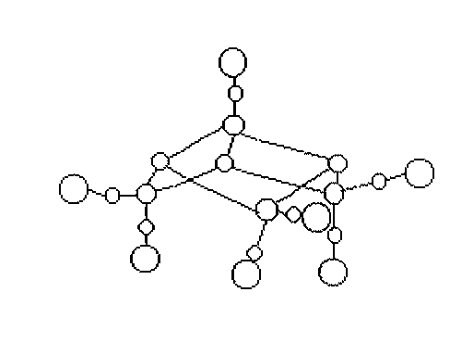
i) Blacken all the circles corresponding to iron atoms and add symbols Fe(A), Fe(B), Fe(C) and Fe(D) beside the circles in the sequence of top \(\rightarrow\) left \(\rightarrow\) right.
ii) The configuration of \(3d\) electron shell of the iron atoms has been studied with modern structural analysis. Knowing that the mean oxidation number of the four iron atoms is \(-0.5\), give their configurations of \(3d\) shell, respectively. Assume that each iron atom adopt \(sp\) hybridization.
5.5 \(\ce{[Fe4S3(NO)7]-}\) anion can be reduced and a new complex \(\ce{[Fe2S2(NO)4]^2-}\) is formed which contains a cyclic structure unit of \(\ce{Fe2S2}\).
i) Write the structural formula for the anion \(\ce{[Fe2S2(NO)4]^2-}\).
ii) Give the oxidation state of each iron atom with Arabic numerals.
iii) \(\ce{[Fe2S2(NO)4]^2-}\) can be converted into \(\ce{[Fe2(SCH3)2(NO)4]^n}\), a carcinogen. Which of the following three species is added to \(\ce{[Fe2S2(NO)4]^2-}\): \(\ce{CH3+}\), \(\ce{^{\bullet}CH3}\) or \(\ce{CH3-}\)? Assign the value of \(n\).
Official English text of the problem.
Answers
The complex structures below use extended coordination SMILES: arrows indicate donor-to-metal bonds, and Fe–Fe single bonds represent the localized bonding model explained in the solution. These strings do not specify coordination geometry or spin coupling.
-
5.1: Nitric oxide, \(\ce{NO}\),
[N]=O: HOMO \(=\pi^*\), containing \(\uparrow\); LUMO \(=\pi^*\), empty, namely the other member of the degenerate pair. -
5.2: b) \(\ce{NO+}\), the nitrosonium ion,
N#[O+]. -
5.3: B, peroxynitrous acid, \(\ce{HOONO}\),
O=NOO. Both the \(\ce{O=N-O}\) and \(\ce{N-O-O}\) angles are bent. -
5.4(i): Blacken the four circles carrying NO ligands: label the upper iron A, then the three basal irons B, C, D from left to right. This is Roussin’s black salt anion, \(\ce{[Fe4S3(NO)7]-}\), with coordination SMILES:
[Fe+]12456(<-N#[O+])<-[S-2]3->[Fe-]-4(<-N#[O+])(<-N#[O+])<-[S-2]->1->[Fe-]-5(<-N#[O+])(<-N#[O+])<-[S-2]->2->[Fe-]-6<-3(<-N#[O+])<-N#[O+]
-
5.4(ii): In the conventional localized bonding model, \[ \boxed{A:3d^7;\qquad B:3d^9;\qquad C:3d^9;\qquad D:3d^9.} \] The corresponding formal oxidation states are \(+1,-1,-1,-1\).
-
5.5(i): Roussin’s red salt anion, \(\ce{[Fe2S2(NO)4]^2-}\): an alternating four-membered \(\ce{Fe-S-Fe-S}\) ring, with two terminal N-bound NO ligands on each iron and an Fe–Fe bond across the ring. Coordination SMILES:
[S-2]1->[Fe-]2(<-N#[O+])(<-N#[O+])<-[S-2]->[Fe-]2<-1(<-N#[O+])<-N#[O+]
-
5.5(ii): Each iron has oxidation state \(-1\).
-
5.5(iii): Add two methyl cations, \(\ce{CH3+}\),
[CH3+], formally one at each sulfur. \(n=0\). The product is Roussin’s red salt methyl ester, \(\ce{[Fe2(SCH3)2(NO)4]}\), with coordination SMILES:
C[S-]1->[Fe-]2(<-N#[O+])(<-N#[O+])<-[S-](C)->[Fe-]2<-1(<-N#[O+])<-N#[O+]
Solution
5.1
Nitric oxide has \(5+6=11\) valence electrons. Its valence molecular-orbital occupation is
\[ (\sigma_{2s})^2(\sigma^*_{2s})^2 (\sigma_{2p})^2(\pi_{2p})^4(\pi^*_{2p})^1. \]
The highest occupied level is the doubly degenerate antibonding \(\pi^*\) level, containing just one electron:
\[ \pi^*:\qquad \underbrace{[\uparrow]}_{\text{HOMO, also SOMO}} \qquad \underbrace{[\phantom{\uparrow}]}_{\text{LUMO}}. \]
Thus the HOMO is singly occupied, while the other spatial orbital of the same \(\pi^*\) pair is vacant. The choice of which member contains the electron is arbitrary.
5.2
Carbon monoxide, \(\ce{CO}\), [C-]#[O+], has
\[ 6+8=14\text{ total electrons}. \]
Neutral nitric oxide has \(7+8=15\). Removing one electron therefore produces the isoelectronic nitrosonium ion:
\[ \ce{NO -> NO+ + e^-}, \qquad 7+8-1=14. \]
Equivalently, both carbon monoxide and nitrosonium have ten valence electrons. Consequently, option b, \(\ce{NO+}\), is the required formal description of the coordinated ligand.
5.3
Peroxynitrous acid has the connectivity
\[ \ce{H-O-O-N=O}. \]
The relevant electron-domain counts are:
- At nitrogen: one double bond, one single bond and one lone pair give three electron domains. The electron-domain arrangement is approximately trigonal planar, and the \(\ce{O=N-O}\) bond angle is bent.
- At the oxygen between nitrogen and the hydroxyl oxygen: two single bonds and two lone pairs give four electron domains. The electron-domain arrangement is approximately tetrahedral, and the \(\ce{N-O-O}\) angle is also bent.
The ideal reference angles for these electron-domain arrangements are \(120^\circ\) and \(109.5^\circ\), respectively; the problem does not supply exact molecular bond angles. Only B shows both required bends. Its SMILES gives connectivity, without selecting a particular torsional conformation.
The balanced reaction sequence is
\[ \ce{O2^{\bullet-} + NO + H+ -> HOONO}, \]
\[ \ce{HOONO -> NO2^{\bullet} + OH^{\bullet}}. \]
The additional species are the superoxide radical anion, [O-][O]; a proton, [H+]; the nitrogen dioxide radical, O=[N+][O-]; and the hydroxyl radical, [OH].
Homolytic cleavage of the peroxide \(\ce{O-O}\) bond gives one electron to each fragment, producing the two radicals.
5.4(i)
Identify each iron by its directly attached NO ligand or ligands:
| Label | Circle to blacken | Ligands attached to that iron |
|---|---|---|
| Fe(A) | Upper central circle, immediately below the vertical NO group | One NO and three sulfurs |
| Fe(B) | Left basal circle, carrying leftward and downward NO groups | Two NO and two sulfurs |
| Fe(C) | Lower central/front circle, carrying the short rightward and downward-left NO groups | Two NO and two sulfurs |
| Fe(D) | Right basal circle, carrying rightward and downward NO groups | Two NO and two sulfurs |
The remaining three core atoms are bridging sulfide ions, formally \(\ce{S^2-}\), [S-2]. Each bridges three irons. Their connections are:
\[ (A,B,C),\qquad(A,B,D),\qquad(A,C,D). \]
Thus A is bonded to all three sulfurs, while each basal iron is bonded to two. Each NO binds through nitrogen, with approximately linear \(\ce{Fe-N-O}\) geometry. The four ligand directions at each iron form a distorted tetrahedral arrangement.
5.4(ii)
The printed \(sp\) assumption appears to require correction to \(sp^3\) to describe these four ligand directions.
Using the formal nitrosonium and sulfide assignments, charge balance gives
\[ \sum_i x_i+3(-2)+7(+1)=-1, \]
so
\[ \sum_i x_i=-2,\qquad \overline{x}=-0.5. \]
Iron is a group-8 element, so an iron with formal oxidation state \(x\) has the \(d\)-electron count
\[ d^{\,8-x}. \]
The conventional localized bonding description has three Fe–Fe bonds: A–B, A–C and A–D. Each iron receives eight electrons from its four ligand donor pairs; each Fe–Fe bond contributes one electron to the count at either end.
Applying the 18-electron count gives, for A,
\[ (8-x_A)+8+3=18 \quad\Longrightarrow\quad x_A=+1,\qquad d_A^7. \]
For each basal iron,
\[ (8-x_{\mathrm{basal}})+8+1=18 \quad\Longrightarrow\quad x_{\mathrm{basal}}=-1,\qquad d_{\mathrm{basal}}^9. \]
The mean oxidation number is therefore
\[ \frac{(+1)+3(-1)}4=-0.5, \]
as required. The formal \(3d\)-orbital occupations before pairing through the metal–metal interactions are
\[ \begin{aligned} A:\quad 3d^7&:\quad [\uparrow\downarrow][\uparrow\downarrow][\uparrow][\uparrow][\uparrow],\\ B,C,D:\quad 3d^9&:\quad [\uparrow\downarrow][\uparrow\downarrow][\uparrow\downarrow] [\uparrow\downarrow][\uparrow]. \end{aligned} \]
These are local electron-counting descriptions, rather than a claim that the complete cluster has six independent unpaired electrons.
5.5(i)
Draw a four-membered ring with iron atoms at two opposite vertices and sulfurs at the other two. Both sulfurs bridge both irons. Attach two terminal, N-bound NO ligands to each iron and show the conventional Fe–Fe bond joining the opposite iron vertices.
This gives the connectivity
\[ \ce{[Fe2(\mu-S)2(NO)4]^2-}. \]
The four-membered ring drawing specifies connectivity; the coordination SMILES does not fix the three-dimensional geometry.
5.5(ii)
The two equivalent iron atoms have oxidation state \(x\). With two sulfides and four nitrosonium ligands,
\[ 2x+2(-2)+4(+1)=-2. \]
Hence
\[ 2x=-2 \quad\Longrightarrow\quad \boxed{x=-1}. \]
Each iron consequently has nine \(d\) electrons. Its electron count, including the Fe–Fe bond, is
\[ 9+4(2)+1=18. \]
5.5(iii)
Each bridging sulfide undergoes methylation to become a bridging methanethiolate ligand, \(\ce{SCH3-}\), C[S-]. Formation of the S–C bond uses a sulfur lone pair and an electrophilic methyl group, represented among the choices by \(\ce{CH3+}\).
The balanced formal methylation equation is
\[ \ce{[Fe2S2(NO)4]^2- + 2CH3+ -> [Fe2(SCH3)2(NO)4]}. \]
The resulting charge is
\[ n=-2+2(+1)=\boxed{0}. \]
The same result follows from the product’s ligand charges, with both iron oxidation states unchanged:
\[ n=2(-1)+2(-1)+4(+1)=0. \]
The solution was checked against the official solution.
IChO 1995 · Theorieaufgabe 5
Stickstoffmonoxid in der Biologie und Eisen-Schwefel-Nitrosylkomplexe
Stickstoffmonoxid hat eine zweifache Wirkung auf den menschlichen Körper. Das in Nervenzellen gebildete Stickstoffmonoxid schädigt die Zellen, während das in den Endothelzellen der Blutgefäße gebildete Stickstoffmonoxid die Gefäße entspannen und den Blutdruck regulieren kann.
5.1 Geben Sie das höchste besetzte Molekülorbital (HOMO) und das niedrigste unbesetzte Molekülorbital (LUMO) des \(\ce{NO}\)-Moleküls mithilfe eines der Symbole \(\pi\), \(\sigma\), \(\pi^*\) oder \(\sigma^*\) an und kennzeichnen Sie das Elektron bzw. die Elektronen im jeweiligen Orbital mit den Symbolen \(\uparrow\) und/oder \(\downarrow\).
5.2 Die Entspannung der Blutgefäße wird durch eine Reihe von Veränderungen verursacht, die durch die Koordination des \(\ce{NO}\)-Moleküls an ein Eisenion vermittelt werden; dieses ist Bestandteil eines hämhaltigen Enzyms. Es war bekannt, dass sich das koordinierte \(\ce{NO}\) wie ein \(\ce{CO}\)-Molekül verhält (isoelektronisch). Welche der folgenden Spezies liegt tatsächlich im Eisenkomplex vor?
a) \(\ce{NO}\) b) \(\ce{NO+}\) c) \(\ce{NO-}\)
5.3 Die Zellschädigung wird durch das freie Radikal \(\ce{OH}\) verursacht, das eines der Produkte der Reaktion zwischen \(\ce{O2-}\) und \(\ce{NO}\) ist:
Dabei entsteht ein Zwischenprodukt mit der Zusammensetzung \(\ce{HOONO}\). \(\ce{HOONO}\) ist eine schwache Säure. Wählen Sie die Strukturformel mit den richtigen Bindungswinkeln für das Zwischenprodukt aus.
5.4 Zur Konservierung von Fleisch wird üblicherweise Natriumnitrit zugesetzt, wodurch anschließend \(\ce{NO}\) entsteht. Daraufhin reagiert \(\ce{NO}\) mit den beim Abbau von Proteinen freigesetzten Schwefel- und Eisenatomen unter Bildung von \(\ce{[Fe4S3(NO)7]-}\). Das Komplexanion wirkt bakteriostatisch und antiseptisch. Die Röntgenstrukturanalyse zeigt, dass das Komplexanion die nachstehend dargestellte Struktur aufweist:
i) Schwärzen Sie alle Kreise, die Eisenatomen entsprechen, und schreiben Sie die Symbole Fe(A), Fe(B), Fe(C) und Fe(D) neben die Kreise in der Reihenfolge oben \(\rightarrow\) links \(\rightarrow\) rechts.
ii) Die Konfiguration der \(3d\)-Elektronenschale der Eisenatome wurde mit modernen Methoden der Strukturanalyse untersucht. Geben Sie unter Berücksichtigung der Tatsache, dass die mittlere Oxidationszahl der vier Eisenatome \(-0.5\) beträgt, ihre jeweiligen Konfigurationen der \(3d\)-Schale an. Nehmen Sie an, dass jedes Eisenatom eine \(sp\)-Hybridisierung aufweist.
5.5 Das \(\ce{[Fe4S3(NO)7]-}\)-Anion kann reduziert werden, wobei ein neuer Komplex \(\ce{[Fe2S2(NO)4]^2-}\) entsteht, der eine cyclische Struktureinheit \(\ce{Fe2S2}\) enthält.
i) Geben Sie die Strukturformel des Anions \(\ce{[Fe2S2(NO)4]^2-}\) an.
ii) Geben Sie die Oxidationszahl jedes Eisenatoms mit arabischen Ziffern an.
iii) \(\ce{[Fe2S2(NO)4]^2-}\) kann in \(\ce{[Fe2(SCH3)2(NO)4]^n}\), eine krebserregende Verbindung, umgewandelt werden. Welche der folgenden drei Spezies wird zu \(\ce{[Fe2S2(NO)4]^2-}\) hinzugefügt: \(\ce{CH3+}\), \(\ce{^{\bullet}CH3}\) oder \(\ce{CH3-}\)? Bestimmen Sie den Wert von \(n\).
Aufgabentext aus dem offiziellen englischen Text übersetzt.
Antworten
Die nachstehenden Komplexstrukturen verwenden erweiterte Koordinations-SMILES: Pfeile kennzeichnen Donor-Metall-Bindungen, und Fe–Fe-Einfachbindungen stellen das in der Lösung erläuterte lokalisierte Bindungsmodell dar. Diese Zeichenketten legen weder die Koordinationsgeometrie noch die Spinkopplung fest.
-
5.1: Stickstoffmonoxid, \(\ce{NO}\),
[N]=O: HOMO \(=\pi^*\), besetzt mit \(\uparrow\); LUMO \(=\pi^*\), leer, nämlich das andere Orbital des entarteten Paars. -
5.2: b) \(\ce{NO+}\), das Nitrosoniumion,
N#[O+]. -
5.3: B, Peroxosalpetrige Säure, \(\ce{HOONO}\),
O=NOO. Sowohl die \(\ce{O=N-O}\)- als auch die \(\ce{N-O-O}\)-Anordnung ist gewinkelt. -
5.4(i): Schwärzen Sie die vier Kreise, die NO-Liganden tragen: Beschriften Sie das obere Eisen mit A, anschließend die drei Eisenatome der Basis von links nach rechts mit B, C, D. Dies ist das Anion des Roussinschen schwarzen Salzes, \(\ce{[Fe4S3(NO)7]-}\), mit dem Koordinations-SMILES:
[Fe+]12456(<-N#[O+])<-[S-2]3->[Fe-]-4(<-N#[O+])(<-N#[O+])<-[S-2]->1->[Fe-]-5(<-N#[O+])(<-N#[O+])<-[S-2]->2->[Fe-]-6<-3(<-N#[O+])<-N#[O+]
-
5.4(ii): Im üblichen lokalisierten Bindungsmodell gilt: \[ \boxed{A:3d^7;\qquad B:3d^9;\qquad C:3d^9;\qquad D:3d^9.} \] Die entsprechenden formalen Oxidationszahlen sind \(+1,-1,-1,-1\).
-
5.5(i): Anion des Roussinschen roten Salzes, \(\ce{[Fe2S2(NO)4]^2-}\): ein alternierender viergliedriger \(\ce{Fe-S-Fe-S}\)-Ring mit zwei terminalen, über N gebundenen NO-Liganden an jedem Eisen und einer Fe–Fe-Bindung quer durch den Ring. Koordinations-SMILES:
[S-2]1->[Fe-]2(<-N#[O+])(<-N#[O+])<-[S-2]->[Fe-]2<-1(<-N#[O+])<-N#[O+]
-
5.5(ii): Jedes Eisen hat die Oxidationszahl \(-1\).
-
5.5(iii): Fügen Sie zwei Methylkationen, \(\ce{CH3+}\),
[CH3+], hinzu, formal eines an jedem Schwefel. \(n=0\). Das Produkt ist der Methylester des Roussinschen roten Salzes, \(\ce{[Fe2(SCH3)2(NO)4]}\), mit dem Koordinations-SMILES:
C[S-]1->[Fe-]2(<-N#[O+])(<-N#[O+])<-[S-](C)->[Fe-]2<-1(<-N#[O+])<-N#[O+]
Lösung
5.1
Stickstoffmonoxid besitzt \(5+6=11\) Valenzelektronen. Die Besetzung seiner Valenzmolekülorbitale lautet:
\[ (\sigma_{2s})^2(\sigma^*_{2s})^2 (\sigma_{2p})^2(\pi_{2p})^4(\pi^*_{2p})^1. \]
Das höchste besetzte Niveau ist das zweifach entartete antibindende \(\pi^*\)-Niveau, das nur ein Elektron enthält:
\[ \pi^*:\qquad \underbrace{[\uparrow]}_{\text{HOMO, zugleich SOMO}} \qquad \underbrace{[\phantom{\uparrow}]}_{\text{LUMO}}. \]
Das HOMO ist somit einfach besetzt, während das andere räumliche Orbital desselben \(\pi^*\)-Paars unbesetzt ist. Welches der beiden Orbitale das Elektron enthält, kann beliebig gewählt werden.
5.2
Kohlenstoffmonoxid, \(\ce{CO}\), [C-]#[O+], besitzt
\[ 6+8=14\text{ Elektronen insgesamt}. \]
Neutrales Stickstoffmonoxid besitzt \(7+8=15\). Durch Entfernen eines Elektrons entsteht daher das isoelektronische Nitrosoniumion:
\[ \ce{NO -> NO+ + e^-}, \qquad 7+8-1=14. \]
Gleichbedeutend damit besitzen sowohl Kohlenstoffmonoxid als auch Nitrosonium zehn Valenzelektronen. Folglich ist Option b, \(\ce{NO+}\), die gesuchte formale Beschreibung des koordinierten Liganden.
5.3
Peroxosalpetrige Säure besitzt die Konnektivität
\[ \ce{H-O-O-N=O}. \]
Die relevanten Anzahlen der Elektronendomänen sind:
- Am Stickstoff: Eine Doppelbindung, eine Einfachbindung und ein freies Elektronenpaar ergeben drei Elektronendomänen. Die Anordnung der Elektronendomänen ist näherungsweise trigonal-planar, und die \(\ce{O=N-O}\)-Bindungsanordnung ist gewinkelt.
- Am Sauerstoff zwischen dem Stickstoff und dem Hydroxylsauerstoff: Zwei Einfachbindungen und zwei freie Elektronenpaare ergeben vier Elektronendomänen. Die Anordnung der Elektronendomänen ist näherungsweise tetraedrisch, und auch die \(\ce{N-O-O}\)-Anordnung ist gewinkelt.
Die idealen Referenzwinkel für diese Anordnungen der Elektronendomänen betragen \(120^\circ\) bzw. \(109.5^\circ\); die Aufgabe gibt keine exakten molekularen Bindungswinkel an. Nur B zeigt beide erforderlichen gewinkelten Anordnungen. Der zugehörige SMILES gibt die Konnektivität an, ohne eine bestimmte Torsionskonformation festzulegen.
Die ausgeglichene Reaktionsfolge lautet:
\[ \ce{O2^{\bullet-} + NO + H+ -> HOONO}, \]
\[ \ce{HOONO -> NO2^{\bullet} + OH^{\bullet}}. \]
Die zusätzlichen Spezies sind das Superoxid-Radikalanion, [O-][O]; ein Proton, [H+]; das Stickstoffdioxidradikal, O=[N+][O-]; und das Hydroxylradikal, [OH].
Bei der homolytischen Spaltung der peroxidischen \(\ce{O-O}\)-Bindung erhält jedes Fragment ein Elektron, wodurch die beiden Radikale entstehen.
5.4(i)
Identifizieren Sie jedes Eisen anhand seines direkt gebundenen NO-Liganden bzw. seiner direkt gebundenen NO-Liganden:
| Bezeichnung | Zu schwärzender Kreis | An dieses Eisen gebundene Liganden |
|---|---|---|
| Fe(A) | Oberer mittlerer Kreis, unmittelbar unter der senkrechten NO-Gruppe | Ein NO und drei Schwefelatome |
| Fe(B) | Linker Kreis der Basis, der nach links und nach unten gerichtete NO-Gruppen trägt | Zwei NO und zwei Schwefelatome |
| Fe(C) | Unterer mittlerer/vorderer Kreis, der die kurzen, nach rechts und nach links unten gerichteten NO-Gruppen trägt | Zwei NO und zwei Schwefelatome |
| Fe(D) | Rechter Kreis der Basis, der nach rechts und nach unten gerichtete NO-Gruppen trägt | Zwei NO und zwei Schwefelatome |
Die übrigen drei Atome des Kerns sind verbrückende Sulfidionen, formal \(\ce{S^2-}\), [S-2]. Jedes verbrückt drei Eisenatome. Ihre Verknüpfungen sind:
\[ (A,B,C),\qquad(A,B,D),\qquad(A,C,D). \]
Somit ist A an alle drei Schwefelatome gebunden, während jedes Eisenatom der Basis an zwei gebunden ist. Jedes NO bindet über Stickstoff mit einer näherungsweise linearen \(\ce{Fe-N-O}\)-Geometrie. Die vier Ligandenrichtungen an jedem Eisen bilden eine verzerrt tetraedrische Anordnung.
5.4(ii)
Die gedruckte Annahme einer \(sp\)-Hybridisierung muss offenbar zu \(sp^3\) korrigiert werden, um diese vier Ligandenrichtungen zu beschreiben.
Mit den formalen Zuordnungen als Nitrosonium und Sulfid ergibt die Ladungsbilanz
\[ \sum_i x_i+3(-2)+7(+1)=-1, \]
also
\[ \sum_i x_i=-2,\qquad \overline{x}=-0.5. \]
Eisen ist ein Element der Gruppe 8; daher besitzt ein Eisenatom mit der formalen Oxidationszahl \(x\) die \(d\)-Elektronenzahl
\[ d^{\,8-x}. \]
Die übliche lokalisierte Bindungsbeschreibung enthält drei Fe–Fe-Bindungen: A–B, A–C und A–D. Jedes Eisen erhält acht Elektronen aus seinen vier Liganden-Donorelektronenpaaren; jede Fe–Fe-Bindung trägt an jedem ihrer beiden Enden ein Elektron zur Elektronenzahl bei.
Die Anwendung der 18-Elektronen-Regel ergibt für A:
\[ (8-x_A)+8+3=18 \quad\Longrightarrow\quad x_A=+1,\qquad d_A^7. \]
Für jedes Eisenatom der Basis gilt:
\[ (8-x_{\mathrm{basal}})+8+1=18 \quad\Longrightarrow\quad x_{\mathrm{basal}}=-1,\qquad d_{\mathrm{basal}}^9. \]
Die mittlere Oxidationszahl beträgt daher
\[ \frac{(+1)+3(-1)}4=-0.5, \]
wie gefordert. Die formalen Besetzungen der \(3d\)-Orbitale vor der Paarung durch die Metall-Metall-Wechselwirkungen lauten:
\[ \begin{aligned} A:\quad 3d^7&:\quad [\uparrow\downarrow][\uparrow\downarrow][\uparrow][\uparrow][\uparrow],\\ B,C,D:\quad 3d^9&:\quad [\uparrow\downarrow][\uparrow\downarrow][\uparrow\downarrow] [\uparrow\downarrow][\uparrow]. \end{aligned} \]
Dies sind lokale Beschreibungen der Elektronenzählung und keine Aussage, dass der gesamte Cluster sechs unabhängige ungepaarte Elektronen besitzt.
5.5(i)
Zeichnen Sie einen viergliedrigen Ring mit Eisenatomen an zwei gegenüberliegenden Ecken und Schwefelatomen an den beiden anderen. Beide Schwefelatome verbrücken beide Eisenatome. Fügen Sie an jedem Eisen zwei terminale, über N gebundene NO-Liganden hinzu und zeichnen Sie die übliche Fe–Fe-Bindung ein, welche die gegenüberliegenden Eisenecken verbindet.
Dies ergibt die Konnektivität
\[ \ce{[Fe2(\mu-S)2(NO)4]^2-}. \]
Die Zeichnung des viergliedrigen Rings legt die Konnektivität fest; der Koordinations-SMILES legt die dreidimensionale Geometrie nicht fest.
5.5(ii)
Die beiden gleichwertigen Eisenatome besitzen die Oxidationszahl \(x\). Mit zwei Sulfid- und vier Nitrosoniumliganden gilt:
\[ 2x+2(-2)+4(+1)=-2. \]
Somit
\[ 2x=-2 \quad\Longrightarrow\quad \boxed{x=-1}. \]
Jedes Eisen besitzt folglich neun \(d\)-Elektronen. Seine Elektronenzahl einschließlich der Fe–Fe-Bindung beträgt
\[ 9+4(2)+1=18. \]
5.5(iii)
Jedes verbrückende Sulfid wird methyliert und dadurch zu einem verbrückenden Methanthiolatliganden, \(\ce{SCH3-}\), C[S-]. Zur Bildung der S–C-Bindung werden ein freies Elektronenpaar des Schwefels und eine elektrophile Methylgruppe verwendet, die unter den Auswahlmöglichkeiten durch \(\ce{CH3+}\) dargestellt wird.
Die ausgeglichene formale Methylierungsgleichung lautet:
\[ \ce{[Fe2S2(NO)4]^2- + 2CH3+ -> [Fe2(SCH3)2(NO)4]}. \]
Die resultierende Ladung beträgt
\[ n=-2+2(+1)=\boxed{0}. \]
Dasselbe Ergebnis folgt aus den Ligandenladungen des Produkts, wobei beide Eisenoxidationszahlen unverändert bleiben:
\[ n=2(-1)+2(-1)+4(+1)=0. \]
Die Lösung wurde mit der offiziellen Lösung abgeglichen.
IChO 1995 · Teori sorusu 5
Biyolojide azot monoksit ve demir-kükürt nitrozil kompleksleri
Azot monoksitin insan vücudu üzerindeki etkisi iki yönlüdür. Sinir hücrelerinde oluşan azot monoksit hücrelere zarar verirken, kan damarlarının endotel hücrelerinde oluşan azot monoksit damarları gevşetebilir ve kan basıncını kontrol edebilir.
5.1 \(\ce{NO}\) molekülünün en yüksek enerjili dolu molekül orbitalini (HOMO) ve en düşük enerjili boş molekül orbitalini (LUMO), \(\pi\), \(\sigma\), \(\pi^*\) veya \(\sigma^*\) simgelerinden birini kullanarak belirtiniz ve ilgili orbitalde bulunan elektronu veya elektronları \(\uparrow\) ve/veya \(\downarrow\) simgelerini kullanarak gösteriniz.
5.2 Kan damarlarının gevşemesi, \(\ce{NO}\) molekülünün, hem içeren bir enzimin bileşeni olan demir iyonuna koordine olması aracılığıyla gerçekleşen bir dizi değişimden kaynaklanır. Koordine olmuş \(\ce{NO}\)'nun \(\ce{CO}\) molekülü gibi davrandığı (izoelektronik olduğu) bilinmektedir; aşağıdaki türlerden hangisi demir kompleksinde gerçekte bulunmaktadır?
a) \(\ce{NO}\) b) \(\ce{NO+}\) c) \(\ce{NO-}\)
5.3 Hücre hasarına, \(\ce{O2-}\) ile \(\ce{NO}\) arasındaki tepkimenin ürünlerinden biri olan \(\ce{OH}\) serbest radikali neden olur:
Bu tepkimede \(\ce{HOONO}\) bileşimine sahip bir ara ürün oluşur. \(\ce{HOONO}\) zayıf bir asittir. Ara ürün için bağ açılarını doğru gösteren yapı formülünü seçiniz.
5.4 Etin korunması için genellikle sodyum nitrit eklenir ve bunun sonucunda \(\ce{NO}\) oluşur. Ardından \(\ce{NO}\), proteinlerin parçalanmasıyla açığa çıkan kükürt ve demir atomlarıyla tepkimeye girerek \(\ce{[Fe4S3(NO)7]-}\) oluşturur. Bu kompleks anyon bakteriyostatiktir ve antiseptik özellik taşır. X-ışını kristalografisi, kompleks anyonun aşağıda gösterilen yapıya sahip olduğunu ortaya koymaktadır:
i) Demir atomlarına karşılık gelen tüm daireleri karalayınız ve üst \(\rightarrow\) sol \(\rightarrow\) sağ sırasıyla dairelerin yanına Fe(A), Fe(B), Fe(C) ve Fe(D) simgelerini ekleyiniz.
ii) Demir atomlarının \(3d\) elektron kabuğunun dizilimi, modern yapı analizi yöntemleriyle incelenmiştir. Dört demir atomunun ortalama yükseltgenme basamağının \(-0.5\) olduğu bilindiğine göre, her birinin \(3d\) kabuğu dizilimini sırasıyla veriniz. Her demir atomunun \(sp\) hibritleşmesi yaptığını varsayınız.
5.5 \(\ce{[Fe4S3(NO)7]-}\) anyonu indirgenebilir ve halkalı bir \(\ce{Fe2S2}\) yapı birimi içeren yeni bir \(\ce{[Fe2S2(NO)4]^2-}\) kompleksi oluşur.
i) \(\ce{[Fe2S2(NO)4]^2-}\) anyonunun yapı formülünü yazınız.
ii) Her demir atomunun yükseltgenme basamağını Arap rakamlarıyla veriniz.
iii) \(\ce{[Fe2S2(NO)4]^2-}\), kanserojen bir madde olan \(\ce{[Fe2(SCH3)2(NO)4]^n}\)'ye dönüştürülebilir. Şu üç türden hangisi \(\ce{[Fe2S2(NO)4]^2-}\)'ye eklenir: \(\ce{CH3+}\), \(\ce{^{\bullet}CH3}\) veya \(\ce{CH3-}\)? \(n\) değerini belirleyiniz.
Soru metni resmi İngilizce metinden çevrilmiştir.
Cevaplar
Aşağıdaki kompleks yapılarında genişletilmiş koordinasyon SMILES gösterimi kullanılmaktadır: oklar donörden metale doğru bağları, Fe–Fe tekli bağları ise çözümde açıklanan yerelleştirilmiş bağlanma modelini temsil eder. Bu dizgeler koordinasyon geometrisini veya spin eşleşmesini belirtmez.
-
5.1: Azot monoksit, \(\ce{NO}\),
[N]=O: HOMO \(=\pi^*\), \(\uparrow\) içerir; LUMO \(=\pi^*\), boştur, yani dejenere çiftin diğer üyesidir. -
5.2: b) \(\ce{NO+}\), nitrozonyum iyonu,
N#[O+]. -
5.3: B, peroksinitröz asit, \(\ce{HOONO}\),
O=NOO. Hem \(\ce{O=N-O}\) hem de \(\ce{N-O-O}\) açıları bükülmüş geometriye karşılık gelir. -
5.4(i): NO ligandları taşıyan dört daireyi karalayınız: üstteki demiri A, ardından tabandaki üç demiri soldan sağa B, C, D olarak etiketleyiniz. Bu, Roussin'in siyah tuzu anyonu, \(\ce{[Fe4S3(NO)7]-}\)'dur; koordinasyon SMILES gösterimi şöyledir:
[Fe+]12456(<-N#[O+])<-[S-2]3->[Fe-]-4(<-N#[O+])(<-N#[O+])<-[S-2]->1->[Fe-]-5(<-N#[O+])(<-N#[O+])<-[S-2]->2->[Fe-]-6<-3(<-N#[O+])<-N#[O+]
-
5.4(ii): Geleneksel yerelleştirilmiş bağlanma modelinde, \[ \boxed{A:3d^7;\qquad B:3d^9;\qquad C:3d^9;\qquad D:3d^9.} \] Bunlara karşılık gelen biçimsel yükseltgenme basamakları \(+1,-1,-1,-1\)'dir.
-
5.5(i): Roussin'in kırmızı tuzu anyonu, \(\ce{[Fe2S2(NO)4]^2-}\): demir ve kükürt atomlarının dönüşümlü olarak yer aldığı dört üyeli bir \(\ce{Fe-S-Fe-S}\) halkası; her demirde N üzerinden bağlı iki uç NO ligandı ve halka boyunca uzanan bir Fe–Fe bağı bulunur. Koordinasyon SMILES gösterimi:
[S-2]1->[Fe-]2(<-N#[O+])(<-N#[O+])<-[S-2]->[Fe-]2<-1(<-N#[O+])<-N#[O+]
-
5.5(ii): Her demirin yükseltgenme basamağı \(-1\)'dir.
-
5.5(iii): Biçimsel olarak her kükürde bir tane olmak üzere iki metil katyonu, \(\ce{CH3+}\),
[CH3+], eklenir. \(n=0\). Ürün, Roussin'in kırmızı tuzunun metil esteri, \(\ce{[Fe2(SCH3)2(NO)4]}\)'dir; koordinasyon SMILES gösterimi şöyledir:
C[S-]1->[Fe-]2(<-N#[O+])(<-N#[O+])<-[S-](C)->[Fe-]2<-1(<-N#[O+])<-N#[O+]
Çözüm
5.1
Azot monoksitin \(5+6=11\) değerlik elektronu vardır. Değerlik molekül orbitallerindeki elektron yerleşimi şöyledir:
\[ (\sigma_{2s})^2(\sigma^*_{2s})^2 (\sigma_{2p})^2(\pi_{2p})^4(\pi^*_{2p})^1. \]
Elektron bulunan en yüksek enerjili düzey, yalnızca bir elektron içeren, iki kat dejenere karşıt bağlayıcı \(\pi^*\) düzeyidir:
\[ \pi^*:\qquad \underbrace{[\uparrow]}_{\text{HOMO, aynı zamanda SOMO}} \qquad \underbrace{[\phantom{\uparrow}]}_{\text{LUMO}}. \]
Dolayısıyla HOMO tek elektronla doluyken, aynı \(\pi^*\) çiftinin diğer uzaysal orbitali boştur. Elektronun hangi üyede bulunduğunun seçimi keyfîdir.
5.2
Karbon monoksit, \(\ce{CO}\), [C-]#[O+], şu elektron sayısına sahiptir:
\[ 6+8=14\text{ toplam elektron}. \]
Nötr azot monoksitte ise \(7+8=15\) elektron vardır. Bu nedenle bir elektronun uzaklaştırılması, izoelektronik nitrozonyum iyonunu oluşturur:
\[ \ce{NO -> NO+ + e^-}, \qquad 7+8-1=14. \]
Eşdeğer bir ifadeyle, hem karbon monoksitin hem de nitrozonyumun on değerlik elektronu vardır. Sonuç olarak b seçeneği, \(\ce{NO+}\), koordine olmuş ligandın istenen biçimsel tanımıdır.
5.3
Peroksinitröz asitte atomların bağlanma sırası şöyledir:
\[ \ce{H-O-O-N=O}. \]
İlgili elektron bölgesi sayıları şöyledir:
- Azot üzerinde: bir çift bağ, bir tekli bağ ve bir ortaklanmamış elektron çifti, üç elektron bölgesi oluşturur. Elektron bölgelerinin düzeni yaklaşık olarak üçgen düzlemseldir ve \(\ce{O=N-O}\) bağ açısı bükülmüş geometriye karşılık gelir.
- Azot ile hidroksil oksijeni arasındaki oksijen üzerinde: iki tekli bağ ve iki ortaklanmamış elektron çifti, dört elektron bölgesi oluşturur. Elektron bölgelerinin düzeni yaklaşık olarak dört yüzlüdür ve \(\ce{N-O-O}\) açısı da bükülmüş geometriye karşılık gelir.
Bu elektron bölgesi düzenleri için ideal referans açıları sırasıyla \(120^\circ\) ve \(109.5^\circ\)'dir; soruda molekülün kesin bağ açıları verilmemiştir. Gerekli iki bükülmeyi de yalnızca B gösterir. SMILES gösterimi, belirli bir torsiyon konformasyonu seçmeden atomların bağlanma düzenini verir.
Denkleştirilmiş tepkime dizisi şöyledir:
\[ \ce{O2^{\bullet-} + NO + H+ -> HOONO}, \]
\[ \ce{HOONO -> NO2^{\bullet} + OH^{\bullet}}. \]
Diğer türler süperoksit radikal anyonu, [O-][O]; bir proton, [H+]; azot dioksit radikali, O=[N+][O-]; ve hidroksil radikali, [OH]'dir.
Peroksit \(\ce{O-O}\) bağının homolitik olarak kırılması, her bir parçaya bir elektron vererek iki radikali oluşturur.
5.4(i)
Her demiri, doğrudan bağlı NO ligandı veya ligandları aracılığıyla belirleyiniz:
| Etiket | Karalanacak daire | Bu demire bağlı ligandlar |
|---|---|---|
| Fe(A) | Dikey NO grubunun hemen altındaki üst orta daire | Bir NO ve üç kükürt |
| Fe(B) | Sola ve aşağıya yönelen NO gruplarını taşıyan sol taban dairesi | İki NO ve iki kükürt |
| Fe(C) | Sağa yönelen kısa NO grubunu ve sol aşağıya yönelen NO grubunu taşıyan alt orta/ön daire | İki NO ve iki kükürt |
| Fe(D) | Sağa ve aşağıya yönelen NO gruplarını taşıyan sağ taban dairesi | İki NO ve iki kükürt |
Çekirdekteki diğer üç atom, köprü oluşturan sülfür iyonlarıdır; biçimsel olarak \(\ce{S^2-}\), [S-2]. Her biri üç demir arasında köprü oluşturur. Bağlantıları şöyledir:
\[ (A,B,C),\qquad(A,B,D),\qquad(A,C,D). \]
Dolayısıyla A, üç kükürdün tümüne bağlıyken tabandaki her demir iki kükürde bağlıdır. Her NO, yaklaşık doğrusal \(\ce{Fe-N-O}\) geometrisiyle azot üzerinden bağlanır. Her demirdeki dört ligandın yönelimi, bozulmuş bir dört yüzlü düzen oluşturur.
5.4(ii)
Basılı metindeki \(sp\) varsayımının, bu dört ligand yönelimini tanımlamak için \(sp^3\) olarak düzeltilmesi gerektiği anlaşılmaktadır.
Biçimsel nitrozonyum ve sülfür atamaları kullanıldığında yük dengesi şu sonucu verir:
\[ \sum_i x_i+3(-2)+7(+1)=-1, \]
dolayısıyla
\[ \sum_i x_i=-2,\qquad \overline{x}=-0.5. \]
Demir, 8. grup elementidir; dolayısıyla biçimsel yükseltgenme basamağı \(x\) olan bir demirin \(d\)-elektron sayısı şöyledir:
\[ d^{\,8-x}. \]
Geleneksel yerelleştirilmiş bağlanma tanımında üç Fe–Fe bağı vardır: A–B, A–C ve A–D. Her demir, dört ligandın donör elektron çiftlerinden sekiz elektron alır; her Fe–Fe bağı, her iki ucundaki elektron sayımına birer elektron katkıda bulunur.
18 elektron sayımı A'ya uygulandığında,
\[ (8-x_A)+8+3=18 \quad\Longrightarrow\quad x_A=+1,\qquad d_A^7. \]
Tabandaki her demir için,
\[ (8-x_{\mathrm{basal}})+8+1=18 \quad\Longrightarrow\quad x_{\mathrm{basal}}=-1,\qquad d_{\mathrm{basal}}^9. \]
Böylece ortalama yükseltgenme basamağı,
\[ \frac{(+1)+3(-1)}4=-0.5, \]
olup istenen değerdir. Metal–metal etkileşimleri yoluyla eşleşme gerçekleşmeden önce biçimsel \(3d\) orbital dolulukları şöyledir:
\[ \begin{aligned} A:\quad 3d^7&:\quad [\uparrow\downarrow][\uparrow\downarrow][\uparrow][\uparrow][\uparrow],\\ B,C,D:\quad 3d^9&:\quad [\uparrow\downarrow][\uparrow\downarrow][\uparrow\downarrow] [\uparrow\downarrow][\uparrow]. \end{aligned} \]
Bunlar yerel elektron sayımı tanımlarıdır; kümenin tamamının altı bağımsız eşleşmemiş elektrona sahip olduğu iddiası değildir.
5.5(i)
Karşılıklı iki köşesinde demir atomları, diğer iki köşesinde kükürtler bulunan dört üyeli bir halka çiziniz. Her iki kükürt de her iki demir arasında köprü oluşturur. Her demire N üzerinden bağlı iki uç NO ligandı bağlayınız ve karşılıklı demir köşelerini birleştiren geleneksel Fe–Fe bağını gösteriniz.
Bu, şu bağlanma düzenini verir:
\[ \ce{[Fe2(\mu-S)2(NO)4]^2-}. \]
Dört üyeli halka çizimi, atomların bağlanma düzenini belirtir; koordinasyon SMILES gösterimi üç boyutlu geometriyi belirlemez.
5.5(ii)
Eşdeğer iki demir atomunun yükseltgenme basamağı \(x\)'tir. İki sülfür ve dört nitrozonyum ligandı ile,
\[ 2x+2(-2)+4(+1)=-2. \]
Buradan
\[ 2x=-2 \quad\Longrightarrow\quad \boxed{x=-1}. \]
Dolayısıyla her demirin dokuz \(d\) elektronu vardır. Fe–Fe bağı da dâhil edildiğinde elektron sayısı şöyledir:
\[ 9+4(2)+1=18. \]
5.5(iii)
Köprü oluşturan her sülfür metillenerek köprü oluşturan bir metantiyolat ligandına, \(\ce{SCH3-}\), C[S-], dönüşür. S–C bağının oluşumunda kükürdün bir ortaklanmamış elektron çifti ve seçenekler arasında \(\ce{CH3+}\) ile temsil edilen elektrofilik bir metil grubu kullanılır.
Denkleştirilmiş biçimsel metillenme denklemi şöyledir:
\[ \ce{[Fe2S2(NO)4]^2- + 2CH3+ -> [Fe2(SCH3)2(NO)4]}. \]
Oluşan yük şöyledir:
\[ n=-2+2(+1)=\boxed{0}. \]
Her iki demirin yükseltgenme basamağı değişmeden kaldığında, ürünün ligand yüklerinden de aynı sonuç elde edilir:
\[ n=2(-1)+2(-1)+4(+1)=0. \]
Çözüm, resmi çözümle karşılaştırılarak kontrol edildi.
IChO 1995 · Problema teórico 5
El óxido nítrico en biología y los complejos nitrosilo de hierro-azufre
La acción del óxido nítrico sobre el cuerpo humano es doble. El óxido nítrico generado en las células nerviosas daña las células, mientras que el óxido nítrico generado en las células endoteliales de los vasos sanguíneos puede relajar los vasos y regular la presión arterial.
5.1 Indique el orbital molecular ocupado de mayor energía (HOMO) y el orbital molecular desocupado de menor energía (LUMO) de la molécula de \(\ce{NO}\) utilizando uno de los símbolos \(\pi\), \(\sigma\), \(\pi^*\) o \(\sigma^*\), e indique el electrón o los electrones que se encuentran en el orbital correspondiente utilizando los símbolos \(\uparrow\) y/o \(\downarrow\).
5.2 La relajación de los vasos sanguíneos se debe a una serie de cambios mediados por la coordinación de la molécula de \(\ce{NO}\) al ion hierro, que es un componente de una enzima que contiene hemo. Se sabía que el \(\ce{NO}\) coordinado se comporta como la molécula de \(\ce{CO}\) (es isoelectrónico). ¿Cuál de las siguientes especies existe realmente en el complejo de hierro?
a) \(\ce{NO}\) b) \(\ce{NO+}\) c) \(\ce{NO-}\)
5.3 El daño celular se debe al radical libre \(\ce{OH}\), que es uno de los productos de la reacción entre \(\ce{O2-}\) y \(\ce{NO}\):
en la que se forma un intermedio de composición \(\ce{HOONO}\). El \(\ce{HOONO}\) es un ácido débil. Elija la fórmula estructural con los ángulos de enlace correctos para el intermedio.
5.4 Para conservar la carne, suele añadirse nitrito de sodio y, como resultado, se forma \(\ce{NO}\). A continuación, el \(\ce{NO}\) reacciona con los átomos de azufre y hierro procedentes de la descomposición de las proteínas, formando \(\ce{[Fe4S3(NO)7]-}\). El anión complejo es bacteriostático y antiséptico. La cristalografía de rayos X muestra que el anión complejo tiene la estructura que se indica a continuación:
i) Rellene de negro todos los círculos correspondientes a átomos de hierro y añada los símbolos Fe(A), Fe(B), Fe(C) y Fe(D) junto a los círculos siguiendo la secuencia arriba \(\rightarrow\) izquierda \(\rightarrow\) derecha.
ii) La configuración de la capa electrónica \(3d\) de los átomos de hierro se ha estudiado mediante técnicas modernas de análisis estructural. Sabiendo que el número de oxidación medio de los cuatro átomos de hierro es \(-0.5\), indique sus respectivas configuraciones de la capa \(3d\). Suponga que cada átomo de hierro adopta una hibridación \(sp\).
5.5 El anión \(\ce{[Fe4S3(NO)7]-}\) puede reducirse y formar un nuevo complejo, \(\ce{[Fe2S2(NO)4]^2-}\), que contiene una unidad estructural cíclica de \(\ce{Fe2S2}\).
i) Escriba la fórmula estructural del anión \(\ce{[Fe2S2(NO)4]^2-}\).
ii) Indique el estado de oxidación de cada átomo de hierro con números arábigos.
iii) El \(\ce{[Fe2S2(NO)4]^2-}\) puede convertirse en \(\ce{[Fe2(SCH3)2(NO)4]^n}\), un carcinógeno. ¿Cuál de las tres especies siguientes se añade al \(\ce{[Fe2S2(NO)4]^2-}\): \(\ce{CH3+}\), \(\ce{^{\bullet}CH3}\) o \(\ce{CH3-}\)? Determine el valor de \(n\).
Enunciado traducido del texto oficial en inglés.
Respuestas
Las estructuras de los complejos que se muestran a continuación utilizan SMILES de coordinación extendidos: las flechas indican enlaces del donador al metal, y los enlaces sencillos Fe–Fe representan el modelo de enlace localizado que se explica en la solución. Estas cadenas no especifican la geometría de coordinación ni el acoplamiento de espines.
-
5.1: Óxido nítrico, \(\ce{NO}\),
[N]=O: HOMO \(=\pi^*\), que contiene \(\uparrow\); LUMO \(=\pi^*\), vacío, es decir, el otro miembro del par degenerado. -
5.2: b) \(\ce{NO+}\), el ion nitrosonio,
N#[O+]. -
5.3: B, ácido peroxinitroso, \(\ce{HOONO}\),
O=NOO. Tanto el ángulo \(\ce{O=N-O}\) como el ángulo \(\ce{N-O-O}\) corresponden a disposiciones angulares. -
5.4(i): Rellene de negro los cuatro círculos que llevan ligandos NO: asigne la letra A al hierro superior y, después, las letras B, C, D, de izquierda a derecha, a los tres hierros basales. Se trata del anión de la sal negra de Roussin, \(\ce{[Fe4S3(NO)7]-}\), con el siguiente SMILES de coordinación:
[Fe+]12456(<-N#[O+])<-[S-2]3->[Fe-]-4(<-N#[O+])(<-N#[O+])<-[S-2]->1->[Fe-]-5(<-N#[O+])(<-N#[O+])<-[S-2]->2->[Fe-]-6<-3(<-N#[O+])<-N#[O+]
-
5.4(ii): En el modelo convencional de enlace localizado, \[ \boxed{A:3d^7;\qquad B:3d^9;\qquad C:3d^9;\qquad D:3d^9.} \] Los estados de oxidación formales correspondientes son \(+1,-1,-1,-1\).
-
5.5(i): Anión de la sal roja de Roussin, \(\ce{[Fe2S2(NO)4]^2-}\): un anillo de cuatro miembros con alternancia \(\ce{Fe-S-Fe-S}\), con dos ligandos NO terminales unidos por el N a cada hierro y un enlace Fe–Fe que atraviesa el anillo. SMILES de coordinación:
[S-2]1->[Fe-]2(<-N#[O+])(<-N#[O+])<-[S-2]->[Fe-]2<-1(<-N#[O+])<-N#[O+]
-
5.5(ii): Cada hierro tiene un estado de oxidación de \(-1\).
-
5.5(iii): Añadir dos cationes metilo, \(\ce{CH3+}\),
[CH3+], formalmente uno a cada azufre. \(n=0\). El producto es el éster metílico de la sal roja de Roussin, \(\ce{[Fe2(SCH3)2(NO)4]}\), con el siguiente SMILES de coordinación:
C[S-]1->[Fe-]2(<-N#[O+])(<-N#[O+])<-[S-](C)->[Fe-]2<-1(<-N#[O+])<-N#[O+]
Solución
5.1
El óxido nítrico tiene \(5+6=11\) electrones de valencia. La ocupación de sus orbitales moleculares de valencia es
\[ (\sigma_{2s})^2(\sigma^*_{2s})^2 (\sigma_{2p})^2(\pi_{2p})^4(\pi^*_{2p})^1. \]
El nivel ocupado de mayor energía es el nivel antienlazante \(\pi^*\), doblemente degenerado, que contiene un solo electrón:
\[ \pi^*:\qquad \underbrace{[\uparrow]}_{\text{HOMO, también SOMO}} \qquad \underbrace{[\phantom{\uparrow}]}_{\text{LUMO}}. \]
Por tanto, el HOMO está ocupado por un solo electrón, mientras que el otro orbital espacial del mismo par \(\pi^*\) está vacío. La elección de qué miembro contiene el electrón es arbitraria.
5.2
El monóxido de carbono, \(\ce{CO}\), [C-]#[O+], tiene
\[ 6+8=14\text{ electrones en total}. \]
El óxido nítrico neutro tiene \(7+8=15\). Por lo tanto, la eliminación de un electrón produce el ion nitrosonio isoelectrónico:
\[ \ce{NO -> NO+ + e^-}, \qquad 7+8-1=14. \]
De manera equivalente, tanto el monóxido de carbono como el nitrosonio tienen diez electrones de valencia. En consecuencia, la opción b, \(\ce{NO+}\), es la descripción formal requerida del ligando coordinado.
5.3
El ácido peroxinitroso tiene la conectividad
\[ \ce{H-O-O-N=O}. \]
Los recuentos de dominios electrónicos pertinentes son:
- En el nitrógeno: un enlace doble, un enlace sencillo y un par solitario dan tres dominios electrónicos. La disposición de los dominios electrónicos es aproximadamente trigonal plana, y el ángulo de enlace \(\ce{O=N-O}\) corresponde a una disposición angular.
- En el oxígeno situado entre el nitrógeno y el oxígeno del hidroxilo: dos enlaces sencillos y dos pares solitarios dan cuatro dominios electrónicos. La disposición de los dominios electrónicos es aproximadamente tetraédrica, y el ángulo \(\ce{N-O-O}\) también corresponde a una disposición angular.
Los ángulos ideales de referencia para estas disposiciones de dominios electrónicos son \(120^\circ\) y \(109.5^\circ\), respectivamente; el problema no proporciona los ángulos de enlace moleculares exactos. Solo B muestra las dos disposiciones angulares requeridas. Su SMILES indica la conectividad, sin seleccionar una conformación torsional concreta.
La secuencia de reacciones ajustadas es
\[ \ce{O2^{\bullet-} + NO + H+ -> HOONO}, \]
\[ \ce{HOONO -> NO2^{\bullet} + OH^{\bullet}}. \]
Las especies adicionales son el anión radical superóxido, [O-][O]; un protón, [H+]; el radical dióxido de nitrógeno, O=[N+][O-]; y el radical hidroxilo, [OH].
La ruptura homolítica del enlace peróxido \(\ce{O-O}\) aporta un electrón a cada fragmento, lo que produce los dos radicales.
5.4(i)
Identifique cada hierro por el ligando o los ligandos NO unidos directamente a él:
| Etiqueta | Círculo que se debe rellenar de negro | Ligandos unidos a ese hierro |
|---|---|---|
| Fe(A) | Círculo central superior, inmediatamente debajo del grupo NO vertical | Un NO y tres azufres |
| Fe(B) | Círculo basal izquierdo, que lleva grupos NO dirigidos hacia la izquierda y hacia abajo | Dos NO y dos azufres |
| Fe(C) | Círculo central inferior/frontal, que lleva los grupos NO cortos dirigidos hacia la derecha y hacia abajo a la izquierda | Dos NO y dos azufres |
| Fe(D) | Círculo basal derecho, que lleva grupos NO dirigidos hacia la derecha y hacia abajo | Dos NO y dos azufres |
Los otros tres átomos del núcleo son iones sulfuro puente, formalmente \(\ce{S^2-}\), [S-2]. Cada uno forma un puente entre tres hierros. Sus conexiones son:
\[ (A,B,C),\qquad(A,B,D),\qquad(A,C,D). \]
Por tanto, A está unido a los tres azufres, mientras que cada hierro basal está unido a dos. Cada NO se une a través del nitrógeno, con una geometría \(\ce{Fe-N-O}\) aproximadamente lineal. Las cuatro direcciones de los ligandos en cada hierro forman una disposición tetraédrica distorsionada.
5.4(ii)
La suposición de hibridación \(sp\) que aparece en el enunciado parece requerir una corrección a \(sp^3\) para describir estas cuatro direcciones de los ligandos.
Utilizando las asignaciones formales de nitrosonio y sulfuro, el balance de cargas da
\[ \sum_i x_i+3(-2)+7(+1)=-1, \]
de modo que
\[ \sum_i x_i=-2,\qquad \overline{x}=-0.5. \]
El hierro es un elemento del grupo 8, por lo que un hierro con estado de oxidación formal \(x\) tiene el siguiente número de electrones \(d\):
\[ d^{\,8-x}. \]
La descripción convencional de enlace localizado presenta tres enlaces Fe–Fe: A–B, A–C y A–D. Cada hierro recibe ocho electrones de los cuatro pares donadores de sus ligandos; cada enlace Fe–Fe contribuye con un electrón al recuento en cada extremo.
La aplicación del recuento de 18 electrones da, para A,
\[ (8-x_A)+8+3=18 \quad\Longrightarrow\quad x_A=+1,\qquad d_A^7. \]
Para cada hierro basal,
\[ (8-x_{\mathrm{basal}})+8+1=18 \quad\Longrightarrow\quad x_{\mathrm{basal}}=-1,\qquad d_{\mathrm{basal}}^9. \]
Por lo tanto, el número de oxidación medio es
\[ \frac{(+1)+3(-1)}4=-0.5, \]
como se requiere. Las ocupaciones formales de los orbitales \(3d\) antes del apareamiento mediante las interacciones metal–metal son
\[ \begin{aligned} A:\quad 3d^7&:\quad [\uparrow\downarrow][\uparrow\downarrow][\uparrow][\uparrow][\uparrow],\\ B,C,D:\quad 3d^9&:\quad [\uparrow\downarrow][\uparrow\downarrow][\uparrow\downarrow] [\uparrow\downarrow][\uparrow]. \end{aligned} \]
Estas son descripciones locales del recuento de electrones, y no una afirmación de que el agregado completo tenga seis electrones desapareados independientes.
5.5(i)
Dibuje un anillo de cuatro miembros con átomos de hierro en dos vértices opuestos y azufres en los otros dos. Ambos azufres forman puentes entre los dos hierros. Una dos ligandos NO terminales, enlazados a través del N, a cada hierro y muestre el enlace Fe–Fe convencional que une los vértices opuestos ocupados por los hierros.
Esto da la conectividad
\[ \ce{[Fe2(\mu-S)2(NO)4]^2-}. \]
El dibujo del anillo de cuatro miembros especifica la conectividad; el SMILES de coordinación no fija la geometría tridimensional.
5.5(ii)
Los dos átomos de hierro equivalentes tienen un estado de oxidación \(x\). Con dos sulfuros y cuatro ligandos nitrosonio,
\[ 2x+2(-2)+4(+1)=-2. \]
Por tanto,
\[ 2x=-2 \quad\Longrightarrow\quad \boxed{x=-1}. \]
En consecuencia, cada hierro tiene nueve electrones \(d\). Su recuento de electrones, incluido el enlace Fe–Fe, es
\[ 9+4(2)+1=18. \]
5.5(iii)
Cada sulfuro puente experimenta una metilación y se convierte en un ligando metanotiolato puente, \(\ce{SCH3-}\), C[S-]. La formación del enlace S–C utiliza un par solitario del azufre y un grupo metilo electrófilo, representado entre las opciones por \(\ce{CH3+}\).
La ecuación formal ajustada de la metilación es
\[ \ce{[Fe2S2(NO)4]^2- + 2CH3+ -> [Fe2(SCH3)2(NO)4]}. \]
La carga resultante es
\[ n=-2+2(+1)=\boxed{0}. \]
El mismo resultado se obtiene a partir de las cargas de los ligandos del producto, manteniéndose sin cambios los estados de oxidación de ambos hierros:
\[ n=2(-1)+2(-1)+4(+1)=0. \]
La solución se comprobó con la solución oficial.
IChO 1995 · 理论题 5
生物体内的一氧化氮与铁硫亚硝酰配合物
一氧化氮对人体的作用具有双重性。神经细胞中产生的一氧化氮会损伤细胞,而血管内皮细胞中产生的一氧化氮则能使血管舒张并调节血压。
5.1 从符号 \(\pi\)、\(\sigma\)、\(\pi^*\) 或 \(\sigma^*\) 中选取合适的符号,指出 \(\ce{NO}\) 分子的最高占据分子轨道(HOMO)和最低未占据分子轨道(LUMO),并用符号 \(\uparrow\) 和/或 \(\downarrow\) 表示相应轨道中的电子。
5.2 血管舒张是由一系列变化引起的,这些变化由 \(\ce{NO}\) 分子与铁离子的配位作用介导,后者是含血红素酶的组成部分。已知配位的 \(\ce{NO}\) 表现得如同 \(\ce{CO}\) 分子(等电子体),那么铁配合物中实际存在的是下列哪一种物种?
a) \(\ce{NO}\) b) \(\ce{NO+}\) c) \(\ce{NO-}\)
5.3 细胞损伤由自由基 \(\ce{OH}\) 引起,它是 \(\ce{O2-}\) 与 \(\ce{NO}\) 反应的产物之一:
该反应中生成一种组成为 \(\ce{HOONO}\) 的中间体。\(\ce{HOONO}\) 是一种弱酸。选出具有正确键角的中间体结构式。
5.4 为保存肉类,通常加入亚硝酸钠,随后由此生成 \(\ce{NO}\)。接着,\(\ce{NO}\) 与蛋白质分解产生的硫原子和铁原子反应,形成 \(\ce{[Fe4S3(NO)7]-}\)。该配阴离子具有抑菌和防腐作用。X 射线晶体学表明,该配阴离子具有如下结构:
i) 将所有对应铁原子的圆圈涂黑,并按上 \(\rightarrow\) 左 \(\rightarrow\) 右的顺序,在圆圈旁标上符号 Fe(A)、Fe(B)、Fe(C) 和 Fe(D)。
ii) 现代结构分析已研究了这些铁原子的 \(3d\) 电子层构型。已知四个铁原子的平均氧化数为 \(-0.5\),分别给出它们的 \(3d\) 电子层构型。假定每个铁原子均采用 \(sp\) 杂化。
5.5 \(\ce{[Fe4S3(NO)7]-}\) 阴离子可被还原,形成新的配合物 \(\ce{[Fe2S2(NO)4]^2-}\),其中含有 \(\ce{Fe2S2}\) 环状结构单元。
i) 写出阴离子 \(\ce{[Fe2S2(NO)4]^2-}\) 的结构式。
ii) 用阿拉伯数字给出每个铁原子的氧化态。
iii) \(\ce{[Fe2S2(NO)4]^2-}\) 可转化为致癌物 \(\ce{[Fe2(SCH3)2(NO)4]^n}\)。向 \(\ce{[Fe2S2(NO)4]^2-}\) 中加入的是下列三种物种中的哪一种:\(\ce{CH3+}\)、\(\ce{^{\bullet}CH3}\) 还是 \(\ce{CH3-}\)?确定 \(n\) 的值。
题目译自官方英文原文。
答案
下列配合物结构使用扩展配位 SMILES:箭头表示由供体指向金属的键,Fe–Fe 单键表示解答中说明的定域成键模型。这些字符串不指定配位几何构型或自旋耦合方式。
-
5.1: 一氧化氮,\(\ce{NO}\),
[N]=O:HOMO \(=\pi^*\),含有 \(\uparrow\);LUMO \(=\pi^*\),为空轨道,即该简并轨道对中的另一个轨道。 -
5.2: b) \(\ce{NO+}\),亚硝酰阳离子,
N#[O+]。 -
5.3: B,过氧亚硝酸,\(\ce{HOONO}\),
O=NOO。\(\ce{O=N-O}\) 和 \(\ce{N-O-O}\) 两处均呈折线形。 -
5.4(i): 将带有 NO 配体的四个圆圈涂黑:上方的铁标为 A,然后将底部的三个铁从左到右标为 B、C、D。这是 Roussin 黑盐阴离子,\(\ce{[Fe4S3(NO)7]-}\),其配位 SMILES 为:
[Fe+]12456(<-N#[O+])<-[S-2]3->[Fe-]-4(<-N#[O+])(<-N#[O+])<-[S-2]->1->[Fe-]-5(<-N#[O+])(<-N#[O+])<-[S-2]->2->[Fe-]-6<-3(<-N#[O+])<-N#[O+]
-
5.4(ii): 在常规的定域成键模型中, \[ \boxed{A:3d^7;\qquad B:3d^9;\qquad C:3d^9;\qquad D:3d^9.} \] 相应的形式氧化态为 \(+1,-1,-1,-1\)。
-
5.5(i): Roussin 红盐阴离子,\(\ce{[Fe2S2(NO)4]^2-}\):一个铁、硫交替排列的四元 \(\ce{Fe-S-Fe-S}\) 环,每个铁上均有两个通过 N 配位的端位 NO 配体,另有一条横跨环的 Fe–Fe 键。配位 SMILES 为:
[S-2]1->[Fe-]2(<-N#[O+])(<-N#[O+])<-[S-2]->[Fe-]2<-1(<-N#[O+])<-N#[O+]
-
5.5(ii): 每个铁的氧化态均为 \(-1\)。
-
5.5(iii): 加入两个甲基阳离子,\(\ce{CH3+}\),
[CH3+],形式上每个硫各结合一个。\(n=0\)。产物为 Roussin 红盐甲酯,\(\ce{[Fe2(SCH3)2(NO)4]}\),其配位 SMILES 为:
C[S-]1->[Fe-]2(<-N#[O+])(<-N#[O+])<-[S-](C)->[Fe-]2<-1(<-N#[O+])<-N#[O+]
解答
5.1
一氧化氮有 \(5+6=11\) 个价电子。其价层分子轨道的电子占据情况为
\[ (\sigma_{2s})^2(\sigma^*_{2s})^2 (\sigma_{2p})^2(\pi_{2p})^4(\pi^*_{2p})^1. \]
最高占据能级为二重简并的反键 \(\pi^*\) 能级,其中仅含一个电子:
\[ \pi^*:\qquad \underbrace{[\uparrow]}_{\text{HOMO,也是 SOMO}} \qquad \underbrace{[\phantom{\uparrow}]}_{\text{LUMO}}. \]
因此,HOMO 为单电子占据,而同一 \(\pi^*\) 轨道对中的另一个空间轨道为空。可任意选择其中一个轨道作为该电子所占据的轨道。
5.2
一氧化碳,\(\ce{CO}\),[C-]#[O+],具有
\[ 6+8=14\text{ 个电子(总数)}. \]
中性一氧化氮具有 \(7+8=15\) 个电子。因此,移去一个电子便产生与一氧化碳等电子的亚硝酰阳离子:
\[ \ce{NO -> NO+ + e^-}, \qquad 7+8-1=14. \]
等价地说,一氧化碳和亚硝酰阳离子均有十个价电子。因此,选项 b,\(\ce{NO+}\),是所要求的对该配位配体的形式描述。
5.3
过氧亚硝酸的原子连接方式为
\[ \ce{H-O-O-N=O}. \]
相关的电子域数目如下:
- 氮原子处:一个双键、一个单键和一对孤电子对构成三个电子域。电子域排列近似为平面三角形,\(\ce{O=N-O}\) 键角处呈折线形。
- 位于氮原子与羟基氧原子之间的氧原子处:两个单键和两对孤电子对构成四个电子域。电子域排列近似为四面体形,\(\ce{N-O-O}\) 键角处也呈折线形。
这些电子域排列的理想参考角分别为 \(120^\circ\) 和 \(109.5^\circ\);题目未提供确切的分子键角。只有 B 显示了所要求的两处弯折。其 SMILES 给出了原子连接方式,但未指定某一特定的扭转构象。
配平后的反应序列为
\[ \ce{O2^{\bullet-} + NO + H+ -> HOONO}, \]
\[ \ce{HOONO -> NO2^{\bullet} + OH^{\bullet}}. \]
其他涉及的物种为超氧自由基阴离子,[O-][O];质子,[H+];二氧化氮自由基,O=[N+][O-];以及羟基自由基,[OH]。
过氧 \(\ce{O-O}\) 键均裂时,每个片段各获得一个电子,从而产生这两个自由基。
5.4(i)
根据与各铁原子直接相连的一个或多个 NO 配体,识别每个铁原子:
| 标号 | 应涂黑的圆圈 | 与该铁相连的配体 |
|---|---|---|
| Fe(A) | 上方中央、紧靠竖直 NO 基团下方的圆圈 | 一个 NO 和三个硫 |
| Fe(B) | 左侧底部、带有朝左和朝下 NO 基团的圆圈 | 两个 NO 和两个硫 |
| Fe(C) | 下方中央/前方、带有较短的朝右及朝左下方 NO 基团的圆圈 | 两个 NO 和两个硫 |
| Fe(D) | 右侧底部、带有朝右和朝下 NO 基团的圆圈 | 两个 NO 和两个硫 |
核心中其余三个原子是桥联的硫离子,形式上为 \(\ce{S^2-}\),[S-2]。每个硫均桥联三个铁。它们的连接关系为:
\[ (A,B,C),\qquad(A,B,D),\qquad(A,C,D). \]
因此,A 与全部三个硫成键,而每个底部铁均与两个硫成键。每个 NO 均通过氮原子配位,\(\ce{Fe-N-O}\) 几何构型近似为直线形。每个铁处的四个配体方向构成畸变的四面体排列。
5.4(ii)
印刷文本中的 \(sp\) 假设似乎需要更正为 \(sp^3\),才能描述这四个配体方向。
采用亚硝酰阳离子和硫离子的形式归属,由电荷平衡得
\[ \sum_i x_i+3(-2)+7(+1)=-1, \]
所以
\[ \sum_i x_i=-2,\qquad \overline{x}=-0.5. \]
铁是第 8 族元素,因此形式氧化态为 \(x\) 的铁,其 \(d\) 电子数为
\[ d^{\,8-x}. \]
常规的定域成键描述中有三条 Fe–Fe 键:A–B、A–C 和 A–D。每个铁从其四对配体给电子对中获得八个电子;每条 Fe–Fe 键向其两端铁原子的电子计数各贡献一个电子。
对 A 应用 18 电子计数规则,得
\[ (8-x_A)+8+3=18 \quad\Longrightarrow\quad x_A=+1,\qquad d_A^7. \]
对于每个底部铁,
\[ (8-x_{\mathrm{basal}})+8+1=18 \quad\Longrightarrow\quad x_{\mathrm{basal}}=-1,\qquad d_{\mathrm{basal}}^9. \]
因此,平均氧化数为
\[ \frac{(+1)+3(-1)}4=-0.5, \]
符合要求。在通过金属–金属相互作用配对之前,形式上的 \(3d\) 轨道占据情况为
\[ \begin{aligned} A:\quad 3d^7&:\quad [\uparrow\downarrow][\uparrow\downarrow][\uparrow][\uparrow][\uparrow],\\ B,C,D:\quad 3d^9&:\quad [\uparrow\downarrow][\uparrow\downarrow][\uparrow\downarrow] [\uparrow\downarrow][\uparrow]. \end{aligned} \]
这些是局部电子计数的描述,并不意味着整个簇合物具有六个彼此独立的未成对电子。
5.5(i)
画一个四元环,使铁原子位于两个相对的顶点,硫原子位于另外两个顶点。两个硫均桥联两个铁。在每个铁上连接两个通过 N 配位的端位 NO 配体,并画出连接相对铁顶点的常规 Fe–Fe 键。
由此得到的连接方式为
\[ \ce{[Fe2(\mu-S)2(NO)4]^2-}. \]
四元环的图示规定了原子连接方式;配位 SMILES 并不确定三维几何构型。
5.5(ii)
两个等价铁原子的氧化态为 \(x\)。考虑两个硫离子和四个亚硝酰阳离子配体,有
\[ 2x+2(-2)+4(+1)=-2. \]
因此
\[ 2x=-2 \quad\Longrightarrow\quad \boxed{x=-1}. \]
所以每个铁均有九个 \(d\) 电子。计入 Fe–Fe 键后,其电子计数为
\[ 9+4(2)+1=18. \]
5.5(iii)
每个桥联硫离子均发生甲基化,成为桥联的甲硫醇根配体,\(\ce{SCH3-}\),C[S-]。S–C 键的形成利用了硫上的一对孤电子对和一个亲电性甲基,在选项中由 \(\ce{CH3+}\) 表示。
配平后的形式甲基化方程式为
\[ \ce{[Fe2S2(NO)4]^2- + 2CH3+ -> [Fe2(SCH3)2(NO)4]}. \]
所得电荷为
\[ n=-2+2(+1)=\boxed{0}. \]
在两个铁的氧化态均不变的情况下,根据产物的配体电荷也可得到相同结果:
\[ n=2(-1)+2(-1)+4(+1)=0. \]
解答已与官方解答核对。
IChO 1995 · Теоретическая задача 5
Оксид азота в биологии и железосерные нитрозильные комплексы
Действие оксида азота на организм человека двойственно. Оксид азота, образующийся в нервных клетках, повреждает клетки, тогда как оксид азота, образующийся в эндотелиальных клетках кровеносных сосудов, может вызывать расслабление сосудов и регулировать кровяное давление.
5.1 Укажите высшую занятую молекулярную орбиталь (HOMO) и низшую свободную молекулярную орбиталь (LUMO) молекулы \(\ce{NO}\), используя один из символов \(\pi\), \(\sigma\), \(\pi^*\) или \(\sigma^*\), и обозначьте электрон(ы), находящийся(еся) на соответствующей орбитали, символами \(\uparrow\) и/или \(\downarrow\).
5.2 Расслабление кровеносных сосудов вызывается рядом изменений, опосредованных координацией молекулы \(\ce{NO}\) с ионом железа, входящим в состав гемсодержащего фермента. Известно, что координированный \(\ce{NO}\) ведёт себя подобно молекуле \(\ce{CO}\) (изоэлектронен ей). Какая из следующих частиц в действительности присутствует в комплексе железа?
a) \(\ce{NO}\) b) \(\ce{NO+}\) c) \(\ce{NO-}\)
5.3 Повреждение клеток вызывается свободным радикалом \(\ce{OH}\), одним из продуктов реакции между \(\ce{O2-}\) и \(\ce{NO}\):
в ходе которой образуется промежуточное соединение состава \(\ce{HOONO}\). \(\ce{HOONO}\) — слабая кислота. Выберите структурную формулу промежуточного соединения с правильными валентными углами.
5.4 Для консервирования мяса обычно добавляют нитрит натрия, в результате чего затем образуется \(\ce{NO}\). Далее \(\ce{NO}\) реагирует с атомами серы и железа, высвобождающимися при разложении белков, с образованием \(\ce{[Fe4S3(NO)7]-}\). Комплексный анион обладает бактериостатическим и антисептическим действием. Рентгеноструктурный анализ показывает, что комплексный анион имеет приведённую ниже структуру:
i) Закрасьте все кружки, соответствующие атомам железа, и проставьте рядом с ними обозначения Fe(A), Fe(B), Fe(C) и Fe(D) в последовательности сверху \(\rightarrow\) слева \(\rightarrow\) справа.
ii) Конфигурация \(3d\)-электронной оболочки атомов железа была изучена современными методами структурного анализа. Зная, что средняя степень окисления четырёх атомов железа равна \(-0.5\), укажите конфигурацию \(3d\)-оболочки каждого из них. Предположите, что каждый атом железа находится в состоянии \(sp\)-гибридизации.
5.5 Анион \(\ce{[Fe4S3(NO)7]-}\) можно восстановить, при этом образуется новый комплекс \(\ce{[Fe2S2(NO)4]^2-}\), содержащий циклическую структурную единицу \(\ce{Fe2S2}\).
i) Напишите структурную формулу аниона \(\ce{[Fe2S2(NO)4]^2-}\).
ii) Укажите степень окисления каждого атома железа арабскими цифрами.
iii) \(\ce{[Fe2S2(NO)4]^2-}\) можно превратить в \(\ce{[Fe2(SCH3)2(NO)4]^n}\), являющийся канцерогеном. Какую из следующих трёх частиц добавляют к \(\ce{[Fe2S2(NO)4]^2-}\): \(\ce{CH3+}\), \(\ce{^{\bullet}CH3}\) или \(\ce{CH3-}\)? Определите значение \(n\).
Условие переведено с официального английского текста.
Ответы
Для приведённых ниже структур комплексов используется расширенная запись координационных связей в SMILES: стрелки обозначают связи от донора к металлу, а одинарные связи Fe–Fe соответствуют локализованной модели связывания, поясняемой в решении. Эти строки не задают координационную геометрию или спиновое взаимодействие.
-
5.1: Оксид азота, \(\ce{NO}\),
[N]=O: HOMO \(=\pi^*\), содержит \(\uparrow\); LUMO \(=\pi^*\), свободна, а именно является второй орбиталью вырожденной пары. -
5.2: b) \(\ce{NO+}\), ион нитрозония,
N#[O+]. -
5.3: B, пероксоазотистая кислота, \(\ce{HOONO}\),
O=NOO. Оба фрагмента, \(\ce{O=N-O}\) и \(\ce{N-O-O}\), имеют угловое строение. -
5.4(i): Закрасьте четыре кружка, несущие лиганды NO: обозначьте верхний атом железа буквой A, затем три атома железа в основании — буквами B, C, D слева направо. Это анион чёрной соли Руссена, \(\ce{[Fe4S3(NO)7]-}\), с координационной записью SMILES:
[Fe+]12456(<-N#[O+])<-[S-2]3->[Fe-]-4(<-N#[O+])(<-N#[O+])<-[S-2]->1->[Fe-]-5(<-N#[O+])(<-N#[O+])<-[S-2]->2->[Fe-]-6<-3(<-N#[O+])<-N#[O+]
-
5.4(ii): В общепринятой локализованной модели связывания \[ \boxed{A:3d^7;\qquad B:3d^9;\qquad C:3d^9;\qquad D:3d^9.} \] Соответствующие формальные степени окисления равны \(+1,-1,-1,-1\).
-
5.5(i): Анион красной соли Руссена, \(\ce{[Fe2S2(NO)4]^2-}\): четырёхчленное кольцо с чередующимися атомами \(\ce{Fe-S-Fe-S}\), с двумя концевыми NO-лигандами, связанными через N, у каждого атома железа и связью Fe–Fe поперёк кольца. Координационная запись SMILES:
[S-2]1->[Fe-]2(<-N#[O+])(<-N#[O+])<-[S-2]->[Fe-]2<-1(<-N#[O+])<-N#[O+]
-
5.5(ii): Каждый атом железа имеет степень окисления \(-1\).
-
5.5(iii): Добавляют два метильных катиона, \(\ce{CH3+}\),
[CH3+], формально по одному к каждому атому серы. \(n=0\). Продукт — метиловый эфир красной соли Руссена, \(\ce{[Fe2(SCH3)2(NO)4]}\), с координационной записью SMILES:
C[S-]1->[Fe-]2(<-N#[O+])(<-N#[O+])<-[S-](C)->[Fe-]2<-1(<-N#[O+])<-N#[O+]
Решение
5.1
Оксид азота имеет \(5+6=11\) валентных электронов. Заселённость его валентных молекулярных орбиталей имеет вид
\[ (\sigma_{2s})^2(\sigma^*_{2s})^2 (\sigma_{2p})^2(\pi_{2p})^4(\pi^*_{2p})^1. \]
Высший занятый уровень — двукратно вырожденный разрыхляющий уровень \(\pi^*\), содержащий всего один электрон:
\[ \pi^*:\qquad \underbrace{[\uparrow]}_{\text{HOMO, также SOMO}} \qquad \underbrace{[\phantom{\uparrow}]}_{\text{LUMO}}. \]
Таким образом, HOMO занята одним электроном, тогда как другая пространственная орбиталь той же пары \(\pi^*\) свободна. Выбор орбитали пары, содержащей электрон, произволен.
5.2
Монооксид углерода, \(\ce{CO}\), [C-]#[O+], имеет
\[ 6+8=14\text{ электронов всего}. \]
Нейтральный оксид азота имеет \(7+8=15\). Поэтому удаление одного электрона приводит к образованию изоэлектронного иона нитрозония:
\[ \ce{NO -> NO+ + e^-}, \qquad 7+8-1=14. \]
Эквивалентная формулировка: и монооксид углерода, и ион нитрозония имеют по десять валентных электронов. Следовательно, вариант b, \(\ce{NO+}\), представляет собой требуемое формальное описание координированного лиганда.
5.3
Пероксоазотистая кислота имеет следующую последовательность соединения атомов:
\[ \ce{H-O-O-N=O}. \]
Число электронных областей у соответствующих атомов определяется следующим образом:
- У атома азота: одна двойная связь, одна одинарная связь и одна неподелённая пара дают три электронные области. Расположение электронных областей приблизительно плоское треугольное, а фрагмент \(\ce{O=N-O}\) имеет угловое строение.
- У атома кислорода между азотом и кислородом гидроксильной группы: две одинарные связи и две неподелённые пары дают четыре электронные области. Расположение электронных областей приблизительно тетраэдрическое, а фрагмент \(\ce{N-O-O}\) также имеет угловое строение.
Идеальные углы для этих расположений электронных областей равны соответственно \(120^\circ\) и \(109.5^\circ\); точные значения валентных углов в молекуле в условии не приведены. Только B показывает оба требуемых изгиба. Его запись SMILES задаёт порядок соединения атомов, не выбирая конкретную торсионную конформацию.
Последовательность реакций с уравненными коэффициентами имеет вид
\[ \ce{O2^{\bullet-} + NO + H+ -> HOONO}, \]
\[ \ce{HOONO -> NO2^{\bullet} + OH^{\bullet}}. \]
Дополнительные частицы — супероксидный радикал-анион, [O-][O]; протон, [H+]; радикал диоксида азота, O=[N+][O-]; и гидроксильный радикал, [OH].
При гомолитическом разрыве пероксидной связи \(\ce{O-O}\) каждый фрагмент получает по одному электрону, в результате чего образуются два радикала.
5.4(i)
Определите положение каждого атома железа по непосредственно связанному с ним лиганду или лигандам NO:
| Обозначение | Кружок, который следует закрасить | Лиганды, связанные с этим атомом железа |
|---|---|---|
| Fe(A) | Верхний центральный кружок, непосредственно под вертикальной группой NO | Один NO и три атома серы |
| Fe(B) | Левый кружок в основании, несущий группы NO, направленные влево и вниз | Два NO и два атома серы |
| Fe(C) | Нижний центральный/передний кружок, несущий группы NO на коротких связях, направленных вправо и вниз-влево | Два NO и два атома серы |
| Fe(D) | Правый кружок в основании, несущий группы NO, направленные вправо и вниз | Два NO и два атома серы |
Остальные три атома каркаса — мостиковые сульфид-ионы, формально \(\ce{S^2-}\), [S-2]. Каждый из них связывает три атома железа. Они соединены со следующими атомами:
\[ (A,B,C),\qquad(A,B,D),\qquad(A,C,D). \]
Таким образом, A связан со всеми тремя атомами серы, тогда как каждый атом железа в основании связан с двумя. Каждый NO связывается через азот, причём фрагмент \(\ce{Fe-N-O}\) имеет приблизительно линейную геометрию. Четыре направления на лиганды у каждого атома железа образуют искажённое тетраэдрическое расположение.
5.4(ii)
Указанное в печатном условии предположение об \(sp\)-гибридизации, по-видимому, требует исправления на \(sp^3\) для описания этих четырёх направлений на лиганды.
При формальном отнесении лигандов к ионам нитрозония и сульфид-ионам баланс зарядов даёт
\[ \sum_i x_i+3(-2)+7(+1)=-1, \]
откуда
\[ \sum_i x_i=-2,\qquad \overline{x}=-0.5. \]
Железо — элемент группы 8, поэтому атом железа с формальной степенью окисления \(x\) имеет следующее число \(d\)-электронов:
\[ d^{\,8-x}. \]
Общепринятое локализованное описание связывания включает три связи Fe–Fe: A–B, A–C и A–D. Каждый атом железа получает восемь электронов от четырёх донорных пар лигандов; каждая связь Fe–Fe вносит по одному электрону в электронный счёт каждого из двух связанных атомов.
Применение правила 18 электронов даёт для A
\[ (8-x_A)+8+3=18 \quad\Longrightarrow\quad x_A=+1,\qquad d_A^7. \]
Для каждого атома железа в основании
\[ (8-x_{\mathrm{basal}})+8+1=18 \quad\Longrightarrow\quad x_{\mathrm{basal}}=-1,\qquad d_{\mathrm{basal}}^9. \]
Следовательно, средняя степень окисления равна
\[ \frac{(+1)+3(-1)}4=-0.5, \]
как и требуется. Формальная заселённость \(3d\)-орбиталей до спаривания за счёт взаимодействий металл–металл имеет вид
\[ \begin{aligned} A:\quad 3d^7&:\quad [\uparrow\downarrow][\uparrow\downarrow][\uparrow][\uparrow][\uparrow],\\ B,C,D:\quad 3d^9&:\quad [\uparrow\downarrow][\uparrow\downarrow][\uparrow\downarrow] [\uparrow\downarrow][\uparrow]. \end{aligned} \]
Это локальные описания для подсчёта электронов, а не утверждение о том, что кластер в целом содержит шесть независимых неспаренных электронов.
5.5(i)
Нарисуйте четырёхчленное кольцо с атомами железа в двух противоположных вершинах и атомами серы в двух других. Оба атома серы образуют мостики между обоими атомами железа. Присоедините к каждому атому железа два концевых NO-лиганда, связанных через N, и покажите принятую в этой модели связь Fe–Fe, соединяющую противоположные вершины с атомами железа.
Получается следующая схема соединения атомов:
\[ \ce{[Fe2(\mu-S)2(NO)4]^2-}. \]
Рисунок четырёхчленного кольца задаёт порядок соединения атомов; координационная запись SMILES не фиксирует трёхмерную геометрию.
5.5(ii)
Два эквивалентных атома железа имеют степень окисления \(x\). При наличии двух сульфид-ионов и четырёх нитрозониевых лигандов
\[ 2x+2(-2)+4(+1)=-2. \]
Следовательно,
\[ 2x=-2 \quad\Longrightarrow\quad \boxed{x=-1}. \]
Таким образом, каждый атом железа имеет девять \(d\)-электронов. Его электронный счёт с учётом связи Fe–Fe составляет
\[ 9+4(2)+1=18. \]
5.5(iii)
Каждый мостиковый сульфид-ион подвергается метилированию, превращаясь в мостиковый метантиолатный лиганд, \(\ce{SCH3-}\), C[S-]. Для образования связи S–C используются неподелённая пара серы и электрофильная метильная группа, представленная среди вариантов частицей \(\ce{CH3+}\).
Уравненное формальное уравнение метилирования имеет вид
\[ \ce{[Fe2S2(NO)4]^2- + 2CH3+ -> [Fe2(SCH3)2(NO)4]}. \]
Результирующий заряд равен
\[ n=-2+2(+1)=\boxed{0}. \]
Тот же результат следует из зарядов лигандов продукта при неизменных степенях окисления обоих атомов железа:
\[ n=2(-1)+2(-1)+4(+1)=0. \]
Решение проверено по официальному решению.
IChO 1995 · مسألة نظرية 5
أحادي أكسيد النيتروجين في علم الأحياء ومعقّدات نتروزيل الحديد والكبريت
لأحادي أكسيد النيتروجين تأثير مزدوج في جسم الإنسان. فأحادي أكسيد النيتروجين المتولّد في الخلايا العصبية يُتلف الخلايا، في حين أن أحادي أكسيد النيتروجين المتولّد في الخلايا البطانية للأوعية الدموية يمكنه إرخاء الأوعية والتحكّم في ضغط الدم.
5.1 حدّد أعلى مدار جزيئي مشغول (HOMO) وأدنى مدار جزيئي غير مشغول (LUMO) لجزيء \(\ce{NO}\) باستخدام أحد الرموز \(\pi\) أو \(\sigma\) أو \(\pi^*\) أو \(\sigma^*\)، وبيّن الإلكترون أو الإلكترونات الموجودة في المدار المقابل باستخدام الرمزين \(\uparrow\) و/أو \(\downarrow\).
5.2 ينجم ارتخاء الأوعية الدموية عن سلسلة من التغيّرات يتوسّطها تناسق جزيء \(\ce{NO}\) مع أيون الحديد، الذي يُعدّ مكوّنًا من مكوّنات إنزيم يحتوي على الهيم. ومن المعروف أن \(\ce{NO}\) المتناسق يسلك سلوك جزيء \(\ce{CO}\) (مماثل له إلكترونيًا)؛ فأيّ الأنواع الآتية يوجد فعليًا في معقّد الحديد؟
a) \(\ce{NO}\) b) \(\ce{NO+}\) c) \(\ce{NO-}\)
5.3 ينجم تلف الخلايا عن الجذر الحر \(\ce{OH}\)، وهو أحد نواتج التفاعل بين \(\ce{O2-}\) و\(\ce{NO}\):
ويتكوّن في هذا التفاعل وسيط تركيبه \(\ce{HOONO}\). ويُعدّ \(\ce{HOONO}\) حمضًا ضعيفًا. اختر الصيغة البنائية التي تبيّن زوايا الروابط الصحيحة لهذا الوسيط.
5.4 تُضاف نتريت الصوديوم عادةً لحفظ اللحوم، ونتيجة لذلك يتكوّن \(\ce{NO}\). ثم يتفاعل \(\ce{NO}\) مع ذرات الكبريت والحديد الناتجة عن تحلّل البروتينات، مكوّنًا \(\ce{[Fe4S3(NO)7]-}\). وهذا الأنيون المعقّد مثبّط لنمو البكتيريا ومطهّر. ويبيّن علم البلورات بالأشعة السينية أن للأنيون المعقّد البنية الموضّحة أدناه:
i) سوّد جميع الدوائر التي تمثّل ذرات الحديد، وأضف الرموز Fe(A) وFe(B) وFe(C) وFe(D) بجانب الدوائر بالترتيب من الأعلى \(\rightarrow\) اليسار \(\rightarrow\) اليمين.
ii) دُرس التوزيع الإلكتروني لغلاف \(3d\) في ذرات الحديد باستخدام التحليل البنيوي الحديث. علمًا بأن متوسط عدد التأكسد لذرات الحديد الأربع هو \(-0.5\)، أعطِ توزيعاتها الإلكترونية في غلاف \(3d\)، على الترتيب. افترض أن كل ذرة حديد تتخذ تهجينًا من نوع \(sp\).
5.5 يمكن اختزال الأنيون \(\ce{[Fe4S3(NO)7]-}\)، فيتكوّن معقّد جديد هو \(\ce{[Fe2S2(NO)4]^2-}\)، يحتوي على وحدة بنائية حلقية من \(\ce{Fe2S2}\).
i) اكتب الصيغة البنائية للأنيون \(\ce{[Fe2S2(NO)4]^2-}\).
ii) أعطِ حالة تأكسد كل ذرة حديد بالأرقام العربية.
iii) يمكن تحويل \(\ce{[Fe2S2(NO)4]^2-}\) إلى \(\ce{[Fe2(SCH3)2(NO)4]^n}\)، وهو مركّب مسرطن. أيّ الأنواع الثلاثة الآتية يُضاف إلى \(\ce{[Fe2S2(NO)4]^2-}\): \(\ce{CH3+}\) أم \(\ce{^{\bullet}CH3}\) أم \(\ce{CH3-}\)؟ حدّد قيمة \(n\).
نص المسألة مترجم عن النص الإنجليزي الرسمي.
الإجابات
تستخدم بُنى المعقّدات أدناه ترميز SMILES الموسّع للتناسق: تشير الأسهم إلى الروابط الممتدّة من الذرة المانحة إلى الفلز، وتمثّل روابط Fe–Fe الأحادية نموذج الترابط الموضعي المشروح في الحل. ولا تحدّد هذه السلاسل النصية هندسة التناسق أو اقتران اللفّ المغزلي.
-
5.1: أحادي أكسيد النيتروجين، \(\ce{NO}\)،
[N]=O: HOMO \(=\pi^*\)، ويحتوي على \(\uparrow\)؛ LUMO \(=\pi^*\)، وهو فارغ، أي إنه المدار الآخر من الزوج المتساوي الطاقة. -
5.2: b) \(\ce{NO+}\)، أيون النتروزونيوم،
N#[O+]. -
5.3: B، حمض البيروكسينيتروز، \(\ce{HOONO}\)،
O=NOO. كلتا الزاويتين \(\ce{O=N-O}\) و\(\ce{N-O-O}\) منثنيتان. -
5.4(i): سوّد الدوائر الأربع التي تحمل ربيطات NO: سمِّ ذرة الحديد العلوية A، ثم ذرات الحديد القاعدية الثلاث B, C, D من اليسار إلى اليمين. وهذا هو أنيون ملح روسان الأسود، \(\ce{[Fe4S3(NO)7]-}\)، وله ترميز SMILES للتناسق الآتي:
[Fe+]12456(<-N#[O+])<-[S-2]3->[Fe-]-4(<-N#[O+])(<-N#[O+])<-[S-2]->1->[Fe-]-5(<-N#[O+])(<-N#[O+])<-[S-2]->2->[Fe-]-6<-3(<-N#[O+])<-N#[O+]
-
5.4(ii): في نموذج الترابط الموضعي التقليدي، \[ \boxed{A:3d^7;\qquad B:3d^9;\qquad C:3d^9;\qquad D:3d^9.} \] حالات التأكسد الشكلية المقابلة هي \(+1,-1,-1,-1\).
-
5.5(i): أنيون ملح روسان الأحمر، \(\ce{[Fe2S2(NO)4]^2-}\): حلقة رباعية الأعضاء تتناوب فيها الذرات على النحو \(\ce{Fe-S-Fe-S}\)، مع ربيطتي NO طرفيتين مرتبطتين عبر N بكل ذرة حديد، ورابطة Fe–Fe تعبر الحلقة. ترميز SMILES للتناسق:
[S-2]1->[Fe-]2(<-N#[O+])(<-N#[O+])<-[S-2]->[Fe-]2<-1(<-N#[O+])<-N#[O+]
-
5.5(ii): حالة تأكسد كل ذرة حديد هي \(-1\).
-
5.5(iii): أضف كاتيوني ميثيل، \(\ce{CH3+}\)،
[CH3+]، بمقدار كاتيون واحد لكل ذرة كبريت من الناحية الشكلية. \(n=0\). والناتج هو إستر الميثيل لملح روسان الأحمر، \(\ce{[Fe2(SCH3)2(NO)4]}\)، وله ترميز SMILES للتناسق الآتي:
C[S-]1->[Fe-]2(<-N#[O+])(<-N#[O+])<-[S-](C)->[Fe-]2<-1(<-N#[O+])<-N#[O+]
الحل
5.1
لأحادي أكسيد النيتروجين \(5+6=11\) إلكترون تكافؤ. وإشغال مداراته الجزيئية التكافؤية هو
\[ (\sigma_{2s})^2(\sigma^*_{2s})^2 (\sigma_{2p})^2(\pi_{2p})^4(\pi^*_{2p})^1. \]
أعلى مستوى مشغول هو المستوى المضاد للترابط \(\pi^*\)، الذي يضم مدارين متساويين في الطاقة، ويحتوي على إلكترون واحد فقط:
\[ \pi^*:\qquad \underbrace{[\uparrow]}_{\text{HOMO، وهو أيضًا SOMO}} \qquad \underbrace{[\phantom{\uparrow}]}_{\text{LUMO}}. \]
إذن يشغل إلكترون واحد المدار HOMO، في حين أن المدار المكاني الآخر من زوج \(\pi^*\) نفسه شاغر. واختيار أيّ المدارين يحتوي على الإلكترون أمر اعتباطي.
5.2
يحتوي أحادي أكسيد الكربون، \(\ce{CO}\)، [C-]#[O+]، على
\[ 6+8=14\text{ إلكترونًا إجمالًا}. \]
أما أحادي أكسيد النيتروجين المتعادل فيحتوي على \(7+8=15\). ولذلك تؤدي إزالة إلكترون واحد إلى تكوين أيون النتروزونيوم المماثل له إلكترونيًا:
\[ \ce{NO -> NO+ + e^-}, \qquad 7+8-1=14. \]
وبصورة مكافئة، يحتوي كلٌّ من أحادي أكسيد الكربون والنتروزونيوم على عشرة إلكترونات تكافؤ. وعليه، فإن الخيار b، \(\ce{NO+}\)، هو الوصف الشكلي المطلوب للربيطة المتناسقة.
5.3
ترتيب اتصال الذرات في حمض البيروكسينيتروز هو
\[ \ce{H-O-O-N=O}. \]
أعداد مجالات الإلكترونات ذات الصلة هي:
- عند النيتروجين: تعطي رابطة مزدوجة واحدة ورابطة أحادية واحدة وزوج إلكتروني منفرد واحد ثلاثة مجالات إلكترونية. ويكون ترتيب مجالات الإلكترونات مثلثيًا مستويًا تقريبًا، وتكون زاوية الرابطة \(\ce{O=N-O}\) منثنية.
- عند الأكسجين الواقع بين النيتروجين وأكسجين مجموعة الهيدروكسيل: تعطي رابطتان أحاديتان وزوجان إلكترونيان منفردان أربعة مجالات إلكترونية. ويكون ترتيب مجالات الإلكترونات رباعي السطوح تقريبًا، وتكون الزاوية \(\ce{N-O-O}\) منثنية أيضًا.
الزاويتان المرجعيتان المثاليتان لهذين الترتيبين لمجالات الإلكترونات هما \(120^\circ\) و\(109.5^\circ\)، على الترتيب؛ ولا تعطي المسألة قيمًا دقيقة لزوايا الروابط في الجزيء. يُظهر B وحده الانثناءين المطلوبين. ويبيّن ترميز SMILES الخاص به ترتيب اتصال الذرات، دون تحديد هيئة التوائية بعينها.
تسلسل التفاعلات الموزونة هو
\[ \ce{O2^{\bullet-} + NO + H+ -> HOONO}, \]
\[ \ce{HOONO -> NO2^{\bullet} + OH^{\bullet}}. \]
الأنواع الإضافية هي أنيون فوق الأكسيد الجذري، [O-][O]؛ وبروتون، [H+]؛ وجذر ثنائي أكسيد النيتروجين، O=[N+][O-]؛ وجذر الهيدروكسيل، [OH].
يمنح الانشطار المتجانس للرابطة البيروكسيدية \(\ce{O-O}\) إلكترونًا واحدًا لكل شظية، فينتج الجذران.
5.4(i)
حدّد كل ذرة حديد من ربيطة NO أو ربيطات NO المرتبطة بها مباشرةً:
| الرمز | الدائرة المطلوب تسويدها | الربيطات المرتبطة بذرة الحديد تلك |
|---|---|---|
| Fe(A) | الدائرة المركزية العلوية، أسفل مجموعة NO الرأسية مباشرةً | ربيطة NO واحدة وثلاث ذرات كبريت |
| Fe(B) | الدائرة القاعدية اليسرى، التي تحمل مجموعتي NO المتجهتين إلى اليسار وإلى الأسفل | ربيطتا NO وذرتا كبريت |
| Fe(C) | الدائرة المركزية السفلية/الأمامية، التي تحمل مجموعتي NO ذواتي الرابطتين القصيرتين المتجهتين إلى اليمين وإلى الأسفل يسارًا | ربيطتا NO وذرتا كبريت |
| Fe(D) | الدائرة القاعدية اليمنى، التي تحمل مجموعتي NO المتجهتين إلى اليمين وإلى الأسفل | ربيطتا NO وذرتا كبريت |
ذرات النواة الثلاث المتبقية هي أيونات كبريتيد جسرية، وصيغتها الشكلية \(\ce{S^2-}\)، [S-2]. ويربط كلٌّ منها بين ثلاث ذرات حديد. واتصالاتها هي:
\[ (A,B,C),\qquad(A,B,D),\qquad(A,C,D). \]
إذن ترتبط A بذرات الكبريت الثلاث جميعًا، في حين ترتبط كل ذرة حديد قاعدية بذرتي كبريت. وترتبط كل ربيطة NO عبر النيتروجين، بهندسة \(\ce{Fe-N-O}\) خطية تقريبًا. وتشكل اتجاهات الربيطات الأربعة عند كل ذرة حديد ترتيبًا رباعي السطوح مشوّهًا.
5.4(ii)
يبدو أن افتراض \(sp\) الوارد في النص المطبوع يحتاج إلى تصحيحه إلى \(sp^3\) لوصف اتجاهات الربيطات الأربعة هذه.
باستخدام التعيينين الشكليين للنتروزونيوم والكبريتيد، تعطي موازنة الشحنة
\[ \sum_i x_i+3(-2)+7(+1)=-1, \]
ومن ثم
\[ \sum_i x_i=-2,\qquad \overline{x}=-0.5. \]
الحديد عنصر من المجموعة 8، ولذلك فإن ذرة حديد ذات حالة تأكسد شكلية \(x\) يكون عدد إلكترونات \(d\) فيها
\[ d^{\,8-x}. \]
يتضمّن الوصف التقليدي للترابط الموضعي ثلاث روابط Fe–Fe: وهي A–B وA–C وA–D. وتتلقى كل ذرة حديد ثمانية إلكترونات من أزواج الإلكترونات الأربعة التي تمنحها ربيطاتها؛ وتسهم كل رابطة Fe–Fe بإلكترون واحد في العدد الإلكتروني عند كلٍّ من طرفيها.
يعطي تطبيق قاعدة الإلكترونات الثمانية عشر على A:
\[ (8-x_A)+8+3=18 \quad\Longrightarrow\quad x_A=+1,\qquad d_A^7. \]
ولكل ذرة حديد قاعدية،
\[ (8-x_{\mathrm{basal}})+8+1=18 \quad\Longrightarrow\quad x_{\mathrm{basal}}=-1,\qquad d_{\mathrm{basal}}^9. \]
وعليه، فإن متوسط عدد التأكسد هو
\[ \frac{(+1)+3(-1)}4=-0.5, \]
كما هو مطلوب. وتكون الإشغالات الشكلية لمدارات \(3d\) قبل الاقتران عبر تآثرات الفلز–الفلز كما يأتي:
\[ \begin{aligned} A:\quad 3d^7&:\quad [\uparrow\downarrow][\uparrow\downarrow][\uparrow][\uparrow][\uparrow],\\ B,C,D:\quad 3d^9&:\quad [\uparrow\downarrow][\uparrow\downarrow][\uparrow\downarrow] [\uparrow\downarrow][\uparrow]. \end{aligned} \]
هذه أوصاف موضعية لعدّ الإلكترونات، وليست ادعاءً بأن العنقود الكامل يحتوي على ستة إلكترونات منفردة مستقلة.
5.5(i)
ارسم حلقة رباعية الأعضاء تكون ذرتا الحديد عند رأسين متقابلين فيها، وذرتا الكبريت عند الرأسين الآخرين. وتشكّل كلتا ذرتي الكبريت جسرًا بين ذرتي الحديد. صِل بكل ذرة حديد ربيطتي NO طرفيتين مرتبطتين عبر N، وأظهر رابطة Fe–Fe التقليدية التي تصل بين رأسي الحديد المتقابلين.
وهذا يعطي ترتيب اتصال الذرات الآتي:
\[ \ce{[Fe2(\mu-S)2(NO)4]^2-}. \]
يحدّد رسم الحلقة رباعية الأعضاء ترتيب اتصال الذرات؛ أما ترميز SMILES للتناسق فلا يحدّد الهندسة ثلاثية الأبعاد.
5.5(ii)
لذرتي الحديد المتكافئتين حالة التأكسد \(x\). وبوجود أيوني كبريتيد وأربع ربيطات نتروزونيوم،
\[ 2x+2(-2)+4(+1)=-2. \]
ومن ثم
\[ 2x=-2 \quad\Longrightarrow\quad \boxed{x=-1}. \]
وعليه، تحتوي كل ذرة حديد على تسعة إلكترونات \(d\). ويكون عدد إلكتروناتها، مع احتساب رابطة Fe–Fe،
\[ 9+4(2)+1=18. \]
5.5(iii)
يخضع كل أيون كبريتيد جسري للمثيلة ليصبح ربيطة ميثان ثيولات جسرية، \(\ce{SCH3-}\)، C[S-]. ويستخدم تكوين رابطة S–C زوجًا إلكترونيًا منفردًا على الكبريت ومجموعة ميثيل محبّة للإلكترونات، يمثّلها بين الخيارات \(\ce{CH3+}\).
معادلة المثيلة الشكلية الموزونة هي
\[ \ce{[Fe2S2(NO)4]^2- + 2CH3+ -> [Fe2(SCH3)2(NO)4]}. \]
الشحنة الناتجة هي
\[ n=-2+2(+1)=\boxed{0}. \]
ويمكن الحصول على النتيجة نفسها من شحنات ربيطات الناتج، مع بقاء حالتي تأكسد الحديد دون تغيير:
\[ n=2(-1)+2(-1)+4(+1)=0. \]
تمت مراجعة الحل بمقارنته بالحل الرسمي.