IChO 1995 · Theory problem 6
The surfactant AOT and micellar extraction of proteins
A surfactant molecule can generally be modelled as Fig. 1 where a circle presents the polar head (PH), i.e. the hydrophilic part of the molecule, and a rectangle represents the non-polar tail (NT), i. e. the hydrophobic part of the molecule.
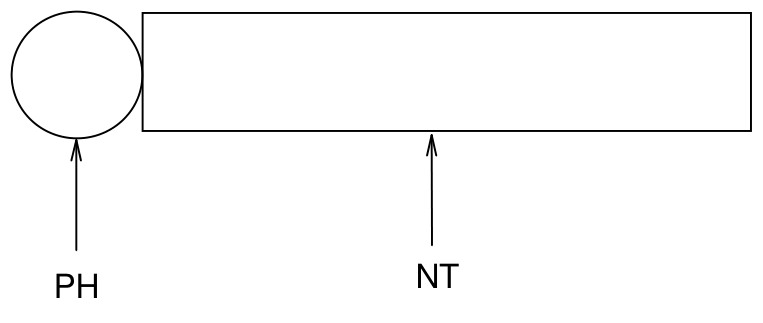
Fig. 1
6.1 AOT is a surfactant. Its systematic name (IUPAC name) is sulfobutanedioic acid 1,4-bis-(2-ethylhexyl) ester sodium salt (formula \(\ce{C20H37NaO7S}\)).
i) Write the structural formula for AOT and fill its PH and NT in the circle and rectangle on your answer sheet.
ii) Choose the type of surfactant AOT among the following.
a) Non-ionic; b) Anionic; c) Cationic; d) Others.
6.2 Mixing an aqueous solution of 50 mmol AOT with isooctane (volume ratio 1 : 1), a micellar extraction system will be formed in the isooctane phase (organic phase).
i) Using the model as shown in Fig. 1, draw a micelle with 10 AOT molecules under the given condition.
ii) What species are in the inner cavity of this micelle? Write their chemical formulas.
6.3 There is an aqueous solution containing the proteins as listed below:
| Protein | Molecular mass (\(M_r\))\(\times10^4\) | Isoelectronic point (PI) |
|---|---|---|
| A | 1.45 | 11.1 |
| B | 1.37 | 7.8 |
| C | 6.45 | 4.9 |
| D | 6.80 | 4.9 |
| E | 2.40 | 4.7 |
| F | 2.38 | 0.5 |
The separation of proteins can be performed by mixing the AOT micellar extraction system with the solution. Adjusting the \(pH\) value of the solution to 4.5, only three of the above listed six proteins can be extracted into the micelles. Which proteins will be extracted?
6.4 The three proteins entered into the micelles will be separated from each other by the following procedure shown as in Fig. 2. Each extracted protein can be sequentially transported into a respective water phase.
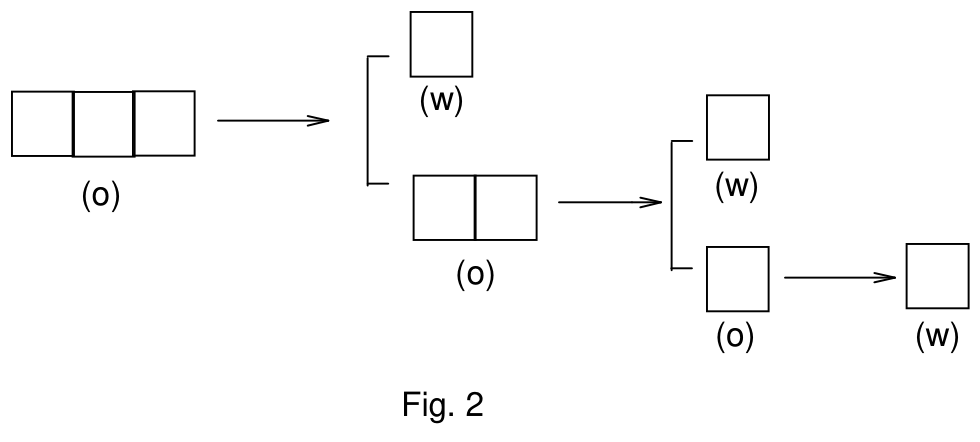
Fig. 2
Note: (w) represents water phase; (o) represents organic phase
Fill the three extracted proteins in the left boxes first and then separate them by the procedure given, and give the separation conditions above each arrow as well.
Official English text of the problem.
Answers
- 6.1(i) AOT is sodium bis(2-ethylhexyl) sulfosuccinate, SMILES:
CCCCC(CC)COC(=O)CC(S(=O)(=O)[O-])C(=O)OCC(CC)CCCC.[Na+]. Its PH is the sulfonate-containing polar core; its NT consists of the two 2-ethylhexyl hydrocarbon chains. - 6.1(ii) b) Anionic.
- 6.2(i) Draw a reverse micelle: ten polar-head circles surrounding an aqueous cavity, with ten tail rectangles extending radially outward into isooctane.
- 6.2(ii) Water, \(\ce{H2O}\), SMILES
O, and sodium ions, \(\ce{Na+}\), SMILES[Na+]. - 6.3 Proteins A, B and E.
- 6.4 Release E, then B, then A into separate aqueous phases. Suitable successive conditions are \(4.7<\mathrm{pH}<7.8\), then \(7.8<\mathrm{pH}<11.1\), then \(\mathrm{pH}>11.1\); for example, pH 6.0, 9.0 and 12.0, respectively.
Solution
6.1(i) Structure and hydrophilic/hydrophobic regions
Let \(R\) denote a 2-ethylhexyl group:
\[ R=\ce{CH2-CH(CH2CH3)-CH2-CH2-CH2-CH3}. \]
The condensed structural formula of AOT is
\[ \ce{Na+}\qquad \ce{R-O-C(=O)-CH(SO3^-)-CH2-C(=O)-O-R}. \]
The two ester groups each carry a 2-ethylhexyl chain, and the sulfonate group is bonded directly to a central carbon. The two \(R\) groups contribute 16 carbon atoms; the central skeleton contributes four, giving the stated formula \(\ce{C20H37NaO7S}\).
For the model on the answer sheet:
- Circle, PH: put the sulfonate-containing polar region here. The principal ionic hydrophilic group is the attached sulfonate, \(\ce{-SO3^-}\), fragment SMILES
[*]S(=O)(=O)[O-]. The ester groups also contribute polarity. Sodium is its counterion. - Rectangle, NT: put the two 2-ethylhexyl groups here, each represented by fragment SMILES
[*]CC(CC)CCCC. These hydrocarbon chains constitute the hydrophobic region.
Here [*] marks attachment to the remainder of the molecule. Although AOT has two hydrocarbon chains, the problem’s simplified model represents its entire non-polar region by one rectangle.
No stereochemical configuration is specified, so the AOT SMILES leaves stereochemistry unspecified.
6.1(ii) Surfactant classification
The amphiphilic organic ion bears a negatively charged sulfonate group. The positive sodium ion is the counterion. Therefore AOT is an anionic surfactant, option b.
6.2(i) Arrangement in the organic phase
Isooctane is 2,2,4-trimethylpentane, \(\ce{C8H18}\), SMILES CC(C)(C)CC(C)C. It is a non-polar solvent, so the hydrocarbon tails are directed into this continuous organic phase. The polar heads gather around entrapped water, forming a reverse micelle.
Describe the required drawing as follows:
- Place exactly ten circles around a central aqueous cavity, approximately \(36^\circ\) apart.
- Attach one rectangle to the outward-facing side of each circle.
- Direct all ten rectangles radially away from the cavity into the surrounding isooctane.
Thus the negatively charged heads line the inner aqueous surface, and the non-polar tails form the exterior.
6.2(ii) Contents of the cavity
The cavity contains water, \(\ce{H2O}\), and hydrated sodium counterions, \(\ce{Na+}\). The polar environment accommodates these ions, while the attached sulfonate groups line the cavity’s boundary.
The amount of water enclosed is not specified.
6.3 Selection of proteins
The table’s PI denotes the isoelectric point, conventionally written \(pI\). The relevant charge relationships are
\[ \begin{aligned} \mathrm{pH}<pI &\quad\Rightarrow\quad \text{net positive protein charge},\\ \mathrm{pH}=pI &\quad\Rightarrow\quad \text{zero net protein charge},\\ \mathrm{pH}>pI &\quad\Rightarrow\quad \text{net negative protein charge}. \end{aligned} \]
AOT’s inward-facing heads are negatively charged, so they attract positively charged proteins. Entry also requires a protein to fit within the micellar aqueous region.
At pH 4.5:
| Protein | \(M_r\) | Net charge | Consequence in the intended model |
|---|---|---|---|
| A | \(1.45\times10^4\) | Positive | Attracted and sufficiently small |
| B | \(1.37\times10^4\) | Positive | Attracted and sufficiently small |
| C | \(6.45\times10^4\) | Positive | Excluded because of its larger size |
| D | \(6.80\times10^4\) | Positive | Excluded because of its larger size |
| E | \(2.40\times10^4\) | Positive | Attracted and sufficiently small |
| F | \(2.38\times10^4\) | Negative | Electrostatically disfavoured |
Protein F has \(\mathrm{pH}>pI\), so its charge has the same sign as the AOT heads. Proteins A–E all have the favourable positive charge, but C and D have much greater molecular masses than A, B and E.
Using this size distinction together with the stated fact that exactly three proteins enter the micelles gives
\[ \boxed{\text{A, B and E}}. \]
6.4 Sequential back-extraction
Raise the pH in stages. When the pH exceeds a protein’s \(pI\), its net charge becomes negative, favouring its release from the negatively charged micellar interior into the external aqueous phase.
The three relevant isoelectric points are
\[ pI_E=4.7<pI_B=7.8<pI_A=11.1. \]
Fill the three initial organic-phase boxes, from left to right, with A, B, E. Complete the remaining boxes and arrow conditions as follows:
| Arrow | Aqueous-phase condition | Protein in the new water-phase box, (w) | Proteins remaining in the organic-phase boxes, (o) |
|---|---|---|---|
| First | \(4.7<\mathrm{pH}<7.8\), e.g. 6.0 | E | A, B |
| Second | \(7.8<\mathrm{pH}<11.1\), e.g. 9.0 | B | A |
| Third | \(\mathrm{pH}>11.1\), e.g. 12.0 | A | None |
At the first stage, E is negative while A and B remain positive. At the second stage, B becomes negative while A remains positive. At the final stage, A also becomes negative.
After each equilibration, separate and collect the aqueous phase before contacting the remaining organic phase with the next aqueous solution.
The solution was checked against the official solution.
IChO 1995 · Theorieaufgabe 6
Das Tensid AOT und die mizellare Extraktion von Proteinen
Ein Tensidmolekül lässt sich im Allgemeinen wie in Abb. 1 modellhaft darstellen, wobei ein Kreis den polaren Kopf (PH), d. h. den hydrophilen Teil des Moleküls, und ein Rechteck den unpolaren Schwanz (NT), d. h. den hydrophoben Teil des Moleküls, darstellt.
Abb. 1
6.1 AOT ist ein Tensid. Sein systematischer Name (IUPAC-Name) lautet Sulfobutandisäure-1,4-bis(2-ethylhexyl)ester-Natriumsalz (Formel \(\ce{C20H37NaO7S}\)).
i) Geben Sie die Strukturformel von AOT an und tragen Sie seinen PH und NT in den Kreis bzw. das Rechteck auf Ihrem Antwortblatt ein.
ii) Wählen Sie aus den folgenden Tensidtypen denjenigen aus, zu dem AOT gehört.
a) Nichtionisch; b) Anionisch; c) Kationisch; d) Sonstige.
6.2 Beim Mischen einer wässrigen Lösung von 50 mmol AOT mit Isooctan (Volumenverhältnis 1 : 1) entsteht in der Isooctanphase (organischen Phase) ein mizellares Extraktionssystem.
i) Zeichnen Sie anhand des in Abb. 1 dargestellten Modells eine Mizelle aus 10 AOT-Molekülen unter den gegebenen Bedingungen.
ii) Welche Spezies befinden sich im inneren Hohlraum dieser Mizelle? Geben Sie ihre chemischen Formeln an.
6.3 Es liegt eine wässrige Lösung vor, die die nachstehend aufgeführten Proteine enthält:
| Protein | Molekülmasse (\(M_r\))\(\times10^4\) | Isoelektronischer Punkt (PI) |
|---|---|---|
| A | 1.45 | 11.1 |
| B | 1.37 | 7.8 |
| C | 6.45 | 4.9 |
| D | 6.80 | 4.9 |
| E | 2.40 | 4.7 |
| F | 2.38 | 0.5 |
Die Trennung der Proteine kann durch Mischen des mizellaren AOT-Extraktionssystems mit der Lösung erfolgen. Wird der \(pH\)-Wert der Lösung auf 4.5 eingestellt, können nur drei der sechs oben aufgeführten Proteine in die Mizellen extrahiert werden. Welche Proteine werden extrahiert?
6.4 Die drei in die Mizellen aufgenommenen Proteine werden durch das folgende, in Abb. 2 dargestellte Verfahren voneinander getrennt. Jedes extrahierte Protein kann nacheinander in eine eigene Wasserphase überführt werden.
Abb. 2
Hinweis: (w) bezeichnet die Wasserphase; (o) bezeichnet die organische Phase
Tragen Sie zunächst die drei extrahierten Proteine in die linken Kästchen ein, trennen Sie sie anschließend nach dem angegebenen Verfahren und geben Sie außerdem über jedem Pfeil die Trennbedingungen an.
Aufgabentext aus dem offiziellen englischen Text übersetzt.
Antworten
- 6.1(i) AOT ist Natriumbis(2-ethylhexyl)sulfosuccinat, SMILES:
CCCCC(CC)COC(=O)CC(S(=O)(=O)[O-])C(=O)OCC(CC)CCCC.[Na+]. Sein PH ist der sulfonathaltige polare Kern; sein NT besteht aus den beiden 2-Ethylhexyl-Kohlenwasserstoffketten. - 6.1(ii) b) Anionisch.
- 6.2(i) Zeichnen Sie eine inverse Mizelle: Zehn Kreise für die polaren Köpfe umgeben einen wässrigen Hohlraum, wobei zehn Rechtecke für die Schwänze radial nach außen in das Isooctan ragen.
- 6.2(ii) Wasser, \(\ce{H2O}\), SMILES
O, und Natriumionen, \(\ce{Na+}\), SMILES[Na+]. - 6.3 Proteine A, B und E.
- 6.4 Überführen Sie zunächst E, dann B und schließlich A in getrennte wässrige Phasen. Geeignete aufeinanderfolgende Bedingungen sind \(4.7<\mathrm{pH}<7.8\), dann \(7.8<\mathrm{pH}<11.1\), dann \(\mathrm{pH}>11.1\); beispielsweise pH 6.0, 9.0 bzw. 12.0.
Lösung
6.1(i) Struktur und hydrophile/hydrophobe Bereiche
Mit \(R\) sei eine 2-Ethylhexylgruppe bezeichnet:
\[ R=\ce{CH2-CH(CH2CH3)-CH2-CH2-CH2-CH3}. \]
Die Halbstrukturformel von AOT lautet
\[ \ce{Na+}\qquad \ce{R-O-C(=O)-CH(SO3^-)-CH2-C(=O)-O-R}. \]
Die beiden Estergruppen tragen jeweils eine 2-Ethylhexylkette, und die Sulfonatgruppe ist direkt an ein zentrales Kohlenstoffatom gebunden. Die beiden \(R\)-Gruppen tragen 16 Kohlenstoffatome bei; das zentrale Gerüst trägt vier bei, woraus sich die angegebene Formel \(\ce{C20H37NaO7S}\) ergibt.
Für das Modell auf dem Antwortblatt:
- Kreis, PH: Tragen Sie hier den sulfonathaltigen polaren Bereich ein. Die wichtigste ionische hydrophile Gruppe ist die gebundene Sulfonatgruppe, \(\ce{-SO3^-}\), mit dem Fragment-SMILES
[*]S(=O)(=O)[O-]. Auch die Estergruppen tragen zur Polarität bei. Natrium ist das Gegenion. - Rechteck, NT: Tragen Sie hier die beiden 2-Ethylhexylgruppen ein, die jeweils durch den Fragment-SMILES
[*]CC(CC)CCCCdargestellt werden. Diese Kohlenwasserstoffketten bilden den hydrophoben Bereich.
Hier kennzeichnet [*] die Bindungsstelle zum Rest des Moleküls. Obwohl AOT zwei Kohlenwasserstoffketten besitzt, stellt das vereinfachte Modell der Aufgabe seinen gesamten unpolaren Bereich durch ein einziges Rechteck dar.
Es ist keine stereochemische Konfiguration vorgegeben, daher bleibt die Stereochemie im SMILES von AOT unspezifiziert.
6.1(ii) Einordnung des Tensids
Das amphiphile organische Ion trägt eine negativ geladene Sulfonatgruppe. Das positive Natriumion ist das Gegenion. Daher ist AOT ein anionisches Tensid, Antwort b.
6.2(i) Anordnung in der organischen Phase
Isooctan ist 2,2,4-Trimethylpentan, \(\ce{C8H18}\), SMILES CC(C)(C)CC(C)C. Es ist ein unpolares Lösungsmittel, daher sind die Kohlenwasserstoffschwänze in diese kontinuierliche organische Phase gerichtet. Die polaren Köpfe lagern sich um eingeschlossenes Wasser an und bilden eine inverse Mizelle.
Die geforderte Zeichnung lässt sich wie folgt beschreiben:
- Ordnen Sie genau zehn Kreise um einen zentralen wässrigen Hohlraum an, jeweils mit einem Winkelabstand von ungefähr \(36^\circ\).
- Setzen Sie an die nach außen gerichtete Seite jedes Kreises ein Rechteck.
- Richten Sie alle zehn Rechtecke radial vom Hohlraum weg in das umgebende Isooctan aus.
Somit kleiden die negativ geladenen Köpfe die innere wässrige Oberfläche aus, und die unpolaren Schwänze bilden die Außenseite.
6.2(ii) Inhalt des Hohlraums
Der Hohlraum enthält Wasser, \(\ce{H2O}\), und hydratisierte Natrium-Gegenionen, \(\ce{Na+}\). Die polare Umgebung nimmt diese Ionen auf, während die gebundenen Sulfonatgruppen die Begrenzung des Hohlraums auskleiden.
Die Menge des eingeschlossenen Wassers ist nicht angegeben.
6.3 Auswahl der Proteine
PI in der Tabelle bezeichnet den isoelektrischen Punkt, der üblicherweise als \(pI\) geschrieben wird. Die maßgeblichen Beziehungen für die Ladung lauten
\[ \begin{aligned} \mathrm{pH}<pI &\quad\Rightarrow\quad \text{positive Nettoladung des Proteins},\\ \mathrm{pH}=pI &\quad\Rightarrow\quad \text{Nettoladung des Proteins gleich null},\\ \mathrm{pH}>pI &\quad\Rightarrow\quad \text{negative Nettoladung des Proteins}. \end{aligned} \]
Die nach innen gerichteten Köpfe von AOT sind negativ geladen und ziehen daher positiv geladene Proteine an. Für die Aufnahme muss ein Protein außerdem in den wässrigen Bereich der Mizelle passen.
Bei pH 4.5:
| Protein | \(M_r\) | Nettoladung | Folge im vorgesehenen Modell |
|---|---|---|---|
| A | \(1.45\times10^4\) | Positiv | Wird angezogen und ist ausreichend klein |
| B | \(1.37\times10^4\) | Positiv | Wird angezogen und ist ausreichend klein |
| C | \(6.45\times10^4\) | Positiv | Wird aufgrund seiner größeren Abmessungen ausgeschlossen |
| D | \(6.80\times10^4\) | Positiv | Wird aufgrund seiner größeren Abmessungen ausgeschlossen |
| E | \(2.40\times10^4\) | Positiv | Wird angezogen und ist ausreichend klein |
| F | \(2.38\times10^4\) | Negativ | Elektrostatisch benachteiligt |
Für Protein F gilt \(\mathrm{pH}>pI\), daher hat seine Ladung dasselbe Vorzeichen wie die der AOT-Köpfe. Die Proteine A–E besitzen alle die günstige positive Ladung, aber C und D haben wesentlich größere Molekülmassen als A, B und E.
Aus diesem Größenunterschied zusammen mit der angegebenen Tatsache, dass genau drei Proteine in die Mizellen aufgenommen werden, ergibt sich
\[ \boxed{\text{A, B und E}}. \]
6.4 Schrittweise Rückextraktion
Erhöhen Sie den pH-Wert stufenweise. Wenn der pH-Wert den \(pI\) eines Proteins übersteigt, wird dessen Nettoladung negativ, was seinen Austritt aus dem negativ geladenen Mizelleninneren in die äußere wässrige Phase begünstigt.
Die drei maßgeblichen isoelektrischen Punkte sind
\[ pI_E=4.7<pI_B=7.8<pI_A=11.1. \]
Tragen Sie in die drei anfänglichen Kästchen der organischen Phase von links nach rechts A, B, E ein. Ergänzen Sie die übrigen Kästchen und die Bedingungen an den Pfeilen wie folgt:
| Pfeil | Bedingung in der wässrigen Phase | Protein im neuen Kästchen der Wasserphase, (w) | In den Kästchen der organischen Phase verbleibende Proteine, (o) |
|---|---|---|---|
| Erster | \(4.7<\mathrm{pH}<7.8\), z. B. 6.0 | E | A, B |
| Zweiter | \(7.8<\mathrm{pH}<11.1\), z. B. 9.0 | B | A |
| Dritter | \(\mathrm{pH}>11.1\), z. B. 12.0 | A | Keine |
In der ersten Stufe ist E negativ, während A und B positiv bleiben. In der zweiten Stufe wird B negativ, während A positiv bleibt. In der letzten Stufe wird auch A negativ.
Trennen Sie nach jeder Gleichgewichtseinstellung die wässrige Phase ab und sammeln Sie sie, bevor Sie die verbleibende organische Phase mit der nächsten wässrigen Lösung in Kontakt bringen.
Die Lösung wurde mit der offiziellen Lösung abgeglichen.
IChO 1995 · Teori sorusu 6
AOT yüzey aktif maddesi ve proteinlerin misel ekstraksiyonu
Bir yüzey aktif madde molekülü genellikle Şekil 1'deki gibi modellenebilir; burada daire polar başı (PH), yani molekülün hidrofilik kısmını, dikdörtgen ise apolar kuyruğu (NT), yani molekülün hidrofobik kısmını temsil eder.
Şekil 1
6.1 AOT bir yüzey aktif maddedir. Sistematik adı (IUPAC adı), sülfobütandioik asit 1,4-bis-(2-etilheksil) esteri sodyum tuzudur (formülü \(\ce{C20H37NaO7S}\)).
i) AOT'nin yapı formülünü yazınız ve cevap kâğıdınızdaki daire ve dikdörtgene PH ve NT kısımlarını yerleştiriniz.
ii) Aşağıdakiler arasından AOT'nin yüzey aktif madde türünü seçiniz.
a) İyonik olmayan; b) Anyonik; c) Katyonik; d) Diğerleri.
6.2 50 mmol AOT içeren sulu bir çözelti izooktanla karıştırıldığında (hacim oranı 1 : 1), izooktan fazında (organik faz) bir misel ekstraksiyon sistemi oluşur.
i) Şekil 1'de gösterilen modeli kullanarak verilen koşulda 10 AOT molekülünden oluşan bir misel çiziniz.
ii) Bu miselin iç boşluğunda hangi türler bulunur? Kimyasal formüllerini yazınız.
6.3 Aşağıda listelenen proteinleri içeren sulu bir çözelti bulunmaktadır:
| Protein | Molekül kütlesi (\(M_r\))\(\times10^4\) | İzoelektronik nokta (PI) |
|---|---|---|
| A | 1.45 | 11.1 |
| B | 1.37 | 7.8 |
| C | 6.45 | 4.9 |
| D | 6.80 | 4.9 |
| E | 2.40 | 4.7 |
| F | 2.38 | 0.5 |
Proteinler, AOT misel ekstraksiyon sistemi çözeltiyle karıştırılarak ayrılabilir. Çözeltinin \(pH\) değeri 4.5'e ayarlandığında, yukarıda listelenen altı proteinden yalnızca üçü misellere ekstrakte edilebilir. Hangi proteinler ekstrakte edilir?
6.4 Misellere giren üç protein, Şekil 2'de gösterilen aşağıdaki işlemle birbirinden ayrılacaktır. Ekstrakte edilen her protein, sırayla kendisine ait ayrı bir su fazına aktarılabilir.
Şekil 2
Not: (w) su fazını; (o) organik fazı temsil eder
Önce ekstrakte edilen üç proteini soldaki kutulara yazınız, ardından verilen işlemle bunları ayırınız ve her okun üzerine ayırma koşullarını da yazınız.
Soru metni resmi İngilizce metinden çevrilmiştir.
Cevaplar
- 6.1(i) AOT, sodyum bis(2-etilheksil) sülfosüksinattır, SMILES:
CCCCC(CC)COC(=O)CC(S(=O)(=O)[O-])C(=O)OCC(CC)CCCC.[Na+]. PH kısmı, sülfonat içeren polar merkezdir; NT kısmı ise iki adet 2-etilheksil hidrokarbon zincirinden oluşur. - 6.1(ii) b) Anyonik.
- 6.2(i) Bir ters misel çiziniz: sulu bir boşluğu çevreleyen on polar baş dairesi ve izooktanın içine doğru radyal olarak dışarı uzanan on kuyruk dikdörtgeni.
- 6.2(ii) Su, \(\ce{H2O}\), SMILES
O, ve sodyum iyonları, \(\ce{Na+}\), SMILES[Na+]. - 6.3 A, B ve E proteinleri.
- 6.4 E'yi, ardından B'yi, ardından A'yı ayrı sulu fazlara aktarınız. Uygun ardışık koşullar \(4.7<\mathrm{pH}<7.8\), ardından \(7.8<\mathrm{pH}<11.1\), ardından \(\mathrm{pH}>11.1\) şeklindedir; örneğin sırasıyla pH 6.0, 9.0 ve 12.0.
Çözüm
6.1(i) Yapı ve hidrofilik/hidrofobik bölgeler
\(R\), bir 2-etilheksil grubunu göstersin:
\[ R=\ce{CH2-CH(CH2CH3)-CH2-CH2-CH2-CH3}. \]
AOT'nin yoğunlaştırılmış yapı formülü şöyledir:
\[ \ce{Na+}\qquad \ce{R-O-C(=O)-CH(SO3^-)-CH2-C(=O)-O-R}. \]
İki ester grubunun her biri bir 2-etilheksil zinciri taşır ve sülfonat grubu doğrudan merkezdeki bir karbon atomuna bağlıdır. İki \(R\) grubu 16 karbon atomu sağlar; merkezdeki iskelet ise dört karbon atomu sağlar ve böylece belirtilen \(\ce{C20H37NaO7S}\) formülü elde edilir.
Cevap kâğıdındaki model için:
- Daire, PH: sülfonat içeren polar bölgeyi buraya yerleştiriniz. Başlıca iyonik hidrofilik grup, bağlı sülfonat grubu, \(\ce{-SO3^-}\), olup bu parçanın SMILES gösterimi
[*]S(=O)(=O)[O-]şeklindedir. Ester grupları da polarlığa katkıda bulunur. Sodyum, karşı iyonudur. - Dikdörtgen, NT: her biri
[*]CC(CC)CCCCparça SMILES gösterimiyle temsil edilen iki 2-etilheksil grubunu buraya yerleştiriniz. Bu hidrokarbon zincirleri hidrofobik bölgeyi oluşturur.
Burada [*], molekülün geri kalanına bağlanma yerini gösterir. AOT'nin iki hidrokarbon zinciri olmasına rağmen, sorudaki basitleştirilmiş model apolar bölgenin tamamını tek bir dikdörtgenle temsil eder.
Herhangi bir stereokimyasal konfigürasyon belirtilmediğinden, AOT'nin SMILES gösteriminde stereokimya belirtilmemiştir.
6.1(ii) Yüzey aktif madde sınıflandırması
Amfifilik organik iyon, negatif yüklü bir sülfonat grubu taşır. Pozitif sodyum iyonu, karşı iyondur. Dolayısıyla AOT, anyonik bir yüzey aktif maddedir; doğru seçenek b'dir.
6.2(i) Organik fazdaki düzenlenme
İzooktan, 2,2,4-trimetilpentandır, \(\ce{C8H18}\), SMILES CC(C)(C)CC(C)C. Apolar bir çözücü olduğu için hidrokarbon kuyrukları bu sürekli organik faza yönelir. Polar başlar, içeride hapsolmuş suyun etrafında toplanarak bir ters misel oluşturur.
İstenen çizimi aşağıdaki gibi tarif ediniz:
- Merkezdeki sulu boşluğun etrafına, aralarında yaklaşık \(36^\circ\) olacak şekilde tam on daire yerleştiriniz.
- Her dairenin dışa bakan tarafına bir dikdörtgen bağlayınız.
- On dikdörtgenin tümünü boşluktan radyal olarak dışarıya, çevredeki izooktanın içine doğru yöneltiniz.
Böylece negatif yüklü başlar içteki sulu yüzey boyunca dizilir ve apolar kuyruklar dış kısmı oluşturur.
6.2(ii) Boşluğun içeriği
Boşlukta su, \(\ce{H2O}\), ve hidratlanmış sodyum karşı iyonları, \(\ce{Na+}\) bulunur. Polar ortam bu iyonları barındırırken, bağlı sülfonat grupları boşluğun sınırı boyunca dizilir.
İçeride tutulan su miktarı belirtilmemiştir.
6.3 Proteinlerin seçimi
Tablodaki PI, geleneksel olarak \(pI\) ile gösterilen izoelektrik noktayı belirtir. İlgili yük ilişkileri şöyledir:
\[ \begin{aligned} \mathrm{pH}<pI &\quad\Rightarrow\quad \text{proteinin net yükü pozitif},\\ \mathrm{pH}=pI &\quad\Rightarrow\quad \text{proteinin net yükü sıfır},\\ \mathrm{pH}>pI &\quad\Rightarrow\quad \text{proteinin net yükü negatif}. \end{aligned} \]
AOT'nin içe dönük başları negatif yüklüdür, dolayısıyla pozitif yüklü proteinleri çeker. Ayrıca, bir proteinin içeri girebilmesi için miselin sulu bölgesine sığması gerekir.
pH 4.5'te:
| Protein | \(M_r\) | Net yük | Öngörülen modeldeki sonuç |
|---|---|---|---|
| A | \(1.45\times10^4\) | Pozitif | Çekilir ve yeterince küçüktür |
| B | \(1.37\times10^4\) | Pozitif | Çekilir ve yeterince küçüktür |
| C | \(6.45\times10^4\) | Pozitif | Daha büyük boyutu nedeniyle içeri alınmaz |
| D | \(6.80\times10^4\) | Pozitif | Daha büyük boyutu nedeniyle içeri alınmaz |
| E | \(2.40\times10^4\) | Pozitif | Çekilir ve yeterince küçüktür |
| F | \(2.38\times10^4\) | Negatif | İçeri girmesi elektrostatik açıdan elverişsizdir |
F proteini için \(\mathrm{pH}>pI\) olduğundan yükü AOT başlarıyla aynı işaretlidir. A–E proteinlerinin tümü elverişli olan pozitif yüke sahiptir, ancak C ve D'nin molekül kütleleri A, B ve E'ninkinden çok daha büyüktür.
Bu boyut farkı, misellere tam olarak üç proteinin girdiğine ilişkin verilen bilgiyle birlikte kullanıldığında şu sonuç elde edilir:
\[ \boxed{\text{A, B ve E}}. \]
6.4 Ardışık geri ekstraksiyon
pH'ı aşamalı olarak yükseltiniz. pH bir proteinin \(pI\) değerini aştığında, proteinin net yükü negatif olur; bu da proteinin negatif yüklü misel içinden dış sulu faza geçmesini kolaylaştırır.
İlgili üç izoelektrik nokta şöyledir:
\[ pI_E=4.7<pI_B=7.8<pI_A=11.1. \]
Başlangıçtaki üç organik faz kutusuna soldan sağa A, B, E yazınız. Kalan kutuları ve okların üzerindeki koşulları aşağıdaki gibi tamamlayınız:
| Ok | Sulu faz koşulu | Yeni su fazı kutusundaki protein, (w) | Organik faz kutularında kalan proteinler, (o) |
|---|---|---|---|
| Birinci | \(4.7<\mathrm{pH}<7.8\), ör. 6.0 | E | A, B |
| İkinci | \(7.8<\mathrm{pH}<11.1\), ör. 9.0 | B | A |
| Üçüncü | \(\mathrm{pH}>11.1\), ör. 12.0 | A | Yok |
İlk aşamada E negatif yüklüyken A ve B pozitif yüklü kalır. İkinci aşamada B negatif yüklü hâle gelirken A pozitif yüklü kalır. Son aşamada A da negatif yüklü hâle gelir.
Her dengeye getirme işleminden sonra, kalan organik fazı bir sonraki sulu çözeltiyle temas ettirmeden önce sulu fazı ayırıp toplayınız.
Çözüm, resmi çözümle karşılaştırılarak kontrol edildi.
IChO 1995 · Problema teórico 6
El tensioactivo AOT y la extracción micelar de proteínas
Una molécula de tensioactivo puede representarse generalmente mediante el modelo de la Fig. 1, donde un círculo representa la cabeza polar (PH), es decir, la parte hidrófila de la molécula, y un rectángulo representa la cola apolar (NT), es decir, la parte hidrófoba de la molécula.
Fig. 1
6.1 El AOT es un tensioactivo. Su nombre sistemático (nombre IUPAC) es sal sódica del éster 1,4-bis(2-etilhexílico) del ácido sulfobutanodioico (fórmula \(\ce{C20H37NaO7S}\)).
i) Escriba la fórmula estructural del AOT e indique su PH y su NT en el círculo y el rectángulo de la hoja de respuestas.
ii) Elija el tipo de tensioactivo al que pertenece el AOT entre los siguientes.
a) No iónico; b) Aniónico; c) Catiónico; d) Otros.
6.2 Al mezclar una disolución acuosa de 50 mmol de AOT con isooctano (relación de volúmenes 1 : 1), se formará un sistema de extracción micelar en la fase de isooctano (fase orgánica).
i) Utilizando el modelo que se muestra en la Fig. 1, dibuje una micela con 10 moléculas de AOT en las condiciones indicadas.
ii) ¿Qué especies se encuentran en la cavidad interna de esta micela? Escriba sus fórmulas químicas.
6.3 Se dispone de una disolución acuosa que contiene las proteínas que se indican a continuación:
| Proteína | Masa molecular (\(M_r\))\(\times10^4\) | Punto isoelectrónico (PI) |
|---|---|---|
| A | 1.45 | 11.1 |
| B | 1.37 | 7.8 |
| C | 6.45 | 4.9 |
| D | 6.80 | 4.9 |
| E | 2.40 | 4.7 |
| F | 2.38 | 0.5 |
La separación de las proteínas puede realizarse mezclando el sistema de extracción micelar de AOT con la disolución. Al ajustar el valor del \(pH\) de la disolución a 4.5, solo tres de las seis proteínas indicadas anteriormente pueden extraerse hacia el interior de las micelas. ¿Qué proteínas se extraerán?
6.4 Las tres proteínas que han entrado en las micelas se separarán entre sí mediante el siguiente procedimiento, que se muestra en la Fig. 2. Cada proteína extraída puede transferirse secuencialmente a una fase acuosa distinta.
Fig. 2
Nota: (w) representa la fase acuosa; (o) representa la fase orgánica
Escriba primero las tres proteínas extraídas en los recuadros de la izquierda y, a continuación, sepárelas mediante el procedimiento indicado; indique también las condiciones de separación encima de cada flecha.
Enunciado traducido del texto oficial en inglés.
Respuestas
- 6.1(i) El AOT es sulfosuccinato de bis(2-etilhexilo) y sodio, SMILES:
CCCCC(CC)COC(=O)CC(S(=O)(=O)[O-])C(=O)OCC(CC)CCCC.[Na+]. Su PH es el núcleo polar que contiene el grupo sulfonato; su NT está formada por las dos cadenas hidrocarbonadas de 2-etilhexilo. - 6.1(ii) b) Aniónico.
- 6.2(i) Dibuje una micela inversa: diez círculos que representan las cabezas polares rodeando una cavidad acuosa, con diez rectángulos que representan las colas extendiéndose radialmente hacia fuera, hacia el isooctano.
- 6.2(ii) Agua, \(\ce{H2O}\), SMILES
O, e iones sodio, \(\ce{Na+}\), SMILES[Na+]. - 6.3 Las proteínas A, B y E.
- 6.4 Libere E, después B y después A en fases acuosas separadas. Unas condiciones sucesivas adecuadas son \(4.7<\mathrm{pH}<7.8\), después \(7.8<\mathrm{pH}<11.1\) y después \(\mathrm{pH}>11.1\); por ejemplo, pH 6.0, 9.0 y 12.0, respectivamente.
Solución
6.1(i) Estructura y regiones hidrófila e hidrófoba
Sea \(R\) un grupo 2-etilhexilo:
\[ R=\ce{CH2-CH(CH2CH3)-CH2-CH2-CH2-CH3}. \]
La fórmula estructural condensada del AOT es
\[ \ce{Na+}\qquad \ce{R-O-C(=O)-CH(SO3^-)-CH2-C(=O)-O-R}. \]
Cada uno de los dos grupos éster lleva una cadena de 2-etilhexilo, y el grupo sulfonato está unido directamente a un carbono central. Los dos grupos \(R\) aportan 16 átomos de carbono; el esqueleto central aporta cuatro, lo que da la fórmula indicada, \(\ce{C20H37NaO7S}\).
Para el modelo de la hoja de respuestas:
- Círculo, PH: sitúe aquí la región polar que contiene el grupo sulfonato. El principal grupo iónico hidrófilo es el sulfonato unido a la molécula, \(\ce{-SO3^-}\), cuyo fragmento SMILES es
[*]S(=O)(=O)[O-]. Los grupos éster también contribuyen a la polaridad. El sodio es su contraión. - Rectángulo, NT: sitúe aquí los dos grupos 2-etilhexilo, cada uno representado por el fragmento SMILES
[*]CC(CC)CCCC. Estas cadenas hidrocarbonadas constituyen la región hidrófoba.
Aquí, [*] indica la unión al resto de la molécula. Aunque el AOT tiene dos cadenas hidrocarbonadas, el modelo simplificado del problema representa toda su región apolar mediante un único rectángulo.
No se especifica ninguna configuración estereoquímica, por lo que el SMILES del AOT deja la estereoquímica sin especificar.
6.1(ii) Clasificación del tensioactivo
El ion orgánico anfifílico posee un grupo sulfonato con carga negativa. El ion sodio positivo es el contraión. Por tanto, el AOT es un tensioactivo aniónico, opción b.
6.2(i) Disposición en la fase orgánica
El isooctano es 2,2,4-trimetilpentano, \(\ce{C8H18}\), SMILES CC(C)(C)CC(C)C. Es un disolvente apolar, por lo que las colas hidrocarbonadas se orientan hacia esta fase orgánica continua. Las cabezas polares se agrupan alrededor del agua atrapada, formando una micela inversa.
Describa el dibujo requerido de la siguiente manera:
- Coloque exactamente diez círculos alrededor de una cavidad acuosa central, separados aproximadamente \(36^\circ\).
- Una un rectángulo al lado de cada círculo orientado hacia el exterior.
- Oriente los diez rectángulos radialmente hacia fuera de la cavidad, hacia el isooctano circundante.
Así, las cabezas con carga negativa recubren la superficie acuosa interna, y las colas apolares forman el exterior.
6.2(ii) Contenido de la cavidad
La cavidad contiene agua, \(\ce{H2O}\), y contraiones sodio hidratados, \(\ce{Na+}\). El entorno polar alberga estos iones, mientras que los grupos sulfonato unidos a las moléculas recubren el límite de la cavidad.
No se especifica la cantidad de agua encerrada.
6.3 Selección de las proteínas
El PI de la tabla denota el punto isoeléctrico, que convencionalmente se escribe \(pI\). Las relaciones pertinentes entre el pH y la carga son
\[ \begin{aligned} \mathrm{pH}<pI &\quad\Rightarrow\quad \text{carga neta positiva de la proteína},\\ \mathrm{pH}=pI &\quad\Rightarrow\quad \text{carga neta nula de la proteína},\\ \mathrm{pH}>pI &\quad\Rightarrow\quad \text{carga neta negativa de la proteína}. \end{aligned} \]
Las cabezas del AOT orientadas hacia el interior tienen carga negativa, por lo que atraen a las proteínas con carga positiva. Para entrar, también es necesario que la proteína quepa en la región acuosa micelar.
A pH 4.5:
| Proteína | \(M_r\) | Carga neta | Consecuencia en el modelo propuesto |
|---|---|---|---|
| A | \(1.45\times10^4\) | Positiva | Atraída y suficientemente pequeña |
| B | \(1.37\times10^4\) | Positiva | Atraída y suficientemente pequeña |
| C | \(6.45\times10^4\) | Positiva | Excluida por su mayor tamaño |
| D | \(6.80\times10^4\) | Positiva | Excluida por su mayor tamaño |
| E | \(2.40\times10^4\) | Positiva | Atraída y suficientemente pequeña |
| F | \(2.38\times10^4\) | Negativa | Desfavorecida electrostáticamente |
Para la proteína F se cumple \(\mathrm{pH}>pI\), por lo que su carga tiene el mismo signo que la de las cabezas del AOT. Todas las proteínas A–E tienen la carga positiva favorable, pero C y D tienen masas moleculares mucho mayores que A, B y E.
Esta diferencia de tamaño, junto con el hecho indicado de que exactamente tres proteínas entran en las micelas, da como resultado
\[ \boxed{\text{A, B y E}}. \]
6.4 Retroextracción secuencial
Aumente el pH por etapas. Cuando el pH supera el \(pI\) de una proteína, su carga neta se vuelve negativa, lo que favorece su liberación desde el interior micelar, cargado negativamente, hacia la fase acuosa externa.
Los tres puntos isoeléctricos pertinentes son
\[ pI_E=4.7<pI_B=7.8<pI_A=11.1. \]
Rellene los tres recuadros iniciales de la fase orgánica, de izquierda a derecha, con A, B, E. Complete los recuadros restantes y las condiciones de las flechas de la siguiente manera:
| Flecha | Condición de la fase acuosa | Proteína en el nuevo recuadro de la fase acuosa, (w) | Proteínas que permanecen en los recuadros de la fase orgánica, (o) |
|---|---|---|---|
| Primera | \(4.7<\mathrm{pH}<7.8\), p. ej., 6.0 | E | A, B |
| Segunda | \(7.8<\mathrm{pH}<11.1\), p. ej., 9.0 | B | A |
| Tercera | \(\mathrm{pH}>11.1\), p. ej., 12.0 | A | Ninguna |
En la primera etapa, E tiene carga negativa, mientras que A y B siguen teniendo carga positiva. En la segunda etapa, B adquiere carga negativa, mientras que A sigue teniendo carga positiva. En la etapa final, A también adquiere carga negativa.
Después de cada equilibrado, separe y recoja la fase acuosa antes de poner la fase orgánica restante en contacto con la siguiente disolución acuosa.
La solución se comprobó con la solución oficial.
IChO 1995 · 理论题 6
表面活性剂 AOT 与蛋白质的胶束萃取
表面活性剂分子通常可用图 1 所示的模型表示,其中圆形表示极性头部(PH),即分子的亲水部分;矩形表示非极性尾部(NT),即分子的疏水部分。
图 1
6.1 AOT 是一种表面活性剂。其系统名称(IUPAC 名称)为磺基丁二酸-1,4-双(2-乙基己基)酯钠盐(分子式为 \(\ce{C20H37NaO7S}\))。
i) 写出 AOT 的结构式,并将其 PH 和 NT 填入答题纸上的圆形和矩形中。
ii) 从以下选项中选出 AOT 所属的表面活性剂类型。
a) 非离子型; b) 阴离子型; c) 阳离子型; d) 其他。
6.2 将含有 50 mmol AOT 的水溶液与异辛烷混合(体积比为 1 : 1),异辛烷相(有机相)中将形成胶束萃取体系。
i) 使用图 1 所示的模型,画出在给定条件下由 10 个 AOT 分子组成的胶束。
ii) 该胶束的内腔中有哪些物种?写出它们的化学式。
6.3 有一份含有下列蛋白质的水溶液:
| 蛋白质 | 分子质量(\(M_r\))\(\times10^4\) | 等电点(PI) |
|---|---|---|
| A | 1.45 | 11.1 |
| B | 1.37 | 7.8 |
| C | 6.45 | 4.9 |
| D | 6.80 | 4.9 |
| E | 2.40 | 4.7 |
| F | 2.38 | 0.5 |
将 AOT 胶束萃取体系与该溶液混合,即可进行蛋白质的分离。将溶液的 \(pH\) 值调至 4.5 时,上述六种蛋白质中只有三种可被萃取进入胶束。哪些蛋白质会被萃取?
6.4 进入胶束的三种蛋白质将按图 2 所示的步骤彼此分离。每种被萃取的蛋白质可依次转移至各自的水相中。
图 2
注:(w) 表示水相; (o) 表示有机相
先将被萃取的三种蛋白质填入左侧方框中,然后按照给定步骤将它们分离,并在每个箭头上方注明分离条件。
题目译自官方英文原文。
答案
- 6.1(i) AOT 是磺基琥珀酸双(2-乙基己基)酯钠,SMILES:
CCCCC(CC)COC(=O)CC(S(=O)(=O)[O-])C(=O)OCC(CC)CCCC.[Na+]。其 PH 为含磺酸根基团的极性核心;其 NT 由两条 2-乙基己基烃链组成。 - 6.1(ii) b) 阴离子型。
- 6.2(i) 画出一个反胶束:十个代表极性头部的圆形围绕一个水相内腔,十个代表尾部的矩形沿径向向外伸入异辛烷中。
- 6.2(ii) 水,\(\ce{H2O}\),SMILES
O,以及钠离子,\(\ce{Na+}\),SMILES[Na+]。 - 6.3 蛋白质 A、B 和 E。
- 6.4 将 E、B、A 依次释放到各自独立的水相中。合适的逐步分离条件依次为 \(4.7<\mathrm{pH}<7.8\)、\(7.8<\mathrm{pH}<11.1\)、\(\mathrm{pH}>11.1\);例如,分别采用 pH 6.0、9.0 和 12.0。
解答
6.1(i) 结构及亲水区与疏水区
令 \(R\) 表示 2-乙基己基:
\[ R=\ce{CH2-CH(CH2CH3)-CH2-CH2-CH2-CH3}. \]
AOT 的结构简式为
\[ \ce{Na+}\qquad \ce{R-O-C(=O)-CH(SO3^-)-CH2-C(=O)-O-R}. \]
两个酯基各连有一条 2-乙基己基链,磺酸根基团则直接与中心骨架上的一个碳原子相连。两个 \(R\) 基团共提供 16 个碳原子;中心骨架提供四个碳原子,由此得到题目给出的分子式 \(\ce{C20H37NaO7S}\)。
对于答题纸上的模型:
- 圆形,PH:在此填入含磺酸根基团的极性区域。主要的离子型亲水基团是连接在分子上的磺酸根基团 \(\ce{-SO3^-}\),其片段 SMILES 为
[*]S(=O)(=O)[O-]。酯基也对极性有所贡献。钠离子是其反离子。 - 矩形,NT:在此填入两个 2-乙基己基,每个基团均可用片段 SMILES
[*]CC(CC)CCCC表示。这些烃链构成疏水区域。
这里的 [*] 标记与分子其余部分相连的位置。虽然 AOT 具有两条烃链,但题目中的简化模型用一个矩形表示其整个非极性区域。
题目未指定立体化学构型,因此 AOT 的 SMILES 也未指定立体化学信息。
6.1(ii) 表面活性剂的分类
该两亲性有机离子带有一个负电荷的磺酸根基团。带正电的钠离子是反离子。因此,AOT 是一种阴离子型表面活性剂,选项为 b。
6.2(i) 在有机相中的排列
异辛烷即 2,2,4-三甲基戊烷,\(\ce{C8H18}\),SMILES CC(C)(C)CC(C)C。它是非极性溶剂,因此烃链尾部朝向这一连续的有机相。极性头部聚集在包裹的水周围,形成反胶束。
所需图示可描述如下:
- 在中心水相内腔周围放置恰好十个圆形,相邻圆形之间的角度约为 \(36^\circ\)。
- 在每个圆形朝外的一侧连接一个矩形。
- 将全部十个矩形沿径向背离内腔,指向周围的异辛烷。
这样,带负电的头部沿内部水相表面排列,非极性尾部则构成外层。
6.2(ii) 内腔中的物质
内腔中含有水 \(\ce{H2O}\) 和水合的钠反离子 \(\ce{Na+}\)。极性环境能够容纳这些离子,而连接在分子上的磺酸根基团沿内腔边界排列。
题目未给出包裹在内的水量。
6.3 蛋白质的选择
表中的 PI 表示等电点,通常记作 \(pI\)。相关的电荷关系为
\[ \begin{aligned} \mathrm{pH}<pI &\quad\Rightarrow\quad \text{蛋白质的净电荷为正},\\ \mathrm{pH}=pI &\quad\Rightarrow\quad \text{蛋白质的净电荷为零},\\ \mathrm{pH}>pI &\quad\Rightarrow\quad \text{蛋白质的净电荷为负}. \end{aligned} \]
AOT 朝向内侧的头部带负电,因此会吸引带正电的蛋白质。蛋白质要进入胶束,其大小还必须能够容纳于胶束的水相区域内。
在 pH 4.5 时:
| 蛋白质 | \(M_r\) | 净电荷 | 在题目所采用的模型中的结果 |
|---|---|---|---|
| A | \(1.45\times10^4\) | 正 | 受到吸引,且体积足够小 |
| B | \(1.37\times10^4\) | 正 | 受到吸引,且体积足够小 |
| C | \(6.45\times10^4\) | 正 | 因体积较大而被排除在外 |
| D | \(6.80\times10^4\) | 正 | 因体积较大而被排除在外 |
| E | \(2.40\times10^4\) | 正 | 受到吸引,且体积足够小 |
| F | \(2.38\times10^4\) | 负 | 静电作用不利于其进入 |
对于蛋白质 F,有 \(\mathrm{pH}>pI\),因此它的电荷与 AOT 头部的电荷同号。蛋白质 A–E 均带有有利于进入胶束的正电荷,但 C 和 D 的分子质量远大于 A、B 和 E。
结合这一大小差异以及题目给出的恰有三种蛋白质进入胶束这一事实,可得
\[ \boxed{\text{A, B 和 E}}. \]
6.4 逐步反萃取
分阶段提高 pH。当 pH 超过某种蛋白质的 \(pI\) 时,其净电荷变为负值,从而有利于其从带负电的胶束内部释放至外部水相。
三种相关蛋白质的等电点为
\[ pI_E=4.7<pI_B=7.8<pI_A=11.1. \]
将三个初始有机相方框从左到右填为 A、B、E。其余方框及箭头上的条件填写如下:
| 箭头 | 水相条件 | 新的水相方框 (w) 中的蛋白质 | 有机相方框 (o) 中剩余的蛋白质 |
|---|---|---|---|
| 第一个 | \(4.7<\mathrm{pH}<7.8\),例如 6.0 | E | A、B |
| 第二个 | \(7.8<\mathrm{pH}<11.1\),例如 9.0 | B | A |
| 第三个 | \(\mathrm{pH}>11.1\),例如 12.0 | A | 无 |
在第一阶段,E 带负电,而 A 和 B 仍带正电。在第二阶段,B 变为带负电,而 A 仍带正电。在最后阶段,A 也变为带负电。
每次达到平衡后,先分离并收集水相,再使剩余的有机相与下一份水溶液接触。
解答已与官方解答核对。
IChO 1995 · Теоретическая задача 6
Поверхностно-активное вещество AOT и мицеллярная экстракция белков
Молекулу поверхностно-активного вещества в общем случае можно представить моделью, показанной на рис. 1, где круг обозначает полярную головку (PH), т. е. гидрофильную часть молекулы, а прямоугольник — неполярный хвост (NT), т. е. гидрофобную часть молекулы.
Рис. 1
6.1 AOT — поверхностно-активное вещество. Его систематическое название (название по ИЮПАК) — натриевая соль 1,4-бис(2-этилгексилового) эфира сульфобутандиовой кислоты (формула \(\ce{C20H37NaO7S}\)).
i) Напишите структурную формулу AOT и впишите его PH и NT соответственно в круг и прямоугольник на бланке ответов.
ii) Выберите тип поверхностно-активного вещества, к которому относится AOT, из перечисленных ниже.
a) Неионогенное; b) Анионное; c) Катионное; d) Другое.
6.2 При смешивании водного раствора, содержащего 50 ммоль AOT, с изооктаном (объёмное соотношение 1 : 1) в изооктановой фазе (органической фазе) образуется мицеллярная экстракционная система.
i) Используя модель, показанную на рис. 1, нарисуйте мицеллу из 10 молекул AOT в заданных условиях.
ii) Какие частицы находятся во внутренней полости этой мицеллы? Напишите их химические формулы.
6.3 Имеется водный раствор, содержащий перечисленные ниже белки:
| Белок | Молекулярная масса (\(M_r\))\(\times10^4\) | Изоэлектронная точка (PI) |
|---|---|---|
| A | 1.45 | 11.1 |
| B | 1.37 | 7.8 |
| C | 6.45 | 4.9 |
| D | 6.80 | 4.9 |
| E | 2.40 | 4.7 |
| F | 2.38 | 0.5 |
Разделение белков можно провести, смешав мицеллярную экстракционную систему AOT с этим раствором. Если установить значение \(pH\) раствора равным 4.5, только три из шести перечисленных выше белков могут быть экстрагированы в мицеллы. Какие белки будут экстрагированы?
6.4 Три белка, перешедшие в мицеллы, будут отделены друг от друга по схеме, показанной на рис. 2. Каждый экстрагированный белок можно последовательно перевести в отдельную водную фазу.
Рис. 2
Примечание: (w) обозначает водную фазу; (o) обозначает органическую фазу
Сначала впишите три экстрагированных белка в левые ячейки, затем разделите их по приведённой схеме, указав также условия разделения над каждой стрелкой.
Условие переведено с официального английского текста.
Ответы
- 6.1(i) AOT — бис(2-этилгексил)сульфосукцинат натрия, SMILES:
CCCCC(CC)COC(=O)CC(S(=O)(=O)[O-])C(=O)OCC(CC)CCCC.[Na+]. Его PH — полярная центральная часть, содержащая сульфонатную группу; его NT состоит из двух 2-этилгексильных углеводородных цепей. - 6.1(ii) b) Анионное.
- 6.2(i) Нарисуйте обратную мицеллу: десять кругов, обозначающих полярные головки, окружают водную полость, а десять прямоугольников, обозначающих хвосты, направлены радиально наружу, в изооктан.
- 6.2(ii) Вода, \(\ce{H2O}\), SMILES
O, и ионы натрия, \(\ce{Na+}\), SMILES[Na+]. - 6.3 Белки A, B и E.
- 6.4 Переведите E, затем B, затем A в отдельные водные фазы. Подходящие последовательные условия: \(4.7<\mathrm{pH}<7.8\), затем \(7.8<\mathrm{pH}<11.1\), затем \(\mathrm{pH}>11.1\); например, pH 6.0, 9.0 и 12.0 соответственно.
Решение
6.1(i) Структура и гидрофильная/гидрофобная области
Обозначим через \(R\) 2-этилгексильную группу:
\[ R=\ce{CH2-CH(CH2CH3)-CH2-CH2-CH2-CH3}. \]
Сокращённая структурная формула AOT имеет вид
\[ \ce{Na+}\qquad \ce{R-O-C(=O)-CH(SO3^-)-CH2-C(=O)-O-R}. \]
Каждая из двух сложноэфирных групп связана с 2-этилгексильной цепью, а сульфонатная группа связана непосредственно с центральным атомом углерода. Две группы \(R\) содержат 16 атомов углерода; центральный скелет содержит ещё четыре, что даёт указанную формулу \(\ce{C20H37NaO7S}\).
Для модели на бланке ответов:
- Круг, PH: поместите сюда полярную область, содержащую сульфонатную группу. Основная ионная гидрофильная группа — присоединённая сульфонатная группа, \(\ce{-SO3^-}\), SMILES фрагмента
[*]S(=O)(=O)[O-]. Сложноэфирные группы также вносят вклад в полярность. Натрий является противоионом. - Прямоугольник, NT: поместите сюда две 2-этилгексильные группы, каждая из которых представляется SMILES фрагмента
[*]CC(CC)CCCC. Эти углеводородные цепи образуют гидрофобную область.
Здесь [*] обозначает место присоединения к остальной части молекулы. Хотя AOT имеет две углеводородные цепи, в упрощённой модели задачи вся его неполярная область представлена одним прямоугольником.
Стереохимическая конфигурация не задана, поэтому в SMILES AOT стереохимия не указана.
6.1(ii) Классификация поверхностно-активного вещества
Амфифильный органический ион содержит отрицательно заряженную сульфонатную группу. Положительный ион натрия является противоионом. Следовательно, AOT — анионное поверхностно-активное вещество, вариант b.
6.2(i) Расположение в органической фазе
Изооктан — это 2,2,4-триметилпентан, \(\ce{C8H18}\), SMILES CC(C)(C)CC(C)C. Это неполярный растворитель, поэтому углеводородные хвосты направлены в эту непрерывную органическую фазу. Полярные головки собираются вокруг заключённой внутри воды, образуя обратную мицеллу.
Требуемый рисунок можно описать следующим образом:
- Расположите ровно десять кругов вокруг центральной водной полости с угловым интервалом приблизительно \(36^\circ\).
- Присоедините по одному прямоугольнику к обращённой наружу стороне каждого круга.
- Направьте все десять прямоугольников радиально от полости в окружающий изооктан.
Таким образом, отрицательно заряженные головки выстилают внутреннюю поверхность, граничащую с водой, а неполярные хвосты образуют внешнюю часть.
6.2(ii) Содержимое полости
Полость содержит воду, \(\ce{H2O}\), и гидратированные противоионы натрия, \(\ce{Na+}\). Полярная среда обеспечивает размещение этих ионов, а присоединённые сульфонатные группы располагаются вдоль границы полости.
Количество заключённой внутри воды не указано.
6.3 Выбор белков
Обозначение PI в таблице означает изоэлектрическую точку, которую обычно записывают как \(pI\). Для заряда справедливы следующие соотношения:
\[ \begin{aligned} \mathrm{pH}<pI &\quad\Rightarrow\quad \text{суммарный заряд белка положителен},\\ \mathrm{pH}=pI &\quad\Rightarrow\quad \text{суммарный заряд белка равен нулю},\\ \mathrm{pH}>pI &\quad\Rightarrow\quad \text{суммарный заряд белка отрицателен}. \end{aligned} \]
Обращённые внутрь головки AOT заряжены отрицательно, поэтому они притягивают положительно заряженные белки. Для проникновения также необходимо, чтобы белок помещался в водной области мицеллы.
При pH 4.5:
| Белок | \(M_r\) | Суммарный заряд | Следствие в рамках предполагаемой модели |
|---|---|---|---|
| A | \(1.45\times10^4\) | Положительный | Притягивается и достаточно мал |
| B | \(1.37\times10^4\) | Положительный | Притягивается и достаточно мал |
| C | \(6.45\times10^4\) | Положительный | Не проникает из-за большего размера |
| D | \(6.80\times10^4\) | Положительный | Не проникает из-за большего размера |
| E | \(2.40\times10^4\) | Положительный | Притягивается и достаточно мал |
| F | \(2.38\times10^4\) | Отрицательный | Проникновение электростатически невыгодно |
Для белка F выполняется \(\mathrm{pH}>pI\), поэтому его заряд имеет тот же знак, что и заряд головок AOT. Все белки A–E имеют благоприятный положительный заряд, однако молекулярные массы C и D значительно больше, чем у A, B и E.
Используя это различие в размерах вместе с указанным в условии фактом, что в мицеллы проникают ровно три белка, получаем
\[ \boxed{\text{A, B и E}}. \]
6.4 Последовательная реэкстракция
Повышайте pH поэтапно. Когда pH превышает \(pI\) белка, его суммарный заряд становится отрицательным, что способствует его выходу из отрицательно заряженной внутренней области мицеллы во внешнюю водную фазу.
Три соответствующие изоэлектрические точки:
\[ pI_E=4.7<pI_B=7.8<pI_A=11.1. \]
Впишите в три исходные ячейки органической фазы слева направо A, B, E. Заполните остальные ячейки и укажите условия над стрелками следующим образом:
| Стрелка | Условие для водной фазы | Белок в новой ячейке водной фазы, (w) | Белки, остающиеся в ячейках органической фазы, (o) |
|---|---|---|---|
| Первая | \(4.7<\mathrm{pH}<7.8\), например 6.0 | E | A, B |
| Вторая | \(7.8<\mathrm{pH}<11.1\), например 9.0 | B | A |
| Третья | \(\mathrm{pH}>11.1\), например 12.0 | A | Нет |
На первом этапе E заряжен отрицательно, тогда как A и B остаются положительно заряженными. На втором этапе B приобретает отрицательный заряд, а A остаётся положительно заряженным. На заключительном этапе A также приобретает отрицательный заряд.
После каждого установления равновесия отделяйте и собирайте водную фазу, прежде чем приводить оставшуюся органическую фазу в контакт со следующим водным раствором.
Решение проверено по официальному решению.
IChO 1995 · مسألة نظرية 6
العامل الفعّال سطحيًا AOT والاستخلاص المذيلي للبروتينات
يمكن عمومًا تمثيل جزيء عامل فعّال سطحيًا بنموذج كما في الشكل 1، حيث تمثّل الدائرة الرأس القطبي (PH)، أي الجزء المحب للماء من الجزيء، ويمثّل المستطيل الذيل غير القطبي (NT)، أي الجزء الكاره للماء من الجزيء.
الشكل 1
6.1 AOT عامل فعّال سطحيًا. واسمه النظامي (اسم IUPAC) هو ملح الصوديوم لإستر 1,4-بيس-(2-إيثيل هكسيل) لحمض السلفوبوتانيديويك (صيغته \(\ce{C20H37NaO7S}\)).
i) اكتب الصيغة البنائية لـ AOT، واملأ الدائرة والمستطيل في ورقة إجابتك بالرأس القطبي PH والذيل غير القطبي NT الخاصين به.
ii) اختر نوع العامل الفعّال سطحيًا AOT من بين الأنواع الآتية.
a) غير أيوني؛ b) أنيوني؛ c) كاتيوني؛ d) غير ذلك.
6.2 عند مزج محلول مائي يحتوي على 50 mmol من AOT مع الأيزوأوكتان (بنسبة حجمية 1 : 1)، يتكوّن نظام استخلاص مذيلي في طور الأيزوأوكتان (الطور العضوي).
i) باستخدام النموذج الموضّح في الشكل 1، ارسم مذيلة تتكوّن من 10 جزيئات من AOT في الظروف المعطاة.
ii) ما الأنواع الكيميائية الموجودة في التجويف الداخلي لهذه المذيلة؟ اكتب صيغها الكيميائية.
6.3 يوجد محلول مائي يحتوي على البروتينات المدرجة أدناه:
| البروتين | الكتلة الجزيئية (\(M_r\))\(\times10^4\) | نقطة التعادل الإلكتروني (PI) |
|---|---|---|
| A | 1.45 | 11.1 |
| B | 1.37 | 7.8 |
| C | 6.45 | 4.9 |
| D | 6.80 | 4.9 |
| E | 2.40 | 4.7 |
| F | 2.38 | 0.5 |
يمكن فصل البروتينات بمزج نظام الاستخلاص المذيلي القائم على AOT مع المحلول. وعند ضبط قيمة \(pH\) للمحلول على 4.5، يمكن استخلاص ثلاثة فقط من البروتينات الستة المدرجة أعلاه إلى داخل المذيلات. أيّ البروتينات ستُستخلص؟
6.4 ستُفصل البروتينات الثلاثة التي دخلت المذيلات بعضها عن بعض بالإجراء الآتي الموضّح في الشكل 2. ويمكن نقل كل بروتين مستخلص بالتتابع إلى طور مائي خاص به.
الشكل 2
ملاحظة: يمثّل (w) الطور المائي؛ ويمثّل (o) الطور العضوي
املأ أولًا المربعات اليسرى بالبروتينات الثلاثة المستخلصة، ثم افصلها باتباع الإجراء المعطى، واذكر أيضًا شروط الفصل فوق كل سهم.
نص المسألة مترجم عن النص الإنجليزي الرسمي.
الإجابات
- 6.1(i) AOT هو سلفوسكسينات بيس(2-إيثيل هكسيل) الصوديوم، وتمثيله بصيغة SMILES:
CCCCC(CC)COC(=O)CC(S(=O)(=O)[O-])C(=O)OCC(CC)CCCC.[Na+]. رأسه القطبي PH هو اللبّ القطبي المحتوي على السلفونات؛ ويتكوّن ذيله غير القطبي NT من سلسلتي 2-إيثيل هكسيل الهيدروكربونيتين. - 6.1(ii) b) أنيوني.
- 6.2(i) ارسم مذيلة عكسية: عشر دوائر تمثّل الرؤوس القطبية وتحيط بتجويف مائي، مع عشرة مستطيلات تمثّل الذيول وتمتد شعاعيًا نحو الخارج إلى داخل الأيزوأوكتان.
- 6.2(ii) الماء، \(\ce{H2O}\)، وتمثيله بصيغة SMILES هو
O، وأيونات الصوديوم، \(\ce{Na+}\)، وتمثيلها بصيغة SMILES هو[Na+]. - 6.3 البروتينات A وB وE.
- 6.4 حرّر E، ثم B، ثم A إلى أطوار مائية منفصلة. والشروط المتتابعة المناسبة هي \(4.7<\mathrm{pH}<7.8\)، ثم \(7.8<\mathrm{pH}<11.1\)، ثم \(\mathrm{pH}>11.1\)؛ مثلًا، pH 6.0 و9.0 و12.0، على الترتيب.
الحل
6.1(i) البنية والمناطق المحبة للماء والكارهة للماء
لتكن \(R\) رمزًا لمجموعة 2-إيثيل هكسيل:
\[ R=\ce{CH2-CH(CH2CH3)-CH2-CH2-CH2-CH3}. \]
الصيغة البنائية المكثّفة لـ AOT هي
\[ \ce{Na+}\qquad \ce{R-O-C(=O)-CH(SO3^-)-CH2-C(=O)-O-R}. \]
تحمل كل واحدة من مجموعتي الإستر سلسلة 2-إيثيل هكسيل، وترتبط مجموعة السلفونات مباشرة بذرة كربون مركزية. وتسهم مجموعتا \(R\) بست عشرة ذرة كربون، بينما يسهم الهيكل المركزي بأربع ذرات، مما يعطي الصيغة المذكورة \(\ce{C20H37NaO7S}\).
بالنسبة إلى النموذج في ورقة الإجابة:
- الدائرة، PH: ضع هنا المنطقة القطبية المحتوية على السلفونات. المجموعة الأيونية الرئيسية المحبة للماء هي مجموعة السلفونات المرتبطة، \(\ce{-SO3^-}\)، وتمثيل هذا الجزء بصيغة SMILES هو
[*]S(=O)(=O)[O-]. وتسهم مجموعتا الإستر أيضًا في القطبية. والصوديوم هو الأيون المقابل لها. - المستطيل، NT: ضع هنا مجموعتي 2-إيثيل هكسيل، وتمثَّل كل منهما بصيغة SMILES للجزء
[*]CC(CC)CCCC. وتشكل هاتان السلسلتان الهيدروكربونيتان المنطقة الكارهة للماء.
تشير [*] هنا إلى موضع الارتباط ببقية الجزيء. وعلى الرغم من أن AOT يحتوي على سلسلتين هيدروكربونيتين، فإن النموذج المبسّط في المسألة يمثّل كامل منطقته غير القطبية بمستطيل واحد.
لم يُحدَّد أي تكوين كيميائي فراغي، ولذلك يترك تمثيل AOT بصيغة SMILES الكيمياء الفراغية غير محدّدة.
6.1(ii) تصنيف العامل الفعّال سطحيًا
يحمل الأيون العضوي مزدوج الألفة مجموعة سلفونات سالبة الشحنة. وأيون الصوديوم الموجب هو الأيون المقابل. ولذلك فإن AOT عامل فعّال سطحيًا أنيوني، أي الخيار b.
6.2(i) الترتيب في الطور العضوي
الأيزوأوكتان هو 2,2,4-ثلاثي ميثيل البنتان، \(\ce{C8H18}\)، وتمثيله بصيغة SMILES هو CC(C)(C)CC(C)C. وهو مذيب غير قطبي، لذا تتجه الذيول الهيدروكربونية إلى داخل هذا الطور العضوي المستمر. وتتجمع الرؤوس القطبية حول الماء المحتجز، مشكّلةً مذيلة عكسية.
صِف الرسم المطلوب على النحو الآتي:
- ضع عشر دوائر بالضبط حول تجويف مائي مركزي، بفواصل زاوية تقارب \(36^\circ\).
- صِل مستطيلًا واحدًا بالجانب المواجه للخارج من كل دائرة.
- وجّه المستطيلات العشرة جميعها شعاعيًا بعيدًا عن التجويف إلى داخل الأيزوأوكتان المحيط.
وهكذا تبطّن الرؤوس السالبة الشحنة السطح المائي الداخلي، وتشكّل الذيول غير القطبية الجزء الخارجي.
6.2(ii) محتويات التجويف
يحتوي التجويف على الماء، \(\ce{H2O}\)، وأيونات الصوديوم المقابلة المميّهة، \(\ce{Na+}\). وتستوعب البيئة القطبية هذه الأيونات، بينما تبطّن مجموعات السلفونات المرتبطة حدود التجويف.
لم تُحدَّد كمية الماء المحتجز.
6.3 اختيار البروتينات
يرمز PI في الجدول إلى نقطة التعادل الكهربي، التي يُرمز إليها اصطلاحًا بـ \(pI\). والعلاقات ذات الصلة بالشحنة هي
\[ \begin{aligned} \mathrm{pH}<pI &\quad\Rightarrow\quad \text{شحنة صافية موجبة للبروتين},\\ \mathrm{pH}=pI &\quad\Rightarrow\quad \text{شحنة صافية معدومة للبروتين},\\ \mathrm{pH}>pI &\quad\Rightarrow\quad \text{شحنة صافية سالبة للبروتين}. \end{aligned} \]
رؤوس AOT المواجهة للداخل سالبة الشحنة، لذا تجذب البروتينات الموجبة الشحنة. ويتطلب الدخول أيضًا أن يكون حجم البروتين ملائمًا للاحتواء داخل المنطقة المائية للمذيلة.
عند pH 4.5:
| البروتين | \(M_r\) | الشحنة الصافية | النتيجة في النموذج المقصود |
|---|---|---|---|
| A | \(1.45\times10^4\) | موجبة | ينجذب وحجمه صغير بما يكفي |
| B | \(1.37\times10^4\) | موجبة | ينجذب وحجمه صغير بما يكفي |
| C | \(6.45\times10^4\) | موجبة | يُستبعد بسبب حجمه الأكبر |
| D | \(6.80\times10^4\) | موجبة | يُستبعد بسبب حجمه الأكبر |
| E | \(2.40\times10^4\) | موجبة | ينجذب وحجمه صغير بما يكفي |
| F | \(2.38\times10^4\) | سالبة | دخوله غير مفضّل كهروستاتيكيًا |
بالنسبة إلى البروتين F، تتحقق العلاقة \(\mathrm{pH}>pI\)، لذا تكون شحنته من الإشارة نفسها لشحنة رؤوس AOT. وتحمل البروتينات A–E جميعها الشحنة الموجبة الملائمة، إلا أن الكتلتين الجزيئيتين للبروتينين C وD أكبر بكثير من الكتل الجزيئية للبروتينات A وB وE.
وباستخدام هذا الاختلاف في الحجم، إلى جانب الحقيقة المذكورة بأن ثلاثة بروتينات بالضبط تدخل المذيلات، نحصل على
\[ \boxed{\text{A, B و E}}. \]
6.4 الاستخلاص العكسي المتتابع
ارفع pH على مراحل. عندما تتجاوز pH قيمة \(pI\) لبروتين ما، تصبح شحنته الصافية سالبة، مما يعزّز تحرّره من داخل المذيلة السالب الشحنة إلى الطور المائي الخارجي.
نقاط التعادل الكهربي الثلاث ذات الصلة هي
\[ pI_E=4.7<pI_B=7.8<pI_A=11.1. \]
املأ مربعات الطور العضوي الابتدائية الثلاثة، من اليسار إلى اليمين، بـ A وB وE. وأكمل المربعات المتبقية والشروط على الأسهم كما يأتي:
| السهم | شرط الطور المائي | البروتين في مربع الطور المائي الجديد، (w) | البروتينات المتبقية في مربعات الطور العضوي، (o) |
|---|---|---|---|
| الأول | \(4.7<\mathrm{pH}<7.8\)، مثلًا 6.0 | E | A, B |
| الثاني | \(7.8<\mathrm{pH}<11.1\)، مثلًا 9.0 | B | A |
| الثالث | \(\mathrm{pH}>11.1\)، مثلًا 12.0 | A | لا يوجد |
في المرحلة الأولى، يكون E سالب الشحنة بينما يبقى A وB موجبي الشحنة. وفي المرحلة الثانية، يصبح B سالب الشحنة بينما يبقى A موجب الشحنة. وفي المرحلة الأخيرة، يصبح A أيضًا سالب الشحنة.
بعد كل عملية موازنة للوصول إلى الاتزان، افصل الطور المائي واجمعه قبل ملامسة الطور العضوي المتبقي للمحلول المائي التالي.
تمت مراجعة الحل بمقارنته بالحل الرسمي.