International Chemistry Olympiad
IChO 1994
Oslo, Norway · 8 theory problems with complete solutions
Problem 1: Lactic acid, hydrogen carbonate and calcium in blood
Lactic acid is formed in the muscles during intense activity (anaerobic metabolism). In the blood, lactic acid is neutralized by reaction with hydrogen carbonate. This will be illustrated by the following calculations:
Lactic acid written as \(\ce{HL}\) is monoprotic, and the acid dissociation constant is \(K_{\mathrm{HL}}=1.4\times10^{-4}\).
The acid dissociation constants for carbonic acid are: \(K_{a1}=4.5\times10^{-7}\) and \(K_{a2}=4.7\times10^{-11}\). All carbon dioxide remains dissolved during the reactions.
1.1 Calculate \(pH\) in a \(3.00\times10^{-3}\) M solution of \(\ce{HL}\).
1.2 Calculate the value of the equilibrium constant for the reaction between lactic acid and hydrogen carbonate.
1.3 \(3.00\times10^{-3}\) mol of lactic acid (\(\ce{HL}\)) is added to \(1.00\ \mathrm{dm^3}\) of \(0.024\) M solution of \(\ce{NaHCO3}\) (no change in volume, \(\ce{HL}\) completely neutralized).
i) Calculate the value of \(pH\) in the solution of \(\ce{NaHCO3}\) before \(\ce{HL}\) is added.
ii) Calculate the value of \(pH\) in the solution after the addition of \(\ce{HL}\).
1.4 \(pH\) in the blood of a person changed from 7.40 to 7.00 due to lactic acid formed during physical activity. Let an aqueous solution having \(pH=7.40\) and \([\ce{HCO3^-}]=0.022\) represent blood in the following calculation. How many moles of lactic acid have been added to \(1.00\ \mathrm{dm^3}\) of this solution when its \(pH\) has become 7.00?
1.5 In a saturated aqueous solution of \(\ce{CaCO3(s)}\) \(pH\) is measured to be 9.95. Calculate the solubility of calcium carbonate in water and show that the calculated value for the solubility product constant \(K_{sp}\) is \(5\times10^{-9}\).
1.6 Blood contains calcium. Determine the maximum concentration of "free" calcium ions in the solution (\(pH=7.40\), \([\ce{HCO3^-}]=0.022\)) given in 1.4.
Official English text of the problem.
Problem 2: Kjeldahl determination of nitrogen
Nitrogen in agricultural materials is often determined by the Kjeldahl method. The method involves a treatment of the sample with hot concentrated sulphuric acid, to convert organically bound nitrogen to ammonium ion. Concentrated sodium hydroxide is then added, and the ammonia formed is distilled into hydrochloric acid of known volume and concentration. The excess hydrochloric acid is then back-titrated with a standard solution of sodium hydroxide, to determine nitrogen in the sample.
2.1 0.2515 g of a grain sample was treated with sulphuric acid, sodium hydroxide was then added and the ammonia distilled into \(50.00\ \mathrm{cm^3}\) of 0.1010 M hydrochloric acid. The excess acid was back-titrated with \(19.30\ \mathrm{cm^3}\) of 0.1050 M sodium hydroxide.
Calculate the concentration of nitrogen in the sample, in percent by mass.
2.2 Calculate the pH of the solution which is titrated in 2.1 when \(0\ \mathrm{cm^3}\), \(9.65\ \mathrm{cm^3}\), \(19.30\ \mathrm{cm^3}\) and \(28.95\ \mathrm{cm^3}\) of sodium hydroxide have been added. Disregard any volume change during the reaction of ammonia gas with hydrochloric acid. \(K_a\) for ammonium ion is \(5.7\times10^{-10}\).
2.3 Draw the titration curve based on the calculations in b).
2.4 What is the pH transition range of the indicator which could be used for the back titration.
2.5 The Kjeldahl method can also be used to determine the molecular weight of amino acids. In a given experiment, the molecular weight of a naturally occurring amino acid was determined by digesting 0.2345 g of the pure acid and distilling ammonia released into \(50.00\ \mathrm{cm^3}\) of 0.1010 M hydrochloric acid. A titration volume of \(17.50\ \mathrm{cm^3}\) was obtained for the back titration with 0.1050 M sodium hydroxide.
Calculate the molecular weight of the amino acid based on one and two nitrogen groups in the molecule, respectively.
Official English text of the problem.
Problem 3: Sulphur oxohalides: structures and identification
Sulphur forms many different compounds with oxygen and halogens (sulphur as the central atom). These compounds are mainly molecular, and many are easily hydrolysed in water.
3.1 Write Lewis structures for molecules \(\ce{SCl2}\), \(\ce{SO3}\), \(\ce{SO2ClF}\), \(\ce{SF4}\), and \(\ce{SBrF5}\).
3.2 Carefully draw the geometries of the 5 molecules. (Disregard small deviations from "ideal" angles.)
3.3 A compound, consisting of sulphur (one atom per molecule), oxygen and one or more atoms of the elements \(\ce{F}\), \(\ce{Cl}\), \(\ce{Br}\), and \(\ce{I}\), was examined. A small amount of the substance reacted with water. It was completely hydrolyzed without any oxidation or reduction, and all reaction products dissolved. 0.1 M solutions of a series of test reagents were added to separate small portions of a diluted solution of the substance.
Which ions are being tested for in the following tests?
i) Addition of \(\ce{HNO3}\) and \(\ce{AgNO3}\).
ii) Addition of \(\ce{Ba(NO3)2}\).
iii) Adjustment to \(pH = 7\) with \(\ce{NH3}\) and addition of \(\ce{Ca(NO3)2}\).
Write the equations for the possible reactions in the tests:
iv) Addition of \(\ce{KMnO4}\) followed by \(\ce{Ba(NO3)2}\) to an acid solution of the substance.
v) Addition of \(\ce{Cu(NO3)2}\).
3.4 In practice, the tests in 3.3 gave the following results:
i) A yellowish precipitate.
ii) No precipitate.
iii) No visible reaction.
iv) The main features were that the characteristic colour of permanganate disappeared, and a white precipitate was formed upon addition of \(\ce{Ba(NO3)2}\).
v) No precipitate.
Write the formulas of the possible compounds, taking the results of these tests into account.
3.5 Finally, a simple quantitative analysis was undertaken:
7.190 g of the substance was weighed out and dissolved in water to give 250.0 \(\mathrm{cm^3}\) of a solution. To 25.00 \(\mathrm{cm^3}\) of this solution, nitric acid and enough \(\ce{AgNO3}\) was added to secure complete precipitation. After washing and drying the precipitate weighed 1.452 g. Determine the formula of the compound.
3.6 Write the equation describing the reaction of the substance with water.
If you have not found the formula for the compound, use \(\ce{SOClF}\).
Official English text of the problem.
Problem 4: Platinum chemistry and the catalytic oxidation of carbon monoxide
Platinum(IV) oxide is not found in the nature, but it can be prepared in a laboratory. Solid platinum(IV) oxide is in equilibrium with platinum metal and oxygen gas at 1 atm (= \(1.01325\times10^5\) Pa) and 650 °C.
4.1 This suggests that the conditions on the Earth, when the minerals we know were formed, were:
[1] \(p(\ce{O2})=1\) atm, \(t=650\) °C;
[2] \(p(\ce{O2})<1\) atm, \(t<650\) °C;
[3] \(p(\ce{O2})>1\) atm, \(t<650\) °C;
[4] \(p(\ce{O2})<1\) atm, \(t>650\) °C;
[5] \(p(\ce{O2})>1\) atm, \(t>650\) °CMark the most probable alternative [1] – [5] on the answer sheet. Please note that the marking of only one alternative will be accepted.
4.2 What are \(\Delta G\) and \(K_p\) for the formation of platinum(IV) oxide at oxygen pressure of 1 atm and temperature of 650 °C?
The preparation of platinum(IV) oxide involves boiling of a solution which contains hexachloroplatinate(IV) ions with sodium carbonate. In this process \(\ce{PtO2 . nH2O}\) is formed and this is in turn converted to platinum(IV) oxide upon subsequent filtering and heat treatment. In the following we assume \(n=4\).
\(\ce{PtO2 . 4H2O}\) or \(\ce{Pt(OH)4 . 2H2O}\) can be dissolved in acids and strong bases.
4.3 Write the balanced equations for the preparation of platinum(IV) oxide according to the procedure given above.
4.4 Write the balanced equations for the dissolution of \(\ce{PtO2 . 4H2O}\) in both hydrochloric acid and sodium hydroxide.
Platinum is mainly found in the nature as the metal (in mixture or in alloying with other precious metals). Platinum is dissolved in aqua regia under the formation of hexachloroplatinate(IV) ions. Aqua regia is a mixture of concentrated hydrochloric and nitric acids in proportion 3 : 1, and of the nitrosylchloride (\(\ce{NOCl}\)) and the atomic chlorine which are formed upon the mixing. The latter is believed to be the active dissolving component.
The hexachloroplatinate(IV) ions can be precipitated as diammonium hexachloroplatinate(IV) and by thermal decomposition of this compound, finely powdered platinum and gaseous products are formed.
4.5 Write the balanced equations for the formation of aqua regia and its reaction with platinum.
4.6 Write the balanced equation of the thermal decomposition of diammonium hexachloroplatinate(IV) at elevated temperature.
From diammonium hexachloroplatinate(IV) we can prepare \(\ce{Pt(NH3)2Cl2}\) which occurs in cis (\(\Delta_fH^0=-467.4\ \mathrm{kJ\,mol^{-1}}\), \(\Delta_fG^0=-228.7\ \mathrm{kJ\,mol^{-1}}\)) and trans (\(\Delta_fH^0=-480.3\ \mathrm{kJ\,mol^{-1}}\), \(\Delta_fG^0=-222.8\ \mathrm{kJ\,mol^{-1}}\)) form.
4.7 The occurrence of the isomers shows that \(\ce{Pt(NH3)2Cl2}\) hasgeometry:
[ 1 ] linear,
[ 2 ] planar,
[ 3 ] tetrahedral,
[ 4 ] octahedral geometry.Mark the correct alternative of [ 1 ] – [ 4 ] on the answer sheet.
4.8 Is the cis form or trans form thermodynamically more stable?
Platinum is used as a catalyst in modern automobiles. In the catalyst carbon monoxide (\(\Delta_fH^0=-110.5\ \mathrm{kJ\,mol^{-1}}\), \(\Delta_fG^0=-137.3\ \mathrm{kJ\,mol^{-1}}\)) reacts with oxygen to carbon dioxide (\(\Delta_fH^0=-393.5\ \mathrm{kJ\,mol^{-1}}\), \(\Delta_fG^0=-394.4\ \mathrm{kJ\,mol^{-1}}\)).
4.9 Is the reaction spontaneous at 25 °C?
[ 1 ] yes, or
[ 2 ] no.Is the reaction:
[ 3 ] endothermic, or
[ 4 ] exothermic?Calculate \(\Delta S^\circ\) for the reaction.
Establish whether the entropy of the reaction system
[5] increases, or
[6] decreases.4.10 Establish an expression for the temperature dependence of the equilibrium constant in this case.
The overall catalytic reaction is simple, whereas the reaction mechanism in the homogeneous phase is very complicated with a large number of reaction steps, and the course is difficult to control owing to a distinct chain character. With platinum as catalyst the significant reaction steps are: (i) Adsorption of \(\ce{CO}\) and adsorption/dissociation of \(\ce{O2}\) (\(\Delta H=-259\) kJ per mol \(\ce{CO + O}\)), (ii) their activation (105 kJ per mol \(\ce{CO + O}\)) and (iii) the reaction and the desorption of \(\ce{CO2}\) (\(\Delta H=21\) kJ per mol \(\ce{CO2}\)).
A one-dimensional energy-diagram for the platinum catalyzed oxidation of carbon monoxide to dioxide can be represented as:
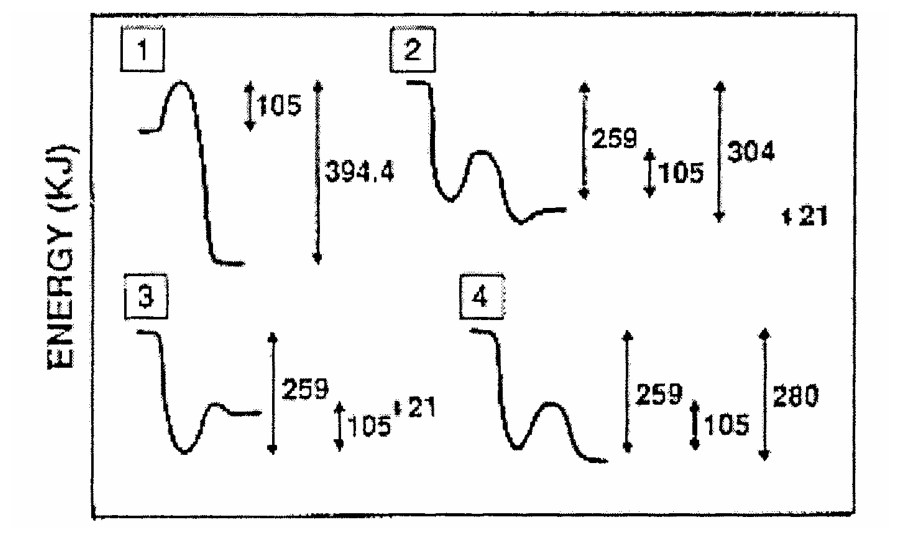
4.11 Mark the correct alternative of [ 1 ] – [ 4 ] on the answer sheet.
Official English text of the problem.
Problem 5: Organic chemistry multiple-choice questions
There is only one correct answer to each question
5.1 What is the correct systematic name (IUPAC name) for the compound below?

- 3-Isopropylhexane
- 2-Methyl-3-propylpentane
- Ethyl isopropyl propyl methane
- 3-Hexylpropane
- 3-Ethyl-2-methylhexane
5.2 How many isomers, including stereoisomers, containing only saturated carbon atoms, are there for \(\ce{C5H10}\)?
- 4 isomers
- 5 isomers
- 6 isomers
- 7 isomers
- 8 isomers
5.3 Which one of the following compounds has a dipole moment significantly different from zero?
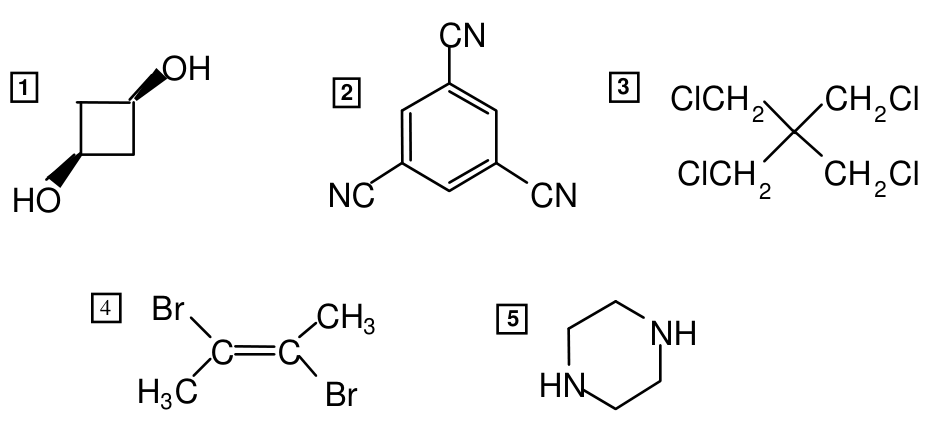
5.4 Which of the following is a pair of structural isomers?
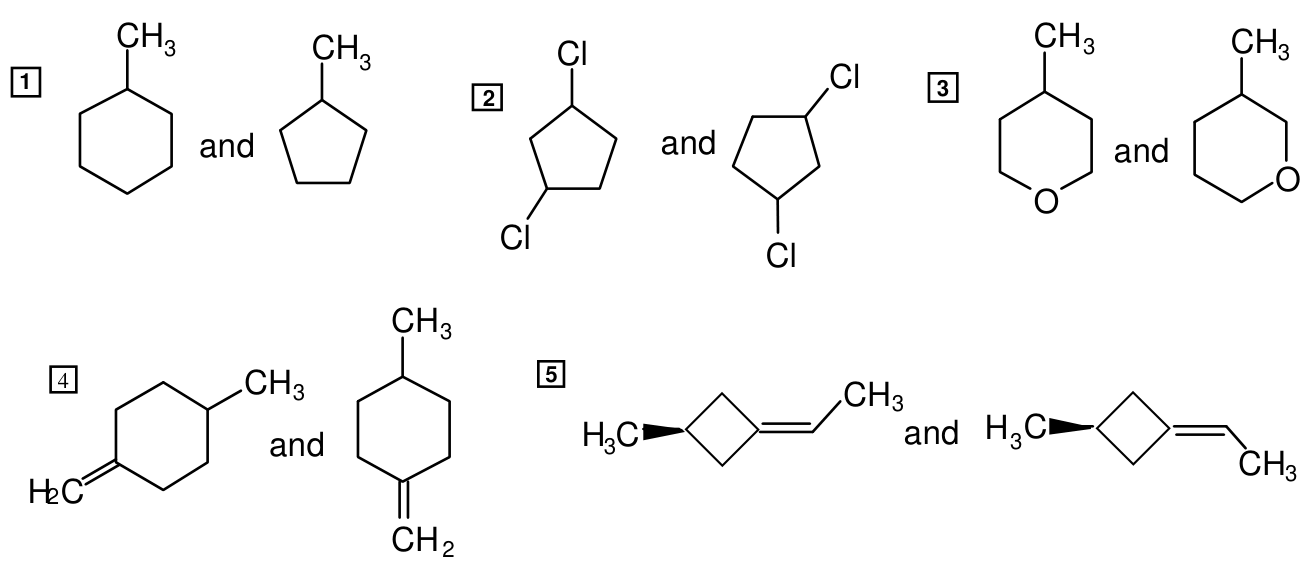
5.5 Which of the following five options is the correct order of relative stabilities of cations a, b and c as written below (most stable first)?
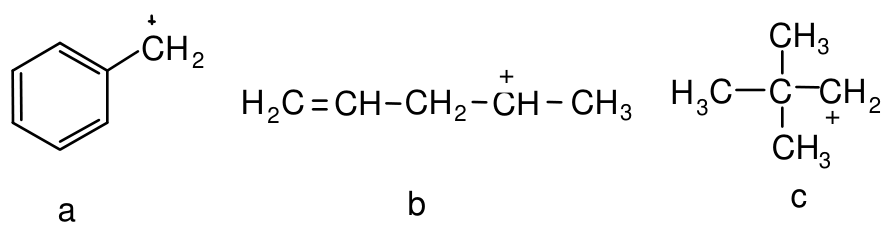
- \(a>b>c\)
- \(b>c>a\)
- \(c>a>b\)
- \(a>c>b\)
- \(b>a>c\)
5.6 What is the correct stereochemical descriptor of the optically active compound drawn below?
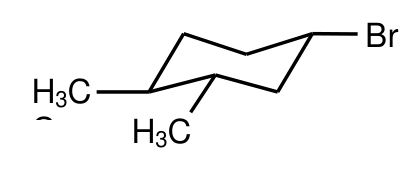
- \(1R,3R,4R\)
- \(1R,3R,4S\)
- \(1R3S,4R\)
- \(1S,3S,4R\)
- \(1S,3S,4S\)
5.7 All the molecules drawn below are neutral compounds. Which one does not contain a formal positive charge and a formal negative charge?

Official English text of the problem.
Problem 6: Structure of an optically active compound C12H16O
An optical active compound A (\(\ce{C12H16O}\)) shows amongst other a strong IR-absorption at 3000 – 3500 \(\mathrm{cm^{-1}}\), and two medium signals at 1580 and 1500 \(\mathrm{cm^{-1}}\). The compound does not react with 2,4-dinitrophenylhydrazine (2,4-D). Upon treatment with \(\ce{I2/NaOH}\), A is oxidized and gives a positive iodoform reaction.
Ozonolysis of A (1. \(\ce{O3}\); 2. \(\ce{Zn, H+}\)) gives B (\(\ce{C9H10O}\)) and C (\(\ce{C3H6O2}\)). Both B and C give precipitation when treated with 2,4-D, and only C gives positive reaction with Tollens reagent. Nitration of B (\(\ce{HNO3/H2SO4}\)) may give two mono-nitro compounds D and E, but in practical work only D is formed.
Acidification followed by heating of the product formed by the Tollens reaction on C gives compound F (\(\ce{C6H8O4}\)). The compound gives no absorption in IR above 3100 \(\mathrm{cm^{-1}}\).
6.1 Based on the above information draw the structure formula(e) for the compounds A – F and give the overall reaction scheme, including the (2,4-D) and the products of the Tollens and iodoform reactions.
6.2 Draw C in an R-configuration. Transform this into a Fischer projection formula and state whether it is a D or L configuration.
Official English text of the problem.
Problem 7: Ideal-gas expansion and a refrigeration cycle
7.1 When an ideal, monatomic gas expands reversibly from a volume \(V_1\) to a volume \(V_2\), a work
\[ w=-\int_{V_1}^{V_2}p\,dV \]
is performed on the system by the surroundings. In this equation, \(w\) is the work and \(p\) is the pressure of the gas.
Determine the performed work when one mole ideal gas expands isothermally from \(V_1=1.00\ \mathrm{dm^3}\) to \(V_2=20.0\ \mathrm{dm^3}\) at the temperature \(T=300.0\ \mathrm{K}\).
Given: The gas constant \(R=8.314\ \mathrm{J\,K^{-1}\,mol^{-1}}\).
7.2 Determine how much heat must be added to the gas during the process given under 7.1.
7.3 The gas will perform less work in an adiabatic expansion than in an isothermal expansion. Is this because the adiabatic expansion is characterized by (check the square you think is most important).
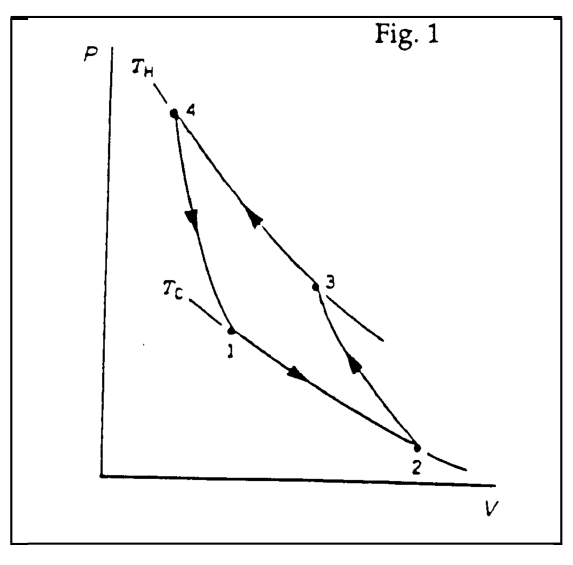
1 The volume of the gas is constant 2 The expansion is always irreversible 3 No heat is supplied to the gas 7.4 The cyclic process shown schematically in Figure 1 shows the four steps in a refrigeration system with an ideal gas as working medium. Identify the isothermal and adiabatic steps in the process. Here, \(T_{\mathrm H}\) and \(T_{\mathrm C}\) represent high and low temperature, respectively. Specify for each step whether it is adiabatic or isothermal.
Official English text of the problem.
Problem 8: Radioactive decay of uranium and ruthenium-97
Avogadro's Number: \(6.022\cdot10^{23}\)
8.1 An atom of \(\ce{^{238}U}\) disintegrates by a series of \(\alpha\)-decays and \(\beta^-\)-decays until it becomes \(\ce{^{206}Pb}\), which is stable.
i) How many \(\alpha\)-decays and how many \(\beta^-\)-decays does an atom starting as \(\ce{^{238}U}\) undergo before it becomes stable?
ii) One of the following ten nuclides is formed from a series of disintegrations starting at \(\ce{^{238}U}\). Which one ?
\(\ce{^{235}U}\), \(\ce{^{234}U}\), \(\ce{^{228}Ac}\), \(\ce{^{224}Ra}\), \(\ce{^{224}Rn}\), \(\ce{^{220}Rn}\), \(\ce{^{215}Po}\), \(\ce{^{212}Po}\), \(\ce{^{212}Pb}\), \(\ce{^{211}Pb}\).
8.2 In a thermal neutron-induced fission process, \(\ce{^{235}U}\) reacts with a neutron and breaks up into energetic fragments and (normally) 2-3 new neutrons.
We consider one single fission event:

Identify the fragment X.
8.3 The half-life of \(\ce{^{238}U}\) is \(4.5\times10^9\) years, the half-life of \(\ce{^{235}U}\) is \(7.0\times10^8\) years. Natural uranium consists of 99.28 % \(\ce{^{238}U}\) and 0.72 % \(\ce{^{235}U}\).
i) Calculate the ratio in natural U between the disintegration rates of these two uranium isotopes.
ii) A mineral contains 50 weight percent uranium. Calculate the disintegration rate of \(\ce{^{238}U}\) in 1.0 kg of this mineral.
8.4 We have the following radioactive sequence:

Halflives: \(\ce{^{97}Ru}\): 2.7 days; \(\ce{^{97}Tc}\): \(2.6\times10^6\) years
At \(t=0\) a radioactive source containing only \(\ce{^{97}Ru}\) has a disintegration rate of \(1.0\times10^9\) Bq.
i) What is the total disintegration rate of the source at \(t=6.0\) days?
ii) What is the total disintegration rate of the source at \(t=6000\) years?
Official English text of the problem.
Internationale Chemie-Olympiade
IChO 1994
Oslo, Norwegen · 8 Theorieaufgaben mit vollständigen Lösungen
Aufgabe 1: Milchsäure, Hydrogencarbonat und Calcium im Blut
Milchsäure wird bei intensiver körperlicher Aktivität in den Muskeln gebildet (anaerober Stoffwechsel). Im Blut wird Milchsäure durch Reaktion mit Hydrogencarbonat neutralisiert. Dies soll durch die folgenden Berechnungen veranschaulicht werden:
Milchsäure, als \(\ce{HL}\) geschrieben, ist einprotonig, und ihre Säuredissoziationskonstante beträgt \(K_{\mathrm{HL}}=1.4\times10^{-4}\).
Die Säuredissoziationskonstanten der Kohlensäure sind: \(K_{a1}=4.5\times10^{-7}\) und \(K_{a2}=4.7\times10^{-11}\). Das gesamte Kohlenstoffdioxid bleibt während der Reaktionen gelöst.
1.1 Berechnen Sie den \(pH\)-Wert einer \(3.00\times10^{-3}\) M Lösung von \(\ce{HL}\).
1.2 Berechnen Sie den Wert der Gleichgewichtskonstante für die Reaktion zwischen Milchsäure und Hydrogencarbonat.
1.3 \(3.00\times10^{-3}\) mol Milchsäure (\(\ce{HL}\)) werden zu \(1.00\ \mathrm{dm^3}\) einer \(0.024\) M Lösung von \(\ce{NaHCO3}\) gegeben (keine Volumenänderung, \(\ce{HL}\) vollständig neutralisiert).
i) Berechnen Sie den \(pH\)-Wert der Lösung von \(\ce{NaHCO3}\) vor der Zugabe von \(\ce{HL}\).
ii) Berechnen Sie den \(pH\)-Wert der Lösung nach der Zugabe von \(\ce{HL}\).
1.4 Der \(pH\)-Wert im Blut einer Person änderte sich aufgrund der bei körperlicher Aktivität gebildeten Milchsäure von 7.40 auf 7.00. Eine wässrige Lösung mit \(pH=7.40\) und \([\ce{HCO3^-}]=0.022\) soll in der folgenden Berechnung das Blut darstellen. Wie viele Mol Milchsäure wurden zu \(1.00\ \mathrm{dm^3}\) dieser Lösung gegeben, wenn ihr \(pH\)-Wert auf 7.00 gesunken ist?
1.5 In einer gesättigten wässrigen Lösung von \(\ce{CaCO3(s)}\) wird ein \(pH\)-Wert von 9.95 gemessen. Berechnen Sie die Löslichkeit von Calciumcarbonat in Wasser und zeigen Sie, dass der berechnete Wert für die Löslichkeitsproduktkonstante \(K_{sp}\) \(5\times10^{-9}\) beträgt.
1.6 Blut enthält Calcium. Bestimmen Sie die maximale Konzentration „freier“ Calciumionen in der in 1.4 angegebenen Lösung (\(pH=7.40\), \([\ce{HCO3^-}]=0.022\)).
Aufgabentext aus dem offiziellen englischen Text übersetzt.
Aufgabe 2: Stickstoffbestimmung nach Kjeldahl
Stickstoff in landwirtschaftlichen Materialien wird häufig nach der Kjeldahl-Methode bestimmt. Bei diesem Verfahren wird die Probe mit heißer konzentrierter Schwefelsäure behandelt, um organisch gebundenen Stickstoff in Ammoniumionen umzuwandeln. Anschließend wird konzentrierte Natronlauge zugegeben, und das gebildete Ammoniak wird in Salzsäure mit bekanntem Volumen und bekannter Konzentration destilliert. Die überschüssige Salzsäure wird dann mit einer Natriumhydroxid-Maßlösung zurücktitriert, um den Stickstoffgehalt der Probe zu bestimmen.
2.1 0.2515 g einer Getreideprobe wurden mit Schwefelsäure behandelt. Anschließend wurde Natronlauge zugegeben und das Ammoniak in \(50.00\ \mathrm{cm^3}\) 0.1010 M Salzsäure destilliert. Die überschüssige Säure wurde mit \(19.30\ \mathrm{cm^3}\) 0.1050 M Natronlauge zurücktitriert.
Berechnen Sie den Stickstoffgehalt der Probe in Massenprozent.
2.2 Berechnen Sie den pH-Wert der in 2.1 titrierten Lösung nach Zugabe von \(0\ \mathrm{cm^3}\), \(9.65\ \mathrm{cm^3}\), \(19.30\ \mathrm{cm^3}\) und \(28.95\ \mathrm{cm^3}\) Natronlauge. Vernachlässigen Sie jegliche Volumenänderung bei der Reaktion von gasförmigem Ammoniak mit Salzsäure. \(K_a\) für das Ammoniumion beträgt \(5.7\times10^{-10}\).
2.3 Zeichnen Sie die Titrationskurve auf der Grundlage der Berechnungen in b).
2.4 Welchen pH-Umschlagsbereich sollte ein Indikator haben, der für die Rücktitration verwendet werden könnte?
2.5 Die Kjeldahl-Methode kann auch zur Bestimmung der Molekülmasse von Aminosäuren verwendet werden. In einem Versuch wurde die Molekülmasse einer natürlich vorkommenden Aminosäure bestimmt, indem 0.2345 g der reinen Säure aufgeschlossen und das freigesetzte Ammoniak in \(50.00\ \mathrm{cm^3}\) 0.1010 M Salzsäure destilliert wurden. Bei der Rücktitration mit 0.1050 M Natronlauge wurde ein Titrationsvolumen von \(17.50\ \mathrm{cm^3}\) erhalten.
Berechnen Sie die Molekülmasse der Aminosäure unter der Annahme von einer beziehungsweise zwei stickstoffhaltigen Gruppen im Molekül.
Aufgabentext aus dem offiziellen englischen Text übersetzt.
Aufgabe 3: Schwefeloxohalogenide: Strukturen und Identifizierung
Schwefel bildet viele verschiedene Verbindungen mit Sauerstoff und Halogenen (mit Schwefel als Zentralatom). Diese Verbindungen sind überwiegend molekular aufgebaut, und viele werden in Wasser leicht hydrolysiert.
3.1 Geben Sie die Lewis-Strukturen der Moleküle \(\ce{SCl2}\), \(\ce{SO3}\), \(\ce{SO2ClF}\), \(\ce{SF4}\) und \(\ce{SBrF5}\) an.
3.2 Zeichnen Sie sorgfältig die räumlichen Strukturen der 5 Moleküle. (Vernachlässigen Sie kleine Abweichungen von den „idealen“ Winkeln.)
3.3 Eine Verbindung aus Schwefel (ein Atom pro Molekül), Sauerstoff und einem oder mehreren Atomen der Elemente \(\ce{F}\), \(\ce{Cl}\), \(\ce{Br}\) und \(\ce{I}\) wurde untersucht. Eine kleine Menge der Substanz reagierte mit Wasser. Sie wurde ohne jegliche Oxidation oder Reduktion vollständig hydrolysiert, und alle Reaktionsprodukte lösten sich. Zu getrennten kleinen Portionen einer verdünnten Lösung der Substanz wurden 0.1 M Lösungen einer Reihe von Nachweisreagenzien gegeben.
Auf welche Ionen wird mit den folgenden Nachweisen geprüft?
i) Zugabe von \(\ce{HNO3}\) und \(\ce{AgNO3}\).
ii) Zugabe von \(\ce{Ba(NO3)2}\).
iii) Einstellung auf \(pH = 7\) mit \(\ce{NH3}\) und Zugabe von \(\ce{Ca(NO3)2}\).
Geben Sie die Gleichungen für die möglichen Reaktionen bei den folgenden Nachweisen an:
iv) Zugabe von \(\ce{KMnO4}\), gefolgt von \(\ce{Ba(NO3)2}\), zu einer sauren Lösung der Substanz.
v) Zugabe von \(\ce{Cu(NO3)2}\).
3.4 Bei der Durchführung der Nachweise aus 3.3 wurden folgende Ergebnisse erhalten:
i) Ein gelblicher Niederschlag.
ii) Kein Niederschlag.
iii) Keine sichtbare Reaktion.
iv) Die wesentlichen Beobachtungen waren das Verschwinden der charakteristischen Farbe des Permanganats und die Bildung eines weißen Niederschlags bei Zugabe von \(\ce{Ba(NO3)2}\).
v) Kein Niederschlag.
Geben Sie unter Berücksichtigung dieser Nachweisergebnisse die Formeln der möglichen Verbindungen an.
3.5 Abschließend wurde eine einfache quantitative Analyse durchgeführt:
7.190 g der Substanz wurden eingewogen und in Wasser zu 250.0 \(\mathrm{cm^3}\) Lösung gelöst. Zu 25.00 \(\mathrm{cm^3}\) dieser Lösung wurden Salpetersäure und genügend \(\ce{AgNO3}\) gegeben, um eine vollständige Fällung sicherzustellen. Nach dem Waschen und Trocknen wog der Niederschlag 1.452 g. Bestimmen Sie die Formel der Verbindung.
3.6 Geben Sie die Gleichung für die Reaktion der Substanz mit Wasser an.
Falls Sie die Formel der Verbindung nicht ermittelt haben, verwenden Sie \(\ce{SOClF}\).
Aufgabentext aus dem offiziellen englischen Text übersetzt.
Aufgabe 4: Platinchemie und die katalytische Oxidation von Kohlenstoffmonoxid
Platin(IV)-oxid kommt in der Natur nicht vor, kann aber im Labor hergestellt werden. Festes Platin(IV)-oxid steht bei 1 atm (= \(1.01325\times10^5\) Pa) und 650 °C mit metallischem Platin und gasförmigem Sauerstoff im Gleichgewicht.
4.1 Dies legt nahe, dass auf der Erde bei der Entstehung der uns bekannten Mineralien folgende Bedingungen herrschten:
[1] \(p(\ce{O2})=1\) atm, \(t=650\) °C;
[2] \(p(\ce{O2})<1\) atm, \(t<650\) °C;
[3] \(p(\ce{O2})>1\) atm, \(t<650\) °C;
[4] \(p(\ce{O2})<1\) atm, \(t>650\) °C;
[5] \(p(\ce{O2})>1\) atm, \(t>650\) °CMarkieren Sie die wahrscheinlichste Alternative [1] – [5] auf dem Antwortblatt. Beachten Sie bitte, dass nur die Markierung einer einzigen Alternative gewertet wird.
4.2 Welche Werte haben \(\Delta G\) und \(K_p\) für die Bildung von Platin(IV)-oxid bei einem Sauerstoffdruck von 1 atm und einer Temperatur von 650 °C?
Zur Herstellung von Platin(IV)-oxid wird eine Lösung, die Hexachloridoplatinat(IV)-Ionen enthält, mit Natriumcarbonat zum Sieden erhitzt. Dabei entsteht \(\ce{PtO2 . nH2O}\), das anschließend durch Filtrieren und Wärmebehandlung in Platin(IV)-oxid überführt wird. Im Folgenden nehmen wir \(n=4\) an.
\(\ce{PtO2 . 4H2O}\) bzw. \(\ce{Pt(OH)4 . 2H2O}\) lässt sich in Säuren und starken Basen lösen.
4.3 Stellen Sie die ausgeglichenen Reaktionsgleichungen für die Herstellung von Platin(IV)-oxid nach dem oben beschriebenen Verfahren auf.
4.4 Stellen Sie die ausgeglichenen Reaktionsgleichungen für das Auflösen von \(\ce{PtO2 . 4H2O}\) sowohl in Salzsäure als auch in Natronlauge auf.
Platin kommt in der Natur hauptsächlich als Metall vor (im Gemisch oder in Legierungen mit anderen Edelmetallen). Platin löst sich in Königswasser unter Bildung von Hexachloridoplatinat(IV)-Ionen. Königswasser ist ein Gemisch aus konzentrierter Salzsäure und Salpetersäure im Verhältnis 3 : 1 sowie aus dem Nitrosylchlorid (\(\ce{NOCl}\)) und dem atomaren Chlor, die beim Mischen entstehen. Letzteres gilt als die für das Auflösen wirksame Komponente.
Die Hexachloridoplatinat(IV)-Ionen können als Diammoniumhexachloridoplatinat(IV) gefällt werden; bei der thermischen Zersetzung dieser Verbindung entstehen fein pulverisiertes Platin und gasförmige Produkte.
4.5 Stellen Sie die ausgeglichenen Reaktionsgleichungen für die Bildung von Königswasser und dessen Reaktion mit Platin auf.
4.6 Stellen Sie die ausgeglichene Reaktionsgleichung für die thermische Zersetzung von Diammoniumhexachloridoplatinat(IV) bei erhöhter Temperatur auf.
Aus Diammoniumhexachloridoplatinat(IV) lässt sich \(\ce{Pt(NH3)2Cl2}\) herstellen, das in der cis-Form (\(\Delta_fH^0=-467.4\ \mathrm{kJ\,mol^{-1}}\), \(\Delta_fG^0=-228.7\ \mathrm{kJ\,mol^{-1}}\)) und in der trans-Form (\(\Delta_fH^0=-480.3\ \mathrm{kJ\,mol^{-1}}\), \(\Delta_fG^0=-222.8\ \mathrm{kJ\,mol^{-1}}\)) vorkommt.
4.7 Das Auftreten der Isomere zeigt, dass \(\ce{Pt(NH3)2Cl2}\) folgende Geometrie besitzt:
[ 1 ] linear,
[ 2 ] planar,
[ 3 ] tetraedrisch,
[ 4 ] oktaedrisch.Markieren Sie die richtige Alternative [ 1 ] – [ 4 ] auf dem Antwortblatt.
4.8 Ist die cis-Form oder die trans-Form thermodynamisch stabiler?
Platin wird in modernen Kraftfahrzeugen als Katalysator eingesetzt. Im Katalysator reagiert Kohlenstoffmonoxid (\(\Delta_fH^0=-110.5\ \mathrm{kJ\,mol^{-1}}\), \(\Delta_fG^0=-137.3\ \mathrm{kJ\,mol^{-1}}\)) mit Sauerstoff zu Kohlenstoffdioxid (\(\Delta_fH^0=-393.5\ \mathrm{kJ\,mol^{-1}}\), \(\Delta_fG^0=-394.4\ \mathrm{kJ\,mol^{-1}}\)).
4.9 Läuft die Reaktion bei 25 °C spontan ab?
[ 1 ] ja oder
[ 2 ] nein.Ist die Reaktion:
[ 3 ] endotherm oder
[ 4 ] exotherm?Berechnen Sie \(\Delta S^\circ\) für die Reaktion.
Stellen Sie fest, ob die Entropie des Reaktionssystems
[5] zunimmt oder
[6] abnimmt.4.10 Leiten Sie für diesen Fall einen Ausdruck für die Temperaturabhängigkeit der Gleichgewichtskonstante her.
Die katalytische Gesamtreaktion ist einfach, während der Reaktionsmechanismus in der homogenen Phase mit einer großen Zahl von Reaktionsschritten sehr kompliziert ist und sich der Verlauf wegen seines ausgeprägten Kettencharakters nur schwer kontrollieren lässt. Mit Platin als Katalysator sind die wesentlichen Reaktionsschritte: (i) Adsorption von \(\ce{CO}\) und Adsorption/Dissoziation von \(\ce{O2}\) (\(\Delta H=-259\) kJ pro mol \(\ce{CO + O}\)), (ii) deren Aktivierung (105 kJ pro mol \(\ce{CO + O}\)) und (iii) die Reaktion und die Desorption von \(\ce{CO2}\) (\(\Delta H=21\) kJ pro mol \(\ce{CO2}\)).
Ein eindimensionales Energiediagramm für die platinkatalysierte Oxidation von Kohlenstoffmonoxid zu Kohlenstoffdioxid lässt sich wie folgt darstellen:
4.11 Markieren Sie die richtige Alternative [ 1 ] – [ 4 ] auf dem Antwortblatt.
Aufgabentext aus dem offiziellen englischen Text übersetzt.
Aufgabe 5: Multiple-Choice-Fragen zur organischen Chemie
Zu jeder Frage gibt es nur eine richtige Antwort
5.1 Wie lautet der korrekte systematische Name (IUPAC-Name) der unten dargestellten Verbindung?
- 3-Isopropylhexan
- 2-Methyl-3-propylpentan
- Ethylisopropylpropylmethan
- 3-Hexylpropan
- 3-Ethyl-2-methylhexan
5.2 Wie viele Isomere, einschließlich Stereoisomeren, gibt es für \(\ce{C5H10}\), die ausschließlich gesättigte Kohlenstoffatome enthalten?
- 4 Isomere
- 5 Isomere
- 6 Isomere
- 7 Isomere
- 8 Isomere
5.3 Welche der folgenden Verbindungen besitzt ein Dipolmoment, das sich deutlich von null unterscheidet?
5.4 Bei welcher der folgenden Möglichkeiten handelt es sich um ein Paar von Strukturisomeren?
5.5 Welche der folgenden fünf Möglichkeiten gibt die richtige Reihenfolge der relativen Stabilitäten der unten dargestellten Kationen a, b und c in ihrer angegebenen Form an (das stabilste zuerst)?
- \(a>b>c\)
- \(b>c>a\)
- \(c>a>b\)
- \(a>c>b\)
- \(b>a>c\)
5.6 Wie lautet der korrekte stereochemische Deskriptor der unten gezeichneten optisch aktiven Verbindung?
- \(1R,3R,4R\)
- \(1R,3R,4S\)
- \(1R3S,4R\)
- \(1S,3S,4R\)
- \(1S,3S,4S\)
5.7 Alle unten gezeichneten Moleküle sind neutrale Verbindungen. Welches enthält keine positive und negative Formalladung?
Aufgabentext aus dem offiziellen englischen Text übersetzt.
Aufgabe 6: Struktur einer optisch aktiven Verbindung C12H16O
Eine optisch aktive Verbindung A (\(\ce{C12H16O}\)) zeigt unter anderem eine starke IR-Absorption bei 3000 – 3500 \(\mathrm{cm^{-1}}\) und zwei mittelstarke Signale bei 1580 und 1500 \(\mathrm{cm^{-1}}\). Die Verbindung reagiert nicht mit 2,4-Dinitrophenylhydrazin (2,4-D). Bei der Behandlung mit \(\ce{I2/NaOH}\) wird A oxidiert und zeigt eine positive Iodoformreaktion.
Die Ozonolyse von A (1. \(\ce{O3}\); 2. \(\ce{Zn, H+}\)) ergibt B (\(\ce{C9H10O}\)) und C (\(\ce{C3H6O2}\)). Sowohl B als auch C bilden bei der Behandlung mit 2,4-D einen Niederschlag, und nur C reagiert positiv mit Tollens-Reagenz. Die Nitrierung von B (\(\ce{HNO3/H2SO4}\)) kann zwei Mononitroverbindungen D und E ergeben, in der Praxis entsteht jedoch nur D.
Das Ansäuern und anschließende Erhitzen des bei der Tollens-Reaktion von C gebildeten Produkts ergibt die Verbindung F (\(\ce{C6H8O4}\)). Die Verbindung zeigt im IR-Spektrum keine Absorption oberhalb von 3100 \(\mathrm{cm^{-1}}\).
6.1 Zeichnen Sie anhand der obigen Angaben die Strukturformel(n) der Verbindungen A – F und geben Sie das gesamte Reaktionsschema einschließlich des (2,4-D) und der Produkte der Tollens- und Iodoformreaktionen an.
6.2 Zeichnen Sie C in R-Konfiguration. Überführen Sie diese Darstellung in eine Fischer-Projektionsformel und geben Sie an, ob es sich um eine D- oder L-Konfiguration handelt.
Aufgabentext aus dem offiziellen englischen Text übersetzt.
Aufgabe 7: Expansion eines idealen Gases und ein Kältekreisprozess
7.1 Wenn sich ein ideales, einatomiges Gas reversibel von einem Volumen \(V_1\) auf ein Volumen \(V_2\) ausdehnt, wird von der Umgebung am System die Arbeit
\[ w=-\int_{V_1}^{V_2}p\,dV \]
verrichtet. In dieser Gleichung ist \(w\) die Arbeit und \(p\) der Druck des Gases.
Bestimmen Sie die verrichtete Arbeit, wenn sich ein Mol eines idealen Gases bei der Temperatur \(T=300.0\ \mathrm{K}\) isotherm von \(V_1=1.00\ \mathrm{dm^3}\) auf \(V_2=20.0\ \mathrm{dm^3}\) ausdehnt.
Gegeben: Die Gaskonstante \(R=8.314\ \mathrm{J\,K^{-1}\,mol^{-1}}\).
7.2 Bestimmen Sie, wie viel Wärme dem Gas während des unter 7.1 beschriebenen Vorgangs zugeführt werden muss.
7.3 Bei einer adiabatischen Expansion verrichtet das Gas weniger Arbeit als bei einer isothermen Expansion. Liegt dies daran, dass die adiabatische Expansion durch eine der folgenden Eigenschaften gekennzeichnet ist (kreuzen Sie das Kästchen an, das Sie für am wichtigsten halten)?
1 Das Volumen des Gases ist konstant 2 Die Expansion ist immer irreversibel 3 Dem Gas wird keine Wärme zugeführt 7.4 Der in Abbildung 1 schematisch dargestellte Kreisprozess zeigt die vier Schritte in einer Kälteanlage mit einem idealen Gas als Arbeitsmedium. Identifizieren Sie die isothermen und adiabatischen Schritte des Prozesses. Dabei stehen \(T_{\mathrm H}\) und \(T_{\mathrm C}\) für die hohe bzw. niedrige Temperatur. Geben Sie für jeden Schritt an, ob er adiabatisch oder isotherm ist.
Aufgabentext aus dem offiziellen englischen Text übersetzt.
Aufgabe 8: Radioaktiver Zerfall von Uran und Ruthenium-97
Avogadro-Zahl: \(6.022\cdot10^{23}\)
8.1 Ein Atom von \(\ce{^{238}U}\) zerfällt durch eine Reihe von \(\alpha\)- und \(\beta^-\)-Zerfällen, bis es zu \(\ce{^{206}Pb}\) wird, das stabil ist.
i) Wie viele \(\alpha\)-Zerfälle und wie viele \(\beta^-\)-Zerfälle durchläuft ein Atom, das ursprünglich \(\ce{^{238}U}\) ist, bevor es stabil wird?
ii) Eines der folgenden zehn Nuklide entsteht durch eine Reihe von Zerfällen, die bei \(\ce{^{238}U}\) beginnt. Welches?
\(\ce{^{235}U}\), \(\ce{^{234}U}\), \(\ce{^{228}Ac}\), \(\ce{^{224}Ra}\), \(\ce{^{224}Rn}\), \(\ce{^{220}Rn}\), \(\ce{^{215}Po}\), \(\ce{^{212}Po}\), \(\ce{^{212}Pb}\), \(\ce{^{211}Pb}\).
8.2 Bei einer durch ein thermisches Neutron induzierten Kernspaltung reagiert \(\ce{^{235}U}\) mit einem Neutron und zerfällt in energiereiche Fragmente und (normalerweise) 2-3 neue Neutronen.
Wir betrachten ein einzelnes Spaltereignis:
Bestimmen Sie das Fragment X.
8.3 Die Halbwertszeit von \(\ce{^{238}U}\) beträgt \(4.5\times10^9\) Jahre, die Halbwertszeit von \(\ce{^{235}U}\) beträgt \(7.0\times10^8\) Jahre. Natürliches Uran besteht aus 99.28 % \(\ce{^{238}U}\) und 0.72 % \(\ce{^{235}U}\).
i) Berechnen Sie das Verhältnis der Zerfallsraten dieser beiden Uranisotope in natürlichem U.
ii) Ein Mineral enthält 50 Massenprozent Uran. Berechnen Sie die Zerfallsrate von \(\ce{^{238}U}\) in 1.0 kg dieses Minerals.
8.4 Gegeben ist die folgende radioaktive Zerfallsfolge:
Halbwertszeiten: \(\ce{^{97}Ru}\): 2.7 Tage; \(\ce{^{97}Tc}\): \(2.6\times10^6\) Jahre
Zum Zeitpunkt \(t=0\) hat eine radioaktive Quelle, die ausschließlich \(\ce{^{97}Ru}\) enthält, eine Zerfallsrate von \(1.0\times10^9\) Bq.
i) Wie groß ist die gesamte Zerfallsrate der Quelle zum Zeitpunkt \(t=6.0\) Tage?
ii) Wie groß ist die gesamte Zerfallsrate der Quelle zum Zeitpunkt \(t=6000\) Jahre?
Aufgabentext aus dem offiziellen englischen Text übersetzt.
Uluslararası Kimya Olimpiyatı
IChO 1994
Oslo, Norveç · 8 teori sorusu, tam çözümleriyle
Soru 1: Kanda laktik asit, hidrojen karbonat ve kalsiyum
Yoğun etkinlik sırasında kaslarda laktik asit oluşur (anaerobik metabolizma). Kandaki laktik asit, hidrojen karbonatla tepkimeye girerek nötrleşir. Bu durum aşağıdaki hesaplamalarla gösterilecektir:
\(\ce{HL}\) ile gösterilen laktik asit monoprotiktir ve asit ayrışma sabiti \(K_{\mathrm{HL}}=1.4\times10^{-4}\) değerindedir.
Karbonik asidin asit ayrışma sabitleri \(K_{a1}=4.5\times10^{-7}\) ve \(K_{a2}=4.7\times10^{-11}\) değerlerindedir. Tepkimeler sırasında karbondioksidin tamamı çözünmüş hâlde kalır.
1.1 \(3.00\times10^{-3}\) M derişimindeki bir \(\ce{HL}\) çözeltisinin \(pH\) değerini hesaplayınız.
1.2 Laktik asit ile hidrojen karbonat arasındaki tepkimenin denge sabitinin değerini hesaplayınız.
1.3 \(0.024\) M derişimindeki \(\ce{NaHCO3}\) çözeltisinin \(1.00\ \mathrm{dm^3}\) hacmine \(3.00\times10^{-3}\) mol laktik asit (\(\ce{HL}\)) eklenir (hacim değişmez, \(\ce{HL}\) tamamen nötrleşir).
i) \(\ce{HL}\) eklenmeden önce \(\ce{NaHCO3}\) çözeltisinin \(pH\) değerini hesaplayınız.
ii) \(\ce{HL}\) eklendikten sonra çözeltinin \(pH\) değerini hesaplayınız.
1.4 Bir kişinin kanının \(pH\) değeri, fiziksel etkinlik sırasında oluşan laktik asit nedeniyle 7.40'tan 7.00'ye değişmiştir. Aşağıdaki hesaplamada, \(pH=7.40\) ve \([\ce{HCO3^-}]=0.022\) olan sulu bir çözelti kanı temsil etsin. Bu çözeltinin \(1.00\ \mathrm{dm^3}\) hacmine, \(pH\) değeri 7.00 olduğunda kaç mol laktik asit eklenmiş olur?
1.5 Doymuş bir sulu \(\ce{CaCO3(s)}\) çözeltisinde \(pH\) değeri 9.95 olarak ölçülmüştür. Kalsiyum karbonatın sudaki çözünürlüğünü hesaplayınız ve çözünürlük çarpımı sabiti \(K_{sp}\) için hesaplanan değerin \(5\times10^{-9}\) olduğunu gösteriniz.
1.6 Kan kalsiyum içerir. 1.4'te verilen çözeltide (\(pH=7.40\), \([\ce{HCO3^-}]=0.022\)) "serbest" kalsiyum iyonlarının en yüksek derişimini belirleyiniz.
Soru metni resmi İngilizce metinden çevrilmiştir.
Soru 2: Kjeldahl yöntemiyle azot tayini
Tarımsal materyallerdeki azot genellikle Kjeldahl yöntemiyle tayin edilir. Bu yöntem, organik olarak bağlı azotu amonyum iyonuna dönüştürmek için numunenin sıcak derişik sülfürik asitle işleme tabi tutulmasını içerir. Ardından derişik sodyum hidroksit eklenir ve oluşan amonyak, hacmi ve derişimi bilinen hidroklorik asit içine damıtılır. Daha sonra, numunedeki azotu tayin etmek için fazla hidroklorik asit, standart bir sodyum hidroksit çözeltisiyle geri titre edilir.
2.1 0.2515 g tahıl numunesi sülfürik asitle işleme tabi tutulmuş, ardından sodyum hidroksit eklenmiş ve amonyak, \(50.00\ \mathrm{cm^3}\) 0.1010 M hidroklorik asit içine damıtılmıştır. Fazla asit, \(19.30\ \mathrm{cm^3}\) 0.1050 M sodyum hidroksitle geri titre edilmiştir.
Numunedeki azot derişimini kütlece yüzde olarak hesaplayınız.
2.2 2.1'de titre edilen çözeltinin pH değerini, \(0\ \mathrm{cm^3}\), \(9.65\ \mathrm{cm^3}\), \(19.30\ \mathrm{cm^3}\) ve \(28.95\ \mathrm{cm^3}\) sodyum hidroksit eklendiğinde hesaplayınız. Amonyak gazının hidroklorik asitle tepkimesi sırasında meydana gelebilecek hacim değişimini ihmal ediniz. Amonyum iyonunun \(K_a\) değeri \(5.7\times10^{-10}\)'dur.
2.3 b)'deki hesaplamalara dayanarak titrasyon eğrisini çiziniz.
2.4 Geri titrasyonda kullanılabilecek indikatörün pH geçiş aralığı nedir?
2.5 Kjeldahl yöntemi, amino asitlerin molekül ağırlığını belirlemek için de kullanılabilir. Bir deneyde, doğal olarak bulunan bir amino asidin molekül ağırlığı, saf asitten 0.2345 g alınarak yaş yakma işlemine tabi tutulması ve açığa çıkan amonyağın \(50.00\ \mathrm{cm^3}\) 0.1010 M hidroklorik asit içine damıtılmasıyla belirlenmiştir. 0.1050 M sodyum hidroksitle yapılan geri titrasyonda \(17.50\ \mathrm{cm^3}\) titrasyon hacmi elde edilmiştir.
Molekülde sırasıyla bir ve iki azot grubu bulunduğunu esas alarak amino asidin molekül ağırlığını hesaplayınız.
Soru metni resmi İngilizce metinden çevrilmiştir.
Soru 3: Kükürt oksohalojenürleri: yapıları ve tanımlanmaları
Kükürt, oksijen ve halojenlerle birçok farklı bileşik oluşturur (merkez atom kükürttür). Bu bileşikler çoğunlukla moleküler yapıdadır ve birçoğu suda kolayca hidrolize olur.
3.1 \(\ce{SCl2}\), \(\ce{SO3}\), \(\ce{SO2ClF}\), \(\ce{SF4}\) ve \(\ce{SBrF5}\) moleküllerinin Lewis yapılarını yazınız.
3.2 Bu 5 molekülün geometrilerini dikkatlice çiziniz. ("İdeal" açılardan küçük sapmaları göz ardı ediniz.)
3.3 Kükürt (molekül başına bir atom), oksijen ve \(\ce{F}\), \(\ce{Cl}\), \(\ce{Br}\) ve \(\ce{I}\) elementlerinin bir veya daha fazla atomundan oluşan bir bileşik incelenmiştir. Maddeden az miktarda alınarak suyla tepkimeye sokulmuştur. Madde, herhangi bir yükseltgenme veya indirgenme olmaksızın tamamen hidrolize olmuş ve tüm tepkime ürünleri çözünmüştür. Maddenin seyreltik çözeltisinden alınan ayrı küçük örneklere, bir dizi test reaktifinin 0.1 M çözeltileri eklenmiştir.
Aşağıdaki testlerde hangi iyonlar aranmaktadır?
i) \(\ce{HNO3}\) ve \(\ce{AgNO3}\) eklenmesi.
ii) \(\ce{Ba(NO3)2}\) eklenmesi.
iii) \(\ce{NH3}\) ile \(pH = 7\) olacak şekilde ayarlanması ve \(\ce{Ca(NO3)2}\) eklenmesi.
Testlerde gerçekleşebilecek tepkimelerin denklemlerini yazınız:
iv) Maddenin asidik bir çözeltisine önce \(\ce{KMnO4}\), ardından \(\ce{Ba(NO3)2}\) eklenmesi.
v) \(\ce{Cu(NO3)2}\) eklenmesi.
3.4 Uygulamada, 3.3'teki testler aşağıdaki sonuçları vermiştir:
i) Sarımsı bir çökelek.
ii) Çökelek yok.
iii) Görünür bir tepkime yok.
iv) Başlıca gözlemler, permanganatın karakteristik renginin kaybolması ve \(\ce{Ba(NO3)2}\) eklendiğinde beyaz bir çökelek oluşmasıdır.
v) Çökelek yok.
Bu testlerin sonuçlarını dikkate alarak olası bileşiklerin formüllerini yazınız.
3.5 Son olarak, basit bir nicel analiz yapılmıştır:
Maddeden 7.190 g tartılmış ve 250.0 \(\mathrm{cm^3}\) çözelti elde edilecek şekilde suda çözülmüştür. Bu çözeltinin 25.00 \(\mathrm{cm^3}\)'üne nitrik asit ve çöktürmenin tam olmasını sağlayacak kadar \(\ce{AgNO3}\) eklenmiştir. Yıkanıp kurutulduktan sonra çökeleğin kütlesi 1.452 g olarak bulunmuştur. Bileşiğin formülünü belirleyiniz.
3.6 Maddenin suyla tepkimesini gösteren denklemi yazınız.
Bileşiğin formülünü bulamadıysanız \(\ce{SOClF}\) kullanınız.
Soru metni resmi İngilizce metinden çevrilmiştir.
Soru 4: Platin kimyası ve karbon monoksitin katalitik yükseltgenmesi
Platin(IV) oksit doğada bulunmaz, ancak laboratuvarda hazırlanabilir. Katı platin(IV) oksit, 1 atm (= \(1.01325\times10^5\) Pa) basınçta ve 650 °C sıcaklıkta platin metali ve oksijen gazı ile dengededir.
4.1 Bu durum, bildiğimiz minerallerin oluştuğu dönemde Dünya'daki koşulların aşağıdakilerden biri olduğunu düşündürür:
[1] \(p(\ce{O2})=1\) atm, \(t=650\) °C;
[2] \(p(\ce{O2})<1\) atm, \(t<650\) °C;
[3] \(p(\ce{O2})>1\) atm, \(t<650\) °C;
[4] \(p(\ce{O2})<1\) atm, \(t>650\) °C;
[5] \(p(\ce{O2})>1\) atm, \(t>650\) °CCevap kâğıdında [1] – [5] seçeneklerinden en olası olanı işaretleyiniz. Yalnızca tek bir seçeneğin işaretlenmesinin kabul edileceğini unutmayınız.
4.2 1 atm oksijen basıncında ve 650 °C sıcaklıkta platin(IV) oksidin oluşumu için \(\Delta G\) ve \(K_p\) nedir?
Platin(IV) oksidin hazırlanması, hekzakloroplatinat(IV) iyonları içeren bir çözeltinin sodyum karbonat ile kaynatılmasını içerir. Bu işlemde \(\ce{PtO2 . nH2O}\) oluşur; ardından süzme ve ısıl işlem uygulanarak bu madde platin(IV) okside dönüştürülür. Aşağıda \(n=4\) olduğunu varsayıyoruz.
\(\ce{PtO2 . 4H2O}\) veya \(\ce{Pt(OH)4 . 2H2O}\), asitlerde ve kuvvetli bazlarda çözünebilir.
4.3 Yukarıda verilen yönteme göre platin(IV) oksidin hazırlanmasına ilişkin denkleştirilmiş denklemleri yazınız.
4.4 \(\ce{PtO2 . 4H2O}\)'nun hem hidroklorik asitte hem de sodyum hidroksitte çözünmesine ilişkin denkleştirilmiş denklemleri yazınız.
Platin doğada başlıca metal hâlinde (diğer değerli metallerle karışım veya alaşım hâlinde) bulunur. Platin, kral suyunda hekzakloroplatinat(IV) iyonları oluşturarak çözünür. Kral suyu, 3 : 1 oranında derişik hidroklorik asit ve nitrik asit ile bunların karıştırılması sırasında oluşan nitrozil klorür (\(\ce{NOCl}\)) ve atomik klordan oluşan bir karışımdır. Atomik klorun, çözünmeyi sağlayan etkin bileşen olduğu düşünülmektedir.
Hekzakloroplatinat(IV) iyonları diamonyum hekzakloroplatinat(IV) olarak çöktürülebilir ve bu bileşiğin ısıl bozunması sonucunda ince toz hâlinde platin ve gaz ürünler oluşur.
4.5 Kral suyunun oluşumuna ve platin ile tepkimesine ilişkin denkleştirilmiş denklemleri yazınız.
4.6 Diamonyum hekzakloroplatinat(IV)'ın yüksek sıcaklıkta ısıl bozunmasının denkleştirilmiş denklemini yazınız.
Diamonyum hekzakloroplatinat(IV)'tan, cis (\(\Delta_fH^0=-467.4\ \mathrm{kJ\,mol^{-1}}\), \(\Delta_fG^0=-228.7\ \mathrm{kJ\,mol^{-1}}\)) ve trans (\(\Delta_fH^0=-480.3\ \mathrm{kJ\,mol^{-1}}\), \(\Delta_fG^0=-222.8\ \mathrm{kJ\,mol^{-1}}\)) biçimlerinde bulunan \(\ce{Pt(NH3)2Cl2}\) hazırlanabilir.
4.7 İzomerlerin varlığı, \(\ce{Pt(NH3)2Cl2}\)'nin geometrisinin aşağıdakilerden hangisi olduğunu gösterir?
[ 1 ] doğrusal,
[ 2 ] düzlemsel,
[ 3 ] tetrahedral,
[ 4 ] oktahedral geometri.Cevap kâğıdında [ 1 ] – [ 4 ] seçeneklerinden doğru olanı işaretleyiniz.
4.8 Termodinamik açıdan cis biçimi mi, trans biçimi mi daha kararlıdır?
Platin, modern otomobillerde katalizör olarak kullanılır. Katalizörde karbon monoksit (\(\Delta_fH^0=-110.5\ \mathrm{kJ\,mol^{-1}}\), \(\Delta_fG^0=-137.3\ \mathrm{kJ\,mol^{-1}}\)), oksijenle tepkimeye girerek karbon dioksite (\(\Delta_fH^0=-393.5\ \mathrm{kJ\,mol^{-1}}\), \(\Delta_fG^0=-394.4\ \mathrm{kJ\,mol^{-1}}\)) dönüşür.
4.9 Tepkime 25 °C'de kendiliğinden gerçekleşir mi?
[ 1 ] evet veya
[ 2 ] hayır.Tepkime:
[ 3 ] endotermik mi, yoksa
[ 4 ] ekzotermik midir?Tepkime için \(\Delta S^\circ\) değerini hesaplayınız.
Tepkime sisteminin entropisinin
[5] arttığını mı, yoksa
[6] azaldığını mı belirleyiniz.4.10 Bu durumda denge sabitinin sıcaklığa bağımlılığını veren bir ifade elde ediniz.
Toplam katalitik tepkime basittir; buna karşılık homojen fazdaki tepkime mekanizması, çok sayıda tepkime basamağı içermesi nedeniyle oldukça karmaşıktır ve belirgin zincir karakterinden dolayı tepkimenin seyrini kontrol etmek zordur. Platin katalizör olarak kullanıldığında önemli tepkime basamakları şunlardır: (i) \(\ce{CO}\)'nun adsorpsiyonu ve \(\ce{O2}\)'nin adsorpsiyonu/ayrışması (mol \(\ce{CO + O}\) başına \(\Delta H=-259\) kJ), (ii) bunların etkinleşmesi (mol \(\ce{CO + O}\) başına 105 kJ) ve (iii) tepkime ve \(\ce{CO2}\)'nin desorpsiyonu (mol \(\ce{CO2}\) başına \(\Delta H=21\) kJ).
Karbon monoksitin platin katalizörlüğünde karbon dioksite yükseltgenmesi için tek boyutlu bir enerji diyagramı şöyle gösterilebilir:
4.11 Cevap kâğıdında [ 1 ] – [ 4 ] seçeneklerinden doğru olanı işaretleyiniz.
Soru metni resmi İngilizce metinden çevrilmiştir.
Soru 5: Organik kimya çoktan seçmeli soruları
Her sorunun yalnızca bir doğru cevabı vardır
5.1 Aşağıdaki bileşiğin doğru sistematik adı (IUPAC adı) nedir?
- 3-İzopropilhekzan
- 2-Metil-3-propilpentan
- Etil izopropil propil metan
- 3-Hekzilpropan
- 3-Etil-2-metilhekzan
5.2 \(\ce{C5H10}\) için, stereoizomerler de dahil olmak üzere, yalnızca doymuş karbon atomları içeren kaç izomer vardır?
- 4 izomer
- 5 izomer
- 6 izomer
- 7 izomer
- 8 izomer
5.3 Aşağıdaki bileşiklerden hangisinin dipol momenti sıfırdan belirgin ölçüde farklıdır?
5.4 Aşağıdakilerden hangisi bir yapı izomeri çiftidir?
5.5 Aşağıdaki beş seçenekten hangisi, aşağıda gösterildikleri hâlleriyle a, b ve c katyonlarının bağıl kararlılıklarının doğru sıralamasıdır (en kararlı olan başta)?
- \(a>b>c\)
- \(b>c>a\)
- \(c>a>b\)
- \(a>c>b\)
- \(b>a>c\)
5.6 Aşağıda çizilen optikçe aktif bileşiğin doğru stereokimyasal tanımlayıcısı nedir?
- \(1R,3R,4R\)
- \(1R,3R,4S\)
- \(1R3S,4R\)
- \(1S,3S,4R\)
- \(1S,3S,4S\)
5.7 Aşağıda çizilen moleküllerin tümü nötr bileşiklerdir. Hangisi bir formal pozitif yük ve bir formal negatif yük içermez?
Soru metni resmi İngilizce metinden çevrilmiştir.
Soru 6: Optikçe aktif bir C12H16O bileşiğinin yapısı
Optikçe aktif bir A (\(\ce{C12H16O}\)) bileşiği, diğer soğurmaların yanı sıra 3000 – 3500 \(\mathrm{cm^{-1}}\) aralığında güçlü bir IR soğurması ve 1580 ve 1500 \(\mathrm{cm^{-1}}\) değerlerinde orta şiddette iki sinyal gösterir. Bileşik, 2,4-dinitrofenilhidrazin (2,4-D) ile tepkimeye girmez. \(\ce{I2/NaOH}\) ile muamele edildiğinde A yükseltgenir ve pozitif iyodoform tepkimesi verir.
A bileşiğinin ozonolizi (1. \(\ce{O3}\); 2. \(\ce{Zn, H+}\)), B (\(\ce{C9H10O}\)) ve C (\(\ce{C3H6O2}\)) bileşiklerini verir. Hem B hem de C, 2,4-D ile muamele edildiğinde çökelek oluşturur ve yalnızca C, Tollens ayıracı ile pozitif tepkime verir. B bileşiğinin nitrolanması (\(\ce{HNO3/H2SO4}\)), iki mononitro bileşiği olan D ve E bileşiklerini verebilir; ancak uygulamada yalnızca D oluşur.
C bileşiğinin Tollens tepkimesi sonucunda oluşan ürünün asitlendirilip ardından ısıtılması, F (\(\ce{C6H8O4}\)) bileşiğini verir. Bu bileşik, IR spektrumunda 3100 \(\mathrm{cm^{-1}}\) üzerinde soğurma göstermez.
6.1 Yukarıdaki bilgilere dayanarak A – F bileşiklerinin yapı formüllerini çiziniz ve (2,4-D) ile Tollens ve iyodoform tepkimelerinin ürünlerini de içeren genel tepkime şemasını veriniz.
6.2 C bileşiğini R konfigürasyonunda çiziniz. Bunu bir Fischer izdüşüm formülüne dönüştürünüz ve konfigürasyonunun D mi yoksa L mi olduğunu belirtiniz.
Soru metni resmi İngilizce metinden çevrilmiştir.
Soru 7: İdeal gazın genleşmesi ve bir soğutma çevrimi
7.1 Tek atomlu bir ideal gaz, \(V_1\) hacminden \(V_2\) hacmine tersinir olarak genleştiğinde, çevre tarafından sistem üzerinde
\[ w=-\int_{V_1}^{V_2}p\,dV \]
işi yapılır. Bu denklemde \(w\) işi, \(p\) ise gazın basıncını ifade eder.
Bir mol ideal gaz, \(T=300.0\ \mathrm{K}\) sıcaklığında \(V_1=1.00\ \mathrm{dm^3}\) hacminden \(V_2=20.0\ \mathrm{dm^3}\) hacmine izotermal olarak genleştiğinde yapılan işi belirleyiniz.
Verilen: Gaz sabiti \(R=8.314\ \mathrm{J\,K^{-1}\,mol^{-1}}\).
7.2 7.1'de verilen süreç sırasında gaza ne kadar ısı verilmesi gerektiğini belirleyiniz.
7.3 Gaz, adyabatik genleşmede izotermal genleşmeye göre daha az iş yapar. Bunun nedeni, adyabatik genleşmenin aşağıdaki özelliklerden hangisine sahip olmasıdır (en önemli olduğunu düşündüğünüz kutucuğu işaretleyiniz).
1 Gazın hacmi sabittir 2 Genleşme her zaman tersinmezdir 3 Gaza ısı verilmez 7.4 Şekil 1'de şematik olarak gösterilen çevrimsel süreç, çalışma akışkanı olarak ideal gaz kullanılan bir soğutma sisteminin dört adımını göstermektedir. Süreçteki izotermal ve adyabatik adımları belirleyiniz. Burada \(T_{\mathrm H}\) ve \(T_{\mathrm C}\), sırasıyla yüksek ve düşük sıcaklığı temsil etmektedir. Her bir adımın adyabatik mi yoksa izotermal mi olduğunu belirtiniz.
Soru metni resmi İngilizce metinden çevrilmiştir.
Soru 8: Uranyum ve rutenyum-97'nin radyoaktif bozunması
Avogadro sayısı: \(6.022\cdot10^{23}\)
8.1 Bir \(\ce{^{238}U}\) atomu, kararlı olan \(\ce{^{206}Pb}\) hâline gelene kadar bir dizi \(\alpha\) ve \(\beta^-\) bozunması geçirir.
i) Başlangıçta \(\ce{^{238}U}\) olan bir atom, kararlı hâle gelmeden önce kaç \(\alpha\) ve kaç \(\beta^-\) bozunması geçirir?
ii) Aşağıdaki on nüklitten biri, \(\ce{^{238}U}\) ile başlayan bir dizi bozunma sonucunda oluşur. Bu hangisidir?
\(\ce{^{235}U}\), \(\ce{^{234}U}\), \(\ce{^{228}Ac}\), \(\ce{^{224}Ra}\), \(\ce{^{224}Rn}\), \(\ce{^{220}Rn}\), \(\ce{^{215}Po}\), \(\ce{^{212}Po}\), \(\ce{^{212}Pb}\), \(\ce{^{211}Pb}\).
8.2 Termal nötronla indüklenen bir fisyon sürecinde \(\ce{^{235}U}\), bir nötronla tepkimeye girer ve yüksek enerjili parçalara ve (normalde) 2-3 yeni nötrona ayrılır.
Tek bir fisyon olayını ele alalım:
X parçasını belirleyiniz.
8.3 \(\ce{^{238}U}\)'un yarı ömrü \(4.5\times10^9\) yıl, \(\ce{^{235}U}\)'un yarı ömrü ise \(7.0\times10^8\) yıldır. Doğal uranyum, %99.28 \(\ce{^{238}U}\) ve %0.72 \(\ce{^{235}U}\)'tan oluşur.
i) Doğal U'da bu iki uranyum izotopunun bozunma hızlarının oranını hesaplayınız.
ii) Bir mineral, kütlece %50 uranyum içermektedir. Bu mineralin 1.0 kg'ındaki \(\ce{^{238}U}\)'un bozunma hızını hesaplayınız.
8.4 Aşağıdaki radyoaktif bozunma dizisi verilmiştir:
Yarı ömürler: \(\ce{^{97}Ru}\): 2.7 gün; \(\ce{^{97}Tc}\): \(2.6\times10^6\) yıl
\(t=0\) anında yalnızca \(\ce{^{97}Ru}\) içeren bir radyoaktif kaynağın bozunma hızı \(1.0\times10^9\) Bq'dir.
i) \(t=6.0\) gün olduğunda kaynağın toplam bozunma hızı nedir?
ii) \(t=6000\) yıl olduğunda kaynağın toplam bozunma hızı nedir?
Soru metni resmi İngilizce metinden çevrilmiştir.
Olimpiada Internacional de Química
IChO 1994
Oslo, Noruega · 8 problemas teóricos con soluciones completas
Problema 1: Ácido láctico, hidrogenocarbonato y calcio en la sangre
El ácido láctico se forma en los músculos durante una actividad intensa (metabolismo anaerobio). En la sangre, el ácido láctico se neutraliza por reacción con el hidrogenocarbonato. Esto se ilustrará mediante los siguientes cálculos:
El ácido láctico, representado como \(\ce{HL}\), es monoprótico y su constante de disociación ácida es \(K_{\mathrm{HL}}=1.4\times10^{-4}\).
Las constantes de disociación ácida del ácido carbónico son: \(K_{a1}=4.5\times10^{-7}\) y \(K_{a2}=4.7\times10^{-11}\). Todo el dióxido de carbono permanece disuelto durante las reacciones.
1.1 Calcule el \(pH\) de una disolución de \(\ce{HL}\) de concentración \(3.00\times10^{-3}\) M.
1.2 Calcule el valor de la constante de equilibrio de la reacción entre el ácido láctico y el hidrogenocarbonato.
1.3 Se añaden \(3.00\times10^{-3}\) mol de ácido láctico (\(\ce{HL}\)) a \(1.00\ \mathrm{dm^3}\) de una disolución de \(\ce{NaHCO3}\) de concentración \(0.024\) M (sin cambio de volumen, \(\ce{HL}\) completamente neutralizado).
i) Calcule el valor del \(pH\) de la disolución de \(\ce{NaHCO3}\) antes de añadir \(\ce{HL}\).
ii) Calcule el valor del \(pH\) de la disolución después de añadir \(\ce{HL}\).
1.4 El \(pH\) de la sangre de una persona pasó de 7.40 a 7.00 debido al ácido láctico formado durante la actividad física. Para el siguiente cálculo, represente la sangre mediante una disolución acuosa con \(pH=7.40\) y \([\ce{HCO3^-}]=0.022\). ¿Cuántos moles de ácido láctico se han añadido a \(1.00\ \mathrm{dm^3}\) de esta disolución cuando su \(pH\) ha alcanzado 7.00?
1.5 En una disolución acuosa saturada de \(\ce{CaCO3(s)}\), se mide un \(pH\) de 9.95. Calcule la solubilidad del carbonato de calcio en agua y demuestre que el valor calculado de la constante del producto de solubilidad \(K_{sp}\) es \(5\times10^{-9}\).
1.6 La sangre contiene calcio. Determine la concentración máxima de iones calcio «libres» en la disolución (\(pH=7.40\), \([\ce{HCO3^-}]=0.022\)) indicada en 1.4.
Enunciado traducido del texto oficial en inglés.
Problema 2: Determinación de nitrógeno por el método de Kjeldahl
El nitrógeno en materiales agrícolas se determina a menudo mediante el método de Kjeldahl. El método consiste en tratar la muestra con ácido sulfúrico concentrado caliente para convertir el nitrógeno unido a compuestos orgánicos en ion amonio. A continuación, se añade hidróxido de sodio concentrado y el amoníaco formado se destila y se recoge en ácido clorhídrico de volumen y concentración conocidos. Después, el exceso de ácido clorhídrico se valora por retroceso con una disolución patrón de hidróxido de sodio para determinar el nitrógeno de la muestra.
2.1 Se trataron 0.2515 g de una muestra de grano con ácido sulfúrico; a continuación, se añadió hidróxido de sodio y el amoníaco se destiló y se recogió en \(50.00\ \mathrm{cm^3}\) de ácido clorhídrico 0.1010 M. El exceso de ácido se valoró por retroceso con \(19.30\ \mathrm{cm^3}\) de hidróxido de sodio 0.1050 M.
Calcule la concentración de nitrógeno en la muestra, en porcentaje en masa.
2.2 Calcule el pH de la disolución que se valora en 2.1 cuando se han añadido \(0\ \mathrm{cm^3}\), \(9.65\ \mathrm{cm^3}\), \(19.30\ \mathrm{cm^3}\) y \(28.95\ \mathrm{cm^3}\) de hidróxido de sodio. Desprecie cualquier cambio de volumen durante la reacción del amoníaco gaseoso con el ácido clorhídrico. El valor de \(K_a\) del ion amonio es \(5.7\times10^{-10}\).
2.3 Dibuje la curva de valoración a partir de los cálculos de b).
2.4 ¿Cuál es el intervalo de viraje de pH del indicador que podría utilizarse para la valoración por retroceso?
2.5 El método de Kjeldahl también puede utilizarse para determinar el peso molecular de los aminoácidos. En un experimento, se determinó el peso molecular de un aminoácido de origen natural mediante la digestión de 0.2345 g del ácido puro y la destilación del amoníaco liberado, que se recogió en \(50.00\ \mathrm{cm^3}\) de ácido clorhídrico 0.1010 M. Se obtuvo un volumen de valoración de \(17.50\ \mathrm{cm^3}\) en la valoración por retroceso con hidróxido de sodio 0.1050 M.
Calcule el peso molecular del aminoácido suponiendo que la molécula contiene uno y dos grupos nitrogenados, respectivamente.
Enunciado traducido del texto oficial en inglés.
Problema 3: Oxohaluros de azufre: estructuras e identificación
El azufre forma muchos compuestos diferentes con oxígeno y halógenos (con el azufre como átomo central). Estos compuestos son principalmente moleculares, y muchos se hidrolizan fácilmente en agua.
3.1 Escriba las estructuras de Lewis de las moléculas \(\ce{SCl2}\), \(\ce{SO3}\), \(\ce{SO2ClF}\), \(\ce{SF4}\) y \(\ce{SBrF5}\).
3.2 Dibuje cuidadosamente las geometrías de las 5 moléculas. (Ignore las pequeñas desviaciones respecto a los ángulos «ideales».)
3.3 Se examinó un compuesto constituido por azufre (un átomo por molécula), oxígeno y uno o más átomos de los elementos \(\ce{F}\), \(\ce{Cl}\), \(\ce{Br}\) y \(\ce{I}\). Se hizo reaccionar una pequeña cantidad de la sustancia con agua. Se hidrolizó por completo sin que se produjera oxidación ni reducción, y todos los productos de la reacción se disolvieron. Se añadieron disoluciones 0.1 M de una serie de reactivos de ensayo a pequeñas porciones separadas de una disolución diluida de la sustancia.
¿Qué iones se pretende detectar en los siguientes ensayos?
i) Adición de \(\ce{HNO3}\) y \(\ce{AgNO3}\).
ii) Adición de \(\ce{Ba(NO3)2}\).
iii) Ajuste a \(pH = 7\) con \(\ce{NH3}\) y adición de \(\ce{Ca(NO3)2}\).
Escriba las ecuaciones de las posibles reacciones en los ensayos:
iv) Adición de \(\ce{KMnO4}\), seguida de \(\ce{Ba(NO3)2}\), a una disolución ácida de la sustancia.
v) Adición de \(\ce{Cu(NO3)2}\).
3.4 En la práctica, los ensayos de 3.3 dieron los siguientes resultados:
i) Un precipitado amarillento.
ii) Ningún precipitado.
iii) Ninguna reacción visible.
iv) Las observaciones principales fueron la desaparición del color característico del permanganato y la formación de un precipitado blanco al añadir \(\ce{Ba(NO3)2}\).
v) Ningún precipitado.
Escriba las fórmulas de los posibles compuestos, teniendo en cuenta los resultados de estos ensayos.
3.5 Finalmente, se realizó un análisis cuantitativo sencillo:
Se pesaron 7.190 g de la sustancia y se disolvieron en agua hasta obtener 250.0 \(\mathrm{cm^3}\) de disolución. A 25.00 \(\mathrm{cm^3}\) de esta disolución se añadieron ácido nítrico y suficiente \(\ce{AgNO3}\) para asegurar la precipitación completa. Tras lavar y secar el precipitado, su masa fue de 1.452 g. Determine la fórmula del compuesto.
3.6 Escriba la ecuación que describe la reacción de la sustancia con agua.
Si no ha encontrado la fórmula del compuesto, utilice \(\ce{SOClF}\).
Enunciado traducido del texto oficial en inglés.
Problema 4: Química del platino y oxidación catalítica del monóxido de carbono
El óxido de platino(IV) no se encuentra en la naturaleza, pero puede prepararse en el laboratorio. El óxido de platino(IV) sólido está en equilibrio con el platino metálico y el oxígeno gaseoso a 1 atm (= \(1.01325\times10^5\) Pa) y 650 °C.
4.1 Esto sugiere que las condiciones en la Tierra, cuando se formaron los minerales que conocemos, eran:
[1] \(p(\ce{O2})=1\) atm, \(t=650\) °C;
[2] \(p(\ce{O2})<1\) atm, \(t<650\) °C;
[3] \(p(\ce{O2})>1\) atm, \(t<650\) °C;
[4] \(p(\ce{O2})<1\) atm, \(t>650\) °C;
[5] \(p(\ce{O2})>1\) atm, \(t>650\) °CMarque la alternativa más probable [1] – [5] en la hoja de respuestas. Tenga en cuenta que solo se aceptará que se marque una alternativa.
4.2 ¿Cuáles son los valores de \(\Delta G\) y \(K_p\) para la formación de óxido de platino(IV) a una presión de oxígeno de 1 atm y una temperatura de 650 °C?
La preparación del óxido de platino(IV) consiste en hervir una disolución que contiene iones hexacloroplatinato(IV) con carbonato de sodio. En este proceso se forma \(\ce{PtO2 . nH2O}\), que a su vez se convierte en óxido de platino(IV) mediante una posterior filtración y un tratamiento térmico. En lo que sigue suponemos que \(n=4\).
El \(\ce{PtO2 . 4H2O}\) o \(\ce{Pt(OH)4 . 2H2O}\) puede disolverse en ácidos y bases fuertes.
4.3 Escriba las ecuaciones ajustadas de la preparación del óxido de platino(IV) según el procedimiento indicado anteriormente.
4.4 Escriba las ecuaciones ajustadas de la disolución de \(\ce{PtO2 . 4H2O}\) tanto en ácido clorhídrico como en hidróxido de sodio.
El platino se encuentra en la naturaleza principalmente como metal (en mezcla o aleado con otros metales preciosos). El platino se disuelve en agua regia con formación de iones hexacloroplatinato(IV). El agua regia es una mezcla de ácidos clorhídrico y nítrico concentrados en proporción 3 : 1, y del cloruro de nitrosilo (\(\ce{NOCl}\)) y el cloro atómico que se forman al mezclarlos. Se considera que este último es el componente activo que provoca la disolución.
Los iones hexacloroplatinato(IV) pueden precipitarse como hexacloroplatinato(IV) de diamonio y, mediante la descomposición térmica de este compuesto, se forman platino finamente pulverizado y productos gaseosos.
4.5 Escriba las ecuaciones ajustadas de la formación del agua regia y de su reacción con el platino.
4.6 Escriba la ecuación ajustada de la descomposición térmica del hexacloroplatinato(IV) de diamonio a temperatura elevada.
A partir del hexacloroplatinato(IV) de diamonio podemos preparar \(\ce{Pt(NH3)2Cl2}\), que se presenta en las formas cis (\(\Delta_fH^0=-467.4\ \mathrm{kJ\,mol^{-1}}\), \(\Delta_fG^0=-228.7\ \mathrm{kJ\,mol^{-1}}\)) y trans (\(\Delta_fH^0=-480.3\ \mathrm{kJ\,mol^{-1}}\), \(\Delta_fG^0=-222.8\ \mathrm{kJ\,mol^{-1}}\)).
4.7 La existencia de estos isómeros muestra que \(\ce{Pt(NH3)2Cl2}\) tiene geometría:
[ 1 ] lineal,
[ 2 ] plana,
[ 3 ] tetraédrica,
[ 4 ] octaédrica.Marque la alternativa correcta [ 1 ] – [ 4 ] en la hoja de respuestas.
4.8 ¿Es termodinámicamente más estable la forma cis o la forma trans?
El platino se utiliza como catalizador en los automóviles modernos. En el catalizador, el monóxido de carbono (\(\Delta_fH^0=-110.5\ \mathrm{kJ\,mol^{-1}}\), \(\Delta_fG^0=-137.3\ \mathrm{kJ\,mol^{-1}}\)) reacciona con el oxígeno para formar dióxido de carbono (\(\Delta_fH^0=-393.5\ \mathrm{kJ\,mol^{-1}}\), \(\Delta_fG^0=-394.4\ \mathrm{kJ\,mol^{-1}}\)).
4.9 ¿Es espontánea la reacción a 25 °C?
[ 1 ] sí, o
[ 2 ] no.¿Es la reacción:
[ 3 ] endotérmica, o
[ 4 ] exotérmica?Calcule \(\Delta S^\circ\) para la reacción.
Determine si la entropía del sistema de reacción
[5] aumenta, o
[6] disminuye.4.10 Obtenga una expresión para la dependencia de la constante de equilibrio con la temperatura en este caso.
La reacción catalítica global es sencilla, mientras que el mecanismo de reacción en fase homogénea es muy complicado, con un gran número de etapas de reacción, y su transcurso es difícil de controlar debido a su marcado carácter de reacción en cadena. Con platino como catalizador, las etapas de reacción significativas son: (i) la adsorción de \(\ce{CO}\) y la adsorción/disociación de \(\ce{O2}\) (\(\Delta H=-259\) kJ por mol de \(\ce{CO + O}\)), (ii) su activación (105 kJ por mol de \(\ce{CO + O}\)) y (iii) la reacción y la desorción de \(\ce{CO2}\) (\(\Delta H=21\) kJ por mol de \(\ce{CO2}\)).
Un diagrama de energía unidimensional de la oxidación de monóxido de carbono a dióxido de carbono catalizada por platino puede representarse como:
4.11 Marque la alternativa correcta [ 1 ] – [ 4 ] en la hoja de respuestas.
Enunciado traducido del texto oficial en inglés.
Problema 5: Preguntas de opción múltiple sobre química orgánica
Solo hay una respuesta correcta para cada pregunta
5.1 ¿Cuál es el nombre sistemático correcto (nombre IUPAC) del compuesto que se muestra a continuación?
- 3-Isopropilhexano
- 2-Metil-3-propilpentano
- Etil isopropil propil metano
- 3-Hexilpropano
- 3-Etil-2-metilhexano
5.2 ¿Cuántos isómeros, incluidos los estereoisómeros, que contengan únicamente átomos de carbono saturados existen para \(\ce{C5H10}\)?
- 4 isómeros
- 5 isómeros
- 6 isómeros
- 7 isómeros
- 8 isómeros
5.3 ¿Cuál de los siguientes compuestos tiene un momento dipolar significativamente distinto de cero?
5.4 ¿Cuál de las siguientes opciones es un par de isómeros estructurales?
5.5 ¿Cuál de las siguientes cinco opciones indica el orden correcto de estabilidad relativa de los cationes a, b y c tal como se representan a continuación (el más estable primero)?
- \(a>b>c\)
- \(b>c>a\)
- \(c>a>b\)
- \(a>c>b\)
- \(b>a>c\)
5.6 ¿Cuál es el descriptor estereoquímico correcto del compuesto ópticamente activo representado a continuación?
- \(1R,3R,4R\)
- \(1R,3R,4S\)
- \(1R3S,4R\)
- \(1S,3S,4R\)
- \(1S,3S,4S\)
5.7 Todas las moléculas representadas a continuación son compuestos neutros. ¿Cuál de ellas no contiene una carga formal positiva y una carga formal negativa?
Enunciado traducido del texto oficial en inglés.
Problema 6: Estructura de un compuesto ópticamente activo C12H16O
Un compuesto ópticamente activo A (\(\ce{C12H16O}\)) presenta, entre otras, una absorción intensa en el IR a 3000 – 3500 \(\mathrm{cm^{-1}}\), y dos señales de intensidad media a 1580 y 1500 \(\mathrm{cm^{-1}}\). El compuesto no reacciona con la 2,4-dinitrofenilhidrazina (2,4-D). Al tratarlo con \(\ce{I2/NaOH}\), A se oxida y da una reacción del yodoformo positiva.
La ozonólisis de A (1. \(\ce{O3}\); 2. \(\ce{Zn, H+}\)) da B (\(\ce{C9H10O}\)) y C (\(\ce{C3H6O2}\)). Tanto B como C forman un precipitado al tratarlos con 2,4-D, y solo C da una reacción positiva con el reactivo de Tollens. La nitración de B (\(\ce{HNO3/H2SO4}\)) puede dar dos compuestos mononitrados D y E, pero en la práctica solo se forma D.
La acidificación seguida del calentamiento del producto formado por la reacción de Tollens sobre C da el compuesto F (\(\ce{C6H8O4}\)). El compuesto no presenta absorción en el IR por encima de 3100 \(\mathrm{cm^{-1}}\).
6.1 Basándose en la información anterior, dibuje la fórmula o las fórmulas estructurales de los compuestos A – F e indique el esquema global de reacciones, incluyendo la (2,4-D) y los productos de las reacciones de Tollens y del yodoformo.
6.2 Dibuje C con configuración R. Transforme esta representación en una fórmula de proyección de Fischer e indique si tiene configuración D o L.
Enunciado traducido del texto oficial en inglés.
Problema 7: Expansión de un gas ideal y un ciclo de refrigeración
7.1 Cuando un gas ideal monoatómico se expande reversiblemente desde un volumen \(V_1\) hasta un volumen \(V_2\), el entorno realiza sobre el sistema un trabajo
\[ w=-\int_{V_1}^{V_2}p\,dV \]
En esta ecuación, \(w\) es el trabajo y \(p\) es la presión del gas.
Determine el trabajo realizado cuando un mol de gas ideal se expande isotérmicamente desde \(V_1=1.00\ \mathrm{dm^3}\) hasta \(V_2=20.0\ \mathrm{dm^3}\) a la temperatura \(T=300.0\ \mathrm{K}\).
Dato: La constante de los gases es \(R=8.314\ \mathrm{J\,K^{-1}\,mol^{-1}}\).
7.2 Determine cuánto calor debe suministrarse al gas durante el proceso descrito en 7.1.
7.3 El gas realizará menos trabajo en una expansión adiabática que en una expansión isotérmica. ¿Se debe esto a que la expansión adiabática se caracteriza por lo siguiente? (Marque la casilla que considere más importante).
1 El volumen del gas es constante 2 La expansión es siempre irreversible 3 No se suministra calor al gas 7.4 El proceso cíclico representado esquemáticamente en la Figura 1 muestra las cuatro etapas de un sistema de refrigeración que utiliza un gas ideal como fluido de trabajo. Identifique las etapas isotérmicas y adiabáticas del proceso. Aquí, \(T_{\mathrm H}\) y \(T_{\mathrm C}\) representan las temperaturas alta y baja, respectivamente. Especifique para cada etapa si es adiabática o isotérmica.
Enunciado traducido del texto oficial en inglés.
Problema 8: Desintegración radiactiva del uranio y del rutenio-97
Número de Avogadro: \(6.022\cdot10^{23}\)
8.1 Un átomo de \(\ce{^{238}U}\) se desintegra mediante una serie de desintegraciones \(\alpha\) y \(\beta^-\) hasta convertirse en \(\ce{^{206}Pb}\), que es estable.
i) ¿Cuántas desintegraciones \(\alpha\) y cuántas desintegraciones \(\beta^-\) experimenta un átomo inicialmente de \(\ce{^{238}U}\) antes de volverse estable?
ii) Uno de los diez núclidos siguientes se forma mediante una serie de desintegraciones que comienza en \(\ce{^{238}U}\). ¿Cuál?
\(\ce{^{235}U}\), \(\ce{^{234}U}\), \(\ce{^{228}Ac}\), \(\ce{^{224}Ra}\), \(\ce{^{224}Rn}\), \(\ce{^{220}Rn}\), \(\ce{^{215}Po}\), \(\ce{^{212}Po}\), \(\ce{^{212}Pb}\), \(\ce{^{211}Pb}\).
8.2 En un proceso de fisión inducida por neutrones térmicos, el \(\ce{^{235}U}\) reacciona con un neutrón y se divide en fragmentos de alta energía y (normalmente) 2-3 neutrones nuevos.
Consideramos un único suceso de fisión:
Identifique el fragmento X.
8.3 El período de semidesintegración del \(\ce{^{238}U}\) es de \(4.5\times10^9\) años, y el del \(\ce{^{235}U}\) es de \(7.0\times10^8\) años. El uranio natural está compuesto por un 99.28 % de \(\ce{^{238}U}\) y un 0.72 % de \(\ce{^{235}U}\).
i) Calcule la razón entre las velocidades de desintegración de estos dos isótopos de uranio en el U natural.
ii) Un mineral contiene un 50 por ciento en masa de uranio. Calcule la velocidad de desintegración del \(\ce{^{238}U}\) en 1.0 kg de este mineral.
8.4 Se tiene la siguiente secuencia radiactiva:
Períodos de semidesintegración: \(\ce{^{97}Ru}\): 2.7 días; \(\ce{^{97}Tc}\): \(2.6\times10^6\) años
En \(t=0\), una fuente radiactiva que contiene únicamente \(\ce{^{97}Ru}\) tiene una velocidad de desintegración de \(1.0\times10^9\) Bq.
i) ¿Cuál es la velocidad de desintegración total de la fuente en \(t=6.0\) días?
ii) ¿Cuál es la velocidad de desintegración total de la fuente en \(t=6000\) años?
Enunciado traducido del texto oficial en inglés.
国际化学奥林匹克
IChO 1994
挪威奥斯陆 · 8 道理论题及完整解答
题目 1:血液中的乳酸、碳酸氢根和钙
肌肉在剧烈活动期间会产生乳酸(无氧代谢)。在血液中,乳酸通过与碳酸氢根反应而被中和。下面的计算将说明这一过程:
乳酸记作 \(\ce{HL}\),是一元酸,其酸解离常数为 \(K_{\mathrm{HL}}=1.4\times10^{-4}\)。
碳酸的酸解离常数为:\(K_{a1}=4.5\times10^{-7}\) 和 \(K_{a2}=4.7\times10^{-11}\)。在反应过程中,所有二氧化碳均保持溶解状态。
1.1 计算 \(3.00\times10^{-3}\) M 的 \(\ce{HL}\) 溶液的 \(pH\)。
1.2 计算乳酸与碳酸氢根反应的平衡常数值。
1.3 向 \(1.00\ \mathrm{dm^3}\)、\(0.024\) M 的 \(\ce{NaHCO3}\) 溶液中加入 \(3.00\times10^{-3}\) mol 乳酸(\(\ce{HL}\))(体积不变,\(\ce{HL}\) 完全被中和)。
i) 计算加入 \(\ce{HL}\) 之前 \(\ce{NaHCO3}\) 溶液的 \(pH\) 值。
ii) 计算加入 \(\ce{HL}\) 后溶液的 \(pH\) 值。
1.4 某人在运动过程中产生的乳酸使其血液的 \(pH\) 从 7.40 变为 7.00。在以下计算中,用一种 \(pH=7.40\)、\([\ce{HCO3^-}]=0.022\) 的水溶液代表血液。当 \(1.00\ \mathrm{dm^3}\) 该溶液的 \(pH\) 变为 7.00 时,向其中加入了多少摩尔乳酸?
1.5 测得 \(\ce{CaCO3(s)}\) 饱和水溶液的 \(pH\) 为 9.95。计算碳酸钙在水中的溶解度,并证明由此计算得到的溶度积常数 \(K_{sp}\) 为 \(5\times10^{-9}\)。
1.6 血液中含有钙。求 1.4 中给出的溶液(\(pH=7.40\),\([\ce{HCO3^-}]=0.022\))中“游离”钙离子的最大浓度。
题目译自官方英文原文。
题目 2:凯氏定氮法
农业物料中的氮通常采用凯氏定氮法测定。该方法用热浓硫酸处理样品,将以有机形式结合的氮转化为铵离子。随后加入浓氢氧化钠溶液,将生成的氨蒸馏至已知体积和浓度的盐酸中。再用氢氧化钠标准溶液返滴定过量的盐酸,从而测定样品中的氮含量。
2.1 用硫酸处理 0.2515 g 谷物样品,随后加入氢氧化钠,将氨蒸馏至 \(50.00\ \mathrm{cm^3}\) 0.1010 M 盐酸中。返滴定过量的酸消耗了 \(19.30\ \mathrm{cm^3}\) 0.1050 M 氢氧化钠溶液。
计算样品中氮的质量百分含量。
2.2 计算 2.1 中的被滴定溶液在分别加入 \(0\ \mathrm{cm^3}\)、\(9.65\ \mathrm{cm^3}\)、\(19.30\ \mathrm{cm^3}\) 和 \(28.95\ \mathrm{cm^3}\) 氢氧化钠溶液时的 pH。忽略氨气与盐酸反应过程中的任何体积变化。铵离子的 \(K_a\) 为 \(5.7\times10^{-10}\)。
2.3 根据 b) 中的计算结果绘制滴定曲线。
2.4 可用于该返滴定的指示剂的 pH 变色范围是多少?
2.5 凯氏定氮法也可用于测定氨基酸的相对分子质量。在某次实验中,为测定一种天然氨基酸的相对分子质量,消解了 0.2345 g 该纯氨基酸,并将释放的氨蒸馏至 \(50.00\ \mathrm{cm^3}\) 0.1010 M 盐酸中。用 0.1050 M 氢氧化钠溶液返滴定,消耗的体积为 \(17.50\ \mathrm{cm^3}\)。
分别按分子中含有一个和两个含氮基团计算该氨基酸的相对分子质量。
题目译自官方英文原文。
题目 3:硫的含氧卤化物:结构与鉴定
硫能与氧和卤素形成多种不同的化合物(以硫为中心原子)。这些化合物主要是分子化合物,其中许多在水中容易水解。
3.1 写出分子 \(\ce{SCl2}\)、\(\ce{SO3}\)、\(\ce{SO2ClF}\)、\(\ce{SF4}\) 和 \(\ce{SBrF5}\) 的路易斯结构。
3.2 仔细画出这 5 种分子的几何构型。(忽略与“理想”键角的微小偏差。)
3.3 对一种由硫(每个分子含一个硫原子)、氧以及元素 \(\ce{F}\)、\(\ce{Cl}\)、\(\ce{Br}\) 和 \(\ce{I}\) 中的一种或多种元素的原子组成的化合物进行了检验。取少量该物质与水反应。该物质完全水解,过程中未发生任何氧化或还原,且所有反应产物均溶解。将该物质的稀溶液分取为若干小份,分别加入一系列检验试剂的 0.1 M 溶液。
下列检验分别用于检验哪些离子?
i) 加入 \(\ce{HNO3}\) 和 \(\ce{AgNO3}\)。
ii) 加入 \(\ce{Ba(NO3)2}\)。
iii) 用 \(\ce{NH3}\) 将溶液调节至 \(pH = 7\),再加入 \(\ce{Ca(NO3)2}\)。
写出下列检验中可能发生的反应的方程式:
iv) 向该物质的酸性溶液中加入 \(\ce{KMnO4}\),随后加入 \(\ce{Ba(NO3)2}\)。
v) 加入 \(\ce{Cu(NO3)2}\)。
3.4 实际进行 3.3 中的检验时,得到以下结果:
i) 生成淡黄色沉淀。
ii) 无沉淀。
iii) 无可见反应。
iv) 主要现象是高锰酸根的特征颜色消失,且加入 \(\ce{Ba(NO3)2}\) 后形成白色沉淀。
v) 无沉淀。
根据这些检验结果,写出可能的化合物的化学式。
3.5 最后,进行了一项简单的定量分析:
称取 7.190 g 该物质,溶于水并配成 250.0 \(\mathrm{cm^3}\) 溶液。取其中 25.00 \(\mathrm{cm^3}\),加入硝酸和足量的 \(\ce{AgNO3}\),以确保沉淀完全。沉淀经洗涤、干燥后,质量为 1.452 g。确定该化合物的化学式。
3.6 写出该物质与水反应的方程式。
如果你未能确定该化合物的化学式,请使用 \(\ce{SOClF}\)。
题目译自官方英文原文。
题目 4:铂的化学与一氧化碳的催化氧化
自然界中不存在氧化铂(IV),但可以在实验室中制备。在 1 atm(= \(1.01325\times10^5\) Pa)、650 °C 下,固态氧化铂(IV)与金属铂和氧气处于平衡。
4.1 这表明,在我们已知的矿物形成时,地球上的条件为:
[1] \(p(\ce{O2})=1\) atm,\(t=650\) °C;
[2] \(p(\ce{O2})<1\) atm,\(t<650\) °C;
[3] \(p(\ce{O2})>1\) atm,\(t<650\) °C;
[4] \(p(\ce{O2})<1\) atm,\(t>650\) °C;
[5] \(p(\ce{O2})>1\) atm,\(t>650\) °C在答题纸上标出 [1] – [5] 中最可能的选项。请注意,只能选择一个选项。
4.2 在氧气压力为 1 atm、温度为 650 °C 时,生成氧化铂(IV)的 \(\Delta G\) 和 \(K_p\) 分别是多少?
制备氧化铂(IV)时,将含有六氯合铂(IV)酸根离子的溶液与碳酸钠一起煮沸。在此过程中生成 \(\ce{PtO2 . nH2O}\),随后经过过滤和热处理,将其转化为氧化铂(IV)。以下假定 \(n=4\)。
\(\ce{PtO2 . 4H2O}\) 或 \(\ce{Pt(OH)4 . 2H2O}\) 可溶于酸和强碱。
4.3 按照上述步骤,写出制备氧化铂(IV)的配平反应方程式。
4.4 分别写出 \(\ce{PtO2 . 4H2O}\) 溶于盐酸和氢氧化钠的配平反应方程式。
铂在自然界中主要以金属形式存在(与其他贵金属混合或形成合金)。铂溶于王水,生成六氯合铂(IV)酸根离子。王水是浓盐酸与浓硝酸按 3 : 1 的比例混合而成的混合物,其中还含有混合时生成的亚硝酰氯(\(\ce{NOCl}\))和原子氯。后者被认为是起溶解作用的活性组分。
六氯合铂(IV)酸根离子可沉淀为六氯合铂(IV)酸铵,该化合物经热分解可生成细粉状铂和气态产物。
4.5 写出王水形成及其与铂反应的配平反应方程式。
4.6 写出六氯合铂(IV)酸铵在高温下热分解的配平反应方程式。
由六氯合铂(IV)酸铵可以制备 \(\ce{Pt(NH3)2Cl2}\),它具有顺式(\(\Delta_fH^0=-467.4\ \mathrm{kJ\,mol^{-1}}\),\(\Delta_fG^0=-228.7\ \mathrm{kJ\,mol^{-1}}\))和反式(\(\Delta_fH^0=-480.3\ \mathrm{kJ\,mol^{-1}}\),\(\Delta_fG^0=-222.8\ \mathrm{kJ\,mol^{-1}}\))两种形式。
4.7 这些异构体的存在表明,\(\ce{Pt(NH3)2Cl2}\) 的几何构型为:
[ 1 ] 直线形,
[ 2 ] 平面形,
[ 3 ] 四面体形,
[ 4 ] 八面体形。在答题纸上标出 [ 1 ] – [ 4 ] 中的正确选项。
4.8 顺式和反式中,哪一种在热力学上更稳定?
铂在现代汽车中用作催化剂。在催化剂作用下,一氧化碳(\(\Delta_fH^0=-110.5\ \mathrm{kJ\,mol^{-1}}\),\(\Delta_fG^0=-137.3\ \mathrm{kJ\,mol^{-1}}\))与氧气反应生成二氧化碳(\(\Delta_fH^0=-393.5\ \mathrm{kJ\,mol^{-1}}\),\(\Delta_fG^0=-394.4\ \mathrm{kJ\,mol^{-1}}\))。
4.9 该反应在 25 °C 时是否自发?
[ 1 ] 是,或
[ 2 ] 否。该反应是:
[ 3 ] 吸热反应,或
[ 4 ] 放热反应?计算该反应的 \(\Delta S^\circ\)。
判断反应体系的熵是
[5] 增加,或
[6] 减少。4.10 建立本例中平衡常数随温度变化的表达式。
总催化反应很简单,而均相中的反应机理却非常复杂,包含大量反应步骤,且由于具有明显的链式反应特征,反应过程难以控制。以铂为催化剂时,主要反应步骤为:(i) \(\ce{CO}\) 的吸附以及 \(\ce{O2}\) 的吸附与解离(每 mol \(\ce{CO + O}\) 的 \(\Delta H=-259\) kJ),(ii) 它们的活化(每 mol \(\ce{CO + O}\) 为 105 kJ),以及 (iii) 反应和 \(\ce{CO2}\) 的脱附(每 mol \(\ce{CO2}\) 的 \(\Delta H=21\) kJ)。
铂催化一氧化碳氧化为二氧化碳的一维能量图可表示为:
4.11 在答题纸上标出 [ 1 ] – [ 4 ] 中的正确选项。
题目译自官方英文原文。
题目 5:有机化学选择题
每题只有一个正确答案
5.1 下列化合物的正确系统名称(IUPAC 名称)是什么?
- 3-异丙基己烷
- 2-甲基-3-丙基戊烷
- 乙基异丙基丙基甲烷
- 3-己基丙烷
- 3-乙基-2-甲基己烷
5.2 \(\ce{C5H10}\) 有多少种仅含饱和碳原子的异构体(包括立体异构体)?
- 4 种异构体
- 5 种异构体
- 6 种异构体
- 7 种异构体
- 8 种异构体
5.3 下列哪一种化合物的偶极矩显著不为零?
5.4 下列哪一组化合物互为构造异构体?
5.5 下列五个选项中,哪一个正确给出了下图所示阳离子 a、b 和 c 的相对稳定性顺序(最稳定者在前)?
- \(a>b>c\)
- \(b>c>a\)
- \(c>a>b\)
- \(a>c>b\)
- \(b>a>c\)
5.6 下图所示具有旋光性的化合物的正确立体化学描述符是什么?
- \(1R,3R,4R\)
- \(1R,3R,4S\)
- \(1R3S,4R\)
- \(1S,3S,4R\)
- \(1S,3S,4S\)
5.7 下图所示的所有分子均为中性化合物。其中哪一种不含形式正电荷和形式负电荷?
题目译自官方英文原文。
题目 6:旋光性化合物 C12H16O 的结构
旋光性化合物 A(\(\ce{C12H16O}\))的红外光谱中,除其他吸收外,在 3000 – 3500 \(\mathrm{cm^{-1}}\) 处有强吸收,在 1580 和 1500 \(\mathrm{cm^{-1}}\) 处有两个中等强度的吸收峰。该化合物不与 2,4-二硝基苯肼(2,4-D)反应。用 \(\ce{I2/NaOH}\) 处理时,A 被氧化,并发生阳性碘仿反应。
A 经臭氧分解(1. \(\ce{O3}\);2. \(\ce{Zn, H+}\))生成 B(\(\ce{C9H10O}\))和 C(\(\ce{C3H6O2}\))。B 和 C 与 2,4-D 反应时均产生沉淀,且只有 C 与 Tollens 试剂反应呈阳性。B 的硝化反应(\(\ce{HNO3/H2SO4}\))可能生成两种一硝基化合物 D 和 E,但实际操作中只生成 D。
将 C 与 Tollens 试剂反应所得的产物酸化后加热,得到化合物 F(\(\ce{C6H8O4}\))。该化合物在 3100 \(\mathrm{cm^{-1}}\) 以上没有红外吸收。
6.1 根据上述信息,画出化合物 A – F 的结构式,并给出完整的反应流程,包括(2,4-D)以及 Tollens 反应和碘仿反应的产物。
6.2 画出 R 构型的 C。将其转换为 Fischer 投影式,并指出它是 D 构型还是 L 构型。
题目译自官方英文原文。
题目 7:理想气体的膨胀与制冷循环
7.1 当单原子理想气体从体积 \(V_1\) 可逆膨胀至体积 \(V_2\) 时,环境对系统所做的功为
\[ w=-\int_{V_1}^{V_2}p\,dV \]
在此式中,\(w\) 为功,\(p\) 为气体的压强。
求一摩尔理想气体在温度 \(T=300.0\ \mathrm{K}\) 下,从 \(V_1=1.00\ \mathrm{dm^3}\) 等温膨胀至 \(V_2=20.0\ \mathrm{dm^3}\) 时所做的功。
已知:气体常数 \(R=8.314\ \mathrm{J\,K^{-1}\,mol^{-1}}\)。
7.2 求在 7.1 所述过程中必须向气体提供多少热量。
7.3 气体在绝热膨胀过程中所做的功比在等温膨胀过程中少。这是否是因为绝热膨胀具有下列特征(勾选你认为最重要的一项所对应的方框)。
1 气体的体积保持不变 2 膨胀总是不可逆的 3 没有向气体提供热量 7.4 图 1 所示的循环过程示意图展示了以理想气体为工作介质的制冷系统中的四个步骤。判断该过程中的等温步骤和绝热步骤。这里,\(T_{\mathrm H}\) 和 \(T_{\mathrm C}\) 分别表示高温和低温。指出每个步骤是绝热过程还是等温过程。
题目译自官方英文原文。
题目 8:铀和钌-97的放射性衰变
阿伏伽德罗常数:\(6.022\cdot10^{23}\)
8.1 一个 \(\ce{^{238}U}\) 原子经过一系列 \(\alpha\) 衰变和 \(\beta^-\) 衰变,最终变为稳定的 \(\ce{^{206}Pb}\)。
i) 一个最初为 \(\ce{^{238}U}\) 的原子在变为稳定原子之前,要经历多少次 \(\alpha\) 衰变和多少次 \(\beta^-\) 衰变?
ii) 下列十种核素中,有一种可由 \(\ce{^{238}U}\) 经一系列衰变生成。是哪一种?
\(\ce{^{235}U}\)、\(\ce{^{234}U}\)、\(\ce{^{228}Ac}\)、\(\ce{^{224}Ra}\)、\(\ce{^{224}Rn}\)、\(\ce{^{220}Rn}\)、\(\ce{^{215}Po}\)、\(\ce{^{212}Po}\)、\(\ce{^{212}Pb}\)、\(\ce{^{211}Pb}\)。
8.2 在热中子诱发的裂变过程中,\(\ce{^{235}U}\) 与一个中子反应,分裂成具有高能量的碎片,并且(通常)产生 2-3 个新中子。
我们考虑一次裂变事件:
确定碎片 X。
8.3 \(\ce{^{238}U}\) 的半衰期为 \(4.5\times10^9\) 年,\(\ce{^{235}U}\) 的半衰期为 \(7.0\times10^8\) 年。天然铀由 99.28 % 的 \(\ce{^{238}U}\) 和 0.72 % 的 \(\ce{^{235}U}\) 组成。
i) 计算天然铀中这两种铀同位素的衰变速率之比。
ii) 某矿物中铀的质量分数为 50 %。计算 1.0 kg 该矿物中 \(\ce{^{238}U}\) 的衰变速率。
8.4 已知下列放射性衰变序列:
半衰期:\(\ce{^{97}Ru}\):2.7 天;\(\ce{^{97}Tc}\):\(2.6\times10^6\) 年
在 \(t=0\) 时,一个仅含 \(\ce{^{97}Ru}\) 的放射源的衰变速率为 \(1.0\times10^9\) Bq。
i) 在 \(t=6.0\) 天时,该放射源的总衰变速率是多少?
ii) 在 \(t=6000\) 年时,该放射源的总衰变速率是多少?
题目译自官方英文原文。
Международная химическая олимпиада
IChO 1994
Осло, Норвегия · 8 теоретических задач с полными решениями
Задача 1: Молочная кислота, гидрокарбонат и кальций в крови
Молочная кислота образуется в мышцах при интенсивной физической нагрузке (анаэробный метаболизм). В крови молочная кислота нейтрализуется в результате реакции с гидрокарбонатом. Это будет проиллюстрировано следующими расчётами:
Молочная кислота, обозначаемая как \(\ce{HL}\), является одноосновной, а её константа кислотной диссоциации равна \(K_{\mathrm{HL}}=1.4\times10^{-4}\).
Константы кислотной диссоциации угольной кислоты равны: \(K_{a1}=4.5\times10^{-7}\) и \(K_{a2}=4.7\times10^{-11}\). Весь диоксид углерода в ходе реакций остаётся растворённым.
1.1 Рассчитайте \(pH\) раствора \(\ce{HL}\) с концентрацией \(3.00\times10^{-3}\) М.
1.2 Рассчитайте значение константы равновесия реакции между молочной кислотой и гидрокарбонатом.
1.3 К \(1.00\ \mathrm{dm^3}\) раствора \(\ce{NaHCO3}\) с концентрацией \(0.024\) М добавляют \(3.00\times10^{-3}\) моль молочной кислоты (\(\ce{HL}\)) (объём не изменяется, \(\ce{HL}\) полностью нейтрализуется).
i) Рассчитайте значение \(pH\) раствора \(\ce{NaHCO3}\) до добавления \(\ce{HL}\).
ii) Рассчитайте значение \(pH\) раствора после добавления \(\ce{HL}\).
1.4 \(pH\) крови человека изменился с 7.40 до 7.00 вследствие образования молочной кислоты при физической нагрузке. В следующем расчёте примем в качестве модели крови водный раствор с \(pH=7.40\) и \([\ce{HCO3^-}]=0.022\). Сколько молей молочной кислоты было добавлено к \(1.00\ \mathrm{dm^3}\) этого раствора, если его \(pH\) стал равен 7.00?
1.5 Измеренное значение \(pH\) насыщенного водного раствора \(\ce{CaCO3(s)}\) равно 9.95. Рассчитайте растворимость карбоната кальция в воде и покажите, что рассчитанное значение произведения растворимости \(K_{sp}\) равно \(5\times10^{-9}\).
1.6 Кровь содержит кальций. Определите максимальную концентрацию «свободных» ионов кальция в растворе (\(pH=7.40\), \([\ce{HCO3^-}]=0.022\)), указанном в 1.4.
Условие переведено с официального английского текста.
Задача 2: Определение азота по методу Кьельдаля
Азот в сельскохозяйственных материалах часто определяют по методу Кьельдаля. Метод включает обработку пробы горячей концентрированной серной кислотой для перевода органически связанного азота в ион аммония. Затем добавляют концентрированный раствор гидроксида натрия, а образовавшийся аммиак отгоняют в соляную кислоту известного объёма и концентрации. После этого избыток соляной кислоты определяют обратным титрованием стандартным раствором гидроксида натрия, чтобы установить содержание азота в пробе.
2.1 Пробу зерна массой 0.2515 г обработали серной кислотой, затем добавили гидроксид натрия и отогнали аммиак в \(50.00\ \mathrm{cm^3}\) 0.1010 М соляной кислоты. На обратное титрование избытка кислоты израсходовали \(19.30\ \mathrm{cm^3}\) 0.1050 М раствора гидроксида натрия.
Рассчитайте массовую долю азота в пробе в процентах.
2.2 Рассчитайте pH раствора, титруемого в 2.1, после добавления \(0\ \mathrm{cm^3}\), \(9.65\ \mathrm{cm^3}\), \(19.30\ \mathrm{cm^3}\) и \(28.95\ \mathrm{cm^3}\) раствора гидроксида натрия. Пренебрегите изменением объёма при реакции газообразного аммиака с соляной кислотой. Значение \(K_a\) для иона аммония равно \(5.7\times10^{-10}\).
2.3 Постройте кривую титрования на основании расчётов в b).
2.4 Каков интервал pH перехода окраски индикатора, который можно использовать для обратного титрования?
2.5 Метод Кьельдаля можно также использовать для определения молекулярной массы аминокислот. В одном из опытов молекулярную массу встречающейся в природе аминокислоты определяли, подвергая минерализации 0.2345 г чистой кислоты и отгоняя выделившийся аммиак в \(50.00\ \mathrm{cm^3}\) 0.1010 М соляной кислоты. На обратное титрование израсходовали \(17.50\ \mathrm{cm^3}\) 0.1050 М раствора гидроксида натрия.
Рассчитайте молекулярную массу аминокислоты, исходя из наличия в молекуле одной и двух азотсодержащих групп соответственно.
Условие переведено с официального английского текста.
Задача 3: Оксогалогениды серы: строение и идентификация
Сера образует множество различных соединений с кислородом и галогенами (сера является центральным атомом). Эти соединения имеют преимущественно молекулярное строение, и многие из них легко гидролизуются в воде.
3.1 Напишите структуры Льюиса для молекул \(\ce{SCl2}\), \(\ce{SO3}\), \(\ce{SO2ClF}\), \(\ce{SF4}\) и \(\ce{SBrF5}\).
3.2 Аккуратно изобразите пространственное строение этих 5 молекул. (Пренебрегайте небольшими отклонениями от «идеальных» углов.)
3.3 Было исследовано соединение, состоящее из серы (один атом на молекулу), кислорода и одного или нескольких атомов элементов \(\ce{F}\), \(\ce{Cl}\), \(\ce{Br}\) и \(\ce{I}\). Небольшое количество вещества прореагировало с водой. Оно полностью гидролизовалось без какого-либо окисления или восстановления, и все продукты реакции растворились. К отдельным небольшим порциям разбавленного раствора вещества добавляли 0.1 М растворы ряда аналитических реагентов.
Какие ионы обнаруживают в следующих пробах?
i) Добавление \(\ce{HNO3}\) и \(\ce{AgNO3}\).
ii) Добавление \(\ce{Ba(NO3)2}\).
iii) Доведение до \(pH = 7\) с помощью \(\ce{NH3}\) и добавление \(\ce{Ca(NO3)2}\).
Напишите уравнения возможных реакций в следующих пробах:
iv) Добавление \(\ce{KMnO4}\), а затем \(\ce{Ba(NO3)2}\) к кислому раствору вещества.
v) Добавление \(\ce{Cu(NO3)2}\).
3.4 На практике пробы из пункта 3.3 дали следующие результаты:
i) Желтоватый осадок.
ii) Осадок отсутствует.
iii) Видимых признаков реакции нет.
iv) Основные наблюдения: характерная окраска перманганата исчезла, а при добавлении \(\ce{Ba(NO3)2}\) образовался белый осадок.
v) Осадок отсутствует.
Напишите формулы возможных соединений с учётом результатов этих проб.
3.5 Наконец, был проведён простой количественный анализ:
Навеску вещества массой 7.190 г растворили в воде, получив 250.0 \(\mathrm{cm^3}\) раствора. К 25.00 \(\mathrm{cm^3}\) этого раствора добавили азотную кислоту и достаточное для полного осаждения количество \(\ce{AgNO3}\). После промывания и высушивания масса осадка составила 1.452 г. Определите формулу соединения.
3.6 Напишите уравнение реакции вещества с водой.
Если вы не нашли формулу соединения, используйте \(\ce{SOClF}\).
Условие переведено с официального английского текста.
Задача 4: Химия платины и каталитическое окисление монооксида углерода
Оксид платины(IV) не встречается в природе, но его можно получить в лаборатории. Твёрдый оксид платины(IV) находится в равновесии с металлической платиной и газообразным кислородом при давлении 1 атм (= \(1.01325\times10^5\) Па) и температуре 650 °C.
4.1 Это позволяет предположить, что условия на Земле во время образования известных нам минералов были следующими:
[1] \(p(\ce{O2})=1\) атм, \(t=650\) °C;
[2] \(p(\ce{O2})<1\) атм, \(t<650\) °C;
[3] \(p(\ce{O2})>1\) атм, \(t<650\) °C;
[4] \(p(\ce{O2})<1\) атм, \(t>650\) °C;
[5] \(p(\ce{O2})>1\) атм, \(t>650\) °CОтметьте наиболее вероятный вариант [1] – [5] на листе ответов. Обратите внимание, что будет принят только ответ с одним отмеченным вариантом.
4.2 Чему равны \(\Delta G\) и \(K_p\) для образования оксида платины(IV) при давлении кислорода 1 атм и температуре 650 °C?
Получение оксида платины(IV) включает кипячение раствора, содержащего ионы гексахлороплатината(IV), с карбонатом натрия. В этом процессе образуется \(\ce{PtO2 . nH2O}\), который затем превращается в оксид платины(IV) после фильтрования и термической обработки. Далее будем считать, что \(n=4\).
\(\ce{PtO2 . 4H2O}\), или \(\ce{Pt(OH)4 . 2H2O}\), может растворяться в кислотах и сильных основаниях.
4.3 Напишите уравнения реакций получения оксида платины(IV) по описанной выше методике, расставив коэффициенты.
4.4 Напишите уравнения реакций растворения \(\ce{PtO2 . 4H2O}\) как в соляной кислоте, так и в гидроксиде натрия, расставив коэффициенты.
Платина встречается в природе главным образом в металлическом состоянии (в смеси или в сплавах с другими благородными металлами). Платина растворяется в царской водке с образованием ионов гексахлороплатината(IV). Царская водка представляет собой смесь концентрированных соляной и азотной кислот в соотношении 3 : 1, а также хлорида нитрозила (\(\ce{NOCl}\)) и атомарного хлора, образующихся при смешивании. Последний считается активным компонентом, обеспечивающим растворение.
Ионы гексахлороплатината(IV) можно осадить в виде гексахлороплатината(IV) аммония, при термическом разложении которого образуются тонкодисперсная платина и газообразные продукты.
4.5 Напишите уравнения реакций образования царской водки и её взаимодействия с платиной, расставив коэффициенты.
4.6 Напишите уравнение реакции термического разложения гексахлороплатината(IV) аммония при повышенной температуре, расставив коэффициенты.
Из гексахлороплатината(IV) аммония можно получить \(\ce{Pt(NH3)2Cl2}\), который существует в цис- (\(\Delta_fH^0=-467.4\ \mathrm{kJ\,mol^{-1}}\), \(\Delta_fG^0=-228.7\ \mathrm{kJ\,mol^{-1}}\)) и транс-форме (\(\Delta_fH^0=-480.3\ \mathrm{kJ\,mol^{-1}}\), \(\Delta_fG^0=-222.8\ \mathrm{kJ\,mol^{-1}}\)).
4.7 Существование изомеров показывает, что \(\ce{Pt(NH3)2Cl2}\) имеет следующую геометрию:
[ 1 ] линейную,
[ 2 ] плоскую,
[ 3 ] тетраэдрическую,
[ 4 ] октаэдрическую.Отметьте правильный вариант [ 1 ] – [ 4 ] на листе ответов.
4.8 Какая форма термодинамически более устойчива: цис- или транс-форма?
Платина используется в качестве катализатора в современных автомобилях. На катализаторе монооксид углерода (\(\Delta_fH^0=-110.5\ \mathrm{kJ\,mol^{-1}}\), \(\Delta_fG^0=-137.3\ \mathrm{kJ\,mol^{-1}}\)) реагирует с кислородом с образованием диоксида углерода (\(\Delta_fH^0=-393.5\ \mathrm{kJ\,mol^{-1}}\), \(\Delta_fG^0=-394.4\ \mathrm{kJ\,mol^{-1}}\)).
4.9 Является ли реакция самопроизвольной при 25 °C?
[ 1 ] да, или
[ 2 ] нет.Является ли реакция:
[ 3 ] эндотермической, или
[ 4 ] экзотермической?Рассчитайте \(\Delta S^\circ\) для этой реакции.
Установите, как изменяется энтропия реакционной системы:
[5] увеличивается, или
[6] уменьшается.4.10 Выведите выражение для температурной зависимости константы равновесия в данном случае.
Суммарная каталитическая реакция проста, тогда как механизм реакции в гомогенной фазе очень сложен и включает большое число стадий, а её ход трудно контролировать из-за выраженного цепного характера. При использовании платины в качестве катализатора основными стадиями реакции являются: (i) адсорбция \(\ce{CO}\) и адсорбция/диссоциация \(\ce{O2}\) (\(\Delta H=-259\) кДж на моль \(\ce{CO + O}\)), (ii) их активация (105 кДж на моль \(\ce{CO + O}\)) и (iii) реакция и десорбция \(\ce{CO2}\) (\(\Delta H=21\) кДж на моль \(\ce{CO2}\)).
Одномерную энергетическую диаграмму окисления монооксида углерода до диоксида, катализируемого платиной, можно представить следующим образом:
4.11 Отметьте правильный вариант [ 1 ] – [ 4 ] на листе ответов.
Условие переведено с официального английского текста.
Задача 5: Вопросы по органической химии с выбором ответа
На каждый вопрос имеется только один правильный ответ
5.1 Каково правильное систематическое название (название по номенклатуре ИЮПАК) приведённого ниже соединения?
- 3-Изопропилгексан
- 2-Метил-3-пропилпентан
- Этилизопропилпропилметан
- 3-Гексилпропан
- 3-Этил-2-метилгексан
5.2 Сколько изомеров, включая стереоизомеры, содержащих только насыщенные атомы углерода, существует для \(\ce{C5H10}\)?
- 4 изомера
- 5 изомеров
- 6 изомеров
- 7 изомеров
- 8 изомеров
5.3 Какое из следующих соединений имеет дипольный момент, существенно отличающийся от нуля?
5.4 В каком из следующих вариантов представлена пара структурных изомеров?
5.5 Какой из следующих пяти вариантов правильно отражает порядок относительной устойчивости катионов a, b и c в приведённом ниже виде (начиная с наиболее устойчивого)?
- \(a>b>c\)
- \(b>c>a\)
- \(c>a>b\)
- \(a>c>b\)
- \(b>a>c\)
5.6 Какой стереохимический дескриптор правильно описывает изображённое ниже оптически активное соединение?
- \(1R,3R,4R\)
- \(1R,3R,4S\)
- \(1R3S,4R\)
- \(1S,3S,4R\)
- \(1S,3S,4S\)
5.7 Все изображённые ниже молекулы являются нейтральными соединениями. Какая из них не содержит формального положительного и формального отрицательного заряда?
Условие переведено с официального английского текста.
Задача 6: Строение оптически активного соединения C12H16O
Оптически активное соединение A (\(\ce{C12H16O}\)) имеет в ИК-спектре, среди прочего, сильную полосу поглощения при 3000 – 3500 \(\mathrm{cm^{-1}}\) и две полосы средней интенсивности при 1580 и 1500 \(\mathrm{cm^{-1}}\). Соединение не реагирует с 2,4-динитрофенилгидразином (2,4-D). При обработке \(\ce{I2/NaOH}\) A окисляется и даёт положительную йодоформную реакцию.
Озонолиз A (1. \(\ce{O3}\); 2. \(\ce{Zn, H+}\)) даёт B (\(\ce{C9H10O}\)) и C (\(\ce{C3H6O2}\)). Как B, так и C образуют осадки при обработке 2,4-D, причём только C даёт положительную реакцию с реактивом Толленса. При нитровании B (\(\ce{HNO3/H2SO4}\)) могут образоваться два мононитросоединения D и E, но на практике образуется только D.
Подкисление с последующим нагреванием продукта реакции C с реактивом Толленса даёт соединение F (\(\ce{C6H8O4}\)). В ИК-спектре этого соединения отсутствует поглощение выше 3100 \(\mathrm{cm^{-1}}\).
6.1 На основании приведённой информации изобразите структурные формулы соединений A – F и приведите общую схему реакций, включающую (2,4-D) и продукты реакций с реактивом Толленса и йодоформной реакции.
6.2 Изобразите C в R-конфигурации. Преобразуйте полученное изображение в проекционную формулу Фишера и укажите, соответствует ли она D- или L-конфигурации.
Условие переведено с официального английского текста.
Задача 7: Расширение идеального газа и холодильный цикл
7.1 При обратимом расширении идеального одноатомного газа от объёма \(V_1\) до объёма \(V_2\) окружающая среда совершает над системой работу
\[ w=-\int_{V_1}^{V_2}p\,dV \]
В этом уравнении \(w\) — работа, а \(p\) — давление газа.
Определите совершённую работу при изотермическом расширении одного моля идеального газа от \(V_1=1.00\ \mathrm{dm^3}\) до \(V_2=20.0\ \mathrm{dm^3}\) при температуре \(T=300.0\ \mathrm{K}\).
Дано: газовая постоянная \(R=8.314\ \mathrm{J\,K^{-1}\,mol^{-1}}\).
7.2 Определите, какое количество теплоты необходимо подвести к газу в ходе процесса, описанного в 7.1.
7.3 При адиабатическом расширении газ совершает меньшую работу, чем при изотермическом расширении. Связано ли это с тем, что адиабатическое расширение характеризуется следующим свойством (отметьте квадрат, соответствующий свойству, которое вы считаете наиболее важным)?
1 Объём газа постоянен 2 Расширение всегда необратимо 3 К газу не подводится теплота 7.4 Циклический процесс, схематически показанный на рисунке 1, включает четыре стадии работы холодильной установки, в которой рабочим телом служит идеальный газ. Определите изотермические и адиабатические стадии процесса. Здесь \(T_{\mathrm H}\) и \(T_{\mathrm C}\) обозначают соответственно высокую и низкую температуры. Для каждой стадии укажите, является ли она адиабатической или изотермической.
Условие переведено с официального английского текста.
Задача 8: Радиоактивный распад урана и рутения-97
Число Авогадро: \(6.022\cdot10^{23}\)
8.1 Атом \(\ce{^{238}U}\) в результате последовательности \(\alpha\)-распадов и \(\beta^-\)-распадов превращается в стабильный \(\ce{^{206}Pb}\).
i) Сколько \(\alpha\)-распадов и сколько \(\beta^-\)-распадов претерпевает атом, первоначально являющийся \(\ce{^{238}U}\), прежде чем он станет стабильным?
ii) Один из следующих десяти нуклидов образуется в результате последовательности распадов, начинающейся с \(\ce{^{238}U}\). Какой именно?
\(\ce{^{235}U}\), \(\ce{^{234}U}\), \(\ce{^{228}Ac}\), \(\ce{^{224}Ra}\), \(\ce{^{224}Rn}\), \(\ce{^{220}Rn}\), \(\ce{^{215}Po}\), \(\ce{^{212}Po}\), \(\ce{^{212}Pb}\), \(\ce{^{211}Pb}\).
8.2 При делении под действием теплового нейтрона \(\ce{^{235}U}\) взаимодействует с нейтроном и распадается на осколки с высокой энергией и (обычно) 2–3 новых нейтрона.
Рассмотрим один акт деления:
Определите осколок X.
8.3 Период полураспада \(\ce{^{238}U}\) составляет \(4.5\times10^9\) лет, период полураспада \(\ce{^{235}U}\) — \(7.0\times10^8\) лет. Природный уран состоит из 99.28 % \(\ce{^{238}U}\) и 0.72 % \(\ce{^{235}U}\).
i) Рассчитайте отношение скоростей распада этих двух изотопов урана в природном U.
ii) Минерал содержит 50 массовых процентов урана. Рассчитайте скорость распада \(\ce{^{238}U}\) в 1.0 кг этого минерала.
8.4 Дана следующая цепочка радиоактивных превращений:
Периоды полураспада: \(\ce{^{97}Ru}\): 2.7 суток; \(\ce{^{97}Tc}\): \(2.6\times10^6\) лет
При \(t=0\) радиоактивный источник, содержащий только \(\ce{^{97}Ru}\), имеет скорость распада \(1.0\times10^9\) Бк.
i) Какова суммарная скорость распада источника при \(t=6.0\) суток?
ii) Какова суммарная скорость распада источника при \(t=6000\) лет?
Условие переведено с официального английского текста.
الأولمبياد الدولي للكيمياء
IChO 1994
أوسلو، النرويج · 8 مسائل نظرية مع حلول كاملة
المسألة 1: حمض اللاكتيك وهيدروجين الكربونات والكالسيوم في الدم
يتكوّن حمض اللاكتيك في العضلات أثناء النشاط الشديد (الأيض اللاهوائي). وفي الدم، يتعادل حمض اللاكتيك بتفاعله مع هيدروجين الكربونات. وستوضّح الحسابات التالية ذلك:
حمض اللاكتيك، الذي يُرمز إليه بـ \(\ce{HL}\)، حمض أحادي البروتون، وثابت تفككه الحمضي هو \(K_{\mathrm{HL}}=1.4\times10^{-4}\).
ثابتا التفكك الحمضي لحمض الكربونيك هما: \(K_{a1}=4.5\times10^{-7}\) و\(K_{a2}=4.7\times10^{-11}\). ويبقى ثاني أكسيد الكربون كله ذائبًا أثناء التفاعلات.
1.1 احسب \(pH\) لمحلول من \(\ce{HL}\) تركيزه \(3.00\times10^{-3}\) M.
1.2 احسب قيمة ثابت الاتزان للتفاعل بين حمض اللاكتيك وهيدروجين الكربونات.
1.3 تُضاف كمية مقدارها \(3.00\times10^{-3}\) mol من حمض اللاكتيك (\(\ce{HL}\)) إلى \(1.00\ \mathrm{dm^3}\) من محلول \(\ce{NaHCO3}\) تركيزه \(0.024\) M (لا يتغير الحجم، ويتعادل \(\ce{HL}\) تمامًا).
i) احسب قيمة \(pH\) في محلول \(\ce{NaHCO3}\) قبل إضافة \(\ce{HL}\).
ii) احسب قيمة \(pH\) في المحلول بعد إضافة \(\ce{HL}\).
1.4 تغيّرت قيمة \(pH\) في دم شخص من 7.40 إلى 7.00 بسبب حمض اللاكتيك المتكوّن أثناء النشاط البدني. ليكن محلول مائي له \(pH=7.40\) و\([\ce{HCO3^-}]=0.022\) ممثّلًا للدم في الحساب التالي. كم مولًا من حمض اللاكتيك أُضيف إلى \(1.00\ \mathrm{dm^3}\) من هذا المحلول عندما أصبحت قيمة \(pH\) له 7.00؟
1.5 قِيست قيمة \(pH\) في محلول مائي مشبع من \(\ce{CaCO3(s)}\)، فكانت 9.95. احسب ذوبانية كربونات الكالسيوم في الماء، وبيّن أن القيمة المحسوبة لثابت حاصل الإذابة \(K_{sp}\) هي \(5\times10^{-9}\).
1.6 يحتوي الدم على الكالسيوم. حدّد أقصى تركيز لأيونات الكالسيوم «الحرة» في المحلول (\(pH=7.40\)، \([\ce{HCO3^-}]=0.022\)) الوارد في 1.4.
نص المسألة مترجم عن النص الإنجليزي الرسمي.
المسألة 2: تقدير النيتروجين بطريقة كيلدال
غالبًا ما يُقدَّر النيتروجين في المواد الزراعية بطريقة كيلدال. تتضمن هذه الطريقة معالجة العينة بحمض الكبريتيك المركَّز الساخن لتحويل النيتروجين المرتبط عضويًا إلى أيون الأمونيوم. ثم يُضاف هيدروكسيد الصوديوم المركَّز، وتُقطَّر الأمونيا المتكوِّنة إلى حمض الهيدروكلوريك معلوم الحجم والتركيز. وبعد ذلك يُعايَر حمض الهيدروكلوريك الزائد معايرةً راجعةً بمحلول قياسي من هيدروكسيد الصوديوم لتقدير النيتروجين في العينة.
2.1 عولجت 0.2515 g من عينة حبوب بحمض الكبريتيك، ثم أُضيف هيدروكسيد الصوديوم وقُطِّرت الأمونيا إلى \(50.00\ \mathrm{cm^3}\) من حمض الهيدروكلوريك بتركيز 0.1010 M. وعُويِر الحمض الزائد معايرةً راجعةً باستخدام \(19.30\ \mathrm{cm^3}\) من هيدروكسيد الصوديوم بتركيز 0.1050 M.
احسب تركيز النيتروجين في العينة بالنسبة المئوية الكتلية.
2.2 احسب الأسّ الهيدروجيني pH للمحلول الذي تجري معايرته في 2.1 عند إضافة \(0\ \mathrm{cm^3}\) و\(9.65\ \mathrm{cm^3}\) و\(19.30\ \mathrm{cm^3}\) و\(28.95\ \mathrm{cm^3}\) من هيدروكسيد الصوديوم. أهمل أي تغيّر في الحجم أثناء تفاعل غاز الأمونيا مع حمض الهيدروكلوريك. قيمة \(K_a\) لأيون الأمونيوم هي \(5.7\times10^{-10}\).
2.3 ارسم منحنى المعايرة استنادًا إلى الحسابات في b).
2.4 ما مجال تغيّر pH للدليل الذي يمكن استخدامه في المعايرة الراجعة؟
2.5 يمكن أيضًا استخدام طريقة كيلدال لتحديد الوزن الجزيئي للأحماض الأمينية. في تجربة معينة، حُدِّد الوزن الجزيئي لحمض أميني موجود في الطبيعة بهضم 0.2345 g من الحمض النقي وتقطير الأمونيا المتحررة إلى \(50.00\ \mathrm{cm^3}\) من حمض الهيدروكلوريك بتركيز 0.1010 M. وكان حجم المعايِر المستهلك في المعايرة الراجعة بهيدروكسيد الصوديوم بتركيز 0.1050 M هو \(17.50\ \mathrm{cm^3}\).
احسب الوزن الجزيئي للحمض الأميني على أساس وجود مجموعة نيتروجينية واحدة ومجموعتين نيتروجينيتين في الجزيء، على الترتيب.
نص المسألة مترجم عن النص الإنجليزي الرسمي.
المسألة 3: هاليدات الكبريت الأكسجينية: البنى والتعرّف عليها
يُكوِّن الكبريت العديد من المركبات المختلفة مع الأكسجين والهالوجينات (تكون ذرة الكبريت هي الذرة المركزية). وهذه المركبات جزيئية في معظمها، ويتحلل كثير منها مائيًا بسهولة في الماء.
3.1 اكتب تراكيب لويس للجزيئات \(\ce{SCl2}\)، و\(\ce{SO3}\)، و\(\ce{SO2ClF}\)، و\(\ce{SF4}\)، و\(\ce{SBrF5}\).
3.2 ارسم بدقة الأشكال الهندسية للجزيئات الخمسة. (أهمل الانحرافات الصغيرة عن الزوايا «المثالية».)
3.3 جرى فحص مركب يتكون من الكبريت (ذرة واحدة في كل جزيء)، والأكسجين، وذرة واحدة أو أكثر من العناصر \(\ce{F}\)، و\(\ce{Cl}\)، و\(\ce{Br}\)، و\(\ce{I}\). تفاعلت كمية صغيرة من المادة مع الماء. وقد تحللت مائيًا تحللًا كاملًا دون أي أكسدة أو اختزال، وذابت جميع نواتج التفاعل. أُضيفت محاليل بتركيز 0.1 M من مجموعة من كواشف الاختبار إلى أجزاء صغيرة منفصلة من محلول مخفف للمادة.
ما الأيونات التي يُكشف عنها في الاختبارات الآتية؟
i) إضافة \(\ce{HNO3}\) و\(\ce{AgNO3}\).
ii) إضافة \(\ce{Ba(NO3)2}\).
iii) ضبط الأس الهيدروجيني عند \(pH = 7\) باستخدام \(\ce{NH3}\) وإضافة \(\ce{Ca(NO3)2}\).
اكتب معادلات التفاعلات الممكنة في الاختبارين الآتيين:
iv) إضافة \(\ce{KMnO4}\) ثم \(\ce{Ba(NO3)2}\) إلى محلول حمضي للمادة.
v) إضافة \(\ce{Cu(NO3)2}\).
3.4 عمليًا، أعطت الاختبارات الواردة في 3.3 النتائج الآتية:
i) راسب مائل إلى الصفرة.
ii) لا راسب.
iii) لا تفاعل مرئي.
iv) تمثلت الملاحظتان الرئيسيتان في اختفاء اللون المميز للبرمنغنات، وتكوّن راسب أبيض عند إضافة \(\ce{Ba(NO3)2}\).
v) لا راسب.
اكتب صيغ المركبات الممكنة، مع مراعاة نتائج هذه الاختبارات.
3.5 أخيرًا، أُجري تحليل كمي بسيط:
وُزنت 7.190 g من المادة وأُذيبت في الماء للحصول على 250.0 \(\mathrm{cm^3}\) من المحلول. وأُضيف إلى 25.00 \(\mathrm{cm^3}\) من هذا المحلول حمض النتريك وكمية كافية من \(\ce{AgNO3}\) لضمان الترسيب الكامل. وبعد غسل الراسب وتجفيفه، بلغت كتلته 1.452 g. حدّد صيغة المركب.
3.6 اكتب المعادلة التي تصف تفاعل المادة مع الماء.
إذا لم تتوصل إلى صيغة المركب، فاستخدم \(\ce{SOClF}\).
نص المسألة مترجم عن النص الإنجليزي الرسمي.
المسألة 4: كيمياء البلاتين والأكسدة الحفزية لأول أكسيد الكربون
لا يوجد أكسيد البلاتين(IV) في الطبيعة، ولكن يمكن تحضيره في المختبر. يكون أكسيد البلاتين(IV) الصلب في حالة اتزان مع فلز البلاتين وغاز الأكسجين عند ضغط 1 atm (= \(1.01325\times10^5\) Pa) ودرجة حرارة 650 °C.
4.1 يشير ذلك إلى أن الظروف على الأرض، حين تكوّنت المعادن التي نعرفها، كانت:
[1] \(p(\ce{O2})=1\) atm، \(t=650\) °C؛
[2] \(p(\ce{O2})<1\) atm، \(t<650\) °C؛
[3] \(p(\ce{O2})>1\) atm، \(t<650\) °C؛
[4] \(p(\ce{O2})<1\) atm، \(t>650\) °C؛
[5] \(p(\ce{O2})>1\) atm، \(t>650\) °Cحدّد البديل الأكثر احتمالًا من [1] – [5] في ورقة الإجابة. يُرجى ملاحظة أنه لن يُقبل إلا تحديد بديل واحد.
4.2 ما قيمتا \(\Delta G\) و\(K_p\) لتكوّن أكسيد البلاتين(IV) عند ضغط أكسجين مقداره 1 atm ودرجة حرارة 650 °C؟
يتضمن تحضير أكسيد البلاتين(IV) غلي محلول يحتوي على أيونات سداسي كلوروبلاتينات(IV) مع كربونات الصوديوم. يتكوّن في هذه العملية \(\ce{PtO2 . nH2O}\)، الذي يتحول بدوره إلى أكسيد البلاتين(IV) عند إجراء الترشيح والمعالجة الحرارية لاحقًا. سنفترض فيما يلي أن \(n=4\).
يمكن إذابة \(\ce{PtO2 . 4H2O}\) أو \(\ce{Pt(OH)4 . 2H2O}\) في الأحماض والقواعد القوية.
4.3 اكتب المعادلات الموزونة لتحضير أكسيد البلاتين(IV) وفقًا للطريقة المذكورة أعلاه.
4.4 اكتب المعادلات الموزونة لإذابة \(\ce{PtO2 . 4H2O}\) في كل من حمض الهيدروكلوريك وهيدروكسيد الصوديوم.
يوجد البلاتين في الطبيعة أساسًا في صورة الفلز (ممزوجًا بفلزات نفيسة أخرى أو مكوّنًا سبائك معها). يذوب البلاتين في الماء الملكي مع تكوّن أيونات سداسي كلوروبلاتينات(IV). والماء الملكي مزيج من حمضي الهيدروكلوريك والنتريك المركّزين بنسبة 3 : 1، ومن كلوريد النتروزيل (\(\ce{NOCl}\)) والكلور الذري اللذين يتكوّنان عند المزج. ويُعتقد أن الأخير هو المكوّن الفعّال في الإذابة.
يمكن ترسيب أيونات سداسي كلوروبلاتينات(IV) على هيئة سداسي كلوروبلاتينات(IV) ثنائي الأمونيوم، ويتكوّن من التحلل الحراري لهذا المركب بلاتين على هيئة مسحوق ناعم ونواتج غازية.
4.5 اكتب المعادلات الموزونة لتكوّن الماء الملكي وتفاعله مع البلاتين.
4.6 اكتب المعادلة الموزونة للتحلل الحراري لسداسي كلوروبلاتينات(IV) ثنائي الأمونيوم عند درجة حرارة مرتفعة.
يمكننا تحضير \(\ce{Pt(NH3)2Cl2}\) من سداسي كلوروبلاتينات(IV) ثنائي الأمونيوم، وهو يوجد في الشكل المقرون (\(\Delta_fH^0=-467.4\ \mathrm{kJ\,mol^{-1}}\)، \(\Delta_fG^0=-228.7\ \mathrm{kJ\,mol^{-1}}\)) والشكل المفروق (\(\Delta_fH^0=-480.3\ \mathrm{kJ\,mol^{-1}}\)، \(\Delta_fG^0=-222.8\ \mathrm{kJ\,mol^{-1}}\)).
4.7 يدل وجود المتماكبات على أن \(\ce{Pt(NH3)2Cl2}\) يتخذ شكلًا هندسيًا:
[ 1 ] خطيًا،
[ 2 ] مستويًا،
[ 3 ] رباعي السطوح،
[ 4 ] ثماني السطوح.حدّد البديل الصحيح من [ 1 ] – [ 4 ] في ورقة الإجابة.
4.8 أيّ الشكلين أكثر استقرارًا من الناحية الديناميكية الحرارية: المقرون أم المفروق؟
يُستخدم البلاتين حفّازًا في السيارات الحديثة. في المحوّل الحفزي، يتفاعل أول أكسيد الكربون (\(\Delta_fH^0=-110.5\ \mathrm{kJ\,mol^{-1}}\)، \(\Delta_fG^0=-137.3\ \mathrm{kJ\,mol^{-1}}\)) مع الأكسجين ليعطي ثاني أكسيد الكربون (\(\Delta_fH^0=-393.5\ \mathrm{kJ\,mol^{-1}}\)، \(\Delta_fG^0=-394.4\ \mathrm{kJ\,mol^{-1}}\)).
4.9 هل التفاعل تلقائي عند 25 °C؟
[ 1 ] نعم، أم
[ 2 ] لا.هل التفاعل:
[ 3 ] ماص للحرارة، أم
[ 4 ] طارد للحرارة؟احسب \(\Delta S^\circ\) للتفاعل.
حدّد ما إذا كانت إنتروبيا نظام التفاعل
[5] تزداد، أم
[6] تنخفض.4.10 استنتج تعبيرًا لاعتماد ثابت الاتزان على درجة الحرارة في هذه الحالة.
التفاعل الحفزي الكلي بسيط، بينما آلية التفاعل في الطور المتجانس معقدة جدًا وتتضمن عددًا كبيرًا من خطوات التفاعل، ويصعب التحكم في مساره بسبب طابعه التسلسلي الواضح. عند استخدام البلاتين حفّازًا، تكون خطوات التفاعل الأساسية هي: (i) امتزاز \(\ce{CO}\) وامتزاز/تفكك \(\ce{O2}\) (\(\Delta H=-259\) kJ لكل مول من \(\ce{CO + O}\))، و(ii) تنشيطهما (105 kJ لكل مول من \(\ce{CO + O}\))، و(iii) التفاعل وإزالة امتزاز \(\ce{CO2}\) (\(\Delta H=21\) kJ لكل مول من \(\ce{CO2}\)).
يمكن تمثيل مخطط طاقة أحادي البعد لأكسدة أول أكسيد الكربون إلى ثاني أكسيد الكربون المحفّزة بالبلاتين كما يلي:
4.11 حدّد البديل الصحيح من [ 1 ] – [ 4 ] في ورقة الإجابة.
نص المسألة مترجم عن النص الإنجليزي الرسمي.
المسألة 5: أسئلة اختيار من متعدد في الكيمياء العضوية
لكل سؤال إجابة صحيحة واحدة فقط
5.1 ما الاسم النظامي الصحيح (اسم IUPAC) للمركب الآتي؟
- 3-أيزوبروبيل هكسان
- 2-ميثيل-3-بروبيل بنتان
- إيثيل أيزوبروبيل بروبيل ميثان
- 3-هكسيل بروبان
- 3-إيثيل-2-ميثيل هكسان
5.2 كم عدد المتماكبات، بما فيها المتماكبات الفراغية، التي تحتوي على ذرات كربون مشبعة فقط، للصيغة \(\ce{C5H10}\)؟
- 4 متماكبات
- 5 متماكبات
- 6 متماكبات
- 7 متماكبات
- 8 متماكبات
5.3 أيّ المركبات الآتية له عزم ثنائي قطب يختلف عن الصفر اختلافًا ملحوظًا؟
5.4 أيّ الخيارات الآتية يمثّل زوجًا من المتماكبات البنائية؟
5.5 أيّ الخيارات الخمسة الآتية يعطي الترتيب الصحيح للاستقرار النسبي للكاتيونات a وb وc كما هي مكتوبة أدناه (بدءًا بالأكثر استقرارًا)؟
- \(a>b>c\)
- \(b>c>a\)
- \(c>a>b\)
- \(a>c>b\)
- \(b>a>c\)
5.6 ما الواصف الكيميائي الفراغي الصحيح للمركب النشط ضوئيًا المرسوم أدناه؟
- \(1R,3R,4R\)
- \(1R,3R,4S\)
- \(1R3S,4R\)
- \(1S,3S,4R\)
- \(1S,3S,4S\)
5.7 جميع الجزيئات المرسومة أدناه مركبات متعادلة. أيّها لا يحتوي على شحنة صورية موجبة وشحنة صورية سالبة؟
نص المسألة مترجم عن النص الإنجليزي الرسمي.
المسألة 6: بنية مركب نشط ضوئيًا C12H16O
يُظهر مركب نشط ضوئيًا A (\(\ce{C12H16O}\))، من بين امتصاصات أخرى، امتصاصًا قويًا للأشعة تحت الحمراء عند 3000 – 3500 \(\mathrm{cm^{-1}}\)، وإشارتين متوسطتي الشدة عند 1580 و1500 \(\mathrm{cm^{-1}}\). لا يتفاعل المركب مع 2,4-ثنائي نيتروفينيل هيدرازين (2,4-D). وعند معالجته بـ \(\ce{I2/NaOH}\)، يتأكسد A ويعطي تفاعل يودوفورم إيجابيًا.
يعطي التحلل بالأوزون للمركب A (1. \(\ce{O3}\)؛ 2. \(\ce{Zn, H+}\)) المركبين B (\(\ce{C9H10O}\)) وC (\(\ce{C3H6O2}\)). يعطي كل من B وC راسبًا عند معالجته بـ 2,4-D، ولا يعطي تفاعلًا إيجابيًا مع كاشف تولنز إلا C. قد تعطي نترتة B (\(\ce{HNO3/H2SO4}\)) مركبين أحاديي النيترو، هما D وE، ولكن لا يتكوّن عمليًا إلا D.
يؤدي تحميض الناتج المتكوّن من تفاعل تولنز مع C، ثم تسخينه، إلى إعطاء المركب F (\(\ce{C6H8O4}\)). لا يُظهر هذا المركب أي امتصاص للأشعة تحت الحمراء فوق 3100 \(\mathrm{cm^{-1}}\).
6.1 استنادًا إلى المعلومات السابقة، ارسم الصيغة أو الصيغ البنائية للمركبات A – F، وأعطِ مخطط التفاعلات الكلي، بما في ذلك (2,4-D) ونواتج تفاعلي تولنز واليودوفورم.
6.2 ارسم C بالتشكيل R. حوّل هذا الرسم إلى صيغة إسقاط فيشر، وحدّد ما إذا كان تشكيله D أم L.
نص المسألة مترجم عن النص الإنجليزي الرسمي.
المسألة 7: تمدد غاز مثالي ودورة تبريد
7.1 عندما يتمدد غاز مثالي أحادي الذرة تمددًا عكوسًا من حجم \(V_1\) إلى حجم \(V_2\)، يبذل الوسط المحيط شغلًا على النظام مقداره
\[ w=-\int_{V_1}^{V_2}p\,dV \]
في هذه المعادلة، يمثّل \(w\) الشغل ويمثّل \(p\) ضغط الغاز.
حدّد الشغل المبذول عندما يتمدد مول واحد من غاز مثالي تمددًا متساوي الحرارة من \(V_1=1.00\ \mathrm{dm^3}\) إلى \(V_2=20.0\ \mathrm{dm^3}\) عند درجة الحرارة \(T=300.0\ \mathrm{K}\).
المعطيات: ثابت الغازات \(R=8.314\ \mathrm{J\,K^{-1}\,mol^{-1}}\).
7.2 حدّد كمية الحرارة التي يجب إمداد الغاز بها أثناء العملية الواردة في 7.1.
7.3 يبذل الغاز شغلًا أقل في التمدد الكظومي منه في التمدد المتساوي الحرارة. هل يرجع ذلك إلى أن التمدد الكظومي يتصف بإحدى الخصائص الآتية (ضع علامة في المربع الذي تراه الأهم).
1 حجم الغاز ثابت 2 التمدد غير عكوس دائمًا 3 لا يُزوَّد الغاز بأي حرارة 7.4 تبيّن العملية الدورية الممثّلة تخطيطيًا في الشكل 1 الخطوات الأربع في نظام تبريد يستخدم غازًا مثاليًا مائعًا عاملًا. حدّد الخطوات المتساوية الحرارة والخطوات الكظومية في العملية. هنا، يمثّل \(T_{\mathrm H}\) و\(T_{\mathrm C}\) درجتي الحرارة المرتفعة والمنخفضة، على الترتيب. بيّن لكل خطوة ما إذا كانت كظومية أم متساوية الحرارة.
نص المسألة مترجم عن النص الإنجليزي الرسمي.
المسألة 8: الاضمحلال الإشعاعي لليورانيوم والروثينيوم-97
عدد أفوغادرو: \(6.022\cdot10^{23}\)
8.1 تضمحل ذرة من \(\ce{^{238}U}\) عبر سلسلة من اضمحلالات \(\alpha\) واضمحلالات \(\beta^-\) حتى تتحول إلى \(\ce{^{206}Pb}\)، وهو مستقر.
i) كم عدد اضمحلالات \(\alpha\) واضمحلالات \(\beta^-\) التي تمر بها ذرة تبدأ على هيئة \(\ce{^{238}U}\) قبل أن تصبح مستقرة؟
ii) تتكوّن إحدى النويدات العشر التالية عبر سلسلة من الاضمحلالات تبدأ من \(\ce{^{238}U}\). أيّها هي؟
\(\ce{^{235}U}\)، \(\ce{^{234}U}\)، \(\ce{^{228}Ac}\)، \(\ce{^{224}Ra}\)، \(\ce{^{224}Rn}\)، \(\ce{^{220}Rn}\)، \(\ce{^{215}Po}\)، \(\ce{^{212}Po}\)، \(\ce{^{212}Pb}\)، \(\ce{^{211}Pb}\).
8.2 في عملية انشطار مستحثة بنيوترون حراري، يتفاعل \(\ce{^{235}U}\) مع نيوترون وينشطر إلى شظايا ذات طاقة عالية و2-3 نيوترونات جديدة (عادةً).
ننظر في حدث انشطار واحد:
حدّد الشظية X.
8.3 عمر النصف لـ \(\ce{^{238}U}\) هو \(4.5\times10^9\) سنة، وعمر النصف لـ \(\ce{^{235}U}\) هو \(7.0\times10^8\) سنة. يتكوّن اليورانيوم الطبيعي من 99.28 % من \(\ce{^{238}U}\) و0.72 % من \(\ce{^{235}U}\).
i) احسب النسبة بين معدّلي اضمحلال هذين النظيرين لليورانيوم في U الطبيعي.
ii) يحتوي معدن على يورانيوم بنسبة 50 بالمئة وزناً. احسب معدّل اضمحلال \(\ce{^{238}U}\) في 1.0 kg من هذا المعدن.
8.4 لدينا سلسلة الاضمحلال الإشعاعي التالية:
أعمار النصف: \(\ce{^{97}Ru}\): 2.7 يوم؛ \(\ce{^{97}Tc}\): \(2.6\times10^6\) سنة
عند \(t=0\)، يكون معدّل اضمحلال مصدر مشع يحتوي فقط على \(\ce{^{97}Ru}\) مساوياً لـ \(1.0\times10^9\) Bq.
i) ما معدّل الاضمحلال الكلي للمصدر عند \(t=6.0\) أيام؟
ii) ما معدّل الاضمحلال الكلي للمصدر عند \(t=6000\) سنة؟
نص المسألة مترجم عن النص الإنجليزي الرسمي.