IChO 1994 · Theory problem 5
Organic chemistry multiple-choice questions
There is only one correct answer to each question
5.1 What is the correct systematic name (IUPAC name) for the compound below?

- 3-Isopropylhexane
- 2-Methyl-3-propylpentane
- Ethyl isopropyl propyl methane
- 3-Hexylpropane
- 3-Ethyl-2-methylhexane
5.2 How many isomers, including stereoisomers, containing only saturated carbon atoms, are there for \(\ce{C5H10}\)?
- 4 isomers
- 5 isomers
- 6 isomers
- 7 isomers
- 8 isomers
5.3 Which one of the following compounds has a dipole moment significantly different from zero?
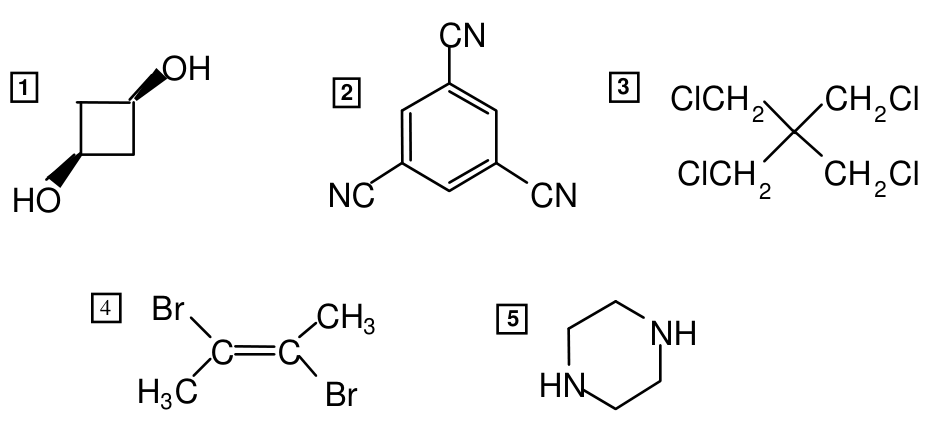
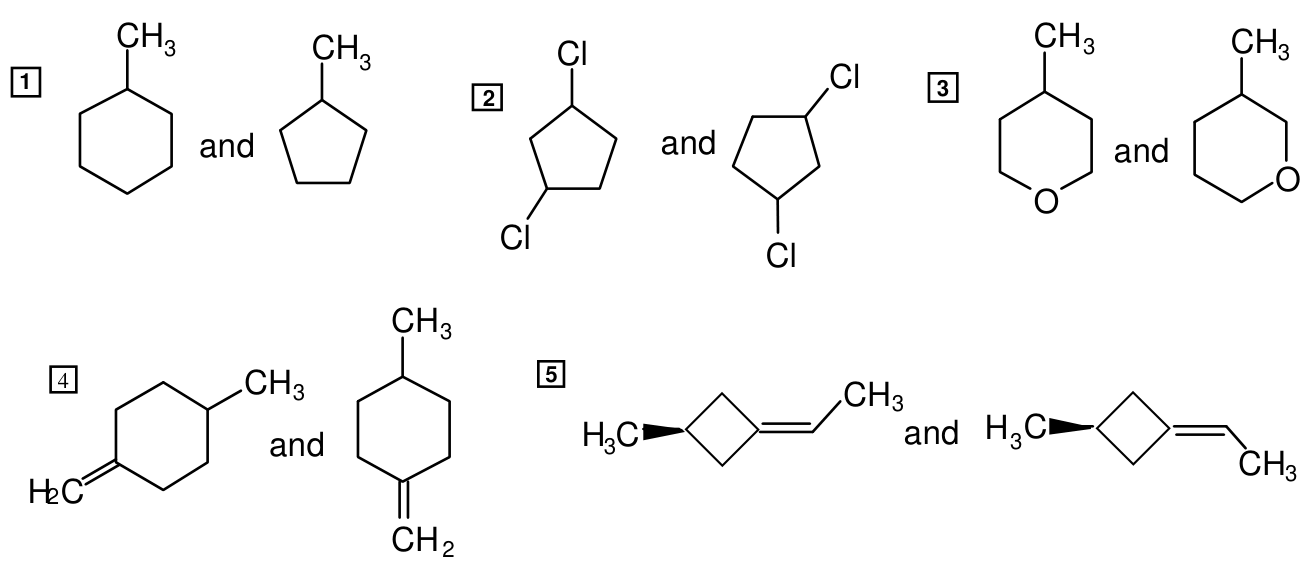
5.4 Which of the following is a pair of structural isomers?
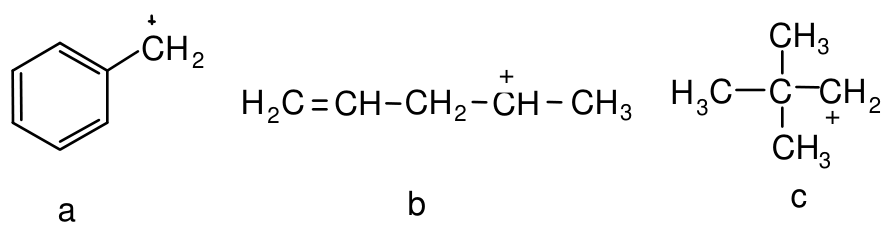
5.5 Which of the following five options is the correct order of relative stabilities of cations a, b and c as written below (most stable first)?
- \(a>b>c\)
- \(b>c>a\)
- \(c>a>b\)
- \(a>c>b\)
- \(b>a>c\)
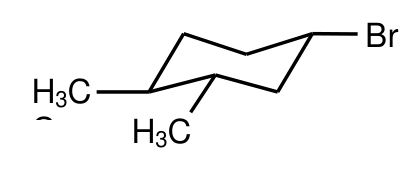
5.6 What is the correct stereochemical descriptor of the optically active compound drawn below?
- \(1R,3R,4R\)
- \(1R,3R,4S\)
- \(1R3S,4R\)
- \(1S,3S,4R\)
- \(1S,3S,4S\)
5.7 All the molecules drawn below are neutral compounds. Which one does not contain a formal positive charge and a formal negative charge?

Official English text of the problem.
Answers
- 5.1 — Option 5: 3-ethyl-2-methylhexane,
CC(C)C(CC)CCC. - 5.2 — Option 4: 7 isomers.
- 5.3 — Option 1: cis-cyclobutane-1,3-diol,
O[C@H]1C[C@@H](O)C1. - 5.4 — Option 3: 4-methyloxane,
CC1CCOCC1, and 3-methyloxane,CC1COCCC1. - 5.5 — Option 1: \(a>b>c\).
- 5.6 — Option 5: \((1S,3S,4S)\), using the numbering implicit in the choices.
- 5.7 — Option 2: N,N,O-trimethylhydroxylamine,
CN(C)OC.
Solution
5.1 — Selecting and numbering the parent chain
The longest continuous carbon chain contains six carbon atoms. Among the possible six-carbon chains, select the one giving the greatest number of substituents:
\[ \ce{CH3-CH(CH3)-CH(CH2CH3)-CH2-CH2-CH3}. \]
This chain has a methyl group and an ethyl group. Numbering from the nearer end gives locants \(2,3\), rather than \(4,5\).
The substituent names are written alphabetically, so ethyl precedes methyl. The name is therefore 3-ethyl-2-methylhexane, option 5.
The alternative six-carbon chain underlying “3-isopropylhexane” has only one substituent and is not the correct parent-chain selection.
5.2 — Counting saturated isomers
The degree of unsaturation is
\[ \mathrm{DBE}=\frac{2(5)+2-10}{2}=1. \]
Since all carbon atoms must be saturated, this degree of unsaturation must be a ring, rather than a double bond. Thus, the compounds are monocyclic cycloalkanes.
The possibilities are:
| Isomer | SMILES |
|---|---|
| Cyclopentane | C1CCCC1 |
| Methylcyclobutane | CC1CCC1 |
| Ethylcyclopropane | CCC1CC1 |
| 1,1-Dimethylcyclopropane | CC1(C)CC1 |
| cis-(1R,2S)-1,2-Dimethylcyclopropane | C[C@H]1[C@@H](C)C1 |
| trans-(1R,2R)-1,2-Dimethylcyclopropane | C[C@H]1[C@H](C)C1 |
| trans-(1S,2S)-1,2-Dimethylcyclopropane | C[C@@H]1[C@@H](C)C1 |
The cis-1,2-dimethyl compound is meso: its mirror image is superimposable. The trans compound exists as two distinct enantiomers.
Consequently,
\[ N=4+1+2=\boxed{7}. \]
Conformations that interconvert by ordinary ring motion are not counted separately. The answer is option 4.
5.3 — Molecular dipoles
In option 1, both hydroxyl groups are shown with solid wedges, so they lie on the same face of the ring. The molecule is cis-cyclobutane-1,3-diol.
The components of the two hydroxyl-group dipoles perpendicular to the ring reinforce one another. They therefore produce a substantial resultant dipole.
The other choices illustrate cancellation in symmetric molecular arrangements:
| Option | Compound and SMILES | Symmetry argument |
|---|---|---|
| 2 | Benzene-1,3,5-tricarbonitrile, N#Cc1cc(C#N)cc(C#N)c1 |
The three equivalent nitrile-group dipoles are arranged at \(120^\circ\) and cancel. |
| 3 | Tetrakis(chloromethyl)methane, ClCC(CCl)(CCl)CCl |
A symmetric arrangement of the four equivalent arms permits their dipoles to cancel. |
| 4 | (E)-2,3-Dibromobut-2-ene, C/C(Br)=C(Br)/C |
The trans arrangement gives opposing bond dipoles and a centrosymmetric molecular framework. |
| 5 | Piperazine, N1CCNCC1 |
Its symmetric chair conformation has opposing amine groups and a center of inversion. |
Thus, the intended answer is option 1. The conformations used for compounds 3 and 5 are not specified by their SMILES.
5.4 — Constitutional isomerism
Structural, or constitutional, isomers have the same molecular formula but different atom-to-atom connections.
In option 3, both compounds have molecular formula \(\ce{C6H12O}\). Numbering the six-membered heterocycle from oxygen as position 1:
- The left structure has its methyl group at position 4: 4-methyloxane,
CC1CCOCC1. - The right structure has its methyl group at position 3: 3-methyloxane,
CC1COCCC1.
Moving the methyl attachment from position 4 to position 3 changes connectivity. These are therefore constitutional isomers.
Option 1 has different molecular formulas for its two members. Options 2, 4 and 5 retain the same connectivity within each pair. The answer is option 3.
5.5 — Carbocation stability
The three cations are:
| Cation | Identification and SMILES | Principal stabilization |
|---|---|---|
| \(a\) | Benzyl cation, [CH2+]c1ccccc1 |
Resonance delocalization into the aromatic ring |
| \(b\) | Pent-4-en-2-yl cation, C=CC[CH+]C |
A secondary carbocation, stabilized by adjacent alkyl groups |
| \(c\) | Neopentyl cation, CC(C)(C)[CH2+] |
A primary carbocation without adjacent carbon–hydrogen bonds for ordinary C–H hyperconjugation |
The benzyl cation is most stable because its vacant \(p\) orbital is conjugated with the aromatic ring, distributing the positive charge over several atoms.
Cation \(b\) is homoallylic, not allylic: a saturated methylene group separates the double bond from the positively charged carbon. It therefore lacks ordinary allylic resonance stabilization, but its secondary substitution still makes it more stable than \(c\).
The phrase “as written” excludes stabilization obtained by rearranging a cation into a different structure. Hence,
\[ \boxed{a>b>c}, \]
which is option 1.
5.6 — Absolute configuration
Use the numbering implicit in the choices: the bromine-bearing carbon is C1; proceeding along the lower edge of the chair gives C2, methyl-bearing C3, and methyl-bearing C4.
All three drawn substituents are equatorial. Bromine at C1 and methyl at C3 are on the same face; methyl at C4 is on the opposite face.
The Cahn–Ingold–Prelog priorities are:
| Center | Priorities, highest to lowest | Configuration |
|---|---|---|
| C1 | \(\ce{Br}\) > ring path through C2 > ring path through C6 > \(\ce{H}\) | \(S\) |
| C3 | Ring path through C4 > ring path through C2 > methyl > \(\ce{H}\) | \(S\) |
| C4 | Ring path through C3 > ring path through C5 > methyl > \(\ce{H}\) | \(S\) |
At C1, the two ring paths initially tie. The path through C2 reaches methyl-substituted C3 first and therefore takes priority over the path through C6.
At C3, the adjacent C4 is attached to two other carbon atoms and one hydrogen, whereas C2 is attached to one other carbon and two hydrogens. Thus, the C4 path has higher priority. The analogous comparison at C4 favors the C3 path.
To make the spatial assignment explicit, an equivalent planar hexagon, numbered clockwise with C1 at the right, has:
- a dashed bromine bond at C1;
- a dashed methyl bond at C3;
- a solid-wedge methyl bond at C4.
At C1 and C3, the projected priority sequence is clockwise but hydrogen points toward the viewer, so the assignment is reversed to \(S\). At C4, hydrogen points away and the sequence is counterclockwise, also giving \(S\).
Therefore,
\[ \boxed{(1S,3S,4S)}, \]
option 5.
With the lowest-locant numbering used for its systematic name, the molecule is (1S,2S,4S)-4-bromo-1,2-dimethylcyclohexane, Br[C@@H]1C[C@H](C)[C@@H](C)CC1. This SMILES specifies configuration; the drawing additionally specifies the chair conformation with all three substituents equatorial.
5.7 — Formal charges
For an atom,
\[ \mathrm{FC} = V-N_{\mathrm{nonbonding}} -\frac{N_{\mathrm{bonding}}}{2}, \]
where \(V\) is the number of valence electrons of the neutral atom.
In N,N,O-trimethylhydroxylamine, CN(C)OC, nitrogen has three single bonds and one lone pair, while oxygen has two single bonds and two lone pairs:
\[ \mathrm{FC}(\ce{N})=5-2-3=0, \qquad \mathrm{FC}(\ce{O})=6-4-2=0. \]
Neither atom carries a formal charge.
For comparison, assigning formal charges to all five structures gives:
| Option | Compound and charge-explicit SMILES | Formal charges |
|---|---|---|
| 1 | Trimethylamine–trimethylborane adduct, C[N+](C)(C)[B-](C)(C)C |
Nitrogen \(+1\), boron \(-1\) |
| 2 | N,N,O-Trimethylhydroxylamine, CN(C)OC |
All atoms uncharged |
| 3 | Diazomethane, C=[N+]=[N-] |
Central nitrogen \(+1\), terminal nitrogen \(-1\) |
| 4 | Trimethylamine N-oxide, C[N+](C)(C)[O-] |
Nitrogen \(+1\), oxygen \(-1\) |
| 5 | Boron trifluoride–dimethyl ether adduct, F[B-](F)(F)[O+](C)C |
Boron \(-1\), oxygen \(+1\) |
In adducts 1 and 5, the nitrogen or oxygen lone pair is donated to boron. With that donor–acceptor bond represented as the drawn single bond, four-coordinate boron has formal charge \(-1\); the donor atom has formal charge \(+1\).
Thus, the only structure without separated formal charges is option 2.
The answers were checked against the official answers published by the organisers.
IChO 1994 · Theorieaufgabe 5
Multiple-Choice-Fragen zur organischen Chemie
Zu jeder Frage gibt es nur eine richtige Antwort
5.1 Wie lautet der korrekte systematische Name (IUPAC-Name) der unten dargestellten Verbindung?
- 3-Isopropylhexan
- 2-Methyl-3-propylpentan
- Ethylisopropylpropylmethan
- 3-Hexylpropan
- 3-Ethyl-2-methylhexan
5.2 Wie viele Isomere, einschließlich Stereoisomeren, gibt es für \(\ce{C5H10}\), die ausschließlich gesättigte Kohlenstoffatome enthalten?
- 4 Isomere
- 5 Isomere
- 6 Isomere
- 7 Isomere
- 8 Isomere
5.3 Welche der folgenden Verbindungen besitzt ein Dipolmoment, das sich deutlich von null unterscheidet?
5.4 Bei welcher der folgenden Möglichkeiten handelt es sich um ein Paar von Strukturisomeren?
5.5 Welche der folgenden fünf Möglichkeiten gibt die richtige Reihenfolge der relativen Stabilitäten der unten dargestellten Kationen a, b und c in ihrer angegebenen Form an (das stabilste zuerst)?
- \(a>b>c\)
- \(b>c>a\)
- \(c>a>b\)
- \(a>c>b\)
- \(b>a>c\)
5.6 Wie lautet der korrekte stereochemische Deskriptor der unten gezeichneten optisch aktiven Verbindung?
- \(1R,3R,4R\)
- \(1R,3R,4S\)
- \(1R3S,4R\)
- \(1S,3S,4R\)
- \(1S,3S,4S\)
5.7 Alle unten gezeichneten Moleküle sind neutrale Verbindungen. Welches enthält keine positive und negative Formalladung?
Aufgabentext aus dem offiziellen englischen Text übersetzt.
Antworten
- 5.1 — Option 5: 3-Ethyl-2-methylhexan,
CC(C)C(CC)CCC. - 5.2 — Option 4: 7 Isomere.
- 5.3 — Option 1: cis-Cyclobutan-1,3-diol,
O[C@H]1C[C@@H](O)C1. - 5.4 — Option 3: 4-Methyloxan,
CC1CCOCC1, und 3-Methyloxan,CC1COCCC1. - 5.5 — Option 1: \(a>b>c\).
- 5.6 — Option 5: \((1S,3S,4S)\), unter Verwendung der in den Antwortmöglichkeiten vorausgesetzten Nummerierung.
- 5.7 — Option 2: N,N,O-Trimethylhydroxylamin,
CN(C)OC.
Lösung
5.1 — Auswahl und Nummerierung der Stammkette
Die längste durchgehende Kohlenstoffkette enthält sechs Kohlenstoffatome. Unter den möglichen Ketten mit sechs Kohlenstoffatomen wird diejenige ausgewählt, die die größte Anzahl an Substituenten aufweist:
\[ \ce{CH3-CH(CH3)-CH(CH2CH3)-CH2-CH2-CH3}. \]
Diese Kette besitzt eine Methylgruppe und eine Ethylgruppe. Die Nummerierung vom näher gelegenen Ende aus ergibt die Lokanten \(2,3\) anstelle von \(4,5\).
Die Namen der Substituenten werden alphabetisch angeordnet, sodass Ethyl vor Methyl steht. Der Name lautet daher 3-Ethyl-2-methylhexan, Option 5.
Die alternative Kette mit sechs Kohlenstoffatomen, die dem Namen „3-Isopropylhexan“ zugrunde liegt, besitzt nur einen Substituenten und ist nicht die korrekt gewählte Stammkette.
5.2 — Zählen der gesättigten Isomere
Der Ungesättigtheitsgrad beträgt
\[ \mathrm{DBE}=\frac{2(5)+2-10}{2}=1. \]
Da alle Kohlenstoffatome gesättigt sein müssen, muss dieser Ungesättigtheitsgrad einem Ring und nicht einer Doppelbindung entsprechen. Die Verbindungen sind somit monocyclische Cycloalkane.
Die Möglichkeiten sind:
| Isomer | SMILES |
|---|---|
| Cyclopentan | C1CCCC1 |
| Methylcyclobutan | CC1CCC1 |
| Ethylcyclopropan | CCC1CC1 |
| 1,1-Dimethylcyclopropan | CC1(C)CC1 |
| cis-(1R,2S)-1,2-Dimethylcyclopropan | C[C@H]1[C@@H](C)C1 |
| trans-(1R,2R)-1,2-Dimethylcyclopropan | C[C@H]1[C@H](C)C1 |
| trans-(1S,2S)-1,2-Dimethylcyclopropan | C[C@@H]1[C@@H](C)C1 |
Die cis-1,2-Dimethylverbindung ist eine meso-Verbindung: Ihr Spiegelbild lässt sich mit ihr zur Deckung bringen. Die trans-Verbindung liegt in Form zweier verschiedener Enantiomere vor.
Folglich gilt
\[ N=4+1+2=\boxed{7}. \]
Konformationen, die durch gewöhnliche Ringbewegungen ineinander übergehen, werden nicht gesondert gezählt. Die Antwort ist Option 4.
5.3 — Molekulare Dipolmomente
In Option 1 sind beide Hydroxygruppen mit ausgefüllten Keilen dargestellt, liegen also auf derselben Seite des Rings. Das Molekül ist cis-Cyclobutan-1,3-diol.
Die senkrecht zum Ring gerichteten Komponenten der beiden Hydroxygruppen-Dipole verstärken sich gegenseitig. Sie erzeugen daher ein beträchtliches resultierendes Dipolmoment.
Die anderen Antwortmöglichkeiten veranschaulichen die Aufhebung von Dipolmomenten in symmetrischen molekularen Anordnungen:
| Option | Verbindung und SMILES | Symmetrieargument |
|---|---|---|
| 2 | Benzol-1,3,5-tricarbonitril, N#Cc1cc(C#N)cc(C#N)c1 |
Die drei gleichwertigen Nitrilgruppen-Dipole sind in Winkeln von \(120^\circ\) zueinander angeordnet und heben sich auf. |
| 3 | Tetrakis(chlormethyl)methan, ClCC(CCl)(CCl)CCl |
Eine symmetrische Anordnung der vier gleichwertigen Arme ermöglicht die Aufhebung ihrer Dipolmomente. |
| 4 | (E)-2,3-Dibrombut-2-en, C/C(Br)=C(Br)/C |
Die trans-Anordnung führt zu entgegengesetzten Bindungsdipolen und einem zentrosymmetrischen Molekülgerüst. |
| 5 | Piperazin, N1CCNCC1 |
Seine symmetrische Sesselkonformation weist einander entgegengerichtete Amingruppen und ein Inversionszentrum auf. |
Die beabsichtigte Antwort ist somit Option 1. Die für die Verbindungen 3 und 5 verwendeten Konformationen werden durch ihre SMILES nicht festgelegt.
5.4 — Konstitutionsisomerie
Struktur- oder Konstitutionsisomere haben dieselbe Summenformel, unterscheiden sich jedoch in der Verknüpfung ihrer Atome.
In Option 3 besitzen beide Verbindungen die Summenformel \(\ce{C6H12O}\). Bei der Nummerierung des sechsgliedrigen Heterocyclus, beginnend mit Sauerstoff als Position 1, gilt:
- Die linke Struktur trägt ihre Methylgruppe an Position 4: 4-Methyloxan,
CC1CCOCC1. - Die rechte Struktur trägt ihre Methylgruppe an Position 3: 3-Methyloxan,
CC1COCCC1.
Die Verlagerung der Methylgruppe von Position 4 an Position 3 verändert die Verknüpfung der Atome. Es handelt sich daher um Konstitutionsisomere.
Die beiden Verbindungen in Option 1 haben unterschiedliche Summenformeln. In den Optionen 2, 4 und 5 bleibt die Verknüpfung der Atome innerhalb jedes Paares gleich. Die Antwort ist Option 3.
5.5 — Stabilität von Carbokationen
Die drei Kationen sind:
| Kation | Bezeichnung und SMILES | Wichtigster Stabilisierungsbeitrag |
|---|---|---|
| \(a\) | Benzylkation, [CH2+]c1ccccc1 |
Mesomere Delokalisierung in den aromatischen Ring |
| \(b\) | Pent-4-en-2-yl-Kation, C=CC[CH+]C |
Ein sekundäres Carbokation, das durch benachbarte Alkylgruppen stabilisiert wird |
| \(c\) | Neopentylkation, CC(C)(C)[CH2+] |
Ein primäres Carbokation ohne benachbarte Kohlenstoff–Wasserstoff-Bindungen für die gewöhnliche C–H-Hyperkonjugation |
Das Benzylkation ist am stabilsten, weil sein unbesetztes \(p\)-Orbital mit dem aromatischen Ring konjugiert ist, wodurch die positive Ladung über mehrere Atome verteilt wird.
Kation \(b\) ist homoallylisch, nicht allylisch: Eine gesättigte Methylengruppe trennt die Doppelbindung vom positiv geladenen Kohlenstoffatom. Ihm fehlt daher die gewöhnliche allylische Mesomeriestabilisierung, doch aufgrund seines sekundären Substitutionsgrades ist es dennoch stabiler als \(c\).
Die Formulierung „in ihrer angegebenen Form“ schließt eine Stabilisierung durch Umlagerung eines Kations in eine andere Struktur aus. Daher gilt
\[ \boxed{a>b>c}, \]
was Option 1 entspricht.
5.6 — Absolute Konfiguration
Es wird die in den Antwortmöglichkeiten vorausgesetzte Nummerierung verwendet: Das bromtragende Kohlenstoffatom ist C1; entlang der unteren Kante des Sessels folgen C2, das methyltragende C3 und das methyltragende C4.
Alle drei eingezeichneten Substituenten stehen äquatorial. Brom an C1 und Methyl an C3 liegen auf derselben Seite; Methyl an C4 liegt auf der gegenüberliegenden Seite.
Die Cahn–Ingold–Prelog-Prioritäten lauten:
| Zentrum | Prioritäten, von der höchsten zur niedrigsten | Konfiguration |
|---|---|---|
| C1 | \(\ce{Br}\) > Ringweg über C2 > Ringweg über C6 > \(\ce{H}\) | \(S\) |
| C3 | Ringweg über C4 > Ringweg über C2 > Methyl > \(\ce{H}\) | \(S\) |
| C4 | Ringweg über C3 > Ringweg über C5 > Methyl > \(\ce{H}\) | \(S\) |
An C1 sind die beiden Ringwege zunächst gleichrangig. Der Weg über C2 erreicht das methylsubstituierte C3 zuerst und hat daher Vorrang vor dem Weg über C6.
An C3 ist das benachbarte C4 an zwei weitere Kohlenstoffatome und ein Wasserstoffatom gebunden, während C2 an ein weiteres Kohlenstoffatom und zwei Wasserstoffatome gebunden ist. Somit hat der Weg über C4 die höhere Priorität. Der entsprechende Vergleich an C4 ergibt einen Vorrang des Weges über C3.
Um die räumliche Zuordnung ausdrücklich zu verdeutlichen, weist ein äquivalentes ebenes Sechseck, das mit C1 rechts im Uhrzeigersinn nummeriert ist, Folgendes auf:
- eine gestrichelte Bindung zu Brom an C1;
- eine gestrichelte Bindung zu Methyl an C3;
- eine Bindung zu Methyl als ausgefüllten Keil an C4.
An C1 und C3 verläuft die projizierte Prioritätsfolge im Uhrzeigersinn, doch das Wasserstoffatom zeigt zum Betrachter, sodass die Zuordnung zu \(S\) umgekehrt wird. An C4 zeigt das Wasserstoffatom vom Betrachter weg, und die Folge verläuft gegen den Uhrzeigersinn, was ebenfalls \(S\) ergibt.
Daher ergibt sich
\[ \boxed{(1S,3S,4S)}, \]
Option 5.
Mit der für den systematischen Namen verwendeten Nummerierung mit den niedrigsten Lokanten ist das Molekül (1S,2S,4S)-4-Brom-1,2-dimethylcyclohexan, Br[C@@H]1C[C@H](C)[C@@H](C)CC1. Diese SMILES-Zeichenfolge legt die Konfiguration fest; die Zeichnung legt zusätzlich die Sesselkonformation fest, in der alle drei Substituenten äquatorial stehen.
5.7 — Formalladungen
Für ein Atom gilt
\[ \mathrm{FC} = V-N_{\mathrm{nonbonding}} -\frac{N_{\mathrm{bonding}}}{2}, \]
wobei \(V\) die Anzahl der Valenzelektronen des neutralen Atoms ist.
In N,N,O-Trimethylhydroxylamin, CN(C)OC, besitzt Stickstoff drei Einfachbindungen und ein freies Elektronenpaar, während Sauerstoff zwei Einfachbindungen und zwei freie Elektronenpaare besitzt:
\[ \mathrm{FC}(\ce{N})=5-2-3=0, \qquad \mathrm{FC}(\ce{O})=6-4-2=0. \]
Keines der beiden Atome trägt eine Formalladung.
Zum Vergleich ergibt die Zuordnung der Formalladungen für alle fünf Strukturen:
| Option | Verbindung und SMILES mit expliziten Ladungen | Formalladungen |
|---|---|---|
| 1 | Trimethylamin–Trimethylboran-Addukt, C[N+](C)(C)[B-](C)(C)C |
Stickstoff \(+1\), Bor \(-1\) |
| 2 | N,N,O-Trimethylhydroxylamin, CN(C)OC |
Alle Atome ungeladen |
| 3 | Diazomethan, C=[N+]=[N-] |
Zentraler Stickstoff \(+1\), endständiger Stickstoff \(-1\) |
| 4 | Trimethylamin-N-oxid, C[N+](C)(C)[O-] |
Stickstoff \(+1\), Sauerstoff \(-1\) |
| 5 | Bortrifluorid–Dimethylether-Addukt, F[B-](F)(F)[O+](C)C |
Bor \(-1\), Sauerstoff \(+1\) |
In den Addukten 1 und 5 wird das freie Elektronenpaar des Stickstoffs beziehungsweise Sauerstoffs dem Bor zur Bindung zur Verfügung gestellt. Wird diese Donor–Akzeptor-Bindung als die eingezeichnete Einfachbindung dargestellt, hat das vierfach koordinierte Bor die Formalladung \(-1\); das Donoratom hat die Formalladung \(+1\).
Somit ist Option 2 die einzige Struktur ohne getrennte Formalladungen.
Die Ergebnisse wurden mit den von den Veranstaltern veröffentlichten offiziellen Ergebnissen abgeglichen.
IChO 1994 · Teori sorusu 5
Organik kimya çoktan seçmeli soruları
Her sorunun yalnızca bir doğru cevabı vardır
5.1 Aşağıdaki bileşiğin doğru sistematik adı (IUPAC adı) nedir?
- 3-İzopropilhekzan
- 2-Metil-3-propilpentan
- Etil izopropil propil metan
- 3-Hekzilpropan
- 3-Etil-2-metilhekzan
5.2 \(\ce{C5H10}\) için, stereoizomerler de dahil olmak üzere, yalnızca doymuş karbon atomları içeren kaç izomer vardır?
- 4 izomer
- 5 izomer
- 6 izomer
- 7 izomer
- 8 izomer
5.3 Aşağıdaki bileşiklerden hangisinin dipol momenti sıfırdan belirgin ölçüde farklıdır?
5.4 Aşağıdakilerden hangisi bir yapı izomeri çiftidir?
5.5 Aşağıdaki beş seçenekten hangisi, aşağıda gösterildikleri hâlleriyle a, b ve c katyonlarının bağıl kararlılıklarının doğru sıralamasıdır (en kararlı olan başta)?
- \(a>b>c\)
- \(b>c>a\)
- \(c>a>b\)
- \(a>c>b\)
- \(b>a>c\)
5.6 Aşağıda çizilen optikçe aktif bileşiğin doğru stereokimyasal tanımlayıcısı nedir?
- \(1R,3R,4R\)
- \(1R,3R,4S\)
- \(1R3S,4R\)
- \(1S,3S,4R\)
- \(1S,3S,4S\)
5.7 Aşağıda çizilen moleküllerin tümü nötr bileşiklerdir. Hangisi bir formal pozitif yük ve bir formal negatif yük içermez?
Soru metni resmi İngilizce metinden çevrilmiştir.
Cevaplar
- 5.1 — Seçenek 5: 3-etil-2-metilhekzan,
CC(C)C(CC)CCC. - 5.2 — Seçenek 4: 7 izomer.
- 5.3 — Seçenek 1: cis-siklobütan-1,3-diol,
O[C@H]1C[C@@H](O)C1. - 5.4 — Seçenek 3: 4-metiloksan,
CC1CCOCC1, ve 3-metiloksan,CC1COCCC1. - 5.5 — Seçenek 1: \(a>b>c\).
- 5.6 — Seçenek 5: Seçeneklerde esas alınan numaralandırmaya göre \((1S,3S,4S)\).
- 5.7 — Seçenek 2: N,N,O-trimetilhidroksilamin,
CN(C)OC.
Çözüm
5.1 — Ana zincirin seçilmesi ve numaralandırılması
En uzun kesintisiz karbon zinciri altı karbon atomu içerir. Olası altı karbonlu zincirler arasından, en fazla sayıda sübstitüent veren zincir seçilir:
\[ \ce{CH3-CH(CH3)-CH(CH2CH3)-CH2-CH2-CH3}. \]
Bu zincirde bir metil grubu ve bir etil grubu bulunur. Daha yakın uçtan numaralandırma yapıldığında konum numaraları \(2,3\) olur; \(4,5\) olmaz.
Sübstitüent adları alfabetik sırayla yazıldığından etil, metilden önce gelir. Dolayısıyla ad 3-etil-2-metilhekzan, doğru seçenek ise 5'tir.
“3-izopropilhekzan” adının dayandığı alternatif altı karbonlu zincirde yalnızca bir sübstitüent vardır ve bu, doğru ana zincir seçimi değildir.
5.2 — Doymuş izomerlerin sayılması
Doymamışlık derecesi şöyledir:
\[ \mathrm{DBE}=\frac{2(5)+2-10}{2}=1. \]
Tüm karbon atomlarının doymuş olması gerektiğinden, bu doymamışlık derecesi bir çift bağdan değil, bir halkadan kaynaklanmalıdır. Dolayısıyla bileşikler tek halkalı sikloalkanlardır.
Olasılıklar şunlardır:
| İzomer | SMILES |
|---|---|
| Siklopentan | C1CCCC1 |
| Metilsiklobütan | CC1CCC1 |
| Etilsiklopropan | CCC1CC1 |
| 1,1-Dimetilsiklopropan | CC1(C)CC1 |
| cis-(1R,2S)-1,2-Dimetilsiklopropan | C[C@H]1[C@@H](C)C1 |
| trans-(1R,2R)-1,2-Dimetilsiklopropan | C[C@H]1[C@H](C)C1 |
| trans-(1S,2S)-1,2-Dimetilsiklopropan | C[C@@H]1[C@@H](C)C1 |
cis-1,2-dimetil bileşiği mezodur: ayna görüntüsüyle üst üste çakıştırılabilir. trans bileşiği ise iki farklı enantiyomer hâlinde bulunur.
Sonuç olarak,
\[ N=4+1+2=\boxed{7}. \]
Olağan halka hareketleriyle birbirine dönüşen konformasyonlar ayrı ayrı sayılmaz. Cevap 4. seçenektir.
5.3 — Moleküler dipoller
1. seçenekte her iki hidroksil grubu da dolu kama bağlarıyla gösterildiğinden halkanın aynı yüzünde yer alır. Molekül cis-siklobütan-1,3-dioldür.
İki hidroksil grubunun dipollerinin halkaya dik bileşenleri birbirini güçlendirir. Bu nedenle, büyüklüğü kayda değer bir bileşke dipol oluştururlar.
Diğer seçenekler, simetrik moleküler düzenlenmelerde dipollerin birbirini yok etmesini gösterir:
| Seçenek | Bileşik ve SMILES | Simetriye dayalı açıklama |
|---|---|---|
| 2 | Benzen-1,3,5-trikarbonitril, N#Cc1cc(C#N)cc(C#N)c1 |
Üç eşdeğer nitril grubu dipolü \(120^\circ\) açıyla düzenlenmiştir ve birbirini yok eder. |
| 3 | Tetrakis(klorometil)metan, ClCC(CCl)(CCl)CCl |
Dört eşdeğer kolun simetrik düzenlenmesi, dipollerinin birbirini yok etmesine olanak verir. |
| 4 | (E)-2,3-Dibromobüt-2-en, C/C(Br)=C(Br)/C |
trans düzenlenme, zıt yönlü bağ dipolleri ve merkezî simetriye sahip bir moleküler iskelet verir. |
| 5 | Piperazin, N1CCNCC1 |
Simetrik sandalye konformasyonunda amin grupları zıt yönlüdür ve bir inversiyon merkezi bulunur. |
Dolayısıyla beklenen cevap 1. seçenektir. 3 ve 5 numaralı bileşikler için kullanılan konformasyonlar, bu bileşiklerin SMILES gösterimlerinde belirtilmemiştir.
5.4 — Yapı izomerliği
Yapı izomerleri, diğer adıyla konstitüsyon izomerleri, aynı molekül formülüne ancak atomlar arasında farklı bağlanma düzenlerine sahiptir.
3. seçenekte her iki bileşiğin molekül formülü de \(\ce{C6H12O}\)'dur. Altı üyeli heterohalka, oksijen 1. konumda olacak şekilde numaralandırıldığında:
- Soldaki yapının metil grubu 4. konumdadır: 4-metiloksan,
CC1CCOCC1. - Sağdaki yapının metil grubu 3. konumdadır: 3-metiloksan,
CC1COCCC1.
Metilin bağlandığı konumun 4'ten 3'e taşınması bağlanma düzenini değiştirir. Dolayısıyla bunlar yapı izomerleridir.
- seçenekteki iki bileşiğin molekül formülleri farklıdır. 2, 4 ve 5. seçeneklerde ise her bir çiftte bağlanma düzeni aynıdır. Cevap 3. seçenektir.
5.5 — Karbokatyon kararlılığı
Üç katyon şunlardır:
| Katyon | Tanımı ve SMILES | Başlıca kararlılaştırıcı etki |
|---|---|---|
| \(a\) | Benzil katyonu, [CH2+]c1ccccc1 |
Aromatik halkaya rezonans yoluyla delokalizasyon |
| \(b\) | Pent-4-en-2-il katyonu, C=CC[CH+]C |
Komşu alkil grupları tarafından kararlılaştırılan sekonder bir karbokatyon |
| \(c\) | Neopentil katyonu, CC(C)(C)[CH2+] |
Olağan C–H hiperkonjugasyonu için komşu karbon–hidrojen bağları bulunmayan primer bir karbokatyon |
Benzil katyonu en kararlıdır; çünkü boş \(p\) orbitali aromatik halkayla konjugasyon hâlindedir ve pozitif yükü birkaç atom üzerine dağıtır.
\(b\) katyonu allilik değil, homoalliliktir: doymuş bir metilen grubu, çift bağı pozitif yüklü karbondan ayırır. Bu nedenle olağan allilik rezonans kararlılaşmasına sahip değildir; ancak sekonder sübstitüsyon yapısı onu yine de \(c\)'den daha kararlı kılar.
“Gösterildikleri hâlleriyle” ifadesi, bir katyonun farklı bir yapıya yeniden düzenlenmesiyle elde edilen kararlılaşmayı kapsam dışında bırakır. Dolayısıyla,
\[ \boxed{a>b>c}, \]
bu da 1. seçenektir.
5.6 — Mutlak konfigürasyon
Seçeneklerde esas alınan numaralandırma kullanılır: brom taşıyan karbon C1'dir; sandalye konformasyonunun alt kenarı boyunca ilerlenince C2, metil taşıyan C3 ve metil taşıyan C4 gelir.
Çizilen üç sübstitüentin tümü ekvatoryal konumdadır. C1'deki brom ve C3'teki metil aynı yüzde; C4'teki metil ise karşı yüzdedir.
Cahn–Ingold–Prelog öncelikleri şöyledir:
| Merkez | En yüksekten en düşüğe öncelikler | Konfigürasyon |
|---|---|---|
| C1 | \(\ce{Br}\) > C2 üzerinden giden halka yolu > C6 üzerinden giden halka yolu > \(\ce{H}\) | \(S\) |
| C3 | C4 üzerinden giden halka yolu > C2 üzerinden giden halka yolu > metil > \(\ce{H}\) | \(S\) |
| C4 | C3 üzerinden giden halka yolu > C5 üzerinden giden halka yolu > metil > \(\ce{H}\) | \(S\) |
C1'de iki halka yolu başlangıçta eşit önceliklidir. C2 üzerinden giden yol, metil sübstitüenti taşıyan C3'e önce ulaşır ve bu nedenle C6 üzerinden giden yola göre önceliklidir.
C3'te komşu C4, başka iki karbon atomuna ve bir hidrojene bağlıyken C2, başka bir karbon atomuna ve iki hidrojene bağlıdır. Bu nedenle C4 yolu daha yüksek önceliğe sahiptir. C4'te yapılan benzer karşılaştırmada C3 yolu öncelik kazanır.
Uzaysal atamayı açıkça göstermek için, C1 sağda olacak şekilde saat yönünde numaralandırılmış eşdeğer bir düzlemsel altıgende şunlar bulunur:
- C1'de kesikli çizgiyle gösterilen bir brom bağı;
- C3'te kesikli çizgiyle gösterilen bir metil bağı;
- C4'te dolu kamayla gösterilen bir metil bağı.
C1 ve C3'te izdüşümdeki öncelik sıralaması saat yönündedir; ancak hidrojen gözlemciye doğru yöneldiğinden atama tersine çevrilerek \(S\) elde edilir. C4'te hidrojen gözlemciden uzağa yönelir ve sıralama saat yönünün tersinedir; bu da \(S\) verir.
Dolayısıyla,
\[ \boxed{(1S,3S,4S)}, \]
yani 5. seçenek elde edilir.
Sistematik adı için kullanılan en küçük konum numaralarını veren numaralandırmayla molekül (1S,2S,4S)-4-bromo-1,2-dimetilsiklohekzan, Br[C@@H]1C[C@H](C)[C@@H](C)CC1, olarak adlandırılır. Bu SMILES gösterimi konfigürasyonu belirtir; çizim ayrıca üç sübstitüentin de ekvatoryal olduğu sandalye konformasyonunu belirtir.
5.7 — Formal yükler
Bir atom için,
\[ \mathrm{FC} = V-N_{\mathrm{nonbonding}} -\frac{N_{\mathrm{bonding}}}{2}, \]
burada \(V\), nötr atomun değerlik elektronlarının sayısıdır.
N,N,O-trimetilhidroksilamin, CN(C)OC, bileşiğinde azotun üç tek bağı ve bir ortaklanmamış elektron çifti, oksijenin ise iki tek bağı ve iki ortaklanmamış elektron çifti vardır:
\[ \mathrm{FC}(\ce{N})=5-2-3=0, \qquad \mathrm{FC}(\ce{O})=6-4-2=0. \]
Her iki atom da formal yük taşımaz.
Karşılaştırma için, beş yapının tümüne formal yük atandığında şu sonuçlar elde edilir:
| Seçenek | Bileşik ve yüklerin açıkça gösterildiği SMILES | Formal yükler |
|---|---|---|
| 1 | Trimetilamin–trimetilboran katılma bileşiği, C[N+](C)(C)[B-](C)(C)C |
Azot \(+1\), bor \(-1\) |
| 2 | N,N,O-Trimetilhidroksilamin, CN(C)OC |
Tüm atomlar yüksüz |
| 3 | Diazometan, C=[N+]=[N-] |
Merkezdeki azot \(+1\), uçtaki azot \(-1\) |
| 4 | Trimetilamin N-oksit, C[N+](C)(C)[O-] |
Azot \(+1\), oksijen \(-1\) |
| 5 | Bor triflorür–dimetil eter katılma bileşiği, F[B-](F)(F)[O+](C)C |
Bor \(-1\), oksijen \(+1\) |
1 ve 5 numaralı katılma bileşiklerinde azotun veya oksijenin ortaklanmamış elektron çifti bora verilir. Bu verici–alıcı bağı çizimdeki gibi tek bağ olarak gösterildiğinde, dört koordinasyonlu borun formal yükü \(-1\), verici atomun formal yükü ise \(+1\) olur.
Dolayısıyla, ayrılmış formal yükler içermeyen tek yapı 2. seçenektir.
Sonuçlar, düzenleyicilerin yayımladığı resmi sonuçlarla karşılaştırılarak kontrol edildi.
IChO 1994 · Problema teórico 5
Preguntas de opción múltiple sobre química orgánica
Solo hay una respuesta correcta para cada pregunta
5.1 ¿Cuál es el nombre sistemático correcto (nombre IUPAC) del compuesto que se muestra a continuación?
- 3-Isopropilhexano
- 2-Metil-3-propilpentano
- Etil isopropil propil metano
- 3-Hexilpropano
- 3-Etil-2-metilhexano
5.2 ¿Cuántos isómeros, incluidos los estereoisómeros, que contengan únicamente átomos de carbono saturados existen para \(\ce{C5H10}\)?
- 4 isómeros
- 5 isómeros
- 6 isómeros
- 7 isómeros
- 8 isómeros
5.3 ¿Cuál de los siguientes compuestos tiene un momento dipolar significativamente distinto de cero?
5.4 ¿Cuál de las siguientes opciones es un par de isómeros estructurales?
5.5 ¿Cuál de las siguientes cinco opciones indica el orden correcto de estabilidad relativa de los cationes a, b y c tal como se representan a continuación (el más estable primero)?
- \(a>b>c\)
- \(b>c>a\)
- \(c>a>b\)
- \(a>c>b\)
- \(b>a>c\)
5.6 ¿Cuál es el descriptor estereoquímico correcto del compuesto ópticamente activo representado a continuación?
- \(1R,3R,4R\)
- \(1R,3R,4S\)
- \(1R3S,4R\)
- \(1S,3S,4R\)
- \(1S,3S,4S\)
5.7 Todas las moléculas representadas a continuación son compuestos neutros. ¿Cuál de ellas no contiene una carga formal positiva y una carga formal negativa?
Enunciado traducido del texto oficial en inglés.
Respuestas
- 5.1 — Opción 5: 3-etil-2-metilhexano,
CC(C)C(CC)CCC. - 5.2 — Opción 4: 7 isómeros.
- 5.3 — Opción 1: cis-ciclobutano-1,3-diol,
O[C@H]1C[C@@H](O)C1. - 5.4 — Opción 3: 4-metiloxano,
CC1CCOCC1, y 3-metiloxano,CC1COCCC1. - 5.5 — Opción 1: \(a>b>c\).
- 5.6 — Opción 5: \((1S,3S,4S)\), utilizando la numeración implícita en las opciones.
- 5.7 — Opción 2: N,N,O-trimetilhidroxilamina,
CN(C)OC.
Solución
5.1 — Selección y numeración de la cadena principal
La cadena continua de carbonos más larga contiene seis átomos de carbono. Entre las posibles cadenas de seis carbonos, se elige la que presenta el mayor número de sustituyentes:
\[ \ce{CH3-CH(CH3)-CH(CH2CH3)-CH2-CH2-CH3}. \]
Esta cadena tiene un grupo metilo y un grupo etilo. La numeración desde el extremo más cercano da los localizadores \(2,3\), en lugar de \(4,5\).
Los nombres de los sustituyentes se escriben en orden alfabético, por lo que etil precede a metil. Por tanto, el nombre es 3-etil-2-metilhexano, opción 5.
La cadena alternativa de seis carbonos en la que se basa «3-isopropilhexano» tiene un solo sustituyente y no es la elección correcta de la cadena principal.
5.2 — Recuento de los isómeros saturados
El grado de insaturación es
\[ \mathrm{DBE}=\frac{2(5)+2-10}{2}=1. \]
Como todos los átomos de carbono deben estar saturados, este grado de insaturación debe corresponder a un anillo, en lugar de a un doble enlace. Por tanto, los compuestos son cicloalcanos monocíclicos.
Las posibilidades son:
| Isómero | SMILES |
|---|---|
| Ciclopentano | C1CCCC1 |
| Metilciclobutano | CC1CCC1 |
| Etilciclopropano | CCC1CC1 |
| 1,1-Dimetilciclopropano | CC1(C)CC1 |
| cis-(1R,2S)-1,2-Dimetilciclopropano | C[C@H]1[C@@H](C)C1 |
| trans-(1R,2R)-1,2-Dimetilciclopropano | C[C@H]1[C@H](C)C1 |
| trans-(1S,2S)-1,2-Dimetilciclopropano | C[C@@H]1[C@@H](C)C1 |
El compuesto cis-1,2-dimetilado es meso: su imagen especular es superponible. El compuesto trans existe en forma de dos enantiómeros distintos.
En consecuencia,
\[ N=4+1+2=\boxed{7}. \]
Las conformaciones que se interconvierten mediante movimientos ordinarios del anillo no se cuentan por separado. La respuesta es la opción 4.
5.3 — Dipolos moleculares
En la opción 1, ambos grupos hidroxilo se representan con cuñas sólidas, por lo que se encuentran en la misma cara del anillo. La molécula es cis-ciclobutano-1,3-diol.
Las componentes de los dipolos de los dos grupos hidroxilo perpendiculares al anillo se refuerzan mutuamente. Por tanto, producen un dipolo resultante considerable.
Las demás opciones ilustran la cancelación en disposiciones moleculares simétricas:
| Opción | Compuesto y SMILES | Argumento de simetría |
|---|---|---|
| 2 | Benceno-1,3,5-tricarbonitrilo, N#Cc1cc(C#N)cc(C#N)c1 |
Los dipolos de los tres grupos nitrilo equivalentes están dispuestos a \(120^\circ\) y se cancelan. |
| 3 | Tetrakis(clorometil)metano, ClCC(CCl)(CCl)CCl |
Una disposición simétrica de los cuatro brazos equivalentes permite que sus dipolos se cancelen. |
| 4 | (E)-2,3-Dibromobut-2-eno, C/C(Br)=C(Br)/C |
La disposición trans da lugar a dipolos de enlace opuestos y a un esqueleto molecular centrosimétrico. |
| 5 | Piperazina, N1CCNCC1 |
Su conformación de silla simétrica presenta grupos amina opuestos y un centro de inversión. |
Por tanto, la respuesta prevista es la opción 1. Las conformaciones utilizadas para los compuestos 3 y 5 no están especificadas por sus SMILES.
5.4 — Isomería constitucional
Los isómeros estructurales, o constitucionales, tienen la misma fórmula molecular, pero distintas conexiones entre los átomos.
En la opción 3, ambos compuestos tienen la fórmula molecular \(\ce{C6H12O}\). Al numerar el heterociclo de seis miembros a partir del oxígeno, al que se asigna la posición 1:
- La estructura de la izquierda tiene su grupo metilo en la posición 4: 4-metiloxano,
CC1CCOCC1. - La estructura de la derecha tiene su grupo metilo en la posición 3: 3-metiloxano,
CC1COCCC1.
Trasladar el punto de unión del metilo de la posición 4 a la posición 3 cambia la conectividad. Por tanto, estos compuestos son isómeros constitucionales.
Los dos miembros de la opción 1 tienen fórmulas moleculares distintas. Las opciones 2, 4 y 5 mantienen la misma conectividad dentro de cada par. La respuesta es la opción 3.
5.5 — Estabilidad de los carbocationes
Los tres cationes son:
| Catión | Identificación y SMILES | Estabilización principal |
|---|---|---|
| \(a\) | Catión bencilo, [CH2+]c1ccccc1 |
Deslocalización por resonancia hacia el anillo aromático |
| \(b\) | Catión pent-4-en-2-ilo, C=CC[CH+]C |
Un carbocatión secundario, estabilizado por los grupos alquilo adyacentes |
| \(c\) | Catión neopentilo, CC(C)(C)[CH2+] |
Un carbocatión primario sin enlaces carbono–hidrógeno adyacentes que permitan la hiperconjugación C–H ordinaria |
El catión bencilo es el más estable porque su orbital \(p\) vacío está conjugado con el anillo aromático, lo que distribuye la carga positiva entre varios átomos.
El catión \(b\) es homoalílico, no alílico: un grupo metileno saturado separa el doble enlace del carbono con carga positiva. Por ello, carece de la estabilización por resonancia alílica ordinaria, pero su sustitución secundaria hace que siga siendo más estable que \(c\).
La expresión «tal como se representan» excluye la estabilización obtenida al transponer un catión para dar una estructura diferente. Por tanto,
\[ \boxed{a>b>c}, \]
que corresponde a la opción 1.
5.6 — Configuración absoluta
Se utiliza la numeración implícita en las opciones: el carbono que lleva el bromo es C1; al avanzar por el borde inferior de la silla se encuentran C2, C3, que lleva un metilo, y C4, que lleva otro metilo.
Los tres sustituyentes representados son ecuatoriales. El bromo en C1 y el metilo en C3 están en la misma cara; el metilo en C4 está en la cara opuesta.
Las prioridades de Cahn–Ingold–Prelog son:
| Centro | Prioridades, de mayor a menor | Configuración |
|---|---|---|
| C1 | \(\ce{Br}\) > recorrido del anillo por C2 > recorrido del anillo por C6 > \(\ce{H}\) | \(S\) |
| C3 | Recorrido del anillo por C4 > recorrido del anillo por C2 > metilo > \(\ce{H}\) | \(S\) |
| C4 | Recorrido del anillo por C3 > recorrido del anillo por C5 > metilo > \(\ce{H}\) | \(S\) |
En C1, los dos recorridos del anillo empatan inicialmente. El recorrido por C2 llega primero a C3, sustituido con un metilo, y por tanto tiene prioridad sobre el recorrido por C6.
En C3, el C4 adyacente está unido a otros dos átomos de carbono y a un hidrógeno, mientras que C2 está unido a otro carbono y a dos hidrógenos. Por tanto, el recorrido por C4 tiene mayor prioridad. La comparación análoga en C4 favorece el recorrido por C3.
Para hacer explícita la asignación espacial, un hexágono plano equivalente, numerado en sentido horario con C1 a la derecha, presenta:
- un enlace al bromo de trazos discontinuos en C1;
- un enlace al metilo de trazos discontinuos en C3;
- un enlace al metilo en cuña sólida en C4.
En C1 y C3, la secuencia de prioridades proyectada sigue el sentido horario, pero el hidrógeno apunta hacia el observador, por lo que la asignación se invierte a \(S\). En C4, el hidrógeno apunta en dirección opuesta al observador y la secuencia sigue el sentido antihorario, lo que también da \(S\).
Por tanto,
\[ \boxed{(1S,3S,4S)}, \]
opción 5.
Con la numeración de localizadores más bajos utilizada para su nombre sistemático, la molécula es (1S,2S,4S)-4-bromo-1,2-dimetilciclohexano, Br[C@@H]1C[C@H](C)[C@@H](C)CC1. Este SMILES especifica la configuración; el dibujo especifica además la conformación de silla con los tres sustituyentes ecuatoriales.
5.7 — Cargas formales
Para un átomo,
\[ \mathrm{FC} = V-N_{\mathrm{nonbonding}} -\frac{N_{\mathrm{bonding}}}{2}, \]
donde \(V\) es el número de electrones de valencia del átomo neutro.
En la N,N,O-trimetilhidroxilamina, CN(C)OC, el nitrógeno tiene tres enlaces sencillos y un par solitario, mientras que el oxígeno tiene dos enlaces sencillos y dos pares solitarios:
\[ \mathrm{FC}(\ce{N})=5-2-3=0, \qquad \mathrm{FC}(\ce{O})=6-4-2=0. \]
Ninguno de los dos átomos tiene carga formal.
Como comparación, la asignación de cargas formales a las cinco estructuras da:
| Opción | Compuesto y SMILES con cargas explícitas | Cargas formales |
|---|---|---|
| 1 | Aducto trimetilamina–trimetilborano, C[N+](C)(C)[B-](C)(C)C |
Nitrógeno \(+1\), boro \(-1\) |
| 2 | N,N,O-Trimetilhidroxilamina, CN(C)OC |
Todos los átomos sin carga |
| 3 | Diazometano, C=[N+]=[N-] |
Nitrógeno central \(+1\), nitrógeno terminal \(-1\) |
| 4 | N-óxido de trimetilamina, C[N+](C)(C)[O-] |
Nitrógeno \(+1\), oxígeno \(-1\) |
| 5 | Aducto trifluoruro de boro–éter dimetílico, F[B-](F)(F)[O+](C)C |
Boro \(-1\), oxígeno \(+1\) |
En los aductos 1 y 5, el par solitario del nitrógeno o del oxígeno se dona al boro. Al representar ese enlace donador–aceptor como el enlace sencillo dibujado, el boro tetracoordinado tiene una carga formal de \(-1\); el átomo donador tiene una carga formal de \(+1\).
Por tanto, la única estructura sin cargas formales separadas es la opción 2.
Los resultados se comprobaron con los resultados oficiales publicados por los organizadores.
IChO 1994 · 理论题 5
有机化学选择题
每题只有一个正确答案
5.1 下列化合物的正确系统名称(IUPAC 名称)是什么?
- 3-异丙基己烷
- 2-甲基-3-丙基戊烷
- 乙基异丙基丙基甲烷
- 3-己基丙烷
- 3-乙基-2-甲基己烷
5.2 \(\ce{C5H10}\) 有多少种仅含饱和碳原子的异构体(包括立体异构体)?
- 4 种异构体
- 5 种异构体
- 6 种异构体
- 7 种异构体
- 8 种异构体
5.3 下列哪一种化合物的偶极矩显著不为零?
5.4 下列哪一组化合物互为构造异构体?
5.5 下列五个选项中,哪一个正确给出了下图所示阳离子 a、b 和 c 的相对稳定性顺序(最稳定者在前)?
- \(a>b>c\)
- \(b>c>a\)
- \(c>a>b\)
- \(a>c>b\)
- \(b>a>c\)
5.6 下图所示具有旋光性的化合物的正确立体化学描述符是什么?
- \(1R,3R,4R\)
- \(1R,3R,4S\)
- \(1R3S,4R\)
- \(1S,3S,4R\)
- \(1S,3S,4S\)
5.7 下图所示的所有分子均为中性化合物。其中哪一种不含形式正电荷和形式负电荷?
题目译自官方英文原文。
答案
- 5.1 — 选项 5: 3-乙基-2-甲基己烷,
CC(C)C(CC)CCC。 - 5.2 — 选项 4: 7 种异构体。
- 5.3 — 选项 1: 顺式-1,3-环丁二醇,
O[C@H]1C[C@@H](O)C1。 - 5.4 — 选项 3: 4-甲基四氢吡喃,
CC1CCOCC1,和 3-甲基四氢吡喃,CC1COCCC1。 - 5.5 — 选项 1: \(a>b>c\)。
- 5.6 — 选项 5: \((1S,3S,4S)\),采用选项中隐含的编号方式。
- 5.7 — 选项 2: N,N,O-三甲基羟胺,
CN(C)OC。
解答
5.1 — 母体链的选择与编号
最长的连续碳链含有六个碳原子。在可能的六碳链中,选择取代基数目最多的一条:
\[ \ce{CH3-CH(CH3)-CH(CH2CH3)-CH2-CH2-CH3}. \]
这条链上有一个甲基和一个乙基。从靠近取代基的一端编号,得到的位次为 \(2,3\),而不是 \(4,5\)。
取代基名称按英文字母顺序排列,因此乙基排在甲基之前。所以名称为 3-乙基-2-甲基己烷,即选项 5。
“3-异丙基己烷”所依据的另一条六碳链上只有一个取代基,因此不是正确的母体链选择。
5.2 — 饱和异构体的计数
不饱和度为
\[ \mathrm{DBE}=\frac{2(5)+2-10}{2}=1. \]
由于所有碳原子都必须是饱和的,这一个不饱和度必须对应一个环,而不是一个双键。因此,这些化合物均为单环环烷烃。
可能的异构体如下:
| 异构体 | SMILES |
|---|---|
| 环戊烷 | C1CCCC1 |
| 甲基环丁烷 | CC1CCC1 |
| 乙基环丙烷 | CCC1CC1 |
| 1,1-二甲基环丙烷 | CC1(C)CC1 |
| 顺式-(1R,2S)-1,2-二甲基环丙烷 | C[C@H]1[C@@H](C)C1 |
| 反式-(1R,2R)-1,2-二甲基环丙烷 | C[C@H]1[C@H](C)C1 |
| 反式-(1S,2S)-1,2-二甲基环丙烷 | C[C@@H]1[C@@H](C)C1 |
顺式-1,2-二甲基化合物是内消旋体:它与其镜像可以重合。反式化合物则存在两种不同的对映异构体。
因此,
\[ N=4+1+2=\boxed{7}. \]
通过通常的环运动即可相互转化的构象不单独计数。答案为选项 4。
5.3 — 分子偶极矩
在选项 1 中,两个羟基均以实楔形键表示,因此它们位于环的同一侧。该分子是顺式-1,3-环丁二醇。
两个羟基偶极矩垂直于环的分量相互增强。因此,它们产生显著的合偶极矩。
其余选项展示了对称分子排列中的偶极矩抵消:
| 选项 | 化合物及 SMILES | 对称性分析 |
|---|---|---|
| 2 | 1,3,5-苯三甲腈,N#Cc1cc(C#N)cc(C#N)c1 |
三个等价的腈基偶极矩以 \(120^\circ\) 夹角排列,彼此抵消。 |
| 3 | 四(氯甲基)甲烷,ClCC(CCl)(CCl)CCl |
四个等价支链的对称排列使其偶极矩能够相互抵消。 |
| 4 | (E)-2,3-二溴-2-丁烯,C/C(Br)=C(Br)/C |
反式排列使键偶极矩方向相反,并形成中心对称的分子骨架。 |
| 5 | 哌嗪,N1CCNCC1 |
其对称的椅式构象中,胺基相向排列,且存在反演中心。 |
因此,题目预期的答案是选项 1。化合物 3 和 5 所采用的构象并未由其 SMILES 指定。
5.4 — 构造异构现象
结构异构体,也称构造异构体,具有相同的分子式,但原子之间的连接方式不同。
在选项 3 中,两种化合物的分子式均为 \(\ce{C6H12O}\)。将六元杂环中的氧原子定为 1 位,开始编号:
- 左侧结构的甲基位于 4 位:4-甲基四氢吡喃,
CC1CCOCC1。 - 右侧结构的甲基位于 3 位:3-甲基四氢吡喃,
CC1COCCC1。
将甲基的连接位置从 4 位移到 3 位,改变了连接方式。因此,两者互为构造异构体。
选项 1 中两种化合物的分子式不同。选项 2、4 和 5 中,每一对化合物的连接方式均相同。答案是选项 3。
5.5 — 碳正离子的稳定性
三个阳离子如下:
| 阳离子 | 名称及 SMILES | 主要稳定作用 |
|---|---|---|
| \(a\) | 苄基正离子,[CH2+]c1ccccc1 |
通过共振使正电荷离域至芳环 |
| \(b\) | 戊-4-烯-2-基正离子,C=CC[CH+]C |
仲碳正离子,由相邻烷基稳定 |
| \(c\) | 新戊基正离子,CC(C)(C)[CH2+] |
伯碳正离子,相邻碳原子上没有可参与通常的 C–H 超共轭的碳氢键 |
苄基正离子最稳定,因为其空的 \(p\) 轨道与芳环共轭,使正电荷分散在多个原子上。
阳离子 \(b\) 是高烯丙基型,而非烯丙基型:双键与带正电荷的碳原子之间隔着一个饱和亚甲基。因此,它不具有通常的烯丙基共振稳定作用,但其仲碳取代情况仍使它比 \(c\) 更稳定。
“所示”这一表述排除了阳离子通过重排为另一种结构而获得的稳定作用。因此,
\[ \boxed{a>b>c}, \]
即选项 1。
5.6 — 绝对构型
采用选项中隐含的编号方式:连接溴的碳原子为 C1;沿椅式构象的下边缘依次为 C2、连接甲基的 C3 和连接甲基的 C4。
图中三个取代基均处于平伏键位置。C1 上的溴与 C3 上的甲基位于同一侧;C4 上的甲基位于另一侧。
Cahn–Ingold–Prelog 顺序规则给出的优先次序如下:
| 中心 | 优先次序,由高到低 | 构型 |
|---|---|---|
| C1 | \(\ce{Br}\) > 经 C2 的环路径 > 经 C6 的环路径 > \(\ce{H}\) | \(S\) |
| C3 | 经 C4 的环路径 > 经 C2 的环路径 > 甲基 > \(\ce{H}\) | \(S\) |
| C4 | 经 C3 的环路径 > 经 C5 的环路径 > 甲基 > \(\ce{H}\) | \(S\) |
在 C1 处,两条环路径在最初的比较中优先级相同。经 C2 的路径首先到达带有甲基取代基的 C3,因此优先于经 C6 的路径。
在 C3 处,相邻的 C4 连接另外两个碳原子和一个氢原子,而 C2 连接另外一个碳原子和两个氢原子。因此,C4 路径的优先级更高。在 C4 处进行类似比较,C3 路径的优先级更高。
为了明确空间构型的判定,可使用一个等效的平面六边形,将 C1 放在右侧并按顺时针方向编号,其中:
- C1 上连接溴的键为虚线键;
- C3 上连接甲基的键为虚线键;
- C4 上连接甲基的键为实楔形键。
在 C1 和 C3 处,投影中的优先次序为顺时针,但氢原子朝向观察者,因此需将判定结果反转,得到 \(S\)。在 C4 处,氢原子背向观察者,优先次序为逆时针,同样得到 \(S\)。
因此,
\[ \boxed{(1S,3S,4S)}, \]
即选项 5。
采用系统命名所用的最低位次编号方式,该分子为 (1S,2S,4S)-4-溴-1,2-二甲基环己烷,Br[C@@H]1C[C@H](C)[C@@H](C)CC1。该 SMILES 指定了构型;图示还进一步指定了三个取代基均处于平伏键位置的椅式构象。
5.7 — 形式电荷
对于一个原子,
\[ \mathrm{FC} = V-N_{\mathrm{nonbonding}} -\frac{N_{\mathrm{bonding}}}{2}, \]
其中,\(V\) 为中性原子的价电子数。
在 N,N,O-三甲基羟胺 CN(C)OC 中,氮原子具有三个单键和一对孤电子对,而氧原子具有两个单键和两对孤电子对:
\[ \mathrm{FC}(\ce{N})=5-2-3=0, \qquad \mathrm{FC}(\ce{O})=6-4-2=0. \]
两个原子均不带形式电荷。
作为比较,对全部五个结构进行形式电荷计算,结果如下:
| 选项 | 化合物及显式标明电荷的 SMILES | 形式电荷 |
|---|---|---|
| 1 | 三甲胺–三甲基硼烷加合物,C[N+](C)(C)[B-](C)(C)C |
氮 \(+1\),硼 \(-1\) |
| 2 | N,N,O-三甲基羟胺,CN(C)OC |
所有原子均不带电荷 |
| 3 | 重氮甲烷,C=[N+]=[N-] |
中心氮 \(+1\),末端氮 \(-1\) |
| 4 | 三甲胺 N-氧化物,C[N+](C)(C)[O-] |
氮 \(+1\),氧 \(-1\) |
| 5 | 三氟化硼–二甲醚加合物,F[B-](F)(F)[O+](C)C |
硼 \(-1\),氧 \(+1\) |
在加合物 1 和 5 中,氮或氧的孤电子对提供给硼。当该供体–受体键按图示表示为单键时,四配位硼的形式电荷为 \(-1\);供体原子的形式电荷为 \(+1\)。
因此,唯一不存在形式电荷分离的结构是选项 2。
结果已与主办方公布的官方答案核对。
IChO 1994 · Теоретическая задача 5
Вопросы по органической химии с выбором ответа
На каждый вопрос имеется только один правильный ответ
5.1 Каково правильное систематическое название (название по номенклатуре ИЮПАК) приведённого ниже соединения?
- 3-Изопропилгексан
- 2-Метил-3-пропилпентан
- Этилизопропилпропилметан
- 3-Гексилпропан
- 3-Этил-2-метилгексан
5.2 Сколько изомеров, включая стереоизомеры, содержащих только насыщенные атомы углерода, существует для \(\ce{C5H10}\)?
- 4 изомера
- 5 изомеров
- 6 изомеров
- 7 изомеров
- 8 изомеров
5.3 Какое из следующих соединений имеет дипольный момент, существенно отличающийся от нуля?
5.4 В каком из следующих вариантов представлена пара структурных изомеров?
5.5 Какой из следующих пяти вариантов правильно отражает порядок относительной устойчивости катионов a, b и c в приведённом ниже виде (начиная с наиболее устойчивого)?
- \(a>b>c\)
- \(b>c>a\)
- \(c>a>b\)
- \(a>c>b\)
- \(b>a>c\)
5.6 Какой стереохимический дескриптор правильно описывает изображённое ниже оптически активное соединение?
- \(1R,3R,4R\)
- \(1R,3R,4S\)
- \(1R3S,4R\)
- \(1S,3S,4R\)
- \(1S,3S,4S\)
5.7 Все изображённые ниже молекулы являются нейтральными соединениями. Какая из них не содержит формального положительного и формального отрицательного заряда?
Условие переведено с официального английского текста.
Ответы
- 5.1 — Вариант 5: 3-этил-2-метилгексан,
CC(C)C(CC)CCC. - 5.2 — Вариант 4: 7 изомеров.
- 5.3 — Вариант 1: цис-циклобутан-1,3-диол,
O[C@H]1C[C@@H](O)C1. - 5.4 — Вариант 3: 4-метилоксан,
CC1CCOCC1, и 3-метилоксан,CC1COCCC1. - 5.5 — Вариант 1: \(a>b>c\).
- 5.6 — Вариант 5: \((1S,3S,4S)\), при нумерации, подразумеваемой в вариантах ответа.
- 5.7 — Вариант 2: N,N,O-триметилгидроксиламин,
CN(C)OC.
Решение
5.1 — Выбор и нумерация главной цепи
Самая длинная непрерывная углеродная цепь содержит шесть атомов углерода. Из возможных шестиуглеродных цепей выбирают ту, которая имеет наибольшее число заместителей:
\[ \ce{CH3-CH(CH3)-CH(CH2CH3)-CH2-CH2-CH3}. \]
Эта цепь имеет метильную и этильную группы. Нумерация с ближайшего к заместителям конца даёт локанты \(2,3\), а не \(4,5\).
Названия заместителей записывают в алфавитном порядке, поэтому этил предшествует метилу. Таким образом, название — 3-этил-2-метилгексан, вариант 5.
Другая шестиуглеродная цепь, лежащая в основе названия «3-изопропилгексан», имеет лишь один заместитель и не является правильным выбором главной цепи.
5.2 — Подсчёт насыщенных изомеров
Степень ненасыщенности равна
\[ \mathrm{DBE}=\frac{2(5)+2-10}{2}=1. \]
Поскольку все атомы углерода должны быть насыщенными, эта степень ненасыщенности должна соответствовать циклу, а не двойной связи. Следовательно, эти соединения являются моноциклическими циклоалканами.
Возможны следующие варианты:
| Изомер | SMILES |
|---|---|
| Циклопентан | C1CCCC1 |
| Метилциклобутан | CC1CCC1 |
| Этилциклопропан | CCC1CC1 |
| 1,1-Диметилциклопропан | CC1(C)CC1 |
| цис-(1R,2S)-1,2-Диметилциклопропан | C[C@H]1[C@@H](C)C1 |
| транс-(1R,2R)-1,2-Диметилциклопропан | C[C@H]1[C@H](C)C1 |
| транс-(1S,2S)-1,2-Диметилциклопропан | C[C@@H]1[C@@H](C)C1 |
цис-1,2-Диметильное соединение является мезо-формой: его зеркальное отражение совместимо с исходной молекулой. транс-Соединение существует в виде двух различных энантиомеров.
Следовательно,
\[ N=4+1+2=\boxed{7}. \]
Конформации, переходящие друг в друга при обычных движениях кольца, отдельно не учитываются. Ответ — вариант 4.
5.3 — Дипольные моменты молекул
В варианте 1 обе гидроксильные группы изображены сплошными клиновидными связями, поэтому они расположены по одну сторону кольца. Эта молекула — цис-циклобутан-1,3-диол.
Компоненты дипольных моментов двух гидроксильных групп, перпендикулярные кольцу, усиливают друг друга. Поэтому они создают значительный результирующий дипольный момент.
Остальные варианты иллюстрируют взаимную компенсацию дипольных моментов при симметричном расположении групп в молекуле:
| Вариант | Соединение и SMILES | Обоснование на основе симметрии |
|---|---|---|
| 2 | Бензол-1,3,5-трикарбонитрил, N#Cc1cc(C#N)cc(C#N)c1 |
Дипольные моменты трёх эквивалентных нитрильных групп расположены под углами \(120^\circ\) и взаимно компенсируются. |
| 3 | Тетракис(хлорметил)метан, ClCC(CCl)(CCl)CCl |
Симметричное расположение четырёх эквивалентных ветвей позволяет их дипольным моментам взаимно компенсироваться. |
| 4 | (E)-2,3-Дибромбут-2-ен, C/C(Br)=C(Br)/C |
Транс-расположение обеспечивает противоположную направленность дипольных моментов связей и наличие центра симметрии у молекулярного скелета. |
| 5 | Пиперазин, N1CCNCC1 |
В его симметричной конформации кресла аминогруппы направлены противоположно и имеется центр инверсии. |
Таким образом, предполагаемый ответ — вариант 1. Конформации, используемые для соединений 3 и 5, не задаются их записями SMILES.
5.4 — Структурная изомерия
Структурные, или конституционные, изомеры имеют одинаковую молекулярную формулу, но различаются порядком соединения атомов.
В варианте 3 оба соединения имеют молекулярную формулу \(\ce{C6H12O}\). При нумерации шестичленного гетероцикла, начинающейся с атома кислорода в положении 1:
- В левой структуре метильная группа находится в положении 4: 4-метилоксан,
CC1CCOCC1. - В правой структуре метильная группа находится в положении 3: 3-метилоксан,
CC1COCCC1.
Перенос места присоединения метильной группы из положения 4 в положение 3 изменяет порядок соединения атомов. Следовательно, это структурные изомеры.
В варианте 1 два соединения имеют разные молекулярные формулы. В вариантах 2, 4 и 5 порядок соединения атомов внутри каждой пары одинаков. Ответ — вариант 3.
5.5 — Устойчивость карбокатионов
Рассматриваются следующие три катиона:
| Катион | Название и SMILES | Основной фактор стабилизации |
|---|---|---|
| \(a\) | Бензильный катион, [CH2+]c1ccccc1 |
Резонансная делокализация заряда с участием ароматического кольца |
| \(b\) | Пент-4-ен-2-ильный катион, C=CC[CH+]C |
Вторичный карбокатион, стабилизированный соседними алкильными группами |
| \(c\) | Неопентильный катион, CC(C)(C)[CH2+] |
Первичный карбокатион без соседних связей углерод–водород, необходимых для обычного C–H-гиперсопряжения |
Бензильный катион наиболее устойчив, поскольку его вакантная \(p\)-орбиталь сопряжена с ароматическим кольцом, благодаря чему положительный заряд распределяется по нескольким атомам.
Катион \(b\) является гомоаллильным, а не аллильным: насыщенная метиленовая группа отделяет двойную связь от положительно заряженного атома углерода. Поэтому у него отсутствует обычная аллильная резонансная стабилизация, однако вторичный характер катионного центра всё же делает его более устойчивым, чем \(c\).
Фраза «в приведённом виде» исключает стабилизацию, достигаемую перегруппировкой катиона в другую структуру. Следовательно,
\[ \boxed{a>b>c}, \]
что соответствует варианту 1.
5.6 — Абсолютная конфигурация
Используем нумерацию, подразумеваемую в вариантах ответа: атом углерода, несущий бром, — C1; далее вдоль нижнего края кресла следуют C2, несущий метильную группу C3 и несущий метильную группу C4.
Все три изображённых заместителя находятся в экваториальных положениях. Бром при C1 и метильная группа при C3 расположены по одну сторону кольца; метильная группа при C4 — по другую.
Приоритеты по правилам Кана–Ингольда–Прелога следующие:
| Центр | Приоритеты от высшего к низшему | Конфигурация |
|---|---|---|
| C1 | \(\ce{Br}\) > путь по кольцу через C2 > путь по кольцу через C6 > \(\ce{H}\) | \(S\) |
| C3 | Путь по кольцу через C4 > путь по кольцу через C2 > метил > \(\ce{H}\) | \(S\) |
| C4 | Путь по кольцу через C3 > путь по кольцу через C5 > метил > \(\ce{H}\) | \(S\) |
При C1 два направления обхода кольца первоначально равноценны. Путь через C2 раньше достигает атома C3 с метильным заместителем и поэтому имеет преимущество перед путём через C6.
При C3 соседний атом C4 связан с двумя другими атомами углерода и одним атомом водорода, тогда как C2 связан с одним другим атомом углерода и двумя атомами водорода. Поэтому путь через C4 имеет более высокий приоритет. Аналогичное сравнение при C4 даёт преимущество пути через C3.
Чтобы явно показать определение пространственной конфигурации, представим эквивалентный плоский шестиугольник, пронумерованный по часовой стрелке, с C1 справа; в нём:
- связь с бромом при C1 изображена штриховым клином;
- связь с метильной группой при C3 изображена штриховым клином;
- связь с метильной группой при C4 изображена сплошным клином.
При C1 и C3 последовательность приоритетов в проекции направлена по часовой стрелке, но водород направлен к наблюдателю, поэтому результат инвертируется и получается \(S\). При C4 водород направлен от наблюдателя, а последовательность идёт против часовой стрелки, что также даёт \(S\).
Следовательно,
\[ \boxed{(1S,3S,4S)}, \]
вариант 5.
При нумерации с наименьшими локантами, используемой в систематическом названии, эта молекула — (1S,2S,4S)-4-бром-1,2-диметилциклогексан, Br[C@@H]1C[C@H](C)[C@@H](C)CC1. Эта запись SMILES задаёт конфигурацию; рисунок дополнительно задаёт конформацию кресла, в которой все три заместителя находятся в экваториальных положениях.
5.7 — Формальные заряды
Для атома
\[ \mathrm{FC} = V-N_{\mathrm{nonbonding}} -\frac{N_{\mathrm{bonding}}}{2}, \]
где \(V\) — число валентных электронов нейтрального атома.
В N,N,O-триметилгидроксиламине, CN(C)OC, азот имеет три одинарные связи и одну неподелённую электронную пару, а кислород — две одинарные связи и две неподелённые электронные пары:
\[ \mathrm{FC}(\ce{N})=5-2-3=0, \qquad \mathrm{FC}(\ce{O})=6-4-2=0. \]
Ни один из этих атомов не несёт формального заряда.
Для сравнения, определение формальных зарядов во всех пяти структурах даёт:
| Вариант | Соединение и SMILES с явно указанными зарядами | Формальные заряды |
|---|---|---|
| 1 | Аддукт триметиламина и триметилборана, C[N+](C)(C)[B-](C)(C)C |
Азот \(+1\), бор \(-1\) |
| 2 | N,N,O-Триметилгидроксиламин, CN(C)OC |
Все атомы незаряжены |
| 3 | Диазометан, C=[N+]=[N-] |
Центральный атом азота \(+1\), концевой атом азота \(-1\) |
| 4 | N-Оксид триметиламина, C[N+](C)(C)[O-] |
Азот \(+1\), кислород \(-1\) |
| 5 | Аддукт трифторида бора и диметилового эфира, F[B-](F)(F)[O+](C)C |
Бор \(-1\), кислород \(+1\) |
В аддуктах 1 и 5 неподелённая электронная пара азота или кислорода предоставляется атому бора. Если эта донорно-акцепторная связь представлена изображённой одинарной связью, четырёхкоординированный бор имеет формальный заряд \(-1\), а атом-донор — формальный заряд \(+1\).
Таким образом, единственная структура без разделённых формальных зарядов — вариант 2.
Ответы проверены по официальным ответам, опубликованным организаторами.
IChO 1994 · مسألة نظرية 5
أسئلة اختيار من متعدد في الكيمياء العضوية
لكل سؤال إجابة صحيحة واحدة فقط
5.1 ما الاسم النظامي الصحيح (اسم IUPAC) للمركب الآتي؟
- 3-أيزوبروبيل هكسان
- 2-ميثيل-3-بروبيل بنتان
- إيثيل أيزوبروبيل بروبيل ميثان
- 3-هكسيل بروبان
- 3-إيثيل-2-ميثيل هكسان
5.2 كم عدد المتماكبات، بما فيها المتماكبات الفراغية، التي تحتوي على ذرات كربون مشبعة فقط، للصيغة \(\ce{C5H10}\)؟
- 4 متماكبات
- 5 متماكبات
- 6 متماكبات
- 7 متماكبات
- 8 متماكبات
5.3 أيّ المركبات الآتية له عزم ثنائي قطب يختلف عن الصفر اختلافًا ملحوظًا؟
5.4 أيّ الخيارات الآتية يمثّل زوجًا من المتماكبات البنائية؟
5.5 أيّ الخيارات الخمسة الآتية يعطي الترتيب الصحيح للاستقرار النسبي للكاتيونات a وb وc كما هي مكتوبة أدناه (بدءًا بالأكثر استقرارًا)؟
- \(a>b>c\)
- \(b>c>a\)
- \(c>a>b\)
- \(a>c>b\)
- \(b>a>c\)
5.6 ما الواصف الكيميائي الفراغي الصحيح للمركب النشط ضوئيًا المرسوم أدناه؟
- \(1R,3R,4R\)
- \(1R,3R,4S\)
- \(1R3S,4R\)
- \(1S,3S,4R\)
- \(1S,3S,4S\)
5.7 جميع الجزيئات المرسومة أدناه مركبات متعادلة. أيّها لا يحتوي على شحنة صورية موجبة وشحنة صورية سالبة؟
نص المسألة مترجم عن النص الإنجليزي الرسمي.
الإجابات
- 5.1 — الخيار 5: 3-إيثيل-2-ميثيل هكسان،
CC(C)C(CC)CCC. - 5.2 — الخيار 4: 7 متماكبات.
- 5.3 — الخيار 1: سيس-سيكلوبوتان-1،3-ديول،
O[C@H]1C[C@@H](O)C1. - 5.4 — الخيار 3: 4-ميثيل أوكسان،
CC1CCOCC1، و3-ميثيل أوكسان،CC1COCCC1. - 5.5 — الخيار 1: \(a>b>c\).
- 5.6 — الخيار 5: \((1S,3S,4S)\)، باستخدام الترقيم الضمني في الخيارات.
- 5.7 — الخيار 2: N,N,O-ثلاثي ميثيل هيدروكسيل أمين،
CN(C)OC.
الحل
5.1 — اختيار السلسلة الأم وترقيمها
تحتوي أطول سلسلة كربونية متصلة على ست ذرات كربون. ومن بين السلاسل الممكنة المؤلفة من ست ذرات كربون، نختار السلسلة التي تعطي أكبر عدد من المستبدلات:
\[ \ce{CH3-CH(CH3)-CH(CH2CH3)-CH2-CH2-CH3}. \]
تحتوي هذه السلسلة على مجموعة ميثيل ومجموعة إيثيل. ويعطي الترقيم من الطرف الأقرب رقمي الموضع \(2,3\)، بدلًا من \(4,5\).
تُكتب أسماء المستبدلات بالترتيب الأبجدي، ولذلك يسبق الإيثيل الميثيل. ومن ثم فالاسم هو 3-إيثيل-2-ميثيل هكسان، وهو الخيار 5.
أما السلسلة البديلة المكوّنة من ست ذرات كربون التي يستند إليها الاسم «3-أيزوبروبيل هكسان»، فلها مستبدل واحد فقط، وليست الاختيار الصحيح للسلسلة الأم.
5.2 — عدّ المتماكبات المشبعة
درجة عدم الإشباع هي
\[ \mathrm{DBE}=\frac{2(5)+2-10}{2}=1. \]
بما أن جميع ذرات الكربون يجب أن تكون مشبعة، فلا بد أن تقابل درجة عدم الإشباع هذه حلقةً، لا رابطةً مزدوجة. إذن، المركبات ألكانات حلقية أحادية الحلقة.
الاحتمالات هي:
| المتماكب | SMILES |
|---|---|
| سيكلوبنتان | C1CCCC1 |
| ميثيل سيكلوبوتان | CC1CCC1 |
| إيثيل سيكلوبروبان | CCC1CC1 |
| 1،1-ثنائي ميثيل سيكلوبروبان | CC1(C)CC1 |
| سيس-(1R,2S)-1،2-ثنائي ميثيل سيكلوبروبان | C[C@H]1[C@@H](C)C1 |
| ترانس-(1R,2R)-1،2-ثنائي ميثيل سيكلوبروبان | C[C@H]1[C@H](C)C1 |
| ترانس-(1S,2S)-1،2-ثنائي ميثيل سيكلوبروبان | C[C@@H]1[C@@H](C)C1 |
المركب سيس-1،2-ثنائي الميثيل هو مركب ميزو: إذ يمكن مطابقة صورته المرآتية عليه. أما المركب ترانس فيوجد في صورة متماكبين مرآتيين متميزين.
وعليه،
\[ N=4+1+2=\boxed{7}. \]
لا تُعدّ التشكلات التي تتحول بعضها إلى بعض بفعل الحركة العادية للحلقة متماكبات منفصلة. الإجابة هي الخيار 4.
5.3 — عزوم ثنائي القطب الجزيئية
في الخيار 1، تظهر مجموعتا الهيدروكسيل كلتاهما بروابط إسفينية ممتلئة، ولذلك تقعان على الوجه نفسه من الحلقة. والجزيء هو سيس-سيكلوبوتان-1،3-ديول.
تعزّز مركبتا عزمي ثنائي القطب لمجموعتي الهيدروكسيل العموديتان على الحلقة إحداهما الأخرى. ولذلك تنتج عنهما محصلة معتبرة لعزم ثنائي القطب.
تُظهر الخيارات الأخرى تلاشي العزوم في ترتيبات جزيئية متناظرة:
| الخيار | المركب وتمثيله بصيغة SMILES | التعليل بالاستناد إلى التناظر |
|---|---|---|
| 2 | بنزين-1،3،5-ثلاثي الكربونيتريل، N#Cc1cc(C#N)cc(C#N)c1 |
تتوزع عزوم ثنائي القطب الثلاثة المتكافئة لمجموعات النتريل بزوايا \(120^\circ\) وتتلاشى. |
| 3 | رباعي(كلوروميثيل)ميثان، ClCC(CCl)(CCl)CCl |
يسمح الترتيب المتناظر للأذرع الأربعة المتكافئة بتلاشي عزوم ثنائي القطب الخاصة بها. |
| 4 | (E)-2،3-ثنائي بروموبوت-2-ين، C/C(Br)=C(Br)/C |
يعطي الترتيب ترانس عزوم ثنائي قطب للروابط متعاكسة الاتجاه وهيكلًا جزيئيًا ذا مركز تناظر. |
| 5 | بيبرازين، N1CCNCC1 |
يحتوي تشكله الكرسي المتناظر على مجموعتي أمين متقابلتين ومركز انعكاس. |
إذن، الإجابة المقصودة هي الخيار 1. ولا تحدد صيغتا SMILES للمركبين 3 و5 التشكلين المستخدمين لهما.
5.4 — التماكب البنائي
للمتماكبات البنائية، أو الدستورية، الصيغة الجزيئية نفسها، لكنها تختلف في كيفية اتصال الذرات بعضها ببعض.
في الخيار 3، لكلا المركبين الصيغة الجزيئية \(\ce{C6H12O}\). وعند ترقيم الحلقة غير المتجانسة السداسية بدءًا من الأكسجين بوصفه الموضع 1:
- تقع مجموعة الميثيل في البنية اليسرى عند الموضع 4: 4-ميثيل أوكسان،
CC1CCOCC1. - تقع مجموعة الميثيل في البنية اليمنى عند الموضع 3: 3-ميثيل أوكسان،
CC1COCCC1.
يغيّر نقل موضع ارتباط مجموعة الميثيل من الموضع 4 إلى الموضع 3 كيفية اتصال الذرات. ولذلك فهذان المركبان متماكبان بنائيان.
تختلف الصيغتان الجزيئيتان للمركبين في الخيار 1. وتحافظ الخيارات 2 و4 و5 على كيفية اتصال الذرات نفسها داخل كل زوج. الإجابة هي الخيار 3.
5.5 — استقرار الكاتيونات الكربونية
الكاتيونات الثلاثة هي:
| الكاتيون | هويته وتمثيله بصيغة SMILES | عامل التثبيت الرئيس |
|---|---|---|
| \(a\) | كاتيون البنزيل، [CH2+]c1ccccc1 |
عدم تمركز الشحنة بالرنين داخل الحلقة العطرية |
| \(b\) | كاتيون بنت-4-ين-2-يل، C=CC[CH+]C |
كاتيون كربوني ثانوي تثبّته مجموعات الألكيل المجاورة |
| \(c\) | كاتيون النيوبنتيل، CC(C)(C)[CH2+] |
كاتيون كربوني أولي لا توجد بجواره روابط كربون–هيدروجين تتيح الاقتران الفائق المعتاد من نوع C–H |
كاتيون البنزيل هو الأكثر استقرارًا لأن مداره \(p\) الفارغ مترافق مع الحلقة العطرية، مما يوزّع الشحنة الموجبة على عدة ذرات.
الكاتيون \(b\) هوموأليلي، وليس أليليًا: إذ تفصل مجموعة ميثيلين مشبعة الرابطة المزدوجة عن ذرة الكربون ذات الشحنة الموجبة. ولذلك يفتقر إلى التثبيت المعتاد بالرنين الأليلي، لكن نمط استبداله الثانوي يجعله مع ذلك أكثر استقرارًا من \(c\).
تستبعد عبارة «كما هي مكتوبة» التثبيت الناتج من إعادة ترتيب الكاتيون إلى بنية مختلفة. ومن ثم،
\[ \boxed{a>b>c}, \]
وهو الخيار 1.
5.6 — التكوين المطلق
نستخدم الترقيم الضمني في الخيارات: ذرة الكربون الحاملة للبروم هي C1؛ وبالسير على طول الحافة السفلية لتشكل الكرسي نصل إلى C2، ثم C3 الحاملة لمجموعة ميثيل، ثم C4 الحاملة لمجموعة ميثيل.
المستبدلات الثلاثة المرسومة جميعها استوائية. يقع البروم عند C1 والميثيل عند C3 على الوجه نفسه؛ أما الميثيل عند C4 فيقع على الوجه المقابل.
أولويات كان–إنغولد–بريلوغ هي:
| المركز | الأولويات، من الأعلى إلى الأدنى | التكوين |
|---|---|---|
| C1 | \(\ce{Br}\) > مسار الحلقة عبر C2 > مسار الحلقة عبر C6 > \(\ce{H}\) | \(S\) |
| C3 | مسار الحلقة عبر C4 > مسار الحلقة عبر C2 > ميثيل > \(\ce{H}\) | \(S\) |
| C4 | مسار الحلقة عبر C3 > مسار الحلقة عبر C5 > ميثيل > \(\ce{H}\) | \(S\) |
عند C1، يتعادل مسارا الحلقة في البداية. ويصل المسار عبر C2 أولًا إلى C3 المستبدلة بمجموعة ميثيل، ولذلك تكون له الأولوية على المسار عبر C6.
عند C3، ترتبط ذرة C4 المجاورة بذرتي كربون أخريين وذرة هيدروجين واحدة، بينما ترتبط C2 بذرة كربون أخرى واحدة وذرتي هيدروجين. لذلك تكون الأولوية الأعلى للمسار عبر C4. وتفضّل المقارنة المماثلة عند C4 المسار عبر C3.
لتوضيح تعيين التكوين الفراغي، يكون لسداسي مستوٍ مكافئ، مرقّم باتجاه عقارب الساعة مع وجود C1 إلى اليمين، ما يأتي:
- رابطة بروم متقطعة عند C1؛
- رابطة ميثيل متقطعة عند C3؛
- رابطة ميثيل إسفينية ممتلئة عند C4.
عند C1 وC3، يكون تسلسل الأولويات في الإسقاط باتجاه عقارب الساعة، لكن الهيدروجين يتجه نحو الناظر، ولذلك يُعكس التعيين ليصبح \(S\). وعند C4، يتجه الهيدروجين بعيدًا عن الناظر ويكون التسلسل عكس اتجاه عقارب الساعة، فيعطي أيضًا \(S\).
إذن،
\[ \boxed{(1S,3S,4S)}, \]
وهو الخيار 5.
باستخدام الترقيم الذي يعطي أصغر أرقام للمواضع في الاسم النظامي، يكون الجزيء (1S,2S,4S)-4-برومو-1،2-ثنائي ميثيل سيكلوهكسان، Br[C@@H]1C[C@H](C)[C@@H](C)CC1. تحدد صيغة SMILES هذه التكوين؛ ويحدد الرسم، إضافةً إلى ذلك، تشكل الكرسي الذي تكون فيه المستبدلات الثلاثة جميعها استوائية.
5.7 — الشحنات الصورية
لذرة ما،
\[ \mathrm{FC} = V-N_{\mathrm{nonbonding}} -\frac{N_{\mathrm{bonding}}}{2}, \]
حيث \(V\) هو عدد إلكترونات التكافؤ في الذرة المتعادلة.
في N,N,O-ثلاثي ميثيل هيدروكسيل أمين، CN(C)OC، للنيتروجين ثلاث روابط أحادية وزوج إلكتروني حر واحد، بينما للأكسجين رابطتان أحاديتان وزوجان إلكترونيان حران:
\[ \mathrm{FC}(\ce{N})=5-2-3=0, \qquad \mathrm{FC}(\ce{O})=6-4-2=0. \]
لا تحمل أيّ من الذرتين شحنة صورية.
للمقارنة، يعطي تعيين الشحنات الصورية للبنى الخمس جميعها ما يأتي:
| الخيار | المركب وتمثيله بصيغة SMILES مع إظهار الشحنات صراحةً | الشحنات الصورية |
|---|---|---|
| 1 | ناتج إضافة ثلاثي ميثيل أمين–ثلاثي ميثيل بوران، C[N+](C)(C)[B-](C)(C)C |
النيتروجين \(+1\)، البورون \(-1\) |
| 2 | N,N,O-ثلاثي ميثيل هيدروكسيل أمين، CN(C)OC |
جميع الذرات غير مشحونة |
| 3 | ديازوميثان، C=[N+]=[N-] |
النيتروجين المركزي \(+1\)، النيتروجين الطرفي \(-1\) |
| 4 | أكسيد N-ثلاثي ميثيل أمين، C[N+](C)(C)[O-] |
النيتروجين \(+1\)، الأكسجين \(-1\) |
| 5 | ناتج إضافة ثلاثي فلوريد البورون–إيثر ثنائي الميثيل، F[B-](F)(F)[O+](C)C |
البورون \(-1\)، الأكسجين \(+1\) |
في ناتجي الإضافة 1 و5، يُمنح الزوج الإلكتروني الحر للنيتروجين أو الأكسجين إلى البورون. وعند تمثيل رابطة المانح–المستقبِل هذه بالرابطة الأحادية المرسومة، تكون الشحنة الصورية للبورون رباعي التناسق \(-1\)؛ وتكون الشحنة الصورية للذرة المانحة \(+1\).
إذن، البنية الوحيدة التي تخلو من شحنات صورية منفصلة هي الخيار 2.
تمت مراجعة النتائج بمقارنتها بالنتائج الرسمية التي نشرها المنظمون.