IChO 1994 · Theory problem 4
Platinum chemistry and the catalytic oxidation of carbon monoxide
Platinum(IV) oxide is not found in the nature, but it can be prepared in a laboratory. Solid platinum(IV) oxide is in equilibrium with platinum metal and oxygen gas at 1 atm (= \(1.01325\times10^5\) Pa) and 650 °C.
4.1 This suggests that the conditions on the Earth, when the minerals we know were formed, were:
[1] \(p(\ce{O2})=1\) atm, \(t=650\) °C;
[2] \(p(\ce{O2})<1\) atm, \(t<650\) °C;
[3] \(p(\ce{O2})>1\) atm, \(t<650\) °C;
[4] \(p(\ce{O2})<1\) atm, \(t>650\) °C;
[5] \(p(\ce{O2})>1\) atm, \(t>650\) °C
Mark the most probable alternative [1] – [5] on the answer sheet. Please note that the marking of only one alternative will be accepted.
4.2 What are \(\Delta G\) and \(K_p\) for the formation of platinum(IV) oxide at oxygen pressure of 1 atm and temperature of 650 °C?
The preparation of platinum(IV) oxide involves boiling of a solution which contains hexachloroplatinate(IV) ions with sodium carbonate. In this process \(\ce{PtO2 . nH2O}\) is formed and this is in turn converted to platinum(IV) oxide upon subsequent filtering and heat treatment. In the following we assume \(n=4\).
\(\ce{PtO2 . 4H2O}\) or \(\ce{Pt(OH)4 . 2H2O}\) can be dissolved in acids and strong bases.
4.3 Write the balanced equations for the preparation of platinum(IV) oxide according to the procedure given above.
4.4 Write the balanced equations for the dissolution of \(\ce{PtO2 . 4H2O}\) in both hydrochloric acid and sodium hydroxide.
Platinum is mainly found in the nature as the metal (in mixture or in alloying with other precious metals). Platinum is dissolved in aqua regia under the formation of hexachloroplatinate(IV) ions. Aqua regia is a mixture of concentrated hydrochloric and nitric acids in proportion 3 : 1, and of the nitrosylchloride (\(\ce{NOCl}\)) and the atomic chlorine which are formed upon the mixing. The latter is believed to be the active dissolving component.
The hexachloroplatinate(IV) ions can be precipitated as diammonium hexachloroplatinate(IV) and by thermal decomposition of this compound, finely powdered platinum and gaseous products are formed.
4.5 Write the balanced equations for the formation of aqua regia and its reaction with platinum.
4.6 Write the balanced equation of the thermal decomposition of diammonium hexachloroplatinate(IV) at elevated temperature.
From diammonium hexachloroplatinate(IV) we can prepare \(\ce{Pt(NH3)2Cl2}\) which occurs in cis (\(\Delta_fH^0=-467.4\ \mathrm{kJ\,mol^{-1}}\), \(\Delta_fG^0=-228.7\ \mathrm{kJ\,mol^{-1}}\)) and trans (\(\Delta_fH^0=-480.3\ \mathrm{kJ\,mol^{-1}}\), \(\Delta_fG^0=-222.8\ \mathrm{kJ\,mol^{-1}}\)) form.
4.7 The occurrence of the isomers shows that \(\ce{Pt(NH3)2Cl2}\) hasgeometry:
[ 1 ] linear,
[ 2 ] planar,
[ 3 ] tetrahedral,
[ 4 ] octahedral geometry.
Mark the correct alternative of [ 1 ] – [ 4 ] on the answer sheet.
4.8 Is the cis form or trans form thermodynamically more stable?
Platinum is used as a catalyst in modern automobiles. In the catalyst carbon monoxide (\(\Delta_fH^0=-110.5\ \mathrm{kJ\,mol^{-1}}\), \(\Delta_fG^0=-137.3\ \mathrm{kJ\,mol^{-1}}\)) reacts with oxygen to carbon dioxide (\(\Delta_fH^0=-393.5\ \mathrm{kJ\,mol^{-1}}\), \(\Delta_fG^0=-394.4\ \mathrm{kJ\,mol^{-1}}\)).
4.9 Is the reaction spontaneous at 25 °C?
[ 1 ] yes, or
[ 2 ] no.
Is the reaction:
[ 3 ] endothermic, or
[ 4 ] exothermic?
Calculate \(\Delta S^\circ\) for the reaction.
Establish whether the entropy of the reaction system
[5] increases, or
[6] decreases.
4.10 Establish an expression for the temperature dependence of the equilibrium constant in this case.
The overall catalytic reaction is simple, whereas the reaction mechanism in the homogeneous phase is very complicated with a large number of reaction steps, and the course is difficult to control owing to a distinct chain character. With platinum as catalyst the significant reaction steps are: (i) Adsorption of \(\ce{CO}\) and adsorption/dissociation of \(\ce{O2}\) (\(\Delta H=-259\) kJ per mol \(\ce{CO + O}\)), (ii) their activation (105 kJ per mol \(\ce{CO + O}\)) and (iii) the reaction and the desorption of \(\ce{CO2}\) (\(\Delta H=21\) kJ per mol \(\ce{CO2}\)).
A one-dimensional energy-diagram for the platinum catalyzed oxidation of carbon monoxide to dioxide can be represented as:
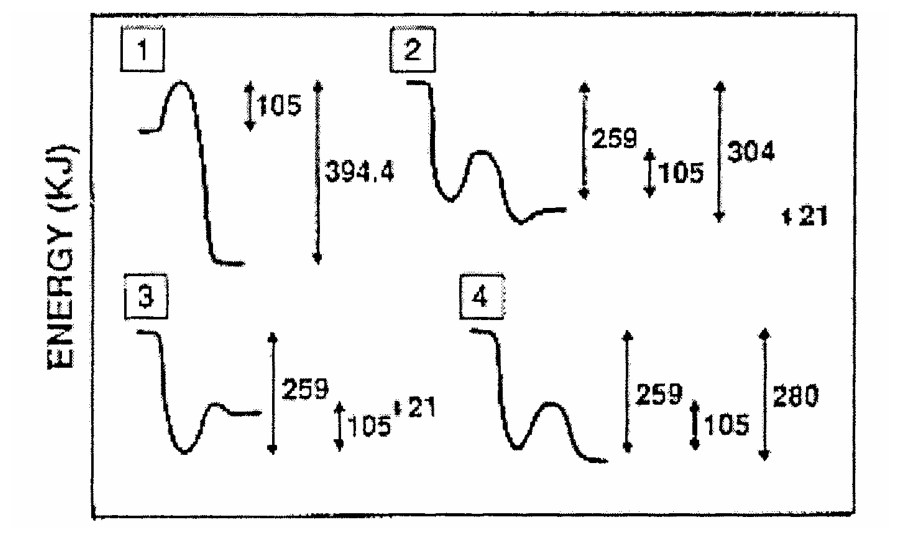
4.11 Mark the correct alternative of [ 1 ] – [ 4 ] on the answer sheet.
Official English text of the problem.
Answers
Species names and SMILES are collected in the Solution.
- 4.1: [4], \(p(\ce{O2})<1\ \mathrm{atm}\), \(t>650\,^\circ\mathrm C\), using the intended qualitative oxide-stability argument.
- 4.2: \(\boxed{\Delta_rG=0,\quad K_p=1}\), taking \(p^\circ=1\ \mathrm{atm}\).
- 4.3: \[ \ce{[PtCl6]^2- + 2CO3^2- + 4H2O -> PtO2 . 4H2O(s) + 6Cl- + 2CO2(g)} \] \[ \ce{PtO2 . 4H2O(s) ->[\Delta] PtO2(s) + 4H2O(g)} \]
- 4.4: \[ \ce{PtO2 . 4H2O(s) + 4H+ + 6Cl- -> [PtCl6]^2- + 6H2O} \] \[ \ce{PtO2 . 4H2O(s) + 2OH- -> [Pt(OH)6]^2- + 2H2O} \]
- 4.5: In the atomic-chlorine description specified in the problem, \[ \ce{HNO3 + 3HCl -> NOCl + 2Cl + 2H2O} \] \[ \ce{Pt + 4Cl + 2Cl- -> [PtCl6]^2-} \]
- 4.6: A formal primary decomposition is \[ \ce{(NH4)2[PtCl6] ->[\Delta] Pt + 2NH3 + 2HCl + 2Cl2}. \] Allowing subsequent reaction between ammonia and chlorine gives the nitrogen-forming net balance \[ \ce{3(NH4)2[PtCl6] ->[\Delta] 3Pt + 2N2 + 2NH3 + 18HCl}. \] The unspecified gas products require the qualification discussed below.
- 4.7: [2], specifically square planar.
- 4.8: Cis, because its standard Gibbs energy of formation is lower.
- 4.9: [1] yes; [4] exothermic; [6] entropy decreases. For \(\ce{CO + 1/2O2 -> CO2}\), \[ \boxed{\Delta_rH^\circ=-283.0\ \mathrm{kJ\,mol^{-1}},\quad \Delta_rG^\circ=-257.1\ \mathrm{kJ\,mol^{-1}},\quad \Delta_rS^\circ=-86.9\ \mathrm{J\,mol^{-1}\,K^{-1}}.} \] For \(\ce{2CO + O2 -> 2CO2}\), these values double.
- 4.10: For the reaction producing one mole of carbon dioxide, assuming temperature-independent reaction enthalpy and entropy, \[ \boxed{K_p(T)\simeq \exp\!\left(\frac{3.404\times10^4\ \mathrm K}{T}-10.45\right).} \] Thus \(K_p\) decreases as temperature increases.
- 4.11: [2]. Relative energy levels are \(0,-259,-154,-304,-283\ \mathrm{kJ\,mol^{-1}}\), in reaction order.
Solution
Chemical names and SMILES
The following identifiers cover the species used in the answers. Dative bonds are written with ->. The platinum(IV) complexes are octahedral; the square-planar stereochemistry of the two platinum(II) isomers is specified explicitly.
Platinum metal and the oxides are extended solids, so their entries represent an atom or formal formula-unit composition, not a discrete molecular structure. SMILES also do not specify gas spin states or the adsorption sites on the catalyst.
| Species and name | SMILES |
|---|---|
| \(\ce{Pt}\), platinum | [Pt] |
| \(\ce{PtO2}\), platinum(IV) oxide, formal composition | [Pt+4].[O-2].[O-2] |
| \(\ce{PtO2 . 4H2O}\), hydrated platinum(IV) oxide, formal composition | [Pt+4].[O-2].[O-2].O.O.O.O |
| \(\ce{[PtCl6]^2-}\), hexachloroplatinate(IV) ion | [Cl-]->[Pt+4](<-[Cl-])(<-[Cl-])(<-[Cl-])(<-[Cl-])<-[Cl-] |
| \(\ce{[Pt(OH)6]^2-}\), hexahydroxoplatinate(IV) ion | [OH-]->[Pt+4](<-[OH-])(<-[OH-])(<-[OH-])(<-[OH-])<-[OH-] |
| \(\ce{(NH4)2[PtCl6]}\), diammonium hexachloroplatinate(IV) | [NH4+].[NH4+].[Cl-]->[Pt+4](<-[Cl-])(<-[Cl-])(<-[Cl-])(<-[Cl-])<-[Cl-] |
| cis-\(\ce{Pt(NH3)2Cl2}\), cis-diamminedichloridoplatinum(II), cisplatin | [NH3]->[Pt@SP1+2](<-[NH3])(<-[Cl-])<-[Cl-] |
| trans-\(\ce{Pt(NH3)2Cl2}\), trans-diamminedichloridoplatinum(II), transplatin | [NH3]->[Pt@SP2+2](<-[NH3])(<-[Cl-])<-[Cl-] |
| \(\ce{Na2CO3}\), sodium carbonate | [Na+].[Na+].[O-]C(=O)[O-] |
| \(\ce{NaOH}\), sodium hydroxide | [Na+].[OH-] |
| \(\ce{CO3^2-}\), carbonate ion | [O-]C(=O)[O-] |
| \(\ce{H+}\), hydrogen ion | [H+] |
| \(\ce{Cl-}\), chloride ion | [Cl-] |
| \(\ce{OH-}\), hydroxide ion | [OH-] |
| \(\ce{NH4+}\), ammonium ion | [NH4+] |
| \(\ce{NH4Cl}\), ammonium chloride | [NH4+].[Cl-] |
| \(\ce{H2O}\), water | O |
| \(\ce{HCl}\), hydrogen chloride; hydrochloric acid when dissolved in water | Cl |
| \(\ce{HNO3}\), nitric acid | O[N+](=O)[O-] |
| \(\ce{NOCl}\), nitrosyl chloride | O=NCl |
| \(\ce{Cl}\), atomic chlorine | [Cl] |
| \(\ce{Cl2}\), molecular chlorine | ClCl |
| \(\ce{NH3}\), ammonia | N |
| \(\ce{N2}\), nitrogen | N#N |
| \(\ce{O2}\), oxygen | O=O |
| \(\ce{O}\), atomic oxygen | [O] |
| \(\ce{CO}\), carbon monoxide | [C-]#[O+] |
| \(\ce{CO2}\), carbon dioxide | O=C=O |
4.1
Consider the equilibrium \[ \ce{PtO2(s) <=> Pt(s) + O2(g)}. \]
Lowering the oxygen partial pressure favors decomposition, which produces oxygen. Using the intended assumption that oxide formation is exothermic, increasing the temperature also favors decomposition.
Thus the combination that most clearly favors native platinum over its oxide is \[ \boxed{p(\ce{O2})<1\ \mathrm{atm},\qquad t>650\,^\circ\mathrm C}, \] namely [4].
4.2
For formation, \[ \ce{Pt(s) + O2(g) <=> PtO2(s)}. \]
The reaction Gibbs energy is zero at equilibrium: \[ \boxed{\Delta_rG=0}. \]
Pure solid activities equal unity. Defining a dimensionless equilibrium constant with \(p^\circ=1\ \mathrm{atm}\), \[ K_p= \frac{a(\ce{PtO2})} {a(\ce{Pt})[p(\ce{O2})/p^\circ]} =\frac{p^\circ}{p(\ce{O2})}. \]
Since the equilibrium oxygen pressure is \(1\ \mathrm{atm}\), \[ \boxed{K_p=1}. \] With this standard-pressure convention, \(\Delta_rG^\circ=-RT\ln K_p=0\) as well.
If an unnormalized, dimensional pressure quotient is used instead, its value is \(1\ \mathrm{atm^{-1}}\).
4.3
Carbonate acts as a base, allowing precipitation of the hydrous oxide while carbon dioxide is released. The net ionic equation is \[ \boxed{\ce{[PtCl6]^2- + 2CO3^2- + 4H2O -> PtO2 . 4H2O(s) + 6Cl- + 2CO2(g)}}. \]
Both sides have charge \(-6\), and all atoms balance. Sodium ions are spectators. Platinum remains in oxidation state \(+IV\), so this is not a redox reaction.
After filtration, heating removes the water: \[ \boxed{\ce{PtO2 . 4H2O(s) ->[\Delta] PtO2(s) + 4H2O(g)}}. \]
4.4
The hydrated oxide is amphoteric.
In hydrochloric acid, protons convert the oxide/hydroxide groups into water, and chloride coordinates the platinum: \[ \boxed{\ce{PtO2 . 4H2O(s) + 4H+ + 6Cl- -> [PtCl6]^2- + 6H2O}}. \]
The total charge is \(-2\) on either side.
In sodium hydroxide, the soluble product is the hexahydroxoplatinate(IV) ion: \[ \boxed{\ce{PtO2 . 4H2O(s) + 2OH- -> [Pt(OH)6]^2- + 2H2O}}. \]
Again, both sides have charge \(-2\). Platinum remains \(+IV\) in both reactions.
4.5
Following the problem’s explicit description in terms of atomic chlorine, mixing the acids gives \[ \boxed{\ce{HNO3 + 3HCl -> NOCl + 2Cl + 2H2O}}. \]
Nitrogen is reduced from \(+V\) in nitric acid to \(+III\) in nitrosyl chloride. Two chloride ions are correspondingly oxidized to two neutral chlorine atoms.
Platinum then reacts according to \[ \boxed{\ce{Pt + 4Cl + 2Cl- -> [PtCl6]^2-}}. \]
Platinum loses four electrons, becoming platinum(IV); four chlorine atoms each gain one electron. Two further chloride ions complete the six-coordinate, octahedral complex.
These equations use the atomic-chlorine model stated in the question; they do not establish a detailed dissolution mechanism.
4.6
A balanced formal decomposition into platinum, ammonia, hydrogen chloride and chlorine is \[ \boxed{\ce{(NH4)2[PtCl6](s) ->[\Delta] Pt(s) + 2NH3(g) + 2HCl(g) + 2Cl2(g)}}. \]
Here platinum is reduced from \(+IV\) to zero, and four chloride ligands are oxidized to two chlorine molecules. The remaining atoms give ammonia and hydrogen chloride.
However, ammonia and chlorine can react further. A nitrogen-forming balance is \[ \ce{4NH3 + 6Cl2 -> 2N2 + 12HCl}. \]
Adding this to three times the formal decomposition above gives \[ \boxed{\ce{3(NH4)2[PtCl6](s) ->[\Delta] 3Pt(s) + 2N2(g) + 2NH3(g) + 18HCl(g)}}. \]
For this net reaction, four nitrogen atoms are oxidized from \(-III\) to zero, supplying the twelve electrons required to reduce three platinum(IV) centers.
Grouping two ammonia and two hydrogen chloride molecules as ammonium chloride gives the corresponding formula-unit balance \[ \ce{3(NH4)2[PtCl6] ->[\Delta] 3Pt + 2N2 + 2NH4Cl + 16HCl}. \]
At elevated temperature, the volatile ammonium chloride can be represented through its dissociation into ammonia and hydrogen chloride. These equations distinguish primary decomposition from secondary gas chemistry; the statement does not specify the final gas composition.
4.7
There are four ligands around platinum. In a tetrahedral arrangement, all pairs of ligand positions are equivalent, so a complex containing two ligands of each kind cannot have distinct cis and trans forms.
A square-planar arrangement permits:
- Cisplatin: the two chloride ligands are adjacent, with a \(\ce{Cl-Pt-Cl}\) angle of approximately \(90^\circ\); the ammonia ligands are also adjacent.
- Transplatin: the chloride ligands are opposite, with a \(\ce{Cl-Pt-Cl}\) angle of \(180^\circ\); the ammonia ligands are also opposite.
All four donor atoms and the platinum atom lie in one plane. Therefore the answer is [2], planar, specifically square planar. The stereochemical SMILES are given in the identifier table.
4.8
Thermodynamic stability at fixed temperature and pressure is determined by Gibbs energy. For cis-to-trans conversion, \[ \begin{aligned} \Delta_rG^\circ &=\Delta_fG^\circ(\text{trans})-\Delta_fG^\circ(\text{cis})\\ &=-222.8-(-228.7)\\ &=+5.9\ \mathrm{kJ\,mol^{-1}}. \end{aligned} \]
Thus the conversion to trans is unfavorable under the standard conditions of the supplied data: \[ \boxed{\text{The cis form is thermodynamically more stable.}} \]
Although the trans form has the lower enthalpy of formation, its entropy contribution makes its Gibbs energy higher.
4.9
Use the reaction normalized to one mole of carbon monoxide: \[ \ce{CO(g) + 1/2O2(g) -> CO2(g)}. \]
The standard formation enthalpy and Gibbs energy of elemental oxygen in its standard state are zero.
Hence \[ \begin{aligned} \Delta_rH^\circ &=-393.5-(-110.5)\\ &=\boxed{-283.0\ \mathrm{kJ\,mol^{-1}}}, \\[4pt] \Delta_rG^\circ &=-394.4-(-137.3)\\ &=\boxed{-257.1\ \mathrm{kJ\,mol^{-1}}}. \end{aligned} \]
Since \(\Delta_rG^\circ<0\), the forward reaction is spontaneous under standard conditions at 25 °C: [1]. Since \(\Delta_rH^\circ<0\), it is exothermic: [4].
Using \[ \Delta_rG^\circ=\Delta_rH^\circ-T\Delta_rS^\circ \] at \(T=298.15\ \mathrm K\), \[ \begin{aligned} \Delta_rS^\circ &=\frac{-283.0-(-257.1)}{298.15} \ \mathrm{kJ\,mol^{-1}\,K^{-1}}\\ &=\boxed{-86.9\ \mathrm{J\,mol^{-1}\,K^{-1}}}. \end{aligned} \]
The system’s entropy decreases: [6], consistent with the reduction from \(1.5\) moles of gas to \(1\) mole of gas.
This does not conflict with spontaneity: the released heat increases the surroundings’ entropy by more than the system’s entropy decreases.
For the integer-coefficient equation \[ \ce{2CO(g) + O2(g) -> 2CO2(g)}, \] the corresponding values are \[ \Delta_rH^\circ=-566.0\ \mathrm{kJ\,mol^{-1}},\quad \Delta_rG^\circ=-514.2\ \mathrm{kJ\,mol^{-1}},\quad \Delta_rS^\circ=-173.7\ \mathrm{J\,mol^{-1}\,K^{-1}}, \] where “per mole” now refers to one mole of reaction as written.
4.10
For the one-carbon-monoxide reaction, \[ K_p= \frac{p(\ce{CO2})/p^\circ} {[p(\ce{CO})/p^\circ][p(\ce{O2})/p^\circ]^{1/2}}. \]
The exact van ’t Hoff relation is \[ \boxed{\frac{d\ln K_p}{dT}=\frac{\Delta_rH^\circ(T)}{RT^2}}. \]
If \(\Delta_rH^\circ\) is treated as constant, integration gives \[ \boxed{ \ln\frac{K_p(T)}{K_p(T_0)} =-\frac{\Delta_rH^\circ}{R} \left(\frac1T-\frac1{T_0}\right) }. \]
Equivalently, taking both reaction enthalpy and entropy as temperature independent, \[ \ln K_p =-\frac{\Delta_rG^\circ}{RT} =-\frac{\Delta_rH^\circ}{RT}+\frac{\Delta_rS^\circ}{R}. \]
Using \(R=8.314\ \mathrm{J\,mol^{-1}\,K^{-1}}\), \[ \ln K_p(T) =\frac{283000}{8.314\,T}-\frac{86.869}{8.314}, \] so \[ \boxed{ K_p(T)\simeq \exp\!\left(\frac{3.404\times10^4\ \mathrm K}{T}-10.45\right) }. \]
At \(298.15\ \mathrm K\), this gives approximately \[ K_p=1.1\times10^{45}. \]
Because the reaction is exothermic, \(d\ln K_p/dT<0\): raising the temperature decreases the equilibrium constant.
If the reaction is instead written as \(\ce{2CO + O2 -> 2CO2}\), its equilibrium constant is the square of the one above: \[ K_{p,2}(T)\simeq \exp\!\left(\frac{6.808\times10^4\ \mathrm K}{T}-20.90\right). \]
4.11
Take the gaseous reactants and free platinum surface as the zero of energy, per mole of carbon monoxide oxidized.
-
Adsorption and oxygen dissociation lower the energy by \(259\ \mathrm{kJ\,mol^{-1}}\): \[ E_{\text{adsorbed reactants}}=-259\ \mathrm{kJ\,mol^{-1}}. \]
-
The activation barrier is \(105\ \mathrm{kJ\,mol^{-1}}\) above those adsorbed reactants: \[ E_{\text{transition state}}=-259+105=-154\ \mathrm{kJ\,mol^{-1}}. \]
-
The final gaseous product must lie at the overall reaction enthalpy calculated in 4.9: \[ E_{\text{gaseous product}}=-283\ \mathrm{kJ\,mol^{-1}}. \]
-
Desorption requires \(21\ \mathrm{kJ\,mol^{-1}}\), so the adsorbed carbon dioxide lies below the gaseous product: \[ E_{\text{adsorbed product}}=-283-21=-304\ \mathrm{kJ\,mol^{-1}}. \]
The required profile therefore starts at zero, falls to \(-259\), rises to \(-154\), falls to \(-304\), and finally rises to \(-283\ \mathrm{kJ\,mol^{-1}}\).
This is diagram [2]. The catalyst provides a reaction pathway with surface intermediates but does not change the overall reaction enthalpy or equilibrium constant.
The solution was checked against the official solution.
IChO 1994 · Theorieaufgabe 4
Platinchemie und die katalytische Oxidation von Kohlenstoffmonoxid
Platin(IV)-oxid kommt in der Natur nicht vor, kann aber im Labor hergestellt werden. Festes Platin(IV)-oxid steht bei 1 atm (= \(1.01325\times10^5\) Pa) und 650 °C mit metallischem Platin und gasförmigem Sauerstoff im Gleichgewicht.
4.1 Dies legt nahe, dass auf der Erde bei der Entstehung der uns bekannten Mineralien folgende Bedingungen herrschten:
[1] \(p(\ce{O2})=1\) atm, \(t=650\) °C;
[2] \(p(\ce{O2})<1\) atm, \(t<650\) °C;
[3] \(p(\ce{O2})>1\) atm, \(t<650\) °C;
[4] \(p(\ce{O2})<1\) atm, \(t>650\) °C;
[5] \(p(\ce{O2})>1\) atm, \(t>650\) °C
Markieren Sie die wahrscheinlichste Alternative [1] – [5] auf dem Antwortblatt. Beachten Sie bitte, dass nur die Markierung einer einzigen Alternative gewertet wird.
4.2 Welche Werte haben \(\Delta G\) und \(K_p\) für die Bildung von Platin(IV)-oxid bei einem Sauerstoffdruck von 1 atm und einer Temperatur von 650 °C?
Zur Herstellung von Platin(IV)-oxid wird eine Lösung, die Hexachloridoplatinat(IV)-Ionen enthält, mit Natriumcarbonat zum Sieden erhitzt. Dabei entsteht \(\ce{PtO2 . nH2O}\), das anschließend durch Filtrieren und Wärmebehandlung in Platin(IV)-oxid überführt wird. Im Folgenden nehmen wir \(n=4\) an.
\(\ce{PtO2 . 4H2O}\) bzw. \(\ce{Pt(OH)4 . 2H2O}\) lässt sich in Säuren und starken Basen lösen.
4.3 Stellen Sie die ausgeglichenen Reaktionsgleichungen für die Herstellung von Platin(IV)-oxid nach dem oben beschriebenen Verfahren auf.
4.4 Stellen Sie die ausgeglichenen Reaktionsgleichungen für das Auflösen von \(\ce{PtO2 . 4H2O}\) sowohl in Salzsäure als auch in Natronlauge auf.
Platin kommt in der Natur hauptsächlich als Metall vor (im Gemisch oder in Legierungen mit anderen Edelmetallen). Platin löst sich in Königswasser unter Bildung von Hexachloridoplatinat(IV)-Ionen. Königswasser ist ein Gemisch aus konzentrierter Salzsäure und Salpetersäure im Verhältnis 3 : 1 sowie aus dem Nitrosylchlorid (\(\ce{NOCl}\)) und dem atomaren Chlor, die beim Mischen entstehen. Letzteres gilt als die für das Auflösen wirksame Komponente.
Die Hexachloridoplatinat(IV)-Ionen können als Diammoniumhexachloridoplatinat(IV) gefällt werden; bei der thermischen Zersetzung dieser Verbindung entstehen fein pulverisiertes Platin und gasförmige Produkte.
4.5 Stellen Sie die ausgeglichenen Reaktionsgleichungen für die Bildung von Königswasser und dessen Reaktion mit Platin auf.
4.6 Stellen Sie die ausgeglichene Reaktionsgleichung für die thermische Zersetzung von Diammoniumhexachloridoplatinat(IV) bei erhöhter Temperatur auf.
Aus Diammoniumhexachloridoplatinat(IV) lässt sich \(\ce{Pt(NH3)2Cl2}\) herstellen, das in der cis-Form (\(\Delta_fH^0=-467.4\ \mathrm{kJ\,mol^{-1}}\), \(\Delta_fG^0=-228.7\ \mathrm{kJ\,mol^{-1}}\)) und in der trans-Form (\(\Delta_fH^0=-480.3\ \mathrm{kJ\,mol^{-1}}\), \(\Delta_fG^0=-222.8\ \mathrm{kJ\,mol^{-1}}\)) vorkommt.
4.7 Das Auftreten der Isomere zeigt, dass \(\ce{Pt(NH3)2Cl2}\) folgende Geometrie besitzt:
[ 1 ] linear,
[ 2 ] planar,
[ 3 ] tetraedrisch,
[ 4 ] oktaedrisch.
Markieren Sie die richtige Alternative [ 1 ] – [ 4 ] auf dem Antwortblatt.
4.8 Ist die cis-Form oder die trans-Form thermodynamisch stabiler?
Platin wird in modernen Kraftfahrzeugen als Katalysator eingesetzt. Im Katalysator reagiert Kohlenstoffmonoxid (\(\Delta_fH^0=-110.5\ \mathrm{kJ\,mol^{-1}}\), \(\Delta_fG^0=-137.3\ \mathrm{kJ\,mol^{-1}}\)) mit Sauerstoff zu Kohlenstoffdioxid (\(\Delta_fH^0=-393.5\ \mathrm{kJ\,mol^{-1}}\), \(\Delta_fG^0=-394.4\ \mathrm{kJ\,mol^{-1}}\)).
4.9 Läuft die Reaktion bei 25 °C spontan ab?
[ 1 ] ja oder
[ 2 ] nein.
Ist die Reaktion:
[ 3 ] endotherm oder
[ 4 ] exotherm?
Berechnen Sie \(\Delta S^\circ\) für die Reaktion.
Stellen Sie fest, ob die Entropie des Reaktionssystems
[5] zunimmt oder
[6] abnimmt.
4.10 Leiten Sie für diesen Fall einen Ausdruck für die Temperaturabhängigkeit der Gleichgewichtskonstante her.
Die katalytische Gesamtreaktion ist einfach, während der Reaktionsmechanismus in der homogenen Phase mit einer großen Zahl von Reaktionsschritten sehr kompliziert ist und sich der Verlauf wegen seines ausgeprägten Kettencharakters nur schwer kontrollieren lässt. Mit Platin als Katalysator sind die wesentlichen Reaktionsschritte: (i) Adsorption von \(\ce{CO}\) und Adsorption/Dissoziation von \(\ce{O2}\) (\(\Delta H=-259\) kJ pro mol \(\ce{CO + O}\)), (ii) deren Aktivierung (105 kJ pro mol \(\ce{CO + O}\)) und (iii) die Reaktion und die Desorption von \(\ce{CO2}\) (\(\Delta H=21\) kJ pro mol \(\ce{CO2}\)).
Ein eindimensionales Energiediagramm für die platinkatalysierte Oxidation von Kohlenstoffmonoxid zu Kohlenstoffdioxid lässt sich wie folgt darstellen:
4.11 Markieren Sie die richtige Alternative [ 1 ] – [ 4 ] auf dem Antwortblatt.
Aufgabentext aus dem offiziellen englischen Text übersetzt.
Antworten
Die Namen der chemischen Spezies und ihre SMILES sind in der Lösung zusammengestellt.
- 4.1: [4], \(p(\ce{O2})<1\ \mathrm{atm}\), \(t>650\,^\circ\mathrm C\), gemäß der beabsichtigten qualitativen Argumentation zur Oxidstabilität.
- 4.2: \(\boxed{\Delta_rG=0,\quad K_p=1}\), mit \(p^\circ=1\ \mathrm{atm}\).
- 4.3: \[ \ce{[PtCl6]^2- + 2CO3^2- + 4H2O -> PtO2 . 4H2O(s) + 6Cl- + 2CO2(g)} \] \[ \ce{PtO2 . 4H2O(s) ->[\Delta] PtO2(s) + 4H2O(g)} \]
- 4.4: \[ \ce{PtO2 . 4H2O(s) + 4H+ + 6Cl- -> [PtCl6]^2- + 6H2O} \] \[ \ce{PtO2 . 4H2O(s) + 2OH- -> [Pt(OH)6]^2- + 2H2O} \]
- 4.5: In der in der Aufgabe vorgegebenen Beschreibung mit atomarem Chlor gilt: \[ \ce{HNO3 + 3HCl -> NOCl + 2Cl + 2H2O} \] \[ \ce{Pt + 4Cl + 2Cl- -> [PtCl6]^2-} \]
- 4.6: Eine formale primäre Zersetzung lautet \[ \ce{(NH4)2[PtCl6] ->[\Delta] Pt + 2NH3 + 2HCl + 2Cl2}. \] Berücksichtigt man die anschließende Reaktion zwischen Ammoniak und Chlor, erhält man die Nettogleichung unter Bildung von Stickstoff: \[ \ce{3(NH4)2[PtCl6] ->[\Delta] 3Pt + 2N2 + 2NH3 + 18HCl}. \] Da die gasförmigen Produkte nicht näher angegeben sind, ist die unten erläuterte Einschränkung erforderlich.
- 4.7: [2], genauer quadratisch-planar.
- 4.8: Cis, da ihre Standardbildungs-Gibbs-Energie niedriger ist.
- 4.9: [1] ja; [4] exotherm; [6] die Entropie nimmt ab. Für \(\ce{CO + 1/2O2 -> CO2}\) gilt: \[ \boxed{\Delta_rH^\circ=-283.0\ \mathrm{kJ\,mol^{-1}},\quad \Delta_rG^\circ=-257.1\ \mathrm{kJ\,mol^{-1}},\quad \Delta_rS^\circ=-86.9\ \mathrm{J\,mol^{-1}\,K^{-1}}.} \] Für \(\ce{2CO + O2 -> 2CO2}\) verdoppeln sich diese Werte.
- 4.10: Für die Reaktion, bei der ein Mol Kohlenstoffdioxid entsteht, unter der Annahme temperaturunabhängiger Reaktionsenthalpie und Reaktionsentropie: \[ \boxed{K_p(T)\simeq \exp\!\left(\frac{3.404\times10^4\ \mathrm K}{T}-10.45\right).} \] Somit nimmt \(K_p\) mit steigender Temperatur ab.
- 4.11: [2]. Die relativen Energieniveaus betragen in der Reihenfolge des Reaktionsverlaufs \(0,-259,-154,-304,-283\ \mathrm{kJ\,mol^{-1}}\).
Lösung
Chemische Namen und SMILES
Die folgenden Bezeichnungen und SMILES erfassen die in den Antworten verwendeten Spezies. Koordinative Bindungen werden mit -> geschrieben. Die Platin(IV)-Komplexe sind oktaedrisch; die quadratisch-planare Stereochemie der beiden Platin(II)-Isomere ist ausdrücklich angegeben.
Metallisches Platin und die Oxide sind ausgedehnte Festkörper; ihre Einträge stellen daher ein Atom oder die formale Zusammensetzung einer Formeleinheit dar, keine diskrete Molekülstruktur. SMILES geben auch weder die Spinzustände der Gasteilchen noch die Adsorptionsplätze auf dem Katalysator an.
| Spezies und Name | SMILES |
|---|---|
| \(\ce{Pt}\), Platin | [Pt] |
| \(\ce{PtO2}\), Platin(IV)-oxid, formale Zusammensetzung | [Pt+4].[O-2].[O-2] |
| \(\ce{PtO2 . 4H2O}\), hydratisiertes Platin(IV)-oxid, formale Zusammensetzung | [Pt+4].[O-2].[O-2].O.O.O.O |
| \(\ce{[PtCl6]^2-}\), Hexachloridoplatinat(IV)-Ion | [Cl-]->[Pt+4](<-[Cl-])(<-[Cl-])(<-[Cl-])(<-[Cl-])<-[Cl-] |
| \(\ce{[Pt(OH)6]^2-}\), Hexahydroxidoplatinat(IV)-Ion | [OH-]->[Pt+4](<-[OH-])(<-[OH-])(<-[OH-])(<-[OH-])<-[OH-] |
| \(\ce{(NH4)2[PtCl6]}\), Diammoniumhexachloridoplatinat(IV) | [NH4+].[NH4+].[Cl-]->[Pt+4](<-[Cl-])(<-[Cl-])(<-[Cl-])(<-[Cl-])<-[Cl-] |
| cis-\(\ce{Pt(NH3)2Cl2}\), cis-Diammindichloridoplatin(II), Cisplatin | [NH3]->[Pt@SP1+2](<-[NH3])(<-[Cl-])<-[Cl-] |
| trans-\(\ce{Pt(NH3)2Cl2}\), trans-Diammindichloridoplatin(II), Transplatin | [NH3]->[Pt@SP2+2](<-[NH3])(<-[Cl-])<-[Cl-] |
| \(\ce{Na2CO3}\), Natriumcarbonat | [Na+].[Na+].[O-]C(=O)[O-] |
| \(\ce{NaOH}\), Natriumhydroxid | [Na+].[OH-] |
| \(\ce{CO3^2-}\), Carbonat-Ion | [O-]C(=O)[O-] |
| \(\ce{H+}\), Wasserstoff-Ion | [H+] |
| \(\ce{Cl-}\), Chlorid-Ion | [Cl-] |
| \(\ce{OH-}\), Hydroxid-Ion | [OH-] |
| \(\ce{NH4+}\), Ammonium-Ion | [NH4+] |
| \(\ce{NH4Cl}\), Ammoniumchlorid | [NH4+].[Cl-] |
| \(\ce{H2O}\), Wasser | O |
| \(\ce{HCl}\), Chlorwasserstoff; in Wasser gelöst Salzsäure | Cl |
| \(\ce{HNO3}\), Salpetersäure | O[N+](=O)[O-] |
| \(\ce{NOCl}\), Nitrosylchlorid | O=NCl |
| \(\ce{Cl}\), atomares Chlor | [Cl] |
| \(\ce{Cl2}\), molekulares Chlor | ClCl |
| \(\ce{NH3}\), Ammoniak | N |
| \(\ce{N2}\), Stickstoff | N#N |
| \(\ce{O2}\), Sauerstoff | O=O |
| \(\ce{O}\), atomarer Sauerstoff | [O] |
| \(\ce{CO}\), Kohlenstoffmonoxid | [C-]#[O+] |
| \(\ce{CO2}\), Kohlenstoffdioxid | O=C=O |
4.1
Betrachten wir das Gleichgewicht \[ \ce{PtO2(s) <=> Pt(s) + O2(g)}. \]
Eine Absenkung des Sauerstoffpartialdrucks begünstigt die Zersetzung, bei der Sauerstoff entsteht. Unter der beabsichtigten Annahme, dass die Oxidbildung exotherm ist, begünstigt auch eine Temperaturerhöhung die Zersetzung.
Die Kombination, die gediegenes Platin gegenüber seinem Oxid am eindeutigsten begünstigt, ist somit \[ \boxed{p(\ce{O2})<1\ \mathrm{atm},\qquad t>650\,^\circ\mathrm C}, \] also [4].
4.2
Für die Bildung gilt: \[ \ce{Pt(s) + O2(g) <=> PtO2(s)}. \]
Die Gibbs-Reaktionsenergie ist im Gleichgewicht null: \[ \boxed{\Delta_rG=0}. \]
Die Aktivitäten reiner Feststoffe sind gleich eins. Definiert man eine dimensionslose Gleichgewichtskonstante mit \(p^\circ=1\ \mathrm{atm}\), so gilt: \[ K_p= \frac{a(\ce{PtO2})} {a(\ce{Pt})[p(\ce{O2})/p^\circ]} =\frac{p^\circ}{p(\ce{O2})}. \]
Da der Sauerstoffdruck im Gleichgewicht \(1\ \mathrm{atm}\) beträgt, gilt: \[ \boxed{K_p=1}. \] Mit dieser Konvention für den Standarddruck gilt außerdem \(\Delta_rG^\circ=-RT\ln K_p=0\).
Verwendet man stattdessen einen nicht normierten, dimensionsbehafteten Druckquotienten, beträgt dessen Wert \(1\ \mathrm{atm^{-1}}\).
4.3
Carbonat wirkt als Base und ermöglicht die Fällung des wasserhaltigen Oxids unter Freisetzung von Kohlenstoffdioxid. Die Netto-Ionengleichung lautet \[ \boxed{\ce{[PtCl6]^2- + 2CO3^2- + 4H2O -> PtO2 . 4H2O(s) + 6Cl- + 2CO2(g)}}. \]
Beide Seiten haben die Ladung \(-6\), und die Bilanz stimmt für alle Atome. Natrium-Ionen sind Zuschauerionen. Platin verbleibt in der Oxidationsstufe \(+IV\); es handelt sich daher nicht um eine Redoxreaktion.
Nach der Filtration wird das Wasser durch Erhitzen entfernt: \[ \boxed{\ce{PtO2 . 4H2O(s) ->[\Delta] PtO2(s) + 4H2O(g)}}. \]
4.4
Das hydratisierte Oxid ist amphoter.
In Salzsäure wandeln Protonen die Oxid-/Hydroxidgruppen in Wasser um, und Chlorid koordiniert an das Platin: \[ \boxed{\ce{PtO2 . 4H2O(s) + 4H+ + 6Cl- -> [PtCl6]^2- + 6H2O}}. \]
Die Gesamtladung beträgt auf beiden Seiten \(-2\).
In Natronlauge ist das lösliche Produkt das Hexahydroxidoplatinat(IV)-Ion: \[ \boxed{\ce{PtO2 . 4H2O(s) + 2OH- -> [Pt(OH)6]^2- + 2H2O}}. \]
Auch hier haben beide Seiten die Ladung \(-2\). Platin verbleibt in beiden Reaktionen in der Oxidationsstufe \(+IV\).
4.5
Gemäß der ausdrücklichen Beschreibung der Aufgabe mit atomarem Chlor ergibt das Mischen der Säuren \[ \boxed{\ce{HNO3 + 3HCl -> NOCl + 2Cl + 2H2O}}. \]
Stickstoff wird von \(+V\) in Salpetersäure zu \(+III\) in Nitrosylchlorid reduziert. Entsprechend werden zwei Chlorid-Ionen zu zwei neutralen Chloratomen oxidiert.
Platin reagiert anschließend gemäß \[ \boxed{\ce{Pt + 4Cl + 2Cl- -> [PtCl6]^2-}}. \]
Platin gibt vier Elektronen ab und wird zu Platin(IV); vier Chloratome nehmen jeweils ein Elektron auf. Zwei weitere Chlorid-Ionen vervollständigen den sechsfach koordinierten, oktaedrischen Komplex.
Diese Gleichungen verwenden das in der Aufgabe angegebene Modell mit atomarem Chlor; sie belegen keinen detaillierten Auflösungsmechanismus.
4.6
Eine ausgeglichene formale Zersetzung zu Platin, Ammoniak, Chlorwasserstoff und Chlor lautet \[ \boxed{\ce{(NH4)2[PtCl6](s) ->[\Delta] Pt(s) + 2NH3(g) + 2HCl(g) + 2Cl2(g)}}. \]
Hier wird Platin von \(+IV\) auf null reduziert, und vier Chloridliganden werden zu zwei Chlormolekülen oxidiert. Die übrigen Atome ergeben Ammoniak und Chlorwasserstoff.
Ammoniak und Chlor können jedoch weiterreagieren. Eine Bilanz unter Bildung von Stickstoff lautet \[ \ce{4NH3 + 6Cl2 -> 2N2 + 12HCl}. \]
Addiert man diese Gleichung zum Dreifachen der obigen formalen Zersetzung, erhält man \[ \boxed{\ce{3(NH4)2[PtCl6](s) ->[\Delta] 3Pt(s) + 2N2(g) + 2NH3(g) + 18HCl(g)}}. \]
Bei dieser Nettoreaktion werden vier Stickstoffatome von \(-III\) auf null oxidiert und liefern damit die zwölf Elektronen, die zur Reduktion von drei Platin(IV)-Zentren benötigt werden.
Fasst man zwei Ammoniak- und zwei Chlorwasserstoffmoleküle als Ammoniumchlorid zusammen, erhält man die entsprechende Bilanz mit Formeleinheiten: \[ \ce{3(NH4)2[PtCl6] ->[\Delta] 3Pt + 2N2 + 2NH4Cl + 16HCl}. \]
Bei erhöhter Temperatur kann das flüchtige Ammoniumchlorid durch seine Dissoziation in Ammoniak und Chlorwasserstoff dargestellt werden. Diese Gleichungen unterscheiden die primäre Zersetzung von der sekundären Gasphasenchemie; die Aufgabenstellung gibt die endgültige Gaszusammensetzung nicht an.
4.7
Um das Platin sind vier Liganden angeordnet. In einer tetraedrischen Anordnung sind alle Paare von Ligandenpositionen gleichwertig, sodass ein Komplex mit jeweils zwei Liganden jeder Art keine unterschiedlichen cis- und trans-Formen aufweisen kann.
Eine quadratisch-planare Anordnung ermöglicht:
- Cisplatin: Die beiden Chloridliganden sind benachbart, mit einem \(\ce{Cl-Pt-Cl}\)-Winkel von ungefähr \(90^\circ\); auch die Ammoniakliganden sind benachbart.
- Transplatin: Die Chloridliganden liegen einander gegenüber, mit einem \(\ce{Cl-Pt-Cl}\)-Winkel von \(180^\circ\); auch die Ammoniakliganden liegen einander gegenüber.
Alle vier Donoratome und das Platinatom liegen in einer Ebene. Die Antwort lautet daher [2], planar, genauer quadratisch-planar. Die stereochemischen SMILES sind in der Tabelle mit den Bezeichnungen angegeben.
4.8
Die thermodynamische Stabilität bei festgelegter Temperatur und festgelegtem Druck wird durch die Gibbs-Energie bestimmt. Für die Umwandlung von cis zu trans gilt: \[ \begin{aligned} \Delta_rG^\circ &=\Delta_fG^\circ(\text{trans})-\Delta_fG^\circ(\text{cis})\\ &=-222.8-(-228.7)\\ &=+5.9\ \mathrm{kJ\,mol^{-1}}. \end{aligned} \]
Die Umwandlung in die trans-Form ist unter den Standardbedingungen der angegebenen Daten somit ungünstig: \[ \boxed{\text{Die cis-Form ist thermodynamisch stabiler.}} \]
Obwohl die trans-Form die niedrigere Bildungsenthalpie besitzt, führt ihr Entropiebeitrag zu einer höheren Gibbs-Energie.
4.9
Wir verwenden die auf ein Mol Kohlenstoffmonoxid normierte Reaktion: \[ \ce{CO(g) + 1/2O2(g) -> CO2(g)}. \]
Die Standardbildungsenthalpie und die Standardbildungs-Gibbs-Energie von elementarem Sauerstoff in seinem Standardzustand sind null.
Damit ergibt sich \[ \begin{aligned} \Delta_rH^\circ &=-393.5-(-110.5)\\ &=\boxed{-283.0\ \mathrm{kJ\,mol^{-1}}}, \\[4pt] \Delta_rG^\circ &=-394.4-(-137.3)\\ &=\boxed{-257.1\ \mathrm{kJ\,mol^{-1}}}. \end{aligned} \]
Da \(\Delta_rG^\circ<0\), läuft die Hinreaktion unter Standardbedingungen bei 25 °C spontan ab: [1]. Da \(\Delta_rH^\circ<0\), ist sie exotherm: [4].
Mit \[ \Delta_rG^\circ=\Delta_rH^\circ-T\Delta_rS^\circ \] ergibt sich bei \(T=298.15\ \mathrm K\): \[ \begin{aligned} \Delta_rS^\circ &=\frac{-283.0-(-257.1)}{298.15} \ \mathrm{kJ\,mol^{-1}\,K^{-1}}\\ &=\boxed{-86.9\ \mathrm{J\,mol^{-1}\,K^{-1}}}. \end{aligned} \]
Die Entropie des Systems nimmt ab: [6], im Einklang mit der Abnahme der Gasstoffmenge von \(1.5\) Mol auf \(1\) Mol.
Dies steht nicht im Widerspruch zum spontanen Ablauf: Die freigesetzte Wärme erhöht die Entropie der Umgebung stärker, als die Entropie des Systems abnimmt.
Für die Gleichung mit ganzzahligen Koeffizienten \[ \ce{2CO(g) + O2(g) -> 2CO2(g)}, \] lauten die entsprechenden Werte \[ \Delta_rH^\circ=-566.0\ \mathrm{kJ\,mol^{-1}},\quad \Delta_rG^\circ=-514.2\ \mathrm{kJ\,mol^{-1}},\quad \Delta_rS^\circ=-173.7\ \mathrm{J\,mol^{-1}\,K^{-1}}, \] wobei sich „pro Mol“ nun auf ein Mol Reaktionsumsatz gemäß der angegebenen Gleichung bezieht.
4.10
Für die Reaktion mit einem Mol Kohlenstoffmonoxid gilt: \[ K_p= \frac{p(\ce{CO2})/p^\circ} {[p(\ce{CO})/p^\circ][p(\ce{O2})/p^\circ]^{1/2}}. \]
Die exakte van-’t-Hoff-Beziehung lautet \[ \boxed{\frac{d\ln K_p}{dT}=\frac{\Delta_rH^\circ(T)}{RT^2}}. \]
Wird \(\Delta_rH^\circ\) als konstant behandelt, ergibt die Integration \[ \boxed{ \ln\frac{K_p(T)}{K_p(T_0)} =-\frac{\Delta_rH^\circ}{R} \left(\frac1T-\frac1{T_0}\right) }. \]
Nimmt man sowohl die Reaktionsenthalpie als auch die Reaktionsentropie als temperaturunabhängig an, gilt gleichwertig: \[ \ln K_p =-\frac{\Delta_rG^\circ}{RT} =-\frac{\Delta_rH^\circ}{RT}+\frac{\Delta_rS^\circ}{R}. \]
Mit \(R=8.314\ \mathrm{J\,mol^{-1}\,K^{-1}}\) ergibt sich \[ \ln K_p(T) =\frac{283000}{8.314\,T}-\frac{86.869}{8.314}, \] also \[ \boxed{ K_p(T)\simeq \exp\!\left(\frac{3.404\times10^4\ \mathrm K}{T}-10.45\right) }. \]
Bei \(298.15\ \mathrm K\) ergibt dies näherungsweise \[ K_p=1.1\times10^{45}. \]
Da die Reaktion exotherm ist, gilt \(d\ln K_p/dT<0\): Eine Erhöhung der Temperatur verringert die Gleichgewichtskonstante.
Wird die Reaktion stattdessen als \(\ce{2CO + O2 -> 2CO2}\) geschrieben, ist ihre Gleichgewichtskonstante das Quadrat der obigen: \[ K_{p,2}(T)\simeq \exp\!\left(\frac{6.808\times10^4\ \mathrm K}{T}-20.90\right). \]
4.11
Wir wählen die gasförmigen Edukte und die freie Platinoberfläche als Energienullpunkt, bezogen auf ein Mol oxidiertes Kohlenstoffmonoxid.
-
Adsorption und Sauerstoffdissoziation senken die Energie um \(259\ \mathrm{kJ\,mol^{-1}}\): \[ E_{\text{adsorbierte Edukte}}=-259\ \mathrm{kJ\,mol^{-1}}. \]
-
Die Aktivierungsbarriere liegt \(105\ \mathrm{kJ\,mol^{-1}}\) über diesen adsorbierten Edukten: \[ E_{\text{Übergangszustand}}=-259+105=-154\ \mathrm{kJ\,mol^{-1}}. \]
-
Das gasförmige Endprodukt muss auf dem Energieniveau der in 4.9 berechneten Gesamtreaktionsenthalpie liegen: \[ E_{\text{gasförmiges Produkt}}=-283\ \mathrm{kJ\,mol^{-1}}. \]
-
Die Desorption erfordert \(21\ \mathrm{kJ\,mol^{-1}}\), sodass das adsorbierte Kohlenstoffdioxid energetisch unter dem gasförmigen Produkt liegt: \[ E_{\text{adsorbiertes Produkt}}=-283-21=-304\ \mathrm{kJ\,mol^{-1}}. \]
Das gesuchte Profil beginnt daher bei null, fällt auf \(-259\), steigt auf \(-154\), fällt auf \(-304\) und steigt schließlich auf \(-283\ \mathrm{kJ\,mol^{-1}}\).
Dies ist Diagramm [2]. Der Katalysator eröffnet einen Reaktionsweg mit Oberflächenintermediaten, verändert jedoch weder die Gesamtreaktionsenthalpie noch die Gleichgewichtskonstante.
Die Lösung wurde mit der offiziellen Lösung abgeglichen.
IChO 1994 · Teori sorusu 4
Platin kimyası ve karbon monoksitin katalitik yükseltgenmesi
Platin(IV) oksit doğada bulunmaz, ancak laboratuvarda hazırlanabilir. Katı platin(IV) oksit, 1 atm (= \(1.01325\times10^5\) Pa) basınçta ve 650 °C sıcaklıkta platin metali ve oksijen gazı ile dengededir.
4.1 Bu durum, bildiğimiz minerallerin oluştuğu dönemde Dünya'daki koşulların aşağıdakilerden biri olduğunu düşündürür:
[1] \(p(\ce{O2})=1\) atm, \(t=650\) °C;
[2] \(p(\ce{O2})<1\) atm, \(t<650\) °C;
[3] \(p(\ce{O2})>1\) atm, \(t<650\) °C;
[4] \(p(\ce{O2})<1\) atm, \(t>650\) °C;
[5] \(p(\ce{O2})>1\) atm, \(t>650\) °C
Cevap kâğıdında [1] – [5] seçeneklerinden en olası olanı işaretleyiniz. Yalnızca tek bir seçeneğin işaretlenmesinin kabul edileceğini unutmayınız.
4.2 1 atm oksijen basıncında ve 650 °C sıcaklıkta platin(IV) oksidin oluşumu için \(\Delta G\) ve \(K_p\) nedir?
Platin(IV) oksidin hazırlanması, hekzakloroplatinat(IV) iyonları içeren bir çözeltinin sodyum karbonat ile kaynatılmasını içerir. Bu işlemde \(\ce{PtO2 . nH2O}\) oluşur; ardından süzme ve ısıl işlem uygulanarak bu madde platin(IV) okside dönüştürülür. Aşağıda \(n=4\) olduğunu varsayıyoruz.
\(\ce{PtO2 . 4H2O}\) veya \(\ce{Pt(OH)4 . 2H2O}\), asitlerde ve kuvvetli bazlarda çözünebilir.
4.3 Yukarıda verilen yönteme göre platin(IV) oksidin hazırlanmasına ilişkin denkleştirilmiş denklemleri yazınız.
4.4 \(\ce{PtO2 . 4H2O}\)'nun hem hidroklorik asitte hem de sodyum hidroksitte çözünmesine ilişkin denkleştirilmiş denklemleri yazınız.
Platin doğada başlıca metal hâlinde (diğer değerli metallerle karışım veya alaşım hâlinde) bulunur. Platin, kral suyunda hekzakloroplatinat(IV) iyonları oluşturarak çözünür. Kral suyu, 3 : 1 oranında derişik hidroklorik asit ve nitrik asit ile bunların karıştırılması sırasında oluşan nitrozil klorür (\(\ce{NOCl}\)) ve atomik klordan oluşan bir karışımdır. Atomik klorun, çözünmeyi sağlayan etkin bileşen olduğu düşünülmektedir.
Hekzakloroplatinat(IV) iyonları diamonyum hekzakloroplatinat(IV) olarak çöktürülebilir ve bu bileşiğin ısıl bozunması sonucunda ince toz hâlinde platin ve gaz ürünler oluşur.
4.5 Kral suyunun oluşumuna ve platin ile tepkimesine ilişkin denkleştirilmiş denklemleri yazınız.
4.6 Diamonyum hekzakloroplatinat(IV)'ın yüksek sıcaklıkta ısıl bozunmasının denkleştirilmiş denklemini yazınız.
Diamonyum hekzakloroplatinat(IV)'tan, cis (\(\Delta_fH^0=-467.4\ \mathrm{kJ\,mol^{-1}}\), \(\Delta_fG^0=-228.7\ \mathrm{kJ\,mol^{-1}}\)) ve trans (\(\Delta_fH^0=-480.3\ \mathrm{kJ\,mol^{-1}}\), \(\Delta_fG^0=-222.8\ \mathrm{kJ\,mol^{-1}}\)) biçimlerinde bulunan \(\ce{Pt(NH3)2Cl2}\) hazırlanabilir.
4.7 İzomerlerin varlığı, \(\ce{Pt(NH3)2Cl2}\)'nin geometrisinin aşağıdakilerden hangisi olduğunu gösterir?
[ 1 ] doğrusal,
[ 2 ] düzlemsel,
[ 3 ] tetrahedral,
[ 4 ] oktahedral geometri.
Cevap kâğıdında [ 1 ] – [ 4 ] seçeneklerinden doğru olanı işaretleyiniz.
4.8 Termodinamik açıdan cis biçimi mi, trans biçimi mi daha kararlıdır?
Platin, modern otomobillerde katalizör olarak kullanılır. Katalizörde karbon monoksit (\(\Delta_fH^0=-110.5\ \mathrm{kJ\,mol^{-1}}\), \(\Delta_fG^0=-137.3\ \mathrm{kJ\,mol^{-1}}\)), oksijenle tepkimeye girerek karbon dioksite (\(\Delta_fH^0=-393.5\ \mathrm{kJ\,mol^{-1}}\), \(\Delta_fG^0=-394.4\ \mathrm{kJ\,mol^{-1}}\)) dönüşür.
4.9 Tepkime 25 °C'de kendiliğinden gerçekleşir mi?
[ 1 ] evet veya
[ 2 ] hayır.
Tepkime:
[ 3 ] endotermik mi, yoksa
[ 4 ] ekzotermik midir?
Tepkime için \(\Delta S^\circ\) değerini hesaplayınız.
Tepkime sisteminin entropisinin
[5] arttığını mı, yoksa
[6] azaldığını mı belirleyiniz.
4.10 Bu durumda denge sabitinin sıcaklığa bağımlılığını veren bir ifade elde ediniz.
Toplam katalitik tepkime basittir; buna karşılık homojen fazdaki tepkime mekanizması, çok sayıda tepkime basamağı içermesi nedeniyle oldukça karmaşıktır ve belirgin zincir karakterinden dolayı tepkimenin seyrini kontrol etmek zordur. Platin katalizör olarak kullanıldığında önemli tepkime basamakları şunlardır: (i) \(\ce{CO}\)'nun adsorpsiyonu ve \(\ce{O2}\)'nin adsorpsiyonu/ayrışması (mol \(\ce{CO + O}\) başına \(\Delta H=-259\) kJ), (ii) bunların etkinleşmesi (mol \(\ce{CO + O}\) başına 105 kJ) ve (iii) tepkime ve \(\ce{CO2}\)'nin desorpsiyonu (mol \(\ce{CO2}\) başına \(\Delta H=21\) kJ).
Karbon monoksitin platin katalizörlüğünde karbon dioksite yükseltgenmesi için tek boyutlu bir enerji diyagramı şöyle gösterilebilir:
4.11 Cevap kâğıdında [ 1 ] – [ 4 ] seçeneklerinden doğru olanı işaretleyiniz.
Soru metni resmi İngilizce metinden çevrilmiştir.
Cevaplar
Türlerin adları ve SMILES gösterimleri Çözüm bölümünde bir araya getirilmiştir.
- 4.1: Amaçlanan nitel oksit kararlılığı gerekçesi kullanıldığında [4], \(p(\ce{O2})<1\ \mathrm{atm}\), \(t>650\,^\circ\mathrm C\).
- 4.2: \(p^\circ=1\ \mathrm{atm}\) alındığında \(\boxed{\Delta_rG=0,\quad K_p=1}\).
- 4.3: \[ \ce{[PtCl6]^2- + 2CO3^2- + 4H2O -> PtO2 . 4H2O(s) + 6Cl- + 2CO2(g)} \] \[ \ce{PtO2 . 4H2O(s) ->[\Delta] PtO2(s) + 4H2O(g)} \]
- 4.4: \[ \ce{PtO2 . 4H2O(s) + 4H+ + 6Cl- -> [PtCl6]^2- + 6H2O} \] \[ \ce{PtO2 . 4H2O(s) + 2OH- -> [Pt(OH)6]^2- + 2H2O} \]
- 4.5: Soruda belirtilen atomik klor açıklamasına göre, \[ \ce{HNO3 + 3HCl -> NOCl + 2Cl + 2H2O} \] \[ \ce{Pt + 4Cl + 2Cl- -> [PtCl6]^2-} \]
- 4.6: Biçimsel bir birincil bozunma şöyledir: \[ \ce{(NH4)2[PtCl6] ->[\Delta] Pt + 2NH3 + 2HCl + 2Cl2}. \] Amonyak ile klorun daha sonra tepkimeye girmesi hesaba katıldığında, azot oluşumunu içeren net denkleştirme elde edilir: \[ \ce{3(NH4)2[PtCl6] ->[\Delta] 3Pt + 2N2 + 2NH3 + 18HCl}. \] Gaz ürünlerin belirtilmemiş olması, aşağıda ele alınan açıklamayı gerekli kılar.
- 4.7: [2], daha özel olarak kare düzlemsel.
- 4.8: Cis, çünkü standart oluşum Gibbs enerjisi daha düşüktür.
- 4.9: [1] evet; [4] ekzotermik; [6] entropi azalır. \(\ce{CO + 1/2O2 -> CO2}\) için, \[ \boxed{\Delta_rH^\circ=-283.0\ \mathrm{kJ\,mol^{-1}},\quad \Delta_rG^\circ=-257.1\ \mathrm{kJ\,mol^{-1}},\quad \Delta_rS^\circ=-86.9\ \mathrm{J\,mol^{-1}\,K^{-1}}.} \] \(\ce{2CO + O2 -> 2CO2}\) için bu değerler iki katına çıkar.
- 4.10: Bir mol karbon dioksit oluşturan tepkime için, tepkime entalpisi ve entropisinin sıcaklıktan bağımsız olduğu varsayılırsa, \[ \boxed{K_p(T)\simeq \exp\!\left(\frac{3.404\times10^4\ \mathrm K}{T}-10.45\right).} \] Dolayısıyla sıcaklık arttıkça \(K_p\) azalır.
- 4.11: [2]. Bağıl enerji düzeyleri, tepkime sırasına göre \(0,-259,-154,-304,-283\ \mathrm{kJ\,mol^{-1}}\)'dir.
Çözüm
Kimyasal adlar ve SMILES
Aşağıdaki tanımlayıcılar, cevaplarda kullanılan türleri kapsar. Koordinatif bağlar -> ile gösterilmiştir. Platin(IV) kompleksleri oktahedraldir; iki platin(II) izomerinin kare düzlemsel stereokimyası açıkça belirtilmiştir.
Platin metali ve oksitler, sürekli örgü yapısına sahip katılardır; dolayısıyla bunlara ait gösterimler, bağımsız bir molekül yapısını değil, bir atomu veya biçimsel formül birimi bileşimini temsil eder. SMILES gösterimleri ayrıca gazların spin durumlarını veya katalizör üzerindeki adsorpsiyon bölgelerini belirtmez.
| Tür ve adı | SMILES |
|---|---|
| \(\ce{Pt}\), platin | [Pt] |
| \(\ce{PtO2}\), platin(IV) oksit, biçimsel bileşim | [Pt+4].[O-2].[O-2] |
| \(\ce{PtO2 . 4H2O}\), hidratlı platin(IV) oksit, biçimsel bileşim | [Pt+4].[O-2].[O-2].O.O.O.O |
| \(\ce{[PtCl6]^2-}\), hekzakloroplatinat(IV) iyonu | [Cl-]->[Pt+4](<-[Cl-])(<-[Cl-])(<-[Cl-])(<-[Cl-])<-[Cl-] |
| \(\ce{[Pt(OH)6]^2-}\), hekzahidroksoplatinat(IV) iyonu | [OH-]->[Pt+4](<-[OH-])(<-[OH-])(<-[OH-])(<-[OH-])<-[OH-] |
| \(\ce{(NH4)2[PtCl6]}\), diamonyum hekzakloroplatinat(IV) | [NH4+].[NH4+].[Cl-]->[Pt+4](<-[Cl-])(<-[Cl-])(<-[Cl-])(<-[Cl-])<-[Cl-] |
| cis-\(\ce{Pt(NH3)2Cl2}\), cis-diamindikloridoplatin(II), sisplatin | [NH3]->[Pt@SP1+2](<-[NH3])(<-[Cl-])<-[Cl-] |
| trans-\(\ce{Pt(NH3)2Cl2}\), trans-diamindikloridoplatin(II), transplatin | [NH3]->[Pt@SP2+2](<-[NH3])(<-[Cl-])<-[Cl-] |
| \(\ce{Na2CO3}\), sodyum karbonat | [Na+].[Na+].[O-]C(=O)[O-] |
| \(\ce{NaOH}\), sodyum hidroksit | [Na+].[OH-] |
| \(\ce{CO3^2-}\), karbonat iyonu | [O-]C(=O)[O-] |
| \(\ce{H+}\), hidrojen iyonu | [H+] |
| \(\ce{Cl-}\), klorür iyonu | [Cl-] |
| \(\ce{OH-}\), hidroksit iyonu | [OH-] |
| \(\ce{NH4+}\), amonyum iyonu | [NH4+] |
| \(\ce{NH4Cl}\), amonyum klorür | [NH4+].[Cl-] |
| \(\ce{H2O}\), su | O |
| \(\ce{HCl}\), hidrojen klorür; suda çözündüğünde hidroklorik asit | Cl |
| \(\ce{HNO3}\), nitrik asit | O[N+](=O)[O-] |
| \(\ce{NOCl}\), nitrozil klorür | O=NCl |
| \(\ce{Cl}\), atomik klor | [Cl] |
| \(\ce{Cl2}\), moleküler klor | ClCl |
| \(\ce{NH3}\), amonyak | N |
| \(\ce{N2}\), azot | N#N |
| \(\ce{O2}\), oksijen | O=O |
| \(\ce{O}\), atomik oksijen | [O] |
| \(\ce{CO}\), karbon monoksit | [C-]#[O+] |
| \(\ce{CO2}\), karbon dioksit | O=C=O |
4.1
Şu dengeyi ele alalım: \[ \ce{PtO2(s) <=> Pt(s) + O2(g)}. \]
Oksijenin kısmi basıncının düşürülmesi, oksijen üreten bozunmayı destekler. Oksit oluşumunun ekzotermik olduğu yönündeki amaçlanan varsayım kullanıldığında, sıcaklığın artırılması da bozunmayı destekler.
Dolayısıyla platinin oksidi yerine doğal metal hâlinde bulunmasını en belirgin biçimde destekleyen koşul birleşimi \[ \boxed{p(\ce{O2})<1\ \mathrm{atm},\qquad t>650\,^\circ\mathrm C}, \] yani [4] seçeneğidir.
4.2
Oluşum için, \[ \ce{Pt(s) + O2(g) <=> PtO2(s)}. \]
Dengede tepkime Gibbs enerjisi sıfırdır: \[ \boxed{\Delta_rG=0}. \]
Saf katıların aktiviteleri bire eşittir. \(p^\circ=1\ \mathrm{atm}\) ile boyutsuz bir denge sabiti tanımlanırsa, \[ K_p= \frac{a(\ce{PtO2})} {a(\ce{Pt})[p(\ce{O2})/p^\circ]} =\frac{p^\circ}{p(\ce{O2})}. \]
Dengedeki oksijen basıncı \(1\ \mathrm{atm}\) olduğundan, \[ \boxed{K_p=1}. \] Bu standart basınç kabulüyle, \(\Delta_rG^\circ=-RT\ln K_p=0\) da geçerlidir.
Bunun yerine normalize edilmemiş, boyutlu bir basınç oranı kullanılırsa, değeri \(1\ \mathrm{atm^{-1}}\) olur.
4.3
Karbonat baz olarak davranır ve karbon dioksit açığa çıkarken hidratlı oksidin çökelmesini sağlar. Net iyon denklemi şöyledir: \[ \boxed{\ce{[PtCl6]^2- + 2CO3^2- + 4H2O -> PtO2 . 4H2O(s) + 6Cl- + 2CO2(g)}}. \]
Her iki tarafın yükü \(-6\)'dır ve tüm atomlar denktir. Sodyum iyonları seyirci iyonlardır. Platin \(+IV\) yükseltgenme basamağında kalır; dolayısıyla bu bir redoks tepkimesi değildir.
Süzme işleminden sonra ısıtma ile su uzaklaştırılır: \[ \boxed{\ce{PtO2 . 4H2O(s) ->[\Delta] PtO2(s) + 4H2O(g)}}. \]
4.4
Hidratlı oksit amfoteriktir.
Hidroklorik asitte protonlar oksit/hidroksit gruplarını suya dönüştürür ve klorür platine koordine olur: \[ \boxed{\ce{PtO2 . 4H2O(s) + 4H+ + 6Cl- -> [PtCl6]^2- + 6H2O}}. \]
Her iki tarafta toplam yük \(-2\)'dir.
Sodyum hidroksitte çözünen ürün, hekzahidroksoplatinat(IV) iyonudur: \[ \boxed{\ce{PtO2 . 4H2O(s) + 2OH- -> [Pt(OH)6]^2- + 2H2O}}. \]
Yine her iki tarafın yükü \(-2\)'dir. Platin her iki tepkimede de \(+IV\) basamağında kalır.
4.5
Soruda atomik klor üzerinden açıkça verilen açıklamaya göre, asitler karıştırıldığında \[ \boxed{\ce{HNO3 + 3HCl -> NOCl + 2Cl + 2H2O}} \] elde edilir.
Azot, nitrik asitteki \(+V\) basamağından nitrozil klorürdeki \(+III\) basamağına indirgenir. Buna karşılık iki klorür iyonu, iki nötr klor atomuna yükseltgenir.
Ardından platin şu denkleme göre tepkimeye girer: \[ \boxed{\ce{Pt + 4Cl + 2Cl- -> [PtCl6]^2-}}. \]
Platin dört elektron vererek platin(IV)'e dönüşür; dört klor atomunun her biri bir elektron alır. İki ek klorür iyonu, koordinasyon sayısı altı olan oktahedral kompleksi tamamlar.
Bu denklemler, soruda belirtilen atomik klor modelini kullanır; ayrıntılı bir çözünme mekanizması ortaya koymaz.
4.6
Platin, amonyak, hidrojen klorür ve klora ayrışmayı gösteren denkleştirilmiş biçimsel bir bozunma şöyledir: \[ \boxed{\ce{(NH4)2[PtCl6](s) ->[\Delta] Pt(s) + 2NH3(g) + 2HCl(g) + 2Cl2(g)}}. \]
Burada platin \(+IV\) basamağından sıfıra indirgenir ve dört klorür ligandı iki klor molekülüne yükseltgenir. Geri kalan atomlar amonyak ve hidrojen klorürü oluşturur.
Ancak amonyak ve klor daha sonra tepkimeye girebilir. Azot oluşumunu içeren bir denkleştirme şöyledir: \[ \ce{4NH3 + 6Cl2 -> 2N2 + 12HCl}. \]
Bu denklem, yukarıdaki biçimsel bozunmanın üç katına eklendiğinde \[ \boxed{\ce{3(NH4)2[PtCl6](s) ->[\Delta] 3Pt(s) + 2N2(g) + 2NH3(g) + 18HCl(g)}} \] elde edilir.
Bu net tepkimede dört azot atomu \(-III\) basamağından sıfıra yükseltgenerek üç platin(IV) merkezini indirgemek için gereken on iki elektronu sağlar.
İki amonyak ve iki hidrojen klorür molekülü amonyum klorür olarak gruplandırıldığında, buna karşılık gelen formül birimi denkleştirmesi elde edilir: \[ \ce{3(NH4)2[PtCl6] ->[\Delta] 3Pt + 2N2 + 2NH4Cl + 16HCl}. \]
Yüksek sıcaklıkta uçucu amonyum klorür, amonyak ve hidrojen klorüre ayrışması üzerinden gösterilebilir. Bu denklemler, birincil bozunmayı ikincil gaz kimyasından ayırır; soru metni son gaz bileşimini belirtmemektedir.
4.7
Platinin çevresinde dört ligand vardır. Tetrahedral bir düzenlenmede tüm ligand konumu çiftleri eşdeğerdir; dolayısıyla her türden iki ligand içeren bir kompleksin farklı cis ve trans biçimleri olamaz.
Kare düzlemsel bir düzenlenme şunlara olanak verir:
- Sisplatin: İki klorür ligandı komşudur ve \(\ce{Cl-Pt-Cl}\) açısı yaklaşık \(90^\circ\)'dir; amonyak ligandları da komşudur.
- Transplatin: Klorür ligandları karşı karşıyadır ve \(\ce{Cl-Pt-Cl}\) açısı \(180^\circ\)'dir; amonyak ligandları da karşı karşıyadır.
Dört verici atomun tamamı ve platin atomu aynı düzlemde bulunur. Bu nedenle cevap [2], düzlemsel, daha özel olarak kare düzlemseldir. Stereokimyasal SMILES gösterimleri tanımlayıcılar tablosunda verilmiştir.
4.8
Sabit sıcaklık ve basınçta termodinamik kararlılığı Gibbs enerjisi belirler. Cis biçiminden trans biçimine dönüşüm için, \[ \begin{aligned} \Delta_rG^\circ &=\Delta_fG^\circ(\text{trans})-\Delta_fG^\circ(\text{cis})\\ &=-222.8-(-228.7)\\ &=+5.9\ \mathrm{kJ\,mol^{-1}}. \end{aligned} \]
Dolayısıyla verilen verilerin standart koşullarında trans biçimine dönüşüm elverişli değildir: \[ \boxed{\text{Cis biçimi termodinamik açıdan daha kararlıdır.}} \]
Trans biçiminin oluşum entalpisi daha düşük olmasına rağmen, entropi katkısı Gibbs enerjisinin daha yüksek olmasına yol açar.
4.9
Bir mol karbon monoksite göre normalize edilmiş tepkimeyi kullanalım: \[ \ce{CO(g) + 1/2O2(g) -> CO2(g)}. \]
Standart hâlindeki elementel oksijenin standart oluşum entalpisi ve Gibbs enerjisi sıfırdır.
Dolayısıyla \[ \begin{aligned} \Delta_rH^\circ &=-393.5-(-110.5)\\ &=\boxed{-283.0\ \mathrm{kJ\,mol^{-1}}}, \\[4pt] \Delta_rG^\circ &=-394.4-(-137.3)\\ &=\boxed{-257.1\ \mathrm{kJ\,mol^{-1}}}. \end{aligned} \]
\(\Delta_rG^\circ<0\) olduğundan, ileri tepkime 25 °C'de standart koşullar altında kendiliğinden gerçekleşir: [1]. \(\Delta_rH^\circ<0\) olduğundan ekzotermiktir: [4].
\[ \Delta_rG^\circ=\Delta_rH^\circ-T\Delta_rS^\circ \] bağıntısı \(T=298.15\ \mathrm K\) sıcaklığında kullanıldığında, \[ \begin{aligned} \Delta_rS^\circ &=\frac{-283.0-(-257.1)}{298.15} \ \mathrm{kJ\,mol^{-1}\,K^{-1}}\\ &=\boxed{-86.9\ \mathrm{J\,mol^{-1}\,K^{-1}}}. \end{aligned} \]
Sistemin entropisi azalır: [6]. Bu, gaz miktarının \(1.5\) molden \(1\) mole düşmesiyle tutarlıdır.
Bu durum kendiliğinden gerçekleşmeyle çelişmez: Açığa çıkan ısı, çevrenin entropisini sistemin entropisindeki azalmadan daha fazla artırır.
Tam sayı katsayılı \[ \ce{2CO(g) + O2(g) -> 2CO2(g)}, \] denklemi için karşılık gelen değerler \[ \Delta_rH^\circ=-566.0\ \mathrm{kJ\,mol^{-1}},\quad \Delta_rG^\circ=-514.2\ \mathrm{kJ\,mol^{-1}},\quad \Delta_rS^\circ=-173.7\ \mathrm{J\,mol^{-1}\,K^{-1}}, \] olup burada “mol başına” ifadesi artık yazıldığı şekliyle tepkimenin bir molünü belirtir.
4.10
Bir mol karbon monoksitin yer aldığı tepkime için, \[ K_p= \frac{p(\ce{CO2})/p^\circ} {[p(\ce{CO})/p^\circ][p(\ce{O2})/p^\circ]^{1/2}}. \]
Van ’t Hoff bağıntısının tam biçimi şöyledir: \[ \boxed{\frac{d\ln K_p}{dT}=\frac{\Delta_rH^\circ(T)}{RT^2}}. \]
\(\Delta_rH^\circ\) sabit kabul edilirse, integral alınarak \[ \boxed{ \ln\frac{K_p(T)}{K_p(T_0)} =-\frac{\Delta_rH^\circ}{R} \left(\frac1T-\frac1{T_0}\right) } \] elde edilir.
Eşdeğer olarak, hem tepkime entalpisi hem de entropisi sıcaklıktan bağımsız alınırsa, \[ \ln K_p =-\frac{\Delta_rG^\circ}{RT} =-\frac{\Delta_rH^\circ}{RT}+\frac{\Delta_rS^\circ}{R}. \]
\(R=8.314\ \mathrm{J\,mol^{-1}\,K^{-1}}\) kullanıldığında, \[ \ln K_p(T) =\frac{283000}{8.314\,T}-\frac{86.869}{8.314}, \] dolayısıyla \[ \boxed{ K_p(T)\simeq \exp\!\left(\frac{3.404\times10^4\ \mathrm K}{T}-10.45\right) }. \]
\(298.15\ \mathrm K\) sıcaklığında bu ifade yaklaşık olarak \[ K_p=1.1\times10^{45} \] değerini verir.
Tepkime ekzotermik olduğundan \(d\ln K_p/dT<0\)'dır: Sıcaklığın artırılması denge sabitini azaltır.
Tepkime bunun yerine \(\ce{2CO + O2 -> 2CO2}\) olarak yazılırsa, denge sabiti yukarıdakinin karesidir: \[ K_{p,2}(T)\simeq \exp\!\left(\frac{6.808\times10^4\ \mathrm K}{T}-20.90\right). \]
4.11
Yükseltgenen karbon monoksitin molü başına, gaz hâlindeki girenlerin ve boş platin yüzeyinin enerjisini sıfır alalım.
-
Adsorpsiyon ve oksijenin ayrışması enerjiyi \(259\ \mathrm{kJ\,mol^{-1}}\) düşürür: \[ E_{\text{adsorplanmış girenler}}=-259\ \mathrm{kJ\,mol^{-1}}. \]
-
Etkinleşme engeli, bu adsorplanmış girenlerin \(105\ \mathrm{kJ\,mol^{-1}}\) üzerindedir: \[ E_{\text{geçiş durumu}}=-259+105=-154\ \mathrm{kJ\,mol^{-1}}. \]
-
Son gaz ürünün enerji düzeyi, 4.9'da hesaplanan toplam tepkime entalpisine eşit olmalıdır: \[ E_{\text{gaz hâlindeki ürün}}=-283\ \mathrm{kJ\,mol^{-1}}. \]
-
Desorpsiyon \(21\ \mathrm{kJ\,mol^{-1}}\) gerektirir; dolayısıyla adsorplanmış karbon dioksit, gaz üründen daha düşük bir enerji düzeyindedir: \[ E_{\text{adsorplanmış ürün}}=-283-21=-304\ \mathrm{kJ\,mol^{-1}}. \]
Bu nedenle istenen profil sıfırdan başlar, \(-259\)'a düşer, \(-154\)'e yükselir, \(-304\)'e düşer ve son olarak \(-283\ \mathrm{kJ\,mol^{-1}}\)'e yükselir.
Bu, [2] numaralı diyagramdır. Katalizör, yüzey ara türleri içeren bir tepkime yolu sağlar; ancak toplam tepkime entalpisini veya denge sabitini değiştirmez.
Çözüm, resmi çözümle karşılaştırılarak kontrol edildi.
IChO 1994 · Problema teórico 4
Química del platino y oxidación catalítica del monóxido de carbono
El óxido de platino(IV) no se encuentra en la naturaleza, pero puede prepararse en el laboratorio. El óxido de platino(IV) sólido está en equilibrio con el platino metálico y el oxígeno gaseoso a 1 atm (= \(1.01325\times10^5\) Pa) y 650 °C.
4.1 Esto sugiere que las condiciones en la Tierra, cuando se formaron los minerales que conocemos, eran:
[1] \(p(\ce{O2})=1\) atm, \(t=650\) °C;
[2] \(p(\ce{O2})<1\) atm, \(t<650\) °C;
[3] \(p(\ce{O2})>1\) atm, \(t<650\) °C;
[4] \(p(\ce{O2})<1\) atm, \(t>650\) °C;
[5] \(p(\ce{O2})>1\) atm, \(t>650\) °C
Marque la alternativa más probable [1] – [5] en la hoja de respuestas. Tenga en cuenta que solo se aceptará que se marque una alternativa.
4.2 ¿Cuáles son los valores de \(\Delta G\) y \(K_p\) para la formación de óxido de platino(IV) a una presión de oxígeno de 1 atm y una temperatura de 650 °C?
La preparación del óxido de platino(IV) consiste en hervir una disolución que contiene iones hexacloroplatinato(IV) con carbonato de sodio. En este proceso se forma \(\ce{PtO2 . nH2O}\), que a su vez se convierte en óxido de platino(IV) mediante una posterior filtración y un tratamiento térmico. En lo que sigue suponemos que \(n=4\).
El \(\ce{PtO2 . 4H2O}\) o \(\ce{Pt(OH)4 . 2H2O}\) puede disolverse en ácidos y bases fuertes.
4.3 Escriba las ecuaciones ajustadas de la preparación del óxido de platino(IV) según el procedimiento indicado anteriormente.
4.4 Escriba las ecuaciones ajustadas de la disolución de \(\ce{PtO2 . 4H2O}\) tanto en ácido clorhídrico como en hidróxido de sodio.
El platino se encuentra en la naturaleza principalmente como metal (en mezcla o aleado con otros metales preciosos). El platino se disuelve en agua regia con formación de iones hexacloroplatinato(IV). El agua regia es una mezcla de ácidos clorhídrico y nítrico concentrados en proporción 3 : 1, y del cloruro de nitrosilo (\(\ce{NOCl}\)) y el cloro atómico que se forman al mezclarlos. Se considera que este último es el componente activo que provoca la disolución.
Los iones hexacloroplatinato(IV) pueden precipitarse como hexacloroplatinato(IV) de diamonio y, mediante la descomposición térmica de este compuesto, se forman platino finamente pulverizado y productos gaseosos.
4.5 Escriba las ecuaciones ajustadas de la formación del agua regia y de su reacción con el platino.
4.6 Escriba la ecuación ajustada de la descomposición térmica del hexacloroplatinato(IV) de diamonio a temperatura elevada.
A partir del hexacloroplatinato(IV) de diamonio podemos preparar \(\ce{Pt(NH3)2Cl2}\), que se presenta en las formas cis (\(\Delta_fH^0=-467.4\ \mathrm{kJ\,mol^{-1}}\), \(\Delta_fG^0=-228.7\ \mathrm{kJ\,mol^{-1}}\)) y trans (\(\Delta_fH^0=-480.3\ \mathrm{kJ\,mol^{-1}}\), \(\Delta_fG^0=-222.8\ \mathrm{kJ\,mol^{-1}}\)).
4.7 La existencia de estos isómeros muestra que \(\ce{Pt(NH3)2Cl2}\) tiene geometría:
[ 1 ] lineal,
[ 2 ] plana,
[ 3 ] tetraédrica,
[ 4 ] octaédrica.
Marque la alternativa correcta [ 1 ] – [ 4 ] en la hoja de respuestas.
4.8 ¿Es termodinámicamente más estable la forma cis o la forma trans?
El platino se utiliza como catalizador en los automóviles modernos. En el catalizador, el monóxido de carbono (\(\Delta_fH^0=-110.5\ \mathrm{kJ\,mol^{-1}}\), \(\Delta_fG^0=-137.3\ \mathrm{kJ\,mol^{-1}}\)) reacciona con el oxígeno para formar dióxido de carbono (\(\Delta_fH^0=-393.5\ \mathrm{kJ\,mol^{-1}}\), \(\Delta_fG^0=-394.4\ \mathrm{kJ\,mol^{-1}}\)).
4.9 ¿Es espontánea la reacción a 25 °C?
[ 1 ] sí, o
[ 2 ] no.
¿Es la reacción:
[ 3 ] endotérmica, o
[ 4 ] exotérmica?
Calcule \(\Delta S^\circ\) para la reacción.
Determine si la entropía del sistema de reacción
[5] aumenta, o
[6] disminuye.
4.10 Obtenga una expresión para la dependencia de la constante de equilibrio con la temperatura en este caso.
La reacción catalítica global es sencilla, mientras que el mecanismo de reacción en fase homogénea es muy complicado, con un gran número de etapas de reacción, y su transcurso es difícil de controlar debido a su marcado carácter de reacción en cadena. Con platino como catalizador, las etapas de reacción significativas son: (i) la adsorción de \(\ce{CO}\) y la adsorción/disociación de \(\ce{O2}\) (\(\Delta H=-259\) kJ por mol de \(\ce{CO + O}\)), (ii) su activación (105 kJ por mol de \(\ce{CO + O}\)) y (iii) la reacción y la desorción de \(\ce{CO2}\) (\(\Delta H=21\) kJ por mol de \(\ce{CO2}\)).
Un diagrama de energía unidimensional de la oxidación de monóxido de carbono a dióxido de carbono catalizada por platino puede representarse como:
4.11 Marque la alternativa correcta [ 1 ] – [ 4 ] en la hoja de respuestas.
Enunciado traducido del texto oficial en inglés.
Respuestas
Los nombres de las especies y sus SMILES se recogen en la Solución.
- 4.1: [4], \(p(\ce{O2})<1\ \mathrm{atm}\), \(t>650\,^\circ\mathrm C\), utilizando el argumento cualitativo previsto sobre la estabilidad del óxido.
- 4.2: \(\boxed{\Delta_rG=0,\quad K_p=1}\), tomando \(p^\circ=1\ \mathrm{atm}\).
- 4.3: \[ \ce{[PtCl6]^2- + 2CO3^2- + 4H2O -> PtO2 . 4H2O(s) + 6Cl- + 2CO2(g)} \] \[ \ce{PtO2 . 4H2O(s) ->[\Delta] PtO2(s) + 4H2O(g)} \]
- 4.4: \[ \ce{PtO2 . 4H2O(s) + 4H+ + 6Cl- -> [PtCl6]^2- + 6H2O} \] \[ \ce{PtO2 . 4H2O(s) + 2OH- -> [Pt(OH)6]^2- + 2H2O} \]
- 4.5: Según la descripción en términos de cloro atómico especificada en el problema, \[ \ce{HNO3 + 3HCl -> NOCl + 2Cl + 2H2O} \] \[ \ce{Pt + 4Cl + 2Cl- -> [PtCl6]^2-} \]
- 4.6: Una descomposición primaria formal es \[ \ce{(NH4)2[PtCl6] ->[\Delta] Pt + 2NH3 + 2HCl + 2Cl2}. \] Si se tiene en cuenta la reacción posterior entre el amoníaco y el cloro, se obtiene el balance neto con formación de nitrógeno \[ \ce{3(NH4)2[PtCl6] ->[\Delta] 3Pt + 2N2 + 2NH3 + 18HCl}. \] La falta de especificación de los productos gaseosos exige la salvedad que se comenta más adelante.
- 4.7: [2], concretamente plana cuadrada.
- 4.8: Cis, porque su energía de Gibbs estándar de formación es menor.
- 4.9: [1] sí; [4] exotérmica; [6] la entropía disminuye. Para \(\ce{CO + 1/2O2 -> CO2}\), \[ \boxed{\Delta_rH^\circ=-283.0\ \mathrm{kJ\,mol^{-1}},\quad \Delta_rG^\circ=-257.1\ \mathrm{kJ\,mol^{-1}},\quad \Delta_rS^\circ=-86.9\ \mathrm{J\,mol^{-1}\,K^{-1}}.} \] Para \(\ce{2CO + O2 -> 2CO2}\), estos valores se duplican.
- 4.10: Para la reacción que produce un mol de dióxido de carbono, suponiendo que la entalpía y la entropía de reacción son independientes de la temperatura, \[ \boxed{K_p(T)\simeq \exp\!\left(\frac{3.404\times10^4\ \mathrm K}{T}-10.45\right).} \] Por tanto, \(K_p\) disminuye al aumentar la temperatura.
- 4.11: [2]. Los niveles de energía relativos son \(0,-259,-154,-304,-283\ \mathrm{kJ\,mol^{-1}}\), en el orden de la reacción.
Solución
Nombres químicos y SMILES
Los siguientes identificadores abarcan las especies utilizadas en las respuestas. Los enlaces dativos se escriben con ->. Los complejos de platino(IV) son octaédricos; la estereoquímica plana cuadrada de los dos isómeros de platino(II) se especifica explícitamente.
El platino metálico y los óxidos son sólidos con estructuras extendidas, por lo que sus entradas representan un átomo o la composición formal de una unidad fórmula, no una estructura molecular discreta. Los SMILES tampoco especifican los estados de espín de los gases ni los sitios de adsorción sobre el catalizador.
| Especie y nombre | SMILES |
|---|---|
| \(\ce{Pt}\), platino | [Pt] |
| \(\ce{PtO2}\), óxido de platino(IV), composición formal | [Pt+4].[O-2].[O-2] |
| \(\ce{PtO2 . 4H2O}\), óxido de platino(IV) hidratado, composición formal | [Pt+4].[O-2].[O-2].O.O.O.O |
| \(\ce{[PtCl6]^2-}\), ion hexacloroplatinato(IV) | [Cl-]->[Pt+4](<-[Cl-])(<-[Cl-])(<-[Cl-])(<-[Cl-])<-[Cl-] |
| \(\ce{[Pt(OH)6]^2-}\), ion hexahidroxoplatinato(IV) | [OH-]->[Pt+4](<-[OH-])(<-[OH-])(<-[OH-])(<-[OH-])<-[OH-] |
| \(\ce{(NH4)2[PtCl6]}\), hexacloroplatinato(IV) de diamonio | [NH4+].[NH4+].[Cl-]->[Pt+4](<-[Cl-])(<-[Cl-])(<-[Cl-])(<-[Cl-])<-[Cl-] |
| cis-\(\ce{Pt(NH3)2Cl2}\), cis-diamminodicloridoplatino(II), cisplatino | [NH3]->[Pt@SP1+2](<-[NH3])(<-[Cl-])<-[Cl-] |
| trans-\(\ce{Pt(NH3)2Cl2}\), trans-diamminodicloridoplatino(II), transplatino | [NH3]->[Pt@SP2+2](<-[NH3])(<-[Cl-])<-[Cl-] |
| \(\ce{Na2CO3}\), carbonato de sodio | [Na+].[Na+].[O-]C(=O)[O-] |
| \(\ce{NaOH}\), hidróxido de sodio | [Na+].[OH-] |
| \(\ce{CO3^2-}\), ion carbonato | [O-]C(=O)[O-] |
| \(\ce{H+}\), ion hidrógeno | [H+] |
| \(\ce{Cl-}\), ion cloruro | [Cl-] |
| \(\ce{OH-}\), ion hidróxido | [OH-] |
| \(\ce{NH4+}\), ion amonio | [NH4+] |
| \(\ce{NH4Cl}\), cloruro de amonio | [NH4+].[Cl-] |
| \(\ce{H2O}\), agua | O |
| \(\ce{HCl}\), cloruro de hidrógeno; ácido clorhídrico cuando está disuelto en agua | Cl |
| \(\ce{HNO3}\), ácido nítrico | O[N+](=O)[O-] |
| \(\ce{NOCl}\), cloruro de nitrosilo | O=NCl |
| \(\ce{Cl}\), cloro atómico | [Cl] |
| \(\ce{Cl2}\), cloro molecular | ClCl |
| \(\ce{NH3}\), amoníaco | N |
| \(\ce{N2}\), nitrógeno | N#N |
| \(\ce{O2}\), oxígeno | O=O |
| \(\ce{O}\), oxígeno atómico | [O] |
| \(\ce{CO}\), monóxido de carbono | [C-]#[O+] |
| \(\ce{CO2}\), dióxido de carbono | O=C=O |
4.1
Considere el equilibrio \[ \ce{PtO2(s) <=> Pt(s) + O2(g)}. \]
La disminución de la presión parcial de oxígeno favorece la descomposición, que produce oxígeno. Bajo el supuesto previsto de que la formación del óxido es exotérmica, el aumento de la temperatura también favorece la descomposición.
Por tanto, la combinación que favorece más claramente al platino nativo frente a su óxido es \[ \boxed{p(\ce{O2})<1\ \mathrm{atm},\qquad t>650\,^\circ\mathrm C}, \] es decir, [4].
4.2
Para la formación, \[ \ce{Pt(s) + O2(g) <=> PtO2(s)}. \]
La energía de Gibbs de reacción es cero en el equilibrio: \[ \boxed{\Delta_rG=0}. \]
Las actividades de los sólidos puros son iguales a la unidad. Definiendo una constante de equilibrio adimensional con \(p^\circ=1\ \mathrm{atm}\), \[ K_p= \frac{a(\ce{PtO2})} {a(\ce{Pt})[p(\ce{O2})/p^\circ]} =\frac{p^\circ}{p(\ce{O2})}. \]
Como la presión de oxígeno en el equilibrio es \(1\ \mathrm{atm}\), \[ \boxed{K_p=1}. \] Con esta convención para la presión estándar, también se cumple \(\Delta_rG^\circ=-RT\ln K_p=0\).
Si, en cambio, se utiliza un cociente de presiones dimensional sin normalizar, su valor es \(1\ \mathrm{atm^{-1}}\).
4.3
El carbonato actúa como base, permitiendo la precipitación del óxido hidratado mientras se libera dióxido de carbono. La ecuación iónica neta es \[ \boxed{\ce{[PtCl6]^2- + 2CO3^2- + 4H2O -> PtO2 . 4H2O(s) + 6Cl- + 2CO2(g)}}. \]
Ambos miembros tienen una carga de \(-6\), y todos los átomos están balanceados. Los iones sodio son espectadores. El platino permanece en el estado de oxidación \(+IV\), por lo que no se trata de una reacción redox.
Tras la filtración, el calentamiento elimina el agua: \[ \boxed{\ce{PtO2 . 4H2O(s) ->[\Delta] PtO2(s) + 4H2O(g)}}. \]
4.4
El óxido hidratado es anfótero.
En ácido clorhídrico, los protones convierten los grupos óxido/hidróxido en agua, y el cloruro se coordina al platino: \[ \boxed{\ce{PtO2 . 4H2O(s) + 4H+ + 6Cl- -> [PtCl6]^2- + 6H2O}}. \]
La carga total es \(-2\) en cada miembro.
En hidróxido de sodio, el producto soluble es el ion hexahidroxoplatinato(IV): \[ \boxed{\ce{PtO2 . 4H2O(s) + 2OH- -> [Pt(OH)6]^2- + 2H2O}}. \]
De nuevo, ambos miembros tienen una carga de \(-2\). El platino permanece en \(+IV\) en ambas reacciones.
4.5
Siguiendo la descripción explícita del problema en términos de cloro atómico, al mezclar los ácidos se obtiene \[ \boxed{\ce{HNO3 + 3HCl -> NOCl + 2Cl + 2H2O}}. \]
El nitrógeno se reduce de \(+V\) en el ácido nítrico a \(+III\) en el cloruro de nitrosilo. En correspondencia, dos iones cloruro se oxidan a dos átomos de cloro neutros.
El platino reacciona entonces según \[ \boxed{\ce{Pt + 4Cl + 2Cl- -> [PtCl6]^2-}}. \]
El platino pierde cuatro electrones y se convierte en platino(IV); cada uno de los cuatro átomos de cloro gana un electrón. Otros dos iones cloruro completan el complejo octaédrico de número de coordinación seis.
Estas ecuaciones utilizan el modelo de cloro atómico indicado en la pregunta; no establecen un mecanismo detallado de disolución.
4.6
Una ecuación ajustada de descomposición formal en platino, amoníaco, cloruro de hidrógeno y cloro es \[ \boxed{\ce{(NH4)2[PtCl6](s) ->[\Delta] Pt(s) + 2NH3(g) + 2HCl(g) + 2Cl2(g)}}. \]
Aquí el platino se reduce de \(+IV\) a cero, y cuatro ligandos cloruro se oxidan a dos moléculas de cloro. Los átomos restantes forman amoníaco y cloruro de hidrógeno.
Sin embargo, el amoníaco y el cloro pueden seguir reaccionando. Un balance con formación de nitrógeno es \[ \ce{4NH3 + 6Cl2 -> 2N2 + 12HCl}. \]
Al sumar esta ecuación a tres veces la descomposición formal anterior, se obtiene \[ \boxed{\ce{3(NH4)2[PtCl6](s) ->[\Delta] 3Pt(s) + 2N2(g) + 2NH3(g) + 18HCl(g)}}. \]
En esta reacción neta, cuatro átomos de nitrógeno se oxidan de \(-III\) a cero y proporcionan los doce electrones necesarios para reducir tres centros de platino(IV).
Al agrupar dos moléculas de amoníaco y dos de cloruro de hidrógeno como cloruro de amonio, se obtiene el balance correspondiente en unidades fórmula \[ \ce{3(NH4)2[PtCl6] ->[\Delta] 3Pt + 2N2 + 2NH4Cl + 16HCl}. \]
A temperatura elevada, el cloruro de amonio volátil puede representarse mediante su disociación en amoníaco y cloruro de hidrógeno. Estas ecuaciones distinguen la descomposición primaria de la química secundaria de los gases; el enunciado no especifica la composición gaseosa final.
4.7
Hay cuatro ligandos alrededor del platino. En una disposición tetraédrica, todos los pares de posiciones de los ligandos son equivalentes, por lo que un complejo que contiene dos ligandos de cada tipo no puede tener formas cis y trans distintas.
Una disposición plana cuadrada permite:
- Cisplatino: los dos ligandos cloruro son adyacentes, con un ángulo \(\ce{Cl-Pt-Cl}\) de aproximadamente \(90^\circ\); los ligandos amoníaco también son adyacentes.
- Transplatino: los ligandos cloruro están en posiciones opuestas, con un ángulo \(\ce{Cl-Pt-Cl}\) de \(180^\circ\); los ligandos amoníaco también están en posiciones opuestas.
Los cuatro átomos donadores y el átomo de platino se encuentran en un mismo plano. Por tanto, la respuesta es [2], plana, concretamente plana cuadrada. Los SMILES estereoquímicos se indican en la tabla de identificadores.
4.8
La estabilidad termodinámica a temperatura y presión fijas viene determinada por la energía de Gibbs. Para la conversión de cis a trans, \[ \begin{aligned} \Delta_rG^\circ &=\Delta_fG^\circ(\text{trans})-\Delta_fG^\circ(\text{cis})\\ &=-222.8-(-228.7)\\ &=+5.9\ \mathrm{kJ\,mol^{-1}}. \end{aligned} \]
Por tanto, la conversión a trans es desfavorable en las condiciones estándar de los datos proporcionados: \[ \boxed{\text{La forma cis es termodinámicamente más estable.}} \]
Aunque la forma trans tiene una entalpía de formación menor, su contribución entrópica hace que su energía de Gibbs sea mayor.
4.9
Utilice la reacción normalizada a un mol de monóxido de carbono: \[ \ce{CO(g) + 1/2O2(g) -> CO2(g)}. \]
La entalpía y la energía de Gibbs estándar de formación del oxígeno elemental en su estado estándar son cero.
Por tanto, \[ \begin{aligned} \Delta_rH^\circ &=-393.5-(-110.5)\\ &=\boxed{-283.0\ \mathrm{kJ\,mol^{-1}}}, \\[4pt] \Delta_rG^\circ &=-394.4-(-137.3)\\ &=\boxed{-257.1\ \mathrm{kJ\,mol^{-1}}}. \end{aligned} \]
Como \(\Delta_rG^\circ<0\), la reacción directa es espontánea en condiciones estándar a 25 °C: [1]. Como \(\Delta_rH^\circ<0\), es exotérmica: [4].
Utilizando \[ \Delta_rG^\circ=\Delta_rH^\circ-T\Delta_rS^\circ \] a \(T=298.15\ \mathrm K\), \[ \begin{aligned} \Delta_rS^\circ &=\frac{-283.0-(-257.1)}{298.15} \ \mathrm{kJ\,mol^{-1}\,K^{-1}}\\ &=\boxed{-86.9\ \mathrm{J\,mol^{-1}\,K^{-1}}}. \end{aligned} \]
La entropía del sistema disminuye: [6], de acuerdo con la reducción de \(1.5\) moles de gas a \(1\) mol de gas.
Esto no contradice la espontaneidad: el calor liberado aumenta la entropía del entorno en una cantidad mayor que la disminución de la entropía del sistema.
Para la ecuación con coeficientes enteros \[ \ce{2CO(g) + O2(g) -> 2CO2(g)}, \] los valores correspondientes son \[ \Delta_rH^\circ=-566.0\ \mathrm{kJ\,mol^{-1}},\quad \Delta_rG^\circ=-514.2\ \mathrm{kJ\,mol^{-1}},\quad \Delta_rS^\circ=-173.7\ \mathrm{J\,mol^{-1}\,K^{-1}}, \] donde «por mol» se refiere ahora a un mol de reacción tal como está escrita.
4.10
Para la reacción con un mol de monóxido de carbono, \[ K_p= \frac{p(\ce{CO2})/p^\circ} {[p(\ce{CO})/p^\circ][p(\ce{O2})/p^\circ]^{1/2}}. \]
La relación exacta de van ’t Hoff es \[ \boxed{\frac{d\ln K_p}{dT}=\frac{\Delta_rH^\circ(T)}{RT^2}}. \]
Si \(\Delta_rH^\circ\) se considera constante, la integración da \[ \boxed{ \ln\frac{K_p(T)}{K_p(T_0)} =-\frac{\Delta_rH^\circ}{R} \left(\frac1T-\frac1{T_0}\right) }. \]
De manera equivalente, considerando que tanto la entalpía como la entropía de reacción son independientes de la temperatura, \[ \ln K_p =-\frac{\Delta_rG^\circ}{RT} =-\frac{\Delta_rH^\circ}{RT}+\frac{\Delta_rS^\circ}{R}. \]
Utilizando \(R=8.314\ \mathrm{J\,mol^{-1}\,K^{-1}}\), \[ \ln K_p(T) =\frac{283000}{8.314\,T}-\frac{86.869}{8.314}, \] por lo que \[ \boxed{ K_p(T)\simeq \exp\!\left(\frac{3.404\times10^4\ \mathrm K}{T}-10.45\right) }. \]
A \(298.15\ \mathrm K\), esto da aproximadamente \[ K_p=1.1\times10^{45}. \]
Como la reacción es exotérmica, \(d\ln K_p/dT<0\): al aumentar la temperatura disminuye la constante de equilibrio.
Si la reacción se escribe, en cambio, como \(\ce{2CO + O2 -> 2CO2}\), su constante de equilibrio es el cuadrado de la anterior: \[ K_{p,2}(T)\simeq \exp\!\left(\frac{6.808\times10^4\ \mathrm K}{T}-20.90\right). \]
4.11
Tome los reactivos gaseosos y la superficie libre de platino como el cero de energía, por mol de monóxido de carbono oxidado.
-
La adsorción y la disociación del oxígeno disminuyen la energía en \(259\ \mathrm{kJ\,mol^{-1}}\): \[ E_{\text{reactivos adsorbidos}}=-259\ \mathrm{kJ\,mol^{-1}}. \]
-
La barrera de activación se encuentra \(105\ \mathrm{kJ\,mol^{-1}}\) por encima de esos reactivos adsorbidos: \[ E_{\text{estado de transición}}=-259+105=-154\ \mathrm{kJ\,mol^{-1}}. \]
-
El producto gaseoso final debe situarse en el nivel correspondiente a la entalpía de reacción global calculada en 4.9: \[ E_{\text{producto gaseoso}}=-283\ \mathrm{kJ\,mol^{-1}}. \]
-
La desorción requiere \(21\ \mathrm{kJ\,mol^{-1}}\), por lo que el dióxido de carbono adsorbido se sitúa por debajo del producto gaseoso: \[ E_{\text{producto adsorbido}}=-283-21=-304\ \mathrm{kJ\,mol^{-1}}. \]
El perfil requerido comienza, por tanto, en cero, desciende a \(-259\), asciende a \(-154\), desciende a \(-304\) y finalmente asciende a \(-283\ \mathrm{kJ\,mol^{-1}}\).
Este es el diagrama [2]. El catalizador proporciona una vía de reacción con intermedios superficiales, pero no modifica la entalpía de reacción global ni la constante de equilibrio.
La solución se comprobó con la solución oficial.
IChO 1994 · 理论题 4
铂的化学与一氧化碳的催化氧化
自然界中不存在氧化铂(IV),但可以在实验室中制备。在 1 atm(= \(1.01325\times10^5\) Pa)、650 °C 下,固态氧化铂(IV)与金属铂和氧气处于平衡。
4.1 这表明,在我们已知的矿物形成时,地球上的条件为:
[1] \(p(\ce{O2})=1\) atm,\(t=650\) °C;
[2] \(p(\ce{O2})<1\) atm,\(t<650\) °C;
[3] \(p(\ce{O2})>1\) atm,\(t<650\) °C;
[4] \(p(\ce{O2})<1\) atm,\(t>650\) °C;
[5] \(p(\ce{O2})>1\) atm,\(t>650\) °C
在答题纸上标出 [1] – [5] 中最可能的选项。请注意,只能选择一个选项。
4.2 在氧气压力为 1 atm、温度为 650 °C 时,生成氧化铂(IV)的 \(\Delta G\) 和 \(K_p\) 分别是多少?
制备氧化铂(IV)时,将含有六氯合铂(IV)酸根离子的溶液与碳酸钠一起煮沸。在此过程中生成 \(\ce{PtO2 . nH2O}\),随后经过过滤和热处理,将其转化为氧化铂(IV)。以下假定 \(n=4\)。
\(\ce{PtO2 . 4H2O}\) 或 \(\ce{Pt(OH)4 . 2H2O}\) 可溶于酸和强碱。
4.3 按照上述步骤,写出制备氧化铂(IV)的配平反应方程式。
4.4 分别写出 \(\ce{PtO2 . 4H2O}\) 溶于盐酸和氢氧化钠的配平反应方程式。
铂在自然界中主要以金属形式存在(与其他贵金属混合或形成合金)。铂溶于王水,生成六氯合铂(IV)酸根离子。王水是浓盐酸与浓硝酸按 3 : 1 的比例混合而成的混合物,其中还含有混合时生成的亚硝酰氯(\(\ce{NOCl}\))和原子氯。后者被认为是起溶解作用的活性组分。
六氯合铂(IV)酸根离子可沉淀为六氯合铂(IV)酸铵,该化合物经热分解可生成细粉状铂和气态产物。
4.5 写出王水形成及其与铂反应的配平反应方程式。
4.6 写出六氯合铂(IV)酸铵在高温下热分解的配平反应方程式。
由六氯合铂(IV)酸铵可以制备 \(\ce{Pt(NH3)2Cl2}\),它具有顺式(\(\Delta_fH^0=-467.4\ \mathrm{kJ\,mol^{-1}}\),\(\Delta_fG^0=-228.7\ \mathrm{kJ\,mol^{-1}}\))和反式(\(\Delta_fH^0=-480.3\ \mathrm{kJ\,mol^{-1}}\),\(\Delta_fG^0=-222.8\ \mathrm{kJ\,mol^{-1}}\))两种形式。
4.7 这些异构体的存在表明,\(\ce{Pt(NH3)2Cl2}\) 的几何构型为:
[ 1 ] 直线形,
[ 2 ] 平面形,
[ 3 ] 四面体形,
[ 4 ] 八面体形。
在答题纸上标出 [ 1 ] – [ 4 ] 中的正确选项。
4.8 顺式和反式中,哪一种在热力学上更稳定?
铂在现代汽车中用作催化剂。在催化剂作用下,一氧化碳(\(\Delta_fH^0=-110.5\ \mathrm{kJ\,mol^{-1}}\),\(\Delta_fG^0=-137.3\ \mathrm{kJ\,mol^{-1}}\))与氧气反应生成二氧化碳(\(\Delta_fH^0=-393.5\ \mathrm{kJ\,mol^{-1}}\),\(\Delta_fG^0=-394.4\ \mathrm{kJ\,mol^{-1}}\))。
4.9 该反应在 25 °C 时是否自发?
[ 1 ] 是,或
[ 2 ] 否。
该反应是:
[ 3 ] 吸热反应,或
[ 4 ] 放热反应?
计算该反应的 \(\Delta S^\circ\)。
判断反应体系的熵是
[5] 增加,或
[6] 减少。
4.10 建立本例中平衡常数随温度变化的表达式。
总催化反应很简单,而均相中的反应机理却非常复杂,包含大量反应步骤,且由于具有明显的链式反应特征,反应过程难以控制。以铂为催化剂时,主要反应步骤为:(i) \(\ce{CO}\) 的吸附以及 \(\ce{O2}\) 的吸附与解离(每 mol \(\ce{CO + O}\) 的 \(\Delta H=-259\) kJ),(ii) 它们的活化(每 mol \(\ce{CO + O}\) 为 105 kJ),以及 (iii) 反应和 \(\ce{CO2}\) 的脱附(每 mol \(\ce{CO2}\) 的 \(\Delta H=21\) kJ)。
铂催化一氧化碳氧化为二氧化碳的一维能量图可表示为:
4.11 在答题纸上标出 [ 1 ] – [ 4 ] 中的正确选项。
题目译自官方英文原文。
答案
各物种的名称和 SMILES 汇总于解答中。
- 4.1: [4],\(p(\ce{O2})<1\ \mathrm{atm}\),\(t>650\,^\circ\mathrm C\),采用题目预期的氧化物稳定性定性论证。
- 4.2: \(\boxed{\Delta_rG=0,\quad K_p=1}\),取 \(p^\circ=1\ \mathrm{atm}\)。
- 4.3: \[ \ce{[PtCl6]^2- + 2CO3^2- + 4H2O -> PtO2 . 4H2O(s) + 6Cl- + 2CO2(g)} \] \[ \ce{PtO2 . 4H2O(s) ->[\Delta] PtO2(s) + 4H2O(g)} \]
- 4.4: \[ \ce{PtO2 . 4H2O(s) + 4H+ + 6Cl- -> [PtCl6]^2- + 6H2O} \] \[ \ce{PtO2 . 4H2O(s) + 2OH- -> [Pt(OH)6]^2- + 2H2O} \]
- 4.5: 按照题目指定的原子氯描述, \[ \ce{HNO3 + 3HCl -> NOCl + 2Cl + 2H2O} \] \[ \ce{Pt + 4Cl + 2Cl- -> [PtCl6]^2-} \]
- 4.6: 形式上的初级分解为 \[ \ce{(NH4)2[PtCl6] ->[\Delta] Pt + 2NH3 + 2HCl + 2Cl2}. \] 若考虑氨与氯气的后续反应,则得到生成氮气的配平净反应 \[ \ce{3(NH4)2[PtCl6] ->[\Delta] 3Pt + 2N2 + 2NH3 + 18HCl}. \] 由于气态产物未被明确指定,需要作出下文讨论的限定。
- 4.7: [2],具体为平面正方形。
- 4.8: 顺式,因为其标准生成吉布斯能较低。
- 4.9: [1] 是;[4] 放热;[6] 熵减少。 对于 \(\ce{CO + 1/2O2 -> CO2}\), \[ \boxed{\Delta_rH^\circ=-283.0\ \mathrm{kJ\,mol^{-1}},\quad \Delta_rG^\circ=-257.1\ \mathrm{kJ\,mol^{-1}},\quad \Delta_rS^\circ=-86.9\ \mathrm{J\,mol^{-1}\,K^{-1}}.} \] 对于 \(\ce{2CO + O2 -> 2CO2}\),这些数值均加倍。
- 4.10: 对于生成一摩尔二氧化碳的反应,假定反应焓和反应熵均与温度无关, \[ \boxed{K_p(T)\simeq \exp\!\left(\frac{3.404\times10^4\ \mathrm K}{T}-10.45\right).} \] 因此,\(K_p\) 随温度升高而减小。
- 4.11: [2]。按反应顺序,相对能量依次为 \(0,-259,-154,-304,-283\ \mathrm{kJ\,mol^{-1}}\)。
解答
化学名称与 SMILES
以下标识涵盖答案中使用的物种。配位键用 -> 表示。铂(IV)配合物为八面体构型;两种铂(II)异构体的平面正方形立体化学已明确标出。
金属铂及其氧化物均为延展固体,因此其条目表示一个原子或形式上的化学式单位组成,而非离散的分子结构。SMILES 也不指定气体的自旋态或催化剂上的吸附位点。
| 物种及名称 | SMILES |
|---|---|
| \(\ce{Pt}\),铂 | [Pt] |
| \(\ce{PtO2}\),氧化铂(IV),形式组成 | [Pt+4].[O-2].[O-2] |
| \(\ce{PtO2 . 4H2O}\),水合氧化铂(IV),形式组成 | [Pt+4].[O-2].[O-2].O.O.O.O |
| \(\ce{[PtCl6]^2-}\),六氯合铂(IV)酸根离子 | [Cl-]->[Pt+4](<-[Cl-])(<-[Cl-])(<-[Cl-])(<-[Cl-])<-[Cl-] |
| \(\ce{[Pt(OH)6]^2-}\),六羟基合铂(IV)酸根离子 | [OH-]->[Pt+4](<-[OH-])(<-[OH-])(<-[OH-])(<-[OH-])<-[OH-] |
| \(\ce{(NH4)2[PtCl6]}\),六氯合铂(IV)酸铵 | [NH4+].[NH4+].[Cl-]->[Pt+4](<-[Cl-])(<-[Cl-])(<-[Cl-])(<-[Cl-])<-[Cl-] |
| 顺式-\(\ce{Pt(NH3)2Cl2}\),顺式二氯二氨合铂(II),顺铂 | [NH3]->[Pt@SP1+2](<-[NH3])(<-[Cl-])<-[Cl-] |
| 反式-\(\ce{Pt(NH3)2Cl2}\),反式二氯二氨合铂(II),反铂 | [NH3]->[Pt@SP2+2](<-[NH3])(<-[Cl-])<-[Cl-] |
| \(\ce{Na2CO3}\),碳酸钠 | [Na+].[Na+].[O-]C(=O)[O-] |
| \(\ce{NaOH}\),氢氧化钠 | [Na+].[OH-] |
| \(\ce{CO3^2-}\),碳酸根离子 | [O-]C(=O)[O-] |
| \(\ce{H+}\),氢离子 | [H+] |
| \(\ce{Cl-}\),氯离子 | [Cl-] |
| \(\ce{OH-}\),氢氧根离子 | [OH-] |
| \(\ce{NH4+}\),铵离子 | [NH4+] |
| \(\ce{NH4Cl}\),氯化铵 | [NH4+].[Cl-] |
| \(\ce{H2O}\),水 | O |
| \(\ce{HCl}\),氯化氢;溶于水时为盐酸 | Cl |
| \(\ce{HNO3}\),硝酸 | O[N+](=O)[O-] |
| \(\ce{NOCl}\),亚硝酰氯 | O=NCl |
| \(\ce{Cl}\),原子氯 | [Cl] |
| \(\ce{Cl2}\),分子氯 | ClCl |
| \(\ce{NH3}\),氨 | N |
| \(\ce{N2}\),氮气 | N#N |
| \(\ce{O2}\),氧气 | O=O |
| \(\ce{O}\),原子氧 | [O] |
| \(\ce{CO}\),一氧化碳 | [C-]#[O+] |
| \(\ce{CO2}\),二氧化碳 | O=C=O |
4.1
考虑以下平衡 \[ \ce{PtO2(s) <=> Pt(s) + O2(g)}. \]
降低氧气分压有利于生成氧气的分解反应。按照题目预期的假设,氧化物的生成是放热过程,因此升高温度也有利于分解。
因此,最明显地有利于自然铂而非其氧化物存在的条件组合是 \[ \boxed{p(\ce{O2})<1\ \mathrm{atm},\qquad t>650\,^\circ\mathrm C}, \] 即 [4]。
4.2
对于生成反应, \[ \ce{Pt(s) + O2(g) <=> PtO2(s)}. \]
平衡时反应吉布斯能为零: \[ \boxed{\Delta_rG=0}. \]
纯固体的活度等于一。以 \(p^\circ=1\ \mathrm{atm}\) 定义无量纲平衡常数, \[ K_p= \frac{a(\ce{PtO2})} {a(\ce{Pt})[p(\ce{O2})/p^\circ]} =\frac{p^\circ}{p(\ce{O2})}. \]
由于平衡氧气压力为 \(1\ \mathrm{atm}\), \[ \boxed{K_p=1}. \] 采用这一标准压力约定时,也有 \(\Delta_rG^\circ=-RT\ln K_p=0\)。
如果改用未经归一化、具有量纲的压力商,则其值为 \(1\ \mathrm{atm^{-1}}\)。
4.3
碳酸根起碱的作用,使水合氧化物沉淀,同时释放二氧化碳。净离子方程式为 \[ \boxed{\ce{[PtCl6]^2- + 2CO3^2- + 4H2O -> PtO2 . 4H2O(s) + 6Cl- + 2CO2(g)}}. \]
两边的电荷均为 \(-6\),所有原子也均守恒。钠离子为旁观离子。铂的氧化态仍为 \(+IV\),因此这不是氧化还原反应。
过滤后,加热除去水: \[ \boxed{\ce{PtO2 . 4H2O(s) ->[\Delta] PtO2(s) + 4H2O(g)}}. \]
4.4
该水合氧化物具有两性。
在盐酸中,质子将氧化物中的氧或羟基转化为水,氯离子与铂配位: \[ \boxed{\ce{PtO2 . 4H2O(s) + 4H+ + 6Cl- -> [PtCl6]^2- + 6H2O}}. \]
两边的总电荷均为 \(-2\)。
在氢氧化钠中,可溶性产物为六羟基合铂(IV)酸根离子: \[ \boxed{\ce{PtO2 . 4H2O(s) + 2OH- -> [Pt(OH)6]^2- + 2H2O}}. \]
同样,两边的电荷均为 \(-2\)。两个反应中铂的氧化态均保持为 \(+IV\)。
4.5
按照题目明确采用的原子氯描述,两种酸混合时发生 \[ \boxed{\ce{HNO3 + 3HCl -> NOCl + 2Cl + 2H2O}}. \]
氮由硝酸中的 \(+V\) 价还原为亚硝酰氯中的 \(+III\) 价。相应地,两个氯离子被氧化为两个中性氯原子。
随后,铂按下式反应 \[ \boxed{\ce{Pt + 4Cl + 2Cl- -> [PtCl6]^2-}}. \]
铂失去四个电子,成为铂(IV);四个氯原子各得到一个电子。另外两个氯离子使配位数达到六,形成八面体配合物。
这些方程式采用题目所述的原子氯模型;它们并未确立详细的溶解机理。
4.6
形式上分解为铂、氨、氯化氢和氯气的配平方程式为 \[ \boxed{\ce{(NH4)2[PtCl6](s) ->[\Delta] Pt(s) + 2NH3(g) + 2HCl(g) + 2Cl2(g)}}. \]
其中,铂由 \(+IV\) 价还原为零价,四个氯配体被氧化为两个氯分子。其余原子形成氨和氯化氢。
然而,氨与氯气可以进一步反应。生成氮气的配平方程式为 \[ \ce{4NH3 + 6Cl2 -> 2N2 + 12HCl}. \]
将此式与上述形式分解方程式的三倍相加,得到 \[ \boxed{\ce{3(NH4)2[PtCl6](s) ->[\Delta] 3Pt(s) + 2N2(g) + 2NH3(g) + 18HCl(g)}}. \]
在该净反应中,四个氮原子由 \(-III\) 价氧化为零价,提供还原三个铂(IV)中心所需的十二个电子。
将两个氨分子和两个氯化氢分子合并为氯化铵,可得到相应的按化学式单位配平的方程式 \[ \ce{3(NH4)2[PtCl6] ->[\Delta] 3Pt + 2N2 + 2NH4Cl + 16HCl}. \]
在高温下,挥发性氯化铵可用其解离形成的氨和氯化氢表示。这些方程式区分了初级分解与后续气相化学反应;题目并未明确指定最终的气体组成。
4.7
铂周围有四个配体。在四面体排列中,任意一对配体位置都是等价的,因此含有两类配体、每类各两个的配合物不可能具有不同的顺式和反式形式。
平面正方形排列允许存在:
- 顺铂: 两个氯配体相邻,\(\ce{Cl-Pt-Cl}\) 键角约为 \(90^\circ\);氨配体也相邻。
- 反铂: 两个氯配体相对,\(\ce{Cl-Pt-Cl}\) 键角为 \(180^\circ\);氨配体也相对。
四个配位原子与铂原子均位于同一平面内。因此答案为 [2],平面形,具体为平面正方形。立体化学 SMILES 已在标识表中给出。
4.8
在温度和压力一定时,热力学稳定性由吉布斯能决定。对于顺式转化为反式的过程, \[ \begin{aligned} \Delta_rG^\circ &=\Delta_fG^\circ(\text{反式})-\Delta_fG^\circ(\text{顺式})\\ &=-222.8-(-228.7)\\ &=+5.9\ \mathrm{kJ\,mol^{-1}}. \end{aligned} \]
因此,在所给数据对应的标准条件下,转化为反式在热力学上不利: \[ \boxed{\text{顺式在热力学上更稳定。}} \]
尽管反式的生成焓较低,但其熵项的贡献使其吉布斯能较高。
4.9
采用按一摩尔一氧化碳归一化的反应: \[ \ce{CO(g) + 1/2O2(g) -> CO2(g)}. \]
标准态单质氧的标准生成焓和标准生成吉布斯能均为零。
因此 \[ \begin{aligned} \Delta_rH^\circ &=-393.5-(-110.5)\\ &=\boxed{-283.0\ \mathrm{kJ\,mol^{-1}}}, \\[4pt] \Delta_rG^\circ &=-394.4-(-137.3)\\ &=\boxed{-257.1\ \mathrm{kJ\,mol^{-1}}}. \end{aligned} \]
由于 \(\Delta_rG^\circ<0\),正向反应在 25 °C 的标准条件下自发进行:[1]。由于 \(\Delta_rH^\circ<0\),该反应放热:[4]。
利用 \[ \Delta_rG^\circ=\Delta_rH^\circ-T\Delta_rS^\circ \] 在 \(T=298.15\ \mathrm K\) 时, \[ \begin{aligned} \Delta_rS^\circ &=\frac{-283.0-(-257.1)}{298.15} \ \mathrm{kJ\,mol^{-1}\,K^{-1}}\\ &=\boxed{-86.9\ \mathrm{J\,mol^{-1}\,K^{-1}}}. \end{aligned} \]
体系的熵减少:[6],这与气体物质的量由 \(1.5\) 摩尔减少至 \(1\) 摩尔相一致。
这与自发性并不矛盾:释放的热量使环境的熵增加,且增加量大于体系熵的减少量。
对于整数系数方程式 \[ \ce{2CO(g) + O2(g) -> 2CO2(g)}, \] 相应的数值为 \[ \Delta_rH^\circ=-566.0\ \mathrm{kJ\,mol^{-1}},\quad \Delta_rG^\circ=-514.2\ \mathrm{kJ\,mol^{-1}},\quad \Delta_rS^\circ=-173.7\ \mathrm{J\,mol^{-1}\,K^{-1}}, \] 其中“每摩尔”此时指按所写方程式进行一摩尔反应。
4.10
对于消耗一摩尔一氧化碳的反应, \[ K_p= \frac{p(\ce{CO2})/p^\circ} {[p(\ce{CO})/p^\circ][p(\ce{O2})/p^\circ]^{1/2}}. \]
精确的范特霍夫关系式为 \[ \boxed{\frac{d\ln K_p}{dT}=\frac{\Delta_rH^\circ(T)}{RT^2}}. \]
若将 \(\Delta_rH^\circ\) 视为常数,积分得到 \[ \boxed{ \ln\frac{K_p(T)}{K_p(T_0)} =-\frac{\Delta_rH^\circ}{R} \left(\frac1T-\frac1{T_0}\right) }. \]
等价地,将反应焓和反应熵都视为与温度无关,有 \[ \ln K_p =-\frac{\Delta_rG^\circ}{RT} =-\frac{\Delta_rH^\circ}{RT}+\frac{\Delta_rS^\circ}{R}. \]
采用 \(R=8.314\ \mathrm{J\,mol^{-1}\,K^{-1}}\), \[ \ln K_p(T) =\frac{283000}{8.314\,T}-\frac{86.869}{8.314}, \] 因此 \[ \boxed{ K_p(T)\simeq \exp\!\left(\frac{3.404\times10^4\ \mathrm K}{T}-10.45\right) }. \]
在 \(298.15\ \mathrm K\) 时,由此得到近似值 \[ K_p=1.1\times10^{45}. \]
由于该反应放热,\(d\ln K_p/dT<0\):升高温度会使平衡常数减小。
若将反应改写为 \(\ce{2CO + O2 -> 2CO2}\),其平衡常数为上述平衡常数的平方: \[ K_{p,2}(T)\simeq \exp\!\left(\frac{6.808\times10^4\ \mathrm K}{T}-20.90\right). \]
4.11
以气态反应物和未被占据的铂表面的能量为零点,能量按每摩尔被氧化的一氧化碳计。
-
吸附和氧气解离使能量降低 \(259\ \mathrm{kJ\,mol^{-1}}\): \[ E_{\text{吸附态反应物}}=-259\ \mathrm{kJ\,mol^{-1}}. \]
-
活化能垒比这些吸附态反应物高 \(105\ \mathrm{kJ\,mol^{-1}}\): \[ E_{\text{过渡态}}=-259+105=-154\ \mathrm{kJ\,mol^{-1}}. \]
-
最终气态产物的能量必须等于 4.9 中计算出的总反应焓: \[ E_{\text{气态产物}}=-283\ \mathrm{kJ\,mol^{-1}}. \]
-
脱附需要 \(21\ \mathrm{kJ\,mol^{-1}}\),因此吸附态二氧化碳的能量低于气态产物: \[ E_{\text{吸附态产物}}=-283-21=-304\ \mathrm{kJ\,mol^{-1}}. \]
因此,所需的能量曲线从零开始,下降至 \(-259\),上升至 \(-154\),下降至 \(-304\),最后上升至 \(-283\ \mathrm{kJ\,mol^{-1}}\)。
这对应于图 [2]。催化剂提供了一条包含表面中间体的反应途径,但不改变总反应焓或平衡常数。
解答已与官方解答核对。
IChO 1994 · Теоретическая задача 4
Химия платины и каталитическое окисление монооксида углерода
Оксид платины(IV) не встречается в природе, но его можно получить в лаборатории. Твёрдый оксид платины(IV) находится в равновесии с металлической платиной и газообразным кислородом при давлении 1 атм (= \(1.01325\times10^5\) Па) и температуре 650 °C.
4.1 Это позволяет предположить, что условия на Земле во время образования известных нам минералов были следующими:
[1] \(p(\ce{O2})=1\) атм, \(t=650\) °C;
[2] \(p(\ce{O2})<1\) атм, \(t<650\) °C;
[3] \(p(\ce{O2})>1\) атм, \(t<650\) °C;
[4] \(p(\ce{O2})<1\) атм, \(t>650\) °C;
[5] \(p(\ce{O2})>1\) атм, \(t>650\) °C
Отметьте наиболее вероятный вариант [1] – [5] на листе ответов. Обратите внимание, что будет принят только ответ с одним отмеченным вариантом.
4.2 Чему равны \(\Delta G\) и \(K_p\) для образования оксида платины(IV) при давлении кислорода 1 атм и температуре 650 °C?
Получение оксида платины(IV) включает кипячение раствора, содержащего ионы гексахлороплатината(IV), с карбонатом натрия. В этом процессе образуется \(\ce{PtO2 . nH2O}\), который затем превращается в оксид платины(IV) после фильтрования и термической обработки. Далее будем считать, что \(n=4\).
\(\ce{PtO2 . 4H2O}\), или \(\ce{Pt(OH)4 . 2H2O}\), может растворяться в кислотах и сильных основаниях.
4.3 Напишите уравнения реакций получения оксида платины(IV) по описанной выше методике, расставив коэффициенты.
4.4 Напишите уравнения реакций растворения \(\ce{PtO2 . 4H2O}\) как в соляной кислоте, так и в гидроксиде натрия, расставив коэффициенты.
Платина встречается в природе главным образом в металлическом состоянии (в смеси или в сплавах с другими благородными металлами). Платина растворяется в царской водке с образованием ионов гексахлороплатината(IV). Царская водка представляет собой смесь концентрированных соляной и азотной кислот в соотношении 3 : 1, а также хлорида нитрозила (\(\ce{NOCl}\)) и атомарного хлора, образующихся при смешивании. Последний считается активным компонентом, обеспечивающим растворение.
Ионы гексахлороплатината(IV) можно осадить в виде гексахлороплатината(IV) аммония, при термическом разложении которого образуются тонкодисперсная платина и газообразные продукты.
4.5 Напишите уравнения реакций образования царской водки и её взаимодействия с платиной, расставив коэффициенты.
4.6 Напишите уравнение реакции термического разложения гексахлороплатината(IV) аммония при повышенной температуре, расставив коэффициенты.
Из гексахлороплатината(IV) аммония можно получить \(\ce{Pt(NH3)2Cl2}\), который существует в цис- (\(\Delta_fH^0=-467.4\ \mathrm{kJ\,mol^{-1}}\), \(\Delta_fG^0=-228.7\ \mathrm{kJ\,mol^{-1}}\)) и транс-форме (\(\Delta_fH^0=-480.3\ \mathrm{kJ\,mol^{-1}}\), \(\Delta_fG^0=-222.8\ \mathrm{kJ\,mol^{-1}}\)).
4.7 Существование изомеров показывает, что \(\ce{Pt(NH3)2Cl2}\) имеет следующую геометрию:
[ 1 ] линейную,
[ 2 ] плоскую,
[ 3 ] тетраэдрическую,
[ 4 ] октаэдрическую.
Отметьте правильный вариант [ 1 ] – [ 4 ] на листе ответов.
4.8 Какая форма термодинамически более устойчива: цис- или транс-форма?
Платина используется в качестве катализатора в современных автомобилях. На катализаторе монооксид углерода (\(\Delta_fH^0=-110.5\ \mathrm{kJ\,mol^{-1}}\), \(\Delta_fG^0=-137.3\ \mathrm{kJ\,mol^{-1}}\)) реагирует с кислородом с образованием диоксида углерода (\(\Delta_fH^0=-393.5\ \mathrm{kJ\,mol^{-1}}\), \(\Delta_fG^0=-394.4\ \mathrm{kJ\,mol^{-1}}\)).
4.9 Является ли реакция самопроизвольной при 25 °C?
[ 1 ] да, или
[ 2 ] нет.
Является ли реакция:
[ 3 ] эндотермической, или
[ 4 ] экзотермической?
Рассчитайте \(\Delta S^\circ\) для этой реакции.
Установите, как изменяется энтропия реакционной системы:
[5] увеличивается, или
[6] уменьшается.
4.10 Выведите выражение для температурной зависимости константы равновесия в данном случае.
Суммарная каталитическая реакция проста, тогда как механизм реакции в гомогенной фазе очень сложен и включает большое число стадий, а её ход трудно контролировать из-за выраженного цепного характера. При использовании платины в качестве катализатора основными стадиями реакции являются: (i) адсорбция \(\ce{CO}\) и адсорбция/диссоциация \(\ce{O2}\) (\(\Delta H=-259\) кДж на моль \(\ce{CO + O}\)), (ii) их активация (105 кДж на моль \(\ce{CO + O}\)) и (iii) реакция и десорбция \(\ce{CO2}\) (\(\Delta H=21\) кДж на моль \(\ce{CO2}\)).
Одномерную энергетическую диаграмму окисления монооксида углерода до диоксида, катализируемого платиной, можно представить следующим образом:
4.11 Отметьте правильный вариант [ 1 ] – [ 4 ] на листе ответов.
Условие переведено с официального английского текста.
Ответы
Названия химических частиц и SMILES собраны в разделе «Решение».
- 4.1: [4], \(p(\ce{O2})<1\ \mathrm{atm}\), \(t>650\,^\circ\mathrm C\), исходя из подразумеваемого качественного рассуждения об устойчивости оксида.
- 4.2: \(\boxed{\Delta_rG=0,\quad K_p=1}\), если принять \(p^\circ=1\ \mathrm{atm}\).
- 4.3: \[ \ce{[PtCl6]^2- + 2CO3^2- + 4H2O -> PtO2 . 4H2O(s) + 6Cl- + 2CO2(g)} \] \[ \ce{PtO2 . 4H2O(s) ->[\Delta] PtO2(s) + 4H2O(g)} \]
- 4.4: \[ \ce{PtO2 . 4H2O(s) + 4H+ + 6Cl- -> [PtCl6]^2- + 6H2O} \] \[ \ce{PtO2 . 4H2O(s) + 2OH- -> [Pt(OH)6]^2- + 2H2O} \]
- 4.5: В рамках описания с участием атомарного хлора, приведённого в условии, \[ \ce{HNO3 + 3HCl -> NOCl + 2Cl + 2H2O} \] \[ \ce{Pt + 4Cl + 2Cl- -> [PtCl6]^2-} \]
- 4.6: Формальное первичное разложение описывается уравнением \[ \ce{(NH4)2[PtCl6] ->[\Delta] Pt + 2NH3 + 2HCl + 2Cl2}. \] Учёт последующей реакции между аммиаком и хлором даёт суммарное уравнение с образованием азота \[ \ce{3(NH4)2[PtCl6] ->[\Delta] 3Pt + 2N2 + 2NH3 + 18HCl}. \] Поскольку газообразные продукты не указаны, необходима оговорка, обсуждаемая ниже.
- 4.7: [2], точнее, плоская квадратная.
- 4.8: Цис-форма, поскольку её стандартная энергия Гиббса образования ниже.
- 4.9: [1] да; [4] экзотермическая; [6] энтропия уменьшается. Для \(\ce{CO + 1/2O2 -> CO2}\), \[ \boxed{\Delta_rH^\circ=-283.0\ \mathrm{kJ\,mol^{-1}},\quad \Delta_rG^\circ=-257.1\ \mathrm{kJ\,mol^{-1}},\quad \Delta_rS^\circ=-86.9\ \mathrm{J\,mol^{-1}\,K^{-1}}.} \] Для \(\ce{2CO + O2 -> 2CO2}\) эти значения удваиваются.
- 4.10: Для реакции с образованием одного моля диоксида углерода, если считать энтальпию и энтропию реакции не зависящими от температуры, \[ \boxed{K_p(T)\simeq \exp\!\left(\frac{3.404\times10^4\ \mathrm K}{T}-10.45\right).} \] Таким образом, \(K_p\) уменьшается с повышением температуры.
- 4.11: [2]. Относительные уровни энергии в порядке протекания реакции составляют \(0,-259,-154,-304,-283\ \mathrm{kJ\,mol^{-1}}\).
Решение
Химические названия и SMILES
Следующие идентификаторы охватывают химические частицы, использованные в ответах. Донорно-акцепторные связи записаны с помощью ->. Комплексы платины(IV) имеют октаэдрическое строение; плоская квадратная стереохимия двух изомеров платины(II) указана явно.
Металлическая платина и оксиды являются твёрдыми веществами с протяжённой структурой, поэтому соответствующие записи представляют атом или формальный состав формульной единицы, а не структуру отдельной молекулы. SMILES также не указывают спиновые состояния газообразных частиц или центры адсорбции на катализаторе.
| Частица и название | SMILES |
|---|---|
| \(\ce{Pt}\), платина | [Pt] |
| \(\ce{PtO2}\), оксид платины(IV), формальный состав | [Pt+4].[O-2].[O-2] |
| \(\ce{PtO2 . 4H2O}\), гидратированный оксид платины(IV), формальный состав | [Pt+4].[O-2].[O-2].O.O.O.O |
| \(\ce{[PtCl6]^2-}\), ион гексахлороплатината(IV) | [Cl-]->[Pt+4](<-[Cl-])(<-[Cl-])(<-[Cl-])(<-[Cl-])<-[Cl-] |
| \(\ce{[Pt(OH)6]^2-}\), ион гексагидроксоплатината(IV) | [OH-]->[Pt+4](<-[OH-])(<-[OH-])(<-[OH-])(<-[OH-])<-[OH-] |
| \(\ce{(NH4)2[PtCl6]}\), гексахлороплатинат(IV) аммония | [NH4+].[NH4+].[Cl-]->[Pt+4](<-[Cl-])(<-[Cl-])(<-[Cl-])(<-[Cl-])<-[Cl-] |
| цис-\(\ce{Pt(NH3)2Cl2}\), цис-диамминдихлороплатина(II), цисплатин | [NH3]->[Pt@SP1+2](<-[NH3])(<-[Cl-])<-[Cl-] |
| транс-\(\ce{Pt(NH3)2Cl2}\), транс-диамминдихлороплатина(II), трансплатин | [NH3]->[Pt@SP2+2](<-[NH3])(<-[Cl-])<-[Cl-] |
| \(\ce{Na2CO3}\), карбонат натрия | [Na+].[Na+].[O-]C(=O)[O-] |
| \(\ce{NaOH}\), гидроксид натрия | [Na+].[OH-] |
| \(\ce{CO3^2-}\), карбонат-ион | [O-]C(=O)[O-] |
| \(\ce{H+}\), ион водорода | [H+] |
| \(\ce{Cl-}\), хлорид-ион | [Cl-] |
| \(\ce{OH-}\), гидроксид-ион | [OH-] |
| \(\ce{NH4+}\), ион аммония | [NH4+] |
| \(\ce{NH4Cl}\), хлорид аммония | [NH4+].[Cl-] |
| \(\ce{H2O}\), вода | O |
| \(\ce{HCl}\), хлороводород; при растворении в воде — соляная кислота | Cl |
| \(\ce{HNO3}\), азотная кислота | O[N+](=O)[O-] |
| \(\ce{NOCl}\), хлорид нитрозила | O=NCl |
| \(\ce{Cl}\), атомарный хлор | [Cl] |
| \(\ce{Cl2}\), молекулярный хлор | ClCl |
| \(\ce{NH3}\), аммиак | N |
| \(\ce{N2}\), азот | N#N |
| \(\ce{O2}\), кислород | O=O |
| \(\ce{O}\), атомарный кислород | [O] |
| \(\ce{CO}\), монооксид углерода | [C-]#[O+] |
| \(\ce{CO2}\), диоксид углерода | O=C=O |
4.1
Рассмотрим равновесие \[ \ce{PtO2(s) <=> Pt(s) + O2(g)}. \]
Понижение парциального давления кислорода благоприятствует разложению, при котором образуется кислород. Если принять подразумеваемое допущение об экзотермичности образования оксида, повышение температуры также благоприятствует разложению.
Таким образом, сочетание условий, наиболее явно благоприятствующее существованию самородной платины, а не её оксида, имеет вид \[ \boxed{p(\ce{O2})<1\ \mathrm{atm},\qquad t>650\,^\circ\mathrm C}, \] то есть [4].
4.2
Для образования оксида, \[ \ce{Pt(s) + O2(g) <=> PtO2(s)}. \]
Энергия Гиббса реакции в равновесии равна нулю: \[ \boxed{\Delta_rG=0}. \]
Активности чистых твёрдых веществ равны единице. Определяя безразмерную константу равновесия при \(p^\circ=1\ \mathrm{atm}\), получаем \[ K_p= \frac{a(\ce{PtO2})} {a(\ce{Pt})[p(\ce{O2})/p^\circ]} =\frac{p^\circ}{p(\ce{O2})}. \]
Поскольку равновесное давление кислорода равно \(1\ \mathrm{atm}\), \[ \boxed{K_p=1}. \] При таком выборе стандартного давления также выполняется \(\Delta_rG^\circ=-RT\ln K_p=0\).
Если вместо этого использовать ненормированное размерное отношение давлений, его значение составляет \(1\ \mathrm{atm^{-1}}\).
4.3
Карбонат действует как основание, обеспечивая осаждение гидратированного оксида с одновременным выделением диоксида углерода. Сокращённое ионное уравнение имеет вид \[ \boxed{\ce{[PtCl6]^2- + 2CO3^2- + 4H2O -> PtO2 . 4H2O(s) + 6Cl- + 2CO2(g)}}. \]
Обе части уравнения имеют заряд \(-6\), и баланс всех атомов соблюдён. Ионы натрия не участвуют в реакции. Платина сохраняет степень окисления \(+IV\), поэтому эта реакция не является окислительно-восстановительной.
После фильтрования воду удаляют нагреванием: \[ \boxed{\ce{PtO2 . 4H2O(s) ->[\Delta] PtO2(s) + 4H2O(g)}}. \]
4.4
Гидратированный оксид амфотерен.
В соляной кислоте протоны превращают оксидные/гидроксидные группы в воду, а хлорид-ионы координируются с платиной: \[ \boxed{\ce{PtO2 . 4H2O(s) + 4H+ + 6Cl- -> [PtCl6]^2- + 6H2O}}. \]
Суммарный заряд в каждой части уравнения равен \(-2\).
В гидроксиде натрия растворимым продуктом является ион гексагидроксоплатината(IV): \[ \boxed{\ce{PtO2 . 4H2O(s) + 2OH- -> [Pt(OH)6]^2- + 2H2O}}. \]
Здесь также обе части имеют заряд \(-2\). В обеих реакциях платина сохраняет степень окисления \(+IV\).
4.5
Согласно явно указанному в условии описанию с участием атомарного хлора, смешивание кислот приводит к реакции \[ \boxed{\ce{HNO3 + 3HCl -> NOCl + 2Cl + 2H2O}}. \]
Азот восстанавливается из степени окисления \(+V\) в азотной кислоте до \(+III\) в хлориде нитрозила. Соответственно, два хлорид-иона окисляются до двух нейтральных атомов хлора.
Затем платина реагирует согласно уравнению \[ \boxed{\ce{Pt + 4Cl + 2Cl- -> [PtCl6]^2-}}. \]
Платина отдаёт четыре электрона, переходя в платину(IV); каждый из четырёх атомов хлора принимает по одному электрону. Ещё два хлорид-иона дополняют координационную сферу до октаэдрического комплекса с координационным числом шесть.
В этих уравнениях используется модель с атомарным хлором, приведённая в условии; они не устанавливают подробный механизм растворения.
4.6
Уравнение формального разложения на платину, аммиак, хлороводород и хлор с расставленными коэффициентами имеет вид \[ \boxed{\ce{(NH4)2[PtCl6](s) ->[\Delta] Pt(s) + 2NH3(g) + 2HCl(g) + 2Cl2(g)}}. \]
Здесь платина восстанавливается из степени окисления \(+IV\) до нуля, а четыре хлоридных лиганда окисляются до двух молекул хлора. Остальные атомы образуют аммиак и хлороводород.
Однако аммиак и хлор могут реагировать далее. Уравнение реакции с образованием азота имеет вид \[ \ce{4NH3 + 6Cl2 -> 2N2 + 12HCl}. \]
Сложение этого уравнения с утроенным приведённым выше уравнением формального разложения даёт \[ \boxed{\ce{3(NH4)2[PtCl6](s) ->[\Delta] 3Pt(s) + 2N2(g) + 2NH3(g) + 18HCl(g)}}. \]
В этой суммарной реакции четыре атома азота окисляются из степени окисления \(-III\) до нуля, отдавая двенадцать электронов, необходимых для восстановления трёх центров платины(IV).
Объединение двух молекул аммиака и двух молекул хлороводорода в хлорид аммония даёт соответствующее уравнение в формульных единицах \[ \ce{3(NH4)2[PtCl6] ->[\Delta] 3Pt + 2N2 + 2NH4Cl + 16HCl}. \]
При повышенной температуре летучий хлорид аммония можно представить через его диссоциацию на аммиак и хлороводород. Эти уравнения разграничивают первичное разложение и вторичные газофазные реакции; в условии не указан конечный состав газов.
4.7
Вокруг платины находятся четыре лиганда. При тетраэдрическом расположении все пары положений лигандов эквивалентны, поэтому комплекс, содержащий по два лиганда каждого вида, не может иметь различных цис- и транс-форм.
Плоское квадратное расположение допускает:
- Цисплатин: два хлоридных лиганда расположены рядом, угол \(\ce{Cl-Pt-Cl}\) составляет приблизительно \(90^\circ\); аммиачные лиганды также расположены рядом.
- Трансплатин: хлоридные лиганды расположены напротив друг друга, угол \(\ce{Cl-Pt-Cl}\) составляет \(180^\circ\); аммиачные лиганды также расположены напротив друг друга.
Все четыре донорных атома и атом платины лежат в одной плоскости. Поэтому ответ — [2], плоская, точнее, плоская квадратная. Стереохимические SMILES приведены в таблице идентификаторов.
4.8
Термодинамическая устойчивость при постоянных температуре и давлении определяется энергией Гиббса. Для превращения цис-формы в транс-форму, \[ \begin{aligned} \Delta_rG^\circ &=\Delta_fG^\circ(\text{транс})-\Delta_fG^\circ(\text{цис})\\ &=-222.8-(-228.7)\\ &=+5.9\ \mathrm{kJ\,mol^{-1}}. \end{aligned} \]
Следовательно, превращение в транс-форму невыгодно в стандартных условиях, к которым относятся приведённые данные: \[ \boxed{\text{Цис-форма термодинамически более устойчива.}} \]
Хотя энтальпия образования транс-формы ниже, энтропийный вклад делает её энергию Гиббса более высокой.
4.9
Используем реакцию, нормированную на один моль монооксида углерода: \[ \ce{CO(g) + 1/2O2(g) -> CO2(g)}. \]
Стандартные энтальпия и энергия Гиббса образования простого вещества кислорода в его стандартном состоянии равны нулю.
Следовательно, \[ \begin{aligned} \Delta_rH^\circ &=-393.5-(-110.5)\\ &=\boxed{-283.0\ \mathrm{kJ\,mol^{-1}}}, \\[4pt] \Delta_rG^\circ &=-394.4-(-137.3)\\ &=\boxed{-257.1\ \mathrm{kJ\,mol^{-1}}}. \end{aligned} \]
Поскольку \(\Delta_rG^\circ<0\), прямая реакция самопроизвольна в стандартных условиях при 25 °C: [1]. Поскольку \(\Delta_rH^\circ<0\), она экзотермическая: [4].
Используя \[ \Delta_rG^\circ=\Delta_rH^\circ-T\Delta_rS^\circ \] при \(T=298.15\ \mathrm K\), получаем \[ \begin{aligned} \Delta_rS^\circ &=\frac{-283.0-(-257.1)}{298.15} \ \mathrm{kJ\,mol^{-1}\,K^{-1}}\\ &=\boxed{-86.9\ \mathrm{J\,mol^{-1}\,K^{-1}}}. \end{aligned} \]
Энтропия системы уменьшается: [6], что согласуется с уменьшением количества газа с \(1.5\) моль до \(1\) моль.
Это не противоречит самопроизвольности: выделяющаяся теплота увеличивает энтропию окружающей среды сильнее, чем уменьшается энтропия системы.
Для уравнения с целочисленными коэффициентами \[ \ce{2CO(g) + O2(g) -> 2CO2(g)}, \] соответствующие значения равны \[ \Delta_rH^\circ=-566.0\ \mathrm{kJ\,mol^{-1}},\quad \Delta_rG^\circ=-514.2\ \mathrm{kJ\,mol^{-1}},\quad \Delta_rS^\circ=-173.7\ \mathrm{J\,mol^{-1}\,K^{-1}}, \] где «на моль» теперь относится к одному молю реакции в записанном виде.
4.10
Для реакции с одним молем монооксида углерода, \[ K_p= \frac{p(\ce{CO2})/p^\circ} {[p(\ce{CO})/p^\circ][p(\ce{O2})/p^\circ]^{1/2}}. \]
Точное уравнение Вант-Гоффа имеет вид \[ \boxed{\frac{d\ln K_p}{dT}=\frac{\Delta_rH^\circ(T)}{RT^2}}. \]
Если считать \(\Delta_rH^\circ\) постоянной, интегрирование даёт \[ \boxed{ \ln\frac{K_p(T)}{K_p(T_0)} =-\frac{\Delta_rH^\circ}{R} \left(\frac1T-\frac1{T_0}\right) }. \]
Эквивалентно, принимая и энтальпию, и энтропию реакции не зависящими от температуры, \[ \ln K_p =-\frac{\Delta_rG^\circ}{RT} =-\frac{\Delta_rH^\circ}{RT}+\frac{\Delta_rS^\circ}{R}. \]
Используя \(R=8.314\ \mathrm{J\,mol^{-1}\,K^{-1}}\), получаем \[ \ln K_p(T) =\frac{283000}{8.314\,T}-\frac{86.869}{8.314}, \] откуда \[ \boxed{ K_p(T)\simeq \exp\!\left(\frac{3.404\times10^4\ \mathrm K}{T}-10.45\right) }. \]
При \(298.15\ \mathrm K\) это даёт приблизительно \[ K_p=1.1\times10^{45}. \]
Поскольку реакция экзотермическая, \(d\ln K_p/dT<0\): повышение температуры уменьшает константу равновесия.
Если же записать реакцию в виде \(\ce{2CO + O2 -> 2CO2}\), её константа равновесия равна квадрату приведённой выше: \[ K_{p,2}(T)\simeq \exp\!\left(\frac{6.808\times10^4\ \mathrm K}{T}-20.90\right). \]
4.11
Примем энергию газообразных реагентов и свободной поверхности платины за нулевой уровень в расчёте на один моль окисленного монооксида углерода.
-
Адсорбция и диссоциация кислорода понижают энергию на \(259\ \mathrm{kJ\,mol^{-1}}\): \[ E_{\text{адсорбированные реагенты}}=-259\ \mathrm{kJ\,mol^{-1}}. \]
-
Активационный барьер находится на \(105\ \mathrm{kJ\,mol^{-1}}\) выше уровня этих адсорбированных реагентов: \[ E_{\text{переходное состояние}}=-259+105=-154\ \mathrm{kJ\,mol^{-1}}. \]
-
Уровень энергии конечного газообразного продукта должен соответствовать суммарной энтальпии реакции, рассчитанной в 4.9: \[ E_{\text{газообразный продукт}}=-283\ \mathrm{kJ\,mol^{-1}}. \]
-
Десорбция требует \(21\ \mathrm{kJ\,mol^{-1}}\), поэтому уровень энергии адсорбированного диоксида углерода ниже уровня газообразного продукта: \[ E_{\text{адсорбированный продукт}}=-283-21=-304\ \mathrm{kJ\,mol^{-1}}. \]
Таким образом, требуемый профиль начинается с нуля, опускается до \(-259\), поднимается до \(-154\), опускается до \(-304\) и, наконец, поднимается до \(-283\ \mathrm{kJ\,mol^{-1}}\).
Это диаграмма [2]. Катализатор обеспечивает путь реакции с поверхностными промежуточными частицами, но не изменяет суммарную энтальпию реакции или константу равновесия.
Решение проверено по официальному решению.
IChO 1994 · مسألة نظرية 4
كيمياء البلاتين والأكسدة الحفزية لأول أكسيد الكربون
لا يوجد أكسيد البلاتين(IV) في الطبيعة، ولكن يمكن تحضيره في المختبر. يكون أكسيد البلاتين(IV) الصلب في حالة اتزان مع فلز البلاتين وغاز الأكسجين عند ضغط 1 atm (= \(1.01325\times10^5\) Pa) ودرجة حرارة 650 °C.
4.1 يشير ذلك إلى أن الظروف على الأرض، حين تكوّنت المعادن التي نعرفها، كانت:
[1] \(p(\ce{O2})=1\) atm، \(t=650\) °C؛
[2] \(p(\ce{O2})<1\) atm، \(t<650\) °C؛
[3] \(p(\ce{O2})>1\) atm، \(t<650\) °C؛
[4] \(p(\ce{O2})<1\) atm، \(t>650\) °C؛
[5] \(p(\ce{O2})>1\) atm، \(t>650\) °C
حدّد البديل الأكثر احتمالًا من [1] – [5] في ورقة الإجابة. يُرجى ملاحظة أنه لن يُقبل إلا تحديد بديل واحد.
4.2 ما قيمتا \(\Delta G\) و\(K_p\) لتكوّن أكسيد البلاتين(IV) عند ضغط أكسجين مقداره 1 atm ودرجة حرارة 650 °C؟
يتضمن تحضير أكسيد البلاتين(IV) غلي محلول يحتوي على أيونات سداسي كلوروبلاتينات(IV) مع كربونات الصوديوم. يتكوّن في هذه العملية \(\ce{PtO2 . nH2O}\)، الذي يتحول بدوره إلى أكسيد البلاتين(IV) عند إجراء الترشيح والمعالجة الحرارية لاحقًا. سنفترض فيما يلي أن \(n=4\).
يمكن إذابة \(\ce{PtO2 . 4H2O}\) أو \(\ce{Pt(OH)4 . 2H2O}\) في الأحماض والقواعد القوية.
4.3 اكتب المعادلات الموزونة لتحضير أكسيد البلاتين(IV) وفقًا للطريقة المذكورة أعلاه.
4.4 اكتب المعادلات الموزونة لإذابة \(\ce{PtO2 . 4H2O}\) في كل من حمض الهيدروكلوريك وهيدروكسيد الصوديوم.
يوجد البلاتين في الطبيعة أساسًا في صورة الفلز (ممزوجًا بفلزات نفيسة أخرى أو مكوّنًا سبائك معها). يذوب البلاتين في الماء الملكي مع تكوّن أيونات سداسي كلوروبلاتينات(IV). والماء الملكي مزيج من حمضي الهيدروكلوريك والنتريك المركّزين بنسبة 3 : 1، ومن كلوريد النتروزيل (\(\ce{NOCl}\)) والكلور الذري اللذين يتكوّنان عند المزج. ويُعتقد أن الأخير هو المكوّن الفعّال في الإذابة.
يمكن ترسيب أيونات سداسي كلوروبلاتينات(IV) على هيئة سداسي كلوروبلاتينات(IV) ثنائي الأمونيوم، ويتكوّن من التحلل الحراري لهذا المركب بلاتين على هيئة مسحوق ناعم ونواتج غازية.
4.5 اكتب المعادلات الموزونة لتكوّن الماء الملكي وتفاعله مع البلاتين.
4.6 اكتب المعادلة الموزونة للتحلل الحراري لسداسي كلوروبلاتينات(IV) ثنائي الأمونيوم عند درجة حرارة مرتفعة.
يمكننا تحضير \(\ce{Pt(NH3)2Cl2}\) من سداسي كلوروبلاتينات(IV) ثنائي الأمونيوم، وهو يوجد في الشكل المقرون (\(\Delta_fH^0=-467.4\ \mathrm{kJ\,mol^{-1}}\)، \(\Delta_fG^0=-228.7\ \mathrm{kJ\,mol^{-1}}\)) والشكل المفروق (\(\Delta_fH^0=-480.3\ \mathrm{kJ\,mol^{-1}}\)، \(\Delta_fG^0=-222.8\ \mathrm{kJ\,mol^{-1}}\)).
4.7 يدل وجود المتماكبات على أن \(\ce{Pt(NH3)2Cl2}\) يتخذ شكلًا هندسيًا:
[ 1 ] خطيًا،
[ 2 ] مستويًا،
[ 3 ] رباعي السطوح،
[ 4 ] ثماني السطوح.
حدّد البديل الصحيح من [ 1 ] – [ 4 ] في ورقة الإجابة.
4.8 أيّ الشكلين أكثر استقرارًا من الناحية الديناميكية الحرارية: المقرون أم المفروق؟
يُستخدم البلاتين حفّازًا في السيارات الحديثة. في المحوّل الحفزي، يتفاعل أول أكسيد الكربون (\(\Delta_fH^0=-110.5\ \mathrm{kJ\,mol^{-1}}\)، \(\Delta_fG^0=-137.3\ \mathrm{kJ\,mol^{-1}}\)) مع الأكسجين ليعطي ثاني أكسيد الكربون (\(\Delta_fH^0=-393.5\ \mathrm{kJ\,mol^{-1}}\)، \(\Delta_fG^0=-394.4\ \mathrm{kJ\,mol^{-1}}\)).
4.9 هل التفاعل تلقائي عند 25 °C؟
[ 1 ] نعم، أم
[ 2 ] لا.
هل التفاعل:
[ 3 ] ماص للحرارة، أم
[ 4 ] طارد للحرارة؟
احسب \(\Delta S^\circ\) للتفاعل.
حدّد ما إذا كانت إنتروبيا نظام التفاعل
[5] تزداد، أم
[6] تنخفض.
4.10 استنتج تعبيرًا لاعتماد ثابت الاتزان على درجة الحرارة في هذه الحالة.
التفاعل الحفزي الكلي بسيط، بينما آلية التفاعل في الطور المتجانس معقدة جدًا وتتضمن عددًا كبيرًا من خطوات التفاعل، ويصعب التحكم في مساره بسبب طابعه التسلسلي الواضح. عند استخدام البلاتين حفّازًا، تكون خطوات التفاعل الأساسية هي: (i) امتزاز \(\ce{CO}\) وامتزاز/تفكك \(\ce{O2}\) (\(\Delta H=-259\) kJ لكل مول من \(\ce{CO + O}\))، و(ii) تنشيطهما (105 kJ لكل مول من \(\ce{CO + O}\))، و(iii) التفاعل وإزالة امتزاز \(\ce{CO2}\) (\(\Delta H=21\) kJ لكل مول من \(\ce{CO2}\)).
يمكن تمثيل مخطط طاقة أحادي البعد لأكسدة أول أكسيد الكربون إلى ثاني أكسيد الكربون المحفّزة بالبلاتين كما يلي:
4.11 حدّد البديل الصحيح من [ 1 ] – [ 4 ] في ورقة الإجابة.
نص المسألة مترجم عن النص الإنجليزي الرسمي.
الإجابات
جُمعت أسماء الأنواع الكيميائية وصيغ SMILES في قسم الحل.
- 4.1: [4]، \(p(\ce{O2})<1\ \mathrm{atm}\)، \(t>650\,^\circ\mathrm C\)، باستخدام الاستدلال النوعي المقصود المتعلق باستقرار الأكسيد.
- 4.2: \(\boxed{\Delta_rG=0,\quad K_p=1}\)، باعتماد \(p^\circ=1\ \mathrm{atm}\).
- 4.3: \[ \ce{[PtCl6]^2- + 2CO3^2- + 4H2O -> PtO2 . 4H2O(s) + 6Cl- + 2CO2(g)} \] \[ \ce{PtO2 . 4H2O(s) ->[\Delta] PtO2(s) + 4H2O(g)} \]
- 4.4: \[ \ce{PtO2 . 4H2O(s) + 4H+ + 6Cl- -> [PtCl6]^2- + 6H2O} \] \[ \ce{PtO2 . 4H2O(s) + 2OH- -> [Pt(OH)6]^2- + 2H2O} \]
- 4.5: وفق الوصف القائم على الكلور الذري المحدّد في المسألة، \[ \ce{HNO3 + 3HCl -> NOCl + 2Cl + 2H2O} \] \[ \ce{Pt + 4Cl + 2Cl- -> [PtCl6]^2-} \]
- 4.6: يُمثَّل التحلل الأولي الشكلي بالمعادلة \[ \ce{(NH4)2[PtCl6] ->[\Delta] Pt + 2NH3 + 2HCl + 2Cl2}. \] وبأخذ التفاعل اللاحق بين الأمونيا والكلور في الحسبان، نحصل على المعادلة الإجمالية الموزونة التي يتكوّن فيها النيتروجين \[ \ce{3(NH4)2[PtCl6] ->[\Delta] 3Pt + 2N2 + 2NH3 + 18HCl}. \] يستلزم عدم تحديد النواتج الغازية التحفّظ الذي نناقشه أدناه.
- 4.7: [2]، وتحديدًا مربع مستوٍ.
- 4.8: المقرون، لأن طاقة غيبس القياسية لتكوّنه أقل.
- 4.9: [1] نعم؛ [4] طارد للحرارة؛ [6] تنخفض الإنتروبيا. للتفاعل \(\ce{CO + 1/2O2 -> CO2}\)، \[ \boxed{\Delta_rH^\circ=-283.0\ \mathrm{kJ\,mol^{-1}},\quad \Delta_rG^\circ=-257.1\ \mathrm{kJ\,mol^{-1}},\quad \Delta_rS^\circ=-86.9\ \mathrm{J\,mol^{-1}\,K^{-1}}.} \] وللتفاعل \(\ce{2CO + O2 -> 2CO2}\)، تتضاعف هذه القيم.
- 4.10: للتفاعل الذي ينتج مولًا واحدًا من ثاني أكسيد الكربون، وبافتراض استقلال إنثالبي التفاعل وإنتروبيته عن درجة الحرارة، \[ \boxed{K_p(T)\simeq \exp\!\left(\frac{3.404\times10^4\ \mathrm K}{T}-10.45\right).} \] لذلك ينخفض \(K_p\) مع ارتفاع درجة الحرارة.
- 4.11: [2]. مستويات الطاقة النسبية هي \(0,-259,-154,-304,-283\ \mathrm{kJ\,mol^{-1}}\)، وفق ترتيب التفاعل.
الحل
الأسماء الكيميائية وصيغ SMILES
تشمل المعرّفات التالية الأنواع الكيميائية المستخدمة في الإجابات. تُمثَّل الروابط التناسقية بالرمز ->. معقّدات البلاتين(IV) ثمانية السطوح؛ وقد حُدّدت صراحةً الكيمياء الفراغية ذات البنية المربعة المستوية لمتماكبي البلاتين(II).
فلز البلاتين والأكاسيد مواد صلبة ذات بنى ممتدة، لذا تمثّل مدخلاتها ذرة أو تركيب وحدة صيغة شكليًا، لا بنية جزيئية منفصلة. كما أن صيغ SMILES لا تحدّد حالات اللف المغزلي للغازات ولا مواقع الامتزاز على الحفّاز.
| النوع الكيميائي واسمه | SMILES |
|---|---|
| \(\ce{Pt}\)، البلاتين | [Pt] |
| \(\ce{PtO2}\)، أكسيد البلاتين(IV)، تركيب شكلي | [Pt+4].[O-2].[O-2] |
| \(\ce{PtO2 . 4H2O}\)، أكسيد البلاتين(IV) المميّه، تركيب شكلي | [Pt+4].[O-2].[O-2].O.O.O.O |
| \(\ce{[PtCl6]^2-}\)، أيون سداسي كلوروبلاتينات(IV) | [Cl-]->[Pt+4](<-[Cl-])(<-[Cl-])(<-[Cl-])(<-[Cl-])<-[Cl-] |
| \(\ce{[Pt(OH)6]^2-}\)، أيون سداسي هيدروكسوبلاتينات(IV) | [OH-]->[Pt+4](<-[OH-])(<-[OH-])(<-[OH-])(<-[OH-])<-[OH-] |
| \(\ce{(NH4)2[PtCl6]}\)، سداسي كلوروبلاتينات(IV) ثنائي الأمونيوم | [NH4+].[NH4+].[Cl-]->[Pt+4](<-[Cl-])(<-[Cl-])(<-[Cl-])(<-[Cl-])<-[Cl-] |
| مقرون-\(\ce{Pt(NH3)2Cl2}\)، مقرون-ثنائي أمين ثنائي كلوريدوبلاتين(II)، سيسبلاتين | [NH3]->[Pt@SP1+2](<-[NH3])(<-[Cl-])<-[Cl-] |
| مفروق-\(\ce{Pt(NH3)2Cl2}\)، مفروق-ثنائي أمين ثنائي كلوريدوبلاتين(II)، ترانسبلاتين | [NH3]->[Pt@SP2+2](<-[NH3])(<-[Cl-])<-[Cl-] |
| \(\ce{Na2CO3}\)، كربونات الصوديوم | [Na+].[Na+].[O-]C(=O)[O-] |
| \(\ce{NaOH}\)، هيدروكسيد الصوديوم | [Na+].[OH-] |
| \(\ce{CO3^2-}\)، أيون الكربونات | [O-]C(=O)[O-] |
| \(\ce{H+}\)، أيون الهيدروجين | [H+] |
| \(\ce{Cl-}\)، أيون الكلوريد | [Cl-] |
| \(\ce{OH-}\)، أيون الهيدروكسيد | [OH-] |
| \(\ce{NH4+}\)، أيون الأمونيوم | [NH4+] |
| \(\ce{NH4Cl}\)، كلوريد الأمونيوم | [NH4+].[Cl-] |
| \(\ce{H2O}\)، الماء | O |
| \(\ce{HCl}\)، كلوريد الهيدروجين؛ حمض الهيدروكلوريك عند إذابته في الماء | Cl |
| \(\ce{HNO3}\)، حمض النتريك | O[N+](=O)[O-] |
| \(\ce{NOCl}\)، كلوريد النتروزيل | O=NCl |
| \(\ce{Cl}\)، الكلور الذري | [Cl] |
| \(\ce{Cl2}\)، الكلور الجزيئي | ClCl |
| \(\ce{NH3}\)، الأمونيا | N |
| \(\ce{N2}\)، النيتروجين | N#N |
| \(\ce{O2}\)، الأكسجين | O=O |
| \(\ce{O}\)، الأكسجين الذري | [O] |
| \(\ce{CO}\)، أول أكسيد الكربون | [C-]#[O+] |
| \(\ce{CO2}\)، ثاني أكسيد الكربون | O=C=O |
4.1
لننظر في الاتزان \[ \ce{PtO2(s) <=> Pt(s) + O2(g)}. \]
يُرجّح خفض الضغط الجزئي للأكسجين التحللَ الذي ينتج الأكسجين. وباستخدام الافتراض المقصود بأن تكوّن الأكسيد طارد للحرارة، فإن رفع درجة الحرارة يُرجّح التحلل أيضًا.
إذًا، فإن مجموعة الظروف التي تُرجّح بوضوح أكبر وجود البلاتين الحر في الطبيعة على أكسيده هي \[ \boxed{p(\ce{O2})<1\ \mathrm{atm},\qquad t>650\,^\circ\mathrm C}, \] أي [4].
4.2
بالنسبة إلى التكوّن، \[ \ce{Pt(s) + O2(g) <=> PtO2(s)}. \]
تساوي طاقة غيبس للتفاعل صفرًا عند الاتزان: \[ \boxed{\Delta_rG=0}. \]
تساوي فعاليات المواد الصلبة النقية الواحد. وبتعريف ثابت اتزان لا بُعدي مع \(p^\circ=1\ \mathrm{atm}\)، \[ K_p= \frac{a(\ce{PtO2})} {a(\ce{Pt})[p(\ce{O2})/p^\circ]} =\frac{p^\circ}{p(\ce{O2})}. \]
ولأن ضغط الأكسجين عند الاتزان هو \(1\ \mathrm{atm}\)، \[ \boxed{K_p=1}. \] ومع هذا الاصطلاح للضغط القياسي، فإن \(\Delta_rG^\circ=-RT\ln K_p=0\) أيضًا.
أما إذا استُخدم بدلًا من ذلك خارج قسمة للضغوط غير مطبّع وله أبعاد، فإن قيمته تكون \(1\ \mathrm{atm^{-1}}\).
4.3
تعمل الكربونات بوصفها قاعدة، مما يسمح بترسيب الأكسيد المميّه مع انطلاق ثاني أكسيد الكربون. والمعادلة الأيونية الصافية هي \[ \boxed{\ce{[PtCl6]^2- + 2CO3^2- + 4H2O -> PtO2 . 4H2O(s) + 6Cl- + 2CO2(g)}}. \]
تبلغ شحنة كل من الطرفين \(-6\)، وجميع الذرات موزونة. وأيونات الصوديوم أيونات متفرّجة. يبقى البلاتين في حالة الأكسدة \(+IV\)، لذا فهذا ليس تفاعل أكسدة واختزال.
بعد الترشيح، يزيل التسخين الماء: \[ \boxed{\ce{PtO2 . 4H2O(s) ->[\Delta] PtO2(s) + 4H2O(g)}}. \]
4.4
الأكسيد المميّه أمفوتيري.
في حمض الهيدروكلوريك، تحوّل البروتونات مجموعات الأكسيد/الهيدروكسيد إلى ماء، ويرتبط الكلوريد تناسقيًا بالبلاتين: \[ \boxed{\ce{PtO2 . 4H2O(s) + 4H+ + 6Cl- -> [PtCl6]^2- + 6H2O}}. \]
الشحنة الكلية هي \(-2\) في كل من الطرفين.
في هيدروكسيد الصوديوم، يكون الناتج القابل للذوبان أيون سداسي هيدروكسوبلاتينات(IV): \[ \boxed{\ce{PtO2 . 4H2O(s) + 2OH- -> [Pt(OH)6]^2- + 2H2O}}. \]
ومرة أخرى، تبلغ شحنة كل من الطرفين \(-2\). ويبقى البلاتين في حالة الأكسدة \(+IV\) في كلا التفاعلين.
4.5
وفق الوصف الصريح في المسألة القائم على الكلور الذري، يعطي مزج الحمضين \[ \boxed{\ce{HNO3 + 3HCl -> NOCl + 2Cl + 2H2O}}. \]
يُختزل النيتروجين من \(+V\) في حمض النتريك إلى \(+III\) في كلوريد النتروزيل. وفي المقابل، يتأكسد أيونا كلوريد إلى ذرتي كلور متعادلتين.
ثم يتفاعل البلاتين وفق المعادلة \[ \boxed{\ce{Pt + 4Cl + 2Cl- -> [PtCl6]^2-}}. \]
يفقد البلاتين أربعة إلكترونات، فيصبح بلاتينًا(IV)؛ وتكتسب كل ذرة من ذرات الكلور الأربع إلكترونًا واحدًا. ويُكمل أيونا كلوريد إضافيان المعقّد ثماني السطوح ذا عدد التناسق ستة.
تستخدم هذه المعادلات نموذج الكلور الذري الوارد في السؤال؛ وهي لا تثبت آلية تفصيلية للإذابة.
4.6
تكون المعادلة الموزونة للتحلل الشكلي إلى البلاتين والأمونيا وكلوريد الهيدروجين والكلور \[ \boxed{\ce{(NH4)2[PtCl6](s) ->[\Delta] Pt(s) + 2NH3(g) + 2HCl(g) + 2Cl2(g)}}. \]
هنا يُختزل البلاتين من \(+IV\) إلى الصفر، وتتأكسد أربع ربيطات كلوريد إلى جزيئي كلور. وتعطي الذرات المتبقية الأمونيا وكلوريد الهيدروجين.
لكن الأمونيا والكلور يمكن أن يتفاعلا لاحقًا. والمعادلة الموزونة التي يتكوّن فيها النيتروجين هي \[ \ce{4NH3 + 6Cl2 -> 2N2 + 12HCl}. \]
بجمع هذه المعادلة مع ثلاثة أمثال معادلة التحلل الشكلي أعلاه نحصل على \[ \boxed{\ce{3(NH4)2[PtCl6](s) ->[\Delta] 3Pt(s) + 2N2(g) + 2NH3(g) + 18HCl(g)}}. \]
في هذا التفاعل الصافي، تتأكسد أربع ذرات نيتروجين من \(-III\) إلى الصفر، موفّرةً الإلكترونات الاثني عشر اللازمة لاختزال ثلاثة مراكز بلاتين(IV).
وبجمع جزيئَي أمونيا وجزيئَي كلوريد هيدروجين على هيئة كلوريد الأمونيوم، نحصل على المعادلة الموزونة المناظرة بوحدات الصيغة \[ \ce{3(NH4)2[PtCl6] ->[\Delta] 3Pt + 2N2 + 2NH4Cl + 16HCl}. \]
عند درجة حرارة مرتفعة، يمكن تمثيل كلوريد الأمونيوم المتطاير من خلال تفككه إلى الأمونيا وكلوريد الهيدروجين. تميّز هذه المعادلات التحلل الأولي من التفاعلات الكيميائية الثانوية للغازات؛ ولا يحدّد نص المسألة التركيب النهائي للغازات.
4.7
توجد أربع ربيطات حول البلاتين. في الترتيب رباعي السطوح، تكون جميع أزواج مواضع الربيطات متكافئة، لذا لا يمكن لمعقّد يحتوي على ربيطتين من كل نوع أن يوجد في شكلين متميزين مقرون ومفروق.
يسمح الترتيب المربع المستوي بوجود:
- السيسبلاتين: تكون ربيطتا الكلوريد متجاورتين، وتبلغ زاوية \(\ce{Cl-Pt-Cl}\) نحو \(90^\circ\)؛ وتكون ربيطتا الأمونيا متجاورتين أيضًا.
- الترانسبلاتين: تكون ربيطتا الكلوريد متقابلتين، وتبلغ زاوية \(\ce{Cl-Pt-Cl}\) مقدار \(180^\circ\)؛ وتكون ربيطتا الأمونيا متقابلتين أيضًا.
تقع الذرات المانحة الأربع وذرة البلاتين في مستوى واحد. لذلك تكون الإجابة [2]، مستوٍ، وتحديدًا مربع مستوٍ. وترد صيغ SMILES المحدّدة للكيمياء الفراغية في جدول المعرّفات.
4.8
تحدّد طاقة غيبس الاستقرار الديناميكي الحراري عند ثبوت درجة الحرارة والضغط. وللتحول من المقرون إلى المفروق، \[ \begin{aligned} \Delta_rG^\circ &=\Delta_fG^\circ(\text{المفروق})-\Delta_fG^\circ(\text{المقرون})\\ &=-222.8-(-228.7)\\ &=+5.9\ \mathrm{kJ\,mol^{-1}}. \end{aligned} \]
إذًا، فالتحول إلى المفروق غير مفضّل في الظروف القياسية للبيانات المعطاة: \[ \boxed{\text{الشكل المقرون أكثر استقرارًا من الناحية الديناميكية الحرارية.}} \]
على الرغم من أن الشكل المفروق أقل إنثالبيًا للتكوّن، فإن مساهمة إنتروبيته تجعل طاقة غيبس له أعلى.
4.9
نستخدم التفاعل مضبوطًا على أساس مول واحد من أول أكسيد الكربون: \[ \ce{CO(g) + 1/2O2(g) -> CO2(g)}. \]
إنثالبي التكوّن القياسي وطاقة غيبس القياسية للتكوّن للأكسجين العنصري في حالته القياسية يساويان صفرًا.
ومن ثم \[ \begin{aligned} \Delta_rH^\circ &=-393.5-(-110.5)\\ &=\boxed{-283.0\ \mathrm{kJ\,mol^{-1}}}, \\[4pt] \Delta_rG^\circ &=-394.4-(-137.3)\\ &=\boxed{-257.1\ \mathrm{kJ\,mol^{-1}}}. \end{aligned} \]
بما أن \(\Delta_rG^\circ<0\)، فإن التفاعل الأمامي تلقائي في الظروف القياسية عند 25 °C: [1]. وبما أن \(\Delta_rH^\circ<0\)، فهو طارد للحرارة: [4].
وباستخدام \[ \Delta_rG^\circ=\Delta_rH^\circ-T\Delta_rS^\circ \] عند \(T=298.15\ \mathrm K\)، \[ \begin{aligned} \Delta_rS^\circ &=\frac{-283.0-(-257.1)}{298.15} \ \mathrm{kJ\,mol^{-1}\,K^{-1}}\\ &=\boxed{-86.9\ \mathrm{J\,mol^{-1}\,K^{-1}}}. \end{aligned} \]
تنخفض إنتروبيا النظام: [6]، وهو ما يتفق مع الانخفاض من \(1.5\) مول من الغاز إلى \(1\) مول من الغاز.
ولا يتعارض ذلك مع التلقائية: فالحرارة المنطلقة تزيد إنتروبيا الوسط المحيط بمقدار يفوق انخفاض إنتروبيا النظام.
وللمعادلة ذات المعاملات الصحيحة \[ \ce{2CO(g) + O2(g) -> 2CO2(g)}, \] تكون القيم المناظرة \[ \Delta_rH^\circ=-566.0\ \mathrm{kJ\,mol^{-1}},\quad \Delta_rG^\circ=-514.2\ \mathrm{kJ\,mol^{-1}},\quad \Delta_rS^\circ=-173.7\ \mathrm{J\,mol^{-1}\,K^{-1}}, \] حيث تشير عبارة «لكل مول» هنا إلى مول واحد من التفاعل كما هو مكتوب.
4.10
للتفاعل الذي يستهلك مولًا واحدًا من أول أكسيد الكربون، \[ K_p= \frac{p(\ce{CO2})/p^\circ} {[p(\ce{CO})/p^\circ][p(\ce{O2})/p^\circ]^{1/2}}. \]
علاقة فان ’ت هوف الدقيقة هي \[ \boxed{\frac{d\ln K_p}{dT}=\frac{\Delta_rH^\circ(T)}{RT^2}}. \]
إذا عومل \(\Delta_rH^\circ\) بوصفه ثابتًا، فإن التكامل يعطي \[ \boxed{ \ln\frac{K_p(T)}{K_p(T_0)} =-\frac{\Delta_rH^\circ}{R} \left(\frac1T-\frac1{T_0}\right) }. \]
وبصورة مكافئة، باعتبار كل من إنثالبي التفاعل وإنتروبيته مستقلًا عن درجة الحرارة، \[ \ln K_p =-\frac{\Delta_rG^\circ}{RT} =-\frac{\Delta_rH^\circ}{RT}+\frac{\Delta_rS^\circ}{R}. \]
وباستخدام \(R=8.314\ \mathrm{J\,mol^{-1}\,K^{-1}}\)، \[ \ln K_p(T) =\frac{283000}{8.314\,T}-\frac{86.869}{8.314}, \] إذن \[ \boxed{ K_p(T)\simeq \exp\!\left(\frac{3.404\times10^4\ \mathrm K}{T}-10.45\right) }. \]
عند \(298.15\ \mathrm K\)، يعطي ذلك تقريبًا \[ K_p=1.1\times10^{45}. \]
لأن التفاعل طارد للحرارة، فإن \(d\ln K_p/dT<0\): أي إن رفع درجة الحرارة يخفض ثابت الاتزان.
أما إذا كُتب التفاعل على الصورة \(\ce{2CO + O2 -> 2CO2}\)، فإن ثابت اتزانه يساوي مربع الثابت أعلاه: \[ K_{p,2}(T)\simeq \exp\!\left(\frac{6.808\times10^4\ \mathrm K}{T}-20.90\right). \]
4.11
نتخذ المتفاعلات الغازية وسطح البلاتين الخالي من المواد الممتزّة مرجعًا لصفر الطاقة، لكل مول من أول أكسيد الكربون المؤكسَد.
-
يخفض الامتزاز وتفكك الأكسجين الطاقة بمقدار \(259\ \mathrm{kJ\,mol^{-1}}\): \[ E_{\text{المتفاعلات الممتزّة}}=-259\ \mathrm{kJ\,mol^{-1}}. \]
-
يقع حاجز التنشيط على ارتفاع \(105\ \mathrm{kJ\,mol^{-1}}\) فوق تلك المتفاعلات الممتزّة: \[ E_{\text{الحالة الانتقالية}}=-259+105=-154\ \mathrm{kJ\,mol^{-1}}. \]
-
يجب أن يقع الناتج الغازي النهائي عند مستوى إنثالبي التفاعل الكلي المحسوب في 4.9: \[ E_{\text{الناتج الغازي}}=-283\ \mathrm{kJ\,mol^{-1}}. \]
-
تتطلب إزالة الامتزاز \(21\ \mathrm{kJ\,mol^{-1}}\)، لذا يقع ثاني أكسيد الكربون الممتزّ عند مستوى أدنى من الناتج الغازي: \[ E_{\text{الناتج الممتزّ}}=-283-21=-304\ \mathrm{kJ\,mol^{-1}}. \]
لذلك يبدأ منحنى الطاقة المطلوب عند الصفر، وينخفض إلى \(-259\)، ويرتفع إلى \(-154\)، وينخفض إلى \(-304\)، ثم يرتفع أخيرًا إلى \(-283\ \mathrm{kJ\,mol^{-1}}\).
وهذا هو المخطط [2]. يوفّر الحفّاز مسارًا للتفاعل يتضمن أنواعًا وسيطة سطحية، لكنه لا يغيّر إنثالبي التفاعل الكلي ولا ثابت الاتزان.
تمت مراجعة الحل بمقارنته بالحل الرسمي.