IChO 1994 · Theory problem 7
Ideal-gas expansion and a refrigeration cycle
7.1 When an ideal, monatomic gas expands reversibly from a volume \(V_1\) to a volume \(V_2\), a work
\[ w=-\int_{V_1}^{V_2}p\,dV \]
is performed on the system by the surroundings. In this equation, \(w\) is the work and \(p\) is the pressure of the gas.
Determine the performed work when one mole ideal gas expands isothermally from \(V_1=1.00\ \mathrm{dm^3}\) to \(V_2=20.0\ \mathrm{dm^3}\) at the temperature \(T=300.0\ \mathrm{K}\).
Given: The gas constant \(R=8.314\ \mathrm{J\,K^{-1}\,mol^{-1}}\).
7.2 Determine how much heat must be added to the gas during the process given under 7.1.
7.3 The gas will perform less work in an adiabatic expansion than in an isothermal expansion. Is this because the adiabatic expansion is characterized by (check the square you think is most important).
| 1 | The volume of the gas is constant |
| 2 | The expansion is always irreversible |
| 3 | No heat is supplied to the gas |
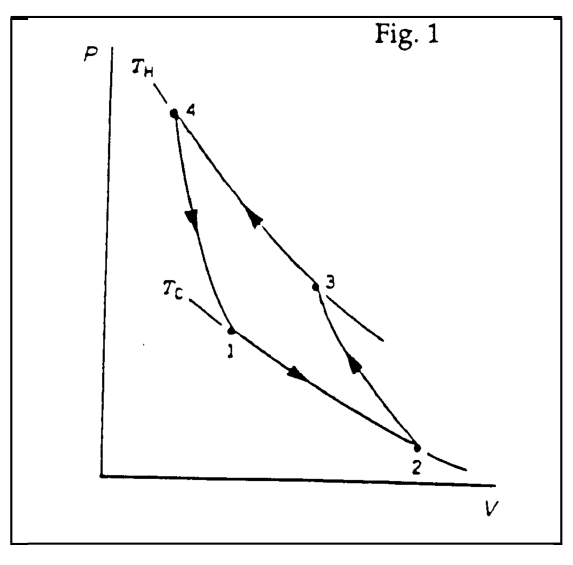
7.4 The cyclic process shown schematically in Figure 1 shows the four steps in a refrigeration system with an ideal gas as working medium. Identify the isothermal and adiabatic steps in the process. Here, \(T_{\mathrm H}\) and \(T_{\mathrm C}\) represent high and low temperature, respectively. Specify for each step whether it is adiabatic or isothermal.
Official English text of the problem.
Answers
- 7.1: \(w=-7.47\ \mathrm{kJ}\), using the stated convention for work done on the gas.
- 7.2: \(q=+7.47\ \mathrm{kJ}\); this heat must be added to the gas.
- 7.3: Check square 3: “No heat is supplied to the gas.”
- 7.4: \(1\rightarrow2\): isothermal expansion at \(T_{\mathrm C}\); \(2\rightarrow3\): adiabatic compression; \(3\rightarrow4\): isothermal compression at \(T_{\mathrm H}\); \(4\rightarrow1\): adiabatic expansion.
Solution
7.1
For an ideal gas,
\[ pV=nRT. \]
Since the expansion is isothermal, \(T\) is constant, so
\[ w=-\int_{V_1}^{V_2}\frac{nRT}{V}\,dV =-nRT\ln\!\left(\frac{V_2}{V_1}\right). \]
Substituting the given quantities,
\[ \begin{aligned} w &=-(1\ \mathrm{mol}) (8.314\ \mathrm{J\,K^{-1}\,mol^{-1}}) (300.0\ \mathrm{K}) \ln\!\left(\frac{20.0\ \mathrm{dm^3}}{1.00\ \mathrm{dm^3}}\right)\\ &=-7471.96\ \mathrm{J}\\ &=\boxed{-7.47\ \mathrm{kJ}}. \end{aligned} \]
The volume ratio is dimensionless. The negative sign means that the gas does work on its surroundings: the work delivered by the gas is \(7.47\ \mathrm{kJ}\).
7.2
With work defined as work done on the gas, the first law is
\[ \Delta U=q+w. \]
For a monatomic ideal gas,
\[ \Delta U=\frac32 nR\Delta T. \]
The temperature remains constant, so \(\Delta U=0\). Therefore,
\[ q=-w=\boxed{+7.47\ \mathrm{kJ}}. \]
Thus \(7.47\ \mathrm{kJ}\) of heat must enter the gas to replace the energy transferred to the surroundings as work.
7.3
The correct choice is 3: No heat is supplied to the gas.
In an adiabatic process, \(q=0\). During expansion the gas does work, so its internal energy decreases:
\[ \Delta U=w<0. \]
Consequently, its temperature falls. Comparing reversible expansions from the same initial state to the same final volume, the adiabatic gas therefore has a lower pressure at each intermediate volume than the isothermal gas.
For a monatomic ideal gas, \(\gamma=C_p/C_V=5/3\). Hence, for \(V>V_1\),
\[ p_{\mathrm{ad}} =p_1\left(\frac{V_1}{V}\right)^{5/3} < p_1\left(\frac{V_1}{V}\right) =p_{\mathrm{iso}}. \]
The area under the pressure–volume curve, \(\int p\,dV\), is consequently smaller for the adiabatic expansion, so the gas delivers less work.
Option 1 is incorrect because the volume increases during expansion. Option 2 is incorrect because an adiabatic expansion can be reversible.
7.4
The lower curve through states 1 and 2 is the isotherm at \(T_{\mathrm C}\); the upper curve through states 3 and 4 is the isotherm at \(T_{\mathrm H}\). The connecting branches are adiabatic.
| Step | Identification | Reasoning |
|---|---|---|
| \(1\rightarrow2\) | Isothermal expansion at \(T_{\mathrm C}\) | Volume increases along the cold isotherm. The gas absorbs heat while doing work, maintaining constant temperature. |
| \(2\rightarrow3\) | Adiabatic compression | Volume decreases without heat exchange. Work done on the gas raises its temperature from \(T_{\mathrm C}\) to \(T_{\mathrm H}\). |
| \(3\rightarrow4\) | Isothermal compression at \(T_{\mathrm H}\) | Volume decreases along the hot isotherm. The gas releases heat to maintain constant temperature. |
| \(4\rightarrow1\) | Adiabatic expansion | Volume increases without heat exchange. The gas does work and cools from \(T_{\mathrm H}\) to \(T_{\mathrm C}\). |
These identifications also agree with the slopes: isotherms obey \(pV=\text{constant}\), whereas reversible adiabats obey \(pV^{5/3}=\text{constant}\) and are steeper at a given state.
The solution was checked against the official solution.
IChO 1994 · Theorieaufgabe 7
Expansion eines idealen Gases und ein Kältekreisprozess
7.1 Wenn sich ein ideales, einatomiges Gas reversibel von einem Volumen \(V_1\) auf ein Volumen \(V_2\) ausdehnt, wird von der Umgebung am System die Arbeit
\[ w=-\int_{V_1}^{V_2}p\,dV \]
verrichtet. In dieser Gleichung ist \(w\) die Arbeit und \(p\) der Druck des Gases.
Bestimmen Sie die verrichtete Arbeit, wenn sich ein Mol eines idealen Gases bei der Temperatur \(T=300.0\ \mathrm{K}\) isotherm von \(V_1=1.00\ \mathrm{dm^3}\) auf \(V_2=20.0\ \mathrm{dm^3}\) ausdehnt.
Gegeben: Die Gaskonstante \(R=8.314\ \mathrm{J\,K^{-1}\,mol^{-1}}\).
7.2 Bestimmen Sie, wie viel Wärme dem Gas während des unter 7.1 beschriebenen Vorgangs zugeführt werden muss.
7.3 Bei einer adiabatischen Expansion verrichtet das Gas weniger Arbeit als bei einer isothermen Expansion. Liegt dies daran, dass die adiabatische Expansion durch eine der folgenden Eigenschaften gekennzeichnet ist (kreuzen Sie das Kästchen an, das Sie für am wichtigsten halten)?
| 1 | Das Volumen des Gases ist konstant |
| 2 | Die Expansion ist immer irreversibel |
| 3 | Dem Gas wird keine Wärme zugeführt |
7.4 Der in Abbildung 1 schematisch dargestellte Kreisprozess zeigt die vier Schritte in einer Kälteanlage mit einem idealen Gas als Arbeitsmedium. Identifizieren Sie die isothermen und adiabatischen Schritte des Prozesses. Dabei stehen \(T_{\mathrm H}\) und \(T_{\mathrm C}\) für die hohe bzw. niedrige Temperatur. Geben Sie für jeden Schritt an, ob er adiabatisch oder isotherm ist.
Aufgabentext aus dem offiziellen englischen Text übersetzt.
Antworten
- 7.1: \(w=-7.47\ \mathrm{kJ}\), gemäß der angegebenen Vorzeichenkonvention für die am Gas verrichtete Arbeit.
- 7.2: \(q=+7.47\ \mathrm{kJ}\); diese Wärme muss dem Gas zugeführt werden.
- 7.3: Kreuzen Sie Kästchen 3 an: „Dem Gas wird keine Wärme zugeführt.“
- 7.4: \(1\rightarrow2\): isotherme Expansion bei \(T_{\mathrm C}\); \(2\rightarrow3\): adiabatische Kompression; \(3\rightarrow4\): isotherme Kompression bei \(T_{\mathrm H}\); \(4\rightarrow1\): adiabatische Expansion.
Lösung
7.1
Für ein ideales Gas gilt
\[ pV=nRT. \]
Da die Expansion isotherm verläuft, ist \(T\) konstant, sodass
\[ w=-\int_{V_1}^{V_2}\frac{nRT}{V}\,dV =-nRT\ln\!\left(\frac{V_2}{V_1}\right). \]
Einsetzen der gegebenen Größen ergibt
\[ \begin{aligned} w &=-(1\ \mathrm{mol}) (8.314\ \mathrm{J\,K^{-1}\,mol^{-1}}) (300.0\ \mathrm{K}) \ln\!\left(\frac{20.0\ \mathrm{dm^3}}{1.00\ \mathrm{dm^3}}\right)\\ &=-7471.96\ \mathrm{J}\\ &=\boxed{-7.47\ \mathrm{kJ}}. \end{aligned} \]
Das Volumenverhältnis ist dimensionslos. Das negative Vorzeichen bedeutet, dass das Gas Arbeit an seiner Umgebung verrichtet: Die vom Gas abgegebene Arbeit beträgt \(7.47\ \mathrm{kJ}\).
7.2
Wird die Arbeit als die am Gas verrichtete Arbeit definiert, lautet der erste Hauptsatz
\[ \Delta U=q+w. \]
Für ein einatomiges ideales Gas gilt
\[ \Delta U=\frac32 nR\Delta T. \]
Die Temperatur bleibt konstant, also ist \(\Delta U=0\). Daher gilt
\[ q=-w=\boxed{+7.47\ \mathrm{kJ}}. \]
Dem Gas müssen somit \(7.47\ \mathrm{kJ}\) Wärme zugeführt werden, um die als Arbeit an die Umgebung übertragene Energie zu ersetzen.
7.3
Die richtige Wahl ist 3: Dem Gas wird keine Wärme zugeführt.
Bei einem adiabatischen Prozess gilt \(q=0\). Während der Expansion verrichtet das Gas Arbeit, sodass seine innere Energie abnimmt:
\[ \Delta U=w<0. \]
Folglich sinkt seine Temperatur. Vergleicht man reversible Expansionen vom gleichen Anfangszustand bis zum gleichen Endvolumen, so hat das adiabatisch expandierende Gas bei jedem dazwischenliegenden Volumen daher einen niedrigeren Druck als das isotherm expandierende Gas.
Für ein einatomiges ideales Gas gilt \(\gamma=C_p/C_V=5/3\). Somit gilt für \(V>V_1\):
\[ p_{\mathrm{ad}} =p_1\left(\frac{V_1}{V}\right)^{5/3} < p_1\left(\frac{V_1}{V}\right) =p_{\mathrm{iso}}. \]
Die Fläche unter der Druck-Volumen-Kurve, \(\int p\,dV\), ist folglich bei der adiabatischen Expansion kleiner, sodass das Gas weniger Arbeit abgibt.
Option 1 ist falsch, weil das Volumen während der Expansion zunimmt. Option 2 ist falsch, weil eine adiabatische Expansion reversibel verlaufen kann.
7.4
Die untere Kurve durch die Zustände 1 und 2 ist die Isotherme bei \(T_{\mathrm C}\); die obere Kurve durch die Zustände 3 und 4 ist die Isotherme bei \(T_{\mathrm H}\). Die verbindenden Kurvenabschnitte sind Adiabaten.
| Schritt | Zuordnung | Begründung |
|---|---|---|
| \(1\rightarrow2\) | Isotherme Expansion bei \(T_{\mathrm C}\) | Das Volumen nimmt entlang der kalten Isotherme zu. Das Gas nimmt Wärme auf, während es Arbeit verrichtet, wodurch die Temperatur konstant bleibt. |
| \(2\rightarrow3\) | Adiabatische Kompression | Das Volumen nimmt ohne Wärmeaustausch ab. Die am Gas verrichtete Arbeit erhöht seine Temperatur von \(T_{\mathrm C}\) auf \(T_{\mathrm H}\). |
| \(3\rightarrow4\) | Isotherme Kompression bei \(T_{\mathrm H}\) | Das Volumen nimmt entlang der heißen Isotherme ab. Das Gas gibt Wärme ab, um die Temperatur konstant zu halten. |
| \(4\rightarrow1\) | Adiabatische Expansion | Das Volumen nimmt ohne Wärmeaustausch zu. Das Gas verrichtet Arbeit und kühlt sich von \(T_{\mathrm H}\) auf \(T_{\mathrm C}\) ab. |
Diese Zuordnungen stimmen auch mit den Steigungen überein: Für Isothermen gilt \(pV=\text{konstant}\), während für reversible Adiabaten \(pV^{5/3}=\text{konstant}\) gilt; Letztere verlaufen in einem gegebenen Zustand steiler.
Die Lösung wurde mit der offiziellen Lösung abgeglichen.
IChO 1994 · Teori sorusu 7
İdeal gazın genleşmesi ve bir soğutma çevrimi
7.1 Tek atomlu bir ideal gaz, \(V_1\) hacminden \(V_2\) hacmine tersinir olarak genleştiğinde, çevre tarafından sistem üzerinde
\[ w=-\int_{V_1}^{V_2}p\,dV \]
işi yapılır. Bu denklemde \(w\) işi, \(p\) ise gazın basıncını ifade eder.
Bir mol ideal gaz, \(T=300.0\ \mathrm{K}\) sıcaklığında \(V_1=1.00\ \mathrm{dm^3}\) hacminden \(V_2=20.0\ \mathrm{dm^3}\) hacmine izotermal olarak genleştiğinde yapılan işi belirleyiniz.
Verilen: Gaz sabiti \(R=8.314\ \mathrm{J\,K^{-1}\,mol^{-1}}\).
7.2 7.1'de verilen süreç sırasında gaza ne kadar ısı verilmesi gerektiğini belirleyiniz.
7.3 Gaz, adyabatik genleşmede izotermal genleşmeye göre daha az iş yapar. Bunun nedeni, adyabatik genleşmenin aşağıdaki özelliklerden hangisine sahip olmasıdır (en önemli olduğunu düşündüğünüz kutucuğu işaretleyiniz).
| 1 | Gazın hacmi sabittir |
| 2 | Genleşme her zaman tersinmezdir |
| 3 | Gaza ısı verilmez |
7.4 Şekil 1'de şematik olarak gösterilen çevrimsel süreç, çalışma akışkanı olarak ideal gaz kullanılan bir soğutma sisteminin dört adımını göstermektedir. Süreçteki izotermal ve adyabatik adımları belirleyiniz. Burada \(T_{\mathrm H}\) ve \(T_{\mathrm C}\), sırasıyla yüksek ve düşük sıcaklığı temsil etmektedir. Her bir adımın adyabatik mi yoksa izotermal mi olduğunu belirtiniz.
Soru metni resmi İngilizce metinden çevrilmiştir.
Cevaplar
- 7.1: Gaz üzerinde yapılan iş için belirtilen işaret kuralı kullanıldığında \(w=-7.47\ \mathrm{kJ}\).
- 7.2: \(q=+7.47\ \mathrm{kJ}\); bu ısı gaza verilmelidir.
- 7.3: 3 numaralı kutucuğu: “Gaza ısı verilmez.” işaretleyiniz.
- 7.4: \(1\rightarrow2\): \(T_{\mathrm C}\) sıcaklığında izotermal genleşme; \(2\rightarrow3\): adyabatik sıkıştırma; \(3\rightarrow4\): \(T_{\mathrm H}\) sıcaklığında izotermal sıkıştırma; \(4\rightarrow1\): adyabatik genleşme.
Çözüm
7.1
Bir ideal gaz için,
\[ pV=nRT. \]
Genleşme izotermal olduğundan \(T\) sabittir; dolayısıyla
\[ w=-\int_{V_1}^{V_2}\frac{nRT}{V}\,dV =-nRT\ln\!\left(\frac{V_2}{V_1}\right). \]
Verilen değerler yerine konulduğunda,
\[ \begin{aligned} w &=-(1\ \mathrm{mol}) (8.314\ \mathrm{J\,K^{-1}\,mol^{-1}}) (300.0\ \mathrm{K}) \ln\!\left(\frac{20.0\ \mathrm{dm^3}}{1.00\ \mathrm{dm^3}}\right)\\ &=-7471.96\ \mathrm{J}\\ &=\boxed{-7.47\ \mathrm{kJ}}. \end{aligned} \]
Hacim oranı boyutsuzdur. Negatif işaret, gazın çevresi üzerinde iş yaptığını gösterir: gazın yaptığı iş \(7.47\ \mathrm{kJ}\)'dür.
7.2
İş, gaz üzerinde yapılan iş olarak tanımlandığında, termodinamiğin birinci yasası şöyledir:
\[ \Delta U=q+w. \]
Tek atomlu bir ideal gaz için,
\[ \Delta U=\frac32 nR\Delta T. \]
Sıcaklık sabit kaldığından \(\Delta U=0\) olur. Dolayısıyla,
\[ q=-w=\boxed{+7.47\ \mathrm{kJ}}. \]
Böylece, çevreye iş olarak aktarılan enerjiyi karşılamak için gaza \(7.47\ \mathrm{kJ}\) ısı girmelidir.
7.3
Doğru seçenek 3: Gaza ısı verilmez.
Adyabatik bir süreçte \(q=0\) olur. Genleşme sırasında gaz iş yapar; bu nedenle iç enerjisi azalır:
\[ \Delta U=w<0. \]
Bunun sonucunda sıcaklığı düşer. Aynı başlangıç durumundan aynı son hacme kadar gerçekleşen tersinir genleşmeler karşılaştırıldığında, bu nedenle adyabatik olarak genleşen gazın basıncı her ara hacimde izotermal olarak genleşen gazın basıncından daha düşüktür.
Tek atomlu bir ideal gaz için \(\gamma=C_p/C_V=5/3\) olur. Dolayısıyla, \(V>V_1\) için,
\[ p_{\mathrm{ad}} =p_1\left(\frac{V_1}{V}\right)^{5/3} < p_1\left(\frac{V_1}{V}\right) =p_{\mathrm{iso}}. \]
Sonuç olarak, basınç–hacim eğrisinin altında kalan alan, \(\int p\,dV\), adyabatik genleşmede daha küçüktür; dolayısıyla gaz daha az iş yapar.
- seçenek yanlıştır, çünkü genleşme sırasında hacim artar. 2. seçenek yanlıştır, çünkü adyabatik bir genleşme tersinir olabilir.
7.4
1 ve 2 durumlarından geçen alttaki eğri, \(T_{\mathrm C}\) sıcaklığındaki izotermdir; 3 ve 4 durumlarından geçen üstteki eğri ise \(T_{\mathrm H}\) sıcaklığındaki izotermdir. Bunları birleştiren kollar adyabatiktir.
| Adım | Tanımlama | Gerekçe |
|---|---|---|
| \(1\rightarrow2\) | \(T_{\mathrm C}\) sıcaklığında izotermal genleşme | Soğuk izoterm boyunca hacim artar. Gaz, iş yaparken ısı alarak sıcaklığını sabit tutar. |
| \(2\rightarrow3\) | Adyabatik sıkıştırma | Isı alışverişi olmadan hacim azalır. Gaz üzerinde yapılan iş, gazın sıcaklığını \(T_{\mathrm C}\)'den \(T_{\mathrm H}\)'ye yükseltir. |
| \(3\rightarrow4\) | \(T_{\mathrm H}\) sıcaklığında izotermal sıkıştırma | Sıcak izoterm boyunca hacim azalır. Gaz, sıcaklığını sabit tutmak için ısı verir. |
| \(4\rightarrow1\) | Adyabatik genleşme | Isı alışverişi olmadan hacim artar. Gaz iş yapar ve \(T_{\mathrm H}\)'den \(T_{\mathrm C}\)'ye soğur. |
Bu tanımlamalar eğimlerle de uyumludur: izotermler \(pV=\text{sabit}\) bağıntısına uyarken, tersinir adyabatlar \(pV^{5/3}=\text{sabit}\) bağıntısına uyar ve belirli bir durumda daha diktir.
Çözüm, resmi çözümle karşılaştırılarak kontrol edildi.
IChO 1994 · Problema teórico 7
Expansión de un gas ideal y un ciclo de refrigeración
7.1 Cuando un gas ideal monoatómico se expande reversiblemente desde un volumen \(V_1\) hasta un volumen \(V_2\), el entorno realiza sobre el sistema un trabajo
\[ w=-\int_{V_1}^{V_2}p\,dV \]
En esta ecuación, \(w\) es el trabajo y \(p\) es la presión del gas.
Determine el trabajo realizado cuando un mol de gas ideal se expande isotérmicamente desde \(V_1=1.00\ \mathrm{dm^3}\) hasta \(V_2=20.0\ \mathrm{dm^3}\) a la temperatura \(T=300.0\ \mathrm{K}\).
Dato: La constante de los gases es \(R=8.314\ \mathrm{J\,K^{-1}\,mol^{-1}}\).
7.2 Determine cuánto calor debe suministrarse al gas durante el proceso descrito en 7.1.
7.3 El gas realizará menos trabajo en una expansión adiabática que en una expansión isotérmica. ¿Se debe esto a que la expansión adiabática se caracteriza por lo siguiente? (Marque la casilla que considere más importante).
| 1 | El volumen del gas es constante |
| 2 | La expansión es siempre irreversible |
| 3 | No se suministra calor al gas |
7.4 El proceso cíclico representado esquemáticamente en la Figura 1 muestra las cuatro etapas de un sistema de refrigeración que utiliza un gas ideal como fluido de trabajo. Identifique las etapas isotérmicas y adiabáticas del proceso. Aquí, \(T_{\mathrm H}\) y \(T_{\mathrm C}\) representan las temperaturas alta y baja, respectivamente. Especifique para cada etapa si es adiabática o isotérmica.
Enunciado traducido del texto oficial en inglés.
Respuestas
- 7.1: \(w=-7.47\ \mathrm{kJ}\), utilizando la convención indicada para el trabajo realizado sobre el gas.
- 7.2: \(q=+7.47\ \mathrm{kJ}\); este calor debe suministrarse al gas.
- 7.3: Marque la casilla 3: «No se suministra calor al gas».
- 7.4: \(1\rightarrow2\): expansión isotérmica a \(T_{\mathrm C}\); \(2\rightarrow3\): compresión adiabática; \(3\rightarrow4\): compresión isotérmica a \(T_{\mathrm H}\); \(4\rightarrow1\): expansión adiabática.
Solución
7.1
Para un gas ideal,
\[ pV=nRT. \]
Como la expansión es isotérmica, \(T\) es constante, por lo que
\[ w=-\int_{V_1}^{V_2}\frac{nRT}{V}\,dV =-nRT\ln\!\left(\frac{V_2}{V_1}\right). \]
Sustituyendo las magnitudes dadas,
\[ \begin{aligned} w &=-(1\ \mathrm{mol}) (8.314\ \mathrm{J\,K^{-1}\,mol^{-1}}) (300.0\ \mathrm{K}) \ln\!\left(\frac{20.0\ \mathrm{dm^3}}{1.00\ \mathrm{dm^3}}\right)\\ &=-7471.96\ \mathrm{J}\\ &=\boxed{-7.47\ \mathrm{kJ}}. \end{aligned} \]
El cociente de los volúmenes es adimensional. El signo negativo significa que el gas realiza trabajo sobre su entorno: el trabajo que entrega el gas es de \(7.47\ \mathrm{kJ}\).
7.2
Si el trabajo se define como el trabajo realizado sobre el gas, el primer principio de la termodinámica se expresa como
\[ \Delta U=q+w. \]
Para un gas ideal monoatómico,
\[ \Delta U=\frac32 nR\Delta T. \]
La temperatura permanece constante, por lo que \(\Delta U=0\). Por tanto,
\[ q=-w=\boxed{+7.47\ \mathrm{kJ}}. \]
Así pues, deben entrar en el gas \(7.47\ \mathrm{kJ}\) de calor para reponer la energía transferida al entorno en forma de trabajo.
7.3
La opción correcta es 3: No se suministra calor al gas.
En un proceso adiabático, \(q=0\). Durante la expansión, el gas realiza trabajo, por lo que su energía interna disminuye:
\[ \Delta U=w<0. \]
En consecuencia, su temperatura disminuye. Al comparar expansiones reversibles desde el mismo estado inicial hasta el mismo volumen final, el gas que se expande adiabáticamente tiene, por tanto, una presión menor en cada volumen intermedio que el gas que se expande isotérmicamente.
Para un gas ideal monoatómico, \(\gamma=C_p/C_V=5/3\). Por tanto, para \(V>V_1\),
\[ p_{\mathrm{ad}} =p_1\left(\frac{V_1}{V}\right)^{5/3} < p_1\left(\frac{V_1}{V}\right) =p_{\mathrm{iso}}. \]
El área bajo la curva de presión–volumen, \(\int p\,dV\), es, en consecuencia, menor para la expansión adiabática, de modo que el gas entrega menos trabajo.
La opción 1 es incorrecta porque el volumen aumenta durante la expansión. La opción 2 es incorrecta porque una expansión adiabática puede ser reversible.
7.4
La curva inferior que pasa por los estados 1 y 2 es la isoterma a \(T_{\mathrm C}\); la curva superior que pasa por los estados 3 y 4 es la isoterma a \(T_{\mathrm H}\). Las ramas que las conectan son adiabáticas.
| Etapa | Identificación | Razonamiento |
|---|---|---|
| \(1\rightarrow2\) | Expansión isotérmica a \(T_{\mathrm C}\) | El volumen aumenta a lo largo de la isoterma fría. El gas absorbe calor mientras realiza trabajo, manteniendo constante la temperatura. |
| \(2\rightarrow3\) | Compresión adiabática | El volumen disminuye sin intercambio de calor. El trabajo realizado sobre el gas eleva su temperatura de \(T_{\mathrm C}\) a \(T_{\mathrm H}\). |
| \(3\rightarrow4\) | Compresión isotérmica a \(T_{\mathrm H}\) | El volumen disminuye a lo largo de la isoterma caliente. El gas cede calor para mantener constante la temperatura. |
| \(4\rightarrow1\) | Expansión adiabática | El volumen aumenta sin intercambio de calor. El gas realiza trabajo y se enfría de \(T_{\mathrm H}\) a \(T_{\mathrm C}\). |
Estas identificaciones también concuerdan con las pendientes: las isotermas obedecen a \(pV=\text{constante}\), mientras que las adiabáticas reversibles obedecen a \(pV^{5/3}=\text{constante}\) y tienen una pendiente más pronunciada en un estado dado.
La solución se comprobó con la solución oficial.
IChO 1994 · 理论题 7
理想气体的膨胀与制冷循环
7.1 当单原子理想气体从体积 \(V_1\) 可逆膨胀至体积 \(V_2\) 时,环境对系统所做的功为
\[ w=-\int_{V_1}^{V_2}p\,dV \]
在此式中,\(w\) 为功,\(p\) 为气体的压强。
求一摩尔理想气体在温度 \(T=300.0\ \mathrm{K}\) 下,从 \(V_1=1.00\ \mathrm{dm^3}\) 等温膨胀至 \(V_2=20.0\ \mathrm{dm^3}\) 时所做的功。
已知:气体常数 \(R=8.314\ \mathrm{J\,K^{-1}\,mol^{-1}}\)。
7.2 求在 7.1 所述过程中必须向气体提供多少热量。
7.3 气体在绝热膨胀过程中所做的功比在等温膨胀过程中少。这是否是因为绝热膨胀具有下列特征(勾选你认为最重要的一项所对应的方框)。
| 1 | 气体的体积保持不变 |
| 2 | 膨胀总是不可逆的 |
| 3 | 没有向气体提供热量 |
7.4 图 1 所示的循环过程示意图展示了以理想气体为工作介质的制冷系统中的四个步骤。判断该过程中的等温步骤和绝热步骤。这里,\(T_{\mathrm H}\) 和 \(T_{\mathrm C}\) 分别表示高温和低温。指出每个步骤是绝热过程还是等温过程。
题目译自官方英文原文。
答案
- 7.1: \(w=-7.47\ \mathrm{kJ}\),采用题目所述的对气体做功的符号约定。
- 7.2: \(q=+7.47\ \mathrm{kJ}\);必须向气体提供这些热量。
- 7.3: 勾选方框 3:“没有向气体提供热量。”
- 7.4: \(1\rightarrow2\):在 \(T_{\mathrm C}\) 下等温膨胀;\(2\rightarrow3\):绝热压缩;\(3\rightarrow4\):在 \(T_{\mathrm H}\) 下等温压缩;\(4\rightarrow1\):绝热膨胀。
解答
7.1
对于理想气体,
\[ pV=nRT. \]
由于膨胀是等温的,\(T\) 保持不变,因此
\[ w=-\int_{V_1}^{V_2}\frac{nRT}{V}\,dV =-nRT\ln\!\left(\frac{V_2}{V_1}\right). \]
代入已知量,
\[ \begin{aligned} w &=-(1\ \mathrm{mol}) (8.314\ \mathrm{J\,K^{-1}\,mol^{-1}}) (300.0\ \mathrm{K}) \ln\!\left(\frac{20.0\ \mathrm{dm^3}}{1.00\ \mathrm{dm^3}}\right)\\ &=-7471.96\ \mathrm{J}\\ &=\boxed{-7.47\ \mathrm{kJ}}. \end{aligned} \]
体积之比是无量纲的。负号表示气体对环境做功:气体对外做的功为 \(7.47\ \mathrm{kJ}\)。
7.2
将功定义为对气体所做的功时,热力学第一定律为
\[ \Delta U=q+w. \]
对于单原子理想气体,
\[ \Delta U=\frac32 nR\Delta T. \]
温度保持不变,因此 \(\Delta U=0\)。所以,
\[ q=-w=\boxed{+7.47\ \mathrm{kJ}}. \]
因此,气体必须吸收 \(7.47\ \mathrm{kJ}\) 的热量,以补偿以功的形式传递给环境的能量。
7.3
正确选项是 3:没有向气体提供热量。
在绝热过程中,\(q=0\)。膨胀时气体对外做功,因此其内能减小:
\[ \Delta U=w<0. \]
因此,其温度降低。比较从相同初态膨胀至相同终态体积的可逆膨胀过程可知,在每个中间体积处,绝热膨胀气体的压强都低于等温膨胀气体的压强。
对于单原子理想气体,\(\gamma=C_p/C_V=5/3\)。因此,当 \(V>V_1\) 时,
\[ p_{\mathrm{ad}} =p_1\left(\frac{V_1}{V}\right)^{5/3} < p_1\left(\frac{V_1}{V}\right) =p_{\mathrm{iso}}. \]
因此,绝热膨胀的压强–体积曲线下的面积 \(\int p\,dV\) 较小,所以气体对外做的功较少。
选项 1 不正确,因为膨胀过程中体积增大。选项 2 不正确,因为绝热膨胀可以是可逆的。
7.4
经过状态 1 和 2 的下方曲线是温度为 \(T_{\mathrm C}\) 的等温线;经过状态 3 和 4 的上方曲线是温度为 \(T_{\mathrm H}\) 的等温线。连接这两条等温线的曲线段为绝热线。
| 步骤 | 判断 | 理由 |
|---|---|---|
| \(1\rightarrow2\) | 在 \(T_{\mathrm C}\) 下等温膨胀 | 体积沿低温等温线增大。气体在做功的同时吸收热量,使温度保持不变。 |
| \(2\rightarrow3\) | 绝热压缩 | 体积减小,且无热量交换。外界对气体做功,使其温度从 \(T_{\mathrm C}\) 升高至 \(T_{\mathrm H}\)。 |
| \(3\rightarrow4\) | 在 \(T_{\mathrm H}\) 下等温压缩 | 体积沿高温等温线减小。气体放出热量,使温度保持不变。 |
| \(4\rightarrow1\) | 绝热膨胀 | 体积增大,且无热量交换。气体对外做功,温度从 \(T_{\mathrm H}\) 降低至 \(T_{\mathrm C}\)。 |
这些判断也与曲线的斜率一致:等温线遵循 \(pV=\text{常数}\),而可逆绝热线遵循 \(pV^{5/3}=\text{常数}\),且在给定状态处更陡。
解答已与官方解答核对。
IChO 1994 · Теоретическая задача 7
Расширение идеального газа и холодильный цикл
7.1 При обратимом расширении идеального одноатомного газа от объёма \(V_1\) до объёма \(V_2\) окружающая среда совершает над системой работу
\[ w=-\int_{V_1}^{V_2}p\,dV \]
В этом уравнении \(w\) — работа, а \(p\) — давление газа.
Определите совершённую работу при изотермическом расширении одного моля идеального газа от \(V_1=1.00\ \mathrm{dm^3}\) до \(V_2=20.0\ \mathrm{dm^3}\) при температуре \(T=300.0\ \mathrm{K}\).
Дано: газовая постоянная \(R=8.314\ \mathrm{J\,K^{-1}\,mol^{-1}}\).
7.2 Определите, какое количество теплоты необходимо подвести к газу в ходе процесса, описанного в 7.1.
7.3 При адиабатическом расширении газ совершает меньшую работу, чем при изотермическом расширении. Связано ли это с тем, что адиабатическое расширение характеризуется следующим свойством (отметьте квадрат, соответствующий свойству, которое вы считаете наиболее важным)?
| 1 | Объём газа постоянен |
| 2 | Расширение всегда необратимо |
| 3 | К газу не подводится теплота |
7.4 Циклический процесс, схематически показанный на рисунке 1, включает четыре стадии работы холодильной установки, в которой рабочим телом служит идеальный газ. Определите изотермические и адиабатические стадии процесса. Здесь \(T_{\mathrm H}\) и \(T_{\mathrm C}\) обозначают соответственно высокую и низкую температуры. Для каждой стадии укажите, является ли она адиабатической или изотермической.
Условие переведено с официального английского текста.
Ответы
- 7.1: \(w=-7.47\ \mathrm{kJ}\), согласно указанному соглашению о знаке работы, совершаемой над газом.
- 7.2: \(q=+7.47\ \mathrm{kJ}\); это количество теплоты необходимо подвести к газу.
- 7.3: Отметьте квадрат 3: «К газу не подводится теплота».
- 7.4: \(1\rightarrow2\): изотермическое расширение при \(T_{\mathrm C}\); \(2\rightarrow3\): адиабатическое сжатие; \(3\rightarrow4\): изотермическое сжатие при \(T_{\mathrm H}\); \(4\rightarrow1\): адиабатическое расширение.
Решение
7.1
Для идеального газа
\[ pV=nRT. \]
Поскольку расширение изотермическое, \(T\) постоянна, поэтому
\[ w=-\int_{V_1}^{V_2}\frac{nRT}{V}\,dV =-nRT\ln\!\left(\frac{V_2}{V_1}\right). \]
Подставляя заданные величины, получаем
\[ \begin{aligned} w &=-(1\ \mathrm{mol}) (8.314\ \mathrm{J\,K^{-1}\,mol^{-1}}) (300.0\ \mathrm{K}) \ln\!\left(\frac{20.0\ \mathrm{dm^3}}{1.00\ \mathrm{dm^3}}\right)\\ &=-7471.96\ \mathrm{J}\\ &=\boxed{-7.47\ \mathrm{kJ}}. \end{aligned} \]
Отношение объёмов безразмерно. Отрицательный знак означает, что газ совершает работу над окружающей средой: работа, совершаемая газом, равна \(7.47\ \mathrm{kJ}\).
7.2
Если работа определяется как работа, совершаемая над газом, первый закон термодинамики имеет вид
\[ \Delta U=q+w. \]
Для одноатомного идеального газа
\[ \Delta U=\frac32 nR\Delta T. \]
Температура остаётся постоянной, поэтому \(\Delta U=0\). Следовательно,
\[ q=-w=\boxed{+7.47\ \mathrm{kJ}}. \]
Таким образом, к газу необходимо подвести \(7.47\ \mathrm{kJ}\) теплоты, чтобы восполнить энергию, переданную окружающей среде в форме работы.
7.3
Правильный вариант — 3: К газу не подводится теплота.
В адиабатическом процессе \(q=0\). При расширении газ совершает работу, поэтому его внутренняя энергия уменьшается:
\[ \Delta U=w<0. \]
Вследствие этого его температура понижается. Поэтому при сравнении обратимых расширений из одного и того же начального состояния до одного и того же конечного объёма давление газа при адиабатическом расширении оказывается ниже при каждом промежуточном объёме, чем при изотермическом расширении.
Для одноатомного идеального газа \(\gamma=C_p/C_V=5/3\). Следовательно, при \(V>V_1\)
\[ p_{\mathrm{ad}} =p_1\left(\frac{V_1}{V}\right)^{5/3} < p_1\left(\frac{V_1}{V}\right) =p_{\mathrm{iso}}. \]
Таким образом, площадь под кривой зависимости давления от объёма, \(\int p\,dV\), при адиабатическом расширении меньше, поэтому газ совершает меньшую работу.
Вариант 1 неверен, поскольку при расширении объём увеличивается. Вариант 2 неверен, поскольку адиабатическое расширение может быть обратимым.
7.4
Нижняя кривая, проходящая через состояния 1 и 2, является изотермой при \(T_{\mathrm C}\); верхняя кривая, проходящая через состояния 3 и 4, является изотермой при \(T_{\mathrm H}\). Соединяющие их ветви являются адиабатами.
| Стадия | Тип процесса | Обоснование |
|---|---|---|
| \(1\rightarrow2\) | Изотермическое расширение при \(T_{\mathrm C}\) | Объём увеличивается вдоль низкотемпературной изотермы. Газ поглощает теплоту, совершая работу и сохраняя постоянную температуру. |
| \(2\rightarrow3\) | Адиабатическое сжатие | Объём уменьшается без теплообмена. Работа, совершаемая над газом, повышает его температуру от \(T_{\mathrm C}\) до \(T_{\mathrm H}\). |
| \(3\rightarrow4\) | Изотермическое сжатие при \(T_{\mathrm H}\) | Объём уменьшается вдоль высокотемпературной изотермы. Газ отдаёт теплоту, чтобы сохранять постоянную температуру. |
| \(4\rightarrow1\) | Адиабатическое расширение | Объём увеличивается без теплообмена. Газ совершает работу и охлаждается от \(T_{\mathrm H}\) до \(T_{\mathrm C}\). |
Такое определение типов процессов согласуется и с наклонами кривых: изотермы подчиняются уравнению \(pV=\text{постоянная}\), тогда как обратимые адиабаты подчиняются уравнению \(pV^{5/3}=\text{постоянная}\) и в данном состоянии имеют более крутой наклон.
Решение проверено по официальному решению.
IChO 1994 · مسألة نظرية 7
تمدد غاز مثالي ودورة تبريد
7.1 عندما يتمدد غاز مثالي أحادي الذرة تمددًا عكوسًا من حجم \(V_1\) إلى حجم \(V_2\)، يبذل الوسط المحيط شغلًا على النظام مقداره
\[ w=-\int_{V_1}^{V_2}p\,dV \]
في هذه المعادلة، يمثّل \(w\) الشغل ويمثّل \(p\) ضغط الغاز.
حدّد الشغل المبذول عندما يتمدد مول واحد من غاز مثالي تمددًا متساوي الحرارة من \(V_1=1.00\ \mathrm{dm^3}\) إلى \(V_2=20.0\ \mathrm{dm^3}\) عند درجة الحرارة \(T=300.0\ \mathrm{K}\).
المعطيات: ثابت الغازات \(R=8.314\ \mathrm{J\,K^{-1}\,mol^{-1}}\).
7.2 حدّد كمية الحرارة التي يجب إمداد الغاز بها أثناء العملية الواردة في 7.1.
7.3 يبذل الغاز شغلًا أقل في التمدد الكظومي منه في التمدد المتساوي الحرارة. هل يرجع ذلك إلى أن التمدد الكظومي يتصف بإحدى الخصائص الآتية (ضع علامة في المربع الذي تراه الأهم).
| 1 | حجم الغاز ثابت |
| 2 | التمدد غير عكوس دائمًا |
| 3 | لا يُزوَّد الغاز بأي حرارة |
7.4 تبيّن العملية الدورية الممثّلة تخطيطيًا في الشكل 1 الخطوات الأربع في نظام تبريد يستخدم غازًا مثاليًا مائعًا عاملًا. حدّد الخطوات المتساوية الحرارة والخطوات الكظومية في العملية. هنا، يمثّل \(T_{\mathrm H}\) و\(T_{\mathrm C}\) درجتي الحرارة المرتفعة والمنخفضة، على الترتيب. بيّن لكل خطوة ما إذا كانت كظومية أم متساوية الحرارة.
نص المسألة مترجم عن النص الإنجليزي الرسمي.
الإجابات
- 7.1: \(w=-7.47\ \mathrm{kJ}\)، وفقًا للاصطلاح المذكور للشغل المبذول على الغاز.
- 7.2: \(q=+7.47\ \mathrm{kJ}\)؛ يجب إمداد الغاز بهذه الحرارة.
- 7.3: ضع علامة في المربع 3: «لا يُزوَّد الغاز بأي حرارة».
- 7.4: \(1\rightarrow2\): تمدد متساوي الحرارة عند \(T_{\mathrm C}\)؛ \(2\rightarrow3\): انضغاط كظومي؛ \(3\rightarrow4\): انضغاط متساوي الحرارة عند \(T_{\mathrm H}\)؛ \(4\rightarrow1\): تمدد كظومي.
الحل
7.1
بالنسبة إلى غاز مثالي،
\[ pV=nRT. \]
بما أن التمدد متساوي الحرارة، فإن \(T\) ثابتة، ومن ثم
\[ w=-\int_{V_1}^{V_2}\frac{nRT}{V}\,dV =-nRT\ln\!\left(\frac{V_2}{V_1}\right). \]
بالتعويض بالقيم المعطاة،
\[ \begin{aligned} w &=-(1\ \mathrm{mol}) (8.314\ \mathrm{J\,K^{-1}\,mol^{-1}}) (300.0\ \mathrm{K}) \ln\!\left(\frac{20.0\ \mathrm{dm^3}}{1.00\ \mathrm{dm^3}}\right)\\ &=-7471.96\ \mathrm{J}\\ &=\boxed{-7.47\ \mathrm{kJ}}. \end{aligned} \]
نسبة الحجمين عديمة الأبعاد. وتعني الإشارة السالبة أن الغاز يبذل شغلًا على الوسط المحيط به: فالشغل الذي يقدّمه الغاز هو \(7.47\ \mathrm{kJ}\).
7.2
عند تعريف الشغل بأنه الشغل المبذول على الغاز، يُكتب القانون الأول على الصورة
\[ \Delta U=q+w. \]
بالنسبة إلى غاز مثالي أحادي الذرة،
\[ \Delta U=\frac32 nR\Delta T. \]
تبقى درجة الحرارة ثابتة، لذا فإن \(\Delta U=0\). وبالتالي،
\[ q=-w=\boxed{+7.47\ \mathrm{kJ}}. \]
إذن يجب أن تدخل إلى الغاز حرارة مقدارها \(7.47\ \mathrm{kJ}\) لتعويض الطاقة المنتقلة إلى الوسط المحيط على هيئة شغل.
7.3
الاختيار الصحيح هو 3: لا يُزوَّد الغاز بأي حرارة.
في العملية الكظومية، \(q=0\). وأثناء التمدد يبذل الغاز شغلًا، فتتناقص طاقته الداخلية:
\[ \Delta U=w<0. \]
وبناءً على ذلك، تنخفض درجة حرارته. وعند مقارنة تمددين عكوسين ينطلقان من الحالة الابتدائية نفسها وينتهيان عند الحجم النهائي نفسه، يكون ضغط الغاز في التمدد الكظومي أقل عند كل حجم وسيط من ضغط الغاز في التمدد المتساوي الحرارة.
بالنسبة إلى غاز مثالي أحادي الذرة، \(\gamma=C_p/C_V=5/3\). ومن ثم، عندما يكون \(V>V_1\)،
\[ p_{\mathrm{ad}} =p_1\left(\frac{V_1}{V}\right)^{5/3} < p_1\left(\frac{V_1}{V}\right) =p_{\mathrm{iso}}. \]
وعليه، تكون المساحة تحت منحنى الضغط–الحجم، \(\int p\,dV\)، أصغر في التمدد الكظومي، ولذلك يقدّم الغاز شغلًا أقل.
الخيار 1 غير صحيح لأن الحجم يزداد أثناء التمدد. والخيار 2 غير صحيح لأن التمدد الكظومي يمكن أن يكون عكوسًا.
7.4
المنحنى السفلي المار بالحالتين 1 و2 هو منحنى تساوي الحرارة عند \(T_{\mathrm C}\)؛ والمنحنى العلوي المار بالحالتين 3 و4 هو منحنى تساوي الحرارة عند \(T_{\mathrm H}\). أما الفرعان الواصلان بينهما فكظوميان.
| الخطوة | تحديد نوع العملية | التعليل |
|---|---|---|
| \(1\rightarrow2\) | تمدد متساوي الحرارة عند \(T_{\mathrm C}\) | يزداد الحجم على طول منحنى تساوي الحرارة البارد. يمتص الغاز حرارة أثناء بذله شغلًا، محافظًا على ثبات درجة الحرارة. |
| \(2\rightarrow3\) | انضغاط كظومي | يتناقص الحجم دون تبادل حراري. يرفع الشغل المبذول على الغاز درجة حرارته من \(T_{\mathrm C}\) إلى \(T_{\mathrm H}\). |
| \(3\rightarrow4\) | انضغاط متساوي الحرارة عند \(T_{\mathrm H}\) | يتناقص الحجم على طول منحنى تساوي الحرارة الساخن. يطلق الغاز حرارة للحفاظ على ثبات درجة الحرارة. |
| \(4\rightarrow1\) | تمدد كظومي | يزداد الحجم دون تبادل حراري. يبذل الغاز شغلًا ويبرد من \(T_{\mathrm H}\) إلى \(T_{\mathrm C}\). |
وتتفق هذه التحديدات أيضًا مع الميول: إذ تخضع منحنيات تساوي الحرارة للعلاقة \(pV=\text{ثابت}\)، في حين تخضع المنحنيات الكظومية العكوسة للعلاقة \(pV^{5/3}=\text{ثابت}\) وتكون أشد انحدارًا عند حالة معيّنة.
تمت مراجعة الحل بمقارنته بالحل الرسمي.