IChO 1996 · Theory problem 4
Chromate-dichromate equilibria and precipitation
The precipitation is widely used in classical methods of the quantitative and qualitative analysis for the separation of ions. The possibility of separation is determined by the equilibrium concentrations of all species in a solution to be analyzed.
Potassium dichromate is one of the most widely used precipitating reagents. The following equilibria are established in aqueous solutions of Cr(VI).

4.1 Calculate the equilibrium constants
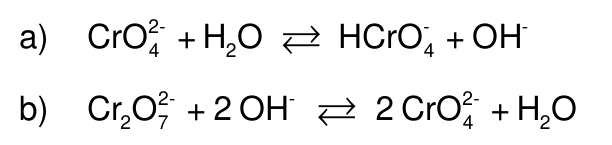
The ionic product of water \(K_{\mathrm W}=1.0\times10^{-14}\).
4.2 In what direction shall the equilibrium state 1b shift upon the addition of the following reagents to the aqueous solution of potassium dichromate?
a) \(\ce{KOH}\)
b) \(\ce{HCl}\)
c) \(\ce{BaCl2}\)
d) \(\ce{H2O}\)
The solubility product of \(\ce{BaCrO4}\) is \(1.2\times10^{-10}\). \(\ce{BaCr2O7}\) is well soluble in water.
4.3 Calculate the pH value of the following solutions
a) \(0.010\ \mathrm M\ \ce{K2CrO4}\)
b) \(0.010\ \mathrm M\ \ce{K2Cr2O7}\)
c) \(0.010\ \mathrm M\ \ce{K2Cr2O7}+0.100\ \mathrm M\ \ce{CH3COOH}\)
Dissociation constant of acetic acid \(K_{\mathrm a}=1.8\times10^{-5}\).
4.4 Calculate the equilibrium concentrations of the following ions in the solution of \(0.010\ \mathrm M\ \ce{K2Cr2O7}+0.100\ \mathrm M\ \ce{CH3COOH}\)
a) \(\ce{CrO4^2-}\)
b) \(\ce{Cr2O7^2-}\)
\(\ce{Pb^2+}\) and \(\ce{Ag+}\) form poorly soluble compounds with chromate and dichromate ions.
The solubility products of these compounds are indicated below.
| \(\ce{PbCrO4}\) | \(K_{s1}=1.2\times10^{-14}\) |
| \(\ce{Ag2CrO4}\) | \(K_{s2}=1.3\times10^{-12}\) |
| \(\ce{Ag2Cr2O7}\) | \(K_{s3}=1.1\times10^{-10}\) |
To the aqueous solution of the mixture of \(1.0\times10^{-3}\ \mathrm M\ \ce{Pb(NO3)2}\) and \(2.0\times10^{-4}\ \mathrm M\ \ce{AgNO3}\) an equal volume of \(0.020\ \mathrm M\) solution of \(\ce{K2Cr2O7}\) in \(0.200\ \mathrm M\ \ce{CH3COOH}\) was added.
4.5 a) Shall \(\ce{Pb^2+}\) be precipitated?
b) Shall \(\ce{Ag+}\) be precipitated?
c) Shall a quantitative separation of \(\ce{Pb^2+}\) and \(\ce{Ag+}\) ions be thus achieved?
The quantitative precipitation is achieved if the residual concentration of the ion being precipitated is not higher than \(1\times10^{-6}\ \mathrm M\).
Official English text of the problem.
Answers
- 4.1(a): \(K=3.2\times10^{-8}\).
- 4.1(b): \(K=4.4\times10^{13}\).
- 4.2(a): Right, toward chromate.
- 4.2(b): Left, toward dichromate.
- 4.2(c): Right, as barium chromate precipitates.
- 4.2(d): Right; dilution raises the pH and increases the fraction of chromium present as chromate.
- 4.3(a): \(\mathrm{pH}=9.25\).
- 4.3(b): \(\mathrm{pH}=4.20\).
- 4.3(c): \(\mathrm{pH}=2.87\).
- 4.4(a): \([\ce{CrO4^2-}]=3.0\times10^{-6}\ \mathrm M\).
- 4.4(b): \([\ce{Cr2O7^2-}]=3.7\times10^{-3}\ \mathrm M\).
- 4.5(a): Yes, as lead(II) chromate, \(\ce{PbCrO4}\).
- 4.5(b): No; neither silver chromate nor silver dichromate precipitates.
- 4.5(c): Yes. The residual \([\ce{Pb^2+}]\approx4.9\times10^{-9}\ \mathrm M\), including precipitation’s effect on the solution equilibria; silver remains dissolved.
Solution
Concentrations are treated as ideal, with water activity equal to unity. All logarithms are decimal.
The molecular and ionic identities used below are:
| Species | Name | SMILES |
|---|---|---|
| \(\ce{CrO4^2-}\) | Chromate ion | [O-][Cr](=O)(=O)[O-] |
| \(\ce{HCrO4^-}\) | Hydrogen chromate ion | O[Cr](=O)(=O)[O-] |
| \(\ce{Cr2O7^2-}\) | Dichromate ion | [O-][Cr](=O)(=O)O[Cr](=O)(=O)[O-] |
| \(\ce{H+}\) | Hydrogen ion, representing the aqueous proton | [H+] |
| \(\ce{OH^-}\) | Hydroxide ion | [OH-] |
| \(\ce{H2O}\) | Water | O |
| \(\ce{CH3COOH}\) | Acetic acid | CC(=O)O |
| \(\ce{CH3COO^-}\) | Acetate ion | CC(=O)[O-] |
| \(\ce{K+}\) | Potassium ion | [K+] |
| \(\ce{Ba^2+}\) | Barium(II) ion | [Ba+2] |
| \(\ce{Pb^2+}\) | Lead(II) ion | [Pb+2] |
| \(\ce{Ag+}\) | Silver(I) ion | [Ag+] |
| \(\ce{Cl^-}\) | Chloride ion | [Cl-] |
| \(\ce{NO3^-}\) | Nitrate ion | [O-][N+](=O)[O-] |
The chromium oxyanion SMILES specify connectivity and one localized representation of bonding. Each chromium atom has tetrahedral oxygen coordination; dichromate consists of two tetrahedra sharing an oxygen. SMILES do not specify these geometries or aqueous proton solvation. Dot-separated salt SMILES below specify formula-unit composition, not crystal structure.
Write \[ h=[\ce{H+}],\qquad x=[\ce{HCrO4^-}],\qquad y=[\ce{CrO4^2-}],\qquad z=[\ce{Cr2O7^2-}]. \]
The supplied equilibria are \[ \ce{HCrO4^- <=> H+ + CrO4^2-}, \qquad K_1=\frac{hy}{x}=10^{-6.50}=3.1623\times10^{-7}, \] and \[ \ce{2HCrO4^- <=> Cr2O7^2- + H2O}, \qquad K_2=\frac{z}{x^2}=10^{1.36}=22.9087. \]
The chromium balance is \[ C_{\mathrm{Cr}}=x+y+2z, \] where \(C_{\mathrm{Cr}}\) counts moles of chromium atoms per litre.
4.1(a)
The requested reaction is \[ \ce{CrO4^2- + H2O <=> HCrO4^- + OH^-}. \]
Adding the reverse of the first supplied equilibrium to \[ \ce{H2O <=> H+ + OH^-} \] gives \[ K_{\mathrm b}=\frac{K_{\mathrm W}}{K_1} =\frac{1.0\times10^{-14}}{10^{-6.50}} =10^{-7.50}. \]
Thus \[ \boxed{K_{\mathrm b}=3.2\times10^{-8}}. \]
4.1(b)
The requested reaction is \[ \ce{Cr2O7^2- + 2OH^- <=> 2CrO4^2- + H2O}. \]
Combine \[ \ce{Cr2O7^2- + H2O <=> 2HCrO4^-}, \qquad K=\frac1{K_2}, \] with twice \[ \ce{HCrO4^- + OH^- <=> CrO4^2- + H2O}, \qquad K=\frac{K_1}{K_{\mathrm W}}. \]
Therefore \[ K=\frac1{K_2}\left(\frac{K_1}{K_{\mathrm W}}\right)^2, \] so \[ \log K=-1.36+2(-6.50+14.00)=13.64, \] and \[ \boxed{K=4.4\times10^{13}}. \]
4.2(a)
Directions refer to the reaction as written in 4.1(b).
Adding potassium hydroxide increases \([\ce{OH^-}]\), driving \[ \ce{Cr2O7^2- + 2OH^- <=> 2CrO4^2- + H2O} \] to the right.
4.2(b)
Hydrochloric acid supplies hydrogen ions, which consume hydroxide: \[ \ce{H+ + OH^- -> H2O}. \]
The equilibrium shifts to the left. Its acid-driven form is \[ \ce{2CrO4^2- + 2H+ <=> Cr2O7^2- + H2O}. \]
4.2(c)
Barium ions remove chromate by precipitation: \[ \ce{Ba^2+ + CrO4^2- -> BaCrO4(s)}. \]
The solid is barium chromate, [Ba+2].[O-][Cr](=O)(=O)[O-].
Removal of chromate drives the equilibrium to the right. The stated solubility of barium dichromate excludes a competing dichromate precipitation in this treatment.
4.2(d)
Dilution shifts the equilibrium to the right.
The potassium dichromate solution is acidic. Dilution lowers \(h\), raises the pH, and therefore increases \[ [\ce{OH^-}]=\frac{K_{\mathrm W}}h. \]
This conclusion can also be checked directly from the coupled balances. For potassium dichromate alone, \[ [\ce{K+}]=C_{\mathrm{Cr}}=x+y+2z. \] Electroneutrality gives \[ [\ce{K+}]+h=x+2y+2z+[\ce{OH^-}], \] hence \[ h=y+\frac{K_{\mathrm W}}h. \]
Thus \(y=h-K_{\mathrm W}/h\). Together with \[ x=\frac{hy}{K_1},\qquad z=K_2x^2, \] the chromium balance shows that decreasing \(C_{\mathrm{Cr}}\) decreases \(h\) and \(y\). However, \[ \frac{y}{z} =\frac{K_1^2}{K_2h^2y} \] increases. The chromate-to-dichromate ratio therefore rises. Dilution decreases the absolute chromate concentration while increasing its fraction of total chromium.
4.3(a)
For \(0.010\ \mathrm M\) potassium chromate, hydrolysis produces approximately equal concentrations of hydrogen chromate and hydroxide: \[ \ce{CrO4^2- + H2O <=> HCrO4^- + OH^-}. \]
Let \(t=[\ce{OH^-}]\). Neglecting the small hydrolysis depletion initially, \[ K_{\mathrm b}\simeq\frac{t^2}{0.010}. \] Therefore \[ t\simeq\sqrt{(3.1623\times10^{-8})(0.010)} =1.78\times10^{-5}\ \mathrm M. \]
Consequently, \[ \mathrm{pOH}=4.75,\qquad \boxed{\mathrm{pH}=9.25}. \]
The hydrolysis fraction is only about \(0.18\%\). Also, \[ z\simeq K_2t^2\approx7.2\times10^{-9}\ \mathrm M, \] so dichromate formation is negligible here. Solving the full balances gives \(\mathrm{pH}=9.2498\).
4.3(b)
For \(0.010\ \mathrm M\) potassium dichromate, \[ C_{\mathrm{Cr}}=0.020\ \mathrm M. \]
As shown in 4.2(d), \[ h=y+[\ce{OH^-}]\simeq y. \] The acid equilibrium therefore gives \[ h^2\simeq K_1x. \]
Since \(y\) is small relative to the total chromium concentration, first solve \[ x+2K_2x^2\simeq0.020. \] The positive root is \[ x\simeq \frac{\sqrt{1+8K_2(0.020)}-1}{4K_2} =1.2658\times10^{-2}\ \mathrm M. \]
Hence \[ h\simeq\sqrt{(3.1623\times10^{-7})(1.2658\times10^{-2})} =6.33\times10^{-5}\ \mathrm M, \] and \[ \boxed{\mathrm{pH}=4.20}. \]
Retaining all species in the balances gives \(h=6.3196\times10^{-5}\ \mathrm M\) and \(\mathrm{pH}=4.1993\).
4.3(c)
Acetic acid dissociates according to \[ \ce{CH3COOH <=> H+ + CH3COO^-}. \]
Its total concentration is \(C_{\mathrm A}=0.100\ \mathrm M\), so \[ [\ce{CH3COO^-}] =\frac{K_{\mathrm a}C_{\mathrm A}}{K_{\mathrm a}+h}. \]
Chromium and potassium concentrations remain \[ C_{\mathrm{Cr}}=[\ce{K+}]=0.020\ \mathrm M. \] Combining their mass and charge balances gives \[ h=y+[\ce{CH3COO^-}]+\frac{K_{\mathrm W}}h. \]
The usual weak-acid estimate is \[ h\simeq\sqrt{K_{\mathrm a}C_{\mathrm A}} =\sqrt{(1.8\times10^{-5})(0.100)} =1.34\times10^{-3}\ \mathrm M. \]
For a check including chromium speciation, solve \[ x+\frac{K_1x}{h}+2K_2x^2=0.020, \] \[ h=\frac{K_1x}{h} +\frac{K_{\mathrm a}(0.100)}{K_{\mathrm a}+h} +\frac{K_{\mathrm W}}h. \]
These yield \[ h=1.33418\times10^{-3}\ \mathrm M,\qquad x=1.26570\times10^{-2}\ \mathrm M, \] and therefore \[ \boxed{\mathrm{pH}=2.87}. \]
4.4(a)
Using the equilibrium values from 4.3(c), \[ [\ce{CrO4^2-}] =\frac{K_1x}{h} =\frac{(3.1623\times10^{-7})(1.26570\times10^{-2})} {1.33418\times10^{-3}}. \]
Thus \[ \boxed{[\ce{CrO4^2-}]=3.0\times10^{-6}\ \mathrm M}. \]
4.4(b)
Similarly, \[ [\ce{Cr2O7^2-}]=K_2x^2 =22.9087(1.26570\times10^{-2})^2 =3.66998\times10^{-3}\ \mathrm M. \]
Thus \[ \boxed{[\ce{Cr2O7^2-}]=3.7\times10^{-3}\ \mathrm M}. \]
4.5(a)
Mixing equal volumes halves every analytical concentration. Before precipitation, \[ [\ce{Pb^2+}]_0=5.0\times10^{-4}\ \mathrm M,\qquad [\ce{Ag+}]_0=1.0\times10^{-4}\ \mathrm M. \] The formal dichromate and acetic acid concentrations become \(0.010\ \mathrm M\) and \(0.100\ \mathrm M\), respectively, matching 4.4.
For lead chromate, the initial ion product is \[ Q_{\mathrm{Pb}} =[\ce{Pb^2+}]_0[\ce{CrO4^2-}] =(5.0\times10^{-4})(3.0\times10^{-6}) =1.5\times10^{-9}. \] Since \[ Q_{\mathrm{Pb}}\gg K_{s1}=1.2\times10^{-14}, \] lead precipitates: \[ \ce{Pb^2+ + CrO4^2- -> PbCrO4(s)}. \]
The solid is lead(II) chromate, [Pb+2].[O-][Cr](=O)(=O)[O-].
The chromium equilibria replenish chromate as it is consumed. For example, the net reaction using hydrogen chromate is \[ \ce{Pb^2+ + HCrO4^- -> PbCrO4(s) + H+}. \]
4.5(b)
The two possible silver precipitates are:
- Silver(I) chromate,
[Ag+].[Ag+].[O-][Cr](=O)(=O)[O-]. - Silver(I) dichromate,
[Ag+].[Ag+].[O-][Cr](=O)(=O)O[Cr](=O)(=O)[O-].
Their precipitation equilibria are \[ \ce{2Ag+ + CrO4^2- <=> Ag2CrO4(s)} \] and \[ \ce{2Ag+ + Cr2O7^2- <=> Ag2Cr2O7(s)}. \]
For silver chromate, \[ Q_{\mathrm{Ag,Cr}} =[\ce{Ag+}]_0^2[\ce{CrO4^2-}] =(1.0\times10^{-4})^2(3.0\times10^{-6}) =3.0\times10^{-14} <1.3\times10^{-12}. \]
For silver dichromate, \[ Q_{\mathrm{Ag,Di}} =[\ce{Ag+}]_0^2[\ce{Cr2O7^2-}] =(1.0\times10^{-4})^2(3.670\times10^{-3}) =3.67\times10^{-11} <1.1\times10^{-10}. \]
Thus neither silver salt precipitates. The final-equilibrium check below confirms this after lead precipitation.
4.5(c)
Using the excess-reagent approximation, the residual lead concentration is \[ [\ce{Pb^2+}] \simeq\frac{K_{s1}}{[\ce{CrO4^2-}]} =\frac{1.2\times10^{-14}}{3.0\times10^{-6}} =4.0\times10^{-9}\ \mathrm M. \] This is already far below the required \(1.0\times10^{-6}\ \mathrm M\).
For a more complete check, allow for both chromium removal and the acidity released during precipitation. Let \[ p=[\ce{Pb^2+}],\qquad s=5.0\times10^{-4}-p, \] where \(s\) is the amount of lead chromate precipitated per litre.
The final chromium balance and lead solubility condition are \[ x+y+2z=0.020-s,\qquad py=K_{s1}. \] Electroneutrality, including the spectator ions, gives \[ h=s+y+\frac{K_{\mathrm a}(0.100)}{K_{\mathrm a}+h} +\frac{K_{\mathrm W}}h. \]
Together with \(y=K_1x/h\) and \(z=K_2x^2\), these equations give \[ h=1.609\times10^{-3}\ \mathrm M, \] \[ y=2.442\times10^{-6}\ \mathrm M,\qquad z=3.536\times10^{-3}\ \mathrm M, \] and \[ \boxed{p=4.9\times10^{-9}\ \mathrm M<1.0\times10^{-6}\ \mathrm M}. \]
With silver remaining at \(1.0\times10^{-4}\ \mathrm M\), its final ion products are \[ Q_{\mathrm{Ag,Cr}}=2.44\times10^{-14}<K_{s2}, \qquad Q_{\mathrm{Ag,Di}}=3.54\times10^{-11}<K_{s3}. \]
Therefore lead is precipitated quantitatively while silver remains dissolved, achieving the specified separation.
The solution was checked against the official solution.
IChO 1996 · Theorieaufgabe 4
Chromat-Dichromat-Gleichgewichte und Fällung
Die Fällung wird in klassischen Methoden der quantitativen und qualitativen Analyse häufig zur Trennung von Ionen eingesetzt. Die Möglichkeit einer Trennung wird durch die Gleichgewichtskonzentrationen aller Spezies in der zu analysierenden Lösung bestimmt.
Kaliumdichromat ist eines der am häufigsten verwendeten Fällungsreagenzien. In wässrigen Lösungen von Cr(VI) stellen sich die folgenden Gleichgewichte ein.
4.1 Berechnen Sie die Gleichgewichtskonstanten
Das Ionenprodukt des Wassers beträgt \(K_{\mathrm W}=1.0\times10^{-14}\).
4.2 In welche Richtung verschiebt sich das Gleichgewicht 1b bei Zugabe der folgenden Reagenzien zur wässrigen Kaliumdichromatlösung?
a) \(\ce{KOH}\)
b) \(\ce{HCl}\)
c) \(\ce{BaCl2}\)
d) \(\ce{H2O}\)
Das Löslichkeitsprodukt von \(\ce{BaCrO4}\) beträgt \(1.2\times10^{-10}\). \(\ce{BaCr2O7}\) ist gut in Wasser löslich.
4.3 Berechnen Sie den pH-Wert der folgenden Lösungen
a) \(0.010\ \mathrm M\ \ce{K2CrO4}\)
b) \(0.010\ \mathrm M\ \ce{K2Cr2O7}\)
c) \(0.010\ \mathrm M\ \ce{K2Cr2O7}+0.100\ \mathrm M\ \ce{CH3COOH}\)
Die Dissoziationskonstante der Essigsäure beträgt \(K_{\mathrm a}=1.8\times10^{-5}\).
4.4 Berechnen Sie die Gleichgewichtskonzentrationen der folgenden Ionen in der Lösung von \(0.010\ \mathrm M\ \ce{K2Cr2O7}+0.100\ \mathrm M\ \ce{CH3COOH}\)
a) \(\ce{CrO4^2-}\)
b) \(\ce{Cr2O7^2-}\)
\(\ce{Pb^2+}\) und \(\ce{Ag+}\) bilden mit Chromat- und Dichromationen schwer lösliche Verbindungen.
Die Löslichkeitsprodukte dieser Verbindungen sind nachstehend angegeben.
| \(\ce{PbCrO4}\) | \(K_{s1}=1.2\times10^{-14}\) |
| \(\ce{Ag2CrO4}\) | \(K_{s2}=1.3\times10^{-12}\) |
| \(\ce{Ag2Cr2O7}\) | \(K_{s3}=1.1\times10^{-10}\) |
Zu einer wässrigen Lösung einer Mischung aus \(1.0\times10^{-3}\ \mathrm M\ \ce{Pb(NO3)2}\) und \(2.0\times10^{-4}\ \mathrm M\ \ce{AgNO3}\) wurde das gleiche Volumen einer \(0.020\ \mathrm M\)-Lösung von \(\ce{K2Cr2O7}\) in \(0.200\ \mathrm M\ \ce{CH3COOH}\) gegeben.
4.5 a) Wird \(\ce{Pb^2+}\) gefällt?
b) Wird \(\ce{Ag+}\) gefällt?
c) Wird dadurch eine quantitative Trennung der \(\ce{Pb^2+}\)- und \(\ce{Ag+}\)-Ionen erreicht?
Eine quantitative Fällung ist erreicht, wenn die Restkonzentration des zu fällenden Ions nicht höher als \(1\times10^{-6}\ \mathrm M\) ist.
Aufgabentext aus dem offiziellen englischen Text übersetzt.
Antworten
- 4.1(a): \(K=3.2\times10^{-8}\).
- 4.1(b): \(K=4.4\times10^{13}\).
- 4.2(a): Nach rechts, in Richtung Chromat.
- 4.2(b): Nach links, in Richtung Dichromat.
- 4.2(c): Nach rechts, da Bariumchromat ausfällt.
- 4.2(d): Nach rechts; die Verdünnung erhöht den pH-Wert und vergrößert den Anteil des als Chromat vorliegenden Chroms.
- 4.3(a): \(\mathrm{pH}=9.25\).
- 4.3(b): \(\mathrm{pH}=4.20\).
- 4.3(c): \(\mathrm{pH}=2.87\).
- 4.4(a): \([\ce{CrO4^2-}]=3.0\times10^{-6}\ \mathrm M\).
- 4.4(b): \([\ce{Cr2O7^2-}]=3.7\times10^{-3}\ \mathrm M\).
- 4.5(a): Ja, als Blei(II)-chromat, \(\ce{PbCrO4}\).
- 4.5(b): Nein; weder Silberchromat noch Silberdichromat fällt aus.
- 4.5(c): Ja. Die Restkonzentration beträgt \([\ce{Pb^2+}]\approx4.9\times10^{-9}\ \mathrm M\), unter Berücksichtigung der Auswirkung der Fällung auf die Lösungsgleichgewichte; Silber bleibt gelöst.
Lösung
Es wird ideales Verhalten angenommen, wobei die Aktivität des Wassers gleich eins gesetzt wird. Alle Logarithmen sind dekadisch.
Die nachstehend verwendeten Moleküle und Ionen sind:
| Spezies | Name | SMILES |
|---|---|---|
| \(\ce{CrO4^2-}\) | Chromation | [O-][Cr](=O)(=O)[O-] |
| \(\ce{HCrO4^-}\) | Hydrogenchromation | O[Cr](=O)(=O)[O-] |
| \(\ce{Cr2O7^2-}\) | Dichromation | [O-][Cr](=O)(=O)O[Cr](=O)(=O)[O-] |
| \(\ce{H+}\) | Wasserstoffion, das für das Proton in wässriger Lösung steht | [H+] |
| \(\ce{OH^-}\) | Hydroxidion | [OH-] |
| \(\ce{H2O}\) | Wasser | O |
| \(\ce{CH3COOH}\) | Essigsäure | CC(=O)O |
| \(\ce{CH3COO^-}\) | Acetation | CC(=O)[O-] |
| \(\ce{K+}\) | Kaliumion | [K+] |
| \(\ce{Ba^2+}\) | Barium(II)-Ion | [Ba+2] |
| \(\ce{Pb^2+}\) | Blei(II)-Ion | [Pb+2] |
| \(\ce{Ag+}\) | Silber(I)-Ion | [Ag+] |
| \(\ce{Cl^-}\) | Chloridion | [Cl-] |
| \(\ce{NO3^-}\) | Nitration | [O-][N+](=O)[O-] |
Die SMILES der Chrom-Sauerstoff-Anionen geben die Konnektivität und eine lokalisierte Darstellung der Bindungsverhältnisse an. Jedes Chromatom ist tetraedrisch von Sauerstoffatomen koordiniert; Dichromat besteht aus zwei Tetraedern, die ein Sauerstoffatom gemeinsam haben. SMILES geben weder diese Geometrien noch die Solvatation des Protons in Wasser an. Die nachstehenden Salz-SMILES mit durch Punkte getrennten Komponenten geben die Zusammensetzung der Formeleinheit an, nicht die Kristallstruktur.
Wir setzen \[ h=[\ce{H+}],\qquad x=[\ce{HCrO4^-}],\qquad y=[\ce{CrO4^2-}],\qquad z=[\ce{Cr2O7^2-}]. \]
Die angegebenen Gleichgewichte sind \[ \ce{HCrO4^- <=> H+ + CrO4^2-}, \qquad K_1=\frac{hy}{x}=10^{-6.50}=3.1623\times10^{-7}, \] und \[ \ce{2HCrO4^- <=> Cr2O7^2- + H2O}, \qquad K_2=\frac{z}{x^2}=10^{1.36}=22.9087. \]
Die Chrombilanz lautet \[ C_{\mathrm{Cr}}=x+y+2z, \] wobei \(C_{\mathrm{Cr}}\) die Stoffmenge der Chromatome pro Liter angibt.
4.1(a)
Die gesuchte Reaktion lautet \[ \ce{CrO4^2- + H2O <=> HCrO4^- + OH^-}. \]
Die Addition der Umkehrung des ersten angegebenen Gleichgewichts zu \[ \ce{H2O <=> H+ + OH^-} \] ergibt \[ K_{\mathrm b}=\frac{K_{\mathrm W}}{K_1} =\frac{1.0\times10^{-14}}{10^{-6.50}} =10^{-7.50}. \]
Damit gilt \[ \boxed{K_{\mathrm b}=3.2\times10^{-8}}. \]
4.1(b)
Die gesuchte Reaktion lautet \[ \ce{Cr2O7^2- + 2OH^- <=> 2CrO4^2- + H2O}. \]
Wir kombinieren \[ \ce{Cr2O7^2- + H2O <=> 2HCrO4^-}, \qquad K=\frac1{K_2}, \] mit dem Doppelten von \[ \ce{HCrO4^- + OH^- <=> CrO4^2- + H2O}, \qquad K=\frac{K_1}{K_{\mathrm W}}. \]
Daraus folgt \[ K=\frac1{K_2}\left(\frac{K_1}{K_{\mathrm W}}\right)^2, \] also \[ \log K=-1.36+2(-6.50+14.00)=13.64, \] und \[ \boxed{K=4.4\times10^{13}}. \]
4.2(a)
Die Richtungsangaben beziehen sich auf die Reaktion in der in 4.1(b) angegebenen Schreibweise.
Die Zugabe von Kaliumhydroxid erhöht \([\ce{OH^-}]\) und verschiebt \[ \ce{Cr2O7^2- + 2OH^- <=> 2CrO4^2- + H2O} \] nach rechts.
4.2(b)
Salzsäure liefert Wasserstoffionen, die Hydroxidionen verbrauchen: \[ \ce{H+ + OH^- -> H2O}. \]
Das Gleichgewicht verschiebt sich nach links. Die durch Säurezugabe begünstigte Reaktion lautet \[ \ce{2CrO4^2- + 2H+ <=> Cr2O7^2- + H2O}. \]
4.2(c)
Bariumionen entfernen Chromat durch Fällung: \[ \ce{Ba^2+ + CrO4^2- -> BaCrO4(s)}. \]
Der Feststoff ist Bariumchromat, [Ba+2].[O-][Cr](=O)(=O)[O-].
Der Entzug von Chromat verschiebt das Gleichgewicht nach rechts. Die angegebene Löslichkeit von Bariumdichromat schließt in dieser Betrachtung eine konkurrierende Dichromatfällung aus.
4.2(d)
Die Verdünnung verschiebt das Gleichgewicht nach rechts.
Die Kaliumdichromatlösung ist sauer. Verdünnung senkt \(h\), erhöht den pH-Wert und erhöht daher \[ [\ce{OH^-}]=\frac{K_{\mathrm W}}h. \]
Diese Schlussfolgerung lässt sich auch direkt anhand der gekoppelten Bilanzen überprüfen. Für Kaliumdichromat allein gilt \[ [\ce{K+}]=C_{\mathrm{Cr}}=x+y+2z. \] Aus der Elektroneutralität folgt \[ [\ce{K+}]+h=x+2y+2z+[\ce{OH^-}], \] also \[ h=y+\frac{K_{\mathrm W}}h. \]
Somit gilt \(y=h-K_{\mathrm W}/h\). Zusammen mit \[ x=\frac{hy}{K_1},\qquad z=K_2x^2, \] zeigt die Chrombilanz, dass eine Verringerung von \(C_{\mathrm{Cr}}\) sowohl \(h\) als auch \(y\) verringert. Allerdings nimmt \[ \frac{y}{z} =\frac{K_1^2}{K_2h^2y} \] zu. Das Verhältnis von Chromat zu Dichromat steigt daher. Verdünnung verringert die absolute Chromatkonzentration, während sie den Anteil des Chromats am Gesamtchrom erhöht.
4.3(a)
Bei \(0.010\ \mathrm M\) Kaliumchromat entstehen durch Hydrolyse annähernd gleiche Konzentrationen von Hydrogenchromat und Hydroxid: \[ \ce{CrO4^2- + H2O <=> HCrO4^- + OH^-}. \]
Es sei \(t=[\ce{OH^-}]\). Wenn die geringe Konzentrationsabnahme durch Hydrolyse zunächst vernachlässigt wird, gilt \[ K_{\mathrm b}\simeq\frac{t^2}{0.010}. \] Daher ist \[ t\simeq\sqrt{(3.1623\times10^{-8})(0.010)} =1.78\times10^{-5}\ \mathrm M. \]
Folglich gilt \[ \mathrm{pOH}=4.75,\qquad \boxed{\mathrm{pH}=9.25}. \]
Der hydrolysierte Anteil beträgt nur etwa \(0.18\%\). Außerdem gilt \[ z\simeq K_2t^2\approx7.2\times10^{-9}\ \mathrm M, \] sodass die Dichromatbildung hier vernachlässigbar ist. Die Lösung der vollständigen Bilanzen ergibt \(\mathrm{pH}=9.2498\).
4.3(b)
Für \(0.010\ \mathrm M\) Kaliumdichromat gilt \[ C_{\mathrm{Cr}}=0.020\ \mathrm M. \]
Wie in 4.2(d) gezeigt, gilt \[ h=y+[\ce{OH^-}]\simeq y. \] Das Säuregleichgewicht liefert daher \[ h^2\simeq K_1x. \]
Da \(y\) im Vergleich zur Gesamtchromkonzentration klein ist, lösen wir zunächst \[ x+2K_2x^2\simeq0.020. \] Die positive Lösung lautet \[ x\simeq \frac{\sqrt{1+8K_2(0.020)}-1}{4K_2} =1.2658\times10^{-2}\ \mathrm M. \]
Damit ist \[ h\simeq\sqrt{(3.1623\times10^{-7})(1.2658\times10^{-2})} =6.33\times10^{-5}\ \mathrm M, \] und \[ \boxed{\mathrm{pH}=4.20}. \]
Die Berücksichtigung aller Spezies in den Bilanzen ergibt \(h=6.3196\times10^{-5}\ \mathrm M\) und \(\mathrm{pH}=4.1993\).
4.3(c)
Essigsäure dissoziiert gemäß \[ \ce{CH3COOH <=> H+ + CH3COO^-}. \]
Ihre Gesamtkonzentration beträgt \(C_{\mathrm A}=0.100\ \mathrm M\), sodass \[ [\ce{CH3COO^-}] =\frac{K_{\mathrm a}C_{\mathrm A}}{K_{\mathrm a}+h}. \]
Die Chrom- und Kaliumkonzentrationen bleiben bei \[ C_{\mathrm{Cr}}=[\ce{K+}]=0.020\ \mathrm M. \] Die Kombination ihrer Stoff- und Ladungsbilanzen ergibt \[ h=y+[\ce{CH3COO^-}]+\frac{K_{\mathrm W}}h. \]
Die übliche Näherung für eine schwache Säure lautet \[ h\simeq\sqrt{K_{\mathrm a}C_{\mathrm A}} =\sqrt{(1.8\times10^{-5})(0.100)} =1.34\times10^{-3}\ \mathrm M. \]
Zur Überprüfung unter Berücksichtigung der Verteilung der Chromspezies lösen wir \[ x+\frac{K_1x}{h}+2K_2x^2=0.020, \] \[ h=\frac{K_1x}{h} +\frac{K_{\mathrm a}(0.100)}{K_{\mathrm a}+h} +\frac{K_{\mathrm W}}h. \]
Diese Gleichungen liefern \[ h=1.33418\times10^{-3}\ \mathrm M,\qquad x=1.26570\times10^{-2}\ \mathrm M, \] und somit \[ \boxed{\mathrm{pH}=2.87}. \]
4.4(a)
Mit den Gleichgewichtswerten aus 4.3(c) ergibt sich \[ [\ce{CrO4^2-}] =\frac{K_1x}{h} =\frac{(3.1623\times10^{-7})(1.26570\times10^{-2})} {1.33418\times10^{-3}}. \]
Damit gilt \[ \boxed{[\ce{CrO4^2-}]=3.0\times10^{-6}\ \mathrm M}. \]
4.4(b)
Analog gilt \[ [\ce{Cr2O7^2-}]=K_2x^2 =22.9087(1.26570\times10^{-2})^2 =3.66998\times10^{-3}\ \mathrm M. \]
Damit gilt \[ \boxed{[\ce{Cr2O7^2-}]=3.7\times10^{-3}\ \mathrm M}. \]
4.5(a)
Das Mischen gleicher Volumina halbiert jede analytische Konzentration. Vor der Fällung gilt \[ [\ce{Pb^2+}]_0=5.0\times10^{-4}\ \mathrm M,\qquad [\ce{Ag+}]_0=1.0\times10^{-4}\ \mathrm M. \] Die formalen Konzentrationen von Dichromat und Essigsäure betragen nun \(0.010\ \mathrm M\) beziehungsweise \(0.100\ \mathrm M\) und stimmen damit mit 4.4 überein.
Für Bleichromat beträgt das anfängliche Ionenprodukt \[ Q_{\mathrm{Pb}} =[\ce{Pb^2+}]_0[\ce{CrO4^2-}] =(5.0\times10^{-4})(3.0\times10^{-6}) =1.5\times10^{-9}. \] Da \[ Q_{\mathrm{Pb}}\gg K_{s1}=1.2\times10^{-14}, \] wird Blei gefällt: \[ \ce{Pb^2+ + CrO4^2- -> PbCrO4(s)}. \]
Der Feststoff ist Blei(II)-chromat, [Pb+2].[O-][Cr](=O)(=O)[O-].
Die Chromgleichgewichte bilden Chromat nach, während es verbraucht wird. Beispielsweise lautet die Nettoreaktion mit Hydrogenchromat \[ \ce{Pb^2+ + HCrO4^- -> PbCrO4(s) + H+}. \]
4.5(b)
Die beiden möglichen Silberniederschläge sind:
- Silber(I)-chromat,
[Ag+].[Ag+].[O-][Cr](=O)(=O)[O-]. - Silber(I)-dichromat,
[Ag+].[Ag+].[O-][Cr](=O)(=O)O[Cr](=O)(=O)[O-].
Ihre Fällungsgleichgewichte lauten \[ \ce{2Ag+ + CrO4^2- <=> Ag2CrO4(s)} \] und \[ \ce{2Ag+ + Cr2O7^2- <=> Ag2Cr2O7(s)}. \]
Für Silberchromat gilt \[ Q_{\mathrm{Ag,Cr}} =[\ce{Ag+}]_0^2[\ce{CrO4^2-}] =(1.0\times10^{-4})^2(3.0\times10^{-6}) =3.0\times10^{-14} <1.3\times10^{-12}. \]
Für Silberdichromat gilt \[ Q_{\mathrm{Ag,Di}} =[\ce{Ag+}]_0^2[\ce{Cr2O7^2-}] =(1.0\times10^{-4})^2(3.670\times10^{-3}) =3.67\times10^{-11} <1.1\times10^{-10}. \]
Somit fällt keines der beiden Silbersalze aus. Die nachstehende Überprüfung des endgültigen Gleichgewichts bestätigt dies auch nach der Bleifällung.
4.5(c)
Unter der Näherung eines Reagenzüberschusses beträgt die Restkonzentration des Bleis \[ [\ce{Pb^2+}] \simeq\frac{K_{s1}}{[\ce{CrO4^2-}]} =\frac{1.2\times10^{-14}}{3.0\times10^{-6}} =4.0\times10^{-9}\ \mathrm M. \] Dies liegt bereits weit unter dem geforderten Wert von \(1.0\times10^{-6}\ \mathrm M\).
Für eine vollständigere Überprüfung berücksichtigen wir sowohl den Entzug von Chrom als auch die während der Fällung freigesetzte Säure. Es sei \[ p=[\ce{Pb^2+}],\qquad s=5.0\times10^{-4}-p, \] wobei \(s\) die pro Liter gefällte Stoffmenge an Bleichromat ist.
Die endgültige Chrombilanz und die Löslichkeitsbedingung für Blei lauten \[ x+y+2z=0.020-s,\qquad py=K_{s1}. \] Die Elektroneutralität unter Einbeziehung der Zuschauerionen ergibt \[ h=s+y+\frac{K_{\mathrm a}(0.100)}{K_{\mathrm a}+h} +\frac{K_{\mathrm W}}h. \]
Zusammen mit \(y=K_1x/h\) und \(z=K_2x^2\) liefern diese Gleichungen \[ h=1.609\times10^{-3}\ \mathrm M, \] \[ y=2.442\times10^{-6}\ \mathrm M,\qquad z=3.536\times10^{-3}\ \mathrm M, \] und \[ \boxed{p=4.9\times10^{-9}\ \mathrm M<1.0\times10^{-6}\ \mathrm M}. \]
Da die Silberkonzentration bei \(1.0\times10^{-4}\ \mathrm M\) bleibt, betragen seine endgültigen Ionenprodukte \[ Q_{\mathrm{Ag,Cr}}=2.44\times10^{-14}<K_{s2}, \qquad Q_{\mathrm{Ag,Di}}=3.54\times10^{-11}<K_{s3}. \]
Somit wird Blei quantitativ gefällt, während Silber gelöst bleibt, wodurch die geforderte Trennung erreicht wird.
Die Lösung wurde mit der offiziellen Lösung abgeglichen.
IChO 1996 · Teori sorusu 4
Kromat-dikromat dengeleri ve çöktürme
Çöktürme, klasik nicel ve nitel analiz yöntemlerinde iyonların ayrılması için yaygın olarak kullanılır. Ayırmanın mümkün olup olmadığı, analiz edilecek çözeltideki tüm türlerin denge derişimleri tarafından belirlenir.
Potasyum dikromat, en yaygın kullanılan çöktürücü reaktiflerden biridir. Cr(VI)'nın sulu çözeltilerinde aşağıdaki dengeler kurulur.
4.1 Denge sabitlerini hesaplayınız.
Suyun iyonlar çarpımı \(K_{\mathrm W}=1.0\times10^{-14}\).
4.2 Potasyum dikromatın sulu çözeltisine aşağıdaki reaktifler eklendiğinde 1b dengesi hangi yöne kayar?
a) \(\ce{KOH}\)
b) \(\ce{HCl}\)
c) \(\ce{BaCl2}\)
d) \(\ce{H2O}\)
\(\ce{BaCrO4}\)'ün çözünürlük çarpımı \(1.2\times10^{-10}\)'dur. \(\ce{BaCr2O7}\) suda iyi çözünür.
4.3 Aşağıdaki çözeltilerin pH değerini hesaplayınız.
a) \(0.010\ \mathrm M\ \ce{K2CrO4}\)
b) \(0.010\ \mathrm M\ \ce{K2Cr2O7}\)
c) \(0.010\ \mathrm M\ \ce{K2Cr2O7}+0.100\ \mathrm M\ \ce{CH3COOH}\)
Asetik asidin ayrışma sabiti \(K_{\mathrm a}=1.8\times10^{-5}\).
4.4 \(0.010\ \mathrm M\ \ce{K2Cr2O7}+0.100\ \mathrm M\ \ce{CH3COOH}\) çözeltisinde aşağıdaki iyonların denge derişimlerini hesaplayınız.
a) \(\ce{CrO4^2-}\)
b) \(\ce{Cr2O7^2-}\)
\(\ce{Pb^2+}\) ve \(\ce{Ag+}\), kromat ve dikromat iyonlarıyla az çözünen bileşikler oluşturur.
Bu bileşiklerin çözünürlük çarpımları aşağıda verilmiştir.
| \(\ce{PbCrO4}\) | \(K_{s1}=1.2\times10^{-14}\) |
| \(\ce{Ag2CrO4}\) | \(K_{s2}=1.3\times10^{-12}\) |
| \(\ce{Ag2Cr2O7}\) | \(K_{s3}=1.1\times10^{-10}\) |
\(1.0\times10^{-3}\ \mathrm M\ \ce{Pb(NO3)2}\) ve \(2.0\times10^{-4}\ \mathrm M\ \ce{AgNO3}\) karışımının sulu çözeltisine, eşit hacimde, \(0.200\ \mathrm M\ \ce{CH3COOH}\) içinde hazırlanmış \(0.020\ \mathrm M\) \(\ce{K2Cr2O7}\) çözeltisi eklenmiştir.
4.5 a) \(\ce{Pb^2+}\) çöker mi?
b) \(\ce{Ag+}\) çöker mi?
c) Böylece \(\ce{Pb^2+}\) ve \(\ce{Ag+}\) iyonlarının nicel olarak ayrılması sağlanır mı?
Çöktürülen iyonun çözeltide kalan derişimi \(1\times10^{-6}\ \mathrm M\)'dan büyük değilse nicel çöktürme sağlanmış olur.
Soru metni resmi İngilizce metinden çevrilmiştir.
Cevaplar
- 4.1(a): \(K=3.2\times10^{-8}\).
- 4.1(b): \(K=4.4\times10^{13}\).
- 4.2(a): Sağa, kromat yönüne.
- 4.2(b): Sola, dikromat yönüne.
- 4.2(c): Baryum kromat çöktüğü için sağa.
- 4.2(d): Sağa; seyreltme pH'ı yükseltir ve kromun kromat hâlinde bulunan kesrini artırır.
- 4.3(a): \(\mathrm{pH}=9.25\).
- 4.3(b): \(\mathrm{pH}=4.20\).
- 4.3(c): \(\mathrm{pH}=2.87\).
- 4.4(a): \([\ce{CrO4^2-}]=3.0\times10^{-6}\ \mathrm M\).
- 4.4(b): \([\ce{Cr2O7^2-}]=3.7\times10^{-3}\ \mathrm M\).
- 4.5(a): Evet, kurşun(II) kromat, \(\ce{PbCrO4}\), olarak.
- 4.5(b): Hayır; ne gümüş kromat ne de gümüş dikromat çöker.
- 4.5(c): Evet. Çöktürmenin çözelti dengeleri üzerindeki etkisi de hesaba katıldığında, çözeltide kalan \([\ce{Pb^2+}]\approx4.9\times10^{-9}\ \mathrm M\)'dır; gümüş çözünmüş hâlde kalır.
Çözüm
Derişimler ideal kabul edilir ve suyun aktivitesi bir alınır. Tüm logaritmalar on tabanındadır.
Aşağıda kullanılan molekül ve iyonların kimlikleri şunlardır:
| Tür | Adı | SMILES |
|---|---|---|
| \(\ce{CrO4^2-}\) | Kromat iyonu | [O-][Cr](=O)(=O)[O-] |
| \(\ce{HCrO4^-}\) | Hidrojen kromat iyonu | O[Cr](=O)(=O)[O-] |
| \(\ce{Cr2O7^2-}\) | Dikromat iyonu | [O-][Cr](=O)(=O)O[Cr](=O)(=O)[O-] |
| \(\ce{H+}\) | Sulu ortamdaki protonu temsil eden hidrojen iyonu | [H+] |
| \(\ce{OH^-}\) | Hidroksit iyonu | [OH-] |
| \(\ce{H2O}\) | Su | O |
| \(\ce{CH3COOH}\) | Asetik asit | CC(=O)O |
| \(\ce{CH3COO^-}\) | Asetat iyonu | CC(=O)[O-] |
| \(\ce{K+}\) | Potasyum iyonu | [K+] |
| \(\ce{Ba^2+}\) | Baryum(II) iyonu | [Ba+2] |
| \(\ce{Pb^2+}\) | Kurşun(II) iyonu | [Pb+2] |
| \(\ce{Ag+}\) | Gümüş(I) iyonu | [Ag+] |
| \(\ce{Cl^-}\) | Klorür iyonu | [Cl-] |
| \(\ce{NO3^-}\) | Nitrat iyonu | [O-][N+](=O)[O-] |
Krom oksoanyonlarının SMILES gösterimleri, atomların bağlanma düzenini ve bağların yerelleştirilmiş bir gösterimini belirtir. Her krom atomu, oksijen atomlarıyla tetrahedral koordinasyona sahiptir; dikromat, bir oksijen atomunu paylaşan iki tetrahedrondan oluşur. SMILES, bu geometrileri veya sulu ortamdaki proton solvatasyonunu belirtmez. Aşağıda noktayla ayrılmış tuz SMILES gösterimleri, kristal yapıyı değil, formül biriminin bileşimini belirtir.
Şu tanımları yapalım: \[ h=[\ce{H+}],\qquad x=[\ce{HCrO4^-}],\qquad y=[\ce{CrO4^2-}],\qquad z=[\ce{Cr2O7^2-}]. \]
Verilen dengeler \[ \ce{HCrO4^- <=> H+ + CrO4^2-}, \qquad K_1=\frac{hy}{x}=10^{-6.50}=3.1623\times10^{-7}, \] ve \[ \ce{2HCrO4^- <=> Cr2O7^2- + H2O}, \qquad K_2=\frac{z}{x^2}=10^{1.36}=22.9087 \] şeklindedir.
Krom denkliği \[ C_{\mathrm{Cr}}=x+y+2z, \] şeklindedir; burada \(C_{\mathrm{Cr}}\), litre başına krom atomlarının mol sayısını ifade eder.
4.1(a)
İstenen tepkime \[ \ce{CrO4^2- + H2O <=> HCrO4^- + OH^-} \] şeklindedir.
Verilen ilk dengenin tersi ile \[ \ce{H2O <=> H+ + OH^-} \] toplandığında \[ K_{\mathrm b}=\frac{K_{\mathrm W}}{K_1} =\frac{1.0\times10^{-14}}{10^{-6.50}} =10^{-7.50} \] elde edilir.
Böylece \[ \boxed{K_{\mathrm b}=3.2\times10^{-8}}. \]
4.1(b)
İstenen tepkime \[ \ce{Cr2O7^2- + 2OH^- <=> 2CrO4^2- + H2O} \] şeklindedir.
\[ \ce{Cr2O7^2- + H2O <=> 2HCrO4^-}, \qquad K=\frac1{K_2}, \] tepkimesini, \[ \ce{HCrO4^- + OH^- <=> CrO4^2- + H2O}, \qquad K=\frac{K_1}{K_{\mathrm W}} \] tepkimesinin iki katıyla birleştirelim.
Dolayısıyla \[ K=\frac1{K_2}\left(\frac{K_1}{K_{\mathrm W}}\right)^2, \] buradan \[ \log K=-1.36+2(-6.50+14.00)=13.64, \] ve \[ \boxed{K=4.4\times10^{13}}. \]
4.2(a)
Yönler, 4.1(b)'de yazılan tepkimeye göredir.
Potasyum hidroksit eklenmesi \([\ce{OH^-}]\)'yi artırarak \[ \ce{Cr2O7^2- + 2OH^- <=> 2CrO4^2- + H2O} \] dengesini sağa kaydırır.
4.2(b)
Hidroklorik asit, hidroksiti tüketen hidrojen iyonları sağlar: \[ \ce{H+ + OH^- -> H2O}. \]
Denge sola kayar. Dengenin asit etkisiyle ilerleyen biçimi \[ \ce{2CrO4^2- + 2H+ <=> Cr2O7^2- + H2O} \] şeklindedir.
4.2(c)
Baryum iyonları, kromatı çöktürerek çözeltiden uzaklaştırır: \[ \ce{Ba^2+ + CrO4^2- -> BaCrO4(s)}. \]
Katı, baryum kromat, [Ba+2].[O-][Cr](=O)(=O)[O-], bileşiğidir.
Kromatın uzaklaştırılması dengeyi sağa kaydırır. Baryum dikromat için belirtilen çözünürlük, bu değerlendirmede yarışan bir dikromat çökelmesini dışlar.
4.2(d)
Seyreltme dengeyi sağa kaydırır.
Potasyum dikromat çözeltisi asidiktir. Seyreltme \(h\)'yi azaltır, pH'ı yükseltir ve dolayısıyla \[ [\ce{OH^-}]=\frac{K_{\mathrm W}}h \] değerini artırır.
Bu sonuç, birbirine bağlı denkliklerden doğrudan da kontrol edilebilir. Yalnızca potasyum dikromat içeren bir çözelti için \[ [\ce{K+}]=C_{\mathrm{Cr}}=x+y+2z. \] Elektriksel nötrlük koşulu \[ [\ce{K+}]+h=x+2y+2z+[\ce{OH^-}], \] bağıntısını verir; buradan \[ h=y+\frac{K_{\mathrm W}}h. \]
Böylece \(y=h-K_{\mathrm W}/h\) olur. Krom denkliği, \[ x=\frac{hy}{K_1},\qquad z=K_2x^2, \] bağıntılarıyla birlikte, \(C_{\mathrm{Cr}}\)'nin azalmasının \(h\) ve \(y\)'yi azalttığını gösterir. Bununla birlikte, \[ \frac{y}{z} =\frac{K_1^2}{K_2h^2y} \] artar. Dolayısıyla kromatın dikromata oranı yükselir. Seyreltme, kromatın mutlak derişimini azaltırken toplam krom içindeki kesrini artırır.
4.3(a)
\(0.010\ \mathrm M\) potasyum kromat için hidroliz, yaklaşık olarak eşit derişimlerde hidrojen kromat ve hidroksit oluşturur: \[ \ce{CrO4^2- + H2O <=> HCrO4^- + OH^-}. \]
\(t=[\ce{OH^-}]\) olsun. Başlangıçta hidrolizden kaynaklanan küçük derişim azalmasını ihmal edersek, \[ K_{\mathrm b}\simeq\frac{t^2}{0.010}. \] Dolayısıyla \[ t\simeq\sqrt{(3.1623\times10^{-8})(0.010)} =1.78\times10^{-5}\ \mathrm M. \]
Bunun sonucunda, \[ \mathrm{pOH}=4.75,\qquad \boxed{\mathrm{pH}=9.25}. \]
Hidrolize uğrayan kesir yalnızca yaklaşık \(0.18\%\)'tir. Ayrıca, \[ z\simeq K_2t^2\approx7.2\times10^{-9}\ \mathrm M, \] olduğundan burada dikromat oluşumu ihmal edilebilir. Tüm denkliklerin çözülmesi \(\mathrm{pH}=9.2498\) sonucunu verir.
4.3(b)
\(0.010\ \mathrm M\) potasyum dikromat için \[ C_{\mathrm{Cr}}=0.020\ \mathrm M. \]
4.2(d)'de gösterildiği gibi, \[ h=y+[\ce{OH^-}]\simeq y. \] Dolayısıyla asit dengesi \[ h^2\simeq K_1x \] bağıntısını verir.
\(y\), toplam krom derişimine göre küçük olduğundan önce \[ x+2K_2x^2\simeq0.020 \] denklemini çözelim. Pozitif kök \[ x\simeq \frac{\sqrt{1+8K_2(0.020)}-1}{4K_2} =1.2658\times10^{-2}\ \mathrm M \] olur.
Buradan \[ h\simeq\sqrt{(3.1623\times10^{-7})(1.2658\times10^{-2})} =6.33\times10^{-5}\ \mathrm M, \] ve \[ \boxed{\mathrm{pH}=4.20}. \]
Denkliklerde tüm türler hesaba katıldığında \(h=6.3196\times10^{-5}\ \mathrm M\) ve \(\mathrm{pH}=4.1993\) elde edilir.
4.3(c)
Asetik asit şu denkleme göre ayrışır: \[ \ce{CH3COOH <=> H+ + CH3COO^-}. \]
Toplam derişimi \(C_{\mathrm A}=0.100\ \mathrm M\) olduğundan \[ [\ce{CH3COO^-}] =\frac{K_{\mathrm a}C_{\mathrm A}}{K_{\mathrm a}+h}. \]
Krom ve potasyum derişimleri \[ C_{\mathrm{Cr}}=[\ce{K+}]=0.020\ \mathrm M \] olarak kalır. Bunların kütle ve yük denklikleri birleştirildiğinde \[ h=y+[\ce{CH3COO^-}]+\frac{K_{\mathrm W}}h \] elde edilir.
Alışılagelmiş zayıf asit yaklaşımı \[ h\simeq\sqrt{K_{\mathrm a}C_{\mathrm A}} =\sqrt{(1.8\times10^{-5})(0.100)} =1.34\times10^{-3}\ \mathrm M \] sonucunu verir.
Kromun türler arasındaki dağılımını da içeren bir kontrol için \[ x+\frac{K_1x}{h}+2K_2x^2=0.020, \] \[ h=\frac{K_1x}{h} +\frac{K_{\mathrm a}(0.100)}{K_{\mathrm a}+h} +\frac{K_{\mathrm W}}h \] denklemlerini çözelim.
Bunlardan \[ h=1.33418\times10^{-3}\ \mathrm M,\qquad x=1.26570\times10^{-2}\ \mathrm M, \] ve dolayısıyla \[ \boxed{\mathrm{pH}=2.87} \] elde edilir.
4.4(a)
4.3(c)'deki denge değerleri kullanıldığında, \[ [\ce{CrO4^2-}] =\frac{K_1x}{h} =\frac{(3.1623\times10^{-7})(1.26570\times10^{-2})} {1.33418\times10^{-3}}. \]
Böylece \[ \boxed{[\ce{CrO4^2-}]=3.0\times10^{-6}\ \mathrm M}. \]
4.4(b)
Benzer şekilde, \[ [\ce{Cr2O7^2-}]=K_2x^2 =22.9087(1.26570\times10^{-2})^2 =3.66998\times10^{-3}\ \mathrm M. \]
Böylece \[ \boxed{[\ce{Cr2O7^2-}]=3.7\times10^{-3}\ \mathrm M}. \]
4.5(a)
Eşit hacimlerin karıştırılması, her analitik derişimi yarıya indirir. Çökelmeden önce, \[ [\ce{Pb^2+}]_0=5.0\times10^{-4}\ \mathrm M,\qquad [\ce{Ag+}]_0=1.0\times10^{-4}\ \mathrm M. \] Dikromat ve asetik asidin formal derişimleri sırasıyla \(0.010\ \mathrm M\) ve \(0.100\ \mathrm M\) olur ve 4.4'teki değerlerle örtüşür.
Kurşun kromat için başlangıçtaki iyonlar çarpımı \[ Q_{\mathrm{Pb}} =[\ce{Pb^2+}]_0[\ce{CrO4^2-}] =(5.0\times10^{-4})(3.0\times10^{-6}) =1.5\times10^{-9} \] olur. \[ Q_{\mathrm{Pb}}\gg K_{s1}=1.2\times10^{-14}, \] olduğundan kurşun çöker: \[ \ce{Pb^2+ + CrO4^2- -> PbCrO4(s)}. \]
Katı, kurşun(II) kromat, [Pb+2].[O-][Cr](=O)(=O)[O-], bileşiğidir.
Krom dengeleri, kromat tüketildikçe yeniden kromat oluşmasını sağlar. Örneğin, hidrojen kromatın kullanıldığı net tepkime \[ \ce{Pb^2+ + HCrO4^- -> PbCrO4(s) + H+} \] şeklindedir.
4.5(b)
Olası iki gümüş çökeltisi şunlardır:
- Gümüş(I) kromat,
[Ag+].[Ag+].[O-][Cr](=O)(=O)[O-]. - Gümüş(I) dikromat,
[Ag+].[Ag+].[O-][Cr](=O)(=O)O[Cr](=O)(=O)[O-].
Bunların çökelme dengeleri \[ \ce{2Ag+ + CrO4^2- <=> Ag2CrO4(s)} \] ve \[ \ce{2Ag+ + Cr2O7^2- <=> Ag2Cr2O7(s)} \] şeklindedir.
Gümüş kromat için, \[ Q_{\mathrm{Ag,Cr}} =[\ce{Ag+}]_0^2[\ce{CrO4^2-}] =(1.0\times10^{-4})^2(3.0\times10^{-6}) =3.0\times10^{-14} <1.3\times10^{-12}. \]
Gümüş dikromat için, \[ Q_{\mathrm{Ag,Di}} =[\ce{Ag+}]_0^2[\ce{Cr2O7^2-}] =(1.0\times10^{-4})^2(3.670\times10^{-3}) =3.67\times10^{-11} <1.1\times10^{-10}. \]
Dolayısıyla gümüş tuzlarının hiçbiri çökmez. Aşağıdaki son denge kontrolü, kurşun çöktükten sonra da bunu doğrular.
4.5(c)
Reaktifin fazlalıkta olduğu yaklaşımı kullanıldığında, çözeltide kalan kurşun derişimi \[ [\ce{Pb^2+}] \simeq\frac{K_{s1}}{[\ce{CrO4^2-}]} =\frac{1.2\times10^{-14}}{3.0\times10^{-6}} =4.0\times10^{-9}\ \mathrm M \] olur. Bu değer, gerekli \(1.0\times10^{-6}\ \mathrm M\) sınırının zaten çok altındadır.
Daha kapsamlı bir kontrol için hem kromun uzaklaşmasını hem de çökelme sırasında açığa çıkan asitliği hesaba katalım. \[ p=[\ce{Pb^2+}],\qquad s=5.0\times10^{-4}-p, \] olsun; burada \(s\), litre başına çöken kurşun kromat miktarıdır.
Son krom denkliği ve kurşunun çözünürlük koşulu \[ x+y+2z=0.020-s,\qquad py=K_{s1} \] şeklindedir. Seyirci iyonlar da hesaba katıldığında elektriksel nötrlük koşulu \[ h=s+y+\frac{K_{\mathrm a}(0.100)}{K_{\mathrm a}+h} +\frac{K_{\mathrm W}}h \] bağıntısını verir.
\(y=K_1x/h\) ve \(z=K_2x^2\) ile birlikte bu denklemler \[ h=1.609\times10^{-3}\ \mathrm M, \] \[ y=2.442\times10^{-6}\ \mathrm M,\qquad z=3.536\times10^{-3}\ \mathrm M, \] ve \[ \boxed{p=4.9\times10^{-9}\ \mathrm M<1.0\times10^{-6}\ \mathrm M} \] sonuçlarını verir.
Gümüş derişimi \(1.0\times10^{-4}\ \mathrm M\) olarak kalırken, son iyonlar çarpımları \[ Q_{\mathrm{Ag,Cr}}=2.44\times10^{-14}<K_{s2}, \qquad Q_{\mathrm{Ag,Di}}=3.54\times10^{-11}<K_{s3} \] olur.
Dolayısıyla kurşun nicel olarak çökerken gümüş çözünmüş hâlde kalır ve belirtilen ayırma sağlanır.
Çözüm, resmi çözümle karşılaştırılarak kontrol edildi.
IChO 1996 · Problema teórico 4
Equilibrios cromato-dicromato y precipitación
La precipitación se utiliza ampliamente en los métodos clásicos de análisis cuantitativo y cualitativo para la separación de iones. La posibilidad de separación está determinada por las concentraciones de equilibrio de todas las especies en la disolución que se va a analizar.
El dicromato de potasio es uno de los reactivos precipitantes más utilizados. En las disoluciones acuosas de Cr(VI) se establecen los siguientes equilibrios.
4.1 Calcule las constantes de equilibrio
El producto iónico del agua es \(K_{\mathrm W}=1.0\times10^{-14}\).
4.2 ¿En qué sentido se desplazará el equilibrio 1b al añadir los siguientes reactivos a la disolución acuosa de dicromato de potasio?
a) \(\ce{KOH}\)
b) \(\ce{HCl}\)
c) \(\ce{BaCl2}\)
d) \(\ce{H2O}\)
El producto de solubilidad del \(\ce{BaCrO4}\) es \(1.2\times10^{-10}\). El \(\ce{BaCr2O7}\) es muy soluble en agua.
4.3 Calcule el valor del pH de las siguientes disoluciones
a) \(0.010\ \mathrm M\ \ce{K2CrO4}\)
b) \(0.010\ \mathrm M\ \ce{K2Cr2O7}\)
c) \(0.010\ \mathrm M\ \ce{K2Cr2O7}+0.100\ \mathrm M\ \ce{CH3COOH}\)
La constante de disociación del ácido acético es \(K_{\mathrm a}=1.8\times10^{-5}\).
4.4 Calcule las concentraciones de equilibrio de los siguientes iones en la disolución de \(0.010\ \mathrm M\ \ce{K2Cr2O7}+0.100\ \mathrm M\ \ce{CH3COOH}\)
a) \(\ce{CrO4^2-}\)
b) \(\ce{Cr2O7^2-}\)
El \(\ce{Pb^2+}\) y el \(\ce{Ag+}\) forman compuestos poco solubles con los iones cromato y dicromato.
Los productos de solubilidad de estos compuestos se indican a continuación.
| \(\ce{PbCrO4}\) | \(K_{s1}=1.2\times10^{-14}\) |
| \(\ce{Ag2CrO4}\) | \(K_{s2}=1.3\times10^{-12}\) |
| \(\ce{Ag2Cr2O7}\) | \(K_{s3}=1.1\times10^{-10}\) |
A la disolución acuosa de la mezcla de \(1.0\times10^{-3}\ \mathrm M\ \ce{Pb(NO3)2}\) y \(2.0\times10^{-4}\ \mathrm M\ \ce{AgNO3}\) se añadió un volumen igual de una disolución \(0.020\ \mathrm M\) de \(\ce{K2Cr2O7}\) en \(0.200\ \mathrm M\ \ce{CH3COOH}\).
4.5 a) ¿Precipitará el \(\ce{Pb^2+}\)?
b) ¿Precipitará el \(\ce{Ag+}\)?
c) ¿Se logrará así una separación cuantitativa de los iones \(\ce{Pb^2+}\) y \(\ce{Ag+}\)?
La precipitación cuantitativa se alcanza si la concentración residual del ion que precipita no es superior a \(1\times10^{-6}\ \mathrm M\).
Enunciado traducido del texto oficial en inglés.
Respuestas
- 4.1(a): \(K=3.2\times10^{-8}\).
- 4.1(b): \(K=4.4\times10^{13}\).
- 4.2(a): Hacia la derecha, hacia el cromato.
- 4.2(b): Hacia la izquierda, hacia el dicromato.
- 4.2(c): Hacia la derecha, al precipitar el cromato de bario.
- 4.2(d): Hacia la derecha; la dilución eleva el pH y aumenta la fracción de cromo presente como cromato.
- 4.3(a): \(\mathrm{pH}=9.25\).
- 4.3(b): \(\mathrm{pH}=4.20\).
- 4.3(c): \(\mathrm{pH}=2.87\).
- 4.4(a): \([\ce{CrO4^2-}]=3.0\times10^{-6}\ \mathrm M\).
- 4.4(b): \([\ce{Cr2O7^2-}]=3.7\times10^{-3}\ \mathrm M\).
- 4.5(a): Sí, como cromato de plomo(II), \(\ce{PbCrO4}\).
- 4.5(b): No; no precipita ni el cromato de plata ni el dicromato de plata.
- 4.5(c): Sí. La concentración residual es \([\ce{Pb^2+}]\approx4.9\times10^{-9}\ \mathrm M\), incluido el efecto de la precipitación sobre los equilibrios de la disolución; la plata permanece disuelta.
Solución
Se supone un comportamiento ideal de las concentraciones, con una actividad del agua igual a la unidad. Todos los logaritmos son decimales.
Las identidades moleculares e iónicas utilizadas a continuación son:
| Especie | Nombre | SMILES |
|---|---|---|
| \(\ce{CrO4^2-}\) | Ion cromato | [O-][Cr](=O)(=O)[O-] |
| \(\ce{HCrO4^-}\) | Ion hidrogenocromato | O[Cr](=O)(=O)[O-] |
| \(\ce{Cr2O7^2-}\) | Ion dicromato | [O-][Cr](=O)(=O)O[Cr](=O)(=O)[O-] |
| \(\ce{H+}\) | Ion hidrógeno, que representa el protón acuoso | [H+] |
| \(\ce{OH^-}\) | Ion hidróxido | [OH-] |
| \(\ce{H2O}\) | Agua | O |
| \(\ce{CH3COOH}\) | Ácido acético | CC(=O)O |
| \(\ce{CH3COO^-}\) | Ion acetato | CC(=O)[O-] |
| \(\ce{K+}\) | Ion potasio | [K+] |
| \(\ce{Ba^2+}\) | Ion bario(II) | [Ba+2] |
| \(\ce{Pb^2+}\) | Ion plomo(II) | [Pb+2] |
| \(\ce{Ag+}\) | Ion plata(I) | [Ag+] |
| \(\ce{Cl^-}\) | Ion cloruro | [Cl-] |
| \(\ce{NO3^-}\) | Ion nitrato | [O-][N+](=O)[O-] |
Los SMILES de los oxoaniones de cromo especifican la conectividad y una representación localizada de los enlaces. Cada átomo de cromo presenta una coordinación tetraédrica de oxígeno; el dicromato consta de dos tetraedros que comparten un oxígeno. Los SMILES no especifican estas geometrías ni la solvatación acuosa del protón. Los SMILES de las sales que aparecen más adelante, con componentes separados por puntos, especifican la composición de la unidad fórmula, no la estructura cristalina.
Escribimos \[ h=[\ce{H+}],\qquad x=[\ce{HCrO4^-}],\qquad y=[\ce{CrO4^2-}],\qquad z=[\ce{Cr2O7^2-}]. \]
Los equilibrios proporcionados son \[ \ce{HCrO4^- <=> H+ + CrO4^2-}, \qquad K_1=\frac{hy}{x}=10^{-6.50}=3.1623\times10^{-7}, \] y \[ \ce{2HCrO4^- <=> Cr2O7^2- + H2O}, \qquad K_2=\frac{z}{x^2}=10^{1.36}=22.9087. \]
El balance de cromo es \[ C_{\mathrm{Cr}}=x+y+2z, \] donde \(C_{\mathrm{Cr}}\) contabiliza los moles de átomos de cromo por litro.
4.1(a)
La reacción solicitada es \[ \ce{CrO4^2- + H2O <=> HCrO4^- + OH^-}. \]
Al sumar el inverso del primer equilibrio proporcionado a \[ \ce{H2O <=> H+ + OH^-} \] se obtiene \[ K_{\mathrm b}=\frac{K_{\mathrm W}}{K_1} =\frac{1.0\times10^{-14}}{10^{-6.50}} =10^{-7.50}. \]
Por tanto, \[ \boxed{K_{\mathrm b}=3.2\times10^{-8}}. \]
4.1(b)
La reacción solicitada es \[ \ce{Cr2O7^2- + 2OH^- <=> 2CrO4^2- + H2O}. \]
Combinamos \[ \ce{Cr2O7^2- + H2O <=> 2HCrO4^-}, \qquad K=\frac1{K_2}, \] con el doble de \[ \ce{HCrO4^- + OH^- <=> CrO4^2- + H2O}, \qquad K=\frac{K_1}{K_{\mathrm W}}. \]
Por lo tanto, \[ K=\frac1{K_2}\left(\frac{K_1}{K_{\mathrm W}}\right)^2, \] de modo que \[ \log K=-1.36+2(-6.50+14.00)=13.64, \] y \[ \boxed{K=4.4\times10^{13}}. \]
4.2(a)
Los sentidos se refieren a la reacción tal como está escrita en 4.1(b).
La adición de hidróxido de potasio aumenta \([\ce{OH^-}]\), desplazando \[ \ce{Cr2O7^2- + 2OH^- <=> 2CrO4^2- + H2O} \] hacia la derecha.
4.2(b)
El ácido clorhídrico aporta iones hidrógeno, que consumen hidróxido: \[ \ce{H+ + OH^- -> H2O}. \]
El equilibrio se desplaza hacia la izquierda. Su forma impulsada por el ácido es \[ \ce{2CrO4^2- + 2H+ <=> Cr2O7^2- + H2O}. \]
4.2(c)
Los iones bario eliminan cromato por precipitación: \[ \ce{Ba^2+ + CrO4^2- -> BaCrO4(s)}. \]
El sólido es cromato de bario, [Ba+2].[O-][Cr](=O)(=O)[O-].
La eliminación de cromato desplaza el equilibrio hacia la derecha. La solubilidad indicada del dicromato de bario excluye una precipitación competitiva de dicromato en este tratamiento.
4.2(d)
La dilución desplaza el equilibrio hacia la derecha.
La disolución de dicromato de potasio es ácida. La dilución disminuye \(h\), eleva el pH y, por tanto, aumenta \[ [\ce{OH^-}]=\frac{K_{\mathrm W}}h. \]
Esta conclusión también puede comprobarse directamente a partir de los balances acoplados. Para el dicromato de potasio solo, \[ [\ce{K+}]=C_{\mathrm{Cr}}=x+y+2z. \] La electroneutralidad da \[ [\ce{K+}]+h=x+2y+2z+[\ce{OH^-}], \] por lo que \[ h=y+\frac{K_{\mathrm W}}h. \]
Así, \(y=h-K_{\mathrm W}/h\). Junto con \[ x=\frac{hy}{K_1},\qquad z=K_2x^2, \] el balance de cromo muestra que una disminución de \(C_{\mathrm{Cr}}\) disminuye \(h\) e \(y\). Sin embargo, \[ \frac{y}{z} =\frac{K_1^2}{K_2h^2y} \] aumenta. Por tanto, la relación cromato/dicromato aumenta. La dilución disminuye la concentración absoluta de cromato, a la vez que aumenta su fracción del cromo total.
4.3(a)
Para el cromato de potasio \(0.010\ \mathrm M\), la hidrólisis produce concentraciones aproximadamente iguales de hidrogenocromato e hidróxido: \[ \ce{CrO4^2- + H2O <=> HCrO4^- + OH^-}. \]
Sea \(t=[\ce{OH^-}]\). Despreciando inicialmente la pequeña disminución de concentración debida a la hidrólisis, \[ K_{\mathrm b}\simeq\frac{t^2}{0.010}. \] Por lo tanto, \[ t\simeq\sqrt{(3.1623\times10^{-8})(0.010)} =1.78\times10^{-5}\ \mathrm M. \]
En consecuencia, \[ \mathrm{pOH}=4.75,\qquad \boxed{\mathrm{pH}=9.25}. \]
La fracción hidrolizada es de solo aproximadamente el \(0.18\%\). Además, \[ z\simeq K_2t^2\approx7.2\times10^{-9}\ \mathrm M, \] por lo que la formación de dicromato es despreciable en este caso. La resolución de los balances completos da \(\mathrm{pH}=9.2498\).
4.3(b)
Para el dicromato de potasio \(0.010\ \mathrm M\), \[ C_{\mathrm{Cr}}=0.020\ \mathrm M. \]
Como se mostró en 4.2(d), \[ h=y+[\ce{OH^-}]\simeq y. \] Por tanto, el equilibrio ácido da \[ h^2\simeq K_1x. \]
Como \(y\) es pequeña en comparación con la concentración total de cromo, resolvemos primero \[ x+2K_2x^2\simeq0.020. \] La raíz positiva es \[ x\simeq \frac{\sqrt{1+8K_2(0.020)}-1}{4K_2} =1.2658\times10^{-2}\ \mathrm M. \]
Por consiguiente, \[ h\simeq\sqrt{(3.1623\times10^{-7})(1.2658\times10^{-2})} =6.33\times10^{-5}\ \mathrm M, \] y \[ \boxed{\mathrm{pH}=4.20}. \]
Al mantener todas las especies en los balances se obtiene \(h=6.3196\times10^{-5}\ \mathrm M\) y \(\mathrm{pH}=4.1993\).
4.3(c)
El ácido acético se disocia según \[ \ce{CH3COOH <=> H+ + CH3COO^-}. \]
Su concentración total es \(C_{\mathrm A}=0.100\ \mathrm M\), por lo que \[ [\ce{CH3COO^-}] =\frac{K_{\mathrm a}C_{\mathrm A}}{K_{\mathrm a}+h}. \]
Las concentraciones de cromo y potasio se mantienen en \[ C_{\mathrm{Cr}}=[\ce{K+}]=0.020\ \mathrm M. \] La combinación de sus balances de materia y de carga da \[ h=y+[\ce{CH3COO^-}]+\frac{K_{\mathrm W}}h. \]
La estimación habitual para un ácido débil es \[ h\simeq\sqrt{K_{\mathrm a}C_{\mathrm A}} =\sqrt{(1.8\times10^{-5})(0.100)} =1.34\times10^{-3}\ \mathrm M. \]
Para realizar una comprobación que incluya la especiación del cromo, resolvemos \[ x+\frac{K_1x}{h}+2K_2x^2=0.020, \] \[ h=\frac{K_1x}{h} +\frac{K_{\mathrm a}(0.100)}{K_{\mathrm a}+h} +\frac{K_{\mathrm W}}h. \]
Estas ecuaciones dan \[ h=1.33418\times10^{-3}\ \mathrm M,\qquad x=1.26570\times10^{-2}\ \mathrm M, \] y, por tanto, \[ \boxed{\mathrm{pH}=2.87}. \]
4.4(a)
Utilizando los valores de equilibrio de 4.3(c), \[ [\ce{CrO4^2-}] =\frac{K_1x}{h} =\frac{(3.1623\times10^{-7})(1.26570\times10^{-2})} {1.33418\times10^{-3}}. \]
Por tanto, \[ \boxed{[\ce{CrO4^2-}]=3.0\times10^{-6}\ \mathrm M}. \]
4.4(b)
Análogamente, \[ [\ce{Cr2O7^2-}]=K_2x^2 =22.9087(1.26570\times10^{-2})^2 =3.66998\times10^{-3}\ \mathrm M. \]
Por tanto, \[ \boxed{[\ce{Cr2O7^2-}]=3.7\times10^{-3}\ \mathrm M}. \]
4.5(a)
La mezcla de volúmenes iguales reduce a la mitad cada concentración analítica. Antes de la precipitación, \[ [\ce{Pb^2+}]_0=5.0\times10^{-4}\ \mathrm M,\qquad [\ce{Ag+}]_0=1.0\times10^{-4}\ \mathrm M. \] Las concentraciones formales de dicromato y ácido acético pasan a ser \(0.010\ \mathrm M\) y \(0.100\ \mathrm M\), respectivamente, coincidiendo con las de 4.4.
Para el cromato de plomo, el producto iónico inicial es \[ Q_{\mathrm{Pb}} =[\ce{Pb^2+}]_0[\ce{CrO4^2-}] =(5.0\times10^{-4})(3.0\times10^{-6}) =1.5\times10^{-9}. \] Como \[ Q_{\mathrm{Pb}}\gg K_{s1}=1.2\times10^{-14}, \] el plomo precipita: \[ \ce{Pb^2+ + CrO4^2- -> PbCrO4(s)}. \]
El sólido es cromato de plomo(II), [Pb+2].[O-][Cr](=O)(=O)[O-].
Los equilibrios del cromo reponen el cromato a medida que se consume. Por ejemplo, la reacción neta utilizando hidrogenocromato es \[ \ce{Pb^2+ + HCrO4^- -> PbCrO4(s) + H+}. \]
4.5(b)
Los dos posibles precipitados de plata son:
- Cromato de plata(I),
[Ag+].[Ag+].[O-][Cr](=O)(=O)[O-]. - Dicromato de plata(I),
[Ag+].[Ag+].[O-][Cr](=O)(=O)O[Cr](=O)(=O)[O-].
Sus equilibrios de precipitación son \[ \ce{2Ag+ + CrO4^2- <=> Ag2CrO4(s)} \] y \[ \ce{2Ag+ + Cr2O7^2- <=> Ag2Cr2O7(s)}. \]
Para el cromato de plata, \[ Q_{\mathrm{Ag,Cr}} =[\ce{Ag+}]_0^2[\ce{CrO4^2-}] =(1.0\times10^{-4})^2(3.0\times10^{-6}) =3.0\times10^{-14} <1.3\times10^{-12}. \]
Para el dicromato de plata, \[ Q_{\mathrm{Ag,Di}} =[\ce{Ag+}]_0^2[\ce{Cr2O7^2-}] =(1.0\times10^{-4})^2(3.670\times10^{-3}) =3.67\times10^{-11} <1.1\times10^{-10}. \]
Por tanto, no precipita ninguna de las dos sales de plata. La comprobación del equilibrio final que se presenta a continuación confirma esto tras la precipitación del plomo.
4.5(c)
Utilizando la aproximación de reactivo en exceso, la concentración residual de plomo es \[ [\ce{Pb^2+}] \simeq\frac{K_{s1}}{[\ce{CrO4^2-}]} =\frac{1.2\times10^{-14}}{3.0\times10^{-6}} =4.0\times10^{-9}\ \mathrm M. \] Este valor ya está muy por debajo del límite exigido de \(1.0\times10^{-6}\ \mathrm M\).
Para una comprobación más completa, tenemos en cuenta tanto la eliminación de cromo como la acidez liberada durante la precipitación. Sean \[ p=[\ce{Pb^2+}],\qquad s=5.0\times10^{-4}-p, \] donde \(s\) es la cantidad de cromato de plomo precipitado por litro.
El balance final de cromo y la condición de solubilidad del plomo son \[ x+y+2z=0.020-s,\qquad py=K_{s1}. \] La electroneutralidad, incluidos los iones espectadores, da \[ h=s+y+\frac{K_{\mathrm a}(0.100)}{K_{\mathrm a}+h} +\frac{K_{\mathrm W}}h. \]
Junto con \(y=K_1x/h\) y \(z=K_2x^2\), estas ecuaciones dan \[ h=1.609\times10^{-3}\ \mathrm M, \] \[ y=2.442\times10^{-6}\ \mathrm M,\qquad z=3.536\times10^{-3}\ \mathrm M, \] y \[ \boxed{p=4.9\times10^{-9}\ \mathrm M<1.0\times10^{-6}\ \mathrm M}. \]
Como la plata permanece a \(1.0\times10^{-4}\ \mathrm M\), sus productos iónicos finales son \[ Q_{\mathrm{Ag,Cr}}=2.44\times10^{-14}<K_{s2}, \qquad Q_{\mathrm{Ag,Di}}=3.54\times10^{-11}<K_{s3}. \]
Por lo tanto, el plomo precipita cuantitativamente mientras que la plata permanece disuelta, con lo que se logra la separación especificada.
La solución se comprobó con la solución oficial.
IChO 1996 · 理论题 4
铬酸根与重铬酸根的平衡及沉淀
在经典的定量分析和定性分析方法中,沉淀法广泛用于离子的分离。能否实现分离,取决于待分析溶液中所有物种的平衡浓度。
重铬酸钾是最常用的沉淀试剂之一。在 Cr(VI) 的水溶液中存在以下平衡。
4.1 计算下列平衡常数
水的离子积为 \(K_{\mathrm W}=1.0\times10^{-14}\)。
4.2 向重铬酸钾水溶液中加入下列试剂时,平衡 1b 将向哪个方向移动?
a) \(\ce{KOH}\)
b) \(\ce{HCl}\)
c) \(\ce{BaCl2}\)
d) \(\ce{H2O}\)
\(\ce{BaCrO4}\) 的溶度积为 \(1.2\times10^{-10}\)。\(\ce{BaCr2O7}\) 易溶于水。
4.3 计算下列溶液的 pH 值
a) \(0.010\ \mathrm M\ \ce{K2CrO4}\)
b) \(0.010\ \mathrm M\ \ce{K2Cr2O7}\)
c) \(0.010\ \mathrm M\ \ce{K2Cr2O7}+0.100\ \mathrm M\ \ce{CH3COOH}\)
乙酸的电离常数为 \(K_{\mathrm a}=1.8\times10^{-5}\)。
4.4 计算 \(0.010\ \mathrm M\ \ce{K2Cr2O7}+0.100\ \mathrm M\ \ce{CH3COOH}\) 溶液中下列离子的平衡浓度
a) \(\ce{CrO4^2-}\)
b) \(\ce{Cr2O7^2-}\)
\(\ce{Pb^2+}\) 和 \(\ce{Ag+}\) 与铬酸根离子及重铬酸根离子形成难溶化合物。
这些化合物的溶度积列于下表。
| \(\ce{PbCrO4}\) | \(K_{s1}=1.2\times10^{-14}\) |
| \(\ce{Ag2CrO4}\) | \(K_{s2}=1.3\times10^{-12}\) |
| \(\ce{Ag2Cr2O7}\) | \(K_{s3}=1.1\times10^{-10}\) |
向含有 \(1.0\times10^{-3}\ \mathrm M\ \ce{Pb(NO3)2}\) 和 \(2.0\times10^{-4}\ \mathrm M\ \ce{AgNO3}\) 的混合水溶液中,加入等体积的以 \(0.200\ \mathrm M\ \ce{CH3COOH}\) 为介质的 \(0.020\ \mathrm M\) \(\ce{K2Cr2O7}\) 溶液。
4.5 a) \(\ce{Pb^2+}\) 是否会沉淀?
b) \(\ce{Ag+}\) 是否会沉淀?
c) 这样能否实现 \(\ce{Pb^2+}\) 和 \(\ce{Ag+}\) 离子的定量分离?
当被沉淀离子的残余浓度不高于 \(1\times10^{-6}\ \mathrm M\) 时,即认为实现了定量沉淀。
题目译自官方英文原文。
答案
- 4.1(a): \(K=3.2\times10^{-8}\)。
- 4.1(b): \(K=4.4\times10^{13}\)。
- 4.2(a): 向右,即向生成铬酸根的方向移动。
- 4.2(b): 向左,即向生成重铬酸根的方向移动。
- 4.2(c): 向右,因为铬酸钡发生沉淀。
- 4.2(d): 向右;稀释使 pH 升高,并使铬以铬酸根形式存在的比例增大。
- 4.3(a): \(\mathrm{pH}=9.25\)。
- 4.3(b): \(\mathrm{pH}=4.20\)。
- 4.3(c): \(\mathrm{pH}=2.87\)。
- 4.4(a): \([\ce{CrO4^2-}]=3.0\times10^{-6}\ \mathrm M\)。
- 4.4(b): \([\ce{Cr2O7^2-}]=3.7\times10^{-3}\ \mathrm M\)。
- 4.5(a): 会,以铬酸铅(II) \(\ce{PbCrO4}\) 的形式沉淀。
- 4.5(b): 不会;铬酸银和重铬酸银均不沉淀。
- 4.5(c): 能。考虑沉淀对溶液平衡的影响后,残余的 \([\ce{Pb^2+}]\approx4.9\times10^{-9}\ \mathrm M\);银仍留在溶液中。
解答
按理想溶液处理各物种的浓度,并取水的活度为一。所有对数均为常用对数。
下文涉及的分子和离子如下:
| 物种 | 名称 | SMILES |
|---|---|---|
| \(\ce{CrO4^2-}\) | 铬酸根离子 | [O-][Cr](=O)(=O)[O-] |
| \(\ce{HCrO4^-}\) | 铬酸氢根离子 | O[Cr](=O)(=O)[O-] |
| \(\ce{Cr2O7^2-}\) | 重铬酸根离子 | [O-][Cr](=O)(=O)O[Cr](=O)(=O)[O-] |
| \(\ce{H+}\) | 氢离子,表示水溶液中的质子 | [H+] |
| \(\ce{OH^-}\) | 氢氧根离子 | [OH-] |
| \(\ce{H2O}\) | 水 | O |
| \(\ce{CH3COOH}\) | 乙酸 | CC(=O)O |
| \(\ce{CH3COO^-}\) | 乙酸根离子 | CC(=O)[O-] |
| \(\ce{K+}\) | 钾离子 | [K+] |
| \(\ce{Ba^2+}\) | 钡(II)离子 | [Ba+2] |
| \(\ce{Pb^2+}\) | 铅(II)离子 | [Pb+2] |
| \(\ce{Ag+}\) | 银(I)离子 | [Ag+] |
| \(\ce{Cl^-}\) | 氯离子 | [Cl-] |
| \(\ce{NO3^-}\) | 硝酸根离子 | [O-][N+](=O)[O-] |
含铬含氧酸根的 SMILES 指定了原子的连接关系以及一种局域化的成键表示。每个铬原子周围的氧配位呈四面体构型;重铬酸根由两个共用一个氧原子的四面体组成。SMILES 并不指定这些几何构型,也不描述水溶液中质子的溶剂化。下文以点分隔的盐的 SMILES 指定的是化学式单元的组成,而非晶体结构。
记 \[ h=[\ce{H+}],\qquad x=[\ce{HCrO4^-}],\qquad y=[\ce{CrO4^2-}],\qquad z=[\ce{Cr2O7^2-}]. \]
给定的平衡为 \[ \ce{HCrO4^- <=> H+ + CrO4^2-}, \qquad K_1=\frac{hy}{x}=10^{-6.50}=3.1623\times10^{-7}, \] 以及 \[ \ce{2HCrO4^- <=> Cr2O7^2- + H2O}, \qquad K_2=\frac{z}{x^2}=10^{1.36}=22.9087. \]
铬的物料衡算为 \[ C_{\mathrm{Cr}}=x+y+2z, \] 其中,\(C_{\mathrm{Cr}}\) 表示每升溶液中铬原子的物质的量。
4.1(a)
所求反应为 \[ \ce{CrO4^2- + H2O <=> HCrO4^- + OH^-}. \]
将给定的第一个平衡反向后,与 \[ \ce{H2O <=> H+ + OH^-} \] 相加,得到 \[ K_{\mathrm b}=\frac{K_{\mathrm W}}{K_1} =\frac{1.0\times10^{-14}}{10^{-6.50}} =10^{-7.50}. \]
因此 \[ \boxed{K_{\mathrm b}=3.2\times10^{-8}}. \]
4.1(b)
所求反应为 \[ \ce{Cr2O7^2- + 2OH^- <=> 2CrO4^2- + H2O}. \]
将 \[ \ce{Cr2O7^2- + H2O <=> 2HCrO4^-}, \qquad K=\frac1{K_2}, \] 与下列反应的两倍相加: \[ \ce{HCrO4^- + OH^- <=> CrO4^2- + H2O}, \qquad K=\frac{K_1}{K_{\mathrm W}}. \]
因此 \[ K=\frac1{K_2}\left(\frac{K_1}{K_{\mathrm W}}\right)^2, \] 所以 \[ \log K=-1.36+2(-6.50+14.00)=13.64, \] 从而 \[ \boxed{K=4.4\times10^{13}}. \]
4.2(a)
移动方向均以 4.1(b) 中所写反应的方向为准。
加入氢氧化钾使 \([\ce{OH^-}]\) 增大,推动 \[ \ce{Cr2O7^2- + 2OH^- <=> 2CrO4^2- + H2O} \] 向右移动。
4.2(b)
盐酸提供氢离子,消耗氢氧根离子: \[ \ce{H+ + OH^- -> H2O}. \]
平衡向左移动。其由酸推动的反应形式为 \[ \ce{2CrO4^2- + 2H+ <=> Cr2O7^2- + H2O}. \]
4.2(c)
钡离子通过沉淀除去铬酸根: \[ \ce{Ba^2+ + CrO4^2- -> BaCrO4(s)}. \]
该固体为铬酸钡,[Ba+2].[O-][Cr](=O)(=O)[O-]。
铬酸根被除去,推动平衡向右移动。根据题目给出的重铬酸钡的溶解性,在此处理中可排除重铬酸盐的竞争性沉淀。
4.2(d)
稀释使平衡向右移动。
重铬酸钾溶液呈酸性。稀释使 \(h\) 减小,pH 升高,因此使 \[ [\ce{OH^-}]=\frac{K_{\mathrm W}}h. \] 增大。
也可以直接利用联立的衡算方程检验这一结论。对于仅含重铬酸钾的溶液, \[ [\ce{K+}]=C_{\mathrm{Cr}}=x+y+2z. \] 由电中性条件得到 \[ [\ce{K+}]+h=x+2y+2z+[\ce{OH^-}], \] 因此 \[ h=y+\frac{K_{\mathrm W}}h. \]
于是 \(y=h-K_{\mathrm W}/h\)。结合 \[ x=\frac{hy}{K_1},\qquad z=K_2x^2, \] 铬的物料衡算表明,降低 \(C_{\mathrm{Cr}}\) 会使 \(h\) 和 \(y\) 均减小。然而, \[ \frac{y}{z} =\frac{K_1^2}{K_2h^2y} \] 会增大。因此,铬酸根与重铬酸根的比值上升。稀释使铬酸根的绝对浓度降低,同时使其占总铬的比例增大。
4.3(a)
对于 \(0.010\ \mathrm M\) 铬酸钾溶液,水解生成的铬酸氢根与氢氧根的浓度近似相等: \[ \ce{CrO4^2- + H2O <=> HCrO4^- + OH^-}. \]
设 \(t=[\ce{OH^-}]\)。先忽略水解造成的少量消耗, \[ K_{\mathrm b}\simeq\frac{t^2}{0.010}. \] 因此 \[ t\simeq\sqrt{(3.1623\times10^{-8})(0.010)} =1.78\times10^{-5}\ \mathrm M. \]
由此得 \[ \mathrm{pOH}=4.75,\qquad \boxed{\mathrm{pH}=9.25}. \]
水解率仅约为 \(0.18\%\)。此外, \[ z\simeq K_2t^2\approx7.2\times10^{-9}\ \mathrm M, \] 因此此处可忽略重铬酸根的生成。求解完整的衡算方程得到 \(\mathrm{pH}=9.2498\)。
4.3(b)
对于 \(0.010\ \mathrm M\) 重铬酸钾溶液, \[ C_{\mathrm{Cr}}=0.020\ \mathrm M. \]
如 4.2(d) 所示, \[ h=y+[\ce{OH^-}]\simeq y. \] 因此,由酸的电离平衡得到 \[ h^2\simeq K_1x. \]
由于 \(y\) 相对于总铬浓度很小,先求解 \[ x+2K_2x^2\simeq0.020. \] 其正根为 \[ x\simeq \frac{\sqrt{1+8K_2(0.020)}-1}{4K_2} =1.2658\times10^{-2}\ \mathrm M. \]
因此 \[ h\simeq\sqrt{(3.1623\times10^{-7})(1.2658\times10^{-2})} =6.33\times10^{-5}\ \mathrm M, \] 从而 \[ \boxed{\mathrm{pH}=4.20}. \]
在衡算方程中保留所有物种,得到 \(h=6.3196\times10^{-5}\ \mathrm M\) 和 \(\mathrm{pH}=4.1993\)。
4.3(c)
乙酸按下式电离: \[ \ce{CH3COOH <=> H+ + CH3COO^-}. \]
其总浓度为 \(C_{\mathrm A}=0.100\ \mathrm M\),因此 \[ [\ce{CH3COO^-}] =\frac{K_{\mathrm a}C_{\mathrm A}}{K_{\mathrm a}+h}. \]
铬和钾的浓度仍为 \[ C_{\mathrm{Cr}}=[\ce{K+}]=0.020\ \mathrm M. \] 结合它们的物料衡算与电荷衡算,得到 \[ h=y+[\ce{CH3COO^-}]+\frac{K_{\mathrm W}}h. \]
采用通常的弱酸近似估算,得到 \[ h\simeq\sqrt{K_{\mathrm a}C_{\mathrm A}} =\sqrt{(1.8\times10^{-5})(0.100)} =1.34\times10^{-3}\ \mathrm M. \]
为在考虑铬的各物种分布的情况下进行检验,求解 \[ x+\frac{K_1x}{h}+2K_2x^2=0.020, \] \[ h=\frac{K_1x}{h} +\frac{K_{\mathrm a}(0.100)}{K_{\mathrm a}+h} +\frac{K_{\mathrm W}}h. \]
得到 \[ h=1.33418\times10^{-3}\ \mathrm M,\qquad x=1.26570\times10^{-2}\ \mathrm M, \] 因此 \[ \boxed{\mathrm{pH}=2.87}. \]
4.4(a)
利用 4.3(c) 中的平衡值, \[ [\ce{CrO4^2-}] =\frac{K_1x}{h} =\frac{(3.1623\times10^{-7})(1.26570\times10^{-2})} {1.33418\times10^{-3}}. \]
因此 \[ \boxed{[\ce{CrO4^2-}]=3.0\times10^{-6}\ \mathrm M}. \]
4.4(b)
同理, \[ [\ce{Cr2O7^2-}]=K_2x^2 =22.9087(1.26570\times10^{-2})^2 =3.66998\times10^{-3}\ \mathrm M. \]
因此 \[ \boxed{[\ce{Cr2O7^2-}]=3.7\times10^{-3}\ \mathrm M}. \]
4.5(a)
等体积混合使各分析浓度均减半。沉淀发生前, \[ [\ce{Pb^2+}]_0=5.0\times10^{-4}\ \mathrm M,\qquad [\ce{Ag+}]_0=1.0\times10^{-4}\ \mathrm M. \] 重铬酸钾和乙酸的形式浓度分别变为 \(0.010\ \mathrm M\) 和 \(0.100\ \mathrm M\),与 4.4 中相同。
对于铬酸铅,初始离子积为 \[ Q_{\mathrm{Pb}} =[\ce{Pb^2+}]_0[\ce{CrO4^2-}] =(5.0\times10^{-4})(3.0\times10^{-6}) =1.5\times10^{-9}. \] 由于 \[ Q_{\mathrm{Pb}}\gg K_{s1}=1.2\times10^{-14}, \] 铅发生沉淀: \[ \ce{Pb^2+ + CrO4^2- -> PbCrO4(s)}. \]
该固体为铬酸铅(II),[Pb+2].[O-][Cr](=O)(=O)[O-]。
铬酸根被消耗时,含铬物种间的平衡会补充铬酸根。例如,以铬酸氢根参与的净反应为 \[ \ce{Pb^2+ + HCrO4^- -> PbCrO4(s) + H+}. \]
4.5(b)
两种可能生成的银盐沉淀为:
- 铬酸银(I),
[Ag+].[Ag+].[O-][Cr](=O)(=O)[O-]。 - 重铬酸银(I),
[Ag+].[Ag+].[O-][Cr](=O)(=O)O[Cr](=O)(=O)[O-]。
它们的沉淀平衡为 \[ \ce{2Ag+ + CrO4^2- <=> Ag2CrO4(s)} \] 以及 \[ \ce{2Ag+ + Cr2O7^2- <=> Ag2Cr2O7(s)}. \]
对于铬酸银, \[ Q_{\mathrm{Ag,Cr}} =[\ce{Ag+}]_0^2[\ce{CrO4^2-}] =(1.0\times10^{-4})^2(3.0\times10^{-6}) =3.0\times10^{-14} <1.3\times10^{-12}. \]
对于重铬酸银, \[ Q_{\mathrm{Ag,Di}} =[\ce{Ag+}]_0^2[\ce{Cr2O7^2-}] =(1.0\times10^{-4})^2(3.670\times10^{-3}) =3.67\times10^{-11} <1.1\times10^{-10}. \]
因此,两种银盐均不沉淀。下文对最终平衡的检验确认,铅沉淀后这一结论仍然成立。
4.5(c)
采用试剂过量的近似,铅的残余浓度为 \[ [\ce{Pb^2+}] \simeq\frac{K_{s1}}{[\ce{CrO4^2-}]} =\frac{1.2\times10^{-14}}{3.0\times10^{-6}} =4.0\times10^{-9}\ \mathrm M. \] 这已经远低于所要求的 \(1.0\times10^{-6}\ \mathrm M\)。
为进行更完整的检验,同时考虑铬被除去以及沉淀过程中释放氢离子所产生的影响。设 \[ p=[\ce{Pb^2+}],\qquad s=5.0\times10^{-4}-p, \] 其中,\(s\) 为每升溶液中沉淀的铬酸铅的物质的量。
最终的铬物料衡算和铅的溶度积条件为 \[ x+y+2z=0.020-s,\qquad py=K_{s1}. \] 计入旁观离子后,由电中性条件得到 \[ h=s+y+\frac{K_{\mathrm a}(0.100)}{K_{\mathrm a}+h} +\frac{K_{\mathrm W}}h. \]
将这些方程与 \(y=K_1x/h\) 和 \(z=K_2x^2\) 联立,得到 \[ h=1.609\times10^{-3}\ \mathrm M, \] \[ y=2.442\times10^{-6}\ \mathrm M,\qquad z=3.536\times10^{-3}\ \mathrm M, \] 以及 \[ \boxed{p=4.9\times10^{-9}\ \mathrm M<1.0\times10^{-6}\ \mathrm M}. \]
银的浓度仍为 \(1.0\times10^{-4}\ \mathrm M\),其最终离子积为 \[ Q_{\mathrm{Ag,Cr}}=2.44\times10^{-14}<K_{s2}, \qquad Q_{\mathrm{Ag,Di}}=3.54\times10^{-11}<K_{s3}. \]
因此,铅被定量沉淀,而银仍留在溶液中,实现了所要求的分离。
解答已与官方解答核对。
IChO 1996 · Теоретическая задача 4
Хромат-дихроматные равновесия и осаждение
Осаждение широко используется в классических методах количественного и качественного анализа для разделения ионов. Возможность разделения определяется равновесными концентрациями всех частиц в анализируемом растворе.
Дихромат калия — один из наиболее широко используемых осадителей. В водных растворах Cr(VI) устанавливаются следующие равновесия.
4.1 Рассчитайте константы равновесия
Ионное произведение воды \(K_{\mathrm W}=1.0\times10^{-14}\).
4.2 В какую сторону сместится равновесие 1b при добавлении следующих реагентов к водному раствору дихромата калия?
a) \(\ce{KOH}\)
b) \(\ce{HCl}\)
c) \(\ce{BaCl2}\)
d) \(\ce{H2O}\)
Произведение растворимости \(\ce{BaCrO4}\) равно \(1.2\times10^{-10}\). \(\ce{BaCr2O7}\) хорошо растворим в воде.
4.3 Рассчитайте pH следующих растворов
a) \(0.010\ \mathrm M\ \ce{K2CrO4}\)
b) \(0.010\ \mathrm M\ \ce{K2Cr2O7}\)
c) \(0.010\ \mathrm M\ \ce{K2Cr2O7}+0.100\ \mathrm M\ \ce{CH3COOH}\)
Константа диссоциации уксусной кислоты \(K_{\mathrm a}=1.8\times10^{-5}\).
4.4 Рассчитайте равновесные концентрации следующих ионов в растворе \(0.010\ \mathrm M\ \ce{K2Cr2O7}+0.100\ \mathrm M\ \ce{CH3COOH}\)
a) \(\ce{CrO4^2-}\)
b) \(\ce{Cr2O7^2-}\)
\(\ce{Pb^2+}\) и \(\ce{Ag+}\) образуют малорастворимые соединения с хромат- и дихромат-ионами.
Произведения растворимости этих соединений приведены ниже.
| \(\ce{PbCrO4}\) | \(K_{s1}=1.2\times10^{-14}\) |
| \(\ce{Ag2CrO4}\) | \(K_{s2}=1.3\times10^{-12}\) |
| \(\ce{Ag2Cr2O7}\) | \(K_{s3}=1.1\times10^{-10}\) |
К водному раствору смеси \(1.0\times10^{-3}\ \mathrm M\ \ce{Pb(NO3)2}\) и \(2.0\times10^{-4}\ \mathrm M\ \ce{AgNO3}\) добавили равный объём \(0.020\ \mathrm M\) раствора \(\ce{K2Cr2O7}\) в \(0.200\ \mathrm M\ \ce{CH3COOH}\).
4.5 a) Будут ли ионы \(\ce{Pb^2+}\) осаждаться?
b) Будут ли ионы \(\ce{Ag+}\) осаждаться?
c) Будет ли таким образом достигнуто количественное разделение ионов \(\ce{Pb^2+}\) и \(\ce{Ag+}\)?
Осаждение считается количественным, если остаточная концентрация осаждаемого иона не превышает \(1\times10^{-6}\ \mathrm M\).
Условие переведено с официального английского текста.
Ответы
- 4.1(a): \(K=3.2\times10^{-8}\).
- 4.1(b): \(K=4.4\times10^{13}\).
- 4.2(a): Вправо, в сторону образования хромата.
- 4.2(b): Влево, в сторону образования дихромата.
- 4.2(c): Вправо, поскольку хромат бария выпадает в осадок.
- 4.2(d): Вправо; разбавление повышает pH и увеличивает долю хрома, находящегося в форме хромата.
- 4.3(a): \(\mathrm{pH}=9.25\).
- 4.3(b): \(\mathrm{pH}=4.20\).
- 4.3(c): \(\mathrm{pH}=2.87\).
- 4.4(a): \([\ce{CrO4^2-}]=3.0\times10^{-6}\ \mathrm M\).
- 4.4(b): \([\ce{Cr2O7^2-}]=3.7\times10^{-3}\ \mathrm M\).
- 4.5(a): Да, в виде хромата свинца(II), \(\ce{PbCrO4}\).
- 4.5(b): Нет; ни хромат серебра, ни дихромат серебра не выпадают в осадок.
- 4.5(c): Да. Остаточная концентрация \([\ce{Pb^2+}]\approx4.9\times10^{-9}\ \mathrm M\) с учётом влияния осаждения на равновесия в растворе; серебро остаётся в растворе.
Решение
Растворы считаются идеальными: активности растворённых частиц принимаются равными их концентрациям, а активность воды — единице. Все логарифмы десятичные.
Используемые ниже молекулы и ионы:
| Частица | Название | SMILES |
|---|---|---|
| \(\ce{CrO4^2-}\) | Хромат-ион | [O-][Cr](=O)(=O)[O-] |
| \(\ce{HCrO4^-}\) | Гидрохромат-ион | O[Cr](=O)(=O)[O-] |
| \(\ce{Cr2O7^2-}\) | Дихромат-ион | [O-][Cr](=O)(=O)O[Cr](=O)(=O)[O-] |
| \(\ce{H+}\) | Ион водорода, обозначающий протон в водном растворе | [H+] |
| \(\ce{OH^-}\) | Гидроксид-ион | [OH-] |
| \(\ce{H2O}\) | Вода | O |
| \(\ce{CH3COOH}\) | Уксусная кислота | CC(=O)O |
| \(\ce{CH3COO^-}\) | Ацетат-ион | CC(=O)[O-] |
| \(\ce{K+}\) | Ион калия | [K+] |
| \(\ce{Ba^2+}\) | Ион бария(II) | [Ba+2] |
| \(\ce{Pb^2+}\) | Ион свинца(II) | [Pb+2] |
| \(\ce{Ag+}\) | Ион серебра(I) | [Ag+] |
| \(\ce{Cl^-}\) | Хлорид-ион | [Cl-] |
| \(\ce{NO3^-}\) | Нитрат-ион | [O-][N+](=O)[O-] |
Записи SMILES оксоанионов хрома задают связность атомов и одно из представлений с локализованными связями. Каждый атом хрома имеет тетраэдрическое окружение из атомов кислорода; дихромат состоит из двух тетраэдров с общим атомом кислорода. SMILES не задают эту геометрию или сольватацию протона в воде. Приведённые ниже записи SMILES солей с компонентами, разделёнными точками, задают состав формульной единицы, а не кристаллическую структуру.
Обозначим \[ h=[\ce{H+}],\qquad x=[\ce{HCrO4^-}],\qquad y=[\ce{CrO4^2-}],\qquad z=[\ce{Cr2O7^2-}]. \]
Данные в условии равновесия имеют вид \[ \ce{HCrO4^- <=> H+ + CrO4^2-}, \qquad K_1=\frac{hy}{x}=10^{-6.50}=3.1623\times10^{-7}, \] и \[ \ce{2HCrO4^- <=> Cr2O7^2- + H2O}, \qquad K_2=\frac{z}{x^2}=10^{1.36}=22.9087. \]
Материальный баланс по хрому: \[ C_{\mathrm{Cr}}=x+y+2z, \] где \(C_{\mathrm{Cr}}\) выражает количество молей атомов хрома в одном литре.
4.1(a)
Реакция, для которой требуется найти константу: \[ \ce{CrO4^2- + H2O <=> HCrO4^- + OH^-}. \]
Складывая первое из данных равновесий, записанное в обратном направлении, с \[ \ce{H2O <=> H+ + OH^-} \] получаем \[ K_{\mathrm b}=\frac{K_{\mathrm W}}{K_1} =\frac{1.0\times10^{-14}}{10^{-6.50}} =10^{-7.50}. \]
Таким образом, \[ \boxed{K_{\mathrm b}=3.2\times10^{-8}}. \]
4.1(b)
Реакция, для которой требуется найти константу: \[ \ce{Cr2O7^2- + 2OH^- <=> 2CrO4^2- + H2O}. \]
Сложим \[ \ce{Cr2O7^2- + H2O <=> 2HCrO4^-}, \qquad K=\frac1{K_2}, \] с удвоенным уравнением \[ \ce{HCrO4^- + OH^- <=> CrO4^2- + H2O}, \qquad K=\frac{K_1}{K_{\mathrm W}}. \]
Следовательно, \[ K=\frac1{K_2}\left(\frac{K_1}{K_{\mathrm W}}\right)^2, \] откуда \[ \log K=-1.36+2(-6.50+14.00)=13.64, \] и \[ \boxed{K=4.4\times10^{13}}. \]
4.2(a)
Направления смещения указаны для реакции в том виде, в котором она записана в 4.1(b).
Добавление гидроксида калия увеличивает \([\ce{OH^-}]\), смещая равновесие \[ \ce{Cr2O7^2- + 2OH^- <=> 2CrO4^2- + H2O} \] вправо.
4.2(b)
Соляная кислота вносит ионы водорода, которые связывают гидроксид-ионы: \[ \ce{H+ + OH^- -> H2O}. \]
Равновесие смещается влево. При действии кислоты его можно записать в виде \[ \ce{2CrO4^2- + 2H+ <=> Cr2O7^2- + H2O}. \]
4.2(c)
Ионы бария выводят хромат-ионы из раствора в виде осадка: \[ \ce{Ba^2+ + CrO4^2- -> BaCrO4(s)}. \]
Твёрдая фаза — хромат бария, [Ba+2].[O-][Cr](=O)(=O)[O-].
Удаление хромат-ионов смещает равновесие вправо. Указанная в условии растворимость дихромата бария исключает в данном рассмотрении конкурирующее осаждение дихромата.
4.2(d)
Разбавление смещает равновесие вправо.
Раствор дихромата калия имеет кислую реакцию. Разбавление уменьшает \(h\), повышает pH и, следовательно, увеличивает \[ [\ce{OH^-}]=\frac{K_{\mathrm W}}h. \]
Этот вывод можно также проверить непосредственно с помощью совместного рассмотрения балансов. Для раствора, содержащего только дихромат калия, \[ [\ce{K+}]=C_{\mathrm{Cr}}=x+y+2z. \] Условие электронейтральности даёт \[ [\ce{K+}]+h=x+2y+2z+[\ce{OH^-}], \] откуда \[ h=y+\frac{K_{\mathrm W}}h. \]
Таким образом, \(y=h-K_{\mathrm W}/h\). Вместе с соотношениями \[ x=\frac{hy}{K_1},\qquad z=K_2x^2, \] баланс по хрому показывает, что уменьшение \(C_{\mathrm{Cr}}\) приводит к уменьшению \(h\) и \(y\). Однако отношение \[ \frac{y}{z} =\frac{K_1^2}{K_2h^2y} \] возрастает. Следовательно, отношение концентраций хромата и дихромата увеличивается. Разбавление уменьшает абсолютную концентрацию хромата, одновременно увеличивая его долю в общем содержании хрома.
4.3(a)
В \(0.010\ \mathrm M\) растворе хромата калия гидролиз приводит к образованию приблизительно равных концентраций гидрохромат- и гидроксид-ионов: \[ \ce{CrO4^2- + H2O <=> HCrO4^- + OH^-}. \]
Пусть \(t=[\ce{OH^-}]\). Сначала пренебрежём небольшим уменьшением концентрации хромата вследствие гидролиза: \[ K_{\mathrm b}\simeq\frac{t^2}{0.010}. \] Тогда \[ t\simeq\sqrt{(3.1623\times10^{-8})(0.010)} =1.78\times10^{-5}\ \mathrm M. \]
Следовательно, \[ \mathrm{pOH}=4.75,\qquad \boxed{\mathrm{pH}=9.25}. \]
Степень гидролиза составляет всего около \(0.18\%\). Кроме того, \[ z\simeq K_2t^2\approx7.2\times10^{-9}\ \mathrm M, \] поэтому образованием дихромата здесь можно пренебречь. Решение полной системы уравнений баланса даёт \(\mathrm{pH}=9.2498\).
4.3(b)
Для \(0.010\ \mathrm M\) раствора дихромата калия \[ C_{\mathrm{Cr}}=0.020\ \mathrm M. \]
Как показано в 4.2(d), \[ h=y+[\ce{OH^-}]\simeq y. \] Следовательно, из равновесия кислотной диссоциации получаем \[ h^2\simeq K_1x. \]
Поскольку \(y\) мало по сравнению с общей концентрацией хрома, сначала решим уравнение \[ x+2K_2x^2\simeq0.020. \] Его положительный корень: \[ x\simeq \frac{\sqrt{1+8K_2(0.020)}-1}{4K_2} =1.2658\times10^{-2}\ \mathrm M. \]
Отсюда \[ h\simeq\sqrt{(3.1623\times10^{-7})(1.2658\times10^{-2})} =6.33\times10^{-5}\ \mathrm M, \] и \[ \boxed{\mathrm{pH}=4.20}. \]
Учёт всех частиц в уравнениях баланса даёт \(h=6.3196\times10^{-5}\ \mathrm M\) и \(\mathrm{pH}=4.1993\).
4.3(c)
Уксусная кислота диссоциирует по уравнению \[ \ce{CH3COOH <=> H+ + CH3COO^-}. \]
Её общая концентрация равна \(C_{\mathrm A}=0.100\ \mathrm M\), поэтому \[ [\ce{CH3COO^-}] =\frac{K_{\mathrm a}C_{\mathrm A}}{K_{\mathrm a}+h}. \]
Концентрации хрома и калия по-прежнему равны \[ C_{\mathrm{Cr}}=[\ce{K+}]=0.020\ \mathrm M. \] Совместное рассмотрение материальных балансов и баланса зарядов даёт \[ h=y+[\ce{CH3COO^-}]+\frac{K_{\mathrm W}}h. \]
Обычная оценка для слабой кислоты: \[ h\simeq\sqrt{K_{\mathrm a}C_{\mathrm A}} =\sqrt{(1.8\times10^{-5})(0.100)} =1.34\times10^{-3}\ \mathrm M. \]
Для проверки с учётом распределения хрома между различными формами решим систему \[ x+\frac{K_1x}{h}+2K_2x^2=0.020, \] \[ h=\frac{K_1x}{h} +\frac{K_{\mathrm a}(0.100)}{K_{\mathrm a}+h} +\frac{K_{\mathrm W}}h. \]
Получаем \[ h=1.33418\times10^{-3}\ \mathrm M,\qquad x=1.26570\times10^{-2}\ \mathrm M, \] и, следовательно, \[ \boxed{\mathrm{pH}=2.87}. \]
4.4(a)
Используя равновесные значения из 4.3(c), получаем \[ [\ce{CrO4^2-}] =\frac{K_1x}{h} =\frac{(3.1623\times10^{-7})(1.26570\times10^{-2})} {1.33418\times10^{-3}}. \]
Таким образом, \[ \boxed{[\ce{CrO4^2-}]=3.0\times10^{-6}\ \mathrm M}. \]
4.4(b)
Аналогично, \[ [\ce{Cr2O7^2-}]=K_2x^2 =22.9087(1.26570\times10^{-2})^2 =3.66998\times10^{-3}\ \mathrm M. \]
Таким образом, \[ \boxed{[\ce{Cr2O7^2-}]=3.7\times10^{-3}\ \mathrm M}. \]
4.5(a)
При смешивании равных объёмов все аналитические концентрации уменьшаются вдвое. До осаждения \[ [\ce{Pb^2+}]_0=5.0\times10^{-4}\ \mathrm M,\qquad [\ce{Ag+}]_0=1.0\times10^{-4}\ \mathrm M. \] Формальные концентрации дихромата и уксусной кислоты становятся равными соответственно \(0.010\ \mathrm M\) и \(0.100\ \mathrm M\), что соответствует условиям 4.4.
Для хромата свинца начальное произведение концентраций ионов равно \[ Q_{\mathrm{Pb}} =[\ce{Pb^2+}]_0[\ce{CrO4^2-}] =(5.0\times10^{-4})(3.0\times10^{-6}) =1.5\times10^{-9}. \] Поскольку \[ Q_{\mathrm{Pb}}\gg K_{s1}=1.2\times10^{-14}, \] свинец осаждается: \[ \ce{Pb^2+ + CrO4^2- -> PbCrO4(s)}. \]
Твёрдая фаза — хромат свинца(II), [Pb+2].[O-][Cr](=O)(=O)[O-].
По мере расходования хромат-ионов их количество восполняется за счёт равновесий соединений хрома. Например, суммарная реакция с участием гидрохромат-иона имеет вид \[ \ce{Pb^2+ + HCrO4^- -> PbCrO4(s) + H+}. \]
4.5(b)
Возможно образование двух осадков солей серебра:
- Хромат серебра(I),
[Ag+].[Ag+].[O-][Cr](=O)(=O)[O-]. - Дихромат серебра(I),
[Ag+].[Ag+].[O-][Cr](=O)(=O)O[Cr](=O)(=O)[O-].
Их равновесия осаждения: \[ \ce{2Ag+ + CrO4^2- <=> Ag2CrO4(s)} \] и \[ \ce{2Ag+ + Cr2O7^2- <=> Ag2Cr2O7(s)}. \]
Для хромата серебра \[ Q_{\mathrm{Ag,Cr}} =[\ce{Ag+}]_0^2[\ce{CrO4^2-}] =(1.0\times10^{-4})^2(3.0\times10^{-6}) =3.0\times10^{-14} <1.3\times10^{-12}. \]
Для дихромата серебра \[ Q_{\mathrm{Ag,Di}} =[\ce{Ag+}]_0^2[\ce{Cr2O7^2-}] =(1.0\times10^{-4})^2(3.670\times10^{-3}) =3.67\times10^{-11} <1.1\times10^{-10}. \]
Таким образом, ни одна из солей серебра не выпадает в осадок. Приведённая ниже проверка конечного равновесия подтверждает это и после осаждения свинца.
4.5(c)
В приближении избытка реагента остаточная концентрация свинца равна \[ [\ce{Pb^2+}] \simeq\frac{K_{s1}}{[\ce{CrO4^2-}]} =\frac{1.2\times10^{-14}}{3.0\times10^{-6}} =4.0\times10^{-9}\ \mathrm M. \] Это уже значительно ниже требуемого значения \(1.0\times10^{-6}\ \mathrm M\).
Для более полной проверки учтём как удаление хрома, так и выделение ионов водорода при осаждении. Пусть \[ p=[\ce{Pb^2+}],\qquad s=5.0\times10^{-4}-p, \] где \(s\) — количество хромата свинца, выпавшего в осадок, в расчёте на один литр.
Конечный баланс по хрому и условие растворимости соединения свинца имеют вид \[ x+y+2z=0.020-s,\qquad py=K_{s1}. \] Условие электронейтральности с учётом ионов, не участвующих в реакции, даёт \[ h=s+y+\frac{K_{\mathrm a}(0.100)}{K_{\mathrm a}+h} +\frac{K_{\mathrm W}}h. \]
Вместе с \(y=K_1x/h\) и \(z=K_2x^2\) эти уравнения дают \[ h=1.609\times10^{-3}\ \mathrm M, \] \[ y=2.442\times10^{-6}\ \mathrm M,\qquad z=3.536\times10^{-3}\ \mathrm M, \] и \[ \boxed{p=4.9\times10^{-9}\ \mathrm M<1.0\times10^{-6}\ \mathrm M}. \]
Поскольку концентрация серебра остаётся равной \(1.0\times10^{-4}\ \mathrm M\), конечные произведения концентраций ионов для его солей равны \[ Q_{\mathrm{Ag,Cr}}=2.44\times10^{-14}<K_{s2}, \qquad Q_{\mathrm{Ag,Di}}=3.54\times10^{-11}<K_{s3}. \]
Следовательно, свинец осаждается количественно, а серебро остаётся в растворе, что обеспечивает требуемое разделение.
Решение проверено по официальному решению.
IChO 1996 · مسألة نظرية 4
اتزانات الكرومات وثنائي الكرومات والترسيب
يُستخدم الترسيب على نطاق واسع في الطرق التقليدية للتحليل الكمي والنوعي لفصل الأيونات. وتتحدد إمكانية الفصل بتراكيز الاتزان لجميع الأنواع الكيميائية في المحلول المراد تحليله.
ثنائي كرومات البوتاسيوم من أكثر كواشف الترسيب استخدامًا. وتقوم الاتزانات الآتية في المحاليل المائية للكروم Cr(VI).
4.1 احسب ثوابت الاتزان
الحاصل الأيوني للماء هو \(K_{\mathrm W}=1.0\times10^{-14}\).
4.2 في أي اتجاه ينزاح الاتزان 1b عند إضافة الكواشف الآتية إلى المحلول المائي لثنائي كرومات البوتاسيوم؟
a) \(\ce{KOH}\)
b) \(\ce{HCl}\)
c) \(\ce{BaCl2}\)
d) \(\ce{H2O}\)
حاصل الإذابة للمركب \(\ce{BaCrO4}\) هو \(1.2\times10^{-10}\). أما \(\ce{BaCr2O7}\) فهو جيد الذوبان في الماء.
4.3 احسب قيمة الأس الهيدروجيني للمحاليل الآتية
a) \(0.010\ \mathrm M\ \ce{K2CrO4}\)
b) \(0.010\ \mathrm M\ \ce{K2Cr2O7}\)
c) \(0.010\ \mathrm M\ \ce{K2Cr2O7}+0.100\ \mathrm M\ \ce{CH3COOH}\)
ثابت تفكك حمض الأسيتيك هو \(K_{\mathrm a}=1.8\times10^{-5}\).
4.4 احسب تراكيز الاتزان للأيونات الآتية في محلول \(0.010\ \mathrm M\ \ce{K2Cr2O7}+0.100\ \mathrm M\ \ce{CH3COOH}\)
a) \(\ce{CrO4^2-}\)
b) \(\ce{Cr2O7^2-}\)
يُكوّن \(\ce{Pb^2+}\) و\(\ce{Ag+}\) مركبات شحيحة الذوبان مع أيونات الكرومات وثنائي الكرومات.
ترد حواصل الإذابة لهذه المركبات أدناه.
| \(\ce{PbCrO4}\) | \(K_{s1}=1.2\times10^{-14}\) |
| \(\ce{Ag2CrO4}\) | \(K_{s2}=1.3\times10^{-12}\) |
| \(\ce{Ag2Cr2O7}\) | \(K_{s3}=1.1\times10^{-10}\) |
أُضيف إلى محلول مائي لمزيج من \(1.0\times10^{-3}\ \mathrm M\ \ce{Pb(NO3)2}\) و\(2.0\times10^{-4}\ \mathrm M\ \ce{AgNO3}\) حجم مساوٍ من محلول بتركيز \(0.020\ \mathrm M\) من \(\ce{K2Cr2O7}\) في \(0.200\ \mathrm M\ \ce{CH3COOH}\).
4.5 a) هل يترسب \(\ce{Pb^2+}\)؟
b) هل يترسب \(\ce{Ag+}\)؟
c) هل يتحقق بذلك فصل كمي لأيونات \(\ce{Pb^2+}\) و\(\ce{Ag+}\)؟
يتحقق الترسيب الكمي إذا لم يتجاوز التركيز المتبقي للأيون المراد ترسيبه \(1\times10^{-6}\ \mathrm M\).
نص المسألة مترجم عن النص الإنجليزي الرسمي.
الإجابات
- 4.1(a): \(K=3.2\times10^{-8}\).
- 4.1(b): \(K=4.4\times10^{13}\).
- 4.2(a): إلى اليمين، نحو الكرومات.
- 4.2(b): إلى اليسار، نحو ثنائي الكرومات.
- 4.2(c): إلى اليمين، إذ تترسب كرومات الباريوم.
- 4.2(d): إلى اليمين؛ يرفع التخفيف الأس الهيدروجيني ويزيد نسبة الكروم الموجود على هيئة كرومات.
- 4.3(a): \(\mathrm{pH}=9.25\).
- 4.3(b): \(\mathrm{pH}=4.20\).
- 4.3(c): \(\mathrm{pH}=2.87\).
- 4.4(a): \([\ce{CrO4^2-}]=3.0\times10^{-6}\ \mathrm M\).
- 4.4(b): \([\ce{Cr2O7^2-}]=3.7\times10^{-3}\ \mathrm M\).
- 4.5(a): نعم، على هيئة كرومات الرصاص(II)، \(\ce{PbCrO4}\).
- 4.5(b): لا؛ فلا تترسب كرومات الفضة ولا ثنائي كرومات الفضة.
- 4.5(c): نعم. التركيز المتبقي هو \([\ce{Pb^2+}]\approx4.9\times10^{-9}\ \mathrm M\)، مع احتساب أثر الترسيب في اتزانات المحلول؛ وتبقى الفضة مذابة.
الحل
تُعامل التراكيز على أساس السلوك المثالي، مع اعتبار فعالية الماء مساوية للواحد. جميع اللوغاريتمات عشرية.
الأنواع الجزيئية والأيونية المستخدمة أدناه هي:
| النوع الكيميائي | الاسم | SMILES |
|---|---|---|
| \(\ce{CrO4^2-}\) | أيون الكرومات | [O-][Cr](=O)(=O)[O-] |
| \(\ce{HCrO4^-}\) | أيون هيدروجين الكرومات | O[Cr](=O)(=O)[O-] |
| \(\ce{Cr2O7^2-}\) | أيون ثنائي الكرومات | [O-][Cr](=O)(=O)O[Cr](=O)(=O)[O-] |
| \(\ce{H+}\) | أيون الهيدروجين، الذي يمثل البروتون في المحلول المائي | [H+] |
| \(\ce{OH^-}\) | أيون الهيدروكسيد | [OH-] |
| \(\ce{H2O}\) | الماء | O |
| \(\ce{CH3COOH}\) | حمض الأسيتيك | CC(=O)O |
| \(\ce{CH3COO^-}\) | أيون الأسيتات | CC(=O)[O-] |
| \(\ce{K+}\) | أيون البوتاسيوم | [K+] |
| \(\ce{Ba^2+}\) | أيون الباريوم(II) | [Ba+2] |
| \(\ce{Pb^2+}\) | أيون الرصاص(II) | [Pb+2] |
| \(\ce{Ag+}\) | أيون الفضة(I) | [Ag+] |
| \(\ce{Cl^-}\) | أيون الكلوريد | [Cl-] |
| \(\ce{NO3^-}\) | أيون النترات | [O-][N+](=O)[O-] |
تحدد صيغ SMILES لأنيونات الكروم الأكسجينية كيفية اتصال الذرات وتمثيلًا واحدًا للروابط الموضعية. تحيط بكل ذرة كروم ذرات أكسجين بتناسق رباعي السطوح؛ ويتكون ثنائي الكرومات من رباعيي سطوح يشتركان في ذرة أكسجين. ولا تحدد صيغ SMILES هذه الأشكال الهندسية أو إماهة البروتون في الماء. وتحدد صيغ SMILES للأملاح المفصولة بنقاط أدناه تركيب وحدة الصيغة، لا البنية البلورية.
لنكتب \[ h=[\ce{H+}],\qquad x=[\ce{HCrO4^-}],\qquad y=[\ce{CrO4^2-}],\qquad z=[\ce{Cr2O7^2-}]. \]
الاتزانات المعطاة هي \[ \ce{HCrO4^- <=> H+ + CrO4^2-}, \qquad K_1=\frac{hy}{x}=10^{-6.50}=3.1623\times10^{-7}, \] و \[ \ce{2HCrO4^- <=> Cr2O7^2- + H2O}, \qquad K_2=\frac{z}{x^2}=10^{1.36}=22.9087. \]
ميزان الكروم هو \[ C_{\mathrm{Cr}}=x+y+2z, \] حيث يمثل \(C_{\mathrm{Cr}}\) عدد مولات ذرات الكروم لكل لتر.
4.1(a)
التفاعل المطلوب هو \[ \ce{CrO4^2- + H2O <=> HCrO4^- + OH^-}. \]
بجمع معكوس الاتزان الأول المعطى مع \[ \ce{H2O <=> H+ + OH^-} \] نحصل على \[ K_{\mathrm b}=\frac{K_{\mathrm W}}{K_1} =\frac{1.0\times10^{-14}}{10^{-6.50}} =10^{-7.50}. \]
إذن \[ \boxed{K_{\mathrm b}=3.2\times10^{-8}}. \]
4.1(b)
التفاعل المطلوب هو \[ \ce{Cr2O7^2- + 2OH^- <=> 2CrO4^2- + H2O}. \]
نجمع \[ \ce{Cr2O7^2- + H2O <=> 2HCrO4^-}, \qquad K=\frac1{K_2}, \] مع ضعف التفاعل \[ \ce{HCrO4^- + OH^- <=> CrO4^2- + H2O}, \qquad K=\frac{K_1}{K_{\mathrm W}}. \]
وعليه \[ K=\frac1{K_2}\left(\frac{K_1}{K_{\mathrm W}}\right)^2, \] ومن ثم \[ \log K=-1.36+2(-6.50+14.00)=13.64, \] و \[ \boxed{K=4.4\times10^{13}}. \]
4.2(a)
تشير الاتجاهات إلى التفاعل كما كُتب في 4.1(b).
تزيد إضافة هيدروكسيد البوتاسيوم من \([\ce{OH^-}]\)، مما يدفع التفاعل \[ \ce{Cr2O7^2- + 2OH^- <=> 2CrO4^2- + H2O} \] إلى اليمين.
4.2(b)
يزود حمض الهيدروكلوريك المحلول بأيونات الهيدروجين التي تستهلك الهيدروكسيد: \[ \ce{H+ + OH^- -> H2O}. \]
ينزاح الاتزان إلى اليسار. وصيغته التي تدفعها إضافة الحمض هي \[ \ce{2CrO4^2- + 2H+ <=> Cr2O7^2- + H2O}. \]
4.2(c)
تزيل أيونات الباريوم الكرومات بالترسيب: \[ \ce{Ba^2+ + CrO4^2- -> BaCrO4(s)}. \]
المادة الصلبة هي كرومات الباريوم، [Ba+2].[O-][Cr](=O)(=O)[O-].
تدفع إزالة الكرومات الاتزان إلى اليمين. وتستبعد ذوبانية ثنائي كرومات الباريوم المذكورة حدوث ترسيب منافس لثنائي الكرومات في هذه المعالجة.
4.2(d)
يزيح التخفيف الاتزان إلى اليمين.
محلول ثنائي كرومات البوتاسيوم حمضي. ويخفض التخفيف \(h\)، ويرفع الأس الهيدروجيني، ومن ثم يزيد \[ [\ce{OH^-}]=\frac{K_{\mathrm W}}h. \]
يمكن أيضًا التحقق من هذا الاستنتاج مباشرةً من الموازين المترابطة. بالنسبة إلى ثنائي كرومات البوتاسيوم وحده، \[ [\ce{K+}]=C_{\mathrm{Cr}}=x+y+2z. \] يعطي التعادل الكهربائي \[ [\ce{K+}]+h=x+2y+2z+[\ce{OH^-}], \] ومن ثم \[ h=y+\frac{K_{\mathrm W}}h. \]
إذن \(y=h-K_{\mathrm W}/h\). وبالاستعانة بالعلاقتين \[ x=\frac{hy}{K_1},\qquad z=K_2x^2, \] يبين ميزان الكروم أن خفض \(C_{\mathrm{Cr}}\) يخفض \(h\) و\(y\). غير أن النسبة \[ \frac{y}{z} =\frac{K_1^2}{K_2h^2y} \] تزداد. ومن ثم ترتفع نسبة الكرومات إلى ثنائي الكرومات. ويخفض التخفيف التركيز المطلق للكرومات مع زيادة نسبتها من الكروم الكلي.
4.3(a)
بالنسبة إلى كرومات البوتاسيوم بتركيز \(0.010\ \mathrm M\)، ينتج التحلل المائي تركيزين متساويين تقريبًا من هيدروجين الكرومات والهيدروكسيد: \[ \ce{CrO4^2- + H2O <=> HCrO4^- + OH^-}. \]
لتكن \(t=[\ce{OH^-}]\). بإهمال النقص الطفيف الناتج عن التحلل المائي في البداية، \[ K_{\mathrm b}\simeq\frac{t^2}{0.010}. \] وعليه \[ t\simeq\sqrt{(3.1623\times10^{-8})(0.010)} =1.78\times10^{-5}\ \mathrm M. \]
وبالتالي، \[ \mathrm{pOH}=4.75,\qquad \boxed{\mathrm{pH}=9.25}. \]
لا تتجاوز نسبة التحلل المائي نحو \(0.18\%\). كذلك، \[ z\simeq K_2t^2\approx7.2\times10^{-9}\ \mathrm M, \] لذا فإن تكوّن ثنائي الكرومات مهمل هنا. ويعطي حل الموازين الكاملة \(\mathrm{pH}=9.2498\).
4.3(b)
بالنسبة إلى ثنائي كرومات البوتاسيوم بتركيز \(0.010\ \mathrm M\)، \[ C_{\mathrm{Cr}}=0.020\ \mathrm M. \]
كما بُيّن في 4.2(d)، \[ h=y+[\ce{OH^-}]\simeq y. \] ومن ثم يعطي الاتزان الحمضي \[ h^2\simeq K_1x. \]
بما أن \(y\) صغير مقارنةً بتركيز الكروم الكلي، نحل أولًا \[ x+2K_2x^2\simeq0.020. \] الجذر الموجب هو \[ x\simeq \frac{\sqrt{1+8K_2(0.020)}-1}{4K_2} =1.2658\times10^{-2}\ \mathrm M. \]
ومن ثم \[ h\simeq\sqrt{(3.1623\times10^{-7})(1.2658\times10^{-2})} =6.33\times10^{-5}\ \mathrm M, \] و \[ \boxed{\mathrm{pH}=4.20}. \]
بإبقاء جميع الأنواع الكيميائية في الموازين نحصل على \(h=6.3196\times10^{-5}\ \mathrm M\) و\(\mathrm{pH}=4.1993\).
4.3(c)
يتفكك حمض الأسيتيك وفقًا للتفاعل \[ \ce{CH3COOH <=> H+ + CH3COO^-}. \]
تركيزه الكلي هو \(C_{\mathrm A}=0.100\ \mathrm M\)، لذا \[ [\ce{CH3COO^-}] =\frac{K_{\mathrm a}C_{\mathrm A}}{K_{\mathrm a}+h}. \]
يبقى تركيزا الكروم والبوتاسيوم كما يأتي \[ C_{\mathrm{Cr}}=[\ce{K+}]=0.020\ \mathrm M. \] وبالجمع بين موازين الكتلة والشحنة لهما نحصل على \[ h=y+[\ce{CH3COO^-}]+\frac{K_{\mathrm W}}h. \]
التقدير المعتاد للحمض الضعيف هو \[ h\simeq\sqrt{K_{\mathrm a}C_{\mathrm A}} =\sqrt{(1.8\times10^{-5})(0.100)} =1.34\times10^{-3}\ \mathrm M. \]
للتحقق مع مراعاة توزع الكروم بين أنواعه الكيميائية، نحل \[ x+\frac{K_1x}{h}+2K_2x^2=0.020, \] \[ h=\frac{K_1x}{h} +\frac{K_{\mathrm a}(0.100)}{K_{\mathrm a}+h} +\frac{K_{\mathrm W}}h. \]
تعطي هاتان المعادلتان \[ h=1.33418\times10^{-3}\ \mathrm M,\qquad x=1.26570\times10^{-2}\ \mathrm M, \] وعليه \[ \boxed{\mathrm{pH}=2.87}. \]
4.4(a)
باستخدام قيم الاتزان من 4.3(c)، \[ [\ce{CrO4^2-}] =\frac{K_1x}{h} =\frac{(3.1623\times10^{-7})(1.26570\times10^{-2})} {1.33418\times10^{-3}}. \]
إذن \[ \boxed{[\ce{CrO4^2-}]=3.0\times10^{-6}\ \mathrm M}. \]
4.4(b)
بالمثل، \[ [\ce{Cr2O7^2-}]=K_2x^2 =22.9087(1.26570\times10^{-2})^2 =3.66998\times10^{-3}\ \mathrm M. \]
إذن \[ \boxed{[\ce{Cr2O7^2-}]=3.7\times10^{-3}\ \mathrm M}. \]
4.5(a)
يؤدي مزج حجمين متساويين إلى خفض كل تركيز تحليلي إلى النصف. قبل الترسيب، \[ [\ce{Pb^2+}]_0=5.0\times10^{-4}\ \mathrm M,\qquad [\ce{Ag+}]_0=1.0\times10^{-4}\ \mathrm M. \] يصبح التركيزان الشكليان لثنائي الكرومات وحمض الأسيتيك \(0.010\ \mathrm M\) و\(0.100\ \mathrm M\)، على الترتيب، بما يطابق 4.4.
بالنسبة إلى كرومات الرصاص، يكون الحاصل الأيوني الابتدائي \[ Q_{\mathrm{Pb}} =[\ce{Pb^2+}]_0[\ce{CrO4^2-}] =(5.0\times10^{-4})(3.0\times10^{-6}) =1.5\times10^{-9}. \] وبما أن \[ Q_{\mathrm{Pb}}\gg K_{s1}=1.2\times10^{-14}, \] فإن الرصاص يترسب: \[ \ce{Pb^2+ + CrO4^2- -> PbCrO4(s)}. \]
المادة الصلبة هي كرومات الرصاص(II)، [Pb+2].[O-][Cr](=O)(=O)[O-].
تعوض اتزانات الكروم الكرومات كلما استُهلكت. فعلى سبيل المثال، يكون التفاعل الصافي باستخدام هيدروجين الكرومات \[ \ce{Pb^2+ + HCrO4^- -> PbCrO4(s) + H+}. \]
4.5(b)
راسبا الفضة المحتملان هما:
- كرومات الفضة(I)،
[Ag+].[Ag+].[O-][Cr](=O)(=O)[O-]. - ثنائي كرومات الفضة(I)،
[Ag+].[Ag+].[O-][Cr](=O)(=O)O[Cr](=O)(=O)[O-].
اتزانا ترسيبهما هما \[ \ce{2Ag+ + CrO4^2- <=> Ag2CrO4(s)} \] و \[ \ce{2Ag+ + Cr2O7^2- <=> Ag2Cr2O7(s)}. \]
بالنسبة إلى كرومات الفضة، \[ Q_{\mathrm{Ag,Cr}} =[\ce{Ag+}]_0^2[\ce{CrO4^2-}] =(1.0\times10^{-4})^2(3.0\times10^{-6}) =3.0\times10^{-14} <1.3\times10^{-12}. \]
بالنسبة إلى ثنائي كرومات الفضة، \[ Q_{\mathrm{Ag,Di}} =[\ce{Ag+}]_0^2[\ce{Cr2O7^2-}] =(1.0\times10^{-4})^2(3.670\times10^{-3}) =3.67\times10^{-11} <1.1\times10^{-10}. \]
إذن لا يترسب أيٌّ من ملحي الفضة. ويؤكد التحقق من الاتزان النهائي أدناه ذلك بعد ترسيب الرصاص.
4.5(c)
باستخدام تقريب الكاشف الفائض، يكون تركيز الرصاص المتبقي \[ [\ce{Pb^2+}] \simeq\frac{K_{s1}}{[\ce{CrO4^2-}]} =\frac{1.2\times10^{-14}}{3.0\times10^{-6}} =4.0\times10^{-9}\ \mathrm M. \] وهذه القيمة أقل بكثير بالفعل من الحد المطلوب \(1.0\times10^{-6}\ \mathrm M\).
لإجراء تحقق أشمل، نأخذ في الحسبان كلًّا من إزالة الكروم والحموضة المتولدة أثناء الترسيب. لتكن \[ p=[\ce{Pb^2+}],\qquad s=5.0\times10^{-4}-p, \] حيث \(s\) هي كمية كرومات الرصاص المترسبة لكل لتر.
ميزان الكروم النهائي وشرط ذوبانية الرصاص هما \[ x+y+2z=0.020-s,\qquad py=K_{s1}. \] يعطي التعادل الكهربائي، مع تضمين الأيونات المتفرجة، \[ h=s+y+\frac{K_{\mathrm a}(0.100)}{K_{\mathrm a}+h} +\frac{K_{\mathrm W}}h. \]
بالاشتراك مع \(y=K_1x/h\) و\(z=K_2x^2\)، تعطي هذه المعادلات \[ h=1.609\times10^{-3}\ \mathrm M, \] \[ y=2.442\times10^{-6}\ \mathrm M,\qquad z=3.536\times10^{-3}\ \mathrm M, \] و \[ \boxed{p=4.9\times10^{-9}\ \mathrm M<1.0\times10^{-6}\ \mathrm M}. \]
مع بقاء تركيز الفضة عند \(1.0\times10^{-4}\ \mathrm M\)، يكون حاصلاها الأيونيان النهائيان \[ Q_{\mathrm{Ag,Cr}}=2.44\times10^{-14}<K_{s2}, \qquad Q_{\mathrm{Ag,Di}}=3.54\times10^{-11}<K_{s3}. \]
وعليه فإن الرصاص يترسب كميًا بينما تبقى الفضة مذابة، وبذلك يتحقق الفصل المحدد.
تمت مراجعة الحل بمقارنته بالحل الرسمي.