International Chemistry Olympiad
IChO 1997
Montreal, Canada · 8 theory problems with complete solutions
Problem 1: Structure of a trisaccharide from cottonseed meal
Compound X is a trisaccharide which occurs principally in cottonseed meal.
Compound X does not react with Benedict’s or Fehling’s solutions nor does it mutarotate.
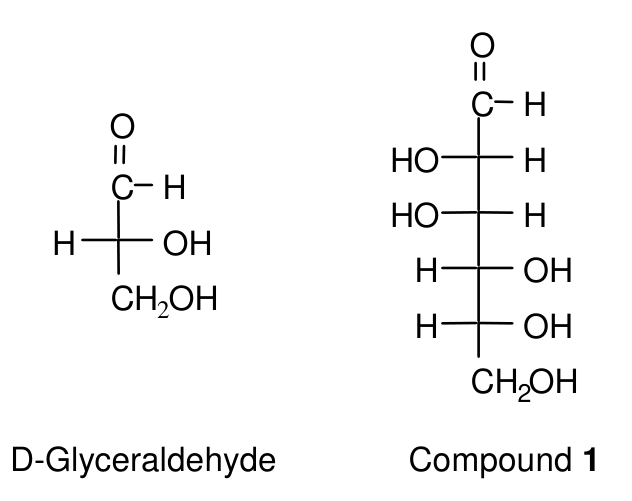
Acid-catalyzed hydrolysis gives three different D-hexoses, A, B, and C. Compounds A and B, as well as compound 1 (see below), all give the same osazone upon reaction with excess acidic phenylhydrazine. Compound C reacts with nitric acid to give an optically inactive compound D. The Kiliani-Fischer approach is used to establish the configurational relationship between D-glyceraldehyde and C. The intermediate aldotetrose which leads to C does not give a meso compound when oxidized by nitric acid. When A is treated with nitric acid, the dicarboxylic acid (aldaric acid) produced is optically active. Both A and B react with 5 moles of \(\ce{HIO4}\); one mole of A gives 5 moles of methanoic (formic) acid and one mole of methanal (formaldehyde) while one mole of B gives 3 moles of methanoic (formic) acid and 2 moles of methanal (formaldehyde) and one mole of carbon dioxide. Both A and B are related to the same aldotetrose which is the diastereoisomer of the one to which C is related. Methylation of X followed by hydrolysis gives a 2,3,4-tri-O-methyl-D-hexose (E) (derived from A), a 1,3,4,6-tetra-O-methyl-D-hexose (F) (derived from B), and a 2,3,4,6-tetra-O-methyl-D-hexose (G) (derived from C).1.1 On the answer sheet, draw Fischer projection formulas of A, B, C, and D.
1.2 On the answer sheet, complete the appropriate Haworth projection formulas to clearly show the ring size and absolute stereochemistry of E, F, and G. Either of the anomeric forms are acceptable as an answer.
1.3 On the answer sheet, underline the correct representation of the connectivity sequence of the three monosaccharides present in trisaccharide X.
Official English text of the problem.
Problem 2: Atmospheric formation of sulfuric acid: kinetics
Professor Molina of the Massachusetts Institute of Technology won the 1995 Nobel Prize in Chemistry for his work on atmospheric chemistry. One reaction that he has studied in detail is the acid rain reaction which produces \(\ce{H2SO4}\) in the atmosphere. He has proposed two possible stoichiometric reactions:

2.1 Using simple collision theory, what reaction orders would be expected for Proposal A and for Proposal B?
Proposal B is thought to proceed by the following two-step process:
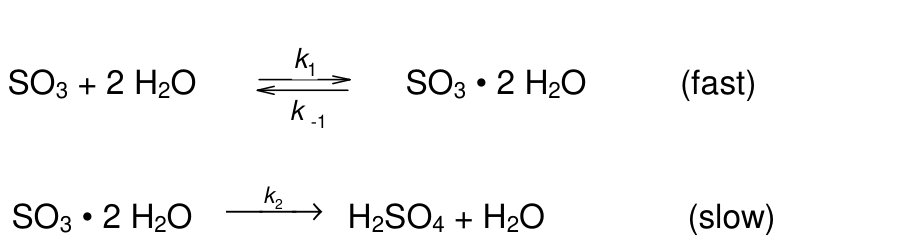
(\(\ce{SO3 * 2H2O}\) is a complex which is stabilized by hydrogen bonds and \(k_2 \ll k_1\) or \(k_{-1}\))
2.2 By applying the principle of stationary (steady) states, derive the appropriate rate law and hence the reaction order of the two-step mechanism for Proposal B.
2.3 Recent quantum chemical calculations have shown that the overall reaction activation energies for the two proposals are:
\(E_A = +80\ \mathrm{kJ\,mol^{-1}}\) for Proposal A
\(E_B = -20\ \mathrm{kJ\,mol^{-1}}\) for Proposal BState the relationship between the rate constant and the temperature (Arrhenius relationship) for each proposal and predict the temperature dependence of the rate constants for each proposal.
2.4 The formation of \(\ce{H2SO4}\) is faster in the upper atmosphere (\(T = 175\ \mathrm{K}\)) than at the earth’s surface (\(T = 300\ \mathrm{K}\)). Which proposed pathway must dominate in the upper atmosphere given the activation energies in part (iii) and your understanding of the Arrhenius equation?
Official English text of the problem.
Problem 3: Synthesis of the thiol side chain of the anti-asthma drug MK-0476
Chemists at Merck Frosst Canada in Montréal have developed a promising drug which is useful against asthma. The structure of MK-0476 is shown below.
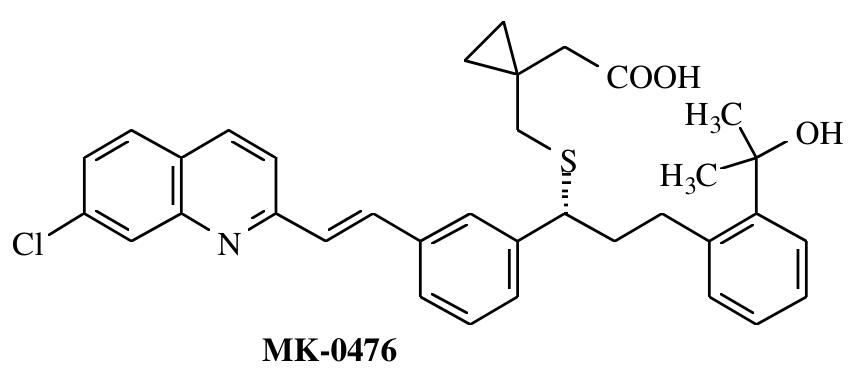
During their investigation, they devised a simple and efficient synthesis, depicted below, for the thiolated portion of MK-0476 starting from diethyl ester A.
3.1 Give the structures of the intermediate products B - F prepared during this synthesis.
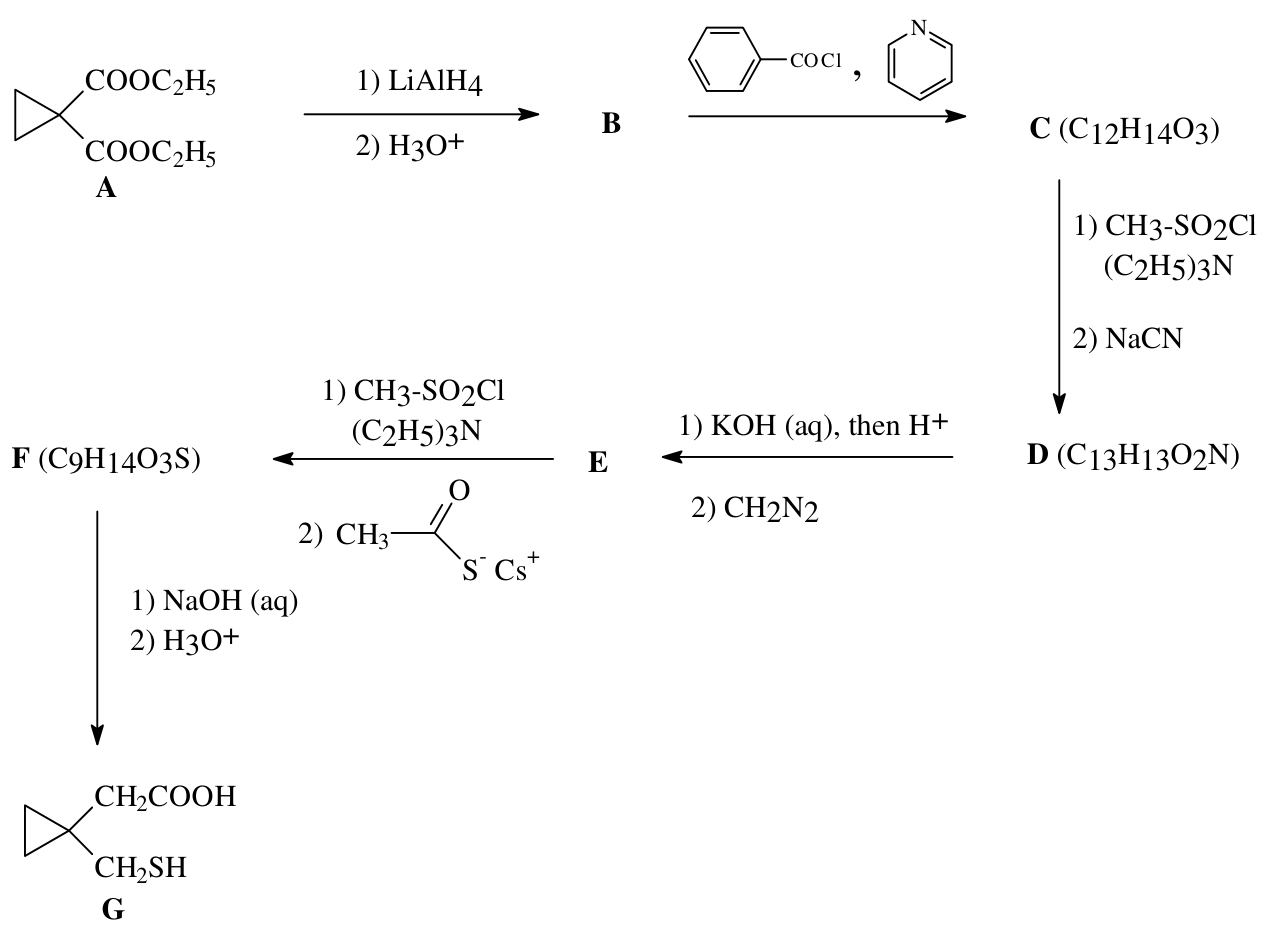
In one of the last steps of the synthesis on MK-0476, the dilithium salt of the above thiol acid (G) was coupled with the side chain of the rest of the molecule as shown below.
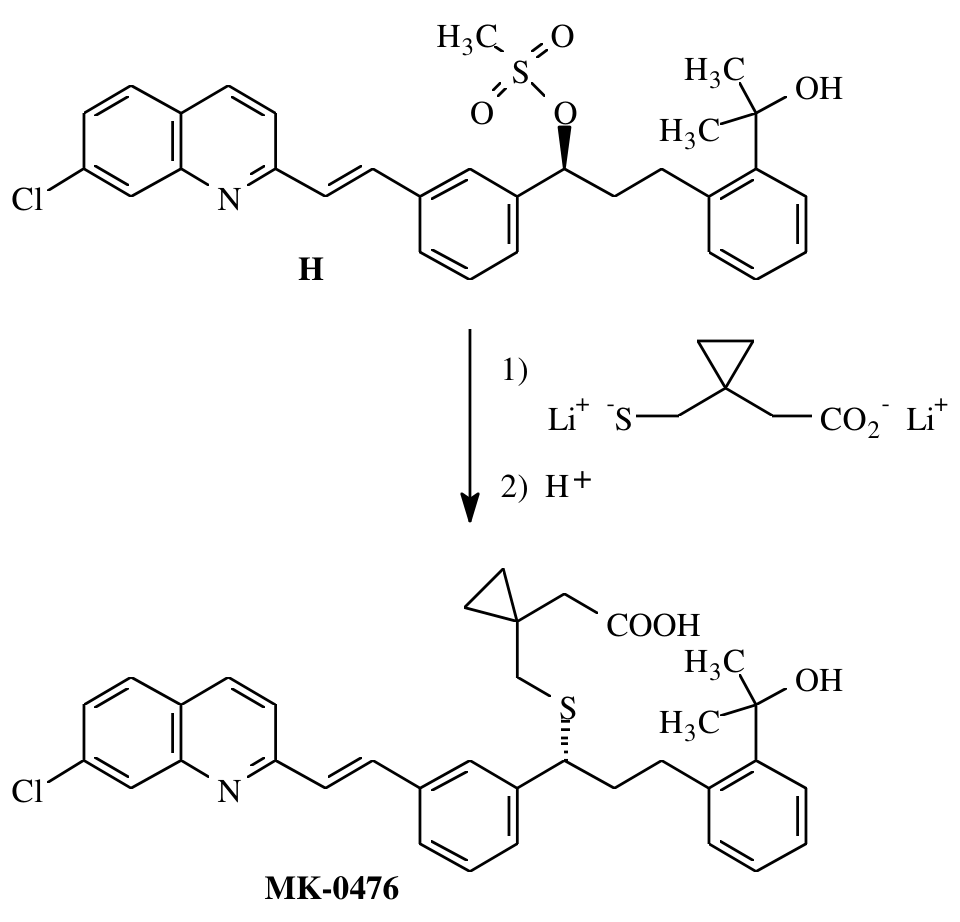
3.2 Based on the observed stereochemistry of the above reaction, what is the mechanistic designation of this coupling process?
3.3 If the process proceeds by your proposed mechanism, what change would occur to the overall rate of the reaction if the concentration of both the thiolate salt and the substrate H were simultaneously tripled?
3.4 For the nucleophilic substitution reaction, model studies were carried out using bromoethane as the substrate to perfect the above coupling. Draw only the structure of the major product of the reaction of one molar equivalent of bromoethane with:
a) G plus two molar equivalents of base
b) G plus one molar equivalent of base
3.5 A side reaction of G is its oxidative dimerization.
Draw the structure of the dimeric product, showing all non-bonded electrons.
Official English text of the problem.
Problem 4: Spectrophotometry of an acid-base indicator
Graph paper is provided for your optional use in this question.
If you choose to use it, print your name and identification code in the upper right corner of the graph paper.
****************************\(\ce{HIn}\) is a weakly acidic indicator.

also written as
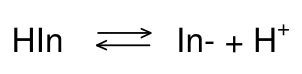
At normal temperatures, the acid dissociation constant for this indicator is \(K_{\mathrm a}=2.93\times10^{-5}\).
The absorbance data (1.00 cm cells) for \(5.00\times10^{-4}\) M (\(\mathrm{mol\,dm^{-3}}\)) solutions of this indicator in strongly acidic and strongly alkaline solutions are given in the following table.
Absorbance Data (A)
\(\lambda\), nm \(pH=1.00\) \(pH=13.00\) 400 0.401 0.067 470 0.447 0.050 485 0.453 0.052 490 0.452 0.054 505 0.443 0.073 535 0.390 0.170 555 0.342 0.342 570 0.303 0.515 585 0.263 0.648 615 0.195 0.816 625 0.176 0.823 635 0.170 0.816 650 0.137 0.763 680 0.097 0.588 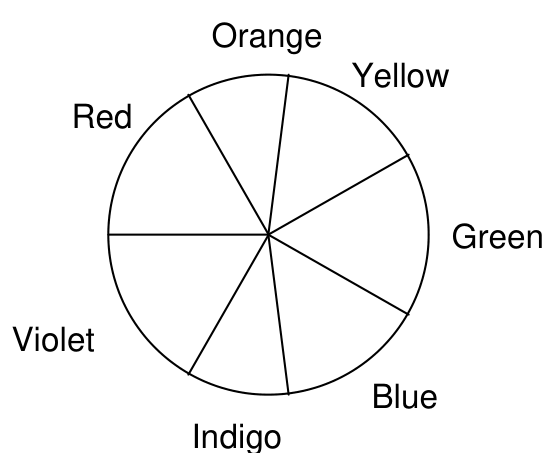
4.1 Predict the observed colour of the a) acidic and b) basic forms of the indicator.
Using a “50 nm wide bar”, shade the appropriate area of the wavelength scale on the answer sheet which would correspond to the colour of the indicator at the \(pH\) values given in the table.
For example, if observed colour is green, your answer would appear as:

4.2 A filter is located between the light source and the sample. What colour filter would be most suitable for the photometric analysis of the indicator in a strongly acidic medium?
4.3 What wavelength range would be most suitable for the photometric analysis of the indicator in a strongly basic medium?
4.4 What would be the absorbance of a \(1.00\times10^{-4}\) M (\(\mathrm{mol\,dm^{-3}}\)) solution of the indicator in alkaline form if measured at 545 nm in a 2.50 cm cell?
4.5 Solutions of the indicator were prepared in a strongly acidic solution (\(\ce{HCl}\), \(pH=1\)) and in a strongly basic solution (\(\ce{NaOH}\), \(pH=13\)). Perfectly linear relationships between absorbance and concentration were observed in both media at 490 nm and 625 nm, respectively.
The molar absorptivities at the two wavelengths are:
\(\lambda=490\ \mathrm{nm}\) \(\lambda=625\ \mathrm{nm}\) \(\ce{HIn}\) (\(\ce{HCl}\)) \(9.04\times10^2\ \mathrm{M^{-1}\,cm^{-1}}\) \(3.52\times10^2\ \mathrm{M^{-1}\,cm^{-1}}\) \(\ce{In-}\) (\(\ce{NaOH}\)) \(1.08\times10^2\ \mathrm{M^{-1}\,cm^{-1}}\) \(1.65\times10^3\ \mathrm{M^{-1}\,cm^{-1}}\) \((\mathrm{M}=\mathrm{mol\,dm^{-3}})\)
Calculate the absorbance (1.00 cm cell) at the two wavelengths for an aqueous \(1.80\times10^{-3}\) M (\(\mathrm{mol\,dm^{-3}}\)) solution of the indicator \(\ce{HIn}\).
Official English text of the problem.
Problem 5: Allotropes of iron and the density of martensite
Iron metal melts at 1811 K. Between room temperature and its melting point, iron metal can exist in different allotropic or crystalline forms. From room temperature to 1185 K, the crystal structure of iron metal exists as a body-centred cubic (bcc) lattice known as α-iron. From 1185 K to 1667 K, the structure becomes face-centred cubic (fcc) and is called γ-iron. Above 1667 K, and up to its melting point, iron reverts to a bcc structure similar to that of α-iron. The latter phase is called δ-iron.
Given that the density of pure iron metal is \(7.874\ \mathrm{g\,cm^{-3}}\) at 293 K:
5.1 Calculate the atomic radius of iron (expressed in cm).
5.2 Calculate its density (expressed in \(\mathrm{g\,cm^{-3}}\)) at 1250 K.
Notes: Ignore the small effects due to the thermal expansion of the metal.
Clearly define any symbols which you use, e.g. \(r\) = atomic radius of \(\ce{Fe}\).
Steel is an alloy of iron and carbon in which some of the interstitial spaces (“holes”) of the crystal lattice (iron) are occupied by small atoms (carbon). Its carbon content typically ranges from 0.1 % to 4.0 %. In a blast-furnace, the melting of iron is facilitated when it contains 4.3 % of carbon by mass. If this mixture is cooled too rapidly the carbon atoms remain dispersed within the α-iron phase. This new solid, called martensite, is extremely hard and brittle. Although is it slightly distorted, the size of the unit cell of this solid (martensite) is the same as that of α-iron (bcc).
Assuming that the carbon atoms are evenly distributed in the iron structure:
5.3 Calculate the average number of carbon atoms per unit cell of α-iron in martensite containing 4.3 % \(\ce{C}\) by mass.
5.4 Calculate the density (expressed in \(\mathrm{g\,cm^{-3}}\)) of this material.
Molar masses and constants:
\(M(\ce{Fe}) = 55.847\ \mathrm{g\,mol^{-1}}\)
\(M(\ce{C}) = 12.011\ \mathrm{g\,mol^{-1}}\)
\(N_{\mathrm A} = 6.02214\times10^{23}\ \mathrm{mol^{-1}}\)
Official English text of the problem.
Problem 6: Refining of platinum metals; a main-group chloride and ammonia
6.1 Much of the world’s supply of platinum group metals is derived from the residues recovered from the electrolytic refining of copper and nickel. A flow chart for the recovery of platinum and palladium is shown on the following page.
i) Clearly draw the shape (geometry) of both the \(\ce{PtCl6^2-}\) and the \(\ce{PdCl4^2-}\) anions.
ii) Clearly draw all possible stereoisomeric structures of monomeric \(\ce{Pd(NH3)2Cl2}\). Label the structures that you have drawn with their correct stereochemical descriptors.
iii) What is the role of the \(\ce{FeSO4}\) in the second step of the flow chart? Write a balanced equation for the reaction of \(\ce{FeSO4}\) in this step.
iv) Write a complete balanced equation for the ignition of \(\ce{Pd(NH3)2Cl2}\) in air to give \(\ce{Pd}\) metal. In this reaction, what is being oxidized and what is being reduced?
6.2 Reaction of a main group chloride (24.71 g) with ammonia (10.90 g) gave a mixture of products consisting of \(\ce{NH4Cl}\) (25.68 g), a solid element A (2.57 g) and a yellow crystalline nitride of this element (7.37 g) according to the equation below.

(where n, m, p, q, r, w, x, y and z are coefficients to be determined)
A sample of the nitride exploded violently when struck with a hammer, but it underwent controlled polymerization on heating to give a bronze-coloured, fibrous solid which exhibits metallic conductivity. Element A also undergoes polymerization to a high molecular weight linear polymer upon heating.
Molar masses:
\[ M(\ce{Cl})=35.453\ \mathrm{g\,mol^{-1}} \qquad M(\ce{N})=14.007\ \mathrm{g\,mol^{-1}} \qquad M(\ce{H})=1.008\ \mathrm{g\,mol^{-1}} \]
i) Identify element A.
ii) Write a complete balanced equation for the reaction of the chloride with ammonia.
iii) Assuming conventional oxidation states, write the balanced redox half-reaction equations involved in this reaction.
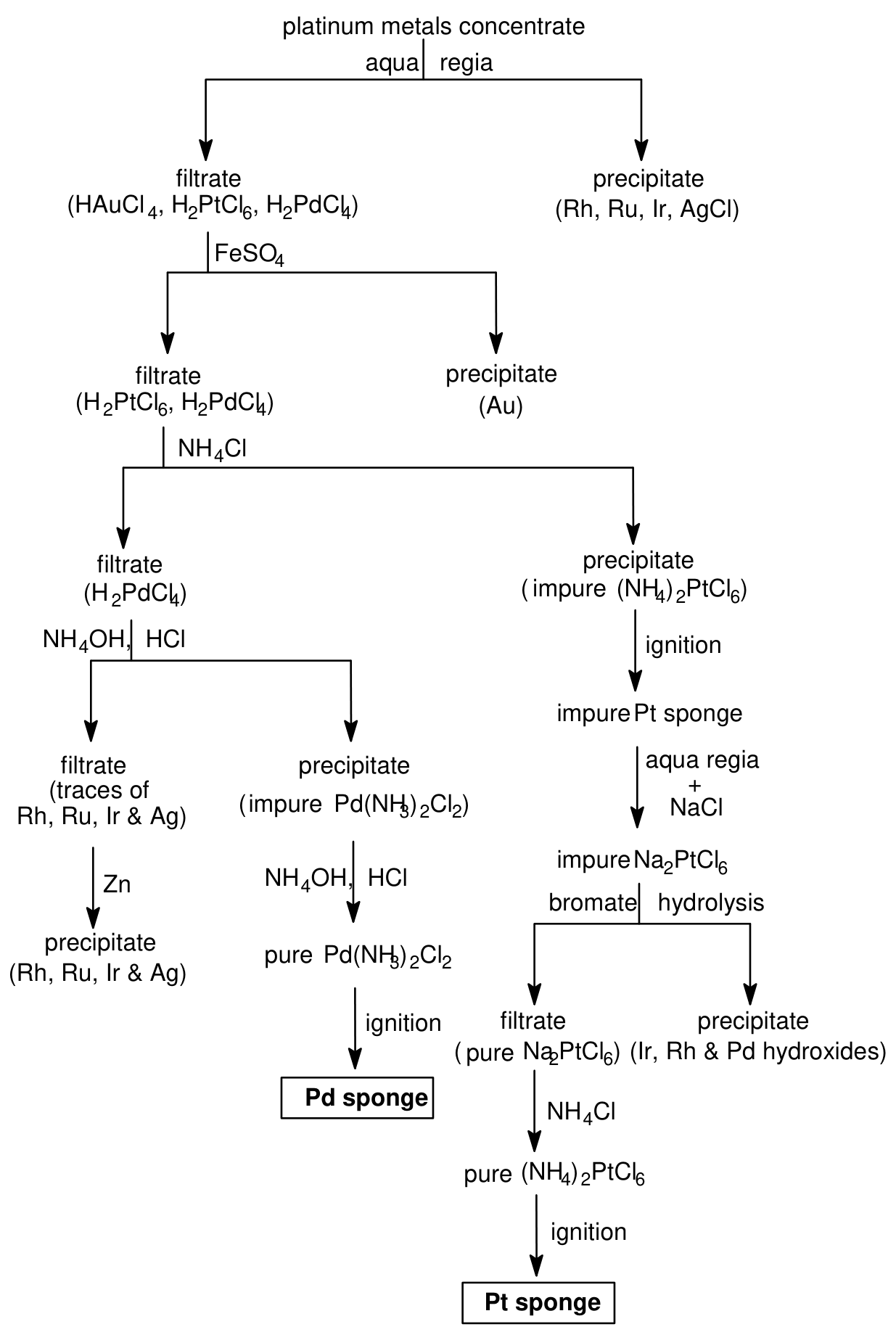
Method of Purification of Platinum and Palladium
Official English text of the problem.
Problem 7: Thermodynamics of chlorine expansion and of nickel ammine/ethylenediamine complexes
7.1 One mole of \(\ce{Cl2(g)}\), which may be assumed to obey the ideal gas law, initially at 300 K and \(1.01325\times10^7\) Pa, is expanded against a constant external pressure of \(1.01325\times10^5\) Pa to a final pressure of \(1.01325\times10^5\) Pa. As a result of the expansion, the gas cooled to a temperature of 239 K (which is the normal boiling point of \(\ce{Cl2}\)), and 0.100 mol of \(\ce{Cl2}\) condensed.
The enthalpy of vaporization of \(\ce{Cl2(l)}\) is 20.42 kJ mol\(^{-1}\) at the normal boiling point, the molar heat capacity of \(\ce{Cl2(g)}\) at constant volume is \(C_v=28.66\) J K\(^{-1}\) mol\(^{-1}\) and the density of \(\ce{Cl2(l)}\) is 1.56 g cm\(^{-3}\) (at 239 K). Assume that the molar heat capacity at constant pressure for \(\ce{Cl2(g)}\) is \(C_p=C_v+R\).
(1 atm \(=1.01325\times10^5\) Pa, \(R=8.314510\) J K\(^{-1}\) mol\(^{-1}=0.0820584\) L atm K\(^{-1}\) mol\(^{-1}\))
i) Either draw a complete molecular orbital energy diagram or write the complete electronic configuration of \(\ce{Cl2}\). Predict the bond order of \(\ce{Cl2}\) and thus whether this molecule will be diamagnetic, ferromagnetic, or paramagnetic.
ii) For the changes described above, calculate the change in the internal energy \((\Delta E)\) and the change in the entropy \((\Delta S_{\mathrm{sys}})\) of the system.
7.2 For the following reactions occurring in dilute aqueous solution at 298 K:

\(\ln K_c=11.60\) and \(\Delta H^0=-33.5\) kJ mol\(^{-1}\)

\(\ln K_c=17.78\) and \(\Delta H^0=-37.2\) kJ mol\(^{-1}\)
Note: \(en\) is ethylenediamine (a neutral bidentate ligand)
(\(R=8.314510\) J K\(^{-1}\) mol\(^{-1}=0.0820584\) L atm K\(^{-1}\) mol\(^{-1}\))
Calculate \(\Delta G^0\), \(\Delta S^0\), and \(K_c\) at 298 K for reaction [3] occurring in a dilute aqueous solution:

Official English text of the problem.
Problem 8: Electrodeposition of copper monolayers on Pt(100)
An electrolyte is prepared from \(\ce{H2SO4}\), \(\ce{CuSO4}\) and distilled water and its volume is \(100.0\ \mathrm{cm^3}\). The concentrations of \(\ce{H+}\) and \(\ce{Cu^2+}\) in the electrolyte are \(c(\ce{H+}) = 1.000\ \mathrm{M}\) \((\mathrm{mol\ dm^{-3}})\) and \(c(\ce{Cu^2+}) = 1.000\times10^{-2}\ \mathrm{M}\) \((\mathrm{mol\ dm^{-3}})\), respectively. Two cubic platinum electrodes are immersed in the electrolyte. Both of the electrodes are single crystals with only one face (100) exposed to the electrolyte (the other five faces are blocked physically by an insulator which is stable in the electrolyte). The exposed surface area of each electrode is equal to \(1.000\ \mathrm{cm^2}\). During an electrolysis a total charge of \(2.0000\ \mathrm{C}\) is passed between the cathode and the anode. At the cathode, two simultaneous processes are occurring: deposition of an epitaxial (layer-by-layer) \(\ce{Cu}\) layer and \(\ce{H2}\) gas generation. At the anode, \(\ce{O2}\) gas is generated. The \(\ce{H2}\) gas is collected in a flask under the following conditions (assume ideal gas behaviour):
\(T = 273.15\ \mathrm{K}\) and \(P(\ce{H2}) = 1.01325\times10^4\ \mathrm{Pa}\); the volume of \(\ce{H2}\) is equal to \(2.0000\ \mathrm{cm^3}\)
8.1 Write equations of the processes taking place at the electrodes.
8.2 Calculate the number of moles of \(\ce{H2}\) gas generated at the cathode and the number of moles of \(\ce{Cu}\) deposited on the electrode.
8.3 Calculate the number of \(\ce{Cu}\) monolayers formed on the \(\ce{Pt}\) (100) cathode.
Note that the lattice constant of \(\ce{Pt}\) is \(a(\ce{Pt}) = 3.9236\times10^{-8}\ \mathrm{cm}\).
Both \(\ce{Pt}\) and \(\ce{Cu}\) have the fcc (face centred cubic) crystallographic structure.
Molar masses and constants:
\(M(\ce{H}) = 1.00795\ \mathrm{g\ mol^{-1}}\)
\(M(\ce{Cu}) = 63.546\ \mathrm{g\ mol^{-1}}\)
\(e = 1.60218\times10^{-19}\ \mathrm{C}\)
\(F = 96485.3\ \mathrm{C\ mol^{-1}}\)
\(R = 8.314510\ \mathrm{J\ K^{-1}\ mol^{-1}} = 0.0820584\ \mathrm{L\ atm\ K^{-1}\ mol^{-1}}\)
\(V_m = 22.4141\ \mathrm{dm^3}\)
\(1\ \mathrm{atm} = 1.01325\times10^5\ \mathrm{Pa}\)
\(N_{\mathrm A} = 6.02214\times10^{23}\ \mathrm{mol^{-1}}\)
Official English text of the problem.
Internationale Chemie-Olympiade
IChO 1997
Montreal, Kanada · 8 Theorieaufgaben mit vollständigen Lösungen
Aufgabe 1: Struktur eines Trisaccharids aus Baumwollsaatmehl
Verbindung X ist ein Trisaccharid, das hauptsächlich in Baumwollsaatmehl vorkommt.
Verbindung X reagiert weder mit Benedict-Lösung noch mit Fehling-Lösung und zeigt auch keine Mutarotation.
Die säurekatalysierte Hydrolyse ergibt drei verschiedene D-Hexosen, A, B und C. Die Verbindungen A und B sowie Verbindung 1 (siehe unten) ergeben bei der Reaktion mit überschüssigem Phenylhydrazin im sauren Milieu alle dasselbe Osazon. Verbindung C reagiert mit Salpetersäure zu einer optisch inaktiven Verbindung D. Mithilfe der Kiliani-Fischer-Synthese wird die Konfigurationsbeziehung zwischen D-Glycerinaldehyd und C bestimmt. Die intermediäre Aldotetrose, die zu C führt, ergibt bei der Oxidation mit Salpetersäure keine meso-Verbindung. Wird A mit Salpetersäure behandelt, so ist die entstehende Dicarbonsäure (Aldarsäure) optisch aktiv. Sowohl A als auch B reagieren mit 5 Mol \(\ce{HIO4}\); ein Mol A ergibt 5 Mol Methansäure (Ameisensäure) und ein Mol Methanal (Formaldehyd), während ein Mol B 3 Mol Methansäure (Ameisensäure), 2 Mol Methanal (Formaldehyd) und ein Mol Kohlenstoffdioxid ergibt. Sowohl A als auch B lassen sich auf dieselbe Aldotetrose zurückführen, die das Diastereomer derjenigen ist, auf die sich C zurückführen lässt. Die Methylierung von X mit anschließender Hydrolyse ergibt eine 2,3,4-Tri-O-methyl-D-hexose (E) (aus A), eine 1,3,4,6-Tetra-O-methyl-D-hexose (F) (aus B) und eine 2,3,4,6-Tetra-O-methyl-D-hexose (G) (aus C).1.1 Zeichnen Sie auf dem Antwortblatt die Fischer-Projektionsformeln von A, B, C und D.
1.2 Vervollständigen Sie auf dem Antwortblatt die entsprechenden Haworth-Projektionsformeln so, dass die Ringgröße und die absolute Stereochemie von E, F und G eindeutig erkennbar sind. Beide anomeren Formen sind als Antwort zulässig.
1.3 Unterstreichen Sie auf dem Antwortblatt die richtige Darstellung der Verknüpfungsreihenfolge der drei Monosaccharide im Trisaccharid X.
Aufgabentext aus dem offiziellen englischen Text übersetzt.
Aufgabe 2: Bildung von Schwefelsäure in der Atmosphäre: Kinetik
Professor Molina vom Massachusetts Institute of Technology erhielt 1995 den Nobelpreis für Chemie für seine Arbeiten zur Atmosphärenchemie. Eine Reaktion, die er eingehend untersucht hat, ist die zur Entstehung von saurem Regen beitragende Reaktion, bei der in der Atmosphäre \(\ce{H2SO4}\) gebildet wird. Er hat zwei mögliche stöchiometrische Reaktionen vorgeschlagen:
2.1 Welche Reaktionsordnungen wären nach der einfachen Stoßtheorie für Vorschlag A und für Vorschlag B zu erwarten?
Es wird angenommen, dass Vorschlag B nach folgendem zweistufigen Prozess abläuft:
(\(\ce{SO3 * 2H2O}\) ist ein durch Wasserstoffbrückenbindungen stabilisierter Komplex, und es gilt \(k_2 \ll k_1\) oder \(k_{-1}\))
2.2 Leiten Sie unter Anwendung des Prinzips der Quasistationarität das entsprechende Geschwindigkeitsgesetz und daraus die Reaktionsordnung des zweistufigen Mechanismus für Vorschlag B her.
2.3 Neuere quantenchemische Berechnungen haben gezeigt, dass die Aktivierungsenergien der Gesamtreaktion für die beiden Vorschläge folgende Werte haben:
\(E_A = +80\ \mathrm{kJ\,mol^{-1}}\) für Vorschlag A
\(E_B = -20\ \mathrm{kJ\,mol^{-1}}\) für Vorschlag BGeben Sie für jeden Vorschlag den Zusammenhang zwischen der Geschwindigkeitskonstanten und der Temperatur (Arrhenius-Beziehung) an und sagen Sie die Temperaturabhängigkeit der jeweiligen Geschwindigkeitskonstanten voraus.
2.4 Die Bildung von \(\ce{H2SO4}\) erfolgt in der oberen Atmosphäre (\(T = 175\ \mathrm{K}\)) schneller als an der Erdoberfläche (\(T = 300\ \mathrm{K}\)). Welcher der vorgeschlagenen Reaktionswege muss angesichts der Aktivierungsenergien aus Teil (iii) und Ihres Verständnisses der Arrhenius-Gleichung in der oberen Atmosphäre dominieren?
Aufgabentext aus dem offiziellen englischen Text übersetzt.
Aufgabe 3: Synthese der Thiol-Seitenkette des Antiasthmatikums MK-0476
Chemiker bei Merck Frosst Canada in Montréal haben einen vielversprechenden Wirkstoff entwickelt, der gegen Asthma wirksam ist. Die Struktur von MK-0476 ist unten dargestellt.
Im Verlauf ihrer Untersuchungen entwickelten sie ausgehend vom Diethylester A eine einfache und effiziente Synthese für den thiolhaltigen Teil von MK-0476, die unten dargestellt ist.
3.1 Geben Sie die Strukturen der bei dieser Synthese hergestellten Zwischenprodukte B - F an.
In einem der letzten Schritte der Synthese von MK-0476 wurde das Dilithiumsalz der oben gezeigten Thiolcarbonsäure (G) mit der Seitenkette des übrigen Moleküls gekoppelt, wie unten dargestellt.
3.2 Wie lautet aufgrund der beobachteten Stereochemie der oben gezeigten Reaktion die mechanistische Bezeichnung dieses Kupplungsprozesses?
3.3 Wenn der Prozess nach dem von Ihnen vorgeschlagenen Mechanismus abläuft, wie verändert sich dann die Gesamtgeschwindigkeit der Reaktion, wenn die Konzentrationen sowohl des Thiolatsalzes als auch des Substrats H gleichzeitig verdreifacht werden?
3.4 Zur Optimierung der oben gezeigten Kupplung wurden Modelluntersuchungen zur nucleophilen Substitutionsreaktion mit Bromethan als Substrat durchgeführt. Zeichnen Sie jeweils nur die Struktur des Hauptprodukts der Reaktion eines molaren Äquivalents Bromethan mit:
a) G und zwei molaren Äquivalenten Base
b) G und einem molaren Äquivalent Base
3.5 Eine Nebenreaktion von G ist seine oxidative Dimerisierung.
Zeichnen Sie die Struktur des dimeren Produkts und geben Sie dabei alle nichtbindenden Elektronen an.
Aufgabentext aus dem offiziellen englischen Text übersetzt.
Aufgabe 4: Spektrophotometrie eines Säure-Base-Indikators
Für diese Aufgabe steht Ihnen Millimeterpapier zur Verfügung, das Sie bei Bedarf verwenden können.
Falls Sie es verwenden, tragen Sie Ihren Namen und Ihren Identifikationscode in Druckschrift in der oberen rechten Ecke des Millimeterpapiers ein.
****************************\(\ce{HIn}\) ist ein schwach saurer Indikator.
auch geschrieben als
Bei normalen Temperaturen beträgt die Säuredissoziationskonstante dieses Indikators \(K_{\mathrm a}=2.93\times10^{-5}\).
Die Extinktionswerte (Küvetten mit 1.00 cm Schichtdicke) für \(5.00\times10^{-4}\) M (\(\mathrm{mol\,dm^{-3}}\)) Lösungen dieses Indikators in stark saurer und stark alkalischer Lösung sind in der folgenden Tabelle angegeben.
Extinktionswerte (A)
\(\lambda\), nm \(pH=1.00\) \(pH=13.00\) 400 0.401 0.067 470 0.447 0.050 485 0.453 0.052 490 0.452 0.054 505 0.443 0.073 535 0.390 0.170 555 0.342 0.342 570 0.303 0.515 585 0.263 0.648 615 0.195 0.816 625 0.176 0.823 635 0.170 0.816 650 0.137 0.763 680 0.097 0.588 4.1 Sagen Sie die beobachtete Farbe der a) sauren und b) basischen Form des Indikators voraus.
Schraffieren Sie auf der Wellenlängenskala des Antwortblatts mit einem „50 nm breiten Balken“ den entsprechenden Bereich, der der Farbe des Indikators bei den in der Tabelle angegebenen \(pH\)-Werten entspricht.
Wenn die beobachtete Farbe beispielsweise Grün ist, würde Ihre Antwort so aussehen:
4.2 Zwischen der Lichtquelle und der Probe befindet sich ein Filter. Welche Filterfarbe wäre für die photometrische Analyse des Indikators in einem stark sauren Medium am besten geeignet?
4.3 Welcher Wellenlängenbereich wäre für die photometrische Analyse des Indikators in einem stark basischen Medium am besten geeignet?
4.4 Welche Extinktion hätte eine \(1.00\times10^{-4}\) M (\(\mathrm{mol\,dm^{-3}}\)) Lösung des Indikators in seiner alkalischen Form bei einer Messung bei 545 nm in einer Küvette mit 2.50 cm Schichtdicke?
4.5 Lösungen des Indikators wurden in einer stark sauren Lösung (\(\ce{HCl}\), \(pH=1\)) und in einer stark basischen Lösung (\(\ce{NaOH}\), \(pH=13\)) hergestellt. In beiden Medien wurden bei 490 nm bzw. 625 nm vollständig lineare Beziehungen zwischen Extinktion und Konzentration beobachtet.
Die molaren Extinktionskoeffizienten bei den beiden Wellenlängen betragen:
\(\lambda=490\ \mathrm{nm}\) \(\lambda=625\ \mathrm{nm}\) \(\ce{HIn}\) (\(\ce{HCl}\)) \(9.04\times10^2\ \mathrm{M^{-1}\,cm^{-1}}\) \(3.52\times10^2\ \mathrm{M^{-1}\,cm^{-1}}\) \(\ce{In-}\) (\(\ce{NaOH}\)) \(1.08\times10^2\ \mathrm{M^{-1}\,cm^{-1}}\) \(1.65\times10^3\ \mathrm{M^{-1}\,cm^{-1}}\) \((\mathrm{M}=\mathrm{mol\,dm^{-3}})\)
Berechnen Sie die Extinktion (Küvette mit 1.00 cm Schichtdicke) bei den beiden Wellenlängen für eine wässrige \(1.80\times10^{-3}\) M (\(\mathrm{mol\,dm^{-3}}\)) Lösung des Indikators \(\ce{HIn}\).
Aufgabentext aus dem offiziellen englischen Text übersetzt.
Aufgabe 5: Allotrope Formen des Eisens und die Dichte von Martensit
Metallisches Eisen schmilzt bei 1811 K. Zwischen Raumtemperatur und seinem Schmelzpunkt kann metallisches Eisen in verschiedenen allotropen oder kristallinen Formen vorliegen. Von Raumtemperatur bis 1185 K liegt die Kristallstruktur des metallischen Eisens als kubisch raumzentriertes Gitter (bcc) vor, das als α-Eisen bezeichnet wird. Von 1185 K bis 1667 K wird die Struktur kubisch flächenzentriert (fcc) und als γ-Eisen bezeichnet. Oberhalb von 1667 K und bis zu seinem Schmelzpunkt nimmt Eisen wieder eine bcc-Struktur an, die derjenigen von α-Eisen ähnelt. Diese letztere Phase wird δ-Eisen genannt.
Die Dichte von reinem metallischem Eisen beträgt bei 293 K \(7.874\ \mathrm{g\,cm^{-3}}\):
5.1 Berechnen Sie den Atomradius von Eisen (angegeben in cm).
5.2 Berechnen Sie seine Dichte (angegeben in \(\mathrm{g\,cm^{-3}}\)) bei 1250 K.
Hinweise: Vernachlässigen Sie die geringen Auswirkungen der Wärmeausdehnung des Metalls.
Definieren Sie alle verwendeten Symbole eindeutig, z. B. \(r\) = Atomradius von \(\ce{Fe}\).
Stahl ist eine Legierung aus Eisen und Kohlenstoff, in der einige der Zwischengitterräume („Lücken“) des Kristallgitters (Eisen) von kleinen Atomen (Kohlenstoff) besetzt sind. Sein Kohlenstoffgehalt liegt üblicherweise zwischen 0.1 % und 4.0 %. Im Hochofen wird das Schmelzen von Eisen erleichtert, wenn es einen Kohlenstoff-Massenanteil von 4.3 % enthält. Wird dieses Gemisch zu schnell abgekühlt, bleiben die Kohlenstoffatome innerhalb der α-Eisen-Phase verteilt. Dieser neue Feststoff, Martensit genannt, ist äußerst hart und spröde. Obwohl die Elementarzelle dieses Feststoffs (Martensit) leicht verzerrt ist, hat sie dieselbe Größe wie diejenige von α-Eisen (bcc).
Unter der Annahme, dass die Kohlenstoffatome gleichmäßig in der Eisenstruktur verteilt sind:
5.3 Berechnen Sie die durchschnittliche Anzahl der Kohlenstoffatome pro Elementarzelle des α-Eisens in Martensit mit einem Massenanteil von 4.3 % \(\ce{C}\).
5.4 Berechnen Sie die Dichte (angegeben in \(\mathrm{g\,cm^{-3}}\)) dieses Materials.
Molare Massen und Konstanten:
\(M(\ce{Fe}) = 55.847\ \mathrm{g\,mol^{-1}}\)
\(M(\ce{C}) = 12.011\ \mathrm{g\,mol^{-1}}\)
\(N_{\mathrm A} = 6.02214\times10^{23}\ \mathrm{mol^{-1}}\)
Aufgabentext aus dem offiziellen englischen Text übersetzt.
Aufgabe 6: Raffination der Platinmetalle; ein Hauptgruppenchlorid und Ammoniak
6.1 Ein großer Teil der weltweiten Versorgung mit Platingruppenmetallen stammt aus den Rückständen, die bei der elektrolytischen Raffination von Kupfer und Nickel anfallen. Auf der folgenden Seite ist ein Fließschema zur Gewinnung von Platin und Palladium dargestellt.
i) Zeichnen Sie deutlich die räumliche Gestalt (Geometrie) der beiden Anionen \(\ce{PtCl6^2-}\) und \(\ce{PdCl4^2-}\).
ii) Zeichnen Sie deutlich alle möglichen stereoisomeren Strukturen von monomerem \(\ce{Pd(NH3)2Cl2}\). Kennzeichnen Sie die gezeichneten Strukturen mit ihren korrekten stereochemischen Deskriptoren.
iii) Welche Rolle spielt \(\ce{FeSO4}\) im zweiten Schritt des Fließschemas? Geben Sie eine ausgeglichene Gleichung für die Reaktion von \(\ce{FeSO4}\) in diesem Schritt an.
iv) Geben Sie eine vollständige, ausgeglichene Gleichung für das Glühen von \(\ce{Pd(NH3)2Cl2}\) an Luft zu metallischem \(\ce{Pd}\) an. Was wird bei dieser Reaktion oxidiert und was wird reduziert?
6.2 Die Reaktion eines Hauptgruppenchlorids (24.71 g) mit Ammoniak (10.90 g) ergab gemäß der folgenden Gleichung ein Produktgemisch aus \(\ce{NH4Cl}\) (25.68 g), einem festen Element A (2.57 g) und einem gelben kristallinen Nitrid dieses Elements (7.37 g).
(wobei n, m, p, q, r, w, x, y und z zu bestimmende Koeffizienten sind)
Eine Probe des Nitrids explodierte heftig, als sie mit einem Hammer geschlagen wurde; beim Erhitzen polymerisierte es jedoch kontrolliert zu einem bronzefarbenen, faserigen Feststoff, der metallische Leitfähigkeit aufweist. Auch Element A polymerisiert beim Erhitzen zu einem hochmolekularen linearen Polymer.
Molare Massen:
\[ M(\ce{Cl})=35.453\ \mathrm{g\,mol^{-1}} \qquad M(\ce{N})=14.007\ \mathrm{g\,mol^{-1}} \qquad M(\ce{H})=1.008\ \mathrm{g\,mol^{-1}} \]
i) Identifizieren Sie Element A.
ii) Geben Sie eine vollständige, ausgeglichene Gleichung für die Reaktion des Chlorids mit Ammoniak an.
iii) Geben Sie unter Annahme der üblichen Oxidationszahlen die ausgeglichenen Redoxteilgleichungen für diese Reaktion an.
Verfahren zur Reinigung von Platin und Palladium
Aufgabentext aus dem offiziellen englischen Text übersetzt.
Aufgabe 7: Thermodynamik der Expansion von Chlor und von Nickel-Ammin-/Ethylendiamin-Komplexen
7.1 Ein Mol \(\ce{Cl2(g)}\), für das die Gültigkeit des idealen Gasgesetzes angenommen werden darf, wird ausgehend von 300 K und \(1.01325\times10^7\) Pa gegen einen konstanten äußeren Druck von \(1.01325\times10^5\) Pa bis zu einem Enddruck von \(1.01325\times10^5\) Pa expandiert. Infolge der Expansion kühlte das Gas auf eine Temperatur von 239 K ab (dies ist der Normalsiedepunkt von \(\ce{Cl2}\)), und 0.100 mol \(\ce{Cl2}\) kondensierten.
Die Verdampfungsenthalpie von \(\ce{Cl2(l)}\) beträgt am Normalsiedepunkt 20.42 kJ mol\(^{-1}\), die molare Wärmekapazität von \(\ce{Cl2(g)}\) bei konstantem Volumen beträgt \(C_v=28.66\) J K\(^{-1}\) mol\(^{-1}\), und die Dichte von \(\ce{Cl2(l)}\) beträgt 1.56 g cm\(^{-3}\) (bei 239 K). Nehmen Sie an, dass die molare Wärmekapazität von \(\ce{Cl2(g)}\) bei konstantem Druck \(C_p=C_v+R\) beträgt.
(1 atm \(=1.01325\times10^5\) Pa, \(R=8.314510\) J K\(^{-1}\) mol\(^{-1}=0.0820584\) L atm K\(^{-1}\) mol\(^{-1}\))
i) Zeichnen Sie entweder ein vollständiges Molekülorbital-Energieniveaudiagramm oder geben Sie die vollständige Elektronenkonfiguration von \(\ce{Cl2}\) an. Sagen Sie die Bindungsordnung von \(\ce{Cl2}\) voraus und damit, ob dieses Molekül diamagnetisch, ferromagnetisch oder paramagnetisch ist.
ii) Berechnen Sie für die oben beschriebenen Änderungen die Änderung der inneren Energie \((\Delta E)\) und die Entropieänderung \((\Delta S_{\mathrm{sys}})\) des Systems.
7.2 Für die folgenden Reaktionen, die bei 298 K in verdünnter wässriger Lösung ablaufen:
\(\ln K_c=11.60\) und \(\Delta H^0=-33.5\) kJ mol\(^{-1}\)
\(\ln K_c=17.78\) und \(\Delta H^0=-37.2\) kJ mol\(^{-1}\)
Hinweis: \(en\) ist Ethylendiamin (ein neutraler zweizähniger Ligand)
(\(R=8.314510\) J K\(^{-1}\) mol\(^{-1}=0.0820584\) L atm K\(^{-1}\) mol\(^{-1}\))
Berechnen Sie \(\Delta G^0\), \(\Delta S^0\) und \(K_c\) bei 298 K für die Reaktion [3], die in verdünnter wässriger Lösung abläuft:
Aufgabentext aus dem offiziellen englischen Text übersetzt.
Aufgabe 8: Elektrolytische Abscheidung von Kupfermonolagen auf Pt(100)
Ein Elektrolyt wird aus \(\ce{H2SO4}\), \(\ce{CuSO4}\) und destilliertem Wasser hergestellt; sein Volumen beträgt \(100.0\ \mathrm{cm^3}\). Die Konzentrationen von \(\ce{H+}\) und \(\ce{Cu^2+}\) im Elektrolyten betragen \(c(\ce{H+}) = 1.000\ \mathrm{M}\) \((\mathrm{mol\ dm^{-3}})\) bzw. \(c(\ce{Cu^2+}) = 1.000\times10^{-2}\ \mathrm{M}\) \((\mathrm{mol\ dm^{-3}})\). Zwei würfelförmige Platinelektroden werden in den Elektrolyten eingetaucht. Beide Elektroden sind Einkristalle, bei denen jeweils nur eine (100)-Fläche dem Elektrolyten ausgesetzt ist (die anderen fünf Flächen sind durch einen im Elektrolyten beständigen Isolator physisch abgedeckt). Die freiliegende Oberfläche jeder Elektrode beträgt \(1.000\ \mathrm{cm^2}\). Während einer Elektrolyse fließt zwischen Kathode und Anode eine Gesamtladung von \(2.0000\ \mathrm{C}\). An der Kathode laufen zwei Prozesse gleichzeitig ab: die Abscheidung einer epitaktischen (lageweise wachsenden) \(\ce{Cu}\)-Schicht und die Entwicklung von \(\ce{H2}\)-Gas. An der Anode wird \(\ce{O2}\)-Gas entwickelt. Das \(\ce{H2}\)-Gas wird unter den folgenden Bedingungen in einem Kolben aufgefangen (nehmen Sie ideales Gasverhalten an):
\(T = 273.15\ \mathrm{K}\) und \(P(\ce{H2}) = 1.01325\times10^4\ \mathrm{Pa}\); das Volumen von \(\ce{H2}\) beträgt \(2.0000\ \mathrm{cm^3}\)
8.1 Geben Sie die Gleichungen der an den Elektroden ablaufenden Prozesse an.
8.2 Berechnen Sie die Stoffmenge des an der Kathode entwickelten \(\ce{H2}\)-Gases und die Stoffmenge des auf der Elektrode abgeschiedenen \(\ce{Cu}\).
8.3 Berechnen Sie die Anzahl der auf der \(\ce{Pt}\)-(100)-Kathode gebildeten \(\ce{Cu}\)-Monolagen.
Beachten Sie, dass die Gitterkonstante von \(\ce{Pt}\) \(a(\ce{Pt}) = 3.9236\times10^{-8}\ \mathrm{cm}\) beträgt.
Sowohl \(\ce{Pt}\) als auch \(\ce{Cu}\) besitzen eine kubisch flächenzentrierte Kristallstruktur (fcc).
Molare Massen und Konstanten:
\(M(\ce{H}) = 1.00795\ \mathrm{g\ mol^{-1}}\)
\(M(\ce{Cu}) = 63.546\ \mathrm{g\ mol^{-1}}\)
\(e = 1.60218\times10^{-19}\ \mathrm{C}\)
\(F = 96485.3\ \mathrm{C\ mol^{-1}}\)
\(R = 8.314510\ \mathrm{J\ K^{-1}\ mol^{-1}} = 0.0820584\ \mathrm{L\ atm\ K^{-1}\ mol^{-1}}\)
\(V_m = 22.4141\ \mathrm{dm^3}\)
\(1\ \mathrm{atm} = 1.01325\times10^5\ \mathrm{Pa}\)
\(N_{\mathrm A} = 6.02214\times10^{23}\ \mathrm{mol^{-1}}\)
Aufgabentext aus dem offiziellen englischen Text übersetzt.
Uluslararası Kimya Olimpiyatı
IChO 1997
Montreal, Kanada · 8 teori sorusu, tam çözümleriyle
Soru 1: Pamuk tohumu küspesinden elde edilen bir trisakkaridin yapısı
X bileşiği, başlıca pamuk tohumu küspesinde bulunan bir trisakkarittir.
X bileşiği Benedict veya Fehling çözeltileriyle tepkime vermez ve mutarotasyon da göstermez.
Asit katalizli hidroliz sonucunda birbirinden farklı üç D-heksoz, A, B ve C elde edilir. A ve B bileşikleri ile 1 bileşiği (aşağıya bakınız), asidik ortamda fazla miktarda fenilhidrazinle tepkimeye girdiklerinde aynı osazonu verir. C bileşiği nitrik asitle tepkimeye girerek optikçe inaktif bir D bileşiği verir. D-gliseraldehit ile C arasındaki konfigürasyon ilişkisini belirlemek için Kiliani-Fischer yaklaşımı kullanılır. C'ye götüren ara aldotetroz, nitrik asitle yükseltgendiğinde mezo bir bileşik vermez. A nitrik asitle işlendiğinde oluşan dikarboksilik asit (aldarik asit) optikçe aktiftir. Hem A hem de B, 5 mol \(\ce{HIO4}\) ile tepkimeye girer; bir mol A, 5 mol metanoik (formik) asit ve bir mol metanal (formaldehit) verirken bir mol B, 3 mol metanoik (formik) asit, 2 mol metanal (formaldehit) ve bir mol karbon dioksit verir. Hem A hem de B, C'nin ilişkili olduğu aldotetrozun diastereoizomeri olan aynı aldotetrozla ilişkilidir. X'in metillenmesini izleyen hidroliz sonucunda (A'dan türeyen) bir 2,3,4-tri-O-metil-D-heksoz (E), (B'den türeyen) bir 1,3,4,6-tetra-O-metil-D-heksoz (F) ve (C'den türeyen) bir 2,3,4,6-tetra-O-metil-D-heksoz (G) elde edilir.1.1 Cevap kâğıdına A, B, C ve D'nin Fischer izdüşüm formüllerini çiziniz.
1.2 Cevap kâğıdındaki uygun Haworth izdüşüm formüllerini, E, F ve G'nin halka büyüklüklerini ve mutlak stereokimyalarını açıkça gösterecek şekilde tamamlayınız. Anomerik biçimlerden herhangi biri cevap olarak kabul edilir.
1.3 Cevap kâğıdında, X trisakkaridinde bulunan üç monosakkaridin bağlanma sırasını doğru gösteren ifadenin altını çiziniz.
Soru metni resmi İngilizce metinden çevrilmiştir.
Soru 2: Atmosferde sülfürik asit oluşumu: kinetik
Massachusetts Institute of Technology'den Profesör Molina, atmosfer kimyası üzerine yaptığı çalışmalarla 1995 Nobel Kimya Ödülü'nü kazanmıştır. Ayrıntılı olarak incelediği tepkimelerden biri, atmosferde \(\ce{H2SO4}\) üreten asit yağmuru tepkimesidir. İki olası stokiyometrik tepkime önermiştir:
2.1 Basit çarpışma teorisine göre, Öneri A ve Öneri B için hangi tepkime dereceleri beklenir?
Öneri B'nin aşağıdaki iki basamaklı süreçle gerçekleştiği düşünülmektedir:
(\(\ce{SO3 * 2H2O}\), hidrojen bağlarıyla kararlı hâle gelen bir komplekstir ve \(k_2 \ll k_1\) veya \(k_{-1}\) olur.)
2.2 Durağan (kararlı) hâl ilkesini uygulayarak, Öneri B'nin iki basamaklı mekanizması için uygun hız bağıntısını ve buradan tepkime derecesini türetiniz.
2.3 Son kuantum kimyasal hesaplamalar, iki öneri için toplam tepkime aktivasyon enerjilerinin aşağıdaki gibi olduğunu göstermiştir:
Öneri A için \(E_A = +80\ \mathrm{kJ\,mol^{-1}}\)
Öneri B için \(E_B = -20\ \mathrm{kJ\,mol^{-1}}\)Her bir öneri için hız sabiti ile sıcaklık arasındaki ilişkiyi (Arrhenius bağıntısını) belirtiniz ve hız sabitlerinin sıcaklığa bağlılığını öngörünüz.
2.4 \(\ce{H2SO4}\) oluşumu, üst atmosferde (\(T = 175\ \mathrm{K}\)) yeryüzündekinden (\(T = 300\ \mathrm{K}\)) daha hızlıdır. (iii) kısmındaki aktivasyon enerjileri ve Arrhenius denklemi hakkındaki bilginiz göz önüne alındığında, önerilen tepkime yollarından hangisi üst atmosferde baskın olmalıdır?
Soru metni resmi İngilizce metinden çevrilmiştir.
Soru 3: Astım ilacı MK-0476'nın tiyol yan zincirinin sentezi
Montréal'deki Merck Frosst Canada şirketinde çalışan kimyagerler, astıma karşı etkili olan, umut vadeden bir ilaç geliştirmişlerdir. MK-0476'nın yapısı aşağıda gösterilmiştir.
Araştırmaları sırasında, dietil ester A'dan başlayarak MK-0476'nın tiyol içeren kısmını elde etmek için aşağıda gösterilen basit ve verimli bir sentez geliştirmişlerdir.
3.1 Bu sentez sırasında hazırlanan B - F ara ürünlerinin yapılarını veriniz.
MK-0476 sentezinin son basamaklarından birinde, yukarıdaki tiyol asidinin (G) dilityum tuzu, aşağıda gösterildiği gibi molekülün geri kalan kısmının yan zinciriyle birleştirilmiştir.
3.2 Yukarıdaki tepkimede gözlenen stereokimyaya dayanarak, bu birleştirme işleminin mekanizması nasıl adlandırılır?
3.3 İşlem önerdiğiniz mekanizmayla ilerliyorsa, hem tiyolat tuzunun hem de H substratının derişimi aynı anda üç katına çıkarıldığında tepkimenin toplam hızında nasıl bir değişiklik olur?
3.4 Yukarıdaki birleştirme işlemini iyileştirmek amacıyla, nükleofilik yer değiştirme tepkimesi için substrat olarak bromoetan kullanılarak model çalışmalar yapılmıştır. Bir molar eşdeğer bromoetanın aşağıdakilerle tepkimesinde oluşan ana ürünün yalnızca yapısını çiziniz:
a) G ve iki molar eşdeğer baz
b) G ve bir molar eşdeğer baz
3.5 G'nin bir yan tepkimesi, yükseltgenerek dimerleşmesidir.
Bağ yapmayan tüm elektronları göstererek dimerik ürünün yapısını çiziniz.
Soru metni resmi İngilizce metinden çevrilmiştir.
Soru 4: Bir asit-baz indikatörünün spektrofotometrisi
Bu soruda isteğe bağlı olarak kullanmanız için grafik kâğıdı verilmiştir.
Kullanmayı tercih ederseniz, grafik kâğıdının sağ üst köşesine adınızı ve kimlik kodunuzu okunaklı harflerle yazınız.
****************************\(\ce{HIn}\) zayıf asidik bir indikatördür.
şu şekilde de gösterilir:
Normal sıcaklıklarda bu indikatörün asit ayrışma sabiti \(K_{\mathrm a}=2.93\times10^{-5}\) değerindedir.
Bu indikatörün kuvvetli asidik ve kuvvetli bazik ortamlardaki \(5.00\times10^{-4}\) M (\(\mathrm{mol\,dm^{-3}}\)) çözeltilerine ait absorbans verileri (1.00 cm'lik küvetlerde) aşağıdaki tabloda verilmiştir.
Absorbans Verileri (A)
\(\lambda\), nm \(pH=1.00\) \(pH=13.00\) 400 0.401 0.067 470 0.447 0.050 485 0.453 0.052 490 0.452 0.054 505 0.443 0.073 535 0.390 0.170 555 0.342 0.342 570 0.303 0.515 585 0.263 0.648 615 0.195 0.816 625 0.176 0.823 635 0.170 0.816 650 0.137 0.763 680 0.097 0.588 4.1 İndikatörün a) asidik ve b) bazik biçimlerinin gözlenen rengini tahmin ediniz.
“50 nm genişliğinde bir şerit” kullanarak, cevap kâğıdındaki dalga boyu ölçeğinde, tabloda verilen \(pH\) değerlerinde indikatörün rengine karşılık gelen uygun bölgeyi tarayınız.
Örneğin, gözlenen renk yeşil ise cevabınız şu şekilde görünmelidir:
4.2 Işık kaynağı ile numune arasına bir filtre yerleştirilmiştir. Kuvvetli asidik bir ortamda indikatörün fotometrik analizi için hangi renkte bir filtre en uygun olur?
4.3 Kuvvetli bazik bir ortamda indikatörün fotometrik analizi için hangi dalga boyu aralığı en uygun olur?
4.4 İndikatörün bazik biçiminin \(1.00\times10^{-4}\) M (\(\mathrm{mol\,dm^{-3}}\)) çözeltisinin absorbansı, 2.50 cm'lik bir küvette 545 nm'de ölçülseydi ne olurdu?
4.5 İndikatör çözeltileri kuvvetli asidik bir çözeltide (\(\ce{HCl}\), \(pH=1\)) ve kuvvetli bazik bir çözeltide (\(\ce{NaOH}\), \(pH=13\)) hazırlanmıştır. Bu iki ortamda sırasıyla 490 nm ve 625 nm'de absorbans ile derişim arasında tam doğrusal ilişkiler gözlenmiştir.
İki dalga boyundaki molar absorptivite değerleri şöyledir:
\(\lambda=490\ \mathrm{nm}\) \(\lambda=625\ \mathrm{nm}\) \(\ce{HIn}\) (\(\ce{HCl}\)) \(9.04\times10^2\ \mathrm{M^{-1}\,cm^{-1}}\) \(3.52\times10^2\ \mathrm{M^{-1}\,cm^{-1}}\) \(\ce{In-}\) (\(\ce{NaOH}\)) \(1.08\times10^2\ \mathrm{M^{-1}\,cm^{-1}}\) \(1.65\times10^3\ \mathrm{M^{-1}\,cm^{-1}}\) \((\mathrm{M}=\mathrm{mol\,dm^{-3}})\)
\(\ce{HIn}\) indikatörünün sulu \(1.80\times10^{-3}\) M (\(\mathrm{mol\,dm^{-3}}\)) çözeltisinin bu iki dalga boyundaki absorbansını (1.00 cm'lik küvette) hesaplayınız.
Soru metni resmi İngilizce metinden çevrilmiştir.
Soru 5: Demirin allotropları ve martenzitin yoğunluğu
Demir metali 1811 K'de erir. Oda sıcaklığı ile erime noktası arasında demir metali farklı allotropik veya kristal biçimlerde bulunabilir. Oda sıcaklığından 1185 K'ye kadar demir metalinin kristal yapısı, α-demir olarak bilinen hacim merkezli kübik (bcc) bir örgüdür. 1185 K ile 1667 K arasında yapı yüzey merkezli kübik (fcc) hâle gelir ve γ-demir olarak adlandırılır. 1667 K'nin üzerinde, erime noktasına kadar demir, α-demirinkine benzer bir bcc yapısına geri döner. Bu son faz δ-demir olarak adlandırılır.
Saf demir metalinin 293 K'deki yoğunluğunun \(7.874\ \mathrm{g\,cm^{-3}}\) olduğu veriliyor:
5.1 Demirin atom yarıçapını (cm cinsinden) hesaplayınız.
5.2 1250 K'deki yoğunluğunu (\(\mathrm{g\,cm^{-3}}\) cinsinden) hesaplayınız.
Notlar: Metalin ısıl genleşmesinden kaynaklanan küçük etkileri ihmal ediniz.
Kullandığınız tüm sembolleri açıkça tanımlayınız; örneğin, \(r\) = \(\ce{Fe}\) atomunun yarıçapı.
Çelik, kristal örgünün (demir) bazı ara yer boşluklarının (“oyukların”) küçük atomlar (karbon) tarafından doldurulduğu bir demir ve karbon alaşımıdır. Karbon içeriği genellikle % 0.1 ile % 4.0 arasında değişir. Bir yüksek fırında, demir kütlece % 4.3 karbon içerdiğinde erimesi kolaylaşır. Bu karışım çok hızlı soğutulursa karbon atomları α-demir fazı içinde dağılmış olarak kalır. Martenzit olarak adlandırılan bu yeni katı son derece sert ve kırılgandır. Birim hücresi hafifçe çarpılmış olsa da bu katının (martenzitin) birim hücre boyutu α-demirinkiyle (bcc) aynıdır.
Karbon atomlarının demir yapısı içinde düzgün dağıldığını varsayarak:
5.3 Kütlece % 4.3 \(\ce{C}\) içeren martenzitte α-demirin birim hücresi başına ortalama karbon atomu sayısını hesaplayınız.
5.4 Bu malzemenin yoğunluğunu (\(\mathrm{g\,cm^{-3}}\) cinsinden) hesaplayınız.
Molar kütleler ve sabitler:
\(M(\ce{Fe}) = 55.847\ \mathrm{g\,mol^{-1}}\)
\(M(\ce{C}) = 12.011\ \mathrm{g\,mol^{-1}}\)
\(N_{\mathrm A} = 6.02214\times10^{23}\ \mathrm{mol^{-1}}\)
Soru metni resmi İngilizce metinden çevrilmiştir.
Soru 6: Platin metallerinin saflaştırılması; bir ana grup klorürü ve amonyak
6.1 Dünyadaki platin grubu metal arzının büyük bir bölümü, bakır ve nikelin elektrolitik saflaştırılması sırasında elde edilen kalıntılardan sağlanır. Platin ve paladyumun geri kazanılmasına ilişkin bir akış şeması sonraki sayfada gösterilmiştir.
i) Hem \(\ce{PtCl6^2-}\) hem de \(\ce{PdCl4^2-}\) anyonunun şeklini (geometrisini) açıkça çiziniz.
ii) Monomerik \(\ce{Pd(NH3)2Cl2}\)'nin olası tüm stereoizomerik yapılarını açıkça çiziniz. Çizdiğiniz yapıları doğru stereokimyasal tanımlayıcılarıyla etiketleyiniz.
iii) Akış şemasının ikinci basamağında \(\ce{FeSO4}\)'ün rolü nedir? Bu basamakta \(\ce{FeSO4}\)'ün tepkimesi için denkleştirilmiş bir denklem yazınız.
iv) \(\ce{Pd(NH3)2Cl2}\)'nin havada kızdırılarak \(\ce{Pd}\) metaline dönüştürülmesi için tam olarak denkleştirilmiş bir denklem yazınız. Bu tepkimede ne yükseltgenir ve ne indirgenir?
6.2 Bir ana grup klorürünün (24.71 g) amonyak (10.90 g) ile tepkimesi, aşağıdaki denkleme göre \(\ce{NH4Cl}\) (25.68 g), katı bir A elementi (2.57 g) ve bu elementin sarı kristal yapılı bir nitrüründen (7.37 g) oluşan bir ürün karışımı vermiştir.
(burada n, m, p, q, r, w, x, y ve z belirlenecek katsayılardır)
Nitrürün bir örneği çekiçle vurulduğunda şiddetle patlamış, ancak ısıtıldığında kontrollü polimerleşme geçirerek metalik iletkenlik gösteren, bronz renkli, lifli bir katı oluşturmuştur. A elementi de ısıtıldığında polimerleşerek yüksek molekül ağırlıklı doğrusal bir polimer oluşturur.
Molar kütleler:
\[ M(\ce{Cl})=35.453\ \mathrm{g\,mol^{-1}} \qquad M(\ce{N})=14.007\ \mathrm{g\,mol^{-1}} \qquad M(\ce{H})=1.008\ \mathrm{g\,mol^{-1}} \]
i) A elementini belirleyiniz.
ii) Klorürün amonyakla tepkimesi için tam olarak denkleştirilmiş bir denklem yazınız.
iii) Yaygın yükseltgenme basamaklarını kabul ederek bu tepkimede yer alan denkleştirilmiş yükseltgenme ve indirgenme yarı tepkime denklemlerini yazınız.
Platin ve Paladyumun Saflaştırılması Yöntemi
Soru metni resmi İngilizce metinden çevrilmiştir.
Soru 7: Klorun genleşmesinin ve nikel amin/etilendiamin komplekslerinin termodinamiği
7.1 İdeal gaz yasasına uyduğu varsayılabilen, başlangıçta 300 K sıcaklıkta ve \(1.01325\times10^7\) Pa basınçta bulunan bir mol \(\ce{Cl2(g)}\), \(1.01325\times10^5\) Pa sabit dış basınca karşı, son basıncı \(1.01325\times10^5\) Pa olana kadar genleştiriliyor. Genleşme sonucunda gaz 239 K sıcaklığa (\(\ce{Cl2}\)'nin normal kaynama noktasına) soğuyor ve 0.100 mol \(\ce{Cl2}\) yoğuşuyor.
\(\ce{Cl2(l)}\)'nin normal kaynama noktasındaki buharlaşma entalpisi 20.42 kJ mol\(^{-1}\), \(\ce{Cl2(g)}\)'nin sabit hacimdeki molar ısı kapasitesi \(C_v=28.66\) J K\(^{-1}\) mol\(^{-1}\) ve \(\ce{Cl2(l)}\)'nin yoğunluğu (239 K'de) 1.56 g cm\(^{-3}\)'tür. \(\ce{Cl2(g)}\) için sabit basınçtaki molar ısı kapasitesinin \(C_p=C_v+R\) olduğunu varsayınız.
(1 atm \(=1.01325\times10^5\) Pa, \(R=8.314510\) J K\(^{-1}\) mol\(^{-1}=0.0820584\) L atm K\(^{-1}\) mol\(^{-1}\))
i) \(\ce{Cl2}\)'nin ya eksiksiz moleküler orbital enerji diyagramını çiziniz ya da tam elektron dizilimini yazınız. \(\ce{Cl2}\)'nin bağ mertebesini ve buna dayanarak bu molekülün diyamanyetik, ferromanyetik veya paramanyetik olup olmadığını öngörünüz.
ii) Yukarıda açıklanan değişimler için sistemin iç enerji değişimini \((\Delta E)\) ve entropi değişimini \((\Delta S_{\mathrm{sys}})\) hesaplayınız.
7.2 298 K'de seyreltik sulu çözeltide gerçekleşen aşağıdaki tepkimeler için:
\(\ln K_c=11.60\) ve \(\Delta H^0=-33.5\) kJ mol\(^{-1}\)
\(\ln K_c=17.78\) ve \(\Delta H^0=-37.2\) kJ mol\(^{-1}\)
Not: \(en\), etilendiamindir (nötr, iki dişli bir ligand)
(\(R=8.314510\) J K\(^{-1}\) mol\(^{-1}=0.0820584\) L atm K\(^{-1}\) mol\(^{-1}\))
Seyreltik sulu çözeltide gerçekleşen [3] tepkimesi için 298 K'de \(\Delta G^0\), \(\Delta S^0\) ve \(K_c\)'yi hesaplayınız:
Soru metni resmi İngilizce metinden çevrilmiştir.
Soru 8: Pt(100) üzerinde bakır tek tabakalarının elektrokimyasal biriktirilmesi
\(\ce{H2SO4}\), \(\ce{CuSO4}\) ve damıtık sudan bir elektrolit hazırlanmıştır ve hacmi \(100.0\ \mathrm{cm^3}\) tür. Elektrolitteki \(\ce{H+}\) ve \(\ce{Cu^2+}\) derişimleri sırasıyla \(c(\ce{H+}) = 1.000\ \mathrm{M}\) \((\mathrm{mol\ dm^{-3}})\) ve \(c(\ce{Cu^2+}) = 1.000\times10^{-2}\ \mathrm{M}\) \((\mathrm{mol\ dm^{-3}})\) dir. Elektrolite küp biçiminde iki platin elektrot daldırılmıştır. Her iki elektrot da yalnızca bir (100) yüzü elektrolitle temas eden tek kristallerdir (diğer beş yüz, elektrolitte kararlı olan bir yalıtkanla fiziksel olarak kapatılmıştır). Her bir elektrodun elektrolitle temas eden yüzey alanı \(1.000\ \mathrm{cm^2}\) ye eşittir. Elektroliz sırasında katot ile anot arasından toplam \(2.0000\ \mathrm{C}\) yük geçirilir. Katotta eş zamanlı iki süreç gerçekleşir: epitaksiyel (tabaka tabaka) bir \(\ce{Cu}\) tabakasının birikmesi ve \(\ce{H2}\) gazı oluşumu. Anotta \(\ce{O2}\) gazı oluşur. \(\ce{H2}\) gazı aşağıdaki koşullarda bir balonda toplanır (ideal gaz davranışı varsayınız):
\(T = 273.15\ \mathrm{K}\) ve \(P(\ce{H2}) = 1.01325\times10^4\ \mathrm{Pa}\); \(\ce{H2}\) hacmi \(2.0000\ \mathrm{cm^3}\) e eşittir
8.1 Elektrotlarda gerçekleşen süreçlerin denklemlerini yazınız.
8.2 Katotta oluşan \(\ce{H2}\) gazının mol sayısını ve elektrot üzerinde biriken \(\ce{Cu}\) mol sayısını hesaplayınız.
8.3 \(\ce{Pt}\) (100) katodu üzerinde oluşan \(\ce{Cu}\) tek tabakalarının sayısını hesaplayınız.
\(\ce{Pt}\) örgü sabitinin \(a(\ce{Pt}) = 3.9236\times10^{-8}\ \mathrm{cm}\) olduğunu dikkate alınız.
Hem \(\ce{Pt}\) hem de \(\ce{Cu}\), fcc (yüzey merkezli kübik) kristalografik yapıya sahiptir.
Molar kütleler ve sabitler:
\(M(\ce{H}) = 1.00795\ \mathrm{g\ mol^{-1}}\)
\(M(\ce{Cu}) = 63.546\ \mathrm{g\ mol^{-1}}\)
\(e = 1.60218\times10^{-19}\ \mathrm{C}\)
\(F = 96485.3\ \mathrm{C\ mol^{-1}}\)
\(R = 8.314510\ \mathrm{J\ K^{-1}\ mol^{-1}} = 0.0820584\ \mathrm{L\ atm\ K^{-1}\ mol^{-1}}\)
\(V_m = 22.4141\ \mathrm{dm^3}\)
\(1\ \mathrm{atm} = 1.01325\times10^5\ \mathrm{Pa}\)
\(N_{\mathrm A} = 6.02214\times10^{23}\ \mathrm{mol^{-1}}\)
Soru metni resmi İngilizce metinden çevrilmiştir.
Olimpiada Internacional de Química
IChO 1997
Montreal, Canadá · 8 problemas teóricos con soluciones completas
Problema 1: Estructura de un trisacárido de la harina de semillas de algodón
El compuesto X es un trisacárido que se encuentra principalmente en la harina de semillas de algodón.
El compuesto X no reacciona con las disoluciones de Benedict ni de Fehling, ni presenta mutarrotación.
La hidrólisis catalizada por ácido produce tres D-hexosas diferentes, A, B y C. Los compuestos A y B, así como el compuesto 1 (véase más abajo), dan la misma osazona al reaccionar con un exceso de fenilhidrazina en medio ácido. El compuesto C reacciona con ácido nítrico para dar un compuesto D ópticamente inactivo. Se utiliza el método de Kiliani-Fischer para establecer la relación configuracional entre el D-gliceraldehído y C. La aldotetrosa intermedia que conduce a C no da un compuesto meso al oxidarse con ácido nítrico. Cuando A se trata con ácido nítrico, el ácido dicarboxílico (ácido aldárico) producido es ópticamente activo. Tanto A como B reaccionan con 5 moles de \(\ce{HIO4}\); un mol de A da 5 moles de ácido metanoico (fórmico) y un mol de metanal (formaldehído), mientras que un mol de B da 3 moles de ácido metanoico (fórmico), 2 moles de metanal (formaldehído) y un mol de dióxido de carbono. Tanto A como B están relacionados con la misma aldotetrosa, que es el diastereoisómero de aquella con la que está relacionado C. La metilación de X seguida de hidrólisis da una 2,3,4-tri-O-metil-D-hexosa (E) (derivada de A), una 1,3,4,6-tetra-O-metil-D-hexosa (F) (derivada de B) y una 2,3,4,6-tetra-O-metil-D-hexosa (G) (derivada de C).1.1 En la hoja de respuestas, dibuje las fórmulas de proyección de Fischer de A, B, C y D.
1.2 En la hoja de respuestas, complete las fórmulas de proyección de Haworth correspondientes para mostrar claramente el tamaño del anillo y la estereoquímica absoluta de E, F y G. Cualquiera de las formas anoméricas es aceptable como respuesta.
1.3 En la hoja de respuestas, subraye la representación correcta de la secuencia de conectividad de los tres monosacáridos presentes en el trisacárido X.
Enunciado traducido del texto oficial en inglés.
Problema 2: Formación atmosférica de ácido sulfúrico: cinética
El profesor Molina, del Massachusetts Institute of Technology, ganó el Premio Nobel de Química de 1995 por su trabajo sobre química atmosférica. Una reacción que ha estudiado en detalle es la reacción de la lluvia ácida que produce \(\ce{H2SO4}\) en la atmósfera. Ha propuesto dos posibles reacciones estequiométricas:
2.1 Utilizando la teoría simple de colisiones, ¿qué órdenes de reacción se esperarían para la propuesta A y para la propuesta B?
Se considera que la propuesta B transcurre mediante el siguiente proceso de dos etapas:
(\(\ce{SO3 * 2H2O}\) es un complejo estabilizado por enlaces de hidrógeno y \(k_2 \ll k_1\) o \(k_{-1}\))
2.2 Aplicando el principio del estado estacionario, deduzca la ley de velocidad apropiada y, a partir de ella, el orden de reacción del mecanismo de dos etapas de la propuesta B.
2.3 Cálculos recientes de química cuántica han mostrado que las energías de activación de la reacción global para las dos propuestas son:
\(E_A = +80\ \mathrm{kJ\,mol^{-1}}\) para la propuesta A
\(E_B = -20\ \mathrm{kJ\,mol^{-1}}\) para la propuesta BIndique la relación entre la constante de velocidad y la temperatura (relación de Arrhenius) para cada propuesta y prediga la dependencia de las constantes de velocidad con la temperatura para cada propuesta.
2.4 La formación de \(\ce{H2SO4}\) es más rápida en la atmósfera superior (\(T = 175\ \mathrm{K}\)) que en la superficie terrestre (\(T = 300\ \mathrm{K}\)). ¿Cuál de las vías propuestas debe predominar en la atmósfera superior, dadas las energías de activación del apartado (iii) y su conocimiento de la ecuación de Arrhenius?
Enunciado traducido del texto oficial en inglés.
Problema 3: Síntesis de la cadena lateral tiólica del fármaco antiasmático MK-0476
Los químicos de Merck Frosst Canada en Montréal han desarrollado un fármaco prometedor que es útil contra el asma. La estructura de MK-0476 se muestra a continuación.
Durante su investigación, idearon una síntesis sencilla y eficiente, representada a continuación, de la porción tiolada de MK-0476 a partir del éster dietílico A.
3.1 Indique las estructuras de los productos intermedios B - F preparados durante esta síntesis.
En una de las últimas etapas de la síntesis de MK-0476, la sal dilítica del ácido con grupo tiol anterior (G) se acopló con la cadena lateral del resto de la molécula, como se muestra a continuación.
3.2 Basándose en la estereoquímica observada en la reacción anterior, ¿cuál es la denominación mecanística de este proceso de acoplamiento?
3.3 Si el proceso transcurre mediante el mecanismo que ha propuesto, ¿qué cambio se produciría en la velocidad global de la reacción si se triplicaran simultáneamente las concentraciones tanto de la sal de tiolato como del sustrato H?
3.4 Para la reacción de sustitución nucleófila, se realizaron estudios modelo utilizando bromoetano como sustrato para perfeccionar el acoplamiento anterior. Dibuje únicamente la estructura del producto mayoritario de la reacción de un equivalente molar de bromoetano con:
a) G más dos equivalentes molares de base
b) G más un equivalente molar de base
3.5 Una reacción secundaria de G es su dimerización oxidativa.
Dibuje la estructura del producto dimérico, mostrando todos los electrones no enlazantes.
Enunciado traducido del texto oficial en inglés.
Problema 4: Espectrofotometría de un indicador ácido-base
Se proporciona papel milimetrado para su uso opcional en esta pregunta.
Si decide utilizarlo, escriba su nombre y código de identificación en la esquina superior derecha del papel milimetrado.
****************************\(\ce{HIn}\) es un indicador débilmente ácido.
también representado como
A temperaturas normales, la constante de disociación ácida de este indicador es \(K_{\mathrm a}=2.93\times10^{-5}\).
Los datos de absorbancia (cubetas de 1.00 cm) de disoluciones de este indicador de concentración \(5.00\times10^{-4}\) M (\(\mathrm{mol\,dm^{-3}}\)) en medios fuertemente ácidos y fuertemente alcalinos se presentan en la siguiente tabla.
Datos de absorbancia (A)
\(\lambda\), nm \(pH=1.00\) \(pH=13.00\) 400 0.401 0.067 470 0.447 0.050 485 0.453 0.052 490 0.452 0.054 505 0.443 0.073 535 0.390 0.170 555 0.342 0.342 570 0.303 0.515 585 0.263 0.648 615 0.195 0.816 625 0.176 0.823 635 0.170 0.816 650 0.137 0.763 680 0.097 0.588 4.1 Prediga el color observado de las formas a) ácida y b) básica del indicador.
Mediante una «barra de 50 nm de anchura», sombree en la hoja de respuestas la zona correspondiente de la escala de longitudes de onda que represente el color del indicador a los valores de \(pH\) indicados en la tabla.
Por ejemplo, si el color observado es verde, su respuesta tendría el siguiente aspecto:
4.2 Se coloca un filtro entre la fuente de luz y la muestra. ¿De qué color sería el filtro más adecuado para el análisis fotométrico del indicador en un medio fuertemente ácido?
4.3 ¿Qué intervalo de longitudes de onda sería el más adecuado para el análisis fotométrico del indicador en un medio fuertemente básico?
4.4 ¿Cuál sería la absorbancia de una disolución del indicador en su forma alcalina de concentración \(1.00\times10^{-4}\) M (\(\mathrm{mol\,dm^{-3}}\)), medida a 545 nm en una cubeta de 2.50 cm?
4.5 Se prepararon disoluciones del indicador en una disolución fuertemente ácida (\(\ce{HCl}\), \(pH=1\)) y en una disolución fuertemente básica (\(\ce{NaOH}\), \(pH=13\)). Se observaron relaciones perfectamente lineales entre la absorbancia y la concentración en ambos medios a 490 nm y 625 nm, respectivamente.
Las absortividades molares a las dos longitudes de onda son:
\(\lambda=490\ \mathrm{nm}\) \(\lambda=625\ \mathrm{nm}\) \(\ce{HIn}\) (\(\ce{HCl}\)) \(9.04\times10^2\ \mathrm{M^{-1}\,cm^{-1}}\) \(3.52\times10^2\ \mathrm{M^{-1}\,cm^{-1}}\) \(\ce{In-}\) (\(\ce{NaOH}\)) \(1.08\times10^2\ \mathrm{M^{-1}\,cm^{-1}}\) \(1.65\times10^3\ \mathrm{M^{-1}\,cm^{-1}}\) \((\mathrm{M}=\mathrm{mol\,dm^{-3}})\)
Calcule la absorbancia (cubeta de 1.00 cm) a las dos longitudes de onda de una disolución acuosa del indicador \(\ce{HIn}\) de concentración \(1.80\times10^{-3}\) M (\(\mathrm{mol\,dm^{-3}}\)).
Enunciado traducido del texto oficial en inglés.
Problema 5: Alótropos del hierro y densidad de la martensita
El hierro metálico funde a 1811 K. Entre la temperatura ambiente y su punto de fusión, el hierro metálico puede existir en diferentes formas alotrópicas o cristalinas. Desde la temperatura ambiente hasta 1185 K, la estructura cristalina del hierro metálico es una red cúbica centrada en el cuerpo (bcc), conocida como hierro α. Desde 1185 K hasta 1667 K, la estructura pasa a ser cúbica centrada en las caras (fcc) y se denomina hierro γ. Por encima de 1667 K, y hasta su punto de fusión, el hierro vuelve a presentar una estructura bcc similar a la del hierro α. Esta última fase se denomina hierro δ.
Sabiendo que la densidad del hierro metálico puro es de \(7.874\ \mathrm{g\,cm^{-3}}\) a 293 K:
5.1 Calcule el radio atómico del hierro (expresado en cm).
5.2 Calcule su densidad (expresada en \(\mathrm{g\,cm^{-3}}\)) a 1250 K.
Notas: Ignore los pequeños efectos debidos a la dilatación térmica del metal.
Defina claramente todos los símbolos que utilice, por ejemplo, \(r\) = radio atómico del \(\ce{Fe}\).
El acero es una aleación de hierro y carbono en la que algunos de los espacios intersticiales («huecos») de la red cristalina (hierro) están ocupados por átomos pequeños (carbono). Su contenido de carbono suele variar entre el 0.1 % y el 4.0 %. En un alto horno, la fusión del hierro se facilita cuando contiene un 4.3 % de carbono en masa. Si esta mezcla se enfría demasiado rápido, los átomos de carbono permanecen dispersos en la fase de hierro α. Este nuevo sólido, denominado martensita, es extremadamente duro y frágil. Aunque está ligeramente distorsionada, la celda unidad de este sólido (martensita) tiene el mismo tamaño que la del hierro α (bcc).
Suponiendo que los átomos de carbono están distribuidos uniformemente en la estructura del hierro:
5.3 Calcule el número medio de átomos de carbono por celda unidad de hierro α en una martensita que contiene un 4.3 % de \(\ce{C}\) en masa.
5.4 Calcule la densidad (expresada en \(\mathrm{g\,cm^{-3}}\)) de este material.
Masas molares y constantes:
\(M(\ce{Fe}) = 55.847\ \mathrm{g\,mol^{-1}}\)
\(M(\ce{C}) = 12.011\ \mathrm{g\,mol^{-1}}\)
\(N_{\mathrm A} = 6.02214\times10^{23}\ \mathrm{mol^{-1}}\)
Enunciado traducido del texto oficial en inglés.
Problema 6: Refinado de los metales del grupo del platino; un cloruro de un elemento de los grupos principales y amoníaco
6.1 Gran parte del suministro mundial de metales del grupo del platino procede de los residuos recuperados del refinado electrolítico del cobre y del níquel. En la página siguiente se muestra un diagrama de flujo para la recuperación del platino y del paladio.
i) Dibuje claramente la forma (geometría) de los aniones \(\ce{PtCl6^2-}\) y \(\ce{PdCl4^2-}\).
ii) Dibuje claramente todas las estructuras estereoisoméricas posibles del \(\ce{Pd(NH3)2Cl2}\) monomérico. Etiquete las estructuras que haya dibujado con sus descriptores estereoquímicos correctos.
iii) ¿Cuál es la función del \(\ce{FeSO4}\) en la segunda etapa del diagrama de flujo? Escriba una ecuación ajustada para la reacción del \(\ce{FeSO4}\) en esta etapa.
iv) Escriba una ecuación completa y ajustada para la ignición del \(\ce{Pd(NH3)2Cl2}\) en aire para obtener \(\ce{Pd}\) metálico. En esta reacción, ¿qué se oxida y qué se reduce?
6.2 La reacción de un cloruro de un elemento de los grupos principales (24.71 g) con amoníaco (10.90 g) produjo una mezcla de productos constituida por \(\ce{NH4Cl}\) (25.68 g), un elemento sólido A (2.57 g) y un nitruro cristalino amarillo de este elemento (7.37 g), de acuerdo con la ecuación siguiente.
(donde n, m, p, q, r, w, x, y y z son coeficientes que deben determinarse)
Una muestra del nitruro explotó violentamente al golpearla con un martillo, pero experimentó una polimerización controlada al calentarla y dio lugar a un sólido fibroso de color bronce que presenta conductividad metálica. El elemento A también experimenta una polimerización al calentarlo, formando un polímero lineal de elevada masa molecular.
Masas molares:
\[ M(\ce{Cl})=35.453\ \mathrm{g\,mol^{-1}} \qquad M(\ce{N})=14.007\ \mathrm{g\,mol^{-1}} \qquad M(\ce{H})=1.008\ \mathrm{g\,mol^{-1}} \]
i) Identifique el elemento A.
ii) Escriba una ecuación completa y ajustada para la reacción del cloruro con amoníaco.
iii) Suponiendo los estados de oxidación convencionales, escriba las ecuaciones ajustadas de las semirreacciones redox que intervienen en esta reacción.
Método de purificación del platino y del paladio
Enunciado traducido del texto oficial en inglés.
Problema 7: Termodinámica de la expansión del cloro y de los complejos de níquel con amoniaco/etilendiamina
7.1 Un mol de \(\ce{Cl2(g)}\), que puede suponerse que obedece la ley de los gases ideales, inicialmente a 300 K y \(1.01325\times10^7\) Pa, se expande contra una presión externa constante de \(1.01325\times10^5\) Pa hasta una presión final de \(1.01325\times10^5\) Pa. Como resultado de la expansión, el gas se enfrió hasta una temperatura de 239 K (que es el punto de ebullición normal del \(\ce{Cl2}\)), y se condensaron 0.100 mol de \(\ce{Cl2}\).
La entalpía de vaporización del \(\ce{Cl2(l)}\) es de 20.42 kJ mol\(^{-1}\) en el punto de ebullición normal, la capacidad calorífica molar del \(\ce{Cl2(g)}\) a volumen constante es \(C_v=28.66\) J K\(^{-1}\) mol\(^{-1}\) y la densidad del \(\ce{Cl2(l)}\) es de 1.56 g cm\(^{-3}\) (a 239 K). Suponga que la capacidad calorífica molar a presión constante del \(\ce{Cl2(g)}\) es \(C_p=C_v+R\).
(1 atm \(=1.01325\times10^5\) Pa, \(R=8.314510\) J K\(^{-1}\) mol\(^{-1}=0.0820584\) L atm K\(^{-1}\) mol\(^{-1}\))
i) Dibuje un diagrama completo de energías de los orbitales moleculares o escriba la configuración electrónica completa del \(\ce{Cl2}\). Prediga el orden de enlace del \(\ce{Cl2}\) y, a partir de él, si esta molécula será diamagnética, ferromagnética o paramagnética.
ii) Para los cambios descritos anteriormente, calcule la variación de energía interna \((\Delta E)\) y la variación de entropía \((\Delta S_{\mathrm{sys}})\) del sistema.
7.2 Para las siguientes reacciones que tienen lugar en disolución acuosa diluida a 298 K:
\(\ln K_c=11.60\) y \(\Delta H^0=-33.5\) kJ mol\(^{-1}\)
\(\ln K_c=17.78\) y \(\Delta H^0=-37.2\) kJ mol\(^{-1}\)
Nota: \(en\) es etilendiamina (un ligando bidentado neutro)
(\(R=8.314510\) J K\(^{-1}\) mol\(^{-1}=0.0820584\) L atm K\(^{-1}\) mol\(^{-1}\))
Calcule \(\Delta G^0\), \(\Delta S^0\) y \(K_c\) a 298 K para la reacción [3], que tiene lugar en disolución acuosa diluida:
Enunciado traducido del texto oficial en inglés.
Problema 8: Electrodeposición de monocapas de cobre sobre Pt(100)
Se prepara un electrolito a partir de \(\ce{H2SO4}\), \(\ce{CuSO4}\) y agua destilada, y su volumen es de \(100.0\ \mathrm{cm^3}\). Las concentraciones de \(\ce{H+}\) y \(\ce{Cu^2+}\) en el electrolito son \(c(\ce{H+}) = 1.000\ \mathrm{M}\) \((\mathrm{mol\ dm^{-3}})\) y \(c(\ce{Cu^2+}) = 1.000\times10^{-2}\ \mathrm{M}\) \((\mathrm{mol\ dm^{-3}})\), respectivamente. Se sumergen dos electrodos cúbicos de platino en el electrolito. Ambos electrodos son monocristales con una sola cara (100) expuesta al electrolito (las otras cinco caras están bloqueadas físicamente por un aislante estable en el electrolito). El área de la superficie expuesta de cada electrodo es igual a \(1.000\ \mathrm{cm^2}\). Durante una electrólisis se hace pasar una carga total de \(2.0000\ \mathrm{C}\) entre el cátodo y el ánodo. En el cátodo tienen lugar dos procesos simultáneos: la deposición de una capa epitaxial (capa a capa) de \(\ce{Cu}\) y la generación de \(\ce{H2}\) gaseoso. En el ánodo se genera \(\ce{O2}\) gaseoso. El \(\ce{H2}\) gaseoso se recoge en un matraz en las siguientes condiciones (suponga un comportamiento de gas ideal):
\(T = 273.15\ \mathrm{K}\) y \(P(\ce{H2}) = 1.01325\times10^4\ \mathrm{Pa}\); el volumen de \(\ce{H2}\) es igual a \(2.0000\ \mathrm{cm^3}\)
8.1 Escriba las ecuaciones de los procesos que tienen lugar en los electrodos.
8.2 Calcule el número de moles de \(\ce{H2}\) gaseoso generado en el cátodo y el número de moles de \(\ce{Cu}\) depositado sobre el electrodo.
8.3 Calcule el número de monocapas de \(\ce{Cu}\) formadas sobre el cátodo de \(\ce{Pt}\) (100).
Tenga en cuenta que la constante de red del \(\ce{Pt}\) es \(a(\ce{Pt}) = 3.9236\times10^{-8}\ \mathrm{cm}\).
Tanto el \(\ce{Pt}\) como el \(\ce{Cu}\) presentan una estructura cristalográfica fcc (cúbica centrada en las caras).
Masas molares y constantes:
\(M(\ce{H}) = 1.00795\ \mathrm{g\ mol^{-1}}\)
\(M(\ce{Cu}) = 63.546\ \mathrm{g\ mol^{-1}}\)
\(e = 1.60218\times10^{-19}\ \mathrm{C}\)
\(F = 96485.3\ \mathrm{C\ mol^{-1}}\)
\(R = 8.314510\ \mathrm{J\ K^{-1}\ mol^{-1}} = 0.0820584\ \mathrm{L\ atm\ K^{-1}\ mol^{-1}}\)
\(V_m = 22.4141\ \mathrm{dm^3}\)
\(1\ \mathrm{atm} = 1.01325\times10^5\ \mathrm{Pa}\)
\(N_{\mathrm A} = 6.02214\times10^{23}\ \mathrm{mol^{-1}}\)
Enunciado traducido del texto oficial en inglés.
国际化学奥林匹克
IChO 1997
加拿大蒙特利尔 · 8 道理论题及完整解答
题目 1:棉籽粕中一种三糖的结构
化合物 X 是一种主要存在于棉籽粕中的三糖。
化合物 X 不与本尼迪特试剂或斐林试剂反应,也不发生变旋现象。
酸催化水解得到三种不同的 D-己糖 A、B 和 C。化合物 A 和 B 以及化合物 1(见下文)与过量苯肼在酸性条件下反应时,均生成相同的糖脎。化合物 C 与硝酸反应,生成无旋光性的化合物 D。采用 Kiliani–Fischer 法确定 D-甘油醛与 C 之间的构型关系。生成 C 的中间体丁醛糖经硝酸氧化时,不生成内消旋化合物。用硝酸处理 A 时,生成的二羧酸(糖二酸)具有旋光性。A 和 B 均与 5 摩尔的 \(\ce{HIO4}\) 反应;一摩尔 A 生成 5 摩尔甲酸(蚁酸)和一摩尔甲醛(蚁醛),而一摩尔 B 生成 3 摩尔甲酸(蚁酸)、2 摩尔甲醛(蚁醛)和一摩尔二氧化碳。A 和 B 均与同一种丁醛糖存在构型上的关联,该丁醛糖是与 C 存在构型关联的丁醛糖的非对映异构体。X 经甲基化后再水解,得到一种 2,3,4-三-O-甲基-D-己糖(E)(源自 A)、一种 1,3,4,6-四-O-甲基-D-己糖(F)(源自 B)和一种 2,3,4,6-四-O-甲基-D-己糖(G)(源自 C)。1.1 在答题纸上画出 A、B、C 和 D 的 Fischer 投影式。
1.2 在答题纸上补全相应的 Haworth 投影式,清楚地表示 E、F 和 G 的环大小及绝对立体化学构型。任一异头体形式均可作为答案。
1.3 在答题纸上,用下划线标出三糖 X 中三种单糖连接顺序的正确表示。
题目译自官方英文原文。
题目 2:大气中硫酸的形成:动力学
麻省理工学院的 Molina 教授因其在大气化学方面的研究获得了 1995 年诺贝尔化学奖。他详细研究过的反应之一是在大气中生成 \(\ce{H2SO4}\) 的酸雨反应。他提出了两个可能的化学计量反应:
2.1 根据简单碰撞理论,方案 A 和方案 B 的预期反应级数分别是多少?
方案 B 被认为通过以下两步过程进行:
(\(\ce{SO3 * 2H2O}\) 是通过氢键稳定的复合物,且 \(k_2 \ll k_1\) 或 \(k_{-1}\))
2.2 运用稳态原理,推导方案 B 的两步机理所对应的速率方程,并由此确定反应级数。
2.3 最近的量子化学计算表明,这两个方案的总反应活化能分别为:
方案 A:\(E_A = +80\ \mathrm{kJ\,mol^{-1}}\)
方案 B:\(E_B = -20\ \mathrm{kJ\,mol^{-1}}\)写出每个方案的速率常数与温度之间的关系(阿伦尼乌斯关系),并预测各方案的速率常数随温度变化的规律。
2.4 在高层大气中(\(T = 175\ \mathrm{K}\)),\(\ce{H2SO4}\) 的生成速度比在地球表面(\(T = 300\ \mathrm{K}\))更快。根据第 (iii) 部分给出的活化能以及你对阿伦尼乌斯方程的理解,所提出的哪一条反应途径必定在高层大气中占主导地位?
题目译自官方英文原文。
题目 3:抗哮喘药物 MK-0476 的硫醇侧链的合成
位于蒙特利尔的 Merck Frosst Canada 公司的化学家开发了一种有望用于治疗哮喘的药物。MK-0476 的结构如下所示。
在研究过程中,他们设计了一条以二乙酯 A 为原料、合成 MK-0476 含硫醇部分的简便高效路线,如下所示。
3.1 给出该合成过程中制得的中间产物 B - F 的结构。
在合成 MK-0476 的最后几个步骤之一中,上述含巯基羧酸(G)的二锂盐与分子其余部分的侧链进行偶联,如下所示。
3.2 根据上述反应中观察到的立体化学结果,这一偶联过程属于哪一种反应机理?
3.3 如果该过程按你提出的机理进行,当硫醇盐和底物 H 的浓度同时增至原来的三倍时,总反应速率将发生怎样的变化?
3.4 为完善上述偶联反应,研究人员以溴乙烷为底物,对该亲核取代反应进行了模型研究。仅画出一摩尔当量的溴乙烷分别与下列物质反应时所得主要产物的结构:
a) G 加两摩尔当量的碱
b) G 加一摩尔当量的碱
3.5 G 的一个副反应是氧化二聚。
画出二聚产物的结构,标出所有非键合电子。
题目译自官方英文原文。
题目 4:酸碱指示剂的分光光度法分析
本题提供坐标纸,可自行选择是否使用。
如果选择使用,请在坐标纸右上角用正楷填写姓名和识别代码。
****************************\(\ce{HIn}\) 是一种弱酸性指示剂。
也可写作
常温下,该指示剂的酸解离常数为 \(K_{\mathrm a}=2.93\times10^{-5}\)。
下表给出了该指示剂在强酸性和强碱性溶液中浓度为 \(5.00\times10^{-4}\) M(\(\mathrm{mol\,dm^{-3}}\))时的吸光度数据(使用 1.00 cm 比色皿)。
吸光度数据(A)
\(\lambda\), nm \(pH=1.00\) \(pH=13.00\) 400 0.401 0.067 470 0.447 0.050 485 0.453 0.052 490 0.452 0.054 505 0.443 0.073 535 0.390 0.170 555 0.342 0.342 570 0.303 0.515 585 0.263 0.648 615 0.195 0.816 625 0.176 0.823 635 0.170 0.816 650 0.137 0.763 680 0.097 0.588 4.1 预测该指示剂的 a) 酸式和 b) 碱式所呈现的颜色。
在答题纸的波长标尺上,用“宽度为 50 nm 的条带”将与表中所给 \(pH\) 值下指示剂颜色相对应的区域涂上阴影。
例如,如果观察到的颜色为绿色,你的答案应如下所示:
4.2 在光源和样品之间放置一片滤光片。在强酸性介质中对该指示剂进行光度分析时,使用什么颜色的滤光片最合适?
4.3 在强碱性介质中对该指示剂进行光度分析时,选择哪个波长范围最合适?
4.4 对浓度为 \(1.00\times10^{-4}\) M(\(\mathrm{mol\,dm^{-3}}\))的碱式指示剂溶液,使用 2.50 cm 比色皿在 545 nm 处测量,其吸光度是多少?
4.5 分别在强酸性溶液(\(\ce{HCl}\),\(pH=1\))和强碱性溶液(\(\ce{NaOH}\),\(pH=13\))中配制该指示剂的溶液。在这两种介质中,分别于 490 nm 和 625 nm 处观察到吸光度与浓度之间呈完全线性关系。
两个波长处的摩尔吸光系数如下:
\(\lambda=490\ \mathrm{nm}\) \(\lambda=625\ \mathrm{nm}\) \(\ce{HIn}\)(\(\ce{HCl}\)) \(9.04\times10^2\ \mathrm{M^{-1}\,cm^{-1}}\) \(3.52\times10^2\ \mathrm{M^{-1}\,cm^{-1}}\) \(\ce{In-}\)(\(\ce{NaOH}\)) \(1.08\times10^2\ \mathrm{M^{-1}\,cm^{-1}}\) \(1.65\times10^3\ \mathrm{M^{-1}\,cm^{-1}}\) \((\mathrm{M}=\mathrm{mol\,dm^{-3}})\)
计算浓度为 \(1.80\times10^{-3}\) M(\(\mathrm{mol\,dm^{-3}}\))的指示剂 \(\ce{HIn}\) 水溶液在这两个波长处的吸光度(使用 1.00 cm 比色皿)。
题目译自官方英文原文。
题目 5:铁的同素异形体与马氏体的密度
金属铁的熔点为 1811 K。在室温至熔点之间,金属铁可以以不同的同素异形体或晶体形式存在。从室温至 1185 K,金属铁的晶体结构为体心立方(bcc)晶格,称为 α-铁。从 1185 K 至 1667 K,其结构变为面心立方(fcc),称为 γ-铁。在 1667 K 以上直至熔点,铁重新转变为与 α-铁类似的 bcc 结构。后一种相称为 δ-铁。
已知纯金属铁在 293 K 时的密度为 \(7.874\ \mathrm{g\,cm^{-3}}\):
5.1 计算铁的原子半径(以 cm 表示)。
5.2 计算铁在 1250 K 时的密度(以 \(\mathrm{g\,cm^{-3}}\) 表示)。
注:忽略金属热膨胀所产生的微小影响。
请明确说明所用各符号的含义,例如 \(r\) = \(\ce{Fe}\) 的原子半径。
钢是铁与碳的合金,其中晶格(铁)的部分间隙(“空隙”)被小原子(碳)占据。其含碳量通常为 0.1 % 至 4.0 %。在高炉中,当铁的碳质量分数为 4.3 % 时,更易熔化。如果这种混合物冷却过快,碳原子会保持分散在 α-铁相中的状态。这种新的固体称为马氏体,极硬且脆。尽管其晶胞略有畸变,这种固体(马氏体)的晶胞大小仍与 α-铁(bcc)相同。
假设碳原子均匀分布在铁的结构中:
5.3 计算在 \(\ce{C}\) 的质量分数为 4.3 % 的马氏体中,每个 α-铁晶胞所含碳原子的平均数目。
5.4 计算这种材料的密度(以 \(\mathrm{g\,cm^{-3}}\) 表示)。
摩尔质量及常数:
\(M(\ce{Fe}) = 55.847\ \mathrm{g\,mol^{-1}}\)
\(M(\ce{C}) = 12.011\ \mathrm{g\,mol^{-1}}\)
\(N_{\mathrm A} = 6.02214\times10^{23}\ \mathrm{mol^{-1}}\)
题目译自官方英文原文。
题目 6:铂族金属的精炼;一种主族元素氯化物与氨
6.1 世界上供应的铂族金属有很大一部分来自铜和镍电解精炼过程中回收的残渣。下一页给出了回收铂和钯的流程图。
i) 清楚地画出 \(\ce{PtCl6^2-}\) 和 \(\ce{PdCl4^2-}\) 两种阴离子的形状(几何构型)。
ii) 清楚地画出单体 \(\ce{Pd(NH3)2Cl2}\) 所有可能的立体异构体结构。用正确的立体化学描述符标注所画的结构。
iii) 在流程图的第二步中,\(\ce{FeSO4}\) 起什么作用?写出这一步中 \(\ce{FeSO4}\) 参与反应的配平方程式。
iv) 写出 \(\ce{Pd(NH3)2Cl2}\) 在空气中灼烧生成金属 \(\ce{Pd}\) 的完整配平反应方程式。在此反应中,什么被氧化,什么被还原?
6.2 一种主族元素氯化物(24.71 g)与氨(10.90 g)反应,按照下列方程式生成由 \(\ce{NH4Cl}\)(25.68 g)、固态单质 A(2.57 g)以及该元素的一种黄色晶态氮化物(7.37 g)组成的混合产物。
(其中 n、m、p、q、r、w、x、y 和 z 为待定系数)
该氮化物的样品受到锤击时发生剧烈爆炸,但加热时可发生受控聚合,生成一种具有金属导电性的青铜色纤维状固体。单质 A 加热时也会聚合,形成高分子量的线型聚合物。
摩尔质量:
\[ M(\ce{Cl})=35.453\ \mathrm{g\,mol^{-1}} \qquad M(\ce{N})=14.007\ \mathrm{g\,mol^{-1}} \qquad M(\ce{H})=1.008\ \mathrm{g\,mol^{-1}} \]
i) 确定元素 A。
ii) 写出该氯化物与氨反应的完整配平方程式。
iii) 按照通常的氧化态指派方法,写出此反应所涉及的配平氧化还原半反应方程式。
铂和钯的提纯方法
题目译自官方英文原文。
题目 7:氯气膨胀及镍的氨/乙二胺配合物的热力学
7.1 一摩尔可视为遵循理想气体定律的 \(\ce{Cl2(g)}\),初始温度为 300 K、压力为 \(1.01325\times10^7\) Pa,在恒定外压 \(1.01325\times10^5\) Pa 下膨胀至终态压力 \(1.01325\times10^5\) Pa。膨胀使气体冷却至 239 K(即 \(\ce{Cl2}\) 的正常沸点),并有 0.100 mol 的 \(\ce{Cl2}\) 凝结。
\(\ce{Cl2(l)}\) 在正常沸点下的汽化焓为 20.42 kJ mol\(^{-1}\),\(\ce{Cl2(g)}\) 的摩尔定容热容为 \(C_v=28.66\) J K\(^{-1}\) mol\(^{-1}\),\(\ce{Cl2(l)}\) 的密度为 1.56 g cm\(^{-3}\)(239 K 时)。假设 \(\ce{Cl2(g)}\) 的摩尔定压热容为 \(C_p=C_v+R\)。
(1 atm \(=1.01325\times10^5\) Pa,\(R=8.314510\) J K\(^{-1}\) mol\(^{-1}=0.0820584\) L atm K\(^{-1}\) mol\(^{-1}\))
i) 画出 \(\ce{Cl2}\) 的完整分子轨道能级图,或写出其完整电子组态。预测 \(\ce{Cl2}\) 的键级,并由此判断该分子具有抗磁性、铁磁性还是顺磁性。
ii) 对于上述变化,计算体系的内能变化 \((\Delta E)\) 和熵变 \((\Delta S_{\mathrm{sys}})\)。
7.2 对于以下在 298 K 的稀水溶液中发生的反应:
\(\ln K_c=11.60\),\(\Delta H^0=-33.5\) kJ mol\(^{-1}\)
\(\ln K_c=17.78\),\(\Delta H^0=-37.2\) kJ mol\(^{-1}\)
注:\(en\) 为乙二胺(一种中性双齿配体)
(\(R=8.314510\) J K\(^{-1}\) mol\(^{-1}=0.0820584\) L atm K\(^{-1}\) mol\(^{-1}\))
计算在 298 K 的稀水溶液中发生的反应 [3] 的 \(\Delta G^0\)、\(\Delta S^0\) 和 \(K_c\):
题目译自官方英文原文。
题目 8:Pt(100) 上铜单原子层的电沉积
用 \(\ce{H2SO4}\)、\(\ce{CuSO4}\) 和蒸馏水配制体积为 \(100.0\ \mathrm{cm^3}\) 的电解液。电解液中 \(\ce{H+}\) 和 \(\ce{Cu^2+}\) 的浓度分别为 \(c(\ce{H+}) = 1.000\ \mathrm{M}\) \((\mathrm{mol\ dm^{-3}})\) 和 \(c(\ce{Cu^2+}) = 1.000\times10^{-2}\ \mathrm{M}\) \((\mathrm{mol\ dm^{-3}})\)。将两个立方体铂电极浸入电解液中。两个电极均为单晶,且都只有一个 (100) 晶面与电解液接触(其余五个面用在电解液中稳定的绝缘体进行物理封闭)。每个电极暴露的表面积均为 \(1.000\ \mathrm{cm^2}\)。电解过程中,阴极与阳极之间通过的总电荷量为 \(2.0000\ \mathrm{C}\)。阴极上同时发生两个过程:外延(逐层)\(\ce{Cu}\) 层的沉积和 \(\ce{H2}\) 气体的生成。阳极上生成 \(\ce{O2}\) 气体。在下列条件下,将 \(\ce{H2}\) 气体收集于烧瓶中(假定气体具有理想气体行为):
\(T = 273.15\ \mathrm{K}\) 且 \(P(\ce{H2}) = 1.01325\times10^4\ \mathrm{Pa}\);\(\ce{H2}\) 的体积为 \(2.0000\ \mathrm{cm^3}\)
8.1 写出电极上所发生过程的反应方程式。
8.2 计算阴极上生成的 \(\ce{H2}\) 气体的物质的量以及电极上沉积的 \(\ce{Cu}\) 的物质的量。
8.3 计算 \(\ce{Pt}\) (100) 阴极上形成的 \(\ce{Cu}\) 单原子层的层数。
已知 \(\ce{Pt}\) 的晶格常数为 \(a(\ce{Pt}) = 3.9236\times10^{-8}\ \mathrm{cm}\)。
\(\ce{Pt}\) 和 \(\ce{Cu}\) 均具有 fcc(面心立方)晶体结构。
摩尔质量和常数:
\(M(\ce{H}) = 1.00795\ \mathrm{g\ mol^{-1}}\)
\(M(\ce{Cu}) = 63.546\ \mathrm{g\ mol^{-1}}\)
\(e = 1.60218\times10^{-19}\ \mathrm{C}\)
\(F = 96485.3\ \mathrm{C\ mol^{-1}}\)
\(R = 8.314510\ \mathrm{J\ K^{-1}\ mol^{-1}} = 0.0820584\ \mathrm{L\ atm\ K^{-1}\ mol^{-1}}\)
\(V_m = 22.4141\ \mathrm{dm^3}\)
\(1\ \mathrm{atm} = 1.01325\times10^5\ \mathrm{Pa}\)
\(N_{\mathrm A} = 6.02214\times10^{23}\ \mathrm{mol^{-1}}\)
题目译自官方英文原文。
Международная химическая олимпиада
IChO 1997
Монреаль, Канада · 8 теоретических задач с полными решениями
Задача 1: Строение трисахарида из хлопкового шрота
Соединение X — трисахарид, встречающийся главным образом в хлопковом шроте.
Соединение X не реагирует с растворами Бенедикта и Фелинга и не подвергается мутаротации.
При кислотно-катализируемом гидролизе образуются три различные D-гексозы: A, B и C. Соединения A и B, а также соединение 1 (см. ниже) при взаимодействии с избытком фенилгидразина в кислой среде дают один и тот же озазон. Соединение C реагирует с азотной кислотой с образованием оптически неактивного соединения D. Для установления конфигурационной связи между D-глицеральдегидом и C используют метод Килиани–Фишера. Промежуточная альдотетроза, из которой получают C, при окислении азотной кислотой не даёт мезосоединения. При обработке A азотной кислотой образуется оптически активная дикарбоновая кислота (альдаровая кислота). Как A, так и B реагируют с 5 молями \(\ce{HIO4}\); один моль A даёт 5 молей метановой (муравьиной) кислоты и один моль метаналя (формальдегида), тогда как один моль B даёт 3 моля метановой (муравьиной) кислоты, 2 моля метаналя (формальдегида) и один моль диоксида углерода. Как A, так и B конфигурационно связаны с одной и той же альдотетрозой, являющейся диастереоизомером той альдотетрозы, с которой связано C. Метилирование X с последующим гидролизом даёт 2,3,4-три-O-метил-D-гексозу (E) (производное A), 1,3,4,6-тетра-O-метил-D-гексозу (F) (производное B) и 2,3,4,6-тетра-O-метил-D-гексозу (G) (производное C).1.1 На листе ответов изобразите проекционные формулы Фишера для A, B, C и D.
1.2 На листе ответов дополните соответствующие проекционные формулы Хеуорса так, чтобы они ясно показывали размер цикла и абсолютную стереохимию E, F и G. В качестве ответа принимается любая из аномерных форм.
1.3 На листе ответов подчеркните правильное изображение последовательности соединения трёх моносахаридов, входящих в состав трисахарида X.
Условие переведено с официального английского текста.
Задача 2: Образование серной кислоты в атмосфере: кинетика
Профессор Молина из Массачусетского технологического института получил Нобелевскую премию по химии за 1995 год за исследования в области химии атмосферы. Одна из реакций, которую он подробно изучал, — это реакция, приводящая к кислотным дождям и образованию \(\ce{H2SO4}\) в атмосфере. Он предложил два возможных стехиометрических уравнения реакции:
2.1 Какие порядки реакции следует ожидать для вариантов A и B исходя из простой теории столкновений?
Предполагается, что вариант B реализуется в виде следующего двухстадийного процесса:
(\(\ce{SO3 * 2H2O}\) — комплекс, стабилизированный водородными связями, и \(k_2 \ll k_1\) или \(k_{-1}\))
2.2 Применяя принцип стационарных состояний, выведите соответствующее кинетическое уравнение и определите из него порядок реакции для двухстадийного механизма варианта B.
2.3 Недавние квантово-химические расчёты показали, что энергии активации суммарной реакции для двух вариантов составляют:
\(E_A = +80\ \mathrm{kJ\,mol^{-1}}\) для варианта A
\(E_B = -20\ \mathrm{kJ\,mol^{-1}}\) для варианта BЗапишите зависимость константы скорости от температуры (уравнение Аррениуса) для каждого варианта и предскажите характер температурной зависимости констант скорости для каждого варианта.
2.4 Образование \(\ce{H2SO4}\) происходит быстрее в верхних слоях атмосферы (\(T = 175\ \mathrm{K}\)), чем у поверхности Земли (\(T = 300\ \mathrm{K}\)). Какой из предложенных путей реакции должен преобладать в верхних слоях атмосферы, если учитывать энергии активации из пункта (iii) и ваше понимание уравнения Аррениуса?
Условие переведено с официального английского текста.
Задача 3: Синтез тиольной боковой цепи противоастматического препарата MK-0476
Химики компании Merck Frosst Canada в Монреале разработали перспективный препарат для лечения астмы. Структура MK-0476 показана ниже.
В ходе исследования они разработали простой и эффективный способ синтеза тиолсодержащего фрагмента MK-0476 из диэтилового эфира A, представленный ниже.
3.1 Приведите структуры промежуточных продуктов B - F, полученных в ходе этого синтеза.
На одной из последних стадий синтеза MK-0476 дилитиевую соль указанной выше тиолсодержащей кислоты (G) соединили с боковой цепью остальной части молекулы, как показано ниже.
3.2 Исходя из наблюдаемой стереохимии приведённой выше реакции, укажите обозначение механизма этого процесса соединения фрагментов.
3.3 Если процесс протекает по предложенному вами механизму, как изменится общая скорость реакции при одновременном увеличении концентраций тиолятной соли и субстрата H в три раза?
3.4 Для отработки приведённой выше реакции соединения фрагментов были проведены модельные исследования реакции нуклеофильного замещения с использованием бромэтана в качестве субстрата. Изобразите только структуру основного продукта реакции одного молярного эквивалента бромэтана с:
a) G в присутствии двух молярных эквивалентов основания
b) G в присутствии одного молярного эквивалента основания
3.5 Побочной реакцией G является его окислительная димеризация.
Изобразите структуру димерного продукта, указав все несвязывающие электроны.
Условие переведено с официального английского текста.
Задача 4: Спектрофотометрия кислотно-основного индикатора
Для выполнения этого задания предоставляется миллиметровая бумага, которой вы можете воспользоваться по желанию.
Если вы решите ею воспользоваться, напишите печатными буквами своё имя и идентификационный код в правом верхнем углу листа миллиметровой бумаги.
****************************\(\ce{HIn}\) — индикатор, являющийся слабой кислотой.
что также записывают как
При обычных температурах константа кислотной диссоциации этого индикатора составляет \(K_{\mathrm a}=2.93\times10^{-5}\).
В следующей таблице приведены значения оптической плотности (кюветы толщиной 1.00 см) растворов этого индикатора с концентрацией \(5.00\times10^{-4}\) М (\(\mathrm{mol\,dm^{-3}}\)) в сильнокислой и сильнощелочной средах.
Данные по оптической плотности (A)
\(\lambda\), нм \(pH=1.00\) \(pH=13.00\) 400 0.401 0.067 470 0.447 0.050 485 0.453 0.052 490 0.452 0.054 505 0.443 0.073 535 0.390 0.170 555 0.342 0.342 570 0.303 0.515 585 0.263 0.648 615 0.195 0.816 625 0.176 0.823 635 0.170 0.816 650 0.137 0.763 680 0.097 0.588 4.1 Предскажите наблюдаемую окраску a) кислотной и b) основной форм индикатора.
Заштрихуйте на шкале длин волн в бланке ответов соответствующую область в виде «полосы шириной 50 нм», которая отвечала бы окраске индикатора при значениях \(pH\), приведённых в таблице.
Например, если наблюдаемая окраска зелёная, ваш ответ должен выглядеть так:
4.2 Между источником света и образцом установлен светофильтр. Светофильтр какого цвета наиболее подходит для фотометрического анализа индикатора в сильнокислой среде?
4.3 Какой диапазон длин волн наиболее подходит для фотометрического анализа индикатора в сильнощелочной среде?
4.4 Какова будет оптическая плотность раствора основной формы индикатора с концентрацией \(1.00\times10^{-4}\) М (\(\mathrm{mol\,dm^{-3}}\)) при измерении на длине волны 545 нм в кювете толщиной 2.50 см?
4.5 Растворы индикатора были приготовлены в сильнокислой среде (\(\ce{HCl}\), \(pH=1\)) и в сильнощелочной среде (\(\ce{NaOH}\), \(pH=13\)). В обеих средах наблюдались строго линейные зависимости оптической плотности от концентрации при 490 нм и 625 нм соответственно.
Молярные коэффициенты поглощения на двух длинах волн составляют:
\(\lambda=490\ \mathrm{nm}\) \(\lambda=625\ \mathrm{nm}\) \(\ce{HIn}\) (\(\ce{HCl}\)) \(9.04\times10^2\ \mathrm{M^{-1}\,cm^{-1}}\) \(3.52\times10^2\ \mathrm{M^{-1}\,cm^{-1}}\) \(\ce{In-}\) (\(\ce{NaOH}\)) \(1.08\times10^2\ \mathrm{M^{-1}\,cm^{-1}}\) \(1.65\times10^3\ \mathrm{M^{-1}\,cm^{-1}}\) \((\mathrm{M}=\mathrm{mol\,dm^{-3}})\)
Рассчитайте оптическую плотность (кювета толщиной 1.00 см) на этих двух длинах волн для водного раствора индикатора \(\ce{HIn}\) с концентрацией \(1.80\times10^{-3}\) М (\(\mathrm{mol\,dm^{-3}}\)).
Условие переведено с официального английского текста.
Задача 5: Аллотропные модификации железа и плотность мартенсита
Металлическое железо плавится при 1811 K. В интервале от комнатной температуры до температуры плавления металлическое железо может существовать в различных аллотропных, или кристаллических, модификациях. От комнатной температуры до 1185 K металлическое железо имеет объёмноцентрированную кубическую (ОЦК) кристаллическую решётку; эта модификация называется α-железом. От 1185 K до 1667 K решётка становится гранецентрированной кубической (ГЦК), и эта модификация называется γ-железом. Выше 1667 K и вплоть до температуры плавления железо вновь приобретает ОЦК-структуру, аналогичную структуре α-железа. Эта последняя фаза называется δ-железом.
Известно, что плотность чистого металлического железа при 293 K составляет \(7.874\ \mathrm{g\,cm^{-3}}\):
5.1 Рассчитайте атомный радиус железа (в см).
5.2 Рассчитайте его плотность (в \(\mathrm{g\,cm^{-3}}\)) при 1250 K.
Примечания: пренебрегайте небольшими эффектами, обусловленными тепловым расширением металла.
Чётко определите все используемые обозначения, например: \(r\) = атомный радиус \(\ce{Fe}\).
Сталь — это сплав железа и углерода, в котором часть междоузлий («пустот») кристаллической решётки железа занята небольшими атомами углерода. Содержание углерода в ней обычно составляет от 0.1 % до 4.0 %. В доменной печи плавление железа облегчается, если оно содержит 4.3 % углерода по массе. Если эту смесь охлаждать слишком быстро, атомы углерода остаются распределёнными внутри фазы α-железа. Это новое твёрдое вещество, называемое мартенситом, чрезвычайно твёрдое и хрупкое. Хотя элементарная ячейка этого твёрдого вещества (мартенсита) слегка искажена, её размер совпадает с размером элементарной ячейки α-железа (ОЦК).
Предполагая, что атомы углерода равномерно распределены в структуре железа:
5.3 Рассчитайте среднее число атомов углерода на элементарную ячейку α-железа в мартенсите, содержащем 4.3 % \(\ce{C}\) по массе.
5.4 Рассчитайте плотность (в \(\mathrm{g\,cm^{-3}}\)) этого материала.
Молярные массы и постоянные:
\(M(\ce{Fe}) = 55.847\ \mathrm{g\,mol^{-1}}\)
\(M(\ce{C}) = 12.011\ \mathrm{g\,mol^{-1}}\)
\(N_{\mathrm A} = 6.02214\times10^{23}\ \mathrm{mol^{-1}}\)
Условие переведено с официального английского текста.
Задача 6: Аффинаж платиновых металлов; хлорид элемента главной подгруппы и аммиак
6.1 Значительную часть мирового производства металлов платиновой группы получают из шламов, образующихся при электролитическом рафинировании меди и никеля. На следующей странице приведена технологическая схема выделения платины и палладия.
i) Чётко изобразите пространственное строение (геометрию) обоих анионов: \(\ce{PtCl6^2-}\) и \(\ce{PdCl4^2-}\).
ii) Чётко изобразите все возможные стереоизомерные структуры мономерного \(\ce{Pd(NH3)2Cl2}\). Подпишите изображённые структуры правильными стереохимическими дескрипторами.
iii) Какова роль \(\ce{FeSO4}\) на второй стадии технологической схемы? Напишите уравнение реакции с участием \(\ce{FeSO4}\) на этой стадии и расставьте коэффициенты.
iv) Напишите полное уравнение прокаливания \(\ce{Pd(NH3)2Cl2}\) на воздухе с образованием металлического \(\ce{Pd}\) и расставьте коэффициенты. Что в этой реакции окисляется, а что восстанавливается?
6.2 При реакции хлорида элемента главной подгруппы (24.71 г) с аммиаком (10.90 г) образовалась смесь продуктов, состоящая из \(\ce{NH4Cl}\) (25.68 г), твёрдого простого вещества A (2.57 г) и жёлтого кристаллического нитрида этого элемента (7.37 г), согласно приведённому ниже уравнению.
(где n, m, p, q, r, w, x, y и z — коэффициенты, которые необходимо определить)
Образец нитрида сильно взрывался при ударе молотком, но при нагревании подвергался контролируемой полимеризации с образованием волокнистого твёрдого вещества бронзового цвета, обладающего металлической проводимостью. Простое вещество A при нагревании также полимеризуется с образованием высокомолекулярного линейного полимера.
Молярные массы:
\[ M(\ce{Cl})=35.453\ \mathrm{g\,mol^{-1}} \qquad M(\ce{N})=14.007\ \mathrm{g\,mol^{-1}} \qquad M(\ce{H})=1.008\ \mathrm{g\,mol^{-1}} \]
i) Определите элемент A.
ii) Напишите полное уравнение реакции хлорида с аммиаком и расставьте коэффициенты.
iii) Используя общепринятые степени окисления, напишите уравнения окислительно-восстановительных полуреакций, протекающих в этой реакции, и расставьте коэффициенты.
Способ очистки платины и палладия
Условие переведено с официального английского текста.
Задача 7: Термодинамика расширения хлора и амминных и этилендиаминовых комплексов никеля
7.1 Один моль \(\ce{Cl2(g)}\), который можно считать идеальным газом, первоначально находившийся при температуре 300 K и давлении \(1.01325\times10^7\) Па, расширяется против постоянного внешнего давления \(1.01325\times10^5\) Па до конечного давления \(1.01325\times10^5\) Па. В результате расширения газ охладился до температуры 239 K (нормальной температуры кипения \(\ce{Cl2}\)), и 0.100 моль \(\ce{Cl2}\) сконденсировалось.
Энтальпия испарения \(\ce{Cl2(l)}\) при нормальной температуре кипения составляет 20.42 кДж моль\(^{-1}\), молярная теплоёмкость \(\ce{Cl2(g)}\) при постоянном объёме равна \(C_v=28.66\) Дж K\(^{-1}\) моль\(^{-1}\), а плотность \(\ce{Cl2(l)}\) составляет 1.56 г см\(^{-3}\) (при 239 K). Считайте, что молярная теплоёмкость \(\ce{Cl2(g)}\) при постоянном давлении равна \(C_p=C_v+R\).
(1 атм \(=1.01325\times10^5\) Па, \(R=8.314510\) Дж K\(^{-1}\) моль\(^{-1}=0.0820584\) л атм K\(^{-1}\) моль\(^{-1}\))
i) Изобразите полную энергетическую диаграмму молекулярных орбиталей или запишите полную электронную конфигурацию \(\ce{Cl2}\). Определите порядок связи в \(\ce{Cl2}\) и на этом основании укажите, является ли эта молекула диамагнитной, ферромагнитной или парамагнитной.
ii) Для описанных выше изменений рассчитайте изменение внутренней энергии \((\Delta E)\) и изменение энтропии \((\Delta S_{\mathrm{sys}})\) системы.
7.2 Для следующих реакций, протекающих в разбавленном водном растворе при 298 K:
\(\ln K_c=11.60\) и \(\Delta H^0=-33.5\) кДж моль\(^{-1}\)
\(\ln K_c=17.78\) и \(\Delta H^0=-37.2\) кДж моль\(^{-1}\)
Примечание: \(en\) — этилендиамин (нейтральный бидентатный лиганд)
(\(R=8.314510\) Дж K\(^{-1}\) моль\(^{-1}=0.0820584\) л атм K\(^{-1}\) моль\(^{-1}\))
Рассчитайте \(\Delta G^0\), \(\Delta S^0\) и \(K_c\) при 298 K для реакции [3], протекающей в разбавленном водном растворе:
Условие переведено с официального английского текста.
Задача 8: Электроосаждение монослоёв меди на Pt(100)
Электролит приготовлен из \(\ce{H2SO4}\), \(\ce{CuSO4}\) и дистиллированной воды; его объём составляет \(100.0\ \mathrm{cm^3}\). Концентрации \(\ce{H+}\) и \(\ce{Cu^2+}\) в электролите равны соответственно \(c(\ce{H+}) = 1.000\ \mathrm{M}\) \((\mathrm{mol\ dm^{-3}})\) и \(c(\ce{Cu^2+}) = 1.000\times10^{-2}\ \mathrm{M}\) \((\mathrm{mol\ dm^{-3}})\). В электролит погружены два кубических платиновых электрода. Оба электрода представляют собой монокристаллы, у которых с электролитом контактирует только одна грань (100) (остальные пять граней физически закрыты изолятором, устойчивым в электролите). Площадь открытой поверхности каждого электрода равна \(1.000\ \mathrm{cm^2}\). В ходе электролиза между катодом и анодом проходит суммарный заряд \(2.0000\ \mathrm{C}\). На катоде одновременно протекают два процесса: осаждение эпитаксиального (формирующегося слой за слоем) слоя \(\ce{Cu}\) и выделение газообразного \(\ce{H2}\). На аноде выделяется газообразный \(\ce{O2}\). Газообразный \(\ce{H2}\) собирают в колбу при следующих условиях (считайте газ идеальным):
\(T = 273.15\ \mathrm{K}\) и \(P(\ce{H2}) = 1.01325\times10^4\ \mathrm{Pa}\); объём \(\ce{H2}\) равен \(2.0000\ \mathrm{cm^3}\)
8.1 Запишите уравнения процессов, протекающих на электродах.
8.2 Рассчитайте количество вещества газообразного \(\ce{H2}\), выделившегося на катоде, и количество вещества \(\ce{Cu}\), осаждённой на электроде.
8.3 Рассчитайте число монослоёв \(\ce{Cu}\), образовавшихся на катоде \(\ce{Pt}\) (100).
Учтите, что параметр решётки \(\ce{Pt}\) равен \(a(\ce{Pt}) = 3.9236\times10^{-8}\ \mathrm{cm}\).
Как \(\ce{Pt}\), так и \(\ce{Cu}\) имеют гранецентрированную кубическую (ГЦК) кристаллическую структуру.
Молярные массы и константы:
\(M(\ce{H}) = 1.00795\ \mathrm{g\ mol^{-1}}\)
\(M(\ce{Cu}) = 63.546\ \mathrm{g\ mol^{-1}}\)
\(e = 1.60218\times10^{-19}\ \mathrm{C}\)
\(F = 96485.3\ \mathrm{C\ mol^{-1}}\)
\(R = 8.314510\ \mathrm{J\ K^{-1}\ mol^{-1}} = 0.0820584\ \mathrm{L\ atm\ K^{-1}\ mol^{-1}}\)
\(V_m = 22.4141\ \mathrm{dm^3}\)
\(1\ \mathrm{atm} = 1.01325\times10^5\ \mathrm{Pa}\)
\(N_{\mathrm A} = 6.02214\times10^{23}\ \mathrm{mol^{-1}}\)
Условие переведено с официального английского текста.
الأولمبياد الدولي للكيمياء
IChO 1997
مونتريال، كندا · 8 مسائل نظرية مع حلول كاملة
المسألة 1: بنية سكر ثلاثي من كُسب بذور القطن
المركب X سكر ثلاثي يوجد أساسًا في كُسب بذور القطن.
لا يتفاعل المركب X مع محلول بندكت أو محلول فهلنغ، ولا يُظهر دورانًا متبدلًا.
يعطي التحلل المائي المحفَّز بالحمض ثلاثة سكريات سداسية مختلفة من السلسلة D، هي A وB وC. يعطي كلٌّ من المركبين A وB، وكذلك المركب 1 (انظر أدناه)، الأوسازون نفسه عند التفاعل مع فائض من الفينيل هيدرازين في وسط حمضي. يتفاعل المركب C مع حمض النتريك ليعطي مركبًا غير نشط ضوئيًا هو D. تُستخدم طريقة كيلياني–فيشر لتحديد العلاقة بين التشكيل الفراغي لـ D-غليسرألدهيد والتشكيل الفراغي لـ C. لا يعطي السكر الألدوزي الرباعي الوسيط الذي يؤدي إلى C مركبًا ميزو عند أكسدته بحمض النتريك. وعند معالجة A بحمض النتريك، يكون الحمض ثنائي الكربوكسيل (حمض الألداريك) الناتج نشطًا ضوئيًا. يتفاعل كلٌّ من A وB مع 5 مولات من \(\ce{HIO4}\)؛ ويعطي مول واحد من A خمسة مولات من حمض الميثانويك (حمض الفورميك) ومولًا واحدًا من الميثانال (الفورمالدهيد)، بينما يعطي مول واحد من B ثلاثة مولات من حمض الميثانويك (حمض الفورميك) ومولين من الميثانال (الفورمالدهيد) ومولًا واحدًا من ثاني أكسيد الكربون. يرتبط كلٌّ من A وB بالسكر الألدوزي الرباعي نفسه، وهو المتماكب الفراغي غير المرآتي للسكر الألدوزي الرباعي الذي يرتبط به C. تعطي مثيلة X المتبوعة بالتحلل المائي 2,3,4-ثلاثي-O-ميثيل-D-هكسوز (E) (مشتقًا من A)، و1,3,4,6-رباعي-O-ميثيل-D-هكسوز (F) (مشتقًا من B)، و2,3,4,6-رباعي-O-ميثيل-D-هكسوز (G) (مشتقًا من C).1.1 ارسم على ورقة الإجابة صيغ إسقاط فيشر لكلٍّ من A وB وC وD.
1.2 أكمل على ورقة الإجابة صيغ إسقاط هاوورث المناسبة لتوضيح حجم الحلقة والكيمياء الفراغية المطلقة لكلٍّ من E وF وG. يُقبل أيٌّ من الشكلين الأنوميريين إجابةً.
1.3 ضع خطًا على ورقة الإجابة تحت التمثيل الصحيح لتسلسل اتصال السكريات الأحادية الثلاثة الموجودة في السكر الثلاثي X.
نص المسألة مترجم عن النص الإنجليزي الرسمي.
المسألة 2: تكوّن حمض الكبريتيك في الغلاف الجوي: الحركية الكيميائية
فاز البروفيسور مولينا من معهد ماساتشوستس للتكنولوجيا بجائزة نوبل في الكيمياء لعام 1995 عن أبحاثه في كيمياء الغلاف الجوي. ومن التفاعلات التي درسها بالتفصيل تفاعل المطر الحمضي الذي ينتج \(\ce{H2SO4}\) في الغلاف الجوي. وقد اقترح تفاعلين محتملين من حيث الستوكيومترية:
2.1 باستخدام نظرية التصادم البسيطة، ما رتب التفاعل المتوقعة للمقترح A وللمقترح B؟
يُعتقد أن المقترح B يسير وفق العملية التالية المكوّنة من خطوتين:
(\(\ce{SO3 * 2H2O}\) معقّد تثبّته الروابط الهيدروجينية، و\(k_2 \ll k_1\) أو \(k_{-1}\))
2.2 بتطبيق مبدأ الحالة المستقرة (الثابتة)، اشتق قانون السرعة المناسب، ومنه رتبة التفاعل للآلية المكوّنة من خطوتين للمقترح B.
2.3 أظهرت حسابات حديثة في كيمياء الكم أن طاقتي التنشيط الكليتين للتفاعل في المقترحين هما:
\(E_A = +80\ \mathrm{kJ\,mol^{-1}}\) للمقترح A
\(E_B = -20\ \mathrm{kJ\,mol^{-1}}\) للمقترح Bاذكر العلاقة بين ثابت السرعة ودرجة الحرارة (علاقة أرهينيوس) لكل مقترح، وتنبّأ بكيفية اعتماد ثابت السرعة على درجة الحرارة لكل منهما.
2.4 يكون تكوّن \(\ce{H2SO4}\) أسرع في الطبقات العليا من الغلاف الجوي (\(T = 175\ \mathrm{K}\)) منه عند سطح الأرض (\(T = 300\ \mathrm{K}\)). أيّ المسارين المقترحين يجب أن يسود في الطبقات العليا من الغلاف الجوي، بالنظر إلى طاقات التنشيط الواردة في الجزء (iii) وفهمك لمعادلة أرهينيوس؟
نص المسألة مترجم عن النص الإنجليزي الرسمي.
المسألة 3: اصطناع السلسلة الجانبية الثيولية للدواء المضاد للربو MK-0476
طوّر كيميائيون في شركة Merck Frosst Canada في مونتريال دواءً واعدًا يفيد في مكافحة الربو. ويُبيَّن تركيب MK-0476 أدناه.
خلال أبحاثهم، ابتكروا طريقة اصطناع بسيطة وفعّالة، موضَّحة أدناه، للجزء المحتوي على مجموعة الثيول من MK-0476 انطلاقًا من إستر ثنائي الإيثيل A.
3.1 أعطِ تراكيب النواتج الوسيطة B - F المحضَّرة خلال هذا الاصطناع.
في إحدى الخطوات الأخيرة من اصطناع MK-0476، أُجري اقتران ملح ثنائي الليثيوم للحمض الثيولي المذكور أعلاه (G) بالسلسلة الجانبية لبقية الجزيء كما هو موضَّح أدناه.
3.2 استنادًا إلى الكيمياء الفراغية المرصودة للتفاعل أعلاه، ما تسمية آلية عملية الاقتران هذه؟
3.3 إذا جرت العملية وفق الآلية التي اقترحتها، فما التغيّر الذي سيطرأ على السرعة الكلية للتفاعل إذا زيد تركيز كلٍّ من ملح الثيولات والركيزة H إلى ثلاثة أمثاله في الوقت نفسه؟
3.4 أُجريت دراسات نموذجية لتفاعل الاستبدال النوكليوفيلي باستخدام بروموإيثان ركيزةً، بهدف تحسين الاقتران المذكور أعلاه. ارسم فقط تركيب الناتج الرئيسي لتفاعل مكافئ مولي واحد من بروموإيثان مع:
a) G مع مكافئين موليين من القاعدة
b) G مع مكافئ مولي واحد من القاعدة
3.5 من التفاعلات الجانبية للمركب G ازدواجه التأكسدي.
ارسم تركيب الناتج الثنائي، موضِّحًا جميع الإلكترونات غير الرابطة.
نص المسألة مترجم عن النص الإنجليزي الرسمي.
المسألة 4: القياس الطيفي الضوئي لدليل حمضي-قاعدي
تُوفَّر ورقة رسم بياني لاستخدامها اختياريًا في هذا السؤال.
إذا اخترت استخدامها، فاكتب اسمك ورمز تعريفك بوضوح في الزاوية العلوية اليمنى من ورقة الرسم البياني.
****************************\(\ce{HIn}\) دليل ذو خواص حمضية ضعيفة.
ويُكتب أيضًا على الصورة
عند درجات الحرارة العادية، يكون ثابت التفكك الحمضي لهذا الدليل \(K_{\mathrm a}=2.93\times10^{-5}\).
تُعطى في الجدول الآتي بيانات الامتصاصية (بخلايا طولها 1.00 cm) لمحاليل هذا الدليل بتركيز \(5.00\times10^{-4}\) M (\(\mathrm{mol\,dm^{-3}}\)) في أوساط شديدة الحمضية وأوساط شديدة القلوية.
بيانات الامتصاصية (A)
\(\lambda\), nm \(pH=1.00\) \(pH=13.00\) 400 0.401 0.067 470 0.447 0.050 485 0.453 0.052 490 0.452 0.054 505 0.443 0.073 535 0.390 0.170 555 0.342 0.342 570 0.303 0.515 585 0.263 0.648 615 0.195 0.816 625 0.176 0.823 635 0.170 0.816 650 0.137 0.763 680 0.097 0.588 4.1 توقَّع اللون المُشاهَد للصورتين a) الحمضية وb) القاعدية للدليل.
باستخدام «شريط بعرض 50 nm»، ظلِّل المنطقة المناسبة من تدريج الأطوال الموجية في ورقة الإجابة، التي تقابل لون الدليل عند قيم \(pH\) الواردة في الجدول.
على سبيل المثال، إذا كان اللون المُشاهَد أخضر، فستبدو إجابتك كما يأتي:
4.2 يُوضَع مرشِّح بين مصدر الضوء والعينة. ما لون المرشِّح الأنسب للتحليل الضوئي للدليل في وسط شديد الحمضية؟
4.3 ما نطاق الأطوال الموجية الأنسب للتحليل الضوئي للدليل في وسط شديد القاعدية؟
4.4 ما امتصاصية محلول من الدليل في صورته القلوية بتركيز \(1.00\times10^{-4}\) M (\(\mathrm{mol\,dm^{-3}}\)) إذا قِيست عند 545 nm في خلية طولها 2.50 cm؟
4.5 حُضِّرت محاليل الدليل في محلول شديد الحمضية (\(\ce{HCl}\)، \(pH=1\)) وفي محلول شديد القاعدية (\(\ce{NaOH}\)، \(pH=13\)). ولُوحظت علاقات خطية تامة بين الامتصاصية والتركيز في كلا الوسطين عند 490 nm و625 nm، على الترتيب.
معاملات الامتصاص المولية عند الطولين الموجيين هي:
\(\lambda=490\ \mathrm{nm}\) \(\lambda=625\ \mathrm{nm}\) \(\ce{HIn}\) (\(\ce{HCl}\)) \(9.04\times10^2\ \mathrm{M^{-1}\,cm^{-1}}\) \(3.52\times10^2\ \mathrm{M^{-1}\,cm^{-1}}\) \(\ce{In-}\) (\(\ce{NaOH}\)) \(1.08\times10^2\ \mathrm{M^{-1}\,cm^{-1}}\) \(1.65\times10^3\ \mathrm{M^{-1}\,cm^{-1}}\) \((\mathrm{M}=\mathrm{mol\,dm^{-3}})\)
احسب الامتصاصية (في خلية طولها 1.00 cm) عند الطولين الموجيين لمحلول مائي من الدليل \(\ce{HIn}\) بتركيز \(1.80\times10^{-3}\) M (\(\mathrm{mol\,dm^{-3}}\)).
نص المسألة مترجم عن النص الإنجليزي الرسمي.
المسألة 5: الأشكال التآصلية للحديد وكثافة المارتنسيت
ينصهر الحديد الفلزي عند 1811 K. وبين درجة حرارة الغرفة ودرجة انصهاره، يمكن أن يوجد الحديد الفلزي في أشكال تآصلية أو بلورية مختلفة. من درجة حرارة الغرفة إلى 1185 K، تكون البنية البلورية للحديد الفلزي شبكة مكعبة مركزية الجسم (bcc) تُعرف باسم الحديد α. ومن 1185 K إلى 1667 K، تصبح البنية مكعبة مركزية الوجوه (fcc)، ويُسمّى الحديد γ. وفوق 1667 K وحتى درجة انصهاره، يعود الحديد إلى بنية bcc مشابهة لبنية الحديد α. ويُسمّى هذا الطور الأخير الحديد δ.
علمًا بأن كثافة الحديد الفلزي النقي تساوي \(7.874\ \mathrm{g\,cm^{-3}}\) عند 293 K:
5.1 احسب نصف القطر الذري للحديد (معبّرًا عنه بوحدة cm).
5.2 احسب كثافته (معبّرًا عنها بوحدة \(\mathrm{g\,cm^{-3}}\)) عند 1250 K.
ملاحظات: أهمل التأثيرات الصغيرة الناتجة عن التمدد الحراري للفلز.
عرّف بوضوح أي رموز تستخدمها، مثلًا \(r\) = نصف القطر الذري لـ \(\ce{Fe}\).
الفولاذ سبيكة من الحديد والكربون تشغل فيها ذرات صغيرة (الكربون) بعض الفراغات البينية («الفجوات») في الشبكة البلورية (الحديد). ويتراوح محتواه من الكربون عادةً بين 0.1 % و4.0 %. في الفرن العالي، يسهل انصهار الحديد عندما يحتوي على 4.3 % من الكربون بالكتلة. وإذا بُرّد هذا المزيج بسرعة كبيرة جدًا، تبقى ذرات الكربون موزعة داخل طور الحديد α. ويُسمّى هذا الصلب الجديد المارتنسيت، وهو شديد الصلادة والهشاشة. وعلى الرغم من أن خلية الوحدة لهذا الصلب (المارتنسيت) مشوّهة قليلًا، فإن حجمها يساوي حجم خلية الوحدة للحديد α ذي البنية (bcc).
بافتراض أن ذرات الكربون موزعة بانتظام في بنية الحديد:
5.3 احسب متوسط عدد ذرات الكربون لكل خلية وحدة من الحديد α في المارتنسيت الذي يحتوي على 4.3 % من \(\ce{C}\) بالكتلة.
5.4 احسب كثافة هذه المادة (معبّرًا عنها بوحدة \(\mathrm{g\,cm^{-3}}\)).
الكتل المولية والثوابت:
\(M(\ce{Fe}) = 55.847\ \mathrm{g\,mol^{-1}}\)
\(M(\ce{C}) = 12.011\ \mathrm{g\,mol^{-1}}\)
\(N_{\mathrm A} = 6.02214\times10^{23}\ \mathrm{mol^{-1}}\)
نص المسألة مترجم عن النص الإنجليزي الرسمي.
المسألة 6: تنقية فلزات البلاتين؛ كلوريد عنصر من عناصر المجموعات الرئيسية والأمونيا
6.1 يُستحصل على جزء كبير من الإمدادات العالمية من فلزات مجموعة البلاتين من الرواسب المتبقية المسترجعة من التنقية الإلكتروليتية للنحاس والنيكل. ويرد في الصفحة التالية مخطط انسيابي لاستخلاص البلاتين والبلاديوم.
i) ارسم بوضوح الشكل (الهندسة الفراغية) لكل من الأنيونين \(\ce{PtCl6^2-}\) و\(\ce{PdCl4^2-}\).
ii) ارسم بوضوح جميع البنى المتماكبة فراغيًا الممكنة للمركب أحادي القسيمة \(\ce{Pd(NH3)2Cl2}\). ضع على البنى التي رسمتها الواصفات الكيميائية الفراغية الصحيحة.
iii) ما دور \(\ce{FeSO4}\) في الخطوة الثانية من المخطط الانسيابي؟ اكتب معادلة موزونة لتفاعل \(\ce{FeSO4}\) في هذه الخطوة.
iv) اكتب معادلة كاملة موزونة للإحراق الشديد للمركب \(\ce{Pd(NH3)2Cl2}\) في الهواء لإنتاج فلز \(\ce{Pd}\). ما الذي يتأكسد وما الذي يُختزل في هذا التفاعل؟
6.2 أدى تفاعل كلوريد أحد عناصر المجموعات الرئيسية (24.71 g) مع الأمونيا (10.90 g) إلى مزيج من النواتج يتكون من \(\ce{NH4Cl}\) (25.68 g)، وعنصر صلب A (2.57 g)، ونتريد بلوري أصفر لهذا العنصر (7.37 g)، وفقًا للمعادلة أدناه.
(حيث إن n وm وp وq وr وw وx وy وz معاملات مطلوب تحديدها)
انفجرت عينة من النتريد بعنف عند طرقها بمطرقة، لكنها خضعت عند تسخينها لبلمرة مضبوطة فأعطت مادة صلبة ليفية برونزية اللون تُظهر موصلية فلزية. ويخضع العنصر A أيضًا عند تسخينه للبلمرة، مكوِّنًا بوليمرًا خطيًا ذا كتلة جزيئية عالية.
الكتل المولية:
\[ M(\ce{Cl})=35.453\ \mathrm{g\,mol^{-1}} \qquad M(\ce{N})=14.007\ \mathrm{g\,mol^{-1}} \qquad M(\ce{H})=1.008\ \mathrm{g\,mol^{-1}} \]
i) حدِّد العنصر A.
ii) اكتب معادلة كاملة موزونة لتفاعل الكلوريد مع الأمونيا.
iii) بافتراض حالات الأكسدة التقليدية، اكتب المعادلات الموزونة لأنصاف تفاعلات الأكسدة والاختزال الداخلة في هذا التفاعل.
طريقة تنقية البلاتين والبلاديوم
نص المسألة مترجم عن النص الإنجليزي الرسمي.
المسألة 7: الديناميكا الحرارية لتمدد الكلور ولمعقدات النيكل مع الأمين/الإيثيلين ثنائي الأمين
7.1 يتمدد مول واحد من \(\ce{Cl2(g)}\)، يمكن افتراض خضوعه لقانون الغاز المثالي، من حالة ابتدائية عند 300 K وضغط \(1.01325\times10^7\) Pa، ضد ضغط خارجي ثابت مقداره \(1.01325\times10^5\) Pa، حتى يصل إلى ضغط نهائي مقداره \(1.01325\times10^5\) Pa. ونتيجةً للتمدد، برد الغاز إلى درجة حرارة 239 K (وهي درجة الغليان العادية لـ \(\ce{Cl2}\))، وتكثف 0.100 mol من \(\ce{Cl2}\).
إنثالبي تبخر \(\ce{Cl2(l)}\) هو 20.42 kJ mol\(^{-1}\) عند درجة الغليان العادية، والسعة الحرارية المولية لـ \(\ce{Cl2(g)}\) عند حجم ثابت هي \(C_v=28.66\) J K\(^{-1}\) mol\(^{-1}\)، وكثافة \(\ce{Cl2(l)}\) هي 1.56 g cm\(^{-3}\) (عند 239 K). افترض أن السعة الحرارية المولية عند ضغط ثابت لـ \(\ce{Cl2(g)}\) هي \(C_p=C_v+R\).
(1 atm \(=1.01325\times10^5\) Pa، \(R=8.314510\) J K\(^{-1}\) mol\(^{-1}=0.0820584\) L atm K\(^{-1}\) mol\(^{-1}\))
i) ارسم مخططًا كاملًا لطاقات المدارات الجزيئية أو اكتب التوزيع الإلكتروني الكامل لـ \(\ce{Cl2}\). تنبأ برتبة الرابطة في \(\ce{Cl2}\)، ومن ثم حدد ما إذا كان هذا الجزيء ديامغناطيسيًا أو فرومغناطيسيًا أو بارامغناطيسيًا.
ii) احسب التغير في الطاقة الداخلية \((\Delta E)\) والتغير في الإنتروبيا \((\Delta S_{\mathrm{sys}})\) للنظام في التحولات الموصوفة أعلاه.
7.2 للتفاعلات الآتية التي تحدث في محلول مائي مخفف عند 298 K:
\(\ln K_c=11.60\) و\(\Delta H^0=-33.5\) kJ mol\(^{-1}\)
\(\ln K_c=17.78\) و\(\Delta H^0=-37.2\) kJ mol\(^{-1}\)
ملاحظة: \(en\) هو الإيثيلين ثنائي الأمين (ربيطة متعادلة ثنائية السن)
(\(R=8.314510\) J K\(^{-1}\) mol\(^{-1}=0.0820584\) L atm K\(^{-1}\) mol\(^{-1}\))
احسب \(\Delta G^0\) و\(\Delta S^0\) و\(K_c\) عند 298 K للتفاعل [3] الذي يحدث في محلول مائي مخفف:
نص المسألة مترجم عن النص الإنجليزي الرسمي.
المسألة 8: الترسيب الكهربائي لطبقات أحادية من النحاس على Pt(100)
يُحضَّر محلول إلكتروليتي من \(\ce{H2SO4}\) و\(\ce{CuSO4}\) والماء المقطر، ويبلغ حجمه \(100.0\ \mathrm{cm^3}\). تركيزا \(\ce{H+}\) و\(\ce{Cu^2+}\) في المحلول الإلكتروليتي هما \(c(\ce{H+}) = 1.000\ \mathrm{M}\) \((\mathrm{mol\ dm^{-3}})\) و\(c(\ce{Cu^2+}) = 1.000\times10^{-2}\ \mathrm{M}\) \((\mathrm{mol\ dm^{-3}})\)، على الترتيب. يُغمَر قطبان مكعبان من البلاتين في المحلول الإلكتروليتي. كلٌّ من القطبين بلورة أحادية، ولا ينكشف للمحلول الإلكتروليتي إلا وجه واحد (100) منه (أما الأوجه الخمسة الأخرى فمحجوبة ماديًّا بعازل مستقر في المحلول الإلكتروليتي). تبلغ مساحة السطح المكشوف لكل قطب \(1.000\ \mathrm{cm^2}\). أثناء التحليل الكهربائي، تمر شحنة كلية مقدارها \(2.0000\ \mathrm{C}\) بين المهبط والمصعد. تحدث عند المهبط عمليتان متزامنتان: ترسيب طبقة من \(\ce{Cu}\) بنمو فوقي متوافق بلوريًّا (طبقة تلو أخرى)، وتوليد غاز \(\ce{H2}\). وعند المصعد، يتولد غاز \(\ce{O2}\). يُجمَع غاز \(\ce{H2}\) في دورق تحت الظروف الآتية (افترض سلوك الغاز المثالي):
\(T = 273.15\ \mathrm{K}\) و\(P(\ce{H2}) = 1.01325\times10^4\ \mathrm{Pa}\)؛ حجم \(\ce{H2}\) يساوي \(2.0000\ \mathrm{cm^3}\)
8.1 اكتب معادلات العمليات التي تحدث عند القطبين.
8.2 احسب عدد مولات غاز \(\ce{H2}\) المتولد عند المهبط وعدد مولات \(\ce{Cu}\) المترسبة على القطب.
8.3 احسب عدد الطبقات الأحادية من \(\ce{Cu}\) المتشكلة على مهبط \(\ce{Pt}\) (100).
لاحظ أن ثابت الشبكة البلورية لـ\(\ce{Pt}\) هو \(a(\ce{Pt}) = 3.9236\times10^{-8}\ \mathrm{cm}\).
لكلٍّ من \(\ce{Pt}\) و\(\ce{Cu}\) بنية بلورية مكعبة متمركزة الوجوه (fcc).
الكتل المولية والثوابت:
\(M(\ce{H}) = 1.00795\ \mathrm{g\ mol^{-1}}\)
\(M(\ce{Cu}) = 63.546\ \mathrm{g\ mol^{-1}}\)
\(e = 1.60218\times10^{-19}\ \mathrm{C}\)
\(F = 96485.3\ \mathrm{C\ mol^{-1}}\)
\(R = 8.314510\ \mathrm{J\ K^{-1}\ mol^{-1}} = 0.0820584\ \mathrm{L\ atm\ K^{-1}\ mol^{-1}}\)
\(V_m = 22.4141\ \mathrm{dm^3}\)
\(1\ \mathrm{atm} = 1.01325\times10^5\ \mathrm{Pa}\)
\(N_{\mathrm A} = 6.02214\times10^{23}\ \mathrm{mol^{-1}}\)
نص المسألة مترجم عن النص الإنجليزي الرسمي.