IChO 1997 · Theory problem 4
Spectrophotometry of an acid-base indicator
Graph paper is provided for your optional use in this question.
If you choose to use it, print your name and identification code in the upper right corner of the graph paper.
****************************
\(\ce{HIn}\) is a weakly acidic indicator.

also written as
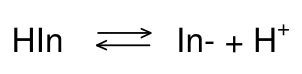
At normal temperatures, the acid dissociation constant for this indicator is \(K_{\mathrm a}=2.93\times10^{-5}\).
The absorbance data (1.00 cm cells) for \(5.00\times10^{-4}\) M (\(\mathrm{mol\,dm^{-3}}\)) solutions of this indicator in strongly acidic and strongly alkaline solutions are given in the following table.
Absorbance Data (A)
| \(\lambda\), nm | \(pH=1.00\) | \(pH=13.00\) |
|---|---|---|
| 400 | 0.401 | 0.067 |
| 470 | 0.447 | 0.050 |
| 485 | 0.453 | 0.052 |
| 490 | 0.452 | 0.054 |
| 505 | 0.443 | 0.073 |
| 535 | 0.390 | 0.170 |
| 555 | 0.342 | 0.342 |
| 570 | 0.303 | 0.515 |
| 585 | 0.263 | 0.648 |
| 615 | 0.195 | 0.816 |
| 625 | 0.176 | 0.823 |
| 635 | 0.170 | 0.816 |
| 650 | 0.137 | 0.763 |
| 680 | 0.097 | 0.588 |
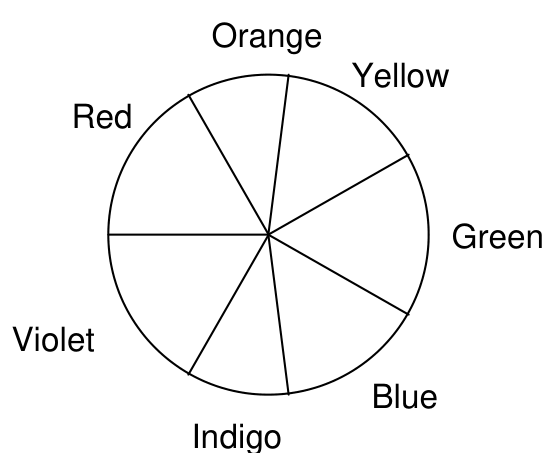
4.1 Predict the observed colour of the a) acidic and b) basic forms of the indicator.
Using a “50 nm wide bar”, shade the appropriate area of the wavelength scale on the answer sheet which would correspond to the colour of the indicator at the \(pH\) values given in the table.
For example, if observed colour is green, your answer would appear as:

4.2 A filter is located between the light source and the sample. What colour filter would be most suitable for the photometric analysis of the indicator in a strongly acidic medium?
4.3 What wavelength range would be most suitable for the photometric analysis of the indicator in a strongly basic medium?
4.4 What would be the absorbance of a \(1.00\times10^{-4}\) M (\(\mathrm{mol\,dm^{-3}}\)) solution of the indicator in alkaline form if measured at 545 nm in a 2.50 cm cell?
4.5 Solutions of the indicator were prepared in a strongly acidic solution (\(\ce{HCl}\), \(pH=1\)) and in a strongly basic solution (\(\ce{NaOH}\), \(pH=13\)). Perfectly linear relationships between absorbance and concentration were observed in both media at 490 nm and 625 nm, respectively.
The molar absorptivities at the two wavelengths are:
| \(\lambda=490\ \mathrm{nm}\) | \(\lambda=625\ \mathrm{nm}\) | |
|---|---|---|
| \(\ce{HIn}\) (\(\ce{HCl}\)) | \(9.04\times10^2\ \mathrm{M^{-1}\,cm^{-1}}\) | \(3.52\times10^2\ \mathrm{M^{-1}\,cm^{-1}}\) |
| \(\ce{In-}\) (\(\ce{NaOH}\)) | \(1.08\times10^2\ \mathrm{M^{-1}\,cm^{-1}}\) | \(1.65\times10^3\ \mathrm{M^{-1}\,cm^{-1}}\) |
\((\mathrm{M}=\mathrm{mol\,dm^{-3}})\)
Calculate the absorbance (1.00 cm cell) at the two wavelengths for an aqueous \(1.80\times10^{-3}\) M (\(\mathrm{mol\,dm^{-3}}\)) solution of the indicator \(\ce{HIn}\).
Official English text of the problem.
Answers
- 4.1 a) Acidic form: orange; shade a 50 nm bar approximately over 600–650 nm. b) Basic form: blue; shade approximately 450–500 nm.
- 4.2 A blue filter, transmitting near 485–490 nm.
- 4.3 The absorption maximum around 625 nm, preferably approximately 615–635 nm.
- 4.4 \(\boxed{A_{545}\approx0.128\approx0.13}\), using linear interpolation.
- 4.5 \(\boxed{A_{490}=1.46,\qquad A_{625}=0.913}\).
Absorbance is dimensionless.
Solution
4.1
The indicator’s acidic form, \(\ce{HIn}\), and conjugate-base anion, \(\ce{In-}\), are generic labels: the problem supplies no molecular constitution from which a specific chemical name or structural SMILES could be determined.
Their equilibrium is
\[ \ce{HIn <=> In- + H+}, \]
where \(\ce{H+}\) is the proton, SMILES [H+]. Thus,
\[ K_{\mathrm a} =\frac{[\ce{H+}][\ce{In-}]}{[\ce{HIn}]}, \qquad \frac{[\ce{In-}]}{[\ce{HIn}]} =\frac{K_{\mathrm a}}{[\ce{H+}]}. \]
At \(pH=1.00\),
\[ \frac{[\ce{In-}]}{[\ce{HIn}]} =\frac{2.93\times10^{-5}}{10^{-1}} =2.93\times10^{-4}, \]
so the spectrum is essentially that of the acidic form. At \(pH=13.00\), the ratio is \(2.93\times10^8\), so the spectrum is essentially that of the basic form.
The observed colour comes from the transmitted light and is approximately complementary to the principal absorbed colour.
- a) Acidic form: The absorption maximum is near \(485\ \mathrm{nm}\), in the blue region. Absorption decreases toward the longer wavelengths, giving an orange appearance. On the answer sheet, shade a 50 nm interval in the orange region, approximately 600–650 nm.
- b) Basic form: Absorption is strongest around \(625\ \mathrm{nm}\), in the orange–red region, while blue light is transmitted strongly. The solution therefore appears blue. Shade approximately 450–500 nm.
4.2
The Beer–Lambert law is
\[ A=\varepsilon bc, \]
where \(\varepsilon\) is molar absorptivity, \(b\) is optical path length, and \(c\) is concentration. Sensitivity to concentration is greatest where \(\varepsilon\) is largest.
The acidic form has its largest tabulated absorbance at \(485\ \mathrm{nm}\):
\[ A_{485}=0.453. \]
Therefore, use a blue filter, transmitting light near 485–490 nm.
4.3
For the basic form,
\[ A_{615}=0.816,\qquad A_{625}=0.823,\qquad A_{635}=0.816. \]
The region 615–635 nm, centred on 625 nm, combines high absorption with a relatively flat maximum. It therefore provides high concentration sensitivity and reduces sensitivity to small wavelength-setting errors.
4.4
First estimate the absorbance at \(545\ \mathrm{nm}\) for the reference solution, whose concentration and path length are
\[ c_{\mathrm{ref}}=5.00\times10^{-4}\ \mathrm{mol\,dm^{-3}}, \qquad b_{\mathrm{ref}}=1.00\ \mathrm{cm}. \]
Linear interpolation between \(535\) and \(555\ \mathrm{nm}\) gives
\[ A_{545,\mathrm{ref}} \approx 0.170+ \frac{545-535}{555-535}(0.342-0.170) =0.256. \]
At a fixed wavelength and chemical form, absorbance scales with \(bc\). Hence,
\[ \begin{aligned} A_{545} &=A_{545,\mathrm{ref}} \frac{bc}{b_{\mathrm{ref}}c_{\mathrm{ref}}}\\[2mm] &\approx 0.256 \left(\frac{2.50\ \mathrm{cm}}{1.00\ \mathrm{cm}}\right) \left( \frac{1.00\times10^{-4}\ \mathrm{mol\,dm^{-3}}} {5.00\times10^{-4}\ \mathrm{mol\,dm^{-3}}} \right)\\[2mm] &=\boxed{0.128\approx0.13}. \end{aligned} \]
4.5
The aqueous solution contains both indicator forms because the weak acid partially dissociates. Let
\[ C=1.80\times10^{-3}\ \mathrm{mol\,dm^{-3}} \]
be the analytical indicator concentration. Neglecting water’s contribution to the proton concentration, set
\[ [\ce{In-}]=[\ce{H+}]=x, \qquad [\ce{HIn}]=C-x. \]
Then
\[ K_{\mathrm a}=\frac{x^2}{C-x}, \]
so
\[ x^2+K_{\mathrm a}x-K_{\mathrm a}C=0. \]
The physically meaningful root is
\[ \begin{aligned} x &=\frac{-K_{\mathrm a}+ \sqrt{K_{\mathrm a}^{\,2}+4K_{\mathrm a}C}}{2}\\[1mm] &=\frac{-2.93\times10^{-5} +\sqrt{(2.93\times10^{-5})^2+ 4(2.93\times10^{-5})(1.80\times10^{-3})}}{2}\\[1mm] &=2.15469\times10^{-4}\ \mathrm{mol\,dm^{-3}}. \end{aligned} \]
Consequently,
\[ [\ce{In-}]=2.15469\times10^{-4}\ \mathrm{mol\,dm^{-3}}, \]
\[ [\ce{HIn}] =1.80\times10^{-3}-2.15469\times10^{-4} =1.58453\times10^{-3}\ \mathrm{mol\,dm^{-3}}. \]
Approximately \(12.0\%\) of the indicator is dissociated, so retaining \(C-x\) in the equilibrium calculation is appropriate.
The two species’ absorbances add:
\[ A_\lambda =b\left( \varepsilon_{\ce{HIn},\lambda}[\ce{HIn}] + \varepsilon_{\ce{In-},\lambda}[\ce{In-}] \right). \]
Using \(b=1.00\ \mathrm{cm}\), the supplied molar absorptivities in \(\mathrm{M^{-1}\,cm^{-1}}\), and concentrations in \(\mathrm M\):
\[ \begin{aligned} A_{490} &=(1.00)\left[ (9.04\times10^2)(1.58453\times10^{-3}) +(1.08\times10^2)(2.15469\times10^{-4}) \right]\\ &=1.45569\\ &=\boxed{1.46}. \end{aligned} \]
Similarly,
\[ \begin{aligned} A_{625} &=(1.00)\left[ (3.52\times10^2)(1.58453\times10^{-3}) +(1.65\times10^3)(2.15469\times10^{-4}) \right]\\ &=0.913278\\ &=\boxed{0.913}. \end{aligned} \]
The solution was checked against the official solution.
IChO 1997 · Theorieaufgabe 4
Spektrophotometrie eines Säure-Base-Indikators
Für diese Aufgabe steht Ihnen Millimeterpapier zur Verfügung, das Sie bei Bedarf verwenden können.
Falls Sie es verwenden, tragen Sie Ihren Namen und Ihren Identifikationscode in Druckschrift in der oberen rechten Ecke des Millimeterpapiers ein.
****************************
\(\ce{HIn}\) ist ein schwach saurer Indikator.
auch geschrieben als
Bei normalen Temperaturen beträgt die Säuredissoziationskonstante dieses Indikators \(K_{\mathrm a}=2.93\times10^{-5}\).
Die Extinktionswerte (Küvetten mit 1.00 cm Schichtdicke) für \(5.00\times10^{-4}\) M (\(\mathrm{mol\,dm^{-3}}\)) Lösungen dieses Indikators in stark saurer und stark alkalischer Lösung sind in der folgenden Tabelle angegeben.
Extinktionswerte (A)
| \(\lambda\), nm | \(pH=1.00\) | \(pH=13.00\) |
|---|---|---|
| 400 | 0.401 | 0.067 |
| 470 | 0.447 | 0.050 |
| 485 | 0.453 | 0.052 |
| 490 | 0.452 | 0.054 |
| 505 | 0.443 | 0.073 |
| 535 | 0.390 | 0.170 |
| 555 | 0.342 | 0.342 |
| 570 | 0.303 | 0.515 |
| 585 | 0.263 | 0.648 |
| 615 | 0.195 | 0.816 |
| 625 | 0.176 | 0.823 |
| 635 | 0.170 | 0.816 |
| 650 | 0.137 | 0.763 |
| 680 | 0.097 | 0.588 |
4.1 Sagen Sie die beobachtete Farbe der a) sauren und b) basischen Form des Indikators voraus.
Schraffieren Sie auf der Wellenlängenskala des Antwortblatts mit einem „50 nm breiten Balken“ den entsprechenden Bereich, der der Farbe des Indikators bei den in der Tabelle angegebenen \(pH\)-Werten entspricht.
Wenn die beobachtete Farbe beispielsweise Grün ist, würde Ihre Antwort so aussehen:
4.2 Zwischen der Lichtquelle und der Probe befindet sich ein Filter. Welche Filterfarbe wäre für die photometrische Analyse des Indikators in einem stark sauren Medium am besten geeignet?
4.3 Welcher Wellenlängenbereich wäre für die photometrische Analyse des Indikators in einem stark basischen Medium am besten geeignet?
4.4 Welche Extinktion hätte eine \(1.00\times10^{-4}\) M (\(\mathrm{mol\,dm^{-3}}\)) Lösung des Indikators in seiner alkalischen Form bei einer Messung bei 545 nm in einer Küvette mit 2.50 cm Schichtdicke?
4.5 Lösungen des Indikators wurden in einer stark sauren Lösung (\(\ce{HCl}\), \(pH=1\)) und in einer stark basischen Lösung (\(\ce{NaOH}\), \(pH=13\)) hergestellt. In beiden Medien wurden bei 490 nm bzw. 625 nm vollständig lineare Beziehungen zwischen Extinktion und Konzentration beobachtet.
Die molaren Extinktionskoeffizienten bei den beiden Wellenlängen betragen:
| \(\lambda=490\ \mathrm{nm}\) | \(\lambda=625\ \mathrm{nm}\) | |
|---|---|---|
| \(\ce{HIn}\) (\(\ce{HCl}\)) | \(9.04\times10^2\ \mathrm{M^{-1}\,cm^{-1}}\) | \(3.52\times10^2\ \mathrm{M^{-1}\,cm^{-1}}\) |
| \(\ce{In-}\) (\(\ce{NaOH}\)) | \(1.08\times10^2\ \mathrm{M^{-1}\,cm^{-1}}\) | \(1.65\times10^3\ \mathrm{M^{-1}\,cm^{-1}}\) |
\((\mathrm{M}=\mathrm{mol\,dm^{-3}})\)
Berechnen Sie die Extinktion (Küvette mit 1.00 cm Schichtdicke) bei den beiden Wellenlängen für eine wässrige \(1.80\times10^{-3}\) M (\(\mathrm{mol\,dm^{-3}}\)) Lösung des Indikators \(\ce{HIn}\).
Aufgabentext aus dem offiziellen englischen Text übersetzt.
Antworten
- 4.1 a) Saure Form: orange; schraffieren Sie einen 50 nm breiten Balken ungefähr über 600–650 nm. b) Basische Form: blau; schraffieren Sie ungefähr 450–500 nm.
- 4.2 Ein blauer Filter, der Licht im Bereich von 485–490 nm durchlässt.
- 4.3 Das Absorptionsmaximum um 625 nm, vorzugsweise ungefähr 615–635 nm.
- 4.4 \(\boxed{A_{545}\approx0.128\approx0.13}\), unter Verwendung linearer Interpolation.
- 4.5 \(\boxed{A_{490}=1.46,\qquad A_{625}=0.913}\).
Die Extinktion ist dimensionslos.
Lösung
4.1
Die saure Form des Indikators, \(\ce{HIn}\), und das Anion seiner konjugierten Base, \(\ce{In-}\), sind allgemeine Bezeichnungen: Die Aufgabe gibt keine molekulare Konstitution an, aus der sich ein spezifischer chemischer Name oder eine strukturelle SMILES-Darstellung bestimmen ließe.
Ihr Gleichgewicht lautet
\[ \ce{HIn <=> In- + H+}, \]
wobei \(\ce{H+}\) das Proton ist, SMILES [H+]. Somit gilt
\[ K_{\mathrm a} =\frac{[\ce{H+}][\ce{In-}]}{[\ce{HIn}]}, \qquad \frac{[\ce{In-}]}{[\ce{HIn}]} =\frac{K_{\mathrm a}}{[\ce{H+}]}. \]
Bei \(pH=1.00\) gilt
\[ \frac{[\ce{In-}]}{[\ce{HIn}]} =\frac{2.93\times10^{-5}}{10^{-1}} =2.93\times10^{-4}, \]
sodass das Spektrum im Wesentlichen dem der sauren Form entspricht. Bei \(pH=13.00\) beträgt das Verhältnis \(2.93\times10^8\), sodass das Spektrum im Wesentlichen dem der basischen Form entspricht.
Die beobachtete Farbe entsteht durch das durchgelassene Licht und ist näherungsweise komplementär zur hauptsächlich absorbierten Farbe.
- a) Saure Form: Das Absorptionsmaximum liegt nahe \(485\ \mathrm{nm}\), im blauen Bereich. Die Absorption nimmt zu längeren Wellenlängen hin ab, wodurch die Lösung orange erscheint. Schraffieren Sie auf dem Antwortblatt ein 50 nm breites Intervall im orangefarbenen Bereich, ungefähr 600–650 nm.
- b) Basische Form: Die Absorption ist um \(625\ \mathrm{nm}\), im orangefarbenen bis roten Bereich, am stärksten, während blaues Licht zu einem großen Anteil durchgelassen wird. Die Lösung erscheint daher blau. Schraffieren Sie ungefähr 450–500 nm.
4.2
Das Lambert-Beer-Gesetz lautet
\[ A=\varepsilon bc, \]
wobei \(\varepsilon\) der molare Extinktionskoeffizient, \(b\) die optische Schichtdicke und \(c\) die Konzentration ist. Die Empfindlichkeit gegenüber Konzentrationsänderungen ist dort am größten, wo \(\varepsilon\) am größten ist.
Die saure Form weist bei \(485\ \mathrm{nm}\) ihren höchsten tabellierten Extinktionswert auf:
\[ A_{485}=0.453. \]
Verwenden Sie daher einen blauen Filter, der Licht im Bereich von 485–490 nm durchlässt.
4.3
Für die basische Form gilt
\[ A_{615}=0.816,\qquad A_{625}=0.823,\qquad A_{635}=0.816. \]
Der Bereich 615–635 nm mit 625 nm als Mittelpunkt verbindet eine hohe Absorption mit einem relativ flachen Maximum. Er bietet daher eine hohe Empfindlichkeit gegenüber Konzentrationsänderungen und verringert die Empfindlichkeit gegenüber kleinen Fehlern bei der Wellenlängeneinstellung.
4.4
Schätzen Sie zunächst die Extinktion bei \(545\ \mathrm{nm}\) für die Referenzlösung ab, deren Konzentration und Schichtdicke wie folgt gegeben sind:
\[ c_{\mathrm{ref}}=5.00\times10^{-4}\ \mathrm{mol\,dm^{-3}}, \qquad b_{\mathrm{ref}}=1.00\ \mathrm{cm}. \]
Lineare Interpolation zwischen \(535\) und \(555\ \mathrm{nm}\) ergibt
\[ A_{545,\mathrm{ref}} \approx 0.170+ \frac{545-535}{555-535}(0.342-0.170) =0.256. \]
Bei einer festen Wellenlänge und einer unveränderten chemischen Form ist die Extinktion proportional zu \(bc\). Daher gilt
\[ \begin{aligned} A_{545} &=A_{545,\mathrm{ref}} \frac{bc}{b_{\mathrm{ref}}c_{\mathrm{ref}}}\\[2mm] &\approx 0.256 \left(\frac{2.50\ \mathrm{cm}}{1.00\ \mathrm{cm}}\right) \left( \frac{1.00\times10^{-4}\ \mathrm{mol\,dm^{-3}}} {5.00\times10^{-4}\ \mathrm{mol\,dm^{-3}}} \right)\\[2mm] &=\boxed{0.128\approx0.13}. \end{aligned} \]
4.5
Die wässrige Lösung enthält beide Indikatorformen, da die schwache Säure teilweise dissoziiert. Es sei
\[ C=1.80\times10^{-3}\ \mathrm{mol\,dm^{-3}} \]
die analytische Indikatorkonzentration. Unter Vernachlässigung des Beitrags des Wassers zur Protonenkonzentration setzen wir
\[ [\ce{In-}]=[\ce{H+}]=x, \qquad [\ce{HIn}]=C-x. \]
Dann gilt
\[ K_{\mathrm a}=\frac{x^2}{C-x}, \]
also
\[ x^2+K_{\mathrm a}x-K_{\mathrm a}C=0. \]
Die physikalisch sinnvolle Wurzel ist
\[ \begin{aligned} x &=\frac{-K_{\mathrm a}+ \sqrt{K_{\mathrm a}^{\,2}+4K_{\mathrm a}C}}{2}\\[1mm] &=\frac{-2.93\times10^{-5} +\sqrt{(2.93\times10^{-5})^2+ 4(2.93\times10^{-5})(1.80\times10^{-3})}}{2}\\[1mm] &=2.15469\times10^{-4}\ \mathrm{mol\,dm^{-3}}. \end{aligned} \]
Folglich gilt
\[ [\ce{In-}]=2.15469\times10^{-4}\ \mathrm{mol\,dm^{-3}}, \]
\[ [\ce{HIn}] =1.80\times10^{-3}-2.15469\times10^{-4} =1.58453\times10^{-3}\ \mathrm{mol\,dm^{-3}}. \]
Ungefähr \(12.0\%\) des Indikators sind dissoziiert, sodass es angemessen ist, \(C-x\) in der Gleichgewichtsberechnung beizubehalten.
Die Extinktionen der beiden Spezies addieren sich:
\[ A_\lambda =b\left( \varepsilon_{\ce{HIn},\lambda}[\ce{HIn}] + \varepsilon_{\ce{In-},\lambda}[\ce{In-}] \right). \]
Mit \(b=1.00\ \mathrm{cm}\), den angegebenen molaren Extinktionskoeffizienten in \(\mathrm{M^{-1}\,cm^{-1}}\) und den Konzentrationen in \(\mathrm M\) ergibt sich:
\[ \begin{aligned} A_{490} &=(1.00)\left[ (9.04\times10^2)(1.58453\times10^{-3}) +(1.08\times10^2)(2.15469\times10^{-4}) \right]\\ &=1.45569\\ &=\boxed{1.46}. \end{aligned} \]
Entsprechend gilt
\[ \begin{aligned} A_{625} &=(1.00)\left[ (3.52\times10^2)(1.58453\times10^{-3}) +(1.65\times10^3)(2.15469\times10^{-4}) \right]\\ &=0.913278\\ &=\boxed{0.913}. \end{aligned} \]
Die Lösung wurde mit der offiziellen Lösung abgeglichen.
IChO 1997 · Teori sorusu 4
Bir asit-baz indikatörünün spektrofotometrisi
Bu soruda isteğe bağlı olarak kullanmanız için grafik kâğıdı verilmiştir.
Kullanmayı tercih ederseniz, grafik kâğıdının sağ üst köşesine adınızı ve kimlik kodunuzu okunaklı harflerle yazınız.
****************************
\(\ce{HIn}\) zayıf asidik bir indikatördür.
şu şekilde de gösterilir:
Normal sıcaklıklarda bu indikatörün asit ayrışma sabiti \(K_{\mathrm a}=2.93\times10^{-5}\) değerindedir.
Bu indikatörün kuvvetli asidik ve kuvvetli bazik ortamlardaki \(5.00\times10^{-4}\) M (\(\mathrm{mol\,dm^{-3}}\)) çözeltilerine ait absorbans verileri (1.00 cm'lik küvetlerde) aşağıdaki tabloda verilmiştir.
Absorbans Verileri (A)
| \(\lambda\), nm | \(pH=1.00\) | \(pH=13.00\) |
|---|---|---|
| 400 | 0.401 | 0.067 |
| 470 | 0.447 | 0.050 |
| 485 | 0.453 | 0.052 |
| 490 | 0.452 | 0.054 |
| 505 | 0.443 | 0.073 |
| 535 | 0.390 | 0.170 |
| 555 | 0.342 | 0.342 |
| 570 | 0.303 | 0.515 |
| 585 | 0.263 | 0.648 |
| 615 | 0.195 | 0.816 |
| 625 | 0.176 | 0.823 |
| 635 | 0.170 | 0.816 |
| 650 | 0.137 | 0.763 |
| 680 | 0.097 | 0.588 |
4.1 İndikatörün a) asidik ve b) bazik biçimlerinin gözlenen rengini tahmin ediniz.
“50 nm genişliğinde bir şerit” kullanarak, cevap kâğıdındaki dalga boyu ölçeğinde, tabloda verilen \(pH\) değerlerinde indikatörün rengine karşılık gelen uygun bölgeyi tarayınız.
Örneğin, gözlenen renk yeşil ise cevabınız şu şekilde görünmelidir:
4.2 Işık kaynağı ile numune arasına bir filtre yerleştirilmiştir. Kuvvetli asidik bir ortamda indikatörün fotometrik analizi için hangi renkte bir filtre en uygun olur?
4.3 Kuvvetli bazik bir ortamda indikatörün fotometrik analizi için hangi dalga boyu aralığı en uygun olur?
4.4 İndikatörün bazik biçiminin \(1.00\times10^{-4}\) M (\(\mathrm{mol\,dm^{-3}}\)) çözeltisinin absorbansı, 2.50 cm'lik bir küvette 545 nm'de ölçülseydi ne olurdu?
4.5 İndikatör çözeltileri kuvvetli asidik bir çözeltide (\(\ce{HCl}\), \(pH=1\)) ve kuvvetli bazik bir çözeltide (\(\ce{NaOH}\), \(pH=13\)) hazırlanmıştır. Bu iki ortamda sırasıyla 490 nm ve 625 nm'de absorbans ile derişim arasında tam doğrusal ilişkiler gözlenmiştir.
İki dalga boyundaki molar absorptivite değerleri şöyledir:
| \(\lambda=490\ \mathrm{nm}\) | \(\lambda=625\ \mathrm{nm}\) | |
|---|---|---|
| \(\ce{HIn}\) (\(\ce{HCl}\)) | \(9.04\times10^2\ \mathrm{M^{-1}\,cm^{-1}}\) | \(3.52\times10^2\ \mathrm{M^{-1}\,cm^{-1}}\) |
| \(\ce{In-}\) (\(\ce{NaOH}\)) | \(1.08\times10^2\ \mathrm{M^{-1}\,cm^{-1}}\) | \(1.65\times10^3\ \mathrm{M^{-1}\,cm^{-1}}\) |
\((\mathrm{M}=\mathrm{mol\,dm^{-3}})\)
\(\ce{HIn}\) indikatörünün sulu \(1.80\times10^{-3}\) M (\(\mathrm{mol\,dm^{-3}}\)) çözeltisinin bu iki dalga boyundaki absorbansını (1.00 cm'lik küvette) hesaplayınız.
Soru metni resmi İngilizce metinden çevrilmiştir.
Cevaplar
- 4.1 a) Asidik biçim: turuncu; yaklaşık 600–650 nm aralığında 50 nm genişliğinde bir şeridi tarayınız. b) Bazik biçim: mavi; yaklaşık 450–500 nm aralığını tarayınız.
- 4.2 485–490 nm civarındaki ışığı geçiren bir mavi filtre.
- 4.3 625 nm civarındaki soğurma maksimumu, tercihen yaklaşık 615–635 nm aralığı.
- 4.4 Doğrusal interpolasyon kullanılarak \(\boxed{A_{545}\approx0.128\approx0.13}\).
- 4.5 \(\boxed{A_{490}=1.46,\qquad A_{625}=0.913}\).
Absorbans boyutsuzdur.
Çözüm
4.1
İndikatörün asidik biçimi \(\ce{HIn}\) ve eşlenik baz anyonu \(\ce{In-}\), genel gösterimlerdir: soruda belirli bir kimyasal adın veya yapısal SMILES gösteriminin belirlenmesini sağlayacak herhangi bir molekül yapısı verilmemiştir.
Aralarındaki denge şöyledir:
\[ \ce{HIn <=> In- + H+}, \]
burada \(\ce{H+}\), SMILES gösterimi [H+] olan protondur. Dolayısıyla,
\[ K_{\mathrm a} =\frac{[\ce{H+}][\ce{In-}]}{[\ce{HIn}]}, \qquad \frac{[\ce{In-}]}{[\ce{HIn}]} =\frac{K_{\mathrm a}}{[\ce{H+}]}. \]
\(pH=1.00\) değerinde,
\[ \frac{[\ce{In-}]}{[\ce{HIn}]} =\frac{2.93\times10^{-5}}{10^{-1}} =2.93\times10^{-4}, \]
olduğundan spektrum esas olarak asidik biçime aittir. \(pH=13.00\) değerinde bu oran \(2.93\times10^8\) olduğundan spektrum esas olarak bazik biçime aittir.
Gözlenen renk, çözeltiden geçen ışıktan kaynaklanır ve başlıca soğurulan rengin yaklaşık olarak tamamlayıcısıdır.
- a) Asidik biçim: Soğurma maksimumu, mavi bölgede, \(485\ \mathrm{nm}\) civarındadır. Soğurma daha uzun dalga boylarına doğru azalır ve turuncu bir görünüm ortaya çıkar. Cevap kâğıdında turuncu bölgede, yaklaşık 600–650 nm aralığında 50 nm genişliğinde bir aralığı tarayınız.
- b) Bazik biçim: Soğurma, turuncu–kırmızı bölgede, \(625\ \mathrm{nm}\) civarında en güçlüdür; mavi ışık ise büyük ölçüde geçirilir. Bu nedenle çözelti mavi görünür. Yaklaşık 450–500 nm aralığını tarayınız.
4.2
Beer–Lambert yasası şöyledir:
\[ A=\varepsilon bc, \]
burada \(\varepsilon\) molar absorptivite, \(b\) optik yol uzunluğu ve \(c\) derişimdir. Derişime duyarlılık, \(\varepsilon\) değerinin en büyük olduğu yerde en yüksektir.
Asidik biçimin tabloda verilen en büyük absorbans değeri \(485\ \mathrm{nm}\) dalga boyundadır:
\[ A_{485}=0.453. \]
Bu nedenle, 485–490 nm civarındaki ışığı geçiren bir mavi filtre kullanınız.
4.3
Bazik biçim için,
\[ A_{615}=0.816,\qquad A_{625}=0.823,\qquad A_{635}=0.816. \]
Merkezi 625 nm olan 615–635 nm bölgesi, yüksek soğurmayı nispeten düz bir maksimumla bir araya getirir. Bu nedenle derişime yüksek duyarlılık sağlar ve dalga boyu ayarındaki küçük hatalara duyarlılığı azaltır.
4.4
Önce referans çözeltinin \(545\ \mathrm{nm}\) dalga boyundaki absorbansını tahmin edelim; bu çözeltinin derişimi ve optik yol uzunluğu şöyledir:
\[ c_{\mathrm{ref}}=5.00\times10^{-4}\ \mathrm{mol\,dm^{-3}}, \qquad b_{\mathrm{ref}}=1.00\ \mathrm{cm}. \]
\(535\) ile \(555\ \mathrm{nm}\) arasında doğrusal interpolasyon yapılırsa
\[ A_{545,\mathrm{ref}} \approx 0.170+ \frac{545-535}{555-535}(0.342-0.170) =0.256. \]
Dalga boyu ve kimyasal biçim sabit tutulduğunda absorbans, \(bc\) ile orantılıdır. Dolayısıyla,
\[ \begin{aligned} A_{545} &=A_{545,\mathrm{ref}} \frac{bc}{b_{\mathrm{ref}}c_{\mathrm{ref}}}\\[2mm] &\approx 0.256 \left(\frac{2.50\ \mathrm{cm}}{1.00\ \mathrm{cm}}\right) \left( \frac{1.00\times10^{-4}\ \mathrm{mol\,dm^{-3}}} {5.00\times10^{-4}\ \mathrm{mol\,dm^{-3}}} \right)\\[2mm] &=\boxed{0.128\approx0.13}. \end{aligned} \]
4.5
Zayıf asit kısmen ayrıştığı için sulu çözelti indikatörün her iki biçimini de içerir. İndikatörün analitik derişimi
\[ C=1.80\times10^{-3}\ \mathrm{mol\,dm^{-3}} \]
olsun. Suyun proton derişimine katkısını ihmal ederek
\[ [\ce{In-}]=[\ce{H+}]=x, \qquad [\ce{HIn}]=C-x. \]
alalım. Bu durumda
\[ K_{\mathrm a}=\frac{x^2}{C-x}, \]
olduğundan
\[ x^2+K_{\mathrm a}x-K_{\mathrm a}C=0. \]
Fiziksel olarak anlamlı kök şöyledir:
\[ \begin{aligned} x &=\frac{-K_{\mathrm a}+ \sqrt{K_{\mathrm a}^{\,2}+4K_{\mathrm a}C}}{2}\\[1mm] &=\frac{-2.93\times10^{-5} +\sqrt{(2.93\times10^{-5})^2+ 4(2.93\times10^{-5})(1.80\times10^{-3})}}{2}\\[1mm] &=2.15469\times10^{-4}\ \mathrm{mol\,dm^{-3}}. \end{aligned} \]
Buna göre,
\[ [\ce{In-}]=2.15469\times10^{-4}\ \mathrm{mol\,dm^{-3}}, \]
\[ [\ce{HIn}] =1.80\times10^{-3}-2.15469\times10^{-4} =1.58453\times10^{-3}\ \mathrm{mol\,dm^{-3}}. \]
İndikatörün yaklaşık \(12.0\%\)'si ayrışmıştır; dolayısıyla denge hesabında \(C-x\) ifadesini korumak uygundur.
İki türün absorbansları toplanır:
\[ A_\lambda =b\left( \varepsilon_{\ce{HIn},\lambda}[\ce{HIn}] + \varepsilon_{\ce{In-},\lambda}[\ce{In-}] \right). \]
\(b=1.00\ \mathrm{cm}\), verilen molar absorptiviteler \(\mathrm{M^{-1}\,cm^{-1}}\) biriminde ve derişimler \(\mathrm M\) biriminde kullanılarak:
\[ \begin{aligned} A_{490} &=(1.00)\left[ (9.04\times10^2)(1.58453\times10^{-3}) +(1.08\times10^2)(2.15469\times10^{-4}) \right]\\ &=1.45569\\ &=\boxed{1.46}. \end{aligned} \]
Benzer şekilde,
\[ \begin{aligned} A_{625} &=(1.00)\left[ (3.52\times10^2)(1.58453\times10^{-3}) +(1.65\times10^3)(2.15469\times10^{-4}) \right]\\ &=0.913278\\ &=\boxed{0.913}. \end{aligned} \]
Çözüm, resmi çözümle karşılaştırılarak kontrol edildi.
IChO 1997 · Problema teórico 4
Espectrofotometría de un indicador ácido-base
Se proporciona papel milimetrado para su uso opcional en esta pregunta.
Si decide utilizarlo, escriba su nombre y código de identificación en la esquina superior derecha del papel milimetrado.
****************************
\(\ce{HIn}\) es un indicador débilmente ácido.
también representado como
A temperaturas normales, la constante de disociación ácida de este indicador es \(K_{\mathrm a}=2.93\times10^{-5}\).
Los datos de absorbancia (cubetas de 1.00 cm) de disoluciones de este indicador de concentración \(5.00\times10^{-4}\) M (\(\mathrm{mol\,dm^{-3}}\)) en medios fuertemente ácidos y fuertemente alcalinos se presentan en la siguiente tabla.
Datos de absorbancia (A)
| \(\lambda\), nm | \(pH=1.00\) | \(pH=13.00\) |
|---|---|---|
| 400 | 0.401 | 0.067 |
| 470 | 0.447 | 0.050 |
| 485 | 0.453 | 0.052 |
| 490 | 0.452 | 0.054 |
| 505 | 0.443 | 0.073 |
| 535 | 0.390 | 0.170 |
| 555 | 0.342 | 0.342 |
| 570 | 0.303 | 0.515 |
| 585 | 0.263 | 0.648 |
| 615 | 0.195 | 0.816 |
| 625 | 0.176 | 0.823 |
| 635 | 0.170 | 0.816 |
| 650 | 0.137 | 0.763 |
| 680 | 0.097 | 0.588 |
4.1 Prediga el color observado de las formas a) ácida y b) básica del indicador.
Mediante una «barra de 50 nm de anchura», sombree en la hoja de respuestas la zona correspondiente de la escala de longitudes de onda que represente el color del indicador a los valores de \(pH\) indicados en la tabla.
Por ejemplo, si el color observado es verde, su respuesta tendría el siguiente aspecto:
4.2 Se coloca un filtro entre la fuente de luz y la muestra. ¿De qué color sería el filtro más adecuado para el análisis fotométrico del indicador en un medio fuertemente ácido?
4.3 ¿Qué intervalo de longitudes de onda sería el más adecuado para el análisis fotométrico del indicador en un medio fuertemente básico?
4.4 ¿Cuál sería la absorbancia de una disolución del indicador en su forma alcalina de concentración \(1.00\times10^{-4}\) M (\(\mathrm{mol\,dm^{-3}}\)), medida a 545 nm en una cubeta de 2.50 cm?
4.5 Se prepararon disoluciones del indicador en una disolución fuertemente ácida (\(\ce{HCl}\), \(pH=1\)) y en una disolución fuertemente básica (\(\ce{NaOH}\), \(pH=13\)). Se observaron relaciones perfectamente lineales entre la absorbancia y la concentración en ambos medios a 490 nm y 625 nm, respectivamente.
Las absortividades molares a las dos longitudes de onda son:
| \(\lambda=490\ \mathrm{nm}\) | \(\lambda=625\ \mathrm{nm}\) | |
|---|---|---|
| \(\ce{HIn}\) (\(\ce{HCl}\)) | \(9.04\times10^2\ \mathrm{M^{-1}\,cm^{-1}}\) | \(3.52\times10^2\ \mathrm{M^{-1}\,cm^{-1}}\) |
| \(\ce{In-}\) (\(\ce{NaOH}\)) | \(1.08\times10^2\ \mathrm{M^{-1}\,cm^{-1}}\) | \(1.65\times10^3\ \mathrm{M^{-1}\,cm^{-1}}\) |
\((\mathrm{M}=\mathrm{mol\,dm^{-3}})\)
Calcule la absorbancia (cubeta de 1.00 cm) a las dos longitudes de onda de una disolución acuosa del indicador \(\ce{HIn}\) de concentración \(1.80\times10^{-3}\) M (\(\mathrm{mol\,dm^{-3}}\)).
Enunciado traducido del texto oficial en inglés.
Respuestas
- 4.1 a) Forma ácida: naranja; sombree una barra de 50 nm que abarque aproximadamente 600–650 nm. b) Forma básica: azul; sombree aproximadamente 450–500 nm.
- 4.2 Un filtro azul, que transmita cerca de 485–490 nm.
- 4.3 El máximo de absorción en torno a 625 nm, preferiblemente en el intervalo aproximado de 615–635 nm.
- 4.4 \(\boxed{A_{545}\approx0.128\approx0.13}\), mediante interpolación lineal.
- 4.5 \(\boxed{A_{490}=1.46,\qquad A_{625}=0.913}\).
La absorbancia es adimensional.
Solución
4.1
La forma ácida del indicador, \(\ce{HIn}\), y el anión que constituye su base conjugada, \(\ce{In-}\), son denominaciones genéricas: el problema no proporciona ninguna constitución molecular a partir de la cual se pueda determinar un nombre químico específico o una representación estructural SMILES.
Su equilibrio es
\[ \ce{HIn <=> In- + H+}, \]
donde \(\ce{H+}\) es el protón, cuyo SMILES es [H+]. Por tanto,
\[ K_{\mathrm a} =\frac{[\ce{H+}][\ce{In-}]}{[\ce{HIn}]}, \qquad \frac{[\ce{In-}]}{[\ce{HIn}]} =\frac{K_{\mathrm a}}{[\ce{H+}]}. \]
A \(pH=1.00\),
\[ \frac{[\ce{In-}]}{[\ce{HIn}]} =\frac{2.93\times10^{-5}}{10^{-1}} =2.93\times10^{-4}, \]
por lo que el espectro es esencialmente el de la forma ácida. A \(pH=13.00\), la relación es \(2.93\times10^8\), por lo que el espectro es esencialmente el de la forma básica.
El color observado procede de la luz transmitida y es aproximadamente complementario del principal color absorbido.
- a) Forma ácida: El máximo de absorción se encuentra cerca de \(485\ \mathrm{nm}\), en la región azul. La absorción disminuye hacia las longitudes de onda mayores, lo que confiere un aspecto naranja. En la hoja de respuestas, sombree un intervalo de 50 nm en la región naranja, aproximadamente 600–650 nm.
- b) Forma básica: La absorción es más intensa en torno a \(625\ \mathrm{nm}\), en la región naranja–roja, mientras que la luz azul se transmite en gran medida. Por tanto, la disolución se ve azul. Sombree aproximadamente 450–500 nm.
4.2
La ley de Beer–Lambert es
\[ A=\varepsilon bc, \]
donde \(\varepsilon\) es la absortividad molar, \(b\) es la longitud del camino óptico y \(c\) es la concentración. La sensibilidad a la concentración es máxima donde \(\varepsilon\) es mayor.
La forma ácida presenta su mayor absorbancia tabulada a \(485\ \mathrm{nm}\):
\[ A_{485}=0.453. \]
Por tanto, utilice un filtro azul, que transmita luz cerca de 485–490 nm.
4.3
Para la forma básica,
\[ A_{615}=0.816,\qquad A_{625}=0.823,\qquad A_{635}=0.816. \]
La región de 615–635 nm, centrada en 625 nm, combina una absorción elevada con un máximo relativamente plano. Por tanto, proporciona una alta sensibilidad a la concentración y reduce la sensibilidad a pequeños errores en el ajuste de la longitud de onda.
4.4
Primero se estima la absorbancia a \(545\ \mathrm{nm}\) de la disolución de referencia, cuya concentración y longitud del camino óptico son
\[ c_{\mathrm{ref}}=5.00\times10^{-4}\ \mathrm{mol\,dm^{-3}}, \qquad b_{\mathrm{ref}}=1.00\ \mathrm{cm}. \]
La interpolación lineal entre \(535\) y \(555\ \mathrm{nm}\) da
\[ A_{545,\mathrm{ref}} \approx 0.170+ \frac{545-535}{555-535}(0.342-0.170) =0.256. \]
Para una longitud de onda y una forma química fijas, la absorbancia es proporcional a \(bc\). Por tanto,
\[ \begin{aligned} A_{545} &=A_{545,\mathrm{ref}} \frac{bc}{b_{\mathrm{ref}}c_{\mathrm{ref}}}\\[2mm] &\approx 0.256 \left(\frac{2.50\ \mathrm{cm}}{1.00\ \mathrm{cm}}\right) \left( \frac{1.00\times10^{-4}\ \mathrm{mol\,dm^{-3}}} {5.00\times10^{-4}\ \mathrm{mol\,dm^{-3}}} \right)\\[2mm] &=\boxed{0.128\approx0.13}. \end{aligned} \]
4.5
La disolución acuosa contiene ambas formas del indicador porque el ácido débil se disocia parcialmente. Sea
\[ C=1.80\times10^{-3}\ \mathrm{mol\,dm^{-3}} \]
la concentración analítica del indicador. Despreciando la contribución del agua a la concentración de protones, se establece
\[ [\ce{In-}]=[\ce{H+}]=x, \qquad [\ce{HIn}]=C-x. \]
Entonces
\[ K_{\mathrm a}=\frac{x^2}{C-x}, \]
por lo que
\[ x^2+K_{\mathrm a}x-K_{\mathrm a}C=0. \]
La raíz con significado físico es
\[ \begin{aligned} x &=\frac{-K_{\mathrm a}+ \sqrt{K_{\mathrm a}^{\,2}+4K_{\mathrm a}C}}{2}\\[1mm] &=\frac{-2.93\times10^{-5} +\sqrt{(2.93\times10^{-5})^2+ 4(2.93\times10^{-5})(1.80\times10^{-3})}}{2}\\[1mm] &=2.15469\times10^{-4}\ \mathrm{mol\,dm^{-3}}. \end{aligned} \]
En consecuencia,
\[ [\ce{In-}]=2.15469\times10^{-4}\ \mathrm{mol\,dm^{-3}}, \]
\[ [\ce{HIn}] =1.80\times10^{-3}-2.15469\times10^{-4} =1.58453\times10^{-3}\ \mathrm{mol\,dm^{-3}}. \]
Aproximadamente el \(12.0\%\) del indicador está disociado, por lo que resulta adecuado conservar \(C-x\) en el cálculo del equilibrio.
Las absorbancias de las dos especies se suman:
\[ A_\lambda =b\left( \varepsilon_{\ce{HIn},\lambda}[\ce{HIn}] + \varepsilon_{\ce{In-},\lambda}[\ce{In-}] \right). \]
Utilizando \(b=1.00\ \mathrm{cm}\), las absortividades molares proporcionadas en \(\mathrm{M^{-1}\,cm^{-1}}\) y las concentraciones en \(\mathrm M\):
\[ \begin{aligned} A_{490} &=(1.00)\left[ (9.04\times10^2)(1.58453\times10^{-3}) +(1.08\times10^2)(2.15469\times10^{-4}) \right]\\ &=1.45569\\ &=\boxed{1.46}. \end{aligned} \]
De forma análoga,
\[ \begin{aligned} A_{625} &=(1.00)\left[ (3.52\times10^2)(1.58453\times10^{-3}) +(1.65\times10^3)(2.15469\times10^{-4}) \right]\\ &=0.913278\\ &=\boxed{0.913}. \end{aligned} \]
La solución se comprobó con la solución oficial.
IChO 1997 · 理论题 4
酸碱指示剂的分光光度法分析
本题提供坐标纸,可自行选择是否使用。
如果选择使用,请在坐标纸右上角用正楷填写姓名和识别代码。
****************************
\(\ce{HIn}\) 是一种弱酸性指示剂。
也可写作
常温下,该指示剂的酸解离常数为 \(K_{\mathrm a}=2.93\times10^{-5}\)。
下表给出了该指示剂在强酸性和强碱性溶液中浓度为 \(5.00\times10^{-4}\) M(\(\mathrm{mol\,dm^{-3}}\))时的吸光度数据(使用 1.00 cm 比色皿)。
吸光度数据(A)
| \(\lambda\), nm | \(pH=1.00\) | \(pH=13.00\) |
|---|---|---|
| 400 | 0.401 | 0.067 |
| 470 | 0.447 | 0.050 |
| 485 | 0.453 | 0.052 |
| 490 | 0.452 | 0.054 |
| 505 | 0.443 | 0.073 |
| 535 | 0.390 | 0.170 |
| 555 | 0.342 | 0.342 |
| 570 | 0.303 | 0.515 |
| 585 | 0.263 | 0.648 |
| 615 | 0.195 | 0.816 |
| 625 | 0.176 | 0.823 |
| 635 | 0.170 | 0.816 |
| 650 | 0.137 | 0.763 |
| 680 | 0.097 | 0.588 |
4.1 预测该指示剂的 a) 酸式和 b) 碱式所呈现的颜色。
在答题纸的波长标尺上,用“宽度为 50 nm 的条带”将与表中所给 \(pH\) 值下指示剂颜色相对应的区域涂上阴影。
例如,如果观察到的颜色为绿色,你的答案应如下所示:
4.2 在光源和样品之间放置一片滤光片。在强酸性介质中对该指示剂进行光度分析时,使用什么颜色的滤光片最合适?
4.3 在强碱性介质中对该指示剂进行光度分析时,选择哪个波长范围最合适?
4.4 对浓度为 \(1.00\times10^{-4}\) M(\(\mathrm{mol\,dm^{-3}}\))的碱式指示剂溶液,使用 2.50 cm 比色皿在 545 nm 处测量,其吸光度是多少?
4.5 分别在强酸性溶液(\(\ce{HCl}\),\(pH=1\))和强碱性溶液(\(\ce{NaOH}\),\(pH=13\))中配制该指示剂的溶液。在这两种介质中,分别于 490 nm 和 625 nm 处观察到吸光度与浓度之间呈完全线性关系。
两个波长处的摩尔吸光系数如下:
| \(\lambda=490\ \mathrm{nm}\) | \(\lambda=625\ \mathrm{nm}\) | |
|---|---|---|
| \(\ce{HIn}\)(\(\ce{HCl}\)) | \(9.04\times10^2\ \mathrm{M^{-1}\,cm^{-1}}\) | \(3.52\times10^2\ \mathrm{M^{-1}\,cm^{-1}}\) |
| \(\ce{In-}\)(\(\ce{NaOH}\)) | \(1.08\times10^2\ \mathrm{M^{-1}\,cm^{-1}}\) | \(1.65\times10^3\ \mathrm{M^{-1}\,cm^{-1}}\) |
\((\mathrm{M}=\mathrm{mol\,dm^{-3}})\)
计算浓度为 \(1.80\times10^{-3}\) M(\(\mathrm{mol\,dm^{-3}}\))的指示剂 \(\ce{HIn}\) 水溶液在这两个波长处的吸光度(使用 1.00 cm 比色皿)。
题目译自官方英文原文。
答案
- 4.1 a) 酸式:橙色;在约 600–650 nm 范围内涂上宽度为 50 nm 的阴影条带。b) 碱式:蓝色;在约 450–500 nm 范围内涂上阴影。
- 4.2 使用透过 485–490 nm 附近光线的蓝色滤光片。
- 4.3 选择 625 nm 附近的吸收峰,最好取约 615–635 nm 的范围。
- 4.4 使用线性内插法,得到 \(\boxed{A_{545}\approx0.128\approx0.13}\)。
- 4.5 \(\boxed{A_{490}=1.46,\qquad A_{625}=0.913}\)。
吸光度是无量纲量。
解答
4.1
指示剂的酸式 \(\ce{HIn}\) 及其共轭碱阴离子 \(\ce{In-}\) 均为通用符号:题目未给出分子构造,因此无法确定具体的化学名称或表示其结构的 SMILES。
它们之间的平衡为
\[ \ce{HIn <=> In- + H+}, \]
其中 \(\ce{H+}\) 为质子,SMILES 为 [H+]。因此,
\[ K_{\mathrm a} =\frac{[\ce{H+}][\ce{In-}]}{[\ce{HIn}]}, \qquad \frac{[\ce{In-}]}{[\ce{HIn}]} =\frac{K_{\mathrm a}}{[\ce{H+}]}. \]
在 \(pH=1.00\) 时,
\[ \frac{[\ce{In-}]}{[\ce{HIn}]} =\frac{2.93\times10^{-5}}{10^{-1}} =2.93\times10^{-4}, \]
因此,该光谱基本上就是酸式的光谱。在 \(pH=13.00\) 时,该比值为 \(2.93\times10^8\),因此该光谱基本上就是碱式的光谱。
观察到的颜色来自透射光,与主要被吸收光的颜色大致互为补色。
- a) 酸式: 吸收峰位于 \(485\ \mathrm{nm}\) 附近,属于蓝光区域。随着波长增大,吸收减弱,因此呈现橙色。在答题纸上,将橙光区域内宽度为 50 nm 的区间涂上阴影,约为 600–650 nm。
- b) 碱式: 在 \(625\ \mathrm{nm}\) 附近的橙红光区域吸收最强,而蓝光的透射较强。因此,溶液呈现蓝色。将约 450–500 nm 的区间涂上阴影。
4.2
朗伯–比尔定律为
\[ A=\varepsilon bc, \]
其中,\(\varepsilon\) 为摩尔吸光系数,\(b\) 为光程长度,\(c\) 为浓度。在 \(\varepsilon\) 最大处,对浓度的测定灵敏度最高。
表中酸式的最大吸光度出现在 \(485\ \mathrm{nm}\) 处:
\[ A_{485}=0.453. \]
因此,应使用透过 485–490 nm 附近光线的蓝色滤光片。
4.3
对于碱式,
\[ A_{615}=0.816,\qquad A_{625}=0.823,\qquad A_{635}=0.816. \]
以 625 nm 为中心的 615–635 nm 区域,既有较强的吸收,又具有相对平坦的峰顶。因此,在该区域测量既能获得较高的浓度测定灵敏度,又能减小波长设置的微小误差对测量的影响。
4.4
首先估算参比溶液在 \(545\ \mathrm{nm}\) 处的吸光度,其浓度和光程长度为
\[ c_{\mathrm{ref}}=5.00\times10^{-4}\ \mathrm{mol\,dm^{-3}}, \qquad b_{\mathrm{ref}}=1.00\ \mathrm{cm}. \]
在 \(535\) 与 \(555\ \mathrm{nm}\) 之间进行线性内插,得到
\[ A_{545,\mathrm{ref}} \approx 0.170+ \frac{545-535}{555-535}(0.342-0.170) =0.256. \]
在波长和化学形态一定时,吸光度与 \(bc\) 成正比。因此,
\[ \begin{aligned} A_{545} &=A_{545,\mathrm{ref}} \frac{bc}{b_{\mathrm{ref}}c_{\mathrm{ref}}}\\[2mm] &\approx 0.256 \left(\frac{2.50\ \mathrm{cm}}{1.00\ \mathrm{cm}}\right) \left( \frac{1.00\times10^{-4}\ \mathrm{mol\,dm^{-3}}} {5.00\times10^{-4}\ \mathrm{mol\,dm^{-3}}} \right)\\[2mm] &=\boxed{0.128\approx0.13}. \end{aligned} \]
4.5
由于弱酸部分解离,水溶液中同时含有指示剂的两种形态。令
\[ C=1.80\times10^{-3}\ \mathrm{mol\,dm^{-3}} \]
为指示剂的分析浓度。忽略水对质子浓度的贡献,设
\[ [\ce{In-}]=[\ce{H+}]=x, \qquad [\ce{HIn}]=C-x. \]
则
\[ K_{\mathrm a}=\frac{x^2}{C-x}, \]
因此
\[ x^2+K_{\mathrm a}x-K_{\mathrm a}C=0. \]
具有物理意义的根为
\[ \begin{aligned} x &=\frac{-K_{\mathrm a}+ \sqrt{K_{\mathrm a}^{\,2}+4K_{\mathrm a}C}}{2}\\[1mm] &=\frac{-2.93\times10^{-5} +\sqrt{(2.93\times10^{-5})^2+ 4(2.93\times10^{-5})(1.80\times10^{-3})}}{2}\\[1mm] &=2.15469\times10^{-4}\ \mathrm{mol\,dm^{-3}}. \end{aligned} \]
由此得到,
\[ [\ce{In-}]=2.15469\times10^{-4}\ \mathrm{mol\,dm^{-3}}, \]
\[ [\ce{HIn}] =1.80\times10^{-3}-2.15469\times10^{-4} =1.58453\times10^{-3}\ \mathrm{mol\,dm^{-3}}. \]
约有 \(12.0\%\) 的指示剂发生了解离,因此在平衡计算中保留 \(C-x\) 是合适的。
两种物种的吸光度具有加和性:
\[ A_\lambda =b\left( \varepsilon_{\ce{HIn},\lambda}[\ce{HIn}] + \varepsilon_{\ce{In-},\lambda}[\ce{In-}] \right). \]
取 \(b=1.00\ \mathrm{cm}\),使用题目给出的以 \(\mathrm{M^{-1}\,cm^{-1}}\) 为单位的摩尔吸光系数,并将浓度以 \(\mathrm M\) 为单位代入:
\[ \begin{aligned} A_{490} &=(1.00)\left[ (9.04\times10^2)(1.58453\times10^{-3}) +(1.08\times10^2)(2.15469\times10^{-4}) \right]\\ &=1.45569\\ &=\boxed{1.46}. \end{aligned} \]
同理,
\[ \begin{aligned} A_{625} &=(1.00)\left[ (3.52\times10^2)(1.58453\times10^{-3}) +(1.65\times10^3)(2.15469\times10^{-4}) \right]\\ &=0.913278\\ &=\boxed{0.913}. \end{aligned} \]
解答已与官方解答核对。
IChO 1997 · Теоретическая задача 4
Спектрофотометрия кислотно-основного индикатора
Для выполнения этого задания предоставляется миллиметровая бумага, которой вы можете воспользоваться по желанию.
Если вы решите ею воспользоваться, напишите печатными буквами своё имя и идентификационный код в правом верхнем углу листа миллиметровой бумаги.
****************************
\(\ce{HIn}\) — индикатор, являющийся слабой кислотой.
что также записывают как
При обычных температурах константа кислотной диссоциации этого индикатора составляет \(K_{\mathrm a}=2.93\times10^{-5}\).
В следующей таблице приведены значения оптической плотности (кюветы толщиной 1.00 см) растворов этого индикатора с концентрацией \(5.00\times10^{-4}\) М (\(\mathrm{mol\,dm^{-3}}\)) в сильнокислой и сильнощелочной средах.
Данные по оптической плотности (A)
| \(\lambda\), нм | \(pH=1.00\) | \(pH=13.00\) |
|---|---|---|
| 400 | 0.401 | 0.067 |
| 470 | 0.447 | 0.050 |
| 485 | 0.453 | 0.052 |
| 490 | 0.452 | 0.054 |
| 505 | 0.443 | 0.073 |
| 535 | 0.390 | 0.170 |
| 555 | 0.342 | 0.342 |
| 570 | 0.303 | 0.515 |
| 585 | 0.263 | 0.648 |
| 615 | 0.195 | 0.816 |
| 625 | 0.176 | 0.823 |
| 635 | 0.170 | 0.816 |
| 650 | 0.137 | 0.763 |
| 680 | 0.097 | 0.588 |
4.1 Предскажите наблюдаемую окраску a) кислотной и b) основной форм индикатора.
Заштрихуйте на шкале длин волн в бланке ответов соответствующую область в виде «полосы шириной 50 нм», которая отвечала бы окраске индикатора при значениях \(pH\), приведённых в таблице.
Например, если наблюдаемая окраска зелёная, ваш ответ должен выглядеть так:
4.2 Между источником света и образцом установлен светофильтр. Светофильтр какого цвета наиболее подходит для фотометрического анализа индикатора в сильнокислой среде?
4.3 Какой диапазон длин волн наиболее подходит для фотометрического анализа индикатора в сильнощелочной среде?
4.4 Какова будет оптическая плотность раствора основной формы индикатора с концентрацией \(1.00\times10^{-4}\) М (\(\mathrm{mol\,dm^{-3}}\)) при измерении на длине волны 545 нм в кювете толщиной 2.50 см?
4.5 Растворы индикатора были приготовлены в сильнокислой среде (\(\ce{HCl}\), \(pH=1\)) и в сильнощелочной среде (\(\ce{NaOH}\), \(pH=13\)). В обеих средах наблюдались строго линейные зависимости оптической плотности от концентрации при 490 нм и 625 нм соответственно.
Молярные коэффициенты поглощения на двух длинах волн составляют:
| \(\lambda=490\ \mathrm{nm}\) | \(\lambda=625\ \mathrm{nm}\) | |
|---|---|---|
| \(\ce{HIn}\) (\(\ce{HCl}\)) | \(9.04\times10^2\ \mathrm{M^{-1}\,cm^{-1}}\) | \(3.52\times10^2\ \mathrm{M^{-1}\,cm^{-1}}\) |
| \(\ce{In-}\) (\(\ce{NaOH}\)) | \(1.08\times10^2\ \mathrm{M^{-1}\,cm^{-1}}\) | \(1.65\times10^3\ \mathrm{M^{-1}\,cm^{-1}}\) |
\((\mathrm{M}=\mathrm{mol\,dm^{-3}})\)
Рассчитайте оптическую плотность (кювета толщиной 1.00 см) на этих двух длинах волн для водного раствора индикатора \(\ce{HIn}\) с концентрацией \(1.80\times10^{-3}\) М (\(\mathrm{mol\,dm^{-3}}\)).
Условие переведено с официального английского текста.
Ответы
- 4.1 a) Кислотная форма: оранжевая; заштрихуйте полосу шириной 50 нм приблизительно в диапазоне 600–650 нм. b) Основная форма: синяя; заштрихуйте приблизительно 450–500 нм.
- 4.2 Синий светофильтр, пропускающий свет вблизи 485–490 нм.
- 4.3 Область максимума поглощения около 625 нм, предпочтительно приблизительно 615–635 нм.
- 4.4 \(\boxed{A_{545}\approx0.128\approx0.13}\), с использованием линейной интерполяции.
- 4.5 \(\boxed{A_{490}=1.46,\qquad A_{625}=0.913}\).
Оптическая плотность — безразмерная величина.
Решение
4.1
Кислотная форма индикатора, \(\ce{HIn}\), и анион сопряжённого основания, \(\ce{In-}\), обозначены условно: в условии не приведено строение молекулы, по которому можно было бы определить конкретное химическое название или структурную запись SMILES.
Равновесие между ними описывается уравнением
\[ \ce{HIn <=> In- + H+}, \]
где \(\ce{H+}\) — протон, SMILES [H+]. Таким образом,
\[ K_{\mathrm a} =\frac{[\ce{H+}][\ce{In-}]}{[\ce{HIn}]}, \qquad \frac{[\ce{In-}]}{[\ce{HIn}]} =\frac{K_{\mathrm a}}{[\ce{H+}]}. \]
При \(pH=1.00\)
\[ \frac{[\ce{In-}]}{[\ce{HIn}]} =\frac{2.93\times10^{-5}}{10^{-1}} =2.93\times10^{-4}, \]
поэтому спектр практически совпадает со спектром кислотной формы. При \(pH=13.00\) это отношение равно \(2.93\times10^8\), поэтому спектр практически совпадает со спектром основной формы.
Наблюдаемая окраска определяется прошедшим светом и приблизительно соответствует цвету, дополнительному к преимущественно поглощаемому.
- a) Кислотная форма: Максимум поглощения находится вблизи \(485\ \mathrm{nm}\), в синей области спектра. Поглощение уменьшается при переходе к более длинным волнам, что обусловливает оранжевую окраску. В бланке ответов заштрихуйте интервал шириной 50 нм в оранжевой области, приблизительно 600–650 нм.
- b) Основная форма: Поглощение наиболее интенсивно около \(625\ \mathrm{nm}\), в оранжево-красной области, тогда как синий свет хорошо пропускается. Поэтому раствор имеет синюю окраску. Заштрихуйте приблизительно 450–500 нм.
4.2
Закон Бугера–Ламберта–Бера имеет вид
\[ A=\varepsilon bc, \]
где \(\varepsilon\) — молярный коэффициент поглощения, \(b\) — длина оптического пути, а \(c\) — концентрация. Чувствительность к изменению концентрации максимальна там, где \(\varepsilon\) имеет наибольшее значение.
Для кислотной формы наибольшее табличное значение оптической плотности соответствует \(485\ \mathrm{nm}\):
\[ A_{485}=0.453. \]
Следовательно, следует использовать синий светофильтр, пропускающий свет вблизи 485–490 нм.
4.3
Для основной формы
\[ A_{615}=0.816,\qquad A_{625}=0.823,\qquad A_{635}=0.816. \]
Область 615–635 нм с центром при 625 нм сочетает высокое поглощение с относительно плоским максимумом. Поэтому она обеспечивает высокую чувствительность к изменению концентрации и снижает чувствительность к небольшим погрешностям установки длины волны.
4.4
Сначала оценим оптическую плотность при \(545\ \mathrm{nm}\) для исходного раствора, концентрация которого и длина оптического пути равны
\[ c_{\mathrm{ref}}=5.00\times10^{-4}\ \mathrm{mol\,dm^{-3}}, \qquad b_{\mathrm{ref}}=1.00\ \mathrm{cm}. \]
Линейная интерполяция между \(535\) и \(555\ \mathrm{nm}\) даёт
\[ A_{545,\mathrm{ref}} \approx 0.170+ \frac{545-535}{555-535}(0.342-0.170) =0.256. \]
При фиксированной длине волны и неизменной химической форме оптическая плотность пропорциональна \(bc\). Следовательно,
\[ \begin{aligned} A_{545} &=A_{545,\mathrm{ref}} \frac{bc}{b_{\mathrm{ref}}c_{\mathrm{ref}}}\\[2mm] &\approx 0.256 \left(\frac{2.50\ \mathrm{cm}}{1.00\ \mathrm{cm}}\right) \left( \frac{1.00\times10^{-4}\ \mathrm{mol\,dm^{-3}}} {5.00\times10^{-4}\ \mathrm{mol\,dm^{-3}}} \right)\\[2mm] &=\boxed{0.128\approx0.13}. \end{aligned} \]
4.5
Водный раствор содержит обе формы индикатора, поскольку слабая кислота частично диссоциирует. Пусть
\[ C=1.80\times10^{-3}\ \mathrm{mol\,dm^{-3}} \]
— аналитическая концентрация индикатора. Пренебрегая вкладом воды в концентрацию протонов, положим
\[ [\ce{In-}]=[\ce{H+}]=x, \qquad [\ce{HIn}]=C-x. \]
Тогда
\[ K_{\mathrm a}=\frac{x^2}{C-x}, \]
откуда
\[ x^2+K_{\mathrm a}x-K_{\mathrm a}C=0. \]
Физически осмысленный корень равен
\[ \begin{aligned} x &=\frac{-K_{\mathrm a}+ \sqrt{K_{\mathrm a}^{\,2}+4K_{\mathrm a}C}}{2}\\[1mm] &=\frac{-2.93\times10^{-5} +\sqrt{(2.93\times10^{-5})^2+ 4(2.93\times10^{-5})(1.80\times10^{-3})}}{2}\\[1mm] &=2.15469\times10^{-4}\ \mathrm{mol\,dm^{-3}}. \end{aligned} \]
Следовательно,
\[ [\ce{In-}]=2.15469\times10^{-4}\ \mathrm{mol\,dm^{-3}}, \]
\[ [\ce{HIn}] =1.80\times10^{-3}-2.15469\times10^{-4} =1.58453\times10^{-3}\ \mathrm{mol\,dm^{-3}}. \]
Диссоциировано приблизительно \(12.0\%\) индикатора, поэтому при расчёте равновесия следует сохранять выражение \(C-x\).
Оптические плотности двух форм складываются:
\[ A_\lambda =b\left( \varepsilon_{\ce{HIn},\lambda}[\ce{HIn}] + \varepsilon_{\ce{In-},\lambda}[\ce{In-}] \right). \]
Используя \(b=1.00\ \mathrm{cm}\), заданные молярные коэффициенты поглощения в \(\mathrm{M^{-1}\,cm^{-1}}\) и концентрации в \(\mathrm M\), получаем:
\[ \begin{aligned} A_{490} &=(1.00)\left[ (9.04\times10^2)(1.58453\times10^{-3}) +(1.08\times10^2)(2.15469\times10^{-4}) \right]\\ &=1.45569\\ &=\boxed{1.46}. \end{aligned} \]
Аналогично,
\[ \begin{aligned} A_{625} &=(1.00)\left[ (3.52\times10^2)(1.58453\times10^{-3}) +(1.65\times10^3)(2.15469\times10^{-4}) \right]\\ &=0.913278\\ &=\boxed{0.913}. \end{aligned} \]
Решение проверено по официальному решению.
IChO 1997 · مسألة نظرية 4
القياس الطيفي الضوئي لدليل حمضي-قاعدي
تُوفَّر ورقة رسم بياني لاستخدامها اختياريًا في هذا السؤال.
إذا اخترت استخدامها، فاكتب اسمك ورمز تعريفك بوضوح في الزاوية العلوية اليمنى من ورقة الرسم البياني.
****************************
\(\ce{HIn}\) دليل ذو خواص حمضية ضعيفة.
ويُكتب أيضًا على الصورة
عند درجات الحرارة العادية، يكون ثابت التفكك الحمضي لهذا الدليل \(K_{\mathrm a}=2.93\times10^{-5}\).
تُعطى في الجدول الآتي بيانات الامتصاصية (بخلايا طولها 1.00 cm) لمحاليل هذا الدليل بتركيز \(5.00\times10^{-4}\) M (\(\mathrm{mol\,dm^{-3}}\)) في أوساط شديدة الحمضية وأوساط شديدة القلوية.
بيانات الامتصاصية (A)
| \(\lambda\), nm | \(pH=1.00\) | \(pH=13.00\) |
|---|---|---|
| 400 | 0.401 | 0.067 |
| 470 | 0.447 | 0.050 |
| 485 | 0.453 | 0.052 |
| 490 | 0.452 | 0.054 |
| 505 | 0.443 | 0.073 |
| 535 | 0.390 | 0.170 |
| 555 | 0.342 | 0.342 |
| 570 | 0.303 | 0.515 |
| 585 | 0.263 | 0.648 |
| 615 | 0.195 | 0.816 |
| 625 | 0.176 | 0.823 |
| 635 | 0.170 | 0.816 |
| 650 | 0.137 | 0.763 |
| 680 | 0.097 | 0.588 |
4.1 توقَّع اللون المُشاهَد للصورتين a) الحمضية وb) القاعدية للدليل.
باستخدام «شريط بعرض 50 nm»، ظلِّل المنطقة المناسبة من تدريج الأطوال الموجية في ورقة الإجابة، التي تقابل لون الدليل عند قيم \(pH\) الواردة في الجدول.
على سبيل المثال، إذا كان اللون المُشاهَد أخضر، فستبدو إجابتك كما يأتي:
4.2 يُوضَع مرشِّح بين مصدر الضوء والعينة. ما لون المرشِّح الأنسب للتحليل الضوئي للدليل في وسط شديد الحمضية؟
4.3 ما نطاق الأطوال الموجية الأنسب للتحليل الضوئي للدليل في وسط شديد القاعدية؟
4.4 ما امتصاصية محلول من الدليل في صورته القلوية بتركيز \(1.00\times10^{-4}\) M (\(\mathrm{mol\,dm^{-3}}\)) إذا قِيست عند 545 nm في خلية طولها 2.50 cm؟
4.5 حُضِّرت محاليل الدليل في محلول شديد الحمضية (\(\ce{HCl}\)، \(pH=1\)) وفي محلول شديد القاعدية (\(\ce{NaOH}\)، \(pH=13\)). ولُوحظت علاقات خطية تامة بين الامتصاصية والتركيز في كلا الوسطين عند 490 nm و625 nm، على الترتيب.
معاملات الامتصاص المولية عند الطولين الموجيين هي:
| \(\lambda=490\ \mathrm{nm}\) | \(\lambda=625\ \mathrm{nm}\) | |
|---|---|---|
| \(\ce{HIn}\) (\(\ce{HCl}\)) | \(9.04\times10^2\ \mathrm{M^{-1}\,cm^{-1}}\) | \(3.52\times10^2\ \mathrm{M^{-1}\,cm^{-1}}\) |
| \(\ce{In-}\) (\(\ce{NaOH}\)) | \(1.08\times10^2\ \mathrm{M^{-1}\,cm^{-1}}\) | \(1.65\times10^3\ \mathrm{M^{-1}\,cm^{-1}}\) |
\((\mathrm{M}=\mathrm{mol\,dm^{-3}})\)
احسب الامتصاصية (في خلية طولها 1.00 cm) عند الطولين الموجيين لمحلول مائي من الدليل \(\ce{HIn}\) بتركيز \(1.80\times10^{-3}\) M (\(\mathrm{mol\,dm^{-3}}\)).
نص المسألة مترجم عن النص الإنجليزي الرسمي.
الإجابات
- 4.1 a) الصورة الحمضية: برتقالي؛ ظلِّل شريطًا بعرض 50 nm يمتد تقريبًا من 600–650 nm. b) الصورة القاعدية: أزرق؛ ظلِّل تقريبًا 450–500 nm.
- 4.2 مرشِّح أزرق، ينفذ الضوء قرب 485–490 nm.
- 4.3 منطقة الامتصاص الأعظمي حول 625 nm، ويُفضَّل النطاق 615–635 nm تقريبًا.
- 4.4 \(\boxed{A_{545}\approx0.128\approx0.13}\)، باستخدام الاستيفاء الخطي.
- 4.5 \(\boxed{A_{490}=1.46,\qquad A_{625}=0.913}\).
الامتصاصية كمية عديمة الأبعاد.
الحل
4.1
الصورة الحمضية للدليل، \(\ce{HIn}\)، وأنيون قاعدته المرافقة، \(\ce{In-}\)، تسميتان عامتان: فلا تُعطي المسألة بنية جزيئية يمكن منها تحديد اسم كيميائي معيَّن أو تمثيل بنيوي بصيغة SMILES.
اتزانهما هو
\[ \ce{HIn <=> In- + H+}, \]
حيث \(\ce{H+}\) هو البروتون، وتمثيله بصيغة SMILES هو [H+]. ومن ثم،
\[ K_{\mathrm a} =\frac{[\ce{H+}][\ce{In-}]}{[\ce{HIn}]}, \qquad \frac{[\ce{In-}]}{[\ce{HIn}]} =\frac{K_{\mathrm a}}{[\ce{H+}]}. \]
عند \(pH=1.00\)،
\[ \frac{[\ce{In-}]}{[\ce{HIn}]} =\frac{2.93\times10^{-5}}{10^{-1}} =2.93\times10^{-4}, \]
لذا فإن الطيف هو في الأساس طيف الصورة الحمضية. وعند \(pH=13.00\)، تكون النسبة \(2.93\times10^8\)، لذا فإن الطيف هو في الأساس طيف الصورة القاعدية.
ينشأ اللون المُشاهَد من الضوء النافذ، ويكون مكمِّلًا تقريبًا للون الرئيسي الممتص.
- a) الصورة الحمضية: تقع قمة الامتصاص قرب \(485\ \mathrm{nm}\)، في المنطقة الزرقاء. ويتناقص الامتصاص باتجاه الأطوال الموجية الأطول، مما يعطي مظهرًا برتقاليًا. ظلِّل في ورقة الإجابة نطاقًا بعرض 50 nm في المنطقة البرتقالية، أي 600–650 nm تقريبًا.
- b) الصورة القاعدية: يكون الامتصاص أشد ما يكون حول \(625\ \mathrm{nm}\)، في المنطقة البرتقالية–الحمراء، بينما ينفذ الضوء الأزرق بدرجة كبيرة. ولذلك يبدو المحلول أزرق. ظلِّل تقريبًا 450–500 nm.
4.2
قانون بير–لامبرت هو
\[ A=\varepsilon bc, \]
حيث \(\varepsilon\) هو معامل الامتصاص المولي، و\(b\) هو طول المسار الضوئي، و\(c\) هو التركيز. وتكون الحساسية للتركيز أعظم ما يمكن حيث تكون \(\varepsilon\) أكبر ما يمكن.
للصورة الحمضية أكبر امتصاصية واردة في الجدول عند \(485\ \mathrm{nm}\):
\[ A_{485}=0.453. \]
لذلك، يُستخدَم مرشِّح أزرق ينفذ الضوء قرب 485–490 nm.
4.3
بالنسبة إلى الصورة القاعدية،
\[ A_{615}=0.816,\qquad A_{625}=0.823,\qquad A_{635}=0.816. \]
تجمع المنطقة 615–635 nm، المتمركزة حول 625 nm، بين الامتصاص العالي وقمة مسطحة نسبيًا. ولذلك توفِّر حساسية عالية للتركيز وتقلِّل الحساسية للأخطاء الصغيرة في ضبط الطول الموجي.
4.4
نقدِّر أولًا الامتصاصية عند \(545\ \mathrm{nm}\) للمحلول المرجعي، الذي يكون تركيزه وطول مساره الضوئي كما يأتي:
\[ c_{\mathrm{ref}}=5.00\times10^{-4}\ \mathrm{mol\,dm^{-3}}, \qquad b_{\mathrm{ref}}=1.00\ \mathrm{cm}. \]
يعطي الاستيفاء الخطي بين \(535\) و\(555\ \mathrm{nm}\)
\[ A_{545,\mathrm{ref}} \approx 0.170+ \frac{545-535}{555-535}(0.342-0.170) =0.256. \]
عند ثبات الطول الموجي والصورة الكيميائية، تتناسب الامتصاصية طرديًا مع \(bc\). ومن ثم،
\[ \begin{aligned} A_{545} &=A_{545,\mathrm{ref}} \frac{bc}{b_{\mathrm{ref}}c_{\mathrm{ref}}}\\[2mm] &\approx 0.256 \left(\frac{2.50\ \mathrm{cm}}{1.00\ \mathrm{cm}}\right) \left( \frac{1.00\times10^{-4}\ \mathrm{mol\,dm^{-3}}} {5.00\times10^{-4}\ \mathrm{mol\,dm^{-3}}} \right)\\[2mm] &=\boxed{0.128\approx0.13}. \end{aligned} \]
4.5
يحتوي المحلول المائي على صورتي الدليل كلتيهما لأن الحمض الضعيف يتفكك جزئيًا. ليكن
\[ C=1.80\times10^{-3}\ \mathrm{mol\,dm^{-3}} \]
هو التركيز التحليلي للدليل. وبإهمال مساهمة الماء في تركيز البروتون، نضع
\[ [\ce{In-}]=[\ce{H+}]=x, \qquad [\ce{HIn}]=C-x. \]
عندئذٍ
\[ K_{\mathrm a}=\frac{x^2}{C-x}, \]
ومن ثم
\[ x^2+K_{\mathrm a}x-K_{\mathrm a}C=0. \]
الجذر ذو المعنى الفيزيائي هو
\[ \begin{aligned} x &=\frac{-K_{\mathrm a}+ \sqrt{K_{\mathrm a}^{\,2}+4K_{\mathrm a}C}}{2}\\[1mm] &=\frac{-2.93\times10^{-5} +\sqrt{(2.93\times10^{-5})^2+ 4(2.93\times10^{-5})(1.80\times10^{-3})}}{2}\\[1mm] &=2.15469\times10^{-4}\ \mathrm{mol\,dm^{-3}}. \end{aligned} \]
وبالتالي،
\[ [\ce{In-}]=2.15469\times10^{-4}\ \mathrm{mol\,dm^{-3}}, \]
\[ [\ce{HIn}] =1.80\times10^{-3}-2.15469\times10^{-4} =1.58453\times10^{-3}\ \mathrm{mol\,dm^{-3}}. \]
يتفكك نحو \(12.0\%\) من الدليل، لذا فمن المناسب الإبقاء على \(C-x\) في حساب الاتزان.
تُجمَع امتصاصيتا النوعين الكيميائيين:
\[ A_\lambda =b\left( \varepsilon_{\ce{HIn},\lambda}[\ce{HIn}] + \varepsilon_{\ce{In-},\lambda}[\ce{In-}] \right). \]
باستخدام \(b=1.00\ \mathrm{cm}\)، ومعاملات الامتصاص المولية المعطاة بوحدة \(\mathrm{M^{-1}\,cm^{-1}}\)، والتراكيز بوحدة \(\mathrm M\):
\[ \begin{aligned} A_{490} &=(1.00)\left[ (9.04\times10^2)(1.58453\times10^{-3}) +(1.08\times10^2)(2.15469\times10^{-4}) \right]\\ &=1.45569\\ &=\boxed{1.46}. \end{aligned} \]
وبالمثل،
\[ \begin{aligned} A_{625} &=(1.00)\left[ (3.52\times10^2)(1.58453\times10^{-3}) +(1.65\times10^3)(2.15469\times10^{-4}) \right]\\ &=0.913278\\ &=\boxed{0.913}. \end{aligned} \]
تمت مراجعة الحل بمقارنته بالحل الرسمي.