IChO 1997 · Theory problem 2
Atmospheric formation of sulfuric acid: kinetics
Professor Molina of the Massachusetts Institute of Technology won the 1995 Nobel Prize in Chemistry for his work on atmospheric chemistry. One reaction that he has studied in detail is the acid rain reaction which produces \(\ce{H2SO4}\) in the atmosphere. He has proposed two possible stoichiometric reactions:

2.1 Using simple collision theory, what reaction orders would be expected for Proposal A and for Proposal B?
Proposal B is thought to proceed by the following two-step process:
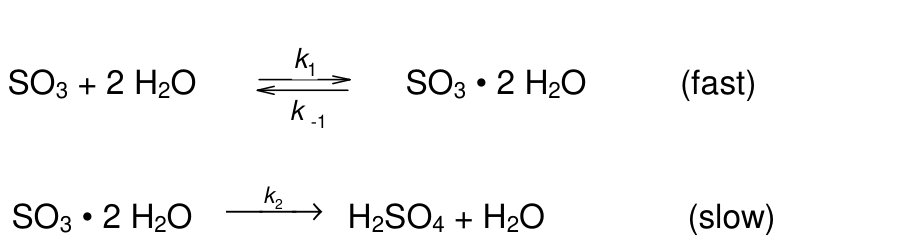
(\(\ce{SO3 * 2H2O}\) is a complex which is stabilized by hydrogen bonds and \(k_2 \ll k_1\) or \(k_{-1}\))
2.2 By applying the principle of stationary (steady) states, derive the appropriate rate law and hence the reaction order of the two-step mechanism for Proposal B.
2.3 Recent quantum chemical calculations have shown that the overall reaction activation energies for the two proposals are:
\(E_A = +80\ \mathrm{kJ\,mol^{-1}}\) for Proposal A
\(E_B = -20\ \mathrm{kJ\,mol^{-1}}\) for Proposal B
State the relationship between the rate constant and the temperature (Arrhenius relationship) for each proposal and predict the temperature dependence of the rate constants for each proposal.
2.4 The formation of \(\ce{H2SO4}\) is faster in the upper atmosphere (\(T = 175\ \mathrm{K}\)) than at the earth’s surface (\(T = 300\ \mathrm{K}\)). Which proposed pathway must dominate in the upper atmosphere given the activation energies in part (iii) and your understanding of the Arrhenius equation?
Official English text of the problem.
Answers
- 2.1: Proposal A: first order in each reactant, second order overall. Proposal B: first order in \(\ce{SO3}\), second order in \(\ce{H2O}\), third order overall.
- 2.2: \[ v=\frac{k_1k_2}{k_{-1}+k_2}[\ce{SO3}][\ce{H2O}]^2 \simeq\frac{k_1k_2}{k_{-1}}[\ce{SO3}][\ce{H2O}]^2. \] The mechanism is third order overall.
- 2.3: \[ k_A=A_A\exp\!\left(-\frac{80\,000\ \mathrm{J\,mol^{-1}}}{RT}\right), \qquad k_B=A_B\exp\!\left(+\frac{20\,000\ \mathrm{J\,mol^{-1}}}{RT}\right). \] As temperature rises, \(k_A\) increases and \(k_B\) decreases.
- 2.4: Proposal B is the dominant pathway indicated by the stated enhancement at lower temperature.
Solution
The chemical species used below are:
| Name | Formula | SMILES |
|---|---|---|
| Water | \(\ce{H2O}\) | O |
| Sulfur trioxide | \(\ce{SO3}\) | O=S(=O)=O |
| Sulfuric acid | \(\ce{H2SO4}\) | OS(=O)(=O)O |
| Sulfur trioxide complex with two water molecules | \(\ce{SO3 * 2H2O}\) | O=S(=O)=O.O.O |
The disconnected SMILES for the complex specifies its molecular components; it does not encode their hydrogen bonds or spatial arrangement.
2.1
The balanced proposed reactions are
\[ \text{A:}\qquad \ce{H2O(g) + SO3(g) -> H2SO4(g)} \]
and
\[ \text{B:}\qquad \ce{2H2O(g) + SO3(g) -> H2SO4(g) + H2O(g)}. \]
Under the simple collision model, the frequency of a specified encounter is proportional to the product of the concentrations of all participating molecules.
For A, one water molecule encounters one sulfur trioxide molecule:
\[ v_A=k_A[\ce{H2O}][\ce{SO3}]. \]
The reaction is first order in each reactant, giving overall order \(1+1=\boxed{2}\).
For B, two water molecules and one sulfur trioxide molecule participate:
\[ v_B=k_B[\ce{H2O}]^2[\ce{SO3}]. \]
The reaction is second order in water and first order in sulfur trioxide, giving overall order \(2+1=\boxed{3}\).
Although one water molecule is regenerated in B, both water molecules participate in the proposed encounter. Cancelling water from the net equation therefore does not remove its kinetic role. These orders follow from the assumed collision model; overall stoichiometry alone does not generally determine reaction order.
2.2
The proposed elementary steps are
\[ \ce{SO3 + 2H2O <=> SO3 * 2H2O} \qquad \text{(forward \(k_1\), reverse \(k_{-1}\))} \]
and
\[ \ce{SO3 * 2H2O -> H2SO4 + H2O} \qquad \text{(\(k_2\))}. \]
Let \(c=[\ce{SO3 * 2H2O}]\). The complex forms in the forward association step and disappears through both dissociation and product formation:
\[ \frac{dc}{dt} =k_1[\ce{SO3}][\ce{H2O}]^2-k_{-1}c-k_2c. \]
Applying the steady-state approximation,
\[ \frac{dc}{dt}\simeq0, \]
gives
\[ c\simeq \frac{k_1}{k_{-1}+k_2} [\ce{SO3}][\ce{H2O}]^2. \]
Sulfuric acid forms through the second step, so
\[ v=\frac{d[\ce{H2SO4}]}{dt}=k_2c. \]
Consequently,
\[ \boxed{ v=\frac{k_1k_2}{k_{-1}+k_2} [\ce{SO3}][\ce{H2O}]^2 }. \]
In the stated slow-conversion limit, \(k_2\ll k_{-1}\), this becomes
\[ \boxed{ v\simeq\frac{k_1k_2}{k_{-1}} [\ce{SO3}][\ce{H2O}]^2 }. \]
Thus the effective rate constant is
\[ k_B=\frac{k_1k_2}{k_{-1}+k_2} \simeq\frac{k_1k_2}{k_{-1}}, \]
and the reaction is first order in sulfur trioxide, second order in water, and third order overall.
With concentrations in \(\mathrm{mol\,L^{-1}}\) and time in seconds, \(k_B\) has units \(\mathrm{L^2\,mol^{-2}\,s^{-1}}\), whereas \(k_A\) has units \(\mathrm{L\,mol^{-1}\,s^{-1}}\).
2.3
The Arrhenius equation is
\[ k=A\exp\!\left(-\frac{E_a}{RT}\right), \]
where \(A\) is the pre-exponential factor and \(R\) is the gas constant. Treating \(A\) as temperature independent over the interval considered,
\[ \frac{d\ln k}{dT}=\frac{E_a}{RT^2}. \]
For Proposal A,
\[ E_A=+80\ \mathrm{kJ\,mol^{-1}} =+80\,000\ \mathrm{J\,mol^{-1}}, \]
so
\[ \boxed{ k_A=A_A\exp\!\left(-\frac{80\,000\ \mathrm{J\,mol^{-1}}}{RT}\right) }. \]
Since \(E_A>0\), \(d\ln k_A/dT>0\): \(k_A\) increases with temperature.
For Proposal B,
\[ E_B=-20\ \mathrm{kJ\,mol^{-1}} =-20\,000\ \mathrm{J\,mol^{-1}}, \]
so
\[ \boxed{ k_B=A_B\exp\!\left(+\frac{20\,000\ \mathrm{J\,mol^{-1}}}{RT}\right) }. \]
Since \(E_B<0\), \(d\ln k_B/dT<0\): \(k_B\) decreases with temperature, or increases on cooling.
The negative value is an effective activation energy for the overall mechanism. It is consistent with lower temperature favouring formation of the hydrogen-bonded complex strongly enough to outweigh the slowing of its subsequent conversion.
2.4
For either pathway, the Arrhenius equation gives
\[ \frac{k(175\ \mathrm K)}{k(300\ \mathrm K)} = \exp\!\left[ -\frac{E_a}{R} \left(\frac{1}{175\ \mathrm K}-\frac{1}{300\ \mathrm K}\right) \right]. \]
The reciprocal-temperature difference is
\[ \frac{1}{175\ \mathrm K}-\frac{1}{300\ \mathrm K} =\frac{1}{420}\ \mathrm{K^{-1}}. \]
Using \(R=8.314\ \mathrm{J\,mol^{-1}\,K^{-1}}\),
\[ \frac{k_A(175\ \mathrm K)}{k_A(300\ \mathrm K)} = \exp\!\left(-\frac{80\,000}{8.314\times420}\right) \approx 1.1\times10^{-10}, \]
whereas
\[ \frac{k_B(175\ \mathrm K)}{k_B(300\ \mathrm K)} = \exp\!\left(+\frac{20\,000}{8.314\times420}\right) \approx 3.1\times10^2. \]
Cooling therefore strongly suppresses pathway A but enhances pathway B. Under the problem’s intended comparison, in which the temperature effect is assessed at fixed reactant concentrations, the faster formation at \(175\ \mathrm K\) requires
\[ \boxed{\text{Proposal B to dominate in the upper atmosphere.}} \]
The solution was checked against the official solution.
IChO 1997 · Theorieaufgabe 2
Bildung von Schwefelsäure in der Atmosphäre: Kinetik
Professor Molina vom Massachusetts Institute of Technology erhielt 1995 den Nobelpreis für Chemie für seine Arbeiten zur Atmosphärenchemie. Eine Reaktion, die er eingehend untersucht hat, ist die zur Entstehung von saurem Regen beitragende Reaktion, bei der in der Atmosphäre \(\ce{H2SO4}\) gebildet wird. Er hat zwei mögliche stöchiometrische Reaktionen vorgeschlagen:
2.1 Welche Reaktionsordnungen wären nach der einfachen Stoßtheorie für Vorschlag A und für Vorschlag B zu erwarten?
Es wird angenommen, dass Vorschlag B nach folgendem zweistufigen Prozess abläuft:
(\(\ce{SO3 * 2H2O}\) ist ein durch Wasserstoffbrückenbindungen stabilisierter Komplex, und es gilt \(k_2 \ll k_1\) oder \(k_{-1}\))
2.2 Leiten Sie unter Anwendung des Prinzips der Quasistationarität das entsprechende Geschwindigkeitsgesetz und daraus die Reaktionsordnung des zweistufigen Mechanismus für Vorschlag B her.
2.3 Neuere quantenchemische Berechnungen haben gezeigt, dass die Aktivierungsenergien der Gesamtreaktion für die beiden Vorschläge folgende Werte haben:
\(E_A = +80\ \mathrm{kJ\,mol^{-1}}\) für Vorschlag A
\(E_B = -20\ \mathrm{kJ\,mol^{-1}}\) für Vorschlag B
Geben Sie für jeden Vorschlag den Zusammenhang zwischen der Geschwindigkeitskonstanten und der Temperatur (Arrhenius-Beziehung) an und sagen Sie die Temperaturabhängigkeit der jeweiligen Geschwindigkeitskonstanten voraus.
2.4 Die Bildung von \(\ce{H2SO4}\) erfolgt in der oberen Atmosphäre (\(T = 175\ \mathrm{K}\)) schneller als an der Erdoberfläche (\(T = 300\ \mathrm{K}\)). Welcher der vorgeschlagenen Reaktionswege muss angesichts der Aktivierungsenergien aus Teil (iii) und Ihres Verständnisses der Arrhenius-Gleichung in der oberen Atmosphäre dominieren?
Aufgabentext aus dem offiziellen englischen Text übersetzt.
Antworten
- 2.1: Vorschlag A: erste Ordnung bezüglich jedes Reaktanten, insgesamt zweite Ordnung. Vorschlag B: erste Ordnung bezüglich \(\ce{SO3}\), zweite Ordnung bezüglich \(\ce{H2O}\), insgesamt dritte Ordnung.
- 2.2: \[ v=\frac{k_1k_2}{k_{-1}+k_2}[\ce{SO3}][\ce{H2O}]^2 \simeq\frac{k_1k_2}{k_{-1}}[\ce{SO3}][\ce{H2O}]^2. \] Der Mechanismus ist insgesamt dritter Ordnung.
- 2.3: \[ k_A=A_A\exp\!\left(-\frac{80\,000\ \mathrm{J\,mol^{-1}}}{RT}\right), \qquad k_B=A_B\exp\!\left(+\frac{20\,000\ \mathrm{J\,mol^{-1}}}{RT}\right). \] Mit steigender Temperatur nimmt \(k_A\) zu und \(k_B\) ab.
- 2.4: Vorschlag B ist der dominierende Reaktionsweg, auf den die angegebene Beschleunigung bei niedrigerer Temperatur hinweist.
Lösung
Die im Folgenden verwendeten chemischen Spezies sind:
| Name | Formel | SMILES |
|---|---|---|
| Wasser | \(\ce{H2O}\) | O |
| Schwefeltrioxid | \(\ce{SO3}\) | O=S(=O)=O |
| Schwefelsäure | \(\ce{H2SO4}\) | OS(=O)(=O)O |
| Schwefeltrioxid-Komplex mit zwei Wassermolekülen | \(\ce{SO3 * 2H2O}\) | O=S(=O)=O.O.O |
Die SMILES-Darstellung des Komplexes mit getrennten Komponenten gibt seine molekularen Bestandteile an; sie codiert weder deren Wasserstoffbrückenbindungen noch deren räumliche Anordnung.
2.1
Die ausgeglichenen vorgeschlagenen Reaktionsgleichungen lauten
\[ \text{A:}\qquad \ce{H2O(g) + SO3(g) -> H2SO4(g)} \]
und
\[ \text{B:}\qquad \ce{2H2O(g) + SO3(g) -> H2SO4(g) + H2O(g)}. \]
Im einfachen Stoßmodell ist die Häufigkeit eines bestimmten Zusammenstoßes proportional zum Produkt der Konzentrationen aller beteiligten Moleküle.
Bei A trifft ein Wassermolekül auf ein Schwefeltrioxidmolekül:
\[ v_A=k_A[\ce{H2O}][\ce{SO3}]. \]
Die Reaktion ist bezüglich jedes Reaktanten erster Ordnung, sodass sich die Gesamtordnung \(1+1=\boxed{2}\) ergibt.
Bei B sind zwei Wassermoleküle und ein Schwefeltrioxidmolekül beteiligt:
\[ v_B=k_B[\ce{H2O}]^2[\ce{SO3}]. \]
Die Reaktion ist bezüglich Wasser zweiter Ordnung und bezüglich Schwefeltrioxid erster Ordnung, sodass sich die Gesamtordnung \(2+1=\boxed{3}\) ergibt.
Obwohl bei B ein Wassermolekül zurückgebildet wird, sind beide Wassermoleküle an dem vorgeschlagenen Zusammenstoß beteiligt. Das Kürzen von Wasser in der Nettogleichung hebt daher seine kinetische Rolle nicht auf. Diese Reaktionsordnungen folgen aus dem angenommenen Stoßmodell; die Gesamtstöchiometrie allein bestimmt im Allgemeinen nicht die Reaktionsordnung.
2.2
Die vorgeschlagenen Elementarschritte lauten
\[ \ce{SO3 + 2H2O <=> SO3 * 2H2O} \qquad \text{(Hinreaktion \(k_1\), Rückreaktion \(k_{-1}\))} \]
und
\[ \ce{SO3 * 2H2O -> H2SO4 + H2O} \qquad \text{(\(k_2\))}. \]
Es sei \(c=[\ce{SO3 * 2H2O}]\). Der Komplex entsteht im Assoziationsschritt der Hinreaktion und wird sowohl durch Dissoziation als auch durch Produktbildung verbraucht:
\[ \frac{dc}{dt} =k_1[\ce{SO3}][\ce{H2O}]^2-k_{-1}c-k_2c. \]
Die Anwendung der Quasistationaritätsnäherung,
\[ \frac{dc}{dt}\simeq0, \]
ergibt
\[ c\simeq \frac{k_1}{k_{-1}+k_2} [\ce{SO3}][\ce{H2O}]^2. \]
Schwefelsäure entsteht im zweiten Schritt, daher gilt
\[ v=\frac{d[\ce{H2SO4}]}{dt}=k_2c. \]
Folglich ist
\[ \boxed{ v=\frac{k_1k_2}{k_{-1}+k_2} [\ce{SO3}][\ce{H2O}]^2 }. \]
Im angegebenen Grenzfall langsamer Umsetzung, \(k_2\ll k_{-1}\), wird daraus
\[ \boxed{ v\simeq\frac{k_1k_2}{k_{-1}} [\ce{SO3}][\ce{H2O}]^2 }. \]
Somit lautet die effektive Geschwindigkeitskonstante
\[ k_B=\frac{k_1k_2}{k_{-1}+k_2} \simeq\frac{k_1k_2}{k_{-1}}, \]
und die Reaktion ist erster Ordnung bezüglich Schwefeltrioxid, zweiter Ordnung bezüglich Wasser und insgesamt dritter Ordnung.
Bei Konzentrationen in \(\mathrm{mol\,L^{-1}}\) und einer Zeitangabe in Sekunden hat \(k_B\) die Einheit \(\mathrm{L^2\,mol^{-2}\,s^{-1}}\), während \(k_A\) die Einheit \(\mathrm{L\,mol^{-1}\,s^{-1}}\) hat.
2.3
Die Arrhenius-Gleichung lautet
\[ k=A\exp\!\left(-\frac{E_a}{RT}\right), \]
wobei \(A\) der präexponentielle Faktor und \(R\) die Gaskonstante ist. Wird \(A\) im betrachteten Intervall als temperaturunabhängig behandelt, gilt
\[ \frac{d\ln k}{dT}=\frac{E_a}{RT^2}. \]
Für Vorschlag A gilt
\[ E_A=+80\ \mathrm{kJ\,mol^{-1}} =+80\,000\ \mathrm{J\,mol^{-1}}, \]
also
\[ \boxed{ k_A=A_A\exp\!\left(-\frac{80\,000\ \mathrm{J\,mol^{-1}}}{RT}\right) }. \]
Da \(E_A>0\), gilt \(d\ln k_A/dT>0\): \(k_A\) nimmt mit steigender Temperatur zu.
Für Vorschlag B gilt
\[ E_B=-20\ \mathrm{kJ\,mol^{-1}} =-20\,000\ \mathrm{J\,mol^{-1}}, \]
also
\[ \boxed{ k_B=A_B\exp\!\left(+\frac{20\,000\ \mathrm{J\,mol^{-1}}}{RT}\right) }. \]
Da \(E_B<0\), gilt \(d\ln k_B/dT<0\): \(k_B\) nimmt mit steigender Temperatur ab beziehungsweise beim Abkühlen zu.
Der negative Wert ist eine effektive Aktivierungsenergie für den Gesamtmechanismus. Er ist damit vereinbar, dass eine niedrigere Temperatur die Bildung des durch Wasserstoffbrückenbindungen stabilisierten Komplexes so stark begünstigt, dass dies die Verlangsamung seiner anschließenden Umsetzung überwiegt.
2.4
Für beide Reaktionswege liefert die Arrhenius-Gleichung
\[ \frac{k(175\ \mathrm K)}{k(300\ \mathrm K)} = \exp\!\left[ -\frac{E_a}{R} \left(\frac{1}{175\ \mathrm K}-\frac{1}{300\ \mathrm K}\right) \right]. \]
Die Differenz der reziproken Temperaturen beträgt
\[ \frac{1}{175\ \mathrm K}-\frac{1}{300\ \mathrm K} =\frac{1}{420}\ \mathrm{K^{-1}}. \]
Mit \(R=8.314\ \mathrm{J\,mol^{-1}\,K^{-1}}\) ergibt sich
\[ \frac{k_A(175\ \mathrm K)}{k_A(300\ \mathrm K)} = \exp\!\left(-\frac{80\,000}{8.314\times420}\right) \approx 1.1\times10^{-10}, \]
während
\[ \frac{k_B(175\ \mathrm K)}{k_B(300\ \mathrm K)} = \exp\!\left(+\frac{20\,000}{8.314\times420}\right) \approx 3.1\times10^2. \]
Abkühlen hemmt somit Reaktionsweg A stark, beschleunigt jedoch Reaktionsweg B. Bei dem in der Aufgabe beabsichtigten Vergleich, bei dem der Temperatureffekt bei konstanten Reaktantenkonzentrationen beurteilt wird, erfordert die schnellere Bildung bei \(175\ \mathrm K\), dass
\[ \boxed{\text{Vorschlag B in der oberen Atmosphäre dominiert.}} \]
Die Lösung wurde mit der offiziellen Lösung abgeglichen.
IChO 1997 · Teori sorusu 2
Atmosferde sülfürik asit oluşumu: kinetik
Massachusetts Institute of Technology'den Profesör Molina, atmosfer kimyası üzerine yaptığı çalışmalarla 1995 Nobel Kimya Ödülü'nü kazanmıştır. Ayrıntılı olarak incelediği tepkimelerden biri, atmosferde \(\ce{H2SO4}\) üreten asit yağmuru tepkimesidir. İki olası stokiyometrik tepkime önermiştir:
2.1 Basit çarpışma teorisine göre, Öneri A ve Öneri B için hangi tepkime dereceleri beklenir?
Öneri B'nin aşağıdaki iki basamaklı süreçle gerçekleştiği düşünülmektedir:
(\(\ce{SO3 * 2H2O}\), hidrojen bağlarıyla kararlı hâle gelen bir komplekstir ve \(k_2 \ll k_1\) veya \(k_{-1}\) olur.)
2.2 Durağan (kararlı) hâl ilkesini uygulayarak, Öneri B'nin iki basamaklı mekanizması için uygun hız bağıntısını ve buradan tepkime derecesini türetiniz.
2.3 Son kuantum kimyasal hesaplamalar, iki öneri için toplam tepkime aktivasyon enerjilerinin aşağıdaki gibi olduğunu göstermiştir:
Öneri A için \(E_A = +80\ \mathrm{kJ\,mol^{-1}}\)
Öneri B için \(E_B = -20\ \mathrm{kJ\,mol^{-1}}\)
Her bir öneri için hız sabiti ile sıcaklık arasındaki ilişkiyi (Arrhenius bağıntısını) belirtiniz ve hız sabitlerinin sıcaklığa bağlılığını öngörünüz.
2.4 \(\ce{H2SO4}\) oluşumu, üst atmosferde (\(T = 175\ \mathrm{K}\)) yeryüzündekinden (\(T = 300\ \mathrm{K}\)) daha hızlıdır. (iii) kısmındaki aktivasyon enerjileri ve Arrhenius denklemi hakkındaki bilginiz göz önüne alındığında, önerilen tepkime yollarından hangisi üst atmosferde baskın olmalıdır?
Soru metni resmi İngilizce metinden çevrilmiştir.
Cevaplar
- 2.1: Öneri A: her bir reaktife göre birinci dereceden, toplamda ikinci dereceden. Öneri B: \(\ce{SO3}\)'e göre birinci dereceden, \(\ce{H2O}\)'ya göre ikinci dereceden, toplamda üçüncü dereceden.
- 2.2: \[ v=\frac{k_1k_2}{k_{-1}+k_2}[\ce{SO3}][\ce{H2O}]^2 \simeq\frac{k_1k_2}{k_{-1}}[\ce{SO3}][\ce{H2O}]^2. \] Mekanizma toplamda üçüncü derecedendir.
- 2.3: \[ k_A=A_A\exp\!\left(-\frac{80\,000\ \mathrm{J\,mol^{-1}}}{RT}\right), \qquad k_B=A_B\exp\!\left(+\frac{20\,000\ \mathrm{J\,mol^{-1}}}{RT}\right). \] Sıcaklık arttıkça \(k_A\) artar ve \(k_B\) azalır.
- 2.4: Düşük sıcaklıkta belirtilen hız artışı, baskın tepkime yolunun Öneri B olduğunu gösterir.
Çözüm
Aşağıda kullanılan kimyasal türler şunlardır:
| Ad | Formül | SMILES |
|---|---|---|
| Su | \(\ce{H2O}\) | O |
| Kükürt trioksit | \(\ce{SO3}\) | O=S(=O)=O |
| Sülfürik asit | \(\ce{H2SO4}\) | OS(=O)(=O)O |
| Kükürt trioksitin iki su molekülüyle oluşturduğu kompleks | \(\ce{SO3 * 2H2O}\) | O=S(=O)=O.O.O |
Kompleksin bağlantısız SMILES gösterimi, moleküler bileşenlerini belirtir; bu bileşenlerin hidrojen bağlarını veya uzaysal düzenlenişini kodlamaz.
2.1
Önerilen denkleştirilmiş tepkimeler şunlardır:
\[ \text{A:}\qquad \ce{H2O(g) + SO3(g) -> H2SO4(g)} \]
ve
\[ \text{B:}\qquad \ce{2H2O(g) + SO3(g) -> H2SO4(g) + H2O(g)}. \]
Basit çarpışma modeline göre, belirli bir karşılaşmanın sıklığı, karşılaşmaya katılan tüm moleküllerin derişimlerinin çarpımıyla orantılıdır.
A için bir su molekülü bir kükürt trioksit molekülüyle karşılaşır:
\[ v_A=k_A[\ce{H2O}][\ce{SO3}]. \]
Tepkime, her bir reaktife göre birinci derecedendir ve toplam tepkime derecesi \(1+1=\boxed{2}\) olur.
B için iki su molekülü ve bir kükürt trioksit molekülü katılır:
\[ v_B=k_B[\ce{H2O}]^2[\ce{SO3}]. \]
Tepkime, suya göre ikinci dereceden ve kükürt trioksite göre birinci derecedendir; toplam tepkime derecesi \(2+1=\boxed{3}\) olur.
B'de bir su molekülü yeniden oluşsa da önerilen karşılaşmaya her iki su molekülü de katılır. Bu nedenle, net denklemde suyun sadeleştirilmesi onun kinetik rolünü ortadan kaldırmaz. Bu dereceler, varsayılan çarpışma modelinden elde edilir; toplam stokiyometri tek başına genellikle tepkime derecesini belirlemez.
2.2
Önerilen elementer basamaklar şunlardır:
\[ \ce{SO3 + 2H2O <=> SO3 * 2H2O} \qquad \text{(ileri \(k_1\), geri \(k_{-1}\))} \]
ve
\[ \ce{SO3 * 2H2O -> H2SO4 + H2O} \qquad \text{(\(k_2\))}. \]
\(c=[\ce{SO3 * 2H2O}]\) olsun. Kompleks, ileri yöndeki birleşme basamağında oluşur ve hem ayrışma hem de ürün oluşumu yoluyla tüketilir:
\[ \frac{dc}{dt} =k_1[\ce{SO3}][\ce{H2O}]^2-k_{-1}c-k_2c. \]
Kararlı hâl yaklaşımı uygulandığında,
\[ \frac{dc}{dt}\simeq0, \]
şu sonuç elde edilir:
\[ c\simeq \frac{k_1}{k_{-1}+k_2} [\ce{SO3}][\ce{H2O}]^2. \]
Sülfürik asit ikinci basamakta oluştuğundan,
\[ v=\frac{d[\ce{H2SO4}]}{dt}=k_2c. \]
Dolayısıyla,
\[ \boxed{ v=\frac{k_1k_2}{k_{-1}+k_2} [\ce{SO3}][\ce{H2O}]^2 }. \]
Belirtilen yavaş dönüşüm sınırında, \(k_2\ll k_{-1}\), bu ifade şu hâle gelir:
\[ \boxed{ v\simeq\frac{k_1k_2}{k_{-1}} [\ce{SO3}][\ce{H2O}]^2 }. \]
Böylece etkin hız sabiti
\[ k_B=\frac{k_1k_2}{k_{-1}+k_2} \simeq\frac{k_1k_2}{k_{-1}}, \]
olur ve tepkime kükürt trioksite göre birinci dereceden, suya göre ikinci dereceden ve toplamda üçüncü derecedendir.
Derişimler \(\mathrm{mol\,L^{-1}}\), zaman ise saniye cinsinden ifade edildiğinde, \(k_B\)'nin birimi \(\mathrm{L^2\,mol^{-2}\,s^{-1}}\), \(k_A\)'nın birimi ise \(\mathrm{L\,mol^{-1}\,s^{-1}}\) olur.
2.3
Arrhenius denklemi
\[ k=A\exp\!\left(-\frac{E_a}{RT}\right), \]
şeklindedir; burada \(A\) üstel öncesi faktör, \(R\) ise gaz sabitidir. Ele alınan aralıkta \(A\)'nın sıcaklıktan bağımsız olduğu kabul edilirse,
\[ \frac{d\ln k}{dT}=\frac{E_a}{RT^2}. \]
Öneri A için,
\[ E_A=+80\ \mathrm{kJ\,mol^{-1}} =+80\,000\ \mathrm{J\,mol^{-1}}, \]
dolayısıyla
\[ \boxed{ k_A=A_A\exp\!\left(-\frac{80\,000\ \mathrm{J\,mol^{-1}}}{RT}\right) }. \]
\(E_A>0\) olduğundan, \(d\ln k_A/dT>0\) olur: \(k_A\) sıcaklıkla artar.
Öneri B için,
\[ E_B=-20\ \mathrm{kJ\,mol^{-1}} =-20\,000\ \mathrm{J\,mol^{-1}}, \]
dolayısıyla
\[ \boxed{ k_B=A_B\exp\!\left(+\frac{20\,000\ \mathrm{J\,mol^{-1}}}{RT}\right) }. \]
\(E_B<0\) olduğundan, \(d\ln k_B/dT<0\) olur: \(k_B\) sıcaklıkla azalır, başka bir deyişle soğutulduğunda artar.
Bu negatif değer, mekanizmanın bütünü için etkin bir aktivasyon enerjisidir. Düşük sıcaklığın, hidrojen bağlarıyla oluşan kompleksin oluşumunu, onu izleyen dönüşümün yavaşlamasına ağır basacak ölçüde desteklemesiyle tutarlıdır.
2.4
Her iki tepkime yolu için de Arrhenius denklemi şu bağıntıyı verir:
\[ \frac{k(175\ \mathrm K)}{k(300\ \mathrm K)} = \exp\!\left[ -\frac{E_a}{R} \left(\frac{1}{175\ \mathrm K}-\frac{1}{300\ \mathrm K}\right) \right]. \]
Sıcaklıkların tersleri arasındaki fark şöyledir:
\[ \frac{1}{175\ \mathrm K}-\frac{1}{300\ \mathrm K} =\frac{1}{420}\ \mathrm{K^{-1}}. \]
\(R=8.314\ \mathrm{J\,mol^{-1}\,K^{-1}}\) kullanıldığında,
\[ \frac{k_A(175\ \mathrm K)}{k_A(300\ \mathrm K)} = \exp\!\left(-\frac{80\,000}{8.314\times420}\right) \approx 1.1\times10^{-10}, \]
buna karşılık
\[ \frac{k_B(175\ \mathrm K)}{k_B(300\ \mathrm K)} = \exp\!\left(+\frac{20\,000}{8.314\times420}\right) \approx 3.1\times10^2. \]
Dolayısıyla soğutma, A tepkime yolunu güçlü biçimde baskılarken B tepkime yolunu hızlandırır. Soruda amaçlanan ve sıcaklık etkisinin sabit reaktif derişimlerinde değerlendirildiği karşılaştırmada, \(175\ \mathrm K\)'deki daha hızlı oluşum şu koşulu gerektirir:
\[ \boxed{\text{Üst atmosferde Öneri B baskın olmalıdır.}} \]
Çözüm, resmi çözümle karşılaştırılarak kontrol edildi.
IChO 1997 · Problema teórico 2
Formación atmosférica de ácido sulfúrico: cinética
El profesor Molina, del Massachusetts Institute of Technology, ganó el Premio Nobel de Química de 1995 por su trabajo sobre química atmosférica. Una reacción que ha estudiado en detalle es la reacción de la lluvia ácida que produce \(\ce{H2SO4}\) en la atmósfera. Ha propuesto dos posibles reacciones estequiométricas:
2.1 Utilizando la teoría simple de colisiones, ¿qué órdenes de reacción se esperarían para la propuesta A y para la propuesta B?
Se considera que la propuesta B transcurre mediante el siguiente proceso de dos etapas:
(\(\ce{SO3 * 2H2O}\) es un complejo estabilizado por enlaces de hidrógeno y \(k_2 \ll k_1\) o \(k_{-1}\))
2.2 Aplicando el principio del estado estacionario, deduzca la ley de velocidad apropiada y, a partir de ella, el orden de reacción del mecanismo de dos etapas de la propuesta B.
2.3 Cálculos recientes de química cuántica han mostrado que las energías de activación de la reacción global para las dos propuestas son:
\(E_A = +80\ \mathrm{kJ\,mol^{-1}}\) para la propuesta A
\(E_B = -20\ \mathrm{kJ\,mol^{-1}}\) para la propuesta B
Indique la relación entre la constante de velocidad y la temperatura (relación de Arrhenius) para cada propuesta y prediga la dependencia de las constantes de velocidad con la temperatura para cada propuesta.
2.4 La formación de \(\ce{H2SO4}\) es más rápida en la atmósfera superior (\(T = 175\ \mathrm{K}\)) que en la superficie terrestre (\(T = 300\ \mathrm{K}\)). ¿Cuál de las vías propuestas debe predominar en la atmósfera superior, dadas las energías de activación del apartado (iii) y su conocimiento de la ecuación de Arrhenius?
Enunciado traducido del texto oficial en inglés.
Respuestas
- 2.1: Propuesta A: primer orden respecto de cada reactivo, segundo orden global. Propuesta B: primer orden respecto de \(\ce{SO3}\), segundo orden respecto de \(\ce{H2O}\), tercer orden global.
- 2.2: \[ v=\frac{k_1k_2}{k_{-1}+k_2}[\ce{SO3}][\ce{H2O}]^2 \simeq\frac{k_1k_2}{k_{-1}}[\ce{SO3}][\ce{H2O}]^2. \] El mecanismo es de tercer orden global.
- 2.3: \[ k_A=A_A\exp\!\left(-\frac{80\,000\ \mathrm{J\,mol^{-1}}}{RT}\right), \qquad k_B=A_B\exp\!\left(+\frac{20\,000\ \mathrm{J\,mol^{-1}}}{RT}\right). \] Al aumentar la temperatura, \(k_A\) aumenta y \(k_B\) disminuye.
- 2.4: La propuesta B es la vía predominante que indica el aumento señalado de la velocidad a menor temperatura.
Solución
Las especies químicas utilizadas a continuación son:
| Nombre | Fórmula | SMILES |
|---|---|---|
| Agua | \(\ce{H2O}\) | O |
| Trióxido de azufre | \(\ce{SO3}\) | O=S(=O)=O |
| Ácido sulfúrico | \(\ce{H2SO4}\) | OS(=O)(=O)O |
| Complejo de trióxido de azufre con dos moléculas de agua | \(\ce{SO3 * 2H2O}\) | O=S(=O)=O.O.O |
La representación SMILES con componentes desconectados del complejo especifica sus componentes moleculares; no codifica sus enlaces de hidrógeno ni su disposición espacial.
2.1
Las reacciones propuestas ajustadas son
\[ \text{A:}\qquad \ce{H2O(g) + SO3(g) -> H2SO4(g)} \]
y
\[ \text{B:}\qquad \ce{2H2O(g) + SO3(g) -> H2SO4(g) + H2O(g)}. \]
Según el modelo simple de colisiones, la frecuencia de un encuentro determinado es proporcional al producto de las concentraciones de todas las moléculas participantes.
En A, una molécula de agua se encuentra con una molécula de trióxido de azufre:
\[ v_A=k_A[\ce{H2O}][\ce{SO3}]. \]
La reacción es de primer orden respecto de cada reactivo, lo que da un orden global de \(1+1=\boxed{2}\).
En B, participan dos moléculas de agua y una molécula de trióxido de azufre:
\[ v_B=k_B[\ce{H2O}]^2[\ce{SO3}]. \]
La reacción es de segundo orden respecto del agua y de primer orden respecto del trióxido de azufre, lo que da un orden global de \(2+1=\boxed{3}\).
Aunque en B se regenera una molécula de agua, ambas moléculas de agua participan en el encuentro propuesto. Por tanto, cancelar el agua en la ecuación neta no elimina su función cinética. Estos órdenes se deducen del modelo de colisiones supuesto; la estequiometría global por sí sola no determina, en general, el orden de reacción.
2.2
Las etapas elementales propuestas son
\[ \ce{SO3 + 2H2O <=> SO3 * 2H2O} \qquad \text{(directa \(k_1\), inversa \(k_{-1}\))} \]
y
\[ \ce{SO3 * 2H2O -> H2SO4 + H2O} \qquad \text{(\(k_2\))}. \]
Sea \(c=[\ce{SO3 * 2H2O}]\). El complejo se forma en la etapa de asociación directa y desaparece tanto por disociación como por formación de productos:
\[ \frac{dc}{dt} =k_1[\ce{SO3}][\ce{H2O}]^2-k_{-1}c-k_2c. \]
Al aplicar la aproximación del estado estacionario,
\[ \frac{dc}{dt}\simeq0, \]
se obtiene
\[ c\simeq \frac{k_1}{k_{-1}+k_2} [\ce{SO3}][\ce{H2O}]^2. \]
El ácido sulfúrico se forma a través de la segunda etapa, por lo que
\[ v=\frac{d[\ce{H2SO4}]}{dt}=k_2c. \]
En consecuencia,
\[ \boxed{ v=\frac{k_1k_2}{k_{-1}+k_2} [\ce{SO3}][\ce{H2O}]^2 }. \]
En el límite indicado de conversión lenta, \(k_2\ll k_{-1}\), esta expresión se convierte en
\[ \boxed{ v\simeq\frac{k_1k_2}{k_{-1}} [\ce{SO3}][\ce{H2O}]^2 }. \]
Así, la constante de velocidad efectiva es
\[ k_B=\frac{k_1k_2}{k_{-1}+k_2} \simeq\frac{k_1k_2}{k_{-1}}, \]
y la reacción es de primer orden respecto del trióxido de azufre, segundo orden respecto del agua y tercer orden global.
Con las concentraciones en \(\mathrm{mol\,L^{-1}}\) y el tiempo en segundos, \(k_B\) tiene unidades de \(\mathrm{L^2\,mol^{-2}\,s^{-1}}\), mientras que \(k_A\) tiene unidades de \(\mathrm{L\,mol^{-1}\,s^{-1}}\).
2.3
La ecuación de Arrhenius es
\[ k=A\exp\!\left(-\frac{E_a}{RT}\right), \]
donde \(A\) es el factor preexponencial y \(R\) es la constante de los gases. Considerando que \(A\) es independiente de la temperatura en el intervalo estudiado,
\[ \frac{d\ln k}{dT}=\frac{E_a}{RT^2}. \]
Para la propuesta A,
\[ E_A=+80\ \mathrm{kJ\,mol^{-1}} =+80\,000\ \mathrm{J\,mol^{-1}}, \]
por lo que
\[ \boxed{ k_A=A_A\exp\!\left(-\frac{80\,000\ \mathrm{J\,mol^{-1}}}{RT}\right) }. \]
Como \(E_A>0\), \(d\ln k_A/dT>0\): \(k_A\) aumenta con la temperatura.
Para la propuesta B,
\[ E_B=-20\ \mathrm{kJ\,mol^{-1}} =-20\,000\ \mathrm{J\,mol^{-1}}, \]
por lo que
\[ \boxed{ k_B=A_B\exp\!\left(+\frac{20\,000\ \mathrm{J\,mol^{-1}}}{RT}\right) }. \]
Como \(E_B<0\), \(d\ln k_B/dT<0\): \(k_B\) disminuye con la temperatura, o aumenta al enfriar.
El valor negativo es una energía de activación efectiva del mecanismo global. Es coherente con que una temperatura menor favorezca la formación del complejo unido por enlaces de hidrógeno lo suficiente como para compensar la ralentización de su posterior conversión.
2.4
Para cualquiera de las dos vías, la ecuación de Arrhenius da
\[ \frac{k(175\ \mathrm K)}{k(300\ \mathrm K)} = \exp\!\left[ -\frac{E_a}{R} \left(\frac{1}{175\ \mathrm K}-\frac{1}{300\ \mathrm K}\right) \right]. \]
La diferencia entre los inversos de las temperaturas es
\[ \frac{1}{175\ \mathrm K}-\frac{1}{300\ \mathrm K} =\frac{1}{420}\ \mathrm{K^{-1}}. \]
Utilizando \(R=8.314\ \mathrm{J\,mol^{-1}\,K^{-1}}\),
\[ \frac{k_A(175\ \mathrm K)}{k_A(300\ \mathrm K)} = \exp\!\left(-\frac{80\,000}{8.314\times420}\right) \approx 1.1\times10^{-10}, \]
mientras que
\[ \frac{k_B(175\ \mathrm K)}{k_B(300\ \mathrm K)} = \exp\!\left(+\frac{20\,000}{8.314\times420}\right) \approx 3.1\times10^2. \]
Por tanto, el enfriamiento inhibe fuertemente la vía A, pero favorece la vía B. En la comparación que plantea el problema, en la que el efecto de la temperatura se evalúa a concentraciones fijas de los reactivos, la formación más rápida a \(175\ \mathrm K\) requiere
\[ \boxed{\text{Que la propuesta B predomine en la atmósfera superior.}} \]
La solución se comprobó con la solución oficial.
IChO 1997 · 理论题 2
大气中硫酸的形成:动力学
麻省理工学院的 Molina 教授因其在大气化学方面的研究获得了 1995 年诺贝尔化学奖。他详细研究过的反应之一是在大气中生成 \(\ce{H2SO4}\) 的酸雨反应。他提出了两个可能的化学计量反应:
2.1 根据简单碰撞理论,方案 A 和方案 B 的预期反应级数分别是多少?
方案 B 被认为通过以下两步过程进行:
(\(\ce{SO3 * 2H2O}\) 是通过氢键稳定的复合物,且 \(k_2 \ll k_1\) 或 \(k_{-1}\))
2.2 运用稳态原理,推导方案 B 的两步机理所对应的速率方程,并由此确定反应级数。
2.3 最近的量子化学计算表明,这两个方案的总反应活化能分别为:
方案 A:\(E_A = +80\ \mathrm{kJ\,mol^{-1}}\)
方案 B:\(E_B = -20\ \mathrm{kJ\,mol^{-1}}\)
写出每个方案的速率常数与温度之间的关系(阿伦尼乌斯关系),并预测各方案的速率常数随温度变化的规律。
2.4 在高层大气中(\(T = 175\ \mathrm{K}\)),\(\ce{H2SO4}\) 的生成速度比在地球表面(\(T = 300\ \mathrm{K}\))更快。根据第 (iii) 部分给出的活化能以及你对阿伦尼乌斯方程的理解,所提出的哪一条反应途径必定在高层大气中占主导地位?
题目译自官方英文原文。
答案
- 2.1: 方案 A:对每种反应物均为一级,总反应级数为二级。方案 B:对 \(\ce{SO3}\) 为一级,对 \(\ce{H2O}\) 为二级,总反应级数为三级。
- 2.2: \[ v=\frac{k_1k_2}{k_{-1}+k_2}[\ce{SO3}][\ce{H2O}]^2 \simeq\frac{k_1k_2}{k_{-1}}[\ce{SO3}][\ce{H2O}]^2. \] 该机理的总反应级数为三级。
- 2.3: \[ k_A=A_A\exp\!\left(-\frac{80\,000\ \mathrm{J\,mol^{-1}}}{RT}\right), \qquad k_B=A_B\exp\!\left(+\frac{20\,000\ \mathrm{J\,mol^{-1}}}{RT}\right). \] 随温度升高,\(k_A\) 增大,\(k_B\) 减小。
- 2.4: 题述的低温下反应加快现象表明,方案 B 是占主导地位的反应途径。
解答
下文使用的化学物种如下:
| 名称 | 化学式 | SMILES |
|---|---|---|
| 水 | \(\ce{H2O}\) | O |
| 三氧化硫 | \(\ce{SO3}\) | O=S(=O)=O |
| 硫酸 | \(\ce{H2SO4}\) | OS(=O)(=O)O |
| 三氧化硫与两个水分子形成的复合物 | \(\ce{SO3 * 2H2O}\) | O=S(=O)=O.O.O |
该复合物的非连接式 SMILES 指明了其分子组成,但不表示分子间的氢键或空间排列。
2.1
所提出的配平反应方程式为
\[ \text{A:}\qquad \ce{H2O(g) + SO3(g) -> H2SO4(g)} \]
和
\[ \text{B:}\qquad \ce{2H2O(g) + SO3(g) -> H2SO4(g) + H2O(g)}. \]
在简单碰撞模型中,某一特定碰撞发生的频率与所有参与碰撞的分子的浓度乘积成正比。
对于 A,一个水分子与一个三氧化硫分子发生碰撞:
\[ v_A=k_A[\ce{H2O}][\ce{SO3}]. \]
该反应对每种反应物均为一级,因此总反应级数为 \(1+1=\boxed{2}\)。
对于 B,有两个水分子和一个三氧化硫分子参与碰撞:
\[ v_B=k_B[\ce{H2O}]^2[\ce{SO3}]. \]
该反应对水为二级,对三氧化硫为一级,因此总反应级数为 \(2+1=\boxed{3}\)。
虽然 B 中有一个水分子再生,但两个水分子都参与了所提出的碰撞过程。因此,在净反应方程式中约去水并不能消除它在动力学中的作用。这些反应级数由所假设的碰撞模型得出;一般而言,仅凭总反应的化学计量关系并不能确定反应级数。
2.2
所提出的基元步骤为
\[ \ce{SO3 + 2H2O <=> SO3 * 2H2O} \qquad \text{(正向 \(k_1\), 逆向 \(k_{-1}\))} \]
和
\[ \ce{SO3 * 2H2O -> H2SO4 + H2O} \qquad \text{(\(k_2\))}. \]
令 \(c=[\ce{SO3 * 2H2O}]\)。该复合物在正向缔合步骤中形成,并通过解离和生成产物这两种途径消耗:
\[ \frac{dc}{dt} =k_1[\ce{SO3}][\ce{H2O}]^2-k_{-1}c-k_2c. \]
应用稳态近似,
\[ \frac{dc}{dt}\simeq0, \]
可得
\[ c\simeq \frac{k_1}{k_{-1}+k_2} [\ce{SO3}][\ce{H2O}]^2. \]
硫酸通过第二步生成,因此
\[ v=\frac{d[\ce{H2SO4}]}{dt}=k_2c. \]
于是,
\[ \boxed{ v=\frac{k_1k_2}{k_{-1}+k_2} [\ce{SO3}][\ce{H2O}]^2 }. \]
在题述的慢转化极限 \(k_2\ll k_{-1}\) 下,上式变为
\[ \boxed{ v\simeq\frac{k_1k_2}{k_{-1}} [\ce{SO3}][\ce{H2O}]^2 }. \]
因此,有效速率常数为
\[ k_B=\frac{k_1k_2}{k_{-1}+k_2} \simeq\frac{k_1k_2}{k_{-1}}, \]
该反应对三氧化硫为一级,对水为二级,总反应级数为三级。
当浓度以 \(\mathrm{mol\,L^{-1}}\) 为单位、时间以秒为单位时,\(k_B\) 的单位为 \(\mathrm{L^2\,mol^{-2}\,s^{-1}}\),而 \(k_A\) 的单位为 \(\mathrm{L\,mol^{-1}\,s^{-1}}\)。
2.3
阿伦尼乌斯方程为
\[ k=A\exp\!\left(-\frac{E_a}{RT}\right), \]
其中,\(A\) 为指前因子,\(R\) 为气体常数。在所考察的温度区间内,将 \(A\) 视为与温度无关,可得
\[ \frac{d\ln k}{dT}=\frac{E_a}{RT^2}. \]
对于方案 A,
\[ E_A=+80\ \mathrm{kJ\,mol^{-1}} =+80\,000\ \mathrm{J\,mol^{-1}}, \]
因此
\[ \boxed{ k_A=A_A\exp\!\left(-\frac{80\,000\ \mathrm{J\,mol^{-1}}}{RT}\right) }. \]
由于 \(E_A>0\),所以 \(d\ln k_A/dT>0\):\(k_A\) 随温度升高而增大。
对于方案 B,
\[ E_B=-20\ \mathrm{kJ\,mol^{-1}} =-20\,000\ \mathrm{J\,mol^{-1}}, \]
因此
\[ \boxed{ k_B=A_B\exp\!\left(+\frac{20\,000\ \mathrm{J\,mol^{-1}}}{RT}\right) }. \]
由于 \(E_B<0\),所以 \(d\ln k_B/dT<0\):\(k_B\) 随温度升高而减小,也就是说,降温时增大。
这一负值是整个反应机理的有效活化能。这与以下情况相符:较低的温度有利于形成氢键复合物,且这一促进作用足以超过其后续转化变慢所带来的影响。
2.4
对于任一反应途径,由阿伦尼乌斯方程可得
\[ \frac{k(175\ \mathrm K)}{k(300\ \mathrm K)} = \exp\!\left[ -\frac{E_a}{R} \left(\frac{1}{175\ \mathrm K}-\frac{1}{300\ \mathrm K}\right) \right]. \]
温度倒数之差为
\[ \frac{1}{175\ \mathrm K}-\frac{1}{300\ \mathrm K} =\frac{1}{420}\ \mathrm{K^{-1}}. \]
取 \(R=8.314\ \mathrm{J\,mol^{-1}\,K^{-1}}\),可得
\[ \frac{k_A(175\ \mathrm K)}{k_A(300\ \mathrm K)} = \exp\!\left(-\frac{80\,000}{8.314\times420}\right) \approx 1.1\times10^{-10}, \]
而
\[ \frac{k_B(175\ \mathrm K)}{k_B(300\ \mathrm K)} = \exp\!\left(+\frac{20\,000}{8.314\times420}\right) \approx 3.1\times10^2. \]
因此,降温会强烈抑制途径 A,却会促进途径 B。按照本题所设定的比较方式,即在反应物浓度固定的条件下考察温度的影响,在 \(175\ \mathrm K\) 时生成速度更快,要求
\[ \boxed{\text{方案 B 在高层大气中占主导地位。}} \]
解答已与官方解答核对。
IChO 1997 · Теоретическая задача 2
Образование серной кислоты в атмосфере: кинетика
Профессор Молина из Массачусетского технологического института получил Нобелевскую премию по химии за 1995 год за исследования в области химии атмосферы. Одна из реакций, которую он подробно изучал, — это реакция, приводящая к кислотным дождям и образованию \(\ce{H2SO4}\) в атмосфере. Он предложил два возможных стехиометрических уравнения реакции:
2.1 Какие порядки реакции следует ожидать для вариантов A и B исходя из простой теории столкновений?
Предполагается, что вариант B реализуется в виде следующего двухстадийного процесса:
(\(\ce{SO3 * 2H2O}\) — комплекс, стабилизированный водородными связями, и \(k_2 \ll k_1\) или \(k_{-1}\))
2.2 Применяя принцип стационарных состояний, выведите соответствующее кинетическое уравнение и определите из него порядок реакции для двухстадийного механизма варианта B.
2.3 Недавние квантово-химические расчёты показали, что энергии активации суммарной реакции для двух вариантов составляют:
\(E_A = +80\ \mathrm{kJ\,mol^{-1}}\) для варианта A
\(E_B = -20\ \mathrm{kJ\,mol^{-1}}\) для варианта B
Запишите зависимость константы скорости от температуры (уравнение Аррениуса) для каждого варианта и предскажите характер температурной зависимости констант скорости для каждого варианта.
2.4 Образование \(\ce{H2SO4}\) происходит быстрее в верхних слоях атмосферы (\(T = 175\ \mathrm{K}\)), чем у поверхности Земли (\(T = 300\ \mathrm{K}\)). Какой из предложенных путей реакции должен преобладать в верхних слоях атмосферы, если учитывать энергии активации из пункта (iii) и ваше понимание уравнения Аррениуса?
Условие переведено с официального английского текста.
Ответы
- 2.1: Вариант A: первый порядок по каждому реагенту, второй общий порядок. Вариант B: первый порядок по \(\ce{SO3}\), второй порядок по \(\ce{H2O}\), третий общий порядок.
- 2.2: \[ v=\frac{k_1k_2}{k_{-1}+k_2}[\ce{SO3}][\ce{H2O}]^2 \simeq\frac{k_1k_2}{k_{-1}}[\ce{SO3}][\ce{H2O}]^2. \] Реакция по этому механизму имеет третий общий порядок.
- 2.3: \[ k_A=A_A\exp\!\left(-\frac{80\,000\ \mathrm{J\,mol^{-1}}}{RT}\right), \qquad k_B=A_B\exp\!\left(+\frac{20\,000\ \mathrm{J\,mol^{-1}}}{RT}\right). \] При повышении температуры \(k_A\) увеличивается, а \(k_B\) уменьшается.
- 2.4: Вариант B — преобладающий путь реакции, на который указывает указанное ускорение при более низкой температуре.
Решение
Ниже используются следующие химические частицы:
| Название | Формула | SMILES |
|---|---|---|
| Вода | \(\ce{H2O}\) | O |
| Триоксид серы | \(\ce{SO3}\) | O=S(=O)=O |
| Серная кислота | \(\ce{H2SO4}\) | OS(=O)(=O)O |
| Комплекс триоксида серы с двумя молекулами воды | \(\ce{SO3 * 2H2O}\) | O=S(=O)=O.O.O |
Запись SMILES комплекса с несвязанными компонентами указывает его молекулярные составляющие; она не кодирует водородные связи между ними или их пространственное расположение.
2.1
Предложенные уравнения реакций с расставленными коэффициентами имеют вид
\[ \text{A:}\qquad \ce{H2O(g) + SO3(g) -> H2SO4(g)} \]
и
\[ \text{B:}\qquad \ce{2H2O(g) + SO3(g) -> H2SO4(g) + H2O(g)}. \]
В простой модели столкновений частота столкновений заданного типа пропорциональна произведению концентраций всех участвующих молекул.
В варианте A одна молекула воды сталкивается с одной молекулой триоксида серы:
\[ v_A=k_A[\ce{H2O}][\ce{SO3}]. \]
Реакция имеет первый порядок по каждому реагенту, поэтому общий порядок равен \(1+1=\boxed{2}\).
В варианте B участвуют две молекулы воды и одна молекула триоксида серы:
\[ v_B=k_B[\ce{H2O}]^2[\ce{SO3}]. \]
Реакция имеет второй порядок по воде и первый порядок по триоксиду серы, поэтому общий порядок равен \(2+1=\boxed{3}\).
Хотя в варианте B одна молекула воды образуется вновь, в предполагаемом столкновении участвуют обе молекулы воды. Поэтому сокращение воды в суммарном уравнении не устраняет её кинетическую роль. Эти порядки следуют из принятой модели столкновений; в общем случае одна лишь суммарная стехиометрия не определяет порядок реакции.
2.2
Предложенные элементарные стадии имеют вид
\[ \ce{SO3 + 2H2O <=> SO3 * 2H2O} \qquad \text{(прямая \(k_1\), обратная \(k_{-1}\))} \]
и
\[ \ce{SO3 * 2H2O -> H2SO4 + H2O} \qquad \text{(\(k_2\))}. \]
Пусть \(c=[\ce{SO3 * 2H2O}]\). Комплекс образуется на прямой стадии ассоциации и расходуется как при диссоциации, так и при образовании продуктов:
\[ \frac{dc}{dt} =k_1[\ce{SO3}][\ce{H2O}]^2-k_{-1}c-k_2c. \]
Применяя приближение стационарного состояния,
\[ \frac{dc}{dt}\simeq0, \]
получаем
\[ c\simeq \frac{k_1}{k_{-1}+k_2} [\ce{SO3}][\ce{H2O}]^2. \]
Серная кислота образуется на второй стадии, поэтому
\[ v=\frac{d[\ce{H2SO4}]}{dt}=k_2c. \]
Следовательно,
\[ \boxed{ v=\frac{k_1k_2}{k_{-1}+k_2} [\ce{SO3}][\ce{H2O}]^2 }. \]
В указанном предельном случае медленного превращения, \(k_2\ll k_{-1}\), это выражение принимает вид
\[ \boxed{ v\simeq\frac{k_1k_2}{k_{-1}} [\ce{SO3}][\ce{H2O}]^2 }. \]
Таким образом, эффективная константа скорости равна
\[ k_B=\frac{k_1k_2}{k_{-1}+k_2} \simeq\frac{k_1k_2}{k_{-1}}, \]
а реакция имеет первый порядок по триоксиду серы, второй порядок по воде и третий общий порядок.
Если концентрации выражены в \(\mathrm{mol\,L^{-1}}\), а время — в секундах, единицы измерения \(k_B\) — \(\mathrm{L^2\,mol^{-2}\,s^{-1}}\), тогда как единицы измерения \(k_A\) — \(\mathrm{L\,mol^{-1}\,s^{-1}}\).
2.3
Уравнение Аррениуса имеет вид
\[ k=A\exp\!\left(-\frac{E_a}{RT}\right), \]
где \(A\) — предэкспоненциальный множитель, а \(R\) — газовая постоянная. Считая \(A\) не зависящим от температуры в рассматриваемом интервале, получаем
\[ \frac{d\ln k}{dT}=\frac{E_a}{RT^2}. \]
Для варианта A
\[ E_A=+80\ \mathrm{kJ\,mol^{-1}} =+80\,000\ \mathrm{J\,mol^{-1}}, \]
поэтому
\[ \boxed{ k_A=A_A\exp\!\left(-\frac{80\,000\ \mathrm{J\,mol^{-1}}}{RT}\right) }. \]
Поскольку \(E_A>0\), \(d\ln k_A/dT>0\): \(k_A\) увеличивается с повышением температуры.
Для варианта B
\[ E_B=-20\ \mathrm{kJ\,mol^{-1}} =-20\,000\ \mathrm{J\,mol^{-1}}, \]
поэтому
\[ \boxed{ k_B=A_B\exp\!\left(+\frac{20\,000\ \mathrm{J\,mol^{-1}}}{RT}\right) }. \]
Поскольку \(E_B<0\), \(d\ln k_B/dT<0\): \(k_B\) уменьшается с повышением температуры, или увеличивается при охлаждении.
Это отрицательное значение представляет собой эффективную энергию активации суммарного механизма. Оно согласуется с тем, что понижение температуры способствует образованию комплекса с водородными связями настолько сильно, что этот эффект перевешивает замедление его последующего превращения.
2.4
Для любого из двух путей реакции уравнение Аррениуса даёт
\[ \frac{k(175\ \mathrm K)}{k(300\ \mathrm K)} = \exp\!\left[ -\frac{E_a}{R} \left(\frac{1}{175\ \mathrm K}-\frac{1}{300\ \mathrm K}\right) \right]. \]
Разность обратных температур равна
\[ \frac{1}{175\ \mathrm K}-\frac{1}{300\ \mathrm K} =\frac{1}{420}\ \mathrm{K^{-1}}. \]
Используя \(R=8.314\ \mathrm{J\,mol^{-1}\,K^{-1}}\), получаем
\[ \frac{k_A(175\ \mathrm K)}{k_A(300\ \mathrm K)} = \exp\!\left(-\frac{80\,000}{8.314\times420}\right) \approx 1.1\times10^{-10}, \]
тогда как
\[ \frac{k_B(175\ \mathrm K)}{k_B(300\ \mathrm K)} = \exp\!\left(+\frac{20\,000}{8.314\times420}\right) \approx 3.1\times10^2. \]
Таким образом, охлаждение сильно замедляет реакцию по пути A, но ускоряет её по пути B. При подразумеваемом в задаче сравнении, в котором влияние температуры оценивается при постоянных концентрациях реагентов, более быстрое образование при \(175\ \mathrm K\) требует
\[ \boxed{\text{преобладания варианта B в верхних слоях атмосферы.}} \]
Решение проверено по официальному решению.
IChO 1997 · مسألة نظرية 2
تكوّن حمض الكبريتيك في الغلاف الجوي: الحركية الكيميائية
فاز البروفيسور مولينا من معهد ماساتشوستس للتكنولوجيا بجائزة نوبل في الكيمياء لعام 1995 عن أبحاثه في كيمياء الغلاف الجوي. ومن التفاعلات التي درسها بالتفصيل تفاعل المطر الحمضي الذي ينتج \(\ce{H2SO4}\) في الغلاف الجوي. وقد اقترح تفاعلين محتملين من حيث الستوكيومترية:
2.1 باستخدام نظرية التصادم البسيطة، ما رتب التفاعل المتوقعة للمقترح A وللمقترح B؟
يُعتقد أن المقترح B يسير وفق العملية التالية المكوّنة من خطوتين:
(\(\ce{SO3 * 2H2O}\) معقّد تثبّته الروابط الهيدروجينية، و\(k_2 \ll k_1\) أو \(k_{-1}\))
2.2 بتطبيق مبدأ الحالة المستقرة (الثابتة)، اشتق قانون السرعة المناسب، ومنه رتبة التفاعل للآلية المكوّنة من خطوتين للمقترح B.
2.3 أظهرت حسابات حديثة في كيمياء الكم أن طاقتي التنشيط الكليتين للتفاعل في المقترحين هما:
\(E_A = +80\ \mathrm{kJ\,mol^{-1}}\) للمقترح A
\(E_B = -20\ \mathrm{kJ\,mol^{-1}}\) للمقترح B
اذكر العلاقة بين ثابت السرعة ودرجة الحرارة (علاقة أرهينيوس) لكل مقترح، وتنبّأ بكيفية اعتماد ثابت السرعة على درجة الحرارة لكل منهما.
2.4 يكون تكوّن \(\ce{H2SO4}\) أسرع في الطبقات العليا من الغلاف الجوي (\(T = 175\ \mathrm{K}\)) منه عند سطح الأرض (\(T = 300\ \mathrm{K}\)). أيّ المسارين المقترحين يجب أن يسود في الطبقات العليا من الغلاف الجوي، بالنظر إلى طاقات التنشيط الواردة في الجزء (iii) وفهمك لمعادلة أرهينيوس؟
نص المسألة مترجم عن النص الإنجليزي الرسمي.
الإجابات
- 2.1: المقترح A: من الرتبة الأولى بالنسبة إلى كل متفاعل، ومن الرتبة الثانية إجمالًا. المقترح B: من الرتبة الأولى بالنسبة إلى \(\ce{SO3}\)، ومن الرتبة الثانية بالنسبة إلى \(\ce{H2O}\)، ومن الرتبة الثالثة إجمالًا.
- 2.2: \[ v=\frac{k_1k_2}{k_{-1}+k_2}[\ce{SO3}][\ce{H2O}]^2 \simeq\frac{k_1k_2}{k_{-1}}[\ce{SO3}][\ce{H2O}]^2. \] الآلية من الرتبة الثالثة إجمالًا.
- 2.3: \[ k_A=A_A\exp\!\left(-\frac{80\,000\ \mathrm{J\,mol^{-1}}}{RT}\right), \qquad k_B=A_B\exp\!\left(+\frac{20\,000\ \mathrm{J\,mol^{-1}}}{RT}\right). \] مع ارتفاع درجة الحرارة، يزداد \(k_A\) وينخفض \(k_B\).
- 2.4: المقترح B هو المسار السائد الذي تشير إليه الزيادة المذكورة في السرعة عند انخفاض درجة الحرارة.
الحل
الأنواع الكيميائية المستخدمة فيما يلي هي:
| الاسم | الصيغة | SMILES |
|---|---|---|
| الماء | \(\ce{H2O}\) | O |
| ثالث أكسيد الكبريت | \(\ce{SO3}\) | O=S(=O)=O |
| حمض الكبريتيك | \(\ce{H2SO4}\) | OS(=O)(=O)O |
| معقّد ثالث أكسيد الكبريت مع جزيئين من الماء | \(\ce{SO3 * 2H2O}\) | O=S(=O)=O.O.O |
يحدّد تمثيل SMILES ذي الأجزاء المنفصلة للمعقّد مكوّناته الجزيئية؛ ولا يرمّز روابطها الهيدروجينية أو ترتيبها الفراغي.
2.1
التفاعلان المقترحان الموزونان هما
\[ \text{A:}\qquad \ce{H2O(g) + SO3(g) -> H2SO4(g)} \]
و
\[ \text{B:}\qquad \ce{2H2O(g) + SO3(g) -> H2SO4(g) + H2O(g)}. \]
وفق نموذج التصادم البسيط، يتناسب تواتر تصادم محدّد طرديًا مع حاصل ضرب تراكيز جميع الجزيئات المشاركة فيه.
في A، يتصادم جزيء ماء واحد مع جزيء واحد من ثالث أكسيد الكبريت:
\[ v_A=k_A[\ce{H2O}][\ce{SO3}]. \]
التفاعل من الرتبة الأولى بالنسبة إلى كل متفاعل، فتكون الرتبة الكلية \(1+1=\boxed{2}\).
في B، يشارك جزيئان من الماء وجزيء واحد من ثالث أكسيد الكبريت:
\[ v_B=k_B[\ce{H2O}]^2[\ce{SO3}]. \]
التفاعل من الرتبة الثانية بالنسبة إلى الماء ومن الرتبة الأولى بالنسبة إلى ثالث أكسيد الكبريت، فتكون الرتبة الكلية \(2+1=\boxed{3}\).
على الرغم من تجدّد جزيء ماء واحد في B، فإن جزيئَي الماء كليهما يشاركان في التصادم المقترح. ولذلك فإن اختزال الماء من المعادلة الصافية لا يلغي دوره في حركية التفاعل. وتنتج هذه الرتب عن نموذج التصادم المفترض؛ فالستوكيومترية الكلية وحدها لا تحدّد رتبة التفاعل عمومًا.
2.2
الخطوتان الأوليتان المقترحتان هما
\[ \ce{SO3 + 2H2O <=> SO3 * 2H2O} \qquad \text{(الأمامي \(k_1\)، العكسي \(k_{-1}\))} \]
و
\[ \ce{SO3 * 2H2O -> H2SO4 + H2O} \qquad \text{(\(k_2\))}. \]
لنضع \(c=[\ce{SO3 * 2H2O}]\). يتكوّن المعقّد في خطوة الارتباط الأمامية، ويختفي بفعل كلٍّ من التفكّك وتكوّن الناتج:
\[ \frac{dc}{dt} =k_1[\ce{SO3}][\ce{H2O}]^2-k_{-1}c-k_2c. \]
بتطبيق تقريب الحالة المستقرة،
\[ \frac{dc}{dt}\simeq0, \]
نحصل على
\[ c\simeq \frac{k_1}{k_{-1}+k_2} [\ce{SO3}][\ce{H2O}]^2. \]
يتكوّن حمض الكبريتيك عبر الخطوة الثانية، ولذلك
\[ v=\frac{d[\ce{H2SO4}]}{dt}=k_2c. \]
وبناءً عليه،
\[ \boxed{ v=\frac{k_1k_2}{k_{-1}+k_2} [\ce{SO3}][\ce{H2O}]^2 }. \]
في حدّ التحوّل البطيء المذكور، \(k_2\ll k_{-1}\)، تصبح هذه العلاقة
\[ \boxed{ v\simeq\frac{k_1k_2}{k_{-1}} [\ce{SO3}][\ce{H2O}]^2 }. \]
إذًا، ثابت السرعة الفعّال هو
\[ k_B=\frac{k_1k_2}{k_{-1}+k_2} \simeq\frac{k_1k_2}{k_{-1}}, \]
والتفاعل من الرتبة الأولى بالنسبة إلى ثالث أكسيد الكبريت، ومن الرتبة الثانية بالنسبة إلى الماء، ومن الرتبة الثالثة إجمالًا.
عند التعبير عن التراكيز بوحدة \(\mathrm{mol\,L^{-1}}\) وعن الزمن بالثواني، تكون وحدات \(k_B\) هي \(\mathrm{L^2\,mol^{-2}\,s^{-1}}\)، بينما تكون وحدات \(k_A\) هي \(\mathrm{L\,mol^{-1}\,s^{-1}}\).
2.3
معادلة أرهينيوس هي
\[ k=A\exp\!\left(-\frac{E_a}{RT}\right), \]
حيث \(A\) هو العامل السابق للأسّ و\(R\) هو ثابت الغازات. باعتبار \(A\) مستقلًا عن درجة الحرارة ضمن المجال المدروس،
\[ \frac{d\ln k}{dT}=\frac{E_a}{RT^2}. \]
للمقترح A،
\[ E_A=+80\ \mathrm{kJ\,mol^{-1}} =+80\,000\ \mathrm{J\,mol^{-1}}, \]
ومن ثمّ
\[ \boxed{ k_A=A_A\exp\!\left(-\frac{80\,000\ \mathrm{J\,mol^{-1}}}{RT}\right) }. \]
بما أن \(E_A>0\)، فإن \(d\ln k_A/dT>0\): يزداد \(k_A\) مع ارتفاع درجة الحرارة.
للمقترح B،
\[ E_B=-20\ \mathrm{kJ\,mol^{-1}} =-20\,000\ \mathrm{J\,mol^{-1}}, \]
ومن ثمّ
\[ \boxed{ k_B=A_B\exp\!\left(+\frac{20\,000\ \mathrm{J\,mol^{-1}}}{RT}\right) }. \]
بما أن \(E_B<0\)، فإن \(d\ln k_B/dT<0\): ينخفض \(k_B\) مع ارتفاع درجة الحرارة، أو يزداد عند التبريد.
القيمة السالبة هي طاقة تنشيط فعّالة للآلية الكلية. وهي تتفق مع كون انخفاض درجة الحرارة يعزّز تكوّن المعقّد المرتبط بروابط هيدروجينية بدرجة تكفي للتغلّب على تباطؤ تحوّله اللاحق.
2.4
لكلٍّ من المسارين، تعطي معادلة أرهينيوس
\[ \frac{k(175\ \mathrm K)}{k(300\ \mathrm K)} = \exp\!\left[ -\frac{E_a}{R} \left(\frac{1}{175\ \mathrm K}-\frac{1}{300\ \mathrm K}\right) \right]. \]
الفرق بين مقلوبَي درجتَي الحرارة هو
\[ \frac{1}{175\ \mathrm K}-\frac{1}{300\ \mathrm K} =\frac{1}{420}\ \mathrm{K^{-1}}. \]
باستخدام \(R=8.314\ \mathrm{J\,mol^{-1}\,K^{-1}}\)،
\[ \frac{k_A(175\ \mathrm K)}{k_A(300\ \mathrm K)} = \exp\!\left(-\frac{80\,000}{8.314\times420}\right) \approx 1.1\times10^{-10}, \]
بينما
\[ \frac{k_B(175\ \mathrm K)}{k_B(300\ \mathrm K)} = \exp\!\left(+\frac{20\,000}{8.314\times420}\right) \approx 3.1\times10^2. \]
إذًا، يثبّط التبريد المسار A بشدة، لكنه يعزّز المسار B. وفي إطار المقارنة المقصودة في المسألة، التي يُقيَّم فيها أثر درجة الحرارة عند ثبات تراكيز المتفاعلات، فإن التكوّن الأسرع عند \(175\ \mathrm K\) يستلزم
\[ \boxed{\text{أن يسود المقترح B في الطبقات العليا من الغلاف الجوي.}} \]
تمت مراجعة الحل بمقارنته بالحل الرسمي.