IChO 1997 · Theory problem 1
Structure of a trisaccharide from cottonseed meal
Compound X is a trisaccharide which occurs principally in cottonseed meal.
Compound X does not react with Benedict’s or Fehling’s solutions nor does it mutarotate.
Acid-catalyzed hydrolysis gives three different D-hexoses, A, B, and C. Compounds A and B, as well as compound 1 (see below), all give the same osazone upon reaction with excess acidic phenylhydrazine. Compound C reacts with nitric acid to give an optically inactive compound D. The Kiliani-Fischer approach is used to establish the configurational relationship between D-glyceraldehyde and C. The intermediate aldotetrose which leads to C does not give a meso compound when oxidized by nitric acid. When A is treated with nitric acid, the dicarboxylic acid (aldaric acid) produced is optically active. Both A and B react with 5 moles of \(\ce{HIO4}\); one mole of A gives 5 moles of methanoic (formic) acid and one mole of methanal (formaldehyde) while one mole of B gives 3 moles of methanoic (formic) acid and 2 moles of methanal (formaldehyde) and one mole of carbon dioxide. Both A and B are related to the same aldotetrose which is the diastereoisomer of the one to which C is related. Methylation of X followed by hydrolysis gives a 2,3,4-tri-O-methyl-D-hexose (E) (derived from A), a 1,3,4,6-tetra-O-methyl-D-hexose (F) (derived from B), and a 2,3,4,6-tetra-O-methyl-D-hexose (G) (derived from C).
1.1 On the answer sheet, draw Fischer projection formulas of A, B, C, and D.
1.2 On the answer sheet, complete the appropriate Haworth projection formulas to clearly show the ring size and absolute stereochemistry of E, F, and G. Either of the anomeric forms are acceptable as an answer.
1.3 On the answer sheet, underline the correct representation of the connectivity sequence of the three monosaccharides present in trisaccharide X.
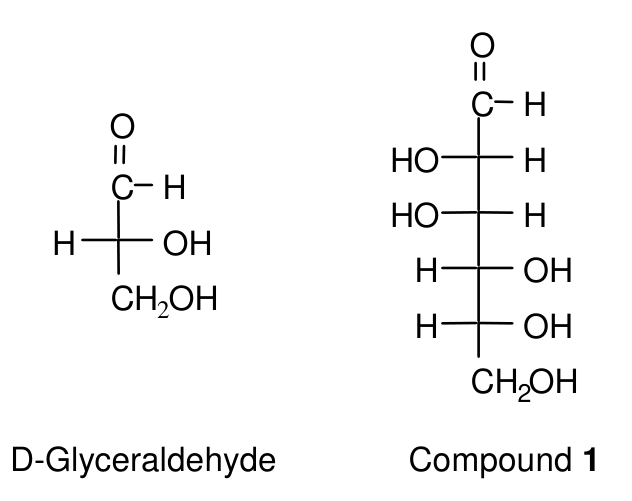
Official English text of the problem.
Answers
- 1.1: The intended assignments are A = D-glucose, B = D-fructose, C = D-galactose, and D = meso-galactaric acid (mucic acid). Their Fischer projections and stereochemical SMILES are specified below.
- 1.2: E = 2,3,4-tri-O-methyl-D-glucopyranose, F = 1,3,4,6-tetra-O-methyl-D-fructofuranose, and G = 2,3,4,6-tetra-O-methyl-D-galactopyranose. Explicit \(\beta\)-anomer drawings and SMILES are given below.
- 1.3: \(\boxed{\mathbf C-\mathbf A-\mathbf B}\), equivalently \(\boxed{\mathbf B-\mathbf A-\mathbf C}\): galactose–glucose–fructose, with glucose in the middle. This is the monosaccharide sequence in raffinose.
Solution
1.1 — Identifying the monosaccharides and drawing their Fischer projections
The supplied compound 1 is D-mannose, with its Fischer hydroxyl groups at C2–C5 arranged left–left–right–right:
O=C[C@@H](O)[C@@H](O)[C@H](O)[C@H](O)CO
Osazone formation modifies C1 and C2 while retaining the configurations at C3, C4, and C5. Consequently, D-glucose, D-mannose, and D-fructose give the same osazone. Its retained Fischer hydroxyl sequence at C3–C5 is left–right–right.
The common D-glucosazone, with hydrazone geometries left unspecified, has SMILES:
c1ccccc1NN=CC(=NNc2ccccc2)[C@@H](O)[C@H](O)[C@H](O)CO
The balanced net reaction is
\[ \ce{C6H12O6 + 3C6H5NHNH2 ->[H^+] C18H22N4O4 + C6H5NH2 + NH3 + 2H2O}. \]
Here phenylhydrazine is NNc1ccccc1, aniline is Nc1ccccc1, ammonia is N, and water is O.
The periodate results distinguish the aldose A from the ketose B. The balanced reactions are
\[ \begin{aligned} \mathbf A:\quad& \ce{C6H12O6 + 5HIO4 -> 5HCOOH + HCHO + 5HIO3},\\ \mathbf B:\quad& \ce{C6H12O6 + 5HIO4 -> 3HCOOH + 2HCHO + CO2 + 5HIO3 + H2O}. \end{aligned} \]
Periodic acid is OI(=O)(=O)=O; iodic acid is OI(=O)=O. The carbon-containing products are methanoic acid O=CO, methanal C=O, and carbon dioxide O=C=O.
Exhaustive cleavage breaks all five carbon–carbon bonds:
- For A, the aldehyde carbon and four secondary alcohol carbons give \(5\ \mathrm{mol}\) of methanoic acid per mole of sugar. The single terminal primary alcohol gives \(1\ \mathrm{mol}\) of methanal.
- For B, two terminal primary alcohol groups give \(2\ \mathrm{mol}\) of methanal, three secondary alcohol carbons give \(3\ \mathrm{mol}\) of methanoic acid, and the ketone carbon gives \(1\ \mathrm{mol}\) of carbon dioxide.
Thus B is D-fructose. Taking the separately labelled compound 1 to be distinct from A, the intended assignment is A = D-glucose.
To identify C, consider chain extension from D-glyceraldehyde, O=C[C@H](O)CO. Kiliani–Fischer extension adds a carbon at the aldehyde end while preserving the existing stereocentres. The two possible D-aldotetroses behave differently on oxidation:
| Aldotetrose | Fischer OH positions, C2–C3 | SMILES | Nitric-acid oxidation product |
|---|---|---|---|
| D-Erythrose | Right, right | O=C[C@H](O)[C@H](O)CO |
meso-Tartaric acid, O=C(O)[C@H](O)[C@H](O)C(=O)O |
| D-Threose | Left, right | O=C[C@@H](O)[C@H](O)CO |
(2S,3S)-Tartaric acid, O=C(O)[C@@H](O)[C@H](O)C(=O)O, which is chiral |
Nitric acid, O=[N+]([O-])O, oxidizes both terminal groups to carboxyl groups. The balanced oxidation equations, using \([O]\) for an oxidizing-oxygen equivalent, are
\[ \ce{C4H8O4 + 3[O] ->[HNO3] C4H6O6 + H2O}, \]
\[ \ce{C6H12O6 + 3[O] ->[HNO3] C6H10O8 + H2O}. \]
Because the tetrose leading to C gives a non-meso acid, it must be D-threose. Its left–right configuration becomes the C4–C5 configuration of C.
The aldaric acid D must be meso. With identical carboxyl groups at both ends, the required symmetric Fischer hydroxyl sequence is therefore
\[ \text{C2–C5: right–left–left–right}. \]
This identifies C as D-galactose and D as galactaric acid, conventionally called mucic acid.
The requested Fischer projections are specified completely in the following table. Draw the carbon backbone vertically, with C1 at the top. At every stereocentre, place hydrogen opposite the indicated hydroxyl group.
| Label and name | Top and bottom groups | Fischer OH positions | Stereochemical SMILES |
|---|---|---|---|
| A: D-Glucose | Top \(\ce{CHO}\); bottom \(\ce{CH2OH}\) | C2 right; C3 left; C4 right; C5 right | O=C[C@H](O)[C@@H](O)[C@H](O)[C@H](O)CO |
| B: D-Fructose | Top \(\ce{CH2OH}\); C2 is \(\ce{C=O}\); bottom \(\ce{CH2OH}\) | C3 left; C4 right; C5 right | OCC(=O)[C@@H](O)[C@H](O)[C@H](O)CO |
| C: D-Galactose | Top \(\ce{CHO}\); bottom \(\ce{CH2OH}\) | C2 right; C3 left; C4 left; C5 right | O=C[C@H](O)[C@@H](O)[C@@H](O)[C@H](O)CO |
| D: meso-Galactaric acid (mucic acid) | Both ends \(\ce{COOH}\) | C2 right; C3 left; C4 left; C5 right | O=C(O)[C@H](O)[C@@H](O)[C@@H](O)[C@H](O)C(=O)O |
As a consistency check, oxidation of A gives chiral D-glucaric acid (saccharic acid):
O=C(O)[C@H](O)[C@@H](O)[C@H](O)[C@H](O)C(=O)O
Its hydroxyl sequence lacks the symmetry of D. The C4–C5 configurations of both A and B correspond to D-erythrose, the required diastereoisomer of D-threose.
1.2 — Methylation analysis and the Haworth projections
Exhaustive methylation converts the free hydroxyl groups of X into methyl ethers. Oxygen atoms already involved in glycosidic bonds or forming the ring oxygen are not methylated. Hydrolysis subsequently restores hydroxyl groups at the glycosidic attachment positions.
| Product | Methylated positions | Interpretation in X |
|---|---|---|
| E, from A | C2, C3, C4 | C5 supplies the pyranose ring oxygen; C1 and C6 participate in glycosidic bonds |
| F, from B | C1, C3, C4, C6 | C5 supplies the furanose ring oxygen; C2 participates in a glycosidic bond |
| G, from C | C2, C3, C4, C6 | C5 supplies the pyranose ring oxygen; C1 participates in a glycosidic bond |
Thus E and G have six-membered pyranose rings, whereas F has a five-membered furanose ring.
For the following precise Haworth descriptions:
- Draw each pyranose with O5 at the upper right and C1 at the right, continuing clockwise through C2, C3, C4, and C5.
- Draw the furanose with O5 at the top and C2 at the right, continuing clockwise through C3, C4, and C5.
- “Up” and “down” mean above and below the ring plane. Unlisted hydrogens point opposite the listed substituent.
Choosing the permitted \(\beta\) anomers gives:
| Product and name | Substituents up | Substituents down | Stereochemical SMILES |
|---|---|---|---|
| E: 2,3,4-tri-O-methyl-\(\beta\)-D-glucopyranose | C1–OH; C3–OMe; C5–\(\ce{CH2OH}\) | C2–OMe; C4–OMe | OC[C@H]1O[C@@H](O)[C@H](OC)[C@@H](OC)[C@@H]1OC |
| F: 1,3,4,6-tetra-O-methyl-\(\beta\)-D-fructofuranose | C2–OH; C3–OMe; C5–\(\ce{CH2OCH3}\), containing C6 | C2–\(\ce{CH2OCH3}\), containing C1; C4–OMe | COC[C@@]1(O)O[C@H](COC)[C@@H](OC)[C@@H]1OC |
| G: 2,3,4,6-tetra-O-methyl-\(\beta\)-D-galactopyranose | C1–OH; C3–OMe; C4–OMe; C5–\(\ce{CH2OCH3}\) | C2–OMe | COC[C@H]1O[C@@H](O)[C@H](OC)[C@@H](OC)[C@H]1OC |
Here OMe denotes \(\ce{OCH3}\). To draw the corresponding \(\alpha\) anomer, reverse the two substituents at the anomeric carbon only. Haworth projections specify relative orientations; they do not imply that the actual rings are planar.
1.3 — Connectivity sequence
The absence of reducing behaviour and mutarotation shows that all three anomeric centres are blocked in glycosidic bonds.
Methylation identifies two attachment positions on A, C1 and C6, but only one on each of B and C, respectively C2 and C1. Therefore A must be the central residue, giving
\[ \boxed{ \text{D-galactose}\;-\;\text{D-glucose}\;-\;\text{D-fructose} } \]
or, in the problem’s labels,
\[ \boxed{\mathbf C-\mathbf A-\mathbf B}. \]
Formation of two glycosidic bonds removes two water molecules, so the molecular formula and balanced hydrolysis are
\[ \ce{3C6H12O6 - 2H2O = C18H32O16}, \]
\[ \ce{C18H32O16 + 2H2O ->[H^+] 3C6H12O6}, \]
where the three product molecules are A, B, and C.
A compatible connectivity is the raffinose linkage pattern, D-galactopyranosyl-(1→6)-D-glucopyranosyl-(1↔2)-D-fructofuranoside. With its three anomeric configurations deliberately unspecified, its SMILES is:
OC[C@H]1OC(OC[C@H]2OC(OC3(CO)O[C@H](CO)[C@@H](O)[C@@H]3O)[C@H](O)[C@@H](O)[C@@H]2O)[C@H](O)[C@@H](O)[C@H]1O
The requested sequence follows directly from the evidence. Assigning this particular pairing of attachment positions requires an additional identification: the alternative pairing C1(C)–C1(A) and C2(B)–C6(A) also preserves the same methylation results and nonreducing behaviour.
The solution was checked against the official solution. Where this solution differs from the official solution, the official solution contains an error or a misprint.
IChO 1997 · Theorieaufgabe 1
Struktur eines Trisaccharids aus Baumwollsaatmehl
Verbindung X ist ein Trisaccharid, das hauptsächlich in Baumwollsaatmehl vorkommt.
Verbindung X reagiert weder mit Benedict-Lösung noch mit Fehling-Lösung und zeigt auch keine Mutarotation.
Die säurekatalysierte Hydrolyse ergibt drei verschiedene D-Hexosen, A, B und C. Die Verbindungen A und B sowie Verbindung 1 (siehe unten) ergeben bei der Reaktion mit überschüssigem Phenylhydrazin im sauren Milieu alle dasselbe Osazon. Verbindung C reagiert mit Salpetersäure zu einer optisch inaktiven Verbindung D. Mithilfe der Kiliani-Fischer-Synthese wird die Konfigurationsbeziehung zwischen D-Glycerinaldehyd und C bestimmt. Die intermediäre Aldotetrose, die zu C führt, ergibt bei der Oxidation mit Salpetersäure keine meso-Verbindung. Wird A mit Salpetersäure behandelt, so ist die entstehende Dicarbonsäure (Aldarsäure) optisch aktiv. Sowohl A als auch B reagieren mit 5 Mol \(\ce{HIO4}\); ein Mol A ergibt 5 Mol Methansäure (Ameisensäure) und ein Mol Methanal (Formaldehyd), während ein Mol B 3 Mol Methansäure (Ameisensäure), 2 Mol Methanal (Formaldehyd) und ein Mol Kohlenstoffdioxid ergibt. Sowohl A als auch B lassen sich auf dieselbe Aldotetrose zurückführen, die das Diastereomer derjenigen ist, auf die sich C zurückführen lässt. Die Methylierung von X mit anschließender Hydrolyse ergibt eine 2,3,4-Tri-O-methyl-D-hexose (E) (aus A), eine 1,3,4,6-Tetra-O-methyl-D-hexose (F) (aus B) und eine 2,3,4,6-Tetra-O-methyl-D-hexose (G) (aus C).
1.1 Zeichnen Sie auf dem Antwortblatt die Fischer-Projektionsformeln von A, B, C und D.
1.2 Vervollständigen Sie auf dem Antwortblatt die entsprechenden Haworth-Projektionsformeln so, dass die Ringgröße und die absolute Stereochemie von E, F und G eindeutig erkennbar sind. Beide anomeren Formen sind als Antwort zulässig.
1.3 Unterstreichen Sie auf dem Antwortblatt die richtige Darstellung der Verknüpfungsreihenfolge der drei Monosaccharide im Trisaccharid X.
Aufgabentext aus dem offiziellen englischen Text übersetzt.
Antworten
- 1.1: Die vorgesehenen Zuordnungen sind A = D-Glucose, B = D-Fructose, C = D-Galactose und D = meso-Galactarsäure (Schleimsäure). Ihre Fischer-Projektionen und stereochemischen SMILES sind unten angegeben.
- 1.2: E = 2,3,4-Tri-O-methyl-D-glucopyranose, F = 1,3,4,6-Tetra-O-methyl-D-fructofuranose und G = 2,3,4,6-Tetra-O-methyl-D-galactopyranose. Explizite Darstellungen der \(\beta\)-Anomere und SMILES sind unten angegeben.
- 1.3: \(\boxed{\mathbf C-\mathbf A-\mathbf B}\), gleichbedeutend mit \(\boxed{\mathbf B-\mathbf A-\mathbf C}\): Galactose–Glucose–Fructose, mit Glucose in der Mitte. Dies ist die Monosaccharidsequenz in Raffinose.
Lösung
1.1 — Identifizierung der Monosaccharide und Zeichnen ihrer Fischer-Projektionen
Die vorgegebene Verbindung 1 ist D-Mannose, deren Hydroxygruppen in der Fischer-Projektion an C2–C5 links–links–rechts–rechts angeordnet sind:
O=C[C@@H](O)[C@@H](O)[C@H](O)[C@H](O)CO
Die Osazonbildung verändert C1 und C2, während die Konfigurationen an C3, C4 und C5 erhalten bleiben. Daher ergeben D-Glucose, D-Mannose und D-Fructose dasselbe Osazon. Die dabei erhalten bleibende Abfolge der Hydroxygruppen an C3–C5 in der Fischer-Projektion lautet links–rechts–rechts.
Das gemeinsame D-Glucosazon hat bei nicht festgelegter Hydrazongeometrie folgenden SMILES:
c1ccccc1NN=CC(=NNc2ccccc2)[C@@H](O)[C@H](O)[C@H](O)CO
Die ausgeglichene Nettoreaktionsgleichung lautet
\[ \ce{C6H12O6 + 3C6H5NHNH2 ->[H^+] C18H22N4O4 + C6H5NH2 + NH3 + 2H2O}. \]
Dabei ist Phenylhydrazin NNc1ccccc1, Anilin Nc1ccccc1, Ammoniak N und Wasser O.
Die Ergebnisse der Periodatoxidation unterscheiden die Aldose A von der Ketose B. Die ausgeglichenen Reaktionsgleichungen lauten
\[ \begin{aligned} \mathbf A:\quad& \ce{C6H12O6 + 5HIO4 -> 5HCOOH + HCHO + 5HIO3},\\ \mathbf B:\quad& \ce{C6H12O6 + 5HIO4 -> 3HCOOH + 2HCHO + CO2 + 5HIO3 + H2O}. \end{aligned} \]
Periodsäure ist OI(=O)(=O)=O; Iodsäure ist OI(=O)=O. Die kohlenstoffhaltigen Produkte sind Methansäure O=CO, Methanal C=O und Kohlenstoffdioxid O=C=O.
Bei der vollständigen Spaltung werden alle fünf Kohlenstoff–Kohlenstoff-Bindungen gespalten:
- Bei A ergeben das Aldehyd-Kohlenstoffatom und die vier Kohlenstoffatome mit sekundären Alkoholgruppen \(5\ \mathrm{mol}\) Methansäure pro Mol Zucker. Die einzige endständige primäre Alkoholgruppe ergibt \(1\ \mathrm{mol}\) Methanal.
- Bei B ergeben zwei endständige primäre Alkoholgruppen \(2\ \mathrm{mol}\) Methanal, drei Kohlenstoffatome mit sekundären Alkoholgruppen ergeben \(3\ \mathrm{mol}\) Methansäure, und das Keton-Kohlenstoffatom ergibt \(1\ \mathrm{mol}\) Kohlenstoffdioxid.
Somit ist B D-Fructose. Unter der Annahme, dass die gesondert bezeichnete Verbindung 1 von A verschieden ist, lautet die vorgesehene Zuordnung A = D-Glucose.
Zur Identifizierung von C betrachten wir die Kettenverlängerung ausgehend von D-Glycerinaldehyd, O=C[C@H](O)CO. Die Kiliani-Fischer-Kettenverlängerung fügt am Aldehydende ein Kohlenstoffatom hinzu, wobei die vorhandenen Stereozentren erhalten bleiben. Die beiden möglichen D-Aldotetrosen verhalten sich bei der Oxidation unterschiedlich:
| Aldotetrose | OH-Positionen in der Fischer-Projektion, C2–C3 | SMILES | Produkt der Oxidation mit Salpetersäure |
|---|---|---|---|
| D-Erythrose | Rechts, rechts | O=C[C@H](O)[C@H](O)CO |
meso-Weinsäure, O=C(O)[C@H](O)[C@H](O)C(=O)O |
| D-Threose | Links, rechts | O=C[C@@H](O)[C@H](O)CO |
(2S,3S)-Weinsäure, O=C(O)[C@@H](O)[C@H](O)C(=O)O, die chiral ist |
Salpetersäure, O=[N+]([O-])O, oxidiert beide endständigen Gruppen zu Carboxygruppen. Die ausgeglichenen Oxidationsgleichungen, in denen \([O]\) für ein Äquivalent oxidierenden Sauerstoffs steht, lauten
\[ \ce{C4H8O4 + 3[O] ->[HNO3] C4H6O6 + H2O}, \]
\[ \ce{C6H12O6 + 3[O] ->[HNO3] C6H10O8 + H2O}. \]
Da die zu C führende Tetrose eine Säure ergibt, die keine meso-Verbindung ist, muss es sich um D-Threose handeln. Ihre Links–rechts-Konfiguration wird zur Konfiguration an C4–C5 von C.
Die Aldarsäure D muss eine meso-Verbindung sein. Da sich an beiden Enden identische Carboxygruppen befinden, lautet die erforderliche symmetrische Abfolge der Hydroxygruppen in der Fischer-Projektion daher
\[ \text{C2–C5: rechts–links–links–rechts}. \]
Damit ist C als D-Galactose und D als Galactarsäure, üblicherweise Schleimsäure genannt, identifiziert.
Die verlangten Fischer-Projektionen sind in der folgenden Tabelle vollständig festgelegt. Zeichnen Sie das Kohlenstoffgerüst senkrecht, mit C1 oben. Platzieren Sie an jedem Stereozentrum das Wasserstoffatom gegenüber der angegebenen Hydroxygruppe.
| Bezeichnung und Name | Obere und untere Gruppe | OH-Positionen in der Fischer-Projektion | Stereochemischer SMILES |
|---|---|---|---|
| A: D-Glucose | Oben \(\ce{CHO}\); unten \(\ce{CH2OH}\) | C2 rechts; C3 links; C4 rechts; C5 rechts | O=C[C@H](O)[C@@H](O)[C@H](O)[C@H](O)CO |
| B: D-Fructose | Oben \(\ce{CH2OH}\); C2 ist \(\ce{C=O}\); unten \(\ce{CH2OH}\) | C3 links; C4 rechts; C5 rechts | OCC(=O)[C@@H](O)[C@H](O)[C@H](O)CO |
| C: D-Galactose | Oben \(\ce{CHO}\); unten \(\ce{CH2OH}\) | C2 rechts; C3 links; C4 links; C5 rechts | O=C[C@H](O)[C@@H](O)[C@@H](O)[C@H](O)CO |
| D: meso-Galactarsäure (Schleimsäure) | Beide Enden \(\ce{COOH}\) | C2 rechts; C3 links; C4 links; C5 rechts | O=C(O)[C@H](O)[C@@H](O)[C@@H](O)[C@H](O)C(=O)O |
Zur Konsistenzprüfung: Die Oxidation von A ergibt chirale D-Glucarsäure (Zuckersäure):
O=C(O)[C@H](O)[C@@H](O)[C@H](O)[C@H](O)C(=O)O
Der Abfolge ihrer Hydroxygruppen fehlt die Symmetrie von D. Die Konfigurationen an C4–C5 sowohl von A als auch von B entsprechen D-Erythrose, dem geforderten Diastereomer der D-Threose.
1.2 — Methylierungsanalyse und Haworth-Projektionen
Die vollständige Methylierung überführt die freien Hydroxygruppen von X in Methylether. Sauerstoffatome, die bereits an glycosidischen Bindungen beteiligt sind oder den Ringsauerstoff bilden, werden nicht methyliert. Durch die anschließende Hydrolyse werden an den glycosidischen Verknüpfungspositionen wieder Hydroxygruppen gebildet.
| Produkt | Methylierte Positionen | Interpretation für X |
|---|---|---|
| E, aus A | C2, C3, C4 | C5 liefert den Sauerstoff des Pyranoserings; C1 und C6 sind an glycosidischen Bindungen beteiligt |
| F, aus B | C1, C3, C4, C6 | C5 liefert den Sauerstoff des Furanoserings; C2 ist an einer glycosidischen Bindung beteiligt |
| G, aus C | C2, C3, C4, C6 | C5 liefert den Sauerstoff des Pyranoserings; C1 ist an einer glycosidischen Bindung beteiligt |
Somit besitzen E und G sechsgliedrige Pyranoseringe, während F einen fünfgliedrigen Furanosering besitzt.
Für die folgenden genauen Beschreibungen der Haworth-Projektionen gilt:
- Zeichnen Sie jede Pyranose mit O5 oben rechts und C1 rechts; fahren Sie im Uhrzeigersinn über C2, C3, C4 und C5 fort.
- Zeichnen Sie die Furanose mit O5 oben und C2 rechts; fahren Sie im Uhrzeigersinn über C3, C4 und C5 fort.
- „Oben“ und „unten“ bedeuten oberhalb bzw. unterhalb der Ringebene. Nicht aufgeführte Wasserstoffatome zeigen in die dem aufgeführten Substituenten entgegengesetzte Richtung.
Bei Wahl der zulässigen \(\beta\)-Anomere ergibt sich:
| Produkt und Name | Substituenten oben | Substituenten unten | Stereochemischer SMILES |
|---|---|---|---|
| E: 2,3,4-Tri-O-methyl-\(\beta\)-D-glucopyranose | C1–OH; C3–OMe; C5–\(\ce{CH2OH}\) | C2–OMe; C4–OMe | OC[C@H]1O[C@@H](O)[C@H](OC)[C@@H](OC)[C@@H]1OC |
| F: 1,3,4,6-Tetra-O-methyl-\(\beta\)-D-fructofuranose | C2–OH; C3–OMe; C5–\(\ce{CH2OCH3}\), enthält C6 | C2–\(\ce{CH2OCH3}\), enthält C1; C4–OMe | COC[C@@]1(O)O[C@H](COC)[C@@H](OC)[C@@H]1OC |
| G: 2,3,4,6-Tetra-O-methyl-\(\beta\)-D-galactopyranose | C1–OH; C3–OMe; C4–OMe; C5–\(\ce{CH2OCH3}\) | C2–OMe | COC[C@H]1O[C@@H](O)[C@H](OC)[C@@H](OC)[C@H]1OC |
Hier bezeichnet OMe \(\ce{OCH3}\). Um das entsprechende \(\alpha\)-Anomer zu zeichnen, vertauschen Sie ausschließlich die beiden Substituenten am anomeren Kohlenstoffatom. Haworth-Projektionen geben relative Orientierungen an; sie bedeuten nicht, dass die tatsächlichen Ringe planar sind.
1.3 — Verknüpfungsreihenfolge
Das Fehlen reduzierender Eigenschaften und der Mutarotation zeigt, dass alle drei anomeren Zentren durch glycosidische Bindungen blockiert sind.
Die Methylierung weist zwei Verknüpfungspositionen an A, C1 und C6, nach, aber jeweils nur eine an B und C, nämlich C2 bzw. C1. Daher muss A der zentrale Rest sein, woraus sich ergibt:
\[ \boxed{ \text{D-Galactose}\;-\;\text{D-Glucose}\;-\;\text{D-Fructose} } \]
oder, mit den Bezeichnungen der Aufgabe,
\[ \boxed{\mathbf C-\mathbf A-\mathbf B}. \]
Bei der Bildung zweier glycosidischer Bindungen werden zwei Wassermoleküle abgespalten; die Summenformel und die ausgeglichene Hydrolysegleichung lauten daher
\[ \ce{3C6H12O6 - 2H2O = C18H32O16}, \]
\[ \ce{C18H32O16 + 2H2O ->[H^+] 3C6H12O6}, \]
wobei die drei Produktmoleküle A, B und C sind.
Eine damit vereinbare Verknüpfung ist das Verknüpfungsmuster der Raffinose, D-Galactopyranosyl-(1→6)-D-glucopyranosyl-(1↔2)-D-fructofuranosid. Wenn ihre drei anomeren Konfigurationen bewusst nicht festgelegt werden, lautet ihr SMILES:
OC[C@H]1OC(OC[C@H]2OC(OC3(CO)O[C@H](CO)[C@@H](O)[C@@H]3O)[C@H](O)[C@@H](O)[C@@H]2O)[C@H](O)[C@@H](O)[C@H]1O
Die geforderte Sequenz folgt unmittelbar aus den Befunden. Die Zuordnung dieser bestimmten Paarung der Verknüpfungspositionen erfordert eine zusätzliche Identifizierung: Auch die alternative Paarung C1(C)–C1(A) und C2(B)–C6(A) ist mit denselben Methylierungsergebnissen und dem nichtreduzierenden Verhalten vereinbar.
Die Lösung wurde mit der offiziellen Lösung abgeglichen. Wo diese Lösung von der offiziellen Lösung abweicht, enthält die offizielle Lösung einen Fehler oder Druckfehler.
IChO 1997 · Teori sorusu 1
Pamuk tohumu küspesinden elde edilen bir trisakkaridin yapısı
X bileşiği, başlıca pamuk tohumu küspesinde bulunan bir trisakkarittir.
X bileşiği Benedict veya Fehling çözeltileriyle tepkime vermez ve mutarotasyon da göstermez.
Asit katalizli hidroliz sonucunda birbirinden farklı üç D-heksoz, A, B ve C elde edilir. A ve B bileşikleri ile 1 bileşiği (aşağıya bakınız), asidik ortamda fazla miktarda fenilhidrazinle tepkimeye girdiklerinde aynı osazonu verir. C bileşiği nitrik asitle tepkimeye girerek optikçe inaktif bir D bileşiği verir. D-gliseraldehit ile C arasındaki konfigürasyon ilişkisini belirlemek için Kiliani-Fischer yaklaşımı kullanılır. C'ye götüren ara aldotetroz, nitrik asitle yükseltgendiğinde mezo bir bileşik vermez. A nitrik asitle işlendiğinde oluşan dikarboksilik asit (aldarik asit) optikçe aktiftir. Hem A hem de B, 5 mol \(\ce{HIO4}\) ile tepkimeye girer; bir mol A, 5 mol metanoik (formik) asit ve bir mol metanal (formaldehit) verirken bir mol B, 3 mol metanoik (formik) asit, 2 mol metanal (formaldehit) ve bir mol karbon dioksit verir. Hem A hem de B, C'nin ilişkili olduğu aldotetrozun diastereoizomeri olan aynı aldotetrozla ilişkilidir. X'in metillenmesini izleyen hidroliz sonucunda (A'dan türeyen) bir 2,3,4-tri-O-metil-D-heksoz (E), (B'den türeyen) bir 1,3,4,6-tetra-O-metil-D-heksoz (F) ve (C'den türeyen) bir 2,3,4,6-tetra-O-metil-D-heksoz (G) elde edilir.
1.1 Cevap kâğıdına A, B, C ve D'nin Fischer izdüşüm formüllerini çiziniz.
1.2 Cevap kâğıdındaki uygun Haworth izdüşüm formüllerini, E, F ve G'nin halka büyüklüklerini ve mutlak stereokimyalarını açıkça gösterecek şekilde tamamlayınız. Anomerik biçimlerden herhangi biri cevap olarak kabul edilir.
1.3 Cevap kâğıdında, X trisakkaridinde bulunan üç monosakkaridin bağlanma sırasını doğru gösteren ifadenin altını çiziniz.
Soru metni resmi İngilizce metinden çevrilmiştir.
Cevaplar
- 1.1: Beklenen eşleştirmeler A = D-glukoz, B = D-fruktoz, C = D-galaktoz ve D = mezo-galaktarik asit (müsik asit) şeklindedir. Bunların Fischer izdüşümleri ve stereokimyasal SMILES gösterimleri aşağıda belirtilmiştir.
- 1.2: E = 2,3,4-tri-O-metil-D-glukopiranoz, F = 1,3,4,6-tetra-O-metil-D-fruktofuranoz ve G = 2,3,4,6-tetra-O-metil-D-galaktopiranoz. Açık \(\beta\)-anomer çizimleri ve SMILES gösterimleri aşağıda verilmiştir.
- 1.3: \(\boxed{\mathbf C-\mathbf A-\mathbf B}\), eşdeğer olarak \(\boxed{\mathbf B-\mathbf A-\mathbf C}\): glukoz ortada olacak şekilde galaktoz–glukoz–fruktoz. Bu, rafinozdaki monosakkarit sırasıdır.
Çözüm
1.1 — Monosakkaritlerin belirlenmesi ve Fischer izdüşümlerinin çizilmesi
Verilen 1 bileşiği, Fischer izdüşümündeki C2–C5 hidroksil grupları sol–sol–sağ–sağ şeklinde sıralanan D-mannozdur:
O=C[C@@H](O)[C@@H](O)[C@H](O)[C@H](O)CO
Osazon oluşumu, C3, C4 ve C5'teki konfigürasyonları korurken C1 ve C2'yi değiştirir. Dolayısıyla D-glukoz, D-mannoz ve D-fruktoz aynı osazonu verir. Osazonun Fischer izdüşümünde korunan C3–C5 hidroksil sırası sol–sağ–sağ şeklindedir.
Ortak ürün olan D-glukozazonun, hidrazon geometrileri belirtilmeden yazılan SMILES gösterimi şöyledir:
c1ccccc1NN=CC(=NNc2ccccc2)[C@@H](O)[C@H](O)[C@H](O)CO
Denkleştirilmiş net tepkime şöyledir:
\[ \ce{C6H12O6 + 3C6H5NHNH2 ->[H^+] C18H22N4O4 + C6H5NH2 + NH3 + 2H2O}. \]
Burada fenilhidrazin NNc1ccccc1, anilin Nc1ccccc1, amonyak N ve su O ile gösterilir.
Periyodat sonuçları, aldoz olan A ile ketoz olan B'yi birbirinden ayırır. Denkleştirilmiş tepkimeler şöyledir:
\[ \begin{aligned} \mathbf A:\quad& \ce{C6H12O6 + 5HIO4 -> 5HCOOH + HCHO + 5HIO3},\\ \mathbf B:\quad& \ce{C6H12O6 + 5HIO4 -> 3HCOOH + 2HCHO + CO2 + 5HIO3 + H2O}. \end{aligned} \]
Periyodik asit OI(=O)(=O)=O; iyodik asit ise OI(=O)=O şeklindedir. Karbon içeren ürünler metanoik asit O=CO, metanal C=O ve karbon dioksit O=C=O'dur.
Tam parçalanma, beş karbon–karbon bağının tümünü koparır:
- A için aldehit karbonu ve dört sekonder alkol karbonu, şekerin molü başına \(5\ \mathrm{mol}\) metanoik asit verir. Uçtaki tek primer alkol, \(1\ \mathrm{mol}\) metanal verir.
- B için uçlardaki iki primer alkol grubu \(2\ \mathrm{mol}\) metanal, üç sekonder alkol karbonu \(3\ \mathrm{mol}\) metanoik asit ve keton karbonu \(1\ \mathrm{mol}\) karbon dioksit verir.
Dolayısıyla B, D-fruktozdur. Ayrı olarak etiketlenen 1 bileşiğinin A'dan farklı olduğu kabul edildiğinde, beklenen eşleştirme A = D-glukoz olur.
C'yi belirlemek için D-gliseraldehitten, O=C[C@H](O)CO, başlayan zincir uzamasını ele alalım. Kiliani–Fischer zincir uzatması, mevcut stereomerkezleri koruyarak aldehit ucuna bir karbon ekler. Olası iki D-aldotetroz, yükseltgenme sırasında farklı davranır:
| Aldotetroz | Fischer OH konumları, C2–C3 | SMILES | Nitrik asitle yükseltgenme ürünü |
|---|---|---|---|
| D-Eritroz | Sağ, sağ | O=C[C@H](O)[C@H](O)CO |
mezo-Tartarik asit, O=C(O)[C@H](O)[C@H](O)C(=O)O |
| D-Treoz | Sol, sağ | O=C[C@@H](O)[C@H](O)CO |
Kiral olan (2S,3S)-tartarik asit, O=C(O)[C@@H](O)[C@H](O)C(=O)O |
Nitrik asit, O=[N+]([O-])O, her iki uç grubunu da karboksil gruplarına yükseltger. Bir yükseltgeyici oksijen eşdeğeri için \([O]\) kullanılarak yazılan denkleştirilmiş yükseltgenme denklemleri şöyledir:
\[ \ce{C4H8O4 + 3[O] ->[HNO3] C4H6O6 + H2O}, \]
\[ \ce{C6H12O6 + 3[O] ->[HNO3] C6H10O8 + H2O}. \]
C'ye götüren tetroz, mezo olmayan bir asit verdiği için D-treoz olmalıdır. Bunun sol–sağ konfigürasyonu, C'nin C4–C5 konfigürasyonu hâline gelir.
Aldarik asit D, mezo olmalıdır. Her iki uçta özdeş karboksil grupları bulunduğundan, gerekli simetrik Fischer hidroksil sırası şöyledir:
\[ \text{C2–C5: sağ–sol–sol–sağ}. \]
Böylece C'nin D-galaktoz, D'nin ise galaktarik asit olduğu belirlenir; galaktarik asit yaygın olarak müsik asit adıyla bilinir.
İstenen Fischer izdüşümleri aşağıdaki tabloda eksiksiz olarak tanımlanmıştır. Karbon iskeletini, C1 en üstte olacak şekilde dikey çiziniz. Her stereomerkezde hidrojeni, belirtilen hidroksil grubunun karşı tarafına yerleştiriniz.
| Etiket ve ad | Üst ve alt gruplar | Fischer OH konumları | Stereokimyasal SMILES |
|---|---|---|---|
| A: D-Glukoz | Üstte \(\ce{CHO}\); altta \(\ce{CH2OH}\) | C2 sağda; C3 solda; C4 sağda; C5 sağda | O=C[C@H](O)[C@@H](O)[C@H](O)[C@H](O)CO |
| B: D-Fruktoz | Üstte \(\ce{CH2OH}\); C2, \(\ce{C=O}\) şeklinde; altta \(\ce{CH2OH}\) | C3 solda; C4 sağda; C5 sağda | OCC(=O)[C@@H](O)[C@H](O)[C@H](O)CO |
| C: D-Galaktoz | Üstte \(\ce{CHO}\); altta \(\ce{CH2OH}\) | C2 sağda; C3 solda; C4 solda; C5 sağda | O=C[C@H](O)[C@@H](O)[C@@H](O)[C@H](O)CO |
| D: mezo-Galaktarik asit (müsik asit) | Her iki uçta \(\ce{COOH}\) | C2 sağda; C3 solda; C4 solda; C5 sağda | O=C(O)[C@H](O)[C@@H](O)[C@@H](O)[C@H](O)C(=O)O |
Tutarlılık kontrolü olarak, A'nın yükseltgenmesi kiral D-glukarik asit (sakkarik asit) verir:
O=C(O)[C@H](O)[C@@H](O)[C@H](O)[C@H](O)C(=O)O
Bunun hidroksil sırası, D'nin simetrisine sahip değildir. Hem A'nın hem de B'nin C4–C5 konfigürasyonları, D-treozun aranan diastereoizomeri olan D-eritroza karşılık gelir.
1.2 — Metilleme analizi ve Haworth izdüşümleri
Tam metilleme, X'in serbest hidroksil gruplarını metil eterlere dönüştürür. Zaten glikozidik bağlarda yer alan veya halka oksijenini oluşturan oksijen atomları metillenmez. Ardından yapılan hidroliz, glikozidik bağlanma konumlarında hidroksil gruplarını yeniden oluşturur.
| Ürün | Metillenmiş konumlar | X'teki yorumu |
|---|---|---|
| A'dan gelen E | C2, C3, C4 | C5, piranoz halkasının oksijenini sağlar; C1 ve C6 glikozidik bağlara katılır |
| B'den gelen F | C1, C3, C4, C6 | C5, furanoz halkasının oksijenini sağlar; C2 bir glikozidik bağa katılır |
| C'den gelen G | C2, C3, C4, C6 | C5, piranoz halkasının oksijenini sağlar; C1 bir glikozidik bağa katılır |
Dolayısıyla E ve G altı üyeli piranoz halkalarına sahipken F beş üyeli bir furanoz halkasına sahiptir.
Aşağıdaki kesin Haworth tanımlamaları için:
- Her piranozu O5 sağ üstte ve C1 sağda olacak şekilde çiziniz; saat yönünde C2, C3, C4 ve C5 ile devam ediniz.
- Furanozu O5 üstte ve C2 sağda olacak şekilde çiziniz; saat yönünde C3, C4 ve C5 ile devam ediniz.
- “Yukarı” ve “aşağı”, halka düzleminin üstünü ve altını ifade eder. Listelenmeyen hidrojenler, listelenen sübstitüentin ters yönüne uzanır.
İzin verilen \(\beta\) anomerleri seçildiğinde şu gösterimler elde edilir:
| Ürün ve ad | Yukarı yönelen sübstitüentler | Aşağı yönelen sübstitüentler | Stereokimyasal SMILES |
|---|---|---|---|
| E: 2,3,4-tri-O-metil-\(\beta\)-D-glukopiranoz | C1–OH; C3–OMe; C5–\(\ce{CH2OH}\) | C2–OMe; C4–OMe | OC[C@H]1O[C@@H](O)[C@H](OC)[C@@H](OC)[C@@H]1OC |
| F: 1,3,4,6-tetra-O-metil-\(\beta\)-D-fruktofuranoz | C2–OH; C3–OMe; C6'yı içeren C5–\(\ce{CH2OCH3}\) | C1'i içeren C2–\(\ce{CH2OCH3}\); C4–OMe | COC[C@@]1(O)O[C@H](COC)[C@@H](OC)[C@@H]1OC |
| G: 2,3,4,6-tetra-O-metil-\(\beta\)-D-galaktopiranoz | C1–OH; C3–OMe; C4–OMe; C5–\(\ce{CH2OCH3}\) | C2–OMe | COC[C@H]1O[C@@H](O)[C@H](OC)[C@@H](OC)[C@H]1OC |
Burada OMe, \(\ce{OCH3}\) grubunu belirtir. Karşılık gelen \(\alpha\) anomerini çizmek için yalnızca anomerik karbondaki iki sübstitüentin yönlerini tersine çeviriniz. Haworth izdüşümleri göreli yönelimleri belirtir; gerçek halkaların düzlemsel olduğu anlamına gelmez.
1.3 — Bağlanma sırası
İndirgen özellik ve mutarotasyon görülmemesi, üç anomerik merkezin de glikozidik bağlarla bloke edildiğini gösterir.
Metilleme, A üzerinde C1 ve C6 olmak üzere iki bağlanma konumu, ancak B ve C üzerinde sırasıyla C2 ve C1 olmak üzere yalnızca birer bağlanma konumu olduğunu gösterir. Bu nedenle A, merkezdeki kalıntı olmalıdır ve şu sıra elde edilir:
\[ \boxed{ \text{D-galaktoz}\;-\;\text{D-glukoz}\;-\;\text{D-fruktoz} } \]
veya sorudaki etiketlerle,
\[ \boxed{\mathbf C-\mathbf A-\mathbf B}. \]
İki glikozidik bağın oluşumu sırasında iki su molekülü ayrılır; dolayısıyla molekül formülü ve denkleştirilmiş hidroliz tepkimesi şöyledir:
\[ \ce{3C6H12O6 - 2H2O = C18H32O16}, \]
\[ \ce{C18H32O16 + 2H2O ->[H^+] 3C6H12O6}, \]
burada üç ürün molekülü A, B ve C'dir.
Verilerle uyumlu bir bağlanma düzeni, D-galaktopiranozil-(1→6)-D-glukopiranozil-(1↔2)-D-fruktofuranozit şeklindeki rafinozun bağlanma düzenidir. Üç anomerik konfigürasyonu özellikle belirtilmeden bırakıldığında, SMILES gösterimi şöyledir:
OC[C@H]1OC(OC[C@H]2OC(OC3(CO)O[C@H](CO)[C@@H](O)[C@@H]3O)[C@H](O)[C@@H](O)[C@@H]2O)[C@H](O)[C@@H](O)[C@H]1O
İstenen sıra, doğrudan verilerden çıkar. Bağlanma konumlarının bu belirli eşleşmesini atamak ise ek bir belirleme gerektirir: alternatif C1(C)–C1(A) ve C2(B)–C6(A) eşleşmesi de aynı metilleme sonuçlarını ve indirgen olmayan davranışı korur.
Çözüm, resmi çözümle karşılaştırılarak kontrol edildi. Bu çözümün resmi çözümden ayrıldığı yerlerde resmi çözümde bir hata ya da baskı hatası vardır.
IChO 1997 · Problema teórico 1
Estructura de un trisacárido de la harina de semillas de algodón
El compuesto X es un trisacárido que se encuentra principalmente en la harina de semillas de algodón.
El compuesto X no reacciona con las disoluciones de Benedict ni de Fehling, ni presenta mutarrotación.
La hidrólisis catalizada por ácido produce tres D-hexosas diferentes, A, B y C. Los compuestos A y B, así como el compuesto 1 (véase más abajo), dan la misma osazona al reaccionar con un exceso de fenilhidrazina en medio ácido. El compuesto C reacciona con ácido nítrico para dar un compuesto D ópticamente inactivo. Se utiliza el método de Kiliani-Fischer para establecer la relación configuracional entre el D-gliceraldehído y C. La aldotetrosa intermedia que conduce a C no da un compuesto meso al oxidarse con ácido nítrico. Cuando A se trata con ácido nítrico, el ácido dicarboxílico (ácido aldárico) producido es ópticamente activo. Tanto A como B reaccionan con 5 moles de \(\ce{HIO4}\); un mol de A da 5 moles de ácido metanoico (fórmico) y un mol de metanal (formaldehído), mientras que un mol de B da 3 moles de ácido metanoico (fórmico), 2 moles de metanal (formaldehído) y un mol de dióxido de carbono. Tanto A como B están relacionados con la misma aldotetrosa, que es el diastereoisómero de aquella con la que está relacionado C. La metilación de X seguida de hidrólisis da una 2,3,4-tri-O-metil-D-hexosa (E) (derivada de A), una 1,3,4,6-tetra-O-metil-D-hexosa (F) (derivada de B) y una 2,3,4,6-tetra-O-metil-D-hexosa (G) (derivada de C).
1.1 En la hoja de respuestas, dibuje las fórmulas de proyección de Fischer de A, B, C y D.
1.2 En la hoja de respuestas, complete las fórmulas de proyección de Haworth correspondientes para mostrar claramente el tamaño del anillo y la estereoquímica absoluta de E, F y G. Cualquiera de las formas anoméricas es aceptable como respuesta.
1.3 En la hoja de respuestas, subraye la representación correcta de la secuencia de conectividad de los tres monosacáridos presentes en el trisacárido X.
Enunciado traducido del texto oficial en inglés.
Respuestas
- 1.1: Las asignaciones previstas son A = D-glucosa, B = D-fructosa, C = D-galactosa y D = ácido meso-galactárico (ácido múcico). Sus proyecciones de Fischer y sus SMILES estereoquímicos se especifican más abajo.
- 1.2: E = 2,3,4-tri-O-metil-D-glucopiranosa, F = 1,3,4,6-tetra-O-metil-D-fructofuranosa y G = 2,3,4,6-tetra-O-metil-D-galactopiranosa. Más abajo se dan representaciones explícitas de los anómeros \(\beta\) y sus SMILES.
- 1.3: \(\boxed{\mathbf C-\mathbf A-\mathbf B}\), o, de forma equivalente, \(\boxed{\mathbf B-\mathbf A-\mathbf C}\): galactosa–glucosa–fructosa, con la glucosa en el centro. Esta es la secuencia de monosacáridos de la rafinosa.
Solución
1.1 — Identificación de los monosacáridos y dibujo de sus proyecciones de Fischer
El compuesto 1 proporcionado es D-manosa, cuyos grupos hidroxilo en C2–C5 están dispuestos en la proyección de Fischer según la secuencia izquierda–izquierda–derecha–derecha:
O=C[C@@H](O)[C@@H](O)[C@H](O)[C@H](O)CO
La formación de la osazona modifica C1 y C2, mientras que conserva las configuraciones de C3, C4 y C5. Por consiguiente, la D-glucosa, la D-manosa y la D-fructosa dan la misma osazona. La secuencia de grupos hidroxilo que se conserva en C3–C5 en la proyección de Fischer es izquierda–derecha–derecha.
La D-glucosazona común, dejando sin especificar las geometrías de las hidrazonas, tiene el siguiente SMILES:
c1ccccc1NN=CC(=NNc2ccccc2)[C@@H](O)[C@H](O)[C@H](O)CO
La reacción neta ajustada es
\[ \ce{C6H12O6 + 3C6H5NHNH2 ->[H^+] C18H22N4O4 + C6H5NH2 + NH3 + 2H2O}. \]
Aquí, la fenilhidrazina es NNc1ccccc1, la anilina es Nc1ccccc1, el amoníaco es N y el agua es O.
Los resultados con el periodato permiten distinguir la aldosa A de la cetosa B. Las reacciones ajustadas son
\[ \begin{aligned} \mathbf A:\quad& \ce{C6H12O6 + 5HIO4 -> 5HCOOH + HCHO + 5HIO3},\\ \mathbf B:\quad& \ce{C6H12O6 + 5HIO4 -> 3HCOOH + 2HCHO + CO2 + 5HIO3 + H2O}. \end{aligned} \]
El ácido peryódico es OI(=O)(=O)=O; el ácido yódico es OI(=O)=O. Los productos que contienen carbono son el ácido metanoico O=CO, el metanal C=O y el dióxido de carbono O=C=O.
La escisión exhaustiva rompe los cinco enlaces carbono–carbono:
- Para A, el carbono aldehídico y los cuatro carbonos de los grupos alcohol secundarios dan \(5\ \mathrm{mol}\) de ácido metanoico por mol de azúcar. El único grupo alcohol primario terminal da \(1\ \mathrm{mol}\) de metanal.
- Para B, dos grupos alcohol primarios terminales dan \(2\ \mathrm{mol}\) de metanal, tres carbonos de grupos alcohol secundarios dan \(3\ \mathrm{mol}\) de ácido metanoico y el carbono cetónico da \(1\ \mathrm{mol}\) de dióxido de carbono.
Por tanto, B es D-fructosa. Si se considera que el compuesto 1, identificado por separado, es distinto de A, la asignación prevista es A = D-glucosa.
Para identificar C, considérese el alargamiento de la cadena a partir del D-gliceraldehído, O=C[C@H](O)CO. El alargamiento de Kiliani–Fischer añade un carbono en el extremo aldehídico y conserva los estereocentros existentes. Las dos D-aldotetrosas posibles se comportan de manera diferente frente a la oxidación:
| Aldotetrosa | Posiciones de los OH en Fischer, C2–C3 | SMILES | Producto de la oxidación con ácido nítrico |
|---|---|---|---|
| D-Eritrosa | Derecha, derecha | O=C[C@H](O)[C@H](O)CO |
Ácido meso-tartárico, O=C(O)[C@H](O)[C@H](O)C(=O)O |
| D-Treosa | Izquierda, derecha | O=C[C@@H](O)[C@H](O)CO |
Ácido (2S,3S)-tartárico, O=C(O)[C@@H](O)[C@H](O)C(=O)O, que es quiral |
El ácido nítrico, O=[N+]([O-])O, oxida ambos grupos terminales a grupos carboxilo. Las ecuaciones de oxidación ajustadas, utilizando \([O]\) para representar un equivalente de oxígeno oxidante, son
\[ \ce{C4H8O4 + 3[O] ->[HNO3] C4H6O6 + H2O}, \]
\[ \ce{C6H12O6 + 3[O] ->[HNO3] C6H10O8 + H2O}. \]
Como la tetrosa que conduce a C da un ácido que no es meso, debe ser D-treosa. Su configuración izquierda–derecha pasa a ser la configuración de C4–C5 de C.
El ácido aldárico D debe ser meso. Al tener grupos carboxilo idénticos en ambos extremos, la secuencia simétrica de grupos hidroxilo requerida en la proyección de Fischer es, por tanto,
\[ \text{C2–C5: derecha–izquierda–izquierda–derecha}. \]
Esto identifica C como D-galactosa y D como ácido galactárico, llamado habitualmente ácido múcico.
Las proyecciones de Fischer solicitadas se especifican por completo en la siguiente tabla. Dibuje el esqueleto carbonado verticalmente, con C1 en la parte superior. En cada estereocentro, coloque el hidrógeno en el lado opuesto al grupo hidroxilo indicado.
| Etiqueta y nombre | Grupos superior e inferior | Posiciones de los OH en Fischer | SMILES estereoquímico |
|---|---|---|---|
| A: D-Glucosa | Arriba \(\ce{CHO}\); abajo \(\ce{CH2OH}\) | C2 derecha; C3 izquierda; C4 derecha; C5 derecha | O=C[C@H](O)[C@@H](O)[C@H](O)[C@H](O)CO |
| B: D-Fructosa | Arriba \(\ce{CH2OH}\); C2 es \(\ce{C=O}\); abajo \(\ce{CH2OH}\) | C3 izquierda; C4 derecha; C5 derecha | OCC(=O)[C@@H](O)[C@H](O)[C@H](O)CO |
| C: D-Galactosa | Arriba \(\ce{CHO}\); abajo \(\ce{CH2OH}\) | C2 derecha; C3 izquierda; C4 izquierda; C5 derecha | O=C[C@H](O)[C@@H](O)[C@@H](O)[C@H](O)CO |
| D: Ácido meso-galactárico (ácido múcico) | Ambos extremos \(\ce{COOH}\) | C2 derecha; C3 izquierda; C4 izquierda; C5 derecha | O=C(O)[C@H](O)[C@@H](O)[C@@H](O)[C@H](O)C(=O)O |
Como comprobación de coherencia, la oxidación de A da ácido D-glucárico (ácido sacárico) quiral:
O=C(O)[C@H](O)[C@@H](O)[C@H](O)[C@H](O)C(=O)O
Su secuencia de grupos hidroxilo carece de la simetría de D. Las configuraciones de C4–C5 tanto de A como de B corresponden a la D-eritrosa, el diastereoisómero requerido de la D-treosa.
1.2 — Análisis por metilación y proyecciones de Haworth
La metilación exhaustiva convierte los grupos hidroxilo libres de X en éteres metílicos. Los átomos de oxígeno que ya participan en enlaces glucosídicos o que constituyen el oxígeno del anillo no se metilan. La hidrólisis restablece posteriormente los grupos hidroxilo en las posiciones de unión glucosídica.
| Producto | Posiciones metiladas | Interpretación en X |
|---|---|---|
| E, a partir de A | C2, C3, C4 | C5 aporta el oxígeno del anillo de piranosa; C1 y C6 participan en enlaces glucosídicos |
| F, a partir de B | C1, C3, C4, C6 | C5 aporta el oxígeno del anillo de furanosa; C2 participa en un enlace glucosídico |
| G, a partir de C | C2, C3, C4, C6 | C5 aporta el oxígeno del anillo de piranosa; C1 participa en un enlace glucosídico |
Por tanto, E y G tienen anillos de piranosa de seis miembros, mientras que F tiene un anillo de furanosa de cinco miembros.
Para las siguientes descripciones precisas de Haworth:
- Dibuje cada piranosa con O5 en la parte superior derecha y C1 a la derecha, continuando en sentido horario por C2, C3, C4 y C5.
- Dibuje la furanosa con O5 en la parte superior y C2 a la derecha, continuando en sentido horario por C3, C4 y C5.
- «Arriba» y «abajo» significan por encima y por debajo del plano del anillo. Los hidrógenos no enumerados apuntan en sentido opuesto al sustituyente indicado.
Al elegir los anómeros \(\beta\) permitidos, se obtiene:
| Producto y nombre | Sustituyentes hacia arriba | Sustituyentes hacia abajo | SMILES estereoquímico |
|---|---|---|---|
| E: 2,3,4-tri-O-metil-\(\beta\)-D-glucopiranosa | C1–OH; C3–OMe; C5–\(\ce{CH2OH}\) | C2–OMe; C4–OMe | OC[C@H]1O[C@@H](O)[C@H](OC)[C@@H](OC)[C@@H]1OC |
| F: 1,3,4,6-tetra-O-metil-\(\beta\)-D-fructofuranosa | C2–OH; C3–OMe; C5–\(\ce{CH2OCH3}\), que contiene C6 | C2–\(\ce{CH2OCH3}\), que contiene C1; C4–OMe | COC[C@@]1(O)O[C@H](COC)[C@@H](OC)[C@@H]1OC |
| G: 2,3,4,6-tetra-O-metil-\(\beta\)-D-galactopiranosa | C1–OH; C3–OMe; C4–OMe; C5–\(\ce{CH2OCH3}\) | C2–OMe | COC[C@H]1O[C@@H](O)[C@H](OC)[C@@H](OC)[C@H]1OC |
Aquí, OMe representa \(\ce{OCH3}\). Para dibujar el anómero \(\alpha\) correspondiente, invierta únicamente los dos sustituyentes del carbono anomérico. Las proyecciones de Haworth especifican orientaciones relativas; no implican que los anillos reales sean planos.
1.3 — Secuencia de conectividad
La ausencia de comportamiento reductor y de mutarrotación muestra que los tres centros anoméricos están bloqueados en enlaces glucosídicos.
La metilación identifica dos posiciones de unión en A, C1 y C6, pero solo una en cada uno de B y C, respectivamente C2 y C1. Por tanto, A debe ser el residuo central, lo que da
\[ \boxed{ \text{D-galactosa}\;-\;\text{D-glucosa}\;-\;\text{D-fructosa} } \]
o, utilizando las etiquetas del problema,
\[ \boxed{\mathbf C-\mathbf A-\mathbf B}. \]
La formación de dos enlaces glucosídicos elimina dos moléculas de agua, de modo que la fórmula molecular y la hidrólisis ajustada son
\[ \ce{3C6H12O6 - 2H2O = C18H32O16}, \]
\[ \ce{C18H32O16 + 2H2O ->[H^+] 3C6H12O6}, \]
donde las tres moléculas de producto son A, B y C.
Una conectividad compatible es el patrón de enlaces de la rafinosa, D-galactopiranosil-(1→6)-D-glucopiranosil-(1↔2)-D-fructofuranósido. Dejando deliberadamente sin especificar sus tres configuraciones anoméricas, su SMILES es:
OC[C@H]1OC(OC[C@H]2OC(OC3(CO)O[C@H](CO)[C@@H](O)[C@@H]3O)[C@H](O)[C@@H](O)[C@@H]2O)[C@H](O)[C@@H](O)[C@H]1O
La secuencia solicitada se deduce directamente de los datos. La asignación de este emparejamiento concreto de posiciones de unión requiere una identificación adicional: el emparejamiento alternativo C1(C)–C1(A) y C2(B)–C6(A) también conserva los mismos resultados de metilación y el comportamiento no reductor.
La solución se comprobó con la solución oficial. Donde esta solución difiere de la solución oficial, la solución oficial contiene un error o una errata.
IChO 1997 · 理论题 1
棉籽粕中一种三糖的结构
化合物 X 是一种主要存在于棉籽粕中的三糖。
化合物 X 不与本尼迪特试剂或斐林试剂反应,也不发生变旋现象。
酸催化水解得到三种不同的 D-己糖 A、B 和 C。化合物 A 和 B 以及化合物 1(见下文)与过量苯肼在酸性条件下反应时,均生成相同的糖脎。化合物 C 与硝酸反应,生成无旋光性的化合物 D。采用 Kiliani–Fischer 法确定 D-甘油醛与 C 之间的构型关系。生成 C 的中间体丁醛糖经硝酸氧化时,不生成内消旋化合物。用硝酸处理 A 时,生成的二羧酸(糖二酸)具有旋光性。A 和 B 均与 5 摩尔的 \(\ce{HIO4}\) 反应;一摩尔 A 生成 5 摩尔甲酸(蚁酸)和一摩尔甲醛(蚁醛),而一摩尔 B 生成 3 摩尔甲酸(蚁酸)、2 摩尔甲醛(蚁醛)和一摩尔二氧化碳。A 和 B 均与同一种丁醛糖存在构型上的关联,该丁醛糖是与 C 存在构型关联的丁醛糖的非对映异构体。X 经甲基化后再水解,得到一种 2,3,4-三-O-甲基-D-己糖(E)(源自 A)、一种 1,3,4,6-四-O-甲基-D-己糖(F)(源自 B)和一种 2,3,4,6-四-O-甲基-D-己糖(G)(源自 C)。
1.1 在答题纸上画出 A、B、C 和 D 的 Fischer 投影式。
1.2 在答题纸上补全相应的 Haworth 投影式,清楚地表示 E、F 和 G 的环大小及绝对立体化学构型。任一异头体形式均可作为答案。
1.3 在答题纸上,用下划线标出三糖 X 中三种单糖连接顺序的正确表示。
题目译自官方英文原文。
答案
- 1.1: 题目预期的鉴定结果为 A = D-葡萄糖、B = D-果糖、C = D-半乳糖,以及 D = 内消旋半乳糖二酸(黏酸)。下文给出了它们的 Fischer 投影式和立体化学 SMILES。
- 1.2: E = 2,3,4-三-O-甲基-D-吡喃葡萄糖、F = 1,3,4,6-四-O-甲基-D-呋喃果糖,以及 G = 2,3,4,6-四-O-甲基-D-吡喃半乳糖。下文给出了明确的 \(\beta\)-异头体画法及 SMILES。
- 1.3: \(\boxed{\mathbf C-\mathbf A-\mathbf B}\),等价地可写为 \(\boxed{\mathbf B-\mathbf A-\mathbf C}\):半乳糖–葡萄糖–果糖,其中葡萄糖位于中间。这就是棉子糖中单糖的连接顺序。
解答
1.1 — 鉴定单糖并绘制其 Fischer 投影式
题目给出的化合物 1 是 D-甘露糖,其 Fischer 投影式中 C2–C5 上的羟基排列为左–左–右–右:
O=C[C@@H](O)[C@@H](O)[C@H](O)[C@H](O)CO
糖脎的形成改变 C1 和 C2,而保留 C3、C4 和 C5 的构型。因此,D-葡萄糖、D-甘露糖和 D-果糖生成相同的糖脎。其保留下来的 C3–C5 上羟基在 Fischer 投影式中的排列为左–右–右。
它们共同生成的 D-葡萄糖脎的 SMILES 如下,其中未指定腙基的几何构型:
c1ccccc1NN=CC(=NNc2ccccc2)[C@@H](O)[C@H](O)[C@H](O)CO
配平后的总反应为
\[ \ce{C6H12O6 + 3C6H5NHNH2 ->[H^+] C18H22N4O4 + C6H5NH2 + NH3 + 2H2O}. \]
其中,苯肼为 NNc1ccccc1,苯胺为 Nc1ccccc1,氨为 N,水为 O。
高碘酸氧化的结果可区分醛糖 A 与酮糖 B。配平后的反应为
\[ \begin{aligned} \mathbf A:\quad& \ce{C6H12O6 + 5HIO4 -> 5HCOOH + HCHO + 5HIO3},\\ \mathbf B:\quad& \ce{C6H12O6 + 5HIO4 -> 3HCOOH + 2HCHO + CO2 + 5HIO3 + H2O}. \end{aligned} \]
高碘酸为 OI(=O)(=O)=O;碘酸为 OI(=O)=O。含碳产物为甲酸 O=CO、甲醛 C=O 和二氧化碳 O=C=O。
彻底氧化裂解使全部五个碳–碳键断裂:
- 对于 A,每摩尔糖中的醛基碳和四个仲醇碳生成 \(5\ \mathrm{mol}\) 甲酸。唯一的末端伯醇基生成 \(1\ \mathrm{mol}\) 甲醛。
- 对于 B,两个末端伯醇基生成 \(2\ \mathrm{mol}\) 甲醛,三个仲醇碳生成 \(3\ \mathrm{mol}\) 甲酸,酮基碳生成 \(1\ \mathrm{mol}\) 二氧化碳。
因此,B 是 D-果糖。若将单独标记的化合物 1 视为不同于 A 的化合物,则题目预期的鉴定结果为 A = D-葡萄糖。
为鉴定 C,考虑从 D-甘油醛 O=C[C@H](O)CO 出发的碳链增长。Kiliani–Fischer 增碳反应在醛基端增加一个碳原子,同时保留已有立体中心的构型。两种可能的 D-丁醛糖在氧化时表现不同:
| 丁醛糖 | Fischer 投影式中 C2–C3 上 OH 的位置 | SMILES | 硝酸氧化产物 |
|---|---|---|---|
| D-赤藓糖 | 右、右 | O=C[C@H](O)[C@H](O)CO |
内消旋酒石酸,O=C(O)[C@H](O)[C@H](O)C(=O)O |
| D-苏阿糖 | 左、右 | O=C[C@@H](O)[C@H](O)CO |
(2S,3S)-酒石酸,O=C(O)[C@@H](O)[C@H](O)C(=O)O,具有手性 |
硝酸 O=[N+]([O-])O 将两个末端基团均氧化为羧基。用 \([O]\) 表示一个氧化氧当量,配平后的氧化方程式为
\[ \ce{C4H8O4 + 3[O] ->[HNO3] C4H6O6 + H2O}, \]
\[ \ce{C6H12O6 + 3[O] ->[HNO3] C6H10O8 + H2O}. \]
由于生成 C 的丁糖经氧化得到非内消旋酸,它必定是 D-苏阿糖。其左–右构型成为 C 的 C4–C5 构型。
糖二酸 D 必须是内消旋体。由于两端具有相同的羧基,所需的对称 Fischer 羟基排列因此为
\[ \text{C2–C5: 右–左–左–右}. \]
由此可确定 C 为 D-半乳糖,D 为半乳糖二酸,其俗名为黏酸。
下表完整给出了所要求的 Fischer 投影式。绘图时将碳骨架竖直放置,C1 位于顶端。在每个立体中心,将氢置于所示羟基的相对一侧。
| 标记及名称 | 顶端和底端基团 | Fischer 投影式中 OH 的位置 | 立体化学 SMILES |
|---|---|---|---|
| A: D-葡萄糖 | 顶端为 \(\ce{CHO}\);底端为 \(\ce{CH2OH}\) | C2 右;C3 左;C4 右;C5 右 | O=C[C@H](O)[C@@H](O)[C@H](O)[C@H](O)CO |
| B: D-果糖 | 顶端为 \(\ce{CH2OH}\);C2 为 \(\ce{C=O}\);底端为 \(\ce{CH2OH}\) | C3 左;C4 右;C5 右 | OCC(=O)[C@@H](O)[C@H](O)[C@H](O)CO |
| C: D-半乳糖 | 顶端为 \(\ce{CHO}\);底端为 \(\ce{CH2OH}\) | C2 右;C3 左;C4 左;C5 右 | O=C[C@H](O)[C@@H](O)[C@@H](O)[C@H](O)CO |
| D: 内消旋半乳糖二酸(黏酸) | 两端均为 \(\ce{COOH}\) | C2 右;C3 左;C4 左;C5 右 | O=C(O)[C@H](O)[C@@H](O)[C@@H](O)[C@H](O)C(=O)O |
作为一致性检验,A 经氧化生成具有手性的 D-葡萄糖二酸(糖质酸):
O=C(O)[C@H](O)[C@@H](O)[C@H](O)[C@H](O)C(=O)O
其羟基排列不具有 D 的对称性。A 和 B 的 C4–C5 构型均对应于 D-赤藓糖,正是题目所要求的 D-苏阿糖的非对映异构体。
1.2 — 甲基化分析及 Haworth 投影式
彻底甲基化将 X 的游离羟基转化为甲醚。已参与糖苷键或构成环氧原子的氧原子不会被甲基化。随后的水解使糖苷键连接位点重新形成羟基。
| 产物 | 甲基化位置 | 在 X 中的含义 |
|---|---|---|
| E,来自 A | C2、C3、C4 | C5 提供吡喃糖环的氧原子;C1 和 C6 参与糖苷键 |
| F,来自 B | C1、C3、C4、C6 | C5 提供呋喃糖环的氧原子;C2 参与糖苷键 |
| G,来自 C | C2、C3、C4、C6 | C5 提供吡喃糖环的氧原子;C1 参与糖苷键 |
因此,E 和 G 具有六元吡喃糖环,而 F 具有五元呋喃糖环。
以下对 Haworth 投影式的精确描述采用如下约定:
- 绘制每个吡喃糖环时,将 O5 置于右上方,C1 置于右侧,沿顺时针方向依次为 C2、C3、C4 和 C5。
- 绘制呋喃糖环时,将 O5 置于顶端,C2 置于右侧,沿顺时针方向依次为 C3、C4 和 C5。
- “向上”和“向下”分别指位于环平面上方和下方。未列出的氢指向与所列取代基相反的方向。
选择题目允许的 \(\beta\) 异头体,得到:
| 产物及名称 | 向上的取代基 | 向下的取代基 | 立体化学 SMILES |
|---|---|---|---|
| E: 2,3,4-三-O-甲基-\(\beta\)-D-吡喃葡萄糖 | C1–OH;C3–OMe;C5–\(\ce{CH2OH}\) | C2–OMe;C4–OMe | OC[C@H]1O[C@@H](O)[C@H](OC)[C@@H](OC)[C@@H]1OC |
| F: 1,3,4,6-四-O-甲基-\(\beta\)-D-呋喃果糖 | C2–OH;C3–OMe;C5–\(\ce{CH2OCH3}\),其中含 C6 | C2–\(\ce{CH2OCH3}\),其中含 C1;C4–OMe | COC[C@@]1(O)O[C@H](COC)[C@@H](OC)[C@@H]1OC |
| G: 2,3,4,6-四-O-甲基-\(\beta\)-D-吡喃半乳糖 | C1–OH;C3–OMe;C4–OMe;C5–\(\ce{CH2OCH3}\) | C2–OMe | COC[C@H]1O[C@@H](O)[C@H](OC)[C@@H](OC)[C@H]1OC |
这里 OMe 表示 \(\ce{OCH3}\)。若要绘制相应的 \(\alpha\) 异头体,只需将异头碳上两个取代基的方向互换。Haworth 投影式表示相对取向,并不意味着实际的环是平面的。
1.3 — 连接顺序
不具有还原性且不发生变旋现象,表明三个异头中心均因形成糖苷键而被封闭。
甲基化分析确定 A 上有两个连接位点,即 C1 和 C6,而 B 和 C 上各仅有一个连接位点,分别为 C2 和 C1。因此,A 必须是中间的糖残基,由此得到
\[ \boxed{ \text{D-半乳糖}\;-\;\text{D-葡萄糖}\;-\;\text{D-果糖} } \]
或者用题目中的标记表示为
\[ \boxed{\mathbf C-\mathbf A-\mathbf B}. \]
形成两个糖苷键脱去两分子水,因此分子式及配平后的水解反应为
\[ \ce{3C6H12O6 - 2H2O = C18H32O16}, \]
\[ \ce{C18H32O16 + 2H2O ->[H^+] 3C6H12O6}, \]
其中三个产物分子分别为 A、B 和 C。
一种与上述结果相符的连接方式是棉子糖的连接模式,即 D-吡喃半乳糖基-(1→6)-D-吡喃葡萄糖基-(1↔2)-D-呋喃果糖苷。特意不指定其三个异头中心的构型时,其 SMILES 为:
OC[C@H]1OC(OC[C@H]2OC(OC3(CO)O[C@H](CO)[C@@H](O)[C@@H]3O)[C@H](O)[C@@H](O)[C@@H]2O)[C@H](O)[C@@H](O)[C@H]1O
所要求的顺序可由证据直接推出。要确定连接位点采用这一特定配对方式,还需要额外的鉴定依据:另一种配对方式 C1(C)–C1(A) 和 C2(B)–C6(A) 同样符合上述甲基化结果及非还原性。
解答已与官方解答核对。本解答与官方解答不同之处,均为官方解答中的错误或印刷错误。
IChO 1997 · Теоретическая задача 1
Строение трисахарида из хлопкового шрота
Соединение X — трисахарид, встречающийся главным образом в хлопковом шроте.
Соединение X не реагирует с растворами Бенедикта и Фелинга и не подвергается мутаротации.
При кислотно-катализируемом гидролизе образуются три различные D-гексозы: A, B и C. Соединения A и B, а также соединение 1 (см. ниже) при взаимодействии с избытком фенилгидразина в кислой среде дают один и тот же озазон. Соединение C реагирует с азотной кислотой с образованием оптически неактивного соединения D. Для установления конфигурационной связи между D-глицеральдегидом и C используют метод Килиани–Фишера. Промежуточная альдотетроза, из которой получают C, при окислении азотной кислотой не даёт мезосоединения. При обработке A азотной кислотой образуется оптически активная дикарбоновая кислота (альдаровая кислота). Как A, так и B реагируют с 5 молями \(\ce{HIO4}\); один моль A даёт 5 молей метановой (муравьиной) кислоты и один моль метаналя (формальдегида), тогда как один моль B даёт 3 моля метановой (муравьиной) кислоты, 2 моля метаналя (формальдегида) и один моль диоксида углерода. Как A, так и B конфигурационно связаны с одной и той же альдотетрозой, являющейся диастереоизомером той альдотетрозы, с которой связано C. Метилирование X с последующим гидролизом даёт 2,3,4-три-O-метил-D-гексозу (E) (производное A), 1,3,4,6-тетра-O-метил-D-гексозу (F) (производное B) и 2,3,4,6-тетра-O-метил-D-гексозу (G) (производное C).
1.1 На листе ответов изобразите проекционные формулы Фишера для A, B, C и D.
1.2 На листе ответов дополните соответствующие проекционные формулы Хеуорса так, чтобы они ясно показывали размер цикла и абсолютную стереохимию E, F и G. В качестве ответа принимается любая из аномерных форм.
1.3 На листе ответов подчеркните правильное изображение последовательности соединения трёх моносахаридов, входящих в состав трисахарида X.
Условие переведено с официального английского текста.
Ответы
- 1.1: Предполагаемые соответствия: A = D-глюкоза, B = D-фруктоза, C = D-галактоза и D = мезо-галактаровая кислота (слизевая кислота). Их проекции Фишера и стереохимические SMILES приведены ниже.
- 1.2: E = 2,3,4-три-O-метил-D-глюкопираноза, F = 1,3,4,6-тетра-O-метил-D-фруктофураноза и G = 2,3,4,6-тетра-O-метил-D-галактопираноза. Явные указания для построения изображений \(\beta\)-аномеров и их SMILES приведены ниже.
- 1.3: \(\boxed{\mathbf C-\mathbf A-\mathbf B}\), или эквивалентно \(\boxed{\mathbf B-\mathbf A-\mathbf C}\): галактоза–глюкоза–фруктоза, с глюкозой в середине. Это последовательность моносахаридов в раффинозе.
Решение
1.1 — Идентификация моносахаридов и построение их проекций Фишера
Приведённое соединение 1 — D-манноза; её гидроксильные группы при C2–C5 в проекции Фишера расположены слева–слева–справа–справа:
O=C[C@@H](O)[C@@H](O)[C@H](O)[C@H](O)CO
Образование озазона изменяет C1 и C2, сохраняя конфигурации при C3, C4 и C5. Поэтому D-глюкоза, D-манноза и D-фруктоза дают один и тот же озазон. Сохраняющаяся последовательность расположения его гидроксильных групп при C3–C5 в проекции Фишера — слева–справа–справа.
Общий для них D-глюкозазон, без указания геометрии гидразонных групп, имеет SMILES:
c1ccccc1NN=CC(=NNc2ccccc2)[C@@H](O)[C@H](O)[C@H](O)CO
Суммарное уравнение реакции с расставленными коэффициентами:
\[ \ce{C6H12O6 + 3C6H5NHNH2 ->[H^+] C18H22N4O4 + C6H5NH2 + NH3 + 2H2O}. \]
Здесь фенилгидразин — NNc1ccccc1, анилин — Nc1ccccc1, аммиак — N, а вода — O.
Результаты периодатного окисления позволяют отличить альдозу A от кетозы B. Уравнения реакций с расставленными коэффициентами:
\[ \begin{aligned} \mathbf A:\quad& \ce{C6H12O6 + 5HIO4 -> 5HCOOH + HCHO + 5HIO3},\\ \mathbf B:\quad& \ce{C6H12O6 + 5HIO4 -> 3HCOOH + 2HCHO + CO2 + 5HIO3 + H2O}. \end{aligned} \]
Йодная кислота — OI(=O)(=O)=O; йодноватая кислота — OI(=O)=O. Углеродсодержащие продукты — метановая кислота O=CO, метаналь C=O и диоксид углерода O=C=O.
При полном окислительном расщеплении разрываются все пять связей углерод–углерод:
- В случае A альдегидный атом углерода и четыре атома углерода вторичных спиртовых групп дают \(5\ \mathrm{mol}\) метановой кислоты на моль сахара. Единственная концевая первичная спиртовая группа даёт \(1\ \mathrm{mol}\) метаналя.
- В случае B две концевые первичные спиртовые группы дают \(2\ \mathrm{mol}\) метаналя, три атома углерода вторичных спиртовых групп дают \(3\ \mathrm{mol}\) метановой кислоты, а кетонный атом углерода даёт \(1\ \mathrm{mol}\) диоксида углерода.
Таким образом, B — D-фруктоза. Если считать отдельно обозначенное соединение 1 отличным от A, предполагаемое соответствие — A = D-глюкоза.
Для идентификации C рассмотрим удлинение цепи D-глицеральдегида, O=C[C@H](O)CO. Удлинение цепи по Килиани–Фишеру добавляет атом углерода с альдегидного конца, сохраняя имеющиеся стереоцентры. Две возможные D-альдотетрозы ведут себя при окислении по-разному:
| Альдотетроза | Положения OH в проекции Фишера, C2–C3 | SMILES | Продукт окисления азотной кислотой |
|---|---|---|---|
| D-Эритроза | Справа, справа | O=C[C@H](O)[C@H](O)CO |
Мезо-винная кислота, O=C(O)[C@H](O)[C@H](O)C(=O)O |
| D-Треоза | Слева, справа | O=C[C@@H](O)[C@H](O)CO |
(2S,3S)-Винная кислота, O=C(O)[C@@H](O)[C@H](O)C(=O)O, которая хиральна |
Азотная кислота, O=[N+]([O-])O, окисляет обе концевые группы до карбоксильных групп. Уравнения окисления с расставленными коэффициентами, в которых \([O]\) обозначает эквивалент окисляющего кислорода:
\[ \ce{C4H8O4 + 3[O] ->[HNO3] C4H6O6 + H2O}, \]
\[ \ce{C6H12O6 + 3[O] ->[HNO3] C6H10O8 + H2O}. \]
Поскольку тетроза, из которой получают C, даёт кислоту, не являющуюся мезоформой, она должна быть D-треозой. Её конфигурация слева–справа становится конфигурацией при C4–C5 соединения C.
Альдаровая кислота D должна быть мезоформой. При одинаковых карбоксильных группах на обоих концах требуемая симметричная последовательность расположения гидроксильных групп в проекции Фишера имеет вид
\[ \text{C2–C5: справа–слева–слева–справа}. \]
Это позволяет идентифицировать C как D-галактозу, а D как галактаровую кислоту, обычно называемую слизевой кислотой.
Требуемые проекции Фишера полностью заданы в следующей таблице. Изобразите углеродную цепь вертикально, расположив C1 вверху. При каждом стереоцентре поместите атом водорода напротив указанной гидроксильной группы.
| Обозначение и название | Верхняя и нижняя группы | Положения OH в проекции Фишера | Стереохимический SMILES |
|---|---|---|---|
| A: D-Глюкоза | Вверху \(\ce{CHO}\); внизу \(\ce{CH2OH}\) | C2 справа; C3 слева; C4 справа; C5 справа | O=C[C@H](O)[C@@H](O)[C@H](O)[C@H](O)CO |
| B: D-Фруктоза | Вверху \(\ce{CH2OH}\); C2 — \(\ce{C=O}\); внизу \(\ce{CH2OH}\) | C3 слева; C4 справа; C5 справа | OCC(=O)[C@@H](O)[C@H](O)[C@H](O)CO |
| C: D-Галактоза | Вверху \(\ce{CHO}\); внизу \(\ce{CH2OH}\) | C2 справа; C3 слева; C4 слева; C5 справа | O=C[C@H](O)[C@@H](O)[C@@H](O)[C@H](O)CO |
| D: мезо-Галактаровая кислота (слизевая кислота) | На обоих концах \(\ce{COOH}\) | C2 справа; C3 слева; C4 слева; C5 справа | O=C(O)[C@H](O)[C@@H](O)[C@@H](O)[C@H](O)C(=O)O |
Для проверки согласованности отметим, что окисление A даёт хиральную D-глюкаровую кислоту (сахарную кислоту):
O=C(O)[C@H](O)[C@@H](O)[C@H](O)[C@H](O)C(=O)O
Последовательность расположения её гидроксильных групп не обладает симметрией, характерной для D. Конфигурации при C4–C5 как у A, так и у B соответствуют D-эритрозе — требуемому диастереоизомеру D-треозы.
1.2 — Анализ методом метилирования и проекции Хеуорса
Полное метилирование превращает свободные гидроксильные группы X в метиловые эфирные группы. Атомы кислорода, уже участвующие в гликозидных связях или входящие в состав цикла, не метилируются. Последующий гидролиз восстанавливает гидроксильные группы в положениях образования гликозидных связей.
| Продукт | Метилированные положения | Интерпретация для X |
|---|---|---|
| E, из A | C2, C3, C4 | Кислород при C5 образует пиранозный цикл; C1 и C6 участвуют в гликозидных связях |
| F, из B | C1, C3, C4, C6 | Кислород при C5 образует фуранозный цикл; C2 участвует в гликозидной связи |
| G, из C | C2, C3, C4, C6 | Кислород при C5 образует пиранозный цикл; C1 участвует в гликозидной связи |
Следовательно, E и G имеют шестичленные пиранозные циклы, тогда как F имеет пятичленный фуранозный цикл.
Для приведённых ниже точных описаний проекций Хеуорса:
- Изображайте каждую пиранозу с O5 справа вверху и C1 справа, продолжая обход по часовой стрелке через C2, C3, C4 и C5.
- Изображайте фуранозу с O5 вверху и C2 справа, продолжая обход по часовой стрелке через C3, C4 и C5.
- «Вверх» и «вниз» означают над и под плоскостью цикла. Неуказанные атомы водорода направлены противоположно указанному заместителю.
Выбор допустимых \(\beta\)-аномеров даёт:
| Продукт и название | Заместители, направленные вверх | Заместители, направленные вниз | Стереохимический SMILES |
|---|---|---|---|
| E: 2,3,4-три-O-метил-\(\beta\)-D-глюкопираноза | C1–OH; C3–OMe; C5–\(\ce{CH2OH}\) | C2–OMe; C4–OMe | OC[C@H]1O[C@@H](O)[C@H](OC)[C@@H](OC)[C@@H]1OC |
| F: 1,3,4,6-тетра-O-метил-\(\beta\)-D-фруктофураноза | C2–OH; C3–OMe; C5–\(\ce{CH2OCH3}\), содержащий C6 | C2–\(\ce{CH2OCH3}\), содержащий C1; C4–OMe | COC[C@@]1(O)O[C@H](COC)[C@@H](OC)[C@@H]1OC |
| G: 2,3,4,6-тетра-O-метил-\(\beta\)-D-галактопираноза | C1–OH; C3–OMe; C4–OMe; C5–\(\ce{CH2OCH3}\) | C2–OMe | COC[C@H]1O[C@@H](O)[C@H](OC)[C@@H](OC)[C@H]1OC |
Здесь OMe обозначает \(\ce{OCH3}\). Чтобы изобразить соответствующий \(\alpha\)-аномер, поменяйте направления двух заместителей только при аномерном атоме углерода. Проекции Хеуорса задают относительную ориентацию; они не подразумевают, что реальные циклы плоские.
1.3 — Последовательность соединения
Отсутствие восстанавливающих свойств и мутаротации показывает, что все три аномерных центра блокированы гликозидными связями.
Метилирование выявляет два положения присоединения у A, C1 и C6, но лишь по одному у B и C — соответственно C2 и C1. Поэтому A должен быть центральным остатком, что даёт
\[ \boxed{ \text{D-галактоза}\;-\;\text{D-глюкоза}\;-\;\text{D-фруктоза} } \]
или, в обозначениях задачи,
\[ \boxed{\mathbf C-\mathbf A-\mathbf B}. \]
При образовании двух гликозидных связей отщепляются две молекулы воды, поэтому молекулярная формула и уравнение гидролиза с расставленными коэффициентами имеют вид
\[ \ce{3C6H12O6 - 2H2O = C18H32O16}, \]
\[ \ce{C18H32O16 + 2H2O ->[H^+] 3C6H12O6}, \]
где три молекулы продуктов — A, B и C.
С полученными данными согласуется схема связей раффинозы, D-галактопиранозил-(1→6)-D-глюкопиранозил-(1↔2)-D-фруктофуранозид. Если намеренно не указывать конфигурации трёх аномерных центров, её SMILES имеет вид:
OC[C@H]1OC(OC[C@H]2OC(OC3(CO)O[C@H](CO)[C@@H](O)[C@@H]3O)[C@H](O)[C@@H](O)[C@@H]2O)[C@H](O)[C@@H](O)[C@H]1O
Искомая последовательность непосредственно следует из приведённых данных. Для установления именно такого попарного соединения положений присоединения требуется дополнительная идентификация: альтернативное соединение C1(C)–C1(A) и C2(B)–C6(A) также сохраняет те же результаты метилирования и невосстанавливающие свойства.
Решение проверено по официальному решению. Там, где это решение расходится с официальным, в официальном решении есть ошибка или опечатка.
IChO 1997 · مسألة نظرية 1
بنية سكر ثلاثي من كُسب بذور القطن
المركب X سكر ثلاثي يوجد أساسًا في كُسب بذور القطن.
لا يتفاعل المركب X مع محلول بندكت أو محلول فهلنغ، ولا يُظهر دورانًا متبدلًا.
يعطي التحلل المائي المحفَّز بالحمض ثلاثة سكريات سداسية مختلفة من السلسلة D، هي A وB وC. يعطي كلٌّ من المركبين A وB، وكذلك المركب 1 (انظر أدناه)، الأوسازون نفسه عند التفاعل مع فائض من الفينيل هيدرازين في وسط حمضي. يتفاعل المركب C مع حمض النتريك ليعطي مركبًا غير نشط ضوئيًا هو D. تُستخدم طريقة كيلياني–فيشر لتحديد العلاقة بين التشكيل الفراغي لـ D-غليسرألدهيد والتشكيل الفراغي لـ C. لا يعطي السكر الألدوزي الرباعي الوسيط الذي يؤدي إلى C مركبًا ميزو عند أكسدته بحمض النتريك. وعند معالجة A بحمض النتريك، يكون الحمض ثنائي الكربوكسيل (حمض الألداريك) الناتج نشطًا ضوئيًا. يتفاعل كلٌّ من A وB مع 5 مولات من \(\ce{HIO4}\)؛ ويعطي مول واحد من A خمسة مولات من حمض الميثانويك (حمض الفورميك) ومولًا واحدًا من الميثانال (الفورمالدهيد)، بينما يعطي مول واحد من B ثلاثة مولات من حمض الميثانويك (حمض الفورميك) ومولين من الميثانال (الفورمالدهيد) ومولًا واحدًا من ثاني أكسيد الكربون. يرتبط كلٌّ من A وB بالسكر الألدوزي الرباعي نفسه، وهو المتماكب الفراغي غير المرآتي للسكر الألدوزي الرباعي الذي يرتبط به C. تعطي مثيلة X المتبوعة بالتحلل المائي 2,3,4-ثلاثي-O-ميثيل-D-هكسوز (E) (مشتقًا من A)، و1,3,4,6-رباعي-O-ميثيل-D-هكسوز (F) (مشتقًا من B)، و2,3,4,6-رباعي-O-ميثيل-D-هكسوز (G) (مشتقًا من C).
1.1 ارسم على ورقة الإجابة صيغ إسقاط فيشر لكلٍّ من A وB وC وD.
1.2 أكمل على ورقة الإجابة صيغ إسقاط هاوورث المناسبة لتوضيح حجم الحلقة والكيمياء الفراغية المطلقة لكلٍّ من E وF وG. يُقبل أيٌّ من الشكلين الأنوميريين إجابةً.
1.3 ضع خطًا على ورقة الإجابة تحت التمثيل الصحيح لتسلسل اتصال السكريات الأحادية الثلاثة الموجودة في السكر الثلاثي X.
نص المسألة مترجم عن النص الإنجليزي الرسمي.
الإجابات
- 1.1: التعيينات المقصودة هي A = D-غلوكوز، وB = D-فركتوز، وC = D-غالاكتوز، وD = حمض ميزو-غالاكتاريك (حمض الميوسيك). ترد أدناه إسقاطات فيشر الخاصة بها وصيغ SMILES المحدِّدة للكيمياء الفراغية.
- 1.2: E = 2,3,4-ثلاثي-O-ميثيل-D-غلوكوبيرانوز، وF = 1,3,4,6-رباعي-O-ميثيل-D-فركتوفورانوز، وG = 2,3,4,6-رباعي-O-ميثيل-D-غالاكتوبيرانوز. ترد أدناه رسوم صريحة للأنوميرات \(\beta\) وصيغ SMILES الخاصة بها.
- 1.3: \(\boxed{\mathbf C-\mathbf A-\mathbf B}\)، أو بصورة مكافئة \(\boxed{\mathbf B-\mathbf A-\mathbf C}\): غالاكتوز–غلوكوز–فركتوز، مع وجود الغلوكوز في الوسط. وهذا هو تسلسل السكريات الأحادية في الرافينوز.
الحل
1.1 — تعيين السكريات الأحادية ورسم إسقاطات فيشر الخاصة بها
المركب 1 المعطى هو D-مانوز، وتترتب مجموعات الهيدروكسيل فيه عند C2–C5 في إسقاط فيشر على النحو: يسار–يسار–يمين–يمين:
O=C[C@@H](O)[C@@H](O)[C@H](O)[C@H](O)CO
يغيّر تكوّن الأوسازون C1 وC2 مع الحفاظ على التشكيلات الفراغية عند C3 وC4 وC5. ولذلك يعطي كلٌّ من D-غلوكوز وD-مانوز وD-فركتوز الأوسازون نفسه. وتسلسل مجموعات الهيدروكسيل الذي يحتفظ به إسقاط فيشر عند C3–C5 هو يسار–يمين–يمين.
صيغة SMILES لـ D-غلوكوسازون المشترك، مع ترك الأشكال الهندسية لمجموعات الهيدرازون دون تحديد، هي:
c1ccccc1NN=CC(=NNc2ccccc2)[C@@H](O)[C@H](O)[C@H](O)CO
التفاعل الصافي الموزون هو
\[ \ce{C6H12O6 + 3C6H5NHNH2 ->[H^+] C18H22N4O4 + C6H5NH2 + NH3 + 2H2O}. \]
هنا صيغة الفينيل هيدرازين هي NNc1ccccc1، وصيغة الأنيلين هي Nc1ccccc1، وصيغة الأمونيا هي N، وصيغة الماء هي O.
تميّز نتائج الأكسدة بالبيريودات الألدوز A من الكيتوز B. والتفاعلات الموزونة هي
\[ \begin{aligned} \mathbf A:\quad& \ce{C6H12O6 + 5HIO4 -> 5HCOOH + HCHO + 5HIO3},\\ \mathbf B:\quad& \ce{C6H12O6 + 5HIO4 -> 3HCOOH + 2HCHO + CO2 + 5HIO3 + H2O}. \end{aligned} \]
صيغة حمض البيريوديك هي OI(=O)(=O)=O؛ وصيغة حمض اليوديك هي OI(=O)=O. والنواتج المحتوية على الكربون هي حمض الميثانويك O=CO، والميثانال C=O، وثاني أكسيد الكربون O=C=O.
يؤدي الشطر الكامل إلى كسر روابط الكربون–الكربون الخمس جميعها:
- في حالة A، تعطي ذرة كربون الألدهيد وذرات الكربون الأربع الحاملة لمجموعات الكحول الثانوية \(5\ \mathrm{mol}\) من حمض الميثانويك لكل مول من السكر. وتعطي مجموعة الكحول الأولية الطرفية الوحيدة \(1\ \mathrm{mol}\) من الميثانال.
- في حالة B، تعطي مجموعتا الكحول الأوليتان الطرفيتان \(2\ \mathrm{mol}\) من الميثانال، وتعطي ذرات الكربون الثلاث الحاملة لمجموعات الكحول الثانوية \(3\ \mathrm{mol}\) من حمض الميثانويك، وتعطي ذرة كربون الكيتون \(1\ \mathrm{mol}\) من ثاني أكسيد الكربون.
إذن B هو D-فركتوز. وباعتبار المركب الموسوم بصورة منفصلة بالرقم 1 مختلفًا عن A، يكون التعيين المقصود هو A = D-غلوكوز.
لتعيين C، ننظر في إطالة السلسلة انطلاقًا من D-غليسرألدهيد، O=C[C@H](O)CO. تضيف إطالة كيلياني–فيشر ذرة كربون عند طرف الألدهيد مع الحفاظ على المراكز الفراغية الموجودة. ويسلك السكّران الألدوزيان الرباعيان الممكنان من السلسلة D سلوكًا مختلفًا عند الأكسدة:
| السكر الألدوزي الرباعي | مواضع OH في إسقاط فيشر، C2–C3 | SMILES | ناتج الأكسدة بحمض النتريك |
|---|---|---|---|
| D-إريثروز | يمين، يمين | O=C[C@H](O)[C@H](O)CO |
حمض ميزو-طرطريك، O=C(O)[C@H](O)[C@H](O)C(=O)O |
| D-ثريوز | يسار، يمين | O=C[C@@H](O)[C@H](O)CO |
حمض (2S,3S)-طرطريك، O=C(O)[C@@H](O)[C@H](O)C(=O)O، وهو كيرالي |
يؤكسد حمض النتريك، O=[N+]([O-])O، كلتا المجموعتين الطرفيتين إلى مجموعتي كربوكسيل. ومعادلات الأكسدة الموزونة، باستخدام \([O]\) للدلالة على مكافئ من الأكسجين المؤكسِد، هي
\[ \ce{C4H8O4 + 3[O] ->[HNO3] C4H6O6 + H2O}, \]
\[ \ce{C6H12O6 + 3[O] ->[HNO3] C6H10O8 + H2O}. \]
بما أن السكر الرباعي المؤدي إلى C يعطي حمضًا ليس من نوع ميزو، فلا بد أن يكون D-ثريوز. ويصبح تشكيله الفراغي يسار–يمين هو التشكيل الفراغي عند C4–C5 في C.
يجب أن يكون حمض الألداريك D من نوع ميزو. وبوجود مجموعتي كربوكسيل متماثلتين عند الطرفين، يكون تسلسل مجموعات الهيدروكسيل المتناظر المطلوب في إسقاط فيشر إذن
\[ \text{C2–C5: يمين–يسار–يسار–يمين}. \]
وهذا يعيّن C بوصفه D-غالاكتوز وD بوصفه حمض الغالاكتاريك، المعروف اصطلاحًا باسم حمض الميوسيك.
تُحدَّد إسقاطات فيشر المطلوبة تحديدًا كاملًا في الجدول التالي. ارسم الهيكل الكربوني رأسيًا، مع وضع C1 في الأعلى. وضع الهيدروجين عند كل مركز فراغي في الجهة المقابلة لمجموعة الهيدروكسيل المبينة.
| الرمز والاسم | المجموعتان العلوية والسفلية | مواضع OH في إسقاط فيشر | صيغة SMILES المحدِّدة للكيمياء الفراغية |
|---|---|---|---|
| A: D-غلوكوز | في الأعلى \(\ce{CHO}\)؛ في الأسفل \(\ce{CH2OH}\) | C2 يمين؛ C3 يسار؛ C4 يمين؛ C5 يمين | O=C[C@H](O)[C@@H](O)[C@H](O)[C@H](O)CO |
| B: D-فركتوز | في الأعلى \(\ce{CH2OH}\)؛ C2 هو \(\ce{C=O}\)؛ في الأسفل \(\ce{CH2OH}\) | C3 يسار؛ C4 يمين؛ C5 يمين | OCC(=O)[C@@H](O)[C@H](O)[C@H](O)CO |
| C: D-غالاكتوز | في الأعلى \(\ce{CHO}\)؛ في الأسفل \(\ce{CH2OH}\) | C2 يمين؛ C3 يسار؛ C4 يسار؛ C5 يمين | O=C[C@H](O)[C@@H](O)[C@@H](O)[C@H](O)CO |
| D: حمض ميزو-غالاكتاريك (حمض الميوسيك) | كلا الطرفين \(\ce{COOH}\) | C2 يمين؛ C3 يسار؛ C4 يسار؛ C5 يمين | O=C(O)[C@H](O)[C@@H](O)[C@@H](O)[C@H](O)C(=O)O |
للتحقق من الاتساق، تعطي أكسدة A حمض D-غلوكاريك (حمض السكّاريك) الكيرالي:
O=C(O)[C@H](O)[C@@H](O)[C@H](O)[C@H](O)C(=O)O
يفتقر تسلسل مجموعات الهيدروكسيل فيه إلى التناظر الموجود في D. ويتوافق التشكيل الفراغي عند C4–C5 في كلٍّ من A وB مع D-إريثروز، وهو المتماكب الفراغي غير المرآتي المطلوب لـ D-ثريوز.
1.2 — التحليل بالمثيلة وإسقاطات هاوورث
تحوّل المثيلة الكاملة مجموعات الهيدروكسيل الحرة في X إلى إيثرات ميثيلية. ولا تتعرض للمثيلة ذرات الأكسجين الداخلة أصلًا في روابط غليكوسيدية أو التي تشكّل أكسجين الحلقة. ويعيد التحلل المائي اللاحق مجموعات الهيدروكسيل عند مواضع الارتباط الغليكوسيدي.
| الناتج | المواضع التي خضعت للمثيلة | التفسير في X |
|---|---|---|
| E، من A | C2, C3, C4 | يوفّر C5 أكسجين حلقة البيرانوز؛ ويشارك C1 وC6 في روابط غليكوسيدية |
| F، من B | C1, C3, C4, C6 | يوفّر C5 أكسجين حلقة الفورانوز؛ ويشارك C2 في رابطة غليكوسيدية |
| G، من C | C2, C3, C4, C6 | يوفّر C5 أكسجين حلقة البيرانوز؛ ويشارك C1 في رابطة غليكوسيدية |
إذن يحتوي E وG على حلقتي بيرانوز سداسيتي الأعضاء، بينما يحتوي F على حلقة فورانوز خماسية الأعضاء.
للوصف الدقيق التالي لإسقاطات هاوورث:
- ارسم كل بيرانوز بحيث يقع O5 في أعلى اليمين وC1 في اليمين، مع الاستمرار في اتجاه عقارب الساعة عبر C2 وC3 وC4 وC5.
- ارسم الفورانوز بحيث يقع O5 في الأعلى وC2 في اليمين، مع الاستمرار في اتجاه عقارب الساعة عبر C3 وC4 وC5.
- تعني «أعلى» و«أسفل» فوق مستوى الحلقة وتحته. وتتجه ذرات الهيدروجين غير المذكورة في الجهة المقابلة للمستبدَل المذكور.
باختيار الأنوميرات \(\beta\) المسموح بها، نحصل على:
| الناتج والاسم | المستبدَلات المتجهة إلى أعلى | المستبدَلات المتجهة إلى أسفل | صيغة SMILES المحدِّدة للكيمياء الفراغية |
|---|---|---|---|
| E: 2,3,4-ثلاثي-O-ميثيل-\(\beta\)-D-غلوكوبيرانوز | C1–OH; C3–OMe; C5–\(\ce{CH2OH}\) | C2–OMe; C4–OMe | OC[C@H]1O[C@@H](O)[C@H](OC)[C@@H](OC)[C@@H]1OC |
| F: 1,3,4,6-رباعي-O-ميثيل-\(\beta\)-D-فركتوفورانوز | C2–OH; C3–OMe; C5–\(\ce{CH2OCH3}\)، التي تحتوي على C6 | C2–\(\ce{CH2OCH3}\)، التي تحتوي على C1؛ C4–OMe | COC[C@@]1(O)O[C@H](COC)[C@@H](OC)[C@@H]1OC |
| G: 2,3,4,6-رباعي-O-ميثيل-\(\beta\)-D-غالاكتوبيرانوز | C1–OH; C3–OMe; C4–OMe; C5–\(\ce{CH2OCH3}\) | C2–OMe | COC[C@H]1O[C@@H](O)[C@H](OC)[C@@H](OC)[C@H]1OC |
يرمز OMe هنا إلى \(\ce{OCH3}\). ولرسم الأنومير \(\alpha\) المقابل، اعكس اتجاه المستبدَلين عند ذرة الكربون الأنوميرية فقط. تحدد إسقاطات هاوورث الاتجاهات النسبية؛ ولا تعني أن الحلقات الفعلية مستوية.
1.3 — تسلسل الاتصال
يدل غياب السلوك الاختزالي والدوران المتبدل على أن المراكز الأنوميرية الثلاثة جميعها مشغولة بروابط غليكوسيدية.
تحدد المثيلة موضعي ارتباط في A، هما C1 وC6، ولكنها تحدد موضعًا واحدًا فقط في كلٍّ من B وC، هما C2 وC1 على الترتيب. ولذلك يجب أن تكون A هي الوحدة السكرية الوسطى، مما يعطي
\[ \boxed{ \text{D-غالاكتوز}\;-\;\text{D-غلوكوز}\;-\;\text{D-فركتوز} } \]
أو، باستخدام رموز المسألة،
\[ \boxed{\mathbf C-\mathbf A-\mathbf B}. \]
يؤدي تكوّن رابطتين غليكوسيديتين إلى فقد جزيئين من الماء، ومن ثم تكون الصيغة الجزيئية ومعادلة التحلل المائي الموزونة كما يلي
\[ \ce{3C6H12O6 - 2H2O = C18H32O16}, \]
\[ \ce{C18H32O16 + 2H2O ->[H^+] 3C6H12O6}, \]
حيث تكون جزيئات النواتج الثلاثة هي A وB وC.
أحد أنماط الاتصال المتوافقة هو نمط الروابط في الرافينوز، D-غالاكتوبيرانوزيل-(1→6)-D-غلوكوبيرانوزيل-(1↔2)-D-فركتوفورانوزيد. ومع ترك تشكيلاته الأنوميرية الثلاثة دون تحديد عمدًا، تكون صيغة SMILES الخاصة به:
OC[C@H]1OC(OC[C@H]2OC(OC3(CO)O[C@H](CO)[C@@H](O)[C@@H]3O)[C@H](O)[C@@H](O)[C@@H]2O)[C@H](O)[C@@H](O)[C@H]1O
ينتج التسلسل المطلوب مباشرةً من الأدلة. أما تعيين هذا الاقتران بعينه بين مواضع الارتباط فيتطلب تحديدًا إضافيًا: فالاقتران البديل C1(C)–C1(A) وC2(B)–C6(A) يحافظ أيضًا على نتائج المثيلة نفسها والسلوك غير الاختزالي نفسه.
تمت مراجعة الحل بمقارنته بالحل الرسمي. حيثما يختلف هذا الحل عن الحل الرسمي، يحتوي الحل الرسمي على خطأ أو خطأ مطبعي.