IChO 1997 · Theory problem 6
Refining of platinum metals; a main-group chloride and ammonia
6.1 Much of the world’s supply of platinum group metals is derived from the residues recovered from the electrolytic refining of copper and nickel. A flow chart for the recovery of platinum and palladium is shown on the following page.
i) Clearly draw the shape (geometry) of both the \(\ce{PtCl6^2-}\) and the \(\ce{PdCl4^2-}\) anions.
ii) Clearly draw all possible stereoisomeric structures of monomeric \(\ce{Pd(NH3)2Cl2}\). Label the structures that you have drawn with their correct stereochemical descriptors.
iii) What is the role of the \(\ce{FeSO4}\) in the second step of the flow chart? Write a balanced equation for the reaction of \(\ce{FeSO4}\) in this step.
iv) Write a complete balanced equation for the ignition of \(\ce{Pd(NH3)2Cl2}\) in air to give \(\ce{Pd}\) metal. In this reaction, what is being oxidized and what is being reduced?
6.2 Reaction of a main group chloride (24.71 g) with ammonia (10.90 g) gave a mixture of products consisting of \(\ce{NH4Cl}\) (25.68 g), a solid element A (2.57 g) and a yellow crystalline nitride of this element (7.37 g) according to the equation below.

(where n, m, p, q, r, w, x, y and z are coefficients to be determined)
A sample of the nitride exploded violently when struck with a hammer, but it underwent controlled polymerization on heating to give a bronze-coloured, fibrous solid which exhibits metallic conductivity. Element A also undergoes polymerization to a high molecular weight linear polymer upon heating.
Molar masses:
\[ M(\ce{Cl})=35.453\ \mathrm{g\,mol^{-1}} \qquad M(\ce{N})=14.007\ \mathrm{g\,mol^{-1}} \qquad M(\ce{H})=1.008\ \mathrm{g\,mol^{-1}} \]
i) Identify element A.
ii) Write a complete balanced equation for the reaction of the chloride with ammonia.
iii) Assuming conventional oxidation states, write the balanced redox half-reaction equations involved in this reaction.
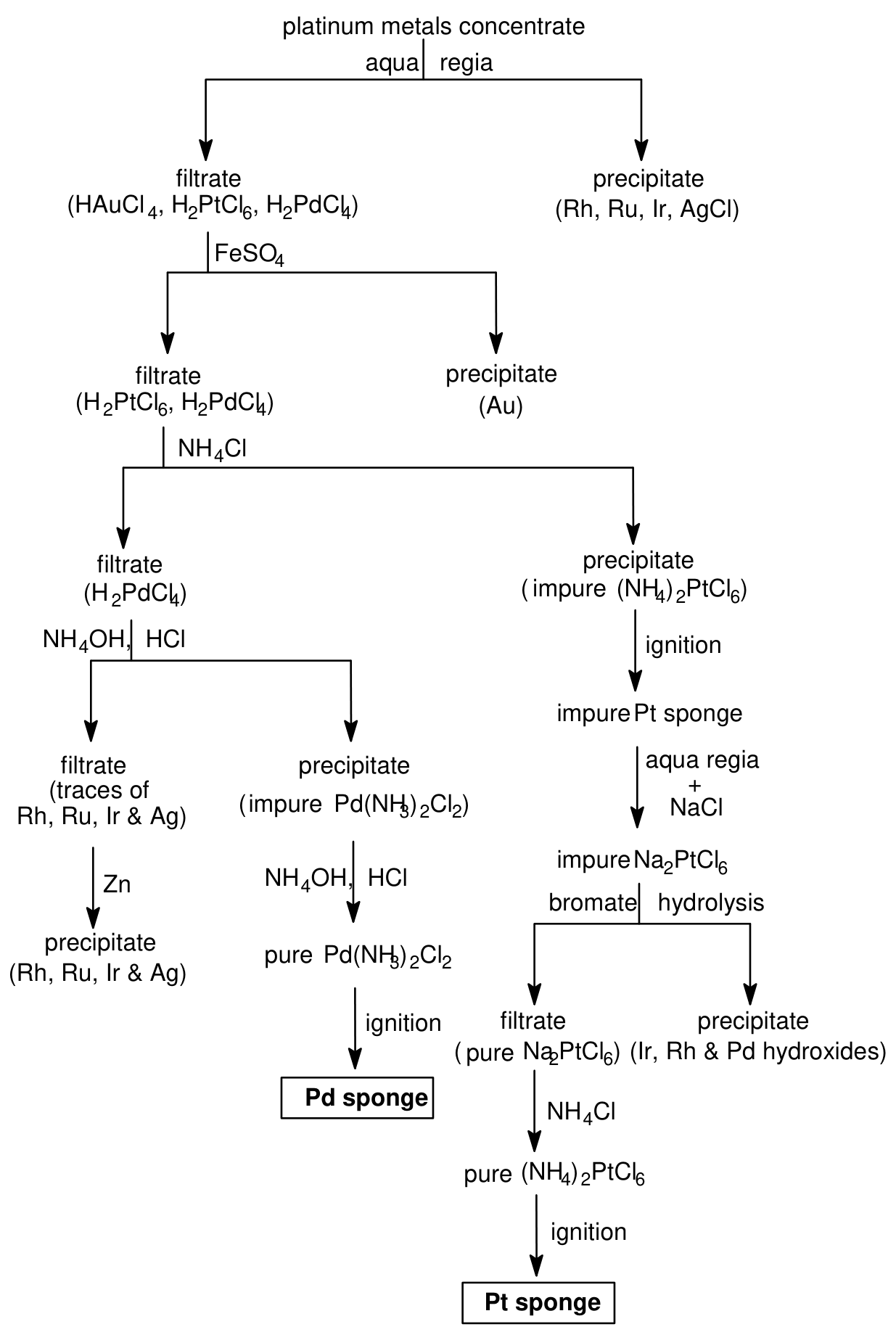
Method of Purification of Platinum and Palladium
Official English text of the problem.
Answers
- 6.1(i) \(\ce{[PtCl6]^2-}\) is octahedral; \(\ce{[PdCl4]^2-}\) is square planar.
- 6.1(ii) There are two stereoisomers: cis-diamminedichloridopalladium(II) and trans-diamminedichloridopalladium(II). Identical ligands occupy adjacent positions in the cis isomer and opposite positions in the trans isomer.
- 6.1(iii) \(\ce{FeSO4}\) is a reducing agent, precipitating gold: \[ \ce{[AuCl4]^- + 3Fe^2+ -> Au + 4Cl^- + 3Fe^3+}. \]
- 6.1(iv) \[ \boxed{\ce{Pd(NH3)2Cl2 + O2 ->[\Delta] Pd + N2 + 2HCl + 2H2O}} \] Ammonia-ligand nitrogen is oxidized; palladium(II) and oxygen are reduced.
- 6.2(i) A is sulfur.
- 6.2(ii) The chloride is sulfur dichloride, \(\ce{SCl2}\), and the nitride is tetrasulfur tetranitride, \(\ce{S4N4}\): \[ \boxed{\ce{6SCl2 + 16NH3 -> 12NH4Cl + 2S + S4N4}}. \] Thus \[ (n,m,p,q,r)=(6,16,12,2,1),\qquad (w,x,y,z)=(1,2,4,4). \]
- 6.2(iii) Sulfur disproportionates from \(+2\) to \(+3\) and \(0\). Balanced half-reactions are \[ \ce{4SCl2 + 4NH3 -> S4N4 + 12H+ + 8Cl^- + 4e^-} \] and \[ \ce{2SCl2 + 4e^- -> 2S + 4Cl^-}. \]
Names and SMILES representations are supplied in the corresponding solution parts below.
Solution
6.1(i)
The coordination SMILES below use arrows for bonds donated from ligands to the metal. Their spatial geometries are specified explicitly in words.
| Ion | Name and SMILES | Geometry and precise drawing description |
|---|---|---|
| \(\ce{[PtCl6]^2-}\) | Hexachloridoplatinate(IV), [Cl-]->[Pt+4](<-[Cl-])(<-[Cl-])(<-[Cl-])(<-[Cl-])<-[Cl-] |
Octahedral: place platinum at the centre, four chlorido ligands at the corners of an equatorial square, and two axial chlorido ligands directly above and below the centre. |
| \(\ce{[PdCl4]^2-}\) | Tetrachloridopalladate(II), [Cl-]->[Pd+2](<-[Cl-])(<-[Cl-])<-[Cl-] |
Square planar: place palladium at the centre of a square and the four chlorido ligands at its corners, all in one plane. |
The metal oxidation states follow from charge balance:
\[ \begin{aligned} \ce{[PtCl6]^2-}:&\quad x+6(-1)=-2\quad\Rightarrow x=+4,\\ \ce{[PdCl4]^2-}:&\quad x+4(-1)=-2\quad\Rightarrow x=+2. \end{aligned} \]
These are the usual six-coordinate, octahedral geometry of platinum(IV), a \(d^6\) ion, and four-coordinate, square-planar geometry of palladium(II), a \(d^8\) ion.
6.1(ii)
The palladium(II) complex is square planar. With two identical ammine ligands and two identical chlorido ligands, only adjacent and opposite arrangements are distinct.
| Stereoisomer | SMILES | Precise drawing description |
|---|---|---|
| cis-Diamminedichloridopalladium(II) | [NH3]->[Pd@SP1+2](<-[NH3])(<-[Cl-])<-[Cl-] |
Put palladium at the centre, ammine ligands north and east, and chlorido ligands south and west. Each identical ligand pair subtends \(90^\circ\). |
| trans-Diamminedichloridopalladium(II) | [NH3]->[Pd@SP2+2](<-[NH3])(<-[Cl-])<-[Cl-] |
Put palladium at the centre, ammine ligands north and south, and chlorido ligands east and west. Each identical ligand pair subtends \(180^\circ\). |
All four donor atoms lie in the same plane. For the atom order written, the extended SMILES descriptors @SP1 and @SP2 distinguish the cis and trans configurations, respectively. Neither isomer is optically active.
6.1(iii)
Iron(II) sulfate, \(\ce{FeSO4}\), SMILES [Fe+2].[O-]S(=O)(=O)[O-], supplies iron(II) ions that reduce dissolved gold(III) to metallic gold. This removes gold from the platinum–palladium solution.
The reacting gold complex is tetrachloridoaurate(III), \(\ce{[AuCl4]^-}\), SMILES [Cl-]->[Au+3](<-[Cl-])(<-[Cl-])<-[Cl-].
Its reduction half-reaction is
\[ \ce{[AuCl4]^- + 3e^- -> Au + 4Cl^-}. \]
Iron(II) is oxidized:
\[ \ce{Fe^2+ -> Fe^3+ + e^-}. \]
Multiplying the second half-reaction by three and adding gives
\[ \boxed{\ce{[AuCl4]^- + 3Fe^2+ -> Au + 4Cl^- + 3Fe^3+}}. \]
Here the iron(II) ion is [Fe+2], the iron(III) ion is [Fe+3], and the chloride ion is [Cl-]. Sulfate is a spectator ion.
6.1(iv)
Complete ignition in air is represented by
\[ \boxed{\ce{Pd(NH3)2Cl2 + O2 ->[\Delta] Pd + N2 + 2HCl + 2H2O}}. \]
The molecular reactant supplied by air is dioxygen, O=O. The molecular products are dinitrogen, N#N; hydrogen chloride, Cl; and water, O.
The oxidation-state changes are:
| Atoms involved | Change | Electron balance per complex |
|---|---|---|
| Two ammonia-ligand nitrogen atoms | \(-3\rightarrow 0\) | Lose \(6e^-\) in total |
| Palladium | \(+2\rightarrow 0\) | Gains \(2e^-\) |
| Two oxygen atoms | \(0\rightarrow -2\) | Gain \(4e^-\) in total |
Thus nitrogen is oxidized, while both palladium and oxygen are reduced. Chlorine remains at \(-1\), and hydrogen remains at \(+1\).
6.2(i)
The qualitative observations identify sulfur. Elemental sulfur commonly consists of cyclooctasulfur, \(\ce{S8}\), SMILES S1SSSSSSS1. Its crown-shaped rings open on heating to form long sulfur chains; the SMILES records the ring connectivity, not its crown conformation.
The yellow, impact-sensitive nitride is tetrasulfur tetranitride, \(\ce{S4N4}\), with a localized cage representation S12=NS3=NS2=NS3=N1. Its actual structure is a nonplanar cage with delocalized sulfur–nitrogen bonding and weak transannular sulfur–sulfur interactions. Its conversion to a conducting sulfur–nitrogen material matches the remaining observation.
The mass data provide a quantitative check. From the supplied molar masses,
\[ \begin{aligned} M(\ce{NH3})&=14.007+3(1.008)=17.031\ \mathrm{g\,mol^{-1}},\\ M(\ce{NH4Cl})&=14.007+4(1.008)+35.453 =53.492\ \mathrm{g\,mol^{-1}}. \end{aligned} \]
Hence
\[ n(\ce{NH3})=\frac{10.90}{17.031}=0.6400\ \mathrm{mol}, \]
\[ n(\ce{NH4Cl})=\frac{25.68}{53.492}=0.4801\ \mathrm{mol}. \]
The nitrogen atoms not present in ammonium chloride must be in the nitride. Retaining additional digits during calculation,
\[ n(\text{N atoms in nitride})=0.15994\ \mathrm{mol}. \]
Their mass is
\[ m(\text{N in nitride}) =(0.15994)(14.007)=2.240\ \mathrm{g}. \]
Therefore,
\[ m(\text{A in nitride})=7.37-2.240=5.130\ \mathrm{g}. \]
For the general formula in the question,
\[ \frac{y}{z}M(\ce{A}) =\frac{5.130\ \mathrm{g}}{0.15994\ \mathrm{mol}} =32.07\ \mathrm{g\,mol^{-1}}. \]
The 1:1 sulfur-to-nitrogen ratio in the identified nitride gives an inferred sulfur molar mass of approximately \(32.1\ \mathrm{g\,mol^{-1}}\), consistent with sulfur.
The numerical composition constrains the empirical formula; identifying the molecular nitride as \(\ce{S4N4}\) also uses its described chemical properties.
6.2(ii)
All chlorine from the starting chloride appears in ammonium chloride. Thus
\[ n(\text{Cl atoms})=0.48007\ \mathrm{mol}, \]
and
\[ m(\text{Cl})=(0.48007)(35.453)=17.020\ \mathrm{g}. \]
The sulfur content of the starting chloride is consequently
\[ m(\text{S in chloride})=24.71-17.020=7.690\ \mathrm{g}. \]
Using the inferred sulfur molar mass,
\[ n(\text{S in chloride}) \simeq\frac{7.690}{32.07} =0.2398\ \mathrm{mol}. \]
Therefore,
\[ \frac{n(\text{Cl atoms})}{n(\text{S atoms})} \simeq\frac{0.4801}{0.2398} =2.002\simeq2. \]
The chloride is sulfur dichloride, \(\ce{SCl2}\), SMILES ClSCl.
The remaining species are ammonia, \(\ce{NH3}\), SMILES N, and ammonium chloride, \(\ce{NH4Cl}\), SMILES [NH4+].[Cl-].
The product amounts are approximately
\[ n(\text{elemental S atoms}) =\frac{2.57}{32.07} =0.0801\ \mathrm{mol}, \]
\[ n(\ce{S4N4}) =\frac{0.15994}{4} =0.03998\ \mathrm{mol}. \]
Dividing all amounts by approximately \(0.0400\ \mathrm{mol}\) gives
\[ \begin{aligned} &n(\ce{SCl2}):n(\ce{NH3}):n(\ce{NH4Cl}): n(\text{elemental S atoms}):n(\ce{S4N4})\\ &\hspace{3em}\simeq 6:16:12:2:1. \end{aligned} \]
Thus the balanced equation in the notation of the question is
\[ \boxed{\ce{6SCl2 + 16NH3 -> 12NH4Cl + 2S + S4N4}}. \]
The symbol \(\ce{S}\) denotes bulk elemental sulfur. Written explicitly in terms of \(\ce{S8}\), the same balance is
\[ \ce{24SCl2 + 64NH3 -> 48NH4Cl + S8 + 4S4N4}. \]
The requested coefficients are
\[ \boxed{ n=6,\ m=16,\ p=12,\ q=2,\ r=1,\quad w=1,\ x=2,\ y=4,\ z=4 }. \]
The supplied reactant masses total \(35.61\ \mathrm{g}\), whereas the product masses total \(35.62\ \mathrm{g}\). This \(0.01\ \mathrm{g}\) difference is consistent with the stated mass precision.
6.2(iii)
In sulfur dichloride, chlorine has oxidation state \(-1\), so sulfur is \(+2\).
In tetrasulfur tetranitride, conventional assignment of nitrogen as \(-3\) gives
\[ 4x+4(-3)=0 \quad\Rightarrow\quad x=+3 \]
for sulfur. Elemental sulfur has oxidation state \(0\).
Consequently, four sulfur atoms are oxidized from \(+2\) to \(+3\), releasing four electrons, and two sulfur atoms are reduced from \(+2\) to \(0\), consuming four electrons. Nitrogen remains at \(-3\).
A balanced oxidation half-reaction is
\[ \boxed{\ce{4SCl2 + 4NH3 -> S4N4 + 12H+ + 8Cl^- + 4e^-}}. \]
The corresponding reduction half-reaction is
\[ \boxed{\ce{2SCl2 + 4e^- -> 2S + 4Cl^-}}. \]
The hydrogen ion, \(\ce{H+}\), has SMILES [H+]. These protons are bookkeeping intermediates: additional ammonia binds them to form the ammonium ion, \(\ce{NH4+}\), SMILES [NH4+]:
\[ \ce{12NH3 + 12H+ -> 12NH4+}. \]
Adding these equations and combining ammonium and chloride ions into ammonium chloride reproduces
\[ \ce{6SCl2 + 16NH3 -> S4N4 + 2S + 12NH4Cl}. \]
The solution was checked against the official solution.
IChO 1997 · Theorieaufgabe 6
Raffination der Platinmetalle; ein Hauptgruppenchlorid und Ammoniak
6.1 Ein großer Teil der weltweiten Versorgung mit Platingruppenmetallen stammt aus den Rückständen, die bei der elektrolytischen Raffination von Kupfer und Nickel anfallen. Auf der folgenden Seite ist ein Fließschema zur Gewinnung von Platin und Palladium dargestellt.
i) Zeichnen Sie deutlich die räumliche Gestalt (Geometrie) der beiden Anionen \(\ce{PtCl6^2-}\) und \(\ce{PdCl4^2-}\).
ii) Zeichnen Sie deutlich alle möglichen stereoisomeren Strukturen von monomerem \(\ce{Pd(NH3)2Cl2}\). Kennzeichnen Sie die gezeichneten Strukturen mit ihren korrekten stereochemischen Deskriptoren.
iii) Welche Rolle spielt \(\ce{FeSO4}\) im zweiten Schritt des Fließschemas? Geben Sie eine ausgeglichene Gleichung für die Reaktion von \(\ce{FeSO4}\) in diesem Schritt an.
iv) Geben Sie eine vollständige, ausgeglichene Gleichung für das Glühen von \(\ce{Pd(NH3)2Cl2}\) an Luft zu metallischem \(\ce{Pd}\) an. Was wird bei dieser Reaktion oxidiert und was wird reduziert?
6.2 Die Reaktion eines Hauptgruppenchlorids (24.71 g) mit Ammoniak (10.90 g) ergab gemäß der folgenden Gleichung ein Produktgemisch aus \(\ce{NH4Cl}\) (25.68 g), einem festen Element A (2.57 g) und einem gelben kristallinen Nitrid dieses Elements (7.37 g).
(wobei n, m, p, q, r, w, x, y und z zu bestimmende Koeffizienten sind)
Eine Probe des Nitrids explodierte heftig, als sie mit einem Hammer geschlagen wurde; beim Erhitzen polymerisierte es jedoch kontrolliert zu einem bronzefarbenen, faserigen Feststoff, der metallische Leitfähigkeit aufweist. Auch Element A polymerisiert beim Erhitzen zu einem hochmolekularen linearen Polymer.
Molare Massen:
\[ M(\ce{Cl})=35.453\ \mathrm{g\,mol^{-1}} \qquad M(\ce{N})=14.007\ \mathrm{g\,mol^{-1}} \qquad M(\ce{H})=1.008\ \mathrm{g\,mol^{-1}} \]
i) Identifizieren Sie Element A.
ii) Geben Sie eine vollständige, ausgeglichene Gleichung für die Reaktion des Chlorids mit Ammoniak an.
iii) Geben Sie unter Annahme der üblichen Oxidationszahlen die ausgeglichenen Redoxteilgleichungen für diese Reaktion an.
Verfahren zur Reinigung von Platin und Palladium
Aufgabentext aus dem offiziellen englischen Text übersetzt.
Antworten
- 6.1(i) \(\ce{[PtCl6]^2-}\) ist oktaedrisch; \(\ce{[PdCl4]^2-}\) ist quadratisch-planar.
- 6.1(ii) Es gibt zwei Stereoisomere: cis-Diammindichloridopalladium(II) und trans-Diammindichloridopalladium(II). Gleiche Liganden besetzen im cis-Isomer benachbarte und im trans-Isomer gegenüberliegende Positionen.
- 6.1(iii) \(\ce{FeSO4}\) ist ein Reduktionsmittel, das Gold ausfällt: \[ \ce{[AuCl4]^- + 3Fe^2+ -> Au + 4Cl^- + 3Fe^3+}. \]
- 6.1(iv) \[ \boxed{\ce{Pd(NH3)2Cl2 + O2 ->[\Delta] Pd + N2 + 2HCl + 2H2O}} \] Der Stickstoff der Ammoniakliganden wird oxidiert; Palladium(II) und Sauerstoff werden reduziert.
- 6.2(i) A ist Schwefel.
- 6.2(ii) Das Chlorid ist Schwefeldichlorid, \(\ce{SCl2}\), und das Nitrid ist Tetraschwefeltetranitrid, \(\ce{S4N4}\): \[ \boxed{\ce{6SCl2 + 16NH3 -> 12NH4Cl + 2S + S4N4}}. \] Somit gilt \[ (n,m,p,q,r)=(6,16,12,2,1),\qquad (w,x,y,z)=(1,2,4,4). \]
- 6.2(iii) Schwefel disproportioniert von \(+2\) zu \(+3\) und \(0\). Die ausgeglichenen Teilgleichungen lauten \[ \ce{4SCl2 + 4NH3 -> S4N4 + 12H+ + 8Cl^- + 4e^-} \] und \[ \ce{2SCl2 + 4e^- -> 2S + 4Cl^-}. \]
Namen und SMILES-Darstellungen sind in den entsprechenden Lösungsteilen unten angegeben.
Lösung
6.1(i)
Die folgenden Koordinations-SMILES verwenden Pfeile für Bindungen, bei denen die Liganden dem Metall ein Elektronenpaar zur Verfügung stellen. Ihre räumlichen Geometrien werden ausdrücklich in Worten angegeben.
| Ion | Name und SMILES | Geometrie und genaue Zeichenanleitung |
|---|---|---|
| \(\ce{[PtCl6]^2-}\) | Hexachloridoplatinat(IV), [Cl-]->[Pt+4](<-[Cl-])(<-[Cl-])(<-[Cl-])(<-[Cl-])<-[Cl-] |
Oktaedrisch: Platzieren Sie Platin im Zentrum, vier Chloridoliganden an den Ecken eines äquatorialen Quadrats und zwei axiale Chloridoliganden direkt oberhalb und unterhalb des Zentrums. |
| \(\ce{[PdCl4]^2-}\) | Tetrachloridopalladat(II), [Cl-]->[Pd+2](<-[Cl-])(<-[Cl-])<-[Cl-] |
Quadratisch-planar: Platzieren Sie Palladium im Mittelpunkt eines Quadrats und die vier Chloridoliganden an dessen Ecken, alle in einer Ebene. |
Die Oxidationszahlen der Metalle ergeben sich aus der Ladungsbilanz:
\[ \begin{aligned} \ce{[PtCl6]^2-}:&\quad x+6(-1)=-2\quad\Rightarrow x=+4,\\ \ce{[PdCl4]^2-}:&\quad x+4(-1)=-2\quad\Rightarrow x=+2. \end{aligned} \]
Dies sind die übliche oktaedrische Geometrie mit der Koordinationszahl sechs von Platin(IV), einem \(d^6\)-Ion, und die übliche quadratisch-planare Geometrie mit der Koordinationszahl vier von Palladium(II), einem \(d^8\)-Ion.
6.1(ii)
Der Palladium(II)-Komplex ist quadratisch-planar. Bei zwei gleichen Amminliganden und zwei gleichen Chloridoliganden unterscheiden sich nur die benachbarte und die gegenüberliegende Anordnung.
| Stereoisomer | SMILES | Genaue Zeichenanleitung |
|---|---|---|
| cis-Diammindichloridopalladium(II) | [NH3]->[Pd@SP1+2](<-[NH3])(<-[Cl-])<-[Cl-] |
Platzieren Sie Palladium im Zentrum, die Amminliganden im Norden und Osten sowie die Chloridoliganden im Süden und Westen. Jedes Paar gleicher Liganden schließt einen Winkel von \(90^\circ\) ein. |
| trans-Diammindichloridopalladium(II) | [NH3]->[Pd@SP2+2](<-[NH3])(<-[Cl-])<-[Cl-] |
Platzieren Sie Palladium im Zentrum, die Amminliganden im Norden und Süden sowie die Chloridoliganden im Osten und Westen. Jedes Paar gleicher Liganden schließt einen Winkel von \(180^\circ\) ein. |
Alle vier Donoratome liegen in derselben Ebene. Für die angegebene Atomreihenfolge kennzeichnen die erweiterten SMILES-Deskriptoren @SP1 und @SP2 die cis- bzw. trans-Konfiguration. Keines der beiden Isomere ist optisch aktiv.
6.1(iii)
Eisen(II)-sulfat, \(\ce{FeSO4}\), SMILES [Fe+2].[O-]S(=O)(=O)[O-], liefert Eisen(II)-Ionen, die gelöstes Gold(III) zu metallischem Gold reduzieren. Dadurch wird Gold aus der Platin-Palladium-Lösung entfernt.
Der reagierende Goldkomplex ist Tetrachloridoaurat(III), \(\ce{[AuCl4]^-}\), SMILES [Cl-]->[Au+3](<-[Cl-])(<-[Cl-])<-[Cl-].
Seine Reduktionsteilgleichung lautet
\[ \ce{[AuCl4]^- + 3e^- -> Au + 4Cl^-}. \]
Eisen(II) wird oxidiert:
\[ \ce{Fe^2+ -> Fe^3+ + e^-}. \]
Multiplikation der zweiten Teilgleichung mit drei und anschließende Addition ergibt
\[ \boxed{\ce{[AuCl4]^- + 3Fe^2+ -> Au + 4Cl^- + 3Fe^3+}}. \]
Dabei ist das Eisen(II)-Ion [Fe+2], das Eisen(III)-Ion [Fe+3] und das Chloridion [Cl-]. Sulfat ist ein Zuschauerion.
6.1(iv)
Das vollständige Glühen an Luft wird dargestellt durch
\[ \boxed{\ce{Pd(NH3)2Cl2 + O2 ->[\Delta] Pd + N2 + 2HCl + 2H2O}}. \]
Der durch die Luft zugeführte molekulare Reaktant ist Disauerstoff, O=O. Die molekularen Produkte sind Distickstoff, N#N; Chlorwasserstoff, Cl; und Wasser, O.
Die Änderungen der Oxidationszahlen sind:
| Beteiligte Atome | Änderung | Elektronenbilanz pro Komplex |
|---|---|---|
| Zwei Stickstoffatome der Ammoniakliganden | \(-3\rightarrow 0\) | Geben insgesamt \(6e^-\) ab |
| Palladium | \(+2\rightarrow 0\) | Nimmt \(2e^-\) auf |
| Zwei Sauerstoffatome | \(0\rightarrow -2\) | Nehmen insgesamt \(4e^-\) auf |
Somit wird Stickstoff oxidiert, während sowohl Palladium als auch Sauerstoff reduziert werden. Chlor verbleibt bei \(-1\), und Wasserstoff verbleibt bei \(+1\).
6.2(i)
Die qualitativen Beobachtungen weisen auf Schwefel hin. Elementarer Schwefel besteht gewöhnlich aus Cyclooctaschwefel, \(\ce{S8}\), SMILES S1SSSSSSS1. Seine kronenförmigen Ringe öffnen sich beim Erhitzen und bilden lange Schwefelketten; die SMILES-Darstellung beschreibt die Verknüpfung der Atome im Ring, nicht dessen Kronenkonformation.
Das gelbe, schlagempfindliche Nitrid ist Tetraschwefeltetranitrid, \(\ce{S4N4}\), mit der lokalisierten Käfigdarstellung S12=NS3=NS2=NS3=N1. Seine tatsächliche Struktur ist ein nichtplanarer Käfig mit delokalisierten Schwefel-Stickstoff-Bindungen und schwachen transannularen Schwefel-Schwefel-Wechselwirkungen. Seine Umwandlung in ein leitfähiges Schwefel-Stickstoff-Material entspricht der verbleibenden Beobachtung.
Die Massenangaben ermöglichen eine quantitative Überprüfung. Aus den angegebenen molaren Massen folgt
\[ \begin{aligned} M(\ce{NH3})&=14.007+3(1.008)=17.031\ \mathrm{g\,mol^{-1}},\\ M(\ce{NH4Cl})&=14.007+4(1.008)+35.453 =53.492\ \mathrm{g\,mol^{-1}}. \end{aligned} \]
Daher gilt
\[ n(\ce{NH3})=\frac{10.90}{17.031}=0.6400\ \mathrm{mol}, \]
\[ n(\ce{NH4Cl})=\frac{25.68}{53.492}=0.4801\ \mathrm{mol}. \]
Die Stickstoffatome, die nicht im Ammoniumchlorid vorliegen, müssen im Nitrid enthalten sein. Wenn bei der Rechnung zusätzliche Stellen beibehalten werden, ergibt sich
\[ n(\text{N-Atome im Nitrid})=0.15994\ \mathrm{mol}. \]
Ihre Masse beträgt
\[ m(\text{N im Nitrid}) =(0.15994)(14.007)=2.240\ \mathrm{g}. \]
Daher gilt
\[ m(\text{A im Nitrid})=7.37-2.240=5.130\ \mathrm{g}. \]
Für die allgemeine Formel in der Aufgabenstellung gilt
\[ \frac{y}{z}M(\ce{A}) =\frac{5.130\ \mathrm{g}}{0.15994\ \mathrm{mol}} =32.07\ \mathrm{g\,mol^{-1}}. \]
Aus dem Schwefel-Stickstoff-Verhältnis von 1:1 im identifizierten Nitrid ergibt sich eine abgeleitete molare Masse des Schwefels von ungefähr \(32.1\ \mathrm{g\,mol^{-1}}\), was mit Schwefel übereinstimmt.
Die zahlenmäßige Zusammensetzung schränkt die Verhältnisformel ein; die Identifizierung des molekularen Nitrids als \(\ce{S4N4}\) stützt sich zusätzlich auf seine beschriebenen chemischen Eigenschaften.
6.2(ii)
Das gesamte Chlor aus dem Ausgangschlorid liegt im Ammoniumchlorid vor. Somit gilt
\[ n(\text{Cl-Atome})=0.48007\ \mathrm{mol}, \]
und
\[ m(\text{Cl})=(0.48007)(35.453)=17.020\ \mathrm{g}. \]
Die Schwefelmasse im Ausgangschlorid beträgt folglich
\[ m(\text{S im Chlorid})=24.71-17.020=7.690\ \mathrm{g}. \]
Mit der abgeleiteten molaren Masse des Schwefels ergibt sich
\[ n(\text{S im Chlorid}) \simeq\frac{7.690}{32.07} =0.2398\ \mathrm{mol}. \]
Daher gilt
\[ \frac{n(\text{Cl-Atome})}{n(\text{S-Atome})} \simeq\frac{0.4801}{0.2398} =2.002\simeq2. \]
Das Chlorid ist Schwefeldichlorid, \(\ce{SCl2}\), SMILES ClSCl.
Die übrigen Spezies sind Ammoniak, \(\ce{NH3}\), SMILES N, und Ammoniumchlorid, \(\ce{NH4Cl}\), SMILES [NH4+].[Cl-].
Die Stoffmengen der Produkte betragen ungefähr
\[ n(\text{elementare S-Atome}) =\frac{2.57}{32.07} =0.0801\ \mathrm{mol}, \]
\[ n(\ce{S4N4}) =\frac{0.15994}{4} =0.03998\ \mathrm{mol}. \]
Division aller Stoffmengen durch ungefähr \(0.0400\ \mathrm{mol}\) ergibt
\[ \begin{aligned} &n(\ce{SCl2}):n(\ce{NH3}):n(\ce{NH4Cl}): n(\text{elementare S-Atome}):n(\ce{S4N4})\\ &\hspace{3em}\simeq 6:16:12:2:1. \end{aligned} \]
Somit lautet die ausgeglichene Gleichung in der Schreibweise der Aufgabenstellung
\[ \boxed{\ce{6SCl2 + 16NH3 -> 12NH4Cl + 2S + S4N4}}. \]
Das Symbol \(\ce{S}\) bezeichnet elementaren Schwefel als makroskopischen Stoff. Explizit mit \(\ce{S8}\) geschrieben lautet dieselbe Bilanz
\[ \ce{24SCl2 + 64NH3 -> 48NH4Cl + S8 + 4S4N4}. \]
Die gesuchten Koeffizienten sind
\[ \boxed{ n=6,\ m=16,\ p=12,\ q=2,\ r=1,\quad w=1,\ x=2,\ y=4,\ z=4 }. \]
Die angegebenen Eduktmassen ergeben insgesamt \(35.61\ \mathrm{g}\), während die Produktmassen insgesamt \(35.62\ \mathrm{g}\) ergeben. Diese Differenz von \(0.01\ \mathrm{g}\) ist mit der angegebenen Genauigkeit der Massenangaben vereinbar.
6.2(iii)
In Schwefeldichlorid hat Chlor die Oxidationszahl \(-1\), sodass Schwefel die Oxidationszahl \(+2\) hat.
In Tetraschwefeltetranitrid ergibt die übliche Zuordnung der Oxidationszahl \(-3\) für Stickstoff
\[ 4x+4(-3)=0 \quad\Rightarrow\quad x=+3 \]
für Schwefel. Elementarer Schwefel hat die Oxidationszahl \(0\).
Folglich werden vier Schwefelatome von \(+2\) zu \(+3\) oxidiert und geben dabei vier Elektronen ab, und zwei Schwefelatome werden von \(+2\) zu \(0\) reduziert und nehmen dabei vier Elektronen auf. Stickstoff verbleibt bei \(-3\).
Eine ausgeglichene Oxidationsteilgleichung lautet
\[ \boxed{\ce{4SCl2 + 4NH3 -> S4N4 + 12H+ + 8Cl^- + 4e^-}}. \]
Die entsprechende Reduktionsteilgleichung lautet
\[ \boxed{\ce{2SCl2 + 4e^- -> 2S + 4Cl^-}}. \]
Das Wasserstoffion, \(\ce{H+}\), hat die SMILES-Darstellung [H+]. Diese Protonen sind formale Zwischenprodukte der Bilanzierung: Zusätzlicher Ammoniak bindet sie unter Bildung des Ammoniumions, \(\ce{NH4+}\), SMILES [NH4+]:
\[ \ce{12NH3 + 12H+ -> 12NH4+}. \]
Durch Addition dieser Gleichungen und Zusammenfassung der Ammonium- und Chloridionen zu Ammoniumchlorid erhält man wieder
\[ \ce{6SCl2 + 16NH3 -> S4N4 + 2S + 12NH4Cl}. \]
Die Lösung wurde mit der offiziellen Lösung abgeglichen.
IChO 1997 · Teori sorusu 6
Platin metallerinin saflaştırılması; bir ana grup klorürü ve amonyak
6.1 Dünyadaki platin grubu metal arzının büyük bir bölümü, bakır ve nikelin elektrolitik saflaştırılması sırasında elde edilen kalıntılardan sağlanır. Platin ve paladyumun geri kazanılmasına ilişkin bir akış şeması sonraki sayfada gösterilmiştir.
i) Hem \(\ce{PtCl6^2-}\) hem de \(\ce{PdCl4^2-}\) anyonunun şeklini (geometrisini) açıkça çiziniz.
ii) Monomerik \(\ce{Pd(NH3)2Cl2}\)'nin olası tüm stereoizomerik yapılarını açıkça çiziniz. Çizdiğiniz yapıları doğru stereokimyasal tanımlayıcılarıyla etiketleyiniz.
iii) Akış şemasının ikinci basamağında \(\ce{FeSO4}\)'ün rolü nedir? Bu basamakta \(\ce{FeSO4}\)'ün tepkimesi için denkleştirilmiş bir denklem yazınız.
iv) \(\ce{Pd(NH3)2Cl2}\)'nin havada kızdırılarak \(\ce{Pd}\) metaline dönüştürülmesi için tam olarak denkleştirilmiş bir denklem yazınız. Bu tepkimede ne yükseltgenir ve ne indirgenir?
6.2 Bir ana grup klorürünün (24.71 g) amonyak (10.90 g) ile tepkimesi, aşağıdaki denkleme göre \(\ce{NH4Cl}\) (25.68 g), katı bir A elementi (2.57 g) ve bu elementin sarı kristal yapılı bir nitrüründen (7.37 g) oluşan bir ürün karışımı vermiştir.
(burada n, m, p, q, r, w, x, y ve z belirlenecek katsayılardır)
Nitrürün bir örneği çekiçle vurulduğunda şiddetle patlamış, ancak ısıtıldığında kontrollü polimerleşme geçirerek metalik iletkenlik gösteren, bronz renkli, lifli bir katı oluşturmuştur. A elementi de ısıtıldığında polimerleşerek yüksek molekül ağırlıklı doğrusal bir polimer oluşturur.
Molar kütleler:
\[ M(\ce{Cl})=35.453\ \mathrm{g\,mol^{-1}} \qquad M(\ce{N})=14.007\ \mathrm{g\,mol^{-1}} \qquad M(\ce{H})=1.008\ \mathrm{g\,mol^{-1}} \]
i) A elementini belirleyiniz.
ii) Klorürün amonyakla tepkimesi için tam olarak denkleştirilmiş bir denklem yazınız.
iii) Yaygın yükseltgenme basamaklarını kabul ederek bu tepkimede yer alan denkleştirilmiş yükseltgenme ve indirgenme yarı tepkime denklemlerini yazınız.
Platin ve Paladyumun Saflaştırılması Yöntemi
Soru metni resmi İngilizce metinden çevrilmiştir.
Cevaplar
- 6.1(i) \(\ce{[PtCl6]^2-}\) oktahedral; \(\ce{[PdCl4]^2-}\) kare düzlemseldir.
- 6.1(ii) İki stereoizomer vardır: cis-diamindikloridopaladyum(II) ve trans-diamindikloridopaladyum(II). Özdeş ligandlar cis izomerinde komşu, trans izomerinde ise karşılıklı konumlarda bulunur.
- 6.1(iii) \(\ce{FeSO4}\), altını çöktüren bir indirgendir: \[ \ce{[AuCl4]^- + 3Fe^2+ -> Au + 4Cl^- + 3Fe^3+}. \]
- 6.1(iv) \[ \boxed{\ce{Pd(NH3)2Cl2 + O2 ->[\Delta] Pd + N2 + 2HCl + 2H2O}} \] Amonyak ligandındaki azot yükseltgenir; paladyum(II) ve oksijen indirgenir.
- 6.2(i) A, kükürttür.
- 6.2(ii) Klorür, kükürt diklorür, \(\ce{SCl2}\), nitrür ise tetrakükürt tetranitrür, \(\ce{S4N4}\)'tür: \[ \boxed{\ce{6SCl2 + 16NH3 -> 12NH4Cl + 2S + S4N4}}. \] Böylece \[ (n,m,p,q,r)=(6,16,12,2,1),\qquad (w,x,y,z)=(1,2,4,4). \]
- 6.2(iii) Kükürt, \(+2\)'den \(+3\) ve \(0\)'a disproporsiyonlaşır. Denkleştirilmiş yarı tepkimeler \[ \ce{4SCl2 + 4NH3 -> S4N4 + 12H+ + 8Cl^- + 4e^-} \] ve \[ \ce{2SCl2 + 4e^- -> 2S + 4Cl^-}. \]
Adlar ve SMILES gösterimleri, aşağıda çözümün ilgili bölümlerinde verilmiştir.
Çözüm
6.1(i)
Aşağıdaki koordinasyon SMILES gösterimlerinde, ligandlardan metale elektron çifti verilerek oluşan bağlar için oklar kullanılmıştır. Uzaysal geometrileri sözcüklerle açıkça belirtilmiştir.
| İyon | Adı ve SMILES gösterimi | Geometri ve çizimin ayrıntılı tarifi |
|---|---|---|
| \(\ce{[PtCl6]^2-}\) | Hekzakloridoplatinat(IV), [Cl-]->[Pt+4](<-[Cl-])(<-[Cl-])(<-[Cl-])(<-[Cl-])<-[Cl-] |
Oktahedral: Platini merkeze, dört klorido ligandını ekvator düzlemindeki bir karenin köşelerine ve iki eksenel klorido ligandını merkezin tam üstüne ve altına yerleştiriniz. |
| \(\ce{[PdCl4]^2-}\) | Tetrakloridopaladat(II), [Cl-]->[Pd+2](<-[Cl-])(<-[Cl-])<-[Cl-] |
Kare düzlemsel: Paladyumu bir karenin merkezine, dört klorido ligandını ise karenin köşelerine, hepsi aynı düzlemde olacak şekilde yerleştiriniz. |
Metallerin yükseltgenme basamakları yük denkliğinden bulunur:
\[ \begin{aligned} \ce{[PtCl6]^2-}:&\quad x+6(-1)=-2\quad\Rightarrow x=+4,\\ \ce{[PdCl4]^2-}:&\quad x+4(-1)=-2\quad\Rightarrow x=+2. \end{aligned} \]
Bunlar, bir \(d^6\) iyonu olan platin(IV)'ün olağan altı koordinasyonlu, oktahedral geometrisi ve bir \(d^8\) iyonu olan paladyum(II)'nin olağan dört koordinasyonlu, kare düzlemsel geometrisidir.
6.1(ii)
Paladyum(II) kompleksi kare düzlemseldir. İki özdeş amin ligandı ve iki özdeş klorido ligandı olduğunda, yalnızca komşu ve karşılıklı yerleşimler birbirinden farklıdır.
| Stereoizomer | SMILES | Çizimin ayrıntılı tarifi |
|---|---|---|
| cis-Diamindikloridopaladyum(II) | [NH3]->[Pd@SP1+2](<-[NH3])(<-[Cl-])<-[Cl-] |
Paladyumu merkeze, amin ligandlarını kuzeye ve doğuya, klorido ligandlarını ise güneye ve batıya yerleştiriniz. Her bir özdeş ligand çifti merkezde \(90^\circ\)'lik açı oluşturur. |
| trans-Diamindikloridopaladyum(II) | [NH3]->[Pd@SP2+2](<-[NH3])(<-[Cl-])<-[Cl-] |
Paladyumu merkeze, amin ligandlarını kuzeye ve güneye, klorido ligandlarını ise doğuya ve batıya yerleştiriniz. Her bir özdeş ligand çifti merkezde \(180^\circ\)'lik açı oluşturur. |
Dört verici atomun tamamı aynı düzlemde bulunur. Yazılan atom sıralaması için genişletilmiş SMILES tanımlayıcıları @SP1 ve @SP2, sırasıyla cis ve trans konfigürasyonlarını birbirinden ayırır. İzomerlerin hiçbiri optikçe aktif değildir.
6.1(iii)
Demir(II) sülfat, \(\ce{FeSO4}\), SMILES [Fe+2].[O-]S(=O)(=O)[O-], çözünmüş altın(III)'ü metalik altına indirgeyen demir(II) iyonlarını sağlar. Böylece altın, platin–paladyum çözeltisinden uzaklaştırılır.
Tepkimeye giren altın kompleksi tetrakloridoaurat(III), \(\ce{[AuCl4]^-}\), SMILES [Cl-]->[Au+3](<-[Cl-])(<-[Cl-])<-[Cl-], iyonudur.
Bu iyonun indirgenme yarı tepkimesi şöyledir:
\[ \ce{[AuCl4]^- + 3e^- -> Au + 4Cl^-}. \]
Demir(II) yükseltgenir:
\[ \ce{Fe^2+ -> Fe^3+ + e^-}. \]
İkinci yarı tepkime üç ile çarpılıp ilkine eklendiğinde şu denklem elde edilir:
\[ \boxed{\ce{[AuCl4]^- + 3Fe^2+ -> Au + 4Cl^- + 3Fe^3+}}. \]
Burada demir(II) iyonu [Fe+2], demir(III) iyonu [Fe+3] ve klorür iyonu [Cl-] ile gösterilir. Sülfat seyirci iyondur.
6.1(iv)
Havada kızdırma işleminin tamamlanması şu denklemle gösterilir:
\[ \boxed{\ce{Pd(NH3)2Cl2 + O2 ->[\Delta] Pd + N2 + 2HCl + 2H2O}}. \]
Havanın sağladığı moleküler reaktif dioksijen, O=O, molekülüdür. Moleküler ürünler diazot, N#N; hidrojen klorür, Cl; ve su, O, molekülleridir.
Yükseltgenme basamağı değişimleri şöyledir:
| İlgili atomlar | Değişim | Kompleks başına elektron denkliği |
|---|---|---|
| Amonyak ligandlarındaki iki azot atomu | \(-3\rightarrow 0\) | Toplam \(6e^-\) verir |
| Paladyum | \(+2\rightarrow 0\) | \(2e^-\) alır |
| İki oksijen atomu | \(0\rightarrow -2\) | Toplam \(4e^-\) alır |
Dolayısıyla azot yükseltgenirken hem paladyum hem de oksijen indirgenir. Klor \(-1\), hidrojen ise \(+1\) yükseltgenme basamağında kalır.
6.2(i)
Nitel gözlemler elementin kükürt olduğunu gösterir. Elementel kükürt genellikle siklooktakükürt, \(\ce{S8}\), SMILES S1SSSSSSS1, biçiminde bulunur. Taç biçimindeki halkaları ısıtıldığında açılarak uzun kükürt zincirleri oluşturur; SMILES gösterimi, taç konformasyonunu değil, halkadaki atomların bağlanma düzenini belirtir.
Sarı renkli, darbeye duyarlı nitrür, yerelleştirilmiş kafes gösterimi S12=NS3=NS2=NS3=N1 olan tetrakükürt tetranitrür, \(\ce{S4N4}\)'tür. Gerçek yapısı, delokalize kükürt–azot bağları ve halka içinden geçen zayıf kükürt–kükürt etkileşimleri içeren, düzlemsel olmayan bir kafestir. İletken bir kükürt–azot malzemesine dönüşmesi, diğer gözlemle uyumludur.
Kütle verileri nicel bir kontrol sağlar. Verilen molar kütlelerden,
\[ \begin{aligned} M(\ce{NH3})&=14.007+3(1.008)=17.031\ \mathrm{g\,mol^{-1}},\\ M(\ce{NH4Cl})&=14.007+4(1.008)+35.453 =53.492\ \mathrm{g\,mol^{-1}}. \end{aligned} \]
Buna göre
\[ n(\ce{NH3})=\frac{10.90}{17.031}=0.6400\ \mathrm{mol}, \]
\[ n(\ce{NH4Cl})=\frac{25.68}{53.492}=0.4801\ \mathrm{mol}. \]
Amonyum klorürde bulunmayan azot atomları nitrürde bulunmalıdır. Hesaplama sırasında daha fazla basamak korunduğunda,
\[ n(\text{nitrürdeki N atomları})=0.15994\ \mathrm{mol}. \]
Bunların kütlesi
\[ m(\text{nitrürdeki N}) =(0.15994)(14.007)=2.240\ \mathrm{g}. \]
Dolayısıyla,
\[ m(\text{nitrürdeki A})=7.37-2.240=5.130\ \mathrm{g}. \]
Sorudaki genel formül için,
\[ \frac{y}{z}M(\ce{A}) =\frac{5.130\ \mathrm{g}}{0.15994\ \mathrm{mol}} =32.07\ \mathrm{g\,mol^{-1}}. \]
Belirlenen nitrürdeki 1:1 kükürt/azot oranından, kükürdün molar kütlesi yaklaşık \(32.1\ \mathrm{g\,mol^{-1}}\) olarak çıkarılır; bu değer kükürtle uyumludur.
Sayısal bileşim, basit formüle ilişkin bir kısıt getirir; moleküler nitrürün \(\ce{S4N4}\) olarak belirlenmesinde, açıklanan kimyasal özelliklerinden de yararlanılır.
6.2(ii)
Başlangıçtaki klorürün içerdiği klorun tamamı amonyum klorürde bulunur. Dolayısıyla
\[ n(\text{Cl atomları})=0.48007\ \mathrm{mol}, \]
ve
\[ m(\text{Cl})=(0.48007)(35.453)=17.020\ \mathrm{g}. \]
Buna göre başlangıçtaki klorürün içerdiği kükürdün kütlesi
\[ m(\text{klorürdeki S})=24.71-17.020=7.690\ \mathrm{g}. \]
Kükürt için çıkarılan molar kütle kullanıldığında,
\[ n(\text{klorürdeki S}) \simeq\frac{7.690}{32.07} =0.2398\ \mathrm{mol}. \]
Dolayısıyla,
\[ \frac{n(\text{Cl atomları})}{n(\text{S atomları})} \simeq\frac{0.4801}{0.2398} =2.002\simeq2. \]
Klorür, kükürt diklorür, \(\ce{SCl2}\), SMILES ClSCl, bileşiğidir.
Diğer türler amonyak, \(\ce{NH3}\), SMILES N, ve amonyum klorür, \(\ce{NH4Cl}\), SMILES [NH4+].[Cl-], bileşikleridir.
Ürün miktarları yaklaşık olarak şöyledir:
\[ n(\text{elementel S atomları}) =\frac{2.57}{32.07} =0.0801\ \mathrm{mol}, \]
\[ n(\ce{S4N4}) =\frac{0.15994}{4} =0.03998\ \mathrm{mol}. \]
Tüm miktarlar yaklaşık \(0.0400\ \mathrm{mol}\)'e bölündüğünde
\[ \begin{aligned} &n(\ce{SCl2}):n(\ce{NH3}):n(\ce{NH4Cl}): n(\text{elementel S atomları}):n(\ce{S4N4})\\ &\hspace{3em}\simeq 6:16:12:2:1. \end{aligned} \]
Böylece, sorudaki gösterimle denkleştirilmiş denklem şöyledir:
\[ \boxed{\ce{6SCl2 + 16NH3 -> 12NH4Cl + 2S + S4N4}}. \]
\(\ce{S}\) sembolü makroskopik elementel kükürdü ifade eder. Açıkça \(\ce{S8}\) cinsinden yazıldığında aynı denklik şöyledir:
\[ \ce{24SCl2 + 64NH3 -> 48NH4Cl + S8 + 4S4N4}. \]
İstenen katsayılar şunlardır:
\[ \boxed{ n=6,\ m=16,\ p=12,\ q=2,\ r=1,\quad w=1,\ x=2,\ y=4,\ z=4 }. \]
Verilen reaktif kütlelerinin toplamı \(35.61\ \mathrm{g}\), ürün kütlelerinin toplamı ise \(35.62\ \mathrm{g}\)'dır. Bu \(0.01\ \mathrm{g}\)'lık fark, kütlelerin belirtilen hassasiyetiyle uyumludur.
6.2(iii)
Kükürt diklorürde klorun yükseltgenme basamağı \(-1\) olduğundan kükürdünki \(+2\)'dir.
Tetrakükürt tetranitrürde, yaygın kabule göre azota \(-3\) yükseltgenme basamağı atandığında kükürt için
\[ 4x+4(-3)=0 \quad\Rightarrow\quad x=+3 \]
elde edilir. Elementel kükürdün yükseltgenme basamağı \(0\)'dır.
Sonuç olarak, dört kükürt atomu \(+2\)'den \(+3\)'e yükseltgenerek dört elektron verirken iki kükürt atomu \(+2\)'den \(0\)'a indirgenerek dört elektron alır. Azot \(-3\) yükseltgenme basamağında kalır.
Denkleştirilmiş bir yükseltgenme yarı tepkimesi şöyledir:
\[ \boxed{\ce{4SCl2 + 4NH3 -> S4N4 + 12H+ + 8Cl^- + 4e^-}}. \]
Buna karşılık gelen indirgenme yarı tepkimesi şöyledir:
\[ \boxed{\ce{2SCl2 + 4e^- -> 2S + 4Cl^-}}. \]
Hidrojen iyonunun, \(\ce{H+}\), SMILES gösterimi [H+] biçimindedir. Bu protonlar, denkleştirme amacıyla kullanılan ara türlerdir: ek amonyak bunları bağlayarak amonyum iyonunu, \(\ce{NH4+}\), SMILES [NH4+], oluşturur:
\[ \ce{12NH3 + 12H+ -> 12NH4+}. \]
Bu denklemler toplanıp amonyum ve klorür iyonları amonyum klorür olarak birleştirildiğinde yeniden şu denklem elde edilir:
\[ \ce{6SCl2 + 16NH3 -> S4N4 + 2S + 12NH4Cl}. \]
Çözüm, resmi çözümle karşılaştırılarak kontrol edildi.
IChO 1997 · Problema teórico 6
Refinado de los metales del grupo del platino; un cloruro de un elemento de los grupos principales y amoníaco
6.1 Gran parte del suministro mundial de metales del grupo del platino procede de los residuos recuperados del refinado electrolítico del cobre y del níquel. En la página siguiente se muestra un diagrama de flujo para la recuperación del platino y del paladio.
i) Dibuje claramente la forma (geometría) de los aniones \(\ce{PtCl6^2-}\) y \(\ce{PdCl4^2-}\).
ii) Dibuje claramente todas las estructuras estereoisoméricas posibles del \(\ce{Pd(NH3)2Cl2}\) monomérico. Etiquete las estructuras que haya dibujado con sus descriptores estereoquímicos correctos.
iii) ¿Cuál es la función del \(\ce{FeSO4}\) en la segunda etapa del diagrama de flujo? Escriba una ecuación ajustada para la reacción del \(\ce{FeSO4}\) en esta etapa.
iv) Escriba una ecuación completa y ajustada para la ignición del \(\ce{Pd(NH3)2Cl2}\) en aire para obtener \(\ce{Pd}\) metálico. En esta reacción, ¿qué se oxida y qué se reduce?
6.2 La reacción de un cloruro de un elemento de los grupos principales (24.71 g) con amoníaco (10.90 g) produjo una mezcla de productos constituida por \(\ce{NH4Cl}\) (25.68 g), un elemento sólido A (2.57 g) y un nitruro cristalino amarillo de este elemento (7.37 g), de acuerdo con la ecuación siguiente.
(donde n, m, p, q, r, w, x, y y z son coeficientes que deben determinarse)
Una muestra del nitruro explotó violentamente al golpearla con un martillo, pero experimentó una polimerización controlada al calentarla y dio lugar a un sólido fibroso de color bronce que presenta conductividad metálica. El elemento A también experimenta una polimerización al calentarlo, formando un polímero lineal de elevada masa molecular.
Masas molares:
\[ M(\ce{Cl})=35.453\ \mathrm{g\,mol^{-1}} \qquad M(\ce{N})=14.007\ \mathrm{g\,mol^{-1}} \qquad M(\ce{H})=1.008\ \mathrm{g\,mol^{-1}} \]
i) Identifique el elemento A.
ii) Escriba una ecuación completa y ajustada para la reacción del cloruro con amoníaco.
iii) Suponiendo los estados de oxidación convencionales, escriba las ecuaciones ajustadas de las semirreacciones redox que intervienen en esta reacción.
Método de purificación del platino y del paladio
Enunciado traducido del texto oficial en inglés.
Respuestas
- 6.1(i) El \(\ce{[PtCl6]^2-}\) es octaédrico; el \(\ce{[PdCl4]^2-}\) es plano cuadrado.
- 6.1(ii) Hay dos estereoisómeros: cis-diamminodicloridopaladio(II) y trans-diamminodicloridopaladio(II). Los ligandos idénticos ocupan posiciones adyacentes en el isómero cis y posiciones opuestas en el isómero trans.
- 6.1(iii) El \(\ce{FeSO4}\) es un agente reductor que precipita el oro: \[ \ce{[AuCl4]^- + 3Fe^2+ -> Au + 4Cl^- + 3Fe^3+}. \]
- 6.1(iv) \[ \boxed{\ce{Pd(NH3)2Cl2 + O2 ->[\Delta] Pd + N2 + 2HCl + 2H2O}} \] El nitrógeno de los ligandos amoníaco se oxida; el paladio(II) y el oxígeno se reducen.
- 6.2(i) A es azufre.
- 6.2(ii) El cloruro es dicloruro de azufre, \(\ce{SCl2}\), y el nitruro es tetranitruro de tetraazufre, \(\ce{S4N4}\): \[ \boxed{\ce{6SCl2 + 16NH3 -> 12NH4Cl + 2S + S4N4}}. \] Por tanto, \[ (n,m,p,q,r)=(6,16,12,2,1),\qquad (w,x,y,z)=(1,2,4,4). \]
- 6.2(iii) El azufre se desproporciona de \(+2\) a \(+3\) y \(0\). Las semirreacciones ajustadas son \[ \ce{4SCl2 + 4NH3 -> S4N4 + 12H+ + 8Cl^- + 4e^-} \] y \[ \ce{2SCl2 + 4e^- -> 2S + 4Cl^-}. \]
Los nombres y las representaciones SMILES se proporcionan en los apartados correspondientes de la solución que figuran a continuación.
Solución
6.1(i)
Las representaciones SMILES de coordinación que aparecen a continuación utilizan flechas para los enlaces donados por los ligandos al metal. Sus geometrías espaciales se especifican explícitamente con palabras.
| Ion | Nombre y SMILES | Geometría y descripción precisa del dibujo |
|---|---|---|
| \(\ce{[PtCl6]^2-}\) | Hexacloridoplatinato(IV), [Cl-]->[Pt+4](<-[Cl-])(<-[Cl-])(<-[Cl-])(<-[Cl-])<-[Cl-] |
Octaédrica: sitúe el platino en el centro, cuatro ligandos clorido en los vértices de un cuadrado ecuatorial y dos ligandos clorido axiales directamente por encima y por debajo del centro. |
| \(\ce{[PdCl4]^2-}\) | Tetracloridopaladato(II), [Cl-]->[Pd+2](<-[Cl-])(<-[Cl-])<-[Cl-] |
Plana cuadrada: sitúe el paladio en el centro de un cuadrado y los cuatro ligandos clorido en sus vértices, todos en un mismo plano. |
Los estados de oxidación de los metales se deducen del balance de cargas:
\[ \begin{aligned} \ce{[PtCl6]^2-}:&\quad x+6(-1)=-2\quad\Rightarrow x=+4,\\ \ce{[PdCl4]^2-}:&\quad x+4(-1)=-2\quad\Rightarrow x=+2. \end{aligned} \]
Estas son las geometrías habituales: octaédrica con número de coordinación seis para el platino(IV), un ion \(d^6\), y plana cuadrada con número de coordinación cuatro para el paladio(II), un ion \(d^8\).
6.1(ii)
El complejo de paladio(II) es plano cuadrado. Con dos ligandos ammina idénticos y dos ligandos clorido idénticos, solo las disposiciones adyacente y opuesta son distintas.
| Estereoisómero | SMILES | Descripción precisa del dibujo |
|---|---|---|
| cis-Diamminodicloridopaladio(II) | [NH3]->[Pd@SP1+2](<-[NH3])(<-[Cl-])<-[Cl-] |
Sitúe el paladio en el centro, los ligandos ammina al norte y al este, y los ligandos clorido al sur y al oeste. Cada par de ligandos idénticos forma un ángulo de \(90^\circ\). |
| trans-Diamminodicloridopaladio(II) | [NH3]->[Pd@SP2+2](<-[NH3])(<-[Cl-])<-[Cl-] |
Sitúe el paladio en el centro, los ligandos ammina al norte y al sur, y los ligandos clorido al este y al oeste. Cada par de ligandos idénticos forma un ángulo de \(180^\circ\). |
Los cuatro átomos donadores se encuentran en el mismo plano. Para el orden de los átomos escrito, los descriptores SMILES extendidos @SP1 y @SP2 distinguen las configuraciones cis y trans, respectivamente. Ninguno de los isómeros es ópticamente activo.
6.1(iii)
El sulfato de hierro(II), \(\ce{FeSO4}\), SMILES [Fe+2].[O-]S(=O)(=O)[O-], aporta iones hierro(II) que reducen el oro(III) disuelto a oro metálico. Esto elimina el oro de la disolución de platino y paladio.
El complejo de oro que reacciona es el tetracloridoaurato(III), \(\ce{[AuCl4]^-}\), SMILES [Cl-]->[Au+3](<-[Cl-])(<-[Cl-])<-[Cl-].
Su semirreacción de reducción es
\[ \ce{[AuCl4]^- + 3e^- -> Au + 4Cl^-}. \]
El hierro(II) se oxida:
\[ \ce{Fe^2+ -> Fe^3+ + e^-}. \]
Al multiplicar la segunda semirreacción por tres y sumarlas se obtiene
\[ \boxed{\ce{[AuCl4]^- + 3Fe^2+ -> Au + 4Cl^- + 3Fe^3+}}. \]
Aquí, el ion hierro(II) es [Fe+2], el ion hierro(III) es [Fe+3] y el ion cloruro es [Cl-]. El sulfato es un ion espectador.
6.1(iv)
La ignición completa en aire se representa mediante
\[ \boxed{\ce{Pd(NH3)2Cl2 + O2 ->[\Delta] Pd + N2 + 2HCl + 2H2O}}. \]
El reactivo molecular aportado por el aire es el dioxígeno, O=O. Los productos moleculares son dinitrógeno, N#N; cloruro de hidrógeno, Cl; y agua, O.
Los cambios de estado de oxidación son:
| Átomos implicados | Cambio | Balance de electrones por complejo |
|---|---|---|
| Dos átomos de nitrógeno de los ligandos amoníaco | \(-3\rightarrow 0\) | Pierden \(6e^-\) en total |
| Paladio | \(+2\rightarrow 0\) | Gana \(2e^-\) |
| Dos átomos de oxígeno | \(0\rightarrow -2\) | Ganan \(4e^-\) en total |
Por tanto, el nitrógeno se oxida, mientras que tanto el paladio como el oxígeno se reducen. El cloro permanece en \(-1\) y el hidrógeno permanece en \(+1\).
6.2(i)
Las observaciones cualitativas permiten identificar el azufre. El azufre elemental suele estar constituido por ciclooctaazufre, \(\ce{S8}\), SMILES S1SSSSSSS1. Sus anillos con forma de corona se abren al calentarlos para formar largas cadenas de azufre; la representación SMILES recoge la conectividad del anillo, no su conformación de corona.
El nitruro amarillo sensible al impacto es el tetranitruro de tetraazufre, \(\ce{S4N4}\), con una representación de jaula con enlaces localizados S12=NS3=NS2=NS3=N1. Su estructura real es una jaula no plana con enlaces azufre–nitrógeno deslocalizados e interacciones transanulares débiles azufre–azufre. Su conversión en un material conductor de azufre y nitrógeno concuerda con la observación restante.
Los datos de masa permiten realizar una comprobación cuantitativa. A partir de las masas molares proporcionadas,
\[ \begin{aligned} M(\ce{NH3})&=14.007+3(1.008)=17.031\ \mathrm{g\,mol^{-1}},\\ M(\ce{NH4Cl})&=14.007+4(1.008)+35.453 =53.492\ \mathrm{g\,mol^{-1}}. \end{aligned} \]
Por consiguiente,
\[ n(\ce{NH3})=\frac{10.90}{17.031}=0.6400\ \mathrm{mol}, \]
\[ n(\ce{NH4Cl})=\frac{25.68}{53.492}=0.4801\ \mathrm{mol}. \]
Los átomos de nitrógeno que no están presentes en el cloruro de amonio deben estar en el nitruro. Conservando cifras adicionales durante el cálculo,
\[ n(\text{átomos de N en el nitruro})=0.15994\ \mathrm{mol}. \]
Su masa es
\[ m(\text{N en el nitruro}) =(0.15994)(14.007)=2.240\ \mathrm{g}. \]
Por tanto,
\[ m(\text{A en el nitruro})=7.37-2.240=5.130\ \mathrm{g}. \]
Para la fórmula general del enunciado,
\[ \frac{y}{z}M(\ce{A}) =\frac{5.130\ \mathrm{g}}{0.15994\ \mathrm{mol}} =32.07\ \mathrm{g\,mol^{-1}}. \]
La proporción 1:1 entre azufre y nitrógeno en el nitruro identificado permite deducir una masa molar del azufre de aproximadamente \(32.1\ \mathrm{g\,mol^{-1}}\), coherente con el azufre.
La composición numérica restringe la fórmula empírica; la identificación del nitruro molecular como \(\ce{S4N4}\) también se basa en las propiedades químicas descritas.
6.2(ii)
Todo el cloro del cloruro de partida aparece en el cloruro de amonio. Por tanto,
\[ n(\text{átomos de Cl})=0.48007\ \mathrm{mol}, \]
y
\[ m(\text{Cl})=(0.48007)(35.453)=17.020\ \mathrm{g}. \]
El contenido de azufre del cloruro de partida es, en consecuencia,
\[ m(\text{S en el cloruro})=24.71-17.020=7.690\ \mathrm{g}. \]
Utilizando la masa molar del azufre deducida,
\[ n(\text{S en el cloruro}) \simeq\frac{7.690}{32.07} =0.2398\ \mathrm{mol}. \]
Por tanto,
\[ \frac{n(\text{átomos de Cl})}{n(\text{átomos de S})} \simeq\frac{0.4801}{0.2398} =2.002\simeq2. \]
El cloruro es dicloruro de azufre, \(\ce{SCl2}\), SMILES ClSCl.
Las especies restantes son amoníaco, \(\ce{NH3}\), SMILES N, y cloruro de amonio, \(\ce{NH4Cl}\), SMILES [NH4+].[Cl-].
Las cantidades de los productos son aproximadamente
\[ n(\text{átomos de S elemental}) =\frac{2.57}{32.07} =0.0801\ \mathrm{mol}, \]
\[ n(\ce{S4N4}) =\frac{0.15994}{4} =0.03998\ \mathrm{mol}. \]
Al dividir todas las cantidades por aproximadamente \(0.0400\ \mathrm{mol}\) se obtiene
\[ \begin{aligned} &n(\ce{SCl2}):n(\ce{NH3}):n(\ce{NH4Cl}): n(\text{átomos de S elemental}):n(\ce{S4N4})\\ &\hspace{3em}\simeq 6:16:12:2:1. \end{aligned} \]
Por tanto, la ecuación ajustada en la notación del enunciado es
\[ \boxed{\ce{6SCl2 + 16NH3 -> 12NH4Cl + 2S + S4N4}}. \]
El símbolo \(\ce{S}\) denota el azufre elemental macroscópico. Escrito explícitamente en términos de \(\ce{S8}\), el mismo balance es
\[ \ce{24SCl2 + 64NH3 -> 48NH4Cl + S8 + 4S4N4}. \]
Los coeficientes solicitados son
\[ \boxed{ n=6,\ m=16,\ p=12,\ q=2,\ r=1,\quad w=1,\ x=2,\ y=4,\ z=4 }. \]
Las masas de los reactivos proporcionadas suman \(35.61\ \mathrm{g}\), mientras que las masas de los productos suman \(35.62\ \mathrm{g}\). Esta diferencia de \(0.01\ \mathrm{g}\) es coherente con la precisión indicada para las masas.
6.2(iii)
En el dicloruro de azufre, el cloro tiene estado de oxidación \(-1\), por lo que el del azufre es \(+2\).
En el tetranitruro de tetraazufre, la asignación convencional de \(-3\) al nitrógeno da
\[ 4x+4(-3)=0 \quad\Rightarrow\quad x=+3 \]
para el azufre. El azufre elemental tiene estado de oxidación \(0\).
En consecuencia, cuatro átomos de azufre se oxidan de \(+2\) a \(+3\), liberando cuatro electrones, y dos átomos de azufre se reducen de \(+2\) a \(0\), consumiendo cuatro electrones. El nitrógeno permanece en \(-3\).
Una semirreacción de oxidación ajustada es
\[ \boxed{\ce{4SCl2 + 4NH3 -> S4N4 + 12H+ + 8Cl^- + 4e^-}}. \]
La semirreacción de reducción correspondiente es
\[ \boxed{\ce{2SCl2 + 4e^- -> 2S + 4Cl^-}}. \]
El ion hidrógeno, \(\ce{H+}\), tiene la representación SMILES [H+]. Estos protones son intermediarios formales del ajuste: el amoníaco adicional se une a ellos para formar el ion amonio, \(\ce{NH4+}\), SMILES [NH4+]:
\[ \ce{12NH3 + 12H+ -> 12NH4+}. \]
Al sumar estas ecuaciones y combinar los iones amonio y cloruro para formar cloruro de amonio se obtiene de nuevo
\[ \ce{6SCl2 + 16NH3 -> S4N4 + 2S + 12NH4Cl}. \]
La solución se comprobó con la solución oficial.
IChO 1997 · 理论题 6
铂族金属的精炼;一种主族元素氯化物与氨
6.1 世界上供应的铂族金属有很大一部分来自铜和镍电解精炼过程中回收的残渣。下一页给出了回收铂和钯的流程图。
i) 清楚地画出 \(\ce{PtCl6^2-}\) 和 \(\ce{PdCl4^2-}\) 两种阴离子的形状(几何构型)。
ii) 清楚地画出单体 \(\ce{Pd(NH3)2Cl2}\) 所有可能的立体异构体结构。用正确的立体化学描述符标注所画的结构。
iii) 在流程图的第二步中,\(\ce{FeSO4}\) 起什么作用?写出这一步中 \(\ce{FeSO4}\) 参与反应的配平方程式。
iv) 写出 \(\ce{Pd(NH3)2Cl2}\) 在空气中灼烧生成金属 \(\ce{Pd}\) 的完整配平反应方程式。在此反应中,什么被氧化,什么被还原?
6.2 一种主族元素氯化物(24.71 g)与氨(10.90 g)反应,按照下列方程式生成由 \(\ce{NH4Cl}\)(25.68 g)、固态单质 A(2.57 g)以及该元素的一种黄色晶态氮化物(7.37 g)组成的混合产物。
(其中 n、m、p、q、r、w、x、y 和 z 为待定系数)
该氮化物的样品受到锤击时发生剧烈爆炸,但加热时可发生受控聚合,生成一种具有金属导电性的青铜色纤维状固体。单质 A 加热时也会聚合,形成高分子量的线型聚合物。
摩尔质量:
\[ M(\ce{Cl})=35.453\ \mathrm{g\,mol^{-1}} \qquad M(\ce{N})=14.007\ \mathrm{g\,mol^{-1}} \qquad M(\ce{H})=1.008\ \mathrm{g\,mol^{-1}} \]
i) 确定元素 A。
ii) 写出该氯化物与氨反应的完整配平方程式。
iii) 按照通常的氧化态指派方法,写出此反应所涉及的配平氧化还原半反应方程式。
铂和钯的提纯方法
题目译自官方英文原文。
答案
- 6.1(i) \(\ce{[PtCl6]^2-}\) 为正八面体形;\(\ce{[PdCl4]^2-}\) 为平面正方形。
- 6.1(ii) 存在两种立体异构体:顺式二氯二氨合钯(II) 和反式二氯二氨合钯(II)。在顺式异构体中,相同配体占据相邻位置;在反式异构体中,相同配体占据相对位置。
- 6.1(iii) \(\ce{FeSO4}\) 是还原剂,使金析出: \[ \ce{[AuCl4]^- + 3Fe^2+ -> Au + 4Cl^- + 3Fe^3+}. \]
- 6.1(iv) \[ \boxed{\ce{Pd(NH3)2Cl2 + O2 ->[\Delta] Pd + N2 + 2HCl + 2H2O}} \] 氨配体中的氮被氧化;钯(II)和氧被还原。
- 6.2(i) A 是硫。
- 6.2(ii) 该氯化物为二氯化硫,\(\ce{SCl2}\),该氮化物为四氮化四硫,\(\ce{S4N4}\): \[ \boxed{\ce{6SCl2 + 16NH3 -> 12NH4Cl + 2S + S4N4}}. \] 因此 \[ (n,m,p,q,r)=(6,16,12,2,1),\qquad (w,x,y,z)=(1,2,4,4). \]
- 6.2(iii) 硫发生歧化,氧化态由 \(+2\) 变为 \(+3\) 和 \(0\)。配平的半反应为 \[ \ce{4SCl2 + 4NH3 -> S4N4 + 12H+ + 8Cl^- + 4e^-} \] 和 \[ \ce{2SCl2 + 4e^- -> 2S + 4Cl^-}. \]
名称和 SMILES 表示法见下文解答中的相应部分。
解答
6.1(i)
以下配位化合物的 SMILES 用箭头表示配体向金属提供电子对所形成的键。其空间几何构型用文字明确说明。
| 离子 | 名称及 SMILES | 几何构型及准确的绘图说明 |
|---|---|---|
| \(\ce{[PtCl6]^2-}\) | 六氯合铂(IV)酸根离子,[Cl-]->[Pt+4](<-[Cl-])(<-[Cl-])(<-[Cl-])(<-[Cl-])<-[Cl-] |
正八面体形:将铂置于中心,四个氯配体置于赤道平面内正方形的顶点,两个轴向氯配体分别置于中心的正上方和正下方。 |
| \(\ce{[PdCl4]^2-}\) | 四氯合钯(II)酸根离子,[Cl-]->[Pd+2](<-[Cl-])(<-[Cl-])<-[Cl-] |
平面正方形:将钯置于正方形的中心,四个氯配体置于其顶点,所有原子均位于同一平面内。 |
根据电荷平衡可确定金属的氧化态:
\[ \begin{aligned} \ce{[PtCl6]^2-}:&\quad x+6(-1)=-2\quad\Rightarrow x=+4,\\ \ce{[PdCl4]^2-}:&\quad x+4(-1)=-2\quad\Rightarrow x=+2. \end{aligned} \]
这分别是铂(IV)这种 \(d^6\) 离子常见的六配位正八面体构型,以及钯(II)这种 \(d^8\) 离子常见的四配位平面正方形构型。
6.1(ii)
该钯(II)配合物为平面正方形构型。由于具有两个相同的氨配体和两个相同的氯配体,只有相邻排列和相对排列这两种不同的排列方式。
| 立体异构体 | SMILES | 准确的绘图说明 |
|---|---|---|
| 顺式二氯二氨合钯(II) | [NH3]->[Pd@SP1+2](<-[NH3])(<-[Cl-])<-[Cl-] |
将钯置于中心,氨配体置于上方和右方,氯配体置于下方和左方。每对相同配体与中心形成的夹角均为 \(90^\circ\)。 |
| 反式二氯二氨合钯(II) | [NH3]->[Pd@SP2+2](<-[NH3])(<-[Cl-])<-[Cl-] |
将钯置于中心,氨配体置于上方和下方,氯配体置于右方和左方。每对相同配体与中心形成的夹角均为 \(180^\circ\)。 |
四个配位原子均位于同一平面内。对于所写的原子顺序,扩展 SMILES 描述符 @SP1 和 @SP2 分别区分顺式和反式构型。两种异构体均无旋光性。
6.1(iii)
硫酸亚铁,\(\ce{FeSO4}\),SMILES 为 [Fe+2].[O-]S(=O)(=O)[O-],提供亚铁离子,将溶液中的金(III)还原为金属金。这样就将金从含铂、钯的溶液中除去。
参与反应的金配合物为四氯合金(III)酸根离子,\(\ce{[AuCl4]^-}\),SMILES 为 [Cl-]->[Au+3](<-[Cl-])(<-[Cl-])<-[Cl-]。
其还原半反应为
\[ \ce{[AuCl4]^- + 3e^- -> Au + 4Cl^-}. \]
亚铁离子被氧化:
\[ \ce{Fe^2+ -> Fe^3+ + e^-}. \]
将第二个半反应乘以三,再相加,得到
\[ \boxed{\ce{[AuCl4]^- + 3Fe^2+ -> Au + 4Cl^- + 3Fe^3+}}. \]
这里亚铁离子为 [Fe+2],铁(III)离子为 [Fe+3],氯离子为 [Cl-]。硫酸根是旁观离子。
6.1(iv)
在空气中完全灼烧的反应可表示为
\[ \boxed{\ce{Pd(NH3)2Cl2 + O2 ->[\Delta] Pd + N2 + 2HCl + 2H2O}}. \]
空气提供的分子反应物为氧气,O=O。分子产物为氮气,N#N;氯化氢,Cl;以及水,O。
氧化态变化如下:
| 涉及的原子 | 变化 | 每个配合物的电子得失 |
|---|---|---|
| 两个氨配体中的氮原子 | \(-3\rightarrow 0\) | 共失去 \(6e^-\) |
| 钯 | \(+2\rightarrow 0\) | 得到 \(2e^-\) |
| 两个氧原子 | \(0\rightarrow -2\) | 共得到 \(4e^-\) |
因此,氮被氧化,而钯和氧均被还原。氯的氧化态保持为 \(-1\),氢的氧化态保持为 \(+1\)。
6.2(i)
根据这些定性现象可确定该元素为硫。单质硫通常由环八硫组成,其化学式为 \(\ce{S8}\),SMILES 为 S1SSSSSSS1。其冠状环加热时开环,形成长硫链;SMILES 记录的是环的连接关系,而不是其冠状构象。
这种黄色、对撞击敏感的氮化物为四氮化四硫,\(\ce{S4N4}\),其局域化成键的笼状结构表示为 S12=NS3=NS2=NS3=N1。其实际结构为非平面笼状结构,具有离域的硫—氮键和较弱的跨环硫—硫相互作用。它可转化为导电的硫—氮材料,这与其余实验现象吻合。
质量数据可用于定量核验。根据所给的摩尔质量,
\[ \begin{aligned} M(\ce{NH3})&=14.007+3(1.008)=17.031\ \mathrm{g\,mol^{-1}},\\ M(\ce{NH4Cl})&=14.007+4(1.008)+35.453 =53.492\ \mathrm{g\,mol^{-1}}. \end{aligned} \]
因此
\[ n(\ce{NH3})=\frac{10.90}{17.031}=0.6400\ \mathrm{mol}, \]
\[ n(\ce{NH4Cl})=\frac{25.68}{53.492}=0.4801\ \mathrm{mol}. \]
未进入氯化铵的氮原子必定存在于氮化物中。在计算过程中保留更多位数,得到
\[ n(\text{氮化物中的 N 原子})=0.15994\ \mathrm{mol}. \]
这些氮原子的质量为
\[ m(\text{氮化物中的 N}) =(0.15994)(14.007)=2.240\ \mathrm{g}. \]
因此,
\[ m(\text{氮化物中的 A})=7.37-2.240=5.130\ \mathrm{g}. \]
对于题目中的通式,
\[ \frac{y}{z}M(\ce{A}) =\frac{5.130\ \mathrm{g}}{0.15994\ \mathrm{mol}} =32.07\ \mathrm{g\,mol^{-1}}. \]
已确定的氮化物中硫与氮的原子数之比为 1:1,据此推得硫的摩尔质量约为 \(32.1\ \mathrm{g\,mol^{-1}}\),与硫相符。
组成的数值数据对实验式作出了约束;将该分子氮化物确定为 \(\ce{S4N4}\),还利用了题目所描述的化学性质。
6.2(ii)
起始氯化物中的氯全部进入氯化铵。因此
\[ n(\text{Cl 原子})=0.48007\ \mathrm{mol}, \]
且
\[ m(\text{Cl})=(0.48007)(35.453)=17.020\ \mathrm{g}. \]
因此,起始氯化物中硫的质量为
\[ m(\text{氯化物中的 S})=24.71-17.020=7.690\ \mathrm{g}. \]
使用推得的硫的摩尔质量,
\[ n(\text{氯化物中的 S}) \simeq\frac{7.690}{32.07} =0.2398\ \mathrm{mol}. \]
因此,
\[ \frac{n(\text{Cl 原子})}{n(\text{S 原子})} \simeq\frac{0.4801}{0.2398} =2.002\simeq2. \]
该氯化物为二氯化硫,\(\ce{SCl2}\),SMILES 为 ClSCl。
其余物种为氨,\(\ce{NH3}\),SMILES 为 N,以及氯化铵,\(\ce{NH4Cl}\),SMILES 为 [NH4+].[Cl-]。
各产物的物质的量约为
\[ n(\text{单质中的 S 原子}) =\frac{2.57}{32.07} =0.0801\ \mathrm{mol}, \]
\[ n(\ce{S4N4}) =\frac{0.15994}{4} =0.03998\ \mathrm{mol}. \]
将所有物质的量除以约 \(0.0400\ \mathrm{mol}\),得到
\[ \begin{aligned} &n(\ce{SCl2}):n(\ce{NH3}):n(\ce{NH4Cl}): n(\text{单质中的 S 原子}):n(\ce{S4N4})\\ &\hspace{3em}\simeq 6:16:12:2:1. \end{aligned} \]
因此,按照题目中的记号,配平的方程式为
\[ \boxed{\ce{6SCl2 + 16NH3 -> 12NH4Cl + 2S + S4N4}}. \]
符号 \(\ce{S}\) 表示宏观的单质硫。若明确以 \(\ce{S8}\) 表示,同一反应的配平方程式为
\[ \ce{24SCl2 + 64NH3 -> 48NH4Cl + S8 + 4S4N4}. \]
所求系数为
\[ \boxed{ n=6,\ m=16,\ p=12,\ q=2,\ r=1,\quad w=1,\ x=2,\ y=4,\ z=4 }. \]
题给反应物质量之和为 \(35.61\ \mathrm{g}\),而产物质量之和为 \(35.62\ \mathrm{g}\)。这 \(0.01\ \mathrm{g}\) 的差异与所给质量的精度相符。
6.2(iii)
在二氯化硫中,氯的氧化态为 \(-1\),因此硫的氧化态为 \(+2\)。
在四氮化四硫中,按通常方法将氮的氧化态指派为 \(-3\),则有
\[ 4x+4(-3)=0 \quad\Rightarrow\quad x=+3 \]
即硫的氧化态为上述数值。单质硫的氧化态为 \(0\)。
因此,四个硫原子由 \(+2\) 氧化为 \(+3\),释放四个电子;两个硫原子由 \(+2\) 还原为 \(0\),消耗四个电子。氮的氧化态保持为 \(-3\)。
配平的氧化半反应为
\[ \boxed{\ce{4SCl2 + 4NH3 -> S4N4 + 12H+ + 8Cl^- + 4e^-}}. \]
相应的还原半反应为
\[ \boxed{\ce{2SCl2 + 4e^- -> 2S + 4Cl^-}}. \]
氢离子 \(\ce{H+}\) 的 SMILES 为 [H+]。这些质子是配平过程中形式上的中间物种:额外的氨与其结合,形成铵离子,\(\ce{NH4+}\),SMILES 为 [NH4+]:
\[ \ce{12NH3 + 12H+ -> 12NH4+}. \]
将这些方程式相加,并将铵离子与氯离子合并为氯化铵,即可得到
\[ \ce{6SCl2 + 16NH3 -> S4N4 + 2S + 12NH4Cl}. \]
解答已与官方解答核对。
IChO 1997 · Теоретическая задача 6
Аффинаж платиновых металлов; хлорид элемента главной подгруппы и аммиак
6.1 Значительную часть мирового производства металлов платиновой группы получают из шламов, образующихся при электролитическом рафинировании меди и никеля. На следующей странице приведена технологическая схема выделения платины и палладия.
i) Чётко изобразите пространственное строение (геометрию) обоих анионов: \(\ce{PtCl6^2-}\) и \(\ce{PdCl4^2-}\).
ii) Чётко изобразите все возможные стереоизомерные структуры мономерного \(\ce{Pd(NH3)2Cl2}\). Подпишите изображённые структуры правильными стереохимическими дескрипторами.
iii) Какова роль \(\ce{FeSO4}\) на второй стадии технологической схемы? Напишите уравнение реакции с участием \(\ce{FeSO4}\) на этой стадии и расставьте коэффициенты.
iv) Напишите полное уравнение прокаливания \(\ce{Pd(NH3)2Cl2}\) на воздухе с образованием металлического \(\ce{Pd}\) и расставьте коэффициенты. Что в этой реакции окисляется, а что восстанавливается?
6.2 При реакции хлорида элемента главной подгруппы (24.71 г) с аммиаком (10.90 г) образовалась смесь продуктов, состоящая из \(\ce{NH4Cl}\) (25.68 г), твёрдого простого вещества A (2.57 г) и жёлтого кристаллического нитрида этого элемента (7.37 г), согласно приведённому ниже уравнению.
(где n, m, p, q, r, w, x, y и z — коэффициенты, которые необходимо определить)
Образец нитрида сильно взрывался при ударе молотком, но при нагревании подвергался контролируемой полимеризации с образованием волокнистого твёрдого вещества бронзового цвета, обладающего металлической проводимостью. Простое вещество A при нагревании также полимеризуется с образованием высокомолекулярного линейного полимера.
Молярные массы:
\[ M(\ce{Cl})=35.453\ \mathrm{g\,mol^{-1}} \qquad M(\ce{N})=14.007\ \mathrm{g\,mol^{-1}} \qquad M(\ce{H})=1.008\ \mathrm{g\,mol^{-1}} \]
i) Определите элемент A.
ii) Напишите полное уравнение реакции хлорида с аммиаком и расставьте коэффициенты.
iii) Используя общепринятые степени окисления, напишите уравнения окислительно-восстановительных полуреакций, протекающих в этой реакции, и расставьте коэффициенты.
Способ очистки платины и палладия
Условие переведено с официального английского текста.
Ответы
- 6.1(i) \(\ce{[PtCl6]^2-}\) имеет октаэдрическое строение; \(\ce{[PdCl4]^2-}\) — плоское квадратное.
- 6.1(ii) Существуют два стереоизомера: цис-диамминдихлоридопалладий(II) и транс-диамминдихлоридопалладий(II). Одинаковые лиганды занимают соседние положения в цис-изомере и противоположные положения в транс-изомере.
- 6.1(iii) \(\ce{FeSO4}\) является восстановителем, осаждающим золото: \[ \ce{[AuCl4]^- + 3Fe^2+ -> Au + 4Cl^- + 3Fe^3+}. \]
- 6.1(iv) \[ \boxed{\ce{Pd(NH3)2Cl2 + O2 ->[\Delta] Pd + N2 + 2HCl + 2H2O}} \] Азот аммиачных лигандов окисляется; палладий(II) и кислород восстанавливаются.
- 6.2(i) A — сера.
- 6.2(ii) Хлорид — дихлорид серы, \(\ce{SCl2}\), а нитрид — тетранитрид тетрасеры, \(\ce{S4N4}\): \[ \boxed{\ce{6SCl2 + 16NH3 -> 12NH4Cl + 2S + S4N4}}. \] Таким образом, \[ (n,m,p,q,r)=(6,16,12,2,1),\qquad (w,x,y,z)=(1,2,4,4). \]
- 6.2(iii) Сера диспропорционирует из степени окисления \(+2\) до \(+3\) и \(0\). Уравнения полуреакций с расставленными коэффициентами: \[ \ce{4SCl2 + 4NH3 -> S4N4 + 12H+ + 8Cl^- + 4e^-} \] и \[ \ce{2SCl2 + 4e^- -> 2S + 4Cl^-}. \]
Названия и представления SMILES приведены ниже в соответствующих частях решения.
Решение
6.1(i)
В приведённых ниже координационных представлениях SMILES стрелки обозначают связи, образованные за счёт донорных электронных пар лигандов, направленных к металлу. Пространственная геометрия явно указана словами.
| Ион | Название и SMILES | Геометрия и точное описание рисунка |
|---|---|---|
| \(\ce{[PtCl6]^2-}\) | Гексахлоридоплатинат(IV), [Cl-]->[Pt+4](<-[Cl-])(<-[Cl-])(<-[Cl-])(<-[Cl-])<-[Cl-] |
Октаэдрическая: поместите платину в центр, четыре хлоридных лиганда — в вершины экваториального квадрата, а два аксиальных хлоридных лиганда — непосредственно над центром и под ним. |
| \(\ce{[PdCl4]^2-}\) | Тетрахлоридопалладат(II), [Cl-]->[Pd+2](<-[Cl-])(<-[Cl-])<-[Cl-] |
Плоская квадратная: поместите палладий в центр квадрата, а четыре хлоридных лиганда — в его вершины; все они находятся в одной плоскости. |
Степени окисления металлов следуют из баланса зарядов:
\[ \begin{aligned} \ce{[PtCl6]^2-}:&\quad x+6(-1)=-2\quad\Rightarrow x=+4,\\ \ce{[PdCl4]^2-}:&\quad x+4(-1)=-2\quad\Rightarrow x=+2. \end{aligned} \]
Это обычная октаэдрическая геометрия с координационным числом шесть для платины(IV), иона \(d^6\), и плоская квадратная геометрия с координационным числом четыре для палладия(II), иона \(d^8\).
6.1(ii)
Комплекс палладия(II) имеет плоское квадратное строение. При наличии двух одинаковых амминных лигандов и двух одинаковых хлоридных лигандов различаются только соседнее и противоположное расположения.
| Стереоизомер | SMILES | Точное описание рисунка |
|---|---|---|
| цис-Диамминдихлоридопалладий(II) | [NH3]->[Pd@SP1+2](<-[NH3])(<-[Cl-])<-[Cl-] |
Поместите палладий в центр, амминные лиганды — сверху и справа, а хлоридные лиганды — снизу и слева. Каждая пара одинаковых лигандов образует угол \(90^\circ\). |
| транс-Диамминдихлоридопалладий(II) | [NH3]->[Pd@SP2+2](<-[NH3])(<-[Cl-])<-[Cl-] |
Поместите палладий в центр, амминные лиганды — сверху и снизу, а хлоридные лиганды — справа и слева. Каждая пара одинаковых лигандов образует угол \(180^\circ\). |
Все четыре донорных атома лежат в одной плоскости. Для указанного порядка атомов дескрипторы расширенного формата SMILES @SP1 и @SP2 различают цис- и транс-конфигурации соответственно. Ни один из изомеров не обладает оптической активностью.
6.1(iii)
Сульфат железа(II), \(\ce{FeSO4}\), SMILES [Fe+2].[O-]S(=O)(=O)[O-], служит источником ионов железа(II), которые восстанавливают растворённое золото(III) до металлического золота. Это позволяет удалить золото из раствора, содержащего платину и палладий.
Реагирующий комплекс золота — тетрахлоридоаурат(III), \(\ce{[AuCl4]^-}\), SMILES [Cl-]->[Au+3](<-[Cl-])(<-[Cl-])<-[Cl-].
Полуреакция его восстановления:
\[ \ce{[AuCl4]^- + 3e^- -> Au + 4Cl^-}. \]
Железо(II) окисляется:
\[ \ce{Fe^2+ -> Fe^3+ + e^-}. \]
Умножая вторую полуреакцию на три и складывая уравнения, получаем
\[ \boxed{\ce{[AuCl4]^- + 3Fe^2+ -> Au + 4Cl^- + 3Fe^3+}}. \]
Здесь ион железа(II) обозначается [Fe+2], ион железа(III) — [Fe+3], а хлорид-ион — [Cl-]. Сульфат-ион не участвует в реакции.
6.1(iv)
Полное прокаливание на воздухе описывается уравнением
\[ \boxed{\ce{Pd(NH3)2Cl2 + O2 ->[\Delta] Pd + N2 + 2HCl + 2H2O}}. \]
Молекулярный реагент, поступающий из воздуха, — молекулярный кислород, O=O. Молекулярные продукты — молекулярный азот, N#N; хлороводород, Cl; и вода, O.
Изменения степеней окисления:
| Участвующие атомы | Изменение | Электронный баланс на один комплекс |
|---|---|---|
| Два атома азота аммиачных лигандов | \(-3\rightarrow 0\) | Отдают в общей сложности \(6e^-\) |
| Палладий | \(+2\rightarrow 0\) | Принимает \(2e^-\) |
| Два атома кислорода | \(0\rightarrow -2\) | Принимают в общей сложности \(4e^-\) |
Таким образом, азот окисляется, а палладий и кислород восстанавливаются. Степень окисления хлора остаётся равной \(-1\), а водорода — \(+1\).
6.2(i)
Качественные наблюдения позволяют определить серу. Простое вещество сера обычно состоит из циклооктасеры, \(\ce{S8}\), SMILES S1SSSSSSS1. Её кольца в форме короны при нагревании раскрываются с образованием длинных серных цепей; SMILES отражает порядок соединения атомов в кольце, а не его конформацию короны.
Жёлтый нитрид, чувствительный к удару, — тетранитрид тетрасеры, \(\ce{S4N4}\), с локализованным представлением клеточной структуры S12=NS3=NS2=NS3=N1. Его реальная структура представляет собой неплоскую клетку с делокализованными связями сера–азот и слабыми трансаннулярными взаимодействиями сера–сера. Его превращение в проводящий материал на основе серы и азота согласуется с оставшимся наблюдением.
Данные о массах позволяют провести количественную проверку. Из приведённых молярных масс получаем
\[ \begin{aligned} M(\ce{NH3})&=14.007+3(1.008)=17.031\ \mathrm{g\,mol^{-1}},\\ M(\ce{NH4Cl})&=14.007+4(1.008)+35.453 =53.492\ \mathrm{g\,mol^{-1}}. \end{aligned} \]
Следовательно,
\[ n(\ce{NH3})=\frac{10.90}{17.031}=0.6400\ \mathrm{mol}, \]
\[ n(\ce{NH4Cl})=\frac{25.68}{53.492}=0.4801\ \mathrm{mol}. \]
Атомы азота, не вошедшие в хлорид аммония, должны находиться в нитриде. Сохраняя дополнительные разряды при расчёте, получаем
\[ n(\text{атомов N в нитриде})=0.15994\ \mathrm{mol}. \]
Их масса составляет
\[ m(\text{N в нитриде}) =(0.15994)(14.007)=2.240\ \mathrm{g}. \]
Следовательно,
\[ m(\text{A в нитриде})=7.37-2.240=5.130\ \mathrm{g}. \]
Для общей формулы из условия задачи
\[ \frac{y}{z}M(\ce{A}) =\frac{5.130\ \mathrm{g}}{0.15994\ \mathrm{mol}} =32.07\ \mathrm{g\,mol^{-1}}. \]
Отношение числа атомов серы к числу атомов азота 1:1 в идентифицированном нитриде даёт расчётную молярную массу серы приблизительно \(32.1\ \mathrm{g\,mol^{-1}}\), что согласуется с серой.
Количественный состав задаёт ограничения на эмпирическую формулу; для установления молекулярной формулы нитрида \(\ce{S4N4}\) также используются описанные химические свойства.
6.2(ii)
Весь хлор из исходного хлорида переходит в хлорид аммония. Таким образом,
\[ n(\text{атомов Cl})=0.48007\ \mathrm{mol}, \]
и
\[ m(\text{Cl})=(0.48007)(35.453)=17.020\ \mathrm{g}. \]
Следовательно, масса серы в исходном хлориде составляет
\[ m(\text{S в хлориде})=24.71-17.020=7.690\ \mathrm{g}. \]
Используя рассчитанную молярную массу серы, получаем
\[ n(\text{S в хлориде}) \simeq\frac{7.690}{32.07} =0.2398\ \mathrm{mol}. \]
Следовательно,
\[ \frac{n(\text{атомов Cl})}{n(\text{атомов S})} \simeq\frac{0.4801}{0.2398} =2.002\simeq2. \]
Хлорид — дихлорид серы, \(\ce{SCl2}\), SMILES ClSCl.
Остальные вещества — аммиак, \(\ce{NH3}\), SMILES N, и хлорид аммония, \(\ce{NH4Cl}\), SMILES [NH4+].[Cl-].
Количества продуктов приблизительно равны
\[ n(\text{атомов S в простом веществе}) =\frac{2.57}{32.07} =0.0801\ \mathrm{mol}, \]
\[ n(\ce{S4N4}) =\frac{0.15994}{4} =0.03998\ \mathrm{mol}. \]
Деля все количества на приблизительно \(0.0400\ \mathrm{mol}\), получаем
\[ \begin{aligned} &n(\ce{SCl2}):n(\ce{NH3}):n(\ce{NH4Cl}): n(\text{атомов S в простом веществе}):n(\ce{S4N4})\\ &\hspace{3em}\simeq 6:16:12:2:1. \end{aligned} \]
Таким образом, уравнение с расставленными коэффициентами в обозначениях условия имеет вид
\[ \boxed{\ce{6SCl2 + 16NH3 -> 12NH4Cl + 2S + S4N4}}. \]
Символ \(\ce{S}\) обозначает серу как простое вещество в макроскопическом количестве. При явной записи через \(\ce{S8}\) тот же баланс имеет вид
\[ \ce{24SCl2 + 64NH3 -> 48NH4Cl + S8 + 4S4N4}. \]
Искомые коэффициенты:
\[ \boxed{ n=6,\ m=16,\ p=12,\ q=2,\ r=1,\quad w=1,\ x=2,\ y=4,\ z=4 }. \]
Суммарная масса реагентов по условию составляет \(35.61\ \mathrm{g}\), тогда как суммарная масса продуктов равна \(35.62\ \mathrm{g}\). Эта разница в \(0.01\ \mathrm{g}\) согласуется с указанной точностью масс.
6.2(iii)
В дихлориде серы хлор имеет степень окисления \(-1\), поэтому степень окисления серы равна \(+2\).
В тетранитриде тетрасеры при общепринятом приписывании азоту степени окисления \(-3\) получаем
\[ 4x+4(-3)=0 \quad\Rightarrow\quad x=+3 \]
для серы. Сера в простом веществе имеет степень окисления \(0\).
Следовательно, четыре атома серы окисляются из степени окисления \(+2\) до \(+3\), отдавая четыре электрона, а два атома серы восстанавливаются из степени окисления \(+2\) до \(0\), принимая четыре электрона. Степень окисления азота остаётся равной \(-3\).
Уравнение полуреакции окисления с расставленными коэффициентами:
\[ \boxed{\ce{4SCl2 + 4NH3 -> S4N4 + 12H+ + 8Cl^- + 4e^-}}. \]
Соответствующая полуреакция восстановления:
\[ \boxed{\ce{2SCl2 + 4e^- -> 2S + 4Cl^-}}. \]
Ион водорода, \(\ce{H+}\), имеет SMILES [H+]. Эти протоны являются формальными промежуточными частицами, используемыми при составлении баланса: дополнительный аммиак связывает их с образованием иона аммония, \(\ce{NH4+}\), SMILES [NH4+]:
\[ \ce{12NH3 + 12H+ -> 12NH4+}. \]
Складывая эти уравнения и объединяя ионы аммония и хлорид-ионы в хлорид аммония, вновь получаем
\[ \ce{6SCl2 + 16NH3 -> S4N4 + 2S + 12NH4Cl}. \]
Решение проверено по официальному решению.
IChO 1997 · مسألة نظرية 6
تنقية فلزات البلاتين؛ كلوريد عنصر من عناصر المجموعات الرئيسية والأمونيا
6.1 يُستحصل على جزء كبير من الإمدادات العالمية من فلزات مجموعة البلاتين من الرواسب المتبقية المسترجعة من التنقية الإلكتروليتية للنحاس والنيكل. ويرد في الصفحة التالية مخطط انسيابي لاستخلاص البلاتين والبلاديوم.
i) ارسم بوضوح الشكل (الهندسة الفراغية) لكل من الأنيونين \(\ce{PtCl6^2-}\) و\(\ce{PdCl4^2-}\).
ii) ارسم بوضوح جميع البنى المتماكبة فراغيًا الممكنة للمركب أحادي القسيمة \(\ce{Pd(NH3)2Cl2}\). ضع على البنى التي رسمتها الواصفات الكيميائية الفراغية الصحيحة.
iii) ما دور \(\ce{FeSO4}\) في الخطوة الثانية من المخطط الانسيابي؟ اكتب معادلة موزونة لتفاعل \(\ce{FeSO4}\) في هذه الخطوة.
iv) اكتب معادلة كاملة موزونة للإحراق الشديد للمركب \(\ce{Pd(NH3)2Cl2}\) في الهواء لإنتاج فلز \(\ce{Pd}\). ما الذي يتأكسد وما الذي يُختزل في هذا التفاعل؟
6.2 أدى تفاعل كلوريد أحد عناصر المجموعات الرئيسية (24.71 g) مع الأمونيا (10.90 g) إلى مزيج من النواتج يتكون من \(\ce{NH4Cl}\) (25.68 g)، وعنصر صلب A (2.57 g)، ونتريد بلوري أصفر لهذا العنصر (7.37 g)، وفقًا للمعادلة أدناه.
(حيث إن n وm وp وq وr وw وx وy وz معاملات مطلوب تحديدها)
انفجرت عينة من النتريد بعنف عند طرقها بمطرقة، لكنها خضعت عند تسخينها لبلمرة مضبوطة فأعطت مادة صلبة ليفية برونزية اللون تُظهر موصلية فلزية. ويخضع العنصر A أيضًا عند تسخينه للبلمرة، مكوِّنًا بوليمرًا خطيًا ذا كتلة جزيئية عالية.
الكتل المولية:
\[ M(\ce{Cl})=35.453\ \mathrm{g\,mol^{-1}} \qquad M(\ce{N})=14.007\ \mathrm{g\,mol^{-1}} \qquad M(\ce{H})=1.008\ \mathrm{g\,mol^{-1}} \]
i) حدِّد العنصر A.
ii) اكتب معادلة كاملة موزونة لتفاعل الكلوريد مع الأمونيا.
iii) بافتراض حالات الأكسدة التقليدية، اكتب المعادلات الموزونة لأنصاف تفاعلات الأكسدة والاختزال الداخلة في هذا التفاعل.
طريقة تنقية البلاتين والبلاديوم
نص المسألة مترجم عن النص الإنجليزي الرسمي.
الإجابات
- 6.1(i) الأيون \(\ce{[PtCl6]^2-}\) ثماني السطوح؛ والأيون \(\ce{[PdCl4]^2-}\) مربع مستوٍ.
- 6.1(ii) يوجد متماكبان فراغيان: مقرون-ثنائي أمين ثنائي كلوريدو البلاديوم(II) ومفروق-ثنائي أمين ثنائي كلوريدو البلاديوم(II). تشغل الربيطات المتماثلة مواضع متجاورة في المتماكب المقرون ومواضع متقابلة في المتماكب المفروق.
- 6.1(iii) يعمل \(\ce{FeSO4}\) عاملًا مختزلًا، فيرسِّب الذهب: \[ \ce{[AuCl4]^- + 3Fe^2+ -> Au + 4Cl^- + 3Fe^3+}. \]
- 6.1(iv) \[ \boxed{\ce{Pd(NH3)2Cl2 + O2 ->[\Delta] Pd + N2 + 2HCl + 2H2O}} \] يتأكسد نيتروجين ربيطات الأمونيا؛ ويُختزل البلاديوم(II) والأكسجين.
- 6.2(i) العنصر A هو الكبريت.
- 6.2(ii) الكلوريد هو ثنائي كلوريد الكبريت، \(\ce{SCl2}\)، والنتريد هو رباعي نتريد رباعي الكبريت، \(\ce{S4N4}\): \[ \boxed{\ce{6SCl2 + 16NH3 -> 12NH4Cl + 2S + S4N4}}. \] ومن ثم \[ (n,m,p,q,r)=(6,16,12,2,1),\qquad (w,x,y,z)=(1,2,4,4). \]
- 6.2(iii) يخضع الكبريت لتفاعل عدم تناسب، فتتغير حالة أكسدته من \(+2\) إلى \(+3\) و\(0\). ونصفا التفاعل الموزونان هما \[ \ce{4SCl2 + 4NH3 -> S4N4 + 12H+ + 8Cl^- + 4e^-} \] و \[ \ce{2SCl2 + 4e^- -> 2S + 4Cl^-}. \]
ترد الأسماء وتمثيلات SMILES في الأجزاء المقابلة من الحل أدناه.
الحل
6.1(i)
تستخدم تمثيلات SMILES التناسقية أدناه أسهمًا للروابط التي تمنح فيها الربيطات أزواجًا إلكترونية إلى الفلز. وتُحدَّد هندساتها الفراغية صراحةً بالكلمات.
| الأيون | الاسم وتمثيل SMILES | الهندسة الفراغية والوصف الدقيق للرسم |
|---|---|---|
| \(\ce{[PtCl6]^2-}\) | سداسي كلوريدو بلاتينات(IV)، [Cl-]->[Pt+4](<-[Cl-])(<-[Cl-])(<-[Cl-])(<-[Cl-])<-[Cl-] |
ثماني السطوح: ضع البلاتين في المركز، وأربع ربيطات كلوريدو عند رؤوس مربع استوائي، وربيطتي كلوريدو محوريتين فوق المركز وتحته مباشرةً. |
| \(\ce{[PdCl4]^2-}\) | رباعي كلوريدو بالادات(II)، [Cl-]->[Pd+2](<-[Cl-])(<-[Cl-])<-[Cl-] |
مربع مستوٍ: ضع البلاديوم في مركز مربع وربيطات الكلوريدو الأربع عند رؤوسه، بحيث تكون جميعها في مستوى واحد. |
تُستنتج حالات أكسدة الفلز من موازنة الشحنة:
\[ \begin{aligned} \ce{[PtCl6]^2-}:&\quad x+6(-1)=-2\quad\Rightarrow x=+4,\\ \ce{[PdCl4]^2-}:&\quad x+4(-1)=-2\quad\Rightarrow x=+2. \end{aligned} \]
هاتان هما الهندستان المعتادتان: هندسة ثمانية السطوح ذات عدد تناسق ستة للبلاتين(IV)، وهو أيون \(d^6\)، وهندسة مربعة مستوية ذات عدد تناسق أربعة للبلاديوم(II)، وهو أيون \(d^8\).
6.1(ii)
معقّد البلاديوم(II) مربع مستوٍ. وبوجود ربيطتي أمين متماثلتين وربيطتي كلوريدو متماثلتين، لا توجد سوى ترتيبات التجاور والتقابل المتميزة.
| المتماكب الفراغي | SMILES | الوصف الدقيق للرسم |
|---|---|---|
| مقرون-ثنائي أمين ثنائي كلوريدو البلاديوم(II) | [NH3]->[Pd@SP1+2](<-[NH3])(<-[Cl-])<-[Cl-] |
ضع البلاديوم في المركز، وربيطتي الأمين شمالًا وشرقًا، وربيطتي الكلوريدو جنوبًا وغربًا. يصنع كل زوج من الربيطات المتماثلة زاوية مقدارها \(90^\circ\). |
| مفروق-ثنائي أمين ثنائي كلوريدو البلاديوم(II) | [NH3]->[Pd@SP2+2](<-[NH3])(<-[Cl-])<-[Cl-] |
ضع البلاديوم في المركز، وربيطتي الأمين شمالًا وجنوبًا، وربيطتي الكلوريدو شرقًا وغربًا. يصنع كل زوج من الربيطات المتماثلة زاوية مقدارها \(180^\circ\). |
تقع الذرات المانحة الأربع جميعها في المستوى نفسه. وبالنسبة إلى ترتيب الذرات المكتوب، تميِّز واصفتا SMILES الموسَّعتان @SP1 و@SP2 بين التشكيلين المقرون والمفروق، على الترتيب. ولا يتمتع أي من المتماكبين بنشاط ضوئي.
6.1(iii)
توفِّر كبريتات الحديد(II)، \(\ce{FeSO4}\)، ذات تمثيل SMILES [Fe+2].[O-]S(=O)(=O)[O-]، أيونات الحديد(II) التي تختزل الذهب(III) المذاب إلى ذهب فلزي. وهذا يزيل الذهب من محلول البلاتين والبلاديوم.
معقّد الذهب المتفاعل هو رباعي كلوريدو أورات(III)، \(\ce{[AuCl4]^-}\)، وتمثيل SMILES له هو [Cl-]->[Au+3](<-[Cl-])(<-[Cl-])<-[Cl-].
نصف تفاعل اختزاله هو
\[ \ce{[AuCl4]^- + 3e^- -> Au + 4Cl^-}. \]
يتأكسد الحديد(II):
\[ \ce{Fe^2+ -> Fe^3+ + e^-}. \]
بضرب نصف التفاعل الثاني في ثلاثة ثم الجمع نحصل على
\[ \boxed{\ce{[AuCl4]^- + 3Fe^2+ -> Au + 4Cl^- + 3Fe^3+}}. \]
هنا يُمثَّل أيون الحديد(II) بـ[Fe+2]، وأيون الحديد(III) بـ[Fe+3]، وأيون الكلوريد بـ[Cl-]. والكبريتات أيون متفرج.
6.1(iv)
يُمثَّل الإحراق الشديد الكامل في الهواء بالمعادلة
\[ \boxed{\ce{Pd(NH3)2Cl2 + O2 ->[\Delta] Pd + N2 + 2HCl + 2H2O}}. \]
المتفاعل الجزيئي الذي يوفِّره الهواء هو ثنائي الأكسجين، O=O. والنواتج الجزيئية هي ثنائي النيتروجين، N#N؛ وكلوريد الهيدروجين، Cl؛ والماء، O.
تغيرات حالات الأكسدة هي:
| الذرات المعنية | التغير | موازنة الإلكترونات لكل معقّد |
|---|---|---|
| ذرتا نيتروجين ربيطتي الأمونيا | \(-3\rightarrow 0\) | تفقدان ما مجموعه \(6e^-\) |
| البلاديوم | \(+2\rightarrow 0\) | يكتسب \(2e^-\) |
| ذرتا الأكسجين | \(0\rightarrow -2\) | تكتسبان ما مجموعه \(4e^-\) |
إذن يتأكسد النيتروجين، بينما يُختزل كل من البلاديوم والأكسجين. ويبقى الكلور عند \(-1\)، والهيدروجين عند \(+1\).
6.2(i)
تُحدِّد الملاحظات النوعية العنصر بأنه الكبريت. يتكون الكبريت العنصري عادةً من ثماني الكبريت الحلقي، \(\ce{S8}\)، وتمثيل SMILES له هو S1SSSSSSS1. تنفتح حلقاته ذات الشكل التاجي عند التسخين لتكوِّن سلاسل كبريت طويلة؛ ويسجِّل تمثيل SMILES كيفية اتصال ذرات الحلقة، لا هيئتها التاجية.
النتريد الأصفر الحساس للصدمات هو رباعي نتريد رباعي الكبريت، \(\ce{S4N4}\)، وله تمثيل قفصي بروابط موضَّعة هو S12=NS3=NS2=NS3=N1. وبنيته الفعلية قفص غير مستوٍ، ذو ترابط غير متمركز بين الكبريت والنيتروجين وتآثرات ضعيفة بين ذرات الكبريت عبر الحلقة. ويتوافق تحوّله إلى مادة موصلة من الكبريت والنيتروجين مع الملاحظة المتبقية.
تتيح بيانات الكتلة تحققًا كميًا. فمن الكتل المولية المعطاة،
\[ \begin{aligned} M(\ce{NH3})&=14.007+3(1.008)=17.031\ \mathrm{g\,mol^{-1}},\\ M(\ce{NH4Cl})&=14.007+4(1.008)+35.453 =53.492\ \mathrm{g\,mol^{-1}}. \end{aligned} \]
وعليه
\[ n(\ce{NH3})=\frac{10.90}{17.031}=0.6400\ \mathrm{mol}, \]
\[ n(\ce{NH4Cl})=\frac{25.68}{53.492}=0.4801\ \mathrm{mol}. \]
لا بد أن تكون ذرات النيتروجين غير الموجودة في كلوريد الأمونيوم موجودة في النتريد. وبالاحتفاظ بأرقام إضافية أثناء الحساب،
\[ n(\text{ذرات N في النتريد})=0.15994\ \mathrm{mol}. \]
كتلتها هي
\[ m(\text{N في النتريد}) =(0.15994)(14.007)=2.240\ \mathrm{g}. \]
لذلك،
\[ m(\text{A في النتريد})=7.37-2.240=5.130\ \mathrm{g}. \]
بالنسبة إلى الصيغة العامة الواردة في السؤال،
\[ \frac{y}{z}M(\ce{A}) =\frac{5.130\ \mathrm{g}}{0.15994\ \mathrm{mol}} =32.07\ \mathrm{g\,mol^{-1}}. \]
تُعطي نسبة الكبريت إلى النيتروجين البالغة 1:1 في النتريد المحدَّد كتلة مولية مستنتجة للكبريت تبلغ نحو \(32.1\ \mathrm{g\,mol^{-1}}\)، وهو ما يتوافق مع الكبريت.
يفرض التركيب العددي قيودًا على الصيغة الأولية؛ أما تحديد النتريد الجزيئي بأنه \(\ce{S4N4}\) فيستند أيضًا إلى خواصه الكيميائية الموصوفة.
6.2(ii)
يظهر كل الكلور الموجود في الكلوريد الابتدائي في كلوريد الأمونيوم. ومن ثم
\[ n(\text{ذرات Cl})=0.48007\ \mathrm{mol}, \]
و
\[ m(\text{Cl})=(0.48007)(35.453)=17.020\ \mathrm{g}. \]
وبالتالي فإن محتوى الكلوريد الابتدائي من الكبريت هو
\[ m(\text{S في الكلوريد})=24.71-17.020=7.690\ \mathrm{g}. \]
باستخدام الكتلة المولية المستنتجة للكبريت،
\[ n(\text{S في الكلوريد}) \simeq\frac{7.690}{32.07} =0.2398\ \mathrm{mol}. \]
لذلك،
\[ \frac{n(\text{ذرات Cl})}{n(\text{ذرات S})} \simeq\frac{0.4801}{0.2398} =2.002\simeq2. \]
الكلوريد هو ثنائي كلوريد الكبريت، \(\ce{SCl2}\)، وتمثيل SMILES له هو ClSCl.
الأنواع الكيميائية المتبقية هي الأمونيا، \(\ce{NH3}\)، ذات تمثيل SMILES N، وكلوريد الأمونيوم، \(\ce{NH4Cl}\)، ذو تمثيل SMILES [NH4+].[Cl-].
كميات النواتج تساوي تقريبًا
\[ n(\text{ذرات S العنصري}) =\frac{2.57}{32.07} =0.0801\ \mathrm{mol}, \]
\[ n(\ce{S4N4}) =\frac{0.15994}{4} =0.03998\ \mathrm{mol}. \]
بقسمة جميع الكميات على نحو \(0.0400\ \mathrm{mol}\) نحصل على
\[ \begin{aligned} &n(\ce{SCl2}):n(\ce{NH3}):n(\ce{NH4Cl}): n(\text{ذرات S العنصري}):n(\ce{S4N4})\\ &\hspace{3em}\simeq 6:16:12:2:1. \end{aligned} \]
إذن المعادلة الموزونة وفق الرموز المستخدمة في السؤال هي
\[ \boxed{\ce{6SCl2 + 16NH3 -> 12NH4Cl + 2S + S4N4}}. \]
يدل الرمز \(\ce{S}\) على الكبريت العنصري في صورته الكتلية. وعند كتابتها صراحةً بدلالة \(\ce{S8}\)، تكون الموازنة نفسها
\[ \ce{24SCl2 + 64NH3 -> 48NH4Cl + S8 + 4S4N4}. \]
المعاملات المطلوبة هي
\[ \boxed{ n=6,\ m=16,\ p=12,\ q=2,\ r=1,\quad w=1,\ x=2,\ y=4,\ z=4 }. \]
يبلغ مجموع كتل المتفاعلات المعطاة \(35.61\ \mathrm{g}\)، في حين يبلغ مجموع كتل النواتج \(35.62\ \mathrm{g}\). وهذا الفرق البالغ \(0.01\ \mathrm{g}\) يتوافق مع دقة الكتل المذكورة.
6.2(iii)
في ثنائي كلوريد الكبريت، تكون حالة أكسدة الكلور \(-1\)، لذا تكون حالة أكسدة الكبريت \(+2\).
في رباعي نتريد رباعي الكبريت، يعطي الإسناد التقليدي لحالة الأكسدة \(-3\) إلى النيتروجين
\[ 4x+4(-3)=0 \quad\Rightarrow\quad x=+3 \]
للكبريت. أما الكبريت العنصري فحالة أكسدته \(0\).
وبالتالي، تتأكسد أربع ذرات كبريت من \(+2\) إلى \(+3\)، فتُطلِق أربعة إلكترونات، وتُختزل ذرتا كبريت من \(+2\) إلى \(0\)، فتستهلكان أربعة إلكترونات. ويبقى النيتروجين عند \(-3\).
نصف تفاعل الأكسدة الموزون هو
\[ \boxed{\ce{4SCl2 + 4NH3 -> S4N4 + 12H+ + 8Cl^- + 4e^-}}. \]
ونصف تفاعل الاختزال المقابل هو
\[ \boxed{\ce{2SCl2 + 4e^- -> 2S + 4Cl^-}}. \]
تمثيل SMILES لأيون الهيدروجين، \(\ce{H+}\)، هو [H+]. هذه البروتونات أنواع وسيطة تُستخدم لأغراض الموازنة: ترتبط بها أمونيا إضافية لتكوين أيون الأمونيوم، \(\ce{NH4+}\)، ذي تمثيل SMILES [NH4+]:
\[ \ce{12NH3 + 12H+ -> 12NH4+}. \]
بجمع هذه المعادلات وضم أيونات الأمونيوم والكلوريد في كلوريد الأمونيوم، نحصل مجددًا على
\[ \ce{6SCl2 + 16NH3 -> S4N4 + 2S + 12NH4Cl}. \]
تمت مراجعة الحل بمقارنته بالحل الرسمي.