IChO 1996 · Theory problem 7
Stereochemistry of 5-norbornene-2,3-dicarboxylic acids
Stereochemistry of organic compounds can sometimes be determined by studying their chemical behaviour. The stereochemical configuration of one of the isomers of 5-norbornene-2,3-dicarboxylic acids (compound X)
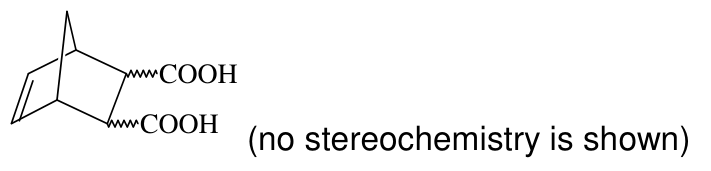
was established by the following experiments.
On heating this substance decomposes producing water and a new compound Y. Compound Y slowly dissolves in excess of aqueous \(\ce{NaOH}\) with the formation of product \(X_1\) same to that is formed in the reaction of X with \(\ce{NaOH}\). The resulting solution of \(X_1\) is treated by \(\ce{I2}\) to give compounds containing iodine. Acidification of the solution leads to a mixture of two isomeric compounds, A and B in the 3 : 1 ratio. The titration of 0.3913 g of compound A by 0.1000 M aqueous solution of \(\ce{NaOH}\) in the presence of phenolphthalein takes 12.70 \(\mathrm{cm^3}\) of alkali. The same amount of 0.1000 M solution of \(\ce{NaOH}\) is required for the titration of 0.3913 g of compound B. On heating compound A slowly transforms into compound C, which contains no iodine and is able to react with water. Under the same conditions compound B does not undergo this transformation, but on heating with hydrochloric acid slowly transforms into A.
All reactions must be written as balance equations. No mechanisms are required.
7.1 Mark by asterisks (*) the asymmetric carbon atoms in the structure of 5-norbornene-2,3-dicarboxylic acids.
7.2 Draw the stereochemical formulas of all stereoisomers of compound X, and the structures of products of their dehydration in those cases when it is possible.
7.3 Write the reactions of \(\ce{NaOH}\) with a stereoisomer of X and a stereoisomer of Y.
7.4 Calculate the molar mass of compound A. Write the reactions leading from \(X_1\) to A.
7.5 Write the reaction of the formation of C from A and the reaction of C with water.
7.6 Draw the stereochemical formula of compound X which satisfies all of the data given in the problem.
7.7 Write the reactions leading from B to A.
7.8 Are the compounds A and B diastereomers?
Official English text of the problem.
Answers
- 7.1: Mark C1, C2, C3 and C4, including both bridgehead carbon atoms.
- 7.2: There are four stereoisomers: the meso cis-endo,endo and cis-exo,exo forms, and a pair of trans enantiomers. Each cis form gives its corresponding five-membered cyclic anhydride; neither trans form can do so without changing configuration. Their stereochemical SMILES are given below.
- 7.3: Both the diacid and its anhydride consume two equivalents of sodium hydroxide to give the same disodium dicarboxylate, \(X_1\).
- 7.4: \(\boxed{M(A)=308.1\ \mathrm{g\,mol^{-1}}}\). A is a five-membered iodolactone with one remaining carboxylic acid group.
- 7.5: A loses hydrogen iodide to form the 2,6:3,5-dilactone C. Complete hydrolysis of C consumes two water molecules and gives the corresponding endo,endo-dihydroxy diacid.
- 7.6: X is cis-endo,endo-5-norbornene-2,3-dicarboxylic acid,
O=C(O)[C@@H]1[C@H](C(=O)O)[C@@H]2C=C[C@H]1C2. - 7.7: Acid-catalysed hydrolysis opens the six-membered lactone of B; subsequent esterification using the other carboxyl group produces the five-membered lactone A.
- 7.8: No. A and B are constitutional isomers, differing in which carboxyl group forms the lactone.
Solution
Throughout, use the original norbornene numbering: the bridgeheads are C1 and C4, and the three bridges are
\[ \mathrm{C1-C2-C3-C4},\qquad \mathrm{C1-C6=C5-C4},\qquad \mathrm{C1-C7-C4}. \]
The carboxyl groups are attached to C2 and C3. An endo carboxyl group points toward the other two-carbon bridge of the cage; an exo group points away from it.
A 2,6-lactone, for example, means that the carboxyl group attached to C2 forms an ester linkage to an oxygen attached to C6. The carboxyl carbon is an additional atom, not C2 itself.
For A, B, their sodium salts and the iodohydroxy intermediate below, each SMILES specifies one enantiomer. The reactions starting from achiral X give the corresponding racemic products.
The small molecules and salts used in the equations are: water O; sodium hydroxide [Na+].[OH-]; iodine II; sodium iodide [Na+].[I-]; hydrochloric acid, represented in aqueous ionic form, [H+].[Cl-]; sodium chloride [Na+].[Cl-]; and hydrogen iodide I.
7.1 — Asymmetric carbon atoms
The parent compound is 5-norbornene-2,3-dicarboxylic acid, with unspecified stereochemistry:
O=C(O)C1C(C(=O)O)C2C=CC1C2
Place asterisks on
\[ \boxed{\mathrm{C1^{*},\ C2^{*},\ C3^{*},\ C4^{*}}}. \]
C2 and C3 each carry hydrogen, a carboxyl group and two different paths through the cage. Each bridgehead, C1 and C4, carries hydrogen and three distinguishable carbon paths.
C5 and C6 are trigonal alkene carbons; C7 bears two hydrogen atoms.
7.2 — All stereoisomers and their dehydration products
The rigid bridge system constrains the bridgehead configurations; the four asymmetric carbons do not give \(2^4\) independently accessible configurations.
| Stereoisomer of 5-norbornene-2,3-dicarboxylic acid | Stereochemical description | SMILES |
|---|---|---|
| cis-endo,endo | Both carboxyl groups endo; meso | O=C(O)[C@@H]1[C@H](C(=O)O)[C@@H]2C=C[C@H]1C2 |
| cis-exo,exo | Both carboxyl groups exo; meso | O=C(O)[C@@H]1[C@H](C(=O)O)[C@H]2C=C[C@@H]1C2 |
| trans-endo,exo | C2 carboxyl endo and C3 carboxyl exo in the fixed numbered cage | O=C(O)[C@H]1[C@H](C(=O)O)[C@H]2C=C[C@@H]1C2 |
| trans-exo,endo | Mirror image of the preceding trans isomer | O=C(O)[C@@H]1[C@@H](C(=O)O)[C@H]2C=C[C@@H]1C2 |
Thus there are two achiral cis isomers and two enantiomeric trans isomers.
In either cis isomer, the neighbouring carboxyl groups can form a five-membered cyclic anhydride. The original configurations at C2 and C3 are retained.
| Starting acid | Dehydration product | SMILES |
|---|---|---|
| cis-endo,endo | cis-endo,endo-5-norbornene-2,3-dicarboxylic anhydride, \(Y_{\mathrm{endo}}\) | O=C1OC(=O)[C@H]2[C@@H]1[C@H]1C=C[C@@H]2C1 |
| cis-exo,exo | cis-exo,exo-5-norbornene-2,3-dicarboxylic anhydride, \(Y_{\mathrm{exo}}\) | O=C1OC(=O)[C@H]2[C@@H]1[C@@H]1C=C[C@H]2C1 |
For each cis isomer, the balanced dehydration equation is
\[ \boxed{\ce{C9H10O4 ->[\Delta] C9H8O3 + H2O}}. \]
To sketch either product, connect the two carboxyl carbonyl carbons through a single anhydride oxygen, giving the ring sequence
\[ \mathrm{C2-C3-C(=O)-O-C(=O)-C2}. \]
The trans carboxyl groups lie on opposite faces and cannot form this small anhydride ring without a configurational change.
7.3 — Reactions with sodium hydroxide
Choose the cis-endo,endo acid and its anhydride. Both produce disodium cis-endo,endo-5-norbornene-2,3-dicarboxylate, \(X_1\):
O=C([O-])[C@@H]1[C@H](C(=O)[O-])[C@@H]2C=C[C@H]1C2.[Na+].[Na+]
Neutralization of the diacid gives
\[ \boxed{\ce{C9H10O4 + 2NaOH -> C9H8Na2O4 + 2H2O}}. \]
Hydrolysis and neutralization of the anhydride give
\[ \boxed{\ce{C9H8O3 + 2NaOH -> C9H8Na2O4 + H2O}}. \]
The corresponding exo acid and exo anhydride likewise give the same exo dicarboxylate as one another.
7.4 — Molar mass of A and its formation from \(X_1\)
Iodination permits intramolecular lactone formation: one carboxyl group becomes an ester, while the other remains available for acid–base titration. Thus A and B are monobasic iodolactones.
The amount of sodium hydroxide used is
\[ n(\ce{NaOH}) = (0.1000\ \mathrm{mol\,L^{-1}}) (12.70\times10^{-3}\ \mathrm L) = 1.270\times10^{-3}\ \mathrm{mol}. \]
Since one mole of A consumes one mole of sodium hydroxide at the acid–base endpoint,
\[ M(A) = \frac{0.3913\ \mathrm g}{1.270\times10^{-3}\ \mathrm{mol}} = \boxed{308.1\ \mathrm{g\,mol^{-1}}}. \]
Strictly, the titration first gives the acid equivalent mass; its equality to the molar mass follows from the presence of one free carboxyl group.
The formula is \(\ce{C9H9IO4}\), consistent with the original diacid incorporating one iodine atom and losing one carboxyl hydrogen during iodolactonization.
The structures established by the subsequent heating and hydrolysis tests are:
| Compound | Name and precise connectivity | SMILES |
|---|---|---|
| A | 2,6-lactone of exo-5-iodo-endo-6-hydroxynorbornane-endo-2,endo-3-dicarboxylic acid. A five-membered \(\gamma\)-lactone; the C3 carboxyl group remains free. | O=C1O[C@@H]2[C@@H](I)[C@H]3C[C@@H]2[C@@H]1[C@H]3C(=O)O |
| B | 3,6-lactone of exo-5-iodo-endo-6-hydroxynorbornane-endo-2,endo-3-dicarboxylic acid. A six-membered \(\delta\)-lactone; the C2 carboxyl group remains free. | O=C(O)[C@@H]1[C@H]2C[C@@H]3[C@H](I)[C@H]2OC(=O)[C@@H]31 |
| \(A_{\mathrm{Na}}\) | Sodium carboxylate of A | O=C1O[C@@H]2[C@@H](I)[C@H]3C[C@@H]2[C@@H]1[C@H]3C(=O)[O-].[Na+] |
| \(B_{\mathrm{Na}}\) | Sodium carboxylate of B | O=C([O-])[C@@H]1[C@H]2C[C@@H]3[C@H](I)[C@H]2OC(=O)[C@@H]31.[Na+] |
For A, the lactone ring contains C2, C1, C6, the ester oxygen and the C2 carboxyl carbon: five atoms. For B, the corresponding ring through C3, C2, C1 and C6 contains six atoms.
Formation of the sodium iodolactone from \(X_1\) is balanced as
\[ \boxed{\ce{C9H8Na2O4 + I2 -> C9H8INaO4 + NaI}}. \]
The organic product on the right is \(A_{\mathrm{Na}}\) or \(B_{\mathrm{Na}}\), according to which carboxyl group closes the ring.
Using hydrochloric acid to express the acidification explicitly,
\[ \boxed{\ce{C9H8INaO4 + HCl -> C9H9IO4 + NaCl}}. \]
The resulting A:B ratio is the stated 3:1.
For either isolated iodolactone, the acid–base titration is
\[ \ce{C9H9IO4 + NaOH -> C9H8INaO4 + H2O}. \]
Both therefore have the same molar mass and consume the same amount of alkali for equal masses.
7.5 — Formation of C and its reaction with water
In A, the remaining endo carboxyl group at C3 is suitably placed to form a second five-membered lactone involving C5. The exo iodine at C5 is replaced by an endo ester oxygen, with loss of hydrogen iodide.
The product C is the 2,6:3,5-dilactone of endo-5,endo-6-dihydroxynorbornane-endo-2,endo-3-dicarboxylic acid:
O=C1O[C@H]2[C@@H]3C[C@@H]4[C@H]2OC(=O)[C@@H]4[C@H]13
It has formula \(\ce{C9H8O4}\). Its two lactone connections are:
- the C2 carboxyl group to the endo oxygen at C6;
- the C3 carboxyl group to the endo oxygen at C5.
The balanced thermal reaction is
\[ \boxed{\ce{C9H9IO4 ->[\Delta] C9H8O4 + HI}}. \]
Complete hydrolysis opens both ester rings, producing endo-5,endo-6-dihydroxynorbornane-endo-2,endo-3-dicarboxylic acid, designated E:
O=C(O)[C@@H]1[C@H]2C[C@H]([C@@H](O)[C@H]2O)[C@@H]1C(=O)O
The balanced hydrolysis equation is
\[ \boxed{\ce{C9H8O4 + 2H2O <=> C9H12O6}}. \]
In a drawing of E, both hydroxyl groups and both carboxyl substituents are endo.
7.6 — Identification of X
Anhydride formation establishes that the two carboxyl groups are cis, leaving the endo,endo and exo,exo possibilities.
Formation of the lactone connections to C5 and C6 requires the carboxyl groups to face inward toward that bridge. The formation of the second lactone in C establishes the necessary orientation of the remaining carboxyl group as well.
Consequently,
\[ \boxed{X=\text{cis-endo,endo-5-norbornene-2,3-dicarboxylic acid}.} \]
Its stereochemical SMILES is
O=C(O)[C@@H]1[C@H](C(=O)O)[C@@H]2C=C[C@H]1C2
To draw X, retain the original norbornene skeleton and its C5=C6 double bond, place both carboxyl groups endo, and place the hydrogens on C2 and C3 exo. Its dehydration product is \(Y_{\mathrm{endo}}\) from part 7.2.
7.7 — Conversion of B into A
B already contains the 3,6-lactone connection. Its free C2 carboxyl group is not positioned to give the second five-membered lactone formed from A, explaining the different thermal behaviour.
In hot aqueous hydrochloric acid, B can first undergo lactone hydrolysis. This gives exo-5-iodo-endo-6-hydroxynorbornane-endo-2,endo-3-dicarboxylic acid, designated D:
O=C(O)[C@@H]1[C@H]2C[C@H]([C@H](I)[C@H]2O)[C@@H]1C(=O)O
The balanced opening of B is
\[ \boxed{\ce{C9H9IO4 + H2O <=>[HCl,\ \Delta] C9H11IO5}} \qquad\text{(B to D)}. \]
The C2 carboxyl group of D can then esterify the endo hydroxyl group at C6, forming the five-membered 2,6-lactone A:
\[ \boxed{\ce{C9H11IO5 <=>[HCl,\ \Delta] C9H9IO4 + H2O}} \qquad\text{(D to A)}. \]
Water cancels from the overall conversion, and hydrochloric acid acts catalytically. The iodine position and the configurations of the cage carbon atoms are retained; the carboxyl group participating in the ester linkage changes.
7.8 — Are A and B diastereomers?
No. Diastereomers must have the same atom connectivity.
In A, the carboxyl group at C2 forms the ester bond to the oxygen at C6. In B, the carboxyl group at C3 forms that bond. Their lactone rings consequently contain five and six atoms, respectively.
Thus A and B are constitutional isomers, specifically regioisomeric iodolactones.
The solution was checked against the official solution.
IChO 1996 · Theorieaufgabe 7
Stereochemie der 5-Norbornen-2,3-dicarbonsäuren
Die Stereochemie organischer Verbindungen lässt sich manchmal durch Untersuchung ihres chemischen Verhaltens bestimmen. Die stereochemische Konfiguration eines der Isomere der 5-Norbornen-2,3-dicarbonsäuren (Verbindung X)
wurde durch die folgenden Experimente ermittelt.
Beim Erhitzen zersetzt sich diese Substanz unter Bildung von Wasser und einer neuen Verbindung Y. Verbindung Y löst sich langsam in überschüssiger wässriger \(\ce{NaOH}\) unter Bildung des Produkts \(X_1\), das mit dem bei der Reaktion von X mit \(\ce{NaOH}\) gebildeten Produkt identisch ist. Die entstandene Lösung von \(X_1\) wird mit \(\ce{I2}\) behandelt, wobei iodhaltige Verbindungen entstehen. Das Ansäuern der Lösung führt zu einem Gemisch zweier isomerer Verbindungen A und B im Verhältnis 3 : 1. Für die Titration von 0.3913 g der Verbindung A mit einer wässrigen 0.1000 M Lösung von \(\ce{NaOH}\) in Gegenwart von Phenolphthalein werden 12.70 \(\mathrm{cm^3}\) Lauge benötigt. Dieselbe Menge an 0.1000 M Lösung von \(\ce{NaOH}\) wird für die Titration von 0.3913 g der Verbindung B benötigt. Beim Erhitzen wandelt sich Verbindung A langsam in Verbindung C um, die kein Iod enthält und mit Wasser reagieren kann. Unter denselben Bedingungen erfährt Verbindung B diese Umwandlung nicht, wandelt sich jedoch beim Erhitzen mit Salzsäure langsam in A um.
Alle Reaktionen müssen als ausgeglichene Reaktionsgleichungen angegeben werden. Mechanismen sind nicht erforderlich.
7.1 Markieren Sie die asymmetrischen Kohlenstoffatome in der Struktur der 5-Norbornen-2,3-dicarbonsäuren mit Sternchen (*).
7.2 Zeichnen Sie die stereochemischen Formeln aller Stereoisomere der Verbindung X sowie die Strukturen ihrer Dehydratisierungsprodukte in den Fällen, in denen eine Dehydratisierung möglich ist.
7.3 Geben Sie die Reaktionen von \(\ce{NaOH}\) mit einem Stereoisomer von X und einem Stereoisomer von Y an.
7.4 Berechnen Sie die molare Masse der Verbindung A. Geben Sie die Reaktionen an, die von \(X_1\) zu A führen.
7.5 Geben Sie die Reaktion zur Bildung von C aus A und die Reaktion von C mit Wasser an.
7.6 Zeichnen Sie die stereochemische Formel der Verbindung X, die allen in der Aufgabe angegebenen Daten entspricht.
7.7 Geben Sie die Reaktionen an, die von B zu A führen.
7.8 Sind die Verbindungen A und B Diastereomere?
Aufgabentext aus dem offiziellen englischen Text übersetzt.
Antworten
- 7.1: Markieren Sie C1, C2, C3 und C4, einschließlich beider Brückenkopf-Kohlenstoffatome.
- 7.2: Es gibt vier Stereoisomere: die meso-Formen cis-endo,endo und cis-exo,exo sowie ein Paar trans-Enantiomere. Jede cis-Form ergibt das entsprechende fünfgliedrige cyclische Anhydrid; keine der beiden trans-Formen kann dies ohne Konfigurationsänderung tun. Ihre stereochemischen SMILES sind unten angegeben.
- 7.3: Sowohl die Dicarbonsäure als auch ihr Anhydrid verbrauchen zwei Äquivalente Natriumhydroxid und bilden dasselbe Dinatriumdicarboxylat, \(X_1\).
- 7.4: \(\boxed{M(A)=308.1\ \mathrm{g\,mol^{-1}}}\). A ist ein fünfgliedriges Iodlacton mit einer verbleibenden Carbonsäuregruppe.
- 7.5: A spaltet Iodwasserstoff ab und bildet das 2,6:3,5-Dilacton C. Die vollständige Hydrolyse von C verbraucht zwei Wassermoleküle und ergibt die entsprechende endo,endo-Dihydroxydicarbonsäure.
- 7.6: X ist cis-endo,endo-5-Norbornen-2,3-dicarbonsäure,
O=C(O)[C@@H]1[C@H](C(=O)O)[C@@H]2C=C[C@H]1C2. - 7.7: Die säurekatalysierte Hydrolyse öffnet den sechsgliedrigen Lactonring von B; die anschließende Veresterung unter Beteiligung der anderen Carboxylgruppe ergibt das fünfgliedrige Lacton A.
- 7.8: Nein. A und B sind Konstitutionsisomere, die sich darin unterscheiden, welche Carboxylgruppe das Lacton bildet.
Lösung
Im Folgenden wird durchgehend die ursprüngliche Norbornen-Nummerierung verwendet: Die Brückenköpfe sind C1 und C4, und die drei Brücken sind
\[ \mathrm{C1-C2-C3-C4},\qquad \mathrm{C1-C6=C5-C4},\qquad \mathrm{C1-C7-C4}. \]
Die Carboxylgruppen sind an C2 und C3 gebunden. Eine endo-Carboxylgruppe weist zur anderen Zwei-Kohlenstoff-Brücke des Käfigs hin; eine exo-Gruppe weist von ihr weg.
Ein 2,6-Lacton bedeutet beispielsweise, dass die an C2 gebundene Carboxylgruppe eine Esterbindung zu einem an C6 gebundenen Sauerstoffatom bildet. Der Carboxylkohlenstoff ist ein zusätzliches Atom, nicht C2 selbst.
Für A, B, ihre Natriumsalze und das unten angegebene Iodhydroxy-Zwischenprodukt beschreibt jeder SMILES ein Enantiomer. Die vom achiralen X ausgehenden Reaktionen ergeben die entsprechenden racemischen Produkte.
Die in den Gleichungen verwendeten kleinen Moleküle und Salze sind: Wasser O; Natriumhydroxid [Na+].[OH-]; Iod II; Natriumiodid [Na+].[I-]; Salzsäure, dargestellt in wässriger ionischer Form, [H+].[Cl-]; Natriumchlorid [Na+].[Cl-]; und Iodwasserstoff I.
7.1 — Asymmetrische Kohlenstoffatome
Die Stammverbindung ist 5-Norbornen-2,3-dicarbonsäure, mit nicht festgelegter Stereochemie:
O=C(O)C1C(C(=O)O)C2C=CC1C2
Sternchen werden an folgenden Atomen angebracht:
\[ \boxed{\mathrm{C1^{*},\ C2^{*},\ C3^{*},\ C4^{*}}}. \]
C2 und C3 tragen jeweils ein Wasserstoffatom, eine Carboxylgruppe und zwei unterschiedliche Wege durch das Käfiggerüst. Jeder Brückenkopf, C1 und C4, trägt ein Wasserstoffatom und drei unterscheidbare Kohlenstoffwege.
C5 und C6 sind trigonal koordinierte Alken-Kohlenstoffatome; C7 trägt zwei Wasserstoffatome.
7.2 — Alle Stereoisomere und ihre Dehydratisierungsprodukte
Das starre Brückensystem schränkt die Brückenkopfkonfigurationen ein; die vier asymmetrischen Kohlenstoffatome ergeben nicht \(2^4\) unabhängig zugängliche Konfigurationen.
| Stereoisomer der 5-Norbornen-2,3-dicarbonsäure | Stereochemische Beschreibung | SMILES |
|---|---|---|
| cis-endo,endo | Beide Carboxylgruppen endo; meso | O=C(O)[C@@H]1[C@H](C(=O)O)[C@@H]2C=C[C@H]1C2 |
| cis-exo,exo | Beide Carboxylgruppen exo; meso | O=C(O)[C@@H]1[C@H](C(=O)O)[C@H]2C=C[C@@H]1C2 |
| trans-endo,exo | Carboxylgruppe an C2 endo und Carboxylgruppe an C3 exo im fest nummerierten Käfiggerüst | O=C(O)[C@H]1[C@H](C(=O)O)[C@H]2C=C[C@@H]1C2 |
| trans-exo,endo | Spiegelbild des vorangehenden trans-Isomers | O=C(O)[C@@H]1[C@@H](C(=O)O)[C@H]2C=C[C@@H]1C2 |
Somit gibt es zwei achirale cis-Isomere und zwei enantiomere trans-Isomere.
Bei beiden cis-Isomeren können die benachbarten Carboxylgruppen ein fünfgliedriges cyclisches Anhydrid bilden. Die ursprünglichen Konfigurationen an C2 und C3 bleiben erhalten.
| Ausgangssäure | Dehydratisierungsprodukt | SMILES |
|---|---|---|
| cis-endo,endo | cis-endo,endo-5-Norbornen-2,3-dicarbonsäureanhydrid, \(Y_{\mathrm{endo}}\) | O=C1OC(=O)[C@H]2[C@@H]1[C@H]1C=C[C@@H]2C1 |
| cis-exo,exo | cis-exo,exo-5-Norbornen-2,3-dicarbonsäureanhydrid, \(Y_{\mathrm{exo}}\) | O=C1OC(=O)[C@H]2[C@@H]1[C@@H]1C=C[C@H]2C1 |
Für jedes cis-Isomer lautet die ausgeglichene Dehydratisierungsgleichung
\[ \boxed{\ce{C9H10O4 ->[\Delta] C9H8O3 + H2O}}. \]
Um eines der beiden Produkte zu skizzieren, verbindet man die beiden Carbonylkohlenstoffatome der Carboxylgruppen über ein einzelnes Anhydrid-Sauerstoffatom, wodurch sich folgende Ringsequenz ergibt:
\[ \mathrm{C2-C3-C(=O)-O-C(=O)-C2}. \]
Die trans-Carboxylgruppen liegen auf entgegengesetzten Seiten und können diesen kleinen Anhydridring nicht ohne Konfigurationsänderung bilden.
7.3 — Reaktionen mit Natriumhydroxid
Wir wählen die cis-endo,endo-Säure und ihr Anhydrid. Beide ergeben Dinatrium-cis-endo,endo-5-norbornen-2,3-dicarboxylat, \(X_1\):
O=C([O-])[C@@H]1[C@H](C(=O)[O-])[C@@H]2C=C[C@H]1C2.[Na+].[Na+]
Die Neutralisation der Dicarbonsäure ergibt
\[ \boxed{\ce{C9H10O4 + 2NaOH -> C9H8Na2O4 + 2H2O}}. \]
Hydrolyse und Neutralisation des Anhydrids ergeben
\[ \boxed{\ce{C9H8O3 + 2NaOH -> C9H8Na2O4 + H2O}}. \]
Die entsprechende exo-Säure und das exo-Anhydrid ergeben ebenfalls beide dasselbe exo-Dicarboxylat.
7.4 — Molare Masse von A und seine Bildung aus \(X_1\)
Die Iodierung ermöglicht eine intramolekulare Lactonbildung: Eine Carboxylgruppe wird zu einem Ester, während die andere weiterhin für eine Säure-Base-Titration zur Verfügung steht. A und B sind somit einbasige Iodlactone.
Die eingesetzte Stoffmenge an Natriumhydroxid beträgt
\[ n(\ce{NaOH}) = (0.1000\ \mathrm{mol\,L^{-1}}) (12.70\times10^{-3}\ \mathrm L) = 1.270\times10^{-3}\ \mathrm{mol}. \]
Da ein Mol A bis zum Säure-Base-Endpunkt ein Mol Natriumhydroxid verbraucht, gilt
\[ M(A) = \frac{0.3913\ \mathrm g}{1.270\times10^{-3}\ \mathrm{mol}} = \boxed{308.1\ \mathrm{g\,mol^{-1}}}. \]
Streng genommen liefert die Titration zunächst die Säureäquivalentmasse; ihre Gleichheit mit der molaren Masse folgt aus dem Vorhandensein einer freien Carboxylgruppe.
Die Summenformel lautet \(\ce{C9H9IO4}\), was damit übereinstimmt, dass die ursprüngliche Dicarbonsäure bei der Iodlactonisierung ein Iodatom aufnimmt und ein Wasserstoffatom einer Carboxylgruppe abgibt.
Die durch die anschließenden Erhitzungs- und Hydrolyseversuche ermittelten Strukturen sind:
| Verbindung | Name und genaue Verknüpfung der Atome | SMILES |
|---|---|---|
| A | 2,6-Lacton der exo-5-Iod-endo-6-hydroxynorbornan-endo-2,endo-3-dicarbonsäure. Ein fünfgliedriges \(\gamma\)-Lacton; die Carboxylgruppe an C3 bleibt frei. | O=C1O[C@@H]2[C@@H](I)[C@H]3C[C@@H]2[C@@H]1[C@H]3C(=O)O |
| B | 3,6-Lacton der exo-5-Iod-endo-6-hydroxynorbornan-endo-2,endo-3-dicarbonsäure. Ein sechsgliedriges \(\delta\)-Lacton; die Carboxylgruppe an C2 bleibt frei. | O=C(O)[C@@H]1[C@H]2C[C@@H]3[C@H](I)[C@H]2OC(=O)[C@@H]31 |
| \(A_{\mathrm{Na}}\) | Natriumcarboxylat von A | O=C1O[C@@H]2[C@@H](I)[C@H]3C[C@@H]2[C@@H]1[C@H]3C(=O)[O-].[Na+] |
| \(B_{\mathrm{Na}}\) | Natriumcarboxylat von B | O=C([O-])[C@@H]1[C@H]2C[C@@H]3[C@H](I)[C@H]2OC(=O)[C@@H]31.[Na+] |
Bei A enthält der Lactonring C2, C1, C6, den Estersauerstoff und den Kohlenstoff der Carboxylgruppe an C2: fünf Atome. Bei B enthält der entsprechende Ring über C3, C2, C1 und C6 sechs Atome.
Die Bildung des Natriumsalzes des Iodlactons aus \(X_1\) wird durch folgende ausgeglichene Gleichung beschrieben:
\[ \boxed{\ce{C9H8Na2O4 + I2 -> C9H8INaO4 + NaI}}. \]
Das organische Produkt auf der rechten Seite ist \(A_{\mathrm{Na}}\) oder \(B_{\mathrm{Na}}\), je nachdem, welche Carboxylgruppe den Ring schließt.
Mit Salzsäure lässt sich das Ansäuern ausdrücklich darstellen:
\[ \boxed{\ce{C9H8INaO4 + HCl -> C9H9IO4 + NaCl}}. \]
Das resultierende Verhältnis A:B beträgt wie angegeben 3:1.
Für jedes der isolierten Iodlactone lautet die Säure-Base-Titration
\[ \ce{C9H9IO4 + NaOH -> C9H8INaO4 + H2O}. \]
Beide haben daher dieselbe molare Masse und verbrauchen bei gleichen Massen dieselbe Menge Lauge.
7.5 — Bildung von C und seine Reaktion mit Wasser
In A ist die verbleibende endo-Carboxylgruppe an C3 räumlich so angeordnet, dass sie unter Beteiligung von C5 einen zweiten fünfgliedrigen Lactonring bilden kann. Das exo-Iodatom an C5 wird unter Abspaltung von Iodwasserstoff durch einen endo-Estersauerstoff ersetzt.
Das Produkt C ist das 2,6:3,5-Dilacton der endo-5,endo-6-Dihydroxynorbornan-endo-2,endo-3-dicarbonsäure:
O=C1O[C@H]2[C@@H]3C[C@@H]4[C@H]2OC(=O)[C@@H]4[C@H]13
Es hat die Summenformel \(\ce{C9H8O4}\). Seine beiden Lactonverknüpfungen sind:
- die Carboxylgruppe an C2 mit dem endo-Sauerstoff an C6;
- die Carboxylgruppe an C3 mit dem endo-Sauerstoff an C5.
Die ausgeglichene Gleichung der thermischen Reaktion lautet
\[ \boxed{\ce{C9H9IO4 ->[\Delta] C9H8O4 + HI}}. \]
Die vollständige Hydrolyse öffnet beide Esterringe und ergibt endo-5,endo-6-Dihydroxynorbornan-endo-2,endo-3-dicarbonsäure, bezeichnet als E:
O=C(O)[C@@H]1[C@H]2C[C@H]([C@@H](O)[C@H]2O)[C@@H]1C(=O)O
Die ausgeglichene Hydrolysegleichung lautet
\[ \boxed{\ce{C9H8O4 + 2H2O <=> C9H12O6}}. \]
In einer Zeichnung von E sind beide Hydroxylgruppen und beide Carboxylsubstituenten endo angeordnet.
7.6 — Identifizierung von X
Die Anhydridbildung zeigt, dass die beiden Carboxylgruppen cis angeordnet sind, sodass die Möglichkeiten endo,endo und exo,exo verbleiben.
Die Bildung der Lactonverknüpfungen zu C5 und C6 erfordert, dass die Carboxylgruppen nach innen zu dieser Brücke hin ausgerichtet sind. Die Bildung des zweiten Lactonrings in C belegt auch die notwendige Orientierung der verbleibenden Carboxylgruppe.
Folglich gilt
\[ \boxed{X=\text{cis-endo,endo-5-Norbornen-2,3-dicarbonsäure}.} \]
Der stereochemische SMILES lautet
O=C(O)[C@@H]1[C@H](C(=O)O)[C@@H]2C=C[C@H]1C2
Um X zu zeichnen, behält man das ursprüngliche Norbornengerüst und seine C5=C6-Doppelbindung bei, ordnet beide Carboxylgruppen endo an und die Wasserstoffatome an C2 und C3 exo. Sein Dehydratisierungsprodukt ist \(Y_{\mathrm{endo}}\) aus Teil 7.2.
7.7 — Umwandlung von B in A
B enthält bereits die 3,6-Lacton-Verknüpfung. Seine freie Carboxylgruppe an C2 ist nicht so angeordnet, dass sie den zweiten fünfgliedrigen Lactonring bilden könnte, der aus A entsteht; dies erklärt das unterschiedliche thermische Verhalten.
In heißer wässriger Salzsäure kann B zunächst eine Lactonhydrolyse eingehen. Dabei entsteht exo-5-Iod-endo-6-hydroxynorbornan-endo-2,endo-3-dicarbonsäure, bezeichnet als D:
O=C(O)[C@@H]1[C@H]2C[C@H]([C@H](I)[C@H]2O)[C@@H]1C(=O)O
Die ausgeglichene Gleichung für die Ringöffnung von B lautet
\[ \boxed{\ce{C9H9IO4 + H2O <=>[HCl,\ \Delta] C9H11IO5}} \qquad\text{(B zu D)}. \]
Die Carboxylgruppe an C2 von D kann anschließend die endo-Hydroxylgruppe an C6 verestern, wodurch das fünfgliedrige 2,6-Lacton A entsteht:
\[ \boxed{\ce{C9H11IO5 <=>[HCl,\ \Delta] C9H9IO4 + H2O}} \qquad\text{(D zu A)}. \]
Wasser kürzt sich aus der Gesamtgleichung heraus, und Salzsäure wirkt katalytisch. Die Position des Iodatoms und die Konfigurationen der Kohlenstoffatome des Käfiggerüsts bleiben erhalten; die an der Esterbindung beteiligte Carboxylgruppe wechselt.
7.8 — Sind A und B Diastereomere?
Nein. Diastereomere müssen dieselbe Verknüpfung der Atome aufweisen.
In A bildet die Carboxylgruppe an C2 die Esterbindung zum Sauerstoff an C6. In B bildet die Carboxylgruppe an C3 diese Bindung. Ihre Lactonringe enthalten folglich fünf beziehungsweise sechs Atome.
Somit sind A und B Konstitutionsisomere, genauer gesagt regioisomere Iodlactone.
Die Lösung wurde mit der offiziellen Lösung abgeglichen.
IChO 1996 · Teori sorusu 7
5-norbornen-2,3-dikarboksilik asitlerin stereokimyası
Organik bileşiklerin stereokimyası bazen kimyasal davranışları incelenerek belirlenebilir. 5-norbornen-2,3-dikarboksilik asitlerin izomerlerinden birinin (X bileşiği)
stereokimyasal konfigürasyonu aşağıdaki deneylerle belirlenmiştir.
Bu madde ısıtıldığında ayrışarak su ve yeni bir Y bileşiği oluşturur. Y bileşiği, fazla miktarda sulu \(\ce{NaOH}\) içinde yavaşça çözünerek X'in \(\ce{NaOH}\) ile tepkimesinde oluşan ürünle aynı olan \(X_1\) ürününü oluşturur. Elde edilen \(X_1\) çözeltisi \(\ce{I2}\) ile işleme sokulduğunda iyot içeren bileşikler oluşur. Çözelti asitlendirildiğinde, A ve B olmak üzere iki izomerik bileşiğin 3 : 1 oranındaki karışımı elde edilir. A bileşiğinin 0.3913 g'ının fenolftalein varlığında 0.1000 M sulu \(\ce{NaOH}\) çözeltisiyle titrasyonu için 12.70 \(\mathrm{cm^3}\) baz gerekir. B bileşiğinin 0.3913 g'ının titrasyonu için de aynı miktarda 0.1000 M \(\ce{NaOH}\) çözeltisi gerekir. A bileşiği ısıtıldığında yavaşça, iyot içermeyen ve suyla tepkimeye girebilen C bileşiğine dönüşür. Aynı koşullarda B bileşiği bu dönüşümü geçirmez; ancak hidroklorik asitle ısıtıldığında yavaşça A'ya dönüşür.
Tüm tepkimeler denkleştirilmiş denklemler olarak yazılmalıdır. Mekanizma yazılması gerekli değildir.
7.1 5-norbornen-2,3-dikarboksilik asitlerin yapısındaki asimetrik karbon atomlarını yıldız (*) ile işaretleyiniz.
7.2 X bileşiğinin tüm stereoizomerlerinin stereokimyasal formüllerini ve mümkün olan durumlarda bunların dehidrasyon ürünlerinin yapılarını çiziniz.
7.3 \(\ce{NaOH}\)'in X'in bir stereoizomeri ve Y'nin bir stereoizomeri ile tepkimelerini yazınız.
7.4 A bileşiğinin molar kütlesini hesaplayınız. \(X_1\)'den A'ya giden tepkimeleri yazınız.
7.5 A'dan C'nin oluşum tepkimesini ve C'nin suyla tepkimesini yazınız.
7.6 Soruda verilen tüm verileri sağlayan X bileşiğinin stereokimyasal formülünü çiziniz.
7.7 B'den A'ya giden tepkimeleri yazınız.
7.8 A ve B bileşikleri diastereomer midir?
Soru metni resmi İngilizce metinden çevrilmiştir.
Cevaplar
- 7.1: Her iki köprübaşı karbon atomu da dahil olmak üzere C1, C2, C3 ve C4'ü işaretleyiniz.
- 7.2: Dört stereoizomer vardır: mezo cis-endo,endo ve cis-exo,exo biçimleri ile bir çift trans enantiyomer. Her cis biçimi, kendisine karşılık gelen beş üyeli halkalı anhidriti verir; trans biçimlerinin hiçbiri konfigürasyon değişmeden bunu yapamaz. Stereokimyasal SMILES gösterimleri aşağıda verilmiştir.
- 7.3: Hem diasit hem de onun anhidriti, iki eşdeğer sodyum hidroksit tüketerek aynı disodyum dikarboksilatı, \(X_1\)'i verir.
- 7.4: \(\boxed{M(A)=308.1\ \mathrm{g\,mol^{-1}}}\). A, bir karboksilik asit grubunun serbest kaldığı beş üyeli bir iyodolaktondur.
- 7.5: A, hidrojen iyodür kaybederek 2,6:3,5-dilakton C'yi oluşturur. C'nin tam hidrolizi iki su molekülü tüketir ve karşılık gelen endo,endo-dihidroksi diasidi verir.
- 7.6: X, cis-endo,endo-5-norbornen-2,3-dikarboksilik asittir,
O=C(O)[C@@H]1[C@H](C(=O)O)[C@@H]2C=C[C@H]1C2. - 7.7: Asit katalizli hidroliz, B'nin altı üyeli lakton halkasını açar; ardından diğer karboksil grubunun kullanıldığı esterleşme, beş üyeli lakton A'yı oluşturur.
- 7.8: Hayır. A ve B, laktonu oluşturan karboksil grubu bakımından farklılık gösteren yapı izomerleridir.
Çözüm
Çözüm boyunca norbornenin özgün numaralandırmasını kullanınız: köprübaşları C1 ve C4'tür ve üç köprü şunlardır:
\[ \mathrm{C1-C2-C3-C4},\qquad \mathrm{C1-C6=C5-C4},\qquad \mathrm{C1-C7-C4}. \]
Karboksil grupları C2 ve C3'e bağlıdır. Bir endo karboksil grubu, kafesin diğer iki karbonlu köprüsüne doğru yönelmiştir; bir exo grubu ise bu köprüden dışarıya doğru yönelmiştir.
Örneğin 2,6-lakton, C2'ye bağlı karboksil grubunun C6'ya bağlı bir oksijenle ester bağı oluşturduğu anlamına gelir. Karboksil karbonu, C2'nin kendisi değil, ek bir atomdur.
A, B, bunların sodyum tuzları ve aşağıdaki iyodohidroksi ara ürün için her SMILES gösterimi bir enantiyomeri belirtir. Akiral X'ten başlayan tepkimeler, karşılık gelen rasemik ürünleri verir.
Denklemlerde kullanılan küçük moleküller ve tuzlar şunlardır: su O; sodyum hidroksit [Na+].[OH-]; iyot II; sodyum iyodür [Na+].[I-]; sulu çözeltideki iyonik biçimiyle gösterilen hidroklorik asit [H+].[Cl-]; sodyum klorür [Na+].[Cl-]; ve hidrojen iyodür I.
7.1 — Asimetrik karbon atomları
Ana bileşik, stereokimyası belirtilmemiş 5-norbornen-2,3-dikarboksilik asittir:
O=C(O)C1C(C(=O)O)C2C=CC1C2
Şu atomlara yıldız koyunuz:
\[ \boxed{\mathrm{C1^{*},\ C2^{*},\ C3^{*},\ C4^{*}}}. \]
C2 ve C3'ün her birine bir hidrojen, bir karboksil grubu ve kafes içinde ilerleyen iki farklı yol bağlıdır. C1 ve C4 köprübaşlarının her birine bir hidrojen ve birbirinden ayırt edilebilen üç karbon yolu bağlıdır.
C5 ve C6, üçgen düzlemsel alken karbonlarıdır; C7 iki hidrojen atomu taşır.
7.2 — Tüm stereoizomerler ve dehidrasyon ürünleri
Rijit köprü sistemi, köprübaşı konfigürasyonlarını sınırlar; dört asimetrik karbon, birbirinden bağımsız olarak erişilebilen \(2^4\) konfigürasyon vermez.
| 5-norbornen-2,3-dikarboksilik asidin stereoizomeri | Stereokimyasal açıklama | SMILES |
|---|---|---|
| cis-endo,endo | Her iki karboksil grubu endo; mezo | O=C(O)[C@@H]1[C@H](C(=O)O)[C@@H]2C=C[C@H]1C2 |
| cis-exo,exo | Her iki karboksil grubu exo; mezo | O=C(O)[C@@H]1[C@H](C(=O)O)[C@H]2C=C[C@@H]1C2 |
| trans-endo,exo | Numaralandırması sabit tutulan kafeste C2 karboksili endo ve C3 karboksili exo | O=C(O)[C@H]1[C@H](C(=O)O)[C@H]2C=C[C@@H]1C2 |
| trans-exo,endo | Önceki trans izomerin ayna görüntüsü | O=C(O)[C@@H]1[C@@H](C(=O)O)[C@H]2C=C[C@@H]1C2 |
Dolayısıyla iki akiral cis izomer ve birbirinin enantiyomeri olan iki trans izomer vardır.
Her iki cis izomerde de komşu karboksil grupları beş üyeli halkalı bir anhidrit oluşturabilir. C2 ve C3'teki özgün konfigürasyonlar korunur.
| Başlangıç asidi | Dehidrasyon ürünü | SMILES |
|---|---|---|
| cis-endo,endo | cis-endo,endo-5-norbornen-2,3-dikarboksilik anhidrit, \(Y_{\mathrm{endo}}\) | O=C1OC(=O)[C@H]2[C@@H]1[C@H]1C=C[C@@H]2C1 |
| cis-exo,exo | cis-exo,exo-5-norbornen-2,3-dikarboksilik anhidrit, \(Y_{\mathrm{exo}}\) | O=C1OC(=O)[C@H]2[C@@H]1[C@@H]1C=C[C@H]2C1 |
Her cis izomer için denkleştirilmiş dehidrasyon denklemi şöyledir:
\[ \boxed{\ce{C9H10O4 ->[\Delta] C9H8O3 + H2O}}. \]
Her iki üründen birini çizmek için iki karboksil grubunun karbonil karbonlarını tek bir anhidrit oksijeni üzerinden birleştiriniz; böylece şu halka dizisi elde edilir:
\[ \mathrm{C2-C3-C(=O)-O-C(=O)-C2}. \]
Trans karboksil grupları karşıt yüzlerde bulunur ve bir konfigürasyon değişikliği olmadan bu küçük anhidrit halkasını oluşturamaz.
7.3 — Sodyum hidroksitle tepkimeler
Cis-endo,endo asidi ve onun anhidritini seçiniz. Her ikisi de disodyum cis-endo,endo-5-norbornen-2,3-dikarboksilat, \(X_1\), oluşturur:
O=C([O-])[C@@H]1[C@H](C(=O)[O-])[C@@H]2C=C[C@H]1C2.[Na+].[Na+]
Diasidin nötrleşmesi şu şekilde gerçekleşir:
\[ \boxed{\ce{C9H10O4 + 2NaOH -> C9H8Na2O4 + 2H2O}}. \]
Anhidritin hidrolizi ve nötrleşmesi şu şekilde gerçekleşir:
\[ \boxed{\ce{C9H8O3 + 2NaOH -> C9H8Na2O4 + H2O}}. \]
Karşılık gelen exo asit ve exo anhidrit de benzer şekilde birbirleriyle aynı exo dikarboksilatı verir.
7.4 — A'nın molar kütlesi ve \(X_1\)'den oluşumu
İyotlama, molekül içi lakton oluşumuna olanak verir: bir karboksil grubu estere dönüşürken diğeri asit–baz titrasyonuna katılabilecek şekilde kalır. Dolayısıyla A ve B, monobazik iyodolaktonlardır.
Kullanılan sodyum hidroksidin mol miktarı şöyledir:
\[ n(\ce{NaOH}) = (0.1000\ \mathrm{mol\,L^{-1}}) (12.70\times10^{-3}\ \mathrm L) = 1.270\times10^{-3}\ \mathrm{mol}. \]
Asit–baz titrasyonunun dönüm noktasında bir mol A, bir mol sodyum hidroksit tükettiğinden,
\[ M(A) = \frac{0.3913\ \mathrm g}{1.270\times10^{-3}\ \mathrm{mol}} = \boxed{308.1\ \mathrm{g\,mol^{-1}}}. \]
Kesin olarak ifade etmek gerekirse, titrasyon ilk olarak asidin eşdeğer kütlesini verir; bunun molar kütleye eşit olması, bir serbest karboksil grubunun bulunmasından kaynaklanır.
Formül \(\ce{C9H9IO4}\)'tür; bu, başlangıçtaki diasidin iyodolaktonlaşma sırasında bir iyot atomu alması ve bir karboksil hidrojenini kaybetmesiyle uyumludur.
Daha sonra yapılan ısıtma ve hidroliz deneyleriyle belirlenen yapılar şunlardır:
| Bileşik | Adı ve atomların tam bağlanma düzeni | SMILES |
|---|---|---|
| A | exo-5-iyodo-endo-6-hidroksinorbornan-endo-2,endo-3-dikarboksilik asidin 2,6-laktonu. Beş üyeli bir \(\gamma\)-lakton; C3 karboksil grubu serbest kalır. | O=C1O[C@@H]2[C@@H](I)[C@H]3C[C@@H]2[C@@H]1[C@H]3C(=O)O |
| B | exo-5-iyodo-endo-6-hidroksinorbornan-endo-2,endo-3-dikarboksilik asidin 3,6-laktonu. Altı üyeli bir \(\delta\)-lakton; C2 karboksil grubu serbest kalır. | O=C(O)[C@@H]1[C@H]2C[C@@H]3[C@H](I)[C@H]2OC(=O)[C@@H]31 |
| \(A_{\mathrm{Na}}\) | A'nın sodyum karboksilat tuzu | O=C1O[C@@H]2[C@@H](I)[C@H]3C[C@@H]2[C@@H]1[C@H]3C(=O)[O-].[Na+] |
| \(B_{\mathrm{Na}}\) | B'nin sodyum karboksilat tuzu | O=C([O-])[C@@H]1[C@H]2C[C@@H]3[C@H](I)[C@H]2OC(=O)[C@@H]31.[Na+] |
A'da lakton halkası C2, C1, C6, ester oksijeni ve C2'deki karboksil karbonunu içerir: beş atom. B'de ise C3, C2, C1 ve C6'dan geçen karşılık gelen halka altı atom içerir.
\(X_1\)'den sodyum iyodolaktonun oluşumu şu şekilde denkleştirilir:
\[ \boxed{\ce{C9H8Na2O4 + I2 -> C9H8INaO4 + NaI}}. \]
Sağ taraftaki organik ürün, halkayı hangi karboksil grubunun kapattığına bağlı olarak \(A_{\mathrm{Na}}\) veya \(B_{\mathrm{Na}}\)'dır.
Asitlendirme hidroklorik asit kullanılarak açıkça ifade edilirse,
\[ \boxed{\ce{C9H8INaO4 + HCl -> C9H9IO4 + NaCl}}. \]
Elde edilen A:B oranı, belirtilen 3:1 oranıdır.
İzole edilen iyodolaktonların her biri için asit–baz titrasyonu şöyledir:
\[ \ce{C9H9IO4 + NaOH -> C9H8INaO4 + H2O}. \]
Bu nedenle her ikisi de aynı molar kütleye sahiptir ve eşit kütleleri için aynı miktarda baz tüketir.
7.5 — C'nin oluşumu ve suyla tepkimesi
A'da, C3'te kalan endo karboksil grubu, C5'i içeren ikinci bir beş üyeli lakton oluşturmak için uygun konumdadır. C5'teki exo iyot, hidrojen iyodür kaybıyla birlikte yerini bir endo ester oksijenine bırakır.
C ürünü, endo-5,endo-6-dihidroksinorbornan-endo-2,endo-3-dikarboksilik asidin 2,6:3,5-dilaktonudur:
O=C1O[C@H]2[C@@H]3C[C@@H]4[C@H]2OC(=O)[C@@H]4[C@H]13
Formülü \(\ce{C9H8O4}\)'tür. İki lakton bağlantısı şunlardır:
- C2 karboksil grubundan C6'daki endo oksijene;
- C3 karboksil grubundan C5'teki endo oksijene.
Denkleştirilmiş ısıl tepkime şöyledir:
\[ \boxed{\ce{C9H9IO4 ->[\Delta] C9H8O4 + HI}}. \]
Tam hidroliz, her iki ester halkasını da açarak E ile gösterilen endo-5,endo-6-dihidroksinorbornan-endo-2,endo-3-dikarboksilik asidi oluşturur:
O=C(O)[C@@H]1[C@H]2C[C@H]([C@@H](O)[C@H]2O)[C@@H]1C(=O)O
Denkleştirilmiş hidroliz denklemi şöyledir:
\[ \boxed{\ce{C9H8O4 + 2H2O <=> C9H12O6}}. \]
E'nin çiziminde, her iki hidroksil grubu ve her iki karboksil sübstitüenti endo konumundadır.
7.6 — X'in belirlenmesi
Anhidrit oluşumu, iki karboksil grubunun cis olduğunu ortaya koyar; geriye endo,endo ve exo,exo olasılıkları kalır.
C5 ve C6'ya lakton bağlantılarının oluşması, karboksil gruplarının içeriye, bu köprüye doğru yönelmesini gerektirir. C'deki ikinci laktonun oluşması, kalan karboksil grubunun da gerekli yönelime sahip olduğunu ortaya koyar.
Dolayısıyla,
\[ \boxed{X=\text{cis-endo,endo-5-norbornen-2,3-dikarboksilik asit}.} \]
Stereokimyasal SMILES gösterimi şöyledir:
O=C(O)[C@@H]1[C@H](C(=O)O)[C@@H]2C=C[C@H]1C2
X'i çizmek için özgün norbornen iskeletini ve C5=C6 çift bağını koruyunuz, her iki karboksil grubunu endo konumuna ve C2 ile C3'teki hidrojenleri exo konumuna yerleştiriniz. Dehidrasyon ürünü, 7.2 kısmındaki \(Y_{\mathrm{endo}}\)'dur.
7.7 — B'nin A'ya dönüşümü
B, zaten 3,6-lakton bağlantısını içerir. Serbest C2 karboksil grubu, A'dan oluşan ikinci beş üyeli laktonu verebilecek konumda değildir; bu da farklı ısıl davranışını açıklar.
Sıcak sulu hidroklorik asit içinde B, önce lakton hidrolizine uğrayabilir. Bu, D ile gösterilen exo-5-iyodo-endo-6-hidroksinorbornan-endo-2,endo-3-dikarboksilik asidi verir:
O=C(O)[C@@H]1[C@H]2C[C@H]([C@H](I)[C@H]2O)[C@@H]1C(=O)O
B'nin halka açılmasının denkleştirilmiş denklemi şöyledir:
\[ \boxed{\ce{C9H9IO4 + H2O <=>[HCl,\ \Delta] C9H11IO5}} \qquad\text{(B'den D'ye)}. \]
Ardından D'nin C2 karboksil grubu, C6'daki endo hidroksil grubuyla esterleşerek beş üyeli 2,6-lakton A'yı oluşturabilir:
\[ \boxed{\ce{C9H11IO5 <=>[HCl,\ \Delta] C9H9IO4 + H2O}} \qquad\text{(D'den A'ya)}. \]
Toplam dönüşümde su sadeleşir ve hidroklorik asit katalizör görevi görür. İyodun konumu ve kafes karbon atomlarının konfigürasyonları korunur; ester bağına katılan karboksil grubu değişir.
7.8 — A ve B diastereomer midir?
Hayır. Diastereomerlerde atomların bağlanma düzeni aynı olmalıdır.
A'da C2'deki karboksil grubu, C6'daki oksijenle ester bağını oluşturur. B'de bu bağı C3'teki karboksil grubu oluşturur. Bu nedenle lakton halkaları sırasıyla beş ve altı atom içerir.
Dolayısıyla A ve B yapı izomerleridir; daha özel olarak, birbirinin regioizomeri olan iyodolaktonlardır.
Çözüm, resmi çözümle karşılaştırılarak kontrol edildi.
IChO 1996 · Problema teórico 7
Estereoquímica de los ácidos 5-norborneno-2,3-dicarboxílicos
La estereoquímica de los compuestos orgánicos puede determinarse en ocasiones estudiando su comportamiento químico. La configuración estereoquímica de uno de los isómeros de los ácidos 5-norborneno-2,3-dicarboxílicos (compuesto X)
se estableció mediante los siguientes experimentos.
Al calentarse, esta sustancia se descompone y produce agua y un nuevo compuesto Y. El compuesto Y se disuelve lentamente en un exceso de disolución acuosa de \(\ce{NaOH}\), con formación del producto \(X_1\), idéntico al que se forma en la reacción de X con \(\ce{NaOH}\). La disolución resultante de \(X_1\) se trata con \(\ce{I2}\) para obtener compuestos que contienen yodo. La acidificación de la disolución da lugar a una mezcla de dos compuestos isómeros, A y B, en una proporción de 3 : 1. La valoración de 0.3913 g del compuesto A con una disolución acuosa de \(\ce{NaOH}\) 0.1000 M en presencia de fenolftaleína requiere 12.70 \(\mathrm{cm^3}\) de álcali. Para valorar 0.3913 g del compuesto B se requiere la misma cantidad de disolución de \(\ce{NaOH}\) 0.1000 M. Al calentarse, el compuesto A se transforma lentamente en el compuesto C, que no contiene yodo y puede reaccionar con agua. En las mismas condiciones, el compuesto B no experimenta esta transformación, pero al calentarlo con ácido clorhídrico se transforma lentamente en A.
Todas las reacciones deben escribirse como ecuaciones ajustadas. No se requieren mecanismos.
7.1 Marque con asteriscos (*) los átomos de carbono asimétricos en la estructura de los ácidos 5-norborneno-2,3-dicarboxílicos.
7.2 Dibuje las fórmulas estereoquímicas de todos los estereoisómeros del compuesto X, así como las estructuras de los productos de su deshidratación en los casos en que esta sea posible.
7.3 Escriba las reacciones de \(\ce{NaOH}\) con un estereoisómero de X y un estereoisómero de Y.
7.4 Calcule la masa molar del compuesto A. Escriba las reacciones que conducen de \(X_1\) a A.
7.5 Escriba la reacción de formación de C a partir de A y la reacción de C con agua.
7.6 Dibuje la fórmula estereoquímica del compuesto X que satisface todos los datos proporcionados en el problema.
7.7 Escriba las reacciones que conducen de B a A.
7.8 ¿Son diastereómeros los compuestos A y B?
Enunciado traducido del texto oficial en inglés.
Respuestas
- 7.1: Marque C1, C2, C3 y C4, incluidos ambos átomos de carbono cabeza de puente.
- 7.2: Hay cuatro estereoisómeros: las formas meso cis-endo,endo y cis-exo,exo, y un par de enantiómeros trans. Cada forma cis da su correspondiente anhídrido cíclico de cinco miembros; ninguna de las formas trans puede hacerlo sin cambiar de configuración. Sus SMILES estereoquímicos se indican más adelante.
- 7.3: Tanto el diácido como su anhídrido consumen dos equivalentes de hidróxido de sodio para dar el mismo dicarboxilato disódico, \(X_1\).
- 7.4: \(\boxed{M(A)=308.1\ \mathrm{g\,mol^{-1}}}\). A es una yodolactona de cinco miembros con un grupo de ácido carboxílico restante.
- 7.5: A pierde yoduro de hidrógeno para formar la 2,6:3,5-dilactona C. La hidrólisis completa de C consume dos moléculas de agua y da el correspondiente diácido endo,endo-dihidroxilado.
- 7.6: X es el ácido cis-endo,endo-5-norborneno-2,3-dicarboxílico,
O=C(O)[C@@H]1[C@H](C(=O)O)[C@@H]2C=C[C@H]1C2. - 7.7: La hidrólisis catalizada por ácido abre la lactona de seis miembros de B; la posterior esterificación mediante el otro grupo carboxilo produce la lactona de cinco miembros A.
- 7.8: No. A y B son isómeros constitucionales que difieren en el grupo carboxilo que forma la lactona.
Solución
En todo lo que sigue se utiliza la numeración original del norborneno: las cabezas de puente son C1 y C4, y los tres puentes son
\[ \mathrm{C1-C2-C3-C4},\qquad \mathrm{C1-C6=C5-C4},\qquad \mathrm{C1-C7-C4}. \]
Los grupos carboxilo están unidos a C2 y C3. Un grupo carboxilo endo está orientado hacia el otro puente de dos carbonos de la estructura de jaula; un grupo exo está orientado en sentido opuesto.
Una 2,6-lactona, por ejemplo, significa que el grupo carboxilo unido a C2 forma un enlace éster con un oxígeno unido a C6. El carbono del carboxilo es un átomo adicional, no el propio C2.
Para A, B, sus sales sódicas y el intermedio yodohidroxilado que se muestra más adelante, cada SMILES especifica un enantiómero. Las reacciones que parten de X, que es aquiral, dan los correspondientes productos racémicos.
Las moléculas pequeñas y las sales utilizadas en las ecuaciones son: agua O; hidróxido de sodio [Na+].[OH-]; yodo II; yoduro de sodio [Na+].[I-]; ácido clorhídrico, representado en forma iónica acuosa, [H+].[Cl-]; cloruro de sodio [Na+].[Cl-]; y yoduro de hidrógeno I.
7.1 — Átomos de carbono asimétricos
El compuesto de partida es el ácido 5-norborneno-2,3-dicarboxílico, con estereoquímica sin especificar:
O=C(O)C1C(C(=O)O)C2C=CC1C2
Se colocan asteriscos en
\[ \boxed{\mathrm{C1^{*},\ C2^{*},\ C3^{*},\ C4^{*}}}. \]
C2 y C3 están unidos, cada uno, a un hidrógeno, un grupo carboxilo y dos recorridos diferentes a través de la estructura de jaula. Cada cabeza de puente, C1 y C4, está unida a un hidrógeno y a tres recorridos carbonados distinguibles.
C5 y C6 son carbonos trigonales del alqueno; C7 está unido a dos átomos de hidrógeno.
7.2 — Todos los estereoisómeros y sus productos de deshidratación
El sistema rígido de puentes restringe las configuraciones de las cabezas de puente; los cuatro carbonos asimétricos no dan lugar a \(2^4\) configuraciones accesibles de forma independiente.
| Estereoisómero del ácido 5-norborneno-2,3-dicarboxílico | Descripción estereoquímica | SMILES |
|---|---|---|
| cis-endo,endo | Ambos grupos carboxilo endo; meso | O=C(O)[C@@H]1[C@H](C(=O)O)[C@@H]2C=C[C@H]1C2 |
| cis-exo,exo | Ambos grupos carboxilo exo; meso | O=C(O)[C@@H]1[C@H](C(=O)O)[C@H]2C=C[C@@H]1C2 |
| trans-endo,exo | Carboxilo de C2 endo y carboxilo de C3 exo en la estructura de jaula con numeración fija | O=C(O)[C@H]1[C@H](C(=O)O)[C@H]2C=C[C@@H]1C2 |
| trans-exo,endo | Imagen especular del isómero trans anterior | O=C(O)[C@@H]1[C@@H](C(=O)O)[C@H]2C=C[C@@H]1C2 |
Por tanto, hay dos isómeros cis aquirales y dos isómeros trans enantioméricos.
En cualquiera de los isómeros cis, los grupos carboxilo vecinos pueden formar un anhídrido cíclico de cinco miembros. Se conservan las configuraciones originales de C2 y C3.
| Ácido de partida | Producto de deshidratación | SMILES |
|---|---|---|
| cis-endo,endo | Anhídrido cis-endo,endo-5-norborneno-2,3-dicarboxílico, \(Y_{\mathrm{endo}}\) | O=C1OC(=O)[C@H]2[C@@H]1[C@H]1C=C[C@@H]2C1 |
| cis-exo,exo | Anhídrido cis-exo,exo-5-norborneno-2,3-dicarboxílico, \(Y_{\mathrm{exo}}\) | O=C1OC(=O)[C@H]2[C@@H]1[C@@H]1C=C[C@H]2C1 |
Para cada isómero cis, la ecuación ajustada de deshidratación es
\[ \boxed{\ce{C9H10O4 ->[\Delta] C9H8O3 + H2O}}. \]
Para dibujar cualquiera de los productos, se conectan los dos carbonos carbonílicos de los grupos carboxilo mediante un único oxígeno de anhídrido, lo que da la siguiente secuencia del anillo:
\[ \mathrm{C2-C3-C(=O)-O-C(=O)-C2}. \]
Los grupos carboxilo trans se sitúan en caras opuestas y no pueden formar este pequeño anillo de anhídrido sin un cambio de configuración.
7.3 — Reacciones con hidróxido de sodio
Se eligen el ácido cis-endo,endo y su anhídrido. Ambos producen cis-endo,endo-5-norborneno-2,3-dicarboxilato disódico, \(X_1\):
O=C([O-])[C@@H]1[C@H](C(=O)[O-])[C@@H]2C=C[C@H]1C2.[Na+].[Na+]
La neutralización del diácido da
\[ \boxed{\ce{C9H10O4 + 2NaOH -> C9H8Na2O4 + 2H2O}}. \]
La hidrólisis y la neutralización del anhídrido dan
\[ \boxed{\ce{C9H8O3 + 2NaOH -> C9H8Na2O4 + H2O}}. \]
De manera análoga, el ácido exo y el anhídrido exo correspondientes dan ambos el mismo dicarboxilato exo.
7.4 — Masa molar de A y su formación a partir de \(X_1\)
La yodación permite la formación intramolecular de una lactona: un grupo carboxilo se convierte en un éster, mientras que el otro permanece disponible para la valoración ácido–base. Por tanto, A y B son yodolactonas monobásicas.
La cantidad de hidróxido de sodio utilizada es
\[ n(\ce{NaOH}) = (0.1000\ \mathrm{mol\,L^{-1}}) (12.70\times10^{-3}\ \mathrm L) = 1.270\times10^{-3}\ \mathrm{mol}. \]
Como un mol de A consume un mol de hidróxido de sodio en el punto final de la valoración ácido–base,
\[ M(A) = \frac{0.3913\ \mathrm g}{1.270\times10^{-3}\ \mathrm{mol}} = \boxed{308.1\ \mathrm{g\,mol^{-1}}}. \]
En rigor, la valoración proporciona primero la masa equivalente del ácido; su igualdad con la masa molar se deduce de la presencia de un solo grupo carboxilo libre.
La fórmula es \(\ce{C9H9IO4}\), coherente con la incorporación de un átomo de yodo al diácido original y la pérdida de un hidrógeno carboxílico durante la yodolactonización.
Las estructuras establecidas mediante los ensayos posteriores de calentamiento e hidrólisis son:
| Compuesto | Nombre y conectividad precisa | SMILES |
|---|---|---|
| A | 2,6-lactona del ácido exo-5-yodo-endo-6-hidroxinorbornano-endo-2,endo-3-dicarboxílico. Una \(\gamma\)-lactona de cinco miembros; el grupo carboxilo de C3 permanece libre. | O=C1O[C@@H]2[C@@H](I)[C@H]3C[C@@H]2[C@@H]1[C@H]3C(=O)O |
| B | 3,6-lactona del ácido exo-5-yodo-endo-6-hidroxinorbornano-endo-2,endo-3-dicarboxílico. Una \(\delta\)-lactona de seis miembros; el grupo carboxilo de C2 permanece libre. | O=C(O)[C@@H]1[C@H]2C[C@@H]3[C@H](I)[C@H]2OC(=O)[C@@H]31 |
| \(A_{\mathrm{Na}}\) | Carboxilato sódico de A | O=C1O[C@@H]2[C@@H](I)[C@H]3C[C@@H]2[C@@H]1[C@H]3C(=O)[O-].[Na+] |
| \(B_{\mathrm{Na}}\) | Carboxilato sódico de B | O=C([O-])[C@@H]1[C@H]2C[C@@H]3[C@H](I)[C@H]2OC(=O)[C@@H]31.[Na+] |
En A, el anillo de lactona contiene C2, C1, C6, el oxígeno del éster y el carbono del carboxilo de C2: cinco átomos. En B, el anillo correspondiente que pasa por C3, C2, C1 y C6 contiene seis átomos.
La formación de la sal sódica de la yodolactona a partir de \(X_1\) se ajusta como
\[ \boxed{\ce{C9H8Na2O4 + I2 -> C9H8INaO4 + NaI}}. \]
El producto orgánico de la derecha es \(A_{\mathrm{Na}}\) o \(B_{\mathrm{Na}}\), según el grupo carboxilo que cierre el anillo.
Utilizando ácido clorhídrico para expresar explícitamente la acidificación,
\[ \boxed{\ce{C9H8INaO4 + HCl -> C9H9IO4 + NaCl}}. \]
La proporción A:B resultante es la indicada, 3:1.
Para cualquiera de las yodolactonas aisladas, la valoración ácido–base es
\[ \ce{C9H9IO4 + NaOH -> C9H8INaO4 + H2O}. \]
Por tanto, ambas tienen la misma masa molar y consumen la misma cantidad de álcali para masas iguales.
7.5 — Formación de C y su reacción con agua
En A, el grupo carboxilo endo restante en C3 está situado adecuadamente para formar una segunda lactona de cinco miembros en la que participa C5. El yodo exo de C5 se sustituye por un oxígeno de éster endo, con pérdida de yoduro de hidrógeno.
El producto C es la 2,6:3,5-dilactona del ácido endo-5,endo-6-dihidroxinorbornano-endo-2,endo-3-dicarboxílico:
O=C1O[C@H]2[C@@H]3C[C@@H]4[C@H]2OC(=O)[C@@H]4[C@H]13
Tiene la fórmula \(\ce{C9H8O4}\). Sus dos conexiones de lactona son:
- el grupo carboxilo de C2 con el oxígeno endo de C6;
- el grupo carboxilo de C3 con el oxígeno endo de C5.
La reacción térmica ajustada es
\[ \boxed{\ce{C9H9IO4 ->[\Delta] C9H8O4 + HI}}. \]
La hidrólisis completa abre ambos anillos de éster y produce ácido endo-5,endo-6-dihidroxinorbornano-endo-2,endo-3-dicarboxílico, denominado E:
O=C(O)[C@@H]1[C@H]2C[C@H]([C@@H](O)[C@H]2O)[C@@H]1C(=O)O
La ecuación ajustada de hidrólisis es
\[ \boxed{\ce{C9H8O4 + 2H2O <=> C9H12O6}}. \]
En un dibujo de E, tanto los dos grupos hidroxilo como los dos sustituyentes carboxilo son endo.
7.6 — Identificación de X
La formación del anhídrido establece que los dos grupos carboxilo son cis, lo que deja las posibilidades endo,endo y exo,exo.
La formación de las conexiones de lactona con C5 y C6 requiere que los grupos carboxilo estén orientados hacia el interior, en dirección a ese puente. La formación de la segunda lactona en C establece también la orientación necesaria del grupo carboxilo restante.
En consecuencia,
\[ \boxed{X=\text{ácido cis-endo,endo-5-norborneno-2,3-dicarboxílico}.} \]
Su SMILES estereoquímico es
O=C(O)[C@@H]1[C@H](C(=O)O)[C@@H]2C=C[C@H]1C2
Para dibujar X, se conserva el esqueleto original del norborneno y su doble enlace C5=C6, se colocan ambos grupos carboxilo endo y se sitúan los hidrógenos de C2 y C3 exo. Su producto de deshidratación es \(Y_{\mathrm{endo}}\) del apartado 7.2.
7.7 — Conversión de B en A
B ya contiene la conexión de 3,6-lactona. Su grupo carboxilo libre de C2 no está situado de modo que pueda dar la segunda lactona de cinco miembros que se forma a partir de A, lo que explica su distinto comportamiento térmico.
En ácido clorhídrico acuoso caliente, B puede experimentar primero la hidrólisis de la lactona. Esto da ácido exo-5-yodo-endo-6-hidroxinorbornano-endo-2,endo-3-dicarboxílico, denominado D:
O=C(O)[C@@H]1[C@H]2C[C@H]([C@H](I)[C@H]2O)[C@@H]1C(=O)O
La ecuación ajustada de apertura de B es
\[ \boxed{\ce{C9H9IO4 + H2O <=>[HCl,\ \Delta] C9H11IO5}} \qquad\text{(B a D)}. \]
El grupo carboxilo de C2 de D puede entonces esterificar el grupo hidroxilo endo de C6, formando la 2,6-lactona de cinco miembros A:
\[ \boxed{\ce{C9H11IO5 <=>[HCl,\ \Delta] C9H9IO4 + H2O}} \qquad\text{(D a A)}. \]
El agua se cancela en la conversión global y el ácido clorhídrico actúa como catalizador. Se conservan la posición del yodo y las configuraciones de los átomos de carbono de la estructura de jaula; cambia el grupo carboxilo que participa en el enlace éster.
7.8 — ¿Son A y B diastereómeros?
No. Los diastereómeros deben tener la misma conectividad atómica.
En A, el grupo carboxilo de C2 forma el enlace éster con el oxígeno de C6. En B, el grupo carboxilo de C3 forma ese enlace. Por consiguiente, sus anillos de lactona contienen cinco y seis átomos, respectivamente.
Por tanto, A y B son isómeros constitucionales, concretamente yodolactonas regioisoméricas.
La solución se comprobó con la solución oficial.
IChO 1996 · 理论题 7
5-降冰片烯-2,3-二羧酸的立体化学
有机化合物的立体化学有时可以通过研究其化学行为来确定。5-降冰片烯-2,3-二羧酸的一种异构体(化合物 X)的立体构型
通过以下实验得以确定。
该物质受热分解,生成水和一种新化合物 Y。化合物 Y 在过量的 \(\ce{NaOH}\) 水溶液中缓慢溶解,生成产物 \(X_1\),与 X 和 \(\ce{NaOH}\) 反应生成的产物相同。向所得 \(X_1\) 溶液中加入 \(\ce{I2}\),生成含碘化合物。将溶液酸化,得到两种互为异构体的化合物 A 和 B 的混合物,二者比例为 3 : 1。以酚酞为指示剂,用 0.1000 M 的 \(\ce{NaOH}\) 水溶液滴定 0.3913 g 化合物 A,消耗碱液 12.70 \(\mathrm{cm^3}\)。滴定 0.3913 g 化合物 B 需要等量的 0.1000 M \(\ce{NaOH}\) 溶液。加热时,化合物 A 缓慢转化为化合物 C,后者不含碘,并且能与水反应。在相同条件下,化合物 B 不发生这种转化,但与盐酸一起加热时会缓慢转化为 A。
所有反应均须写成配平的方程式。无需写出反应机理。
7.1 用星号 (*) 标出 5-降冰片烯-2,3-二羧酸结构中的不对称碳原子。
7.2 画出化合物 X 的所有立体异构体的立体化学结构式,并在能够发生脱水的情况下画出其脱水产物的结构。
7.3 写出 \(\ce{NaOH}\) 分别与 X 的一种立体异构体和 Y 的一种立体异构体发生的反应。
7.4 计算化合物 A 的摩尔质量。写出由 \(X_1\) 生成 A 的各步反应。
7.5 写出由 A 生成 C 的反应,以及 C 与水的反应。
7.6 画出符合题目所给全部信息的化合物 X 的立体化学结构式。
7.7 写出由 B 转化为 A 的各步反应。
7.8 化合物 A 和 B 是否为非对映异构体?
题目译自官方英文原文。
答案
- 7.1: 标出 C1、C2、C3 和 C4,包括两个桥头碳原子。
- 7.2: 共有四种立体异构体:内消旋的顺式-内,内型和顺式-外,外型,以及一对反式对映异构体。每种顺式异构体均生成相应的五元环状酸酐;两种反式异构体在不改变构型的情况下均无法生成这种酸酐。它们的立体化学 SMILES 见下文。
- 7.3: 二羧酸及其酸酐均消耗两当量氢氧化钠,生成相同的二羧酸二钠盐 \(X_1\)。
- 7.4: \(\boxed{M(A)=308.1\ \mathrm{g\,mol^{-1}}}\)。A 是一种五元环碘代内酯,仍保留一个羧基。
- 7.5: A 脱去碘化氢,形成 2,6:3,5-双内酯 C。C 完全水解消耗两个水分子,生成相应的内,内-二羟基二羧酸。
- 7.6: X 是顺式-内,内-5-降冰片烯-2,3-二羧酸,
O=C(O)[C@@H]1[C@H](C(=O)O)[C@@H]2C=C[C@H]1C2。 - 7.7: 酸催化水解使 B 的六元内酯环开环;随后另一个羧基参与酯化,生成五元内酯 A。
- 7.8: 不是。 A 和 B 是构造异构体,区别在于参与形成内酯的羧基不同。
解答
全文采用降冰片烯原有的编号:桥头碳为 C1 和 C4,三条桥分别为
\[ \mathrm{C1-C2-C3-C4},\qquad \mathrm{C1-C6=C5-C4},\qquad \mathrm{C1-C7-C4}. \]
羧基连接在 C2 和 C3 上。内向(endo)羧基朝向笼状骨架中另一条含两个碳原子的桥;外向(exo)羧基则背向该桥。
例如,2,6-内酯表示连接在 C2 上的羧基与连接在 C6 上的氧原子形成酯键。羧基碳是一个额外的原子,并非 C2 本身。
对于 A、B、它们的钠盐以及下文的碘代羟基中间体,每个 SMILES 均指定其中一个对映异构体。由非手性的 X 出发进行反应,得到相应的外消旋产物。
方程式中使用的小分子和盐为:水 O;氢氧化钠 [Na+].[OH-];碘 II;碘化钠 [Na+].[I-];以水溶液中的离子形式表示的盐酸 [H+].[Cl-];氯化钠 [Na+].[Cl-];以及碘化氢 I。
7.1 — 不对称碳原子
母体化合物为 5-降冰片烯-2,3-二羧酸,其立体化学未指定:
O=C(O)C1C(C(=O)O)C2C=CC1C2
在以下原子上标出星号:
\[ \boxed{\mathrm{C1^{*},\ C2^{*},\ C3^{*},\ C4^{*}}}. \]
C2 和 C3 各自连接一个氢原子、一个羧基以及两条穿过笼状骨架的不同路径。每个桥头碳 C1 和 C4 均连接一个氢原子以及三条可相互区分的碳链路径。
C5 和 C6 是呈平面三角形构型的烯烃碳原子;C7 连接两个氢原子。
7.2 — 所有立体异构体及其脱水产物
刚性的桥环体系限制了桥头碳的构型;四个不对称碳原子并不会产生 \(2^4\) 种可独立实现的构型。
| 5-降冰片烯-2,3-二羧酸的立体异构体 | 立体化学描述 | SMILES |
|---|---|---|
| 顺式-内,内 | 两个羧基均为内向;内消旋 | O=C(O)[C@@H]1[C@H](C(=O)O)[C@@H]2C=C[C@H]1C2 |
| 顺式-外,外 | 两个羧基均为外向;内消旋 | O=C(O)[C@@H]1[C@H](C(=O)O)[C@H]2C=C[C@@H]1C2 |
| 反式-内,外 | 在编号固定的笼状骨架中,C2 上的羧基为内向,C3 上的羧基为外向 | O=C(O)[C@H]1[C@H](C(=O)O)[C@H]2C=C[C@@H]1C2 |
| 反式-外,内 | 前一种反式异构体的镜像 | O=C(O)[C@@H]1[C@@H](C(=O)O)[C@H]2C=C[C@@H]1C2 |
因此,共有两种非手性的顺式异构体和两种互为对映异构体的反式异构体。
在任一种顺式异构体中,相邻的羧基均可形成五元环状酸酐。C2 和 C3 原有的构型保持不变。
| 起始酸 | 脱水产物 | SMILES |
|---|---|---|
| 顺式-内,内 | 顺式-内,内-5-降冰片烯-2,3-二羧酸酐,\(Y_{\mathrm{endo}}\) | O=C1OC(=O)[C@H]2[C@@H]1[C@H]1C=C[C@@H]2C1 |
| 顺式-外,外 | 顺式-外,外-5-降冰片烯-2,3-二羧酸酐,\(Y_{\mathrm{exo}}\) | O=C1OC(=O)[C@H]2[C@@H]1[C@@H]1C=C[C@H]2C1 |
对于每种顺式异构体,配平的脱水方程式为
\[ \boxed{\ce{C9H10O4 ->[\Delta] C9H8O3 + H2O}}. \]
绘制任一种产物时,将两个羧基的羰基碳通过一个酸酐氧原子连接起来,所得环中原子的连接顺序为
\[ \mathrm{C2-C3-C(=O)-O-C(=O)-C2}. \]
反式羧基位于相反的两面,在不改变构型的情况下无法形成这种小的酸酐环。
7.3 — 与氢氧化钠的反应
选择顺式-内,内酸及其酸酐。二者均生成顺式-内,内-5-降冰片烯-2,3-二羧酸二钠,即 \(X_1\):
O=C([O-])[C@@H]1[C@H](C(=O)[O-])[C@@H]2C=C[C@H]1C2.[Na+].[Na+]
二羧酸的中和反应为
\[ \boxed{\ce{C9H10O4 + 2NaOH -> C9H8Na2O4 + 2H2O}}. \]
酸酐的水解和中和反应为
\[ \boxed{\ce{C9H8O3 + 2NaOH -> C9H8Na2O4 + H2O}}. \]
相应的外向酸和外向酸酐同样生成彼此相同的外向二羧酸盐。
7.4 — A 的摩尔质量及其由 \(X_1\) 生成的反应
碘化反应可使分子内形成内酯:一个羧基转变为酯,另一个羧基则仍可参与酸碱滴定。因此,A 和 B 均为一元酸性的碘代内酯。
所用氢氧化钠的物质的量为
\[ n(\ce{NaOH}) = (0.1000\ \mathrm{mol\,L^{-1}}) (12.70\times10^{-3}\ \mathrm L) = 1.270\times10^{-3}\ \mathrm{mol}. \]
由于在酸碱滴定终点,每摩尔 A 消耗一摩尔氢氧化钠,
\[ M(A) = \frac{0.3913\ \mathrm g}{1.270\times10^{-3}\ \mathrm{mol}} = \boxed{308.1\ \mathrm{g\,mol^{-1}}}. \]
严格来说,滴定首先给出的是酸的当量质量;由于存在一个游离羧基,该数值才等于其摩尔质量。
分子式为 \(\ce{C9H9IO4}\),这与原二羧酸在碘内酯化过程中引入一个碘原子并失去一个羧基氢原子相符。
通过后续加热和水解实验确定的结构如下:
| 化合物 | 名称及确切的连接方式 | SMILES |
|---|---|---|
| A | 外-5-碘-内-6-羟基降冰片烷-内-2,内-3-二羧酸的 2,6-内酯。一种五元环 \(\gamma\)-内酯;C3 上的羧基保持游离。 | O=C1O[C@@H]2[C@@H](I)[C@H]3C[C@@H]2[C@@H]1[C@H]3C(=O)O |
| B | 外-5-碘-内-6-羟基降冰片烷-内-2,内-3-二羧酸的 3,6-内酯。一种六元环 \(\delta\)-内酯;C2 上的羧基保持游离。 | O=C(O)[C@@H]1[C@H]2C[C@@H]3[C@H](I)[C@H]2OC(=O)[C@@H]31 |
| \(A_{\mathrm{Na}}\) | A 的羧酸钠盐 | O=C1O[C@@H]2[C@@H](I)[C@H]3C[C@@H]2[C@@H]1[C@H]3C(=O)[O-].[Na+] |
| \(B_{\mathrm{Na}}\) | B 的羧酸钠盐 | O=C([O-])[C@@H]1[C@H]2C[C@@H]3[C@H](I)[C@H]2OC(=O)[C@@H]31.[Na+] |
对于 A,内酯环包含 C2、C1、C6、酯氧原子以及 C2 上的羧基碳:共五个原子。对于 B,经过 C3、C2、C1 和 C6 的相应环包含六个原子。
由 \(X_1\) 生成碘代内酯钠盐的配平反应式为
\[ \boxed{\ce{C9H8Na2O4 + I2 -> C9H8INaO4 + NaI}}. \]
右侧的有机产物为 \(A_{\mathrm{Na}}\) 或 \(B_{\mathrm{Na}}\),取决于哪个羧基参与闭环。
用盐酸明确表示酸化过程,
\[ \boxed{\ce{C9H8INaO4 + HCl -> C9H9IO4 + NaCl}}. \]
所得 A:B 的比例为题目给出的 3:1。
对于分离出的任一种碘代内酯,其酸碱滴定反应为
\[ \ce{C9H9IO4 + NaOH -> C9H8INaO4 + H2O}. \]
因此,二者具有相同的摩尔质量,等质量时消耗等量的碱。
7.5 — C 的生成及其与水的反应
在 A 中,C3 上剩余的内向羧基处于适当位置,可与 C5 形成第二个五元内酯环。C5 上的外向碘原子被内向酯氧原子取代,同时脱去碘化氢。
产物 C 是内-5,内-6-二羟基降冰片烷-内-2,内-3-二羧酸的 2,6:3,5-双内酯:
O=C1O[C@H]2[C@@H]3C[C@@H]4[C@H]2OC(=O)[C@@H]4[C@H]13
其分子式为 \(\ce{C9H8O4}\)。它的两个内酯连接分别为:
- C2 上的羧基与 C6 上的内向氧原子相连;
- C3 上的羧基与 C5 上的内向氧原子相连。
配平的热反应方程式为
\[ \boxed{\ce{C9H9IO4 ->[\Delta] C9H8O4 + HI}}. \]
完全水解使两个酯环均开环,生成内-5,内-6-二羟基降冰片烷-内-2,内-3-二羧酸,记作 E:
O=C(O)[C@@H]1[C@H]2C[C@H]([C@@H](O)[C@H]2O)[C@@H]1C(=O)O
配平的水解方程式为
\[ \boxed{\ce{C9H8O4 + 2H2O <=> C9H12O6}}. \]
在 E 的结构图中,两个羟基和两个羧基取代基均为内向。
7.6 — X 的鉴定
酸酐的形成表明两个羧基为顺式,因此剩下内,内和外,外两种可能。
与 C5 和 C6 形成内酯连接要求羧基朝内、面向该桥。C 中第二个内酯环的形成也确定了剩余羧基必须具有的取向。
因此,
\[ \boxed{X=\text{顺式-内,内-5-降冰片烯-2,3-二羧酸}.} \]
其立体化学 SMILES 为
O=C(O)[C@@H]1[C@H](C(=O)O)[C@@H]2C=C[C@H]1C2
绘制 X 时,保留原来的降冰片烯骨架及其 C5=C6 双键,将两个羧基均置于内向,并将 C2 和 C3 上的氢原子置于外向。其脱水产物为第 7.2 部分中的 \(Y_{\mathrm{endo}}\)。
7.7 — B 向 A 的转化
B 已含有 3,6-内酯连接。其 C2 上的游离羧基所处的位置无法形成由 A 生成的第二个五元内酯环,这解释了二者热行为的差异。
在热盐酸水溶液中,B 可首先发生内酯水解。该反应生成外-5-碘-内-6-羟基降冰片烷-内-2,内-3-二羧酸,记作 D:
O=C(O)[C@@H]1[C@H]2C[C@H]([C@H](I)[C@H]2O)[C@@H]1C(=O)O
B 开环的配平方程式为
\[ \boxed{\ce{C9H9IO4 + H2O <=>[HCl,\ \Delta] C9H11IO5}} \qquad\text{(B 转化为 D)}. \]
随后,D 的 C2 羧基可与 C6 上的内向羟基发生酯化,形成五元环的 2,6-内酯 A:
\[ \boxed{\ce{C9H11IO5 <=>[HCl,\ \Delta] C9H9IO4 + H2O}} \qquad\text{(D 转化为 A)}. \]
在总转化中,水相互抵消,盐酸起催化作用。碘原子的位置和笼状骨架碳原子的构型保持不变;发生变化的是参与形成酯键的羧基。
7.8 — A 和 B 是否为非对映异构体?
不是。 非对映异构体必须具有相同的原子连接方式。
在 A 中,C2 上的羧基与 C6 上的氧原子形成酯键。在 B 中,形成该键的是 C3 上的羧基。因此,它们的内酯环分别含有五个和六个原子。
所以,A 和 B 是构造异构体,具体而言是互为区域异构体的碘代内酯。
解答已与官方解答核对。
IChO 1996 · Теоретическая задача 7
Стереохимия 5-норборнен-2,3-дикарбоновых кислот
Стереохимию органических соединений иногда можно установить, изучая их химические свойства. Стереохимическая конфигурация одного из изомеров 5-норборнен-2,3-дикарбоновых кислот (соединение X)
была установлена с помощью следующих экспериментов.
При нагревании это вещество разлагается с образованием воды и нового соединения Y. Соединение Y медленно растворяется в избытке водного раствора \(\ce{NaOH}\) с образованием продукта \(X_1\), такого же, как и при реакции X с \(\ce{NaOH}\). Полученный раствор \(X_1\) обрабатывают \(\ce{I2}\), при этом образуются соединения, содержащие иод. Подкисление раствора приводит к образованию смеси двух изомерных соединений A и B в соотношении 3 : 1. На титрование 0.3913 г соединения A водным раствором \(\ce{NaOH}\) с концентрацией 0.1000 М в присутствии фенолфталеина расходуется 12.70 \(\mathrm{cm^3}\) щёлочи. Такое же количество раствора \(\ce{NaOH}\) с концентрацией 0.1000 М требуется для титрования 0.3913 г соединения B. При нагревании соединение A медленно превращается в соединение C, которое не содержит иода и способно реагировать с водой. В тех же условиях соединение B не претерпевает такого превращения, но при нагревании с соляной кислотой медленно превращается в A.
Все реакции необходимо записать в виде уравнений с расставленными коэффициентами. Механизмы не требуются.
7.1 Отметьте звёздочками (*) асимметрические атомы углерода в структуре 5-норборнен-2,3-дикарбоновых кислот.
7.2 Изобразите стереохимические формулы всех стереоизомеров соединения X, а также структуры продуктов их дегидратации в тех случаях, когда она возможна.
7.3 Напишите реакции \(\ce{NaOH}\) со стереоизомером X и стереоизомером Y.
7.4 Рассчитайте молярную массу соединения A. Напишите реакции, приводящие от \(X_1\) к A.
7.5 Напишите реакцию образования C из A и реакцию C с водой.
7.6 Изобразите стереохимическую формулу соединения X, удовлетворяющую всем данным условия задачи.
7.7 Напишите реакции, приводящие от B к A.
7.8 Являются ли соединения A и B диастереомерами?
Условие переведено с официального английского текста.
Ответы
- 7.1: Отметьте C1, C2, C3 и C4, включая оба атома углерода в головах мостиков.
- 7.2: Существуют четыре стереоизомера: мезо-формы цис-эндо,эндо и цис-экзо,экзо, а также пара транс-энантиомеров. Каждая цис-форма образует соответствующий пятичленный циклический ангидрид; ни одна транс-форма не может образовать его без изменения конфигурации. Их стереохимические SMILES приведены ниже.
- 7.3: И дикарбоновая кислота, и её ангидрид расходуют два эквивалента гидроксида натрия с образованием одного и того же динатриевого дикарбоксилата \(X_1\).
- 7.4: \(\boxed{M(A)=308.1\ \mathrm{g\,mol^{-1}}}\). A представляет собой пятичленный иодолактон с одной оставшейся карбоксильной группой.
- 7.5: A отщепляет иодоводород с образованием 2,6:3,5-дилактона C. При полном гидролизе C расходуются две молекулы воды и образуется соответствующая эндо,эндо-дигидроксидикарбоновая кислота.
- 7.6: X — цис-эндо,эндо-5-норборнен-2,3-дикарбоновая кислота,
O=C(O)[C@@H]1[C@H](C(=O)O)[C@@H]2C=C[C@H]1C2. - 7.7: При кислотно-катализируемом гидролизе раскрывается шестичленный лактонный цикл B; последующая этерификация с участием другой карбоксильной группы приводит к образованию пятичленного лактона A.
- 7.8: Нет. A и B — структурные изомеры, различающиеся тем, какая карбоксильная группа образует лактон.
Решение
Везде будем использовать исходную нумерацию норборнена: атомы в головах мостиков — C1 и C4, а три мостика имеют вид
\[ \mathrm{C1-C2-C3-C4},\qquad \mathrm{C1-C6=C5-C4},\qquad \mathrm{C1-C7-C4}. \]
Карбоксильные группы присоединены к C2 и C3. Карбоксильная группа в положении эндо направлена к другому двухуглеродному мостику каркаса; группа в положении экзо направлена от него.
Например, обозначение 2,6-лактон означает, что карбоксильная группа, присоединённая к C2, образует сложноэфирную связь с атомом кислорода, присоединённым к C6. Карбоксильный атом углерода — это дополнительный атом, а не сам C2.
Для A, B, их натриевых солей и приведённого ниже иодгидроксипромежуточного соединения каждая запись SMILES задаёт один энантиомер. Реакции, исходящие из ахирального X, дают соответствующие рацемические продукты.
Малые молекулы и соли, используемые в уравнениях: вода O; гидроксид натрия [Na+].[OH-]; иод II; иодид натрия [Na+].[I-]; соляная кислота, представленная в ионной форме в водном растворе, [H+].[Cl-]; хлорид натрия [Na+].[Cl-]; и иодоводород I.
7.1 — Асимметрические атомы углерода
Исходное соединение — 5-норборнен-2,3-дикарбоновая кислота с неуказанной стереохимией:
O=C(O)C1C(C(=O)O)C2C=CC1C2
Звёздочками следует отметить
\[ \boxed{\mathrm{C1^{*},\ C2^{*},\ C3^{*},\ C4^{*}}}. \]
Каждый из атомов C2 и C3 связан с водородом, карбоксильной группой и двумя различными путями по каркасу. Каждый из атомов в головах мостиков, C1 и C4, связан с водородом и тремя различимыми углеродными путями.
C5 и C6 — тригональные атомы углерода алкенового фрагмента; C7 несёт два атома водорода.
7.2 — Все стереоизомеры и продукты их дегидратации
Жёсткая система мостиков ограничивает конфигурации атомов в их головах; четыре асимметрических атома углерода не дают \(2^4\) независимо реализуемых конфигураций.
| Стереоизомер 5-норборнен-2,3-дикарбоновой кислоты | Стереохимическое описание | SMILES |
|---|---|---|
| цис-эндо,эндо | Обе карбоксильные группы в положении эндо; мезо-форма | O=C(O)[C@@H]1[C@H](C(=O)O)[C@@H]2C=C[C@H]1C2 |
| цис-экзо,экзо | Обе карбоксильные группы в положении экзо; мезо-форма | O=C(O)[C@@H]1[C@H](C(=O)O)[C@H]2C=C[C@@H]1C2 |
| транс-эндо,экзо | Карбоксильная группа при C2 в положении эндо, а при C3 — экзо в фиксированном пронумерованном каркасе | O=C(O)[C@H]1[C@H](C(=O)O)[C@H]2C=C[C@@H]1C2 |
| транс-экзо,эндо | Зеркальное отражение предыдущего транс-изомера | O=C(O)[C@@H]1[C@@H](C(=O)O)[C@H]2C=C[C@@H]1C2 |
Таким образом, существуют два ахиральных цис-изомера и два энантиомерных транс-изомера.
В каждом из цис-изомеров соседние карбоксильные группы могут образовать пятичленный циклический ангидрид. Исходные конфигурации при C2 и C3 сохраняются.
| Исходная кислота | Продукт дегидратации | SMILES |
|---|---|---|
| цис-эндо,эндо | Ангидрид цис-эндо,эндо-5-норборнен-2,3-дикарбоновой кислоты, \(Y_{\mathrm{endo}}\) | O=C1OC(=O)[C@H]2[C@@H]1[C@H]1C=C[C@@H]2C1 |
| цис-экзо,экзо | Ангидрид цис-экзо,экзо-5-норборнен-2,3-дикарбоновой кислоты, \(Y_{\mathrm{exo}}\) | O=C1OC(=O)[C@H]2[C@@H]1[C@@H]1C=C[C@H]2C1 |
Для каждого цис-изомера уравнение дегидратации с расставленными коэффициентами имеет вид
\[ \boxed{\ce{C9H10O4 ->[\Delta] C9H8O3 + H2O}}. \]
Чтобы изобразить любой из продуктов, соедините два карбонильных атома углерода карбоксильных групп через один ангидридный атом кислорода, получив следующую последовательность атомов в цикле:
\[ \mathrm{C2-C3-C(=O)-O-C(=O)-C2}. \]
Карбоксильные группы в транс-положениях находятся по разные стороны и не могут образовать этот малый ангидридный цикл без изменения конфигурации.
7.3 — Реакции с гидроксидом натрия
Выберем цис-эндо,эндо-кислоту и её ангидрид. Оба соединения образуют динатриевый цис-эндо,эндо-5-норборнен-2,3-дикарбоксилат \(X_1\):
O=C([O-])[C@@H]1[C@H](C(=O)[O-])[C@@H]2C=C[C@H]1C2.[Na+].[Na+]
Нейтрализация дикарбоновой кислоты протекает по уравнению
\[ \boxed{\ce{C9H10O4 + 2NaOH -> C9H8Na2O4 + 2H2O}}. \]
Гидролиз и нейтрализация ангидрида протекают по уравнению
\[ \boxed{\ce{C9H8O3 + 2NaOH -> C9H8Na2O4 + H2O}}. \]
Соответствующие экзо-кислота и экзо-ангидрид аналогично дают один и тот же экзо-дикарбоксилат.
7.4 — Молярная масса A и его образование из \(X_1\)
Иодирование делает возможным внутримолекулярное образование лактона: одна карбоксильная группа превращается в сложноэфирную, а другая остаётся доступной для кислотно-основного титрования. Таким образом, A и B — одноосновные иодолактоны.
Количество израсходованного гидроксида натрия составляет
\[ n(\ce{NaOH}) = (0.1000\ \mathrm{mol\,L^{-1}}) (12.70\times10^{-3}\ \mathrm L) = 1.270\times10^{-3}\ \mathrm{mol}. \]
Поскольку при кислотно-основном титровании до конечной точки один моль A расходует один моль гидроксида натрия,
\[ M(A) = \frac{0.3913\ \mathrm g}{1.270\times10^{-3}\ \mathrm{mol}} = \boxed{308.1\ \mathrm{g\,mol^{-1}}}. \]
Строго говоря, титрование сначала даёт эквивалентную массу кислоты; её равенство молярной массе следует из наличия одной свободной карбоксильной группы.
Формула соединения — \(\ce{C9H9IO4}\), что согласуется с присоединением одного атома иода к исходной дикарбоновой кислоте и потерей одного карбоксильного атома водорода при иодолактонизации.
Структуры, установленные последующими опытами с нагреванием и гидролизом:
| Соединение | Название и точный порядок соединения атомов | SMILES |
|---|---|---|
| A | 2,6-Лактон экзо-5-иод-эндо-6-гидроксинорборнан-эндо-2,эндо-3-дикарбоновой кислоты. Пятичленный \(\gamma\)-лактон; карбоксильная группа при C3 остаётся свободной. | O=C1O[C@@H]2[C@@H](I)[C@H]3C[C@@H]2[C@@H]1[C@H]3C(=O)O |
| B | 3,6-Лактон экзо-5-иод-эндо-6-гидроксинорборнан-эндо-2,эндо-3-дикарбоновой кислоты. Шестичленный \(\delta\)-лактон; карбоксильная группа при C2 остаётся свободной. | O=C(O)[C@@H]1[C@H]2C[C@@H]3[C@H](I)[C@H]2OC(=O)[C@@H]31 |
| \(A_{\mathrm{Na}}\) | Натриевая соль карбоксильной группы A | O=C1O[C@@H]2[C@@H](I)[C@H]3C[C@@H]2[C@@H]1[C@H]3C(=O)[O-].[Na+] |
| \(B_{\mathrm{Na}}\) | Натриевая соль карбоксильной группы B | O=C([O-])[C@@H]1[C@H]2C[C@@H]3[C@H](I)[C@H]2OC(=O)[C@@H]31.[Na+] |
В A лактонный цикл содержит C2, C1, C6, сложноэфирный атом кислорода и карбоксильный атом углерода группы при C2: пять атомов. В B соответствующий цикл, проходящий через C3, C2, C1 и C6, содержит шесть атомов.
Образование натриевой соли иодолактона из \(X_1\) описывается уравнением с расставленными коэффициентами
\[ \boxed{\ce{C9H8Na2O4 + I2 -> C9H8INaO4 + NaI}}. \]
Органический продукт в правой части — \(A_{\mathrm{Na}}\) или \(B_{\mathrm{Na}}\) в зависимости от того, какая карбоксильная группа замыкает цикл.
Используя соляную кислоту для явной записи подкисления, получаем
\[ \boxed{\ce{C9H8INaO4 + HCl -> C9H9IO4 + NaCl}}. \]
Полученное соотношение A:B равно указанному в условии 3:1.
Для каждого из выделенных иодолактонов кислотно-основное титрование описывается уравнением
\[ \ce{C9H9IO4 + NaOH -> C9H8INaO4 + H2O}. \]
Следовательно, оба соединения имеют одинаковую молярную массу и при равных массах расходуют одинаковое количество щёлочи.
7.5 — Образование C и его реакция с водой
В A оставшаяся эндо-карбоксильная группа при C3 расположена подходящим образом для образования второго пятичленного лактона с участием C5. Атом иода в положении экзо при C5 замещается сложноэфирным атомом кислорода в положении эндо с отщеплением иодоводорода.
Продукт C представляет собой 2,6:3,5-дилактон эндо-5,эндо-6-дигидроксинорборнан-эндо-2,эндо-3-дикарбоновой кислоты:
O=C1O[C@H]2[C@@H]3C[C@@H]4[C@H]2OC(=O)[C@@H]4[C@H]13
Он имеет формулу \(\ce{C9H8O4}\). Две его лактонные связи соединяют:
- карбоксильную группу при C2 с эндо-атомом кислорода при C6;
- карбоксильную группу при C3 с эндо-атомом кислорода при C5.
Уравнение термической реакции с расставленными коэффициентами имеет вид
\[ \boxed{\ce{C9H9IO4 ->[\Delta] C9H8O4 + HI}}. \]
При полном гидролизе раскрываются оба сложноэфирных цикла с образованием эндо-5,эндо-6-дигидроксинорборнан-эндо-2,эндо-3-дикарбоновой кислоты, обозначенной E:
O=C(O)[C@@H]1[C@H]2C[C@H]([C@@H](O)[C@H]2O)[C@@H]1C(=O)O
Уравнение гидролиза с расставленными коэффициентами имеет вид
\[ \boxed{\ce{C9H8O4 + 2H2O <=> C9H12O6}}. \]
На рисунке E обе гидроксильные группы и оба карбоксильных заместителя находятся в положении эндо.
7.6 — Идентификация X
Образование ангидрида устанавливает, что две карбоксильные группы находятся в цис-положении, оставляя варианты эндо,эндо и экзо,экзо.
Для образования лактонных связей с C5 и C6 карбоксильные группы должны быть направлены внутрь, к этому мостику. Образование второго лактона в C устанавливает также необходимую ориентацию оставшейся карбоксильной группы.
Следовательно,
\[ \boxed{X=\text{цис-эндо,эндо-5-норборнен-2,3-дикарбоновая кислота}.} \]
Его стереохимическая запись SMILES:
O=C(O)[C@@H]1[C@H](C(=O)O)[C@@H]2C=C[C@H]1C2
Чтобы изобразить X, сохраните исходный скелет норборнена и его двойную связь C5=C6, расположите обе карбоксильные группы в положении эндо, а атомы водорода при C2 и C3 — в положении экзо. Продукт его дегидратации — \(Y_{\mathrm{endo}}\) из пункта 7.2.
7.7 — Превращение B в A
B уже содержит 3,6-лактонную связь. Его свободная карбоксильная группа при C2 расположена неподходящим образом для образования второго пятичленного лактона, образующегося из A, что объясняет различие в поведении при нагревании.
В горячем водном растворе соляной кислоты B может сначала подвергнуться гидролизу лактонного цикла. При этом образуется экзо-5-иод-эндо-6-гидроксинорборнан-эндо-2,эндо-3-дикарбоновая кислота, обозначенная D:
O=C(O)[C@@H]1[C@H]2C[C@H]([C@H](I)[C@H]2O)[C@@H]1C(=O)O
Раскрытие цикла B описывается уравнением с расставленными коэффициентами
\[ \boxed{\ce{C9H9IO4 + H2O <=>[HCl,\ \Delta] C9H11IO5}} \qquad\text{(B в D)}. \]
Затем карбоксильная группа при C2 в D может этерифицировать эндо-гидроксильную группу при C6 с образованием пятичленного 2,6-лактона A:
\[ \boxed{\ce{C9H11IO5 <=>[HCl,\ \Delta] C9H9IO4 + H2O}} \qquad\text{(D в A)}. \]
В суммарном уравнении превращения вода сокращается, а соляная кислота действует как катализатор. Положение иода и конфигурации атомов углерода каркаса сохраняются; меняется карбоксильная группа, участвующая в образовании сложноэфирной связи.
7.8 — Являются ли A и B диастереомерами?
Нет. Диастереомеры должны иметь одинаковый порядок соединения атомов.
В A карбоксильная группа при C2 образует сложноэфирную связь с атомом кислорода при C6. В B эту связь образует карбоксильная группа при C3. Поэтому их лактонные циклы содержат соответственно пять и шесть атомов.
Таким образом, A и B — структурные изомеры, а именно региоизомерные иодолактоны.
Решение проверено по официальному решению.
IChO 1996 · مسألة نظرية 7
الكيمياء الفراغية لأحماض 5-نوربورنين-2،3-ثنائي الكربوكسيليك
يمكن أحيانًا تحديد الكيمياء الفراغية للمركبات العضوية بدراسة سلوكها الكيميائي. وقد حُدِّد التكوين الفراغي لأحد متماكبات أحماض 5-نوربورنين-2،3-ثنائي الكربوكسيليك (المركب X)
بالتجارب الآتية.
عند تسخين هذه المادة، تتفكك منتجةً الماء ومركبًا جديدًا Y. يذوب المركب Y ببطء في فائض من محلول \(\ce{NaOH}\) المائي، مع تكوُّن الناتج \(X_1\) نفسه الذي يتكوَّن من تفاعل X مع \(\ce{NaOH}\). يُعالَج المحلول الناتج من \(X_1\) باليود \(\ce{I2}\) ليعطي مركبات تحتوي على اليود. ويؤدي تحميض المحلول إلى مزيج من مركبين متماكبين، A وB، بنسبة 3 : 1. تتطلب معايرة 0.3913 g من المركب A بمحلول مائي تركيزه 0.1000 M من \(\ce{NaOH}\)، بوجود الفينولفثالين، مقدارًا قدره 12.70 \(\mathrm{cm^3}\) من القلوي. وتلزم الكمية نفسها من محلول \(\ce{NaOH}\) ذي التركيز 0.1000 M لمعايرة 0.3913 g من المركب B. عند التسخين، يتحول المركب A ببطء إلى المركب C، الذي لا يحتوي على اليود ويمكنه التفاعل مع الماء. وفي الظروف نفسها، لا يخضع المركب B لهذا التحول، ولكنه يتحول ببطء إلى A عند تسخينه مع حمض الهيدروكلوريك.
يجب كتابة جميع التفاعلات في صورة معادلات موزونة. ولا تُطلَب آليات التفاعل.
7.1 ضع علامات النجمة (*) على ذرات الكربون غير المتناظرة في بنية أحماض 5-نوربورنين-2،3-ثنائي الكربوكسيليك.
7.2 ارسم الصيغ الفراغية لجميع المتماكبات الفراغية للمركب X، وبنى نواتج نزع الماء منها في الحالات التي يكون فيها ذلك ممكنًا.
7.3 اكتب تفاعلات \(\ce{NaOH}\) مع متماكب فراغي للمركب X ومتماكب فراغي للمركب Y.
7.4 احسب الكتلة المولية للمركب A. واكتب التفاعلات المؤدية من \(X_1\) إلى A.
7.5 اكتب تفاعل تكوُّن C من A وتفاعل C مع الماء.
7.6 ارسم الصيغة الفراغية للمركب X التي تتفق مع جميع المعطيات الواردة في المسألة.
7.7 اكتب التفاعلات المؤدية من B إلى A.
7.8 هل المركبان A وB متماكبان فراغيان غير مرآتيين؟
نص المسألة مترجم عن النص الإنجليزي الرسمي.
الإجابات
- 7.1: ضع العلامات على C1 وC2 وC3 وC4، بما فيها ذرتا الكربون عند رأسي الجسر.
- 7.2: توجد أربعة متماكبات فراغية: الصورتان الميزو cis-endo,endo وcis-exo,exo، وزوج من المتماكبات المرآتية trans. وتعطي كل صورة cis الأنهيدريد الحلقي الخماسي الأعضاء الموافق لها؛ ولا يمكن لأيٍّ من صورتي trans أن تفعل ذلك دون تغيير التكوين الفراغي. وتُورَد أدناه تمثيلاتها الفراغية بصيغة SMILES.
- 7.3: يستهلك كلٌّ من الحمض ثنائي الكربوكسيل وأنهيدريده مكافئين من هيدروكسيد الصوديوم، ليعطيا ثنائي الكربوكسيلات ثنائي الصوديوم نفسه، \(X_1\).
- 7.4: \(\boxed{M(A)=308.1\ \mathrm{g\,mol^{-1}}}\). المركب A يودولاكتون خماسي الأعضاء، تبقى فيه مجموعة حمض كربوكسيلي واحدة.
- 7.5: يفقد A يوديد الهيدروجين ليكوِّن ثنائي اللاكتون 2,6:3,5، أي C. ويستهلك التحلل المائي الكامل للمركب C جزيئَي ماء، ويعطي الحمض ثنائي الكربوكسيل وثنائي الهيدروكسيل الموافق، ذي التوجيه endo,endo.
- 7.6: X هو حمض cis-endo,endo-5-نوربورنين-2،3-ثنائي الكربوكسيليك،
O=C(O)[C@@H]1[C@H](C(=O)O)[C@@H]2C=C[C@H]1C2. - 7.7: يفتح التحلل المائي المحفَّز بالحمض حلقة اللاكتون السداسية الأعضاء في B؛ ثم تؤدي الأسترة اللاحقة باستخدام مجموعة الكربوكسيل الأخرى إلى تكوين اللاكتون الخماسي الأعضاء A.
- 7.8: لا. المركبان A وB متماكبان بنيويان، ويختلفان في مجموعة الكربوكسيل التي تكوِّن اللاكتون.
الحل
نستخدم في جميع ما يأتي الترقيم الأصلي للنوربورنين: رأسا الجسر هما C1 وC4، والجسور الثلاثة هي
\[ \mathrm{C1-C2-C3-C4},\qquad \mathrm{C1-C6=C5-C4},\qquad \mathrm{C1-C7-C4}. \]
ترتبط مجموعتا الكربوكسيل بـ C2 وC3. وتتجه مجموعة الكربوكسيل ذات التوجيه endo نحو الجسر الآخر المكوَّن من ذرتَي كربون في البنية القفصية؛ أما المجموعة ذات التوجيه exo فتتجه بعيدًا عنه.
فعلى سبيل المثال، يعني 2,6-لاكتون أن مجموعة الكربوكسيل المرتبطة بـ C2 تكوِّن رابطة إسترية مع ذرة أكسجين مرتبطة بـ C6. وكربون الكربوكسيل ذرة إضافية، وليس C2 نفسها.
بالنسبة إلى A وB وأملاحهما الصوديومية والوسيط اليودي الهيدروكسيلي الوارد أدناه، يحدد كل تمثيل بصيغة SMILES متماكبًا مرآتيًا واحدًا. وتعطي التفاعلات التي تبدأ من X غير الكيرالي النواتج الراسيمية الموافقة.
الجزيئات الصغيرة والأملاح المستخدمة في المعادلات هي: الماء O؛ وهيدروكسيد الصوديوم [Na+].[OH-]؛ واليود II؛ ويوديد الصوديوم [Na+].[I-]؛ وحمض الهيدروكلوريك، ممثلًا بصورته الأيونية المائية، [H+].[Cl-]؛ وكلوريد الصوديوم [Na+].[Cl-]؛ ويوديد الهيدروجين I.
7.1 — ذرات الكربون غير المتناظرة
المركب الأم هو حمض 5-نوربورنين-2،3-ثنائي الكربوكسيليك، دون تحديد الكيمياء الفراغية:
O=C(O)C1C(C(=O)O)C2C=CC1C2
ضع علامات النجمة على
\[ \boxed{\mathrm{C1^{*},\ C2^{*},\ C3^{*},\ C4^{*}}}. \]
ترتبط كلٌّ من C2 وC3 بذرة هيدروجين ومجموعة كربوكسيل ومسارين مختلفين عبر البنية القفصية. ويرتبط كل رأس جسر، C1 وC4، بذرة هيدروجين وثلاثة مسارات كربونية يمكن التمييز بينها.
أما C5 وC6 فهما ذرتا كربون ألكينيتان بهندسة مثلثية؛ وترتبط C7 بذرتَي هيدروجين.
7.2 — جميع المتماكبات الفراغية ونواتج نزع الماء منها
يفرض نظام الجسور الصلب قيودًا على التكوينات الفراغية عند رأسي الجسر؛ فلا تعطي ذرات الكربون الأربع غير المتناظرة \(2^4\) تكوينًا فراغيًا يمكن الحصول عليها على نحو مستقل.
| المتماكب الفراغي لحمض 5-نوربورنين-2،3-ثنائي الكربوكسيليك | الوصف الفراغي | SMILES |
|---|---|---|
| cis-endo,endo | مجموعتا الكربوكسيل كلتاهما بتوجيه endo؛ ميزو | O=C(O)[C@@H]1[C@H](C(=O)O)[C@@H]2C=C[C@H]1C2 |
| cis-exo,exo | مجموعتا الكربوكسيل كلتاهما بتوجيه exo؛ ميزو | O=C(O)[C@@H]1[C@H](C(=O)O)[C@H]2C=C[C@@H]1C2 |
| trans-endo,exo | كربوكسيل C2 بتوجيه endo وكربوكسيل C3 بتوجيه exo في البنية القفصية المرقمة الثابتة | O=C(O)[C@H]1[C@H](C(=O)O)[C@H]2C=C[C@@H]1C2 |
| trans-exo,endo | الصورة المرآتية للمتماكب trans السابق | O=C(O)[C@@H]1[C@@H](C(=O)O)[C@H]2C=C[C@@H]1C2 |
إذن يوجد متماكبان cis غير كيراليين ومتماكبان trans يشكلان زوجًا مرآتيًا.
في كلٍّ من متماكبي cis، يمكن لمجموعتَي الكربوكسيل المتجاورتين تكوين أنهيدريد حلقي خماسي الأعضاء. ويُحتفَظ بالتكوينين الفراغيين الأصليين عند C2 وC3.
| الحمض الابتدائي | ناتج نزع الماء | SMILES |
|---|---|---|
| cis-endo,endo | أنهيدريد cis-endo,endo-5-نوربورنين-2،3-ثنائي الكربوكسيليك، \(Y_{\mathrm{endo}}\) | O=C1OC(=O)[C@H]2[C@@H]1[C@H]1C=C[C@@H]2C1 |
| cis-exo,exo | أنهيدريد cis-exo,exo-5-نوربورنين-2،3-ثنائي الكربوكسيليك، \(Y_{\mathrm{exo}}\) | O=C1OC(=O)[C@H]2[C@@H]1[C@@H]1C=C[C@H]2C1 |
لكل متماكب cis، تكون معادلة نزع الماء الموزونة كما يأتي
\[ \boxed{\ce{C9H10O4 ->[\Delta] C9H8O3 + H2O}}. \]
لرسم أيٍّ من الناتجين، صِل ذرتَي كربون الكربونيل في مجموعتَي الكربوكسيل عبر ذرة أكسجين أنهيدريدية واحدة، لتحصل على تسلسل الحلقة
\[ \mathrm{C2-C3-C(=O)-O-C(=O)-C2}. \]
تقع مجموعتا الكربوكسيل في المتماكبين trans على وجهين متقابلين، ولا يمكنهما تكوين حلقة الأنهيدريد الصغيرة هذه دون تغيير التكوين الفراغي.
7.3 — التفاعلات مع هيدروكسيد الصوديوم
نختار الحمض cis-endo,endo وأنهيدريده. وينتج كلاهما cis-endo,endo-5-نوربورنين-2،3-ثنائي الكربوكسيلات ثنائي الصوديوم، \(X_1\):
O=C([O-])[C@@H]1[C@H](C(=O)[O-])[C@@H]2C=C[C@H]1C2.[Na+].[Na+]
يعطي تعادل الحمض ثنائي الكربوكسيل
\[ \boxed{\ce{C9H10O4 + 2NaOH -> C9H8Na2O4 + 2H2O}}. \]
ويعطي التحلل المائي للأنهيدريد وتعادله
\[ \boxed{\ce{C9H8O3 + 2NaOH -> C9H8Na2O4 + H2O}}. \]
وبالمثل، يعطي الحمض exo والأنهيدريد exo الموافق له ثنائي الكربوكسيلات exo نفسه.
7.4 — الكتلة المولية للمركب A وتكوُّنه من \(X_1\)
تتيح اليَودَنة تكوين لاكتون داخل الجزيء: تتحول إحدى مجموعتَي الكربوكسيل إلى إستر، بينما تبقى الأخرى متاحة للمعايرة الحمضية القاعدية. ومن ثم فإن A وB يودولاكتونان أحاديا القاعدية.
كمية مادة هيدروكسيد الصوديوم المستخدمة هي
\[ n(\ce{NaOH}) = (0.1000\ \mathrm{mol\,L^{-1}}) (12.70\times10^{-3}\ \mathrm L) = 1.270\times10^{-3}\ \mathrm{mol}. \]
بما أن مولًا واحدًا من A يستهلك مولًا واحدًا من هيدروكسيد الصوديوم عند نقطة نهاية المعايرة الحمضية القاعدية، فإن
\[ M(A) = \frac{0.3913\ \mathrm g}{1.270\times10^{-3}\ \mathrm{mol}} = \boxed{308.1\ \mathrm{g\,mol^{-1}}}. \]
وبعبارة دقيقة، تعطي المعايرة أولًا الكتلة المكافئة الحمضية؛ وتساوي هذه الكتلةُ الكتلةَ المولية لوجود مجموعة كربوكسيل حرة واحدة.
الصيغة هي \(\ce{C9H9IO4}\)، وهو ما يتفق مع إدخال ذرة يود واحدة إلى الحمض ثنائي الكربوكسيل الأصلي وفقدان ذرة هيدروجين واحدة من مجموعة كربوكسيل أثناء تكوين اليودولاكتون.
البنى التي تُثبِتها اختبارات التسخين والتحلل المائي اللاحقة هي:
| المركب | الاسم والترابط الذري الدقيق | SMILES |
|---|---|---|
| A | 2,6-لاكتون حمض exo-5-يودو-endo-6-هيدروكسي نوربورنان-endo-2،endo-3-ثنائي الكربوكسيليك. لاكتون \(\gamma\) خماسي الأعضاء؛ وتبقى مجموعة الكربوكسيل عند C3 حرة. | O=C1O[C@@H]2[C@@H](I)[C@H]3C[C@@H]2[C@@H]1[C@H]3C(=O)O |
| B | 3,6-لاكتون حمض exo-5-يودو-endo-6-هيدروكسي نوربورنان-endo-2،endo-3-ثنائي الكربوكسيليك. لاكتون \(\delta\) سداسي الأعضاء؛ وتبقى مجموعة الكربوكسيل عند C2 حرة. | O=C(O)[C@@H]1[C@H]2C[C@@H]3[C@H](I)[C@H]2OC(=O)[C@@H]31 |
| \(A_{\mathrm{Na}}\) | ملح كربوكسيلات الصوديوم للمركب A | O=C1O[C@@H]2[C@@H](I)[C@H]3C[C@@H]2[C@@H]1[C@H]3C(=O)[O-].[Na+] |
| \(B_{\mathrm{Na}}\) | ملح كربوكسيلات الصوديوم للمركب B | O=C([O-])[C@@H]1[C@H]2C[C@@H]3[C@H](I)[C@H]2OC(=O)[C@@H]31.[Na+] |
في A، تحتوي حلقة اللاكتون على C2 وC1 وC6 وأكسجين الإستر وكربون مجموعة الكربوكسيل المرتبطة بـ C2: أي خمس ذرات. أما في B، فتحتوي الحلقة الموافقة المارة عبر C3 وC2 وC1 وC6 على ست ذرات.
تُوازَن معادلة تكوين ملح اليودولاكتون الصوديومي من \(X_1\) كما يأتي
\[ \boxed{\ce{C9H8Na2O4 + I2 -> C9H8INaO4 + NaI}}. \]
الناتج العضوي في الطرف الأيمن هو \(A_{\mathrm{Na}}\) أو \(B_{\mathrm{Na}}\)، تبعًا لمجموعة الكربوكسيل التي تُغلِق الحلقة.
وباستخدام حمض الهيدروكلوريك للتعبير عن التحميض صراحةً،
\[ \boxed{\ce{C9H8INaO4 + HCl -> C9H9IO4 + NaCl}}. \]
تكون النسبة الناتجة A:B هي النسبة المعطاة 3:1.
لأيٍّ من اليودولاكتونين المعزولين، تكون المعايرة الحمضية القاعدية كما يأتي
\[ \ce{C9H9IO4 + NaOH -> C9H8INaO4 + H2O}. \]
لذلك فكلاهما له الكتلة المولية نفسها، ويستهلك المقدار نفسه من القلوي عند تساوي الكتلتين.
7.5 — تكوين C وتفاعله مع الماء
في A، تقع مجموعة الكربوكسيل المتبقية عند C3، ذات التوجيه endo، في موضع مناسب لتكوين لاكتون ثانٍ خماسي الأعضاء تشارك فيه C5. وتُستبدَل ذرة اليود ذات التوجيه exo عند C5 بذرة أكسجين إسترية ذات توجيه endo، مع فقدان يوديد الهيدروجين.
الناتج C هو 2,6:3,5-ثنائي لاكتون حمض endo-5،endo-6-ثنائي هيدروكسي نوربورنان-endo-2،endo-3-ثنائي الكربوكسيليك:
O=C1O[C@H]2[C@@H]3C[C@@H]4[C@H]2OC(=O)[C@@H]4[C@H]13
صيغته هي \(\ce{C9H8O4}\). ورابطتاه اللاكتونيتان هما:
- من مجموعة الكربوكسيل عند C2 إلى الأكسجين ذي التوجيه endo عند C6؛
- من مجموعة الكربوكسيل عند C3 إلى الأكسجين ذي التوجيه endo عند C5.
التفاعل الحراري الموزون هو
\[ \boxed{\ce{C9H9IO4 ->[\Delta] C9H8O4 + HI}}. \]
يفتح التحلل المائي الكامل كلتا الحلقتين الإستريتين، منتجًا حمض endo-5،endo-6-ثنائي هيدروكسي نوربورنان-endo-2،endo-3-ثنائي الكربوكسيليك، الذي نرمز إليه بـ E:
O=C(O)[C@@H]1[C@H]2C[C@H]([C@@H](O)[C@H]2O)[C@@H]1C(=O)O
معادلة التحلل المائي الموزونة هي
\[ \boxed{\ce{C9H8O4 + 2H2O <=> C9H12O6}}. \]
في رسم E، تكون مجموعتا الهيدروكسيل ومستبدلا الكربوكسيل جميعها بتوجيه endo.
7.6 — تحديد هوية X
يثبت تكوين الأنهيدريد أن مجموعتَي الكربوكسيل في وضعية cis، مما يُبقي احتمالَي endo,endo وexo,exo.
يتطلب تكوين الروابط اللاكتونية مع C5 وC6 أن تتجه مجموعتا الكربوكسيل إلى الداخل نحو ذلك الجسر. كما يثبت تكوين اللاكتون الثاني في C التوجيه اللازم لمجموعة الكربوكسيل المتبقية.
وبناءً على ذلك،
\[ \boxed{X=\text{حمض cis-endo,endo-5-نوربورنين-2،3-ثنائي الكربوكسيليك}.} \]
تمثيله الفراغي بصيغة SMILES هو
O=C(O)[C@@H]1[C@H](C(=O)O)[C@@H]2C=C[C@H]1C2
لرسم X، احتفظ بهيكل النوربورنين الأصلي ورابطته المزدوجة C5=C6، وضع مجموعتَي الكربوكسيل كلتيهما بتوجيه endo، وضع ذرتَي الهيدروجين عند C2 وC3 بتوجيه exo. وناتج نزع الماء منه هو \(Y_{\mathrm{endo}}\) الوارد في الجزء 7.2.
7.7 — تحويل B إلى A
يحتوي B أصلًا على رابطة 3,6-لاكتون. ولا تقع مجموعة الكربوكسيل الحرة عند C2 في موضع يسمح بإعطاء اللاكتون الثاني الخماسي الأعضاء المتكوِّن من A، وهو ما يفسر اختلاف السلوك الحراري.
في محلول حمض الهيدروكلوريك المائي الساخن، يمكن أن يخضع B أولًا للتحلل المائي للاكتون. وينتج عن ذلك حمض exo-5-يودو-endo-6-هيدروكسي نوربورنان-endo-2،endo-3-ثنائي الكربوكسيليك، الذي نرمز إليه بـ D:
O=C(O)[C@@H]1[C@H]2C[C@H]([C@H](I)[C@H]2O)[C@@H]1C(=O)O
معادلة فتح حلقة B الموزونة هي
\[ \boxed{\ce{C9H9IO4 + H2O <=>[HCl,\ \Delta] C9H11IO5}} \qquad\text{(من B إلى D)}. \]
يمكن لمجموعة الكربوكسيل عند C2 في D بعد ذلك أن تؤستر مجموعة الهيدروكسيل ذات التوجيه endo عند C6، فتكوِّن 2,6-لاكتون الخماسي الأعضاء A:
\[ \boxed{\ce{C9H11IO5 <=>[HCl,\ \Delta] C9H9IO4 + H2O}} \qquad\text{(من D إلى A)}. \]
يُختزَل الماء من طرفَي معادلة التحول الكلي، ويعمل حمض الهيدروكلوريك حفازًا. ويُحتفَظ بموضع اليود والتكوينات الفراغية لذرات الكربون في البنية القفصية؛ وتتغير مجموعة الكربوكسيل المشاركة في الرابطة الإسترية.
7.8 — هل A وB متماكبان فراغيان غير مرآتيين؟
لا. يجب أن يكون للمتماكبات الفراغية غير المرآتية الترابط الذري نفسه.
في A، تكوِّن مجموعة الكربوكسيل عند C2 الرابطة الإسترية مع الأكسجين عند C6. أما في B، فتكوِّن مجموعة الكربوكسيل عند C3 تلك الرابطة. ولذلك تحتوي حلقتاهما اللاكتونيتان على خمس ذرات وست ذرات، على الترتيب.
إذن A وB متماكبان بنيويان، وهما تحديدًا يودولاكتونان متماكبان موضعيًا.
تمت مراجعة الحل بمقارنته بالحل الرسمي.