International Chemistry Olympiad
IChO 1990
Paris, France · 7 theory problems with complete solutions
Problem 1: Phosphoric acid
The elemental phosphorus is present in the nature as phosphate in a complex mineral apatite. This mineral contains, in addition to phosphate, silica and the following ions: \(\ce{Ca^2+}\), \(\ce{CO3^2-}\), \(\ce{SO4^2-}\), \(\ce{SiO3^2-}\), and \(\ce{F^-}\).
Let us assume that this mineral is a mixture of tricalcium phosphate, \(\ce{Ca3(PO4)2}\), calcium sulphate, calcium fluoride, calcium carbonate and silica.
For uses as fertilizer the calcium bis(dihydrogenphosphate), \(\ce{Ca(H2PO4)2}\), which is soluble in water, has been prepared. For this purpose, apatite is treated with a mixture of phosphoric and sulphuric acid. At the same time this operation eliminates the majority of impurities.
The elemental analysis of an apatite gave the following results in which, except of fluorine, the elemental composition is expressed as if the elements were in the form of oxides:
\(\ce{CaO}\) \(\ce{P2O5}\) \(\ce{SiO2}\) \(\ce{F}\) \(\ce{SO3}\) \(\ce{CO2}\) % by mass 47.3 28.4 3.4 3.4 3.5 6.1 Operation 1 - A sample of \(m_0\) of this mineral is treated with \(50.0\ \mathrm{cm^3}\) of a solution containing \(0.500\ \mathrm{mol\,dm^{-3}}\) phosphoric and \(0.100\ \mathrm{mol\,dm^{-3}}\) sulphuric acids. The mixture is completely dehydrated by heating up to about \(70\,^\circ\mathrm C\) avoiding temperature rising above \(90\,^\circ\mathrm C\). This operation is carried out under the hood since toxic gaseous substances are emitted. The dry residue is ground and weighed; \(m_1\) is the mass of the residue obtained.
In these conditions only dihydrogenphosphate, \(\ce{Ca(H2PO4)2}\), is formed while silica and silicate do not react.
Operation 2 - \(1.00\ \mathrm g\) of this residue is treated with \(50.0\ \mathrm{cm^3}\) of water at \(40\,^\circ\mathrm C\), then filtered, dried and weighed. The mass of the residue obtained is \(m_2\). This new residue is mainly containing gypsum, \(\ce{CaSO4.2H2O}\), whose solubility can be considered as constant between \(20\,^\circ\mathrm C\) and \(50\,^\circ\mathrm C\) and is equal to \(2.3\ \mathrm{g\,dm^{-3}}\).
1.1 Write the balanced equations for the reactions that are involved.
1.2 From what mass of apatite should one start if all the reactions are stoichiometric?
Starting with \(m_0\) of obtained apatite, \(m_1=5.49\ \mathrm g\) of residue are obtained.
1.3 What mass should theoretically be obtained?
1.4 This result is due to the presence of products that are not expected to be found in the residue. Give two of them that under these experimental conditions can plausibly account for the data.
Traditionally, in industry the analysis and the yield are expressed as percentage of oxide. The phosphorous content is expressed as if it were \(\ce{P2O5}\).
If \(n_2\) is the amount of a soluble product obtained, \(n_1\) the amount of a substance added as acid, \(n_0\) the amount of apatite added, the yield is:
\[ r_{\mathrm{exp}}=\frac{n_2}{n_1+n_0}\,100 \]
\(m_2=0.144\ \mathrm g\) of residue is obtained on the filter.
1.5 Calculate \(r_{\mathrm{exp}}\).
1.6 The experimental yield is over \(100\%\). Calculate a value of \(r\) nearer to the real yield.
Relative atomic masses of P: 31; Ca: 40; O: 16; H: 1; F: 19; C: 12; Si: 28; S: 32.
Values of \(pK\): \[ \frac{\ce{HSO4^-}}{\ce{SO4^2-}}=2 \qquad \frac{\ce{HF}}{\ce{F^-}}=3 \qquad \frac{\ce{H3PO4}}{\ce{H2PO4^-}}=2 \qquad \frac{\ce{H2PO4^-}}{\ce{HPO4^2-}}=7 \qquad \frac{\ce{HPO4^2-}}{\ce{PO4^3-}}=12 \]
Official English text of the problem.
Problem 2: Ionic solutions - aqueous solutions of copper salts
This part is about the acidity of the hydrated \(\ce{Cu^2+}\) ion and the precipitation of the hydroxide.
Consider a \(1.00\times10^{-2}\ \mathrm{mol\,dm^{-3}}\) solution of copper(II) nitrate. The \(\mathrm{pH}\) of this solution is 4.65.
2.1 Give the equation for the formation of the conjugate base of the hydrated \(\ce{Cu^2+}\) ion.
2.2 Calculate the \(pK_a\) of the corresponding acid-base pair.
The solubility product of copper(II) hydroxide is \(K_{sp}=1\times10^{-20}\).
2.3 At what \(\mathrm{pH}\) value hydroxide \(\ce{Cu(OH)2}\) precipitates from the solution under consideration? Justify your calculation showing that the conjugate base of this hydrated \(\ce{Cu^2+}\) ion is present in negligible quantity.
Disproportionation of copper(I) ions
The \(\ce{Cu+}\) ion is involved in two redox couples:

Standard electrode potential \(E_1^0=+\,0.52\ \mathrm{V}\)

Standard electrode potential \(E_2^0=+\,0.16\ \mathrm{V}\)
2.4 Write down the equation for the disproportionation of copper(I) ions and calculate the corresponding equilibrium constant.
2.5 Calculate the composition of the solution (in \(\mathrm{mol\,dm^{-3}}\)) obtained on dissolving \(1.00\times10^{-2}\ \mathrm{mol}\) of copper(I) in \(1.0\ \mathrm{dm^3}\) of water.
2.6 Apart from \(\ce{Cu+}\) ions, name two chemical species which also disproportionate in aqueous solution; write down the equations and describe the experimental conditions under which disproportionation is observed.
Consider the stability of copper(I) oxide, \(\ce{Cu2O}\), in contact with a \(1.00\times10^{-2}\ \mathrm{mol\,dm^{-3}}\) solution of \(\ce{Cu^2+}\) ions. The solubility product of copper(I) oxide is \(K_{sp}=[\ce{Cu+}][\ce{OH-}]=1\times10^{-15}\)
2.7 Calculate the \(\mathrm{pH}\) value at which \(\ce{Cu2O}\) becomes stable. Quote a simple experiment allowing the observation of the precipitation of \(\ce{Cu2O}\).
Complex formation involving \(\ce{Cu+}\) and \(\ce{Cu^2+}\) ions
2.8 The dissociation constant of the complex ion \(\ce{[Cu(NH3)2]+}\) is \(K_D=1\times10^{-11}\). Calculate the standard electrode potential of the couple:

2.9 The standard electrode potential of the couple

\(E_3^0=-\,0{,}02\ \mathrm{V}\).
Calculate the dissociation constant for the complex ion \(\ce{[Cu(NH3)4]^2+}\).
2.10 Deduce from it the standard electrode potential of the couple:

Does the disproportionation of the cation \(\ce{[Cu(NH3)2]+}\) take place?
Official English text of the problem.
Problem 3: Organic synthesis - synthesis of haloperidol
Haloperidol is a powerful neuroleptic prescribed in cases of psychomotoric disorder and for the treatment of various psychoses. A synthesis of this compound is proposed.
3.1 Give a scheme for the preparation of methyl 4-chlorobenzoate starting from benzene and all necessary inorganic substances. Diazomethane (\(\ce{H2CN2}\)) must be used in your synthesis.
γ-Butyrolactone (J) is a cyclic ester represented below.
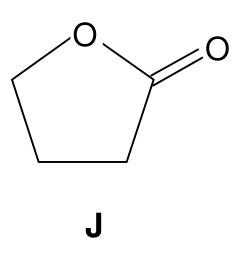
3.2 How can γ-butyrolactone J be converted into 4-hydroxybutanoic acid (K)?
3.3 Convert K into 4-chlorobutanoyl chloride (L).
The reactions described below do not correspond to those used in the industrial synthesis of haloperidol for which the route is quite complex.
Methyl 4-chlorobenzoate is treated with an excess of vinylmagnesium bromide in anhydrous ether. M is obtained after hydrolysis. When M is treated with an excess of hydrogen bromide in anhydrous conditions in the presence of benzoyl peroxide, N is obtained. N reacts with ammonia to form 4-(4-chlorophenyl)-4-hydroxypiperidine (O).
3.4 Write down the structure of M, N and O and indicate the mechanism of the reaction leading to M.
In the presence of a moderate amount of aluminium chloride, L reacts with fluorobenzene to yield mainly a ketone P (\(\ce{C10H10OFCl}\)).
3.5 Sketch the structure of P and indicate the mechanism.
3.6 Give a chemical and physical test method for the determination of the carbonyl group. How can you make sure that the carbonyl group does not belong to an aldehyde group?
P reacts with O in basic media in a 1 : 1 molar ratio to give H that contains only one chlorine atom on the aromatic ring.
3.7 Give the structure of H which is haloperidol.
3.8 State the multiplicity of each resonance in the \(\ce{^1H}\) NMR spectrum of K. Assume that all coupling constants between protons and adjacent carbons are identical.
Official English text of the problem.
Problem 4: Chemical thermodynamics
The production of zinc from zinc sulphide proceeds in two stages: the roasting of zinc sulphide in the air and the reduction of the zinc oxide formed by carbon monoxide. In this problem we will consider the roasting of zinc sulphide.
This operation consists in burning zinc sulphide in the air. The equation of the reaction taking place is as follows:

Industrially this reaction is carried out at 1350 K.
4.1 Show that the reaction can be self-sustaining, i.e. that the heat produced is sufficient to bring the reactants from ambient temperature to the reaction temperature.
Suppose that the zinc containing mineral contains only zinc sulphide, \(\ce{ZnS}\).
4.2 Starting with a stoichiometric mixture of one mole zinc blend only and a necessary quantity of the air at 298 K, calculate the temperature to which the mixture will raise by the heat evolved during the roasting of the mineral at 1350 K under standard pressure. Is the reaction self-sustaining? Air is considered to be a mixture of oxygen and nitrogen in a volume ratio equal to 1 : 4.
In fact, zinc blend is never pure and is always mixed with a gangue that can be assumed to be entirely silica \(\ce{SiO2}\).
4.3 Assuming that the gangue does not react during the roasting, calculate the minimum \(\ce{ZnS}\) content of the mineral for which the reaction would be self-sustaining at 1350 K despite the presence of silica. Give the answer is grams of \(\ce{ZnS}\) per hundred grams of zinc blend.
Data:
Standard molar heat capacities averaged over the temperature range considered (in \(\mathrm{J\,K^{-1}\,mol^{-1}}\)):
\(\ce{ZnS}\) (solid): 58.05 \(\ce{ZnO}\) (solid): 51.64 \(\ce{SO2}\) (gas): 51.10 \(\ce{O2}\) (gas): 34.24 \(\ce{N2}\) (gas): 30.65 \(\ce{SiO2}\) (solid): 72.50 Molar masses (in \(\mathrm{g\,mol^{-1}}\)):
\(\ce{ZnS}\) \(\ce{SiO2}\) 97.5 60.1 Official English text of the problem.
Problem 5: Chemical kinetics
Nitramide \(\ce{NO2NH2}\) decomposes slowly in aqueous solution according to the reaction:

The experimental kinetic law is as follows:
\[ \frac{d[\ce{N2O}]}{dt} =k\frac{[\ce{NO2NH2}]}{[\ce{H3O+}]} \]
5.1 What is the apparent order of this reaction in a buffered solution?
5.2 Which of the following mechanisms is the most appropriate for the interpretation of this kinetic law? Justify your answer.

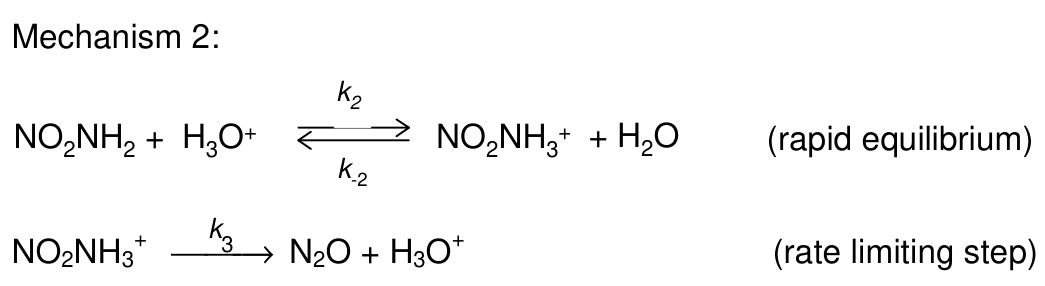
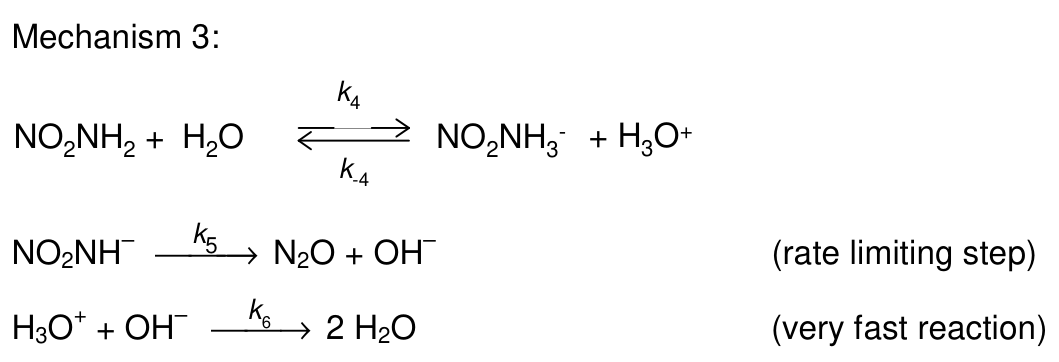
5.3 Show the relationship between the experimentally observed rate constant and the rate constants of the selected mechanism.
5.4 Show that hydroxyl ions catalyze the decomposition of nitramide.
The decomposition is studied in a buffered solution of a constant volume \(V\) at a constant temperature by measuring the partial pressure of the gas \(\ce{N2O}\), considered to be insoluble in water, in a constant volume of the same value \(V\) above the solution. The following results are obtained:
\(t\)(min) 0 5 10 15 20 25 \(p\)(Pa) 0 6800 12400 17200 20800 24000 After a sufficiently long time, the pressure stabilises at 40000 Pa.
5.5 Express the pressure \(p\) as a function of time and the constant \(k'\) such that
\[ k'=\frac{k}{[\ce{H3O+}]}. \]
5.6 Verify graphically that the kinetic law is confirmed by these experimental results.
5.7 Calculate \(k'\) giving its units.
Official English text of the problem.
Problem 6: Bio-organic chemistry
The reaction of dehydrogenation of succinate to fumarate is a one step in the tricarboxylic Krebs cycle, catalysed by the enzyme succinic dehydrogenase. Flavine-adenine-dinucleotide, FAD, acts as a coenzyme. The equation of the process:
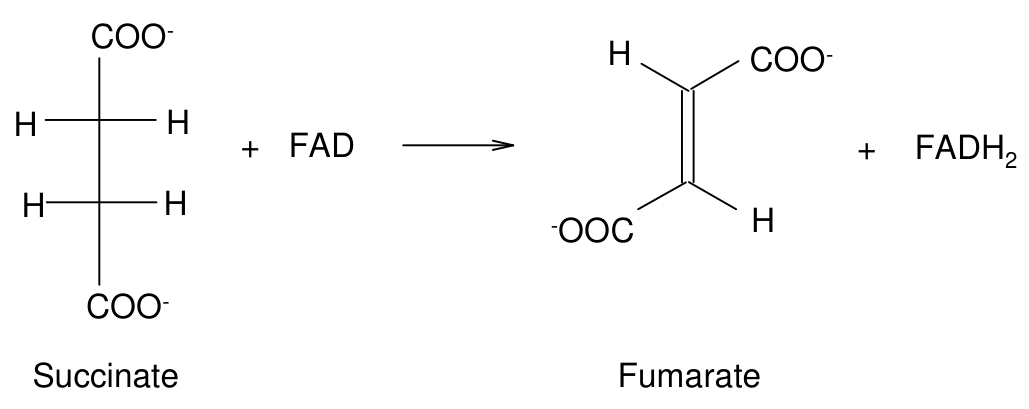
The stereochemistry of the dehydrogenation of succinate to fumarate has been studied. Consider the enzymatic reaction with the 2,3-dideuteriosuccinates related to the acids or obtained by catalytic deuteration (in the presence of palladium on coal) of fumaric and maleic acids.
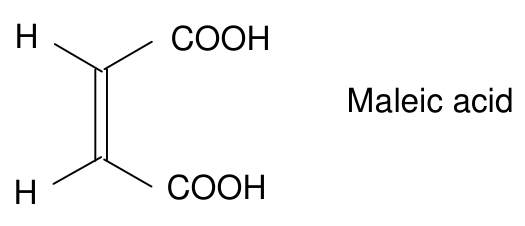
6.1 Using Fischer formulae, write down structures for all the possible stereoisomers obtained by catalytic deuteration of maleic and fumaric acids. How many isomers are there? Indicate those that are optically active. Establish a stereochemical relationship between them (compare the isomers two by two). Using Newman projections show the most stable conformation of each isomer.
The proportion of dideuterated fumarate (obtained when each of the above 2-3 dideuterated succinates is submitted to the enzymatic reaction) is 4 % when using fumaric acid as starting molecule, but 48.5 % when using maleic acid.
It is assumed that at the active site, the enzymatic dehydrogenation occurs on the succinate, in the most stable conformation as proposed in 6.1. The dehydrogenation stereochemistry can be syn or anti.
6.2 On the basis of the Newman projections of the most stable conformations of each isomer and the above facts, determine the percentage of dideuterated fumarate formed by syn and anti dehydrogenation.
(Assume that the percentages of dideuterated fumarate are 0 or 50 %, respectively.)
6.3 Show the stereochemistry of the enzymatic dehydrogenation.
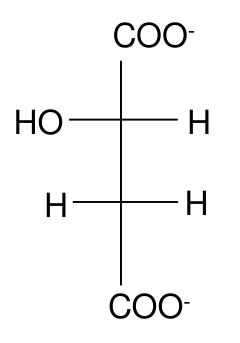
In the following step of the Krebs cycle and in the presence of fumarase enzyme, fumarate adds on a water molecule to yield \((S)\)-malate (also called as L-malate).
Fischer projection of \((S)\)-malate:
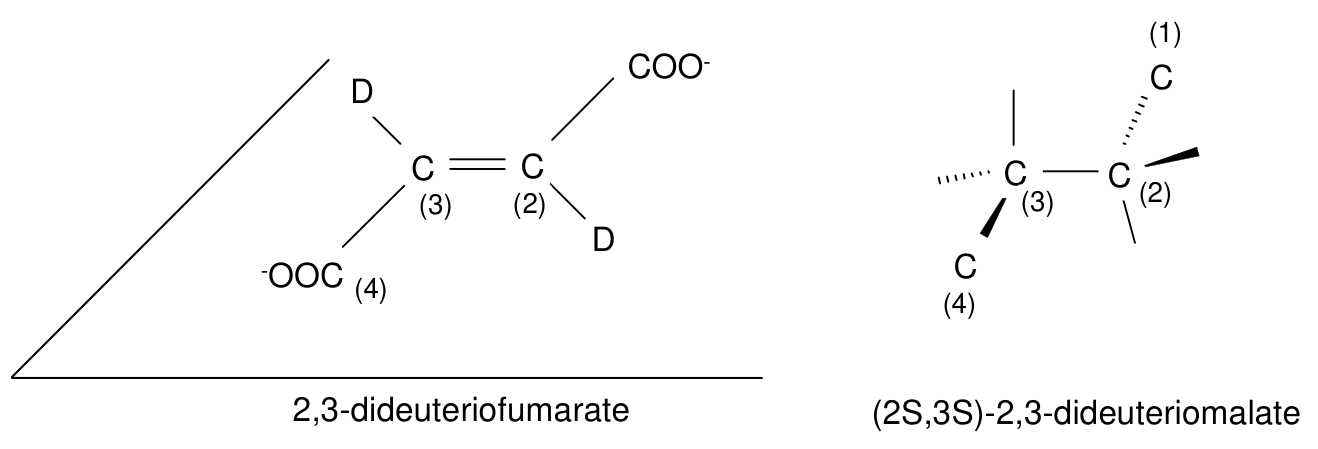
6.4 The 2,3-dideuterofumarate reacts with fumarase to \((2S,3S)\)-2,3-dideuteromalate (through addition of water). Show the stereochemical pathway of the reaction. Use the schematic drawing below to answer this question.
The acetylcoenzyme A, \(\ce{CH3COSCoA}\) reacts with glyoxylate, \(\ce{OHC-CO2-}\), in the presence of malate synthetase enzyme to \((S)\)-malate.
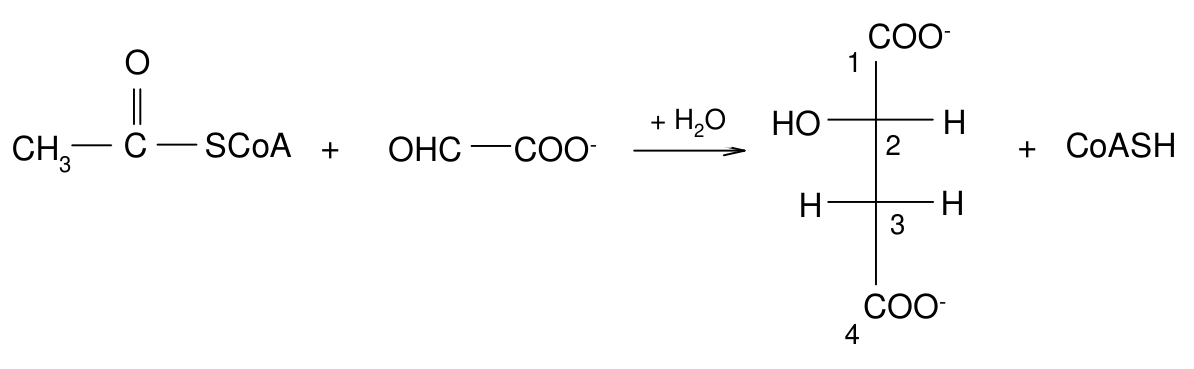
A similar reaction can proceed between an ester \(\ce{CH3COOR'}\) (similar to the thioester \(\ce{CH3COSCoA}\)) and an aldehyde \(\ce{R''CHO}\) (similar to the glyoxylate) in the presence of \(\ce{R'-O-}\) ions. It leads to a β-hydroxyester.
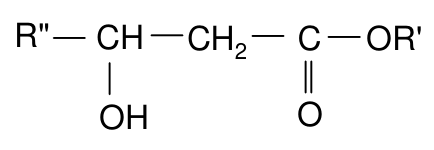
(\(\ce{R'-O-}\) enter the reaction as a base to produce an intermediate carbanion from the ester)
6.5 Write the steps of the mechanism.
The enzymatic reaction is carried out using acetylcoenzyme A which is obtained from acetic acid \(\ce{CHDTCOOH}\) having \(R\)-configuration.
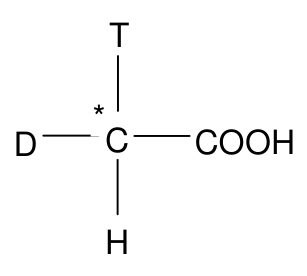
(tritium \(\ce{T} = {}^{3}_{1}\ce{H}\), deuterium \(\ce{D} = {}^{2}_{1}\ce{H}\))
The formed \((S)\)-malate is dehydrated (the reverse reaction of question 6.4) by an enzymatic reaction.
6.6 What enzyme can be used?
The major product is monotritiated fumarate (79%) with 21 % untritiated fumarate.
6.7 Write down the Fischer projections of the two possible structures of the major product \((S)\)-malate arising from the acetylcoenzyme A which has a labelled acetyl group with \(R\)-configuration.
6.8 What would be the products if the starting material has a labelled acetyl group with \(S\)-configuration?
Official English text of the problem.
Problem 7: Hydrogenation of benzene in continuous reactors
In this problem tick the appropriate box in the tables of the answer sheet.
Hydrogenation of benzene to cyclohexane is performed in continuous reactors. The reaction is as follows:

Two basic types of continuous reactors are examined: a continuous plug flow reactor and a continuous stirred reactor.
The continuous plug flow reactor (Fig. 1)
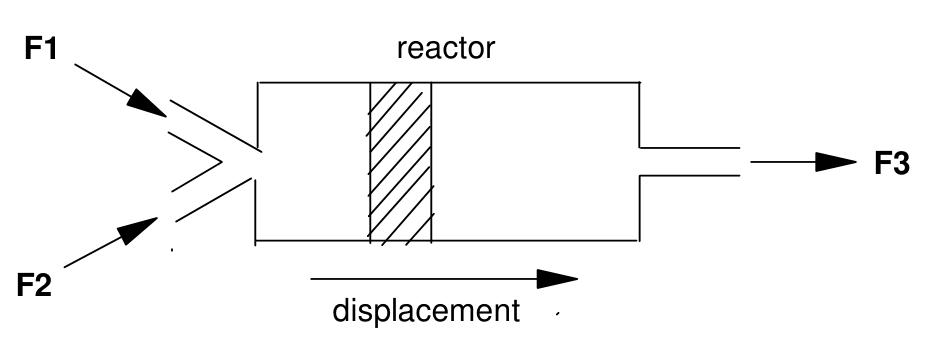
Fig. 1
The reagents are introduced and mixed at the inlet of the reactor (flow F1 and F2). Each slice of the reaction medium (marked zone in the diagram) moves along inside the plug flow reactor without mixing with the others and exits from the reactor (flow F3). When the flow has stabilized, concentrations and conditions are time-independent but dependent on the location in the reactor.
The continuous stirred reactor (Fig. 2)
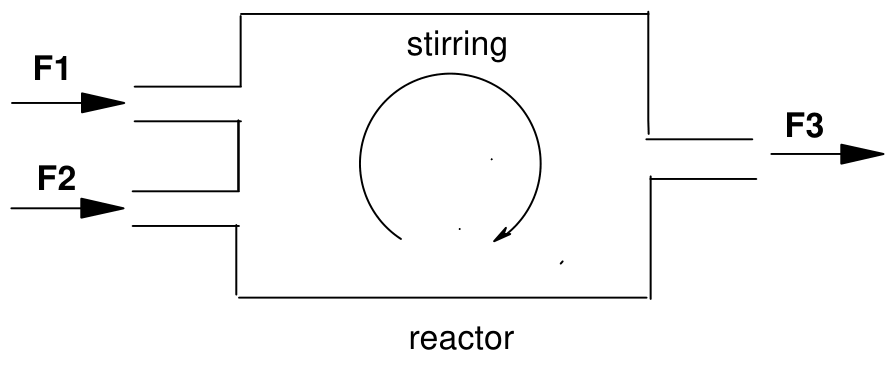
Fig. 2
The reagents are introduced into the reactor (flows F1 and F2). Inside the reactor they are stirred perfectly and instantaneously. When the flow is stabilized, concentrations and conditions are time-independent and identical at every point of the reactor.
The differential yield of hydrogenation (\(Y\)) is given by \[ Y=-\frac{\mathrm{d}([\ce{C6H12}])}{\mathrm{d}([\ce{C6H6}])}. \]
The proportion of benzene already hydrogenated is given by \[ p=\frac{[\ce{C6H12}]}{[\ce{C6H12}]+[\ce{C6H6}]}. \]
The relationship between \(p\) and \(Y\) is shown in Fig. 3.
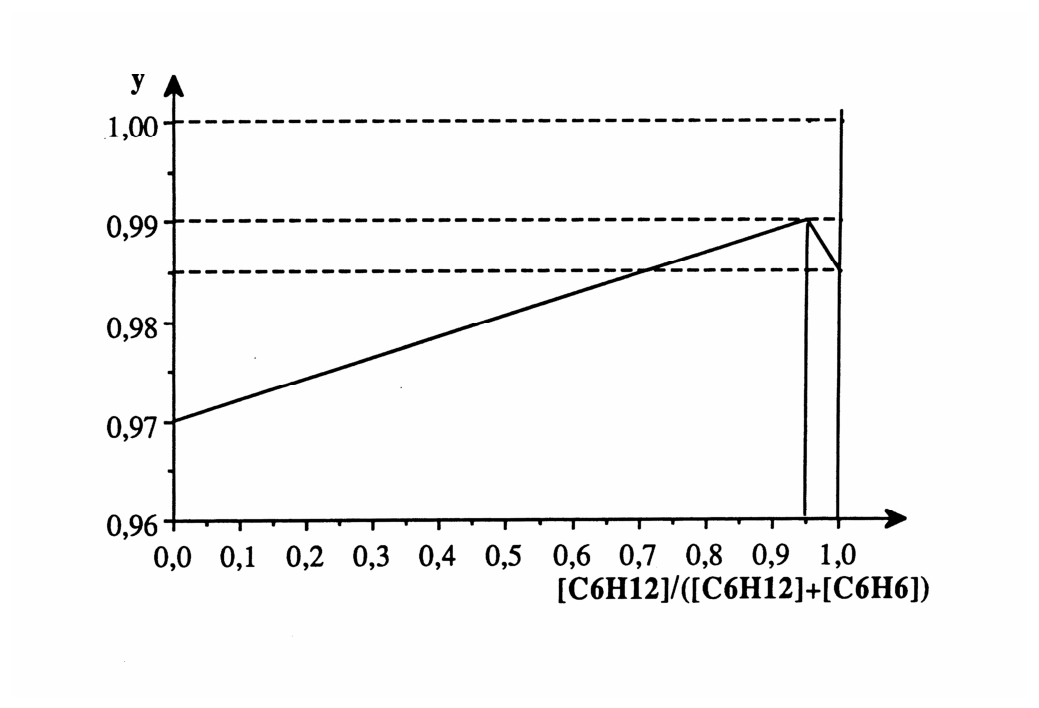
Fig. 3
The aim is to hydrogenate almost all the benzene, i.e. \(0.9\le p\le1\) with the best mean yield \[ Y=-\frac{\Delta[\ce{C6H12}]}{\Delta[\ce{C6H6}]}. \]
7.1 What is the value of \(p\) in a continuous stirred reactor leading to the maximal mean yield of hydrogenation? What is the maximal value of \(Y\)?
7.2 For a continuous plug flow reactor, give a rough value of \(Y\) for \(0.9\le p\le1\):
\(Y=0.97,\ 0.98,\ 0.99\) or \(1.00\) ?
7.3 Represent by grey shading in the graph (Fig. 3) the quantities of benzene lost in installation P (plug flow reactor) and installation MP (stirred reactor + plug flow reactor).
7.4 Give the amount of annual benzene lost in installation P and MP assuming an annual consumption of 100 000 tons of benzene.
Official English text of the problem.
Internationale Chemie-Olympiade
IChO 1990
Paris, Frankreich · 7 Theorieaufgaben mit vollständigen Lösungen
Aufgabe 1: Phosphorsäure
Das Element Phosphor kommt in der Natur als Phosphat im komplex zusammengesetzten Mineral Apatit vor. Dieses Mineral enthält neben Phosphat Siliciumdioxid und die folgenden Ionen: \(\ce{Ca^2+}\), \(\ce{CO3^2-}\), \(\ce{SO4^2-}\), \(\ce{SiO3^2-}\) und \(\ce{F^-}\).
Wir nehmen an, dass dieses Mineral ein Gemisch aus Tricalciumphosphat, \(\ce{Ca3(PO4)2}\), Calciumsulfat, Calciumfluorid, Calciumcarbonat und Siliciumdioxid ist.
Zur Verwendung als Düngemittel wird das wasserlösliche Calciumbis(dihydrogenphosphat), \(\ce{Ca(H2PO4)2}\), hergestellt. Dazu wird Apatit mit einem Gemisch aus Phosphorsäure und Schwefelsäure behandelt. Gleichzeitig wird bei diesem Vorgang der größte Teil der Verunreinigungen entfernt.
Die Elementaranalyse eines Apatits ergab die folgenden Ergebnisse, wobei die elementare Zusammensetzung mit Ausnahme von Fluor so angegeben wird, als lägen die Elemente in Form ihrer Oxide vor:
\(\ce{CaO}\) \(\ce{P2O5}\) \(\ce{SiO2}\) \(\ce{F}\) \(\ce{SO3}\) \(\ce{CO2}\) Massenanteil in % 47.3 28.4 3.4 3.4 3.5 6.1 Arbeitsgang 1 - Eine Probe dieses Minerals mit der Masse \(m_0\) wird mit \(50.0\ \mathrm{cm^3}\) einer Lösung behandelt, die \(0.500\ \mathrm{mol\,dm^{-3}}\) Phosphorsäure und \(0.100\ \mathrm{mol\,dm^{-3}}\) Schwefelsäure enthält. Das Gemisch wird durch Erhitzen auf etwa \(70\,^\circ\mathrm C\) vollständig entwässert, wobei ein Temperaturanstieg über \(90\,^\circ\mathrm C\) vermieden wird. Dieser Arbeitsgang wird unter dem Abzug durchgeführt, da giftige gasförmige Stoffe freigesetzt werden. Der trockene Rückstand wird gemahlen und gewogen; \(m_1\) ist die Masse des erhaltenen Rückstands.
Unter diesen Bedingungen wird nur Dihydrogenphosphat, \(\ce{Ca(H2PO4)2}\), gebildet, während Siliciumdioxid und Silicat nicht reagieren.
Arbeitsgang 2 - \(1.00\ \mathrm g\) dieses Rückstands wird bei \(40\,^\circ\mathrm C\) mit \(50.0\ \mathrm{cm^3}\) Wasser behandelt, anschließend wird filtriert und der Rückstand getrocknet und gewogen. Die Masse des erhaltenen Rückstands beträgt \(m_2\). Dieser neue Rückstand enthält hauptsächlich Gips, \(\ce{CaSO4.2H2O}\), dessen Löslichkeit zwischen \(20\,^\circ\mathrm C\) und \(50\,^\circ\mathrm C\) als konstant angesehen werden kann und \(2.3\ \mathrm{g\,dm^{-3}}\) beträgt.
1.1 Stellen Sie die ausgeglichenen Gleichungen für die ablaufenden Reaktionen auf.
1.2 Von welcher Masse Apatit sollte man ausgehen, wenn alle Reaktionen stöchiometrisch ablaufen?
Ausgehend von \(m_0\) des vorliegenden Apatits erhält man \(m_1=5.49\ \mathrm g\) Rückstand.
1.3 Welche Masse sollte theoretisch erhalten werden?
1.4 Dieses Ergebnis ist auf die Anwesenheit von Produkten zurückzuführen, die im Rückstand nicht erwartet werden. Geben Sie zwei davon an, die unter diesen Versuchsbedingungen die Daten plausibel erklären können.
In der Industrie werden die Analyse und die Ausbeute traditionell als prozentualer Oxidanteil angegeben. Der Phosphorgehalt wird so ausgedrückt, als läge er als \(\ce{P2O5}\) vor.
Wenn \(n_2\) die Stoffmenge eines erhaltenen löslichen Produkts, \(n_1\) die Stoffmenge eines als Säure zugesetzten Stoffes und \(n_0\) die Stoffmenge des zugesetzten Apatits ist, beträgt die Ausbeute:
\[ r_{\mathrm{exp}}=\frac{n_2}{n_1+n_0}\,100 \]
Auf dem Filter erhält man \(m_2=0.144\ \mathrm g\) Rückstand.
1.5 Berechnen Sie \(r_{\mathrm{exp}}\).
1.6 Die experimentelle Ausbeute liegt über \(100\%\). Berechnen Sie einen Wert für \(r\), der der tatsächlichen Ausbeute näher kommt.
Relative Atommassen von P: 31; Ca: 40; O: 16; H: 1; F: 19; C: 12; Si: 28; S: 32.
Werte von \(pK\): \[ \frac{\ce{HSO4^-}}{\ce{SO4^2-}}=2 \qquad \frac{\ce{HF}}{\ce{F^-}}=3 \qquad \frac{\ce{H3PO4}}{\ce{H2PO4^-}}=2 \qquad \frac{\ce{H2PO4^-}}{\ce{HPO4^2-}}=7 \qquad \frac{\ce{HPO4^2-}}{\ce{PO4^3-}}=12 \]
Aufgabentext aus dem offiziellen englischen Text übersetzt.
Aufgabe 2: Ionenlösungen - wässrige Lösungen von Kupfersalzen
Dieser Teil behandelt die Acidität des hydratisierten \(\ce{Cu^2+}\)-Ions und die Fällung des Hydroxids.
Betrachten Sie eine \(1.00\times10^{-2}\ \mathrm{mol\,dm^{-3}}\) Kupfer(II)-nitrat-Lösung. Der \(\mathrm{pH}\)-Wert dieser Lösung beträgt 4.65.
2.1 Geben Sie die Gleichung für die Bildung der konjugierten Base des hydratisierten \(\ce{Cu^2+}\)-Ions an.
2.2 Berechnen Sie den \(pK_a\)-Wert des entsprechenden Säure-Base-Paares.
Das Löslichkeitsprodukt von Kupfer(II)-hydroxid beträgt \(K_{sp}=1\times10^{-20}\).
2.3 Bei welchem \(\mathrm{pH}\)-Wert fällt das Hydroxid \(\ce{Cu(OH)2}\) aus der betrachteten Lösung aus? Begründen Sie Ihre Berechnung, indem Sie zeigen, dass die konjugierte Base dieses hydratisierten \(\ce{Cu^2+}\)-Ions in vernachlässigbarer Menge vorliegt.
Disproportionierung von Kupfer(I)-Ionen
Das \(\ce{Cu+}\)-Ion ist an zwei Redoxpaaren beteiligt:
Standardelektrodenpotential \(E_1^0=+\,0.52\ \mathrm{V}\)
Standardelektrodenpotential \(E_2^0=+\,0.16\ \mathrm{V}\)
2.4 Schreiben Sie die Gleichung für die Disproportionierung von Kupfer(I)-Ionen auf und berechnen Sie die entsprechende Gleichgewichtskonstante.
2.5 Berechnen Sie die Zusammensetzung der Lösung (in \(\mathrm{mol\,dm^{-3}}\)), die beim Auflösen von \(1.00\times10^{-2}\ \mathrm{mol}\) Kupfer(I) in \(1.0\ \mathrm{dm^3}\) Wasser entsteht.
2.6 Nennen Sie außer \(\ce{Cu+}\)-Ionen zwei chemische Spezies, die ebenfalls in wässriger Lösung disproportionieren; schreiben Sie die Gleichungen auf und beschreiben Sie die Versuchsbedingungen, unter denen die Disproportionierung beobachtet wird.
Betrachten Sie die Stabilität von Kupfer(I)-oxid, \(\ce{Cu2O}\), in Kontakt mit einer \(1.00\times10^{-2}\ \mathrm{mol\,dm^{-3}}\) Lösung von \(\ce{Cu^2+}\)-Ionen. Das Löslichkeitsprodukt von Kupfer(I)-oxid beträgt \(K_{sp}=[\ce{Cu+}][\ce{OH-}]=1\times10^{-15}\)
2.7 Berechnen Sie den \(\mathrm{pH}\)-Wert, bei dem \(\ce{Cu2O}\) stabil wird. Nennen Sie einen einfachen Versuch, mit dem sich die Fällung von \(\ce{Cu2O}\) beobachten lässt.
Komplexbildung mit \(\ce{Cu+}\)- und \(\ce{Cu^2+}\)-Ionen
2.8 Die Dissoziationskonstante des Komplexions \(\ce{[Cu(NH3)2]+}\) beträgt \(K_D=1\times10^{-11}\). Berechnen Sie das Standardelektrodenpotential des Redoxpaares:
2.9 Das Standardelektrodenpotential des Redoxpaares
beträgt \(E_3^0=-\,0{,}02\ \mathrm{V}\).
Berechnen Sie die Dissoziationskonstante des Komplexions \(\ce{[Cu(NH3)4]^2+}\).
2.10 Leiten Sie daraus das Standardelektrodenpotential des Redoxpaares ab:
Findet eine Disproportionierung des Kations \(\ce{[Cu(NH3)2]+}\) statt?
Aufgabentext aus dem offiziellen englischen Text übersetzt.
Aufgabe 3: Organische Synthese - Synthese von Haloperidol
Haloperidol ist ein stark wirksames Neuroleptikum, das bei psychomotorischen Störungen und zur Behandlung verschiedener Psychosen verschrieben wird. Eine Synthese dieser Verbindung wird vorgeschlagen.
3.1 Geben Sie ein Schema zur Herstellung von 4-Chlorbenzoesäuremethylester ausgehend von Benzol und allen erforderlichen anorganischen Substanzen an. Diazomethan (\(\ce{H2CN2}\)) muss in Ihrer Synthese verwendet werden.
γ-Butyrolacton (J) ist ein cyclischer Ester, der nachstehend dargestellt ist.
3.2 Wie lässt sich γ-Butyrolacton J in 4-Hydroxybutansäure (K) umwandeln?
3.3 Wandeln Sie K in 4-Chlorbutanoylchlorid (L) um.
Die nachstehend beschriebenen Reaktionen entsprechen nicht denjenigen, die bei der industriellen Synthese von Haloperidol verwendet werden; deren Syntheseweg ist recht komplex.
4-Chlorbenzoesäuremethylester wird mit einem Überschuss an Vinylmagnesiumbromid in wasserfreiem Ether behandelt. Nach der Hydrolyse wird M erhalten. Wird M unter wasserfreien Bedingungen in Gegenwart von Benzoylperoxid mit einem Überschuss an Bromwasserstoff behandelt, so erhält man N. N reagiert mit Ammoniak unter Bildung von 4-(4-Chlorphenyl)-4-hydroxypiperidin (O).
3.4 Geben Sie die Strukturen von M, N und O an und erläutern Sie den Mechanismus der Reaktion, die zu M führt.
In Gegenwart einer mäßigen Menge Aluminiumchlorid reagiert L mit Fluorbenzol und liefert hauptsächlich ein Keton P (\(\ce{C10H10OFCl}\)).
3.5 Zeichnen Sie die Struktur von P und geben Sie den Mechanismus an.
3.6 Geben Sie eine chemische und eine physikalische Nachweismethode für die Carbonylgruppe an. Wie können Sie sicherstellen, dass die Carbonylgruppe nicht zu einer Aldehydgruppe gehört?
P reagiert mit O in basischem Medium im Stoffmengenverhältnis 1 : 1 zu H, das nur ein Chloratom am aromatischen Ring enthält.
3.7 Geben Sie die Struktur von H an, bei dem es sich um Haloperidol handelt.
3.8 Geben Sie die Multiplizität jeder Resonanz im \(\ce{^1H}\)-NMR-Spektrum von K an. Nehmen Sie an, dass alle Kopplungskonstanten zwischen Protonen an benachbarten Kohlenstoffatomen identisch sind.
Aufgabentext aus dem offiziellen englischen Text übersetzt.
Aufgabe 4: Chemische Thermodynamik
Die Gewinnung von Zink aus Zinksulfid erfolgt in zwei Stufen: dem Rösten von Zinksulfid an der Luft und der Reduktion des dabei gebildeten Zinkoxids durch Kohlenstoffmonoxid. In dieser Aufgabe betrachten wir das Rösten von Zinksulfid.
Bei diesem Verfahren wird Zinksulfid an der Luft verbrannt. Die Gleichung der dabei ablaufenden Reaktion lautet wie folgt:
Industriell wird diese Reaktion bei 1350 K durchgeführt.
4.1 Zeigen Sie, dass die Reaktion selbstunterhaltend sein kann, d. h., dass die erzeugte Wärme ausreicht, um die Edukte von der Umgebungstemperatur auf die Reaktionstemperatur zu bringen.
Nehmen Sie an, dass das zinkhaltige Mineral ausschließlich Zinksulfid, \(\ce{ZnS}\), enthält.
4.2 Berechnen Sie ausgehend von einem stöchiometrischen Gemisch aus einem Mol reiner Zinkblende und der erforderlichen Luftmenge bei 298 K die Temperatur, auf die sich das Gemisch durch die beim Rösten des Minerals bei 1350 K unter Standarddruck freigesetzte Wärme erwärmt. Ist die Reaktion selbstunterhaltend? Luft wird als Gemisch aus Sauerstoff und Stickstoff im Volumenverhältnis 1 : 4 betrachtet.
Tatsächlich ist Zinkblende niemals rein, sondern stets mit einer Gangart vermischt, von der angenommen werden kann, dass sie vollständig aus Siliciumdioxid \(\ce{SiO2}\) besteht.
4.3 Berechnen Sie unter der Annahme, dass die Gangart während des Röstens nicht reagiert, den Mindestgehalt des Minerals an \(\ce{ZnS}\), bei dem die Reaktion trotz der Anwesenheit von Siliciumdioxid bei 1350 K selbstunterhaltend wäre. Geben Sie die Antwort in Gramm \(\ce{ZnS}\) pro hundert Gramm Zinkblende an.
Daten:
Über den betrachteten Temperaturbereich gemittelte molare Standardwärmekapazitäten (in \(\mathrm{J\,K^{-1}\,mol^{-1}}\)):
\(\ce{ZnS}\) (fest): 58.05 \(\ce{ZnO}\) (fest): 51.64 \(\ce{SO2}\) (gasförmig): 51.10 \(\ce{O2}\) (gasförmig): 34.24 \(\ce{N2}\) (gasförmig): 30.65 \(\ce{SiO2}\) (fest): 72.50 Molare Massen (in \(\mathrm{g\,mol^{-1}}\)):
\(\ce{ZnS}\) \(\ce{SiO2}\) 97.5 60.1 Aufgabentext aus dem offiziellen englischen Text übersetzt.
Aufgabe 5: Chemische Kinetik
Nitramid \(\ce{NO2NH2}\) zersetzt sich in wässriger Lösung langsam gemäß der Reaktion:
Das experimentell ermittelte Geschwindigkeitsgesetz lautet:
\[ \frac{d[\ce{N2O}]}{dt} =k\frac{[\ce{NO2NH2}]}{[\ce{H3O+}]} \]
5.1 Welche scheinbare Ordnung hat diese Reaktion in einer gepufferten Lösung?
5.2 Welcher der folgenden Mechanismen eignet sich am besten zur Erklärung dieses Geschwindigkeitsgesetzes? Begründen Sie Ihre Antwort.
5.3 Zeigen Sie den Zusammenhang zwischen der experimentell beobachteten Geschwindigkeitskonstante und den Geschwindigkeitskonstanten des gewählten Mechanismus auf.
5.4 Zeigen Sie, dass Hydroxidionen die Zersetzung von Nitramid katalysieren.
Die Zersetzung wird in einer gepufferten Lösung mit konstantem Volumen \(V\) bei konstanter Temperatur untersucht, indem der Partialdruck des Gases \(\ce{N2O}\), das als in Wasser unlöslich betrachtet wird, in einem konstanten Gasvolumen desselben Wertes \(V\) über der Lösung gemessen wird. Dabei werden folgende Ergebnisse erhalten:
\(t\)(min) 0 5 10 15 20 25 \(p\)(Pa) 0 6800 12400 17200 20800 24000 Nach hinreichend langer Zeit stabilisiert sich der Druck bei 40000 Pa.
5.5 Drücken Sie den Druck \(p\) als Funktion der Zeit und der Konstante \(k'\) aus, wobei
\[ k'=\frac{k}{[\ce{H3O+}]}. \]
5.6 Überprüfen Sie grafisch, dass diese experimentellen Ergebnisse das Geschwindigkeitsgesetz bestätigen.
5.7 Berechnen Sie \(k'\) und geben Sie die Einheiten an.
Aufgabentext aus dem offiziellen englischen Text übersetzt.
Aufgabe 6: Bioorganische Chemie
Die Dehydrierung von Succinat zu Fumarat ist ein Schritt im Tricarbonsäurezyklus nach Krebs, der durch das Enzym Succinatdehydrogenase katalysiert wird. Flavin-Adenin-Dinukleotid, FAD, wirkt dabei als Coenzym. Die Reaktionsgleichung lautet:
Die Stereochemie der Dehydrierung von Succinat zu Fumarat wurde untersucht. Betrachten Sie die enzymatische Reaktion mit den 2,3-Dideuteriosuccinaten, die den Säuren entsprechen, die durch katalytische Deuterierung (in Gegenwart von Palladium auf Kohle) von Fumar- und Maleinsäure erhalten werden.
6.1 Zeichnen Sie mithilfe von Fischer-Projektionen die Strukturen aller möglichen Stereoisomere, die durch katalytische Deuterierung von Malein- und Fumarsäure erhalten werden. Wie viele Isomere gibt es? Geben Sie an, welche davon optisch aktiv sind. Bestimmen Sie die stereochemischen Beziehungen zwischen ihnen (vergleichen Sie die Isomere paarweise). Zeigen Sie mithilfe von Newman-Projektionen die stabilste Konformation jedes Isomers.
Der Anteil an dideuteriertem Fumarat (das entsteht, wenn jedes der oben genannten 2,3-dideuterierten Succinate der enzymatischen Reaktion unterzogen wird) beträgt 4 %, wenn Fumarsäure als Ausgangsmolekül verwendet wird, dagegen 48.5 %, wenn Maleinsäure verwendet wird.
Es wird angenommen, dass die enzymatische Dehydrierung am aktiven Zentrum am Succinat in der unter 6.1 vorgeschlagenen stabilsten Konformation erfolgt. Die Dehydrierung kann stereochemisch syn oder anti verlaufen.
6.2 Bestimmen Sie anhand der Newman-Projektionen der stabilsten Konformationen jedes Isomers und der oben genannten Befunde den prozentualen Anteil an dideuteriertem Fumarat, das durch syn- bzw. anti-Dehydrierung gebildet wird.
(Nehmen Sie an, dass die Anteile an dideuteriertem Fumarat jeweils 0 oder 50 % betragen.)
6.3 Zeigen Sie die Stereochemie der enzymatischen Dehydrierung.
Im folgenden Schritt des Krebs-Zyklus addiert Fumarat in Gegenwart des Enzyms Fumarase ein Wassermolekül unter Bildung von \((S)\)-Malat (auch als L-Malat bezeichnet).
Fischer-Projektion von \((S)\)-Malat:
6.4 2,3-Dideuteriofumarat reagiert mit Fumarase zu \((2S,3S)\)-2,3-Dideuteriomalat (durch Addition von Wasser). Zeigen Sie den stereochemischen Verlauf der Reaktion. Verwenden Sie zur Beantwortung dieser Frage die folgende schematische Zeichnung.
Acetylcoenzym A, \(\ce{CH3COSCoA}\), reagiert mit Glyoxylat, \(\ce{OHC-CO2-}\), in Gegenwart des Enzyms Malatsynthase zu \((S)\)-Malat.
Eine ähnliche Reaktion kann zwischen einem Ester \(\ce{CH3COOR'}\) (analog zum Thioester \(\ce{CH3COSCoA}\)) und einem Aldehyd \(\ce{R''CHO}\) (analog zum Glyoxylat) in Gegenwart von \(\ce{R'-O-}\)-Ionen ablaufen. Sie führt zu einem β-Hydroxyester.
(\(\ce{R'-O-}\) wirkt in der Reaktion als Base, die aus dem Ester ein intermediäres Carbanion erzeugt.)
6.5 Schreiben Sie die Schritte des Mechanismus auf.
Die enzymatische Reaktion wird mit Acetylcoenzym A durchgeführt, das aus Essigsäure \(\ce{CHDTCOOH}\) mit \(R\)-Konfiguration gewonnen wird.
(Tritium \(\ce{T} = {}^{3}_{1}\ce{H}\), Deuterium \(\ce{D} = {}^{2}_{1}\ce{H}\))
Das gebildete \((S)\)-Malat wird durch eine enzymatische Reaktion dehydratisiert (die Umkehrreaktion zu Frage 6.4).
6.6 Welches Enzym kann verwendet werden?
Das Hauptprodukt ist monotritiiertes Fumarat (79%), daneben entstehen 21 % nicht tritiiertes Fumarat.
6.7 Zeichnen Sie die Fischer-Projektionen der beiden möglichen Strukturen des Hauptprodukts \((S)\)-Malat, das aus Acetylcoenzym A mit einer markierten Acetylgruppe in \(R\)-Konfiguration entsteht.
6.8 Welche Produkte würden entstehen, wenn das Ausgangsmaterial eine markierte Acetylgruppe in \(S\)-Konfiguration hätte?
Aufgabentext aus dem offiziellen englischen Text übersetzt.
Aufgabe 7: Hydrierung von Benzol in kontinuierlich betriebenen Reaktoren
Kreuzen Sie bei dieser Aufgabe das entsprechende Kästchen in den Tabellen des Antwortbogens an.
Die Hydrierung von Benzol zu Cyclohexan wird in kontinuierlich betriebenen Reaktoren durchgeführt. Die Reaktion lautet wie folgt:
Zwei grundlegende Typen kontinuierlich betriebener Reaktoren werden untersucht: ein kontinuierlicher Rohrreaktor mit Pfropfenströmung und ein kontinuierlicher Rührkesselreaktor.
Der kontinuierliche Rohrreaktor mit Pfropfenströmung (Abb. 1)
Abb. 1
Die Reaktanten werden am Einlass des Reaktors zugeführt und gemischt (Ströme F1 und F2). Jede Schicht des Reaktionsmediums (markierter Bereich in der Abbildung) bewegt sich durch den Rohrreaktor, ohne sich mit den anderen Schichten zu vermischen, und verlässt den Reaktor (Strom F3). Sobald sich ein stationärer Strömungszustand eingestellt hat, sind die Konzentrationen und Bedingungen zeitunabhängig, hängen jedoch vom Ort im Reaktor ab.
Der kontinuierliche Rührkesselreaktor (Abb. 2)
Abb. 2
Die Reaktanten werden dem Reaktor zugeführt (Ströme F1 und F2). Im Reaktor werden sie augenblicklich und vollständig durchmischt. Sobald sich ein stationärer Strömungszustand eingestellt hat, sind die Konzentrationen und Bedingungen zeitunabhängig und an jedem Ort im Reaktor gleich.
Die differentielle Ausbeute der Hydrierung (\(Y\)) ist gegeben durch \[ Y=-\frac{\mathrm{d}([\ce{C6H12}])}{\mathrm{d}([\ce{C6H6}])}. \]
Der Anteil des bereits hydrierten Benzols ist gegeben durch \[ p=\frac{[\ce{C6H12}]}{[\ce{C6H12}]+[\ce{C6H6}]}. \]
Der Zusammenhang zwischen \(p\) und \(Y\) ist in Abb. 3 dargestellt.
Abb. 3
Ziel ist es, nahezu das gesamte Benzol zu hydrieren, d. h. \(0.9\le p\le1\), und dabei die bestmögliche mittlere Ausbeute zu erzielen: \[ Y=-\frac{\Delta[\ce{C6H12}]}{\Delta[\ce{C6H6}]}. \]
7.1 Bei welchem Wert von \(p\) erreicht ein kontinuierlicher Rührkesselreaktor die maximale mittlere Ausbeute der Hydrierung? Wie groß ist der maximale Wert von \(Y\)?
7.2 Geben Sie für einen kontinuierlichen Rohrreaktor mit Pfropfenströmung einen ungefähren Wert von \(Y\) für \(0.9\le p\le1\) an:
\(Y=0.97,\ 0.98,\ 0.99\) oder \(1.00\) ?
7.3 Stellen Sie im Diagramm (Abb. 3) durch graue Schattierung die Benzolmengen dar, die in Anlage P (Rohrreaktor mit Pfropfenströmung) und Anlage MP (Rührkesselreaktor + Rohrreaktor mit Pfropfenströmung) verloren gehen.
7.4 Geben Sie die jährlichen Benzolverluste in den Anlagen P und MP bei einem angenommenen jährlichen Verbrauch von 100 000 Tonnen Benzol an.
Aufgabentext aus dem offiziellen englischen Text übersetzt.
Uluslararası Kimya Olimpiyatı
IChO 1990
Paris, Fransa · 7 teori sorusu, tam çözümleriyle
Soru 1: Fosforik asit
Fosfor elementi doğada, karmaşık bir mineral olan apatitte fosfat hâlinde bulunur. Bu mineral, fosfatın yanı sıra silika ve şu iyonları içerir: \(\ce{Ca^2+}\), \(\ce{CO3^2-}\), \(\ce{SO4^2-}\), \(\ce{SiO3^2-}\) ve \(\ce{F^-}\).
Bu mineralin trikalsiyum fosfat, \(\ce{Ca3(PO4)2}\), kalsiyum sülfat, kalsiyum florür, kalsiyum karbonat ve silika karışımı olduğunu varsayalım.
Gübre olarak kullanılmak üzere suda çözünen kalsiyum bis(dihidrojenfosfat), \(\ce{Ca(H2PO4)2}\), hazırlanmıştır. Bu amaçla apatit, fosforik asit ve sülfürik asit karışımıyla işleme tabi tutulur. Bu işlem aynı zamanda safsızlıkların büyük bölümünü giderir.
Bir apatit örneğinin element analizi aşağıdaki sonuçları vermiştir; bu sonuçlarda flor dışındaki elementlerin bileşimi, elementler oksitleri hâlindeymiş gibi ifade edilmiştir:
\(\ce{CaO}\) \(\ce{P2O5}\) \(\ce{SiO2}\) \(\ce{F}\) \(\ce{SO3}\) \(\ce{CO2}\) Kütlece % 47.3 28.4 3.4 3.4 3.5 6.1 İşlem 1 - Bu mineralin \(m_0\) kütleli bir örneği, \(0.500\ \mathrm{mol\,dm^{-3}}\) fosforik asit ve \(0.100\ \mathrm{mol\,dm^{-3}}\) sülfürik asit içeren bir çözeltinin \(50.0\ \mathrm{cm^3}\)'ü ile işleme tabi tutulur. Karışım, sıcaklığın \(90\,^\circ\mathrm C\)'nin üzerine çıkması önlenerek yaklaşık \(70\,^\circ\mathrm C\)'ye kadar ısıtılıp tamamen susuzlaştırılır. Zehirli gazlar açığa çıktığından bu işlem çeker ocakta gerçekleştirilir. Kuru kalıntı öğütülür ve tartılır; elde edilen kalıntının kütlesi \(m_1\)'dir.
Bu koşullarda yalnızca dihidrojenfosfat, \(\ce{Ca(H2PO4)2}\), oluşurken silika ve silikat tepkimeye girmez.
İşlem 2 - Bu kalıntının \(1.00\ \mathrm g\)'ı, \(40\,^\circ\mathrm C\)'de \(50.0\ \mathrm{cm^3}\) su ile işleme tabi tutulur; ardından süzülür, kurutulur ve tartılır. Elde edilen kalıntının kütlesi \(m_2\)'dir. Bu yeni kalıntı esas olarak jips, \(\ce{CaSO4.2H2O}\), içerir; jipsin çözünürlüğü \(20\,^\circ\mathrm C\) ile \(50\,^\circ\mathrm C\) arasında sabit kabul edilebilir ve \(2.3\ \mathrm{g\,dm^{-3}}\)'e eşittir.
1.1 Gerçekleşen tepkimelerin denkleştirilmiş denklemlerini yazınız.
1.2 Tüm tepkimeler stokiyometrik olarak gerçekleşiyorsa başlangıçta ne kadar apatit alınmalıdır?
Elde edilen apatitin \(m_0\) kütlesiyle başlandığında, \(m_1=5.49\ \mathrm g\) kalıntı elde edilmektedir.
1.3 Teorik olarak hangi kütle elde edilmelidir?
1.4 Bu sonuç, kalıntıda bulunması beklenmeyen ürünlerin varlığından kaynaklanmaktadır. Bu deney koşullarında verileri makul biçimde açıklayabilecek bu tür iki ürün belirtiniz.
Sanayide geleneksel olarak analiz ve verim, oksit yüzdesi olarak ifade edilir. Fosfor içeriği, \(\ce{P2O5}\) hâlindeymiş gibi ifade edilir.
\(n_2\) elde edilen çözünür ürünün madde miktarı, \(n_1\) asit olarak eklenen maddenin madde miktarı ve \(n_0\) eklenen apatitin madde miktarı ise verim şöyledir:
\[ r_{\mathrm{exp}}=\frac{n_2}{n_1+n_0}\,100 \]
Filtre üzerinde \(m_2=0.144\ \mathrm g\) kalıntı elde edilir.
1.5 \(r_{\mathrm{exp}}\)'yi hesaplayınız.
1.6 Deneysel verim \(100\%\)'ün üzerindedir. Gerçek verime daha yakın bir \(r\) değeri hesaplayınız.
Bağıl atom kütleleri: P: 31; Ca: 40; O: 16; H: 1; F: 19; C: 12; Si: 28; S: 32.
\(pK\) değerleri: \[ \frac{\ce{HSO4^-}}{\ce{SO4^2-}}=2 \qquad \frac{\ce{HF}}{\ce{F^-}}=3 \qquad \frac{\ce{H3PO4}}{\ce{H2PO4^-}}=2 \qquad \frac{\ce{H2PO4^-}}{\ce{HPO4^2-}}=7 \qquad \frac{\ce{HPO4^2-}}{\ce{PO4^3-}}=12 \]
Soru metni resmi İngilizce metinden çevrilmiştir.
Soru 2: İyonik çözeltiler - bakır tuzlarının sulu çözeltileri
Bu bölüm, hidratlanmış \(\ce{Cu^2+}\) iyonunun asitliği ve hidroksidin çökelmesiyle ilgilidir.
\(1.00\times10^{-2}\ \mathrm{mol\,dm^{-3}}\) derişiminde bir bakır(II) nitrat çözeltisini ele alınız. Bu çözeltinin \(\mathrm{pH}\) değeri 4.65'tir.
2.1 Hidratlanmış \(\ce{Cu^2+}\) iyonunun eşlenik bazının oluşum denklemini yazınız.
2.2 İlgili asit-baz çiftinin \(pK_a\) değerini hesaplayınız.
Bakır(II) hidroksidin çözünürlük çarpımı \(K_{sp}=1\times10^{-20}\)'dir.
2.3 İncelenen çözeltiden \(\ce{Cu(OH)2}\) hidroksidi hangi \(\mathrm{pH}\) değerinde çökelir? Bu hidratlanmış \(\ce{Cu^2+}\) iyonunun eşlenik bazının ihmal edilebilir miktarda bulunduğunu göstererek hesaplamanızı gerekçelendiriniz.
Bakır(I) iyonlarının disproporsiyonlaşması
\(\ce{Cu+}\) iyonu iki redoks çiftinde yer alır:
Standart elektrot potansiyeli \(E_1^0=+\,0.52\ \mathrm{V}\)
Standart elektrot potansiyeli \(E_2^0=+\,0.16\ \mathrm{V}\)
2.4 Bakır(I) iyonlarının disproporsiyonlaşma denklemini yazınız ve ilgili denge sabitini hesaplayınız.
2.5 \(1.00\times10^{-2}\ \mathrm{mol}\) bakır(I)'in \(1.0\ \mathrm{dm^3}\) suda çözünmesiyle elde edilen çözeltinin bileşimini (\(\mathrm{mol\,dm^{-3}}\) cinsinden) hesaplayınız.
2.6 \(\ce{Cu+}\) iyonları dışında, sulu çözeltide disproporsiyonlaşan iki kimyasal türün adını veriniz; denklemleri yazınız ve disproporsiyonlaşmanın gözlendiği deney koşullarını açıklayınız.
Bakır(I) oksidin, \(\ce{Cu2O}\), \(1.00\times10^{-2}\ \mathrm{mol\,dm^{-3}}\) derişimindeki bir \(\ce{Cu^2+}\) iyonu çözeltisiyle temas hâlindeki kararlılığını ele alınız. Bakır(I) oksidin çözünürlük çarpımı \(K_{sp}=[\ce{Cu+}][\ce{OH-}]=1\times10^{-15}\)'tir.
2.7 \(\ce{Cu2O}\)'nun kararlı hâle geldiği \(\mathrm{pH}\) değerini hesaplayınız. \(\ce{Cu2O}\)'nun çökelmesinin gözlenmesini sağlayan basit bir deney belirtiniz.
\(\ce{Cu+}\) ve \(\ce{Cu^2+}\) iyonlarının yer aldığı kompleks oluşumu
2.8 \(\ce{[Cu(NH3)2]+}\) kompleks iyonunun ayrışma sabiti \(K_D=1\times10^{-11}\)'dir. Aşağıdaki çiftin standart elektrot potansiyelini hesaplayınız:
2.9 Aşağıdaki çiftin standart elektrot potansiyeli
\(E_3^0=-\,0{,}02\ \mathrm{V}\)'tur.
\(\ce{[Cu(NH3)4]^2+}\) kompleks iyonunun ayrışma sabitini hesaplayınız.
2.10 Buradan aşağıdaki çiftin standart elektrot potansiyelini bulunuz:
\(\ce{[Cu(NH3)2]+}\) katyonunun disproporsiyonlaşması gerçekleşir mi?
Soru metni resmi İngilizce metinden çevrilmiştir.
Soru 3: Organik sentez - haloperidol sentezi
Haloperidol, psikomotor bozukluklarda ve çeşitli psikozların tedavisinde reçete edilen güçlü bir nöroleptiktir. Bu bileşik için bir sentez önerilmektedir.
3.1 Benzen ve gerekli tüm inorganik maddelerden başlayarak metil 4-klorobenzoatın hazırlanması için bir sentez şeması veriniz. Sentezinizde diazometan (\(\ce{H2CN2}\)) kullanılmalıdır.
γ-Bütirolakton (J), aşağıda gösterilen halkalı bir esterdir.
3.2 γ-Bütirolakton J, 4-hidroksibütanoik aside (K) nasıl dönüştürülebilir?
3.3 K'yi 4-klorobütanoil klorüre (L) dönüştürünüz.
Aşağıda açıklanan tepkimeler, sentez yolu oldukça karmaşık olan haloperidolün endüstriyel sentezinde kullanılan tepkimelerle aynı değildir.
Metil 4-klorobenzoat, susuz eterde aşırı miktarda vinilmagnezyum bromür ile tepkimeye sokulur. Hidrolizden sonra M elde edilir. M, benzoil peroksit varlığında susuz koşullarda aşırı miktarda hidrojen bromür ile tepkimeye sokulduğunda N elde edilir. N, amonyakla tepkimeye girerek 4-(4-klorofenil)-4-hidroksipiperidin (O) oluşturur.
3.4 M, N ve O'nun yapılarını yazınız ve M'nin oluşumuna yol açan tepkimenin mekanizmasını belirtiniz.
Orta miktarda alüminyum klorür varlığında L, florobenzenle tepkimeye girerek başlıca bir keton olan P'yi (\(\ce{C10H10OFCl}\)) verir.
3.5 P'nin yapısını çiziniz ve mekanizmayı belirtiniz.
3.6 Karbonil grubunun belirlenmesi için bir kimyasal ve bir fiziksel test yöntemi veriniz. Karbonil grubunun bir aldehit grubuna ait olmadığından nasıl emin olabilirsiniz?
P, bazik ortamda O ile 1 : 1 mol oranında tepkimeye girerek yalnızca aromatik halka üzerinde tek bir klor atomu içeren H'yi verir.
3.7 Haloperidol olan H'nin yapısını veriniz.
3.8 K'nin \(\ce{^1H}\) NMR spektrumundaki her rezonansın çokluluğunu belirtiniz. Komşu karbonlardaki protonlar arasındaki tüm eşleşme sabitlerinin aynı olduğunu varsayınız.
Soru metni resmi İngilizce metinden çevrilmiştir.
Soru 4: Kimyasal termodinamik
Çinko sülfürden çinko üretimi iki aşamada gerçekleşir: çinko sülfürün havada kavrulması ve oluşan çinko oksidin karbon monoksitle indirgenmesi. Bu soruda çinko sülfürün kavrulmasını ele alacağız.
Bu işlem, çinko sülfürün havada yakılmasından oluşur. Gerçekleşen tepkimenin denklemi şöyledir:
Endüstride bu tepkime 1350 K'de gerçekleştirilir.
4.1 Tepkimenin kendi kendini sürdürebileceğini, yani açığa çıkan ısının girenleri ortam sıcaklığından tepkime sıcaklığına getirmeye yeterli olduğunu gösteriniz.
Çinko içeren mineralin yalnızca çinko sülfür, \(\ce{ZnS}\), içerdiğini varsayınız.
4.2 298 K'de yalnızca bir mol çinko blendi ve gerekli miktarda havadan oluşan stokiyometrik bir karışımdan başlayarak, mineralin standart basınç altında 1350 K'de kavrulması sırasında açığa çıkan ısı ile karışımın sıcaklığının hangi değere yükseleceğini hesaplayınız. Tepkime kendi kendini sürdürebilir mi? Havanın, hacim oranı 1 : 4 olan oksijen ve azot karışımı olduğu kabul edilmektedir.
Gerçekte çinko blendi hiçbir zaman saf değildir ve her zaman, tamamının silis \(\ce{SiO2}\) olduğu varsayılabilecek bir gang ile karışım hâlinde bulunur.
4.3 Gangın kavurma sırasında tepkimeye girmediğini varsayarak, silisin varlığına rağmen tepkimenin 1350 K'de kendi kendini sürdürebilmesi için mineralin içermesi gereken en düşük \(\ce{ZnS}\) miktarını hesaplayınız. Cevabınızı yüz gram çinko blendi başına gram \(\ce{ZnS}\) olarak veriniz.
Veriler:
İncelenen sıcaklık aralığı boyunca ortalaması alınmış standart molar ısı kapasiteleri (\(\mathrm{J\,K^{-1}\,mol^{-1}}\) cinsinden):
\(\ce{ZnS}\) (katı): 58.05 \(\ce{ZnO}\) (katı): 51.64 \(\ce{SO2}\) (gaz): 51.10 \(\ce{O2}\) (gaz): 34.24 \(\ce{N2}\) (gaz): 30.65 \(\ce{SiO2}\) (katı): 72.50 Molar kütleler (\(\mathrm{g\,mol^{-1}}\) cinsinden):
\(\ce{ZnS}\) \(\ce{SiO2}\) 97.5 60.1 Soru metni resmi İngilizce metinden çevrilmiştir.
Soru 5: Kimyasal kinetik
Nitramid \(\ce{NO2NH2}\), sulu çözeltide aşağıdaki tepkimeye göre yavaşça bozunur:
Deneysel hız yasası şöyledir:
\[ \frac{d[\ce{N2O}]}{dt} =k\frac{[\ce{NO2NH2}]}{[\ce{H3O+}]} \]
5.1 Tamponlanmış bir çözeltide bu tepkimenin görünür derecesi nedir?
5.2 Aşağıdaki mekanizmalardan hangisi bu hız yasasını açıklamak için en uygundur? Yanıtınızı gerekçelendirin.
5.3 Deneysel olarak gözlenen hız sabiti ile seçilen mekanizmanın hız sabitleri arasındaki ilişkiyi gösterin.
5.4 Hidroksil iyonlarının nitramidin bozunmasını katalizlediğini gösterin.
Bozunma, sabit sıcaklıkta ve sabit \(V\) hacmindeki tamponlanmış bir çözeltide, suda çözünmediği kabul edilen \(\ce{N2O}\) gazının çözeltinin üzerindeki aynı \(V\) değerine sahip sabit hacimdeki kısmi basıncı ölçülerek incelenir. Aşağıdaki sonuçlar elde edilir:
\(t\)(min) 0 5 10 15 20 25 \(p\)(Pa) 0 6800 12400 17200 20800 24000 Yeterince uzun bir süre sonra basınç 40000 Pa değerinde sabitlenir.
5.5 \(p\) basıncını, zamanın ve aşağıdaki gibi tanımlanan \(k'\) sabitinin bir fonksiyonu olarak ifade edin:
\[ k'=\frac{k}{[\ce{H3O+}]}. \]
5.6 Bu deneysel sonuçların hız yasasını doğruladığını grafiksel olarak gösterin.
5.7 \(k'\) değerini birimlerini belirterek hesaplayın.
Soru metni resmi İngilizce metinden çevrilmiştir.
Soru 6: Biyoorganik kimya
Süksinatın fumarata dehidrojenasyon tepkimesi, trikarboksilik asit Krebs döngüsünün süksinat dehidrogenaz enzimi tarafından katalizlenen bir basamağıdır. Flavin adenin dinükleotit, FAD, koenzim olarak işlev görür. Sürecin denklemi:
Süksinatın fumarata dehidrojenasyonunun stereokimyası incelenmiştir. İlgili asitlere karşılık gelen veya fumarik ve maleik asitlerin katalitik döteryumlanmasıyla (karbon üzerinde palladyum varlığında) elde edilen 2,3-didöterosüksinatlarla gerçekleşen enzimatik tepkimeyi ele alınız.
6.1 Fischer formüllerini kullanarak, maleik ve fumarik asitlerin katalitik döteryumlanmasıyla elde edilebilecek tüm stereoizomerlerin yapılarını yazınız. Kaç izomer vardır? Optikçe aktif olanları belirtiniz. Aralarındaki stereokimyasal ilişkiyi belirleyiniz (izomerleri ikişer ikişer karşılaştırınız). Newman izdüşümlerini kullanarak her izomerin en kararlı konformasyonunu gösteriniz.
Yukarıdaki 2,3-didöteryumlanmış süksinatların her biri enzimatik tepkimeye sokulduğunda elde edilen didöteryumlanmış fumaratın oranı, başlangıç molekülü olarak fumarik asit kullanıldığında %4, maleik asit kullanıldığında ise %48.5'tir.
Aktif bölgede enzimatik dehidrojenasyonun, süksinatın 6.1'de önerilen en kararlı konformasyonu üzerinde gerçekleştiği varsayılmaktadır. Dehidrojenasyonun stereokimyası syn veya anti olabilir.
6.2 Her izomerin en kararlı konformasyonunun Newman izdüşümlerine ve yukarıdaki bilgilere dayanarak, syn ve anti dehidrojenasyonla oluşan didöteryumlanmış fumaratın yüzdesini belirleyiniz.
(Didöteryumlanmış fumarat yüzdelerinin sırasıyla %0 veya %50 olduğunu varsayınız.)
6.3 Enzimatik dehidrojenasyonun stereokimyasını gösteriniz.
Krebs döngüsünün bir sonraki basamağında ve fumaraz enziminin varlığında, fumarata bir su molekülü katılır ve \((S)\)-malat (L-malat olarak da adlandırılır) oluşur.
\((S)\)-malatın Fischer izdüşümü:
6.4 2,3-Didöterofumarat, fumaraz ile tepkimeye girerek (su katılması yoluyla) \((2S,3S)\)-2,3-didöteromalata dönüşür. Tepkimenin stereokimyasal yolunu gösteriniz. Bu soruyu yanıtlamak için aşağıdaki şematik çizimi kullanınız.
Asetilkoenzim A, \(\ce{CH3COSCoA}\), malat sentetaz enziminin varlığında glioksilat, \(\ce{OHC-CO2-}\), ile tepkimeye girerek \((S)\)-malat oluşturur.
Benzer bir tepkime, \(\ce{R'-O-}\) iyonlarının varlığında bir ester \(\ce{CH3COOR'}\) (tiyoester \(\ce{CH3COSCoA}\)'ya benzer) ile bir aldehit \(\ce{R''CHO}\) (glioksilata benzer) arasında gerçekleşebilir. Bu tepkime bir β-hidroksiester verir.
(\(\ce{R'-O-}\), esterden bir karbanyon ara ürünü oluşturmak üzere tepkimeye baz olarak katılır.)
6.5 Mekanizmanın basamaklarını yazınız.
Enzimatik tepkime, \(R\) konfigürasyonuna sahip asetik asit \(\ce{CHDTCOOH}\)'tan elde edilen asetilkoenzim A kullanılarak gerçekleştirilir.
(trityum \(\ce{T} = {}^{3}_{1}\ce{H}\), döteryum \(\ce{D} = {}^{2}_{1}\ce{H}\))
Oluşan \((S)\)-malat, enzimatik bir tepkimeyle dehidratasyona uğratılır (6.4 sorusundaki tepkimenin tersi).
6.6 Hangi enzim kullanılabilir?
Ana ürün monotrityumlanmış fumarattır (%79); ayrıca %21 oranında trityumlanmamış fumarat bulunur.
6.7 \(R\) konfigürasyonuna sahip işaretli bir asetil grubu içeren asetilkoenzim A'dan oluşan ana ürün \((S)\)-malatın olası iki yapısının Fischer izdüşümlerini yazınız.
6.8 Başlangıç maddesi \(S\) konfigürasyonuna sahip işaretli bir asetil grubu içerseydi ürünler neler olurdu?
Soru metni resmi İngilizce metinden çevrilmiştir.
Soru 7: Sürekli reaktörlerde benzenin hidrojenasyonu
Bu soruda cevap kâğıdındaki tablolarda uygun kutuyu işaretleyiniz.
Benzenin siklohekzana hidrojenasyonu sürekli reaktörlerde gerçekleştirilir. Tepkime aşağıdaki gibidir:
İki temel sürekli reaktör türü incelenmektedir: sürekli piston akışlı reaktör ve sürekli karıştırmalı reaktör.
Sürekli piston akışlı reaktör (Şekil 1)
Şekil 1
Tepkimeye giren maddeler reaktörün girişinden beslenir ve karıştırılır (F1 ve F2 akımları). Tepkime ortamının her bir dilimi (şemada işaretlenmiş bölge), diğer dilimlerle karışmadan piston akışlı reaktörün içinde ilerler ve reaktörden çıkar (F3 akımı). Akış kararlı hâle geldiğinde derişimler ve koşullar zamandan bağımsızdır, ancak reaktör içindeki konuma bağlıdır.
Sürekli karıştırmalı reaktör (Şekil 2)
Şekil 2
Tepkimeye giren maddeler reaktöre beslenir (F1 ve F2 akımları). Reaktörün içinde anında ve tam olarak karıştırılırlar. Akış kararlı hâle geldiğinde derişimler ve koşullar zamandan bağımsızdır ve reaktörün her noktasında aynıdır.
Hidrojenasyonun diferansiyel verimi (\(Y\)) şu şekilde verilir: \[ Y=-\frac{\mathrm{d}([\ce{C6H12}])}{\mathrm{d}([\ce{C6H6}])}. \]
Benzenin hidrojenasyona uğramış kısmının oranı şu şekilde verilir: \[ p=\frac{[\ce{C6H12}]}{[\ce{C6H12}]+[\ce{C6H6}]}. \]
\(p\) ile \(Y\) arasındaki ilişki Şekil 3'te gösterilmiştir.
Şekil 3
Amaç, benzenin hemen hemen tamamını, yani \(0.9\le p\le1\) olacak şekilde, en yüksek ortalama verimle hidrojenasyona uğratmaktır: \[ Y=-\frac{\Delta[\ce{C6H12}]}{\Delta[\ce{C6H6}]}. \]
7.1 Sürekli karıştırmalı bir reaktörde en yüksek ortalama hidrojenasyon verimini sağlayan \(p\) değeri nedir? \(Y\)'nin en yüksek değeri nedir?
7.2 Sürekli piston akışlı bir reaktör için \(0.9\le p\le1\) aralığında \(Y\)'nin yaklaşık değerini belirtiniz:
\(Y=0.97,\ 0.98,\ 0.99\) veya \(1.00\) ?
7.3 P tesisinde (piston akışlı reaktör) ve MP tesisinde (karıştırmalı reaktör + piston akışlı reaktör) kaybedilen benzen miktarlarını grafikte (Şekil 3) gri tarama ile gösteriniz.
7.4 Yıllık benzen tüketiminin 100 000 ton olduğunu varsayarak P ve MP tesislerinde yıllık kaybedilen benzen miktarını belirtiniz.
Soru metni resmi İngilizce metinden çevrilmiştir.
Olimpiada Internacional de Química
IChO 1990
París, Francia · 7 problemas teóricos con soluciones completas
Problema 1: Ácido fosfórico
El elemento fósforo se encuentra en la naturaleza en forma de fosfato en un mineral complejo, la apatita. Este mineral contiene, además de fosfato, sílice y los siguientes iones: \(\ce{Ca^2+}\), \(\ce{CO3^2-}\), \(\ce{SO4^2-}\), \(\ce{SiO3^2-}\) y \(\ce{F^-}\).
Supongamos que este mineral es una mezcla de fosfato tricálcico, \(\ce{Ca3(PO4)2}\), sulfato de calcio, fluoruro de calcio, carbonato de calcio y sílice.
Para su uso como fertilizante, se ha preparado bis(dihidrogenofosfato) de calcio, \(\ce{Ca(H2PO4)2}\), que es soluble en agua. Para ello, la apatita se trata con una mezcla de ácido fosfórico y ácido sulfúrico. Al mismo tiempo, esta operación elimina la mayor parte de las impurezas.
El análisis elemental de una apatita dio los siguientes resultados, en los que, salvo en el caso del flúor, la composición elemental se expresa como si los elementos estuvieran en forma de óxidos:
\(\ce{CaO}\) \(\ce{P2O5}\) \(\ce{SiO2}\) \(\ce{F}\) \(\ce{SO3}\) \(\ce{CO2}\) % en masa 47.3 28.4 3.4 3.4 3.5 6.1 Operación 1 - Una muestra de masa \(m_0\) de este mineral se trata con \(50.0\ \mathrm{cm^3}\) de una disolución que contiene ácido fosfórico \(0.500\ \mathrm{mol\,dm^{-3}}\) y ácido sulfúrico \(0.100\ \mathrm{mol\,dm^{-3}}\). La mezcla se deshidrata completamente calentándola hasta unos \(70\,^\circ\mathrm C\), evitando que la temperatura supere los \(90\,^\circ\mathrm C\). Esta operación se realiza en una campana extractora, ya que se desprenden sustancias gaseosas tóxicas. El residuo seco se tritura y se pesa; \(m_1\) es la masa del residuo obtenido.
En estas condiciones solo se forma dihidrogenofosfato, \(\ce{Ca(H2PO4)2}\), mientras que la sílice y el silicato no reaccionan.
Operación 2 - Se trata \(1.00\ \mathrm g\) de este residuo con \(50.0\ \mathrm{cm^3}\) de agua a \(40\,^\circ\mathrm C\); a continuación, se filtra, se seca y se pesa. La masa del residuo obtenido es \(m_2\). Este nuevo residuo contiene principalmente yeso, \(\ce{CaSO4.2H2O}\), cuya solubilidad puede considerarse constante entre \(20\,^\circ\mathrm C\) y \(50\,^\circ\mathrm C\) y es igual a \(2.3\ \mathrm{g\,dm^{-3}}\).
1.1 Escriba las ecuaciones ajustadas de las reacciones que tienen lugar.
1.2 ¿De qué masa de apatita se debe partir si todas las reacciones son estequiométricas?
Partiendo de \(m_0\) de la apatita obtenida, se obtienen \(m_1=5.49\ \mathrm g\) de residuo.
1.3 ¿Qué masa debería obtenerse teóricamente?
1.4 Este resultado se debe a la presencia de productos que no se esperaba encontrar en el residuo. Indique dos de ellos que, en estas condiciones experimentales, puedan explicar de forma plausible los datos.
Tradicionalmente, en la industria, el análisis y el rendimiento se expresan como porcentaje de óxido. El contenido de fósforo se expresa como si estuviera en forma de \(\ce{P2O5}\).
Si \(n_2\) es la cantidad de un producto soluble obtenido, \(n_1\) la cantidad de una sustancia añadida como ácido y \(n_0\) la cantidad de apatita añadida, el rendimiento es:
\[ r_{\mathrm{exp}}=\frac{n_2}{n_1+n_0}\,100 \]
Se obtienen \(m_2=0.144\ \mathrm g\) de residuo en el filtro.
1.5 Calcule \(r_{\mathrm{exp}}\).
1.6 El rendimiento experimental es superior al \(100\%\). Calcule un valor de \(r\) más próximo al rendimiento real.
Masas atómicas relativas de P: 31; Ca: 40; O: 16; H: 1; F: 19; C: 12; Si: 28; S: 32.
Valores de \(pK\): \[ \frac{\ce{HSO4^-}}{\ce{SO4^2-}}=2 \qquad \frac{\ce{HF}}{\ce{F^-}}=3 \qquad \frac{\ce{H3PO4}}{\ce{H2PO4^-}}=2 \qquad \frac{\ce{H2PO4^-}}{\ce{HPO4^2-}}=7 \qquad \frac{\ce{HPO4^2-}}{\ce{PO4^3-}}=12 \]
Enunciado traducido del texto oficial en inglés.
Problema 2: Disoluciones iónicas - disoluciones acuosas de sales de cobre
Esta parte trata sobre la acidez del ion \(\ce{Cu^2+}\) hidratado y la precipitación del hidróxido.
Considere una disolución de nitrato de cobre(II) de concentración \(1.00\times10^{-2}\ \mathrm{mol\,dm^{-3}}\). El \(\mathrm{pH}\) de esta disolución es 4.65.
2.1 Escriba la ecuación de formación de la base conjugada del ion \(\ce{Cu^2+}\) hidratado.
2.2 Calcule el \(pK_a\) del par ácido-base correspondiente.
El producto de solubilidad del hidróxido de cobre(II) es \(K_{sp}=1\times10^{-20}\).
2.3 ¿A qué valor de \(\mathrm{pH}\) precipita el hidróxido \(\ce{Cu(OH)2}\) de la disolución considerada? Justifique su cálculo mostrando que la base conjugada de este ion \(\ce{Cu^2+}\) hidratado está presente en una cantidad despreciable.
Desproporción de los iones cobre(I)
El ion \(\ce{Cu+}\) participa en dos pares redox:
Potencial estándar de electrodo \(E_1^0=+\,0.52\ \mathrm{V}\)
Potencial estándar de electrodo \(E_2^0=+\,0.16\ \mathrm{V}\)
2.4 Escriba la ecuación de desproporción de los iones cobre(I) y calcule la constante de equilibrio correspondiente.
2.5 Calcule la composición de la disolución (en \(\mathrm{mol\,dm^{-3}}\)) obtenida al disolver \(1.00\times10^{-2}\ \mathrm{mol}\) de cobre(I) en \(1.0\ \mathrm{dm^3}\) de agua.
2.6 Aparte de los iones \(\ce{Cu+}\), nombre dos especies químicas que también experimenten desproporción en disolución acuosa; escriba las ecuaciones y describa las condiciones experimentales en las que se observa la desproporción.
Considere la estabilidad del óxido de cobre(I), \(\ce{Cu2O}\), en contacto con una disolución de iones \(\ce{Cu^2+}\) de concentración \(1.00\times10^{-2}\ \mathrm{mol\,dm^{-3}}\). El producto de solubilidad del óxido de cobre(I) es \(K_{sp}=[\ce{Cu+}][\ce{OH-}]=1\times10^{-15}\)
2.7 Calcule el valor de \(\mathrm{pH}\) al que el \(\ce{Cu2O}\) se vuelve estable. Indique un experimento sencillo que permita observar la precipitación del \(\ce{Cu2O}\).
Formación de complejos de los iones \(\ce{Cu+}\) y \(\ce{Cu^2+}\)
2.8 La constante de disociación del ion complejo \(\ce{[Cu(NH3)2]+}\) es \(K_D=1\times10^{-11}\). Calcule el potencial estándar de electrodo del par:
2.9 El potencial estándar de electrodo del par
\(E_3^0=-\,0{,}02\ \mathrm{V}\).
Calcule la constante de disociación del ion complejo \(\ce{[Cu(NH3)4]^2+}\).
2.10 Deduzca a partir de ella el potencial estándar de electrodo del par:
¿Tiene lugar la desproporción del catión \(\ce{[Cu(NH3)2]+}\)?
Enunciado traducido del texto oficial en inglés.
Problema 3: Síntesis orgánica - síntesis del haloperidol
El haloperidol es un potente neuroléptico que se prescribe en casos de trastornos psicomotores y para el tratamiento de diversas psicosis. Se propone una síntesis de este compuesto.
3.1 Proponga un esquema para la preparación de 4-clorobenzoato de metilo a partir de benceno y de todas las sustancias inorgánicas necesarias. Debe utilizar diazometano (\(\ce{H2CN2}\)) en su síntesis.
La γ-butirolactona (J) es un éster cíclico representado a continuación.
3.2 ¿Cómo puede convertirse la γ-butirolactona J en ácido 4-hidroxibutanoico (K)?
3.3 Convierta K en cloruro de 4-clorobutanoilo (L).
Las reacciones descritas a continuación no corresponden a las utilizadas en la síntesis industrial del haloperidol, cuya ruta es bastante compleja.
El 4-clorobenzoato de metilo se trata con un exceso de bromuro de vinilmagnesio en éter anhidro. Tras la hidrólisis se obtiene M. Cuando M se trata con un exceso de bromuro de hidrógeno en condiciones anhidras y en presencia de peróxido de benzoilo, se obtiene N. N reacciona con amoníaco para formar 4-(4-clorofenil)-4-hidroxipiperidina (O).
3.4 Escriba las estructuras de M, N y O e indique el mecanismo de la reacción que conduce a M.
En presencia de una cantidad moderada de cloruro de aluminio, L reacciona con fluorobenceno para dar principalmente una cetona P (\(\ce{C10H10OFCl}\)).
3.5 Dibuje la estructura de P e indique el mecanismo.
3.6 Indique un método químico y uno físico para detectar el grupo carbonilo. ¿Cómo puede asegurarse de que el grupo carbonilo no pertenece a un grupo aldehído?
P reacciona con O en medio básico en una proporción molar de 1 : 1 para dar H, que contiene un solo átomo de cloro situado en el anillo aromático.
3.7 Indique la estructura de H, que es el haloperidol.
3.8 Indique la multiplicidad de cada resonancia en el espectro de RMN de \(\ce{^1H}\) de K. Suponga que todas las constantes de acoplamiento entre protones de carbonos adyacentes son idénticas.
Enunciado traducido del texto oficial en inglés.
Problema 4: Termodinámica química
La producción de zinc a partir de sulfuro de zinc se lleva a cabo en dos etapas: la tostación del sulfuro de zinc en aire y la reducción del óxido de zinc formado mediante monóxido de carbono. En este problema consideraremos la tostación del sulfuro de zinc.
Esta operación consiste en quemar sulfuro de zinc en aire. La ecuación de la reacción que tiene lugar es la siguiente:
Industrialmente, esta reacción se lleva a cabo a 1350 K.
4.1 Demuestre que la reacción puede ser autosostenida, es decir, que el calor producido es suficiente para llevar los reactivos desde la temperatura ambiente hasta la temperatura de reacción.
Suponga que el mineral que contiene zinc contiene únicamente sulfuro de zinc, \(\ce{ZnS}\).
4.2 Partiendo de una mezcla estequiométrica de un mol de blenda pura y la cantidad necesaria de aire a 298 K, calcule la temperatura que alcanzará la mezcla debido al calor desprendido durante la tostación del mineral a 1350 K y a presión estándar. ¿Es autosostenida la reacción? Se considera que el aire es una mezcla de oxígeno y nitrógeno en una proporción volumétrica de 1 : 4.
En realidad, la blenda nunca es pura y siempre está mezclada con una ganga que puede suponerse constituida enteramente por sílice \(\ce{SiO2}\).
4.3 Suponiendo que la ganga no reacciona durante la tostación, calcule el contenido mínimo de \(\ce{ZnS}\) del mineral para el cual la reacción sería autosostenida a 1350 K a pesar de la presencia de sílice. Exprese la respuesta en gramos de \(\ce{ZnS}\) por cada cien gramos de blenda.
Datos:
Capacidades caloríficas molares estándar medias en el intervalo de temperaturas considerado (en \(\mathrm{J\,K^{-1}\,mol^{-1}}\)):
\(\ce{ZnS}\) (sólido): 58.05 \(\ce{ZnO}\) (sólido): 51.64 \(\ce{SO2}\) (gas): 51.10 \(\ce{O2}\) (gas): 34.24 \(\ce{N2}\) (gas): 30.65 \(\ce{SiO2}\) (sólido): 72.50 Masas molares (en \(\mathrm{g\,mol^{-1}}\)):
\(\ce{ZnS}\) \(\ce{SiO2}\) 97.5 60.1 Enunciado traducido del texto oficial en inglés.
Problema 5: Cinética química
La nitramida \(\ce{NO2NH2}\) se descompone lentamente en disolución acuosa según la reacción:
La ley cinética experimental es la siguiente:
\[ \frac{d[\ce{N2O}]}{dt} =k\frac{[\ce{NO2NH2}]}{[\ce{H3O+}]} \]
5.1 ¿Cuál es el orden aparente de esta reacción en una disolución amortiguadora?
5.2 ¿Cuál de los siguientes mecanismos es el más adecuado para interpretar esta ley cinética? Justifique su respuesta.
5.3 Muestre la relación entre la constante de velocidad observada experimentalmente y las constantes de velocidad del mecanismo seleccionado.
5.4 Demuestre que los iones hidróxido catalizan la descomposición de la nitramida.
La descomposición se estudia en una disolución amortiguadora de volumen constante \(V\) a temperatura constante, midiendo la presión parcial del gas \(\ce{N2O}\), considerado insoluble en agua, en un volumen constante del mismo valor \(V\) situado por encima de la disolución. Se obtienen los siguientes resultados:
\(t\)(min) 0 5 10 15 20 25 \(p\)(Pa) 0 6800 12400 17200 20800 24000 Tras un tiempo suficientemente largo, la presión se estabiliza en 40000 Pa.
5.5 Exprese la presión \(p\) en función del tiempo y de la constante \(k'\), tal que
\[ k'=\frac{k}{[\ce{H3O+}]}. \]
5.6 Verifique gráficamente que estos resultados experimentales confirman la ley cinética.
5.7 Calcule \(k'\) e indique sus unidades.
Enunciado traducido del texto oficial en inglés.
Problema 6: Química bioorgánica
La reacción de deshidrogenación del succinato a fumarato es una etapa del ciclo de los ácidos tricarboxílicos de Krebs, catalizada por la enzima succinato deshidrogenasa. El dinucleótido de flavina y adenina, FAD, actúa como coenzima. La ecuación del proceso:
Se ha estudiado la estereoquímica de la deshidrogenación del succinato a fumarato. Considere la reacción enzimática con los 2,3-dideuteriosuccinatos correspondientes a los ácidos u obtenidos por deuteración catalítica (en presencia de paladio sobre carbón) de los ácidos fumárico y maleico.
6.1 Utilizando fórmulas de Fischer, escriba las estructuras de todos los estereoisómeros posibles obtenidos por deuteración catalítica de los ácidos maleico y fumárico. ¿Cuántos isómeros hay? Indique cuáles son ópticamente activos. Establezca la relación estereoquímica entre ellos (compare los isómeros dos a dos). Utilizando proyecciones de Newman, muestre la conformación más estable de cada isómero.
La proporción de fumarato dideuterado (obtenido cuando cada uno de los succinatos 2-3 dideuterados anteriores se somete a la reacción enzimática) es del 4 % cuando se utiliza ácido fumárico como molécula de partida, pero del 48.5 % cuando se utiliza ácido maleico.
Se supone que, en el centro activo, la deshidrogenación enzimática tiene lugar sobre el succinato en la conformación más estable propuesta en 6.1. La estereoquímica de la deshidrogenación puede ser syn o anti.
6.2 A partir de las proyecciones de Newman de las conformaciones más estables de cada isómero y de los hechos anteriores, determine el porcentaje de fumarato dideuterado formado por deshidrogenación syn y anti.
(Suponga que los porcentajes de fumarato dideuterado son 0 o 50 %, respectivamente.)
6.3 Muestre la estereoquímica de la deshidrogenación enzimática.
En la siguiente etapa del ciclo de Krebs y en presencia de la enzima fumarasa, el fumarato adiciona una molécula de agua para dar \((S)\)-malato (también llamado L-malato).
Proyección de Fischer del \((S)\)-malato:
6.4 El 2,3-dideuteriofumarato reacciona con la fumarasa para dar \((2S,3S)\)-2,3-dideuteriomalato (mediante adición de agua). Muestre el curso estereoquímico de la reacción. Utilice el dibujo esquemático siguiente para responder a esta pregunta.
La acetilcoenzima A, \(\ce{CH3COSCoA}\), reacciona con el glioxilato, \(\ce{OHC-CO2-}\), en presencia de la enzima malato sintetasa para dar \((S)\)-malato.
Una reacción similar puede tener lugar entre un éster \(\ce{CH3COOR'}\) (similar al tioéster \(\ce{CH3COSCoA}\)) y un aldehído \(\ce{R''CHO}\) (similar al glioxilato) en presencia de iones \(\ce{R'-O-}\). Da lugar a un β-hidroxiéster.
(\(\ce{R'-O-}\) interviene en la reacción como base para producir un carbanión intermedio a partir del éster)
6.5 Escriba las etapas del mecanismo.
La reacción enzimática se lleva a cabo utilizando acetilcoenzima A obtenida a partir de ácido acético \(\ce{CHDTCOOH}\) de configuración \(R\).
(tritio \(\ce{T} = {}^{3}_{1}\ce{H}\), deuterio \(\ce{D} = {}^{2}_{1}\ce{H}\))
El \((S)\)-malato formado se deshidrata (la reacción inversa de la pregunta 6.4) mediante una reacción enzimática.
6.6 ¿Qué enzima se puede utilizar?
El producto mayoritario es fumarato monotritiado (79%), con un 21 % de fumarato no tritiado.
6.7 Escriba las proyecciones de Fischer de las dos estructuras posibles del producto mayoritario, el \((S)\)-malato, procedente de la acetilcoenzima A que tiene un grupo acetilo marcado de configuración \(R\).
6.8 ¿Cuáles serían los productos si el material de partida tuviera un grupo acetilo marcado de configuración \(S\)?
Enunciado traducido del texto oficial en inglés.
Problema 7: Hidrogenación del benceno en reactores continuos
En este problema, marque la casilla correspondiente en las tablas de la hoja de respuestas.
La hidrogenación del benceno a ciclohexano se lleva a cabo en reactores continuos. La reacción es la siguiente:
Se examinan dos tipos básicos de reactores continuos: un reactor continuo de flujo pistón y un reactor continuo de tanque agitado.
El reactor continuo de flujo pistón (Fig. 1)
Fig. 1
Los reactivos se introducen y se mezclan en la entrada del reactor (corrientes F1 y F2). Cada porción del medio de reacción (zona marcada en el esquema) se desplaza por el interior del reactor de flujo pistón sin mezclarse con las demás y sale del reactor (corriente F3). Cuando el flujo se ha estabilizado, las concentraciones y las condiciones son independientes del tiempo, pero dependen de la posición en el reactor.
El reactor continuo de tanque agitado (Fig. 2)
Fig. 2
Los reactivos se introducen en el reactor (corrientes F1 y F2). En el interior del reactor se mezclan de manera perfecta e instantánea. Cuando el flujo se ha estabilizado, las concentraciones y las condiciones son independientes del tiempo e idénticas en todos los puntos del reactor.
El rendimiento diferencial de la hidrogenación (\(Y\)) viene dado por \[ Y=-\frac{\mathrm{d}([\ce{C6H12}])}{\mathrm{d}([\ce{C6H6}])}. \]
La proporción de benceno ya hidrogenado viene dada por \[ p=\frac{[\ce{C6H12}]}{[\ce{C6H12}]+[\ce{C6H6}]}. \]
La relación entre \(p\) e \(Y\) se muestra en la Fig. 3.
Fig. 3
El objetivo es hidrogenar casi todo el benceno, es decir, \(0.9\le p\le1\), con el mejor rendimiento medio \[ Y=-\frac{\Delta[\ce{C6H12}]}{\Delta[\ce{C6H6}]}. \]
7.1 ¿Cuál es el valor de \(p\) en un reactor continuo de tanque agitado que permite obtener el máximo rendimiento medio de hidrogenación? ¿Cuál es el valor máximo de \(Y\)?
7.2 Para un reactor continuo de flujo pistón, indique un valor aproximado de \(Y\) para \(0.9\le p\le1\):
¿\(Y=0.97,\ 0.98,\ 0.99\) o \(1.00\)?
7.3 Represente mediante sombreado gris en la gráfica (Fig. 3) las cantidades de benceno perdidas en la instalación P (reactor de flujo pistón) y en la instalación MP (reactor de tanque agitado + reactor de flujo pistón).
7.4 Indique la cantidad de benceno perdida anualmente en las instalaciones P y MP, suponiendo un consumo anual de 100 000 toneladas de benceno.
Enunciado traducido del texto oficial en inglés.
国际化学奥林匹克
IChO 1990
法国巴黎 · 7 道理论题及完整解答
题目 1:磷酸
磷元素在自然界中以磷酸盐的形式存在于成分复杂的矿物磷灰石中。这种矿物除磷酸盐外,还含有二氧化硅和下列离子:\(\ce{Ca^2+}\)、\(\ce{CO3^2-}\)、\(\ce{SO4^2-}\)、\(\ce{SiO3^2-}\) 和 \(\ce{F^-}\)。
假设这种矿物是磷酸三钙 \(\ce{Ca3(PO4)2}\)、硫酸钙、氟化钙、碳酸钙和二氧化硅的混合物。
为了用作肥料,人们制备了可溶于水的磷酸二氢钙 \(\ce{Ca(H2PO4)2}\)。为此,用磷酸和硫酸的混合液处理磷灰石。这一操作同时除去了大部分杂质。
对一种磷灰石进行元素分析,得到以下结果;除氟以外,各元素的含量均按其以氧化物形式存在进行折算:
\(\ce{CaO}\) \(\ce{P2O5}\) \(\ce{SiO2}\) \(\ce{F}\) \(\ce{SO3}\) \(\ce{CO2}\) 质量百分数 47.3 28.4 3.4 3.4 3.5 6.1 操作 1 - 取质量为 \(m_0\) 的该矿物样品,用 \(50.0\ \mathrm{cm^3}\) 含有 \(0.500\ \mathrm{mol\,dm^{-3}}\) 磷酸和 \(0.100\ \mathrm{mol\,dm^{-3}}\) 硫酸的溶液处理。将混合物加热至约 \(70\,^\circ\mathrm C\),使其完全脱水,同时避免温度升至 \(90\,^\circ\mathrm C\) 以上。由于会释放有毒气体,此操作在通风橱中进行。将干燥残渣研磨并称量;所得残渣的质量为 \(m_1\)。
在这些条件下,磷酸盐只生成磷酸二氢钙 \(\ce{Ca(H2PO4)2}\),而二氧化硅和硅酸盐不发生反应。
操作 2 - 取 \(1.00\ \mathrm g\) 该残渣,在 \(40\,^\circ\mathrm C\) 下用 \(50.0\ \mathrm{cm^3}\) 水处理,然后过滤、干燥并称量。所得残渣的质量为 \(m_2\)。这一新残渣主要含有石膏 \(\ce{CaSO4.2H2O}\),其溶解度在 \(20\,^\circ\mathrm C\) 至 \(50\,^\circ\mathrm C\) 之间可视为恒定,等于 \(2.3\ \mathrm{g\,dm^{-3}}\)。
1.1 写出所涉及反应的配平方程式。
1.2 如果所有反应均按化学计量关系进行,应取多少质量的磷灰石作为起始原料?
以 \(m_0\) 的所取磷灰石为起始原料,得到 \(m_1=5.49\ \mathrm g\) 残渣。
1.3 理论上应得到多少质量的残渣?
1.4 这一结果是由于残渣中存在原本预计不会出现的产物。请给出其中两种在这些实验条件下能合理解释数据的产物。
工业上通常以氧化物的百分含量表示分析结果和产率。磷含量按其以 \(\ce{P2O5}\) 形式存在进行折算。
若 \(n_2\) 为所得可溶性产物的物质的量,\(n_1\) 为以酸的形式加入的物质的物质的量,\(n_0\) 为加入的磷灰石的物质的量,则产率为:
\[ r_{\mathrm{exp}}=\frac{n_2}{n_1+n_0}\,100 \]
在滤器上得到 \(m_2=0.144\ \mathrm g\) 残渣。
1.5 计算 \(r_{\mathrm{exp}}\)。
1.6 实验产率超过 \(100\%\)。计算一个更接近实际产率的 \(r\) 值。
相对原子质量:P:31;Ca:40;O:16;H:1;F:19;C:12;Si:28;S:32。
\(pK\) 值: \[ \frac{\ce{HSO4^-}}{\ce{SO4^2-}}=2 \qquad \frac{\ce{HF}}{\ce{F^-}}=3 \qquad \frac{\ce{H3PO4}}{\ce{H2PO4^-}}=2 \qquad \frac{\ce{H2PO4^-}}{\ce{HPO4^2-}}=7 \qquad \frac{\ce{HPO4^2-}}{\ce{PO4^3-}}=12 \]
题目译自官方英文原文。
题目 2:离子溶液——铜盐的水溶液
本部分讨论水合 \(\ce{Cu^2+}\) 离子的酸性及氢氧化物的沉淀。
考虑浓度为 \(1.00\times10^{-2}\ \mathrm{mol\,dm^{-3}}\) 的硝酸铜(II)溶液。该溶液的 \(\mathrm{pH}\) 为 4.65。
2.1 写出水合 \(\ce{Cu^2+}\) 离子形成其共轭碱的反应方程式。
2.2 计算相应共轭酸碱对的 \(pK_a\)。
氢氧化铜(II)的溶度积为 \(K_{sp}=1\times10^{-20}\)。
2.3 在所讨论的溶液中,氢氧化物 \(\ce{Cu(OH)2}\) 在什么 \(\mathrm{pH}\) 值下开始沉淀?通过说明该水合 \(\ce{Cu^2+}\) 离子的共轭碱含量可忽略不计,论证你的计算是合理的。
铜(I)离子的歧化
\(\ce{Cu+}\) 离子涉及两个氧化还原电对:
标准电极电势 \(E_1^0=+\,0.52\ \mathrm{V}\)
标准电极电势 \(E_2^0=+\,0.16\ \mathrm{V}\)
2.4 写出铜(I)离子歧化的反应方程式,并计算相应的平衡常数。
2.5 将 \(1.00\times10^{-2}\ \mathrm{mol}\) 的铜(I)溶于 \(1.0\ \mathrm{dm^3}\) 水中,计算所得溶液的组成(以 \(\mathrm{mol\,dm^{-3}}\) 表示)。
2.6 除 \(\ce{Cu+}\) 离子外,列举两种也能在水溶液中发生歧化的化学物种;写出反应方程式,并描述可观察到歧化反应的实验条件。
考虑氧化铜(I) \(\ce{Cu2O}\) 与浓度为 \(1.00\times10^{-2}\ \mathrm{mol\,dm^{-3}}\) 的 \(\ce{Cu^2+}\) 离子溶液接触时的稳定性。氧化铜(I)的溶度积为 \(K_{sp}=[\ce{Cu+}][\ce{OH-}]=1\times10^{-15}\)
2.7 计算 \(\ce{Cu2O}\) 开始稳定存在时的 \(\mathrm{pH}\) 值。举出一个可以观察到 \(\ce{Cu2O}\) 沉淀生成的简单实验。
涉及 \(\ce{Cu+}\) 和 \(\ce{Cu^2+}\) 离子的配合物形成
2.8 配离子 \(\ce{[Cu(NH3)2]+}\) 的解离常数为 \(K_D=1\times10^{-11}\)。计算下列电对的标准电极电势:
2.9 下列电对的标准电极电势为
\(E_3^0=-\,0{,}02\ \mathrm{V}\)。
计算配离子 \(\ce{[Cu(NH3)4]^2+}\) 的解离常数。
2.10 由此推导下列电对的标准电极电势:
阳离子 \(\ce{[Cu(NH3)2]+}\) 是否发生歧化?
题目译自官方英文原文。
题目 3:有机合成——氟哌啶醇的合成
氟哌啶醇是一种强效抗精神病药,用于精神运动障碍及各种精神病的治疗。现提出该化合物的一条合成路线。
3.1 以苯和所有必需的无机物为原料,给出制备4-氯苯甲酸甲酯的合成方案。合成中必须使用重氮甲烷(\(\ce{H2CN2}\))。
γ-丁内酯(J)是一种环状酯,其结构如下所示。
3.2 如何将γ-丁内酯 J 转化为4-羟基丁酸(K)?
3.3 将 K 转化为4-氯丁酰氯(L)。
下述反应与氟哌啶醇工业合成中采用的反应不同,后者的合成路线相当复杂。
在无水乙醚中,用过量的乙烯基溴化镁处理4-氯苯甲酸甲酯,水解后得到 M。在无水条件下,在过氧化苯甲酰存在时,用过量的溴化氢处理 M,得到 N。N 与氨反应,生成4-(4-氯苯基)-4-羟基哌啶(O)。
3.4 写出 M、N 和 O 的结构,并说明生成 M 的反应机理。
在适量的氯化铝存在下,L 与氟苯反应,主要生成酮 P(\(\ce{C10H10OFCl}\))。
3.5 画出 P 的结构,并说明反应机理。
3.6 各给出一种鉴定羰基的化学方法和物理方法。如何确定该羰基不属于醛基?
P 与 O 在碱性介质中按1 : 1的摩尔比反应,得到 H,其中仅含一个位于芳环上的氯原子。
3.7 给出 H,即氟哌啶醇的结构。
3.8 指出 K 的 \(\ce{^1H}\) NMR谱中各共振信号的多重性。假设相邻碳原子上质子之间的所有耦合常数均相同。
题目译自官方英文原文。
题目 4:化学热力学
由硫化锌生产锌分为两个阶段:在空气中焙烧硫化锌,以及用一氧化碳还原所生成的氧化锌。本题将讨论硫化锌的焙烧。
这一操作是在空气中燃烧硫化锌。所发生反应的方程式如下:
工业上在 1350 K 下进行这一反应。
4.1 证明该反应能够自持,即反应产生的热量足以使反应物从环境温度升至反应温度。
假设含锌矿物中仅含硫化锌,\(\ce{ZnS}\)。
4.2 从 298 K 下由一摩尔纯闪锌矿与所需量的空气组成的化学计量混合物出发,计算在标准压力下于 1350 K 焙烧矿物时释放的热量可使该混合物升至的温度。该反应能否自持?将空气视为氧气和氮气按 1 : 4 的体积比组成的混合物。
实际上,闪锌矿从来都不是纯净的,总是混有脉石,可假定脉石完全由二氧化硅 \(\ce{SiO2}\) 组成。
4.3 假设脉石在焙烧过程中不参与反应,计算在存在二氧化硅的情况下,反应仍能在 1350 K 下自持时矿物中所需的最低 \(\ce{ZnS}\) 含量。以每百克闪锌矿中 \(\ce{ZnS}\) 的克数表示答案。
数据:
在所考虑温度范围内取平均值的标准摩尔热容(单位为 \(\mathrm{J\,K^{-1}\,mol^{-1}}\)):
\(\ce{ZnS}\)(固态): 58.05 \(\ce{ZnO}\)(固态): 51.64 \(\ce{SO2}\)(气态): 51.10 \(\ce{O2}\)(气态): 34.24 \(\ce{N2}\)(气态): 30.65 \(\ce{SiO2}\)(固态): 72.50 摩尔质量(单位为 \(\mathrm{g\,mol^{-1}}\)):
\(\ce{ZnS}\) \(\ce{SiO2}\) 97.5 60.1 题目译自官方英文原文。
题目 5:化学动力学
硝酰胺 \(\ce{NO2NH2}\) 在水溶液中按下列反应缓慢分解:
实验测得的速率方程如下:
\[ \frac{d[\ce{N2O}]}{dt} =k\frac{[\ce{NO2NH2}]}{[\ce{H3O+}]} \]
5.1 在缓冲溶液中,该反应的表观反应级数是多少?
5.2 下列哪种机理最适合解释这一速率方程?请说明理由。
5.3 推导实验测得的速率常数与所选机理中各速率常数之间的关系。
5.4 证明氢氧根离子能催化硝酰胺的分解。
在恒温下,对体积恒定为 \(V\) 的缓冲溶液中的分解反应进行研究,方法是测量溶液上方气体 \(\ce{N2O}\) 的分压。假定该气体不溶于水,其所占体积也恒定为 \(V\)。得到以下结果:
\(t\)(min) 0 5 10 15 20 25 \(p\)(Pa) 0 6800 12400 17200 20800 24000 经过足够长的时间后,压力稳定在 40000 Pa。
5.5 将压力 \(p\) 表示为时间和常数 \(k'\) 的函数,其中
\[ k'=\frac{k}{[\ce{H3O+}]}. \]
5.6 用作图法验证这些实验结果符合该速率方程。
5.7 计算 \(k'\),并给出其单位。
题目译自官方英文原文。
题目 6:生物有机化学
琥珀酸根脱氢生成富马酸根的反应是 Krebs 三羧酸循环中的一个步骤,由琥珀酸脱氢酶催化。黄素腺嘌呤二核苷酸 FAD 起辅酶作用。该过程的反应式为:
人们已经研究了琥珀酸根脱氢生成富马酸根的立体化学。考虑与下列酸相对应的,或由富马酸和马来酸经催化氘化(在钯炭存在下)得到的 2,3-二氘代琥珀酸根的酶促反应。
6.1 用 Fischer 投影式写出马来酸和富马酸经催化氘化得到的所有可能立体异构体的结构。共有多少种异构体?指出其中具有旋光性的异构体。确定它们之间的立体化学关系(将异构体两两比较)。用 Newman 投影式表示每一种异构体的最稳定构象。
将上述各 2,3-二氘代琥珀酸根进行酶促反应时,所得二氘代富马酸根的比例在以富马酸为起始分子的情况下为 4 %,而在以马来酸为起始分子的情况下为 48.5 %。
假定在活性位点,琥珀酸根以 6.1 中提出的最稳定构象发生酶促脱氢。脱氢的立体化学方式可以是顺式(syn)或反式(anti)。
6.2 根据各异构体最稳定构象的 Newman 投影式及上述事实,确定经顺式和反式脱氢形成的二氘代富马酸根的百分比。
(假定二氘代富马酸根的百分比分别为 0 或 50 %。)
6.3 表示酶促脱氢的立体化学过程。
在 Krebs 循环的下一步中,富马酸根在富马酸酶存在下加成一个水分子,生成 \((S)\)-苹果酸根(也称为 L-苹果酸根)。
\((S)\)-苹果酸根的 Fischer 投影式:
6.4 2,3-二氘代富马酸根在富马酸酶作用下反应(通过加成水),生成 \((2S,3S)\)-2,3-二氘代苹果酸根。表示该反应的立体化学途径。用下面的示意图回答此问题。
乙酰辅酶 A,\(\ce{CH3COSCoA}\),在苹果酸合酶存在下与乙醛酸根 \(\ce{OHC-CO2-}\) 反应,生成 \((S)\)-苹果酸根。
在 \(\ce{R'-O-}\) 离子存在下,酯 \(\ce{CH3COOR'}\)(类似于硫酯 \(\ce{CH3COSCoA}\))与醛 \(\ce{R''CHO}\)(类似于乙醛酸根)之间可以发生类似的反应,生成 β-羟基酯。
(\(\ce{R'-O-}\) 在反应中作为碱,使酯生成碳负离子中间体)
6.5 写出反应机理的各个步骤。
酶促反应使用的乙酰辅酶 A 由具有 \(R\) 构型的乙酸 \(\ce{CHDTCOOH}\) 制得。
(氚 \(\ce{T} = {}^{3}_{1}\ce{H}\),氘 \(\ce{D} = {}^{2}_{1}\ce{H}\))
生成的 \((S)\)-苹果酸根经酶促反应脱水(问题 6.4 的逆反应)。
6.6 可以使用哪种酶?
主要产物为单氚代富马酸根(79%),另有 21 % 不含氚的富马酸根。
6.7 写出由带有 \(R\) 构型标记乙酰基的乙酰辅酶 A 生成的主要产物 \((S)\)-苹果酸根的两种可能结构的 Fischer 投影式。
6.8 如果起始物质带有 \(S\) 构型的标记乙酰基,会得到什么产物?
题目译自官方英文原文。
题目 7:连续反应器中的苯加氢
本题请在答题纸表格中相应的方框内打勾。
苯加氢生成环己烷的反应在连续反应器中进行。反应如下:
现考察两种基本类型的连续反应器:连续平推流反应器和连续搅拌反应器。
连续平推流反应器(图 1)
图 1
反应物在反应器入口处加入并混合(物流 F1 和 F2)。反应介质的每一薄层(图中的标记区域)沿平推流反应器内部移动,不与其他薄层混合,最后流出反应器(物流 F3)。当流动达到稳定状态时,浓度和条件不随时间变化,但随反应器内的位置而变化。
连续搅拌反应器(图 2)
图 2
反应物加入反应器(物流 F1 和 F2)。它们在反应器内通过搅拌瞬间完全混合。当流动达到稳定状态时,浓度和条件不随时间变化,且在反应器内各处均相同。
加氢反应的微分收率(\(Y\))由下式给出: \[ Y=-\frac{\mathrm{d}([\ce{C6H12}])}{\mathrm{d}([\ce{C6H6}])}. \]
已加氢的苯所占的比例由下式给出: \[ p=\frac{[\ce{C6H12}]}{[\ce{C6H12}]+[\ce{C6H6}]}. \]
\(p\) 与 \(Y\) 的关系如图 3 所示。
图 3
目标是使几乎所有的苯加氢,即 \(0.9\le p\le1\),同时获得最高的平均收率: \[ Y=-\frac{\Delta[\ce{C6H12}]}{\Delta[\ce{C6H6}]}. \]
7.1 在连续搅拌反应器中,使加氢反应的平均收率达到最大时,\(p\) 的值是多少?\(Y\) 的最大值是多少?
7.2 对于连续平推流反应器,给出 \(0.9\le p\le1\) 时 \(Y\) 的近似值:
\(Y=0.97,\ 0.98,\ 0.99\) 或 \(1.00\)?
7.3 在图(图 3)中用灰色阴影表示装置 P(平推流反应器)和装置 MP(搅拌反应器 + 平推流反应器)中苯的损失量。
7.4 假设苯的年消耗量为 100 000 吨,给出装置 P 和 MP 中苯的年损失量。
题目译自官方英文原文。
Международная химическая олимпиада
IChO 1990
Париж, Франция · 7 теоретических задач с полными решениями
Задача 1: Фосфорная кислота
Фосфор встречается в природе в виде фосфата в сложном минерале апатите. Помимо фосфата, этот минерал содержит кремнезём и следующие ионы: \(\ce{Ca^2+}\), \(\ce{CO3^2-}\), \(\ce{SO4^2-}\), \(\ce{SiO3^2-}\) и \(\ce{F^-}\).
Предположим, что этот минерал представляет собой смесь фосфата кальция, \(\ce{Ca3(PO4)2}\), сульфата кальция, фторида кальция, карбоната кальция и кремнезёма.
Для использования в качестве удобрения получают растворимый в воде дигидрофосфат кальция, \(\ce{Ca(H2PO4)2}\). Для этого апатит обрабатывают смесью фосфорной и серной кислот. При этом также удаляется большая часть примесей.
Элементный анализ образца апатита дал следующие результаты; за исключением фтора, содержание элементов выражено в пересчёте на соответствующие оксиды:
\(\ce{CaO}\) \(\ce{P2O5}\) \(\ce{SiO2}\) \(\ce{F}\) \(\ce{SO3}\) \(\ce{CO2}\) Массовая доля, % 47.3 28.4 3.4 3.4 3.5 6.1 Операция 1 - Навеску этого минерала массой \(m_0\) обрабатывают \(50.0\ \mathrm{cm^3}\) раствора, содержащего фосфорную кислоту с концентрацией \(0.500\ \mathrm{mol\,dm^{-3}}\) и серную кислоту с концентрацией \(0.100\ \mathrm{mol\,dm^{-3}}\). Смесь полностью обезвоживают нагреванием примерно до \(70\,^\circ\mathrm C\), не допуская повышения температуры выше \(90\,^\circ\mathrm C\). Эту операцию проводят в вытяжном шкафу, поскольку выделяются токсичные газообразные вещества. Сухой остаток измельчают и взвешивают; масса полученного остатка равна \(m_1\).
В этих условиях образуется только дигидрофосфат \(\ce{Ca(H2PO4)2}\), а кремнезём и силикат не реагируют.
Операция 2 - \(1.00\ \mathrm g\) этого остатка обрабатывают \(50.0\ \mathrm{cm^3}\) воды при \(40\,^\circ\mathrm C\), затем фильтруют, сушат и взвешивают. Масса полученного остатка равна \(m_2\). Этот новый остаток в основном содержит гипс, \(\ce{CaSO4.2H2O}\), растворимость которого можно считать постоянной в интервале от \(20\,^\circ\mathrm C\) до \(50\,^\circ\mathrm C\) и равной \(2.3\ \mathrm{g\,dm^{-3}}\).
1.1 Напишите уравнения протекающих реакций и расставьте коэффициенты.
1.2 Какую исходную массу апатита следует взять, если все реакции протекают стехиометрически?
Из исходной навески данного апатита массой \(m_0\) получают остаток массой \(m_1=5.49\ \mathrm g\).
1.3 Какую массу следует получить теоретически?
1.4 Этот результат обусловлен присутствием продуктов, которые не предполагалось обнаружить в остатке. Укажите два таких продукта, присутствие которых в данных экспериментальных условиях могло бы объяснить полученные данные.
Традиционно в промышленности результаты анализа и выход выражают в процентах в пересчёте на оксид. Содержание фосфора выражают в пересчёте на \(\ce{P2O5}\).
Если \(n_2\) — количество полученного растворимого продукта, \(n_1\) — количество вещества, добавленного в виде кислоты, а \(n_0\) — количество добавленного апатита, то выход равен:
\[ r_{\mathrm{exp}}=\frac{n_2}{n_1+n_0}\,100 \]
На фильтре получают остаток массой \(m_2=0.144\ \mathrm g\).
1.5 Рассчитайте \(r_{\mathrm{exp}}\).
1.6 Экспериментальный выход превышает \(100\%\). Рассчитайте значение \(r\), более близкое к истинному выходу.
Относительные атомные массы: P: 31; Ca: 40; O: 16; H: 1; F: 19; C: 12; Si: 28; S: 32.
Значения \(pK\): \[ \frac{\ce{HSO4^-}}{\ce{SO4^2-}}=2 \qquad \frac{\ce{HF}}{\ce{F^-}}=3 \qquad \frac{\ce{H3PO4}}{\ce{H2PO4^-}}=2 \qquad \frac{\ce{H2PO4^-}}{\ce{HPO4^2-}}=7 \qquad \frac{\ce{HPO4^2-}}{\ce{PO4^3-}}=12 \]
Условие переведено с официального английского текста.
Задача 2: Ионные растворы — водные растворы солей меди
Эта часть посвящена кислотным свойствам гидратированного иона \(\ce{Cu^2+}\) и осаждению гидроксида.
Рассмотрим раствор нитрата меди(II) с концентрацией \(1.00\times10^{-2}\ \mathrm{mol\,dm^{-3}}\). Значение \(\mathrm{pH}\) этого раствора равно 4.65.
2.1 Напишите уравнение образования сопряжённого основания гидратированного иона \(\ce{Cu^2+}\).
2.2 Рассчитайте \(pK_a\) соответствующей кислотно-основной пары.
Произведение растворимости гидроксида меди(II) равно \(K_{sp}=1\times10^{-20}\).
2.3 При каком значении \(\mathrm{pH}\) из рассматриваемого раствора выпадает в осадок гидроксид \(\ce{Cu(OH)2}\)? Обоснуйте свой расчёт, показав, что сопряжённое основание этого гидратированного иона \(\ce{Cu^2+}\) присутствует в пренебрежимо малом количестве.
Диспропорционирование ионов меди(I)
Ион \(\ce{Cu+}\) входит в состав двух окислительно-восстановительных пар:
Стандартный электродный потенциал \(E_1^0=+\,0.52\ \mathrm{V}\)
Стандартный электродный потенциал \(E_2^0=+\,0.16\ \mathrm{V}\)
2.4 Напишите уравнение диспропорционирования ионов меди(I) и рассчитайте соответствующую константу равновесия.
2.5 Рассчитайте состав раствора (в \(\mathrm{mol\,dm^{-3}}\)), полученного при растворении \(1.00\times10^{-2}\ \mathrm{mol}\) меди(I) в \(1.0\ \mathrm{dm^3}\) воды.
2.6 Помимо ионов \(\ce{Cu+}\), назовите две химические частицы, которые также диспропорционируют в водном растворе; напишите уравнения и опишите экспериментальные условия, при которых наблюдается диспропорционирование.
Рассмотрим устойчивость оксида меди(I), \(\ce{Cu2O}\), в контакте с раствором ионов \(\ce{Cu^2+}\) с концентрацией \(1.00\times10^{-2}\ \mathrm{mol\,dm^{-3}}\). Произведение растворимости оксида меди(I) равно \(K_{sp}=[\ce{Cu+}][\ce{OH-}]=1\times10^{-15}\)
2.7 Рассчитайте значение \(\mathrm{pH}\), при котором \(\ce{Cu2O}\) становится устойчивым. Приведите простой опыт, позволяющий наблюдать выпадение \(\ce{Cu2O}\) в осадок.
Комплексообразование с участием ионов \(\ce{Cu+}\) и \(\ce{Cu^2+}\)
2.8 Константа диссоциации комплексного иона \(\ce{[Cu(NH3)2]+}\) равна \(K_D=1\times10^{-11}\). Рассчитайте стандартный электродный потенциал пары:
2.9 Стандартный электродный потенциал пары
\(E_3^0=-\,0{,}02\ \mathrm{V}\).
Рассчитайте константу диссоциации комплексного иона \(\ce{[Cu(NH3)4]^2+}\).
2.10 На основании полученного результата определите стандартный электродный потенциал пары:
Происходит ли диспропорционирование катиона \(\ce{[Cu(NH3)2]+}\)?
Условие переведено с официального английского текста.
Задача 3: Органический синтез — синтез галоперидола
Галоперидол — сильнодействующий нейролептик, назначаемый при психомоторных расстройствах и для лечения различных психозов. Предлагается способ синтеза этого соединения.
3.1 Приведите схему получения метил-4-хлорбензоата из бензола и любых необходимых неорганических веществ. В вашем синтезе должен быть использован диазометан (\(\ce{H2CN2}\)).
γ-Бутиролактон (J) — циклический сложный эфир, изображённый ниже.
3.2 Как можно превратить γ-бутиролактон J в 4-гидроксибутановую кислоту (K)?
3.3 Превратите K в хлорангидрид 4-хлорбутановой кислоты (L).
Описанные ниже реакции не соответствуют реакциям, используемым в промышленном синтезе галоперидола, схема которого довольно сложна.
Метил-4-хлорбензоат обрабатывают избытком винилмагнийбромида в безводном эфире. После гидролиза получают M. При обработке M избытком бромоводорода в безводных условиях в присутствии пероксида бензоила получают N. N реагирует с аммиаком с образованием 4-(4-хлорфенил)-4-гидроксипиперидина (O).
3.4 Напишите структурные формулы M, N и O и укажите механизм реакции, приводящей к M.
В присутствии умеренного количества хлорида алюминия L реагирует с фторбензолом с образованием преимущественно кетона P (\(\ce{C10H10OFCl}\)).
3.5 Изобразите структуру P и укажите механизм реакции.
3.6 Предложите химический и физический методы обнаружения карбонильной группы. Как можно убедиться, что карбонильная группа не входит в состав альдегидной группы?
P реагирует с O в щелочной среде в молярном соотношении 1 : 1 с образованием H, содержащего только один атом хлора, находящийся в ароматическом кольце.
3.7 Приведите структуру H, представляющего собой галоперидол.
3.8 Укажите мультиплетность каждого сигнала в спектре ЯМР \(\ce{^1H}\) соединения K. Считайте, что все константы спин-спинового взаимодействия между протонами при соседних атомах углерода одинаковы.
Условие переведено с официального английского текста.
Задача 4: Химическая термодинамика
Получение цинка из сульфида цинка протекает в две стадии: обжиг сульфида цинка на воздухе и восстановление образовавшегося оксида цинка монооксидом углерода. В этой задаче мы рассмотрим обжиг сульфида цинка.
Эта операция заключается в сжигании сульфида цинка на воздухе. Уравнение протекающей реакции имеет следующий вид:
В промышленности эту реакцию проводят при 1350 K.
4.1 Покажите, что реакция может быть самоподдерживающейся, т. е. что выделяющейся теплоты достаточно для нагревания реагентов от температуры окружающей среды до температуры реакции.
Предположим, что цинксодержащий минерал содержит только сульфид цинка, \(\ce{ZnS}\).
4.2 Для исходной стехиометрической смеси одного моля чистой цинковой обманки и необходимого количества воздуха при 298 K рассчитайте температуру, до которой смесь нагреется за счёт теплоты, выделяющейся при обжиге минерала при 1350 K и стандартном давлении. Является ли реакция самоподдерживающейся? Считайте воздух смесью кислорода и азота в объёмном отношении 1 : 4.
В действительности цинковая обманка никогда не бывает чистой и всегда смешана с пустой породой, которую можно считать состоящей исключительно из кремнезёма \(\ce{SiO2}\).
4.3 Предполагая, что пустая порода не вступает в реакции при обжиге, рассчитайте минимальное содержание \(\ce{ZnS}\) в минерале, при котором реакция была бы самоподдерживающейся при 1350 K, несмотря на присутствие кремнезёма. Ответ выразите в граммах \(\ce{ZnS}\) на сто граммов цинковой обманки.
Данные:
Стандартные молярные теплоёмкости, усреднённые по рассматриваемому интервалу температур (в \(\mathrm{J\,K^{-1}\,mol^{-1}}\)):
\(\ce{ZnS}\) (твёрдый): 58.05 \(\ce{ZnO}\) (твёрдый): 51.64 \(\ce{SO2}\) (газ): 51.10 \(\ce{O2}\) (газ): 34.24 \(\ce{N2}\) (газ): 30.65 \(\ce{SiO2}\) (твёрдый): 72.50 Молярные массы (в \(\mathrm{g\,mol^{-1}}\)):
\(\ce{ZnS}\) \(\ce{SiO2}\) 97.5 60.1 Условие переведено с официального английского текста.
Задача 5: Химическая кинетика
Нитрамид \(\ce{NO2NH2}\) медленно разлагается в водном растворе по реакции:
Экспериментально установленное кинетическое уравнение имеет следующий вид:
\[ \frac{d[\ce{N2O}]}{dt} =k\frac{[\ce{NO2NH2}]}{[\ce{H3O+}]} \]
5.1 Каков кажущийся порядок этой реакции в буферном растворе?
5.2 Какой из следующих механизмов наиболее подходит для объяснения этого кинетического уравнения? Обоснуйте свой ответ.
5.3 Установите связь между экспериментально наблюдаемой константой скорости и константами скоростей выбранного механизма.
5.4 Покажите, что гидроксид-ионы катализируют разложение нитрамида.
Разложение изучают в буферном растворе постоянного объёма \(V\) при постоянной температуре, измеряя парциальное давление газа \(\ce{N2O}\), который считают нерастворимым в воде, в постоянном объёме над раствором, равном тому же значению \(V\). Получены следующие результаты:
\(t\)(мин) 0 5 10 15 20 25 \(p\)(Па) 0 6800 12400 17200 20800 24000 По истечении достаточно длительного времени давление стабилизируется на уровне 40000 Па.
5.5 Выразите давление \(p\) как функцию времени и константы \(k'\), определяемой соотношением
\[ k'=\frac{k}{[\ce{H3O+}]}. \]
5.6 Проверьте графически, что эти экспериментальные результаты подтверждают кинетическое уравнение.
5.7 Вычислите \(k'\), указав единицы измерения.
Условие переведено с официального английского текста.
Задача 6: Биоорганическая химия
Реакция дегидрирования сукцината до фумарата является одной из стадий цикла трикарбоновых кислот Кребса и катализируется ферментом сукцинатдегидрогеназой. Флавинадениндинуклеотид, FAD, выступает в качестве кофермента. Уравнение процесса:
Была изучена стереохимия дегидрирования сукцината до фумарата. Рассмотрите ферментативную реакцию с 2,3-дидейтеросукцинатами, соответствующими кислотам или полученными каталитическим дейтерированием (в присутствии палладия на угле) фумаровой и малеиновой кислот.
6.1 Используя проекции Фишера, запишите структуры всех возможных стереоизомеров, получаемых при каталитическом дейтерировании малеиновой и фумаровой кислот. Сколько существует изомеров? Укажите оптически активные изомеры. Установите стереохимическое соотношение между ними (сравните изомеры попарно). Используя проекции Ньюмена, покажите наиболее устойчивую конформацию каждого изомера.
Доля дидейтерированного фумарата (получаемого при проведении ферментативной реакции с каждым из указанных выше 2,3-дидейтерированных сукцинатов) составляет 4 % при использовании фумаровой кислоты в качестве исходного вещества и 48.5 % при использовании малеиновой кислоты.
Предполагается, что в активном центре ферментативное дегидрирование сукцината протекает в наиболее устойчивой конформации, предложенной в 6.1. Стереохимия дегидрирования может быть син или анти.
6.2 На основании проекций Ньюмена наиболее устойчивых конформаций каждого изомера и приведённых выше данных определите процентную долю дидейтерированного фумарата, образующегося при син- и анти-дегидрировании.
(Примите, что процентные доли дидейтерированного фумарата составляют соответственно 0 или 50 %.)
6.3 Покажите стереохимию ферментативного дегидрирования.
На следующей стадии цикла Кребса в присутствии фермента фумаразы фумарат присоединяет молекулу воды с образованием \((S)\)-малата (также называемого L-малатом).
Проекция Фишера \((S)\)-малата:
6.4 2,3-Дидейтерофумарат под действием фумаразы превращается в \((2S,3S)\)-2,3-дидейтеромалат (путём присоединения воды). Покажите стереохимический путь реакции. Для ответа на этот вопрос используйте приведённый ниже схематический рисунок.
Ацетилкофермент A, \(\ce{CH3COSCoA}\), реагирует с глиоксилатом, \(\ce{OHC-CO2-}\), в присутствии фермента малатсинтазы с образованием \((S)\)-малата.
Аналогичная реакция может протекать между сложным эфиром \(\ce{CH3COOR'}\) (аналогичным тиоэфиру \(\ce{CH3COSCoA}\)) и альдегидом \(\ce{R''CHO}\) (аналогичным глиоксилату) в присутствии ионов \(\ce{R'-O-}\). Она приводит к образованию β-гидроксиэфира.
(\(\ce{R'-O-}\) вступают в реакцию в качестве основания, образуя промежуточный карбанион из сложного эфира)
6.5 Запишите стадии механизма.
Ферментативную реакцию проводят с использованием ацетилкофермента A, полученного из уксусной кислоты \(\ce{CHDTCOOH}\), имеющей \(R\)-конфигурацию.
(тритий \(\ce{T} = {}^{3}_{1}\ce{H}\), дейтерий \(\ce{D} = {}^{2}_{1}\ce{H}\))
Образовавшийся \((S)\)-малат дегидратируют (реакция, обратная реакции в вопросе 6.4) посредством ферментативной реакции.
6.6 Какой фермент можно использовать?
Основным продуктом является монотритированный фумарат (79%), наряду с которым образуется 21 % фумарата, не содержащего трития.
6.7 Запишите проекции Фишера двух возможных структур основного продукта — \((S)\)-малата, образующегося из ацетилкофермента A, содержащего меченую ацетильную группу с \(R\)-конфигурацией.
6.8 Какие продукты образуются, если исходное вещество содержит меченую ацетильную группу с \(S\)-конфигурацией?
Условие переведено с официального английского текста.
Задача 7: Гидрирование бензола в реакторах непрерывного действия
В этой задаче отметьте соответствующую клетку в таблицах бланка ответов.
Гидрирование бензола до циклогексана проводят в реакторах непрерывного действия. Реакция протекает следующим образом:
Рассматриваются два основных типа реакторов непрерывного действия: проточный реактор идеального вытеснения и проточный реактор идеального смешения.
Проточный реактор идеального вытеснения (рис. 1)
Рис. 1
Реагенты подают и смешивают на входе в реактор (потоки F1 и F2). Каждый слой реакционной среды (выделенная область на схеме) движется вдоль реактора идеального вытеснения, не смешиваясь с другими слоями, и выходит из реактора (поток F3). После установления стационарного режима течения концентрации и условия не зависят от времени, но зависят от положения в реакторе.
Проточный реактор идеального смешения (рис. 2)
Рис. 2
Реагенты подают в реактор (потоки F1 и F2). Внутри реактора они мгновенно и полностью перемешиваются. После установления стационарного режима течения концентрации и условия не зависят от времени и одинаковы во всех точках реактора.
Дифференциальный выход гидрирования (\(Y\)) определяется выражением \[ Y=-\frac{\mathrm{d}([\ce{C6H12}])}{\mathrm{d}([\ce{C6H6}])}. \]
Доля уже гидрированного бензола определяется выражением \[ p=\frac{[\ce{C6H12}]}{[\ce{C6H12}]+[\ce{C6H6}]}. \]
Зависимость между \(p\) и \(Y\) показана на рис. 3.
Рис. 3
Цель состоит в том, чтобы гидрировать почти весь бензол, т. е. достичь \(0.9\le p\le1\), с наилучшим средним выходом \[ Y=-\frac{\Delta[\ce{C6H12}]}{\Delta[\ce{C6H6}]}. \]
7.1 При каком значении \(p\) в проточном реакторе идеального смешения достигается максимальный средний выход гидрирования? Чему равно максимальное значение \(Y\)?
7.2 Для проточного реактора идеального вытеснения укажите приближённое значение \(Y\) при \(0.9\le p\le1\):
\(Y=0.97,\ 0.98,\ 0.99\) или \(1.00\)?
7.3 Покажите серой заливкой на графике (рис. 3) количества бензола, теряемого в установке P (реактор идеального вытеснения) и установке MP (реактор идеального смешения + реактор идеального вытеснения).
7.4 Укажите годовые потери бензола в установках P и MP, предполагая, что годовой расход бензола составляет 100 000 тонн.
Условие переведено с официального английского текста.
الأولمبياد الدولي للكيمياء
IChO 1990
باريس، فرنسا · 7 مسائل نظرية مع حلول كاملة
المسألة 1: حمض الفوسفوريك
يوجد عنصر الفوسفور في الطبيعة على هيئة فوسفات في معدن معقد هو الأباتيت. ويحتوي هذا المعدن، بالإضافة إلى الفوسفات، على السيليكا والأيونات الآتية: \(\ce{Ca^2+}\)، \(\ce{CO3^2-}\)، \(\ce{SO4^2-}\)، \(\ce{SiO3^2-}\)، و\(\ce{F^-}\).
لنفترض أن هذا المعدن مزيج من فوسفات ثلاثي الكالسيوم، \(\ce{Ca3(PO4)2}\)، وكبريتات الكالسيوم وفلوريد الكالسيوم وكربونات الكالسيوم والسيليكا.
حُضِّر ثنائي(ثنائي هيدروجين الفوسفات) الكالسيوم، \(\ce{Ca(H2PO4)2}\)، القابل للذوبان في الماء، لاستخدامه سمادًا. ولهذا الغرض، يُعالَج الأباتيت بمزيج من حمضي الفوسفوريك والكبريتيك. وتزيل هذه العملية في الوقت نفسه معظم الشوائب.
أعطى التحليل العنصري لعينة من الأباتيت النتائج الآتية، التي يُعبَّر فيها عن التركيب العنصري، باستثناء الفلور، كما لو كانت العناصر على هيئة أكاسيد:
\(\ce{CaO}\) \(\ce{P2O5}\) \(\ce{SiO2}\) \(\ce{F}\) \(\ce{SO3}\) \(\ce{CO2}\) % كتليًا 47.3 28.4 3.4 3.4 3.5 6.1 العملية 1 - تُعالَج عينة كتلتها \(m_0\) من هذا المعدن بحجم \(50.0\ \mathrm{cm^3}\) من محلول يحتوي على حمض الفوسفوريك بتركيز \(0.500\ \mathrm{mol\,dm^{-3}}\) وحمض الكبريتيك بتركيز \(0.100\ \mathrm{mol\,dm^{-3}}\). يُنزع الماء من المزيج تمامًا بالتسخين إلى نحو \(70\,^\circ\mathrm C\)، مع تجنب ارتفاع درجة الحرارة فوق \(90\,^\circ\mathrm C\). تُجرى هذه العملية داخل خزانة شفط الأبخرة نظرًا إلى انبعاث مواد غازية سامة. تُطحن البقايا الجافة وتُوزن؛ وتمثل \(m_1\) كتلة البقايا الناتجة.
في هذه الظروف، لا يتكوّن سوى ثنائي هيدروجين الفوسفات، \(\ce{Ca(H2PO4)2}\)، بينما لا تتفاعل السيليكا والسيليكات.
العملية 2 - تُعالَج كتلة \(1.00\ \mathrm g\) من هذه البقايا بحجم \(50.0\ \mathrm{cm^3}\) من الماء عند \(40\,^\circ\mathrm C\)، ثم تُرشَّح وتُجفَّف وتُوزن. كتلة البقايا الناتجة هي \(m_2\). وتحتوي هذه البقايا الجديدة أساسًا على الجبس، \(\ce{CaSO4.2H2O}\)، الذي يمكن اعتبار ذوبانيته ثابتة بين \(20\,^\circ\mathrm C\) و\(50\,^\circ\mathrm C\)، وتساوي \(2.3\ \mathrm{g\,dm^{-3}}\).
1.1 اكتب المعادلات الموزونة للتفاعلات التي تحدث.
1.2 ما كتلة الأباتيت التي ينبغي البدء بها إذا كانت جميع التفاعلات تتم وفق النسب الستوكيومترية؟
عند البدء بكتلة \(m_0\) من الأباتيت المتحصل عليه، تنتج بقايا كتلتها \(m_1=5.49\ \mathrm g\).
1.3 ما الكتلة التي ينبغي الحصول عليها نظريًا؟
1.4 ترجع هذه النتيجة إلى وجود نواتج لا يُتوقَّع العثور عليها في البقايا. اذكر اثنين منها يمكن، في هذه الظروف التجريبية، أن يفسرا المعطيات تفسيرًا معقولًا.
جرت العادة في الصناعة على التعبير عن نتائج التحليل والمردود بالنسبة المئوية للأكسيد. ويُعبَّر عن محتوى الفوسفور كما لو كان \(\ce{P2O5}\).
إذا كانت \(n_2\) كمية مادة ناتج قابل للذوبان تم الحصول عليه، و\(n_1\) كمية مادة أُضيفت على هيئة حمض، و\(n_0\) كمية مادة الأباتيت المضافة، فإن المردود هو:
\[ r_{\mathrm{exp}}=\frac{n_2}{n_1+n_0}\,100 \]
يُحصَل على بقايا كتلتها \(m_2=0.144\ \mathrm g\) على المرشح.
1.5 احسب \(r_{\mathrm{exp}}\).
1.6 يتجاوز المردود التجريبي \(100\%\). احسب قيمة لـ\(r\) أقرب إلى المردود الحقيقي.
الكتل الذرية النسبية: P: 31؛ Ca: 40؛ O: 16؛ H: 1؛ F: 19؛ C: 12؛ Si: 28؛ S: 32.
قيم \(pK\): \[ \frac{\ce{HSO4^-}}{\ce{SO4^2-}}=2 \qquad \frac{\ce{HF}}{\ce{F^-}}=3 \qquad \frac{\ce{H3PO4}}{\ce{H2PO4^-}}=2 \qquad \frac{\ce{H2PO4^-}}{\ce{HPO4^2-}}=7 \qquad \frac{\ce{HPO4^2-}}{\ce{PO4^3-}}=12 \]
نص المسألة مترجم عن النص الإنجليزي الرسمي.
المسألة 2: المحاليل الأيونية - المحاليل المائية لأملاح النحاس
يتناول هذا الجزء حموضة أيون \(\ce{Cu^2+}\) المميّه وترسيب الهيدروكسيد.
اعتبر محلولًا من نترات النحاس(II) تركيزه \(1.00\times10^{-2}\ \mathrm{mol\,dm^{-3}}\). تبلغ قيمة \(\mathrm{pH}\) لهذا المحلول 4.65.
2.1 اكتب معادلة تكوّن القاعدة المرافقة لأيون \(\ce{Cu^2+}\) المميّه.
2.2 احسب قيمة \(pK_a\) للزوج الحمضي-القاعدي الموافق.
حاصل الإذابة لهيدروكسيد النحاس(II) هو \(K_{sp}=1\times10^{-20}\).
2.3 عند أي قيمة من \(\mathrm{pH}\) يترسّب الهيدروكسيد \(\ce{Cu(OH)2}\) من المحلول قيد الدراسة؟ برّر حسابك بإظهار أن القاعدة المرافقة لأيون \(\ce{Cu^2+}\) المميّه هذا موجودة بكمية مهملة.
عدم تناسب أيونات النحاس(I)
يدخل أيون \(\ce{Cu+}\) في زوجين من أزواج الأكسدة والاختزال:
جهد القطب القياسي \(E_1^0=+\,0.52\ \mathrm{V}\)
جهد القطب القياسي \(E_2^0=+\,0.16\ \mathrm{V}\)
2.4 اكتب معادلة عدم تناسب أيونات النحاس(I) واحسب ثابت الاتزان الموافق.
2.5 احسب تركيب المحلول (بوحدة \(\mathrm{mol\,dm^{-3}}\)) الناتج عن إذابة \(1.00\times10^{-2}\ \mathrm{mol}\) من النحاس(I) في \(1.0\ \mathrm{dm^3}\) من الماء.
2.6 بخلاف أيونات \(\ce{Cu+}\)، سمِّ نوعين كيميائيين آخرين يخضعان أيضًا لعدم التناسب في المحلول المائي؛ واكتب المعادلات وصف الظروف التجريبية التي يُلاحظ فيها عدم التناسب.
ادرس استقرار أكسيد النحاس(I)، \(\ce{Cu2O}\)، عند ملامسته محلولًا من أيونات \(\ce{Cu^2+}\) تركيزه \(1.00\times10^{-2}\ \mathrm{mol\,dm^{-3}}\). حاصل الإذابة لأكسيد النحاس(I) هو \(K_{sp}=[\ce{Cu+}][\ce{OH-}]=1\times10^{-15}\)
2.7 احسب قيمة \(\mathrm{pH}\) التي يصبح عندها \(\ce{Cu2O}\) مستقرًا. اذكر تجربة بسيطة تتيح ملاحظة ترسيب \(\ce{Cu2O}\).
تكوّن المعقّدات بمشاركة أيونات \(\ce{Cu+}\) و\(\ce{Cu^2+}\)
2.8 ثابت تفكّك الأيون المعقّد \(\ce{[Cu(NH3)2]+}\) هو \(K_D=1\times10^{-11}\). احسب جهد القطب القياسي للزوج:
2.9 جهد القطب القياسي للزوج
\(E_3^0=-\,0{,}02\ \mathrm{V}\).
احسب ثابت تفكّك الأيون المعقّد \(\ce{[Cu(NH3)4]^2+}\).
2.10 استنتج منه جهد القطب القياسي للزوج:
هل يحدث عدم تناسب الكاتيون \(\ce{[Cu(NH3)2]+}\)؟
نص المسألة مترجم عن النص الإنجليزي الرسمي.
المسألة 3: الاصطناع العضوي - اصطناع الهالوبيريدول
الهالوبيريدول دواء قوي مضاد للذهان يُوصف في حالات الاضطراب النفسي الحركي ولعلاج حالات الذهان المختلفة. يُقترح مسار لاصطناع هذا المركب.
3.1 أعطِ مخططًا لتحضير 4-كلوروبنزوات الميثيل انطلاقًا من البنزين وجميع المواد غير العضوية اللازمة. يجب استخدام الديازوميثان (\(\ce{H2CN2}\)) في اصطناعك.
γ-بيوتيرولاكتون (J) إستر حلقي مُمثَّل أدناه.
3.2 كيف يمكن تحويل γ-بيوتيرولاكتون J إلى حمض 4-هيدروكسي بوتانويك (K)؟
3.3 حوِّل K إلى كلوريد 4-كلوروبوتانويل (L).
لا تتطابق التفاعلات الموصوفة أدناه مع التفاعلات المستخدمة في الاصطناع الصناعي للهالوبيريدول، الذي يتسم مساره بتعقيد كبير.
يُعالَج 4-كلوروبنزوات الميثيل بفائض من بروميد فاينيل المغنيسيوم في إيثر لامائي. يُحصَل على M بعد التحلل المائي. وعند معالجة M بفائض من بروميد الهيدروجين في ظروف لامائية بوجود بيروكسيد البنزويل، يُحصَل على N. يتفاعل N مع الأمونيا ليكوِّن 4-(4-كلوروفينيل)-4-هيدروكسي بيبيريدين (O).
3.4 اكتب بنية كلٍّ من M وN وO، وبيِّن آلية التفاعل المؤدي إلى M.
بوجود كمية معتدلة من كلوريد الألومنيوم، يتفاعل L مع الفلوروبنزين ليعطي أساسًا كيتونًا P (\(\ce{C10H10OFCl}\)).
3.5 ارسم بنية P وبيِّن الآلية.
3.6 أعطِ طريقة اختبار كيميائية وأخرى فيزيائية للكشف عن مجموعة الكربونيل. كيف يمكنك التأكد من أن مجموعة الكربونيل لا تنتمي إلى مجموعة ألدهيد؟
يتفاعل P مع O في وسط قاعدي بنسبة مولية 1 : 1 ليعطي H الذي يحتوي على ذرة كلور واحدة فقط على الحلقة العطرية.
3.7 أعطِ بنية H، وهو الهالوبيريدول.
3.8 حدِّد تعددية كل إشارة رنين في طيف الرنين المغناطيسي النووي لـ \(\ce{^1H}\) للمركب K. افترض أن جميع ثوابت الاقتران بين البروتونات على ذرات الكربون المتجاورة متطابقة.
نص المسألة مترجم عن النص الإنجليزي الرسمي.
المسألة 4: الديناميكا الحرارية الكيميائية
يجري إنتاج الزنك من كبريتيد الزنك على مرحلتين: تحميص كبريتيد الزنك في الهواء، واختزال أكسيد الزنك المتكوّن بأول أكسيد الكربون. سنتناول في هذه المسألة تحميص كبريتيد الزنك.
تتمثل هذه العملية في حرق كبريتيد الزنك في الهواء. ومعادلة التفاعل الذي يحدث هي كما يلي:
يُجرى هذا التفاعل صناعيًا عند 1350 K.
4.1 بيّن أن التفاعل يمكن أن يستمر ذاتيًا، أي إن الحرارة الناتجة تكفي لرفع درجة حرارة المتفاعلات من درجة حرارة الوسط المحيط إلى درجة حرارة التفاعل.
افترض أن الخام المحتوي على الزنك لا يحتوي إلا على كبريتيد الزنك، \(\ce{ZnS}\).
4.2 انطلاقًا من مزيج ستوكيومتري من مول واحد من بلند الزنك وحده والكمية اللازمة من الهواء عند 298 K، احسب درجة الحرارة التي سيبلغها المزيج بفعل الحرارة المنطلقة أثناء تحميص الخام عند 1350 K تحت الضغط القياسي. هل يستمر التفاعل ذاتيًا؟ يُعدّ الهواء مزيجًا من الأكسجين والنيتروجين بنسبة حجمية تساوي 1 : 4.
في الواقع، لا يكون بلند الزنك نقيًا أبدًا، بل يكون دائمًا مختلطًا بشوائب صخرية يمكن افتراض أنها تتكون بالكامل من السيليكا \(\ce{SiO2}\).
4.3 بافتراض أن الشوائب الصخرية لا تتفاعل أثناء التحميص، احسب الحد الأدنى لمحتوى الخام من \(\ce{ZnS}\) الذي يسمح باستمرار التفاعل ذاتيًا عند 1350 K رغم وجود السيليكا. أعطِ الإجابة بالغرامات من \(\ce{ZnS}\) لكل مئة غرام من بلند الزنك.
المعطيات:
السعات الحرارية المولية القياسية المتوسطة على مدى درجات الحرارة المعني (بوحدة \(\mathrm{J\,K^{-1}\,mol^{-1}}\)):
\(\ce{ZnS}\) (صلب): 58.05 \(\ce{ZnO}\) (صلب): 51.64 \(\ce{SO2}\) (غاز): 51.10 \(\ce{O2}\) (غاز): 34.24 \(\ce{N2}\) (غاز): 30.65 \(\ce{SiO2}\) (صلب): 72.50 الكتل المولية (بوحدة \(\mathrm{g\,mol^{-1}}\)):
\(\ce{ZnS}\) \(\ce{SiO2}\) 97.5 60.1 نص المسألة مترجم عن النص الإنجليزي الرسمي.
المسألة 5: الحركية الكيميائية
يتفكك النترامايد \(\ce{NO2NH2}\) ببطء في المحلول المائي وفقًا للتفاعل:
قانون السرعة التجريبي هو كما يلي:
\[ \frac{d[\ce{N2O}]}{dt} =k\frac{[\ce{NO2NH2}]}{[\ce{H3O+}]} \]
5.1 ما الرتبة الظاهرية لهذا التفاعل في محلول منظم؟
5.2 أي الآليات الآتية هي الأنسب لتفسير قانون السرعة هذا؟ علّل إجابتك.
5.3 بيّن العلاقة بين ثابت السرعة المرصود تجريبيًا وثوابت سرعة الآلية المختارة.
5.4 بيّن أن أيونات الهيدروكسيد تحفّز تفكك النترامايد.
يُدرس التفكك في محلول منظم ذي حجم ثابت \(V\) عند درجة حرارة ثابتة، وذلك بقياس الضغط الجزئي لغاز \(\ce{N2O}\)، الذي يُعدّ غير قابل للذوبان في الماء، في حيز ثابت الحجم فوق المحلول له القيمة نفسها \(V\). حُصل على النتائج الآتية:
\(t\)(min) 0 5 10 15 20 25 \(p\)(Pa) 0 6800 12400 17200 20800 24000 بعد زمن طويل بما يكفي، يستقر الضغط عند 40000 Pa.
5.5 عبّر عن الضغط \(p\) بدلالة الزمن والثابت \(k'\) بحيث
\[ k'=\frac{k}{[\ce{H3O+}]}. \]
5.6 تحقّق بيانيًا من أن هذه النتائج التجريبية تؤكد قانون السرعة.
5.7 احسب \(k'\) مع بيان وحداته.
نص المسألة مترجم عن النص الإنجليزي الرسمي.
المسألة 6: الكيمياء العضوية الحيوية
يُعدّ تفاعل نزع الهيدروجين من السكسينات لتكوين الفومارات إحدى خطوات دورة كريبس للأحماض ثلاثية الكربوكسيل، ويحفزه إنزيم نازعة هيدروجين السكسينات. ويعمل ثنائي نوكليوتيد الفلافين والأدينين، FAD، مرافقًا إنزيميًا. معادلة العملية:
دُرست الكيمياء الفراغية لنزع الهيدروجين من السكسينات لتكوين الفومارات. انظر في التفاعل الإنزيمي مع سكسينات 2,3-ثنائية الديوتيريوم المناظرة للأحماض أو الناتجة عن الدوترة الحفزية (بوجود البلاديوم على الفحم) لحمضي الفوماريك والمالئيك.
6.1 باستخدام صيغ فيشر، اكتب تراكيب جميع المتماكبات الفراغية الممكنة الناتجة عن الدوترة الحفزية لحمضي المالئيك والفوماريك. كم عدد المتماكبات؟ حدّد أيّها نشط ضوئيًا. بيّن العلاقة الفراغية بينها (بمقارنة المتماكبات اثنين اثنين). وباستخدام إسقاطات نيومان، وضّح التشكل الأكثر استقرارًا لكل متماكب.
تبلغ نسبة الفومارات ثنائية الديوتيريوم (الناتجة عند إخضاع كلٍّ من السكسينات ثنائية الديوتيريوم في الموضعين 2-3 المذكورة أعلاه للتفاعل الإنزيمي) 4 % عند استخدام حمض الفوماريك جزيئًا ابتدائيًا، لكنها تبلغ 48.5 % عند استخدام حمض المالئيك.
يُفترض أن نزع الهيدروجين الإنزيمي في الموقع الفعال يحدث للسكسينات في التشكل الأكثر استقرارًا المقترح في 6.1. ويمكن أن تكون الكيمياء الفراغية لنزع الهيدروجين من النمط المتوافق (syn) أو المتعاكس (anti).
6.2 استنادًا إلى إسقاطات نيومان للتشكلات الأكثر استقرارًا لكل متماكب وإلى المعطيات السابقة، حدّد النسبة المئوية للفومارات ثنائية الديوتيريوم المتكوّنة بنزع الهيدروجين المتوافق والمتعاكس.
(افترض أن النسب المئوية للفومارات ثنائية الديوتيريوم هي 0 أو 50 %، على الترتيب.)
6.3 وضّح الكيمياء الفراغية لنزع الهيدروجين الإنزيمي.
في الخطوة التالية من دورة كريبس، وبوجود إنزيم الفوماراز، تُضاف جزيئة ماء إلى الفومارات لتعطي مالات التشكيل \((S)\) (وتُسمى أيضًا L-مالات).
إسقاط فيشر لمالات التشكيل \((S)\):
6.4 تتفاعل 2,3-ثنائي ديوتيروفومارات بوجود الفوماراز لتعطي 2,3-ثنائي ديوتيرومالات ذات التشكيل \((2S,3S)\) (بإضافة الماء). وضّح المسار الفراغي للتفاعل. استخدم الرسم التخطيطي أدناه للإجابة عن هذا السؤال.
يتفاعل أسيتيل مرافق الإنزيم A، \(\ce{CH3COSCoA}\)، مع الغليوكسيلات، \(\ce{OHC-CO2-}\)، بوجود إنزيم مخلّقة المالات ليعطي مالات التشكيل \((S)\).
يمكن أن يحدث تفاعل مشابه بين إستر \(\ce{CH3COOR'}\) (مشابه للثيوإستر \(\ce{CH3COSCoA}\)) وألدهيد \(\ce{R''CHO}\) (مشابه للغليوكسيلات) بوجود أيونات \(\ce{R'-O-}\). وينتج عنه إستر β-هيدروكسي.
(تدخل \(\ce{R'-O-}\) التفاعل بوصفها قاعدة لتكوين وسيط كربانيوني من الإستر)
6.5 اكتب خطوات الآلية.
يُجرى التفاعل الإنزيمي باستخدام أسيتيل مرافق الإنزيم A المحضّر من حمض الأسيتيك \(\ce{CHDTCOOH}\) ذي التشكيل \(R\).
(التريتيوم \(\ce{T} = {}^{3}_{1}\ce{H}\)، والديوتيريوم \(\ce{D} = {}^{2}_{1}\ce{H}\))
تُنزَع جزيئة ماء من مالات التشكيل \((S)\) المتكوّنة بتفاعل إنزيمي (التفاعل العكسي للسؤال 6.4).
6.6 ما الإنزيم الذي يمكن استخدامه؟
الناتج الرئيس هو الفومارات أحادية التريتيوم (79%)، مع 21 % من الفومارات الخالية من التريتيوم.
6.7 اكتب إسقاطات فيشر للتركيبين الممكنين للناتج الرئيس، مالات التشكيل \((S)\)، الناتج من أسيتيل مرافق الإنزيم A الذي يحمل مجموعة أسيتيل موسومة ذات التشكيل \(R\).
6.8 ما النواتج إذا كانت المادة الابتدائية تحمل مجموعة أسيتيل موسومة ذات التشكيل \(S\)؟
نص المسألة مترجم عن النص الإنجليزي الرسمي.
المسألة 7: هدرجة البنزين في المفاعلات المستمرة
في هذه المسألة، ضع علامة في الخانة المناسبة في جداول ورقة الإجابة.
تُجرى هدرجة البنزين إلى الهكسان الحلقي في مفاعلات مستمرة. ويكون التفاعل كما يأتي:
يُدرَس نوعان أساسيان من المفاعلات المستمرة: مفاعل الجريان السدادي المستمر ومفاعل التقليب المستمر.
مفاعل الجريان السدادي المستمر (الشكل 1)
الشكل 1
تُدخَل المتفاعلات وتُمزَج عند مدخل المفاعل (التياران F1 وF2). تتحرك كل شريحة من وسط التفاعل (المنطقة المحددة في الرسم) داخل مفاعل الجريان السدادي من دون أن تختلط بالشرائح الأخرى، ثم تخرج من المفاعل (التيار F3). عندما يستقر الجريان، تصبح التراكيز والظروف مستقلة عن الزمن، لكنها تعتمد على الموضع داخل المفاعل.
مفاعل التقليب المستمر (الشكل 2)
الشكل 2
تُدخَل المتفاعلات إلى المفاعل (التياران F1 وF2). وتُخلَط داخله خلطًا تامًا ولحظيًا بالتقليب. عندما يستقر الجريان، تصبح التراكيز والظروف مستقلة عن الزمن ومتماثلة عند كل نقطة من المفاعل.
يُعطى المردود التفاضلي للهدرجة (\(Y\)) بالعلاقة \[ Y=-\frac{\mathrm{d}([\ce{C6H12}])}{\mathrm{d}([\ce{C6H6}])}. \]
تُعطى نسبة البنزين الذي جرت هدرجته بالفعل بالعلاقة \[ p=\frac{[\ce{C6H12}]}{[\ce{C6H12}]+[\ce{C6H6}]}. \]
يوضح الشكل 3 العلاقة بين \(p\) و\(Y\).
الشكل 3
الهدف هو هدرجة البنزين كله تقريبًا، أي \(0.9\le p\le1\)، بأفضل مردود متوسط \[ Y=-\frac{\Delta[\ce{C6H12}]}{\Delta[\ce{C6H6}]}. \]
7.1 ما قيمة \(p\) في مفاعل التقليب المستمر التي تؤدي إلى أعلى مردود متوسط للهدرجة؟ وما القيمة العظمى لـ \(Y\)؟
7.2 لمفاعل الجريان السدادي المستمر، أعطِ قيمة تقريبية لـ \(Y\) عندما \(0.9\le p\le1\):
\(Y=0.97,\ 0.98,\ 0.99\) أم \(1.00\) ؟
7.3 مثّل بالتظليل الرمادي على الرسم البياني (الشكل 3) كميات البنزين المفقودة في المنظومة P (مفاعل الجريان السدادي) والمنظومة MP (مفاعل التقليب + مفاعل الجريان السدادي).
7.4 أعطِ كمية البنزين المفقودة سنويًا في المنظومتين P وMP، بافتراض استهلاك سنوي قدره 100 000 طن من البنزين.
نص المسألة مترجم عن النص الإنجليزي الرسمي.