International Chemistry Olympiad
IChO 1989
Halle, German Democratic Republic · 6 theory problems with complete solutions
Problem 1: Solubility product of copper(II) iodate by iodometric titration
To determine the solubility product of copper(II) iodate, \(\ce{Cu(IO3)2}\), by iodometric titration in an acidic solution (25 °C) 30.00 cm³ of a 0.100 molar sodium thiosulphate solution are needed to titrate 20.00 cm³ of a saturated aqueous solution \(\ce{Cu(IO3)2}\).
1.1 Write the sequence of balanced equations for the above described reactions.
1.2 Calculate the initial concentration of \(\ce{Cu^2+}\) and the solubility product of copper(II) iodate. Activity coefficients can be neglected.
Official English text of the problem.
Problem 2: Synthesis gas: compression work and the CO conversion equilibrium
A mixture of gases containing mainly carbon monoxide and hydrogen is produced by the reaction of alkanes with steam:

2.1 Using equations (1) and (2) write down an overall reaction (3) so that the net enthalpy change is zero.
2.2 The synthesis of methanol from carbon monoxide and hydrogen is carried out either
a) in two steps, where the starting mixture corresponding to equation (3) is compressed from \(0.1\times10^6\ \mathrm{Pa}\) to \(3\times10^6\ \mathrm{Pa}\), and the mixture of products thereof compressed again from \(3\times10^6\ \mathrm{Pa}\) to \(6\times10^6\ \mathrm{Pa}\)
or
b) in one step, where the mixture of products corresponding to equation (3) is compressed from \(0.1\times10^6\ \mathrm{Pa}\) to \(6\times10^6\ \mathrm{Pa}\).
Calculate the work of compression, \(W_a\), according to the two step reaction for \(100\ \mathrm{cm^3}\) of starting mixture and calculate the difference in the work of compression between the reactions 1 and 2.
Assume for calculations a complete reaction at constant pressure. Temperature remains constant at \(500\ \mathrm{K}\), ideal gas behaviour is assumed.
To produce hydrogen for the synthesis of ammonia, a mixture of \(40.0\ \mathrm{mol}\) CO and \(40.0\ \mathrm{mol}\) of hydrogen, \(18.0\ \mathrm{mol}\) of carbon dioxide and \(2.0\ \mathrm{mol}\) of nitrogen are in contact with \(200.0\ \mathrm{mol}\) of steam in a reactor where the conversion equilibrium is established.

2.3 Calculate the number of moles of each gas leaving the reactor.
Official English text of the problem.
Problem 3: Removal of sulphur dioxide from power-station flue gases
Sulphur dioxide is removed from waste gases of coal power stations by washing with aqueous suspensions of calcium carbonate or calcium hydroxide. The residue formed is recovered.
3.1 Write all reactions as balanced equations.
3.2 How many kilograms of calcium carbonate are daily consumed to remove 95 % of the sulphur dioxide if 10000 \(\mathrm{m^3/h}\) of waste gas (corrected to 0 °C and standard pressure) containing 0.15 % sulphur dioxide by volume are processed? How many kilograms of gypsum are recovered thereby?
3.3 Assuming that the sulphur dioxide is not being removed and equally spread in an atmospheric liquid water pool of 5000 \(\mathrm{m^3}\) and fully returned on earth as rain, what is the expected pH of the condensed water?
3.4 If a sodium sulphite solution is used for absorption, sulphur dioxide and the sulphite solution can be recovered. Write down the balanced equations and point out possible pathways to increase the recovery of sulphur dioxide from an aqueous solution.
Note:
Protolysis of sulphur dioxide in aqueous solutions can be described by the first step dissociation of sulphurous acid. The dissociation constant \(K_{a,1}(\ce{H2SO3})=10^{-2.25}\).
Assume ideal gases and a constant temperature of 0 °C at standard pressure.
\(M(\ce{CaCO3})=100\ \mathrm{g\,mol^{-1}};\ M(\ce{CaSO4})=172\ \mathrm{g\,mol^{-1}}\).
Official English text of the problem.
Problem 4: 32P-labelled PCl5: reaction mechanism and solubility of Mg(NH4)PO4
\(\ce{^{32}P}\) labelled phosphorus pentachloride (half-life \(t_{1/2}=14.3\) days) is used to study the electrophilic attack of a \(\ce{PCl4+}\) cation on nitrogen or on oxygen.

The reaction is carried out in \(\ce{CCl4}\) and the solvent and product IV distilled off. Samples of III (remaining in the distillation flask), of IV (in the distillate) and samples of the starting material II are hydrolyzed by heating with a strong sodium hydroxide solution. The phosphate ions formed are precipitated as ammonium magnesium phosphate. Purified samples of the three precipitates are then dissolved by known volumes of water and the radioactivity measured.
4.1 Write the balanced equations for the reaction of red phosphorus forming \(\ce{PCl5}\)
4.2 Write the reaction equations for complete hydrolysis of the compounds II and III using sodium hydroxide.
4.3 How long does it take in order to lower the initial radioactivity to \(10^{-3}\) of the initial value?
4.4 Write two alternative mechanisms for the reaction of labelled \(\ce{PCl4^-}\) with the anion of I.
4.5 After hydrolysis the precipitated ammonium magnesium phosphates show the following values for radioactivity:
II. 2380 Bq for 128 mg of \(\ce{Mg(NH4)PO4}\)
III. 28 Bq for 153 mg of \(\ce{Mg(NH4)PO4}\)
IV. 2627 Bq for 142 mg of \(\ce{Mg(NH4)PO4}\)
Using these data, what can you say about the nucleophilic centre attacked by \(\ce{PCl4^-}\)?
Data: For \(\ce{H3PO4}\): \(pK_1=2.2;\quad pK_2=7.2;\quad pK_3=12.4\)
Solubility product of \(\ce{Mg(NH4)PO4}\): \(pK_s=12.6\)
Equilibrium concentration of \(\ce{NH4+}=0.1\ \mathrm{mol\,dm^{-3}}\)
4.6 Calculate the solubility for \(\ce{Mg(NH4)PO4}\) at pH equal to 10 under idealized conditions (activity coefficients can be neglected).
Official English text of the problem.
Problem 5: Isomeric cyclobutanedicarboxylic acids
Carboxylic acids are a chemically and biologically important class of organic compounds.
5.1 Draw the constitutional (structural) formulae of all isomeric cyclobutanedicarboxylic acids and give the systematic names for these compounds.
5.2 There are three stereoisomers, I,II and III, of cyclobutane-1,2-dicarboxylic acid. Draw perspective or stereo formulas of I, II and III indicating the relative configuration of each molecule.
5.3 Which pairs of stereoisomers I, II and III are diastereoisomers and which are enantiomers of each other?
5.4 Which reaction can be used to determine the relative configuration of diastereoisomers?
5.5 How may the enantiomers of cyclobutane-1,2-dicarboxylic acid be separated?
5.6 Indicate the absolute configurations of each asymmetric centre on the structures of the stereoisomers I, II and III using the Cahn-Ingold-Prelog rules (\(R,S\) system).
Official English text of the problem.
Problem 6: Fats, fatty acids and phospholipids
Fats (lipids) contain a non-polar (hydrophobic) and a polar (hydrophilic) group. The lipids insoluble in water, have important biological functions.
6.1 Draw the structures of Z-octadec-9-enoic acid (oleic acid), octadecanoic acid (stearic acid), and hexadecanoic acid (palmitic acid).
6.2 Using these three fatty acids in part 6.1 draw one possible structure of a triacyl glyceride.
6.3 Write the equation for the hydrolysis reaction of your triacyl glyceride in part 6.2 in aqueous NaOH solution. Give the mechanism of the hydrolysis of one of the fatty acids from your glyceride.
6.4 Which of the following fatty acids, \(\ce{C21H43COOH}\), \(\ce{C17H35COOH}\) or \(\ce{C5H11COOH}\), is the least soluble in water?
6.5 Phospholipids are an important class of bioorganic compounds. Draw the structure of the phosphatidic acid derived from your triacyl glyceride in part 6.2.
6.6 Phospholipids are frequently characterized by the diagram:
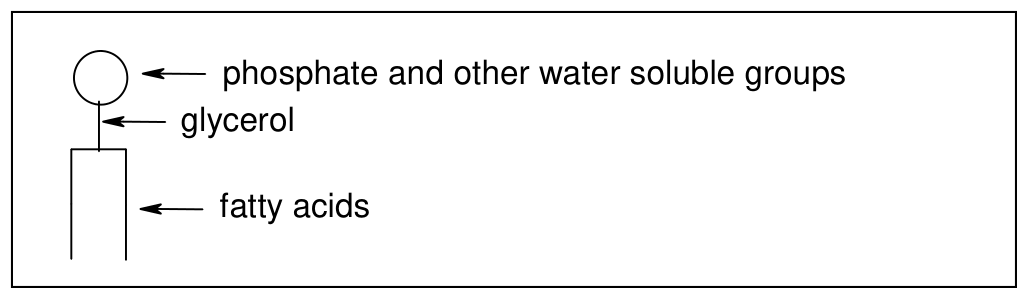
i) Mark the hydrophilic and hydrophobic groups on a copy of the above diagram.
ii) Draw two possibilities for the association of six identical molecules of a phospholipid in water using the above diagram.
iii) Biomembranes consist of a phospholipid bi-layer. Draw such a model for a membrane using the above diagram.
iv) Such a model (iii) is incomplete. What other bio-macromolecules are contained in such biomembranes?
Official English text of the problem.
Internationale Chemie-Olympiade
IChO 1989
Halle, Deutsche Demokratische Republik · 6 Theorieaufgaben mit vollständigen Lösungen
Aufgabe 1: Löslichkeitsprodukt von Kupfer(II)-iodat durch iodometrische Titration
Zur Bestimmung des Löslichkeitsprodukts von Kupfer(II)-iodat, \(\ce{Cu(IO3)2}\), durch iodometrische Titration in saurer Lösung (25 °C) werden 30.00 cm³ einer 0.100-molaren Natriumthiosulfatlösung benötigt, um 20.00 cm³ einer gesättigten wässrigen Lösung von \(\ce{Cu(IO3)2}\) zu titrieren.
1.1 Geben Sie die Abfolge der ausgeglichenen Reaktionsgleichungen für die oben beschriebenen Reaktionen an.
1.2 Berechnen Sie die Anfangskonzentration von \(\ce{Cu^2+}\) und das Löslichkeitsprodukt von Kupfer(II)-iodat. Aktivitätskoeffizienten können vernachlässigt werden.
Aufgabentext aus dem offiziellen englischen Text übersetzt.
Aufgabe 2: Synthesegas: Kompressionsarbeit und das CO-Konvertierungsgleichgewicht
Ein Gasgemisch, das hauptsächlich Kohlenstoffmonoxid und Wasserstoff enthält, wird durch die Reaktion von Alkanen mit Wasserdampf hergestellt:
2.1 Stellen Sie mithilfe der Gleichungen (1) und (2) eine Gesamtreaktion (3) auf, sodass die gesamte Enthalpieänderung null beträgt.
2.2 Die Synthese von Methanol aus Kohlenstoffmonoxid und Wasserstoff erfolgt entweder
a) in zwei Schritten, wobei das Ausgangsgemisch gemäß Gleichung (3) von \(0.1\times10^6\ \mathrm{Pa}\) auf \(3\times10^6\ \mathrm{Pa}\) komprimiert wird und das daraus entstehende Produktgemisch anschließend nochmals von \(3\times10^6\ \mathrm{Pa}\) auf \(6\times10^6\ \mathrm{Pa}\) komprimiert wird
oder
b) in einem Schritt, wobei das Produktgemisch gemäß Gleichung (3) von \(0.1\times10^6\ \mathrm{Pa}\) auf \(6\times10^6\ \mathrm{Pa}\) komprimiert wird.
Berechnen Sie die Kompressionsarbeit \(W_a\) für die zweistufige Reaktion für \(100\ \mathrm{cm^3}\) Ausgangsgemisch und berechnen Sie die Differenz der Kompressionsarbeiten zwischen den Reaktionen 1 und 2.
Nehmen Sie für die Berechnungen einen vollständigen Umsatz bei konstantem Druck an. Die Temperatur bleibt konstant bei \(500\ \mathrm{K}\); ideales Gasverhalten wird vorausgesetzt.
Zur Herstellung von Wasserstoff für die Ammoniaksynthese wird ein Gemisch aus \(40.0\ \mathrm{mol}\) CO und \(40.0\ \mathrm{mol}\) Wasserstoff, \(18.0\ \mathrm{mol}\) Kohlenstoffdioxid und \(2.0\ \mathrm{mol}\) Stickstoff in einem Reaktor mit \(200.0\ \mathrm{mol}\) Wasserdampf in Kontakt gebracht, wobei sich das Konvertierungsgleichgewicht einstellt.
2.3 Berechnen Sie die Stoffmenge jedes Gases, das den Reaktor verlässt.
Aufgabentext aus dem offiziellen englischen Text übersetzt.
Aufgabe 3: Entfernung von Schwefeldioxid aus Kraftwerksrauchgasen
Schwefeldioxid wird aus den Abgasen von Kohlekraftwerken durch Waschen mit wässrigen Suspensionen von Calciumcarbonat oder Calciumhydroxid entfernt. Der dabei entstehende Rückstand wird gewonnen.
3.1 Geben Sie alle Reaktionen als ausgeglichene Reaktionsgleichungen an.
3.2 Wie viele Kilogramm Calciumcarbonat werden täglich verbraucht, um 95 % des Schwefeldioxids zu entfernen, wenn 10000 \(\mathrm{m^3/h}\) Abgas (auf 0 °C und Normaldruck umgerechnet) mit einem Schwefeldioxid-Volumenanteil von 0.15 % behandelt werden? Wie viele Kilogramm Gips werden dabei gewonnen?
3.3 Angenommen, das Schwefeldioxid wird nicht entfernt, verteilt sich gleichmäßig in einem Vorrat an flüssigem Wasser in der Atmosphäre von 5000 \(\mathrm{m^3}\) und gelangt vollständig als Regen zur Erde zurück: Welcher pH-Wert des kondensierten Wassers ist zu erwarten?
3.4 Wird zur Absorption eine Natriumsulfitlösung verwendet, können Schwefeldioxid und die Sulfitlösung zurückgewonnen werden. Geben Sie die ausgeglichenen Reaktionsgleichungen an und nennen Sie mögliche Wege, die Rückgewinnung von Schwefeldioxid aus einer wässrigen Lösung zu erhöhen.
Hinweis:
Die Protolyse von Schwefeldioxid in wässrigen Lösungen lässt sich durch die erste Dissoziationsstufe der schwefligen Säure beschreiben. Die Dissoziationskonstante beträgt \(K_{a,1}(\ce{H2SO3})=10^{-2.25}\).
Nehmen Sie ideale Gase und eine konstante Temperatur von 0 °C bei Normaldruck an.
\(M(\ce{CaCO3})=100\ \mathrm{g\,mol^{-1}};\ M(\ce{CaSO4})=172\ \mathrm{g\,mol^{-1}}\).
Aufgabentext aus dem offiziellen englischen Text übersetzt.
Aufgabe 4: 32P-markiertes PCl5: Reaktionsmechanismus und Löslichkeit von Mg(NH4)PO4
Mit \(\ce{^{32}P}\) markiertes Phosphorpentachlorid (Halbwertszeit \(t_{1/2}=14.3\) Tage) wird verwendet, um den elektrophilen Angriff eines \(\ce{PCl4+}\)-Kations am Stickstoff oder am Sauerstoff zu untersuchen.
Die Reaktion wird in \(\ce{CCl4}\) durchgeführt, und das Lösungsmittel sowie das Produkt IV werden abdestilliert. Proben von III (das im Destillationskolben zurückbleibt), von IV (im Destillat) sowie Proben des Ausgangsstoffs II werden durch Erhitzen mit konzentrierter Natronlauge hydrolysiert. Die gebildeten Phosphationen werden als Magnesiumammoniumphosphat gefällt. Gereinigte Proben der drei Niederschläge werden anschließend in bekannten Wasservolumina gelöst, und ihre Radioaktivität wird gemessen.
4.1 Geben Sie die ausgeglichenen Reaktionsgleichungen für die Bildung von \(\ce{PCl5}\) aus rotem Phosphor an.
4.2 Geben Sie die Reaktionsgleichungen für die vollständige Hydrolyse der Verbindungen II und III mit Natriumhydroxid an.
4.3 Wie lange dauert es, bis die anfängliche Radioaktivität auf \(10^{-3}\) des Anfangswerts abgesunken ist?
4.4 Geben Sie zwei alternative Mechanismen für die Reaktion von markiertem \(\ce{PCl4^-}\) mit dem Anion von I an.
4.5 Nach der Hydrolyse weisen die gefällten Magnesiumammoniumphosphate folgende Radioaktivitätswerte auf:
II. 2380 Bq für 128 mg \(\ce{Mg(NH4)PO4}\)
III. 28 Bq für 153 mg \(\ce{Mg(NH4)PO4}\)
IV. 2627 Bq für 142 mg \(\ce{Mg(NH4)PO4}\)
Welche Aussage lässt sich anhand dieser Daten über das von \(\ce{PCl4^-}\) angegriffene nukleophile Zentrum treffen?
Daten: Für \(\ce{H3PO4}\): \(pK_1=2.2;\quad pK_2=7.2;\quad pK_3=12.4\)
Löslichkeitsprodukt von \(\ce{Mg(NH4)PO4}\): \(pK_s=12.6\)
Gleichgewichtskonzentration von \(\ce{NH4+}=0.1\ \mathrm{mol\,dm^{-3}}\)
4.6 Berechnen Sie die Löslichkeit von \(\ce{Mg(NH4)PO4}\) bei einem pH-Wert von 10 unter idealisierten Bedingungen (Aktivitätskoeffizienten können vernachlässigt werden).
Aufgabentext aus dem offiziellen englischen Text übersetzt.
Aufgabe 5: Isomere Cyclobutandicarbonsäuren
Carbonsäuren sind eine chemisch und biologisch wichtige Klasse organischer Verbindungen.
5.1 Zeichnen Sie die Konstitutionsformeln (Strukturformeln) aller isomeren Cyclobutandicarbonsäuren und geben Sie die systematischen Namen dieser Verbindungen an.
5.2 Es gibt drei Stereoisomere, I, II und III, der Cyclobutan-1,2-dicarbonsäure. Zeichnen Sie perspektivische Formeln oder Stereoformeln von I, II und III, aus denen die relative Konfiguration jedes Moleküls hervorgeht.
5.3 Welche Paare der Stereoisomere I, II und III sind Diastereomere und welche sind Enantiomere voneinander?
5.4 Mit welcher Reaktion lässt sich die relative Konfiguration von Diastereomeren bestimmen?
5.5 Wie lassen sich die Enantiomere der Cyclobutan-1,2-dicarbonsäure trennen?
5.6 Geben Sie an den Strukturen der Stereoisomere I, II und III die absolute Konfiguration jedes asymmetrischen Zentrums mithilfe der Cahn-Ingold-Prelog-Regeln (\(R,S\)-System) an.
Aufgabentext aus dem offiziellen englischen Text übersetzt.
Aufgabe 6: Fette, Fettsäuren und Phospholipide
Fette (Lipide) enthalten eine unpolare (hydrophobe) und eine polare (hydrophile) Gruppe. Die in Wasser unlöslichen Lipide haben wichtige biologische Funktionen.
6.1 Zeichnen Sie die Strukturen von Z-Octadec-9-ensäure (Ölsäure), Octadecansäure (Stearinsäure) und Hexadecansäure (Palmitinsäure).
6.2 Zeichnen Sie unter Verwendung dieser drei Fettsäuren aus Teil 6.1 eine mögliche Struktur eines Triacylglycerids.
6.3 Formulieren Sie die Reaktionsgleichung für die Hydrolyse Ihres Triacylglycerids aus Teil 6.2 in wässriger NaOH-Lösung. Geben Sie den Mechanismus der hydrolytischen Abspaltung einer der Fettsäuren aus Ihrem Glycerid an.
6.4 Welche der folgenden Fettsäuren, \(\ce{C21H43COOH}\), \(\ce{C17H35COOH}\) oder \(\ce{C5H11COOH}\), ist in Wasser am wenigsten löslich?
6.5 Phospholipide sind eine wichtige Klasse bioorganischer Verbindungen. Zeichnen Sie die Struktur der Phosphatidsäure, die sich von Ihrem Triacylglycerid aus Teil 6.2 ableitet.
6.6 Phospholipide werden häufig durch das folgende Schema dargestellt:
i) Kennzeichnen Sie die hydrophilen und hydrophoben Gruppen in einer Kopie des obigen Schemas.
ii) Zeichnen Sie mithilfe des obigen Schemas zwei Möglichkeiten für die Assoziation von sechs identischen Molekülen eines Phospholipids in Wasser.
iii) Biomembranen bestehen aus einer Phospholipid-Doppelschicht. Zeichnen Sie mithilfe des obigen Schemas ein solches Membranmodell.
iv) Ein solches Modell (iii) ist unvollständig. Welche weiteren Biomakromoleküle sind in solchen Biomembranen enthalten?
Aufgabentext aus dem offiziellen englischen Text übersetzt.
Uluslararası Kimya Olimpiyatı
IChO 1989
Halle, Demokratik Alman Cumhuriyeti · 6 teori sorusu, tam çözümleriyle
Soru 1: İyodometrik titrasyonla bakır(II) iyodatın çözünürlük çarpımının belirlenmesi
Bakır(II) iyodatın, \(\ce{Cu(IO3)2}\), çözünürlük çarpımını asidik çözeltide (25 °C) iyodometrik titrasyonla belirlemek için, doymuş sulu \(\ce{Cu(IO3)2}\) çözeltisinin 20.00 cm³'lük örneğinin titrasyonunda 0.100 molar sodyum tiyosülfat çözeltisinden 30.00 cm³ gerekmektedir.
1.1 Yukarıda açıklanan tepkimelerin denkleştirilmiş denklemlerini sırasıyla yazınız.
1.2 Başlangıçtaki \(\ce{Cu^2+}\) derişimini ve bakır(II) iyodatın çözünürlük çarpımını hesaplayınız. Aktivite katsayıları ihmal edilebilir.
Soru metni resmi İngilizce metinden çevrilmiştir.
Soru 2: Sentez gazı: sıkıştırma işi ve CO dönüşüm dengesi
Başlıca karbon monoksit ve hidrojen içeren bir gaz karışımı, alkanların su buharıyla tepkimesi sonucunda üretilir:
2.1 (1) ve (2) denklemlerini kullanarak net entalpi değişimi sıfır olacak şekilde bir toplam tepkime (3) yazınız.
2.2 Karbon monoksit ve hidrojenden metanol sentezi aşağıdaki iki yoldan biriyle gerçekleştirilir:
a) İki basamakta: (3) denklemine karşılık gelen başlangıç karışımı \(0.1\times10^6\ \mathrm{Pa}\) basınçtan \(3\times10^6\ \mathrm{Pa}\) basınca sıkıştırılır ve bundan elde edilen ürün karışımı yeniden, \(3\times10^6\ \mathrm{Pa}\) basınçtan \(6\times10^6\ \mathrm{Pa}\) basınca sıkıştırılır.
veya
b) Tek basamakta: (3) denklemine karşılık gelen ürün karışımı \(0.1\times10^6\ \mathrm{Pa}\) basınçtan \(6\times10^6\ \mathrm{Pa}\) basınca sıkıştırılır.
\(100\ \mathrm{cm^3}\) başlangıç karışımı için iki basamaklı tepkimeye göre sıkıştırma işini, \(W_a\), hesaplayınız ve 1 ve 2 tepkimeleri arasındaki sıkıştırma işi farkını hesaplayınız.
Hesaplamalarda tepkimenin sabit basınçta tam olarak gerçekleştiğini varsayınız. Sıcaklık \(500\ \mathrm{K}\) değerinde sabit kalır; ideal gaz davranışı varsayılır.
Amonyak sentezi için hidrojen üretmek üzere, \(40.0\ \mathrm{mol}\) CO ve \(40.0\ \mathrm{mol}\) hidrojen, \(18.0\ \mathrm{mol}\) karbon dioksit ve \(2.0\ \mathrm{mol}\) azottan oluşan bir karışım, dönüşüm dengesinin kurulduğu bir reaktörde \(200.0\ \mathrm{mol}\) su buharıyla temas hâlindedir.
2.3 Reaktörden çıkan her gazın mol sayısını hesaplayınız.
Soru metni resmi İngilizce metinden çevrilmiştir.
Soru 3: Termik santrallerin baca gazlarından kükürt dioksitin giderilmesi
Kömürle çalışan termik santrallerin atık gazlarındaki kükürt dioksit, kalsiyum karbonat veya kalsiyum hidroksitin sulu süspansiyonlarıyla yıkanarak giderilir. Oluşan katı kalıntı geri kazanılır.
3.1 Tüm tepkimeleri denkleştirilmiş denklemler olarak yazınız.
3.2 Hacimce 0.15 % kükürt dioksit içeren 10000 \(\mathrm{m^3/h}\) atık gaz (0 °C ve standart basınca düzeltilmiş) işleniyorsa, kükürt dioksitin 95 %'ini gidermek için günde kaç kilogram kalsiyum karbonat tüketilir? Bu işlemle kaç kilogram alçı taşı geri kazanılır?
3.3 Kükürt dioksitin giderilmediği, atmosferdeki 5000 \(\mathrm{m^3}\) hacminde bir sıvı su kütlesinde eşit olarak dağıldığı ve tamamının yağmur olarak yeryüzüne döndüğü varsayılırsa, yoğuşan suyun beklenen pH değeri nedir?
3.4 Absorpsiyon için sodyum sülfit çözeltisi kullanılırsa, kükürt dioksit ve sülfit çözeltisi geri kazanılabilir. Denkleştirilmiş denklemleri yazınız ve sulu bir çözeltiden kükürt dioksitin geri kazanımını artırmak için olası yolları belirtiniz.
Not:
Kükürt dioksitin sulu çözeltilerdeki protolizi, sülfüroz asidin birinci basamak ayrışmasıyla açıklanabilir. Ayrışma sabiti \(K_{a,1}(\ce{H2SO3})=10^{-2.25}\).
Gazların ideal olduğunu ve standart basınçta sıcaklığın sabit olarak 0 °C olduğunu varsayınız.
\(M(\ce{CaCO3})=100\ \mathrm{g\,mol^{-1}};\ M(\ce{CaSO4})=172\ \mathrm{g\,mol^{-1}}\).
Soru metni resmi İngilizce metinden çevrilmiştir.
Soru 4: 32P ile işaretlenmiş PCl5: tepkime mekanizması ve Mg(NH4)PO4 bileşiğinin çözünürlüğü
\(\ce{^{32}P}\) ile işaretlenmiş fosfor pentaklorür (yarı ömrü \(t_{1/2}=14.3\) gün), bir \(\ce{PCl4+}\) katyonunun azota veya oksijene elektrofilik saldırısını incelemek için kullanılmaktadır.
Tepkime \(\ce{CCl4}\) içinde gerçekleştirilir ve çözücü ile IV ürünü damıtılarak uzaklaştırılır. III (damıtma balonunda kalan), IV (distilatta bulunan) ve başlangıç maddesi II örnekleri, derişik sodyum hidroksit çözeltisiyle ısıtılarak hidroliz edilir. Oluşan fosfat iyonları amonyum magnezyum fosfat olarak çöktürülür. Ardından, üç çökeltiden alınan saflaştırılmış örnekler hacmi bilinen su miktarlarında çözülür ve radyoaktiviteleri ölçülür.
4.1 Kırmızı fosfordan \(\ce{PCl5}\) oluşumu tepkimesinin denkleştirilmiş denklemlerini yazınız.
4.2 II ve III bileşiklerinin sodyum hidroksit kullanılarak tam hidrolizine ait tepkime denklemlerini yazınız.
4.3 Başlangıçtaki radyoaktivitenin başlangıç değerinin \(10^{-3}\) katına düşmesi ne kadar sürer?
4.4 İşaretlenmiş \(\ce{PCl4^-}\) ile I bileşiğinin anyonu arasındaki tepkime için iki alternatif mekanizma yazınız.
4.5 Hidrolizden sonra çöktürülen amonyum magnezyum fosfatların radyoaktivite değerleri şöyledir:
II. 128 mg \(\ce{Mg(NH4)PO4}\) için 2380 Bq
III. 153 mg \(\ce{Mg(NH4)PO4}\) için 28 Bq
IV. 142 mg \(\ce{Mg(NH4)PO4}\) için 2627 Bq
Bu verileri kullanarak, \(\ce{PCl4^-}\) tarafından saldırıya uğrayan nükleofilik merkez hakkında ne söyleyebilirsiniz?
Veriler: \(\ce{H3PO4}\) için: \(pK_1=2.2;\quad pK_2=7.2;\quad pK_3=12.4\)
\(\ce{Mg(NH4)PO4}\) bileşiğinin çözünürlük çarpımı: \(pK_s=12.6\)
Denge derişimi: \(\ce{NH4+}=0.1\ \mathrm{mol\,dm^{-3}}\)
4.6 İdealleştirilmiş koşullarda (aktivite katsayıları ihmal edilebilir), pH 10'da \(\ce{Mg(NH4)PO4}\) bileşiğinin çözünürlüğünü hesaplayınız.
Soru metni resmi İngilizce metinden çevrilmiştir.
Soru 5: İzomerik siklobütandikarboksilik asitler
Karboksilik asitler, kimyasal ve biyolojik açıdan önemli bir organik bileşik sınıfıdır.
5.1 Tüm izomerik siklobütandikarboksilik asitlerin yapı (konstitüsyon) formüllerini çiziniz ve bu bileşiklerin sistematik adlarını veriniz.
5.2 Siklobütan-1,2-dikarboksilik asidin I, II ve III olmak üzere üç stereoizomeri vardır. Her molekülün bağıl konfigürasyonunu göstererek I, II ve III'ün perspektif veya stereo formüllerini çiziniz.
5.3 I, II ve III stereoizomerlerinin hangi çiftleri birbirlerinin diastereoizomerleri, hangileri enantiyomerleridir?
5.4 Diastereoizomerlerin bağıl konfigürasyonunu belirlemek için hangi tepkime kullanılabilir?
5.5 Siklobütan-1,2-dikarboksilik asidin enantiyomerleri nasıl ayrılabilir?
5.6 Cahn-Ingold-Prelog kurallarını (\(R,S\) sistemi) kullanarak I, II ve III stereoizomerlerinin yapıları üzerinde her asimetrik merkezin mutlak konfigürasyonunu belirtiniz.
Soru metni resmi İngilizce metinden çevrilmiştir.
Soru 6: Yağlar, yağ asitleri ve fosfolipitler
Yağlar (lipitler), apolar (hidrofobik) bir grup ve polar (hidrofilik) bir grup içerir. Suda çözünmeyen lipitlerin önemli biyolojik işlevleri vardır.
6.1 Z-oktadek-9-enoik asit (oleik asit), oktadekanoik asit (stearik asit) ve hekzadekanoik asidin (palmitik asit) yapılarını çiziniz.
6.2 6.1 kısmındaki bu üç yağ asidini kullanarak bir triaçil gliseridin olası yapılarından birini çiziniz.
6.3 6.2 kısmındaki triaçil gliseridinizin sulu NaOH çözeltisindeki hidroliz tepkimesinin denklemini yazınız. Gliseridinizdeki yağ asitlerinden birinin hidroliz mekanizmasını veriniz.
6.4 Şu yağ asitlerinden hangisinin sudaki çözünürlüğü en düşüktür: \(\ce{C21H43COOH}\), \(\ce{C17H35COOH}\) veya \(\ce{C5H11COOH}\)?
6.5 Fosfolipitler, biyoorganik bileşiklerin önemli bir sınıfıdır. 6.2 kısmındaki triaçil gliseridinizden türetilen fosfatidik asidin yapısını çiziniz.
6.6 Fosfolipitler sıklıkla şu şemayla gösterilir:
i) Yukarıdaki şemanın bir kopyası üzerinde hidrofilik ve hidrofobik grupları işaretleyiniz.
ii) Yukarıdaki şemayı kullanarak bir fosfolipidin birbirinin aynı altı molekülünün suda bir araya gelmesi için iki olası düzen çiziniz.
iii) Biyomembranlar bir fosfolipit çift tabakasından oluşur. Yukarıdaki şemayı kullanarak bir zar için böyle bir model çiziniz.
iv) Böyle bir model (iii) eksiktir. Bu tür biyomembranlarda başka hangi biyomakromoleküller bulunur?
Soru metni resmi İngilizce metinden çevrilmiştir.
Olimpiada Internacional de Química
IChO 1989
Halle, República Democrática Alemana · 6 problemas teóricos con soluciones completas
Problema 1: Producto de solubilidad del yodato de cobre(II) mediante valoración yodométrica
Para determinar el producto de solubilidad del yodato de cobre(II), \(\ce{Cu(IO3)2}\), mediante valoración yodométrica en una disolución ácida (25 °C), se necesitan 30.00 cm³ de una disolución 0.100 molar de tiosulfato de sodio para valorar 20.00 cm³ de una disolución acuosa saturada de \(\ce{Cu(IO3)2}\).
1.1 Escriba la secuencia de ecuaciones ajustadas de las reacciones descritas anteriormente.
1.2 Calcule la concentración inicial de \(\ce{Cu^2+}\) y el producto de solubilidad del yodato de cobre(II). Pueden despreciarse los coeficientes de actividad.
Enunciado traducido del texto oficial en inglés.
Problema 2: Gas de síntesis: trabajo de compresión y equilibrio de conversión del CO
Una mezcla de gases que contiene principalmente monóxido de carbono e hidrógeno se produce mediante la reacción de alcanos con vapor de agua:
2.1 Utilizando las ecuaciones (1) y (2), escriba una reacción global (3) de modo que la variación neta de entalpía sea cero.
2.2 La síntesis de metanol a partir de monóxido de carbono e hidrógeno se lleva a cabo bien
a) en dos etapas, en las que la mezcla inicial correspondiente a la ecuación (3) se comprime de \(0.1\times10^6\ \mathrm{Pa}\) a \(3\times10^6\ \mathrm{Pa}\), y la mezcla de productos resultante se comprime de nuevo de \(3\times10^6\ \mathrm{Pa}\) a \(6\times10^6\ \mathrm{Pa}\)
o bien
b) en una etapa, en la que la mezcla de productos correspondiente a la ecuación (3) se comprime de \(0.1\times10^6\ \mathrm{Pa}\) a \(6\times10^6\ \mathrm{Pa}\).
Calcule el trabajo de compresión, \(W_a\), según la reacción en dos etapas para \(100\ \mathrm{cm^3}\) de mezcla inicial y calcule la diferencia en el trabajo de compresión entre las reacciones 1 y 2.
Para los cálculos, suponga una reacción completa a presión constante. La temperatura permanece constante a \(500\ \mathrm{K}\) y se supone un comportamiento de gas ideal.
Para producir hidrógeno destinado a la síntesis de amoníaco, una mezcla de \(40.0\ \mathrm{mol}\) de CO y \(40.0\ \mathrm{mol}\) de hidrógeno, \(18.0\ \mathrm{mol}\) de dióxido de carbono y \(2.0\ \mathrm{mol}\) de nitrógeno se pone en contacto con \(200.0\ \mathrm{mol}\) de vapor de agua en un reactor donde se establece el equilibrio de conversión.
2.3 Calcule el número de moles de cada gas que sale del reactor.
Enunciado traducido del texto oficial en inglés.
Problema 3: Eliminación del dióxido de azufre de los gases de combustión de centrales eléctricas
El dióxido de azufre se elimina de los gases residuales de las centrales eléctricas de carbón mediante lavado con suspensiones acuosas de carbonato de calcio o hidróxido de calcio. El residuo formado se recupera.
3.1 Escriba todas las reacciones como ecuaciones ajustadas.
3.2 ¿Cuántos kilogramos de carbonato de calcio se consumen diariamente para eliminar el 95 % del dióxido de azufre si se procesan 10000 \(\mathrm{m^3/h}\) de gases residuales (corregidos a 0 °C y presión estándar) que contienen un 0.15 % de dióxido de azufre en volumen? ¿Cuántos kilogramos de yeso se recuperan de este modo?
3.3 Suponiendo que el dióxido de azufre no se elimina y se distribuye uniformemente en una masa de agua líquida atmosférica de 5000 \(\mathrm{m^3}\), y que retorna íntegramente a la Tierra en forma de lluvia, ¿cuál es el pH esperado del agua condensada?
3.4 Si se utiliza una disolución de sulfito de sodio para la absorción, se pueden recuperar el dióxido de azufre y la disolución de sulfito. Escriba las ecuaciones ajustadas e indique posibles vías para aumentar la recuperación del dióxido de azufre de una disolución acuosa.
Nota:
La protólisis del dióxido de azufre en disoluciones acuosas puede describirse mediante la primera etapa de disociación del ácido sulfuroso. La constante de disociación es \(K_{a,1}(\ce{H2SO3})=10^{-2.25}\).
Suponga gases ideales y una temperatura constante de 0 °C a presión estándar.
\(M(\ce{CaCO3})=100\ \mathrm{g\,mol^{-1}};\ M(\ce{CaSO4})=172\ \mathrm{g\,mol^{-1}}\).
Enunciado traducido del texto oficial en inglés.
Problema 4: PCl5 marcado con 32P: mecanismo de reacción y solubilidad de Mg(NH4)PO4
El pentacloruro de fósforo marcado con \(\ce{^{32}P}\) (período de semidesintegración \(t_{1/2}=14.3\) días) se utiliza para estudiar el ataque electrofílico de un catión \(\ce{PCl4+}\) sobre el nitrógeno o sobre el oxígeno.
La reacción se lleva a cabo en \(\ce{CCl4}\) y el disolvente y el producto IV se separan por destilación. Se hidrolizan muestras de III (que permanece en el matraz de destilación), de IV (en el destilado) y del material de partida II calentándolas con una disolución concentrada de hidróxido de sodio. Los iones fosfato formados se precipitan como fosfato de amonio y magnesio. A continuación, se disuelven muestras purificadas de los tres precipitados en volúmenes conocidos de agua y se mide la radiactividad.
4.1 Escriba las ecuaciones ajustadas de la reacción del fósforo rojo para formar \(\ce{PCl5}\)
4.2 Escriba las ecuaciones de reacción de la hidrólisis completa de los compuestos II y III con hidróxido de sodio.
4.3 ¿Cuánto tiempo se necesita para reducir la radiactividad inicial a \(10^{-3}\) de su valor inicial?
4.4 Escriba dos mecanismos alternativos para la reacción del \(\ce{PCl4^-}\) marcado con el anión de I.
4.5 Tras la hidrólisis, los fosfatos de amonio y magnesio precipitados presentan los siguientes valores de radiactividad:
II. 2380 Bq para 128 mg de \(\ce{Mg(NH4)PO4}\)
III. 28 Bq para 153 mg de \(\ce{Mg(NH4)PO4}\)
IV. 2627 Bq para 142 mg de \(\ce{Mg(NH4)PO4}\)
A partir de estos datos, ¿qué puede decirse sobre el centro nucleofílico atacado por \(\ce{PCl4^-}\)?
Datos: Para \(\ce{H3PO4}\): \(pK_1=2.2;\quad pK_2=7.2;\quad pK_3=12.4\)
Producto de solubilidad de \(\ce{Mg(NH4)PO4}\): \(pK_s=12.6\)
Concentración de equilibrio de \(\ce{NH4+}=0.1\ \mathrm{mol\,dm^{-3}}\)
4.6 Calcule la solubilidad de \(\ce{Mg(NH4)PO4}\) a un pH igual a 10 en condiciones idealizadas (pueden despreciarse los coeficientes de actividad).
Enunciado traducido del texto oficial en inglés.
Problema 5: Ácidos ciclobutanodicarboxílicos isómeros
Los ácidos carboxílicos son una clase de compuestos orgánicos de importancia química y biológica.
5.1 Dibuje las fórmulas constitucionales (estructurales) de todos los ácidos ciclobutanodicarboxílicos isómeros e indique los nombres sistemáticos de estos compuestos.
5.2 Existen tres estereoisómeros, I, II y III, del ácido ciclobutano-1,2-dicarboxílico. Dibuje las fórmulas en perspectiva o estereoquímicas de I, II y III, indicando la configuración relativa de cada molécula.
5.3 ¿Qué pares de estereoisómeros I, II y III son diastereoisómeros y cuáles son enantiómeros entre sí?
5.4 ¿Qué reacción puede utilizarse para determinar la configuración relativa de los diastereoisómeros?
5.5 ¿Cómo pueden separarse los enantiómeros del ácido ciclobutano-1,2-dicarboxílico?
5.6 Indique las configuraciones absolutas de cada centro asimétrico en las estructuras de los estereoisómeros I, II y III utilizando las reglas de Cahn-Ingold-Prelog (sistema \(R,S\)).
Enunciado traducido del texto oficial en inglés.
Problema 6: Grasas, ácidos grasos y fosfolípidos
Las grasas (lípidos) contienen un grupo apolar (hidrófobo) y un grupo polar (hidrófilo). Los lípidos, insolubles en agua, desempeñan importantes funciones biológicas.
6.1 Dibuje las estructuras del ácido Z-octadec-9-enoico (ácido oleico), el ácido octadecanoico (ácido esteárico) y el ácido hexadecanoico (ácido palmítico).
6.2 Utilizando estos tres ácidos grasos del apartado 6.1, dibuje una estructura posible de un triacilglicérido.
6.3 Escriba la ecuación de la reacción de hidrólisis de su triacilglicérido del apartado 6.2 en una disolución acuosa de NaOH. Indique el mecanismo de hidrólisis de uno de los ácidos grasos de su glicérido.
6.4 ¿Cuál de los siguientes ácidos grasos, \(\ce{C21H43COOH}\), \(\ce{C17H35COOH}\) o \(\ce{C5H11COOH}\), es el menos soluble en agua?
6.5 Los fosfolípidos constituyen una clase importante de compuestos bioorgánicos. Dibuje la estructura del ácido fosfatídico derivado de su triacilglicérido del apartado 6.2.
6.6 Los fosfolípidos se representan frecuentemente mediante el siguiente diagrama:
i) Señale los grupos hidrófilos e hidrófobos en una copia del diagrama anterior.
ii) Dibuje dos posibilidades de asociación de seis moléculas idénticas de un fosfolípido en agua utilizando el diagrama anterior.
iii) Las biomembranas consisten en una bicapa de fosfolípidos. Dibuje un modelo de este tipo para una membrana utilizando el diagrama anterior.
iv) Este modelo (iii) es incompleto. ¿Qué otras biomacromoléculas contienen estas biomembranas?
Enunciado traducido del texto oficial en inglés.
国际化学奥林匹克
IChO 1989
德意志民主共和国哈雷 · 6 道理论题及完整解答
题目 1:用碘量法测定碘酸铜(II)的溶度积
为用碘量法测定碘酸铜(II)(\(\ce{Cu(IO3)2}\))的溶度积,在酸性溶液中(25 °C)滴定 20.00 cm³ 的 \(\ce{Cu(IO3)2}\) 饱和水溶液,需要消耗 30.00 cm³ 浓度为 0.100 mol/L 的硫代硫酸钠溶液。
1.1 按顺序写出上述反应的配平方程式。
1.2 计算 \(\ce{Cu^2+}\) 的初始浓度和碘酸铜(II)的溶度积。可忽略活度系数。
题目译自官方英文原文。
题目 2:合成气:压缩功与 CO 变换平衡
烷烃与水蒸气反应,生成主要含有一氧化碳和氢气的混合气体:
2.1 利用方程式 (1) 和 (2),写出净焓变为零的总反应 (3)。
2.2 由一氧化碳和氢气合成甲醇,可采用以下任一方式进行:
a) 分两步进行,将与方程式 (3) 对应的初始混合物从 \(0.1\times10^6\ \mathrm{Pa}\) 压缩至 \(3\times10^6\ \mathrm{Pa}\),再将由此生成的产物混合物从 \(3\times10^6\ \mathrm{Pa}\) 压缩至 \(6\times10^6\ \mathrm{Pa}\)
或
b) 一步进行,将与方程式 (3) 对应的产物混合物从 \(0.1\times10^6\ \mathrm{Pa}\) 压缩至 \(6\times10^6\ \mathrm{Pa}\)。
对于 \(100\ \mathrm{cm^3}\) 的初始混合物,计算按两步反应进行时的压缩功 \(W_a\),并计算反应 1 和 2 之间的压缩功之差。
计算时假设反应在恒压下完全进行。温度保持为 \(500\ \mathrm{K}\),并假设气体具有理想气体行为。
为制取用于合成氨的氢气,将含有 \(40.0\ \mathrm{mol}\) CO、\(40.0\ \mathrm{mol}\) 氢气、\(18.0\ \mathrm{mol}\) 二氧化碳和 \(2.0\ \mathrm{mol}\) 氮气的混合物与 \(200.0\ \mathrm{mol}\) 水蒸气在反应器中接触,并建立变换平衡。
2.3 计算离开反应器的各气体的物质的量。
题目译自官方英文原文。
题目 3:去除发电厂烟气中的二氧化硫
燃煤发电厂废气中的二氧化硫通过用碳酸钙或氢氧化钙的水悬浮液洗涤而除去。生成的残渣予以回收。
3.1 写出所有反应的配平化学方程式。
3.2 若处理 10000 \(\mathrm{m^3/h}\) 的废气(已折算至 0 °C 和标准压力),其中二氧化硫的体积分数为 0.15 %,则每天除去其中 95 % 的二氧化硫需要消耗多少千克碳酸钙?由此可回收多少千克石膏?
3.3 假设二氧化硫未被除去,而是均匀分布在大气中总体积为 5000 \(\mathrm{m^3}\) 的液态水中,并全部以雨水的形式返回地面,预计凝结水的 pH 是多少?
3.4 如果用亚硫酸钠溶液吸收,则可回收二氧化硫和亚硫酸钠溶液。写出配平的化学方程式,并指出提高二氧化硫从水溶液中回收程度的可行途径。
注:
二氧化硫在水溶液中的质子转移反应可用亚硫酸的第一级解离来描述。解离常数为 \(K_{a,1}(\ce{H2SO3})=10^{-2.25}\)。
假设气体均为理想气体,温度恒为 0 °C,压力为标准压力。
\(M(\ce{CaCO3})=100\ \mathrm{g\,mol^{-1}};\ M(\ce{CaSO4})=172\ \mathrm{g\,mol^{-1}}\)。
题目译自官方英文原文。
题目 4:32P 标记的 PCl5:反应机理与 Mg(NH4)PO4 的溶解度
用 \(\ce{^{32}P}\) 标记的五氯化磷(半衰期 \(t_{1/2}=14.3\) 天)研究 \(\ce{PCl4+}\) 阳离子对氮或氧的亲电进攻。
反应在 \(\ce{CCl4}\) 中进行,随后蒸出溶剂和产物 IV。分别取 III(留在蒸馏烧瓶中)、IV(在馏出液中)和起始原料 II 的样品,与浓氢氧化钠溶液一起加热,使其水解。生成的磷酸根离子以磷酸铵镁的形式沉淀。随后用已知体积的水溶解这三种沉淀的纯化样品,并测量其放射性活度。
4.1 写出由红磷生成 \(\ce{PCl5}\) 的配平反应方程式。
4.2 写出化合物 II 和 III 用氢氧化钠完全水解的反应方程式。
4.3 放射性活度降低到初始值的 \(10^{-3}\) 需要多长时间?
4.4 写出标记的 \(\ce{PCl4^-}\) 与 I 的阴离子反应的两种可能机理。
4.5 水解后沉淀得到的磷酸铵镁具有如下放射性活度:
II. 128 mg \(\ce{Mg(NH4)PO4}\) 的活度为 2380 Bq
III. 153 mg \(\ce{Mg(NH4)PO4}\) 的活度为 28 Bq
IV. 142 mg \(\ce{Mg(NH4)PO4}\) 的活度为 2627 Bq
利用这些数据,对于受到 \(\ce{PCl4^-}\) 进攻的亲核中心,你能得出什么结论?
数据:对于 \(\ce{H3PO4}\):\(pK_1=2.2;\quad pK_2=7.2;\quad pK_3=12.4\)
\(\ce{Mg(NH4)PO4}\) 的溶度积:\(pK_s=12.6\)
平衡浓度:\(\ce{NH4+}=0.1\ \mathrm{mol\,dm^{-3}}\)
4.6 在理想化条件下(可忽略活度系数),计算 pH 等于 10 时 \(\ce{Mg(NH4)PO4}\) 的溶解度。
题目译自官方英文原文。
题目 5:环丁烷二羧酸的异构体
羧酸是一类在化学和生物学上具有重要意义的有机化合物。
5.1 画出所有互为异构体的环丁烷二羧酸的构造(结构)式,并给出这些化合物的系统名称。
5.2 环丁烷-1,2-二羧酸有三种立体异构体 I、II 和 III。画出 I、II 和 III 的透视式或立体结构式,标明各分子的相对构型。
5.3 在立体异构体 I、II 和 III 中,哪些对互为非对映异构体,哪些对互为对映异构体?
5.4 可以用什么反应确定非对映异构体的相对构型?
5.5 如何分离环丁烷-1,2-二羧酸的对映异构体?
5.6 使用 Cahn-Ingold-Prelog 规则(\(R,S\) 体系),在立体异构体 I、II 和 III 的结构上标明每个不对称中心的绝对构型。
题目译自官方英文原文。
题目 6:脂肪、脂肪酸和磷脂
脂肪(脂质)含有非极性(疏水性)基团和极性(亲水性)基团。不溶于水的脂质具有重要的生物学功能。
6.1 画出 Z-十八碳-9-烯酸(油酸)、十八烷酸(硬脂酸)和十六烷酸(棕榈酸)的结构。
6.2 使用第 6.1 部分中的这三种脂肪酸,画出一种可能的三酰甘油结构。
6.3 写出第 6.2 部分中所画三酰甘油在 NaOH 水溶液中发生水解反应的方程式。给出从该甘油酯中水解出其中一种脂肪酸的反应机理。
6.4 下列脂肪酸中,\(\ce{C21H43COOH}\)、\(\ce{C17H35COOH}\) 和 \(\ce{C5H11COOH}\),哪一种在水中的溶解度最小?
6.5 磷脂是一类重要的生物有机化合物。画出由第 6.2 部分中所画三酰甘油衍生的磷脂酸的结构。
6.6 磷脂常用下图表示:
i) 临摹上图,并在图中标出亲水基团和疏水基团。
ii) 使用上述图示,画出六个相同磷脂分子在水中缔合的两种可能形式。
iii) 生物膜由磷脂双分子层构成。使用上述图示画出这种膜模型。
iv) 这样的模型 (iii) 并不完整。这类生物膜中还含有哪些其他生物大分子?
题目译自官方英文原文。
Международная химическая олимпиада
IChO 1989
Галле, Германская Демократическая Республика · 6 теоретических задач с полными решениями
Задача 1: Определение произведения растворимости иодата меди(II) методом иодометрического титрования
Для определения произведения растворимости иодата меди(II), \(\ce{Cu(IO3)2}\), методом иодометрического титрования в кислом растворе (25 °C) на титрование 20.00 см³ насыщенного водного раствора \(\ce{Cu(IO3)2}\) требуется 30.00 см³ 0.100-молярного раствора тиосульфата натрия.
1.1 Запишите последовательность уравнений описанных выше реакций с расставленными коэффициентами.
1.2 Рассчитайте исходную концентрацию \(\ce{Cu^2+}\) и произведение растворимости иодата меди(II). Коэффициентами активности можно пренебречь.
Условие переведено с официального английского текста.
Задача 2: Синтез-газ: работа сжатия и равновесие конверсии CO
Газовую смесь, содержащую преимущественно монооксид углерода и водород, получают реакцией алканов с водяным паром:
2.1 Используя уравнения (1) и (2), запишите суммарную реакцию (3) так, чтобы суммарное изменение энтальпии было равно нулю.
2.2 Синтез метанола из монооксида углерода и водорода проводят либо
a) в две стадии, причём исходную смесь, соответствующую уравнению (3), сжимают от \(0.1\times10^6\ \mathrm{Pa}\) до \(3\times10^6\ \mathrm{Pa}\), а полученную смесь продуктов снова сжимают от \(3\times10^6\ \mathrm{Pa}\) до \(6\times10^6\ \mathrm{Pa}\)
либо
b) в одну стадию, причём смесь продуктов, соответствующую уравнению (3), сжимают от \(0.1\times10^6\ \mathrm{Pa}\) до \(6\times10^6\ \mathrm{Pa}\).
Рассчитайте работу сжатия \(W_a\) для двухстадийного процесса при использовании \(100\ \mathrm{cm^3}\) исходной смеси и вычислите разность работ сжатия для реакций 1 и 2.
При расчётах считайте, что реакция протекает полностью при постоянном давлении. Температура остаётся постоянной и равной \(500\ \mathrm{K}\); газы считайте идеальными.
Для получения водорода, используемого в синтезе аммиака, смесь \(40.0\ \mathrm{mol}\) CO и \(40.0\ \mathrm{mol}\) водорода, \(18.0\ \mathrm{mol}\) диоксида углерода и \(2.0\ \mathrm{mol}\) азота приводят в контакт с \(200.0\ \mathrm{mol}\) водяного пара в реакторе, где устанавливается равновесие конверсии.
2.3 Рассчитайте количество вещества каждого газа, выходящего из реактора.
Условие переведено с официального английского текста.
Задача 3: Удаление диоксида серы из дымовых газов электростанций
Диоксид серы удаляют из отходящих газов угольных электростанций промывкой водными суспензиями карбоната кальция или гидроксида кальция. Образующийся осадок выделяют.
3.1 Запишите все реакции в виде уравнений с расставленными коэффициентами.
3.2 Сколько килограммов карбоната кальция расходуется ежедневно для удаления 95 % диоксида серы, если обрабатывают 10000 \(\mathrm{m^3/h}\) отходящих газов (объём приведён к 0 °C и стандартному давлению), содержащих 0.15 % диоксида серы по объёму? Сколько килограммов гипса при этом получают?
3.3 Если предположить, что диоксид серы не удаляется, равномерно распределяется в содержащейся в атмосфере жидкой воде объёмом 5000 \(\mathrm{m^3}\) и полностью возвращается на землю с дождём, каким будет ожидаемое значение pH сконденсировавшейся воды?
3.4 Если для поглощения использовать раствор сульфита натрия, можно регенерировать диоксид серы и раствор сульфита. Запишите уравнения реакций с расставленными коэффициентами и укажите возможные способы увеличения степени извлечения диоксида серы из водного раствора.
Примечание:
Протолиз диоксида серы в водных растворах можно описать диссоциацией сернистой кислоты по первой ступени. Константа диссоциации \(K_{a,1}(\ce{H2SO3})=10^{-2.25}\).
Считайте газы идеальными, а температуру постоянной и равной 0 °C при стандартном давлении.
\(M(\ce{CaCO3})=100\ \mathrm{g\,mol^{-1}};\ M(\ce{CaSO4})=172\ \mathrm{g\,mol^{-1}}\).
Условие переведено с официального английского текста.
Задача 4: Меченный 32P PCl5: механизм реакции и растворимость Mg(NH4)PO4
Меченный \(\ce{^{32}P}\) пентахлорид фосфора (период полураспада \(t_{1/2}=14.3\) суток) используется для изучения электрофильной атаки катиона \(\ce{PCl4+}\) на атом азота или кислорода.
Реакцию проводят в \(\ce{CCl4}\), после чего растворитель и продукт IV отгоняют. Образцы III (оставшегося в перегонной колбе), IV (в дистилляте) и исходного вещества II гидролизуют нагреванием с концентрированным раствором гидроксида натрия. Образовавшиеся фосфат-ионы осаждают в виде фосфата аммония-магния. Затем очищенные образцы трёх осадков растворяют в известных объёмах воды и измеряют радиоактивность.
4.1 Напишите уравнения реакций получения \(\ce{PCl5}\) из красного фосфора и расставьте коэффициенты.
4.2 Напишите уравнения реакций полного гидролиза соединений II и III с использованием гидроксида натрия.
4.3 Сколько времени потребуется для снижения радиоактивности до \(10^{-3}\) от исходного значения?
4.4 Напишите два альтернативных механизма реакции меченного \(\ce{PCl4^-}\) с анионом I.
4.5 После гидролиза осаждённые фосфаты аммония-магния имеют следующие значения радиоактивности:
II. 2380 Бк для 128 мг \(\ce{Mg(NH4)PO4}\)
III. 28 Бк для 153 мг \(\ce{Mg(NH4)PO4}\)
IV. 2627 Бк для 142 мг \(\ce{Mg(NH4)PO4}\)
Что на основании этих данных можно сказать о нуклеофильном центре, атакуемом \(\ce{PCl4^-}\)?
Данные: для \(\ce{H3PO4}\): \(pK_1=2.2;\quad pK_2=7.2;\quad pK_3=12.4\)
Произведение растворимости \(\ce{Mg(NH4)PO4}\): \(pK_s=12.6\)
Равновесная концентрация \(\ce{NH4+}=0.1\ \mathrm{mol\,dm^{-3}}\)
4.6 Рассчитайте растворимость \(\ce{Mg(NH4)PO4}\) при pH, равном 10, в идеализированных условиях (коэффициентами активности можно пренебречь).
Условие переведено с официального английского текста.
Задача 5: Изомерные циклобутандикарбоновые кислоты
Карбоновые кислоты — химически и биологически важный класс органических соединений.
5.1 Изобразите структурные формулы всех изомерных циклобутандикарбоновых кислот и приведите систематические названия этих соединений.
5.2 Существуют три стереоизомера циклобутан-1,2-дикарбоновой кислоты: I, II и III. Изобразите перспективные или стереохимические формулы I, II и III, указав относительную конфигурацию каждой молекулы.
5.3 Какие пары стереоизомеров I, II и III являются диастереоизомерами, а какие — энантиомерами друг друга?
5.4 Какую реакцию можно использовать для определения относительной конфигурации диастереоизомеров?
5.5 Как можно разделить энантиомеры циклобутан-1,2-дикарбоновой кислоты?
5.6 Укажите абсолютную конфигурацию каждого асимметрического центра на структурах стереоизомеров I, II и III, используя правила Кана — Ингольда — Прелога (система \(R,S\)).
Условие переведено с официального английского текста.
Задача 6: Жиры, жирные кислоты и фосфолипиды
Жиры (липиды) содержат неполярную (гидрофобную) и полярную (гидрофильную) группы. Нерастворимые в воде липиды выполняют важные биологические функции.
6.1 Изобразите структуры Z-октадец-9-еновой кислоты (олеиновой кислоты), октадекановой кислоты (стеариновой кислоты) и гексадекановой кислоты (пальмитиновой кислоты).
6.2 Используя эти три жирные кислоты из пункта 6.1, изобразите одну из возможных структур триацилглицерида.
6.3 Напишите уравнение реакции гидролиза вашего триацилглицерида из пункта 6.2 в водном растворе NaOH. Приведите механизм гидролитического отщепления одной из жирных кислот от вашего глицерида.
6.4 Какая из следующих жирных кислот, \(\ce{C21H43COOH}\), \(\ce{C17H35COOH}\) или \(\ce{C5H11COOH}\), наименее растворима в воде?
6.5 Фосфолипиды — важный класс биоорганических соединений. Изобразите структуру фосфатидной кислоты, полученной из вашего триацилглицерида из пункта 6.2.
6.6 Фосфолипиды часто изображают с помощью схемы:
i) Обозначьте гидрофильные и гидрофобные группы на копии приведённой выше схемы.
ii) Используя приведённую выше схему, изобразите два возможных способа ассоциации шести одинаковых молекул фосфолипида в воде.
iii) Биомембраны состоят из фосфолипидного бислоя. Используя приведённую выше схему, изобразите такую модель мембраны.
iv) Такая модель (iii) неполна. Какие другие биомакромолекулы содержатся в таких биомембранах?
Условие переведено с официального английского текста.
الأولمبياد الدولي للكيمياء
IChO 1989
هاله، جمهورية ألمانيا الديمقراطية · 6 مسائل نظرية مع حلول كاملة
المسألة 1: حاصل الإذابة ليودات النحاس(II) باستخدام المعايرة اليودومترية
لتحديد حاصل الإذابة ليودات النحاس(II)، \(\ce{Cu(IO3)2}\)، باستخدام المعايرة اليودومترية في محلول حمضي (25 °C)، يلزم 30.00 cm³ من محلول ثيوكبريتات الصوديوم بتركيز مولاري 0.100 لمعايرة 20.00 cm³ من محلول مائي مشبع من \(\ce{Cu(IO3)2}\).
1.1 اكتب تسلسل المعادلات الموزونة للتفاعلات الموصوفة أعلاه.
1.2 احسب التركيز الابتدائي لـ \(\ce{Cu^2+}\) وحاصل الإذابة ليودات النحاس(II). يمكن إهمال معاملات النشاط.
نص المسألة مترجم عن النص الإنجليزي الرسمي.
المسألة 2: غاز التخليق: شغل الانضغاط واتزان تحويل CO
يُنتَج مزيج من الغازات يحتوي أساسًا على أول أكسيد الكربون والهيدروجين بتفاعل الألكانات مع بخار الماء:
2.1 باستخدام المعادلتين (1) و(2)، اكتب تفاعلًا إجماليًا (3) بحيث يكون صافي التغير في الإنثالبي صفرًا.
2.2 يُجرى تخليق الميثانول من أول أكسيد الكربون والهيدروجين إما
a) على خطوتين، حيث يُضغط المزيج الابتدائي الموافق للمعادلة (3) من \(0.1\times10^6\ \mathrm{Pa}\) إلى \(3\times10^6\ \mathrm{Pa}\)، ثم يُضغط مزيج النواتج الناتج منه مرة أخرى من \(3\times10^6\ \mathrm{Pa}\) إلى \(6\times10^6\ \mathrm{Pa}\)
أو
b) على خطوة واحدة، حيث يُضغط مزيج النواتج الموافق للمعادلة (3) من \(0.1\times10^6\ \mathrm{Pa}\) إلى \(6\times10^6\ \mathrm{Pa}\).
احسب شغل الانضغاط، \(W_a\)، وفقًا للتفاعل ذي الخطوتين لكمية حجمها \(100\ \mathrm{cm^3}\) من المزيج الابتدائي، واحسب الفرق في شغل الانضغاط بين التفاعلين 1 و2.
افترض في الحسابات أن التفاعل تام ويجري عند ضغط ثابت. تبقى درجة الحرارة ثابتة عند \(500\ \mathrm{K}\)، ويُفترض سلوك الغاز المثالي.
لإنتاج الهيدروجين اللازم لتخليق الأمونيا، يُوضَع مزيج من \(40.0\ \mathrm{mol}\) من CO و\(40.0\ \mathrm{mol}\) من الهيدروجين و\(18.0\ \mathrm{mol}\) من ثاني أكسيد الكربون و\(2.0\ \mathrm{mol}\) من النيتروجين في تماس مع \(200.0\ \mathrm{mol}\) من بخار الماء في مفاعل يتحقق فيه اتزان التحويل.
2.3 احسب عدد مولات كل غاز يغادر المفاعل.
نص المسألة مترجم عن النص الإنجليزي الرسمي.
المسألة 3: إزالة ثاني أكسيد الكبريت من غازات مداخن محطات توليد الكهرباء
يُزال ثاني أكسيد الكبريت من الغازات العادمة لمحطات توليد الكهرباء العاملة بالفحم بغسلها بمعلقات مائية من كربونات الكالسيوم أو هيدروكسيد الكالسيوم. وتُسترد البقايا المتكوّنة.
3.1 اكتب جميع التفاعلات في صورة معادلات موزونة.
3.2 كم كيلوغرامًا من كربونات الكالسيوم يُستهلك يوميًا لإزالة 95 % من ثاني أكسيد الكبريت إذا عولجت كمية من الغاز العادم مقدارها 10000 \(\mathrm{m^3/h}\) (مصحّحة إلى 0 °C والضغط القياسي)، تحتوي على ثاني أكسيد الكبريت بنسبة حجمية قدرها 0.15 %؟ وكم كيلوغرامًا من الجبس يُسترد بذلك؟
3.3 بافتراض أن ثاني أكسيد الكبريت لا يُزال، وأنه يتوزع بالتساوي في كمية من الماء السائل في الغلاف الجوي حجمها 5000 \(\mathrm{m^3}\)، وتعود هذه الكمية بأكملها إلى الأرض على هيئة مطر، فما الأسّ الهيدروجيني المتوقع للماء المتكثّف؟
3.4 إذا استُخدم محلول كبريتيت الصوديوم للامتصاص، أمكن استرداد ثاني أكسيد الكبريت ومحلول الكبريتيت. اكتب المعادلات الموزونة، وبيّن الطرق الممكنة لزيادة استرداد ثاني أكسيد الكبريت من محلول مائي.
ملاحظة:
يمكن وصف انتقال البروتون في تفاعل ثاني أكسيد الكبريت في المحاليل المائية بالخطوة الأولى لتفكك حمض الكبريتوز. ثابت التفكك هو \(K_{a,1}(\ce{H2SO3})=10^{-2.25}\).
افترض أن الغازات مثالية، وأن درجة الحرارة ثابتة عند 0 °C والضغط قياسي.
\(M(\ce{CaCO3})=100\ \mathrm{g\,mol^{-1}};\ M(\ce{CaSO4})=172\ \mathrm{g\,mol^{-1}}\).
نص المسألة مترجم عن النص الإنجليزي الرسمي.
المسألة 4: PCl5 الموسوم بـ32P: آلية التفاعل وذوبانية Mg(NH4)PO4
يُستخدم خماسي كلوريد الفوسفور الموسوم بـ\(\ce{^{32}P}\) (عمر النصف \(t_{1/2}=14.3\) يومًا) لدراسة الهجوم الإلكتروفيلي لكاتيون \(\ce{PCl4+}\) على النيتروجين أو الأكسجين.
يُجرى التفاعل في \(\ce{CCl4}\)، ويُفصل المذيب والناتج IV بالتقطير. تُحلَّل مائيًا عينات من III (المتبقي في دورق التقطير)، ومن IV (الموجود في ناتج التقطير)، وعينات من المادة الابتدائية II، وذلك بالتسخين مع محلول مركز من هيدروكسيد الصوديوم. تُرسَّب أيونات الفوسفات المتكوِّنة على هيئة فوسفات الأمونيوم والمغنيسيوم. ثم تُذاب عينات منقّاة من الرواسب الثلاثة في أحجام معلومة من الماء، ويُقاس النشاط الإشعاعي.
4.1 اكتب المعادلات الموزونة لتفاعل الفوسفور الأحمر الذي يُكوِّن \(\ce{PCl5}\).
4.2 اكتب معادلات تفاعلات التحلل المائي الكامل للمركبين II وIII باستخدام هيدروكسيد الصوديوم.
4.3 ما الزمن اللازم لخفض النشاط الإشعاعي الابتدائي إلى \(10^{-3}\) من قيمته الابتدائية؟
4.4 اكتب آليتين بديلتين لتفاعل \(\ce{PCl4^-}\) الموسوم مع أنيون I.
4.5 بعد التحلل المائي، تُظهر رواسب فوسفات الأمونيوم والمغنيسيوم قيم النشاط الإشعاعي الآتية:
II. 2380 Bq لكل 128 mg من \(\ce{Mg(NH4)PO4}\)
III. 28 Bq لكل 153 mg من \(\ce{Mg(NH4)PO4}\)
IV. 2627 Bq لكل 142 mg من \(\ce{Mg(NH4)PO4}\)
باستخدام هذه البيانات، ماذا يمكنك أن تستنتج بشأن المركز النوكليوفيلي الذي يهاجمه \(\ce{PCl4^-}\)؟
المعطيات: بالنسبة إلى \(\ce{H3PO4}\): \(pK_1=2.2;\quad pK_2=7.2;\quad pK_3=12.4\)
حاصل الإذابة لـ\(\ce{Mg(NH4)PO4}\): \(pK_s=12.6\)
تركيز الاتزان لـ\(\ce{NH4+}=0.1\ \mathrm{mol\,dm^{-3}}\)
4.6 احسب ذوبانية \(\ce{Mg(NH4)PO4}\) عند أس هيدروجيني يساوي 10 في ظروف مثالية (يمكن إهمال معاملات الفعالية).
نص المسألة مترجم عن النص الإنجليزي الرسمي.
المسألة 5: أحماض السيكلوبوتان ثنائية الكربوكسيل المتماكبة
الأحماض الكربوكسيلية فئة من المركبات العضوية ذات أهمية كيميائية وبيولوجية.
5.1 ارسم الصيغ البنائية (التركيبية) لجميع أحماض السيكلوبوتان ثنائية الكربوكسيل المتماكبة، وأعطِ الأسماء النظامية لهذه المركبات.
5.2 توجد ثلاثة متماكبات فراغية، I وII وIII، لحمض السيكلوبوتان-1,2-ثنائي الكربوكسيل. ارسم صيغًا منظورية أو فراغية لكل من I وII وIII، موضحًا التهيئة النسبية لكل جزيء.
5.3 أي أزواج المتماكبات الفراغية I وII وIII متماكبات فراغية غير مرآتية، وأيها متماكبات مرآتية بعضها لبعض؟
5.4 ما التفاعل الذي يمكن استخدامه لتحديد التهيئة النسبية للمتماكبات الفراغية غير المرآتية؟
5.5 كيف يمكن فصل المتماكبين المرآتيين لحمض السيكلوبوتان-1,2-ثنائي الكربوكسيل؟
5.6 بيّن التهيئة المطلقة لكل مركز غير متناظر على بُنى المتماكبات الفراغية I وII وIII باستخدام قواعد كان–إنغولد–بريلوغ (نظام \(R,S\)).
نص المسألة مترجم عن النص الإنجليزي الرسمي.
المسألة 6: الدهون والأحماض الدهنية والفوسفوليبيدات
تحتوي الدهون (الليبيدات) على مجموعة غير قطبية (كارهة للماء) ومجموعة قطبية (محبة للماء). ولليبيدات غير القابلة للذوبان في الماء وظائف حيوية مهمة.
6.1 ارسم تراكيب حمض Z-أوكتاديس-9-ينويك (حمض الأولييك)، وحمض الأوكتاديكانويك (حمض الستياريك)، وحمض الهكساديكانويك (حمض البالميتيك).
6.2 باستخدام الأحماض الدهنية الثلاثة الواردة في الجزء 6.1، ارسم تركيبًا ممكنًا واحدًا لغليسيريد ثلاثي الأسيل.
6.3 اكتب معادلة تفاعل التحلل المائي للغليسيريد ثلاثي الأسيل الذي اخترته في الجزء 6.2 في محلول مائي من NaOH. بيّن آلية التحلل المائي لتحرير أحد الأحماض الدهنية من الغليسيريد الذي اخترته.
6.4 أي الأحماض الدهنية الآتية، \(\ce{C21H43COOH}\) أو \(\ce{C17H35COOH}\) أو \(\ce{C5H11COOH}\)، هو الأقل ذوبانًا في الماء؟
6.5 الفوسفوليبيدات فئة مهمة من المركبات العضوية الحيوية. ارسم تركيب حمض الفوسفاتيديك المشتق من الغليسيريد ثلاثي الأسيل الذي اخترته في الجزء 6.2.
6.6 كثيرًا ما تُمثَّل الفوسفوليبيدات بالمخطط الآتي:
i) حدّد المجموعات المحبة للماء والكارهة للماء على نسخة من المخطط أعلاه.
ii) ارسم احتمالين لتجمّع ستة جزيئات متماثلة من أحد الفوسفوليبيدات في الماء باستخدام المخطط أعلاه.
iii) تتكون الأغشية الحيوية من طبقة ثنائية من الفوسفوليبيدات. ارسم نموذجًا من هذا النوع لغشاء باستخدام المخطط أعلاه.
iv) هذا النموذج (iii) غير مكتمل. ما الجزيئات الحيوية الضخمة الأخرى التي تحتويها هذه الأغشية الحيوية؟
نص المسألة مترجم عن النص الإنجليزي الرسمي.