IChO 1989 · Theory problem 6
Fats, fatty acids and phospholipids
Fats (lipids) contain a non-polar (hydrophobic) and a polar (hydrophilic) group. The lipids insoluble in water, have important biological functions.
6.1 Draw the structures of Z-octadec-9-enoic acid (oleic acid), octadecanoic acid (stearic acid), and hexadecanoic acid (palmitic acid).
6.2 Using these three fatty acids in part 6.1 draw one possible structure of a triacyl glyceride.
6.3 Write the equation for the hydrolysis reaction of your triacyl glyceride in part 6.2 in aqueous NaOH solution. Give the mechanism of the hydrolysis of one of the fatty acids from your glyceride.
6.4 Which of the following fatty acids, \(\ce{C21H43COOH}\), \(\ce{C17H35COOH}\) or \(\ce{C5H11COOH}\), is the least soluble in water?
6.5 Phospholipids are an important class of bioorganic compounds. Draw the structure of the phosphatidic acid derived from your triacyl glyceride in part 6.2.
6.6 Phospholipids are frequently characterized by the diagram:
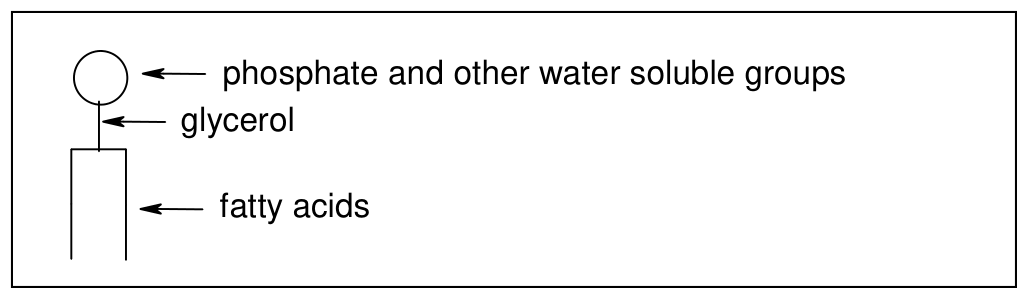
i) Mark the hydrophilic and hydrophobic groups on a copy of the above diagram.
ii) Draw two possibilities for the association of six identical molecules of a phospholipid in water using the above diagram.
iii) Biomembranes consist of a phospholipid bi-layer. Draw such a model for a membrane using the above diagram.
iv) Such a model (iii) is incomplete. What other bio-macromolecules are contained in such biomembranes?
Official English text of the problem.
Answers
- 6.1
- Oleic acid, \((9Z)\)-octadec-9-enoic acid:
CCCCCCCC/C=C\CCCCCCCC(=O)O - Stearic acid, octadecanoic acid:
CCCCCCCCCCCCCCCCCC(=O)O -
Palmitic acid, hexadecanoic acid:
CCCCCCCCCCCCCCCC(=O)O -
6.2 One possible structure is 1-oleoyl-2-stearoyl-3-palmitoyl-sn-glycerol:
CCCCCCCC/C=C\CCCCCCCC(=O)OC[C@@H](OC(=O)CCCCCCCCCCCCCCCCC)COC(=O)CCCCCCCCCCCCCCC -
6.3 Complete alkaline hydrolysis is: \[ \ce{C55H104O6 + 3 NaOH -> HOCH2CH(OH)CH2OH + C17H33COONa + C17H35COONa + C15H31COONa}. \] The products are:
- Glycerol:
OCC(O)CO - Sodium oleate:
CCCCCCCC/C=C\CCCCCCCC(=O)[O-].[Na+] - Sodium stearate:
CCCCCCCCCCCCCCCCCC(=O)[O-].[Na+] - Sodium palmitate:
CCCCCCCCCCCCCCCC(=O)[O-].[Na+]
The mechanism is hydroxide addition to an ester carbonyl, collapse of the tetrahedral intermediate with loss of a glycerol-derived alkoxide, and proton transfer to form the carboxylate.
-
6.4 Docosanoic acid (behenic acid), \(\ce{C21H43COOH}\), is least soluble:
CCCCCCCCCCCCCCCCCCCCCC(=O)O -
6.5 Retaining the oleoyl and stearoyl groups gives 1-oleoyl-2-stearoyl-sn-glycero-3-phosphoric acid, a phosphatidic acid:
CCCCCCCC/C=C\CCCCCCCC(=O)OC[C@@H](OC(=O)CCCCCCCCCCCCCCCCC)COP(=O)(O)O -
6.6(i) The polar head is hydrophilic; the two hydrocarbon tails are hydrophobic.
-
6.6(ii) Two schematic arrangements are a micelle-like cluster, with six heads facing outward and tails inward, and a bilayer fragment, with three molecules in each opposing leaflet.
-
6.6(iii) A membrane bilayer has polar heads facing the aqueous medium on both sides and hydrocarbon tails packed together in its interior.
-
6.6(iv) Proteins are the principal additional biomacromolecules. Membranes also bear carbohydrate chains attached to proteins and lipids.
Solution
6.1
Number each fatty acid from its carboxyl carbon, which is C1.
| Fatty acid | Condensed structure | Structural interpretation |
|---|---|---|
| Oleic acid | \(\ce{HOOC-(CH2)7-CH=CH-(CH2)7-CH3}\) | Eighteen carbons, with a \(Z\) double bond between C9 and C10. |
| Stearic acid | \(\ce{HOOC-(CH2)16-CH3}\) | Eighteen carbons and no carbon–carbon double bonds. |
| Palmitic acid | \(\ce{HOOC-(CH2)14-CH3}\) | Sixteen carbons and no carbon–carbon double bonds. |
For the oleic acid drawing, place the two carbon-chain substituents on the same side of the double bond; the two attached hydrogens are consequently on the other side. The /C=C\ notation in its SMILES specifies this \(Z\) geometry. It does not prescribe conformations about the remaining single bonds.
6.2
A triacylglycerol has all three hydroxyl groups of glycerol esterified. Use one residue from each acid:
| Glycerol position | Attached acyl group |
|---|---|
| C1 | Oleoyl |
| C2 | Stearoyl |
| C3 | Palmitoyl |
To draw the chosen structure, place the glycerol carbon chain vertically, with C1 above C2 and C3 below it. Each glycerol oxygen connects to its fatty-acid residue through an ester linkage, \(\ce{-O-C(=O)-}\).
To specify the stereoisomer encoded in the answer, use a Fischer projection with the central hydrogen on the right and the central stearoyloxy substituent on the left. Horizontal bonds project toward the viewer, and vertical bonds project away. Keep the oleoyl double bond \(Z\).
The resulting molecular formula is \(\ce{C55H104O6}\). Other arrangements of the three acyl groups are also acceptable.
6.3
In water, O, sodium hydroxide, [Na+].[OH-], supplies the attacking hydroxide ion, [OH-]. Each ester group consumes one hydroxide ion, so complete hydrolysis consumes three equivalents.
The balanced equation in the Answers section produces glycerol and the three sodium carboxylates. Free fatty acids do not remain as the final products in aqueous alkali.
Consider cleavage of the palmitoyl ester at glycerol C3. For the mechanism, let:
- \(\ce{R}\) denote the palmitoyl hydrocarbon chain, \(\ce{CH3(CH2)14-}\).
- \(\ce{G-OH}\) denote 1-oleoyl-2-stearoyl-sn-glycerol, the product after removal of the C3 acyl group:
CCCCCCCC/C=C\CCCCCCCC(=O)OC[C@@H](OC(=O)CCCCCCCCCCCCCCCCC)CO
The reacting ester can then be written as \(\ce{R-C(=O)-O-G}\).
- Nucleophilic addition \[ \ce{R-C(=O)-O-G + OH^- -> R-C(OH)(O^-)-O-G}. \] Draw an electron-flow arrow from a lone pair on hydroxide oxygen to the carbonyl carbon, and another from the carbonyl \(\pi\) bond to its oxygen.
The resulting tetrahedral oxyanion intermediate is:
CCCCCCCC/C=C\CCCCCCCC(=O)OC[C@@H](OC(=O)CCCCCCCCCCCCCCCCC)COC(O)([O-])CCCCCCCCCCCCCCC
Either face of the carbonyl can be attacked; no configuration is specified at this temporary tetrahedral center.
- Collapse of the tetrahedral intermediate \[ \ce{R-C(OH)(O^-)-O-G -> R-C(=O)-OH + G-O^-}. \] Draw an arrow from the negatively charged oxygen’s lone pair toward the carbonyl carbon to restore the carbonyl bond. Simultaneously, move the electrons of the acyl carbon–glycerol oxygen bond onto the leaving oxygen.
This gives palmitic acid, whose SMILES is listed in 6.1, and the C3 alkoxide of 1-oleoyl-2-stearoyl-sn-glycerol:
CCCCCCCC/C=C\CCCCCCCC(=O)OC[C@@H](OC(=O)CCCCCCCCCCCCCCCCC)C[O-]
- Proton transfer \[ \ce{R-C(=O)-OH + G-O^- -> R-C(=O)-O^- + G-OH}. \] The alkoxide oxygen accepts the carboxylic acid proton; the acid’s oxygen–hydrogen bond electrons remain on its oxygen.
The products of this cleavage are the diacylglycerol defined above and the palmitate ion:
CCCCCCCCCCCCCCCC(=O)[O-]
Formation of the resonance-stabilized carboxylate makes saponification effectively irreversible under these conditions. Analogous cleavage of the two remaining ester groups ultimately yields glycerol, oleate and stearate. Sodium ions, [Na+], provide the counterions.
6.4
Including the carboxyl carbon, the three acids contain 22, 18 and 6 carbon atoms, respectively. They are docosanoic acid, stearic acid and hexanoic acid, CCCCCC(=O)O.
All have the same polar carboxyl group, but their nonpolar hydrocarbon chains differ greatly in length. Increasing that chain length makes hydration less favorable. Therefore, the longest-chain acid, docosanoic acid, \(\ce{C21H43COOH}\), is the least soluble in water.
6.5
A phosphatidic acid contains two fatty-acid ester groups and one phosphate monoester on the glycerol backbone.
Starting from the chosen triacylglycerol:
- Retain the oleoyl ester at C1.
- Retain the stearoyl ester at C2.
- Replace the palmitoyl ester at C3 with a phosphate ester, so the terminal group becomes \(\ce{-CH2-O-P(=O)(OH)2}\).
Use the same glycerol stereochemical arrangement as in 6.2 and retain the oleoyl \(Z\) double bond. This gives the phosphatidic acid whose SMILES appears in the Answers section.
That SMILES depicts the fully protonated acid. Its phosphate head can ionize in aqueous solution.
6.6(i)
On the supplied symbol:
- Label the circle, representing phosphate and other polar head groups, hydrophilic.
- Label the two long tail lines, representing the hydrocarbon portions of the fatty-acid residues, hydrophobic.
The glycerol and ester region forms the interface between the polar head and the hydrocarbon tails.
6.6(ii)
Describe the two drawings as follows:
-
Micellar arrangement: Place six head circles at equal intervals around a circle. From each head, direct both tails inward toward the common central region. Thus, all six polar heads face the surrounding water while the tails associate internally.
-
Bilayer fragment: Place three head circles in an upper horizontal row, with their tails pointing downward. Place three more head circles in a lower row, with their tails pointing upward. The two sets of tails meet in the middle; the upper and lower head groups contact water on opposite sides.
These are schematic associations. Double-tailed phospholipids generally favor bilayers over small spherical micelles.
6.6(iii)
Extend the second arrangement into two continuous opposing leaflets. From top to bottom, the drawing should show:
- The aqueous medium.
- A row of polar heads.
- Tails directed downward.
- Tails from the opposite leaflet directed upward, meeting the first set in the hydrophobic interior.
- A second row of polar heads.
- The aqueous medium on the other side.
The membrane therefore presents hydrophilic surfaces to both aqueous compartments and encloses its hydrocarbon chains within the bilayer.
6.6(iv)
The principal missing biomacromolecules are proteins. Integral membrane proteins are embedded in the bilayer, and some span it completely; peripheral proteins associate with its surfaces.
Carbohydrate chains also occur as parts of glycoproteins and glycolipids, commonly on the noncytosolic surface. These names describe classes of substances rather than specified molecular structures, so no unique SMILES can be assigned without their sequences and connectivity.
The solution was checked against the official solution.
IChO 1989 · Theorieaufgabe 6
Fette, Fettsäuren und Phospholipide
Fette (Lipide) enthalten eine unpolare (hydrophobe) und eine polare (hydrophile) Gruppe. Die in Wasser unlöslichen Lipide haben wichtige biologische Funktionen.
6.1 Zeichnen Sie die Strukturen von Z-Octadec-9-ensäure (Ölsäure), Octadecansäure (Stearinsäure) und Hexadecansäure (Palmitinsäure).
6.2 Zeichnen Sie unter Verwendung dieser drei Fettsäuren aus Teil 6.1 eine mögliche Struktur eines Triacylglycerids.
6.3 Formulieren Sie die Reaktionsgleichung für die Hydrolyse Ihres Triacylglycerids aus Teil 6.2 in wässriger NaOH-Lösung. Geben Sie den Mechanismus der hydrolytischen Abspaltung einer der Fettsäuren aus Ihrem Glycerid an.
6.4 Welche der folgenden Fettsäuren, \(\ce{C21H43COOH}\), \(\ce{C17H35COOH}\) oder \(\ce{C5H11COOH}\), ist in Wasser am wenigsten löslich?
6.5 Phospholipide sind eine wichtige Klasse bioorganischer Verbindungen. Zeichnen Sie die Struktur der Phosphatidsäure, die sich von Ihrem Triacylglycerid aus Teil 6.2 ableitet.
6.6 Phospholipide werden häufig durch das folgende Schema dargestellt:
i) Kennzeichnen Sie die hydrophilen und hydrophoben Gruppen in einer Kopie des obigen Schemas.
ii) Zeichnen Sie mithilfe des obigen Schemas zwei Möglichkeiten für die Assoziation von sechs identischen Molekülen eines Phospholipids in Wasser.
iii) Biomembranen bestehen aus einer Phospholipid-Doppelschicht. Zeichnen Sie mithilfe des obigen Schemas ein solches Membranmodell.
iv) Ein solches Modell (iii) ist unvollständig. Welche weiteren Biomakromoleküle sind in solchen Biomembranen enthalten?
Aufgabentext aus dem offiziellen englischen Text übersetzt.
Antworten
- 6.1
- Ölsäure, \((9Z)\)-Octadec-9-ensäure:
CCCCCCCC/C=C\CCCCCCCC(=O)O - Stearinsäure, Octadecansäure:
CCCCCCCCCCCCCCCCCC(=O)O -
Palmitinsäure, Hexadecansäure:
CCCCCCCCCCCCCCCC(=O)O -
6.2 Eine mögliche Struktur ist 1-Oleoyl-2-stearoyl-3-palmitoyl-sn-glycerol:
CCCCCCCC/C=C\CCCCCCCC(=O)OC[C@@H](OC(=O)CCCCCCCCCCCCCCCCC)COC(=O)CCCCCCCCCCCCCCC -
6.3 Die vollständige alkalische Hydrolyse lautet: \[ \ce{C55H104O6 + 3 NaOH -> HOCH2CH(OH)CH2OH + C17H33COONa + C17H35COONa + C15H31COONa}. \] Die Produkte sind:
- Glycerol:
OCC(O)CO - Natriumoleat:
CCCCCCCC/C=C\CCCCCCCC(=O)[O-].[Na+] - Natriumstearat:
CCCCCCCCCCCCCCCCCC(=O)[O-].[Na+] - Natriumpalmitat:
CCCCCCCCCCCCCCCC(=O)[O-].[Na+]
Der Mechanismus besteht aus der Addition von Hydroxid an eine Ester-Carbonylgruppe, dem Zerfall des tetraedrischen Zwischenprodukts unter Abspaltung eines vom Glycerol abgeleiteten Alkoholats und einer Protonenübertragung unter Bildung des Carboxylats.
-
6.4 Docosansäure (Behensäure), \(\ce{C21H43COOH}\), ist am wenigsten löslich:
CCCCCCCCCCCCCCCCCCCCCC(=O)O -
6.5 Bei Beibehaltung der Oleoyl- und Stearoylgruppen erhält man 1-Oleoyl-2-stearoyl-sn-glycero-3-phosphorsäure, eine Phosphatidsäure:
CCCCCCCC/C=C\CCCCCCCC(=O)OC[C@@H](OC(=O)CCCCCCCCCCCCCCCCC)COP(=O)(O)O -
6.6(i) Der polare Kopf ist hydrophil; die beiden Kohlenwasserstoffschwänze sind hydrophob.
-
6.6(ii) Zwei schematische Anordnungen sind ein mizellenartiges Aggregat, bei dem sechs Köpfe nach außen und die Schwänze nach innen weisen, und ein Doppelschichtfragment mit drei Molekülen in jeder der beiden einander gegenüberliegenden Einzelschichten.
-
6.6(iii) In einer Membrandoppelschicht weisen die polaren Köpfe auf beiden Seiten zum wässrigen Medium, während die Kohlenwasserstoffschwänze im Inneren dicht aneinander gepackt sind.
-
6.6(iv) Proteine sind die wichtigsten zusätzlichen Biomakromoleküle. Membranen tragen außerdem Kohlenhydratketten, die an Proteine und Lipide gebunden sind.
Lösung
6.1
Nummerieren Sie jede Fettsäure ausgehend von ihrem Carboxylkohlenstoffatom, das C1 ist.
| Fettsäure | Halbstrukturformel | Interpretation der Struktur |
|---|---|---|
| Ölsäure | \(\ce{HOOC-(CH2)7-CH=CH-(CH2)7-CH3}\) | Achtzehn Kohlenstoffatome mit einer \(Z\)-Doppelbindung zwischen C9 und C10. |
| Stearinsäure | \(\ce{HOOC-(CH2)16-CH3}\) | Achtzehn Kohlenstoffatome und keine Kohlenstoff–Kohlenstoff-Doppelbindungen. |
| Palmitinsäure | \(\ce{HOOC-(CH2)14-CH3}\) | Sechzehn Kohlenstoffatome und keine Kohlenstoff–Kohlenstoff-Doppelbindungen. |
Ordnen Sie in der Zeichnung der Ölsäure die beiden Kohlenstoffketten als Substituenten auf derselben Seite der Doppelbindung an; die beiden gebundenen Wasserstoffatome befinden sich folglich auf der anderen Seite. Die Schreibweise /C=C\ in ihrem SMILES legt diese \(Z\)-Geometrie fest. Sie schreibt keine Konformationen bezüglich der übrigen Einfachbindungen vor.
6.2
In einem Triacylglycerol sind alle drei Hydroxylgruppen des Glycerols verestert. Verwenden Sie je einen Rest jeder Säure:
| Position am Glycerol | Gebundene Acylgruppe |
|---|---|
| C1 | Oleoyl |
| C2 | Stearoyl |
| C3 | Palmitoyl |
Um die gewählte Struktur zu zeichnen, ordnen Sie die Kohlenstoffkette des Glycerols senkrecht an, mit C1 oberhalb und C3 unterhalb von C2. Jedes Sauerstoffatom des Glycerols ist über eine Esterbindung, \(\ce{-O-C(=O)-}\), mit seinem Fettsäurerest verbunden.
Um das in der Antwort codierte Stereoisomer anzugeben, verwenden Sie eine Fischer-Projektion mit dem Wasserstoffatom am mittleren Kohlenstoffatom rechts und dem Stearoyloxy-Substituenten an diesem Kohlenstoffatom links. Horizontale Bindungen weisen zum Betrachter hin, vertikale Bindungen vom Betrachter weg. Behalten Sie die \(Z\)-Konfiguration der Oleoyl-Doppelbindung bei.
Die resultierende Summenformel ist \(\ce{C55H104O6}\). Andere Anordnungen der drei Acylgruppen sind ebenfalls zulässig.
6.3
In Wasser, O, liefert Natriumhydroxid, [Na+].[OH-], das angreifende Hydroxidion, [OH-]. Jede Estergruppe verbraucht ein Hydroxidion, sodass bei vollständiger Hydrolyse drei Äquivalente verbraucht werden.
Die ausgeglichene Reaktionsgleichung im Abschnitt Antworten liefert Glycerol und die drei Natriumcarboxylate. Freie Fettsäuren bleiben in wässriger alkalischer Lösung nicht als Endprodukte bestehen.
Betrachten Sie die Spaltung des Palmitoylesters an C3 des Glycerols. Für den Mechanismus gelte:
- \(\ce{R}\) bezeichnet die Kohlenwasserstoffkette des Palmitoylrests, \(\ce{CH3(CH2)14-}\).
- \(\ce{G-OH}\) bezeichnet 1-Oleoyl-2-stearoyl-sn-glycerol, das Produkt nach Abspaltung der Acylgruppe an C3:
CCCCCCCC/C=C\CCCCCCCC(=O)OC[C@@H](OC(=O)CCCCCCCCCCCCCCCCC)CO
Der reagierende Ester kann dann als \(\ce{R-C(=O)-O-G}\) geschrieben werden.
- Nukleophile Addition \[ \ce{R-C(=O)-O-G + OH^- -> R-C(OH)(O^-)-O-G}. \] Zeichnen Sie einen Elektronenverschiebungspfeil von einem freien Elektronenpaar am Sauerstoffatom des Hydroxidions zum Carbonylkohlenstoffatom und einen weiteren von der \(\pi\)-Bindung der Carbonylgruppe zu deren Sauerstoffatom.
Das entstehende tetraedrische Oxyanion-Zwischenprodukt ist:
CCCCCCCC/C=C\CCCCCCCC(=O)OC[C@@H](OC(=O)CCCCCCCCCCCCCCCCC)COC(O)([O-])CCCCCCCCCCCCCCC
Der Angriff kann von beiden Seiten der Carbonylgruppe erfolgen; an diesem vorübergehend gebildeten tetraedrischen Zentrum wird keine Konfiguration festgelegt.
- Zerfall des tetraedrischen Zwischenprodukts \[ \ce{R-C(OH)(O^-)-O-G -> R-C(=O)-OH + G-O^-}. \] Zeichnen Sie einen Pfeil vom freien Elektronenpaar des negativ geladenen Sauerstoffatoms zum Carbonylkohlenstoffatom, um die Carbonylbindung wiederherzustellen. Verschieben Sie gleichzeitig die Elektronen der Bindung zwischen dem Acylkohlenstoffatom und dem Glycerol-Sauerstoffatom auf das austretende Sauerstoffatom.
Dabei entstehen Palmitinsäure, deren SMILES in 6.1 aufgeführt ist, und das C3-Alkoholat von 1-Oleoyl-2-stearoyl-sn-glycerol:
CCCCCCCC/C=C\CCCCCCCC(=O)OC[C@@H](OC(=O)CCCCCCCCCCCCCCCCC)C[O-]
- Protonenübertragung \[ \ce{R-C(=O)-OH + G-O^- -> R-C(=O)-O^- + G-OH}. \] Das Sauerstoffatom des Alkoholats nimmt das Proton der Carbonsäure auf; die Elektronen der Sauerstoff–Wasserstoff-Bindung der Säure verbleiben an deren Sauerstoffatom.
Die Produkte dieser Spaltung sind das oben definierte Diacylglycerol und das Palmitation:
CCCCCCCCCCCCCCCC(=O)[O-]
Die Bildung des mesomeriestabilisierten Carboxylats macht die Verseifung unter diesen Bedingungen praktisch irreversibel. Die analoge Spaltung der beiden verbleibenden Estergruppen liefert schließlich Glycerol, Oleat und Stearat. Natriumionen, [Na+], dienen als Gegenionen.
6.4
Unter Einbeziehung des Carboxylkohlenstoffatoms enthalten die drei Säuren 22, 18 beziehungsweise 6 Kohlenstoffatome. Es handelt sich um Docosansäure, Stearinsäure und Hexansäure, CCCCCC(=O)O.
Alle besitzen dieselbe polare Carboxylgruppe, ihre unpolaren Kohlenwasserstoffketten unterscheiden sich jedoch stark in ihrer Länge. Mit zunehmender Kettenlänge wird die Hydratation weniger günstig. Daher ist die Säure mit der längsten Kette, Docosansäure, \(\ce{C21H43COOH}\), in Wasser am wenigsten löslich.
6.5
Eine Phosphatidsäure enthält zwei Fettsäureestergruppen und einen Phosphatmonoester am Glycerolgerüst.
Gehen Sie vom gewählten Triacylglycerol aus:
- Behalten Sie den Oleoylester an C1 bei.
- Behalten Sie den Stearoylester an C2 bei.
- Ersetzen Sie den Palmitoylester an C3 durch einen Phosphatester, sodass die endständige Gruppe zu \(\ce{-CH2-O-P(=O)(OH)2}\) wird.
Verwenden Sie dieselbe stereochemische Anordnung des Glycerols wie in 6.2 und behalten Sie die \(Z\)-Doppelbindung des Oleoylrests bei. So erhalten Sie die Phosphatidsäure, deren SMILES im Abschnitt Antworten angegeben ist.
Dieser SMILES stellt die vollständig protonierte Säure dar. Ihre Phosphatkopfgruppe kann in wässriger Lösung ionisieren.
6.6(i)
Im vorgegebenen Symbol:
- Beschriften Sie den Kreis, der Phosphat und andere polare Kopfgruppen darstellt, mit hydrophil.
- Beschriften Sie die beiden langen Schwanzlinien, die die Kohlenwasserstoffanteile der Fettsäurereste darstellen, mit hydrophob.
Der Glycerol- und Esterbereich bildet die Grenzfläche zwischen dem polaren Kopf und den Kohlenwasserstoffschwänzen.
6.6(ii)
Beschreiben Sie die beiden Zeichnungen wie folgt:
-
Mizellare Anordnung: Ordnen Sie sechs Kopfkreise in gleichen Abständen auf einem Kreis an. Richten Sie von jedem Kopf aus beide Schwänze nach innen zum gemeinsamen zentralen Bereich. So weisen alle sechs polaren Köpfe zum umgebenden Wasser, während sich die Schwänze im Inneren zusammenlagern.
-
Doppelschichtfragment: Ordnen Sie drei Kopfkreise in einer oberen horizontalen Reihe an, wobei ihre Schwänze nach unten weisen. Ordnen Sie drei weitere Kopfkreise in einer unteren Reihe an, wobei ihre Schwänze nach oben weisen. Die beiden Gruppen von Schwänzen treffen in der Mitte aufeinander; die oberen und unteren Kopfgruppen stehen auf gegenüberliegenden Seiten mit Wasser in Kontakt.
Dies sind schematische Assoziate. Phospholipide mit zwei Schwänzen bilden im Allgemeinen bevorzugt Doppelschichten statt kleiner kugelförmiger Mizellen.
6.6(iii)
Erweitern Sie die zweite Anordnung zu zwei durchgehenden, einander gegenüberliegenden Einzelschichten. Von oben nach unten sollte die Zeichnung Folgendes zeigen:
- Das wässrige Medium.
- Eine Reihe polarer Köpfe.
- Nach unten gerichtete Schwänze.
- Nach oben gerichtete Schwänze der gegenüberliegenden Einzelschicht, die im hydrophoben Inneren auf die erste Gruppe treffen.
- Eine zweite Reihe polarer Köpfe.
- Das wässrige Medium auf der anderen Seite.
Die Membran bietet somit beiden wässrigen Kompartimenten hydrophile Oberflächen und schließt ihre Kohlenwasserstoffketten im Inneren der Doppelschicht ein.
6.6(iv)
Die wichtigsten fehlenden Biomakromoleküle sind Proteine. Integrale Membranproteine sind in die Doppelschicht eingebettet, und einige durchspannen sie vollständig; periphere Proteine lagern sich an ihre Oberflächen an.
Kohlenhydratketten kommen außerdem als Bestandteile von Glykoproteinen und Glykolipiden vor, häufig auf der nichtzytosolischen Oberfläche. Diese Bezeichnungen beschreiben Stoffklassen und keine festgelegten Molekülstrukturen, sodass ohne Kenntnis ihrer Sequenzen und Verknüpfungen kein eindeutiger SMILES zugeordnet werden kann.
Die Lösung wurde mit der offiziellen Lösung abgeglichen.
IChO 1989 · Teori sorusu 6
Yağlar, yağ asitleri ve fosfolipitler
Yağlar (lipitler), apolar (hidrofobik) bir grup ve polar (hidrofilik) bir grup içerir. Suda çözünmeyen lipitlerin önemli biyolojik işlevleri vardır.
6.1 Z-oktadek-9-enoik asit (oleik asit), oktadekanoik asit (stearik asit) ve hekzadekanoik asidin (palmitik asit) yapılarını çiziniz.
6.2 6.1 kısmındaki bu üç yağ asidini kullanarak bir triaçil gliseridin olası yapılarından birini çiziniz.
6.3 6.2 kısmındaki triaçil gliseridinizin sulu NaOH çözeltisindeki hidroliz tepkimesinin denklemini yazınız. Gliseridinizdeki yağ asitlerinden birinin hidroliz mekanizmasını veriniz.
6.4 Şu yağ asitlerinden hangisinin sudaki çözünürlüğü en düşüktür: \(\ce{C21H43COOH}\), \(\ce{C17H35COOH}\) veya \(\ce{C5H11COOH}\)?
6.5 Fosfolipitler, biyoorganik bileşiklerin önemli bir sınıfıdır. 6.2 kısmındaki triaçil gliseridinizden türetilen fosfatidik asidin yapısını çiziniz.
6.6 Fosfolipitler sıklıkla şu şemayla gösterilir:
i) Yukarıdaki şemanın bir kopyası üzerinde hidrofilik ve hidrofobik grupları işaretleyiniz.
ii) Yukarıdaki şemayı kullanarak bir fosfolipidin birbirinin aynı altı molekülünün suda bir araya gelmesi için iki olası düzen çiziniz.
iii) Biyomembranlar bir fosfolipit çift tabakasından oluşur. Yukarıdaki şemayı kullanarak bir zar için böyle bir model çiziniz.
iv) Böyle bir model (iii) eksiktir. Bu tür biyomembranlarda başka hangi biyomakromoleküller bulunur?
Soru metni resmi İngilizce metinden çevrilmiştir.
Cevaplar
- 6.1
- Oleik asit, \((9Z)\)-oktadek-9-enoik asit:
CCCCCCCC/C=C\CCCCCCCC(=O)O - Stearik asit, oktadekanoik asit:
CCCCCCCCCCCCCCCCCC(=O)O -
Palmitik asit, hekzadekanoik asit:
CCCCCCCCCCCCCCCC(=O)O -
6.2 Olası yapılardan biri 1-oleoil-2-stearoil-3-palmitoil-sn-gliseroldür:
CCCCCCCC/C=C\CCCCCCCC(=O)OC[C@@H](OC(=O)CCCCCCCCCCCCCCCCC)COC(=O)CCCCCCCCCCCCCCC -
6.3 Tam bazik hidroliz şöyledir: \[ \ce{C55H104O6 + 3 NaOH -> HOCH2CH(OH)CH2OH + C17H33COONa + C17H35COONa + C15H31COONa}. \] Ürünler şunlardır:
- Gliserol:
OCC(O)CO - Sodyum oleat:
CCCCCCCC/C=C\CCCCCCCC(=O)[O-].[Na+] - Sodyum stearat:
CCCCCCCCCCCCCCCCCC(=O)[O-].[Na+] - Sodyum palmitat:
CCCCCCCCCCCCCCCC(=O)[O-].[Na+]
Mekanizma; hidroksidin bir ester karboniline katılması, gliserolden türemiş bir alkoksidin ayrılmasıyla tetrahedral ara ürünün parçalanması ve karboksilat oluşturmak üzere proton aktarılması basamaklarından oluşur.
-
6.4 Çözünürlüğü en düşük olan dokozanoik asittir (behenik asit), \(\ce{C21H43COOH}\):
CCCCCCCCCCCCCCCCCCCCCC(=O)O -
6.5 Oleoil ve stearoil grupları korunduğunda bir fosfatidik asit olan 1-oleoil-2-stearoil-sn-glisero-3-fosforik asit elde edilir:
CCCCCCCC/C=C\CCCCCCCC(=O)OC[C@@H](OC(=O)CCCCCCCCCCCCCCCCC)COP(=O)(O)O -
6.6(i) Polar baş hidrofiliktir; iki hidrokarbon kuyruğu hidrofobiktir.
-
6.6(ii) İki şematik düzen; altı başın dışa, kuyrukların ise içe dönük olduğu misel benzeri bir küme ve karşılıklı iki yaprağın her birinde üç molekülün bulunduğu bir çift tabaka parçasıdır.
-
6.6(iii) Bir zar çift tabakasında polar başlar her iki taraftaki sulu ortama dönüktür; hidrokarbon kuyrukları ise tabakanın iç kısmında sıkıca bir arada bulunur.
-
6.6(iv) Başlıca ek biyomakromoleküller proteinlerdir. Zarlar ayrıca proteinlere ve lipitlere bağlı karbonhidrat zincirleri taşır.
Çözüm
6.1
Her yağ asidini, C1 olan karboksil karbonundan başlayarak numaralandırınız.
| Yağ asidi | Yoğunlaştırılmış yapı | Yapısal yorum |
|---|---|---|
| Oleik asit | \(\ce{HOOC-(CH2)7-CH=CH-(CH2)7-CH3}\) | On sekiz karbon; C9 ile C10 arasında bir \(Z\) çift bağı. |
| Stearik asit | \(\ce{HOOC-(CH2)16-CH3}\) | On sekiz karbon; karbon–karbon çift bağı yok. |
| Palmitik asit | \(\ce{HOOC-(CH2)14-CH3}\) | On altı karbon; karbon–karbon çift bağı yok. |
Oleik asidi çizerken iki karbon zinciri sübstitüentini çift bağın aynı tarafına yerleştiriniz; dolayısıyla bağlı iki hidrojen diğer tarafta bulunur. SMILES gösterimindeki /C=C\ ifadesi bu \(Z\) geometrisini belirtir. Geri kalan tek bağlar etrafındaki konformasyonları belirlemez.
6.2
Bir triaçilgliserolde, gliserolün üç hidroksil grubunun tamamı esterleşmiştir. Her asitten bir kalıntı kullanınız:
| Gliseroldeki konum | Bağlı açil grubu |
|---|---|
| C1 | Oleoil |
| C2 | Stearoil |
| C3 | Palmitoil |
Seçilen yapıyı çizmek için gliserolün karbon zincirini, C1 C2'nin üstünde ve C3 onun altında olacak şekilde dikey yerleştiriniz. Her gliserol oksijeni, yağ asidi kalıntısına bir ester bağı, \(\ce{-O-C(=O)-}\), aracılığıyla bağlanır.
Cevapta kodlanan stereoizomeri belirtmek için merkezdeki hidrojenin sağda, merkezdeki stearoiloksi sübstitüentinin solda olduğu bir Fischer izdüşümü kullanınız. Yatay bağlar gözlemciye doğru, dikey bağlar ise gözlemciden uzağa yönelir. Oleoil grubundaki çift bağı \(Z\) olarak koruyunuz.
Elde edilen molekül formülü \(\ce{C55H104O6}\) olur. Üç açil grubunun diğer düzenlenişleri de kabul edilebilir.
6.3
Suda, O, sodyum hidroksit, [Na+].[OH-], saldıran hidroksit iyonunu, [OH-], sağlar. Her ester grubu bir hidroksit iyonu tükettiğinden, tam hidrolizde üç eşdeğer tüketilir.
Cevaplar bölümündeki denkleştirilmiş denklemde gliserol ve üç sodyum karboksilat oluşur. Sulu bazik ortamda serbest yağ asitleri son ürünler olarak kalmaz.
Gliserolün C3 konumundaki palmitoil esterinin parçalanmasını ele alalım. Mekanizma için:
- \(\ce{R}\), palmitoil grubunun hidrokarbon zincirini, \(\ce{CH3(CH2)14-}\), göstersin.
- \(\ce{G-OH}\), C3 konumundaki açil grubunun uzaklaştırılmasından sonraki ürün olan 1-oleoil-2-stearoil-sn-gliserolü göstersin:
CCCCCCCC/C=C\CCCCCCCC(=O)OC[C@@H](OC(=O)CCCCCCCCCCCCCCCCC)CO
Bu durumda tepkimeye giren ester \(\ce{R-C(=O)-O-G}\) olarak yazılabilir.
- Nükleofilik katılma \[ \ce{R-C(=O)-O-G + OH^- -> R-C(OH)(O^-)-O-G}. \] Hidroksit oksijenindeki bir ortaklanmamış elektron çiftinden karbonil karbonuna doğru bir elektron akış oku ve karbonil \(\pi\) bağından karbonil oksijenine doğru bir başka ok çiziniz.
Oluşan tetrahedral oksianyon ara ürünü şöyledir:
CCCCCCCC/C=C\CCCCCCCC(=O)OC[C@@H](OC(=O)CCCCCCCCCCCCCCCCC)COC(O)([O-])CCCCCCCCCCCCCCC
Karbonilin her iki yüzünden de saldırı gerçekleşebilir; bu geçici tetrahedral merkezde herhangi bir konfigürasyon belirtilmemiştir.
- Tetrahedral ara ürünün parçalanması \[ \ce{R-C(OH)(O^-)-O-G -> R-C(=O)-OH + G-O^-}. \] Karbonil bağını yeniden oluşturmak için negatif yüklü oksijenin ortaklanmamış elektron çiftinden karbonil karbonuna doğru bir ok çiziniz. Aynı anda, açil karbonu–gliserol oksijeni bağının elektronlarını ayrılan oksijene taşıyınız.
Böylece SMILES gösterimi 6.1'de verilen palmitik asit ve 1-oleoil-2-stearoil-sn-gliserolün C3 alkoksidi oluşur:
CCCCCCCC/C=C\CCCCCCCC(=O)OC[C@@H](OC(=O)CCCCCCCCCCCCCCCCC)C[O-]
- Proton aktarımı \[ \ce{R-C(=O)-OH + G-O^- -> R-C(=O)-O^- + G-OH}. \] Alkoksit oksijeni, karboksilik asidin protonunu alır; asidin oksijen–hidrojen bağının elektronları asidin oksijeni üzerinde kalır.
Bu parçalanmanın ürünleri, yukarıda tanımlanan diaçilgliserol ve palmitat iyonudur:
CCCCCCCCCCCCCCCC(=O)[O-]
Rezonansla kararlı hâle gelen karboksilatın oluşması, bu koşullarda sabunlaşmayı pratikte tersinmez kılar. Kalan iki ester grubunun benzer biçimde parçalanması sonucunda gliserol, oleat ve stearat elde edilir. Sodyum iyonları, [Na+], karşı iyonları sağlar.
6.4
Karboksil karbonu da sayıldığında üç asit sırasıyla 22, 18 ve 6 karbon atomu içerir. Bunlar dokozanoik asit, stearik asit ve hekzanoik asittir, CCCCCC(=O)O.
Hepsi aynı polar karboksil grubuna sahiptir, ancak apolar hidrokarbon zincirlerinin uzunlukları büyük ölçüde farklıdır. Zincir uzunluğunun artması hidratasyonu daha az elverişli hâle getirir. Bu nedenle, en uzun zincirli asit olan dokozanoik asidin, \(\ce{C21H43COOH}\), sudaki çözünürlüğü en düşüktür.
6.5
Bir fosfatidik asit, gliserol iskeleti üzerinde iki yağ asidi ester grubu ve bir fosfat monoesteri içerir.
Seçilen triaçilgliserolden başlayarak:
- C1 konumundaki oleoil esterini koruyunuz.
- C2 konumundaki stearoil esterini koruyunuz.
- C3 konumundaki palmitoil esterini bir fosfat esteriyle değiştiriniz; böylece uç grup \(\ce{-CH2-O-P(=O)(OH)2}\) olur.
6.2'deki gliserol stereokimyasal düzenini aynen kullanınız ve oleoil grubunun \(Z\) çift bağını koruyunuz. Böylece SMILES gösterimi Cevaplar bölümünde yer alan fosfatidik asit elde edilir.
Bu SMILES gösterimi, asidin tamamen protonlanmış hâlini betimler. Fosfat başı sulu çözeltide iyonlaşabilir.
6.6(i)
Verilen simge üzerinde:
- Fosfatı ve diğer polar baş gruplarını temsil eden daireyi, hidrofilik olarak etiketleyiniz.
- Yağ asidi kalıntılarının hidrokarbon kısımlarını temsil eden iki uzun kuyruk çizgisini, hidrofobik olarak etiketleyiniz.
Gliserol ve ester bölgesi, polar baş ile hidrokarbon kuyrukları arasındaki ara yüzü oluşturur.
6.6(ii)
İki çizimi aşağıdaki gibi betimleyiniz:
-
Misel düzeni: Altı baş dairesini bir çemberin çevresine eşit aralıklarla yerleştiriniz. Her baştan çıkan iki kuyruğu da içe, ortak merkez bölgesine doğru yönlendiriniz. Böylece altı polar başın tamamı çevredeki suya bakarken kuyruklar iç kısımda bir araya gelir.
-
Çift tabaka parçası: Üç baş dairesini, kuyrukları aşağıya bakacak şekilde üstte yatay bir sıraya yerleştiriniz. Üç baş dairesini daha, kuyrukları yukarıya bakacak şekilde altta bir sıraya yerleştiriniz. İki kuyruk grubu ortada buluşur; üst ve alt baş grupları karşı taraflardaki suyla temas eder.
Bu birleşmeler şematiktir. Çift kuyruklu fosfolipitler genellikle küçük küresel miseller yerine çift tabakalar oluşturma eğilimindedir.
6.6(iii)
İkinci düzeni, karşılıklı iki kesintisiz yaprak oluşturacak şekilde genişletiniz. Çizim, yukarıdan aşağıya şunları göstermelidir:
- Sulu ortam.
- Bir sıra polar baş.
- Aşağıya yönelmiş kuyruklar.
- Karşı yapraktan yukarıya yönelmiş, hidrofobik iç bölgede ilk kuyruk grubuyla buluşan kuyruklar.
- İkinci bir sıra polar baş.
- Diğer taraftaki sulu ortam.
Dolayısıyla zar, her iki sulu bölmeye de hidrofilik yüzeyler sunar ve hidrokarbon zincirlerini çift tabakanın içinde barındırır.
6.6(iv)
Eksik olan başlıca biyomakromoleküller proteinlerdir. İntegral zar proteinleri çift tabakaya gömülüdür ve bazıları tabakayı tamamen kat eder; periferik proteinler ise tabakanın yüzeyleriyle etkileşir.
Karbonhidrat zincirleri de glikoproteinlerin ve glikolipitlerin parçaları olarak, çoğunlukla sitozole bakmayan yüzeyde bulunur. Bu adlar belirli moleküler yapıları değil, madde sınıflarını tanımlar; dolayısıyla dizileri ve bağlanma düzenleri bilinmeden bunlara tek bir SMILES gösterimi atanamaz.
Çözüm, resmi çözümle karşılaştırılarak kontrol edildi.
IChO 1989 · Problema teórico 6
Grasas, ácidos grasos y fosfolípidos
Las grasas (lípidos) contienen un grupo apolar (hidrófobo) y un grupo polar (hidrófilo). Los lípidos, insolubles en agua, desempeñan importantes funciones biológicas.
6.1 Dibuje las estructuras del ácido Z-octadec-9-enoico (ácido oleico), el ácido octadecanoico (ácido esteárico) y el ácido hexadecanoico (ácido palmítico).
6.2 Utilizando estos tres ácidos grasos del apartado 6.1, dibuje una estructura posible de un triacilglicérido.
6.3 Escriba la ecuación de la reacción de hidrólisis de su triacilglicérido del apartado 6.2 en una disolución acuosa de NaOH. Indique el mecanismo de hidrólisis de uno de los ácidos grasos de su glicérido.
6.4 ¿Cuál de los siguientes ácidos grasos, \(\ce{C21H43COOH}\), \(\ce{C17H35COOH}\) o \(\ce{C5H11COOH}\), es el menos soluble en agua?
6.5 Los fosfolípidos constituyen una clase importante de compuestos bioorgánicos. Dibuje la estructura del ácido fosfatídico derivado de su triacilglicérido del apartado 6.2.
6.6 Los fosfolípidos se representan frecuentemente mediante el siguiente diagrama:
i) Señale los grupos hidrófilos e hidrófobos en una copia del diagrama anterior.
ii) Dibuje dos posibilidades de asociación de seis moléculas idénticas de un fosfolípido en agua utilizando el diagrama anterior.
iii) Las biomembranas consisten en una bicapa de fosfolípidos. Dibuje un modelo de este tipo para una membrana utilizando el diagrama anterior.
iv) Este modelo (iii) es incompleto. ¿Qué otras biomacromoléculas contienen estas biomembranas?
Enunciado traducido del texto oficial en inglés.
Respuestas
- 6.1
- Ácido oleico, ácido \((9Z)\)-octadec-9-enoico:
CCCCCCCC/C=C\CCCCCCCC(=O)O - Ácido esteárico, ácido octadecanoico:
CCCCCCCCCCCCCCCCCC(=O)O -
Ácido palmítico, ácido hexadecanoico:
CCCCCCCCCCCCCCCC(=O)O -
6.2 Una estructura posible es el 1-oleoil-2-estearoil-3-palmitoil-sn-glicerol:
CCCCCCCC/C=C\CCCCCCCC(=O)OC[C@@H](OC(=O)CCCCCCCCCCCCCCCCC)COC(=O)CCCCCCCCCCCCCCC -
6.3 La hidrólisis alcalina completa es: \[ \ce{C55H104O6 + 3 NaOH -> HOCH2CH(OH)CH2OH + C17H33COONa + C17H35COONa + C15H31COONa}. \] Los productos son:
- Glicerol:
OCC(O)CO - Oleato de sodio:
CCCCCCCC/C=C\CCCCCCCC(=O)[O-].[Na+] - Estearato de sodio:
CCCCCCCCCCCCCCCCCC(=O)[O-].[Na+] - Palmitato de sodio:
CCCCCCCCCCCCCCCC(=O)[O-].[Na+]
El mecanismo consiste en la adición de hidróxido al carbonilo de un éster, el colapso del intermedio tetraédrico con pérdida de un alcóxido derivado del glicerol y la transferencia de un protón para formar el carboxilato.
-
6.4 El ácido docosanoico (ácido behénico), \(\ce{C21H43COOH}\), es el menos soluble:
CCCCCCCCCCCCCCCCCCCCCC(=O)O -
6.5 Al conservar los grupos oleoil y estearoil se obtiene el ácido 1-oleoil-2-estearoil-sn-glicero-3-fosfórico, un ácido fosfatídico:
CCCCCCCC/C=C\CCCCCCCC(=O)OC[C@@H](OC(=O)CCCCCCCCCCCCCCCCC)COP(=O)(O)O -
6.6(i) La cabeza polar es hidrófila; las dos colas hidrocarbonadas son hidrófobas.
-
6.6(ii) Dos disposiciones esquemáticas son un agregado de tipo micelar, con seis cabezas orientadas hacia el exterior y las colas hacia el interior, y un fragmento de bicapa, con tres moléculas en cada monocapa opuesta.
-
6.6(iii) Una bicapa de membrana tiene las cabezas polares orientadas hacia el medio acuoso a ambos lados y las colas hidrocarbonadas empaquetadas unas junto a otras en su interior.
-
6.6(iv) Las proteínas son las principales biomacromoléculas adicionales. Las membranas también presentan cadenas de carbohidratos unidas a proteínas y lípidos.
Solución
6.1
Numere cada ácido graso a partir de su carbono carboxílico, que es C1.
| Ácido graso | Estructura condensada | Interpretación estructural |
|---|---|---|
| Ácido oleico | \(\ce{HOOC-(CH2)7-CH=CH-(CH2)7-CH3}\) | Dieciocho carbonos, con un doble enlace \(Z\) entre C9 y C10. |
| Ácido esteárico | \(\ce{HOOC-(CH2)16-CH3}\) | Dieciocho carbonos y ningún doble enlace carbono–carbono. |
| Ácido palmítico | \(\ce{HOOC-(CH2)14-CH3}\) | Dieciséis carbonos y ningún doble enlace carbono–carbono. |
Para dibujar el ácido oleico, sitúe los dos sustituyentes de cadena carbonada en el mismo lado del doble enlace; los dos hidrógenos unidos a este se encuentran, por tanto, en el otro lado. La notación /C=C\ de su SMILES especifica esta geometría \(Z\). No prescribe las conformaciones en torno a los demás enlaces simples.
6.2
Un triacilglicerol tiene esterificados los tres grupos hidroxilo del glicerol. Utilice un residuo de cada ácido:
| Posición del glicerol | Grupo acilo unido |
|---|---|
| C1 | Oleoil |
| C2 | Estearoil |
| C3 | Palmitoil |
Para dibujar la estructura elegida, coloque la cadena carbonada del glicerol verticalmente, con C1 por encima de C2 y C3 por debajo. Cada oxígeno del glicerol se conecta con su residuo de ácido graso mediante un enlace éster, \(\ce{-O-C(=O)-}\).
Para especificar el estereoisómero codificado en la respuesta, utilice una proyección de Fischer con el hidrógeno central a la derecha y el sustituyente estearoiloxi central a la izquierda. Los enlaces horizontales se proyectan hacia el observador y los verticales se alejan de él. Mantenga el doble enlace del grupo oleoil en configuración \(Z\).
La fórmula molecular resultante es \(\ce{C55H104O6}\). También son aceptables otras disposiciones de los tres grupos acilo.
6.3
En agua, O, el hidróxido de sodio, [Na+].[OH-], proporciona el ion hidróxido atacante, [OH-]. Cada grupo éster consume un ion hidróxido, por lo que la hidrólisis completa consume tres equivalentes.
La ecuación ajustada de la sección Respuestas produce glicerol y los tres carboxilatos de sodio. Los ácidos grasos libres no permanecen como productos finales en un medio alcalino acuoso.
Considere la escisión del éster de palmitoilo en C3 del glicerol. Para el mecanismo, sean:
- \(\ce{R}\) la cadena hidrocarbonada del grupo palmitoil, \(\ce{CH3(CH2)14-}\).
- \(\ce{G-OH}\) el 1-oleoil-2-estearoil-sn-glicerol, el producto tras la eliminación del grupo acilo de C3:
CCCCCCCC/C=C\CCCCCCCC(=O)OC[C@@H](OC(=O)CCCCCCCCCCCCCCCCC)CO
El éster que reacciona puede escribirse entonces como \(\ce{R-C(=O)-O-G}\).
- Adición nucleófila \[ \ce{R-C(=O)-O-G + OH^- -> R-C(OH)(O^-)-O-G}. \] Dibuje una flecha de desplazamiento de electrones desde un par solitario del oxígeno del hidróxido hasta el carbono carbonílico, y otra desde el enlace \(\pi\) del carbonilo hasta su oxígeno.
El intermedio oxianiónico tetraédrico resultante es:
CCCCCCCC/C=C\CCCCCCCC(=O)OC[C@@H](OC(=O)CCCCCCCCCCCCCCCCC)COC(O)([O-])CCCCCCCCCCCCCCC
El ataque puede producirse por cualquiera de las dos caras del carbonilo; no se especifica ninguna configuración en este centro tetraédrico temporal.
- Colapso del intermedio tetraédrico \[ \ce{R-C(OH)(O^-)-O-G -> R-C(=O)-OH + G-O^-}. \] Dibuje una flecha desde el par solitario del oxígeno con carga negativa hacia el carbono carbonílico para restablecer el enlace carbonílico. Simultáneamente, desplace los electrones del enlace entre el carbono del grupo acilo y el oxígeno del glicerol hacia el oxígeno saliente.
Esto da lugar al ácido palmítico, cuyo SMILES figura en 6.1, y al alcóxido en C3 del 1-oleoil-2-estearoil-sn-glicerol:
CCCCCCCC/C=C\CCCCCCCC(=O)OC[C@@H](OC(=O)CCCCCCCCCCCCCCCCC)C[O-]
- Transferencia de un protón \[ \ce{R-C(=O)-OH + G-O^- -> R-C(=O)-O^- + G-OH}. \] El oxígeno del alcóxido acepta el protón del ácido carboxílico; los electrones del enlace oxígeno–hidrógeno del ácido permanecen en su oxígeno.
Los productos de esta escisión son el diacilglicerol definido anteriormente y el ion palmitato:
CCCCCCCCCCCCCCCC(=O)[O-]
La formación del carboxilato estabilizado por resonancia hace que la saponificación sea prácticamente irreversible en estas condiciones. La escisión análoga de los otros dos grupos éster produce finalmente glicerol, oleato y estearato. Los iones sodio, [Na+], actúan como contraiones.
6.4
Incluyendo el carbono carboxílico, los tres ácidos contienen 22, 18 y 6 átomos de carbono, respectivamente. Son el ácido docosanoico, el ácido esteárico y el ácido hexanoico, CCCCCC(=O)O.
Todos tienen el mismo grupo carboxilo polar, pero sus cadenas hidrocarbonadas apolares difieren mucho en longitud. El aumento de la longitud de la cadena hace que la hidratación sea menos favorable. Por tanto, el ácido de cadena más larga, el ácido docosanoico, \(\ce{C21H43COOH}\), es el menos soluble en agua.
6.5
Un ácido fosfatídico contiene dos grupos éster de ácidos grasos y un monoéster de fosfato en el esqueleto de glicerol.
Partiendo del triacilglicerol elegido:
- Conserve el éster de oleoilo en C1.
- Conserve el éster de estearoilo en C2.
- Sustituya el éster de palmitoilo en C3 por un éster de fosfato, de modo que el grupo terminal pase a ser \(\ce{-CH2-O-P(=O)(OH)2}\).
Utilice la misma disposición estereoquímica del glicerol que en 6.2 y conserve el doble enlace \(Z\) del grupo oleoil. Así se obtiene el ácido fosfatídico cuyo SMILES aparece en la sección Respuestas.
Ese SMILES representa el ácido completamente protonado. Su cabeza de fosfato puede ionizarse en disolución acuosa.
6.6(i)
En el símbolo proporcionado:
- Rotule el círculo, que representa el fosfato y otros grupos de la cabeza polar, como hidrófilo.
- Rotule las dos líneas largas de las colas, que representan las porciones hidrocarbonadas de los residuos de ácidos grasos, como hidrófobas.
La región del glicerol y de los ésteres forma la interfaz entre la cabeza polar y las colas hidrocarbonadas.
6.6(ii)
Describa los dos dibujos de la siguiente manera:
-
Disposición micelar: Coloque seis círculos que representen las cabezas a intervalos iguales sobre una circunferencia. Desde cada cabeza, dirija ambas colas hacia el interior, hacia la región central común. Así, las seis cabezas polares quedan orientadas hacia el agua circundante, mientras que las colas se asocian en el interior.
-
Fragmento de bicapa: Coloque tres círculos que representen las cabezas en una fila horizontal superior, con sus colas apuntando hacia abajo. Coloque otros tres círculos que representen las cabezas en una fila inferior, con sus colas apuntando hacia arriba. Los dos conjuntos de colas se encuentran en el centro; los grupos de las cabezas superiores e inferiores están en contacto con el agua en lados opuestos.
Estas son asociaciones esquemáticas. Los fosfolípidos de dos colas suelen favorecer las bicapas frente a las micelas esféricas pequeñas.
6.6(iii)
Extienda la segunda disposición hasta formar dos monocapas continuas opuestas. De arriba abajo, el dibujo debe mostrar:
- El medio acuoso.
- Una fila de cabezas polares.
- Colas dirigidas hacia abajo.
- Colas de la monocapa opuesta dirigidas hacia arriba, que se encuentran con el primer conjunto en el interior hidrófobo.
- Una segunda fila de cabezas polares.
- El medio acuoso del otro lado.
Por tanto, la membrana presenta superficies hidrófilas a ambos compartimentos acuosos y encierra sus cadenas hidrocarbonadas dentro de la bicapa.
6.6(iv)
Las principales biomacromoléculas que faltan son las proteínas. Las proteínas integrales de membrana están insertadas en la bicapa y algunas la atraviesan por completo; las proteínas periféricas se asocian con sus superficies.
También hay cadenas de carbohidratos que forman parte de glucoproteínas y glucolípidos, habitualmente en la superficie no citosólica. Estos nombres describen clases de sustancias y no estructuras moleculares específicas, por lo que no se les puede asignar un SMILES único sin conocer sus secuencias y su conectividad.
La solución se comprobó con la solución oficial.
IChO 1989 · 理论题 6
脂肪、脂肪酸和磷脂
脂肪(脂质)含有非极性(疏水性)基团和极性(亲水性)基团。不溶于水的脂质具有重要的生物学功能。
6.1 画出 Z-十八碳-9-烯酸(油酸)、十八烷酸(硬脂酸)和十六烷酸(棕榈酸)的结构。
6.2 使用第 6.1 部分中的这三种脂肪酸,画出一种可能的三酰甘油结构。
6.3 写出第 6.2 部分中所画三酰甘油在 NaOH 水溶液中发生水解反应的方程式。给出从该甘油酯中水解出其中一种脂肪酸的反应机理。
6.4 下列脂肪酸中,\(\ce{C21H43COOH}\)、\(\ce{C17H35COOH}\) 和 \(\ce{C5H11COOH}\),哪一种在水中的溶解度最小?
6.5 磷脂是一类重要的生物有机化合物。画出由第 6.2 部分中所画三酰甘油衍生的磷脂酸的结构。
6.6 磷脂常用下图表示:
i) 临摹上图,并在图中标出亲水基团和疏水基团。
ii) 使用上述图示,画出六个相同磷脂分子在水中缔合的两种可能形式。
iii) 生物膜由磷脂双分子层构成。使用上述图示画出这种膜模型。
iv) 这样的模型 (iii) 并不完整。这类生物膜中还含有哪些其他生物大分子?
题目译自官方英文原文。
答案
- 6.1
- 油酸,\((9Z)\)-十八碳-9-烯酸:
CCCCCCCC/C=C\CCCCCCCC(=O)O - 硬脂酸,十八烷酸:
CCCCCCCCCCCCCCCCCC(=O)O -
棕榈酸,十六烷酸:
CCCCCCCCCCCCCCCC(=O)O -
6.2 一种可能的结构是 1-油酰基-2-硬脂酰基-3-棕榈酰基-sn-甘油:
CCCCCCCC/C=C\CCCCCCCC(=O)OC[C@@H](OC(=O)CCCCCCCCCCCCCCCCC)COC(=O)CCCCCCCCCCCCCCC -
6.3 完全碱性水解的反应为: \[ \ce{C55H104O6 + 3 NaOH -> HOCH2CH(OH)CH2OH + C17H33COONa + C17H35COONa + C15H31COONa}. \] 产物为:
- 甘油:
OCC(O)CO - 油酸钠:
CCCCCCCC/C=C\CCCCCCCC(=O)[O-].[Na+] - 硬脂酸钠:
CCCCCCCCCCCCCCCCCC(=O)[O-].[Na+] - 棕榈酸钠:
CCCCCCCCCCCCCCCC(=O)[O-].[Na+]
反应机理为:氢氧根离子加成到酯羰基上,四面体中间体解离并脱去由甘油衍生的醇盐离子,随后通过质子转移生成羧酸根离子。
-
6.4 二十二烷酸(山嵛酸),\(\ce{C21H43COOH}\),溶解度最小:
CCCCCCCCCCCCCCCCCCCCCC(=O)O -
6.5 保留油酰基和硬脂酰基,可得到 1-油酰基-2-硬脂酰基-sn-甘油-3-磷酸,这是一种磷脂酸:
CCCCCCCC/C=C\CCCCCCCC(=O)OC[C@@H](OC(=O)CCCCCCCCCCCCCCCCC)COP(=O)(O)O -
6.6(i) 极性头部具有亲水性;两条烃链尾部具有疏水性。
-
6.6(ii) 两种示意排列分别为类胶束聚集体,其中六个头部朝外、尾部朝内,以及双分子层片段,其中相对的两个单分子层各含三个分子。
-
6.6(iii) 膜双分子层的极性头部朝向两侧的水性介质,烃链尾部则紧密排列在内部。
-
6.6(iv) 蛋白质是主要的其他生物大分子。膜还带有连接在蛋白质和脂质上的糖链。
解答
6.1
对每种脂肪酸,从羧基碳原子开始编号,该碳原子为 C1。
| 脂肪酸 | 结构简式 | 结构说明 |
|---|---|---|
| 油酸 | \(\ce{HOOC-(CH2)7-CH=CH-(CH2)7-CH3}\) | 含十八个碳原子,C9 与 C10 之间有一个 \(Z\) 构型双键。 |
| 硬脂酸 | \(\ce{HOOC-(CH2)16-CH3}\) | 含十八个碳原子,无碳碳双键。 |
| 棕榈酸 | \(\ce{HOOC-(CH2)14-CH3}\) | 含十六个碳原子,无碳碳双键。 |
画油酸结构时,将两个碳链取代基置于双键的同侧;因此,连接在双键碳原子上的两个氢原子位于另一侧。其 SMILES 中的 /C=C\ 记号指定了这种 \(Z\) 几何构型。它并不规定其余单键的构象。
6.2
三酰甘油中,甘油的三个羟基全部被酯化。每种酸各取一个残基:
| 甘油位置 | 连接的酰基 |
|---|---|
| C1 | 油酰基 |
| C2 | 硬脂酰基 |
| C3 | 棕榈酰基 |
画所选结构时,将甘油碳链竖直放置,C1 位于 C2 上方,C3 位于其下方。甘油的每个氧原子都通过酯键 \(\ce{-O-C(=O)-}\) 与相应的脂肪酸残基相连。
为明确表示答案中编码的立体异构体,采用 Fischer 投影式,将中央碳原子上的氢置于右侧,硬脂酰氧基取代基置于左侧。水平键朝向观察者,竖直键背向观察者。保持油酰基中的双键为 \(Z\) 构型。
所得分子的分子式为 \(\ce{C55H104O6}\)。三个酰基的其他排列方式也可以接受。
6.3
在水 O 中,氢氧化钠 [Na+].[OH-] 提供发起进攻的氢氧根离子 [OH-]。每个酯基消耗一个氢氧根离子,因此完全水解消耗三个当量。
“答案”部分中的配平方程式生成甘油和三种羧酸钠盐。在碱性水溶液中,游离脂肪酸不会作为最终产物保留下来。
考虑甘油 C3 位的棕榈酰酯的断裂。为说明机理,令:
- \(\ce{R}\) 表示棕榈酰基中的烃链,即 \(\ce{CH3(CH2)14-}\)。
- \(\ce{G-OH}\) 表示 1-油酰基-2-硬脂酰基-sn-甘油,即脱去 C3 位酰基后的产物:
CCCCCCCC/C=C\CCCCCCCC(=O)OC[C@@H](OC(=O)CCCCCCCCCCCCCCCCC)CO
于是,参与反应的酯可写为 \(\ce{R-C(=O)-O-G}\)。
- 亲核加成 \[ \ce{R-C(=O)-O-G + OH^- -> R-C(OH)(O^-)-O-G}. \] 画一条电子流向箭头,从氢氧根离子氧原子上的一对孤电子指向羰基碳原子;再画一条箭头,从羰基的 \(\pi\) 键指向其氧原子。
所得的四面体氧负离子中间体为:
CCCCCCCC/C=C\CCCCCCCC(=O)OC[C@@H](OC(=O)CCCCCCCCCCCCCCCCC)COC(O)([O-])CCCCCCCCCCCCCCC
羰基的任一面都可受到进攻;这里不指定这一暂时形成的四面体中心的构型。
- 四面体中间体的解离 \[ \ce{R-C(OH)(O^-)-O-G -> R-C(=O)-OH + G-O^-}. \] 画一条箭头,从带负电的氧原子上的一对孤电子指向羰基碳原子,以恢复羰基键。同时,将酰基碳原子与甘油氧原子之间的键电子移向离去的氧原子。
这一步生成棕榈酸,其 SMILES 已列于 6.1 中,并生成 1-油酰基-2-硬脂酰基-sn-甘油的 C3 位醇盐离子:
CCCCCCCC/C=C\CCCCCCCC(=O)OC[C@@H](OC(=O)CCCCCCCCCCCCCCCCC)C[O-]
- 质子转移 \[ \ce{R-C(=O)-OH + G-O^- -> R-C(=O)-O^- + G-OH}. \] 醇盐离子的氧原子接受羧酸的质子;羧酸中氧氢键的电子保留在其氧原子上。
这次断裂的产物是上文定义的二酰甘油和棕榈酸根离子:
CCCCCCCCCCCCCCCC(=O)[O-]
生成由共振稳定的羧酸根离子,使皂化反应在这些条件下实际上不可逆。其余两个酯基发生类似的断裂,最终生成甘油、油酸根离子和硬脂酸根离子。钠离子 [Na+] 充当反离子。
6.4
包括羧基碳原子在内,这三种酸分别含有 22、18 和 6 个碳原子。它们分别是二十二烷酸、硬脂酸和己酸 CCCCCC(=O)O。
它们都具有相同的极性羧基,但非极性烃链的长度差别很大。链长增加会使水合更不利。因此,链最长的酸,即二十二烷酸,\(\ce{C21H43COOH}\),在水中的溶解度最小。
6.5
磷脂酸的甘油骨架上含有两个脂肪酸酯基和一个磷酸单酯基。
以所选的三酰甘油为起点:
- 保留 C1 位的油酰酯。
- 保留 C2 位的硬脂酰酯。
- 将 C3 位的棕榈酰酯替换为磷酸酯,使末端基团变为 \(\ce{-CH2-O-P(=O)(OH)2}\)。
采用与 6.2 中相同的甘油立体化学排列,并保持油酰基中的双键为 \(Z\) 构型。这样便得到“答案”部分中以 SMILES 表示的磷脂酸。
该 SMILES 表示完全质子化的酸。其磷酸头部可在水溶液中电离。
6.6(i)
在给定的符号上:
- 将代表磷酸基团和其他极性头部基团的圆圈标为亲水性。
- 将代表脂肪酸残基中烃链部分的两条长尾线标为疏水性。
甘油和酯基区域构成极性头部与烃链尾部之间的界面。
6.6(ii)
两幅图的画法如下:
-
胶束排列: 沿一个圆周等间隔放置六个代表头部的圆圈。从每个头部引出两条尾部,均朝内指向共同的中央区域。这样,六个极性头部都朝向周围的水,而尾部在内部聚集。
-
双分子层片段: 在上方的水平行中放置三个代表头部的圆圈,尾部朝下。在下方一行再放置三个代表头部的圆圈,尾部朝上。两组尾部在中间相接;上下两侧的头部基团分别与两侧的水接触。
这些是缔合方式的示意图。双尾磷脂通常更倾向于形成双分子层,而非小型球状胶束。
6.6(iii)
将第二种排列延伸为两个连续且相对的单分子层。从上到下,图中应依次表示:
- 水性介质。
- 一排极性头部。
- 朝下的尾部。
- 来自相对单分子层的朝上的尾部,在疏水内部与第一组尾部相接。
- 第二排极性头部。
- 另一侧的水性介质。
因此,膜以亲水表面朝向两侧的水性区室,并将烃链包埋在双分子层内部。
6.6(iv)
模型中缺少的主要生物大分子是蛋白质。整合膜蛋白嵌入双分子层中,其中一些完全贯穿双分子层;外周膜蛋白则与膜表面结合。
糖链也作为糖蛋白和糖脂的组成部分存在,通常位于非胞质侧表面。这些名称描述的是物质类别,而非确定的分子结构,因此,在不知道其序列和连接方式的情况下,无法指定唯一的 SMILES。
解答已与官方解答核对。
IChO 1989 · Теоретическая задача 6
Жиры, жирные кислоты и фосфолипиды
Жиры (липиды) содержат неполярную (гидрофобную) и полярную (гидрофильную) группы. Нерастворимые в воде липиды выполняют важные биологические функции.
6.1 Изобразите структуры Z-октадец-9-еновой кислоты (олеиновой кислоты), октадекановой кислоты (стеариновой кислоты) и гексадекановой кислоты (пальмитиновой кислоты).
6.2 Используя эти три жирные кислоты из пункта 6.1, изобразите одну из возможных структур триацилглицерида.
6.3 Напишите уравнение реакции гидролиза вашего триацилглицерида из пункта 6.2 в водном растворе NaOH. Приведите механизм гидролитического отщепления одной из жирных кислот от вашего глицерида.
6.4 Какая из следующих жирных кислот, \(\ce{C21H43COOH}\), \(\ce{C17H35COOH}\) или \(\ce{C5H11COOH}\), наименее растворима в воде?
6.5 Фосфолипиды — важный класс биоорганических соединений. Изобразите структуру фосфатидной кислоты, полученной из вашего триацилглицерида из пункта 6.2.
6.6 Фосфолипиды часто изображают с помощью схемы:
i) Обозначьте гидрофильные и гидрофобные группы на копии приведённой выше схемы.
ii) Используя приведённую выше схему, изобразите два возможных способа ассоциации шести одинаковых молекул фосфолипида в воде.
iii) Биомембраны состоят из фосфолипидного бислоя. Используя приведённую выше схему, изобразите такую модель мембраны.
iv) Такая модель (iii) неполна. Какие другие биомакромолекулы содержатся в таких биомембранах?
Условие переведено с официального английского текста.
Ответы
- 6.1
- Олеиновая кислота, \((9Z)\)-октадец-9-еновая кислота:
CCCCCCCC/C=C\CCCCCCCC(=O)O - Стеариновая кислота, октадекановая кислота:
CCCCCCCCCCCCCCCCCC(=O)O -
Пальмитиновая кислота, гексадекановая кислота:
CCCCCCCCCCCCCCCC(=O)O -
6.2 Одна из возможных структур — 1-олеоил-2-стеароил-3-пальмитоил-sn-глицерин:
CCCCCCCC/C=C\CCCCCCCC(=O)OC[C@@H](OC(=O)CCCCCCCCCCCCCCCCC)COC(=O)CCCCCCCCCCCCCCC -
6.3 Полный щелочной гидролиз: \[ \ce{C55H104O6 + 3 NaOH -> HOCH2CH(OH)CH2OH + C17H33COONa + C17H35COONa + C15H31COONa}. \] Продукты реакции:
- Глицерин:
OCC(O)CO - Олеат натрия:
CCCCCCCC/C=C\CCCCCCCC(=O)[O-].[Na+] - Стеарат натрия:
CCCCCCCCCCCCCCCCCC(=O)[O-].[Na+] - Пальмитат натрия:
CCCCCCCCCCCCCCCC(=O)[O-].[Na+]
Механизм включает присоединение гидроксид-иона к карбонильной группе сложного эфира, распад тетраэдрического интермедиата с отщеплением алкоголят-иона, производного глицерина, и перенос протона с образованием карбоксилата.
-
6.4 Наименее растворима докозановая кислота (бегеновая кислота), \(\ce{C21H43COOH}\):
CCCCCCCCCCCCCCCCCCCCCC(=O)O -
6.5 При сохранении олеоильной и стеароильной групп получается 1-олеоил-2-стеароил-sn-глицеро-3-фосфорная кислота, являющаяся фосфатидной кислотой:
CCCCCCCC/C=C\CCCCCCCC(=O)OC[C@@H](OC(=O)CCCCCCCCCCCCCCCCC)COP(=O)(O)O -
6.6(i) Полярная головка гидрофильна; два углеводородных хвоста гидрофобны.
-
6.6(ii) Два схематических варианта расположения — мицеллоподобный агрегат, в котором шесть головок обращены наружу, а хвосты внутрь, и фрагмент бислоя, в каждом из двух противоположно ориентированных монослоёв которого находится по три молекулы.
-
6.6(iii) В мембранном бислое полярные головки обращены к водной среде с обеих сторон, а углеводородные хвосты плотно упакованы внутри него.
-
6.6(iv) Основными дополнительными биомакромолекулами являются белки. Мембраны также содержат углеводные цепи, присоединённые к белкам и липидам.
Решение
6.1
Пронумеруйте атомы углерода каждой жирной кислоты, начиная с карбоксильного атома углерода, который обозначается C1.
| Жирная кислота | Сокращённая структурная формула | Описание структуры |
|---|---|---|
| Олеиновая кислота | \(\ce{HOOC-(CH2)7-CH=CH-(CH2)7-CH3}\) | Восемнадцать атомов углерода, двойная связь с конфигурацией \(Z\) между C9 и C10. |
| Стеариновая кислота | \(\ce{HOOC-(CH2)16-CH3}\) | Восемнадцать атомов углерода, двойных связей углерод–углерод нет. |
| Пальмитиновая кислота | \(\ce{HOOC-(CH2)14-CH3}\) | Шестнадцать атомов углерода, двойных связей углерод–углерод нет. |
При изображении олеиновой кислоты расположите два заместителя с углеродными цепями по одну сторону двойной связи; два связанных с ней атома водорода, соответственно, находятся по другую сторону. Обозначение /C=C\ в её SMILES задаёт эту геометрию \(Z\). Оно не определяет конформации относительно остальных одинарных связей.
6.2
В триацилглицерине этерифицированы все три гидроксильные группы глицерина. Используйте по одному остатку каждой кислоты:
| Положение в глицерине | Присоединённая ацильная группа |
|---|---|
| C1 | Олеоил |
| C2 | Стеароил |
| C3 | Пальмитоил |
Чтобы изобразить выбранную структуру, расположите углеродную цепь глицерина вертикально: C1 над C2, а C3 под ним. Каждый атом кислорода глицерина связан с соответствующим остатком жирной кислоты сложноэфирной связью, \(\ce{-O-C(=O)-}\).
Чтобы задать стереоизомер, закодированный в ответе, используйте проекцию Фишера с атомом водорода при центральном атоме углерода справа и стеароилоксизаместителем при нём слева. Горизонтальные связи направлены к наблюдателю, а вертикальные — от него. Сохраните конфигурацию \(Z\) двойной связи в олеоильном остатке.
Полученная молекулярная формула — \(\ce{C55H104O6}\). Другие варианты расположения трёх ацильных групп также допустимы.
6.3
В воде, O, гидроксид натрия, [Na+].[OH-], служит источником атакующего гидроксид-иона, [OH-]. На каждую сложноэфирную группу расходуется один гидроксид-ион, поэтому полный гидролиз требует трёх эквивалентов.
Согласно уравнению с расставленными коэффициентами в разделе «Ответы», образуются глицерин и три натриевые соли карбоновых кислот. В водном растворе щёлочи свободные жирные кислоты не сохраняются в качестве конечных продуктов.
Рассмотрим расщепление пальмитоильной сложноэфирной группы при C3 глицерина. Для описания механизма примем следующие обозначения:
- \(\ce{R}\) обозначает углеводородную цепь пальмитоильного остатка, \(\ce{CH3(CH2)14-}\).
- \(\ce{G-OH}\) обозначает 1-олеоил-2-стеароил-sn-глицерин, продукт после удаления ацильной группы при C3:
CCCCCCCC/C=C\CCCCCCCC(=O)OC[C@@H](OC(=O)CCCCCCCCCCCCCCCCC)CO
Тогда реагирующий сложный эфир можно записать как \(\ce{R-C(=O)-O-G}\).
- Нуклеофильное присоединение \[ \ce{R-C(=O)-O-G + OH^- -> R-C(OH)(O^-)-O-G}. \] Проведите стрелку, показывающую перемещение электронов, от неподелённой пары атома кислорода гидроксид-иона к карбонильному атому углерода, а другую — от \(\pi\)-связи карбонильной группы к её атому кислорода.
Образующийся тетраэдрический оксианионный интермедиат:
CCCCCCCC/C=C\CCCCCCCC(=O)OC[C@@H](OC(=O)CCCCCCCCCCCCCCCCC)COC(O)([O-])CCCCCCCCCCCCCCC
Атака возможна с любой стороны карбонильной группы; конфигурация этого временного тетраэдрического центра не задаётся.
- Распад тетраэдрического интермедиата \[ \ce{R-C(OH)(O^-)-O-G -> R-C(=O)-OH + G-O^-}. \] Проведите стрелку от неподелённой пары отрицательно заряженного атома кислорода к карбонильному атому углерода, чтобы восстановить карбонильную связь. Одновременно перенесите электроны связи между ацильным атомом углерода и атомом кислорода глицерина на уходящий атом кислорода.
При этом образуются пальмитиновая кислота, SMILES которой приведён в 6.1, и алкоголят-ион 1-олеоил-2-стеароил-sn-глицерина с отрицательным зарядом на кислороде при C3:
CCCCCCCC/C=C\CCCCCCCC(=O)OC[C@@H](OC(=O)CCCCCCCCCCCCCCCCC)C[O-]
- Перенос протона \[ \ce{R-C(=O)-OH + G-O^- -> R-C(=O)-O^- + G-OH}. \] Атом кислорода алкоголят-иона принимает протон карбоновой кислоты; электроны связи кислород–водород кислоты остаются на её атоме кислорода.
Продуктами этого расщепления являются определённый выше диацилглицерин и пальмитат-ион:
CCCCCCCCCCCCCCCC(=O)[O-]
Образование резонансно-стабилизированного карбоксилата делает омыление практически необратимым в этих условиях. Аналогичное расщепление двух оставшихся сложноэфирных групп в конечном итоге приводит к образованию глицерина, олеата и стеарата. Ионы натрия, [Na+], служат противоионами.
6.4
С учётом карбоксильного атома углерода три кислоты содержат соответственно 22, 18 и 6 атомов углерода. Это докозановая кислота, стеариновая кислота и гексановая кислота, CCCCCC(=O)O.
Все они имеют одинаковую полярную карбоксильную группу, но их неполярные углеводородные цепи существенно различаются по длине. Увеличение длины этой цепи делает гидратацию менее благоприятной. Поэтому кислота с самой длинной цепью, докозановая кислота, \(\ce{C21H43COOH}\), наименее растворима в воде.
6.5
Фосфатидная кислота содержит на глицериновом остове две сложноэфирные группы жирных кислот и одну группу моноэфира фосфорной кислоты.
Исходя из выбранного триацилглицерина:
- Сохраните олеоильную сложноэфирную группу при C1.
- Сохраните стеароильную сложноэфирную группу при C2.
- Замените пальмитоильную сложноэфирную группу при C3 на фосфатную сложноэфирную группу, так чтобы концевая группа стала \(\ce{-CH2-O-P(=O)(OH)2}\).
Используйте то же стереохимическое расположение глицеринового фрагмента, что и в 6.2, и сохраните конфигурацию \(Z\) двойной связи в олеоильном остатке. Это даёт фосфатидную кислоту, SMILES которой приведён в разделе «Ответы».
Этот SMILES изображает полностью протонированную кислоту. Её фосфатная головка может ионизироваться в водном растворе.
6.6(i)
На приведённом условном изображении:
- Обозначьте кружок, представляющий фосфатную и другие полярные группы головки, как гидрофильный.
- Обозначьте две длинные линии хвостов, представляющие углеводородные части остатков жирных кислот, как гидрофобные.
Область глицеринового фрагмента и сложноэфирных групп образует границу между полярной головкой и углеводородными хвостами.
6.6(ii)
Опишите два рисунка следующим образом:
-
Мицеллярное расположение: Разместите шесть кружков головок через равные промежутки по окружности. От каждой головки направьте оба хвоста внутрь, к общей центральной области. Таким образом, все шесть полярных головок обращены к окружающей воде, а хвосты объединяются внутри.
-
Фрагмент бислоя: Разместите три кружка головок в верхнем горизонтальном ряду, направив их хвосты вниз. Разместите ещё три кружка головок в нижнем ряду, направив их хвосты вверх. Две группы хвостов сходятся посередине; верхние и нижние головки контактируют с водой с противоположных сторон.
Это схематические ассоциаты. Фосфолипиды с двумя хвостами обычно преимущественно образуют бислои, а не небольшие сферические мицеллы.
6.6(iii)
Продолжите второе расположение, образовав два непрерывных противоположно ориентированных монослоя. Сверху вниз на рисунке должны быть показаны:
- Водная среда.
- Ряд полярных головок.
- Хвосты, направленные вниз.
- Хвосты противоположного монослоя, направленные вверх и сходящиеся с первой группой хвостов в гидрофобной внутренней области.
- Второй ряд полярных головок.
- Водная среда с другой стороны.
Таким образом, мембрана обращена гидрофильными поверхностями к обоим водным компартментам, а её углеводородные цепи заключены внутри бислоя.
6.6(iv)
Основные недостающие биомакромолекулы — белки. Интегральные мембранные белки встроены в бислой, причём некоторые пронизывают его полностью; периферические белки связаны с его поверхностями.
Углеводные цепи также присутствуют в составе гликопротеинов и гликолипидов, обычно на нецитозольной поверхности. Эти названия описывают классы веществ, а не конкретные молекулярные структуры, поэтому без знания их последовательностей и порядка соединения атомов нельзя задать единственный SMILES.
Решение проверено по официальному решению.
IChO 1989 · مسألة نظرية 6
الدهون والأحماض الدهنية والفوسفوليبيدات
تحتوي الدهون (الليبيدات) على مجموعة غير قطبية (كارهة للماء) ومجموعة قطبية (محبة للماء). ولليبيدات غير القابلة للذوبان في الماء وظائف حيوية مهمة.
6.1 ارسم تراكيب حمض Z-أوكتاديس-9-ينويك (حمض الأولييك)، وحمض الأوكتاديكانويك (حمض الستياريك)، وحمض الهكساديكانويك (حمض البالميتيك).
6.2 باستخدام الأحماض الدهنية الثلاثة الواردة في الجزء 6.1، ارسم تركيبًا ممكنًا واحدًا لغليسيريد ثلاثي الأسيل.
6.3 اكتب معادلة تفاعل التحلل المائي للغليسيريد ثلاثي الأسيل الذي اخترته في الجزء 6.2 في محلول مائي من NaOH. بيّن آلية التحلل المائي لتحرير أحد الأحماض الدهنية من الغليسيريد الذي اخترته.
6.4 أي الأحماض الدهنية الآتية، \(\ce{C21H43COOH}\) أو \(\ce{C17H35COOH}\) أو \(\ce{C5H11COOH}\)، هو الأقل ذوبانًا في الماء؟
6.5 الفوسفوليبيدات فئة مهمة من المركبات العضوية الحيوية. ارسم تركيب حمض الفوسفاتيديك المشتق من الغليسيريد ثلاثي الأسيل الذي اخترته في الجزء 6.2.
6.6 كثيرًا ما تُمثَّل الفوسفوليبيدات بالمخطط الآتي:
i) حدّد المجموعات المحبة للماء والكارهة للماء على نسخة من المخطط أعلاه.
ii) ارسم احتمالين لتجمّع ستة جزيئات متماثلة من أحد الفوسفوليبيدات في الماء باستخدام المخطط أعلاه.
iii) تتكون الأغشية الحيوية من طبقة ثنائية من الفوسفوليبيدات. ارسم نموذجًا من هذا النوع لغشاء باستخدام المخطط أعلاه.
iv) هذا النموذج (iii) غير مكتمل. ما الجزيئات الحيوية الضخمة الأخرى التي تحتويها هذه الأغشية الحيوية؟
نص المسألة مترجم عن النص الإنجليزي الرسمي.
الإجابات
- 6.1
- حمض الأولييك، حمض \((9Z)\)-أوكتاديس-9-ينويك:
CCCCCCCC/C=C\CCCCCCCC(=O)O - حمض الستياريك، حمض الأوكتاديكانويك:
CCCCCCCCCCCCCCCCCC(=O)O -
حمض البالميتيك، حمض الهكساديكانويك:
CCCCCCCCCCCCCCCC(=O)O -
6.2 أحد التراكيب الممكنة هو 1-أوليويل-2-ستيارويل-3-بالميتويل-sn-غليسرول:
CCCCCCCC/C=C\CCCCCCCC(=O)OC[C@@H](OC(=O)CCCCCCCCCCCCCCCCC)COC(=O)CCCCCCCCCCCCCCC -
6.3 التحلل المائي القلوي الكامل هو: \[ \ce{C55H104O6 + 3 NaOH -> HOCH2CH(OH)CH2OH + C17H33COONa + C17H35COONa + C15H31COONa}. \] النواتج هي:
- الغليسرول:
OCC(O)CO - أوليات الصوديوم:
CCCCCCCC/C=C\CCCCCCCC(=O)[O-].[Na+] - ستيارات الصوديوم:
CCCCCCCCCCCCCCCCCC(=O)[O-].[Na+] - بالميتات الصوديوم:
CCCCCCCCCCCCCCCC(=O)[O-].[Na+]
تتمثل الآلية في إضافة الهيدروكسيد إلى مجموعة كربونيل إسترية، ثم تفكك الوسيط رباعي السطوح مع مغادرة ألكوكسيد مشتق من الغليسرول، ثم انتقال بروتون لتكوين الكربوكسيلات.
-
6.4 حمض الدوكوسانويك (حمض البيهينيك)، \(\ce{C21H43COOH}\)، هو الأقل ذوبانًا:
CCCCCCCCCCCCCCCCCCCCCC(=O)O -
6.5 يؤدي الاحتفاظ بمجموعتي الأوليويل والستيارويل إلى الحصول على حمض 1-أوليويل-2-ستيارويل-sn-غليسيرو-3-الفوسفوريك، وهو أحد أحماض الفوسفاتيديك:
CCCCCCCC/C=C\CCCCCCCC(=O)OC[C@@H](OC(=O)CCCCCCCCCCCCCCCCC)COP(=O)(O)O -
6.6(i) الرأس القطبي محب للماء؛ والذيلان الهيدروكربونيان كارهان للماء.
-
6.6(ii) الترتيبان التخطيطيان هما تجمّع شبيه بالمذيلة، تتجه فيه الرؤوس الستة إلى الخارج والذيول إلى الداخل، وجزء من طبقة ثنائية، يضم ثلاثة جزيئات في كل وريقة من الوريقتين المتقابلتين.
-
6.6(iii) تتجه الرؤوس القطبية في الطبقة الثنائية للغشاء نحو الوسط المائي على الجانبين، وتتراص الذيول الهيدروكربونية معًا في داخلها.
-
6.6(iv) البروتينات هي الجزيئات الحيوية الضخمة الإضافية الرئيسية. وتحمل الأغشية أيضًا سلاسل كربوهيدراتية مرتبطة بالبروتينات والليبيدات.
الحل
6.1
رقّم ذرات كل حمض دهني بدءًا من كربون مجموعة الكربوكسيل، وهو C1.
| الحمض الدهني | الصيغة البنائية المكثفة | تفسير البنية |
|---|---|---|
| حمض الأولييك | \(\ce{HOOC-(CH2)7-CH=CH-(CH2)7-CH3}\) | ثماني عشرة ذرة كربون، مع رابطة مزدوجة ذات ترتيب \(Z\) بين C9 وC10. |
| حمض الستياريك | \(\ce{HOOC-(CH2)16-CH3}\) | ثماني عشرة ذرة كربون، دون روابط مزدوجة بين ذرات الكربون. |
| حمض البالميتيك | \(\ce{HOOC-(CH2)14-CH3}\) | ست عشرة ذرة كربون، دون روابط مزدوجة بين ذرات الكربون. |
عند رسم حمض الأولييك، ضع المستبدَلين المكوّنين من سلسلتين كربونيتين على الجانب نفسه من الرابطة المزدوجة؛ وتكون ذرتا الهيدروجين المرتبطتان بها، تبعًا لذلك، على الجانب الآخر. يحدّد الترميز /C=C\ في تمثيله بصيغة SMILES هذا الترتيب الهندسي \(Z\). ولا يحدّد التوافقات الفراغية حول الروابط الأحادية المتبقية.
6.2
في ثلاثي أسيل الغليسرول، تكون مجموعات الهيدروكسيل الثلاث في الغليسرول مؤسترة جميعها. استخدم بقية واحدة من كل حمض:
| الموضع في الغليسرول | مجموعة الأسيل المرتبطة |
|---|---|
| C1 | أوليويل |
| C2 | ستيارويل |
| C3 | بالميتويل |
لرسم التركيب المختار، ضع سلسلة كربون الغليسرول رأسيًا، بحيث يكون C1 أعلى C2 وC3 أسفله. ترتبط كل ذرة أكسجين في الغليسرول ببقية الحمض الدهني الخاصة بها عبر رابطة إسترية، \(\ce{-O-C(=O)-}\).
لتحديد المتماكب الفراغي المرمّز في الإجابة، استخدم إسقاط فيشر بحيث تكون ذرة الهيدروجين المركزية على اليمين ومستبدَل الستيارويلوكسي المركزي على اليسار. تتجه الروابط الأفقية نحو الناظر، وتتجه الروابط الرأسية بعيدًا عنه. حافظ على الترتيب \(Z\) للرابطة المزدوجة في الأوليويل.
الصيغة الجزيئية الناتجة هي \(\ce{C55H104O6}\). وتُقبل أيضًا ترتيبات أخرى لمجموعات الأسيل الثلاث.
6.3
في الماء، O، يوفّر هيدروكسيد الصوديوم، [Na+].[OH-]، أيون الهيدروكسيد المهاجم، [OH-]. تستهلك كل مجموعة إسترية أيون هيدروكسيد واحدًا، ولذلك يستهلك التحلل المائي الكامل ثلاثة مكافئات.
تنتج المعادلة الموزونة في قسم الإجابات الغليسرول وأملاح الكربوكسيلات الصوديومية الثلاثة. ولا تبقى الأحماض الدهنية الحرة نواتج نهائية في الوسط القلوي المائي.
لننظر في شطر إستر البالميتويل عند C3 في الغليسرول. لتوضيح الآلية، لنفترض أن:
- \(\ce{R}\) يرمز إلى السلسلة الهيدروكربونية للبالميتويل، \(\ce{CH3(CH2)14-}\).
- \(\ce{G-OH}\) يرمز إلى 1-أوليويل-2-ستيارويل-sn-غليسرول، وهو الناتج بعد إزالة مجموعة الأسيل عند C3:
CCCCCCCC/C=C\CCCCCCCC(=O)OC[C@@H](OC(=O)CCCCCCCCCCCCCCCCC)CO
يمكن عندئذ كتابة الإستر المتفاعل على الصورة \(\ce{R-C(=O)-O-G}\).
- الإضافة النوكليوفيلية \[ \ce{R-C(=O)-O-G + OH^- -> R-C(OH)(O^-)-O-G}. \] ارسم سهمًا لحركة الإلكترونات من زوج إلكتروني حر على أكسجين الهيدروكسيد إلى كربون الكربونيل، وسهمًا آخر من رابطة \(\pi\) في الكربونيل إلى ذرة الأكسجين فيه.
الوسيط الأوكسيانيوني رباعي السطوح الناتج هو:
CCCCCCCC/C=C\CCCCCCCC(=O)OC[C@@H](OC(=O)CCCCCCCCCCCCCCCCC)COC(O)([O-])CCCCCCCCCCCCCCC
يمكن أن يحدث الهجوم على أيٍّ من وجهي الكربونيل؛ ولا يُحدَّد ترتيب فراغي عند هذا المركز المؤقت رباعي السطوح.
- تفكك الوسيط رباعي السطوح \[ \ce{R-C(OH)(O^-)-O-G -> R-C(=O)-OH + G-O^-}. \] ارسم سهمًا من الزوج الإلكتروني الحر على الأكسجين سالب الشحنة نحو كربون الكربونيل لإعادة تكوين رابطة الكربونيل. وفي الوقت نفسه، انقل إلكترونات الرابطة بين كربون الأسيل وأكسجين الغليسرول إلى ذرة الأكسجين المغادرة.
ينتج عن ذلك حمض البالميتيك، الوارد تمثيله بصيغة SMILES في 6.1، وألكوكسيد 1-أوليويل-2-ستيارويل-sn-غليسرول عند C3:
CCCCCCCC/C=C\CCCCCCCC(=O)OC[C@@H](OC(=O)CCCCCCCCCCCCCCCCC)C[O-]
- انتقال البروتون \[ \ce{R-C(=O)-OH + G-O^- -> R-C(=O)-O^- + G-OH}. \] تستقبل ذرة أكسجين الألكوكسيد بروتون الحمض الكربوكسيلي؛ وتبقى إلكترونات رابطة الأكسجين–الهيدروجين في الحمض على ذرة الأكسجين فيه.
ناتجا هذا الشطر هما ثنائي أسيل الغليسرول المعرّف أعلاه وأيون البالميتات:
CCCCCCCCCCCCCCCC(=O)[O-]
يجعل تكوّن الكربوكسيلات المثبّتة بالرنين التصبّن غير عكوس عمليًا في هذه الظروف. ويؤدي الشطر المماثل للمجموعتين الإستريتين المتبقيتين في النهاية إلى الغليسرول والأوليات والستيارات. وتوفّر أيونات الصوديوم، [Na+]، الأيونات المقابلة.
6.4
باحتساب كربون الكربوكسيل، تحتوي الأحماض الثلاثة على 22 و18 و6 ذرات كربون، على الترتيب. وهي حمض الدوكوسانويك وحمض الستياريك وحمض الهكسانويك، CCCCCC(=O)O.
تمتلك جميعها مجموعة الكربوكسيل القطبية نفسها، لكن سلاسلها الهيدروكربونية غير القطبية تختلف اختلافًا كبيرًا في الطول. وتجعل زيادة طول السلسلة الإماهة أقل ملاءمة. لذلك، فإن الحمض ذا السلسلة الأطول، حمض الدوكوسانويك، \(\ce{C21H43COOH}\)، هو الأقل ذوبانًا في الماء.
6.5
يحتوي حمض الفوسفاتيديك على مجموعتي إستر لأحماض دهنية وإستر فوسفات أحادي واحد على الهيكل الأساسي للغليسرول.
بدءًا من ثلاثي أسيل الغليسرول المختار:
- احتفظ بإستر الأوليويل عند C1.
- احتفظ بإستر الستيارويل عند C2.
- استبدل إستر البالميتويل عند C3 بإستر فوسفات، بحيث تصبح المجموعة الطرفية \(\ce{-CH2-O-P(=O)(OH)2}\).
استخدم الترتيب الكيميائي الفراغي نفسه للغليسرول كما في 6.2، وحافظ على الرابطة المزدوجة ذات الترتيب \(Z\) في الأوليويل. ينتج عن ذلك حمض الفوسفاتيديك الذي يظهر تمثيله بصيغة SMILES في قسم الإجابات.
يمثّل ترميز SMILES هذا الحمض في صورته كاملة البروتنة. ويمكن لرأسه الفوسفاتي أن يتأين في المحلول المائي.
6.6(i)
على الرمز المعطى:
- ضع على الدائرة، التي تمثّل الفوسفات والمجموعات القطبية الأخرى في الرأس، وسم محبة للماء.
- ضع على خطّي الذيل الطويلين، اللذين يمثّلان الأجزاء الهيدروكربونية من بقايا الأحماض الدهنية، وسم كارهين للماء.
تشكّل منطقة الغليسرول والإستر السطح الفاصل بين الرأس القطبي والذيول الهيدروكربونية.
6.6(ii)
صِف الرسمين كما يأتي:
-
ترتيب مذيلي: ضع ست دوائر تمثّل الرؤوس على مسافات متساوية حول دائرة. وجّه كلا الذيلين من كل رأس إلى الداخل نحو المنطقة المركزية المشتركة. وهكذا تواجه الرؤوس القطبية الستة جميعها الماء المحيط، بينما تتجمع الذيول في الداخل.
-
جزء من طبقة ثنائية: ضع ثلاث دوائر تمثّل الرؤوس في صف أفقي علوي، بحيث تتجه ذيولها إلى الأسفل. وضع ثلاث دوائر أخرى تمثّل الرؤوس في صف سفلي، بحيث تتجه ذيولها إلى الأعلى. تلتقي مجموعتا الذيول في الوسط؛ وتلامس مجموعات الرؤوس العلوية والسفلية الماء على جانبين متقابلين.
هذه تجمعات تخطيطية. وتميل الفوسفوليبيدات ذات الذيلين عمومًا إلى تكوين طبقات ثنائية أكثر من تكوين مذيلات كروية صغيرة.
6.6(iii)
مدّد الترتيب الثاني ليشكّل وريقتين متصلتين متقابلتين. ينبغي أن يُظهر الرسم، من الأعلى إلى الأسفل:
- الوسط المائي.
- صفًا من الرؤوس القطبية.
- ذيولًا متجهة إلى الأسفل.
- ذيولًا من الوريقة المقابلة متجهة إلى الأعلى، تلتقي بمجموعة الذيول الأولى في المنطقة الداخلية الكارهة للماء.
- صفًا ثانيًا من الرؤوس القطبية.
- الوسط المائي على الجانب الآخر.
وبذلك يعرض الغشاء سطحين محبين للماء تجاه الحيّزين المائيين، ويحصر سلاسله الهيدروكربونية داخل الطبقة الثنائية.
6.6(iv)
الجزيئات الحيوية الضخمة الرئيسية الغائبة هي البروتينات. تكون البروتينات الغشائية المتكاملة منغرسة في الطبقة الثنائية، ويعبر بعضها هذه الطبقة بالكامل؛ أما البروتينات المحيطية فترتبط بسطحيها.
توجد أيضًا سلاسل كربوهيدراتية بوصفها أجزاءً من البروتينات السكرية والليبيدات السكرية، عادةً على السطح غير المواجه للسيتوسول. تصف هذه الأسماء فئات من المواد، لا تراكيب جزيئية محددة، ولذلك لا يمكن إسناد تمثيل SMILES فريد إليها دون معرفة تسلسلاتها وكيفية اتصال مكوّناتها.
تمت مراجعة الحل بمقارنته بالحل الرسمي.