International Chemistry Olympiad
IChO 1988
Espoo, Finland · 6 theory problems with complete solutions
Problem 1: Flatlandia: the periodic system of a two-dimensional world
The periodic system of the elements in our three-dimensional world is based on the four electron quantum numbers \(n = 1, 2, 3,\ldots;\ l = 0, 1,\ldots,n - 1,\ m = 0,\pm 1,\pm 2,\ldots,\pm 1;\) and \(s = \pm 1/2\). In Flatlandia, a two-dimensional world, the periodic system is thus based on three electron quantum numbers: \(n = 1,2,3,\ldots;\ m_l = 0,\pm1,\pm2,\ldots,\pm(n-1);\) and \(s = \pm1/2\) where \(m_l\) plays the combined role of \(l\) and \(m_l\) of the three dimensional world. The following tasks relate to this two-dimensional world, where the chemical and physical experience obtained from our world is supposed to be still applicable.
1.1 Draw the first four periods of the Flatlandian periodic table of the elements. Number them according to their nuclear charge. Use the atomic numbers (\(Z\)) as symbols of the specific element. Write the electron configuration for each element.
1.2 Draw the hybrid orbitals of the elements with \(n = 2\). Which element is the basis for the “organic” chemistry in Flatlandia? Find the Flatlandian analogous for ethane, ethene and cyclohexane. What kind of aromatic ring compounds are possible?
1.3 Which rules in Flatlandia correspond to the octet and the 18-electron rules in the three dimensional world?
1.4 Predict graphically the trends in the first ionization energies of the Flatlandian elements with \(n = 2\). Show graphically how the electronegativities of the elements increase in the Flatlandian periodic table.
1.5 Draw the molecular orbital energy diagrams of the neutral homonuclear diatomic molecules of the elements with \(n = 2\). Which of these molecules are stable in Flatlandia?
1.6 Consider simple binary compounds of the elements (\(n = 2\)) with \(Z = 1\). Draw their Lewis structure, predict their geometries and propose analogues for them in the three-dimensional world.
1.7 Consider elements with \(n \leq 3\). Propose an analogue and write the chemical symbol from our world for each of these Flatlandian elements. On the basis of this chemical and physical analogue predict which two-dimensional elements are solid, liquid or gaseous at normal pressure and temperature.
Official English text of the problem.
Problem 2: Fluorides of an element A and the electron-density maps of compound E
Upon heating of a mixture of A and fluorine (molar ratio 1 : 9, pressure approximately 1 MPa) to 900 °C three compounds (B, C and D) are formed. All three products are crystalline solids at ambient temperature with melting points below 150 °C. The fluorine content of C is found to be 36.7 % and that of D 46.5 % (by weight). When B is treated with anhydrous \(\ce{HOSO2F}\) at −75 °C a compound E is formed:

E is a solid which is stable for weeks at 0 °C, but decomposes in days at room temperature. The electron density distribution of E obtained through X-ray diffraction studies is shown on two intersecting, mutually perpendicular planes (see Fig. 1).
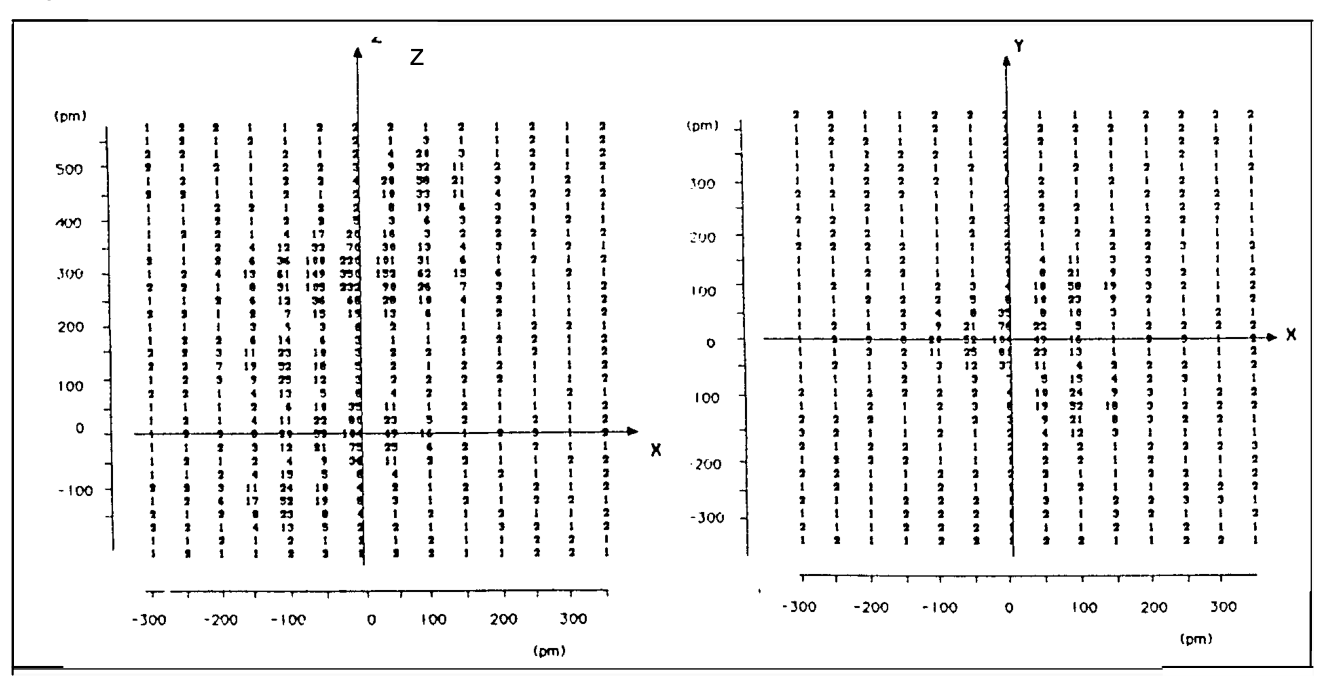
Fig. 1
The numbers indicated on the maps relate to the electron density in the neighbourhood of the atoms of E as a function of the spatial coordinates. The maxima found in these maps coincide with the locations of the atoms and the values are approximately proportional to the number of electrons in the atom in question.
2.1 Show where the maxima lie by drawing the contour curves around the maxima, connecting points of equal electron densities. Label each maximum to show the identities of the atoms in E.
2.2 When 450.0 mg of C was treated with an excess of mercury, 53.25 ml of A was liberated at a pressure of 101.0 kPa and a temperature of 25 °C. Calculate the relative atomic mass of A.
2.3 Identify A, B, C, D and E.
2.4 Use the valence-shell electron-pair repulsion theory (VSEPR) to propose electron-pair geometries for B and C. Using the two electron density maps, sketch the molecular geometry of E.
The original mixture was hydrolysed in water. B reacts to A while liberating oxygen and producing aqueous hydrogen fluoride. Hydrolysis of C leads to A and oxygen (in molar ratio of 4 : 3) and yields an aqueous solution of \(\ce{AO3}\) and hydrogen fluoride. D hydrolyses to an aqueous solution of \(\ce{AO3}\) and hydrogen fluoride.
2.5 Write the equations for the three hydrolysis reactions.
2.6 Quantitative hydrolysis of a mixture of B, C and D gives 60.2 ml of gas (measured at 290 K and 100 kPa). The oxygen content of this gas is 40.0% (by volume). The amount of \(\ce{AO3}\) dissolved in water is titrated with an aqueous 0.1 molar \(\ce{FeSO4}\) solution and 36.0 ml used thereby. During the titration \(\ce{Fe^{2+}}\) is oxidized to \(\ce{Fe^{3+}}\) and \(\ce{AO3}\) is reduced to A. Calculate the composition (% by moles) of the original mixture of B, C and D.
Official English text of the problem.
Problem 3: Combustion in a car engine and catalytic oxidation of CO
A typical family car has four cylinders with a total cylinder volume of 1600 cm³ and a fuel consumption of 7.0 l per 100 km when driving at a speed of 90 km/h. During one second each cylinder goes through 25 burn cycles and consumes 0.4 g of fuel. Assume that fuel consists of 2,2,4-trimethylpentane, \(\ce{C8H18}\). The compression ratio of the cylinder is 1:8.
3.1 Calculate the air intake of the engine (m³/s). The gasified fuel and air are introduced into the cylinder when its volume is largest until the pressure is 101.0 kPa. Temperature of both incoming air and fuel are 100 °C. Air contains 21.0 % (by volume) of \(\ce{O2}\) and 79.0 % of \(\ce{N2}\). It is assumed that 10.0 % of the carbon forms \(\ce{CO}\) upon combustion and that nitrogen remains inert.
3.2 The gasified fuel and the air are compressed until the volume in the cylinder is at its smallest and then ignited. Calculate the composition (% by volume) and the temperature of the exhaust gases immediately after the combustion (exhaust gases have not yet started to expand). The following data is given:
Compound \(\Delta H_f\) (kJ/mol) \(C_p\) (J/mol K) \(\ce{O2(g)}\) 0.0 29.36 \(\ce{N2(g)}\) 0.0 29.13 \(\ce{CO(g)}\) −110.53 29.14 \(\ce{CO2(g)}\) −395.51 37.11 \(\ce{H2O(g)}\) −241.82 33.58 2,2,4-trimethylpentane −187.82 3.3 Calculate the final temperature of the leaving gases assuming that the piston has moved to expand the gases to the maximum volume of the cylinder and that the final gas pressure in the cylinder is 200 kPa.
3.4 To convert \(\ce{CO(g)}\) into \(\ce{CO2(g)}\) the exhaust gases are led through a bed of catalysts with the following work function:
\[ \frac{n(\ce{CO})}{n(\ce{CO2})} = \frac{1}{4}k \left[\frac{n(\ce{CO})}{n(\ce{CO2})}\right]_1 v e^{-T/T_0} \]
where \([n(\ce{CO})/n(\ce{CO2})]_1\) is the molar ratio before the catalyst, \(v\) is the flow rate in mol/s and \(T\) the temperature of the gases entering the catalyst (the same as the temperature of the leaving exhaust gases). \(T_0\) is a reference temperature (373 K) and \(k\) is equal to 3.141 s/mol. Calculate the composition (% by volume) of the exhaust gases leaving the catalyst.
Official English text of the problem.
Problem 4: Photodecomposition of AgCl in chloride determination, pH of a weak-acid mixture and conditional constants
Chloride ions are analytically determined by precipitating them with silver nitrate. The precipitate is undergoing decomposition in presence of light and forms elemental silver and chlorine. In aqueous solution the latter disproportionates to chlorate(V) and chloride. With excess of silver ions, the chloride ions formed are precipitated whereas chlorate(V) ions are not.
4.1 Write the balanced equations of the reactions mentioned above.
4.2 The gravimetric determination yielded a precipitate of which 12 % by mass was decomposed by light. Determine the size and direction of the error caused by this decomposition.
4.3 Consider a solution containing two weak acids \(\ce{HA}\) and \(\ce{HL}\), 0.020 molar and 0.010 molar solutions, respectively. The acid constants are \(1\times10^{-4}\) for \(\ce{HA}\) and \(1\times10^{-7}\) for \(\ce{HL}\). Calculate the pH of the solution.
4.4 \(\ce{M}\) forms a complex \(\ce{ML}\) with the acid \(\ce{H2L}\) with the formation constant \(K_1\). The solution contains another metal ion \(\ce{N}\) that forms a complex \(\ce{NHL}\) with the acid \(\ce{H2L}\). Determine the conditional equilibrium constant, \(K_1'\) for the complex \(\ce{ML}\) in terms of \([\ce{H+}]\) and \(K\) values.
\[ K_1=\frac{[\ce{ML}]}{[\ce{M}][\ce{L}]} \]
\[ K_1'=\frac{[\ce{ML}]}{[\ce{M}'][\ce{L}']} \]
\([\ce{M}']\) = total concentration of \(\ce{M}\) not bound in \(\ce{ML}\)
\([\ce{L}']\) = the sum of the concentrations of all species containing \(\ce{L}\) except \(\ce{ML}\)
In addition to \(K_1\), the acid constants \(K_{a1}\) and \(K_{a2}\) of \(\ce{H2L}\) as well as the formation constant \(K_{\ce{NHL}}\) of \(\ce{NHL}\) are known.
\[ K_{\ce{NHL}} =\frac{[\ce{NHL}]}{[\ce{N}][\ce{L}][\ce{H+}]} \]
You may assume that the equilibrium concentration \([\ce{H+}]\) and \([\ce{N}]\) are known, too.
Official English text of the problem.
Problem 5: Synthesis of a secondary alcohol G from phenol and the mass spectrum of D
A common compound A is prepared from phenol and oxidized to compound B. Dehydration of A with \(\ce{H2SO4}\) leads to compound C and treatment of A with \(\ce{PBr3}\) gives D. In the mass spectrum of D there is a very strong peak at \(m/e = 83\) (base peak) and two molecular ion peaks at \(m/e\) 162 and 164. The ratio of intensities of the peaks 162 and 164 is 1.02. Compound D can be converted to an organomagnesium compound E that reacts with a carbonyl compound F in dry ether to give G after hydrolysis. G is a secondary alcohol with the molecular formula \(\ce{C8H16O}\).
5.1 Outline all steps in the synthesis of G and draw the structural formulae of the compounds A – G.
5.2 Which of the products A – G consist of configurational stereoisomeric pairs?
5.3 Identify the three ions in the mass spectrum considering isotopic abundances given in the text.
Official English text of the problem.
Problem 6: Identification of a bio-accumulated pollutant X from its mass spectrum
Upon analyzing sea mussels a new bio-accumulated pollutant X was found as determined by mass spectroscopy coupled to a gas chromatograph. The mass spectrum is illustrated in figure. Determine the structural formula of X assuming that it is produced out of synthetic rubber used as insulation in electrolysis cells that are used for the production of chlorine. Give the name of the compound X. The isotopic abundances of the pertinent elements are shown in the figure and table below. Intensities of the ions m/e = 196, 233, 268 and 270 are very low and thus omitted. Peaks of the \(\ce{^{13}C}\) containing ions are omitted for simplicity.
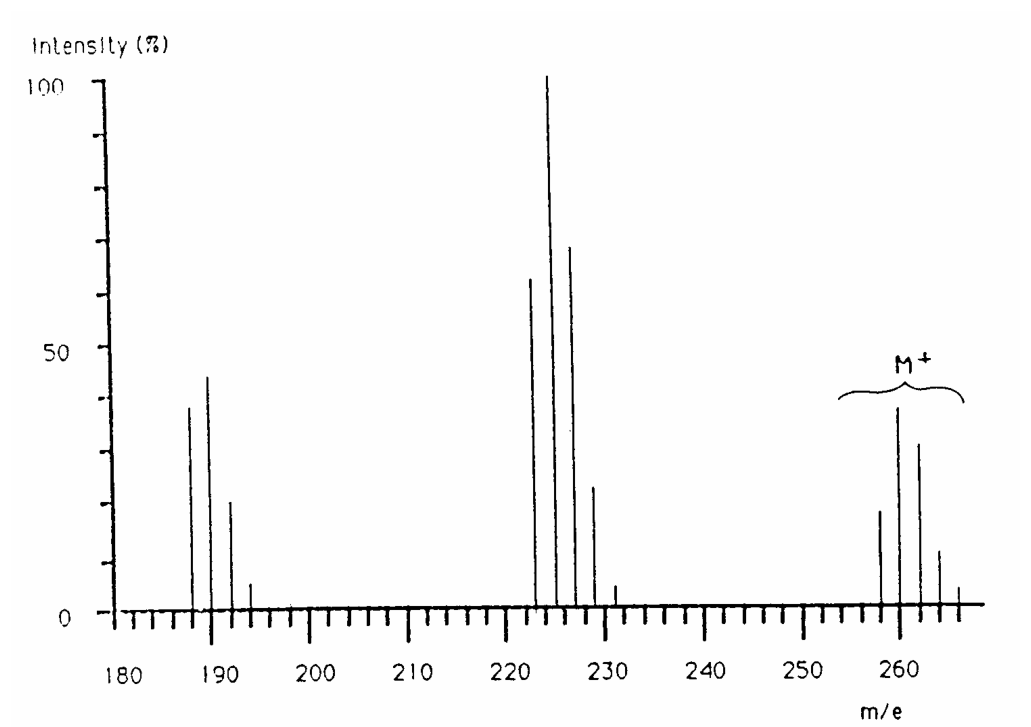
Element Mas Norm.abundanc Mass Norm.abundanc Mas Norm.abundanc H 1 100.0 2 0.015 C 12 100.0 13 1.1 N 14 100.0 15 0.37 O 16 100.0 17 0.04 18 0.20 P 31 100.0 S 32 100.0 33 0.80 34 4.4 Cl 35 100.0 37 32.5 Br 79 100.0 81 98.0 Official English text of the problem.
Internationale Chemie-Olympiade
IChO 1988
Espoo, Finnland · 6 Theorieaufgaben mit vollständigen Lösungen
Aufgabe 1: Flatlandia: das Periodensystem einer zweidimensionalen Welt
Das Periodensystem der Elemente in unserer dreidimensionalen Welt beruht auf den vier Elektronenquantenzahlen \(n = 1, 2, 3,\ldots;\ l = 0, 1,\ldots,n - 1,\ m = 0,\pm 1,\pm 2,\ldots,\pm 1;\) und \(s = \pm 1/2\). In Flatlandia, einer zweidimensionalen Welt, beruht das Periodensystem somit auf drei Elektronenquantenzahlen: \(n = 1,2,3,\ldots;\ m_l = 0,\pm1,\pm2,\ldots,\pm(n-1);\) und \(s = \pm1/2\), wobei \(m_l\) die kombinierte Rolle von \(l\) und \(m_l\) der dreidimensionalen Welt übernimmt. Die folgenden Aufgaben beziehen sich auf diese zweidimensionale Welt, in der die aus unserer Welt gewonnenen chemischen und physikalischen Erfahrungen weiterhin gelten sollen.
1.1 Zeichnen Sie die ersten vier Perioden des Periodensystems der Elemente von Flatlandia. Nummerieren Sie die Elemente entsprechend ihrer Kernladung. Verwenden Sie die Ordnungszahlen (\(Z\)) als Symbole für die jeweiligen Elemente. Geben Sie für jedes Element die Elektronenkonfiguration an.
1.2 Zeichnen Sie die Hybridorbitale der Elemente mit \(n = 2\). Welches Element bildet die Grundlage der „organischen“ Chemie in Flatlandia? Finden Sie die Flatlandia-Analoga zu Ethan, Ethen und Cyclohexan. Welche Arten aromatischer Ringverbindungen sind möglich?
1.3 Welche Regeln in Flatlandia entsprechen der Oktettregel und der 18-Elektronen-Regel in der dreidimensionalen Welt?
1.4 Stellen Sie die vorhergesagten Trends der ersten Ionisierungsenergien der Elemente von Flatlandia mit \(n = 2\) grafisch dar. Zeigen Sie grafisch, wie die Elektronegativitäten der Elemente im Periodensystem von Flatlandia zunehmen.
1.5 Zeichnen Sie die Molekülorbital-Energiediagramme der neutralen homonuklearen zweiatomigen Moleküle der Elemente mit \(n = 2\). Welche dieser Moleküle sind in Flatlandia stabil?
1.6 Betrachten Sie einfache binäre Verbindungen der Elemente (\(n = 2\)) mit dem Element mit \(Z = 1\). Zeichnen Sie ihre Lewis-Strukturen, sagen Sie ihre Geometrien voraus und schlagen Sie Analoga aus der dreidimensionalen Welt vor.
1.7 Betrachten Sie die Elemente mit \(n \leq 3\). Schlagen Sie für jedes dieser Elemente von Flatlandia ein Analogon aus unserer Welt vor und geben Sie dessen chemisches Symbol an. Sagen Sie anhand dieser chemischen und physikalischen Analogie voraus, welche zweidimensionalen Elemente bei Normaldruck und Normaltemperatur fest, flüssig oder gasförmig sind.
Aufgabentext aus dem offiziellen englischen Text übersetzt.
Aufgabe 2: Fluoride eines Elements A und die Elektronendichtekarten der Verbindung E
Beim Erhitzen eines Gemisches aus A und Fluor (Stoffmengenverhältnis 1 : 9, Druck etwa 1 MPa) auf 900 °C entstehen drei Verbindungen (B, C und D). Alle drei Produkte sind bei Umgebungstemperatur kristalline Feststoffe mit Schmelzpunkten unter 150 °C. Der Fluorgehalt von C beträgt 36.7 % und der von D 46.5 % (Massenanteile). Wird B bei −75 °C mit wasserfreiem \(\ce{HOSO2F}\) behandelt, entsteht eine Verbindung E:
E ist ein Feststoff, der bei 0 °C wochenlang stabil ist, sich bei Raumtemperatur jedoch innerhalb von Tagen zersetzt. Die durch Röntgenbeugungsuntersuchungen ermittelte Elektronendichteverteilung von E ist in zwei einander schneidenden, zueinander senkrechten Ebenen dargestellt (siehe Abb. 1).
Abb. 1
Die in den Karten angegebenen Zahlen geben die Elektronendichte in der Umgebung der Atome von E als Funktion der Raumkoordinaten an. Die in diesen Karten auftretenden Maxima fallen mit den Positionen der Atome zusammen, und ihre Werte sind annähernd proportional zur Anzahl der Elektronen im jeweiligen Atom.
2.1 Kennzeichnen Sie die Lage der Maxima, indem Sie um die Maxima Konturlinien zeichnen, die Punkte gleicher Elektronendichte verbinden. Beschriften Sie jedes Maximum mit dem zugehörigen Atom in E.
2.2 Bei der Behandlung von 450.0 mg C mit einem Überschuss an Quecksilber wurden bei einem Druck von 101.0 kPa und einer Temperatur von 25 °C 53.25 ml A freigesetzt. Berechnen Sie die relative Atommasse von A.
2.3 Identifizieren Sie A, B, C, D und E.
2.4 Schlagen Sie mithilfe des Elektronenpaarabstoßungsmodells der Valenzschale (VSEPR) Elektronenpaargeometrien für B und C vor. Skizzieren Sie anhand der beiden Elektronendichtekarten die Molekülgeometrie von E.
Das ursprüngliche Gemisch wurde in Wasser hydrolysiert. B reagiert zu A, wobei Sauerstoff freigesetzt wird und eine wässrige Fluorwasserstofflösung entsteht. Die Hydrolyse von C führt zu A und Sauerstoff (im Stoffmengenverhältnis 4 : 3) und liefert eine wässrige Lösung von \(\ce{AO3}\) und Fluorwasserstoff. D hydrolysiert zu einer wässrigen Lösung von \(\ce{AO3}\) und Fluorwasserstoff.
2.5 Stellen Sie die Gleichungen für die drei Hydrolysereaktionen auf.
2.6 Die quantitative Hydrolyse eines Gemisches aus B, C und D liefert 60.2 ml Gas (gemessen bei 290 K und 100 kPa). Der Sauerstoffgehalt dieses Gases beträgt 40.0% (Volumenanteil). Die in Wasser gelöste Menge an \(\ce{AO3}\) wird mit einer wässrigen 0.1-molaren \(\ce{FeSO4}\)-Lösung titriert, wobei 36.0 ml verbraucht werden. Während der Titration wird \(\ce{Fe^{2+}}\) zu \(\ce{Fe^{3+}}\) oxidiert und \(\ce{AO3}\) zu A reduziert. Berechnen Sie die Zusammensetzung (Stoffmengenanteile in %) des ursprünglichen Gemisches aus B, C und D.
Aufgabentext aus dem offiziellen englischen Text übersetzt.
Aufgabe 3: Verbrennung in einem Automotor und katalytische Oxidation von CO
Ein typischer Familienwagen hat vier Zylinder mit einem Gesamtzylindervolumen von 1600 cm³ und einen Kraftstoffverbrauch von 7.0 l pro 100 km bei einer Fahrgeschwindigkeit von 90 km/h. Innerhalb einer Sekunde durchläuft jeder Zylinder 25 Verbrennungszyklen und verbraucht 0.4 g Kraftstoff. Nehmen Sie an, dass der Kraftstoff aus 2,2,4-Trimethylpentan, \(\ce{C8H18}\), besteht. Das Verdichtungsverhältnis des Zylinders beträgt 1:8.
3.1 Berechnen Sie den angesaugten Luftvolumenstrom des Motors (m³/s). Der verdampfte Kraftstoff und die Luft werden bei maximalem Zylindervolumen in den Zylinder eingeleitet, bis der Druck 101.0 kPa beträgt. Sowohl die einströmende Luft als auch der Kraftstoff haben eine Temperatur von 100 °C. Luft enthält 21.0 % (Volumenanteil) \(\ce{O2}\) und 79.0 % \(\ce{N2}\). Es wird angenommen, dass 10.0 % des Kohlenstoffs bei der Verbrennung \(\ce{CO}\) bilden und dass Stickstoff inert bleibt.
3.2 Der verdampfte Kraftstoff und die Luft werden verdichtet, bis das Volumen im Zylinder minimal ist, und anschließend gezündet. Berechnen Sie die Zusammensetzung (in Volumen-%) und die Temperatur der Abgase unmittelbar nach der Verbrennung (die Abgase haben noch nicht begonnen, sich auszudehnen). Folgende Daten sind gegeben:
Verbindung \(\Delta H_f\) (kJ/mol) \(C_p\) (J/mol K) \(\ce{O2(g)}\) 0.0 29.36 \(\ce{N2(g)}\) 0.0 29.13 \(\ce{CO(g)}\) −110.53 29.14 \(\ce{CO2(g)}\) −395.51 37.11 \(\ce{H2O(g)}\) −241.82 33.58 2,2,4-Trimethylpentan −187.82 3.3 Berechnen Sie die Endtemperatur der austretenden Gase unter der Annahme, dass sich der Kolben so bewegt hat, dass die Gase auf das maximale Zylindervolumen expandiert sind, und dass der Enddruck des Gases im Zylinder 200 kPa beträgt.
3.4 Zur Umwandlung von \(\ce{CO(g)}\) in \(\ce{CO2(g)}\) werden die Abgase durch ein Katalysatorbett geleitet, dessen Wirkungsweise durch folgende Funktion beschrieben wird:
\[ \frac{n(\ce{CO})}{n(\ce{CO2})} = \frac{1}{4}k \left[\frac{n(\ce{CO})}{n(\ce{CO2})}\right]_1 v e^{-T/T_0} \]
Dabei ist \([n(\ce{CO})/n(\ce{CO2})]_1\) das Stoffmengenverhältnis vor dem Katalysator, \(v\) der Stoffmengenstrom in mol/s und \(T\) die Temperatur der in den Katalysator eintretenden Gase (gleich der Temperatur der austretenden Abgase). \(T_0\) ist eine Referenztemperatur (373 K), und \(k\) beträgt 3.141 s/mol. Berechnen Sie die Zusammensetzung (in Volumen-%) der aus dem Katalysator austretenden Abgase.
Aufgabentext aus dem offiziellen englischen Text übersetzt.
Aufgabe 4: Photolyse von AgCl bei der Chloridbestimmung, pH-Wert eines Gemisches schwacher Säuren und bedingte Konstanten
Chloridionen werden analytisch bestimmt, indem sie mit Silbernitrat gefällt werden. Der Niederschlag zersetzt sich unter Lichteinwirkung und bildet elementares Silber und Chlor. In wässriger Lösung disproportioniert Letzteres zu Chlorat(V) und Chlorid. Bei einem Überschuss an Silberionen werden die gebildeten Chloridionen gefällt, die Chlorat(V)-Ionen hingegen nicht.
4.1 Stellen Sie die ausgeglichenen Gleichungen der oben genannten Reaktionen auf.
4.2 Bei der gravimetrischen Bestimmung wurde ein Niederschlag erhalten, von dem 12 % der Masse durch Licht zersetzt wurden. Bestimmen Sie den Betrag und die Richtung des durch diese Zersetzung verursachten Fehlers.
4.3 Betrachten Sie eine Lösung, die zwei schwache Säuren \(\ce{HA}\) und \(\ce{HL}\) in Konzentrationen von 0.020 molar bzw. 0.010 molar enthält. Die Säurekonstanten betragen \(1\times10^{-4}\) für \(\ce{HA}\) und \(1\times10^{-7}\) für \(\ce{HL}\). Berechnen Sie den pH-Wert der Lösung.
4.4 \(\ce{M}\) bildet mit der Säure \(\ce{H2L}\) einen Komplex \(\ce{ML}\) mit der Bildungskonstante \(K_1\). Die Lösung enthält ein weiteres Metallion \(\ce{N}\), das mit der Säure \(\ce{H2L}\) einen Komplex \(\ce{NHL}\) bildet. Bestimmen Sie die bedingte Gleichgewichtskonstante \(K_1'\) für den Komplex \(\ce{ML}\) in Abhängigkeit von \([\ce{H+}]\) und den \(K\)-Werten.
\[ K_1=\frac{[\ce{ML}]}{[\ce{M}][\ce{L}]} \]
\[ K_1'=\frac{[\ce{ML}]}{[\ce{M}'][\ce{L}']} \]
\([\ce{M}']\) = Gesamtkonzentration von \(\ce{M}\), das nicht in \(\ce{ML}\) gebunden ist
\([\ce{L}']\) = Summe der Konzentrationen aller Spezies, die \(\ce{L}\) enthalten, mit Ausnahme von \(\ce{ML}\)
Neben \(K_1\) sind die Säurekonstanten \(K_{a1}\) und \(K_{a2}\) von \(\ce{H2L}\) sowie die Bildungskonstante \(K_{\ce{NHL}}\) von \(\ce{NHL}\) bekannt.
\[ K_{\ce{NHL}} =\frac{[\ce{NHL}]}{[\ce{N}][\ce{L}][\ce{H+}]} \]
Sie dürfen annehmen, dass auch die Gleichgewichtskonzentrationen \([\ce{H+}]\) und \([\ce{N}]\) bekannt sind.
Aufgabentext aus dem offiziellen englischen Text übersetzt.
Aufgabe 5: Synthese eines sekundären Alkohols G aus Phenol und das Massenspektrum von D
Eine gängige Verbindung A wird aus Phenol hergestellt und zur Verbindung B oxidiert. Die Dehydratisierung von A mit \(\ce{H2SO4}\) führt zur Verbindung C, und die Umsetzung von A mit \(\ce{PBr3}\) ergibt D. Im Massenspektrum von D gibt es einen sehr starken Peak bei \(m/e = 83\) (Basispeak) und zwei Molekülionenpeaks bei \(m/e\) 162 und 164. Das Intensitätsverhältnis der Peaks 162 und 164 beträgt 1.02. Die Verbindung D kann in eine Organomagnesiumverbindung E überführt werden, die mit einer Carbonylverbindung F in wasserfreiem Ether reagiert und nach Hydrolyse G ergibt. G ist ein sekundärer Alkohol mit der Summenformel \(\ce{C8H16O}\).
5.1 Skizzieren Sie alle Schritte der Synthese von G und zeichnen Sie die Strukturformeln der Verbindungen A – G.
5.2 Welche der Produkte A – G liegen als Paare von Konfigurationsisomeren vor?
5.3 Identifizieren Sie die drei Ionen im Massenspektrum unter Berücksichtigung der im Text angegebenen Isotopenhäufigkeiten.
Aufgabentext aus dem offiziellen englischen Text übersetzt.
Aufgabe 6: Identifizierung eines bioakkumulierten Schadstoffs X anhand seines Massenspektrums
Bei der Untersuchung von Meeresmuscheln wurde mittels Massenspektrometrie, gekoppelt mit Gaschromatographie, ein neuer bioakkumulierter Schadstoff X nachgewiesen. Das Massenspektrum ist in der Abbildung dargestellt. Bestimmen Sie die Strukturformel von X unter der Annahme, dass es aus synthetischem Kautschuk entsteht, der als Isoliermaterial in Elektrolysezellen zur Herstellung von Chlor verwendet wird. Geben Sie den Namen der Verbindung X an. Die Isotopenhäufigkeiten der relevanten Elemente sind in der Abbildung und der nachstehenden Tabelle angegeben. Die Intensitäten der Ionen mit m/e = 196, 233, 268 und 270 sind sehr gering und daher nicht dargestellt. Die Peaks der \(\ce{^{13}C}\)-haltigen Ionen wurden der Einfachheit halber weggelassen.
Element Masse Norm. Häufigkeit Masse Norm. Häufigkeit Masse Norm. Häufigkeit H 1 100.0 2 0.015 C 12 100.0 13 1.1 N 14 100.0 15 0.37 O 16 100.0 17 0.04 18 0.20 P 31 100.0 S 32 100.0 33 0.80 34 4.4 Cl 35 100.0 37 32.5 Br 79 100.0 81 98.0 Aufgabentext aus dem offiziellen englischen Text übersetzt.
Uluslararası Kimya Olimpiyatı
IChO 1988
Espoo, Finlandiya · 6 teori sorusu, tam çözümleriyle
Soru 1: Flatlandia: iki boyutlu bir dünyanın periyodik sistemi
Üç boyutlu dünyamızda elementlerin periyodik sistemi, elektronun dört kuantum sayısına dayanır: \(n = 1, 2, 3,\ldots;\ l = 0, 1,\ldots,n - 1,\ m = 0,\pm 1,\pm 2,\ldots,\pm 1;\) ve \(s = \pm 1/2\). İki boyutlu bir dünya olan Flatlandia'da ise periyodik sistem, elektronun üç kuantum sayısına dayanır: \(n = 1,2,3,\ldots;\ m_l = 0,\pm1,\pm2,\ldots,\pm(n-1);\) ve \(s = \pm1/2\). Burada \(m_l\), üç boyutlu dünyadaki \(l\) ve \(m_l\) kuantum sayılarının rollerini birlikte üstlenir. Aşağıdaki sorular, dünyamızdan edindiğimiz kimyasal ve fiziksel deneyimlerin hâlâ geçerli olduğu varsayılan bu iki boyutlu dünyayla ilgilidir.
1.1 Flatlandia elementlerinin periyodik tablosunun ilk dört periyodunu çiziniz. Elementleri çekirdek yüklerine göre numaralandırınız. Her bir elementin simgesi olarak atom numarasını (\(Z\)) kullanınız. Her elementin elektron dizilimini yazınız.
1.2 \(n = 2\) olan elementlerin hibrit orbitallerini çiziniz. Flatlandia'da “organik” kimyanın temelini hangi element oluşturur? Etan, eten ve siklohekzanın Flatlandia'daki benzerlerini bulunuz. Ne tür aromatik halkalı bileşikler mümkündür?
1.3 Flatlandia'da hangi kurallar, üç boyutlu dünyadaki oktet ve 18 elektron kurallarına karşılık gelir?
1.4 \(n = 2\) olan Flatlandia elementlerinin birinci iyonlaşma enerjilerindeki eğilimleri grafikle öngörünüz. Flatlandia periyodik tablosunda elementlerin elektronegatifliklerinin nasıl arttığını grafikle gösteriniz.
1.5 \(n = 2\) olan elementlerin nötr, eş çekirdekli iki atomlu moleküllerinin moleküler orbital enerji diyagramlarını çiziniz. Bu moleküllerden hangileri Flatlandia'da kararlıdır?
1.6 \(n = 2\) olan elementlerin \(Z = 1\) olan elementle oluşturduğu basit ikili bileşikleri ele alınız. Lewis yapılarını çiziniz, geometrilerini öngörünüz ve bunlara üç boyutlu dünyadan benzerler öneriniz.
1.7 \(n \leq 3\) olan elementleri ele alınız. Bu Flatlandia elementlerinin her biri için dünyamızdan bir benzer öneriniz ve kimyasal simgesini yazınız. Bu kimyasal ve fiziksel benzerliğe dayanarak, iki boyutlu elementlerin hangilerinin normal basınç ve sıcaklıkta katı, sıvı veya gaz hâlinde olduğunu öngörünüz.
Soru metni resmi İngilizce metinden çevrilmiştir.
Soru 2: Bir A elementinin florürleri ve E bileşiğinin elektron yoğunluğu haritaları
A ve flor karışımı (mol oranı 1 : 9, basınç yaklaşık 1 MPa) 900 °C'ye ısıtıldığında üç bileşik (B, C ve D) oluşur. Üç ürünün tümü ortam sıcaklığında kristal katılardır ve erime noktaları 150 °C'nin altındadır. C'nin flor içeriği %36.7, D'ninki ise %46.5 (kütlece) olarak bulunmuştur. B, −75 °C'de susuz \(\ce{HOSO2F}\) ile tepkimeye sokulduğunda E bileşiği oluşur:
E, 0 °C'de haftalarca kararlı kalan, ancak oda sıcaklığında günler içinde bozunan bir katıdır. E'nin X-ışını kırınımı çalışmalarıyla elde edilen elektron yoğunluğu dağılımı, birbiriyle kesişen ve birbirine dik iki düzlem üzerinde gösterilmiştir (bkz. Şekil 1).
Şekil 1
Haritalarda belirtilen sayılar, uzaysal koordinatların bir fonksiyonu olarak E'nin atomlarının çevresindeki elektron yoğunluğunu ifade eder. Bu haritalardaki maksimumlar atomların konumlarıyla çakışır ve değerleri, ilgili atomdaki elektron sayısıyla yaklaşık olarak orantılıdır.
2.1 Eşit elektron yoğunluğuna sahip noktaları birleştirerek maksimumların çevresine eş yoğunluk eğrileri çizin ve maksimumların nerede bulunduğunu gösterin. E'deki atomların kimliklerini göstermek için her maksimumu etiketleyin.
2.2 450.0 mg C, aşırı miktarda cıva ile tepkimeye sokulduğunda, 101.0 kPa basınçta ve 25 °C sıcaklıkta 53.25 ml A açığa çıkmıştır. A'nın bağıl atom kütlesini hesaplayın.
2.3 A, B, C, D ve E'yi belirleyin.
2.4 Değerlik kabuğu elektron çifti itmesi kuramını (VSEPR) kullanarak B ve C için elektron çifti geometrileri önerin. İki elektron yoğunluğu haritasını kullanarak E'nin molekül geometrisini çizimle gösterin.
Başlangıçtaki karışım suda hidroliz edilmiştir. B, oksijen açığa çıkarıp sulu hidrojen florür oluştururken A'ya dönüşür. C'nin hidrolizi sonucunda A ve oksijen (4 : 3 mol oranında) oluşur ve sulu bir \(\ce{AO3}\) ve hidrojen florür çözeltisi elde edilir. D, hidroliz olarak sulu bir \(\ce{AO3}\) ve hidrojen florür çözeltisi oluşturur.
2.5 Üç hidroliz tepkimesinin denklemlerini yazın.
2.6 B, C ve D karışımının nicel hidrolizi sonucunda 60.2 ml gaz (290 K ve 100 kPa'da ölçülmüştür) elde edilir. Bu gazın oksijen içeriği hacimce %40.0'tır. Suda çözünmüş \(\ce{AO3}\) miktarı, sulu 0.1 molar \(\ce{FeSO4}\) çözeltisiyle titre edilir ve bu işlemde 36.0 ml kullanılır. Titrasyon sırasında \(\ce{Fe^{2+}}\), \(\ce{Fe^{3+}}\)'e yükseltgenir ve \(\ce{AO3}\), A'ya indirgenir. Başlangıçtaki B, C ve D karışımının bileşimini (molce %) hesaplayın.
Soru metni resmi İngilizce metinden çevrilmiştir.
Soru 3: Bir otomobil motorunda yanma ve CO'nun katalitik yükseltgenmesi
Tipik bir aile otomobilinin toplam silindir hacmi 1600 cm³ olan dört silindiri vardır ve 90 km/h hızla giderken 100 km'de 7.0 l yakıt tüketir. Bir saniye içinde her silindir 25 yanma çevrimi gerçekleştirir ve 0.4 g yakıt tüketir. Yakıtın 2,2,4-trimetilpentandan, \(\ce{C8H18}\), oluştuğunu varsayın. Silindirin sıkıştırma oranı 1:8'dir.
3.1 Motorun hava emiş debisini (m³/s) hesaplayın. Gaz hâline getirilmiş yakıt ve hava, silindir hacmi en büyük değerindeyken basınç 101.0 kPa olana kadar silindire alınır. Giren havanın ve yakıtın sıcaklıkları 100 °C'dir. Hava, hacimce %21.0 \(\ce{O2}\) ve %79.0 \(\ce{N2}\) içerir. Yanma sırasında karbonun %10.0'ının \(\ce{CO}\) oluşturduğu ve azotun tepkimeye girmediği varsayılmaktadır.
3.2 Gaz hâline getirilmiş yakıt ve hava, silindirdeki hacim en küçük değerine ulaşana kadar sıkıştırılır ve ardından tutuşturulur. Yanmanın hemen ardından egzoz gazlarının bileşimini (hacimce %) ve sıcaklığını hesaplayın (egzoz gazları henüz genleşmeye başlamamıştır). Aşağıdaki veriler verilmiştir:
Bileşik \(\Delta H_f\) (kJ/mol) \(C_p\) (J/mol K) \(\ce{O2(g)}\) 0.0 29.36 \(\ce{N2(g)}\) 0.0 29.13 \(\ce{CO(g)}\) −110.53 29.14 \(\ce{CO2(g)}\) −395.51 37.11 \(\ce{H2O(g)}\) −241.82 33.58 2,2,4-trimetilpentan −187.82 3.3 Pistonun, gazları silindirin en büyük hacmine kadar genleştirecek şekilde hareket ettiğini ve silindirdeki son gaz basıncının 200 kPa olduğunu varsayarak çıkan gazların son sıcaklığını hesaplayın.
3.4 \(\ce{CO(g)}\)'yu \(\ce{CO2(g)}\)'ye dönüştürmek için egzoz gazları, aşağıdaki çalışma fonksiyonuna sahip bir katalizör yatağından geçirilir:
\[ \frac{n(\ce{CO})}{n(\ce{CO2})} = \frac{1}{4}k \left[\frac{n(\ce{CO})}{n(\ce{CO2})}\right]_1 v e^{-T/T_0} \]
Burada \([n(\ce{CO})/n(\ce{CO2})]_1\) katalizörden önceki mol oranı, \(v\) mol/s cinsinden akış debisi ve \(T\) katalizöre giren gazların sıcaklığıdır (çıkan egzoz gazlarının sıcaklığıyla aynıdır). \(T_0\) bir referans sıcaklıktır (373 K) ve \(k\), 3.141 s/mol değerine eşittir. Katalizörden çıkan egzoz gazlarının bileşimini (hacimce %) hesaplayın.
Soru metni resmi İngilizce metinden çevrilmiştir.
Soru 4: Klorür tayininde AgCl'nin fotobozunması, zayıf asit karışımının pH'sı ve koşullu sabitler
Klorür iyonları, gümüş nitrat ile çöktürülerek analitik olarak tayin edilir. Çökelek, ışık varlığında bozunarak elementel gümüş ve klor oluşturur. Sulu çözeltide klor, klorat(V) ve klorür oluşturmak üzere disproporsiyonlaşır. Gümüş iyonlarının fazlası bulunduğunda, oluşan klorür iyonları çöktürülürken klorat(V) iyonları çöktürülmez.
4.1 Yukarıda belirtilen tepkimelerin denkleştirilmiş denklemlerini yazınız.
4.2 Gravimetrik tayinde elde edilen çökeleğin kütlece %12'si ışık etkisiyle bozunmuştur. Bu bozunmanın neden olduğu hatanın büyüklüğünü ve yönünü belirleyiniz.
4.3 Sırasıyla 0.020 molar ve 0.010 molar derişimlerde iki zayıf asit, \(\ce{HA}\) ve \(\ce{HL}\), içeren bir çözeltiyi ele alınız. Asitlik sabitleri \(\ce{HA}\) için \(1\times10^{-4}\), \(\ce{HL}\) için ise \(1\times10^{-7}\)'dir. Çözeltinin pH'sını hesaplayınız.
4.4 \(\ce{M}\), \(\ce{H2L}\) asidi ile oluşum sabiti \(K_1\) olan bir \(\ce{ML}\) kompleksi oluşturur. Çözelti, \(\ce{H2L}\) asidi ile \(\ce{NHL}\) kompleksi oluşturan başka bir metal iyonu, \(\ce{N}\), içerir. \(\ce{ML}\) kompleksi için koşullu denge sabiti \(K_1'\)'yi, \([\ce{H+}]\) ve \(K\) değerleri cinsinden belirleyiniz.
\[ K_1=\frac{[\ce{ML}]}{[\ce{M}][\ce{L}]} \]
\[ K_1'=\frac{[\ce{ML}]}{[\ce{M}'][\ce{L}']} \]
\([\ce{M}']\) = \(\ce{ML}\) içinde bağlı olmayan \(\ce{M}\)'nin toplam derişimi
\([\ce{L}']\) = \(\ce{ML}\) dışındaki tüm \(\ce{L}\) içeren türlerin derişimleri toplamı
\(K_1\)'e ek olarak, \(\ce{H2L}\)'nin asitlik sabitleri \(K_{a1}\) ve \(K_{a2}\) ile \(\ce{NHL}\)'nin oluşum sabiti \(K_{\ce{NHL}}\) bilinmektedir.
\[ K_{\ce{NHL}} =\frac{[\ce{NHL}]}{[\ce{N}][\ce{L}][\ce{H+}]} \]
\([\ce{H+}]\) ve \([\ce{N}]\) denge derişimlerinin de bilindiğini varsayabilirsiniz.
Soru metni resmi İngilizce metinden çevrilmiştir.
Soru 5: Fenolden sekonder bir alkol olan G'nin sentezi ve D'nin kütle spektrumu
Yaygın bir bileşik olan A, fenolden hazırlanır ve B bileşiğine yükseltgenir. A'nın \(\ce{H2SO4}\) ile dehidrasyonu C bileşiğini, A'nın \(\ce{PBr3}\) ile tepkimesi ise D'yi verir. D'nin kütle spektrumunda \(m/e = 83\)'te çok şiddetli bir pik (temel pik) ve \(m/e\) 162 ve 164'te iki moleküler iyon piki vardır. 162 ve 164 piklerinin şiddetlerinin oranı 1.02'dir. D bileşiği, susuz eterde bir karbonil bileşiği olan F ile tepkimeye girerek hidrolizden sonra G'yi veren bir organomagnezyum bileşiği olan E'ye dönüştürülebilir. G, molekül formülü \(\ce{C8H16O}\) olan sekonder bir alkoldür.
5.1 G'nin sentezindeki tüm basamakları ana hatlarıyla gösteriniz ve A – G bileşiklerinin yapı formüllerini çiziniz.
5.2 A – G ürünlerinden hangileri konfigürasyonel stereoizomer çiftlerinden oluşur?
5.3 Metinde verilen izotop bolluklarını dikkate alarak kütle spektrumundaki üç iyonu belirleyiniz.
Soru metni resmi İngilizce metinden çevrilmiştir.
Soru 6: Biyobirikime uğramış bir X kirleticisinin kütle spektrumundan belirlenmesi
Deniz midyelerinin analizi sırasında, gaz kromatografına bağlı kütle spektroskopisi ile biyobirikime uğramış yeni bir X kirleticisi bulundu. Kütle spektrumu şekilde gösterilmiştir. X'in, klor üretiminde kullanılan elektroliz hücrelerinde yalıtım malzemesi olarak kullanılan sentetik kauçuktan oluştuğunu varsayarak yapı formülünü belirleyiniz. X bileşiğinin adını veriniz. İlgili elementlerin izotop bollukları aşağıdaki şekil ve tabloda gösterilmiştir. m/e = 196, 233, 268 ve 270 olan iyonların şiddetleri çok düşük olduğundan bunlar gösterilmemiştir. Basitlik açısından, \(\ce{^{13}C}\) içeren iyonların pikleri de gösterilmemiştir.
Element Kütle Normalize bolluk Kütle Normalize bolluk Kütle Normalize bolluk H 1 100.0 2 0.015 C 12 100.0 13 1.1 N 14 100.0 15 0.37 O 16 100.0 17 0.04 18 0.20 P 31 100.0 S 32 100.0 33 0.80 34 4.4 Cl 35 100.0 37 32.5 Br 79 100.0 81 98.0 Soru metni resmi İngilizce metinden çevrilmiştir.
Olimpiada Internacional de Química
IChO 1988
Espoo, Finlandia · 6 problemas teóricos con soluciones completas
Problema 1: Flatlandia: el sistema periódico de un mundo bidimensional
El sistema periódico de los elementos de nuestro mundo tridimensional se basa en los cuatro números cuánticos del electrón \(n = 1, 2, 3,\ldots;\ l = 0, 1,\ldots,n - 1,\ m = 0,\pm 1,\pm 2,\ldots,\pm 1;\) y \(s = \pm 1/2\). En Flatlandia, un mundo bidimensional, el sistema periódico se basa, por tanto, en tres números cuánticos del electrón: \(n = 1,2,3,\ldots;\ m_l = 0,\pm1,\pm2,\ldots,\pm(n-1);\) y \(s = \pm1/2\), donde \(m_l\) desempeña conjuntamente el papel de \(l\) y \(m_l\) del mundo tridimensional. Las siguientes tareas se refieren a este mundo bidimensional, en el que se supone que la experiencia química y física adquirida en nuestro mundo sigue siendo aplicable.
1.1 Dibuje los cuatro primeros períodos de la tabla periódica de los elementos de Flatlandia. Numere los elementos según su carga nuclear. Utilice los números atómicos (\(Z\)) como símbolos de los respectivos elementos. Escriba la configuración electrónica de cada elemento.
1.2 Dibuje los orbitales híbridos de los elementos con \(n = 2\). ¿Qué elemento constituye la base de la química «orgánica» en Flatlandia? Encuentre los análogos en Flatlandia del etano, el eteno y el ciclohexano. ¿Qué tipos de compuestos cíclicos aromáticos son posibles?
1.3 ¿Qué reglas de Flatlandia corresponden a las reglas del octeto y de los 18 electrones del mundo tridimensional?
1.4 Prediga gráficamente las tendencias de las primeras energías de ionización de los elementos de Flatlandia con \(n = 2\). Muestre gráficamente cómo aumentan las electronegatividades de los elementos en la tabla periódica de Flatlandia.
1.5 Dibuje los diagramas de energía de los orbitales moleculares de las moléculas diatómicas homonucleares neutras de los elementos con \(n = 2\). ¿Cuáles de estas moléculas son estables en Flatlandia?
1.6 Considere compuestos binarios sencillos de los elementos (\(n = 2\)) con el elemento de \(Z = 1\). Dibuje sus estructuras de Lewis, prediga sus geometrías y proponga análogos para ellos en el mundo tridimensional.
1.7 Considere los elementos con \(n \leq 3\). Proponga un análogo de nuestro mundo y escriba su símbolo químico para cada uno de estos elementos de Flatlandia. A partir de esta analogía química y física, prediga qué elementos bidimensionales son sólidos, líquidos o gaseosos a presión y temperatura normales.
Enunciado traducido del texto oficial en inglés.
Problema 2: Fluoruros de un elemento A y mapas de densidad electrónica del compuesto E
Al calentar una mezcla de A y flúor (relación molar 1 : 9, presión aproximada de 1 MPa) hasta 900 °C, se forman tres compuestos (B, C y D). Los tres productos son sólidos cristalinos a temperatura ambiente, con puntos de fusión inferiores a 150 °C. Se determina que el contenido de flúor de C es del 36.7 % y el de D, del 46.5 % (en masa). Cuando B se trata con \(\ce{HOSO2F}\) anhidro a −75 °C, se forma un compuesto E:
E es un sólido que permanece estable durante semanas a 0 °C, pero se descompone en cuestión de días a temperatura ambiente. La distribución de densidad electrónica de E, obtenida mediante estudios de difracción de rayos X, se muestra en dos planos secantes y mutuamente perpendiculares (véase la Fig. 1).
Fig. 1
Los números indicados en los mapas corresponden a la densidad electrónica en las proximidades de los átomos de E en función de las coordenadas espaciales. Los máximos que aparecen en estos mapas coinciden con las posiciones de los átomos, y sus valores son aproximadamente proporcionales al número de electrones del átomo en cuestión.
2.1 Indique dónde se encuentran los máximos dibujando curvas de nivel a su alrededor que conecten puntos de igual densidad electrónica. Etiquete cada máximo para indicar la identidad de los átomos de E.
2.2 Al tratar 450.0 mg de C con un exceso de mercurio, se liberaron 53.25 ml de A a una presión de 101.0 kPa y una temperatura de 25 °C. Calcule la masa atómica relativa de A.
2.3 Identifique A, B, C, D y E.
2.4 Utilice la teoría de repulsión de los pares de electrones de la capa de valencia (VSEPR) para proponer las geometrías de los pares de electrones de B y C. A partir de los dos mapas de densidad electrónica, esboce la geometría molecular de E.
La mezcla original se hidrolizó en agua. B reacciona para dar A, liberando oxígeno y produciendo fluoruro de hidrógeno en disolución acuosa. La hidrólisis de C da lugar a A y oxígeno (en una relación molar de 4 : 3) y produce una disolución acuosa de \(\ce{AO3}\) y fluoruro de hidrógeno. D se hidroliza para dar una disolución acuosa de \(\ce{AO3}\) y fluoruro de hidrógeno.
2.5 Escriba las ecuaciones de las tres reacciones de hidrólisis.
2.6 La hidrólisis cuantitativa de una mezcla de B, C y D produce 60.2 ml de gas (medidos a 290 K y 100 kPa). El contenido de oxígeno de este gas es del 40.0% (en volumen). La cantidad de \(\ce{AO3}\) disuelta en agua se valora con una disolución acuosa 0.1 molar de \(\ce{FeSO4}\), de la que se consumen 36.0 ml. Durante la valoración, el \(\ce{Fe^{2+}}\) se oxida a \(\ce{Fe^{3+}}\) y el \(\ce{AO3}\) se reduce a A. Calcule la composición (% en moles) de la mezcla original de B, C y D.
Enunciado traducido del texto oficial en inglés.
Problema 3: Combustión en el motor de un automóvil y oxidación catalítica del CO
Un automóvil familiar típico tiene cuatro cilindros con un volumen total de 1600 cm³ y un consumo de combustible de 7.0 l por cada 100 km cuando circula a una velocidad de 90 km/h. Durante un segundo, cada cilindro realiza 25 ciclos de combustión y consume 0.4 g de combustible. Suponga que el combustible está compuesto por 2,2,4-trimetilpentano, \(\ce{C8H18}\). La relación de compresión del cilindro es de 1:8.
3.1 Calcule el caudal de admisión de aire del motor (m³/s). El combustible vaporizado y el aire se introducen en el cilindro cuando su volumen es máximo hasta alcanzar una presión de 101.0 kPa. La temperatura tanto del aire como del combustible que entran es de 100 °C. El aire contiene un 21.0 % (en volumen) de \(\ce{O2}\) y un 79.0 % de \(\ce{N2}\). Se supone que el 10.0 % del carbono forma \(\ce{CO}\) durante la combustión y que el nitrógeno permanece inerte.
3.2 El combustible vaporizado y el aire se comprimen hasta que el volumen del cilindro es mínimo y, a continuación, se enciende la mezcla. Calcule la composición (% en volumen) y la temperatura de los gases de escape inmediatamente después de la combustión (los gases de escape aún no han comenzado a expandirse). Se proporcionan los siguientes datos:
Compuesto \(\Delta H_f\) (kJ/mol) \(C_p\) (J/mol K) \(\ce{O2(g)}\) 0.0 29.36 \(\ce{N2(g)}\) 0.0 29.13 \(\ce{CO(g)}\) −110.53 29.14 \(\ce{CO2(g)}\) −395.51 37.11 \(\ce{H2O(g)}\) −241.82 33.58 2,2,4-trimetilpentano −187.82 3.3 Calcule la temperatura final de los gases que salen, suponiendo que el pistón se ha desplazado hasta expandir los gases al volumen máximo del cilindro y que la presión final del gas en el cilindro es de 200 kPa.
3.4 Para convertir el \(\ce{CO(g)}\) en \(\ce{CO2(g)}\), los gases de escape se hacen pasar por un lecho de catalizadores con la siguiente función de funcionamiento:
\[ \frac{n(\ce{CO})}{n(\ce{CO2})} = \frac{1}{4}k \left[\frac{n(\ce{CO})}{n(\ce{CO2})}\right]_1 v e^{-T/T_0} \]
donde \([n(\ce{CO})/n(\ce{CO2})]_1\) es la relación molar antes del catalizador, \(v\) es el caudal en mol/s y \(T\) es la temperatura de los gases que entran en el catalizador (la misma que la temperatura de los gases de escape que salen). \(T_0\) es una temperatura de referencia (373 K) y \(k\) es igual a 3.141 s/mol. Calcule la composición (% en volumen) de los gases de escape que salen del catalizador.
Enunciado traducido del texto oficial en inglés.
Problema 4: Fotodescomposición del AgCl en la determinación de cloruros, pH de una mezcla de ácidos débiles y constantes condicionales
Los iones cloruro se determinan analíticamente mediante su precipitación con nitrato de plata. El precipitado se descompone en presencia de luz y forma plata elemental y cloro. En disolución acuosa, este último se desproporciona para formar clorato(V) y cloruro. En presencia de un exceso de iones plata, los iones cloruro formados precipitan, mientras que los iones clorato(V) no lo hacen.
4.1 Escriba las ecuaciones ajustadas de las reacciones mencionadas anteriormente.
4.2 La determinación gravimétrica produjo un precipitado del cual el 12 % en masa se descompuso por acción de la luz. Determine la magnitud y el signo del error causado por esta descomposición.
4.3 Considere una disolución que contiene dos ácidos débiles, \(\ce{HA}\) y \(\ce{HL}\), con concentraciones de 0.020 molar y 0.010 molar, respectivamente. Las constantes de acidez son \(1\times10^{-4}\) para \(\ce{HA}\) y \(1\times10^{-7}\) para \(\ce{HL}\). Calcule el pH de la disolución.
4.4 \(\ce{M}\) forma un complejo \(\ce{ML}\) con el ácido \(\ce{H2L}\), con una constante de formación \(K_1\). La disolución contiene otro ion metálico, \(\ce{N}\), que forma un complejo \(\ce{NHL}\) con el ácido \(\ce{H2L}\). Determine la constante de equilibrio condicional, \(K_1'\), del complejo \(\ce{ML}\) en función de \([\ce{H+}]\) y de los valores de \(K\).
\[ K_1=\frac{[\ce{ML}]}{[\ce{M}][\ce{L}]} \]
\[ K_1'=\frac{[\ce{ML}]}{[\ce{M}'][\ce{L}']} \]
\([\ce{M}']\) = concentración total de \(\ce{M}\) que no está unido en \(\ce{ML}\)
\([\ce{L}']\) = suma de las concentraciones de todas las especies que contienen \(\ce{L}\), excepto \(\ce{ML}\)
Además de \(K_1\), se conocen las constantes de acidez \(K_{a1}\) y \(K_{a2}\) de \(\ce{H2L}\), así como la constante de formación \(K_{\ce{NHL}}\) de \(\ce{NHL}\).
\[ K_{\ce{NHL}} =\frac{[\ce{NHL}]}{[\ce{N}][\ce{L}][\ce{H+}]} \]
Puede suponer que también se conocen las concentraciones de equilibrio \([\ce{H+}]\) y \([\ce{N}]\).
Enunciado traducido del texto oficial en inglés.
Problema 5: Síntesis de un alcohol secundario G a partir de fenol y espectro de masas de D
Un compuesto común A se prepara a partir de fenol y se oxida para obtener el compuesto B. La deshidratación de A con \(\ce{H2SO4}\) da lugar al compuesto C, y el tratamiento de A con \(\ce{PBr3}\) produce D. En el espectro de masas de D hay un pico muy intenso a \(m/e = 83\) (pico base) y dos picos del ion molecular a \(m/e\) 162 y 164. La relación entre las intensidades de los picos 162 y 164 es 1.02. El compuesto D puede convertirse en un compuesto organomagnésico E que reacciona con un compuesto carbonílico F en éter anhidro para dar G tras la hidrólisis. G es un alcohol secundario de fórmula molecular \(\ce{C8H16O}\).
5.1 Esboce todas las etapas de la síntesis de G y dibuje las fórmulas estructurales de los compuestos A – G.
5.2 ¿Cuáles de los productos A – G presentan pares de estereoisómeros configuracionales?
5.3 Identifique los tres iones del espectro de masas teniendo en cuenta las abundancias isotópicas indicadas en el texto.
Enunciado traducido del texto oficial en inglés.
Problema 6: Identificación de un contaminante bioacumulado X a partir de su espectro de masas
Al analizar mejillones marinos, se encontró un nuevo contaminante bioacumulado X, identificado mediante espectrometría de masas acoplada a un cromatógrafo de gases. El espectro de masas se muestra en la figura. Determine la fórmula estructural de X suponiendo que se produce a partir del caucho sintético utilizado como aislante en las celdas de electrólisis empleadas para la producción de cloro. Indique el nombre del compuesto X. Las abundancias isotópicas de los elementos pertinentes se muestran en la figura y en la tabla siguientes. Las intensidades de los iones m/e = 196, 233, 268 y 270 son muy bajas y, por tanto, se han omitido. Los picos de los iones que contienen \(\ce{^{13}C}\) se han omitido para simplificar.
Elemento Masa Abund. normalizada Masa Abund. normalizada Masa Abund. normalizada H 1 100.0 2 0.015 C 12 100.0 13 1.1 N 14 100.0 15 0.37 O 16 100.0 17 0.04 18 0.20 P 31 100.0 S 32 100.0 33 0.80 34 4.4 Cl 35 100.0 37 32.5 Br 79 100.0 81 98.0 Enunciado traducido del texto oficial en inglés.
国际化学奥林匹克
IChO 1988
芬兰埃斯波 · 6 道理论题及完整解答
题目 1:Flatlandia:二维世界的元素周期系
我们所处的三维世界中的元素周期系以四个电子量子数为基础:\(n = 1, 2, 3,\ldots;\ l = 0, 1,\ldots,n - 1,\ m = 0,\pm 1,\pm 2,\ldots,\pm 1;\) 和 \(s = \pm 1/2\)。在二维世界 Flatlandia 中,元素周期系因此以三个电子量子数为基础:\(n = 1,2,3,\ldots;\ m_l = 0,\pm1,\pm2,\ldots,\pm(n-1);\) 和 \(s = \pm1/2\),其中 \(m_l\) 同时起到三维世界中 \(l\) 和 \(m_l\) 的作用。以下各问涉及这个二维世界,并假定我们在自身世界中获得的化学和物理经验在其中仍然适用。
1.1 画出 Flatlandia 元素周期表的前四个周期。按核电荷数为元素编号。用原子序数(\(Z\))作为各元素的符号。写出每种元素的电子排布。
1.2 画出 \(n = 2\) 的元素的杂化轨道。哪种元素是 Flatlandia 中“有机”化学的基础?找出 Flatlandia 中与乙烷、乙烯和环己烷对应的物质。可能存在哪些类型的芳香性环状化合物?
1.3 Flatlandia 中的哪些规则对应于三维世界中的八电子规则和 18 电子规则?
1.4 用图示预测 Flatlandia 中 \(n = 2\) 的元素的第一电离能变化趋势。用图示表示 Flatlandia 元素周期表中元素电负性增大的方向。
1.5 画出 \(n = 2\) 的元素所形成的中性同核双原子分子的分子轨道能级图。这些分子中哪些在 Flatlandia 中是稳定的?
1.6 考虑 \(n = 2\) 的元素与 \(Z = 1\) 的元素形成的简单二元化合物。画出它们的路易斯结构,预测其几何构型,并提出三维世界中与之对应的物质。
1.7 考虑 \(n \leq 3\) 的元素。为 Flatlandia 中的每种元素提出我们世界中与之对应的元素,并写出其化学符号。根据这种化学和物理上的类比,预测哪些二维元素在常温常压下为固态、液态或气态。
题目译自官方英文原文。
题目 2:元素 A 的氟化物与化合物 E 的电子密度图
将 A 与氟气的混合物(摩尔比为 1 : 9,压强约为 1 MPa)加热至 900 °C,生成三种化合物(B、C 和 D)。这三种产物在环境温度下均为晶态固体,熔点均低于 150 °C。测得 C 的氟含量为 36.7 %,D 的氟含量为 46.5 %(均为质量百分数)。在 −75 °C 下用无水 \(\ce{HOSO2F}\) 处理 B,生成化合物 E:
E 是一种固体,在 0 °C 下可稳定存在数周,但在室温下会在数日内分解。通过 X 射线衍射研究得到的 E 的电子密度分布,显示在两个相交且互相垂直的平面上(见图 1)。
图 1
图中标出的数字表示 E 中各原子附近的电子密度随空间坐标的变化。这些图中的极大值位置与原子位置重合,其数值近似正比于相应原子中的电子数。
2.1 在极大值周围绘制等值线,连接电子密度相等的点,以标明极大值的位置。标注每个极大值,指出其对应于 E 中的哪种原子。
2.2 用过量的汞处理 450.0 mg 的 C,在压强为 101.0 kPa、温度为 25 °C 时释放出 53.25 ml 的 A。计算 A 的相对原子质量。
2.3 确定 A、B、C、D 和 E 分别是什么物质。
2.4 利用价层电子对互斥理论(VSEPR),推测 B 和 C 的电子对几何构型。根据两幅电子密度图,画出 E 的分子几何构型示意图。
将最初的混合物在水中水解。B 反应生成 A,同时释放氧气并生成氟化氢水溶液。C 水解生成 A 和氧气(摩尔比为 4 : 3),并得到含有 \(\ce{AO3}\) 和氟化氢的水溶液。D 水解得到含有 \(\ce{AO3}\) 和氟化氢的水溶液。
2.5 写出这三个水解反应的方程式。
2.6 将 B、C 和 D 的混合物定量水解,得到 60.2 ml 气体(在 290 K、100 kPa 下测量)。该气体的氧气含量为 40.0%(体积百分数)。用 0.1 mol/L 的 \(\ce{FeSO4}\) 水溶液滴定溶于水中的 \(\ce{AO3}\),消耗滴定液 36.0 ml。滴定过程中,\(\ce{Fe^{2+}}\) 被氧化为 \(\ce{Fe^{3+}}\),\(\ce{AO3}\) 被还原为 A。计算最初 B、C 和 D 混合物的组成(摩尔百分数)。
题目译自官方英文原文。
题目 3:汽车发动机中的燃烧与 CO 的催化氧化
一辆典型的家用汽车有四个气缸,气缸总体积为 1600 cm³,以 90 km/h 的速度行驶时,每 100 km 的燃油消耗量为 7.0 l。每秒钟,每个气缸进行 25 次燃烧循环,消耗 0.4 g 燃油。假设燃油由 2,2,4-三甲基戊烷(\(\ce{C8H18}\))组成。气缸的压缩比为 1:8。
3.1 计算发动机的空气进气量(m³/s)。在气缸体积最大时,将汽化的燃油和空气引入气缸,直至压力达到 101.0 kPa。进入气缸的空气和燃油的温度均为 100 °C。空气中含有 21.0 %(体积分数)的 \(\ce{O2}\) 和 79.0 % 的 \(\ce{N2}\)。假设燃烧时有 10.0 % 的碳生成 \(\ce{CO}\),且氮气不参与反应。
3.2 将汽化的燃油和空气压缩至气缸内体积最小,然后点火。计算燃烧刚结束时废气的组成(体积百分数)和温度(废气尚未开始膨胀)。给定下列数据:
物质 \(\Delta H_f\) (kJ/mol) \(C_p\) (J/mol K) \(\ce{O2(g)}\) 0.0 29.36 \(\ce{N2(g)}\) 0.0 29.13 \(\ce{CO(g)}\) −110.53 29.14 \(\ce{CO2(g)}\) −395.51 37.11 \(\ce{H2O(g)}\) −241.82 33.58 2,2,4-三甲基戊烷 −187.82 3.3 假设活塞已移动,使气体膨胀至气缸的最大体积,且气缸内气体的最终压力为 200 kPa,计算排出气体的最终温度。
3.4 为将 \(\ce{CO(g)}\) 转化为 \(\ce{CO2(g)}\),使废气通过催化剂床,其作用函数如下:
\[ \frac{n(\ce{CO})}{n(\ce{CO2})} = \frac{1}{4}k \left[\frac{n(\ce{CO})}{n(\ce{CO2})}\right]_1 v e^{-T/T_0} \]
其中,\([n(\ce{CO})/n(\ce{CO2})]_1\) 是进入催化剂前的物质的量之比,\(v\) 是以 mol/s 为单位的流量,\(T\) 是进入催化剂的气体温度(与排出废气的温度相同)。\(T_0\) 是参考温度(373 K),\(k\) 等于 3.141 s/mol。计算离开催化剂的废气组成(体积百分数)。
题目译自官方英文原文。
题目 4:氯离子测定中 AgCl 的光分解、弱酸混合溶液的 pH 和条件常数
在分析中,用硝酸银沉淀氯离子来测定其含量。沉淀在光照下发生分解,生成单质银和氯气。在水溶液中,后者歧化生成氯酸根(V)和氯离子。在银离子过量的条件下,生成的氯离子被沉淀,而氯酸根(V)离子不被沉淀。
4.1 写出上述反应的配平化学方程式。
4.2 重量法测定所得沉淀中,有 12 %(质量分数)被光分解。确定这种分解所造成的误差的大小和方向。
4.3 考虑一种含有两种弱酸 \(\ce{HA}\) 和 \(\ce{HL}\) 的溶液,两者的物质的量浓度分别为 0.020 mol/L 和 0.010 mol/L。\(\ce{HA}\) 的酸解离常数为 \(1\times10^{-4}\),\(\ce{HL}\) 的酸解离常数为 \(1\times10^{-7}\)。计算该溶液的 pH。
4.4 \(\ce{M}\) 与酸 \(\ce{H2L}\) 形成配合物 \(\ce{ML}\),其形成常数为 \(K_1\)。溶液中还含有另一种金属离子 \(\ce{N}\),它与酸 \(\ce{H2L}\) 形成配合物 \(\ce{NHL}\)。用 \([\ce{H+}]\) 和各 \(K\) 值表示配合物 \(\ce{ML}\) 的条件平衡常数 \(K_1'\)。
\[ K_1=\frac{[\ce{ML}]}{[\ce{M}][\ce{L}]} \]
\[ K_1'=\frac{[\ce{ML}]}{[\ce{M}'][\ce{L}']} \]
\([\ce{M}']\) = 未结合于 \(\ce{ML}\) 中的 \(\ce{M}\) 的总浓度
\([\ce{L}']\) = 除 \(\ce{ML}\) 外所有含 \(\ce{L}\) 物种的浓度之和
除 \(K_1\) 外,\(\ce{H2L}\) 的酸解离常数 \(K_{a1}\) 和 \(K_{a2}\),以及 \(\ce{NHL}\) 的形成常数 \(K_{\ce{NHL}}\) 也均为已知。
\[ K_{\ce{NHL}} =\frac{[\ce{NHL}]}{[\ce{N}][\ce{L}][\ce{H+}]} \]
可以假定平衡浓度 \([\ce{H+}]\) 和 \([\ce{N}]\) 也为已知。
题目译自官方英文原文。
题目 5:由苯酚合成仲醇 G 及 D 的质谱
由苯酚制得一种常见化合物 A,将其氧化得到化合物 B。A 在 \(\ce{H2SO4}\) 作用下脱水生成化合物 C,而用 \(\ce{PBr3}\) 处理 A 则得到 D。在 D 的质谱中,\(m/e = 83\) 处有一个很强的峰(基峰),\(m/e\) 为 162 和 164 处有两个分子离子峰。162 和 164 两峰的强度比为 1.02。化合物 D 可转化为有机镁化合物 E,后者在无水乙醚中与羰基化合物 F 反应,经水解后得到 G。G 是一种分子式为 \(\ce{C8H16O}\) 的仲醇。
5.1 概述合成 G 的所有步骤,并画出化合物 A – G 的结构式。
5.2 产物 A – G 中,哪些存在成对的构型立体异构体?
5.3 根据题文给出的同位素丰度,确定质谱中的三个离子。
题目译自官方英文原文。
题目 6:根据质谱鉴定生物富集污染物 X
在分析海洋贻贝时,通过气相色谱联用质谱法发现了一种新的生物富集污染物 X。其质谱如图所示。假设 X 是由用于生产氯气的电解槽中作为绝缘材料的合成橡胶产生的,确定 X 的结构式。给出化合物 X 的名称。相关元素的同位素丰度见下图及下表。m/e = 196、233、268 和 270 的离子强度很低,因此省略。为简明起见,含有 \(\ce{^{13}C}\) 的离子峰也已省略。
元素 质量 归一化丰度 质量 归一化丰度 质量 归一化丰度 H 1 100.0 2 0.015 C 12 100.0 13 1.1 N 14 100.0 15 0.37 O 16 100.0 17 0.04 18 0.20 P 31 100.0 S 32 100.0 33 0.80 34 4.4 Cl 35 100.0 37 32.5 Br 79 100.0 81 98.0 题目译自官方英文原文。
Международная химическая олимпиада
IChO 1988
Эспоо, Финляндия · 6 теоретических задач с полными решениями
Задача 1: Flatlandia: периодическая система двумерного мира
Периодическая система элементов в нашем трёхмерном мире основана на четырёх квантовых числах электрона \(n = 1, 2, 3,\ldots;\ l = 0, 1,\ldots,n - 1,\ m = 0,\pm 1,\pm 2,\ldots,\pm 1;\) и \(s = \pm 1/2\). В двумерном мире Flatlandia периодическая система, таким образом, основана на трёх квантовых числах электрона: \(n = 1,2,3,\ldots;\ m_l = 0,\pm1,\pm2,\ldots,\pm(n-1);\) и \(s = \pm1/2\), где \(m_l\) объединяет роли \(l\) и \(m_l\) трёхмерного мира. Следующие задания относятся к этому двумерному миру, в котором, как предполагается, по-прежнему применимы химические и физические закономерности, установленные в нашем мире.
1.1 Изобразите первые четыре периода периодической таблицы элементов мира Flatlandia. Пронумеруйте элементы в соответствии с зарядом их ядер. В качестве символов конкретных элементов используйте атомные номера (\(Z\)). Запишите электронную конфигурацию каждого элемента.
1.2 Изобразите гибридные орбитали элементов с \(n = 2\). Какой элемент лежит в основе «органической» химии мира Flatlandia? Найдите аналоги этана, этена и циклогексана в мире Flatlandia. Какие ароматические циклические соединения возможны?
1.3 Какие правила в мире Flatlandia соответствуют правилу октета и правилу 18 электронов в трёхмерном мире?
1.4 Представьте графически предполагаемые закономерности изменения первой энергии ионизации элементов мира Flatlandia с \(n = 2\). Покажите графически, как возрастает электроотрицательность элементов в периодической таблице мира Flatlandia.
1.5 Изобразите энергетические диаграммы молекулярных орбиталей нейтральных гомоядерных двухатомных молекул элементов с \(n = 2\). Какие из этих молекул устойчивы в мире Flatlandia?
1.6 Рассмотрите простые бинарные соединения элементов (\(n = 2\)) с элементом \(Z = 1\). Изобразите их структуры Льюиса, предскажите их геометрию и предложите для них аналоги в трёхмерном мире.
1.7 Рассмотрите элементы с \(n \leq 3\). Для каждого из этих элементов мира Flatlandia предложите аналог из нашего мира и запишите его химический символ. На основе этого химического и физического аналога предскажите, какие двумерные элементы являются твёрдыми, жидкими или газообразными при нормальных давлении и температуре.
Условие переведено с официального английского текста.
Задача 2: Фториды элемента A и карты электронной плотности соединения E
При нагревании смеси A и фтора (мольное соотношение 1 : 9, давление приблизительно 1 МПа) до 900 °C образуются три соединения (B, C и D). Все три продукта при температуре окружающей среды представляют собой кристаллические твёрдые вещества с температурами плавления ниже 150 °C. Установлено, что содержание фтора в C составляет 36.7 %, а в D — 46.5 % (по массе). При обработке B безводной \(\ce{HOSO2F}\) при −75 °C образуется соединение E:
E — твёрдое вещество, устойчивое в течение нескольких недель при 0 °C, но разлагающееся за несколько дней при комнатной температуре. Распределение электронной плотности E, полученное методом рентгеновской дифракции, показано в двух пересекающихся взаимно перпендикулярных плоскостях (см. рис. 1).
Рис. 1
Числа, указанные на картах, характеризуют электронную плотность в окрестности атомов E в зависимости от пространственных координат. Максимумы на этих картах совпадают с положениями атомов, а их значения приблизительно пропорциональны числу электронов в соответствующем атоме.
2.1 Укажите положения максимумов, проведя вокруг них линии равной электронной плотности, соединяющие точки с одинаковыми значениями электронной плотности. Подпишите каждый максимум, указав, какому атому в E он соответствует.
2.2 При обработке 450.0 мг C избытком ртути выделилось 53.25 мл A при давлении 101.0 кПа и температуре 25 °C. Рассчитайте относительную атомную массу A.
2.3 Определите A, B, C, D и E.
2.4 Используя теорию отталкивания электронных пар валентной оболочки (VSEPR), предложите геометрию расположения электронных пар для B и C. На основании двух карт электронной плотности изобразите геометрию молекулы E.
Исходную смесь подвергли гидролизу в воде. B превращается в A с выделением кислорода и образованием водного раствора фтороводорода. Гидролиз C приводит к образованию A и кислорода (в мольном соотношении 4 : 3), а также водного раствора \(\ce{AO3}\) и фтороводорода. D гидролизуется с образованием водного раствора \(\ce{AO3}\) и фтороводорода.
2.5 Напишите уравнения трёх реакций гидролиза.
2.6 При количественном гидролизе смеси B, C и D образуется 60.2 мл газа (объём измерен при 290 К и 100 кПа). Содержание кислорода в этом газе составляет 40.0% (по объёму). Количество растворённого в воде \(\ce{AO3}\) определяют титрованием водным 0.1-молярным раствором \(\ce{FeSO4}\), на которое расходуется 36.0 мл этого раствора. В ходе титрования \(\ce{Fe^{2+}}\) окисляется до \(\ce{Fe^{3+}}\), а \(\ce{AO3}\) восстанавливается до A. Рассчитайте состав (в мол. %) исходной смеси B, C и D.
Условие переведено с официального английского текста.
Задача 3: Сгорание в автомобильном двигателе и каталитическое окисление CO
Типичный семейный автомобиль имеет четыре цилиндра с общим объёмом 1600 см³ и расходует 7.0 л топлива на 100 км при движении со скоростью 90 км/ч. За одну секунду в каждом цилиндре происходит 25 циклов сгорания и расходуется 0.4 г топлива. Считайте, что топливо состоит из 2,2,4-триметилпентана, \(\ce{C8H18}\). Степень сжатия в цилиндре составляет 1:8.
3.1 Рассчитайте объёмный расход воздуха, поступающего в двигатель (м³/с). Газообразное топливо и воздух подаются в цилиндр при его максимальном объёме до достижения давления 101.0 кПа. Температура как поступающего воздуха, так и топлива составляет 100 °C. Воздух содержит 21.0 % (по объёму) \(\ce{O2}\) и 79.0 % \(\ce{N2}\). Предполагается, что при сгорании 10.0 % углерода образует \(\ce{CO}\), а азот остаётся инертным.
3.2 Газообразное топливо и воздух сжимаются до минимального объёма в цилиндре, после чего смесь поджигают. Рассчитайте состав (% по объёму) и температуру отработавших газов непосредственно после сгорания (отработавшие газы ещё не начали расширяться). Даны следующие величины:
Вещество \(\Delta H_f\) (кДж/моль) \(C_p\) (Дж/моль К) \(\ce{O2(g)}\) 0.0 29.36 \(\ce{N2(g)}\) 0.0 29.13 \(\ce{CO(g)}\) −110.53 29.14 \(\ce{CO2(g)}\) −395.51 37.11 \(\ce{H2O(g)}\) −241.82 33.58 2,2,4-триметилпентан −187.82 3.3 Рассчитайте конечную температуру выходящих газов, предполагая, что при движении поршня газы расширились до максимального объёма цилиндра и конечное давление газа в цилиндре составляет 200 кПа.
3.4 Для превращения \(\ce{CO(g)}\) в \(\ce{CO2(g)}\) отработавшие газы пропускают через слой катализаторов, работа которого описывается следующей функцией:
\[ \frac{n(\ce{CO})}{n(\ce{CO2})} = \frac{1}{4}k \left[\frac{n(\ce{CO})}{n(\ce{CO2})}\right]_1 v e^{-T/T_0} \]
где \([n(\ce{CO})/n(\ce{CO2})]_1\) — молярное отношение перед катализатором, \(v\) — молярный расход в моль/с, а \(T\) — температура газов на входе в катализатор (равная температуре выходящих отработавших газов). \(T_0\) — опорная температура (373 К), а \(k\) равно 3.141 с/моль. Рассчитайте состав (% по объёму) отработавших газов на выходе из катализатора.
Условие переведено с официального английского текста.
Задача 4: Фотохимическое разложение AgCl при определении хлоридов, pH смеси слабых кислот и условные константы
Хлорид-ионы определяют аналитически, осаждая их нитратом серебра. Под действием света осадок разлагается с образованием металлического серебра и хлора. В водном растворе последний диспропорционирует с образованием хлорат-ионов(V) и хлорид-ионов. При избытке ионов серебра образовавшиеся хлорид-ионы осаждаются, тогда как хлорат-ионы(V) не осаждаются.
4.1 Напишите уравнения упомянутых выше реакций и расставьте коэффициенты.
4.2 При гравиметрическом определении был получен осадок, 12 % массы которого разложилось под действием света. Определите величину и знак погрешности, вызванной этим разложением.
4.3 Рассмотрите раствор, содержащий две слабые кислоты \(\ce{HA}\) и \(\ce{HL}\) с молярными концентрациями 0.020 и 0.010 моль/л соответственно. Константы диссоциации кислот равны \(1\times10^{-4}\) для \(\ce{HA}\) и \(1\times10^{-7}\) для \(\ce{HL}\). Вычислите pH раствора.
4.4 \(\ce{M}\) образует с кислотой \(\ce{H2L}\) комплекс \(\ce{ML}\) с константой образования \(K_1\). Раствор содержит ион другого металла \(\ce{N}\), который образует с кислотой \(\ce{H2L}\) комплекс \(\ce{NHL}\). Выразите условную константу равновесия \(K_1'\) для комплекса \(\ce{ML}\) через \([\ce{H+}]\) и значения \(K\).
\[ K_1=\frac{[\ce{ML}]}{[\ce{M}][\ce{L}]} \]
\[ K_1'=\frac{[\ce{ML}]}{[\ce{M}'][\ce{L}']} \]
\([\ce{M}']\) = суммарная концентрация \(\ce{M}\), не связанного в \(\ce{ML}\)
\([\ce{L}']\) = сумма концентраций всех частиц, содержащих \(\ce{L}\), кроме \(\ce{ML}\)
Помимо \(K_1\), известны константы диссоциации \(K_{a1}\) и \(K_{a2}\) кислоты \(\ce{H2L}\), а также константа образования \(K_{\ce{NHL}}\) комплекса \(\ce{NHL}\).
\[ K_{\ce{NHL}} =\frac{[\ce{NHL}]}{[\ce{N}][\ce{L}][\ce{H+}]} \]
Можно считать, что равновесные концентрации \([\ce{H+}]\) и \([\ce{N}]\) также известны.
Условие переведено с официального английского текста.
Задача 5: Синтез вторичного спирта G из фенола и масс-спектр D
Распространённое соединение A получают из фенола и окисляют до соединения B. Дегидратация A с помощью \(\ce{H2SO4}\) приводит к соединению C, а обработка A реагентом \(\ce{PBr3}\) даёт D. В масс-спектре D наблюдаются очень интенсивный пик при \(m/e = 83\) (базовый пик) и два пика молекулярных ионов при \(m/e\) 162 и 164. Отношение интенсивностей пиков 162 и 164 равно 1.02. Соединение D можно превратить в магнийорганическое соединение E, которое реагирует с карбонильным соединением F в сухом эфире, давая после гидролиза G. G — вторичный спирт с молекулярной формулой \(\ce{C8H16O}\).
5.1 Приведите все стадии синтеза G и изобразите структурные формулы соединений A – G.
5.2 Какие из продуктов A – G существуют в виде пар конфигурационных стереоизомеров?
5.3 Определите три иона в масс-спектре с учётом приведённых в тексте данных о распространённости изотопов.
Условие переведено с официального английского текста.
Задача 6: Идентификация биоаккумулированного загрязняющего вещества X по его масс-спектру
При анализе морских мидий методом масс-спектрометрии в сочетании с газовой хроматографией было обнаружено новое биоаккумулированное загрязняющее вещество X. Масс-спектр представлен на рисунке. Определите структурную формулу X, предполагая, что оно образуется из синтетического каучука, используемого в качестве изоляционного материала в электролизёрах для производства хлора. Приведите название соединения X. Изотопные распространённости соответствующих элементов приведены на рисунке и в таблице ниже. Интенсивности ионов с m/e = 196, 233, 268 и 270 очень малы, поэтому они не показаны. Для упрощения пики ионов, содержащих \(\ce{^{13}C}\), не показаны.
Элемент Масса Норм. распространённость Масса Норм. распространённость Масса Норм. распространённость H 1 100.0 2 0.015 C 12 100.0 13 1.1 N 14 100.0 15 0.37 O 16 100.0 17 0.04 18 0.20 P 31 100.0 S 32 100.0 33 0.80 34 4.4 Cl 35 100.0 37 32.5 Br 79 100.0 81 98.0 Условие переведено с официального английского текста.
الأولمبياد الدولي للكيمياء
IChO 1988
إسبو، فنلندا · 6 مسائل نظرية مع حلول كاملة
المسألة 1: Flatlandia: النظام الدوري لعالم ثنائي الأبعاد
يستند النظام الدوري للعناصر في عالمنا ثلاثي الأبعاد إلى أعداد الكم الأربعة للإلكترون \(n = 1, 2, 3,\ldots;\ l = 0, 1,\ldots,n - 1,\ m = 0,\pm 1,\pm 2,\ldots,\pm 1;\) و\(s = \pm 1/2\). أما في Flatlandia، وهو عالم ثنائي الأبعاد، فيستند النظام الدوري إلى ثلاثة أعداد كم للإلكترون: \(n = 1,2,3,\ldots;\ m_l = 0,\pm1,\pm2,\ldots,\pm(n-1);\) و\(s = \pm1/2\)، حيث يؤدي \(m_l\) الدور المشترك لكلٍّ من \(l\) و\(m_l\) في العالم ثلاثي الأبعاد. تتعلق المهام الآتية بهذا العالم ثنائي الأبعاد، الذي يُفترض أن تظل الخبرة الكيميائية والفيزيائية المكتسبة من عالمنا قابلة للتطبيق فيه.
1.1 ارسم الدورات الأربع الأولى من الجدول الدوري للعناصر في Flatlandia. رقّم العناصر وفقًا لشحناتها النووية. استخدم الأعداد الذرية (\(Z\)) رموزًا للعناصر المعنية. اكتب التوزيع الإلكتروني لكل عنصر.
1.2 ارسم المدارات المهجّنة للعناصر التي لها \(n = 2\). أي عنصر يشكّل أساس الكيمياء «العضوية» في Flatlandia؟ أوجد نظائر الإيثان والإيثين والهكسان الحلقي في Flatlandia. ما أنواع المركبات الحلقية العطرية الممكنة؟
1.3 ما القواعد في Flatlandia التي تقابل قاعدة الثمانية وقاعدة الإلكترونات الثمانية عشر في العالم ثلاثي الأبعاد؟
1.4 تنبّأ بيانيًا باتجاهات طاقات التأين الأولى لعناصر Flatlandia التي لها \(n = 2\). بيّن بيانيًا كيف تزداد السالبية الكهربائية للعناصر في الجدول الدوري في Flatlandia.
1.5 ارسم مخططات طاقة المدارات الجزيئية للجزيئات المتعادلة ثنائية الذرة المتماثلة النواتين للعناصر التي لها \(n = 2\). أي هذه الجزيئات مستقر في Flatlandia؟
1.6 انظر في المركبات الثنائية البسيطة للعناصر (\(n = 2\)) مع العنصر الذي له \(Z = 1\). ارسم بنى لويس لها، وتنبّأ بأشكالها الهندسية، واقترح نظائر لها في العالم ثلاثي الأبعاد.
1.7 انظر في العناصر التي لها \(n \leq 3\). اقترح نظيرًا من عالمنا لكل عنصر من عناصر Flatlandia هذه، واكتب رمزه الكيميائي. استنادًا إلى هذا التشابه الكيميائي والفيزيائي، تنبّأ بأي العناصر ثنائية الأبعاد يكون صلبًا أو سائلًا أو غازيًا عند الضغط ودرجة الحرارة العاديين.
نص المسألة مترجم عن النص الإنجليزي الرسمي.
المسألة 2: فلوريدات العنصر A وخرائط الكثافة الإلكترونية للمركب E
عند تسخين مزيج من A والفلور (بنسبة مولية 1 : 9، وتحت ضغط يقارب 1 MPa) إلى 900 °C، تتكوّن ثلاثة مركبات (B وC وD). والنواتج الثلاثة جميعها مواد صلبة بلورية عند درجة الحرارة المحيطة، ودرجات انصهارها أقل من 150 °C. وُجد أن محتوى C من الفلور يبلغ 36.7 %، ومحتوى D منه يبلغ 46.5 % (كتليًا). عند معالجة B بمادة \(\ce{HOSO2F}\) اللامائية عند −75 °C، يتكوّن المركب E:
E مادة صلبة تظل مستقرة لأسابيع عند 0 °C، لكنها تتحلّل خلال أيام عند درجة حرارة الغرفة. يُعرض توزيع الكثافة الإلكترونية للمركب E، المستنتج من دراسات حيود الأشعة السينية، على مستويين متقاطعين ومتعامدين أحدهما على الآخر (انظر الشكل 1).
الشكل 1
تمثّل الأعداد المبيّنة على الخرائط الكثافة الإلكترونية في جوار ذرات E بدلالة الإحداثيات المكانية. وتتطابق مواضع القيم العظمى في هذه الخرائط مع مواضع الذرات، وتتناسب قيمها تقريبًا مع عدد الإلكترونات في الذرة المعنية.
2.1 بيّن مواضع القيم العظمى برسم منحنيات تساوي الكثافة حولها، بحيث تصل بين النقاط ذات الكثافات الإلكترونية المتساوية. ضع رمزًا عند كل قيمة عظمى يبيّن هوية الذرة المقابلة لها في E.
2.2 عند معالجة 450.0 mg من C بفائض من الزئبق، تحرّر 53.25 ml من A تحت ضغط 101.0 kPa وعند درجة حرارة 25 °C. احسب الكتلة الذرية النسبية للعنصر A.
2.3 حدّد هوية A وB وC وD وE.
2.4 استخدم نظرية تنافر أزواج إلكترونات غلاف التكافؤ (VSEPR) لاقتراح الأشكال الهندسية لأزواج الإلكترونات في B وC. وبالاستعانة بخريطتي الكثافة الإلكترونية، ارسم الشكل الهندسي الجزيئي للمركب E.
أُخضع المزيج الأصلي للتحلّل المائي في الماء. يتفاعل B ليتحوّل إلى A مع تحرير الأكسجين وإنتاج محلول مائي من فلوريد الهيدروجين. ويؤدي التحلّل المائي للمركب C إلى تكوّن A والأكسجين (بنسبة مولية 4 : 3)، وينتج عنه محلول مائي من \(\ce{AO3}\) وفلوريد الهيدروجين. أما D فيتحلّل مائيًا ليعطي محلولًا مائيًا من \(\ce{AO3}\) وفلوريد الهيدروجين.
2.5 اكتب معادلات تفاعلات التحلّل المائي الثلاثة.
2.6 يعطي التحلّل المائي الكمي لمزيج من B وC وD مقدارًا من الغاز حجمه 60.2 ml (مقاسًا عند 290 K و100 kPa). ويبلغ محتوى هذا الغاز من الأكسجين 40.0% (حجميًا). تُعايَر كمية \(\ce{AO3}\) الذائبة في الماء بمحلول مائي من \(\ce{FeSO4}\) تركيزه 0.1 مولاري، ويُستهلك منه 36.0 ml. أثناء المعايرة، يتأكسد \(\ce{Fe^{2+}}\) إلى \(\ce{Fe^{3+}}\)، ويُختزل \(\ce{AO3}\) إلى A. احسب تركيب المزيج الأصلي من B وC وD (بالنسبة المئوية المولية).
نص المسألة مترجم عن النص الإنجليزي الرسمي.
المسألة 3: الاحتراق في محرك سيارة والأكسدة الحفزية لـ CO
تحتوي سيارة عائلية نموذجية على أربع أسطوانات يبلغ حجمها الكلي 1600 cm³، وتستهلك 7.0 l من الوقود لكل 100 km عند السير بسرعة 90 km/h. خلال ثانية واحدة، تمر كل أسطوانة بـ 25 دورة احتراق وتستهلك 0.4 g من الوقود. افترض أن الوقود يتكون من 2,2,4-ثلاثي ميثيل البنتان، \(\ce{C8H18}\). نسبة الانضغاط في الأسطوانة هي 1:8.
3.1 احسب معدل سحب الهواء إلى المحرك (m³/s). يُدخل الوقود المتبخر والهواء إلى الأسطوانة عندما يكون حجمها عند قيمته العظمى، حتى يصبح الضغط 101.0 kPa. تبلغ درجة حرارة كل من الهواء والوقود الداخلين 100 °C. يحتوي الهواء على 21.0 % (حجمًا) من \(\ce{O2}\) و79.0 % من \(\ce{N2}\). يُفترض أن 10.0 % من الكربون يتحول إلى \(\ce{CO}\) عند الاحتراق، وأن النيتروجين يظل خاملًا.
3.2 يُضغط الوقود المتبخر والهواء حتى يصل الحجم داخل الأسطوانة إلى قيمته الصغرى، ثم يُشعلان. احسب تركيب غازات العادم (% حجمًا) ودرجة حرارتها مباشرة بعد الاحتراق (لم تبدأ غازات العادم بالتمدد بعد). تُعطى البيانات الآتية:
المركب \(\Delta H_f\) (kJ/mol) \(C_p\) (J/mol K) \(\ce{O2(g)}\) 0.0 29.36 \(\ce{N2(g)}\) 0.0 29.13 \(\ce{CO(g)}\) −110.53 29.14 \(\ce{CO2(g)}\) −395.51 37.11 \(\ce{H2O(g)}\) −241.82 33.58 2,2,4-ثلاثي ميثيل البنتان −187.82 3.3 احسب درجة الحرارة النهائية للغازات الخارجة، بافتراض أن المكبس قد تحرك بحيث تتمدد الغازات إلى الحجم الأقصى للأسطوانة، وأن ضغط الغاز النهائي داخل الأسطوانة يبلغ 200 kPa.
3.4 لتحويل \(\ce{CO(g)}\) إلى \(\ce{CO2(g)}\)، تُمرر غازات العادم عبر طبقة من الحفازات لها دالة الأداء الآتية:
\[ \frac{n(\ce{CO})}{n(\ce{CO2})} = \frac{1}{4}k \left[\frac{n(\ce{CO})}{n(\ce{CO2})}\right]_1 v e^{-T/T_0} \]
حيث \([n(\ce{CO})/n(\ce{CO2})]_1\) هي النسبة المولية قبل الحفاز، و\(v\) هو معدل التدفق بوحدة mol/s، و\(T\) هي درجة حرارة الغازات الداخلة إلى الحفاز (وهي نفسها درجة حرارة غازات العادم الخارجة). وتمثل \(T_0\) درجة حرارة مرجعية (373 K)، وتساوي \(k\) مقدار 3.141 s/mol. احسب تركيب غازات العادم الخارجة من الحفاز (% حجمًا).
نص المسألة مترجم عن النص الإنجليزي الرسمي.
المسألة 4: التحلل الضوئي لـ AgCl في تقدير الكلوريد، والأس الهيدروجيني لمزيج من الأحماض الضعيفة، والثوابت الشرطية
تُقدَّر أيونات الكلوريد تحليليًا بترسيبها باستخدام نترات الفضة. ويتحلل الراسب في وجود الضوء، مكوِّنًا الفضة العنصرية والكلور. وفي المحلول المائي، يخضع الكلور لتفاعل عدم تناسب، فينتج الكلورات(V) والكلوريد. وعند وجود فائض من أيونات الفضة، تترسب أيونات الكلوريد المتكوِّنة، في حين لا تترسب أيونات الكلورات(V).
4.1 اكتب المعادلات الموزونة للتفاعلات المذكورة أعلاه.
4.2 أسفر التقدير الوزني عن راسب تحللت نسبة 12 % من كتلته بفعل الضوء. حدِّد مقدار الخطأ الناجم عن هذا التحلل واتجاهه.
4.3 اعتبر محلولًا يحتوي على حمضين ضعيفين هما \(\ce{HA}\) و\(\ce{HL}\)، بتركيزين مولاريين قدرهما 0.020 و0.010، على الترتيب. وثابتا تأين الحمضين هما \(1\times10^{-4}\) للحمض \(\ce{HA}\) و\(1\times10^{-7}\) للحمض \(\ce{HL}\). احسب الأس الهيدروجيني للمحلول.
4.4 يُكوِّن \(\ce{M}\) معقَّدًا \(\ce{ML}\) مع الحمض \(\ce{H2L}\)، وثابت تكوينه \(K_1\). ويحتوي المحلول على أيون فلزي آخر \(\ce{N}\)، يُكوِّن معقَّدًا \(\ce{NHL}\) مع الحمض \(\ce{H2L}\). أوجد ثابت الاتزان الشرطي \(K_1'\) للمعقَّد \(\ce{ML}\) بدلالة \([\ce{H+}]\) وقيم \(K\).
\[ K_1=\frac{[\ce{ML}]}{[\ce{M}][\ce{L}]} \]
\[ K_1'=\frac{[\ce{ML}]}{[\ce{M}'][\ce{L}']} \]
\([\ce{M}']\) = التركيز الكلي لـ \(\ce{M}\) غير المرتبط في \(\ce{ML}\)
\([\ce{L}']\) = مجموع تراكيز جميع الأنواع الكيميائية التي تحتوي على \(\ce{L}\)، باستثناء \(\ce{ML}\)
بالإضافة إلى \(K_1\)، يُعرَف ثابتا تأين الحمض \(K_{a1}\) و\(K_{a2}\) للحمض \(\ce{H2L}\)، وكذلك ثابت التكوين \(K_{\ce{NHL}}\) للمعقَّد \(\ce{NHL}\).
\[ K_{\ce{NHL}} =\frac{[\ce{NHL}]}{[\ce{N}][\ce{L}][\ce{H+}]} \]
يمكنك افتراض أن تركيزي الاتزان \([\ce{H+}]\) و\([\ce{N}]\) معلومان أيضًا.
نص المسألة مترجم عن النص الإنجليزي الرسمي.
المسألة 5: اصطناع كحول ثانوي G انطلاقًا من الفينول وطيف الكتلة للمركب D
يُحضَّر مركب شائع A من الفينول، ويُؤكسَد إلى المركب B. يؤدي نزع الماء من A باستخدام \(\ce{H2SO4}\) إلى المركب C، وتعطي معالجة A باستخدام \(\ce{PBr3}\) المركب D. يظهر في طيف الكتلة للمركب D قمة شديدة جدًا عند \(m/e = 83\) (القمة الأساسية)، وقمتان للأيون الجزيئي عند \(m/e\) 162 و164. وتبلغ نسبة شدتي القمتين 162 و164 مقدار 1.02. يمكن تحويل المركب D إلى مركب مغنيسيوم عضوي E يتفاعل مع مركب كربونيل F في إيثر جاف ليعطي G بعد التحلل المائي. والمركب G كحول ثانوي صيغته الجزيئية \(\ce{C8H16O}\).
5.1 بيّن جميع خطوات اصطناع G وارسم الصيغ البنائية للمركبات A – G.
5.2 أيّ من النواتج A – G يتكون من أزواج من المتماكبات الفراغية التكوينية؟
5.3 حدّد الأيونات الثلاثة في طيف الكتلة، مع مراعاة الوفرة النظيرية المعطاة في النص.
نص المسألة مترجم عن النص الإنجليزي الرسمي.
المسألة 6: تحديد هوية ملوِّث متراكم حيويًا X من طيف كتلته
عند تحليل بلح البحر، عُثر على ملوِّث جديد متراكم حيويًا X، وذلك باستخدام مطيافية الكتلة المقترنة بجهاز استشراب غازي. يوضّح الشكل طيف الكتلة. حدِّد الصيغة البنائية للمركّب X بافتراض أنه يتكوّن من المطاط الاصطناعي المستخدم مادةً عازلة في خلايا التحليل الكهربائي المستخدمة لإنتاج الكلور. أعطِ اسم المركّب X. تُعرض الوفرات النظيرية للعناصر ذات الصلة في الشكل والجدول أدناه. شدّات الأيونات ذات m/e = 196, 233, 268 و270 منخفضة جدًا، ولذلك حُذفت. وحُذفت قمم الأيونات المحتوية على \(\ce{^{13}C}\) للتبسيط.
العنصر الكتلة الوفرة المُطبَّعة الكتلة الوفرة المُطبَّعة الكتلة الوفرة المُطبَّعة H 1 100.0 2 0.015 C 12 100.0 13 1.1 N 14 100.0 15 0.37 O 16 100.0 17 0.04 18 0.20 P 31 100.0 S 32 100.0 33 0.80 34 4.4 Cl 35 100.0 37 32.5 Br 79 100.0 81 98.0 نص المسألة مترجم عن النص الإنجليزي الرسمي.