IChO 1988 · Theory problem 2
Fluorides of an element A and the electron-density maps of compound E
Upon heating of a mixture of A and fluorine (molar ratio 1 : 9, pressure approximately 1 MPa) to 900 °C three compounds (B, C and D) are formed. All three products are crystalline solids at ambient temperature with melting points below 150 °C. The fluorine content of C is found to be 36.7 % and that of D 46.5 % (by weight). When B is treated with anhydrous \(\ce{HOSO2F}\) at −75 °C a compound E is formed:

E is a solid which is stable for weeks at 0 °C, but decomposes in days at room temperature. The electron density distribution of E obtained through X-ray diffraction studies is shown on two intersecting, mutually perpendicular planes (see Fig. 1).
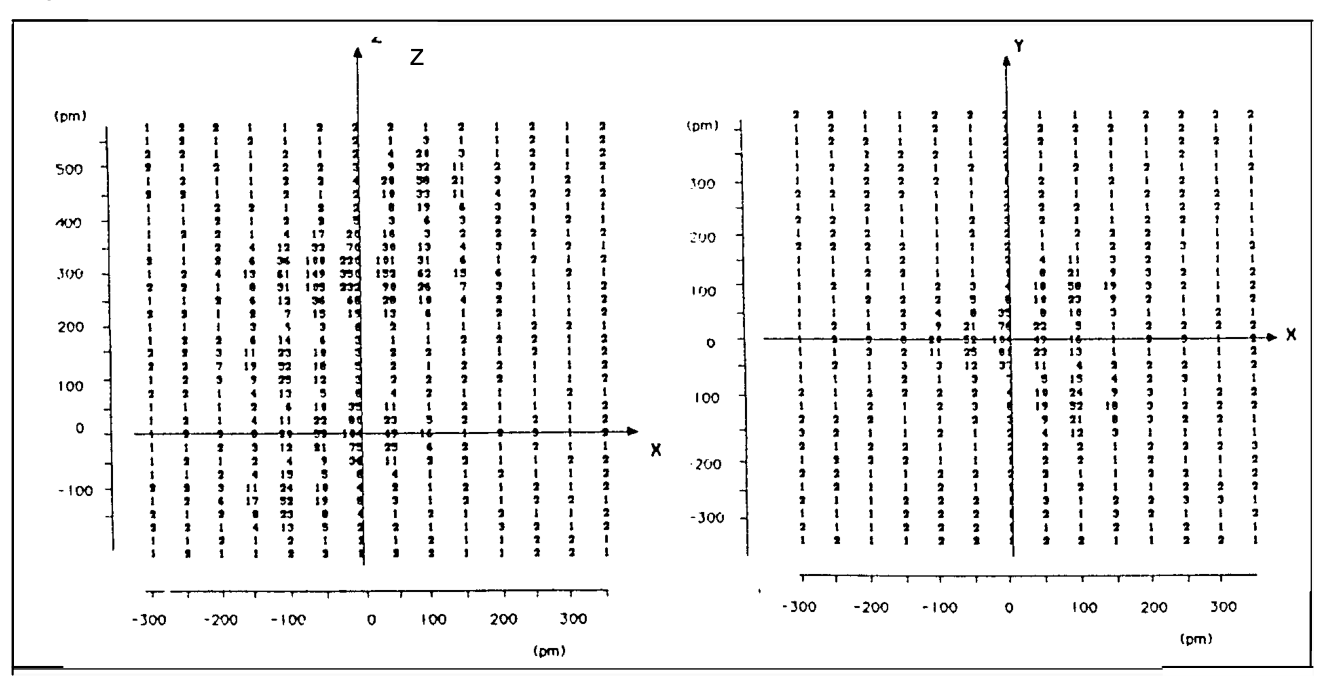
Fig. 1
The numbers indicated on the maps relate to the electron density in the neighbourhood of the atoms of E as a function of the spatial coordinates. The maxima found in these maps coincide with the locations of the atoms and the values are approximately proportional to the number of electrons in the atom in question.
2.1 Show where the maxima lie by drawing the contour curves around the maxima, connecting points of equal electron densities. Label each maximum to show the identities of the atoms in E.
2.2 When 450.0 mg of C was treated with an excess of mercury, 53.25 ml of A was liberated at a pressure of 101.0 kPa and a temperature of 25 °C. Calculate the relative atomic mass of A.
2.3 Identify A, B, C, D and E.
2.4 Use the valence-shell electron-pair repulsion theory (VSEPR) to propose electron-pair geometries for B and C. Using the two electron density maps, sketch the molecular geometry of E.
The original mixture was hydrolysed in water. B reacts to A while liberating oxygen and producing aqueous hydrogen fluoride. Hydrolysis of C leads to A and oxygen (in molar ratio of 4 : 3) and yields an aqueous solution of \(\ce{AO3}\) and hydrogen fluoride. D hydrolyses to an aqueous solution of \(\ce{AO3}\) and hydrogen fluoride.
2.5 Write the equations for the three hydrolysis reactions.
2.6 Quantitative hydrolysis of a mixture of B, C and D gives 60.2 ml of gas (measured at 290 K and 100 kPa). The oxygen content of this gas is 40.0% (by volume). The amount of \(\ce{AO3}\) dissolved in water is titrated with an aqueous 0.1 molar \(\ce{FeSO4}\) solution and 36.0 ml used thereby. During the titration \(\ce{Fe^{2+}}\) is oxidized to \(\ce{Fe^{3+}}\) and \(\ce{AO3}\) is reduced to A. Calculate the composition (% by moles) of the original mixture of B, C and D.
Official English text of the problem.
Answers
-
2.1: In the \(xz\) map, label the maxima from highest to lowest \(z\): F, Xe, O, S, O. In the \(xy\) map, label the common central maximum S, the positive-\(y\) maximum F, and the negative-\(y\) maximum O. Specifically, the maximum of 52 at \((-100,-125)\) in the \(xz\) map is O, and the maximum of 58 at \((+100,+100)\) in the \(xy\) map is F.
-
2.2: \(\boxed{A_{\mathrm r}(\mathrm A)\approx131.3}\), dimensionless.
-
2.3:
| Label | Identity | SMILES |
|---|---|---|
| A | Xenon, \(\ce{Xe}\) | [Xe] |
| B | Xenon difluoride, \(\ce{XeF2}\) | F[Xe]F |
| C | Xenon tetrafluoride, \(\ce{XeF4}\) | F[Xe](F)(F)F |
| D | Xenon hexafluoride, \(\ce{XeF6}\) | F[Xe](F)(F)(F)(F)F |
| E | Xenon(II) fluoride fluorosulfate, \(\ce{FXeOSO2F}\) | F[Xe]OS(=O)(=O)F |
-
2.4: B has trigonal-bipyramidal electron-pair geometry and a linear molecular geometry. C has octahedral electron-pair geometry and a square-planar molecular geometry. E has approximately linear \(\ce{F-Xe-O}\), a bent \(\ce{Xe-O-S}\) linkage, and approximately tetrahedral coordination around sulfur. Its sulfur-bound fluorine lies at positive \(y\) in the \(xy\) map.
-
2.5: \[ \ce{2XeF2 + 2H2O -> 2Xe + O2 + 4HF} \] \[ \ce{6XeF4 + 12H2O -> 4Xe + 2XeO3 + 3O2 + 24HF} \] \[ \ce{XeF6 + 3H2O -> XeO3 + 6HF} \]
-
2.6: The original mixture contains, by moles, \[ \boxed{\ce{XeF2}:23.8\%,\qquad \ce{XeF4}:71.4\%,\qquad \ce{XeF6}:4.8\%.} \]
Solution
2.1 — Electron-density maxima
The maxima locate atomic centres. Their heights distinguish the heavy xenon atom from sulfur and from the lighter oxygen and fluorine atoms. The relevant electron counts are \[ Z(\mathrm{Xe})=54,\qquad Z(\mathrm S)=16,\qquad Z(\mathrm F)=9,\qquad Z(\mathrm O)=8. \] The xenon identification is independently confirmed by the atomic-mass calculation in 2.2.
The contour drawing should contain nested closed inner curves around the following centres. Coordinates are in pm; apart from the two labelled peak maxima (52 and 58), they are approximate readings of the map.
| Map | Position | Atom and structural role |
|---|---|---|
| \(xz\), \(y=0\) | Uppermost small peak, approximately \((+100,+475)\) | F, bonded to Xe |
| \(xz\), \(y=0\) | Very large peak near \((0,+300)\) | Xe |
| \(xz\), \(y=0\) | Peak near \((-100,+125)\), between Xe and S | O, bridging Xe and S |
| \(xz\), \(y=0\) | Central peak near \((0,0)\) | S |
| \(xz\), \(y=0\) | \((-100,-125)\), maximum 52 | O, terminal oxygen on S |
| \(xy\), \(z=0\) | Central peak near \((0,0)\) | S, the same atom as in the other map |
| \(xy\), \(z=0\) | \((+100,+100)\), maximum 58 | F, bonded to S |
| \(xy\), \(z=0\) | Lower-right peak, approximately \((+100,-125)\) | O, the other terminal oxygen on S |
Contours connect equal-density points, with higher values toward each centre; interpolation is appropriate between printed grid points. For example, a contour at density 55 can enclose the fluorine maximum of 58, whereas it cannot enclose the oxygen maximum of 52.
The distinction between these two peaks is consistent with \[ \frac{58}{52}=1.115\approx\frac{9}{8}, \] the fluorine-to-oxygen electron-count ratio.
Counting the shared sulfur only once gives one Xe, one S, three O and two F atoms.
2.2 — Relative atomic mass of A
Mercury removes the fluorine from C, liberating elemental A. The non-fluorine mass in the sample is \[ m(\mathrm A) =(450.0\ \mathrm{mg})(1-0.367) =284.85\ \mathrm{mg} =0.28485\ \mathrm g. \]
Using \(T=298.15\ \mathrm K\) and \(R=8.314\ \mathrm{kPa\,L\,mol^{-1}\,K^{-1}}\), \[ n(\mathrm A)=\frac{pV}{RT} =\frac{(101.0\ \mathrm{kPa})(0.05325\ \mathrm L)} {(8.314\ \mathrm{kPa\,L\,mol^{-1}\,K^{-1}})(298.15\ \mathrm K)} =2.16968\times10^{-3}\ \mathrm{mol}. \]
The gaseous element is monatomic xenon, consistent with the large electron-density maximum. Therefore, \[ M(\mathrm A) =\frac{0.28485\ \mathrm g}{2.16968\times10^{-3}\ \mathrm{mol}} =131.2865\ \mathrm{g\,mol^{-1}}. \]
Thus \[ \boxed{A_{\mathrm r}(\mathrm A)\approx131.3.} \]
2.3 — Identification of A–E
The atomic mass and electron-density map identify A as xenon.
For a fluoride \(\ce{XeF_{$n$}}\), the fluorine mass fraction \(w_{\mathrm F}\) satisfies \[ w_{\mathrm F}=\frac{nM(\mathrm F)}{M(\mathrm{Xe})+nM(\mathrm F)}. \] Hence, using \(M(\mathrm F)=19.00\ \mathrm{g\,mol^{-1}}\), \[ n=\frac{w_{\mathrm F}}{1-w_{\mathrm F}} \frac{M(\mathrm{Xe})}{M(\mathrm F)}. \]
For C, \[ n=\frac{0.367}{0.633}\frac{131.2865}{19.00} =4.006\approx4, \] so C is xenon tetrafluoride, \(\ce{XeF4}\).
For D, \[ n=\frac{0.465}{0.535}\frac{131.2865}{19.00} =6.006\approx6, \] so D is xenon hexafluoride, \(\ce{XeF6}\).
The maps establish the connectivity of E as \[ \ce{F-Xe-O-S(=O)(=O)-F}. \] Thus E is xenon(II) fluoride fluorosulfate. The conventional double bonds represent the two terminal sulfur–oxygen bonds.
Fluorosulfuric acid, \(\ce{HOSO2F}\), has SMILES OS(=O)(=O)F; hydrogen fluoride, \(\ce{HF}\), has SMILES [H]F. The reaction is
\[
\ce{XeF2 + HOSO2F -> FXeOSO2F + HF}.
\]
It replaces one xenon-bound fluorine with an oxygen-bound fluorosulfate group. Therefore B is xenon difluoride, \(\ce{XeF2}\).
2.4 — Electron-pair and molecular geometries
For B, \(\ce{XeF2}\), xenon has two bonding pairs and three lone pairs: \(AX_2E_3\). Five electron domains give a trigonal-bipyramidal electron-pair arrangement. The three lone pairs occupy equatorial positions, leaving the fluorine atoms in the two axial positions. Consequently, the molecule is linear, with a \(180^\circ\) bond angle.
For C, \(\ce{XeF4}\), xenon has four bonding pairs and two lone pairs: \(AX_4E_2\). Six electron domains give an octahedral electron-pair arrangement. The lone pairs occupy opposite positions, leaving four fluorines in a plane. Consequently, the molecule is square planar, with adjacent bond angles of \(90^\circ\).
For E, the requested sketch can be described as follows:
- Place sulfur at the common central maximum of the two maps.
- In the \(xz\) plane, draw the bridging oxygen above and to the left of S. Continue from this oxygen upward and to the right to Xe, and then farther upward and to the right to the terminal Xe-bound F. The \(\ce{O-Xe-F}\) unit is approximately straight.
- Draw one terminal sulfur–oxygen bond downward and to the left in the \(xz\) plane, toward the oxygen maximum of 52.
- Draw the remaining two sulfur bonds in the \(xy\) plane: the sulfur-bound F is at positive \(x\), positive \(y\), and the other terminal O is at positive \(x\), negative \(y\).
Sulfur therefore has approximately tetrahedral coordination by three oxygen atoms and one fluorine atom. The bridging \(\ce{S-O-Xe}\) unit is bent, while \(\ce{F-Xe-O}\) is approximately linear.
The SMILES given in 2.3 specify connectivity; they do not encode these xenon coordination geometries or the molecule’s orientation in the plotted planes.
2.5 — Hydrolysis reactions
The additional molecular species are water, \(\ce{H2O}\), O; oxygen, \(\ce{O2}\), O=O; and xenon trioxide, \(\ce{XeO3}\), O=[Xe](=O)=O. Hydrogen fluoride was specified in 2.3.
For B, balancing fluorine and hydrogen first and then oxygen gives \[ \boxed{\ce{2XeF2 + 2H2O -> 2Xe + O2 + 4HF}.} \]
For C, use the specified xenon-to-oxygen ratio of \(4:3\). Write \[ \ce{aXeF4 + bH2O -> 4Xe + cXeO3 + 3O2 + dHF}. \] Element balances give \[ a=4+c,\qquad d=4a,\qquad b=2a,\qquad b=3c+6. \] Therefore \(a=6\), \(b=12\), \(c=2\) and \(d=24\): \[ \boxed{\ce{6XeF4 + 12H2O -> 4Xe + 2XeO3 + 3O2 + 24HF}.} \]
For D, all xenon forms xenon trioxide: \[ \boxed{\ce{XeF6 + 3H2O -> XeO3 + 6HF}.} \]
2.6 — Composition of the fluoride mixture
Let the initial amounts of \(\ce{XeF2}\), \(\ce{XeF4}\) and \(\ce{XeF6}\) be \(x\), \(y\) and \(z\) mol, respectively.
The total amount of gas collected during hydrolysis is \[ N=\frac{pV}{RT} =\frac{(100\ \mathrm{kPa})(0.0602\ \mathrm L)} {(8.314\ \mathrm{kPa\,L\,mol^{-1}\,K^{-1}})(290\ \mathrm K)} =2.496827\times10^{-3}\ \mathrm{mol}. \]
Volume fractions equal mole fractions under these conditions, so \[ n(\ce{O2})=0.400N,\qquad n(\ce{Xe})=0.600N. \]
The hydrolysis equations give \[ x+\frac23y=0.600N \] and \[ \frac12x+\frac12y=0.400N. \] Thus \[ x+y=0.800N, \] and subtraction yields \[ \frac13y=0.200N. \] Consequently, \[ y=0.600N=1.498096\times10^{-3}\ \mathrm{mol}, \] \[ x=0.200N=4.993654\times10^{-4}\ \mathrm{mol}. \]
To find \(z\), use the titration. Iron(II) sulfate, \(\ce{FeSO4}\), has ionic SMILES [Fe+2].[O-]S(=O)(=O)[O-]. Its iron(II) ions, \(\ce{Fe^{2+}}\), [Fe+2], are oxidized to iron(III) ions, \(\ce{Fe^{3+}}\), [Fe+3].
Xenon in \(\ce{XeO3}\) has oxidation state \(+6\), so reduction to xenon requires six electrons per xenon atom. The balanced titration equation in acidic solution is
\[
\ce{XeO3 + 6H+ + 6Fe^{2+} -> Xe + 3H2O + 6Fe^{3+}},
\]
where the hydrogen ion, \(\ce{H+}\), has SMILES [H+].
Therefore, \[ n(\ce{Fe^{2+}}) =(0.1\ \mathrm{mol\,L^{-1}})(0.0360\ \mathrm L) =3.60\times10^{-3}\ \mathrm{mol}, \] and \[ n(\ce{XeO3})=\frac{3.60\times10^{-3}}6 =6.00\times10^{-4}\ \mathrm{mol}. \]
Hydrolysis produces \(y/3\) mol of xenon trioxide from C and \(z\) mol from D: \[ \frac y3+z=6.00\times10^{-4}. \] Hence \[ z=6.00\times10^{-4} -\frac{1.498096\times10^{-3}}3 =1.006346\times10^{-4}\ \mathrm{mol}. \]
The total initial amount is \[ x+y+z=2.098096\times10^{-3}\ \mathrm{mol}. \]
| Compound | Initial amount / mmol | Mole percentage |
|---|---|---|
| B, \(\ce{XeF2}\) | 0.4994 | 23.8% |
| C, \(\ce{XeF4}\) | 1.4981 | 71.4% |
| D, \(\ce{XeF6}\) | 0.1006 | 4.8% |
The solution was checked against the official solution.
IChO 1988 · Theorieaufgabe 2
Fluoride eines Elements A und die Elektronendichtekarten der Verbindung E
Beim Erhitzen eines Gemisches aus A und Fluor (Stoffmengenverhältnis 1 : 9, Druck etwa 1 MPa) auf 900 °C entstehen drei Verbindungen (B, C und D). Alle drei Produkte sind bei Umgebungstemperatur kristalline Feststoffe mit Schmelzpunkten unter 150 °C. Der Fluorgehalt von C beträgt 36.7 % und der von D 46.5 % (Massenanteile). Wird B bei −75 °C mit wasserfreiem \(\ce{HOSO2F}\) behandelt, entsteht eine Verbindung E:
E ist ein Feststoff, der bei 0 °C wochenlang stabil ist, sich bei Raumtemperatur jedoch innerhalb von Tagen zersetzt. Die durch Röntgenbeugungsuntersuchungen ermittelte Elektronendichteverteilung von E ist in zwei einander schneidenden, zueinander senkrechten Ebenen dargestellt (siehe Abb. 1).
Abb. 1
Die in den Karten angegebenen Zahlen geben die Elektronendichte in der Umgebung der Atome von E als Funktion der Raumkoordinaten an. Die in diesen Karten auftretenden Maxima fallen mit den Positionen der Atome zusammen, und ihre Werte sind annähernd proportional zur Anzahl der Elektronen im jeweiligen Atom.
2.1 Kennzeichnen Sie die Lage der Maxima, indem Sie um die Maxima Konturlinien zeichnen, die Punkte gleicher Elektronendichte verbinden. Beschriften Sie jedes Maximum mit dem zugehörigen Atom in E.
2.2 Bei der Behandlung von 450.0 mg C mit einem Überschuss an Quecksilber wurden bei einem Druck von 101.0 kPa und einer Temperatur von 25 °C 53.25 ml A freigesetzt. Berechnen Sie die relative Atommasse von A.
2.3 Identifizieren Sie A, B, C, D und E.
2.4 Schlagen Sie mithilfe des Elektronenpaarabstoßungsmodells der Valenzschale (VSEPR) Elektronenpaargeometrien für B und C vor. Skizzieren Sie anhand der beiden Elektronendichtekarten die Molekülgeometrie von E.
Das ursprüngliche Gemisch wurde in Wasser hydrolysiert. B reagiert zu A, wobei Sauerstoff freigesetzt wird und eine wässrige Fluorwasserstofflösung entsteht. Die Hydrolyse von C führt zu A und Sauerstoff (im Stoffmengenverhältnis 4 : 3) und liefert eine wässrige Lösung von \(\ce{AO3}\) und Fluorwasserstoff. D hydrolysiert zu einer wässrigen Lösung von \(\ce{AO3}\) und Fluorwasserstoff.
2.5 Stellen Sie die Gleichungen für die drei Hydrolysereaktionen auf.
2.6 Die quantitative Hydrolyse eines Gemisches aus B, C und D liefert 60.2 ml Gas (gemessen bei 290 K und 100 kPa). Der Sauerstoffgehalt dieses Gases beträgt 40.0% (Volumenanteil). Die in Wasser gelöste Menge an \(\ce{AO3}\) wird mit einer wässrigen 0.1-molaren \(\ce{FeSO4}\)-Lösung titriert, wobei 36.0 ml verbraucht werden. Während der Titration wird \(\ce{Fe^{2+}}\) zu \(\ce{Fe^{3+}}\) oxidiert und \(\ce{AO3}\) zu A reduziert. Berechnen Sie die Zusammensetzung (Stoffmengenanteile in %) des ursprünglichen Gemisches aus B, C und D.
Aufgabentext aus dem offiziellen englischen Text übersetzt.
Antworten
-
2.1: Beschriften Sie in der \(xz\)-Karte die Maxima vom höchsten zum niedrigsten \(z\)-Wert mit F, Xe, O, S, O. Beschriften Sie in der \(xy\)-Karte das gemeinsame zentrale Maximum mit S, das Maximum bei positivem \(y\) mit F und das Maximum bei negativem \(y\) mit O. Insbesondere ist das Maximum von 52 bei \((-100,-125)\) in der \(xz\)-Karte O, und das Maximum von 58 bei \((+100,+100)\) in der \(xy\)-Karte ist F.
-
2.2: \(\boxed{A_{\mathrm r}(\mathrm A)\approx131.3}\), dimensionslos.
-
2.3:
| Bezeichnung | Identität | SMILES |
|---|---|---|
| A | Xenon, \(\ce{Xe}\) | [Xe] |
| B | Xenondifluorid, \(\ce{XeF2}\) | F[Xe]F |
| C | Xenontetrafluorid, \(\ce{XeF4}\) | F[Xe](F)(F)F |
| D | Xenonhexafluorid, \(\ce{XeF6}\) | F[Xe](F)(F)(F)(F)F |
| E | Xenon(II)-fluorid-fluorosulfat, \(\ce{FXeOSO2F}\) | F[Xe]OS(=O)(=O)F |
-
2.4: B hat eine trigonal-bipyramidale Elektronenpaargeometrie und eine lineare Molekülgeometrie. C hat eine oktaedrische Elektronenpaargeometrie und eine quadratisch-planare Molekülgeometrie. E weist eine annähernd lineare \(\ce{F-Xe-O}\)-Einheit, eine gewinkelte \(\ce{Xe-O-S}\)-Verknüpfung und eine annähernd tetraedrische Koordination um Schwefel auf. Sein an Schwefel gebundenes Fluoratom liegt in der \(xy\)-Karte bei positivem \(y\).
-
2.5: \[ \ce{2XeF2 + 2H2O -> 2Xe + O2 + 4HF} \] \[ \ce{6XeF4 + 12H2O -> 4Xe + 2XeO3 + 3O2 + 24HF} \] \[ \ce{XeF6 + 3H2O -> XeO3 + 6HF} \]
-
2.6: Das ursprüngliche Gemisch enthält, bezogen auf die Stoffmenge, \[ \boxed{\ce{XeF2}:23.8\%,\qquad \ce{XeF4}:71.4\%,\qquad \ce{XeF6}:4.8\%.} \]
Lösung
2.1 — Elektronendichtemaxima
Die Maxima geben die Positionen der Atomzentren an. Anhand ihrer Höhen lässt sich das schwere Xenonatom von Schwefel sowie von den leichteren Sauerstoff- und Fluoratomen unterscheiden. Die maßgeblichen Elektronenzahlen sind \[ Z(\mathrm{Xe})=54,\qquad Z(\mathrm S)=16,\qquad Z(\mathrm F)=9,\qquad Z(\mathrm O)=8. \] Die Identifizierung als Xenon wird unabhängig davon durch die Berechnung der Atommasse in 2.2 bestätigt.
Die Konturzeichnung sollte ineinanderliegende geschlossene innere Kurven um die folgenden Zentren enthalten. Die Koordinaten sind in pm angegeben; abgesehen von den beiden beschrifteten Maximalwerten (52 und 58) handelt es sich um Näherungswerte, die aus der Karte abgelesen wurden.
| Karte | Position | Atom und strukturelle Rolle |
|---|---|---|
| \(xz\), \(y=0\) | Oberstes kleines Maximum, etwa bei \((+100,+475)\) | F, an Xe gebunden |
| \(xz\), \(y=0\) | Sehr großes Maximum nahe \((0,+300)\) | Xe |
| \(xz\), \(y=0\) | Maximum nahe \((-100,+125)\), zwischen Xe und S | O, verbrückt Xe und S |
| \(xz\), \(y=0\) | Zentrales Maximum nahe \((0,0)\) | S |
| \(xz\), \(y=0\) | \((-100,-125)\), Maximalwert 52 | O, terminaler Sauerstoff an S |
| \(xy\), \(z=0\) | Zentrales Maximum nahe \((0,0)\) | S, dasselbe Atom wie in der anderen Karte |
| \(xy\), \(z=0\) | \((+100,+100)\), Maximalwert 58 | F, an S gebunden |
| \(xy\), \(z=0\) | Maximum rechts unten, etwa bei \((+100,-125)\) | O, der andere terminale Sauerstoff an S |
Konturlinien verbinden Punkte gleicher Elektronendichte, wobei die Werte zum jeweiligen Zentrum hin zunehmen; zwischen den eingezeichneten Gitterpunkten ist eine Interpolation angemessen. Beispielsweise kann eine Konturlinie bei der Dichte 55 das Fluormaximum von 58 umschließen, nicht jedoch das Sauerstoffmaximum von 52.
Die Unterscheidung dieser beiden Maxima steht im Einklang mit \[ \frac{58}{52}=1.115\approx\frac{9}{8}, \] dem Verhältnis der Elektronenzahlen von Fluor und Sauerstoff.
Zählt man das gemeinsame Schwefelatom nur einmal, erhält man ein Xe-, ein S-, drei O- und zwei F-Atome.
2.2 — Relative Atommasse von A
Quecksilber entfernt das Fluor aus C, wobei elementares A freigesetzt wird. Die nicht auf Fluor entfallende Masse in der Probe beträgt \[ m(\mathrm A) =(450.0\ \mathrm{mg})(1-0.367) =284.85\ \mathrm{mg} =0.28485\ \mathrm g. \]
Mit \(T=298.15\ \mathrm K\) und \(R=8.314\ \mathrm{kPa\,L\,mol^{-1}\,K^{-1}}\) gilt \[ n(\mathrm A)=\frac{pV}{RT} =\frac{(101.0\ \mathrm{kPa})(0.05325\ \mathrm L)} {(8.314\ \mathrm{kPa\,L\,mol^{-1}\,K^{-1}})(298.15\ \mathrm K)} =2.16968\times10^{-3}\ \mathrm{mol}. \]
Das gasförmige Element ist einatomiges Xenon, was mit dem großen Elektronendichtemaximum übereinstimmt. Daher gilt \[ M(\mathrm A) =\frac{0.28485\ \mathrm g}{2.16968\times10^{-3}\ \mathrm{mol}} =131.2865\ \mathrm{g\,mol^{-1}}. \]
Somit ist \[ \boxed{A_{\mathrm r}(\mathrm A)\approx131.3.} \]
2.3 — Identifizierung von A–E
Die Atommasse und die Elektronendichtekarte identifizieren A als Xenon.
Für ein Fluorid \(\ce{XeF_{$n$}}\) erfüllt der Fluormassenanteil \(w_{\mathrm F}\) die Gleichung \[ w_{\mathrm F}=\frac{nM(\mathrm F)}{M(\mathrm{Xe})+nM(\mathrm F)}. \] Daraus folgt mit \(M(\mathrm F)=19.00\ \mathrm{g\,mol^{-1}}\) \[ n=\frac{w_{\mathrm F}}{1-w_{\mathrm F}} \frac{M(\mathrm{Xe})}{M(\mathrm F)}. \]
Für C gilt \[ n=\frac{0.367}{0.633}\frac{131.2865}{19.00} =4.006\approx4, \] also ist C Xenontetrafluorid, \(\ce{XeF4}\).
Für D gilt \[ n=\frac{0.465}{0.535}\frac{131.2865}{19.00} =6.006\approx6, \] also ist D Xenonhexafluorid, \(\ce{XeF6}\).
Aus den Karten ergibt sich für E die Bindungsverknüpfung \[ \ce{F-Xe-O-S(=O)(=O)-F}. \] Somit ist E Xenon(II)-fluorid-fluorosulfat. Die konventionellen Doppelbindungen stellen die beiden terminalen Schwefel–Sauerstoff-Bindungen dar.
Fluorschwefelsäure, \(\ce{HOSO2F}\), hat den SMILES-Code OS(=O)(=O)F; Fluorwasserstoff, \(\ce{HF}\), hat den SMILES-Code [H]F. Die Reaktion lautet
\[
\ce{XeF2 + HOSO2F -> FXeOSO2F + HF}.
\]
Dabei wird ein an Xenon gebundenes Fluoratom durch eine über Sauerstoff gebundene Fluorosulfatgruppe ersetzt. Daher ist B Xenondifluorid, \(\ce{XeF2}\).
2.4 — Elektronenpaar- und Molekülgeometrien
In B, \(\ce{XeF2}\), besitzt Xenon zwei bindende und drei freie Elektronenpaare: \(AX_2E_3\). Fünf Elektronendomänen ergeben eine trigonal-bipyramidale Elektronenpaaranordnung. Die drei freien Elektronenpaare besetzen äquatoriale Positionen, sodass die Fluoratome die beiden axialen Positionen einnehmen. Folglich ist das Molekül linear, mit einem Bindungswinkel von \(180^\circ\).
In C, \(\ce{XeF4}\), besitzt Xenon vier bindende und zwei freie Elektronenpaare: \(AX_4E_2\). Sechs Elektronendomänen ergeben eine oktaedrische Elektronenpaaranordnung. Die freien Elektronenpaare besetzen einander gegenüberliegende Positionen, sodass die vier Fluoratome in einer Ebene liegen. Folglich ist das Molekül quadratisch-planar, mit Winkeln von \(90^\circ\) zwischen benachbarten Bindungen.
Für E lässt sich die geforderte Skizze wie folgt beschreiben:
- Platzieren Sie Schwefel am gemeinsamen zentralen Maximum der beiden Karten.
- Zeichnen Sie in der \(xz\)-Ebene den verbrückenden Sauerstoff oberhalb und links von S ein. Gehen Sie von diesem Sauerstoff aus nach oben und rechts zu Xe und anschließend weiter nach oben und rechts zum terminalen, an Xe gebundenen F. Die \(\ce{O-Xe-F}\)-Einheit ist annähernd geradlinig.
- Zeichnen Sie eine terminale Schwefel–Sauerstoff-Bindung in der \(xz\)-Ebene nach unten und links zum Sauerstoffmaximum von 52.
- Zeichnen Sie die beiden übrigen Schwefelbindungen in der \(xy\)-Ebene: Das an Schwefel gebundene F liegt bei positivem \(x\) und positivem \(y\), der andere terminale O bei positivem \(x\) und negativem \(y\).
Schwefel weist daher eine annähernd tetraedrische Koordination durch drei Sauerstoffatome und ein Fluoratom auf. Die verbrückende \(\ce{S-O-Xe}\)-Einheit ist gewinkelt, während \(\ce{F-Xe-O}\) annähernd linear ist.
Die in 2.3 angegebenen SMILES-Codes beschreiben die Bindungsverknüpfung; sie codieren weder diese Koordinationsgeometrien des Xenons noch die Orientierung des Moleküls in den dargestellten Ebenen.
2.5 — Hydrolysereaktionen
Die zusätzlichen molekularen Spezies sind Wasser, \(\ce{H2O}\), O; Sauerstoff, \(\ce{O2}\), O=O; und Xenontrioxid, \(\ce{XeO3}\), O=[Xe](=O)=O. Fluorwasserstoff wurde in 2.3 angegeben.
Für B ergibt das Ausgleichen zunächst von Fluor und Wasserstoff und anschließend von Sauerstoff \[ \boxed{\ce{2XeF2 + 2H2O -> 2Xe + O2 + 4HF}.} \]
Für C wird das vorgegebene Verhältnis von Xenon zu Sauerstoff von \(4:3\) verwendet. Man setzt an: \[ \ce{aXeF4 + bH2O -> 4Xe + cXeO3 + 3O2 + dHF}. \] Die Elementbilanzen ergeben \[ a=4+c,\qquad d=4a,\qquad b=2a,\qquad b=3c+6. \] Daher sind \(a=6\), \(b=12\), \(c=2\) und \(d=24\): \[ \boxed{\ce{6XeF4 + 12H2O -> 4Xe + 2XeO3 + 3O2 + 24HF}.} \]
Für D wird das gesamte Xenon zu Xenontrioxid umgesetzt: \[ \boxed{\ce{XeF6 + 3H2O -> XeO3 + 6HF}.} \]
2.6 — Zusammensetzung des Fluoridgemisches
Die anfänglichen Stoffmengen von \(\ce{XeF2}\), \(\ce{XeF4}\) und \(\ce{XeF6}\) seien \(x\), \(y\) beziehungsweise \(z\) mol.
Die gesamte Stoffmenge des bei der Hydrolyse aufgefangenen Gases beträgt \[ N=\frac{pV}{RT} =\frac{(100\ \mathrm{kPa})(0.0602\ \mathrm L)} {(8.314\ \mathrm{kPa\,L\,mol^{-1}\,K^{-1}})(290\ \mathrm K)} =2.496827\times10^{-3}\ \mathrm{mol}. \]
Unter diesen Bedingungen sind Volumenanteile gleich Stoffmengenanteilen, also gilt \[ n(\ce{O2})=0.400N,\qquad n(\ce{Xe})=0.600N. \]
Aus den Hydrolysegleichungen folgt \[ x+\frac23y=0.600N \] und \[ \frac12x+\frac12y=0.400N. \] Somit gilt \[ x+y=0.800N, \] und Subtraktion ergibt \[ \frac13y=0.200N. \] Folglich ist \[ y=0.600N=1.498096\times10^{-3}\ \mathrm{mol}, \] \[ x=0.200N=4.993654\times10^{-4}\ \mathrm{mol}. \]
Zur Bestimmung von \(z\) wird die Titration herangezogen. Eisen(II)-sulfat, \(\ce{FeSO4}\), hat den ionischen SMILES-Code [Fe+2].[O-]S(=O)(=O)[O-]. Seine Eisen(II)-Ionen, \(\ce{Fe^{2+}}\), [Fe+2], werden zu Eisen(III)-Ionen, \(\ce{Fe^{3+}}\), [Fe+3], oxidiert.
Xenon hat in \(\ce{XeO3}\) die Oxidationszahl \(+6\), sodass die Reduktion zu Xenon sechs Elektronen pro Xenonatom erfordert. Die ausgeglichene Titrationsgleichung in saurer Lösung lautet
\[
\ce{XeO3 + 6H+ + 6Fe^{2+} -> Xe + 3H2O + 6Fe^{3+}},
\]
wobei das Wasserstoffion, \(\ce{H+}\), den SMILES-Code [H+] hat.
Daher gilt \[ n(\ce{Fe^{2+}}) =(0.1\ \mathrm{mol\,L^{-1}})(0.0360\ \mathrm L) =3.60\times10^{-3}\ \mathrm{mol}, \] und \[ n(\ce{XeO3})=\frac{3.60\times10^{-3}}6 =6.00\times10^{-4}\ \mathrm{mol}. \]
Bei der Hydrolyse entstehen aus C \(y/3\) mol Xenontrioxid und aus D \(z\) mol: \[ \frac y3+z=6.00\times10^{-4}. \] Daraus folgt \[ z=6.00\times10^{-4} -\frac{1.498096\times10^{-3}}3 =1.006346\times10^{-4}\ \mathrm{mol}. \]
Die gesamte anfängliche Stoffmenge beträgt \[ x+y+z=2.098096\times10^{-3}\ \mathrm{mol}. \]
| Verbindung | Anfängliche Stoffmenge / mmol | Stoffmengenanteil in Prozent |
|---|---|---|
| B, \(\ce{XeF2}\) | 0.4994 | 23.8% |
| C, \(\ce{XeF4}\) | 1.4981 | 71.4% |
| D, \(\ce{XeF6}\) | 0.1006 | 4.8% |
Die Lösung wurde mit der offiziellen Lösung abgeglichen.
IChO 1988 · Teori sorusu 2
Bir A elementinin florürleri ve E bileşiğinin elektron yoğunluğu haritaları
A ve flor karışımı (mol oranı 1 : 9, basınç yaklaşık 1 MPa) 900 °C'ye ısıtıldığında üç bileşik (B, C ve D) oluşur. Üç ürünün tümü ortam sıcaklığında kristal katılardır ve erime noktaları 150 °C'nin altındadır. C'nin flor içeriği %36.7, D'ninki ise %46.5 (kütlece) olarak bulunmuştur. B, −75 °C'de susuz \(\ce{HOSO2F}\) ile tepkimeye sokulduğunda E bileşiği oluşur:
E, 0 °C'de haftalarca kararlı kalan, ancak oda sıcaklığında günler içinde bozunan bir katıdır. E'nin X-ışını kırınımı çalışmalarıyla elde edilen elektron yoğunluğu dağılımı, birbiriyle kesişen ve birbirine dik iki düzlem üzerinde gösterilmiştir (bkz. Şekil 1).
Şekil 1
Haritalarda belirtilen sayılar, uzaysal koordinatların bir fonksiyonu olarak E'nin atomlarının çevresindeki elektron yoğunluğunu ifade eder. Bu haritalardaki maksimumlar atomların konumlarıyla çakışır ve değerleri, ilgili atomdaki elektron sayısıyla yaklaşık olarak orantılıdır.
2.1 Eşit elektron yoğunluğuna sahip noktaları birleştirerek maksimumların çevresine eş yoğunluk eğrileri çizin ve maksimumların nerede bulunduğunu gösterin. E'deki atomların kimliklerini göstermek için her maksimumu etiketleyin.
2.2 450.0 mg C, aşırı miktarda cıva ile tepkimeye sokulduğunda, 101.0 kPa basınçta ve 25 °C sıcaklıkta 53.25 ml A açığa çıkmıştır. A'nın bağıl atom kütlesini hesaplayın.
2.3 A, B, C, D ve E'yi belirleyin.
2.4 Değerlik kabuğu elektron çifti itmesi kuramını (VSEPR) kullanarak B ve C için elektron çifti geometrileri önerin. İki elektron yoğunluğu haritasını kullanarak E'nin molekül geometrisini çizimle gösterin.
Başlangıçtaki karışım suda hidroliz edilmiştir. B, oksijen açığa çıkarıp sulu hidrojen florür oluştururken A'ya dönüşür. C'nin hidrolizi sonucunda A ve oksijen (4 : 3 mol oranında) oluşur ve sulu bir \(\ce{AO3}\) ve hidrojen florür çözeltisi elde edilir. D, hidroliz olarak sulu bir \(\ce{AO3}\) ve hidrojen florür çözeltisi oluşturur.
2.5 Üç hidroliz tepkimesinin denklemlerini yazın.
2.6 B, C ve D karışımının nicel hidrolizi sonucunda 60.2 ml gaz (290 K ve 100 kPa'da ölçülmüştür) elde edilir. Bu gazın oksijen içeriği hacimce %40.0'tır. Suda çözünmüş \(\ce{AO3}\) miktarı, sulu 0.1 molar \(\ce{FeSO4}\) çözeltisiyle titre edilir ve bu işlemde 36.0 ml kullanılır. Titrasyon sırasında \(\ce{Fe^{2+}}\), \(\ce{Fe^{3+}}\)'e yükseltgenir ve \(\ce{AO3}\), A'ya indirgenir. Başlangıçtaki B, C ve D karışımının bileşimini (molce %) hesaplayın.
Soru metni resmi İngilizce metinden çevrilmiştir.
Cevaplar
-
2.1: \(xz\) haritasında maksimumları en yüksek \(z\)'den en düşüğe doğru F, Xe, O, S, O olarak etiketleyin. \(xy\) haritasında ortak merkezî maksimumu S, pozitif \(y\) tarafındaki maksimumu F ve negatif \(y\) tarafındaki maksimumu O olarak etiketleyin. Özellikle, \(xz\) haritasında \((-100,-125)\) konumundaki 52 değerli maksimum O, \(xy\) haritasında \((+100,+100)\) konumundaki 58 değerli maksimum ise F'dir.
-
2.2: \(\boxed{A_{\mathrm r}(\mathrm A)\approx131.3}\), boyutsuzdur.
-
2.3:
| Etiket | Kimliği | SMILES |
|---|---|---|
| A | Ksenon, \(\ce{Xe}\) | [Xe] |
| B | Ksenon diflorür, \(\ce{XeF2}\) | F[Xe]F |
| C | Ksenon tetraflorür, \(\ce{XeF4}\) | F[Xe](F)(F)F |
| D | Ksenon hekzaflorür, \(\ce{XeF6}\) | F[Xe](F)(F)(F)(F)F |
| E | Ksenon(II) florür florosülfat, \(\ce{FXeOSO2F}\) | F[Xe]OS(=O)(=O)F |
-
2.4: B'nin elektron çifti geometrisi üçgen çift piramit, molekül geometrisi ise doğrusaldır. C'nin elektron çifti geometrisi oktahedral, molekül geometrisi ise kare düzlemseldir. E'de yaklaşık doğrusal bir \(\ce{F-Xe-O}\) birimi, açısal bir \(\ce{Xe-O-S}\) bağlantısı ve kükürt çevresinde yaklaşık tetrahedral bir koordinasyon vardır. Kükürde bağlı flor, \(xy\) haritasında pozitif \(y\) tarafında yer alır.
-
2.5: \[ \ce{2XeF2 + 2H2O -> 2Xe + O2 + 4HF} \] \[ \ce{6XeF4 + 12H2O -> 4Xe + 2XeO3 + 3O2 + 24HF} \] \[ \ce{XeF6 + 3H2O -> XeO3 + 6HF} \]
-
2.6: Başlangıçtaki karışım molce şu bileşime sahiptir: \[ \boxed{\ce{XeF2}:23.8\%,\qquad \ce{XeF4}:71.4\%,\qquad \ce{XeF6}:4.8\%.} \]
Çözüm
2.1 — Elektron yoğunluğu maksimumları
Maksimumlar atom merkezlerinin konumlarını verir. Yükseklikleri, ağır ksenon atomunu kükürtten ve daha hafif olan oksijen ve flor atomlarından ayırt etmeyi sağlar. İlgili elektron sayıları şöyledir: \[ Z(\mathrm{Xe})=54,\qquad Z(\mathrm S)=16,\qquad Z(\mathrm F)=9,\qquad Z(\mathrm O)=8. \] Ksenonun kimliği, 2.2'deki atom kütlesi hesabıyla bağımsız olarak doğrulanır.
Eş yoğunluk eğrilerinin çiziminde, aşağıdaki merkezlerin çevresinde iç içe geçmiş kapalı iç eğriler bulunmalıdır. Koordinatlar pm cinsindendir; etiketlenmiş iki tepe maksimumu (52 ve 58) dışındakiler haritadan okunan yaklaşık değerlerdir.
| Harita | Konum | Atom ve yapıdaki rolü |
|---|---|---|
| \(xz\), \(y=0\) | En üstteki küçük tepe, yaklaşık \((+100,+475)\) | F, Xe'ye bağlı |
| \(xz\), \(y=0\) | \((0,+300)\) yakınındaki çok büyük tepe | Xe |
| \(xz\), \(y=0\) | Xe ile S arasında, \((-100,+125)\) yakınındaki tepe | O, Xe ile S arasında köprü oluşturan atom |
| \(xz\), \(y=0\) | \((0,0)\) yakınındaki merkezî tepe | S |
| \(xz\), \(y=0\) | \((-100,-125)\), maksimum 52 | O, S'ye bağlı uç oksijen atomu |
| \(xy\), \(z=0\) | \((0,0)\) yakınındaki merkezî tepe | S, diğer haritadakiyle aynı atom |
| \(xy\), \(z=0\) | \((+100,+100)\), maksimum 58 | F, S'ye bağlı |
| \(xy\), \(z=0\) | Sağ alttaki tepe, yaklaşık \((+100,-125)\) | O, S'ye bağlı diğer uç oksijen atomu |
Eş yoğunluk eğrileri, eşit yoğunluklu noktaları birleştirir ve her merkeze doğru değerler artar; basılı ızgara noktaları arasında ara değerleme yapılması uygundur. Örneğin, yoğunluğun 55 olduğu bir eğri, 58 değerli flor maksimumunu çevreleyebilirken 52 değerli oksijen maksimumunu çevreleyemez.
Bu iki tepe arasındaki ayrım, \[ \frac{58}{52}=1.115\approx\frac{9}{8}, \] şeklindeki florun elektron sayısının oksijeninkine oranıyla tutarlıdır.
Ortak kükürt atomu yalnızca bir kez sayıldığında bir Xe, bir S, üç O ve iki F atomu elde edilir.
2.2 — A'nın bağıl atom kütlesi
Cıva, C'deki floru uzaklaştırarak elementel A'yı açığa çıkarır. Numunenin flor dışındaki kütlesi şöyledir: \[ m(\mathrm A) =(450.0\ \mathrm{mg})(1-0.367) =284.85\ \mathrm{mg} =0.28485\ \mathrm g. \]
\(T=298.15\ \mathrm K\) ve \(R=8.314\ \mathrm{kPa\,L\,mol^{-1}\,K^{-1}}\) kullanılarak, \[ n(\mathrm A)=\frac{pV}{RT} =\frac{(101.0\ \mathrm{kPa})(0.05325\ \mathrm L)} {(8.314\ \mathrm{kPa\,L\,mol^{-1}\,K^{-1}})(298.15\ \mathrm K)} =2.16968\times10^{-3}\ \mathrm{mol}. \]
Gaz hâlindeki element, büyük elektron yoğunluğu maksimumuyla tutarlı olarak tek atomlu ksenondur. Dolayısıyla, \[ M(\mathrm A) =\frac{0.28485\ \mathrm g}{2.16968\times10^{-3}\ \mathrm{mol}} =131.2865\ \mathrm{g\,mol^{-1}}. \]
Böylece \[ \boxed{A_{\mathrm r}(\mathrm A)\approx131.3.} \]
2.3 — A–E'nin belirlenmesi
Atom kütlesi ve elektron yoğunluğu haritası, A'nın ksenon olduğunu gösterir.
\(\ce{XeF_{$n$}}\) biçimindeki bir florür için florun kütle kesri \(w_{\mathrm F}\) şu bağıntıyı sağlar: \[ w_{\mathrm F}=\frac{nM(\mathrm F)}{M(\mathrm{Xe})+nM(\mathrm F)}. \] Buradan, \(M(\mathrm F)=19.00\ \mathrm{g\,mol^{-1}}\) kullanılarak, \[ n=\frac{w_{\mathrm F}}{1-w_{\mathrm F}} \frac{M(\mathrm{Xe})}{M(\mathrm F)}. \]
C için, \[ n=\frac{0.367}{0.633}\frac{131.2865}{19.00} =4.006\approx4, \] dolayısıyla C, ksenon tetraflorürdür, \(\ce{XeF4}\).
D için, \[ n=\frac{0.465}{0.535}\frac{131.2865}{19.00} =6.006\approx6, \] dolayısıyla D, ksenon hekzaflorürdür, \(\ce{XeF6}\).
Haritalar, E'de atomların birbirine bağlanma düzeninin şu şekilde olduğunu ortaya koyar: \[ \ce{F-Xe-O-S(=O)(=O)-F}. \] Böylece E, ksenon(II) florür florosülfattır. Geleneksel çift bağ gösterimleri, iki uç kükürt–oksijen bağını temsil eder.
Florosülfürik asidin, \(\ce{HOSO2F}\), SMILES gösterimi OS(=O)(=O)F; hidrojen florürün, \(\ce{HF}\), SMILES gösterimi ise [H]F'dir. Tepkime şöyledir:
\[
\ce{XeF2 + HOSO2F -> FXeOSO2F + HF}.
\]
Bu tepkimede ksenona bağlı bir florun yerini, oksijen üzerinden bağlanan bir florosülfat grubu alır. Dolayısıyla B, ksenon diflorürdür, \(\ce{XeF2}\).
2.4 — Elektron çifti ve molekül geometrileri
B, \(\ce{XeF2}\), için ksenonun iki bağ yapan elektron çifti ve üç ortaklanmamış elektron çifti vardır: \(AX_2E_3\). Beş elektron bölgesi, üçgen çift piramit elektron çifti düzeni oluşturur. Üç ortaklanmamış elektron çifti ekvatoryal konumları işgal eder ve flor atomları iki eksenel konumda kalır. Sonuç olarak molekül, \(180^\circ\) bağ açısıyla doğrusaldır.
C, \(\ce{XeF4}\), için ksenonun dört bağ yapan elektron çifti ve iki ortaklanmamış elektron çifti vardır: \(AX_4E_2\). Altı elektron bölgesi, oktahedral elektron çifti düzeni oluşturur. Ortaklanmamış elektron çiftleri karşılıklı konumları işgal eder ve dört flor bir düzlemde kalır. Sonuç olarak molekül, komşu bağlar arasındaki açılar \(90^\circ\) olacak şekilde kare düzlemseldir.
E için istenen çizim şu şekilde tarif edilebilir:
- Kükürdü iki haritanın ortak merkezî maksimumuna yerleştirin.
- \(xz\) düzleminde köprü oluşturan oksijeni S'nin yukarısına ve soluna çizin. Bu oksijenden yukarıya ve sağa doğru Xe'ye, ardından daha da yukarıya ve sağa doğru Xe'ye bağlı uç F'ye ilerleyin. \(\ce{O-Xe-F}\) birimi yaklaşık olarak doğrusaldır.
- \(xz\) düzleminde bir uç kükürt–oksijen bağını aşağıya ve sola doğru, 52 değerli oksijen maksimumuna yönelerek çizin.
- Kükürdün kalan iki bağını \(xy\) düzleminde çizin: kükürde bağlı F, pozitif \(x\), pozitif \(y\) konumundadır; diğer uç O ise pozitif \(x\), negatif \(y\) konumundadır.
Dolayısıyla kükürt, üç oksijen atomu ve bir flor atomuyla yaklaşık tetrahedral koordinasyona sahiptir. Köprü oluşturan \(\ce{S-O-Xe}\) birimi açısal, \(\ce{F-Xe-O}\) ise yaklaşık olarak doğrusaldır.
2.3'te verilen SMILES gösterimleri atomların bağlanma düzenini belirtir; ksenonun bu koordinasyon geometrilerini veya molekülün çizilen düzlemlerdeki yönelimini kodlamaz.
2.5 — Hidroliz tepkimeleri
Ek moleküler türler su, \(\ce{H2O}\), O; oksijen, \(\ce{O2}\), O=O; ve ksenon trioksit, \(\ce{XeO3}\), O=[Xe](=O)=O'dur. Hidrojen florür 2.3'te belirtilmiştir.
B için önce flor ve hidrojen, ardından oksijen denkleştirildiğinde şu denklem elde edilir: \[ \boxed{\ce{2XeF2 + 2H2O -> 2Xe + O2 + 4HF}.} \]
C için verilen \(4:3\) ksenon/oksijen oranını kullanın. Şöyle yazın: \[ \ce{aXeF4 + bH2O -> 4Xe + cXeO3 + 3O2 + dHF}. \] Elementlerin korunumu şu bağıntıları verir: \[ a=4+c,\qquad d=4a,\qquad b=2a,\qquad b=3c+6. \] Dolayısıyla \(a=6\), \(b=12\), \(c=2\) ve \(d=24\): \[ \boxed{\ce{6XeF4 + 12H2O -> 4Xe + 2XeO3 + 3O2 + 24HF}.} \]
D için ksenonun tamamı ksenon trioksit oluşturur: \[ \boxed{\ce{XeF6 + 3H2O -> XeO3 + 6HF}.} \]
2.6 — Florür karışımının bileşimi
\(\ce{XeF2}\), \(\ce{XeF4}\) ve \(\ce{XeF6}\)'nın başlangıçtaki miktarları sırasıyla \(x\), \(y\) ve \(z\) mol olsun.
Hidroliz sırasında toplanan toplam gaz miktarı şöyledir: \[ N=\frac{pV}{RT} =\frac{(100\ \mathrm{kPa})(0.0602\ \mathrm L)} {(8.314\ \mathrm{kPa\,L\,mol^{-1}\,K^{-1}})(290\ \mathrm K)} =2.496827\times10^{-3}\ \mathrm{mol}. \]
Bu koşullarda hacim kesirleri mol kesirlerine eşittir, dolayısıyla \[ n(\ce{O2})=0.400N,\qquad n(\ce{Xe})=0.600N. \]
Hidroliz denklemleri \[ x+\frac23y=0.600N \] ve \[ \frac12x+\frac12y=0.400N. \] bağıntılarını verir. Böylece \[ x+y=0.800N, \] ve çıkarma işlemiyle \[ \frac13y=0.200N. \] elde edilir. Sonuç olarak, \[ y=0.600N=1.498096\times10^{-3}\ \mathrm{mol}, \] \[ x=0.200N=4.993654\times10^{-4}\ \mathrm{mol}. \]
\(z\)'yi bulmak için titrasyonu kullanın. Demir(II) sülfatın, \(\ce{FeSO4}\), iyonik SMILES gösterimi [Fe+2].[O-]S(=O)(=O)[O-]'dir. İçerdiği demir(II) iyonları, \(\ce{Fe^{2+}}\), [Fe+2], demir(III) iyonlarına, \(\ce{Fe^{3+}}\), [Fe+3], yükseltgenir.
\(\ce{XeO3}\)'te ksenonun yükseltgenme basamağı \(+6\) olduğundan, ksenona indirgenmesi için ksenon atomu başına altı elektron gerekir. Asidik çözeltide denkleştirilmiş titrasyon denklemi şöyledir:
\[
\ce{XeO3 + 6H+ + 6Fe^{2+} -> Xe + 3H2O + 6Fe^{3+}},
\]
burada hidrojen iyonunun, \(\ce{H+}\), SMILES gösterimi [H+]'dır.
Dolayısıyla, \[ n(\ce{Fe^{2+}}) =(0.1\ \mathrm{mol\,L^{-1}})(0.0360\ \mathrm L) =3.60\times10^{-3}\ \mathrm{mol}, \] ve \[ n(\ce{XeO3})=\frac{3.60\times10^{-3}}6 =6.00\times10^{-4}\ \mathrm{mol}. \]
Hidroliz sonucunda C'den \(y/3\) mol, D'den ise \(z\) mol ksenon trioksit oluşur: \[ \frac y3+z=6.00\times10^{-4}. \] Buradan \[ z=6.00\times10^{-4} -\frac{1.498096\times10^{-3}}3 =1.006346\times10^{-4}\ \mathrm{mol}. \]
Başlangıçtaki toplam miktar şöyledir: \[ x+y+z=2.098096\times10^{-3}\ \mathrm{mol}. \]
| Bileşik | Başlangıçtaki miktar / mmol | Mol yüzdesi |
|---|---|---|
| B, \(\ce{XeF2}\) | 0.4994 | 23.8% |
| C, \(\ce{XeF4}\) | 1.4981 | 71.4% |
| D, \(\ce{XeF6}\) | 0.1006 | 4.8% |
Çözüm, resmi çözümle karşılaştırılarak kontrol edildi.
IChO 1988 · Problema teórico 2
Fluoruros de un elemento A y mapas de densidad electrónica del compuesto E
Al calentar una mezcla de A y flúor (relación molar 1 : 9, presión aproximada de 1 MPa) hasta 900 °C, se forman tres compuestos (B, C y D). Los tres productos son sólidos cristalinos a temperatura ambiente, con puntos de fusión inferiores a 150 °C. Se determina que el contenido de flúor de C es del 36.7 % y el de D, del 46.5 % (en masa). Cuando B se trata con \(\ce{HOSO2F}\) anhidro a −75 °C, se forma un compuesto E:
E es un sólido que permanece estable durante semanas a 0 °C, pero se descompone en cuestión de días a temperatura ambiente. La distribución de densidad electrónica de E, obtenida mediante estudios de difracción de rayos X, se muestra en dos planos secantes y mutuamente perpendiculares (véase la Fig. 1).
Fig. 1
Los números indicados en los mapas corresponden a la densidad electrónica en las proximidades de los átomos de E en función de las coordenadas espaciales. Los máximos que aparecen en estos mapas coinciden con las posiciones de los átomos, y sus valores son aproximadamente proporcionales al número de electrones del átomo en cuestión.
2.1 Indique dónde se encuentran los máximos dibujando curvas de nivel a su alrededor que conecten puntos de igual densidad electrónica. Etiquete cada máximo para indicar la identidad de los átomos de E.
2.2 Al tratar 450.0 mg de C con un exceso de mercurio, se liberaron 53.25 ml de A a una presión de 101.0 kPa y una temperatura de 25 °C. Calcule la masa atómica relativa de A.
2.3 Identifique A, B, C, D y E.
2.4 Utilice la teoría de repulsión de los pares de electrones de la capa de valencia (VSEPR) para proponer las geometrías de los pares de electrones de B y C. A partir de los dos mapas de densidad electrónica, esboce la geometría molecular de E.
La mezcla original se hidrolizó en agua. B reacciona para dar A, liberando oxígeno y produciendo fluoruro de hidrógeno en disolución acuosa. La hidrólisis de C da lugar a A y oxígeno (en una relación molar de 4 : 3) y produce una disolución acuosa de \(\ce{AO3}\) y fluoruro de hidrógeno. D se hidroliza para dar una disolución acuosa de \(\ce{AO3}\) y fluoruro de hidrógeno.
2.5 Escriba las ecuaciones de las tres reacciones de hidrólisis.
2.6 La hidrólisis cuantitativa de una mezcla de B, C y D produce 60.2 ml de gas (medidos a 290 K y 100 kPa). El contenido de oxígeno de este gas es del 40.0% (en volumen). La cantidad de \(\ce{AO3}\) disuelta en agua se valora con una disolución acuosa 0.1 molar de \(\ce{FeSO4}\), de la que se consumen 36.0 ml. Durante la valoración, el \(\ce{Fe^{2+}}\) se oxida a \(\ce{Fe^{3+}}\) y el \(\ce{AO3}\) se reduce a A. Calcule la composición (% en moles) de la mezcla original de B, C y D.
Enunciado traducido del texto oficial en inglés.
Respuestas
-
2.1: En el mapa \(xz\), etiquete los máximos de mayor a menor \(z\): F, Xe, O, S, O. En el mapa \(xy\), etiquete el máximo central común como S, el máximo con \(y\) positivo como F y el máximo con \(y\) negativo como O. En concreto, el máximo de 52 en \((-100,-125)\) del mapa \(xz\) es O, y el máximo de 58 en \((+100,+100)\) del mapa \(xy\) es F.
-
2.2: \(\boxed{A_{\mathrm r}(\mathrm A)\approx131.3}\), adimensional.
-
2.3:
| Etiqueta | Identidad | SMILES |
|---|---|---|
| A | Xenón, \(\ce{Xe}\) | [Xe] |
| B | Difluoruro de xenón, \(\ce{XeF2}\) | F[Xe]F |
| C | Tetrafluoruro de xenón, \(\ce{XeF4}\) | F[Xe](F)(F)F |
| D | Hexafluoruro de xenón, \(\ce{XeF6}\) | F[Xe](F)(F)(F)(F)F |
| E | Fluoruro fluorosulfato de xenón(II), \(\ce{FXeOSO2F}\) | F[Xe]OS(=O)(=O)F |
-
2.4: B tiene una geometría de pares de electrones de bipirámide trigonal y una geometría molecular lineal. C tiene una geometría de pares de electrones octaédrica y una geometría molecular cuadrada plana. E presenta una unidad \(\ce{F-Xe-O}\) aproximadamente lineal, una unión \(\ce{Xe-O-S}\) angular y una coordinación aproximadamente tetraédrica alrededor del azufre. Su flúor unido al azufre se encuentra en la región de \(y\) positivo del mapa \(xy\).
-
2.5: \[ \ce{2XeF2 + 2H2O -> 2Xe + O2 + 4HF} \] \[ \ce{6XeF4 + 12H2O -> 4Xe + 2XeO3 + 3O2 + 24HF} \] \[ \ce{XeF6 + 3H2O -> XeO3 + 6HF} \]
-
2.6: La mezcla original contiene, en moles, \[ \boxed{\ce{XeF2}:23.8\%,\qquad \ce{XeF4}:71.4\%,\qquad \ce{XeF6}:4.8\%.} \]
Solución
2.1 — Máximos de densidad electrónica
Los máximos localizan los centros atómicos. Sus alturas permiten distinguir el átomo pesado de xenón del azufre y de los átomos más ligeros de oxígeno y flúor. Los números de electrones pertinentes son \[ Z(\mathrm{Xe})=54,\qquad Z(\mathrm S)=16,\qquad Z(\mathrm F)=9,\qquad Z(\mathrm O)=8. \] La identificación del xenón se confirma de forma independiente mediante el cálculo de la masa atómica en 2.2.
El dibujo de las curvas de nivel debe contener curvas interiores cerradas, unas dentro de otras, alrededor de los siguientes centros. Las coordenadas están expresadas en pm; salvo los dos máximos etiquetados (52 y 58), son lecturas aproximadas del mapa.
| Mapa | Posición | Átomo y función estructural |
|---|---|---|
| \(xz\), \(y=0\) | Pico pequeño situado más arriba, aproximadamente en \((+100,+475)\) | F, unido a Xe |
| \(xz\), \(y=0\) | Pico muy grande cerca de \((0,+300)\) | Xe |
| \(xz\), \(y=0\) | Pico cerca de \((-100,+125)\), entre Xe y S | O, que forma un puente entre Xe y S |
| \(xz\), \(y=0\) | Pico central cerca de \((0,0)\) | S |
| \(xz\), \(y=0\) | \((-100,-125)\), máximo 52 | O, oxígeno terminal unido a S |
| \(xy\), \(z=0\) | Pico central cerca de \((0,0)\) | S, el mismo átomo que en el otro mapa |
| \(xy\), \(z=0\) | \((+100,+100)\), máximo 58 | F, unido a S |
| \(xy\), \(z=0\) | Pico inferior derecho, aproximadamente en \((+100,-125)\) | O, el otro oxígeno terminal unido a S |
Las curvas de nivel conectan puntos de igual densidad, con valores más altos hacia cada centro; es adecuado interpolar entre los puntos impresos de la cuadrícula. Por ejemplo, una curva de nivel de densidad 55 puede encerrar el máximo de flúor de 58, pero no puede encerrar el máximo de oxígeno de 52.
La distinción entre estos dos picos es coherente con \[ \frac{58}{52}=1.115\approx\frac{9}{8}, \] la relación entre los números de electrones del flúor y del oxígeno.
Contando el azufre compartido una sola vez, se obtiene un átomo de Xe, uno de S, tres de O y dos de F.
2.2 — Masa atómica relativa de A
El mercurio elimina el flúor de C, liberando A elemental. La masa de la muestra que no corresponde al flúor es \[ m(\mathrm A) =(450.0\ \mathrm{mg})(1-0.367) =284.85\ \mathrm{mg} =0.28485\ \mathrm g. \]
Utilizando \(T=298.15\ \mathrm K\) y \(R=8.314\ \mathrm{kPa\,L\,mol^{-1}\,K^{-1}}\), \[ n(\mathrm A)=\frac{pV}{RT} =\frac{(101.0\ \mathrm{kPa})(0.05325\ \mathrm L)} {(8.314\ \mathrm{kPa\,L\,mol^{-1}\,K^{-1}})(298.15\ \mathrm K)} =2.16968\times10^{-3}\ \mathrm{mol}. \]
El elemento gaseoso es xenón monoatómico, lo que concuerda con el gran máximo de densidad electrónica. Por tanto, \[ M(\mathrm A) =\frac{0.28485\ \mathrm g}{2.16968\times10^{-3}\ \mathrm{mol}} =131.2865\ \mathrm{g\,mol^{-1}}. \]
Así, \[ \boxed{A_{\mathrm r}(\mathrm A)\approx131.3.} \]
2.3 — Identificación de A–E
La masa atómica y el mapa de densidad electrónica identifican A como xenón.
Para un fluoruro \(\ce{XeF_{$n$}}\), la fracción másica de flúor \(w_{\mathrm F}\) satisface \[ w_{\mathrm F}=\frac{nM(\mathrm F)}{M(\mathrm{Xe})+nM(\mathrm F)}. \] Por tanto, utilizando \(M(\mathrm F)=19.00\ \mathrm{g\,mol^{-1}}\), \[ n=\frac{w_{\mathrm F}}{1-w_{\mathrm F}} \frac{M(\mathrm{Xe})}{M(\mathrm F)}. \]
Para C, \[ n=\frac{0.367}{0.633}\frac{131.2865}{19.00} =4.006\approx4, \] por lo que C es tetrafluoruro de xenón, \(\ce{XeF4}\).
Para D, \[ n=\frac{0.465}{0.535}\frac{131.2865}{19.00} =6.006\approx6, \] por lo que D es hexafluoruro de xenón, \(\ce{XeF6}\).
Los mapas establecen la conectividad de E como \[ \ce{F-Xe-O-S(=O)(=O)-F}. \] Así, E es fluoruro fluorosulfato de xenón(II). Los dobles enlaces convencionales representan los dos enlaces terminales azufre–oxígeno.
El ácido fluorosulfúrico, \(\ce{HOSO2F}\), tiene el SMILES OS(=O)(=O)F; el fluoruro de hidrógeno, \(\ce{HF}\), tiene el SMILES [H]F. La reacción es
\[
\ce{XeF2 + HOSO2F -> FXeOSO2F + HF}.
\]
En ella se sustituye un flúor unido al xenón por un grupo fluorosulfato unido a través de un oxígeno. Por tanto, B es difluoruro de xenón, \(\ce{XeF2}\).
2.4 — Geometrías de los pares de electrones y geometrías moleculares
En B, \(\ce{XeF2}\), el xenón tiene dos pares enlazantes y tres pares solitarios: \(AX_2E_3\). Cinco dominios electrónicos dan lugar a una disposición de los pares de electrones de bipirámide trigonal. Los tres pares solitarios ocupan posiciones ecuatoriales, dejando los átomos de flúor en las dos posiciones axiales. En consecuencia, la molécula es lineal, con un ángulo de enlace de \(180^\circ\).
En C, \(\ce{XeF4}\), el xenón tiene cuatro pares enlazantes y dos pares solitarios: \(AX_4E_2\). Seis dominios electrónicos dan lugar a una disposición octaédrica de los pares de electrones. Los pares solitarios ocupan posiciones opuestas, dejando los cuatro átomos de flúor en un plano. En consecuencia, la molécula es cuadrada plana, con ángulos entre enlaces adyacentes de \(90^\circ\).
Para E, el esquema solicitado puede describirse de la siguiente manera:
- Sitúe el azufre en el máximo central común de los dos mapas.
- En el plano \(xz\), dibuje el oxígeno puente por encima y a la izquierda de S. Continúe desde este oxígeno hacia arriba y a la derecha hasta Xe, y después más arriba y a la derecha hasta el F terminal unido a Xe. La unidad \(\ce{O-Xe-F}\) es aproximadamente rectilínea.
- Dibuje un enlace terminal azufre–oxígeno hacia abajo y a la izquierda en el plano \(xz\), hacia el máximo de oxígeno de 52.
- Dibuje los otros dos enlaces del azufre en el plano \(xy\): el F unido al azufre se encuentra en \(x\) positivo, \(y\) positivo, y el otro O terminal se encuentra en \(x\) positivo, \(y\) negativo.
Por tanto, el azufre presenta una coordinación tetraédrica aproximada con tres átomos de oxígeno y un átomo de flúor. La unidad puente \(\ce{S-O-Xe}\) es angular, mientras que \(\ce{F-Xe-O}\) es aproximadamente lineal.
Los SMILES indicados en 2.3 especifican la conectividad; no codifican estas geometrías de coordinación del xenón ni la orientación de la molécula en los planos representados.
2.5 — Reacciones de hidrólisis
Las especies moleculares adicionales son el agua, \(\ce{H2O}\), O; el oxígeno, \(\ce{O2}\), O=O; y el trióxido de xenón, \(\ce{XeO3}\), O=[Xe](=O)=O. El fluoruro de hidrógeno se especificó en 2.3.
Para B, al ajustar primero el flúor y el hidrógeno y después el oxígeno se obtiene \[ \boxed{\ce{2XeF2 + 2H2O -> 2Xe + O2 + 4HF}.} \]
Para C, se utiliza la relación especificada entre xenón y oxígeno de \(4:3\). Se escribe \[ \ce{aXeF4 + bH2O -> 4Xe + cXeO3 + 3O2 + dHF}. \] Los balances de los elementos dan \[ a=4+c,\qquad d=4a,\qquad b=2a,\qquad b=3c+6. \] Por tanto, \(a=6\), \(b=12\), \(c=2\) y \(d=24\): \[ \boxed{\ce{6XeF4 + 12H2O -> 4Xe + 2XeO3 + 3O2 + 24HF}.} \]
Para D, todo el xenón forma trióxido de xenón: \[ \boxed{\ce{XeF6 + 3H2O -> XeO3 + 6HF}.} \]
2.6 — Composición de la mezcla de fluoruros
Sean las cantidades iniciales de \(\ce{XeF2}\), \(\ce{XeF4}\) y \(\ce{XeF6}\) iguales a \(x\), \(y\) y \(z\) mol, respectivamente.
La cantidad total de gas recogido durante la hidrólisis es \[ N=\frac{pV}{RT} =\frac{(100\ \mathrm{kPa})(0.0602\ \mathrm L)} {(8.314\ \mathrm{kPa\,L\,mol^{-1}\,K^{-1}})(290\ \mathrm K)} =2.496827\times10^{-3}\ \mathrm{mol}. \]
En estas condiciones, las fracciones volumétricas son iguales a las fracciones molares, por lo que \[ n(\ce{O2})=0.400N,\qquad n(\ce{Xe})=0.600N. \]
Las ecuaciones de hidrólisis dan \[ x+\frac23y=0.600N \] y \[ \frac12x+\frac12y=0.400N. \] Así, \[ x+y=0.800N, \] y al restar se obtiene \[ \frac13y=0.200N. \] En consecuencia, \[ y=0.600N=1.498096\times10^{-3}\ \mathrm{mol}, \] \[ x=0.200N=4.993654\times10^{-4}\ \mathrm{mol}. \]
Para hallar \(z\), se utiliza la valoración. El sulfato de hierro(II), \(\ce{FeSO4}\), tiene el SMILES iónico [Fe+2].[O-]S(=O)(=O)[O-]. Sus iones hierro(II), \(\ce{Fe^{2+}}\), [Fe+2], se oxidan a iones hierro(III), \(\ce{Fe^{3+}}\), [Fe+3].
El xenón en \(\ce{XeO3}\) tiene un estado de oxidación de \(+6\), por lo que su reducción a xenón requiere seis electrones por átomo de xenón. La ecuación ajustada de la valoración en disolución ácida es
\[
\ce{XeO3 + 6H+ + 6Fe^{2+} -> Xe + 3H2O + 6Fe^{3+}},
\]
donde el ion hidrógeno, \(\ce{H+}\), tiene el SMILES [H+].
Por tanto, \[ n(\ce{Fe^{2+}}) =(0.1\ \mathrm{mol\,L^{-1}})(0.0360\ \mathrm L) =3.60\times10^{-3}\ \mathrm{mol}, \] y \[ n(\ce{XeO3})=\frac{3.60\times10^{-3}}6 =6.00\times10^{-4}\ \mathrm{mol}. \]
La hidrólisis produce \(y/3\) mol de trióxido de xenón a partir de C y \(z\) mol a partir de D: \[ \frac y3+z=6.00\times10^{-4}. \] Por tanto, \[ z=6.00\times10^{-4} -\frac{1.498096\times10^{-3}}3 =1.006346\times10^{-4}\ \mathrm{mol}. \]
La cantidad inicial total es \[ x+y+z=2.098096\times10^{-3}\ \mathrm{mol}. \]
| Compuesto | Cantidad inicial / mmol | Porcentaje molar |
|---|---|---|
| B, \(\ce{XeF2}\) | 0.4994 | 23.8% |
| C, \(\ce{XeF4}\) | 1.4981 | 71.4% |
| D, \(\ce{XeF6}\) | 0.1006 | 4.8% |
La solución se comprobó con la solución oficial.
IChO 1988 · 理论题 2
元素 A 的氟化物与化合物 E 的电子密度图
将 A 与氟气的混合物(摩尔比为 1 : 9,压强约为 1 MPa)加热至 900 °C,生成三种化合物(B、C 和 D)。这三种产物在环境温度下均为晶态固体,熔点均低于 150 °C。测得 C 的氟含量为 36.7 %,D 的氟含量为 46.5 %(均为质量百分数)。在 −75 °C 下用无水 \(\ce{HOSO2F}\) 处理 B,生成化合物 E:
E 是一种固体,在 0 °C 下可稳定存在数周,但在室温下会在数日内分解。通过 X 射线衍射研究得到的 E 的电子密度分布,显示在两个相交且互相垂直的平面上(见图 1)。
图 1
图中标出的数字表示 E 中各原子附近的电子密度随空间坐标的变化。这些图中的极大值位置与原子位置重合,其数值近似正比于相应原子中的电子数。
2.1 在极大值周围绘制等值线,连接电子密度相等的点,以标明极大值的位置。标注每个极大值,指出其对应于 E 中的哪种原子。
2.2 用过量的汞处理 450.0 mg 的 C,在压强为 101.0 kPa、温度为 25 °C 时释放出 53.25 ml 的 A。计算 A 的相对原子质量。
2.3 确定 A、B、C、D 和 E 分别是什么物质。
2.4 利用价层电子对互斥理论(VSEPR),推测 B 和 C 的电子对几何构型。根据两幅电子密度图,画出 E 的分子几何构型示意图。
将最初的混合物在水中水解。B 反应生成 A,同时释放氧气并生成氟化氢水溶液。C 水解生成 A 和氧气(摩尔比为 4 : 3),并得到含有 \(\ce{AO3}\) 和氟化氢的水溶液。D 水解得到含有 \(\ce{AO3}\) 和氟化氢的水溶液。
2.5 写出这三个水解反应的方程式。
2.6 将 B、C 和 D 的混合物定量水解,得到 60.2 ml 气体(在 290 K、100 kPa 下测量)。该气体的氧气含量为 40.0%(体积百分数)。用 0.1 mol/L 的 \(\ce{FeSO4}\) 水溶液滴定溶于水中的 \(\ce{AO3}\),消耗滴定液 36.0 ml。滴定过程中,\(\ce{Fe^{2+}}\) 被氧化为 \(\ce{Fe^{3+}}\),\(\ce{AO3}\) 被还原为 A。计算最初 B、C 和 D 混合物的组成(摩尔百分数)。
题目译自官方英文原文。
答案
-
2.1: 在 \(xz\) 图中,按 \(z\) 从高到低的顺序,将各极大值标记为:F、Xe、O、S、O。在 \(xy\) 图中,将两图共有的中心极大值标记为 S,将正 \(y\) 方向的极大值标记为 F,负 \(y\) 方向的极大值标记为 O。具体而言,\(xz\) 图中位于 \((-100,-125)\)、数值为 52 的极大值对应于 O,\(xy\) 图中位于 \((+100,+100)\)、数值为 58 的极大值对应于 F。
-
2.2: \(\boxed{A_{\mathrm r}(\mathrm A)\approx131.3}\),无量纲。
-
2.3:
| 标记 | 物质 | SMILES |
|---|---|---|
| A | 氙,\(\ce{Xe}\) | [Xe] |
| B | 二氟化氙,\(\ce{XeF2}\) | F[Xe]F |
| C | 四氟化氙,\(\ce{XeF4}\) | F[Xe](F)(F)F |
| D | 六氟化氙,\(\ce{XeF6}\) | F[Xe](F)(F)(F)(F)F |
| E | 氟化氟硫酸氙(II),\(\ce{FXeOSO2F}\) | F[Xe]OS(=O)(=O)F |
-
2.4: B 的电子对几何构型为三角双锥形,分子几何构型为直线形。C 的电子对几何构型为八面体形,分子几何构型为平面正方形。E 中的 \(\ce{F-Xe-O}\) 近似为直线形,\(\ce{Xe-O-S}\) 连接部分为折线形,硫周围的配位构型近似为四面体形。与硫相连的氟位于 \(xy\) 图中正 \(y\) 方向。
-
2.5: \[ \ce{2XeF2 + 2H2O -> 2Xe + O2 + 4HF} \] \[ \ce{6XeF4 + 12H2O -> 4Xe + 2XeO3 + 3O2 + 24HF} \] \[ \ce{XeF6 + 3H2O -> XeO3 + 6HF} \]
-
2.6: 最初混合物中各组分的摩尔百分数为 \[ \boxed{\ce{XeF2}:23.8\%,\qquad \ce{XeF4}:71.4\%,\qquad \ce{XeF6}:4.8\%.} \]
解答
2.1 — 电子密度极大值
极大值的位置对应于原子中心。其峰高可将重的氙原子与硫原子以及较轻的氧、氟原子区分开来。相关的电子数为 \[ Z(\mathrm{Xe})=54,\qquad Z(\mathrm S)=16,\qquad Z(\mathrm F)=9,\qquad Z(\mathrm O)=8. \] 2.2 中的原子质量计算独立验证了氙的判定。
绘制的等值线图应在下列中心周围包含层层嵌套的闭合内圈曲线。坐标单位为 pm;除两个已标出的峰值(52 和 58)外,其余坐标均为从图中读取的近似值。
| 图 | 位置 | 原子及其在结构中的作用 |
|---|---|---|
| \(xz\),\(y=0\) | 最上方的小峰,约位于 \((+100,+475)\) | F,与 Xe 成键 |
| \(xz\),\(y=0\) | \((0,+300)\) 附近的极大峰 | Xe |
| \(xz\),\(y=0\) | \((-100,+125)\) 附近的峰,位于 Xe 与 S 之间 | O,桥连 Xe 和 S |
| \(xz\),\(y=0\) | \((0,0)\) 附近的中心峰 | S |
| \(xz\),\(y=0\) | \((-100,-125)\),极大值为 52 | O,S 上的端位氧 |
| \(xy\),\(z=0\) | \((0,0)\) 附近的中心峰 | S,与另一幅图中的是同一个原子 |
| \(xy\),\(z=0\) | \((+100,+100)\),极大值为 58 | F,与 S 成键 |
| \(xy\),\(z=0\) | 右下方的峰,约位于 \((+100,-125)\) | O,S 上的另一个端位氧 |
等值线连接电子密度相等的点,越靠近各中心,数值越高;可在图中印出的网格点之间进行插值。例如,密度为 55 的等值线可以包围峰值为 58 的氟原子极大值,但不能包围峰值为 52 的氧原子极大值。
这两个峰之间的差别与下式一致: \[ \frac{58}{52}=1.115\approx\frac{9}{8}, \] 即氟原子与氧原子的电子数之比。
将两图共有的硫原子只计数一次,可得一个 Xe、一个 S、三个 O 和两个 F 原子。
2.2 — A 的相对原子质量
汞从 C 中除去氟,释放出单质 A。样品中非氟部分的质量为 \[ m(\mathrm A) =(450.0\ \mathrm{mg})(1-0.367) =284.85\ \mathrm{mg} =0.28485\ \mathrm g. \]
取 \(T=298.15\ \mathrm K\) 和 \(R=8.314\ \mathrm{kPa\,L\,mol^{-1}\,K^{-1}}\), \[ n(\mathrm A)=\frac{pV}{RT} =\frac{(101.0\ \mathrm{kPa})(0.05325\ \mathrm L)} {(8.314\ \mathrm{kPa\,L\,mol^{-1}\,K^{-1}})(298.15\ \mathrm K)} =2.16968\times10^{-3}\ \mathrm{mol}. \]
该气态单质为单原子气体氙,这与较大的电子密度极大值相符。因此, \[ M(\mathrm A) =\frac{0.28485\ \mathrm g}{2.16968\times10^{-3}\ \mathrm{mol}} =131.2865\ \mathrm{g\,mol^{-1}}. \]
因此 \[ \boxed{A_{\mathrm r}(\mathrm A)\approx131.3.} \]
2.3 — A–E 的鉴定
原子质量和电子密度图表明 A 为氙。
对于氟化物 \(\ce{XeF_{$n$}}\),氟的质量分数 \(w_{\mathrm F}\) 满足 \[ w_{\mathrm F}=\frac{nM(\mathrm F)}{M(\mathrm{Xe})+nM(\mathrm F)}. \] 因此,取 \(M(\mathrm F)=19.00\ \mathrm{g\,mol^{-1}}\), \[ n=\frac{w_{\mathrm F}}{1-w_{\mathrm F}} \frac{M(\mathrm{Xe})}{M(\mathrm F)}. \]
对于 C, \[ n=\frac{0.367}{0.633}\frac{131.2865}{19.00} =4.006\approx4, \] 所以 C 为四氟化氙,\(\ce{XeF4}\)。
对于 D, \[ n=\frac{0.465}{0.535}\frac{131.2865}{19.00} =6.006\approx6, \] 所以 D 为六氟化氙,\(\ce{XeF6}\)。
由图可确定 E 中原子的连接方式为 \[ \ce{F-Xe-O-S(=O)(=O)-F}. \] 因此,E 为氟化氟硫酸氙(II)。按惯例画出的双键表示两个端位硫–氧键。
氟硫酸 \(\ce{HOSO2F}\) 的 SMILES 为 OS(=O)(=O)F;氟化氢 \(\ce{HF}\) 的 SMILES 为 [H]F。反应为
\[
\ce{XeF2 + HOSO2F -> FXeOSO2F + HF}.
\]
该反应用一个经氧原子连接的氟硫酸根基团取代了一个与氙相连的氟原子。因此,B 为二氟化氙,\(\ce{XeF2}\)。
2.4 — 电子对几何构型与分子几何构型
对于 B,\(\ce{XeF2}\),氙有两个成键电子对和三个孤电子对:\(AX_2E_3\)。五个电子域形成三角双锥形电子对排布。三个孤电子对占据赤道位置,使氟原子处于两个轴向位置。因此,分子为直线形,键角为 \(180^\circ\)。
对于 C,\(\ce{XeF4}\),氙有四个成键电子对和两个孤电子对:\(AX_4E_2\)。六个电子域形成八面体形电子对排布。两个孤电子对占据彼此相对的位置,使四个氟原子位于同一平面内。因此,分子为平面正方形,相邻键之间的键角为 \(90^\circ\)。
对于 E,所要求的示意图可按以下方式绘制:
- 将硫原子放在两幅图共有的中心极大值处。
- 在 \(xz\) 平面内,将桥氧画在 S 的左上方。从该氧原子向右上方延伸至 Xe,再继续向右上方延伸至与 Xe 相连的端位 F。\(\ce{O-Xe-F}\) 单元近似为直线形。
- 在 \(xz\) 平面内,向左下方画出一个端位硫–氧键,指向峰值为 52 的氧原子极大值。
- 在 \(xy\) 平面内画出硫的其余两个键:与硫相连的 F 位于正 \(x\)、正 \(y\) 处,另一个端位 O 位于正 \(x\)、负 \(y\) 处。
因此,硫与三个氧原子和一个氟原子形成近似的四面体配位构型。桥连的 \(\ce{S-O-Xe}\) 单元为折线形,而 \(\ce{F-Xe-O}\) 近似为直线形。
2.3 中给出的 SMILES 指定了原子连接方式;它们不表示这些氙的配位几何构型,也不表示分子在所绘平面中的取向。
2.5 — 水解反应
其余涉及的分子物种为水,\(\ce{H2O}\),O;氧气,\(\ce{O2}\),O=O;以及三氧化氙,\(\ce{XeO3}\),O=[Xe](=O)=O。氟化氢已在 2.3 中说明。
对于 B,先配平氟和氢,再配平氧,得到 \[ \boxed{\ce{2XeF2 + 2H2O -> 2Xe + O2 + 4HF}.} \]
对于 C,利用给定的氙与氧气的摩尔比 \(4:3\)。写出 \[ \ce{aXeF4 + bH2O -> 4Xe + cXeO3 + 3O2 + dHF}. \] 由各元素守恒可得 \[ a=4+c,\qquad d=4a,\qquad b=2a,\qquad b=3c+6. \] 因此 \(a=6\)、\(b=12\)、\(c=2\),且 \(d=24\): \[ \boxed{\ce{6XeF4 + 12H2O -> 4Xe + 2XeO3 + 3O2 + 24HF}.} \]
对于 D,所有氙均形成三氧化氙: \[ \boxed{\ce{XeF6 + 3H2O -> XeO3 + 6HF}.} \]
2.6 — 氟化物混合物的组成
设 \(\ce{XeF2}\)、\(\ce{XeF4}\) 和 \(\ce{XeF6}\) 的初始物质的量分别为 \(x\)、\(y\) 和 \(z\) mol。
水解过程中收集到的气体总物质的量为 \[ N=\frac{pV}{RT} =\frac{(100\ \mathrm{kPa})(0.0602\ \mathrm L)} {(8.314\ \mathrm{kPa\,L\,mol^{-1}\,K^{-1}})(290\ \mathrm K)} =2.496827\times10^{-3}\ \mathrm{mol}. \]
在这些条件下,体积分数等于摩尔分数,因此 \[ n(\ce{O2})=0.400N,\qquad n(\ce{Xe})=0.600N. \]
由水解方程式可得 \[ x+\frac23y=0.600N \] 以及 \[ \frac12x+\frac12y=0.400N. \] 因此 \[ x+y=0.800N, \] 两式相减得 \[ \frac13y=0.200N. \] 于是, \[ y=0.600N=1.498096\times10^{-3}\ \mathrm{mol}, \] \[ x=0.200N=4.993654\times10^{-4}\ \mathrm{mol}. \]
利用滴定求出 \(z\)。硫酸亚铁 \(\ce{FeSO4}\) 的离子形式 SMILES 为 [Fe+2].[O-]S(=O)(=O)[O-]。其中的亚铁离子 \(\ce{Fe^{2+}}\),[Fe+2],被氧化为铁(III)离子 \(\ce{Fe^{3+}}\),[Fe+3]。
\(\ce{XeO3}\) 中氙的氧化态为 \(+6\),因此还原为单质氙时,每个氙原子需要得到六个电子。在酸性溶液中,配平后的滴定反应方程式为
\[
\ce{XeO3 + 6H+ + 6Fe^{2+} -> Xe + 3H2O + 6Fe^{3+}},
\]
其中氢离子 \(\ce{H+}\) 的 SMILES 为 [H+]。
因此, \[ n(\ce{Fe^{2+}}) =(0.1\ \mathrm{mol\,L^{-1}})(0.0360\ \mathrm L) =3.60\times10^{-3}\ \mathrm{mol}, \] 且 \[ n(\ce{XeO3})=\frac{3.60\times10^{-3}}6 =6.00\times10^{-4}\ \mathrm{mol}. \]
水解时,C 生成 \(y/3\) mol 三氧化氙,D 生成 \(z\) mol 三氧化氙: \[ \frac y3+z=6.00\times10^{-4}. \] 因此 \[ z=6.00\times10^{-4} -\frac{1.498096\times10^{-3}}3 =1.006346\times10^{-4}\ \mathrm{mol}. \]
初始总物质的量为 \[ x+y+z=2.098096\times10^{-3}\ \mathrm{mol}. \]
| 化合物 | 初始物质的量 / mmol | 摩尔百分数 |
|---|---|---|
| B,\(\ce{XeF2}\) | 0.4994 | 23.8% |
| C,\(\ce{XeF4}\) | 1.4981 | 71.4% |
| D,\(\ce{XeF6}\) | 0.1006 | 4.8% |
解答已与官方解答核对。
IChO 1988 · Теоретическая задача 2
Фториды элемента A и карты электронной плотности соединения E
При нагревании смеси A и фтора (мольное соотношение 1 : 9, давление приблизительно 1 МПа) до 900 °C образуются три соединения (B, C и D). Все три продукта при температуре окружающей среды представляют собой кристаллические твёрдые вещества с температурами плавления ниже 150 °C. Установлено, что содержание фтора в C составляет 36.7 %, а в D — 46.5 % (по массе). При обработке B безводной \(\ce{HOSO2F}\) при −75 °C образуется соединение E:
E — твёрдое вещество, устойчивое в течение нескольких недель при 0 °C, но разлагающееся за несколько дней при комнатной температуре. Распределение электронной плотности E, полученное методом рентгеновской дифракции, показано в двух пересекающихся взаимно перпендикулярных плоскостях (см. рис. 1).
Рис. 1
Числа, указанные на картах, характеризуют электронную плотность в окрестности атомов E в зависимости от пространственных координат. Максимумы на этих картах совпадают с положениями атомов, а их значения приблизительно пропорциональны числу электронов в соответствующем атоме.
2.1 Укажите положения максимумов, проведя вокруг них линии равной электронной плотности, соединяющие точки с одинаковыми значениями электронной плотности. Подпишите каждый максимум, указав, какому атому в E он соответствует.
2.2 При обработке 450.0 мг C избытком ртути выделилось 53.25 мл A при давлении 101.0 кПа и температуре 25 °C. Рассчитайте относительную атомную массу A.
2.3 Определите A, B, C, D и E.
2.4 Используя теорию отталкивания электронных пар валентной оболочки (VSEPR), предложите геометрию расположения электронных пар для B и C. На основании двух карт электронной плотности изобразите геометрию молекулы E.
Исходную смесь подвергли гидролизу в воде. B превращается в A с выделением кислорода и образованием водного раствора фтороводорода. Гидролиз C приводит к образованию A и кислорода (в мольном соотношении 4 : 3), а также водного раствора \(\ce{AO3}\) и фтороводорода. D гидролизуется с образованием водного раствора \(\ce{AO3}\) и фтороводорода.
2.5 Напишите уравнения трёх реакций гидролиза.
2.6 При количественном гидролизе смеси B, C и D образуется 60.2 мл газа (объём измерен при 290 К и 100 кПа). Содержание кислорода в этом газе составляет 40.0% (по объёму). Количество растворённого в воде \(\ce{AO3}\) определяют титрованием водным 0.1-молярным раствором \(\ce{FeSO4}\), на которое расходуется 36.0 мл этого раствора. В ходе титрования \(\ce{Fe^{2+}}\) окисляется до \(\ce{Fe^{3+}}\), а \(\ce{AO3}\) восстанавливается до A. Рассчитайте состав (в мол. %) исходной смеси B, C и D.
Условие переведено с официального английского текста.
Ответы
-
2.1: На карте \(xz\) подпишите максимумы в порядке убывания \(z\): F, Xe, O, S, O. На карте \(xy\) обозначьте общий центральный максимум как S, максимум при положительном \(y\) — как F, а максимум при отрицательном \(y\) — как O. В частности, максимум 52 в точке \((-100,-125)\) на карте \(xz\) соответствует O, а максимум 58 в точке \((+100,+100)\) на карте \(xy\) — F.
-
2.2: \(\boxed{A_{\mathrm r}(\mathrm A)\approx131.3}\), безразмерная величина.
-
2.3:
| Обозначение | Вещество | SMILES |
|---|---|---|
| A | Ксенон, \(\ce{Xe}\) | [Xe] |
| B | Дифторид ксенона, \(\ce{XeF2}\) | F[Xe]F |
| C | Тетрафторид ксенона, \(\ce{XeF4}\) | F[Xe](F)(F)F |
| D | Гексафторид ксенона, \(\ce{XeF6}\) | F[Xe](F)(F)(F)(F)F |
| E | Фторид-фторсульфат ксенона(II), \(\ce{FXeOSO2F}\) | F[Xe]OS(=O)(=O)F |
-
2.4: В B электронные пары расположены в виде тригональной бипирамиды, а молекула имеет линейную геометрию. В C электронные пары расположены октаэдрически, а молекула имеет плоскую квадратную геометрию. В E фрагмент \(\ce{F-Xe-O}\) приблизительно линейный, фрагмент \(\ce{Xe-O-S}\) угловой, а координация вокруг серы приблизительно тетраэдрическая. Связанный с серой атом фтора находится при положительном \(y\) на карте \(xy\).
-
2.5: \[ \ce{2XeF2 + 2H2O -> 2Xe + O2 + 4HF} \] \[ \ce{6XeF4 + 12H2O -> 4Xe + 2XeO3 + 3O2 + 24HF} \] \[ \ce{XeF6 + 3H2O -> XeO3 + 6HF} \]
-
2.6: Исходная смесь содержит следующие мольные доли компонентов: \[ \boxed{\ce{XeF2}:23.8\%,\qquad \ce{XeF4}:71.4\%,\qquad \ce{XeF6}:4.8\%.} \]
Решение
2.1 — Максимумы электронной плотности
Максимумы указывают положения центров атомов. По их высоте можно отличить тяжёлый атом ксенона от серы и от более лёгких атомов кислорода и фтора. Соответствующие числа электронов равны \[ Z(\mathrm{Xe})=54,\qquad Z(\mathrm S)=16,\qquad Z(\mathrm F)=9,\qquad Z(\mathrm O)=8. \] Идентификация ксенона независимо подтверждается расчётом атомной массы в 2.2.
На рисунке с линиями равной электронной плотности должны быть вложенные замкнутые внутренние кривые вокруг перечисленных ниже центров. Координаты приведены в пм; за исключением двух подписанных максимумов пиков (52 и 58), они приблизительно считаны с карты.
| Карта | Положение | Атом и его роль в структуре |
|---|---|---|
| \(xz\), \(y=0\) | Самый верхний небольшой пик, приблизительно \((+100,+475)\) | F, связанный с Xe |
| \(xz\), \(y=0\) | Очень большой пик вблизи \((0,+300)\) | Xe |
| \(xz\), \(y=0\) | Пик вблизи \((-100,+125)\), между Xe и S | O, мостиковый атом между Xe и S |
| \(xz\), \(y=0\) | Центральный пик вблизи \((0,0)\) | S |
| \(xz\), \(y=0\) | \((-100,-125)\), максимум 52 | O, концевой атом кислорода при S |
| \(xy\), \(z=0\) | Центральный пик вблизи \((0,0)\) | S, тот же атом, что и на другой карте |
| \(xy\), \(z=0\) | \((+100,+100)\), максимум 58 | F, связанный с S |
| \(xy\), \(z=0\) | Нижний правый пик, приблизительно \((+100,-125)\) | O, другой концевой атом кислорода при S |
Линии равной электронной плотности соединяют точки с одинаковыми значениями плотности, причём значения возрастают по направлению к каждому центру; между нанесёнными точками сетки следует использовать интерполяцию. Например, линия, соответствующая плотности 55, может охватывать максимум фтора 58, но не может охватывать максимум кислорода 52.
Различие между этими двумя пиками согласуется с отношением \[ \frac{58}{52}=1.115\approx\frac{9}{8}, \] то есть с отношением числа электронов фтора к числу электронов кислорода.
Если учитывать общий атом серы только один раз, получаем один атом Xe, один атом S, три атома O и два атома F.
2.2 — Относительная атомная масса A
Ртуть отщепляет фтор от C, высвобождая A в виде простого вещества. Масса образца, приходящаяся на элемент, отличный от фтора, составляет \[ m(\mathrm A) =(450.0\ \mathrm{mg})(1-0.367) =284.85\ \mathrm{mg} =0.28485\ \mathrm g. \]
Используя \(T=298.15\ \mathrm K\) и \(R=8.314\ \mathrm{kPa\,L\,mol^{-1}\,K^{-1}}\), получаем \[ n(\mathrm A)=\frac{pV}{RT} =\frac{(101.0\ \mathrm{kPa})(0.05325\ \mathrm L)} {(8.314\ \mathrm{kPa\,L\,mol^{-1}\,K^{-1}})(298.15\ \mathrm K)} =2.16968\times10^{-3}\ \mathrm{mol}. \]
Газообразное простое вещество — одноатомный ксенон, что согласуется с большим максимумом электронной плотности. Следовательно, \[ M(\mathrm A) =\frac{0.28485\ \mathrm g}{2.16968\times10^{-3}\ \mathrm{mol}} =131.2865\ \mathrm{g\,mol^{-1}}. \]
Таким образом, \[ \boxed{A_{\mathrm r}(\mathrm A)\approx131.3.} \]
2.3 — Определение A–E
Атомная масса и карта электронной плотности позволяют установить, что A — ксенон.
Для фторида \(\ce{XeF_{$n$}}\) массовая доля фтора \(w_{\mathrm F}\) удовлетворяет соотношению \[ w_{\mathrm F}=\frac{nM(\mathrm F)}{M(\mathrm{Xe})+nM(\mathrm F)}. \] Отсюда, используя \(M(\mathrm F)=19.00\ \mathrm{g\,mol^{-1}}\), получаем \[ n=\frac{w_{\mathrm F}}{1-w_{\mathrm F}} \frac{M(\mathrm{Xe})}{M(\mathrm F)}. \]
Для C \[ n=\frac{0.367}{0.633}\frac{131.2865}{19.00} =4.006\approx4, \] поэтому C — тетрафторид ксенона, \(\ce{XeF4}\).
Для D \[ n=\frac{0.465}{0.535}\frac{131.2865}{19.00} =6.006\approx6, \] поэтому D — гексафторид ксенона, \(\ce{XeF6}\).
Карты позволяют установить следующий порядок соединения атомов в E: \[ \ce{F-Xe-O-S(=O)(=O)-F}. \] Таким образом, E — фторид-фторсульфат ксенона(II). Принятые в этой записи двойные связи обозначают две концевые связи сера–кислород.
Фторсульфоновая кислота, \(\ce{HOSO2F}\), имеет запись SMILES OS(=O)(=O)F; фтороводород, \(\ce{HF}\), имеет запись SMILES [H]F. Реакция протекает по уравнению
\[
\ce{XeF2 + HOSO2F -> FXeOSO2F + HF}.
\]
В ней один связанный с ксеноном атом фтора замещается фторсульфатной группой, связанной с ксеноном через кислород. Следовательно, B — дифторид ксенона, \(\ce{XeF2}\).
2.4 — Геометрия расположения электронных пар и геометрия молекул
В B, \(\ce{XeF2}\), у ксенона имеются две связывающие и три неподелённые электронные пары: \(AX_2E_3\). Пять областей электронной плотности обусловливают расположение электронных пар в виде тригональной бипирамиды. Три неподелённые пары занимают экваториальные положения, а атомы фтора — два аксиальных положения. Следовательно, молекула линейная, с валентным углом \(180^\circ\).
В C, \(\ce{XeF4}\), у ксенона имеются четыре связывающие и две неподелённые электронные пары: \(AX_4E_2\). Шесть областей электронной плотности обусловливают октаэдрическое расположение электронных пар. Неподелённые пары занимают противоположные положения, а четыре атома фтора располагаются в одной плоскости. Следовательно, молекула имеет плоскую квадратную геометрию, с углами между соседними связями \(90^\circ\).
Требуемый рисунок для E можно описать следующим образом:
- Поместите атом серы в общий центральный максимум двух карт.
- В плоскости \(xz\) изобразите мостиковый атом кислорода выше и левее S. От этого атома кислорода проведите связь вверх и вправо к Xe, а затем ещё выше и правее — к концевому атому F, связанному с Xe. Фрагмент \(\ce{O-Xe-F}\) приблизительно линейный.
- Изобразите одну концевую связь сера–кислород направленной вниз и влево в плоскости \(xz\), к максимуму кислорода 52.
- Изобразите две оставшиеся связи серы в плоскости \(xy\): связанный с серой атом F находится при положительных \(x\) и \(y\), а другой концевой атом O — при положительном \(x\) и отрицательном \(y\).
Таким образом, сера имеет приблизительно тетраэдрическую координацию тремя атомами кислорода и одним атомом фтора. Мостиковый фрагмент \(\ce{S-O-Xe}\) имеет угловое строение, тогда как \(\ce{F-Xe-O}\) приблизительно линейный.
Записи SMILES, приведённые в 2.3, задают порядок соединения атомов; они не кодируют указанную геометрию координационного окружения ксенона или ориентацию молекулы в изображённых плоскостях.
2.5 — Реакции гидролиза
Дополнительные молекулярные вещества — вода, \(\ce{H2O}\), O; кислород, \(\ce{O2}\), O=O; и триоксид ксенона, \(\ce{XeO3}\), O=[Xe](=O)=O. Фтороводород был указан в 2.3.
Для B, уравнивая сначала фтор и водород, а затем кислород, получаем \[ \boxed{\ce{2XeF2 + 2H2O -> 2Xe + O2 + 4HF}.} \]
Для C используем заданное соотношение ксенона и кислорода \(4:3\). Запишем \[ \ce{aXeF4 + bH2O -> 4Xe + cXeO3 + 3O2 + dHF}. \] Балансы элементов дают \[ a=4+c,\qquad d=4a,\qquad b=2a,\qquad b=3c+6. \] Следовательно, \(a=6\), \(b=12\), \(c=2\) и \(d=24\): \[ \boxed{\ce{6XeF4 + 12H2O -> 4Xe + 2XeO3 + 3O2 + 24HF}.} \]
Для D весь ксенон переходит в триоксид ксенона: \[ \boxed{\ce{XeF6 + 3H2O -> XeO3 + 6HF}.} \]
2.6 — Состав смеси фторидов
Пусть исходные количества \(\ce{XeF2}\), \(\ce{XeF4}\) и \(\ce{XeF6}\) равны соответственно \(x\), \(y\) и \(z\) моль.
Общее количество газа, собранного при гидролизе, составляет \[ N=\frac{pV}{RT} =\frac{(100\ \mathrm{kPa})(0.0602\ \mathrm L)} {(8.314\ \mathrm{kPa\,L\,mol^{-1}\,K^{-1}})(290\ \mathrm K)} =2.496827\times10^{-3}\ \mathrm{mol}. \]
При этих условиях объёмные доли равны мольным, поэтому \[ n(\ce{O2})=0.400N,\qquad n(\ce{Xe})=0.600N. \]
Из уравнений гидролиза получаем \[ x+\frac23y=0.600N \] и \[ \frac12x+\frac12y=0.400N. \] Таким образом, \[ x+y=0.800N, \] а вычитание даёт \[ \frac13y=0.200N. \] Следовательно, \[ y=0.600N=1.498096\times10^{-3}\ \mathrm{mol}, \] \[ x=0.200N=4.993654\times10^{-4}\ \mathrm{mol}. \]
Чтобы найти \(z\), воспользуемся данными титрования. Сульфат железа(II), \(\ce{FeSO4}\), имеет ионную запись SMILES [Fe+2].[O-]S(=O)(=O)[O-]. Его ионы железа(II), \(\ce{Fe^{2+}}\), [Fe+2], окисляются до ионов железа(III), \(\ce{Fe^{3+}}\), [Fe+3].
Ксенон в \(\ce{XeO3}\) имеет степень окисления \(+6\), поэтому для восстановления до простого вещества требуется шесть электронов на каждый атом ксенона. Уравнение реакции титрования в кислой среде с расставленными коэффициентами имеет вид
\[
\ce{XeO3 + 6H+ + 6Fe^{2+} -> Xe + 3H2O + 6Fe^{3+}},
\]
где ион водорода, \(\ce{H+}\), имеет запись SMILES [H+].
Следовательно, \[ n(\ce{Fe^{2+}}) =(0.1\ \mathrm{mol\,L^{-1}})(0.0360\ \mathrm L) =3.60\times10^{-3}\ \mathrm{mol}, \] и \[ n(\ce{XeO3})=\frac{3.60\times10^{-3}}6 =6.00\times10^{-4}\ \mathrm{mol}. \]
При гидролизе из C образуется \(y/3\) моль триоксида ксенона, а из D — \(z\) моль: \[ \frac y3+z=6.00\times10^{-4}. \] Отсюда \[ z=6.00\times10^{-4} -\frac{1.498096\times10^{-3}}3 =1.006346\times10^{-4}\ \mathrm{mol}. \]
Общее исходное количество вещества составляет \[ x+y+z=2.098096\times10^{-3}\ \mathrm{mol}. \]
| Соединение | Исходное количество / ммоль | Мольная доля, % |
|---|---|---|
| B, \(\ce{XeF2}\) | 0.4994 | 23.8% |
| C, \(\ce{XeF4}\) | 1.4981 | 71.4% |
| D, \(\ce{XeF6}\) | 0.1006 | 4.8% |
Решение проверено по официальному решению.
IChO 1988 · مسألة نظرية 2
فلوريدات العنصر A وخرائط الكثافة الإلكترونية للمركب E
عند تسخين مزيج من A والفلور (بنسبة مولية 1 : 9، وتحت ضغط يقارب 1 MPa) إلى 900 °C، تتكوّن ثلاثة مركبات (B وC وD). والنواتج الثلاثة جميعها مواد صلبة بلورية عند درجة الحرارة المحيطة، ودرجات انصهارها أقل من 150 °C. وُجد أن محتوى C من الفلور يبلغ 36.7 %، ومحتوى D منه يبلغ 46.5 % (كتليًا). عند معالجة B بمادة \(\ce{HOSO2F}\) اللامائية عند −75 °C، يتكوّن المركب E:
E مادة صلبة تظل مستقرة لأسابيع عند 0 °C، لكنها تتحلّل خلال أيام عند درجة حرارة الغرفة. يُعرض توزيع الكثافة الإلكترونية للمركب E، المستنتج من دراسات حيود الأشعة السينية، على مستويين متقاطعين ومتعامدين أحدهما على الآخر (انظر الشكل 1).
الشكل 1
تمثّل الأعداد المبيّنة على الخرائط الكثافة الإلكترونية في جوار ذرات E بدلالة الإحداثيات المكانية. وتتطابق مواضع القيم العظمى في هذه الخرائط مع مواضع الذرات، وتتناسب قيمها تقريبًا مع عدد الإلكترونات في الذرة المعنية.
2.1 بيّن مواضع القيم العظمى برسم منحنيات تساوي الكثافة حولها، بحيث تصل بين النقاط ذات الكثافات الإلكترونية المتساوية. ضع رمزًا عند كل قيمة عظمى يبيّن هوية الذرة المقابلة لها في E.
2.2 عند معالجة 450.0 mg من C بفائض من الزئبق، تحرّر 53.25 ml من A تحت ضغط 101.0 kPa وعند درجة حرارة 25 °C. احسب الكتلة الذرية النسبية للعنصر A.
2.3 حدّد هوية A وB وC وD وE.
2.4 استخدم نظرية تنافر أزواج إلكترونات غلاف التكافؤ (VSEPR) لاقتراح الأشكال الهندسية لأزواج الإلكترونات في B وC. وبالاستعانة بخريطتي الكثافة الإلكترونية، ارسم الشكل الهندسي الجزيئي للمركب E.
أُخضع المزيج الأصلي للتحلّل المائي في الماء. يتفاعل B ليتحوّل إلى A مع تحرير الأكسجين وإنتاج محلول مائي من فلوريد الهيدروجين. ويؤدي التحلّل المائي للمركب C إلى تكوّن A والأكسجين (بنسبة مولية 4 : 3)، وينتج عنه محلول مائي من \(\ce{AO3}\) وفلوريد الهيدروجين. أما D فيتحلّل مائيًا ليعطي محلولًا مائيًا من \(\ce{AO3}\) وفلوريد الهيدروجين.
2.5 اكتب معادلات تفاعلات التحلّل المائي الثلاثة.
2.6 يعطي التحلّل المائي الكمي لمزيج من B وC وD مقدارًا من الغاز حجمه 60.2 ml (مقاسًا عند 290 K و100 kPa). ويبلغ محتوى هذا الغاز من الأكسجين 40.0% (حجميًا). تُعايَر كمية \(\ce{AO3}\) الذائبة في الماء بمحلول مائي من \(\ce{FeSO4}\) تركيزه 0.1 مولاري، ويُستهلك منه 36.0 ml. أثناء المعايرة، يتأكسد \(\ce{Fe^{2+}}\) إلى \(\ce{Fe^{3+}}\)، ويُختزل \(\ce{AO3}\) إلى A. احسب تركيب المزيج الأصلي من B وC وD (بالنسبة المئوية المولية).
نص المسألة مترجم عن النص الإنجليزي الرسمي.
الإجابات
-
2.1: في خريطة \(xz\)، ضع رموز الذرات عند القيم العظمى بالترتيب من أعلى \(z\) إلى أدناه: F, Xe, O, S, O. وفي خريطة \(xy\)، ضع الرمز S عند القيمة العظمى المركزية المشتركة، والرمز F عند القيمة العظمى ذات \(y\) الموجب، والرمز O عند القيمة العظمى ذات \(y\) السالب. وعلى وجه التحديد، فإن القيمة العظمى 52 عند \((-100,-125)\) في خريطة \(xz\) تخصّ O، والقيمة العظمى 58 عند \((+100,+100)\) في خريطة \(xy\) تخصّ F.
-
2.2: \(\boxed{A_{\mathrm r}(\mathrm A)\approx131.3}\)، وهي كمية بلا أبعاد.
-
2.3:
| الرمز | الهوية | SMILES |
|---|---|---|
| A | الزينون، \(\ce{Xe}\) | [Xe] |
| B | ثنائي فلوريد الزينون، \(\ce{XeF2}\) | F[Xe]F |
| C | رباعي فلوريد الزينون، \(\ce{XeF4}\) | F[Xe](F)(F)F |
| D | سداسي فلوريد الزينون، \(\ce{XeF6}\) | F[Xe](F)(F)(F)(F)F |
| E | فلوريد فلوروسلفات الزينون(II)، \(\ce{FXeOSO2F}\) | F[Xe]OS(=O)(=O)F |
-
2.4: للمركب B شكل هندسي لأزواج الإلكترونات على هيئة ثنائي هرم ثلاثي القاعدة، وشكل هندسي جزيئي خطي. وللمركب C شكل هندسي لأزواج الإلكترونات ثماني السطوح، وشكل هندسي جزيئي مربع مستوٍ. وفي E، تكون وحدة \(\ce{F-Xe-O}\) خطية تقريبًا، وتكون وصلة \(\ce{Xe-O-S}\) منحنية، ويكون التناسق حول الكبريت رباعي السطوح تقريبًا. وتقع ذرة الفلور المرتبطة بالكبريت عند \(y\) الموجب في خريطة \(xy\).
-
2.5: \[ \ce{2XeF2 + 2H2O -> 2Xe + O2 + 4HF} \] \[ \ce{6XeF4 + 12H2O -> 4Xe + 2XeO3 + 3O2 + 24HF} \] \[ \ce{XeF6 + 3H2O -> XeO3 + 6HF} \]
-
2.6: يحتوي المزيج الأصلي، بالنسب المولية، على \[ \boxed{\ce{XeF2}:23.8\%,\qquad \ce{XeF4}:71.4\%,\qquad \ce{XeF6}:4.8\%.} \]
الحل
2.1 — القيم العظمى للكثافة الإلكترونية
تحدّد القيم العظمى مواضع مراكز الذرات. وتتيح ارتفاعاتها تمييز ذرة الزينون الثقيلة عن الكبريت وعن ذرات الأكسجين والفلور الأخف. وأعداد الإلكترونات ذات الصلة هي \[ Z(\mathrm{Xe})=54,\qquad Z(\mathrm S)=16,\qquad Z(\mathrm F)=9,\qquad Z(\mathrm O)=8. \] ويؤكّد حساب الكتلة الذرية في 2.2، بصورة مستقلة، تعيين الزينون.
ينبغي أن يتضمّن رسم منحنيات تساوي الكثافة منحنيات داخلية مغلقة ومتداخلة حول المراكز الآتية. الإحداثيات بوحدة pm؛ وهي قراءات تقريبية من الخريطة، باستثناء القيمتين العظميين المبيّنتين للقمتين (52 و58).
| الخريطة | الموضع | الذرة ودورها البنيوي |
|---|---|---|
| \(xz\)، \(y=0\) | القمة الصغيرة الأعلى، عند \((+100,+475)\) تقريبًا | F، مرتبطة بذرة Xe |
| \(xz\)، \(y=0\) | قمة كبيرة جدًا قرب \((0,+300)\) | Xe |
| \(xz\)، \(y=0\) | قمة قرب \((-100,+125)\)، بين Xe وS | O، تصل بين Xe وS بجسر |
| \(xz\)، \(y=0\) | القمة المركزية قرب \((0,0)\) | S |
| \(xz\)، \(y=0\) | \((-100,-125)\)، القيمة العظمى 52 | O، أكسجين طرفي مرتبط بذرة S |
| \(xy\)، \(z=0\) | القمة المركزية قرب \((0,0)\) | S، وهي الذرة نفسها في الخريطة الأخرى |
| \(xy\)، \(z=0\) | \((+100,+100)\)، القيمة العظمى 58 | F، مرتبطة بذرة S |
| \(xy\)، \(z=0\) | القمة السفلية اليمنى، عند \((+100,-125)\) تقريبًا | O، ذرة الأكسجين الطرفية الأخرى المرتبطة بذرة S |
تصل منحنيات تساوي الكثافة بين نقاط متساوية الكثافة، وتزداد القيم باتجاه كل مركز؛ ويمكن استخدام الاستيفاء بين نقاط الشبكة المطبوعة. فعلى سبيل المثال، يمكن لمنحنى عند كثافة 55 أن يحيط بالقيمة العظمى للفلور البالغة 58، لكنه لا يستطيع أن يحيط بالقيمة العظمى للأكسجين البالغة 52.
ويتوافق التمييز بين هاتين القمتين مع \[ \frac{58}{52}=1.115\approx\frac{9}{8}, \] وهي نسبة عدد إلكترونات الفلور إلى عدد إلكترونات الأكسجين.
بعد عدّ ذرة الكبريت المشتركة مرة واحدة فقط، نحصل على ذرة Xe واحدة، وذرة S واحدة، وثلاث ذرات O، وذرتي F.
2.2 — الكتلة الذرية النسبية للعنصر A
يزيل الزئبق الفلور من C، محرّرًا A في صورته العنصرية. وكتلة المكوّن غير الفلوري في العينة هي \[ m(\mathrm A) =(450.0\ \mathrm{mg})(1-0.367) =284.85\ \mathrm{mg} =0.28485\ \mathrm g. \]
باستخدام \(T=298.15\ \mathrm K\) و \(R=8.314\ \mathrm{kPa\,L\,mol^{-1}\,K^{-1}}\)، \[ n(\mathrm A)=\frac{pV}{RT} =\frac{(101.0\ \mathrm{kPa})(0.05325\ \mathrm L)} {(8.314\ \mathrm{kPa\,L\,mol^{-1}\,K^{-1}})(298.15\ \mathrm K)} =2.16968\times10^{-3}\ \mathrm{mol}. \]
العنصر الغازي هو الزينون الأحادي الذرة، وهو ما يتوافق مع القيمة العظمى الكبيرة للكثافة الإلكترونية. لذلك، \[ M(\mathrm A) =\frac{0.28485\ \mathrm g}{2.16968\times10^{-3}\ \mathrm{mol}} =131.2865\ \mathrm{g\,mol^{-1}}. \]
إذن \[ \boxed{A_{\mathrm r}(\mathrm A)\approx131.3.} \]
2.3 — تعيين هوية A–E
تحدّد الكتلة الذرية وخريطة الكثافة الإلكترونية هوية A بأنه الزينون.
في فلوريد صيغته \(\ce{XeF_{$n$}}\)، يحقّق الكسر الكتلي للفلور \(w_{\mathrm F}\) العلاقة \[ w_{\mathrm F}=\frac{nM(\mathrm F)}{M(\mathrm{Xe})+nM(\mathrm F)}. \] ومن ثم، باستخدام \(M(\mathrm F)=19.00\ \mathrm{g\,mol^{-1}}\)، \[ n=\frac{w_{\mathrm F}}{1-w_{\mathrm F}} \frac{M(\mathrm{Xe})}{M(\mathrm F)}. \]
بالنسبة إلى C، \[ n=\frac{0.367}{0.633}\frac{131.2865}{19.00} =4.006\approx4, \] إذًا C هو رباعي فلوريد الزينون، \(\ce{XeF4}\).
بالنسبة إلى D، \[ n=\frac{0.465}{0.535}\frac{131.2865}{19.00} =6.006\approx6, \] إذًا D هو سداسي فلوريد الزينون، \(\ce{XeF6}\).
تحدّد الخرائط كيفية اتصال الذرات في E على النحو الآتي: \[ \ce{F-Xe-O-S(=O)(=O)-F}. \] وعليه، فإن E هو فلوريد فلوروسلفات الزينون(II). وتمثّل الرابطتان المزدوجتان الاصطلاحيتان رابطتي الكبريت–الأكسجين الطرفيتين.
صيغة SMILES لحمض الفلوروسلفوريك، \(\ce{HOSO2F}\)، هي OS(=O)(=O)F؛ وصيغة SMILES لفلوريد الهيدروجين، \(\ce{HF}\)، هي [H]F. والتفاعل هو
\[
\ce{XeF2 + HOSO2F -> FXeOSO2F + HF}.
\]
يستبدل هذا التفاعل إحدى ذرتي الفلور المرتبطتين بالزينون بمجموعة فلوروسلفات ترتبط به عبر الأكسجين. لذلك فإن B هو ثنائي فلوريد الزينون، \(\ce{XeF2}\).
2.4 — الأشكال الهندسية لأزواج الإلكترونات وللجزيئات
في B، \(\ce{XeF2}\)، تحيط بالزينون زوجان رابطان وثلاثة أزواج منفردة: \(AX_2E_3\). وتعطي المجالات الإلكترونية الخمسة ترتيبًا لأزواج الإلكترونات على هيئة ثنائي هرم ثلاثي القاعدة. وتشغل الأزواج المنفردة الثلاثة المواضع الاستوائية، فتتبقى لذرتي الفلور الموضعان المحوريان. وبناءً على ذلك، يكون الجزيء خطيًا، بزاوية رابطة مقدارها \(180^\circ\).
في C، \(\ce{XeF4}\)، تحيط بالزينون أربعة أزواج رابطة وزوجان منفردان: \(AX_4E_2\). وتعطي المجالات الإلكترونية الستة ترتيبًا لأزواج الإلكترونات ثماني السطوح. ويشغل الزوجان المنفردان موضعين متقابلين، فتقع ذرات الفلور الأربع في مستوى واحد. وبناءً على ذلك، يكون الجزيء مربعًا مستويًا، بزوايا بين الروابط المتجاورة مقدارها \(90^\circ\).
بالنسبة إلى E، يمكن وصف الرسم المطلوب كما يأتي:
- ضع الكبريت عند القيمة العظمى المركزية المشتركة بين الخريطتين.
- في المستوى \(xz\)، ارسم ذرة الأكسجين الجسرية أعلى S وإلى يسارها. تابع من ذرة الأكسجين هذه صعودًا وإلى اليمين نحو Xe، ثم تابع صعودًا وإلى اليمين نحو ذرة F الطرفية المرتبطة بذرة Xe. وتكون الوحدة \(\ce{O-Xe-F}\) مستقيمة تقريبًا.
- ارسم إحدى رابطتي الكبريت–الأكسجين الطرفيتين إلى الأسفل وإلى اليسار في المستوى \(xz\)، باتجاه القيمة العظمى للأكسجين البالغة 52.
- ارسم رابطتي الكبريت المتبقيتين في المستوى \(xy\): تقع ذرة F المرتبطة بالكبريت عند \(x\) الموجب و\(y\) الموجب، وتقع ذرة O الطرفية الأخرى عند \(x\) الموجب و\(y\) السالب.
إذًا، يحيط بالكبريت تناسق رباعي السطوح تقريبًا، مكوّن من ثلاث ذرات أكسجين وذرة فلور واحدة. وتكون الوحدة الجسرية \(\ce{S-O-Xe}\) منحنية، بينما تكون \(\ce{F-Xe-O}\) خطية تقريبًا.
تحدّد صيغ SMILES الواردة في 2.3 كيفية اتصال الذرات؛ لكنها لا ترمّز هذه الأشكال الهندسية للتناسق حول الزينون، ولا اتجاه الجزيء في المستويات المرسومة.
2.5 — تفاعلات التحلّل المائي
الأنواع الجزيئية الإضافية هي الماء، \(\ce{H2O}\)، O؛ والأكسجين، \(\ce{O2}\)، O=O؛ وثلاثي أكسيد الزينون، \(\ce{XeO3}\)، O=[Xe](=O)=O. وقد ذُكر فلوريد الهيدروجين في 2.3.
بالنسبة إلى B، تعطي موازنة الفلور والهيدروجين أولًا، ثم الأكسجين، المعادلة \[ \boxed{\ce{2XeF2 + 2H2O -> 2Xe + O2 + 4HF}.} \]
بالنسبة إلى C، نستخدم نسبة الزينون إلى الأكسجين المحدّدة، وهي \(4:3\). نكتب \[ \ce{aXeF4 + bH2O -> 4Xe + cXeO3 + 3O2 + dHF}. \] تعطي موازنة العناصر \[ a=4+c,\qquad d=4a,\qquad b=2a,\qquad b=3c+6. \] إذن \(a=6\)، و\(b=12\)، و\(c=2\)، و\(d=24\): \[ \boxed{\ce{6XeF4 + 12H2O -> 4Xe + 2XeO3 + 3O2 + 24HF}.} \]
بالنسبة إلى D، يتحوّل الزينون كله إلى ثلاثي أكسيد الزينون: \[ \boxed{\ce{XeF6 + 3H2O -> XeO3 + 6HF}.} \]
2.6 — تركيب مزيج الفلوريدات
لتكن الكميات الابتدائية من \(\ce{XeF2}\) و\(\ce{XeF4}\) و\(\ce{XeF6}\) هي \(x\) و\(y\) و\(z\) mol، على الترتيب.
الكمية الكلية للغاز المتجمّع أثناء التحلّل المائي هي \[ N=\frac{pV}{RT} =\frac{(100\ \mathrm{kPa})(0.0602\ \mathrm L)} {(8.314\ \mathrm{kPa\,L\,mol^{-1}\,K^{-1}})(290\ \mathrm K)} =2.496827\times10^{-3}\ \mathrm{mol}. \]
تساوي الكسور الحجمية الكسور المولية في هذه الظروف، لذا \[ n(\ce{O2})=0.400N,\qquad n(\ce{Xe})=0.600N. \]
تعطي معادلات التحلّل المائي \[ x+\frac23y=0.600N \] و \[ \frac12x+\frac12y=0.400N. \] إذن \[ x+y=0.800N, \] وبالطرح نحصل على \[ \frac13y=0.200N. \] وبناءً على ذلك، \[ y=0.600N=1.498096\times10^{-3}\ \mathrm{mol}, \] \[ x=0.200N=4.993654\times10^{-4}\ \mathrm{mol}. \]
لإيجاد \(z\)، نستخدم المعايرة. صيغة SMILES الأيونية لكبريتات الحديد(II)، \(\ce{FeSO4}\)، هي [Fe+2].[O-]S(=O)(=O)[O-]. وتتأكسد أيونات الحديد(II) فيها، \(\ce{Fe^{2+}}\)، [Fe+2]، إلى أيونات الحديد(III)، \(\ce{Fe^{3+}}\)، [Fe+3].
حالة أكسدة الزينون في \(\ce{XeO3}\) هي \(+6\)، لذا يتطلّب اختزاله إلى الزينون ستة إلكترونات لكل ذرة زينون. ومعادلة المعايرة الموزونة في محلول حمضي هي
\[
\ce{XeO3 + 6H+ + 6Fe^{2+} -> Xe + 3H2O + 6Fe^{3+}},
\]
حيث صيغة SMILES لأيون الهيدروجين، \(\ce{H+}\)، هي [H+].
لذلك، \[ n(\ce{Fe^{2+}}) =(0.1\ \mathrm{mol\,L^{-1}})(0.0360\ \mathrm L) =3.60\times10^{-3}\ \mathrm{mol}, \] و \[ n(\ce{XeO3})=\frac{3.60\times10^{-3}}6 =6.00\times10^{-4}\ \mathrm{mol}. \]
ينتج التحلّل المائي \(y/3\) mol من ثلاثي أكسيد الزينون من C، و\(z\) mol منه من D: \[ \frac y3+z=6.00\times10^{-4}. \] ومن ثم \[ z=6.00\times10^{-4} -\frac{1.498096\times10^{-3}}3 =1.006346\times10^{-4}\ \mathrm{mol}. \]
الكمية الابتدائية الكلية هي \[ x+y+z=2.098096\times10^{-3}\ \mathrm{mol}. \]
| المركب | الكمية الابتدائية / mmol | النسبة المئوية المولية |
|---|---|---|
| B، \(\ce{XeF2}\) | 0.4994 | 23.8% |
| C، \(\ce{XeF4}\) | 1.4981 | 71.4% |
| D، \(\ce{XeF6}\) | 0.1006 | 4.8% |
تمت مراجعة الحل بمقارنته بالحل الرسمي.