IChO 1988 · Theory problem 6
Identification of a bio-accumulated pollutant X from its mass spectrum
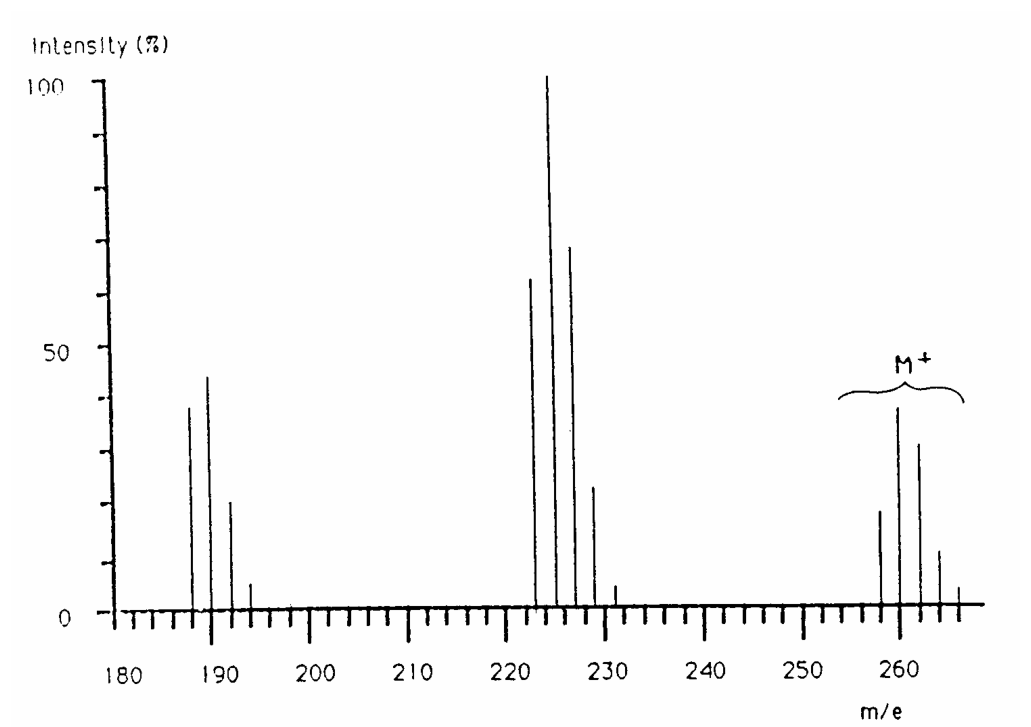
Upon analyzing sea mussels a new bio-accumulated pollutant X was found as determined by mass spectroscopy coupled to a gas chromatograph. The mass spectrum is illustrated in figure. Determine the structural formula of X assuming that it is produced out of synthetic rubber used as insulation in electrolysis cells that are used for the production of chlorine. Give the name of the compound X. The isotopic abundances of the pertinent elements are shown in the figure and table below. Intensities of the ions m/e = 196, 233, 268 and 270 are very low and thus omitted. Peaks of the \(\ce{^{13}C}\) containing ions are omitted for simplicity.
| Element | Mas | Norm.abundanc | Mass | Norm.abundanc | Mas | Norm.abundanc |
|---|---|---|---|---|---|---|
| H | 1 | 100.0 | 2 | 0.015 | ||
| C | 12 | 100.0 | 13 | 1.1 | ||
| N | 14 | 100.0 | 15 | 0.37 | ||
| O | 16 | 100.0 | 17 | 0.04 | 18 | 0.20 |
| P | 31 | 100.0 | ||||
| S | 32 | 100.0 | 33 | 0.80 | 34 | 4.4 |
| Cl | 35 | 100.0 | 37 | 32.5 | ||
| Br | 79 | 100.0 | 81 | 98.0 |
Official English text of the problem.
Answers
- Problem 6: X is hexachlorobutadiene, systematically 1,1,2,3,4,4-hexachlorobuta-1,3-diene, with molecular formula \(\ce{C4Cl6}\) and structural formula
\[
\boxed{\ce{Cl2C=C(Cl)-C(Cl)=CCl2}}.
\]
SMILES:
ClC(Cl)=C(Cl)C(Cl)=C(Cl)Cl.
Solution
Problem 6
The molecular-ion cluster begins at \(m/e=258\), with successive peaks separated by 2. This is characteristic of substitution of \(\ce{^{35}Cl}\) by \(\ce{^{37}Cl}\). The supplied relative abundances give
\[ r=\frac{\text{abundance of }\ce{^{37}Cl}} {\text{abundance of }\ce{^{35}Cl}} =\frac{32.5}{100.0}=0.325. \]
For a species containing \(n\) chlorine atoms, the intensity of the peak containing \(k\) heavy chlorine atoms, relative to the peak containing only light chlorine atoms, is
\[ \frac{I_{M+2k}}{I_M}=\binom{n}{k}r^k. \]
In particular,
\[ \frac{I_{M+2}}{I_M}=nr. \]
The first two molecular-ion peaks have an intensity ratio of approximately \(1:2\). Six chlorine atoms predict \(I_{260}/I_{258}=6(0.325)=1.95\), consistent with the figure. The complete predicted envelope is:
| \(m/e\) | Intensity relative to \(I_{258}=100\) |
|---|---|
| 258 | 100 |
| 260 | 195 |
| 262 | 158.4 |
| 264 | 68.7 |
| 266 | 16.7 |
| 268 | 2.18 |
| 270 | 0.118 |
This also explains why the peaks at 268 and 270 are very weak. Thus, X contains six chlorine atoms.
Using the integer isotope masses supplied, the mass remaining after accounting for six light chlorine atoms is
\[ 258\,\mathrm{u}-6(35\,\mathrm{u})=48\,\mathrm{u}. \]
For the carbon framework derived from the rubber,
\[ N_{\mathrm C}=\frac{48\,\mathrm{u}}{12\,\mathrm{u}}=4. \]
There is no remaining mass for hydrogen, giving the molecular formula
\[ \boxed{\ce{C4Cl6}}. \]
The fragment clusters provide an independent consistency check. Their lowest-mass peaks are
\[ 223=258-35,\qquad 188=258-2(35), \]
consistent with loss of one chlorine atom and net loss of two chlorine atoms, respectively. The corresponding isotope patterns fit five and four remaining chlorine atoms:
| Cluster begins at \(m/e\) | Chlorine atoms | Predicted first-to-second peak ratio | Highest-mass member |
|---|---|---|---|
| 223 | 5 | \(1:1.625\) | \(48+5(37)=233\) |
| 188 | 4 | \(1:1.300\) | \(48+4(37)=196\) |
The highest-mass members require every remaining chlorine atom to be \(\ce{^{37}Cl}\), explaining the other two weak, omitted peaks.
Counting each halogen atom as a hydrogen atom, the degree of unsaturation is
\[ \mathrm{DBE}=\frac{2(4)+2-6}{2}=2. \]
The synthetic-rubber origin points to a four-carbon diene framework. Buta-1,3-diene, also called 1,3-butadiene, has SMILES C=CC=C. Replacing all six hydrogen atoms of this framework by chlorine gives
\[ \ce{Cl2C=C(Cl)-C(Cl)=CCl2}, \]
which has exactly two double bonds and the required formula and mass spectrum.
Therefore, X is hexachlorobutadiene, or 1,1,2,3,4,4-hexachlorobuta-1,3-diene, SMILES ClC(Cl)=C(Cl)C(Cl)=C(Cl)Cl. Neither double bond has \(E/Z\) stereochemistry because each terminal carbon bears two identical chlorine atoms.
The answers were checked against the official answers published by the organisers.
IChO 1988 · Theorieaufgabe 6
Identifizierung eines bioakkumulierten Schadstoffs X anhand seines Massenspektrums
Bei der Untersuchung von Meeresmuscheln wurde mittels Massenspektrometrie, gekoppelt mit Gaschromatographie, ein neuer bioakkumulierter Schadstoff X nachgewiesen. Das Massenspektrum ist in der Abbildung dargestellt. Bestimmen Sie die Strukturformel von X unter der Annahme, dass es aus synthetischem Kautschuk entsteht, der als Isoliermaterial in Elektrolysezellen zur Herstellung von Chlor verwendet wird. Geben Sie den Namen der Verbindung X an. Die Isotopenhäufigkeiten der relevanten Elemente sind in der Abbildung und der nachstehenden Tabelle angegeben. Die Intensitäten der Ionen mit m/e = 196, 233, 268 und 270 sind sehr gering und daher nicht dargestellt. Die Peaks der \(\ce{^{13}C}\)-haltigen Ionen wurden der Einfachheit halber weggelassen.
| Element | Masse | Norm. Häufigkeit | Masse | Norm. Häufigkeit | Masse | Norm. Häufigkeit |
|---|---|---|---|---|---|---|
| H | 1 | 100.0 | 2 | 0.015 | ||
| C | 12 | 100.0 | 13 | 1.1 | ||
| N | 14 | 100.0 | 15 | 0.37 | ||
| O | 16 | 100.0 | 17 | 0.04 | 18 | 0.20 |
| P | 31 | 100.0 | ||||
| S | 32 | 100.0 | 33 | 0.80 | 34 | 4.4 |
| Cl | 35 | 100.0 | 37 | 32.5 | ||
| Br | 79 | 100.0 | 81 | 98.0 |
Aufgabentext aus dem offiziellen englischen Text übersetzt.
Antworten
- Aufgabe 6: X ist Hexachlorbutadien, mit dem systematischen Namen 1,1,2,3,4,4-Hexachlorbuta-1,3-dien, der Summenformel \(\ce{C4Cl6}\) und der Strukturformel
\[
\boxed{\ce{Cl2C=C(Cl)-C(Cl)=CCl2}}.
\]
SMILES:
ClC(Cl)=C(Cl)C(Cl)=C(Cl)Cl.
Lösung
Aufgabe 6
Die Molekülionen-Peakgruppe beginnt bei \(m/e=258\), wobei aufeinanderfolgende Peaks einen Abstand von 2 aufweisen. Dies ist charakteristisch für den Austausch von \(\ce{^{35}Cl}\) gegen \(\ce{^{37}Cl}\). Aus den angegebenen relativen Häufigkeiten ergibt sich
\[ r=\frac{\text{Häufigkeit von }\ce{^{37}Cl}} {\text{Häufigkeit von }\ce{^{35}Cl}} =\frac{32.5}{100.0}=0.325. \]
Für eine Spezies mit \(n\) Chloratomen beträgt die Intensität des Peaks mit \(k\) schweren Chloratomen relativ zum Peak mit ausschließlich leichten Chloratomen
\[ \frac{I_{M+2k}}{I_M}=\binom{n}{k}r^k. \]
Insbesondere gilt
\[ \frac{I_{M+2}}{I_M}=nr. \]
Die ersten beiden Molekülionenpeaks weisen ein Intensitätsverhältnis von ungefähr \(1:2\) auf. Für sechs Chloratome wird \(I_{260}/I_{258}=6(0.325)=1.95\) vorhergesagt, was mit der Abbildung übereinstimmt. Die vollständig vorhergesagte Intensitätsverteilung lautet:
| \(m/e\) | Intensität relativ zu \(I_{258}=100\) |
|---|---|
| 258 | 100 |
| 260 | 195 |
| 262 | 158.4 |
| 264 | 68.7 |
| 266 | 16.7 |
| 268 | 2.18 |
| 270 | 0.118 |
Dies erklärt auch, weshalb die Peaks bei 268 und 270 sehr schwach sind. Somit enthält X sechs Chloratome.
Unter Verwendung der angegebenen ganzzahligen Isotopenmassen verbleibt nach Berücksichtigung von sechs leichten Chloratomen die Masse
\[ 258\,\mathrm{u}-6(35\,\mathrm{u})=48\,\mathrm{u}. \]
Für das aus dem Kautschuk stammende Kohlenstoffgerüst gilt
\[ N_{\mathrm C}=\frac{48\,\mathrm{u}}{12\,\mathrm{u}}=4. \]
Für Wasserstoff verbleibt keine Masse, sodass sich folgende Summenformel ergibt:
\[ \boxed{\ce{C4Cl6}}. \]
Die Fragment-Peakgruppen ermöglichen eine unabhängige Konsistenzprüfung. Ihre Peaks mit der jeweils niedrigsten Masse liegen bei
\[ 223=258-35,\qquad 188=258-2(35), \]
was der Abspaltung eines Chloratoms beziehungsweise der Nettoabspaltung zweier Chloratome entspricht. Die zugehörigen Isotopenmuster passen zu fünf beziehungsweise vier verbleibenden Chloratomen:
| Peakgruppe beginnt bei \(m/e\) | Chloratome | Vorhergesagtes Intensitätsverhältnis des ersten zum zweiten Peak | Peak mit der höchsten Masse |
|---|---|---|---|
| 223 | 5 | \(1:1.625\) | \(48+5(37)=233\) |
| 188 | 4 | \(1:1.300\) | \(48+4(37)=196\) |
Die Peaks mit der höchsten Masse setzen voraus, dass jedes verbleibende Chloratom \(\ce{^{37}Cl}\) ist. Dies erklärt die beiden anderen schwachen, weggelassenen Peaks.
Zählt man jedes Halogenatom als Wasserstoffatom, beträgt der Ungesättigtheitsgrad
\[ \mathrm{DBE}=\frac{2(4)+2-6}{2}=2. \]
Die Herkunft aus synthetischem Kautschuk deutet auf ein Diengerüst mit vier Kohlenstoffatomen hin. Buta-1,3-dien, auch 1,3-Butadien genannt, hat den SMILES-Code C=CC=C. Ersetzt man alle sechs Wasserstoffatome dieses Gerüsts durch Chlor, erhält man
\[ \ce{Cl2C=C(Cl)-C(Cl)=CCl2}, \]
das genau zwei Doppelbindungen sowie die erforderliche Summenformel und das erforderliche Massenspektrum aufweist.
Somit ist X Hexachlorbutadien, oder 1,1,2,3,4,4-Hexachlorbuta-1,3-dien, SMILES: ClC(Cl)=C(Cl)C(Cl)=C(Cl)Cl. Keine der beiden Doppelbindungen weist eine \(E/Z\)-Stereochemie auf, da jedes endständige Kohlenstoffatom zwei identische Chloratome trägt.
Die Ergebnisse wurden mit den von den Veranstaltern veröffentlichten offiziellen Ergebnissen abgeglichen.
IChO 1988 · Teori sorusu 6
Biyobirikime uğramış bir X kirleticisinin kütle spektrumundan belirlenmesi
Deniz midyelerinin analizi sırasında, gaz kromatografına bağlı kütle spektroskopisi ile biyobirikime uğramış yeni bir X kirleticisi bulundu. Kütle spektrumu şekilde gösterilmiştir. X'in, klor üretiminde kullanılan elektroliz hücrelerinde yalıtım malzemesi olarak kullanılan sentetik kauçuktan oluştuğunu varsayarak yapı formülünü belirleyiniz. X bileşiğinin adını veriniz. İlgili elementlerin izotop bollukları aşağıdaki şekil ve tabloda gösterilmiştir. m/e = 196, 233, 268 ve 270 olan iyonların şiddetleri çok düşük olduğundan bunlar gösterilmemiştir. Basitlik açısından, \(\ce{^{13}C}\) içeren iyonların pikleri de gösterilmemiştir.
| Element | Kütle | Normalize bolluk | Kütle | Normalize bolluk | Kütle | Normalize bolluk |
|---|---|---|---|---|---|---|
| H | 1 | 100.0 | 2 | 0.015 | ||
| C | 12 | 100.0 | 13 | 1.1 | ||
| N | 14 | 100.0 | 15 | 0.37 | ||
| O | 16 | 100.0 | 17 | 0.04 | 18 | 0.20 |
| P | 31 | 100.0 | ||||
| S | 32 | 100.0 | 33 | 0.80 | 34 | 4.4 |
| Cl | 35 | 100.0 | 37 | 32.5 | ||
| Br | 79 | 100.0 | 81 | 98.0 |
Soru metni resmi İngilizce metinden çevrilmiştir.
Cevaplar
- Soru 6: X, hekzaklorobütadiendir; sistematik adı 1,1,2,3,4,4-hekzaklorobüta-1,3-dien, molekül formülü \(\ce{C4Cl6}\) ve yapı formülü şöyledir:
\[
\boxed{\ce{Cl2C=C(Cl)-C(Cl)=CCl2}}.
\]
SMILES:
ClC(Cl)=C(Cl)C(Cl)=C(Cl)Cl.
Çözüm
Soru 6
Moleküler iyon pik kümesi \(m/e=258\) değerinde başlar ve ardışık pikler arasındaki fark 2'dir. Bu, \(\ce{^{35}Cl}\) yerine \(\ce{^{37}Cl}\) bulunmasının karakteristik bir özelliğidir. Verilen bağıl bolluklardan şu elde edilir:
\[ r=\frac{\text{bolluk: }\ce{^{37}Cl}} {\text{bolluk: }\ce{^{35}Cl}} =\frac{32.5}{100.0}=0.325. \]
\(n\) klor atomu içeren bir tür için, \(k\) ağır klor atomu içeren pikin şiddetinin yalnızca hafif klor atomları içeren pikin şiddetine oranı şöyledir:
\[ \frac{I_{M+2k}}{I_M}=\binom{n}{k}r^k. \]
Özel olarak,
\[ \frac{I_{M+2}}{I_M}=nr. \]
İlk iki moleküler iyon pikinin şiddet oranı yaklaşık \(1:2\)'dir. Altı klor atomu için öngörülen \(I_{260}/I_{258}=6(0.325)=1.95\) değeri şekille uyumludur. Öngörülen pik dağılımının tamamı şöyledir:
| \(m/e\) | \(I_{258}=100\)'e göre bağıl şiddet |
|---|---|
| 258 | 100 |
| 260 | 195 |
| 262 | 158.4 |
| 264 | 68.7 |
| 266 | 16.7 |
| 268 | 2.18 |
| 270 | 0.118 |
Bu, 268 ve 270'teki piklerin neden çok zayıf olduğunu da açıklar. Dolayısıyla X, altı klor atomu içerir.
Verilen tam sayı izotop kütleleri kullanıldığında, altı hafif klor atomunun kütlesi çıkarıldıktan sonra kalan kütle şöyledir:
\[ 258\,\mathrm{u}-6(35\,\mathrm{u})=48\,\mathrm{u}. \]
Kauçuktan gelen karbon iskeleti için,
\[ N_{\mathrm C}=\frac{48\,\mathrm{u}}{12\,\mathrm{u}}=4. \]
Hidrojen için geriye kütle kalmadığından molekül formülü şu olur:
\[ \boxed{\ce{C4Cl6}}. \]
Parçalanma iyonlarının pik kümeleri bağımsız bir tutarlılık kontrolü sağlar. Bunların en düşük kütleli pikleri şöyledir:
\[ 223=258-35,\qquad 188=258-2(35), \]
Bu değerler, sırasıyla bir klor atomunun kaybıyla ve net olarak iki klor atomunun kaybıyla uyumludur. İlgili izotop dağılımları, geriye beş ve dört klor atomu kalmasıyla uyumludur:
| Kümenin başladığı \(m/e\) değeri | Klor atomu sayısı | Öngörülen birinci pik/ikinci pik şiddet oranı | En yüksek kütleli üye |
|---|---|---|---|
| 223 | 5 | \(1:1.625\) | \(48+5(37)=233\) |
| 188 | 4 | \(1:1.300\) | \(48+4(37)=196\) |
En yüksek kütleli üyeler, geriye kalan klor atomlarının her birinin \(\ce{^{37}Cl}\) olmasını gerektirir; bu da gösterilmeyen diğer iki zayıf piki açıklar.
Her bir halojen atomu bir hidrojen atomu olarak sayıldığında doymamışlık derecesi şöyledir:
\[ \mathrm{DBE}=\frac{2(4)+2-6}{2}=2. \]
Sentetik kauçuk kökeni, dört karbonlu bir dien iskeletine işaret eder. 1,3-bütadien olarak da adlandırılan büta-1,3-dienin SMILES gösterimi C=CC=C şeklindedir. Bu iskeletteki altı hidrojen atomunun tamamının klorla değiştirilmesiyle
\[ \ce{Cl2C=C(Cl)-C(Cl)=CCl2}, \]
elde edilir; bu yapı tam olarak iki çift bağa ve gerekli formül ile kütle spektrumuna sahiptir.
Dolayısıyla X, hekzaklorobütadien, diğer adıyla 1,1,2,3,4,4-hekzaklorobüta-1,3-dien olup SMILES gösterimi ClC(Cl)=C(Cl)C(Cl)=C(Cl)Cl şeklindedir. Her bir uç karbon iki özdeş klor atomu taşıdığından, çift bağların hiçbirinde \(E/Z\) stereoizomerliği yoktur.
Sonuçlar, düzenleyicilerin yayımladığı resmi sonuçlarla karşılaştırılarak kontrol edildi.
IChO 1988 · Problema teórico 6
Identificación de un contaminante bioacumulado X a partir de su espectro de masas
Al analizar mejillones marinos, se encontró un nuevo contaminante bioacumulado X, identificado mediante espectrometría de masas acoplada a un cromatógrafo de gases. El espectro de masas se muestra en la figura. Determine la fórmula estructural de X suponiendo que se produce a partir del caucho sintético utilizado como aislante en las celdas de electrólisis empleadas para la producción de cloro. Indique el nombre del compuesto X. Las abundancias isotópicas de los elementos pertinentes se muestran en la figura y en la tabla siguientes. Las intensidades de los iones m/e = 196, 233, 268 y 270 son muy bajas y, por tanto, se han omitido. Los picos de los iones que contienen \(\ce{^{13}C}\) se han omitido para simplificar.
| Elemento | Masa | Abund. normalizada | Masa | Abund. normalizada | Masa | Abund. normalizada |
|---|---|---|---|---|---|---|
| H | 1 | 100.0 | 2 | 0.015 | ||
| C | 12 | 100.0 | 13 | 1.1 | ||
| N | 14 | 100.0 | 15 | 0.37 | ||
| O | 16 | 100.0 | 17 | 0.04 | 18 | 0.20 |
| P | 31 | 100.0 | ||||
| S | 32 | 100.0 | 33 | 0.80 | 34 | 4.4 |
| Cl | 35 | 100.0 | 37 | 32.5 | ||
| Br | 79 | 100.0 | 81 | 98.0 |
Enunciado traducido del texto oficial en inglés.
Respuestas
- Problema 6: X es hexaclorobutadieno, cuyo nombre sistemático es 1,1,2,3,4,4-hexaclorobuta-1,3-dieno, con fórmula molecular \(\ce{C4Cl6}\) y fórmula estructural
\[
\boxed{\ce{Cl2C=C(Cl)-C(Cl)=CCl2}}.
\]
SMILES:
ClC(Cl)=C(Cl)C(Cl)=C(Cl)Cl.
Solución
Problema 6
El grupo de picos del ion molecular comienza en \(m/e=258\), con picos sucesivos separados por 2. Esto es característico de la sustitución de \(\ce{^{35}Cl}\) por \(\ce{^{37}Cl}\). Las abundancias relativas proporcionadas dan
\[ r=\frac{\text{abundancia de }\ce{^{37}Cl}} {\text{abundancia de }\ce{^{35}Cl}} =\frac{32.5}{100.0}=0.325. \]
Para una especie que contiene \(n\) átomos de cloro, la intensidad del pico que contiene \(k\) átomos de cloro pesado, relativa al pico que contiene únicamente átomos de cloro ligero, es
\[ \frac{I_{M+2k}}{I_M}=\binom{n}{k}r^k. \]
En particular,
\[ \frac{I_{M+2}}{I_M}=nr. \]
Los dos primeros picos del ion molecular tienen una relación de intensidades de aproximadamente \(1:2\). Para seis átomos de cloro se predice \(I_{260}/I_{258}=6(0.325)=1.95\), en concordancia con la figura. La envolvente completa predicha es:
| \(m/e\) | Intensidad relativa a \(I_{258}=100\) |
|---|---|
| 258 | 100 |
| 260 | 195 |
| 262 | 158.4 |
| 264 | 68.7 |
| 266 | 16.7 |
| 268 | 2.18 |
| 270 | 0.118 |
Esto también explica por qué los picos en 268 y 270 son muy débiles. Por tanto, X contiene seis átomos de cloro.
Utilizando las masas isotópicas enteras proporcionadas, la masa restante tras descontar seis átomos de cloro ligero es
\[ 258\,\mathrm{u}-6(35\,\mathrm{u})=48\,\mathrm{u}. \]
Para el esqueleto carbonado derivado del caucho,
\[ N_{\mathrm C}=\frac{48\,\mathrm{u}}{12\,\mathrm{u}}=4. \]
No queda masa disponible para hidrógeno, lo que da la fórmula molecular
\[ \boxed{\ce{C4Cl6}}. \]
Los grupos de picos de los fragmentos proporcionan una comprobación independiente de la coherencia. Sus picos de menor masa son
\[ 223=258-35,\qquad 188=258-2(35), \]
en concordancia con la pérdida de un átomo de cloro y la pérdida neta de dos átomos de cloro, respectivamente. Los patrones isotópicos correspondientes concuerdan con cinco y cuatro átomos de cloro restantes:
| El grupo de picos comienza en \(m/e\) | Átomos de cloro | Relación predicha entre el primer y el segundo pico | Componente de mayor masa |
|---|---|---|---|
| 223 | 5 | \(1:1.625\) | \(48+5(37)=233\) |
| 188 | 4 | \(1:1.300\) | \(48+4(37)=196\) |
Los componentes de mayor masa requieren que todos los átomos de cloro restantes sean \(\ce{^{37}Cl}\), lo que explica los otros dos picos débiles omitidos.
Contando cada átomo de halógeno como un átomo de hidrógeno, el grado de insaturación es
\[ \mathrm{DBE}=\frac{2(4)+2-6}{2}=2. \]
El origen en el caucho sintético apunta a un esqueleto de dieno de cuatro carbonos. El buta-1,3-dieno, también llamado 1,3-butadieno, tiene el SMILES C=CC=C. La sustitución de los seis átomos de hidrógeno de este esqueleto por cloro da
\[ \ce{Cl2C=C(Cl)-C(Cl)=CCl2}, \]
que tiene exactamente dos dobles enlaces y la fórmula y el espectro de masas requeridos.
Por tanto, X es hexaclorobutadieno, o 1,1,2,3,4,4-hexaclorobuta-1,3-dieno, SMILES ClC(Cl)=C(Cl)C(Cl)=C(Cl)Cl. Ninguno de los dos dobles enlaces presenta estereoquímica \(E/Z\) porque cada carbono terminal lleva dos átomos de cloro idénticos.
Los resultados se comprobaron con los resultados oficiales publicados por los organizadores.
IChO 1988 · 理论题 6
根据质谱鉴定生物富集污染物 X
在分析海洋贻贝时,通过气相色谱联用质谱法发现了一种新的生物富集污染物 X。其质谱如图所示。假设 X 是由用于生产氯气的电解槽中作为绝缘材料的合成橡胶产生的,确定 X 的结构式。给出化合物 X 的名称。相关元素的同位素丰度见下图及下表。m/e = 196、233、268 和 270 的离子强度很低,因此省略。为简明起见,含有 \(\ce{^{13}C}\) 的离子峰也已省略。
| 元素 | 质量 | 归一化丰度 | 质量 | 归一化丰度 | 质量 | 归一化丰度 |
|---|---|---|---|---|---|---|
| H | 1 | 100.0 | 2 | 0.015 | ||
| C | 12 | 100.0 | 13 | 1.1 | ||
| N | 14 | 100.0 | 15 | 0.37 | ||
| O | 16 | 100.0 | 17 | 0.04 | 18 | 0.20 |
| P | 31 | 100.0 | ||||
| S | 32 | 100.0 | 33 | 0.80 | 34 | 4.4 |
| Cl | 35 | 100.0 | 37 | 32.5 | ||
| Br | 79 | 100.0 | 81 | 98.0 |
题目译自官方英文原文。
答案
- 题目 6: X 是六氯丁二烯,系统命名为 1,1,2,3,4,4-六氯-1,3-丁二烯,分子式为 \(\ce{C4Cl6}\),结构式为
\[
\boxed{\ce{Cl2C=C(Cl)-C(Cl)=CCl2}}.
\]
SMILES:
ClC(Cl)=C(Cl)C(Cl)=C(Cl)Cl。
解答
题目 6
分子离子峰簇始于 \(m/e=258\),相邻峰之间的间隔为 2。这是 \(\ce{^{35}Cl}\) 被 \(\ce{^{37}Cl}\) 替代的特征。由所给的相对丰度可得
\[ r=\frac{\text{丰度:}\ce{^{37}Cl}} {\text{丰度:}\ce{^{35}Cl}} =\frac{32.5}{100.0}=0.325. \]
对于含有 \(n\) 个氯原子的物种,含有 \(k\) 个重氯原子的峰相对于仅含轻氯原子的峰的强度为
\[ \frac{I_{M+2k}}{I_M}=\binom{n}{k}r^k. \]
特别地,
\[ \frac{I_{M+2}}{I_M}=nr. \]
前两个分子离子峰的强度比约为 \(1:2\)。若含有六个氯原子,则预测得到 \(I_{260}/I_{258}=6(0.325)=1.95\),与图中结果一致。预测的完整同位素峰包络如下:
| \(m/e\) | 相对于 \(I_{258}=100\) 的强度 |
|---|---|
| 258 | 100 |
| 260 | 195 |
| 262 | 158.4 |
| 264 | 68.7 |
| 266 | 16.7 |
| 268 | 2.18 |
| 270 | 0.118 |
这也解释了为什么 268 和 270 处的峰很弱。因此,X 含有六个氯原子。
使用所给的整数同位素质量,扣除六个轻氯原子的质量后,剩余质量为
\[ 258\,\mathrm{u}-6(35\,\mathrm{u})=48\,\mathrm{u}. \]
对于源自橡胶的碳骨架,
\[ N_{\mathrm C}=\frac{48\,\mathrm{u}}{12\,\mathrm{u}}=4. \]
没有剩余质量可分配给氢,因此分子式为
\[ \boxed{\ce{C4Cl6}}. \]
碎片离子峰簇提供了独立的一致性检验。它们的最低质量峰为
\[ 223=258-35,\qquad 188=258-2(35), \]
分别与失去一个氯原子和净失去两个氯原子相符。相应的同位素峰型符合分别剩余五个和四个氯原子的情况:
| 峰簇起始处的 \(m/e\) | 氯原子数 | 预测的第一峰与第二峰的强度比 | 质量最大的成员 |
|---|---|---|---|
| 223 | 5 | \(1:1.625\) | \(48+5(37)=233\) |
| 188 | 4 | \(1:1.300\) | \(48+4(37)=196\) |
质量最大的成员要求所有剩余氯原子均为 \(\ce{^{37}Cl}\),这解释了另外两个被省略的弱峰。
将每个卤素原子按一个氢原子计,不饱和度为
\[ \mathrm{DBE}=\frac{2(4)+2-6}{2}=2. \]
其来源为合成橡胶,提示它具有四碳二烯骨架。丁-1,3-二烯,也称为 1,3-丁二烯,其 SMILES 为 C=CC=C。将此骨架上的全部六个氢原子替换为氯,得到
\[ \ce{Cl2C=C(Cl)-C(Cl)=CCl2}, \]
该结构恰好具有两个双键,且分子式和质谱均符合要求。
因此,X 是六氯丁二烯,即 1,1,2,3,4,4-六氯-1,3-丁二烯,SMILES 为 ClC(Cl)=C(Cl)C(Cl)=C(Cl)Cl。两个双键均不存在 \(E/Z\) 立体异构,因为每个末端碳原子都连接着两个相同的氯原子。
结果已与主办方公布的官方答案核对。
IChO 1988 · Теоретическая задача 6
Идентификация биоаккумулированного загрязняющего вещества X по его масс-спектру
При анализе морских мидий методом масс-спектрометрии в сочетании с газовой хроматографией было обнаружено новое биоаккумулированное загрязняющее вещество X. Масс-спектр представлен на рисунке. Определите структурную формулу X, предполагая, что оно образуется из синтетического каучука, используемого в качестве изоляционного материала в электролизёрах для производства хлора. Приведите название соединения X. Изотопные распространённости соответствующих элементов приведены на рисунке и в таблице ниже. Интенсивности ионов с m/e = 196, 233, 268 и 270 очень малы, поэтому они не показаны. Для упрощения пики ионов, содержащих \(\ce{^{13}C}\), не показаны.
| Элемент | Масса | Норм. распространённость | Масса | Норм. распространённость | Масса | Норм. распространённость |
|---|---|---|---|---|---|---|
| H | 1 | 100.0 | 2 | 0.015 | ||
| C | 12 | 100.0 | 13 | 1.1 | ||
| N | 14 | 100.0 | 15 | 0.37 | ||
| O | 16 | 100.0 | 17 | 0.04 | 18 | 0.20 |
| P | 31 | 100.0 | ||||
| S | 32 | 100.0 | 33 | 0.80 | 34 | 4.4 |
| Cl | 35 | 100.0 | 37 | 32.5 | ||
| Br | 79 | 100.0 | 81 | 98.0 |
Условие переведено с официального английского текста.
Ответы
- Задача 6: X — гексахлорбутадиен, систематическое название — 1,1,2,3,4,4-гексахлорбута-1,3-диен, с молекулярной формулой \(\ce{C4Cl6}\) и структурной формулой
\[
\boxed{\ce{Cl2C=C(Cl)-C(Cl)=CCl2}}.
\]
SMILES:
ClC(Cl)=C(Cl)C(Cl)=C(Cl)Cl.
Решение
Задача 6
Группа пиков молекулярного иона начинается при \(m/e=258\), причём соседние пики разделены интервалом 2. Это характерно для замены \(\ce{^{35}Cl}\) на \(\ce{^{37}Cl}\). Из приведённых относительных распространённостей получаем
\[ r=\frac{\text{распространённость }\ce{^{37}Cl}} {\text{распространённость }\ce{^{35}Cl}} =\frac{32.5}{100.0}=0.325. \]
Для частицы, содержащей \(n\) атомов хлора, интенсивность пика, соответствующего \(k\) тяжёлым атомам хлора, относительно пика, соответствующего только лёгким атомам хлора, равна
\[ \frac{I_{M+2k}}{I_M}=\binom{n}{k}r^k. \]
В частности,
\[ \frac{I_{M+2}}{I_M}=nr. \]
Отношение интенсивностей первых двух пиков молекулярного иона составляет приблизительно \(1:2\). Для шести атомов хлора предсказывается \(I_{260}/I_{258}=6(0.325)=1.95\), что согласуется с рисунком. Полное предсказываемое распределение интенсивностей изотопных пиков:
| \(m/e\) | Интенсивность относительно \(I_{258}=100\) |
|---|---|
| 258 | 100 |
| 260 | 195 |
| 262 | 158.4 |
| 264 | 68.7 |
| 266 | 16.7 |
| 268 | 2.18 |
| 270 | 0.118 |
Это также объясняет, почему пики при 268 и 270 очень слабы. Таким образом, X содержит шесть атомов хлора.
Используя приведённые целочисленные массы изотопов, получаем массу, оставшуюся после учёта шести лёгких атомов хлора:
\[ 258\,\mathrm{u}-6(35\,\mathrm{u})=48\,\mathrm{u}. \]
Для углеродного скелета, происходящего из каучука,
\[ N_{\mathrm C}=\frac{48\,\mathrm{u}}{12\,\mathrm{u}}=4. \]
На водород массы не остаётся, что даёт молекулярную формулу
\[ \boxed{\ce{C4Cl6}}. \]
Группы пиков фрагментных ионов позволяют независимо проверить согласованность вывода. Их пики с наименьшими массами:
\[ 223=258-35,\qquad 188=258-2(35), \]
что согласуется с потерей одного атома хлора и суммарной потерей двух атомов хлора соответственно. Соответствующие распределения изотопных пиков согласуются с наличием пяти и четырёх оставшихся атомов хлора:
| Начало группы пиков, \(m/e\) | Число атомов хлора | Предсказываемое отношение интенсивностей первого и второго пиков | Компонент с наибольшей массой |
|---|---|---|---|
| 223 | 5 | \(1:1.625\) | \(48+5(37)=233\) |
| 188 | 4 | \(1:1.300\) | \(48+4(37)=196\) |
Для компонентов с наибольшими массами необходимо, чтобы каждый оставшийся атом хлора был \(\ce{^{37}Cl}\), что объясняет слабость двух других не показанных пиков.
При подсчёте каждого атома галогена как атома водорода степень ненасыщенности равна
\[ \mathrm{DBE}=\frac{2(4)+2-6}{2}=2. \]
Происхождение из синтетического каучука указывает на диеновый скелет из четырёх атомов углерода. Бута-1,3-диен, также называемый 1,3-бутадиеном, имеет SMILES C=CC=C. Замена всех шести атомов водорода этого скелета на хлор даёт
\[ \ce{Cl2C=C(Cl)-C(Cl)=CCl2}, \]
что соответствует ровно двум двойным связям, требуемой формуле и масс-спектру.
Следовательно, X — гексахлорбутадиен, или 1,1,2,3,4,4-гексахлорбута-1,3-диен, SMILES ClC(Cl)=C(Cl)C(Cl)=C(Cl)Cl. Ни одна из двойных связей не обладает \(E/Z\)-стереоизомерией, поскольку каждый концевой атом углерода несёт два одинаковых атома хлора.
Ответы проверены по официальным ответам, опубликованным организаторами.
IChO 1988 · مسألة نظرية 6
تحديد هوية ملوِّث متراكم حيويًا X من طيف كتلته
عند تحليل بلح البحر، عُثر على ملوِّث جديد متراكم حيويًا X، وذلك باستخدام مطيافية الكتلة المقترنة بجهاز استشراب غازي. يوضّح الشكل طيف الكتلة. حدِّد الصيغة البنائية للمركّب X بافتراض أنه يتكوّن من المطاط الاصطناعي المستخدم مادةً عازلة في خلايا التحليل الكهربائي المستخدمة لإنتاج الكلور. أعطِ اسم المركّب X. تُعرض الوفرات النظيرية للعناصر ذات الصلة في الشكل والجدول أدناه. شدّات الأيونات ذات m/e = 196, 233, 268 و270 منخفضة جدًا، ولذلك حُذفت. وحُذفت قمم الأيونات المحتوية على \(\ce{^{13}C}\) للتبسيط.
| العنصر | الكتلة | الوفرة المُطبَّعة | الكتلة | الوفرة المُطبَّعة | الكتلة | الوفرة المُطبَّعة |
|---|---|---|---|---|---|---|
| H | 1 | 100.0 | 2 | 0.015 | ||
| C | 12 | 100.0 | 13 | 1.1 | ||
| N | 14 | 100.0 | 15 | 0.37 | ||
| O | 16 | 100.0 | 17 | 0.04 | 18 | 0.20 |
| P | 31 | 100.0 | ||||
| S | 32 | 100.0 | 33 | 0.80 | 34 | 4.4 |
| Cl | 35 | 100.0 | 37 | 32.5 | ||
| Br | 79 | 100.0 | 81 | 98.0 |
نص المسألة مترجم عن النص الإنجليزي الرسمي.
الإجابات
- المسألة 6: X هو سداسي كلورو البوتاديين، واسمه النظامي 1,1,2,3,4,4-سداسي كلورو بوتا-1,3-ديين، وصيغته الجزيئية \(\ce{C4Cl6}\) وصيغته البنائية
\[
\boxed{\ce{Cl2C=C(Cl)-C(Cl)=CCl2}}.
\]
SMILES:
ClC(Cl)=C(Cl)C(Cl)=C(Cl)Cl.
الحل
المسألة 6
تبدأ مجموعة قمم الأيون الجزيئي عند \(m/e=258\)، وتفصل بين كل قمتين متتاليتين قيمة مقدارها 2. وهذه سمة مميّزة لاستبدال \(\ce{^{35}Cl}\) بـ \(\ce{^{37}Cl}\). وتعطي الوفرات النسبية المعطاة
\[ r=\frac{\text{وفرة }\ce{^{37}Cl}} {\text{وفرة }\ce{^{35}Cl}} =\frac{32.5}{100.0}=0.325. \]
لنوع كيميائي يحتوي على \(n\) من ذرات الكلور، تكون شدة القمة التي تحتوي على \(k\) من ذرات الكلور الثقيلة، نسبةً إلى القمة التي تحتوي على ذرات الكلور الخفيفة فقط، كما يلي
\[ \frac{I_{M+2k}}{I_M}=\binom{n}{k}r^k. \]
وعلى وجه الخصوص،
\[ \frac{I_{M+2}}{I_M}=nr. \]
تبلغ نسبة شدتي أول قمتين للأيون الجزيئي نحو \(1:2\). ويؤدي وجود ست ذرات كلور إلى النسبة المتوقعة \(I_{260}/I_{258}=6(0.325)=1.95\)، بما يتفق مع الشكل. ويكون التوزيع الكامل المتوقع لشدّات القمم كما يلي:
| \(m/e\) | الشدة نسبةً إلى \(I_{258}=100\) |
|---|---|
| 258 | 100 |
| 260 | 195 |
| 262 | 158.4 |
| 264 | 68.7 |
| 266 | 16.7 |
| 268 | 2.18 |
| 270 | 0.118 |
وهذا يفسّر أيضًا سبب الضعف الشديد للقمتين عند 268 و270. إذن، يحتوي X على ست ذرات كلور.
باستخدام الكتل النظيرية الصحيحة المعطاة، تكون الكتلة المتبقية بعد احتساب ست ذرات كلور خفيفة هي
\[ 258\,\mathrm{u}-6(35\,\mathrm{u})=48\,\mathrm{u}. \]
وبالنسبة إلى الهيكل الكربوني المشتق من المطاط،
\[ N_{\mathrm C}=\frac{48\,\mathrm{u}}{12\,\mathrm{u}}=4. \]
لا تتبقى أي كتلة للهيدروجين، مما يعطي الصيغة الجزيئية
\[ \boxed{\ce{C4Cl6}}. \]
توفّر مجموعات قمم الشظايا تحققًا مستقلًا من الاتساق. وقممها ذات الكتلة الأدنى هي
\[ 223=258-35,\qquad 188=258-2(35), \]
وهو ما يتفق مع فقد ذرة كلور واحدة وفقدٍ صافٍ لذرتي كلور، على الترتيب. وتتوافق الأنماط النظيرية المقابلة مع بقاء خمس ذرات كلور وأربع ذرات كلور:
| تبدأ مجموعة القمم عند \(m/e\) | عدد ذرات الكلور | النسبة المتوقعة لشدة القمة الأولى إلى الثانية | العضو ذو الكتلة الأعلى |
|---|---|---|---|
| 223 | 5 | \(1:1.625\) | \(48+5(37)=233\) |
| 188 | 4 | \(1:1.300\) | \(48+4(37)=196\) |
يتطلّب ظهور العضو ذي الكتلة الأعلى أن تكون كل ذرة كلور متبقية من النظير \(\ce{^{37}Cl}\)، وهو ما يفسّر القمتين الضعيفتين الأخريين اللتين حُذفتا.
باحتساب كل ذرة هالوجين على أنها ذرة هيدروجين، تكون درجة عدم الإشباع
\[ \mathrm{DBE}=\frac{2(4)+2-6}{2}=2. \]
يشير أصل المركّب المشتق من المطاط الاصطناعي إلى هيكل ديين ذي أربع ذرات كربون. وللبوتا-1,3-ديين، الذي يُسمّى أيضًا 1,3-بوتاديين، تمثيل SMILES هو C=CC=C. ويعطي استبدال جميع ذرات الهيدروجين الست في هذا الهيكل بذرات كلور
\[ \ce{Cl2C=C(Cl)-C(Cl)=CCl2}, \]
وهو مركّب يحتوي على رابطتين مزدوجتين بالضبط، وله الصيغة وطيف الكتلة المطلوبان.
إذن، X هو سداسي كلورو البوتاديين، أو 1,1,2,3,4,4-سداسي كلورو بوتا-1,3-ديين، وتمثيل SMILES له هو ClC(Cl)=C(Cl)C(Cl)=C(Cl)Cl. ولا تُظهر أيٌّ من الرابطتين المزدوجتين تصاوغًا فراغيًا من نوع \(E/Z\)، لأن كل ذرة كربون طرفية تحمل ذرتي كلور متماثلتين.
تمت مراجعة النتائج بمقارنتها بالنتائج الرسمية التي نشرها المنظمون.