International Chemistry Olympiad
IChO 1987
Veszprém – Budapest, Hungary · 5 theory problems with complete solutions
Problem 1: Carbohydrate oxidation and fermentation in a sewage plant
Treating waste water in a sewage plant, 45 % of its carbohydrate \(\ce{(CH2O)_n}\) is completely oxidized, 10 % undergoes anaerobic decomposition by fermentation (two components) and the rest remains in the sludge. The total gas formation is \(16\ \mathrm{m^3}\) per day (\(25\ ^\circ\mathrm{C}\), \(100\ \mathrm{kPa}\)).
1.1 What is the amount of carbohydrate remaining in the sludge measured in kg per day?
1.2 Using the heat of combustion of methane (\(-882\ \mathrm{kJ\,mol^{-1}}\)), calculate the amount of energy that can be produced by combustion of the methane formed per day.
1.3 Knowing that the concentration of the carbohydrate in the waste water is \(250\ \mathrm{mg\,dm^{-3}}\), calculate the daily amount of waste water processed in the plant in \(\mathrm{m^3}\) of water per day.
Official English text of the problem.
Problem 2: Identification of a hydrated sodium phosphate by acid-base titration
500 mg of a hydrated sodium salt of phosphoric acid are dissolved in 50.0 cm³ of 0.1 molar sulphuric acid. This solution is diluted with distilled water to 100.0 cm³ and 20.0 cm³ of it are titrated with 0.100 molar \(\ce{NaOH}\) solution using thymolphthalein as indicator. The average of the burette reading is 26.53 cm³. The pH at the end-point is 10.00.
Problems:
2.1 Calculate the percentage distribution by moles of all protonated \(\ce{H_{n}PO4^{n-3}}\) species at the end-point.
2.2 What is the stoichiometric formula of the salt?
The cumulative protonation constants are given by
\[ \beta_n= \frac{[\ce{H_{n}PO4^{n-3}}]} {[\ce{PO4^3-}][\ce{H+}]^n} \]
where \(\log\beta_1=11.70;\quad \log\beta_2=18.6;\quad \log\beta_3=20.6.\)
The relative atomic masses are: Na = 23.0; P = 31.0; H = 1.0; O = 16.0.
Official English text of the problem.
Problem 3: Potentiometric titration of a chloride-cyanide mixture with silver nitrate
25.00 \(\mathrm{cm^3}\) of a neutral solution containing potassium chloride and potassium cyanide are potentiometrically titrated with a standard 0.1000 molar silver nitrate solution at \(25\,^\circ\mathrm{C}\) using a silver electrode and a normal calomel half-cell with \(\ce{KNO3}\) - salt bridge. The protonation of cyanide ions is negligible. The potentiometric curve obtained (emf (V)) vs. burette readings (in \(\mathrm{cm^3}\)) is shown in Fig. 1.
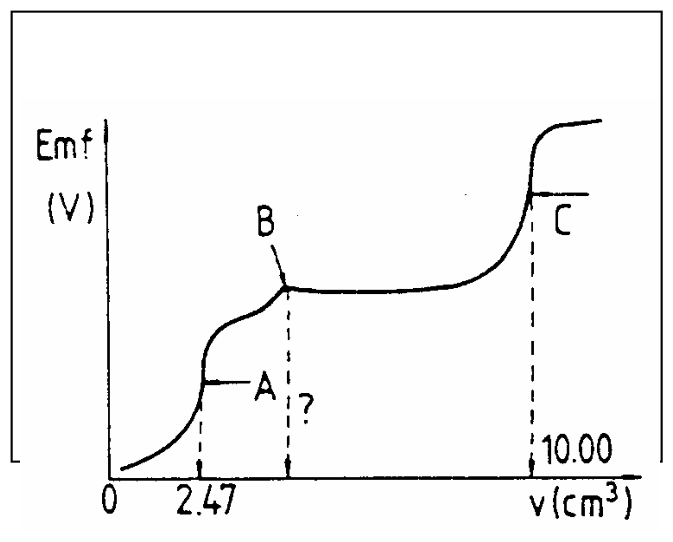
Fig. 1
3.1 The end points of the reactions taking place during the titration, are marked with A, B and C. Write the balanced ionic equation for each reaction.
3.2 What volume of the titrant is required to reach point B?
3.3 Calculate the concentrations of \(\ce{KCl}\) and \(\ce{KCN}\) (in \(\mathrm{mol\,dm^{-3}}\)) in the sample solution.
3.4 Calculate the emf readings at the points A and C in volts.
3.5 What is the molar ratio \(\ce{Cl-}/\ce{CN-}\) in the solution and in the precipitate at point C?
Data:
\[ E^\circ(\ce{Ag+}/\ce{Ag})=0.800\ \mathrm{V} \]
\[ E^\circ(\text{Calomel})=0.285\ \mathrm{V} \]
\[ K_{\mathrm{sp}}(\ce{AgCN})=10^{-15.8} \]
\[ K_{\mathrm{sp}}(\ce{AgCl})=10^{-9.75} \]
\[ \beta_2= \frac{[\ce{[Ag(CN)2]-}]}{[\ce{Ag+}][\ce{CN-}]^2} =10^{21.1} \]
Official English text of the problem.
Problem 4: Reaction sequence leading to indene (compounds A-I)
Write the structural formulae of the compounds A to I in the following reaction sequence.
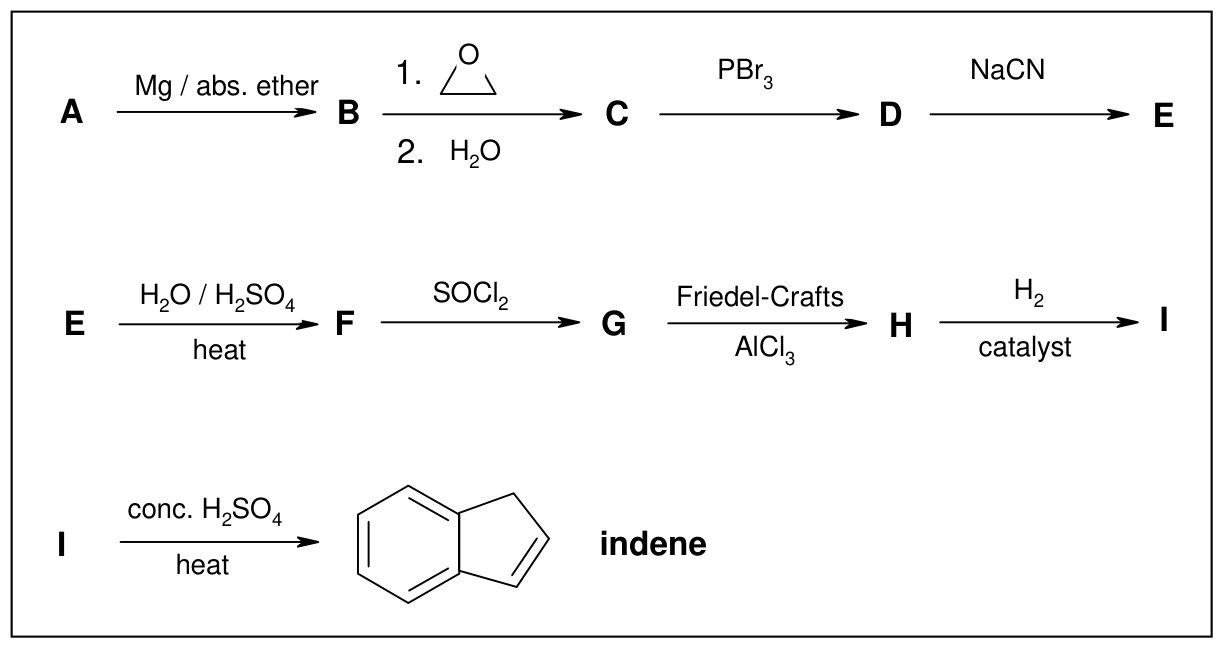
Official English text of the problem.
Problem 5: Organic chemistry questions: chlorination, alcohols, aldohexoses, C4H8 isomers, lecithin, citric acid cycle, NAD+
5.1 What ratio of primary / secondary / tertiary products can statistically be expected in the high temperature chlorination of methyl butane? Assume that the reaction rate of the substitution is equal for all C-H bonds.
5.2 Which of the following alcohols: pentan-1-ol, pentan-2-ol and 2-methyl-butan-2-ol react with the following reagents listed below?
1) cold, concentrated sulphuric acid; 2) \(\ce{CrO3 / H2SO4}\); 3) \(\ce{ZnCl2 / HCl}\); 4) \(\ce{I2 / NaOH}\)
5.3 Which of the following aldohexose structures are:
1) enantiomer pairs, 2) diastereomer pairs?
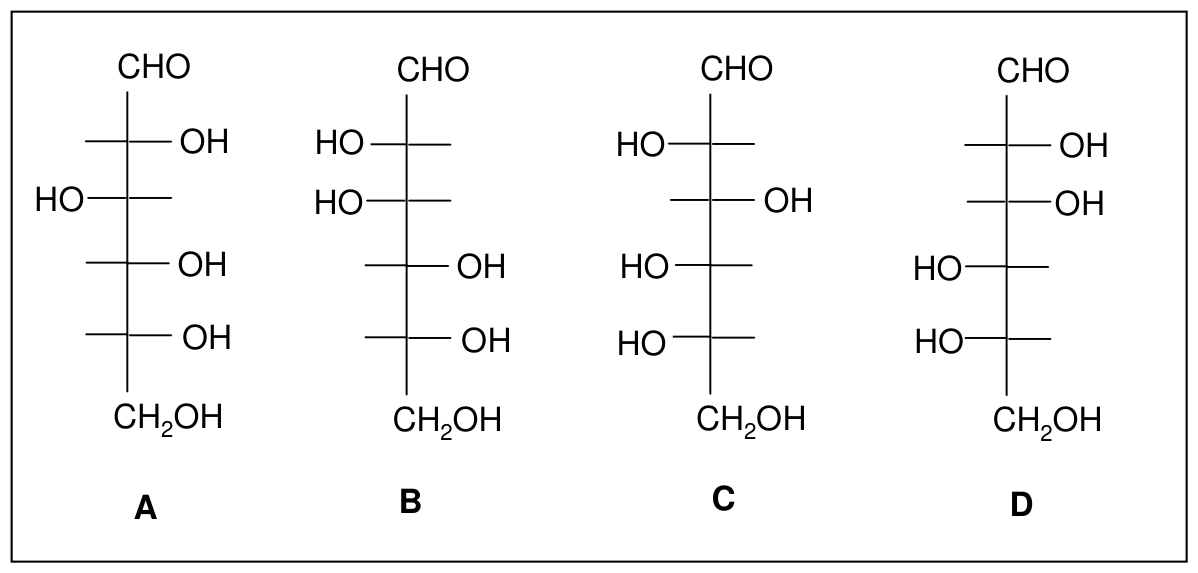
5.4 Two hydrocarbon compounds of the same molecular formula, \(\ce{C4H8}\), easily react with hydrogen in the presence of a platinum catalyst. During ozonolysis only ethanal (acetaldehyde) is formed in both cases. The \(\ce{^1H}\)-NMR spectra of the two compounds show two types of protons in a ratio of 3 to 1. Draw the structures of the described compounds.
5.5 Select the components of the group listed below that can be obtained during complete hydrolysis of lecithin (a phospholipid): serine, phosphoric acid, sphingosine, choline, glycerol, myo-inositol, phosphatidic acid and fatty acids).
5.6 Which of the following carboxylic acid can be formed in the tricarboxylic acid cycle (Krebs' citric acid cycle):
maleic acid (cis-butenedioic acid), mandelic acid (a-hydroxy-phenylethanoic acid), malic acid (2-hydroxy-butanedioic acid), tricarb-allylic acid (propane-1,2,3-tricarboxylic acid), oxalacetic acid (2-oxo-butanedioic acid), keto-glutaric acid (2-oxo-pentanedioic acid), fumaric acid (trans-butenedioic acid) and acetoacetic acid (3-oxo-butanoic acid).
5.7 To which structures is the nicotinamide moiety (part) of \(\ce{NAD+}\) converted during the uptake of hydrogen to form \(\ce{NADH}\) (A, B or C)?
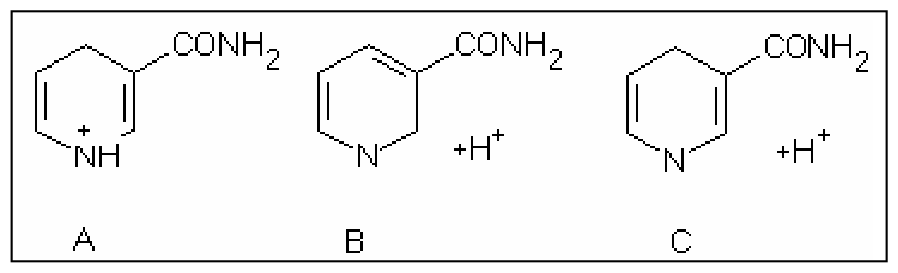
Official English text of the problem.
Internationale Chemie-Olympiade
IChO 1987
Veszprém – Budapest, Ungarn · 5 Theorieaufgaben mit vollständigen Lösungen
Aufgabe 1: Kohlenhydratoxidation und Gärung in einer Kläranlage
Bei der Behandlung von Abwasser in einer Kläranlage werden 45 % des darin enthaltenen Kohlenhydrats \(\ce{(CH2O)_n}\) vollständig oxidiert, 10 % werden durch Gärung anaerob zersetzt (zwei Komponenten), und der Rest verbleibt im Klärschlamm. Die gesamte Gasbildung beträgt \(16\ \mathrm{m^3}\) pro Tag (\(25\ ^\circ\mathrm{C}\), \(100\ \mathrm{kPa}\)).
1.1 Welche Menge an Kohlenhydrat verbleibt im Klärschlamm, gemessen in kg pro Tag?
1.2 Berechnen Sie mithilfe der Verbrennungswärme von Methan (\(-882\ \mathrm{kJ\,mol^{-1}}\)) die Energiemenge, die durch Verbrennung des pro Tag gebildeten Methans gewonnen werden kann.
1.3 Berechnen Sie aus der Kohlenhydratkonzentration im Abwasser von \(250\ \mathrm{mg\,dm^{-3}}\) die täglich in der Anlage behandelte Abwassermenge in \(\mathrm{m^3}\) Wasser pro Tag.
Aufgabentext aus dem offiziellen englischen Text übersetzt.
Aufgabe 2: Identifizierung eines hydratisierten Natriumphosphats durch Säure-Base-Titration
500 mg eines hydratisierten Natriumsalzes der Phosphorsäure werden in 50.0 cm³ 0.1-molarer Schwefelsäure gelöst. Diese Lösung wird mit destilliertem Wasser auf 100.0 cm³ verdünnt, und 20.0 cm³ davon werden mit 0.100-molarer \(\ce{NaOH}\)-Lösung unter Verwendung von Thymolphthalein als Indikator titriert. Der Mittelwert der Bürettenablesungen beträgt 26.53 cm³. Der pH-Wert am Endpunkt beträgt 10.00.
Aufgaben:
2.1 Berechnen Sie die prozentuale Stoffmengenverteilung aller protonierten \(\ce{H_{n}PO4^{n-3}}\)-Spezies am Endpunkt.
2.2 Wie lautet die stöchiometrische Formel des Salzes?
Die kumulativen Protonierungskonstanten sind gegeben durch
\[ \beta_n= \frac{[\ce{H_{n}PO4^{n-3}}]} {[\ce{PO4^3-}][\ce{H+}]^n} \]
wobei \(\log\beta_1=11.70;\quad \log\beta_2=18.6;\quad \log\beta_3=20.6.\)
Die relativen Atommassen sind: Na = 23.0; P = 31.0; H = 1.0; O = 16.0.
Aufgabentext aus dem offiziellen englischen Text übersetzt.
Aufgabe 3: Potentiometrische Titration eines Chlorid-Cyanid-Gemisches mit Silbernitrat
25.00 \(\mathrm{cm^3}\) einer neutralen Lösung, die Kaliumchlorid und Kaliumcyanid enthält, werden bei \(25\,^\circ\mathrm{C}\) mit einer 0.1000-molaren Silbernitrat-Maßlösung unter Verwendung einer Silberelektrode und einer Normalkalomelelektrode mit einer \(\ce{KNO3}\)-Salzbrücke potentiometrisch titriert. Die Protonierung der Cyanidionen ist vernachlässigbar. Die erhaltene potentiometrische Kurve (EMK (V)) in Abhängigkeit vom Bürettenstand (in \(\mathrm{cm^3}\)) ist in Abb. 1 dargestellt.
Abb. 1
3.1 Die Endpunkte der während der Titration ablaufenden Reaktionen sind mit A, B und C gekennzeichnet. Geben Sie für jede Reaktion die ausgeglichene Ionengleichung an.
3.2 Welches Volumen der Maßlösung ist erforderlich, um Punkt B zu erreichen?
3.3 Berechnen Sie die Konzentrationen von \(\ce{KCl}\) und \(\ce{KCN}\) (in \(\mathrm{mol\,dm^{-3}}\)) in der Probelösung.
3.4 Berechnen Sie die EMK-Messwerte an den Punkten A und C in Volt.
3.5 Wie groß ist das Stoffmengenverhältnis \(\ce{Cl-}/\ce{CN-}\) in der Lösung und im Niederschlag am Punkt C?
Daten:
\[ E^\circ(\ce{Ag+}/\ce{Ag})=0.800\ \mathrm{V} \]
\[ E^\circ(\text{Kalomel})=0.285\ \mathrm{V} \]
\[ K_{\mathrm{sp}}(\ce{AgCN})=10^{-15.8} \]
\[ K_{\mathrm{sp}}(\ce{AgCl})=10^{-9.75} \]
\[ \beta_2= \frac{[\ce{[Ag(CN)2]-}]}{[\ce{Ag+}][\ce{CN-}]^2} =10^{21.1} \]
Aufgabentext aus dem offiziellen englischen Text übersetzt.
Aufgabe 4: Reaktionsfolge zur Herstellung von Inden (Verbindungen A-I)
Geben Sie die Strukturformeln der Verbindungen A bis I in der folgenden Reaktionsfolge an.
Aufgabentext aus dem offiziellen englischen Text übersetzt.
Aufgabe 5: Fragen zur organischen Chemie: Chlorierung, Alkohole, Aldohexosen, C4H8-Isomere, Lecithin, Citratzyklus, NAD+
5.1 Welches Verhältnis von primären / sekundären / tertiären Produkten ist bei der Hochtemperaturchlorierung von Methylbutan statistisch zu erwarten? Nehmen Sie an, dass die Reaktionsgeschwindigkeit der Substitution für alle C-H-Bindungen gleich ist.
5.2 Welche der folgenden Alkohole: Pentan-1-ol, Pentan-2-ol und 2-Methylbutan-2-ol reagieren mit den nachstehend aufgeführten Reagenzien?
1) kalte, konzentrierte Schwefelsäure; 2) \(\ce{CrO3 / H2SO4}\); 3) \(\ce{ZnCl2 / HCl}\); 4) \(\ce{I2 / NaOH}\)
5.3 Welche der folgenden Aldohexosestrukturen bilden:
1) Enantiomerenpaare, 2) Diastereomerenpaare?
5.4 Zwei Kohlenwasserstoffverbindungen mit derselben Summenformel, \(\ce{C4H8}\), reagieren in Gegenwart eines Platinkatalysators leicht mit Wasserstoff. Bei der Ozonolyse entsteht in beiden Fällen ausschließlich Ethanal (Acetaldehyd). Die \(\ce{^1H}\)-NMR-Spektren der beiden Verbindungen zeigen zwei Arten von Protonen im Verhältnis 3 zu 1. Zeichnen Sie die Strukturen der beschriebenen Verbindungen.
5.5 Wählen Sie aus der nachstehenden Gruppe diejenigen Bestandteile aus, die bei der vollständigen Hydrolyse von Lecithin (einem Phospholipid) erhalten werden können: Serin, Phosphorsäure, Sphingosin, Cholin, Glycerin, myo-Inositol, Phosphatidsäure und Fettsäuren).
5.6 Welche der folgenden Carbonsäuren können im Tricarbonsäurezyklus (Krebs-Citratzyklus) gebildet werden:
Maleinsäure (cis-Butendisäure), Mandelsäure (α-Hydroxyphenylessigsäure), Äpfelsäure (2-Hydroxybutandisäure), Tricarballylsäure (Propan-1,2,3-tricarbonsäure), Oxalessigsäure (2-Oxobutandisäure), Ketoglutarsäure (2-Oxopentandisäure), Fumarsäure (trans-Butendisäure) und Acetessigsäure (3-Oxobutansäure).
5.7 In welche Struktur wird der Nicotinamidrest (Teil) von \(\ce{NAD+}\) bei der Aufnahme von Wasserstoff unter Bildung von \(\ce{NADH}\) umgewandelt (A, B oder C)?
Aufgabentext aus dem offiziellen englischen Text übersetzt.
Uluslararası Kimya Olimpiyatı
IChO 1987
Veszprém – Budapeşte, Macaristan · 5 teori sorusu, tam çözümleriyle
Soru 1: Bir atık su arıtma tesisinde karbonhidratın yükseltgenmesi ve fermantasyonu
Bir atık su arıtma tesisinde atık su arıtılırken, içerdiği karbonhidratın \(\ce{(CH2O)_n}\) %45'i tamamen yükseltgenir, %10'u fermantasyon yoluyla anaerobik olarak ayrışır (iki bileşen oluşur) ve geri kalanı çamurda kalır. Toplam gaz oluşumu günde \(16\ \mathrm{m^3}\) kadardır (\(25\ ^\circ\mathrm{C}\), \(100\ \mathrm{kPa}\)).
1.1 Çamurda kalan karbonhidrat miktarı günde kaç kg'dır?
1.2 Metanın yanma ısısını (\(-882\ \mathrm{kJ\,mol^{-1}}\)) kullanarak, bir günde oluşan metanın yakılmasıyla üretilebilecek enerji miktarını hesaplayınız.
1.3 Atık sudaki karbonhidrat derişiminin \(250\ \mathrm{mg\,dm^{-3}}\) olduğunu bilerek, tesiste günlük olarak arıtılan atık su miktarını günde \(\mathrm{m^3}\) su cinsinden hesaplayınız.
Soru metni resmi İngilizce metinden çevrilmiştir.
Soru 2: Hidratlı bir sodyum fosfatın asit-baz titrasyonuyla belirlenmesi
Fosforik asidin hidratlı bir sodyum tuzundan 500 mg, 50.0 cm³ 0.1 molar sülfürik asitte çözülür. Bu çözelti damıtılmış suyla 100.0 cm³ hacme seyreltilir ve çözeltinin 20.0 cm³ hacmindeki bir kısmı, indikatör olarak timolftalein kullanılarak 0.100 molar \(\ce{NaOH}\) çözeltisiyle titre edilir. Büret okumalarının ortalaması 26.53 cm³'tür. Dönüm noktasındaki pH 10.00'dır.
Sorular:
2.1 Dönüm noktasında protonlanmış tüm \(\ce{H_{n}PO4^{n-3}}\) türlerinin molce yüzde dağılımını hesaplayınız.
2.2 Tuzun stokiyometrik formülü nedir?
Kümülatif protonlanma sabitleri aşağıdaki bağıntıyla verilmektedir:
\[ \beta_n= \frac{[\ce{H_{n}PO4^{n-3}}]} {[\ce{PO4^3-}][\ce{H+}]^n} \]
Burada \(\log\beta_1=11.70;\quad \log\beta_2=18.6;\quad \log\beta_3=20.6.\)
Bağıl atom kütleleri: Na = 23.0; P = 31.0; H = 1.0; O = 16.0.
Soru metni resmi İngilizce metinden çevrilmiştir.
Soru 3: Klorür-siyanür karışımının gümüş nitratla potansiyometrik titrasyonu
Potasyum klorür ve potasyum siyanür içeren nötr bir çözeltinin 25.00 \(\mathrm{cm^3}\) hacmindeki örneği, \(25\,^\circ\mathrm{C}\)'de bir gümüş elektrot ve \(\ce{KNO3}\) tuz köprüsüne sahip normal kalomel yarı hücresi kullanılarak standart 0.1000 molar gümüş nitrat çözeltisiyle potansiyometrik olarak titre edilmektedir. Siyanür iyonlarının protonlanması ihmal edilebilir düzeydedir. Elde edilen potansiyometrik eğri (emk (V) ile büret okumaları (\(\mathrm{cm^3}\) cinsinden) arasındaki ilişki) Şekil 1'de gösterilmiştir.
Şekil 1
3.1 Titrasyon sırasında gerçekleşen tepkimelerin dönüm noktaları A, B ve C ile işaretlenmiştir. Her tepkime için denkleştirilmiş iyon denklemini yazınız.
3.2 B noktasına ulaşmak için gereken titrant hacmi nedir?
3.3 Örnek çözeltideki \(\ce{KCl}\) ve \(\ce{KCN}\) derişimlerini (\(\mathrm{mol\,dm^{-3}}\) cinsinden) hesaplayınız.
3.4 A ve C noktalarındaki emk okumalarını volt cinsinden hesaplayınız.
3.5 C noktasında çözeltideki ve çökelekteki \(\ce{Cl-}/\ce{CN-}\) mol oranı nedir?
Veriler:
\[ E^\circ(\ce{Ag+}/\ce{Ag})=0.800\ \mathrm{V} \]
\[ E^\circ(\text{Kalomel})=0.285\ \mathrm{V} \]
\[ K_{\mathrm{sp}}(\ce{AgCN})=10^{-15.8} \]
\[ K_{\mathrm{sp}}(\ce{AgCl})=10^{-9.75} \]
\[ \beta_2= \frac{[\ce{[Ag(CN)2]-}]}{[\ce{Ag+}][\ce{CN-}]^2} =10^{21.1} \]
Soru metni resmi İngilizce metinden çevrilmiştir.
Soru 4: İndene götüren tepkime dizisi (A-I bileşikleri)
Aşağıdaki tepkime dizisinde A ile I arasındaki bileşiklerin yapı formüllerini yazınız.
Soru metni resmi İngilizce metinden çevrilmiştir.
Soru 5: Organik kimya soruları: klorlama, alkoller, aldoheksozlar, C4H8 izomerleri, lesitin, sitrik asit döngüsü, NAD+
5.1 Metilbütanın yüksek sıcaklıkta klorlanmasında istatistiksel olarak birincil / ikincil / üçüncül ürünlerin hangi oranda oluşması beklenir? Yer değiştirme tepkimesinin hızının tüm C-H bağları için eşit olduğunu varsayın.
5.2 Şu alkollerden hangileri aşağıda sıralanan reaktiflerle tepkimeye girer: pentan-1-ol, pentan-2-ol ve 2-metilbütan-2-ol?
1) soğuk, derişik sülfürik asit; 2) \(\ce{CrO3 / H2SO4}\); 3) \(\ce{ZnCl2 / HCl}\); 4) \(\ce{I2 / NaOH}\)
5.3 Aşağıdaki aldoheksoz yapılarından hangileri:
1) enantiyomer çiftleri, 2) diastereomer çiftleridir?
5.4 Aynı molekül formülüne, \(\ce{C4H8}\), sahip iki hidrokarbon bileşiği, platin katalizör varlığında hidrojenle kolayca tepkimeye girer. Ozonoliz sırasında her iki durumda da yalnızca etanal (asetaldehit) oluşur. İki bileşiğin \(\ce{^1H}\)-NMR spektrumları, 3'e 1 oranında iki tür proton gösterir. Tanımlanan bileşiklerin yapılarını çiziniz.
5.5 Aşağıda sıralanan gruptan, lesitinin (bir fosfolipit) tam hidrolizi sırasında elde edilebilen bileşenleri seçiniz: serin, fosforik asit, sfingozin, kolin, gliserol, miyo-inositol, fosfatidik asit ve yağ asitleri).
5.6 Aşağıdaki karboksilik asitlerden hangileri trikarboksilik asit döngüsünde (Krebs'in sitrik asit döngüsü) oluşabilir:
maleik asit (cis-bütendioik asit), mandelik asit (a-hidroksifeniletanoik asit), malik asit (2-hidroksibütandioik asit), trikarb alilik asit (propan-1,2,3-trikarboksilik asit), oksaloasetik asit (2-oksobütandioik asit), ketoglutarik asit (2-oksopentandioik asit), fumarik asit (trans-bütendioik asit) ve asetoasetik asit (3-oksobütanoik asit).
5.7 \(\ce{NAD+}\)'ın nikotinamid kısmı (bölümü), hidrojen alarak \(\ce{NADH}\) oluştururken hangi yapılara dönüşür (A, B veya C)?
Soru metni resmi İngilizce metinden çevrilmiştir.
Olimpiada Internacional de Química
IChO 1987
Veszprém – Budapest, Hungría · 5 problemas teóricos con soluciones completas
Problema 1: Oxidación y fermentación de carbohidratos en una planta depuradora de aguas residuales
Durante el tratamiento de aguas residuales en una planta depuradora, el 45 % de sus carbohidratos \(\ce{(CH2O)_n}\) se oxida completamente, el 10 % experimenta una descomposición anaerobia por fermentación (dos componentes) y el resto permanece en los lodos. La producción total de gas es de \(16\ \mathrm{m^3}\) por día (\(25\ ^\circ\mathrm{C}\), \(100\ \mathrm{kPa}\)).
1.1 ¿Cuál es la cantidad de carbohidratos que permanece en los lodos, expresada en kg por día?
1.2 Utilizando el calor de combustión del metano (\(-882\ \mathrm{kJ\,mol^{-1}}\)), calcule la cantidad de energía que puede producirse mediante la combustión del metano formado por día.
1.3 Sabiendo que la concentración de carbohidratos en las aguas residuales es de \(250\ \mathrm{mg\,dm^{-3}}\), calcule la cantidad diaria de aguas residuales tratadas en la planta en \(\mathrm{m^3}\) de agua por día.
Enunciado traducido del texto oficial en inglés.
Problema 2: Identificación de un fosfato de sodio hidratado mediante valoración ácido-base
Se disuelven 500 mg de una sal de sodio hidratada del ácido fosfórico en 50.0 cm³ de ácido sulfúrico 0.1 molar. Esta disolución se diluye con agua destilada hasta 100.0 cm³ y se valoran 20.0 cm³ de ella con una disolución de \(\ce{NaOH}\) 0.100 molar utilizando timolftaleína como indicador. La lectura media de la bureta es de 26.53 cm³. El pH en el punto final es 10.00.
Cuestiones:
2.1 Calcule la distribución porcentual en moles de todas las especies protonadas \(\ce{H_{n}PO4^{n-3}}\) en el punto final.
2.2 ¿Cuál es la fórmula estequiométrica de la sal?
Las constantes acumulativas de protonación vienen dadas por
\[ \beta_n= \frac{[\ce{H_{n}PO4^{n-3}}]} {[\ce{PO4^3-}][\ce{H+}]^n} \]
donde \(\log\beta_1=11.70;\quad \log\beta_2=18.6;\quad \log\beta_3=20.6.\)
Las masas atómicas relativas son: Na = 23.0; P = 31.0; H = 1.0; O = 16.0.
Enunciado traducido del texto oficial en inglés.
Problema 3: Valoración potenciométrica de una mezcla de cloruro y cianuro con nitrato de plata
Se valoran potenciométricamente 25.00 \(\mathrm{cm^3}\) de una disolución neutra que contiene cloruro de potasio y cianuro de potasio con una disolución patrón de nitrato de plata 0.1000 molar a \(25\,^\circ\mathrm{C}\), utilizando un electrodo de plata y una semicelda normal de calomelanos con un puente salino de \(\ce{KNO3}\). La protonación de los iones cianuro es despreciable. La curva potenciométrica obtenida (fem (V)) frente a las lecturas de la bureta (en \(\mathrm{cm^3}\)) se muestra en la Fig. 1.
Fig. 1
3.1 Los puntos finales de las reacciones que tienen lugar durante la valoración están marcados con A, B y C. Escriba la ecuación iónica ajustada de cada reacción.
3.2 ¿Qué volumen de valorante se necesita para alcanzar el punto B?
3.3 Calcule las concentraciones de \(\ce{KCl}\) y \(\ce{KCN}\) (en \(\mathrm{mol\,dm^{-3}}\)) en la disolución de la muestra.
3.4 Calcule las lecturas de fem en los puntos A y C en voltios.
3.5 ¿Cuál es la relación molar \(\ce{Cl-}/\ce{CN-}\) en la disolución y en el precipitado en el punto C?
Datos:
\[ E^\circ(\ce{Ag+}/\ce{Ag})=0.800\ \mathrm{V} \]
\[ E^\circ(\text{Calomelanos})=0.285\ \mathrm{V} \]
\[ K_{\mathrm{sp}}(\ce{AgCN})=10^{-15.8} \]
\[ K_{\mathrm{sp}}(\ce{AgCl})=10^{-9.75} \]
\[ \beta_2= \frac{[\ce{[Ag(CN)2]-}]}{[\ce{Ag+}][\ce{CN-}]^2} =10^{21.1} \]
Enunciado traducido del texto oficial en inglés.
Problema 4: Secuencia de reacciones que conduce al indeno (compuestos A-I)
Escriba las fórmulas estructurales de los compuestos A a I de la siguiente secuencia de reacciones.
Enunciado traducido del texto oficial en inglés.
Problema 5: Cuestiones de química orgánica: cloración, alcoholes, aldohexosas, isómeros de C4H8, lecitina, ciclo del ácido cítrico, NAD+
5.1 ¿Qué proporción de productos primarios / secundarios / terciarios cabe esperar estadísticamente en la cloración del metilbutano a alta temperatura? Suponga que la velocidad de la reacción de sustitución es igual para todos los enlaces C-H.
5.2 ¿Cuáles de los siguientes alcoholes: pentan-1-ol, pentan-2-ol y 2-metilbutan-2-ol reaccionan con los reactivos que se indican a continuación?
1) ácido sulfúrico concentrado y frío; 2) \(\ce{CrO3 / H2SO4}\); 3) \(\ce{ZnCl2 / HCl}\); 4) \(\ce{I2 / NaOH}\)
5.3 ¿Cuáles de las siguientes estructuras de aldohexosas son:
1) pares de enantiómeros, 2) pares de diastereómeros?
5.4 Dos hidrocarburos de la misma fórmula molecular, \(\ce{C4H8}\), reaccionan fácilmente con hidrógeno en presencia de un catalizador de platino. Durante la ozonólisis se forma únicamente etanal (acetaldehído) en ambos casos. Los espectros de RMN de \(\ce{^1H}\) de los dos compuestos muestran dos tipos de protones en una proporción de 3 a 1. Dibuje las estructuras de los compuestos descritos.
5.5 Seleccione los componentes del grupo que se indica a continuación que pueden obtenerse durante la hidrólisis completa de la lecitina (un fosfolípido): serina, ácido fosfórico, esfingosina, colina, glicerol, mio-inositol, ácido fosfatídico y ácidos grasos).
5.6 ¿Cuáles de los siguientes ácidos carboxílicos pueden formarse en el ciclo de los ácidos tricarboxílicos (ciclo del ácido cítrico de Krebs):
ácido maleico (ácido cis-butenodioico), ácido mandélico (ácido α-hidroxifeniletanoico), ácido málico (ácido 2-hidroxibutanodioico), ácido tricarbalílico (ácido propano-1,2,3-tricarboxílico), ácido oxalacético (ácido 2-oxobutanodioico), ácido cetoglutárico (ácido 2-oxopentanodioico), ácido fumárico (ácido trans-butenodioico) y ácido acetoacético (ácido 3-oxobutanoico).
5.7 ¿En cuál de las estructuras (A, B o C) se convierte la porción (parte) de nicotinamida del \(\ce{NAD+}\) durante la captación de hidrógeno para formar \(\ce{NADH}\)?
Enunciado traducido del texto oficial en inglés.
国际化学奥林匹克
IChO 1987
匈牙利维斯普雷姆和布达佩斯 · 5 道理论题及完整解答
题目 1:污水处理厂中碳水化合物的氧化与发酵
在污水处理厂处理污水时,其中 45 % 的碳水化合物 \(\ce{(CH2O)_n}\) 被完全氧化,10 % 通过发酵发生厌氧分解(生成两种组分),其余部分留在污泥中。每天产生的气体总体积为 \(16\ \mathrm{m^3}\)(\(25\ ^\circ\mathrm{C}\),\(100\ \mathrm{kPa}\))。
1.1 每天留在污泥中的碳水化合物的质量是多少(以 kg 计)?
1.2 利用甲烷的燃烧热(\(-882\ \mathrm{kJ\,mol^{-1}}\)),计算燃烧每天生成的甲烷所能产生的能量。
1.3 已知污水中碳水化合物的浓度为 \(250\ \mathrm{mg\,dm^{-3}}\),计算该厂每天处理的污水体积,以每天处理的水的 \(\mathrm{m^3}\) 数表示。
题目译自官方英文原文。
题目 2:通过酸碱滴定鉴定含结晶水的磷酸钠盐
将 500 mg 某种含结晶水的磷酸钠盐溶解于 50.0 cm³ 浓度为 0.1 mol/L 的硫酸中。用蒸馏水将此溶液稀释至 100.0 cm³,取其中 20.0 cm³,以百里酚酞为指示剂,用浓度为 0.100 mol/L 的 \(\ce{NaOH}\) 溶液滴定。滴定管读数的平均值为 26.53 cm³。终点时的 pH 为 10.00。
问题:
2.1 计算终点时所有质子化物种 \(\ce{H_{n}PO4^{n-3}}\) 按物质的量计的百分比分布。
2.2 该盐的化学计量式是什么?
累积质子化常数定义为
\[ \beta_n= \frac{[\ce{H_{n}PO4^{n-3}}]} {[\ce{PO4^3-}][\ce{H+}]^n} \]
其中 \(\log\beta_1=11.70;\quad \log\beta_2=18.6;\quad \log\beta_3=20.6.\)
相对原子质量为:Na = 23.0;P = 31.0;H = 1.0;O = 16.0。
题目译自官方英文原文。
题目 3:用硝酸银电位滴定氯化物与氰化物的混合物
在 \(25\,^\circ\mathrm{C}\) 下,以银电极和配有 \(\ce{KNO3}\) 盐桥的当量甘汞半电池,用 0.1000 摩尔浓度的硝酸银标准溶液对 25.00 \(\mathrm{cm^3}\) 含有氯化钾和氰化钾的中性溶液进行电位滴定。氰离子的质子化可忽略不计。所得电位滴定曲线(电动势(V)对滴定管读数(以 \(\mathrm{cm^3}\) 为单位))如图 1 所示。
图 1
3.1 滴定过程中各反应的终点以 A、B 和 C 标出。写出每个反应配平后的离子方程式。
3.2 达到 B 点所需的滴定剂体积是多少?
3.3 计算试样溶液中 \(\ce{KCl}\) 和 \(\ce{KCN}\) 的浓度(以 \(\mathrm{mol\,dm^{-3}}\) 为单位)。
3.4 计算 A 点和 C 点的电动势读数,以伏特为单位。
3.5 在 C 点,溶液中和沉淀中的 \(\ce{Cl-}/\ce{CN-}\) 摩尔比分别是多少?
数据:
\[ E^\circ(\ce{Ag+}/\ce{Ag})=0.800\ \mathrm{V} \]
\[ E^\circ(\text{甘汞})=0.285\ \mathrm{V} \]
\[ K_{\mathrm{sp}}(\ce{AgCN})=10^{-15.8} \]
\[ K_{\mathrm{sp}}(\ce{AgCl})=10^{-9.75} \]
\[ \beta_2= \frac{[\ce{[Ag(CN)2]-}]}{[\ce{Ag+}][\ce{CN-}]^2} =10^{21.1} \]
题目译自官方英文原文。
题目 4:制备茚的反应序列(化合物 A-I)
写出下列反应序列中化合物 A 至 I 的结构式。
题目译自官方英文原文。
题目 5:有机化学问题:氯化、醇、己醛糖、C4H8 异构体、卵磷脂、柠檬酸循环、NAD+
5.1 从统计角度看,甲基丁烷高温氯化时,预计生成的伯 / 仲 / 叔产物的比例是多少?假设所有 C-H 键的取代反应速率相同。
5.2 下列醇中,哪些能与下面列出的各试剂反应:1-戊醇、2-戊醇和 2-甲基-2-丁醇?
1) 冷的浓硫酸;2) \(\ce{CrO3 / H2SO4}\);3) \(\ce{ZnCl2 / HCl}\);4) \(\ce{I2 / NaOH}\)
5.3 下列己醛糖结构中,哪些是:
1) 成对的对映异构体,2) 成对的非对映异构体?
5.4 两种分子式同为 \(\ce{C4H8}\) 的烃类化合物,在铂催化剂存在下均容易与氢气反应。两者臭氧分解时都只生成乙醛。这两种化合物的 \(\ce{^1H}\)-NMR 谱均显示两类质子,其比例为 3 比 1。画出上述化合物的结构。
5.5 从下列物质中选出卵磷脂(一种磷脂)完全水解时可得到的组分:丝氨酸、磷酸、鞘氨醇、胆碱、甘油、肌醇、磷脂酸和脂肪酸)。
5.6 下列羧酸中,哪些可以在三羧酸循环(Krebs 柠檬酸循环)中形成:
马来酸(顺丁烯二酸)、扁桃酸(α-羟基苯乙酸)、苹果酸(2-羟基丁二酸)、丙三羧酸(丙烷-1,2,3-三羧酸)、草酰乙酸(2-氧代丁二酸)、酮戊二酸(2-氧代戊二酸)、富马酸(反丁烯二酸)和乙酰乙酸(3-氧代丁酸)。
5.7 \(\ce{NAD+}\) 摄取氢形成 \(\ce{NADH}\) 时,其烟酰胺部分转化为哪一种结构(A、B 或 C)?
题目译自官方英文原文。
Международная химическая олимпиада
IChO 1987
Веспрем – Будапешт, Венгрия · 5 теоретических задач с полными решениями
Задача 1: Окисление и брожение углеводов на станции очистки сточных вод
При очистке сточных вод на очистной станции 45 % содержащегося в них углевода \(\ce{(CH2O)_n}\) полностью окисляется, 10 % подвергается анаэробному разложению путём брожения (два компонента), а остальная часть остаётся в иле. Общий объём образующегося газа составляет \(16\ \mathrm{m^3}\) в сутки (\(25\ ^\circ\mathrm{C}\), \(100\ \mathrm{kPa}\)).
1.1 Какова масса углевода, остающегося в иле, в кг в сутки?
1.2 Используя теплоту сгорания метана (\(-882\ \mathrm{kJ\,mol^{-1}}\)), рассчитайте количество энергии, которое можно получить при сжигании метана, образующегося за сутки.
1.3 Зная, что концентрация углевода в сточных водах составляет \(250\ \mathrm{mg\,dm^{-3}}\), рассчитайте суточный объём сточных вод, перерабатываемых на станции, в \(\mathrm{m^3}\) воды в сутки.
Условие переведено с официального английского текста.
Задача 2: Идентификация кристаллогидрата фосфата натрия методом кислотно-основного титрования
500 mg кристаллогидрата натриевой соли фосфорной кислоты растворяют в 50.0 cm³ 0.1-молярной серной кислоты. Этот раствор разбавляют дистиллированной водой до 100.0 cm³, а затем 20.0 cm³ полученного раствора титруют 0.100-молярным раствором \(\ce{NaOH}\), используя тимолфталеин в качестве индикатора. Среднее значение отсчёта по бюретке составляет 26.53 cm³. pH в конечной точке титрования равен 10.00.
Вопросы:
2.1 Рассчитайте распределение всех протонированных форм \(\ce{H_{n}PO4^{n-3}}\) в конечной точке титрования в мольных процентах.
2.2 Какова стехиометрическая формула соли?
Суммарные константы протонирования определяются выражением
\[ \beta_n= \frac{[\ce{H_{n}PO4^{n-3}}]} {[\ce{PO4^3-}][\ce{H+}]^n} \]
где \(\log\beta_1=11.70;\quad \log\beta_2=18.6;\quad \log\beta_3=20.6.\)
Относительные атомные массы: Na = 23.0; P = 31.0; H = 1.0; O = 16.0.
Условие переведено с официального английского текста.
Задача 3: Потенциометрическое титрование смеси хлорида и цианида нитратом серебра
25.00 \(\mathrm{cm^3}\) нейтрального раствора, содержащего хлорид калия и цианид калия, потенциометрически титруют стандартным 0.1000-молярным раствором нитрата серебра при \(25\,^\circ\mathrm{C}\), используя серебряный электрод и нормальный каломельный полуэлемент с солевым мостиком, содержащим \(\ce{KNO3}\). Протонированием цианид-ионов можно пренебречь. Полученная потенциометрическая кривая — зависимость ЭДС (В) от показаний бюретки (в \(\mathrm{cm^3}\)) — приведена на рис. 1.
Рис. 1
3.1 Конечные точки реакций, протекающих при титровании, обозначены A, B и C. Запишите уравнение каждой реакции в ионной форме, расставив коэффициенты.
3.2 Какой объём титранта необходим для достижения точки B?
3.3 Рассчитайте концентрации \(\ce{KCl}\) и \(\ce{KCN}\) (в \(\mathrm{mol\,dm^{-3}}\)) в исследуемом растворе.
3.4 Рассчитайте значения ЭДС в точках A и C в вольтах.
3.5 Каково молярное отношение \(\ce{Cl-}/\ce{CN-}\) в растворе и в осадке в точке C?
Данные:
\[ E^\circ(\ce{Ag+}/\ce{Ag})=0.800\ \mathrm{V} \]
\[ E^\circ(\text{Каломель})=0.285\ \mathrm{V} \]
\[ K_{\mathrm{sp}}(\ce{AgCN})=10^{-15.8} \]
\[ K_{\mathrm{sp}}(\ce{AgCl})=10^{-9.75} \]
\[ \beta_2= \frac{[\ce{[Ag(CN)2]-}]}{[\ce{Ag+}][\ce{CN-}]^2} =10^{21.1} \]
Условие переведено с официального английского текста.
Задача 4: Последовательность реакций, приводящая к индену (соединения A-I)
Напишите структурные формулы соединений от A до I в следующей последовательности реакций.
Условие переведено с официального английского текста.
Задача 5: Вопросы по органической химии: хлорирование, спирты, альдогексозы, изомеры C4H8, лецитин, цикл лимонной кислоты, NAD+
5.1 Какое соотношение первичных / вторичных / третичных продуктов можно статистически ожидать при высокотемпературном хлорировании метилбутана? Считайте, что скорость реакции замещения одинакова для всех связей C-H.
5.2 Какие из следующих спиртов: пентан-1-ол, пентан-2-ол и 2-метилбутан-2-ол — реагируют с перечисленными ниже реагентами?
1) холодная концентрированная серная кислота; 2) \(\ce{CrO3 / H2SO4}\); 3) \(\ce{ZnCl2 / HCl}\); 4) \(\ce{I2 / NaOH}\)
5.3 Какие из следующих структур альдогексоз образуют:
1) пары энантиомеров, 2) пары диастереомеров?
5.4 Два углеводорода с одинаковой молекулярной формулой \(\ce{C4H8}\) легко реагируют с водородом в присутствии платинового катализатора. При озонолизе в обоих случаях образуется только этаналь (ацетальдегид). В спектрах ЯМР \(\ce{^1H}\) обоих соединений наблюдаются два типа протонов в соотношении 3 к 1. Изобразите структуры описанных соединений.
5.5 Выберите из приведённого ниже перечня компоненты, которые могут быть получены при полном гидролизе лецитина (фосфолипида): серин, фосфорная кислота, сфингозин, холин, глицерин, мио-инозитол, фосфатидная кислота и жирные кислоты.
5.6 Какие из следующих карбоновых кислот могут образовываться в цикле трикарбоновых кислот (цикле лимонной кислоты Кребса):
малеиновая кислота (цис-бутендиовая кислота), миндальная кислота (α-гидроксифенилэтановая кислота), яблочная кислота (2-гидроксибутандиовая кислота), трикарбаллиловая кислота (пропан-1,2,3-трикарбоновая кислота), щавелевоуксусная кислота (2-оксобутандиовая кислота), кетоглутаровая кислота (2-оксопентандиовая кислота), фумаровая кислота (транс-бутендиовая кислота) и ацетоуксусная кислота (3-оксобутановая кислота).
5.7 В какую из структур превращается никотинамидный фрагмент (часть) \(\ce{NAD+}\) при присоединении водорода с образованием \(\ce{NADH}\) (A, B или C)?
Условие переведено с официального английского текста.
الأولمبياد الدولي للكيمياء
IChO 1987
فيسبريم – بودابست، المجر · 5 مسائل نظرية مع حلول كاملة
المسألة 1: أكسدة الكربوهيدرات وتخمّرها في محطة لمعالجة مياه الصرف الصحي
عند معالجة مياه الصرف في محطة لمعالجة مياه الصرف الصحي، يتأكسد 45 % من محتواها من الكربوهيدرات \(\ce{(CH2O)_n}\) أكسدةً تامة، ويخضع 10 % منه للتحلل اللاهوائي بالتخمّر (مكوّنان)، ويبقى الباقي في الحمأة. يبلغ إجمالي حجم الغاز المتكوّن \(16\ \mathrm{m^3}\) يوميًا (\(25\ ^\circ\mathrm{C}\)، \(100\ \mathrm{kPa}\)).
1.1 ما كمية الكربوهيدرات المتبقية في الحمأة مقيسةً بالكيلوغرام في اليوم؟
1.2 باستخدام حرارة احتراق الميثان (\(-882\ \mathrm{kJ\,mol^{-1}}\))، احسب كمية الطاقة التي يمكن إنتاجها باحتراق الميثان المتكوّن يوميًا.
1.3 علمًا بأن تركيز الكربوهيدرات في مياه الصرف يساوي \(250\ \mathrm{mg\,dm^{-3}}\)، احسب الكمية اليومية من مياه الصرف التي تُعالَج في المحطة بوحدة \(\mathrm{m^3}\) من الماء في اليوم.
نص المسألة مترجم عن النص الإنجليزي الرسمي.
المسألة 2: تعيين هوية فوسفات صوديوم مميّهة بمعايرة حمضية قاعدية
تُذاب 500 mg من أحد أملاح الصوديوم المميّهة لحمض الفوسفوريك في 50.0 cm³ من حمض الكبريتيك بتركيز 0.1 مولاري. يُخفَّف هذا المحلول بالماء المقطر إلى 100.0 cm³، وتُعايَر 20.0 cm³ منه بمحلول \(\ce{NaOH}\) بتركيز 0.100 مولاري باستخدام الثيمولفثالين دليلًا. يبلغ متوسط قراءة السحاحة 26.53 cm³. وتبلغ قيمة pH عند نقطة النهاية 10.00.
المطلوب:
2.1 احسب التوزيع بالنسبة المئوية المولية لجميع الأنواع المبرتنة \(\ce{H_{n}PO4^{n-3}}\) عند نقطة النهاية.
2.2 ما الصيغة الستوكيومترية للملح؟
تُعطى ثوابت البروتنة التراكمية بالعلاقة
\[ \beta_n= \frac{[\ce{H_{n}PO4^{n-3}}]} {[\ce{PO4^3-}][\ce{H+}]^n} \]
حيث \(\log\beta_1=11.70;\quad \log\beta_2=18.6;\quad \log\beta_3=20.6.\)
الكتل الذرية النسبية هي: Na = 23.0; P = 31.0; H = 1.0; O = 16.0.
نص المسألة مترجم عن النص الإنجليزي الرسمي.
المسألة 3: المعايرة الجهدية لمزيج من الكلوريد والسيانيد بنترات الفضة
تُعايَر جهديًا كمية حجمها 25.00 \(\mathrm{cm^3}\) من محلول متعادل يحتوي على كلوريد البوتاسيوم وسيانيد البوتاسيوم بمحلول قياسي من نترات الفضة تركيزه 0.1000 مولاري عند \(25\,^\circ\mathrm{C}\)، باستخدام قطب فضة ونصف خلية كالوميل عيارية ذات جسر ملحي من \(\ce{KNO3}\). تُهمَل بروتنة أيونات السيانيد. يوضّح الشكل 1 منحنى المعايرة الجهدية الناتج، أي القوة الدافعة الكهربائية (V) بدلالة قراءات السحاحة (بوحدة \(\mathrm{cm^3}\)).
الشكل 1
3.1 تُشار إلى نقاط نهاية التفاعلات التي تحدث أثناء المعايرة بالرموز A وB وC. اكتب المعادلة الأيونية الموزونة لكل تفاعل.
3.2 ما حجم المحلول المُعايِر اللازم للوصول إلى النقطة B؟
3.3 احسب تركيزي \(\ce{KCl}\) و\(\ce{KCN}\) (بوحدة \(\mathrm{mol\,dm^{-3}}\)) في محلول العينة.
3.4 احسب قراءتي القوة الدافعة الكهربائية عند النقطتين A وC بالفولت.
3.5 ما النسبة المولية \(\ce{Cl-}/\ce{CN-}\) في المحلول وفي الراسب عند النقطة C؟
المعطيات:
\[ E^\circ(\ce{Ag+}/\ce{Ag})=0.800\ \mathrm{V} \]
\[ E^\circ(\text{الكالوميل})=0.285\ \mathrm{V} \]
\[ K_{\mathrm{sp}}(\ce{AgCN})=10^{-15.8} \]
\[ K_{\mathrm{sp}}(\ce{AgCl})=10^{-9.75} \]
\[ \beta_2= \frac{[\ce{[Ag(CN)2]-}]}{[\ce{Ag+}][\ce{CN-}]^2} =10^{21.1} \]
نص المسألة مترجم عن النص الإنجليزي الرسمي.
المسألة 4: سلسلة تفاعلات تؤدي إلى الإندين (المركبات A-I)
اكتب الصيغ البنائية للمركبات من A إلى I في سلسلة التفاعلات الآتية.
نص المسألة مترجم عن النص الإنجليزي الرسمي.
المسألة 5: أسئلة في الكيمياء العضوية: الكلورة، والكحولات، والألدهكسوزات، ومتماكبات C4H8، والليسيثين، ودورة حمض الستريك، وNAD+
5.1 ما النسبة التي يمكن توقعها إحصائيًا بين النواتج الأولية / الثانوية / الثالثية عند كلورة ميثيل بيوتان في درجة حرارة مرتفعة؟ افترض أن سرعة تفاعل الاستبدال متساوية لجميع روابط C-H.
5.2 أي من الكحولات الآتية: بنتان-1-ول، وبنتان-2-ول، و2-ميثيل بيوتان-2-ول، يتفاعل مع الكواشف المذكورة أدناه؟
1) حمض الكبريتيك المركز البارد؛ 2) \(\ce{CrO3 / H2SO4}\)؛ 3) \(\ce{ZnCl2 / HCl}\)؛ 4) \(\ce{I2 / NaOH}\)
5.3 أي من بُنى الألدهكسوزات الآتية تشكّل:
1) أزواجًا من المتماكبات المرآتية، 2) أزواجًا من المتماكبات الفراغية غير المرآتية؟
5.4 يتفاعل مركبان هيدروكربونيان لهما الصيغة الجزيئية نفسها، \(\ce{C4H8}\)، بسهولة مع الهيدروجين بوجود حفاز من البلاتين. وعند التحلل بالأوزون، لا يتكوّن في كلتا الحالتين إلا الإيثانال (الأسيتالدهيد). وتُظهر أطياف الرنين المغناطيسي النووي \(\ce{^1H}\)-NMR للمركبين نوعين من البروتونات بنسبة 3 إلى 1. ارسم بُنيتي المركبين الموصوفين.
5.5 اختر من المجموعة المذكورة أدناه المكوّنات التي يمكن الحصول عليها عند التحلل المائي الكامل لليسيثين (وهو دهن فوسفوري): السيرين، وحمض الفوسفوريك، والسفينغوزين، والكولين، والغليسرول، وميو-إينوزيتول، وحمض الفوسفاتيديك، والأحماض الدهنية).
5.6 أي من الأحماض الكربوكسيلية الآتية يمكن أن يتكوّن في دورة الأحماض ثلاثية الكربوكسيل (دورة كريبس لحمض الستريك):
حمض المالييك (حمض سيس-بيوتينديويك)، وحمض الماندليك (حمض a-هيدروكسي-فينيل إيثانويك)، وحمض الماليك (حمض 2-هيدروكسي-بيوتانديويك)، وحمض التريكاربالّيليك (حمض بروبان-1,2,3-ثلاثي الكربوكسيل)، وحمض الأوكسالو أسيتيك (حمض 2-أوكسو-بيوتانديويك)، وحمض الكيتوغلوتاريك (حمض 2-أوكسو-بنتانديويك)، وحمض الفوماريك (حمض ترانس-بيوتينديويك)، وحمض الأسيتو أسيتيك (حمض 3-أوكسو-بيوتانويك).
5.7 إلى أي من البُنى (A أو B أو C) يتحول جزء النيكوتيناميد من \(\ce{NAD+}\) أثناء اكتساب الهيدروجين لتكوين \(\ce{NADH}\)؟
نص المسألة مترجم عن النص الإنجليزي الرسمي.