International Chemistry Olympiad
IChO 1986
Leiden, Netherlands · 7 theory problems with complete solutions
Problem 1: Platinum(II) antitumour complexes: isomers, hydrolysis and DNA binding
Compounds containing divalent platinum with the general formula \(\ce{PtX2(amine)2}\) (X = \(\ce{Cl2}\), \(\ce{SO4^2-}\), malonate, etc.) have met a lot of scientific interest because of their biological activity, particularly in view of their properties in the treatment of tumours. The best known compound used clinically is \(\ce{PtCl2(NH3)2}\). This compound, in which platinum is coordinated in a planar square, has two geometrical isomers of which only one shows the antitumour activity.
1.1 Sketch the spatial structures of the two possible isomers.
1.2 How many isomers has \(\ce{PtBrCl(NH3)2}\)? Sketch all of them.
It is possible to replace the amine ligands by one ligand containing two donor atoms (N). Then one obtains a chelating ligand, such as 1,2-diaminoethane (en).
1.3 Show graphically that \(\ce{PtBrCl(en)}\) has only one stable structure.
The ligand en can be substituted via methylation to form dmen or pn (racemic).
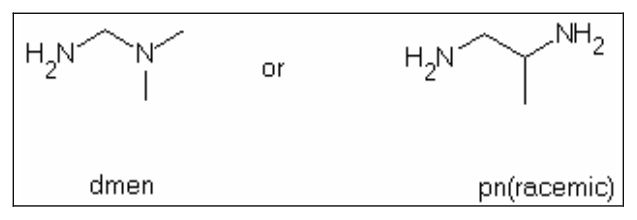
1.4 Give spatial structures of all isomers of the following compounds: \(\ce{PtCl2(dmen)}\), \(\ce{PtCl2(pn)}\), \(\ce{PtBrCl(dmen)}\) and \(\ce{PtBrCl(pn)}\).
These compounds can isomerise in aqueous solution through dissociation of a ligand and transient replacement of the stronger ligands by the weak ligand water. \(\ce{Cl-}\) and \(\ce{Br-}\) are replaced relatively easily, but it is more difficult to replace the amine ligands, which usually requires heating.
1.5 Considering each of the isomers in the previous questions a-d, indicate which Isomers can be converted to another at room temperature. Give both the original molecule and the products.
1.6 \(\ce{PtCl2(en)}\) reacts with \(\ce{Br-}\) in a molar proportion of 1:2 at room temperature. Which compound would you expect to form in what proportion? You can assume that the \(\ce{Pt-Br}\) and \(\ce{Pt-Cl}\) bonds are equally strong and that there is no perturbing influence from hydrolysis.
1.7 Using the equation to express chemical equilibrium, show that hydrolysis hardly ever occurs in blood but that it does occur in the cells. Note: \(\ce{PtCl2(NH3)2}\) hydrolyses to and \(\ce{2Cl-}\). In cells the \(\ce{Cl-}\) concentration is low; in blood it is fairly high.
After hydrolysis in the tumour cell a reactive platinum ion is formed to which two \(\ce{NH3}\) groups are still bound, as it was found in the urine of patients treated with this compound. The reactive platinum ion appears to be bound to cellular DNA, where the bonding occurs via guanine to one of the N-atoms.
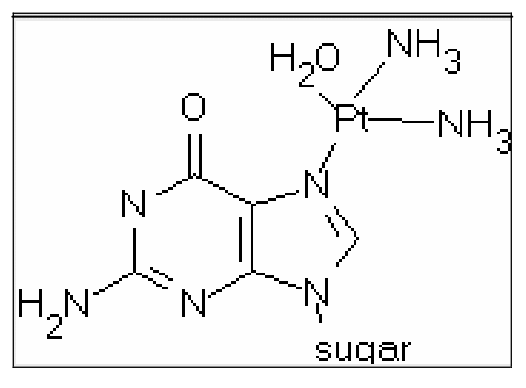
As a result of the two reactive sites of platinum and the two unreactive \(\ce{NH3}\) ligands, it can form additionally a second bond to DNA. Research has shown that this happens in particular with a second guanine base from the same strand of DNA.
1.8 Show by calculations which of the two isomers in question a) can form this bond.
(Note: \(\ce{Pt-N}\) distance = 210 pm, DNA base distance = 320 pm).
Official English text of the problem.
Problem 2: Sodium triphosphate in detergents: complexation of Ca2+ and Mg2+
The compound \(\ce{Na5P3O10}\) is used as an additive for detergents to bind the \(\ce{Ca^{2+}}\) and \(\ce{Mg^{2+}}\) ions present in water in order to prevent the precipitation of their fatty acid salts on the laundry.
2.1 Draw the structure of the ions \(\ce{(P3O10)^{5-}}\) and \(\ce{(P3O9)^{3-}}\) assuming that P-P bonds do not occur.
2.2 Assuming an octahedral coordination of the \(\ce{Mg^{2+}}\) ion give a drawing of the \(\ce{Mg(P3O10)(H2O)_{n})^{3-}}\) ion also indicating the value for n.
The complex ions of \(\ce{Mg^{2+}}\) and \(\ce{Ca^{2+}}\) and triphosphate are well soluble in water. They are, among other things, responsible for the wild growth of algae in surface waters. They could be removed by precipitation as an insoluble compound.
2.3 Give some possibilities (ions) to precipitate the triphosphates bound to \(\ce{Ca^{2+}}\) or \(\ce{Mg^{2+}}\).
2.4 Calculate the mass of \(\ce{Na5P3O10}\) (in grams) necessary in a washing machine to reduce the amount of \(\ce{Ca^{2+}}\) in 20 litres of city water (0.225 g/l) to an acceptable maximum of 0.02 g/l. Effects of pH, the precipitation of \(\ce{Ca(OH)2}\), and possible effects by other positive ions, can be neglected. The following data is given:
\[ K_1=\frac{[\ce{Ca^{2+}}][\ce{P3O10^{5-}}]} {[\ce{CaP3O10^{3-}}]} =1.0\times10^{-6} \]
Molar mass of \(\ce{Na5P3O10}\) is \(366\ \mathrm{g\,mol^{-1}}\), the molar mass of Ca is \(40\ \mathrm{g\,mol^{-1}}\).
Official English text of the problem.
Problem 3: Particle-in-a-box model of conjugated dyes and retinal
In order to explain why dyes are coloured, they can be considered as rod-like, one-dimensional molecules over which the electrons are distributed. The wave lengths of the electrons should fit to the available space which is the length \(l\). When absorbing light, an electron makes a transition from a lower to a higher energy state. The energy difference is given by:
\[ \Delta E=h\times\mathit{coverlambda}\quad\text{where }\lambda=\frac{h}{p} \]
3.1 Give a general expression for possible wavelengths of the electron as a function of the length \(l\).
In the 'particle in the box' model, only the variations in the kinetic energy of the electrons are considered.
3.2 Give an expression for the possible energies that electrons in the molecule can have (as a function of \(l\)).
3.3 Show that for a chain of length \(l\) with \(k\) electrons, the longest wavelength absorption occurs at:
\[ \lambda=\frac{8mcl^2}{h(k+1)} \qquad\text{for even values of }k \]
3.4 Derive an expression for the wavelength of the first electronic transition as a function of the number of C-atoms for even values of \(n\).
3.5 Calculate the minimum number of C-atoms (conjugated systems) to obtain a visible colour. C-C bond length is 142 pm.
The retina in the human eye contains rhodopsin, a light absorbent.
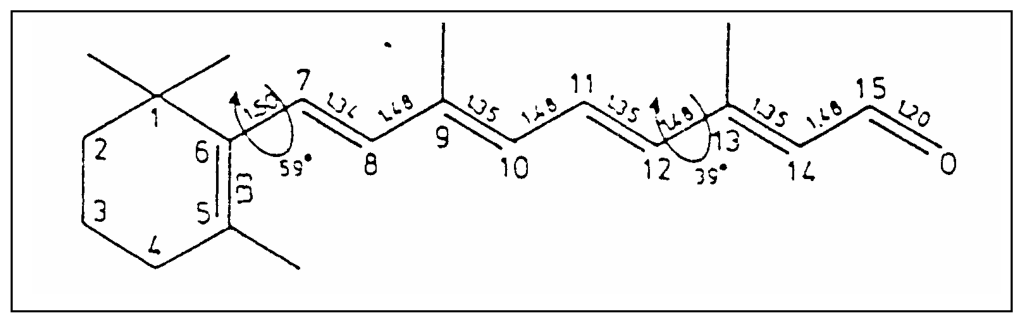
The molecule in the part of C-atoms 7 through 12 is planar. The angle between the bonds C5-C6, C7-C8, C11-C12 and C13-C14 is about 39°. According to the 'particle in the box' theory fragment C7 through C12 should absorb at about 213 nm. In reality the absorption of retinal occurs at 308 nm.
3.6 Give a reason for the longer wavelength that is observed in practice using the above mentioned theories.
3.7 When retinal is bound to opsin to form rhodopsin, the absorption occurs around 600 nm. Which atoms must be forced into one plane by the protein? Show by calculation that it's true.
Official English text of the problem.
Problem 4: Intramolecular catalysis of amide hydrolysis (an enzyme model)
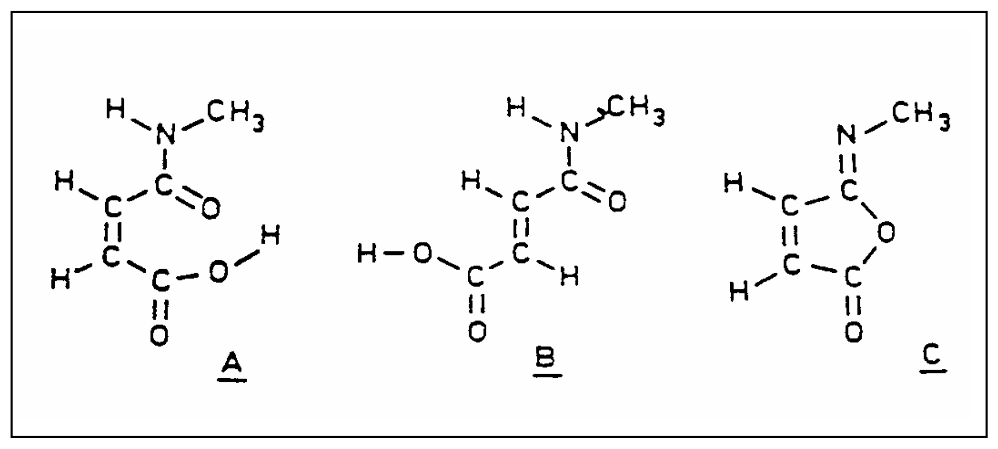
The high efficiency of catalysis by enzymes is mainly due to an enzyme-reactant complex in which the reacting group is placed in a favourable position for the reaction with respect to the catalyzing groups of the enzyme. Studies are carried out with model compounds in which a catalyzing group has been introduced in the proximity of the reaction centre of the molecule. As an example we consider the hydrolysis of the amide bond in compound A. This reaction proceeds in water at 39 °C and pH = 2 more than a million times faster than the hydrolysis of compound B.
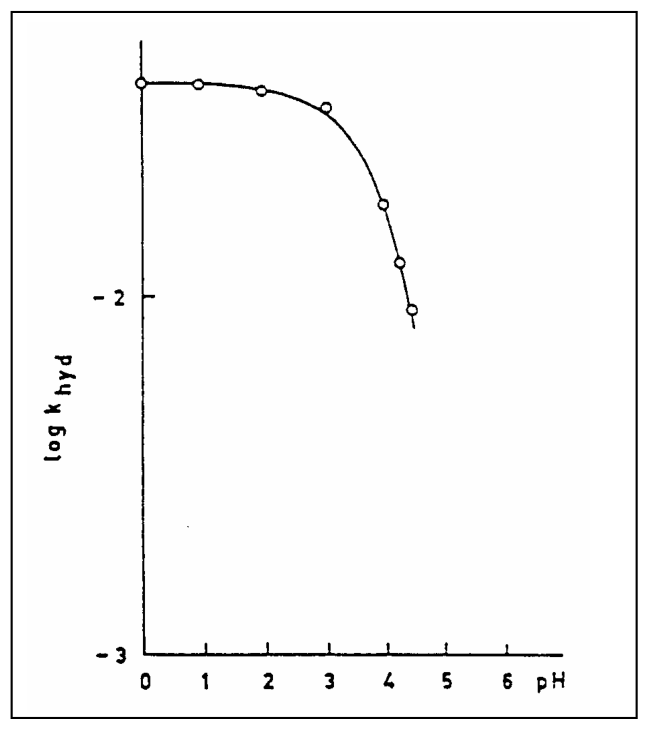
The relation between the rate constant \(k_{\mathrm{hyd}}\) and pH for the hydrolysis of A at 39 °C is shown in figure below.
Further observation:
Addition of water to the iso-imide C gives a rapid reaction, which initially yields A. Subsequently, hydrolysis of A occurs. The amid carbonyl group in A is labelled with \(\ce{^{13}C}\) and the hydrolysis is allowed to take place in \(\ce{H2^{18}O}\) at pH = 2 and 39 °C. The diacid formed upon hydrolysis is isolated, converted into a disilver salt and completely decarboxylated with bromine in a anhydrous reaction medium. The carbon dioxide formed is a mixture of particles of masses 44, 45, 46 and 47 which are formed in equal amounts.
4.1 Why is the hydrolysis of A so much faster than that of B?
4.2 Explain why the rate of hydrolysis of A is independent on pH in the range between pH = 0 to pH = 2.
4.3 Why does \(k_{\mathrm{hyd}}\) decrease so rapidly at pH values higher than 3.
4.4 Give a detailed reaction mechanism for the hydrolysis of A. Indicate which step in the reaction is rate determining.
4.5 Show that the observations further made are consistent with the reaction mechanism given under d.
Official English text of the problem.
Problem 5: Lactic acid, its dilactide and polylactide, and the herbicide Barnon
Bacterial conversion of saccharose leads to (S)-(+)-2-hydroxypropanoic acid (L-(+)-lactic acid), which forms a cyclic ester out of two molecules. This dilactide can be polymerized to a polylactide, which is used in surgery.
5.1 Give the spatial structures and Fischer projection of L-(+)-lactic acid and its dilactide.
5.2 Sketch the structure of the polylactide discussed above (at least three units). What is its tacticity (iso-, syndio- or atactic)?
5.3 Draw the isomeric dilactides formed out of racemic lactic acid. Show the configuration of the chiral centres.
L-(+)-lactic acid is used for the preparation of the herbicide Barnon that is used against wild oats. In this case (+)-lactic acid is esterified with 2-propanol and then the hydroxyl group is treated with methanesulfonyl chloride. The product is then submitted to a \(\mathrm{S_N2}\)-reaction with 3-fluoro-4-chloro-phenylamine, where the methanesulfonate group leaves as \(\ce{CH3SO3^-}\). Finally a benzoyl group is introduced with the help of benzoyl chloride.
5.4 Draw the Fischer projection of the various consecutive reaction products.
Official English text of the problem.
Problem 6: Restriction endonucleases Cla I and Taq I and recombinant DNA
In recombinant DNA technology specific endonucleases can recognize and hydrolyse the phosphoric ester bound in each of both strands. Cla I for example hydrolyses the bond between two nucleotides in the sequence:

6.1 Give the base sequence of the complementary strand in the 5' - 3' direction and indicate with arrows the location where the hydrolysis by Cla I would occur.
6.2 How often on average will this sequence occur in one strand of DNA molecule of \(10^5\) base pairs? You can assume that the four bases occur equally often and that they randomly distribute in the two chains.
Taq I hydrolyses a long double strand DNA molecule into fragments which are on average 256 base pairs long. The 3' end of these fragments treated by cleavage turns out to be a thymine(T)- and the 5' end a cytosine(C)- end.
6.3 How long is the sequence recognized by Taq I?
6.4 Give the two possible base sequences (in the direction 5' - 3') which form the recognition pattern for Taq I (must obviously have some symmetry).
The DNA of a phage which occurs as a close circle contains only 5'-pApTpCpGpApT-3' sequence in each of the two strands. After treatment with ClaI equilibrium is established:

6.5 Give a schematic drawing of the circular and linear molecules. Indicate the bases adjacent to the cleaning site in both strands. Indicate also the 3' and 5' ends.
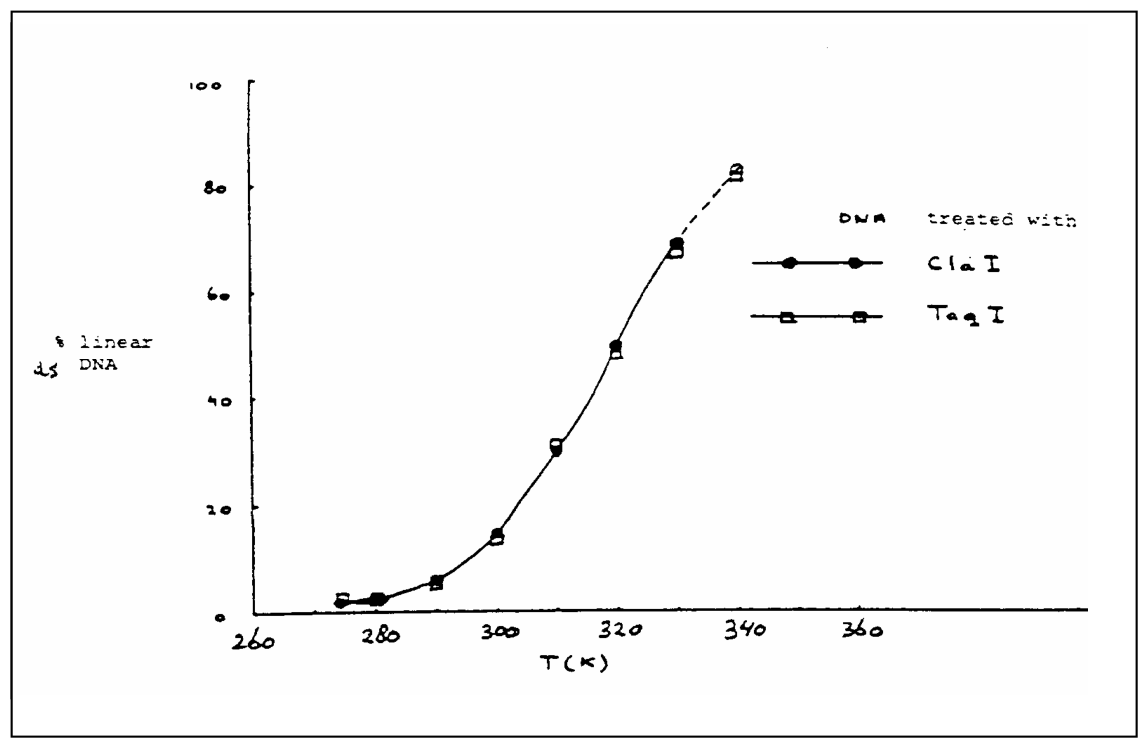
In Fig. 1 the percentage of linear DNA is given as a function of temperature, measured in a solution of 0.15 M \(\ce{NaCl}\) buffered with citrate at pH = 6.5. With Taq I as cleavage enzyme, the same curve is obtained.
6.6 Is the reaction as written endothermic or exothermic? Explain your answer.
6.7 Show, considering the information given, which of the two base sequences of the answer to 6.4 is the correct one.
6.8 What would look the curve for Taq I like if the recognition pattern would have been the other possibility of d)?
A large DNA molecule is cut into fragments with the aid of Cla I. One fragment is isolated, purified and mixed in the ratio of 1:1 with phage DNA which was also cleaved with Cla I. Thereby recombinant molecules can be formed through the reaction:

6.9 Would the enthalpy of this reaction be positive, negative or about zero? Explain your answer.
6.10 Which combination of temperature, DNA concentration and ionic strength (high or low in each case) will give the maximum percentage of recombinant molecules?
Official English text of the problem.
Problem 7: Continuous process A + 2 B <=> 2 C: flow sheet and energy balance
The equilibrium constant of the reaction \(\ce{A(g) + 2B(g) <=> 2C(g)}\) is \(K_p = 10.0\ \mathrm{MPa^{-1}}\). The starting materials are supplied at 25 °C and heated to 100 °C where complete equilibration takes place. Below 100 °C the reaction rate is negligibly small. The whole process is executed continuously in a stationary state. The boiling points at 0.1 MPa of \(\ce{A}\), \(\ce{B}\), and \(\ce{C}\) are 40 °C, 80 °C, and 60 °C, respectively. The three compounds have the same heat of evaporation: \(q\ \mathrm{J\,mol^{-1}}\). The heat capacities of \(\ce{A}\), \(\ce{B}\), and \(\ce{C}\) may be neglected. A schematic diagram of a distillation is shown below (Fig. 1).
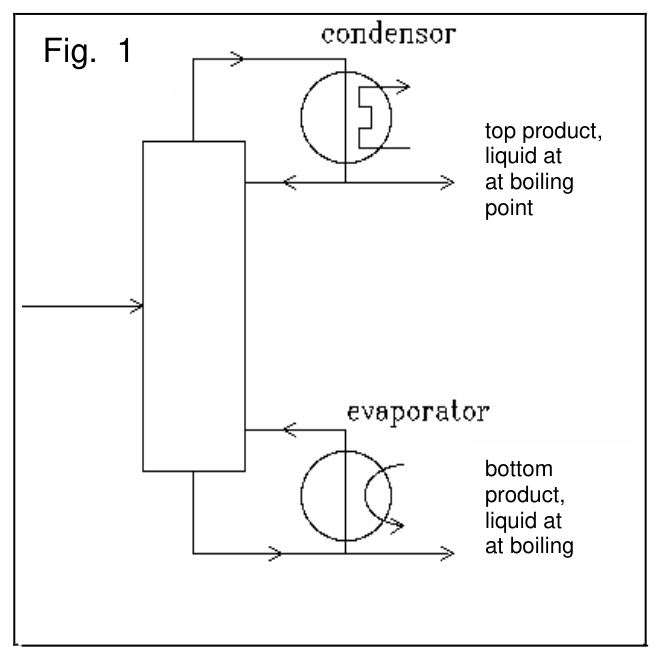
The total heat used at each of the two distillations is \(3q\ \mathrm{J\,mol^{-1}}\) (of the top product). Apart from distillation columns (each with its own evaporator and condenser) the pieces of apparatus shown of Fig. 2 are available.
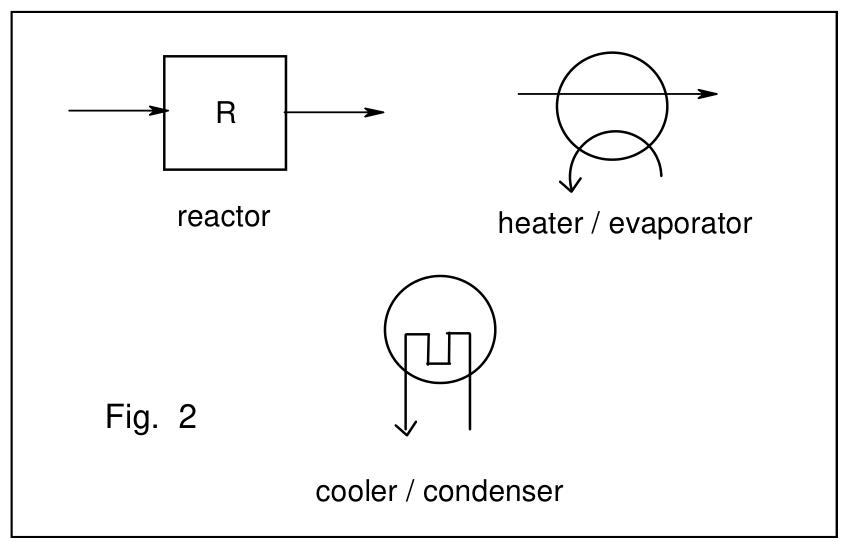
7.1 Draw a flow diagram of the process in which all flows are given (flow sheet) and in which the starting materials are used as efficiently as possible using as few pieces of apparatus as possible.
7.2 Express the equilibrium constant in terms of the degree of conversion and of total pressure for the case that the feed to the reactor is stoichiometric. What is the value of the degree of conversion when total pressure is 0.100 MPa?
7.3 Number all flows. Calculate the composition of each flow in \(\mathrm{mol\,s^{-1}}\) for a rate of production of 1 mole of \(\ce{C}\) per second under the conditions of part b.
7.4 In what respect can the reaction conditions influence the composition of the mixture that leaves the reactor? (Refer to question b.)
7.5 The process requires energy. For the conditions of b explain where energy should be supplied in the flow diagram drawn in part a. Derive an expression for the total energy needed.
Official English text of the problem.
Internationale Chemie-Olympiade
IChO 1986
Leiden, Niederlande · 7 Theorieaufgaben mit vollständigen Lösungen
Aufgabe 1: Platin(II)-Komplexe mit Antitumorwirkung: Isomere, Hydrolyse und DNA-Bindung
Verbindungen mit zweiwertigem Platin der allgemeinen Formel \(\ce{PtX2(amine)2}\) (X = \(\ce{Cl2}\), \(\ce{SO4^2-}\), Malonat usw.) haben wegen ihrer biologischen Aktivität großes wissenschaftliches Interesse geweckt, insbesondere im Hinblick auf ihre Eigenschaften bei der Behandlung von Tumoren. Die bekannteste klinisch eingesetzte Verbindung ist \(\ce{PtCl2(NH3)2}\). Diese Verbindung, in der Platin quadratisch-planar koordiniert ist, besitzt zwei geometrische Isomere, von denen nur eines eine Antitumorwirkung zeigt.
1.1 Skizzieren Sie die räumlichen Strukturen der beiden möglichen Isomere.
1.2 Wie viele Isomere besitzt \(\ce{PtBrCl(NH3)2}\)? Skizzieren Sie alle.
Die Aminliganden lassen sich durch einen einzigen Liganden mit zwei Donoratomen (N) ersetzen. Man erhält dann einen Chelatliganden, beispielsweise 1,2-Diaminoethan (en).
1.3 Zeigen Sie zeichnerisch, dass \(\ce{PtBrCl(en)}\) nur eine stabile Struktur besitzt.
Der Ligand en kann durch Methylierung zu dmen oder pn (racemisch) substituiert werden.
1.4 Geben Sie die räumlichen Strukturen aller Isomere der folgenden Verbindungen an: \(\ce{PtCl2(dmen)}\), \(\ce{PtCl2(pn)}\), \(\ce{PtBrCl(dmen)}\) und \(\ce{PtBrCl(pn)}\).
Diese Verbindungen können in wässriger Lösung durch Dissoziation eines Liganden und vorübergehenden Ersatz der stärkeren Liganden durch den schwachen Liganden Wasser isomerisieren. \(\ce{Cl-}\) und \(\ce{Br-}\) werden relativ leicht ersetzt; die Aminliganden lassen sich dagegen schwerer ersetzen, wozu gewöhnlich Erwärmen erforderlich ist.
1.5 Geben Sie für jedes der Isomere aus den vorangegangenen Fragen a-d an, welche Isomere bei Raumtemperatur ineinander umgewandelt werden können. Geben Sie sowohl das Ausgangsmolekül als auch die Produkte an.
1.6 \(\ce{PtCl2(en)}\) reagiert bei Raumtemperatur mit \(\ce{Br-}\) im Stoffmengenverhältnis 1:2. Welche Verbindung erwarten Sie in welchem Anteil? Sie können annehmen, dass die Bindungen \(\ce{Pt-Br}\) und \(\ce{Pt-Cl}\) gleich stark sind und kein störender Einfluss durch Hydrolyse vorliegt.
1.7 Zeigen Sie mithilfe der Gleichung für das chemische Gleichgewicht, dass im Blut kaum Hydrolyse auftritt, in den Zellen hingegen schon. Hinweis: \(\ce{PtCl2(NH3)2}\) hydrolysiert zu und \(\ce{2Cl-}\). In Zellen ist die \(\ce{Cl-}\)-Konzentration niedrig; im Blut ist sie ziemlich hoch.
Nach der Hydrolyse in der Tumorzelle entsteht ein reaktives Platinion, an das noch zwei \(\ce{NH3}\)-Gruppen gebunden sind, wie es im Urin von Patienten gefunden wurde, die mit dieser Verbindung behandelt wurden. Das reaktive Platinion scheint an die zelluläre DNA gebunden zu sein, wobei die Bindung über eines der N-Atome des Guanins erfolgt.
Aufgrund der beiden reaktiven Stellen des Platins und der beiden nicht reaktiven \(\ce{NH3}\)-Liganden kann es zusätzlich eine zweite Bindung zur DNA ausbilden. Untersuchungen haben gezeigt, dass dies insbesondere mit einer zweiten Guaninbase desselben DNA-Strangs geschieht.
1.8 Zeigen Sie durch Berechnungen, welches der beiden Isomere aus Frage a) diese Bindung ausbilden kann.
(Hinweis: \(\ce{Pt-N}\)-Abstand = 210 pm, Abstand der DNA-Basen = 320 pm).
Aufgabentext aus dem offiziellen englischen Text übersetzt.
Aufgabe 2: Natriumtriphosphat in Waschmitteln: Komplexierung von Ca2+ und Mg2+
Die Verbindung \(\ce{Na5P3O10}\) wird als Waschmittelzusatz verwendet, um die im Wasser vorhandenen \(\ce{Ca^{2+}}\)- und \(\ce{Mg^{2+}}\)-Ionen zu binden und dadurch die Ausfällung ihrer Fettsäuresalze auf der Wäsche zu verhindern.
2.1 Zeichnen Sie die Struktur der Ionen \(\ce{(P3O10)^{5-}}\) und \(\ce{(P3O9)^{3-}}\) unter der Annahme, dass keine P-P-Bindungen auftreten.
2.2 Zeichnen Sie unter Annahme einer oktaedrischen Koordination des \(\ce{Mg^{2+}}\)-Ions das Ion \(\ce{Mg(P3O10)(H2O)_{n})^{3-}}\) und geben Sie dabei auch den Wert von n an.
Die Komplexionen aus \(\ce{Mg^{2+}}\) bzw. \(\ce{Ca^{2+}}\) und Triphosphat sind gut wasserlöslich. Sie sind unter anderem für das übermäßige Algenwachstum in Oberflächengewässern verantwortlich. Sie könnten durch Fällung als unlösliche Verbindung entfernt werden.
2.3 Geben Sie einige Möglichkeiten (Ionen) an, um die an \(\ce{Ca^{2+}}\) oder \(\ce{Mg^{2+}}\) gebundenen Triphosphate auszufällen.
2.4 Berechnen Sie die Masse an \(\ce{Na5P3O10}\) (in Gramm), die in einer Waschmaschine erforderlich ist, um den Gehalt an \(\ce{Ca^{2+}}\) in 20 Litern Leitungswasser (0.225 g/l) auf einen zulässigen Höchstwert von 0.02 g/l zu senken. Einflüsse des pH-Werts, die Fällung von \(\ce{Ca(OH)2}\) und mögliche Einflüsse anderer positiver Ionen können vernachlässigt werden. Folgende Daten sind gegeben:
\[ K_1=\frac{[\ce{Ca^{2+}}][\ce{P3O10^{5-}}]} {[\ce{CaP3O10^{3-}}]} =1.0\times10^{-6} \]
Die molare Masse von \(\ce{Na5P3O10}\) beträgt \(366\ \mathrm{g\,mol^{-1}}\), die molare Masse von Ca beträgt \(40\ \mathrm{g\,mol^{-1}}\).
Aufgabentext aus dem offiziellen englischen Text übersetzt.
Aufgabe 3: Teilchen-im-Kasten-Modell konjugierter Farbstoffe und Retinal
Um zu erklären, warum Farbstoffe farbig sind, kann man sie als stabförmige, eindimensionale Moleküle betrachten, über die die Elektronen verteilt sind. Die Wellenlängen der Elektronen müssen in den verfügbaren Raum der Länge \(l\) passen. Bei der Absorption von Licht geht ein Elektron von einem niedrigeren in einen höheren Energiezustand über. Die Energiedifferenz ist gegeben durch:
\[ \Delta E=h\times\mathit{coverlambda}\quad\text{wobei }\lambda=\frac{h}{p} \]
3.1 Geben Sie einen allgemeinen Ausdruck für die möglichen Wellenlängen des Elektrons in Abhängigkeit von der Länge \(l\) an.
Im Modell „Teilchen im Kasten“ werden nur die Änderungen der kinetischen Energie der Elektronen berücksichtigt.
3.2 Geben Sie einen Ausdruck für die möglichen Energien an, die Elektronen im Molekül haben können (in Abhängigkeit von \(l\)).
3.3 Zeigen Sie, dass bei einer Kette der Länge \(l\) mit \(k\) Elektronen die Absorption mit der größten Wellenlänge bei folgendem Wert auftritt:
\[ \lambda=\frac{8mcl^2}{h(k+1)} \qquad\text{für gerade Werte von }k \]
3.4 Leiten Sie einen Ausdruck für die Wellenlänge des ersten elektronischen Übergangs in Abhängigkeit von der Anzahl der C-Atome für gerade Werte von \(n\) her.
3.5 Berechnen Sie die Mindestanzahl an C-Atomen (konjugierte Systeme), die erforderlich ist, um eine sichtbare Farbe zu erhalten. Die C-C-Bindungslänge beträgt 142 pm.
Die Netzhaut des menschlichen Auges enthält Rhodopsin, eine lichtabsorbierende Substanz.
Das Molekül ist im Bereich der C-Atome 7 bis 12 planar. Der Winkel zwischen den Bindungen C5-C6, C7-C8, C11-C12 und C13-C14 beträgt etwa 39°. Nach der Theorie des „Teilchens im Kasten“ sollte das Fragment C7 bis C12 bei etwa 213 nm absorbieren. Tatsächlich erfolgt die Absorption von Retinal bei 308 nm.
3.6 Geben Sie mithilfe der oben genannten Theorien einen Grund für die in der Praxis beobachtete größere Wellenlänge an.
3.7 Wenn Retinal an Opsin gebunden wird und dadurch Rhodopsin entsteht, erfolgt die Absorption bei etwa 600 nm. Welche Atome müssen durch das Protein in eine gemeinsame Ebene gezwungen werden? Bestätigen Sie dies durch eine Berechnung.
Aufgabentext aus dem offiziellen englischen Text übersetzt.
Aufgabe 4: Intramolekulare Katalyse der Amidhydrolyse (ein Enzymmodell)
Die hohe Effizienz der Katalyse durch Enzyme beruht hauptsächlich auf einem Enzym-Substrat-Komplex, in dem die reagierende Gruppe relativ zu den katalytisch wirkenden Gruppen des Enzyms in einer für die Reaktion günstigen Position angeordnet ist. Es werden Untersuchungen an Modellverbindungen durchgeführt, in denen eine katalytisch wirkende Gruppe in der Nähe des Reaktionszentrums des Moleküls eingeführt wurde. Als Beispiel betrachten wir die Hydrolyse der Amidbindung in Verbindung A. Diese Reaktion verläuft in Wasser bei 39 °C und pH = 2 mehr als eine Million Mal schneller als die Hydrolyse von Verbindung B.
Der Zusammenhang zwischen der Geschwindigkeitskonstante \(k_{\mathrm{hyd}}\) und dem pH-Wert für die Hydrolyse von A bei 39 °C ist in der folgenden Abbildung dargestellt.
Weitere Beobachtung:
Die Zugabe von Wasser zum Isoimid C führt zu einer schnellen Reaktion, bei der zunächst A entsteht. Anschließend erfolgt die Hydrolyse von A. Die Amidcarbonylgruppe in A wird mit \(\ce{^{13}C}\) markiert, und die Hydrolyse wird in \(\ce{H2^{18}O}\) bei pH = 2 und 39 °C durchgeführt. Die bei der Hydrolyse gebildete Dicarbonsäure wird isoliert, in ein Disilbersalz überführt und mit Brom in einem wasserfreien Reaktionsmedium vollständig decarboxyliert. Das gebildete Kohlenstoffdioxid ist ein Gemisch von Teilchen mit den Massen 44, 45, 46 und 47, die in gleichen Mengen entstehen.
4.1 Warum verläuft die Hydrolyse von A so viel schneller als die von B?
4.2 Erklären Sie, warum die Hydrolysegeschwindigkeit von A im Bereich zwischen pH = 0 und pH = 2 unabhängig vom pH-Wert ist.
4.3 Warum nimmt \(k_{\mathrm{hyd}}\) bei pH-Werten oberhalb von 3 so rasch ab?
4.4 Geben Sie einen detaillierten Reaktionsmechanismus für die Hydrolyse von A an. Kennzeichnen Sie den geschwindigkeitsbestimmenden Reaktionsschritt.
4.5 Zeigen Sie, dass die weiteren Beobachtungen mit dem unter d angegebenen Reaktionsmechanismus vereinbar sind.
Aufgabentext aus dem offiziellen englischen Text übersetzt.
Aufgabe 5: Milchsäure, ihr Dilactid und Polylactid sowie das Herbizid Barnon
Die bakterielle Umsetzung von Saccharose führt zu (S)-(+)-2-Hydroxypropansäure (L-(+)-Milchsäure), die aus zwei Molekülen einen cyclischen Ester bildet. Dieses Dilactid kann zu einem Polylactid polymerisiert werden, das in der Chirurgie verwendet wird.
5.1 Geben Sie die räumlichen Strukturen und die Fischer-Projektionen von L-(+)-Milchsäure und ihrem Dilactid an.
5.2 Skizzieren Sie die Struktur des oben beschriebenen Polylactids (mindestens drei Einheiten). Welche Taktizität besitzt es (iso-, syndio- oder ataktisch)?
5.3 Zeichnen Sie die isomeren Dilactide, die aus racemischer Milchsäure entstehen. Geben Sie die Konfiguration der chiralen Zentren an.
L-(+)-Milchsäure wird zur Herstellung des Herbizids Barnon verwendet, das gegen Flughafer eingesetzt wird. Hierzu wird (+)-Milchsäure mit 2-Propanol verestert und anschließend die Hydroxygruppe mit Methansulfonylchlorid umgesetzt. Das Produkt wird dann einer \(\mathrm{S_N2}\)-Reaktion mit 3-Fluor-4-chlorphenylamin unterzogen, wobei die Methansulfonatgruppe als \(\ce{CH3SO3^-}\) abgespalten wird. Schließlich wird mithilfe von Benzoylchlorid eine Benzoylgruppe eingeführt.
5.4 Zeichnen Sie die Fischer-Projektionen der verschiedenen aufeinanderfolgenden Reaktionsprodukte.
Aufgabentext aus dem offiziellen englischen Text übersetzt.
Aufgabe 6: Restriktionsendonukleasen Cla I und Taq I und rekombinante DNA
In der rekombinanten DNA-Technologie können spezifische Endonukleasen die Phosphorsäureesterbindung in jedem der beiden Stränge erkennen und hydrolysieren. Cla I hydrolysiert beispielsweise die Bindung zwischen zwei Nukleotiden in der Sequenz:
6.1 Geben Sie die Basensequenz des komplementären Strangs in 5' - 3'-Richtung an und kennzeichnen Sie mit Pfeilen die Stellen, an denen die Hydrolyse durch Cla I stattfinden würde.
6.2 Wie oft kommt diese Sequenz durchschnittlich in einem Strang eines DNA-Moleküls mit \(10^5\) Basenpaaren vor? Sie können annehmen, dass die vier Basen gleich häufig vorkommen und in den beiden Ketten zufällig verteilt sind.
Taq I hydrolysiert ein langes doppelsträngiges DNA-Molekül zu Fragmenten, die im Durchschnitt 256 Basenpaare lang sind. Das 3'-Ende dieser durch Spaltung erhaltenen Fragmente erweist sich als Thymin(T)-Ende und das 5'-Ende als Cytosin(C)-Ende.
6.3 Wie lang ist die von Taq I erkannte Sequenz?
6.4 Geben Sie die beiden möglichen Basensequenzen (in 5' - 3'-Richtung) an, die das Erkennungsmuster für Taq I bilden (dieses muss offensichtlich eine gewisse Symmetrie aufweisen).
Die DNA eines Phagen, die als geschlossener Ring vorliegt, enthält in jedem der beiden Stränge nur eine 5'-pApTpCpGpApT-3'-Sequenz. Nach der Behandlung mit ClaI stellt sich ein Gleichgewicht ein:
6.5 Zeichnen Sie schematisch die ringförmigen und linearen Moleküle. Geben Sie die an die Spaltstelle angrenzenden Basen in beiden Strängen an. Kennzeichnen Sie auch die 3'- und 5'-Enden.
In Abb. 1 ist der prozentuale Anteil linearer DNA in Abhängigkeit von der Temperatur dargestellt, gemessen in einer mit Citrat auf pH = 6.5 gepufferten Lösung von 0.15 M \(\ce{NaCl}\). Mit Taq I als Spaltungsenzym erhält man dieselbe Kurve.
6.6 Ist die Reaktion in der angegebenen Richtung endotherm oder exotherm? Begründen Sie Ihre Antwort.
6.7 Zeigen Sie unter Berücksichtigung der gegebenen Informationen, welche der beiden Basensequenzen aus der Antwort auf 6.4 die richtige ist.
6.8 Wie würde die Kurve für Taq I aussehen, wenn das Erkennungsmuster der anderen Möglichkeit aus d) entspräche?
Ein großes DNA-Molekül wird mithilfe von Cla I in Fragmente geschnitten. Ein Fragment wird isoliert, gereinigt und im Verhältnis 1:1 mit Phagen-DNA gemischt, die ebenfalls mit Cla I gespalten wurde. Dabei können durch folgende Reaktion rekombinante Moleküle gebildet werden:
6.9 Wäre die Enthalpie dieser Reaktion positiv, negativ oder ungefähr null? Begründen Sie Ihre Antwort.
6.10 Welche Kombination aus Temperatur, DNA-Konzentration und Ionenstärke (jeweils hoch oder niedrig) ergibt den maximalen prozentualen Anteil rekombinanter Moleküle?
Aufgabentext aus dem offiziellen englischen Text übersetzt.
Aufgabe 7: Kontinuierlicher Prozess A + 2 B <=> 2 C: Fließbild und Energiebilanz
Die Gleichgewichtskonstante der Reaktion \(\ce{A(g) + 2B(g) <=> 2C(g)}\) beträgt \(K_p = 10.0\ \mathrm{MPa^{-1}}\). Die Ausgangsstoffe werden bei 25 °C zugeführt und auf 100 °C erhitzt, wobei sich das Gleichgewicht vollständig einstellt. Unterhalb von 100 °C ist die Reaktionsgeschwindigkeit vernachlässigbar klein. Der gesamte Prozess wird kontinuierlich im stationären Zustand durchgeführt. Die Siedepunkte von \(\ce{A}\), \(\ce{B}\) und \(\ce{C}\) bei 0.1 MPa betragen 40 °C, 80 °C bzw. 60 °C. Die drei Verbindungen haben dieselbe Verdampfungswärme: \(q\ \mathrm{J\,mol^{-1}}\). Die Wärmekapazitäten von \(\ce{A}\), \(\ce{B}\) und \(\ce{C}\) können vernachlässigt werden. Eine schematische Darstellung einer Destillation ist unten gezeigt (Abb. 1).
Die bei jeder der beiden Destillationen insgesamt eingesetzte Wärme beträgt \(3q\ \mathrm{J\,mol^{-1}}\) (bezogen auf das Kopfprodukt). Neben Destillationskolonnen (jeweils mit eigenem Verdampfer und Kondensator) stehen die in Abb. 2 gezeigten Apparate zur Verfügung.
7.1 Zeichnen Sie ein Fließbild des Prozesses, in dem alle Stoffströme angegeben sind und in dem die Ausgangsstoffe unter Verwendung möglichst weniger Apparate möglichst effizient genutzt werden.
7.2 Drücken Sie die Gleichgewichtskonstante für den Fall eines stöchiometrischen Reaktorzulaufs durch den Umsatzgrad und den Gesamtdruck aus. Welchen Wert hat der Umsatzgrad bei einem Gesamtdruck von 0.100 MPa?
7.3 Nummerieren Sie alle Stoffströme. Berechnen Sie die Zusammensetzung jedes Stoffstroms in \(\mathrm{mol\,s^{-1}}\) für eine Produktionsrate von 1 Mol \(\ce{C}\) pro Sekunde unter den Bedingungen von Teil b.
7.4 In welcher Hinsicht können die Reaktionsbedingungen die Zusammensetzung des Gemisches beeinflussen, das den Reaktor verlässt? (Beziehen Sie sich auf Frage b.)
7.5 Der Prozess benötigt Energie. Erläutern Sie für die Bedingungen von b, an welchen Stellen des in Teil a gezeichneten Fließbildes Energie zugeführt werden muss. Leiten Sie einen Ausdruck für die insgesamt benötigte Energie her.
Aufgabentext aus dem offiziellen englischen Text übersetzt.
Uluslararası Kimya Olimpiyatı
IChO 1986
Leiden, Hollanda · 7 teori sorusu, tam çözümleriyle
Soru 1: Platin(II) antitümör kompleksleri: izomerler, hidroliz ve DNA'ya bağlanma
Genel formülü \(\ce{PtX2(amine)2}\) (X = \(\ce{Cl2}\), \(\ce{SO4^2-}\), malonat vb.) olan, iki değerlikli platin içeren bileşikler, biyolojik etkinlikleri ve özellikle tümör tedavisindeki özellikleri nedeniyle bilim dünyasında büyük ilgi görmüştür. Klinik uygulamada kullanılan en iyi bilinen bileşik \(\ce{PtCl2(NH3)2}\)'dir. Platinin kare düzlemsel bir geometride koordine olduğu bu bileşiğin iki geometrik izomeri vardır ve bunlardan yalnızca biri antitümör etkinlik gösterir.
1.1 Olası iki izomerin uzaysal yapılarını çiziniz.
1.2 \(\ce{PtBrCl(NH3)2}\)'nin kaç izomeri vardır? Hepsini çiziniz.
Amin ligandlarını, iki verici atom (N) içeren tek bir ligandla değiştirmek mümkündür. Böylece 1,2-diaminoetan (en) gibi şelat oluşturan bir ligand elde edilir.
1.3 \(\ce{PtBrCl(en)}\)'nin yalnızca bir kararlı yapısının olduğunu çizimle gösteriniz.
en ligandına metilleme yoluyla sübstitüsyon uygulanarak dmen veya pn (rasemik) oluşturulabilir.
1.4 Şu bileşiklerin tüm izomerlerinin uzaysal yapılarını veriniz: \(\ce{PtCl2(dmen)}\), \(\ce{PtCl2(pn)}\), \(\ce{PtBrCl(dmen)}\) ve \(\ce{PtBrCl(pn)}\).
Bu bileşikler, sulu çözeltide bir ligandın ayrılması ve daha kuvvetli ligandların geçici olarak zayıf bir ligand olan suyla yer değiştirmesi yoluyla izomerleşebilir. \(\ce{Cl-}\) ve \(\ce{Br-}\) nispeten kolay yer değiştirir; ancak amin ligandlarının yer değiştirmesi daha zordur ve genellikle ısıtma gerektirir.
1.5 Önceki a-d sorularındaki izomerlerin her birini ele alarak hangi izomerlerin oda sıcaklığında birbirine dönüşebileceğini belirtiniz. Hem başlangıç molekülünü hem de ürünleri veriniz.
1.6 \(\ce{PtCl2(en)}\), oda sıcaklığında \(\ce{Br-}\) ile 1:2 mol oranında tepkimeye girer. Hangi bileşiğin hangi oranda oluşmasını beklersiniz? \(\ce{Pt-Br}\) ve \(\ce{Pt-Cl}\) bağlarının eşit kuvvette olduğunu ve hidrolizin bozucu bir etkisinin bulunmadığını varsayabilirsiniz.
1.7 Kimyasal dengeyi ifade eden denklemi kullanarak hidrolizin kanda hemen hemen hiç gerçekleşmediğini, ancak hücrelerde gerçekleştiğini gösteriniz. Not: \(\ce{PtCl2(NH3)2}\) hidrolizlenerek ve \(\ce{2Cl-}\) oluşturur. Hücrelerde \(\ce{Cl-}\) derişimi düşüktür; kanda ise oldukça yüksektir.
Tümör hücresindeki hidrolizin ardından, kendisine iki \(\ce{NH3}\) grubunun hâlâ bağlı olduğu reaktif bir platin iyonu oluşur; bu iyon, söz konusu bileşikle tedavi edilen hastaların idrarında bulunmuştur. Reaktif platin iyonunun hücresel DNA'ya bağlandığı ve bu bağlanmanın guanindeki N atomlarından biri üzerinden gerçekleştiği anlaşılmaktadır.
Platinin iki reaktif bağlanma yeri ve tepkimeye girmeyen iki \(\ce{NH3}\) ligandı bulunması nedeniyle, DNA ile ayrıca ikinci bir bağ oluşturabilir. Araştırmalar, bunun özellikle aynı DNA zincirindeki ikinci bir guanin bazıyla gerçekleştiğini göstermiştir.
1.8 a) sorusundaki iki izomerden hangisinin bu bağı oluşturabileceğini hesaplamalarla gösteriniz.
(Not: \(\ce{Pt-N}\) uzaklığı = 210 pm, DNA bazları arasındaki uzaklık = 320 pm).
Soru metni resmi İngilizce metinden çevrilmiştir.
Soru 2: Deterjanlarda sodyum trifosfat: Ca2+ ve Mg2+ iyonlarının kompleksleşmesi
\(\ce{Na5P3O10}\) bileşiği, suda bulunan \(\ce{Ca^{2+}}\) ve \(\ce{Mg^{2+}}\) iyonlarını bağlayarak bunların yağ asidi tuzlarının çamaşırlar üzerinde çökelmesini önlemek amacıyla deterjan katkısı olarak kullanılır.
2.1 P-P bağlarının bulunmadığını varsayarak \(\ce{(P3O10)^{5-}}\) ve \(\ce{(P3O9)^{3-}}\) iyonlarının yapılarını çiziniz.
2.2 \(\ce{Mg^{2+}}\) iyonunun oktahedral koordinasyona sahip olduğunu varsayarak \(\ce{Mg(P3O10)(H2O)_{n})^{3-}}\) iyonunu çiziniz ve n değerini de belirtiniz.
\(\ce{Mg^{2+}}\) ve \(\ce{Ca^{2+}}\) iyonlarının trifosfatla oluşturduğu kompleks iyonlar suda iyi çözünür. Bunlar, diğer etkenlerin yanı sıra, yüzey sularında alglerin aşırı çoğalmasından sorumludur. Çözünmeyen bir bileşik hâlinde çöktürülerek uzaklaştırılabilirler.
2.3 \(\ce{Ca^{2+}}\) veya \(\ce{Mg^{2+}}\) iyonlarına bağlı trifosfatları çöktürmek için kullanılabilecek bazı seçenekleri (iyonları) belirtiniz.
2.4 Bir çamaşır makinesindeki 20 litre şebeke suyunda bulunan \(\ce{Ca^{2+}}\) miktarını (0.225 g/l), kabul edilebilir en yüksek değer olan 0.02 g/l'ye düşürmek için gerekli \(\ce{Na5P3O10}\) kütlesini (gram cinsinden) hesaplayınız. pH etkileri, \(\ce{Ca(OH)2}\) çökelmesi ve diğer pozitif iyonların olası etkileri ihmal edilebilir. Aşağıdaki veriler verilmiştir:
\[ K_1=\frac{[\ce{Ca^{2+}}][\ce{P3O10^{5-}}]} {[\ce{CaP3O10^{3-}}]} =1.0\times10^{-6} \]
\(\ce{Na5P3O10}\) bileşiğinin molar kütlesi \(366\ \mathrm{g\,mol^{-1}}\), Ca'nın molar kütlesi ise \(40\ \mathrm{g\,mol^{-1}}\) değerindedir.
Soru metni resmi İngilizce metinden çevrilmiştir.
Soru 3: Konjuge boyaların ve retinalin kutudaki parçacık modeli
Boyaların neden renkli olduğunu açıklamak için, bunlar elektronların üzerlerine dağıldığı çubuk benzeri, tek boyutlu moleküller olarak düşünülebilir. Elektronların dalga boyları, uzunluğu \(l\) olan kullanılabilir alana sığmalıdır. Işık soğurulduğunda bir elektron daha düşük bir enerji durumundan daha yüksek bir enerji durumuna geçiş yapar. Enerji farkı şu şekilde verilir:
\[ \Delta E=h\times\mathit{coverlambda}\quad\text{burada }\lambda=\frac{h}{p} \]
3.1 Elektronun olası dalga boyları için \(l\) uzunluğunun fonksiyonu olarak genel bir ifade veriniz.
“Kutudaki parçacık” modelinde elektronların yalnızca kinetik enerjilerindeki değişimler dikkate alınır.
3.2 Moleküldeki elektronların sahip olabileceği olası enerjiler için (\(l\)'nin fonksiyonu olarak) bir ifade veriniz.
3.3 Uzunluğu \(l\) olan ve \(k\) elektron içeren bir zincir için en uzun dalga boylu soğurmanın aşağıdaki dalga boyunda gerçekleştiğini gösteriniz:
\[ \lambda=\frac{8mcl^2}{h(k+1)} \qquad\text{çift değerli }k \]
3.4 \(n\)'nin çift değerleri için, ilk elektronik geçişin dalga boyunu C atomlarının sayısının fonksiyonu olarak veren bir ifade türetiniz.
3.5 Görünür bir renk elde etmek için gereken en az C atomu sayısını (konjuge sistemler) hesaplayınız. C-C bağ uzunluğu 142 pm'dir.
İnsan gözündeki retina, ışık soğuran bir madde olan rodopsin içerir.
Molekülün 7 ile 12 arasındaki C atomlarını içeren kısmı düzlemseldir. C5-C6, C7-C8, C11-C12 ve C13-C14 bağları arasındaki açı yaklaşık 39°'dir. “Kutudaki parçacık” kuramına göre C7 ile C12 arasındaki parça yaklaşık 213 nm'de soğurma yapmalıdır. Gerçekte retinalin soğurması 308 nm'de gerçekleşir.
3.6 Yukarıda belirtilen kuramları kullanarak uygulamada gözlenen daha uzun dalga boyunun bir nedenini belirtiniz.
3.7 Retinal, rodopsini oluşturmak üzere opsine bağlandığında soğurma yaklaşık 600 nm'de gerçekleşir. Protein hangi atomları aynı düzlemde bulunmaya zorlamalıdır? Bunun doğru olduğunu hesaplama yaparak gösteriniz.
Soru metni resmi İngilizce metinden çevrilmiştir.
Soru 4: Amit hidrolizinin molekül içi katalizi (bir enzim modeli)
Enzimlerin katalizdeki yüksek etkinliği, esas olarak, tepkimeye giren grubun enzimin katalizleyici gruplarına göre tepkime için elverişli bir konumda bulunduğu bir enzim-reaktan kompleksinden kaynaklanır. Molekülün tepkime merkezinin yakınına katalizleyici bir grubun yerleştirildiği model bileşiklerle çalışmalar yürütülmektedir. Örnek olarak A bileşiğindeki amit bağının hidrolizini ele alıyoruz. Bu tepkime, suda 39 °C ve pH = 2 koşullarında, B bileşiğinin hidrolizinden bir milyon kattan daha hızlı gerçekleşir.
A bileşiğinin 39 °C'deki hidrolizi için hız sabiti \(k_{\mathrm{hyd}}\) ile pH arasındaki ilişki aşağıdaki şekilde gösterilmiştir.
Ek gözlem:
İzoimit C'ye su katılması, başlangıçta A'yı veren hızlı bir tepkimeye yol açar. Ardından A'nın hidrolizi gerçekleşir. A'daki amit karbonil grubu \(\ce{^{13}C}\) ile işaretlenir ve hidrolizin pH = 2 ve 39 °C koşullarında \(\ce{H2^{18}O}\) içinde gerçekleşmesi sağlanır. Hidroliz sonucu oluşan diasit ayrılır, bir digümüş tuzuna dönüştürülür ve susuz bir tepkime ortamında bromla tamamen dekarboksile edilir. Oluşan karbon dioksit, eşit miktarlarda oluşan, kütleleri 44, 45, 46 ve 47 olan taneciklerin bir karışımıdır.
4.1 A'nın hidrolizi neden B'ninkinden çok daha hızlıdır?
4.2 A'nın hidroliz hızının pH = 0 ile pH = 2 aralığında neden pH'dan bağımsız olduğunu açıklayınız.
4.3 \(k_{\mathrm{hyd}}\), 3'ten yüksek pH değerlerinde neden bu kadar hızlı azalır?
4.4 A'nın hidrolizi için ayrıntılı bir tepkime mekanizması veriniz. Tepkimenin hangi basamağının hız belirleyici olduğunu belirtiniz.
4.5 Ek gözlemlerin d maddesinde verilen tepkime mekanizmasıyla tutarlı olduğunu gösteriniz.
Soru metni resmi İngilizce metinden çevrilmiştir.
Soru 5: Laktik asit, dilaktidi ve polilaktidi ve Barnon herbisiti
Sakkarozun bakteriyel dönüşümü, iki molekülünden halkalı bir ester oluşturan (S)-(+)-2-hidroksipropanoik asidi (L-(+)-laktik asit) verir. Bu dilaktit, cerrahide kullanılan bir polilaktide polimerleştirilebilir.
5.1 L-(+)-laktik asidin ve dilaktidinin uzaysal yapılarını ve Fischer projeksiyonunu veriniz.
5.2 Yukarıda söz edilen polilaktidin yapısını çiziniz (en az üç birim). Taktisitesi nedir (izo-, sindiyo- veya ataktik)?
5.3 Rasemik laktik asitten oluşan izomerik dilaktitleri çiziniz. Kiral merkezlerin konfigürasyonunu gösteriniz.
L-(+)-laktik asit, yabani yulafa karşı kullanılan Barnon herbisitinin hazırlanmasında kullanılır. Bu işlemde (+)-laktik asit, 2-propanol ile esterleştirilir ve ardından hidroksil grubu metansülfonil klorür ile tepkimeye sokulur. Daha sonra ürün, 3-floro-4-kloro-fenilamin ile bir \(\mathrm{S_N2}\) tepkimesine sokulur; bu tepkimede metansülfonat grubu \(\ce{CH3SO3^-}\) olarak ayrılır. Son olarak benzoil klorür yardımıyla bir benzoil grubu eklenir.
5.4 Ardışık tepkimelerde oluşan çeşitli ürünlerin Fischer projeksiyonlarını çiziniz.
Soru metni resmi İngilizce metinden çevrilmiştir.
Soru 6: Restriksiyon endonükleazları Cla I ve Taq I ve rekombinant DNA
Rekombinant DNA teknolojisinde özgül endonükleazlar, her iki zincirdeki fosforik asit ester bağını tanıyabilir ve hidroliz edebilir. Örneğin Cla I, aşağıdaki dizide iki nükleotit arasındaki bağı hidroliz eder:
6.1 Tamamlayıcı zincirin baz dizisini 5' - 3' yönünde yazınız ve Cla I ile hidrolizin gerçekleşeceği yeri oklarla gösteriniz.
6.2 Bu dizi, \(10^5\) baz çiftinden oluşan bir DNA molekülünün bir zincirinde ortalama kaç kez bulunur? Dört bazın eşit sıklıkta bulunduğunu ve iki zincire rastgele dağıldığını varsayabilirsiniz.
Taq I, uzun bir çift zincirli DNA molekülünü, ortalama uzunluğu 256 baz çifti olan parçalara hidroliz eder. Kesim sonucunda oluşan bu parçaların 3' ucunun bir timin(T) ucu, 5' ucunun ise bir sitozin(C) ucu olduğu belirlenmiştir.
6.3 Taq I tarafından tanınan dizinin uzunluğu nedir?
6.4 Taq I için tanıma örüntüsünü oluşturan iki olası baz dizisini (5' - 3' yönünde) yazınız (bunların belirli bir simetriye sahip olması gerektiği açıktır).
Kapalı bir halka biçiminde bulunan bir fajın DNA'sı, iki zincirinin her birinde yalnızca bir 5'-pApTpCpGpApT-3' dizisi içerir. ClaI ile işlemden sonra şu denge kurulur:
6.5 Halkasal ve doğrusal moleküllerin şematik bir çizimini yapınız. Her iki zincirde kesim yerine komşu bazları gösteriniz. Ayrıca 3' ve 5' uçlarını da belirtiniz.
Şekil 1'de, pH = 6.5'te sitrat ile tamponlanmış 0.15 M \(\ce{NaCl}\) çözeltisinde ölçülen doğrusal DNA yüzdesi, sıcaklığın bir fonksiyonu olarak verilmiştir. Kesim enzimi olarak Taq I kullanıldığında da aynı eğri elde edilir.
6.6 Tepkime, yazıldığı yönde endotermik midir, ekzotermik midir? Yanıtınızı açıklayınız.
6.7 Verilen bilgileri dikkate alarak 6.4 sorusunun yanıtındaki iki baz dizisinden hangisinin doğru olduğunu gösteriniz.
6.8 Tanıma örüntüsü d)'deki diğer olasılık olsaydı, Taq I için eğri nasıl görünürdü?
Büyük bir DNA molekülü, Cla I yardımıyla parçalara kesilir. Parçalardan biri ayrılır, saflaştırılır ve yine Cla I ile kesilmiş faj DNA'sı ile 1:1 oranında karıştırılır. Böylece aşağıdaki tepkime yoluyla rekombinant moleküller oluşabilir:
6.9 Bu tepkimenin entalpisi pozitif mi, negatif mi, yoksa yaklaşık sıfır mı olur? Yanıtınızı açıklayınız.
6.10 Sıcaklık, DNA derişimi ve iyonik şiddetin hangi birleşimi (her biri için yüksek veya düşük), en yüksek rekombinant molekül yüzdesini verir?
Soru metni resmi İngilizce metinden çevrilmiştir.
Soru 7: Sürekli A + 2 B <=> 2 C prosesi: akım şeması ve enerji dengesi
\(\ce{A(g) + 2B(g) <=> 2C(g)}\) tepkimesinin denge sabiti \(K_p = 10.0\ \mathrm{MPa^{-1}}\)'dir. Başlangıç maddeleri 25 °C'de beslenir ve dengeye tam olarak ulaşılan 100 °C'ye ısıtılır. 100 °C'nin altında tepkime hızı ihmal edilebilecek kadar küçüktür. Prosesin tamamı sürekli olarak kararlı hâlde yürütülür. \(\ce{A}\), \(\ce{B}\) ve \(\ce{C}\)'nin 0.1 MPa'daki kaynama noktaları sırasıyla 40 °C, 80 °C ve 60 °C'dir. Üç bileşiğin buharlaşma ısıları aynıdır: \(q\ \mathrm{J\,mol^{-1}}\). \(\ce{A}\), \(\ce{B}\) ve \(\ce{C}\)'nin ısı kapasiteleri ihmal edilebilir. Bir damıtma işleminin şematik gösterimi aşağıda verilmiştir (Şekil 1).
İki damıtma işleminin her birinde kullanılan toplam ısı, tepe ürününün molü başına \(3q\ \mathrm{J\,mol^{-1}}\)'dir. Damıtma kolonlarının (her birinin kendi buharlaştırıcısı ve yoğuşturucusu vardır) yanı sıra Şekil 2'de gösterilen cihazlar da mevcuttur.
7.1 Başlangıç maddelerinin mümkün olduğunca verimli kullanıldığı, mümkün olan en az sayıda cihazı içeren ve tüm akımların gösterildiği bir proses akım diyagramı (akım şeması) çiziniz.
7.2 Reaktöre yapılan beslemenin stokiyometrik olduğu durum için denge sabitini dönüşüm derecesi ve toplam basınç cinsinden ifade ediniz. Toplam basınç 0.100 MPa olduğunda dönüşüm derecesi kaçtır?
7.3 Tüm akımları numaralandırınız. b kısmındaki koşullarda saniyede 1 mol \(\ce{C}\) üretim hızı için her akımın bileşimini \(\mathrm{mol\,s^{-1}}\) cinsinden hesaplayınız.
7.4 Tepkime koşulları, reaktörden çıkan karışımın bileşimini hangi yönden etkileyebilir? (b sorusuna bakınız.)
7.5 Proses enerji gerektirir. b'deki koşullar için, a kısmında çizdiğiniz akım diyagramında enerjinin nerelerde sağlanması gerektiğini açıklayınız. Gereken toplam enerji için bir ifade türetiniz.
Soru metni resmi İngilizce metinden çevrilmiştir.
Olimpiada Internacional de Química
IChO 1986
Leiden, Países Bajos · 7 problemas teóricos con soluciones completas
Problema 1: Complejos antitumorales de platino(II): isómeros, hidrólisis y unión al ADN
Los compuestos que contienen platino divalente con la fórmula general \(\ce{PtX2(amine)2}\) (X = \(\ce{Cl2}\), \(\ce{SO4^2-}\), malonato, etc.) han despertado un gran interés científico por su actividad biológica, especialmente por sus propiedades en el tratamiento de tumores. El compuesto más conocido que se utiliza clínicamente es \(\ce{PtCl2(NH3)2}\). Este compuesto, en el que el platino presenta una coordinación cuadrada plana, tiene dos isómeros geométricos, de los cuales solo uno muestra actividad antitumoral.
1.1 Dibuje las estructuras espaciales de los dos isómeros posibles.
1.2 ¿Cuántos isómeros tiene \(\ce{PtBrCl(NH3)2}\)? Dibújelos todos.
Es posible sustituir los ligandos amina por un ligando que contenga dos átomos donadores (N). Se obtiene entonces un ligando quelante, como el 1,2-diaminoetano (en).
1.3 Muestre gráficamente que \(\ce{PtBrCl(en)}\) tiene una sola estructura estable.
El ligando en puede sustituirse mediante metilación para formar dmen o pn (racémico).
1.4 Indique las estructuras espaciales de todos los isómeros de los siguientes compuestos: \(\ce{PtCl2(dmen)}\), \(\ce{PtCl2(pn)}\), \(\ce{PtBrCl(dmen)}\) y \(\ce{PtBrCl(pn)}\).
Estos compuestos pueden isomerizarse en disolución acuosa mediante la disociación de un ligando y la sustitución transitoria de los ligandos más fuertes por el ligando débil agua. \(\ce{Cl-}\) y \(\ce{Br-}\) se sustituyen con relativa facilidad, pero es más difícil sustituir los ligandos amina, lo que suele requerir calentamiento.
1.5 Considerando cada uno de los isómeros de las preguntas anteriores a-d, indique qué isómeros pueden convertirse en otro a temperatura ambiente. Indique tanto la molécula original como los productos.
1.6 \(\ce{PtCl2(en)}\) reacciona con \(\ce{Br-}\) en una proporción molar de 1:2 a temperatura ambiente. ¿Qué compuesto esperaría que se formase y en qué proporción? Puede suponer que los enlaces \(\ce{Pt-Br}\) y \(\ce{Pt-Cl}\) tienen la misma fuerza y que no hay ninguna influencia perturbadora de la hidrólisis.
1.7 Utilizando la ecuación que expresa el equilibrio químico, muestre que la hidrólisis apenas ocurre en la sangre, pero sí en las células. Nota: \(\ce{PtCl2(NH3)2}\) se hidroliza para dar y \(\ce{2Cl-}\). En las células, la concentración de \(\ce{Cl-}\) es baja; en la sangre es bastante alta.
Tras la hidrólisis en la célula tumoral, se forma un ion platino reactivo al que siguen unidos dos grupos \(\ce{NH3}\), tal como se encontró en la orina de pacientes tratados con este compuesto. El ion platino reactivo parece estar unido al ADN celular, donde la unión se produce a través de la guanina, en uno de los átomos de N.
Debido a los dos sitios reactivos del platino y a los dos ligandos \(\ce{NH3}\) no reactivos, puede formar además un segundo enlace con el ADN. Las investigaciones han mostrado que esto ocurre, en particular, con una segunda base de guanina de la misma hebra de ADN.
1.8 Muestre mediante cálculos cuál de los dos isómeros de la pregunta a) puede formar este enlace.
(Nota: distancia \(\ce{Pt-N}\) = 210 pm, distancia entre bases del ADN = 320 pm).
Enunciado traducido del texto oficial en inglés.
Problema 2: Trifosfato de sodio en detergentes: complejación de Ca2+ y Mg2+
El compuesto \(\ce{Na5P3O10}\) se utiliza como aditivo para detergentes para captar los iones \(\ce{Ca^{2+}}\) y \(\ce{Mg^{2+}}\) presentes en el agua y evitar la precipitación de sus sales de ácidos grasos sobre la ropa.
2.1 Dibuje la estructura de los iones \(\ce{(P3O10)^{5-}}\) y \(\ce{(P3O9)^{3-}}\), suponiendo que no hay enlaces P-P.
2.2 Suponiendo una coordinación octaédrica del ion \(\ce{Mg^{2+}}\), dibuje el ion \(\ce{Mg(P3O10)(H2O)_{n})^{3-}}\) e indique también el valor de n.
Los iones complejos de \(\ce{Mg^{2+}}\) y \(\ce{Ca^{2+}}\) con trifosfato son muy solubles en agua. Son responsables, entre otras cosas, de la proliferación descontrolada de algas en las aguas superficiales. Podrían eliminarse por precipitación en forma de un compuesto insoluble.
2.3 Proponga algunas posibilidades (iones) para precipitar los trifosfatos unidos a \(\ce{Ca^{2+}}\) o \(\ce{Mg^{2+}}\).
2.4 Calcule la masa de \(\ce{Na5P3O10}\) (en gramos) necesaria en una lavadora para reducir la cantidad de \(\ce{Ca^{2+}}\) en 20 litros de agua de la red de abastecimiento (0.225 g/l) hasta un máximo aceptable de 0.02 g/l. Pueden despreciarse los efectos del pH, la precipitación de \(\ce{Ca(OH)2}\) y los posibles efectos de otros iones positivos. Se proporcionan los siguientes datos:
\[ K_1=\frac{[\ce{Ca^{2+}}][\ce{P3O10^{5-}}]} {[\ce{CaP3O10^{3-}}]} =1.0\times10^{-6} \]
La masa molar de \(\ce{Na5P3O10}\) es \(366\ \mathrm{g\,mol^{-1}}\) y la masa molar del Ca es \(40\ \mathrm{g\,mol^{-1}}\).
Enunciado traducido del texto oficial en inglés.
Problema 3: Modelo de partícula en una caja para colorantes conjugados y retinal
Para explicar por qué los colorantes tienen color, pueden considerarse moléculas unidimensionales en forma de varilla en las que se distribuyen los electrones. Las longitudes de onda de los electrones deben ajustarse al espacio disponible, cuya longitud es \(l\). Al absorber luz, un electrón realiza una transición de un estado de menor energía a otro de mayor energía. La diferencia de energía viene dada por:
\[ \Delta E=h\times\mathit{coverlambda}\quad\text{donde }\lambda=\frac{h}{p} \]
3.1 Dé una expresión general para las longitudes de onda posibles del electrón en función de la longitud \(l\).
En el modelo de «partícula en una caja», solo se consideran las variaciones de la energía cinética de los electrones.
3.2 Dé una expresión para las energías posibles que pueden tener los electrones de la molécula (en función de \(l\)).
3.3 Demuestre que, para una cadena de longitud \(l\) con \(k\) electrones, la absorción de mayor longitud de onda se produce a:
\[ \lambda=\frac{8mcl^2}{h(k+1)} \qquad\text{para valores pares de }k \]
3.4 Deduzca una expresión para la longitud de onda de la primera transición electrónica en función del número de átomos de C para valores pares de \(n\).
3.5 Calcule el número mínimo de átomos de C (sistemas conjugados) necesario para obtener un color visible. La longitud del enlace C-C es de 142 pm.
La retina del ojo humano contiene rodopsina, una sustancia que absorbe luz.
La molécula es plana en la región que comprende los átomos de C del 7 al 12. El ángulo entre los enlaces C5-C6, C7-C8, C11-C12 y C13-C14 es de unos 39°. Según la teoría de la «partícula en una caja», el fragmento de C7 a C12 debería absorber a unos 213 nm. En realidad, la absorción del retinal se produce a 308 nm.
3.6 Explique por qué la longitud de onda observada en la práctica es mayor, utilizando las teorías mencionadas anteriormente.
3.7 Cuando el retinal se une a la opsina para formar rodopsina, la absorción se produce alrededor de 600 nm. ¿Qué átomos debe forzar la proteína a situarse en un mismo plano? Demuéstrelo mediante un cálculo.
Enunciado traducido del texto oficial en inglés.
Problema 4: Catálisis intramolecular de la hidrólisis de una amida (un modelo enzimático)
La elevada eficiencia de la catálisis enzimática se debe principalmente a un complejo enzima-reactivo en el que el grupo que reacciona se encuentra en una posición favorable para la reacción con respecto a los grupos catalíticos de la enzima. Se realizan estudios con compuestos modelo en los que se ha introducido un grupo catalítico en las proximidades del centro de reacción de la molécula. Como ejemplo, consideramos la hidrólisis del enlace amida en el compuesto A. Esta reacción transcurre en agua a 39 °C y pH = 2 más de un millón de veces más deprisa que la hidrólisis del compuesto B.
La relación entre la constante de velocidad \(k_{\mathrm{hyd}}\) y el pH para la hidrólisis de A a 39 °C se muestra en la figura siguiente.
Observación adicional:
La adición de agua a la isoimida C da lugar a una reacción rápida que inicialmente produce A. Posteriormente, se produce la hidrólisis de A. El grupo carbonilo de la amida en A se marca con \(\ce{^{13}C}\) y se deja que la hidrólisis tenga lugar en \(\ce{H2^{18}O}\) a pH = 2 y 39 °C. El diácido formado en la hidrólisis se aísla, se convierte en una sal de diplata y se descarboxila completamente con bromo en un medio de reacción anhidro. El dióxido de carbono formado es una mezcla de partículas de masas 44, 45, 46 y 47, que se forman en cantidades iguales.
4.1 ¿Por qué la hidrólisis de A es mucho más rápida que la de B?
4.2 Explique por qué la velocidad de hidrólisis de A es independiente del pH en el intervalo comprendido entre pH = 0 y pH = 2.
4.3 ¿Por qué \(k_{\mathrm{hyd}}\) disminuye tan rápidamente a valores de pH superiores a 3?
4.4 Proponga un mecanismo de reacción detallado para la hidrólisis de A. Indique qué etapa de la reacción determina la velocidad.
4.5 Muestre que las observaciones adicionales concuerdan con el mecanismo de reacción propuesto en d.
Enunciado traducido del texto oficial en inglés.
Problema 5: El ácido láctico, su dilactida y su polilactida, y el herbicida Barnon
La conversión bacteriana de la sacarosa da lugar al ácido (S)-(+)-2-hidroxipropanoico (ácido L-(+)-láctico), que forma un éster cíclico a partir de dos moléculas. Esta dilactida puede polimerizarse para formar una polilactida, que se utiliza en cirugía.
5.1 Dé las estructuras espaciales y la proyección de Fischer del ácido L-(+)-láctico y de su dilactida.
5.2 Esboce la estructura de la polilactida mencionada anteriormente (al menos tres unidades). ¿Cuál es su tacticidad (iso-, sindio- o atáctica)?
5.3 Dibuje las dilactidas isómeras que se forman a partir del ácido láctico racémico. Indique la configuración de los centros quirales.
El ácido L-(+)-láctico se utiliza para preparar el herbicida Barnon, que se emplea contra la avena silvestre. En este caso, el ácido (+)-láctico se esterifica con 2-propanol y, a continuación, el grupo hidroxilo se trata con cloruro de metanosulfonilo. El producto se somete después a una reacción \(\mathrm{S_N2}\) con 4-cloro-3-fluorofenilamina, en la que el grupo metanosulfonato sale como \(\ce{CH3SO3^-}\). Finalmente, se introduce un grupo benzoilo con ayuda de cloruro de benzoilo.
5.4 Dibuje la proyección de Fischer de los distintos productos consecutivos de la reacción.
Enunciado traducido del texto oficial en inglés.
Problema 6: Endonucleasas de restricción Cla I y Taq I y ADN recombinante
En la tecnología del ADN recombinante, endonucleasas específicas pueden reconocer e hidrolizar el enlace éster fosfórico en cada una de las dos hebras. Cla I, por ejemplo, hidroliza el enlace entre dos nucleótidos de la secuencia:
6.1 Indique la secuencia de bases de la hebra complementaria en la dirección 5' - 3' y señale con flechas el lugar donde se produciría la hidrólisis por Cla I.
6.2 ¿Cuántas veces, en promedio, aparecerá esta secuencia en una hebra de una molécula de ADN de \(10^5\) pares de bases? Puede suponer que las cuatro bases aparecen con la misma frecuencia y que se distribuyen aleatoriamente en las dos cadenas.
Taq I hidroliza una molécula larga de ADN de doble hebra y genera fragmentos cuya longitud media es de 256 pares de bases. El extremo 3' de estos fragmentos obtenidos por escisión resulta ser un extremo de timina (T), y el extremo 5', un extremo de citosina (C).
6.3 ¿Qué longitud tiene la secuencia reconocida por Taq I?
6.4 Indique las dos posibles secuencias de bases (en la dirección 5' - 3') que constituyen el patrón de reconocimiento de Taq I (evidentemente, deben presentar cierta simetría).
El ADN de un fago, que se encuentra en forma de círculo cerrado, contiene una única secuencia 5'-pApTpCpGpApT-3' en cada una de las dos hebras. Tras el tratamiento con ClaI se establece un equilibrio:
6.5 Dibuje un esquema de las moléculas circular y lineal. Indique las bases adyacentes al sitio de escisión en ambas hebras. Indique también los extremos 3' y 5'.
En la Fig. 1 se muestra el porcentaje de ADN lineal en función de la temperatura, medido en una disolución de \(\ce{NaCl}\) 0.15 M tamponada con citrato a pH = 6.5. Con Taq I como enzima de escisión se obtiene la misma curva.
6.6 ¿Es endotérmica o exotérmica la reacción tal como está escrita? Explique su respuesta.
6.7 Determine, considerando la información proporcionada, cuál de las dos secuencias de bases de la respuesta a 6.4 es la correcta.
6.8 ¿Qué aspecto tendría la curva correspondiente a Taq I si el patrón de reconocimiento hubiera sido la otra posibilidad de d)?
Una molécula grande de ADN se corta en fragmentos con ayuda de Cla I. Uno de los fragmentos se aísla, se purifica y se mezcla en una proporción de 1:1 con ADN de fago que también se ha escindido con Cla I. De este modo pueden formarse moléculas recombinantes mediante la reacción:
6.9 ¿Sería la entalpía de esta reacción positiva, negativa o aproximadamente cero? Explique su respuesta.
6.10 ¿Qué combinación de temperatura, concentración de ADN y fuerza iónica (alta o baja en cada caso) proporcionará el máximo porcentaje de moléculas recombinantes?
Enunciado traducido del texto oficial en inglés.
Problema 7: Proceso continuo A + 2 B <=> 2 C: diagrama de flujo y balance de energía
La constante de equilibrio de la reacción \(\ce{A(g) + 2B(g) <=> 2C(g)}\) es \(K_p = 10.0\ \mathrm{MPa^{-1}}\). Las materias primas se suministran a 25 °C y se calientan hasta 100 °C, temperatura a la que se alcanza plenamente el equilibrio. Por debajo de 100 °C, la velocidad de reacción es despreciable. Todo el proceso se lleva a cabo de forma continua en estado estacionario. Los puntos de ebullición a 0.1 MPa de \(\ce{A}\), \(\ce{B}\) y \(\ce{C}\) son 40 °C, 80 °C y 60 °C, respectivamente. Los tres compuestos tienen el mismo calor de vaporización: \(q\ \mathrm{J\,mol^{-1}}\). Las capacidades caloríficas de \(\ce{A}\), \(\ce{B}\) y \(\ce{C}\) pueden despreciarse. A continuación se muestra un esquema de una destilación (Fig. 1).
El calor total utilizado en cada una de las dos destilaciones es \(3q\ \mathrm{J\,mol^{-1}}\) (de producto de cabeza). Además de las columnas de destilación (cada una con su propio evaporador y condensador), se dispone de los equipos mostrados en la Fig. 2.
7.1 Dibuje un diagrama de flujo del proceso en el que se indiquen todas las corrientes y en el que las materias primas se utilicen con la máxima eficiencia posible, empleando el menor número posible de equipos.
7.2 Exprese la constante de equilibrio en función del grado de conversión y de la presión total para el caso en que la alimentación al reactor sea estequiométrica. ¿Cuál es el valor del grado de conversión cuando la presión total es 0.100 MPa?
7.3 Numere todas las corrientes. Calcule la composición de cada corriente en \(\mathrm{mol\,s^{-1}}\) para una velocidad de producción de 1 mol de \(\ce{C}\) por segundo en las condiciones de la parte b.
7.4 ¿De qué manera pueden influir las condiciones de reacción en la composición de la mezcla que sale del reactor? (Consulte la pregunta b.)
7.5 El proceso requiere energía. Para las condiciones de b, explique dónde debe suministrarse energía en el diagrama de flujo dibujado en la parte a. Deduzca una expresión para la energía total necesaria.
Enunciado traducido del texto oficial en inglés.
国际化学奥林匹克
IChO 1986
荷兰莱顿 · 7 道理论题及完整解答
题目 1:铂(II)抗肿瘤配合物:异构体、水解与 DNA 结合
含有二价铂、通式为 \(\ce{PtX2(amine)2}\)(X = \(\ce{Cl2}\)、\(\ce{SO4^2-}\)、丙二酸根等)的化合物因其生物活性,尤其是治疗肿瘤方面的性质,引起了科学界的广泛关注。临床上使用的最著名的化合物是 \(\ce{PtCl2(NH3)2}\)。在该化合物中,铂的配位构型为平面正方形;它有两种几何异构体,其中只有一种具有抗肿瘤活性。
1.1 画出两种可能异构体的空间结构示意图。
1.2 \(\ce{PtBrCl(NH3)2}\) 有多少种异构体?画出所有异构体的结构示意图。
可以用一个含有两个配位原子(N)的配体取代胺配体。这样就得到一个螯合配体,例如 1,2-乙二胺(en)。
1.3 用图示说明 \(\ce{PtBrCl(en)}\) 只有一种稳定结构。
配体 en 可通过甲基化发生取代,形成 dmen 或 pn(外消旋体)。
1.4 给出下列化合物所有异构体的空间结构:\(\ce{PtCl2(dmen)}\)、\(\ce{PtCl2(pn)}\)、\(\ce{PtBrCl(dmen)}\) 和 \(\ce{PtBrCl(pn)}\)。
这些化合物在水溶液中可通过配体的解离,以及弱配体水对较强配体的暂时取代而发生异构化。\(\ce{Cl-}\) 和 \(\ce{Br-}\) 较容易被取代,但胺配体较难被取代,通常需要加热。
1.5 考虑前面 a-d 各问中的每一种异构体,指出哪些异构体在室温下可以转化为另一种异构体。同时给出原始分子和产物。
1.6 \(\ce{PtCl2(en)}\) 与 \(\ce{Br-}\) 在室温下按 1:2 的摩尔比反应。你预计会生成哪些化合物,其比例如何?可以假设 \(\ce{Pt-Br}\) 和 \(\ce{Pt-Cl}\) 键同样强,且不存在水解的干扰。
1.7 用表示化学平衡的方程式说明,为什么水解在血液中几乎不发生,却会在细胞内发生。注:\(\ce{PtCl2(NH3)2}\) 水解生成以及 \(\ce{2Cl-}\)。细胞内的 \(\ce{Cl-}\) 浓度低;血液中的浓度则相当高。
在肿瘤细胞内水解后,会形成一种活泼的铂离子,其上仍结合着两个 \(\ce{NH3}\) 基团;这一点已通过接受该化合物治疗的患者尿液中的检测结果得到证实。这种活泼的铂离子似乎与细胞 DNA 结合,结合通过鸟嘌呤的一个 N 原子发生。
由于铂具有两个反应位点和两个不参与反应的 \(\ce{NH3}\) 配体,它还可以与 DNA 形成第二个键。研究表明,这尤其会发生在同一条 DNA 链上的另一个鸟嘌呤碱基处。
1.8 通过计算说明 a) 问中的两种异构体哪一种能够形成这个键。
(注:\(\ce{Pt-N}\) 距离 = 210 pm,DNA 碱基间距 = 320 pm。)
题目译自官方英文原文。
题目 2:洗涤剂中的三聚磷酸钠:Ca2+ 和 Mg2+ 的配位作用
化合物 \(\ce{Na5P3O10}\) 用作洗涤剂添加剂,以结合水中的 \(\ce{Ca^{2+}}\) 和 \(\ce{Mg^{2+}}\) 离子,防止它们的脂肪酸盐沉淀在衣物上。
2.1 假设不存在 P-P 键,画出 \(\ce{(P3O10)^{5-}}\) 和 \(\ce{(P3O9)^{3-}}\) 离子的结构。
2.2 假设 \(\ce{Mg^{2+}}\) 离子采取八面体配位构型,画出 \(\ce{Mg(P3O10)(H2O)_{n})^{3-}}\) 离子的结构,并注明 n 的值。
\(\ce{Mg^{2+}}\) 和 \(\ce{Ca^{2+}}\) 与三聚磷酸根形成的配离子易溶于水。它们也是导致地表水中藻类大量繁殖的因素之一。可以通过将它们沉淀为不溶性化合物而加以去除。
2.3 举出几种可使与 \(\ce{Ca^{2+}}\) 或 \(\ce{Mg^{2+}}\) 结合的三聚磷酸根沉淀的离子。
2.4 计算洗衣机中所需 \(\ce{Na5P3O10}\) 的质量(以克为单位),使 20 升自来水中 \(\ce{Ca^{2+}}\) 的含量从 0.225 g/l 降至可接受的最高值 0.02 g/l。可以忽略 pH 的影响、\(\ce{Ca(OH)2}\) 的沉淀以及其他阳离子可能产生的影响。给定以下数据:
\[ K_1=\frac{[\ce{Ca^{2+}}][\ce{P3O10^{5-}}]} {[\ce{CaP3O10^{3-}}]} =1.0\times10^{-6} \]
\(\ce{Na5P3O10}\) 的摩尔质量为 \(366\ \mathrm{g\,mol^{-1}}\),Ca 的摩尔质量为 \(40\ \mathrm{g\,mol^{-1}}\)。
题目译自官方英文原文。
题目 3:共轭染料和视黄醛的箱中粒子模型
为了解释染料为何有颜色,可以将其视为棒状的一维分子,电子分布在整个分子上。电子的波长应与可用空间相适应,这一空间的长度为 \(l\)。吸收光时,电子从较低能态跃迁到较高能态。能量差由下式给出:
\[ \Delta E=h\times\mathit{coverlambda}\quad\text{其中 }\lambda=\frac{h}{p} \]
3.1 给出电子可能具有的波长随长度 \(l\) 变化的一般表达式。
在“箱中粒子”模型中,只考虑电子动能的变化。
3.2 给出分子中电子可能具有的能量的表达式(作为 \(l\) 的函数)。
3.3 证明:对于长度为 \(l\)、含有 \(k\) 个电子的链,最长吸收波长为:
\[ \lambda=\frac{8mcl^2}{h(k+1)} \qquad\text{对于偶数 }k \]
3.4 对于偶数 \(n\),推导第一次电子跃迁的波长随碳原子数变化的表达式。
3.5 计算使体系呈现可见颜色所需的最少碳原子数(共轭体系)。C-C 键长为 142 pm。
人眼视网膜含有一种吸光物质——视紫红质。
分子中从碳原子 7 到碳原子 12 的部分为平面结构。C5-C6、C7-C8、C11-C12 和 C13-C14 键之间的夹角约为 39°。根据“箱中粒子”理论,C7 到 C12 片段应在约 213 nm 处吸收。实际上,视黄醛的吸收发生在 308 nm 处。
3.6 利用上述理论,说明实际观测到的波长较长的原因。
3.7 当视黄醛与视蛋白结合形成视紫红质时,吸收发生在约 600 nm 处。蛋白质必须使哪些原子处于同一平面内?通过计算证明这一点。
题目译自官方英文原文。
题目 4:酰胺水解的分子内催化(酶模型)
酶催化的高效率主要归因于酶与反应物形成的复合物,其中反应基团相对于酶的催化基团处于有利于反应的位置。人们通过在分子反应中心附近引入催化基团的模型化合物开展研究。作为一个例子,我们考察化合物 A 中酰胺键的水解。在 39 °C、pH = 2 的水溶液中,该反应的速率比化合物 B 的水解速率快一百万倍以上。
A 在 39 °C 下水解的速率常数 \(k_{\mathrm{hyd}}\) 与 pH 的关系如下图所示。
进一步的观察结果:
向异酰亚胺 C 中加入水会迅速发生反应,最初生成 A。随后,A 发生水解。将 A 的酰胺羰基用 \(\ce{^{13}C}\) 标记,并使其在 pH = 2、39 °C 的 \(\ce{H2^{18}O}\) 中水解。分离水解生成的二羧酸,将其转化为二银盐,再在无水反应介质中用溴使其完全脱羧。生成的二氧化碳是质量分别为 44、45、46 和 47 的粒子的混合物,四种粒子的生成量相等。
4.1 为什么 A 的水解比 B 快得多?
4.2 解释为什么在 pH = 0 至 pH = 2 的范围内,A 的水解速率与 pH 无关。
4.3 为什么在 pH 高于 3 时,\(k_{\mathrm{hyd}}\) 下降得如此迅速?
4.4 给出 A 水解的详细反应机理。指出反应中的决速步骤。
4.5 说明进一步的观察结果与 d 中给出的反应机理一致。
题目译自官方英文原文。
题目 5:乳酸及其丙交酯和聚丙交酯,以及除草剂 Barnon
蔗糖经细菌转化生成 (S)-(+)-2-羟基丙酸(L-(+)-乳酸),两个乳酸分子可形成环酯。这种丙交酯可聚合为用于外科手术的聚丙交酯。
5.1 给出 L-(+)-乳酸及其丙交酯的空间结构和 Fischer 投影式。
5.2 画出上述聚丙交酯的结构简图(至少含三个单元)。它具有何种立构规整性(等规、间规还是无规)?
5.3 画出由外消旋乳酸形成的各种异构丙交酯。标明手性中心的构型。
L-(+)-乳酸可用于制备防除野燕麦的除草剂 Barnon。在此合成过程中,先使 (+)-乳酸与 2-丙醇酯化,再用甲磺酰氯处理其羟基。随后,使所得产物与 3-氟-4-氯苯胺发生 \(\mathrm{S_N2}\) 反应,甲磺酸酯基以 \(\ce{CH3SO3^-}\) 的形式离去。最后用苯甲酰氯引入苯甲酰基。
5.4 画出各步连续反应产物的 Fischer 投影式。
题目译自官方英文原文。
题目 6:限制性内切核酸酶 Cla I 和 Taq I 与重组 DNA
在重组 DNA 技术中,特异性内切核酸酶能够识别并水解两条链中各自的磷酸酯键。例如,Cla I 水解下列序列中两个核苷酸之间的键:
6.1 给出互补链沿 5' - 3' 方向的碱基序列,并用箭头标出 Cla I 发生水解的位置。
6.2 在一个含有 \(10^5\) 个碱基对的 DNA 分子的一条链中,该序列平均会出现多少次?可假设四种碱基出现的频率相同,并且在两条链中随机分布。
Taq I 将一个长的双链 DNA 分子水解为平均长度为 256 个碱基对的片段。经切割处理后,这些片段的 3' 端为胸腺嘧啶(T)端,5' 端为胞嘧啶(C)端。
6.3 Taq I 识别的序列有多长?
6.4 给出构成 Taq I 识别模式的两种可能的碱基序列(沿 5' - 3' 方向)(显然必须具有某种对称性)。
某噬菌体的 DNA 呈闭合环状,其两条链中各仅含有一个 5'-pApTpCpGpApT-3' 序列。经 ClaI 处理后,建立如下平衡:
6.5 画出环状分子和线性分子的示意图。标出两条链中切割位点相邻的碱基,同时标出 3' 端和 5' 端。
图 1 给出了线性 DNA 百分比随温度变化的关系,测定所用溶液为含 0.15 M \(\ce{NaCl}\)、以柠檬酸盐缓冲至 pH = 6.5 的溶液。以 Taq I 作为切割酶时,得到相同的曲线。
6.6 按所写方向进行的反应是吸热反应还是放热反应?解释你的答案。
6.7 根据所给信息,说明 6.4 的答案中哪一种碱基序列是正确的。
6.8 如果识别模式是 d) 中的另一种可能序列,Taq I 的曲线会是什么样的?
利用 Cla I 将一个大的 DNA 分子切割成片段。分离并纯化其中一个片段,再将其与同样经 Cla I 切割的噬菌体 DNA 按 1:1 的比例混合。由此可通过下列反应形成重组分子:
6.9 该反应的焓变为正、为负还是约为零?解释你的答案。
6.10 温度、DNA 浓度和离子强度采用怎样的组合(每项均选择高或低),可使重组分子的百分比最大?
题目译自官方英文原文。
题目 7:连续过程 A + 2 B <=> 2 C:工艺流程图与能量衡算
反应 \(\ce{A(g) + 2B(g) <=> 2C(g)}\) 的平衡常数为 \(K_p = 10.0\ \mathrm{MPa^{-1}}\)。原料在 25 °C 下供入,并加热至 100 °C,在此温度下反应充分达到平衡。低于 100 °C 时,反应速率小到可以忽略不计。整个过程在稳态下连续进行。\(\ce{A}\)、\(\ce{B}\) 和 \(\ce{C}\) 在 0.1 MPa 下的沸点分别为 40 °C、80 °C 和 60 °C。这三种化合物具有相同的汽化热:\(q\ \mathrm{J\,mol^{-1}}\)。\(\ce{A}\)、\(\ce{B}\) 和 \(\ce{C}\) 的热容可忽略不计。下图为蒸馏示意图(图 1)。
两次蒸馏中,每次蒸馏所消耗的总热量均为 \(3q\ \mathrm{J\,mol^{-1}}\)(以塔顶产品计)。除蒸馏塔(各自配有蒸发器和冷凝器)外,还可使用图 2 所示的设备。
7.1 绘制该过程的流程图,标出所有物流(工艺流程图),使原料得到尽可能高效的利用,同时使用尽可能少的设备。
7.2 对于反应器进料符合化学计量比的情况,用转化率和总压表示平衡常数。当总压为 0.100 MPa 时,转化率是多少?
7.3 为所有物流编号。在 b 部分的条件下,当 \(\ce{C}\) 的生产速率为每秒 1 摩尔时,计算各物流的组成,以 \(\mathrm{mol\,s^{-1}}\) 表示。
7.4 反应条件可以在哪些方面影响离开反应器的混合物的组成?(参见问题 b。)
7.5 该过程需要能量。对于 b 的条件,说明在 a 部分所绘制的流程图中应在哪些位置供能。推导所需总能量的表达式。
题目译自官方英文原文。
Международная химическая олимпиада
IChO 1986
Лейден, Нидерланды · 7 теоретических задач с полными решениями
Задача 1: Противоопухолевые комплексы платины(II): изомеры, гидролиз и связывание с ДНК
Соединения, содержащие двухвалентную платину и имеющие общую формулу \(\ce{PtX2(amine)2}\) (X = \(\ce{Cl2}\), \(\ce{SO4^2-}\), малонат и т. д.), привлекли большой научный интерес благодаря своей биологической активности, особенно в связи с их свойствами, позволяющими использовать их для лечения опухолей. Наиболее известное соединение, применяемое в клинической практике, — \(\ce{PtCl2(NH3)2}\). Это соединение, в котором платина имеет плоскую квадратную координацию, существует в виде двух геометрических изомеров, из которых лишь один обладает противоопухолевой активностью.
1.1 Изобразите пространственные структуры двух возможных изомеров.
1.2 Сколько изомеров имеет \(\ce{PtBrCl(NH3)2}\)? Изобразите их все.
Аминные лиганды можно заменить одним лигандом, содержащим два донорных атома (N). В этом случае получают хелатный лиганд, например 1,2-диаминоэтан (en).
1.3 Покажите графически, что \(\ce{PtBrCl(en)}\) имеет только одну устойчивую структуру.
Путём метилирования лиганда en можно получить его замещённые производные dmen или pn (рацемический).
1.4 Приведите пространственные структуры всех изомеров следующих соединений: \(\ce{PtCl2(dmen)}\), \(\ce{PtCl2(pn)}\), \(\ce{PtBrCl(dmen)}\) и \(\ce{PtBrCl(pn)}\).
Эти соединения могут изомеризоваться в водном растворе за счёт отщепления лиганда и временного замещения более сильных лигандов слабым лигандом — водой. \(\ce{Cl-}\) и \(\ce{Br-}\) замещаются сравнительно легко, тогда как заместить аминные лиганды труднее: для этого обычно требуется нагревание.
1.5 Рассматривая каждый из изомеров в предыдущих вопросах a-d, укажите, какие изомеры могут превращаться друг в друга при комнатной температуре. Приведите как исходную молекулу, так и продукты.
1.6 \(\ce{PtCl2(en)}\) реагирует с \(\ce{Br-}\) в молярном соотношении 1:2 при комнатной температуре. Образования какого соединения и в какой доле вы ожидаете? Можно считать, что связи \(\ce{Pt-Br}\) и \(\ce{Pt-Cl}\) одинаково прочны и что гидролиз не оказывает мешающего влияния.
1.7 Используя уравнение химического равновесия, покажите, что в крови гидролиз практически не происходит, а в клетках происходит. Примечание: \(\ce{PtCl2(NH3)2}\) гидролизуется с образованием и \(\ce{2Cl-}\). В клетках концентрация \(\ce{Cl-}\) низкая, а в крови — довольно высокая.
После гидролиза в опухолевой клетке образуется реакционноспособный ион платины, с которым по-прежнему связаны две группы \(\ce{NH3}\), что было установлено при исследовании мочи пациентов, получавших это соединение. По-видимому, реакционноспособный ион платины связывается с клеточной ДНК, причём связывание происходит через один из атомов N гуанина.
Благодаря наличию у платины двух реакционноспособных центров и двух нереакционноспособных лигандов \(\ce{NH3}\) она может дополнительно образовать вторую связь с ДНК. Исследования показали, что это происходит, в частности, со вторым гуаниновым основанием той же цепи ДНК.
1.8 Покажите расчётами, какой из двух изомеров в вопросе a) может образовать эту связь.
(Примечание: расстояние \(\ce{Pt-N}\) = 210 пм, расстояние между основаниями ДНК = 320 пм).
Условие переведено с официального английского текста.
Задача 2: Трифосфат натрия в моющих средствах: комплексообразование с Ca2+ и Mg2+
Соединение \(\ce{Na5P3O10}\) используют в качестве добавки к моющим средствам для связывания присутствующих в воде ионов \(\ce{Ca^{2+}}\) и \(\ce{Mg^{2+}}\), чтобы предотвратить осаждение их солей жирных кислот на белье.
2.1 Изобразите строение ионов \(\ce{(P3O10)^{5-}}\) и \(\ce{(P3O9)^{3-}}\), предполагая, что связи P-P отсутствуют.
2.2 Предполагая октаэдрическую координацию иона \(\ce{Mg^{2+}}\), изобразите строение иона \(\ce{Mg(P3O10)(H2O)_{n})^{3-}}\) и укажите значение n.
Комплексные ионы, образованные \(\ce{Mg^{2+}}\) и \(\ce{Ca^{2+}}\) с трифосфатом, хорошо растворимы в воде. Они, среди прочего, способствуют бурному росту водорослей в поверхностных водах. Их можно было бы удалить осаждением в виде нерастворимого соединения.
2.3 Предложите несколько вариантов ионов, с помощью которых можно осадить трифосфаты, связанные с \(\ce{Ca^{2+}}\) или \(\ce{Mg^{2+}}\).
2.4 Рассчитайте массу \(\ce{Na5P3O10}\) (в граммах), необходимую для снижения содержания \(\ce{Ca^{2+}}\) в 20 литрах водопроводной воды (0.225 г/л) в стиральной машине до допустимого максимума 0.02 г/л. Влиянием pH, осаждением \(\ce{Ca(OH)2}\) и возможным влиянием других положительных ионов можно пренебречь. Даны следующие сведения:
\[ K_1=\frac{[\ce{Ca^{2+}}][\ce{P3O10^{5-}}]} {[\ce{CaP3O10^{3-}}]} =1.0\times10^{-6} \]
Молярная масса \(\ce{Na5P3O10}\) равна \(366\ \mathrm{g\,mol^{-1}}\), молярная масса Ca равна \(40\ \mathrm{g\,mol^{-1}}\).
Условие переведено с официального английского текста.
Задача 3: Модель «частица в ящике» для сопряжённых красителей и ретиналя
Чтобы объяснить, почему красители имеют окраску, их можно рассматривать как стержнеобразные одномерные молекулы, вдоль которых распределены электроны. Длины волн электронов должны соответствовать доступному пространству длиной \(l\). При поглощении света электрон переходит из состояния с более низкой энергией в состояние с более высокой энергией. Разность энергий задаётся выражением:
\[ \Delta E=h\times\mathit{coverlambda}\quad\text{где }\lambda=\frac{h}{p} \]
3.1 Приведите общее выражение для возможных длин волн электрона как функции длины \(l\).
В модели «частица в ящике» рассматриваются только изменения кинетической энергии электронов.
3.2 Приведите выражение для возможных энергий электронов в молекуле (как функции \(l\)).
3.3 Покажите, что для цепи длиной \(l\), содержащей \(k\) электронов, поглощение с наибольшей длиной волны происходит при:
\[ \lambda=\frac{8mcl^2}{h(k+1)} \qquad\text{для чётных значений }k \]
3.4 Выведите выражение для длины волны первого электронного перехода как функции числа атомов C для чётных значений \(n\).
3.5 Рассчитайте минимальное число атомов C (в сопряжённых системах), необходимое для появления видимой окраски. Длина связи C-C составляет 142 пм.
Сетчатка глаза человека содержит родопсин — вещество, поглощающее свет.
Участок молекулы, включающий атомы C с 7 по 12, является плоским. Угол между связями C5-C6, C7-C8, C11-C12 и C13-C14 составляет около 39°. Согласно теории «частица в ящике», фрагмент с C7 по C12 должен поглощать свет с длиной волны около 213 нм. В действительности поглощение ретиналя происходит при 308 нм.
3.6 Используя упомянутые выше теории, объясните причину большей длины волны, наблюдаемой на практике.
3.7 Когда ретиналь связывается с опсином с образованием родопсина, поглощение происходит при длине волны около 600 нм. Какие атомы белок должен принудительно расположить в одной плоскости? Подтвердите это расчётом.
Условие переведено с официального английского текста.
Задача 4: Внутримолекулярный катализ гидролиза амидов (модель фермента)
Высокая эффективность ферментативного катализа обусловлена главным образом образованием комплекса фермента с реагентом, в котором реагирующая группа занимает благоприятное для реакции положение относительно каталитических групп фермента. Исследования проводят с модельными соединениями, в которых каталитическая группа введена вблизи реакционного центра молекулы. В качестве примера рассмотрим гидролиз амидной связи в соединении A. Эта реакция протекает в воде при 39 °C и pH = 2 более чем в миллион раз быстрее, чем гидролиз соединения B.
Зависимость константы скорости \(k_{\mathrm{hyd}}\) от pH для гидролиза A при 39 °C показана на рисунке ниже.
Дополнительное наблюдение:
При добавлении воды к изоимиду C происходит быстрая реакция, в результате которой первоначально образуется A. Затем происходит гидролиз A. Амидную карбонильную группу в A метят изотопом \(\ce{^{13}C}\) и проводят гидролиз в \(\ce{H2^{18}O}\) при pH = 2 и 39 °C. Образующуюся при гидролизе дикарбоновую кислоту выделяют, превращают в дисеребряную соль и полностью декарбоксилируют бромом в безводной реакционной среде. Образующийся диоксид углерода представляет собой смесь частиц с массами 44, 45, 46 и 47, образующихся в равных количествах.
4.1 Почему гидролиз A протекает настолько быстрее, чем гидролиз B?
4.2 Объясните, почему скорость гидролиза A не зависит от pH в диапазоне от pH = 0 до pH = 2.
4.3 Почему \(k_{\mathrm{hyd}}\) столь быстро уменьшается при значениях pH выше 3?
4.4 Приведите подробный механизм реакции гидролиза A. Укажите, какая стадия реакции определяет её скорость.
4.5 Покажите, что дополнительные наблюдения согласуются с механизмом реакции, приведённым в пункте d.
Условие переведено с официального английского текста.
Задача 5: Молочная кислота, её дилактид и полилактид, а также гербицид Barnon
Бактериальное превращение сахарозы приводит к образованию (S)-(+)-2-гидроксипропановой кислоты (L-(+)-молочной кислоты), две молекулы которой образуют циклический сложный эфир. Этот дилактид можно полимеризовать с получением полилактида, который используется в хирургии.
5.1 Приведите пространственные структуры и проекции Фишера L-(+)-молочной кислоты и её дилактида.
5.2 Изобразите структуру рассмотренного выше полилактида (не менее трёх звеньев). Какова его тактичность (изо-, синдио- или атактическая)?
5.3 Изобразите изомерные дилактиды, образующиеся из рацемической молочной кислоты. Укажите конфигурацию хиральных центров.
L-(+)-Молочная кислота используется для получения гербицида Barnon, применяемого против овсюга. При этом (+)-молочную кислоту этерифицируют пропан-2-олом, а затем гидроксильную группу обрабатывают метансульфонилхлоридом. Полученный продукт далее вводят в реакцию \(\mathrm{S_N2}\) с 3-фтор-4-хлорфениламином, в которой метансульфонатная группа отщепляется в виде \(\ce{CH3SO3^-}\). Наконец, с помощью бензоилхлорида вводят бензоильную группу.
5.4 Изобразите проекции Фишера последовательно образующихся продуктов реакций.
Условие переведено с официального английского текста.
Задача 6: Эндонуклеазы рестрикции Cla I и Taq I и рекомбинантная ДНК
В технологии рекомбинантной ДНК специфические эндонуклеазы способны распознавать и гидролизовать фосфоэфирную связь в каждой из двух цепей. Например, Cla I гидролизует связь между двумя нуклеотидами в последовательности:
6.1 Приведите последовательность оснований комплементарной цепи в направлении 5' - 3' и укажите стрелками места гидролиза под действием Cla I.
6.2 Сколько раз в среднем эта последовательность будет встречаться в одной цепи молекулы ДНК, содержащей \(10^5\) пар оснований? Можно считать, что все четыре основания встречаются одинаково часто и случайным образом распределены в обеих цепях.
Taq I гидролизует длинную двухцепочечную молекулу ДНК до фрагментов, длина которых в среднем составляет 256 пар оснований. Оказывается, что образующиеся при расщеплении фрагменты имеют тиминовые (T) 3'-концы и цитозиновые (C) 5'-концы.
6.3 Какова длина последовательности, распознаваемой Taq I?
6.4 Приведите две возможные последовательности оснований (в направлении 5' - 3'), образующие сайт узнавания Taq I (он, очевидно, должен обладать некоторой симметрией).
ДНК фага, существующая в форме замкнутого кольца, содержит лишь одну последовательность 5'-pApTpCpGpApT-3' в каждой из двух цепей. После обработки ClaI устанавливается равновесие:
6.5 Схематически изобразите кольцевую и линейную молекулы. Укажите основания, прилегающие к месту расщепления в обеих цепях. Укажите также 3'- и 5'-концы.
На рис. 1 представлена зависимость процентного содержания линейной ДНК от температуры, измеренная в растворе 0.15 M \(\ce{NaCl}\) с цитратным буфером при pH = 6.5. При использовании Taq I в качестве расщепляющего фермента получается такая же кривая.
6.6 Является ли реакция в записанном направлении эндотермической или экзотермической? Объясните свой ответ.
6.7 Используя приведённую информацию, покажите, какая из двух последовательностей оснований в ответе на 6.4 является правильной.
6.8 Как выглядела бы кривая для Taq I, если бы сайт узнавания соответствовал другому варианту из d)?
Большую молекулу ДНК разрезают на фрагменты с помощью Cla I. Один фрагмент выделяют, очищают и смешивают в соотношении 1:1 с ДНК фага, также расщеплённой Cla I. При этом в результате реакции могут образовываться рекомбинантные молекулы:
6.9 Будет ли энтальпия этой реакции положительной, отрицательной или приблизительно равной нулю? Объясните свой ответ.
6.10 Какое сочетание температуры, концентрации ДНК и ионной силы (высоких или низких в каждом случае) обеспечит максимальное процентное содержание рекомбинантных молекул?
Условие переведено с официального английского текста.
Задача 7: Непрерывный процесс A + 2 B <=> 2 C: технологическая схема и энергетический баланс
Константа равновесия реакции \(\ce{A(g) + 2B(g) <=> 2C(g)}\) равна \(K_p = 10.0\ \mathrm{MPa^{-1}}\). Исходные вещества подают при 25 °C и нагревают до 100 °C, при которой полностью устанавливается равновесие. Ниже 100 °C скорость реакции пренебрежимо мала. Весь процесс осуществляется непрерывно в стационарном режиме. Температуры кипения \(\ce{A}\), \(\ce{B}\) и \(\ce{C}\) при 0.1 MPa составляют соответственно 40 °C, 80 °C и 60 °C. Все три соединения имеют одинаковую теплоту испарения: \(q\ \mathrm{J\,mol^{-1}}\). Теплоёмкостями \(\ce{A}\), \(\ce{B}\) и \(\ce{C}\) можно пренебречь. Ниже приведена принципиальная схема ректификации (рис. 1).
Общее количество теплоты, затрачиваемое на каждую из двух ректификаций, составляет \(3q\ \mathrm{J\,mol^{-1}}\) (верхнего продукта). Помимо ректификационных колонн (каждая со своим испарителем и конденсатором), имеются аппараты, показанные на рис. 2.
7.1 Нарисуйте технологическую схему процесса с указанием всех потоков, обеспечивающую максимально эффективное использование исходных веществ при минимально возможном числе аппаратов.
7.2 Выразите константу равновесия через степень превращения и общее давление для случая, когда питание реактора имеет стехиометрический состав. Чему равна степень превращения при общем давлении 0.100 MPa?
7.3 Пронумеруйте все потоки. Рассчитайте состав каждого потока в \(\mathrm{mol\,s^{-1}}\) при скорости получения 1 моля \(\ce{C}\) в секунду в условиях части b.
7.4 Каким образом условия реакции могут влиять на состав смеси, выходящей из реактора? (См. вопрос b.)
7.5 Процесс требует затрат энергии. Для условий b объясните, в каких местах технологической схемы, нарисованной в части a, следует подводить энергию. Выведите выражение для общего количества необходимой энергии.
Условие переведено с официального английского текста.
الأولمبياد الدولي للكيمياء
IChO 1986
لايدن، هولندا · 7 مسائل نظرية مع حلول كاملة
المسألة 1: معقّدات البلاتين(II) المضادّة للأورام: المتماكبات والتحلّل المائي والارتباط بالحمض النووي DNA
حظيت المركّبات التي تحتوي على البلاتين ثنائي التكافؤ، ذات الصيغة العامة \(\ce{PtX2(amine)2}\) (X = \(\ce{Cl2}\)، \(\ce{SO4^2-}\)، مالونات، إلخ)، باهتمام علمي كبير بسبب نشاطها الحيوي، ولا سيما بالنظر إلى خصائصها في علاج الأورام. وأشهر مركّب مستخدم سريريًا هو \(\ce{PtCl2(NH3)2}\). ولهذا المركّب، الذي تتخذ فيه الروابط التناسقية حول البلاتين ترتيبًا مربّعًا مستويًا، متماكبان هندسيان، لا يُظهر النشاط المضادّ للأورام إلا أحدهما.
1.1 ارسم البنيتين الفراغيتين للمتماكبين الممكنين.
1.2 كم عدد متماكبات \(\ce{PtBrCl(NH3)2}\)؟ ارسمها جميعًا.
يمكن استبدال ربيطات الأمين بربيطة واحدة تحتوي على ذرّتين مانحتين (N). وعندئذ نحصل على ربيطة مخلِّبة، مثل 1,2-ثنائي أمينو الإيثان (en).
1.3 بيّن بالرسم أن \(\ce{PtBrCl(en)}\) له بنية مستقرة واحدة فقط.
يمكن تعديل الربيطة en بالاستبدال عن طريق المثيلة لتكوين dmen أو pn (راسيمي).
1.4 أعطِ البنى الفراغية لجميع متماكبات المركّبات الآتية: \(\ce{PtCl2(dmen)}\)، و\(\ce{PtCl2(pn)}\)، و\(\ce{PtBrCl(dmen)}\)، و\(\ce{PtBrCl(pn)}\).
يمكن لهذه المركّبات أن تتماكب في المحلول المائي من خلال انفصال ربيطة واستبدال الربيطات الأقوى مؤقتًا بالربيطة الضعيفة، وهي الماء. ويُستبدل كلٌّ من \(\ce{Cl-}\) و\(\ce{Br-}\) بسهولة نسبية، لكن استبدال ربيطات الأمين أصعب، ويتطلّب عادةً التسخين.
1.5 بالنظر إلى كلّ متماكب من المتماكبات الواردة في الأسئلة السابقة a-d، حدّد المتماكبات التي يمكن أن يتحوّل أحدها إلى آخر عند درجة حرارة الغرفة. أعطِ كلًّا من الجزيء الأصلي والنواتج.
1.6 يتفاعل \(\ce{PtCl2(en)}\) مع \(\ce{Br-}\) بنسبة مولية 1:2 عند درجة حرارة الغرفة. ما المركّب الذي تتوقّع تكوّنه، وبأيّ نسبة؟ يمكنك افتراض أن رابطتي \(\ce{Pt-Br}\) و\(\ce{Pt-Cl}\) متساويتان في القوة، وأنه لا يوجد تأثير مُخلّ ناتج عن التحلّل المائي.
1.7 باستخدام معادلة تعبّر عن الاتزان الكيميائي، بيّن أن التحلّل المائي يكاد لا يحدث في الدم، ولكنه يحدث في الخلايا. ملاحظة: يتحلّل \(\ce{PtCl2(NH3)2}\) مائيًا إلى و\(\ce{2Cl-}\). يكون تركيز \(\ce{Cl-}\) منخفضًا في الخلايا؛ أمّا في الدم فيكون مرتفعًا نسبيًا.
بعد التحلّل المائي في الخلية الورمية، يتكوّن أيون بلاتين نشط تظلّ مجموعتا \(\ce{NH3}\) مرتبطتين به، كما وُجد في بول المرضى الذين عولجوا بهذا المركّب. ويبدو أن أيون البلاتين النشط يرتبط بالحمض النووي DNA الخلوي، حيث يحدث الارتباط عبر الغوانين عند إحدى ذرّات N.
نتيجةً لوجود موقعين نشطين في البلاتين وربيطتي \(\ce{NH3}\) غير نشطتين، يمكنه أيضًا تكوين رابطة ثانية مع DNA. وقد أظهرت الأبحاث أن هذا يحدث على وجه الخصوص مع قاعدة غوانين ثانية من شريط DNA نفسه.
1.8 بيّن بالحسابات أيّ المتماكبين الواردين في السؤال a) يستطيع تكوين هذه الرابطة.
(ملاحظة: المسافة \(\ce{Pt-N}\) = 210 pm، والمسافة بين قواعد DNA = 320 pm).
نص المسألة مترجم عن النص الإنجليزي الرسمي.
المسألة 2: ثلاثي فوسفات الصوديوم في المنظفات: تكوين معقدات Ca2+ وMg2+
يُستخدم المركب \(\ce{Na5P3O10}\) مادةً مضافةً إلى المنظفات لربط أيونات \(\ce{Ca^{2+}}\) و\(\ce{Mg^{2+}}\) الموجودة في الماء، بغرض منع ترسّب أملاح أحماضها الدهنية على الغسيل.
2.1 ارسم بنية الأيونين \(\ce{(P3O10)^{5-}}\) و\(\ce{(P3O9)^{3-}}\)، بافتراض عدم وجود روابط P-P.
2.2 بافتراض أن تناسق أيون \(\ce{Mg^{2+}}\) ثماني السطوح، ارسم أيون \(\ce{Mg(P3O10)(H2O)_{n})^{3-}}\)، مع بيان قيمة n أيضًا.
الأيونات المعقدة المتكوّنة من \(\ce{Mg^{2+}}\) و\(\ce{Ca^{2+}}\) وثلاثي الفوسفات جيدة الذوبان في الماء. وهي مسؤولة، من بين عوامل أخرى، عن النمو المفرط للطحالب في المياه السطحية. ويمكن إزالتها بالترسيب على هيئة مركب غير قابل للذوبان.
2.3 اذكر بعض الخيارات الممكنة (أيونات) لترسيب ثلاثي الفوسفات المرتبط بـ\(\ce{Ca^{2+}}\) أو \(\ce{Mg^{2+}}\).
2.4 احسب كتلة \(\ce{Na5P3O10}\) (بالغرام) اللازمة في غسالة لخفض كمية \(\ce{Ca^{2+}}\) في 20 لترًا من مياه شبكة المدينة (0.225 g/l) إلى حد أقصى مقبول قدره 0.02 g/l. يمكن إهمال تأثيرات pH، وترسّب \(\ce{Ca(OH)2}\)، والتأثيرات المحتملة للأيونات الموجبة الأخرى. المعطيات التالية متاحة:
\[ K_1=\frac{[\ce{Ca^{2+}}][\ce{P3O10^{5-}}]} {[\ce{CaP3O10^{3-}}]} =1.0\times10^{-6} \]
الكتلة المولية لـ\(\ce{Na5P3O10}\) هي \(366\ \mathrm{g\,mol^{-1}}\)، والكتلة المولية لـCa هي \(40\ \mathrm{g\,mol^{-1}}\).
نص المسألة مترجم عن النص الإنجليزي الرسمي.
المسألة 3: نموذج الجسيم في صندوق للأصباغ المترافقة والريتينال
لتفسير سبب تلوّن الأصباغ، يمكن اعتبارها جزيئات أحادية البعد شبيهة بالقضبان تتوزّع الإلكترونات على امتدادها. وينبغي أن تتلاءم الأطوال الموجية للإلكترونات مع الحيّز المتاح، الذي يبلغ طوله \(l\). عند امتصاص الضوء، ينتقل إلكترون من حالة طاقة أدنى إلى حالة طاقة أعلى. ويُعطى فرق الطاقة بالعلاقة:
\[ \Delta E=h\times\mathit{coverlambda}\quad\text{حيث }\lambda=\frac{h}{p} \]
3.1 أعطِ تعبيرًا عامًا للأطوال الموجية الممكنة للإلكترون بدلالة الطول \(l\).
في نموذج «الجسيم في صندوق»، لا تُؤخذ في الحسبان إلا التغيّرات في الطاقة الحركية للإلكترونات.
3.2 أعطِ تعبيرًا للطاقات الممكنة التي يمكن أن تمتلكها الإلكترونات في الجزيء (بدلالة \(l\)).
3.3 بيّن أنه في سلسلة طولها \(l\) وتحتوي على \(k\) إلكترونًا، يحدث الامتصاص ذو أطول طول موجي عند:
\[ \lambda=\frac{8mcl^2}{h(k+1)} \qquad\text{للقيم الزوجية لـ }k \]
3.4 اشتقّ تعبيرًا للطول الموجي للانتقال الإلكتروني الأول بدلالة عدد ذرات الكربون، وذلك للقيم الزوجية لـ \(n\).
3.5 احسب الحد الأدنى لعدد ذرات الكربون (في الأنظمة المترافقة) اللازم للحصول على لون مرئي. طول الرابطة C-C هو 142 pm.
تحتوي شبكية العين البشرية على الرودوبسين، وهو مادة ماصّة للضوء.
يكون الجزيء مستويًا في الجزء الممتد من ذرة الكربون 7 إلى ذرة الكربون 12. وتبلغ الزاوية بين الروابط C5-C6 وC7-C8 وC11-C12 وC13-C14 نحو 39°. ووفقًا لنظرية «الجسيم في صندوق»، ينبغي أن يمتص الجزء الممتد من C7 إلى C12 عند نحو 213 nm. لكن امتصاص الريتينال يحدث في الواقع عند 308 nm.
3.6 أعطِ سببًا للطول الموجي الأطول الذي يُلاحظ عمليًا، مستعينًا بالنظريات المذكورة أعلاه.
3.7 عندما يرتبط الريتينال بالأوبسين لتكوين الرودوبسين، يحدث الامتصاص عند نحو 600 nm. ما الذرات التي يجب أن يُجبرها البروتين على الوقوع في مستوى واحد؟ أثبت صحة ذلك بالحساب.
نص المسألة مترجم عن النص الإنجليزي الرسمي.
المسألة 4: التحفيز داخل الجزيء للتحلل المائي للأميد (نموذج لإنزيم)
تُعزى الكفاءة العالية للتحفيز بالإنزيمات أساسًا إلى تكوّن معقّد بين الإنزيم والمادة المتفاعلة، تكون فيه المجموعة المتفاعلة في موضع ملائم للتفاعل بالنسبة إلى المجموعات المحفِّزة في الإنزيم. وتُجرى دراسات باستخدام مركّبات نموذجية أُدخلت فيها مجموعة محفِّزة بالقرب من مركز التفاعل في الجزيء. ونتناول مثالًا على ذلك التحلل المائي للرابطة الأميدية في المركّب A. يحدث هذا التفاعل في الماء عند 39 °C وpH = 2 بسرعة تزيد على سرعة التحلل المائي للمركّب B بأكثر من مليون مرة.
تُبيَّن في الشكل أدناه العلاقة بين ثابت السرعة \(k_{\mathrm{hyd}}\) وpH للتحلل المائي للمركّب A عند 39 °C.
ملاحظة إضافية:
تؤدي إضافة الماء إلى الإيزوإيميد C إلى تفاعل سريع ينتج عنه A في البداية. ثم يحدث التحلل المائي للمركّب A. تُوسَم مجموعة الكربونيل الأميدية في A بالنظير \(\ce{^{13}C}\)، ويُسمح بحدوث التحلل المائي في \(\ce{H2^{18}O}\) عند pH = 2 و39 °C. يُعزل الحمض ثنائي الكربوكسيل الناتج عن التحلل المائي، ويُحوَّل إلى ملح ثنائي الفضة، ثم تُنزع منه مجموعتا الكربوكسيل نزعًا كاملًا باستخدام البروم في وسط تفاعل لامائي. وثاني أكسيد الكربون المتكوّن هو مزيج من جسيمات ذات كتل 44 و45 و46 و47 تتكوّن بكميات متساوية.
4.1 لماذا يكون التحلل المائي للمركّب A أسرع بكثير من التحلل المائي للمركّب B؟
4.2 فسِّر لماذا لا تعتمد سرعة التحلل المائي للمركّب A على pH في المجال من pH = 0 إلى pH = 2.
4.3 لماذا ينخفض \(k_{\mathrm{hyd}}\) بهذه السرعة عند قيم pH الأعلى من 3؟
4.4 أعطِ آلية تفاعل مفصّلة للتحلل المائي للمركّب A. وحدِّد الخطوة المحدِّدة لسرعة التفاعل.
4.5 بيِّن أن الملاحظات الإضافية تتفق مع آلية التفاعل الواردة في البند d.
نص المسألة مترجم عن النص الإنجليزي الرسمي.
المسألة 5: حمض اللاكتيك وثنائي اللاكتيد وبولي اللاكتيد المشتقان منه، ومبيد الأعشاب Barnon
يؤدي التحويل البكتيري للسكروز إلى حمض (S)-(+)-2-هيدروكسي بروبانويك (حمض L-(+)-اللاكتيك)، الذي يُكوِّن إسترًا حلقيًا من جزيئين. ويمكن بلمرة ثنائي اللاكتيد هذا إلى بولي اللاكتيد، الذي يُستخدم في الجراحة.
5.1 أعطِ البنى الفراغية وإسقاط فيشر لحمض L-(+)-اللاكتيك وثنائي اللاكتيد المشتق منه.
5.2 ارسم بنية بولي اللاكتيد المذكور أعلاه (ثلاث وحدات على الأقل). ما انتظامه الفراغي (متماثل الترتيب، أم متناوب الترتيب، أم عشوائي الترتيب)؟
5.3 ارسم ثنائيات اللاكتيد المتماكبة المتكوِّنة من حمض اللاكتيك الراسيمي. بيِّن التشكيل المطلق للمراكز الكيرالية.
يُستخدم حمض L-(+)-اللاكتيك لتحضير مبيد الأعشاب Barnon الذي يُستخدم لمكافحة الشوفان البري. وفي هذه الحالة يُؤستر حمض (+)-اللاكتيك باستخدام 2-بروبانول، ثم تُعالَج مجموعة الهيدروكسيل بكلوريد الميثان سلفونيل. ثم يُخضع الناتج لتفاعل \(\mathrm{S_N2}\) مع 3-فلورو-4-كلورو فينيل أمين، حيث تغادر مجموعة الميثان سلفونات على هيئة \(\ce{CH3SO3^-}\). وأخيرًا تُدخَل مجموعة بنزويل بمساعدة كلوريد البنزويل.
5.4 ارسم إسقاط فيشر لمختلف نواتج التفاعل المتتالية.
نص المسألة مترجم عن النص الإنجليزي الرسمي.
المسألة 6: نوكليازات التقييد الداخلية Cla I وTaq I والدنا المؤتلف
في تقنية الدنا المؤتلف، تستطيع نوكليازات داخلية نوعية التعرّف على الرابطة الإسترية الفوسفاتية في كلٍّ من السلسلتين وحلمأتها. فعلى سبيل المثال، يحلمئ Cla I الرابطة بين نوكليوتيدين في التتابع:
6.1 أعطِ تتابع القواعد في السلسلة المتممة في الاتجاه 5' - 3'، وبيّن بالأسهم موضع حدوث الحلمأة بواسطة Cla I.
6.2 كم مرة، في المتوسط، سيظهر هذا التتابع في إحدى سلسلتي جزيء دنا يتألف من \(10^5\) زوج من القواعد؟ يمكنك افتراض أن القواعد الأربع تتكرر بالتواتر نفسه وأنها تتوزع عشوائيًا في السلسلتين.
يحلمئ Taq I جزيئًا طويلًا من الدنا مزدوج السلسلة إلى قطع يبلغ متوسط طولها 256 زوجًا من القواعد. ويتبيّن أن النهاية 3' لهذه القطع الناتجة عن القطع هي نهاية ثايمين(T)، وأن النهاية 5' هي نهاية سيتوزين(C).
6.3 ما طول التتابع الذي يتعرّف عليه Taq I؟
6.4 أعطِ تتابعي القواعد الممكنين (في الاتجاه 5' - 3') اللذين يشكّلان نمط التعرّف الخاص بـ Taq I (ومن الواضح أنه يجب أن يتّصف بقدر من التناظر).
يحتوي دنا عاثية، يوجد على هيئة حلقة مغلقة، على تتابع واحد فقط من النوع 5'-pApTpCpGpApT-3' في كلٍّ من السلسلتين. وبعد المعالجة بـ ClaI، يستقر الاتزان:
6.5 ارسم رسمًا تخطيطيًا للجزيئات الحلقية والخطية. بيّن القواعد المجاورة لموضع القطع في كلتا السلسلتين. وبيّن أيضًا النهايتين 3' و5'.
في الشكل 1، تُعطى النسبة المئوية للدنا الخطي بدلالة درجة الحرارة، وقد قِيست في محلول من \(\ce{NaCl}\) تركيزه 0.15 M، منظم بالسترات عند pH = 6.5. ويُحصل على المنحنى نفسه عند استخدام Taq I إنزيمًا للقطع.
6.6 هل التفاعل كما هو مكتوب ماصّ للحرارة أم طارد لها؟ فسّر إجابتك.
6.7 بيّن، بالاستناد إلى المعلومات المعطاة، أيّ تتابعي القواعد الواردين في إجابة 6.4 هو الصحيح.
6.8 كيف سيكون شكل المنحنى الخاص بـ Taq I لو كان نمط التعرّف هو الاحتمال الآخر في d)؟
يُقطع جزيء دنا كبير إلى قطع بمساعدة Cla I. وتُعزل إحدى القطع وتُنقّى وتُمزج بنسبة 1:1 مع دنا عاثية قُطع أيضًا بواسطة Cla I. وبذلك يمكن أن تتكوّن جزيئات مؤتلفة من خلال التفاعل:
6.9 هل سيكون تغيّر الإنثالبي لهذا التفاعل موجبًا أم سالبًا أم قريبًا من الصفر؟ فسّر إجابتك.
6.10 أيّ توليفة من درجة الحرارة وتركيز الدنا والقوة الأيونية (مرتفعة أو منخفضة في كل حالة) ستعطي أعلى نسبة مئوية من الجزيئات المؤتلفة؟
نص المسألة مترجم عن النص الإنجليزي الرسمي.
المسألة 7: العملية المستمرة A + 2 B <=> 2 C: مخطط التدفق وميزان الطاقة
ثابت اتزان التفاعل \(\ce{A(g) + 2B(g) <=> 2C(g)}\) هو \(K_p = 10.0\ \mathrm{MPa^{-1}}\). تُزوَّد المواد الأولية عند 25 °C وتُسخَّن إلى 100 °C، حيث يتحقق الاتزان التام. وتكون سرعة التفاعل دون 100 °C ضئيلة إلى حد يمكن إهمالها. تُجرى العملية بأكملها بصورة مستمرة في حالة مستقرة. درجات غليان \(\ce{A}\) و\(\ce{B}\) و\(\ce{C}\) عند 0.1 MPa هي 40 °C و80 °C و60 °C، على الترتيب. وللمركبات الثلاثة حرارة التبخر نفسها: \(q\ \mathrm{J\,mol^{-1}}\). ويمكن إهمال السعات الحرارية لكل من \(\ce{A}\) و\(\ce{B}\) و\(\ce{C}\). يوضّح الشكل أدناه رسمًا تخطيطيًا لعملية تقطير (الشكل 1).
الحرارة الكلية المستخدمة في كل من عمليتي التقطير هي \(3q\ \mathrm{J\,mol^{-1}}\) (من الناتج العلوي). وبالإضافة إلى عمودي التقطير (ولكل منهما مبخّر ومكثّف خاصان به)، تتوافر الأجهزة الموضّحة في الشكل 2.
7.1 ارسم مخطط تدفق للعملية يُبيّن جميع التيارات (مخطط انسيابي)، وتُستخدم فيه المواد الأولية بأعلى كفاءة ممكنة وبأقل عدد ممكن من الأجهزة.
7.2 عبّر عن ثابت الاتزان بدلالة درجة التحول والضغط الكلي في الحالة التي تكون فيها تغذية المفاعل ذات نسب ستوكيومترية. ما قيمة درجة التحول عندما يكون الضغط الكلي 0.100 MPa؟
7.3 رقّم جميع التيارات. احسب تركيب كل تيار بوحدة \(\mathrm{mol\,s^{-1}}\) عند معدل إنتاج مقداره 1 مول من \(\ce{C}\) في الثانية، في ظل شروط الجزء b.
7.4 كيف يمكن أن تؤثر شروط التفاعل في تركيب المزيج الخارج من المفاعل؟ (ارجع إلى السؤال b.)
7.5 تتطلب العملية طاقة. في ظل شروط b، وضّح مواضع تزويد الطاقة في مخطط التدفق المرسوم في الجزء a. اشتق تعبيرًا للطاقة الكلية اللازمة.
نص المسألة مترجم عن النص الإنجليزي الرسمي.